OCTOBER 2026 | www.pax-intl.com
MRO EUROPE
MRO, Interiors & IFEC
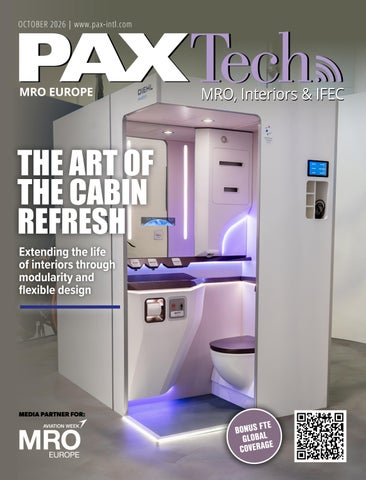
THE ART OF THE CABIN REFRESH Extending the life of interiors through modularity and flexible design
MEDIA PARTNER FOR:
TE BONUS F GLOBAL E COVERAG
EDITOR’S LETTER
PAX Tech Mississauga, Ontario Canada Website: www.pax-intl.com
PUBLISHER Aijaz Khan E-mail: aijaz@globalmarketingcom.ca
EDITORIAL OFFICES Jane Hobson, Managing Editor Tel: (1 416) 997-3914 E-mail: jane@pax-intl.com Robynne Trueman, Business Editor Tel: (1 705) 471-4110 E-mail: robynne@pax-intl.com Alex Preston, Senior Editor Tel: +44 (0) 7969 092913 E-mail: alex@pax-intl.com
ART DEPARTMENT Kelly Wong, Senior Graphic Designer
CONTRIBUTORS Kieran Ricci
Retrofitting for the future
A
s the seasons shift and the industry heads to Amsterdam for Aviation Week’s MRO Europe 2026 this month, the conversations in these pages also turn a new leaf, focusing on the key considerations for airline decisionmakers in cabin refurbishment. This year’s event is set to spotlight the trends shaping the future of maintenance, repair and overhaul, with discussions focused on digital transformation, sustainability, workforce development and supply chain resilience. “These themes reflect the industry’s adaptability and innovation as it navigates a period of rapid transformation,” says Mark Thomas, Senior Director of Marketing at Aviation Week Network. The emphasis on adaptability is prevalent throughout this issue as experts from IFPL Group, Panasonic, Axinom and Rosen Aviation discuss future-proofing the aircraft cabin through modularity, open architectures and connectivity. Brad Smith, CTO for Aviation at Viasat, tells PAX Tech that in today’s market, retrofitting for the future comes down to building on a standard, allowing airlines to swap one module for the next rather than starting from scratch when new innovations are introduced. Porter brings an airline perspective to updating cabin interiors, highlighting the carrier’s upgraded De Havilland Dash 8-400 fleet featuring Expliseat’s TiSeat 2V seats. “Updating seats, along with other cabin upgrades, will noticeably refresh and modernize the overall environment,” says Kent Woodside, Executive Vice President and Chief Operating Officer at Porter Airlines. We hope you enjoy this issue in true Dutch fashion–over a cup of coffee (or two)–as you take in the sights of the canals, breathe in the crisp autumn air and gear up for engaging conversations on the expo floor. Safe travels to Amsterdam and see you soon!
PAX International and PAX Tech are published a total of 10 times a year by PAX International, Mississauga, Ontario, Canada. International Distribution.
Robynne Trueman Business Editor PAX Tech
ISSN 1206-5714 Key title: Pax International
www.pax-intl.com | PAX TECH | 3
CONTENTS
20
MRO
35
Features AIRLINES
10
SATISFACTION GUARANTEED Alina von Bethmann, Senior Director Program Starlink Transformation at Lufthansa Group, talks to PAX Tech about the airline’s rollout of Starlink service
12
INVESTING IN ECONOMY Porter is refreshing its 29 Dash 8-400 aircraft with TiSeat 2V seats, LED lighting, carpeting and updated cabin features
ON THE COVER: In Diehl Aviation’s AURS, tactile guidance, Braille and distinctively shaped controls are integrated into the overall lavatory architecture instead of being treated as separate additions. Read more on page 20.
DEPARTMENTS
3 6 33 38 42
EDITOR’S NOTE NEWS FTE GLOBAL EVENTS FACTS & FIGURES
4 | PAX TECH | OCTOBER 2026
14
READY, SET, RETROFIT Andy Masson, Senior Vice President Product & Strategy, PAC highlights the importance of a modular, software-led approach to IFE retrofit
16
PORTUGAL AS A KEY PILLAR Lufthansa Technik positions Portugal as a cornerstone of European aviation maintenance as it breaks ground on its facility in Santa Maria da Feira, south of Porto
CABIN EQUIPMENT
20
CABIN CUES Inside Diehl Aviation’s approach to accessible cabin design, bringing invisible passenger needs into focus for airlines
IFE
22
CONTENT AND THE CLOUD Touch Inflight Solutions’ Alex Glavonich explains the evolving role of CSPs in keeping passengers engaged in the era of connected cabins
26
RAISING SEATBACK STANDARDS Rosen Aviation and Axinom partner to deliver a lightweight seatback screen that operates as a central cloud-based entity in a LEO-connected world
CONNECTIVITY
28
BUILDING FOR THE FUTURE Viasat’s Brad Smith makes the case for standardization with modularity as a complementary approach to future-proofing IFC investments
IN-SEAT POWER
30
THE POWER TO ADAPT Neil McGregor, COO, IFPL Group, explains the importance of investing in adaptable architectures to power connected cabins
10
Viasat ΛMΛRΛ Connectivity as unique as your airline. Seamless multi-orbit IFC Flexible digital services Connected applications
LEARN MORE ABOUT VIASAT ΛMΛRΛ
NEWS EXHIBITOR
ABC International highlights non-textile cabin flooring
ABC International’s Non-Textile Floor solution is designed for high-traffic aircraft cabin areas, including galleys, entrance zones and lavatories
ABC International is spotlighting its Non-Textile Floor (NTF) solution, developed for demanding aircraft cabin applications including entrance zones, galleys and lavatories. The flooring combines flame-retardant PVC with optimized geometry to support dimensional stability and dependable performance in high-traffic environments. The NTF solution is designed to remain flat and retain dimensional integrity after prolonged exposure to elevated temperatures, positioning the product as a durable, cost-effective option for cabin interiors. Key features include slip resistance compliant with CS/ FAR 25.793, along with resistance to abrasion, mechanical impacts and everyday operational wear. The flooring also meets CS/FAR 25.853 flammability requirements. ABC International offers standard color options for rapid delivery, as well as custom finishes to support airline branding and cabin interior design requirements.
EXHIBITOR
Lufthansa Technik AG names Harald Gloy next CEO Lufthansa Technik AG has announced that Harald Gloy will become its next CEO. Gloy will succeed Soeren Stark, who is retiring, effective February 1, 2027. The company’s Supervisory Board has appointed the 54-year-old graduate engineer to lead for a five-year term. He has been a member of the company’s Executive Board since 2022, serving as Chief Operating Officer (COO). Grazia Vittadini, Chairwoman of the Supervisory Board of Lufthansa Technik AG, said, “Harald Gloy combines deep knowledge of Lufthansa Technik with broad leadership experience across the Lufthansa Group. He has played an important role in the company’s strong performance and knows our customers, our employees and the global maintenance, repair and overhaul market exceptionally well. The Supervisory Board has full confidence in his ability to lead Lufthansa Technik into its next phase, deliver on the company’s strategy and further strengthen its position as a global industry leader. I look forward to continuing to work with Harald and the entire Executive Board as he takes on his new role.” Soeren Stark will continue to lead the company until Gloy takes office.
Harald Gloy, incoming CEO of Lufthansa Technik AG
6 | PAX TECH | OCTOBER 2026
Inclusive, accessible, boundless. Diehl Aviation’s Space³ is an innovative cabin solution that ensures equal and dignified travel for all passengers, regardless of age, size, or mobility. The fully accessible layout includes three fully equiped lavatories and allows up to four additional seats, optimizing space while reducing weight through intelligent structural design. Space³ combines accessibility, efficiency, and revenue potential to set a new standard in inclusive air travel.
DISCOVER SPACE 3
NEWS EXHIBITOR
Diehl Aviation marks 20 years of innovation in Rostock Last month, Diehl Aviation’s development site in Rostock, Germany celebrated its 20th anniversary. What began in 2006 with just under 20 employees has evolved over the past two decades into an established engineering site that today provides 35 jobs. The Rostock team has become an integral part of the company’s development network, contributing its expertise to the development of modern aviation systems. One of the site’s distinguishing features is its versatility, Diehl tells PAX Tech. While other development sites primarily specialize in individual technology fields, the Rostock team combines expertise in avionics and cabin systems under one roof. This broad technological scope has played a key role in the site’s successful development over the past two decades. After 20 years, the Rostock site remains on a growth trajectory with Diehl expanding its capacities in the Hanseatic city. “The Rostock site exemplifies what Diehl Aerospace stands for: technical excellence, a strong capacity for innovation, and highly dedicated employees,” said Florian Maier, CEO of Diehl Aerospace. “Given the excellent prospects in both civil and military aviation, we will continue to invest in our engineering capabilities and systematically expand the site.”
After 20 years, the Rostock site remains on a growth trajectory
8 | PAX TECH | OCTOBER 2026
EXHIBITOR
AJW Group expands partnership with Sun PhuQuoc Airways
AJW Group signs PBH agreement with Sun PhuQuoc Airways to support the carrier’s expanding A330 fleet
AJW Group has announced the signing of a six-year Power-by-the-Hour (PBH) support agreement with Sun PhuQuoc Airways (SPA). The agreement will support the carrier’s expanding A330 fleet as it prepares to expand its medium- and long-haul operations and international network across the Asia-Pacific region. Scott Symington, Chief Commercial Officer at AJW Group, said, “We are delighted to expand our partnership with Sun PhuQuoc Airways as they embark on this exciting new phase of growth. Supporting the introduction of a new widebody fleet requires careful planning, reliable logistics, and strong technical expertise, and we are proud to bring all three to this program. Having already established support for the airline’s A320 family earlier this year, this agreement is a natural next step in our relationship.” Pham Dang Thanh, Deputy CEO at Sun PhuQuoc Airways, said, “As we scale our widebody operations, having the right technical partner is critical, not only to ensure reliable component support, but also to give us the confidence to expand our international network with pace and reliability. AJW Group’s proven track record and collaborative approach make them a strong partner for us as we enter this next chapter.”
AIRLINES
The Lufthansa Group Starlink installation is conducted by aircraft fleet
SATISFACTION GUARANTEED L
Alina von Bethmann, Senior Director Program Starlink Transformation at Lufthansa Group
Alina von Bethmann, Senior Director Program Starlink Transformation at Lufthansa Group, talks to PAX Tech about the airline’s rollout of Starlink service by ALEX PRESTON
10 | PAX TECH | OCTOBER 2026
ufthansa Group’s continual investment in aircraft and premium product and service innovations along the entire travel chain, has reached a new milestone. Coinciding with Lufthansa’s 100th anniversary, an occasion it calls “a bold look into the future,” the Group has launched high-speed, inflight Wi-Fi provided by Starlink,with a Lufthansa A320neo the first aircraft to offer the product. In total, 850 aircraft across the Group’s airlines (Lufthansa, SWISS, Austrian Airlines, Brussels Airlines, ITA Airways, Edelweiss, Discover Airlines, Air Dolomiti, Lufthansa City Airlines and Eurowings) will be equipped with the “Lufthansa Group Wi-Fi” branded service by the end of 2029. This makes Lufthansa Group the largest airline group in Europe to equip its fleet with Starlink.
Rollout roadmap
“For the time being the Starlink installations are retrofit events, meaning the aircraft is already operative in the fleet, or will undergo an installation right after Transfer of Title and after the ferry flight to a Lufthansa Group hub,” Alina von Bethmann, Senior Director Program Starlink Transformation at Lufthansa Group, tells PAX Tech. To avoid additional ground-time, in most cases the installation is conducted during regularly planned aircraft layovers, for example C-Checks using the overall planning dependencies and build-on efficiencies from scheduling. The process time is primarily based on the conditions and time-needs of the checks that are conducted. “We always optimize where possible, to link the different tasks even better, also based on learnings we could gather throughout the first installations of our A320 aircraft,” she says.
Lufthansa Group has launched high-speed, inflight Wi-Fi provided by Starlink,with a Lufthansa A320neo the first aircraft to offer the product
Lufthansa Group plans to have up to 50 aircraft equipped before the end of this year
To avoid additional ground-time, in most cases the installation is conducted during regularly planned aircraft layovers
The installation is conducted by aircraft fleet. Currently several airlines within the Lufthansa Group are equipping aircraft from the A320 family with Starlink. Other fleets are to follow gradually, with the A350 and the A330 scheduled to be next in line, von Bethmann confirms. For scheduling, the Group plans to have up to 50 aircraft equipped before the end of this year—an install rate of more than two aircraft per week. It is a pace that will increase by the beginning of next year, says von Bethmann, depending on aircraft availability and on the summer and winter flight plan.
A new era
The Lufthansa Group Wi-Fi is sponsored by Mastercard, as was its previous inflight broadband service, FlyNet. The service will be complementary for all passenger groups, as long as they are Miles&More members, the Groups’ frequent flyer and awards program or have a Travel ID account. Travel ID registration is free of charge. “At Lufthansa Group we believe that the individual choice of our guests is best offered by a consistent experience throughout the airlines of the group. Offering complementary high-speed internet gives us the chance for
enhanced and closer interaction with our guests onboard,” von Bethmann says. Passengers will be able to watch videos, access cloud-based working, and other high-speed applications whilst in flight, on several devices at once. Terms of use apply to all passengers, which have been developed based on passenger surveys. According to von Bethmann, future use-cases will include personalized retail options, entertainment offers and impulses for travel-related services, as well as destination-based offers.
www.pax-intl.com | PAX TECH | 11
AIRLINES
INVESTING IN
Porter Airlines is upgrading its Dash 8-400 cabins with LED mood lighting, reading lights and new carpeting
ECONOMY
Porter is refreshing its 29 Dash 8-400 aircraft with TiSeat 2V seats, LED lighting, carpeting and updated cabin features by KIERAN RICCI
Kent Woodside, Executive Vice President, Chief Operating Officer, Porter Airlines
P
orter Airlines unveiled its upgraded De Havilland Dash 8-400 fleet this summer, reinforcing the airline’s focus on comfort, hospitality and consistency across its aircraft types. All 29 Dash 8-400 aircraft are being refreshed with the latest generation of Expliseat’s TiSeat 2V, along with updated cabin lighting, reading lights and carpeting. The first upgraded aircraft are already in service, with the full fleet expected to be completed this fall. In an August interview, Kent Woodside, Executive Vice President, Chief Operating Officer at Porter Airlines, told PAX Tech that refresh responds directly to passenger feedback and reflects Porter’s wider approach to the onboard experience. “Our passengers told us that seat comfort is a meaningful part of their experience, even on shorter regional flights,” Woodside says. “Updating seats, along with other cabin upgrades,
12 | PAX TECH | OCTOBER 2026
will noticeably refresh and modernize the overall environment.” Porter’s Dash 8-400 fleet operates regional routes in Eastern Canada and the U.S., with Billy Bishop Toronto City Airport (YTZ) serving as the airline’s Dash 8 hub. From the downtown airport, Porter is continuing to build frequency and connectivity, offering travelers more options than any other airline, Woodside says.
Refresh ramps up
The cabin refresh centers on Expliseat’s TiSeat 2V, which Woodside describes as the world’s lightest aircraft seat in its category. The latest generation introduces a series of refinements designed to improve comfort and convenience for passengers, while supporting operational efficiency for the airline. The seats feature redesigned cushions, custom-developed to Porter’s specifications, along with updated tray tables and an integrated Personal
Electronic Device holder for handsfree viewing. First-row seats have also been redesigned with tray tables that provide additional personal space. LED technology with mood lighting and reading lights, as well as refreshed carpeting is also part of the refresh. Woodside says these changes align with Porter’s continuing commitment to provide an elevated Economy service offering. The airline’s cabin configuration and legroom remain unchanged. Porter operates its Dash 8 fleet with 78 seats, including 32 inches of legroom in PorterReserve and 30 inches in PorterClassic. The aircraft’s two-by-two layout offers an Economy experience with no middle seats.
Understanding regional realities
Porter is positioning the upgrade as a step in its effort to bring a more premium feel to regional flying, even on shorter sectors where aircraft size
A comprehensive cabin refresh across its Dash 8-400 fleet with the latest generation of Expliseat’s TiSeat 2V featuring redesigned cushions, updated tray tables and an integrated Personal Electronic Device holder for hands-free viewing
and operating requirements can create design constraints. “Porter is known for providing a globally recognized flying experience, and we will continue prioritizing comfort and genuine hospitality as part of our standards,” Woodside says. “We are pleased to be the first Canadian airline operating with enhanced Dash 8 cabins.” For Porter, the design and selection process required balancing passenger comfort, durability, operational efficiency and the realities of a regional aircraft environment. Woodside says the airline’s existing relationship with Expliseat helped guide the process. “We have a long-standing partnership with Expliseat, and they understood the balance we were looking for in the new seat design,” he says. The TiSeat 2V uses carbon fiber and titanium materials to significantly reduce weight. Woodside says the
lighter seat supports lower fuel consumption and reduced CO₂ emissions throughout the life of the aircraft. A lighter aircraft can also help extend range and reduce Maximum Takeoff Weight constraints. The project brought together Porter’s internal maintenance expertise with Expliseat’s seat design and engineering capabilities. “Porter’s Maintenance team was essential in the planning and implementation of this important project,” Woodside says. “They worked closely with Expliseat to find a solution that would enhance the passenger experience and improve operational efficiency.”
Keeping Economy consistent
According to Woodside, Porter already sees strong overall passenger satisfaction scores for its Dash 8 fleet, and the upgraded cabin builds on that foundation.
“This investment is just another way we are continuing to invest in Economy travel,” he says. It also supports Porter’s broader strategy of delivering a consistent passenger experience across its entire fleet, the Dash 8-400s and Embraer E195-E2s. The airline has continued to emphasize features such as complimentary beer and wine served in glassware, no middle seats and a hospitality-focused service style. “Porter has led the way in bringing Economy travelers an elevated flying experience across both our Dash 8 and Embraer E195-E2s,” Woodside says, emphasizing the “genuine care and hospitality” Porter delivers on all flights. As the reinvigorated Dash 8-400s continue entering service, Porter is bringing a more modern cabin experience to its network, while maintaining the features that have long defined its premium passenger experience. www.pax-intl.com | PAX TECH | 13
IFE Astrova is now flying on more than 30 airlines
READY, SET,
RETROFIT Andy Masson, Senior Vice President Product & Strategy, PAC highlights the importance of a modular, software-led approach to IFE retrofit
A
Andy Masson, Senior Vice President Product & Strategy, PAC
by ROBYNNE TRUEMAN
s more inflight entertainment functionality moves from hardware into software, the definition of an IFE retrofit is expanding. Modernizing the passenger experience once required replacing an entire system. Airlines now have more options to upgrade without a full replacement. For Panasonic Avionics Corporation (PAC), flexibility within the system is the key to futureproofing. Its Astrova solution, now flying on more than 30 airlines, reflects this deliberately modular approach. Andy Masson, Senior Vice President Product & Strategy, PAC tells PAX Tech, “Our platform software helps airlines to increase velocity in changing and upgrading applications, content and their user interface. Then, as market demands warrant, airlines can selectively upgrade hardware where 14 | PAX TECH | OCTOBER 2026
additional processing power, storage, connectivity or peripherals are needed.” Astrova’s modern software makes upgrades to the passenger experience turnkey, enabling airlines to refresh the look and feel of the interface, improve personalization and other forms of digital engagement. “Airlines need a practical path to align their passenger experience across diverse fleets without replacing seats, wiring or cabin infrastructure,” Masson explains. “Our platform approach paves the way for a modern digital experience at speed.” The result, he says, is a more targeted retrofit strategy where airlines can preserve parts of the installation that retain value and modernize the areas passengers interact with most frequently.
Standardizing software
“Our over-the-air distribution processes are poised to help airlines keep their digital experiences up to date like never before, changing the rhythm of passenger experience development,” Masson explains. Software and content updates deliver the most visible improvements in the passenger interface and the software, content and design decisions that shape it. Refreshing visual identity, improving content discovery, introducing new applications, updating maps and destination content, refining advertising and retail experiences, and making the journey more intuitive are among the changes airlines can implement remotely or during routine maintenance. Masson says some carriers may opt to build or deploy third-party applications. One example is BBC Player, a streaming platform designed
exNeo replaces legacy X-series monitors while retaining existing seats, hardnesses and mechanical interfaces
by BBC Studios specifically for aviation. Announced in partnership with PAC at AIX 2026, the platform is set to launch later this year. Software updates can improve Bluetooth performance, support more applications or preserve personalized settings. Deployment depends on connectivity, system configuration, certification requirements or the type of updates, he notes. “Rather than waiting for the next major hardware program, our airlines can make smaller, more focused improvements throughout the operating life of their system,” Masson explains. PAC’s standardized software platform model supports quicker and more reliable additions and updates to the system benefitting loyalty, revenue, enterprise integration and AI teams.
The hard(ware) conversations
For hardware retrofits, airlines should choose an IFE system that can evolve throughout the service life, Masson says. Processing capacity, memory, storage and OS support determine the scope for future softeware updates, while modular design allows component upgrades with less downtime. “While every architecture will still have practical hardware and compatibility limits, our modular design and standardized foundation provide great flexibility to add capabilities over time,” Masson says.
PAC’s customers seek a consistent digital experience across aircraft types and generations. A common software and application environment makes passenger experience upgrades easier to introduce fleet-wide, Masson says. “The objective here is not to eliminate future hardware investment completely,” he explains. “The intent is to make that investment more selective so that an airline can update the specific component that creates a constraint rather than repeatedly replacing the entire system and incur costs associated with the re-certification of the seat.”
Creating consistency
Software-led upgrades retain more of the existing installation than hardware retrofits, reducing physical work and potentially limiting recertification. The focus shifts to loading content, configuration and validation, although downtime varies with the installation and certification scope, Masson says. He explains that the ideal balance between software and hardware is to make targeted hardware upgrades when performance becomes a constraint, and use software to evolve the passenger experience over time. An approach reflected by PAC’s eXNeo seatback screen, released earlier this year. exNeo replaces legacy X-series monitors while retaining existing seats, hardnesses and mechanical interfaces. Its updated processing, storage, Bluetooth and Android capabilities
create a stronger foundation for modern digital experiences and interactive content without requiring a full cabin overhaul. “Our goal with eXNeo was to ensure existing X-Series customers with older aircraft could still deliver a similar digital experience as Astrova, albeit without 4K or OLED,” Masson explains. “eXNeo gives these X Series customers a clear path to enhance their digital engagement, extend the life of their cabin investments and deliver meaningful improvements to the passenger experience today.” He adds that eXNeo solves this technology gap for many airline customers by offering a cost-effective means to deliver a common passenger experience across an airline’s fleet, but he reinforces that modular systems that can be upgraded over time, like Astrova, are the future of the commercial aviation industry.
Keeping the balance
Masson sees the future of IFE lifecycle management as a balance between flexible, modular hardware and continuous software improvements. As applications become more demanding, airlines must ensure hardware can keep pace while using software to refresh the passenger experience more frequently. “It is one of the main reasons we are so focused on modularity with Astrova,” Masson explains. A modular, software-led approach can extend system lifecycles, reduce the need for full cabin replacements and deliver both cost and sustainability benefits by retaining existing architecture wherever possible. “A more resource-conscious retrofit strategy is where Panasonic’s eXNeo seatback screen highlights this sustainability effort. The drop-in approach is specifically designed for existing seats, harnesses and other interfaces rather than requiring a full cabin overhaul and recertification,” Masson says.
www.pax-intl.com | PAX TECH | 15
MRO Lufthansa Technik marked a key milestone earlier this year by officially breaking ground on its 55,000-squaremeter facility in Santa Maria da Feira
Portugal as a key pillar L Lufthansa Technik positions Portugal as a cornerstone of European aviation maintenance as it breaks ground on its facility in Santa Maria da Feira, south of Porto by ROBYNNE TRUEMAN
16 | PAX TECH | OCTOBER 2026
ufthansa Technik marked a key milestone earlier this year by officially breaking ground on its 55,000-square-meter facility in Santa Maria da Feira, south of Porto. Lufthansa Technik Portugal, founded in 2024, is set to create up to 700 new jobs in the aviation industry over the coming years. Portuguese Prime Minister Luís Montenegro highlighted the project’s value for the country at the groundbreaking ceremony in June, alongside representatives from politics, business and partner organizations. “We are here for the benefit of the country, promoting a development strategy alongside our partners, Lufthansa Technik and Lufthansa Group. We are the primary stakeholders in ensuring the longevity of this partnership. I am confident that we will reinforce our political,
economic, and working relationship with Germany,” Montenegro said. The Lufthansa Technik Portugal facility, a wholly owned subsidiary of Lufthansa Technik, is dedicated to the repair of engine parts and aircraft components. With its three-digit million-euro investment in Portugal, the company will further expand its capabilities and strengthen its global network. Start of operations is expected in 2028. “The groundbreaking in Santa Maria da Feira is a visible and powerful symbol of what the Lufthansa Group stands for in Portugal: a reliable, longterm industrial partner. For more than 70 years, we have been present in this country,” said Carsten Spohr, CEO, Lufthansa Group. “With this investment by Lufthansa Technik, we are positioning Portugal as a cornerstone of European aviation maintenance.”
JOIN PAX PANEL
The industry’s best virtual roundtable discussion series, featuring executives and representatives from the industry’s most iconic companies Share key insights, learnings and experiences from your sector in PAX Panel: All episodes available online Featured in digital editions of PAX International and PAX Tech Share on your website and social channels Attract new clients PREVIOUS SPONSORS INCLUDE:
ALL PAX PANEL EPISODES ARE AVAILABLE ONLINE SO THAT EVERYONE CAN WATCH AND SHARE FOR ALL EPISODES CLICK HERE! The PAX Panel concept is created and hosted by PAX International and PAX Tech. Contact jane@pax-intl.com to become a panelist
MRO
Spohr adds that Portugal has become one of the most strategically important locations for Lufthansa Group beyond its home markets. “This facility reflects the confidence we place in Portuguese talent, capabilities and ambition. This depth of commitment across industry and innovation also underpins our strong interest in TAP Air Portugal as a natural extension of the partnership with Portugal we have been building for decades – with the country serving as Europe’s gateway to South America, Africa and the Portuguese-speaking world,” Spohr said. The facility’s groundbreaking marks a significant mielstone for the Lufthansa Group in Portugal and reflects a broader vision for its presence in the country. The investment extends beyond a single facility, encompassing maintenance excellence, a TravelTech and AI Hub in Northern Portugal, and Associação help alliance Portugal—a new Portuguese identity of help alliance, the Luftnasa Group’s aid organization. It is the first time a help alliance organization has been founded outside of Germany in Europe, underscoring the social commitment of the Lufthansa Group in the home market. The Group’s engagement in Portugal reflects a multi-dimensional approach. Seven Lufthansa Group airline brands
18 | PAX TECH | OCTOBER 2026
Lufthansa Technik Portugal, founded in 2024, is set to create up to 700 new jobs in the aviation industry over the coming years
The Lufthansa Technik Portugal facility is dedicated to the repair of engine parts and aircraft components
(Lufthansa, SWISS, Austrian Airlines, Brussels Airlines, Edelweiss, Eurowings and Discover Airlines) currently operate 353 weekly flights to Lisbon, Porto, Faro, Madeira and the Azores. With more than 500 employees already working across the Lufthansa Group’s entities in Portugal, and a combined ambition to create more than 1,000 direct jobs across various businesses in the years ahead, the Lufthansa Group is establishing one of its most significant employment platforms. “Lufthansa Technik has big plans and strong ambitions, and Portugal will be a key pillar of our continued growth and long-term success. With this new facility in Santa Maria da Feira, we will put a key part of our strategy into action and build a site that will
play an important role in the aviation industry,” said Harald Gloy, incoming CEO of Lufthansa Technik. Establishing Lufthansa Technik Portugal at the Santa Maria da Feira facility was made possible through the close and trusted partnership Lufthansa Technik has built with Portuguese policymakers. “I would like to sincerely thank the Government, the trade and investment agency AICEP and the City of Santa Maria da Feira for their strong support and shared commitment. Today’s groundbreaking marks the start of an exciting chapter and clearly demonstrates what can be achieved when the right partners work closely together with a common purpose,” Gloy said.
More flights. More cities. More Florida!
Nonstop flights to 6 Florida cities from Pearson.
This winter, enjoy nonstop flights to Orlando, Fort Lauderdale, Miami, Tampa, Fort Myers & West Palm Beach on Porter. On your flight, enjoy complimentary beer, wine and premium snacks; free, fast streaming WiFi; delicious fresh meal options and no middle seats! You’ve never flown to Florida like this before! Actually enjoy economy!
www.pax-intl.com | PAX TECH | 19
CABIN EQUIPMENT
CABIN CUES Tammo Bahns, Customer Innovation Engineer at Diehl Aviation
Tactile elements are another valuable way for passengers who need to orient themselves, locate a control or confirm a function without relying solely on vision
Inside Diehl Aviation’s approach to accessible cabin design, bringing invisible passenger needs into focus for airlines
F
by ROBYNNE TRUEMAN
or two consecutive years, Diehl Aviation has received the Crystal Cabin Award in the accessibility category. This year for its Adaptive User Routing System (AURS) concept, which extends the focus to passengers with visual or hearing accessibility needs and for its Space³ lavatory concept in 2025. For Tammo Bahns, Customer Innovation Engineer at Diehl Aviation, these honors reflect a consistent development direction for the company. “Both concepts were shaped through direct input from people with relevant accessibility needs. These users did not simply evaluate finished products. Their experience actively
20 | PAX TECH | OCTOBER 2026
influenced the design,” he tells PAX Tech in a September interview. This exemplifies Diehl Aviation’s philosophy for approaching accessibility onboard, considering sensory, cognitive and other less visible requirements from the beginning rather than as a feature to be added later.
Visibility for invisible requirements
For Diehl, accessibility is considered at the earliest stage of cabin definition, before layouts and product architectures have been fixed. Bahns says it must extend beyond visible mobility limitations to encompass layout, lighting, information, controls
and the overall passenger interaction. “Airlines should involve affected passenger groups in development and evaluation, and plan for both line-fit and retrofit applications,” he explains. “Requirements are diverse, so continuous testing and improvement are more effective than treating accessibility as a single feature or a compliance exercise.” Bahns emphasizes that accessibility and operational efficiency are not competing priorities. Diehl Aviation’s Space³ concept combines two of three lavatory units into an enlarged, wheelchair-accessible space within a conventional two-lavatory arrangement, as an example. “Thoughtful accessibility can support passenger independence, privacy, comfort and dignity while remaining practical and economically viable for airlines,” he affirms.
Controls accessible for all
For a cabin to be truly accessible, controls should be intuitive for all passengers; easy to locate, clear in purpose and responsive, providing immediate feedback when activated. Using these controls should not require perfect vision, hearing or dexterity, knowledge of a particular language or familiarity with the aircraft interior.
Accessible wayfinding should guide passengers through an intuitive sequence: where they are, what they can operate and what will happen next
Accessible design for invisible mobility limitations can range from using cabin lighting to create spatial awareness to using a visual hierarchy to communicate safety protocols. For Diehl Aviation, lighting is both an atmospheric design element and a functional accessibility tool. In compact environments such as aircraft lavatories, carefully designed lighting can improve spatial perception, make controls and functional areas easier to recognize, and guide passengers toward relevant touchpoints. In the AURS solutions, adaptive lighting is part of the broader orientation system which includes high-contrast surfaces, tactile guidance, Braille, distinctively shaped controls, visual information and optional audio cues. Similarly, color, contrast and visual hierarchy can help passengers identify important information and understand how to interact with the cabin environment. Strong contrast can distinguish controls and functional elements from surrounding surfaces, while a clear hierarchy ensures that key actions and safety information are recognized first. “Our design approach seeks to reduce unnecessary visual complexity and apply a consistent logic across related functions,” says Bahns. “Color is never considered in isolation. It is supported by shape, positioning, symbols, labeling and tactile information.” The design must also remain clear in different lighting conditions, regardless of vantage point and distance. For example, in Space³, tailored lighting and color schemes additionally help
improve the perception of space within a compact lavatory environment. These elements, lighting, color and contrast, and visual hierarchy, are a core consideration when developing signage for accessible wayfinding. To better support passengers who have difficulty processing visual information or interpreting conventional signage, Bahns explains that accessible wayfinding should guide passengers through an intuitive sequence: where they are, what they can operate and what will happen next. “Information should be concise, consistently positioned and available through more than one sensory channel,” he tells PAX Tech. Diehl’s AURS concept achieves this by combining various symbols, tactile features and stimuli that are helpful for better orientation. For example, safety announcements can also be presented visually on an integrated mirror screen, helping critical information reach passengers who may not hear an announcement. AURS uses high-contrast surfaces, tactile guidance, Braille and distinct control shapes to make orientation intuitive and reduce unnecessary contact. Safety announcements appear visually on an integrated mirror display, ensuring critical information is never audio-only. Adaptive lighting and optional audio cues highlight essential elements and support passengers with low vision. “The concept’s adaptive digital layer provides a basis for presenting information in different ways according to passenger requirements. The goal is not to add more
In AURS, tactile guidance, Braille and distinctively shaped controls are integrated into the overall lavatory architecture instead of being treated as separate additions
information, but to make the right information easier to find, understand and act upon,” Bahns says. Tactile elements are another valuable way for passengers to orient themselves, locate a control or confirm a function without relying solely on vision. In AURS, tactile guidance, Braille and distinctively shaped controls are integrated into the overall lavatory architecture instead of being treated as separate additions. “When accessibility is considered from the outset, these elements can become a coherent part of the interior design rather than a visual or functional compromise,” he says.
AURS onboard
AURS is being trialed with accessibility groups, with Diehl’s connectedcabin platform technically mature but requiring aircraft-specific implementation and certification. “We want to apply the lessons learned to additional cabin elements and address accessibility more systematically across the future product portfolio,” says Bahns of what is next for Diehl Aviation. Potential development areas for the company include adaptive systems, touchless functions, and broader connected-cabin applications. www.pax-intl.com | PAX TECH | 21
IFE
Content and the cloud Voyager, Touch’s end-to-end media engagement platform, is designed to give airline teams direct control over the passenger experience via activation campaigns and content presentation
Touch Inflight Solutions’ Alex Glavonich explains the evolving role of CSPs in keeping passengers engaged in the era of connected cabins
A
by ROBYNNE TRUEMAN
s more airlines bring high-speed connectivity onboard, the passenger inflight entertainment experience is rapidly evolving. And with it, the traditional Content Service Provider (CSP) model. As Alex Glavonich, VP of Creative Strategy, Brand & Innovation at Touch Inflight Solutions tells PAX Tech, “Digital Experience Management, which combines media licensing and technical processing with true experience management, is replacing the traditional CSP model of licensing, encoding and content delivery.” Content positioning and editorial control can now be managed through web technologies rather than static hardware. Inflight connectivity (IFC) plays a large part in driving this shift which Glavonich calls “a double-edged
22 | PAX TECH | OCTOBER 2026
sword,” because once passengers have unrestricted high-speed access, they can easily switch to the apps they already use on the ground. For an airline’s IFE platform, the plethora of content choices mean earning passenger attention, rather than assuming it.
Adapting to demand
Passengers increasingly expect the on-demand access, personalization, multiple formats and freedom to move between screens that they experience in their daily life, while onboard. Touch has adapted to that shift by moving beyond the licensing-and-delivery model. “Alongside our core expertise in content strategy, curation and licensing, we are using cloud-native workflows, supporting incremental over-the-air delivery and direct
Alex Glavonich, VP of Creative Strategy, Brand & Innovation, Touch Inflight Solutions
streaming models, and expanding into connected formats and services such as OTT, IPTV and FAST where the technology and rights environment allow,” Glavonich explains. He notes that the changing role of the CSP is no longer just about deciding what goes in the content library, but determining what deserves attention, how passengers access that content and how to make it feel more contextual and relevant to the journey. “Technology gives us more possibilities. Our job is to turn those possibilities into a better entertainment experience,” he says.
WINNER OF THE
2026 PAX VERIFIED AWARD FOR EUROPE
VERIFIED AWARD
WINNER 2026
WWW.PAX-INTL.COM
IFE
Content positioning and editorial control can now be managed through web technologies rather than static hardware
Curation vs. connectivity
For CSP’s like Touch, the best content strategy embraces the various ways users want to engage with onboard systems. “We do not see curated IFE, bringyour-own-device and connectivity as competing propositions,” Glavonich says. “The strongest experience combines them – connectivity expands the passenger’s choices, technology enables the experience and curation turns abundance into relevance.” As Glavonich explains, access and curation solve different problems: while passengers have near-unlimited entertainment at their fingertips, curation answers the question of what is worth watching on the journey. “As access becomes less scarce, relevance becomes more valuable,” he says, pointing to the unique role of curated IFE in delivering this relevance by considering the context of the passenger’s route. Curation allows an airline to express its brand through the content it champions, the voices it introduces and the experiences it builds around it. Rather than offering exclusive titles,
24 | PAX TECH | OCTOBER 2026
differentiation comes from using passenger data to shape discovery and create a dynamic, engaging entertainment experience tailored to the airline’s audience. “Good content strategy is also about interpreting why, trying something new and learning from it. That is how curation becomes more than selecting titles and starts becoming part of what makes the airline experience distinctive,” Glavonich says.
Personalizing IFE platforms Using data to personalize the content experience onboard is another way Touch is working to retain passenger attention. “The IFE platform is built around a closed data loop. Every passenger interaction, from plays and pauses to favorites, UI clicks, and search queries, feeds into a central data lake. That data then helps inform content curation and experience decisions for the next cycle,” Glavonich explains. Touch is building an agentic system on that foundation for personalization, using contextual and behavioral data to create more relevant content
For CSP’s like Touch, the best content strategy embraces the various ways users want to engage with onboard systems
collections for each passenger. Voyager, Touch’s end-to-end media engagement platform, is designed to give airline teams direct control over the passenger experience via activation campaigns and content presentation. Pre-flight, inflight and post-flight are all covered by the same cloud-native system, eliminating the need to manage three separate systems. The platform supports direct cloud streaming where higher-bandwidth connectivity is available, or incremental over-theair updates to an onboard server for aircraft without dependable connectivity. The goal, Glavonich says, is to get new content in front of passengers quickly. “To pioneer an avant-garde and truly intuitive user interface, Touch strategically partners with specialized industry experts such as the renowned London design firm Monokoto, ensuring the digital experience instantly captivates travelers,” he adds. Touch has already secured a major airline customer on the platform, with further proof-of-concepts underway across other parts of the solution.
Stay in touch with &
IN PRINT PAX issues are distributed at some of the biggest international onboard services, aircraft interiors and MRO trade shows around the world.
IN YOUR INBOX Get breaking industry news weekly to your inbox, and copies of our digital issues as soon as they are available.
ONLINE Our website is updated daily with content from the seating, interiors, IFEC and MRO industries, plus onboard catering and passenger services news. For advertising queries, please contact jane@pax-intl.com or robynne@pax-intl.com
WWW.PAX-INTL.COM
IFE
RAISING SEATBACK STANDARDS Rosen Aviation and Axinom partner to deliver a lightweight seatback screen that operates as a central cloud-based entity in a LEO-connected world by ROBYNNE TRUEMAN
Lee Clark, Senior Vice President Strategy, Rosen Aviation
Ralph Wagner, CEO, Axinom
for entertainment, commerce, loyalty, disruption management and other airline services, with the cloud serving as the system’s “brain.” The platform rethinks traditional inflight entertainment architecture, replacing bulky seatback systems tied to a vendor’s closed ecosystem with a lightweight, cloud-connected screen at the center of the passenger experience.
“Taking the data wiring out of the cabin raises the bar for the display. Each screen has to run the airline’s applications on its own and hold up in a commercial cabin for years,” Lee Clark, Senior Vice President Strategy at Rosen Aviation, tells PAX Tech. “That is the standard we have built toward in business aviation for decades, and we are bringing it to commercial volumes.”
The platform is a lightweight, cloudpowered seatback solution
R
osen Aviation and Axinom have unveiled the Connected Seatback Platform, a lightweight, cloud-powered wireless seatback solution that positions the screen as the airline’s digital surface in the air. Combining Rosen’s hardware displays with Axinom’s software, the platform provides a single foundation
26 | PAX TECH | OCTOBER 2026
On the software side, the platform reaches beyond the screen. Cloudmanaged certificates make each display a trusted device in the airline’s infrastructure, while the open ARINC 853/CSMIM standard for cabin messaging allows screens to exchange data with the rest of the cabin, such as lighting, seats, sensors and crew devices.
Rosen Aviation’s displays range from 11 to 97 inches, ideal for Economy seatbacks to large shared cabin surfaces
A system that scales
LEO leads the way
Axinom and Rosen Aviation are presenting the Connected Seatback Platform as a new approach to IFE enabled by LEO satellite connectivity. According to Axinom CEO Ralph Wagner, traditional seatback systems relied on onboard content servers and closed vendor systems because aircraft internet was slow and limited. Faster, gate-to-gate connectivity now allows for a more flexible, cloud-connected approach. Rosen builds the display, while Axinom supplies the software connected to the cloud. Traditional systems bundle screens, servers, software and content synchronization under one supplier, with all components designed and updated together. “What makes the partnership work is that two specialists come together, each doing what they do best,” says Wagner. “To get the full benefit of a fleet connected over LEO, the airline’s software should be designed for the cloud, for servers onboard, and for the seatback screens alike, and connect to the aircraft’s own systems, from avionics data to cabin devices.” The partnership separates hardware and software, giving airlines flexibility to choose and upgrade each independently. Axinom’s software is hardware-agnostic while Rosen Aviation’s displays are softwareagnostic and support various
programs, allowing airlines to replace individual components without overhauling the entire system. “What the airline gets is not a turnkey entertainment system, but a foundation it owns and builds its services on,” Wagner explains.
The platform and partnership
Rosen Aviation sources displays from major manufacturers and carries out avionics engineering, electronics development and structural integration in-house, delivering displays that are built to the airline’s specification. The design features enable lightweight displays, ranging from 11 to 97 inches, ideal for Economy seatbacks to large shared cabin surfaces. In-seat spatial audio adds a personalized three-dimensional sound field at the seat, potentially eliminating the need for headphones. Where to invest is a decision per cabin, Rosen’s Clark says. The same software foundation provided by Axinom runs across the whole aircraft, while the fitout is chosen class by class. “For decades, the seatback screen has been seen purely as an entertainment system. We see it as the one screen in the passenger journey that the airline fully controls,” Axinom’s Wagner explains. “With this platform the airline can finally use it that way, but entertainment is one application among many.”
Wagner points to passenger engagement as the key benefit for airlines in adopting the Connected Seatback Platform. “For the first time, the airline knows who is sitting in the seat,” he explains. “The passenger pairs the airline’s app on their phone with the seat via the cloud, and the screen loads their profile. The airline can then tailor what it shows.” Beyond entertainment, passengers can manage their whole trip from the seat. Relevant flight information, such as disruption alerts, reaches the seat in real time, allowing passengers to rebook from their seat, rather than on a small phone screen or queuing at a transfer desk. “With the seatback connected, the cabin becomes one more touchpoint in the ecosystem the airline already runs, rather than a gap between two airports, and the journey carries on before the flight, onboard and after landing. The data flows back to the airline, which can leverage it to keep improving the passenger experience on every future flight,” Wagner says. The approach also supports fleetwide scalability, with apps, content and software updates delivered through the cloud, allowing airlines to introduce new features and services without modifying onboard hardware. “Installation and retrofit take considerably less effort, and a single display can be swapped and registered from the ground without touching the rest of the system,” adds Wagner.
www.pax-intl.com | PAX TECH | 27
CONNECTIVITY
Building for the future Viasat’s Brad Smith makes the case for standardization with modularity as a complementary approach to future-proofing IFC investments by ROBYNNE TRUEMAN
In August, ViaSat-3 F3 entered service in APAC, delivering greater flexibility, coverage and capacity across the network
Brad Smith, CTO for Aviation at Viasat
A
s the pace of satellite innovation technology surges, the importance of building flexibility into connected aircraft amplifies. For Viasat, that approach focuses on combining industry standard architecture while consolidating the number of components airlines need to install and maintain. Brad Smith, CTO for Aviation at Viasat, tells PAX Tech that in today’s market, retrofitting for the future comes down to building on a standard, allowing airlines to swap one module for the next rather than starting from scratch when new innovations are introduced. “It may be possible to move slightly faster by skipping the standards,” he says, citing ARINC 791 and 792 as examples. “We have found that airline customers come back around to standardization every time, because
28 | PAX TECH | OCTOBER 2026
that is what lets them upgrade a system, inspect it and maintain it without pulling the aircraft apart.” For Smith, the rapid rate at which aviation technology evolves strengthens the case for standardization with modularity as a complementary approach. While standardization enables modularity, a focus on software and integration does the heavy lifting in cases where upgrades are available. “An aircraft flies for 30 years. Nobody wants to redesign the cabin every time the technology turns over,” he notes. Smith emphasizes that a wellplanned inflight connectivity architecture allows airlines to add capabilities through software updates without having to modify the hardware each time. “Modularity still matters for the day an airline genuinely does need new hardware, but the better outcome is not needing to open up the aircraft at all, just push a software update and unlock something the system could already do,” he says.
Upgrades without inconvenience
Viasat is designing connectivity hardware and software to accommodate future technology and service upgrades. The innovations focus on three goals: aligning with industry standards, shifting as much functionality as possible from hardware to software and simplifying the system itself. Fewer components mean fewer interfaces to connect, fewer problems for a customer to troubleshoot and less equipment to maintain, Smith explains. The original ARINC 791 spec, defining installation of firstgeneration Ku-band and Ka-band satellite communication systems on commercial aircraft, allowed for five or six separate components. Viasat collapsed that to three in its first design a decade ago and has continued to streamline the process ever since. “We are integrating the modem right into the antenna and removing another interface entirely,” Smith says. As far as reducing install time and minimizing aircraft downtime, Smith underscores the importance of standardization.
“Viasat can work directly with the OEM and plug into what is already there instead of driving a major modification,” he says.
Cost considerations
When selecting connectivity solutions that will stand the test of time, airlines should consider the system’s track record, reliability, the hardware’s service historyand ease of maintenance. Smith emphasizes that cost goes beyond the invoice. “How easy is it to troubleshoot? How easy is it to pull a box and swap it?” he asks, highlighting the practical questions airlines should consider when evaluating options. Inspection requirements should also factor into the decision. “If a connectivity system is installed in a way that forces an early check, outside your normal C check window, that is real money and real downtime,” Smith points out. “Heritage and reliability are not nice-to-haves. They are what keeps your maintenance schedule on your terms, not the system’s.”
“Part of what that new capacity (from VS3 F3 and VS3 F2) lets airlines do is differentiate themselves and the connected experience they choose, not just get people online,” he says, adding, “If you want to protect that investment over the next decade, prioritize a system that stays reliable and current, not just what it can do on day one.”
Connecting APAC and beyond
In August, ViaSat-3 F3 entered service in APAC, delivering greater flexibility, coverage and capacity across the network, setting the provider up to pursue growth opportunities in an underserved, attractive market. “It has added an immense amount of flexible, steerable capacity in some of the fastest-growing aviation markets in the world. It is serving the global carriers that fly through the region every day too,” Smith says. The news comes as Viasat heads to Singapore for APEX FTE EXPO next month where Smith expects conversations to lean toward digital products, entertainment and the passenger experience rather than pure connectivity plumbing. Which, he says, is reflective of Viasat’s story this year.
As the pace of satellite innovation technology surges, the importance of building flexibility into connected aircraft amplifies
www.pax-intl.com | PAX TECH | 29
IN-SEAT POWER
THE POWER TO ADAPT Neil McGregor, COO, IFPL Group, explains the importance of investing in adaptable architectures to power connected cabins by ROBYNNE TRUEMAN
I
Neil McGregor, COO, IFPL Group
n its 30th anniversary year, IFPL Group has been looking back at its position as a leader in practical innovation in the aviation market. But at the same time, the U.K. and Isle of Wight-based company is educating its customers on the importance of future-proofing in-seat power systems for the rapidly evolving IFEC landscape, including the increasing demand for USB-C power outlets onboard. As Neil McGregor, COO, IFPL Group, tells PAX Tech, “USB-C is an important step forward, but it should not be viewed as the final destination.” Power ratings and charging protocols will continue to evolve as passengers bring an increasingly diverse range of devices onboard, creating opportunities through technologies like higher-power USB-C and Qi2, while placing new demands on aircraft power systems. For McGregor, this means the industry focus must shift to adaptable architecture rather than power level. “Airlines investing today need systems that can evolve through
30 | PAX TECH | OCTOBER 2026
IFPL’s TRANSFORM system has been designed with modularity and upgradeability at its core
modular hardware and software updates, without repeatedly replacing the complete installation,” he explains.
Behind the outlet
Airlines are increasingly examining the level of capacity required to power passengers’ personal devices onboard. With USB-C, the available charging ranges from 15W to 100W. But more important than the visible outlet is the architecture behind it, responsible for distributing and managing power throughout the cabin. When considering the power system, airlines must look beyond USB-C availability to whether it can reliably deliver sufficient power to every passenger. While typical PEDs such as laptops, tablets and smartphones can operate on 60W,
consistent power delivery to all passengers is more important than maximum output at each seat. To achieve this, McGregor explains in-seat power architecture needs to be capable of intelligent load management, suitable cabling and power conversion, effective thermal management and operating within the aircraft’s available electrical load capacity. Adaptability and maintainability of the system must also be key considerations. “Charging standards and passenger devices will continue to change, so the most valuable architecture is one that allows individual components to be upgraded without removing or replacing the entire system,” McGregor says.
Uniting the world in Singapore for the largest end-to-end passenger experience and innovation expo 18-19 NOVEMBER 2026 | MARINA BAY SANDS, SINGAPORE HELD IN:
SUPPORTED BY:
HEADLINE PARTNER:
HEADLINE PARTNER:
For the first time, APEX Global EXPO and FTE Asia Expo unite as one mega-event to create the aviation industry’s largest end-to-end passenger experience & innovation expo. From airline and airport leadership to cabin experience, onboard services, content, connectivity, and travel technology, the full passenger journey across APAC and beyond come together under one roof at APEX FTE EXPO Asia.
3,OOO+ Attendees
12O+ Speakers
1OO+ Exhibitors SCAN HERE
REGISTER YOUR INTEREST TODAY
IN-SEAT POWER Retrofit or replace
As airlines race to accommodate more passenger devices requiring USB-C power onboard, it is worth noting that simply replacing a USB-A outlet with a higher rated USB-C unit does not automatically increase power available at the seat. “The wider architecture must be able to deliver and manage that additional demand,” McGregor explains. “Airlines need to consider heat generation, circuit protection, certification requirements and the physical constraints of existing seats and cabin wiring.” This is where a modular system, such as IFPL’s TRANSFORM, comes in. Rather than replacing the entire system, airlines can upgrade selected elements, re-use suitable existing infrastructure and introduce higherpower capabilities in stages. This approach reduces aircraft downtime, installation complexity and the overall cost for the carrier. McGregor says the decision to retrofit or replace a power system depends largely on the aircraft’s existing infrastructure, often designed for little or no passenger power demand. Electrical capacity, wiring routes, seat construction, certification status and installation space all determine which upgrades are feasible.
Transforming passenger experiences
Modular and scalable systems allow airlines to take a more proportionate approach by selectively installing or upgrading components, while continuing to use suitable infrastructure already onboard. IFPL’s TRANSFORM system has been designed with modularity and upgradeability at its core. “Our patented interchangeable cartridge outlets allow airlines to upgrade the passenger-facing configuration as their requirements evolve, selecting combinations of USB-A and USB-C without having to replace the whole power module,” McGregor says. TRANSFORM eliminates the need for a Master Control unit by using peer-to-peer power management. Power is managed dynamically across the network, enabling airlines to efficiently distribute the aircraft’s available electrical capacity and maintain a consistent, reliable charging experience for passengers. Further flexibility is provided via over-the-air software updates, allowing system functionality and power management specifications to be adjusted after installation. Systems that provide this flexibility empower airlines to accommodate evolving
charging requirements while protecting the investment long into the future. “Designing flexibility into the architecture today ensures airlines are better prepared to respond if passenger device requirements continue to increase,” McGregor notes.
Future-proofing power
As for what airlines should consider when future-proofing in-seat power systems, McGregor emphasizes that power management, weight, wiring and aircraft electrical infrastructure should be central to the evaluation process. “A headline power rating is meaningful only if the aircraft can deliver that power reliably across the cabin under real operating conditions,” he explains. Intelligent power management is key, enabling the system to balance passenger demand against available power to maintain a consistent service, while protecting the aircraft’s electrical infrastructure. “Futureproofing does not mean predicting every device or standard that will emerge. It means creating an in-seat power architecture flexible enough to respond when they do,” McGregor concludes.
Power ratings and charging protocols will continue to evolve as passengers bring an increasingly diverse range of devices onboard
32 | PAX TECH | OCTOBER 2026
FTE GLOBAL
Bigger in FTE Global 2026 panel “Physical AI, smart environments and the future of travel” in Dallas, Texas, USA
Texas
FTE Managing Director Max Gosney highlights the key themes and conversations that emerged from FTE Global’s landmark 20th anniversary edition in Dallas, Texas
F
by ROBYNNE TRUEMAN
TE Global made a move to Dallas, Texas USA, last month for its 20th anniversary edition of the event regarded as “the CES for aviation.” For this landmark edition, FTE Global brought aviation professionals together under the theme “Transforming Travel Together,” highlighting the industry’s growing recognition that the biggest opportunities come from collaboration across airlines, airports, technology partners, government agencies and innovators throughout the aviation ecosystem. Attendees saw a major focus on AI, automation, digital transformation, CX, sustainability, future mobility, alongside passenger experience and next-generation journeys.
Trending topics
Collaboration and achieving quality engagement between airlines, airports and suppliers to smooth the path to more effective implementations of new technologies were among the key themes that emerged during this year’s event. As Max Gosney, Managing Director, Future Travel Experience tells PAX Tech, “With the huge projected growth in passenger volumes by the 2040s, we are all going to have to prepare our operations to be able to do more and to do it safely, efficiently and in a way that adds value to the traveling public.” Gosney adds that AI was never far from the conversation across all of these facets and remains the dominant technology on the minds of aviation leaders.
Max Gosney, Managing Director, Future Travel Experience
Landing in Las Vegas
Gosney says the move to Dallas was a big hit among attendees. “Our airport, airline and overall attendance numbers grew by more than 40 percent from last year,” he says. “People loved the feel of the Lone Star State and the chance to experience Texan culture and cuisine.” Gosney also notes an increase in number of exhibitors, with 80 booths on the show floor. FTE has informed PAX Tech that next year’s FTE Global will take place in Las Vegas, Nevada, co-located with IFSA Global EXPO, at the Mandalay Bay Resort and Casino from September 7 to 9. “Las Vegas is an attractive, wellconnected location offering world-class conference facilities and some brilliant restaurants and entertainment venues for networking,” he says. “We will www.pax-intl.com | PAX TECH | 33
FTE GLOBAL
The ribbon cutting marked the official show floor opening, which coincided with a networking break and a light breakfast, allowing visitors to connect with exhibitors and speak with fellow attendees before a full day of inspiring conference sessions and business meetings at FTE Global 2026
Brandon Capps, CEO and Founder of VIBEQUEST (left) and Jane Hobson, Managing Editor, PAX Tech at the VIBEQUEST booth on the FTE Global 2026 expo floor
retain and build upon the definite buzz we saw on the show floor in Dallas.”
Pioneering excellence
The networking and welcome reception for IFSA Global EXPO and FTE Global in Dallas was the backdrop for the FTE Global Pioneer Awards ceremony, sponsored by Assaia, recognizing the world’s most innovative projects across airport and airline organizations. Thirty airlines and airports were shortlisted, with three airports and three airlines taking home FTE Global Pioneer Awards trophies at the event: International Airlines Group (IAG); All Nippon Airways (ANA); Turkish Airlines; Dallas Fort Worth International Airport (DFW); Munich Airport (MUC); and Japan Airport Terminal Co Ltd. PAX Tech Managing Editor Jane Hobson presented the 2026 FTE Global Pioneer Award to Turkish Airlines at the event. “As a long-time partner of FTE, it was a huge honor to participate in this event that recognizes the pioneering airports and airlines in our industry,” says Hobson. 34 | PAX TECH | OCTOBER 2026
“As a brand, we serve the world’s most forward-thinking airports and airlines and these awards are about showcasing the real tip of the spear in terms of industry trailblazers pushing the boundaries with new technologies that enhance the passenger journey,” says Gosney.
Next stop, Singapore
Next month, APEX FTE EXPO will take center stage, bringing more than 2,000 industry participants to the Marina Bay Sands in Singapore from November 18 to 19.
Gosney says he looks forward to the continuing conversations. “We heard so much conversation about the AI agenda in Dallas. That will carry through to APEX FTE EXPO where the show’s mission is to shine a light on real world implementations that add to the bottom line. There will be a big focus on AI and how to cut through the hype to see it generate a tangible ROI for your aviation operation,” he concludes.
FTE GLOBAL Capps first sketched VIBEQUEST on a cabin cocktail napkin, focused on his own lower back discomfort, his inability to sleep and general comfort in the seat
VQ made its North American introduction at FTE Global EXPO 2025 and returned to FTE Global 2026 in Dallas, Texas, this year
Conversations on
comfort
From an idea on a cocktail napkin to the expo floor, VIBEQUEST Founder and CEO, Brandon Capps challenges the standard of comfort onboard with a luxury seat overlay
E
by ROBYNNE TRUEMAN
ven the most well-designed Economy Class seats tend to lead to passengers shifting in search of a more comfortable position, seeking personalized support in the most populated cabin. “Comfort on an aircraft has always been sold one way. For many travelers, upgrades are out of reach,” Brandon Capps, Founder and CEO of VIBEQUEST tells PAX Tech. “Because Economy seats are the same for everyone, the only comfort product an airline can really sell to this demographic is space, and space is finite.” VIBEQUEST (VQ) is a portable, premium, patent pending seat overlay that rests on any seat in the cabin by body weight alone, with zero modification or attachment to the seat. Built for overall comfort from the tailbone up, the adaptable inflatable lumbar support allows passengers to customize the support they want in any position, at any time. Capps says the inspiration for the product stems from his mother’s
32-year career as a flight attendant. “She always said, the happier the passengers are, the more fun and easier her career was,” he says, noting that his common discomfort when flying came to a head last year. After visiting four U.S. states and three time zones in 10 days, Capps first sketched VIBEQUEST on a cabin cocktail napkin, focused on his own lower back discomfort, his inability to sleep and general comfort in the seat. “A seat will never be able to address each unique individual’s comfort. A portable and customizable unit can,” Capps says. The product was built by a U.S. firm that specializes in aerospace and automobile seating for some of the largest companies in the world.
From Dallas to Singapore
VQ made its North American introduction at FTE Global EXPO 2025 and returned to FTE Global 2026 in Dallas, Texas, this year. “Comfort in the aircraft is now a trending topic, and we walked into that hall with a comfort product that costs
Brandon Capps, Founder and CEO of VIBEQUEST
an airline nothing and earns from the first flight,” Capps says of the ancillary revenue model VQ proposes. He likens the model to a duty free concession: the seat is the shelf, and VQ supplies and replaces worn stock, with neither party buying the other’s inventory. Passengers rent VQ per flight, with pricing based on sector length and launch tiers agreed with each airline partner to suit its market. While FTE Global 2026 began VQ’s proof of concept (POC) discussions for 2027, next month’s APEX FTE EXPO in Singapore will introduce VIBEQUEST to the APAC market, where Capps says he hopes to secure a regional POC with an airline and potentially an airport or lounge. With long-haul sectors well suited to the product’s comfort and sleep benefits, the company will demo VQ on real aircraft seats at Stands 1013 and 1015, where it looks forward to meeting stakeholders responsible for ancillary revenue, cabin and inflight services.
www.pax-intl.com | PAX TECH | 35
FTE GLOBAL
Highlights from the showfloor
Snapshots from the FTE Global 2026 showfloor in Dallas, Texas
The Embross team on the expo floor in Dallas
Fives Intralogistics at FTE Global 2026
Brock Solutions at the Gaylord Texan Resort & Convention Center for FTE Global
Discussion panel for “The Checkpoint Has Changed: Horizon 25, Public-Private Partnerships and the Future of Airport Security” at FTE Global 2026 in Dallas
EASIER on the expo floor
Murr Elektronik ready to welcome attendees at FTE Global
36 | PAX TECH | OCTOBER 2026
HELD IN:
SUPPORTED BY:
HEADLINE PARTNER:
STRATEGIC PARTNER:
HEADLINE PARTNER:
For the first time, APEX Global EXPO and FTE Asia Expo unite as one mega-event, creating the aviation industry’s largest end-to-end passenger experience innovation expo. From airline and airport leadership to cabin experience, onboard services, content, connectivity and travel technology, the full passenger journey comes together in Singapore.
HEAR FROM THE LEADERS DEFINING AVIATION’S NEW GOLDEN ERA JAYSON GOH Executive Vice President, Airport Management
MESFIN TASEW Chief Executive Officer
RICHARD NUTTALL President
PAUL SCURRAH AM Managing Director and Chief Executive Officer
REASONS TO ATTEND 1
Pre-book meetings through the app and at the One-to-One Meeting Hub
2
DR. ANDRÉS CONESA
Chief Executive Officer
Chief Executive Officer
THREE STAGES
APEX Premium Conference, FTE Premium Conference and the free-to-attend EXPO Stage
4 Plus leaders from
DEDICATED SHOW ZONES
Cabin tech, inflight content, startups and onboard services, all on one floor
3 LEVY HALEVY
1OO+ AIRLINES AND AIRPORTS
FREE-TO-ATTEND EXHIBITION
Live demonstrations plus complimentary EXPO Stage sessions
Airbus, Google, Star Alliance, Riyadh Air, Panasonic, Queensland Airports and more.
REGISTER NOW 1 8 - 1 9 N OV EM B E R 2 O 2 6 M A R I N A B AY S A N D S , S I N G A P O R E
SCAN TO REGISTER
EVENTS
MRO Europe continues to serve as a key meeting place for the global aviation community
Cleared for innovation Aviation Week’s MRO Europe 2026 prepares to welcome the aviation aftermarket’s brightest minds for three days packed with innovation, networking and big-picture conversations
A
by ROBYNNE TRUEMAN
s the aviation aftermarket navigates rapid transformation, Aviation Week’s MRO Europe 2026 is set to bring together the industry’s biggest innovators, decision-makers and thought leaders for three days of insight, collaboration and discovery, with PAX Tech proud to serve as a media partner for the event. This year’s event will spotlight the trends shaping the future of maintenance, repair and overhaul, with discussions focused on digital transformation, sustainability, workforce development and supply chain resilience. From predictive maintenance and AI-powered analytics to evolving regulations, attendees can expect a forward-looking agenda designed to help businesses remain competitive in a changing market. “These themes reflect the industry’s adaptability and innovation as it navigates a period of rapid transformation,” Mark Thomas, Senior Director of Marketing at Aviation Week Network, tells PAX Tech. 38 | PAX TECH | OCTOBER 2026
As the largest event of its kind in Europe, MRO Europe continues to serve as a key meeting place for the global aviation community. More than 12,000 attendees are expected to gather, representing airlines, lessors, MRO providers, OEMs and suppliers from across the industry. The event begins with a senior-level conference before opening onto an exhibition floor showcasing the latest products, services and technologies. Complementing the conference is the popular Go Live! Theatre, where attendees can access free educational sessions and practical industry insights. Innovation will be on display across the show floor, particularly within the Showcase Pavilion, which highlights emerging companies and first-time exhibitors. This year’s participants include Air Worthy, Anemo Engineering, ATA 25, Aviation Repair Technologies, FCD Express, Herber Aircraft Service, Invirtus Technologies, MT Aero, Prodigy and Rohmann. The conference agenda also features anticipated sessions, including the
Mark Thomas, Senior Director of Marketing at Aviation Week Network
OEM Fireside Chat with Boeing Global Services President and CEO Chris Raymond. Other highlights include discussions on circular economy initiatives, workforce development and technologies such as additive manufacturing, cybersecurity and predictive AI. Beyond the stage and show floor, MRO Europe facilitates connections. Through its Networking App, dedicated meeting zones and attendeefocused spaces such as the Frequent Flyer Lounge and VIP Lounge, participants can build valuable connections before and during the event. “Networking is at the heart of MRO Europe, and we have designed the event to facilitate meaningful connections at every turn,” says Thomas. Whether attendees are seeking strategic insights, emerging technologies or new business opportunities, Aviation Week’s MRO Europe 2026 is set to deliver an engaging experience at the center of the global aviation aftermarket industry.
EVENTS EVENTS
MRO Europe 2026
exhibitor spotlight Repair. Refinish. Revive. – Mankiewicz: Mankiewicz provides advanced coating solutions that give worn aircraft cabin components a second life. From touch-up kits for cabin crews to OEM-qualified laminate repairs and solutions for heavily damaged surfaces, the portfolio helps airlines extend component life, reduce replacement costs and downtime, and minimize overall parts consumption. Booth: 5-421. www.mankiewicz.com
MRO/Repair Services – AJW Group: AJW Group offers practical solutions to supply chain challenges. From accessing hard-to-source material and reducing AOG exposure to improving repair turnaround times and optimizing PBH support, AJW supports customers in keeping operations moving. Booth: 1-918. www.ajw-group.com
Maintenance, Engineering, Modifications, Component Repairs, Digitalized Records, Calibration Services – AMAC Aerospace: AMAC Aerospace Group of Companies’ roster includes maintenance experts from Switzerland, Turkey, JCB Aero (France) and GAMIT (UK). The company provides a range of solutions for commercial and business aircraft maintenance, modifications, procurement, records online asset management and more, all delivered through its onestop-shop operations. Booth: 1-1122. www.amacaerospace.com
Aircraft Maintenance Services – Turkish Technic: Turkish Technic, an association of Turkish Airlines group companies, is one of world’s leading aviation service providers, where comprehensive maintenance, repair, overhaul, modification and reconfiguration services are performed with a highly qualified workforce of more than 11,500 personnel. Booth: 1-130. www.turkishtechnic.com
www.pax-intl.com | PAX TECH | 39
EVENTS Aircraft Cargo Nets, Cargo Restraint & MRO Aftermarket Solutions – AmSafe Bridport: : Amsafe Bridport provides services such as aircraft cargo restraint, safety and aftermarket requirements. AmSafe’s Bridport’s experts provide insights into Emergency evacuation slide and oxygen cylinders, 9G barrier and belly hold nets, fire and smoke protection, cargo liners, panel repairs and AOG support worldwide. Booth: 7-1503. www.amsafebridport.com
Excellence in Motion—Lufthansa Technik AG: Lufthansa Technik offers the full range of services for commercial, VIP and special mission aircraft. The portfolio includes maintenance, repair, overhaul and modification of airframes, engines, components and landing gears, as well as the manufacture of innovative cabin products and digital fleet support. The company bundles the latter in AVIATAR, its independent and modular platform for digital fleet management solutions, data analysis and engineering. Booth: 1-137. www.lufthansa-technik.com
One Stop Shop For Cabin Interior Needs & Engineering Integrator – Regent Aerospace Corporation: Headquartered in Valencia,California, Regent Aerospace Corporation is a leading FAA, EASA and CAAC-approved Part 145 aircraft interiors repair station. Founded in 1993, Regent provides airlines, lessors and MROs with comprehensive cabin repair, refurbishment, overhaul, retrofit, IFE integration and installation services worldwide. Regent is also OEM of the universal life vest. Booth: 5-712. www.regentaerospace.com
Horizon Solutions™ Aftermarket Services and Support – BAE Systems: BAE Systems offers support that keeps its customer’s fleets airworthy by ensuring the safety and reliability of flight-critical systems. The company has strategically located global service centers to comprehensively meet customers’ requirements at all operational levels, supporting more than 600 operators and 20,000 aircraft worldwide. Booth: 1-510. www.baesystems.com
40 | PAX TECH | OCTOBER 2026
EVENTS APEX FTE EXPO will take place at the Marina Bay Sands in Singapore on November 18 to 19
Aviation’s
golden era As APEX Global EXPO makes a move to APAC for the first time, combining with FTE’s longrunning regional event, APEX FTE EXPO promises a comprehensive platform for passenger experience and innovation in Singapore
A
by ROBYNNE TRUEMAN
PEX FTE EXPO will take place at the Marina Bay Sands in Singapore on November 18 to 19, building on 15 years of momentum as the longrunning regional show transforms into the unified APEX FTE EXPO. Under the event theme of “Aviation’s New Golden Era: Higher Revenue, Greater Returns & AI ROI,” the expo is expected to attract more than 2,000 participants, including representatives from 100+ airlines and airport operators worldwide. This marks the first time in a decade that the Airline Passenger Experience Association (APEX) is bringing its flagship APEX Global EXPO event to APAC. In this year’s edition, Global EXPO will combine its passenger experience heritage with Future Travel Experience’s long-established regional innovation platform, uniting the two brands under one roof. “Bringing APEX Global EXPO to Singapore was a natural next step. By joining forces with FTE, we’re combining APEX’s passenger experience community with FTE’s 15
years of regional innovation, which gives airlines, airports and suppliers one place to shared ideas, explore collaborations, and do business,” Lauren Costello, APEX/IFSA Executive Director tells PAX Tech.
Key features on the floor
The exhibition floor at Marina Bay Sands is free to visit, and brings together suppliers, airlines and airport operators as a comprehensive platform for innovation solutions and the passenger experience. At this year’s APEX FTE EXPO, a key feature is the introduction of the IFSA Inflight Services Zone for suppliers of onboard products, catering, retail, passenger amenities, connectivity and service innovation. APEX World of Content brings together inflight entertainment exhibitors who will be showcasing the latest in passenger entertainment, while the Inflight Innovation Pavilion serves as a dedicated hub for interior technology and innovative concepts. In the Startup Zone, emerging innovators have the opportunity to
Lauren Costello, Executive Director, APEX/IFSA
present pioneering solutions, connect with airlines and gain visibility among industry leaders. Exhibitors can take advantage of networking opportunities in the Oneto-One Meeting Hub on the expo floor, which provides a space to connect and collaborate. APEX encourages attendees to schedule meetings through the official event app.
Conversations on the conference stage
The APEX Premium Conference Stage agenda features sessions focused on innovation, digital transformation, passenger experience, automation, AI, operational efficiency, next-gen IFEC and sustainability, spanning the full two-day event in Singapore. The EXPO Stage agenda features content on inflight services, personalization, retail and more. Keynote speakers in this year’s lineup include Jayson Goh, Executive Vice President, Airport Management, Changi Airport Group; Richard Nuttall, President, Philippine Airlines; and Dr. Faizal Bin Yahya, Senior Research Fellow, Institute of Policy Studies, University of Singapore. “We call this aviation’s new golden era because momentum is strong, whether it is next-gen IFEC, AI or the onboard service details passengers remember, the ideas for the next decade of travel will be determined on the floor in Singapore,” Costello says. www.pax-intl.com | PAX TECH | 41
FACTS & FIGURES
Amsterdam aviation by the numbers A look at the airlines, infrastructure and industry surrounding Amsterdam and Schiphol
Oneairport,
Embraer & Boeing
six runways
Amsterdam Airport Schiphol is the region’s main commercial airport, with five runways primarily serving international airline traffic and a sixth used mainly by smaller aircraft
Home to
major airlines KLM, Transavia, Martinair, TUI fly Netherlands and Corendon Dutch Airlines are headquartered or based in Amsterdam and the surrounding Schiphol region
Both aircraft manufacturers have local operations: Embraer maintains an Amsterdam office, while Boeing’s presence includes aircraft parts and repair management
68 million Passengers traveled through Schiphol in 2025, an increase of 2.9 percent compared to 2024
10,000
square metres
The size of EPCOR’s APU and component maintenance workshop in Schiphol-Rijk. The region also hosts KLM’s aircraft and engine maintenance facilities and Fokker Services Group’s component repair operation
42 | PAX TECH | OCTOBER 2026
Fokker
100
Visitors can explore a retired KLM Fokker 100 at Schiphol’s free Panorama Terrace, which offers views of aircraft and activity on the apron
Boeing
747
A retired KLM jumbo jet stands in the grounds of the Corendon Amsterdam Schiphol Airport hotel in Badhoevedorp, where guided tours offer a closer look inside
READERSHIP AWARDS 2027
RETURN TO HAMBURG! From onboard caterers to connectivity and all the latest in aircraft cabins, the PAX Readership Awards will once again recognize those in the industry that go above and beyond.
2027
2027
The award winners will be announced on Wednesday April 7, 2027 at the Radisson Blu Hotel in Hamburg. Award winners will be featured in our May 2027 special post-Hamburg Awards digital issue.
VERIFIED AWARD
PAX-INTL.COM www.pax-intl.com | PAX TECH | 43
October 27-29, 2026 RAI Amsterdam, The Netherlands #MROE
THE GLOBAL AVIATION AFTERMARKET LANDS IN AMSTERDAM • Connect with 11,000+ attendees • Explore innovations from 600+ exhibitors • Engage with world-class content from industry-leaders Speakers will cover Fleet Forecasts, Strategic Sovereignty, Dual-Use MRO, Workforce Transformation, Circular Economy, Supply Chain Resilience & more. Featuring:
AIRLINE KEYNOTE
Anne Brachet EVP, Air France-KLM Engineering and Maintenance
Martin Mayer
VP – CSM Aviation, Corporate Procurement, DHL
INDUSTRY KEYNOTE
Chris Raymond President and CEO, Boeing Global Services
Register Today! Scan the QR code or visit mroeurope.aviationweek.com for more information
Frank Stevens VP Embraer MRO Services – Global, Embraer
Maddie Wolf GM, GTM and VP Operations, Legion