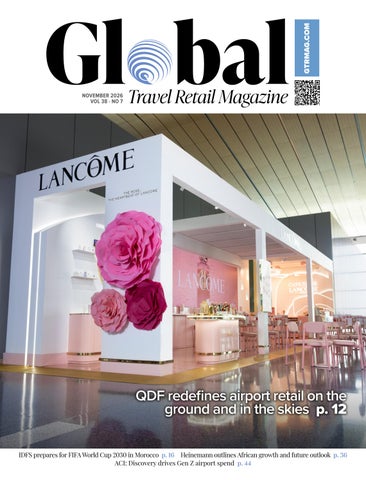
GTRMAG.COM GTRMAG.COM OCTOBER 2026 TFWA WORLD EXHIBITION & CONFERENCE NOVEMBER 2026 VOL 3838 • NO 6 7 VOL · NO
QDF redefines airport retail on the ground and in the skies p. 12 IDFSQDF prepares for FIFA 2030 in Morocco p. 16Heinemann Heinemann outlines African growth andat future outlook expands retailWorld whileCup embracing digital p. 8 champions Icelandic identity Keflavik p. 34p. 36 ACI: Discovery drives Gen Z airport spend p. 44 KIX enters next phase of growth p. 68 ACI on delivering retail refresh p. 104
LUMIÈRE DU JOUR
E A U D E PA R F U M
Available at Moroccanoil.com, Bloomingdale's, Bluemercury, Nordstrom, Sephora, and Ulta
Letter from the Editor
Looking beyond uncertainty
A
s our industry gathers in Rabat for this year’s MEADFA Conference, conflict and instability in the Middle East weigh heavily on the region. Beyond the human cost, disruption to aviation continues to affect businesses and the people who depend on them. For travel retail, planning for growth means responding to immediate pressures while continuing to invest in customers, partnerships and the future. With MEADFA in Morocco for the first time, this year’s gathering offers a closer look at a country preparing to welcome a much wider audience. In this issue, International Duty Free Shops shares its plans as Morocco expands its airports ahead of the 2030 FIFA World Cup. The retailer, which introduced duty free to the country 37 years ago, is broadening its international brand offer and giving Moroccan products greater visibility, with local hospitality an important part of the shopping experience. How the region can sustain investment and build resilience will be central to Tab Musleh’s MEADFA session, “Dispatches from Doha: Unlocking MENA’s travel retail potential.” The Qatar Airways Chief Retail and Hospitality Officer will draw on Qatar Duty Free’s experience to explore how passenger insight, local products and distinctive airport experiences can encourage travelers to shop amid an uncertain operating environment. In this issue, Musleh shares QDF’s plans to connect more of the passenger journey through an e-commerce platform, allowing customers to shop and pay in the air and collect on the ground. Integration with Privilege Club will support more relevant communications, while the forthcoming “Worth Discovering” campaign aims to encourage more passengers to explore the retailer’s offer. In Africa, Tourvest Retail & Catering brings a regional perspective to the relationship between local identity and international opportunity, with a focus on giving African brands a confident place alongside global names. Tourvest’s work with airlines combines digital development, closer supplier partnerships and an offer tailored to each passenger base. These are just a few of the stories in this issue, which features interviews with several leading operators and the latest developments across beauty, confectionery and spirits in the region. As MEADFA marks its 25th anniversary, there is much to discuss about the pressures facing the region and the opportunities taking shape across its diverse markets. We look forward to those conversations in Rabat and wish you a productive and successful conference.
Kindest regards,
HIBAH NOOR Editor-in-Chief hibah@gtrmag.com
6 GLOBAL TRAVEL RETAIL MAGAZINE NOVEMBER 2026
NOVEMBER 2026 · VOL 38 · NO 7 Global Travel Retail Magazine (ISSN 0962-0699) is published seven times a year by Paramount Publishing Company Inc. The views expressed in this magazine do not necessarily reflect the views and opinions of the publisher or the editor. November 2026, Vol 38. No. 7. Printed in Canada. All rights reserved. Nothing may be reprinted in whole or in part without written permission from the publisher. Paramount Publishing Company Inc.
GLOBAL TRAVEL RETAIL MAGAZINE Tel: 1 905 821 3344 www.gtrmag.com PUBLISHER Aijaz Khan aijaz@globalmarketingcom.ca EDITORIAL DEPARTMENT EDITOR-IN-CHIEF Hibah Noor hibah@gtrmag.com DEPUTY EDITOR Laura Shirk laura@gtrmag.com SENIOR EDITOR Atoosa Ryanne Arfa atoosa@gtrmag.com DIGITAL EDITOR Wendy Morley wendy@gtrmag.com SENIOR WRITER Alison Farrington alison@gtrmag.com ART DIRECTOR Kristie Weekes
ADVISORY BOARD Gary Leong Thomas Henningsen Nick King
CIRCULATION & SUBSCRIPTION MANAGER accounts@globalmarketingcom.ca
Contents
WHAT’S INSIDE
16 Top Stories
Features
12 Discovering more
AFRICA SPOTLIGHT 22 Mediterranean momentum
Qatar Duty Free is developing a fully transactional e-commerce platform and preparing its 2027 “Worth Discovering” campaign, with passenger data and Privilege Club integration shaping a more personalized offer
Avolta CEO Middle East & Africa Abdeslam Agzoul discusses the retailer’s first year in Tunisia, from airport upgrades to the next phase of growth
16 A wider audience
26 The sky is no limit
36 A continent of opportunity
RETAILER NEWS 32 Cleared for recovery
As Morocco expands its airports ahead of 2030, International Duty Free Shops is adapting its stores, expanding its brand portfolio and increasing the visibility of local products
Heinemann Middle East Africa CEO Bernard Schlafstein discusses the company’s African growth while examining local partnerships and future opportunities
44 Discovery over discounts
ACI’s Stefano Baronci says static assortments and slow refresh cycles are costing airports a generation that spends more but shops differently
8 GLOBAL TRAVEL RETAIL MAGAZINE NOVEMBER 2026
Tourvest Retail & Catering advances its Vision 2030 strategy through closer commercial partnerships and a more connected approach to airline retail
Dubai Duty Free Managing Director Ramesh Cidambi discusses the retailer’s response to a challenging year and why investment remains a priority as passenger traffic recovers
Contents
WHAT’S INSIDE
60 CONSUMER INSIGHTS 42 Small spend, big pull
China’s youngest beauty consumers control little disposable income but are already dictating which products go viral and which brands earn a second look
BEAUTY 48 Scent of opportunity
54 The latest in confectionery news
A new confectionery creation makes its debut; Air4Casts identifies eight airport retail hotspots offering promising opportunities for confectionery brands in travel retail
SPIRITS 56 Spice, speed, small formats
Evarist Rego discusses how ARMAF is expanding its airport presence through fragrance innovation and travel retail partnerships
Rae Gibson, Director of Power Brands and Emerging Categories at Pernod Ricard Global Travel Retail, discusses how consumer insights are influencing the company’s latest innovations
50 From Provence to paradise
58 Aged to perfection
CONFECTIONERY & FOOD 52 Sweetening the travel retail experience
60 Charting a new course
L’Occitane Group drives travel retail growth through beauty innovation, immersive experiences and regional strategies that attract new consumers and build long-term loyalty
Hershey refreshes its travel retail portfolio with new packaging, premium gifting and immersive airport activations to boost engagement and local relevance
10 GLOBAL TRAVEL RETAIL MAGAZINE NOVEMBER 2026
Brown-Forman’s Oscar Camargo reflects on a year of GTR growth as the company invests in premium whiskey and expands its international reach
Edrington’s Kasper Andersen discusses how The Macallan uses its latest whiskies to tell stories that connect with travelers and encourage premium purchases
Top Story
Discovering more
Qatar Duty Free is developing a fully transactional e-commerce platform and preparing its “Worth Discovering” campaign for 2027, with passenger data and Privilege Club integration shaping a more personalized offer by HIBAH NOOR
Q
atar Duty Free (QDF) is extending its retail offer into the air with an e-commerce platform that will let passengers shop and pay during their flight, then collect their purchases on the ground. Alongside the digital development, its new “Worth Discovering” campaign will launch at the end of the first quarter of 2027, encouraging more travelers to explore the retailer’s brands, products and experiences. For Qatar Airways Chief Retail and Hospitality Officer Thabet Musleh, the platform combines shopping convenience with a better understanding of passengers and their loyalty preferences. QDF has benchmarked the experience against leading retailers beyond travel retail, seeking to match the standard
12 GLOBAL TRAVEL RETAIL MAGAZINE NOVEMBER 2026
of its physical offer at Hamad International Airport (HIA). “We’ve spoken about this for years,” Musleh says. “We said we would launch when the time was right and the product was right. We’ve set a very high benchmark for ourselves with our brick-andmortar offering, and we wanted to make sure our e-commerce offering was just as spectacular.”
Shopping in the air
Musleh estimates that development has taken around three years, possibly longer. The platform will offer 12,000 products across 600 brands and 14 categories, with Arabic and English options and payment in Qatari riyals or US dollars. Orders can be placed from 90 days before travel to 90 minutes before landing, while fulfillment options include delivery at the gate.
QDF’s e-commerce product range is wider than that of any other travel retailer, according to Musleh. Around 40 to 50 individual brand boutiques will sit within the catalogue, giving brands dedicated environments in which to present their products. “It’s designed to feel like a premium shopping environment, with each brand presented professionally,” Musleh says. The inflight service will support completed transactions, extending the time available to shop beyond a passenger’s stay in the terminal. Qatar Airways’ Starlink-enabled Wi-Fi will support access to QDF during flights, as set out in the retailer’s earlier e-commerce plans. “We want people to be able to shop in the air and collect on the ground. It is fully enabled for payment in the air, so
Thabet Musleh, Chief Retail and Hospitality Officer, Qatar Airways Group
QDF’s Musleh and team at Lancôme Café de la Rose, a distinctive beauty and lifestyle experience at Hamad International Airport
you can actually shop and pay online,” Musleh says. “This isn’t a reserve-andcollect service; it is a full shopping experience in the air, with collection when you land.” Thanks to the Qatar Airways Group trinity model, QDF can introduce the shopping opportunity immediately once passengers complete their ticket purchase. Musleh says they may receive the prompt: “Thank you for buying your ticket. Would you like to shop?” They will then be directed to the shopping platform, where communications can reflect specific brands, products and reasons to buy.
the passenger journey. “It’s about encouraging customers to discover new products, new brands and new launches,” Musleh says. “Penetration is still very low in airports all over the world, so the more we can share with customers what they can discover during their journey, the better it is for the business.” The campaign presents discovery as part of every journey, from iconic luxury brands to hidden gems. It gives QDF an opportunity to introduce travelers to less familiar parts of its retail offer alongside brands they already know. A key objective is to reach travelers who currently pass through airports without making purchases. The campaign’s broader invitation to discover will complement QDF’s efforts to deliver more relevant, personalized communications through its website and loyalty program, informed by passenger insights.
Worth discovering
After approximately a year of campaign development, “Worth Discovering” will run across QDF’s usual passenger touchpoints from the end of the first quarter of 2027. Its message invites travelers to explore brands, experiences, flavors and exclusive moments throughout their journey. The aim is to give passengers a consistent message about what they can discover, while encouraging more of them to engage with the retail offer. “Worth Discovering” reflects QDF’s investment in continuity throughout
A more personal offer
Full integration with Qatar Airways Privilege Club and Avios benefits is central to the platform. QDF’s access to travel and purchase information will help it tailor communications to passengers. “I think we’ll be able to deliver
hyper-personalization like nobody has ever done before,” Musleh says. The retailer has access to detailed insights into members’ travel patterns and purchasing preferences, including their inflight consumption. Musleh emphasizes that the depth of this knowledge carries greater value than the overall size of the membership database. “I think the biggest difference between our loyalty program and others is that our program is data-rich; it’s not a data dump,” he says. “We know when our members fly, what they buy, what they drink in the air and where they are flying to before they even fly.” His examples include encouraging a couple flying from London to the Maldives to buy sunscreen in the airport, or suggesting a perfume or gift to a husband when QDF knows it is his wife’s birthday. Passenger information can inform communications to families too, drawing on what customers traveling with children tend to purchase. Brand partners will also play a role in creating exclusive experiences for loyalty members. Musleh intends to collaborate with the loyalty team to identify opportunities for suppliers to offer benefits beyond traditional product promotions.
www.gtrmag.com GLOBAL TRAVEL RETAIL MAGAZINE NOVEMBER 2026 13
Top Story
QDF’s broad retail offer provides opportunities to engage families as it seeks to turn more travelers into shoppers
“How do we get brands to be more creative about what they want to do with the loyalty program? Can we create things that aren’t just gift-with-purchase offers, but bigger experiences that we can offer customers?” Musleh asks.
Further launches ahead
QDF has continued to raise the bar with a series of standout launches over the past 12 months, including POP MART, Assouline Travel Series Kiosk and Lancôme Cafe de la Rose, bringing new experiences and concepts to Hamad International Airport. Building on this momentum, QDF is working with several brands on further world-first concepts. One travel retail first could be ready in December 2026 or January 2027, while another project will see a brand engage with customers across the entire journey, Musleh reveals, although he is keeping the brands under wraps for now. Those plans come as QDF continues to report rising spend despite regional
14 GLOBAL TRAVEL RETAIL MAGAZINE NOVEMBER 2026
disruption. Musleh expects some of its top-five brands to finish the year with large double-digit growth compared with 2025. Asked about the disruption and the work to rebuild the network, he declined to add to the Group CEOs’ public comments. Musleh will address the changing regional picture as keynote speaker at the upcoming MEADFA conference in November. The pace of change in the region is expected to inform his discussion of what it means for consumers, customers and brand partners. QDF works with those brand partners both to develop new concepts and to manage the day-to-day business. This ongoing collaboration has brought recognition from Advantage Group International, with QDF ranking first among 36 retailers, based on feedback from around 80 suppliers. For Musleh, the result gives particular recognition to the back-office and head-office teams who work with
partners daily. These teams do not always receive the recognition given to frontline colleagues, making feedback from the suppliers they work with especially meaningful. “We’ve been receiving recognition from our customers for many years, but to get that recognition from our brand partners — to be told that you are the best at what you do — means an enormous amount,” he says. Almost 12 years into his time at QDF, Musleh remains closely involved in the business, putting pressure on himself and his team to achieve more. “The big things we do are for one reason only: to keep raising the bar. That’s why we do it. It’s not for awards or accolades. It’s about continuing to raise the bar, putting Qatar on the map, putting Qatar Duty Free on the map and continuing to deliver for our customers,” he says. “That’s the most important part of what we do every day: our customers.”
DESIGNED FOR THE CURIOUS
For Trade Only. Not for Distribution to Consumers.
These products are not risk free and provide nicotine, which is addictive. Only for use by adults.
Africa Spotlight
A wider audience As Morocco expands its airports ahead of 2030, International Duty Free Shops is adapting its stores, broadening its brand portfolio and giving local products greater visibility among an increasingly diverse passenger mix by HIBAH NOOR
M
orocco’s airport expansion ahead of the 2030 FIFA World Cup is giving International Duty Free Shops (IDFS) an opportunity to rethink how it serves international passengers, from the brands they encounter to the Moroccan products they take home. According to Maroc.ma, the Kingdom’s national portal, the government and Airports of Morocco (ONDA) signed an agreement covering MAD38 billion (US$3.90 billion) in airport investment for 2025–2030. Against that backdrop, IDFS is preparing for growth through changes to its stores, category mix and customer communication. For IDFS, the company that pioneered duty free in Morocco in 1989, that task draws on 37 years of experience with the country’s airports and travelers. International brand partnerships remain central to its business, while greater visibility for Moroccan suppliers gives IDFS a way to distinguish its offer as the country attracts a broader audience. “The opportunity is not simply to serve more passengers, but to respond more effectively to their evolving expectations through a more relevant, engaging and distinctive shopping experience,” says Anthony
16 GLOBAL TRAVEL RETAIL MAGAZINE NOVEMBER 2026
IDFS continues to serve passengers at Casablanca Mohammed V International Airport as the country prepares for further airport expansion
The retailer brings international fashion brands to Marrakech Menara Airport, complementing the city’s reputation as a destination for fashion, design and culture
Courchet, General Manager at IDFS. The MEADFA Conference comes to Morocco for the first time in 2026 as IDFS marks 37 years in the market. “It is both a privilege and a meaningful moment for IDFS,” he says. “MEADFA coming to Morocco gives us a unique home-ground opportunity to welcome the international travel retail community to the market we helped establish.”
The event gives IDFS an opportunity to share its pioneering heritage and continuing investment alongside Morocco’s development as a tourism, travel and business hub connecting Africa, Europe, the Middle East and the Americas.
Growing retail along with arrivals Morocco’s airports handled record passenger traffic of 36.3 million in 2025,
IDFS’s main store at Casablanca Mohammed V International Airport’s Terminal 2 reflects the operator’s longstanding presence in Morocco’s travel retail market
according to ONDA. Expansion plans aim to increase annual airport capacity to 80 million passengers by 2030, as reported by Maroc.ma ONDA’s plans for Casablanca include a digitally enabled terminal with an integrated high-speed rail station. Modern terminals, smoother passenger journeys and improved connectivity could give operators more opportunities to attract shoppers. Separately, Morocco aims to welcome 26 million tourist arrivals annually by 2030, compared with 19.8 million in 2025, according to Morocco’s Tourism Ministry. For IDFS, this tourism growth offers opportunities to introduce more travelers to Moroccan brands alongside its international portfolio.
“Our focus is on intuitive store layouts, a relevant brand and category mix, digital engagement and attentive service, while bringing Moroccan products and hospitality to the forefront,” says Courchet. The operator’s relationship with ONDA has developed over decades of changes in Morocco’s aviation market. When IDFS began, lower passenger volumes and limited international connectivity supported a smaller retail offer centered on premium global brands and personalized service. Expansion across the country enabled IDFS to serve passengers beyond the main international gateways and develop a deeper understanding of Morocco’s diverse passenger mix.
With ONDA’s continued support, IDFS helped establish airport shopping in Morocco by introducing international retail standards, building relationships with global brands and giving local suppliers access to international consumers. The company has developed local knowledge, talent and operational expertise that continue to support the development of Moroccan travel retail. “We have helped position travel retail as part of Morocco’s welcome to the world and its final impression on departing passengers,” notes Courchet. As Morocco prepares to co-host the 2030 FIFA World Cup, IDFS’s priorities include maintaining strong relationships with its airport and brand partners and evolving with the Kingdom’s development. “By 2030, we want IDFS to be recognized for building on its pioneering heritage and continuing to contribute to the development of Moroccan travel retail,” says Courchet. “Success would mean welcoming stores, attentive service and a relevant retail offer that brings together leading international brands and the best of Morocco, supported by technology that enhances the shopping experience.” “Above all, we want a visit to Morocco Duty Free by IDFS Shops to be a memorable part of each traveler’s experience of the Kingdom” he adds. “As Morocco welcomes the world in 2030, our ambition is to offer the quality, value and Moroccan hospitality that make us your ‘Last good buy before you fly!’”
Tailoring the offer for regional differences
Beyond Casablanca and Marrakech, IDFS identifies Agadir, Fès, Rabat and Tangier as markets with particular growth potential over the next five years. Each attracts a different mix of leisure, business and cultural travel, shaping the retail opportunities at its airport. Agadir’s leisure and tourism appeal, together with its role as a gateway to southern Morocco, offers a different profile from Rabat’s mix of cultural
www.gtrmag.com GLOBAL TRAVEL RETAIL MAGAZINE NOVEMBER 2026 17
Africa Spotlight
character, drawing on decades of experience in the Moroccan market.
Moroccan discoveries with global familiarity
IDFS brings international brands and local discoveries to travelers passing through Fès–Saïss Airport
tourism, business travel and international events. Tangier combines tourism and economic activity with a strategic position between Africa and Europe. IDFS sees opportunities to reflect these distinct characteristics through a retail assortment tailored to each location. Fès holds particular interest for the operator because its imperial heritage and craftsmanship create distinctive opportunities for Moroccan brands and
gifts connected to the destination. The city’s cultural identity gives local products a context that can carry through into airport retail. Essaouira’s coastal and cultural appeal merits attention, while Nador and Oujda have important connections with Moroccans living abroad. IDFS’s approach is to develop a relevant retail offer tailored to each airport’s passenger mix, seasonality and regional
IDFS’s international portfolio has broadened through the more recent introduction of Michael Kors and Coach, alongside its longstanding position as Lacoste’s exclusive travel retail partner in Morocco. Store upgrades and stronger relationships with Moroccan suppliers have accompanied that development, giving the operator more scope to combine familiar names with products passengers may encounter for the first time. “We see these as complementary, not competing priorities,” says Courchet. “International brands bring familiarity, trust and global appeal, while Moroccan brands give our stores authenticity and a distinctive sense of place.” IDFS gives Moroccan products prominence through merchandising, storytelling and quality presentation, helping local suppliers stand confidently alongside established international
Lacoste, IDFS’s exclusive travel retail partner in Morocco, brings the internationally recognized fashion brand to travelers at Marrakech
18 GLOBAL TRAVEL RETAIL MAGAZINE NOVEMBER 2026
Kids and grown-ups love it so, the happy world of Haribo!
Africa Spotlight
Guess brings contemporary fashion to Marrakech Menara Airport
names. The aim is an international shopping experience with an unmistakably Moroccan identity. Nowhere is that more apparent than through the “Take the Beauty of Morocco with You” campaign. “Morocco has a distinctive beauty heritage, from traditional rituals and botanical ingredients to contemporary fragrance creation. Our role is to bring these stories to life through a compelling retail offer, presenting Moroccan brands with the visibility, care and quality they deserve,” explains Courchet. “Every traveler passing through an airport is a potential new customer and brand ambassador, giving local brands exposure to audiences that could otherwise take years and substantial investment to reach,” he adds. IDFS wants to give passengers more opportunities to discover Moroccan
20 GLOBAL TRAVEL RETAIL MAGAZINE NOVEMBER 2026
suppliers alongside familiar international brands. “Today’s Moroccan traveler is increasingly informed, digitally connected and familiar with international retail standards,” says Courchet. “They expect recognized brands, clear value and attentive service, alongside products that reflect the country’s identity. As Morocco’s pioneering duty free operator, our longstanding presence has given us a deep understanding of the market, while reminding us of the importance of continuing to listen and adapt. Convenience, discovery and gifting all help shape a relevant shopping experience.”
Investing in technology to benefit customers While IDFS is already using digital tools in its day-to-day store opera-
tions, it sees further potential for data to guide decisions about products, promotions and customer engagement. Existing applications help coordinate communication across stores and support employees in their daily work, improving the company’s efficiency and responsiveness. “Over time, AI could support planning and more tailored communication, complementing the market knowledge built over decades,” Courchet shares. “Our approach is practical: invest where technology improves the customer experience and strengthens retail performance. Better insight can also help us collaborate more effectively with brand partners, while personal service and Moroccan hospitality will remain at the heart of the IDFS experience.”
Africa Spotlight
Mediterranean momentum Avolta CEO Middle East & Africa Abdeslam Agzoul discusses the retailer’s first year in Tunisia, from airport upgrades to the next phase of growth
F
rom Mediterranean resorts and ancient Carthage to the desert landscapes of Star Wars, Tunisia brings a rich cultural heritage and diverse passenger markets to Avolta’s North African portfolio. In its first year in the Maghreb country, the retailer has invested in airport store refurbishments and expanded its local assortment, thus laying the groundwork for further commercial development in 2027. Global Travel Retail Magazine spoke with Abdeslam Agzoul, CEO Middle East & Africa at Avolta, to discuss the company’s progress. “Our entry into Tunisia marked an important step in strengthening Avolta’s presence across North Africa and the Mediterranean,” Agzoul explains. “Over the past year, we have opened 15 duty free stores across five airports.” Together, Tunis-Carthage, DjerbaZarzis, Sfax-Thyna, Tozeur-Nefta and Tabarka-Aïn Draham account for nearly 80% of Tunisia’s air traffic. They serve destinations from the capital of Tunis and Djerba’s beach resorts to Sfax’s commercial center, Tozeur’s
22 GLOBAL TRAVEL RETAIL MAGAZINE NOVEMBER 2026
by ATOOSA RYANNE ARFA
Saharan oasis and Tabarka’s mountainous northwest. Passengers include international tourists and Tunisians traveling abroad or visiting family.
From transition to transformation
With support from the Tunisian Civil Aviation and Airports Authority (OACA), Avolta took over an existing duty free business and opened stores across the five airports in just two months. “Our partnership with OACA has been central to establishing our operations and developing a retail offer for international and domestic travelers,” Agzoul emphasizes. At Tunis-Carthage International Airport, Avolta has refurbished the stores to give international brands greater prominence. “We have broadened the assortment and created more dedicated spaces that make the category easier to navigate and more engaging for our customers,” Agzoul remarks. The retailer has expanded beauty spaces, introduced its Haute Parfumerie concept and added cigar humidors in departures and arrivals. At Djerba-
Abdeslam Agzoul, CEO Middle East & Africa at Avolta
Zarzis International Airport, it has introduced a Victoria’s Secret corner. Avolta has also introduced digital services, including Club Avolta with in-store registration tablets, Reserve & Collect, and self-checkout. “Club Avolta and Reserve & Collect give us additional ways to engage travelers before and during their journey, while self-checkout makes purchasing faster and more convenient,” Agzoul adds.
Fast, friendly, familiar From Switzerland to Shanghai, our shelves are stocked with the comforts travelers need; always easy to find and ready to go.
Africa Spotlight
Harissa, a Tunisian chili pepper paste, is among the local specialties featured in Avolta’s duty free assortment
Avolta has given international brands greater prominence at Tunis-Carthage International Airport
A taste of local heritage
For Agzoul, airports offer an opportunity to introduce visitors to Tunisia and give departing passengers a final encounter with the destination. “The airport is the first and last impression many travelers have of Tunisia, so we want our shops to tell a Tunisian story,” he observes. Avolta uses dedicated displays to give local food and artisanal products greater visibility. “The local offer is brought to life through gifting selections that showcase Tunisian heritage and craftsmanship,” Agzoul notes. The assortment includes Maison Masmoudi and Pâtisserie Madame Rekik, which specialize in Tunisian sweets such as makroudh, a date-filled semolina pastry, and kaak warka, an almond-filled pastry flavored with rosewater. Maison de Senteurs offers fragrances and body care inspired by Mediterranean botanicals, while Rivière d’Or supplies Tunisian extra-virgin olive oil. Tazart offers dates, including the prized golden Deglet Nour variety. Avolta plans to expand its partnerships with Tunisian producers while maintaining international retail standards. “The range will continue to evolve through partnerships with Tunisian brands, artisans and local producers,” Agzoul explains. “This allows passengers to leave Tunis-Carthage with products that embody an authentic part
24 GLOBAL TRAVEL RETAIL MAGAZINE NOVEMBER 2026
Avolta has introduced Club Avolta registration tablets in stores across Tunisia, alongside Reserve & Collect and self-checkout services
of Tunisia while meeting the quality and service standards expected in an international airport.”
The next chapter
With initial refurbishments complete, Avolta is assessing purchasing behavior and customer feedback to identify opportunities for 2027. “The commercial response has been encouraging,” Agzoul reports. “We are using purchasing behavior and feedback from our teams to identify opportunities by category, brand and passenger profile.” Avolta plans to prioritize premium beauty, introduce new brands, expand
its selection of locally produced gifts and optimize retail space according to passenger flows and dwell times. “2027 will be about translating the transformation of our Tunisian operation into sustained performance,” Agzoul says. “Our priority is to optimize that investment through a sharper category mix, new brands and concepts, and better conversion of passenger flows.” “Our objective is to build on the investment by increasing the relevance of our offer for the Tunisian market, improving the travel retail experience and supporting sustainable development of the business,” Agzoul concludes.
BURN BRIGHTER AVO EXPRESIVO
Smoking seriously harms you and others around you
Africa Spotlight
Tourvest partners with global brands such as Cadbury to enhance onboard retail experiences and passenger engagement
The sky is no limit Tourvest Retail & Catering advances its Vision 2030 strategy through closer commercial partnerships and a more connected approach to airline retail by ATOOSA RYANNE ARFA
T
ourvest Retail & Catering has spent 2026 strengthening airline partnerships and expanding digital capabilities as it approaches the start of its Vision 2030. The South African-rooted company aims to develop retail experiences tailored to airline passengers while giving African brands greater access to international markets. Global Travel Retail Magazine caught up with Nomusa Khumalo, Chief Customer Officer for
26 GLOBAL TRAVEL RETAIL MAGAZINE NOVEMBER 2026
Africa and the Middle East at Tourvest, to discuss the company’s progress and commercial strategy.
Different markets, different opportunities
Tourvest has given its partners a greater role in retail initiatives. “We have worked to turn transactional arrangements into genuine commercial partnerships where Tourvest, airlines, suppliers and crew all create value,” Khumalo
Nomusa Khumalo, Chief Customer Officer for Africa and the Middle East, Tourvest Retail & Catering
Africa Spotlight
South African fashion brand MAXHOSA Africa is among Tourvest’s local brand partners
explains. Her guiding question: “What can we achieve together that none of us could achieve alone?” Khumalo notes that Tourvest’s markets vary in maturity and growth potential. “Across Southern Africa, we see strong potential in onboard retail and catering, particularly when we combine established international brands with local products, crew engagement and campaigns tailored to each airline’s passenger base.” In Nigeria, Tourvest operates two duty free stores at Murtala Muhammed International Airport in Lagos. “We see potential in Nigerian consumers’ appetite for premium brands, travel and distinctive retail experiences, although success requires patience, strong local partnerships and the ability to navigate regulatory, currency and operational challenges,” Khumalo notes. The company also partners with South African fashion and lifestyle brands MAXHOSA Africa and Ntozinhle Lifestyle. “African products should not sit on the margins of duty free retail,” Khumalo emphasizes. “They deserve a seat at the table, positioned as confidently as global luxury brands.”
28 GLOBAL TRAVEL RETAIL MAGAZINE NOVEMBER 2026
Tourvest operates two duty free stores at Murtala Muhammed International Airport in Lagos, Nigeria
Onboard, on brand
Tourvest’s airline portfolio includes South African Airways, Airlink and FlySafair, each with different retail needs. “We are more deliberate about tailoring our offer to the passenger, airline and journey,” Khumalo explains. “South African Airways has a premium African heritage, Airlink serves regional business and leisure travelers, and FlySafair has a dynamic, accessible South African personality. We reflect these differences in products, price points and experiences.” The company’s Bootlegger Coffee partnership aboard FlySafair saw sales rise 20% and units sold increase 15% through its “café in the sky” concept from July 2025 to June 2026, compared with the previous year. “This demonstrates the value of turning a supplier partnership into a differentiated onboard experience, not just another product,” she notes.
Beyond the trolley
Tourvest has expanded in-house warehousing and logistics capabilities for greater operational control. Khumalo sees these efforts as part of broader operational integration. “Buying, marketing, operations, technology, data,
suppliers, airline partners and crew no longer operate separately. They form one ecosystem,” she explains. For Khumalo, commercial growth depends on how well retailers understand passengers. “Growth in travel retail cannot come only from more products. It must also come from better customer insight, improved execution and more relevant products, campaigns and interactions.” The company is also developing an integrated airline retail platform to connect onboard purchases with digital commerce. Khumalo says Tourvest tracks spend per head and revenue per flight to assess performance. “Data helps us replace intuition-led retailing with more precise, evidence-based decisions,” she notes. Its technology roadmap includes flight-targeted offers and personalized recommendations, while historical sales data helps forecast demand for fresh catering products and reduce waste. “We are taking the experience beyond the trolley,” Khumalo explains. “The catalogue, webstore, crew interactions, onboard activations, social media and supplier campaigns should work together to make onboard retail part of
Africa Spotlight
Tourvest is investing in digital technology to improve airline retail performance and passenger experiences
the passenger journey, not an isolated transaction.” Tourvest’s “Relate, Engage and Amplify” marketing strategy supports this connected approach through social media and crew advocacy. Partnerships with Red Bull, Coca-Cola, Cadbury and Ajmal include passenger activations. Khumalo describes the philosophy as “the journey is the medium,” with campaigns focused on passenger experiences. “Data must serve a purpose,” she emphasizes. “Its value lies in putting the right product on the right flight, at the right price, for the right customer.”
The next destination
As Vision 2030 enters a new phase, Tourvest plans greater digital integration and closer supplier partnerships across its airline and airport businesses.
30 GLOBAL TRAVEL RETAIL MAGAZINE NOVEMBER 2026
Khumalo also sees e-commerce and loyalty initiatives as opportunities to strengthen customer relationships. “For us, success is not just a larger footprint,” Khumalo says. “It is a more resilient business that creates jobs, invests in people, connects African brands with international travelers and delivers globally competitive experiences rooted in Africa.” Tourvest’s participation in South Africa's Youth Employment Service (YES) Programme provides one example of its investment in people. Between July 2025 and June 2026, eight young people participated, six completed the program and three subsequently joined the company. For Khumalo, the goal is for African brands to claim their place in international travel retail. “We have the
Tourvest has expanded its in-house warehousing and logistics capabilities to improve operational control
opportunity to create commercial platforms where African products, stories and talent can stand confidently alongside the world’s leading brands,” she concludes.
THE NEXT CHAPTER OF MASTERY A NEW TRAVEL EXCLUSIVE P L E AS E D R I N K R E S P O N S I B LY
Retailer News
Cleared for
recovery
Dubai Duty Free Managing Director Ramesh Cidambi discusses the retailer’s response to a challenging year and why investment remains a priority as passenger traffic recovers Ramesh Cidambi, Managing Director of Dubai Duty Free
by ATOOSA RYANNE ARFA
A
fter a challenging year marked by regional conflict and disruptions to passenger traffic, Dubai Duty Free is looking ahead to recovery with plans for continued investment. Speaking with Global Travel Retail Magazine at the TFWA World Exhibition & Conference in Cannes, Managing Director Ramesh Cidambi discussed the retailer’s response to the disruption and why he remains confident in its long-term prospects. Dubai Duty Free entered March with sales up 13% year on year after record results in January and February. The regional conflict then disrupted passenger traffic. “We were in a very good position at the end of February, with
32 GLOBAL TRAVEL RETAIL MAGAZINE NOVEMBER 2026
high inventory levels and strong sales performance,” Cidambi recalls. “Once the conflict started, passenger numbers dropped dramatically. In March, both passenger traffic and sales fell by 66%.” Sales declined 60% in April before the shortfall narrowed to 35% in May and 24% in June. By July, the decline had eased to 19%, although renewed regional tensions contributed to declines of approximately 21% in August and September. Cidambi expects passenger traffic to reach approximately 71 million in 2026, while full-year sales could finish at 25% below 2025.
Adjusting course
Dubai Duty Free had 79 shipping containers in transit in early March, primarily
carrying food, confectionery and liquor. As passenger numbers dropped, disruption around the Strait of Hormuz slowed deliveries and prompted the retailer to reconsider promotions and orders. “Initially, we were more aggressive with promotions because the drop in sales was so significant,” Cidambi explains. “But as demand started recovering, we realized that getting merchandise into the country was becoming a challenge. We had to moderate promotions and protect our inventory.” Cidambi says shipping times have since improved, with shipments dispatched in June arriving in approximately half the time taken by those caught in the initial disruption. They also increased merchandise orders as
Dubai Duty Free continues to see high passenger spending despite regional disruptions, with Cidambi emphasizing the importance of an attractive retail offer and strong service
demand recovered to account for longer delivery times. The retailer has also reassigned employees between terminals to match changes in passenger traffic. “Our Terminal 1 business is down about 40% to 45%, but Terminal 3 is only down about 12% to 13%,” he explains. “We have adjusted staffing to reflect those differences. The most important thing is to monitor passenger numbers closely and respond as the situation changes.” Cidambi credits Dubai Duty Free’s employees for their response during the most difficult months of the disruption. “Our teams were fantastic in helping and reassuring passengers, maintaining safe retail operations and responding to changing circumstances,” he says.
“We remained calm and focused on the things we could control, which included our service, stock availability and retail offer.”
Reading the passenger mix
Cidambi has also kept suppliers informed about changes in passenger traffic and spending. “We have been communicating constantly with brands, especially those without teams in the region, to explain what is happening on the ground,” he says. “Their experience can differ significantly depending on the terminal, the category and the passengers they serve.” Africa has been one of the more resilient markets, according to Cidambi. Between March and September, sales to passengers traveling to Africa
fell 27%, compared with a 50% decline among those headed to the Middle East. By September, sales to Africa-bound travelers were down just 4% from a year earlier. “For the first time in our history, sales to passengers traveling to Africa were higher than those traveling to the Far East,” he notes. Cidambi also highlights travelers’ spending power, with Dubai Duty Free’s fashion boutiques recording an average transaction value of approximately US $2,000, up 8% year on year during the conflict period. “The consumer still has the capacity to spend,” he says. “We continue to see high spending per passenger compared with other regions. If the retail offer is attractive and service levels are good, customers are still willing to spend.”
www.gtrmag.com GLOBAL TRAVEL RETAIL MAGAZINE NOVEMBER 2026 33
Retailer News
Dubai Duty Free has strengthened its partnership with Emirates through a new agreement that offers exclusive promotions to the airline’s passengers at Terminal 3
Case for continued investment
Dubai Duty Free has strengthened its partnership with Emirates through a new agreement that offers exclusive shopping promotions to the airline’s passengers at Terminal 3. Cidambi says Emirates and flydubai have led the recovery in passenger traffic, which has encouraged the retailer to work more closely with both airlines. The retailer plans to open a Bulgari boutique in November and a Chanel
34 GLOBAL TRAVEL RETAIL MAGAZINE NOVEMBER 2026
boutique before year-end, with a major perfumes and cosmetics refurbishment due for completion in late November. “We are continuing to invest in our people and our retail spaces,” Cidambi says. “We need brands to continue investing in advertising, promotions and their own retail operations as well.” Dubai’s tourism efforts also give him confidence in the recovery. “Dubai continues to be a very attractive city, and the government is doing a great
deal to promote tourism and encourage visitors,” he says. “We expect passenger numbers to grow next year, and that means brands will have opportunities for growth as well.” Cidambi encourages suppliers to maintain their commitment to the region. “We still have a substantial business, and passengers still have the propensity to spend,” he concludes. “If your service levels are good and your retail offer is attractive, you can succeed.”
FRUITY
FLAVOURS NR 1 LOLLIPOP BRAND*
Scan to visit our website *Pi Insight TR Confectionery Sell Out Panel
Meet you at the MEADFA Conference
Retailer News
A continent of
opportunity
Heinemann Middle East Africa CEO Bernard Schlafstein discusses the company’s African growth by examining local partnerships and future opportunities by ATOOSA RYANNE ARFA
G
ebr. Heinemann is expanding across Africa, and Bernard Schlafstein sees substantial opportunity ahead. For the CEO of Heinemann Middle East Africa, the continent is an important growth market. The company has tripled wholesale turnover since 2022 and now supplies B2B customers in more than 40 countries, with doubledigit growth over last year. Speaking with Global Travel Retail Magazine at the TFWA World Exhibition & Conference in Cannes, Schlafstein discussed the partnerships driving Heinemann’s expansion and the realities of investing across Africa.
54 countries, no single playbook
For Schlafstein, familiarity with Africa’s diverse markets is essential to successful
36 GLOBAL TRAVEL RETAIL MAGAZINE NOVEMBER 2026
partnerships. “I always say Africa is not a country. It’s a continent with 54 countries,” he says with a laugh. “You have to understand the differences between the markets.” Wholesale accounts for most of Heinemann’s African business, but local retail partnerships also contribute to its expansion. “Our DNA is the partnership model,” Schlafstein explains. “We can help our clients build their shops, invest in developing their businesses, and supply all categories without necessarily taking a share.” The company might take an ownership stake in a joint venture or share in a retail operation’s profits. In other scenarios, Heinemann supplies merchandise and helps develop stores without taking a share of the business. When Malta-based distributor Salvo Grima bid for an Algerian duty free
Bernard Schlafstein, CEO of Heinemann Middle East Africa
concession spanning three airports, Heinemann backed the bid and became the exclusive supplier. “We asked Salvo Grima to take the tender and told them we would support them,” Schlafstein recalls. “They won, and now we supply
Available In Travel Retail In 2026
Retailer News
Heinemann and its Big Five Duty Free joint venture partners are set to invest in store refurbishments in South Africa following a full rebrand
the entire business. We are the exclusive partner without being a shareholder.” In South Africa, Heinemann and its Big Five Duty Free joint venture partners have spent 18 months refining their commercial arrangements. With a full rebranding completed, the partners are now planning a major investment in the refurbishment of the stores. “We continuously look at how we can strengthen the business,” Schlafstein says. “We are committed to South Africa for the long term and will continue investing in the country.” In Nigeria, Heinemann operates a joint venture, but currency volatility and restrictions on transferring funds abroad can complicate investment. “You can have a big country with a lot of opportunity, but if you can’t get your money out, it’s difficult to invest,” he explains. He notes the importance of evaluating the business climate alongside the political environment to determine sensible investments. Schlafstein also sees a need to adapt Heinemann’s German approach to the
38 GLOBAL TRAVEL RETAIL MAGAZINE NOVEMBER 2026
Gebr. Heinemann supplies B2B customers in more than 40 African countries, with wholesale turnover tripling since 2022
realities of doing business in Africa. “We’re still a German company, and you can’t bring Germany to Africa,” he observes. “You need to adapt to the market. You need to take risks. There’s no project where you get a perfect contract, perfect earnings, and no risk. Either we decide to take those risks or
we don’t. But if we sit and wait, we lose the market.”
A network built for growth
Behind the scenes, Heinemann’s international distribution network proved invaluable during recent regional disruptions. When the Middle East conflict
Retailer News
Gebr. Heinemann’s international distribution network supports its African partners, with supply operations based in Germany and plans for a new logistics hub in Turkey
caused supply bottlenecks in Dubai for some operators, Heinemann continued fulfilling African orders from its two German distribution centers. “Some of them couldn’t supply their businesses in Africa because their logistics centers were in Dubai,” Schlafstein explains. “We could supply them from Hamburg, and that’s where our business benefited.” Dubai also brings Schlafstein and his team closer to African partners. Many travel retail operators maintain offices or logistics facilities there, which gives Heinemann more opportunities to meet clients and develop relationships. “Moving to Dubai was one of the biggest advantages for us,” he says. “We meet clients there every day, both existing partners and new ones. It’s a completely
40 GLOBAL TRAVEL RETAIL MAGAZINE NOVEMBER 2026
different situation from operating from Hamburg.” Heinemann has other developments underway in the Middle East. Its joint venture with JAH Arabia International Duty Free LLC recently opened another terminal at Jeddah Airport following its 2025 launch, and Saudi and other Middle Eastern brands now account for approximately 12% of turnover. To support distribution, Heinemann plans to launch a logistics hub in Turkey and is evaluating smaller regional facilities.
Taking the longer view
Schlafstein wants international brands to give smaller African travel retail markets the same attention they give major airports. “Brands support the big
locations because that’s where they can make a lot of turnover,” he says. “But they also have to support markets where they can build their business for the future.” He also urges brands to recognize retailers’ financial commitments in these markets. “We are taking the risk. We’re paying for the goods, so the brands aren’t taking that financial risk,” he emphasizes. “They have to believe in our strategy and what we want to achieve there.” For Schlafstein, Africa’s long-term growth depends on the industry’s willingness to invest in emerging markets. “Believe in Africa,” he concludes. “Believe in the market.”
Consumer Insights
Small spend, big pull China’s youngest beauty consumers control little disposable income but are already dictating which products go viral and which brands earn a second look by WENDY MORLEY
A
monthly beauty budget of 1,500 to 3,000 RMB, roughly US$220 to US$450, does not sound like much buying power. But China’s Gen Alpha shoppers are already shaping what older consumers discover, discuss and eventually buy, according to Jing Daily. Cost is not the variable that determines whether something spreads online; attention is. Members of this group often purchase without planning in advance. The shopper spots a product mid-scroll, checks other users’ comments without leaving the app, and completes checkout minutes later, having never set out to buy anything in the first place. This cohort is not simply a younger slice of Gen Z. The so-called “Zalpha” segment, born roughly between 2008 and 2013, is entering the beauty category years earlier than Gen Z did, often around age eight to 10 rather than 12 to 15, with parental influence and safety concerns still shaping much of the relationship. This age group latches onto trends fast and drops
42 GLOBAL TRAVEL RETAIL MAGAZINE NOVEMBER 2026
them just as quickly, and brands able to steer that impulse constructively rather than cash in on it for a quick sale stand a better chance of winning over both the child and the parent footing the bill.
A market built for low commitment
Small formats and sample sizes are driving much of how this generation shops. A miniature size lets someone try a product for a moment rather than commit to finishing it, suiting a shopping style built around rotation rather than loyalty. Mintel research found that 57% of Chinese beauty and personal care consumers regularly use sample-sized products at home.
The pattern extends beyond China. In South Korea, teenagers accounted for 43% of transaction value in the first half of 2025 on fashion platform Ably, while budget retailer Daiso saw basic cosmetics sales climb 240% year-onyear between January and October 2024 as color cosmetics rose 130%. Jing Daily reports that collectible packaging and blind-box mechanics are drawing some of this spending away from beauty in its conventional sense and toward products that function more like toys. Flower Knows leans on elaborate box and case design to drive that appeal, while Girlcult builds its products
Gen Alpha’s taste for beauty with a collectible edge is reflected in Girlcult’s elaborate, customizable packaging
On the Ably app, entertainment is built into the path to purchase through character tie-ins, personalized recommendations and randomized promotions
to be altered or personalized after purchase. Chinese children’s skincare brand Hi!papa was also cited for engineering play directly into functionality, using
packaging that visibly changes color in response to temperature or UV exposure so a child can see the product working.
posts from other shoppers before buying, far outpacing reliance on any single influencer’s recommendation.
Retail as content
AI is an important checkpoint
Discovery itself has become as much a competitive battleground as the product. YSL’s use of robotic store staff, star-themed installations and blind-box mechanics in its China retail spaces, have all been aimed at giving shoppers something worth filming rather than simply something worth buying. Ably in South Korea takes a similar approach online, layering character tie-ins, algorithmic suggestions and randomized promotions on top of its core shopping function so browsing itself becomes a form of entertainment. Despite the appetite for entertainment, these younger shoppers are unusually resistant to heavily produced marketing. Unpolished, user-submitted content, including posts that admit a product did not work as expected, tends to land better with this audience than a flawless influencer post, because it shows how something actually behaves in ordinary use. Mintel survey findings show that among 18- to 24-year-olds, 42% turn to e-commerce reviews and 39% read
A survey of 1,200 Chinese beauty consumers born after the year 2000 found more than three-quarters had turned to AI at some point in a beauty decision, most often to check an ingredient, compare products or settle whether something was worth the money. Among the sources these shoppers consult before buying, AI tools ranked above beauty counter staff and even professional advisers, and more than half credited AI with talking them out of a purchase that would not have suited them. That trust has limits, though. Roughly a third of respondents were skeptical of what AI told them, and close to 30% still trusted a human review over an algorithmic one, with most landing somewhere in between, cross-checking AI against other sources rather than treating it as the final word. While entertainment opens the door for these consumers, proof, whether from a reviewer, a comment section or an AI tool, is what gets a product across the line.
www.gtrmag.com GLOBAL TRAVEL RETAIL MAGAZINE NOVEMBER 2026 43
Consumer Insights
Asia Pacific and the Middle East show contrasting recovery patterns, with passenger spend outpacing traffic recovery in parts of Asia Pacific, while the Middle East sees stronger traffic growth
Stefano Baronci, Director General at Airports Council International Asia Pacific & Middle East
Discovery over discounts ACI’s Stefano Baronci says static assortments and slow refresh cycles are costing airports a generation that spends more but shops differently
G
en Z travelers already outspend Gen X and boomers at airports, but the retail formats built to capture that spending have not kept pace with what actually drives it, according to Stefano Baronci, Director General at Airports Council International Asia Pacific & Middle East (ACI APAC & MID). Baronci refers to the association’s “Travel Retail Study in the Post-Pandemic Era,” which indexes retail spend per passenger at 312 for Gen Z against 100 for boomers and 189 for Gen X. “Gen Z cannot be approached in the same way as previous generations,” he says. “They remain highly price-aware and compare value closely, but they are not principally price-led. They are also more trendsensitive and less willing to engage with retail that feels repetitive or generic.”
Spending power, different motives
The study’s breakdown of purchase motivation explains the shift. Store experience and engagement account for 40% of the younger generation’s decision,
44 GLOBAL TRAVEL RETAIL MAGAZINE NOVEMBER 2026
by HIBAH NOOR
authenticity for 30% and price for just 23%. Boomers show close to the opposite pattern, with price driving 48% of their choices, and the study finds the conversion moment remains predominantly after security even when discovery and price comparison begin online. “The issue is not demand,” Baronci says. “Our study says Gen Z is already spending more than older travelers. The challenge is making the offer relevant.” Members of this generation want products that feel current; they want brands with strong provenance and stores that offer discovery and a clear identity. Local and destination-linked products can differentiate the offer, while sustainability matters most when quality and price remain competitive. “What airports and retailers are still getting wrong is the persistence of static assortments, fixed brand lineups, generic global offers and slow refresh cycles,” he points out. Traditional duty free formats lose relevance when they cannot respond quickly to trends or offer a strong sense of place. Baronci’s suggestion to retailers
is not more space but passenger-led category planning, flexible or pilot formats, more frequent assortment refreshes and stronger inclusion of credible local and emerging brands.
Luxury spending shows greatest shift
The difference is particularly pronounced in luxury, where Gen Z travelers are 2.5 times more likely than boomers to buy, a gap Baronci traces to category preference data, which shows luxury accounts for 10% of Gen Z choices versus 4% for boomers. Within Gen Z retail spend, luxury takes the largest share at 51%, followed by beauty at 16% and electronics at 15%. “They [Gen Z] are more willing to spend on premium categories such as beauty, luxury goods and electronics, driven less by price and more by experience, authenticity and discovery,” he says. Winning that spending, Baronci adds, is not about offering deeper discounts; it is about creating engaging retail environments, regularly refreshing product ranges, offering authentic
Luxury goods lead travel retail spending across both Asia Pacific and the Middle East, followed by perfumes and cosmetics, and electronics
local and exclusive products and designing stores that encourage exploration. Electronics show a similar pattern on a smaller scale. Gen Z travelers are four times more likely than boomers to purchase electronics or travel accessories, with the category accounting for 12% of Gen Z preferences compared to 3% for boomers. “Greater pre-trip price transparency means convenience alone is insufficient,” he states. “The offer must be travel-relevant, competitively positioned and easy to purchase.” When it comes to technology brands, the strongest opportunities are curated travel accessories and devices, exclusive travel-retail editions, seamless pre-order or click-and-collect options and engaging displays that make products easy to understand and explore. Deeper product ranges and more differentiated assortments can help capture additional spend, especially where practical travel utility meets novelty and discovery.
A sense of place
The study shows that local products are a genuine differentiator; an item tied to a destination is something no other airport can offer. Across Asia Pacific and the Middle East, it groups local products and souvenirs into a single category, finding them a consistent, meaningful part of what passengers buy. The category accounts for 17% of Gen Z preferences, tied with millennials and ahead of the 15% recorded among Gen X and boomers. Baronci links the interest
to authenticity and destination identity rather than simple familiarity with global brands, and the broader appeal, he says, lies in gifting value and a genuine sense of place. The study recommends giving local and regional products greater prominence as a source of differentiation, with strong storytelling seen as a way for airports and brands to stand out. “Local products should not be treated as a small souvenir section,” Baronci says. “They deserve stronger visibility and should be presented with the same care as international brands.”
Closing the experience gap
Despite their digital fluency, Gen Z passengers still convert largely in the terminal after security, reinforcing the importance of store experience within that 40% share of purchase motivation. Digital adoption is highest among Gen Z of any generation, Baronci notes, but remains relatively low overall. “Digital should reduce friction and help passengers discover and plan purchases through pre-order and clickand-collect, mobile loyalty, contactless checkout and digital promotions,” he says. “The store should do what digital cannot: provide an engaging environment, establish provenance and authenticity, showcase trending or exclusive products and convert discovery into a purchase.” A similar gap shows up around sustainability. According to the study, only around one in five airports describe it as fully central to their retail strategy,
while most say it is important but still developing. “Gen Z’s stated willingness to pay a premium for sustainable products is high at 65%, but the qualitative research shows that this weakens when real price differences emerge,” shares Baronci. Closing the gap requires moving from broad claims to visible, operational measures. These include credible local and ethical sourcing, lower plastic or responsible packaging, waste reduction, efficient fit-out standards and meaningful ESG criteria in concession tenders. Sustainable products still must compete on quality and price, he notes, and airports should make their credentials easy to identify while tracking whether they move conversion and spend. “For most passengers, sustainability is now part of the buying decision, rather than the only reason for the purchase.”
Testing, not scaling
Baronci expects airport retail to shift toward a model built around passenger mix rather than traffic growth alone over the next five years. The mechanism is straightforward, he says: demand may exist, but conversion and incremental spend are constrained when the assortment, format or message does not match passengers’ changing expectations. Retail spaces will become more modular and easier to refresh, with areas set aside for pilot formats or lighter fit-outs that can be tested before rolling out more widely. Retail media and promotions will become more data-led, drawing on passenger profiles, travel purpose and behavioral insight to shape digital promotions and social media engagement rather than broadcasting a single offer to every passenger. “The strongest performers will combine quantitative spend data with qualitative passenger insight, improve airport-retailer collaboration on data and analytics and use performance feedback to adjust category mix, space allocation, refresh timing and concept testing,” concludes Baronci. “That creates a genuine test-and-learn model rather than a fixed retail estate.”
www.gtrmag.com GLOBAL TRAVEL RETAIL MAGAZINE NOVEMBER 2026 45
Advertorial BEAUTE LUXE brings leading international fragrance brands to more than 90 points of sale across over 30 African countries
First to lead A travel retail pioneer for more than 40 years, David Dayan has made BEAUTE LUXE GROUP the leader in airport distribution across the African continent
F
or luxury brands, David Dayan has unquestionably become one of the world’s leading experts in travel retail development. The biggest names in fashion, beauty and accessories have called on him to establish their presence in international airports, with brands including Givenchy, Lacoste, Rituals, Nuxe, Parker, Wolford and Vilebrequin putting their trust in him. He has also opened IT Trattoria restaurants at Paris-Charles de Gaulle and Paris-Orly, and rolled out Orange kiosks in more than 20 African airports.
Conquering Africa
In 2018, Dayan founded the BEAUTE LUXE GROUP to bring luxury fragrance brands to airports in emerging countries, upholding the same high standards as in the most mature markets: scrupulous respect for each brand’s image and its quality guidelines. Since then, he and his teams of specialists have tirelessly traveled
46 GLOBAL TRAVEL RETAIL MAGAZINE NOVEMBER 2026
throughout his favorite territory, Africa, and the major fragrance and cosmetics groups have come on board, including L’Oréal with Armani, Lancôme, YSL, Prada, Valentino, Ralph Lauren and Azzaro; Puig with Jean Paul Gaultier, Rabanne and Carolina Herrera; Coty with Gucci, Hugo Boss, Burberry, Chloé, Marc Jacobs and Calvin Klein. Hermès, L’Occitane and Sol de Janeiro complete the portfolio. Eight years after its creation, BEAUTE LUXE GROUP is the travel retail leader in Africa, with more than 90 points of sale across over 30 countries, from Tunisia to South Africa via Ethiopia.
Setting course for dermocosmetics
In 2027, the group will launch dermocosmetics in African airports. “We are convinced that this category has a bright future in travel retail.” explains Dayan. “Through our four East African subsidiaries, we already distribute the category’s leading brands, La Roche-Posay and
David Dayan, CEO, BEAUTE LUXE GROUP
CeraVe, in local markets, in pharmacies and beauty stores, across more than 700 points of sale. Many pharmaceutical laboratories have approached us to handle their distribution. We are exploring the possibility of expanding our portfolio in this fast-growing category,” BEAUTE LUXE GROUP has been developing its own perfume stores, beginning in 2023. The group currently operates 19 in India and will open its first perfume store on the African continent in Ethiopia in 2027. Since its creation, the company’s course and its ambition have remained the same: to explore untapped territories and introduce the great fragrance and cosmetics brands to these markets, with an unwavering commitment to quality.
Beauty
Scent of
opportunity
ARMAF is expanding its airport presence through fragrance innovation and travel retail partnerships by ATOOSA RYANNE ARFA ARMAF collaborated with Bollywood actor John Abraham to develop Club de Nuit Intense Overdose, a new take on its popular fragrance with a gourmand twist
F
rom affordable alternatives to luxury perfumes to playful, dessert-inspired scents, ARMAF has built an international following. Parent company Sterling Perfumes is now looking to build on that success in duty free and travel retail, with new product formats designed for travelers and expansion into additional markets. At the TFWA World Exhibition & Conference in Cannes, Global Travel Retail Magazine caught up with Evarist Rego, Director of Strategy and Business Development at ARMAF to discuss the UAE-based company’s expansion and how it is adapting its fragrance portfolio for international travelers. ARMAF distributes its products across 150 countries, with a portfolio designed to appeal to consumers at different price points. Although the company has an established international business, travel retail remains a relatively new channel. ARMAF sees airport retail partnerships as an opportunity to reach more travelers and develop its presence in new markets.
A world of fragrance
Launched in 2015, ARMAF’s Club de Nuit Intense Man has fueled its
48 GLOBAL TRAVEL RETAIL MAGAZINE NOVEMBER 2026
international expansion. Known for its citrus and woody notes as an affordable luxury alternative, it averages 600,000 units in monthly production, sometimes reaching one million, according to Rego. “That one SKU opened doors for us across different retail channels, from department stores to specialized perfumery stores,” he recalls. Sustained demand exceeded expectations. “None of us expected that,” he admits. ARMAF recently introduced Club de Nuit Intense Overdose with Bollywood actor John Abraham, a fan of the original fragrance. Abraham helped develop the new version with a gourmand twist. “He’s a smart guy,” Rego says. “He’s not just a name or a face. He’s actively involved.” Abraham worked closely with the company chairman, with further collaborations planned. “It’s something we’re going to take to the next level, not just limit to one product.” ARMAF’s Odyssey collection features colorful packaging and experimental gourmand scents. “We wanted to have fun,” Rego explains. “We wanted to target younger consumers looking for unique and experimental products.” Launched in 2023, Odyssey Mandarin Sky combines mandarin and
Evarist Rego, Director of Strategy and Business Development at ARMAF
caramel notes and has maintained high sales volumes. Newer scents feature mango, pistachio and vanilla. The company also developed its premium SHK collection with Emirati actor and influencer Saud Al Kaabi. Inspired by Dubai’s multicultural population and ingredients from Al Kaabi’s travels, its Scent of One World concept reflects his experiences. At Cannes, ARMAF unveiled new fragrances, including a tuberose scent, with duty free launches expected later this year.
Armaf’s Club de Nuit Smart Perfume Kiosk at Zayed International Airport offers travelers a self-service experience to explore and purchase fragrances in under a minute
The range also includes 30-milliliter travel sizes and discovery sets. The Hamidi brand offers non-alcoholic perfumes, fragrance oils and personal care products such as shower gels and body lotions for fragrance layering. While the overall travel retail assortment focuses on fragrances, Rego says the company plans to introduce premium skincare in the coming years, potentially including anti-aging products.
Sweet smell of success
Headquartered in the UAE, ARMAF has focused its initial travel retail expansion on the Gulf, with ARMAF present at Dubai Duty Free and Zayed International Airport in Abu Dhabi. The brand has also entered airport retail in Oman,
Part of ARMAF’s Odyssey collection, Mandarin Sky combines mandarin and caramel notes in a fragrance designed to appeal to younger consumers
with Bahrain next on its agenda. Rego identifies Europe and the Americas as future priorities. “Our first focus is to establish ourselves in travel retail in the region we are based,” he explains. “We’re taking it one step at a time.” At Zayed International Airport, ARMAF partnered with TRSS and Abu Dhabi Airports to launch the Club de Nuit Smart Perfume Kiosk in June near Gates D. Developed by retail technology company UMMI, the self-service kiosk features 12 fragrances and lets passengers sample and purchase products in under a minute. It also collects sales and inventory data to guide merchandising decisions. “It’s about interacting with the product and getting a sensorial experience before buying it,” Rego explains.
Partners in perfume
As ARMAF expands its airport presence, the company sees opportunities to collaborate with retailers on marketspecific exclusives. “We are always open to having exclusives,” Rego notes. “If our partner wants, we can work very closely in creating those exclusives for a particular market.” The company’s manufacturing capabilities allow it to respond quickly to demand. “We do research to understand a product’s potential. We can produce it and enter the market within four months,” Rego explains. Accessible pricing also remains central to ARMAF’s commercial strategy. “Everybody in the value chain needs to make money,” Rego concludes. “We are talking about ensuring that not only our distributors and wholesalers, but also the end consumer, gets a super product in their hands.”
ARMAF’s premium SHK collection, developed in collaboration with Emirati actor and influencer Saud Al Kaabi, draws inspiration from Dubai’s multicultural identity
www.gtrmag.com GLOBAL TRAVEL RETAIL MAGAZINE NOVEMBER 2026 49
Beauty
From Provence to paradise by LAURA SHIRK
L’Occitane Group drives travel retail growth through beauty innovation, immersive experiences and regional strategies that attract new consumers and build longterm loyalty
C
atering to different age groups, consumer profiles and preferences, each brand in L’Occitane Group’s portfolio has a distinctive identity. Together, they allow the group to remain relevant to a broad range of travelers. “Our diverse brand portfolio enables us to engage consumers across multiple beauty categories, from premium skincare to fragrance and body care, with products that particularly lend themselves to self-gifting,” Evelyne Ly-
50 GLOBAL TRAVEL RETAIL MAGAZINE NOVEMBER 2026
Wainer, Managing Director of Global Travel Retail, told Global Travel Retail Magazine at the TFWA World Exhibition & Conference in Cannes. Rooted in the botanical heritage of Provence, France, L’Occitane en Provence is known for its sensorial products, responsible ingredient sourcing and meaningful performance as it marks its 50th anniversary this year. Complementing the brand’s heritageled approach, L’Occitane Group’s Korean skincare brand, Erborian,
reflects the growing global appeal of K-beauty, while Elemis combines naturally derived ingredients with scientific innovation to deliver premium skincare. With travelers becoming increasingly diverse in their shopping behaviors, Ly-Wainer explains, the group is investing in more immersive, personalized retail experiences, supported by digital engagement before, during and after the airport journey, “Ultimately, our objective is not simply to drive immediate conversion, but to use travel retail as
L’Occitane en Provence is known for its sensorial products, including its Fleurs de Cerisier Hand Cream collection
a powerful channel for brand discovery, customer recruitment and long-term loyalty,” she says.
Making every moment Cheirosa
Last but certainly not least, a growing force in L’Occitane Group’s portfolio, Sol de Janeiro rounds out the line-up. Since its launch in 2015, the brand has built a passionate community around its message of joy, self-celebration and the vibrant spirit of Brazil. Inspired by the Brazilian concept of “cheirosa” — smelling irresistible from sunrise to sundown — the brand’s Cheirosa platform is more than a collection of fragrances; it represents Sol de Janeiro’s evolution from a body care brand into one with a strong fragrance offering. The platform provides a recognizable, expandable brand universe that connects its fragrance identity, Brazilian storytelling, product innovation and consumer engagement. Sol de Janeiro’s global travel retail campaign “Make Life Cheirosa,” offered travelers a look into the brand’s colorful world through playful, multi-sensory experiences this summer, showcasing its latest body care and fragrance innovations. “Over the past year, we’ve realized that while people love our fragrance
mists, they also want them to last longer. That led us to develop an entirely new category: Intense Perfume Mist, which is about to launch globally,” Sol de Janeiro CEO Jordan Saxemard shared during the conversation. Comprising four new fragrances — Cheirosa 62, Cheirosa 59, Cheirosa 91 and Cheirosa 74 — the collection draws on specific moments in Rio de Janeiro’s history and Brazilian culture, with each fragrance number representing a distinct reference. “We believe now is the right time to launch because travel retail is so important to our vision of an endless summer. Rio [de Janeiro] is known for its almost endless summers and we want to bring that feeling to life,” comments Saxemard. As part of its innovation strategy, Sol de Janeiro is attracting new customers, including men, with Cheirosa 7 and Cheirosa 10, soccer-inspired fragrances that celebrate Brazil’s “pelada” tradition while introducing odor-eliminating technology and a new performancedriven category, Cologne Mist. “What we need to do is nurture moments of discovery and engagement with brands. There’s what I call a pricing paradox: people often say travel retail is no longer as attractive on price com-
pared with the high street or online,” he adds. “Yet younger generations are actually less price-sensitive. We need to create opportunities for them to discover brands and products they can’t resist.”
Building long-term growth across MENA
The Middle East has been described by L’Occitane Group as an important strategic opportunity, particularly given the region’s appetite for premium beauty, fragrance and distinctive retail experiences. “We are working closely with our regional partners to ensure that our offering reflects the diverse preferences and expectations of travelers across the region, while maximizing the significant growth potential of our brands,” says Evelyne Ly-Wainer. As airport infrastructure and connectivity across the Middle East and North Africa (MENA) continue to develop, the group’s priority is to build sustainable, long-term growth through strong partnerships, innovation and memorable consumer experiences. “The key is to combine each brand’s distinctive identity with an understanding of local preferences, ensuring our offering remains relevant to the increasingly diverse MENA traveler,” concludes Evelyne Ly-Wainer.
www.gtrmag.com GLOBAL TRAVEL RETAIL MAGAZINE NOVEMBER 2026 51
Confectionery & Food
Sweetening the travel retail experience Hershey refreshes its travel retail portfolio with new packaging, premium gifting and immersive airport activations to boost engagement and local relevance by LAURA SHIRK
T
he Hershey Company recently unveiled a major transformation of its travel retail-exclusive portfolio, introducing a reimagined range designed specifically for the needs of today’s global traveler. The revamped portfolio aims to increase relevance among shoppers, as well as boost conversion and expand Hershey’s presence within the gifting and premium segments. In addition to new SKUs, the transformation includes the rebranding of existing travel retail exclusives, an updated portfolio architecture and new packaging that incorporates travel-inspired cues and storytelling.
52 GLOBAL TRAVEL RETAIL MAGAZINE NOVEMBER 2026
Kisses and Nuggets are the first lines to debut the refreshed identity, having launched in key Asian markets from September, followed by Reese’s global rollout in January and Hershey’s in H2 2027. Rolling out throughout 2027, the assortment will be supported by a new global activation platform that brings The Hershey Company’s “Take the Taste With You” tagline to life through immersive airport experiences, including experiential retail, digital engagement and personalization. Speaking with Global Travel Retail Magazine at the TFWA World Exhibition & Conference in Cannes, Dana Sidani, Senior Business Development Manager
Dana Sidani, Senior Business Development Manager WTR at The Hershey Company
WTR at the company, explains it combines portfolio storytelling, retailtainment and shopper insights to maximize impact and visibility, ultimately transforming the retail space from a pure shopping area to a memorable part of the journey. “This year in Cannes, we launched our 2027 activation platform ‘Tag Your Trip’, where you can type your name on a screen, choose a destination and an emoji sticker, and put it on a suitcase,” says Sidani. “Earlier this year we launched the First Class Selfie, which we
Products on display at the Hershey stand at the TFWA Exhibition & Conference in Cannes
Kisses and Nuggets are the first lines to debut The Hershey Company’s revamped travel retail-exclusive portfolio
have now brought to Mumbai Airport. The Hershey gate in Mumbai is a firsttime initiative for the company and, as far as we know, the world’s first fully branded airport gate.” “We brought a splash of color through the seating, flooring and decoration, along with the First Class Selfie activation, relaxation booth and different photo opportunities,” she adds. Acknowledging that successful activations are tailored to the airport environment while remaining consistent with the global brand platform, Sidani notes the company works to connect these physical experiences with digital engagement and personalization, integrating the full traveler journey from the retail space to the departure gates.
Personalization and local relevance drive growth
Driven by major airport investments, tourism growth and expanding international connectivity, the Middle East has emerged as one of the most dynamic regions for travel retail. According to Sidani, the region’s rapid development and strong appetite for chocolate consumption
provide substantial growth opportunities in the channel. “The region has a very diverse shopper and traveler base, making it an ideal environment for both global brands and innovative retail experiences,” she says. Sidani points to destination-inspired packaging as one way Hershey is tailoring its offer to regional travelers. “A Dubai pack has four of our travel retail bags in one, with iconic visuals of Dubai. Similarly for Qatar, and eventually other airports that we deal with,” she remarks. “We also do a lot of customization sleeves. Regardless of the festival, we do Ramadan, Diwali and Christmas, as well as more generic messages such as ‘I miss you,’ ‘Get well soon’ or ‘Wish you were here.’” The company is investing more in its retail partnerships, destination-led activations and differentiated travel retail exclusives to build excitement around new flavors, purchasing occasions, seasonal moments and local relevance.
Reimagining confectionery
As evolving consumer demographics, demand for premium products and gifting, and the rise of experiential retail
reshape the Middle East market, the company’s transformation reflects a more purposeful approach to innovation across its assortment and activation strategy. “Today’s travelers are seeking products that feel more premium, more exclusive and worthy of gifting, which is why we’ve done this whole revamp,” says Sidani. “We want to stay relevant and keep everyone excited about the brand with its new look and feel. We changed our branding last year, so we now have all-new visuals.” While the new look stands out on the shelf and delivers stronger travel nostalgia through stickers linked to the journey, such as luggage, travel accessories and gifting, the new packaging translates into more engaging experiences and activations, opening up opportunities across different segments of the category. Looking ahead, the company has a gifting range in its pipeline, which is going to help it tap into confectionery and snacking even further. “It’s been a very exciting time at Hershey. There is so much to come,” she adds.
www.gtrmag.com GLOBAL TRAVEL RETAIL MAGAZINE NOVEMBER 2026 53
Confectionery & Food
A Familiar Favourite, reimagined as LINDOR: Cinnamon Roll
B
uilding on the successful launch of the LINDOR Cornet platform, Lindt & Sprüngli is bringing a familiar bakery favourite to the range with LINDOR Cornet Cinnamon Roll, a limited-edition flavour available exclusively in travel retail. Taking cues from the familiar taste of freshly baked cinnamon rolls, the new creation combines a delicate chocolate shell with LINDOR’s signature irresistibly smooth-melting filling. Aromatic cinnamon, buttery pastry and sweet bakery notes come together in a flavour that is immediately recognisable to travellers, while offering a new take on the LINDOR experience. The 212g pack, exclusive to travel retail comes in a light blue design with glitter-inspired detailing, bringing subtle seasonal cues to the premium LINDOR visual identity. The format is suited to gifting and self-treating occasions. LINDOR Cinnamon Roll is beginning to appear at selected travel retail locations worldwide, with increased visibility planned around the Christmas season. The limited edition will be available while stocks last.
Air4casts identifies eight confectionery retail hotspots
J
akarta Terminal 3, Helsinki, Düsseldorf and Kuala Lumpur Terminal 2 lead an Air4casts shortlist of international departure terminals offering potential for confectionery retail. Palma de Mallorca, Geneva Terminal 1, Munich Terminal 2 and Zurich also feature. The analysis covers approximately 1.99 billion international departures across 1,007 terminal identifiers in 2026, combining passenger volumes and nationality mix to model confectionery propensity. Figures include actuals through August and forecasts for September–December. The eight highlighted terminals score between 1.215 and 1.235 against a neutral passenger mix of 1.000. These scores indicate opportunities to test assortments, gifting formats, local products and price points, rather than rank actual chocolate sales. Brussels Airport reports annual chocolate sales of around 850 tonnes, while Dubai Duty Free sold 719 tonnes of “Dubai chocolate” in 2025, alongside AED845 million (US$230 million) in total confectionery sales. Different product and airport definitions prevent direct comparison.
54 GLOBAL TRAVEL RETAIL MAGAZINE NOVEMBER 2026
Air4casts unveils its “Terminals to Watch” listing
Air4casts also mapped concession records against terminal data, identifying Avolta, Heinemann and Lagardère as having the broadest mapped reach. Retailers and brands can use these insights to identify test markets, validating opportunities against actual category sales, shop footfall and conversion.
Spirits
Spice, speed, small
formats Rae Gibson, Director of Power Brands and Emerging Categories at Pernod Ricard Global Travel Retail, discusses how consumer insights are influencing the company’s latest innovations by ATOOSA RYANNE ARFA
W
hat do a ready-to-drink Malibu cocktail, vodka with a Tabasco kick and a Formula 1 racing simulator have in common? For Rae Gibson, Director of Power Brands and Emerging Categories at Pernod Ricard Global Travel Retail, each represents an opportunity to reach consumers whose expectations of spirits brands are changing. At Pernod Ricard’s suite in the Majestic Hotel during the TFWA World Exhibition & Conference in Cannes, Gibson welcomed Global Travel Retail Magazine for a conversation about the ideas behind the company’s latest innovations. From the growing appeal of smaller spirits formats to the enthusiastic reception of spicy vodka in India, she shared what Pernod Ricard is learning about travelers and how those insights are influencing its approach.
56 GLOBAL TRAVEL RETAIL MAGAZINE NOVEMBER 2026
Thinking small, aiming big
Ready-to-drink (RTD) cocktails and smaller spirits formats are gaining ground in domestic markets, and Gibson believes travel retail has an opportunity to capitalize on their popularity. Pernod Ricard Global Travel Retail is expanding its RTD assortment and developing compact, full-strength spirits products, including individual servings that give travelers an alternative to purchasing a full-size bottle. Among its upcoming launches is Malibu Punch, a canned cocktail with 10% alcohol by volume (ABV). Gibson sees demand for higher-strength products alongside lighter, refreshing drinks, with packaging playing an important role in attracting shoppers. According to Gibson, smaller formats appeal to consumers who want to control their spending or sample different products. These purchases can also generate incremental
Rae Gibson, Director of Power Brands and Emerging Categories at Pernod Ricard Global Travel Retail
sales, either as additions to an existing basket or from shoppers who would otherwise skip the spirits category. Younger consumers are also changing how the industry defines cocktails. “Millennials and Gen X would never
Malibu Punch, a canned cocktail with 10% ABV, reflects Pernod Ricard’s focus on ready-to-drink formats
have considered canned mixed drinks as cocktails,” Gibson says. “Their definition of a cocktail has changed completely.” She credits improvements in premixed drink quality with changing perceptions, as canned cocktails now compete more credibly with drinks prepared at a bar.
Need for speed
At airports in Miami and Singapore, Chivas Regal has invited travelers to experience Formula 1 through racing simulators that form part of its partnership with Ferrari driver Charles Leclerc. Pernod Ricard has three simulators traveling between airports, with activations concentrated around Grand Prix destinations. Gibson says the company initially expected the experience to appeal primarily to race fans traveling to the events, but it has attracted other travelers as well. “We had a queue of people waiting to play the simulator,” she recalls of the Miami activation. “We thought it would appeal to people traveling through airports for the Grand Prix, but it obviously has quite a broad appeal.” The popularity has translated into purchases, with Gibson stating that
the Chivas Regal 16-year-old Charles Leclerc expression sold out ahead of Grand Prix events in some locations, while participating airports also recorded sales increases. Beyond the excitement of the racetrack, Gibson sees an opportunity to connect with travelers through occasions important to them. For Diwali, Pernod Ricard is developing Chivas Regal activations in Delhi, Mumbai and Dubai, with limited-edition packaging and gifting stations promoting Chivas XV.
Turning up the heat
Absolut Tabasco began with a conversation between Pernod Ricard and hot sauce maker Tabasco as consumer interest in spicy cocktails grew. Inspired by the popularity of Bloody Marys and spicy margaritas, the two brands partnered to develop a vodka incorporating Tabasco pepper mash, with packaging that combines elements of their familiar bottles. Gibson remembers her excitement when she first saw the concept. “Oh my God. I got tingles,” she recalls. The collaboration has introduced Absolut to new audiences, includ-
Chivas Regal’s partnership with Formula 1 driver Charles Leclerc has brought racing simulators to airports
ing Indian travelers, who have not traditionally been a major focus for the brand’s travel retail business. Following its global rollout in June, Delhi and Dubai became the product’s third- and fifth-largest sales locations, while Mexico and Brazil have also performed well. Gibson believes local familiarity with spicy flavors helps explain the reception. “Where spice is culturally relevant or understood, it’s been so naturally accepted,” she says. Pernod Ricard has activated Absolut Tabasco in more than 65 locations, using sampling to introduce the product to travelers. In Western markets, where consumers may be less familiar with spicy spirits, Gibson recommends mixing it with lemonade to balance the heat and encourage trial. For Gibson, one of the most exciting parts of her job is seeing how consumers respond to new ideas. Whether a canned cocktail attracts a new customer or a spicy vodka finds fans in markets Absolut hadn’t traditionally targeted, she sees opportunities to challenge assumptions about what travelers want. “It forces us to get creative and to stay on our toes,” she concludes.
www.gtrmag.com GLOBAL TRAVEL RETAIL MAGAZINE NOVEMBER 2026 57
Spirits
Aged to
perfection
Brown-Forman’s Oscar Camargo reflects on a year of GTR growth as the company invests in premium whiskey and expands its international reach by ATOOSA RYANNE ARFA
W
hen Global Travel Retail Magazine connected with Oscar Camargo in Cannes last year, he had just stepped into his role as Director, GTR, Brown-Forman. Returning to Cannes this October, Camargo had plenty of progress to report, driven primarily by higher Jack Daniel’s Tennessee Whiskey sales volumes and favorable foreign exchange movements. “Our GTR business delivered 6% net sales growth, including 5% organic growth, supported by strong traveler traffic across key international travel corridors,” Camargo noted. The conversation also covered Brown-Forman’s premium whiskey ambitions, from new Jack Daniel’s releases to The Glendronach’s bicentennial celebrations.
Two centuries in the making
The Glendronach was one of the stars of Brown-Forman’s Cannes showcase as the Scottish distillery celebrated its 200th anniversary. “The Glendronach has become a major focus for us,” Camargo shared. “Its 200th anniversary gives us an opportunity to invest further in the brand and bring its heritage
58 GLOBAL TRAVEL RETAIL MAGAZINE NOVEMBER 2026
and sherry cask mastery to a wider audience.” Its travel retail-exclusive House Editions collection takes inspiration from Seville, Venice and Paris. Developed by Master Blender Rachel Barrie, the expressions incorporate different cask influences: Palo Cortado sherry casks for The Sevillian Room, Amarone wine casks for The Venetian Room and Cognac casks for The Parisian Room. Airport activations introduce travelers to the collection through tastings and cask education, as well as personalized gifting opportunities. “We’ve had a great start with The Glendronach House Editions, with exciting feedback and more to come throughout the year,” Camargo reported. “Sales are stronger than initially anticipated.” Brown-Forman plans further activations in Asia and India after its European campaign. “Scotch single malts are very relevant in Asia Pacific, which is why The Glendronach has such a strong focus,” Camargo observed. “We’re creating opportunities for discovery and engagement around the product through cask education, tasting experiences and personalized gifting.”
Oscar Camargo, Director, GTR, Brown-Forman
New ways to discover Jack
During our tour of Brown-Forman’s Cannes suite, Camargo demonstrated Jack Daniel’s new “Be A Traveler, Not A Tourist” digital tool. “The platform takes Jack Daniel’s outside the whiskey aisle and into the travel experience. Travelers can discover local attractions and get inspiration for their next adventure, courtesy of Jack,” he said. Camargo also highlighted Single Barrel Heritage Barrel, an ultra-premium expression aged for at least seven years in specially toasted barrels and exclusive to GTR and the U.S. domestic market. “GTR was the first market outside the U.S. to launch Single Barrel Heritage Barrel, which has been a great way to
The Brown-Forman team at the TFWA World Exhibition & Conference in Cannes
offer something extra special to global travelers,” he recalled. “It’s still early days, but we’ve seen very successful results so far.” Jack Daniel’s Tennessee Blackberry was another recent launch, with early sales indicating its appeal outside the traditional whiskey audience. “Tennessee Blackberry is exceeding launch expectations and the feedback has been great,” Camargo remarked. “Our network of brand ambassadors tells us it’s really popular with non-whiskey drinkers, which proves the recruitment power of the liquid.” Woodford Reserve’s premium expressions were also part of the Cannes presentation, including Double XO Blend and the 2026 Master’s Collection Super Seasoned Oak. The latter uses barrels made from oak staves seasoned outdoors for five to seven years.
A taste for premium
American whiskey’s growth in travel retail gives Camargo a lot of reason for optimism. “American whiskey has steadily gained share in GTR, with its value share of the whiskey category increasing from 10% in 2019 to almost 12%,” he noted, citing IWSR 2025 data. “Premiumization continues to be a long-term growth driver in GTR. Our strategy is built around leadership in premium American whiskey,” he said. Brown-Forman’s premium whiskey portfolio grew nearly 12% in value in 2025 compared with 2024. “Although
growth has slowed in 2026 amid challenging macroeconomic and political conditions, consumers are increasingly willing to invest in quality brands, exclusive releases and authentic experiences.” However, spending patterns vary across price segments. “The super-premium whiskey segment is the strongest-performing by volume, while the ultra-premium segment has shown signs of slowing in a more cautious spending environment,” Camargo noted.
The next pour
Asia Pacific remains a priority for Brown-Forman with further growth targeted in China, South Korea and The Glendronach celebrates its 200th anniversary with its travel retailIndia. Camargo highlights exclusive House Editions collection, inspired by Seville, Venice and Paris new management and and we’re looking at how to translate customer marketing appointments to that know-how into other regions,” strengthen regional capabilities. “We Camargo added. wanted to bring new energy, new capaFor 2027, the company plans further bilities and greater commercial focus to investment in premium products and the business,” he recalled. “We’ve made a immersive retail experiences, with closer lot of changes in the way we address the region, and so far, the strategy is proving collaboration between travel retail and domestic markets. “We want to connect to be the right one, with results ahead the brand experience more closely across of plan.” the whole traveler journey, from booking The company also sees opportunithrough the airport and beyond,” he ties beyond airports. “We’ve been very concluded. successful in cruises in the Americas,
www.gtrmag.com GLOBAL TRAVEL RETAIL MAGAZINE NOVEMBER 2026 59
Spirits
Charting a new course Edrington’s Kasper Andersen discusses how The Macallan uses its latest whiskies to tell stories that connect with travelers and encourage premium purchases by ATOOSA RYANNE ARFA
B
ehind every premium whisky is a story that can take decades to unfold. For Edrington, the Scottish spirits company behind The Macallan and Highland Park, storytelling supports its premiumization strategy and helps travelers appreciate the craftsmanship behind its whiskies and the value of trading up. At the TFWA World Exhibition & Conference in Cannes, Kasper Andersen, Regional Managing Director for Western Europe and Global Travel Retail at Edrington, welcomed Global Travel Retail Magazine aboard the company’s yacht, Lady Trudy. The visit included a presentation of The Macallan’s latest releases by Senior Whisky Maker Diane Stuart and Stefan Mases, Brand Education Manager for Global Travel Retail. “The different directions our whisky makers can take each expression are a really fun part of the process,” Andersen says.
60 GLOBAL TRAVEL RETAIL MAGAZINE NOVEMBER 2026
A story in every bottle
As travelers become more selective about spending, Andersen sees an opportunity to encourage premium purchases through craftsmanship stories. The Macallan’s Colour Collection celebrates the natural color imparted by oak casks, while the new Carta Nautica 20 Years Old explores their transatlantic journey. The Macallan TIME : SPACE Sherry Cask, another recent release, highlights the company’s relationship with a Spanish sherry producer. With travel retail expressions priced from approximately US$83 to US$99,500, The Macallan caters to newcomers and collectors. “Consumers are being more rigorous in asking questions of the brand in terms of authenticity, the origin of ingredients, the craftsmanship,” Andersen notes.
An Atlantic adventure
The Macallan Carta Nautica 20 Years Old celebrates the journey of oak staves
Kasper Andersen, Regional Managing Director for Western Europe and Global Travel Retail at Edrington
from North America and Europe to Jerez de la Frontera, Spain, where they are crafted into casks and seasoned with sherry wine, before being transported to Scotland for whisky maturation. Carta Nautica reverses the usual maturation order, with whisky first aged in sherry-seasoned oak before its transfer to ex-bourbon casks. “Most people will mature in ex-bourbon casks and then move it to sherry casks, but we have made the very specific decision to do the opposite,” Stuart explains. The result has tropical fruit characteristics alongside richer sherry-influenced flavors. “There’s a lovely charred pineapple characteristic. There’s a juicy mango to it as well,” Stuart describes. “You also get a lovely vanilla sweetness, a bit like crème brûlée.”
A TRAVEL EXCLUSIVE, 10 YEARS IN THE MAKING.
Elijah Craig® Kentucky Straight Bourbon Whiskey. Bardstown, KY 47% Alc./Vol. © 2026
Spirits
The Macallan TIME : SPACE Sherry Cask celebrates the distillery’s relationship with Spanish sherry producer Valdespino and the influence of sherry-seasoned oak casks on whisky maturation
American artist Amy Genser created Carta Nautica’s ocean-inspired artwork, with sculpted paper forms that evoke coral reefs and ocean currents. Featured on the whisky’s packaging, the artwork also appears at its debut pop-up with Lotte Duty Free in Singapore Changi Airport’s Terminal 3, ahead of a wider airport rollout. Andersen cites Changi’s international passenger profile as a reason for the location. “We welcome everybody,” he emphasizes. “We haven't designed the whisky to reach a specific age group.”
The art of whisky making
TIME : SPACE Sherry Cask highlights The Macallan’s partnership with Valdes-
The Macallan’s Inspired by Toasted Coconut is a travel retail-exclusive expression developed with pastry chef Jordi Roca, with packaging that incorporates discarded coconut fibers
pino, a historic sherry producer in Jerez, Spain, which gives the whisky maker greater control over oak cask preparation and its influence on flavor and natural color. “Our casks deliver so much of the flavor that we find in the final whisky,” Stuart explains. After maturation in predominantly European oak sherry-seasoned casks, TIME : SPACE Sherry Cask was married in a selection of the first 200 casks seasoned at The Macallan’s Valdespino bodega. It is the first whisky influenced by Valdespino sherry-seasoned casks since the bodega came under The Macallan’s ownership. The Macallan’s sixth and final Harmony Collection release includes
Inspired by Toasted Coconut, a travel retail exclusive developed with El Celler de Can Roca pastry chef Jordi Roca. The whisky features toasted coconut notes and packaging made with discarded coconut fibers. At Cannes, Mases presented a tropical cocktail featuring the expression. “We try to have a little bit of fun and tell the story of The Macallan from different angles,” Andersen remarks. Highland Park has also introduced two travel retail exclusives. Light of Orkney 11 Year Old offers a lighter take on its signature honeyed smoke, while Between You and I: Journeys, a 17-year-old expression developed with food artist Laila Gohar, explores the relationship between whisky and food.
New horizons
Highland Park’s Between You and I: Journeys is a 17-year-old travel retail-exclusive whisky developed in collaboration with food artist Laila Gohar that explores the relationship between whisky and food
62 GLOBAL TRAVEL RETAIL MAGAZINE NOVEMBER 2026
Andersen sees India as Edrington’s largest growth opportunity, citing its population and rising passport ownership, with further potential in Brazil, Vietnam and Thailand. Cruise retail also offers more time for product discovery. “An airport has high traffic and short dwell times,” he explains. “Cruise has fewer passengers and longer dwell times, so you have a different opportunity to connect with the consumer.” From airport installations to tastings at sea, Andersen sees storytelling as a way to communicate premium whisky craftsmanship and encourage portfolio exploration. “The stories help bring the products to life,” he concludes.
bl u
ed
og
-g ro u
p. c
om
25 years of expertise in retail, live, digital, public relations and creative work
Great journeys are built together. At Avolta, partnership is at the heart of progress. Congratulations to MEADFA on 25 years of bringing our vibrant community together. avoltaworld.com