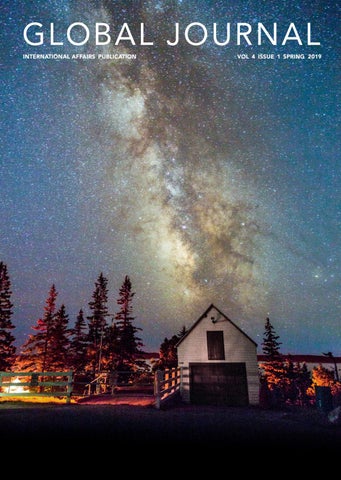
GLOBAL JOURNAL INTERNATIONAL AFFAIRS PUBLICATION
VOL 4 ISSUE 1 SPRING 2019
1
Editors
Photographers
Caitriona Keane
Kyle Bianchi
Cathy Tripp
Lauren Scornavacca
Kristin Terry
Charlie Steiner
Patricia Riester
Raina Levin
Alanna Pasco
Emma Bernstein Silvia Diaz Colleen Curtis Will Lake Lauren Butler Aneri Shah Erin Coyne Jordan Massa James DeCunzo Jessie Siegler Victoria Romulo Fernanda Lopez Margaret Sweeden
Cover photo taken by Kyle Bianchi
About Global Journal
Insight to our vision
Global Journal is a Northeastern University International Affairs student-run publication, covering international news, events on campus, study abroad, as well as domestic and international co-ops. Founded in 2014 by Madlen Gubernick, Elizabeth Zona, and Yasmeen Alhaj, the student group aims to bring the international community together through experiential narratives. Because being a Northeastern student inevitably implies international interest and awareness, Global Journal encourages students of all disciplines to participate in the student group. Global Journal comprises not only international affairs students, but journalism, political science, business, health education and art students as well. We believe that as Northeastern students, we are all global citizens with vast international experience: Global Journal gives students the platform to share those experiences with the rest of the community. We hope to inspire students of all disciplines to partake in building international bridges to help promote our global experiences.
Copyright Š 2019 All rights reserved
Letter from the President I am once again thrilled to present to you our newest edition of the Global Journal. This edition is a bitter-sweet one for me, as it will be my last as President of the Global Journal. The Global Journal has been such an important part of my Northeastern experience, and I cherish the years I have spent leading the Global Journal team and crafting the content of each print edition. There are so many people who have made the Global Journal possible, and I would like to take this opportunity to express my gratitude. To the College of Social Science and Humanities and the International Affairs Department, thank you for giving the Global Journal a platform to grow and thrive. Thank you to the various staff and faculty who have guided and supported the Global Journal these past years. To our wonderful Faculty Advisor, Jon Andrews, thank you for always encouraging every endeavor and idea I had and for being a source of support and guidance when it was most needed. The Global Journal could not have come this far without you. To Professor Denise Garcia, thank you for pushing me to pursue this role. Without you, I would not be writing this letter nor would I have accomplished many of the things I have at Northeastern - I am immensely grateful! To the fantastic Global Journal team — thank you for your tenacity and drive in making this publication possible. Mikaela and Gabriella, as our two most veteran members, I cannot thank you enough for all you have done for the Global Journal. No matter where your time at Northeastern has taken you, from Panama to Madrid, you have always made time for the Global Journal and for that I am immensely grateful. To our Head of Design, Karina, I cannot begin to fathom the hours you have put in every semester into creating these print editions. Your immense creativity and design knowledge has pushed the Global Journal to extend beyond written storytelling to include some of the most beautiful and touching examples of visual storytelling. Thank you for always meeting our impossible deadlines, and for your positivity and friendship while doing so. To our writers, you make the Global Journal into everything it is. Without you, our pages would not be filled with stories of personal reflection, struggles and growth. Thank you for sharing your story, and giving me, and our readers, a glimpse into your unique experience. Lastly, thank you to every person who has read the Global Journal; your support and passion for the Global Journal has given voice to many stories that would otherwise have never been shared. While I am sad to see this chapter of my life end, I am confident that I am leaving the Global Journal in the best possible hands. Caitriona, Alanna and Lindsay, I leave to you the responsibility and privilege of the future of the Global Journal — the three of you make a formidable team, and I am confident that you will take the Global Journal to incredible new heights. I wish you the best of luck! The value of global storytelling lies in the powerful way it brings individuals together despite whatever differences there may be. The Global Journal serves as an exceptional platform for this, and I wish it all the success going forward.
Sincerely,
Francesca Batault President of Global Journal
Photo by Kyle Bianchi
Meet the Team Members of the board
Francesca Batault President Politics, Philosophy & Economics Major, International Affairs, Law and Public Policy Minors From: Johannesburg, South Africa
Karina Masri Senior Art Director Graphic Design Major, International Affairs, Art History & Chinese Minors From: Southborough, MA
Gabriela Beatham-Garcia VP of Public Relations International Affairs Major, International Security Minor From: Madrid, Spain
Mikaela Cole VP of Outreach International Affairs Major, Concentration in Latin America From: Huntington Beach, CA
Lindsay Lowery Co-Editor in Chief Political Science & International Affairs Major, Concentration in Security Studies From: Minneapolis, MN
Alanna Co-Editor in Chief International Affairs Major, Computer Science Minor From: Boston, MA
Brittany Associate Designer International Affairs & Philosophy Major From: Sicklerville, NJ
Caitriona Keane Editor International Affairs and Biochemistry Major From: Suffern, NY
Kathryn Norris Associate Designer English Major From: Santa Barbara, CA
Kristin Terry Associate Designer Political Science & International Affairs Major, Concentration in Security Studies From: Johns Creek, GA
Cathy Trip Editor International Affairs Major, Cultural Anthropology Minor From: Fremont, CA
12
39
26
31
10
Americas Feeling Homesick at Home The Aloha State Tourists Like Me Quedarse en el chiquito
22
Europe Yellow Fury Amsterdam’s Market-ability Pub Culture: More Than Just a Pint
38
Africa
Mount Kilimanjaro Reflection Poverty and Education in Kisumu Slums A New Approach to Trust Communicating Without Words: Language Barriers in the Atlas Mountains
54
11
14
46
Middle East One Day in Jerusalem Invisible Borders Yet Still Coexisting
54
Asia & Oceania Barefoot Philosophy The Enigmatic Russian Soul An Unexpected New Home Get Outside
24
10
11 Ecuador by Lauren Scornavacca
Ecuador by Lauren Scornavacca
Feeling Homesick at Home Story by Tori Baldassini, Co-op
When I left Boston to go to Ecuador for six
However, there were also days when I missed
months to complete my global co-op with
Boston. I have lived in the Boston area my whole
the non-profit organization, Manna Project
life, and the six month span I was in Ecuador was
International, I was filled with excitement. I
the longest I have ever gone without being near
had a lot to be excited about – I was about to
my home. The transition into fall in Ecuador was
embark on a life-changing adventure in Ecuador.
particularly difficult because I missed the change
During my time there, I made several great
of season; Ecuador has a rather temperate climate,
friends, connected with a community that is very
and there were no dramatic changes between the
different from my own, improved my Spanish
summer and the fall. Looking at the calendar and
and got to travel to parts of the world I never
seeing it was October made me crave the crisp
imagined I would ever see. Even thinking back
autumn air, the changing leaves and of course, a
on these experiences now, I feel extraordinarily
pumpkin spiced coffee from Dunks.
grateful to have had the opportunity to learn and work in Ecuador.
12
But luckily, my feelings of homesickness never lasted long. If I started out my day feeling down,
Ecuador by Lauren Scornavacca
the excited energy of my students would almost
for an overpriced meal with my friends, I start
always cheer me back up again. And when the
craving the delicious $4 pork dish my neighbor
energy of my students got out of hand and I
used to make every Saturday. But most of all, I
started to feel overwhelmed, I could always rely
miss the people I was with everyday in Ecuador.
on my friends to lend me a helping hand; I will forever be grateful for the wonderful support network I found while living in Ecuador. That being said, I was still very excited to head back home just in time for Christmas. Now, having been back in Boston for the past two months, I am still really happy to be back. It’s been wonderful to see my family and friends here, and it was great to get to see Bostonians running through the streets because the Patriots won yet another Super Bowl championship. But now, a part of me really misses Ecuador. When I am walking to class in freezing cold temperatures, I really miss its temperate climate; when I go out
Of course, technology has made it easier than ever to connect with people who are long distances away, but nothing can replace being able to joke around with my friends or seeing my students’ smiling faces every day. Ironically, although I proudly identify Boston as my home, I am feeling homesick here. As strange and difficult as this feeling has been for me, it has made me realize that Ecuador became my home for those six months. Although I will probably always crave Dunkin Donuts and cheer for the Patriots, Boston is not the only place that my heart can call home anymore.
13
Hawaii by Charlie Steiner
The Aloha State
Photo by First Last
Story by Samantha Greig, Co-op
In Hawaii, Aloha is more than just a greeting.
people closer together to create intimate bonds
Aloha is a way of life and a symbol of love and
in a short period of time. Although the mainland
acceptance that creates the beautiful island spirit.
of the United States has various groups of interest
The spirit of Aloha manifests itself in the Hawaiian
that serve the same purpose, defining these
culture in a plethora of subtle ways that breathe
groups as Ohana seems to solidify the connection
even more life into the already enthralling magic
between people, creating a more welcoming
of the islands. The Instagram-worthy views are
atmosphere. Humans, being social creatures,
not the only things that bring people back to visit
enjoy the companionship of others. Research has
year after year. The culture of Hawaii is largely
shown that having supportive relationships is an
centered on the concept of Ohana, which means
essential component of happiness and wellbeing.
family. Here, Ohana encompasses much more
This specific element of Hawaiian culture within
than just relatives; the term can be applied to
the community may be one of the reasons that
many different groups across society. This concept
Hawaii was named the happiest state in the
makes large communities feel smaller, bringing
United States in 2018.
14
Hawaii by Samantha Greig
I am currently in Hawaii doing my second co-op
clinic goes beyond that of a service provider
at an outpatient Physical Therapy (PT) clinic.
and recipient. Compassion and understanding
I have heard the term “Ohana” on multiple
is truly emphasized as an essential component
occasions during my short time here, but the
of creating the special Ohana bond that
concept gained a new meaning for me after a
characterizes the spirit of Aloha.
recent experience at work. The owner of the company I am working at had just discharged a patient from PT services, but told her that she would always be part of this PT Ohana. The owner then thanked the patient for allowing him to treat her. The patient was told that she was welcome to come back at any time, during any point in her life, for a free check-up. This type of pro bono work is generally unheard of in the rest of the United States because free check-ups take up valuable time that the company could instead be using to make money. The therapist-
Another way the Aloha spirit is expressed in Hawaii is the concept of “Island Time.” The easy, go-with-the-flow nature of Hawaiians, induced by never-ending sun and an abundance of pineapples, leads to this so-called “Island Time.” Although important appointments have set times, the pace of life in Hawaii is far more fluid than that of the mainland. There is less rush to complete menial tasks and if large waves are in the forecast, those take priority over anything else scheduled.
patient relationship that is emphasized at this
15
Tourists Like Me Story by Raina Levin, Study Abroad
“When do you cease to be a tourist?” I had
permeates the city; with no air conditioning
this conversation with a couple of friends in the
or heat, the cool dampness creeps into every
months before I left for Peru. The three of us,
crevice of every apartment. 24 hours after
who lived on the same hall our freshman year,
you’ve showered, your towel is still wet. You’re
would spend a year and a half dispersed on
never quite certain whether your clothing is
three different continents.
damp or cold, or perhaps it’s only your hands
We discussed the question — what determines your “tourist” identity? Is it the length of
that are cold. The ever-present whiteness and wetness cast an air of uncertainty over the city, although to be fair, such uncertainty is
your stay, the sites you visit, your lack of personal connections to a place? Where is the
probably reserved for tourists like me.
line between tourist and resident? Are you
I stand out here. We all do, as international
automatically a tourist if you have a return
students; Lima isn’t like Barcelona, or even
flight booked? I walked into my five-month
Buenos Aires, cities popular for intercambios
study abroad experience equipped with these
estudantiles. The ten of us on my program are
questions, and I still grapple with them now. As I
very clearly “others” in this city, as is reinforced
reflect, I revisit the words I wrote during my stay.
to us every morning when we try to enter the
“
The ever-present whiteness and wetness cast an air of uncertainty over the city, although to be fair, such uncertainty is probably reserved for tourists like me.
”
August 13, 2018, less than two weeks into my semester in Lima:
“Apparently, it doesn’t rain in the winter here. Instead, the city is painted by a persistent drizzle, a faint mist you can breathe more than see, that manifests itself as the slipperiness of the pavement beneath your feet. Humidity
16
university. Without IDs (we’ll receive them when we’re officially registered for classes in a couple of weeks), we can’t walk through the main entrance. Instead, we wait in line at the office for international students, where we show a copy of our passports and thank the very kind women who let us in every day. Outside of school, it’s also obvious that I’m not accustomed to life here. I’m noticeably hesitant on the buses – something I’m working on – and paranoid about my personal belongings. My phone, which on the T rests loosely in my hand as I listen to podcasts, is usually stowed in a zipped jacket pocket. If I need to consult it for a moment, I brace the edge of the iPhone against my body, my hand clenched tightly around it. Lima takes “traffic” beyond any definition I’d ever known of the word. I’m not entirely sure
Machu Picchu by Raina Levin
that there’s a real rush hour; it seems like most
November 25, 2018, four months into my
every minute would be part of it. Cars honk
semester in Peru: “I was surprised by the combi
with complete impunity here, in a very different
system here.
way than back home. In the United States, a honk serves to get another car’s attention, but here, each one is part of a very loud, city-wide conversation between cars, buses, micros, taxis and pedestrians. The streets ring with a disharmonious chorus of inescapable beeps, so ingrained in the fabric of the city that any quiet moment seems surreal.”
They take some getting used to — these old, discarded vans purchased from other countries, vans that weave through traffic with a cobrador shouting their destinations from the side door. It’s funny, in Cusco, when we arrived, we were picked up from the airport by a large white tourist van. As we loaded in, we compared our
17
Photo by First Last
Machu Picchu by Raina Levin
fancy van to a combi. In a second, we were all
here — there’s no way we would’ve been able
off, shouting our best imitation of our beloved
to do that a couple of months ago.”
Lima combis, using the street names closest to us. Marina, La Marina, todo “La Marina!” Javier Prado! Benavides! “Todo Benavides!” It was spontaneous, unplanned and uproarious. It hit us all in that moment how we’ve adapted to life
18
As I reflect on these seemingly disjointed memories, I wonder: did I stop being a tourist then? Did I cross the tourist/temporary resident line when I felt comfortable in Lima, when I could recite street names at will, when I didn’t need
to check my phone for a bus route? I think it’s
while sauntering onwards, while drinking from
ironic that this moment took place in Cusco, an
a disposable water bottle. I could tell myself
expensive city many Peruvians are never able to
I’m not part of the problem as I throw my trash
visit. It is home to one of the most visited tourist
away in the proper receptacle, trying to keep
attractions in the world: Machu Picchu.
my conscious clear.
Before going to Cusco, I had a sort of haughty
But that trash isn’t there because of a couple of
attitude about it. I waited a long time to go —
inconsiderate tourists; it would be much easier if
it just wasn’t my priority. I was different from
it were. No, the trash is there because there are
the other tourists, who treat Lima as an airport
so many of us — thousands per day — all coming
gateway rather than a city; I lived and studied
to visit the same place. And I, among them.
there, afterall. I was dedicated to seeing all of Peru, not just trapezing through Machu Picchu, or following the “gringo trail,” as a man in my hostel called it. I was traveling the right way, meeting real people and speaking their language.
“
My pride evaporated with the early morning fog that shrouds Machu Picchu.
Balancing guilt and responsibility as a tourist is complicated. It’s why, when you see trash along hiking trails, you pick it up. It’s why, even when it’s muddy, you stick to the trail, preserving the flora that borders the path. You take each footstep up the mountain knowing that you are causing irreparable environmental harm. But you also contribute. You pay the institution that runs the tour. You tip the guide, who is good
”
at his job and deserves to be told as much, in words and soles. You go to restaurants, to bodegas. You stay at a family-owned hostel and
My pride evaporated with the early morning
converse with the staff. In the small cities, they
fog that shrouds Machu Picchu. Golden hour
ask you to tell your friends about the place, to
rays of light graced the verdant mountains,
spread the word and attract more tourists. You
the casual llamas, the 500-year-old ruins, and
promise you will.
I intently wished I’d scheduled more time for myself in Cusco - more time amongst the ruins and the crowds.
Two months removed from my study abroad experience — my long-term tourist experience, as you could call it — I’m still working on it.
Just beyond Machu Picchu, a mountain of trash
I keep trying to find a line in the sand, some
grows. In 2016, 14 tons of trash accumulated
clear-cut way to cause more benefit than harm
each day in the surrounding area. No one
to the communities I visit. I haven’t found it
wants this; no one relishes in the transformation
yet. If you have any suggestions, please let this
of a sacred city into a dumping ground. It’s
perpetual tourist know.
easy to imagine a select group of tourists — a camera-wielding, conniving, littering band — as responsible for the trash; it’d be all too easy to vilify them. I could disparage these people
19
Colonia by Emma Bernstein
Quedarse En El Chiquito Story by Emma Bernstein, Dialogue
Uruguay is Argentina’s hermanito to the north,
to as Argentina’s little brother. When I heard
colloquially referred to as the Switzerland of
that a week of my dialogue would be spent
South America. Both Argentina and Uruguay
in Uruguay, I had absolutely no expectations
have a heavy European influence due to a high
of this small South American country. In fact,
volume of early European immigration, but the
nobody in the group had any expectations at
countries have their own unique identities, and
all, which I came to realize was one of the best
Uruguayans would be offended to be referred
aspects of our trip to Uruguay.
20
After spending three weeks in the chilly, bustling
del Sacramento, or Colonia for short. Being in
city of Buenos Aires, everyone was feeling worn
Colonia felt like we were transported back in
down and over-stimulated. We boarded the ferry
time to colonial days. The historic district was
in Puerto Madero, Buenos Aires’s shiny port
impeccably preserved, and was reminiscent
district of skyscrapers with reflective windowed
of old Portugal. The buildings were pastel and
facades and upscale parillas. After a two-hour
terracotta stucco, with palm trees and sea views
ferry ride, we arrived in grey, rainy Montevideo.
within walking distance on all sides. There was
The first day in Montevideo was a blur of
an indescribable feeling that we all experienced,
tour buses and historic information, clouded
but everyone was very at peace while we stayed
in a gloomy drizzle. We passed mate drinker
in Colonia. Every night we would go down to the
after mate drinker, sitting on park benches
waterfront with a bottle of malbec to watch the
with their cups and thermoses, sipping from
most incredible sunsets I’ve seen in my life. For
metal bombillas that are designed for drinking
me, there was absolutely nothing to complain
mate. Mate is the unofficial national drink of
about in Colonia.
Argentina and Uruguay, and once you drink it, it is clear why it’s so popular. It tastes like an extremely bitter green tea, but the caffeine hit is completely unlike coffee and is very enjoyable.
“
Being in Colonia felt like we were transported back in time to colonial days. The historic district was impeccably preserved, and was reminiscent of old Portugal.
”
In Uruguay, we spent a couple days in the capital city of Montevideo which had a
surprisingly relaxed, slow vibe for a capital city. Nobody ever seemed to be in a rush for any reason, which was a welcome change of pace after being in hectic, crowded Buenos Aires for three weeks. From Montevideo, we travelled to my favorite place I have ever been to: Colonia
My favorite day of the entire dialogue was our free day in Colonia. The most popular mode of transportation there was golf carts, so we went to the rental shop and rented an old-fashioned buggy for the day. We drove all around the peninsula during the most beautiful sunny day. When we got hungry, we decided to stop at a restaurant right on the waterfront to order Uruguay’s national dish, chevito. Chevito is a literal pile of meat, cheese, french fries and eggs, and was one of the most delicious meals I have ever had. Paired with a view of the sparkling water, a glass of malbec, warm sun and good friends, I was at my happiest in that moment. I think what I love the most about Uruguay is that it is truly a hidden gem. Nobody knows how magical Uruguay is unless they have been there and experienced it. Even Anthony Bourdain agreed that it was one of his favorite countries on Earth. However, I hope that people do not flock to Uruguay as a tourist destination, because that would ruin the vibe that local Uruguayans have created.
21
22
23 Paris by Silvia Diaz
Paris by Silvia Diaz
Yellow Fury Story by Gabriela Beatham-Garcia, Study Abroad
We all have romantic visions of studies abroad;
By some sort of miracle, I managed to secure
meeting interesting people, eating exotic cuisine
an apartment in the first arrondissement, right
and traveling where maps and GPS’s are stumped.
in the center of Paris. I was eight minutes from
I had a similar vision of what my semester in Paris
the Louvre, three from the Musée de l’Orangerie
would be like: four months of crêpes, croissants,
and a mere 25 to my university, Sciences Po.
cathedrals, Courbets and saunters along the
I did my best to speak in French and ask for local
Seine. Paris is the epitome of picturesque, and its
tips and recommendations. I was lucky in so
privileged status in the areas of fashion, cuisine,
many ways, and it became easy to lose myself in
art and culture are rivaled by few.
the many pastry shops, cafés and museums. And
24
Paris by Silvia Diaz
that was how the story went for the first three
could hear the scuffles and see the smoke from
months.
our windows. But it was the next weekend that
November came and I went on a trip to
things really took a turn for the worse.
Normandy and Bretagne with an Erasmus travel
Instead of watching it on TV, I was leaning out
group. We were delayed both leaving and
of my window, witnessing protestors set fire
returning by boisterous crowds wearing yellow
to the streets, burn cars and break into stores.
vests who were blocking the roads and choosing
I was trapped in my apartment with tear gas
who may pass. At that moment, I didn’t know
seeping in through the windows. Suddenly, my
much about who they were or what they wanted.
well-situated flat morphed into the complete
Frankly, I was mostly annoyed at the delays these
opposite of an ideal location. As a student of
groups were causing us. The next Saturday,
International Affairs and International Security,
however, they swarmed the streets of Paris. I
it was fascinating to witness these historical
hosted a Friendsgiving at my apartment and we
moments, filled with passion and fueled by
25
Paris by Silvia Diaz
outrage. I was, in the very meaning of the
Unfortunately, it only takes a few to spark
phrase, living history. However, as a 20-year-old
violence, and throughout the many Saturdays it
woman, it was frightening. Despite trying to
became increasingly harder to concentrate on
avoid it, those images and experiences changed
the core message of the self-proclaimed Yellow
how I navigated Paris the last few weeks.
Jackets, or “Gilets Jaunes.� It altered the course
This movement projected a very powerful message, but one that was at many times
of the end of my study abroad, and I found myself eager to leave when exams ended.
corrupted by acts of violence. The movement
Even though this series of events was in some
grew and grew, even spreading to other
ways so shocking to me, it helped to remind
countries throughout the European Union,
me that I am not immune to domestic politics
countries plagued with similar problems and
when I embark on these idealistic adventures.
who were quick to latch onto the momentum.
They give us insight into how different peoples
This exemplifies the relatability of the struggles
address discontent and express frustration, while
they express and the reason why it became
simultaneously teaching us about the current
impossible for the government to ignore.
social, political, and economic environment of
26
Paris by Silvia Diaz
a country. Learning this is the authentic lesson
In many ways, I seem to be chasing protests
of studying abroad, and the process involves
and social unrest. I went straight from the
rolling up your sleeves to take part in both the
Yellow Jacket, fury-filled streets of Paris to the
pretty and the ugly. In the moment, it is hard
frenzy of Brexit in London. I don’t know if you
“
I am not immune to domestic politics when I embark on these idealistic adventures.
”
could characterize the decision as reckless or purposeful; it may be a bit of both. But the complexities of these issues are many times overlooked by foreigners, or cherry-picked by news sources. I continue to try to gain a deep and multidimensional understanding of them through my daily, experiential “history classes,” but I know that I have only begun to scratch the surface.
to understand all of these things, but reflection helped me to appreciate every event that
contributed to my understanding of the French people, culture and current social climate.
27
Amsterdam by Charlie Steiner
Amsterdam’s Market-ability Story by Lindsay Lowery, Study Abroad
The lure of class-free days with no
The market culture is as embedded in
responsibilities is exemplified in students’
Amsterdam as its canals. Big and small,
love for Fridays. In Amsterdam with no Friday
niche and varied, they are found in every
classes, I had the whole city at the feet. My only
neighborhood. The Albert Cuyp Market is
limits were the money on my metro card or my
possibly Amsterdam’s most famous market,
exhaustion from biking. Fridays quickly became
especially for tourists. Cradled in the De Pijp
my market day, as I ventured throughout and
neighborhood, it features daily selections of
outside the city, becoming wonderfully lost in
fruit, cheese, vegetables and knick knacks like
the aisles of stalls.
watches and clothes. Its marketability has left
28
it brimming with tourists, but catering to them
I gorged myself on the abundant cheese
has cost it some of its feeling of authenticity.
samples, but always came back to my favorite
Other markets include the monthly goods
stall and type (30+ Belegen). Light and soft, this
market in Museumplein against the backdrop of
cheese was perfect for slicing, shredding and
the Rijksmuseum; the Bloemenmarkt, a flower
eating straight. I wandered the aisles, trying to
market in the city center; Nieuwmarkt, for
learn Dutch by matching foods I knew to the
which an entire metro stop is dedicated; and a
displayed Dutch words. Thoughts of “when will
smattering of other food, antique, clothes and
you get to do this again?” rang in my head, and
art markets that flourish along the city’s streets
I frequently treated myself to ripe strawberries
and canals.
or freshly-baked muffins.
The smell of stroopwafels waft through the air in many Dutch markets. These wafer-thin waffles are traditionally sliced in half and filled with caramel syrup. They can be dressed up with Nutella chocolate or sprinkles, but I think it’s best to stick to the tried and true. Cheese, another Dutch staple, is found in every market. It must be due to the abundance of farms that dot
“
Its marketability has left it brimming with tourists, but catering to them has cost it some of its feeling of authenticity.
”
the countryside just outside Amsterdam’s limits. Poffertjes, mini Dutch pancakes, are dusted
“When will you get to do this again?” This
with powdered sugar. Other assorted foods are
question drove many of my decisions abroad from
colorfully displayed with enveloping aromas and
start to end. Previously, I had rushed through
inviting prices.
grocery stores, grabbing what I needed from
My local market gave me the picturesque Dutch lifestyle I dreamed of before going abroad. Each Friday, I rode my bike even farther outside the city. My path wound along quiet canals lined with old, small houses that each seemed uniquely sculpted. Just ten minutes away and nestled in the open courtyard of a surrounding mall was the Stadshart market. Here, they
shelves with a few impulse buys. In Amsterdam, I tried to appreciate basic opportunities more. I slowed down and truly enjoyed food shopping, intentionally treating myself instead of impulse buying. Luckily, I now still don’t have class on Fridays. While I may no longer be biking to get my cheese from a local farmer, I walk to get my groceries from grocery stores.
greeted me in Dutch, not English. I knew I had
The peace I found while abroad and exploring
escaped the confines of touristy markets and
markets lingers. I found another place and
found a true Dutch market. It contained almost
routine to call home, and it made me hungry for
anything you could imagine: mattresses, fruit,
my next adventure — and a stroopwafel.
purses, meat, handmade cards and jewelry, seafood, the list could go on. As time went on, this became my weekly retreat where I relished my Friday market day.
29
Pub Culture: More Than Just a Pint Story by Erin Cutroneo, NU.in
I am of the NU.in legacy: a newly accepted
their own. In Ireland, I had conversations with
freshman who elected to go abroad their first
strangers sitting next to me about everything
semester of college instead of jumping straight
from my struggles adjusting to the Irish weather,
into the “typical” college experience. I chose to
to their experiences with the housing crisis and
go to Dublin, Ireland mainly because my name is
our thoughts on the current state of democracy.
Erin, which literally translates as “Ireland.”
Never in these conversations did I feel any sort
Within my first week in Ireland, I found myself transported to the sparkly student accommodations that juxtaposed the traditional working class “Liberties” neighborhood of Dublin that it was located in — one which I soon learned was populated by “feral children,” as one of my professors called them: young people who enjoyed shooting off fireworks at the sky, passing cars, and even each other. Just across the street from where one of these children tased my group leader the first week, I found my local Pub: Arthur’s. My first evening in Dublin, I sat in the midst of a group of Irish people having a good time and socializing in an easy, open, and honest way: “having the Craic”, as the locals call it. While I would initially stick to hovering next to my four-day-old friend — someone who would soon become my pub buddy throughout the rest of the semester — it was almost too easy, too natural to just loosen up and talk to the people sitting next to me, or even the bartenders when they had a break between waiting for your pint of Guinness to settle, before filling it the rest of the way up. As I began to explore the other pubs in my area, I found something you don’t find very often in the United States: people who were genuinely open to points of view and ideas different from
30
of animosity or judgement for my thoughts or feelings. There were no factions, no sides and anyone could speak to everyone and feel, if not understood, at the very least respected.
“
Given the typical dreary and rainy Irish weather, the Irish people created a place of welcoming and gathering for themselves.
”
A couple months into my stay, I began to
wonder: “Why are Irish bars called pubs?” The answer was both simple and telling: “Pub” is short for “Public House.” Given the typical dreary and rainy Irish weather, the Irish people created a place of welcoming and gathering for themselves. These pubs represent the undeniable community that exists in Irish culture. Under a rarely blue sky that almost constantly threatened dreary weather, the Irish people displayed a character that exactly
contradicted the miserable skies that hung over their city. Through centuries of oppression and discrimination under colonial rule, the Irish have made one thing their strength: their
Ireland by Colleen Curtis
sense of togetherness. The Irish pub is the
losing so much of and still struggling to recover
physical manifestation of that, representing Irish
the lives lost during the Great Famine to the
resilience through unity.
fight for national independence from British
Despite being a somewhat isolated island nation, I found the Irish to be much more accepting of people from all walks of life than many people I have met in the United States. Through all the hardship they have faced, from
rule, the Irish still hold fast to their core values of fairness, warmth and generosity. It is those very traits that are represented in the form and function of the pub: refuge from stormy weather, acceptance for all, and above all, a place to have the Craic — a true place for the public.
31
32
33 Lion Cub by Will Lake
Photo by Erin Burba Mount Kilimanjaro by Lauren Butler
Mount Kilimanjaro Reflection Story by Tova Lenchner, Personal Reflection
Every morning, 80-some odd people summit Mount Kilimanjaro; on the morning of July 19, 2017 at about 7:08 a.m., I was one of them. When I tell people this, they are impressed, but to be honest, this was one of the easiest accomplishments of my life. Six months earlier, when I told my father that we should climb Mount Kilimanjaro, he didn’t quite realize I was joking. With most travel
34
plans, I don’t fully grasp the ensuing change until I actually arrive, but when my father signed us up for the climb it felt all too real. Although his decision seemed alarmingly abrupt, it was actually the culmination of nearly a year of change. By May 2016, my father had already approached us about our thoughts on moving to Kenya. My upcoming first year of college
“
She said, “Do it afraid: just take it one step at a time.” And that’s just what I did.”
other news: breast cancer. Treatment needed to start immediately and these treatments were only readily available in the United States. My dad was locked into a contract and had no choice but to
”
included some traveling plans, so I felt that I
was in no place to deny him of this opportunity. He spent some time visiting and establishing a
new lifestyle, anxiously waiting for us to join him during the following summer. But my mom had
put his faith in his three daughters for the next year. Suddenly, the roles were flipped: it was our time to pay mom back for all that she had done for us as children, and take care of her. Luckily, I had the perfect coping strategy — although it is not always 100% effective: I ran. I’m no marathoner, but I found that an hour on the road reminds me to “look where my feet
35
are.” My mother always presented me with this metaphor when I felt that some challenge was too great for me to face. This expression reminds me that worrying has no benefit, and that in the current moment, everything is alright. My father had always been a thrill seeker, but he would choose rock climbing or running a race over skydiving, and justified this by explaining that he finds more thrill and accomplishment in doing something by the power of his own strength. I experienced this same thing every time I ran. Unbeknownst to me, this running would also become the perfect training strategy for Kilimanjaro.
“
It was easy in the beginning. We strolled through the forest taking pictures with the lush flora and trying to capture video clips of the animals we saw, or at least heard. We would stop for snacks and tea and to play yard games taught to us by our Kenyan friends. But halfway through, the trek started to become much more difficult. The ecosystem drastically switched to look like some movie set on Mars, with intermittent patches of Dr. Seuss-esque mystery plants and formations. It was cold, we couldn’t shower, the food was gross, and then people started getting sick; but we had to keep
We made it to the crest of the summit ridge. I cried just watching the pure beauty of the sunrise come over the uninterrupted horizon.
”
Although I say this accomplishment was easy,
that doesn’t mean it came without its dose of
mental breakdowns. After 10 hours cramped in a van venturing to a town placed in the foothills of Kilimanjaro, we checked into our hotel — one that distinctly smelled of humidity and played host to some questionable half-dead bugs in the hallway. Suddenly, the immensity of everything I was about to do seemed to hit me all at once, uncontrollably, leaving me to cry in my mother’s arms. I clung to her as she tried to leave and say goodbye like a child on her first day of kindergarten. She said, “Do it afraid: just take it
36
one step at a time.” And that’s just what I did.
going, one step at a time. Then came the night of the summit: we woke up at 11:30 p.m. to begin our journey. The guides and porters say they do this because that is when the snow is the most compact, but I believe it’s actually because we were under the cover of dark, and in the darkness you can’t see what you’re in for - you can’t see how steep it is, you can’t see how much longer you have to go, you can’t see what you’re getting yourself into. But we kept going, and then came my second breakdown; I think this one was prompted — at least in part — by the lack of oxygen. In a very emotionally delusional state, we made it to the crest of the summit ridge. I cried just watching the pure beauty of the sunrise come over the uninterrupted horizon. But, we had to keep going, one step at a time. We watched as people skipped down the mountain, relishing in the oxygen-filled air closer to the mountain’s base, and I remember being slightly annoyed as I continued to trek upwards. But on our way back down we did the exact same thing, nearly running down the mountain as the oxygen returned to the air, running almost as if to say
Tanzania by Jordan Massa
Mount Kilimanjaro by Lauren Butler
“Get me off this mountain as fast as you can!”
I say that this is the easiest accomplishment
My third and final emotional breakdown came
of my life, not because it came without its
in the back of a van two days later on our way
unique hardships, but because in this state
back home. This one was by far the strangest to
you can only think of one thing. You can’t
me, because this time the challenge was over,
think of that drama with your friends, of the
but it felt as though I was leaving something
homework you have to do, or even about trying
behind — almost as if I were leaving an old
to look presentable to impress anyone. On the
friend who had tried to duel me in a wrestling
mountain, there was no one and no ego; just
match, but would have to do better next time.
the one goal of surviving.
37
Poverty and Education in Kisumu Slums Story by Madeleine Hahn-Smith, Co-op
Karibu Kenya! “Karibu” - meaning welcome, is one of the first Kiswahili words I learned when I arrived in Kisumu and is a central theme of this community and its culture. Each new person I met welcomed me into their home — offering food, tea, and conversation. These conversations often became lessons for the challenges facing the communities here and what local people are doing to address these problems. When people think of Africa, images of poverty, violence, and disease shown on the news come to mind. It seems that very rarely do we hear about the amazing positive changes that locals were affecting in their
to send their children to school. Korando was created to address these challenges by providing completely free education to kids whose families cannot afford the associated costs. Korando fills a significant gap in the Kenyan education system, reaching kids that would otherwise have no opportunity to learn basic skills like reading, writing, and mathematics.
“
My time in Kisumu has not only changed my perspective, but continues to inspire me every day.
”
own community. My time in Kisumu has not only changed my perspective, but continues to
I have been so struck by the excitement that
inspire me every day.
the children here at Korando. They often wake
For my third co-op, I am working with Better Me Kenya and the Korando Educational Centre to assist with their efforts to lift up the Kisumu community through education, accessible healthcare, and additional psycho-social support. Korando was first started in 2006 by a retired school teacher affectionately known as Mama Dolfine who started caring for orphans in her community and eventually opened her own informal school to care for and provide education to orphans and vulnerable children in her community. Though primary education is officially free in Kenya, in reality there are admission charges, uniform and school supply costs, and other expenses that make it difficult for many families
38
up as early as 4:30am and are working and learning until 6:30 pm. After that they are piled with homework. Despite these incredibly busy schedules I have never child complain about going to school. A 2018 study by the Kenyan Ministry of Education estimates that over 850,000 children between 6 and 17 years of age are currently out of school. I believe that the kids at Korando recognize that many of their peers still cannot attend and they are happy to be here. About 13 kilometers (8 miles) from Korando is Nyalenda, a slum settlement on the outskirts of Kisumu near Lake Victoria. Here, HIV affects most residents either directly or indirectly and many survive without reliable income,
Photo by Aneri Shah
oftentimes making less than 200 Ksh ($2 USD)
This mobile library gives kids who cannot attend
per day. With such a small income, it is a
school the chance to read and learn. On some
struggle for families to afford to put food on
days kids who do attend school are able to join
the table and pay for basic necessities. Parents
us, allowing for peer learning to occur. This is
want their children to attend school, but it is not
in no way a permanent solution to the issue but
economically viable.
Irene has done a good job of addressing the
Irene Onoka, an entrepreneur who grew up in Nyalenda, is well-versed in the challenges facing
problem and giving kids some opportunity to still use their brains and practice their literacy.
its residents. She works to address some of
Paul (nicknamed Pablo), is one of the children
these problems and help the families bring their
in a difficult situation that is being supported by
children back to school. For the past 4 years she
Irene. His parents took off when he was a baby
has taken money out of her own pocket to run a
and he lives in Nyalend with his grandmother in
mobile library for the kids in this situation.
Nyalenda. She does her best to make
39
Kenya by Aneri Shah
everything work but her age makes it difficult.
gathered a group of women together to start a
Pablo attended school for several years but
cooperative and we are currently in the process of
because of the cost of school fees he dropped
opening a bakery, which will help generate some
out in 2017 and hasn’t been able to go back.
income. Hopefully, women will be able to use this
Luckily Irene and her acquaintances are working
income to pay for their children’s education. One
to support Paul through school sponsorship
woman I met has seven kids and her husband
fundraising and can We hope to raise sufficient
is unemployed. She works long hours doing
funds in the next few weeks and get him back to
domestic work such as washing to put food on the
his learning soon
table. This cooperative will give a more reliable
Irene has now decided to take her efforts to the next level by starting a community-based
source of income that will hopefully soon be enough to help her send her kids to school.
organization (CBO), which just received official
This organization is still in its early stages and
government approval last month. This CBO has
we have a long way to go before the bakery is
40
Kenya by Aneri Shah
operational and making a profit. For me it has
We also hope that once the bakery is established,
been an incredible opportunity to learn from
we can start a chama. A chama isan informal
the local community members. With some
micro-savings group where women can pool their
funding and a lot of hard work, I believe this
money together and take loans from each other
bakery could be an incredible opportunity to
as an investment in income-generating activities.
improve the entire community. Irene envisions a
Irene also hopes to build a more permanent
ripple effect occurring, so that the women in the
community center nearby that will serve as a more
cooperative will learn entrepreneurial skills such
permanent replacement to the mobile library.
as bookkeeping and then will be able to take that
I’m so excited to continue to learn from these
knowledge and start their own small businesses or
incredible entrepreneurs throughout the rest of
expand the bakery further. As women move up or
my coop. Kenya truly has some incredible people
out of the organization, more women can come in
doing incredible work and I feel very lucky to have
and get training.
this opportunity.
41
Tanzania by Erin Coyne
A New Approach to Trust Story by Erin Burba, Co-op
When I decided to move to Tanzania for my
English-speaking countries, and my trips to
second co-op, I had very little foundation for
more unfamiliar places were always heavily
and understanding of what was ahead. I knew
structured and accompanied with school
next to nothing about the country. My new
support. I was finally hitting a stride with
boss couldn’t tell me exactly what kind of
my social life and mental health, and I was
projects I would be working on, and he was
terrified that neither would survive such an
honest in telling me about the challenges of
interruption as half a year on the other side
operating in Tanzania’s solar energy market.
of the world. Still, I recognized that the co-op
My solo travels had all been to Western,
with Sikubora was an amazing opportunity,
42
and I hated the idea that I would allow fear of
on conveniently aggregated, straightforward
the unknown to dictate my life and limit my
evidence. It was not a perfect method. Some
experience based on my perception of safety.
situations looked riskier in hindsight than
The bravery/FOMO got the best of me, and I
previously assessed. But we accomplished so
moved to Tanzania where I would live for the
much more than we would have if we only acted
next seven months.
on obvious foundations and straightforward
When Sikubora approaches people interested in
paths. Trust empowered us to try.
purchasing a solar energy system for their home,
The credit approval process at Sikubora
it is assumed that this will be the first formal
was designed to compile these scattered
loan of the customer’s life. The scarcity of formal
pieces of evidence in favor of the customer’s
financial institutions and generally informal, piece
responsibility and financial activity into a real
meal nature of employment in Tanzania led
foundation for loan eligibility. Completing the
many people to have little to no documentation
credit application with a Sikubora employee
of their financial activity. In traditional financial
establishes our relationship with the customer
institutions, a person with no formal bank account
as one built on honesty and trust: if they
and no proof of employment would almost
can provide accurate personal information,
definitely be denied the opportunity for a loan.
we can work to create mutually beneficial
And yet, Sikubora routinely grants multi-hundred
opportunities. Piecework, farming, self-
dollar loans to this population.
employment and the endorsement of local
“
We accomplished so much more than we would have if we only acted on obvious foundations and straightforward paths. Trust empowered us to try.
”
leaders are respected and recognized with similar weight to formal employment and banking. System shut-offs and loan defaults are not automatic, but rather something we avoid through compassionate displays of moderate leniency and active customer relations. We found that once we identified a customer as responsible and trustworthy, and recognized that with a loan, the customer works hard to maintain that identity and adhere to the terms of repayment.
This year, I’ve run into many personal and
Starting my co-op at Sikubora, I was tasked
professional situations where the foundation
with familiarizing myself with the company’s
for taking the next step was anywhere from
resource tracking software and enhancing it
minimal to unstable. I acted with a less-than-
with new reports and utilities. It took some time
confident degree of certainty. At Sikubora, my
to become familiar with the tech stack, but I
boss, my coworkers and I pooled small and
learned what was required to be competent
scattered pieces of evidence in favor of people’s
in my position. I listened to my coworkers in
abilities and trusted that they could produce an
the all-company meetings and started working
outcome that was comparable to one founded
with them to identify and alleviate pain points
43
Ngorongoro Crater by Jordan Massa
“
I don’t know what my life would be like if I never let myself act with less than complete confidence.
me non-technical tasks, like working on the financial model and writing funding proposals. This experience of doing my co-op in Tanzania has already had an immense impact on how I think about my life, approach my goals,
”
in their work. A few months into the co-op, I designed and built a complete inventory
tracking system. Then, my boss started giving
44
and address challenges. At the root of each change is my new approach to trust. Despite the demands of my classes and the anxiety of securing my final co-op, I have found myself more relaxed, more resilient to adversity and stronger in standing up to my fears and avoidant tendencies. I can recognize that I’ve
Ngorongoro Crater by Jordan Massa
made it through every challenge up to this
or at least still in Kentucky. I definitely
point, and with that, I can trust myself to find
wouldn’t have moved to Tanzania, nor would
a way through the next round. I’ve started
I be applying for co-op positions that I feel
focusing more on my habits and default
are a reach for my skills and experience. If the
systems than on my goals, finally able to trust
folks at Sikubora never took a risk on granting
the compounding effects rather than worry
someone a loan for a solar energy system, a lot
about immediate results. My willingness to trust
of responsible, hard-working Tanzanians still
others — personally, professionally, emotionally
wouldn’t have reliable electricity in their homes.
— has a much more liberal foundation.
I don’t know what the future holds. But in the
I don’t know what my life would be like if I never let myself act with less than complete
present, I can act in a way that validates the efforts of my past self with trust in my future self.
confidence. I might still be in my hometown,
45
High Atlas Mountains by James DeCunzo
Communicating Without Words: Language Barriers in the Atlas Mountains Story by Aspen Schneider, Dialogue
Communication became the greatest comfort
of Morocco in which we spent time, such
when traveling with a group of unknown
communication was completely impossible.
classmates to a continent that I had never
The villages within the High Atlas Mountains
been and immersing in a culture and religion
are isolated from the modernized world, with
vastly different than my own. To be able to
very little interaction with any other place.
ask my professor questions, to discuss new
A sink with running water and a very old
ideas and experiences amongst peers and
television were among the most advanced
to converse with my host family about the
technology to be seen. Within an isolated way
different lifestyles we live all helped immensely
of life, also came a more isolated language.
in feeling comfortable in Morocco and gaining
The villagers within the area spoke only
understanding of the country.
Amazigh, a very old dialect, which is not
Within the High Atlas Mountains, however, a mountain range within the Northern area
46
commonly used. Suddenly, the ability to communicate with others and the connection
High Atlas Mountains by James DeCunzo
that provided assistance in a foreign land no
What resulted from this lack of verbal
longer existed.
communication was a much greater appreciation
The families of the High Atlas Mountains live simply, and are self-reliant for all of their needs. The mothers create the clothing that is worn, the fathers kill the animals that are eaten. Us students, when staying within the mountains, were tasked with helping the families complete their necessary tasks. Such tasks included bringing cattle to water sources, pulling weeds from the ground and cutting plants to bring home. Although such tasks may seem easy at first consideration, they become much more difficult when there is no common language for the person guiding you to explain the tasks at hand or provide assistance in the best methods to complete the assignments.
for non-verbal communication. The ability to point in different directions or at different paths, to demonstrate how to hold the weeds properly before pulling, to shake a finger when something was incorrect all proved helpful. Even more so, the warmth that a smile can bring and the reassurance provided from a clap of the hands were proven more so than ever before. The ability for different people, of very different lifestyles and backgrounds with almost nothing in common, to connect through the most fundamental cues was astounding. It served as a reminder that regardless of the many differences that exist amongst countries, amongst groups, and amongst people, we are all linked in some way. There is always a way to cooperate, to share a moment, to show kindness.
47
48
Lebanon by Karina Masri
49
Israel by Jessie Siegler
One Day in Jerusalem Story by Jessie Siegler, Co-op
One day, during my co-op in Israel last spring, a
thus considered extremely holy along with
friend and I decided to take a trip to one of the
the Mount’s Western retaining wall, known as
most contested pieces of land in the world. The
the Western Wall or Kotel. The Mount is also
place: the Temple Mount in Jerusalem, which
the site of the Dome of the Rock and Al-Aqsa
many of my friends in Tel Aviv refused to visit
Mosque, two of Islam’s holiest sites. The Dome,
because of the security issues and conflict which
constructed in the late 7th century, is one of the
surrounds it. The Temple Mount is contested in
most iconic buildings in history and is perhaps
large part due to the same reason Jerusalem is
the most famous image of Jerusalem as a whole.
contested — its holiness to multiple religions. Its name comes from the the site of the ancient Jewish temples which stood there, and it is
50
I was nervous to navigate the complexity of Jerusalem’s Old City for the first time without a
tour guide. It was a sunny day and I was hot in
visitors to the Wall. We then queued up with
my long clothing, anticipating the conservative
the large group of people waiting to enter the
dress code required for women to visit the
Mount during its very limited visiting hours, many
Mount. I used Google Maps to navigate from the
of whom appeared to be American Christians.
new city to the old by walking. There are many
After waiting in line and passing through another
gates that you can use to enter the four quarters
round of security, we were allowed to enter the
of the old city (Christian, Jewish, Muslim and
wooden walkway which passes over the Wall and
Armenian), some of which are more commonly
opens onto the Mount. At the top of the walkway,
frequented by tourists than others. Each quarter
Muslim security (administered by Jordanians)
and neighborhood in the city is different from the
evaluated the appropriateness of our attire.
next. I knew I wanted to enter into the Jewish
I wore long pants and a large scarf wrapped
Quarter through the gate that I was familiar with,
around my waist and was let through without a
the Zion Gate. Thus, I then navigated from there
problem, while my friend (male, in shorts) was
to the Mount.
made to wear a turquoise skirt to cover his knees.
“
After passing through all the layers of security, the nervousness I had been feeling dissipated and I could appreciate the beauty of the Mount.
After passing through all the layers of security, the nervousness I had been feeling dissipated and I could appreciate the beauty of the Mount. Despite being a place of tension and conflict, it felt very quiet and peaceful, largely due to the fact that it was full of people going to pray. The Mount is a large, open plaza, with trees planted around it. The most stunning part is the
”
Dome, and while I was not allowed inside (as a non-Muslim), admiring it from the outside was amazing in itself. After taking many photos, we
On the way to the gate, while walking along a
were told that it was time for visitors to leave,
beautiful park near the old city wall, Google Maps
and we were ushered out through a different
showed us crossing a dotted line referred to as
gate on the western side. As we were heading
the “1949 Armistice Agreement Line.” We saw no
towards the gate, two Orthodox Jewish men
physical reality corresponding to the line — the
tried to enter the gate and prostrate themselves
sidewalk continued forward, uninterrupted by
before the Mount. Just a few feet in front of me,
any geopolitical burdens. We then reached the
a group of guards slowly walked the men back,
Zion Gate, where physical evidence of conflict -
keeping them outside the gate. Jewish worship
namely, dozens of bullet holes in the stone from
is not allowed on the Mount, and neither are
the Six-Day War — could actually be seen. Next,
Jewish symbols of any kind. I had made sure not
we headed through the Jewish Quarter toward
to wear any, and my friend had left his yarmulke
the Western Wall plaza, where we would access
at home. The sense of peacefulness I had felt was
the Mount. Descending the stone stairs to the
broken, though I knew it was false to begin with.
plaza, we first passed through security with other
51
Photo by Olivia Sorenson
Invisible Borders Yet Still Coexisting Story by Danielle Murad Waiss, Co-op
The smell of a bonfire surrounds me. Behind me
they have bonfires and are cooking an evening
are the beaches of Tel Aviv and in the evening
meal. I no longer hear the Hebrew that usually
sun, the sky is painted many oranges and pinks.
surrounds me. I hear Arabic instead. I do not
As I move forward, I leave behind the tourists,
understand what they are saying, but as I walk,
the Tel Aviv fitness freaks and the strolling
some people stare at me, sometimes yelling
couples. As I cross into the last beach before
something at me in Arabic, sometimes winking
the port it feels like I am in a different country.
and sometimes just looking. Perhaps it is
The long, paved boardwalk that contours the
because of the riots that recently took place in
beaches of the Mediterranean Sea in Tel Aviv
Jaffa, or because I am alone and it is beginning
is the same, the walking and bike paths extend
to get dark, but I am a little nervous. I press on
all the way to the port, but the only grassy
walking straight ahead.
beach in the city, seems to mark a big change. Multiple families are arriving at the beach,
52
The strip of Bauhaus buildings that line the beaches in Tel Aviv have disappeared.
I carry on, the view of the ancient white stone
I come by a beautiful sweets shop, with all kinds
buildings and the narrow clock tower also in
of treats displayed. It seems to be a popular
white are inviting me forward. I eventually make
location. As I pass the shop I find myself in a
it to the port. A narrow stone barrier lines the
different environment. The buildings here are
water. I can hear a mix of languages including
no longer made out of white stone. I can hear
English, Russian, Spanish and Arabic. There is
music, chatter and a big crowd. I have found
a musician and people watching. I am at ease
the Shuk Hapishpishim or flea market. I can no
once again. A wide staircase invites me up. I
longer hear Arabic, English is predominantly
ascend and find myself between small shops
spoken. The contrast between the street I just
and homes lining this maze of white buildings,
turned from and this area is extreme. The local
white homes and white stones. I am now alone,
culture is gone. It is nice, but it feels wrong, like
except for the occasional passersby who are
it wasn´t meant to be here, like it is disrupting
either on their way, or are exploring the area.
the otherwise calm evening in Jaffa.
It is quiet, I am not scared but intrigued. The white stone, from which the Old City of Jaffa is constructed, makes it difficult to figure out where I am. Eventually a right turn leads me into the main square; an open plaza, with some shops and restaurants, a small stage and some sort of ancient ruins. The people here are enjoying the evening. An argentine tango lesson is taking place on the stage and people are watching. Others are sitting in the few bars and restaurants and enjoying the breeze that is coming from the beach.
As I walk back home leaving the white stone behind me, I am flooded by the local bustle of Tel Avivians. There is a temporal division between these two parts of the city. The Old City of Jaffa is generally quiet, compared to the non-stop city life of Tel Aviv. My walk was mostly quiet, the lights were dimly lit and it felt as though I was in a different time. People are more conservative in their demeanor and dress and they follow their long standing traditions more. In contrast, Tel Aviv is a pocket of liberalism, personal freedoms and self-expression. Neither
I can see the clock tour just behind the square,
is better or worse, but the boundaries in ways of
I walk towards it straight through the plaza
life really highlight these distinctions.
and before I know it, I find myself in a less comfortable environment. The clock tower is in front of what seems to be the entrance to Jaffa, which is confirmed by the police van standing at the entrance. The men in and surrounding the van are keeping an eye out and this clear division makes my senses heighten. The people here are Arabs. Nobody says anything, some ignore me, while some smile and nod. The sidewalk is lined with shops and restaurants, and the distinct aroma of Middle Eastern spices
Although Tel Aviv and Jaffa are considered one place, the differences that exist make it seem like miles away. I can’t help but think about the politics of it all and how the situation has drawn borders within this city. Recent events have made people cautious and I can’t help to think whether the warnings I have heard are only feeding into our imaginations to help construct these borders and lines within a city that has coexisted with different ideas.
fills the air.
53
Photo by Lydia Ioannidou
54
55 South Korea by Victoria Romulo
South Korea by Victoria Romulo
An Unexpected New Home Story by Sherilyn Gautama, Study Abroad
As an international student who moved out
excitement (mostly excitement, though). South
when I was 15, I am used to adapting to new
Korea is a special country for me because it is
places and shifting homes. It’s interesting as a
the place I spent my high school graduation trip
teenager to have changing definitions of what
with my friends just a year before. It’s a country
a home is, and I felt that the most when I was
where I have hidden a lot of memories and a
in Seoul, South Korea. As background, I am an
country where I’ve really bonded and fell in love
Indonesian student who moved to Singapore
with its culture and people.
for high school, then came to Northeastern for university. When I received the acceptance letter to study abroad in Yonsei University, I didn’t feel elated. I felt a mixed sense of dread and
56
When I moved into Yonsei University for my study abroad, I was so excited. I could already tell that I would have a great time in this
South Korea by Victoria Romulo
summer program. I also started becoming
About two weeks in, me, my roommate and
very familiar with the surrounding areas of
her boyfriend went on a weekend trip to Nami
Sinchon, Ewha and Hongdae. I got to know
Island. This had been my dream because it is
friends who kept me company every day. I
the set of a famous Korean TV drama I watched
was lucky enough to share the same classes
when I was young. We had a magical time there
as Yunjin, a Korean girl studying in the United
exploring the island by bike. We also passed
Kingdom, and we always went to our second
different cities in the east and witnessed the
class together while we shared what we did on
most beautiful sunrise in Korea (and arguably,
the weekends. I even had a routine everyday
in my life) in Jeongdongjin. As I watched the
for school: ordering coffee from the same spot
sunrise, I just realized how in love I was with
and eating the same menu for breakfast. As a
this country and it really felt like home. I was in
person who loves a sense of routine, I didn’t
awe at how at ease I was becoming with this
even notice that I was starting to become very
unfamiliar city. We also went to some other
familiar with my surroundings.
beautiful places like Seoraksan mountain, a freshwater river in Yang Yang and a filming site
57
South Korea by Victoria Romulo
from a popular drama called “Goblin.” I never
wasn’t going to pass because I did not do as well
thought I would grow to adapt so quickly,
as I wanted. I sang a famous song called “Eyes,
especially when many aspects in my life in Korea
Nose, Lips” by Taeyang with a bilingual twist: I
were vastly different to my life back home in
sang the first half in Korean and the second half
Singapore or even Boston.
in English. It turned out that I did well, passed
Around halfway through the summer program, there was a talent show program where the Yonsei International Summer School students could audition and be a part of the Summer Fiesta, a dinner party the school arranged for
the audition and was asked to perform. I was very nervous as the day came closer because I was singing in a language I was not familiar with, but the event planning team was so supportive and emailed me constant encouragement.
all of us and our professors. My roommate (who
I was also lucky enough to be approached by the
was also from Northeastern) told me to apply for
GEO office in Northeastern to do a takeover on
it because she knew how much I loved singing.
their Instagram about my time in Korea and my
I auditioned right after my classes and thought I
study abroad experience. I loved sharing how
58
South Korea by Victoria Romulo
my day went and answering questions about
this new country because I was not there just for
it. Yet another amazing opportunity from this
a mere vacation. I had to study and be in school.
experience! The International Marketing Team
I did not realize how comfortable I felt the more
in Yonsei emailed me that they saw my GEO
I went out and was able to order food by myself
takeover and wanted to interview me about my
or even use the subway trains without getting
time. I never thought I would have this much
lost. I mean, it took me at least six months to
involvement in such a short amount of time in
a year to be able to call Singapore and Boston
my study abroad, so I felt beyond grateful and
home, and here I was feeling at home after six
blessed to able to share my time in Korea.
weeks in Korea. Though I only visited Korea for
As my time in Korea came to a close, I reflected back on the amazing memories I made while I was there. I reflected as I sit down sipping my
a short time, I did not expect to find a place to call home, and that made South Korea an irreplaceable place in my life.
favourite coffee order at the sandwich place down the road from my dorm. I thought I was going to struggle a lot in terms of adapting to
59
Indian Woman by Fernanda Lรณpez
The Barefoot Philosophy Story by Chelsey Harmer, Dialogue
Sitting on the ground in a circle, barefoot,
fed. The smell of much needed rain pouring
metal trays in front of us, watching the locals
down, filling the reserves, getting caught with
skillfully eat a heaping plate of dal, rice and
no umbrella. Sleeping on a low cot, watching
roti without using any silverware. Children
millipedes crawl under the door.
from a nearby village wandering over to play, learning their names without sharing a common language. Stray dogs trailing along behind us fighting with one another, hoping to get
60
These were the sights, sounds and smells of our stay at Barefoot College. After driving many hours on the deserted highway, and
down narrow bumpy cow-filled roads, we found
at work laughing and wiring solar lanterns,
ourselves in Tilonia, a village in the Ajmer
communicating without sharing a common
district in Rajasthan, Northern India. Our stay
language. These women were the current group
was humbling, and I had to embrace being
of “Solar Mamas,� who came to Tilonia from
uncomfortable at times. It was here, away
the most remote villages across the globe to
from the organized chaos that exists in the
train to become solar engineers. By the end
cities, that I learned some of the most valuable
of six months, the women are sent home with
lessons from our entire dialogue. I realized,
the knowledge and tools required to bring
sitting on the floor among the others, eating
solar power to their villages, all without using a
some of the best food I would have over the
universal language, but instead with a workbook
whole trip, that Barefoot College is truly a
that uses diagrams and pictures. The women
hidden gem. While it may not be a traditional
in the current group were from 10 different
college, as its name implies, it is a place that
countries, ranging from Afghanistan to Myanmar.
embodies community, education, and growth.
I had a chance to speak with the women from
Barefoot College was built by the poor, for the poor. The mission of the organization is centered around supporting and nurturing rural villages, empowering them to become innovators and educators. My experience at Barefoot was unique because it is unlike any other social enterprise that we visited. I realized that development does not have to entail urbanization. There is value and untapped potential in empowering the rural poor by spreading self-sufficiency and sustainability to the most remote places in the world. This is achieved through many different lenses at the
Uganda who knew English. All four were very grateful for the experience, a little homesick and were excited to go home and light their villages. In addition to learning engineering skills, they also take courses in personal finance, entrepreneurship, sexual health and technology. The women were confident and seemed to enjoy the safe space that Barefoot had created for them. The whole workroom had a sort of buzz to it, an energy and confidence that spread between the women as they worked side by side; in that moment, I knew Barefoot was a very special place.
college, from educating others about energy
Barefoot College provided me with a new
and water to sexual education and dental care.
perspective on rural development. My previous
Barefoot’s innovative solutions target 14 of the
mindset was rigid, in that development is about
17 UN Sustainable Development Goals. The
baby steps and access to basic necessities,
most impressive program the college has to
but my experience at Barefoot taught me that
offer is the Solar Mamas.
these villages have all of the capability they
When I walked into the workroom containing 45 women of all different nationalities, sitting on either side of a long table filed with circuit
need; education, training and technology are the key to helping them make leaps and bounds instead of baby steps.
boards, soldering tools, I was awestruck. These mothers and grandmothers were busy
61
The Enigmatic Russian Soul Story by Rintaro Nishimura Dialogue
Exploration comes with surprises and discovery.
westernized and has a lot of potential for trade
My summer escapade to explore a new culture
as they like to shop western brands which are
led me to discover the enigmatic Russian soul.
seen as luxury goods. A sign of Russian identity
Culture is the values, beliefs, and traditions of
is knowing art, paintings, or ballets. There was
a group of people. We delved into the enigma
high control by the government and a lot of
through four main topics: architecture, food,
security as the World Cup was coming shortly.
society, and life. Before arriving in Russia, I
Additionally, the cost of living is lower compared
imagined I would find cold people that didn’t
to the US or Tokyo while bigger cities can be a
smile and preferred a lot of personal space.
little more expensive than rural areas.
I expected angry people that are impatient, diversity, and a high number of English speakers. All these assumptions are stereotypical thoughts that most foreigners would most likely have. But what I actually experienced was a surprising amount of smiling, especially in big cities like St. Petersburg who receive millions of tourists a year. I saw a collectivist society that thinks of common goals first and at the same time is modernizing at a faster pace in big cities like Moscow. Russian society has low personal space, showing public affection to a great extent. They like to show off their wealth due to the high power distance, dressing and using expensive goods. Regarding lifestyle, a high drinking culture was expected, as Russia is known for their vodka. An oppressed society was expected due to government control that is shown in international media. A lower cost of living and a lot of winter clothes were anticipated due to the harsh Russian weather.In reality, we saw a slow-paced society where services take a substantial amount of time. There is a high smoking and drinking culture, whether it is alcoholic beverages or tea. There is an unpredictable lifestyle, where anything can happen. This society is quite
62
As a Japanese citizen who has never been to Russia, the expectations in terms of architecture were mainly religious and Soviet-style buildings. The reality was that architecture is a way Russians preserve and glorify their past. It tells us what Russians in general, and in particular regions feel proud of. It is part of their identity. There was also a general perception that Moscow and St. Petersburg were modern, while other cities weren’t. We saw that despite the discrepancy in speed, all regions were modernizing one way or the other. Wooden architecture like in Tomsk were symbols of wealth for merchants. Constructivist architecture in Yekaterinburg were symbols of success of the factories in the Stalin era. Fountains in St. Petersburg were products of the charismatic Peter the Great. Cathedrals were distinct from each other in design and central to the lives of the people. The Kremlin in Moscow is a symbol of victory and power for Russian citizens. Food is defined as how people live off the land. It is central to the lives of people in a particular region. We expected regional variety, high vodka consumption, and local vegetables and
Russia by Kate Moore
fruits. Famous Russian gourmet for me was
intertwined with the land. Russia is a vast country
borscht and beef stroganoff, which were very
with regional variations, and appearances
much influenced by guidebooks found in Japan.
can deceive you. On one hand, you have
However, there was much more, such as a fusion of European and Asian culture, fast food popularity, and unexpected tea culture. There were also many dishes that were dough-based, such as pelmeni and blinis, which were methods to preserve products for the long winter season. There were also many berry types, which became
the architecture and food that have come to symbolize Russia in the world. On the other hand, you have the people, who are not as stereotypes suggest they are. What ties them together is the fact that the people’s identity relies heavily on the past, which is preserved by these artifacts.
mors and jam. Again, the idea was that Russian
Exploration always comes with new discoveries.
traditional food is geared toward preservation.
Why not take the chance to learn outside of the
The Russian soul is like a matryoshka doll, which happens to originate in Japan. This seems to encapsulate our journey to understand
traditional classroom setting when there are a plethora of opportunities served on a silver platter (courtesy of Northeastern’s DoC program!)
the complex Russian soul. The soul is deeply
63
New Zealand by Margaret Sweeden
Get Outside Story by Amelia Aldrich, Study Abroad
There are few places in this world that
New Zealand is a playground for explorers,
embrace nature so effortlessly and without
dreamers and thrill-seekers alike. It is home to
hesitation. Whether it be simply taking a
breathtaking views, crystal clear waters and the
moment to appreciate the clear blue skies and
most kind and welcoming people; and I was
favorable surfing conditions, or disregarding
lucky enough to call it home for five months.
responsibilities for the day and heading out on a
While I admit that my superficial reason for
hike instead, the small island of New Zealand has
going was to study abroad at the University of
perfected the art of prioritizing the outdoors.
Canterbury in Christchurch, my true purpose was to refocus on aspects of my life and restore
64
a love for nature that I felt I had lost since
worlds. I was never fully devoted to one, but
entering college.
instead had one foot in each, taking advantage
I grew up experiencing the best of both worlds
of the beauty in both.
— while I was raised in Boston, surrounded
Nature has always offered me a unique sense of
by the hustle and bustle of the city, my family
calm and has served as an escape, allowing me
would escape to a different world whenever
to breathe easier and self-reflect. However, as
we had the chance. We would spend holidays
I have grown up and become more entrenched
and long weekends in the Green Mountains of
in the busy pace of college, my priorities
Vermont — isolated in the forest and deeply
have shifted and the time I used to spend
immersed in nature, far away from any sign of
outside has transformed into time I spend in
civilization. I had a charmed upbringing, having
seemingly endless meetings and lectures. As
the privilege to learn from two vastly different
classes quickly consumed my attention, my
65 Photo by Jacob Grondin
New Zealand by Margaret Sweeden
mind became occupied with concerns about
if it would further my academic career and if I
upcoming exams and deadlines — and in turn,
might benefit from a more demanding program
my free time disappeared.
elsewhere. Then I caught myself, re-evaluated
When I was presented with the opportunity to spend a semester abroad in New Zealand, my first thought was, “Wow, I am going to miss out on so much here — is that worth it?” I could picture all the weekend trips, board game nights and dinners I would miss out on. When I tried to envision myself on the other side of the world, I could not help but feel left out of all the events happening at home. I started to consider
66
my thought process and said to myself, “This is an opportunity to live somewhere new, exchange the New England winter for the New Zealand summer, make new friends and revive your love of being outside — how could you ever question that?” Reflecting back on why I chose Northeastern, I remember telling my friends, “I’m going to Northeastern just so I can leave it.” It being Northeastern. I saw college as the time to take chances, challenges and
explore. However, upon reflection, I quickly
or my peers’, to miss a lecture if a hike was in
realized that this opportunity to study abroad in
question or the waves were high. Every person
New Zealand fell squarely in line with my initial
I met — whether they were a fellow student,
decision to attend Northeastern. Northeastern
traveler or professor — had the same avid
encourages time abroad like other universities
desire to be outside and appreciate the full
encourage academic excellence, and this
extent of nature. The two islands that make up
realization made my decision easy. Moreover,
this magnificent country boasts of extraordinary
selecting my classes was a breeze, flights
landscapes, steep mountains and endless
were booked within minutes and even saying
coastlines. Everyone around me clearly mirrored
goodbye to friends and family was painless. I
my excitement and love for the outdoors.
packed my hiking boots, some warm layers of
Never did I think that my love of being outside
clothing and a journal for my thoughts — and I
would be met with such enthusiasm by my
“
As soon as I landed, I knew I made the right decision. I was greeted by snowcapped mountains, a warm sun, and endless shades of green.
”
was off to fly around the world to this island in the middle of the Pacific Ocean.
professors, who often encouraged us to take breaks and step outside. Most of them having grown up surrounded by nature themselves, were well versed in the physical and mental benefits nature offers. They would support our choices of spending the afternoon in the sun rather than locked up in the library, reminding us that there will always be time for studies when the sun isn’t out. After five months in New Zealand, my appetite for being outside has been replenished. Although I do not have access to the same resources in Boston as I did on the South Island, I still make
As soon as I landed, I knew I made the right
a conscious effort to appreciate nature. When
decision. I was greeted by snow-capped
the sun is shining and the sky is blue, I make a
mountains, a warm sun and endless shades
point to go outside and let the sun warm my
of green. I spent the next five months fully
skin — even if just for a few minutes. I know now
immersing myself in nature — exploring
to remind myself that prioritizing the things you
New Zealand’s infinite national parks, hiking
feel passionately about and make you happy will
countless trails and surfing the massive waves
forever be more meaningful than a single
of the Pacific Ocean.
exam grade or perfect class attendance in
In addition to the stunning landscapes and views, I was also surrounded by people who were likewise there to appreciate and take advantage of all that New Zealand had to
the grand scheme of life. So, go outside. Take a breath of fresh air. Take a hike. Use those moments to remember what is most important to you, and don’t let it slip away as we so often do.
offer. Every weekend was a new adventure and there was never any hesitation on my end,
67
   Join Us @ GlobalJournalNU
Special Thanks The N.U.in Program Global Experience Office The School of Journalism Student Government Association The International Affairs Program College of Social Sciences and Humanities
Read More Stories www.globaljournalnu.com