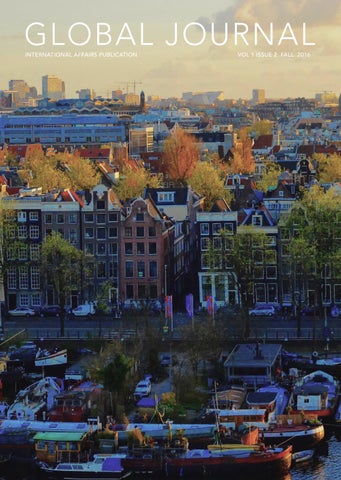
GLOBAL JOURNAL INTERNATIONAL AFFAIRS PUBLICATION
VOL 1 ISSUE 2 FALL 2016
1
About Global Journal Insight into our vision
Global Journal is a Northeastern University International
Affairs student-run publication, covering international news, events on campus, study abroad, as well as domestic and
international co-ops. Founded in 2014 by Madlen Gubernick, Elizabeth Zona, and Yasmeen Alhaj, the student group aims
to bring the international community together through experiential narratives.
Because being a Northeastern student inevitably implies international interest and awareness, Global Journal
encourages students of all disciplines to participate in the student group. Global Journal is comprised not only of in-
ternational affairs students, but journalism, political science, business, health education and art students as well.
We believe that as Northeastern students, we are all global citizens with vast international experience: Global Journal
gives students the platform to share those experiences with
the rest of the community. We hope to inspire students of all
disciplines to partake in building international bridges to help promote our global experiences.
Cover photo taken by Ryan Maia
2
Table of Contents
AMERICAS
Student Spotlight: Caitlin Morelli Paraguay: The Little Country That Changed my Life
8
Food Security: A Global Issue
ASIA
CSSH Spotlight: Rose Internet Censorship
20
Coming to Terms with My Privilege in India CSSH Spotlight: Camille
AFRICA
CSSH Spotlight: Timothy CSSH Spotlight: Maya
34
CSSH Spotlight: Ali CSSH Spotlight: Katie
EUROPE
Traveler or a Tourist? Return to Sarajevo
44
Ten Countries Entrepreneurship in Spain
MIDDLE EAST
Thoughts From the Jabal
Politics of Space in Turkey
56
3
Meet the Team Members of the board
Madlen Gubernick Founder, President, & Editor in Chief. International Affairs Major, Journalism & Global Social Entrepreneurship Minors
Elizabeth Zona Co-Founder, President of Marketing. Business Administration Major, dual concentration in Marketing & MIS From: Maplewood, New Jersey
Yasmeen Alhaj Co-Founder & Managing Editor International Affairs Major with a Middle East Concentration, Sociology Minor From: Dhahran, Saudi Arabia
Jeremy Love-Epp Editor Environmental Studies & International Affairs Majors, International Security Studies Minor From: Raytown, Missouri
Olivia Arnold Editor Journalism Major, Political Science Minor From: Marlboro, New Jersey
From: Brooklyn, New York
Caroline Boschetto Editor International Affairs Major, Journalism & Global Social Entrepreneurship Minors From: Doylestown, Pennsylvania
4
Olivia Pickard Social Media Chair International Business Major, International Affairs & Human Services Minors From: Boston, Massachusetts
Lydia Ioannidou Print Design Chair Design Major with Concentration in Graphic and Information Design From: Athens, Greece
Mary Cehn Promotional Chair International Affairs & Political Science Major From: San Diego, California
Kathleen Brody Recruitment Chair International Affairs & Human Services Major, Spanish Minors From: Summit, New Jersey
Sarah Zaatar Vice President of Marketing & Treasurer. Business Administration Major, dual concentration in Entrepreneurship & Marketing From: Dubai, UAE
5
Staff Writers
Contributing Writers
Mary Chen
Alyssa Bilotta
Devin Windelspecht
Samir A. Habib
Daniella Emami
Lindsay Marum
Helen Wang
Kuei-Feng Tung
Alex Jones
Felicia Deconarine
Rachel Abastillas
Pavit Arora
Alexandra Kuenning Sydne Mass Julie Renner Hridayam Agarwal Amy Hood
College of Social Sciences and Humanities Spotlight Rose Leopold Maya Bur Timothy Maurer Camille Carlton Alison Campbell Katherine Powers
6
Letter from the Founders
Global Journal is proud to present our second
we’ve included in this edition, as well as those on
students have traveled the globe for co-op,
Northeastern
edition! As they do every semester, Northeastern Dialogue of Civilization programs, NU.in, and various study abroad opportunities. For the second semester in a row we are excited to share
the stories of these experiences with the rest of the Northeastern community.
Global Journal offers a platform for students to showcase their vast international experiences
with students, faculty and alumni of the university.
We are proud of each and every one of the stories
our website, because they highlight what makes University
special.
Our
global
community is built on the foundation of diversity, inclusion and experience, and through Global
Journal, students are given the chance to reflect on the university’s global opportunities.
We are honored to be that platform for Northeastern students on campus and abroad, and look forward to continuing our commitment to
global storytelling. We hope you enjoy this edition as much as you did the last!
Sincerely,
Madlen, Yasmeen, & Elizabeth
7
8
Photo by Lydia Ioannidou
9
The Global Journal | Americas
Student Spotlight: Caitlin Morelli Interview conducted by Madlen Gubernick, On Campus
After four and half years at Northeastern,
isn’t easy. You expect it to go according to plan,
international affairs and political science, with
face,” she said. Caitlin admits that although it
Caitlin Morelli graduated with a dual degree in
minors in global social entrepreneurship and business administration.
While at Northeastern, Caitlin was heavily
involved both in class and across the world. She completed three co-ops, one dialogue,
one summer semester at the London School of Economics, and was Editor in Chief of the Northeastern Social Enterprise Review. Her
first
co-op
was
at
the
Canadian
Consulate of Boston, where she worked in
the trade department to facilitate Canadian entrepreneurship in Boston. “I learned a lot about
how government functions,” she said, looking back on her time at the Consulate.
After declaring a minor in Global Social
Entrepreneurship, Caitlin moved to Cape Town,
South Africa to begin her second co-op. She
worked as a project manager for Heart Capital, a boutique impact-investing firm. There, she helped
build a new site for a social enterprise called Food Pods, an initiative that helps women grow and sell vegetables in townships around Cape
Town. The site is one of the many visits students make during the global social entrepreneurship dialogue to Cape Town.
It was at Heart Capital that Caitlin realized what a challenge social entrepreneurship can be.
“Working on-the-ground for a small organization
10
but there are so many unknown factors that you
wasn’t glamorous, her co-op was undoubtedly rewarding.
With both a political science co-op, and a social
entrepreneurship co-op under her belt, Caitlin
planned for her third and final co-op in the fall of 2014. At the time, President Aoun announced that he was looking for his own co-op student, which
came to be known as a Global Officer. “The job
description was vague. All we knew at the time was that he wanted to send a student around the
world to develop global initiatives for the school,” Caitlin said of Aoun’s announcement. Caitlin was one of many students to submit a cover letter for
the position, but, she was one of few invited to create a one-minute pitch video, and ultimately interview with Aoun himself.
Although the position was designed for one student, Aoun chose two students — Caitlin
and Matt Bilotti — to be Northeastern’s first Global Ambassadors. While Caitlin’s journey focused on telling student stories and identifying potential co-ops in the social enterprise space,
Matt worked within the international startup scene.
“Entrepreneurship — both social and
technological — are two of Northeastern’s strongest areas,” Caitlin said, explaining why
Aoun decided to move forward with both students.
The Global Journal | Americas
Photo by Lydia Ioannidou
Ultimately, Caitlin’s co-op focused on building
Northeastern.
more international co-ops. “I didn’t feel that there
participating students, to learn what it meant
an international network in the hopes of creating
were many options that fit my background when I
was looking for an international co-op,” she said of her motivation for the project. While goal
to
traveling, meet
Caitlin
with
also
made
Northeastern
it
a
students
already overseas, interviewing them on their experiences: both positive and negative. “There
was no platform for these students to share their experiences. Many of them come back to campus
and want to share and reflect, but often they don’t know where to go,” she said.
Although Caitlin looks back on all of her co-ops
fondly, she names her dialogue in Bali, Indonesia
as one of the best experiences she had at
The social entrepreneurship
dialogue was a chance for Caitlin, and all other
to design a social enterprise in response to
community issues. “It was a great atmosphere with even greater people,” she said reflecting on her summer in Asia.
Now a graduate, Caitlin will be joining Venture
for America and packing her bags once again to
join emocha in Baltimore, a company that builds mobile health applications.
From her home in Westchester, to Boston, across the globe and back, Caitlin is on to her
next adventure as a Northeastern alum: a title that will only supplement her already outstanding achievements.
11
The Global Journal | Americas
Paraguay: The Little Country That Changed My Life Story by Daniella Emami, Study Abroad
In the summer of 2011, when I was 16 years old, I
had the privilege to live and work in the small town of Itapevy, Paraguay. When I first found out that I would
be living in Paraguay, I honestly had no idea where
the country was, let alone what Paraguayan culture entailed. I made the mistake of setting expectations
for what my summer would look like: what the country of Paraguay was like and what its people were like. Every expectation I set was proven to be completely wrong, in the absolute best way possible.
Paraguay is a small country with a population of about 6 million, landlocked between three Latino
supergiants: Argentina, Brazil and Chile. Although small and often unnoticed, Paraguay was, and still
is, the most interesting, confusing and enigmatic
country that I have ever been to. It is a Latino country heavily influenced by its indigenous Guaraní
roots; to this day, a large part of the country speaks Guaraní, not Spanish. When Spanish is spoken, it is often reserved for business, while Guaraní is for everyday life. Additionally, unlike many of the people
from the neighboring Latino countries, Paraguayans
are often soft-spoken, timid and calmer by nature– and actually don’t dance very often.
I can vividly remember the day I first arrived at
my host family’s farm. We traveled on a cachapé, the Guaraní word for a horse-drawn sugar crate,
on top of that day’s sugar cane harvest. It was a
bumpy ride for the last hour of the trip on a small, winding dirt road– the only way in and out of the small community of Itapevy. When we finally arrived
12
at my new home, its beauty struck me: it was lush,
green and gorgeous. My home was similar to that
of many Paraguayan campo homes: the main home was built of brick on the outside and cement floors on the inside, and the bathroom and kitchen were
separate spaces outside of the home. There were
also animals everywhere– dogs, cats, cows, horses, goats, pigs, you name it.
That day, I met my two loving host parents and
three endearing younger host brothers, all of whom had lived in this small town of 200 people for their entire lives. They took me in as their own hija within
days.With no phone, Internet, or electricity, my host
family and fellow community members showed me how to have fun in the most pure ways. We would
cry from laughing while playing cards, adventure to the river and mountains and spend quality family time together every single night.
My daily routine was completely opposite to what
I had become accustomed to in the States. I was home for every meal, as well as for afternoon and
evening mate, a traditional South American tea. In
“ Every expectation I
set was proven to be completely wrong. ”
The Global Journal | Americas
Photo by Lydia Ioannidou
13
my community, mate was a staple of social life, and
I had in my entire life?
adopted family. When drinking mate, one person
that make Paraguay the beautiful, fascinating, and
it was one of the ways I got to know my friends and holds the guampa, the cup that is used to drink out of, and is responsible for filling the guampa each
round with hot water over the tea leaves, then
passing it along. As I found out the hard way, you
must finish the mate when it is your turn or it can’t be passed along to the next person– a societal rule
based on superstition. Little rules like this were what I found to be the most intriguing part of Paraguayan campo life.
My host parents taught me many more of their superstitions: don’t mix hot and cold, because you
I could go on for days about the small things sometimes just strange place that it is, but looking back I will always remember Paraguay as the place I learned what pure, simple happiness looks
like. Every person I met, especially my host family, seemed to be completely at peace– maybe because
of the emphasis on close, personal relationships, or because of a naturally calmer state of mind. Although it has been five years now, I will never forget the ways of genuinely living and loving that I learned from my time in the Paraguayan campo.
will blow up; don’t sweep at night, because witches
will come to get you; always eat an animal’s head
last; and don’t ever leave your machete anywhere
other than the roof. Did I mention that I saw more machetes in one 200-person Paraguayan town than
remember Paraguay “ Iaswillthealways place I learned what pure, simple happiness looks like. ”
14
Photo by Taylor Tomasso
15
The Global Journal | Americas
Food Security: A Global Issue Story by Kuei-Feng Tung, On Campus
Here in Boston, food is readily available where
of the global market when other countries else were
and cuisine exist to suit the consumer’s needs.
Eventually, the concept of food security evolved
many combinations of price range, convenience,
It’s often more difficult to decide what to eat than it is to find a place to eat. Perhaps one third of the world’s population engaging in agriculture
has got something to do with it. However, at the
same time, the latest State of Commodities Report indicates some levels of chronic undernourishment in most countries worldwide, meaning that people
periodically don’t consume enough nutritional value to cover their annual needs. Of the one
third engaged in agriculture, 70% of the world’s
poor work the lands. It’s ironic that many of the people growing food are the ones prone to hunger.
How can this duality of abundance and scarcity simultaneously exist? Food
security
researcher
Jennifer
Clapp
discussed her findings and the academic dialogue
on our current food system at Northeastern University’s guest speaker series on February
23rd. According to Clapp, food security originated
as a military concern. It was a high priority threat to the state if people couldn’t be fed and we can
see evidence of the United States’ agricultural
industry’s exceptional treatment to both our tax code and our foreign trade policy. Agriculture is in a separate tax code from other business industries
allowing for more government subsidies just for that industry, and up until 1947, the United States
had upheld protectionist trade policies to shelter
domestic productions of food from the whims
16
advised to lower tariffs and other barriers to trade. beyond self sufficiency and food was weaponized into
diplomatic bargaining chips; e.g. threatening to stop
shipments of staple foods to control states dependent on these imports. There are currently two highly polarized narratives on trade and food security – both championed by powerful international institutions:
On one hand, the World Trade Organization (WTO) adamantly encourages globalization, more
transnational trade relations, and less tariffs or other
‘barriers’ that inhibit trade deals. The WTO’s narrative, rooted in David Recardo’s theory of Comparative
Advantage, claims that each country is predisposed to growing certain produce due to their conditions
(geography, etc). As such, many WTO experts argue that an interdependent and connected world system
of countries utilizing their resources to develop and produce what they’re most suited to grow and trading
with each other is inherently more efficient, trade is now a moral imperative because many countries require
these “transmission belts” of goods and services to
generate income and access products they’re not
suited to grow themselves, and that protectionism is a peril to stability. Clapp used Cambodia as a case
study to illustrate the WTO’s structural adjustment recommendations. Because of Cambodia’s monsoon seasons and access to flatlands, they were encouraged to focus most of their agricultural sector on growing
rice. Today, Cambodia and 4 other countries supply 85% of the world’s demand for rice.
The Global Journal | Americas
On the other hand, the Food and Agriculture
assumptions do not reflect reality. For example,
serves many roles besides trading commodities and
move between borders is outrageous because labor
Organization of the UN (FAO) argues that food recommends countries diversify their crop yield to
ensure self-sufficiency, buffer their vulnerability to the world market’s price volatility (in a similar way
to hedging bets and risks by diversifying a stock market portfolio), and protect their autonomy and sovereignty. Countries are more stable socially and farmers are protected against loss of land rights and
fluctuating prices compared to those countries that
depend on one or two cash crops. Unlike trading stocks, in the event of devaluation, ‘cutting your losses’ and changing produce to something else
more profitable is often not an option. Considering
that plants may need years to mature to the point they start producing actual valuable fruits, berries, nuts, etc, the transition phase between crops is long
and a farmer from that 70% would be without income
possibly for years until the new crops mature with no Photo by X
insurance until then.
At the same time, neither narrative is perfect. The Comparative advantage theory only plausible
within the confines of its assumptions, and these
the basis that commodities are the only things that and cash can flow from one country to another. Equally, the diversity narrative may not be a viable
option anymore since as many as 66 states (⅓ of all countries) are beyond able to reverse their
interdependency on other countries for their access to food.
Because there are problems and merits with both narratives, deadlocks often happen at the
institutional level; “WTO rules matters for food
security, but it’s not a food security organization.”, said Clapp, and at the same time, FAO considers
there be no place for discussions of free trade in their
forums. Consequently, the two major institutions making structural recommendations for food security do not communicate with each other.
What that indicates to Clapp is that perhaps the
binary yes/no nature of the question being asked by scholars in the food systems field needs change.
Instead of “Is trade is beneficial for food security?”, the question “under what situations can trade be
beneficial for food security?” might better answer our
questions of food systems, abundance, and scarcity.
“ The concept of food security evolved beyond self sufficiency. ” 17
The Global Journal | Europe
18 Photo by Lydia Ioannidou
The Global Journal | Europe
19
20
Photo by Madeline Seibert
21
The Global Journal | Asia
CSSH Spotlight: India Story by Rose Leopold, Dialogue of Civilizations
This picture comes from a potter’s village in the
I took this picture during a Dialogue of Civilizations
the world’s largest slums, containing almost a million
policy. Witnessing the impact of climate change
Dharavi slum of Mumbai, India. Dharavi is one of people in 3/4 of a square mile. The density of people
and businesses in the slum is extraordinary and yet, people are still happy. In this picture, the women are smiling and laughing even though their life conditions are less than ideal. I think that’s what I want people
to take away most from this image - that happiness can be found even in the most difficult situations. People in Dharavi are proud of where they come
from due to the innovation found there. We are can all learn something from these potters.
Photo by Rose Leopold
22
trip to India to study climate change science and firsthand on the developing world changed my life
and the focus of my studies at Northeastern. Climate
change is the world’s most pressing issue and I want to have a role in addressing it. After the Dialogue,
I decided to pursue a Master’s degree in Security and Resilience Studies here in CSSH, and I hope
that I can focus on urban resiliency in the developing world in the face of climate change.
The Global Journal | Asia
Photo courtesy of CSSH
23
The Global Journal | Asia
Internet Censorship in China through the Lens of a Third- Culture Kid Story by Helen Wang, On Campus
“Where are you from?”
(gyoza) or macaroni and cheese (often with a look
So went the dreaded question of my childhood,
parents’ best efforts, I never acquired a taste for red
known each other as long as they could remember,
Chinese relatives’ dismay, I would smother anything
I’m what you might call a third-culture kid; I was
terms of table manners, my parents were determined
Cultural Revolution, but my parents immigrated (or
less sophisticated “mini-trident”. I could go on, but
protesters in Tiananmen square) to Canada when I
differences in ideology.
90s/early 2000s due to lenient immigration policy, we
inner demons, trying to empathize with a culture
suburbs, before moving to Seattle in 2006, when my
while living among one that promoted self-
at Microsoft. Even though I’ve lived most of my life
how could I embrace a heritage rooted in dynastic
States – a yellow face on a green card, granted all
that the suppression of democracy was inherently
right to vote. So when I came to Northeastern in the
growing up in different countries and different eras
but neither did I feel Chinese or Canadian.
believing ethnocentric propaganda from opposite
we’d left behind, my parents were adamant about
I shouldn’t have been that surprised in the first place.
language and culture, and to preserve traditions
crucial for the Communist Party of China, using
Lunar New Year, May Day, and the Mid-Autumn
and Nazi totalitarian regimes to maintain power by
Independence Day. When I was hungry, my mood
politics. With the arrival of the internet in China in
of revulsion from my grandmother). Despite my
asked by a room full of wide-eyed children who had
bean paste or matcha-flavored anything, and to my
as I switched schools every year up until sixth grade.
I could get my hands on in chocolate or cheese. In
born in China to parents who grew up during the
that I master the art of wielding chopsticks over the
escaped, considering my mother was one of the
differences in customs were trivial compared to
was a year old. As part of the mass exodus of the
For much of my adolescence, I wrestled with
bounced around Toronto, Ottawa, and some of their
that emphasized filial piety, modesty, and conformity
mother finally received an offer for her dream job
achievement, free thinking, and individualism. But
in the Seattle area, I am still an alien to the United
power and totalitariansm when I grew up learning
the equivalent privileges of citizenship except for the
wrong? As I grew older, I came to realize that
fall of 2014, I certainly couldn’t say I was American,
had somewhat brainwashed my parents and I into
Although I had no memory of the hemisphere
sides of the spectrum.
teaching my younger sister and me about Chinese
Propaganda and censorship have always been
they’d grown up practicing. We celebrated the
methods and messages influenced by the Soviet
Festival alongside Christmas, Thanksgiving, and
influencing public perception of government and
determined whether I would turn to either jiaozi
1994, the Communist Party moved quickly to squash
24
The Global Journal | Asia
the China Democracy Party should they attempt to
Chinese citizen engages almost exclusively with
led to a wave of imprisonment and the launch of
government.
leverage the internet to overthrow party elites. This the “Golden Shield Project”; so began the “Great Firewall of China”. In today’s information age, the Chinese propaganda machine employs an internet
police force of over two million to analyze metadata,
block website content, and monitor individual
browsing patterns. Internet censorship in China has led to stark differences among the opinions of young first- and second-generation immigrants growing up in Western civilizations and those who never left.
Ask any international Chinese freshman here at
Northeastern to look something up on the internet, and they might pull up Baidu instead of Google.
That’s because the most popular search engine in
China is Baidu, and Google is currently one of over 18,000 websites that are blocked in China (Google
had set up a version of its services to conform to
Chinese regulations for four years before shutting down operations in 2010). Also on the list are Facebook, Instagram, Twitter, The New York Times,
Wikileaks, Reporters without Borders, Bloomberg,
Amnesty International, Flickr, TIME, and the Economist, to name a few. Other targeted content includes websites promoting democracy, freedom of
speech, the 1989 Tiananmen Square protests, the Tibetan independence movement, police brutality,
and many foreign current events. A good portion
of American visitors are familiar with VPNs (virtual private networks), which can sometimes be used
to circumvent internet regulations, but the average
online content within the bubble created by the As expected, journalistic integrity doesn’t truly exist in China. Any news deviating from governmentapproved material can result in blacklisting the news
media organization responsible for the crime, hefty fines, arrest, or even imprisonment. According to Amnesty International, China has imprisoned the
largest number of journalists and cyber-dissidents in the world, which leads to an incredibly insulated
media landscape. Take the 2008 Beijing Olympics,
for example. Portrayed to represent China’s status
as a rising star in the global economy, the Olympics were essential to maintaining domestic support for
the Chinese government. In the months and years before, the Communist Party specifically instructed local media to avoid reporting on controversial topics
such as Tibetan independence, East Turkestan
movements, pollution and air quality, and food safety
issues. Many journalists speculate that the timing of the September 2008 Chinese milk scandal was a result of waiting until after the “perfect” Olympics to recall the infant formula, leading many to wonder if the government’s policies went too far.
When I visited China during the summer of 2010, our first family trip back since emigration, I personally experienced the Great Chinese Firewall for the first time. During the day, I enjoyed touring classic sites
like the Forbidden City, the Great Wall of China, Shanghai’s financial district, and the silk markets
of Guangzhou, in addition to seeing the villages my
25
The Global Journal | Asia
parents grew up in. It was an incredible opportunity
One can only estimate China’s true power once if
about what my life would have been like had we
allowing information to flow more freely outweighs
to connect with my family’s heritage and learn more not immigrated. During the evenings, I tried in vain
to connect with my friends at home through social media and listened to the adults speak in hushed
tones about the latest allegations of corruption to
surface despite the internet police. I also met many
the government ever decides that the benefits of the potential death of the Communist Party in the case of complete democratic revolution. I’d imagine President Trump would have a difficult time finding leverage to negotiate.
distant relatives, many of whom had much narrower worldview than I did, not only because of growing
up in different cultures, but also because of a lack
of access to more objective information. On more
recent visits, in 2012 and 2014, my VPN connections were often interrupted or unreliable, a result of increased vigilance on part of the internet police.
The modern Chinese propaganda machine is
constantly evolving and adapting, tightening its chokehold as information becomes increasingly
accessible. Growing up as a third-culture kid in North
America, I have truly been blessed with perspective
on freedom of information. Despite my frustration as a child, I understand now that my parents were influenced not only by the traditional Chinese
values they grew up with, but also by propaganda and censorship, the effects of which drove many an argument back in the day. I sympathize with the Chinese, especially the young. While my parents
left before internet censorship became an issue, it certainly has affected an entire generation of ablebodied, intelligent individuals. To live in a country in which the government is so paranoid about losing
its power that it actively curbs the ability of its citizens to access objective and reliable information
to learn about the rest of the world is an enormous disadvantage
26
in
today’s
globalized
economy.
“
Growing up as a third-culture kid in North America, I have truly been blessed with perspective on freedom of information.
”
The Global Journal | Asia
Photo by Claire Mancuso
27
The Global Journal | Asia
Coming to Terms with My Privilege in India Story by Rachel Abastillas, Dialogue of Civilizations
When thinking about India, one might imagine vibrant colors, delicious spicy food, crowded streets and the Taj Mahal. My preconceived notions of India before my Social Entrepreneurship in India Dialogue of Civilizations program definitely did not include the complexity of social issues that have been neglected for decades, prior to the evolution of the social entrepreneurial space. In our pre-departure meetings, we were told by past students to pack lightly and to bring medications. We were told to reflect daily in a journal or with a peer on sites we visit and people we meet. We were told this trip will not be easy and is not meant for those who want to just glide along. However, we were not told that we would face one of the most rewarding, yet challenging experiences of our lives with regards to coming to terms with our privilege as we had yet to learn that for ourselves. On our first site visit in Delhi, we met with Madhureeta Anand, a Bollywood documentary filmmaker, who showcases the underworld of sexual preference through female infanticide in her film titled “Kajarya.” This film is an illustration of rural communities employing this practice, while a non-traditional city journalist attempts to break through the inclusive culture by reporting on it. The viewing was followed by questions directed toward Madhureeta regarding her inspiration behind writing the screenplay. She explained how her drive came from village women
28
she interviewed and her desire to bring light to the conversation of female infanticide in India. I remember sitting in the first row, in awe of this woman who is challenging what has sadly become a deeply rooted cultural norm in certain rural villages in India. I began to question why I as an American woman deserve a life, while a baby girl in Delhi is sentenced to her death? Why is this privilege afforded to me and not all women and children in the world? Our team also traveled to Pune, where we met with Chetna Gala Sinha, an Ashoka Fellow who founded a women’s microfinance institution called Mann Deshi Bank. Within the organization, they train women using financial literacy programs in order to help ensure the sustainability of their blossoming businesses. While in Pune, we visited some of the various businesses to interview women on their successes repaying their loans. One of the stores we went to was a beaded jewelry store, and all of the women spoke of how they enjoy working with Mann Deshi Bank because they are one of the only non-discriminatory microfinance institutions in the region. The institution is found to be more supportive of these women, which results in them working extremely hard to repay their loans. For example, I interviewed Rubina, a woman who borrowed money from the banks. Due to this instillment of fear, Rubina and many other women trust Mann Deshi because she said to them, “it’s the obvious choice” because the bank is always encouraging the
The Global Journal | Asia
development of these women’s organizations. After Pune, we took a bus to Aurangabad, a region in India known for its prehistoric Ajanta and Ellora Buddhist caves. Aurangabad, a leading city in the waste reduction, is home to a social entrepreneurial organization called the Civic Response Team (CRT). CRT influences its citizens to properly segregate their waste by simplifying the issue in a comprehensive way. An example is their use of a Charlie Chaplin impersonator conducting street performances to teach kids and their families the process of segregating waste and recycling. He goes around encouraging kids to pick up rubbish from the ground and tossing it out into its designated waste bins. Another example of their work is employing men and women to sort dry waste, which they can then take and sell for money. During the site visit, we met with one of the coordinators who described herself as a revolutionary. When we asked her what exactly fueled her to become a revolutionary, she responded, “The fact that I don’t deserve the rights that other women can’t have.” Meanwhile, behind her stood a family of four segregating dry waste. In this moment, I could not believe I was looking at a child helping his parents sort through waste rather than being in school studying. This image really pushed me further into my reflection regarding my undeserved privileges. One of our most academically challenging projects of the trip was yet to come. Flying out to Mumbai was
highly anticipated as we were all thrilled to be engulfed by historic culture in its purest form by working in our consulting groups throughout the city. As we were landing, I could see the slums surrounding the airport and expanding for miles. This hit close to home for many of the students assigned to read Behind the Beautiful Forevers, a novel painting a picture of the disturbing operation of slums throughout Mumbai. Additionally, we went on a tour of Dharavi, the largest slum in the world. Here, we witnessed the realities of the slum and how it operates. Surprising to many, the movie Slumdog Millionaire’s portrayal of a desperate and poor environment is not at all what the slum is like. Dharavi is actually a highly functioning, well structured slum with various markets. Most people we met with were migrants to Dharavi from cities we visited previously. Unfortunately, one of the more negative aspects of the slum was that throughout our tour, the only time I saw women was while walking through an alley narrow enough for me to see them crouched inside, cooking food with their children. Fortunately, my group was focused on researching possible strategies to gain government support for families that are involved in waste picking, as well as researching global market trends that had the potential to implement waste management plans that needed government sponsorship. This was an exciting experience because we were able meet leaders in this industry, such as Mobin, President of the Recyclers Association, and Vinod Anand, founder
29
The Global Journal | Asia
Photo by Nicole Hicks
of the Dharavi Project. With their guidance, we became
sharp wheel blades, making it easier to get hurt. This
aware of specific areas of the slum we should visit and
forced me to realize that a large part of the population
the certain people we should interview. Thus began
does not have access to air-conditioned offices,
the beginning of our research and field work for our
cushioned seats and a proper building. It became
consulting project. During this process I witnessed the
apparent to me that privilege is not warranted and is
unsanitary and unsafe conditions of the workplaces.
definitely not granted. It is randomly selected.
Men were grinding plastic into shrapnel using long
30
The Global Journal | Asia
One of my major takeaways from this Dialogue
Indian culture and gender rights, and coming to terms
of
social
with our privilege. Going on this dialogue you must be
entrepreneurship is applied in India, but how India
prepared for that protective layer to dissolve, as well
is a center for this field that includes various issues
as accept that you might not understand or agree with
that are relevant universally. In our last three days, we
everything, and that is okay.
Civilizations
program
was
not
how
travelled to Goa for a reflection period with our peers. During this time, we were encouraged to present a creative personal reflection, drawing upon our feelings toward what we witnessed in the last month. Some people presented beautiful poems, videos and even choreographed dance. These presentations were meant for the class to understand everyone’s ebb and flow of triumph and struggle in regards to understanding
witnessed the “ We realities of the slum
and how it operates.
”
31
The Global Journal | Asia
CSSH Spotlight: India Story by Camille Carlton, Co-op
When I was working in India, one of my fondest moments was when I was able to take the women’s compartment in the local train to work each day. It was a foreign, yet welcomed feeling as I watched each of them in their beautiful colored saris with strands of jasmines in their hair. We would share smiles, snacks, and stories—despite the language barrier. It was a simple, daily occurrence and even though I usually never saw them again, it was the warmest way to start and end my day. I always had this feeling that, somehow, by riding the train together, the women and I were an unconventional family sharing some of the same hopes and wants and maybe even struggles. While I don’t think I can ever fully explain the feeling
Photo by Camile Carlton
32
(especially since I myself don’t fully understand it), I hope that I can convey even a small percentage of this strange, yet wonderful bond I felt with the women in India. They showed me great kindness by sharing food, assisting me with directions, and even offering support when the train was so crowded that my ribs felt like they might break in response to all of the elbows nudged into them. In return, I would simply ask them about their families or work and their faces would light up with joy. I admired each of these women and hope that, one day, my work in India will have as great of a positive impact on them as they have had on me.
The Global Journal | Asia
Photo courtesy of CSSH
33
34
Photo by Daniella Emami
35
The Global Journal | Asia
CSSH Spotlight: South Africa Story by Timothy Maurer, Dialogue of Civilizations
South Africa is a country of contradictions,
reality, I saw women working their hardest to
poverty, natural beauty abuts urban sprawl, and
students diligently pursuing their studies so that
where extreme wealth intersects with extreme the best traits of humanity can be witnessed in the worst environments. There are many parallels
between the issues facing South African society, and those facing American society. Western audiences are regularly inundated with photos of
slums and shantytowns in the developing world and so it is easy for one to write off these images
as almost natural features of the developing
world. However it is important to remember that
there is nothing natural about poverty, that it is a manmade abomination like slavery, and that it is all of our responsibility to work to eradicate it.
Many of the people in the townships used
to tell us ‘poverty either makes you or breaks you’ and I witnessed that every day in places like Enkanini. For every man that had given
up hope and taken to the bottle to escape this
provide better lives for their children. I saw young
they could one day address the problems that plague their community. In an environment like a township it is easy for one to feel discouraged,
to focus only on the horrors of this environment and feel as if the scale of these problems are too
overwhelming. But for the people living in these townships these weren’t just places of hardship,
but their neighborhood, their community, and their home. The resilient people I met in these
communities weren’t working hard to ‘escape’ their neighborhoods, they were working hard to
improve them. Their perseverance inspires me
and reminds me of what President Roosevelt once said: ‘The test of our progress is not whether we add more to the abundance of those
who have much, it is whether we provide enough for those who have too little.
Photo by Timothy Maurer
36
The Global Journal | Asia
Photo courtesy of CSSH
37
The Global Journal | Asia
CSSH Spotlight: Zambia Story by Maya Bur, Dialogue of Civilizations
My experience in Zambia was eye-opening in a number of ways. I went in expecting to learn a
lot about the region and international non-profit work, which I certainly did, but I also spent a lot of
time learning about myself. I like that this photograph captures a seemingly introspective moment
for the young boy in the foreground, because it’s a representation of my experience on the trip. It
suggests that it’s okay to take some time alone to relax, process, or just enjoy the view.
Photo by Maya Bur
38
“
This photograph captures a seemingly introspective moment.
”
The Global Journal | Asia
Photo courtesy of CSSH
39
The Global Journal | Asia
CSSH Spotlight: Rwanda Story by Ali Campbell, Co-op
Living in Rwanda for the duration of my co-op
was an exceptional experience: it was an exercise in resiliency but also an amazing opportunity to live and work within a politically and culturally
complex environment. Combining my co-op work
with research and photography allowed me to
view and understand the country from multiple different perspectives, and deeply underscored my passions for travel and international politics.
Photo by Ali Campbell
40
“
An amazing opportunity to live and work within a politically and culturally complex environment.
”
The Global Journal | Asia
Photo courtesy of CSSH
41
The Global Journal | Asia
CSSH Spotlight: South Africa Story by Katie Powers, Dialogue of Civilizations
 My experience in South Africa completely
hardships faced by someone living in an informal
entrepreneurship experience, which I now know I
water, healthcare, or employment opportunities.
changed my life. I gained hands on social
want to pursue in some form as a career. It was the
most challenging yet the most rewarding four weeks
of my time at Northeastern. I went through a series of highs and lows, which one can expect when traveling to a developing country where poverty
and unemployment are rampant. Since I returned to the states, I have not stopped thinking about the
incredible, kind, intelligent people that I met or the
unforgettable experiences that I had. It is too easy to get bogged down as a student balancing a million
things like school, jobs, friends, family, and life in general but my problems will never compare to the
Photo by Katie Powers
42
settlement in South Africa with no electricity, running We are all so unbelievably blessed to live in Boston
and go to such a prestigious university, which is
important to be mindful of. I am forever grateful for the opportunities I have been presented with and it is my goal in the future to reciprocate those opportunities in order to empower those living in poverty to be able
to live a more proud, happy, dignified life. A million
thanks to Professor Shaughnessy, Nina Angeles, the Social Enterprise Institute, and Northeastern.
The Global Journal | Asia
Photo courtesy of CSSH
43
44
Photo by Lydia Ioannidou
45
The Global Journal | Europe
Traveler or a Tourist? Reflections on a Dialogue Story by Alex Jones, N.U.in
I’m riding on the back of a moped through the Old
syllabus? Our professor encouraged us to “be
I have class in an hour and I remember a quote
new things. Meet new people. Experience a new
Town of Rhodes, and my mind is on the syllabus. from it: “Be a traveler, not a tourist.” That was the
guiding philosophy of our Dialogue to Greece and it’s one I tried my best to live by. At that moment, I felt like I was doing a pretty good job.
Rhodes has a bit of a split identity. The New Town looks like a street in Tampa.
It’s full of
beachfront hotels souvenir shops all selling the
same thing, and tourists. The Old Town, on the other hand, is a maze of narrow market streets surrounding an old crusader fortress. Rhodes has
been the prize of empires from Ancient Greece to the Crusaders; from the Ottomans to the Italians.
Each of these empires left their distinct mark on the island and you can see traces of them all in the Old Town.
Our local guide, Charlie, spoke with near-
resignation about how many visitors don’t know that that an Old City even exists. Apparently,
thousands of visitors can visit the city annually and
not even notice the giant castle. In one sense, it’s easy to see how one could get pulled into the New Town. The city of Rhodes has beautiful beaches where the Aegean meets the Mediterranean.
There’s a massive casino that was built by Italian fascists and a string of great restaurants in the
New Town. And it’s not as though the Old City is deserted; plenty of visitors see it every day. Still, some don’t even know it’s there.
But what does any of this have to do with a
46
Greek” for a month and put down our phones to try
culture. It’s the second oldest Dialogue program
at Northeastern, and I believe it’s the best of what
the program can be. At each place we visited, we had the opportunity to try something new, whether
that’s a new dish or experiencing what it’s like to climb 999 stairs.
At the same time, we did a number of touristy
things, too- including taking selfies at the Parthenon. It’s easy to understand how someone
could be happy to just relax by the beach in Rhodes-
however, what I was confused by, I suppose, was a lack of attention to the surroundings. I couldn’t
help but look around at all the empty stares into the ocean and wonder, you came all the way to
Rhodes, and you don’t notice the giant castle in the near distance? I met plenty of people who
never left the area around their hotels- people who had no idea what these locations have to offer.
Going to Greece on a Dialogue put me in a
position of privilege. Not every visitor to Greece gets access to such amazing guides or gets such
a comprehensive view of the history and culture.
The reason I was on that moped was because I
had lost my debit card a day before, and the owner of the hotel offered me a ride to a Western Union to
pick up money that was wired to me. He went out
of his way to do this, and I’m extremely grateful. I’d stumbled into an experience by accident, and learned about the generosity of Greek hospitality
The Global Journal | Europe
in the process.
looking at you, Rick Steves), and you can spend
between being a traveler or a tourist is about the
what the locals have to say. Look at what’s around
don’t have to eat at restaurants off the beaten
Just pay attention.
In the end, I don’t think that the difference
all the time you want in the New Town. But listen to
sites you visit or the activities you choose. You
you. Want to be a traveler, not a tourist? Easy:
path, you can absolutely wear a fanny pack (here’s
Photo by Lydia Ioannidou
47
The Global Journal | Europe
Return to Saravejo Story by Devon Windelspecht, Co-op
There’s a legend surrounding the Ottoman
one of the first times I had ever spent any real time
is the heart of Sarajevo: that if you drink from the
language or a culture, but to study and understand
fountain in Baščaršija, the Turkish old town that fountain’s fresh, mountain-fed waters, then one day
you will return. I always expected to come back to this city, but never this soon.
When I returned to Sarajevo this past July for a six-month journalism co-op, barely a year had
passed since I first set foot in Bosnia as part of Northeastern’s Balkans Dialogue of Civilizations.
Yet since that summer, our world had changed to be almost unrecognizable with terrorist attacks in Paris, Brussels, Orlando, Ankara and Beirut, the
Syrian Refugee Crisis, the summer coup attempt in Turkey and the rise of anti-refugee and anti-Muslim
sentiments in Europe and the United States. In just 12 months, our world had seemed to grow more dangerous, more cynical and more afraid, and as the world changed, I had changed as well.
By the time my plane landed in Sarajevo
abroad. The purpose of that trip was not to learn a a conflict — the Bosnian Civil War, one of the worst wars in Europe since World War II.
In the 1990s, Sarajevo served as the heart of this war, which pitted neighbor against neighbor, religion
against religion and ethnic group against ethnic
group. The city saw not only one of the longest and most brutal sieges in modern history, but also
systematic campaigns of ethnic cleansing and genocide.
I still keep several positive memories from that dialogue of playing cards in a cafe by the river, seeing the orange haze of sunset fall like a blanket onto the
city from the top of the Yellow Fortress, interacting with many people of another faith for the first time and hearing a language spoken around me that was radically dissimilar to any I had ever heard before.
But I have memories too of walking in the
International Airport, I found myself with another
footsteps of genocide. Memories of discussing the
that I had begun to learn and experiences traveling
crimes with people who had experienced those very
year of classes under my belt, two new languages in an entirely different part of the world, Jordan and the Middle East, still fresh in my mind. Although the
sights and sounds streets of the streets of Sarajevo were much like I had remembered, the city was in
many ways less familiar than it should have been now that I was looking at it with a slightly older, slightly wiser, slightly less wide-eyed gaze.
Just like many students’ first Dialogue of Civilizations,
my travels to the Balkans during summer 2015 was
48
hard topics of conflict, ethnic cleansing and war
things personally, barely 20 years before. Memories of feeling a particular sadness lingering behind the surface of a city that I have never felt before or since.
Investigative Journalism, the focus of my co-op, is not international affairs, political science, or conflict
studies, and my return to Sarajevo was concerned more with the realities of government corruption and
organized crime that affect this part of Europe today
than the conflicts of the past. But, always, the war
The Global Journal | Europe
was still there.
In the little time I had off work, I often found myself taking long walks along the river, where on Sundays the road was closed to cars and children came out
in bicycles, lovers cuddled on park benches and old
ladies sat gossiping in cafes. With the fall leaves dusting the sidewalk, it was easy to believe that the country had finally moved on from the war and that things had fully healed. But, always, there were signs
to show otherwise: the collapsed buildings along
the riverside that had never been fully repaired, the nationalistic politics that seemed to grind any
progress toward true reconciliation to a standstill, the bullet holes that traced lines over the house that I returned to every night.
In the evenings, while sitting on my terrace and
watching dusk fall upon the city, I would find myself
thinking about the people who might have lived in the same house as I while bullets grazed its walls. I would think about my Bosnian friend from work, who still holds a newspaper clipping showing him as a
four-year-old child clutching a tiny penguin-shaped
backpack, full of emergency supplies his mother made him carry in case they were ever separated.
I would think of the war veterans cafe next door to my office, and the things the people there have seen and perhaps themselves had done.
And in those moments, I would think of Damascus, Aleppo, Mosul, Yemen and Libya. It’s hard to believe now, with the ubiquity of these wars on our
newsfeeds, but during my first summer in Bosnia, the realities of those very conflicts had yet to fully
come to light. Russia had yet to begin its bombing
campaign in Syria, ISIS-inspired terrorism had yet to strike Paris, Nice, Beirut or Istanbul. The Syrian Refugee crisis had yet the hit its fever pitch, and the
European Union had yet to close its borders against the waves of refugees from the Middle East.
To look at bullet scars on a building or walk between gravestones bearing the same four years of death over and over means one thing when studying
a conflict 20 years gone. It means something entirely different with the realization that what the people of Bosnia went through in the ‘90s, Syrians, Yemenis, Libyans and Iraqis are today themselves enduring.
Sarajevo has not healed from its own four-year
siege, and Bosnia has not yet healed from the war.
It takes more than 20 years for those scars to mend, for people to reconcile, for forgiveness and peace to
take root. And whenever the Syrian Civil War ends,
whenever Libya repairs itself, it will take more than
20 years, or 30 or even 50, for those nations to find their own resolution. Much changes in a year, and
what I have found upon returning to Sarajevo is how
eerily similar a conflict that we as an international community should have learned from resembles the wars of today.
But there is this as well: once a year, a film festival opens in Sarajevo, the largest of its kind in all of
southeastern Europe. The festival was born from the days of the war, when several young people, braving
sniper fire and staving off siege-induced hunger,
gathered together in a basement bunker to bring joy,
warmth and hope to thousands who for years had
49
The Global Journal | Europe
found themselves trapped within the city center.
A quote from one of those founders still sticks with me: “During those nights, we were doing more than
just surviving. For the first time in years, we were living.”
Even in the darkest of places, people manage not just to survive, but to find small and beautiful
moments worth living for. That says something, and as the months passed by in Bosnia, the more I saw that despite the war’s lingering effects, people were
in their own ways moving on. People were healing, even if all the wounds hadn’t yet mended.
There is hope in that, and I try to keep that in mind
as yet another city, yet another country, suffers the same fate as Sarajevo once endured.
Photo by Devin Windelspecht
50
The Global Journal | Europe
51
The Global Journal | Europe
Ten Countries Story by Linsday Marum, Co-op
If someone had told me last year that I would be
of my mind, I never thought about moving to the
the opportunity to travel to ten different countries and
completed my last co-op at a law firm in Boston,
living in Europe for over six months, that I would get work in one of the most prestigious offices in the Netherlands, I would have thought they were crazy.
But here I am, working for the Dutch Rapporteur on Trafficking in Beings and Sexual Violence Against
Children, and the experience is beyond anything I could have ever imagined.
My journey abroad began in Italy this past June.,
where I completed a study program at the Lorenzo de
Medici Institute and finished up two of my remaining four classes. Studying abroad in Italy was something
I had thought about since I was a freshman, but was not serious about until last year when I realized I was
about to graduate and had never left the Boston area for more than two weeks at a time. I lived in Florence
for a month and was captivated by the city: the art,
the music, the culture, and especially the people. I
passed the Duomo every day on my way to class, and lived one street away from the Ponte Vecchio.
I got the chance to take two awesome psychology classes, Psychology of Crime and Love and Natural
Selection: Science and Myth, that I would not have
had the chance to take back home. I learned from professors that had a lot of global experience,
studied with other students that were from all over the U.S., and made friends with people I would not
have had the chance to even meet if I had not gone abroad. Italy was everything I could have imagined and so much more.
While going to Italy had always been in the back
52
Netherlands, especially for a six-month co-op. I
and was set on going to law school right after graduation. As I began applying for study abroad
programs, I also got more curious about getting work experience outside of the U.S., especially in the field of human trafficking. I ended up being
one of the first two international interns to work with the Dutch Rapporteur, and in the process I discovered a potential new career path. My research
on issues relating to human trafficking like health care and victim identification will be in the office’s
tenth report on the state of human trafficking in the Netherlands. I have also gone to conferences in Berlin and Utrecht to represent the Rapporteur and learn about other countries and agencies’ responses
to this phenomenon. Not only has the work been
fascinating, but I have worked with a great team of people and learned so much about working in a foreign office on global issues.
One of the best parts about this experience has
been the travel that goes along with it. I will have been to ten different countries and dozens of cities
by the time I go home in December. My perspective on the world have expanded greatly due to all the
amazing places I went to and all the interesting people I have met. This journey has made me a
better student, employee, and person, and I believe
that every Northeastern student should try to travel
outside of the U.S. at least once while they are in school.
The Global Journal | Europe
Photo by Lydia Ioannidou
53
The Global Journal | Europe
Entrepreneurship in Spain Story by Pavit Arora, N.U.in
My passion for traveling brought me to the vibrant
such aspirations weren’t pursuing them, we realized
business that brought me to Universidad Francisco
entrepreneurs, these students were on paths leading
city of Madrid; however it was my passion for de Vitoria. This past summer, as part of a freshman study abroad program, I studied international business and entrepreneurship in Spain’s capital.
Learning about business in Europe, and Spain in
particular, was fascinating for us young business
students, on the search for potential co-ops or postgraduation jobs.
It was during our first entrepreneurship class
that the purpose for our time in Madrid became apparent. Our teacher prompted us to find a problem local students in Madrid face, and through
entrepreneurship models, determine a solution. Teams choose a variety of issues, such as health, finances, and more.
After speaking with students attending the
university, my group and I were pleased to see that many of the Spanish students had aspirations
to start a company, leading us to our project topic: entrepreneurial spirit. Many of the students at our university had complex ideas, in hopes of developing
them into businesses, however they often neglected
these aspirations due to a lack of entrepreneurial support.
By speaking with these students, we
came to learn that Spanish students do have an entrepreneurial spirit, it was support they lacked.
However entrepreneurial these students were, we found that they were studying to be accountants,
lawyers, or doctors, due to a lack of institutional support. Although we found it odd that students with
54
that due to the social stigma in Spain against towards a more stable profession- perhaps as they were taught to do.
Coming from Northeastern, we are fortunate enough
to have a prevalent sense of entrepreneurship, which is consistently encouraged by members of the
community. However, in Madrid, entrepreneurship
is often looked down upon and considered an unstable profession. At first, we assumed that the lack of entrepreneurial spirit was primarily within the university, however, we soon realized, it stemmed much deeper than that- it is a national issue.
Entrepreneurs in Spain pay a considerable
business tax, and are further discouraged by significant international trade taxes. For example, entrepreneurs who decide to change their residency
to a different country and the value of stake in their country exceeds 4 million euros, or they own more than 25% of the company would have to pay an exit tax. These government regulations make it nearly
impossible for Spanish entrepreneurs to establish
themselves as a global brand. Without international recognition, startup companies are unable to acquire
sufficient capital, as both local and foreign investors are discouraged by the constrained market.
In
order to protect its legacy businesses, in hopes of insuring consistent national capital, Spain is holding
back aspiring entrepreneurs- leading to a lack of entrepreneurial spirit.
With this in mind, our team started a program
The Global Journal | Europe
Photo by X Photo by Madlen Gubernick
for college and high school students to help
only is Spain suffering from a lack of entrepreneurial
have at Northeastern. Our program teaches the
are to be at a school that celebrates, supports and
develop an entrepreneurial spirit, similar to what we
students basic business skills, such as: networking, interviewing,
resume
building,
and
ideation
development. This experience showed us that not
spirit, it made us further recognize how lucky we encourages entrepreneurs. Through this program, we were able to share the value of entrepreneurship with the students of Madrid.
55
56
Photo by Ali Campbell
57
The Global Journal | Middle East
Thoughts From the Jabal: A Jordanian Immersion Story by Samir A. Habib, Co-op
Jabal Amman is one of seven Jabals or hills that
right before indulging in ice cream from Gerard,
Jordan. I arrived here on August 1, 2016, unsure
Jordanian desert from Sufrah. And of course, with
comprises the vibrant and busy city of Amman, of what to expect. My apartment that I would call
home for the next four months blinded me with white lights as I ate fresh za’atar (Arabic thyme)
bread overlooking the city by night from my window. I was about to embark on a four month journey that would change my life in more ways than I could have imagined.
This four month journey of mine has been my
international co-op experience in Amman, the capital of Jordan. Located in between Palestine,
Syria, Iraq, and Israel, Jordan is a melting pot of culture and history. From the ancient ruins of the
Ammonites from 1000 B.C., to ancient Petra, and Roman, Byzantine and Umayyad structures, this
part of the World has been home to thousands of years of history.
As time has passed, the city
of Amman as we see it today has grown and developed. What was a bustling center for trade for
the Romans, Amman in 2016 seems to have kept its ancient practices of global acceptance, cultural
exchange, and development. Throughout the city, the Muslim call to prayer echoes in the background while you walk by the walls of a catholic church.
Taking a stroll down the infamous Shara’a Al-
Rainbow, you pass by Jordanians, Westerners and Asians, with imported cars honking as means of communication as they slowly drive down. You can
eat the best falafel sandwich at Al-Quds, or grab a
quick burger from Firefly Burger down the street,
58
fresh Syrian Knafe from up the street, or a fancier a cup of addicting local black tea with na’na’ (mint)
and a fresh shisha (hookah). Finally, if you’re keen, the bars are open and busy till quite late for an after
dinner drink. The city’s culture truly speaks for itself.
With this thriving pool of culture comes a wave
of development. I work at a company named Oasis500, a seed-stage start-up accelerator. The company invests in the technology and creative
industries (and soon, space-tech companies), and fosters the growth of both the Jordanian and
Arab entrepreneurship ecosystem. I work with the
investment team as an investment analyst. My job is to be the first screen between the company and
potential investments by reviewing pitch decks, conducting
due-diligence
and
research,
and
assisting the investment team in any way possible. It has been incredible to witness the sheer amounts
of innovation that has emerged in just four months, and learn from some of the most skilled individuals
in the industry. Frustrations certainly exist in the daily lives for those who live here, and thus the determination to make life better with technology has
fostered
incredible
thought-leaders
and
businesses. From on-demand home maintenance, to disruptive online payment and financial tools, the
ecosystem in Amman is raw and full of expertise and potential. What an exciting time to be in such a unique place.
As my time here comes to an end, I leave the city
The Global Journal | Middle East
and the company learning tremendous amounts
highly encourage students seeking an international
parallel, I’ve learned a lot about Jordanian culture,
related co-op experience to consider applying for
of the emerging industry and those creating it. In and finally- I’ve learned a lot about myself and
future career prospects. I feel melancholy to leave my life here, and return to the life I have in Boston. I
business
or
venture
capital/entrepreneurship-
positions at Oasis500 or similar start-ups throughout Jordan and the Middle East. Ma’asalaam.
Photo by Samir A. Habib
59
The Global Journal | Middle East
Politics of Space in Turkey Story by Hridayam Agarwal, On Campus
Syria has been a war torn zone for a six now and
for their arrivals. In regards to creating space for
countries have taken it upon themselves to greet
gates open to only Syrians, while providing limited
in the name of humanity and selflessness, several refugees into their nations. Turkey, recently in the
news, has been experiencing a massive influx of
refugees from Syria, a country it has had recent political tensions with. The refugee camps set up in
Turkey have been acting as agents of politics as the refugees, who are new to these unknown districts, brought with them their own physical space and
engaged with political conflict. Politics of space is defined as the government inputs and decisions,
these refugees, the Turkish government kept camp
access to humanitarian organizations and the press. Conveniently enough, all the camps have been set close to the border with a wide range
of services and facilities for the refugees to use. Moreover, Syrian refugees have been reclaiming
their spaces in the camps and initiating their own self-help interventions to try and create a sense of comfort amongst themselves.
On the other hand, the lack of disclosure and
budgets and policy making that contribute toward
collaborative space in Turkey contributes to the
the reality of politics and the needs of the people
to provide the refugees with the best resources
space exploration, which in actuality reflects upon residing in that area.
Conflicts between Syria and Turkey were halted in 2009 when Visa requirements for citizenry in both the countries was lifted. Following that,
Turkey’s foreign policy transitioned from opposing Syrian leaders to supporting the government.
However, soon enough, Turkey’s involvement in the Syrian refugee crisis created chaos and
confusion between rebels and refugees in the
eyes of the Turkish citizens, many of whom viewed refugees as “trouble makers.”
Refugees have paved formal and informal
methods to travel since the Turkish borders opened
“ 60
politics of space in Turkey. Yet, with the motivation it can, they hope that the European Union would
help provide funds to build infrastructure and
schools for the young Syrian children and adults. Furthermore, besides providing the refugees with housing and recreational services,, their continuous
attempt to help promote regime change in Syria by supporting the Free Syrian Army and seeking
help from the international community shows their political involvement and advancement.
During an interview with the Anadolu Agency, Karl Kulessa, Turkey’s country representative at the United Nations Population Fund, said it is possible for Turkey to face economic, social and
The Syrian refugee crisis created chaos and confusion.
”
The Global Journal | Middle East
Photo by Lydia Ioannidou
cultural challenges by opening borders to a large
Turkey. Refugees have carried their subjectivity
also feels hopeful and positive about Turkey’s
physical space and have, intentionally or not,
amount of refugees. However, Kulessa said he success rate.
The Turkish government has done an incredible
job with its supply driven policies and in taking responsibility for the refugees. From the beginning,
politics has been an essential part of every step
that has gone into creating the refugee camps in
with them and while doing so, they have claimed
engaged in political conflict. Although Turkey knew that the integration would come with several
challenges, it has achieved a miracle in managing
and balancing out its policies between the refugee crisis and the nation’s own problems.
61
The Global Journal | Middle East
62 Photo by Yasmeen Al-Haj
The Global Journal | Middle East
63
   Join Us @ GlobalJournalNU
Special Thanks The N.U.in Program Global Experience Office The School of Journalism Student Government Association The International Affairs Program College of Social Sciences and Humanities
Read More Stories www.globaljournalnu.com
64