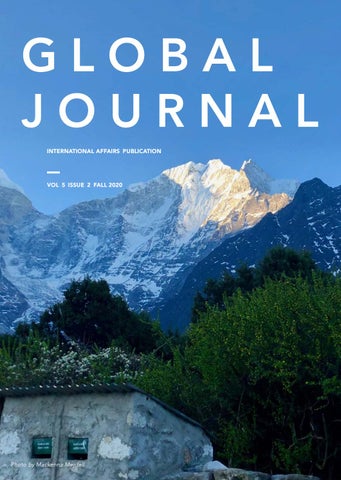
GLOBAL JOURNAL INTERNATIONAL AFFAIRS PUBLICATION
VOL 5 ISSUE 2 FALL 2020
Photo by Mackenna Mejdell
1
EDITORS
Scout Gullick Lauren Goldberg Mirsa Freed Simone Lamont Ben Schmitt Sally Jin
PHOTOGRAPHERS
Scout Gullick
Caitriona Keane
Jack Trapp
Andrew Small
Justus Martin
Taylor Niederland
Mackenna Mejdal Anna Brown Emily Hirsh Larry Cai
DESIGNER
2
Elizabeth Wheeler
GLOBAL JOURNAL about
INSIGHT TO OUR VISION
Global Journal is a Northeastern University International Affairs student-run publication covering international news, events on campus, study abroad as well as domestic and international co-ops. Founded in 2014 by Madlen Gubernick, Elizabeth Zona and Yasmeen Alhaj, the student group aims to bring the international community together through experiential narratives. Because being a Northeastern student inevitably implies international interest and awareness, Global Journal encourages students of all disciplines to participate in the student group. Global Journal comprises not only international affairs students, but journalism, political science, business, health education and art students as well. We believe that as Northeastern students, we are all global citizens with vast international experience; Global Journal gives students the platform to share those experiences with the rest of the community. We hope to inspire students of all disciplines to partake in building international bridges to help promote our global experiences.
3
L E T T E R from the P R E S I D E N T This semester, like the last, was unprecedented. The student body, and the world, settled into “the new normal” and tried to figure out what that meant. The Northeastern community remained scattered; some returned to campus, with others still spread throughout the globe. For the Global Journal, these new circumstances challenged us to adapt both the way we operate and the way we think to advance with the times. Without the hard work of many, this edition would not have been possible. I would firstly like to thank our entire team for their creativity, adaptability, and determination. I would also like to especially thank our E-board, many of whom assumed new roles with passion and dedication at an incredibly stressful time. Jon Andrew, our faculty advisor, remains a constant source of support and encouragement. Lastly, I would like to recognize our contributing writers and photographers, who continued to think globally at a time when many of us remain confined at home. In this edition you will find stories reflecting a range of different realities. Some, from a time before COVID-19, remember the once familiar ability to travel uninhibited. Others, mine included, recount experiences at the pandemic’s onset and the changes that followed. Still, others explore the world as it is now, full of uncertainty, but also with a sense of resilience. I hope these stories can provide insight into how the past year has affected, and been understood by, Northeastern students. They also serve as a reminder of the importance, now more than ever, of cultivating a global outlook to face challenges of a global nature.
Sincerely,
Caitriona Keane
4
PRESIDENT OF GLOBAL JOURNAL
Photo by Caitriona Keane
5
MEET the T E A M
6
CAITRIONA KEANE
SCOUT GULLICK
President
Editor-in-Chief
Biochemistry & International Affairs Majors, History Minor
English & Environmental Studies Majors, Theatre & Writing Minors
from Suffern, New York
from Miami, Florida
MIHIRO SHIMANO
K AT H E R I N E N O R R I S
Social Media Chair
VP of Outreach
Political Science & International Affairs Major, Journalism Practices Minor
International Affairs Major, Writing & Journalism Minor
from Tokyo, Japan
from Santa Barbara, California
ELIZABETH WHEELER
S I T I A I S YA H
Creative Director
VP of Public Relations
Graphic and Information Design Major
Journalism & Media/Screen Studies Major International Affairs & History Minors
from Atlanta, Georgia
from Jakarta, Indonesia
TIFFANY LAM
MARCUS CHEN
Treasurer
Web Editor
Economics & International Affairs Major
Marketing Major, Experience Design Minor
from Manila, Philippines
from Taichung, Taiwan
7
p. 47 p. 49
p. 26
p. 48–49
p. 40–41
8p. 47
T A B L E of CONTENTS THE CALM BEFORE THE 10 STORM Impressions from Tanzania Weight We Carry Reflection on a Country in Revolution Learning to Take Time in Spain Two in One City in Motion
WISHING FOR A 38 RELATIVE TOMORROW Moving in the Midst of a Pandemic The Details That Make a Life
44
ONWARDS AND UPWARDS Japan, Reproached The Balkans, Where the Past Is the Past
9
THE CALM BEFORE
THE STORM We didn’t know it would be our last trip. The last time something foreign wasn’t just our incessant idleness in a place so familiar. The penultimate flight before we’d return to our homes, albeit all across the globe. Our hub for diversity, our campus, hummed with nonchalance—and later trepidation—targeted at a disease that seemed so far away. We were untouchable. Unstoppable. Until we weren’t. Still, our spirits soared in tandem with the planes that landed in dream-worthy destinations, and for many, marked the start of a temporary new life, studying abroad far from home or campus. We danced and hugged and lived with seldom caution of proximity to other beings.
10
Photo by Scout11 Gullick
IMPRESSIONS FROM TANZANIA p h o t o s b y J U S T U S M A R T I N , Personal Story 12
The African bush elephant is the largest land animal. Yet, the wide landscape easily fits multiple of the majestic creatures. The photo is meant to put life forms in perspective with nature and humble the human viewer.
13
While in Tanzania, I spent most of my time in Arusha, the city often termed the gate to the Serengeti and the Kilimanjaro. This photo is a snapshot of life outside that urban environment.
14
On the day trips to the rural areas surrounding Arusha, we always brought some games to break the ice.
15
16
Scenes from one of the markets around Arusha.
17
In the orphanage where I used to help out, there were a couple of classrooms where the kids were taught the basics. Here the boy repeated to me what he had learned that day.
18
A scene capturing the rural lifestyle.
19
20
21
Above: The Serengeti National Park is well known for its migration routes used by more than 1.5 million wildebeests and zebras. However, the landscapes themselves and abundance of wildlife are enough to leave a lasting impact. Right: Notably, not all of northern Tanzania’s landscapes are savannah. There are also lush forests, especially on the slopes of Mt. Meru and Kilimanjaro.
22
23
WEIGHT WE CARRY by MACKENNA MEJDAL, Personal Story
“We are not the masters of this planet.” Each year, hundreds of individuals make the perilous climb to disprove this by summiting Mount Everest. Climbing this mountain is no small feat. It requires several years of alpine climbing experience, a personal supply of oxygen for climbing in the “dead zone” (which does not contain enough atmospheric oxygen to support vital respiration), extensive knowledge of the
Photo by Mackenna Mejdal
mountain’s routes and the ability to predict weather conditions. These are all essential skills that Nepali guides must master. Their lives, as well as their clients’ lives, depend on it. These guides, along with local porters and yaks, lead visitors to the summit, carrying the brunt of the weight, taking the most risks and receiving the least reward.
The sharp lines of the vast icy mountains met the blue sky in perfect balance.
Camp in Sagarmatha National Park. Exploring the Himalayas resembled visiting a distant planet. The sharp lines of the vast icy mountains met the blue sky in perfect balance. Mount Everest’s radiance only represents the tip of an iceberg, where a deep-seated history of inequity lies beneath the surface. Mount Everest was named after the British royal surveyor Sir George Everest in 1865, linking the peak to the Western
Mountaineering is a gratifying sport, that I have had the privilege of participating in for several years. It is also a sport that requires great attention and care. Not only must one’s respect be oriented towards the mountain one is climbing, but also to the cultural environment and to the individuals who call the land home. I visited Nepal on a Northeastern team fundraising program. A small group of fellow students and I completed a trek to Everest Base
24
world. However, this tremendously beautiful summit is locally referred to as Qomolangma, Romanized as Chomolungma, in Tibet, meaning “Holy Mother.” In Nepali, the mountain is named Sagarmatha, “Peak of Heaven,” among several other venerating translations. While the peak is not fully visible from Base Camp, the Khumbu valley nearly convinced me that I was in heaven. It was impossible to feel alone or separate from this beauty; each connected spire of ice
embraced me as a fellow, albeit smaller, piece of the same whole. Nepal is the most stunning country that I have ever visited. I observed an environment so breathtakingly beautiful that these adjectives don’t seem fitting enough. This experience altered my outlook on life because, among the beautiful, I encountered the ugly truths of hidden injustice. As the steam from our morning coffee slowly rose towards the sturdy wooden beams of the tea house common area, Santosh, a trekking guide, shared his perspective on working in
spoke of the minimal pay porters receive, along with unequipped gear. I noticed that many porters were making these treks across the rugged mountainous rock in sneakers. These are among the most dangerous jobs globally, and they echo the unspoken truth of inequity in Himalayan climbing today.
We can visit places with the forethought of what we can leave behind, not just what we can take away.
the Everest industry. While better than the national average, his income does not cover
Cracking buildings and tilting wood posts
food or transportation costs to the mountain.
hang ominously over-exhausted power lines.
Similarly, the four porters I trekked with spoke
Highways and bridges remain inaccessible and
of the difficult weights they must carry along the
require hours of detours to circumnavigate.
journey. Bishal told me how he typically carries
From the heart of Kathmandu to the most
loads between 100 and 140 pounds. Durga
remote village in the Himalayas, the effects of
25
Photos by Mackenna Mejdal
the 2015 Gorka earthquake weigh heavy on Nepal. Natural disasters, such as flooding and forest fires, have worsened in recent years due to climate change. The Himalayan region is also incredibly seismically active, as it is positioned on both the Asian and Indo-Australian tectonic plates. While staying in the remote village of Tengboche, several locals shared their experiences of the earthquake with us. They explained that, for them, the only option was to bunker down and pray that rockslides would miss their precarious position between two ridgelines. International climbers residing at high elevation cities simply took helicopter transportation to safe regions in lowlying plains. Many villages remain inaccessible by any modern transport and require incredibly long walks even to reach medical clinics. I had the opportunity to speak with the
26
nonprofit
Himalayan
Rescue
Association
in Dingboche about the quake and other mountain tragedies. This organization works to support locals during crises by providing free care for those affected. They also expressed the importance of sharing local perspectives, considering stories are mostly told from a western standpoint. Western influences have changed Nepal in many ways, and we must all be mindful of these modifications and aim to empower local voices who are impacted the most. Current efforts are being made to improve this imbalance. Among the sea of yellow tents at Base Camp, I saw one particularly altruistic site: Everest ER. Everest ER is a seasonal clinic run by Dr. Luanne Freer, which provides subsidized health care access to local guides and porters at Base Camp. The organization supports all climbers and trekkers but recognizes the inequity
in treatment towards local guides and seeks to correct it through accessible health care support. During a simultaneously physically demanding and naturally magnificent experience, it can be challenging to think of the impacts one makes with each step. After a grueling day of hiking 14 miles with over a thousand feet of elevation gain, the last things on my mind were global imbalances. After the first few days, I realized that thinking about how much my legs hurt or how
By shifting our focus to caring for and helping others, we can aspire to something greater than ourselves.
hungry I was, did not change my prospects or experience in the slightest. What did change my outlook, however, was shifting my perspective to think of others instead. By shifting our focus to caring for and helping others, we can aspire to something greater than ourselves. We can visit places with the forethought of what we can leave behind, not just what we can take away. We can share the weight we carry.
27
Photo by Anna Brown
REFLECTION ON A COUNTRY IN REVOLUTION
b y A N N A B R O W N , Study Abroad
My first interaction with Lebanon was with the infamous Lebanese bureaucracy. I stepped off the plane and was quickly pushed into a chaotic line. For almost an hour, I had to stand there in the hot Beirut–Rafic Hariri International Airport, waiting for my visa to be finally approved. I was then finally allowed to exit and step into the scalding August day. Luckily, the driver I had hired had been waiting for me, and he spoke in rapid English as we drove into the city. He pointed out a tall, hulking skeleton of a former Holiday Inn, remarking about how snipers used to shoot people from there during their civil war. As we snaked into the city, he bemoaned the traffic but kept the windows open, letting the warm Mediterranean air into the cabin. Once in my neighborhood, it took us almost an hour to find my new address. Beirut, and Lebanon in general, don’t really have addresses. In Beirut, apartment buildings are only named, not numbered, and street signs are hard to come
28
by. It took five different groups of Lebanese men standing by the road for us to finally find my building. I tipped the driver extra for his trouble, not quite yet understanding the value that my US dollars had. I then took the rickety elevator, which lacked a door up to my apartment. There, I was briefed about all the intricacies of Lebanese life by my roommate. “Don’t drink the water or even use it to make tea; it’s saltwater.” My roommate stated, unsurprised by the fact. “The power goes out from about 10 am to 6 pm, so the generator should come on, but it doesn’t connect to the water heater, so make sure not to shower during that time. Also, wave hello to the soldiers outside. They’re quite nice.” It was a lot to take in, a lot of things that I had never had to think about growing up in the United States. I asked her if this is how it is everywhere in Lebanon or just our apartment? “Oh, we are lucky,” she replied, smiling. “We have a generator and 24/7 water.” I soon learned
just how lucky I was. Another group of exchange students lived in an apartment that would routinely lose water for days at a time. One girl was late to class because the generator in her building hadn’t kicked in, leaving her trapped in an elevator. Beirut was a constant juxtaposition, with glittering high rises and expensive clubs, yet lacking in basic amenities like clean water or 24-hour electricity. Living in Lebanon was a constant learning curve: it was learning about the 18 different sects, ignoring the bullet holes in every building and rationalizing the gleaming skyscrapers situated next to dilapidated Ottoman-era buildings.
I sat stunned, watching a country—that had been divided amongst religious lines for centuries—rise up against a common enemy. As a student at the American University of Beirut, I was on a constant mission to find out why things were the way they were. I studied
a country—that had been divided amongst religious lines for centuries—rise up against a common enemy. I got to take to the street, along with my friends. I saw my classmates finally fighting back, finally working for their rights. But still, nothing actually changed. The power still went off at 10 am every morning, the same children still begged on every street corner and the same systemic issues still reared their ugly heads in every facet of life. To me, living in Lebanon for a semester and getting to experience the October uprising firsthand was proof that more students need to step outside their comfort zone when looking to study abroad. I came face to face with many of the issues people from all around the world deal with, and I got to learn from classmates as they fought for their rights. I truly saw that learning cannot be confined to a classroom but should be the product of the wide world around us—that issues cannot only be read about from a textbook but must also be seen in real life.
French colonialism in the area and how they had completely re-oriented Lebanon’s economy to focus on silk, making them unable to produce anything domestically. I learned how Lebanon
Photo by Anna Brown
went through government after government following decolonization and developed a powersharing structure to prevent religious war. How the 15-year civil war had wrecked the country, and how nothing after it was fixed because the people that had run the war were now running the country. Through all of this, I was struck by how amazing and resilient the Lebanese people were. I was even more amazed by how they chose to come together and finally fight back against the corrupt government that October. I sat stunned, watching
29
strived to learn more or push themselves further. However, they also recognize that a lot of what we learn is found not just in the workplace, but by sharing and connecting with others. What made the lifestyle so different for me was how they prioritized personal time and time with your community at the same level as work. I feel like the culture in the United States is all about how far we can push ourselves until we reach a breaking point. How much can we pile on our plate until it becomes too much? In Spain, a large part of the lifestyle is to make time to enjoy Photo by Scout Gullick
the day. Going to get a drink and tapas with your neighbors is considered an important part of the daily to-do. My host mom would get upset with me if I spent too much time in my room doing
LEARNING TO TAKE TIME IN SPAIN b y S O F I A C I P R I A N , Study Abroad
It is 3 p.m. on a Thursday afternoon in Seville, Spain and every single street I walk onto is filled with laughter. People are sharing drinks, kids are running to the playground and everyone is enjoying themselves. It shocked me at first to experience a culture where the world was not moving at 100 miles a minute and you could feel the stress in the air after a busy day of work. My semester in Spain taught me how to fully embrace the lifestyle of working to live instead of living to work. I learned to step back from the daily stresses and take time for myself. This is not to say that people in Spain do not work a lot or work hard. They were some of the most hard-working people I’ve ever met. They were passionate about the work they did and always
30
homework. She wanted to make sure that I went outside and took in as much of the country’s beauty as possible. This was partly emphasized because I was there only temporarily, but I mostly learned this because it is the typical Spanish way of life.
I have learned to evaluate success based on my happiness and how much I am able to appreciate each day. I tend to let stress consume me to the point where I can’t move on until it is resolved, so spending time in a culture that was so different benefited me a lot. It felt as though life moved slower while I was in Spain. Instead of always being consumed with deadlines and checking things off a to-do list, I learned to take some time for myself, too. The stress was still there, but it became easier to manage it and coexist with it. In the meantime, I could enjoy the day before the sun went down. I didn’t feel rushed or pressured
Photo by Scout Gullick
to constantly be doing something that was considered “productive” because spending time with my friends or enjoying the city was equally as productive, just in a different way.
When I look back on my college years, I want to see that I enjoyed them and grew as a person, and not just see that I suffered through it for a degree. Now that I am back in Boston, I approach dayto-day stress totally differently. I’ve been fully reimmersed in the fast-paced culture of the city and now had to learn to integrate the lessons I learned into my life in Boston. I now set aside
all get done eventually and I still give it the same
time to do something for myself every day … or
attention I used to, but it relieves a lot of pressure
at least most days. Whether that means going
knowing that it is not the only thing that I should
out to dinner with friends, reading a book or
be focusing on at this point in my life. When I
watching a TV show, it doesn’t matter what it is
look back on my college years, I want to see that
as long as I make space for something in my day
I enjoyed them and grew as a person, and not just
that doesn’t require stressing out and worrying
see that I suffered through it for a degree.
about what else needs to get done.
Many people in the United States are focused
This time is equally as important as my
on fast-paced competitions to see who reaches
academic tasks. Instead of focusing only on
the finish line first and how many accomplishments
homework and deadlines, I make sure to block off
you can attain. I now know that we can still gain
a bit of time for myself everyday. I still get around
those accomplishments without letting the
the same amount of work done by focusing on
pressure to succeed constantly weigh us down.
finishing tasks so I can relax. This has allowed me
Life does not need to revolve around work or
to put things into perspective and really focus on
school exclusively. We should take time to enjoy
the things that are most important. My mental
the people and spaces around us and recognize
health and my relationships with myself and
that our ability to do so is an accomplishment
others have improved tremendously because I’ve
itself. Nothing will compare to my time in Seville,
learned that school and academic achievements
but missing it is just a reminder to keep those
are not the only factors that gauge success and
practices and values in my life going forward.
prosperity in life. I have learned to evaluate success based on my happiness and how much I am able to appreciate each day. The work will
31
TWO IN ONE
a local, until they heard my accent. Local students
b y L A R R Y C A I , Study Abroad
accent. My ability to speak and read Mandarin,
In the Chinese language, there is no phrase for “Chinese-American.” The closest term is hua yi mei guo ren (华裔美国人), which means “Chinese descended American,” but I chose to use the term mei guo hua qiao (美国华侨). While this typically translates as “American Overseas Chinese,” its literal translation means “cultural bridge to America.” Hua refers to China as a culture, qiao refers to Overseas Chinese, but is written similarly and pronounced the same as “bridge,” and mei guo of course refers to the
thought I was a local, even after hearing my my maternal native language, was respected by those who knew I was an American. In the same city, my inability to speak Cantonese, Hong Kong’s local dialect, or Hokkien, my paternal native language, were a source of curiosity. This means, incredibly, I was often expected to know four languages.
I had never felt out of place in either culture, and it was nice to know I did indeed have a place within each culture.
United States. As someone who has the ability to assimilate into both countries, I also believe the
Back in my hometown, which is 55% ethnic
phrase illustrates the role I am both encouraged
Chinese, my bilingual abilities were respected.
and privileged to play. Nowhere did I learn more
Now, in Hong Kong, my bilingual abilities could
about this role than in Hong Kong.
be argued to only be half of what was expected
I chose to go to Hong Kong in Fall 2017 to
of me. This was, of course, a tremendous
study and experience what I had long believed to
compliment, as it meant I was held to the same
be the bridge between East and West. I quickly
standards as a college educated Hongkonger.
found out that I was not only a patron of this
Few Hongkongers expect Americans to know
bridge; I was apparently socially expected to
anything other than English, and their linguistic
help maintain it. In other words, I was now part
expectations of me proved I was not considered
of the bridge. As such, I found myself constantly
an outsider. I had never felt out of place in either
switching between languages and customs both
culture, and it was nice to know I did indeed have
inside and outside the classroom, and being
a place within each culture.
treated as both an exchange student and a local.
The HKU administration inaccurately listed
I like to believe that the cultural bridge between
my Chinese name as my legal name, and my
the East and West exists. My interactions with the
legal name was ignored, as it was believed to
University of Hong Kong, its faculty, the city, the
have been a nickname. My American professor
local students, and my fellow exchange students
assumed I was a Hongkonger who had a private
proved that I was on both ends and the middle.
education (how else could I speak English so
My dual cultural identity was turbocharged in
well?), and my Hongkonger professor used
Hong Kong. Exchange students asked me if I was
Chinese teaching etiquette to counter my very
32
American personality. In other words, I got roasted a lot. Of course, this was a compliment, as it actually made it clear I was welcome, since a Hongkonger or Chinese professor poking fun at me signified he viewed me no differently than he viewed the native students, and took ownership over my presence in his class. When traveling and asked where I was from, I soon realized I had three identities to claim: American, Chinese, or Hongkonger. In Thailand, I once asked a hawker how much I owed him in English. He responded in Mandarin, correctly assuming that I knew the language. In Shanghai, I noticed a British couple lost at a train station. I asked them in English if they needed assistance, figuring
they
would
appreciate
a
fellow
Anglophone’s presence. The man responded in
Photo by Larry Cai
fluent Mandarin, and we parted ways without them ever knowing I was an American. The list of
full assumption that I would know the answer,
tales would go on for some time.
even though I had not raised my hand. I did know
Being privileged with two identities meant
the answer, and quickly learned to answer these
I was given a responsibility to represent and
questions thoughtfully and objectively, knowing
connect both of them. In Beijing, I was asked to
I could change someone’s opinion regarding
help watch over a tour group while the guide,
hundreds of millions of people. These were all
the only other person present who spoke both
responsibilities I did not think I would inherit,
English and Mandarin, went to go get tickets.
but I gladly accepted them, knowing I was not
Across Asia, I was a constant translator and
born into two cultures just to sit passively in two
primary source. I was asked relevant, albeit
different manners.
controversial questions about both countries,
Having now lived on both sides of the
such as the police brutality and gun culture in
metaphorical bridge between the East and
America, and the civil rights and elitism in China.
West, I’ve been given life experiences I could not
In the classroom, I was once asked to compare
imagine replicating in any other fashion. I have
Chinese and American literature and another
grown used to crossing and strengthening the
time asked to compare Chinese and American
bridge I represent, and to this day, I understand
governance. A British professor once called on
the importance of not just viewing it without fear,
me to answer a question regarding the differences
but helping others cross it. Of course, I do not
between Chinese and American geography with
plan on exiting this bridge any time soon.
33
A biker speeds by East Side Gallery mural “Save Our Earth.”
CITY IN MOTION p h o t o s b y E M I L Y H E R S H , NUin
New York may be the city that never sleeps, but once Berlin awakens from its slumber, it is in constant motion. The hustle and bustle is real, people at all times of the day and night rushing around by foot, bicycle, subway, or car. Throughout all my travels to other cities in Europe during my time in NUin, I’d never encountered a place that was as fast-paced as Berlin. Here are a few places where you can catch a glimpse of the daily commotion.
34
RIGHT: An older couple strolls through the Pergamon museum on a chilly Sunday morning.
BELOW: The East Side Gallery is the artistic expression of the once divided Berlin. Passersby glance at the murals and watching them photograph each other and admire the artwork is entertaining.
35
The Friedrichstraße U-bahn station, where a man and his baby get ready to board the next train out.
36
This young woman on her bike races alongside the cars on highly trafficked Mehringdamm.
37
38
Photo by Taylor Niederland
WISHING FOR A
R E L AT I V E TOMORROW Today was the same as yesterday, as was the day before. Staring up at our ceilings, feeling the walls cave in as we desperately hope for safety, so that we may take risks in our excursions abroad. As we lay in the absence of adventure, we flood our minds with the past, sharing stories and photos as we FaceTime our travel companions. Written to capture the fleeting memories of adventure, love, joy, uncertainty, these words implore the discovery of eternity in future stories; we must plunge into every moment, for we won’t know when we will have another like it. When we do, we’ll be ready.
39
MOVING IN THE MIDST OF A PANDEMIC b y T A Y L O R N I E D E R L A N D , Co-op
It’s early March, life is as usual, and I am enjoying studying at Northeastern and working part-time as a server in Boston. I have just received my co-op acceptance letter and am thrilled with the prospect of moving to Geneva, Switzerland and interning for Interpeace, an international organization for peacebuilding. The peacebuilding field is a major interest area of mine and Geneva has always been a dream destination for an International Affairs major like myself. The epitome of an international city,
Photo by Taylor Niederland
Geneva offers an array of cultures coupled with a unique sense of acceptance and appreciation from the local population. Little did I know the unrelenting challenges that awaited me after confirming my acceptance.
It’s during times like these when one realizes there’s more love circulating the world than hate.
were anything but certain. After staying at my family home in California for nearly five months and continually communicating between the Swiss embassy in San Francisco and the HR department at my co-op, I received the greenlight to travel to Geneva and start my internship in July. My apprehensive state eased when I finally boarded
Nearly a week after receiving my offer letter and confirming my acceptance, the gravity of COVID-19 came knocking at my door, and emotions of shock trembled the masses. I was laid-off from my restaurant job, abruptly transitioned to online learning and left with no other option but to move back to my hometown in California. For a planner like myself, uncertainty is the worst state of being and the coming months
40
the
plane
for
Geneva,
however
upcoming challenges lied ahead in forms I had not yet imagined. The first of which was the 14day quarantine subject to all individuals entering Switzerland. 14 days – it doesn’t seem long or daunting; still, never have I felt more aloof and alone. The previous quarantine I had endured was at the very least partly enjoyable with the comfort of my family. However, being in isolation, without friends, family or roommates, is a feeling I had never experienced before. I
Switzerland’s beauty is a comparison like no other. If one were to see the smile on my face, head tilted towards the sun, arm sprawled back, they would think I had just won the lottery or had gotten cured of some disease. In these summer months, lake swims, sunsets, picnics, volleyball and French class became a part of my everyday after-work activities. The joy on people’s faces when reconnecting with loved ones after strict social distancing to combat the pandemic’s first wave was priceless. During one of my many trips to the lake, I witnessed an elderly man’s reconnection with his grandson, who hadn’t seen each other since before the pandemic. Their embrace was so contagious one couldn’t help but smile and be reminded of their own grandfather. It’s during times like these when one realizes there’s more love circulating the world than hate. lost all sense of time, failed to keep an eating or sleeping schedule, and was left feeling incredibly vulnerable. Luckily after this initial quarantine, the sun finally emerged and I was thrust into the Swiss summer. Throughout May and October, the cases of COVID-19 in Switzerland had lowered and the government allowed people to gather and enjoy the summer (with obvious precautions in mind). On my first day out of quarantine, I met with my friend from NUin England, whose family now resides in Geneva. We laid on the lake enjoying the sunshine and freshwater while eating and drinking – one of the happiest memories I have from my time in Switzerland. Conversing with others after weeks of isolation makes you appreciate human connection. Accordingly, the contrast of being isolated in my one-bedroom apartment for the first time, experiencing
As I am writing this article, it is mid-December and Switzerland is in the midst of its second wave. Fortunately, there is a large amount of trust in the government in Switzerland, and people tend to follow government regulations and suggestions seriously. After nearly two months of business closure and social distancing measures, the COVID-19 cases are decreasing, and there are talks of the Canton of Geneva reopening. I am excited to see loved ones reunite once again and spread their contagious happiness. Both living in Switzerland and the ongoing pandemic have taught me the value of human kindness, respect and joy. While this adventure abroad was filled with unexpected challenges and unavoidable periods of adjustment, I wouldn’t trade this experience for any other. Unforeseen hardships are what life is all about, but acts of love and kindness encourage us to continue living for hopes of a better tomorrow.
41
THE DETAILS THAT MAKE A LIFE b y C A I T R I O N A K E A N E , Study Abroad
Ever since I was young, I’ve dreamed of Paris. I was a certified Francophile; in middle school I eagerly began my French classes, read as much as I could about the “City of Lights” and imagined myself walking along the famous lamp-lined bridges of the Seine. When I set off to study at Sciences Po this past spring, I was unsure of what to expect. I knew the Paris of my childhood daydreams would be different than the vibrant, modern and global city. I was excited to live in a different country, to put my French skills to the test and to study politics in the halls where many a French president once walked. After landing at Charles De Gaulle, I set out to visit places I had only read about, which at times, seemed surreal. I climbed the Eiffel Tower, gazing out onto the city from a bird’s-eye view as my knees shook, half in wonder and half with a case of mild acrophobia. At the Musée d’Orsay, I studied the swirling blue brushstrokes of Van Gogh’s self-portrait, calm against his famous red hair, just as I had once analyzed in my Art History class. I walked the cobblestone streets of Montmartre and climbed all the way to the Sacré Cœur, where the buildings below were wrapped in a cold January morning mist. I was still in the process of checking off my list of “must-sees” when the pandemic forced me to pack my bags and return home with less than 48-hours’ notice. It seemed some of my dreams of Paris would have to wait a little longer. Between
the
exciting
days
of
making
acquaintance with my new home and all it had to
42
offer were often days of stress and uncertainty. As the weeks went on, the specter of COVID-19 loomed larger and larger as the virus seemed to inch closer to Paris. After the first outbreak emerged in Italy, where my roommate had visited only a week prior, I was forced to quarantine at home and missed a week of classes. Within my apartment, we began tracking the number of cases in France, unsure of whether we too would be sent home like our friends in Italy. And finally, the other shoe dropped; within days we were to return home, Sciences Po would transition online and the very day I left, Macron announced the first confinement. On my last day in Paris, I finally stopped in the bookshop I had passed on my daily walk to campus in St-Germain-des-Prés, disappointed I only had time for a hurried stop between packing my suitcases, rather than the leisurely browse I had envisioned. Yet as I rode the metro back to the 14 arrondissement one last time, I must admit I also felt relief. Reflecting on my life in Paris now, it’s funny what stands out. Being home in New York these past few months has made me think about how my life shifted so suddenly. When moving to a new city, it takes time to understand its character, adjust to its quirks and uncover its secrets. It takes time to build a life somewhere. When I arrived in Paris, despite its magic, I was overcome with uncertainty, and at times, I found myself wishing for the simple familiarity of going through my daily routine unthinkingly. Yet slowly, day by day, detail by detail, I built
Photos by Caitriona Keane
my life. I learned new words for things I’d never come across in my French classes (arugula, la roquette). I figured out how to use the tricky handles to open the doors on Metro Line 12. I sampled different boulangeries on my daily walk home and quickly found my neighborhood’s best. I learned how to order my favorite bread; “une tradi, s’il vous plaît.” I began leaving my eggs out on the counter like the French do. I got used to the different wail the ambulance made as it drove by. I started to have a life in Paris, instead of just feeling like a tourist who had outstayed their welcome. Then suddenly, I was back in New York, in the house where I grew up, while my new home was under lockdown. I hope to return to Paris eventually, to finish ticking off the boxes on my list of Parisian wonders I imagined when I was 12. One day, I
hope to marvel at the jeweled light of the Saint Chappelle’s stained-glass windows and gaze upon the masterpieces in the Louvre. I am sure the Paris I left, still relatively unchanged by the pandemic, will not be the same one that will greet me in the future. The city, like much of the world, will be marked by a new normal in the wake of its ordeal. Through its loss, unrest and adaptations there will be new uncertainties, new struggles and, yes, new beauties. Yet I will return to Paris as an old friend; still unfamiliar with all of its idiosyncrasies and contradictions, yet aware of little details that make it what it is. I will recognize the roar of motorcycles and savor the taste of my still-steaming crêpe de sucre et cannelle with a fondness, a reminder of the time when, for a brief moment, my life belonged in Paris.
43
We step into eternity. Now what? Caution creeps into the eyes of the passersby, their masks covering any other semblance of emotion. You smile at them—exuding your gratitude for breathing in foreign air and exhaling the staleness of your familiar abode—but they don’t see it. Instead, they see crinkled eyes that may just project the same caution you saw in them. Perhaps we’re all smiling. As you take that first step, feel the renewed appreciation for the world travel up your body until your restless feet can stay still no more. Run, and then come back and tell us what you saw.
ONWARDS AND
UPWARDS 44
Photo by Andrew Small
45
JAPAN, REPROACHED b y D E M I P I R R O N E , Virtual Dialogue
Adopted from Vietnam, I grew up in
between a cluster of ideas found in Europe
Westchester, New York, anxious to learn more
versus European ideals. Japan’s socio-cultural
about the diversity of norms that existed past
anxiety, influenced by Western interventions and
what I always knew and assumed. As I graduate
increased globalization, showed how potentially
from Northeastern with a Bachelor of Science
irrational ways of organizing life transformed
in political science and a minor in psychology, I
into gaining a sense of national identity while
refined this focus on examining the relationship
also evolving social norms into traditions rather
between heuristics and decision making in public
than truth.
policy. My Summer I Dialogue, The Twenty-First Century City: Tokyo and Kyoto, reminded me that these heuristics and problem-solving tools are historically contextual, globally diffused and, most importantly, should always aim to help others. Learning about Tokyo’s history as a globalized city was incredibly interesting and relevant. COVID-19, ironically, represented the duality of globalization; the interconnectedness of the international political economy has certainly led to the city’s prominent and consistent growth, but also creates vulnerabilities that require resilience, shown by the cancellation of the Olympics after several years of infrastructural planning. Regardless, the Machiavellian intrigue of the changing affinities of the Daimyo up to the Pax Tokugawa showed the social and historical contexts that saturated the relationship between Japan and its concept of modernity and globalization for centuries to come. According to Christopher Goto-Jones, the author of one of the primary textbooks utilized in the dialogue, many classical characteristics of modernity are associated with 18th century European Enlightenment,
46
but
there
is
a
difference
The entirety of the program really made me think about how I want to help others in the future and how these public policy laws and norms precipitate into individual acts of kindness. This cultural evolution is also shown in the way that Japan approaches human services through a collectivist society. A “general tendency within Japanese society to have a strong sense of shame in front of others” may induce or compound the issues of Hikikomori (chronic loneliness), Kodoku-Shi (the secluded death of the elderly), Amae culture (adolescent identity and dependence crises), sex trafficking and homelessness. Many non-governmental organizations (commonly called “NPOs” in Japan) work to not only decrease the stigma associated with these issues but also scaffold their responses with local organizations to appropriately
understand
these
intimate
and capricious issues. Analyzing how NPOs collaborate with local government municipalities
Photos by Andrew Small
was eye-opening in the context of comparison to the American NPO sector.
The entirety of the program really made me think about how I want to help others in the future
The actual structure of the course could not
and how these public policy laws and norms
be applauded enough. It involved a wide, but
precipitate into individual acts of kindness.
intense, perspective on Japanese economics,
Besides this in general, awesome experience,
history, urban development and the future in an
I appreciated the cultural sensitivity not only
asynchronous format. In addition to engaging
towards the country we were studying but
group projects with other students, several
also the treatment we as students experienced
guest speakers from Meiji University spoke as
ourselves. Professors Vicino and Gardinier’s
leaders in the nonprofit sector, showing how
accommodations, compassion and transparency
they adapted their inherently intimate acts of
shown during the Black Lives Matter movement
human service into online formats. One guest
felt truly genuine and sincere. Not only did the
speaker, Mr. Kenneth Nakagawa, is a coordinator
innovative and globalized substance of the
for Tango Therapy, which uses Argentine music
course show Northeastern’s grit, the professors
to connect generations and allows the elderly
and students did too. Whether in Japan or
to meet, touch and hug younger volunteers in
Boston—in an international environment strife
a healthy and beautiful way. With a new online
with anxiety, political discord, and a new sense
virtual format, this program speaks to the soul of
of isolation—everyone should remember we
Japanese collectivism and resilience.
are never alone.
47
THE BALKANS: WHERE THE PAST IS THE PAST b y J A C K T R A P P, Study Abroad
When Americans hear the term “Balkans,” their first thought, if they recognize it that is, depicts graphic TV footage from the 90s, showing refugees running for their lives and dictators ousted from office. Indeed, the tragic Yugoslav Wars wreaked havoc on the people from the eastern European peninsula, resulting in the deaths of 140,000 people. In the eyes of the outside world, the Balkan peninsula was a land defined by violence. Unfortunately, that opinion still persists today, more than two decades later. Last summer, I wondered to myself about what
Photo by Jack Trapp Photo by Jack Trapp
life looks like for people in an ex-Soviet, middle income country led by a president who calls himself a king. To find out, I booked some flights to Montenegro.
of the TV war footage from 20 years ago still clouded their opinion greatly. The term “Balkan” triggered images of the notorious Slobodan
I spent my time trailrunning through the rugged peaks of the Dinaric Alps and exploring the countless villages tucked into the countryside. When I mentioned my trip plans to friends back home, they had a couple of different responses; none of which were overwhelmingly positive. Most hadn’t ever heard of Montenegro, and those that had, such as my parents, were a bit apprehensive about my plan. The memories
48
Milosevic and the violence in the streets. The most common question was, “Isn’t that dangerous?” In fact, Montenegro has a lower crime rate than the United States, and the quality of life has risen steadily since 2006, when it separated from Serbia to form its own nation. Like many other countries with troublesome pasts, Montenegro and its Balkan neighbors must face the prejudiced perspectives created by their history. On the flight from Boston, I tried to picture what lay ahead. My research on the country, a Google or two, had shown me stunning beaches and idyllic countryside, but the
premonitions of my friends and family still rang
in “Casino Royale.” I spent my time trail running
in my ears. I couldn’t shake the idea that I was
through the rugged peaks of the Dinaric Alps
entering a land of brusque people and unfriendly
and exploring the countless villages tucked into
faces. Needless to say, I was totally unprepared
the countryside. Incidentally, I also took classes
for the energetic taxi driver who cheerily told me
online, but that’s sort of secondary.
how much I was going to love his country. The
As it happens, I really did feel at home in
genial disposition of my hosts didn’t end there
Kotor. The locals were hospitable, and although
either; when I entered my hostel through an
most didn’t speak a word of English, we got
arched passage, I received a cheer from a group
along extremely well. At the market down the
of friends sharing a drink in the courtyard. Almost
road, I met a few local women who seemed to
in unison, they greeted me with raised pints and
like nothing better than inquiring about my
broad smiles. I was home!
bachelorhood. I found the language barrier to be
For two months, I lived in Kotor, Montenegro.
negligible, for with the help of google translate
It’s a gorgeous Adriatic coastal town surrounded
and expressive gesticulation, we managed to
by towering cliffs and tranquil bays. Perhaps most
have extensive conversations. They demanded to
famously, it’s the site of James Bond’s poker game
know why, at my age (19), I lived alone without a
49
wife or girlfriend to speak of. Throughout my stay
most beautiful merging of land and sea occurred
in Kotor, that topic seemed to be of great import
at the Montenegrin seaside.”
for inquisitive locals. The fishermen on the pier
Everyone knows not to judge a book by its
asked that same question time and time again
cover, yet we’re constantly guilty of doing just
and refused to accept any of my offered excuses.
that. The images of violence and conflict are two
Admittedly, after weeks of rubbernecking past
decades old, yet somehow, they still define the
the long-legged and sharp featured women that
western view of the region. After three months in
one finds on the Dalmation Coast, I asked myself
the region, I learned an important lesson: don’t
the same question. Their high cheekbones, hazel
presume to know another culture until you’ve
eyes and jet-black hair created an oddly exotic
experienced it yourself. My preconceptions of
look which I found mesmerizing.
the Balkans were based on outdated ideas which
They’re a distinctive people, the Montenegrins,
didn’t reflect the vibrant way of life I found nor
if not simply for their impressive stature, which as
the untroubled people I met in this part of the
Google informed me, is 2nd only to the Dutch.
world. The only reminders of the Yugoslav Wars
As I wandered around at my unremarkable 5’9”,
are the overgrown garrisons entombed in the
it seemed that every man, woman and child
hillsides. The people of this country have clearly
effectively towered over me.
moved on from the past, and it’s high time the rest of the world does too.
It’s a gorgeous Adriatic coastal town surrounded by towering cliffs and tranquil bays. Apart from their peculiar interest in my love life, or lack thereof, the Montenegrin locals who I got to know demonstrated overwhelming friendliness and hospitality. While somewhat aloof, their love of country is infectious. They understand that they were blessed to live in a natural treasure chest of grandeur and tranquility, of which the outside world had taken little notice. It’s a good thing too, I say. The sleepy villages which hug the coast in the Bay of Kotor wouldn’t benefit from the introduction of two lane highways and exit ramps on which the Western World relies. The Montenegrins enjoy their peace and quiet. The British poet Lord Byron described it best when he observed, “At the moment of the creation of our planet, the
50
Photos by Jack Trapp
51
JOIN US @GLOBALJOURNALNU
SPECIAL THANKS
The N.U.in Program The International Affairs Program Student Government Association Global Experience Office College of Social Sciences and Humanities The School of Journalism
READ MORE STORIES W W W. G L O B A L J O U R N A L N U . C O M