

The Federal Reserve’s Evolving Interpretation and Implementation of Its Mandate
Athanasios Orphanides* MIT
Economics Working Paper 24114
HOOVER INSTITUTION
434 GALVEZ MALL
STANFORD UNIVERSITY
STANFORD, CA 94305-6010
November 2024
Throughout its history, the Fed has operated with a muddled mandate that has not explicitly recognized price stability as the primary goal of monetary policy. The Fed’s success in maintaining price stability and fostering the good economic performance associated with it has depended on how it interpreted its mandate and implemented its policy strategy. In the 1970s and in the recent past, the Fed interpreted its mandate in an overambitious fashion, placing undue emphasis on the elusive goal of maximum employment. On both occasions, the Fed’s strategy proved insufficiently resilient, and high inflation followed. To improve its policy strategy the Fed ought to revert to earlier interpretations of its mandate that acknowledge the primacy of price stability as a policy guide.
Keywords: Federal Reserve, mandate, maximum employment, monetary policy strategy
JEL Codes: E32, E52, E58, E61
The Hoover Institution Economics Working Paper Series allows authors to distribute research for discussion and comment among other researchers. Working papers reflect the views of the authors and not the views of the Hoover Institution.
* Prepared for the 50-year Retrospective on the Shadow Open Market Committee and its Role in Monetary Policy, Hoover Institution, Stanford, October 14, 2024 The author has been a member of the SOMC since 2014. Correspondence: MIT Sloan School of Management, E62-481, 100 Main Street, Cambridge, MA 02142. Tel.: +1617-324-4051. E-mail: athanasios.orphanides@mit.edu
I. Introduction
The Shadow Open Market Committee (SOMC) was founded in 1973 to help improve monetary policy at a critical time.1 The Fed had failed. The United States was experiencing the third major inflation episode since the founding of the Fed in 1913 (Figure 1), the first during peacetime. In his welcoming statement at the inaugural meeting of the SOMC, on September 14, 1973, Allan Meltzer noted that “recent economic policy had produced some of the poorest results in many years,” and that “inflation is at the highest rate in peacetime history and shows no sign of ending.” (SOMC, 1973.) It took another six years for the Fed to act. In October 1979 the Fed abandoned the policy strategy that led to the Great Inflation. During the 1980s, it largely restored price stability and succeeded in fostering growth and prosperity.
The Federal Reserve’s checkered record in defending price stability has improved since the founding of the SOMC half a century ago. But more recently, Fed policy strategy shifted again, resulting in the recent inflation spike that evoked the malaise of the 1970s. Despite some policy improvement, notably the adoption of a quantitative definition for price stability in 2012, the Fed’s monetary policy strategy proved insufficiently resilient once again.
This study presents a brief history of the evolution of the Fed’s interpretation of its mandate, and examines how this evolution shaped policy strategy and economic outcomes over time Throughout its history, the Fed has operated with a muddled statutory mandate that has not explicitly recognized price stability as the primary goal of monetary policy. At present, the pertinent legislation mentions three goals that cannot be simultaneously attained: maximum employment, stable prices, and moderate long-term interest rates.
A muddled mandate requires operational interpretation before a policy strategy can be adopted towards attaining it. The Fed’s policy success has varied over time with the interpretation of the mandate and associated policy strategy. At times, such as the 1950s, 1980s and 1990s, the Fed adopted a modest interpretation of its mandate, and succeeded in fostering growth and prosperity. But at other times, such as the 1970s, as well as the recent past, the Fed interpreted its mandate in an overambitious fashion, placing excessive emphasis on achieving the elusive goal of maximum employment. Sooner or later, episodes of high inflation followed.
A key lesson from the historical record is that successful policy is associated with a policy strategy that recognizes price stability as the Fed’s primary operational objective.2 Price stability is essential for a well-functioning monetary system that fosters good economic performance over time. An Act of Congress that clarifies the Fed’s statutory mandate would reduce the scope for unhelpful discretion, improve accountability and facilitate an improvement in the Fed’s policy
1 Bordo and Levy (2024) document the history of the SOMC.
2 The SOMC has consistently advocated the primacy of price stability. According to SOMC “core beliefs”: “Price stability is the best contribution that monetary policy can make to overall macroeconomic performance and for this reason should be the primary objective of the central bank.” (SOMC 2014, p. 2).
strategy (Orphanides, 2014, Levin and Skinner, 2024). Legislation along these lines has been proposed in the past but failed.3 But legislative change is not required for policy improvement. Current legislation affords the Fed broad discretion on how to interpret its mandate, and the authority to adopt a strategy best suited to deliver good policy outcomes over time. The Fed can improve its policy by reverting to a more modest interpretation of its current statutory mandate, recognizing price stability as a primary operational objective and correcting the undue emphasis it currently places on the goal of maximum employment
II. The Federal Reserve’s statutory mandate: 1913, 1946, and 1977
The evolution of the Fed’s statutory mandate since 1913 can be briefly described by focusing on three legislative acts: The Federal Reserve Act that established the Fed in 1913; The Employment Act of 1946 that declared national policy goals; and the Federal Reserve Reform Act of 1977 that added the current statement of monetary policy objectives in the Federal Reserve Act. Key provisions are collected in the box.
Evolution of the Federal Reserve’s statutory mandate
1913: “[Rates of discount] shall be fixed with a view of accommodating commerce and business.” (Federal Reserve Act, Section 14(d).)
1946: “The Congress hereby declares that it is the continuing policy and responsibility of the Federal Government to use all practicable means... to promote maximum employment, production and purchasing power.” (Employment Act, Section 2.)
1977: “The Board of Governors of the Federal Reserve System and the Federal Open Market Committee shall maintain long run growth of the monetary and credit aggregates commensurate with the economy’s long run potential to increase production, so as to promote effectively the goals of maximum employment, stable prices, and moderate long-term interest rates.” (Federal Reserve Act, Section 2A.)
3 An example is the zero-inflation resolution, proposed in 1989. It would have clarified the Fed’s mandate and found support at the Fed. As Chairman Greenspan testified: “The Zero-Inflation Resolution represents a constructive effort to provide congressional guidance to the Federal Reserve. If passed, it would further clarify the intent of Congress and the President as expressed in prior legislation. Legislative direction as to the appropriate goals for macroeconomic policy in general and monetary policy in particular have been provided before. Unfortunately, the instructions have defined multiple objectives for policy, which have not always been entirely consistent at least over the near term. The current resolution is laudable, in part because it directs monetary policy toward a single goal, price stability, that monetary policy is uniquely suited to pursue.” (Greenspan, 1989, p. 4-5.)
Unlike modern central banking law, the Federal Reserve Act made no mention of price stability, economic growth, or employment as policy goals. The Fed was founded in 1913 in response to the panic of 1907. The resulting legislation was meant to create a decentralized reserve system with the authority to address such panics and provide a safer banking and monetary system. To that end, the Fed would furnish an “elastic currency,” as noted in the preamble to the Act:
“An Act to provide for the Establishment of Federal Reserve Banks, to Furnish an Elastic Currency, to Afford Means of Rediscounting Commercial Paper, to Establish a More Effective Supervision of Banking in the United States, and for Other Purposes.” (U.S. Congress, 1913, p. 1)
The Act came closest to describing a macroeconomic policy goal in Section 14(d). Reserve Banks were granted numerous powers, including to purchase and sell assets in open markets and to engage in credit operations. The Act instructed the Fed to set the rates of discount in such operations “with a view of accommodating commerce and business.” (p. 16).
In effect, the law afforded the Fed remarkably broad discretion in interpreting its mandate and formulating its policy strategy The most important function of the Federal Reserve in the very first years of its operations was to facilitate government finance during World War I. The result was high inflation, the first inflationary episode in Figure 1.
The Employment Act of 1946 was enacted after the end of World War II, aiming to protect the United States from the disastrous economic outcomes experienced during the Great Depression. It marked a major shift in national policy objectives, affecting all government institutions, including the Federal Reserve. Section 2 was the declaration of policy:
“The Congress hereby declares that it is the continuing policy and responsibility of the Federal Government to use all practicable means ... to coordinate and utilize all its plans, functions and resources for the purposes of creating and maintaining, in a manner calculated to foster and promote free competitive enterprise and the general welfare, conditions under which there will be afforded useful employment opportunities, including self-employment, for those able, willing, and seeking to work, and to promote maximum employment, production and purchasing power.” (U.S. Congress, 1946, p. 1)
The Employment Act introduced the concept of “maximum employment” as a policy objective for the Fed. The law could be read as elevating the status of “maximum employment” as the predominant policy goal but was open to alternative interpretations. The law also demanded promoting “maximum purchasing power” which could be read as an implicit reference to “price stability” as a policy goal. The meaning of “maximum” was not defined in a practicable manner. A literal interpretation of this language would be a recipe for trouble. It would not be feasible to attain the stated goals simultaneously. In effect, the Fed retained considerable discretion in interpreting its mandate and formulating its policy strategy.
The Fed’s current statutory mandate reflects an amendment to the Federal Reserve Act introduced with the Federal Reserve Reform Act of 1977. The 1977 Act added section 2A to the Federal Reserve Act:
“The Board of Governors of the Federal Reserve System and the Federal Open Market Committee shall maintain long run growth of the monetary and credit aggregates commensurate with the economy’s long run potential to increase production, so as to promote effectively the goals of maximum employment, stable prices, and moderate long-term interest rates.” (U.S. Congress, 1977, p. 1.)
With this amendment, the list of three objectives, “maximum employment, production and purchasing power,” was replaced with a new, similarly unhelpful list, “maximum employment, stable prices, and moderate long-term interest rates.”
The introduction of “stable prices” as an explicit policy objective, reflected frustration with the Fed’s failure to maintain price stability over the previous decade. The amendment provided useful guidance on policy strategy, instructing the Fed to maintain “long run” growth of money and credit “commensurate with the economy’s long run potential to increase production.” On the other hand, the amendment retained “maximum employment” as a policy goal, and introduced “moderate long-term interest rates” as an additional policy goal for the Fed, without defining the meaning of either “maximum” or “moderate ” In effect, the 1977 amendment kept the Fed’s statutory mandate as muddled as it had been earlier. Once again, the implied guidance was that the Fed was expected to use its discretionary authority to interpret its statutory mandate in a sensible manner.
In summary, throughout its history, the Fed has operated with a statutory mandate that has not explicitly recognized price stability as the primary goal of monetary policy. The muddled formulation, describing multiple and potentially incompatible goals, has afforded the Fed broad discretion regarding how to interpret its mandate and how to employ its considerable powers to attain it
III. Evolution of the interpretation of the mandate and policy strategy
In light of the unhelpful formulation of the Fed’s statutory mandate, the Fed’s success in delivering price stability and fostering the good economic performance that is associated with it, has rested on the interpretation of the mandate and implementation of its policy strategy. This section briefly reviews the evolution of the Fed’s interpretation of its mandate over time, and relates this evolution to subsequent developments in inflation.
As already mentioned, when the Fed was founded in 1913, the Federal Reserve Act did not offer much guidance on macroeconomic policy goals. The Fed’s first major task was to help finance
World War I. Yet, within a decade of its founding, the Fed had developed to a modern central bank and had adopted an activist, preemptive policy framework that aimed to control business cycle fluctuations. But the Fed opposed proposals that would have explicitly recognized stable prices as a policy goal.4 The Fed’s policy approach appeared successful for a time, but subsequently failed, leading to the economic disaster of the Great Depression.5
How did the Fed interpret its mandate during the 1930s? The Fed’s 1939 publication of The Federal Reserve System: Its Purposes and Functions makes for interesting reading:
“The purpose of Federal Reserve functions, like that of Governmental functions in general, is the public good. Federal Reserve policy can not be adequately understood, therefore, merely in terms of how much the Federal Reserve authorities have the power to do and how much they have not the power to do. It must be understood in the light of its objective which is to maintain monetary conditions favorable for an active and sound use of the country’s productive facilities, full employment, and a rate of consumption reflecting widely diffused well-being.” (Federal Reserve, 1939, p. 28.)
“Widely diffused well-being” makes us wince. A charitable reading is that, despite what we now know about Fed policy during the Great Depression, the Fed’s intentions were noble. But good intentions do not imply good policy. Another notable element in this description is the omission of any reference to price stability which highlights the continued lack of appreciation of the critical nature of preserving price stability as an operational objective for monetary policy.
The Employment Act of 1946 prompted the Fed to modify the way it described its goals. The second edition of The Federal Reserve System: Its Purposes and Functions, published in 1947, provides the following description:
“The principal purpose of the Federal Reserve is to regulate the supply, availability, and cost of money with a view to contributing to the maintenance of a high level of employment, stable values, and a rising standard of living.” (Federal Reserve, 1947, p. 1.)
This relates to the formulation of the three objectives in the Employment Act but with some important differences. While referring to all three goals mentioned in the Employment Act in some way, the Fed avoided the adjective “maximum,” which had not been defined in a practicable manner. The Fed attempted to explain the wording in the Act in more reasonable terms. Note the reference to a “high level” of employment as a policy objective, instead of maximum employment, and the usage of “stable values, and a rising standard of living” instead of maximum production and maximum purchasing power. The use of “stable values” suggests that the Fed interpreted the reference to maximum purchasing power in the Employment Act of
4 The implementation of preemptive policy was facilitated by important advances in data collection and policy analysis, including detrending methods that could be used to assess the “normal” level of economic activity. See Meltzer (2003) and Orphanides (2003) for additional information on the Fed’s policy strategy at the time.
5 Friedman and Schwartz (1963) and Meltzer (2003) document the contribution of Fed policy errors
1946 as an implicit reference to the goal of “stable prices,” which subsequently became explicit in 1977.
The 1947 edition of Purposes and Functions was also refreshingly transparent about the causes of high inflation earlier in the 1940s. It explained, in plain terms, that similar to the first inflation episode after the founding of the Fed, the second episode could also be attributed to the Fed’s role in facilitating war finance:
“In time of war the duty of the Federal Reserve, as of everyone, is to support the country’s war effort. The Federal Reserve provides machinery for aiding the Government to finance the enormous expenditures necessitated by war
Prevention of inflation had to become secondary to providing the sinews of war.”
(Federal Reserve, 1947, p. 105-107.)
Fed policy improved considerably in the 1950s. The improvement, however, was not prompted by the change in the Fed’s statutory mandate in 1946. Rather it reflected a fundamental change in the interpretation of the mandate towards recognition of the primacy of price stability as an operational policy objective. Under Chair Martin, price stability was described as a necessary condition for the achievement of favorable growth and employment outcomes and the fulfilment of the Fed’s statutory mandate as described in the Employment Act. 6
The evolving interpretation of the (unchanged) statutory mandate can be seen by comparing the 1954 edition of Purposes and Functions to the 1947 edition. The revised edition provided the following description:
“The basic function of the Federal Reserve System is to make possible a flow of credit and money that will foster orderly economic growth and a stable dollar. An efficient monetary mechanism is indispensable to the steady development of the nation’s resources and a rising standard of living.” (Federal Reserve, 1954, p. 1.)
Note, in particular, that no reference to either “maximum” or “high” employment is made Instead, the focus is on “orderly economy growth.” Similar to the use of “stable values” in 1947, the reference to “a stable dollar” in 1954 reflected the goal of price stability.
Aiming to deliver “orderly economic growth” implied a more robust policy strategy for the Fed, relative to the activist pursuit of level targets of real economic activity (such as the output gap, or the unemployment gap).
Statements by Chair Martin, in speeches and congressional testimony, confirm that this evolved interpretation of the mandate and policy strategy was seen as consistent with the Employment
6 Romer and Romer (2002) characterize policy in the 1950s as remarkably similar to the 1990s, sharing an overarching concern about inflation.
Act. The testimony provided in 1957 at the Senate Hearings on the Investigation of the Financial Condition of the United States is illuminating. Regarding Fed goals and the Employment Act, Chair Martin’s responses included the following:
“The objectives expressed in section 2 of the Full Employment Act of 1946 have been, in fact, the aims and goals of the Federal Reserve System since early in its history.” (U.S. Congress, 1957, p. 1257.)
“The goal of price stability, now implicit in the Employment Act, can be made explicit by a straightforward declaration and directive to all agencies of the Government that antiinflationary actions are to be taken promptly whenever the cost of living begins to rise.” (p. 1271.)
“[T]he only possible means of attaining the objectives of the Employment Act, in my judgment, are to resist inflation.” (p. 1301.)
It took another twenty years before Chair Martin’s recommendation to make price stability an explicit goal was adopted. This did not prevent the Fed from recognizing price stability as the primary operational objective for attaining the objectives of the Employment Act.
Unfortunately, by the end of Chair Martin’s tenure, and especially following Arthur Burns’ appointment as Fed Chair in 1970, the Fed shifted towards a more literal interpretation of its mandate, placing higher priority on maximum employment While price stability was recognized as desirable, it was no longer seen as the primary operational objective for monetary policy. The associated change in policy strategy could be understood as an attempt to improve on the more modest approach that prevailed during the 1950s. Perceived advances in economic theory and policy that had been popular in academic circles, akin to the modern optimal control approach to monetary policy, influenced policy design.
Indeed, the activist approach that characterized policy during this period can be successful, in theory, under the assumption of perfect knowledge of the structure of the economy. The fragility of optimal control methods and lack of robustness to structural change in the economy was not well understood at the time. Limits to knowledge were downplayed. In the event, the Fed was unable to detect structural change in real time, exposing the fragility of its approach. During most of the 1970s, the Fed attempted to stabilize the unemployment rate at levels that it subsequently recognized were overly optimistic. The delay in understanding the changing structure of employment, coupled with the Fed’s excessive emphasis on the maximum employment side of its statutory mandate led to high inflation, despite the Fed’s continued recognition of price stability as a desirable goal.7 The Fed could have largely avoided the Great
7 Lopez-Salido, Markowitz, and Nelson (2024) document the Fed’s consistent recognition of the desirability of price stability, including in periods when it failed to defend it
Inflation if it had retained the more modest interpretation of its mandate that characterized Fed policy in the 1950s and treated price stability as the primary operational policy goal.8
Arthur Burns acknowledged the origins of the policy error in his 1979 Per Jacobsson Lecture. However, he failed to grasp the significance of the overambitious interpretation of the Fed’s mandate, and associated policy strategy. Burns noted that the natural rate of unemployment had increased significantly during the 1970s, and explained how this led to a rise inflation. He then suggested that the Fed could have checked inflation, but implied that its statutory mandate constrained policy action.
“Viewed in the abstract, the Federal Reserve System had the power to abort the inflation at its incipient stage fifteen years ago or at any later point, and it has the power to end it today. ...
The Employment Act prescribes that ‘it is the continuing policy and responsibility of the Federal Government to ... utilize all its plans, functions, and resources ... to promote maximum employment.’ The Federal Reserve is subject to this provision of law, and that has limited its practical scope for restrictive actions ...” (Burns, 1979, p. 15 )
Burns’ account of the inflationary episode rested on the interpretation of the mandate that the Fed had adopted during his tenure, specifically the counterproductive, excessive emphasis given to maximum employment. The Fed had the discretion to revert to the earlier interpretation of its mandate, and associated robust policy strategy. Doing so, would have improved economic outcomes and fulfilled the Fed’s statutory mandate better.
Indeed, when Arthur Burns delivered his address in September of 1979, Fed staff was already preparing the policy reform introduced by Chair Volcker in October 1979 (Lindsey et al, 2005). The law had not changed between September and October of 1979. What changed was the interpretation of the Fed’s mandate.
In the aftermath of the Great Inflation, a revised interpretation of the mandate and change in policy strategy were essential for the restoration of monetary stability. The revised interpretation was reflected in the 1984 edition of Purposes and Functions:
“The Federal Reserve contributes to the attainment of the nation’s economic and financial goals through its ability to influence money and credit in the economy. As the nation’s central bank, it attempts to ensure that growth in money and credit over the long run is sufficient to encourage growth in the economy in line with its potential and with reasonable price stability.” (Federal Reserve, 1984, p. 1.)
8 Orphanides and Williams (2013) provide a narrative history of this episode and show how the Great Inflation would have been avoided had a more robust policy approach been in place.
Note that, similar to the “orderly economic growth” clause in 1954, the 1984 edition focused on “growth in line with its potential.” This was an important marker reflecting a preference for policy robustness, in contrast to the overambitious approach aiming for maximum employment. The focus on the growth rate of output (instead of level targets relating to maximum production or maximum employment) is a common characteristic of robust policy rules.9
It is also noteworthy that this shift in interpretation had nothing to do with the actual change in the Fed’s statutory mandate in 1977. Recall that the 1977 amendment had replaced the list of three objectives, “maximum employment, production and purchasing power,” with the new list, “maximum employment, stable prices, and moderate long-term interest rates.” While “maximum employment” is common in both the old and new list, no reference to “maximum employment” appears either in the 1954 or 1984 descriptions of Fed goals and policy strategy. Attempting to achieve “maximum employment” was recognized as inconsistent with the design of a robust monetary policy strategy that could deliver good economic outcomes over time.
During the 1980s and 1990s, under both Chairs Volcker and Greenspan, the Fed avoided the trap of focusing directly on maximum employment. The Fed effectively treated price stability as its primary mandate, and communicated that achieving and maintaining price stability is the best way for the central bank to contribute to maximum sustainable growth and employment over time. Chair Greenspan summarized the Fed’s policy strategy as follows:
“a strategy for policy directed at maximizing the probabilities of achieving over time our goals of price stability and the maximum sustainable economic growth that we associate with it.” (Greenspan, 2004, p. 37.)
By adopting this modest interpretation of the Fed’s statutory mandate, and implementing a policy strategy that recognized the primacy of price stability, the Fed successfully supported economic growth and prosperity into the 2000s.
The Great Moderation era ended abruptly with the Global Financial Crisis. One consequence of that crisis was an increase of the unemployment rate to levels not seen since the Great Depression. The unemployment rate rose to 10% in October 2009 and stayed stubbornly high for several quarters. The salience of high unemployment appears to have influenced the Fed toward a more literal interpretation of its mandate: Once again, the Fed raised the prominence of maximum employment as an explicit policy goal. References to “sustainable economic growth” in FOMC statements were eventually replaced with references to “maximum employment.”
9 Examples with an interest rate instrument include the speed-limit/timeless-perspective policies in Walsh (2003) and Woodford (2003), natural growth targeting in Orphanides (2003, 2024), and the Lean-Against-the-Wind approach in Hetzel (2022, 2024)
Compare, for example, the FOMC Statement issued on January 28, 2009, to that issued on November 3, 2010:10
“The Federal Reserve will employ all available tools to promote the resumption of sustainable economic growth and to preserve price stability.” (Federal Reserve, 2009.)
“Consistent with its statutory mandate, the Committee seeks to foster maximum employment and price stability.” (Federal Reserve, 2010.)
This shift occurred in the context of an ongoing discussion at the Fed that had started long before the crisis, aiming to improve the communication of the Fed’s definition of price stability. This reflected the recognition that a clearer definition of price stability could facilitate the better anchoring of inflation expectations, thereby improving the effectiveness of monetary policy in delivering price stability and economic stability over time.11
On January 25, 2012, the FOMC adopted a Statement on Longer-Run Goals and Monetary Policy Strategy (the “consensus statement,” Federal Reserve, 2012). The consensus statement was a milestone for the Fed.12 It announced the adoption of a 2% inflation target as the definition of price stability. In parallel, however, while recognizing that “maximum employment” could not be described in similarly precise terms, the consensus statement pointed to participants’ estimates of “the longer-run normal rate of unemployment” as a guide. Furthermore, it described a “balanced approach” in resolving conflicts in policy when inflation deviated from 2% and unemployment deviated from the Committee’s assessment of maximum employment. This effectively placed “maximum employment” on equal footing with “price stability” in the Fed’s monetary policy strategy, inviting the possibility of policy mistakes similar to those that characterized the 1970s (Orphanides, 2014).
The inflationary risk emanating from interpreting the mandate in an overambitious manner was magnified following a review of the consensus statement in 2020. The revised statement (Federal Reserve, 2020), released on August 27, 2020, elevated the prominence of maximum employment further. The ordering of discussion of the Fed’s multiple goals was switched so that the goal of “maximum employment” would be discussed first. The goal of “stable prices” was relegated to second place, while discussion of the goal of “moderate long-term interest rates” continued to be absent. More importantly, the revised statement introduced an asymmetric focus on “shortfalls of employment from its maximum level” and an asymmetric tolerance for
10 A reference to “maximum employment” was first included in the September 21, 2010 FOMC statement. A reference to “sustainable economic growth” was last included in the August 12, 2009 statement.
11 The critical role of inflation expectations had already been recognized and reflected in policy strategy during the Volcker-Greenspan era, but Chairs Volcker and Greenspan opposed a precise numerical definition of price stability By contrast, Chairs Bernanke and Yellen had both expressed support for a numerical definition of price stability long before their appointments as Fed Chairs.
12 Lacker (2020) and Orphanides (2019) provide accounts of the deliberations leading to the consensus statement.
overshooting the 2% inflation goal. This set the stage for a policy error that contributed to the spike in inflation soon after.13
Similar to the 1970s, the Fed’s recent inflationary error could be attributed to the overambitious manner in which it interpreted its mandate, placing excessive emphasis on maximum employment. This implied a policy strategy that was not resilient to unexpected developments. The problem became apparent during the very first episode requiring policy tightening after the adoption of the revised strategy. During 2021, inflation rose faster than had been anticipated, a forecast error (Levy, 2024). However, the Fed continued to ease policy until March 2022. This policy easing was implemented by keeping the federal funds rate near zero, thereby guiding short-term real-interest rates to lower negative levels, and by expanding the Fed’s balance sheet through bond purchases, thereby exerting downward pressure on longer-term interest rates. Despite inflation and the Fed’s inflation forecasts having exceeded the Fed’s 2% target, the Fed continued to cite insufficient progress towards maximum employment to explain its policy.14
Unlike the 1970s, the Fed recognized its error before inflation rose to double digits and normalized policy more quickly. This avoided a protracted disanchoring of inflation expectations and contained the economic cost of the Fed’s inflation error.
IV. Conclusion
The Fed has been operating with a muddled statutory mandate that has not explicitly recognized price stability as the primary goal of monetary policy. By necessity, the Fed has had to provide an operational interpretation to formulate monetary policy. The Fed’s success in maintaining price stability and fostering the good economic performance that is associated with it, has largely depended on how it interpreted its mandate and implemented its policy strategy.
During the 1950s, 1980s and 1990s, the Fed adopted a modest interpretation of its mandate that succeeded in fostering growth and prosperity. In contrast, in the 1970s and in the recent past, the Fed interpreted its mandate in an overambitious fashion by placing undue emphasis on the elusive goal of maximum employment. On both occasions, the Fed’s strategy proved insufficiently resilient and high inflation followed. While the Fed’s track record on price stability has improved over the past 50 years, the recent inflation surge serves as a reminder of
13 See Bordo et al (2023, 2024), Eggertsson and Kohn (2023), Ireland (2024) and Orphanides (2023, 2024) for analysis of this policy error, including the role of the 2020 consensus statement.
14 For example, following the December 15, 2021 FOMC decision to keep its target range for the federal funds rate unchanged at 0 to 0.25 percent, Chair Powell explained: “With inflation having exceeded 2 percent for some time, the Committee expects it will be appropriate to maintain this target range until labor market conditions have reached levels consistent with the Committee’s assessments of maximum employment.” (Federal Reserve, 2021.)
the inevitable policy errors that can occur when the Fed loses sight of the primacy of price stability.
An Act of Congress explicitly recognizing price stability as the Fed’s primary goal could mitigate the risk of policy error. However, improvement is possible even without legislative change Current law affords the Fed broad discretion in interpreting its mandate, and the authority to adopt a strategy best suited for delivering good economic outcomes over time. The Fed could enhance its policy strategy by reverting to a more modest interpretation of its statutory mandate, recognizing price stability as the primary operational objective and correcting the undue emphasis it currently places on the goal of maximum employment. To become a more successful central bank, the Fed must resist the temptation to overreach and recognize that price stability is a precondition for maximizing economic growth and fostering prosperity.
References
Bordo, Michael, John Cochrane and John Taylor (2023). How Monetary Policy Got Behind the Curve and How to Get Back. Hoover Institution. https://www.hoover.org/research/howmonetary-policy-got-behind-curve-and-how-get-back
Bordo, Michael, John Cochrane and John Taylor (2024). Getting Monetary Policy Back on Track. Hoover Institution. https://www.hoover.org/research/getting-monetary-policy-back-track
Bordo, Michael, and Mickey Levy (2024). The 50-Year History of the SOMC and the Evolution of Monetary Policy. Paper presented at the 50-year Retrospective on the Shadow Open Market Committee and its Role in Monetary Policy, Hoover Institution, Stanford, October 14.
Burns, Arthur. 1979. The Anguish of Central Banking. The 1979 Per Jacobsson Lecture, Belgrade, September 30.
Eggertsson, Gauti and Donald Kohn. (2023). The Inflation Surge of the 2020s: The Role of Monetary Policy. Hutchins Center Working Paper No. 87, August. https://www.brookings.edu/articles/the-inflation-surge-of-the-2020s-the-role-of-monetarypolicy/
Greenspan, Alan (1989). Statement before the Subcommittee on Domestic Monetary Policy of the Committee on Banking, Finance and Urban Affairs. U.S. House of Representatives, October 25.
Greenspan, Alan (2004). Risk and Uncertainty in Monetary Policy. American Economic Review, 94(2), pp. 33–40.
Federal Reserve (1939) The Federal Reserve System: Its Purposes and Functions. Washington, D.C.
Federal Reserve (1947). The Federal Reserve System: Its Purposes and Functions. Second Edition. Washington, D.C.
Federal Reserve (1954). The Federal Reserve System: Its Purposes and Functions. Third Edition. Washington, D.C.
Federal Reserve (1984). The Federal Reserve System: Its Purposes and Functions. Seventh Edition. Washington, D.C.
Federal Reserve (2009). FOMC Statement. January 28 https://www.federalreserve.gov/newsevents/pressreleases/monetary20090128a.htm
Federal Reserve (2010). FOMC Statement, November 3.
https://www.federalreserve.gov/newsevents/pressreleases/monetary20101103a.htm
Federal Reserve (2012). Statement on Longer-Run Goals and Monetary Policy Strategy. January 24. https://www.federalreserve.gov/monetarypolicy/files/FOMC_LongerRunGoals_201201.pdf
Federal Reserve (2020). Statement on Longer-Run Goals and Monetary Policy Strategy. August 27. https://www.federalreserve.gov/newsevents/pressreleases/monetary20200827a.htm
Federal Reserve (2021). Transcript of Chair Powell’s Press Conference December 15, 2021. https://www.federalreserve.gov/mediacenter/files/FOMCpresconf20211215.pdf
Friedman, Milton and Anna Schwartz (1963). A Monetary History of the United States: 1867–1960. Princeton University Press, Princeton, NJ.
Hetzel, Robert (2022). The Federal Reserve: A New History, Chicago: University of Chicago.
Hetzel, Robert (2024). In Search of a Stable Nominal Anchor. Paper presented at the 50-year Retrospective on the Shadow Open Market Committee and its Role in Monetary Policy, Hoover Institution, Stanford, October 14.
Ireland, Peter (2024). The Devolution of Federal Reserve Monetary Policy Strategy, 2012–24 Southern Economic Journal, forthcoming.
Lacker, Jeffrey (2020). A look Back at the Consensus Statement. Cato Journal, 40(2), p. 285319. https://www.cato.org/sites/cato.org/files/2020-05/cj-v40n2-3.pdf
Levin, Andrew and Christina Parajon Skinner (2024). Central Bank Undersight: Assessing the Fed’s Accountability to Congress. Economics Working Paper 23120, Hoover Institution, Stanford, February.
Levy, Mickey (2024). The Fed: Bad Forecasts and Misguided Monetary Policy. In Bordo, Cochrane, and Taylor (2024).
Lindsey, David, Athanasios Orphanides and Robert Rasche (2005). The Reform of October 1979: How It Happened and Why. Federal Reserve Bank of St Louis Review 87 (2, Part 2), p. 187–235.
https://research.stlouisfed.org/publications/review/05/03/part2/MarchApril2005Part2.pdf
Lopez-Salido, David, Emily Markowitz, and Edward Nelson (2024). Continuity and Change in the Federal Reserve’s Perspective on Price Stability. FEDS 2024-041, May.
https://www.federalreserve.gov/econres/feds/files/2024041pap.pdf
Meltzer, Allan (2003). A History of the Federal Reserve: Vol. I. University of Chicago Press, Chicago.
Orphanides, Athanasios (2003). Historical monetary policy analysis and the Taylor rule. Journal of Monetary Economics 50, p. 983–1022.
Orphanides, Athanasios (2014). The Need for a Price Stability Mandate. Cato Journal, 34(2), p. 265-279. https://www.cato.org/sites/cato.org/files/serials/files/cato-journal/2014/5/cato-journalv34n2.pdf
Orphanides, Athanasios (2019). Monetary Policy Strategy and its Communication. In Challenges for Monetary Policy, Proceedings of the 2019 Jackson Hole Economic Policy Symposium, Jackson Hole, WY: August. https://www.kansascityfed.org/documents/6954/Orphanides_Jh2019.pdf
Orphanides, Athanasios (2023). The Forward Guidance Trap. IMES Working Paper No. 2023-E6, October. https://www.imes.boj.or.jp/research/papers/english/23-E-06.pdf
Orphanides, Athanasios (2024). Enhancing Resilience with Natural Growth Targeting. IMFS Working Paper 200, February. https://www.imfs-frankfurt.de/en/research/imfs-workingpapers.html
Orphanides, Athanasios, and John C. Williams (2013). Monetary Policy Mistakes and the Evolution of Inflation Expectations. In Bordo, Michael, and Athanasios Orphanides (eds) The Great Inflation: The Rebirth of Modern Central Banking. University of Chicago Press. http://www.nber.org/chapters/c9176
Romer, Christina, and David Romer (2002). A rehabilitation of monetary policy in the 1950's The American Economic Review, 92(2), p. 121-127.
Shadow Open Market Committee (1973). Minutes of the Meeting of the Shadow Open Market Committee, September 14. https://shadowfed.org/wp-content/uploads/somcarchive/1973_09_14.pdf
Shadow Open Market Committee (2014). The SOMC and Its Core Beliefs. November 3. https://shadowfed.org/wp-content/uploads/somc-archive/SOMC-CoreBeliefs2014.pdf
U.S. Congress (1913). Federal Reserve Act. Public Law 63-43, December 23. https://fraser.stlouisfed.org/title/federal-reserve-act-975
U.S. Congress (1946). Employment Act of 1946. Public Law 79-33, February 20. https://www.govinfo.gov/content/pkg/STATUTE-60/pdf/STATUTE-60-Pg23.pdf
U.S. Congress (1957). Investigation of the Financial Condition of the United States. Hearings before the Committee on Finance, United States Senate, August 13. https://fraser.stlouisfed.org/title/investigation-financial-condition-united-states-1088/part-3-1281
U.S. Congress (1977). Federal Reserve Reform Act of 1977. Public Law 95-188, November 16 http://www.gpo.gov/fdsys/pkg/STATUTE-91/pdf/STATUTE-91-Pg1387.pdf
Walsh, Carl (2003). Speed limit policies: the output gap and optimal monetary policy. American Economic Review, 93(1), pp. 265–278.
Woodford, Michael (2003). Interest and Prices: Foundations of a Theory of Monetary Policy. Princeton, N.J.: Princeton University Press.
Figure 1. The Federal Reserve’s record in maintaining price stability
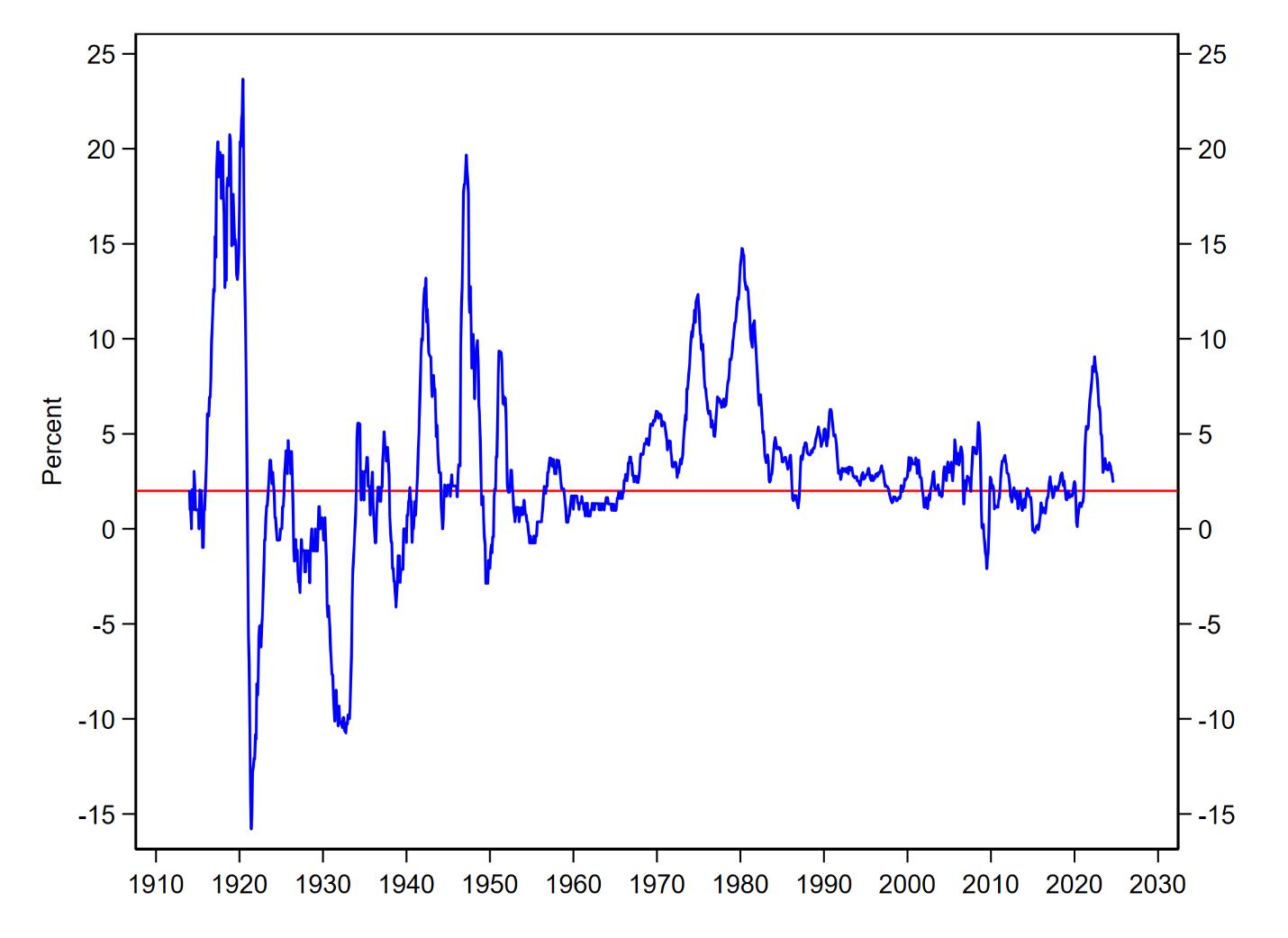
Notes: Percent change of CPI for all urban consumers, year-on-year, monthly.
Source: U.S. Bureau of Labor Statistics and author calculations.