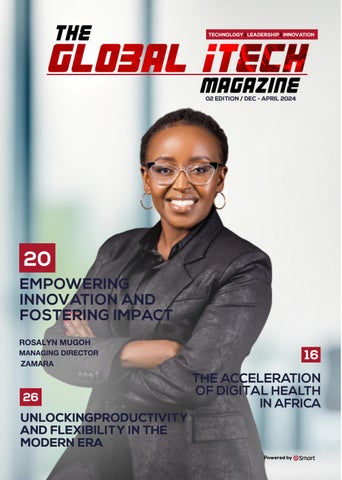
Global itech Magazine Issue 2
1
Success is built on trust! Digitise your healthcare facility
with SmartHealth+ HMIS
Our Promise
Growing Together
Ease of Use
Talk to us:
24/7 Local support and customization
E: sales@smartapplicationsgroup.com W: www.smartapplicationsgroup.com 2 M: +254 724 842 126
Cloud Based
Our Certifications
One click real-time facility performance dashboards
SmartHealth+ is a Healthcare Management Information System (HMIS) powered by Smart Global itech Magazine Issue 2 Our systems are globally used, recognized and ISO certified.
Powered by Smart Applications International Ltd
HEAD OFFICE
International House, Mama Ngina Street P.O. Box: 57776 - 00200, Nairobi,Kenya
Tel: +254 20 320 6000 Tel: +254 709 326 000 Toll Free Line: 0800723600 Whatsapp: +254 718 222 000
EDITOR’S NOTE
y
Global i-Tech
E-mail: info@smartapplicationsgroup.com Website: www.smartapplicationsgroup.com
GLOBAL I-TECH TEAM Esther Kiringa William Techera Baraka Jefwa Andreas Mukabwa Levi Kinyanjui Eunice Ndila
EDITORIAL CONTRIBUTORS Daniel van der Merwe Tabish Asifi Elsie Katam Mary Murigah Anna Collard
Esther Kiringa Group Sales & Marketing Director
Smart Applications International Ltd
hat a transformative year it has been for the healthcare industry! Technology has played a pivotal role in reshaping the way we serve patients, with a relentless pursuit of better care and improved quality at its core.
W
In this issue of Global iTech magazine, we delve into the heart of this revolution with our main theme: “Fast-Tracking Wellness: The Acceleration of Digital Health.” In these pages, we explore the symbiotic relationship between technology and healthcare, shining a spotlight on the key stakeholders who stand to gain the most from this alliance. We’ll also discuss how we can continually enhance our efforts by listening to user feedback and implementing solutions that address genuine market needs. But that’s not all. Our magazine’s pages come alive with a captivating CEO profile, featuring Rosalyn Mugo, the visionary leader at Zamara. As a woman in the industry, her journey is not just inspiring but also a testament to the transformative power of leadership. As you embark on this reading journey with Global iTech, I extend a warm welcome to the third annual Smart Technology Summit. This year, we dive into the theme of “The Interplay of Technology Ecosystems.” We seek answers to the crucial question of how to build resilient healthcare ecosystems, complete with robust financial systems and strict regulatory compliance, all powered by the latest technologies.
No part of this publication may be reproduced, distributed, transmitted or in any form or by any means including photocopying, recording, or other means electronic or mechanical, without prior written permission of the publisher, except in the case of brief quotations,embodied in reviews and certain other non-commercial uses permitted in the copyright laws. Global itech Magazine Issue 2
Before I conclude, as a marketer, I have two simple yet heartfelt calls to action: First, I hope you relish every page of this magazine, finding inspiration and insights along the way. Second, I invite you to immerse yourself fully in the summit, where knowledge and innovation collide to shape the future of healthcare. 3
CONTENTS
In this issue
34 Smart Data: Empowering Healthcare Business Leaders in Decision-Making The ‘Healthcare Analytics 2022/2023: Lifestyle Diseases, Cost of Healthcare, Hospitalization Cost, and Disease’ by Smart Applications International gives an extensive outlook of the dynamic world of healthcare in Kenya.
30
20
7 HABITS OF EFFECTIVE IT GOVERNANCE
CEO PROFILE
In a captivating Q&A session with the Global i-Tech Magazine, Rosalyn Mugoh, the dynamic Managing Director of Zamara, unveiled her remarkable journey of leadership, innovation, and societal impact..
In today’s fast-paced digital world, effective IT governance is crucial for organizations to efficiently manage their tech-nology investments, minimize risks, and create a competitive advantage. technology strategy with the overall business strategy, ensuring that IT is utilized optimally to achieve organizational
Enjoying our content? Don’t forget to subscribe https://issuu.com/globali_tech
Features
Columns
Guest Editorial
14. Dimension Data Enhances-
5
6.
Security with the Smart Access Control Solution
Will Chat GPT impact critical thinking skills for the youth? Artificial intelligence (AI) tools are here to stay so instead of seeing it as a threat, they should be seen as an asset.
The Smart access control solution is a biometrics-based system, that provides greatly improved security with the aim of controlling who has access to a specific office location.
Promoting Good Pharmacy Practice in Drug Prescription using Digital Health Innovations The Big Pharma is an indutry-wise language affiliated with the global pharmaceutical players. They are a critical component of the healthcare ecosystem, indispensable and vital vertebrae of
26. Embracing Agile Working: Unlocking Productivity and Flexibility in the Modern Era In a rapidly evolving world where agility is paramount, organizations and individuals alike are realising the immense benefits of agile working.
care. Across Africa, we have seen the development of the pharmaceutical in-
13
Creating A Better Customer Service Experience In The Tech Field
dustry from qualified human resources, advanced pharmaceutical local manufacturers, and eventual support from the global pharmaceutical players.
Customer Experience (CX) is essential in the tech field because customers have higher expectations.
4
Global itech Magazine Issue 2
TRENDS
WILL CHAT GPT IMPACT CRITICAL THINKING SKILLS FOR THE YOUTH? ChatGPT has had more airtime than the world’s most renowned celebrity. Its arrival has sparked questions and concerns that some did not even think to ask, including if it is a threat to our critical thinking skills.
CHAT GPT
W
rite this essay. Complete this analysis. Unpack the meaning behind this excerpt. These are all sentences that bring horror to those who do homework – lengthy essays about things that students are not sure they care about, and that many do not see the point in doing in the first place. This homework is not designed to be terrifying; it is designed to ignite the mind and critical thinking; to challenge students to form their own opinions and then using research and cognitive thinking to back them up. Currently, this is being threatened by tools like ChatGPT. Yet, artificial intelligence (AI) tools are here to stay so instead of seeing it as a threat, it should be seen as an asset, but one that supports cognitive growth and memory function rather than replacing it, says Anna Collard, SVP Content Strategy & Evangelist at KnowBe4 AFRICA. “Research by George Millar in 1956 found that the average person can only keep around seven items in their working memory,” she explains. “Miller’s Law of seven plus-minus two means up to nine or as little as five items are the limit of a human’s processing abilities. Today, that number has gone down to four. This research, along with other academic papers and analyses, points to reduced memory due to an over-reliance on technology also called the Google effect,” explains Collard. This is a concern, one that has grown increasingly vocal over the past year as educators and researchers have pondered the impact of technology, and now AI, on cognitive behavior and memory retention. However, it is also balanced Global itech Magazine Issue 2
by research that has pointed out that, human beings have been outsourcing their memory to various materials and solutions for centuries. Paper, parchment, papyrus, and wood are some prime examples. Modern technology is no different. It can be a tool to bolster memory and make it far easier for humans to manage lives that are deluged by information, noise, and digital clutter. Do not ban it, rather teach students how to use it within practical guidelines and policies that help them to enhance their understanding of AI and this type of tool. “The research goes in both directions, suggesting that technology is both an enabler and an inhibitor of human memory,” says Collard. “This points to the fact that, the impact does not lie in using it, but in how it is used or, in the case of ChatGPT, abused. The latter can be an immensely useful tool that supports students in their research and studies, but if it becomes the sole source of information and does all the writing for them, that is where the problems start.” Nowadays, remembering where you found a fact has become more important than remembering the fact itself. This translates directly into the biggest challenge with ChatGPT – it is vague on its sources and often out of date, which means that it rarely is as accurate as it needs to be. “ChatGPT uses machine learning to infer information and this introduces inaccuracies,” says Collard. “If you ask ChatGPT what happens if you break a mirror, it replies with ‘You will have
ANNA COLLARD
SVP CONTENT STRATEGY & EVANGELIST AT KNOWBE4 AFRICA seven years of bad luck’. This is not a fact; it is basedon superstition. If users do not constantly check the factual accuracy of ChatGPT, they run the risk of sharing fake news, inaccurate information, and even conspiracy theories.” The TruthfulQA benchmark test has found that most generative models are only truthful 25% of the time, according to the 2022 Stanford University Artificial Intelligence Index Report. This means over-reliance on technology such as ChatGPT is simply going to make the student’s work look stupid. However, that is not enough to stop people from turning to tech when they are tired, overwhelmed, or lazy, which means that the best approach is to embrace it. “Do not ban it, rather teach students how to use it within practical guidelines and policies that help them to enhance their understanding of AI and this type of tool,” concludes Collard. “This will enhance their own critical thinking skills by asking them to question the sources, content, truthfulness, and accuracy of the content that the platform serves up to them, and it will turn the threat into an opportunity.” Distributed by APO Group on behalf of KnowBe4.
5
GUEST EDITORIAL
PROMOTING GOOD PHARMACY PRACTICE IN DRUG PRESCRIPTION USING DIGITAL HEALTH INNOVATIONS
They enable physicians to make informed decisions based on accurate and up-to-date information, thereby promoting effective and personalized drug prescriptions.Decision Support Systems (DSS): Sophisticated decision support systems analyze patient data and provide evidence-based drug prescription and deprescription recommendations.
WILLIAM TECHERA The Big Pharma is an industry-wise language affiliated with the global pharmaceutical players. They are a critical component of the healthcare ecosystem, indispensable and vital vertebrae of care. Across Africa, we have seen the development of the pharmaceutical industry from qualified human resources, advanced pharmaceutical local manufacturers, and eventual support from the global pharmaceutical players. However, with the advent of this growth, we have witnessed an immense change in pharmacy practice amongst others. Pharmaceutical overprescription and polypharmacy have become growing concerns in the healthcare industry. The unnecessary use of medications and the simultaneous administration of multiple drugs can lead to adverse effects, reduced medication efficacy, and increased healthcare costs. To address these challenges, technology has emerged as a valuable tool to promote good practices in drug prescription and deprescription. By leveraging innovative solutions, healthcare professionals can enhance patient safety, improve treatment outcomes, and create significant value in the industry. Electronic Health Records (EHR): Implementing electronic health records allows healthcare providers to access a comprehensive patient medical history, including current medications, allergies, and previous adverse reactions. EHRs streamline the prescription process, reducing the risk of overprescription and drug interactions. 6
These systems utilize algorithms and databases to consider factors such as age, gender, medical history, and potential drug interactions. By assisting healthcare professionals in making informed decisions, DSS reduces the likelihood of polypharmacy and helps optimize treatment regimens. Telemedicine: Telemedicine platforms enable remote consultations, allowing patients to access healthcare professionals from the comfort of their homes. Through video conferencing and secure messaging, doctors can review medical records, conduct virtual assessments, and prescribe medications as necessary. Telemedicine reduces the burden on traditional healthcare systems and provides an opportunity for careful evaluation of prescription needs, minimizing unnecessary medications. Medication Management Apps: With the proliferation of smartphones, medication management apps have become popular tools for patients and healthcare providers. These apps serve as reminders for medication schedules, helping individuals adhere to prescribed treatments and reducing the risk of missed or doubled doses. Additionally, some apps provide drug interaction alerts and educational resources, empowering patients with essential information about their medications and potential side effects. Global itech Magazine Issue 2
GUEST EDITORIAL
Data Analytics and AI: Leveraging the power of data analytics and artificial intelligence (AI), healthcare organizations can identify patterns, trends, and outliers related to drug prescriptions. By analyzing large volumes of patient data, AI algorithms can detect instances of overprescription or polypharmacy, enabling healthcare providers to intervene and optimize treatment plans. Such insights promote evidence-based medicine, enhance patient safety, and contribute to overall healthcare efficiency.
By embracing these technological advancements, the healthcare industry can prioritize patient safety, improve treatment outcomes, and create significant value for both patients and healthcare providers.
It enhances treatment outcomes by ensuring that patients receive appropriate and personalized medications. Moreover, it optimizes healthcare resources by reducing unnecessary prescriptions and the associated costs.
Through video conferencing and secure messaging, doctors can review medical records, conduct virtual assessments, and prescribe medications as necessary. Telemedicine reduces the burden on traditional healthcare systems and provides an opportunity for careful evaluation of prescription needs, minimizing unnecessary medications.
Ultimately, technology-driven solutions empower healthcare professionals with accurate and timely information, leading to more efficient and effective drug prescription practices.
About the Writer:
Value Created for the Healthcare Industry: The integration of technology in drug prescription practices offers several valuable benefits to the healthcare industry. It improves patient safety by reducing medication errors and adverse drug events.
Overprescription and polypharmacy can be mitigated through the adoption of technology-driven solutions. Electronic health records, decision support systems, telemedicine, medication management apps, and data analytics contribute to good drug prescription and deprescription practice.
Global itech Magazine Issue 2
The writer is an avid healthcare business writer, and promoter of healthcare technology who has seasoned experience in working and fostering relationships in the healthcare industry from the medical, insurance, and technology segments.
7
NEWS
NEW WEB-BASED PLATFORM PREDICTS YIELDS OF NINE KEY AFRICAN CROPS
State-of-the-art tool uses AI and satellite data to overcome Africa’s agricultural data gap and support effective decision-making and crisis planning. The tool has provided predictions for agricultural yields in 47 African countries, across many of the most important crops for African food production, including maize, cassava, and sorghum, among others. The tool is designed to support farmers, policymakers, and local communities in crisis management, monitoring, and mitigation efforts.
DR. OUSMANE BADIANE,
EXECUTIVE CHAIRPERSON, AKADEMIYA2063 A new tool, which uses cutting-edge machine learning techniques and satellite remotely sensed data to predict agricultural yields for nine key crops across Africa, was launched recently. The webbased Africa Agriculture Watch (AAgWa) platform combines remote sensing data and machine learning techniques to support informed decision-making in African food production systems.
The AAgWa platform was officially launched as the fourth core program of pan-African non-profit research organization AKADEMIYA2063 at a virtual event, which highlighted the significant threats posed to Africa’s food production systems from climate shocks, global market disruptions, health crises, plant diseases, and pest outbreaks. Stakeholders discussed how today’s emerging digital technologies can help overcome Africa’s “agricultural data gap”, which inhibits African farmers and policymakers from responding effectively to threats to crop production, while driving further agricultural productivity and strengthening resilience
across the African continent. “When it comes to innovations in data, and particularly in remote sensing and artificial intelligence (AI), Africa does not have to follow – we can lead from within,” said Dr. Ousmane Badiane, Executive Chairperson, AKADEMIYA2063. “Africa’s telecoms revolution has shown how much you can achieve if you put in the effort and the resources, and at AKADEMIYA2063 we are investing in making key data and analytics for development accessible for all African countries.” This new phase of the AAgWa program will facilitate the use of emerging technologies like AI and advanced remote sensing by African countries to achieve their development objectives and broader economic growth, including the African Union’s (AU) Agenda 2063 and Digital Transformation Strategy for Africa (2020-2030).
KENYAN VIRTUAL HOSPITAL AMONG 11 START-UPS SHORTLISTED IN MULTICHOICE AFRICA ACCELERATOR PROGRAMME 11 Africa-based start-ups shortlisted to pitch for international funding and take their small businesses to the next level. Through the app, patients can Badugela, MultiChoice Africa chat and consult with doctors, buy medication from pharmacies, book labs, and diagnostic tests, and even have a doctor visit them at home.
MULTICHOICE AFRICA ACCELERATOR PROGRAMME SET TO BOOST PROSPERITY OF AFRICAN SMALL AND MEDIUM-SIZED BUSINESSES (SMME)
Kenyan startup, Zuri Health, has been shortlisted to pitch for international funding and take their small businesses to the next level thanks to the MultiChoice Africa Accelerator program. Now in its second leg, the program, through a panel of experts selected 11 of the most promising small businesses and invited them to pitch to prospective international investors in Dubai. Zuri Health is a virtual hospital providing affordable and accessible healthcare services to patients across Sub-Saharan Africa via mobile app, website, WhatsApp bot, and SMS service. 8
The programme specifically targets start-ups and small businesses in the technology sectors of health tech, agritech, fintech, edutech, the circular economy, and creative industries. “The quality of the submissions this year was high. It confirms our view that Africa has enormous potential. The specific focus on tech industries allows us to showcase the innovation of Africa to the world, but also enables these businesses to develop tech solutions to real societal problems,” says Fhulufhelo
CEO.
The 11 start-ups shortlisted to present their business plans to a panel of investors for this year’s MultiChoice Africa Accelerator Programme are: 1.Tupuca from Angola 2.Taskmoby from Ethiopia 3.StarNews Mobile from Ivory Coast 4.Tendo from Ghana 6.Dojah Inc and Crop2Cash from Nigeria 7. MaTontine from Senegal 8. Botlhale AI and Gradesmatch South Africa 9. Mighty Finance Solution from Zambia
Global itech Magazine Issue 2
NEWS
DRC USES INNOVATIVE SOLUTIONS FOR FIRST MAJOR POLIO IMMUNISATION CAMPAIGN These solutions are now also being used beyond polio, to support other health interventions in the WHO African region AWHO’s Polio Eradication Programme in the African region has established geographic information systems and other innovative tools that enable teams to quickly map areas in which health facilities are located, to locate houses in which eligible children live (especially zero-dose children), and to track the movements of vaccination teams during polio outbreak response campaigns to reach every child, even in the most remote locations. FIRST LARGE-SCALE CAMPAIGN IN THE DEMOCRATIC REPUBLIC OF THE CONGO (DRC) USING INNOVATIVE “These solutions are now also bePOLIO VACCINE ing used beyond polio, to support
The Democratic Republic of the Congo (DRC) recently launched its first major immunisation campaign using the novel polio vaccine type 2 (nOPV2), to protect children against the devastating consequences of the virus.lthough used previously in the country to halt outbreaks of circulating variant poliovirus type 2 (cVDPV2), this is the first time the DRC will conduct such a large-scale vaccination campaign. Starting on 1 June 2023, more than 17 million children under the age of five are being target-
other health interventions in the WHO African region,” says Kebba Touray, head of the AFRO Geographic Information System Centre.
Dr Lusamba Kabamba, GPEI coordinator in the DRC, confirms that monitoring pre-campaign activities using new technologies constitutes
a very valuable advantage. “The Open Data Kit tool is a simple mobile application that provides software and standards for field electronic data collection. Through a simple editable form, independent monitors, vaccinators, supervisors, and health workers can plan as well as evaluate the quality of a vaccination campaign by logging data and key observations in the forms.” Kabamba also notes that teams on the ground will be able to share near real-time geolocation points (marked using the ODK tool) where vaccination posts can be set up, how many health centres have been visited, the quality of markings on houses visited by vaccinators, as well as the quality of finger markers used to identify children who have been vaccinated. The tool also enables teams to locate children who have missed their vaccination.
SIEMENS HEALTHINEERS, WINGCOPTER TO PILOT INTEGRATED DRONE DELIVERY SOLUTION FOR HEALTHCARE FACILITIES Siemens Healthineers to collaborate with German drone manufacturer and service provider Wingcopter to pilot an integrated drone delivery solution for healthcare facilities throughout Africa.
FIRST INTEGRATED DRONE-BASED TRANSPORTATION SOLUTION FOR LABORATORY SAMPLES AND MEDICAL SUPPLIES IN AFRICA
Siemens Healthineers Middle East, Southern & Eastern Africa and Wingcopter GmbH have signed a Memorandum of Understanding (MoU) to develop and roll out an integrated drone delivery solution to transport various laboratory diagnostics materials as well as other medical supplies in Africa.he combination of Siemens Healthineers’ Laboratory Diagnostics testing capabilities and Wingcopter’s drone delivery services will provide improved diagnostics and faster treatment. Global itech Magazine Issue 2
The solution will adopt the latest in digital technology provided by Siemens Healthineers and Wingcopter from highly automated drone delivery to Laboratory Information Systems which will accurately track and report results directly to the patients. Ole Maloy, Managing Director of Siemens Healthineers Middle East, Southern & Eastern Africa, said, “At Siemens Healthineers, we are committed to providing access to care for everyone. Our partnership with Wingcopter will look to bridge the existing gaps in healthcare infrastructure, providing equitable and affordable access to diagnostic testing and medical supplies.” The utilization of Wingcopter’s delivery drones interconnected with Siemens Healthineers’ laboratory diagnostics facilities will allow for quick and automated
2-way delivery of samples, medicine and other medical products. The battery-powered drones will be operated by Wingcopter, covering a range of up to 75 kilometers while maintaining the cold chain at all times. These sustainable and efficient drone delivery networks will allow for the centralization of sample testing and medical consumables distribution, resulting in improved access to diagnosis, faster turnaround time, increased efficiency and reduction in costs. Tom Plümmer, CEO and Co-founder of Wingcopter GmbH comments, “We are convinced that we have found the perfect partner for our bold ambitions to improve and save the lives of millions of people on the African continent and beyond. Partnering with Siemens Healthineers will bring us a big step closer to 9
NEWS
KASPERSKY REPORTS ON NEW MOBILE APT CAMPAIGN TARGETING IOS DEVICES During the analysis, it was confirmed that there was no impact on the company’s products, technologies and services, and no Kaspersky customer user data or critical company processes were affected. The new mobile APT campaign was uncovered while the experts were monitoring the network traffic of its corporate Wi-Fi network using the Kaspersky Unified Monitoring and Analysis Platform (KUMA). Upon further analysis, company researchers discovered the threat actor has been targeting iOS devices of dozens of company employees. “When it comes to cybersecurity, even the most secure operating systems can be compromised. As APT actors are constantly evolving their tactics and searching for new weaknesses to exploit, businesses must IGOR KUZNETSOV prioritise security of their systems. HEAD OF THE EEMEA UNIT AT KASPERSKY This involves prioritising employee GLOBAL RESEARCH AND ANALYSIS TEAM Kaspersky researchers have uncovered an on- education and awareness and progoing mobile Advanced Persistent Threat (APT) viding them with the latest threat campaign targeting iOS devices with previously intelligence and tools to effectively unknown malware. Dubbed as ‘Operation Tri- recognise and defend against poangulation’, the campaign distributes zero-click tential threats,” commented Igor exploits via iMessage to run malware gaining Kuznetsov, head of the EEMEA unit complete control over the device and user data, at Kaspersky Global Research and with the final goal to hiddenly spy on users. Analysis Team (GReAT). “Our inThe new mobile APT campaign was uncovered vestigation of the Triangulation opwhile the experts were monitoring the network eration continues. We expect further traffic of its corporate Wi-Fi network using details on it to be shared soon, as the Kaspersky Unified Monitoring and Anal- there can be targets of this spy operysis Platform (KUMA). Upon further analysis, ation outside Kaspersky.” company researchers discovered the threat ac- The investigation of the attack techtor has been targeting iOS devices of dozens of nique is still ongoing, but so far company employees.
Kaspersky researchers were able to identify the general infection sequence. The victim received a message via iMessage with an attachment containing a zero-click exploit. Without any further interaction, the message triggered a vulnerability that led to code execution for privilege escalation and provided full control over the infected device. Once the attacker successfully established its presence in the device, the message was automatically deleted. Further, the spyware quietly transmitted private information to remote servers: including microphone recordings, photos from instant messengers, geolocation and data about a number of other activities of the owner of the infected device. During the analysis, it was confirmed that there was no impact on the company’s products, technologies and services, and no Kaspersky customer user data or critical company processes were affected. The attackers could only access data stored on the infected devices. Although not certain, it is believed that the attack was not targeted specifically at Kaspersky – the company’s just first to discover it.
INDYGENEUS, EMERALD MOU EXPANDS OPPORTUNITY FOR WOMEN’S HEALTH RESEARCH IN NIGERIA IndyGeneUS AI has entered a partnership with Nigerian healthcare solutions company, Emerald Industrial, to engage participants for its upcoming Women’s Health clinical research pilot study. variants shared among diverse populations of women diagnosed with endometriosis, uterine fibroids, and polycystic ovary syndrome (PCOS). Now, IndyGeneUS AI has partnered with Emerald to include women living in Nigeria in its ground-breaking study. Earlier this year, IndyGeneUS, announced the formation of the Women’s Health Research Collaborative (WHRC) to identify common genetic variants shared among diverse populations of women diagnosed YUSUF HENRIQUES with endometriosis, uterine fibroids, INDYGENEUS AI FOUNDER, and polycystic ovary syndrome (PCOS). AND CEO Now, IndyGeneUS AI has partnered with Earlier this year, IndyGeneUS, anEmerald to include women living in Ninounced the formation of the Womgeria in its ground-breaking study. en’s Health Research Collaborative “We know that American women are (WHRC) to identify common genetic 10
not the only ones suffering in silence from endometriosis, fibroids, and PCOS, so we’re not going to limit our study to one geographic region,” said Yusuf Henriques, IndyGeneUS AI founder, and CEO. Nigeria holds one of the largest populations on the African continent. However, data on the incidence of endometriosis, fibroids, and PCOS in Africa is limited. From 2013 to 2017 fibroids accounted for 6.4% of admissions and 21.3% of all major surgeries according to a retrospective study at the University of Abuja Teaching Hospital. Two infertility clinics in Southeast Nigeria reported PCOS in 18.1% of patients over a 2-year period. Global itech Magazine Issue 2
NEWS
LIQUID DATAPORT LAUNCHES ITS SHORTEST FIBRE ROUTE CONNECTING KENYA TO DR CONGO The much anticipated 3,800km route marks a new era in East-West connectivity on the continent, adding to Liquid’s One Africa Digital Network, which now spans 110,000 km
LIQUID DATAPORT LAUNCHES ITS SHORTEST FIBRE ROUTE CONNECTING THE EAST COAST TO THE WEST COAST OF AFRICA
Liquid Dataport, a business of Liquid Intelligent Technologies (Liquid), a pan-African technology group, has launched its newest fibre route connecting Mombasa, Kenya, to Muanda on the west coast of the Democratic Republic of Congo (DR Congo). This is the shortest route connecting East to West Africa, reducing data transmission latency by 20 milliseconds. The much anticipated 3,800km route marks a new era in East-West connectivity on the continent, adding to Liquid’s One Africa Digital Network, which now spans 110,000 km. The fibre route connects Kenya and DRC, passing through Uganda and Rwanda and bringing more reliable and affordable broadband
connectivity to over 40 million people living and working in all the major cities along the route. The latest route complements Liquid’s earlier achievement, already a first, in 2019, linking Dar Es Salaam to Muanda on the West Coast of DR Congo via Zambia. Hardy Pemhiwa, President & Group Chief Executive Officer of Liquid Intelligent Technologies, said, “The real challenge today is closing the access-usage gap in Africa so that more Africans can use the internet technologies available to them, now and in the future. This East-West route which compliments our existing Pan Africa fibre network, is significant because it is helping to solve that problem – it not only brings global traffic to the continent but
also improves the cost economics of Africa’s broadband Internet access.” The new East-West route enables Liquid’s customers to take advantage of capacities ranging from 1Mbps to 100,000Mbps. It enables cloud supplier redundancy with access to multiple data centres and cable landing stations, ensuring maximum uptime. This is hugely beneficial to the many businesses in East, Central & Southern Africa that are embarking on their digital transformation journey. In order for African enterprises to expand continentally and compete with their global counterparts, they need stable, reliable connectivity with low latency and access to numerous digital tools to optimise their businesses.
CENTI, CENTBEE PARTNER TO EMPOWER AFRICAN DIASPORA WITH BLOCKCHAIN-BASED TRANSFERS
Deploying advanced blockchain technology, this partnership is poised to make cross-border money transfers more streamlined, cost-effective and inclusive
Centi, and Centbee announced at the London Blockchain Conference that they have joined forces to redefine remittance services from Switzerland to Africa. Deploying advanced blockchain technology, this pa Centi, and Centbee announced at the London Blockchain Conference that they have joined forces to redefine remittance services from SwitzerCEO OF CENTI, BERHARD MÜLLER WITH LORIEN GAMAROFF AND ANland to Africa. Deploying GUS BROWN, CO-CEO’S OF CENTBEE AT THE LONDON BLOCKCHAIN advanced blockchain techCONFERENCE HAPPENING 31 MAY - 2 JUNE 2023 Centi, and Centbee announced at the London Blockchain Confer- nology, this partnership is ence that they have joined forces to redefine remittance services poised to make cross-borfrom Switzerland to Africa. Deploying advanced blockchain der money transfers more technology, this partnership is poised to make cross-border mon- streamlined, cost-effective ey transfers more streamlined, cost-effective and inclusive. Cen- and inclusive. ti, and Centbee announced at the London Blockchain Conference Traditionally, remittances that they have joined forces to redefine remittance services from rely heavily on bank transSwitzerland to Africa. Deploying advanced blockchain technolo- fers and credit cards, creatgy, this partnership is poised to make cross-border money trans- ing challenges for the unbanked and underbanked fers more streamlined, cost-effective and inclusive. Global itech Magazine Issue 2
communities in Europe. Addressing this critical issue, Centi has developed a unique cash on-ramp feature, whilst Centbee offers off-ramps in various African countries including Ghana, Senegal, Cameroon, Nigeria, Kenya, and Uganda. This synergy promises to enhance financial inclusion significantly. Preliminary tests indicate that sending CHF 50 in cash to Ghana using Centi and Centbee’s combined service could be 85% cheaper than the market leader. This translates to recipients getting up to 30% more cashin-hand based on the same CHF 50 sent from Switzerland. This revolutionary model could pose a formidable challenge to traditional high-fee remittance 11
NEWS
HUAWEI AND PARTNERS TO BOOST DIGITAL INCLUSION IN UGANDA THROUGH DIGITRUCK PROJECT DigiTruck will provide free digital skills training for more than 10,000 beneficiaries. theme of 'Equal Opportunities in Education, Science Technology for Innovation and a Gender Equal Future', priority beneficiaries of the Uganda DigiTruck project include girls and women. Other target beneficiaries are young people and 'Jua-Kali' micro and small business owners. "Digitization of Jua Kali enterprises will create sustainable livelihood opportunities for the informal sector, as it will enable small businesses to participate in regional and national trade, expand the customer landscape, and allow businesses to provide clients with a greater range of services and products," said Col. Rtd Okello P. Charles Engola, Minister of State for Labour, Employment and Industrial Relations in Uganda. DIGITRUCK PROJECT LAUNCHED BY H.E. YOWERI K. MUSEVENI, THE PRESIDENT OF UGANDA Ugandan President H.E Yoweri Kaguta Museveni officially launched a new DigiTruck project in Uganda. The project will provide free training in digital skills for more than 10,000 beneficiaries over three years. The DigiTruck project is a part of Huawei’s TECH4ALL initiative, the company’s long-term initiative for driving inclusion and sustainability across the globe. President Yoweri Museveni commented in a tweet, "I launched the Huawei DigiTruck project in Uganda. A project that will benefit over 10,000 Ugandans in a span of 3 years especially jua-kali, enterprise own-
ers, women, young girls and students through Digital Skilling." He added that, "Digital transformation is one of the key drivers of effective human capital development, it therefore gives me pleasure to launch this Huawei Project." In line with the IWD theme of 'DigitAll: Innovation for a gender equal future' and Uganda's national theme of 'Equal Opportunities in Educa-
"The training will also improve financial inclusion through improved ability to operate mobile money operations and expand employment opportunities, especially in rural areas." Running in partnership with the Ministry of Labour, Gender and Social Development and the international social enterprise Close the Gap, the Uganda DigiTruck project is aligned with the nation's 2040 vision, National Development Plan, and Education Digital Agenda Strategy. The focus of these initiatives includes promoting digital foundation skills, digital communications and information, digital transactions,
using the Internet for problem-solving, online tion, Science Technology for Innosafety, civic responsibility, and data privacy. vation and a Gender Equal Future', priority beneficiaries of the Uganda
AI-POWERED HEALTH-TECH SOLUTION TRANSFORMS AFRICAN BLOOD DONATIONS Is AI solving pressing African issues? with many exhibitors showcasing how the AI boom is turbocharging waves of innovation across industries, from education and agriculture, to transport, retail, energy, or logistics.
MUBARAK AYANNIYI,
FOUNDER AND CEO, BETALIF During the inaugural, GITEX Africa, held in the Red City of Marrakech, thousands of attendees were able to witness AI and its far-reaching multisectoral impact evident on the exhibition floor, 12
BetaLife, an award-winning Nigerian start-up epitomised this movement in the healthcare sector. The cloud-based AI-powered platform connects hospitals and blood banks using advanced algorithms, ensuring the efficient flow of lifesaving blood products to patients in need. Mubarak Ayanniyi, the 21-year old founder and CEO, said the greatest advantage of Betalife is its ability to analyse copious data via an AI-powered algorithm that accurately predicts when, where, and in what amounts blood donations are required, thereby directing resources and allocating donations when needed, ultimately saving countless lives.
“BetaLife has revolutionised the way that blood donations are managed in Africa”, said Ayanniyi. “Instead of relying on manual processes, hospitals and blood banks are now using BetaLife to predict when and where blood donations are needed most. This has led to more efficient distribution of blood products, reducing waste and ensuring that those who need it most receive the lifesaving treatment they require.” GITEX Africa was held under the High Patronage of His Majesty King Mohammed VI, and hosted by the Digital Development Agency (ADD), under the authority of the Moroccan Ministry of Digital Transition and Administration Reform.
Global itech Magazine Issue 2
COLUMN
CREATING A BETTER CUSTOMER SERVICE EXPERIENCE IN THE TECH FIELD Customer Experience (CX) is essential in the tech field because customers have higher expectations as a result of the complexity of products and services on offer and thus it is important to create a clear understanding of such solutions through clear-cut communication
tomer experience through surveys, metrics, analytics, and auditing. This has given us an upper hand when it comes to refining our Customer Experience Strategy. We also acknowledge that our customers’ motivations, desires, and needs are changing and so we are ever ready to change along with them. This can be seen from our most recent solution, Smart Access, a virtual mode of medical access. Understanding your customer’s needs is the first step to customer loyalty.
ELSIE KATAM CUSTOMER EXPERIENCE EXECUTIVE SMART APPLICATIONS INTERNATIONAL LTD
Customer Experience (CX) is essential in any business, but it is even more important in the tech field. This is because customers have higher expectations as a result of the complexity of products and services. A positive customer experience is also very important, especially now that customers have an array of options to choose from in the market, and that increases challenges for us in the tech space. Consumers are constantly judging companies based on what kind of services they provide and how different they are from others in the same game. From the definition of CX, it is basically the customer’s journey at every touchpoint of their buying experience. From how a business is able to create awareness, provide an easy purchase process and post-sales customer experience. So how then would you define success in CX? It is simple, Loyalty. The next question would be how then do you create loyalty in this very competitive field? Here at Smart Applications, we take pride in making sure to give a positive lasting impression at each and every touch point of our customer’s journey. Our customers are at the heart of our business and that is why from the beginning, we develop products with our customers in mind. Over the years we have focused on transforming the total cusGlobal itech Magazine Issue 2
Secondly, During the purchase touchpoint, it is important for us as a company to attend to each of our customers equally and in a personalized way. Companies in the technology industry are seeking to provide different services to different categories of consumers. It is no longer true that one method fits everyone. Companies should be available at every level and channel via which the consumer wishes to communicate. Thirdly, it is important to note that CX is a constant effort that takes commitment. So even after selling our solutions to our customers, we provide support and post-sales customer experience. We have always been available for our customers for support and in this same spirit, it is important to us to provide fast, human, and personalized support to our customers. With all this, we believe we will maintain a good relationship with our customers. Consumers want the smartest, tech-savvy larger-than-life objects that make their lives digitally powered, easy and convenient. The tech sector is overcoming numerous obstacles as it is, developing innovative ideas and technology as well as finding workable, affordable solutions to problems that consumers face on a daily basis. In order to keep clients, businesses must focus on improving the customer experience at this pivotal time when the market is teeming with competitors eager to take on any challenge. All consumer electronics companies today have to focus on boosting customer pleasure and loyalty through cutting-edge customer experience strategies. 13
WITH SMART APPLICATIONS INTERNATIONAL’S SMART ACCESS CONTROL SOLUTION, MR. DAVID KAMANDE, HEAD OF INFRASTRUCTURE FACILITIES & DATA CENTER – EAST AFRICA AT DIMENSION DATA, HIGHLIGHTS IMPROVED USER MANAGEMENT, ENHANCED SECURITY, AND CLIENT ACCESS CONTROL.
14
Global itech Magazine Issue 2
NEWS
DIMENSION DATA ENHANCES SECURITY WITH THE SMART ACCESS CONTROL SOLUTION The Smart access control solution is a biometrics-based system, that provides greatly improved security with the aim of controlling who has access to a specific office location. The system also incorporates Time and Attendance that accurately records employee working hours, streamlines payroll, and provides real-time reporting for efficient workforce management. Regarding the implementation process, Mr. Kamande emphasized its hassle-free nature, stating, “The execution of the implementation process adhered to the scheduled timelines and was performed excellently. All devices were successfully activated without any issues.” Furthermore, Mr. Kamande praised the after-sales services and support, highlighting the team’s quick and efficient assistance whenever needed. By implementing the Smart Access Control Solution, companies like Dimension Data have successfully managed to securely control access to data centres. The system has since deterred misuse as individuals know that the system is recording their time and date of access. Everyone is held accountable for their actions. Mr. Kamande noted, “As a user, you can manage your staff and adjust access levels. You can also manage your clients and set timeframes for their logins. Our updated model provides better security than the previous version.”
MR. DAVID KAMANDE Head of Infrastructure Facilities & Data Center East Africa at Dimension Data Dimension Data, a prominent IT infrastructure and services company operating across the Middle East and Africa, has been using the Smart Access Control solution implemented by Smart Applications International. This leading ICT solutions provider offers a range of world-class technology solutions to secure Dimension Data’s Data Centres in Kenya and effectively manage their staff medical scheme through Smart virtual access.
He further added, “Our infrastructure and client service delivery have significantly improved, enhancing our ability to provide better client services.” Reflecting on his experience with the solution thus far, Mr. Kamande praised the facial recognition system and the timely assistance provided by the intelligent application. When asked if he would recommend the system to others, he confidently stated, “Certainly! The system is quite good. It’s user-friendly and easy to navigate.”
The Smart access control solution is a biometrics-based system, providing greatly improved security than the access control solutions that use Radio-Frequency Identification (RFID) cards only. The system also covers Time and Attendance which empowers organizations by accurately tracking staff working hours, supporting payroll processes, and enabling efficient scheduling and management of staff shifts. Additionally, it provides HR personnel with real-time reports on staff mobility within the organization and its branches. Key benefits of this solution include: • • • •
Precise tracking of staff reporting and exit times. Enhanced security measures. Simplified report generation for Human Resource functions.
Mr. David Kamande, Head of Infrastructure Facilities & Data Center– East Africa at Dimension Data, expressed the challenges they faced before adopting the Smart Access Control solution, stating, “The absence of a biometric access control system in the earlier model made it challenging to operate and resulted in low security, allowing unauthorized parties easy access to the centres.” Global itech Magazine Issue 2
15
TREND FEATURE
IN AFRICA, DIGITAL HEALTH IS A VITAL NECESSITY, ADDRESSING VAST DISTANCES, LIMITED HEALTHCARE INFRASTRUCTURE, AND PRESSING HEALTH CHALLENGES. 16
Global itech Magazine Issue 2
FEATURE
FAST-TRACKING WELLNESS: THE ACCELERATION OF DIGITAL HEALTH IN AFRICA Catalysing a Health Revolution Through Technological Advancements
For nearly six years, Zipline drones have eff iciently delivered life-saving supplies to 12 remote regional hospitals in Rwanda. Africa, a continent rich in culture and diversity, is now on the brink of a healthcare revolution powered by the rapid acceleration of digital health technologies. In a region where access to quality healthcare has often been a challenge, digital health is emerging as a potent force for change, bringing improved healthcare services and outcomes within closer reach than ever before. THE DIGITAL HEALTH TRANSFORMATION A In recent years, Africa has witnessed a remarkable surge in digital health innovations that are fundamentally reshaping the healthcare landscape. This transformation is primarily attributed to the widespread adoption of mobile phone technology and the establishment of reliable, extensive internet connectivity across the continent. According to a recent report from GSMA, Africa boasts an impressive 489 million unique mobile subscribers in 2023, indicating a substantial 43% penetration rate. Additionally, there are 287 million mobile internet users in 2023, reflecting a noteworthy 25% penetration rate. These statistics position the continent exceptionally well to capitalize on the potential of mobile health (mHealth) applications. The combination of a high adoption rate of mobile phones and robust internet penetration rates in Africa places the continent in an advantageous position for fostering innovation. This presents a unique opportunity for Africa to harness its expanding internet accessibility through mobile technology to develop cost-effective healthcare solutions. Global itech Magazine Issue 2
It’s worth noting that traditional digital health solutions, prevalent in developed markets, often entail substantial upfront investments for purchase, installation, and maintenance. Consequently, it is in Africa’s best interest to focus on Internet-based technologies to enhance access to medical services, even in marginalized and remote areas. The Government of Rwanda stole a march in implementing the use of Internet-based technologies to enhance access to medical services in marginalised and remote areas by partnering with Zipline. For close to six years, Zipline drones have been operating all across Rwanda, helping to deliver life-saving blood and medical supplies efficiently to 12 regional hospitals in remote locations. Zipline has been operating in partnership with the Government of Rwanda to initially deliver blood to healthcare facilities. The partnership recently extended to include the delivery of medicine, medical supplies, nutrition, and animal health products. Under the new partnership, Rwanda will triple its delivery volume by adding new delivery sites in rural and urban locations throughout the country and opening up Zipline’s service to other government entities. “With this new agreement, we will be incorporating Zipline into many aspects of our national operations from providing a reliable healthcare supply chain, to addressing malnutrition, to creating an unforgettable eco-tourism experience. Rwanda is an innovation hub and we’re thrilled to be the first country in the world to launch a national drone delivery service,” said Clare Akamanzi, Chief Executive Officer of the Rwanda Development Board. 17
FEATURE
The Promise of Telemedicine Telemedicine services have grown exponentially in Africa, however, there is still untapped potential facing this growth. In a recently published document by the UNDP titled, “INSURANCE AND TELEMEDICINE IN AFRICA: A moonshot in response to COVID-19” readers were presented with a moonshot estimate of how many more people could be reached if telemedicine were fully leveraged to change the parameters of health insurance and health service delivery in the Sub-Saharan Africa Region.
inpatient and outpatient cover, especially if greater outpatient care availability were to generate later hospitalization savings (and therefore greater insurance savings),” the report added. For a large of Kenya’s population residing outside urban areas, the barriers to healthcare access in rural regions have serious and far-reaching consequences. In such circumstances, digital telemedicine emerges as a crucial tool, enabling marginalized communities to access the essential care they need.
“Through desk-based research, insights were drawn from available literature and case studies of telemedicine and health insurance in SSA. These learnings were validated and supplemented through key informant interviews with service providers and industry experts from the SSA health insurance and telemedicine space.
In this context, Gertrudes, in collaboration with AMD Global Telemedicine, introduced the Daktari Smart Telemedicine Program. This initiative, featuring AMD Global Telemedicine’s virtual care platform and interconnected medical devices, was launched in November 2021.
Using data from publicly available databases along with these key informant interviews, a modeling exercise was conducted to provide a preliminary estimate of what could be – a prerequisite for considering what is needed to get to such a future,” the report pointed out. “The view across the three approaches shows that as many as 285 million more people could have access to health insurance, and therefore to health care more broadly, should the full potential of telemedicine be unlocked. The estimates show that scaling up telemedicine could help 186 million more people in SSA to afford a basic or entry-level health insurance product that could provide them with both 18
The hospital harnesses AMD’s AGNES Connect platform and integrates primary care devices to provide high-quality specialist care to children residing in four rural counties. “I get very satisfied when I see that I can offer care to a child remotely, follow up with that child, and see that they are back to normal. Let’s use this technology to reach patients and not wait for them to come to us.” Dr. Renson Mukhwana, Pediatrician, Gertrude’s Children’s Hospital. Digital health is not merely a luxury but a necessity for Africa, a continent marked by vast geographical distances, limited healthcare infrastructure in many areas, and the ongoing challenges posed by infectious diseases, maternal and child health, and non-communicable diseases like diabetes and hypertension. Global itech Magazine Issue 2
FEATURE
MOBILE HEALTH APPLICATIONS: EMPOWERING COMMUNITIES The widespread use of mobile phones across Africa has opened doors to innovative mobile health applications. These apps provide valuable health information, promote preventive measures, and offer convenient tools for tracking personal health metrics. Leading ICT and biometric giant, Smart Applications International Ltd, fondly known as, Smart, recently launched a virtual mode of medical access, for the 11 African countries they operate. The virtual access will be available on both a newly developed app dubbed Smart Access and through USSD codes for subscribers using feature phones.
As Africa accelerates its digital health journey, the continent stands at the threshold of transformative change. Digital health technologies are not just improving healthcare access; they are saving lives, enhancing the quality of care, and bolstering healthcare systems across the region. Africa’s commitment to leveraging technology for the well-being of its people is a testament to its resilience, innovation, and determination to fast-track wellness for all.
Through the app, patients are able to access healthcare insurance, view utilisation of their covers instantly, read informational articles about their health, and geolocate their healthcare providers of choice at the tap of their screens. Speaking during the launch, Smart Applications International, Managing Director, Mr. Harrison Muiru, noted that, “millions of Smart customers will now be able to use virtual access to pay for services across all lines of healthcare. We are cognizant of creating transformative patient-centric solutions that address current needs in such economic times”. Mr. Muiru further noted,
Our team has worked on the Smart Access App to ensure that this unique and comprehensive solution offers accurate users an opportunity to manage access health education on various topics of interest, check for closest medical providers with specified services These features will go a long way in the promotion of trust within the healthcare ecosystem ”.
ACCELERATING AFRICA’S DIGITAL HEALTH JOURNEY The potential of digital health in Africa is immense. Challenges remain, including infrastructure limitations in some areas, ensuring data privacy and security, and addressing disparities in access to digital technologies. However, these challenges are not insurmountable. African governments, alongside international organisations and the private sector, are working together to harness the full potential of digital health. Investments in infrastructure, regulatory frameworks, and capacity building are paving the way for a brighter healthcare future for all Africans. Global itech Magazine Issue 2
As Africa accelerates its digital health journey, the continent stands at the threshold of transformative change. Digital health technologies are not just improving healthcare access; they are saving lives, enhancing the quality of care, and bolstering healthcare systems across the region. 19
CEO PROFILE
ROSALYN MUGOH MANAGING DIRECTOR
20 20
Global itech Magazine 2023
CEO PROFILE
EMPOWERING INNOVATION AND FOSTERING IMPACT A Glimpse into Rosalyn Mugoh’s Vision for Zamara In a captivating Q&A session with the Global i-Tech Magazine, Rosalyn Mugoh, the dynamic Managing Director of Zamara, unveiled her remarkable journey of leadership, innovation, and societal impact. Her insights offer a unique glimpse into her visionary approach and the driving forces behind Zamara’s success. Rosalyn’s leadership journey defies convention, characterised by twists and turns that have guided her to her current role. She emphasizes the interconnectedness of experiences, understanding that each step is a learning opportunity. This philosophy has underpinned her career, reminding us that every road connects where we are to where we aspire to be.
EMPOWERING TEAMS AND CULTIVATING SUCCESS
TRIUMPHS, RECOGNITION, AND IMPACT
Could you share with us some key milestones and experiences that have shaped your career journey leading up to your current role as the Managing Director of Zamara?
What emotions and thoughts were running through your mind when you first heard about winning the Overall Corporate Lines Broker of the Year, Best Broker in Technology Application, and General Broker of the Year at the Think Business Insurance Awards 2023?
Every path to leadership is different. Mine was not linear in any way, with many twists and turns to navigate. I realised early that giving up was not an option. That these roads tend to be connected – the road between where you want to be and where you are. Each experience has been a learning opportunity. What do you consider to be the most important leadership qualities that have contributed to your success in this position? If I would pick three, they would be, First - effective communication – how one transmits information has a direct effect on the success of the business. Second, a Strong Work Ethic - I did various jobs growing up and was exposed to the work environment quite early, and the third, agility - the ability to react to the ever-changing environment with courage and with a great outcome. How do you approach building and nurturing a strong and cohesive team within Zamara? Building and nurturing a strong and cohesive team within Zamara is of utmost importance to ensure the organization’s success and positive work culture. To achieve this, I follow some key principles and strategies some of which include: •
Building a Sense of Belonging: I am a big believer that building a strong sense of community in the workplace boosts performance.
•
Empowerment and Accountability: I believe in empowering team members to take ownership of their work and make decisions within their scope of responsibility. This sense of ownership fosters accountability and motivates individuals to excel in their roles.
•
•
Recognizing and Rewarding Achievements: Recognizing and celebrating team and individual achievements helps boost morale and creates a positive atmosphere. I make it a point to acknowledge and reward exceptional performance, whether through verbal appreciation, incentives, or professional growth opportunities. Encouraging Professional Development: I am committed to supporting the ongoing professional development of my team members. This includes offering training, workshops, and resources to enhance their skills and knowledge.
Global itech Magazine 2023
The feeling is usually very surreal. I felt like all the hard work was paying off and it was an appreciation, a recognition of the blood, sweat, and tears and everything that we had put in. Your mission of empowering prosperity within society through innovative and trustworthy insurance solutions is commendable. Can you share an example of how your insurance solutions have positively impacted a specific community or organization? We have several solutions that have in their own way provided socio-economic reliance. The one that comes to mind is our Zamara Afya Health Solution. This is the only solution in Kenya that has no waiting periods and no pre-entry medical examination. It removes all barriers to entry. How do you plan to build upon these awards and further strengthen your company’s commitment to exceptional customer service and innovative insurance solutions in the coming years? By recognizing that we have a role to play and a top position to maintain in the coming years by remaining focused on our role and goals in society and industry by developing more innovative solutions to simplify the customer experience without losing sight of the human aspect of the services. The Best Broker in Technology Application award highlights your company’s commitment to innovation. Can you share some specific examples of how technology has enhanced your services and customer experience? Last year, Zamara announced plans to invest Kshs 100 million to upgrade its digital capabilities and customer service. The plans also included the upgrade of its operations and technology, including the launch of various digital platforms. Our commitment to innovation is evident in our seamless digital onboarding process. We have developed a user-friendly online platform dubbed eZamara that is also accessible on a mobile phone. eZamara is a one-stop shop that gives you access to quotations from several insurers and allows one to compare the rates and benefits and buys the one that is more suited to their needs.
21
CEO PROFILE
Additionally, our commitment to enhancing customer experience extends to our customer support services. We employ AI-driven chatbots that can address common inquiries and provide instant assistance 24/7. This ensures that clients receive quick responses to their queries, even outside regular business hours, enhancing overall customer satisfaction. A case in point is our first micro-pension solution in Africa dubbed Fahari, a fully digitized pension/savings solution where you can sign up, start saving, and check your balance at the palm of your hand through WhatsApp. How does Zamara foster a culture of innovation within the organization, and how are employees encouraged to contribute their ideas and creativity? Our leadership’s willingness to embrace change and adapt to new ideas sends a strong message that innovation is valued and integral to our organizational culture. We believe that nurturing a culture of innovation is a priority that fuels our growth and excellence. Additionally, fostering an environment where employees are empowered to contribute their ideas and creativity is key to our success. However, we have a dedicated and highly experienced technology and research and development team. We have focused on enriching certain areas – taking advantage of emerging innovative solutions, and encouraging strategic partnerships, people, and digital transformation. At Zamara, we have a dedicated and highly experienced technology and innovation team. We involve our employees by holding internal polls and surveys, and based on the results, we agree on what can be implemented and when.
PRIORITIZING PEOPLE AND PURPOSE With your recently concluded Regional HR Summit, it’s clear to note that Employee well-being is a key aspect of Zamara’s reputation. How does the company prioritise the well-being of its employees, promote work-life balance and ensure that employees feel supported and valued in their roles? What specific initiatives are in place to support their physical and mental health? We understand the dual-sided pressure that our employees face at work and at home. We have various ways of promoting the balance. One is ensuring that our psychological contract remains strong. 22
This contract ensures that our staff feel supported and cared for. We also have flexible work schedules. We create a fun work environment where we provide Board Games, darts that allow teams to foster a sense of community. A culture of health and wellness is one that we also promote by planning wellness days to ensure that physical and mental health is every employee’s top priority. We have a dedicated toll-free counseling line that our staff can call to receive help. Zamara is actively involved in various CSR initiatives. How does the company identify and select the causes and projects it supports? Our commitment to Corporate Social Responsibility (CSR) is a fundamental aspect of our organizational values. The process of identifying and selecting the causes and projects we support at Zamara is a holistic and purpose-driven endeavour. By aligning with our values, engaging stakeholders, assessing needs, and emphasizing sustainable impact, we ensure that our CSR initiatives contribute positively to the well-being of the communities we serve. Our CSR projects are anchored around creating a financially secure future. First, is to ensure that we create initiatives that are authentic and aligned with who we are. Next is to align skills with passion. We leverage those skills that we already must serve the community. And finally, articulate the outcomes of these initiatives. How does Zamara engage employees in CSR activities, and what role does employee participation play in contributing to the success of these initiatives? Engaging employees in Corporate Social Responsibility (CSR) activities for us is a pivotal aspect of our organizational philosophy. We have various forums that allow employee participation, and we believe that their participation in these initiatives goes beyond mere involvement; it becomes a driving force behind the success of our CSR endeavours. She Matters, the women’s council, which I head, is a wellness initiative that focuses on female employees within Zamara. This is fulfilled by having talks, events, and other activities, all centered on making women more impactful in their areas of influence and responsibilities. We also have a similar council for our male employees known as He Matters.
Global itech Magazine Issue 2
Anywhere and anytime
International health and life insurance that puts people first, not profits. WHY USE US FOR YOUR CORPORATE COVER? Because we’re collaborating on the African continent and beyond to bring world-class collaboration and solutions to all. HOW DO WE DO INSURANCE DIFFERENTLY?
We have clients in over 100 countries around the world
We run numerous on-the-ground operations using experienced in-house teams
multinational companies, as well as companies that cannot
We offer customisable & fully portable
include local nationals
GET IN TOUCH! | info@unisuregroup.com | unisuregroup.com Global itech Magazine Issue 2
23
FEATURE
COLLABORATING FOR THE GREATER GOOD / CORPORATE COLLABORATION FOR GREAT HEALTHCARE ACCESS How a multi-year collaboration between 2 companies is furthering healthcare access for all in Mauritius and beyond
The saying ‘work smarter, not harder’ doesn’t quite ring true in the case of The Unisure Group and Smart Applications International’s collaboration. In fact, it’s been a matter of consistently working smarter and harder to get things off the ground and introduce Smart’s innovative technology to the Mauritian healthcare market.
The Unisure/Smart collaboration has been years in the making. Unisure, an international health and life insurance provider, saw a gap in the Mauritian market as far as direct settlement structures within out-patient services were concerned. In 2020, they approached Smart with the idea of introducing the market to Smart’s biometric cards, and now, more recently, the Smart Access app. “Medical facilities in Mauritius charge medical insurance members upfront for out-patient medical treatment because there isn’t currently a formal direct billing structure to insurers that allows for seamless service delivery,” explains Unisure Head of IPMI in Mauritius, Daniel van der Merwe. “While we understood the facilities’ concern around the financial risks, we also felt that we owed it to our Unisure members to find a way to offer them a seamless engagement with the medical facilities within our network.” “There are a few very large insurers in Mauritius, and even though it’s not as big a market as any of the other African countries, our conversations with Smart centred around the fact the country’s participation rate in insurance is 24
much higher, largely because the population in general can afford to buy medical insurance,” Unisure’s Group Chief Risk Officer, Pierre Rossouw, explains. “Mauritius has one of the highest GDP per capita in Africa and it’s classified as an upper-middle-income economy. There are many lives on cover with insurers, and that certainly presents a great opportunity for Smart.” “There are a few very large insurers in Mauritius, and even though it’s not as big a market as any of the other African countries, our conversations with Smart centred around the fact the country’s participation rate in insurance is much higher, largely because the population in general can afford to buy medical insurance,” Unisure’s Group Chief Risk Officer, Pierre Rossouw, explains. “Mauritius has one of the highest GDP per capita in Africa and it’s classified as an upper-middle-income economy. There are many lives on cover with insurers, and that certainly presents a great opportunity for Smart.” The Smart Access app goes beyond biometrics to offer a virtual mode of medical access aimed at enhancing the patient experience, providing instant onboarding support to medical insurers, and ensuring provider transparency in healthcare administration. It essentially issues members with a One Time Pin to allow the hospital to identify them and their level of cover and benefits, but in providing a seamless interaction between the medical provider and the insurer, it also acts Global itech Magazine Issue 2
FEATURE
The saying ‘work smarter, not harder’ doesn’t quite ring true in the case of The Unisure Group and Smart Applications International’s collaboration. In fact, it’s been a matter of consistently working smarter and harder to get things off the ground and introduce Smart’s innovative technology to the Mauritian healthcare market. The Unisure/Smart collaboration has been years in the making. Unisure, an international health and life insurance provider, saw a gap in the Mauritian market as far as direct settlement structures within out-patient services were concerned. In 2020, they approached Smart with the idea of introducing the market to Smart’s biometric cards, and now, more recently, the Smart Access app. “Medical facilities in Mauritius charge medical insurance members upfront for out-patient medical treatment because there isn’t currently a formal direct billing structure to insurers that allows for seamless service delivery,” explains Unisure Head of IPMI in Mauritius, Daniel van der Merwe. “While we understood the facilities’ concern around the financial risks, we also felt that we owed it to our Unisure members to find a way to offer them a seamless engagement with the medical facilities within our network.” “There are a few very large insurers in Mauritius, and even though it’s not as big a market as any of the other African countries, our conversations with Smart centred around the fact the country’s participation rate in insurance is much higher, largely because the population in general can afford to buy medical insurance,” Unisure’s Group Chief Risk Officer, Pierre Rossouw, explains. “Mauritius has one of the highest GDP per capita in Africa and it’s classified as an upper-middle-income economy. There are many lives on cover with insurers, and that certainly presents a great opportunity for Smart.” “There are a few very large insurers in Mauritius, and even though it’s not as big a market as any of the other African countries, our conversations with Smart centred around the fact the country’s participation rate in insurance is much higher, largely because the population in general can afford to buy medical insurance,” Unisure’s Group Chief Risk Officer, Pierre Rossouw, explains. “Mauritius has one of the highest GDP per capita in Africa and it’s classified as an upper-middle-income economy. There are many lives on cover with insurers, and that certainly presents a great opportunity for Smart.” The Smart Access app goes beyond biometrics to offer a virtual mode of medical access aimed at enhancing the patient experience, providing instant onboarding support to medical insurers, and ensuring provider transparency in healthcare administration. It essentially issues members with a One Time Pin to allow the hospital to identify them and their level of cover and benefits, but in providing a seamless interaction between the medical provider and the insurer, it also acts as a facilitator of all data,
Global itech Magazine Issue 2
effectively functioning as a full administration system for hospitals too. After many discussions and engagements in Mauritius with numerous stakeholders, the Smart and Unisure teams recently got their first buy in from one of the country’s leading healthcare providers. “This is a massive win, for Unisure and Smart,” van der Merwe explains. “Firstly, for Smart, this is the catalyst that will help them to start including other insurers into the structure as well. Large scale participation is vital, because that’s how this will benefit everyone who uses Smart, not just one particular entity.” For Unisure, on the other hand, spearheading an initial proof of concept alongside Smart will of course benefit their members, hence their direct involvement. But in staying true to one of their seven company values – “We’re going far, together” – Unisure tackled this project with passion because the company equally wants the insurance market to thrive and for world-class healthcare, seamlessly delivered, to be available throughout Africa and beyond. The fact that a lot of companies set up principal structures in Mauritius, using it as a base to work with the rest of the continent, opens up new benefits to international private medical insurance plans. While many insurers may offer international cover, however, they do it on a pay-and-claim basis. Corporates now signing up with Unisure and within the Smart network will benefit from first-ever direct settlement advantages on their out-patient international cover. “Smart currently has a presence in 11 African countries,” van der Merwe explains. “What that means for someone like myself, who lives permanently in Mauritius but travels to Kenya frequently, for example, is that should I need to access medical care and I’m on roaming cover, I merely need to present my Smart Access app to a medical provider within Unisure’s network and it identifies everything. It even has a ‘find a medical provider’ feature if I’m new to the country and not sure where my closest provider in the network is.” At the end of the day, widespread medical services and ease of access is really what it is about, and thanks to the Unisure/ Smart collaboration, ensuring that members don’t have to pay out of their pocket for medical treatment, this has truly revolutionised the industry and created an entirely different ecosystem for members to participate in. For more information on The Unisure Group and Smart Applications International Ltd, visit www.unisuregroup.com and www.smartapplicationsgroup.com/kenya/ respectively.
25
FEATURE
EMBRACING AGILE WORKING
26
Global itech Magazine Issue 2
FEATURE
EMBRACING AGILE WORKING: UNLOCKING PRODUCTIVITY AND FLEXIBILITY IN THE MODERN ERA
Harnessing Technology to Transform the Way We Work It highlights the profound impact of agile working, both in response to unforeseen circumstances and as a sustainable way forward.
EMBRACING AGILE WORKING In a rapidly evolving world where agility is paramount, organizations and individuals alike are realising the immense benefits of agile working. However, despite the availability of advanced productivity tools and the rise of keywords like “enterprise mobility,” many organisations have yet to fully embrace this transformative approach. The remarkable potential of technology lies in its ability to dispel obscurity and bring forth unprecedented visibility. It empowers us to run multi-billion-dollar businesses from anywhere in the world, making the concept of working from anywhere a reality. With a simple touch of a button, we can access medical professionals, obtain necessary medication, and even share our medical history effortlessly, regardless of our geographical location.
A PARADIGM SHIFT The COVID-19 pandemic catalysed a paradigm shift in the way we work here at Smart. Prior to the outbreak, our organisation grappled with the challenges of managing office space and costs, leading some to tentatively explore remote work options. In one such case, a suggestion to have the tech team pilot remote work sparked doubts and hesitations.
MARY MURIGAH GROUP HUMAN RESOURCES DIRECTOR SMART APPLICATIONS INTERNATIONAL LTD
“I was struck by the delay in retrieving Mongolia’s documents. With just a touch of a button, they could have instantly accessed crucial information about Mongolia’s recurrent health issue and swiftly administered an appropriate solution. However, lacking this vital first-hand knowledge, they resorted to a trial-and-error approach, leading to unforeseen challenges. Eventually, after a significant period, Mongolia was singing with the angels.” Never mind my anecdote, I’ll make it all make sense in my article where I explore the power of technology in enabling agile working. It highlights the profound impact of agile working, both in response to unforeseen circumstances and as a sustainable way forward. Global itech Magazine Issue 2
Everyone was of the opinion that we should pilot remote working with our customer-facing teams. However, fate intervened as lockdown measures were swiftly implemented, forcing organizations to adopt remote work practices for all their teams overnight. Amidst the crisis, innovative minds from the Smart team quickly developed a solution to ensure productivity and accountability. The birth of our transformative productivity software, affectionately known as the “Smart Operations Management Information System” or “SOMIS” for short, revolutionized the way work was managed.
In a rapidly evolving world where agility is paramount, organizations and individuals alike are realising the immense benefits of agile working. 27
FEATURE
TASK / ACTIVITY MANAGEMENT
SOMIS not only provided visibility into ongoing projects but also facilitated the adoption of agile methods of working. What could have been a deterioration of business performance due to a lack of accountability turned into steady growth, as productivity issues were swiftly identified and addressed. UNLEASHING PRODUCTIVITY Currently, one of the biggest challenges in most organisations when it comes to operational efficiency is how to get employees fully engaged and have them share periodic progress updates.Due to a lack of visibility & control of employee productivity, most organisations are experiencing: 1. Poor time management 2. Absenteeism 3. Unstructured/unplanned tasks
4. 5. 6. 7. 8.
Unmet targets Overworked & redundant employees Unproductive meetings & events High turnover of employees due to lack of career growth & poor performance A lack of innovation
The Smart Staff productivity system is a versatile system that addresses the above challenges and enhances the operations of an Organisation and the productivity of its employees. It utilises a modular approach giving the user easy options to choose among its modules, as well as the flexibility to scale up/ advance the system according to an organisation’s expansion and needs.
INCIDENT/ISSUE RESOLUTION
28
Global itech Magazine Issue 2
FEATURE
The system has been carefully designed by ICT experts who worked closely with Human resources experts to address the entire needs related to staff productivity. The solution comes with powerful features and functionalities enabling the administration to manage the entire practice within a single application on a reliable effective technology footprint. Today, SOMIS has empowered us to embrace flexible work schedules without sacrificing productivity. With the ability to work from anywhere, employees can deliver value while maintaining a work-life balance. The system’s comprehensive features seamlessly integrate agile methodologies, organising projects, assigning responsibilities, setting deadlines, and enabling progress tracking and effective communication. The intuitive color-coded interface alerts users to impending deadlines, completed work, and areas of concern, enabling timely interventions and team energization. Real-time performance management ensures accountability and fosters continuous improvement.
The system is developed on a web-based front end and connects to a centralised database making it easily deployable and adaptable to any user’s needs based on their operational model and option to run the application within their environment. Smart staff productivity system provides the best-fit functionalities to an Organisation’s operational requirements, as demonstrated in the compliance checklist below. It has the following Key functionalities as its core modules: 1. 2. 3. 4. 5. 6. 7. 8. 9.
Tasks/activity recording and monitoring Dashboard & Reports for Tasks / activity Incident / Issues recording and monitoring Room / Hostel booking Performance evaluation & feedback i.e., 360 feedback Periodic alerts on individual performance e.g., 20% Training & event organization Employee ROI based on allocated resources Productivity based on employee output and contribution
HR TRANSFORMATION THROUGH TECHNOLOGY
Throughout the pandemic and the ongoing transition back to physical workplaces, many HR functions have grappled with sustaining productivity. Technology emerges as the answer, offering a reliable tool to drive accountability and visibility. By leveraging data from this tool, HR professionals can monitor performance, provide references, and even design appropriate reward and recognition programs. Trust is essential, but technology enhances transparency and fuels motivation. And finally, Mongolia rests, but the quest to inspire convenience continues. Smart is in the business of inspiring convenience in the world more so in the healthcare sector, but if we can inspire it in the workplace, that is the essence of human beings, work!
Global itech Magazine Issue 2
Throughout the pandemic and the ongoing transition back to physical workplaces, many HR functions have grappled with sustaining productivity.
To learn more about SOMIS contact Smart at: info@smartapplicationsgroup.com
29
PICTORIAL
AIBK BROKERS CONFERENCE
Our Group Sales and Marketing Director, Esther Muiruri, was honored to be the Guest Speaker during the brokers conference held, today at the Sarova Stanley Hotel, Nairobi, Kenya, by the Association of Insurance Brokers (AIBK). She spoke on Global Perspectives and How Insurance Brokers can leverage technology to drive and grow the insurance business.
THE RWANDA INSURANCE BROKERS ASSOCIATION CONFERENCE.
At the Rwanda Insurance Brokers Association conference, sponsored by Smart Applications International, our team showcased healthcare innovation. Our Country Manager, Cleophas Obiero, led the way with Head of Hospital Operations Innocent Niyonshuti and Head of Customer Relations Nadine uwitonze
17TH ASSOCIATION OF INSURANCE BROKERS OF KENYA - AIBK CONFERENCE
Smart Team, during the 17th AIBK Conference, Corporate Golf Tournament at the Diamonds Leisure Hotel and Golf Club.
SMART WESTERN REGION HEALTHCARE PROVIDER FORUM
We witnessed an incredible turnout at the Smart Applications International Western Region Healthcare Provider Forum, held at The Grand Royal Swiss Hotel in Kisumu, Kenya. The Smart team was led by Group Managing Director, Harrison Muiru, Group Marketing & Sales Director, Esther Muiruri, Head of Hospital Operations, Esther Macharia, and Head of Product Delivery and Support, Purity Njagi.
30
Global itech Magazine Issue 2
ey o
PICTORIAL
AFRICA COMPANY OF THE YEAR AWARDS
Smart Applications Tanzania was named Fintech Company of the Year 2023 at the Africa Company of the Year Awards (ACOYA 2023)! It was a memorable night as our Smart Tanzania team led by Country Manager Grace Wangeci and, Executive Customer Operations, Jeff Mutuma received the Award.
UNHCR, UN REFUGEE AGENCY CHARITY GOLF TOURNAMENT IN KENYA
Our team from Smart Applications International Ltd, led by Managing Director, Harrison Muiru, Group Marketing & Sales Director, Esther Muiruri, Marketing Manager William Techera, and Business Development Manager, John Ngoloma teed off at the 2nd annual UNHCR, the UN Refugee Agency Charity Golf tournament in Kenya.
THE SMART-AKI NAIROBI CHAPTER BREAKFAST
The Smart Applications International Ltd-Association of Kenya Insurers [AKI] Nairobi Chapter Breakfast event brought together healthcare providers, insurance players, and policy drivers in an explorative review, discourse, and affirmation of the use of mobile technology in enhancing medical digital access. The event was graced by top leadership from Smart Applications International Ltd, the Association of Kenya Insurers [AKI], and Kenya Healthcare Federation amongst key decision makers in the industry.
THE SMART COASTAL REGION HEALTH CARE PROVIDER FORUM
Our recent forum at The Travellers Beach Hotel in Mombasa, Kenya showcased our commitment to healthcare digitization and empowering Kenya’s healthcare Global itech Magazine Issue 2 31 future with innovative solutions.
COLUMN
“Effective IT governance is crucial for organizations to efficiently manage their technology investments, minimize risks, and create a competitive advantage”
BY TABISH ASIFI Group IT Governance Lead, Majid Al Futtaim Holding Digital Transformation Program
7 HABITS OF EFFECTIVE IT GOVERNANCE In today’s fast-paced digital world, effective IT governance is crucial for organizations to efficiently manage their technology investments, minimize risks, and create a competitive advantage. IT governance allows companies to align their technology strategy with the overall business strategy, ensuring that IT is utilized optimally to achieve organizational objectives. Based on my years of experience in the field, I can simplify all the key learnings into 7 simple habits that organizations can adopt to enhance their IT governance effectiveness. HABIT 1: ENSURE ALIGNMENT WITH THE BUSINESS STRATEGY An essential habit of effective IT governance is making sure that technology initiatives align with the organization’s business strategy. The IT council and board must periodically evaluate the role of IT within the company and ensure that basic IT processes and infrastructure are in place to support business objectives. Getting the basics right is crucial for achieving strategic alignment.
32
HABIT 2: ASSESS IT PERFORMANCE Regularly assessing IT performance is another key habit of effective IT governance. The IT council should set the right agenda and topics, focusing on the organization’s strategic priorities. IT governance responsibilities can be broken down into three areas: strategic alignment, value delivery, and risk management. To assess IT governance effectively, the council should ask key questions, such as: Are IT investments aligned with the business strategy? Is IT delivering value? How are IT risks being managed?
Global itech Magazine Issue 2
COLUMN
HABIT 3: DEVELOP THE RIGHT IT GOVERNANCE MODEL A one-size-fits-all approach to IT governance is not effective. Organizations need to develop an IT governance model tailored to their unique needs and context. An effective IT governance model should balance being broad enough to address overall organizational objectives while being specific enough to address the unique challenges and opportunities that the organization faces.
HABIT 6: MEASURE AND MONITOR IT’S IMPACT ON THE BUSINESS Measuring the quality and cost-competitiveness of the IT capability is essential for effective IT governance. IT leaders must develop metrics and key performance indicators (KPIs) to assess the impact of IT on the business, such as its contribution to revenue growth or cost savings. Regularly monitoring these metrics will help organizations optimize their IT investments.
HABIT 4: ALIGN IT PLANNING WITH BUSINESS STRATEGY
HABIT 7: DEVELOP THE RIGHT HABITS
Effective IT governance requires aligning IT planning with the organization’s business strategy. Two-way communication between IT and business leaders is essential to ensure that IT initiatives support strategic objectives and that business needs are met by IT capabilities.
To establish highly effective IT governance, organizations must: • •
HABIT 5: PLAY AN ACTIVE LEADERSHIP ROLE IN TRANSFORMATION AND INNOVATION Organizations with effective IT governance actively promote innovation and digital transformation. IT leaders should encourage a culture of innovation and empower their teams to experiment with new technologies, as these efforts can lead to significant competitive advantages and drive growth.
Global itech Magazine Issue 2
•
Identify the optimal IT governance model that suits their unique context and needs. Determine the major structures needed to manage IT governance, such as IT steering committees, IT councils, and IT project management offices. Clarify the current standing of the IT asset portfolio and establish a clear roadmap for future technology investments.
In conclusion, adopting these seven habits will help organizations create highly effective IT governance, enabling them to better align their technology initiatives with business strategies, drive innovation, and maximize the value of their IT investments.
33
Secure, Fast, Access
SMART DATA EMPOWERING HEALTHCARE BUSINESS LEADERS IN DECISION-MAKING Key Insights from Smart Applications Healthcare Analytics 2022/2023
The 'Healthcare Analytics 2022/2023: Lifestyle Diseases, Cost of Healthcare, Hospitalization Cost, and Disease' by Smart Applications International gives an extensive outlook of the dynamic world of healthcare in Kenya. Data has become a transformative force, offering valuable insights that can give healthcare business leaders a competitive edge. Powered by the Smart Applications business intelligence engine, such data has revolutionised how leaders in the healthcare space operate, enabling them to make informed decisions. This report studies six key takeaways from recent healthcare analytics, providing healthcare business leaders with actionable information to enhance their decision-making processes.
The key highlights of the report include: • Disease prevalence per region. • Lifestyle diseases prevalence. • Cost of treatment for the top trending diseases. • Geographic distribution of disease. • Age and gender distribution. • Hospitalisation rates and cost.
1. Disease Prevalence Per Region
Disease prevalence per region refers to the frequency or occurrence of a particular disease within a specific geographical area. It is an important measure used to understand the burden of diseases and their distribution across different populations. With the Smart BI engine, healthcare leaders are able to access Disease prevalence per region. The below example shows the disease prevalence per region in Kenya as relayed in the 34 image below:
Disease prevalence is typically expressed as a proportion or percentage of individuals affected by a specific disease within a given population or region. Disease prevalence can vary significantly between regions due to various factors, including:
1. Demographics 2. Environmental Factors 3. Lifestyle and Behavior 4. Access to Healthcare 5. Infectious Disease Transmission
Understanding disease prevalence per region helps leaders prioritize resources, develop targeted interventions, and improve patient outcomes. It's important to note that disease prevalence can change over time due to various factors, including public health interventions, changes in risk factors, and advancements in medical treatments. Therefore, it's crucial to consult updated and reliable sources for the most current information on disease prevalence per region. Global itech Magazine Issue 2
Hypertension emerged as the leading lifestyle disease since 2022, accounting for 50.5% of patient visits. It was followed by diabetes, which constituted 25.7% of the visits, and asthma, which accounted for 18.7%.
2. Prevalence of Lifestyle Diseases
The prevalence of lifestyle diseases refers to the frequency or occurrence of diseases that are strongly inuenced by lifestyle factors, such as diet, physical activity, tobacco use, alcohol consumption, and stress levels. These diseases are often chronic in nature and can develop over a long period of time due to unhealthy habits or behaviors. In the Smart Applications Healthcare Analytics period reported for 2022/2023, the prevalence of lifestyle diseases was analyzed, revealing interesting trends. Hypertension emerged as the leading lifestyle disease since 2022, accounting for 50.5% of patient visits. It was followed by diabetes, which constituted 25.7% of the visits, and asthma, which accounted for 18.7%. While hypertension and diabetes ranked highest in terms of patient visits, a closer examination of the cost per visit indicates that other diseases have a more signicant nancial impact. Heart disease, although comprising only 3.4% of patient visits, incurs relatively higher treatment costs compared to hypertension and diabetes. Similarly, heart failure, osteoporosis, and stroke, although less prevalent in terms of patient visits, represent the top three diseases in terms of cost per visit.
Global itech Magazine Issue 2
Heart failure, with a prevalence of 1.2% of patient visits, is associated with relatively higher treatment costs. Osteoporosis, which accounts for 0.3% of patient visits, also incurs signicant expenses. Finally, stroke, with the least prevalence at 0.2% of patient visits, imposes substantial nancial burdens. These ndings underscore the importance of considering both prevalence and cost when assessing the impact of lifestyle diseases on healthcare systems. While hypertension and diabetes are widespread, the comparatively lower treatment costs contribute to a more manageable economic burden. On the other hand, diseases such as heart failure, osteoporosis, and stroke, despite being less prevalent, demand greater nancial resources for effective management. These insights can inform healthcare planning and resource allocation, highlighting the need for targeted strategies to address the prevalence and cost implications of different lifestyle diseases. By understanding the prevalence and associated costs, healthcare organizations can prioritize interventions, allocate resources effectively, and implement preventive measures to reduce the burden of lifestyle diseases on individuals and healthcare systems.
3. Cost of Treatment for Top Trending Diseases
The cost of treatment for different diseases can vary signicantly based on various factors such as the type of disease, severity, treatment modalities, geographical location, healthcare system, and individual patient factors.
35
In Kenya, the cost of healthcare services can vary depending on the type of visit or treatment. Here are the approximate costs for different types of visits and treatments as reported in the Smart Applications Healthcare Analytics period reported for 2022/2023: 1. Outpatient Cost: The average cost for an outpatient visit in Kenya is approximately Ksh 6,000. This includes consultations with healthcare providers, diagnostic tests, and minor procedures that do not require hospitalization.
Additionally, the number of patient visits is higher during the month of June. Increased patient visits during a specic period can be inuenced by various factors, such as seasonal illnesses, school holidays, or specic health campaigns conducted during that time. It's important for healthcare providers to be prepared for higher patient volumes during such periods and ensure adequate stafng and resources to meet the increased demand. Please note that the costs mentioned here are approximate gures and can vary based on the specic healthcare provider, location, and individual circumstances. It's always recommended to check with healthcare providers or relevant healthcare authorities in Kenya for the most accurate and upto-date information regarding healthcare costs and trends.
4. Geographic Distribution of Lifestyle Disease
2. Admission Cost: If a patient requires hospitalization, the estimated cost in Kenya is around Ksh 139,000. This covers expenses related to hospital stays, medical procedures, medications, and nursing care during the admission period. 3. Dental Cost: Dental visits in Kenya typically cost around Ksh 11,000 per visit. This includes dental examinations, cleanings, llings, extractions, and other dental treatments.
The Smart Applications Healthcare Analytics period reported for 2022/2023 provided insights into the geographic distribution of diseases. These insights are invaluable for healthcare business leaders. The geographic distribution of lifestyle diseases refers to the patterns and variations of these diseases across different regions or locations. It examines how the prevalence and impact of lifestyle diseases differ based on geographical factors such as country, region, urban or rural areas, and socio-economic conditions.
4. Optical Cost: The average cost per visit for optical services, such as eye examinations and prescription glasses, is approximately Ksh 13,000 in Kenya. 5. Maternity Cost: The cost of maternity care per patient in Kenya is estimated to be around Ksh 114,000 on average. This covers prenatal care, delivery, postnatal care, and any necessary medical interventions during pregnancy and childbirth.
36
Lifestyle diseases can have distinct geographic distributions due to several factors:
1. Cultural and Behavioral Factors 2. Socioeconomic Disparities 3. Environmental Factors 4. Urban-Rural Divide 5. Genetic and Ethnic Factors
Understanding the geographic distribution of lifestyle diseases is crucial for public health planning, resource allocation, and targeted interventions. It allows policymakers and healthcare providers to identify regions with higher disease burdens, implement preventive measures, and allocate resources appropriately to address the specic needs of each region. Public health campaigns, educational programs, policy initiatives, and communitybased interventions can be tailored to target the specic lifestyle factors contributing to the prevalence of diseases in different geographic areas. Global itech Magazine Issue 2
5. Age and Gender Distribution of Disease
The age and gender distribution of a disease refers to how the disease affects different age groups and genders within a population. Analyzing this distribution can provide valuable insights into the epidemiology and impact of a disease on different segments of the population. The Smart Applications Healthcare Analytics period reported for 2022/2023 provideS insights into the age and gender distribution of diseases. This information helps leaders identify vulnerable populations, design preventive care programs, and develop personalized treatment plans. By understanding disease patterns across different demographics, leaders can optimize care delivery and improve health outcomes.
•
•
•
Hospitalization Rates: Females have a higher likelihood of being hospitalized compared to males. This gender difference may be attributed to various factors, including biological, hormonal, and social factors. Age and Hospitalization: Infants and older patients are more prone to hospitalization compared to other age groups. Infants have developing immune systems and are susceptible to infections, while older patients often have multiple chronic conditions requiring medical attention. Middle-aged Females and Hospitalization: Among females, middle-aged individuals have a higher likelihood of hospitalization compared to other age groups. This could be due to specic health conditions that are more prevalent or have higher severity during this life stage.
Global itech Magazine Issue 2
•
•
Hospitalization of Male Infants: Male infants exhibit a higher likelihood of hospitalization compared to female infants. This difference might be inuenced by various factors, including biological and genetic variations, susceptibility to certain illnesses, and healthcareseeking behaviors. Gender and Disease Distribution: Women are more likely to be diagnosed with conditions such as hypertension, asthma, heart disease, and heart failure compared to men. Conversely, men have a higher likelihood of being diagnosed with diabetes and stroke compared to women. These gender disparities in disease prevalence may stem from biological, hormonal, and behavioral differences.
The geographic distribution of lifestyle diseases refers to the patterns and variations of these diseases across different regions or locations. It examines how the prevalence and impact of lifestyle diseases differ based on geographical factors such as country, region, urban or rural areas, and socio-economic conditions.
•
Age and Lifestyle Diseases: The risk of lifestyle diseases tends to increase with age, with older people being more likely to be diagnosed with conditions associated with lifestyle choices. Individuals aged 41-50 years are particularly at high risk, followed by those aged 51-60 years. This emphasizes the importance of promoting healthy lifestyles and preventive measures across different age groups, with specic attention to these age ranges.
It's worth noting that disease distribution can vary across populations, regions, and time periods, so it's important to consider these factors when interpreting the data.
6. Hospitalisation Rates and Cost:
Hospitalization rates and costs refer to the frequency of hospital admissions and the associated nancial expenses incurred by individuals or healthcare systems for providing inpatient care. Understanding hospitalization rates and costs is crucial for assessing the burden of healthcare utilization, resource allocation, and healthcare planning. Factors Inuencing Hospitalization Costs: 1. Medical Condition 2. Length of Stay 3. Intensity of Care 4. Geographic Location 5. Insurance Coverage 37
Analytics highlight hospitalisation rates and associated costs, providing leaders with vital information on the disease burden impacting healthcare facilities. Identifying the diseases with the highest number of admissions allows leaders to allocate resources efciently and streamline workows. Additionally, understanding the distribution of inpatient revenue across different categories of service can inform revenue optimization strategies. The Smart Applications Healthcare Analytics period reported for 2022/2023, reveals that: Prevalent Causes for Admission: Gastroenteritis, tonsillitis, and hypertension have emerged as the most common reasons for hospital admissions. These conditions contribute signicantly to the overall burden of inpatient care. Gastroenteritis refers to inammation of the gastrointestinal tract, tonsillitis involves inammation of the tonsils, and hypertension refers to high blood pressure. These conditions require medical attention and hospitalization to manage symptoms and provide appropriate treatment. Leading Revenue Drivers for Inpatient: Medical procedures are the primary drivers of revenue for inpatient services. Various surgical interventions, diagnostic tests, and therapeutic procedures generate substantial income for healthcare facilities. On the other hand, radiology services, such as imaging studies, contribute relatively less to inpatient revenue. This difference may be attributed to the higher costs associated with specialized medical procedures and the equipment required for their execution.
Average Expenses per Visit for Specic Conditions:
- Heart Failure Patient (Kwale County): On average, a heart failure patient in Kwale County incurs the highest expenses per visit, amounting to Ksh. 16k. - Heart Disease Patient (Kwale County): Similarly, heart disease patients in Kwale County spend the highest average amount per visit, approximately Ksh. 24k. 38
- Diabetic Patient (Lamu County): Diabetic patients in Lamu County have the highest average expenses per visit, approximately Ksh. 4.8k. - Stroke Patient (Uasin Gishu County): Stroke patients in Uasin Gishu County spend the highest average amount per visit, around Ksh. 8.1k.
- Osteoporosis Patient (Nyeri County): Osteoporosis patients in Nyeri County spend the highest average amount per visit, approximately Ksh. 18k. - Hypertension Patient (Lamu County): Hypertension patients in Lamu County spend the highest average amount per visit, approximately Ksh. 2.6k. These average expenses per visit reect the unique healthcare dynamics, costs, and regional factors associated with specic medical conditions and counties. It is essential to consider these factors when assessing the nancial implications of healthcare utilization for patients in different regions. Smart data and healthcare analytics have transformed decision-making for healthcare business leaders. By leveraging recent healthcare analytics, leaders gain valuable insights into disease prevalence rates, treatment costs, the geographic distribution of diseases, age and gender patterns, hospitalization rates and costs, and the prevalence of lifestyle diseases. Armed with this information, leaders can make informed decisions, optimize resource allocation, and drive improved patient outcomes. Smart data has become a powerful tool in the healthcare industry, empowering leaders to navigate the complexities of modern healthcare and deliver high-quality, cost-effective care. Global itech Magazine Issue 2
Providing Dignified Quality Mental Healthcare in Africa RECOVERY IN DIGNITY
C H G B U STA N I
CHG FACILITIES
Westlands, Nairobi
T: +254 729 359 501 A: Chiromo Lane, Westlands
Braeside, Lavington
T: +254 733 778 609 A: Braeside Gardens, Lavington
Muthithi Road, Nairobi
T: +254 768 243 043 A: No. 94 Muthithi Rd, Westlands
Nyali, Mombasa
T: +254 769 398 128 A: Bungalow Road, Nyali
Upperhill Medical Centre T: +254 743 867 361 A: Ralph Bunche Road
CHG SPECIALTIES Mental Wellness Programs Depression Anxiety Bipolar Disorder Attention Deficit Hyperactivity Disorder (ADHD) Schizophrenia CHIROMO HOSPITAL GROUP +254769398128 | +254733332099 Info@chiromohg.co.ke 37, Muthangari Rd, Lavington
Adolescent & Child counselling Drug & Alcohol Abuse Post Traumatic Stress Disorder (PTSD) Obsessive Compulsive Disorder (OCD) and Other Mental Illnesses Toll Free:
0800220 000 39
@chiromoHospGroup
chiromohospitalgroup.co.ke
December to April Issue
40
Global itech Magazine Issue 2