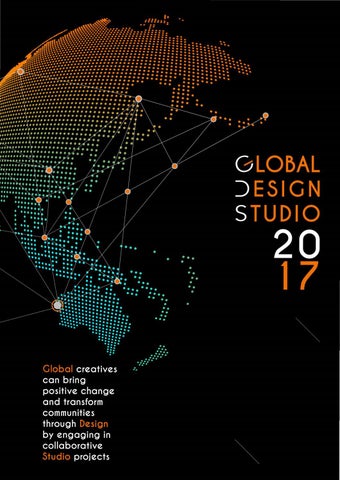
Cover Designed by:
Mr Matthaeus Tan & Mr Hoang Long Nguyen
First published in 2017 by Global Design Studio Perth, Western Australia www.g-d-s.com.au
Š20171 GDS All rights reserved. Except as permitted by the Copyright Act 1968, no part of this publication may be reproduced or transmitted in any form or by any means, electronic or mechanical, including photocopying, recording or any other information or storage system, without prior permission in writing from the publisher. Any copy of this book issued by the publisher is sold subject to the condition that it shall not by way of trade or otherwise be lend, resold, hired out or otherwise circulated without the publisher's prior consent in any form or binding or cover other than that in which it is published and without a similar condition. All enquires must be directed to Global Design Studio. Every effort has been made to trace accurate ownership of copyrighted text and visual materials used in this publication. Errors or omissions will be corrected in subsequent editions, provided notifications is send to the publisher.
Head of Media, GDS I Matthaeus Tan
G
(m
n
(o¡]
www.g-d-s.com.au Global Design Studio Global Design Studio global_design_studio
CONTENTS
INTRODUCTION 01 IDENTITY 02 GOS TEAM 03 HAZARDS AND 0SAKA : NATURAL DISASTER MANAGEMENT O 4
05 06
07
LIVEABILITY MALAYSIA:SARAWAKEN
SARAWAKEN:ON THE ROAD
PECHA KUCHA 2Ox2O:KucH1No.sARAWAK SYMPOSIUM HCMC:soNG TaT
08 09 LIVEABILITY VIETNAM:URBAN TALES 10 ARCHITECTURE FUTURES :STUDENT WORKS 11 URBANISM : THE NEAR AND FAR_FUTURE CITIES 12 CASA:Ml CASA SU CASA 13 SONA : STUDENT ORGANISED NETWORK FOR ARCHITECTURE CONTRIBUTORS 14
The Global Design Studio (GDS) philosophy is to bring together creative communities to this shared platform. Attracting creatives from across diverse industries and academic disciplines together to co-create new knowledge, build shared resources and engage in sustainable collaborations, in order to collaborate in design, research, practice, education and community projects. The GDS philosophy is underpinned by three important learning and teaching elements of Global, Design and Studio whereby learning is experienced through active participation set beyond the classroom and learning outcomes contribute to the transformation of people and their communities. The focus is on actively mobilising and deploying passionate creatives to contribute their talents to deliver practical solutions. GDS is currently growing four key areas: Research, Education, Community, and Practice. These four areas are under the stewardship of fourteen GDS: Principals, Senior Associates and Associates. The GDS team is very proud of our 100+ Architecture students from Curtin who have contributed to making a difference in the lives of others on our recent GDS programs that were hosted in Vietnam (2016) and Malaysia (2017). Both of these GDS programs were significantly supported by award-winning design practices in Ho Chi Minh City (HCMC), HCMC University of Architecture, Habitat for Humanities (Vietnam), Australian Consulate (Vietnam), Curtin Malaysia, Curtin International, City of Miri, City of Kata Kinabalu, City of Kuching, Kuching Pecha Kucha, DNA Architects, SMK St. Columba, SMK Kai Dee, SMK Kuching High, Urban Sketchers Kuching, HAUS Kuching, PERKATA Special School Kuching, Sarawak Children's Cancer Society and Pertubuhan Akitek Malaysia Sarawak. We thank everyone who has come on our journey so far and we look forward to continuing our journey together. The GDS creatives' greatest accomplishment is making a difference in the lives of others through small acts of kindness and in the process we learn so much more about ourselves.
•
Australian Government
ENDE�VOUR
Endeavour Mobility Grants
... . . . .........• . ...... .... . ..... ....... ........ ..........• ....................• ... ............• ............• .... .................• . .........•••..• .... . .............•••• ... .... .............•••••
. . ....................•••
........................• . . ........................• ::···:::·· ·:: ...•••••• ::.:::::: . ....•... ........• ...... ............•• ............• ...... ....... ................. ........• .............. ........... ... ••.........•.. ... ................ ..... ...........••.••• ... .............••.•.. .......... ...... ... .........
The GDS leadership team have submitted twelve applications to the two Australian Federal Government Mobility Programs: 1) New Colombo Plan and 2) Endeavour Mobility Scheme. The applications were led by: Dr Emil Jonescu (Lecturer in Construction Management & GDS Principal, Research Portfolio) Associate Professor Monty Sutrisna (Head, Construction Managment) Associate Professor Khoa Do (Fellow of the Curtin Academy & GDS Principal, Education Portfolio) Dr Francesco Mancini (Senior Lecturer & GDS Principal, Education Portfolio) The applications will offer 100+ students from both the undergraduate and postgraduate cohorts in the School of Built Environment (So BE) the opportunity to learn beyond the classroom.
Global Design Studio
Collaborators & Contributors
Global Mobility DNA
....•. ••
•• •••• ••••••• ••• ••••••• •••••••••• • •• • ••••••••••••• ••••••••••••• ••••• ••••••••••••••••••••• •••••••••••••••••••••••• •• •••••••••••••••••••••••••••• •••• ••• • •••• ·--�--z=-· :::: •••• •••• •••• •••• :::: •••••••••••••�F.llii:rr.lm ••••••••••••••• ••••••••••••••• ••• ••••••••••••• •••••••••• •• • •••••••••• • • •••••••••• •••••••••• •••••••••• •••••••••• ••••• •• • ••••
..
..
• •• ••
EXP.ERIENCING
•
RESEARCH & DEVELOPMENT
One of the main things I have learned through the GDS program is that when you're in these 'live' situations, you're le ming at a completely different level, on so many more dimensi@ns than contemporary classroom learning. Most of the timďż˝ the significance of these experiences are not fully realised until you get back home, and really get a chance to reflect back and then implem nt these new skills into your daily life. It is imp;rtant for students and educators tolnderstand that it is not something that can be taught through lectures or tutorials, but something that has to be experienced first-hand. - Ms Ahdha Moosa, GDS On The Road participant, 2017 -
GOS for me began two decades ago when I transitioned into academia from Architectural practice. My philosophy in life is to be brave and go beyond your constraints by seeing beyond your limitations. So my approach to teaching is to offer my students every opportunity to excel in their learning by going beyond their limitations. I strongly believe in the notion of multiple intellience and the need to support opportunities for students to acquire valuable long-life EQ learning.
Associate Professor Khoa Do Principal I GDS Learning and Teaching Portfolio
The learning beyond the classroom philosophy is not only limited to be just about applying theory into practice or simply another way of offering real-world application or acquisition of employable skills for students. Rather, the 'learning beyond the classroom' philosophy, to me, is about extending the classroom beyond its physical and philosophical limitational-constraints and is where my pedagogy stems from. Developing a teaching model that provided seamless transition from the classroom into the local and global communities is where I have devoted a great deal of my time to designing and refining for my teaching. As a GDS principal for the Education Portfolio. I am committed to my continued contribution to the important work that staff, students and communities have gained through the learning beyond the classroom mobility programs that have been offered for over a decade. Establishing 'reach' for students to connect to both local and global communities are invaluable for all involved. GDS Learning and Teaching Portfolio (GDS L&TP) focuses on developing educational engagements, teaching activities, and practices that support the advancement of students' mindfulness, confidence and resilience for life-long learning. The learner-centred teaching model is informed by three pedagogical philosophies: 1) experiential-based learning, 2) learning by doing and 3) an active-learner engagement. GDS L&TP seeks valuable interdisciplinary opportunities to build collaborative communities of projects and practices.
Dr Emil Jonescu Principal I GOS Research & Development Portfolio
GDS is an opportunity to connect with people at a very human level, it is raw and many of the emotions and opportunities are unscripted. It highlights the need to be adaptive and versatile and to make our own destiny, and most of all, to place trust in one another in the global community. GDS provides opportunities for international and local mobility that enhances student learning experiences through community and professional collaboration.
With an acquired knowledge and understanding of the architectural, functional and political aspects associated with control architecture and the urban contexts in which they exist by combining 10 years of policing experience in WA with architectural investigation and academic discourse, my research expertise relates to surveillance in urban spaces, understanding spaces and how they promote, shape and influences behaviours. This background aligns well with sensitivity to social and community provision, safety, equitable policy and governance (also considered in my PhD) and links with law enforcement. With this, I am developing an urban environment, architectural and psychology of space educational curriculum from a law enforcement perspective for consideration of safety (globally). With this under-pinning, current research interests inherently cross disciplinary boundaries (urban design, social science, sustainability, architecture, environmental psychology) seeking to develop socially sustainable urban environments through shaping of behaviours and social engagement in urban contexts. With a strong network in the government sector I am interested in collaborating and creating linkage between urban research and state and local government and private partners to facilitate synergistic relationships and create active communities that support sustainable behaviours, inclusivity, aging populations, and blended populations. Having worked in a senior role in government researching the feasibility of public infrastructure what I bring an intimate understanding of the machinations of municipal perspectives in establishing need, and realising community infrastructure projects.
"What the GDS has done is provide ' students with a gateway to explore different countries and cultures during our studies. For me, this has been an eye opening experience as the places we have visited contrast vastly to our , concept of life in Perth. Through this program we have been provided with a unique opportunity to not only interact with other students but has also provided us with the opportunity to further engage with academics and industry partners. Travelling to places like Sibu and Kuching allowed us to connect with these different cultures on a human scale and really immerse ourselves in their way of life. Before GDS, I associated architecture with simply the design of buildings. It took travelling to a different place to show me that architecture is more about the human interaction with space."
Eoin McAuliffe, GDS On The Road icipant, 2017
Where GDS is a leader in this area is opening and extending relationships and experiences between students and communities, businesses and networks to allow for mutually beneficial learning and teaching through the process of research, design, engagement and construction. We provide a platform for our students to be insightful and aware, to solve problems people didn't even know they had. Mr David Robinson Principal I GDS Practice Portfolio
Architecture as a discipline is extremely varied, both in practice and education. A combination of the humanities and sciences allows for a greater extent and reach in research, and an ability to specialise or broaden one's approach depending on interests and circumstance. From design, to advocacy, to project management or procurement, the role of an architect is often very different to what students may expect or be exposed to in study. It is often said that the education of an architect does not happen solely in universities where you are trained to think, question, research and engage. After graduation, an architect is thrust into the 'real' world where suddenly ideas and drawings manifest into built form. GDS promotes the early engagement of these experiences and realities to ensure that students have a greater awareness of the impact design has on our existence. In the practice of architecture, your primary role is often as a coordinator. Be it a coordinator of ideas, people or energy, the role of an architect as a design 'hero', singular in ideas and creation is a misrepresentation of the truth of the work. Good architecture comes through engagement and understanding towards a common purpose. The collaboration between clients, architects, consultants, builders and government creates architecture that is meaningful, purposeful and appropriate. Architecture is also not defined by the size or scale of a project nor solely about the construction of buildings, it is about the production of thought into a tangible outcome in our experience of the environment. Whether an urban intervention, a framework for planning, a residence, a tower or even a city, architecture is a multi-scaled approach to the design of our planet (and perhaps beyond...).
GOS is a platform that empowers learners to establish their creative-purpose and intuition on global perspectives. It is an opportunity to build design thinking capabilities to tackle real-life scenario as a collective. GOS has always been, to me-a place where we trade our creative-difference; imagination, skills and talent with the aim of developing creative-competitiveness in a collaborative environment-a creative 'marketplace'
Mr Chris Leong Principal I GDS Community Portfolio
As a collective, GDS seeks to nurture our 'creative-ability' to be adaptive and agile in order to compete and stay ahead in today's modern market. Empowering learners with the tools and skills they need to apply design-thinking, discovery, interpretation, ideation, and experimentation through real-world projects. It provides life experiences through extended academic learning and discourse. With this under-pinning, we seek to cultivate a healthy attitude towards 'controlled failure' whilst embracing the creative-differences amongst our learning community; bridging visions and execution through engagement with the wider community in bringing forward new ideas. "Creativity is contagious. Pass it on." - Albert Einstein
I! , I
GOS for me is a big family; brothers and sisters all from different parents but with the same blood. GOS is a gathering point where people from different backgrounds can celebrate their similarities and learn from differences. Through creativity and design we can connect people regardless the nationality and language. The same as music or dance, design is a universal language, able to create bridges among different communities. GOS is a movement, GOS is a desire, GOS is a dream. "You may say I am a dreamer, but I am not the only one... - John Lennon
Mr Alejandro Gil Herrero Principal I GDS Community Portfolio
A community is a self-organised network of people with a common agenda, cause or interest, who collaborate by sharing ideas, information and other resources. GDS is a flexible, organic and adaptive group of people gathered with the idea of reaching other communities and including them in a bigger network. The language, nationality, religion, or the culture are often boundaries that impede better communication between people from different backgrounds. However, there are many other ways to find global links such as music, paint, dance, food and also design and creativity. Through good design you can engage with people, interact with them, and provide them with different ways of living in a collective sphere. The GDS program encourages individuals and communities to work towards a more social and cooperative life - thinking global in order to act local.
I was fortunate enough to be a part of the GDS Vietnam program that ran in 2016. The team and I travelled to Ho Chi Minh City in order to identify and explore ideas surrounding 'live-ability' in the various districts. Teaming up with local studio, Kientruc 0, my team investigated 'live-ability' in the informal settlements that lined the shores of the waterfront within District 4. The site visit to these informal settlements was truly eye opening and placed my whole life in perspective; a once in a lifetime experience to say the least. GDS taught me a lot about myself as a person and the skills I bare, allowing me to form a new perspective on architecture, different cultures, the built and natural environments and the world as a whole.
rrnr
- Mr Aaron Bro
ENGAGEMENT - GDS is a platform for real-life experiences and human engagement with different backgrounds and ethnic groups. The level of engagement often results in fresh learning and emotive experience beyond our expectations. GDS allows us to break out of our comfort zone and understanding different communities and modes of living.
Mr Michael Koo
SENIOR ASSOCIATE I GDS
FLEXIBILITY - The GDS program requires a lot of flexibility in adapting towards uncertain environments and community ctice. Through the,, f�� •••
flexible recent GDS thinking and programs in Sarawak, I've action... " learned that "flexible
I· , Mr Hoang Long Nguyen
SENIOR ASSOCIATE I GDS
Mr Matthaeus Tan
my second fam1· 1 y... ,,
SHARING - GDS is not just about learning but also about sharing. I will never forget the smiles of the local people and students in Kuching when we were visiting and playing with them. Language or skin is no longer a barrier as above all, we are all human beings.
thinking and action" is the key driver when work with the community.
SENIOR ASSOCIATE I GDS Head of Media
LEARNING - What's amazing about GDS is that the ,, programme ••• provides an environment for you to exp I ore yourself. It even pushes you to do things that you may never think you can do. I, myself, have never thought that I could dance, present or draw in front of a crowd; or design and finish an exhibition within 3 weeks. However, a sense that you can find abilities you didn't know you had deep inside you.
TEAMWORK - GDS runs on teamwork to effectively deliver its projects. In my experience, learning to collaborate and working as a team is a crucial element of a successful project. There is a saying "to go fast go alone, to go far go together", so to go far in the project you need team collaboration.
FRIENDSHIP - I came to the GDS Malaysia SarAWAKEN by myself without any friends. Surprisingly, by the end of the trip, I've made countless amazing friends whom I would rather call "my second family". The trip has bonded us through the heart.
The first Global Design Studio I have taken part in, served as a reminder of who I am as an individual. GDS Vietnam has allowed me to connect with communities of different social classes and has led me to research more in-depth about how architecture can act as a mediator for communities in conflict.
As human beings, we interact with each other through common events we experience throughout ,, ••• our lives, influenced by what we have been and are pursuing at different stages. I was involved with GDS since its very first symposium in Vietnam and with every GDS workshop, I have had the chance to have countless meaningful connections with many individuals, with students, educators, and the communities GDS was involved with. I have grown and expanded my personal boundaries with every workshops.
Now, as a part-time educator, I truly believe that the GDS program ,, is an effective ••• educational tool for my students and myself, providing opportunities and serving as a constant reminder that architecture is not about personal gain and glory but it is for the people that we serve.
for the
people that we serve,,
Mr Triet Le
SENIOR ASSOCIATE I GDS
passionate individuals around the globe... "
GDS has taught me that to be an educator, it takes dedication, passion and patience to engage with students, encourage them to seek knowledge, and provoke their thoughts in profound ways. GDS provides invaluable opportunities to connect to other passionate individuals from around the globe. It introduces everyone to network of innovators, leaders, and helps educate new generations of young architects, educators, planners, community builders, environmental conservationist; into individual who will make a better tomorrow for the communities.
GDS is a platform where we can learn and explore new things that happen around us. • " It is a program ••• where you get a chance to experience differ ent cultures, _ ••• learning through
GDS has created an opportunity to further develop my education at a wider global-level. Providing the opportunity to immerse myself into a 1 1 culture other than
.
:�n, Ms Alison Giancristofaro
ASSOCIATE I GDS
,, ...exper enc . ng and celebrating our differences."
and as a result learning, experiencing and celebrating our differences. Through these experiences I have had the opportunity to interact with people from all other cultures and we have become life long friends, in essence we have become a global family. Besides all of our differences, creativity and design is a global language.
expenence d•ff I erent cultures ,,
Ms Joyce Kho
ASSOCIATE I GDS
experience and interact with different communities.
GDS can help students gain self-confidence and discover their strengths as they will have to 'step up' to speak and perform in front of others. It is a great encouragement for them to step out their comfort zone and keep challenging themselves.
GDS has become a major platform to my learning experience. The ideology behind human interaction, collaboration, new experiences and gained knowledge are characteristics that have now strengthened me as an individual, as a designer, and as a part-time educator.
Design in the world is becoming increasingly globalised and democratised in the sense of accessibility,, 1 to trends and ••• aesthetics online and on social media. Sometimes the bombardment of solutions can be nauseating and we can feel more lost than enlightened.
re-ca1· brate our approac h • " t O d eSIQ n ...
Mr Rex AuYeung
ASSOCIATE I GDS
Global Design Studio allows us to re-calibrate our approach to design, by revisiting our understanding of the problems, programmes and people which shape the contexts we design for.
Mr Jack Colombera
ASSOCIATE I GDS
GDS provides the means and opportunities for people from all corner of the world to • " creatively engage with ••• one another. Experiencing, sharing and learning from the diverse ways of " life, cultures, past and present. We all see, think and experience the world in different ways but are often limited to our own environments.
expenence the world .• n I eren t d•ff ways...
GDS facilitates, nurtures and opens our minds up to the vastness of what is possible, teaching, learning and allowing one to dream beyond. Our imagination is one of our greatest gifts and design is the means we can challenge what we can envision, create and achieve not only in the present but the future.
01. 02. 03. 04. 05.
Natural Hazards and Disaster Management International Conference in Osaka, Japan. Mr Choon Yong Heng (Graduate Architect, HASSELL) and Mr Michael Han Ming Koo (Senior Associate, GDS) represented GDS and Curtin University, Australia at the International Conference on Natural Hazards and Disaster Management on June 1-3, 2017 Osaka, Japan. Both presented their work titled: "Doomsday rehearsal: Architecture for pre-disaster learning and 2020 Tokyo Olympics the year of disaster prevention global classroom" and "The abyss: The search for a responsive underwater habitation" respectively, Michael Koo being awarded the Best Poster Award.
Mr Michael Han Ming Koo and Mr Choon Yong Heng with their awards Mr Michael Han Ming Koo and Mr Choon Yong Heng having a conversation with Mr Fantonalgo Raymund N. from the University of East-Manila, Philippines Mr Choon Yong Heng presenting his masters disertation work to international deligates Mr Choon Yong Heng receiving an award from Professor Hesham Ali from Florida International University, USA Mr Michael Han Ming Koo and Mr Choon Yong Heng representing Curtin University at the International Conference on Natural Hazards and Disaster Management
The conference focused on the significance of early warning systems and risk management strategies through international collaboration of interdisciplinary platforms. Specifically, the thrust of the event considers adaptability and climate-change mitigation to avert natural hazards and disasters.
Natural Hazards and Disaster Management Osaka, Japan: http://naturalhazards.conferenceseries.com/
Globally responsive and industry facing universities such as Curtin University are by nature places that serve as a design agency for positive change. Students and staff at Curtin are collaboratively leading the development of learning settings that support ways of innovating the future industries. The GDS (Global Design Studio) staff and students in the program see our collective call to action through creative designs we are able to support the development of intelligently responsive solutions focused on community. The GDS Malaysia program is first and foremost an opportunity to connect the "One Curtin University" philosophy (connecting campuses Curtin Bentley and Miri) through the mobility of staff and student engagements. The GDS TWO stage program:
Stage 1: Research Exhibition "SarAWAKEN" A group of 80 (staff, students and industry expects) collaborated on FIVE important areas of study which focused on the community of Miri and Curtin Malaysia: 1. The River of Life of the Baram Malaysia 2. Eco-tourism & Urban Development 3. Intellectual Footprint of Curtin Malaysia 4. Campus and Community Place-activation 5. Local Narratives
Stage 2: "SarAWAKEN" On The Road A group of 30 (staff, students and industry experts) collaborated with high schools and primary schools, organisations/ foundations and industries in Miri, Bintulu, Sibu, Mukah and Kuching. The Campaign on the Road project seeks to AWAKEN the community in activities that actively and creatively demonstrate learning collaboratively by re-engaging with shared meaningful experiences. These activities included: design learning through a problem challenge, creative origami time capsule, positive aspirational messaging though painted murals, urban cinemas showing the importance of learning together, presented at an internationally recognised knowledge share platform "PechaKucha", retrofitting an activity space in a children cancer centre into a "wonderland" (inspiring hope), learning through place and making at the special needs school, working with Urban Sketchers to capture the narratives and joining the local people as they share they love for their community and place they call their home. 01. 02. 03. 04. 05. 06. 07. 08. 09.
10.
Curtin University, Miri representatives admiring the scale model of the exhibition. Professor Alan Dench apreciating students works after the presentation to the board of Curtin University, Miri. Post-presentation conversation with Professor Clement Kuek from Curtin University, Miri. Souvenir handover with Mr Adam Yii Siew Sang, Mayor of Miri. Group picture: GDS participants and the Mayor of Miri. Meeting with representatives of the School of Engineering, Curtin University, Miri. Exhibition scale model being handed over to Curtin University, Miri. Group photograph of the entire GDS Team at the entrance of the exhibition. Installation by Team Local Narratives. Installation by Team Baram River and Team Eco-Tourism.
''When the winds of change blows, some build walls while others build windmills'' - Chinese Proverb -
SarAWAKEN Exhbition Led by Fellow of the Curtin Academy and GDS co-founder and director Associate Professor Khoa Do, a group comprising 77 students and graduate architects, as well as industry experts Dr Emil Jonescu, Mr Triet Le and Mr Alejandro Gil, Project Facilitator Mr Chris Leong and Dr Boon Lay Ong Head of Discipline of Architecture, School of Built Environment, Faculty of Humanities at Curtin University's Perth Campus, chose Sarawak as the destination for their international field trip component of their studies in architecture-the GDS Malaysia LiveABILITY Project comprising three stages. Sarawak was chosen largely because of the diverse opportunities for impactful study it offers, as well as an ongoing collaboration in student mobility between the Perth Campus and Curtin Malaysia, Curtin University's largest international campus here. Commencing with a think-tank stage 'Conversational Piece' students undertook a scoping-study of Sarawak discovering value insights into learning and teaching at Curtin Malaysia, including campus activation and learning
environments, design and creative thinking pedagogy, influence of community and cultures, and the impact of Sarawak's tourism and economic development strategies. The first of several planned v1s1ts includes deliverables that have translated into the 'CURTIN SARAWAKEN' exhibition. This, and future exhibitions to be held at Curtin Malaysia, includes a collection of physical artefacts and interactive experiences that capture local narratives, illustrate the 'intellectual footprint' of the Malaysian campus, captivate imagination through creative works, and communicate Sarawak's potential future (the evolving identity of the place). Through engagement with industry experts, the second stage 'Xtrapolation' will advance findings from stage one into projects that will support dialogue and engagement with the wider community and highlight the importance of Curtin Malaysia's intellectual footprint. The final stage will see the findings of the intellectual footprint being positioned globally through the hosting of an 'Industry SYMPOSIUM' the namesake of the final stage.
01. 02. 03. 04. 05. 06. 07. 08. 09.
GDS participants visiting a traditional longhouse and partaking in cultural practices with the locals Group discussions occur daily during the SarAwaken program The GDS team were given a tour around the Curtin Sarawak campus GDS participants having a friendly basketball match with supervisors Students having light refreshments at a roadside store located near the Grand Old Lady, Miri Petroleum Museum Associate Professor Khoa Do encouraging students to practice the act of imagination A necessary group photo at the long house. Group photo of Team Baram River and Team Eco-Tourism GDS participants were fortunate to witness traditional Sarawakian dance courtesy of Curtin University, Miri
The workshops or programmes allow students to band together in collaborative learning and conceiving the possible outcomes for pressing topics, with the aid of industry experts, local communities and university academia. Ultimately we learn to 'think quick' and confront the realities of the global design landscape with more clarity and ingenuity; preparing us to be more flexible and resilient graduates.
01. YB Lo Khere Chiang having an entertaining coversation with Associate Professor Khoa Do and participating students. 02. The GDS Team was graced with the presence of Datuk Patinggi Puan Sri Lorna Enan Muloon during our activity at SCCS, Kuching. 03. Datuk Patinggi Tan Sri Dr. George Chan Hong Nam listening intently during the GDS presentation at Curtin University, Miri. 04. Student engagement with Mr Colin Beckett (Curtin Chancellor), Professor Deborah Terry (Curtin Vice Chancellor), and Professor Jim Mienczakowski (Pro Vice Chancellor, Curtin Malaysia).
:q: 0 / /
t'
f' Jf;.
ARICULTURE
0ďż˝
CONNECTIVITY
i DANCE
0-- .,-
¡-
-0<D' '-.. ECONOMY
"The classroom is out there, Awaken the community" A group of 30 (staff, students and industry experts) collaborated with high schools and primary schools, organisations/ foundations and industries in Miri, Bintulu, Sibu, Mukah and Kuching. The Campaign on the Road project seeks to AWAKEN the community in activities that actively and creatively demonstrate learning collaboratively by re-engaging with shared meaningful experiences. These activities included: design learning through a problem challenge, creative origami time capsule, positive aspirational messaging though painted murals, urban cinemas showing the importance of learning together, presented at an internationally recognised knowledge share platform "PechaKucha", retrofitting an activity space at the Children Cancer Centre into a 'wonderland' (inspiring hope), learning through place and making at the PERKATA Special Needs School, working with Urban Sketches to capture the narratives and joining the local people as they share they love for their community and place they call their home.
The first leg of the SarAWAKENjourney started in Bintulu where we stopped at SMK Kai Dee, a local primary school. The team crafted origami pieces with the primary students while asking who they aspire to and where they see themselves in 10 years' time. A myriad of photographs taken by the end of the day proving that simple, engaging activities bring people together. Park City Mall was the next engagement with urban sketches and a pop-up cinema placed in the middle of the mall. At first, the shoppers were shy to engage, but after adjustments to our table layout, many locals contributed, sparking dancing and singing by the end. The day in Bintulu was a momentous success in energising and engaging the local community. GDS Staff and students offered to creative activities: 1. Origami Time Capsule - where students were asked to write about their dreams and then fold it into a butterfly which was then encased into a shadow frame. 2. 'Through your eyes' disposable cameras were given to students to capture places which were their favourite places to learn" or
" people and things that inspire them to learn". GDS Staff and students place-activated the ParkCity Mall through three activities: 1. Collective Sketches - a long scroll which seek the contribution of the local people through a direct and active participation. Conversations were struck and images captured the conversations. 2. Flash mob - through dance and music gathered interest and participation. 3. Pop-up cinema - showing heart felt short films about the importance of people and communities. The team journeyed from Bintulu to Sibu where the fun started in Jaya Square food markets. A pop-up cinema accompanied by music, dance, drawing and sketching awakened the community and attracted attention of all locals in the area. The day was greatly successful in energizing and engaging the local Sibu community. GDS Staff and students transformed the Sibu Jaya Square Market into a creative hub of music, dance, art and film. Our destination of week one saw the team travel from Sibu to Kuching! The day was spent exploring the city and trying local food. The team was represented by Ahdha Moosa and
Associate Professor Khoa Do, who talked about Architecture Futures and Global Design Studio. The second day spent in Kuching, the team formed a collaboration with 9Lives. Established 2014, 9 Lives is a platform to promote & expose artists from Sarawak. Together, at SMJK Kuching High GDS and 9 Lives completed a mural. The group also joined Urban Sketchers who draw the cities they live in and the ones they tour. This experience saw the team hone in on their sketching and observational skills. 01. 02. 03. 04. 05. 06. 07. 08. 09. 10. 11. 12.
GIF 1:
Celebration after completion of a mural with HAUS at Kuching High School GIF 2 : Refer to No. 01 GIF 3: Refer to No. 01 GDS representatives handing over a souvenir of appreciation to HAUS members GDS participants having a great time with the students of SMK St. Columba Souvenir handover ceremony by the principal of SMK Kai Dee Our collaboration with Urban Sketchers Kuching "Gotong Royong" with the community after an eventful day at Sibu Jaya night market Group photo in front of a mural the GDS Team did at SJK Chung Hua Sungai Buda Souvenir handover ceremony by the principal of SJK Chung Hua Sungai Buda Enjoying the mobile library which we assembled and was designed by Intodesign Lab Group photo with participants at SMK St. Columba
y
•
The re-design of the Sarawak Children's Cancer Society post treatment room was a unique and rewarding experience. The space provides a retreat for children aged 0-8 years. At the outset of the project, we looked to establish a set of guiding design principles that enables the space to engage with the children on multiple levels. The overarching goal was to create a place for children to escape and invite them to engage in imaginative play, whilst providing a comfortable healing environment. The implementation of play based design ensures the intention of the space to adapt and change as the children grow and develop. The GDS team shared an extraordinary opportunity in working alongside the wonderful people at Sarawak Children's Cancer Society in creating a memorable shared experience. - Lahni Lowe & Claire Buscombe, GDS On The Road participants, 2017 -
02. 03. 04. 05. 06.
IMAGES
Lahni and Claire enjoying a conversation with their piers during dinner at The Granary. Eoin McAuliffe and Connie Lei having a good time at Pecha Kucha Night. GOS participants listening intently to the presenting speakers. Group photograph with participating speakers The entire GOS Team indulge themsleves with great food and amazing conversations during Pecha Kucha Night, Kuching. International participants socialising over dinner at The Granary during the Pecha Kucha 20x20 event.
SECONDS
Our destination for week one during the SarAwaken raod trip saw the team travel from Sibu to Kuching. The day was spent exploring the city and trying local food. The team was represented by Ahdha Moosa, who talked about Architecture Futures and Associate Professor Khoa Do, who talked about Global Design Studio at Pecha Kucha 20x20. The event took place at The Granary in a simple format of 20 slides with provoking images and each was spoken to for 20 seconds. The day was greatly successful in energizing and awakening the local Kuching community.
changing in order to respond intelligently and timely to our world's changing expectations. The education of our architects and designers today will shape our built environments of our near and far futures. Our 20 images & presentation speaks to the importance of divergent design thinking demonstrated through master's research projects - highly visual studies.
GDS presented two presentation at Pecha Kucha (an international event/program run in over 900 country).
The Global.Design.Studio (G.D.S Program) is an active community-network of creatives collaborating on projects supporting the design, development and delivery of innovative approaches to education, research and practice. It is fundamentally a knowledge sharing and community engagement platform for participating creatives.
Presentation One (Ms Ahdha Moosa, Post-graduate) - Architecture Futures: of the near and far (20 x Architecture Master's Research): The discipline and practice of architecture is rapidly
Presentation Two - Global Design Studio: creatives can bring positive change and transform communities:
My personal experi ¡ Ee wit GDS is unlike any form of studio within fie university setting I have taken so far, travelling to Vietnam (Ho Chi Minh City) and working within a local firm, with colleagues from across the globe ane!l experiencing firsthand how architecture is shaped in their own unique way while also creating new friendships and bonds. This has allowed me to approach design through a completely different perspective, ope unique to this location but also eQ_abling me to apply it to my own local context'-.
Recognised as one of the world's most liveable cities, Perth, Western Australia continues to experience design challenges such as urban sprawl, tourism and transportation. Ho Chi Minh City, Vietnam, one of Southeast Asia's most energetic cities, is undergoing transformational growth with an economy generating rapid urbanisation, informal densities and rural-urban migration. Perth and Ho Chi Minh City are both centrifugal economic epicentres where people live, work and play.
How can we make both cities more liveable? Curtin University's School of Built Environment explores this question with an international panel of experts, design educators and emerging architects. LiveAbility will consider Ho Chi Minh City's position in the global context by integrating experience and knowledge with an understanding of place and culture. This symposium will also discuss strategies to improve the liveability of our cities through architecture, and the significance of transformative education on conscious practice. LiveAbility is an opportunity for global exchange in a local context and offers a shared forum for learners, academics and practitioners to collectively exchange creative ideas and processes.
- -
01. 02. 03. 04. 05.
Symposium poster Networking with speakers from Group GSA and HTA+pizzini GDS representatives with symposium speakers, Mr. Andrew Currie (OUT-2) and Mr. Hoanh Tran (HTA+pizzini) Mr. Dam Vu and Ms. An-Ni Le from Kientruc-0 giving their insights on Ho Chi Minh City's Liveability Q&A session by fellow symposium participants
The exhibition captures the outcomes of three weeks of intensive architectural and urban studies, involving five award winning local architecture practices, academics and students from the Asia-Pacific region. The 50+ creatives examined aspects of LiveABILITY in Ho Chi Minh City, Vietnam.
Buoi Trien lam tong ket thanh qua sau 3 tuan nghien cuu ve do thj Vil Vil kien truc,voi Slj tham gia tu phia cac van phong kien true 09t nhieu giai thliong,phia CCI SO OilO t90 uy tin Vil sinh Vien tu khu Vl,IC chau A Thai Binh Duang . Han 50 khuynh huong giai phap Se lam rohCln nhC/ng khia C9nh cua "SONG TOT" trong thanh ph6 H6 Chi Minh , Vi�t Nam.
Participants and Contributors The Department of Architecture and Interior Architecture, Curtin University and Ho Chi Minh City University of Architecture, together with five international award winning architectural practices (Group GSA, HTApizzini Architects, Kientruc 0, OUT-2 and Transform Architecture), have come together to support the 2016 "LiveABILITY" Vietnam internship program.
01.
02. 03. 04. 05.
Mr Dam Vu, director of Kientruc 0 architects leading the team through District 4, Ho Chi Minh City A team on a mission to interview the public in District 2, Ho Chi Minh City GDS participants exploring the city during the first few days of the program Ahdha Moosa socializing with public after a fruitful site visit Ho Chi Minh City University of Architecture students having a laugh socializing with Curtin students during lunch
The program has allowed me to see a different side of Architecture, it has deepened my understanding of what architecture is, and broadened my scope of thinking and problem solving when faced with a design challenge. The program was not only about architecture and design, but about experiencing life in a whole new context and the challenges and opportunities that arose from it. Tackling the topic of 'Liveability', students worked in collaboration with a selection of top a chitectural firms in Vietnam to help improve the quality of everyday life in Ho Chi Minh City. My teams' partner firm was Out-2 Design; together we designed a series of tube house typologies for a range of distinct functions and living conditions. - Mr Ryan Hoo
r, GDS Vietnam participant, 2016 -
In the study of Architecture at University, the stringent requirements in terms of time, effort and focus upon your degree can be substantial. This kind of environment may prepare us for the work load associated with the practice of architecture, but fails in developing us for its personable aspects. GDS provides the ability to engage with and understand the people in which we model our designs for. This is where I feel the GDS program presents a great opportunity. Going out of your comfort zone in a foreign place, and actively engaging with practioners and academics alike, gives a great representation of architecture as a profession. In GDS Vietnam, having the ability to actively experience the cultures and places in which you were designing for I felt gave an immeasurable perspective and valuable lessons in which could never be sourced from a classroom. Mr Alexander Lockhart, GD5 Viet, dl11 ďż˝ artici >c n ,, 20 b
Architecture Futures The discipline and practice of architecture is rapidly changing in order to respond intelligently to our world's changing expectations. The education of our architects and designers today will shape our built environments of our near and far futures. The fourteen images of students works and presentations speaks to the importance of divergent design thinking demonstrated through master's research projects - highly visual studies.
01. 02. 03. 04.
05.
06.
07. 08.
09. 10. 11.
12. 13. 14.
The Abyss: The search for a Responsive Underwater Habitation, Mr Michael Koo, 2016 Edge: A New Hope for an Uncertain Terrain, Mr Jack Colombera, 2014 Connecting Hands, Ms Alex Walsh, 2016 Urban Intensification on the Railway Edge: Exploring Perth's Railway Reserves for Housingg, Mr Matthew Robinson, 2010 Re-encountering the Discovered: A Retrospective of Perceptual Finding Around Architecture, Mr Andrew Tang-Smith, 2010 Water Sanctuary, Superstudio Competition (shortlisted), Ms Connie Lei, Ms Ahdha Moosa, Ms Hui En Wong, 2016 Modular Housing, Mr Hoang Long Nguyen, 2016 Ascension: Re-Imagine Vietnamese Informal Settlements: The Re-Integration of Informal Communities into Formal Developments, Mr Matthaeus Tze Leong Tan, 2016 Build Your Own Wikihouse, Mr Jonathan Peake, 2015 Spatial Confluent: A Conceptual Energy for Integrated Building Design, Mr Sohrab Anwari, 2014 Roots of the Future, Mr Alejandro Gil Herrero, 2014 Doomsday Rehearsal: Reimagining Architecture for Pre-disaster Preparation, Mr Choon Yong Heng, 2016 Exploring Design Concepts: Knowledge in the Making, Mr Yau Sing (Chris) Leong, 2014 Alive, Mr Iain Bicknell, 2014
.· : I .
r '
·Trodtionl-fvturc ·Locd�I ·Clalotc,:,,:,ndtioni -COIIWU'Wfy�
•
. . r. I
;'.t�., :� ___
--�--....
....._,__..,_.,_ ......, ...
._..........
.. I .
"It is important to be reminded that cities are about people and urbanisation is a process of progressive consequences that characterises the places we understand as our cities" (Do K. B: Gil Herrero A., 2017)
� / - ---=--=---
NYC HIGHLINE
TORONTO
HAMBURG SINGAPORE MELBOURNE 2034 FOREST
.--· .=
,:..,-
Historically, human settlement patterns and urban morphology (city forms) communicate the historical significance in the way cities have taken shape and evolved in response to the growth imperatives for accommodating access to resources, economies of trade, and land use patterns. In contemporary settings, cities are epicentres for driving economies of activities, culture (Human Dimension), environment (Geographical & Climate) and economics (Process/Systems). We are in the 'information century' and we see our cities transform with evolving forces of change generated by an ongoing 'CONNECTED/DISRUPTIVE REVOLUTION' (similar to that of the industrial revolution). With the added contributions of mass rural urban drift, mass global migration and the transient global communities coupled with the doomsday scenarios modelling on projected: food shortage, climate change, unsustainable lifestyles, and disasters, wide spread pandemics etc. which have all concentrated our efforts of tasking a multitude of disciplines to offer solutions. ""
.;;;.
'"'0 B S E R V E R
......,
::.........·-=:::::--=-:.. �--== s.c •
..,
I -
)
••
=---- =-=--
_'Y -j;> ==--=====-�-
=-
=- -
=-
§:- =-
�?§=-,
01. 02. 03. 04. 05. 06. 07. 08. 09. 10.
Posters from the Urbanism & Film Showing Submergence, Ahdha Moosa. The Urban Forest, Nathan Allet. Resilience - Vertical Village. Crime Resilence, Connie Lei. The Undesire City, Alex Lockhart. Refugee Cities, Oliver Fenner. Smart Cities, Elliott Luttrell. The Creative City, Chelsea Chan. Beyond Earth - The Planetary City
UMAPID1
,...., . , . ._,:,:·,�. �!.�:�f
... .....
�!...·::·:�,::·'·
..... •·······�·......., .•. : •·..·.:.'! ..."'"• ,.,
,,,
VHl°'T !SA c�l�11vE c1rr
,....,:;,
·' �.. Q
7
Saart Cities and Driverless Vehicles
UMAPID2
Overview This unit provides students with opportunities for in depth research on prevailing urban themes and topics dominating our contemporary reading and understanding of cities (urban centres) through the mediums of film and text. The research begins with a pre-search or scoping stage looking to focus the research and at the same time developing an appropriate research methodology. Throughout the course of the semester students will identify critical components tipping points of the urban issues and interpret complex concepts through design of a propositional urban model.
Pedagogical Approach
(Teaching and Learning Approach) The learning environment, assessments and teaching methods adopted in this unit focus and strengthen students' design research capabilities. The unit has been designed and developed to be delivered as an intensive and reflective research project. The unit intends is to introduce masters' students to some of the elements of undertaking a Dissertation/Thesis by project. Students will be supported through a supervisor/researcher mode whilst undertaking a self-directed study.
01.
Lecturers, colleagues and guests engaging with works by students.
02.
Alejandro interacting with works by
03.
Ahdha Moosa.
04.
Connie Lei.
05.
Hui En Wong.
06.
Urban Filters and Urban Acupuncture.
Masters Urban Studio students.
07.
Planetary Cities.
08.
Alex Lockhart.
09.
Oliver Fenner.
10.
Elliot Luttrell.
11.
The City Space.
12.
Tota: The Resilient City.
13.
The Cube City.
14. Time to Choose.
��� <J � (t;.j
....-4
As soon as we landed in Sarawak, l\llalaysia, we hopped on a bus and ventured from Bintulu, to Kucning, stopping along the way and sparking conversations around community engagement and collaboration with local organizations. One of the activities that we engaged in with the locals, was teaching kids the musical instruments. Not only did we energize the local primary school and special needs school that participated in the workshop, but we also left a mark in Kuching and the families. Engaging a class and teaching was one of the few occasions that enabled me to get out of my comfort zone. The trip has not only given me a perspective on architecture and space, but also human behaviour and the power of doing.
,.,
�:·,
F,om o,un Urbul•m 10 Low Cuoon Cl11H
-=
------·-�---=--"';'"..:.=
::=-.:.-=<::.·.::::;;::;;:::--..;;".!',-::,..-=,-:.-�-:..""::.-:
i=l
&LISA
CASA
Equip's main goal is to engage students from different year levels to develop stronger student participation by setting up events that will enable them to interact with one another, When students begin to teach each other outside of these events, the program has been successful, Students are generally equipped with the necessary support, tools and resources, CASA has produced a variety of initiatives to provide local students inside architecture with necessary tools for study, inevitably creating engagement between different year levels, including kits, beyond, the recharge station initiative and design workshops, The program allows students to believe in the CASA 'vision' and gives them a taste of community and collaboration, 'Enable' is an initiative that seeks programs and opens them up to students to build up on their leadership skills, enabling students to engage with the international community through study trips and
,'� tiln �,
,' 8 \
-"� "-"' COMMUNITY
I
,,, '
(''
//
iiil �·� ;.-
� ,:_'!-- 1•'1.")1,.. ·��--�=:lf,lliilljt·f
'
CASA is a student association representing the architecture student body, Looking ahead for 2017, we ask; "How can we activate CASA's potential so that we can engage students with the local, wider and international community to develop stronger societies in the present and future?" The answer is by equipping, energising and enabling students through our events and initiatives, that call for a collaboration and collective audience, Through this, we will engage a stronger community of students at Curtin University,
t .
...
,,, ...
'' ''
\,,,',,,
�,...:;.:,,allL_.r-• :::::::.==--:__,
-
91.Ef!!FI 11111111111111
-
REEVES
Jot• the
-
Pletnlk & public space
,+I!\
·�------......',, ,
VALUES
,
CASA
'--�--- Q'
'\
'
\
' '' '' '
/,,,,/
e
EXPElUENCE
PRINCIPLES
COLLABORATION +ENGAGEMENT
CELEBRATING ARCHITECTURE
seminars and giving students the chance to express and find themselves, This portfolio engages on a global level in order to develop stronger communities by opening up a platform where students can share ideas and collaborate across different countries and regions, We know that the engagements are a success when teams and friendships begin to form through collaborations and project outcomes, Programs include overseas study trips, internships and architecture competitions, 'Energize' is an initiative that activates a tradition in building 201 (Architecture) and builds up student relationships,
Activities allow students to work together to produce something leading onto greater ties with fellow classmates, We seek to animate the environment, to build up on assets and potential to celebrate architecture, CASA energises the wider community including different schools in SoBE and various faculties in Curtin, creating engagements through think tanks, Through the engagements, When students start to engage and become friends outside of the set program, we know that this program has been a success, Programs include Vertical Engagements, interactive walls, pot luck, pop-up study and design week,
08G)8 Student Organised Network for Architecture SONA Western Australia is the Student Organised Network for Architecture of Western Australia, it is a collective of students who aspire to collaborate and connect within the nation. SONA is a resource network, it allows opportunity to meet the local architecture groups, network with peers and allows for inter-university connectivity. THE AUSTRALJAN INSTITUTE OF ARCHITECTS - SONA is the student division of the AJA, your state representative often meets with the local chapter of AJA to discuss the industry, student collaboration and networking events. SUPERSTUDIO - An annual event hosted by local SONA groups, a chance to compete with your peers and the nation in an intense 24 hour design competition and allow your creative juices to flow. Winners of the competition are sent to the Venice Biennale to see works from some of the best architects in the world. SNEAKY DESIGNS - A four hour relaxed design event hosted by SONA WA, with simple and open briefs, this competition is to engage students and allow free roam for design. When you see a poster be sure to join in, snacks and drinks are always provided, along with music, movies and a humble first prize. SONA is not just an organisation, it is the bridge between students and industry.
I was lucky enough to enjoy the GDS experience for the SarAwaken portion of the Malaysia series. To be able to travel into an unfamiliar country, enjoy the culture and meet the people was a blessing. I was teamed with the local narratives group and our goal was to understand the situation of Miri, what local cultures were present, and what their stories were. We undertook the task through observation and conservation. The process was truly enlightening and I took away so much from the three weeks I was there. GDS was also an amazing opportunity to connect with my peers, we shared the same homes and traveled together, spending our days at university or in town. If GDS is to occur sometime soon I'll be sure to sign up again. - Mr Sam Chapman, SONA Curtin Representative, 2017 -
SuperStudio 2014
--
Producing Architecture
Friday 1st - Saturday 2nd August 2014
Suzanne Hunt Seminar Wes1ernAus1ralianPresiden1of1heAuslralian InstituteofArchitects OetailsonPeterHuntTravelPrizeand more! Oate:Tuesday6thJune,2017 Time:12.)0pm
Event:TalkbySuzieHunt, Principa1,SuzanneHuntArchitect,SlatePresidentWestern Australia,Australian lnstituleofArchitects
2-DAY INTENSIVE
LvnchandRefre$hmenrsProvided
REVIT WORKSHOP MONDAY 17TH AND TUESDAY 18TH APRIL
0(:)G)(:) MEMBER $19&..
I NON MEMBER $330"'
24-25 July 2015 UWA
Australian � Institute of Architects
Architecture. Landscape and Visual Arts Campus
...,,., ""<tl2!i,o.�- ·-=...,..__,.._.,_on.,,.....
lHEA<CHllECT Explorin1 the theme EQUITY
MAGAZINE LAUNCH �te: Friday 4th Nov 2016 Time: From 6pm Venue: The Pal.ace Woods B.agot 108 St. Georges Terr.ice Cost: FREE