SPECIAL REPORT
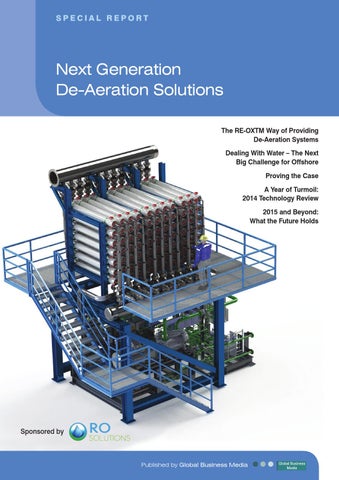
Next Generation De-Aeration Solutions The RE-OXTM Way of Providing De-Aeration Systems Dealing With Water – The Next Big Challenge for Offshore Proving the Case A Year of Turmoil: 2014 Technology Review 2015 and Beyond: What the Future Holds
Sponsored by
Published by Global Business Media
RO Solutions
RE-OX
TM
Compact Membrane De- Aeration systems
We provide the next generation of de-aeration process units to the global energy market
Discover more at our web page: rosolutions.no
SPECIAL REPORT: NEXT GENERATION DE-AERATION SOLUTIONS
SPECIAL REPORT
Next Generation De-Aeration Solutions The RE-OXTM Way of Providing De-Aeration Systems Dealing With Water – The Next Big Challenge for Offshore
Contents
Proving the Case A Year of Turmoil: 2014 Technology Review 2015 and Beyond: What the Future Holds
Foreword 2 John Hancock, Editor
The RE-OXTMTM Way of Providing De-Aeration Systems
3
Geir Terje Ressem, RO Solutions
Sponsored by
Published by Global Business Media
Published by Global Business Media Global Business Media Limited 62 The Street Ashtead Surrey KT21 1AT United Kingdom Switchboard: +44 (0)1737 850 939 Fax: +44 (0)1737 851 952 Email: info@globalbusinessmedia.org Website: www.globalbusinessmedia.org Publisher Kevin Bell
Foreword The Advantages Of Liqui-Cel® Membrane Technology Over Conventional Deoxygenation Vacuum Towers The Commercial Case for Increasing the Usage of De-Aeration Solutions for Offshore Operations De-Aeration Systems – 2014 Global Technology Review Advances in Water Treatment Systems Key Factors to Consider When Choosing Next Generation De-Aeration Solutions for Modern Oil and Gas Projects Future Outlook
Editor Tom Cropper
Dealing With Water – The Next Big Challenge for Offshore
Business Development Director Marie-Anne Brooks
Tom Cropper, Editor
Senior Project Manager Steve Banks Advertising Executives Michael McCarthy Abigail Coombes Production Manager Paul Davies For further information visit: www.globalbusinessmedia.org The opinions and views expressed in the editorial content in this publication are those of the authors alone and do not necessarily represent the views of any organisation with which they may be associated. Material in advertisements and promotional features may be considered to represent the views of the advertisers and promoters. The views and opinions expressed in this publication do not necessarily express the views of the Publishers or the Editor. While every care has been taken in the preparation of this publication, neither the Publishers nor the Editor are responsible for such opinions and views or for any inaccuracies in the articles.
© 2015. The entire contents of this publication are protected by copyright. Full details are available from the Publishers. All rights reserved. No part of this publication may be reproduced, stored in a retrieval system or transmitted in any form or by any means, electronic, mechanical photocopying, recording or otherwise, without the prior permission of the copyright owner.
8
Going Offshore Enhanced Recovery Options Updating Existing Practices
Proving the Case
10
Jo Roth, Staff Writer
Becoming Commercial Counting the Cost Assessing the Investment
A Year of Turmoil: 2014 Technology Review
12
James Butler, Staff Writer
Oil Exploration in 2015 Opportunities for Water Smaller is Better
2015 and Beyond: What the Future Holds
14
Tom Cropper, Editor
The Future of the Oil Price The Next Generation of Technologies Low Salinity Water Injection Getting to Market
References 16
WWW.OFFSHORETECHNOLOGYREPORTS.COM | 1
SPECIAL REPORT: NEXT GENERATION DE-AERATION SOLUTIONS
Foreword T
HE OIL and gas industry has a problem. Many
Unfortunately the infrastructure required to do this
of the world’s largest oil fields are reaching a
has traditionally been large, heavy and expensive. In
tipping point where easy oil has been exhausted,
an economic environment in which costs are always
which means more advanced techniques are
an issue, the race is on to find alternatives which can
required to bring it to the surface. The trouble
do this more cheaply.
is, a low global oil price means many of these
One of the main names in this field is RO Solutions
techniques risk becoming commercially unviable
who together with Membrana have brought to
In this environment, water is rapidly becoming a
market an ultra-light weight water treatment product.
major issue for oil contractors. Firstly, it can be used
Named Re Ox, it boasts a fraction of the footprint
in secondary and tertiary recovery phases by being
of larger water towers, which can lead to substantial
injected into the well to force hard to reach oil to the
cost savings.
surface. This water is either sourced from recycled water from the well or from the ocean.
In the lead article in this report, Geir Terje Ressem of RO Solutions describes how this product works in
In either case, water will need to undergo
more detail. Elsewhere we have a wider investigation
considerable treatment before it can be used. Water
of the commercial case for these products as well
extracted from the well needs to be separated from
as some of the challenges the next generation of
the oil before it can either be re-injected or flushed into
technologies must face.
the environment. Seawater, meanwhile, will need to be treated to have gasses, solids and sulphates removed before it can be injected into the well.
Tom Cropper Editor
Tom Cropper has produced articles and reports on various aspects of global business over the past 15 years. He has also worked as a copywriter for some of the largest corporations in the world, including ING, KPMG and the World Wildlife Fund.
2 | WWW.OFFSHORETECHNOLOGYREPORTS.COM
SPECIAL REPORT: NEXT GENERATION DE-AERATION SOLUTIONS
The RE-OXTM Way of Providing De-Aeration Systems Geir Terje Ressem, RO Solutions
RE – OXTM
Compact Membrane De- Aeration systems
I
N COOPER ATION with Membrana, RO Solutions is creating the next generation of ultra-compact de-aeration plants for sea water oilfield injection. They have a lower weight, a significantly smaller footprint, are more stable in operation and, most importantly, the RE-OXTM system and the Liqui-Cel® Membrane Contactor is provided at a lower installation cost than existing de-aeration products on the market.
Foreword Initially, oil can be retrieved from a reservoir only using natural lift mechanisms, such as gravity, natural water displacement, gas expansion and others. However, over time, these natural mechanisms will no longer provide sufficient pressure to force oil to the surface. Other methods must then be employed to maintain pressure in the reservoir to keep up the production rate. One such method that is commonly used is water injection. Water injection entails sending large volumes of water into a well to keep pressure elevated enough to lift oil to the surface. Injection water can come from several sources including seawater, river water, produced water and even aquifer water. However, sea water contains approximately 10ppm of oxygen and, as with any offshore water flooding process, dissolved oxygen in the injection water will cause unwanted effects such as souring and bacteria growth. Therefore, it is common practice to remove oxygen from the water before injection. In cases where polymers are added, oxygen removal is critical to prevent a reduction in the polymer’s effectiveness. Other positive effects of removing oxygen from the water are: • The elimination of pipe corrosion. •L ess expensive piping can be specified downstream of the deaerator. • The life of existing piping is extended. •O xygen removal avoids bio fouling down hole and prevents reservoir souring.
•W hen adding polymers to improve Chemically Enhanced Oil Recovery (CEOR), low oxygen content affects the polymer/ water interface thereby improving recovery efficiency by 6 – 20%. Normally, process equipment in the deaeration of water made for injection purposes occupies large areas of space and volume. Additionally, de-aeration plant adds significant weight to the structure of the whole production platform. Investing in heavy and large equipment has been the common method to solve the degasing issues – up until today. There are critical factors to consider on existing platforms as well as during the initial stage of a project involving de-aeration of water at an offshore installation. Although degasing technologies, such as vacuum towers and forced draft deaerators have existed for many years in a variety of industries, these older methods are being rapidly displaced by membrane based systems. However, it has not been common to utilise the properties of the membrane contactor for sea water purposes and, in particular, not where larger volumes of liquid are concerned. In cooperation with Membrana, the Norwegian company, RO Solutions have developed a degasing system specifically designed for offshore operations that meet the NORSOK standard. The RE-OXTM de-aeration system is making use of the properties of the Liqui-Cel® Membrane Contactors producing a compact, durable and efficient operation unit.
The Advantages Of Liqui-Cel® Membrane Technology Over Conventional Deoxygenation Vacuum Towers The significant difference in technology that the membrane contactor represents, allows the RE-OXTM de-aeration system to occupy less footprint and a significantly lower weight to the same production volume than conventional solutions can provide.
www.rosolutions.no
WWW.OFFSHORETECHNOLOGYREPORTS.COM | 3
SPECIAL REPORT: NEXT GENERATION DE-AERATION SOLUTIONS
Although degasing technologies, such as vacuum towers and forced draft deaerators have existed for many years in a variety of industries, these older methods are being rapidly displaced by membrane based systems
Historically, to remove dissolved O2 from injection water, bulky de-aeration towers and oxygen scavenging agents have dominated this market. Currently, Liqui-Cel速 Membrane Contactor technology is being evaluated in various hydrocarbon extraction applications to replace these older technologies because of the reduced weight and footprint The RE-OXTM De-Aeration System is a membrane based system utilizing the properties of a hollow polymer fibre type of membrane provided by Membrana. Several of the components used in a reverse osmosis desalination plant are used also in a de-aeration system. This gives the system a similar design and footprint to the desalination system of the same capacity. The operation of the system will be familiar to operators monitoring and controlling the process. The benefits of a membrane system in any type of industry, versus a vacuum tower are the lower volume and weight and its reliability. These same benefits are now being applied to the offshore injection water market. Membrane systems can save up to 80% of a vacuum tower weight while the footprint can be rearranged to fit topside space limitations.
The Commercial Case for Increasing the Usage of De-Aeration Solutions for Offshore Operations
ILLUSTRATIONS SHOW THE FOOTPRINT AND WEIGHT SAVING POTENTIAL BY CHOOSING THE RE-OX DEOXYGENATING SYSTEM
4 | WWW.OFFSHORETECHNOLOGYREPORTS.COM
The RE-OXTM deoxygenation system has significant weight savings compared to a packed bed vacuum tower. It weighs only 50-80% of the operational weight of a traditional packed vacuum tower. A 100 ton water tower can save some US$12 million in construction costs alone. The deck space costs US$500.000 to US$3.500.000 per sq. meter, when installed at a greenfield platform. A smaller footprint and reduced weight are not the only benefits of using the RE-OXTM system. The Liqui-Cel速 membrane contactors maintain positive pressure after degassing which may reduce booster pump capacity requirements and thus lower CAPEX. Unlike bulky de-aeration towers, The RE-OXTM system is modular and adaptable and can be expanded easily and optimized to meet water capacity requirements even after initial installation.
ILLUSTRATION SHOWS THE DESIGN OF A 1300M3 PER HOUR RE-OX SYSTEM. THE FOOTPRINT IS 8 X 6 METER. WET WEIGHT IS 33 000 KILO
The membrane system eliminates the need for large, heavy structural steel decks due to its light weight and single deck installation. The RE-OXTM system is installed on one platform deck, thereby eliminating costly multiple deck openings required for a vacuum tower. A further advantage is that the system can be delivered as a compact turnkey skid design that is easily lifted using existing offshore platform cranes. This eliminates costly transportation barges and heavy lift cranes. With the introduction of the Liqui-Cel速 8 x 80 High Pressure Membrane Contactors, there has been an increase in discussion and activity about utilizing membrane contactor technology to remove dissolved gases from water in many hydrocarbon related applications. The devices are ASME code-rate to 19 bar (300 psi) to handle high inlet pressures. This allows higher inlet water pressures so the outlet pressures eliminate the need for booster pumps or reducing booster pump capacity requirements. Due to its smaller volume and faster equilibrium technology, the start-up time for a RE-OXTM system utilizing the advantages of the Liqui-Cel速 Membrane Technology is less than 1 hour compared with 30-35 hours for a vacuum tower. The membranes
SPECIAL REPORT: NEXT GENERATION DE-AERATION SOLUTIONS
reach < 10 ppb faster than the oxygen probe speed of measurement. Environmental regulations are becoming more stringent, which increases chemical disposal costs. Removing dissolved gases with chemicals requires storing large volumes of scavenger chemicals and handling by employees. The RE-OXTM system, using Liqui-Cel® Membrane Contactors do not use chemicals to operate. This eliminates the need for storage tanks, pumps, valves and maintenance of a chemical dosage unit.
• Liqui-Cel® Membrane Contactor systems can be installed in module stages to match the water injection ramp up demand. Vacuum towers cannot operate in this manner. • Liqui-Cel® Membrane Contactors are not affected by wave movement. Tower swaying can disrupt the oxygen removal by causing localized flooding and channelling. • Liqui-Cel® Membrane Contactor systems are very quiet compared to vacuum towers which have a bypass line into the basin to mix scavenger chemicals. •T hese systems can be placed on higher decks due to their low center of gravity and light weight. •T he use of membrane deoxygenation is a proven, mature technology. It has been the method of choice in all semiconductor plants built in the last 15 years.
RE – OXTM
Compact Membrane De- Aeration systems
De-Aeration Systems – 2014 Global Technology Review ILLUSTRATION SHOWS THE DESIGN OF A 220M3 PER HOUR RE-OX SYSTEM. THE FOOTPRINT IS 5 X 1,5 METER. WET WEIGHT IS 1400 KILO
The benefits of using the RE-OXTM system can be summarised as follows: •N o re-pressurization pumps are needed since the pressure drop through the LiquiCel® Membrane Contactors system is low. This eliminates costly instrumentation control systems. •N o onsite hydrostatic tests are required like those needed for pressure vessels such as vacuum towers •R educed time required to install the LiquiCel® Membrane Contactor system due to simplicity of tie-ins and controls. •P lacement downstream of SRU or RO eliminates risk of scaling. • I n filtered raw seawater, scaling could occur; membrane cleaning schedule can be designed into the system design, thereby automating the cleaning procedure. Common caustic and acids are used. Conducting a Preventative Maintenance on a vacuum tower is costly and can shut down the field while it is being serviced/cleaned.
The use of membrane contactors was invented by Membrana in 1992 and they have been used in over 30 different industries over the past 23 years. Several industrial markets have moved from vacuum towers to membrane contactors. These include: •R emoval of Dissolved Oxygen from DI Water in Power Plants, Microelectronics •R emoval of Carbon Dioxide to Extend the Life of Ion Exchange Beds and Improve Performance of EDI (Electrodeionization) Technology •T otal Gas Control to Enhance Megasonic Cleaning Technologies •R emoval of Dissolved Nitrogen from Blanketed Storage Tanks •A ccurate Total Control of Dissolved Gasses at Point of Use • Removal of VOCs from Liquids • Humidification of Gasses •D egassing Inks, Developers, Photo Resists and Other Emulsions in Imaging and Photographic Markets •D ebubbling Coating Solutions Used in Paper Manufacturing •C arbonation, Decarbonation and Nitrogenation in the Beverage Industry
www.rosolutions.no
CROSS SECTION OF THE 8 X 80 INCH PRESSURE VESSEL INCLUDED THE HOLLOW FIBER MEMBRANE MADE BY LIQUI-CEL® OF MEMBRANA
WWW.OFFSHORETECHNOLOGYREPORTS.COM | 5
SPECIAL REPORT: NEXT GENERATION DE-AERATION SOLUTIONS
The movement in the price of oil will force the industry to focus on cost efficient solutions at every stage of the production steps
The use of membranes to eliminate scavenger chemicals is viewed as a beneficial green alternative. So the future for membranes is a positive one having many benefits over traditional technologies that impact the environment in a negative manner.
Advances in Water Treatment Systems The RE-OXTM de-aeration units are designed and manufactured by RO Solutions, while the gas transfer technology represented by the Liqui-Cel® membrane contactors was invented and is manufactured by Membrana. Liqui-Cel® membrane contactors use a micro porous hollow fibre membrane to remove oxygen from the water stream. Gas flows on one side of the membrane, and liquid flows on the other side at a higher pressure relative to the gas stream. Because the membrane is hydrophobic, it prevents intrusion of liquid into the pores and acts as an inert support that allows direct contact between a gas and a liquid phase without dispersion. Applying a vacuum and/or an inert sweep gas to the gas phase lowers the partial pressure of the target gas. This creates the driving force for dissolved oxygen in the liquid to transfer through the hollow fibre membrane pores. The transferred oxygen is then carried away by the vacuum pump or sweep gas.
THE PRINCIPLE OF OXYGEN REMOVAL FROM WATER USING SWEEP GAS INSIDE THE HOLLOW FIBERS
Nitrogen is a commonly used sweep gas because of its availability and safety properties. The RE-OX system for sea water deoxygenating also utilise N2 as the sweep gas under vacuum. The consumption of N2 during normal operation is dependent on several parameters such as inlet water temperature, flow rate and the number of contactors.
6 | WWW.OFFSHORETECHNOLOGYREPORTS.COM
In order to secure a reliable and safe N2 supply to the RE-OXTM process, RO Solutions provide an on-demand, continues source of nitrogen gas from a generator that produces nitrogen from compressed air. The nitrogen is produced at low pressure, eliminating safety hazards usually associated with high pressure gas. RO Solutions operate a full scale testing facility with direct access to the Atlantic Ocean in central Norway. The testing facility is a multi-purpose process unit including an ultrafiltration unit (UF) pre-treatment unit, followed by Nanofiltration (NF) and a deoxygenating unit. It is possible to bypass or include each water treatment step according to the actual testing situation. The seawater inlet is extracted from the ocean depth of 20 meters approximately 300 meters from the test plant location. On behalf of Statoil RO Solutions has conducted full scale verification runs at its testing facility in order to verify the RE-OXTM and Liqui-Cel® technology in an industrial environment and at different water temperatures. During these test runs the seawater was pretreated in cartridge filters and desalted in NF membranes to a salinity of approximately 3000 ppm. The quality of the Nitrogen sweep gas is important and will have impact on the oxygen removal efficiency. RO Solutions choose to run with a purity of 99,99%. However Nitrogen of a different purity might also be beneficial in some circumstances. It is clear that the process meets the target of removing oxygen from sea water in an efficient way. It is worthwhile to mention that the sea water temperature has an impact on how efficiently the oxygen is removed in the gas transfer process; a higher temperature gives a more efficient oxygen removal to the same N2 charge and water flow. Even at a water temperature of 7 – 8 C the deoxygenating process works stably and at a cost efficient level. The test runs met expectations of removing oxygen to a level of less than 10ppb at recommended a design flow of 10 m3/h and was approved. During the operations there were clear indications that higher temperatures improved the oxygen removal performance significantly. As expected, operating the RE-OXTM system and the Liqui-Cel® Membrane Contactors was not complicated and reproducibility was also demonstrated from start up after down time. During test runs the performance of the system was directly observed with a sensor monitoring the O2 level directly in the water flow.
SPECIAL REPORT: NEXT GENERATION DE-AERATION SOLUTIONS
Run
8m3/h 10m3/h 12m3/h
Result in treated water, ppb O2
6,5
7,2
10,7
Charging of N2, Nm3/h
1,1
1,2
1,3
Vacuum, hPa
52
60
68
Specific feed of N2, Nm3 N2/m3 water
0,14
0,12
0,11
Water temperature C
8
8
8
TABLE SHOWS FIGURES FROM SEAWATER RO-SOLUTIONS TEST RUNS
RE – OXTM
Compact Membrane De- Aeration systems
Key Factors to Consider When Choosing Next Generation De-Aeration Solutions for Modern Oil and Gas Projects Greenfield platforms/FPSO – points to consider using membrane contactors: •M ajor weight savings compared to vacuum towers •C ompact system footprint that can be placed on high floors • No deck penetrations • Not affected by wave movements • No tanks required for scavengers
Contact RO Solutions Stranvegen 6. No7790 Malm, Norway Phone: +47 979 60 750 Geir.terje.ressem@rosolutions.no www.rosolutions.no
Brownfields – points to consider using membrane contactors: • Can add incremental or a complete injection system to an existing deck • Deck additions are light weight
Future Outlook With the re-evaluation of the quality of injection water for greenfields and brownfields, the need for cost efficient, deoxygenated water will only grow. Referring to the development in the petroleum activity in recent years, the amount of injection water will increase to 2-3 times the current volume over the next 10 years, as more fields begin to use water injection solutions. The movement in the price of oil will force the industry to focus on cost efficient solutions at every stage of the production steps. Taking this into consideration, it is clear that the future is looking prosperous for the expansion of deoxygenation membrane systems into the Oil and Gas market. With over 300 installations in the demanding microelectronics market, including 25 systems over 1000 m3/hr water flow rates, Liqui-Cel® Membrane Contactors will become a valuable technology as more and more companies evaluate the cost advantages compared to vacuum towers or chemical addition.
www.rosolutions.no
WWW.OFFSHORETECHNOLOGYREPORTS.COM | 7
SPECIAL REPORT: NEXT GENERATION DE-AERATION SOLUTIONS
Dealing With Water – The Next Big Challenge for Offshore Tom Cropper, Editor Why water is such a major issue in offshore oil companies
Traditionally this has been done by passing it through large towers, using gravitational filtration, nutshell filtration or floatation separation
T
HE LAST few years have seen significant investment from major oil and gas companies into something that most people might not readily associate with oil and gas drilling – water. As exploration pushes further from the shore and greater focus moves to secondary and tertiary oil recovery solutions, the way water is used and treated on board a rig is becoming an increasingly hot topic of conversation. However, the looming issue of cost is ever present which means the next generation of water treatment technologies is presented with both a significant challenge and a compelling opportunity.
Going Offshore Water is used in a number of ways on board an offshore oil rig. Firstly, there is the waste water sourced from within the well. All oil pumped to the surface comes mixed with water and other fluids which must be treated before either being recycled or released into the environment. Traditionally this has been done by passing it through large towers, using gravitational filtration, nutshell filtration or floatation separation. The problem is, not only does this process require large and heavy equipment – which takes up valuable space on board a rig – but it may also not be as effective as it needs to be. Regulatory scrutiny is tightening on the quality of discharged water into the environment. Pressure is building on oil and gas companies to achieve substantial reductions in the amount of oil contained within discharged water. Furthermore, the practical considerations of deep water exploration have forced a rethink in how water is treated on board the rig. With exploration taking place many miles from the shore, EPC contractors are keen to ensure they can handle as much water treatment on-site as possible. Not only is this cheaper, but in remote areas, it is also often the only practical approach.
8 | WWW.OFFSHORETECHNOLOGYREPORTS.COM
Developers are now coming up with technologies which make use of membrane and mechanical separation units to further improve water management. These are designed to replace old fashioned gravity separators, nutshell filters or floatation separation. The goal is improved water/oil ratios, enabling water to either be discharged into the environment or reused. This, combined with reduced footprint, weight and operational costs, makes them a compelling proposition.
Enhanced Recovery Options The most common use for water on board an oil rig, though, is for advanced recovery options. As oil fields age, drillers will progressively turn to enhanced techniques which can maximise the amount of oil sourced from the well. Even in these low-price times, an increase of just a few percentage points in yield can produce billions of dollars in revenue. The secondary phase of oil recovery commonly relies on the injection of water into the well to increase the pressure and force oil to the surface. The most common way to do this is by taking water from the ocean and injecting it into the well. For this to happen, though, the water will need to be treated. Initially, floating solids and any marine life must be removed from the water, before gasses and sulphates are also taken out. These can have a corrosive effect on the well. For example, sulphates in the water can lead to scale formation, which can impede oil flows and hinder production. Alternatively, oil companies can reduce costs and minimise their impact on the environment if they simply recycle the waste water sourced from the well. In order to do this though, water treatment solutions need to be significantly more effective than they have been in the past. The next phase, also known as Enhanced Oil Recovery (EOR) relies on other measures
SPECIAL REPORT: NEXT GENERATION DE-AERATION SOLUTIONS
RE – OXTM
Compact Membrane De- Aeration systems
such as thermal or chemical treatment, which can further increase productivity. Water can also play a part at this stage, with research taking place on the benefits of injecting low salinity water into the well in order to increase oil flows. With oil fields showing their age, these IOR and EOR solutions are becoming increasingly important. For example, around 60% of BP’s offshore recovery now comes from IOR solutions – an indication of the amount of water being used. Indeed, as you will have read in the first article of this report, RO Solutions, one of the leading water treatment specialists, believe future water use could increase by two or three times.
Updating Existing Practices The big problem, though, is that existing techniques and equipment can include high capital costs and may not be up to standard. Vast de-gassing towers take up valuable space on board a rig, which translates directly to increased running costs. This means the search is now on for more compact options. One of the most common involves a membrane degassing unit in which fluids can be passed next to a gas which is held at a lower pressure. These can be separated by a micro porous membrane which
allows gas transfer while not allowing fluid to come into direct contact with the gas. The main benefits of this can be increased efficiency, a lower footprint and weight which translate into significantly lower running costs. These systems can also reduce or eliminate the use of toxic chemicals which, at the same time, reduces the risk of contamination in the local environment. With rigs operating in more remote areas and extreme environments, a compact design also reduces the risk of damage or mechanical failure. This, in turn, reduces downtime costs. Water treatment has made considerable strides over the past few years. The need for increased water use in hazardous and remote locations is making this one of the leading, if not the biggest, consideration for oil and gas producers. However, this comes at a time when cost considerations have gone from being a thorn in the side of oil producers to a prohibitive factor in getting the green light for any potential oil exploration venture. This means that a raft of new technologies needs to be developed which further reduce footprint, weight, waste and cost. The big challenge for these, though, is making them pay and helping developers produce technologies which are commercially viable.
www.rosolutions.no
WWW.OFFSHORETECHNOLOGYREPORTS.COM | 9
SPECIAL REPORT: NEXT GENERATION DE-AERATION SOLUTIONS
Proving the Case Jo Roth, Staff Writer Oil and gas companies are increasing their investment in water treatment solutions, but is it worth the money?
A need to enhance oil recovery procedures in hard to reach oil, coupled with space considerations and environmental legislation has led to a rethink in the way water is treated while on the rig
D
EEP WATER exploration has always been a cost sensitive proposition. At the beginning of the year experts were warning that the industry needed a crude oil price of around $100 per barrel in order to be financially sustainable1. With current costs now heading closer to $40 a barrel, the question is whether they can sustain capital expenditure of new technology. Water treatment is one of the key areas in which they have been investing. A need to enhance oil recovery procedures in hard to reach oil, coupled with space considerations and environmental legislation has led to a rethink in the way water is treated while on the rig. However, with money running short, is there the capital or the will to continue with this investment?
Becoming Commercial There are many obstacles standing in the way of development including: -A llowing small start-ups to take technologies from development to commercialisation. - Justifying capital outlay Deep water exploration is, by nature, extremely high risk. However, it’s precisely because of this that most operators are highly risk averse. New technologies must be proven and innovations will take a while to commercialise. This presents major obstacles to many of the small start-up companies which are developing the next generation of cutting edge technology. It is for this reason that major oil companies are upping their investment in water treatment start-ups. A 2013 report2 from London Environmental Investment Forum (LEIF) into water investment from oil companies highlighted companies such as Statoil, Shell, Saudi Aramco and BP – all of whom had developed corporate venture finance initiatives which prioritised water. This investment can prove critical in helping new technologies commercialise, while also ensuring the major oil powers will have that new generation of technologies when they need it.
10 | WWW.OFFSHORETECHNOLOGYREPORTS.COM
Another option is partnership models between start-ups or smaller companies and more established firms. This has advantages in firstly spreading the initial capital expenditure and therefore the risk, while also lending new names the support of services providers who have established a reputation with the major names in oil and gas. An example of this can be seen in the partnership between RO Solutions, a water treatment services provider and Membrana, which has been one of the pioneering names in Membrane de-aeration systems. The result of this collaboration has been Re OxTM which promises a new ultra-light package of de-aeration solutions. By working in this way it is possible to overcome many of the financial hurdles that confront those developing new systems.
Counting the Cost While surviving the rocky path towards commercialisation is a major consideration for smaller innovators, the large oil companies must consider at what point the benefits of a new system become worth the capital expenditure. This calculation has become more complicated over the past year as the economic climate for deep water oil explorers becomes ever more challenging. Over the course of 2014, the oil price first faltered and then took a nosedive. The reason was over supply, caused by a faltering world economy and a battle for control of the oil market between OPEC and the USA.
SPECIAL REPORT: NEXT GENERATION DE-AERATION SOLUTIONS
RE – OXTM
Compact Membrane De- Aeration systems
Between June and the end of 2014 the global oil price plummeted by 40%, and it has kept on falling. At the time of writing oil is currently trading at less than $50 per barrel. The fall was caused largely by an economic recovery which consistently fell below expectations. Month on month predictions for future rises in oil demand fell, which in turn had a supressing impact on price. Meanwhile, political turmoil in Iraq and Syria has not affected their oil production rates, which means the market has become far more comfortable about geopolitical risk. On top of this, shale exploration has seen a surge of supply from the USA. This has resulted in a significant shift in the balance of power in the global oil market. Partially in response to this, OPEC decided not to restrict oil supply in order to maintain a high global oil price. Instead they chose to continue supply and accept the effects of a much lower global price for crude oil. They can sustain this because their own oil reserves remain high and their domestic oil is comparatively cheap to extract. A higher price offers greater support to their competitors such as the USA. For now, though, they’re content to have the market operate at a lower price, while ensuring they retain their market share. The biggest impact is being felt in offshore exploration where extraction costs are steadily increasing as oil becomes more challenging to locate and extract. A vivid example of this challenge was reported by Forbes magazine as it covered Chevron’s launch of as new $8bn deep water drilling rig. “At $100 a barrel (where oil was in June),” they reported, “Chevron and partners would need to produce roughly 100 million barrels to generate enough cash (after operating expenses) to pay back their capital investment.” With the oil price standing at $68 per barrel at that time, they estimated Chevron would require
around 150 million barrels before it even broke even3. With prices now below the $50 mark, that breakeven point appears even further away. The question is how this environment will affect investment in new technologies. Projects such as Chevron’s Gulf of Mexico platform were already in development before the price fall. The question is what this means for future expansion plans and also for any company considering investing in new technology. In the North Sea we’re already seeing the effects. In January 2015 Premier Oil announced plans to cut its spending in the North Sea4. BP has also slashed jobs in their North Sea operations5, while in December 2014 the Telegraph reported that a third of all North Sea oil drillers were facing bankruptcy6.
Assessing the Investment Companies, therefore, face a difficult choice. Do they continue to invest in new technologies, or do they contract and horde their finances for another day? Any new de-aeration system may well represent potential efficiency and cost savings, but will inevitably incur an initial capital outlay as existing infrastructure is dismantled and replaced. According to Re Ox, their Liqui Cell de-gassing solution offers a 50-80% weight reduction on traditional packages. This in turn translates directly to considerable cost savings. Their next generation Re-Ox system, they say, has a much smaller footprint and can also maintain pressure after degassing, which can reduce pump power requirements. The commercial argument in favour of implementing new technologies is therefore becoming more compelling by the year. A tough economic environment may make oil companies wary of implementation costs. However, this new generation of technology not only offers the prospect of increased efficiency but can also produce considerable reductions in overall running costs.
www.rosolutions.no
WWW.OFFSHORETECHNOLOGYREPORTS.COM | 11
SPECIAL REPORT: NEXT GENERATION DE-AERATION SOLUTIONS
A Year of Turmoil: 2014 Technology Review James Butler, Staff Writer The continuing expansion into new and harder to find oil reserves is spurring increased innovation within the oil and gas sector
A major stumbling block for water treatment systems traditionally has been the high capital requirements of most technology
G
LOBAL OIL demand in 2014 may not have been as high as expected at the beginning of the year, but it is still growing. This means oil companies will have to continue their search for new sources of oil. Doing this creates a number of opportunities for water treatment companies as water becomes an increasingly important part of the drilling process. In this article we’re going to examine some of these opportunities and look at the developments being made in technologies which are helping oil companies utilise water more efficiently.
Oil Exploration in 2015 Over the last few years predictions for oil exploration have consistently been bullish with industry experts forecasting continued investment in exploration despite the disappointing number of new finds so far. Areas such as Brazil and the Gulf of Mexico have been particular promising with new ventures planned in the Arctic and off the coast of Australia. Now, though, the picture is changing. Speaking to Reuters7, Rune Magnus Lundetrae, CFO of Seadrill said: “The market is going to be bad this year,” he explained. “It is going to be worse next year, then it will be stabilising.” With major players cutting back on capital expenditure analysts believe deep water projects may have to be suspended. Moreover existing fields which could potentially yield significantly more oil may have to be retired as the Enhanced Oil Recovery techniques required to deliver oil in these areas become financially unsustainable. Even so, many of the big rigs and vessels ordered during the boom years are now coming online, which means companies are facing a decision. Do they shelve a project which cost millions or do they drill for what’s there on the basis that some oil is better than nothing? Meanwhile, deep water drilling will continue to thrive in areas such as the Gulf of Mexico and Brazil as these produce continued good flows. This, combined with the financial pressures of the
12 | WWW.OFFSHORETECHNOLOGYREPORTS.COM
market, will ensure that there are still opportunities for water treatment companies which can offer cost effective solutions.
Opportunities for Water The use of water is a major issue for oil companies and has driven considerable investment over the last few years. As oil becomes more difficult to source and drilling companies investigate deeper areas, an ability to treat and process water onsite will be crucial. Here is where some of the major opportunities exist: Enhanced oil recovery systems: Enhanced Oil Recovery (EOR) and improved oil recovery (IOR) solutions are crucial to maximising the productivity of a well. By comparison, basic drilling techniques, which rely on pressure and pumping to procure oil, expect to bring around 10% of any oil within a particular reserve to the surface. Advanced techniques can potentially push that figure up to 60% dramatically increasing the lifespan and profitability of any single field. Water plays an important role in these processes. The secondary phase of exploration, or IOR, injects water into the well head to increase the pressure and force more oil to the surface. This water may have been sourced either from waste water produced in the primary phase, or from the environment. Either way this will need to be treated. Sulphate removal systems: removing salt from the water can be important in reducing or eliminating scaling. In recent years we’ve seen the transition towards membrane based solutions, which can quickly and efficiently remove salt from the water. Low salinity water: This is a potential area of further development. Early investigations of this technology suggest that low salinity water can improve the wettability of the reservoirs and so increase yield. This technology is still in the early stages so we can expect to see considerable advances over the next few years.
SPECIAL REPORT: NEXT GENERATION DE-AERATION SOLUTIONS
RE – OXTM
Compact Membrane De- Aeration systems
Low weight and cost systems: A major stumbling block for water treatment systems traditionally has been the high capital requirements of most technology. Water is degassed by being passed through large vacuum towers. These take up much needed space on board the rig and suck up considerable reserves of capital. Finding a cheaper alternative to this technology could prove to be crucial.
Smaller is Better The major imperative is to produce smaller and more compact units. Several approaches have been used to deliver this. Some manufacturers are turning to centrifuge technology to filter and
separate water. The most extensive development, though, has been seen in membrane filtration systems with several companies bringing out new products over the course of the year. Each of these promises roughly the same thing: better performance, lower footprint, less weight and reduced cost. This technology is not new in itself. It has been used in a variety of industries and has already replaced much of the old infrastructure involved in the treatment of waste water from within the well. The focus now is on water injected into the well to improve oil yields, with new ultra-light modules offering a vastly reduced weight and footprint when compared with old fashioned degassing towers. How these technologies develop and are applied in the field will be one of the more interesting developments to watch in 2015. The last 12 months have undoubtedly been difficult for the oil and gas industry. They have seen a dramatic fall in the oil price and a stalling of some drilling operations around the world. The future is uncertain, but with offshore oil increasingly dependent on enhanced oil recovery solutions, water and treatment technologies, will continue to occupy the minds of the major players for the foreseeable future.
www.rosolutions.no
WWW.OFFSHORETECHNOLOGYREPORTS.COM | 13
SPECIAL REPORT: NEXT GENERATION DE-AERATION SOLUTIONS
2015 and Beyond: What the Future Holds Tom Cropper, Editor Why water will continue to play a central role in offshore oil for many years to come
The goal of the next generation of water treatment technologies will remain the same; to improve efficiency and production rates while reducing cost, weight and footprint
The future demands of offshore oil are the same as in many other industries – to do what you’re doing better, but for less money. Whether or not this can be achieved will depend greatly on the nature and sophistication of the next generation of technologies, as well as the future of the oil price. The offshore oil market faces a challenging future. On the one hand improved and enhanced oil recovery solutions (IOR and EOR) will increasingly become important as they seek to maximise life from aging fields. Deep water exploration will see rigs push further from the shore and into more hazardous environments meaning processes such as water treatment will need to be done onsite. Meanwhile, more stringent environmental legislation into the way waste water is treated and disposed of on-site will increase their focus on water treatment at all stages of the process.
The Future of the Oil Price However, continued volatility in the oil price makes many of these advanced drilling operations economically marginal. At the time of writing, USA crude oil has dropped a further 3% and now rests at $46.31 per barrel8. Doom mongers within the industry are arguing the need to prepare for the days of sub $40 prices. The gap between how much oil is out there, and how much can be extracted will depend on how long the price remains low and whether or not new technologies can be developed which deliver on a more affordable basis. On the question of where the oil price goes from here there is considerable anxiety. Much of the mainstream talk from analysts is that we have reached a new normal where prices will settle. Forecasts talk of a tough couple of years for the energy industry before the situation stabilises. However, a dissenting opinion can be found in an article by Vatsal Srivasta. As he points out, few analysts predicted the 60% fall in prices experienced in the second half of 2014 and what
14 | WWW.OFFSHORETECHNOLOGYREPORTS.COM
could actually be about to happen is a reversal. He argues that the supply surge from US shale will peak in 20169, which could see prices start to rise once more. The future of oil prices may govern what level of resources the oil companies can invest in EOR and deep water recovery. However, the goal of the next generation of water treatment technologies will remain the same; to improve efficiency and production rates while reducing cost, weight and footprint.
The Next Generation of Technologies As previous articles within this report have shown, the biggest development in the last few years has been in the growth of membrane technologies. These use membranes to pass fluids next to a gas which can remove particles and impurities such as oil from the water. However, much of their use has, to date, been in the treatment of waste water procured from within the well. The challenge is to put this technology to use in preparing water which is to be injected into the well. This is the aim of a product developed by RO Solutions – a water treatment specialist – and Membrana who developed the first membrane filtration systems. It uses Membrana’s Liqui Cell technology which passes liquid next to gas, separated by microporous hollow fibre membranes. By ensuring the gas is at a lower pressure relative to the liquid, it can remove oxygen and other gasses from the water. This has been combined with technology developed by RO Solutions to create the Re OX 600, an ultra-compact unit which can remove gasses and sulphates from water to be injected into the well. Like any new technology this is in its early stages and must prove its viability in order to succeed. Tests to date have been going well at RO Solutions’ Testing Facility on the Norwegian coast. This has produced the results they hoped for by removing oxygen to a level of 10ppb.
SPECIAL REPORT: NEXT GENERATION DE-AERATION SOLUTIONS
RE – OXTM
Compact Membrane De- Aeration systems
The advantages of these systems are clear. They have a much lower footprint and weight than older systems which means they can be placed on upper floors of platforms. They are not affected by wave movements and do not contain as many toxic chemicals which means they present significantly less of a threat to the wider marine environment.
Low Salinity Water Injection In 2012, trials began of low salinity water injection technology at BP’s Clair Ridge10 development. It is one of a number of projects which have taken place over the past decade or so. BP has demonstrated the potential of low salinity injection on the Alaskan North Slope while Shell have been progressing the concept under the trade mark Designer WaterTM. The idea is that low salinity changes the wettability characteristic of the reservoir rock in those reservoirs with high salinity. According to Water World11, these studies have found that a five to ten times lower concentration in polymer is required to deliver the same effect. Therefore, this has the potential not only to increase significantly EOR yields, but also to do so on a more cost efficient basis. As a result of their trials, BP’s Clair Ridge development is set to become the first sanctioned large scale EOR facility to deploy desalination technologies. The entire facility is set to go online in 2016 and includes around USD$120million earmarked for desalination facilities.
Environmental Investment Forum, investment in water technologies has been soaring12 over the past few years. It represents a recognition from the industry that small water technologies require nurturing in order to bring them to market. Another important factor for the future will be collaboration. With many of the major players in the development of water technologies being small cap firms specialising in certain areas, collaboration between different parties will be crucial. It allows firms to pool resources, manpower and expertise, which can prove crucial in helping new and unproven products attain commercial viability. Despite, or perhaps because of, the economic challenges affecting the industry, water treatment is set to remain big news in the oil and gas sector. Although any new technology represents an inevitable risk, their cost, weight and footprint benefits, mean they are certainly a risk worth taking.
Getting to Market For all these clear benefits, delivering this technology is not as straightforward as one might imagine. The oil industry is by nature highly cautious in the adoption of new technologies and with good reason. The expense incurred if new technologies fail to deliver can be enormous. Therefore, it can be a long time between development of concept and commercialisation. This explains why, according to the London
www.rosolutions.no
WWW.OFFSHORETECHNOLOGYREPORTS.COM | 15
References: Big oil counts the cost of new discoveries: http://www.ft.com/cms/s/0/b7861cc8-a51b-11e3-8988-00144feab7de.html#slide0
1
2
Water innovation in oil and gas: http://www.globalcorporateventuring.com/article.php/6616/water-innovation-in-oil-and-gas
3
Bad timing? Chevron Christens new $8bn development
http://www.forbes.com/sites/christopherhelman/2014/12/02/bad-timing-chevron-christens-new-8b-deepwater-oil-platform/ 4
North Sea drilling falls: http://www.scotsman.com/business/energy/north-sea-drilling-falls-as-premier-oil-plans-cuts-1-3661596
5
BP announces north sea jobs cut: http://www.bbc.co.uk/news/uk-scotland-scotland-business-30817678
6
Third of British listed oil and gas companies facing bankruptcy:
http://www.telegraph.co.uk/finance/newsbysector/energy/11315956/Third-of-listed-UK-oil-and-gas-drillers-face-bankruptcy.html
7
Offshore drilling market to suffer in 2015: http://www.reuters.com/article/2014/09/10/drilling-outlook-idUSL5N0RB23320140910
8
US crude oil drops 3%: http://www.cnbc.com/id/102357367
9
How long will oil prices stay low: http://economictimes.indiatimes.com/markets/commodities/how-long-will-crude-prices-stay-low/articleshow/45975696.cms
10
BP deploys reduced salinity oil injection: http://www.offshore-technology.com/features/featurereduced-salinity-water-injection-losal-eor-clair-ridge/
11
Changing water needs in offshore oil: http://www.waterworld.com/articles/2011/01/changing-water-needs-in-offshore-oil.html
12
Hundreds of millions set to be invested: http://waterbriefing.org/home/company-news/item/7756-%E2%80%9Chundreds-of-millions%E2%80%9D-set-to-be-invested-in-water-tech-by-oil--gas-companies
16 | WWW.OFFSHORETECHNOLOGYREPORTS.COM
Offshore Technology Reports… the leading specialist combined online research and networking resource for senior upstream oil and gas industry professionals.
• Up to the minute Industry and Technology information available to all site users on a free of charge open access basis. • Qualified signed up members are able to access premium content Special Reports and interact with their peers using a variety of advanced online networking tools. • Designed to help users identify new technical solutions, understand the implications of different technical choices and select the best solutions available. • Thought Leadership – Advice and guidance from internationally recognised upstream oil and gas key opinion leaders. • Peer Input – Contributions from senior upstream oil and gas industry professionals. • Independent Editorial Content – Expert and authoritative analysis from award winning journalists and leading industry commentators. •
Unbiased Supplier Provided Content.
•
Designed to facilitate debate.
•
Written to the highest professional standards
Visit http://www.offshoretechnologyreports.com/