SPECIAL REPORT
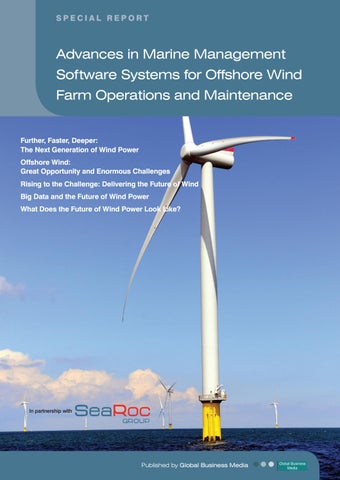
Advances in Marine Management Software Systems for Offshore Wind Farm Operations and Maintenance
Further, Faster, Deeper: The Next Generation of Wind Power Offshore Wind: Great Opportunity and Enormous Challenges Rising to the Challenge: Delivering the Future of Wind Big Data and the Future of Wind Power What Does the Future of Wind Power Look Like?
In partnership with
Published by Global Business Media
Global provIder of leadInG marIne manaGement system Improve safety and effIcIency across your project Monitor and manage your project operations, either a single project or portfolio, from a centralised system – providing integrated solutions including personnel, vessel and helicopter tracking, inductions, access control, weather monitoring and tailored communication systems.
PortfolIo management
+44(0)1243 816 606
stakeholder access from any locatIon
info@searoc.com
secure data storage
www.searoc.com
Integrated hardware solutIons
ADVANCES IN MARINE MANAGEMENT SOFTWARE SYSTEMS FOR OFFSHORE WIND FARM OPERATIONS AND MAINTENANCE
SPECIAL REPORT
Advances in Marine Management Software Systems for Offshore Wind Farm Operations and Maintenance
Further, Faster, Deeper: The Next Generation of Wind Power
Contents
Offshore Wind: Great Opportunity and Enormous Challenges Rising to the Challenge: Delivering the Future of Wind Big Data and the Future of Wind Power What Does the Future of Wind Power Look Like?
Foreword
2
Tom Cropper, Editor
Further, Faster, Deeper: 3 The Next Generation of Wind Power SeaRoc Group Ltd In partnership with
Published by Global Business Media
Published by Global Business Media Global Business Media Limited 62 The Street Ashtead Surrey KT21 1AT United Kingdom Switchboard: +44 (0)1737 850 939 Fax: +44 (0)1737 851 952 Email: info@globalbusinessmedia.org Website: www.globalbusinessmedia.org Publisher Tom Cropper Business Development Director Marie-Anne Brooks Editor Tom Cropper Senior Project Manager Steve Banks
Wind Power and the Future of Energy The Next Generation Marine and Helicopter Co-ordination
Offshore Wind: 6 Great Opportunity and Enormous Challenges Tom Cropper, Editor
Evolution of Offshore Wind Power What’s Creating This Boom? New Opportunities, New Challenges
Rising to the Challenge: Delivering the Future of Wind 8 Jo Roth, Staff Writer
The Task A Major Challenge Going Deeper
Advertising Executives Michael McCarthy Abigail Coombes
Big Data and the Future of Wind Power 10
Production Manager Paul Davies
The Age of Big Data The Next Generation A Positive Outlook
For further information visit: www.globalbusinessmedia.org The opinions and views expressed in the editorial content in this publication are those of the authors alone and do not necessarily represent the views of any organisation with which they may be associated. Material in advertisements and promotional features may be considered to represent the views of the advertisers and promoters. The views and opinions expressed in this publication do not necessarily express the views of the Publishers or the Editor. While every care has been taken in the preparation of this publication, neither the Publishers nor the Editor are responsible for such opinions and views or for any inaccuracies in the articles.
James Butler, Staff Writer
What Does the Future of Wind Power Look Like?
12
Tom Cropper, Editor
A Promising Future Continuing Success Improving the Maths The Environment
References 14
Š 2017. The entire contents of this publication are protected by copyright. Full details are available from the Publishers. All rights reserved. No part of this publication may be reproduced, stored in a retrieval system or transmitted in any form or by any means, electronic, mechanical photocopying, recording or otherwise, without the prior permission of the copyright owner. WWW.MULTIPLATFORMPUBLISHING.CO.UK | 1
ADVANCES IN MARINE MANAGEMENT SOFTWARE SYSTEMS FOR OFFSHORE WIND FARM OPERATIONS AND MAINTENANCE
Foreword T
HERE WAS good news for the offshore wind
projects including their work supporting what will be
sector recently when it was announced that the
the world’s first gigawatt wind farm – the enormous
cost of building a wind farm had reached record
Hornsea Project One.
lows. The increase in windfarms over the past few
Elsewhere in this Report, we’ll look at the
years has been little short of remarkable, but that
development of the offshore sector, and how it is
could just be the tip of the iceberg.
moving centre stage. Jo Roth then looks at the
Until now, offshore windfarms were limited by how
technical and logistical challenges of moving into
far from shore they could be located. Now, that’s
deep water, while James Butler examines some of
changing and a new generation is pushing out into
the key issues operators will have to consider when
the depths. The benefits come in increased yields
making the move.
and a larger footprint, but such ambitious projects are inherently challenging and risky.
Finally, we’ll cast an eye to the future and look at major projects such as Hornsea Project One and how
Key to success will be the marine management
marine management technology is progressing to help
systems underpinning the entire operation.
the offshore wind market fulfil its impressive potential.
Unfortunately, these are often lacking in the necessary
As so often, the future is full of opportunities and
scale and complexity. A new generation of offshore
challenges. Expanding into new areas could see
wind farms, will therefore need a new generation of
wind power multiply many times over, but this will be
systems capable of delivering the enhanced features
a major challenge. The key to this future could lie in
that far from shore projects need.
the logistical systems which reduce costs, improve
Our opening article comes from one of the pioneers
safety and efficiency and make everything possible.
in the sector. SeaRoc Group’s landmark marine management system, SeaPlanner, is powering some of the world’s most ambitious offshore projects. In their article, they focus on some of their most cutting-edge
Tom Cropper Editor
Tom Cropper has produced articles and reports on various aspects of global business over the past 15 years. He has also worked as a copywriter for some of the largest corporations in the world, including ING, KPMG and the World Wildlife Fund.
2 | WWW.MULTIPLATFORMPUBLISHING.CO.UK
ADVANCES IN MARINE MANAGEMENT SOFTWARE SYSTEMS FOR OFFSHORE WIND FARM OPERATIONS AND MAINTENANCE
Further, Faster, Deeper: The Next Generation of Wind Power
Global
Provider
SeaRoc Group Ltd
of
leadinG
T
HE LAST few years have witnessed tremendous grow th for of fshore windfarms, but that should only be the tip of the iceberg. The oceans contain enormous potential for the future of our energy security. However, to access them the next generation of offshore wind farms will have to shatter the conventions of what’s possible. To do this they will require a new generation of communications systems, which is where companies such as ours come in.
Wind Power and the Future of Energy The SeaRoc Group is one of the world’s leading producers of marine management systems. The SeaPlanner system, integrates all the important information – either a single project or portfolio – into one place. In 2016, we also launched an industry-first communications and data logistics system called SeaHub. This uses unmanned containers with all the equipment needed to provide reliable communications and data sharing for far from shore operations. This feeds information via satellite back to a central communications system where data can be analysed using our SeaPlanner Software. The SeaHub system also contains autonomous safety systems including fire suppression, gas detection and temperature control. This represents a major step forward compared to what has gone before, and it’s a step the industry needs. The offshore wind sector may have achieved a great deal already, but it has to do much more if it is to fulfil its potential. Governments across Europe have set ambitious targets to increase dramatically the amount of power that comes from renewable sources. Although that figure is rising, the next generation of wind farms will have to operate in areas previously thought of as out of reach. In particular, they will be moving into deeper waters located further from the shore. Doing so creates serious issues surrounding asset
integrity and project life-cycle management and compliance. Infrastructure will face the combined challenges of deep water, rough waves, adverse sea conditions and corrosive elements. Operating in those areas should increase the electricity yield, but, at the same time, costs will be difficult to manage. Moving further from shore will bring companies into contact with new environmental considerations and fragile marine environments. The list of issues they have to consider will grow exponentially. To thrive in this environment, windfarms will have to evolve. The next generation of wind farms will have to be bigger, more efficient and robust than ever before, and feature radical new technologies to help them survive in harsher environments. One of the key new projects is the Hornsea Project One Offshore Wind Farm. Located far out beyond other wind farms in the region it will occupy a vast area of 407 square kilometres, which equates to five times the size of Hull. It will feature seven megawatt turbines towering almost 200 metres into the air. Located far out into the sea with perfect conditions for wind energy its operators say it will be the world’s first gigawatt windfarm. They hope to have the project completed by 2020 and to supply more than a million homes with energy.
Marine ManaGeMent SySteM
iMProve Safety MiniMiSe riSkS reduce coStS
The Next Generation A project of such magnitude pushes beyond the conventional boundaries of offshore wind. Until now, projects have been located close to the shore and on a much smaller scale. This will be larger, operating in deeper waters and further from the support of the shore. As such, it will need a communications system capable of dealing with these extreme requirements. At SeaRoc, we’re used to working with companies operating in remote, far-shore locations, which has helped us develop a cutting-edge suite of products capable of working in such extreme areas.
+44(0)1243 816 606 info@searoc.com www.searoc.com
WWW.MULTIPLATFORMPUBLISHING.CO.UK | 3
ADVANCES IN MARINE MANAGEMENT SOFTWARE SYSTEMS FOR OFFSHORE WIND FARM OPERATIONS AND MAINTENANCE
The SeaRoc Group is one of the world’s leading producers of marine management systems. The SeaPlanner system, integrates all the important information across a project into one place
A project such as this needs the best management system going which is why the operators have signed a new contract with the SeaRoc Group to extend our SeaHub Communications Containers. The SeaHub, which has already been provided for DONG Energy’s Race Bank and Walney Extension sites, uses sensors, vessel tracking, helicopter tracking, personnel tracking and crew finder technologies to deliver all the key information back to the central hub of operations where it is made visual by the SeaPlanner software. The solution has been tailor-made with the next generation of far from shore wind farms in mind. It houses all the equipment it needs including satellite, microwave or fibre backhaul capability within one container. It enables all communications as well as tracking of personnel and assets. The system drives down costs through its ability to manage projects via a centralised control system which helps operators to standardise their project designs and share costs across the operation. In a high capacity project such as this, in which multiple teams will be collaborating from different locations, it allows them to collaborate and quickly share information, reducing the risk of error, data duplication and wasted time and effort. The personnel tracking and man overboard alarm will be particularly useful in a hostile environment such as Hornsea Project One. It will be operating far from shore in the rough conditions of the North Sea. It is operating at the very edge of what is possible for offshore windfarms and, as such, has very little margin for error. The complete system will aim to do everything it can to ensure operators are able to track the location of personnel, raise the alarm if something goes wrong and monitor the condition of equipment. 4 | WWW.MULTIPLATFORMPUBLISHING.CO.UK
This is just one of several projects SeaRoc has worked on with DONG Energy. As a company, DONG Energy is one of the pioneers pushing the envelope of what’s possible in the offshore sector. They do this by bringing together the very best technology from providers such as SeaRoc to ensure they are equipped for the next frontier of the renewables market.
Marine and Helicopter Co-ordination As part of this venture, they have developed a Marine and Helicopter Co-ordination Centre (MHCC) to operate as the hub of their UK offshore wind farm construction. The MHCC will direct far flung offshore projects from one central location. To keep track of all this information, they will use SeaPlanner to bring all
ADVANCES IN MARINE MANAGEMENT SOFTWARE SYSTEMS FOR OFFSHORE WIND FARM OPERATIONS AND MAINTENANCE
their required data into one place. It will provide personnel management services, vessel and helicopter tracking, communication dispatcher and site wide communications hardware such as the VHF marine and VHF Airband. As Nick Murphy, SeaRoc Group’s Head of Operations explains, it “provides an enhanced level of control and brings standardisation across projects.” By so doing, it can give operators a greater level of visibility and control over operations across the spectrum. The SeaPlanner will sit at the heart of the system, while unmanned communications containers, housing all the equipment required, will be deployed in DONG Energy’s offshore locations, feeding information into the centralised system. The technology has already proved its worth and is being rolled out across many of DONG Energy’s operations. The use of a single cutting-edge system is enhancing standardisation and improving efficiency across the board. Operators achieve round the clock real-time surveillance of all activity allowing
them to monitor actual conditions and evaluate the performance of operations. The increased visibility and depth of information allows operators to identify areas of operational improvement and continually fine-tune their approach, to cut out risk and waste. Commenting on the system, Louise Damgaard, a senior project manager at DONG Energy, talked up the importance of having a single supplier. “We’re very pleased to work with SeaPlanner to implement these important enhancements to our new Marine and Offshore Coordination capability. They’ve undertaken work for our projects in the past and this contract proves that having a reliable UK supplier is an invaluable asset to offshore wind in this country.” As well as the ability to standardise the approach across operations, and achieve a smooth communication between systems, a specialised system, tailor-made to the sector can be crucial. At SeaRoc we understand the unique challenges of working offshore. As such, we’re able to bring all that experience and expertise to bear in developing a system specifically designed for the challenges of the offshore environment. Those challenges will continue to grow into the future. Technology is broadening the horizons, placing sites which were previously out of reach in range. Equipment and infrastructure will have to improve dramatically, but so too will communications and the gathering of information. Bringing real-time data from remote locations into one easy to manage space will be vital in ensuring these wind farms continue to function, despite all the challenges put in front of them. The potential of the market is enormous. The last few years may have witnessed tremendous growth, but experts believe that could be just the beginning. Unlocking the future means technology will have to develop and that technology will have to work effectively. Holding it all together will be crucial, which is why systems such as SeaPlanner are being seen as so vital to the future.
The increased visibility and depth of information allows operators to identify areas of operational improvement and continually fine-tune their approach, to cut out risk and waste.
Global
Provider of
leadinG
Marine ManaGeMent SySteM
iMProve Safety MiniMiSe riSkS reduce coStS
+44(0)1243 816 606 info@searoc.com www.searoc.com
WWW.MULTIPLATFORMPUBLISHING.CO.UK | 5
ADVANCES IN MARINE MANAGEMENT SOFTWARE SYSTEMS FOR OFFSHORE WIND FARM OPERATIONS AND MAINTENANCE
Offshore Wind: Great Opportunity and Enormous Challenges Tom Cropper, Editor Renewables are taking their place at the forefront of European energy supply, with offshore wind power at the head of the charge.
Records for wind power are being set across Europe, which is seeing costs plummet to a fraction of their original value, and one of the main drivers for that is offshore wind
O
FFSHORE WIND is becoming a major new player in the renewable energies market. Costs are falling, technology is improving and investment is growing. With more than 90% of new power coming from renewables in 2016, the future is bright1. It offers companies a way to cope with our growing demand for power, while also satisfying a need to improve their environmental credentials.
Evolution of Offshore Wind Power Earlier this year, the renewable energies market reached an historic landmark. For the first time, renewable energy, including wind, solar and wood chip burning, provided more electricity for the national grid than coal and gas. According to the National Grid, measurements taken on one day showed that renewables were providing 50.7% of UK energy needs2. Adding in nuclear and low carbon options accounted for more than 72.1% of the country’s energy requirements. This might have been a one-off, but records for wind power are being set across Europe, which is seeing costs plummet to a fraction of their original value, and one of the main drivers for that is offshore wind. Offshore wind farm construction has surged over the last couple of years with 11 projects worth $18.2bn in Europe reaching completion representing 4,948MW of additional capacity. According to the report, European capacity could reach 17.4GW and grow to 24.6GW by 20203. Europe leads the way, but projects are being completed around the world. In 2016, the US saw its first offshore wind farm power up several miles off Rhode Island. More projects are planned across the country, although the election of Donald Trump has thrown fresh doubt over the future of Federal funding for offshore projects4.
6 | WWW.MULTIPLATFORMPUBLISHING.CO.UK
What’s Creating This Boom? Several factors are coming together to forge an extremely healthy climate for offshore wind energy. European countries are pushing towards increased use of renewables while energy companies are mindful of the future and are investing in long term projects in order to ensure their own future competitiveness. Under the coalition Government, the UK became a strong active supporter of offshore wind energy developing a long-term strategy designed to strengthen the UK’s position in the offshore market. This, claimed a report, had the potential to unlock £7bn in the UK’s economy. The strategy included £46million in funding over five years for the Offshore Renewable Energy Catapult Centre, and £20 million from the Regional Growth Fund for GROW: Offshore Wind, a manufacturing support advisory programme to help UK supply chains become more competitive5. Elsewhere, in Norway, energy companies hit by the oil price crisis have been turning their attention towards foreign offshore wind companies to open up new opportunities. They quickly faced calls to concentrate their attentions on the domestic sector. “There is a huge market out there. Norway needs to do something fast if we are going to be able to hang on,” said Oyvind Isachsen from the Norwegian Wind Energy Association (NORWEA)6. The technology is improving, enabling companies to venture further from the shore and manage more ambitious projects. Costs are falling. New technologies and large turbines are increasing yields and efficiency of projects. Subsidies continue to support the market and push the price of wind power down. The price per megawatt now is now beginning to rival more conventional production techniques.
ADVANCES IN MARINE MANAGEMENT SOFTWARE SYSTEMS FOR OFFSHORE WIND FARM OPERATIONS AND MAINTENANCE
Global
Provider of
leadinG
Marine ManaGeMent SySteM
It currently stands between e50 and e96 for onshore wind and e73 to e140 for offshore power, compared to e65 to e70 for coal and gas. Although still the cheapest form of production, the gap is closing. Coal and gas supplies are finite and they can only maintain their position at the head of the market for so long7.
New Opportunities, New Challenges The message from these figures is clear: Renewables’ time has come – it’s no longer simply a technology for a future; it is here and now – and offshore wind is at the forefront of growth. Improved technology is increasing yield and efficiency while falling costs are making it more competitive. Investment is flowing into the sector as energy companies become increasingly ambitious. The question now is: how does wind transform its undoubted potential into reality? Operations are venturing further from the shore and into deeper areas. This can increase the yield, but it also comes with a host of problems especially regarding logistics, finances and safety. The challenge for markets is to deliver these projects in a way which is financially sustainable, while ensuring adequate
technological support and that safety standards continue to meet the highest levels. It’s a difficult balancing act and requires the very best support. Key to this will be the marine management software underpinning each project. Operators will need to carefully consider factors such as: •C ommunications: maintaining fast and effective communications between all locations. •T racking: maintaining a good overview of the location of all personnel and equipment. •M anagement software: which can centralise all the required information into one place •C oordination: Specialist equipment to better manage the coordination of infrastructure. How companies integrate new marine management systems into their operations will go a long way to determining how successful they can be in developing new and more ambitious projects. As they move further away from the shore and into uncharted territories, the margins for error will become much smaller. Those who succeed will be those who manage to keep all those plates spinning in the air and maintain the delicate balancing act which will make projects profitable. Those who fail to innovate will find themselves left behind. It’s a future full of exciting possibilities, but it’s also one with multiple challenges.
The message from these figures is clear:
iMProve Safety MiniMiSe riSkS reduce coStS
+44(0)1243 816 606 info@searoc.com
Renewables’ time has come – it’s no longer simply a technology for a future; it is here and now
www.searoc.com
WWW.MULTIPLATFORMPUBLISHING.CO.UK | 7
ADVANCES IN MARINE MANAGEMENT SOFTWARE SYSTEMS FOR OFFSHORE WIND FARM OPERATIONS AND MAINTENANCE
Rising to the Challenge: Delivering the Future of Wind Jo Roth, Staff Writer How can offshore wind producers react to the challenge of operations moving further from the shore?
Energy from turbines operating in deep water in the North Sea could potentially cater for all of Europe’s energy needs alone
N
E W CHALLENGES call for new technologies to meet them. As operations move further from the shore, every aspect becomes more difficult. Risks are higher, costs are greater and the task of ensuring smooth communications and logistics becomes tougher. However, the demands of the market are pushing companies into more hostile territory. Technology will have to improve rapidly to keep pace.
The Task As the offshore sector advances, companies are pushing further and further into the ocean. There are many advantages to doing this. Windspeeds are usually faster than on land, with even a small increase leading to significantly higher production. A turbine in a 15mph wind can generate twice the power of a turbine in a 12mph wind according to American Geo Sciences8. Those windspeeds are likely to be more consistent than land. Coastal populations have high energy needs. Situating a wind farm offshore provides a good local source of energy as well as more jobs, without the impact on the surrounding environment. Moving further from the shore can also reduce the visibility of the wind farm and avoid public resistance. The arrival of a new windfarm off the coast in Brighton in 2014, was hailed as a giant step forward for wind power by some, but bitterly opposed by critics who complained that it would be expensive and would spoil the view9. Governments, especially in Europe, see enormous potential in the offshore wind market. A European Commission Report10 into the future of offshore wind makes this ambitious statement: “With the maritime economy, we can pull Europe out of recession.” Europe oceans, it says, should be seen as a rich resource and exploiting deeper areas in the North Sea, Mediterranean and Atlantic should be a major priority. Energy from 8 | WWW.MULTIPLATFORMPUBLISHING.CO.UK
turbines operating in deep water in the North Sea could potentially cater for all of Europe’s energy needs alone. However, there is a problem: the technical, logistical and commercial challenge of exploiting the deep-water environment. Current commercial substructures, it argues, are limited to water depths of 40 to 50m. However, the deep-water environment starts at 50m. To fulfil its potential, the market must find a way of unlocking production in depths of 50m and more.
A Major Challenge Doing so is a major challenge. The deep water offshore market may have plenty of potential, but it remains in its early stages and faces enormous problems. Installing wind farms in water becomes more expensive the deeper it goes. Wave action can damage equipment while salt in the sea and air can cause corrosion and create maintenance issues. Conventional installation techniques are depth limited, putting many of the most productive offshore sites out of reach. The deeper a wind farm goes, the greater these problems will be. Operational costs will be greater, eating into profit margins which are already thin. Safety becomes more difficult to guarantee and maintaining effective communications becomes increasingly challenging. Greater distances push existing technologies up to and beyond the breaking point. In remote areas, infrastructure might be lacking on which to base communications. Radio, for instance, has a limited operating radius. Pushing further into the sea reduces the reliability and robustness of communication links. Maintenance becomes a bigger issue. With farms operating in increasingly challenging environments, the likelihood of sudden equipment failure grows. However, the more remote nature of wind farms makes maintenance a difficult
ADVANCES IN MARINE MANAGEMENT SOFTWARE SYSTEMS FOR OFFSHORE WIND FARM OPERATIONS AND MAINTENANCE
Global
Provider of
leadinG
Marine ManaGeMent SySteM
logistical challenge. Downtime is inevitable and expensive. Every lost hour represents reduced revenue and increased costs.
Going Deeper For all the challenges, operators are being driven deeper into the ocean by the demands of the market. This demand is caused both by a desire for cleaner, renewable sources of energy, but also the need to meet future energy demand. Rising populations and the development of emerging economies such as India, Brazil, Africa and China look set to increase dramatically energy consumption. The US Energy Information Administration predicts a 48% rise in the world’s energy needs by 204011. However, traditional fuel such as coal, gas and oil are hard to source. Their future availability will depend on the spread of technology and whether the market makes further exploration and production financially feasible. So how can these challenges be overcome? The EU’s report believes that it will require the political will and considerable government support to help the sector overcome its hurdles. It makes a number of key recommendations including: • Ports must have enough space for installation vessels. • The costs of installation must come down. A good way to do this is with self-installing systems. • Expertise needs to develop. Specialist training courses must be developed to create a generation of technicians with the skills required to work in this hostile environment. It is in communications that many of the advances
can be made. Digital technology has facilitated major strides in the management and storage of information in industries of all kinds. As business becomes more mobile and light-footed, data can be shared among professionals in multiple locations around the world. In an offshore environment, though, the challenges are much more severe. These locations lack the connectivity required for rapid data transfer. Traditional communication methods such as radio are slow, comparatively inefficient and do not have the range for far-shore operations. A new generation of communications software will be crucial. These can use satellite technologies to facilitate communications between operations located far from one another. They can gather information from multiple sources and bring them together into one platform. They can increase visibility of data about operations, personnel status and the location of crucial equipment. They can monitor the condition of equipment, production levels and help managers fine-tune operations for maximum effectiveness. By increasing visibility, marine management systems can drive savings and improvements across the operation. Those which might previously have been slow, expensive or impossible, are now cheaper and easier to manage. Multiple large-scale operations can be simply and quickly managed from one centralised location. It’s a system which places data and transparency front and centre, and can provide the foundation for strong and sustainable growth for years to come.
iMProve Safety MiniMiSe riSkS reduce coStS
+44(0)1243 816 606 info@searoc.com www.searoc.com
WWW.MULTIPLATFORMPUBLISHING.CO.UK | 9
ADVANCES IN MARINE MANAGEMENT SOFTWARE SYSTEMS FOR OFFSHORE WIND FARM OPERATIONS AND MAINTENANCE
Big Data and the Future of Wind Power James Butler, Staff Writer Landmark offshore wind projects grab the headlines, but it will be the use of data and the development of marine management systems which will make the future possible.
The rise of digital technology has seen an explosion in the amount of data businesses are capturing. Studies suggest that 90% of today’s data was created within the last few years
F
AR OUT in the North Sea a gigantic construction is underway. It’s called Hornsea Project One and, once completed it will produce more power than any other wind farm in the world. It’s a sign of a future – one of far-from-shore projects producing more and more power. It’s a major undertaking and will present enormous challenges in terms of safety, execution and management. While technology is advancing rapidly, the key to success could lie in the somewhat more mundane realm of data.
The Age of Big Data The data revolution is underway and it is transforming businesses of all kinds. The rise of digital technology has seen an explosion in the amount of data businesses are capturing. Studies suggest that 90% of today’s data was created within the last few years12. That information is creating a world of opportunities. Businesses can gain more valuable insights into their operations, they can track the progress of projects, see the condition of assets and track individual personnel. When used correctly it can unlock a huge amount of value in even a relatively small business. In the marine environment, big data has a host of applications. It can show real-time information about the status of equipment, energy production and the location of vessels and personnel. It can issue early warnings and enable operators to streamline daily operations and schedule maintenance to have the minimum impact on performance efficiencies. The challenges, though, comes in the capture, storage and analysis of this data. With ambitious projects such as Hornsea Project One, data is crucial to its success. Pushing out into greater depths will place a strain on individual workers and equipment. Installation costs can increase rapidly putting pressure on profit margins. While much of the focus has been on the development of new equipment, it will be the detail that matters.
10 | WWW.MULTIPLATFORMPUBLISHING.CO.UK
The statistics behind Hornsea Project One are certainly impressive. It will cover an area of more than 400 Square kilometres and use gigantic turbines taller than the Gherkin in London. Out in the ocean it will be exposed to higher and more consistent wind speeds which greatly increase its yield. Its operators believe it will be the world’s first offshore windfarm to produce more than a gigawatt of power. The secret of its success, though, lies in the management of data. DONG Energy plans to utilise a system which has already proved its worth on other DONG Energy sites13. It uses SeaRoc’s SeaPlanner software to feed data via satellite into one of DONG Energy’s central operations centres. It provides real-time visibility on all of DONG Energy’s operations including vessels, helicopters and personnel. Operators receive a clear view of all their most important information right there on one interface. It standardises processes and improves automation to reduce the time and cost involved with running these vast and complex operations. “This has been a fantastic project for us to work on and we are proud to have delivered a product that is applicable to any type of offshore construction, and is unique to the offshore renewable industry,” said Neil Pittman, SeaRoc Group Project Manager, referring to the deployment of SeaHub. “This system provides a highly-reliable and robust communications system for mission-critical activities, maintaining the highest levels of safety, management and efficiency for offshore construction and maintenance operations.” Systems such as these highlight the direction technology is taking. It’s developing faster and more reliable communications via satellite and enabling the sharing of accurate real time data across multiple locations. From the control centre, operators can manage the location of people, equipment and vehicles, as well as the integrity of assets, to ensure everything runs as smoothly as possible. The enhanced level of information this
ADVANCES IN MARINE MANAGEMENT SOFTWARE SYSTEMS FOR OFFSHORE WIND FARM OPERATIONS AND MAINTENANCE
Global
Provider of
leadinG
Marine ManaGeMent SySteM
provides enables more accurate decisions to be taken on the spur of the moment, and reduces operational wastage.
The Next Generation Advances in software will go hand in hand with advances in technology and equipment. The industry is working hard to break existing limits with new types of offshore wind farms. Over the past ten years, Principal Power has been developing floating offshore windfarms to replace existing bottom-founded structures. These new structures required less effort to install, are easier to place and involve less of a risk to life and limb. The concept has proved its durability in even the harshest of weather conditions, suggesting it could take wind power into deeper waters where the optimal wind conditions can be found. A floating design simultaneously makes it more financially viable and safer. Off the coast of Peterhead in Scotland, the world’s first floating wind farm is taking shape. Although still a trial, the Hywind Windfarm, run by Statoil is designed to prove that floating wind farms can be viable in the open ocean. It features gigantic turbines 175m high and weighing more than 11,500 tonnes. They will be held upright by ground-breaking software which twists the blades to offset the motion from the wind and the waves. If successful, this will pave the way for expansion into deeper waters and could see wind power continue its impressive progress. The question, though, is whether or not it can continue.
The signs are extremely positive. The price of wind power has fallen by 32% since 2012, faster than anyone projected14. Coupled with improvements in technologies, this suggests growth can continue.
iMProve Safety
A Positive Outlook Experts agree. A survey from Lawrence Berkeley National Laboratory of energy experts attempted to gauge expert opinion on whether wind power could continue to grow through 2030 and beyond. They then plotted expert opinion against traditional analysis and found that the experts were markedly more optimistic about the future than the analysis. The report’s author’s hope that their optimism is driven by expert insights and knowledge about the technological advances in the pipeline. While onshore wind is a relatively mature sector, they say, the offshore market has plenty of development to come. It has potential for rapid growth with technological advances which are in development. The prospect of giant turbines and floating structures capable of delivering vast quantities of power is exciting, but such vast infrastructures operating in remote parts of the world will need to be monitored and managed. As the scale of infrastructure develops, marine management software will have to manage an equally sizable – if somewhat less dramatic – revolution. The question of whether or not offshore wind can fulfil all that undoubted potential could eventually depend on the management of data.
MiniMiSe riSkS reduce coStS
+44(0)1243 816 606 info@searoc.com www.searoc.com
WWW.MULTIPLATFORMPUBLISHING.CO.UK | 11
ADVANCES IN MARINE MANAGEMENT SOFTWARE SYSTEMS FOR OFFSHORE WIND FARM OPERATIONS AND MAINTENANCE
What Does the Future of Wind Power Look Like? Tom Cropper, Editor Wind power has enormous potential for growth as technology improves and costs fall, but how does the market ensure that potential becomes reality?
According to a report compiled by DONG Energy, the price of UK wind-power has fallen by almost a third in four years to an average of £97 per kilowatt hour
A Promising Future The launch of America’s first wind farm, the Block Island Wind Farm, is being seen by many experts as a watershed moment. While Europe has led the way, the US has lagged behind as renewables struggle to compete with the much cheaper coal and natural gas. However, that gap is closing as turbines become larger and more efficient. The move towards far-from-shore wind farms should also increase yields as conditions are more favourable in the deep ocean. According to a survey of the industry, the price of UK wind-power has fallen by almost a third in four years to an average of £97 per kilowatt hour. Furthermore, a survey of energy experts suggests costs could continue to fall by another 20% to 30% by 203015.
Continuing Success Maintaining that downward curve could prove crucial to the sector’s long-term prospects, and most experts are optimistic and believe it could soon be level with coal and natural gas. Much of that future, though, could depend on the future of government attitudes. Support from governments across Europe has been crucial in facilitating growth, but as wind power becomes more competitive, questions may be raised over whether such subsidies are still necessary. So far, the signs are good. Governments have been vocal in their support for wind power and see it as being crucial in meeting their renewable energy goals, as well as generating jobs and economic growth. A recent auction of subsidies paid for by consumers in their electricity bills, saw the costs of subsidies drop by 50%. In the latest auction, the price of electricity guaranteed to wind power producers dropped to £57.70 per megawatt hour, less than the price guaranteed to the highly controversial Hinckley Point Nuclear Power Plant16. Campaigners are already calling for the Government to abandon its support for Nuclear 12 | WWW.MULTIPLATFORMPUBLISHING.CO.UK
power plants and focus carbon reduction efforts on wind power instead. Even so, the moment when it becomes economically competitive with natural gas and coal could prove to be bitter sweet. Gains on the one hand could be offset by losses on another as Government support declines. Political instability will increase uncertainty and could harm future prospects. The success of Donald Trump has raised questions over the US’s commitment to renewable energies. The increasing popularity of far-right parties in Europe could also call Europe’s drive towards renewables into question.
Improving the Maths The financial calculation could become more complicated as operators move into more challenging areas. The construction costs of such projects will grow and, while production should be much faster, each project will have to work hard to improve operational costs and efficiency. So far, the sector has been extremely successful in this, finding cost savings through improvements in key areas such as technical construction and operational know-how. Today’s turbines are bigger, more cost-effective and efficient than ever before. Further savings can be found in the management of operations through the use of marine management systems. By bringing all the relevant information about a project into one place from multiple locations can increase visibility and help managers make more informed decisions. Current systems are inadequate for the task in hand, which is why a new generation of technologies will be crucial to growth. As we’ve seen in this Report, specialist providers are producing new systems which dramatically improve the management of complex operations. They may run in the background, but as the costbenefit analysis becomes more crucial, they will play an increasingly important role in the future of the offshore wind sector.
ADVANCES IN MARINE MANAGEMENT SOFTWARE SYSTEMS FOR OFFSHORE WIND FARM OPERATIONS AND MAINTENANCE
Global
Provider of
leadinG
Marine ManaGeMent SySteM
The Environment The issue of the environment influences almost every aspect of the energy industry. For wind power, it represents both an opportunity and a challenge. It’s an opportunity because international efforts to transition towards renewable energies create an exciting market environment. Governments around the world have set ambitious targets for the use of renewable energies. To meet them, they will need to invest in clean energy with wind power showing itself to be one of the most costeffective options. However, that creates a challenge. In probing into deeper waters, companies will encounter a range of new environmental issues. While constructing America’s first offshore windfarm, for example, engineers had to halt operations because a humpback whale had strayed into the region. At the time, they were driving piles 200 feet into the Atlantic Ocean floor. Under the Endangered Species Act, it is illegal for
companies to harass certain marine species, such as the humpback whale. The delay was more than just a frustration. The law allows for the driving in of piles only in certain months, when the whales aren’t migrating into the area. Bad weather was also hampering operations, which gave a finite window to complete the work; otherwise it would have meant waiting for another six months. In the end, the whale moved away in the nick of time and the work was completed before the deadline – it just shows the fine margins companies are dealing with and the fragile nature of offshore construction projects. A kink here or there can throw operations into loss. Managing deep water operations will always be a major undertaking and one which is open to all sorts of risks. However, with demand looking strong and investment flooding into the sector, the prospects for wind power are extremely positive. Marine management technology will play a crucial role in helping it to realise that vision.
iMProve Safety MiniMiSe riSkS reduce coStS
Current systems are inadequate for the task in hand, which is why a new generation of technologies will be crucial to growth
+44(0)1243 816 606 info@searoc.com www.searoc.com
WWW.MULTIPLATFORMPUBLISHING.CO.UK | 13
ADVANCES IN MARINE MANAGEMENT SOFTWARE SYSTEMS FOR OFFSHORE WIND FARM OPERATIONS AND MAINTENANCE
References: 1
90% of New Power Comes From Renewables: https://www.theguardian.com/environment/2017/feb/09/new-energy-europe-renewable-sources-2016
2
Renewables Provide More than Half of UK Energy Needs for the First Time: http://www.bbc.co.uk/news/business-40198567
3
Offshore Wind Market: https://windeurope.org/wp-content/uploads/files/about-wind/statistics/WindEurope-Annual-Offshore-Statistics-2016.pdf
4
US Advances on Clean Energy: https://www.theguardian.com/sustainable-business/2016/dec/13/wind-farm-projects-clean-energy-environment
5
6
7
8
9
Multi Million Pound Investment into UK Offshore Wind Sector: https://www.gov.uk/government/news/multi-million-pound-investment-in-offshore-wind-industry-to-unlock-billions-in-uk-economy Norwegian Firms Urged to Invest in Domestic Offshore Wind Production: https://www.evwind.es/2017/06/29/norwegian-firms-urged-to-invest-in-domestic-offshore-wind-power/60307 Europe’s Offshore Wind Market Booming as Costs Fall: https://www.theguardian.com/environment/2016/oct/20/europes-offshore-wind-industry-booming-as-costs-fall What are the Advantages and Disadvantages of Offshore Wind: https://www.americangeosciences.org/critical-issues/faq/what-are-advantages-and-disadvantages-offshore-wind-farms Giant Windfarm Will Cost Millions and Spoil the View: http://www.telegraph.co.uk/news/earth/energy/windpower/10977287/Giant-wind-farm-will-cost-millions-and-ruin-Brighton-view.html
10
EWEA Report: http://www.ewea.org/fileadmin/files/library/publications/reports/Deep_Water.pdf
11
EIA: Future Energy Consumption: https://www.eia.gov/todayinenergy/detail.php?id=26212
12
90% of Today’s Data Created in Two Years: https://www.mediapost.com/publications/article/291358/90-of-todays-data-created-in-two-years.html
13
New Communications and Data System Operational at Race Bank: http://www.searoc.com/news/new-communications-and-logistic-data-solution-operational-on-race-bank-owf/
14
First Floating Offshore Wind Farm: http://www.bbc.co.uk/news/business-40699979
15
Wind Costs Could Drop by 30%: http://newenergyupdate.com/wind-energy-update/wind-costs-could-drop-30-2030-dong-build-uks-biggest-offshore-om-hub
16
Renewable Energy Projects Win Auction: http://www.bbc.co.uk/news/uk-scotland-scotland-business-41226164
14 | WWW.MULTIPLATFORMPUBLISHING.CO.UK
ADVANCES IN MARINE MANAGEMENT SOFTWARE SYSTEMS FOR OFFSHORE WIND FARM OPERATIONS AND MAINTENANCE
Notes:
WWW.MULTIPLATFORMPUBLISHING.CO.UK | 15
ADVANCES IN MARINE MANAGEMENT SOFTWARE SYSTEMS FOR OFFSHORE WIND FARM OPERATIONS AND MAINTENANCE
Notes:
16 | WWW.MULTIPLATFORMPUBLISHING.CO.UK
Global provIder of leadInG marIne manaGement system Improve safety and effIcIency across your project Monitor and manage your project operations, either a single project or portfolio, from a centralised system – providing integrated solutions including personnel, vessel and helicopter tracking, inductions, access control, weather monitoring and tailored communication systems.
PortfolIo management
+44(0)1243 816 606
stakeholder access from any locatIon
info@searoc.com
secure data storage
www.searoc.com
Integrated hardware solutIons
Visit: www.primarycarereports.co.uk