SPECIAL REPORT
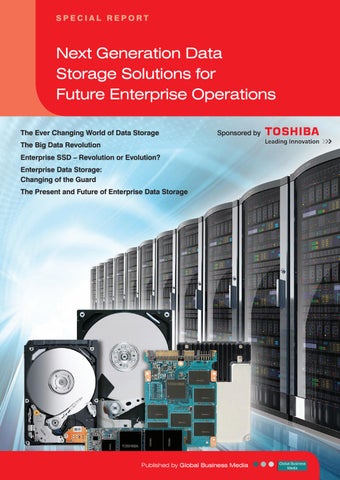
Next Generation Data Storage Solutions for Future Enterprise Operations The Ever Changing World of Data Storage
Sponsored by
The Big Data Revolution Enterprise SSD – Revolution or Evolution? Enterprise Data Storage: Changing of the Guard The Present and Future of Enterprise Data Storage
Published by Global Business Media
AT THE HEART OF DATA STORAGE Reliable data storage is the lifeblood of any enterprise. So why trust your data to anything less than the most trusted, most reliable drives from the most experienced manufacturer? Toshiba invented NAND flash storage, and have millions of drives installed worldwide. From HDDs to SSDs, and 3.5� to 2.5�, when you need high-capacity, high-performance storage solutions for the heart of your enterprise, your head says Toshiba. For more information visit www.toshiba-storage.com
SPECIAL REPORT: NEXT GENERATION DATA STORAGE SOLUTIONS FOR FUTURE ENTERPRISE OPERATIONS
SPECIAL REPORT
Next Generation Data Storage Solutions for Future Enterprise Operations The Ever Changing World of Data Storage
Sponsored by
The Big Data Revolution
Contents
Enterprise SSD – Revolution or Evolution? Enterprise Data Storage: Changing of the Guard The Present and Future of Enterprise Data Storage
Foreword 2 Tom Cropper, Editor
The Ever Changing World of Data Storage
3
Rainer Kaese, Senior Manager Business Development at Toshiba Electronics Europe, Storage Products Division
Spinning Disks in the Enterprise Published by Global Business Media
Smaller, Faster, Denser The Changing Face of Interfaces
Published by Global Business Media
RAID Redundancy Facing the Chop?
Global Business Media Limited 62 The Street Ashtead Surrey KT21 1AT United Kingdom
Keeping an Eye on Industry Drivers
Switchboard: +44 (0)1737 850 939 Fax: +44 (0)1737 851 952 Email: info@globalbusinessmedia.org Website: www.globalbusinessmedia.org
The Big Data Revolution
Publisher Kevin Bell Editor Tom Cropper Business Development Director Marie-Anne Brooks Senior Project Manager Steve Banks Advertising Executives Michael McCarthy Abigail Coombes Production Manager Paul Davies
Conclusion
Tom Cropper, Editor
The Value of Big Data Improving Performance Balancing Costs Against Benefits
Enterprise SSD – Revolution or Evolution?
9
Jo Roth, Staff Writer
Growth of Technology Not Necessarily the End of HDD
Enterprise Data Storage: Changing of the Guard
11
James Butler, Staff Writer
For further information visit: www.globalbusinessmedia.org
HDD
The opinions and views expressed in the editorial content in this publication are those of the authors alone and do not necessarily represent the views of any organisation with which they may be associated.
The Rise of the Cloud
Material in advertisements and promotional features may be considered to represent the views of the advertisers and promoters. The views and opinions expressed in this publication do not necessarily express the views of the Publishers or the Editor. While every care has been taken in the preparation of this publication, neither the Publishers nor the Editor are responsible for such opinions and views or for any inaccuracies in the articles.
7
SSD
The Present and Future of Enterprise Data Storage 13 Tom Cropper, Editor
The Move Towards Flash Data Protection And for the Future
References 15
© 2016. The entire contents of this publication are protected by copyright. Full details are available from the Publishers. All rights reserved. No part of this publication may be reproduced, stored in a retrieval system or transmitted in any form or by any means, electronic, mechanical photocopying, recording or otherwise, without the prior permission of the copyright owner. WWW.CEOREPORTS.COM | 1
SPECIAL REPORT: NEXT GENERATION DATA STORAGE SOLUTIONS FOR FUTURE ENTERPRISE OPERATIONS
Foreword W
E OFTEN talk about enterprise data storage
to keep track of vast quantities of information. This is
as a fast moving world of new and advanced
creating a range of new opportunities.
technologies. The truth is – many of these have
Jo Roth will look at the changing nature of data
been around – in some form – for decades. Now,
storage solutions. The biggest news of recent times
though, they are becoming faster, more efficient
has been the rise of solid state drives – which offer
and more sophisticated.
faster processing speeds and superior performance
Data management is also becoming a much higher priority for companies of all sizes. It can help improve
over traditional hard drives. As they develop, they are offering a viable option for enterprise solutions.
business analysis, create more sales contacts, engage
James Butler will then compare SSD drives with the
with customers and improve service/product insight.
competition. Much has been written about the demise
With much more information about customers,
of hard drives in recent times, but they continue to
suppliers and partners being held, keeping this all
have a strong foothold on the market. James will look
safe is an even greater priority than ever.
at the advantages of the competing systems and
Data storage, therefore, is developing – both in the
issues that buyers should consider.
ways companies approach it, and the technology
Finally, we’ll examine the key trends in data
being used to store it. In our opening article, we
management now and into the future. Technology is
hear from Toshiba, one of the leading producers
moving fast so the next generation of products will
of enterprise data storage solutions. They explain
offer an increasing range of options for companies
some of the key technological innovations which are
of all sizes.
impacting development in data management. We’ll also look into the way data management has grown to be a major priority for companies. We live in the age of big data – a time when businesses have
Tom Cropper Editor
Tom Cropper has produced articles and reports on various aspects of global business over the past 15 years. He has also worked as a copywriter for some of the largest corporations in the world, including ING, KPMG and the World Wildlife Fund.
2 | WWW.CEOREPORTS.COM
SPECIAL REPORT: NEXT GENERATION DATA STORAGE SOLUTIONS FOR FUTURE ENTERPRISE OPERATIONS
The Ever Changing World of Data Storage Rainer Kaese, Senior Manager Business Development at Toshiba Electronics Europe, Storage Products Division Next Generation Data Storage Solutions for Future Enterprise Operations
There has been much written about the demise of the hard disk drive (HDD), with the majority of new mobile devices using Flash memory as the main storage medium. The adoption of Flashbased SSDs in laptops and desktop computers continues at pace and also continues to eat into traditional HDD applications. Despite this shift, it is expected that HDDs will still account for the majority of sales in 2016, as HDDs remain the most economical way to store large data sets. Demands for archival and long-term storage are being driven by the ever-increasing volume of data that home users and enterprises are creating and storing. This is leading to growth in external backup drives, Networked Attached Storage (NAS) systems (local home storage servers), enterprise storage and cloud storage in general. This trend will increase the availability and accessibility of cloud and networked storage and may limit demand for storage capacity in personal devices.
For personal devices, the price gap between SSDs and HDDs is reducing as new NAND technologies make it a more competitive storage option. In the Enterprise market, the price per GB for Enterprise HDDs is falling at a similar rate as the cost per GB for Enterprise SSDs.
Spinning Disks in the Enterprise Enterprise HDD capacity is expected to continue to grow with a potential to reach 20-40TB by the end of the decade, while still maintaining the industry standard 3.5-inch form factor. Enterprise capacity HDDs with 10TB are already starting to answer the industry’s Nearline storage needs. New technologies such as Shingled Magnetic Recording (SMR) will increase the capacity on the same physical hardware – taking a 10TB drive to 12TB and further. While conventional HDDs record data by writing to magnetic tracks that do not overlap, SMR HDDs record data on tracks that partially overlap like roof shingles and this provides a higher track density. WWW.CEOREPORTS.COM | 3
SPECIAL REPORT: NEXT GENERATION DATA STORAGE SOLUTIONS FOR FUTURE ENTERPRISE OPERATIONS
The cost per GB is likely to continue to decrease, especially as the introduction of 3D NAND technologies such as Toshiba’s 3D BiCS NAND help to increase chip bit densities and increase drive capacities
4 | WWW.CEOREPORTS.COM
The increase in capacity is not without cost though – the random write performance of these drives is limited and un-deterministic to a certain extent, while sequential read/write and random read performance is similar to the Nearline models. This makes SMR drives suitable for the increasing need for streamed data, data archiving and cold data. Use of helium-filling technology rather than air can also support the journey into the doubledigit TB range. Because helium is less dense than air, helium-filled drives lower the drag on the platters, meaning that less turbulence is caused as they spin. As a result, more platters can be accommodated in the same space and power consumption can be reduced. In addition, new recording technologies are under development to support the evolution to 20-40TB in the mid-term. As HDD is the storage media of choice for large data volumes, the HDD pricing in terms of cost per TB is a key criterion. Over time, ongoing 3.5-inch HDD technology innovations are set to bring ever-increasing capacities (from 8 to 10 to 12 to 14 to 20 to 30TB) for roughly the same unit price.
There are several factors influencing this shift; improved IOPS performance of eSSDs in comparison to even the fastest HDDs; reduced energy consumption of Flash-based drives; and the decreasing cost per GB. The cost per GB is likely to continue to decrease, especially as the introduction of 3D NAND technologies such as Toshiba’s 3D BiCS NAND help to increase chip bit densities and increase drive capacities. While 3D technologies are only just starting to make their mark on the storage landscape, SSDs manufactured using these new chips promise higher endurance, faster speeds, greater energy efficiency and higher capacities. In the long term, SSDs have the potential to outgrow HDDs in terms of capacity, with 256TB SSDs predicted to become available within the near future. Though they are unlikely to rival HDDs in terms of cost per capacity, at least in the foreseeable future. Until then, the most efficient way of storing data will still be to create a lowcost (passive-) media and bring the bit storage to the expensive read/write unit by mechanical means (as is done with HDD), rather than having to connect each and every bit storage cell (as is the case with SSD).
Smaller, Faster, Denser
The Changing Face of Interfaces
While HDDs will still account for the majority of archival storage of the near future, their place within the server architecture is changing – more and more 15,000 RPM drives are being replaced by Enterprise SSDs.
At the entry-level end of the enterprise market, SATA interface equipped eSSDs have proven very popular as boot drives and for larger storage volumes. One of the reasons for this is the fact that SATA SSDs provide the lowest cost/
SPECIAL REPORT: NEXT GENERATION DATA STORAGE SOLUTIONS FOR FUTURE ENTERPRISE OPERATIONS
capacity entry point into the Flash-based storage world. This economic advantage was driven by the high volume scale of client SATA SSDs being produced to replace 2.5-inch laptop HDD. With additions such as power loss protection and increased over-provisioning, a client SATA SSD can be turned into a reasonably reliable and entry level eSSD. With a predicted decline of the 2.5” form-factor client SATA SSDs due to the transition to M.2 PCI Express (PCIe) modules, this commercial driver will eventually disappear – and SATA as an interface for boot drives and local storage has the potential to be replaced by NVM-e based storage components that are directly connected via PCI-Express, in the long term. The use of new interfaces has accelerated the shift in form factor away from the 2.5” factor to M2 modules and even smaller. The world’s smallest NVM Express (NVMe) SSD that squeezes 256GB into a single BGA package measuring just 16mm by 20mm was recently announced. One of the limiting factors for the speeds at which SSDs can operate has been the way they interface with computers – the commonly used 6Gbit/s SATA interface has a bandwidth of up to 600MB/s, while SAS 12Gbit/s interfaces achieve up to 1200MB/s. PCIe Generation 3 based SSDs typically support 4 lanes with bandwidths of approximately 1GB/s per lane, resulting in 4GB/s bandwidth. It is expected in the long term that the SATA eSSD market will transition to PCIe-based solutions for boot. The higher bandwidth of PCIe enables the CPU to address more NAND chips at the same time, reducing latencies and enhancing read/ write speeds. This has started a transition towards SSDs that have a direct connection to the PCIe bus using the NVMe interface protocol that has gained widespread adoption in many operating systems.
The first server models that support this interface are available, but the number of devices is limited to the number of free PCI Express connections in the motherboard’s chipset. As PCIe-based Enterprise S SDs of more than 4TB~8TB become available, this configuration will prove enough for Tier 0 storage architectures. High DWPD PCIe SSDs will also become widely available in the Add-In-Card (AIC) form factor for direct plug in to the PCIe slots of the motherboard. While this approach reduces the need for cabling it, it does currently not allow any hot plug functionality – so removing or exchanging cards without service interruptions would not be possible. It is important to note that hot plug capabilities were designed to overcome the unpredictable failure of individual HDDs in an array. As SSDs do not have any moving parts, their failure rates are far more predictable. Individual memory cells may wear out and fail, but inbuilt redundancy accommodates for this and monitoring software can identify drives that are reaching their endurance limits. From that perspective, failure rates are therefore similar to other semiconductor based devices in the server such as CPU or DRAM. For larger, more complex storage systems, the 12Gbit/s SAS interface is expected to remain the standard interface. The interface supports end-to-end data protection being provided by the SAS link, dual link capability and a large existing infrastructure of controllers, HBA, expanders, backplanes and JBOD. To address differentiated applications and their different style of workloads, eSSD manufacturers are developing drives optimised for specific capacity points (such as 0.5TB, 1TB, 2TB, 4TB raw Flash) and endurance levels (25, 10, 3 or WWW.CEOREPORTS.COM | 5
SPECIAL REPORT: NEXT GENERATION DATA STORAGE SOLUTIONS FOR FUTURE ENTERPRISE OPERATIONS
What is clear is that to be successful, manufacturers will need full control of design and development of drives and firmware
1 DWPD) to ensure the optimal balance of write endurance, capacity and cost for all applications and architectures.
RAID Redundancy Facing the Chop? There is a trend away from the use of traditional RAID array-based redundancy protection as continuously increasing drive capacities have made rebuild times unacceptably long for many organisations. Instead, modern storage architectures based on alternative redundancy technologies such as Erasure Coding provide redundancy and data protection on a system level where several copies of data are stored on a number of individual servers. Depending on the system architecture, these systems can be resistant to individual drive failures, server or cluster failures, and even data centre failures.
Keeping an Eye on Industry Drivers The demand for storage capacity continues to grow as does the perceived value of the data stored. This is driving demand for cloud storage operations where economies of scale can help mitigate the costs of storing ever-increasing amounts of data. While speed and capacity will remain important factors, power consumption and reliability will become even more important when determining total cost of ownership. Capacity per unit space is increasing in importance and high capacity, low endurance SSDs may become the industry’s preferred solution. In addition to cloud archival storage, the storage of video surveillance data is an important growth area. Applications for video surveillance systems keep expanding into many areas including industrial process monitoring, airports and traffic monitoring and a host of retail situations where customer behavior analysis can help improve overall customer experience. Surveillance data is increasingly being used not only to protect against security risks, but
6 | WWW.CEOREPORTS.COM
also as a part of a comprehensive business process management tool. Greater opportunities for enhanced video analytics are being offered with emerging, advanced video surveillance technologies and systems. The shift towards higher resolution cameras that have higher capacity demands together with the volume of video-data generated and the need to store data for longer, change data storage requirements. This drives increased demands for local storage capacity as well as cloud-based video surveillance-as-a-service (VSaaS) offerings. Here, the right, well thought through approach to storage is needed to make full use of the modern video surveillance solutions available on the market.
Conclusion The adoption of new technologies and interfaces will continue to disrupt the existing perceptions of how and where HDDs and SSDs should be used in various storage architectures. The accessibility and growth of cloud storage and service offerings will dictate the need for storage in local devices for applications as diverse as file access, media streaming and surveillance data storage and analytics. Whatever the application, the industry is reaching an inflexion point in the use of HDDs switching to SSDs and, as the price per GB falls, sales of SSDs will continue to grow and adoption will intensify and widen into new applications. What is clear is that to be successful, manufacturers will need full control of design and development of drives and firmware – in the SSD market, that will, by necessity, include firmware, controllers and NAND flash memory cells. With one of the industry’s most comprehensive range of storage technologies and products, Toshiba remains well positioned to support the ever-evolving storage requirements of both client and enterprise markets.
Contact For more information, visit www.toshiba.semicon-storage.com
SPECIAL REPORT: NEXT GENERATION DATA STORAGE SOLUTIONS FOR FUTURE ENTERPRISE OPERATIONS
The Big Data Revolution Tom Cropper, Editor How data is changing businesses and how organisations can make the best use of it.
B
IG DATA – it’s one of those watchwords we often read about. Even so it remains a term which is much misunderstood. Although many businesses are collecting increasing amounts of data, there is a wide variation between those who make the best use of it, and those who are struggling to cope with the mountains of confusing information. Before companies can start to harness it, therefore, they need to understand precisely what it is, how the information can help their business, and why effective data storage mechanisms can give them a critical competitive edge. The last few years have been characterised by what’s been termed the big data revolution. Within a short space of time, the amount and type of data businesses collect has grown exponentially. For example, a study for the Harvard Business Review found that the use of what it calls data-driven decision making had tripled in US manufacturing between 2005 and 20101. Much of this is down to the expanding digital universe which is predicted to grow by 40%2 per year. By 2020, according to an IDC report, there could be almost as many digital bits as there are stars in the sky. The more data businesses collect, the greater the impact it’s having on their business.
The Value of Big Data According to McKinsey, retailers can increase their profits by up to 60% by using data3. Gary Loveman, CEO of Caesars Entertainment, has been highly vocal about the value of data to the business. As creditors fought over the messy bankruptcy of its casino unit, the most valuable asset was Total Rewards, a data driven marketing campaign, which was said to be worth $1bn. Loveman has been one of the pioneering forces in data marketing for years. As far back as 2003 he had this to say to the Harvard Business Review: “We use database marketing and decision-science-based analytical tools to widen the gap between us and casino operators who base their customer incentives more on intuition than evidence.”4
It was true then and its true now. Indeed, data technology has improved out of all recognition and, as it does, so too have the rewards. Today, businesses can use data to drive a number of key benefits including: • I mproving customer relations: The more a company knows about its customers the easier it is to provide a better service. AT&T has said that big data helped it improve customer satisfaction levels by 59%. •P ricing optimisation: A study from McKinsey found that 75% of a typical company’s revenue came from standard products5. However, 30% of the thousands of pricing decisions companies make every year fail to deliver the best price. Getting the pricing right for a business is crucial. A 1% increase in price could translate to an 8.7% increase in operating profits, assuming there is no drop off in volume. The trick is to find the optimum point – where the price is at the highest point before volumes drop so low that they impact profits. Big data makes it easier to find that perfect price. • Performing risk analysis: A company’s performance can be affected by a host of factors including news events, weather, market and much more. Big data allows companies to bring all that information together to deliver a comprehensive health test on a business and a market. •P roduct assessment: Big data can provide a huge amount of information about how your product is performing in the marketplace and how it is perceived. Avenues such as social media produce large amounts of information about customer reaction to your products, which might not be communicated to you directly. It’s the case of hearing what’s said about you when you’re not in the room. •R eal time customisation of websites: We’ve all become used to tracking cookies on websites and the tailored options provided by sites such as Amazon. It is possible to get a huge amount of information about each web visitor – their age, gender, buying history and much more. This is a successful approach. Amazon is estimated to make 20% extra in sales because of their customised offers6. WWW.CEOREPORTS.COM | 7
SPECIAL REPORT: NEXT GENERATION DATA STORAGE SOLUTIONS FOR FUTURE ENTERPRISE OPERATIONS
The last few years have been characterised by what’s been termed the big data revolution. Within a short space of time, the amount and type of data businesses collect has grown exponentially
Improving Performance Businesses are, in one respect, information processors that gather data and act on insights. Technologies which can deliver faster, more comprehensive and more accurate information will do a great deal to improve business performance. Businesses of all kinds are using data to improve performance in unprecedented ways. However, as the Harvard Business Review Study discovered, adoption is far from uniform. It found that those companies which had more sophisticated IT systems were more likely to use data-driven decision making. Equally, those which employed more professionals with college degrees were more likely to use data – suggesting individuals with a high level of formal education were more comfortable using data based analytics. Much of a business’s success with data will be down to its capacity to manage and store it. Here the market is undergoing a period of rapid change. The rise of software defined storage options is creating an environment which is ripe for change. New disruptive technologies such as
8 | WWW.CEOREPORTS.COM
flash-based solid state drives offer faster, more effective and more reliable storage options. Larger players are also bringing innovative solutions to the market. Existing hard disk storage devices are upping their performance and capacity; new solid state solutions, and cloud based applications are helping companies improve their data strategies while driving down infrastructure and operational costs.
Balancing Costs Against Benefits At the same time, the business world is in a state of uncertainty. A fragile global economic recovery sees profit margins coming under pressure which means managers will need to see a clear return on investment. That calculation is far from straightforward. Upfront costs can vary as can the ongoing expense of running systems. Managers will have to balance the costs of introducing a new system against the potential benefits. To do that they will need to stay abreast of an increasingly volatile and quickly evolving market.
SPECIAL REPORT: NEXT GENERATION DATA STORAGE SOLUTIONS FOR FUTURE ENTERPRISE OPERATIONS
Enterprise SSD – Revolution or Evolution? Jo Roth, Staff Writer Much has been written about the rise of SSD drives in enterprise data solutions, but how much of that is just hype?
T
HE DATA storage market is moving rapidly – and the cornerstone of this revolution is the solid state drive. These have been promoted as the future of the industry and a technology which could soon eclipse all others. As always, though, there is work to do in digging through the hype to see where this technology is heading and what precise benefits it can offer. Within the space of a few years the solid state drive (SSD) market has grown rapidly both in terms of market share and sophistication of technologies on offer. Go back just a year or two and SSDs had only made their mark in the consumer market and among those looking for more storage. Today, it’s all change. Research from IDC finds that SSDs are moving into every area of the data centre and every area of IT. “Demand for SSDs in both the client and enterprise market remains strong,” explains Jeff Janukowicz, an IDC analyst. “SSDs facilitate more efficient and faster access to data… This creates a growing opportunity for SSD suppliers to deliver client PC and enterprise data centre solutions and capitalise on the transformation underway in these markets7.” In a market which is generally led by innovation rather than a single disruptive piece of technology, this is one solution with the potential to have a truly transformative impact. Compared with HDD, access speeds are faster; SSDs have no moving parts and use flash memory to store data, which provides superior reliability; they use less power, which can reduce an energy bill and, because it generates less heat, can promise a longer lifespan. As these products become increasingly available, the SSD market is growing rapidly. In 2015 it was valued at $13.29bn and is expected to grow at 9.5% between 2016 and 2022, according to a recent report8. The largest share of the market will be held by SSDs
with a capacity of less than 250GB, but the most rapid growth is likely to be seen in between 250GB and 500GB. Meanwhile, a study from International Data Corps suggest that SSD capacity shipments are growing at 50% per year9 – a trend which could last until the end of the decade. If it does, they suggest it could be 7.5 times larger than it is today.
Growth of Technology This market growth comes because the technology is developing rapidly. More and more developers are coming to market, which is spurring innovation. They are becoming more sophisticated, offering denser and larger storage levels. This is a major advance and places SSDs on a par with the largest HDD applications. Moving into the future, we can expect major advances in the realm of 3D NAND, which sees the basic one transistor per cell architecture stacked in three dimensional arrays within the chip.
Not Necessarily the End of HDD The rise of SSD has prompted plenty of experts to forecast the death of HDD. Estimates from Western Digital and Seagate suggest the market for HDD contracted by 100 million10 units year over year in 2015 – a faster fall than the overall drop in PC sales. According to TrendFocus, sales of HDDs dipped by 16.9% over the year, although the amount of total overall storage shipped increased. Even so, the HDD market is far from done. There are still some advantages, including cost. Although the prices of SSDs are falling as more products become available, they remain much higher than HDD – especially for the high storage volume applications. In many cases, cost considerations will still make HDD a better choice. While it is true that SSDs are eating considerably into market share, HDD looks WWW.CEOREPORTS.COM | 9
SPECIAL REPORT: NEXT GENERATION DATA STORAGE SOLUTIONS FOR FUTURE ENTERPRISE OPERATIONS
The gulf between HDD and SDD is coming down, but for many it remains prohibitive. Some data centres will still prefer to wait for prices to drop further before making the transition
set to retain considerable market share for the foreseeable future. Indeed, the hybrid array market – a combination of solid state and HDD – remains strong. According to IDC, the hybrid array market remains three times the size of the all flash market – despite the latter experiencing extremely rapid growth.11 A 2013 report from Gartner12 also sees the two technologies working together into the future. It says that, due to the scale of data needs, it would be physically impossible to completely replace all HDD components within a data centre. “It would cost the NAND industry hundreds of billions of dollars to construct enough new fabrication plants to displace even 20% of the forecast need for enterprise storage, which likely will exceed 500,000PB in 2017,” states the report. “Therefore, within the next five to 10 years, it will be physically impossible to manufacture a sufficient number of SSDs to replace the existing HDD installed base and produce enough to cater for the extra storage growth.” According to the report, SSDs have demonstrated an ‘immediately apparent’ ROI over and above HDDs and will become ubiquitous. However, they will still remain much more expensive than HDDs for the foreseeable
10 | WWW.CEOREPORTS.COM
future. The report suggests enterprise SSDs can expect to remain 25 times more expensive per GB than HDDs. The SSD market still has some questions to answer. Price is still a major problem. The gulf between HDD and SDD is coming down, but for many it remains prohibitive. Some data centres will still prefer to wait for prices to drop further before making the transition. There is some confusion over exactly how SSDs should be used. Currently an SSD is implemented in an array system and, while this might serve in the short term, there is some doubt as to whether it will prove to be the ideal option over a longer period of time. Precisely what SSDs can offer may also depend on which vendor you can speak to. Assessing quality and performance may not always be possible just by looking at the marketing materials. There is still some work to do, but the SSD market is showing real signs of growth and potential. Enterprise SSDs are proving themselves to be ideal options for high performance data centres and are infiltrating every conceivable area of the market. Even so, existing HDD systems retain some advantages and will continue to hold an important position within the market.
SPECIAL REPORT: NEXT GENERATION DATA STORAGE SOLUTIONS FOR FUTURE ENTERPRISE OPERATIONS
Enterprise Data Storage: Changing of the Guard James Butler , Staff Writer Solid state, hard drive or a mix? How to choose the best data storage system for your data centre.
T
HE GRASS is always greener, so they say; and it’s true that something new and exciting always attracts plenty of attention. So, when experts write about data storage trends for 2016 and beyond, they can’t help but predict big things for new, exciting and transformative technologies such as solid state drives (SSD). These have already achieved big things in the personal computing world, but once you get to the enterprise level, in which companies have powerful data centres operating in the terabyte range, the old ways still rule. The question is: can solid state drives now offer a better deal than their HDD equivalents – and is the old guard changing? Here’s how the various runners and riders compare.
HDD Hard drives have been the basis of the computing world for 50 years. They are comprised of a metal platter with a magnetic coating which stores all the data you need. These spin and are read by a read/write arm which stretches over the disk. The advantages these have are incumbency. This is a system which has worked well in data centres for years and companies will be loath to get rid of it without good reason. They are cost effective, providing fast and reliable storage of high data volumes for a low price – compared with SSDs. Although they’ve been around since the 50s, they continue to evolve and improve with more data being stored on increasingly small packages. On the other hand, they produce noise and vibration and can be prone to over-heating. Requirements are changing. Companies are handling more and more data every year. They are also looking to reduce the size of data centres making them faster and more efficient. HDDs may have performed well for years but, compared to other technologies out there, particularly solid state drives, they are beginning to show their age.
SSD Between 2010 and 2014, funding for enterprise storage options increased by nearly 200% according to figures from CB Insights.13 This is down to the increasing volumes of data being stored and the growing influence of solid state drives and flash arrays. Indeed, everywhere you look, this seems to be the dominant theme of the enterprise market. There has been enthusiasm for removable storage ever since personal computing first became popular, with the arrival of bubble memory in the 70s and eighties. Primary drives appeared on notebooks during the early 2000s. These have grown in power and become more standardised as they achieved a greater dominance in the PC market, but in recent years they have reached into the enterprise data market. From a layman’s perspective, this is an oversized USB memory stick. Instead of a spinning disk, it has no moving parts and all information is stored on a microchip. Typically, it uses a NANDbased non-volatile flash memory. In the early days of SSDs, as they entered the computing market, many feared that this data could rub out over time. If that was ever true, it’s certainly not the case with today’s modern technologies. The advantages are: •S SDs are faster: StorageReview.com14 claims SSDs can read/write data at speeds of up to 550MBS, compared with 50 to 120MBS for HDDs. •N o moving parts: As such they produce less noise and vibration and are less susceptible to over-heating. •M ore resilient: Partly because they have no moving parts they are more resilient. They are more likely to withstand impact damage and require less maintenance. SSDs have quickly spread across personal computing but when it comes to enterprise data management HDDs still retain a strong position. The reason? As always, it comes down WWW.CEOREPORTS.COM | 11
SPECIAL REPORT: NEXT GENERATION DATA STORAGE SOLUTIONS FOR FUTURE ENTERPRISE OPERATIONS
The rise of cloud computing over the past decade has seen increased amounts of data moved onto cloud based servers
to a question of cost. SSDs offer a much higher cost per terabyte than their HDD equivalents, sometimes four times the price. However, this argument is changing. First of all, SSDs are becoming more affordable. As more products come to market and next generation technologies become more commonplace, the cost per terabyte is coming down. The market is shifting from single level cell technologies to multilevel cells that enable higher cell densities. Helium filled cells can also offer a higher data density. A study from Wikibon has predicted SSDs will offer superior value for money by the end of 201615. Cost can also be a question of perspective. It is easy to use the cost per GB as the sole calculation, but cost can also be impacted by performance. With no moving parts, life expectancy can be longer with greater builtin redundancy in case of failure, they can also feature low power consumption and higher speed and performance than HDD equivalents. So, while HDDs may offer a lower top line cost, SSDs make up ground when it comes to ongoing operation.
The Rise of the Cloud Virtualisation is another key trend in data management. The rise of cloud computing over the past decade has seen increased amounts of data moved onto cloud based servers. This has a number of attractions. It enables companies to reduce the amount of hardware on the premises, and so significantly drive down their overall costs. However, doing so places sensitive data in the hands of a third party. If they have a problem, your data can be at risk, so it still makes sense to have key information held on physical
12 | WWW.CEOREPORTS.COM
servers in the company’s location. There will be a mix of data which is held on the cloud, private cloud, and private servers. It’s also worth remembering that even with cloud computing, that information will be held on a physical server somewhere. Each of these choices has its own merits. For those companies making the choice it’s a question of achieving the right balance of cost versus performance. Administrators will have to assess their total backup needs; how much information will they need to save and when, and how regularly does their information change? Some companies can see their data change by 40% every month. Having up-to-date accurate data easily to hand can be mission critical. Companies may also have a back-up window. This is a period in which company activity is at its lowest during a week and so back-ups can be performed. In those companies in which a so called back up window does exist, time could be of the essence. In many cases we may see a mix of different systems. Old data, which does not need to be accessed, can be held on slower drives, while newer and more changeable information can be held on faster, more expensive SSDs – it’s one way to manage the costs. The challenge of managing data is the perception that this technology is moving forward quickly. As new technologies come to market, they provide more opportunities and increased options. Understanding how that can feed into data centre functionality, and how they may affect overall operational costs, could be a key challenge for the future.
SPECIAL REPORT: NEXT GENERATION DATA STORAGE SOLUTIONS FOR FUTURE ENTERPRISE OPERATIONS
The Present and Future of Enterprise Data Storage Tom Cropper, Editor How new technologies are revolutionising the ways companies handle their data.
D
ATA NEEDS are changing. There’s more available – the amount of information businesses generate and capture is growing exponentially by the year. Equally, this data is showing real value – it can provide an insight into business performance, help generate sales leads, increase revenue, monitor product performance or company reputation. It can drive a business forward in so many different ways that those businesses which manage their data effectively are achieving a significant competitive advantage over those who do not. As such, data storage is developing from a basic operational necessity into an important part of the business. According to the 2015 data storage trends survey conducted by ESG, professionals agree that effective storage of data is critical to core business functions and can lead to a competitive advantage16.
The Move Towards Flash Because of this, we’re seeing a rapid evolution in the sophistication of data storage technologies, which leads us to what most experts agree will be the biggest trend of the next few years – the move towards flash based storage and an all flash data centre. Previously this has been held back because of a lack of products catering to high volume industrial storage level, and a high cost per GB ratio versus conventional hard drives. Two things are changing: the cost is coming down as more products come to market, and the capacity of the latest offerings is growing rapidly. Earlier in 2016, Toshiba announced its first SSD for enterprise data storage solutions to embed 15nm MLC NAND flash memory, it comes with 6.0Gbits/ SATA solid state drive and is designed for value endurance workloads with a capacity of up to 1.6TB. It offers many of the key features data centre managers are looking for: high performance and efficiency, low operating power and high reliability. It also comes equipped with Toshiba’s Quadruple Swing By Code error
technology which helps to protect customer data caused by NAND flash memory media wear. As well as improving the reliability and safety of customer data, it also helps to extend the life expectancy of the system. “The HK4 Series joins our family of SATA SSDs and is designed to meet the needs of our customers who are looking for a SATA SSD with low operating power, excellent quality of service, high capacity and with encryption,” said Jeremy Werner, vice president of SSD and storage solutions marketing at Toshiba America Electronic Components, Inc. “Knowing that security and encryption is a priority for our customers, we are thrilled to release a SATA SSD that meets those needs.” The benefits of flash based solid state drives have prompted plenty of experts to predict the arrival of all flash data centres. Writing on Network Computing.com Andy Walls said: “An all-flash facility will offer many advantages. Slow-performing or aging storage solutions will no longer be a hindrance to business innovation. Companies will be able to deploy new features, applications, virtual desktop infrastructures, mobile and social systems of engagement, and new technology-driven business lines much easier.” Such arguments are compelling, but traditional HDD refuses to go quietly into the night. It continues to offer cost advantages over SSD and remains a viable option for those applications where cost outweighs requirements for speed and performance – such as the archiving of cold data. HDD drives are also growing and expanding, able to cope with capacities of 10TB and more. To reduce infrastructure costs further, though, businesses are moving towards virtualisation and transferring increasing amounts of data onto cloud storage applications. These can have critical drawbacks for active data management services in which a delay of even a few milliseconds can be crucial. They do however, offer value for cold data storage WWW.CEOREPORTS.COM | 13
SPECIAL REPORT: NEXT GENERATION DATA STORAGE SOLUTIONS FOR FUTURE ENTERPRISE OPERATIONS
An all-flash facility will offer many advantages. Slow-performing or aging storage solutions will no longer be a hindrance to business innovation
which is why many businesses will be using a hybrid of cloud and local data storage services.
Data Protection While much is being written about developments in the storage space, it’s worth also paying attention to data protection. Here the challenge of keeping multiple copies of the same data from multiple tools is difficult and expensive. Copy Data Management (CDM) uses a single live clone for a range of services including back-up, replication and archiving. Research from IDC suggests copy data will cost firms $51bn worldwide by 201817. The market is growing rapidly, with companies such as Actifio offering a copy data virtualisation platform which consolidates data protection processes and separates data from infrastructure. The promise of CDM is that it simplifies an increasingly complicated environment – it can replace decades of accumulated functionality with something which is far more streamlined and easy to use. As such, it can play an important role in helping data managers to retain their sanity in an increasingly crowded and hectic market place
And for the Future There is a host of technologies floating around the data storage marketplace. Some, like the ones we’ve discussed in this article, slot into the newish category. They’ve been around for some years but are now offering real value to managers in a practical sense. Other technologies are on the horizon and, although they may be some way off maturity – as yet – they do offer exciting potential in the years to come. These include: •N ew flash technologies: Flash based technology is in a rapid stage of development and the future could see many of these coming to market, which blur the lines between memory and storage. 14 | WWW.CEOREPORTS.COM
•C loud to cloud back-up: Cloud to cloud back up providers are promising the same level of back-up and storage as you could find in local data centres. This has enormous potential in the future, although it may need more data to exist in the cloud before it truly takes off. •F lat Backups: Could this be the next big revolution? Traditional back-ups can provide reliable protection of data but at the cost of impacting other systems. Snapshots simply provide a moment in time view of your data. They are space efficient because only new or changed blocks are stored. However, your data can still be vulnerable if the disk crashes. Flat backups provide the streamlining benefits of snapshots with the reassurance of traditional backups. It still takes a snapshot, but incremental changes are then moved to the backup target without impacting the performance of your system. Looking further ahead, the future appears even more exciting. At the time of writing, the BBC has just reported on a new storage device, developed by Dutch scientists, which can write memory atom by atom18. With each bit of data represented by a single chlorine atom, they were able to produce 500TB of storage. Such innovations are some way off becoming practical reality. But they indicate precisely how much further this market has to travel. Predicting the future is no easy task. There are so many new technologies coming in to play, and user demand is evolving so rapidly, that it’s difficult to be sure when certain technologies will mature and whether they will offer the best value for any individual organisation. The task for managers is to understand what’s out there and their relative merits. Then they need to assess the requirements of their own organisation to determine which option represents an ideal fit.
SPECIAL REPORT: NEXT GENERATION DATA STORAGE SOLUTIONS FOR FUTURE ENTERPRISE OPERATIONS
References:
1
The Rise of Data Driven Decision Making: https://hbr.org/2016/02/the-rise-of-data-driven-decision-making-is-real-but-uneven
2
Data Growth, Business Opportunities and IT Imperatives: http://www.emc.com/leadership/digital-universe/2014iview/executive-summary.htm
3
Improving Customer Experience Through Big Data Analytics: http://www.oracle.com/us/corporate/profit/big-ideas/030614-mabramow-2163930.html
4
Big Data at Caesar’s Entertainment: http://www.forbes.com/sites/bernardmarr/2015/05/18/when-big-data-becomes-your-most-valuable-asset/#7a9f59cd3eed
Using Big Data to Make Better Pricing Decisions: http://www.mckinsey.com/business-functions/marketing-and-sales/our-insights/using-big-data-to-make-better-pricing-decisions
5
6
Ten Practical Big Data Benefits: http://datascienceseries.com/stories/ten-practical-big-data-benefits
7
Top Ten SSD Market Trends: http://www.enterprisestorageforum.com/storage-hardware/top-10-enterprise-ssd-market-trends.html
8
Solid State Drive Market: http://tiny.cc/xty3cy
9
Top Ten SSD Market Trends: http://www.enterprisestorageforum.com/storage-hardware/top-10-enterprise-ssd-market-trends.html
10
Hard Drive Shipments Drop: http://www.anandtech.com/show/10098/market-views-2015-hard-drive-shipments
11
Top Ten SSD Market Trends: http://www.enterprisestorageforum.com/storage-hardware/top-10-enterprise-ssd-market-trends.html
12
SSDs to Complement Not Replace: http://www.storagenewsletter.com/rubriques/market-reportsresearch/gartner-ssd-hdd/
13
Enterprise Storage: http://marketrealist.com/2015/09/enterprise-storage-moves-software-defined-storage/
14
SSD V HDD: http://www.storagereview.com/ssd_vs_hdd
15
Wikibon study: http://wikibon.org/wiki/v/Evolution_of_All-Flash_Array_Architectures
16
The Future of Data Storage: http://www.networkcomputing.com/storage/future-data-storage-flash-and-hybrid-cloud/396697859
17
How Copy Data Management Differs: http://searchdatabackup.techtarget.com/answer/How-copy-data-management-differs-from-traditional-backup
18
Storage Device Writes Information Atom by Atom: http://www.bbc.co.uk/news/science-environment-36824902
WWW.CEOREPORTS.COM | 15
SPECIAL REPORT: NEXT GENERATION DATA STORAGE SOLUTIONS FOR FUTURE ENTERPRISE OPERATIONS
Notes:
16 | WWW.CEOREPORTS.COM
AT THE HEART OF DATA STORAGE Reliable data storage is the lifeblood of any enterprise. So why trust your data to anything less than the most trusted, most reliable drives from the most experienced manufacturer? Toshiba invented NAND flash storage, and have millions of drives installed worldwide. From HDDs to SSDs, and 3.5� to 2.5�, when you need high-capacity, high-performance storage solutions for the heart of your enterprise, your head says Toshiba. For more information visit www.toshiba-storage.com
CEO Reports… the leading specialist combined online research and networking resource for CEOs and senior management.
• Up to the minute unparalleled depth of information on specialist subjects available to all site users on a free of charge open access basis. • Qualified signed up members are able to access premium content Special Reports and interact with their peers using a variety of advanced online networking tools. •
Designed to help users identify new solutions, understand the implications of different choices and select the best solutions available.
•
Thought Leadership – Advice and guidance from internationally recognised key opinion leaders.
• Peer Input – Contributions from senior management personnel within major corporations and SMEs. •
Independent Editorial Content – Expert and authoritative analysis from award winning journalists and leading industry commentators.
•
Unbiased supplier provided content.
•
Designed to facilitate debate.
•
Written to the highest professional standards.
Visit http://www.ceoreports.com/