SPECIAL REPORT
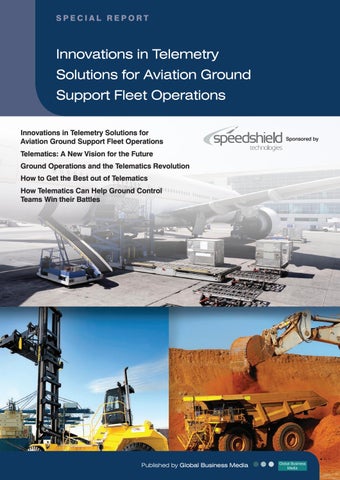
Innovations in Telemetry Solutions for Aviation Ground Support Fleet Operations Innovations in Telemetry Solutions for Aviation Ground Support Fleet Operations Telematics: A New Vision for the Future Ground Operations and the Telematics Revolution How to Get the Best out of Telematics How Telematics Can Help Ground Control Teams Win their Battles
Published by Global Business Media
Sponsored by
FLEETONLINE AIRSIDE The most advanced Ground Support Equipment Fleet Safety & Reporting system on the market today.
Key Features: Powerful, intuitive fleet management with 24/7 online reporting. GPS & Geo-fencing Impact sensing Safety interlocks
Pre-start checklist
To find out more visit:
Engine monitoring
speedshield.com
Driver verification Transmission control Intelligent speed control & zoning
INNOVATIONS IN TELEMETRY SOLUTIONS FOR AVIATION GROUND SUPPORT FLEET OPERATIONS
SPECIAL REPORT
Innovations in Telemetry Solutions for Aviation Ground Support Fleet Operations Innovations in Telemetry Solutions for Aviation Ground Support Fleet Operations
Sponsored by
Telematics: A New Vision for the Future
Contents
Ground Operations and the Telematics Revolution How to Get the Best out of Telematics How Telematics Can Help Ground Control Teams Win their Battles
Foreword
2
Tom Cropper, Editor
Innovations in Telemetry Solutions for 3 Aviation Ground Support Fleet Operations Speedshield Technologies
Published by Global Business Media
Published by Global Business Media Global Business Media Limited 62 The Street Ashtead Surrey KT21 1AT United Kingdom Switchboard: +44 (0)1737 850 939 Fax: +44 (0)1737 851 952 Email: info@globalbusinessmedia.org Website: www.globalbusinessmedia.org Publisher Tom Cropper Business Development Director Marie-Anne Brooks Editor Tom Cropper Senior Project Manager Steve Banks Advertising Executives Michael McCarthy Abigail Coombes Production Manager Paul Davies For further information visit: www.globalbusinessmedia.org The opinions and views expressed in the editorial content in this publication are those of the authors alone and do not necessarily represent the views of any organisation with which they may be associated. Material in advertisements and promotional features may be considered to represent the views of the advertisers and promoters. The views and opinions expressed in this publication do not necessarily express the views of the Publishers or the Editor. While every care has been taken in the preparation of this publication, neither the Publishers nor the Editor are responsible for such opinions and views or for any inaccuracies in the articles.
Control Damage Prevention Optimisation
Telematics: A New Vision for the Future
6
Tom Cropper, Editor
Assessing the Problem The Role of Telematics Ground Operations
Ground Operations and the Telematics Revolution 8 Jo Roth, Staff Writer
A Growing Market Reduced Maintenance Tracking Mileage and Vehicle Usage Improved Safety Moving into the Future
How to Get the Best out of Telematics 10 James Butler, Staff Writer
The Rise of Big Data Connected Information Understanding Metrics
How Telematics Can Help Ground Control Teams Win their Battles
12
Tom Cropper, Editor
A Growing and Emerging Sector The System in Action
References 14
Š 2017. The entire contents of this publication are protected by copyright. Full details are available from the Publishers. All rights reserved. No part of this publication may be reproduced, stored in a retrieval system or transmitted in any form or by any means, electronic, mechanical photocopying, recording or otherwise, without the prior permission of the copyright owner. WWW.AIRPORTTECHNOLOGYREPORTS.COM | 1
INNOVATIONS IN TELEMETRY SOLUTIONS FOR AVIATION GROUND SUPPORT FLEET OPERATIONS
Foreword A
IRPORT GROUND crews are about to face
which eases the pressure on profits and helps to
one of their most challenging periods ever.
generate more revenue.
Air traffic is predicted to increase exponentially,
We then look more closely at some of those
passenger expectations are growing, budgets are
demands and why airports are beginning to turn
tightening and they are being expected to manage
to telematics as an answer. Jo Roth discusses the
their environmental footprint. Delivering the goods
growing market and what opportunities this offers.
in this demanding environment will be no easy task,
James Butler then asks what considerations airports
but the answer comes in the form of telematics.
should make when installing and implementing new
For many people, this basically means sensors
systems, before we take a look at the technology in
placed on vehicles to see where they are driving to
action and how it is improving operations and helping
and how they are being used. The insurance sector
operators win their daily battles.
makes particularly good use of them. For airports,
The exciting thing about this sector is that it is still in
these can track the location of equipment, ensure they
such an early stage of development. Although current
are ready to use when needed and deliver a host of
systems can do much, they are also developing and
operational improvements.
producing more functionality. With adoption far from
As our opening article from telemetry system
complete, telematics can give operators a crucial
provider Speedshield Technologies demonstrates,
advantage in an increasingly competitive landscape.
telematics has the potential to unlock many benefits
The secret is to know what the technology can do
operators didn’t even know existed. For example,
and how to achieve it.
they can show where they are wasting money and energy, improve accountability among the workforce and optimise costs. This can save time and money,
Tom Cropper Editor
Tom Cropper has produced articles and reports on various aspects of global business over the past 15 years. He has also worked as a copywriter for some of the largest corporations in the world, including ING, KPMG and the World Wildlife Fund.
2 | WWW.AIRPORTTECHNOLOGYREPORTS.COM
INNOVATIONS IN TELEMETRY SOLUTIONS FOR AVIATION GROUND SUPPORT FLEET OPERATIONS
Innovations in Telemetry Solutions for Aviation Ground Support Fleet Operations Speedshield Technologies
“Avoidable damage costs can drop up to 75% after implementing access control and impact detection”
G
ROUND SUPPORT Equipment (GSE) Management in today’s environment is one of increasing demand and operational change. Keeping up with the growing number of aircraft movements in all aspects of aviation requires a change of thinking in the support space, to do more with less, do it safer than before and ultimately do it smarter. Technology is in itself an enabler for change, and telematics on the ramp provides an opportunity to unmask many of the operations, GPU’s sitting idle while APU’s burn through tonnes of jet fuel, baggage tugs run empty on the tarmac and equipment ‘borrowed’ by competing agendas. Technology can provide visibility, but it can also provide real, actionable intelligence, active and passive control, and enhance planning to provide rapid and continuous cost benefit. Safety on the ramp is paramount, it can be an inherently dangerous work environment, and understanding the GSE place in the operation,
and how that equipment is utilised and by whom is critical.
Control When considering telematics, it can sometimes be easy to pigeon-hole simple GPS mapping - just a pin on a map. What a system like Fleet Online Airside brings is many layers of benefit and enablers of change, access control linked directly to airport security, individual allocation of equipment to task, licence expiry management to avoid non-compliance, operator accountability and associated improvement in operational quality. When an operator is compelled to ‘sign on’ to a piece of equipment, there is an instantaneous change in mentality associated with the upcoming task. There is a level of awareness now that responsibility for the asset is squarely at the operator’s feet - there is accountability. This may be singularly the biggest opportunity, but also
FLEET MANAGEMENT EVOLVED Power your fleet and gain in depth insight into fleet performance with our advanced telemetry solutions, providing economic, operational and environmental benefits across your business.
www.speedshield.com
WWW.AIRPORTTECHNOLOGYREPORTS.COM | 3
INNOVATIONS IN TELEMETRY SOLUTIONS FOR AVIATION GROUND SUPPORT FLEET OPERATIONS
Fleet Online Airside incorporates a 3 axial accelerometer and advanced detection algorithms developed through many years and thousands of devices operating in many industries worldwide
the biggest hurdle a previously uncontrolled fleet operator will face. Pass this hurdle and many opportunities await.
Damage Prevention When the idea of individual accountability lands, there is a noticeable improvement overall in operational quality. However, there is always an action or task which may present a risk, and therefore an opportunity to improve. Monitoring the use of equipment, and any impacts and harsh braking or unusual operations allow the dialogue to begin between management and operations staff to better understand the environment and task requirement, and design ways to reduce the risk of collision or damage to equipment, infrastructure, staff…… Without the information the system provides, the conversation is very difficult to initiate and the opportunity lost. Fleet Online Airside incorporates a 3 axial accelerometer and advanced detection algorithms developed through many years and thousands of devices operating in many industries worldwide. We know the value of accurate data, and we know the negative impact false positives and other spurious results can have on the value of the system. With Fleet Online Airside, the system is calibrated remotely and the ‘noise’ removed to provide just the events requiring response, ensuring value in every alert. Tracking of assets is important in an environment as expansive as an airfield. Understanding location is crucial to ensure they are best utilised for the missions ahead. Critical to their location is their status – are they in use, are they fuelled up or charged, are they scheduled for service or under repair? The Fleet Online Airside mapping interface allows a planner or coordinator to see 4 | WWW.AIRPORTTECHNOLOGYREPORTS.COM
which assets are available, those with low fuel levels, those that are under repair and therefore unavailable for use, as well as vehicles currently in use, who is operating them and how long they have been working for. Such real time birds-eye information makes the service operator better informed and able to make decisions based on actionable intelligence. Commissioning of the Fleet Online Airside system has immediate operational benefit – no more so than an operator who commissioned the GPS tracking system only to discover immediately that several assets had been ‘missing’ from the roster. With all the information available, the vehicles were able to be recovered and put back into service, while the operators responsible for the relocation were easily identified.
Optimisation It’s important to realise the benefits of such systems in ways which are accurate, actionable and repeatable. There are a multitude of opportunities to improve the overall efficiency of any operation, and identifying the problem is critical in designing a solution that works. If we take an example – Ground Power Unit operations – the ideal scenario is relatively obvious. Auxiliary Power Units on-board aircraft are expensive to
INNOVATIONS IN TELEMETRY SOLUTIONS FOR AVIATION GROUND SUPPORT FLEET OPERATIONS
run and maintain. The problem operationally is that they are convenient, as they are on-board and available. Ground Power Units are a far more cost-effective alternative, but we must find a method of understanding their availability, status and workload to determine how the ground handler can affectively promote their use and subsequently the understanding within the business of the savings such a policy can realise. By engineering a specific solution to GPU operations, Fleet Online Airside can effectively manage authorised operation, tracking and activity information, highlighting business opportunities both in real time and retrospectively. The GPU data can be represented in such a way to describe many key metrics such as operator, run time, time on aircraft, time actively delivering power, time at idle and many more. The portal then takes that information and provides actionable information such as ratios representing the amount of time a GPU is engaged on an aircraft against the time it is actually providing power, or time connected to the aircraft but not accepted by the aircraft. It can highlight the asset and location of equipment not being utilised in real time, or higher level metrics to clearly show total utilisation of the entire GPU fleet at a port level, right down to regions within such as terminal or gate level. The actions taken on the basis of such information can effectively manage improved asset engagement and continue to measure the true impact of management initiatives – something that can be all too easily lost in translation on a busy airport environment.
Some of our user base actually embeds the data output from our system directly into their own investigation process, effectively triggering an internal safety investigation if an impact event is detected outside certain thresholds. The objectivity of the data assists in ensuring the consistency of these processes and the benefits of their outcomes. In the case of deck loader operations, Fleet Online Airside is capable of measuring and displaying lift activity in real-time, showing both location of asset, operator assigned and logged in, and aggregate lift activity and hourly lift rates, all from the GPS location page and available as automatic upload to inventory and operational management systems. Critical to the high availability requirements of modern GSE, the system is CanBUS enabled, allowing highly descriptive error messages to be transmitted from the unit to the online portal, where they are then able to be sent to subscribed service partners. The information available means a service provider can know what is wrong (or potentially about to go wrong), send the right technician with the right parts and tools, and send them to the exact location of the equipment in question. The advantages of such an integrated platform are unrivalled in the modern GSE environment. GSE efficiency and safety go hand in hand, and the Fleet Online Airside product combines active and passive safety features with the very best information suite to ensure rapid operational benefits, and the continuous improvement in all areas across the ramp.
FLEET MANAGEMENT EVOLVED Power your fleet and gain in depth insight into fleet performance with our advanced telemetry solutions, providing economic, operational and environmental benefits across your business.
www.speedshield.com
WWW.AIRPORTTECHNOLOGYREPORTS.COM | 5
INNOVATIONS IN TELEMETRY SOLUTIONS FOR AVIATION GROUND SUPPORT FLEET OPERATIONS
Telematics: A New Vision for the Future Tom Cropper, Editor How a more sophisticated understanding of telematics could solve many of the aviation industry’s key challenges.
Over the past 30 years demand for air travel has increased at an unprecedented rate, but at the same time prices have fallen
T
IMES ARE tough for the aviation industry. On the one hand, their services are more in demand than ever, but on the other hand, profit margins are shrinking, capacities are being stretched and the oil price is volatile. Difficult times, though, can be the mother of invention. They force companies to take a closer look at their operations, to eliminate waste, streamline costs and optimise productivity. One technology which helps companies achieve all those goals is telematics. As systems become more sophisticated, they are delivering additional information about a wider range of parameters in real-time. If they can harness this correctly, aviation companies can unlock enormous gains.
Assessing the Problem First, let’s analyse the challenge facing the aviation industry. Over the past 30 years demand for air travel has increased at an unprecedented rate, but at the same time prices have fallen1. It’s one of those rare situations in which the laws of supply versus demand do not apply. The result is that profit margins have progressively shrunk, making it increasingly difficult to make money from aviation-only activities. Most airports are operating at a loss, according to studies2, and the same is true of airlines. In a world of austerity, every penny will be priceless. At the same time, airports will have to cope with a world in which their capacities will be stretched as never before. According to IATA’s long-term passenger forecasts, there could be seven billion people travelling by air by 2035, as passenger numbers double in just 20 years3. Those forecasts may be thrown off course by an economic shock or any other unforeseen events as happened in 2001 with 9/11 and in 2008 with the global credit crisis. However, if these forecasts turn out to be even close, the aviation industry will have to make major changes to adapt. Opportunities for expansion are limited, expensive and can take decades, which leaves 6 | WWW.AIRPORTTECHNOLOGYREPORTS.COM
operators with little choice but to get the best out of their existing infrastructure. At the same time, airlines will be looking to reduce their fuel usage both for financial and environmental reasons. All industries are coming under pressure from both the government and public to reduce their impact on the environment. Measures which can control fuel usage will be invaluable in reducing costs and managing carbon footprints.
The Role of Telematics Telematics will have an important role to play, but the technology is not generally as understood as it could be. For many people, the first thing they hear about telematics is its use in relation to the insurance market. Black box devices can be installed in cars to track how people drive, when they use the vehicle and where they go. It can identify instances of excessive braking, speeding, and acceleration, as well as viewing how the car is being driven. The idea is to give people access to more appropriate insurance policies, which, potentially, could lead to discounts. The technology has only achieved limited market penetration so far, but the prospects for growth in the future are exciting. Studies suggest that half of all cars could be insured using telematics by 20304. There is some evidence to suggest people drive more safely when their driving performance is being measured and stored5. The industrial market could have even more potential for growth. In the aviation industry, the use of telematics is less well understood, but still has enormous potential. Everyone will already be aware of the role played by black box recorders in harvesting flight information, electronic commands sent to cockpits and decisions made by pilots. As recent air disasters have shown, these can be critical in assessing the causes of accidents. However, this barely scratches the surface of what the systems can achieve. When used to their full potential, they can monitor flight plans,
INNOVATIONS IN TELEMETRY SOLUTIONS FOR AVIATION GROUND SUPPORT FLEET OPERATIONS
manage logistics at airports, improve turnaround times and optimise fuel usage. On the ground, they can monitor behaviour and reduce the risk of damage caused by minor accidents. They can track the location of crucial equipment, improving turnaround times and optimising fuel use. What’s missing is the market awareness and the knowledge of how to incorporate this into existing infrastructure. As technology improves – with both the devices themselves and data management – operators are gathering an increasing amount of information and analysing it in real-time. This can do much more than traditional telemetry, showing where assets are at all times, tracking the use of resources, identifying opportunities to save money and optimise processes. There is tremendous potential both for the airside and ground operations.
Ground Operations It is possible to look at the fleet and manage its use more effectively. For ground crew, for example, it helps them cope with growing traffic demands. With airports handling more and more aircraft every day, the pressure is on to reduce turnaround times while still maintaining the highest standards of safety. Operations around the world can be viewed and brought together into one streamlined system; different departments can collaborate and share information. They can increase the visibility of information, helping to make safety checks quicker and more effective. The real value, though, comes in the ability to identify cost saving opportunities, to highlight instances of wastage and show where fuel savings can be increased and costs optimised.
They can track the location of crucial equipment, improving turnaround times and optimising fuel use. What’s missing is the market awareness and the knowledge of how to incorporate this into existing infrastructure As technology improves, it shines a light on airside and ground side operations. It highlights previously invisible areas of waste and inefficiencies. Making relatively small improvements in multiple areas around the world, can add up to major gains across the entire operation. As with anything in life, though, innovation is faster than adoption, which creates a competitive opportunity. While adopting new technology may seem to be an expense and a business risk, it can also place companies at an advantage to their main competitors. If they can work more efficiently and effectively than others, they can offer performance and price advantages which give them a crucial competitive edge. Understanding new technology, how it is improving and where it can develop, will do much to get airports ready for the challenging environment of the future.
FLEET MANAGEMENT EVOLVED Power your fleet and gain in depth insight into fleet performance with our advanced telemetry solutions, providing economic, operational and environmental benefits across your business.
www.speedshield.com
WWW.AIRPORTTECHNOLOGYREPORTS.COM | 7
INNOVATIONS IN TELEMETRY SOLUTIONS FOR AVIATION GROUND SUPPORT FLEET OPERATIONS
Ground Operations and the Telematics Revolution Jo Roth, Staff Writer Ground operations are coming under pressure like never before, but the answer could lie in the world of telematics
The telematics market is entering what many in the industry are terming a golden age. It is reaching a point where the available technology is reaching the market and driving genuine growth
A
IRPORTS WILL face enormous challenges over the coming decades and key to how they deal with them will be the performance of ground control systems. These are crucial in ensuring a smooth operation of the airport and turning around aircraft more quickly. However, it must get faster. Airports are handling more and more traffic than ever before. With expansion proving costly and difficult the only answer is to make the best of existing facilities. By improving turnaround times and getting aircraft back in the air, ground crews hold the key and telematics are crucial to helping them to do so.
A Growing Market The telematics market is entering what many in the industry are terming a golden age. It is reaching a point where the available technology is reaching the market and driving genuine growth. According to a report from MarketsandMarkets, the commercial telematics market is expected to grow from $7.31bn in 2017 to $18.43bn by the end of 20226. That’s a remarkable annual growth rate of more than 20% and will be driven, says the study, by the increasing adoption of the next generation telematics protocol, which is enhancing service delivery, as well as the proliferation of technology, as the cost of sensors reduces. The fortunes of telematics technology are tied into the Internet of Things (IoT) – a term which became commonplace even before it demonstrated sustainable growth potential. Now, though, as technology comes of age, it is developing into a major force in industries of all kinds, especially aviation. According to Technavio, the aviation IoT market is set for annual growth rates of approximately 19% between 2017 and 20217. Investment is moving rapidly into the development of smart technologies, which can dramatically improve operations across the spectrum of the aviation market. What this means is that aviation – and ground control in particular – represents fertile ground
8 | WWW.AIRPORTTECHNOLOGYREPORTS.COM
for the next frontier of telematics growth. It’s a place which has a need, an opportunity and the available technology. For many years the market has been increasing, but ground control crews increasingly find it challenging to deal with the growth while maintaining adequate standards of safety and reliability. As each airport handles everincreasing traffic volumes, time is more valuable than ever. A few minutes saved on a single process could result in a significant increase in capacity across the whole operation. Companies operate in multiple airport locations around the world dealing with assets and infrastructure in many different environments. They need to see the location of their assets, and organise their workloads more effectively to ensure equipment is located as and when it is needed. In short, it is about eliminating or reducing waste, which can show up in lost money and time. Managing operations is incredibly complicated and equipment can sometimes be difficult to locate and retrieve. Every year, companies see their bottom line take a significant hit simply because items are mislaid. Telematics systems can reduce that problem by tracking the location of assets and enabling them to be retrieved promptly and efficiently. They cut down on infrastructure costs and improve turnaround times by ensuring the required equipment is there when needed. Setup times are reduced as ground crew can see the location of all the assets, and get them ready in advance.
Reduced Maintenance Another financial headache comes in the costs and downtime caused by unexpected maintenance. When equipment fails it must be taken out of service and replaced. Engineers will be assigned to address the problem, which costs time and money. The more severe the problem, the longer the downtime and the greater the cost. By monitoring the condition of assets more effectively, it is possible to
INNOVATIONS IN TELEMETRY SOLUTIONS FOR AVIATION GROUND SUPPORT FLEET OPERATIONS
identify problems at an early stage before they become critical. This also improves safety by minimising the risk of sudden and unexpected component failure.
Tracking Mileage and Vehicle Usage Sensors can track the mileage of vehicles and the way in which they are driven. These have all sorts of uses – they can identify where vehicles are being driven and when and they can see when they get damaged and who is driving. This can help minimise insurance premiums and it can also be used to reduce fuel usage and costs. Operators can identify the ideal routes or see where fuel is being wasted. As sensors provide more comprehensive information, they are identifying previously unthought of areas of waste and opportunities to make savings.
Improved Safety Safety procedures can be more strictly enforced, such as the use of seatbelts or startup procedures. In the same way that insurance companies use telematics to identify moments of dangerous driving, operators can see where drivers are accelerating too fast or braking too suddenly. They can draw up driver profiles of employees and identify where some need to improve. For example, if one person drives dangerously, they can be given extensive training to improve their behaviour and so reduce the risk to themselves, equipment and other workers. For speed control areas, they can have special limiters which are activated by
sensors in the tarmac and ensure compliance with safety regulations. At times, the very fact of being observed can improve drivers’ practices. Research shows that tracking devices make people drive more safely. Accidents among younger drivers reduced by 20% when telematics devices were installed on board cars, according to one study8. The same applies when they are installed in commercial vehicles. The act of being monitored means employees have direct accountability for the handling of equipment, which results in better behaviour.
Moving into the Future The future of the market is always uncertain, but all the signs suggest that aviation telematics is set for dramatic growth. The technology is there – as is the need. By reducing costs and streamlining operations, it can help ground crew win their daily battles and dramatically improve their performances. Although the technology may incur a cost, the savings make this a valuable investment. The biggest problem will be deciding how to implement the technology, to blend it in with existing infrastructure and to get the very best out of it. In a technical environment in which much remains uncertain and in which education among professionals is far from extensive, that is by no means straightforward. Building awareness of what the technology can do and how it can advance the cause of ground crews will leave them in better shape to cope with the challenges of the future.
FLEET MANAGEMENT EVOLVED Power your fleet and gain in depth insight into fleet performance with our advanced telemetry solutions, providing economic, operational and environmental benefits across your business.
www.speedshield.com
WWW.AIRPORTTECHNOLOGYREPORTS.COM | 9
INNOVATIONS IN TELEMETRY SOLUTIONS FOR AVIATION GROUND SUPPORT FLEET OPERATIONS
How to Get the Best out of Telematics James Butler, Staff Writer Telematics can be transformative, but how can airports put it to work in the most effective way?
With such an enormous amount of data, operators risk being blinded by information. It can be difficult to see the wood for the trees unless there is a way of gathering and presenting information
W
ELCOME TO the age of big data – a world in which even moderately sized organisations are generating and gathering vast quantities of information. Every piece of data carries a value and can contribute to the success or failure of an organisation. Nowhere is this more important than in the aviation sector which has a huge potential for data management. Across all operations there are countless opportunities where data can be produced and, more importantly, where it can be of use to operators. However, first it has to be harnessed and then analysed, which is why airports and airlines are investing more in telematics. As we’ve already demonstrated elsewhere in this Report, the gains can be considerable, but to benefit, airports have to develop an effective telematics strategy. That can be easier said than done, particularly because this sector is still developing.
One of the most important aspects, therefore, will be the central system into which data is fed and analysed. It must be flexible and comprehensive, capable of taking information of multiple types and from many different locations and displaying it in a coherent way. For that to happen, the system needs to be set up to handle specific data points required for that operation. Products dedicated to the aviation sector have a decisive advantage over those for more generic commercial or industrial applications. They can set the required parameters specifically required for airport operations and display these in a clear and intelligible way. This will bring in an incredibly complicated array of information, but to get the most out of it, they must be as visible and accessible as possible, requiring only minimal training to compile reports and to understand their meaning.
The Rise of Big Data
Systems must be interconnected. Segmentation is an enormous problem in airports, where different departments can become isolated from overall operations. The sector has identified enormous gains through the principal of the connected airport. By harnessing digital technology and harmonising systems, departments can collaborate and share information into a single repository. The result is a more streamlined process in which different operations work alongside, rather than against, one another. In delivering these systems, much depends on the quality and nature of the provider. The sector is primed for growth and that attracts participants. There are plenty of companies offering telematics services for aviation. To a certain extent, this is positive news – competition spurs innovation, which sees the capabilities of technologies advance and at an ever-increasing pace. Inevitably, though, quality will vary with some offering a more comprehensive service than others.
The rise of data usage over the past ten years has been nothing short of sensational. More than 90% of all the data ever produced was generated within the last few years9. Aviation represents one of the bigger producers. Across all operations the potential for data use is almost endless. It can come from all areas including: • Maintenance and repair • Fuel and energy usage • Employee performance • Weather conditions • Asset location • Logistics • Damage and accidents • Route planning All this can be gathered by sensors placed on equipment and monitored, which is where the first problem lies. With such an enormous amount of data, operators risk being blinded by information. It can be difficult to see the wood for the trees unless there is a way of gathering and presenting information. 10 | WWW.AIRPORTTECHNOLOGYREPORTS.COM
Connected Information
INNOVATIONS IN TELEMETRY SOLUTIONS FOR AVIATION GROUND SUPPORT FLEET OPERATIONS
Look at providers and see whether they have a system which has a track record: do they have experience in aviation and can they offer case studies evidencing success? Can they offer ongoing support and how tailored are their systems to your requirements? The quality of the provider will feed into the quality of the information being gathered. It is tempting to believe that, simply because information is being fed into a system it is accurate, but that is not necessarily the case. The best solutions are the result of many years of research developing multiple layers of complex algorithms to ensure information is detailed and accurate. While not having information can be costly, the wrong information can be even more damaging, creating false positives and encouraging operators to set their targets and benchmarks in the wrong places, based on false assumptions. In developing new systems, operators must also consider what data they actually need to gather. As technology evolves, it is shining a light on many different parts of operations. Operators will need to determine a goal and decide what they want to gather and why they need that information. Data which is of little or no use does nothing but consume precious resources.
Understanding Metrics Clear and concise metrics can give operators the knowledge and tools to make better decisions and implement change. Enhanced telematics can show how equipment is being used, when it was standing idle and where it might have opportunities to be used more effectively. For example, it can see moments when vehicles were running idle, or when equipment is latched
In delivering these systems, much depends on the quality and nature of the provider. The sector is primed for growth and that attracts participants. There are plenty of companies offering telematics services for aviation
onto an aircraft but not doing anything. It can spot previously invisible instances of inefficiencies and waste and provide actionable data to help operators take action. By seeing a comprehensive set of real-time data, operators can better assess their own performance levels and take immediate remedial action. One of the biggest challenges of this environment is coping with technologies which are evolving all the time. The playing field is on the move and the goal posts are shifting. Improved telematics is becoming ever-more advanced at utilising, presenting and acting upon data. The challenge is to stay abreast of developments and feed them into existing operations to turn theoretical gains into tangible improvements.
FLEET MANAGEMENT EVOLVED Power your fleet and gain in depth insight into fleet performance with our advanced telemetry solutions, providing economic, operational and environmental benefits across your business.
www.speedshield.com
WWW.AIRPORTTECHNOLOGYREPORTS.COM | 11
INNOVATIONS IN TELEMETRY SOLUTIONS FOR AVIATION GROUND SUPPORT FLEET OPERATIONS
How Telematics Can Help Ground Control Teams Win their Battles Tom Cropper, Editor Telematics is evolving quickly and operators need to adjust their mentality, to keep up and unlock the full benefits.
One of the most sophisticated systems comes from Speedshield Technologies who offer a suite of telematics technologies for a range of sectors including aviation
I
T’S OFTEN a case in the aviation sector, that technology advances more quickly than people can keep up. That certainly seems to be the case in the world of telematics. The increased accessibility of sensors and the wider use of digital of technologies are creating more opportunities than ever before, but not all ground crews are taking full advantage. The problem is that many are only just adjusting their perspective of telematics – what it is and what it can do. Those that have are already grasped its potential are reaping the dividends.
A Growing and Emerging Sector At its most basic, ground telematics involves tracking the use and mileage of ground vehicles. At Bristol Airport, for example, they use TomTom Telematics to provide real-time monitoring of airport vehicle movements. It interacts with a software system to show where vehicles are at any one time, track how they are being used and monitor fuel consumption. According to Steve Webb, Motor Transport Manager at Bristol, this is proving to be an ideal way to cut costs. “A major area of energy consumption is the diesel used by our vehicles on the ground,” he explains. “As well as the environmental benefits of reducing the amount of fuel we use, there are also significant cost savings – especially important in these days of high fuel costs!10” However, this only scratches the surface of what is actually possible and what telematics can offer. It can capture a much wider range of factors such as vehicle location, damage, how it is being used, who is using it and much more. All this information can be fed into a central software system and reveal far more detail on usage than ever before. One of the most sophisticated systems comes from Speedshield Technologies who offer a suite of telematics technologies for a range of sectors including aviation. One of their latest
12 | WWW.AIRPORTTECHNOLOGYREPORTS.COM
is SenSHIELD11. This high-performance video analytics device takes technology, which normally requires desktop-level hardware, and allows it to run at the point of video capture. This dramatically reduces communications bandwidth and can produce data continuously from real-time video capture to provide details about events and information you need to know to keep an operation functioning smoothly. A tough, flexible design with waterproof connections means it is capable of working in hazardous industrial areas such as airports for prolonged periods of time. It can perform key duties such as traffic management and video surveillance and provide fast alerts for emergency situations. It can also help identify any runway incursions or other problems which might affect the management of the airport. The system is a generic telematics product aimed at a wide range of different applications, as well as providing a specific telematics system offering a range of attractive services for airports. Called FMAS, it offers a simple to use interface which means it can see a host of information such as: • Driver verification • Runway incursions • Arrivals and Departures • Geo Fencing • Engine monitoring The system can tell you, for example, how workers are driving their vehicles, when they are soft-shifting, driving at high speeds or at high RPM. It can tell you when there has been an impact and what driver was operating at the time. It can also monitor engine conditions showing oil pressure, transmission temperature, coolant level and coolant temperature. By giving the operator an enhanced overview of the condition of their fleet, it can help them monitor a wider range of parameters.
INNOVATIONS IN TELEMETRY SOLUTIONS FOR AVIATION GROUND SUPPORT FLEET OPERATIONS
The digital screen can facilitate the compilation of online reports and the rapid sharing of information. It can integrate with other Speedshield products providing a huge amount of easily accessible information12. Speedshield also offers products which can help to enforce safer driving practices. Speed limiters13 keep vehicles to certain designated speeds in all areas. This helps improve compliance with warranties, improves driver performance and, of course, reduces the number of accidents.
The System in Action The complete suite of technologies can produce huge benefits for operators in all sorts of areas. Qantas Freight, for example, used them to meet their demanding safety requirements. The system provides them with driver verification using the ASIC card airports require for operators in freight environments14. It allows them to identify and select certain pieces of equipment for operations and can provide intelligent driver restraint, such as enforcing compliance with seatbelt usage and limiting speed. This is intelligently controlled by using RFID-enabled control zones, which use sensors embedded in the tarmac. The addition of impact detecting equipment means that any accident can be instantly recorded and reported. This provides valuable information – it can reduce the instances of unnoticed damage, which can result in poor performance, and may improve information gathering, which can help in developing training. It is easier to see what kind of accidents are most common and how they can be avoided. By recording the date and location
of the impact they can move to CCTV to gather more information about the accident. They say that the simple accountability brought about by the system has led to a huge reduction in the number of avoidable accidents around the airport. Aside from gathering all this information, it can be sent to the fleet online management system where all the information can be seen in one place. All the key data is displayed in easy to understand graphs and any issues can be clearly identified on the front screen. Automatic emails can be scheduled for selected events, which can quickly send messages to all relevant stakeholders to ensure prompt action is taken. All reports can be downloaded and will remain available for the entire lifecycle of the product, allowing for historical reporting on any piece of equipment. The market has already seen considerable development, but it still has a lot of room for further growth – both in terms of market awareness and the actual sophistication of the technology involved. That should be exciting from an operator’s perspective. To cope with the challenges coming their way over the next few years, they will have to make great strides forward. The benefit of this system – and others like it – is that it gives all the tools and information needed to do exactly that. As the technology improves, it will become more affordable, accessible and widespread. The more operators make use of it, the more evidence there is for its benefits, which helps in demonstrating the value proposition and in implementing change effectively. The future, then, is full of potential which is why there is so much interest in the burgeoning telematics sector.
FLEET MANAGEMENT EVOLVED Power your fleet and gain in depth insight into fleet performance with our advanced telemetry solutions, providing economic, operational and environmental benefits across your business.
www.speedshield.com
WWW.AIRPORTTECHNOLOGYREPORTS.COM | 13
INNOVATIONS IN TELEMETRY SOLUTIONS FOR AVIATION GROUND SUPPORT FLEET OPERATIONS
References: 1
How Airline Prices Fell 50% in 30 Years and Nobody Noticed:
https://www.theatlantic.com/business/archive/2013/02/how-airline-ticket-prices-fell-50-in-30-years-and-why-nobody-noticed/273506/ Airport Industry is Back in the Black but Most Airports Lose Money:
2
https://www.linkedin.com/pulse/airport-industry-black-yet-most-airports-lose-money-ilia-lioutov 3
Air Passenger Numbers to Double in 20 Years: http://www.iata.org/pressroom/pr/Pages/2016-10-18-02.aspx
4
50% of all Cars Could be Insured by Telematics by 2030:
http://www.insurancebusinessmag.com/uk/news/breaking-news/50-of-worlds-vehicles-to-be-insured-with-telematics-by-2030-68705.aspx 5
Why Having a Black Box Improves Driver Behaviour: https://www.insurethebox.com/why-having-a-black-box-improves-driving-behaviour/
6
Telematics Industry Forecast: http://www.marketsandmarkets.com/PressReleases/commercial-telematics.asp
7
Global Aviation IoT Market: https://www.technavio.com/report/global-aerospace-global-aviation-iot-market-2017-2021
8
Satellite Boxes Make Young Drivers Safer: https://www.theguardian.com/money/2012/apr/05/car-insurance-premiums-telematics-satellite-box
9
Big Data. For Better or Worse: https://www.sciencedaily.com/releases/2013/05/130522085217.htm
10
Bristol Airport Case Study: https://telematics.tomtom.com/en_gb/webfleet/knowledge-centre/case-studies/passenger-transport/bristolairport/
11
SenShield: http://www.speedshield.com/index.php/solutions/senshield/
12
FMAS: http://www.speedshield.com/index.php/solutions/fmas/
13
Speed Control Products: http://www.speedshield.com/index.php/solutions/speed-control-products/
14
Qantas Freight Case Study: http://www.speedshield.com/index.php/casestudies/qantas-freight/
14 | WWW.AIRPORTTECHNOLOGYREPORTS.COM
FLEETONLINE AIRSIDE The most advanced Ground Support Equipment Fleet Safety & Reporting system on the market today.
Key Features: Powerful, intuitive fleet management with 24/7 online reporting. GPS & Geo-fencing Impact sensing Safety interlocks
Pre-start checklist
To find out more visit:
Engine monitoring
speedshield.com
Driver verification Transmission control Intelligent speed control & zoning
INNOVATIONS IN TELEMETRY SOLUTIONS FOR AVIATION GROUND SUPPORT FLEET OPERATIONS
Notes:
16 | WWW.AIRPORTTECHNOLOGYREPORTS.COM
Airport Technology Reports The leading specialist online research and networking resource for Senior Professionals in the Airport Industry
• Up to the minute news and other content available to all site users on a free-of-charge, open access basis. • Qualified signed up members are able to access premium content Special Reports and interact with their peers using a variety of advanced online networking tools. • Designed to help users identify new solutions, understand the implications of different choices and select the best options available. • Thought Leadership – Advice and guidance from internationally recognised key opinion leaders in the airport industry. • Peer Input – Contributions from senior airport industry professionals. • Independent Editorial Content – Expert and authoritative analysis from award winning journalists and leading industry commentators. • Unbiased Supplier Provided Content. • Designed to facilitate debate. • Written to the highest professional standards. Visit: www.primarycarereports.co.uk
Visit: www.primarycarereports.co.uk