SPECIAL REPORT
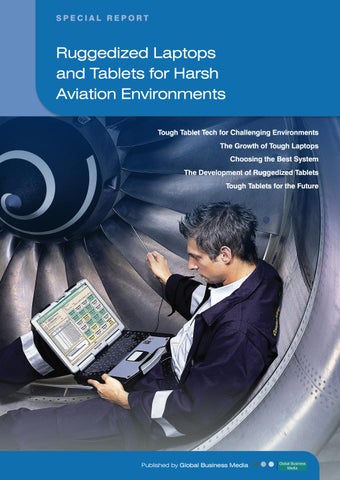
Ruggedized Laptops and Tablets for Harsh Aviation Environments Tough Tablet Tech for Challenging Environments The Growth of Tough Laptops Choosing the Best System The Development of Ruggedized Tablets Tough Tablets for the Future
Published by Global Business Media
RUGGED TECHNOLOGY FOR THE AIRLINE INDUSTRY From Electronic Flight Bag and maintenance, to ground operations and in-flight applications, Panasonic’s rugged Toughpad tablets and Toughbook notebook PCs are helping major names across the airline and airport industries achieve higher levels of efficiency and productivity than ever before. So if you’d like to experience the many benefits being enjoyed by businesses such as Vienna Airport, BA CityFlyer, Finnair, easyJet and Iberia, why not talk to us today?
Toughbook CF-20 with Intel® CoreTM m5 vProTM processor and Toughpad FZ-G1 and FZ-M1 with Intel® Core™ i5 vPro™ processors.
Visit: www.toughbook.eu Call: +44 (0)1273 765 114
Intel, the Intel logo, Intel Core, Intel vPro, Core Inside and vPro Inside are trademarks of Intel Corporation in the U.S. and other countries.
RUGGEDIZED LAPTOPS AND TABLETS FOR HARSH AVIATION ENVIRONMENTS
SPECIAL REPORT
Ruggedized Laptops and Tablets for Harsh Aviation Environments Tough Tablet Tech for Challenging Environments The Growth of Tough Laptops
Contents
Choosing the Best System The Development of Ruggedized Tablets Tough Tablets for the Future
Foreword
2
Tom Cropper, Editor
Tough Tablet Tech for Challenging Environments
3
Panasonic Marketing Europe GmbH
Easyjet and Finnair Greater Capability in the Cabin Published by Global Business Media
Case Study Vienna International Airport Published by Global Business Media
HEAVY-DUTY USE FROM LANDING TO TAKEOFF
Global Business Media Limited 62 The Street Ashtead Surrey KT21 1AT United Kingdom
GREATER FLEXIBILITY FOR OPTIMAL GROUND OPERATIONS
Switchboard: +44 (0)1737 850 939 Fax: +44 (0)1737 851 952 Email: info@globalbusinessmedia.org Website: www.globalbusinessmedia.org Publisher Kevin Bell Business Development Director Marie-Anne Brooks Editor Tom Cropper
EXTREME WEATHER – BAD NEWS FOR ANY NOTEBOOK
The Growth of Tough Laptops Tom Cropper, Editor
A Growing Market Challenges
Choosing the Best System Benefits
Advertising Executives Michael McCarthy Abigail Coombes
Choosing the Supplier
For further information visit: www.globalbusinessmedia.org The opinions and views expressed in the editorial content in this publication are those of the authors alone and do not necessarily represent the views of any organisation with which they may be associated. Material in advertisements and promotional features may be considered to represent the views of the advertisers and promoters. The views and opinions expressed in this publication do not necessarily express the views of the Publishers or the Editor. While every care has been taken in the preparation of this publication, neither the Publishers nor the Editor are responsible for such opinions and views or for any inaccuracies in the articles.
8
Jo Roth, Staff Writer
Senior Project Manager Steve Banks
Production Manager Paul Davies
6
Making a Choice
The Development of Ruggedized Tablets
10
James Butler, Staff Writer
Rise of the Tablet Rugged Technology Software Solutions Tablets versus Laptops
Tough Tablets for the Future
12
Jo Roth, Staff Writer
Refreshing Systems Eliminating Errors A New Generation of Products Meeting the Needs
© 2016. The entire contents of this publication are protected by copyright. Full details are available from the Publishers. All rights reserved. No part of this publication may be reproduced, stored in a retrieval system or transmitted in any form or by any means, electronic, mechanical photocopying, recording or otherwise, without the prior permission of the copyright owner.
References 14
WWW.AIRPORTTECHNOLOGYREPORTS.COM | 1
RUGGEDIZED LAPTOPS AND TABLETS FOR HARSH AVIATION ENVIRONMENTS
Foreword L
OOKING BACK over the past 15 years, it’s
Their article examines the evolution of the technology
remarkable how integral mobile computing has
and the key benefits this offers for airlines.
become to our work and leisure life. First, laptops
We will then look at the development of the rugged
started to displace desktop computers; then tablets
laptop market. A combination of high consumer
started to move in on laptops. Investment, driven
demand and rapid technological development is
by insatiable consumer demand has spurred
creating an enticing market opportunity – one which
innovation to unprecedented levels.
some of the major developers are looking to fill.
The impact on the industrial space has been
Even so, there is wide variation in the nature and
transformative, but some areas of aviation remained
quality of devices on offer. With single units costing
relatively untouched until recently. That is now
upwards of £1,000 and being ordered in bulk,
changing with the introduction of tough ruggedized
making the wrong choice can be a costly exercise for
laptops and tablets capable of functioning within the
consumers. Jo Roth will examine the key questions
most extreme environments.
buyers must ask when choosing a system. The
This pays obvious dividends for airports and
final two articles will focus on the most prevalent
aviators who often work in areas exposed to heavy
trends in the market and where this is going in the
vibrations, weather, extremes of temperatures
future. Industrial rugged computers are increasingly
with a high susceptibility to impact damage. As
following the commercial market, both in terms of the
ruggedized laptops and tablets become increasingly
sophistication of software, speed of processors and
sophisticated, they are helping airports manage risk,
much more. Moreover, lightness and mobility are key
reduce errors and streamline processes.
as the tablet increasingly takes center stage.
The first article in our Special Report comes from Panasonic, one of the leading names in this space. Their Toughbooks and Toughpads lead the market and have been deployed by some of the biggest airlines.
Tom Cropper Editor
Tom Cropper has produced articles and reports on various aspects of global business over the past 15 years. He has also worked as a copywriter for some of the largest corporations in the world, including ING, KPMG and the World Wildlife Fund.
2 | WWW.AIRPORTTECHNOLOGYREPORTS.COM
RUGGEDIZED LAPTOPS AND TABLETS FOR HARSH AVIATION ENVIRONMENTS
Tough Tablet Tech for Challenging Environments Panasonic Marketing Europe GmbH Very few tablets or laptops are capable of performing in the many difficult environments encountered in the aviation industry, but two major names – easyJet and Finnair – are discovering every day the many performance advantages delivered by Panasonic’s specialised Toughpad range.
Because Toughbooks are equipped with integrated wireless LAN, communication between airport workers can flow uninterrupted
T
HE FLIGHT deck of an aircraft of one of the world’s busiest airlines can be a tough place for technology. Demanding schedules, flying at altitude, and landing overnight at some of the coldest and hottest destinations in Europe all mean that any new equipment must be able to cope with the most difficult of conditions and still be user-friendly. So when easyJet was looking to update its pilot crews’ existing Panasonic Toughbook CF-19 rugged notebooks, it chose one of Panasonic’s latest rugged Toughpad tablets. Taking the burden from pilots, Panasonic’s rugged laptops were initially deployed as electronic flight bag (EFB) devices, to replace the paper documentation, weighing more than 20kg, that each plane had to carry in its flight deck. This reduced fuel costs significantly, as well as improving efficiency and ease of use for the crews. Moving to a tablet provided additional improvements, as Anthony Spouncer, easyJet’s senior project manager for IT operations systems, explains.
“We carried out desktop, simulator and actual trials with a well-known consumer tablet, but the device wasn’t suitable for aircraft. We had various update problems with our applications and fundamental issues around the suitability of the device. Keeping the device in the aircraft meant that it would be exposed to extreme temperatures overnight, which led to failures,” he says.
Easyjet and Finnair EasyJet has 226 aircraft, each carrying two Panasonic Toughpad tablets running Airbus FlySmart applications for calculations, Airbus AirN@v for engineering documentation, LIDO electronic route manual for charts and Vistair DocuNet for technical documentation. The devices are docked in cradles in the cockpits and have their own bespoke certified power solution. “The new Panasonic Toughpad tablets were the right choice for a number of factors,” continues Spouncer. “Their ability to withstand temperatures from -25 up to +65°C, rugged WWW.AIRPORTTECHNOLOGYREPORTS.COM | 3
RUGGEDIZED LAPTOPS AND TABLETS FOR HARSH AVIATION ENVIRONMENTS
reliability, long battery life and DO-160 certification set them apart.” Finnair, too, turned to Toughpad with the acquisition of 150 FZ-G1 tablets. One of Finnair’s key applications for the devices is performance calculation: the pilot uses the tablet to ensure performance requirements are met and to calculate optimal engine power for take-off.
Greater Capability in the Cabin
“In the future, the data connection will allow us to receive and share passenger data and other flightrelated information on the device,” Finnair Technical Pilot, Timo Seppälä
In the aircraft cabin, crew use the Toughpad as an electronic service manual. They can also use it to report potential issues such as set covers that need cleaning. “In the future, the data connection will allow us to receive and share passenger data and other flight-related information on the device,” Finnair Technical Pilot, Timo Seppälä says. “One of the key distinguishing features of the Toughpad was the display. Lighting conditions in the cockpit vary a lot. There could be direct sunlight from the window, so a sufficiently bright display is required. On the other hand, during dark hours, the displays and instruments are dimmed to very low levels to allow maximum outside visibility. Even on their lowest setting, however, consumer tablets are far too bright. “The Toughpad has a very wide brightness range, and Panasonic created custom firmware for us, giving greater range in lower brightness settings,” adds Seppälä. “This allowed us to match the brightness of the Toughpad displays with our cockpit displays. “From the outset, Panasonic understood the special characteristics of our operation. It was well informed on aviation requirements, since other airlines are also using Toughpad tablets and Toughbook notebook PCs. For example, Panasonic had already carried out many of the tests required by aviation authorities, which saved time for us,” Seppälä finishes.
4 | WWW.AIRPORTTECHNOLOGYREPORTS.COM
Case Study Vienna International Airport HEAVY-DUTY USE FROM LANDING TO TAKEOFF Nearly 350 planes take off from Vienna International Airport every day to over 190 destinations throughout the world. 18.8 million passengers were handled in 2007 alone. Traffic at this volume and scale must be handled efficiently: Every minute an aircraft sits on the ground costs money. So to accelerate and precisely track all ground operations, airport management made the decision to use Panasonic Toughbook Notebooks. To a casual observer, the hustle and bustle of the airport’s busy tarmac looks like utter chaos. Yet exactly the opposite is true. In fact, every vehicle movement is precisely coordinated and synchronized with the other. As a result, optimizing the facility’s already highly efficient processes and services is a difficult challenge - and one perfectly suited to the Panasonic Toughbook CF-18. In fact, 200 of the notebooks are already being used by ground crew every day. For airport management, the decision to go with the notebooks was an easy one. “We had a wide range of solutions to choose from - from handhelds to robust notebooks. But we were quickly able to separate the wheat from the chaff,” says Vienna International Airport system administrator Oliver Pleyer. As a result, the fully ruggedized Toughbook CF-18 was “cleared for takeoff” in record time. GREATER FLEXIBILITY FOR OPTIMAL GROUND OPERATIONS Thanks to its non-reflective swivel display, the CF-18 convertible notebook can be transformed easily from a classic notebook into a practical
RUGGEDIZED LAPTOPS AND TABLETS FOR HARSH AVIATION ENVIRONMENTS
everything runs efficiently and in real time, all procedures and work steps can be displayed in clear, meticulous detail. The Toughbook’s advantages speak for themselves, particularly when it takes longer than expected to service an aircraft. Here, too, the CF18 gets high marks with a long battery life of up to 8.5 hours - making it possible for ground crews to put several aircraft in the air without having to rely on an external power supply.
tablet PC. Even with work gloves, the touchscreen can be operated with a pen for quick and accurate data entry. And thanks to Panasonic’s special built-in solutions, Toughbook notebooks can be optimally integrated in every vehicle, ensuring smooth, reliable ground operations - from catering and baggage handling vehicles to pushback tractors. Work steps for aircraft loading procedures can be entered conveniently on site. Central operations can then use the data immediately to identify the position and activity of each individual vehicle. And because Toughbooks are equipped with integrated wireless LAN, communication between airport workers can flow uninterrupted. “The notebook’s wireless internet connectivity gives me a bird’s-eye view – I can stay on top of everything that’s going on at the airport,” says loading supervisor Stefan Holzapfel. And because
EXTREME WEATHER – BAD NEWS FOR ANY NOTEBOOK Even under the most miserable weather conditions, ground crew data remains safe and protected. Resistant to shocks and vibrations, the robust notebook can withstand extreme damage - even being dropped from a baggage loader. From freezing sub-zero temperatures to scorching sun on the tarmac, Panasonic Toughbooks are ready for action. And they are IP54 certified against water and dust. Vienna International Airport workers are more than satisfied with the Panasonic Toughbook CF-18. Light weight, long battery life and excellent data protection make the CF-18 the ideal tool for daily use throughout the facility. For quality monitoring, ramp services manager Alexander Winkler, there’s no question. “Panasonic Toughbooks are ideal – for our needs and for our vehicles.”
The Toughbook’s advantages speak for themselves, particularly when it takes longer than expected to service an aircraft
For more information on our specialized aviation technology, please visit www. toughbook.eu or call +44 (0)1273 765 114. Computer Product Solutions Panasonic Marketing Europe GmbH Hagenauer Strasse 43 65203 Wiesbaden Germany WWW.AIRPORTTECHNOLOGYREPORTS.COM | 5
RUGGEDIZED LAPTOPS AND TABLETS FOR HARSH AVIATION ENVIRONMENTS
The Growth of Tough Laptops Tom Cropper, Editor
In a bid to reduce costs and improve customer service, more and more airports are turning to ruggedized laptops and tablets.
C
The challenge for manufacturers of more expensive systems is to embark on an extensive campaign of customer education to highlight the benefits which come with additional costs
O M PU T ER S A N D t a b l e t s h ave become ubiquitous in every facet of life. In the aviation industry the transition to newer and more mobile technologies is facilitating improvements in efficiency and productivity, while simultaneously reducing waste, maintenance and errors. This, in turn, creates a gap in the market, which numerous companies are moving to fill. In adopting these technologies, though, airport operators and managers must understand precisely what is on offer and how to ensure they select the correct devices for their requirements. These choices come against a turbulent commercial backdrop. The aviation market is growing rapidly. Growth is currently 4%1 per year driven by increasing demand across the spectrum but especially in fast emerging economies such as China. This new business represents an opportunity, but also a sizable challenge – namely how can airports cope with the expected increase in capacity? With physical expansion limited, advances must be made in efficiency. Every second gained in any aspect of the airport management contributes to increased capacity as well as improved customer satisfaction.
A Growing Market In this respect ruggedized laptops and tablets represent a clear opportunity. They allow staff to be more mobile and to share data across departments. More importantly, they are taking IT to harder to reach areas of the airport, such as aircraft maintenance and repair. By doing so, much of the administrative burden can be transferred from paper-based systems to digital storage. The market for ruggedized laptops and tablets is tiny compared to the wider commercial landscape. However, this is a lucrative business in which bulk orders are the norm. Airports will require hundreds and thousands of gadgets to
6 | WWW.AIRPORTTECHNOLOGYREPORTS.COM
maintain operations. VDC research estimates the ruggedized laptop market is growing 10% year on year2. It stood at $5bn in 2014 and although rugged handheld volume was flat last year, revenue increased by 4%. Rugged smartphone use increased by 9.8% driven largely by growth in construction, utilities and manufacturing. This creates an opportunity which major suppliers are looking to fill. Big name companies such as Panasonic are delivering rugged devices for all sorts of industry partners. These devices are also attracting attention in the consumer market, where some customers enjoy the extra durability and enhanced features. Increasingly, though, the industrial market is beginning to mirror the consumer. The demand is for smaller, lighter and higher performance machines. As well as having a tough shell capable of withstanding all sorts of weather conditions, consumers are looking for the same wafer thin and light devices they enjoy in their day-to-day working life. They must contain numerous ports for multiple connectivity and maintain extra-long battery life. Android’s OS system is experiencing a marked increase in market share through the introduction of embedded manufacturing applications and increased use by first responders. Lighter, handheld tablets are replacing more cumbersome ruggedized laptops, enabling staff to become more mobile. This has benefits in areas such as check-ins where the action is moving away from the desks and to the passengers. Light, handheld devices carried by staff enable them to process passengers in a more timely and mobile manner.
Challenges The market still faces challenges. Cost pressures are persuading many companies to economize and make do with basic consumer items, such as iPads. The challenge is to persuade buyers
RUGGEDIZED LAPTOPS AND TABLETS FOR HARSH AVIATION ENVIRONMENTS
that this represents a false economy. Those businesses which compromise on quality will find products inadequate for their use. Conventional devices may be difficult to use outside, struggle to cope with weather conditions and require regular maintenance or replacement; the danger is that, having splashed out on regular devices, an airport manager will have to suffer the expense of replacing these with toughened products. Suppliers of ruggedized devices need to convince the market that, although these devices are more expensive, they will deliver the requisite performance levels and will be a cheaper proposition in the long run. In some cases it is simply a case of experience. Those airports which have used iPads and find that they are inadequate will have to turn to rugged tablets. The longer these products demonstrate continued use and high performance, the easier it will be for marketing teams to make the sale. However, waiting to learn from other airports represents a significant business risk. The market is becoming more and more competitive. Passengers have increasing choice in their airports and are showing a willingness to select those which offer a proven high standard of customer service over and above the main alternatives. Profit margins are coming under pressure, so every incremental gain
will deliver crucial dividends for hard pressed airport managers. In such situations there is a clear advantage to early adopters. Those who make the transition earlier will take on a risk, but will have clear opportunities to steal a march on the competition. In doing this, much depends on the selection of relevant technologies. With the market growing, there are a several different suppliers offering products at differing price points. The challenge for manufacturers of more expensive systems is to embark on an extensive campaign of customer education to highlight the benefits which come with additional costs. Adopting an inferior product will not only mean standards suffer, but it can also incur an extra charge through the need to overhaul and replace existing systems. Economizing now can mean a substantial charge later on in the process. Two factors combine to make these extremely interesting times for suppliers and manufacturers of tough laptops. The demand is there in that airports need more mobile and hardened devices, and so too is the technology. By developing a new generation of ultra tough and durable mobile computing technologies, airports can go a long way towards meeting many of their core business goals. The difficulty comes in understanding the nature of this technology and where it can go in the future.
Every second gained in any aspect of the airport management contributes to increased capacity as well as improved customer satisfaction
WWW.AIRPORTTECHNOLOGYREPORTS.COM | 7
RUGGEDIZED LAPTOPS AND TABLETS FOR HARSH AVIATION ENVIRONMENTS
Choosing the Best System Jo Roth, Staff Writer
Ruggedized laptops and tablets offer a range of benefits to airport operators, but care needs to be taken when choosing the correct system.
T
Transferring from a paper based administration process can be critically important in eliminating mistakes and reducing administration time and costs
HE MARKET for toughened tablets and laptops is evolving rapidly. A need to streamline processes, improve performance and reduce costs is prompting operators to look more carefully at their systems and how they can evolve to cope with a more demanding commercial environment. At the same time, the technology is evolving, offering a suite of more mobile and sophisticated platforms from which they can work. Even so, this technology is not fool-proof. Correct implementation of new systems and processes can go a long way towards helping an airport achieve its goals. Similarly, though, incorrect implementation can waste money and may lead to a short-term deterioration of service and performance. The key in assessing new systems is to truly realize the benefits they can bring and how they can be best incorporated into existing systems.
Benefits First, the benefits: A key improvement with the early adoption of rugged technology was in weight. Previously, aircrew and mechanics would have had to carry heavy and cumbersome documents. By transferring to a lighter laptop or iPad, the lives of personnel become significantly easier, and, in addition, they save fuel and improve the efficiency of their workload. Transferring from a paper based administration process can be critically important in eliminating mistakes and reducing administration time and costs. A study into human factors in aviation states that 80% of aviation maintenance errors come from human factors such as fatigue or overwork. Problems can be exacerbated in paper-based systems because of the sheer amount of technical data. Understanding the information requires expertise and specialist knowledge. Locating the issue can be time consuming and, in many cases impossible. Using computer technology, engineers can update data and see information on a real-time basis. Mistakes can be reduced or eliminated and, when they do occur, it can be easier for operators to identify what went wrong. 8 | WWW.AIRPORTTECHNOLOGYREPORTS.COM
An illustration of the benefits that can be realized comes from Taughanock Aviation Corp, which operates out of Ithaca Tompkins regional airport in New York. They estimate that they have saved between one and two hours a day by reducing the volume of paperwork and the risk of data entry errors3. They have achieved improvements in basic areas such as fuel management. Previously all fuel management processes were manual and paper driven. Using a tablet-based solution, operators can now gather information at the point of fueling and display real-time inventory visibility, statistical analysis and automated reporting. This reduces the need for paperwork and also accelerates the overall process. The first ruggedized laptops and tablets were able to achieve significant reductions, but the latest generations go even further. These tablets can weigh just a kilogram or so, taking lightness to an entirely new level. They push for the twin goals of delivering high quality tough units within a lighter and more mobile casing.
Making a Choice The benefits are clear, but that doesn’t mean they are without problems. Introducing new mobile computing technologies represents a significant upheaval. Staff who have become accustomed to one way of working will have to adapt to new technologies. Process changes can have unintended consequences which may hinder rather than improve performance. Any new project or technology can have teething problems which can reduce their value for the end-user. Much, therefore, depends on understanding the technology, assessing the need and implementing the correct solutions to meet overriding goals. A key factor to think about is the environment in which laptops will be working. They may be designed with sealed keyboards to protect against the intrusion of dust or water, to withstand shocks, corrosive chemicals, vibrations or extreme temperatures. All these conditions and more might be expected in an airport. Here,
RUGGEDIZED LAPTOPS AND TABLETS FOR HARSH AVIATION ENVIRONMENTS
small – when taking the overall budget of an airport into account – they still deserve attention. As well as the price of equipment, companies must also factor in the costs of process change and new associated infrastructure. Against that they can look at the possible efficiency savings, reduction in man hours and the risk of errors. Taking this data together, they should be able to make an assessment about whether or not this new technology represents a viable business proposition.
just a kilogram or so, taking lightness to
Choosing the Supplier laptops may need to cope with all weather conditions, harmful substances such as aviation fuel, constant vibrations, the risk of sudden impact, constant movement and damage. This is important because, although rugged laptops are becoming more common, some are more rugged than others. The standard of testing varies from company to company. Some go by the US military’s own measure, the MIL-STD 810G scale, to determine how much wear a device can take. This is based on a set of tests which include parameters such as extreme temperature and range all the way up to gunfire. Others bring in a third party to provide independent verification. Some do their own assessments and tests. This means buyers might find claims such as ‘designed to take…’ However, a little digging may reveal fundamental weaknesses in testing procedures. Buyers will have to understand what environments they are likely to be working in and what they want from the device – i.e. in terms of durability, performance and battery life. They will also need to know more about an individual company’s own testing procedures to assess how they perform. Cost is also an issue. Although the upfront cost of individual tablets or laptops may be relatively
These tablets can weigh
The choice of supplier will be key. As even a brief search on the internet will demonstrate, this is a busy and competitive market. Many of the major commercial IT companies have developed their own ruggedized computer technology and will be marketing it to the aviation industry. However, inevitably, there will be significant differences in the quality of different packages. Potential buyers will have to look at the background of any company – are they a generic technology provider, or have they taken time to properly assess the technological requirements of the aviation industry? How extensive is their track record and do they have a reputation for ongoing development and consultation with clients? The more bespoke a service, the more valuable it will be for the end user. There is much to be gained by bringing a more mobile IT orientated approach to business. Even so, there are risks. These must be properly understood and weighed against the very obvious benefits the technology can bring. By assessing need and ensuring the technology can cope with the demands which will be placed upon it, operators can achieve significant success. Over and above this, though, will be a comprehension of how the aviation market is developing. This will have an impact on the trends shaping technology now and into the future.
an entirely new level. They push for the twin goals of delivering high quality tough units within a lighter and more mobile casing
WWW.AIRPORTTECHNOLOGYREPORTS.COM | 9
RUGGEDIZED LAPTOPS AND TABLETS FOR HARSH AVIATION ENVIRONMENTS
The Development of Ruggedized Tablets James Butler, Staff Writer
How new technologies have enabled tablet computers to provide a whole new range of services to airports in even the most inhospitable of environments.
S It was in 2010 that Steve Jobs introduced the iPad to the world. At the time it was the technology the world didn’t know it needed or even wanted. Within a few weeks, though, it could be found everywhere
INCE THEIR introduction, tablet computers have taken the world by storm. They permeate every part of our life both in the entertainment and business worlds. They can be seen everywhere from shop retailers to businessmen logging into their emails on the go and even doctors helping with treatment. Now, as ruggedized technology becomes more sophisticated, they are entering harsh and challenging industrial environments.
Rise of the Tablet It was in 2010 that Steve Jobs introduced the iPad to the world. At the time it was the technology the world didn’t know it needed or even wanted. Within a few weeks, though, it could be found everywhere. But while, Jobs may have envisioned its commercial success, he might not have expected it could have been used quite so widely for industry and business. Tablets are making themselves felt in many areas of aviation. Staff working for Iberia Airlines can be seen roving the terminals with handheld iPads. Because flight information is updated through an integral IT system, they can help passengers quickly and efficiently with any queries including checking them into their flights. It reduces the necessity for queueing and makes the entire experience a little less stressful for passengers. Elsewhere, staff and engineers within the terminal can use tablet computers to quickly access information from any location in the terminal. For example, technology monitoring the flow of footfall through the airport can quickly sound alarms alerting managers. They, in turn, can take all the necessary measures to remedy the situation – such as assigning additional staff – instantly without having to return to their workstations. In 2014, Iberia also became one of a growing number of airlines to switch to paperless cockpits through the use of iPads4. While technologies such as these are very worthwhile, until now there has been a problem
10 | WWW.AIRPORTTECHNOLOGYREPORTS.COM
transferring the benefits of tablets to every part of the airport. Attempts to use iPads in some of the more challenging environments within the airport have been thwarted. In conditions which can include heavy vibrations, severe heat fluctuations, exposure to bad weather or corrosive elements, conventional technologies are insufficient. Also, the software at times has proved fragile: In April 2015, a fleet of 8,000 iPads used by American Airlines was hit by a software glitch which made it impossible to retrieve flight plans5.
Rugged Technology Replacing these models are ruggedized, weatherproofed heavy duty tablets designed for use in even the harshest of conditions. This is possible through the development of tough military-grade casings which can insulate tablets from harsh weather conditions. Even so, this experiences some resistance. The first concern is cost. The latest rugged tablets can cost upwards of £1,500, compared with a few hundred pounds for consumer laptops. Consumer devices have also often had the edge in terms of a higher display resolution, higher pixel density and clock speed. This has been enough to prompt some airlines to deploy iPads rather than the rugged tablet equivalent. Doing so, though, often causes more trouble than it solves. Consumer tablets experience high instances of failure. They are also not kitted out for demanding continuous industrial scale use. Software is not durable enough and battery life insufficient, while screen brightness can also be an issue. Lighting varies considerably. Units may be used outside in daylight in which case they need to be bright enough to be visible. At the same time, use in cockpits involves low lighting levels for maximum visibility in night time hours. In such circumstances a brightly lit iPad might not be the best solution. Therefore, despite the additional cost, rugged tablets offer a far more viable option for the aviation industry.
RUGGEDIZED LAPTOPS AND TABLETS FOR HARSH AVIATION ENVIRONMENTS
Software Solutions Moreover, software and computing packages are evolving rapidly with new applications being produced almost as quickly as in the wider commercial market. This means computing speeds are beginning to match top-of-the range entertainment and gaming machines offering peak usability for industrial clients. As we move into the future, tablets will also deliver multiple enhanced features for users. The range of functions they can be used for has grown steadily. From being simple replacements for flight manuals, they are becoming efficient data input and management tools. Tablets come with integrated barcode scanners enabling mobile asset management, wireless, GPS and fast Intel processors to deliver all the functionality users need. With connectivity becoming a wider trend, they will also be able to synch with other systems around the airport, delivering details on passengers and much more. This will contribute to improvements in security as well as improving the level of customer service to passengers.
Tablets versus Laptops Another key development for the future is the increasing use of tablets versus laptops. Durable laptops deliver key IT services to areas of the airport which would normally have been unsuitable for delicate technology. In doing so they have contributed towards many
operational improvements, but now they too are being phased out. As the computing power of tablets grows, their lightness, versatility and mobility are proving a winning ingredient. They can be up to a thousand pounds cheaper, while enabling staff to roam around terminals more freely. In effect, in doing so, they have been liberated, being able to offer a higher standard of customer service. Others are opting for the best of both worlds with hybrid systems. These use a detachable ‘tablet’ screen together with a keyboard. This is a rapidly growing market in consumer electronics and the same trend is repeating itself in the aviation market. The future, therefore, would seem to be firmly tilting towards tablets. They are becoming tough enough, fast enough and cheap enough to deliver in the most challenging environments. The benefits are being felt all over the airport operation, from faster check-in times, to resource optimization, location status, maintenance and repair, cargo tracking and much more. Each of these uses comes with a significant bottom line improvement for airports. As airports move into the future, the demands being placed upon them are growing exponentially. The technical advances and improvements of ruggedized tablets are crucial in helping airports to meet their key challenges into the future.
Software and computing packages are evolving rapidly with new applications being produced almost as quickly as in the wider commercial market
WWW.AIRPORTTECHNOLOGYREPORTS.COM | 11
RUGGEDIZED LAPTOPS AND TABLETS FOR HARSH AVIATION ENVIRONMENTS
Tough Tablets for the Future Tom Cropper, Editor
How tablets and laptops have been deployed to revolutionize maintenance across the airport.
T
Computers can be used to store real time information such as maintenance issues, flight status, crew details and other information. In doing so, they can eliminate errors and inefficiencies experienced by paper administration
HE AVIATION industry is one of the most innovative users of technology. Articles excitedly talk of a future filled with holographic assistants, mobile apps and automated car parking. Even so, many areas remain remarkably old fashioned relying on paper-based administrative systems. This is partly due to the fact that harsh environments experienced in many areas of an airport inhibit the use of computers. That has been changing over the past few years with the emergence of toughened ruggedized laptops and tablets capable of functioning in the harshest of conditions. Now, as the technology gains widespread adoption, the question is – where can this technology go?
Refreshing Systems In 2011, American Airways and Alaska Airways made a major change by replacing their bulky 200 page flight manuals with small handheld iPads after the Federal Aviation Agency approved their use for cockpits. They were followed shortly afterwards by United Airlines who announced that “the paperless flight-deck represents the next generation of flying6.” They believed the lighter load could save 320,000 ,gallons of fuel. Since then, British Airways, Iberia, and Ryanair have all followed suit. At a stroke, this eliminated the need for substantial amounts of paperwork and enabled pilots to access information seamlessly through a light device. This innovation signposted a new direction – one away from paper-based processes and towards IT. Computers can be used to store real time information such as maintenance issues, flight status, crew details and other information. In doing so, they can eliminate errors and inefficiencies experienced by paper administration.
Eliminating Errors Speaking to Infotech, Bob Leisenring, Project Manager for Mead & Hunt, a construction firm working at Michigan Airport, described the problems encountered by paper-based manual
12 | WWW.AIRPORTTECHNOLOGYREPORTS.COM
systems: “Mistakes were easier to make because it was necessary to reproduce the information between the field daily reports and the office spreadsheets and then again on to the MDOT standard forms7,” he says. Michigan has also switched to a paperless administration system. Using shareable software solutions, they and other companies are able to eliminate issues surrounding manual data errors, bad handwriting and duplicate information. In addition, they can accelerate the throughput of information allowing real time sharing of data. However, although Alaska Airways’ use of iPads may have reaped dividends, the technology still has shortcomings. In terms of durability, battery life, and performance, conventional products are not always up to the task. The environment around an aircraft can involve corrosive substances, extreme hot and cold, as well as all kinds of weather conditions. Devices will have to withstand vibrations and impact damage and continue functioning for prolonged periods of time on a single charge. Software may not offer the required reliability or endurance. It is only with the advent of high quality ruggedized laptops that it has been possible to make substantial leaps forward. A prime example comes from British Airways. By 2013 they were using ruggedized tough pads to record aircraft and flight details coming out of London City Airport8. Flight details and status can be added using touch screens transmitting data immediately to servers which feed into the BA City Flyer Maintenance system. This eliminates the need for manual data inputting, provides optional PDF prints of technical log pages and allows engineers and crews to access real time information. As well as reducing the possibility of data input errors, it also enhances transparency of the overall process, and accelerates turnaround times. In short, it reduces the amount of time during which an aircraft is out of service and allows it to spend more time generating revenue for the airline.
RUGGEDIZED LAPTOPS AND TABLETS FOR HARSH AVIATION ENVIRONMENTS
A New Generation of Products Today, the technology is becoming increasingly common and is being used to various degrees in many different areas of the airport. As devices prove their value, the technology is developing at an increased pace. A new generation of products is taking performance to a higher level. This generation is characterized by a number of key trends: •F rom laptops to tablets: Ruggedized laptops have already proved benefits in many areas of the airport. However, they are now progressively being replaced by more mobile tablets. These can provide access to the same amount of data while still offering the durability to exist in harsh environments. •H igh performance: Workers’ experience of computing is informed by their personal use. As such they expect the same level of performance. Computers are being built to the same high speed specifications delivering market-beating speed and performance. •L ightness: Inevitably, ruggedized laptops imply additional strength and weight. Demand is great for high performance units which come in a light casing. Lighter products lead to greater usability and improved enthusiasm among employees. •S pecialisms: Industry specific apps are shaping the choice of operating systems with Android gaining market share versus Apple. •C onnectivity: As a whole, airports are becoming more connected. Data is being shared and stored across multiple platforms. Paper-based systems are being replaced by digital, and different departments are able to collaborate remotely. Mobile computing technologies make this easier, faster and more effective.
The industrial aviation market is mirroring the commercial. Just as tablets are taking territory from laptops among consumers, so they are beginning to replace laptops in aviation, but the emergence of a market for hybrids is also likely to be a key trend. Panasonic has been one of the leading innovators in this space. One of their latest products, the Toughbook CF-209 is designed to combine the best of both worlds – a rugged notebook with a detachable tablet which can be used in six different modes. Powered by a sixth generation Intel Core TM vPRO TM processor and capable of running Windows 10, it offers considerable performance, durability and flexibility for different tasks.
It is only with the advent of high quality ruggedized laptops that it has been possible to make substantial leaps forward
Meeting the Needs Innovations such as these hold considerable potential for use in airports. Different areas will present different challenges and have their own requirements. From exterior areas, which will be exposed to the elements, to terminals which may only require the protection afforded by semiruggedized products, flexibility will be an asset. Aviation represents a lucrative potential market. The challenge for developers and innovators alike will be to come up with solutions which meet its needs. The good news is that the technology is likely to be there. Such is the power of the consumer market that the speed of innovation is faster here than in almost any other area. In turn, these innovations will be making their way into other markets such as the military, construction and aviation. Although technology has already made significant strides forward, more may be to come in the future.
WWW.AIRPORTTECHNOLOGYREPORTS.COM | 13
RUGGEDIZED LAPTOPS AND TABLETS FOR HARSH AVIATION ENVIRONMENTS
References: 1
2
IATA Forecasts Rapid Growth: http://www.iata.org/pressroom/pr/pages/2014-10-16-01.aspx VDC Releases Quarterly Rugged Device:
http://blog.vdcresearch.com/mobile_and_wireless/2014/09/vdc-releases-results-of-its-quarterly-rugged-device-tracker.html 3
Tablets lift productivity: http://www.ruggedtabletpc.com/rugged-tablet-news/topic/airport
4
Iberia Moves to Paperless Cockpits:
http://www.computerworlduk.com/news/it-vendors/iberia-moves-paperless-cockpits-with-lufthansa-systems-ipad-apps-3541704/ 5
iPads cause chaos in the Air: http://www.thememo.com/2015/04/29/ipads-cause-chaos-in-the-skies/
6
United Airlines Replaces Flight Manuals with iPads:
http://www.telegraph.co.uk/technology/apple/8720249/United-Airlines-replaces-flight-manuals-with-iPads.html 7
Airport Construction Goes Paperless in Michigan: https://www.infotechfl.com/downloads/fieldmanager/airportFM.pdf
8
British Airways Becomes First UK Airline to Deploy Panasonic Toughpad Tablets:
http://business.panasonic.co.uk/computer-product/press-and-events/british-airways-first-uk-airline-to-deploy-panasonic-toughpad-tablets 9
Panasonic Introduces World’s First Rugged Detachable Notebook: http://business.panasonic.co.uk/computer-product/news-and-events/panasonic-introduces-the-world-s-first-fully-rugged-detachable-notebook-toughbook-cf-20-for-business
14 | WWW.AIRPORTTECHNOLOGYREPORTS.COM
RUGGEDIZED LAPTOPS AND TABLETS FOR HARSH AVIATION ENVIRONMENTS
Notes:
WWW.AIRPORTTECHNOLOGYREPORTS.COM | 15
RUGGEDIZED LAPTOPS AND TABLETS FOR HARSH AVIATION ENVIRONMENTS
Notes:
16 | WWW.AIRPORTTECHNOLOGYREPORTS.COM
Airport And Airline Professionals Find Solutions To Their Business Challenges With Airport Technology Reports
For the past decade, Airport Technology Reports has been helping airports, airlines, and their service providers to find new solutions to their technical, commercial, and operational challenges. Our Special Reports provide readers with an unparalleled depth of information on specialist subjects, which receive limited coverage in the mainstream airport and airline media. Each report is designed to facilitate more informed purchasing decisions, with a unique mix of: • Subject specific technical information • Insight and knowledge from internationally recognised key opinion leaders • Independent data and analysis • Unbiased editorial content
subscriptions@globalbusinessmedia.org www.globalbusinessmedia.org
Visit: www.primarycarereports.co.uk