100 Borough High Street London, SE1 1LB United Kingdom
Global Banking & Finance Review is the trading name of GBAF Publications LTD
Company Registration Number: 7403411
VAT Number: GB 112 5966 21 ISSN 2396-717X.
The information contained in this publication has been obtained from sources the publishers believe to be correct. The publisher wishes to stress that the information contained herein may be subject to varying international, federal, state and/or local laws or regulations.
editor
Dear Readers’
Welcome to Issue 85 of Global Banking & Finance Review.
As finance, technology, and business converge, the sources of competitive advantage are evolving. Success today depends less on scale and more on an organisation’s ability to adapt, innovate, and create lasting value. In this issue, we explore the leaders, institutions, and ideas driving that shift.
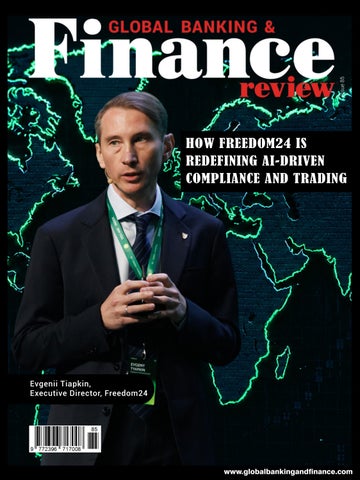
Our cover story features Evgenii Tiapkin, Executive Director of Freedom24, who discusses how AI-driven compliance, intelligent automation, and integrated investment platforms are redefining the future of digital investing. His insights highlight the growing role of technology in balancing innovation, efficiency, and regulatory excellence.
We also feature Matt Phillips, Head of Banking, Northern Europe at Diebold Nixdorf, who examines why the next competitive advantage for retail banks will be their capacity to change. As customer expectations continue to evolve, the ability to execute transformation consistently and at scale is becoming a critical differentiator.
In an exclusive interview, Hasan Asadullozoda, Chairman of OJSC Oriyonbonk, shares his perspective on leadership, financial inclusion, innovation, and sustainable growth, offering valuable lessons on building institutions that create lasting impact.
This issue also highlights CIBC Private Banking’s approach to ultra-high-net-worth advisory, demonstrating how personalised service, strategic liquidity management, and integrated expertise are helping families preserve and grow wealth across generations.
Beyond these features, we examine the forces quietly reshaping modern business and finance— from intangible assets and organisational intelligence to data-driven decision-making, technology ecosystems, and behavioural finance. Together, these themes reveal a world where knowledge, adaptability, and strategic insight are becoming the true drivers of long-term success.
Thank you for reading, and we hope you enjoy this issue.
The purchaser or reader of this publication assumes all responsibility for the use of these materials and information. However, the publisher assumes no responsibility for errors, omissions, or contrary interpretations of the subject matter contained herein no legal liability can be accepted for any errors. No part of this publication may be reproduced without the prior consent of the publisher.
Editor, Global Banking & Finance Review
Stay caught up on the latest news and trends taking place by signing up for our free email newsletter, reading us online at http://www.globalbankingandfinance.com/ and download our App for the latest digital magazine for free on Google Play and the Apple App Store
Mr. Hasan Asadullozoda, Chairman, OJSC Oriyonbonk
Beyond
The Quiet Advantage: Why Modern Business Success Is Becoming Less Visible
The Invisible Advantage: Why Modern Business Power Is No Longer What It Seems
The Hidden Flow: Why Modern Finance Is No Longer About Money Alone
The Decision Gap: Why Traders Know What to Do—But Don’t Always Do It
The Hidden Equation: Why Business Success Is Being Calculated Differently
The Invisible Engine: How Technology Is Quietly Rewriting Business Power
The Quiet Tech Shift: What’s Really Reshaping Modern Business
Matt Phillips, Head of Banking, Northern Europe, Diebold Nixdorf
INTERVIEW
Evgenii Tiapkin, Executive Director, Freedom24
How Freedom24 Is Redefining AI-Driven Compliance and Investment
Inside CIBC Private Banking’s Approach to Ultra-High-Net-Worth Advisory
For ultra-high-net-worth (UHNW) families, meaningful partnership goes far beyond banking transactions. It’s about having a trusted advisor who understands the unique challenges of significant wealth, someone who can anticipate needs, respond with agility, and deliver specialized expertise with discretion. CIBC Private Banking exists to help Canada’s most successful families navigate complexity, seize opportunity, and build multi-generational continuity.
That’s the purpose of CIBC Private Banking: a relationship-led model designed for families with significant wealth who are balancing business interests, cross-border needs, multi-generational priorities, and legacy planning. The goal isn’t simply to manage finances. It’s to help families make confident decisions through life’s most consequential moments.
High-touch service built for access, not volume
For many affluent families, what matters most isn’t the range of products, it’s how quickly and thoughtfully their needs are met. CIBC’s approach is designed to foster close relationships and broad accessibility, with more than 50 locations nationwide and a low private banker-to-household ratio. This ensures proactive coverage and genuine support.
The strength of CIBC’s service is evident in client loyalty. According to client surveys conducted in 2025, CIBC Private Banking reported a net promoter score above 85 from hundreds of affluent respondents, demonstrating deep trust and appreciation for speed of response, adviser accessibility, and steady guidance through transitions.
Industry recognition has followed, with CIBC Private Banking receiving recognition from Euromoney, Global Finance, and Global Banking & Finance Review for its Client Services and Ultra-HighNet-Worth and private banking platform.
Liquidity as strategy, not administration
For UHNW families, liquidity is rarely a simple question of cash flow. It’s a strategic lever used to fund acquisitions, manage concentrated positions, support philanthropy, de-risk at the right moment, or optimize cross-border exposure.
CIBC differentiates itself with sophisticated multi-currency solutions aligned to how UHNW balance sheets are structured and deployed. This includes special-arrangement pricing, dual-currency instruments, and tailored credit facilities calibrated to timing, risk, and opportunity. The objective is control: helping families retain strategic flexibility while staying aligned to long-term goals.
Advice that respects real-world complexity
Ultra-high-net-worth families face a wide spectrum of challenges, there’s no one-size-fits-all solution. An entrepreneur preparing for a liquidity event requires a distinct strategy compared to a professional navigating complex compensation, or a real estate owner managing portfolio concentration and leverage. Even within a single family, priorities often shift across generations, from business succession to legacy planning.
CIBC’s approach is intentionally contextual, shaped around industries, life stages, and family dynamics:
• Entrepreneurs receive integrated planning across credit strategy, investment positioning, and transition preparation.
• Professionals benefit from coordinated banking and advice that fits time constraints and risk preferences.
• Real estate owners are supported with lending, liquidity, and portfolio alignment.
• Rising-generation stewards are guided in building financial fluency, governance understanding, and confidence as future decision-makers.
Bringing the full bank to the client seamlessly
At CIBC, we believe that exceptional client experience is rooted in coordination, delivering expertise precisely when it’s needed, so our clients
never have to navigate the institution themselves. Our unique value is in making complex financial needs simple and seamless, ensuring that every solution feels effortless, no matter how sophisticated the planning behind it may be.
CIBC Private Bankers serve as cross-bank connectors, coordinating access to specialized capabilities across CIBC Wood Gundy, Private Investment Counsel, Commercial Banking, Capital Markets, CIBC Bank USA, and CIBC Caribbean. This integration creates a unified experience for our clients, transforming intricate financial landscapes into clear, manageable pathways.
To illustrate the impact of this approach, we have developed a hypothetical example based on a composite of our clients’ experiences. A family-run business in Calgary, long supported by CIBC Commercial Banking, was introduced to Private Banking for personal liquidity needs. Following the sale of their business for more than CA$200 million, the family relied on their Private Banker to guide them through the transition from a business enterprise to a family enterprise. CIBC orchestrated Family Enterprise Advisory support, establishing a multi-generational framework for tax, estate, and philanthropy planning, and partnered with CIBC Global Asset
strategy.
The outcome was not only timely liquidity, diversified holdings, durable family governance, and a values-led plan for the long term. For the family, this seamless integration meant greater peace of mind, confidence that their legacy was secure, and the freedom to focus on their future together. Ultimately, the family felt empowered, knowing their financial foundation was strong and their values would guide the next generation.
A partner for decisions that define legacies
CIBC Private Banking distinguishes itself by being present for families at their most pivotal moments. It’s not just the expertise or the breadth of resources, it’s the quiet commitment to understanding what matters most, and the willingness to walk alongside clients as they navigate uncertainty, opportunity, and change. For ultra-high-net-worth families navigating complexity and shaping legacy, that combination matters.
To learn more or connect with an advisor, visit cibc.com/privatebanking.
Management and CIBC Wood Gundy to deliver a tailored investment
How Freedom24 Is Redefining AI-Driven Compliance and Investment
Freedom24 has been recognised across multiple categories this year. From your perspective, what underlying strategic priorities have driven innovation across both compliance technology and investment platforms?
The recognition reflects something we have been building deliberately over a number of years — the conviction that compliance and product are not separate disciplines. In too many financial organisations, they operate in parallel: the product team builds, and the compliance team reviews. We made a structural decision early on to integrate these functions from the outset. That decision shapes everything.
Our strategic priorities come down to three things. First, owning our technology — we do not rely on third-party infrastructure for critical functions. Second, treating regulatory architecture as a competitive advantage rather than a cost centre. And third, building for scale from day one, so that what works for a thousand clients works equally well for half a million. The awards across Neo Compliance and Tradernet are a reflection of how those priorities are beginning to compound.
Neo Compliance has been awarded for its AI-driven approach. How does the platform integrate artificial intelligence into compliance processes, and what differentiates it from more traditional compliance frameworks?
Traditional compliance frameworks were designed for a different era — slower, more fragmented, built around manual review cycles and periodic audits. In a digital brokerage operating across the EU and EEA, that model becomes a structural bottleneck almost immediately. Queues form. Decisions slow. The client experience deteriorates.
Neo Compliance was designed around a different assumption: that compliance should be continuous, not episodic. We apply AI at the points where it genuinely adds value — document analysis, risk profile assessment, pattern recognition across client activity, and the generation of structured outputs for review. The critical distinction is that we do not use AI to replace human judgement in final decisions. We use it to ensure that when a compliance professional makes a decision, they are working with complete, structured, and current information rather than spending their time on data retrieval.
What differentiates us from legacy frameworks is precisely that balance — automation where it creates efficiency, human oversight where it creates accountability. In an uncertain regulatory environment, that combination is not optional. It is a prerequisite for sustainable growth.
In an increasingly complex regulatory environment, how important is automation and data intelligence in ensuring consistency and scalability within compliance operations?
They are not merely important — they are definitional. A firm that cannot scale its compliance infrastructure at the same pace as its client base is not really scaling at all. It is accumulating risk.
Operating under MiFID II, within the CySEC framework, and as a subsidiary of a US-listed entity subject to SEC reporting standards and SOX requirements, we face a compliance environment that is genuinely multilayered. The only way to maintain consistency across that environment — across markets, languages, jurisdictions, and client profiles — is through intelligent automation. Data intelligence allows us to identify exceptions, monitor continuously, and respond to regulatory change without rebuilding processes from scratch each time. That agility is increasingly a differentiator in this industry.
Tradernet has been recognised both as a digital investment platform and an integrated investment solution. How do you define "integration" in this context, and what does it enable for users?
Integration, in our context, means that a client does not experience the complexity that sits behind the platform. They should not have to navigate between tools to move from research to analysis to execution. They should not encounter friction at the moment of decision. The entire journey — from market data and analytics through to order placement and portfolio monitoring — should feel like a single, coherent experience.
What this enables, practically, is better decision-making. When analytical tools are embedded in the investment flow rather than hosted in a separate environment, clients use them more consistently. They arrive at decisions with more context. Over time, that leads to more disciplined investing — which is ultimately what we are trying to support.
For institutional and sophisticated retail clients alike, integration also means API connectivity, cross-asset access across US, European and Asian exchanges, and the kind of performance under load that professional users require. Tradernet is built to serve both audiences without compromising on either.
User expectations around investment platforms continue to evolve. What key factors are shaping platform development today, particularly in terms of functionality, accessibility, and performance?
Three factors stand out. The first is speed — not just execution speed, but the speed at which a client can move from an idea to an informed position. The second is accessibility: the assumption that a sophisticated investment platform must be complex to use is simply outdated. Our clients expect professional-grade tools presented with consumer-grade clarity. The third is reliability. In volatile markets, platform stability is not a feature — it is the baseline expectation. Any degradation at a moment of market stress is not forgiven quickly.
Evgenii Tiapkin, Executive Director, Freedom24
Underlying all three is a shift in the profile of the European retail investor. They are more informed, more active, and more demanding than a decade ago. Platform development has to reflect that evolution continuously, not in annual release cycles.
With growing competition in digital investment, how does Freedom24 approach platform innovation while maintaining reliability and operational stability?
Proprietary infrastructure is the answer. Because we own our technology stack, we can iterate on the product without creating instability in the underlying systems. We are not dependent on vendor release schedules or third-party architecture decisions. That ownership is what allows us to innovate at pace while maintaining the operational standards our clients and regulators expect.
We also apply a discipline of building compliance logic into new features from the design stage rather than retrofitting it later. That approach eliminates a significant category of risk and accelerates time to deployment. Innovation and stability are not in tension when the architecture is built correctly from the beginning.
To what extent does data play a role across both Neo Compliance and Tradernet, particularly in enhancing decision-making, risk management, and user experience?
Data is the connective tissue across both platforms. In Neo Compliance, it enables continuous client monitoring, real-time risk profiling, and the kind of audit trail that satisfies regulators operating under both European and US standards. In Tradernet, it powers the analytical layer that informs client decisions — market data, portfolio analytics, instrument screening, and performance attribution.
The more important point is that data governance is not an afterthought for us. Given our reporting obligations to the SEC and our adherence to PCAOB audit standards, the integrity and traceability of data across the organisation is a structural requirement. The discipline that imposes internally translates directly into product quality externally.
Looking ahead, how do you see the intersection of AI, compliance, and digital investment platforms evolving over the next few years, and where is Freedom24 positioning itself within that landscape?
The direction is clear: AI will become a deeper layer in both compliance and investment infrastructure across the industry. The firms that will lead are those that have invested in the data foundations and proprietary systems to deploy it responsibly — not those who adopt it reactively as a feature.
For Freedom24, the next phase is about deepening the ecosystem around our core brokerage offering. That means expanding our geographic footprint across Europe, continuing to invest in platform capabilities, and extending the integration between our compliance infrastructure and our client-facing tools. We are also focused on what we call intelligent compliance — using AI not just to manage risk, but to improve the client journey at the points where regulatory requirements touch the user experience directly.
Ultimately, the firms that will define the next chapter of European digital investment will be those that can combine technological capability with institutional discipline. That is the standard we are building towards.
A New Source of Advantage for Retail Banks: Building the Capacity to Change
Retail banking leaders have spent more than a decade modernising channels, launching new digital journeys and improving customer access. Those efforts were essential. Yet as I look at how the industry is evolving, I believe the next source of advantage will be defined less by what banks launch and more by how consistently and quickly they can keep improving.
The pace of customer expectations continues to rise, shaped not only by other banks but by digital experiences across everyday life. At the same time, growth and profitability outlooks are becoming more uncertain in many markets, intensifying the need for disciplined execution. Against this backdrop, many senior leaders tell me the same thing: we know what needs to change, but making change happen at speed is increasingly difficult. That tension is not a lack of ambition. It is a question of organisational capacity.
Customers are rebalancing relationships, quietly
One of the most important shifts in retail banking is the way customer behaviour has changed. Increasingly, customers do not leave their bank outright. Instead, they open additional relationships and gradually move activity—payments, deposits, and engagement—towards whichever provider feels easiest and most reliable. Account numbers may remain stable even as value migrates elsewhere.
This “quiet rebalancing” changes the economics of loyalty. Retention is no longer just a marketing or product challenge; it becomes an execution challenge. Banks must continuously improve experiences, because customers can now redistribute their financial lives incrementally and with very little friction.
The experience promise is set by the market, not by peers
Customer expectations are no longer shaped solely by comparisons within banking. Consumers increasingly judge banks against whatever feels simplest elsewhere—whether that is retail, travel, or digital services more broadly. As a result, tolerance for friction has declined sharply, while expectations for seamless, cross channel experiences continue to rise.
This is why having a strong digital front end is no longer sufficient. Customers experience banking through outcomes: how quickly issues are resolved, how reliably transactions execute, and how consistently support is delivered across channels. In practice, experience is less about design alone and more about how well the organisation works behind the scenes.
Why change feels slow in many banks
When banks struggle to adapt at pace, technology is often blamed. Technology matters, but in my experience, it is rarely the root cause. Three structural constraints come up repeatedly.
First, day to day operations consume organisational energy. Complex environments must run flawlessly every day. When incidents occur or volumes spike, the best people are naturally pulled into stabilising the present, leaving less capacity to build the future. Over time, recovery becomes routine, and acceleration never quite happens.
Second, modernisation has become permanent, yet many organisations still treat it as episodic. Cloud adoption, data modernisation and AI are no longer one off initiatives; they are ongoing conditions. That reality demands operating models designed for continuous change, not periodic transformation programmes.
Third, complexity accumulates faster than it is removed. Every new capability adds layers—systems, processes, dependencies. Without a deliberate approach to simplification, even well intentioned transformation efforts can slow the organisation down.
From transformation programmes to change capacity
Taken together, these constraints point to a larger shift underway. Leading banks are moving away from large, episodic transformation initiatives and toward building change capacity as an institutional capability.
The objective is not constant disruption. It is the ability to evolve in steady, controlled increments—making improvement routine rather than exceptional. That requires operating models where stability and change reinforce each other instead of competing for attention.
This is also where the discussion around in house versus outsourcing needs to be reframed.
Where outsourcing and managed services add strategic value
In the coming years, outsourcing will matter less as a cost tactic and more as a way to industrialise execution. Used well, managed services allow banks to scale capacity, absorb complexity and sustain momentum— without spreading leadership attention too thinly. Three areas are particularly relevant:
• Technology build: As change becomes continuous, banks need delivery capacity that scales with ambition. External partners can provide repeatable execution engines, while the bank retains ownership of customer promise, priorities and decisions.
Phillips, Head of Banking, Northern Europe, Diebold Nixdorf
Matt
• Technology maintenance: The burden of maintaining complex estates and keeping them compliant is one of the least visible but most powerful drags on change. Treating maintenance as a strategic discipline—focused on simplification and resilience—makes future improvement easier, not harder.
• Operations (“run”): Reliability and responsiveness are becoming sources of trust. As customer loyalty fragments, consistent execution in everyday moments increasingly determines where activity flows. Industrialised operating models help ensure service quality does not depend on heroics.
The critical point is that outsourcing does not mean outsourcing identity. Banks must continue to own their proposition, their customer relationships and the decisions that define trust. Managed services simply strengthen the organisation’s ability to deliver on those commitments.
Patterns emerging across the industry
Across markets, a few patterns are becoming clear. Banks that stabilise execution create space to innovate. Banks that decouple change from constant firefighting move faster with less risk. And banks that recognise quiet shifts in customer behaviour early tend to focus investment on reliability and responsiveness rather than novelty alone.
None of these outcomes comes from technology alone. They come from operating models that make improvement sustainable.
Looking ahead
As customer loyalty becomes more fluid and expectations continue to rise, the ability to change repeatedly and reliably will define future competitiveness in retail banking.
The most successful banks will treat change as a managed capability—not a periodic event. They will design organisations where stability enables progress, where execution scales without fragility, and where leadership attention is focused on value creation rather than operational drag.
At Diebold Nixdorf, we work with retail banks globally on exactly these challenges, helping them build the change capacity needed to remain relevant in an increasingly demanding environment. Our Branch Automation Solutions combine self-service, branch and digital capabilities to facilitate seamless, richer, and faster consumer journeys, driving new efficiency levels. Is your institution ready to lead the way? Let’s connect if you’d like to explore how your bank can drive efficiency and elevate the customer experience in retail banking.
Leading Beyond Banking: Hasan Asadullozoda on Trust, Transformation and Tajikistan's Financial Future
Q1. Mr. Asadullozoda, what key principles have guided your leadership at OJSC ORIYONBONK, and how have they contributed to your recognition as Best Chairman of the Year?
My leadership at OJSC ORIYONBONK has been anchored in three core principles: integrity, client-centricity, and continuous improvement. From the outset, I firmly believed that a bank is not merely a financial intermediary — it is a trusted partner in the economic lives of individuals, businesses, and communities. Maintaining the highest ethical standards has therefore been nonnegotiable.
Equally important has been our unwavering focus on the customer. We have consistently sought to understand the evolving needs of our clients and to deliver solutions that genuinely add value to their financial wellbeing. This customer-first philosophy has driven every major decision we have made as an institution.
Finally, I have always championed a culture of continuous improvement — encouraging our teams to challenge the status quo, embrace innovation, and never settle for mediocrity. I believe that recognition such as Best Chairman of the Year is not a personal achievement; it is a reflection of the collective dedication of every member of the ORIYONBONK family. I accept this honour on behalf of all of them.
Q2. Can you share the major strategic initiatives you implemented in recent years that have significantly enhanced the bank's growth and market position?
Over the past several years, we have pursued a multi-dimensional growth strategy that has meaningfully strengthened our position in Tajikistan's financial sector.
First, we undertook a comprehensive modernisation of our core banking infrastructure, enabling faster, more reliable service delivery across all our channels. This laid the technical foundation for the digital transformation that followed.
Second, we expanded our branch and service network with a deliberate focus on underserved regions, bringing professional banking services to populations that had previously relied on informal financial channels. This expansion was not simply about growth in numbers — it was about deepening financial inclusion across Tajikistan.
Third, we significantly broadened our product portfolio for small and medium-sized enterprises, recognising that SMEs are the backbone of our national economy. Tailored credit facilities, trade finance instruments, and cash management solutions have allowed us to become a preferred banking partner for this vital segment. Finally, we invested heavily in human capital — recruiting, training, and retaining talented professionals who share our vision and values. I am firmly convinced that sustainable institutional growth is, above all, a function of the quality of an organisation's people.
Q3. How has OJSC ORIYONBONK leveraged technological innovation to improve customer experience, operational efficiency, and financial inclusion in Tajikistan?
Technology has become one of the most powerful enablers of our mission, and we have embraced it with real conviction.
On the customer experience front, we have significantly enhanced our digital banking capabilities, providing clients with convenient, round-the-clock access to their accounts, payments, and other essential services through modern mobile and internet banking platforms. The feedback from our clients has been overwhelmingly positive — they value the speed, simplicity, and security that these platforms offer.
From an operational standpoint, the automation of a wide range of back-office and compliance processes has reduced processing times, minimised errors, and freed our staff to focus on higher-value, relationshipdriven activities. This has had a measurable positive impact on both our productivity and our service quality.
Perhaps most importantly, technology has been a powerful tool for advancing financial inclusion. By removing geographic and logistical barriers, our digital solutions have made it possible for citizens in remote areas to access banking services for the first time. We regard this as one of our most significant contributions to Tajikistan's sustainable development.
Q4. What role does social responsibility play in your leadership, and what initiatives has the bank introduced to support communities and sustainable development?
Social responsibility is not a peripheral concern at ORIYONBONK — it is deeply embedded in our institutional identity. We genuinely believe that a bank's success must be measured not only in financial terms, but also by the positive impact it creates in the society it serves.
Among our most meaningful initiatives has been our commitment to financial literacy. We have organised educational programmes for young people, entrepreneurs, and rural communities, equipping them with the knowledge they need to make informed financial decisions and to participate more actively in the formal economy.
We have also been a consistent supporter of social infrastructure projects, contributing to initiatives in education, healthcare, and cultural development across various regions of Tajikistan. Supporting the wellbeing of communities is, for us, an expression of gratitude to the society that has placed its trust in us.
Furthermore, we have taken steps to align our lending and investment practices with principles of environmental sustainability, recognising that responsible banking must take into account the long-term health of our natural environment. This is an area where we intend to deepen our commitment in the years ahead.
Mr. Hasan Asadullozoda Chairman, OJSC Oriyonbonk
Q5. What were the biggest challenges you faced as chairman, and how did your leadership navigate the bank through them successfully?
Leadership at the helm of a financial institution inevitably means confronting challenges — sometimes anticipated, sometimes entirely unexpected. Among the most significant tests we faced were periods of macroeconomic volatility and the disruptions brought about by the global pandemic.
During these difficult periods, our priority was threefold: to protect the financial stability of the institution, to support our clients through their own difficulties, and to maintain the confidence of all our stakeholders. This required a combination of prudent risk management, transparent communication, and decisive yet measured action.
We implemented targeted support measures for clients facing genuine hardship, while simultaneously strengthening our capital and liquidity positions to ensure the bank's resilience. I was — and remain — immensely proud of how our team responded to these pressures. It is precisely in moments of adversity that organisational character is revealed.
Another ongoing challenge has been navigating an increasingly complex and evolving regulatory environment. We have addressed this by investing in compliance capabilities and by maintaining constructive, open dialogue with regulatory authorities. We regard sound regulation as a foundation for long-term institutional credibility, not as an obstacle to be circumvented.
Q6. Looking ahead, what are your key priorities for OJSC ORIYONBONK, and how do you plan to maintain its competitive edge in Tajikistan's banking sector?
Looking forward, our strategic agenda is both ambitious and purposeful.
Our foremost priority is to continue deepening our digital transformation. The pace of technological change in the global financial industry is accelerating, and we are committed to keeping ORIYONBONK at the leading edge of innovation in our market. This includes advancing our data analytics capabilities, expanding our digital product offerings, and exploring the opportunities presented by emerging financial technologies.
Second, we intend to broaden and deepen our service to the SME and retail segments, offering increasingly personalised and value-added solutions that respond to the specific needs of each client group.
Third, we will continue to invest in our people — developing leadership talent at all levels of the organisation, fostering a culture of excellence and accountability, and building the capabilities needed to compete effectively an evolving marketplace.
Finally, we are committed to strengthening our international partnerships and correspondent banking relationships, which are vital to supporting our clients' cross-border business activities and to integrating Tajikistan more fully into the global financial system. I am genuinely optimistic about what lies ahead for ORIYONBONK and for Tajikistan's financial sector.
Q7. Finally, what advice would you give to emerging business leaders and future bank chairpersons striving to achieve excellence in today's dynamic financial landscape?
I would offer several reflections drawn from my own experience. First and foremost: lead with integrity. In banking, as in all aspects of business and public life, your reputation is your most valuable asset. Guard it with the utmost care. Every decision you make — particularly in difficult moments — will either reinforce or erode the trust that stakeholders have placed in you.
Second, never stop learning. The financial world is changing at a pace that was unimaginable even a decade ago. The leaders who will thrive are those who remain genuinely curious, who are willing to challenge their own assumptions, and who actively seek out new knowledge and perspectives. Third, invest in your people. An institution is ultimately only as strong as the individuals who comprise it. Create environments where talented people can grow, where diverse perspectives are valued, and where excellence is both recognised and rewarded.
Fourth, keep the long view. It can be tempting in business to prioritise short-term metrics at the expense of long-term value creation. Resist that temptation. Build institutions that are designed to endure — institutions founded on solid values, sound governance, and genuine service to society.
And finally: remember that leadership is a privilege, not merely a position. Use it wisely, use it humbly, and always in service of something larger than yourself.
The Quiet Advantage: Why Modern Business Success Is Becoming Less Visible
For much of the past century, business success was easy to recognise. It was visible in scale—factories, offices, fleets, and physical expansion. Companies grew by adding more: more assets, more employees, more markets. Size and presence were the clearest signals of strength.
Today, that visibility is fading.
The most important drivers of business success are becoming harder to see, harder to measure, and often absent from traditional indicators. Competitive advantage is shifting away from what companies own to what they know, how they operate, and how effectively they adapt. This is not a marginal evolution. It is a structural transformation in how business value is created and sustained.
In this new landscape, success is no longer defined by scale alone—but by something quieter, more subtle, and significantly more powerful.
The Decline of Visible Value
Historically, tangible assets formed the foundation of corporate value. Industrial-era businesses relied on physical infrastructure, capital investment, and production capacity to compete. These assets were not only essential—they were measurable, reportable, and visible.
That is no longer the case.
Today, intangible assets—such as data, intellectual property, brand equity, and organisational capability—are driving the majority of business value. Among leading companies, these assets now account for a dominant share of market valuation. For example, intangible assets represent roughly 90% of the market value of major public companies, compared to just a fraction several decades ago (Forbes).
This shift reflects a broader transformation in the economy. As digital technologies expand and knowledge becomes the primary input to production, physical assets are no longer the primary constraint on growth. Instead, value is increasingly created through information, relationships, and innovation.
The result is a paradox: the most valuable elements of a business are often the least visible.
The Rise of the Intangible Core
The modern business is increasingly built around what can be described as an intangible core. This includes assets such as proprietary data, software systems, customer relationships, organisational processes, and human capital.
These assets share several defining characteristics.
First, they are scalable. Unlike physical assets, which require proportional investment to expand, intangible assets can often be replicated at minimal cost. A software platform, for example, can serve millions of users without requiring equivalent increases in infrastructure. (McKinsey & Company)
Second, they are cumulative. Intangible assets tend to increase in value over time as they are used, refined, and integrated. Data becomes more valuable as it grows. Brands strengthen with recognition and trust. Organisational knowledge deepens through experience.
Third, they are interconnected. Unlike physical assets, which often operate independently, intangible assets derive value from how they interact. Data feeds analytics, which informs decision-making, which shapes customer experience, which reinforces brand value.
Research shows that investment in intangible assets has been growing significantly faster than investment in tangible assets, reflecting their increasing importance in driving productivity and growth (Santander). This shift is not just about new types of assets. It is about a new logic of value creation.
From Ownership to Capability
One of the most significant implications of this transformation is the shift from ownership to capability.
In the traditional model, competitive advantage was based on controlling scarce resources—factories, supply chains, or capital. In the modern model, advantage is based on capabilities: the ability to analyse data, innovate, adapt, and execute effectively.
Capabilities are inherently less visible than assets. They are embedded in processes, systems, and people. They are not easily captured in financial statements, yet they determine how effectively a business operates.
Deloitte highlights that many organisations underutilise their intangible assets because they lack structured approaches to managing them, despite their central role in value creation (Deloitte).
This creates both a challenge and an opportunity. Companies that can identify and develop their capabilities gain a significant advantage— one that is difficult for competitors to replicate.
The New Economics of Scale
The shift toward intangible assets also changes the nature of scale. In traditional industries, scaling required proportional investment. To produce more, companies needed more factories, more labour, and more capital. Growth was linear and resource-intensive.
In the intangible economy, scaling follows a different pattern. Once an asset such as software, data, or intellectual property is created, it can be deployed across a wide range of applications with relatively low incremental cost.
This creates what economists describe as increasing returns to scale—where the value generated grows faster than the resources
required. It also allows companies to expand rapidly without the constraints of physical infrastructure.
The implications are significant. Growth becomes less about accumulation and more about leverage—using existing capabilities to generate new value.
The Measurement Gap
Despite the importance of intangible assets, they remain difficult to measure.
Traditional accounting systems are designed to capture tangible assets, which have clear costs and lifespans. Intangible assets, by contrast, are often internally generated and evolve over time. As a result, they are frequently underrepresented or excluded from financial statements.
This creates a gap between book value and market value. Companies may appear less valuable on paper than they are in reality, because their most important assets are not fully captured.
Research highlights that traditional valuation models often fail to account for the economic potential of intangible assets, particularly in digital environments (Frontline Journals).
For investors and analysts, this means relying on alternative indicators—such as innovation capacity, customer engagement, and data capabilities—to assess value.
For businesses, it means recognising that value is not always visible in conventional metrics.
The Strategic Shift Toward Intangibles
As the value shift accelerates, businesses are rethinking their strategies.
Investment priorities are changing. Companies are allocating more resources to research and development, data infrastructure, and talent development—areas that build intangible assets rather than physical ones.
This is reflected in broader economic trends. Investment in intangible assets has been shown to correlate strongly with productivity and growth, particularly in knowledge-intensive sectors (Santander).
At the same time, companies are placing greater emphasis on managing intangible assets strategically. This includes protecting intellectual property, strengthening brand identity, and developing organisational capabilities.
The challenge lies in integration. Intangible assets are most valuable when they are aligned and mutually reinforcing. Data, technology, and human capital must work together to create value.
The Role of Technology in the Value Shift
Technology is both a driver and an enabler of the value shift. Digital platforms, cloud computing, and artificial intelligence allow businesses to create and scale intangible assets more effectively. They enable the collection and analysis of data, the automation of processes, and the delivery of personalised experiences.
At the same time, technology accelerates competition. As barriers to entry are lowered, companies must continuously innovate to maintain their advantage.
This creates a dynamic environment where value is constantly being created, challenged, and redefined.
Human Capital as a Core Asset
In the intangible economy, people play a central role.
Human capital—skills, knowledge, creativity, and collaboration—is one of the most important drivers of value. Employees are not just executing tasks; they are creating ideas, solving problems, and building relationships.
This places greater emphasis on talent management, organisational culture, and continuous learning. Companies must invest in developing their workforce, not just as a resource, but as a strategic asset.
The connection between human capital and intangible value is particularly strong in industries where innovation and knowledge are critical.
Risk and Resilience in the Intangible Economy
While intangible assets offer significant advantages, they also introduce new risks.
Data breaches, intellectual property disputes, and reputational damage can have immediate and far-reaching consequences. Unlike physical assets, which degrade gradually, intangible assets can lose value rapidly.
At the same time, strong intangible assets can enhance resilience. Companies with strong brands, loyal customers, and robust capabilities are better able to withstand disruptions.
This dual nature underscores the importance of managing intangible assets carefully. They are both a source of strength and a potential vulnerability.
The Future of Business Value
The shift toward intangible assets is not a temporary trend.
It reflects a fundamental transformation in the structure of the global economy.
As digital technologies continue to evolve, the importance of intangible assets will only increase. Data, software, and intellectual property will become even more central to value creation.
At the same time, the challenges associated with measuring and managing these assets will persist. Businesses will need to develop new frameworks, metrics, and strategies to navigate this environment.
Conclusion: The Power You Cannot See
The quiet transformation of business value is reshaping how companies compete, grow, and succeed.
The most important assets are no longer physical or visible. They are embedded in data, systems, relationships, and capabilities. They do not occupy space, yet they define outcomes.
This shift requires a new way of thinking about business. Success is no longer about accumulation—it is about utilisation. It is about how effectively a company can leverage what it knows, how it operates, and how it adapts.
The companies that thrive in this environment will not necessarily be the largest or the most visible. They will be the ones that understand the invisible forces shaping value—and learn how to harness them.
Because in the modern economy, the true source of advantage is not what you can see.It is what you cannot.
The Hidden Equation: Why Business Success Is Being Calculated Differently
For decades, business success followed a familiar formula. Companies grew by expanding operations, increasing revenue, and building tangible assets. Performance could be observed, measured, and compared through financial statements and market share. The rules were clear, and the signals were visible.
Today, that equation is quietly being rewritten.
Modern business success is no longer determined solely by what is measurable on paper. Instead, it is shaped by a deeper and more complex set of variables—intangible assets, data capabilities, organisational intelligence, and adaptive strategy. These elements are not always visible, yet they increasingly define outcomes.
What makes this transformation particularly significant is its subtlety. There is no single disruptive moment or clear dividing line between old and new models. Instead, the shift unfolds gradually, embedded within everyday decisions and operations. Yet its implications are profound: the logic of business is changing from the inside out.
The Shift Beneath Traditional Metrics
Traditional business metrics—revenue growth, profit margins, and asset accumulation—remain important. However, they are no longer sufficient to explain performance in the modern economy.
One of the clearest indicators of this shift is the growing divergence between book value and market value. Many of the world’s most valuable companies have relatively modest tangible assets but command high valuations based on expectations of future performance.
This divergence reflects the increasing importance of intangible assets. These include intellectual property, data, brand equity, organisational processes, and human capital—assets that lack physical form but generate economic value. (Wikipedia)
The rise of these assets has fundamentally altered how value is created. Instead of relying on physical production and scale, businesses are leveraging knowledge, information, and innovation to drive growth.
Intangible Assets as the New Foundation
The importance of intangible assets is not theoretical—it is measurable at a systemic level.
Investment in intangible assets has grown significantly over the past two decades, outpacing investment in physical assets in many advanced economies. (McKinsey & Company) These investments include spending on software, research and development, branding, and organisational development.
What makes intangible assets particularly powerful is their ability to scale and compound.
Unlike physical assets, which require additional resources to expand, intangible assets can often be replicated at minimal cost. A piece of software, for example, can be deployed across multiple markets without significant additional investment.
At the same time, intangible assets tend to increase in value as they are used. Data becomes more valuable as it is analysed and refined. Brands strengthen with recognition and trust. Organisational knowledge deepens over time.
Research shows that companies that invest heavily in intangible assets tend to outperform their peers in terms of growth and productivity, highlighting their role as a key driver of competitive advantage. (McKinsey & Company)
This shift from physical to intangible value represents a fundamental transformation in the structure of business.
Data as a Strategic Asset
Among intangible assets, data occupies a central position.
Data is no longer a byproduct of business activity—it is a core input
into decision-making, innovation, and value creation. Organisations increasingly treat data as a strategic asset, integrating it into their operations and using it to drive performance. (Deloitte)
The economic role of data is comparable to that of traditional capital. It is a “storable factor input” that contributes directly to production and value creation, even though it is often underrepresented in financial statistics. (OECD)
The implications are significant.
First, data enables more informed decision-making. By analysing patterns and trends, businesses can anticipate changes in demand, optimise operations, and identify new opportunities.
Second, data enhances efficiency. Automated systems can use data to streamline processes, reduce costs, and improve productivity.
Third, data creates new forms of value. Data-driven products and services, such as personalised recommendations or predictive analytics, generate revenue streams that were not possible in traditional models.
As organisations become more data-driven, the ability to collect, analyse, and act on data becomes a defining capability.
The Rise of Organisational Intelligence
Beyond data, the modern business environment is increasingly shaped by organisational intelligence—the collective ability of an organisation to learn, adapt, and execute effectively.
Organisational intelligence is not a single asset. It is an emergent property that arises from the interaction of people, processes, and technology. It includes decision-making frameworks, operational systems, and cultural attributes such as adaptability and collaboration.
In data-driven organisations, this intelligence is embedded in everyday operations. Employees use data to inform their work, systems provide real-time insights, and decision-making processes are continuously refined.
McKinsey describes the future enterprise as one where data is “embedded in every decision, interaction, and process,” enabling organisations to operate more effectively and respond more quickly to change. (McKinsey & Company)
This shift transforms the nature of business capability. Success is no longer about having the right resources, but about using those resources intelligently.
The Changing Nature of Competitive Advantage
The rise of intangible assets and organisational intelligence is reshaping competition.
In traditional markets, competitive advantage was often based on scale. Larger companies could produce more efficiently, negotiate better terms, and dominate distribution channels.
In the modern environment, advantage is increasingly based on differentiation and adaptability. Companies compete on their ability to innovate, personalise, and respond to changing conditions.
This shift is evident in the growing importance of capabilities such as data analytics, customer experience design, and strategic agility.
Research shows that intangible assets, particularly data and intellectual property, play a central role in shaping firm value and competitive positioning in the digital economy. (frontlinejournals.com)
As a result, the competitive landscape is becoming more dynamic. Smaller or more agile companies can compete effectively by leveraging intangible assets, while larger organisations must adapt to maintain their advantage.
The Measurement Problem
One of the most challenging aspects of this transformation is measurement.
Traditional accounting systems are designed to capture tangible assets and realised performance. They are less effective at capturing the value of intangible assets or future potential.
This creates a gap between reported financial performance and actual value creation. Companies may appear undervalued on their balance sheets, while others may be valued highly based on expectations.
The difficulty of valuing intangible assets is a well-recognised challenge. These assets are inherently non-physical and often lack clear market benchmarks, making them difficult to quantify accurately. (Wikipedia)
This measurement problem has broader implications. It affects investment decisions, risk assessment, and strategic planning. It also reinforces the importance of qualitative analysis in understanding business performance.
The Role of Technology in Value Creation
Technology is both a driver and an enabler of the hidden equation in modern business.
Digital technologies—such as cloud computing, artificial intelligence, and advanced analytics—enable the creation and scaling of intangible assets. They also enhance organisational intelligence by providing real-time insights and automating routine processes.
At the same time, technology increases competition. As barriers to entry are lowered, companies must continuously innovate to maintain their advantage.
The integration of technology into business processes also blurs traditional boundaries. Finance, operations, and strategy are becoming increasingly interconnected, reflecting the systemic nature of modern business.
Risk in the Invisible Economy
The shift toward intangible assets introduces new forms of risk.
Unlike physical assets, which tend to depreciate gradually, intangible assets can lose value rapidly. A data breach, reputational crisis, or technological disruption can have immediate and significant consequences.
At the same time, intangible assets are subject to greater uncertainty. Their value depends on future outcomes, which are inherently unpredictable.
This requires new approaches to risk management. Businesses must adopt more dynamic and adaptive frameworks, incorporating real-time data and predictive analytics to identify and mitigate risks.
The Integration Imperative
As the drivers of value become more complex, integration becomes increasingly important.
Value is not created by individual assets in isolation, but by how they interact. Data, technology, human capital, and organisational processes must work together to generate outcomes.
This requires a holistic approach to strategy and management. Companies must align their resources, capabilities, and objectives to maximise the value of their intangible assets.
Those that succeed in this integration gain a significant advantage, as they are able to leverage their assets more effectively and respond more quickly to change.
The Future of Business Success
The transformation of business value is ongoing.
As digital technologies continue to evolve, the importance of intangible assets and organisational intelligence will only increase. Data will become more central to decision-making, and capabilities will become more important than resources.
At the same time, the challenges associated with measurement and management will persist. Businesses will need to develop new frameworks and strategies to navigate this environment.
The future of business success will be defined by those who can understand and leverage the hidden equation—those who can integrate data, technology, and human capability into a coherent and adaptive system.
Conclusion: What Lies Beneath
The quiet transformation of business is reshaping how companies compete, grow, and succeed.
The most important drivers of value are no longer visible on factory floors or balance sheets. They are embedded in data, systems, relationships, and capabilities. They operate beneath the surface, shaping outcomes in ways that are not always immediately apparent.
This shift requires a new way of thinking.
Success is no longer about accumulation—it is about utilisation. It is about how effectively a company can leverage what it knows, how it operates, how it adapts.
The companies that thrive in this environment will not necessarily be the largest or the most visible. They will be the ones that understand the forces shaping value—and learn how to harness them.
Because in modern business, the most important equation is no longer the one you can see.
It is the one that runs beneath everything.
The Hidden Flow: Why Modern Finance Is No Longer About Money Alone
For most of modern history, finance has been defined by a simple premise: the efficient allocation of capital. Money flowed from savers to borrowers, from investors to enterprises, from markets to opportunities. Institutions were built to manage this flow— banks, exchanges, funds—each playing a defined role in a largely predictable system.
Today, that premise is being quietly rewritten.
Finance is no longer just about money. It is increasingly about information, intangibles, and the structures that connect them. Capital still matters, but it is no longer the sole determinant of financial power or value. Instead, the financial system is being reshaped by forces that are less visible but more influential—data, expectations, risk perception, and intangible assets.
This transformation is not dramatic in appearance. It does not announce itself with a single disruptive event. Instead, it unfolds gradually, embedded within markets, institutions, and decisionmaking processes. Yet its implications are profound: the flow of finance is no longer defined solely by capital, but by what sits behind it.
The Evolution of Financial Value
Traditionally, financial value was tied closely to tangible assets and measurable outputs. Companies were valued based on physical capital, production capacity, and cash flows. Financial markets reflected this reality, pricing assets according to observable fundamentals.
Over time, however, the composition of value has changed.
Intangible assets—such as intellectual property, data, brand equity, and organisational capabilities—have become central to corporate valuation. Global investment in these assets has grown steadily, reaching trillions of dollars annually and outpacing investment in physical capital across major economies (WIPO).
This shift has important financial implications. Unlike tangible assets, intangible assets are difficult to measure, harder to collateralise, and often underrepresented in financial statements. Yet they drive future earnings and influence investor expectations.
As a result, financial markets are increasingly shaped not just by what companies own, but by what they are expected to become.
The Expanding Role of Intangible Capital
The growing importance of intangible assets has fundamentally altered the nature of finance.
In traditional models, financing decisions were closely linked to physical assets. Loans could be secured against property or equipment, and investments were evaluated based on tangible returns.
In the intangible economy, this relationship is less direct. Many of the most valuable assets—such as software, algorithms, or brand reputation—cannot be easily used as collateral. This creates new challenges for financing and valuation.
The OECD notes that investment in intangible assets is now a key driver of productivity growth, but it is also subject to greater financial constraints due to information asymmetry and valuation difficulty (ONE MPI). Investors must rely more heavily on expectations, projections, and qualitative assessments.
At the same time, research shows that intangible assets have a positive impact on firm value and performance, reinforcing their importance in financial decision-making (Taylor & Francis Online).
This creates a paradox at the heart of modern finance: the most important drivers of value are often the least visible and the hardest to quantify.
Finance as a System of Expectations
As the nature of value changes, so too does the nature of finance itself.
Modern financial markets are increasingly driven by expectations rather than static measures. Investors price assets based on anticipated future performance, not just current results. This forward-looking perspective amplifies the role of intangible factors such as innovation, brand strength, and strategic positioning.
In this context, finance becomes less about the movement of capital and more about the interpretation of signals. Data, narratives, and perceptions all play a role in shaping financial outcomes.
This is evident in the way markets respond to information. Announcements related to technology, strategy, or innovation can have immediate and significant effects on valuation, even if they do not involve immediate financial changes.
The implication is that financial value is increasingly constructed through a combination of data, interpretation, and expectation.
The Data Layer of Finance
One of the most significant drivers of this transformation is the rise of data.
Data has become a foundational element of financial systems, influencing everything from investment decisions to risk management. Financial institutions rely on data analytics to assess creditworthiness, forecast
market trends, and optimise portfolios.
The integration of data into finance has several key effects.
First, it enhances decision-making. By analysing large datasets, organisations can identify patterns and trends that would otherwise remain hidden. This allows for more informed and timely decisions.
Second, it increases speed. Financial markets operate in real time, with data flowing continuously and decisions being made at unprecedented speeds.
Third, it changes the distribution of power. Access to high-quality data and advanced analytics capabilities can provide a significant advantage, allowing some participants to anticipate market movements more effectively than others.
In this sense, data is not just a tool—it is a form of capital in its own right.
Risk Reimagined in a Complex System
The transformation of finance also extends to how risk is understood and managed.
In traditional models, risk was often associated with measurable
factors such as interest rates, creditworthiness, or market volatility. While these factors remain important, the rise of intangible assets and complex systems introduces new dimensions of risk.
For example, the value of a company may depend heavily on its reputation, intellectual property, or technological capabilities. These assets are inherently more volatile than physical assets, as they can be affected by changes in perception, competition, or innovation.
At the same time, the interconnected nature of modern financial systems means that risks can propagate more quickly and unpredictably. A disruption in one part of the system can have cascading effects across markets and institutions.
Research highlights that intangible investments, while driving growth, also require different approaches to risk management due to their unique characteristics (ONE MPI).
This requires a shift from static risk models to more dynamic and adaptive frameworks.
The Changing Role of Financial Institutions
Financial institutions themselves are evolving in response to these changes.
Banks, asset managers, and other financial entities are no longer just intermediaries of capital. They are becoming interpreters of information, leveraging data and analytics to guide decisionmaking.
This shift is evident in the growing importance of technology within finance. Digital platforms, algorithmic trading, and AI-driven analytics are transforming how financial services are delivered and consumed.
At the same time, the boundaries between financial and nonfinancial organisations are becoming less distinct. Companies in sectors such as technology and retail are increasingly offering financial services, integrating payments, lending, and investment into their ecosystems.
This convergence reflects a broader trend: finance is becoming embedded within business processes, rather than operating as a separate function.
Capital Allocation in the Intangible Economy
The allocation of capital is at the core of finance, and it is being reshaped by the rise of intangible assets.
In traditional models, capital allocation decisions were based on tangible investments with predictable returns. In the intangible economy, these decisions are more complex.
Investments in research and development, software, or brand development may not generate immediate returns, but they can create significant long-term value. This requires a different
approach to evaluation, one that considers uncertainty, optionality, and strategic positioning.
McKinsey’s analysis shows that higher investment in intangible assets is associated with higher productivity and economic growth, suggesting that effective capital allocation in this area is critical for long-term performance (Santander).
This places greater emphasis on strategic judgment, as financial decisions must balance short-term performance with long-term potential.
The Measurement Challenge
One of the most persistent challenges in modern finance is measurement.
Traditional financial metrics are designed to capture tangible assets and realised performance. They are less effective at capturing the value of intangible assets or future potential.
This creates a disconnect between reported financial performance and actual value creation. Companies may appear less valuable on paper than they are in reality, while others may be valued highly based on expectations rather than current results.
Academic research suggests that improved disclosure of intangible assets can enhance the accuracy of financial analysis and forecasting, highlighting the need for better reporting frameworks (IFRS).
Until such frameworks are fully developed, financial decision-making will continue to rely on a combination of quantitative and qualitative assessments.
Stability and Resilience in Financial Systems
The shift toward intangible and data-driven finance also has implications for stability.
Interestingly, intangible investments have shown resilience during periods of economic disruption. Unlike physical assets, which may be affected by supply chain disruptions or economic downturns, intangible assets can continue to generate value even in adverse conditions (IPWatchdog).
This resilience contributes to the stability of firms and, by extension, financial systems. However, it also introduces new vulnerabilities, particularly in areas such as cybersecurity and intellectual property.
Balancing these factors is a key challenge for modern finance.
The Future of Finance: Beyond Capital
As the financial system continues to evolve, it is becoming clear that capital alone is no longer the defining element of finance.
Instead, finance is increasingly shaped by a combination of capital, information, and capability. These elements interact in complex ways, influencing how value is created, measured, and distributed.
This transformation has several implications.
First, financial advantage will increasingly depend on the ability to interpret and act on information, rather than simply access capital.
Second, the boundaries between finance and other domains—such as technology and operations—will continue to blur.
Third, the nature of financial decision-making will become more complex, requiring a broader set of skills and perspectives.
Conclusion: The Flow Beneath the Surface
The evolution of finance is not always visible. It does not manifest in dramatic shifts or sudden disruptions. Instead, it unfolds gradually, reshaping the underlying structure of financial systems.
Money still flows, but it flows differently. It is guided by data, influenced by expectations, and shaped by intangible forces that are not always apparent. The hidden flow of modern finance is not just about capital—it is about the infrastructure of value that supports it.
Understanding this shift is essential for navigating the future of finance. It requires moving beyond traditional models and recognising the deeper forces at work.
Because in today’s financial system, the most important movements are not always the ones you can see.
They are the ones that happen beneath the surface.
The Invisible Engine: How Technology Is Quietly Rewriting Business Power
For decades, technology has been framed as a tool—something businesses adopt to improve efficiency, reduce costs, or enhance productivity. It has been seen as an enabler, operating in the background while strategy, leadership, and capital drove decisionmaking.
That framing is no longer sufficient.
Today, technology is no longer just supporting business—it is redefining it. It is reshaping how value is created, how organisations compete, and perhaps most importantly, where power resides. The most significant technological transformation of our time is not about devices, software, or even artificial intelligence in isolation. It is about a deeper structural shift: the emergence of an invisible engine that is quietly reconfiguring the foundations of business.
This transformation is subtle, often unfolding beneath the surface of everyday operations. Yet its implications are profound. Technology is no longer a layer on top of business. It is becoming the architecture beneath it.
The Shift from Tool to Infrastructure
Historically, businesses adopted technology in discrete ways— installing systems to manage inventory, automate processes, or support communication. These technologies operated within defined boundaries, enhancing existing models without fundamentally altering them.
Today, technology functions differently. It is no longer confined to specific functions or departments. Instead, it operates as an integrated infrastructure that permeates every aspect of business activity.
Research on digital transformation highlights that organisations across industries are being forced to rethink their strategies and operations as they adapt to a digital world (ScienceDirect). This shift is not about incremental improvement—it is about redefinition. Digital technologies now connect processes, people, and data into unified systems. Cloud platforms, APIs, and data ecosystems enable organisations to operate in real time, responding to changes as they occur rather than reacting after the fact.
This integration transforms technology from a tool into a foundation. It becomes the environment in which business operates, rather than a component of it.
The Rise of the Data-Driven Core
At the heart of this transformation lies data. Data is no longer a byproduct of business activity—it is a primary driver of it.
Modern organisations generate vast amounts of data from operations, customer interactions, and digital systems. This data is analysed, interpreted, and used to inform decisions at every level.
Data technology—encompassing big data analytics, artificial intelligence, and machine learning—is enabling businesses to extract insights from complex datasets and apply them in real time (Wikipedia). This capability fundamentally changes how decisions are made.
Instead of relying on historical trends or intuition, organisations can now anticipate outcomes, optimise processes, and personalise experiences. Decision-making becomes continuous rather than episodic, embedded within systems rather than confined to meetings.
This shift creates a new form of organisational capability: the ability to sense and respond. Businesses become more adaptive, more responsive, and more aligned with dynamic market conditions.
Technology and the Redefinition of Value
Perhaps the most significant impact of technology is its role in redefining value itself.
In the industrial era, value was largely derived from physical assets— factories, machinery, and infrastructure. Today, it is increasingly derived from intangible assets such as data, software, and intellectual property.
Research shows that investment in intangible assets—including software, data, and brand-related assets—is growing significantly faster than investment in physical assets (WIPO). This reflects a broader shift in how businesses create and capture value.
Digital transformation accelerates this trend by enabling the creation, scaling, and monetisation of intangible assets. Software can be replicated at near-zero cost. Data can be analysed and reused across multiple applications. Digital platforms can connect users and services in ways that were previously impossible.
This creates a new economic logic, where value is not constrained by physical limitations but driven by information and connectivity.
The Emergence of Digital Ecosystems
As technology becomes more integrated, businesses are increasingly operating within digital ecosystems rather than as standalone entities.
A digital ecosystem is a network of organisations, platforms, and users that interact through shared technologies and data. These
ecosystems enable collaboration, innovation, and value creation across organisational boundaries (Wikipedia).
This shift reflects a fundamental change in how businesses operate. Instead of controlling all aspects of production and delivery, companies are becoming participants in broader networks. They collaborate with partners, integrate services, and co-create value with customers.
Deloitte notes that digital ecosystems have the potential to create value beyond individual organisations, highlighting their role in expanding opportunities for growth and innovation (Deloitte).
In this context, competitive advantage is no longer determined solely by internal capabilities. It is shaped by the strength and structure of the ecosystem in which a company operates.
Complexity and the Challenge of Integration
While technology enables new opportunities, it also introduces new complexities.
Modern business environments are characterised by interconnected systems, rapid innovation, and continuous change. As McKinsey’s technology outlook emphasises, organisations must navigate increasing complexity as the boundaries between digital and physical systems blur (McKinsey & Company).
This complexity creates challenges in integration, coordination, and governance. Businesses must manage multiple technologies, platforms, and data sources while ensuring alignment with strategic objectives.
Moreover, digital transformation is not always straightforward. Research indicates that many initiatives fail to deliver expected benefits, often due to misalignment between technology and business strategy (ScienceDirect).
This highlights a critical insight: technology alone does not create value. It must be integrated into organisational processes, culture, and strategy to be effective.
The Changing Nature of Competitive Advantage
The invisible engine of technology is also reshaping competition. In the past, competitive advantage was often based on scale, cost efficiency, or access to resources. Today, it is increasingly based on agility, innovation, and the ability to leverage technology effectively.
Digital transformation enables businesses to adapt more quickly to changes in the environment. It allows them to experiment with new models, respond to customer needs, and optimise operations in real time.
Research mapping digital business trends identifies emerging technologies, platforms, and data-driven models as key drivers of economic development and competitive differentiation (Nature).
This creates a more dynamic competitive landscape, where advantage is less about size and more about capability.
The Human Dimension of Technological Change
Despite the central role of technology, the human dimension remains critical.
Technology does not operate in isolation. It is designed, implemented, and used by people. Its effectiveness depends on how individuals and organisations interact with it.
Digital transformation often requires significant changes in organisational culture, skills, and leadership. Employees must adapt to new tools, processes, and ways of working. Leaders must navigate uncertainty, make strategic decisions, and align technology with business goals.
Research emphasises the need for an integrated view of digital transformation, considering its impact on organisational design, processes, and employees (Emerald).
This underscores the importance of human capabilities in the digital age. While technology provides the tools, people determine how those tools are used.
Technology as an Invisible Force
One of the most striking aspects of modern technology is its invisibility.
Unlike traditional infrastructure, which is visible and tangible, digital systems often operate behind the scenes. They are embedded in processes, integrated into platforms, and accessed through interfaces that conceal their complexity.
This invisibility can create the impression that technology is less significant than it actually is. In reality, it is becoming more central to business operations, even as it becomes less visible.
This paradox reflects the maturity of technology. As systems become more advanced, they also become more seamless, blending into the background of everyday activity.
The result is an invisible engine—one that drives business performance without being immediately apparent.
The Future of Technology in Business
Looking ahead, the role of technology is likely to become even more central.
Emerging technologies such as artificial intelligence, quantum computing, and advanced analytics will further enhance the capabilities of organisations. They will enable new forms of value creation, new business models, and new ways of interacting with customers.
At the same time, the challenges associated with technology will continue to evolve. Issues such as data privacy, cybersecurity, and ethical considerations will become increasingly important.
Businesses will need to navigate these challenges while continuing to innovate and adapt.
Power Beneath the Surface
The transformation driven by technology is not always visible, but it is deeply consequential.
It is changing how businesses operate, how value is created, and how decisions are made. It is shifting power from physical assets to digital capabilities, from hierarchical structures to interconnected systems, and from intuition to data-driven insight.
This shift does not announce itself with dramatic change. It unfolds gradually, embedded within systems and processes, shaping outcomes in ways that are often difficult to see.
Yet its impact is undeniable.
The invisible engine of technology is quietly rewriting the rules of business. And in doing so, it is redefining what it means to compete, to grow, and to succeed in the modern world.
The companies that recognise this shift—and adapt to it—will not just keep pace with change. They will shape it.
The Invisible Advantage: Why Modern Business Power Is No Longer What It Seems
For much of the twentieth century, business success was easy to identify. It was visible in scale, infrastructure, and market dominance. Companies that owned factories, controlled supply chains, and expanded geographically were widely regarded as leaders. Value was tangible, measurable, and anchored in physical presence.
Today, that clarity has dissolved.
Modern business power is no longer defined by what is visible. It is shaped by forces that are harder to see, harder to measure, and often underestimated: intangible assets, organisational capability, data, and strategic adaptability. The shift is not superficial—it is structural. It reflects a deeper transformation in how value is created, sustained, and recognised.
This transformation has created what can be described as an “invisible advantage”—a new form of competitive power that operates beneath the surface of traditional metrics. Understanding this shift is essential for interpreting modern business performance and anticipating future trends.
The Decline of Tangible Dominance
In traditional industrial economies, tangible assets formed the backbone of corporate value. Physical capital—machinery, buildings, and inventory—represented both the means of production and the primary source of competitive advantage. This model has been steadily eroded.
Today, intangible assets dominate corporate valuation across major economies. Intellectual property, data, brand equity, software, and organisational knowledge have become central to business success. In leading firms, these assets account for the vast majority of enterprise value, often exceeding 90% in advanced markets (WIPO).
This shift reflects a broader economic transition from industrial production to knowledge-based value creation. It also signals a fundamental change in how businesses compete. Physical scale is no longer the primary determinant of advantage; instead, it is the ability to leverage intangible resources effectively.
implications are profound. Value is no longer tied to what companies own, but to what they know, how they operate, and how they evolve.
The Rise of the Intangible Core
At the centre of this transformation lies the rise of what can be described as the intangible core of the modern firm. This core consists of non-physical assets that generate economic value, including intellectual property, organisational processes, data systems, and human capital (Wikipedia).
They are scalable, meaning they can be deployed across multiple contexts without proportional increases in cost. A software platform, for example, can serve millions of users without requiring equivalent physical expansion.
They are cumulative, growing in value as they are used and refined. Data becomes more valuable as it is collected and analysed. Brand strength increases with recognition and trust.
They are interconnected, deriving value from how they interact with other assets. Data informs decision-making, which enhances customer experience, which strengthens brand equity.
Research shows that companies that invest more heavily in intangible assets tend to achieve higher growth and productivity. Firms in the top quartile of performance invest significantly more in intangibles than their peers, highlighting the link between invisible assets and visible outcomes (McKinsey & Company).
This suggests that the intangible core is not just a component of value—it is its primary driver.
From Ownership to Capability
One of the most important consequences of this shift is the transition from ownership to capability as the basis of competitive advantage.
In traditional models, success depended on controlling scarce resources. Companies competed by acquiring assets, securing supply chains, and expanding physical presence.
The
In the modern environment, advantage depends on capabilities—the ability to use resources effectively. These capabilities include data analysis, innovation, strategic decision-making, and organisational agility.
Capabilities are inherently less visible than assets. They are embedded in processes, culture, and systems. They cannot be easily acquired or replicated, making them a more sustainable source of advantage.
Deloitte emphasises that know-how, data, and organisational expertise are among the most important intangible drivers of value, yet they are often under-recognised and under-managed within organisations (Deloitte).
This creates a new competitive dynamic. Companies that can develop and integrate capabilities effectively gain an advantage that is difficult for competitors to imitate.
The New Economics of Growth
The shift toward intangible assets also changes the nature of growth. In the industrial era, growth was linear. Expanding output required proportional increases in resources—more factories, more labour, more capital.
In the intangible economy, growth is often exponential. Once an intangible asset is created, it can be scaled across multiple markets and applications with minimal additional cost.
This creates increasing returns to scale, where value grows faster than
investment. It also enables rapid expansion, particularly in digital industries.
For example, investment in software, data, and intellectual property has been shown to increase productivity and unlock growth potential across sectors (McKinsey & Company).
The implication is that growth is no longer constrained by physical capacity. It is driven by the ability to leverage intangible assets effectively.
The Measurement Challenge
Despite their importance, intangible assets remain difficult to measure.
Traditional accounting systems are designed to capture tangible assets with clear costs and lifespans. Intangible assets, by contrast, are often internally generated and evolve over time. As a result, they are frequently underrepresented or excluded from financial statements.
This creates a gap between book value and market value. Companies may appear less valuable on paper than they are in reality because their most important assets are not fully recognised.
Studies indicate that a significant portion of intangible value—often the majority—is not reflected in financial reporting, leading to incomplete assessments of business performance (Forbes).
This measurement challenge has broader implications. It affects investment decisions, risk assessment, and strategic planning. It also reinforces the importance of qualitative analysis in understanding business value.
The Strategic Importance of Data
Among intangible assets, data occupies a particularly important position.
Data is not just a resource—it is a foundation for decision-making, innovation, and competitive differentiation. It enables businesses to understand customers, optimise operations, and anticipate future trends.
In many industries, data has become a primary source of value. Companies that can collect, analyse, and apply data effectively gain a significant advantage.
At the same time, data introduces new challenges. It requires robust systems for management, protection, and governance. It also raises questions about privacy, security, and ethical use.
Despite these challenges, the strategic importance of data continues to grow. It is increasingly central to the intangible core of the modern firm.
Human Capital as a Value Driver
Another critical component of intangible value is human capital.
Employees are no longer just contributors to production; they are creators of value. Their skills, knowledge, and creativity directly influence innovation, decision-making, and organisational performance.
This places greater emphasis on talent management, organisational culture, and continuous learning. Companies must invest in developing their workforce as a strategic asset.
Human capital also interacts with other intangible assets. It drives innovation, enhances data utilisation, and strengthens organisational capabilities.
In this sense, people are not just part of the business—they are central to its value.
Risk in the Intangible Economy
The rise of intangible assets introduces new forms of risk. Unlike physical assets, which tend to depreciate gradually, intangible assets can lose value rapidly. A data breach, reputational crisis, or technological
disruption can have immediate and significant consequences.
Intangible assets also involve higher levels of uncertainty and information asymmetry, making them more difficult to evaluate and manage (Springer Nature Link).
At the same time, strong intangible assets can enhance resilience. Companies with strong brands, loyal customers, and robust capabilities are better able to withstand disruptions.
This dual nature underscores the importance of managing intangible assets strategically. They are both a source of strength and a potential vulnerability.
The Integration Imperative
As intangible assets become more important, integration becomes critical.
Value is not created by individual assets in isolation, but by how they interact. Data, technology, human capital, and organisational processes must work together to generate outcomes.
Deloitte highlights the need for a holistic approach to managing intangible assets, integrating legal, operational, and strategic perspectives to unlock their full value (iasplus.com).
This requires organisational alignment, cross-functional collaboration, and a clear understanding of how different assets contribute to overall performance.
Companies that can achieve this integration gain a significant advantage.
The Future of Business Value
The transformation of business value is ongoing.
Intangible assets are expected to continue growing in importance,
driven by digital transformation, technological innovation, and global connectivity. Their total global value is already approaching $100 trillion, underscoring their central role in the economy (WIPO).
At the same time, the challenges associated with measuring and managing these assets will persist. Businesses will need to develop new frameworks, metrics, and strategies to navigate this environment.
The future of business value will be shaped by those who can understand and leverage intangible assets effectively.
Conclusion: The Power You Cannot See
The invisible advantage is redefining what it means to succeed in business.
Value is no longer anchored in physical assets or visible scale. It is embedded in data, knowledge, relationships, and capabilities. It operates beneath the surface, shaping outcomes in ways that are not always immediately apparent.
This shift requires a new perspective.
Businesses must move beyond traditional metrics and recognise the importance of intangible assets. They must invest in capabilities, integrate their resources, and adapt to a more complex and dynamic environment.
The companies that succeed will not necessarily be the largest or the most visible. They will be the ones that understand the invisible forces shaping value—and learn how to harness them.
Because in modern business, the true source of power is not what you can see.
It is what you cannot.
The Decision Gap: Why Traders Know What to Do— But
Don’t Always Do It
In financial markets, knowledge is often treated as the cornerstone of success. Trading education, whether formal or informal, consistently emphasises a set of well-established principles: manage risk, follow a strategy, cut losses early, and avoid emotional decisions. These rules are not obscure. They are widely understood, frequently repeated, and supported by both academic research and industry practice.
Yet despite this clarity, many traders struggle to apply what they know. The issue is not a lack of information, but a gap between intention and execution—a phenomenon that can be described as the decision gap. This gap represents the divergence between what traders recognise as the correct course of action and what they actually do in real time. Understanding why this occurs requires a closer examination of how decisions are made under conditions of uncertainty, pressure, and emotional influence.
Knowledge in Theory vs Behaviour in Practice
At a theoretical level, trading appears structured and logical. Strategies are designed with defined rules, risk parameters are calculated, and potential outcomes are evaluated. In this framework, decision-making is systematic and disciplined.
However, real-world trading rarely unfolds under ideal conditions. Markets are dynamic and often unpredictable. Prices move rapidly,
information is incomplete, and external events can disrupt even the most carefully constructed plans. In such environments, decision-making shifts from deliberate reasoning to more instinctive processes.
Behavioural finance research suggests that individuals rely on two modes of thinking: a slower, analytical system and a faster, intuitive system (https://www.sciencedirect.com/topics/psychology/dual-process-theory). Under pressure, the intuitive system tends to dominate, leading to decisions that may not align with previously defined strategies.
This explains why traders who understand risk management principles may still hold losing positions longer than intended or deviate from their plans during volatile market conditions. The challenge lies not in acquiring knowledge, but in applying it consistently when it matters most.
The Role of Emotion in Decision-Making
Emotion plays a central role in the decision gap. Trading is inherently emotional because it involves uncertainty, financial risk, and continuous feedback in the form of gains and losses. Each price movement can trigger psychological responses that influence behaviour.
Research has shown that emotional states significantly affect financial decision-making, particularly under conditions of risk and uncertainty (https://www.ncbi.nlm.nih.gov/pmc/articles/PMC6014618/). For example,
fear may cause traders to exit positions prematurely, while excitement may encourage overtrading or excessive risk-taking.
These responses are not anomalies; they are natural human reactions. However, in the context of trading, they can lead to actions that contradict established strategies. A trader may know that cutting losses is essential yet hesitate to exit a losing trade due to the discomfort associated with realising a loss. Similarly, the temptation to chase a rapidly moving market can override the discipline required to wait for a valid setup.
The persistence of these behaviours highlights the extent to which emotion can override knowledge, particularly in high-pressure situations.
Speed and the Pressure of Real-Time Decisions
Another critical factor contributing to the decision gap is the speed at which trading decisions must often be made. Financial markets operate continuously, with prices reacting instantly to new information. Opportunities can emerge and disappear within seconds. This rapid pace creates a sense of urgency. Decisions that might otherwise be carefully considered must be made quickly, often with incomplete information. Under such conditions, the brain prioritises efficiency over accuracy, relying on heuristics and pattern recognition rather than detailed analysis.
While these shortcuts can be effective in certain contexts, they are also susceptible to error. Research in cognitive psychology indicates that decision-making under time pressure tends to favour intuitive judgments, which may not always align with rational strategies (https://www.frontiersin.org/articles/10.3389/fpsyg.2017.01567/full).
In trading, this can result in impulsive actions, such as entering trades without proper confirmation or failing to adhere to predefined exit criteria. The faster the environment, the greater the challenge of maintaining disciplined execution.
Cognitive Biases and Their Influence
Beyond emotion and speed, cognitive biases play a significant role in shaping trading behaviour. These biases are systematic patterns of thinking that influence judgment and decision-making, often without conscious awareness.
Among the most relevant in trading are:
• Loss aversion, where individuals experience losses more intensely than equivalent gains, leading to reluctance in closing losing positions
• Overconfidence, which can result in excessive risk-taking following a series of successful trades
• Confirmation bias, where traders seek information that supports their existing views while ignoring contradictory evidence
These biases are well documented in behavioural finance literature and have been shown to affect investment decisions across both retail and institutional contexts (https://www.cfainstitute.org/en/ research/foundation/2017/behavioral-finance).
Because these biases operate automatically, they can be difficult to recognise in real time. They create a subtle but persistent influence on behaviour, contributing to the gap between intention and action.
The Disconnect Between Planning and Execution
Most traders operate with some form of structured plan. This may include defined entry conditions, risk limits, and exit strategies. However, having a plan does not guarantee that it will be followed.
The decision gap often emerges at the point of execution. A trader may intend to exit a position at a predetermined loss level, but when that level is reached, hesitation occurs. The decision is delayed, the position is held, and the outcome deviates from the original plan.
This disconnect is not necessarily due to a lack of discipline in the conventional sense. Rather, it reflects the complex interplay of emotion, bias, and real-time pressure. The plan exists in a controlled, rational context, while execution occurs in a dynamic and uncertain environment.
Bridging this gap requires more than simply refining the plan; it requires addressing the factors that influence behaviour during execution.
The Reinforcement of Inconsistent Behaviour
One of the more subtle aspects of the decision gap is its ability to reinforce itself over time. When deviations from a trading plan result in favourable outcomes, they can create a false sense of validation.
For example, a trader who holds a losing position beyond their predefined stop-loss may eventually see the market reverse, turning the trade into a profit. While the outcome is positive, the decision to deviate from the plan was not consistent with disciplined trading.
If such outcomes occur repeatedly, they can normalise inconsistent behaviour. The trader begins to associate rule-breaking with success, increasing the likelihood of similar actions in the future.
This dynamic is closely related to reinforcement learning, where behaviours are shaped by their perceived outcomes (https://www.simplypsychology. org/operant-conditioning.html). In trading, however, the presence of randomness means that positive outcomes do not always reflect sound decision-making.
Habit Formation and Decision-Making Patterns
Over time, trading behaviour becomes habitual. Repeated actions, whether disciplined or impulsive, form patterns that influence future decisions. These habits operate at a level that is often below conscious awareness, shaping responses to market conditions.
If a trader consistently reacts to market volatility with impulsive decisions, that behaviour becomes ingrained. Conversely, consistent adherence to a structured process can also become habitual, reinforcing disciplined execution.
Research on habit formation suggests that repeated behaviours in consistent contexts become automatic over time, reducing the need for conscious effort (https://www.ncbi.nlm.nih.gov/pmc/ articles/PMC3505409/). This has important implications for trading, where the goal is to internalise disciplined behaviour so that it persists even under pressure.
Bridging the Decision Gap
Addressing the decision gap requires a shift in focus from acquiring knowledge to improving execution. This involves recognising the factors that influence behaviour and implementing strategies to manage them.
One approach is to simplify decision-making frameworks. Clear, well-defined rules are easier to follow under pressure than complex strategies with multiple variables. By reducing ambiguity, traders can improve consistency in execution.
Another important element is the development of self-awareness. Understanding how emotions and biases influence behaviour enables traders to identify patterns and make adjustments over time. Reflection between trades can provide valuable insights into decision-making processes and highlight areas for improvement.
Additionally, introducing deliberate pauses in the decision-making process can help mitigate the effects of impulsive reactions. Even brief moments of reflection can create space for rational thinking to reassert itself.
Accepting the Limits of Control
It is important to recognise that the decision gap cannot be eliminated entirely. Markets will always involve uncertainty, and human decisionmaking will always be influenced by emotion and bias. The objective is not perfection, but improvement.
By focusing on reducing the frequency and impact of inconsistent decisions, traders can enhance overall performance. This requires a realistic understanding of the limitations of both knowledge and control.
In this context, success in trading is less about predicting market movements and more about managing behaviour. It involves aligning actions with intentions as closely as possible, even in the face of uncertainty.
The Real Test of Trading
The decision gap reveals a fundamental aspect of trading that is often overlooked. It is not simply a technical discipline, but a behavioural one. While knowledge provides the foundation, execution determines the outcome.
The ability to consistently apply what one knows—to act in accordance with a defined process despite the pressures of real-time markets—is what distinguishes effective traders from inconsistent ones.
In the end, the market does not evaluate intentions or knowledge. It reflects actions. And the difference between knowing and doing, subtle though it may seem, is where the true challenge of trading resides.
The Quiet Tech Shift: What’s Really Reshaping Modern Business
In today’s business environment, technology is often associated with disruption—rapid innovation, bold transformation, and sweeping change. Headlines tend to focus on breakthroughs in artificial intelligence, automation, and digital platforms, reinforcing the idea that technological progress is both visible and immediate. Yet, beneath this surface narrative lies a more subtle transformation—one that is less dramatic, but arguably more profound.
Across industries, technology is not merely introducing new tools; it is quietly redefining how decisions are made, how organisations operate, and how value is created. This shift is gradual, often unnoticed in real time, yet it is steadily altering the foundations of business itself.
Understanding this evolution requires moving beyond the concept of technology as a series of innovations and recognising it as an embedded force shaping the structure and behaviour of modern enterprises.
From Innovation to Integration
For much of the past two decades, technological progress in business was defined by adoption. Companies implemented digital tools to improve efficiency, enhance customer engagement, or expand their market reach. Digital transformation was seen as a
competitive advantage—something that differentiated forward-thinking organisations from their peers.
Today, that distinction has largely disappeared. Digital transformation is no longer optional; it has become a baseline requirement for operating in a connected economy. As a result, the focus has shifted from adoption to integration.
Research highlights that organisations across industries are now embedding technology into core operations, fundamentally reshaping how they deliver value, streamline processes, and interact with stakeholders.
(Prosci)
This integration is not limited to front-end applications such as customer interfaces or digital marketing. It extends deep into organisational structures, influencing supply chains, financial systems, and decisionmaking frameworks. Technology is no longer an external layer—it is becoming the core infrastructure of business.
The Expanding Role of Artificial Intelligence
At the centre of this transformation is artificial intelligence (AI). While AI has been discussed for decades, its current evolution marks a significant departure from earlier applications. Rather than functioning as a specialised tool, AI is increasingly becoming a general-purpose capability embedded across business functions.
Industry analyses indicate that AI is moving from experimental use cases to enterprise-wide deployment, influencing everything from customer service to strategic planning. (research.etr.ai)
This shift is particularly evident in the emergence of autonomous and “agentic” systems—technologies capable of performing complex tasks with minimal human intervention. These systems are not only automating processes but also contributing to decision-making, analysing large datasets, and generating insights in real time.
At the same time, the scale of AI’s impact is expanding rapidly. Estimates suggest that the global market for AI-driven products and services could approach $1 trillion by the end of the decade, reflecting its growing importance across industries. (pdadvisorsandstrategists. com)
However, the adoption of AI also highlights an important reality: technology alone does not create value. The effectiveness of AI depends on how it is integrated into organisational processes, how data is managed, and how human oversight is maintained.
The Rise of Data-Centric Business Models
Closely linked to AI is the increasing centrality of data. Modern businesses generate and collect vast amounts of information, from customer interactions and operational metrics to market trends and external signals. This data has become a critical asset, enabling organisations to make more informed decisions and develop more targeted strategies.
The shift toward data-centric business models reflects a broader trend in which value is derived not only from products and services, but from the insights that underpin them. Companies are leveraging data to
personalise customer experiences, optimise supply chains, and anticipate market shifts.
Yet, the growing reliance on data also introduces new challenges. Issues related to data governance, privacy, and security have become central concerns for organisations. As technology evolves, businesses must balance innovation with responsibility, ensuring that data is used effectively while maintaining trust.
Industry research emphasises that strong data governance frameworks and privacy-first approaches are essential for navigating this increasingly complex landscape. (BPM)
Cloud, Infrastructure, and the Invisible Backbone
While technologies such as AI and analytics often receive the most attention, they rely on an underlying infrastructure that is equally critical. Cloud computing, distributed systems, and scalable architectures form the backbone of modern digital operations.
The shift toward cloud-first strategies has accelerated in recent years, enabling organisations to move beyond traditional IT models and adopt more flexible, scalable solutions. Companies that embrace cloud-native architectures benefit from faster deployment, improved collaboration, and greater resilience.
Research suggests that organisations adopting cloud-first approaches can achieve significantly faster time-to-market for new products and services, highlighting the strategic importance
of infrastructure decisions. (Tech Today Global) At the same time, the rise of edge computing and hybrid cloud models reflects the need for more distributed and responsive systems. As businesses operate across global networks and digital ecosystems, the ability to process data closer to its source becomes increasingly valuable.
This infrastructure, while often invisible to end users, plays a crucial role in enabling the broader technological transformation.
Cybersecurity and the Trust Imperative
As technology becomes more deeply embedded in business operations, the importance of cybersecurity has grown correspondingly. Digital systems are not only enablers of efficiency and innovation; they are also potential points of vulnerability.
The increasing sophistication of cyber threats has led organisations to adopt more comprehensive security frameworks, including zero-trust
architectures and continuous monitoring systems. These approaches reflect a shift from reactive security measures to proactive risk management.
Beyond technical considerations, cybersecurity is closely linked to trust. Customers, partners, and stakeholders expect organisations to protect their data and maintain the integrity of their systems. Failure to do so can have significant reputational and financial consequences.
In this context, security is not merely a technical function—it is a strategic priority that underpins the broader digital transformation.
The Human Dimension of Technology
Despite the central role of technology, the success of digital transformation ultimately depends on people. Technology can enable new capabilities, but it is human behaviour that determines how those capabilities are used.
One of the most significant challenges facing organisations is the alignment between technology and workforce skills. As new tools and systems are introduced, employees must adapt to changing roles and responsibilities.
Research highlights that effective digital transformation requires not only technological investment, but also a focus on change management, training, and organisational culture. (Prosci)
This human dimension is particularly relevant in the context of AI and automation. While these technologies can enhance productivity, they also require new forms of oversight, collaboration, and decision-making. The relationship between humans and technology is evolving, moving toward a more integrated and collaborative model.
Complexity and the Need for Simplification
As technology becomes more advanced, it also introduces greater complexity. Organisations must navigate a landscape that includes multiple platforms, systems, and data sources, each with its own requirements and implications.
This complexity can create challenges in terms of integration, governance, and decision-making. Without clear frameworks, businesses may struggle to manage the interplay between different technologies and processes.
As a result, there is an increasing emphasis on simplification. Companies are seeking to streamline their technology stacks, standardise processes, and create more coherent digital ecosystems.
This approach reflects a broader recognition that effective technology strategies are not defined by the number of tools used, but by how well those tools work together.
The Emerging Shape of Business
Taken together, these trends point toward a fundamental shift in how businesses operate. Technology is no longer a separate function or support system; it is becoming an intrinsic part of organisational identity.
The boundaries between digital and physical operations are blurring, creating hybrid models that combine traditional processes with advanced technologies. At the same time, the distinction between industries is becoming less pronounced, as technology enables new forms of competition and collaboration.
Research indicates that the lines between centralised and decentralised systems, as well as between digital and physical environments, are increasingly fluid. (McKinsey & Company)
This evolution is reshaping not only how businesses function, but also how they define value, compete in the market, and engage with customers.
A Gradual but Defining Transformation
One of the most important aspects of this technological shift is its gradual nature. Unlike disruptive innovations that create immediate and visible change, the current transformation is unfolding incrementally.
Small adjustments in processes, incremental improvements in decisionmaking, and gradual integration of new technologies are collectively reshaping the business landscape. These changes may not be immediately apparent, but their cumulative impact is significant.
This gradual transformation aligns with broader observations in technology adoption, where new capabilities are often integrated over time rather than introduced in a single, disruptive moment.
The Edge That Isn’t Obvious
The evolution of technology in business is not defined solely by innovation, but by integration. It is not only about new tools, but about how those tools reshape behaviour, decision-making, and organisational structure.
What makes this transformation particularly significant is its subtlety. It does not always announce itself through dramatic change. Instead, it operates quietly, influencing the foundations of business in ways that become visible only over time.
Companies that recognise this shift—and adapt accordingly—are better positioned to navigate complexity, manage risk, and create sustainable value. Those that focus solely on visible innovations may overlook the deeper changes that are redefining the competitive landscape.
In the end, the most powerful technological advantages are not always the most obvious. They are often the ones that are embedded, integrated, and quietly shaping the way business is done.