5 minute read
Scoring sustainability goals in Hong Kong

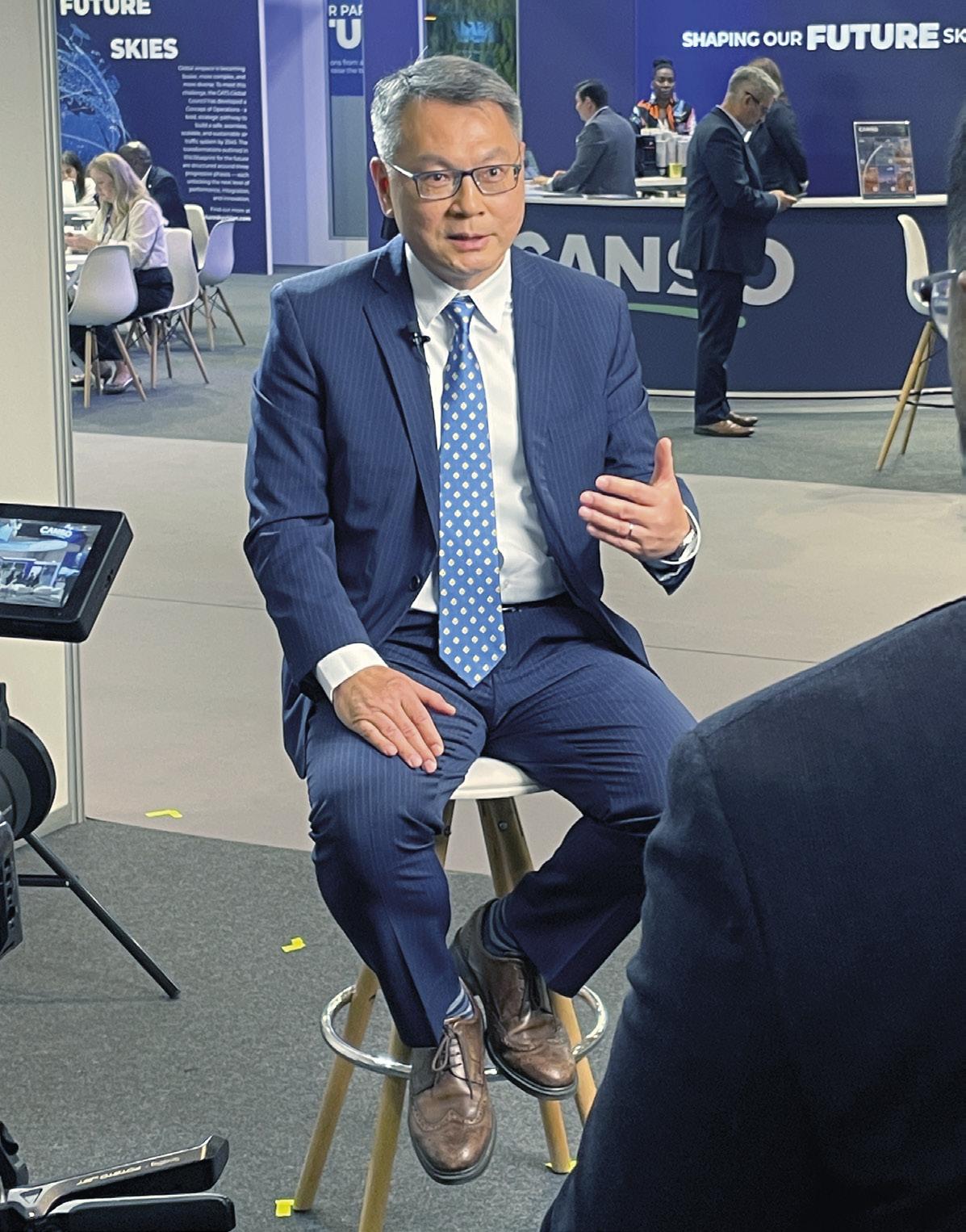
Captain Victor Liu, Director-General Hong Kong CAD on protecting the environment for future generations
Question: Why is aviation sustainability so important?
Sustainability in civil aviation is essential for the sector’s long-term viability and the planet, enabling progress towards the goal of net-zero carbon emissions and inclusive green growth for the planet. Key areas for reducing carbon emissions include accelerated adoption of new and innovative technologies, streamlined flight operations, Sustainable Aviation Fuels (SAF) and alternative energy sources.
ICAO has adopted a long-term global aspirational goal (LTAG) for international aviation of achieving net-zero carbon emissions by 2050, supporting the United Nations Framework Convention on Climate Change (UNFCCC) Paris Agreement’s temperature goal. Adherence to Hong Kong’s Climate Action Plan 2050 is critical to achieving this goal.
QHow is the Hong Kong Civil Aviation Department (CAD) working with other stakeholders to meet this goal?
Working with the relevant authorities, CAD participates in the Distributed Multi-nodal Air Traffic Flow Management (ATFM) network, a concept which primarily uses the Ground Delay Programme (GDP) to regulate air traffic flow by allocating calculated takeoff time to offset airborne delay, which minimises fuel consumption and carbon footprint.
In addition, Hong Kong’s Special Administrative Region (SAR) Government has set a target for SAF usage and encourages development of SAF supply chains. Cathay Pacific, the flagship carrier of Hong Kong, has committed to an ambitious target to reach 10% SAF usage by 2030 on flights they operate in order to meet the net-zero emission target.
Question: How can technology play a role in achieving aviation sustainability?
CAD is active in exploring and adapting innovative technologies, such as flight inspection by drones and the trial of two-phase immersion cooling.
As drone technology rapidly progresses and gains prevalence, CAD works with flight inspection service providers to conduct trials using drones for flight inspections. The goal is to enhance efficiency while also reducing cost and carbon emissions from conventional flight inspections.
Additionally, CAD is studying the viability of two-phase immersion cooling for some high-heat-generating systems, such as the Control Tower Simulator’s Image Generation System. The cooling scheme jointly developed by CAD and the Electrical and Mechanical Services Department (EMSD) won the Prize of the Republic and Canton of Geneva and a Gold Medal at the 50th International Exhibition of Inventions of Geneva.
Question: What can air traffic control (ATC) teams do to contribute to sustainability goals?
All aircraft approaching the Hong Kong International Airport (HKIA) are encouraged to adopt the Continuous Descent Approach (CDA) procedure when specific route and weather conditions are met. The CDA procedure requires the aircraft to fly higher and adopt a lower power setting and drag configuration during the commencement of the approach, which results in a more efficient descent. CDA has also introduced a set of departure procedures which make use of satellite-based navigation technology for enhanced track adherence. Aircraft which are properly equipped to use the technology can make use of the on-board navigation capabilities to adhere closely to the nominal centre line of the flight track, aiding efficiency. Additionally, we have implemented the Approach Spacing Tool (AST) to assist our air traffic controllers (ATCOs) in delivering optimised arrival spacing at HKIA. The system continuously integrates real-time data on wind direction and speed, track and speed of arriving aircraft, and their wake turbulence categories. The tool calculates the optimal spacing and positions of the arriving aircraft along their approach path and displays them in the form of graphical chevrons on the radar display. The capacity of HKIA has been increased with a reduction in airborne delay.
Question: Can you provide examples of company initiatives to advance sustainability?
As a regulator, CAD has facilitated the deployment of autonomous vehicles at HKIA. This is the world’s first airport to put autonomous vehicles into live airport operations on a large scale. The vehicles have revolutionised airport operations. They have enhanced the precision and efficiency in moving baggage and staff, and improved patrolling of airport security fences, resulting in reduced congestion and heightened overall efficiency and security.
CAD has also deployed an energy optimisation solution for the central air-conditioning system. Using artificial intelligence (AI) with big data analysis, the system responds to the real-time load and changes in the external weather conditions to continually monitor and control different components to achieve the optimal targets with the most efficient air conditioning delivery at the lowest energy consumption.
Question: Is aviation sustainability truly achievable?
I believe that it is. As stewards of the planet, it is our mission to protect the environment for future generations. The worsening environmental conditions pose increasing risks to the aviation industry, likely leading to stricter regulations and penalties that could raise operational costs.
Despite the challenges, where there’s a will, there’s a way. With a careful balance between air traffic growth and the commitment to net-zero emissions, we will reach our goal, whether sooner or later.
VICTOR LIU
Captain Victor Liu, JP has over 30 years of aviation experience. Before holding different senior management positions in various technical divisions of CAD he was Chairman of ICAO’s Asia Pacific Regional Aviation Safety Group, and Vice President - Asia of the International Federation of Airworthiness. He is also a Fellow of the Hong Kong Institute of Engineers.
