Think water, think WISA! T
Water& Sanitation
The official magazine of the Water Institute of Southern Africa T
Complete water resource and wastewater management
Africa
ORANGE RIVER Resource management progresses WISA YWP PRESIDENT Industry capacity building
Royal HaskoningDHV
Umtumvuma brings water security to 23 255 households
THE HOT SEAT
Mark Shepherd, Director of JOAT Group, discusses savings through the company s potable water interventions P10
September / October 2012 • ISSN 1990-8857 • Cover price R35.00 • Vol 7 No. 5
M ME MEDIA
300 000 metres of
TRENCHLESS PIPE Successfully Installed
RENOVATE EXISTING PIPES BY: Pipe Bursting • Sliplining • CIPP UV Cure • CIPP Ambient Cure Ribloc Expanda • Ribloc Ribline • Ribloc Rotoloc • Pipe Eating INSTALLATION OF NEW PIPES BY: Horizontal Directional Drilling • Guided Rock Drilling • Bores of 1200mm Lengths up to 400 metres • Microtunnelling
Countrywide 08600 66 344 • info@trenchless.co.za • www.trenchless.co.za
CONTENTS Volume 7. No.5 Think water, think WISA! T
Water& Sanitation
The official magazine of the Water Institute of Southern Africa T
ON THE COVER Part of
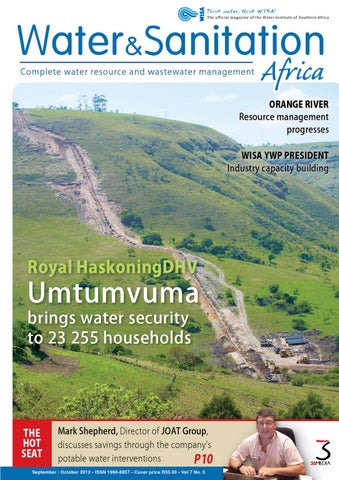
the new 800 mm, 2.3 km long delivery pipeline of the award-winning Umtumvuma Water Scheme, which brings water security to 23 255 households. Royal HaskoningDHV - formerly SSI - won the 2012 SAICE Pietermaritzburg Branch Award for Technical Excellence for the design and supervision of the project.
34
Complete water resource and wastewater management
Africa
ORANGE RIVER Resource management progresses WISA YWP PRESIDENT Industry capacity building
Royal HaskoningDHV
Umtumvuma brings water security to 23 255 households
THE HOT SEAT
Mark Shepherd, Director of JOAT Group, discusses savings through the company s potable water interventions P10
MEDIA M ME
September / October 2012 • ISSN 1990-8857 • Cover price R35.00 • Vol 7 No. 5
Rural communities to receive potable water service
42 Expansion of Driefontein WWTW forging ahead
COVER STORY Enhancing society together
4
WISA President’s comment Challenges for young water professionals Process controller division launched
3 6 9
PUBLIC SECTOR DWA minister’s NCOP speech Water use verification progress Ngobi village back on stream
24 28 30
WATER BOARDS Rural communities serviced Rural population benefits
34 36
BULK RAW WATER INFRASTRUCTURE Berg River outfall quality Westonaria WWTW extensions Driefontein WWTW expansion forges ahead Zeekoegat Set for commissioning
38 40 42 44
TECHNICAL FOCUS Water quality
45
TECHNOLOGY Water meters Sanitation Laboratories
48 52 53
CASE STUDIES Ekurhuleni ‘disaster zone’ Shepherd Widnes boosts profits Ford improves effluent quality Unilever achieves water neutrality
56 57 58 60
EDUCATION & TRAINING Pump efficiency vs electric motors Pump students graduate
71 72
Contaminated water and increases of deadly substances in drinking water are becoming the silent assassin of people in South Africa
REGULARS News international News Africa Trends & products Level of dams
SEPTEMBER/OCTOBER 2012
45 12 15 62 69
1
Publisher Elizabeth Shorten Associate publisher Ferdie Pieterse Head of design Frédérick Danton Senior designer Hayley Mendelow Senior sub-editor Claire Nozaic Sub-editor Patience Gumbo Contributors Blake Wilkins Marketing & online manager Martin Hiller Production manager Antois-Leigh Botma Production coordinator Jacqueline Modise Distribution manager Nomsa Masina Distribution coordinator Asha Pursotham Administration Tonya Hebenton Printers United Litho Johannesburg +27 (0)11 402 0571 Advertising sales Avé Delport Tel: +27 (0)11 467 6224 • Cell: +27 (0)83 302 1342 Fax: 086 502 1216 E-mail: avedel@lantic.net Publisher
MEDIA Physical address: No 4, 5 th Avenue Rivonia 2056 Postal address: PO Box 92026, Norwood 2117, South Africa Tel: +27 (0)11 233 2600 Fax: +27 (0)11 234 7274/5 E-mail: chantelle@3smedia.co.za
ISSN: 1990 - 8857 Annual subscription: R270 (SA rate) E-mail: subs@3smedia.co.za Copyright 2012. All rights reserved. All articles in Water&Sanitation Africa are copyright protected and may not be reproduced either in whole or in part without the prior written permission of the publishers. The views of contributors do not necessarily reflect those of the Water Institute of Southern Africa or the publishers. WISA CONTACTS: HEAD OFFICE Tel: +27 (0)11 805 3537 Fax: +27 (0)11 315 1258 Physical address: 1st Floor, Building 5, Constantia Park, 546 16th Road, Randjiespark Ext 7, Midrand BRANCHES Eastern Cape Chairman: Hennie Greeff Tel: +27(0)41 453 3102 Secretary/Treasurer: Chris Dickson Tel: +27(0)41 507 8200
www.ewisa.co.za
Free State Chairperson: D.R. Tlhomelang Tel: +27(0)51 403 0800 Secretary/ Treasurer: Riana Wessels Tel: +27(0)56-515-0375 KwaZulu-Natal Chairman: Chris Fennemore Tel: +27 (0)31 311 8734 Secretary/ Treasurer: Stephanie Walsh Tel: +27 (0)31 302-4077 Western Cape Chairman: Gareth McConkey Tel: +27(0) 21 712 4260 Secretary/ Treasurer: Eleonore Bondesio Tel: +27(0)21 872 0322 WISA mission statement The Water Institute of Southern Africa provides a forum for exchange of information and views to improve water resource management in southern Africa.
Endorsed by
PRESIDENT'S COMMENT
WISA: A modern organisation he WISA 2012 Biennial Ronald M Conference and Exhibition has come and gone, leaving most of us with fond memories of this successful event. I want to extend my deepest appreciation to Dana Grobler, and his organising committee, for a job well done. The board and council take cognisance of the constructive criticism received and will improve on this, and I also want to encourage those with either positive comments or concerns to forward them to our acting chief executive for the WISA 2014 Mpumalanga Local Conference Organising Committee to address. WISA 2014 will be held at the Mbombela Stadium in Nelspruit, Mpumalanga, and I want to congratulate Moses Khoza and his WISA 2014 team for taking the baton and running with it. We wish them well with their planning ‒ we know that Mpumalanga will pull out all the stops to be added to the list of WISA s successes. Ever since the conference we have, as a nation, been through a very exciting period filled with a host of activities of significant importance, such as: July marked the birthday of one of the greatest leaders the world has ever seen, our dear and beloved Madiba. August highlighted women s role as the pillars of civil society. Our Minster of Foreign Affairs was elected Chair of the African Union. We all discussed the water issue in Carolina. This winter is being regarded as one of the coldest, while our heart goes out to those who lost their lives and valuable possessions during the recent floods. World economic fluctuations, the ongoing service delivery strikes and, probably the highlight, our successful Olympic team! And just ahead of us lies spring, which brings with it new life, signifying change, new opportunities, growth and just like the Namaqualand sheds its dreary winter coat for a spectacular multi-coloured floral display, we too should appreciate of the dynamic opportunities afforded by our Creator. WISA launched its first African Branch in the land of the brave ‒ Namibia ‒ on 30 July 2012 at the Safari Conference Centre in Windhoek. This will remain in the annals of history as one of the successes of WISA. The interim branch committee, under the leadership of Dr Vaino
T
PATRON MEMBERS • Amatola Water • Aveng Water • BIGEN AFRICA Services • BKS • Bloem Water • Botjheng Water • Bushbuckridge Water • City of Cape Town • City of Tshwane • CSIR • Dow Water & Process SA • Department of Water Affairs
Brown
Shivute, CEO of the Namibian Water Corporation, will undoubtedly take this branch to higher levels. During August, our board of directors had a three-day strategic session and, I can assure you, that this will change the dynamics of WISA in the future. In the next edition, I will allude to the action plans that were discussed and ratified. I can inform subscribers that the following issues will be attended to: • operations policy • vision of WISA • fast tracking and playing a pivotal role in sectoral training • consolidate WISA s position in the water sector • vigilance in water business. Changing to IT matters, eWISA achieved its one millionth hit ‒ hearty congratulations to the eWISA team! I call on business to exploit the tremendous marketing opportunities this system provides. The WISA website and database are currently being given a facelift and Melissa Wheal, our administration, events and systems manager, is hard at work to get this project off the ground. We want to welcome the following new patron members to the WISA family: • Bushbuckridge Water • Schneider Electric • ZMG Watech. I want to encourage subscribers to kindly forward their ideas or comments regarding WISA's operations to the acting chief executive. I believe that our organisation is owned by our members and this is one way the subscribers can have their say. You are, after all, shareholders of WISA. I want to thank our head office, Dot Zandberg and her team, for the sterling and excellent work they are doing in sustaining WISA. We are indeed blessed to have you around. Finally, I want to extend WISA s best wishes to all municipalities for their Green and Blue Drop Certification assessments. May God bless all of us. Ronald M Brown President: Water Institute of Southern Africa
• ERWAT • ESKOM Holdings • eThekwini Municipality • Festo • Golder Associates Africa • Grundfos Alldos • Huber Technology • ITT Water & Wastewater South Africa • Johannesburg Water • Magalies Water • Merck • Mhlathuze Water • NCP Chlorchem • Nelson Mandela Bay
SEPTEMBER/OCTOBER 2012
Metropolitan Municipality • Overberg Water • PD Naidoo & Associates Consulting Engineers • Prentec • Rand Water • SALGA • SAME Water • Schneider Electric • Sedibeng Water • Siemens • SSI Engineers and Environmental Consultants • Sulzer Pumps
Wastewater SA • TCTA • Tecroveer • Umgeni Water • Veolia Water Solutions & Technologies South Africa • WAM Technology • Water Research Commission • Water & Sanitation Services SA • WEC Projects • Zetachem • ZMG Watech
3
COVER STORY
Royal HaskoningDHV
Enhancing society together Among Royal HaskoningDHV s major business themes is urban development ‒ food and water security, and sustainability in water and transport.
Urban development ‒ food and water security For rural and township communities, the nearest safe water supply may be a kilometre or more away, and a daily ritual that robs mostly women of their dignity and independence is to carry water from the river, standpipe or borehole to their homes. The company's expertise is available to identify exploitable sources of supply, to develop local and regional plans, and then implement the necessary abstraction, treatment, conveyancing, storage and reticulation infrastructure to deliver this precious commodity. In 2010, it received recognition from the South African Institution of Civil Engineering (SAICE) ‒ Best Community
With more than 300 years of combined experience and a network covering 35 countries, Royal HaskoningDHV’s offerings in water and wastewater treatment are comprehensive.
Project ‒ for its work on the Ozwathini Water Supply Scheme, where nearly 31 000 people in the Gcwensa, Mlamula and Phambela communities in the Ilembe District of the KwaZulu-Natal Midlands now enjoy a piped water supply. For these women and children, daily life revolved around the task of collecting water and the health of the community was being compromised.
R
oyal HaskoningDHV, formally SSI Engineers & Environmental Consultants, boasts the expertise of 8 000 specialists and support staff, with
ABOVE An aerial view of the Nereda plant at Gansbaai
Initiated by the Ilembe District Municipality and supported by the Department of Water Affairs and Municipal Infrastructure Grant funding, the Ozwathini Water Supply Scheme was born.
a global footprint of 100 offices in 35 countries.
In 2005, the process of addressing the needs of the
It is a significant player in the maritime, water and delta
communities began and over the next three years and in
technology markets and a major force in aviation, mobility and infrastructure development. The company currently employs more than 1 000 technical, scientific and support staff throughout a branch network of 26 offices in Southern Africa, with principal offices in South Africa, Botswana, Zimbabwe and Mozambique. Our footprint extends further north into East Africa and the Middle East.
BELOW Fishwater Flats WWTW in the Nelson Mandela Bay Metro where treated final effluent will supplement water supplies to nearby Coega
close consultation with the local community, over 30 000 people received a guaranteed safe supply of water. In addition, more than of 100 000 person days of employment of local labour was created. While the construction of the pipelines, reservoirs and boreholes that comprised this R38 million project was proceeding, relationships developed between all the participants bearing fruit of a different kind. One of the civil engineering graduates had the opportunity of working on site and broadening her knowledge of rural water supplies. She was then able to return to the office and apply her knowledge in the design environment. A schools outreach programme was initiated using the SAICE Free Career Guidance for Engineering presentation. This resulted in offers of financial assistance for two students at university. An application to Book Smart in America resulted in 11 schools in the area receiving over 3 000 books. The community has benefited from all the project objectives ‒ and so much more. Similarly, the Umtamvuna Water Supply Scheme project has recently won the 2012 SAICE Pietermaritzburg Branch award for Excellence. The award recognises the Most Outstanding Civil Engineering Project located within the geographic area of the branch. The Umtamvuna Water Treatment Works serves a large area in the southernmost region of the Ugu District
4
SEPTEMBER/OCTOBER 2012
COVER STORY
Mossel Bay desalination plant intake pipeline during construction
The Nereda Epe plant in the Netherlands treats effluent from 60 000 inhabitants
The Outinequa WWTW at George incorporates effluent reuse technologies
Municipality, supplying the coastal strip
The largest Nereda wastewater treat-
effluent for raw water, leaving raw water
from Port Edward in the south all the
ment works (WWTW) to date was recently
supplies for human and animal consump-
way up to Ramsgate in the north. It also
commissioned in Epe, a town of 59 000
tion. The company's specialists are explor-
serves the rural and semi-rural areas of
inhabitants located 80 km due east of
ing direct effluent reuse in certain towns
Izingolweni, Vukuzithathe, Nzimakwe and
Amsterdam. Construction commenced in
where indirect options are not feasible or
KwaXolo. The longer term water service
2010 and in addition to
practical. Effluent reuse
planning makes provision to pump water
purifying the wastewater
is, therefore, a practi-
beyond Ramsgate to include Margate.
from 59 000 residents, it
cal, cost-effective and
Highlights of the R61 million scheme,
also handles the wastewa-
quick-to-implement
which provides potable water security to
ter outflows from a local
means
24 255 households, saw the replacement
slaughterhouse.
and enhancing existing
of the ageing and leaking existing pipeline
of
extending
water supplies.
The Nereda plant was
Its
expertise
was
from the river abstraction to pump up to a
constructed
raw water storage dam. This required the
Veluwe
construction of an 800 mm diameter 2.1 km
Epe s
welded
The design of this Nereda
Southern Cape, where
mountainous terrain, and the replacement
installation
in addition to effluent
of low-lift and high-lift pump-sets with new,
experience gained from
reuse
more powerful equipment doubled the rat-
various industrial Nereda
project-managed
ed capacity of the river abstraction works to
installations,
design and installation
40 Mℓ/d. This also required increasing the
South Africa s pilot plant.
steel
pipeline
up
treacherous
capacity of all the delivery pipework as well
for
Water water
Located
the
applied to towns in
Board,
the
authority. incorporates
including in
the
drought-affected
strategies,
it the
of several desalination
TOP The new Knysna WTW
plants in the towns
ABOVE The first desalination plant installed at Sedgefield
of
Plettenberg
Bay,
as the electrical power plant and all ancil-
Overstrand municipal dis-
lary equipment. This intervention resulted
trict of the Western Cape,
in an energy cost saving of R2.4 million per
Royal HaskoningDHV con-
year due to greater pump efficiencies.
structed the first commercial sized Nereda
latter town features the largest desalination
Knysna,
Sedgefield
and Mossel Bay. The
plant in the seaside town of Gansbaai.
plant with a capacity of 15 Mℓ/d and this
Sustainability in water and transport ‒ leading edge technologies
Initially a 2 Mℓ/d plant, the installation
plant won the 2011 CESA AON Engineering
has been sized for future expansion up to
Excellence Award in its value category.
Among
Royal
5 Mℓ/d, which can be accommodated on
If the past 90 years of SSI Engineers &
HaskoningDHV is the largest spender on
the same site due to the smaller footprint
Environmental Consultants were impres-
research and development, and much of
and operating efficiencies provided by the
sive, future collaborations can only inspire
this R&D spend is directed into sustainable
technology. The fully automated plant has
confidence for our developing nation. The
water and wastewater technologies.
proved the Nereda concept and has been
combined local and international resources
A typical example is the Nereda wastewa-
running trouble free since commission-
of Royal HaskoningDHV span over 300 years
ter technology, which is set to revolutionise
ing in 2009, winning the SAICE Award for
of experience. This signals a new era in water
the wastewater industry providing huge
Technical Excellence in that year. A second
and wastewater engineering in southern
reductions in capital cost, operational effi-
Nereda plant is currently under construc-
Africa, born out of a legacy of unmatched,
ciencies and reduced energy requirements.
tion at Wemmershoek, Stellenbosch.
award-winning expertise in the discipline.
tion with the University of Delft and major
Life beyond our rivers
Dutch water boards has now brought
Its water specialists are in the vanguard
Visit www.rhdhv.co.za or www.royalhaskoningdhv.com
Nereda into the realm of sustainable reality
of reuse initiatives and have completed a
with full-scale plants being constructed in
number of installations in George, Mossel
the Netherlands, South Africa and Portugal
Bay and Port Elizabeth where its technical
with exceptional results for municipalities
expertise has resulted in meaningful sav-
and water authorities.
ings through the swopping of treated final
European
consultancies,
Group-funded development in conjunc-
In each issue, Water&Sanitation Africa offers advertisers the opportunity to promote their company s products and services to an appropriate audience by booking the prime position of the front cover, which includes a two-page feature article. The magazine offers advertisers an ideal platform to ensure maximum exposure of their brand. Please call Avé Delport on +27 (0)11 467 6224/ +27 (0)83 302 1342 to secure your booking.
SEPTEMBER/OCTOBER 2012
5
WISA
Young Water Professionals
Challenges for young water professionals by Dr Inga Jacobs, president of Young Water Professionals, WISA.
It is widely recognised that capacity building and sustainable knowledge transfer are critical concerns for several sectors in South Africa, and the water sector is no different. years) are the future of the water sector, the Young Water Professionals (YWP) was established as an international initiative by the International Water Association (IWA). In Southern Africa, the Southern African Young Water Professionals (SA YWP), in collaboration with the Water Institute for Southern Africa (WISA), has been highly successful in providing opportunities for YWPs to meet and communicate, providing career development opportunities for them, supporting employers with the recruitment and retention of YWPs as well as ensuring that the programme remains relevant. The SA YWP programme is entering its fourth year of existence as an official programme with more than 800 student members and provincial chapters set up in the Western Cape, KwaZulu-Natal, Gauteng and further afield in Zimbabwe and Mozambique. Plans are also under way to launch the Mpumalanga and the Free State YWP
T
he loss of intellectual assets is a major threat
chapters this year.
to effective water management, particularly
I can honestly say that young people have found
in water-scarce countries such as South Africa
the YWP programme immensely supportive in career
where the onus has always been on the sci-
development, networking and technical skills training,
entific community to find technological solutions for
but perhaps more importantly, having a supportive
sectoral challenges.
network of individuals who are going through the same
The repercussions for the sector include high staff turn-
challenges that young people face when developing
over as well as the loss of skills and institutional memory.
their careers.
“Young professionals will play a vital part in facilitating change in the water sector.”
technical challenges such as
This is oftentimes the non-
Dr Inga Jacobs, president of the Young Water Professionals
networking
at
or sharing the challenges of being a
Young water professionals in South Africa are therefore faced with the threefold challenge of developing their skills, finding mentors to help them do so, as well as grappling with the added responsibility of relearning knowledge that could have been retained through sustainable knowledge transfer policies and programmes. Fulfilling the present and future needs of the water and wastewater industries requires the continuous development of a workforce that is both adequate in size, capable in skills and strong in leadership. Recognising that young water professionals (students and professionals in the water sector and under the age of 35, or who attained their most recent qualification within the past five
6
confer-
ences, finding a mentor,
SEPTEMBER/OCTOBER 2012
3191 Wetpaint Advertising
young woman professional in a still largely
also expand our network further into the
male-dominated sector. Through the YWP
region and really be the regional platform
programme these kinds of formal but also
for young water professionals.
informal lessons are shared, and it helps to
Also, the development of partnerships
grow professionals that are equipped to
is another key focus and already the YWP
deal with the technical and non-technical
programme is working with the DWA to
challenges that the water sector throws
provide support to the Africa Youth Summit
before us. Even professionals who work
in July. We will host several workshops and
“We are the ones faced with the consequences of the environmental threats, and we are passionate about improving the situation” in other sectors have come to us because
activities to share survival tips by young
that kind of support is not provided in their
professionals for young professionals and
respective sectors.
scholars on what to expect from a career in the water sector and to highlight the
Main achievements to date The
first
Southern
numerous opportunities.
African
Regional
Conference, the biggest YWP conference
Activity highlights
to date, attracted 300 participants; the
The YWP has a very exciting programme
second
del-
planned this year both in the region and
egates. These regional conferences surpass
globally. Some of the highlights include
international
the following:
conference YWP
attracted
440
conferences
in
the
amount of delegates and the extent of the
• The
YWP
International
Conference
-
Budapest, Hungary, held from 10 to 13 July
technical programmes. Other achievements include, but are not
• YWP activities at IWA World Water
limited to:
Congress ‒ Busan, South Korea, 16 to 21
• DIY Manual on Lessons Learned from
September 2012
Southern Africa ‒ the Southern African
• a series of non-technical career building
region has developed a guideline that
workshops hosted at the CSIR in Pretoria
documents success stories and lessons
focusing on training in financial planning,
learned, and shares it with the rest of the world with the hope that other regions can also learn from our experience in set-
activities
at
the
Freshwater
Governance Conference ‒ Drakensberg, November 2012.
ting up the YWP programme • providing support to the
self-esteem, setting goals, etc. • YWP
I drink Tap
Water campaign • Moola for Amanzi competition with the Dutch-SA Water partnership • support to Aqua Enduro (a Department of Water Affairs (DWA) initiative)
We believe that young professionals will play a vital part in facilitating change in the water sector. The youth are dynamic enough to take change in their stride, while having the mentorship of distinguished water professionals for guidance.
• more involvement of YWPs in manage-
We are the ones faced with the conse-
ment committees and leadership positions
quences of the environmental threats, and
in membership organisations, WISA Board,
we are passionate about improving the sit-
IWA board, Strategic Council, etc.
uation. More than this, we aim to improve
• an exciting programme of activities at
the way things are done in a fun and posi-
the WISA 2012 conference, including the
tive way, while still maintaining economic
international Wetskills competition
relevance and scientific excellence.
• our own clothing range.
YWPs are more comfortable working in a multi-disciplinary or even trans-disciplinary
Rainwater Harvesting Systems that last for more than a lifetime The world is changing around us - everyday. Technological advances demand ongoing upgrades and solutions, but not ROCLA Rainwater Harvesting Systems. Because superb design and leading-edge manufacturing processes ensure that ROCLA provides the truly permanent rainwater harvesting solution. ROCLA’s Rainwater Harvesting Systems offer an unmatched water capture and re-use solution, which greatly reduces dependence on municipal potable water. With the looming water crises, ROCLA’s revolutionary ecoRain™ system offers a sustainable and cost saving water-supply solution to Southern Africa. ROCLA Rainwater Harvesting Systems are ready for the future. ROCLA is ISO 9001/2008 certified and has the SABS mark of approval on all applicable products.
ROCLA
Main aims as YWP president
environment than the baby boomers on
Given this incredible track record and as we
whom we still rely so much, making us
usher in the new committee, it is my hope
well-suited to tackle the challenges facing
that we move from a period of establish-
us today in a communicative, team-based
ment and growth to a period of consolida-
manner. We are comfortable working in
tion of the programme through partner-
a global environment, but we need the
A Murray & Roberts Company
ships. This means that I would hope to
mentorship and guidance of more experi-
grow the programme in the provinces but
enced professionals.
For technical expertise and unmatched experience, contact ROCLA now on Tel: (011) 670-7600 or Fax: (011) 472-2141 Web: www.roclaproducts.co.za
OUR DIFFERENCE IS CONCRETE 4\YYH` 9VILY[Z
Proven Bioremediation Technology SOUTH AFRICA
WISA
Process controllers
Gauteng process controller division launched The division is the first nationally and more are in the pipeline.
A
Gauteng processor controller division was launched in mid-July with the primary objective of professionalising the industry. WISA is responsible for capturing and managing the process controller database. At present, the
Department of Water Affairs (DWA) has 5 600 process controllers on its database while WISA has a separate database of process controllers. A proposed change to DWA regulations requires that all process controllers must register with DWA and be classified in terms of their qualifications and/or experience.
ABOVE The committee of the new Gauteng process controller division comprises, front from the left: Katleho Thubela (additional member, Emfuleni), Solomon Makate (vice chairman, DWA), Elize Mare (chairperson), Susan Stofberg (secretary). Back row from the left: Josaya Lekalakala (treasurer, Tshwane), Anita Pillay (WISA training manager), Leah Moelane (additional member, Meralong City) and Dot Zandberg (Acting chief executive, WISA)
The DWA s Solomon Makate told the workshop at which the new division was launched that the classification of process controllers
of accredited training service providers. It is proposed that, in terms
will be plant specific, even if individual processor controllers have
of classifications, all process controllers be classified in future. It is
the knowledge and experience to work at several plants. The new division will be structured on the same principles as WISA while the membership database and finances will be controlled by
hoped that the classification process will be finalised soon and it is our objective to have achieved the professionalisation process by next February.
WISA head office. The professionalisation of process controllers will focus on several key strategic directions: • The development of process controllers within the current academic sphere or environment.
thuthuka group limited
• The development of process controllers beyond the current acawards narrowing the skills gap between the professional process controller and the professional process engineer. This objective is aimed at placing process controllers in a position to engage on a more professional level with the process engineer and challenge design concepts that may impact on their ability to maintain, operate, control and monitor a plant in a sustainable manner. • Promote the image of the process controller within the water sector and provide a career choice for matriculants or provide an entry level for emerging process engineers. • Improve the administrative skills of professional process engineers. Dot Zandberg, acting chief executive of WISA, told the workshop that WISA is updating and improving access to its database by making the facility web based. We will have on the database a list
ABOVE About 75 people attended the ground-breaking process controllers’ workshop organised by WISA in Gauteng in mid-July
Engineered Solutions for Africa TGL designs, manufactures, PUZ[HSSZ HUK ÄUHUJLZ T\S[P disciplinary turnkey projects for the chemical, mining, renewable energy, metallurgical and industrial markets in Africa. :DWHU 7UHDWPHQW DQG 5HFODPDWLRQ $LU 3ROOXWLRQ 0DQDJHPHQW 0LQLQJ DQG 0HWDOOXUJLFDO ,QIUDVWUXFWXUH 3URMHFWV 3URFHVV (QJLQHHULQJ 6ROLGV :DVWH 0DQDJHPHQW 3ODQW +D]DUGRXV &KHPLFDOV 0DQDJHPHQW 3ODQW $FLG +DQGOLQJ 3ODQW 3KDUPDFHXWLFDO 3ODQW 3URMHFW )LQDQFH 5HQHZDEOH (QHUJ\ *ULG &RQQHFWLRQ 3URMHFWV
Lead anode plant for Kamoto Copper mine, DR Congo.
CCD Thickeners for SNC Lavalin, Madagascar
35-million litre reservoir, North West Province, South Africa
TGL has projects in: Zambia, Madagascar, D.R. Congo, Botswana, Malawi, Zimbabwe, Nigeria, Ghana, Namibia, Mauritius, Mozambique Contact: tel: +27 (0)11 468 5956 e-mail: tomm@thuthukagroup.com / www.thuthukagroup.com Adding value to your African project
V Squared V2/11696 Jun2012
demic sphere or environment. This strategic focus will strive to-
HOT SEAT
JOAT Group
Full service capability in water supply system optimisation In the realm of pressure management, JOAT has implemented the i20 system – the world’s most advanced solution.
O
ver the past six years, municipalities, utilities and government organisations in South Africa have saved 82.9 Mℓ/d of potable water worth R100 million a year through
interventions by the JOAT Group, says company director, Mark Shepherd. The Durban-based company, with a national network of branch offices, has an impressive list of key accomplishments gained during the 10 years it has addressed the needs of local government in the field of water distribution optimisation. This specialisation area includes demand, leakage and pressure management. Over that period, the JOAT Group has worked on over 24 258 km of mains on systems ranging in size from 18 km to over 11 000 km, and has attended to over a million connections. We have not yet had an unsuccessful project and we have a reputation as the company that solves our customers problems, says Shepherd. The technical people within our customer base have full faith in our capabilities. The key services offered by the JOAT Group include system stabilisation, condition surveys of meters and valves, data logging, water audits and water balances, water system operations, optimal zoning of distribution systems, leakage management, revenue enhancement, asset and energy management, network analysis modelling, and pressure management. Our pressure management capability is of particular importance because of an increasing demand in
A typical PRV installation under construction
pressure of a reticulation network in order to reduce cyclical fatigue on pipes and joints in addition to cutting down on the frequency of pipe bursts and the resultant
South Africa for systems that run at optimal levels
increase in water losses.
“We have not yet had an unsuccessful project and we have a reputation as the company that solves our customers’ problems.” Mark Shepherd,
pressure management solutions on the international
Company director
i2O solution in some of the major metropolitan areas in
Based on our intensive exposure to a wide range of market, the JOAT Group has opted to support the Britishmanufactured i2O system as providing customers with the best possible solution. We have implemented the South Africa and have achieved exceptional results. without interruption to customers. We have been at
Not only has the i20 system delivered greater than
the forefront of designing, testing and implementing
expected leakage savings, it has also proven to be a very
advanced management systems offered by a range of
reliable device. eThekwini Municipality prides itself as
international manufacturers.
being forward thinking and the continuous research and
He explains that the JOAT Group is keenly aware that
development that goes into the i20 system insures that
many municipalities face financial constraints in terms
this solution remains current and sustainable, describes
of maintaining and replacing assets such as costly
Simon Scruton, manager: Non Revenue Water Branch,
water infrastructure.
eThekwini Water and Sanitation.
Extending the life of assets
types of pressure control: fixed outlet, time-based
Shepherd says the i2O system can be used in all three Decision-makers look to extend the life of assets, an important aspect of which is to reduce the operating
10
modulation and flow-based modulation.
We believe
that the i2O system has been developed to the point
SEPTEMBER/OCTOBER 2012
HOT SEAT
LEFT i2O installation in Mangaung Metro Municipality
‒ a world first and the most widely de-
RIGHT i2O installation in eThekwini Municipality
ing and remotely controlling water pres-
ployed system for automatically optimissure in water zones equipped with PRVs. • Advanced
Management:
Pump control ‒ This is similar to PRV
to provide a good service to
control but optimises and remotely
consumers, but low enough to
controls parts of a water network fed
reduce leakages and the fre-
by pumps. It can achieve the same
quency of bursts.
Advanced
Pressure
Management
The i2O solution, which has
benefits in networks without PRVs,
been implemented in scores of
or enhance the benefits in networks
locations worldwide, achieves its unique • the careful monitoring of flow and presautomated
control
tion shows water service organisation executives and managers the real-time
sure by robust, advanced loggers and
with them. • Network Data: i2O s monitoring solu-
performance by:
• remote
Pressure
the optimum level at all times
of
pressure via a system controller and an
performance of their water systems from any Internet connection. The i2O system has been installed in these
advanced pilot valve • software that continuously learns the
municipalities: eThekwini, Ugu, iLembe,
characteristics of the network, enabling
uThukela,
the optimum pressure reducing valve
City
pressure to be set to meet pressure re-
(Pietermaritzberg). Installation in Nelson
quirements under all demand conditions.
Mandela Bay (Port Elizabeth) is awaiting
Shepherd points out that the added advantages of the i2O system accrue to sig-
of
Mangaung Cape
Town
(Bloemfontein), and
Msunduzi
the completion of construction. Dean
Hansford,
i2O s
Business
nificant leakage savings and competitive
Development manager for the United
costs compared with alternative leakage
Kingdom and sub-Saharan Africa, says that
reduction measures.
working with JOAT has been so easy for
The i2O solution can be installed within
us. As a company, it shares our passion for
one day and benefits will start accruing
the use of innovative technologies in the
within the first week of operation. In addi-
water industry in Southern Africa. With the
tion, the system requires little or no main-
help of JOAT s expertise in the field of non-
tenance in the first five years of operation.
revenue water reduction, i2O is becoming
The i20 system has saved us an additional R286 000 per year in a zone which was recently commissioned and optimised. The system seems to be very reliable and where it is far in advance of any other
is operating under stable conditions, says
pressure management system currently
Melvin Engelbrecht, City of Cape Town.
established as the advanced pressure management system of choice in South Africa. The JOAT Group is the sole distributor for sub-Saharan Africa of the i2O solution.
Turnkey solutions Referring to the provision of turnkey solu-
available. The i20 is an integrated system that uses the nationwide GSM network
How it works
tions for large scale non-revenue water
and true artificial intelligence to self-learn
The i2O system makes a major impact on
reduction programmes, Shepherd points
water distribution networks. It has a world-
six key metrics: leakage, burst frequency,
out that this type of appointment has been
wide patent for self-learning capabilities
operating expenses, energy costs, lifetime
successful in allowing institutional custom-
through the application of an algorithm ‒
extension of network infrastructure and
ers to fast track the procurement of service
no other product on the market currently
customer service. The system allows water
providers, contractors and suppliers.
has the same capability. Furthermore,
service organisations to:
the open loop control addresses all the
• optimise water pressure continuously
lows the contracted service provider with
weaknesses of closed loop systems in that
and automatically to meet customer
the flexibility to respond to what can be
the system will still control to the desired
service levels throughout the network
urgent challenges that invariably arise.
parameters even if communication is lost
• adjust water pressure levels in any part
All turnkey projects implemented by the
of a water distribution network remotely.
JOAT Group are compliant with municipal
with remote sensors.
An appointment of this nature also al-
Customer intervention is not required as
The i2O solutions combine hardware and
supply chain management rules and regu-
the system takes into account daily, week-
software that give operators the ability to
lations, he concludes.
ly, monthly and even seasonal changes.
monitor or control their water networks
The JOAT Group provides a nationwide ser-
This important capability is undertaken by
from any Internet connection. Core solu-
vice through branches in Pietermaritzburg,
the system automatically as it continually
tions address three contexts of advanced
Port
adjusts the pressure in the network. The
pressure management:
fontein, Port Elizabeth and Cape Town.
customer can rest assured that with these
• Advanced
pressure adjustments the network is at
Pressure
Management:
Pressure Reducing Valve (PRV) control
SEPTEMBER/OCTOBER 2012
Shepstone,
Johannesburg,
Bloem-
More than 60 people are employed in the group s branches.
11
NEWS
BOLIVIA
Soup and sustenance in Bolivia MICROLOANS AND payment plans help the trickle-down economics of water infrastructure installation. Bringing water service to poor families in the mountains of Bolivia, where the air is thin at 3 650 m, is challenging. Who pays for the installation of service and who pays for the water consumed thereafter? In 2011, Fatima s family was one of 28 in Boqueron Alto, Bolivia, that did not have
International
access to the improved water system that was installed in 2008. Since she had moved in after the system was constructed, Fatima could not pay the post-construction connection fee of around US$1 000 (R8 148) that was being imposed by the village s water committee. This connection fee was calculated using simple math ‒ families who contributed their labour and cash when the new water system was being constructed paid the equivalent of around US$1 000, the majority being monetised in-kind contributions. The committee
argues that it is therefore only fair for new connections to cost the same amount. But with such a large cash down payment, and no additional labour required for implementation, poor families like Fatima s are at a significant disadvantage and have struggled to find the money to pay for the connection. The committee has also been extremely creative in its approach to sustaining water access. • Tariffs are collected efficiently and transparently. • Two additional springs were purchased with village funds, because there is an understanding that water quantities will have to be maintained over time ‒ as populations grow, as families use more water for agricultural production, and as water resources become increasingly threatened from climate change. • There is a loan scheme emanating from the village s water fund: families take loans to improve their homes and purchase agricultural inputs. They have one year to repay the loan, at an interest rate of 17%. If they fail to repay, their water supply is cut off. To date, there have been no defaults. Source: Circle of Blue Website
We don t want to start water rationing for the people when we are more than able to increase water capacity and ensure the people are comfortable, Chin said at a press conference after opening Innovation Day 2012. The Langat 2 water treatment plant was approved by the federal government at a cost of RM3.94 billion [Malaysian ringgit] (R10.2 billion) and is expected to treat around 1.9 billion litres of water for Selangor, Putrajaya and Kuala Lumpur until 2025. It also involves building a 44.6 km tunnel, the largest and longest in South East Asia, to channel the water from Sungai Semantan in Pahang to Sungai Hulu Langat in Selangor through the main range. The project is on hold as the Selangor government refused to approve the development order for various reasons, one of which is the ongoing water restructuring exercise in the state. Source: The Sun Daily
SPAIN
Robotic fish to patrol for pollution in harbours
MALAYSIA
Chin warns of water rationing THE RATIONING of water may be a possibility in the future if the Selangor government continues its refusal to allow the Langat 2 water treatment plant to be built, says the Energy, Green Technology and Water minister, Datuk Seri Peter Chin Fah Kui. The demand for water has jumped with the start of dry weather and, as a result, the reserves are dipping further, when they are already at a critical level.
Constant watch: teams of robot fish could check for pollution IN THE SHALLOW waters of Gijon harbour, in northern Spain, a large, yellow fish cuts through the waves. But this swimmer stands apart from the marine life that usually inhabits this port: there's no flesh and blood here, just carbon fibre and metal. This is robo-fish ‒ scientists' latest weapon in the war
Engineering a Greener Future
Sustainable solutions that work Kaytech will help you to implement sustainable solutions that work. Technological innovation is combined with a practical balance between engineering imperatives and cost-effectiveness to give you the greener answer to your ecological challenge. From landďŹ lls to coastal erosion, from basic rural amenities to large scale water infrastructures, each
Backed by professional engineering support, Kaytech is always a better solution. For more information on how Kaytech can help you, contact us today.
R
Johannesburg
011 922 3300
East London
043 727 1057
Cape Town
021 531 8110
Durban
031 717 2300
www.kaytech.co.za
'JMUSBUJPO %SBJOBHF t 4FQBSBUJPO t 3PBE .BJOUFOBODF 3FIBCJMJUBUJPO t 8BUFS BOE 8BTUF $POUBJONFOU t &SPTJPO $POUSPM
octarine 3706
bidim
project presents its own unique challenges. Kaytech has an extensive range of environmentally sound and recycled products to ensure that you get exactly what you need for your speciďŹ c project.
NEWS
International
against pollution. This sea-faring machine works autonomously to hunt down contamination in the water, feeding this information back to the shore. Several are undergoing their first trials in Spain to see if they make the grade as future marine police. The idea is that we want to have real-time monitoring of pollution, so that if someone is dumping chemicals or something is leaking, we can get to it straight away, find out what is causing the problem and put a stop to it, explains Luke Speller, a senior scientist at the research division of BMT Group, a technology consultancy. The company is part of the Shoal consortium, a European Commission-funded group from academia and business that has developed these underwater robots. The fish, which measure about 1.5 m long, may be a little larger than their real-life counterparts, but their movements closely mimic them. The fish use micro-electrode arrays to sense contaminants. In their current form they can detect phenols and heavy metals such as copper and lead, as well as monitor oxygen levels and salinity.
But it may be some time before robotic fish become permanent fixtures in our waters. Prototypes currently cost about £20 000 (R130 000) each, although Speller says costs will drop once more are produced. Source: BBC News
USA
A new approach to water desalination GRAPHENE SHEETS with precisely controlled pores have the potential to purify water more efficiently than existing methods. One promising source of potable water is the world s virtually limitless supply of seawater, but so far desalination technology has been too expensive for widespread use. Now Massachusetts Institute of
Technology (MIT) researchers have come up with a new approach using a different kind of filtration material: sheets of graphene, a one-atom-thick form of the element carbon, which they say can be far more efficient and possibly less expensive than existing desalination systems. There are not that many people working on desalination from a materials point of view, says Jeffrey Grossman, the Carl Richard Soderberg Associate Professor of Power Engineering in MIT s Department of Materials Science and Engineering. Grossman and graduate student David Cohen-Tanugi aimed to control the properties of the material down to the atomic level , producing a graphene sheet perforated with precisely sized holes. They also
added other elements to the material, causing the edges of these minuscule openings to interact chemically with water molecules ‒ either repelling or attracting them. We were very pleasantly surprised by how well graphene performed compared to existing systems in computer simulations, Grossman says. One common method of desalination, called reverse osmosis, uses membranes to filter the salt from the water. But these systems require extremely high pressure ‒ and hence, energy use ‒ to force water through the thick membranes, which are about a thousand times thicker than graphene. The new graphene system operates at much lower pressure and thus could purify water at far lower cost, the researchers say. Source: MIT News Office When water molecules (red and white) and sodium and chlorine ions (green and purple) in saltwater, on the right, encounter a sheet of graphene (pale blue, center) perforated by holes of the right size, the water passes through (left side), but the sodium and chlorine of the salt are blocked. Graphic: David Cohen-Tanugi
14
SEPTEMBER/OCTOBER 2012
Excellence in Chemical Dosing For more than 65 years sera products have represented the highest measure of quality, safety and reliability in the treatment of drinking water, process water and wastewater.
Chlorine dioxide preparation and dosing systems, for up to 1,000 g/h
Preparation and dosing stations for polymers and flocculation aids
Compact vertical dosing systems for all kinds of fluids
Dosing and feeding pumps Dosing systems and disinfection systems Process measuring and control technology Fittings and accessories Extensive pre- and after-sales service
sera DoseTech SA [PTY] Ltd. Unit 3-4 Airborne Park Cnr of Empire & Taljaard Str Bartlett Boksburg, PO Box 15474 South Africa Tel: +27 11 397 5120 Fax: +27 11 397 5502 info.za@sera-web.com www.sera-web.com
Africa MAURITANIA
Energy-efficient water treatment plant for desert mine
A reverse osmosis skid system, similar to the one shown here, is being supplied to a Mauritanian mine by Veolia. VEOLIA WATER Solutions & Technologies South Africa has been contracted to design, fabricate and supply a brackish water treatment plant for the second phase of a mine in Mauritania, North West Africa. In terms of the contract, 62.5 m³/h of reverse osmosis (RO) permeate will be supplied to the process plant. Documentation was provided in English and French. A French process engineer was co-opted to be part of the team in terms of Veolia s international exchange programme to provide assistance with this aspect of the contract. The treatment process starts with the feed of raw water from boreholes on site. This water is pumped to the multimedia filters with feed pumps to undergo pre-filtration. Thereafter the water is pumped into a filtered water tank before being sent through a set of plate heat exchangers. This step is necessary due to the high ambient temperatures of the area, which can see the water reaching temperatures of 50° C. Before the RO treatment can commence, the water temperature needs to be brought down to a maximum of 30° C. This temperature reduction is achieved through a cooling system consisting of two air-cooled chiller systems, each with a plate heat exchanger at
the process interface. After the water has been cooled down, it is treated in the duplex RO system. From there, the desalinated water is pumped to two desalinated water storage tanks outside the building, ready for distribution to the plant as process water for industrial usage. The plant is due for commissioning at the start of 2013.
NAMIBIA
WISA launches new branch in Namibia WISA HAS LAUNCHED a new branch in Namibia with a membership list approaching 40. The WISA head office in Gauteng, South Africa, will assist the fledgling branch in the short term and will support the members in developing and running a programme of events such as training workshops. The WISA acting CEO, Dot Zandberg, who attended the launch, mentions that Southern African membership will be extended to Lesotho with the launch of a branch in the fourth quarter of this year and to Zimbabwe, Mozambique and possibly Zambia in 2013.
SUB-SAHARAN AFRICA
Skidrat pump attracts industry attention
The Australian developed SkidRat is now available from Xylem THE SKIDRAT pump protection unit is attracting attention in the industry as an ideal way to prevent pumps from being damaged by sediment at the bottom of ponds. This innovative unit was
NEWS
developed by UAT in Australia and is exclusively distributed throughout sub-Saharan Africa by Xylem (formerly known as ITT Water & Wastewater South Africa). Harnessing a pontoon approach, the SkidRat features modular floats that lend this unit to unlimited configurations to suit each pump and application. The tough and durable unit is chemical resistant and can be handled by cranes, excavators, bulldozers, trucks and trailers.
SOUTH AFRICA
Freshwater governance conference THE INTERNATIONAL Conference on Fresh Water Governance for Sustainable Development will be held in the Drakensberg from 5 to 7 November with noted
Africa academic and author Professor Ali Mazrui as the main speaker. The conference, which is being organised by the Water Research Commission and the Department of Water Affairs, together with the Australian National University, has a programme of 94 papers, workshops, special sessions, moderated sessions, panel discussions, side events and role playing games. Apart from South African presenters, papers will be presented by speakers from Europe, North and South America, India, Asia and the rest of Africa. Among the many papers being read will be a presentation by Ashwin Seetal of SSI Engineers and Environmental Consultants. He will talk on the process of compulsory licensing, which is generally perceived as the ultimate
a comparative analysis of the lessons learnt from each of the case studies, as well as other projects where preparatory work is under way, concluding with recommendations for improved planning and process implementation efficiencies.
SOUTHERN AFRICA Prof Ali Mazrui, main speaker at the International Conference on Fresh Water Governance for Sustainable Development
WaterAid opens office in South Africa
implementation of the various provisions of South Africa s National Water Act (Act 36 of 1998), especially as it directly relates to the protection, use, conservation, management and control of water resources. The paper assesses the early approaches to implementing compulsory licensing, describes the different phases of the process and presents
WATERAID, AN international NGO dedicated exclusively to the provision of safe domestic water, sanitation and hygiene education to the world's poorest people, has opened a Southern African regional office in Tshwane. The regional office is headed by Robert Kampala, who acts as the head of region and staffed by six people, including Kampala. The other staff
When you can see the whole facility, you’ll see the savings Energy is a major part of water’s price and, of course, your facility’s operating costs. In addition, energy is the single largest contributor to the carbon footprint of the water process. Fortunately, Schneider Electric™ has the solution to manage and optimise your energy in line with your process obligations — and to reduce your carbon footprint. Our comprehensive approach to energy management, along with combined power and process services, can yield an energy cost reduction of up to 30 per cent of your existing installation. And with visibility across your entire water network, you’ll be able to optimise the management of your process, reducing and avoiding energy waste in real time.
Flexible software, reliable services make upgrading easy
The difference an energy management solution makes
kWh
Our combined security, SCADA, and power monitoring solution yields the highest efficiency
Implementation of Energy Management Solution Baseline Energy @ measured @ recorded
n utio sol t u ho Energy Wit savings
ion olut s h Wit Time Measurements recorded during the reference period
Measurements recorded for comparison to the reference
When you partner with Schneider Electric all along the life cycle of your facility, you’ll gain access to our expertise as a world leader in electrical distribution, motor control, and process automation. We encourage you to directly involve our experts and engineers by inviting them to conduct a thorough on-site audit and diagnosis of your facility, allowing them to propose informed solutions for improvement.
Improve productivity and safety at once Add to this, integrated security and remote management capabilities, and you’ve got a scalable, flexible solution to reduce energy costs, lower your carbon footprint, and provide a safer, more productive work environment for your employees.
Presenting EcoStruxure™, a solutions approach to the energy needs of the water industry that combines advanced power management with a proven automation control system to improve your energy efďŹ ciency and to help yield a holistically optimised plant.
Make the most of your energySM
Learn more about our water solutions Download our NEW water solutions guide today and stand a chance to win an iPad 2! Visit www.SEreply.com and enter the key code 20784p Call +27-11-254-6400
Š2012 Schneider Electric. All Rights Reserved. Schneider Electric, Make the most of your energy, and EcoStruxure are trademarks owned by Schneider Electric Industries SAS or its affiliated companies. All other trademarks are the PROPERTY OF THEIR RESPECTIVE OWNERS WWW SCHNEIDER ELECTRIC COM 2EGISTERED .AME 3CHNEIDER %LECTRIC 3OUTH !FRICA 0TY ,TD 2EGISTRATION .UMBER 4ERMS AND CONDITIONS APPLY s 998-2574_ZA_B
NEWS
User-friendly wheelchair access has been provided to safe drinking water points in Madagascar as a result of interventions by WaterAid members are responsible in the region for programmes, advocacy, support, technical matters and finance and administration. In the 2010/2011 period WaterAid estimates that
18
Africa
worldwide 884 million people do not have access to safe drinking water and 2.6 million people live without sanitation. A total of 4 000 children died every day in that period from diarrhoeal diseases resulting from this lack of services. At present, WaterAid has 224 477 supporters, over 600 staff members and 479
partner organisations in 23 countries around the world. With the organisation now represented in South Africa ‒ with offices in the Water Research Commission premises ‒ WaterAid is active in eight Southern African countries. These include Madagascar, Malawi, Mozambique, Zambia, Angola, Lesotho and Swaziland. WaterAid is also active in seven West Africa countries and five East African countries. WaterAid receives funds from supporters or donors that are tied to specific projects or programmes or have restrictions as to how, where, when and what the money can be used for. The organisation is aiming to raise £100 million (R1.3 billion) by 2015. WaterAid also receives funds which supporters give to it with no restriction as to how they are used.
WaterAid has robust planning, monitoring and evaluation systems in place that ensures that activity plans are jointly developed with clear outputs and outcomes. Funding is based on approved plans and budgets with the partners.
THE GAMBIA
Four million Gunjur Water Project Contract signed THE NATIONAL Water and Electricity Company (Nawec) has signed contracts with three contractors for the implementation of the US$4 497 497 (R36 644 263) Gunjur Water Supply Project at a ceremony held at the Nawec head office in Kanifing. The project is awarded to Sierra Construction System, a
SEPTEMBER/OCTOBER 2012
The Intelligent Choice With a solid track record spanning over half a century, GIBB has established itself as a partner of choice. Backed by a Level 2 BBBEE rating, GIBB provides engineering solutions to a diverse range of markets across the African continent.
1FPQMF t &YQFSUJTF t &YDFMMFODF marketing@gibb.co.za | www.gibb.co.za | +27 11 519 4600
INTERNATIONAL CONFERENCE WATER REUSE for DRINKING purposes
9 – 11 OCTOBER 2012 Gateway Hotel Umhlanga KwaZulu-Natal INTERNATIONAL THOUGHT LEADERS PRESENTING: Prof George Tchobanoglous from the University of California: International Practices and Trends in Potable Water Reuse; State of California, regulatory history, trends and recent developments; Groundwater Recharge Project in LA
Mr Harry Seah from the Singapore Public Utility Board: Singapore experience in potable reuse of water; Regulations/ guidelines for potable reuse
The Department of Water Affairs is revising the national water resource strategy, which includes water reuse as one of the key pillars. This conference focuses on potable water reuse - a much-debated and controversial topic locally and globally. Water reuse is already taking place in South Africa, but more attention will in future be placed on the strategic roll-out of direct and indirect potable reuse projects.
Dr Ben Stanford from Hazen and Sawyer: United States: Western States Case Studies
OTHER TOPICS INCLUDE:
Mr Jurgen Menge from the City of Windhoek:
* South African national water resource strategy, development and roll out * Regulatory trends and perspectives * Water reclamation technologies * Sustainability of water reuse projects * Financial and institutional aspects
The City’s Case Study
Mr Piet du Pisani from the City of Windhoek: Institutional models for water development projects drinking water supply projects
Conference programme and registration: www.wisa.org.za/wruc/ Contact: Melissa Wheal +27 (11) 805 3537; admin@wisa.org.za
Earn 2 CPD points
NEWS
Sierra Leone company; Water Resources Development (WARD), a Lebanese company; and Sinco Spa, a Senegalese company, and will run parallel to ensure timely completion. According to the project agreement, Sinco Spa will construct a treatment plant and associate civil works worth US$2 749 595, WARD will construct a 500 m3 elevated water tank including design to the tune of US$681 625, while Sierra Construction System will construct a water distribution network with all associated civil works to the tune of US$1 066 277. The project is being funded by the Islamic Development Bank and the government of The Gambia. It is expected that when completed it will complement the government's eorts in providing clean and
Africa safe drinking water to the Gambian people in line with the development objectives and Vision 2020. Speaking at the signing ceremony, Ebrima Sanyang, the MD of Nawec, said the project is very timely and important as Gunjur is a big metropolis without clean drinking water. He added that the coming of this project will address the issue. Sanyang also informed the gathering that the project would be ready by the end of this year if everything goes as planned. Source: AllAfrica Global Media.
ZAMBIA
Bannow Africa launches in Zambia BANNOW AFRICA, a recently launched South African
20
company marketing and installing a range of package sewage treatment plants manufactured in Ireland, has launched Bannow Zambia as part of the company s plans to expand its inuence in Africa. A delegation from Zambia visited South Africa recently to meet with representatives of the local company and to inspect the Blivet package plant, which is operating at the Nedbank Olwazini Training Centre in Muldersdrift, Gauteng for the past eight years. It was Bannow Export s ďŹ rst package plant in South Africa Bannow Zambia will market the Blivet range of package plant of varying capacities from the smallest suitable for 10 people to the Blivet 4 000, which has a capacity of 100 mÂł/d of euent.
Prior to November last year, Bannow Export had sold and installed package plants in Lesotho, Seychelles, Mauritius, Mozambique, Zanzibar, Angola, Nigeria, Gabon, Chad, Algeria and South Africa. Bannow Africa is planning to launch into the Nigerian market later in 2012. Monica Kachali, the MD of the newly formed Bannow Zambia joint venture, visits the Blivet package plant at the Nedbank Olwazini Training Centre in Muldersdrift
SEPTEMBER/OCTOBER 2012
'FBUVSFT PG UIF .VMFCZ 4ZTUFN 5BOL
P Prestressed post-tensioned panel reservoir P Cast elements from 3m up to 7m in height P Diameter ranging from 8.6mĂ˜ to 32.60mĂ˜ P Contains volumes from 159Kl to 5,600Kl P Final concrete strength well over 50MPa P Conforms to the strict Eurocode 2 part 3 P Reservoir underwritten by Vela VKE AQUADAM will be in stand MA38 10-14 September
Contact t www.aquadam.co.za Pretoria: 012 - 810 0940 t $BQF 5PXO 021 - 905 7943
WATERTIGHT SOLUTIONS
PROFILE
NuWater
The quest for clean water NuWater shows that extensive membrane water treatment expertise coupled with proprietary reverse osmosis technology and flexible financing options is an attractive proposition for municipalities, mines, water utilities and the energy sector.
T
he South Africa-based water clean-
of small, self-contained RO water treatment
Our technology allows us to address the
ing company NuWater has moved
plants, with capacities ranging from 50 to
rapidly increasing demand for highly scal-
swiftly to consolidate an impressive
500 m³/d, continue to grow both locally
able, rapidly deployable and cost-effective
national and international footprint
and internationally.
water cleaning and desalination solutions,
supported by its proprietary, large diameter
On the international front, NuWater has
(16 inches) reverse osmosis (RO) technology
its 16-inch RO technology running at two
The build, own and operate model
and an extensive knowledge base in other
impressive plants in Singapore ‒ a 55 mil-
we offer as an alternative to equipment
membrane technologies, including micro-,
lion litres per day secondary sewerage
purchase provides customers with the
ultra- and nano-filtration, as well as in
water reclamation plant for Singapore s
attractive option of avoiding capital invest-
membrane bioreactors.
national water agency and an award-
ment and technology risk as we charge
Nuwater was formed less than two
winning 10 million litres per day seawater
only for the water that we clean. Customers
years ago following the acquisition of
desalination plant for diversified energy
can focus on their core activities while
GrahamTek s RO intellectual property and
company PowerSeraya.
NuWater controls plant operation and
continues Holmes.
the incorporation of GrahamTek s local and
NuWater has demonstrated its technol-
Singapore operations under the NuWater
ogy and delivery capability in some of the
Turning to the important advantages ac-
Brand.
Town-based
world s most advanced water centres as
cruing to NuWater s RO technology, Holmes
Nuwater has secured and delivered a major
well as in some of the most demanding
says:
build, own and operate contract with Anglo
water treatment conditions, says NuWater
the use of large diameter 16" spiral wound
American s New Vaal Colliery for a 15 Mℓ/d
CEO John Holmes.
membrane elements, which significantly in-
Since
then,
Cape
performance enhancement.
Nuwater
(GrahamTek)
pioneered
plant treating mine drainage water and has
The company focuses on designing, build-
crease membrane surface area per pressure
built a strong pipeline of both mining and
ing, owning and operating modular and mo-
vessel, resulting in far more compact plants.
other projects.
bile water treatment plants. In addition, the
Our large capacity plants are highly efficient
Nuwater s success in the mining sector
company offers plants that provide potable
and their modular design allows them to be
builds on projects secured under the pre-
water from sea and brackish water as well as
moved when necessary as well as enhanc-
vious GrahamTek name in the municipal
contaminated surface and groundwater.
ing scalability should the client require ad-
and power sectors, namely the seawater
Product development and manufactur-
desalination plant for Knysna Municipality
ing are undertaken in Cape Town and
at Sedgefield and wastewater treatment
Singapore
business
covers our integrated flow distributor (IFD)
plants at two Eskom power stations. In addi-
development and investor relations con-
and electromagnetic field (EMF) advances,
tion to these major projects, Nuwater s sales
ducted through London and Cape Town.
which help produce cross-flow velocities
with
international
ditional volumes of water to be treated. In addition, our patented RO technology
and hydraulic conditions that minimise membrane scaling and fouling.
LEFT A view of the interior of the 55 million litres per day secondary sewerage water reclamation plant at Singapore’s national water agency. The plant uses NuWater’s 16 inch RO technology BELOW An exterior view of Singapore national water agency building
22
SEPTEMBER/OCTOBER 2012
PROFILE
Although our plants deliver a high rate of water recovery as standard, customers in the mining, oil and gas, and other sectors
WATER REGENERATION & DESALINATION Brine / Waste Stream
are increasingly looking to achieve 100%
Effluent From Other Sources
water recovery or zero liquid discharge. Based on the aqueous chemistry of the brine stream, NuWater utilises its innovative and energy-efficient high temperature evaporative crystallisation or low temperature freeze/Eutectic freeze crystallisation
Seawater Surface Water Groundwater
Using proprietary technologies, NuWater provides a range of products, services and financing solutions to treat or reclaim almost any quality and quantity of water.
complete value proposition to our clients.
Our modular and, where relevant, mobile treatment plants allow for rapid deployment or redeployment, making them suited to decentralised water treatment applications (including specialist applications such as mining and oil & gas). Wherever possible, NuWater also aims to extract value from the waste streams created.
In future, this may include recovery and
Challenge us to clean your water.
modules to address such requirements. As a technology-driven company, we are continually working towards providing a
Wastewater
Clean Water
Inorganic Salts
Recycle
People
Mining
Industry Oil & Gas
Organic / Biomass
Fuel
Disposal By-Products
Sell Wastewater Reclamation
disposal (or sale) of salts and other byproducts of the water treatment process. Holmes mentions that NuWater believes the future of water treatment lies in distributed rather than centralised water treat-
product water quality, as well as general
ment infrastructure.
plant performance.
ABOVE A graphic showing the flow of NuWater’s water regeneration and desalination processes
The fact that we are able to offer rapidly
The collected data is analysed centrally
deployable plants capable of being moved,
to highlight trends and to provide early
current. The resulting calibrated harmonic
multiple times if necessary, means that
warning of possible required maintenance.
field disorientates the formation of active
NuWater is able to offer customers com-
This methodology ensures efficient day-to-
crystals, which inhibits membrane fouling.
mercial terms that cannot be achieved with
day plant operation and provides our plant
Operating costs are an important vari-
traditional fixed infrastructure.
designers with access to data to optimise
able when customers consider the range
plant operation, which feeds back into
of water treatment plants,
The growth internationally in the use of RO technology for seawater and brackish water desalination, as well as for the recovery and reuse of secondary wastewater,
future designs. NuWater s
patented
membrane elements results in lower plant
RO technology facilitates our large-scale
internationally
capital, operations and maintenance costs
underpins NuWater s faith in the technology to provide significant benefits to its customer base. The trust we have earned from demanding customers, such as Singapore s Public Utility Board and Anglo American,
states Vos.
NuWater s technology and use of 16 inch
compared with traditional 8
Our expertise covers a wide range of integrated water treatment solutions, with specific expertise in utilising membrane technology
is confirmation of our committed focus on
inch technology plants. NuWater continues to develop and refine proprietary technologies
applicable
to its large-scale modular and mobile plant design.
customer satisfaction. Our customers de-
modular and mobile product offering
These include an inter-connection and
mand more than leading-edge technology,
and provides market differentiation and
manifold system that allows plant modules
they are looking for a broad range of skills
brand credibility.
to be added and removed without affect-
and delivery capabilities including innova-
The combination of technologies allows
ing the operations of the remainder of
tive funding solutions and environmentally
NuWater plants to operate at sustainable
the plant. Plant capacities can therefore
friendly forms of waste stream recycling.
flux rates 50 to 150% higher than conven-
be increased or decreased rapidly with
NuWater will continue to strive to deliver
tional 8 inch RO systems, Holmes explains.
minimal impact on production. Fixed infra-
superior product and service offerings in all
The footprint of our 16 inch RO technol-
structure is kept to a minimum, enhancing
ogy is up to 50% smaller than conventional
the speed and ease of plant deployment
wide
8 inch RO plants, allowing large capac-
and redeployment.
range of integrated water treatment solu-
ity modules to be built as modular and
tions, with specific expertise in utilising
mobile units.
these areas, states Holmes. Since
our
expertise
covers
a
Nuwater s fresh and dynamic approach to challenging water treatment require-
membrane technology, we are able to
The IFD ensures even distribution of the
ments has drawn a lot of attention from
provide plants with capacities ranging from
feed flow over the membrane element
major international customers and poten-
350 m³/d to 60 million litres, quite apart
and creates higher cross flow velocity, thus
tial partners. We have an exciting period of
from our small plants with capacities start-
improving hydraulic conditions. The flow
growth ahead of us and expect a number of
ing from 50 m³/d.
distributor allows flux to be increased with-
significant project successes over the com-
out the normally associated fouling of the
ing months, concludes Holmes.
Jean Vos, NuWater sales manager for Africa, says advanced process control, mon-
membrane surface.
itoring and communications technologies
In specific applications, the EMF is incor-
are used to monitor NuWater water treat-
porated into the NuWater pressure vessels
ment plants on a 24/7 basis. These include
to produce a magnetic field. This field is
real-time remote monitoring of source and
optimised by controlling the electrical
SEPTEMBER/OCTOBER 2012
www.nuwaterglobal.com
23
PUBLIC SEC TOR
DWA speech
2012 will be the year of infrastructural development The Department of Water Affairs has committed to providing water infrastructure, streamlining process, creating jobs and strengthening capacity.
A
number of key elements are contained in the
the mining sector on integrating biodiversity
budget vote speech delivered by the minis-
considerations.
ter of Water and Environmental Affairs, Edna
• The development of a national environmental
Molewa, in the National Council of Provinces
impact assessment and management strategy
(NCOP) earlier this year.
to address key concerns and constraints.
Among the policy priorities and budget for the finan-
• Strengthening of the management of biodi-
cial year 2012/13 are the following:
versity through the newly launched national
• The development of a National Water Investment
• Continuing to roll out access to clean and safe
Infrastructure Plan announced by President Jacob
drinking water with a current backlog of an
Zuma, and its Strategic Integrated Projects (SIPs). With more investment required in the development of water infrastructure, the first results of the NWIF indicate that at least R573 billion will be required over the next 10 years. • The transformation of industries to build a green economy
coupled
with
the
creation
of
new
labour-absorbing industries to mitigate impacts on the environment. • The launch of the national mining and biodiver-
24
biodiversity assessment report.
Framework (NWIF) and strategy arising out of the
Minister of Water and Environmental Affairs, Edna Molewa
estimated 710 000 households. • Investigating the integration of the authorisation process to cover water use licences, environmental impact assessment authorisations and waste licences. • Ramping up the exploitation of groundwater resources and intensifying projects on water recycling as well as desalination. • Strengthening institutional capacity through the possible employment of retired engineers. • Allocating funds for water demand management in
sity guideline (with the Department of Mineral
municipalities to effect savings in water consumption.
Resources) in partnership with industry to guide
• Reducing the number of catchment management
SEPTEMBER/OCTOBER 2012
PUBLIC SEC TOR
agencies from 19 to 9 and investigating
industries that will mitigate impacts on
Environmental impact assessments
the restructuring of water boards.
the environment. Programmes such as
As a developing state, we must ensure a
• Ensuring the effective delivery of water
the national waste management strategy,
balance between economic growth, social
services and sanitation by municipalities
environmental programmes linked to the
development and environmental sustain-
through the entire value chain, sup-
expanded public works programme and
ability. By the end of this year, the minister
ported by a R2.597 billion allocation
the
have
of Mineral Resources, Susan Shabangu,
through the regional bulk programme.
proved to be very significant over the
and I will launch the national mining and
Skills development will continue to be
past years. The Council for Scientific and
biodiversity guideline in partnership with
part of the programme, focusing on
Industrial Research (CSIR) values the water
industry to guide the mining sector on in-
training of plant operators.
saved through the clearing of invasive al-
tegrating biodiversity considerations into
ien plants through our Working for Water
the planning processes and managing
programme to be R400
biodiversity during the operational phases
billion.
of a mine.
• The provision of R714 million to mu-
working
The first results of the National Water Investment Framework indicate that at least R573 billion will be required over the next 10 years
for
programmes
The Working for Water
We are also in the process of developing
and Working on Fire pro-
a national environmental impact assess-
grammes will therefore
ment (EIA) and management strategy
be
R1.1
to address key concerns and constraints
billion, thus bringing the
within the current environmental impact
allocation to these pro-
management system. The department
nicipalities to administer and manage
grammes to R7.7 billion over the Medium-
is also developing standards for the EIA
Department
of
(DWA)
Term Expenditure Framework (MTEF). This
listed activities to replace the require-
transferred
water
wastewater
will provide 205 877 work opportunities
ment contained in the 2010 EIA regula-
and 102 603 full-time equivalent jobs over
tions
• Extensive support will continue to be
this period. We also aim to create 62 860
prior to the construction or expansion of
given to the provinces in the provision of
work opportunities this financial year,
applicable facilities.
water infrastructure.
31 277 full-time jobs and 600 youth ben-
Water
Affairs
and
services schemes.
increased
by
for
environmental
authorisation
efiting from the National Youth Service in
Management of biodiversity
The green economy and jobs
addition to 40% of the work being done
We are strengthening the management
We want to transform our industries
by youth. We want 55% of beneficiaries
of our biodiversity through the newly
towards the building of a green econ-
from our programmes to be women and
launched national biodiversity assessment
omy and create new labour-absorbing
2% to be people with disabilities.
report, which covers biodiversity and ecosystems across terrestrial, freshwater, estuarine and marine environments.
Water On water, we have since increased the 1994 figure of 59% for access to clean and safe drinking water to 94.7% ‒ an increase of 35.7% ‒ leaving the backlog at 5.3%, or some 710 000 households compared to 3.9 million households in 1994. However, there are still many rural areas and informal settlements without water and areas where post-1994 infrastructural deficiencies are still characterised by taps that run dry due to poor maintenance or operational problems. For this reason, we are embarking on a process to ensure that all communities drink purified water within the next three to four years. Our biggest challenge will, however, remain the inadequate maintenance of infrastructure, especially at municipal level.
Water allocation reform programme In addressing water use authorisations backlog, we finalised 1 049 last year and
SEPTEMBER/OCTOBER 2012
25
PUBLIC SEC TOR
strategic industries have benefitted from
transferred R542.4 million for this purpose
has been provided for the construction of
this achievement. We currently prioritise
and we have allocated R714 million for
the Nooitgedagt.
the applications from the historically
this year, of which R370 million will be for
disadvantaged and we are finalising the
refurbishment, R147 million for operations
R38.5
compulsory licensing projects in pilot ar-
and maintenance and R187 million for hu-
Community
eas of Tosca, Jan Dissel and Umhlathuze.
man resources.
during this financial year to benefit eight
In the Free State, we are investing million
the
Accelerated
Infrastructure
under
Programme
We are also looking at an integrated
Our fourth Blue Drop Certification audit
municipalities in the refurbishment of eight
authorisation process by Department of
cycle shows that we continue to improve
sewage treatment plants and three water
Environmental Affairs (DEA) and the DWA
on our drinking water quality manage-
treatment plants. A total of R10 million
to cover water use licences, environmen-
ment. We assessed 931 water supply
will be spent on a water conservation and
tal impact assessment authorisations and
systems and 98 qualified for a Blue Drop,
water demand management investiga-
waste licences with a view to integrate
an increase from 66 in the last cycle. The
tion within the Mangaung Metro area. We have also approved R193.6 million under
Last year, 173 625 people benefited from jobs in completed projects, and this year we expect about 550 000 to benefit from the projects
Regional Bulk Infrastructure Grant (RBIG) for various projects in 10 municipalities. A further R7.2 million has been set aside to make projects implementable in five more municipalities. Gauteng will benefit from the implemen-
further permits to streamline the regula-
number of systems where water safety
tation of Phase 2 of the Lesotho Highlands
tory processes.
planning is under way has increased from
Water
154 last year to 579 this year; 269 of these
water at the core of regional develop-
increasing the exploitation of our ground-
risk
compare
ment. On the acid mine drainage in the
water resources, intensifying projects on
well with the expectations of the World
Witwatersrand, we have implemented a
water recycling as well as desalination of
Health Organisation.
short-term solution for the Western Basin
In addition to this, we are currently
management
processes
water particularly in our coastal areas.
and
This
commissioned
project
a
positions
feasibility
study
Promoting water conservation and demand management
2012 ‒ a year of infrastructure development for growth and development
We have allocated funds for water de-
The Infrastructure plan announced by
In KwaZulu-Natal, the construction of the
mand management and this year we
President Zuma and its SIPs require more in-
Mooi-Mgeni Transfer Scheme to augment
will support 10 municipalities to save
vestment in water infrastructure. Therefore,
the current yield of the Mgeni System by
720 million cubic meters of water, but we
we are developing a national water invest-
60 million cubic metres per annum is ongo-
want local government to also allocate ad-
ment framework and strategy, the first
ing. This water will benefit six municipali-
ditional resources for this activity. We are
results of which indicate that at least R573
ties ‒ eThekwini Metro, uMgungundlovu,
also working closely with the agriculture,
billion will be required over the next 10
Msunduzi, Ugu District, Sisonke and Ilembe
industry and mining sectors to set water
years. Approximately 42% of this is funded.
‒ from April 2013. We are also raising the
use efficiency targets for their sub-sectors.
26
Project.
for a long-term solution for the entire Witwatersrand. We are sure that we will overcome the problem.
Hazelmere Dam at a tune of R360 million to
Support for provinces
increase the water supply by an additional
Support to local government
In the Eastern Cape, we will conclude
10 million cubic metres per annum in areas
We want to ensure the delivery of water
the final planning work for the construc-
such as Ballito and Mandeni. The project
services and sanitation by municipalities
tion of the R20 billion Umzimvubu Dam
will also support development in the hous-
to all our people. Therefore, the depart-
Project, which will be used as a multi-pur-
ing sector, the King Shaka Airport and the
ment is strategically positioning itself to
pose dam, including irrigation and hydro-
Dube Trade Port by September 2014.
ensure that the whole value chain, from
power. Currently, the Lusikisiki Regional
source-to-tap and waste-to-source func-
Water Supply Scheme serves the town of
with the R2.1 billion first phase of the
tions effectively. For the current financial
Lusikisiki and 23 rural villages. Because
Mokolo and Crocodile River (West) Water
year, the regional bulk programme has
the Xura River is inadequate to supply the
Augmentation (MCWAP-1) to provide part
been allocated R2.597 billion.
growth requirements, the Zalu Dam will
of the water required for the developments
Last year, 173 625 people benefited from
be built on the Xura River at an estimated
in the Waterberg District, in particular,
jobs in completed projects, and this year
cost of R320 million and the project will
Lephalale, Matimba and the Medupi power
we expect about 550 000 to benefit from
include the development of groundwater,
stations, as well as the future mines in
the projects. Skills development will con-
and the upgrade and expansion of the
the area.
tinue to be part of the programme, focus-
regional bulk water system to augment
ing on training of plant operators to en-
the existing supply area and expand the
planned to transfer surplus return flows
sure efficient operation and maintenance
scheme to supply a further 56 villages.
from the Crocodile River (West) to the
In
A
Limpopo
further
we
have
augmentation
commenced
scheme
is
of the infrastructure. We will also provide
We are also planning for the new
funds to municipalities to administer and
Foxwood Dam on the Koonap River, near
manage our transferred water and waste-
Adelaide, at a cost of about R200 million to
We also continue with the De Hoop Dam
water services schemes. Last year, we
deliver water by 2018. About R450 million
and its associated distribution systems
SEPTEMBER/OCTOBER 2012
Lephalale environs at a cost provisionally estimated at R10.5 billion (MCWAP-2).
PUBLIC SEC TOR
to deliver water for domestic and mining use in the Greater Sekhukhune, Waterberg and Capricorn district municipalities. In the past three years, we invested about R2.7 billion towards its construction and a further R374 million will be spend this financial year. Impoundment of water in the De Hoop Dam is starting latest in November 2012 and 2.3 million people in the domestic sector in Sekhukhune areas will benefit from this project. We also want to complete the R750 million Nandoni Bulk Distribution System by early 2013, while the Mopani District Municipality stands to benefit from the R2.1 billion Great Letaba River Water Augmentation Project involving the Tzaneen and N wamitwa dams and associated works which commenced this year. In Mpumalanga, we will complete the R130 million Dwarsloop-Acornhoek steel pipeline to provide water to nine rural communities. Two of these communities have already been connected. In the Northern Cape, we have made
anticipation of the R540 million rehabilita-
Again in the North West, construction of
good progress in ensuring water sup-
tion project to be rolled out over the next
the R75 million Madibeng project will start
ply from the Orange River to a number
four years.
this financial year.
of rural communities to augment their
In the North West, the Taung Dam is
In the Western Cape we are making
groundwater supply. We have completed
being used to address the water needs of
progress with preparation for the project
the R85 million bulk water pipelines
about 186 000 households in the Greater
for the raising of the Clanwilliam Dam.
to
At
Taung and Naledi local municipalities.
The dam s design is under way and its
Heuningvlei, we are implementing a pro-
Construction will start during this financial
R1.83 billion construction will start in 2013.
ject estimated at R196 million. Together
year on the R135 million Greater Mamusa
This will include raising the dam by 13 m to
with the Sedibeng Water Board, we
project to upgrade the bulk water supply to
increase the water supply by 69.5 million
have a pipeline bypass project to supply
areas including Schweizer-Reyneke, Amalia,
cubic metres per annum for rural areas
water to Springbok, the main centre of
Glaudina and Migdol from groundwater
Namakwaland, as an emergency project in
sources and water from the Bloemhof Dam.
such as Clanwilliam, Vredendal and Klawer. (Speech abridged)
Kenhardt
and
Riemvasmaak.
SEPTEMBER/OCTOBER 2012
Th e N a me t h a t Re a lly H o ld s Wa ter ABECO
Est. 1983 Manufactured in South Africa Specialists In: Pressed Sectional Steel Tanks • Structural Steel • Supporting Towers • Water Storage • G.R.P Tanks
TANKS Abeco House, 6A Bradford Rd Bedfordview, South Africa
Tel: +27 11 616 7999 | Fax: +27 11 616 8355 E-mail: Abeco@icon.co.za
www.abecotanks.co.za
27
PUBLIC SEC TOR
Free State
Water use verification in upper Orange region making progress The water use verification project under way in the Upper Orange Water Management Area is proceeding apace and has entered the end of the validation phase, says Ashwin Seetal, specialist sector consultant: Water Management, SSI Engineers and Environmental Consultants.
T
he two-year project is due for completion next
•Reserve determinations and classification, which
July. The project is one of a series of water
comprises balancing water use requirements with
resource management projects under way coun-
environmental sustainability needs to protect wa-
trywide under the auspices of the Department
ter resources.
of Water Affairs (DWA) and forms a critical basis for other
•Water allocation reform, which redresses historical
aspects of water management envisaged in the imple-
allocation imbalances (issues of social justice) and
mentation of South Africa s National Water Act (Act 36
ensures effective water resources management.
of 1998). The water use verification project in the Upper
•The operations of the DWA Water Trading Entity
Orange Water Management Area (WMA) commenced in
with the primary objective of making water use
July last year and is due for completion in July 2013.
billing and water revenue management more ef-
A paper on the water use verification project in the Upper Orange WMA was presented by Vernon Blair of the DWA: Free State region, at the Orange River Basin Symposium at the University of the Free State in
Vernon Blair of the Department of Water Affairs: Free State region
ficient and accountable. The paper indicates that the project provides a foundation for effective water management (in the management and control of water use) and is a critical activity in imple-
Bloemfontein June this year. Supporting authors were
menting the National Water Act. The project is important
Seetal and E Maritz (consultant s project leader from
because it will confirm the true extent of water use in
MHP Geospace).
the water management area. Without this project, there
The
project
links
with
other
water
sector
would be continued unreasonable or unsubstantiated
processes, including:
claims to water entitlements, and unfair or disproportion-
• Institutional establishment and transformation, com-
ate use of water from water resources. This is particularly
prising the establishment of Catchment Management
problematic in areas where there is not enough water for
Agencies and the transformation of Irrigation Boards
all water users.
into Water User Associations.
The validation and verification project is also the basis
• Compliance, monitoring and enforcement, which ad-
of the Water Allocation Reform (WAR) Programme by
dresses unlawful water use and ensures compliance
confirming how much, where and by whom water is be-
with water use authorisation conditions. • Water conservation and water demand management, which encourages the efficient use of water resources. • Water availability assessment studies, which reconcile water demands with its availability.
Without this project, there would be continued unreasonable or unsubstantiated claims to water entitlements ing used and the lawfulness of this use. It helps to identify potential unlawful users of water and supports efforts to address and manage unlawful water uses. Among additional project benefits identified in the paper are an improved quantification of the availability of water for WAR and for social and economic development purposes in the catchment. This will allow the DWA in the region to engage more effectively with provincial and local governments to address their current and future water requirements, especially the availability of water for development purposes as described in the Provincial Growth and Development Plan, Integrated Development Plan
and
Local
Economic
Development
Plan.
In his presentation, Blair states that validation is a 16-step
28
SEPTEMBER/OCTOBER 2012
Visit us at the IMESA Exhibition Outeniqua Transport Museum - George 24-26 October Stands 39-40
[ Water Solutions ] [ In Africa, water is a scarce and valuable resource. With over 30 years of experience, Robor delivers Áexible, efÀcient and customised steel pipe solutions and products to the water industry. ] Our innovative technology ensures superior water pipeline performance, even in the harshest environments. In addition, Robor offers a variety of value added steel pipe and complete pipe systems perfectly suited to the conveyance of water and sewage, including lined, coated and uncoated steel pipe, as well as Àttings and jointing systems.
Value added services for complete water solutions include: • Lining and coating • Jointing systems • Air ducting • Fire protection solutions • Robotic and submerged arc welding facilities • On-site services and training • Technical support
For more information: Tel: +27 (0)11 971 4300 • E-mail: watersolutions@robor.co.za • www.robor.co.za
PUBLIC SEC TOR
process starting with water use registration
process challenges are missing/outdated
when dealing with the large numbers of
and remote sensing analyses and culminat-
property and ownership information; locat-
users dispersed over a very wide area.
ing in user interaction meetings. It then
ing the necessary legal documents ‒ es-
enters the verification phase, a seven-step
pecially those issued under the previous
process that is initiated with feedback from
Act, such as water court orders, sharing
users, compilation and review, and ends
agreements and permits; and the fact that
with final reporting, data handover and
the SAPWAT (water irrigation requirement)
the final water user report-back workshop.
model relies on some assumptions and es-
• efficient implementation (performance)
The various phases of the process and the
timations regarding variables such as crops
• careful monitoring (evaluation, oversight).
project start with water use registration
and irrigation types.
Blair found that because the project is mul-
He identifies the key success factors as: • meticulous planning (project structure, design and strategy) • thorough
and
timeous
preparation
(workflow management)
(which is not part of this particular pro-
Blair remarks that multiple forms of
tidisciplinary, team configuration and co-
ject), moves through water use validation
communication are essential for general
ordination are vital; project desktop results
and verification, the public participation
communication and information transmis-
must be tested and confirmed with water
stakeholder engagement process (a legal
sion. Communication tools must include
users; flexible implementation approaches
requirement),
and
newsletters, letters, smses, newspapers,
are necessary to accommodate changes
resource
websites, presentations at gatherings and
in client and stakeholder requirements
management and validation assessments,
telephone contacts. The visibility of the
and project dynamics; the visibility of the
as well as calculations of water storage sites
project is crucial for stakeholder awareness
project is crucial for stakeholder awareness
and abstraction for irrigation purposes.
and participation. Flexible approaches to
and participation; and stakeholder inputs
The author says among the validation
engaging with stakeholders are necessary
are essential.
outcomes
preliminary
comprising
findings
water
MORETELE LOCAL MUNICIPALITY
Ngobi village back on stream after president steps in When Mmatsheko Pine wrote to President Jacob Zuma in February to complain about a non-existent water service in Ngobi Village in North West, she had little idea that her e-mail would lead to the arrival of a cavalcade of five cabinet ministers headed by the president.
A
nd within a short unspecified time, water again began flowing in the village, which falls under the jurisdiction of the Moretele Local Municipality. In her letter to the president, Pine said that the people
residing in the area are now old, aged and mostly sick. The area
President Zuma visited the home of Pine and talked with her father,
has been without water for the past two years. People rely on rain
Amos Pine, on service delivery issues. Thanking Pine, Zuma said: We
to harvest water. There are water pipes and machines installed, but
are happy that we have a citizen like you who took such action. We
the problem is said to be pressure to pump water. Could your office
wish there could be more people like you. Pine s comment, recorded in a statement released by the Office of
kindly assist with the powers that be? The president highlighted the plea in his State of The Nation Address in February and in June led a contingent of ministers to the village to address some of the challenges the community was facing. As a result of that visit, the area s 11 boreholes, which were not
30
President Jacob Zuma travelled to Ngobi Village near Hammanskraal to meet Mmatsheko Pine, who emailed him to complain about the lack of water services in the area. Minister of Water Affairs Edna Molewa (right) looks on
the Presidency, read: I m overwhelmed. Words can t describe. I m so happy. My dad is so proud of me. The president also met with thousands of community members to talk about service delivery issues.
functioning due to pump pressure problems, have been serviced
The ministerial entourage included Collins Chabane (Performance
and are now providing water to the Ngobi and Selepe areas. An ad-
Monitoring and Evaluation), Ebrahim Patel (Economic Development),
ditional 10 boreholes and a 2.5 Mℓ reservoir are being constructed
Richard Baloyi (Cooperative Governance and Traditional Affairs),
as part of the Ngobi Water Project, which also comprises the electrifi-
Edna Molewa (Water and Environmental Affairs) and Dipuo
cation of boreholes and construction of pump stations.
Peters (Energy).
SEPTEMBER/OCTOBER 2012
PROFILE
Rand Water Academy
Training initiative launched Rand Water has moved swiftly to action various training initiatives since revealing details of its academy concept at the WISA annual conference in Cape Town in May.
W
hile the official launch of the academy takes place on 12 October, the initiatives that were finalised ahead of that date include:
• the rolling out within Rand Water ‒ on 18 June ‒ of a National Treasury Project whereby 28 process controllers and 30 environmental scientists were contracted with Rand Water for a period of 36 months • running out of a four-week technical training programme, which started on 12 July, for nine trainees, process controllers, supervisors and managers at the International Office de Leu in Limegos in France • contracting by Rand Water on 3 August of 12 engineers from the Siyenza Manje Project for 36 months • dispatching in July and August of two Rand Water employees to conduct postgraduate studies overseas: ‒ An employee from the Strategic Asset Management Department departed to America on a Fulbright scholarship to conduct postgraduate studies on acid mine drainage. She will return to Rand Water after two years. ‒ An employee from the Operations Department departed for the Delft University to conduct postgraduate studies on water management. She will return to Rand Water after two years. • Rand Water began the development of a platform via the Netherlands Water Partnership to form a centre of expertise with other key sector role players to assist and drive capacitation within municipalities. The Rand Water Academy concept is born out of a few key strategic needs both at a national and political level and, very importantly, an internal Rand Water need to systematise the various pockets of excellence in training and development operating independently across the organisation into a single integrated unit. This move to integrate and create efficiencies signals the broader intention to pursue a sector-wide influence within (and among) sector partners and outside of the borders of South Africa. The Rand Water Academy will address the critical skills issues that affect the South African water and sanitation (WAT/SAN) sector as well as the broader continent. On 18 May 2012, during the WISA biannual conference in Cape Town, Rand Water launched the Rand Water Academy concepts. The concept launch projected the academy beyond a skills transfer focus into the realm of a special purposes vehicle that could incorporate various other models, which include technology development,
32
SEPTEMBER/OCTOBER 2012
PROFILE
research platforms and centres of compe-
specialist team of trained resources to
tence and excellence.
provide ad hoc specialist solutions to
In line with one of Rand Water s strategic organisational objectives, which is to have
challenges that arise within the WAT/
ABOVE AND BELOW Trainees of Rand Water at the Office International De Leu in France in July/August 2012
SAT sector.
a high performance culture and to specifi-
Education, Blade Nzimande, has been ad-
cally build capability and capacity to meet
Planned activities
vocating and calling for business to place a
changing organisational requirements, the
Over the next four months, Rand Water
higher focus on artisan development.
concept of an academy could be the spe-
plans to:
cial purpose vehicle to drive and sustain
• establish an academy site for the devel-
in his drive to increase the number of
opment of process controllers for water
artisans in the country and is proud to
and wastewater sector
have such an initiative fully supported
that strategic objective. The Rand Water Academy concepts launched at WISA will progressively be
Rand Water fully supports the minister
• establish a centre of expertise with
realised through specific phases of devel-
the
opment incorporating five key concepts:
Partnership,
• A centre of excellence
universities and water/waste-
‒ Addressing one of the key challenges of
Netherlands local
technical
water stakeholders
process controller classification around
• conduct national road shows
the Blue and Green Drop incentive-based
to promote the technical pro-
regulations (a Master Process Controller).
fessions existent within the
A centre of competence
water/wastewater sector to
‒ Addressing the challenges of innovation
target groups at universities
in science and technology. Rand Water employees are provided with the tools to take an idea and capture it so that it can be transformed into a marketable
by the National Treasury. The intention is
Water
and colleges • enrol 40 artisans onto the National Treasury Project • enrol 30 engineers onto the
product or service. Research and development ‒ Addressing the shortage of key graded researchers in the water sector by in-
One of the key focal areas planned within the National Treasury Project is the development of artisans
creasing the pool of National Research Foundation-graded researchers within
National Treasury Project; total enrol-
to contractually recruit potential future
Rand Water and the WAT/SAN sector.
ment onto the National Treasury Project
graduate artisans onto the project and
will be 120 graduates
train them for a period of 18 months and
A professional exchange hub ‒ Addressing the challenges of exposure
• deploy a team of engineers for post-
and international development by al-
graduate studies to Delft University for
lowing resources to practise in different
masters or PhD studies
thereafter deploy them to municipalities as a technical resource. Rand Water will play a very strong
countries and cities outside of South
• set-up of mobile laboratories with com-
mentorship role for these young gradu-
Africa and by inviting international re-
petent graduates, scientists and process
ates during their development stages at
sources to do the same within the South
controllers to conduct various types of
the municipalities.
African water industry.
water and wastewater treatment meas-
A WAT/SAN solutions unit
urements onsite at the plants.
‒ Addressing the challenges of science/
One of the key focal areas planned within
engineering and operations solutions
the National Treasury Project is the devel-
in the WAT/SAN sector by utilising a
opment of artisans. The minister of Higher
SEPTEMBER/OCTOBER 2012
Web: www.randwater.co.za
33
WATER BOARD NEWS
KwaZulu-Natal
Rural communities to receive potable water service Construction on various elements of the Mhlabatshane Bulk Water Supply Scheme is moving ahead, and work is under way on a water treatment works that will make potable water available to 40 000 people initially.
T
he
to
pump station at the water treatment
Work on the pump station and command
8 Mℓ/d) treatment works will
4
Mℓ/d
(upgradable
works, which has already been construct-
reservoir is proceeding on deadline. Power
comprise a 500 Kℓ header tank,
ed, will convey water to a proposed new
for the water works and other elements of
flow control chamber, four square
2 Mℓ main reservoir. A gravity main will
the new bulk scheme will be supplied by
Dortmund type clarifiers, four rapid sand
lead from the existing 550 Kℓ Phungashe
diesel generators for an undetermined pe-
filters, chemical dosing equipment, a
reservoir to connect into an existing pipe-
riod as Eskom has been unable to commit
1 750 Kℓ clear water reservoir and pump
line at the Mhlabatshane River.
to upgrading a sub-station in the area.
station, two sludge lagoons and a backwash pond.
eventually provide potable water to about
Water will be pumped to the treatment works
from
The bulk water supply scheme will
the
recently
completed,
100 000 people in 10 tribal authorities in the Umzumbe and Hibiscus Coast mu-
R93 million Mhlabatshane Dam, via an
nicipalities, which fall
already completed 4 km-long raw water
within the Ugu District
rising main. Impoundment started in
Municipality (UDM).
March and the water level at the dam wall is already at 6 m of the projected 24 m.
In terms of an agreement between Umgeni
Garth Whitehead, resident engineer on
Water
and
UDM,
site with project consulting engineers
Umgeni Water is fund-
Bosch-Stimele,
mentions
that
BELOW The Mhlabatshane Dam from which the new bulk water scheme will draw raw water. Construction of the dam was completed in March
contrac-
ing and implementing
tors Cyclone Construction moved onto
the bulk water supply
the treatment works site in March, after
scheme and will supply
completing work on the separate dam
bulk potable water to a
contract. The project deadline is year end.
UDM distribution and
A new rising main from the clear water
reticulation scheme.
34
SEPTEMBER/OCTOBER 2012
Access our laboratory for sampling of the following: • river water • borehole water • sewage & industrial water • dam water • tap water
For any enquiries contact us Tel: (015) 276 4700/1 or E-mail: information@lepelle.co.za
The laboratory uses advanced technology and boasts competent personnel assuring you of timeous and accurate results. Results produced are considered to be 100% credible as per the Blue Drop & Green Drop requirements!! Situated at Ebenezer plant scheme (Ebenezer Dam area)
Lebo Sebola Risk & Quality Manager: Lepelle Northern Water
BLUE IS THE NEW GREEN
Coralynne & Associates +27 (011) 422 1949
0861 00 ZEST (9378)
|
www.zest.co.za
To find out more scan the code or visit: zest.co.za/sustainability
WATER BOARD NEWS
Mbizana
Rural population will benefit from water scheme A regional scheme will supply 130 000 Eastern Cape inhabitants with potable water is under way.
O
nce completed, Phase 1 of the
behalf of the Department of Water Affairs
Greater Mbizana Regional Bulk
and Alfred Nzo District Municipality.
Water
will
The expansion of the treatment works,
have the potential to supply
with a further future upgrade raising capac-
and a pump station. The reticulation com-
130 000 people with potable water within
ity to 20 Mℓ/d to provide potable water to
ponent that will supply water to consumers
the Mbizana Municipality.
an estimated 266 000 people in the Eastern
is being handled by the district municipality.
Extensions
36
to
Supply
the
Scheme
Nomlacu Water Treatment Works, part of the upgraded 10 Mℓ/d works, including the old (LHS) and the new (RHS) (June 2012)
Nomlacu
Water
Cape region inland of Wild Coast Sun resort,
Stephen says the contract for the installa-
Treatment Works, about 10 km west of
is one element of the R900 million, multi-
tion of about 30 km pipelines, including the
the town of Bizana ‒ to increase treat-
phased water scheme. The other elements
first phase of the north-western and south-
ment capacity to 10 Mℓ/d from the cur-
comprise the R260 million Ludeke Dam
eastern feeders has been awarded to the
rent 1.5 Mℓ/d ‒ are well advanced, says
(expected to be completed in 2013), the raw
Sanyati/Sakula joint venture. The pipelines
David Stephen, programme manager at
water pump station and rising main to the
will feed into bulk reservoirs located to pro-
Umgeni Water.
treatment works, mechanical and electrical
vide water into eight of the 17 supply zones.
Umgeni is acting as the implementing
work, and the bulk treated water supply sys-
Work started in March 2012, and is due for
agent for the bulk supply scheme on
tem, which comprises pipelines, reservoirs
completion in September 2013.
SEPTEMBER/OCTOBER 2012
In Gear for your Success... The Name that Set the Benchmark... Over the last four decades with the supply of reliable P4 aerator and screw pump drive packages designed for the extreme conditions and high demands of the water treatment industry.
B-BBEE Contributor: Level 4
Always on the Move
Talking the torque at Electra Mining Stand C19 Hall 6
From ITT comes Xylem. Xylem is a world leader in the design, manufacturing and application of highly engineered technologies for the water industry. We are 12,000 people unified in a common purpose: creating innovative solutions to global water challenges. We know this is only achieved when partnering closely with our customers. We are committed to continuing the product innovation and forward thinking you’ve come to expect from the collection of market-leading brands in the Xylem portfolio. For more information on what this transformative shift can mean to your business, go to xyleminc.com.
Xylem Water Solutions South Africa (Pty) Ltd
Tel: +27 11 966 9300
BULK RAW WATER INFRASTRUC TURE
Stellenbosch
Outfall water into Berg River is of a high quality South Africa’s second Nereda granular biomass wastewater treatment plant, being constructed at Wemmershoek as an upgrade to the existing plant, will result in major savings in operating costs to the Stellenbosch Municipality, says to Pieter Jordaan, SSI Engineers and Environmental Consultants’ project principal. LEFT The raw feed sewage tank under construction as part of the Nereda granular biomass wastewater treatment plant is being added as an upgrade to the existing Wemmershoek WWTW in Stellenbosch
The upgraded treatment works will replace the existing Franschhoek and La Motte plants, and incorporate the existing Wemmershoek works. The design period was preceded by various investigations and public participation for the selection of the pipeline routes and treatment process. Strict requirements were set for the quality of the effluent water to be released into the Berg River. Conventional sewage treatment technology cannot be utilised on this site due to space restrictions at the existing Wemmershoek treatment works. This is not an issue with Nereda installations as this technology uses a much smaller plant footprint compared to equivalent capacity conventional plants, which in many cases will eliminate the need to purchase additional land for an
A
part from the projected savings in operational
upgraded wastewater facility.
costs, which were calculated ahead of the lat-
Nereda technology was developed by DHV (SSI s par-
est electricity tariff increases, there is no need
ent company) in conjunction with the Delft University
to replace costly membranes every five years.
in the Netherlands. It comprises a process where granu-
Membrane bioreactor (MBR) technology was one of the
lar biomass is grown, whereas conventional processes
options considered for the Wemmershoek upgrade and
make use of activated sludge flocs. The granules settle
the costs of the two technologies were comparable,
much faster than conventional flocs and can operate in
but the savings in operating costs was a major factor in selecting the Nereda solution, says Jordaan In 2009, SSI commissioned the first full-scale domestic Nereda sewage treatment project in the world with a
BELOW The inlet structure under construction at Wemmershoek
mixed liquor concentrations comparable to MBR while maintaining high settling velocities. Higher biomass concentrations allow for much smaller reactor tanks and smaller overall plant footprint, and as
new plant at Gansbaai. This was a major departure in secondary wastewater treatment where the biomass forms granules instead of flocs in the reactor, resulting in major capital cost savings on the 5 Mℓ/d project compared to a traditional treatment process. Operational costs are considerably lower compared to conventional plants of similar capacity, says Jordaan. He adds that the R70 million Wemmershoek project entails the construction of the upgraded 5 Mℓ/d sewage works as well as a new main transfer sewer pipeline from Franschhoek to Wemmershoek and an outfall pipeline to the Berg River. Treated effluent will be pumped back to Franschhoek through a separate rising main to irrigate parks and sports fields. The Nereda option includes a 7 km outfall pipeline to below the Berg River Supplement Scheme Pump Station. The pipelines go through very difficult terrain and we managed to satisfy the needs of most landowners, including some wine estates, states Jordaan.
38
SEPTEMBER/OCTOBER 2012
BULK RAW WATER INFRASTRUC TURE
simultaneous denitrification occurs (where both nutrients and phosphates are removed), this usually means chemical-free operations. This win-win process is more environmentally
friendly
and
sustain-
able, with an attendant cost saving. The Gansbaai plant has proved that the technology is very robust and has produced excellent quality effluent. Nereda technology has received various prestigious overseas awards and the Gansbaai
project
received
the
2009
SAICE (the South African Institution of Civil Engineering) Technical Excellence Award and a CESA (Consulting Engineers South
Africa)
Engineering
Excellence
commendation.
at the Gansbaai plant. There is an incorrect
ABOVE An outfall pipeline from the new Nereda plant is being installed through vineyards to the Berg River
Jordaan explains that work on the
perception that highly qualified people
Wemmershoek project, which started in
are required to run Nereda plants because
February, is proceeding on schedule with
of the technology involved. This is not the
This connectivity method is also being
commissioning due 18 months from the
case as a local operator with a matricula-
considered for the Wemmershoek plant.
start of the project. The incoming feed is
tion certificate runs the Gansbaai plant
Both SSI and the municipality will have
largely domestic.
under supervision of a senior operator and
remote access to the plant to monitor
quarterly visits from SSI.
the process and to make changes to
There will be a good flow from day one when we start the plant next year and
SSI has ongoing remote access to the
there is no holiday peak, unlike the pattern
plant by way of an ADSL connection.
the operating recipe where necessary, Jordaan concludes.
39
SEPTEMBER/OCTOBER 2012
Atlas Copco - Blowing down the cost of energy usage
The ZS blower range reduces energy costs when compared to a traditional lobe blower Many waste water treatment plants use aerobic biological processes to digest waste by-products. Typically, the major energy consumers in these plants are the aeration blowers. To allow energy optimisation and substantially reduce energy bills in these continuously operating plants, Altas Copco’s innovative ZS blower incorporates the latest technologies within the most efficient design. Atlas Copco Compressor Technique P.O Box 14110, Witfield 1467 Tel: (011) 821 9000, Fax: (011) 821 9106/7 www.atlascopco.com / www.atlascopco.co.za
Visit us at electra mining mining • industrial • construction • electrical
africa 2012 Stand G21 Hall 6
BULK RAW WATER INFRASTRUC TURE
West Rand municipality
Extensions to WWTW in Westonaria overcome dolomite challenges The upgrading of the Hannes van Niekerk Wastewater Treatment Works in Westonaria, a presidential top ten project, is making steady progress despite a number of challenges that include building in South Africa’s worst dolomite area.
D
r Michele Kruger, associate director at CSVwater Consulting Engineers, specialist
RIGHT sludge drying beds
sub-contractors to the project consulting engineers, Proplan, told a WISA process con-
troller workshop in Randfontein recently that sinkholes of between 5 and 10 m can occur on the site. The extensions to the 22 Mℓ/d WWTW are being constructed in the safest area on the site. Work on the civils part of the extension is under way and is due for completion next April. The adjudication of mechanical and electrical contracts was under way at the time of writing. The motivation for the plant upgrade arose out of concerns in the Westonaria Local Municipality that the Hannes van Niekerk WWTW, the only treatment plant in the region, would not be able to cope with increased flow
Johannesburg Metropolitan Municipality and by the local
arising from new developments. The plant also processes
municipalities of Merafong City, Randfontein, Emfuleni
flow from outside the Westonaria municipal area, such as
and the Sedibeng District Municipality. The total popula-
the Randfontein Local Municipality, where further housing
tion is an estimated at 143 964. The Hannes van Niekerk WWTW is the only municipal
developments are under way. The future flow from Randfontein Local Municipality will
treatment plant in Westonaria Local Municipality. It has a
constitute about 15% of the total flow to be treated at the
stated capacity of between 28.5 and 30.5Mℓ/d. However,
treatment plants in the Westonaria Local Municipality.
the plant treatment cycle is designed in such a way that
This gives the project a significant regional flavour and
the actual plant capacity is 22 Mℓ/d. This is a result
motivation to view this project as a national priority.
of the fact that the existing biofilters have no recycles, which means there is no denitrification or phosphate
The Westonaria Local Municipality, which falls within the West Rand District Municipality in Gauteng, has a total surface area of 1 098 km² and is bordered by the
BELOW The BNR reactor
removal in the biofilters and the flow is returned back to the orbal plants. Kruger mentions that once the need for an upgrade of the Hannes van Niekerk works had been identified, various water authorities and financial institutions moved swiftly to get the project under way. The Department of Water Affairs (DWA) acted swiftly and a task team was set up including all stakeholders, such as Rand Water and Johannesburg Water. The go ahead was given for a feasibility study and once we had a plan on how to go ahead, the DWA approached National Treasury for funding through the Regional Bulk Infrastructure Grant (RBIG). Treasury understood the need and quickly came on board through the RBIG process, which requires a scoping report, feasibility report, preliminary design report and implementation ready study for each plant. The 15 Mℓ/d extension to Hannes van Niekerk WWTW is now six months into construction, which is an amazing feat when one considers that the problem was identified around three years ago. Apart from extending the capacity of the existing treatment works, the feasibility study recommended that a
40
SEPTEMBER/OCTOBER 2012
BULK RAW WATER INFRASTRUC TURE
new WWTW be designed and built. Work is
tapered front raked mechanical
under way to source funding for that plant,
screens, a screen bypass with a
known as the Zuurbekom works.
50 mm hand screen, two vortex
A natural watershed separates the east-
degritters, associated grit pumps,
ern areas and western areas. The existing
and a grit classifier, associated
Hannes van Niekerk WWTW is located in
blowers, one 6 mm tapered front-
the west of the area while new works will
raked mechanical fine screen and
be on the eastern side, which is underlain
two flat bottom parshall flumes
with dolomitic underground structures. The
with flow measuring devices.
identification of a favourable location for a
The flow and load will be bal-
new treatment facility has been carefully
anced via a balancing tank and
considered.
biological nutrient removal will be
The feasibility study concluded that an
done via an activated sludge reac-
extension of 15 Mℓ/d to the Hannes van
tor with its associated recycles.
Niekerk WWTW and the addition of a pump
The return activated sludge will be collected
station pumping the remaining 15 Mℓ/d
in two clarifiers. Disinfection will be via chlo-
recommended that the treatment works
flow to the proposed new Zuurbekom
rine gas dosing and chlorine contact chan-
be constructed in 20 Mℓ/d modules with
WWTW were required to address the
nels with a contact time of 30 minutes. The
40 Mℓ/d to be constructed as part of Phase
infrastructure requirements for a 15-year
wasted sludge will be dried and thickened
1. This will provide the Westonaria LM the
design horizon. As there is only an estima-
before composting.
opportunity of evaluating the inflow to the
tion of the expected load to the Hannes van
The
capacity
required
at
the
ABOVE Clarifier
new
new plant and determining the need for
Niekerk WWTW, the treatment works will be
Zuurbekom WWTW on the eastern bound-
the construction of an additional 20 Mℓ/d
able to run in three stages: Phoredox UCT,
ary of the Westonaria LM is 19, 39
module as developments necessitate ad-
Modified UCT and Johannesburg mode.
61 Mℓ/d in 2015, 2020 and 2025 respec-
and
The head of works will have a 50 mm
tively, with the 2030 estimation requiring
hand-raked static bar screen, two 10 mm
an installed capacity of 80 Mℓ/d. It was
ditional upgrades. The total project cost is an estimated R1.2 billion.
SEPTEMBER/OCTOBER 2012
Global knowledge Engineering and expertise for water industry
Delivering leading edge solutions for more than 4 decades: •Chemical & Petro Chemical Industries •Tank Farm & Pipeline Infrastructure •Water and Waste Water Treatment •Industrial Plant Design & Build •Food & Beverage Plants •Civil Infrastructure •Oil & Gas Refining •Bio Fuels Plants •Coke Ovens
Uhde A division of ThyssenKrupp PDNA Engineering (Pty) Ltd. Tel: +27 11 236 1000 e-mail: info.tkpdna@thyssenkrupp.com www.uhde.co.za
Uhde
41
BULK RAW WATER INFRASTRUC TURE
Driefontein
Expansion of WWTW forging ahead Excellent progress is being made with the construction of the first of two 25 Mℓ/day modules that form part of the expansion of the Driefontein Wastewater Treatment Works in Johannesburg.
T
he project, located about 10 km from Lanseria
pipe work and manholes, as well as roads, stormwater
International Airport, began in May last year and
infrastructure and paving.
is scheduled for completion in May 2013.
Stuart Graham, Concor Civils contract manager respon-
Concor Civils, an operating division of Murray
sible for the project, explains that the existing wastewater
& Roberts Construction, was awarded the contract by
treatment works (WWTW) at Driefontein originally had
Johannesburg Water and has subcontracted the earth-
a nominal capacity of 25 Mℓ/day, which was increased
works, piping and roadworks to Power Construction.
to 30 Mℓ/day by upgrading and replacing existing
The scope of work includes site preparation and fencing,
infrastructure. However, a rapid increase in human devel-
primary sedimentation tanks, balancing tank, biological
opments within the catchment serviced by the WWTW
nutrient removal reactors, final clarifiers, a disinfection fa-
rendered the existing plant capacity of 30 Mℓ/day inade-
cility, raw sludge, return activated sludge, waste activated
quate and the plant struggled to achieve the required dis-
sludge, thickened sludge and wash water pump stations,
charge standards, especially during peak flow conditions.
a screening channel, gravity thickeners, control and minor
Studies commissioned by Johannesburg Water indicated
buildings, volatile fatty acids fermenter buildings, retain-
that an ultimate capacity of 80 Mℓ/day was required to
ing walls, boxes and minor structures, interconnecting
accommodate future urban developments. The water authority decided to phase the expansion by building two 25 Mℓ/day modules, the first of which is being constructed. The second will be constructed at a later stage.
Expansion is imperative The Driefontein WWTW is located in the upper part of the Crocodile River Catchment that drains to the Hartbeespoort Dam.
Pollution in the Crocodile River
Catchment and Hartbeespoort Dam is well documented and catchment is now categorised as sensitive, says Graham. It therefore became imperative to expand the Driefontein WWTW to cater for these new developments and to avoid any uncontrolled waste spillages arising from a lack of capacity. The expansion project aims to deploy robust and reliable treatment technologies, which have a proven record with Johannesburg Water. At the same time, new energy efficient technologies will be installed with the capacity to serve the works facilities for the foreseeable future. Owing to bad founding conditions, Johannesburg Water has specified dynamic compaction under the primary sedimentation tanks and the new balancing tank, requiring of 12 245 m2 of earth to be dynamically compacted. During the course of the project 21 410 m3 of concrete will be poured and 68 995 m2 of formwork will be erected, with 2 572 t of reinforcing being fixed and 260 000 m3 of earth moved. As part of the upgrade, Johannesburg Water allocated funds for certified and accredited training of members of the local community and Concor Civils has already trained a number of local residents as shutter hands and bricklayers, allowing them to be employed on the project.
42
SEPTEMBER/OCTOBER 2012
Introducing the revolutionary Desert® No Flush Urinal
A ‘NORMAL’ URINAL WASTES OVER 150,000 LITRES OF WATER EVERY YEAR
BUT OURS DOESN’T EVEN WASTE A DROP! www.desert.com.au TEL: 0861 TITIMA (0861 848462)
EMAIL: desert@titimagroup.com . www.titimagroup.com
BULK RAW WATER INFRASTRUC TURE
Zeekoegat WWTW upgrade
Upgrade ahead of schedule The commissioning of stage one of the upgrading and expansion of Tshwane’s Zeekoegat Wastewater Treatment Works is scheduled for completion in November this year, six months head of the contract period.
S
tage one involves the construc-
Work on the stressed 30 Mℓ/day plant,
tion of a new 40 Mℓ/day bio-
which is located about 20 km north-east of
logical nutrient removal activated
the Pretoria CBD, was split into four stages
sludge
elements
for budgetary reasons. The remaining three
comprise additional screens and degritting
stages of the Zeekoegat works upgrade and
chambers at the existing inlet works; three
expansion comprise the construction of
primary settling tanks; 10 000 m³ balanc-
sludge handling facilities, tertiary treatment
ing tank; 30 000 m³ biological nutrient
facilities for 85 Mℓ/day and the upgrading
module.
The
removal reactor with associated air blow-
of the existing 30 Mℓ/day works to 45 Mℓ/
ers, diffusers and pipe work; four second-
day by eliminating various bottlenecks.
ABOVE A view of the bioreactor and secondary settling tanks at the Zeekoegat WWTW
ary settling tanks; chlorine contact tank;
David Turner, divisional director of Water
various small pump stations and sumps;
& Wastewater Treatment at Worley Parsons,
all interconnecting pipework and valves;
mentions that the municipality has instruct-
and upgrading of the bulk electrical and
ed that stages three and four be combined
The objectives of the overall project are to
reticulation systems.
and a tender be drawn up to construct the
increase plant capacity from 30 to 85 Mℓ/d,
final two stages running together.
improve the quality of effluent entering the
The tender for the second stage of the project was published several months ago
In terms of the original brief given to
Roodeplaat Dam to meet more stringent
by the Tshwane Municipality and drew a
the consulting engineers, a joint venture
phosphate limits of 0.035 mg/ℓ to better
number of responses, including a submis-
comprising Bigen Africa and KV3 (the lat-
manage the treatment of raw water from
sion from Concor Civils, part of Murray &
ter now part of the international Worley
the dam into potable water, and to upgrade
Roberts Construction, in joint venture with
Parsons Group), the project was planned to
sludge handling capabilities at Zeekoegat
Power Construction. This joint venture is
be undertaken in four stages while ensuring
to comply with the latest legislation.
constructing stage one. At the time of writ-
that there was an overlap of work on each
ing the tender had not yet been awarded.
of the stages.
The completion of the overall project is scheduled for 2015/16.
PLANT CAPACITY BEING DOUBLED
Upgrade for stressed Sebokeng works
W
ork is proceeding apace on an extension to the
the important project, including feasibility analysis, design of
overloaded Sebokeng wastewater treatment works,
mechanical equipment and control systems, project management
which currently services a population of about
and contract documentation. The extension will double the current
700 000 people in southern Gauteng near the indus-
capacity of the WWTW and is due for completion in 2014. Upon
trial area of Vanderbijlpark.
completion the plant will service approximately over a million peo-
The overloading of the works was addressed by the Emfuleni Local
ple in Gauteng.
Municipality, which is responsible for the provision of services in the
Social and economic needs
area, to enhance the development of the region.
44
Aurecon was appointed to develop an integrated, multi-
Over and above the provision of quality services, it was considered
disciplinary solution to the overloading issue and was tasked with
vital for the Emfuleni Local Municipality and the Aurecon team to
the design and construction monitoring of the extension works,
consider the social and economic implications of the project so as to
comprising a new inlet works, primary settling tanks, two 50 Mℓ/d
maximise social and economic benefits, with particular emphasis on
biological nutrient removal activated sludge units and clarifiers,
the provision of basic human needs. The result has been a collabo-
disinfection, sludge dewatering and drying. The multi-disciplinary
rative team effort in working to ensure a safe and palatable water
technical group provided a number of engineering services for
supply for the residents of Sebokeng and surrounding areas.
SEPTEMBER/OCTOBER 2012
TECHNICAL FOCUS
Water quality
The silent assassin Contaminated water and increases of deadly substances in drinking water are increasingly becoming the silent assassin of people in South Africa, especially the marginalised in rural areas.
C
ontaminated water has already claimed
recently informed reporters in Parliament that the re-
victims. In 2008 the Provincial Portfolio
quired upgrading of the entire water value chain could
Committee for Health in the Eastern Cape
cost as much as R573 billion over 10 years. This, he said,
found a direct link between the deaths of
includes about R394 billion for water services, R162 bil-
78 babies and contaminated water in the province. An
lion for water resources infrastructure and R16 billion
official departmental report attributed the deaths to poor water quality in Barkley East, Maclear, Sterkspruit and Elliot. Previously Dr Anthony Turton, senior water researcher
The required upgrading of the entire water value chain could cost as much as R573 billion over 10 years
at the Council for Scientific and Industrial Research (CSIR), said in an article published on IOL news that
for water demand management. The current budget
shrinking scientific and technical capacities causes a rap-
allocations and grant-funded programmes provided
id deterioration in the quality of water in South Africa.
by National Treasury only provide 44% of the 10-year
Turton said as many as 50% of municipalities do not employ qualified engineers. He said toxic cyanobacte-
expenditure projection.
You ve got a gap of 56%,
Balzer said.
ria, known as blue-green algae, is found in most South
Recently retired CEO of Overberg Water and water
African rivers and reservoir systems. This is a national
engineer, Dries Potgieter, said a higher percentage of
crisis of note. He suggested that the matter be dealt
people may have access to water, but it does not imply
with nationally.
safe water if the poor water quality is brought into the
Former Minister of Water Affairs and Forestry Lindiwe
equation. The situation is far worse than people and
Hendricks confirmed that 60% of municipal water treat-
authorities tend to concede. The crisis is being played
ment plants in South Africa are operating below stand-
down and not fully comprehended by all.
ard. She conceded that badly polluted rivers could have a deadly effect on people and animals. The minister announced a Blue and Green Drop cer-
Redressing infrastructural inadequacies too expensive and time consuming
tification initiative to evaluate and classify municipal
Potgieter said water problems developed over years
compliance with good and safe drinking water and
as water purification plants were left to deteriorate.
wastewater standards. Minister
of
Water
Affairs
and
Forestry, Edna Molewa said after the release of the Blue and Green Drop assessment reports, that 914 water supply systems were assessed and that only 66 were awarded Blue Drop certificates. Absence of Blue Drop certification does not necessarily mean bad or life-threatening water quality, but in many cases, probably far too many, it might be the case. A
report
published
by
IRIN:
Humanitarian News and Analysis (a service of the United Nations Office for the Coordination of Humanitarian Affairs) warns that ageing infrastructure and rising demand spew potentially
deadly
bacteria
into
water systems. Trevor Balzer, senior official in the Department of Water Affairs,
SEPTEMBER/OCTOBER 2012
45
TECHNICAL FOCUS
Entire systems will have to be replaced or
maintenance cost, reduce corrosion in pipes,
refurbished, but technical incapacities and
have a good shelf life and must produce
insufficient funds make this impossible.
high-quality, safe drinking water.
He states that alternative solutions should
algae, effectively destroying them. The
treatments
above
have
been
made more effective by the inclusion of ultrasound in the generation cell. The ultrasound assists with disruption of organ-
traditional systems. Time is of the essence
Replacing chemicals with Hydrochemical Activation
compared to the problem and the possible
Hydrochemical Activation combines well
water where extreme agitation occurs and
effects. We simply don t have time and
understood water treatment technologies
promotes more active chemical reaction of
funds to regenerate and extend capacities
in a single reaction cell that treats water
the ozone and hydrogen peroxide.
of existing purification networks conven-
as it passes through a treatment unit.
The result is treatment processes up to 10
tionally, to build new plants and to get
This includes a powerful high-frequency
times more effective than chlorine treat-
experienced engineers and operators back
electromagnetic field, peroxide formation,
ment in the destruction of live organisms
in the system."
ozone injection and ultrasound.
and twice as effective at removal of organic
be identified and implemented to support
isms and creates microscopic areas in the
Potgieter explained that private engi-
Hydrochemical Activation seems to be
neering companies did well by developing
a suitable option to replace and improve
alternative
solutions
existing water treatment processes as it
the
and that excellent and promising results
replaces chlorine and other chemicals.
on particulate material and in dissolved
were achieved.
Instead of chemicals, the process produces
ionic molecules that induces flocculation
a variety of compounds in a high-frequency
and improves sedimentation in water
Alternative processes the answer
electrical field by rearranging water mol-
treatment processes.
Potgieter said it must be determined to
ecules to produce chemically active ions
Particulate and other materials passing
what requirements new processes or tech-
in high concentration, although in some
through the reaction cell emerge hav-
water
purification
and inorganic contaminants. The
strong cell
electromagnetic
induces
electrostatic
field
in
charges
nology should comply with to be deemed effective and acceptable. Among other things, it must be cheaper than conventional systems, be able to be installed in a very short time, the capacity de-
Hydrochemical Activation seems to be a suitable option to replace and improve existing water treatment processes as it replaces chlorine and other chemicals
The Huntsville Times
sign must be able to be adapted to the need, it must minimise or eliminate the reliance
instances a naturally occurring molecular
ing had their structure altered and more
on chemicals, eliminate all pathogens and
dissociation agent may be added.
charged sites available for attraction and
impurities, have a low electricity demand,
The molecules dissociate from H2O to
be self-monitoring with low operating and
form OH-, O-2, OH+ and then also re-arrange
processes. These flocs demonstrate bet-
to form hydrogen peroxide (H2O2), hydro-
ter cohesion, improved settling rates and
nium ions (H3O+) and hydrogen gas (H2).
removal of material from water. This allows
In this extreme environment, hydrogen
water to be processed through the same
peroxide also reacts with injected ozone to
facilities at higher flow rates without det-
form peroxone H2O3, an extremely power-
rimental effects on process or final water
ful oxidising agent.
quality. The implications for reduction in
binding
in
the
treatment
flocculation
The effect of hydrogen peroxide in water
required investment in construction of
treatment processes is well documented
infrastructure to meet increased water de-
and is used routinely by water treatment
mand and improved quality are extremely
facilities to treat drinking water (potable
significant to the water treatment industry.
water) and effluents. High concentrations of formed ions will
The final result is oxygenated water with no chemical residues.
attack many organisms by disrupting their
Dissolved salts that will potentially form
protective external coatings and structures.
deposits in the pipes and heating appara-
Hydrochemical Activation generates and
tus remain dissolved due to the enhanced
injects ozone (O3) gas into the process to
polarity that improves solubility.
enhance the oxidative state in the water, creating an even stronger sterilisation and
Preferred process
purification process.
Potgieter said that prior to his retirement
These compounds have strong chemical
46
as CEO of Overberg Water, he explored
effects on contaminant components and a
several
powerful sterilisation effect on microorgan-
processes and that he is of opinion that a
alternative
water
purification
isms in the water.
patented Hydrochemical Activation pro-
The reactions reduce contaminants like
cess, developed in South Africa, provides
dissolved iron and hydrogen sulphide ‒
an acceptable and attractive solution and
organic odour producing contaminants. It
came to the conclusion that it should be
attacks the cellular structure of live micro-
further investigated by Overberg Water.
organisms including bacteria, fungi and
A pilot plant was subsequently installed
SEPTEMBER/OCTOBER 2012
TECHNICAL FOCUS
in
East
The treatment units are designed to fit
effluent and sludge although further treat-
purification plant. Extensive testing was
Overberg
Water`s
Rûensveld
into the existing piping structure and do
ment of the effluent may be necessary to
done with highly positive results, beyond
not require additional infrastructure. The
bring it up to drinking water standard. If
expectation. The process, among others,
equipment is specifically constructed and
chemical oxygen demand is a problem,
also completely removed the colouring
configured for the special requirements of
then the units can be programmed to
and odour effects of geosmin, a specific
each site.
treat that effectively as well. The sanitised
compound formed by algae commonly
Results achieved at Overberg Water
sludge, though, now opens promising
found in the Theewaterskloof and Cape
indicated that this technology can be
commercial and job creation opportuni-
Town municipal areas. Potgieter explained that the process removes, amongst others, bacteria like E. coli,
Salmonella, Streptococcus, Staphylococcus, Legionella, Cryptosporidium and Giardia lamblia. It complies with all requirements, is harmless to the environment, low on energy consumption and works without harmful chemicals. The units are compact and can be easily integrated on most existing sites and new installations. They require low electrical input and will typically use 3 kW at a treatment rate of 170 m³/hour. Normal electrical supply is adequate and no special electrical installation is required.
The units are compact and can be easily integrated on most existing sites and new installations used for industrial water treatment, bot-
ties for it to be further processed into
tle rinsing, sterilisation, general amenities
eco-friendly fertiliser.
water
supplied,
arsenic
contaminated
Potgieter
added
that
municipalities
water, aquaculture, abattoir wastewater
especially are interested and regard it as
discharge, irrigation water supply, rural
an addition to existing systems to facili-
drinking water, tanneries, drinking water
tate safe water, and Blue and Green Drop
treatment, maritime bilge water, bottled
status. I believe the process complies with
water, food safety compliance and public
requirements of all municipalities and wa-
swimming pools.
ter purification and provision authorities.
It is equally effective for the treatment of
This technology could be a relatively quick
water for domestic consumption and for
solution for serious water problems and
the treatment of sewage effluent. In the
should become the preferred solution for
latter instance, it will totally sanitise the
third tier governments.
SEPTEMBER/OCTOBER 2012
47
TECHNOLOGY
Water meters
Water conservation is top priority The South African Water Meter Manufacturers’ Association has welcomed new government plans to invest billions of rand into infrastructural projects, urging that the conservation of dwindling water resources be among its most important priorities.
T
he
government
has
done
an
excellent job over recent years
and upgrading of water supply networks,
because it s wasted through undetected
Draxl believes.
leaks, inaccurate measurement and inaccu-
in bringing water to increasing
The development of new metering
numbers of people. The next stage
technology by the major European meter
Better management of water resources
is to protect those gains by drastically
manufacturers is providing South Africa
by water utilities through more efficient
curbing continuing water wastage through
with an efficient answer to this problem.
metering can prevent this from happening
more efficient metering, says association
Metering is now more efficient than it has
in the future. It is acknowledged worldwide
chairman, Friedrich Draxl. We are seeing a
ever been in the key areas of low-flow
that the payback period on the initial capital
rapid decline in water availability through
measurement and the ability to transmit
investment in more advanced metering in-
climate change, unnecessary wastage and
metered data accurately and reliably into
frastructures is extremely quick. Besides the
increasing demand. It is estimated that
water management and billing systems.
direct savings, major capital investments
within 10 to 15 years, demand will signifi-
This allows for quick detection of water loss
required to build new dams, boreholes,
cantly exceed supply.
and accurate billing.
desalination plants and developing other
Better management of water resources
rate meter reading, or its not metered at all.
primary sources of water can be deferred, or
is a key to solving the wastage problem
Unpaid bills
‒ wastage not just of water, but also of
Draxl says industry leaders estimate that
the millions of rand revenue rightly due
about 30% of total water consumption in
to water authorities for the maintenance
South Africa is actually unpaid for, either
48
in some cases cancelled altogether.
Source: The South African Water Meter Manufacturers Association
SEPTEMBER/OCTOBER 2012
Member of the Dawn Group
Think Green
Leading ng gm manufacturer off quality piping pi p systems for water ret t reticulation and conveyance conveyan
Building a GREEN ER tomorrow today.. . Johannesburg Tel: +27 11 345 5600 headoffice@dpiplastics.co.za bellville@dpiplastics.co.za
Cape Town Tel: +27 11 957 5600
pe@dpiplastics.co.za george@dpiplastics.co.za
exports@dpiplastics.co.za info@dpiplastics.co.za
www.dpiplastics.co.za za bloem@dpiplastics.co.za durban@dpiplastics.co.za
info@dpiplastics.co.za polokwane@dpiplastics.co.za ane@dpiplastics.c nelspruit@dpiplastics.co.za co
Small
Improvement by us Big Benefits for you By redesigning the counter mechanism of the PSM/KSM range of water meters, Elster Kent engineers have created a near frictionless counter. The benefits for you are: • superior performance and low-flow measurement accuracy • less water goes unaccounted for, thus more revenue is generated • longer legal service life – at least 15 years
The large diameter grooved piston facilitates the passing of undissolved solids through the meter.
Elster Kent KSM & PSM Volumetric Water Meters Often copied - never equalled
JOHANNESBURG Tel: (011) 470-4900 Fax: (011) 474-0175
BLOEMFONTEIN Tel: (051) 430-2603 Fax: (051) 430-6165
The company's policy is one of continuous improvement and the right is reserved to modify the specifications without notice
DURBAN Tel: (031) 266-4915 Fax: (031) 266-9521
PORT ELIZABETH Cell: 082 458-3439
6801/11/2011
CAPE TOWN Tel: (021) 511-8465/6 Fax: (021) 511-8446
Copyright © Elster Group. All Rights Reserved. Elster and its logo, are trademarks of Elster Group.
TECHNOLOGY
Water meters
Environment-friendly meter A new domestic water meter from Sensus combines accurate metering over a wide range while linking seamlessly with automatic meter-reading networks.
I
n a move away from high carbon
An added feature is the vertical configura-
or are considering interfacing the meter
footprint brass manufacture, the body
tion of its piston assembly, which improves
with electronic water management de-
of the Sensus 220C meter is made of
its ability to handle dirt without stoppage.
vices, says Basil Bold, MD of Sensus South
ultra-strong composite engineering
polymer and is half the weight of a brassa major saving on transportation and
“The meter incorporates the latest German design criteria in the field of consumer water metering.”
therefore energy costs.
Basil Bold, Sensus South Africa MD
bodied meter of the same size. This means
The Class C meter s communications
50
technology incorporates a standard reed
The meter has undergone extensive test-
Africa. The meter incorporates the latest
switch in addition to a high-integrity in-
ing by the SABS and has been approved
German design criteria in the field of con-
ductive pulse capability. The meter can be
by the National Regulator for Compulsory
sumer water metering.
integrated into any remote meter-reading
Specifications to the more stringent Class
network while ensuring the data integrity
C accuracy standard
required for billing purposes ‒ something
These features make the 220C of par-
that cannot be guaranteed with the old-
ticular value to municipalities, which are
technology reed switch interface.
moving across to remote meter reading
SEPTEMBER/OCTOBER 2012
Sensus is the world s largest water meter manufacturer and a major supplier to South African municipalities and utilities.
Source: Sensus South Africa
Saving Water, Saving Lives YARD WATER METER OVERVIEW
FEATURES
The Intelligent Water Meter and the supporting Meter Management System (MMS) provides a revolutionary approach to Water Demand Management. The Intelligent Water Meter ensures signiÀcant water savings through consumption management and leak detection with the added beneÀt of no billing costs. Bad debt is reduced and the lower consumption contributes towards reduced demand on reticulation and treatment plant.
• Intelligent Meter options ȩ Conventional Mode: Revenue collection via standard billing. The client can check the status of his/her debt at any given time ȩ Pre-paid Mode: the client buys credit in advance from a vending point ȩ Post-Payment Mode: the user is assigned a negative credit limit in litres or rand value ȩ Flat rate Mode: Àxed amount per month for unlimited volume • Optional metered Lifeline Áow (40 ȳ/hr) when credit runs out • High air Áow detection and correction • Insensitive to lightning, freezing water, ambient temperatures up to 700 C, water hammer and dirt particles in water • Optional built in radio for AMR (no loose wires or antenna) • Arrears collection via User Tag (mode dependent)
COMMUNITY STANDPIPE OVERVIEW
FEATURES
The Community Standpipe Water Meter and supporting Meter Management System (WAS) is designed to offer a solution to the provision of water at communal water supply points. It requires low capital investment and can be used in both rural areas and informal settlements. One Meter can typically serve up to 40 households. The unit consists of a Class B multi jet water meter with electronic read out and built in Áow control valve. A patented valve system ensures extended battery life. The unit is meteorologically sealed and provides a high level of resistance to physical tamper and is immune to magnetic tamper. Should the meter become faulty, it can be replaced in the Àeld within ten minutes.
• Eight programmable tariff steps • Physical tamper resistant. Full encryption and copy protection • Immune to magnetic interference • Meter accuracy unaffected by sand particles • High air Áow detection and correction • Adjustable Free Basic Water • Daily consumption limit for water-scarce areas • Full calendar clock • Patented low power consumption system • Battery can provide 90 000 valve applications • Robust metal housing with security screws • Delivered fully assembled and pressure tested to 20 bar • SANS 1529-1 and SANS 1529-9 approved
HANDHELD VENDING UNIT OVERVIEW
FEATURES
The Handheld Vending Unit is used in conjunction with the Intelligent Water Meter and Community Standpipe. It provides the link between the Meter and the Meter Management System (MMS). A network of conveniently located Vending Units provides the customer with easy access to “point of sale” where credit can be purchased. Each transaction is supported by a receipt printed from a dedicated printer.
• • • • •
523 Church Street, Provisus Building, Arcadia, Pretoria, 0083, South Africa Tel: +27 12 440 9885 | Fax: +27 12 440 9751 Naphtali Motaung | +27 72 736 2995 info@lesira.co.za | www.lesira.co.za
56 MB internal data memory, LCD display Single membrane keypad with standard key functions Built in battery with battery charge-level indicator Charged batteries provide 8 hours continuous operation Re-chargeable from a 220V AC source using the supplied charger. A car charger can also be used • High level of security with password protection • Theft risk is low as only dedicated functions are provided • Weighs approximately 350 g • Supplied with dedicated printer • Optional increased internal data memory (up to 2GB) • Optional GPRS module for automatic real-time downloading of data and online transactions • Optional collection of capital repayments and service charges
(PTY) LTD
TECHNOLOGY
Sanitation
Potential sanitation savings An Australian product that offers both water savings and improved hygiene was recently introduced to the South African market.
A
over
scale, the urine itself is not the major cause
Product specifics
150 000 ℓ of water every year.
of the problem because it is almost 98%
The Desert Cubes themselves not only
However, an Australian innova-
water-based and usually sterile and largely
save water, but also eliminate unpleasant
tion recently introduced into
odourless, maintains Phakisi.
odours, which results in improved hygiene.
normal
urinal
wastes
the South African market has the ability to
The problem is the faecal bacteria that
The cubes, which are 100% biodegradable
reduce this wasteful water use by up to
bind with the urine solids and ultimately
and septic and sewerage safe, also eliminate
98% simply through the use of a small blue
digest the uric proteins, which results in the
the maintenance and running costs associ-
cube, according to Titima Group Business
release of toxic ammonia-based gases, the
ated with urinal flushing systems, chemical
Development manager, Lincoln Phakisi.
outcome of which is the offensive ammonia
sanitisers and urinal deodorizer blocks ac-
According to him, the technology is a first in
smell ‒ and bathrooms are covered with
cording to Phakisi. The Desert Cube System
the country and is entirely microbial-based,
bacteria originating from faecal matter,
is ideal for septic tanks because it adds ben-
with no chemicals added.
explains Phakisi. Excessive flushing also cre-
eficial microbes and, therefore, allows the
ates almost permanently damp surfaces on
septic tank users to further reduce water
which bacterial colonies thrive.
consumption and wastewater, which results
Aimed
primarily
at
high
pedestrian
volume facilities, such as office parks and malls, the Desert Cube s potential water
Desert Cubes work through the use of microbial
interferes
explains Phakisi. The cubes also have a shelf
use the urinal in which it is being utilised.
with the bacterial digestion that produces
life of up to two years when correctly sealed
It is already being used and tested at the
these unpleasant odours. In addition, by
and stored.
OR Tambo airport; the DTI Campus in
eliminating the need to flush after use, it
Additionally, the cubes can be used in
Sunnyside, Pretoria; certain Growthpoint
also substantially reduces the need to touch
conjunction with the Desert No Flush Urinal,
properties,
technology,
which
Retail
the urinal and related mechanisms, thereby
which incorporates a removable and reus-
Centre and The Bridge Mall; and 9 St David s
greatly enhancing personal hygiene and re-
able trap, as well as the use of high-quality
Place Office Park in Johannesburg, as well
ducing the opportunity for bacteria transfer.
porcelain made with silver nanotechnol-
namely
Woodmead
ogy that makes cleaning and maintenance
as certain Old Mutual Properties, namely
52
in fewer blockages and reduced pumping,
savings really depend on how many people
the Eastgate Galleria Mall and Hyde Park
Savings summed up
easier. The urinals
Mall. However, Phakisi notes that it is also
The potential savings are easily calculated,
makes retrofitting of the product into exist-
wide footprint also
big in Australia and Asia. It is also very
according to Phakisi; the average facility
ing facilities substantially easier as it lessens
successful in Europe and the US, where it
traffic and assumed urinal use is multiplied
the need to retile the facility to maintain
is trading under the names Eco-Cube and
by the amount of liters per flush, which in
pleasing aesthetics.
Eco-Blue respectively.
most facilities is normally between 1 and
Apart from the above advantages, there
4 ℓ. For example, in an office block with 200
is currently no product in the market that
Urinal Challenges
males using a urinal with 2 ℓ flushing three
compares with Desert cube, making this an
Surprisingly, when assessing the challenges
times a day, for 220 days a week, will waste
international technology well worth investi-
related to the use of 'wet' urinals on a large
264 000 ℓ per year!
gating, concludes Phakisi.
SEPTEMBER/OCTOBER 2012
TECHNOLOGY
Laboratories
Chlorine and turbidity meters A portable meter is proving that a rugged design and easy-to-use features do not come at the cost of accuracy.
T
hermo
Orion
brush, stir rod and reagents. It measures
AQUAfast Chlorine and Turbidity
Scientific s
free and total chlorine over the range 0 to
meters are ideal for testing drink-
2 mg/ℓ up to 4.0 mg/ℓ with the same rea-
ing or wastewater in
gents using US EPA approved
and uncover the vial for each measure-
the field, plant or lab, with
methods. The results are
their powerful features and
accurate and reproducible,
ment in most light conditions. The Orion AQUAfast Turbidity meter will
quick, simple operation. The
while time is saved by the
auto-arrange from 0 to 1 000 NTUs and give
meters are small, portable
user not having to cover
an accurate turbidity reading in seconds.
and rugged in their IP67 pro-
Comparison tests for this meter with other
AQUAfast Chlorine and Turbidity meters
tection casings with large easy-to-read displays and
turbidity techniques show excellent correlation in side-by-side testing in a variety
simple user interfaces. The
Orion
of applications. Just one set of standards
AQUAfast
is required to both calibrate and perform
Chlorine meter is supplied
periodic calibration checks.
in a field carry case along with
test
vials,
Source: Labotec
cleaning
Dynamic temperature control
Everyday new pH meter
A
T
new temperature control system provides rapid heating and cooling for highly precise, external temperature applications. Julabo s new Presto represents a new generation of highly dynamic temperature control systems
hermo has
Scientific
unveiled
new range
de-
designed for precise temperature control and rapid temperature
signed
changes, making them ideal for reactor vessels, material stress
to be durable and
tests or temperature simulations.
dependable for each
Presto units cover a working temperature range of -40 to +250° C with 1.2 kW of cooling capacity and 2.8 kW of heating capacity. The
a
meter
specifically
Orion Star A211 bench-top meter
sample every day. The
Orion
Star
highly efficient components allow extremely fast compensation of
A211 bench-top meter, which forms part of the new range,
exothermic and endothermic reactions.
provides reliable metering and is ideal for the day-to-day
The powerful magnetically coupled pumps are available in a
laboratory requirements.
choice of pressure up to 1.7 bar and flow rates up to 40 ℓ/min. They
The large, backlit graphic display clearly shows results with
are maintenance free and will not emit oil vapour. The pumps also
user ID, sample ID and easy-to-understand icons. Anyone can
have adjustable pump capacities.
use this meter with its plain language prompts and soft keys
An identifying factor is the large industrial-grade touch panel that gives a clear, well organised
that update for easy selection. Orion Star A211 shows pH/Mv/
view of all important informa-
RmV and temperature with 2 000 data point memory with time
tion. A multiple interface
permits remote control of the
and date stamp that combines with RS232 and USB interfaces to
Presto
networks
and, if combined with the
meet good laboratory practice requirements.
Julabo Wireless temperature
solution, permits completely
These meters also feature unique advantages not found in
wireless control of the unit.
Presto is DIN and ISO 9001
other meters, such as direct Orion Star stirrer probe control,
certified, and complies
making it easier to maintain and place probes into samples and
with
selectable settings to meet your needs for readings, response,
across
strict
interna-
tional standards.
accuracy and repeatability. This meter is IP54 rated to handle splashes and is wall mount-
Source: Labotec
able if table space is a problem. Orion Star A211 bench-top
A new generation of highly dynamic temperature control systems from Presto
meter is sold with a three-year meter replacement warrantee, making it an ideal choice for any laboratory.
Source: Labotec
SEPTEMBER/OCTOBER 2012
53
TECHNOLOGY
Laboratories
Water testing priority Many of South Africa’s natural water sources have been adversely affected by some human influence.
W
hether contamination from
for the safety and quality of water in
domestic waste, commer-
South Africa.
cial ventures, industry and/ or
agricultural
Drinking
water
requires
substantial
A plant operator shows a water sample after treatment through a wastewater plant
practices,
treatment before use and consumption,
all manner of pollutants are entering our
and measuring and monitoring of water
surface and groundwater supplies, many
quality has become essential to human
comparable to international drinking wa-
of which are extremely harmful to both
and environmental health. The methods
ter quality standards.
people and the environment.
applied vary extensively depending on the
In Africa, there is the additional pressure of contamination from rapidly expanding
water s origin and intended purpose. The
parameters
water
total suspended solids (TSS) and turbid-
informal settlements, with high poverty
quality typically fall into two categories:
ity. Microbiological parameters include
levels and inadequate sanitation systems
chemical
microbio-
Coliform bacteria, E. coli, and specific
and infrastructure. Overpopulation in rural
logical, the recommended levels of which
pathogenic species of bacteria (such as
catchment areas and the use of streams
are stipulated by the South African
cholera-causing Vibrio cholerae), viruses,
and rivers for human cleansing further
National
241:2006.
and protozoan parasites (those most
aggravates
or
for
physical
Standard,
drinking
Chemical/physical parameters include heavy metals, trace organic compounds,
and
SANS
Considering
This standard is the definitive refer-
common for causing diarrhoeal disease
groundwater provides 60 to 90% of the
ence on acceptable limits for drinking
in humans). Chemical parameters tend to
country s domestic water supply, such
water quality with guideline levels for
pose more of a chronic health risk through
localised pressures are a major concern
a range of water quality characteristics
build-up of heavy metals although some
the
problem.
54
SEPTEMBER/OCTOBER 2012
Don’t settle for less –
Get the best meter solution The new Thermo Scientific Orion Star™ A and VERSA STAR™ meters build on the quality, accuracy, and expertise you’ve come to expect from the Orion product line. We’ve expanded the offering, combining new features focused on an easy to use interface and the tried-and-true features relied on by many professionals. Even the accessories have gotten an upgrade, creating a complete package and making the Orion Star A and VERSA STAR meters a perfect fit for your needs.
Tel: 011 315 5434 / 021 531 7660 / 031 566 4870 sales@labotec.co.za www.labotec.co.za
for your application
TECHNOLOGY
components
like
nitrates/nitrites
and
this
status
through
its
In addition to traditional
standard
water testing, the labora-
arsenic may have a more immediate
consistently
impact. Physical parameters largely affect
of
the aesthetics and taste of the drinking
management system.
water and may complicate the removal of
operation
and
tory
also
testing
specialises
wastewater
in and
micro-
waste components. Tests include soil/sludge analysis,
that
those conducted at Talbot
waste analysis and classifi-
drinking water meets the legislated fit for
Laboratories, test all types
cation (as per Department
human consumption quality criteria rests
of water from potable to
of
with local authorities and water services
bottled,
requirements) and sewage
institutions (local or district municipali-
ground, river and dam water.
sludge
ties). Bulk water suppliers often have their
These analyses ensure that
A water source sampling
own laboratories to test water while
the samples submitted are
smaller agencies use commercial labs with
suitably tested to the relevant
specialist testing facilities and skills such
SANS standards for the ap-
as those at Talbot Laboratories.
propriate application.
The
responsibility
Talbot
of
Laboratories,
environmental
testing
ensuring
an
independent
facility,
is
and
quality
biological analyses, such as
microbial pathogens.
Chemical
high
borehole,
surface,
A laboratory technician making up reagents and standards
Environmental
Affairs
characterisation.
service by field samplers is also available to assist in the correct collection of samples for further testing.
For drinking water testing,
Expert
analysis
and
ac-
Talbot Laboratories provides a suite of
interpretation of results by a team of com-
credited by the South African National
analyses which encompasses testing to
petent and dedicated quality, technical,
Accreditation Service (SANAS) to the ISO
establish if a specific water source is suit-
customer care and sales staff provides es-
17025:2005 standard for various chemical
able for human consumption, whether it
sential information for identifying possible
and microbiological tests. SANAS gives
meets appropriate standards for discharge
environmental contamination or pollution.
formal recognition that test facilities are
to a natural water resource or as trade ef-
Talbot Laboratories is equipped to pro-
competent to carry out specific tasks to
fluent to sewer, or is suitable for livestock
vide a rapid, reliable and accurate service
certify that water service providers meet
watering or irrigation purposes. Additional
in environmental testing.
the required criteria. The Talbot labora-
water testing services include tests for
tory continues to successfully maintain
bottled water and shelf life analysis.
Source: Talbot Laboratories
55
SEPTEMBER/OCTOBER 2012
HEAD OFFICE Tel: (011) 615-6076 Fax: (011) 615-8582 • DURBAN Tel: (031) 701-2711 Fax: (031) 701-2706 CAPE TOWN Tel: (021) 946-1722 Fax: (021) 946-1723 • PORT ELIZABETH Tel: (041) 360 6957 Fax: 086 603 3357 Website: www.hannainst.co.za
•
E-Mail: hannasa@mweb.co.za
CASE STUDY
Emergency sewer upgrade
Ekurhuleni regenerates ‘disaster zone’ with help from Incledon Ekurhuleni Metropolitan Municipality has successfully completed a R13 million emergency sewer upgrade in the Klippoortjie area with the assistance of Incledon after the area was declared a disaster zone as a result of extensive leakages in the corroded pipeline.
I
ncledon was contacted in April to sup-
monoxide. High-quality HDPE piping was selected as the
ply more than 1 600 m of 1 000 mm
product of choice because polyethylene is a non-polar
diameter
spirally
high-molecular weight hydrocarbon that is highly resist-
polyethylene
ant to chemicals and other media such as salts, acids and
wound
steel-reinforced high-density
(HDPE) sewer pipes to replace the existing
alkalis, Matshate indicates.
concrete pipeline. Installed in 1935, the
Due to its high ring stiffness and the axial flexibility of
pipeline had to be urgently replaced after
spiral reinforced HDPE pipe, the new pipe is able to relieve
it had been severely corroded due to toxic
the excessive stress caused by soil settlement, groundwa-
gases created by the raw sewerage, which had begun to spill into residential and agricultural land. Ekurhuleni
Municipality
professional
engineering
technologist Oupa Matshate points out that the area was immediately declared a disaster zone following the spillage, which created serious health and safety concerns for residents in the area. We urgently required the delivery of a suitable pipeline and Incledon was able to meet our demands in an exceptionally swift and professional manner.
ABOVE The collapse in certain sections of a 77-yearold, corroded concrete sewer pipeline required swift action by Ekurhuleni Metro
ter floating and excessive loads through elastic deformation, which prevents leakage and damage at the joints. Incledon departmental head of infrastructure, Ian Geldard, points out that the pipe product supplied for the emergency sewer upgrade project is of the highest quality and is manufactured according to SANS 674:2010 specifications. The emergency pipeline upgrade project was divided into three phases with all contract work completed by
The steel-reinforced spirally wound HDPE sewer pipes
Baatshuma Electrical within one month. The first phase
that were supplied to the project by Incledon are manufac-
of the project involved the installation of 425 m of piping;
tured by Amanzi Starway, a leading local specialist in the
777 m of piping was installed in phase two and a further
supply of high-quality drainage and sewer pipes. Matshate notes that the brand was selected for the project due to its excellent corrosion and wear-resistant properties. At the time of installation, concrete pipes were recognised as the best material for sewerage pipes. After more than 75 years of operation, however, the concrete had been corroded as a result of prolonged exposure to toxic gases such as hydrogen sulphide, methane and carbon
2 700 m was laid in the final phase. All 12 m length pipes
BELOW Contractors coupling the 1 000 mm diameter steelreinforced HDPE sewer pipes on site
for each phase of the project were delivered within 14 to 30 days of Ekurhuleni unicipality placing the order. Matshate adds that the state of the environment that was affected by the leakage will be closely monitored and long-term rehabilitation measures will be undertaken when and where necessary.
Source: Incledon BELOW On site at the emergency replacement of the 77-year-old sewerage pipe in Ekurhuleni: (L to R) Incledon sales representative for civils, Robinson Patji; Ekurhuleni Municipality professional engineering technologist, Oupa Matshate; and Ian Geldard, Incledon’s departmental head of infrastructure
56
SEPTEMBER/OCTOBER 2012
CASE STUDY
Process optimisation
Memosens boosts profits for Shepherd Widnes Shepherd Widnes, part of the Shepherd Chemical Company – one of the world’s foremost producers of speciality metal-based products – has significantly increased profits as an added benefit to using Endress+Hauser’s Memosens digital sensors.
I
n general, analytical meas-
and costly. Use of the Memosens
urements are used in many
sensors with a Liquiline device
industries for environmental
mounted in the laboratory al-
compliance, safety and pro-
lows electrodes to be cleaned,
cess monitoring.
maintained and calibrated offline.
The company has been pro-
Pre-calibrated sensors can be
ducing cobalt, manganese and
simply swapped in with minimal
nickel salts for over 30 years.
process downtime.
Its products are used widely; their uses include being used
Huge cost savings
as a supplement to animal feed
Endress+Hauser
and as pigment in paints and
the Shepherd Widnes team to
ganic salts to the required purity
with
ensure that they had an ap-
glazing products. In order to manufacture inor-
worked
LEFT Electrodes are cleaned, maintained and calibrated offline
propriate maintenance sched-
RIGHT Dual validation pH monitoring
ule and that operatives were trained to correctly maintain
and morphology, the chemical
the equipment.
processes that the raw materials pass through must be closely monitored,
when
Memosens
Engineers are able to interrogate the
controlled and optimised. The Shepherd
non-contact digital sensors were installed
sensor to monitor operating hours and
Widnes team had found it a challenge to
was the required level of measurement and
conditions, to establish the date of the
do this consistently. In the past, they relied
control achieved.
last calibration and monitor changes in
the
Endress+Hauser
slope, which provides an indication of the
on visual assessment of some processes, where each step of the extraction could be
Memosens: robust and reliable
sensor s health. This allows for effective
monitored by observation of an obvious
Memosens dual validation pH monitor-
predictive maintenance. What s more, the
colour change.
ing systems were put in place, each
ability to perform maintenance procedures
While this allowed them to confirm that
installation consisting of the new Liquiline
under laboratory conditions also serves to
the extraction process was working, it did
CM442 dual input transmitter and two
increase sensor lifetime. As a result, none of
not present an opportunity for optimisa-
CPS71D electrodes.
the sensors or cables had failed in over six
tion and as a result, product quality was
Perspex assemblies with a weir and baf-
inconsistent. Consequently some batches
fle plate were used to produce a steady,
needed to be supplemented by blending
uniform flow rate and stable measure-
The Memocheck simulation tool is now
with additional, high-purity metal salts,
ment. A further, single channel device was
used to perform simulation of pH and
thus reducing the profit level for that batch.
mounted in the laboratory.
temperature values on the transmitter.
months from the initial installation, which represented a big cost saving.
At the start of 2010, Shepherd Widnes
The Memosens system has proved to be
This enables quick and easy verification
began looking at ways of optimising their
robust enough to cope with the difficult
of the complete measuring chain for
processes. The pH is key as each metal
on-site conditions while reducing costs and
optimum process safety. The installa-
impurity has an optimum pH at which it
maximising product quality and process
tion of the Memosens system has had a
precipitates from the solution. By monitor-
efficiency. Measurements which previously
major contribution to the control of the
ing and adjusting the pH at each stage of
could not be made using analogue pH sys-
extraction process.
the process, maximum impurity extrac-
tems were made possible using the contact-
tion can be ensured. The problem is that
less, inductive Memosens technology.
most pH measuring instruments are too
Furthermore, with several pH systems
delicate to cope with the humidity and
across the site, the frequent need for cali-
physical conditions found on this site.
bration and replacement of analogue elec-
Various systems were trialled but only
trodes and cables was both time consuming
SEPTEMBER/OCTOBER 2012
The pH control system has led to a 10-fold reduction in losses and a consistent product quality. We couldn t be happier, says Paul Croft, site manager: Shepherd Widnes.
Source: Endress+Hauser (Pty) Ltd.
57
CASE STUDY
Industry
New water treatment plant helps improve effluent quality
Veolia Water Solutions & Technologies South Africa has been awarded a turnkey project valued at R19 million by the Ford Motor Company of Southern Africa for the design, supply, installation and commissioning of a new wastewater treatment plant at the motor manufacturer’s Silverton assembly plant, east of Pretoria.
T
he wastewater treatment plant
old plant and construct a new one, boasting
(WWTP)
lo-
the latest technology, explains Munier. The
cally installed ContiFilt from Veolia s
will
see
the
first
new plant has been erected close to the
German subsidiary, Krüger Wabag.
old WWTP.
This technology uses continuously regener-
As a large part of the effluent will come
ated sand filtration as opposed to the clas-
from the paint shop, safely getting rid
sic sand filtration with periodic backwash
of phosphates is the biggest concern.
sequence and related downtime.
Ford requires a reject containing less
BELOW Veolia installed the first local ContiFilt from its German subsidiary, Krüger Wabag, at a new water treatment plant at Ford’s Silverton vehicle manufacturing facility
The necessity for the new plant was moti-
than 20 mg/ℓ of phosphate and Veolia
made to that pipe for the collection of the
vated by the need to increase plant capacity
is guaranteeing that Ford s water will
water, resulting in an immediate increase
as a result of Ford starting production of the
comply with the Tshwane Metropolitan
in the use of recycled water from 7 to 15%.
new Ranger bakkie range, resulting in an
Municipality s bylaws.
Ford has also requested a connection from the new plant to the piping system of one
expected increase in wastewater volume from the plant, as well as the need to meet
Recycling of water enhanced
of its other treatment plants to allow the
municipal requirements.
Currently, there is an underground sewage
recycling of 25 to 30% more process water.
The existing decade-old WWTP previously
pipe running from the production area to
A tank at the existing WWTP will be used as
pre-treated water before it ended up at the
the plant. For the new WWTP, a tie-in will be
a holding storage for water pumped from
Tshwane Sewage Works, explains Laurent Munier, project manager: Design & Build at Veolia Water Solutions & Technologies South Africa, a subsidiary of Veolia Water. With water recycling and reuse being a key focus for Ford, an environmental impact assessment (EIA) was conducted, which recommended further treatment of the effluent to comply with municipal bylaws. After considering upgrading the existing water plant, it was decided that it will be more cost-effective to rather decommission the
58
ABOVE The new wastewater treatment plant that Veolia designed, supplied and installed at Ford’s Silverton assembly plant
SEPTEMBER/OCTOBER 2012
CASE STUDY
Sustainability
the factory. Apart from that, the rest of the existing plant will be bypassed. Oil-skimming to separate floating oils will take place in this holding tank, after which the water will get pumped to, stored and prepared in three batch tanks at the new WWTP.
Ford does not want to run the
plant continuously, but rather for the shifts required, which necessitate storage capacity during the off-shifts. In addition, the batch tanks will offer a closed volume for the chemical dosing required to eliminate phosphates, which will in turn improve chemical control and guarantee the efficiency of the treatment, says Munier. The
separation
of
phosphates
will
be achieved by dosing ferric chloride. As soon as the capacity volume in a batch tank is reached, the water will get pumped through for the next step, which involves clarification. The lamella clarifier, supplied by Veolia s French subsidiary Opalium, will treat a maximum capacity of 1.8 Mℓ/d of water spread over
one
eight-hour
shift.
Flocculants
and coagulants will be injected in the clarifier to produce sludge that can settle in the clarifier. As this produced sludge will be light and watery, it will be pumped into a thickener where it will receive further treatment to enable settlement. The thickener will supply the filter press that will dry the sludge, which will then download to a skip. The plant will produce very little waste. All recovered water will be pumped back into the feed tank. The thickener will also provide additional storage capacity as this sludge treatment process will take place only once a day in a
Unilever achieves water neutrality Sustainability incorporating water recovery and rain water harvesting bring benefits
six-hour, fully automatic treatment cycle. The clarified water will be sent to the ContiFilt, consisting of four filters, where the heavy metals in the wastewater will be precipitated. This customised and economic option for many wastewater solutions, both municipal and industrial, offers continuous
60
T
he new R670 million, state-of-the-
The key elements of the wet services sys-
art Unilever savoury dry food plant
tems are a water recycling system compris-
at Riverhorse Valley in Durban has
ing a dissolved air flotation unit, membrane
set a new benchmark in South
bioreactor and reverse osmosis (RO) plant;
Africa s industrial sector.
a harvested rainwater treatment line in
sand filtration technology. Unlike other sand
As the country s first green manufacturing
the treatment plant; treating and recycling
filters, this one does not need to be shut
plant with a significantly reduced carbon
shower and process wash water; and a hot
down for backwashing or cleaning.
footprint, the Indonsa factory was designed
water generating system.
The EIA requested that the batch tanks
in terms of a brief to provide wet service
be contained in case of a leak as the raw
systems with sustainability and water neu-
work as follows:
effluent could have disastrous repercussions
trality in mind.
• rainwater is recovered off the main fac-
The water harvesting/recovery systems
if filtered into the environment. To this end,
What has emerged on the ground is a
we erected a half-metre high walling with
22 000 m² factory ‒ the biggest dry savoury
a pumping facility. Water from a leaking
food plant in Unilever worldwide ‒ that is
• AC condensate water is recovered from
tank will be drained into a pit, after which
capable of producing 65 000 t of product
all air-conditioning units and stored in a
it will be pumped into the holding tank
per year (capable of being expanded to
with the lowest level by means of a high
100 000 t) and incorporates advanced wa-
capacity pump able to handle huge flow,
ter treatment and water recovery systems.
concludes Munier. The plant is currently in
The design has the added benefit of reduc-
commissioning phase.
ing power consumption in the factory.
SEPTEMBER/OCTOBER 2012
tory roof and stored in a 1.5 Mℓ water recovery tank
1.5 Mℓ water recovery tank • all greywater is drained into various effluent sumps • sewerage is not recovered and is drained directly to municipal sewers.
CASE STUDY
Unilever states that the water recovery systems should enable the recovery of 70% of all water in production phases. The water is being treated to the nationally accepted drinking standard and will be recycled for use in the factory. All water activity is monitored on a dedicated PLC system so that the
ABOVE The reverse osmosis system installed at Unilever’s new “green” food factory in Durban
system is fully automatic and that actual recycled water
LEFT A view of the new, R670 million, state-of-the-art Unilever savoury dry food plant at Riverhorse Valley in Durban
ply in the event of an emergency.
volumes can be monitored. The water recovery plant has been established separate from the factory and any untoward changes in the operating parameters of the plant are notified on the monitoring screen in the plant control room, which then cause switching over to municipal supIt is estimated that the factory will harvest 19 Mℓ litres of combined rainwater and AC condensate water for recycling and use as domestic water. The advanced technology in operation at Indonsa sets new global standards in responsible and sustainable dry food production. It embodies our resolve to simultaneously improve the lives of people and to entrench respect for the environment, says chairman for Unilever South Africa, Marijn van Tiggelen. He adds that Unilever viewed sustainability as a strategic economic and business imperative and vital element of its vision. For us, sustainability now implies responsibility, integrity and moral obligation. Pier-Luigi Sigismondi, Unilever s chief supply chain officer, states that the group aims to globally reduce carbon dioxide emissions from manufacturing and logistics by over 40% by 2020 from its 1995 baseline, at a rate of
at new Durban food factory
almost 5% a year. It is imperative for Unilever to respond positively to growing global demand for sustainably sourced products.
Water recovery systems
We will continuously reduce our impact across the entire
Water from the recovery tank and effluent sumps is
life cycle of our products and intensify the advancement
pumped to the treatment plant, which was designed by
of new technologies such as the ones used here at
Aqueduct. There is a separate process stream for the com-
Indonsa to achieve our global sustainability objectives.
bined recovered rainwater and AC condensate water, and a separate stream for the greywater. Rainwater is treated by means of an up-flow sand filter and activated carbon filter before the stream joins the common treatment line for final disinfection by UV and chlorine. Mineralisation is necessary in order to return the minerals removed in the
BELOW The water recycling tanks at the Unilever food factory in Durban
Indonsa is a global first for the group in terms of advancing its focus on sustainable green technology. It is Unilever s second largest plant in the world and its fifth plant in South Africa. Globally, Unilever operates 250 plants selling about 170 billion products in 180 countries annually.
high pressure RO process. Once the streams are treated back to drinking water quality, the treated water is fed back to the domestic water storage tank to be reused on site. Hot water is generated by a central hot water plant and distributed via a reticulation network to all parts of the factory where hot water is required. The heat extracted from the factory space by the AC system is transferred to the water in the hot water plant by a heat exchanger. This reduces the energy demand on the national grid. Instead of using electrical power to generate hot water, the hot water is generated by heat rejected from the AC system. The recycled greywater, together with the harvested rain and AC condensate water, means the site in theory does not require any water from the local authority.
SEPTEMBER/OCTOBER 2012
61
TRENDS & PRODUC TS
Unique package plant
An answer to sewage service delivery Africa will break away from the centralised model of sewage treatment and adopt a decentralised approach that can be deployed rapidly, independent of access to capital, and with low operating and maintenance costs, predicts Loyiso Jiya, chairman of Bannow Africa.
I
n an exclusive interview with Water&Sanitation
potable water? And what if we are
Africa, Jiya says the delivery of sewage services to
able to meet the required treatment
communities can be provided in a short time frame
standards consistently for up to 20
and with greatly reduced capital outlay if decision-
years? Jiya asked.
makers jettison the western notion of centralised
We say adopt sewage mining: scrap
treatment. Other developing nations, such as Vietnam,
the pipeline, scrap the pump station
India and Brazil, have taken on the decentralised model
and put the package plant directly on
with success.
the location where it taps directly into
Development in many parts of South Africa and other
the existing sewage lines. Discharge
African countries is being held back because of con-
the treated material back into the river
straints on access to mains sewage, power and water. What frightens municipalities is the vision of deploying several hundred package sewage plants across a wide geographical area and thereafter having to cope with such plants in various levels of disarray. They prefer to have a centralised treatment plant under their control. But the risk can be mitigated through the implementation of guarantees on plant reliability, as is required by
ABOVE A view of the aerator rotating biological drums that are at the heart of the Bannow package plant design
eThekwini Municipality, and the signing of maintenance
or use it for irrigation. And with our package plants at even remote locations there is nothing much worth stealing because our units are mostly fibreglass. The plant can be used as a short-term solution to support stressed municipal sewage treatment plants, as a long-term solution in areas that need treatment capacity but are not connected to sewerage pipes, or in remote locations where it is not economically viable to install large-scale municipal treatment plants.
contracts to reliable outsourced suppliers, Jiya states.
Jiya pointed out that package plants based on the ro-
A possible shift in the current mindset at government
tating biological contactor (RBC) design had developed
level will be achieved by the conduct of a feasibility
a reputation for poor reliability, which had arisen as a
study by various water and wastewater treatment sector
result of bearing failure on the rotating disc shaft that is
stakeholders, who would look at alternative technolo-
integral to the design of many such systems.
gies of wastewater treatment plants, comparing whole
With the internationally patented Blivet system, the
life costing of the packaged solution and a large-scale
effluent flows into a primary settlement tank and then
municipal system. It is common cause that the latter can take up to five years to design, build and commission at a cost of hundreds of millions of rand, depending on plant capacity. In terms of our what if scenario, we postulate setting up and operating decentralised units on site in numerous locations instead of channelling the sewage for tens of kilometres into a massive central plant at vast expense. What if the treated effluent was made available for irrigation purposes at the various locations rather than using
BELOW A Blivet package plant, which has been operating at the Nedbank Olwazini Training Centre in Muldersdrift for the past eight years, received a Green Drop award in 2012
into the heart of the plant: an aerator rotating biological drum. As the drum rotates, it lifts the effluent into its coils, effectively aerating the effluent to promote bacteria and biomass growth, which absorb the nutrients. The system is self-regulating, self-oxygenating and powered by a simple electric motor. It was designed in Ireland in 1985 and installed at a housing estate where the local authority was due to build a conventional wastewater treatment works. The package plant has been operating problem-free since then. Bannow Export, the manufacturer and supplier of Blivet packaged sewerage plants, entered the South African market last year following a successful visit to this country by a trade delegation from Ireland. Bannow Africa is wholly owned by black South Africans. The board members comprise Jiya, Gerrard Sullivan, Colin Bloom (RGM) and Ted O Morcoe. Jiya, formerly a senior partner with Ernst & Young, is also a member of the Eastern Cape Development Corporation Board, in a province where the potential for package plants is significant. A Blivet package plant ‒ operating at the Nedbank Olwazini Training Centre in Muldersdrift, Gauteng, for the past eight years ‒ has achieved a Green Drop award
62
SEPTEMBER/OCTOBER 2012
TRENDS & PRODUC TS
(92.6% for 2012) and was judged the na-
A drawing of the Blivet system
tional best performer of four private sector facilities tested. The plant uses a BMS Blivet RBC type activated sludge process and has a treatment capacity of 64 m³/d. Bannow Africa s first operating units since the company was established in South Africa will be installed at the Cacadu District Municipality in Eastern Cape. At the time of writing, the company had quoted on various package treatment plants at 17 different locations in South Africa, Zimbabwe and Zambia. Many Blivet and other package plants installed by Bannow Export in Africa, including South Africa, since 2001, are in use at resorts and other locations. Initially, we had the same view of our potential growth path in South Africa as did our Irish parent company, says Jiya. We believed the private sector hospitality industry would be our main market and that business there would drive growth in the public sector. However, the reverse has
with a capacity of 100 m³ of effluent per day.
that does not re-
proven to be true.
However, by placing the package plants in
quire mains water
Among the issues raised by potential cus-
parallel treatment capacity can be increased
but still provides
tomers in the public sector are financing,
ad infinitum. The package plant has a life
users with flushing
speed of installation, capacity, operating
span of 20 years in normal applications and
toilets, another that
requirements and maintenance.
is sustainable owing to its low requirements
incorporates
for electricity and maintenance.
ditional units and
Jiya indicates that Bannow Africa has
ad-
developed three financing models: outright
An integral part of our business plan
uses sludge to generate biogas for cooking
purchase, rental funded by Sasfin Bank
in Africa is to use local communities for
and lighting purposes, and solutions that
and Rentworks with full maintenance, and
installation work as well as for operation
include disinfection or sludge drying beds.
placement of a unit with recovery of costs
and maintenance, says Jiya. Maintenance
It has a patented chlorination unit as one of
based on megalitre of effluent treated.
is minimal as each package plant has two
the alternatives for disinfection.
We are in discussion with various mu-
electric motors and two bearings. The plant
nicipalities about the latter model, which
can be remotely monitored by radio or
distributors nationwide and has offices in
Bannow
Africa
has
appointed
nine
will carry a minimum of a five-year agree-
satellite and any rises in operational levels
Gauteng and the Eastern Cape. Local man-
ment. Our intention is to identify a funding
can be attended to by trained members
ufacture has been brought forward and the
organisation to finance this model, such as
of the community. A Blivet 4000 plant
company is considering setting up a factory
the Development Bank of Southern Africa.
with a 100 m³/day capacity requires about
in the East London industrial development
14 kW/d of power and can be run on solar
zone. Bannow Africa is licensed to operate
power. Back-up batteries are provided.
throughout the continent and has set up a
The Bannow Africa range includes the Blivet range of package plants of varying capacities with the smallest suitable for 10
Bannow has several different package
people, and the largest (the Blivet 4000)
systems, including a closed system model
SEPTEMBER/OCTOBER 2012
joint venture in Zambia. Nigeria is the next location for a joint venture.
63
TRENDS & PRODUC TS
Technology showcase
Relocatable steel reservoirs better than bricks and mortar industry and construction in recent years. The increased use of
A steel panel reservoir from Rainbow Reservoirs
steel reservoirs arises from the product s increased structural and general sophistication, and because of space savings and ease of installation. The agricultural sector continues to ignore steel panel reservoirs in preference for bricks and mortar structures. In some sectors, the steel alternative remains incorrectly viewed as expensive, says Thompson. Although the purchase price may be higher than a bricks and mortar alternative, when viewed in terms of overall lifetime cost the panel reservoir is always substantially cheaper and it carries the additional advantage of relocatability. Thompson explains that a lower lifetime cost is the direct result of the longer effective life of the steel panel reservoir. There are examples of Rainbow reservoirs that have remained leak and corrosion-free for more than 30 years. Generally, bricks and mor-
RAINBOW RESERVOIRS HAS begun local manufacture of various reservoir component parts and is planning to start local rolling of the Zincalume steel panels from which the reservoir walls are constructed. Local rolling will increase the number of flat panels that can be
tar reservoirs have an accepted effective lifespan of 15 years as a
packed by the source factory overseas into a shipping container,
lower initial outlay for a bricks and mortar reservoir, he says.
lowering shipping costs and helping to contain prices.
result of cracks and bursts that occur from unsound construction and earth movement. Although steel remains expensive, the price of cement has recently seen a dramatic rise, reducing the advantage of a Relocatability is a further advantage. Whereas the bricks and
Panel cutting and punching is likely to continue abroad be-
mortar construct is fixed, the steel reservoir s design facilitates
cause of the precise nature of these operations and the high cost
easy relocation. Should the source of the steel reservoir s water
of the machinery needed to carry them out.
run dry, it can simply be moved.
Rainbow MD, Wayne Thompson, explains that a worldwide
In this way, the steel reservoir becomes an asset rather than a
shortage of fresh water continues to drive reservoir construction
consumable.
with steel panel reservoirs, having been adopted by commerce,
Source: Rainbow Reservoirs
Largest rental fleet of pumps in Africa WITH A HOLDING of 720 pumps, Xylem South Africa offers the largest rental fleet in Africa backed by a robust stock holding of new pumps, says Xylem sales director, Darryl Macdougall. He adds: Our rental fleet
Macdougall explains that
treatment, including vertical
the Xylem range of pumps
industrial turbine, borehole
and mixers is designed to
and durable centrifugal
perform in the most severe
pumps. Apart from submers-
applications and incorporates
ible mixers and slurry pumps,
a wide range of corrosion and
Xylem offers submersible
abrasion-resistant offerings.
centrifugal and stainless steel
Xylem s products and sys-
is backed by spare parts
tems include a wide range of
availability, back-up service as
submersible pumps for
well as on-site maintenance,
drainage, wash-down,
and repairs on and off-site,
water recovery, water
ensuring that we are able
supply and wastewater
vertical
multistage centrifugal pumps for
Flygt’s adaptive N-technology offers unrivalled self-cleaning functionality
to satisfy customer demand immediately. We re effectively a one-stop shop for
wastewater handling.
pump requirements.
Xylem s head office in South
We were the first manufac-
Africa is in Bartlett, Gauteng,
turer of submersible pumps
with branches in Rustenburg
as far back as 1947 and our
and Cape Town. The com-
company has enjoyed a long history of continuous innovation in this arena, he reveals.
64
pany also has representation
A CD300M Godwin pump powered by a diesel engine
SEPTEMBER/OCTOBER 2012
in Africa. Source: Xylem Water Solutions.
TRENDS & PRODUC TS
Vent-O-Mats help save historical wooden water pipeline Air release valves designed and manufactured in South Africa have helped save a 100-yearold wooden pipeline in Tasmania, built as part of one of the southern hemisphere’s first hydroelectric power plant projects near Lake Margaret in 1911. THE LAKE WAS DAMMED to raise its water level by 6 m, and a 2.2 km woodstave pipeline constructed to transfer water from the dam to the power station s turbines. Wood was chosen as the pipeline material because it was cheaper than steel at the time of construction and was also expected to last longer. The original wood deterio-
a market leader in terms
rated very quickly and was
through a valve orifice
replaced in 1938 by pine,
aerodynamically engineered
allowing the line to remain in
to throttle air discharge
service until 2006, when the
when the velocity of the
power station s new owners,
approaching liquid would
Hydro Tasmania, closed it be-
otherwise become too great
cause of maintenance costs.
and induce an unacceptable
When the decision to close the pipeline was taken, local
of useful life and pipeline protection. The valves limit surge and water hammer as a standard function during pipeline filling, when most
ABOVE Vent-O-Mat valves installed on a restored wooden pipeline at an historic hydro-electric power plant in Tasmania
surge devices are not yet operational, and deliver automatic protection against column separation. Under conditions of surge within the pipeline, they allow controlled air release
pressure rise.
Pump system helps reduce energy use and CO2 emissions AN SKF CUSTOMER in the pulp and paper industry has identified an energy improvement potential of 70% for one factory by monitoring only eight out of their 300 pumps using the SKF Energy Monitoring Service ‒ Pump Systems. The BeyondZero Portfolio product also helped the customer identify a potential reduction of 1 900 t of carbon dioxide
This throttling action
(CO2) emissions per year.
lobby groups pushed for
increases resistance to the
it to be rebuilt as both the
flow of the approaching
power station and its pipeline
liquid, which decelerates.
developed to provide customers with insight about the
The opposite extreme is
operational efficiency of their pump systems. Many pump
are major tourist attractions
The SKF Energy Monitoring Service ‒ Pump Systems was
and an important part of
experienced when a pipeline
systems are inefficient, so the identified savings can be
local history.
experiences liquid column
significant, says Eric Huston, SKF Global business manager:
separation due to pump
Asset and Energy Management.
Resulting from this, a
Through monitoring and optimising efficiency of the eight
new pipeline was designed
stoppage. Under these
by Johnstone McGee and
conditions, Vent-O-Mat allows
pumps, it was calculated that the factory could reduce its
Gandy (JMG) in Hobart and
air into the pipeline, but
annual electricity demand by up to 2 500 MWh, correspond-
constructed by Hazell Bros,
throttles its discharge as the
ing to 1% of the factory total electricity use. This equates to
with technical assistance
separated column begins to
about 1 900 t of CO2 emission per year (according to world
from the International
rejoin, reducing the impact
power grid mix CO2 factor of 0.749 kg CO2/kWh).
Tank and Pipe Company of
velocity and alleviating high
Portland, Oregon. The original
surge pressures.
woodstave line was preserved in three sections. To protect the restored pipeline against the
Energy Monitoring Service (EMS) specifically for pump systems typically demonstrates that an energy use savings potential can be greater than 20% in non-monitored pump
The Vent-O-Mat valve range is manufactured at the
systems; and year-to-year savings of about 5% in those sys-
Benoni works of Dynamic
tems that are regularly monitored. SKF is a leading global supplier of bearings, seals,
Fluid Control. Queenstown s restored
mechatronics and lubrication systems. Services include
and water hammer, JMG
woodstave pipeline was
technical support, maintenance and reliability, engineering
chose South African Vent-
recommissioned in 2010.
consulting and training.
potential damage of surge
Source: SKF South Africa (Pty) Ltd.
O-Mat valves, which are recognised worldwide as
Source: Dynamic Fluid Control
SEPTEMBER/OCTOBER 2012
65
TRENDS & PRODUC TS
Technology showcase
Benefits of best in class calibration Substantial benefits accrue to undertaking high quality on-site calibration, claims Endress+Hauser. WE SEE OUR calibration service as part of a customer s quality assurance and maintenance planning, the company states in a statement. Our aim is to provide you with complete calibration management solutions according to your actual requirements. Over the years, industry
under real-life conditions
which parameters need to be
differing sectors of industry
requirements for calibration
calibrated in our laboratories.
from a single source. We pro-
(including loop). Referring to methodology, the company indicates that parameters that have to be calibrated on site are determined in conjunction with the customer. If high accuracy is required, we will define
have changed under the pres-
A technician conducts tests on site
vide support to assist custom-
skills and equipment to
ers to establish their metrol-
calibrate all instruments,
ogy plan by recommending
including devices from
calibration specifications per
other suppliers. A calibration
With years of experience in
parameter (maximum permis-
certificate compliant with
minimisation of the internal/
metrology, we offer quick and
sible error, calibration intervals
the ISO 17025 standard is
external logistic effort and
competent solutions for every
and methods).
issued. The certificate details
measurement, and response
aspect of calibration in widely
sure of process optimisation. The advantages of on-site calibration are a reduction in process downtime,
Calibration solutions: the key to monitoring quality standards
Calibration standard operat-
all required data in a way that
ing procedures ensure that the
is easy to understand and
calibrations we perform have
most importantly, satisfies the
a high degree of repeatability,
requirements of all relevant
independent of technician
authorities. The company uses
or site location. Our facilities
a high performance calibra-
and calibration references
tion management software
are traceable to national and
(CompuCal) tool that manages
international standards (accord-
the calibration scheduling
ing to ISO17025) while on-site
and documentation manage-
calibration is performed by
ment activity around a
highly trained sta in line with
customer s installed base. It
industry standards such as GMP
provides traceable and audit-
(Good Manufacturing Practice).
able records.
Endress+Hauser says all its specialists have the necessary
Krohne launches its online academy THE KROHNE ACADEMY online is a web-based training programme where customers can train themselves on speciďŹ c topics valid for the whole process industry and not only for Krohne. The content of the site does not include advertisements either. Krohne provides the content on an external platform, called Krohne Academy online This platform is dedicated to customers, prospects and
Parameter
Equipment type
Conductivity
Conductivity measuring chain, including cell, transmitter and cable
Flow
Electromagnetic flowmeter Vortex flowmeter Coriolis flowmeter Ultrasonic flowmeter Thermal flowmeter
Pressure
Pressure sensors Pressure transmitters
pH
pH measuring chain, including cell, transmitter and cable
Temperature
Resistance thermometer Probe + temperature transmitter Probe + display
Other parameters
On request, we can calibrate other parameters; please contact us for further information
students who can train themselves on specific topics. The registration and the use of the platform are completely free of charge. Register on the website: http://academy-online.krohne.com Source: Krohne
66
Source: Endress+Hauser
SEPTEMBER/OCTOBER 2012
Clean solutions in your process automation. Proline Promag 800 Endress+Hauser now compliments its flow measurement basket for the Water and Wastewater industries with innovative battery operated magnetic flowmeters up to DN 600. The new Promag 800 gives you reliable monitoring of water systems, leak detection and end user water consumption without need for power. Drinking water and custody transfer approvals are available.
Liquicontrol CDC80 The LiquiControl CDC80 is a stand-alone control system for efficient aeration basin control. It provides independent control through the analysis of the ammonia degradation rate and the real condition of the biological process. • Reduce energy consumption by optimising aeration control • Ensure safe (Green Drop quality) final effluent parameters • Easily adjust controller settings for Automatic or Manual operation
Tel: 0861 363 737 (0861 endres) 24 hr Helpline 082 443 4214 Service Hotline: 0861 347 378 (0861 ehserv) info@za.endress.com www.za.endress.com
Branches: Johannesburg, Cape Town, Durban, eMalahleni (Witbank), Port Elizabeth Satellite offices: Klerksdorp, Northern KwaZulu Natal, Pretoria, Richards Bay, Sasolburg
Technology showcase
New Apex pump range Watson-Marlow Bredel SA has launched the new APEX range of pumps for dosing, metering and transfer duties between 2.8 and 1 200 ℓ/hour. ROBUST, RELIABLE AND FLEXIBLE, the new range sets a new standard for lowering life cycle costs in a broad range of tough industrial applications. The pumps have no expensive wearing components such as seals, valves, membranes, stators, roThe new APEX 15 hose pumps tors or glands to maintain, and they are suitable for handling difficult fluids ‒ corrosive, viscous, shear-sensitive, gaseous, crystallizing or even fluids with a combination of these properties. The all-round performance of the models 10, 15 and 20 means they are suited to applications ranging from lime dosing and slurry transfer to handling food and beverage products, says Watson-Marlow Bredel SA general manager Nico van Schalkwyk. Along with a two-year warranty, customers purchase safe in the knowledge that these pumps are manufactured by Bredel, the world s largest manufacturer of hose pumps, with more than 100 000 models in operation around the globe, he adds. Offering the best performance available on the market for pressures up to 116 psi makes the new range of pumps suitable for continuous, precise dosing. The pumps also require extremely low maintenance, giving extended up-time and therefore process continuity. With a cast aluminum housing that provides superior heat dissipation, robust direct coupled technology and precision machined hosed elements, APEX offers decreased cost of ownership, reduced operating costs and low inventory stocking. Among the many benefits of the new pumps is ease of scalability. While the range offers optimum performance for low transfer applications, should process requirements change easy upgrades are achievable without having to buy a new pump. APEX models are three pumps in one, with a single pump body adjustable for three hose sizes (10, 15 and 20 mm) when production volumes rise, states Van Schalkwyk. Such scalability to higher flows provides future-proofing that cannot be matched by competitor pumps. Watson-Marlow has also expanded its area network with the opening of a branch in Cape Town. The company has restructured its sales force and appointed Bernard Rabé as Cape Town area manager to focus on industrial sectors such as food & beverage, pharmaceuticals, cosmetics and environmental.
Source: Watson-Marlow Bredel SA.
Level of dams The full supply capacity (10⁶ m³) and level of some of South Africa’s dams as at 16 July 2012. Limpopo Hartbeespoort (NW) Olifantsnek (NW) Buffelspoort (NW) Bospoort (NW) Lindleyspoort (NW) Roodeplaat (NW) Koster (NW) Klipvoor (NW) Vaalkop (NW) Roodekopjes (NW) Marico-Bosveld (NW) Klein Marico poort (NW) Albasini (LP) Vondo (LP) Olifants Witbank (M) Middelburg (M) Bronkhorstspruit (M) Rust de Winter (M) Loskop (M) Buffelskloof (M) Ohrigstad (LP) Blyderivierspoort (LP) Klaserie (LP) Ebenezer (LP) Magoebaskloof (LP) Tzaneen (LP) Middle Letaba (LP) Vaal Vaal (FS) Grootdraai (M) Boskop (NW) Klipdrift (NW) Erfenis (FS) Kalkfontein (FS). Rustfontein (FS) Krugersdrift (FS) Groothoek (FS) Sterkfontein (FS) Saulspoort (FS) Vaalharts Storage Weir (NC)
(186.44) (13.67) (10.25) (15.79) (14.33) (41.15) (12.80) (42.08) (56.01) (102.33) (26.96) (7.07) (28.19) (30.44)
98.3% 85.1% 99.9% 100.0% 83.2% 92.8% 85.2% 100.5% 38.9% 102.6% 93.2% 102.9% 36.9% 85.9%
(104.02) (48.05) (56.99) (28.18) (361.51) (5.24) (13.44) (54.36) (5.60) (69.13) (4.84) (156.53) (171.93)
75.9% 64.2% 76.4% 77.8% 87.5% 100.2% 84.7% 100.2% 101.4% 98.6% 100.3% 84.6% 2.0%
(2 603.45) (349.53) (21.02) (13.30) (206.06) (325.13) (71.20) (71.47) (11.90) (2 616.90) (15.67) (50.68)
70.4% 66.4% 101.3% 100.4% 58.7% 77.8% 58.1% 63.4% 47.9% 98.2% 102.7% 80.6%
Bloemhof (FS) Douglas Storage Weir (NC) Orange Katse (L) Egmont (FS) Gariep (FS) Vanderkloof (FS) Boegoeberg (NC) Olifants/Doorn Clanwilliam (WC) Berg Voelvlei (WC) Wemmershoek (WC) Berg River (WC) Steenbras (WC) Eikenhof (WC) Breede Brandvlei (WC) Roode Elsberg (WC) Pietersfontein (WC) Kwaggaskloof (WC) Theewaterskloof (WC) Duiwenhoks (WC) Coastal Hartebeestkuil (WC) Wolwedans (WC) Krom River (EC) Gamtoos Kouga (EC) Loerie (EC) Sondags Nqweba (Van Ryneveld Pass) (EC) Darlington (EC) Fish Grassridge (EC) Kommandodrif (EC) De Mistkraal (EC) Katrivier (EC)
(1 240.24) 72.2% (16.24) 108.8% (1 519.10) (9.25) (5 196.04) (3 171.30) (19.81)
74.6% 64.0% 96.3% 91.9% 82.6%
(121.76)
89.7%
(158.58) (58.71) (127.05) (33.88) (28.85)
60.8% 59.1% 88.3% 72.2% 65.3%
(284.29) (7.72) (1.98) (173.86) (480.19) (6.18)
48.0% 54.6% 83.9% 45.9% 67.2% 103.4%
(7.13) (25.10) (35.24)
102.3% 100.8% 102.1%
(125.91) (3.02)
107.2% 101.9%
(46.36)
102.7%
(180.83)
41.7%
(46.19) (55.87) (2.45) (24.68)
16.9% 94.6% 105.3% 101.1%
Great Kei Xonxa (EC) Lubisi (EC) Doornrivier (EC) Waterdown (EC) Mvoti/Mgeni/Mkhomazi Midmar (KZN) Nagle (KZN) Albert Falls (KZN) Inanda (KZN) Hazelmere Tugela Spioenkop (KZN) Driel Barrage (KZN) Woodstock (KZN) Usutu/Phongolo/Mfolozi Goedertrouw (KZN) Klipfontein (KZN) Hluhluwe (KZN) Pongolapoort (KZN) Jericho (M) Westoe (M) Morgenstond (M) Heyshope (M) Sabie/Krokodil/Komati Nooitgedacht (M) Driekoppies (M) Witklip (M) Da Gama (M) Inyaka (M)
(115.86) (158.00) (17.93) (37.44)
101.8% 98.1% 91.2% 102.7%
(235.95) (23.23) (288.14) (237.40) (17.85)
86.1% 90.6% 71.1% 98.0% 93.1%
(270.64) (8.69) (373.25)
86.3% 101.7% 99.8%
(301.26) (18.08) (25.89) (2 267.07) (59.27) (59.52) (100.16) (444.94)
80.0% 43.7% 87.5% 58.7% 80.1% 77.9% 61.2% 95.8%
(78.40) (250.92) (12.51) (13.52) (123.66)
65.6% 88.2% 95.5% 95.1% 100.1%
Info supplied by DWA Total full supply capacity of dams (106 m3) Last year 31 560.1
2012/07/16 31 629.0
Acronyms EC Eastern Cape FS Free State G Gauteng KZN KwaZulu-Natal L Lesotho LP Limpopo province M Mpumalanga NC Northern Cape NW North West WC Western Cape
SEPTEMBER/OCTOBER 2012
69
Geared Motors \ Drive Electronics \ Drive Automation \ Industrial Gears \ Services
We drive the water industry
1Thread_4565_WAT
SEW-EURODRIVE, a BEE company, leaders in the field of geared motors are now able to supply an Industrial Gear Unit that offers more efficiency for mixing and agitating applications with their MC range of Extended Bearing Distance (EBD) Industrial Gear Units. In process plants, large axial and radial forces occur at the agitator shaft during agitating processes. Traditional designs solve this problem with separate, external bearings that take on the function of the agitator shaft bearings, a solution that very often proves cost intensive. Our new EBD concept extends the bearing span across the low speed shaft and offers stronger bearings within the gear unit itself, which means that in many cases separate bearings are no longer required in the agitator or an over sizing of the gear unit can be avoided. These high torque MC Industrial Gear Units can be used for the reliable operation of mixers, mounting flanges, agitators and surface aerators.
SEW-EURODRIVE - Driving the world.
Come and visit us at Electra Mining. Live in Hall 6, Stand J20 at the Nasrec Expo Centre in Johannesburg on 10th - 14th September 2012. We look forward to seeing you there!
Tel: +27 11 248-7000 Web: www.sew.co.za
EDUCATION & TRAINING
Pump efficiency
A focus on reliability The course content provided by 2KG Training nationwide concentrates on pump efficiency and reliability rather than on electric motors as there are significantly higher returns from improved performance in the pump environment.
T
he belief that improving the operating efficiency of electric
understand
motors will result in huge savings
requirements and
is a fallacy because the majority
may
not
the realise
of electric motors used to drive pumps in
that a substantial
the water and sanitation sectors are run-
amount of energy
ning at acceptable levels of efficiency,
is being wasted.
normally well in excess of 90%, says Harry Rosen, director of 2KG Training.
Thus,
Rosen says it is important
that
making improvements to electric motor
representatives
efficiencies will bring only small savings
of all sectors of a
compared with addressing improvements
pumping
in the pumping sector.
attend
scheme pump
Rosen indicates that performance im-
training workshops ‒ from engineers to
change the focus from pump efficiency
provements of up to 50% can be achieved
supervisors to operators and maintenance
to pump reliability, the pumps will fail
by correctly addressing pump operating
staff ‒ because of the different levels of
less often but will still be more efficient
parameters, suitability and maintenance.
understanding of pumping issues.
and use less energy ‒ an efficient pump
If Eskom s power generation capacity is
The operator knows that running a
is a reliable pump. It could be that the
taken at 40 000 MW, the pumping load as
certain sequence of pumps results in
focus in that environment should be on
a percentage of that total is estimated at
higher flow rates, and subsequently more
pump reliability as opposed to efficiency.
between 6 000 and 8000 MW. Taking the
efficient operation ‒ he can decide which
That would lead to fewer failures and
in-use pump population in South Africa
pump to turn on because he is on site. He
therefore fewer spillages of sewerage into
at an estimated 10 000 units, it can be
can effect a wide range of changes on the
the environment.
appreciated that introducing improved
ground. An engineer believes on the basis
On occasion we are told that funding
efficiencies can have a significant impact
of information at hand that a system is
is an issue but financial aid is available
on
power
running perfectly but it is at operator level
to municipalities through organisations
consumption read against performance
where there is an understanding of what is
such as the Renewable Energy and Energy
criteria, and maintenance costs.
happening on the ground.
Efficiency Partnership, which is active in
operational
performance,
He says when carrying out a pumping
Our approach is to try and train at all
South Africa. It and other organisations
system assessment, hours are spent on
levels within the overall pumping environ-
such as US Aid are trying to encourage
site taking performance readings on the
ment, from engineers and artisans respon-
municipalities to address the issue by mak-
deployed pumps and understanding how
sible for mechanical and electrical issues
ing funding available and by undertaking
each pump fits into the overall system.
to foremen, instrumentation technicians,
assessments of a municipality s pumping
When you start bringing systems into
and operators. We often find that the ar-
environment to identify what remedial
the equation you need to identify the
tisan repairing the pump observes certain
work is necessary. In that way they get the
most efficient way of system operation
wear characteristics and can identify the
upgrade process started, Rosen says.
in order to reduce losses. A three-pump
problem in the pumping system.
An estimated 500 people a year attend
system could be pumping raw water from
One of our challenges is to make deci-
pump-related training workshops run by
a dam into a reservoir. When the reservoir
sion-makers aware of the potential savings
2KG Training, being lectured by local and
is empty, a call goes out to the pump op-
that can arise from providing staff with the
international experts on understanding
erator to run all the available pumps until
proper training.
pumps and the pumping environment.
the reservoir is full, at which stage all three
The main priority in some municipalities
pumps are shut down again. It would be
is keeping the pumps running, but if we
far better to run one pump on its own for a longer period, thus reducing system friction losses and eliminating system losses. The team operating
and
maintain-
ing the system may not
“One of our challenges is to make decision-makers aware of the potential savings thatt can arise from providing staff with the proper per training.” Harry Rosen, director of 2KG Training SEPTEMBER/OCTOBER 2012
71
EDUCATION & TRAINING
Pump training
Students graduate with specialised knowledge of pumps The Vaal University of Technology is one of three technical universities in South Africa that acknowledge the course content and training provided at the Grundfos South Africa‘s academy.
T
he comprehensive course covers basic and advanced hydraulics, pipes, valves, diesel engines, vee belts
and
pulleys,
mechanical
seals and various types of pumps. Dudley Willer, knowledge manager at Grundfos South Africa, says that students who attend the 22-week course are either
managers supported, when the oppor-
mechanical or electrical graduates, or
tunity presents itself, by specialists from
sales staff from Grundfos distributors who
Europe. We make sure we utilise their skills
have been identified within their organisa-
to provide students with the best training
tions and are in need of the information
at all times.
provided in the intense training course to
He states that the course is valued at
further their careers in the pump industry. The
full-time
course
ABOVE The 2012 graduation class at the Grundfos South Africa Academy with Dudley Willer, front left, knowledge manager at the academy and Jonathan Hamp-Adams, centre row left (with glasses), Grundfos general manager. Top student Gonval Store, back right
about R50 000 per student but is offered
covers
both
free of charge. The reason we do this is
Gonval Store graduated as a top student
academic and practical training,
says
so that we can maintain the pump knowl-
and was voted by his peers in the 2012
Willer. Training on specific products and
edge base and grow the pump industry in
Grundfos graduation group as the best
solutions is presented by local product
South Africa.
overall student for the year.
Index to Advertisers 70
Hansen Industrial
20
JOAT Group
Atlas Copco
39
Kaytech
13
Royal HaskoningDHV (SSI)
Blue Planet
8
KROHNE South Africa
68
Thuthuka Group
Degrémont
16
Labotec
54
Titima
43
DPI Plastics
48
Lepelle Northern Water
Trenchless Technology
IFC
Dynamic Fluid Control
15
Lesira-Teq
51
Uhde
41
Ecochem Pumps
63
NU WATER
22-23
Veolia Water Solution & Technology
59
Elster Kent Metering
49
Rand Water
32-33
Videx Storage Tanks
21
Endress + Hauser
67
ROBOR
12
ROCLA
Frontier Pipeline Services
72
14
SEW EURODRIVE
27
Aquadam
Fiberpipe
IBC
36
Sera DoseTech SA
Abeco Tanks
10-11
2, 34
28 7
OFC, 4,5,31 9
Water & Sanitation Services South Africa OBC
SanAqua
47
WISA, Department of Water Affairs and Golder Associates
19
GIBB
18
Schneider Electric
17
Xylem (ITT Water & Wastewater)
37
Hanna Instruments
55
Sensus South Africa
50
Zest WEG Group
35
SEPTEMBER/OCTOBER 2012