Think water, think WISA! T
Water& Sanitation
The official magazine of the Water Institute of Southern Africa T
Complete water resource and wastewater management
Africa
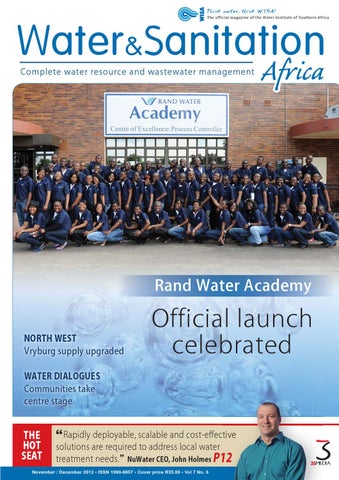
Rand Water Academy
NORTH WEST Vryburg supply upgraded
Official launch celebrated
WATER DIALOGUES Communities take centre stage
THE HOT SEAT
Rapidly deployable, scalable and cost-effective ctiive solutions are required to address local water treatment needs. NuWater CEO, John Holmes P12 12 2
November / December 2012 • ISSN 1990-8857 • Cover price R35.00 • Vol 7 No. 6
MED MEDIA
300 000 metres of
TRENCHLESS PIPE Successfully Installed
RENOVATE EXISTING PIPES BY: Pipe Bursti0) Sliplining CIPP UV Cure CIPP Ambient Cure Ribloc Expanda Ribloc Ribline Ribloc Rotoloc Pipe Eating INSTALLATION OF NEW PIPES BY: Horizontal Directional Drilling Guided Rock Drilling Bores of 1200mm Lengths up to 400 metres Microtunnelling
Countrywide 08600 66 344 +0(1u64'0%*.'55T%1T<# 999T64'0%*.'55T%1T<#
CONTENTS
Rand Water Academy officially launched
4
Volume 7. No.6
ON THE COVER
The launch of the Rand Water Academy brings with it a new era of skills capacity in the local water sector.
20 Vryburg bulk water supply upgraded
COVER STORY Rand Water Academy officially launched WISA President’s message Namibian WISA branch launched Process controllers celebrated YWPs make a global impact
4
6 8 8 10
HOT SEAT NuWater CEO, John Holmes: Closing the gap
12
REGIONAL FOCUS Vryburg bulk water supply upgraded North West bulk water supply progresses
20 24
PROJECTS New sludge handling facility for Johannesburg Water Krohne deliver largest diameter flow meter
28 31
New sludge handling facility
28
REGULARS Editor’s comment News international News Africa Trends & products
3 16 18 42
TECHNICAL PAPER Correlation of water quality with farming activities 33 INDUSTRY INSIGHT Stressed supply: PWC Report WRC Water Dialogues Trends, milestones and challenges in the groundwater business
37 38 39
31
Krohne to deliver largest diameter flow meter in southern hemisphere
NOVEMBER/DECEMBER 2012
1
Proven Bioremediation Technology SOUTH AFRICA
Publisher Elizabeth Shorten Associate publisher Ferdie Pieterse Editor Chantelle Mattheus Head of design Frédérick Danton Senior designer Hayley Mendelow Chief sub-editor Claire Nozaic Sub-editor Patience Gumbo Contributors Refilwe Khutswane, Peter Rosewarne, Dr Heidrun Tippe Marketing & online manager Martin Hiller Production manager Antois-Leigh Botma Production coordinator Jacqueline Modise Distribution manager Nomsa Masina Distribution coordinator Asha Pursotham Administration Tonya Hebenton Printers United Litho Johannesburg +27 (0)11 402 0571 Advertising sales Avé Delport Tel: +27 (0)11 467 6224 • Cell: +27 (0)83 302 1342 Fax: 086 502 1216 E-mail: avedel@lantic.net
EDITOR’S COMMENT
A new chapter
T
he final issue of Water&Sanitation Africa for 2012 ‒ the November/December issue ‒ has a number of highlights in its pages, not least of which is the introduction of a new editor as the magazine bids
farewell to its founding editor, Debbie Besseling, whose wealth of knowledge in the industry will be missed. It is always daunting to face a new challenge, a new
beginning and as I pick up the reigns of editorship of Water&Sanitation Africa, Publisher
despite previously having worked on titles of a similar nature, it is no less daunting ‒ and yet stimulating. However, I believe the only way to get started though is
Physical address: No 4, 5th Avenue Rivonia 2056 Postal address: PO Box 92026, Norwood 2117, South Africa Tel: +27 (0)11 233 2600 Fax: +27 (0)11 234 7274/5 E-mail: chantelle@3smedia.co.za MEDIA
ISSN: 1990 - 8857 Annual subscription: R270 (SA rate) E-mail: subs@3smedia.co.za Copyright 2012. All rights reserved. All articles in Water&Sanitation Africa are copyright protected and may not be reproduced either in whole or in part without the prior written permission of the publishers. The views of contributors do not necessarily reflect those of the Water Institute of Southern Africa or the publishers. WISA CONTACTS:
to quit talking and begin doing and I hope this is evident throughout the pages of the magazine. Some highlights in this edition include a number of community-driven initiatives, such as the Water Research Commission s (WRC s) first Water Current s Policy Series held on 14 August 2012 at the Leriba Lodge, Centurion, with a greater community-centric focus as one
“Tactical and more localised solutions are required to help close the ‘water gap’ ”
of the primary solutions necessitated,
according
to delegates and speakers alike. The WRC dialogues are
discussion-based
events on topical water issues affecting the South African public, the aim of which is to serve as a platform to exchange ideas and opinions related to water, and having been in attendance, I can definitely attest to the support for this initiative being extensive and widespread throughout the water sector. In addition, although strategic national water planning is critical, it has become clear that tactical and more localised solutions are required to help close the water
HEAD OFFICE Tel: +27 (0)11 805 3537 Fax: +27 (0)11 315 1258 Physical address: 1st Floor, Building 5, Constantia Park, 546 16th Road, Randjiespark Ext 7, Midrand
gap . Large centralised water infrastructure projects on their own are not sufficient to address the challenge due to their costs, planning duration and execution complexities, believes NuWater CEO, John Holmes, as we talk to him in this month s Hot Seat on the growing demand for clean water and the sustainable solutions available. A project that I think encapsulates all of the above ‒ a focus on community partici-
BRANCHES Eastern Cape Chairman: Hennie Greeff Tel: +27(0)41 453 3102 Secretary/Treasurer: Chris Dickson Tel: +27(0)41 507 8200
www.ewisa.co.za
pation, as well as sustainable water resource management ‒ is featured in our regional focus as we report on the progress of the upgrading of the bulk water supply to the town of Vryburg and the smaller communities in its immediate vicinity. I trust you will find the mix of projects, processes and opinions both interesting
Free State Chairperson: D.R. Tlhomelang Tel: +27(0)51 403 0800 Secretary/ Treasurer: Riana Wessels Tel: +27(0)56-515-0375
reading and inspiring, I look forward to your continued support and input into the
KwaZulu-Natal Chairman: Chris Fennemore Tel: +27 (0)31 311 8734 Secretary/ Treasurer: Stephanie Walsh Tel: +27 (0)31 302-4077
In the previous edition of Water&Sanitation Africa, the name of engineering and environmental consultant Royal HaskoningDHV was misspelt on the cover. Water&Sanitation Africa apologises for this error and any embarrassment caused.
Western Cape Chairman: Gareth McConkey Tel: +27(0) 21 712 4260 Secretary/ Treasurer: Eleonore Bondesio Tel: +27(0)21 872 0322 WISA mission statement m The Water Institute of Southern Africa provides a forum er for exchange of information and views to improve water resource management in southern Africa.
Endorsed by
magazine as it maintains its position as the complete water resource and wastewater management tool.
Cover opportunity In each issue, Water&Sanitation Africa offers companies the opportunity to get to the front of the line by placing a company, product or service on the front cover of the magazine. Buying this position will afford the advertiser the cover story on pages 4 and 5 and maximum exposure. For more information on cover bookings contact Avé Delport on +27 (0)83 302 1342 or e-mail avedel@lantic.net
NOVEMBER/DECEMBER 2012
3
COVER STORY
RAND WATER ACADEMY
Rand Water Academy
This is a momentous event in our endeavour as a sector to enhance capacity and ensure that as we deliver on our mandate, we also speak to the need for the development and skilling of our youth to employable levels. Minister of Water Affairs, Edna Molewa, at the launch.
T
he Rand Water Academy, located in Zuikerbosch, Vereeniging, officially opened its doors on 12 October to 120 young graduates in the fields of science, artisanship, engineering and process
control. The academy aims to build skills and further local capacity development in the water and sanitation sector, and will initially cater for critical skills within Rand Water, and then focus on a larger Southern African scale. The launch of the academy is in line with one of Rand Water s strategic organisational objectives: to have a high performance culture and to specifically build capability and capacity to meet changing organisational requirements. Molewa said: The concept of an academy must be the special purpose vehicle to drive and sustain that particular strategic objective. According to Molewa, it is important to take note that the Rand Water Academy
4
NOVEMBER/DECEMBER 2012
COVER STORY
officially launched is borne out of the need to systematise the various pockets of excellence in training operating independently across the organisation into a single integrated unit. This move is to integrate and create efficiencies, and signals the broader intention to pursue a sector-wide influence within and outside the borders of the republic.
Course contents As part of its objectives for the 2011/12 financial year, the board of Rand Water articulated the establishment of a Rand Water Academy as a priority project for its HR portfolio. The course on offer is a three-year course and
Opposite top Minister of Water Affairs, Edna Molewa cuts the ribbon at the launch
get the on-the-job exposure and experience needed to
Opposite below Minister Molewa unveils the commemorative plaque flanked on the far left by Rand Water CEO, Dinizulu Kumalo
Programme aims to address the need for registered and
graduates will train for 18 months at the Rand Water
make them employable, but will also address the issue of professional registration with the relevant professional bodies. The Process Controllers Development and Training qualified process controllers who can be utilised in municipal water and wastewater treatment works, thereby ensuring that the plants can strive to obtain Blue and Green Drop status and, according to Molewa,
maintain
the status and improve the quality of operation and maintenance . The academy programmes cover key areas where the
Zuikerbosch Water Purification and Pumping Station,
water sector is seriously under-capacitated, including:
before completing the remainder of the project with a
• assessment of water resources and determination of
recipient water services authority, namely a municipality. Rand Water envisages that the academy will develop into an entity that will drive the capacitation and professionalisation of engineers, artisans, process controllers, scientists, accountants and future leaders. The Rand Waster Academy has five key focal areas:
quantities of water available for use
The academy programmes cover key areas where the water sector is seriously undercapacitated
• a Centre of Excellence, which addresses one of the
• natural water resource monitoring and modelling systems • compulsory licensing processes • water pricing reform • water effluent treatment, compliance, enforcement and management • Catchment Management Agencies; • monitoring and enforcement of water use provisions of licences and permits
key challenges of process controller development and
• water infrastructure planning and construction
classification around the Blue and Green Drop incen-
• expertise in new water supply systems (e.g.
tive-based regulations.
desalination and recycling) and technology
• a Centre of Competence, which addresses the chal-
• expertise in water saving and efficiency op-
lenges around innovation in science and technology
tions for all sectors.
• research & development, which seeks to address the
Further aspects highlighted by the minister
shortage of key researcher capacity within Rand Water
at the launch include developing, and appre-
and in the water sector by increasing the pool of re-
ciation and understanding of how to increase
searchers within Rand Water, and the sector at large
water production and security through land
• a professional exchange hub, which aims to address
restoration and land use change, as well as
the challenges of exposure and international development by allowing trained individuals to practice in different countries and cities outside South Africa and by inviting international water professionals to do the same within the South African water industry • a water/sanitation solutions unit, to address the chal-
building productive collaborative relation-
Mr. Dinizulu Kumalo Percival Sechemane the CEO of Rand Water
ships with all water users.
Looming water crisis The minister also highlighted the multi-faceted looming water crisis as a dominant feature in the industry.
lenges of science/engineering and operations solutions
According to Molewa, there are three primary facets to
in the sector by utilising a team of trained water profes-
the crises, namely water scarcity due to demographic
sionals to provide ad hoc specialist solutions to chal-
and economic growth, a skills gap due to a recognised
lenges that arise within the water and sanitation sector.
skills misalignment in the sector, and a lack of good
We see this initiative not as a duplication of existing
management of the available good and well-intentioned
efforts, but as a programme that addresses, among
supportive policy.
others, the dire need for work integrated learning, said
The water sector urgently needs 4 000 artisans/
Molewa, adding that this would be provided by the two
technicians to overcome the crippling challenges of
programmes on offer, namely the Graduate in Training
poor operation and maintenance of infrastructure,
Programme and the Process Controllers Development
according to Molewa, who added that this was nothing
and Training Programme.
new. I believe these are some of the reasons we have such academies that will ensure a smoother transition
Programmes prioritised
of particularly our youth and previously disadvantaged
The Graduate in Training Programme seeks to not only
from just qualification to accreditation and expertise.
ensure that young science and engineering graduates
We need these skills.
In each issue, Water&Sanitation Africa offers advertisers the opportunity to promote their company s products and services to an appropriate audience by booking the prime position of the front cover, which includes a two-page feature article. The magazine offers advertisers an ideal platform to ensure maximum exposure of their brand. Please call Avé Delport on +27 (0)11 467 6224/ +27 (0)83 302 1342 to secure your booking.
5
PRESIDENT ’S MESSAGE
Taking it to the next level e have to believe that as
W
extremely good networking and strong rela-
who surpassed the offerings of all the other
31 556 000 seconds ‒ a year
tionship-building opportunities with other
shortlisted candidates. Is it not time that we
in total ‒ are almost gone and
organisations, including in our own country
start talking to each other, build strong and
we look back, there could only
and the rest of Africa. It was most encourag-
healthy relationships with stakeholders and
be huge satisfaction. WISA has made great
ing to see that Africa featured prominently
start regulating ourselves in terms of best
strides in becoming this modern organisa-
during the conference, even highlighting
practices and assessments, provide site-spe-
tion, and we will continue doing so by being
the theme of the conference Water and
cific training or recruit the retired profes-
creative and innovative in order to give the
Food Security . In the final analysis, it will
sionals to assist? The situation is so urgent
best benefits to our members.
be in our interest to facilitate a similar
that we cannot shy away from reaching out
The WISA board recently held a very ex-
conference of Water and Food Security in
to others, especially in the water sector, and
citing session to revisit the existing strategy
South Africa with all stakeholders, as it is
it sometimes need not cost anything, just a
with the intention of ensuring active and de-
the cornerstone of any society.
cisive participation of its members in the wa-
It sometimes feels that we all know our
ter sector ‒ even the term member has been
at 3 394, but we still have very low local
challenges but the solution is beyond us
changed to subscriber. The WISA strategic
government representation. Hopefully, this
for various reasons, especially red tape. We
session final report needs to be finalised
will be addressed with the structuring of
spend millions of rand on improving infra-
and will be shared with our subscribers, but
our
I would, in the interim, like to mention a few
and
strategic decisions that have been made:
section, which will
• a review of the subscribers benefits
provide marketing
• finalisation
of
our
Memorandum
of
Incorporation and rules of the company • upgrading of the WISA membership database and website
new
membership
currently
structure
Events
membership
emphasis on local
The WISA board recently held a very exciting session to revisit the existing strategy
and
technology, but shy away from training
and
capacitating the (our) people
government. We have plenty of challenges in the water
operating and managing these facilities.
sector and different ways of addressing
WISA will endeavour to do so by taking the
• professionalisation of the organisation
these challenges, sometimes successful
first strategic step, and by the next edition
• international exposure with our patron
and sometimes we need to go back to
you will be informed on the progress of the
the drawing board, but we won t become
professionalisation of process controllers
• a new vision and mission for the company
disillusioned, for it is our mission to turn
and scientific services personnel.
• a stronger emphasis on the activities of our
these challenges into achievable objectives
Let me take this opportunity to wish all
and opportunities. The amazing thing is that
of you a blessed and joyous festive season.
sometimes the answer or solution is or has
Wherever you will be, enjoy it, and come
members and stakeholders.
branches and divisions • stronger platform in the water sector in terms of support and oversight roles.
been right under our
back with an abundance of new
WISA would like to acknowledge the services
nose. For example,
energy for 2013 ‒ no matter what or
of Dr Mandla Msibi, who resigned as a board
for two years we
how we celebrate, the festive season
member after years of contribution to the or-
were looking exter-
is best celebrated by giving the light
ganisation, and I would like to thank him for
nally for an assistant
of love to those who need it most.
his role in the Education, Training and Youth
superintendent
Development Portfolio Committee and wish
my local authority,
him well with his future endeavours.
only to find in the
WISA, once again, formed part of the South
one
Week in Stockholm, Sweden. This presented
people,
• Amatola Water • Aveng Water • BIGEN AFRICA Services • BKS • Bloem Water • Botjheng Water • Bushbuckridge Water • City of Cape Town • City of Tshwane • CSIR • Dow Water & Process SA • Department of
in
appointment
African delegation to the International Water
PATRON MEMBERS
6
thank you . stands
WISA s
of
our
WISA greetings. Ronald M Brown
of
President: Water Institute of
own
Southern Africa
someone
Water Affairs • ERWAT • ESKOM Holdings • eThekwini Municipality • Festo • Golder Associates Africa • Grundfos Alldos • Huber Technology • ITT Water & Wastewater South Africa • Johannesburg Water • Magalies Water • Merck • Mhlathuze Water
• NCP Chlorchem • Nelson Mandela Bay Metropolitan Municipality • Overberg Water • PD Naidoo & Associates Consulting Engineers • Prentec • Rand Water • SALGA • SAME Water • Schneider Electric • Sedibeng Water • Siemens • SSI Engineers and Environmental
NOVEMBER/DECEMBER 2012
Consultants • Sulzer Pumps Wastewater SA • TCTA • Tecroveer • Umgeni Water • Veolia Water Solutions & Technologies South Africa • WAM Technology • Water Research Commission • Water & Sanitation Services SA • WEC Projects • Zetachem • ZMG Watech
When you can see the whole facility, you’ll see the savings Energy is a major part of water’s price and, of course, your facility’s operating costs. In addition, energy is the single largest contributor to the carbon footprint of the water process. Fortunately, Schneider Electric™ has the solution to manage and optimise your energy in line with your process obligations — and to reduce your carbon footprint. Our comprehensive approach to energy management, along with combined power and process services, can yield an energy cost reduction of up to 30 per cent of your existing installation. And with visibility across your entire water network, you’ll be able to optimise the management of your process, reducing and avoiding energy waste in real time.
Flexible software, reliable services make upgrading easy
The difference an energy management solution makes
kWh
Our combined security, SCADA, and power monitoring solution yields the highest efficiency
Implementation of Energy Management Solution Baseline Energy @ measured @ recorded
n utio sol t u ho Energy Wit savings
ion olut s h Wit Time Measurements recorded during the reference period
Measurements recorded for comparison to the reference
When you partner with Schneider Electric all along the life cycle of your facility, you’ll gain access to our expertise as a world leader in electrical distribution, motor control, and process automation. We encourage you to directly involve our experts and engineers by inviting them to conduct a thorough on-site audit and diagnosis of your facility, allowing them to propose informed solutions for improvement.
Improve productivity and safety at once Add to this, integrated security and remote management capabilities, and you’ve got a scalable, flexible solution to reduce energy costs, lower your carbon footprint, and provide a safer, more productive work environment for your employees.
Presenting EcoStruxure™, a solutions approach to the energy needs of the water industry that combines advanced power management with a proven automation control system to improve your energy efďŹ ciency and to help yield a holistically optimised plant.
Make the most of your energySM
Learn more about our water solutions Download our NEW water solutions guide today and stand a chance to win an iPad 2! Visit www.SEreply.com and enter the key code 20901p Call +27-11-254-6400
Š2012 Schneider Electric. All Rights Reserved. Schneider Electric, Make the most of your energy, and EcoStruxure are trademarks owned by Schneider Electric Industries SAS or its affiliated companies. All other trademarks are the PROPERTY OF THEIR RESPECTIVE OWNERS WWW SCHNEIDER ELECTRIC COM 2EGISTERED .AME 3CHNEIDER %LECTRIC 3OUTH !FRICA 0TY ,TD 2EGISTRATION .UMBER 4ERMS AND CONDITIONS APPLY s 998-2574_ZA_B
WISA NEWS
WISA branch launched in Namibia Namibia is the first country outside South Africa to join WISA. The launch, held on 30 July, was officiated by WISA president, Ronald Brown, WISA acting chief executive, Dot Zandberg, and CEO of NamWater, Dr Vaino Shivute. industry, suppliers, consultants, development organisations and research organisations. WISA is a well-established, not for profit, volunteer professional community, providing a wide range of benefits to its members and the water sector in general. It strives to be the inclusive and objective representative of the Southern African water sector in terms of the
Dr Vaino Shivurte and WISA president, Ronald Brown, unveiling the symbolic plaque of the WISA Namibia branch, supported by John Shigweda, Kristina Afomso and WISA acting CEO, Dot Zandberg
mandates it holds from its about 3 266 members, said Brown at the launch, which took place at Safar Court and Conference Centre, just outside the city centre. Zandberg
credited
NamWater s Kristina Afomso with driving the process with some help from her colleagues in the Training and Development division, as well as WISA s head office in Midrand, South Africa. NamWater covered all the costs of the launch, and the WISA Namibia branch
N
amibia has been experiencing a lack of a platform
will be situated at NamWater. The launch was well attended by a
for water information, skills sharing, as well as net-
big delegation of NamWater management and staff, as well as the
working,
Namibian Ministry of Agriculture staff and the City of Windhoek staff.
this
said Shivute at the launch. It is against
backdrop
that
NamWater
spearheaded
the
At the launch it was also suggested that Namibia should host the
establishment of a branch in the country in order to promote
2016 water conference, the possibility of which is being further in-
the sharing and application of water-related scientific and engi-
vestigated, according to Zandberg. Meanwhile, the next conference
neering knowledge and management skills among interested
‒ the WISA 2014 Conference ‒ is set to take place in Mpumalanga,
and associated groups and individuals from public authorities,
South Africa.
Process controllers celebrated he final quarter of 2012 has seen a number of process con-
every advantage necessary to excel as productive members of
trollers days take place. WISA has long acknowledged the
the WISA Process Controller s division, which they have organ-
vital role of all water and wastewater process controllers in
ised this event to take place at the Lowveld Showgrounds in
the water sector in ensuring the provision of safe drinking
Nelspruit.
T
water to citizens and the treatment of wastewater to a standard that is not harmful to the region s water resources and the envi-
• Western Cape Process Controllers Day ‒ 29 November 2012
ronment. The process controllers days are therefore an initiative
The third Process Controllers Day to be hosted in the Western
in the hope of creating platforms to stimulate and develop the
Cape will be hosted at the Ceres Victoria Park by the WISA Western
country s process controllers in a peer review environment where
Cape branch, in collaboration with the Department of Water
they can relate easily and professionally with each other.
Affairs Western Cape, SALGA, Overberg Water and the Witzenberg
In aid of this, two Process Controllers Days have and will be taking place over the last few months of 2012:
The theme for the Western Cape Process Controllers Day, spe-
• Mpumalanga Process Controllers Day ‒ 16 October 2012 This
cifically, will address the crucial role of women in water, according
was the first ever Process Controllers Day hosted in Mpumalanga
to Western Cape Process Controllers division chairperson, Sydney
and, according to a spokesperson from the Mpumalanga
Armoed, who added that interesting exhibitions by suppliers and
WISA branch, from an operational standpoint, no resource is
key players in the sector will also serve to enhance the outcomes
as important as the human resource. As such, it is in an effort
of the day by affording delegates practical engagements with the
to ensure that the province s district process controllers at all
suppliers and technical specialists .
the water and wastewater treatment plants in the region have
8
Municipality.
All delegates receive a certificate of attendance.
NOVEMBER/DECEMBER 2012
WISA NEWS
Capacity building and training uring the past year, WISA has moved into the realm of
well as a standardised framework for determining skills shortages
capacity building and training within the water sector
and supply. This has led to duplication of work, poor knowledge
and has employed a training manager and coordinator
management as well as a low return on investments. With regard
to deal with these issues. The first decision that was
to coordination, WISA aims to consult with water sector partners
made by WISA with regard to training was that it would not be pre-
in identifying training needs at all levels and to facilitate sector
senting any short courses under its name as a training provider. The
skills planning. WISA is currently working with the EWSETA in
decision was taken due to the fact that WISA is not an accredited
updating the sector skills plan and is in the process of signing a
training provider and has no intention of becoming one due to a
Memorandum of Understanding with the authority, which will
D
conflict of interest with its various members.
give credence to the role that the institution is playing with regard
WISA, together with the Energy and Water Sector Education and
to coordination.
Training Authority (EWSETA) and the Department of Water Affairs
WISA aims to fulfil its role of quality assurance through influencing
(DWA), held the first of many capacity building and training work-
the development and quality of training for the water sector, as often
shops during the WISA 2012 Biennial Conference and Exhibition.
numerous training programmes that remain questionable and lack
Each session of the workshop dealt with various aspects pertaining to capacity building and training, and were as follows: • coordinating water sector capacity building and training in South Africa • improving skills planning and career de-
currency are seen. There is a need to
WISA aims to create an ethos that is embedded in its new vision of ‘Promoting excellence in the water sector’
velopment opportunities
develop
appropriate
mechanisms
for the standardisation and quality assurance of training programmes within the water sector. WISA has started to work on forming effective partnerships with educational insti-
• improving capacity building and training and career development in water services
tutes, training authorities as well as employers. In this way it will be able to ensure that the training that is received will develop the skills
• improving capacity building and training and career development in integrated water resource management.
required and therefore have real labour market relevance. During the past year, WISA has established a Process Controller
The workshop was well attended by various stakeholders who
Division and has established branches of this division in various prov-
made valuable contributions to the outcomes of each session. The
inces as well. The establishment of this division will assist with WISA s
workshop also provided WISA a platform to share with the sector
initiative of becoming the professional body for the water sector, as
the WISA capacity building and training strategy. The strategy fo-
the designation of process controller will be the first to be registered
cuses on three very distinct areas of training and capacity building
with the South African Qualifications Authority (SAQA). WISA has
that WISA will be involved in. These are coordination, quality assur-
started the process on becoming recognised as a professional body
ance and professionalisation.
with SAQA and has the full support of DWA and the EWSETA.
Currently there is no institutional mechanism that provides cred-
Therefore, through these three key aspects of capacity building
ible information as well as analysis of the supply and demand for
and training, WISA aims to create an ethos that is embedded in its
skills in the water sector. There have been many initiatives as well
new vision of Promoting excellence in the water sector, through
as skills audits and assessments conducted; however, there has
building expertise, sharing knowledge and improving quality
been no coordination with regard to the sharing of information as
of life .
WISA & CTICC go green he Cape Town International Convention Centre (CTICC) is
2012 WISA conference, ensuring the organisation s continued focus
committed to working with conference and event organisers
on the sustainable utilisation of the country s natural resources.
T
to ensure that delegates and guests also understand the need to minimise their impact on the environment.
At the CTICC, we have long recognised that sustainable business
success requires that organisations make sound environmental practices a strategic imperative. As such, the CTICC has a dedicated environmental task team that advises management on trends and issues in environmental management. This green commitment is nothing new to the CTICC. From the first day of construction, the centre has worked hard to minimise its environmental impact, and its proposed expansion will build further on its reputation as a truly green event destination. It is therefore with great pride that WISA recently received a green certificate from the CTICC to verify that the water institute recycled 1 340 kg of the conference waste stream during the May
NOVEMBER/DECEMBER 2012
9
WISA NEWS
YOUNG WATER PROFESSIONALS
Making a global impact The Southern African Young Water Professionals programme has entered its fourth year of official existence, with more than 800 student members and provincial chapters set up in the Western Cape, KwaZulu-Natal, Gauteng and further afield, in Zimbabwe and Mozambique. Plans are also under way to launch the Mpumalanga and the Free State chapters this year.
Professionals (EAYWPs) Conference in Uganda, where she conducted a podium presentation sharing SAYWP success stories and lessons learned. The conference occurred at the National Water and SC-International Resource Centre in Kampala, Uganda, from 11 to 13 December 2011, under the theme Water for Tomorrow: A Collective Responsibility . EAYWP is a regional forum that was established to bring together YWPs below the age of 35 in the region, with the main aim of pooling competences in order to provide unified approaches towards solving the challenges faced by the water sector in the region. The EAYWP operates under the auspices of the International Water Association (IWA) and the African Water Association. The objectives of the conference were to provide a forum for YWPs from across and beyond Africa to meet, share experiences and
ABOVE YWPs made a strong representation at the recent WISA conference BELOW Inge Jacobs at the World Water Forum in Mareilles, held in March 2012
T
he Young Water Professional (YWPs) are helping
elaborate on their role in addressing the challenges facing
other young professionals and students in career
the water sector in the region. Also, to provide an oppor-
development, networking, and technical skills
tunity to broaden the YWP programme by reaching out to
training, but perhaps more importantly, having
more YWPs in Africa and working towards establishing the
a supportive network of individuals who are going through the same challenges that young people face when developing their careers. This is oftentimes the non-technical challenges ‒ such as networking at conferences and finding a mentor, or sharing the
African YWP umbrella. The
The YWPs are making an impact across the globe through their involvement in various international conferences and events
over 250 delegates from over 12 other countries namely, Kenya,
Rwanda,
Burundi,
South Sudan, Sudan, Ghana, Ivory
Coast,
Ethiopia,
Zimbabwe,
Japan,
Austria
challenges of being a young woman
and Germany.
professional in a largely male-domi-
• The World Water Forum in Marseille in March 2012.
nated sector ‒ to grow professionals
The SAYWP programme was represented at the 6th World
that are equipped to deal with the
Water Forum held in Marseille, France, by Inga Jacobs and
technical but also non-technical chal-
Tobias Barnard. This event, themed Time for Solutions ,
lenges that the water sector throws
took place from 12 to 17 March 2012 and drew people
before them.
from all sectors related to water, with a strong presence of
In addition, the YWPs are making an impact across the globe through
10
conference was attended by
young professionals wanting to make a difference in the water sector.
their involvement in various inter-
Inga and Tobias assisted the IWA and the IWA YWP with
national conferences and events,
their Dialogue Café Session by facilitating discussions on
most notably:
global water challenges and, more specifically, the role
• First East Africa YWP Conference
that YWPs around the world can play in addressing these
in Uganda. Representing Southern
challenges. Inga, in a traditional African outfit, proudly
African Young Water Professionals
represented South Africa in a fashion show themed
(SAYWP), Preshanthie Naicker attend-
Women leadership in Water: presenting new thinking
ed the first East Africa Young Water
new challenges .
NOVEMBER/DECEMBER 2012
WISA NEWS
The youth showed their passion towards the water sector by voicing their opinions and solution in sessions for Youth Solutions , Emerging Academic Perspectives: Water for Food , and Youth debate on climate change , which were all combined in creation of a youth vision for the water sector and the launch of the Water youth movement that aims to bring together all youth organisations and programmes in the world. The
French
Young
Professionals
programme,
Projection , recreated a slum that was effectively used as a venue to discuss water problems and solutions in an environment that ensured you never forgot the real world situation faced by millions of people living in such conditions. of School Task team, responsible for the finalisation of this
The WISA 2012 Conference in May 2012
strategy. The main purpose of the Out of School Youth
YWPs also made a strong representation at the WISA
stream was to provide a platform for governments, civil
Conference, where they were able to network and take
society organisations and key partners in Africa to share
part in Wetskills 2012. Twenty Dutch and African students
experiences and understand what countries are doing
presented their two-week water challenge pitches, which
with regard to youth engagement in the water and sani-
they had worked on prior to the conference collaborative-
tation sector.
ly, to a jury of professionals. Congratulations go to Linda
The meeting also provided government officials with
Zulu, Nadine Wacka, Sanne Muis and Peter de Jong, who
an opportunity to review previous declarations and com-
won this year s challenge with Sewage treatment: a walk
mitments, and consider strategic direction for operation-
in the park .
alising the Africa Youth Programme against the backdrop
Hard work also paid off when Umvoto Africa was
that young persons have the right to participate in all
awarded the YWP Professional Development Award,
spheres of society, and that governments are encouraged
while D Ikumi won the Dr GG Cille Award for the student
to facilitate the creation or strengthening of platforms
with the best contribution to the
for
youth
understanding
in
decision-making
of
anaerobic
and
sludge handling, with a paper on modeling of struvite precipitation in anaerobic digestion. The best paper on mine water management by a student went to J Gorimbo, for work on investigation of
Governments are encouraged to facilitate the creation or strengthening of platforms for youth participation in decision-making
ABOVE YWP delegates at the WISA 2012 Conference
participation at
local, national, regional, and continental levels of governance, as stipulated in Article 11 (Youth Participation) of the Africa Youth Charter.
the regeneration of natural zeolite used to absorb heavy (UK) went to F Mhlanga for his work on influent character-
The IWA International YWP conference in Budapest in July 2012
isation of wastewater.
Between 10 and 13 July 2012, YWPs from more than 30
metals, while the Foundation for Water Research Award
different countries met in Budapest, Hungary, for the 6th
The Africa Youth Summit in June 2012
IWA YWP conference.
South Africa, through the Department of Water Affairs,
This conference provided an international forum for
hosted the Africa Youth in Water Summit. The event
young researchers and professionals working in water
created a platform for young people participating in
and wastewater research, technology and management
various school-based and out of school projects to share
sectors, to present their work and meet their peers from
experiences of being in the water sector. Over 500 young
all over the world.
people attended the summit from the nine provinces
The South African YWPs were well represented at this
of South Africa. For the YWP network, the out of school
event and proudly took the podium for five presentations
youth session was an important platform attended by
and a poster session. The Gauteng YWP chairperson,
young leaders from all over Africa. This session focused
Shanna Nienaber, did a presentation at the conference
on the development of Africa Youth Water Strategy and
looking at the role that river basin organisations play in
Implementation Plan, which will be presented to the
effectively governing transboundary rivers in Southern
technical committee of African Ministers Council of Water
Africa. Raymond Siebritis, the Western Cape YWP chair-
(AMCOW) and subsequently to the AMCOW for approval.
man, also presented at this event. He explored the impact
The SAYWP president, Inga Jacobs, formed part of the Out
that water research is having in South Africa.
NOVEMBER/DECEMBER 2012
11
HOT SEAT
NUWATER
Closing the gap
IIn this month’s Hot Seat, NuWater CEO John Holmes talks tto Chantelle Mattheus on the growing demand for clean water and the few companies able to offer the technology, w expertise, creativity and financing capability required to e meet the challenge. m
T
he gap between demand for clean water and supply contin-
There are currently very few companies able to offer the technol-
ues to grow in South Africa and across much of the globe
ogy, expertise, creativity and financing capability required to supply
as population, industrial and agricultural growth continues.
reliable and cost-effective decentralised water treatment solutions.
Although strategic national water planning is critical, it has
This is particularly true for unconventional water treatment require-
become clear that tactical and more localised solutions are required
ments, such as mine drainage water and produced water in oil and
to help close the water gap . Large centralised water infrastructure
gas, as well as indirect potable reuse where wastewater is recycled
projects on their own are not sufficient to address the challenge due
as high-quality drinking water. NuWater was set up specifically to
to their costs, planning duration and execution complexities.
address this gap in the market and to bring a new focus to decen-
Rapidly deployable, and in some cases redeployable, solutions that
tralised water treatment and localised water reuse applications.
are scalable and cost-effective are required to address local water
We identified three critical success factors for NuWater from the
treatment requirements. Efficient and effective technology needs
start: access to superior technology, the ability to provide flexible
to be supplemented by creative thinking on symbiotic water reuse
financing options to our customers and a passionate commitment to
scenarios and financing alternatives, says Holmes.
customer service.
What other challenges abound? JH The treatment and
refinement of technology in the
leading technology for
treatment plants. Aside from
areas of zero liquid discharge
desalinating large volumes
technology, NuWater offers a
handling of waste streams from
and value from waste are a
of sea and brackish water.
range of financing options to
the water treatment process
major focus for NuWater.
The superiority of NuWater s
its customers, ranging from
proprietary large-diameter
equipment supply through to
remains a major challenge.
(16 inch) RO has been proven
water as a service where the
potential of water reclamation
What solutions can NuWater offer? NuWater is able to
with some of the world s
customer is charged only for the
and reuse, further technology
offer a broad range of water
most demanding customers
water cleaned by NuWater.
improvements are required to
treatment solutions based
and at high profile sites.
fully dewater waste streams
on multiple technologies.
NuWater is also a pioneer in
and extract value from them to
We specialise in membrane
completely modular, rapidly
How important is continued R&D? NuWater is a technology-
help offset overall treatment
technologies, and in particular
deployable and redeployable,
led company with proprietary
costs. The development and
reverse osmosis (RO) ‒ the
water and wastewater
technology. We, however,
In order to maximise the
12
NOVEMBER/DECEMBER 2012
HOT SEAT recognise that technology continues to evolve and that further investment and creativity is required to maintain a competitive advantage. We work very closely with academic research institutions and our Singapore office is based at
OPPOSITE NuWater’s 15 Mℓ/d Wastewater Reclamation Plant at Anglo American Thermal Coal’s New Vaal Colliery RIGHT NuWater Small Mobile Plant for Drinking Water BELOW RIGHT NuWater Modular & Mobile/Redeployable Plant
the Nanyang Technological University, a globally recognised
water reclamation plant at
centre for water technology. At
Anglo American Thermal
NuWater, we also believe that
Coal s New Vaal Colliery, near
you need to continue to look
Vereeniging; the seawater
outside the company for the
1 Mℓ/d desalination plant
best and most suitable solution
at Sedgefield, supplying
to a specific application. We
drinking water; the 55 Mℓ/d
therefore also invest time and
wastewater reclamation
effort in developing strong
plant for Singapore s Public
relationships with international
Utility Board (PUB), providing
technology providers.
high-grade water for industrial and drinking purposes and the
What cutting edge technologies has NuWater brought to the market?
10 Mℓ/d seawater desalination process water to Singapore s
i ificantly l to the h NuWater N W signifi
b i f our distributed di ib d new business for
NuWater s predecessor
PowerSeraya power station.
team s skills and experience.
water treatment solutions,
Current projects? NuWater
a trusted brand name in this
(16 inch) RO technology and
What were some of the highlights of these projects?
has recently secured a major
space. NuWater is a young
proved that this technology
The projects mentioned provide
contract in Ghana for a leading
high-growth company without
surpasses conventional 8-inch
a good idea of the scope
mining company to provide
the common legacy issues of
technology both in terms
of application of NuWater s
two mine wastewater treatment
conventional water companies.
of produced water quality,
technology and expertise,
plants. These plants will ensure
We are focused on the growth
and capital and operating
particularly in unconventional
reclaimed and discharged water
opportunities already identified,
costs. Our flow distributor
water treatment applications.
meets the highest international
which present real and
and electromagnetic field
RO is central to all the plants
standards. We have a number
immediate business.
technologies allow NuWater
mentioned, as is specialist
of similar mining projects
plants to achieve greater
pretreatment using the
in the pipeline as well as
sustainable flux rates than
latest media filtration and
unconventional industrial and
What key benefits are there on offer? There is always a
conventional technology
membrane technology. What
drinking water projects.
small number of key questions
without the commonly
is also significant is the range
associated fouling and scaling.
of capacities of the different
plant providing high-grade
company, GrahamTek,
and NuWater aims to become
pioneered large diameter
a customer asks a supplier
Market focus? Extractive
NuWater s technology was proven in Singapore, considered to be one of the most sophisticated global water hubs. Our
NuWater is a technologyled company with proprietary technology
technology is deployed at
or service provider. First, is
industries, such as mining
your technology and delivery
and oil and gas, represent
capability proven in demanding
major opportunities
environments? Second, how
for NuWater as our
much does it cost over the life
technology and business
cycle of the requirement? And
model is very well-suited
finally, are you able to provide
Singapore s flagship wastewater
plants and feed water sources,
to addressing the requirements
the required technical and
reclamation plant, the Bedok
which range from seawater
of these industries. In addition,
commercial services and service
NEWater factory.
to secondary sewerage water
our modular and mobile
levels over the duration of
and contaminated ground and
plants position us well for
the requirement?
What are some of NuWater s projects? NuWater s primary
surface water. The nature of the
the growth in decentralised
plants also ranges from world-
water treatment. Increased
to provide simple and clear
regional focus is on sub-
class infrastructure, such as the
enforcement of environmental
responses to all these questions
Saharan Africa and Asia Pacific,
PUB Bedok plant in Singapore,
discharge limits on mining and
supported by project and
operating from its bases in Cape
to the pioneering large-scale
oil and gas companies and a
customer references. NuWater s
Town and Singapore. Some of
modular and mobile plant at
growing public awareness of
willingness and capability to
the most high profile projects
Anglo American Thermal Coal.
the importance of managing
take on performance risk also
we have executed include the
All of these projects have had
water supplies will help drive
provides further reassurance to
15 Mℓ/d completely modular
their own unique challenges,
growth in our target markets.
customers where the applica-
and mobile mine drainage
which have contributed
Necessity will also help drive
tion is unproven.
NOVEMBER/DECEMBER 2012
Quite simply, NuWater is able
13
INTERNATIONAL NEWS AUSTRALIA
Former Sydney Water CEO appointed to NBN board FORMER CEO and MD of Sydney Water, Dr Kerry Schott, has been appointed to the board of NBN Co. Schott has extensive experience in infrastructure delivery and finance, both in the public and private sectors, and will be a valuable addition to the NBN Co Board, the Australian minister for Finance and Deregulation, senator Penny Wong, said. Schott has spent 15 years in investment banking, including as a MD at Deutsche Bank responsible for infrastructure work in Australia and Asia, and as executive vice president of Bankers Trust Australia. She also has significant experience in the public sector, including as CEO of the NSW Commission of Audit. She is a member of the Infrastructure Partnerships Australia Board, Whitlam Institute and the New South Wales Treasury Corporation (TCorp). Schott s appointment is effective immediately. Source: ARN
INDIA Frequent floods
Centre plans to restructure Brahmaputra Board
AGAINST THE backdrop of frequent floods in Assam and allegations of its failures to deal with the situation, the centre has decided to restructure the
16
Brahmaputra Board and turn it into a body to develop and manage water resources of the entire north-eastern region. The Water Resources Ministry sought feedback from chief ministers of the seven north-eastern states, on the draft proposal to restructure the board, which came into being 32 years ago. The government may bring in a new legislation to transform the Brahmaputra Board into the Brahmaputra River Valley Authority and replace the current Brahmaputra Board 1980 Act. A review of the functioning of the Brahmaputra Board reveals that it did not have a mandate to provide a strong framework for the holistic development of the Brahmaputra River, said the draft. It also said the board failed to build up competent engineering cadre to support its activities, which remained largely concentrated in the state of Assam. According to the draft, the proposed authority will be mandated to coordinate development and management of water, land and related sources to maximise economic and social welfare without compromising the ecosystem of the Brahmaputra valley. It will have two parts ‒ a policy-making apex council and an executive wing. The council will be headed by the Water Resources minister as chairman and include the chief ministers and ministers for water resources of the north-eastern states. The executive board will be responsible for implementing the decisions of the council. After the authority is set up, the centre will create a fund called the Brahmaputra Fund. The fund will be used to finance the water resources activities in the member states. The centre will be the custodian of the fund, which will be controlled by the authority, the
draft said. Source: Businessline
Ryan Lochte campaigns for clean water and sanitation in India AMERICAN OLYMPIC swimmer Ryan Lochte, along with fellow gold medalist Conor Dwyer, has filmed a public service announcement urging support for greater access to clean water in developing countries, including India. The campaign is for Water for People, which is a Denverbased NGO. According to Politico, the organisation describes its mission as helping people in developing countries improve quality of life by supporting the development of locally sustainable drinking water resources, sanitation facilities, and hygiene education programmes . They currently work in Honduras, Guatemala, Nicaragua, Bolivia, Peru, Ecuador, Malawi, Rwanda, Uganda, and India. The organisation is in the midst of a fundraising drive for its Time Well Spent challenge, seeking to help women spent time doing what they love, the report added. Donate now to Time Well Spent and give women and girls time to do things they love, Lochte said. Source: the Indian Express
OMAN
Date palm leaves can help clean wastewater
NOVEMBER/DECEMBER 2012
DATE PALM leaves can help purify wastewater from hospitals of chemicals and dyes before it is discharged into the municipal sewers, scientists claim. Researcher Al Said Al Shafey, from Sultan Qaboos University in Oman, intends to establish basis for a physico-chemical unit for the treatment of hospital wastewater. Al Shafey said they could extract dehydrated and activated carbons from date palm leaves, which is a cheap and sustainable resource in Oman. Around 180 000 t of date palm leaves are estimated to be produced annually in the country, the Times of Oman reported. Scientists tested different carbons for removal of certain pharmaceuticals like ciprofloxacin, paracetamol, fexofenadine, lisinopril, diphenhydramine and chlorpheniramine maleate from aquatic solutions. The chemists also examined the removal of heavy metals and dyes. The results showed that the cheap dehydrated carbon from date palm leaves proved to be as efficient as activated carbon for removing pharmaceuticals and dyes. According to Al Shafey, the findings would be soon utilised in a pilot project in hospital wastewater treatment. Hospitals consume a significant amount of water in a day, ranging from 400 to 1 200 ℓ/d per bed. It generates significant amounts of wastewater, usually loaded with microorganisms, heavy metals, hormones, radioactive isotopes and other impurities, the researchers said. The main challenge of pharmaceuticals was that many of these substances are not easily biodegradable as they bypass the biological wastewater treatment and become ubiquitous in the environment. Source: Money control
bidim
R
AFRICAN NEWS KENYA
Water wars kill scores
WATER SCARCITY is fuelling deadly inter-ethnic wars that continue to claim lives in Kenya, according to government officials. And if nothing is done to educate communities on how to conserve the valuable resource, the situation will escalate, governance experts and environmentalists warn. On 9 September, 38 people were killed in revenge attacks in Kenya s Tana River Delta district. The deceased included eight children, five women, 16 men, and nine police officers. The incident occurred as the
18
government announced that it would conduct a disarmament exercise in the Tana River Delta, following clashes over water and pasture that have left more than 80 people dead. But conflict over resources is not confined to this region. North Eastern provincial officer, Ernest Munyi, also the region s assistant commissioner of police, said that the attacks were becoming more frequent. These are nomadic pastoralists who depend on livestock for survival. They rustle livestock and fight over water and the few grazing fields, he said. Peter Mangich, director of water services at the Ministry of Water and Irrigation, stated that due to the effects of climate change, the country now only received one quarter of its previous rainfall. The average annual rainfall is 630 mm, which should be four times
this figure to be enough. The National Development Plan 2002 to 2008 recognised Kenya as a water-scarce country where the water demand exceeded renewable freshwater sources, he said. Source: ipsnews.net
SOUTH AFRICA
Mintek’s new water atomising plant launched MINERAL RESOURCES Minister, Susan Shabangu, has launched Mintek s R44 million water atomising plant. Situated at Mintek s Randburg campus, the will provide an effective means for the production of solid metal powder from 6 t batches of molten metal. The atomiser plant was designed and built by MDM Engineering, which sourced the atomisation technology from UK-based
NOVEMBER/DECEMBER 2012
metals processing company Atomising Systems. Unveiling the new plant, Shabangu said the facility represents an ongoing collaboration between Mintek and the platinum industry. She said the technical collaboration was aimed at lowering the costs and environmental burden of the sector, and consequently represented one of the tangible areas where government was working with the industry to remove technical impediments and reduce risk in the sector. As a department, we always strive towards working hand in hand with the mining sector, in a joint effort to solve problems that may exist, she said. According to Mintek, the new plant will initially be used for a two-year research and development project for Anglo American Platinum. Source: SAnews
REGIONAL FOCUS • North West
BULK WATER SUPPLY
Vryburg bulk water supply upgraded
The construction of a new pump station at Vryburg in the North West is part of the upgrading of the bulk water supply to the town and its immediate vicinity. Chantelle Mattheus spoke to the relevant role players regarding the project’s progress and what it will mean to the local community.
Need expertise with effluent and wastewater treatment? K' Enyuka produces affordable, workable and effective solutions tailored to specific requirements, whether dewatering or the treatment of wastewater and effluent. Its offering includes design, engineering and construction of wastewater treatment and effluent plants as well as dewatering installations.
T
he Vryburg area in the North West has been experiencing what has been termed serious water shortages by those involved in the upgrade of the town and the surrounding areas bulk water
infrastructure during the past seasons due to the absence of sustainable water supply systems to the town and townships . There are also a further 3 500 houses planned through local housing projects that will increase the demand substantially in the area. The new bulk water supply line was designed to supply bulk water from Pudimoe to Vryburg. The total length of the supply line will be 56 km, with three new reservoirs and two new pump stations. NEP Consulting Engineers has been appointed by Dr Ruth Segomotsi Mompati
Hydro-Pyro Metallurgical | Mineral Processing Engineers | Project Managers
District Municipality as the consulting engineers for the bulk water project to supply water to the town of Vryburg, as well as Huhudi, Colridge and Kismet. This will include
T +27 11 498 6000 F +27 11 498 6060 E mail@kenyuka.com
Coralynne & Associates +27 (0) 11 422 1949
the complete design of the bulk water system, putting it out for construction tendering and ensuring the project is
www.kenyuka.com
running as planned during construction by the appointed
20
NOVEMBER/DECEMBER 2012
REGIONAL FOCUS • North West contractors and ensuring the quality of work is maintained
Vryburg, adjacent to the N18 road. This treatment works
throughout the project, says Rayno Booysen of NEP
consists of two plants, with a new water treatment works
Consulting Engineers.
planned, says municipality spokesperson, Molefi Chwene.
Current infrastructure includes an existing 250 mm
The old water treatment works, which is currently
diameter pumpline from Pudimoe water works to supply
operational, was commissioned in 1967 and has been
the Vryburg area and the villages along the pumpline
refurbished with a design capacity 6 Mℓ/d. The second
route, as well as 20 existing boreholes used to supply wa-
treatment works, which is currently under refurbishment
ter to the Vryburg reservoir. The existing water resources
and only partially operational, was commissioned in 2003
are already over-utilised and the long-term sustainability
with a design capacity of 8 Mℓ/d. The final water treat-
thereof is seriously impacted. The results can be seen in
ment works currently being constructed is the newest
the areas mentioned where water shortages occur regularly, says Booysen. The new supply line will have the capacity to supply the Vryburg area for the next 20 years. According to Booysen, key factors that had to be considered the
TABLE 1 The phases of the new bulk water scheme
edition, with a design capacity of 8 Mℓ/d. Chwene explains that the Naledi Bulk Water Supply Project is mainly set to benefit the Naledi Local Municipality, which is one of five local municipalities
during
planning
and
design stages were
PHASE 1: Reservoirs
Budget (ZAR including vat)
Main contractors Lepogo Construction JV Mphumelelo
SECTION A
New 10 Mℓ concrete reservoir at Vryburg
16 427 309.71
with regards to bulk
SECTION B
New 1 Mℓ concrete reservoir at Dryharts
11 600 928.38
Ultimate Dynamic
water supply from
SECTION C
New 1 Mℓ steel tank at Brussels
3 397 112.33
HT Pelatona JV Ora and Ore
the current capacity
treatment plants, as well as population growth patterns, the continually growing water from
PHASE 2: Pipelines SECTION A1
Pumping main diameter 500 mm from new Pudimoe Pump station to turn off at Dryharts (13.1 km)
36 179 477.26
Balekane JV Esorfranki
SECTION A2
Pumping and gravitational main of diameter 500 mm from new turn off at Dryharts to Dryharts reservoir (4.1 km)
13 181 468.65
KD Civils/Uncle Paul JV
SECTION B
Gravity supply line diameter 500 mm from turn off at Dryharts Reservoir to Brussels booster pumpstation (17.5 km)
52 115 186.64
Udumo Trading t/a Ultimate Dynamic
Pumping main diameter 500 mm from Brussels Pumpstation to new 10 Mℓ concrete reservoir (21.3 km)
C1: 50 835 722.04
Balekane JV Esorfranki
SECTION C1&2
C2: 10 013 695.41
Balekane JV Esorfranki
demands communities,
the topography of the system, bulk water storage facilities and pipeline capacities for current and future demands .
District perspective With reference to
SECTION D
Gravity supply line diameter 400 mm from new 10 Mℓ reservoir to existing Vryburg reservoir (6 km)
12 238 362.84
MIS Pipelines
SECTION E
Gravity supply line diameter 400 mm from new 10 Mℓ reservoir to existing Huhudi reservoir (4 km)
8 581 059.30
MIS Pipelines
the existing infrastructure,
Vryburg
town is getting bulk treated water from the Pudimoe Water Treatment which
is
Plant,
PHASE 3: Pumpstations Section a
Pumpstation at New 10 Mℓ Reservoir, Vryburg
7 365 140.77
HT Pelatona
Section b
Brussels Booster Pump Station
14 382 117.95
HT Pelatona
approxi-
mately 50 km from
NOVEMBER/DECEMBER 2012
21
REGIONAL FOCUS • North West that fall under the district municipality s
jurisdiction
and only constitutes 14% of its population. Up to the end of 2007, most of the portable water supply to the Naledi Local Municipality
was
groundwater
from sources
through a series of boreholes. The groundwater was
Bulk water is currently being abstracted from the Vaalharts irrigation scheme with a maximum
augmented by a pumped supply from the 2003 water works in Pudimoe via a 315
mm
uPVC
pipeline
with the design flow of 6 Mℓ/d. Currently the water requirement for the Naledi Local Municipality is about 9 Mℓ/d and peak require-
ment of 13 Mℓ/d ‒ and this will be addressed with the new bulk water pipeline which will be constructed parallel to the existing water line, explains Chwene. He adds that bulk water is currently being abstracted from the Vaalharts irrigation scheme with a maximum of 3.1 million cubic metres per annum, which equates to 8.99 Mℓ/d (including 20 days storage) to be withdrawn for use by the Naledi Local Municipality.
New pump stations and reservoirs planned Part of the project, valued at R17.8 million, involves the construction of a new pump station at Vryburg next to an existing pressure tower, as well as the construction of a booster pump station at nearby Brussels in the North West. HT Pelatona Projects has been appointed at the main contractor on site, with NEP Consulting Engineers continuing their role as the appointed civil engineers on the project. The bulk water pipeline, with its pump station and reservoirs, will form part of the total supply project that will supply water from the Taung Dam up to Pudimoe Water Treatment Plant, from where it will be treated and supplied to the Vryburg area. These reservoirs and pump stations were strategically placed for the most feasible option, says Booysen. This was achieved by dividing the bulk water supply system into three sections, namely: • pumping main from Pudimoe to Dryharts • gravitation line from Dryharts to Brussels • pumping main from booster pump station at Brussels to Vryburg. The sections were divided in this manner to reduce the total energy cost of the bulk water supply line. With the positioning of the 1 Mℓ concrete reservoir close to Dryharts, we were able to gravitate water for 20 km from Dryharts up to the new 1 Mℓ steel reservoir at Brussels. Water is then pumped from a new booster pump station at Brussels to Vryburg, says Booysen, adding that the new supply line will also be designed to be utilised in future to supply water to Ganyesa and Stella as well.
Localised labour He adds that the project commenced in January and , at the time of writing, was almost 50% complete. The targeted completion date of March 2013 is still in place and all seems to be in line to be completed by the specified date , says Booysen.
22
22
NOVEMBER/DECEMBER 2012
REGIONAL FOCUS • North West
BULK WATER SUPPLY
North West project progresses The Ngaka Modiri Molema District Municipality in the North West province has secured R10.2 million for the upgrading of bulk water supply in Braklaagte (Lekubu). Worley Parsons’ civil engineer, Lebogang Moinwe, spoke to Refilwe Khutswane about the projects progress to date.
B
raklaagte (Lekubu) is a formal settlement approximately 20 km north of Zeerust and consists of 1 422 stands with a total population of 5 401 beneficiaries. The existing water sup-
ply consists of 12 boreholes: three new drilled but not equipped and nine equipped boreholes. Eight of the equipped boreholes are electrically operated and one is driven by diesel power. The two of the newly drilled boreholes are in the main villages and one in Modisa section of the settlement. The borehole equipped with a diesel motor and one driven by electrical power are in the Modisa section of the settlement and are connected to a steel storage tank of 40 kℓ. The water is then fed into the existing distribution network from elevated steel reservoir, which ensures a minimum system inlet pressure of 10 m (static) into the distribution network. The remaining seven boreholes supply the main village. Five of them are connected to a 600 kℓ steel reservoir by means of 75 mm diameter uPVC pipes and two directly supply the network. One of the seven boreholes has dried up and has broken rods, while another has very small pipes as well as broken rods. The water from these boreholes is fed into the existing distribution network from the reservoir by means of a network of uPVC pipes varying in size between 62 and 200 mm in diameter.
Upgrade needed The current combined safe yield of the nine production boreholes serving Braklaagte is 3.5 ℓ/s. However, only seven are in operation currently. According to Moinwe, this means that the entire bulk infrastructure needs to be
24
NOVEMBER/DECEMBER 2012
Excellence in Chemical Dosing For more than 65 years sera products have represented the highest measure of quality, safety and reliability in the treatment of drinking water, process water and wastewater.
Chlorine dioxide preparation and dosing systems, for up to 1,000 g/h
Preparation and dosing stations for polymers and flocculation aids
Compact vertical dosing systems for all kinds of fluids
Dosing and feeding pumps Dosing systems and disinfection systems Process measuring and control technology Fittings and accessories Extensive pre- and after-sales service
sera DoseTech SA [PTY] Ltd. Unit 3-4 Airborne Park Cnr of Empire & Taljaard Str Bartlett Boksburg, PO Box 15474 South Africa Tel: +27 11 397 5120 Fax: +27 11 397 5502 info.za@sera-web.com www.sera-web.com
REGIONAL FOCUS • North West rehabilitated to enable sufficient water supply and distri-
• the equipping of three new boreholes
bution to the village, which was the primary reason for the
• the electrical connection to the reservoir.
municipality initiating the project.
Competitive tenders shall be invited in respect of each
The scope of the works includes the erection of a new
of the above portions of the works in accordance with
550 kℓ steel reservoir on concrete footings, the provision
the relevant provisions of the latest edition of the CIBD
of a chlorination unit at the existing elevated reservoir,
Standard for Uniformity in Construction Procurement.
the installation of a new 110 mm diameter Class 9 uPVC connector pipe line between the existing 600 and 40 kℓ reservoirs (±4.5 km), the installation of 110 and 75 mm diameter Class 9 distribution pipe line (±6 km) and 12 standpipes and the equipping and rehabilitation of four boreholes.
The contract data in the associ-
Construction is still in its early stage, with a focus on tried and tested technology being upheld
Additionally, provision of two cattle drinking points, the
ated procurement documents will be based on the use of Building Industries
Federation
South
Africa s (BIFSA) standard industry contracts with minimal project
specific variations and amendments that do not change
electrical connection to reservoir, fencing and site works
their intended usage.
have also been included in the scope of works outlined in
Furthermore the municipality, together with the
the tender.
contractor once appointed, is to proceed
inaccor-
dance with the provisions of the Standard Conditions
Contracts and construction
of Tender contained in Annex F of Standard Condition
Construction is still in its early stage, with a focus on tried
Procurement, Moinwe explained.
and tested technology being upheld throughout the proj-
According to Moinwe, an accredited training provider
ect rollout. The project, valued at R10.2 million, is set to be
will be appointed to provide the required skills training
completed February 2013. Moinwe outlines the portions of the works that still need to be subcontracted to CIDB registered contractors, in accordance with the municipalities procedures, as being: • the supply and erection of a new 550 kℓ steel reservoir
OPPOSITE The WorleyParsons team laying pipes in the Braklaagte village
on site. Thrity-five people will be appointed on the project peak and they will be the indirect beneficiaries of the R70 000 that has been set aside in the project budget for accredited training courses for selected local and other labourers, he maintained.
25
NOVEMBER/DECEMBER 2012
The Intelligent Choice With a solid track record spanning over half a century, GIBB has established itself as a partner of choice. Backed by a Level 2 BBBEE rating, GIBB provides engineering solutions to a diverse range of markets across the African continent.
1FPQMF t &YQFSUJTF t &YDFMMFODF marketing@gibb.co.za | www.gibb.co.za | +27 11 519 4600
ADVERTORIAL
BUCKMAN
Committed to wastewater First Buckman wastewater treatment course a success G Global water treatment innovator, Buckman, recently organised a and hosted a three-day training course aimed at developing an understanding of the basic physical a and chemical unit operations and biological processes used to render w wastewater safe for discharge, recycling and/or reuse for industrial purposes and processes.
of the course, in line with Buckman s
COMPREHENSIVE FOCUS
broader purpose as a company, is to
Planning for the course began in March this year, with a significant
make the world more sustainable. This contribution to sustainabil-
amount of time going into the construction of the course material.
ity comes from providing the technical training that will help local
Buckman Industry Specialist: Water Technologies ‒ and the second
business partners reduce their risks, improve their efficiencies and
expert presenter for the course ‒ Alfonso Palazzo added that the
be good stewards of both the environment and the bottom line,
course content was carefully compiled in accordance with well-rec-
explains Buckman Industry Technology Manager, Peter Wheeler.
ognised reference material on wastewater engineering, chemistry
THE AIM
The current challenges with regards to handling wastewater treatment have highlighted a need for skills improvement in the sector, which is what prompted this course, says Wheeler.
and microbiology, with the course also being ECSA accredited for three full points. Palazzo and Allison s fields of expertise include industrial microbi-
The course, which was presented over a three-day period from
ology, water chemistry, liquid-solid separation, membrane technol-
19 to 21 September
ogies, biotechnology and
2012
wastewater
at
the
Kopanong Hotel and Conference
Centre
in Benoni, Gauteng, was
targeted
at
chemical engineers, water
treatment
practitioners,
plant
supervisors and other technical personnel involved in the
The course content sought to provide a technically structured overview of wastewater treatment principles and technologies
The sought
to
technically
content provide
a
structured
overview of wastewater treatment
principles
and
technologies
will
enable
that
delegates
to gain insight into the decision-making
criteria
that are used to match
field of wastewater
wastewater
treatment
treatment. The 29 delegates who attended all received a certifi-
operations and processes with specific wastewater contaminants.
cate of attendance for the short course in wastewater treatment
The course also added insight through referencing industrial case
on the final day.
studies and practical knowledge from the course presenters own
According to one of the course presenters, Technical Consultant
experiences.
to Buckman and Industry, Pam Allison, an added benefit was
The course outline included:
the networking that was facilitated between the delegates.
• an overview of wastewater treatment
This was further promoted by provision being made for short
• constituents in wastewater
interactive breakout sessions where delegates participated
• physical unit operations (including screening, grit removal, flow
in choosing suitable unit operations and processes for the
equalisation, mixing and flocculation, primary sedimentation, high
practical design of a wastewater treatment facility to treat a specific water quality.
26
treatment.
course
rate clarification and flotation)
They were able to apply the theory
• chemical unit operations (including coagulation and floccula-
and practical, as well as their own experience and find solutions
tion, chemical precipitation, chemical oxidation and chemical
amongst themselves.
neutralisation)
NOVEMBER/DECEMBER 2012
ADVERTORIAL
training and skills transfer
• biological processes (including microbial metabolism and growth,
myself in charge of an effluent plant at the moment and I have
aerobic biological oxidation, biological nitrification and denitrifi-
no specific background in this field, said course attendee, Mariska
cation, biological phosphorous removal, primary sedimentation,
van Eeden.
anaerobic fermentation and oxidation)
Her main aim in attending the course was to gather information on
• advanced wastewater treatment processes (including filtration,
the different types of methods and technologies available currently
absorption, ion exchange, membrane separation and disinfection)
to address wastewater in industry contexts such as her own. The
• reuse of water and biosolids.
course coordinators highlighted a lot of processes and procedures I
In addition, the course presenters also indicated they aimed to
was not aware of, so in this way I found it most definitely worthwhile
enable the attendees to assess the advantages and disadvantages
to attend, said Van Eeden, adding that the interaction across the
prevalent in traditional wastewater treatment technologies, process-
board with other industrial role players was an added advantage in
es and operations in comparison with the more sophisticated newer
that she was given a unique perspective into their challenges and
wastewater treatment technologies.
how those industries addressed it in their cases. This will be of great help in managing my plant effectively and efficiently going forward.
SIGNIFICANT VALUE IN ATTENDING
Van Eeden adds that although she came to the course with a lot of
Palazzo indicated that due to the interactive nature of the course,
questions, I haven t had to ask a single one because between the
an attendee was even able to come forward with their own material
course material and presentations they seem to know what I want to
and demonstrate how they had made money through a focus on
ask and answer it before I even get to asking.
zero liquid discharge. Many people are finding ways in which they
The team has indicated that more courses will be offered in 2013,
can increase their efficiency and make a profit from wastewater,
the first being in the first quarter, focusing on subjects that have
which is hugely exciting and encouraging, said Buckman s Palazzo,
been raised during this initial course. Some subjects that can have
indicating that course participants came from a wide range of sec-
more focus include ion exchange, reverse osmosis and membrane
tors, including food, metals and mining, refineries, pulp and paper,
bioreactors. There is definitely a huge need out there and we expect
consulting and textiles.
the attendance will keep growing over the courses to come, con-
I found the course highly informative, especially because I find
cludes Wheeler.
NOVEMBER/DECEMBER 2012
27
PROJEC T
JOHANNESBURG WATER
New sludge handling facility Ensuring the continued optimal performance of the Bushkoppie Waste Water Treatment Works, a new approach for the reliable and efficient stabilisation, dewatering and disposal of sludge has played a key role in the design and construction of the new sludge handling facility, finds Chantelle Mattheus.
T
he Bushkoppie Waste Water Treatment Works
the other two works in the south have been an ongoing
(WWTW), located in the South of Johannesburg,
source of maintenance and reliability problems. The
Gauteng, is one of the largest wastewater
sludge pipeline to Goudkoppies works is routed via an in-
facilities currently operated by Johannesburg
formal settlement, which makes access for maintenance a
Water. It has a nominal treatment capacity of 200 Mℓ/ day employing conventional biological nutrient removal (BNR) treatment process strains such as screening and grit removal, as well as primary and secondary clarification and disinfection, before discharging into the local Harrington Spruit.
The challenge is to operate these treatment works optimally through the reduction of costs and the efficient use of chemicals
The plant therefore produces primary and waste acti-
challenge and can put people s health at risk when pipe blockages lead to pipe bursts, said
Thapelo
Teane,
Johannesburg
Water
capital investment spokesperson, at the site visit on
vated sludge streams. However, before commencing the
8 August 2012.
construction of the new sludge handling facility ‒ which
Teane added that while the sludge pipeline to the
was 95% complete when Water&Sanitation Africa visited
Olifantsvlei works is also prone to grit settlements and
the site in early August and set to be commissioned at
therefore poor reliability, part of the motivation for the
the end of August this year ‒ no on-site sludge treatment
new sludge handling facility was because the anaerobic
facility existed, resulting in the sludge being pumped to the Olifantsvlei and Goudkoppies WWTWs for treatment. The Bushkoppie Works is currently dependent on the Olifantsvlei and Goudkoppies WWTWs availability to receive sludge. The long sludge conveyance pipelines to
Construction in progress on the new sludge handling facility in August 2012
digesters at the Olifantsvlei WWTW are also overloaded. Hence the digester performance is compromised due to the additional sludge from the Bushkoppie works. Johannesburg Water owns and maintains six WWTWs of varying capacity. The challenge is to operate these treatment works optimally through the reduction of costs and the efficient use of chemicals, while at the same time maintaining compliance standards in line with the requirements of the Department of Water Affairs, said City of Johannesburg MMC, Councillor Matshidiso Mfikoe. The new sludge facility is set to create additional infrastructure redundancy and regional back-up facilities once commissioned. Operation and maintenance will also be undertaken, according to Teane, in a reliable and
cost-effective
manner.
The
project will therefore adhere to the Johannesburg Water Standards in terms of process selection, mechanical/electrical equipment selection, and
control
or
instrumentation
installation. This will ensure use of standardised equipment and systems for which Johannesburg Water has proven operating procedures and maintenance protocols.
28
NOVEMBER/DECEMBER 2012
PROJEC T stabilisation.
A
digester
heating system is also to be included to enhance the
performance
of
the
digesters, as well as a gas collection
and
cleaning
system (including hot water boilers and gas holders). The dewatering facility includes six belt presses and polymer storage and make up. Also part of the projects are the standard associated
Focus on community The community had heartily accepted the project, according to Teane, who noted that the different regulatory processes require public participation and stakeholder consultation in order to obtain the necessary permits and licenses. He noted: A project cannot be considered sustainable without developing a positive and cooperative relationship with the local and downstream community ‒ to this effect the community has been engaged in a constructive and sustained manner. I am pleased to announce that, to date, the upgrading
Above Current functioning infrastructure on the Johannesburg Water Bushkoppie Wastewater Treatment works site
pump stations, electrical substation rooms, motor control centre rooms, effluent monitoring rooms, workshops and stores, as well as the final effluent pumping and irrigation system. In addition, the facility will also be making use of a lime dosing and mixing system to increase pH and assist with phosphate precipitation from the filtrate, while a sludge out loading station is to assist with the removal of digested sludge from the site. All infrastructure where odour may originate from is to be located in buildings or covered, such as the screening area and existing volatile fatty acid fermenters,
of the facility has provided employment for more than 132 people and jobs such as paving, painting, steel fixing, bricklaying and carpentry are carried out by the local SMMEs appointed by the civil contractor, noted Mfikoe on her visit to the site. She added that youth constituted 72% of the workforce on site and accredited training was also provided, in line with Johannesburg Water s empowerment and upliftment initiatives.
added Teane.
“A project cannot be considered sustainable without developing a positive and cooperative relationship with the local and downstream community”
Rands and cents According
to
Teane,
the design, construction and commissioning of the new sludge handling facility has an
estimated final cost of R310 million, which was broken
Development goals considered
up into four tenders, namely:
The new sludge facility is also to consider the regional
• the civil works tender
and environmental aspects to develop a state-of-the-
• the mechanical works tender for the dewatering facility
art facility, with the deployment of robust and reliable
• the mechanical works tender for sludge stabilisation
treatment technologies that have a proven record of
• the electrical and control instrumentation tender.
accomplishment being a primary technological goal.
The civil works tender, which was valued at approximate-
Specific environmental consideration has been given to,
ly R120.8 million, was awarded to Eigenbau in March
among others, the treated wastewater discharge quality,
2011. The mechanical works tender for the dewatering
stabilisation of the sludge that will aid with its ultimate
facility was awarded to SAME Water in July 2011 and the
beneficial use and the elimination of the potential for
mechanical works tender for the sludge stabilisation por-
sludge spillages into the environment due to pipeline
tion of the project was awarded to Aqua Engineering SA
bursts. The project will be executed in accordance with
in May 2011. The projects were estimated at R53.61 mil-
all the key regulatory requirements related to water,
lion and R45.3 million respectively.
waste and environment, said Teane.
The final tender for the electrical and control instru-
The facility is also aimed at being in line with the nation-
mentation portion of the project closed in April this
al drive for the efficient use of energy, with the technolog-
year and the contractor is expected to be appointed by
ical selection criteria also being influenced by energy effi-
October 2012.
ciency. It is a target to reduce the energy usage per unit of wastewater treated with the works expansion project,
Moving forward
explained Teane.
According to Teane, Eigenbau completed the construction of the dewatering facility ‒ Phase 1 of the project ‒ at
30
Facility features
the end of June this year and commissioning was to take
The new facility, which is located on the existing work s
place in September, after the installation of mechanical
footprint, will entail a new sludge screening channel in
and electrical equipment. The mechanical, electrical, and
order to eliminate downstream blockages, three sludge
control and instrumentation contractors (Phase 2) are set
thickeners to ensure the sizing of the digesters are op-
to establish on site at a later stage, with Phase 2 of the
timised and four anaerobic sludge digesters for sludge
project expected to be completed by December 2013.
NOVEMBER/DECEMBER 2012
PROJEC T
FLOW METERS
Krohne to deliver largest diameter flow meter in southern hemisphere Delivering a flow meter 3.5 m long with an inside diameter of 3 m is no easy feat, but Krohne South Africa, the local division of the global manufacturer of industrial process instrumentation solutions is well up to o the task, finds Chantelle Mattheus.
e have been working on this particular
W
The right choice
project, which Rand Water refers to as BG3,
The flow meter to be installed is an electromagnetic
for the past three and half years. The pro-
one ‒ the most popular measurement tool of all kinds of
ject essentially is to upgrade the amount
liquids at the moment.
of water Rand Water can transport from the Vaal Dam to
The electromagnetic flow meter s design is based on
the Suikerbos Water Treatment Plant, which is one of the
the utilisation of Faraday s law for accurate and precise measurement and offers several advantages over the
biggest water treatment plants in the Southern hemisphere, explains Krohne South Africa sales and marketing manager, John Alexander. Hence the need for what will be ‒ when installed ‒ the biggest flow meter in the southern hemisphere, according to Alexander. The previous record was also held by Krohne, with the installation of a 2.5 m diameter flow meter for the Lesotho Highlands Water Project in the late 1990s. The value of the meter is in excess of R8 million.
ABOVE A relative example of the diameter of the flow meter BELOW The site where the flow meter is to be installed in 2013
other flow meter options, such as variable area flow meters, mass flow meters and ultrasonic flow meters. The technology allows for measurement that is independent of pressure, density, temperature and viscosity, short inlet and outlet runs, and no additional pressure losses. An added advantage, especially when considering future maintenance programmes, is the lack of moving parts in the meter. There is actually no maintenance on the product as such because of its design, says Alexander, adding that the lifespan for installed meters such as these can be in excess of 20 years. The only thing that could result in maintenance being necessary is the electronics, but even so the mean time before failure for this part of the meter has been estimated at 297 years. So not in our lifetime, he states.
Ebb and flow This flow meter is really to measure the amount of water that Rand Water will be extracting from the Vaal Dam; because the water will be effectively purchased from the Department of Water Affairs, it is a very important measuring point for the water utility to actually be able to monitor the volumes with regards to billing. It is therefore easy to understand how a seemingly small error in measurement could inevitably lead to considerable financial losses over a sustained period of time, necessitating extreme accuracy ‒ which Krohne believes
NOVEMBER/DECEMBER 2012
31
PROJEC T
Current project in progress on site it can supply with this installation. The measuring accuracy in this case is aimed at 0.2%, says Krohne South Africa project manager, Deon Rampathi. According to Rampathi, the flow rate is estimated at 3 500 Mℓ/d.
Uniquely suited Although the local market is increasingly competitive, Alexander believes that Krohne is uniquely suited to being able to deliver on such a large scale locally, thanks to its Shanghai-based calibration facility. The meter is going to be manufactured in the Krohne factory in Shanghai, primarily because the calibration is to be a wet calibration, which means putting a known quantity of water through the meter and being able to prove the meter is reading accurately. Apart from our calibration facility in Holland, the Shanghai facility is the only other one that can handle a calibration of this magnitude, explains Alexander. The calibration, which involves repeated calibration processes at 20%, 47% and 100% of the estimated flow rate of 3 500 Mℓ/d, will also be witnessed by members of the Rand Water team. Another reason for the meter being manufactured in Shanghai is the particular flange specifications. These are special counter flanges to enable them to be able to remove the meter if they have to and put in a new meter at a later stage. It could also be referred to as a dismantling joint and it is a special design as per Rand Water s specification, says Rampathi.
Part way through the process We are still busy with the final approval of the drawings. We should probably start manufacturing in the next few weeks, possibly in late October, and then delivery is roughly a year from then, says Alexander. Alexander notes that Krohne will be assisting Rand Water with the installation and commissioning of the meter. One of the primary challenges in this will be transporting the meter from the Durban harbour, as it will be transported to the harbour via sea freight. In addition, a special crane is needed on-site to position the meter in its chamber. You can imagine having to lift a meter weighing 11 t; it s a huge meter and a huge undertaking, states Alexander. From our point of view, it is a real accolade for Krohne South Africa to be chosen. This size meter project is very rare ‒ the time span between such projects is often a good 15 to 20 years ‒ but we are hoping this will stimulate interest on our ability to deliver smaller scale meter projects as well, locally. To manufacture a meter of this diameter requires really special skills and facilities ‒ and we have them, concludes Alexander.
32
NOVEMBER/DECEMBER 2012
TECHNICAL PAPER • Dams
Correlation of water quality with farming activities Hydrochemical characteristics of the Bonsma Dam, KwaZulu-Natal
Africa’s’s Africa leaderinin leader natural natural resource resource and and development development
AN Shabalala1, 2, 3, WL Combrinck2, 3 1 CGS, P/bag x112, Pretoria, 0001 t +27 (0)11 841 1170 • f 086 679 8441 •ashabalala@geoscience.org.za 2 Space Geodesy Programme, HartRAO, South Africa, ludwig@hartrao.ac.za 3 Department of Geography, Geoinformatics and Meteorology, University of Pretoria.
solutions solutions
Abstract Pressure to increase productivity of agricultural systems in order to meet domestic and international demand has resulted in the intensification of agriculture, exploitation of more land and greater reliance on pesticides, fertilisers, and imported animal feedstuff. Sources of pollutants from agricultural systems include livestock grazing, nitrates and phosphates in fertilisers, metals, pathogens, sediments and pesticides. Excess Nitrogen and phosphates accelerate algal production in receiving surface water, resulting in a variety of problems including fish kills and reduced recreational activities. To investigate the impact of farming activities (mainly dairy farming) on water quality, water samples were collected from the Bonsma Dam in KwaZulu-Natal and analysed for hydrochemical variables. The study showed that the concentrations of most of the metals, TDS as well as the pH and electrical conductivity values, met the water quality requirements for domestic, agricultural, livestock and aquatic ecosystem uses. Of concern were nitrates, chloride, aluminium and iron as they exceeded the guidelines set by the Department of Water Affairs and Forestry (DWAF) (1996) for irrigation and aquatic ecosystem uses. The iron and aluminium content of the dam water also did not meet the requirements for domestic use. Metals such as iron and aluminium could be detrimental to the health of humans and animals when they are present in excessive quantities. Keywords: Agriculture, water quality, nutrients, eutrophication
1. Introduction
several years of practice (Addiscott et al,
South Africa has a robust agricultural indus-
1992). Typical sources of water pollution
try, comprising of a well-developed com-
associated
mercial sector and a predominantly sub-
include livestock grazing, nitrates and
sistence-oriented sector in the rural areas.
phosphates in fertilisers (also K, Na, Mg
Agricultural activities range from intensive
and Ca), metals, pathogens, sediments
crop production and mixed farming in win-
and pesticides. To address the increased
ter rainfall and high summer rainfall areas, to
concerns about water quality degrada-
cattle ranching in the bushveld, and sheep
tion due to agricultural practices, water
farming in more arid regions. However, ag-
quality investigations were carried out
riculture has both direct and indirect effects
with an aim of investigating the impact
on the quality of surface and groundwater
of farming activities, mainly dairy farm-
and is among the leading causes of water
ing, on the Bonsma Dam.
with
agricultural
systems
quality degradation, mainly from nitrate, in many parts of the country. Agricultural prac-
2. Study area background
tices can cause pollution of water bodies
Bonsma Dam is situated in Underberg,
and lead to the depletion of water quality
which is a town located beneath the
over time due to the cumulative effects of
Southern Drakensberg mountain, on
NOVEMBER/DECEMBER 2012
33
Tel: + 27(0) 11 441 1111 www.srk.co.za Tel: + 27(0) 11 441 1111 www.srk.co.za
TECHNICAL PAPER • Dams Dam provides drinking water for stock and irrigation waters for crops to the surrounding farms. Its location, among farmlands, makes it vulnerable to pollution associated with agricultural activities, and this raises the probability that the quality of the dam water has also been compromised.
3. Methodology The sampling of the Underberg Dam was conducted in March 2011 (after the wet season) and October 2011(after the dry season). This was done in order to monitor changes in water quality brought about by seasonal hydrological cycle. Results obtained will be useful in determining the relationship between water quality and seasonal patterns. A total of 100 samples were collected in and around the dam using the global positioning systems (GPS) to locate appropriate sampling points. Water samples were the Umzimkhulu River. It started out as a single store built to serve the settlers who had started farming there in 1886. It is a predominantly farming community whose livelihood depends on activities such as grazing, dairy,
FIG 2.1 Picture of the Bonsma Dam. The insert is the map of Underberg
collected at a depth of 30 cm below the water surface using previously acid-washed high density polyethylene (HDPE) bottles, chilled to between 3 and 5° C and despatched in a cooler box to the Council for Geoscience and the Tshwane University of Technology laboratories
crops and timber farms, with its main economic activity
for analysis. Physical parameters such as pH, electrical
being cattle and sheep ranching. Much of the grassland
conductivity (EC) and total dissolved solids (TDS) were
is grazed by livestock, providing its people with meat
measured in the field using portable, multi-sensor me-
and dairy products, employment and a source of income,
ters. Cations were analysed using inductively coupled
which is central to the local economy. The Bonsma
plasma mass spectrometry (ICP-MS) and anions by ion chromatography (IC). The Oasis montaj software was used for mapping and processing of data. The results are presented in the following section.
4. Results and discussion
thuthuka group limited
The suitability of water for any particular use can be determined by the total concentration of dissolved min-
Engineered Solutions for Africa TGL designs, manufactures, PUZ[HSSZ HUK ÄUHUJLZ T\S[P disciplinary turnkey projects for the chemical, mining, renewable energy, metallurgical and industrial markets in Africa. :DWHU 7UHDWPHQW DQG 5HFODPDWLRQ $LU 3ROOXWLRQ 0DQDJHPHQW 0LQLQJ DQG 0HWDOOXUJLFDO ,QIUDVWUXFWXUH 3URMHFWV 3URFHVV (QJLQHHULQJ 6ROLGV :DVWH 0DQDJHPHQW 3ODQW +D]DUGRXV &KHPLFDOV 0DQDJHPHQW 3ODQW $FLG +DQGOLQJ 3ODQW 3KDUPDFHXWLFDO 3ODQW 3URMHFW )LQDQFH 5HQHZDEOH (QHUJ\ *ULG &RQQHFWLRQ 3URMHFWV
eral constituents in that water. The macro elements are partly used for determining the water quality as well as what the concentrations of constituents in the water is doing over a time frame period (trend analysis) or over an area (spatial analysis). Measurements showed that the electrical conductivity of the dam was still within the
Lead anode plant for Kamoto Copper mine, DR Congo.
minimum and maximum allowable limit (70 to 300 mS/ cm) as set by the DWAF (1996, with higher values being observed in the wet season and lower values in the dry season (Fig 4.1)). The high EC values can be attributed to the recharging of the dam during the wet season, which can lead to a build up of salts and nutrients, and therefore increased conductivity (Brainwood et al, 2004). Low EC values following the dry season can be caused by
CCD Thickeners for SNC Lavalin, Madagascar
the dilution effect of groundwater as it enters the water body, as well as the uptake of nutrients by aquatic plants. Discharge into streams can also change the conductivity. Agricultural runoffs would raise the conductivity because of the presence of chloride, phosphate and nitrate. Measurements done following the wet season showed
35-million litre reservoir, North West Province, South Africa
that pH values were within the South African water standards, which is a pH between 6 and 9 (Fig 4.1). Following
Contact: tel: +27 (0)11 468 5956 e-mail: tomm@thuthukagroup.com / www.thuthukagroup.com Adding value to your African project
V Squared V2/11696 Jun2012
high rainfall in summer, the dam is diluted with rainfall
TGL has projects in: Zambia, Madagascar, D.R. Congo, Botswana, Malawi, Zimbabwe, Nigeria, Ghana, Namibia, Mauritius, Mozambique
and runoff thus explaining the low pH values. In the dry season the dam water was highly alkaline (pH>9). This indicates that the water was hard and can cause aesthetic problems. A possible explanation for the highly alkaline
34
NOVEMBER/DECEMBER 2012
TECHNICAL PAPER • Dams FIG 4.1 Seasonal variation of the EC and pH in the dam: (a) EC – wet season; (b) EC – dry season; (c) pH – wet season; (d)pH – dry season .Red lines indicate the minimum and maximum allowable limit
a
c
a d
FIG 4.2 Nitrate content of the inlet stream leading to the dam, wet season water is the use of calcium-based fertilisers by farmers in the area, as well as addictives such as agricultural lime. Nutrients, mainly nitrogen (N), potassium (K), and phosphorus (P), are applied in croplands in a form of fertilisers to promote plant growth. Excessive amount of these nutrients causes water quality problems when they enter the water systems. Analysis of the water samples from the Bonsma Dam showed that the concentration of N, K and P was within the target water quality range (TWQR) for domestic, irrigation and aquatic ecosystem uses. Nitrate concentrations were slightly elevated following the wet season (fig 4.3a), when compared to the dry season (fig 4.3b). This can be attributed to the combined use of livestock manure and mineral fertilizer by farmers in the Underberg area, which results in considerable enrichment of surface soils with salts and nutrients (Daniel et al, 1993) that are then washed into water bodies during
runoff
events.
Therefore,
nitrate concentrations tend to be highest in spring in conjunction with high runoff events/rainy season (Brainwood et al, 2004). This also explains why potassium concentrations were higher after the wet season (fig 4.3c). In the dry season (fig 4.3d) where there is no rainfall, nutrients (N, P, K) level remain within the ranges for natural waters. The nitrate content of the inlet streams leading to the dam were also high following
FIG 4.3 Proportional symbol map showing the distribution of the concentrations of nitrate and potassium along the dam: (a) nitrate – wet season (b) nitrate – dry season (c) potassium – wet season (d) Potassium – dry season. At the background is the satellite image of the dam
a
b
c
d
NOVEMBER/DECEMBER 2012
35
TECHNICAL PAPER • Dams Table 4.1: Target water quality range for Al, Fe and Cl, DWAF (1996).
the wet season (fig 4.2), which rendered the water body eutrophic (2.5 to 10 mg/ℓ). During periods of high rainfall, these streams carry nutrients leached from soils, fertilisers from crops and animal faecal matter into surface
fertilized, manured and grazed contains relatively high levels of nutrients such as N, P, K, organic matter and suspended particles (Khaleel et al, 1980). Macro element analysis showed that nitrates, potassium, calcium and chloride were more concentrated in the dam
TWQR (ppm) Concentration range of element in the dam (ppm)
Domestic
Al
0.1 – 1.4
0 – 0.15
Fe
0.01 – 1.7
Cl
0.7-18
Element
after the wet season. The overall ionic conductivity and total dissolved
Livestock watering
Aquatic ecosystem
0–5
0–5
0.005
0 – 0.1
0–5
0 – 10
NA
months (spring) mobilise more salts
0-100
0-1
0 – 3 000
NA
and nutrient laden sediments than
Irrigation
solids values were also higher in the same season, while the pH was lower in the dry season. High intensity storm events that occur in the wet
low intensity rainfall experience in
a
b
c
waters, which explains the elevated nitrate concentration
the dry months (winter), which explains the elevated
found in them. The concentration of major metals such as Mg, Ca and Na were within their TWQR for domestic, irrigation, livestock and aquatic ecosystem uses, as set by the DWAF (1996). Of concern was the Al, Fe and Cl content of the dam (Fig 4.4.), which did not meet the TWQR for some of the uses shown in the table below.
5. Conclusion The analysis of nitrate occurrences in the Bonsma Dam showed that agricultural applications of manure and fertilisers are a potential source of nitrate contamination of the water. The highest nitrate concentrations were found in the inlet streams leading to the dam. Probable explana-
concentrations of the nutrients, organic matter and sus-
FIG 4.4 Colour map showing the distribution of the concentrations of selected elements in the dam: (a) Al – wet season (b) Al – dry season (c) Fe – wet season (d) Fe – dry season (e) Cl – wet season (f) Cl – dry season.
tion is that overland flow from areas that are intensively
pended solids found in the dam following the wet season. The geology of the area can also have a great influence on the overall water quality, as the weathering processes of rocks may contribute to the content of metals, nutrients and sediments in the dam. Overall, the concentrations of most of the metals, TDS, pH and electrical conductivity values met the water quality requirements for domestic, agricultural, livestock and aquatic ecosystem uses as set by the Department of Water Affairs. On the other hand, nitrates, chloride, aluminium and iron were a concern, as they exceeded the guidelines set by the DWAF for irrigation and aquatic ecosystem uses. The iron and aluminium content of the dam water also did not meet the requirements for domestic uses.
ACKNOWLEDGEMENT HartRAO is gratefully acknowledged for financial support during the course of the project. REFERENCES 1. B Singh and GS Sekhon, Nitrate pollution of groundwater from nitrogen fertilizers and animal wastes in Punjab, India. Agriculture and environment 3, p.57-67(1976) 2. Department of Water Affairs and Forestry, South African Water Quality Guidelines (first edition). Volume 8: Field Guide, (1996) 3. DG Hadjimitsis, MG. Hadjimitsis, L Toulios and C Clayton, The use of space technology for assisting water quality assessment and monitoring of inland water bodies. Physics and chemistry of the earth 35, p.115-120 (2010) 4. FAO Irrigation and Drainage Papers. Control of water pollution from agriculture. FAO Irrigation and Drainage Papers, (1996) 5. GS Bilotta, RE. Brazier and PM Haygarth, The impact of grazing animals on the quality of soils, vegetation, and surface waters in intensively managed grasslands. Advances in Agronomy, Vol 94, (2007) 6. Hooda, P S, A C Edwards, et al, A review of water quality concerns in livestock farming areas. The Science of the Total Environment 250: p.143-167 (2000) 7. Impact of dairy farming on Well Water Nitrate level and soil content of phosphorus and Potassium. Journal of Dairy science Vol.82, No.10, (1999) 8. J Bartram and R Ballance, Water Quality Monitoring - A Practical Guide to the Design and Implementation of Freshwater Quality Studies and Monitoring Programmes. United Nations Environment Programme and the World Health Organization. (1996).
36
d
9. L Volterra, M Boualam et al, Eutrophication and health. World Health Organization and European commission. (2002). 10. MA Brainwood, S Burgin and B Maheshwari, Temporal variations in water quality of farm dams: impacts of land use and water sources. Agriculture water management 70, p.151-175, (2004) 11. M Sall and M Vanclooster, Assessing the well water pollution problem by nitrates in the small scale farming systems of the Niayes region, Senegal. Agricultural water management 96, p. 360-1368, (2009) 12. M Ribaudo, Water quality impacts of Agriculture. Agricultural Resources and Environmental Indicators. Retrieved 21 February 2011 from http://www.ers.usda.gov/publications/arei/ah722/ arei2_3/arei2_3waterqimpacts.pdf 13. MN Almasr and JJ Kaluarachchi, Assessment and management of long-term nitrate pollution of groundwater in agriculture dominated watersheds. Journal of Hydrology 295, p.225-245, (2004) 14. P Irwin, J Akhurst and D Irwin, A Field Guide to the Natal Drakensberg - Published by the Natal branch of the Wildlife Society of Southern Africa. (1980). 15. RD Walmsley,JJ Walmsley, Mzuri Consultants, and M Silberbauer, National State of the Environment Report - Freshwater systems and resources. Department of Water Affairs and Forestry. (1999). 16. S Li, S Gu, W Lui, H Han and Q Zhang, Water Quality in relation to land use and land cover in the upper Han River basin, China. Doi:10.1016/j.catena.2008.06.0052, (2008) 17. TR Cumby, AJ Brewer and SJ Dimmock, Dirty water from dairy farms: biochemical characteristics. Bioresource Technology 67, p.155-160, (1999) 18. VS Russell, 1974 Pollution: concept and definition. Biological Conservation. Applied Science Publishers Ltd, England. Vol. 6, No. 3, (1974)
NOVEMBER/DECEMBER 2012
INDUSTRY INSIGHT
STRESSED SUPPLY
Tackling the ripple effect of a clean supply of water Worldwide, the shortage of water is expected to transform corporate and industrial practices, according to a report issued by professional services firm PwC.
aspects of water management, beginning with technical, institutional and organisational issues; the application of new technologies; legal and regulatory concerns; and regulatory effectiveness. Other aspects include standards, investment, costs, financing, pricing, governance, financial, social and environmental sustainability. The supply of water has also become inseparable from the issue of sani-
P
wC s 2012 Water challenges, drivers and solu-
tions study shows that the dwindling supply of safe drinking water throughout key regions, such as South Africa, China, India and the US, is under major threat from unsustainable domestic, industrial and agricultural demands. The report anticipates that virtually every industry worldwide expects to undergo major transformation in the next decade in their business, production and planning models in the wake of a stressed water system and a lack of sanitary facilities. Luther Erasmus, a senior manager and water expert at PwC, says: Sub-Saharan Africa and South Asia remain the key regions in the world with the lowest use of safe drinking water and a lack of sanitary facilities. Sanitation and water stress pose major economic and social challenges as these inevitably have an effect on consumers disposable income, businesses profits and economic growth. Globally, one in three people is affected by water scarcity and if current trends continue, nearly half of the world s population will live in areas of high water stress by 2030, according to statistics issued by the Organisation for Economic Co-operation and Development (OECD). Erasmus says that the management of water has become an increasingly difficult and complex task for governments worldwide. The main challenges lie in providing access to safe drinking water for a global population that has risen from 1.5 billion at the beginning of the 20th century to seven billion today. The report states that the management of water has become both difficult and complex. The complexity arises from the multifaceted
tation of facilities needed for the treatment of wastewater prior to its discharge back into the environment. Erasmus says that water stress and a lack of sanitary facilities can cause major challenges for businesses, such as regulatory and reputational risks leading to significant business disruptions, higher costs, and even the loss of licence to operate in regions experiencing water insecurity. In a recent global study issued by PwC, 41% of CEOs said that freshwater scarcity would have a negative effect on their company s long-term success. He says that investors and other stakeholders are also calling for better disclosure of water performance and risks. There is increasing pressure from investors and regulators for public companies to provide better disclosure on water-related
“Sanitation and water stress pose major economic and social challenges.” Luther Erasmus, senior manager and water expert, PwC
companies are making use of sustainability and emerging water-specific voluntary reporting frameworks for guidance, such as the global reporting initiative water indicators and the carbon disclosure project water guidelines. To manage the risks of water, companies need to be proactive and develop plans to minimise their effect on water resources, while still supwith less, explains Erasmus. They need to con-
sider reducing reliance on conventional drinking water supply options by way of treating and recycling industrial process water and captured rainwater, as well as by using innovative strategies.
THE ULTIMATE SAND FILTER Autonomous, No control system, Economical, No wearing parts, Low maintenance!
This autonomous valveless gravity sand filter can be installed and forgotten. AGF has proved to be a huge success in mining, industry and water treatment were it is important to have water free of fine solids.
Valve & Allied CC Tel 011 - 789 4110, Fax 011 - 886 4398 email: info@vacc.co.za
Although no clear standards for water disclosure have been implemented, some leading
porting growth through strategies to do more
NOVEMBER/DECEMBER 2012
If you want a hassle free system, contact:
performance and risks.
37
INDUSTRY INSIGHT
WATER DIALOGUES
Communities to take centre stage A greater community-centric focus is one of the primary solutions identified at the WRC’s first Water Current’s Policy Series, held on 14 August 2012 at the Leriba Lodge, Centurion. Chantelle Mattheus attended the event, which also featured discussions on job creation in the water sector. the divide between research, economics and society in order to inform future agendas. In every crisis there is opportunity. The launch of the Water Currents Policy Series attracted more than 150 registered delegates, ranging from scientists and water users, to policy makers and senior programme managers.
Righting the wrongs of the past Wrongs of the past, relating to the topic at hand, included a focus on top-down planning for passive beneficiaries, exacerbated by a silo mentality and the proliferation of once-off projects ‒ all of which played a role in the ultimate abandonment of a number of projects, according to Barbara van Koppen. Van Koppen, who is a recent addition to the WRC board, added that in some cases this was even worse in the water sector, as a large majority of the projects rolled out were
T
he South African government is currently deploying a number of efforts towards employment creation through focusing a big portion of their efforts and their budget on large-scale infrastruc-
ture development projects, as well as on a number of water-related projects, such as the Working for Water and the River Health Programme. According to the debate at the recent inaugural Water Research Commission (WRC) Dialogues, entitled New opportunities for water-related jobs and asset creation , the problem is that many of these
projects are all top-down and very specialised. According to the WRC, it is increasingly being realised
technology driven, with communities hardly involved in the planning and largely playing a role in the operation and maintenance. This, she said, further resulted in a lack of ownership by the communities of the projects. South Africa should start looking at using innovative robust and scalable methodologies for community-driven water development, linked to municipalities Integrated Development Plans, with solutions for inclusive planning, informed technology choices and democratic accountability, said Van Koppen.
The Indian perspective: a self-targeting programme
that there should be more community-driven projects
In Naidoo s opening address, he noted the WRC has
undertaken in collaboration with local government.
been inspired by India s National Rural Employment
However, these projects also have their own challenges.
Guarantee Scheme under the Mahatma Gandhi National
We intend the dialogues to be a solution-orientated discussion to address our challenges. We have a rich repository of smart people in our science and technology system who need to be tapped into to apply their research capability beyond the laboratory, said the WRC CEO, Dhesigen Naidoo, in his opening address, adding that water and water availability are critical factors in the growth and development of the country. The issue of jobs is a critical issue of our time, both nationally and internationally,
continued Naidoo. He
added that this had been brought into particular focus
38
From left to right Kate Philip, Trade & Industrial Policy Strategies; Shilp Verma of the International Water Management Institute India; and Barbara van Koppen, new WRC board member
Rural Employment Guarantee Act (2005), which aims to
“We intend the dialogues to be a solution-orientated discussion to address our challenges”
enhance the rural Indian communities livelihood security through legally guaranteeing one hundred days of wage-employment in a financial year to a rural household whose adult members volunteer to do unskilled manual labour. Through this scheme the
Indian
government
provides
employment to 55 million rural households, with communities deciding how to best utilise the labour.
in light of the recent economic meltdown, and that
Elaborating on the Indian project, Shilp Verma of the
the WRC was hoping to use the dialogues to bridge
International Water Management Institute (IWMI), noted
NOVEMBER/DECEMBER 2012
INDUSTRY INSIGHT
WATER DIALOGUES that the primary success of the project
Industrial Policy Strategies (TIPS), used the
74 sites running, but is set to start 80 new
to date lay in the fact that it was self-tar-
Community Work Programme (CWP) as an
sites in the current financial year.
geting, in that the beneficiaries applied
example of a project that can result from the
of their own will, eradicating the need to
communities being involved in a participa-
Closing comments
identify beneficiaries.
tory project.
WRC research manager Inga Jacobs con-
Verma added though that despite the
Philip noted that in the current South
cluded by emphasising the key points of
advantages of an employment guarantee,
African context, the opportunity does exist
the dialogue, which included public aware-
eventually a well-implemented public works
to use local labour to address social chal-
ness as a key driver to the sustainability of
programme should crowd itself out. This
lenges at the local level through the CWP,
environmental interventions. According to
needs to be internalised in performance
with the large number of unemployed citi-
Jacobs, cross-sectoral collaboration and joint
assessment and long-term planning, accom-
zens being viewed as an untapped resource.
resource mobilisation for implementation
panied by high levels of transparency and
However, this needed to be undertaken as
and access research offered many possibil-
accountability being built into the project
part of a participatory process, which is the
ities to solving a number of the challenges
design.
essential logic of the CWP.
discussed on the day. The discussions high-
There remains plenty of scope
According to Philip, although the CWP is
lighted that while it is government s current
Coincidentally, the IWMI found that com-
a component of the EWP and encompasses
job creation focus, public employment is
munities prioritised water asset creation in
the same working conditions, it has a
not a fix-all solution, despite the obvious
over 60% of the works.
different delivery modality in that it is an
advantages of employment guarantees ‒ as
area-based programme, which is partially
highlighted in the Indian experience. Rather,
CWP under the spotlight
responsible for its success to date. However,
according to the WRC, there is a more
Kate Philip, a leading expert on inequality
the demand to participate still exceeds the
desperate need to address the underlying
and economic marginalisation in Trade &
programme capacity. The CWP currently has
structural, social and economic issues.
for improvement.
30 YEARS’ REFLECTION
Trends, milestones and challenges in the groundwater business After 37 years as a scientist in the field of groundwater – 30 of them with SRK Consulting – partner and principal hydrogeologist Peter Rosewarne looks at some developments in the quantification, use and perception of this often elusive resource.
R
anked among the 20 most water-scarce countries, South African water scientists and engineers have good reason to be interested in the extent, location and suitable management
DIAGRAM 1 Quantification of South Africa’s Groundwater Resources (GRA2 Project) – utilisable groundwater exploration potential (UGEP). Source: DWAF 2005 Comprehensive
getting straight answers to straight questions. When I became involved in hydrogeology in 1976, the
of the country s groundwater
estimates of South Africa s
resources and how much of it
exploitable groundwater re-
may be sustainably developed
sources, by the local pioneers
into beneficial water supply.
of hydrogeology like [JP]
Because of the nature of 95%
Enslin and [JR] Vegter, were
of South Africa s aquifers (hard
largely
rock, so-called secondary aq-
(2.5 billion m3 by the way).
uifers), hydrogeologists have
By contrast, the publication,
long struggled to quantify how
Surface Water Resources of South Africa, was already well established and new editions were regularly being produced. Groundwater was perceived as being out of sight, unreliable and a poor relation of surface water,
much groundwater is present and, more importantly, what is
sustainably
exploitable.
This has often been much to the frustration of not only hydrogeologists,
but
also
engineers, who are used to
NOVEMBER/DECEMBER 2012
educated
guesses
39
INDUSTRY INSIGHT In my early years in the sector, a key concern among hydrogeologists was about the lack of systematic countrywide groundwater data collection, interpretation and quantification. This concern led to a series of groundwater mapping projects initiated by the Directorate of Geohydrology in the then Department of Water Affairs and Forestry (DWAF) and the Water Research Commission in the 1990s. The former programme consisted of a series of 21 hydrogeological maps covering South Africa at a scale of 1:500 000, each with an explanatory booklet. The latter, by senior author JR Vegter, comprised of two A0 map sheets containing various scale maps depicting a more quantitative except where there was no alternative but to develop local groundwater resources. In this respect, there are over 300 towns in South Africa that rely on groundwater as their main source of water supply.
Peter Rosewarne at a training session with local DWA scientists in Maputo in 2002
approach, including inter alia borehole prospects, saturated indices and recharge, also with an explanatory booklet. In 2003 to 2005, I was part of a team of hydrogeologists appointed by the DWAF to carry out the first comprehensive quantification of South Africa s groundwater resources in the Groundwater Resources Assessment
The quest for quantification
Phase 2 Project. Using the full power of computing and
In the 1970s and 1980s, we were still drawing maps using
GIS packages then available, new estimates of exploitable
Letraset and Rötring pens, and the early researchers in this
groundwater resources ranged from 19/16 billion cubic
field had to do manual calculations, whereas today we de-
metres (wet/dry years) to 10/7 billion cubic metres ‒ the
rive very rapid estimates from Geographical Information
latter, lower figures taking into account constraints on
Systems (GIS). An average hydrogeologist today can do
exploitation such as quality and maximum allowable
in a few weeks what it took the early pioneers a lifetime s
drawdown due to environmental issues.
to achieve.
Computers have brought great advances to the science, making the use of numerical models for predictive purposes both second nature and almost mandatory. The lack of this technology certainly goes some way to explaining why the estimates of groundwater resources made in the 1970s are so vastly different to those arrived at in 2005. In my early days at the DWAF, I remember a pioneer of numerical modelling in South Africa, Dr Dave Bredenkamp, going about his arcane craft and sifting through reams of computer printouts. Nowadays, anyone can download a software package, press a few keys and get stuck into a user-friendly menu and start modelling . One of the key challenges in the application of numerical models and other computer-based programmes today is to educate the inexperienced hydrogeologist to not just accept any old answer that the computer generates.
Importance of groundwater There have also been changes in the way that groundwater use is viewed by authorities; earlier in my career, I made a proposal to the Water Engineer for Cape Town to look at the groundwater resources of the Table Mountain Group (TMG) sandstones. These rocks form one of the few major aquifers in South Africa. It was dismissed. I thought, it may be a drop, relatively speaking, but it s on our doorstep, not in the ocean! It therefore came as no surprise when the city embarked on a comprehensive groundwater exploration programme of the TMG Aquifer in 2002. Heading down the home straight of my career there are some exciting developments ahead. One is the very detailed assessment of Karoo Aquifers that will be required as part of the exploration for shale gas in the Great Karoo. This research work has the potential to add immensely to our understanding and use of these unique aquifers, and potentially inspire a new generation of hydrogeologists.
40
NOVEMBER/DECEMBER 2012
Elster Kent Metering your trusted partner in Pre-Paid Metering Elster Kent Metering’s vast experience both locally and abroad make us the perfect partner for your pre-paid metering programme. Our range of FOUR prepaid metering options cover your needs from standpipe to individual unit metering. Our pre-paid meters have: • excellent low-flow metering capabilities • secure software • lowest service-life cost • robust components • capacity to feed three bathrooms • different options for flats • reliability you can trust • superb after-sales service • SANS 1529-9:2008 approval • the name you can trust
For the best pre-paid metering advice and trusted, cost-effective metering solutions call:
Elster Kent / Telbit Pre-Paid Metering Systems Domestic and Commercial Often copied - never equalled
JOHANNESBURG Tel: (011) 470-4900 Fax: (011) 474-0175
BLOEMFONTEIN Tel: (051) 430-2603 Fax: (051) 430-6165
The company's policy is one of continuous improvement and the right is reserved to modify the specifications without notice
DURBAN Tel: (031) 266-4915 Fax: (031) 266-9521
PORT ELIZABETH Cell: 082 458-3439
6802/11/2011
CAPE TOWN Tel: (021) 511-8465/6 Fax: (021) 511-8446
Copyright © Elster Group. All Rights Reserved. Elster and its logo, are trademarks of Elster Group.
TRENDS & PRODUC TS
WATER METERS
Poor choice can increase revenue losses Choosing cheap water meters imported from the East can directly affect a municipality’s revenue base due to their inaccuracy in local water conditions. This is according to the MD of Elster Kent Metering South Africa, Mark Shamley, who discussed the effect of local water conditions on meter performance and accuracy with Chantelle Mattheus.
W
ater losses in the distribution system
installed meter was under reading by 9.95%, the mu-
can often be separated into two
nicipality would only be charging the household for
types: the real losses from leakage
27 kℓ a month ‒ a 3 kℓ monthly loss. According to
or
the
apparent
commercial
Shamley, at current Johannesburg Water rates this
losses that often result from inaccuracies in
equates to approximately a R45.82 per month loss
metering, meter reading errors or even billing
per household. Extrapolated for a municipality
errors. These losses can have a very real ‒ and
with 100 000 households and/or meters, this
negative ‒ impact on the municipality or
equates to annual losses of over R55 million.
utility s revenue, despite these apparent
Roughly the equivalent amount of capex that
water losses being easily reduced through
an average sized metro in South Africa has to
choosing the best performing meter for
spend on replacing domestic and commercial
the specific local water landscape.
meters in a year.
The reason cheap meter options aren t
If you take into consideration that our
as accurate locally is because installation
meters cost an average of R164, this means
practices in South Africa result in a lot more suspended solids or grit in the water,
they could buy a whole new meter every four
says
months,
Shamley.
says Shamley. Depending on the
household usage, the revenue losses could be a lot
As proof of this statement, Shamley quotes recent suspended solids laboratory testing undertaken in a controlled environment. We tested our meters against a meter imported from the East and the tests show the
Elster Kent KSM volumetric meter
less or a lot more, leading to shorter time periods before the return on investment is garnered.
Man and machine
import does not respond well to suspended solids. After
Additional factors may also impact performance, but
approximately 500 hours of testing, with water contain-
the impact is less if a good-quality meter has been
ing suspended solids, the compared meter was reading
installed. When the meters are installed, the installers
on average 9.95% less than the Elster Kent meter. These figures indicate that if a household were to use, for example, an average of 30 kℓ a month, and the
GRAPH 1 Grit test after 500 hours.
often don t flush the pipes properly. Additionally, if you have had a burst pipe in your area, this will often also lead to a lot more suspended solids in the water, explains Shamley. He adds that most domestic meters in this country
1.5 Class C
are mechanical devices and, as such, have mechanical
10 9 8 7 6 5 4 3 2 1 0 --1 -2 -3 -4 -5 -6 -7 -8 -9 -10
limitations
continuous
accurate
measurement.
deteriorates over time and that s really dependant on
Accuracy (%)
two things: the volume of water that goes through the meter and the quality of that water. Air can also play a factor in water meter accuracy. When there is a burst pipe, air does affect the accuracy of readings somewhat. However, we do tend to overlook this to some extent locally, because in South Africa it is not a major problem as it is in some African 10
100
1000
10000
Flow rate ((ľľ/h)
Good Revenue Meter
42
to
These mechanical devices performance and accuracy
Poor Revenue Meter
countries, says Shamley. It is not wise to buy the cheapest meters on the
NOVEMBER/DECEMBER 2012
TRENDS & PRODUC TS NON-REVENUE WATER Annual lost revenue due to meter inaccuracy
Assisting water conservation
R1 400
R1 200
Annual lost revenue
R1 000
R800
R600
R400
R200
R10
15
20 -2.0%
30 -5.0%
40
50
-10.0%
Meter inaccuracy (under-reading)
GRAPH 2 Annual Lost revenue due to meter inaccuracy. At 30 m/month consumer consumption, a 9.95% measuring difference covers the R30 difference in price between Elster Kent meter and ‘cheap’ Chinese imported meter in just 0.7 months market as this could end up costing the municipality or utility more in revenue than was saved initially over the meters life
Consulting engineering company Vela VKE, part of the SMEC Group, was recently commissioned to assist a number of South African municipalities in implementing effective water demand management strategies in order to reduce wastage.
cycle. It s not the cost of the meter, but the cost of metering
he Vela VKE head of water services for Johannesburg,
through modifying volumetric polymer meters originally de-
T
signed by the UK arm of the group for local South African and
generate revenue from. This can result from leakages or poor
African water conditions.
management strategies, and has a considerably negative envi-
that s important, says Shamley. Elster Kent Metering s innovative water metering solutions include a complete metering and automated meter reading portfolio. The company s South African contingent manufactures a meter locally for use
According to Shamley, a meter has an average lifespan of 20
Rowan Griffioen, notes that some municipalities in South Africa have up to 50% of their water supply unaccounted for on a continuous basis. Unaccounted
for water is water that the municipality pays for, but does not
ronmental and financial impact on communities.
to 30 years, but because of local water conditions, the optimal
Griffioen highlights the fact that the water services section has
meter replacement period in South Africa is probably every 8
the capabilities to reduce that number to a sustainable 25% by
to 10 years, depending on the household s water consumption
implementing a long-term solution that is based on in-depth research and studies. The benefits of an efficient water de-
patterns and the quality of water going through it. Although quality water meters have a longer service life, regular meter replacement can also be a very good thing, but you have to replace it with a good quality meter, con-
mand management strategy are that it saves capital and, more importantly, conserves the country s most precious resource. Griffioen adds that the Vela VKE water services team is also currently playing a major role in upgrading the bulk and domes-
cludes Shamley.
tic water meter infrastructure across Johannesburg. With regards to bulk meters, we have developed a model to determine
Making rands and cents of water metering
the correct meter sizing related to water flow. A large amount
A localised case study A project undertaken for an Mpumalanga municipality in 2001 perfectly highlights the possible savings when choosing the correct water meter and maintaining the water meter network. The project aimed to replace all water meters older than 10 years through a two-phase approach, focusing on two regions in the same municipal jurisdiction. “In this case a numberof the meters were even as old as 30 years,” says Shamley. In Phase 1, 40% of the meters were replaced – a total of 1 688 out of a possible 4 250 meters in the demarcated area. This resulted in additional billing income of 8 kℓ/month on average across all meters in the area for the municipality involved. In Phase 2, 1 071 (48,7%) meters out of the 2 200 meters in the second demarcated area were replaced. This resulted in additional revenue collection of 10 kℓ/month for each household. “These increases were all due to increased water meter accuracy and the payback on these meters at that time was 2.81 months, including the cost of the meter and of installation offset against the additional revenue from the more accurate meters,” says Shamley.
of meters are currently sized based on the pipe diameter, rather than the velocity and flow inside the pipeline. By installing the correct sized meters, we are able to reduce meter inaccuracies from as high as 15%, to less than 8%. In most instances, however, it is reduced to within 2 to 5%
inaccuracy,
which is in line with the meter s
An example of a PRV installation by Vela VKE
own inaccuracy.
Johannesburg in focus With regards to domestic water meters, Griffioen points out that Vela VKE is working in conjunction with Johannesburg Water
NOVEMBER/DECEMBER 2012
43
TRENDS & PRODUC TS on a R15-million fourphase project to relocate household meters that are inaccessible for reading and replace those that are either damaged,
Left An above-ground municipal bulk meter
replaced by December 2012. The biggest challenge facing us with this particular project is locating the meter, which
Right An above-ground domestic meter
can prove to be time-consuming, as most homeowners are
cannot be located or
unaware of its location. We
have
do, however, have two teams
been
installed
underground. All meters are replaced with an above-ground meter in order to improve their accessibility and to ultimately
of contractors each replacing approximately 20 meters per day, which places us on track to complete the project within the deadline.
provide more accurate water usage figures. The first two phases entailed the replacement of 200 domestic and
Moving forward
bulk water meters, before Vela VKE was commissioned
Looking to the future, Griffioen believes that the demand
to replace and relocate more than 28 000 domestic water
for integrated water resource management services will
meters across Johannesburg, says Griffioen.
continue to increase, particularly among municipalities.
Working closely with two contracting firms, we are
The expansion of South Africa s infrastructure
currently responsible for implementing the replacement
and population, as well as water scarcity, has
of water meters. To ensure that data is not compromised, readings and serial numbers of both the old and new meters are recorded, before compiling and submitting the information to the service provider, thereby diligently closing off the job cards, he continues. Griffioen notes that more than 13 000 domestic and bulk water meters have been replaced since the project started in March 2011, and he anticipates a further 5 000 to be
44
“All meters are replaced with an above-ground meter.” Rowan Griffioen, Vela VKE head of water services Johannesburg
NOVEMBER/DECEMBER 2012
made local authorities increasingly aware of the need for more effective water demand management strategies that provide long-term and sustainable solutions. With this in mind, I am confident that Vela VKE has the necessary experience and expertise to add measurable value to the country s future water supply infrastructure, he concludes.
TRENDS & PRODUC TS
SLUDGE TREATMENT
Finding sustainable solutions Sewage sludge is the end product of wastewater treatment and its processing represents a crucial economic and environmental challenge. Chantelle Mattheus discusses with Degrémont South Africa’s deputy MD, Dumi Luthuli, the technologies that could offer sustainable solutions.
T
he quantities of sewage sludge produced are
Degrémont has developed and installed dozens of
steadily on the rise due to both demographic
Heliantis or greenhouse facilities equipped with adapted
change and increasing urban sprawl, in parallel
turning machines ‒ the so-called scarifiers . The Heliantis
with the increasing rate of connections to a
is a simple, clean, ecological and economical technology
network and wastewater treatment works. In addition,
that utilises 20 to 100 kWh per tonne of water evaporated.
new international regulations have been introduced
Degrémont has built more than 70 ther-
that require higher volumes of effluent to be treated to
mal drying facilities in the past 60 years.
even higher standards, according to Luthuli. Having built approximately 10 000 plants worldwide, sludge treatment is one of Degrémont s five areas of expertise, along with drinking water purification, desalination by reverse osmosis, wastewater treatment and treated wastewater reuse, and industrial water treatment. Degrémont developed a comprehensive range of technologies adapted to all the elementary processes being a part of the whole sludge treatment line. All those
International regulations require higher volumes of effluent be treated to higher standards
sub-processes have been largely enhanced in the recent
Thermal drying is a very sensitive process that could be dangerous if not properly designed.
After
extensive
research,
Degrémont came up with two reliable and efficient processes, namely: The Evaporis LE (low energy), which consumes 700 to 750 kWh per tonne of water evaporated to be compared with 600 to 1 100 kWh for other processes. It is a two-stage process.
years. Among them, Luthuli cites the following:
The Evaporis LT (low temperature) is a single-stage band
• Anaerobic digestion: This is a stabilisation process,
dryer that uses waste heat (low temperature calories that
which can be boosted by a preliminary thermal hy-
are generally lost).
drolysis resulting in boosted energy production and
• Incineration: Incineration of dewatered cake by high
an improved filterability of digested sludge. From 5
temperature fluidised bed is now an internationally
to 10% additional cake dryness may be obtained on
recognised process. Degrémont s incineration tech-
the downstream dewatering devices. Degrémont s
nology ‒ the Thermylis ‒ has numerous outstanding
Cannon Mixer is the perfect solution to get excel-
references, mostly in North America.
lent process conditions and to avoid long-term
Current strategies are to get autogenous conditions, in or-
maintenance problems.
der to avoid an injection of external fuel. This can be easily
• Mechanical dewatering: Classical mechanical dewater-
achieved, either by installing an enhanced dewatering de-
ing technologies like filter belt presses, centrifuges and
vice (Dehydris Twist) upstream or by pre-drying coupled
plate filter presses are well-known. The benefits and
with heat exchangers.
drawbacks of these technologies are also well-known.
For large plants, a direct valorisation of energy with
In order to enhance the dewatering efficiencies and to
steam turbines driving electrical generators is very
meet international trends, Degrémont developed the Dehydris Twist dewatering technology. This technolo-
Evaporis LE – a low energy thermal dryer
interesting ‒ the Galindo Plant in Bilbao, Spain, being an excellent example.
gy greatly reduces the sludge transportation costs but, more importantly, brings benefits to the upstream processes like thermal drying or incineration, due to high cake dryness. Using the Dehydris Twist allows gains of 8 to 10% in cake dryness compared to conventional filter belt presses, and 2 to 6% compared to Plate Filter Presses, depending on sludge quality and chemical conditioning. • Sludge drying: Sludge drying basically serves the purpose of reducing the final sludge volume and therefore helps to minimise the disposal costs. Solar or thermal drying are the two main routes employed by Degrémont; the final choice being dependent on the climate, energy costs and plant size. As far as solar drying of dewatered sludge is concerned,
NOVEMBER/DECEMBER 2012
45
TRENDS & PRODUC TS
AERATION CONTROL
Plant reliability versus energy efficiency With approximately 60% of a municipal WWTW’s energy demand attributable to aeration, process optimisation could contribute significantly towards efficient energy use. by Dr Heidrun Tippe, Endress+Hauser
Left ISEmax (also below) in sludge basin
well as the conversion of ammonia to nitrate (nitrification) is done by aerobic bacteria, a sufficient aeration of the basin is a must. The activity curve (black line) of Graph 1 demonstrates that the microbiological activity of the nitrification bacteria is strongly influenced by the oxygen (O2) concentration, even in low O2-concentration ranges below 1 mg/ℓ O2. Between 1 and 2 mg/ℓ O2 the curve levels off and oxygen > 3 mg/ℓ means that no significant activity increase of the bacteria will be visible.
C
at the plant s outlet. Furthermore, energy cost
other hand, over-aeration offers no benefits since sig-
trends show that energy efficiency is growing in impor-
nificant improvement concerning the load emissions is not
tance in wastewater treatment. The challenge and (future)
given. A significant increase in the specific energy demand
key to success for operators will be their ability to manage
of the plant would be the only result of over-aeration.
required plant reliability, reduce complexity and optimise
Current legislative demands have led to an increase in the
energy efficiency. Linked to actual energy benchmark dis-
complexity of modern wastewater treatment in ensuring
cussions for wastewater treatment plants, this contribution
adherence to effluent limits at the plant s outlet.
urrent legislative demands have led to an
WWTPs have to meet outlet limits that are legis-
increase in the complexity of modern waste-
lated. Plant operators have to guarantee a sufficient
water treatment adhering to effluent limits
demonstrates, in the case of aeration control, how control strategies based on online data support increased plant safety by optimising energy input. Furthermore, the aim of energy monitoring systems and an implementation strategy is to provide energy savings in a strategic and sustainable manner.
Aim of nutrient online measurement for controlling aeration
oxygen concentration in the aeration basin. On the
GRAPH 1 Illustrating the importance of the oxygen parameter in wastewater treatment via biological processes
Online measurement of oxygen is used to limit over-aeration as well as under-aeration. Several examples demonstrate the positive effect of online oxygen measurement in the aeration basins or basin zones. The prevention of under-aeration by a minimum set-point makes the whole treatment process more reliable and improves the outlet situation independent of the inlet load. Furthermore, inefficient energy usage due to over-aeration is avoided.
The aeration step in a biological wastewater treatment plant (WWTP) is the key process step as well as the main cost factor regarding energy demand. Approximately 60% of the energy demand of a municipal WWTP is attributable to aeration to eliminate chemical oxygen demand (COD) and nutrients. Independent of the process layout, there are several parameters with the potential to contribute significantly towards process optimisation. When considering the main microbiological elimination reactions in aeration and non-aeration periods, three parameters are typically tracked: oxygen, ammonia and nitrate.
The outstanding importance of oxygen Graph 1 shows that oxygen is a very important parameter for successful wastewater treatment via biological processes. Because the degradation of organic matter as
46
NOVEMBER/DECEMBER 2012
TRENDS & PRODUC TS ISE sensors for ammonia and nitrate
version fits perfectly for the intermittent process or for SBR
The positive effect of using oxygen to avoid under-aera-
(sequence batch reactors), because both processes have
tion and over-aeration is well demonstrated. But today,
aeration and non-aeration phases in one basin.
modern solutions additionally use nutrient parameters
Process reliability
like ammonia and nitrate for real-time aeration control. The main benefit is dynamic control of the aeration rate in relation to the detected change of load situations and again, optimised energy efficiency. This means that only online information regarding load and nitrification/denitrification situations from the process allow for the consequent exploitation of existing energy savings potential in the plant. The basis is a new measuring principle for ammonia and nitrate. Wet-chemical analyser systems are not the best choice in these applications because the implementation into control strategies requires fast reaction times from the measuring system. The so called ion-selective measuring method (ISE) was
The aeration step in a biological wastewater treatment plant is the... main cost factor regarding energy demand
After considering the various aspects surrounding energy efficiency, we also look at overall plant reliability. Adhering to legislation for the outlet is a factor of the efficiency of the biological treatment step, i.e. in the aeration basins. Water temperature, load situation and potentially disturbing substances can all influence the specific activity of bacteria. The idea is to use the online ammonia concentration for an adjustment of the oxygen concentration. In the case of a high load situation, the bacteria can be supported by higher oxygen concentrations. In those situations the energy efficiency is weak, but the outlet limits are guaranteed. In the case of an under-load situation, the control strategy with
developed specifically for these applications and offers accurate, reliable and fast measurements in aer-
ammonia adjusts the oxygen set-point to a (very) low level.
ation basins. The sensor is available as a one-parameter
These are the process situations where energy savings
sensor (ammonia or nitrate) or as a two-parameter sen-
potential are employed, without negatively affecting
sor for both parameters in parallel. The two-parameter
the limits.
PUMPS, PIPES & VALVES
Verder SA launches new range of pumps
from
humble
V
erder Pumps ‒ an internationally recognised market leader in the production and distribution of a wide range of industrial strength pumps ‒ introduced a new range of pumping
products at the 2012 Electra Mining Exhibition, which was held at the Nasrec Expo Centre in Johannesburg from 10 to 14 September 2012. Verder South Africa marketing manager, Laetitia Möller said the company officially launched a new range
a) Dura 45 b) Model T Submersible verderhus c) Model B Close coupled Verderhus d) Model L Long coupled Verderhus
of Verderhus screw channel pumps and Verderflex
in
employees operating on a modest budget. Today, the local division has distinguished itself as one of the fastest-growing
Verder South Africa has celebrated one decade of success in the South African market by launching two new pumps at the 2012 Electra Mining event.
beginnings
Johannesburg in 2002, with just four
companies
within
the Verder Group over the past decade. We have found it fitting to celebrate our 10th year in the country by launching new products at Electra Mining, as the mining industry is our largest market, and the event serves as the ideal platform to engage with some of the largest and emerging names in the industry, she explained. Verder sales engineer, Hannes Liebenberg highlighted the fact that the new Verderhus range is ideally suited to the gold and platinum mining sectors. The local gold and platinum mining industries have major problems in dewatering shafts and sumps where there is a high content of solids and abrasive products with a low water pH level. The Verderhus pump is perfect for removing this slurry, due to the fact that it is specifically designed for discharging highly abrasive, corrosive and high flow materials. Verder also launched the Verderflex Dura 45 peristaltic hose pump at Electra Mining, added Möller.
Dura 45 peristaltic hose pumps at the event, in addition to exhibiting tried-and-trusted models such as the Verdermag magnetic centrifugal and
d
pumps Verderair
air-operated double Diaphragm pumps. Verder
b
drive
a c
South
Africa was established
NOVEMBER/DECEMBER 2012
47
TRENDS & PRODUC TS
PUMPS, PIPES & VALVES
New intelligent dewatering pump for local markets Chantelle Mattheus attended Sulzer Pumps’ recent launch at the Electra Mining Conference, in September 2012.
pump stops in the event of a power overload and/or high temperature • rapid assessment of operation/fault history through a USB port, which allows the pump condition to be checked with a PC, without disassembly
S
pecifically suited to the harsh con-
a mine there are also large volumes of
• no control panels required as the built-in
ditions prevalent on mining and
water that need to be removed in order to
pump electronics eliminate traditional
construction sites, the ABS sub-
keep production moving.
electrical panels
mersible dewatering pumps are
This, according to the team, is the real
• reduced energy consumption and wear
available in two series, one for drainage
world and therefore has necessitated the
as the pump can be set to stop at dry run-
(the XJ pump) and one for sludge (the XJS
introduction of a range of dewatering
ning and start again at a specified level.
pump). The ABS submersible dewa dewa-
pumps made for the real w world .
Intelligent metering
tering pump range is the world s
Unique pumping so solution
toughest and smartest dewateraid Jonas Enevold, ing pump, said Sulzer
ps Pumps
According
spokesperson,
to
submersible
Ene Enevold,
Enevold the
dew dewatering
ABS pump
explained
that
building
the
world s most intelligent dewatering pump means
eliminating
electrical
control
at the event held at the Expo
range offers stable operation, long
panels. The AquaTronic unit integrates
ec, Johannesburg, Centre, Nasrec,
life and high po portability, and is
electronic intelligence into the pump,
South Africa.
also packed with electronic in-
while the AquaPlug control and monitor-
telligence called AquaTronic and
ing module integrates it into the power
Unique conditions ditions
AquaPlug. These tw two features save
supply.
Construction sites are notori-
energy, reduce w wear and allow
ously difficultt places to work,
pump condition to be checked
as are surface and underground
without
con-
nes. ditions of mines. Some
the
of
AquaTronic
unit
disassembly.
mersible dewatering pump range starts immediately with full capacity and runs
efits include:
consistently. Although the pump can
rrotation
mud,
include
the
Fur Further major ben• ccorrect
nges harsh challenges
Furthermore,
ensures that pumping with the ABS sub-
ttime
motor
be run continuously, the AquaPlug ‒ an
every
optional control and monitoring module ‒
as
the
can also be used to stop it when snoring.
slurry, stones and
p pump electron-
In addition, the AquaTronic unit also
rocks, which are
iically adjusts for
has internal software that presents the
iincorrect
pump s service history and can assist in
often
found
in
surface waterr on
phase
o order
construction sites. On
monitoring ‒ and managing ‒ the pump s
• motor p protection as the
performance over its life cycle.
Index to Advertisers K enyuka
Index to advertisers Blue Planet South Africa (Aquaclean) Buckman Laboratories Dynamic Fluid Control
26-27 NEP Consulting Engineers
20 Sera Dose Tech SA (Pty) Ltd
24
32 SRK Consulting Engineers
33
21 Thuthuka Projects Managers
34
12-13 Trenchless Technology CC
22 NU WATER
OFC UWP Engineering
Elster Kent Metering (Pty) Ltd
41 Rand Water
Fiberpipe
40 Royal Haskoning SSI
GIBB ENGINEERING
25 SBS
Kaytech
17 Schneider Electric
Keller AG Fur DRUCKMESSTECHNIK
48
2 KROHNE South Africa
19 Valve & Allied 14-15 Videx Storage Tanks
IBC Sensus South Africa
NOVEMBER/DECEMBER 2012
7 Water & Sanitation 44 Xylem (ITT Water & Wastewater)
IFC 18 37 23 OBC 29
D. ME D. OR F EE N NT SI A Y A R LW UA ,A .G TS ED L S L O TA RC INS OU Y 1x S CE DU RE GSM-2
Picture: GSM-2 system for water level measurements
The days when you had to run from measuring station to measuring station every day LQ DOO NLQGV RI ZHDWKHU WR UHDG RII WKH ODVW ZDWHU OHYHO RU LQVWDOOHG GDWD ORJJHU DUH GHÀ QL tively a thing of the past. *60 ZKLFK LV TXLFN DQG HDV\ WR LQVWDOO QRZ WUDQVPLWV WKH PHDVXULQJ GDWD VWUDLJKW WR \RXU RIÀ FH E\ H PDLO YLD D *356 ,QWHUQHW FRQQHFWLRQ RU 606 7KH KHDUW RI WKH PHDVXULQJ V\VWHP LV WKH *60 'DWD0DQDJHU VRIWZDUH 7KH PHDVXULQJ GDWD WKDW LV WUDQVPLWWHG E\ WKH PHDVXULQJ VWDWLRQV LV FRQWLQXRXVO\ UHDG LQ VWRUHG DQG GLVSOD\HG E\ WKH 'DWD0DQDJHU VR WKDW \RX FDQ SHUPDQHQWO\ PRQLWRU \RXU HTXLSPHQW 3HUIRUPDQFH IHDWXUHV RI WKH *60 PHDVXULQJ V\VWHP
Level Sensor
%DWWHU\ RSHUDWHG ORZ SRZHU FRQVXPSWLRQ VHUYLFH OLIH RI XS WR \HDUV
/HVV WKDQ µ LQ GLDPHWHU À WV LQWR \RXU VWDQGSLSH YDQGDO SURRI
%DWWHU\ DQG DQWHQQD LQWHJUDWHG LQ WKH KRXVLQJ 9DULRXV VHQVRU LQWHUIDFHV EXLOW LQ DLU SUHVVXUH VHQVRU 5HPRWH GHYLFH FRQÀ JXUDWLRQ E\ H PDLO
)UHH 3& VRIWZDUH DYDLODEOH $XWRPDWLF IXUWKHU SURFHVVLQJ RI PHDVXULQJ GDWD $SSOLFDWLRQV ZDWHU OHYHO À OOLQJ OHYHO PHDVXUHPHQWV SUHVVXUH PRQLWRULQJ LQ JHQHUDO« 0RUH LQIR www.keller-druck.com ¾ 3URGXFWV ¾ 'DWD /RJJHUV
.(//(5
/RZ FRVW <
'DWD /RJJHU '&; (&2
1RQ IRXOLQJ ;.<
'DWD /RJJHU '&; $$
$JJUHVVLYH 0HGLD '&; 39')