Think water, think WISA! T
Water& Sanitation
The official magazine of the Water Institute of Southern Africa T
Complete water resource and wastewater management
PANEL DISCUSSION Water quality in the spotlight
IN THE HOT SEAT
Africa
REGIONAL FOCUS Western Cape projects prioritised
Team members who function as active participants take th the initiative to help make things happen. Mpho Ramphao, water and wastewater engineer, Aurecon M May/June 2013 • ISSN 1990-8857 • Cover price R40.00 • Vol 8 No. 3
P18
MEDIA
300 000 metres of
TRENCHLESS PIPE Successfully Installed
RENOVATE EXISTING PIPES BY: Pipe Bursti0) Sliplining CIPP UV Cure CIPP Ambient Cure Ribloc Expanda Ribloc Ribline Ribloc Rotoloc Pipe Eating INSTALLATION OF NEW PIPES BY: Horizontal Directional Drilling Guided Rock Drilling Bores of 1200mm Lengths up to 400 metres Microtunnelling
Countrywide 08600 66 344 +0(1u64'0%*.'55T%1T<# 999T64'0%*.'55T%1T<#
CONTENTS COVER STORY Here today, reused tomorrow WISA President’s message WISA celebrates National Water Week Divisional discourse Western Cape Process Controller’s Open Day YWP: A battle of the minds
4
8 10 12 14 16
ON THE COVER
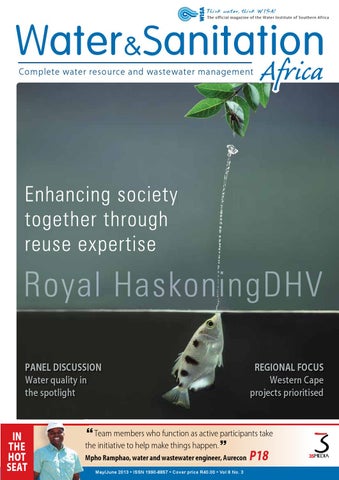
Just as the archerfish has evolved innovative technology in reusing water to hunt its prey, Royal HaskoningDHV’s evolved water reuse expertise is today’s solution for a sustainable tomorrow.
HOT SEAT Mpho Ramphao, water and wastewater engineer at leading engineering, management and specialist technical services group Aurecon, weighs in on South Africa’s wastewater situation. 18 PANEL DISCUSSION To drink or not to drink? • Department of Water Affairs • Rand Water • Water Research Commission • Aquainnovate REGIONAL FOCUS: Western Cape Sustainable solutions sought Monitoring of school boreholes under way Swartland pipeline nears completion Pearly Beach uses ultrafiltration membrane technology
Volume 8. No.3
29
39 42 44
WISA celebrates National Water Week
10
48
AFRICAN FOCUS Malawi: Pump company wins turnkey contract Mozambique: Ultraflo for Chinanguanine Botswana: Mines cleaning up wastewater Botswana: Maun drinking water supply ensured
50 51 52 53
INDUSTRY INSIGHT Is greywater recycling sustainable?
55
SPECIAL FOCUS A specialised solution Pipe repair prioritised
57 60
FEATURE: RESERVOIRS AND BOREHOLES Storage capacity doubled 20 kℓ KwaZulu-Natal tank installation successful Celebrating 30 years of success Borehole pumps prioritised New product well-positioned
62 64 66 68 70
REGULARS Editor’s comment Infrastructure news Industry news
3 22 24
Monitoring of school boreholes under way
Celebrating 30 years of success MAY/JUNE 2013
42
66 1
YOU URGENTLY NEED: Specialist knowledge on wastewater management Complete professional solutions to wastewater problems
BACKED BY 20 YEARS OF EXCELLENCE, ERWAT BRINGS YOU: Expertise and experience in all aspects of wastewater Consultation, sourcing and facilitation of services to address your needs SANAS 17025 accredited laboratory analysis Value-added service at affordable prices
Why don’t you contact us today? t 011 929 7000
f 011 929 7031
mail@erwat.co.za
www.erwat.co.za
Publisher Elizabeth Shorten Editor Chantelle Mattheus Head of design Frédérick Danton Senior designer Hayley Mendelow Designer Kirsty Galloway Chief sub-editor Claire Nozaïc Sub-editor Patience Gumbo Contributors Jan Theron, Shanna Nienaber, Timony Siebert Marketing & online manager Martin Hiller Production manager Antois-Leigh Botma Production coordinator Jacqueline Modise Distribution manager Nomsa Masina Distribution coordinator Asha Pursotham Financial manager Andrew Lobban Administration Tonya Hebenton Printers United Litho Johannesburg +27 (0)11 402 0571 Advertising sales Avé Delport Tel: +27 (0)11 467 6224 • Cell: +27 (0)83 302 1342 Fax: 086 502 1216 E-mail: avedel@lantic.net
EDITOR’S COMMENT
With baited breath Aquainnovate. In addition, the magazine continues to highlight the successful roll-out and delivery of services to communities through
Publisher
its regional focus; this time highlighting infrastructure projects in the Western Cape. Physical address: No 4, 5th Avenue Rivonia 2056 Postal address: PO Box 92026, Norwood 2117, South Africa Tel: +27 (0)11 233 2600 Fax: +27 (0)11 234 7274/5 E-mail: chantelle@3smedia.co.za MEDIA
ISSN: 1990 - 8857 Annual subscription: R290 (SA rate) E-mail: subs@3smedia.co.za Copyright 2013. All rights reserved.
The upgrade and extension of the Grabouw s I write this editor s comment I
A
Sewage Treatment Works is unpacked on
find myself in a strange position.
page 39 and the roll-out of the Swartland
Despite water and wastewater
pipeline project, which is currently nearing
having been in the pages of the
completion, is investigated on page 44. On
mainstream newspapers quite often recent-
page 42, an interesting project being rolled
ly, my focus is instead on the upcoming
out by SRK Consulting ‒ the monitoring of
announcements I believe will set the agenda
school boreholes ‒ is also highlighted.
for the water sector going forward.
In an aside, in the previous edition of
Coming up is the Department of Water
Water&Sanitation Africa we highlighted the
protected and may not be reproduced either in whole
Affairs budget vote on 21 May, which will
Mbazwane Groundwater Monitoring Network
or in part without the prior written permission of the
most definitely be dissected on our website
as part of our KwaZulu-Natal regional focus,
publishers. The views of contributors do not necessarily
(infrastructurene.ws) as soon as it is released.
but we wrongly referred to Mark Schapers
We are also all awaiting with baited breath
as a Jeffares & Green executive associate. He
All articles in Water&Sanitation Africa are copyright
reflect those of the Water Institute of Southern Africa or the publishers.
the release of the Green
WISA CONTACTS:
Drop
HEAD OFFICE Tel: +27 (0)11 805 3537 Fax: +27 (0)11 315 1258 Physical address: 1st Floor, Building 5, Constantia Park, 546 16th Road, Randjiespark Ext 7, Midrand
Drop update, which will
BRANCHES
from 7 to 11 July.
Eastern Cape Chairman: Hennie Greeff Tel: +27(0)41 453 3102 Secretary/Treasurer: Chris Dickson Tel: +27(0)41 507 8200
www.ewisa.co.za
Results
and
Blue
be released at WISA s 4th Municipal Water Quality Conference, to be held I
can
antee
almost
that
guar-
those
announcements
two
will
be
is, in fact, a technical
The magazine continues to highlight the successful rollout and delivery of services to communities
the focus of water-related
director. Our humblest apologies for this error. That hope
being you
said,
I
thoroughly
enjoy and are inspired by of
the
latest
edition
Water&Sanitation
Africa. I was particularly inspired by the passion and
commitment
dis-
Free State Chairperson: D.R. Tlhomelang Tel: +27(0)51 403 0800 Secretary/ Treasurer: Riana Wessels Tel: +27(0)56-515-0375
discussion for a while. As such, this edition
played by the young engineer I got to inter-
of Water&Sanitation Africa is starting off
view for the Hot Seat in this edition on page
the debates ‒ specifically on water and
18: Mpho Ramphao, water and wastewater
wastewater quality ‒ in our panel discussion,
engineer at Aurecon. If we all have even a
KwaZulu-Natal Chairman: Chris Fennemore Tel: +27 (0)31 311 8734 Secretary/ Treasurer: Stephanie Walsh Tel: +27 (0)31 302-4077
with some illustrious participants, such
fraction of his enthusiasm, the challenges the
as the Department of Water Affairs, Rand
water sector is currently facing will be noth-
Water, the Water Research Commission and
ing but speed bumps.
Western Cape Chairman: Gareth McConkey Tel: +27(0) 21 712 4260 Secretary/ Treasurer: Eleonore Bondesio Tel: +27(0)21 872 0322 WISA mission statement m The Water Institute of Southern Africa provides a forum er for exchange of information and views to improve water resource management in southern Africa.
Endorsed by
Cover opportunity In each issue, Water&Sanitation Africa offers companies the opportunity to get to the front of the line by placing a company, product or service on the front cover of the magazine. Buying this position will afford the advertiser the cover story on pages 4 and 5 and maximum exposure. For more information on cover bookings contact Avé Delport on +27 (0)83 302 1342 or e-mail avedel@lantic.net
MAY/JUNE 2013
3
COVER STORY
ROYAL HASKONINGDHV
Here today, reused Royal HaskoningDHV, leading the future of sustainable water
G
rowing populations, increasing urbanisation and industrial growth is placing severe stress on existing surface and groundwater resources throughout the world. This ongoing growth
in water demand and the impacts of climate variability combine to alter our planet and the way we live. This is especially so in arid countries like South Africa where droughts have shown the devastating effects the lack of water can have on communities and economies.
By Jan Theron, who is based in Port Elizabeth and heads Royal HaskoningDHV’s global knowledge group for Water Reuse
assurance, even during disaster situations. The obvious first step is to minimise wastage and make better use of the water we have while heightening awareness and caring for this precious resource. Technological advances and their innovative application make water reuse a viable and completely safe supplement to natural sources. Water reuse solutions must be fit for purpose with the specific purpose of providing a sustainable, secure supply of water as part of an overall water
This reality requires a passionate, innovative response
resource portfolio. With a legacy of close to one hundred
to provide water security to communities and industry in
years of water technology experience in Southern
a long-term sustainable manner with improved levels of
Africa, coupled with similar experience worldwide, Royal HaskoningDHV is an acknowledged expert in the field. Dealing with water shortages and the development of water reuse solutions for both potable and industrial water supply were manifest in preventing disaster situations during the recent droughts ‒ the worst in 150 years ‒ that hit the Western and Eastern Cape provinces. These interventions ‒ collectively coined by Royal HaskoningDHV as Life beyond our Rivers ‒ have prompted the development of a very specific approach and tailored solution packages that focus on direct and indirect potable reuse; industrial, commercial and agricultural water reuse; and desalination, as well as dealing with situations where de facto reuse take place. Direct potable reuse involves the introduction of reclaimed water from a wastewater treatment works directly into a drinking water treatment system, often involving several advanced treatment steps and technologies to mitigate any risks to the drinking water supply. Indirect potable reuse involves the augmentation of a water (surface or groundwater) source with reclaimed water via an environmental buffer (such as a large dam) before introducing it into the drinking water treatment system. Industrial, commercial and agricultural water reuse can be direct or indirect, depending on the specific requirements of the end users. De facto reuse is a very common occurrence where treated wastewater is being reused, but not officially recognised, for instance where a drinking water supply intake is located downstream of a wastewater
ABOVE Part of the ultrafiltration and reverse osmosis plant for 5 Mℓ/d industrial reuse application at Mossel Bay Regional WWTW LEFT Aerial view of the Fishwater Flats WWTW, Port Elizabeth
4
MAY/JUNE 2013
treatment plant discharge point. In order to effectively develop and truly benefit from water reuse, an adaptable focus around the specific needs of consumers and our is
ever-changing required
and
environment
should
include
the following: • Strategy for sustainable water ‒ Integrated water resource development and management including
COVER STORY
tomorrow the successful introduction of water reuse and desalina-
• Social acceptance & facilitation ‒ Reuse of
tion into an existing water resource portfolio as part of
water, especially for potable reuse, most often
the planning process.
comes with some reluctance to be accepted
• Future-proof industrial water supply ‒ Introducing
by communities due to various factors ranging
water reuse as a sustainable, feasible and potentially
from religious beliefs to ignorance about the
cost saving water supply to industrial, commercial and
subject. Social facilitation and education is
mining users.
critical prior to the development of any water
• Water reuse extends existing water (and wastewater)
reuse scheme and to its ultimate success.
infrastructure capacity ‒ Fit-for-purpose water reuse
These focus points are key drivers of our overall
solutions to industrial, mining and water utilities can
vision of Enhancing Society Together and the
create capacity on existing infrastructure and unlock other water resource and infrastructure capacity through water trading and added benefits to the environment. • Reducing the water footprint ‒ through water reuse. • Water reuse = food security ‒ Introduction of water reuse as a safe supply of water for agricultural development. • Augmentation of potable water supply ‒ through direct
“Technological advances and their innovative application make water reuse a viable and completely safe supplement to natural sources.” Jan Theron
following projects are recent examples of applications of water reuse solutions, successfully implemented or currently under way by Royal HaskoningDHV.
or indirect water reuse and desalination. This includes
George indirect potable water reuse: A 10 Mℓ/d water
the development of drought intervention solutions and
reuse plant treating effluent from the Outeniqua WWTW
ensuring safe drinking water through integrated water safety plans and wastewater risk abatement plans, which also applies to de facto reuse. • Life cycle sustainability ‒ Decision-making tools to ensure feasibility of water reuse schemes are essential and should include life cycle costing, risk-based evaluation and management, as well as operation and maintenance solutions. • Energy
efficient
and desalination.
solutions
‒
for
water
reuse
BELOW Mossel Bay desalination plant during construction
using ultrafiltration technology, providing an indirect pota-
INSET Mossel Bay 15 Mℓ/d desalination plant seawater intake pump station during construction
Municipality and PetroSA, this reuse plant treats 5 Mℓ/d
ble water supply augmentation via the Garden Route Dam. Mossel Bay WWTW direct industrial water reuse: As part of a water swop initiative between Mossel Bay effluent from the Mossel Bay WWTW using ultrafiltration and reverse osmosis to supply PetroSA with industrial water in exchange for an equal quantity of their surface water allocation from a nearby dam. Nelson Mandela Bay direct industrial water reuse: This
In each issue, Water&Sanitation Africa offers advertisers the opportunity to promote their company s products and services to an appropriate audience by booking the prime position of the front cover, which includes a feature article. The magazine offers advertisers an ideal platform to ensure maximum exposure of their brand. Please call Avé Delport on +27 (0)11 467 6224/ +27 (0)83 302 1342 to secure your booking.
MAY/JUNE 2013
5
COVER STORY
About the author: Jan Theron is a professional civil engineer with more than 12 years’ experience in the water and wastewater treatment industry. He is currently the director of Advisory Group: Eastern Cape Water for Royal HaskoningDHV and also leads the company’s global Knowledge Group for Water Reuse. project, which is in its design phase, will provide 45 Mℓ/d of direct industrial water reuse via membrane biological reactors at the Fishwater Flats WWTW.
potable water, as a main source of industrial water or a combination of the two, it dramatically improves the sustainability and security of water supply with the upside of improved living standards and assurance of developmen-
BELOW Mossel Bay Regional WWTW with building housing the ultrafiltration and RO plant in the foreground
tal and economic growth for the future. Without this intervention, our current water resources would quite likely be here today and gone tomorrow! With our passion for sustainability, a more comfortable scenario can be our water is here today and reused tomorrow.
Amathole District drought interventions: Several projects at planning and design stage, including a direct potable reuse scheme at Adelaide (1.5 Mℓ/d) and an indirect potable reuse scheme at Butterworth (5 Mℓ/d), will provide alternative supplementary water supplies to become more resilient to droughts. Chris Hani District ‒ Strategy for sustainable water: This planning document introduces the strategy, feasibility and specific implementation plans to develop and manage an integrated and optimum combination of water resources as part of the overall portfolio, including the introduction of water reuse. Ultimately, these projects have shown that water reuse is a very feasible, cost-effective and sustainable option that should be considered when reviewing and planning the augmentation of water resources into the future. Whether introducing water reuse as a supplementary supply to
6
MAY/JUNE 2013
The world needs fewer engineering companies. Rebranded as Royal HaskoningDHV, SSI Engineers & Environmental Consultants believes in being more than an engineering company. Our rebranding to Royal HaskoningDHV ushers in a new class of engineers and consultants, offering solutions for the sustainable interaction between people and their environment, ultimately enhancing society together.
www.rhdhv.co.za www.royalhaskoningdhv.com
Everything You’ve Ever Needed As a global market leader in waste water products, KSB has served the sanitation sector as a competent partner for over 100 years. Our pumps and valves handle municipal and industrial waste water, keep buildings and property well drained and serve in sundry pumped drainage systems. Wherever waste water needs moving, look no further. For first class solutions: pumps, valves, automation, drives and systems, mixing processes, tank cleaning routines, sludge handling task or surface drainage applications, KSB has got it all. Products are now available in South Africa. For more information on our products, or to find a branch near you visit us on www.ksbpumps.co.za
Š Creamer Media 051007CG
KSB Pumps & Valves (Pty) Ltd Tel: +27 11 876 5600
Submersible Propeller - Amaline & Amacan Submersible Waste Pumps - Amarex N & KRT
Dry Pit Waste Pumps - Sewatec
Process Mixers & Agitators - Amamix / Amaprop
Tank Cleaning Systems - Amajet
PRESIDENT ’S COMMENT
Preventive maintenance in practice The water sector offers a host of opportunities for growth and development, which have their own sets of dynamics to take into account, but opportunities do exist. common area for many of us ‒
on a regular schedule, preventive measures
• Managing the established maintenance
whether we own or operate
will reduce the risk of costly repairs. The
programme should also include periodic
installations and facilities for
key to ensuring effective equipment main-
meetings with maintenance personnel
conveyance and treatment of
tenance is to make certain that responsibil-
and providing them formal feedback on
water and wastewater, or provide a service
ities are clearly defined and maintenance
to these sites ‒ is maintenance. Asset care
personnel have the relevant tools and skills
and maintenance is of utmost importance
to do their job effectively. It is also essential
for the viability and sustainability of the
to schedule preventive maintenance.
their job performance. • During the meeting, identify the employees strengths, along with weaknesses. • Enhance employee skills in areas that will
various employed systems in our sector.
In some of the discussions I have had
When discussing the importance of a
with my maintenance team, we generally
preventive maintenance plan with your op-
agreed that maintenance personnel must
feedback from supervisors on their job
erational teams, you see first-hand how a
be involved as much as possible as they
performance and how they can improve
good preventive maintenance programme
will take better ownership thereof if they
preserves assets, keeps things running in
are updated on the progress of the mainte-
A preventive maintenance programme
optimum condition and helps ensure that
nance programme. Allowing them to also
that works will:
maximum life expectancy is achieved. It
partake in matters on how to improve the
• define specific goals for the programme
also helps managers to anticipate failure,
system adds further value to the team. In
• utilise qualified maintenance personnel
thereby allowing time to plan and budget
essence planning becomes more and more
• have an organised and effective system
for replacements as well as perform work at
important. By failing to prepare, you are
for maintaining equipment records and
more convenient times. All of these factors
preparing to fail. ‒ Benjamin Franklin
make preventive maintenance a more predictable and cost-effective way to operate. You may agree that there is no single
efforts will be required to eventually yield results as this is one management tool that one ought not underestimate. To understand preventive maintenance, one needs to define it, and everybody involved in this process needs to be committed and understand the difference between preventive/proactive and corrective/reactive maintenance. Preventive maintenance includes work that is planned and carried out on a regular basis to maintain and keep the infrastructure or assets in good condition. Minor re-
maintenance
personnel
want
their skills and perform better.
scheduling maintenance work
During this process of engaging with
• include periodic management reviews
my team, the following started to become
to evaluate and continually improve
clear and accepted practice:
solution for improving preventive maintenance, but rather that many combined
benefit the employee and the facility. • Most
the programme. A well-executed preventive maintenance
TABLE 1 Preventive maintenance Advantages
Disadvantages
• flexibility for adjusting maintenance frequencies • component life cycle is increased • energy savings are generated • equipment and/or process failures are reduced • early interventions and corrective measures help prevent the costly major failures, reducing the cost of ownership • improved system reliability • decreased system downtime • up to 20% cost savings may be achieved as opposed to reactive methods
• catastrophic failures are not eliminated • it is more labour intensive • it includes some invasive activities that have the potential to cause incidental damage to components
pairs and replacements as dictated by the routine examinations may also, at times, be included. Reactive maintenance is undertaken in reaction to a crisis; it normally occurs as a result of failures and the malfunctioning or
TABLE 1 Reactive maintenance Advantages
Disadvantages
• lower initial or short-term costs • fewer staff required
• increased costs due to unplanned equipment downtime • increased labour costs, especially if overtime is needed for untimely repairs/replacements • may result in secondary equipment or system losses • is an inefficient use of staff resources
breakdown of equipment. In order to ensure the routine maintenance and health of the system, the technician should adhere to a routine check-up. If done correctly and
8
MAY/JUNE 2013
Total Water and Effluent Treatment Solutions Unlock Potential, Create Value Innovative but proven solutions for domestic and industrial water and wastewater treatment, ranging from low-cost rural facilities to zero discharge and integrated industrial systems. With our expertise and technologies water is conserved, costs are reduced and investment returns are maximised. Conventional Water Treatment: ■ Potable water treatment ■ Sewage water treatment ■ Sludge dewatering Industrial Water Treatment: ■ Effluent treatment ■ Ion exchange ■ Membrane desalination ■ Process water treatment ■ Boiler feedwater preparation Tenova Bateman Technologies offers differentiated, project specific hydrometallurgical, mineral, water treatment and bio process technologies complimented by turnkey modular plant solutions.
58 Emerald Parkway Road, Greenstone Hill, Johannesburg, South Africa Phone +27 11 899 9111 Fax +27 11 899 3919 enquiries.TMM@za.tenovagroup.com www.tenovagroup.com TENOVA is a worldwide supplier of advanced technologies, products and engineering services for the iron & steel and mining industries
PRESIDENT ’S COMMENT schedule results in reduced breakdowns
order for them to make critical decisions
and cost savings. Many organisations with
• we need to effectively use the abilities of
sector, but the emphasis of the aforesaid
sound intentions either develop or hire
the maintenance staff and let them take
in this article articulates the significance
out preventive maintenance programmes
ownership of the programme
of such a plan. No one gets an iron-clad
and schedules, only to file them away later.
opportunity, luck and timing are important.
needs to be properly used to be of any real
maintenance needs
But the backbone of success is usually
staff needs to understand the fundamentals of water and wastewater treatment in
career
the
guarantee of success. Certainly, factors like
• there is no one-size-fits-all system, but the
and
in
that will satisfy your asset care and
session, we learned:
training
plans
Like any tool, the maintenance programme
During our brainstorming and research
in
maintenance
paths
worth to your organisation.
• invest
preventive
• have checks and balances in place and
found in old-fashioned, basic concepts like
monitor progress by having regular plan-
hard work, determination, good planning
ning meetings
and perseverance. ‒ Mia Hamm
• always investigate and explore best pracRonald M Brown
tice and systems. I believe that there are many best practice
WISA President
WISA celebrates National Water Week This year, WISA celebrated National Water Week in March by spreading the word on water consciousness and water careers to the youth in Midrand, Gauteng. ater
is
life:
Respect
it,
directly from the taps with their mouths
Conserve it, Enjoy it was the
and hands as this could spread disease.
theme for this year s National
They must rather use the
Water Week, celebrated in
water
supplied,
explained
2013. To celebrate National Water Week,
Special
WISA visited two schools in Tembisa near
given to the older grades
Midrand: Winnie Mandela Primary School
6 and 7 classes, with the
and Reagile Primary School. WISA represent-
representatives taking the
atives, Evelyn Ramphomane and Maimboti
opportunity to discuss the
Mutezo from the WISA head office, engaged
various career opportuni-
with the children on a consultative basis,
ties available in the water
explaining various ways to conserve South
sector.
Africa`s most precious resource ‒ water.
on how important water
Ramphomane. attention
was
We gave lessons
The reason for visiting was to inform the
is in the larger context and
learners about Water Week awareness and
also gave tips on subject
to give some few lessons on Water Saving
choices that can lead them
Tips ,
into the water industry.
explained
Ramphomane,
adding
that some of the tips included methods for
10
bottles
South Africa between 18 and 24 March
In addition, the team
washing their faces, that they stop brushing
distributed
their teeth with running water on, use of
tles,
the shower, that the kettle should not be
pens, beanies and flyers
filled to the brim for one cup (which will also
explaining various ways
help on saving electricity), tips for washing
to conserve water.
the car and rather using a bucket instead
principals of both primary
of hose.
schools were very excited
water
calendars,
botrulers,
The
The grades of concern ‒ or rather the
and thankful about all this.
focus grades ‒ were grades R, 1, 6 and 7 as
The teachers said this was
this is where the WISA representatives felt
excellent and educational
they would have the most impact. We first
for
gave away the water bottles to the Grade R
the learners,
and 1 and taught them not to drink water
Ramphomane.
the
educators
and
concluded
MAY/JUNE 2013
BELOW Ramphomane and Mutezo educate the learners of Reagile Primary School about water conservation
WISA NEWS
DIVISIONAL DISCOURSE
Investigating industrial water The pollution of our national water sources by the irresponsible discharge of industrial effluent is one of the biggest threats posed by industrial water – or rather the incorrect treatment thereof – according to Willie Saunders of the Southern African Industrial Water Association, a division of WISA. he majority of industries in South
need the support of the other role players,
to act as one team to protect our water
Africa are willing to pay municipal
says Saunders.
sources and the environment and to pro-
T
industrial
discharge
levies
He adds that recently a lot of focus has
penalties on their polluted effluent
been given to industrial water; however, this
and in most instances pass the costs on to
primarily revolves around the mine water
the consumer instead of putting any effort
crisis. Taking into account the number of
Education essential
into pretreating and recycling their effluents
industries in South Africa today that contrib-
Education and training play a major role in
internally. They do not regard effluent treat-
ute to pollution, the focus on industrial wa-
the current context, especially at manage-
ment as part of their money-making process
ter is definitely not enough and a lot more
ment level of the industrial sector, believes
and prefer to ignore the downstream im-
can be achieved, says Saunders.
Saunders. Management must be the driver
says Saunders.
and first line of responsibility for water con-
plications on the ecosystems and national
SAIWA scrutinised
servation and responsible discharge of their
Saunders has been serving on the Southern
The mission of SAIWA is the following: To
industrial effluents.
African Industrial Water Association (SAIWA)
gather and disseminate information for the
I presume enough focus is being given
committee in various portfolios over the
advancement of cost-effective and environ-
in the theoretical training, but one only
past 15 years and he has a passion for the
mentally acceptable operational practices,
becomes aware of this immense problem
effective functioning of this division .
control measures and management of
of industrial pollution when you are ex-
The only way this challenge can be over-
industrial water and wastewater related sys-
posed practically to problematic industries
come, according to Saunders, is through
tems and processes. Saunders says: SAIWA
where you can visualise the irresponsible
increased pressure on industries from the
will strive for the successful implementation
behaviour of some of the big polluters in our
water conservation measures,
he warns.
of its mission. He
“SAIWA strives to accommodate a diverse committee representation from the different segments involved in industrial water.” Willie Saunders, SAIWA
12
mote the recycling of industrial effluents,
and
country. The application of effective tech-
adds
SAIWA s
that
focus
is
nologies and options then becomes more tangible, he says.
to bring the different
stakeholders
Tracking technology
the
When assessing the possible impact of new
industrial
water
technologies being rolled out in the mar-
fraternity
together
ket, a number of factors need to be taken
in an effort to create
into account. One factor that significantly
an awareness of the
affects the costs and viability of most of the
challenges
being
water treatment technologies available is
faced in the day-
the sludge, brine or any other solids result-
to-day operation of
ing from the pretreatment processes, says
industries that deal
Saunders, adding that this factor creates re-
with
sistance as many industries are reluctant to
involved
in
troublesome
undertake treatment and recycling on-site.
industrial water pollution control authori-
effluents and the subsequent effect on
ties of the different metro councils as well
water sources and the environment. SAIWA
The removal of sludge and the disposal
as from government level, including the
strives to accommodate a diverse com-
thereof is abnormally costly and it seems
Department of Water Affairs and Rand
mittee representation from the different
as if a monopoly evolved over the years
Water Board, forcing them to implement
segments involved in industrial water, e.g.
pertaining to sludge handling and disposal.
treatment facilities on-site. Incentivise the
chemical suppliers, industry representatives,
More focus should be given on a national
reuse of industrial wastewater and promote
water authorities and environmentalists.
level to innovative technologies that recover
the synergistic cooperation of industries
Annual conferences are organised by SAIWA
by-products from the sludge or even sub-
with water treatment companies to solve
to bring the different disciplines together
sidising efforts to make pretreatment and
effluent problems in national interest. It
where mutual problems and possible solu-
recycling more affordable.
must be mentioned that the metro council
tions can be discussed in order to conserve
industrial pollution control authorities are
the precious commodity called H2O.
There are, however, a number of best practice examples available in the country.
doing a great job and have grown sig-
SAIWA wishes to achieve the involvement
Plants with zero water discharge, which
nificantly the last 10 to 15 years, but they
of the total industrial water environment
do not generate contamination and reduce
MAY/JUNE 2013
WISA NEWS e.g. internationally with the pollution of the
ACHIEVEMENTS TO DATE
Rhine River and Thames River. In the South
By Willie Saunders SAIWA ran very successful annual symposiums from 1987 through to 1992. These were supplemented with technical evenings and workshops. By 1993, it was becoming diďŹƒcult to organise symposiums with the help of a few dedicated members working part time and SAIWA instead elected to assist with the Industrial Water sessions at Afriwater and the WISA biennial conference. It became obvious that the place for SAIWA was within WISA as the Industrial Water Division. This was accomplished in November 1996. However, SAIWA managed to organise a very successful Industrial Water Workshop during 2001 with several international speakers, i.e. Dr Richard Lutey, Dr Paul Puckorius and Doug Dewitt-Dick (all from the US). Until 2011, several annual seminars were held at the Maccauvlei venue in Vereeniging. SAIWA also encourages research and novel solutions towards industrial wastewater treatment by sponsoring awards at the WISA biennual conferences for the best contributions.
African context we are experiencing increasing pollution loads, for instance to the Vaal River and Hartbeespoort Dam catchment areas and the underground water. It is just a matter of time before the situation gets completely out of hand. Therefore the need for eective legislation, more intense government involvement, better cooperation between all relevant stakeholders, upgrading of existing treatment works and capacity to handle industrial pollution incidents cannot be underestimat-
pollution downstream, would be considered
API or oil catchment dams, for example, are
ed, says Saunders, adding that there needs
best practice ideals. Greater emphasis should
completely inadequate or under designed
to be eective management of pollution by
be placed on concepts where industrial
for high rainfall, says Saunders.
the dierent authorities. Treat or address
euent recycling technologies can minimise
Additionally, rainwater that is supposed
water wastages, reduce intake and are at the
to serve as a clean-up or dilution for our
same time cost eective, says Saunders.
natural water resources eventually becomes
the source of pollution rather than treating the symptoms.
a polluting factor. Illegal discharge of toxic
Focus on the future
Private sector buy-in pivotal
industrial contaminants to the sewers af-
Moving forward, Saunders says the focus
If industry and the private sector could more
fects the design capacity and eectiveness
should be on reduced pollution and in-
extensively utilise waste or partially treated
of the treatment works severely and sub-
creased reuse of industrial wastewater .
wastewater in an eort to save our precious
standard euent is being discharged to the
He adds that SAIWA will look to WISA to
drinking water, the impact could be signiďŹ -
rivers and catchment areas. This, together
facilitate the networking with other WISA
cant, believes Saunders. Partially treated
with pollution from informal settlements,
sub-divisions and assistance with overall
industrial water can be used for oor wash-
will eventually cause a signiďŹ cant deteriora-
planning and organising of events. WISA as
ings, cooling water, toilet ushing and dust
tion of South Africa s water, he warns.
the parent body should convey the bigger
control instead of using drinking quality water. Eective recycling of water at car and
picture of industrial water during negotia-
Crises stage?
tions and talks with government and water
truck wash centres, rainwater harvesting
We are deďŹ nitely close to a crisis stage ‒ if
and minimising evaporation of swimming
we are not already there ‒ unless a concert-
pools by covering could all contribute to
ed eort from all role players in the industri-
Of speciďŹ c interest is a joint conference in
saving initiatives.
al water fraternity and government can be
August/September to be held in conjunc-
mobilised to address the relevant issues,
tion with the Desalination division in order
says Saunders.
to involve a broader spectrum of attendees
The treatment of industrial water is, however, not performed well in general. Many industries visited revealed that their
According to him, history has demonstrat-
stormwater discharge facilities that include
ed the role that industrial water can play,
authorities to SAIWA and keep communication channels open.
and to demonstrate the advantages of inter-divisional teamwork.
13
MAY/JUNE 2013
6(16,%/( (1*,1((5,1* 62/87,216
1R]]OHV
:DWHU ÂżOWUDWLRQ ZDWHU WUHDWPHQW SODQWV DQG SXPS VWDWLRQV GHVLJQHG DQG EXLOW E\ $6: *URXS RI &RPSDQLHV $6: +($' 2)),&( 53 Gerhardus Street,Strijdom Park, Johannesburg, South Africa Branches - Cape Town and Durban Tel: (0027) 11 793 1330 Fax: (0027) 11 793 4829 Email: sales@asw.co.za www.asw.co.za
WISA NEWS
WESTERN CAPE
Process Controllers’ Open Day The Third Western Cape Process Controllers’ Open Day was held on 29 November 2012 in Ceres in the Witzenberg municipal district and about 280 process controllers attended. his event was the first organised by
T
were invited to participate and provide in-
Day. He said that this type of event, which
the formalised Process Controller
put. The main objective was to source ideas
recognised the need for process controllers
Division (PCD) of the Water Institute
about the most practical ways for the PCD
to congregate and deliberate the issues
of Southern Africa (WISA) and was
to achieve its desired goals in the province.
pertaining to their role in the water sector,
held in collaboration with the Department
One proposal was to divide the province
needed to be held in other provinces as
of Water Affairs (DWA), Overberg Water,
into smaller sub-zones, which will be easily
well. He strongly voiced his concerns about
Witzenberg and South African Local Government Association (SALGA). differed
Even from
the the
format previous
two events. The event was preceded by a
brainstorming
session
municipalities who fail to realise
It is the objective of the PCD to have each process controller in the water sector ascribe to the values and principles of WISA’s motto
on
date to ensure that adequate training and support be provided to process controllers. This investment, he stressed, would enable them to provide quality
28 November 2012 where several process
manageable and allow easy interaction and
services such as Blue Drop quality drinking
controllers from across the Western Cape
measurable growth. Assessments can be
water and Green Drop quality wastewater
done and achievable targets and objectives
effluent standard that would not harm the
can be set for providing solutions where re-
environment or health of the local residents
quired and can be project man-
supported by these municipal systems. The
aged without placing undue
municipalities that are lagging need to act
pressure on the already stressed
decisively and invest in their process con-
personnel
WISA s
trollers because the professionalisation of
role as both a catalyst and facil-
process controllers is a reality and will be on
itator for skills transfer and the
their doorstep very soon.
Registration of the delegates upon arrival
resources.
advancement of the national
His speech was followed by the deputy
objectives for the water sector is
mayor of Witzenberg Municipality, Kariem
also being pursued in this area,
Adams, who endorsed many of the remarks
especially when it relates to the
made by the WISA president and expressed
training and professionalisation
the gratitude of his council for the opportu-
of process controllers.
nity afforded to host an event of such great
The
theme
for
Western
Cape
Controllers
Open
the
third
Process Day
significance in the water sector. Dr Marlene van der Merwe-Botha deliv-
was
ered the key note address, which was aptly
Women in Water , which pro-
titled The role of women in the water sec-
vided the newly formed PCD
tor . She told delegates about her career as a
the opportunity to acknowl-
woman in the water sector, pointing out the
edge women who committed
aspirations that she had and how she had
themselves to the development
to set her targets and goals to achieve the
of the water sector.
desired outcomes.
The pro-
gramme director for the event was
14
the serious nature of their man-
Swastika
Surujlal
Yolanda
Hess
from
Saldanha
Bay
from
Municipality, in her presentation, inspired
George ‒ a very successful pro-
all women to take up their rightful position
fessional in the sector.
in the water sector and gave a practical ac-
The WISA president, Ronald
count of the issues women were faced with
Brown, set the tone in his
when filling the shoes of jobs traditionally
opening address by congratu-
reserved for men. She emphasised that ac-
lating the PCD for hosting the
ceptability was based on skills, qualifications
third Process Controller Open
and preparedness to learn and integrate the
MAY/JUNE 2013
WISA NEWS During her presentation, Natasha DavisWolmarans, one of the lead regulatory staff for Blue and Green Drop assessment at the DWA (Western Cape), focused on the importance of the role that process controllers play in obtaining Blue and Green Drop certification. This included the collection and analysis of samples as well as the recording of other operational information during their shifts. The
signing
of
a
Memorandum
of
Agreement between Overberg Water and Drakenstein
Municipality
was
another
highlight of the day. The agreement aims to provide process controllers with better training opportunities. The organising committee would like to express its sincere gratitude to the
ABOVE Winner of the price – Marthalin Swart (middle) won a fully paid conference entrance to WISA 2014. With her are Sydney Armoed (left) and Ronald Brown (right) BELOW Delegates opening proceedings with the national anthem
following
sponsors
and
exhibitors
for
has also ensured through its implementation
the support provided leading up to and
plan that the two programmes complement
during the event: AL Abbot, Ceres Fruit
each other. The N3 programme has now
Juices, Ceres Fruit Processors, Circuit Water
been rolled out for other water service pro-
Engineering
viders in the Western Cape, and Overberg
Chemicals, Goba, Grundfos, Ithuba Valves,
Equipment,
Exeo,
Ikusasa
Water is currently busy with the third group
Lyners, Maxal, Merck, Microzone, Overberg
required knowledge in the workplace. This,
of students doing the subject Water N3
Water, Peninsula Water Treatment, Royal
she said, earned her the trust and respect
and Wastewater N3. Once students have
HaskoningDHV,
of her peers and she has made great strides
completed the N3 subjects and training,
Consultants,
in getting her colleagues (male and female)
an
to advance their studies and careers in
ination is conducted
the sector.
at a Department of
external
exam-
In her address, Ntombizanele Mupariwa,
Education FET college,
the acting director of regulatory perfor-
i.e. at Boland college.
mance management at the DWA, gave a de-
The courses have an
tailed summary of the progress made thus
81% success rate and
far with Regulation 17, which pertains to the
there is a continuously
professionalisation of process controllers.
increasing
The operations manager from Overberg
Veolia WISA
Water, and
Virtual
Witzenberg
Municipality. The municipality deserves a
The theme for the third Western Cape Process Controllers’ Open Day was ‘Women in Water’
demand
special word of thanks for its warm hospitality throughout ‒ it really pulled out all stops to make the event as memorable as possible for the delegates.
for training. Overberg
It is the objective of
Water, Sydney Armoed, took the opportunity
Water has extended invitations to municipal-
the PCD to have each process controller in
to tell the delegates about training initiatives
ities across the Western Cape to enroll their
the water sector ascribe to the values and
that Overberg Water has embarked on in
process controllers in the courses; some mu-
principles of WISA s motto: Building ex-
order to ensure that it was compliant with
nicipalities have taken up the offer with sig-
pertise, sharing knowledge and improving
the regulatory requirements for its process
nificant positive effects on their operations.
quality of life . The PCD also welcomes role
controllers and water
players
treatment
plants.
holders in the sector
addressed
who wish to partner
It
also
and
stake-
the issue of process
with
controller training and
these
development
They may contact the
in
the
it
to
achieve
objectives.
Western Cape because
chairperson
it became clear that
PCD, Sydney Armoed,
a lot of confusion still
on +27 (0)28 214 3500
exists about the NQF
or
learnerships and the
min@overbergwater.
N3
co.za
tion.
distance
educa-
Over the past
of
the
bedryfad-
The
Fourth
Western Cape Process
four years, Overberg
Controllers
Water has trained its
Day
own staff as well as
at
groups of unemployed
Wastewater Treatment
persons in both edu-
Plant in George on 28
cational streams, and
November 2013. MAY/JUNE 2013
will the
Open be
held
Outeniqua
15
WISA NEWS
YOUNG WATER PROFESSIONALS
A battle of the minds WISA’s Young Water Professionals (YWP) hosted an Inter-University Water Law Debate at the WRC’s International Conference on Freshwater Governance for Sustainable Development, writes Shanna Nienaber, chair of the Gauteng branch of YWP. he governance of how water is used,
T
prepare position papers for this event. Apart
leading experts in the water sector. The two
who uses it and how much is used is
from participating in the diverse conference
best speakers from each debate presented
a complex issue and is the substance
sessions on offer, participating teams also at-
on their experiences of the competition in
of a substantial body of law at local,
tended a debating and water law workshop.
the closing ceremony of the conference.
national and international levels. As a result,
This provided a platform for participants to
This event proved to be great fun and an
the role and importance of water law exper-
discuss a range of water law concerns and
engaging learning experience for delegates.
tise is well recognised in the South African
work on developing their public speaking
It was exciting to see how the participant s
water sector. It is therefore critical that South
and communication skills. The actual debates
confidence and presenting skills improved
Africa encourages the development of water
took place during lunch hour and provided
during the course of the competition. Equally
law capacity among young water profession-
other delegates at the conference with a plat-
exciting was seeing how members of the au-
als in order to develop the skills needed to
form to think critically about controversial
dience engaged in the debates with critical
draft and implement sound legal frameworks
legal issues. The debates were adjudicated by
questions and comments. The debate and
in future. In recognition of this need, the YWP provided an opportunity for postgraduate students of law from universities from around the country to engage in public
The adjudication team watching one of the debates: from left Inga Jacobs (WRC), Claudius Chikhosa (UP), Dhesigen Naidoo (WRC), Shanna Nienaber (Department of Science and Technology)
debates on a range of pertinent water law issues.
This
Inter-University
Water
Law
Debating Exchange was held at the Water Research Commission-hosted International Conference on Freshwater Governance for Sustainable Development, held from 5 to 7 November 2012, and was sponsored by the Department of Water Affairs. Selected teams were given two topics to research. The first topic focused on the accessibility and effectiveness of the Water Tribunal and the extent to which it helps to achieve the aims and objects of the National Water Act. The second topic explored the appropriateness of trading of water use entitlements in South Africa. In preparation for the debates, teams were expected to
16
MAY/JUNE 2013
the other sessions at the conference served as a reminder of the importance of creating platforms to engage on pertinent issues pertaining to the governance of the South African water sector.
The world’s most popular water meter wins more enthusiasts
The V110 KSM incorporates all the advanced engineering attributes of its popular cousin, the PSM, plus its engineering-plastic body makes it unlikely to be stolen. Having no second hand value virtually eliminates the potential for theft. While the tough, UVstabilised, engineering-plastic body repels undesirable interest, its internal mechanism is unsurpassed for low
Elster Kent Metering (Pty) Ltd PO Box 201, Auckland Park 2006 JOHANNESBURG DURBAN CAPE TOWN BLOEMFONTEIN PORT ELIZABETH
Tel: (011) 470-4900 Tel: (031) 266-4915 Tel: (021) 511-8465/6 Tel: (051) 430-2603 Cell: 082 458-3439
Fax: (011) 474-0175 Fax: (031) 266-9521 Fax: (021) 511-8446 Fax: (051) 430-6165
and high flow accuracy in any position. Over the last six years every component in our meters has been refined and improved for greater accuracy and longevity. For the full story on our V110 KSM meter range, visit our website or call our offices. Often copied, never equaled.
Copyright Š Elster Group. All Rights Reserved. Elster and its logo, are trademarks of Elster Group. The company's policy is one of continuous improvement and the right is reserved to modify the specifications without notice www.elstermetering.co.za 8360/6/2012
Vital Connections
HOT SEAT
AURECON
Leading expertise The perception that wastewater treatment is the “less attractive” cousin to the delivery of potable water is slowly starting to change as the sector increases the level of experience and expertise available, believes Mpho Ramphao, water and wastewater engineer at engineering, management and specialist technical services group Aurecon.
T
he provision of potable water has long been one of the most attractive areas called upon in terms of supporting government in the roll-out of basic services, yet wastewater treatment is very much a
forgotten service. The process of removing dirty water and
RIGHT Mpho Ramphao with his CESA Young Engineer of the year Award
toilet waste from homes and other centres simply does not have the same appeal for many, and it is regarded as a mundane profession by the ill-informed, Ramphao tells Chantelle Mattheus. This is despite the fact that investing in this area has the potential to have just as much impact on disease control and improving living standards, while the infrastructure required is very similar. However, Ramphao believes that the wastewater sector is slowly gaining momentum. I think this is largely attributable to the Department of
goals (MDGs), as there is still a huge backlog of wastewa-
Water Affair s public education initiative on the Blue/
ter infrastructure that needs to be constructed in South
Green Drop process.
Africa, especially in rural areas where there is virtually
As CESA Young Engineer of the Year in 2011, Ramphao
none, or in the case of urban areas, there is a lot that needs
is one of the young, up-and-coming, innovative engi-
to be maintained, refurbished and or upgraded to meet
neers working towards changing the dynamic in the
the future demands of a large number of people moving
South African context through Aurecon ‒ the company
into urban areas .
he works for ‒ and also by consciously working towards
18
gaining experience through the access availed to him
Leading innovation
as part of the Aurecon team on large-scale cutting-edge
Not only is South Africa known and respected for its
wastewater projects.
extensive network of large-scale schemes for the transfer
He believes, however, that there still remains a lot of
of water and wastewater, but the country s engineering
work to be done to achieve the millennium development
skills are also well sought after internationally, notes
MAY/JUNE 2013
HOT SEAT
Ramphao. The country has seen many water and waste-
professional engineering services for preliminary design,
water professionals leaving our shores to take up offers in
detailed design, treatment works permit applications,
other countries ‒ to our detriment. This is attributed largely
tender document preparation and tender reporting for the
to the many wastewater technological advancements that
upgrading of Darling WWTW, under the supervision of the
originate from this country s research universities and their
project director.
highly rated academics.
The upgraded treatment works uses the pond system to
This skills edge does also mean that younger engineers
dampen the peak hydraulic loading on a new biological
are increasingly given the opportunity to participate in
nitrogen removal activated sludge process (ASP). This
larger projects and gain invaluable experience through this exposure. Some of the noteworthy projects Ramphao has been involved in include two projects from the Swartland Municipality, namely
the
Darling
Treatment
Works
Wastewater (WWTW)
with a capacity of 2 Mℓ/d and the Malmesbury WWTW, which due to sustained growth in the town of Malmesbury has been upgraded with membrane bioreactors (MBRs) for solid-liquid separation to an average dry weather flow of 10 Mℓ/d, peak
Team members who function as active participants take the initiative to help make things happen
dry weather flow of 20 Mℓ/d and peak wet weather flow of 30 Mℓ/d. Ramphao views the Malmesbury WWTW as a defining moment in his career because he studied his MSc Eng in Wastewater Engineering with a special focus on MBRs. For me to have the opportunity to apply my academic skills on
ABOVE The Malmesbury WWTW was of particular interest to Ramphao as he studied MSc Eng in Wastewater Engineering with a special focus on MBRs
flow dampening allows a saving on the cost of components affected by hydraulic loading. The peak flows are absorbed by the ponds where the relatively low loading rate enables production of a water quality suitable for irrigation, once disinfection has taken place. The flow
RIGHT MBR final effluent BELOW The MBR plant applies the well-established activated sludge process to treat wastewater (bioreactor filled with sludge)
what is the second municipal MBR project in South Africa was a cherry on top. This plant was successfully commissioned in early March 2013 and is currently producing a pristine effluent water quality.
Seizing opportunities In the case of the Darling WWTW, the original WWTW consisted principally of a series of anaerobic and oxidation-evaporation ponds. The treatment works was overloaded in excess of 250%, says Ramphao. In addition, the existing works was not capable of treating effluent to levels acceptable by law, as it produced effluent that was below the required discharge standard and could no longer operate in compliance with the permit issued by the Department of Water Affairs. Ramphao explains that this specific project was his first engineering project where he was involved from the outset till the project was completed. I performed the bulk of the MAY/JUNE 2013
19
HOT SEAT from the new activated sludge plant is
International exposure
discharged to the local river system. The
In addition, he has also gained a lot of inter-
ASP was incorporated into the existing
national exposure through Aurecon, and
Mpho Ramphao studied Civil
oxidation-evaporation ponds to increase the
other projects he highlights as noteworthy
capacity of the works and to improve the
include the Gammams WWTW in Namibia,
quality of the effluent. The ASP is designed
which has a capacity of 40 Mℓ/d and the
to operate in parallel with the existing
Melbourne Eastern Treatment Plant, with a
oxidation-evaporation ponds.
capacity of 400 Mℓ/d.
Engineering at the University of Cape Town and on completion immediately enrolled for an MSc Eng with a special focus on water and wastewater treatment, which he completed in 2004. He joined the then Ninham Shand in October 2004, one of the heritage firms of Aurecon. “All my wastewater knowledge was gained in Ninham Shand/ Aurecon,” says Ramphao. He specialises in wastewater treatment with a focus on the optimisation of wastewater treatment facilities. His experience ranges from design, construction, commissioning and operation to conventional facilities and nutrient removal (biological and chemical) plants, as well as membrane bioreactors. Additionally, his specific expertise in wastewater treatment discipline includes activated sludge treatment with biological nutrient removal, phosphorus precipitation, primary and secondary sedimentation, membrane bioreactor treatment and filtration, biological trickling filtration, anaerobic digestion, aerobic digestion of waste activated sludge, sludge dewatering, disinfection and pumping. “In collaboration with internationally acclaimed researchers, I have authored and co-authored eight scientific technical papers and have presented on a number of international conferences, with the latest being Ozwater 2011 in Adelaide, Australia. There is a scarcity of water and wastewater process engineers in South Africa and the supply of these skills to the market is basically non-existent,” says Ramphao, adding that this is a skill one acquires through postgraduate studies, which most graduates are not prepared to do. The conscious transfer of skills to upand-coming engineers is essential, believes Ramphao. “I value this the most because without it, I would not be where I am. I am where I am because some very special and dedicated people sacrificed their time to groom me to be the best I can be. I am of the view that you cannot learn everything in the classroom and that the best skills come by ‘learning on the job’.” Aurecon has an internal mentorship programme where the major driver is to acquire professional registration in terms of the young graduates. In addition, there is also a performance management review process where everyone’s progress gets tracked. “In my case, I joined the company and was given a task to design a project, given all the freedom to ‘learn and make mistakes’ within limits, afforded an opportunity to be responsible for the construction site (i.e. engineers’ representative on-site), and also to manage the project and track the budgets and cash flows. It normally does not happen this way, and I believe that I just happened to join the company at the right time,” says Ramphao.
A major focus is the maximised use of
Gammams WWTW and Melbourne ETP
treated effluent for irrigation. Construction
also indicate the vast experience we have
of a new pipeline to supply this water to the
in South Africa to be able to work on major
local golf course has allowed the transforma-
international projects, says Ramphao.
tion of this previously barren facility to one now attracting players from Cape Town. It is
Dream team
also an enticing residential development and
Being part of a well-adjusted, well-structured
has indirectly created employment ‒ such
and educated team plays a very important
as a new restaurant that partly caters for day
role in shaping one s goals and ensuring you
visitors to the golf course. Importantly, it is no
learn to think outside of the box, as well as
longer necessary to use precious potable wa-
keeping one motivated and inspired, says
ter for irrigation, which had to be piped a sig-
Ramphao. To be in a dream team, it is a sign
nificant distance to the town from far afield
of the confidence your peers have in you. It is
by the district municipality, says Ramphao.
important that you are regarded as an active
On a personal note, he adds that managing
participant. Team members who function as
the interactions of the parties involved was
active participants take the initiative to help
very important and helped him to gain ex-
make things happen. I always ask: What
tensive design experience of the wastewater
contribution can I make to help the team
treatment works. Darling WWTW is dearest
achieve success?
to me in the sense that it was my first major
Ramphao is still at a fairly early stage of his
project (albeit small in capacity compared
career and, as such, his potential impact of
to others), which I used to motivate my
his career on the industry is only just begin-
professional engineering registration with
ning. I am hoping that my background in
ECSA. I learnt most of my engineering skills
water and wastewater treatment will lead to
on this project.
my growth and success. As I grow in my in-
BELOW The upgraded treatment works utilises membrane bioreactors for solidliquid separation
coming and subsequent roles, I hope to bring others up the ladder with me, to provide to the personal and professional growth of the junior team members, in much the same way that the engineers at Aurecon are doing for me. I want to be the employee that is remembered for the problems that became solutions and the unattainable becoming a reality, concludes Ramphao.
20
MAY/JUNE 2013
BASIC BACKGROUND
INFRASTRUC TURE NEWS
The top infrastructure and service delivery stories making the news
JW launches new meter repair project
A
ccording
to
a
statement
customers is effective and efficient. This
All contract workers will have identi-
released
by
Johannesburg
will assist JW in recording water flow data
fication cards with them at all times to
Water s (JW) marketing and
as well as improve the quality of their
ensure that residents can identify them. No
communications
manager,
water demand and conservation strategy.
employee at any stage should be allowed
Millicent Kabwe, Johannesburg Water has
Customers can also now be more confident
access inside the house; all work will be
launched a new project that will replace
that they are getting accurate consumption
done outside the houses, says Kabwe.
customer meters in order to address the
monitoring and billing.
back log in technical faulty meters.
According to the statement,
According to Kabwe, JW has appointed
residents can be assured that
seven contractors ‒ Bluestone Trench
all the work that the contractors
Technologies, F and A Civils, Letswamotse
do will reinstate the state of the
Civil Engineering, Mapitsi Civil Works,
meters to what it was previously
Sakhile
and
or make it better. The responsible
Daughter, and Sydwell Shabangu Projects
contractor will repair any new in-
‒ to install approximately 33 000 meters
stallations that are reported. The
over a period of three months (April, May
project is already up and running,
and June 2013).
and the meter replacement will
Projects,
S
Monamodi
The contractors will ensure that the metering of water being supplied to
be done in areas that fall within
REPLACING METERS AND VALVES Replacing the leaking/faulty meters and valves will involve: • raising of meters that have been buried • locating meters that have been labelled “unable to locate” • where meters are located within customer properties, these meters will be moved to outside of the customers’ property to create easy access for Johannesburg Water meter reading staff • meters that are scheduled for replacement will be exchanged with above-ground meters, ensuring they do not become buried again in the future.
the jurisdiction of the city.
22
MAY/JUNE 2013
JOIN OUR COMMUNITY FOR FREE Infrastructurene.ws brings together the communities from our three magazines – IMIESA, Water&Sanitation Africa and ReSource. It is a leading news hub, with in-depth articles, videos and podcasts, an events calendar, and full social media functionality.
LIKE INFRASTRUCTURE NEWS ON FACEBOOK Have your say or get the conversation started about anything and everything related to the infrastructure and service delivery industries.
Scan here to go to website
STAY IN TOUCH A weekly newsletter keeps you up to date Sign up online for our FREE weekly newsletter and get an instant summary of the latest news, events and developments in the infrastructure and service delivery industries.
The @infrastructure4 tweets will keep you updated on all the latest, exciting and, of course, interesting happenings in the infrastructure and service delivery industries.
VISIT www.infrastructurene.ws TODAY
INFRASTRUC TURE NEWS
War on leaks gains momentum
T
he deputy min-
leaks,
The greatest contributors to the water
facilitate skills development and
loss were identified to be tap and toilet
and Environmental
create jobs for young people.
leaks, which account for 88% of the water
Affairs,
Through the War on Leaks project
loss in Randfontein, she said.
ister
of
water
Water Rejoice
conservation,
fix
Mabudafhasi, says the war on
in Randfontein, 30 local indigent
leaks has gained momentum.
youth were trained and appoint-
She launched the War on Leaks
ed
project in Randfontein, Gauteng,
Water
Conservation tasked
with
to
the
Department
of
Municipality, a total of 3 017 households have been visited and educated about the
18
implementing the edu-
in
cation and awareness
The Department of Water Affairs realises
with
programme, as well as
the need for local government support as
the
Randfontein
rolling out the retro-
a lack of capacity and resources hinders
Local
Municipality,
fitting and leak repair
the implementation of projects. That
initiative in the region.
is the reason why our department has
April
on
as
Warriors,
According
Water Affairs and the Randfontein Local
2013,
conjunction
the
Independent
Development Trust and the
On
importance of conserving water.
the
embarked on intervention
day,
programmes such as the
Speaking at the launch, Mabudafhasi
Mabudafhasi worked with the
Regional Bulk Infrastructure
indicated that in order to meet the coun-
Water Conservation Warriors
Grant, to ensure that dilap-
try s social and economic developmental
to fix leaking taps at already
idated infrastructure is im-
needs as outlined by President Jacob
identified households expe-
proved, and the Accelerated
Zuma in his 2010 State of the Nation
riencing water leaks, before
Community
Address, the country has to reduce water
awarding the youth with
Programme, to ensure that
loss by half in 2014.
competency certificates for a
the rectification of water in-
basic plumbing course they
frastructure is taking place,
had participated in.
concluded Mabudafhasi.
Rand Water Foundation.
launch
The project aims to eradicate water leaks at household level, educate users about
Infrastructure
Water researcher aw awarded Order of the Baobab According to Lubisi, Ekama receives Accordin th the honour
ed and continue to contribute to a
research that has provided
non-racial, non-sexist, democratic and
innovative
prosperous South Africa as envisaged in
enhancing
solutions and
to
improving
P
our Constitution.
wa wastewater treatment. His im-
This is the 19th investiture ceremony
port portant work is helping the coun-
since the inception of the National
try to find solutions to water scarcity. rof George Ekama has
made by individuals who contribut-
for his excellent
Both Sout South Africans and foreign na-
Orders.
President
Jacob
Zuma
be-
stowed to deserving recipients the
the
tionals were officially awarded National
Mendi
national Order of the
Orders at an investiture ceremony held on
Order of Ikhamanga, the Order of the
Baobab
been
awarded
Decoration
for
Bravery,
the
This
Freedom Da Day, on Saturday, 27 April 2013.
Baobab, the Order of Luthuli, the Order
African
The ceremo ceremony was held under the theme
of Mapungubwe and the Order of the
National Orders for 2013 was made
Mobilising ssociety towards consolidating
Companions of OR Tambo.
by the Chancellor of the National
our democra democracy and freedom .
announcement
of
(Silver). South
Orders, Dr Cassius Lubisi, on behalf of the Presidency of South Africa on 22 April 2013.
Lubisi
sai said
at
the
announcement:
National Or Orders are the highest awards
Currently
a
professor
in
the
the
Faculty of Engineering and the Built Environment s
Department
of
Civil
that a count country, through its president, be-
Engineering at the University of Cape
The Order of the Baobab recog-
stows on its citizens and eminent foreign
Town, Ekama is also a fellow of several
nises distinguished service in the
nationals wh who have contributed towards
institutions such as the Water Institute
fields of business and the economy;
the advance advancement of democracy and who
of Southern Africa, Royal Society of
science, medicine and technological
made a sign significant impact on improving
South Africa, the National Academy of
innovation; and community service,
the lives of South Africans. The National
Science and the South African Academy
he said.
Orders also recognise the contributions
of Engineering.
MAY/JUNE 2013
23
INDUSTRY NEWS
HATCH GOBA
Major merger finalised Consulting engineering, project management and implementation firms Hatch and Goba have announced their merger and now operate as one entity. he new entity, under the name
T
with a deep level of understanding of the
employees. What s more, ongoing invest-
Hatch Goba, which forms part of the
local environment to produce excellence for
ment in developing local staff will ensure that
global Hatch group, is a multidiscipli-
both public and private sector clients.
the specialist skills base in both engineering
nary and multisectoral engineering
In the public sector, Hatch Goba is now
and large-scale project delivery, which is
consultancy delivering infrastructure, mining
able to offer a differentiated service to
greatly needed in South Africa, continues to
and metals, and energy projects using world-
clients who need to fulfil the mandate of
grow, explains Rory Kirk, Hatch Goba s man-
class practices and processes that will ensure
the National Planning Commission and the
aging director.
that clients achieve their objectives.
National Development Plan, which are key to
Goba s already established outstanding reputation for delivery of infrastructure ‒
the growth that South Africa needs, explains Hatch Goba s chairman, Trueman Goba.
including major roads, highways, airports
Having worked together on a number of
and bridges; water and wastewater; mining
projects over the past
and industrial infrastructure ‒ coupled with
six years, Hatch and
Hatch s African and global expertise and
Goba have developed
presence in the mining and metals, energy
a
and infrastructure sectors, has resulted
with a good cultural fit.
in a new entity with complementary skill
Hatch Goba will have
sets, regional presence and an expanded
a combined workforce
client base.
of over 1 500 personnel
strong
relationship
Hatch Goba is now able to provide a more
in South Africa and will
comprehensive service to the mining and
continue to give prior-
metals, energy and infrastructure sectors
ity
while ensuring that insight into world-class
programmes and career
project management practices is combined
opportunities
to
Hatch Goba chairman, Trueman Goba, and managing director, Rory Kirk, shaking hands after finalisation of the merger
developmental for
its
Solving SA’s supply constraints Central University of Technology’s (CUT) water resource expert Prof Yali Woyessa offers insight on how best to sustainably optimise South Africa’s water use.
W
oyessa and his team ‒ wa-
progress has already been made. The main
Commenting on the future direction of the
ter resource experts from
aim of this modelling task is to understand
research and application of the software,
CUT s
Water
the use of land and management practices,
Woyessa indicates: As part of the strategic
Resources and Environment
Sustainable
which have negative impacts on water
focus of the research group to grow its
Research Group in the Department of Civil
resources. We believe that our research will
capacity and its roles in finding solutions to
Engineering ‒ believe the answer to solving
benefit the local government departments
the ever-present water shortage issue, an
the country s dwindling water supply lies
by providing them with the necessary infor-
adjunct processor has been appointed in the
in understanding the socio-hydrological
mation for better decision-making.
Department of Civil Engineering for a period
dynamics and extreme hydrological events
An extreme hydrological event monitor-
of two years to assist in the enhancement of
such as floods and drought that have be-
ing software was developed by CUT lec-
the outcomes and to make a positive impact
come more frequent in the past decade.
turer OJ Gericke - a user-friendly tool used
in the socio-economic development of the
for designing flood estimation, essential for
central region of South Africa.
Woyessa says: In trying to understand the human-environment dynamics and its im-
24
the design of hydraulic structures.
A Centre for Water and Environment
pact on water resources, a conceptual mod-
Gericke has presented this unique soft-
el that integrates the socio-economic and
ware at several workshops at the universities
platform for researchers to network, in-
biophysical environment is being developed
of Stellenbosch and Pretoria, impressing
teract and share knowledge with relevant
by the research group. Research in this area
their faculty heads with the multitude of
stakeholders and peer institutions, con-
is still in its infancy but some encouraging
applications it can be used for.
cludes Woyessa.
MAY/JUNE 2013
is
also
being
established,
creating
a
ADVERTORIAL
PEETS
Strategically positioned for maximum impact The Process, Energy and Environmental Technology Station (PEETS) at the University of Johannesburg’s Doornfontein Campus is strategically positioned to positively impact the wastewater treatment and industrial water treatment sectors in order to optimise the current water usage context.
W
on developing intellectual, technological and
We are looking at creating strategic part-
nicipalities in a very direct
well-defined practical solutions to the multi-
nerships with international investors where
manner as they are the en-
tude of environmental and process-related
they will come and build the plant at no cost
gine room of managing our
problems within the local context.
to the municipality, recovering their cost per
with the communities as primary clients.
Contextual analysis
The use of our coal-based energy and the
According
move to diversification of the mix towards
semi-arid, water-constrained classification
Obviously, challenges arise around govern-
renewables is where our awareness thrusts
also needs reassessing when considering
ance and municipal finance management,
are positioned. The water-energy fulcrum is
that R7 billion worth of water is lost or unac-
but these can, to a large degree, be solved
directly interrelated and we strive to dissem-
counted for annually. The primary challenges
through establishing sound public-private
inate thinking and promulgate interaction
are technical and engineering competence,
partnerships (PPPs). I think the solution lies
in this domain,
the inability to carry through on decisions
in forming solid PPPs driven by technically
and implement them and, most importantly
competent entities, be it us or similar role
in the water context, the wasteful use
players, so that the related politics is side-
of resources.
lined, he continues.
e are interacting with mu-
kilolitre through water purchase agreements
water resources, as well as the key interface
says Mansoor Mollagee,
PEETS director. The core business function of PEETS is in the energy (focusing on renewables and en-
to
Mollagee,
with the municipalities, over sustained periSouth
Africa s
ods of time, states Mollagee.
ergy efficiency) and the environmental space
More production, whether of water or en-
A further wastewater focus ‒ and a major
(focusing on water, air and solid waste), with
ergy, is not necessarily more efficient when
driver in the unit ‒ is the waste-to-energy as-
a strong emphasis on waste-to-energy. With
the existing resources are not optimally
pect. The unit is currently in discussion with
a firm bridge between its energy and envi-
utilised. The efficient use of water resources
Johannesburg Water to roll out a project that
ronment activities, water treatment solutions
‒ or rather averting water losses ‒ is always
assesses the use of the sewage s low-grade
for the municipal and mining sectors as well
a cheaper option than building a new water
methane emissions to generate electricity.
as technical investigations are the bedrock
treatment plant, says Mollagee.
The problem with waste to energy, par-
PEETS is involved with all three tiers of
ticularly locally, is the cost of rolling out the
in the SMME and large industrial realm,
government, namely local, provincial and
technology. Our approach as PEETS is going
says Mollagee.
national, in order to add value to and capaci-
to be very different, looking at localising the
tate the process of becoming more effective
technology so that it becomes affordable
agents of change on a training, auditing,
within the South African context.
of our efforts as we expand our footprint
PEETS is a newly created unit that focuses
These interventions are about rolling out
BELOW PEETS exhibition stand at the Energy Indaba, Sandton Convention Centre, which was held from 19 to 21 February
strategic and project development level.
Practical application
projects that feed into government s drive
BELOW RIGHT Qedani Mahlangu from the Gauteng Department of Infrastructure Development, at the exhibition opening
Regionally, PEETS has started by focusing its
for increasing human capacity development,
proposed interventions on KwaZulu-Natal.
technology transfer and job creation.
implementable, bankable, scalable pilot
MAY/JUNE 2013
25
INDUSTRY NEWS
WORLD WATER DAY
Celebrations at Zandspruit informal settlement Xylem Water Solutions South Africa has entered into a partnership with Emthonjeni Community Centres and the Rotary Club of Northcliff to help address the growing water-needs of the community residing in the informal settlement of Zandspruit in Gauteng.
W
orld Water Day is held annu-
made this the ideal opportunity to celebrate
vision of bringing sustainable change to the
ally on 22 March as a means
Xylem s partnership with Emthonjeni and
community of Zandspruit informal settle-
of focusing attention on the
the Rotary Club of Northcliff, which has
ment, adds Louise Rivett, MD of Emthonjeni
importance
freshwater
come about as an effort to help improve
Community Centres.
and advocating for the sustainable man-
the lives of the 70 000 people residing in
agement of freshwater resources. World
the informal settlement of Zandspruit. This
sentiment.
Water day also happened to fall within
partnership was officially celebrated on
with the Rotary Foundation and WASRAG
South Africa s Water Week this year, which
World Water Day at Emthonjeni s premises
(Water and Sanitation Rotary Action Group),
in Zandspruit.
has been instrumental in providing clean
of
BELOW “We saw an ideal opportunity with Emthonjeni Community Centres, where we could get involved in supplying water solutions that will contribute to this pivotal community service becoming selfsustainable,” says Heinrich Louw, marketing manager of Xylem Water Solutions South Africa (pictured far right)
Emthonjeni
Community
drinking water and hygienic sanitation to
established to work alongside the local
communities around the world. The infor-
communities in areas of poverty, to meet
mal settlements in South Africa are often
their devastating physical, medical, job cre-
characterised by inadequate basic services
ation, educational and social needs. When
like the provision of clean drinking water
Xylem Water Solutions South Africa heard
and sanitation. This lack of water has pro-
about Emthonjeni s valuable work within
found implications for human development,
Zandspruit
community,
which increases the risks of waterborne dis-
the company decided to come
eases, health and the child mortality rate. We
on board, along with the
are excited and believe that this joint
Rotary Club of Northcliff, by
initiative with Xylem Water Solutions South
upgrading the existing water
Africa, Emthonjeni Community Centres and
infrastructure at Emthonjeni s
the Rotary Club of Northcliff could make
premises in Zandspruit.
a significant contribution towards food
Xylem South
Water
Africa
seeking to
work
Solutions
security, enhance academic performance
constantly
and improve the health of the beneficiary
opportunities
schools. The combined efforts of our gov-
best-in-class
ernment, the private sector, Rotary and
is
out with
non-profit
organisations
to
the goodwill of individuals will go a long
address the full spectrum of
way in addressing the challenges in South
water challenges by provid-
Africa and the developing world, and in our
ing support in the form of
small way contribute to the provision of
water technology, sanitation
safe drinking water and hygienic sanitation
equipment
hygiene
to communities that are in dire need of this
education. We saw an ideal
basic right, says Dean Gounden, president
opportunity with Emthonjeni
of the Rotary Club of Northcliff.
and
Community
where
World Water Day witnessed the official
we could get involved in
kick-off of the first phase of this newly
supplying water solutions that
formed working relationship. Community
will contribute to this pivotal
members from Zandspruit were hosted
community service becoming
at Emthonjeni s premises in Zandspruit to
self-sustainable, says Heinrich
celebrate World Water Day, South African
Louw,
manager
Water Week and the partnership between
Solutions
Xylem, Emthonjeni and the Rotary Club of
of
Centres,
marketing
Xylem
Water
South Africa.
Northcliff. A hygiene workshop for commu-
Clean water is the foundation
of
development;
all
sustainable
this
initiative
will contribute to Emthonjeni s
26
Rotary International, together
was
the
Centres
The Rotary Club of Northcliff shares this
MAY/JUNE 2013
nity members was presented in cooperation with the City of Johannesburg, along with a very special performance by the worldrenowned Soweto Gospel Choir.
TRC/0103/E
Because every drop counts! With escalating water demand and decreasing raw water quality, it has never been more important to increase both the purification and re-use of water in South Africa. Zetachem - supply and manufacture the widest range of both organic and in-organic water treatment chemicals, and are an ideal partner when choosing chemicals for water purification. Zetachem specialise in tailor-made solutions specific to customer needs. NSF Certification demonstrates Zetachem's commitment to safe drinking water chemicals while ISO 9001 reinforces Zetachem's focus on quality.
Tel: +27 (0)31 469 0165 • E.Mail: enquiries@zetachem.co.za • www.zetachem.co.za
THE AD SHOP 2549
PANEL DISCUSSION
WATER QUALITY MANAGEMENT
To drink or not to drink? Water quality refers to the chemical, physical and biological characteristics of water, usually in respect to its suitability for an intended purpose; “good quality� water most often implies that the intended purpose is potable water. rinking water is of a much better
D
safeguarding the tap water quality man-
development, mining and recreation also
quality than, for example, water
agement for the citizenry at large.As stated
have the potential to signiďŹ cantly alter the
for industrial purposes. In order
by the DWA in the 2012 Blue Drop Report,
quality of natural waters and changes the
to treat water to the Class 1
this objective stems from the fact that the
water use potential.
standard, as per the SANS 241: 2006 (SANAS
livelihood of mankind depends on the avail-
standard for Drinking Water), a lot of pro-
ability of clean drinking water .
In
the
following
panel
discussion,
Water&Sanitation Africa seeks to highlight
cesses and innovative technologies are in-
The nature of water, and thus water
sustainable water quality management in
troduced. A number of key role players also
quality, is easily changed and negatively
the South African context by interviewing
ensure the quality is maintained through
aected by both natural processes and
key role players, such as the DWA, the Water
managing, monitoring and, as in the case
human activities, and can vary across
Research Commission and Rand Water, as
of the Department of Water Aairs (DWA),
locations as sources and inuences vary,
well as key private sector role players, on
regulating the drinking water environment.
such as seasonal changes, climatic changes
the importance of maintaining the quality
The Blue Drop certiďŹ cation programme
and the types of soils, rocks and surfaces
and standard of our drinking water through
was introduced by the DWA as a means
through which it moves. Human activities
continued testing, regulation and key
of regulation and was designed and
both intentional and unintentional, such as
sustainable water management initiatives,
implemented with the core objective of
agricultural activities, urban and industrial
programmes and processes.
29
MAY/JUNE 2013
LET YOUR BRAND STAND OUT WITH 3S MEDIA ‡ 1HHG WR UHDFK \RXU QLFKH WDUJHW PDUNHW" ‡ :DQW PD[LPXP H[SRVXUH" ‡ :DQW D KLJK SHQHWUDWLRQ IRU \RXU PHVVDJH" Then 3S MEDIA’S products are for you. Our brands reach the infrastructure and service delivery, water, waste management, mining and conferencing industries. WE OFFER YOU ‡ %UDQG DGYHUWLVLQJ LQ print magazines, buyers’ guides, directories and supplements ‡ %UDQG DGYHUWLVLQJ LQ exact replica online magazines with limited animation and hyperlinks to your website ‡ 3UHVV RIÀFHV with multimedia functionality on websites accessible via computers or mobile phones, harnessing the power of video and animation ‡ Banner adverts RQ ZHEVLWHV DQG LQ QHZVOHWWHUV WR GULYH WUDIÀF WR \RXU SUHVV RIÀFH your own website event or job listing ‡ Event sponsorships and exhibition stands. MEDIA Scan here to go to website
FOR MORE ABOUT 3S MEDIA’S OFFERINGS VISIT www.3smedia.co.za or e-mail enquiries@3smedia.co.za
PANEL DISCUSSION
WATER QUALITY Ntombizanele Mary Bila-Mupariwa
DEPARTMENT OF WATER AFFAIRS the South African National
in areas where
turnaround within
Standards 241; this increased
there is a real
municipalities (skills)
to 97.3% in the 2012 reporting
drive to comply;
• plant operation
cycle. The overall national
however, the
What would you say is the current water quality context in South Africa?
drinking water compliance
lack of capacity
figure is recorded at 98%
and resources compromises
(based upon microbiological,
local government s
How do you envision these challenges being overcome?
According to the verified
chemical, physical and
performance. Two of the
The department continues
analysis of 2011/12, the Blue
organoleptic data).
major interventions by the
to undertake training and
department are the Regional
support initiatives to improve
Bulk Infrastructure Grant
the skills of process controllers
quality performance per
How is this context changing? Between 2009 and
(RBIG), to ensure that rundown
in order to improve operation
supply system vary from
2012 there has been significant
infrastructure is improved,
and maintenance. Councillor s
excellent to unacceptable .
improvement in the number
and the Rapid Response Unit,
induction training, which is
The report reveals a significant
of Blue Drop awards and Blue
which ensures the rectification
run by the department, also
improvement, which serves as
Drop scores (see Table 1).
of mechanical and civil
improves the commitment
evidence of the positive impact
However, there are some towns
infrastructure faults.
and competency in water
this Blue Drop incentive-based
that require improvement and
regulation approach has on the
further support in order to deal
South African water sector.
with the challenges that they
Drop assessments results indicate that drinking water
The national microbiological tap water in 2009 was measured at 93.3% against
TABLE 1 Blue Drop assessment analysis (national)
and maintenance.
managerial positions.
are experiencing.
compliance for South African
30
deputy director: Water Services Regulation
How is DWA contributing to this changing context? The department realises the need
What are the primary challenges to ensuring optimal water quality?
Which water quality projects would you like to highlight?
There is need for improvement
• the Blue Drop certification
in the following areas:
programme ‒ measures,
• commitment and competency
monitors and reports drinking
in water managerial positions
for local government support
• skilled process controlling • competent plant managers
water quality in South Africa each year • Regulatory Performance
Category
2009
2010
2011
2012
Trend
• asset management
Measurement System ‒
Number of municipalities audited
107
153
162
153
↓
• flow management and
assesses, evaluates and
Number of water systems audited
402
787
914
931
↑
Number of Blue Drop awards
25
38
66
98
↑
National Blue Drop score (%)
51.4
67.2
72.9
87.6
↑
planning (water quantity) • disaster management • financial management • high staff
MAY/JUNE 2013
reports overall water management business in municipalities • funding for access to
PANEL DISCUSSION
Performance category
2008
2009
2011
2012
Risk trend
Municipal Water
impact on the water resource
Highest CRR
25
29
32
28
↓
Quality Conference,
(and human health) and to
which takes place
ensure prioritised and targeted
in Sun City from
regulation of institutions.
Average CRR
13.5
13.3
13.6
12.3
↓
Lowest CRR
5
4
3
2
↓
Average design rating (A)
2.5
1.4
1.4
1.4
→
report will also
and wastewater quality
Average capacity exceedance rating (B)
3.3
3.7
4.1
3.8
↓
indicate the trend
lessons learnt:
Average effluent failure rating (C)
3.2
5.7
5.7
4.7
↓
of the risk profile as
• replication of successful
Average technical skills rating (D)
1.7
2.4
2.6
2.5
↓
well as the Green
Average % deviation from maximum CRR
67.0
66.8
69.2
66.0
7 to 11 July. The
Drop Scores.
↓
The following are water
models across different disciplines • find someone doing
triggered a paradigm shift
What are some of the DWA s latest innovations in the wastewater quality context? The Green Drop
drinking water in urban and
within the wastewater service
incentive-based regulation is
rural areas, including the
and drinking water quality
an innovative means that seeks
Municipal Infrastructure
management domain.
to identify and develop the
to focus attention and
core competencies required for
resources to areas where most
The Cumulative Risk Ratio (CRR) = A x B + C + D
TABLE 2 Cumulative risk comparitive analysis
programmes have achieved significant success and
Grant, RBIG and Accelerated
How does the DWA feel the Blue and Green Drop awards have affected performance to date? It is encouraging
the sector that, if strengthened,
• the National Water Resource
Community Infrastructure Programme, which provides accelerated implementation
will gradually and sustainably
something right and share it/ publish this achievement • name and shame is a powerful awareness raiser to focus political principles attention and solicit resources support • a risk-based approach helps
urgent action is needed • (always) establish a reliable
improve the level of
baseline from where progress
wastewater management in
can be monitored, then
to note the increase in the
South Africa. The Green Drop
put incentives in place to
Strategy 2 (NWRS-2) ‒ a key
number of towns getting
system was also developed to
reach reasonable targets ‒ a
focus area is drinking water
the Blue and Green Drop
access and quality
awards. This shows continuous
What would you say is the current wastewater quality context in South Africa? The
be used as a regulatory tool to
scientific credible process is
data in Table 2 projects a very
institutions to upload their
Framework draft ‒ aligns with
positive reflection of progress
water quality data.
NWRS-2 for partnerships to
in wastewater treatment
reduce water inefficiencies in
plants in South Africa. The
Abatement Plan (W2RAP)
an incentive-based approach
overall picture is positive
for wastewater has a similar
of water services
• DWA and Water Resource
commitment and improvement
Group partnership (Strategic
in both drinking water and
Water Partners Network
wastewater management.
(SPWN)) ‒ water demand
The department is looking
management, leak and
forward to the release of the
loss reduction
Green Drop Report in July.
• a water efficiency assessment and evaluation tool (under development) ‒ to establish baseline water footprint and water efficiency with a scorecard with incentive criteria to reduce water inefficiencies • Water Offsetting Policy
be used by the water services
The Wastewater Risk
non-negotiable • what is working for other countries does not necessarily provide a model for South African situations or scenarios • put more emphasis on track
and it seems the country
approach to water safety
record and performance
How important are initiatives such as Blue and Green Drop? The
as a whole has managed to
planning for drinking water
guarantees when using
contain and then turnaround
supply systems. W2RAP is
the risk. The regulator regards
the first of its kind globally.
approach to water quality
this trend as encouraging;
It s an approach that allows
staff when investing in
changed in 2008 with the
however, plants that remain
institutions to identify and
capacity building; appoint
introduction of alternative
in or have digressed into
prioritise critical risks within the
strong technical and project
regulation approaches,
critical and higher risk
supply of drinking water and
managers and ensure
with the primary objective
categories will be placed under
treatment of wastewater and
capacity building is a KPI in
of improving the quality of
regulatory surveillance.
to take corrective measures to
the agreement.
water services. Blue Drop and
abate these risks. Risk analysis
How is this context changing? The 2013 Green
is used by the regulator to
adopted as key regulatory programmes geared to
Drop Assessment Report
the corresponding risks
recognise excellence . These
will be released at the 4th
according to their potential
Green Drop certification were
services providers • retain competent technical
identify, quantify and manage
MAY/JUNE 2013
31
5DQG :DWHU ZHQW EH\RQG SODWLQXP ,QWHUQDWLRQDO :DWHU 6DIHW\ $ZDUG :LQQHU 6LQFH 5DQG :DWHU KDV HQVXUHG D VXVWDLQDEOH VXSSO\ RI VXSHULRU TXDOLW\ GULQNLQJ ZDWHU WR *DXWHQJ 7KURXJK HIIHFWLYH ZDWHU VDIHW\ SODQQLQJ DQG VRXQG FXVWRPHU SDUWQHUVKLSV WKH ZDWHU XWLOLW\ KDV VXFFHVVIXOO\ SDUWLFLSDWHG LQ WKH DQQXDO %OXH 'URS DXGLWV VLQFH ,Q 5DQG :DWHU DQG D QXPEHU RI LWV ORFDO DXWKRULW\ FXVWRPHUV UHFHLYHG SODWLQXP %OXH 'URS VWDWXV UHFRJQLVLQJ RQJRLQJ H[FHOOHQFH LQ ZDWHU PDQDJHPHQW ,QWHUQDWLRQDOO\ 5DQG :DWHU KDV EHHQ KRQRXUHG ZLWK D 'ULQNLQJ :DWHU 6DIHW\ DZDUG IURP WKH ,QWHUQDWLRQDO :DWHU $VVRFLDWLRQ ,:$ VXEVWDQWLDWLQJ WKH IDFW WKDW *DXWHQJ¶V GULQNLQJ ZDWHU PHHWV JOREDO ZDWHU TXDOLW\ VWDQGDUGV
PANEL DISCUSSION
WATER QUALITY
RAND WATER What would you say is the current water quality context in South Africa?
How is Rand Water contributing to this changing context? We aim to
monitoring ‒ resulting in
change the context by investing
Which technology would you highlight as key to ensuring water quality at Rand Water? The roll-out of
There are limited raw water resources and these are under
in research and development
real-time/online water quality
of the water treatment process.
increasing threat of pollution
into the optimisation of
monitoring throughout the
and a lack of skills required to
treatment processes to ensure
bulk water supply system has
perform water treatment. In
safe water in future.
made a significant impact.
What are the primary challenges to ensuring optimal water quality?
extremely important in the
addition, the increasing cost
corrective action when necessary ‒ and maintenance to ensure optimal functioning
How important are initiatives such as Blue and Green Drop? These are
How is this context changing? Further strains
I would have to say that the
Where do you think the industry s focus should be to ensure continued water quality? On the protection of
biggest challenge is access
South Africa s limited raw water
and the importance of good
to the system are becoming
to adequate resources and
resources, the optimisation
water quality.
apparent ‒ biological water
the lack of buy-in to a holistic
of treatment processes and
pollution and waterborne
approach to water quality
educating the population on
disease is becoming an
(by all parties in the water
wise water use.
increasing threat, for example.
supply chain).
of chemicals is also having a negative effect on water quality.
water industry as they give substance to the sustainable supply of water services
How has Rand Water performed in the Blue and Green Drop awards to date?
How important is continuous testing and maintenance processes in ensuring water quality?
Rand Water has been the top
Water safety plans promote
Ekurhuleni) and is the water
the importance of good water
services provider to four of the
quality through-out the water
top 10 municipalities, namely
supply chain (catchment to
Johannesburg, Tshwane,
tap). This requires continuous
Ekurhuleni and Mogale City.
performing municipality/ water board partnership nationally (Rand Water/
LEFT Zuikerbosch Water Purification Plant BELOW Tweefontein Waste Water Treatment Plant
MAY/JUNE 2013
Supplying Superior Quality Water since 1903
33
PANEL DISCUSSION
WATER QUALITY
WATER RESEARCH COMMISSION (WRC)
Dr Nonhlanhla Kalebaila research manager: Drinking Water Treatment and Quality
What is the current water quality context? The current
How is this context changing? While there are
strategies that
concerns with water quality
clear indications that the water
a desired future.
in South Africa are diverse,
quality in South Africa has
Apart from
complex and dynamic. South
deteriorated over the past 20
knowledge
Africa is a dry country, with
years, there is at least hope
generation, the WRC also
Blue Drop results indicate an
an average rainfall of 450 mm
for change moving forward.
fosters human capital
improvement in the quality
per annum, which is far
However, South Africa will
development in the water
of drinking water in South
below the global average of
need to adopt an advanced
sector. The WRC aims at
Africa, the South African water
860 mm per annum. Apart
and smart water management
providing South Africa with
sector still faces an array of
from low rainfall, there are
approach. And indeed the
future researchers as well as a
water quality management
several other factors, such as
revised version of the National
source of skilled human capital
challenges. Some of these
climate change, population
Water Resources Strategy
for other institutions within
issues include lack of capacity
growth, an expanding
(NWRS-2) is expected to set the
the water sector. Recently,
at purification plants, both
economy, water pollution
strategic direction for water
and international obligations,
resources management in
which limit the availability of
the country over the next 20
freshwater resources in South
years. With regards to drinking
Africa. In short, the scarcity
water, the latest results of
of freshwater resources and
the Blue Drop certification
impacts of water pollution
programme have shown a
(eutrophication, acidification
significant improvement in the
and toxic contamination) on
management of drinking water
water quality and ultimately
quality. The overall national
on human health, cost of
Blue Drop assessment score
drinking water treatment and
increased from 72.9% in 2011
the impact on ecosystems are
to 87.6% in 2012.
will lead towards
What are the primary challenges to ensuring optimal water quality? Although the 2012
some of the challenges facing the South African water sector at present. Specifically, South Africa s
34
How is the WRC contributing to this changing context? The Water Research
water quality is at risk from
Commission (WRC) has led
the WRC participated in the
in terms of numbers of staff
poorly treated municipal waste,
and coordinated a wide range
first Local Government Sector
and the skills of existing staff;
industrial effluent and fertiliser
of research projects, tackling
Education Training Authority
purification plants are not able
run-off from agriculture.
the many challenges facing
pre-scoping meeting for the
to cope with demand; and poor
Most of the nitrogen and
the South African water
occupational qualification
maintenance of purification
phosphorus released into
sector. In an effort to address
related to water, the purpose of
plants and infrastructure. In
the environment comes from
water quality degradation
the meeting was to determine
addition, there is a need to
these three sources. In high
due to industrial pollution,
and define the curriculum
enforce measurement and
concentrations these nutrients
the WRC has also entered
scope for water-related
reporting for all water service
can lead to eutrophication.
into a number of strategic
occupational qualifications for
providers nationally to ensure
Additionally, heavy metal and
research partnerships with
the local government sector.
compliance to the stipulated
radionuclide contamination,
industry. Research conducted
Through research, important
water quality standards.
acid mine drainage, salinity
in this regard covers aspects
contributions have been
increases, increased suspended
of water quality and quantity,
made, such as production of
solids levels, bacterial and
with special emphasis on
user-friendly systems that help
How do you envision these challenges being overcome?
viral pathogens, pesticide/
mitigation of the effects of
water service providers to
There is a need for more
insecticide contamination, and
pollution. A number of research
deal with the various technical
specific strategic policy and
contamination with estrogen
projects are also aligned to the
issues related to operation
localised actions to water
and estrogen-mimicking
government s outcomes and
and maintenance of small
quality challenges. The ongoing
substances are some of the
directly support policy and
water treatment plants, which
revision of the National
other key water quality risks
decision-making in the water
impact upon the quantity
Water Resource Strategy and
confronting the South African
sector. For example, a recent
and quality of potable water
ultimately the Catchment
water sector. The current
study on the South African
before distribution. We believe
Management Strategies for
situation is further worsened by
water sector institutional
that such projects have had a
water management areas and
the inadequate water treatment
landscape identified scenarios
significant impact on social,
Catchment Management Plans
and sewage treatment plant
relating to the governance of
health and economic issues, as
for individual catchments
infrastructure and shortage of
water to assist policymakers
well as on the sustainability of
is a step towards the right
skilled plant operators.
and stakeholders to develop
the environment.
direction. Already plans
MAY/JUNE 2013
PANEL DISCUSSION are under way for a multi-
in water since 1998 and has
which is yet another critical
Safety Plan Tool can be used
stakeholder and possibly
also been a partner in several
WRC-funded project aimed at
to ensure acceptable drinking
sector-based engagement
global research initiatives
establishing the extent of water
water quality that does not
approach to formulate
relating to this topic. One of
quality deterioration as a result
exceed the numerical limits
action plans to address
the studies completed recently
of the HIV pandemic in South
stipulated in the South
water quality deficiencies
was aimed at developing a
Africa. Results from this study
African National Standard for
and identify appropriate
framework for deriving EDC
will give an overview on the
drinking water (SANS 241).
monitoring programmes to
guidelines in drinking water,
extent of antiretroviral-related
The Water Safety Plan Tool
assess progress. Compliance
further providing water
contamination in our water.
requires the implementation
to the South African National
resource managers with a
In addition, results from this
of an integrated water quality
Water Standards (SANS 241)
catchment perspective to EDC
study will be instrumental in
management plan, which
must be enforced for all water
management. The proposed
assessing the risk of resistance
includes a risk assessment
users and service providers.
framework recommends a
development in HIV-positive
and risk management
Lastly, a national audit of
precautionary, risk-based, tiered
people and most importantly
approach from catchment
water purification skills and
approach, whereby trigger
give an insight on their removal
to point of delivery. Once
purification plants capacity must be undertaken in order to address the gaps, and develop and implement preventive maintenance programmes for
the risk has been identified,
There is a need for more specific strategic policy and localised actions to water quality challenges
all purification plants.
control measures can be put into place to mitigate it. The process also needs to identify systems by which these measures are implemented
values for oestrogen activity
efficiencies in wastewater
and monitored. Management
Which projects would you like to highlight? The WRC
are derived and screening for
treatment plants.
plans describing actions taken
funds a number of water
environment takes precedence
water safety, the study entitled
or incident conditions and
quality-related projects,
over testing for specific target
Web enablement of a Water
documenting the system
with a major influence on
chemicals. Any indication of
Safety Plan and Incorporation
assessment (including upgrade
public health. The threat to
oestrogenic activity in excess
of Existing Similar Supply
and improvement), monitoring
public health by emerging
of the recommended trigger
System Assessment Tool
and communication plans
contaminants, particularly
value would necessitate further
introduces the concept of
and supporting programmes,
the endocrine disrupting
investigation and testing of the
Water Safety Planning to
should be included. In so
compounds (EDCs), present the
water in question.
water service providers and
doing, the process allows for
highlights key steps to be
better understanding of water
most compelling reasons to be
active compounds in the water
Another new WRC study is
With regards to drinking
during normal operation
constantly informed about the
focusing on the presence, levels
considered when developing
supply systems and ensures the
quality of our water resources.
and potential implications of
a Water Safety Plan. This study
safety of drinking water.
In view of this, the WRC has
HIV antiretrovirals in drinking,
also provides a step-by-step
maintained a focus on EDCs
treated and natural water,
guidance as to how the Water
Where do you think the industry s focus should be to ensure continued water quality? Mining is the industry sector with the largest water quality impact (by volume) in South Africa. Mining and industry can potentially have significant impacts on water quality if effluent release and water use are not appropriately managed. Thus a strong focus on effluent management as means of reducing water quality impacts at a system or catchment level is encouraged. Industries need to constantly manage effluent from the source prior to discharge, develop waste treatment and water reclamation systems, protect affected aquatic ecosystems, support water sanitation projects or provide financial resources for waste treatment.
MAY/JUNE 2013
35
PANEL DISCUSSION
WATER QUALITY
AQUAINNOVATE What is the current water quality situation in South Africa? Slowly but surely,
Mat Carlisle Water Security director are both experts and pretenders
alternative sources
This forces other
swimming in the same
questions... do
of water. Factors that
proverbial pond.
you wish to own
shape our thinking
South Africans are being
include the fact
and operate the equipment required to take
that all our municipal water is
responsible courses of action
treated to potable standards,
and enjoy the savings they
but less than 1% is used
offer? Do you want to commit to
for drinking.
to this once plentiful resource is
Should water conservation get more of a focus? How should South Africans approach the subject of water conservation? A
resulting in water taking centre
strategic understanding
the cost of water going to be?
stage in all our thinking.
is required by answering
forced to contemplate the inconvenient truth of water being on the endangered list. The increasingly limited access
a particular technology? What is
Also, wastewater from domestic sources consist, on average, of 20% black (toilet)
a culture that just turns on the
water is used for, how much is
How important is water security and water quality?
taps ‒ at worst we need to walk
needed and where is your water
All these questions impact on
and reused. Then there s the
to a tap, but something comes
being used? Answering these
the decision to buy equipment
issue of rainwater harvesting,
out. High water costs, especially
questions by means of a simple
or to partner with a company
which proves to be financially
in the commercial and industrial
flow chart brings a
sectors, are forcing professionals
visual perspective
and government alike to rethink
to what s going on
their potable use. Not only is the
behind all the taps and
bottom line affected, but the
the pipes in our walls.
For the most part, we ve been
future of water security impacts
questions like: What your
One of the key
water and 80% grey (washing) water, which can be treated
viable provided the
One thing is for certain, whether South Africans like it or not, the issue of water needs to be considered
right data and designs are employed. One thing is for certain, whether South Africans like it or not,
on continued operations and
findings the flow chart
expansion of South Africa as
will reveal is that many
a nation.
of our water uses don t require
to provide sustainable
For the discerning and the
the quality drinking water that
water solutions.
responsible, Aquainnovate can
It s no surprise that the
the issue of water needs to be considered.
As a company concerned
whole subject of water savings
they currently use, for example
has now become a growing
toilet flushing, washing and
with water security, we take a
part in water conservation while
business and, as with any new
industrial cooling, to name
strategic look at primary use,
making your bottom line look
and fashionable sector, there
a few.
reuse, potential savings and
hydrated in the process.
MAY/JUNE 2013
ensure that you ve done your
37
ADVERTORIAL
BUCKMAN ONSITE
A breakthrough in customer reporting An innovative, interactive breakthrough in customer reporting, Buckman OnSite is a web-based customer portal and data dashboard interface that gives customers access to vital information about their operations through automated controller data, manually entered data and more.
he product is the latest in a long
T
Additionally, value is found
line of innovations that continue to
for customers in that it offers
provide value not only to industry
a new level of visibility into
and communities at large, but also
their own processes and
directly to Buckman s customers. Buckman
provides updates and reports
OnSite improves how you ‒ the customer ‒
that would normally only
view your operation, Buckman s services and
be provided by Buckman
the relationship between the two.
service reps during their
A real insight, it s a powerful tool for both
service visits.
the rep and the customer. For Buckman, the
OnSite is a great tool
value lies in the fact that it saves valuable
for
time spent by service reps creating and com-
compliance, alerting us to alarm conditions
ensuring
continuous
piling customer service reports, and it allows
so we can respond quickly. It also gives us
for quick review and feedback to customers
a mechanism to enter our corrective action
in between service visits.
and to track data trends.
A screenshot of the operator comment log (dashboard) Chemistry and Environmental Compliance at NIPSCO.
This translates into faster, more efficient
It will definitely improve cooling water
and effective customer service on-demand
chemistry control and compliance. You can
as the customer no longer has to wait long
also have reports generated that help mon-
Flawless functionality
periods for the service reports and the data
itor the percentage of compliance. Buckman
The functionality of Buckman OnSite is key in
is up-to-date ‒ not merely historical informa-
has done a tremendous job in developing
its indelible impact on the effectiveness and
tion. It also means the rep can spend more
this tool to enhance its customers under-
efficiency of operations on a case-by-case
time on activities that actually improve the
standing, communication and performance,
basis, as well as in the larger global context,
customer s operation.
says Bert Valenkamph, director of Station
reaffirming the organisation s underpinning mantra that commitment makes the best chemistry .
Buckman OnSite functions
38
Daily summary reports
Exception reports
Documentation management
Data comparison
• e-mailed to customer and rep daily • increases communication • allows for minor adjustments and training • report also displays comments that were captured in the manual data log interface
• e-mailed reports providing timely notification of issues that need to be addressed (out of compliance)
• user can archive, organise and access documents such as service reports, material safety data sheets, lab reports, business reviews, etc. • files are formatted based on eight business management standards
• ability to graphically compare online controller data and manually entered lab data • only data management process that can do this currently
Monitoring of other key parameters • inventories and chemical usage • process parameters such as megawatt loading, back pressure etc.
MAY/JUNE 2013
Functionality
includes
daily
summary
reports, exception reports, document management, data comparison, as well as the monitoring of key parameters. It works well, is easy to use and gives timely feedback to everyone involved, says Elijah Rumler, Outside Operator, Oneok Hutch. No other chemistry company comes close to providing the comprehensive reporting, graphical interpretation and document management capabilities of Buckman OnSite. It gives you ‒ the customer ‒ a new level of visibility into your processes, a way to monitor your success and see more clearly the value that Buckman brings to it.
REGIONAL FOCUS
WESTERN CAPE
Sustainable solutions sought Sustainability has been a key focus in upgrading the Grabouw Sewage Treatment Works. Civil, water, and renewable energy engineering consultant at GIBB Dave Crombie discusses the unique and often challenging project with Chantelle Mattheus.
G
IBB
tendered
successfully
to
design the upgrades and exten-
way, and includes additional biological reac-
sions to the Grabouw Sewage Treatment Works, which will pro-
The upgrade has, however, not been without its challenges, one of which was the
tors and clarifiers, says Crombie.
extended process for gaining environmental
Innovative insight to
approval, which was surprising, considering
vide increased sewage treatment capacity
According
Crombie,
an
innovative
for the residents of Grabouw, says Crombie .
approach to the design was the inclusion
The leading multidisciplinary engineering
of an unusual method for particulate COD
A further challenge was phasing the work
company was chosen on the basis of its
(chemical oxygen demand) and suspended
to fit in with several options for funding and
the public support for the project, according to Crombie.
vast expertise and a proven track
record
in
renewable
energy projects. Grabouw forms part of the Theewaterskloof
Municipality,
a local municipality that falls under
the
jurisdiction
the resulting cash flow con-
The innovative nature of the new process caught the imagination of the contractors, and the municipal officials and process controllers
of
straints. We also successfully assisted a civil contractor through a difficult cash flow situation while he was busy on this site, says Crombie. The innovative nature of the
the Overberg District Municipality in the
solids removal for further treatment in a
new process caught the imagination of the
Western Cape.
composting plant. The upgraded sewage
contractors, equipment suppliers and, most
The municipality identified the need for
treatment process makes use of a unique
significantly, the municipal officials and pro-
the upgrade in 2007 and appointed GIBB
combination of equipment, in an innovative
cess controllers, and all have contributed to a
as the consulting engineer to design the
manner. Specifically, the process of taking
successful team effort, says Crombie.
works required.
dewatered sludge from the incoming raw
Phase 1 has been completed and at the time of going to print phase 2 was underway
Phase 1 is now complete and has been commissioned. Phase 2 is currently under
sewage directly to composting is being used for the first time in the world, says Crombie.
MAY/JUNE 2013
39
No need for Maintenance
Rewarding progress For Crombie, the project has a number of highlights. Getting the support of the municipality for an unconventional approach to achieving the sustainability objectives they had set, was very encouraging. The commissioning was another highlight ‒ this was completed in a very short time, and achieving the correct operation did not pose many difficulties. According to Crombie, a further benefit of this design approach for the communities ‒ both in Grabouw and further afield ‒ is the energy efficiency of the works. In addition, the method of directly processing the incoming sewage particulate matter to produce compost is sure to find application elsewhere where there is a need for the upgrading of existing sewage treatment works and for new sewage treatment works. The specific restraints and attributes of the Grabouw Sewage Treatment Works have leant themselves to this approach, but these circumstances are not unique, says Crombie. Ultimately, the upgrade will mostly have a direct benefit for the local communities, as Crombie indicates. The upgrading of the sewage works is set to unlock the moratorium on property development. With this, the local economy will receive a boost, as well as facilitate an increase in employment opportunities. The final product ‒ compost ‒ has use in landscaping, initially along a barren constructed berm next to a major road running adjacent to the community. This will facilitate the establishment of vegetation to enhance the environment for them and for those travelling by. The product can also be used as a supplement in
BELOW The composting plant was supplied by subcontractor HotRot
KROHNE WATERFLUX 3070 C, a battery powered, and maintenance-free electromagnetic water meter. The WATERFLUX3000 combined with the IFC070 battery powered converter is a reliable solution for remote water monitoring needs in the water industry where no power connection is available and provides certainty in case of power failure. The IFC 070 compact signal converter is available in aluminium and polycarbonate housing. The signal converter in a polycarbonate housing is suitable for submersion in flooded measurement chambers and is protected to IP68 / NEMA 6P. Non-wearing and maintenance-free thanks to RILSAN®lined measuring tube without moving measuring inserts and no need for repair therefore reducing the operating cost. Further, the Rilsan® liner of the flow sensor is highly resistant to pressure or vacuum conditions, to corrosion and aging. The meter can be installed with 0 inlets and 0 outlets before and after the meter due to the rectangular measuring section. Meter complies with (SABS) now NRCS approval for billing KROHNE – Water engineering is our world. Contact details: KROHNE South Africa 8 Bushbuck Close Corporate Park South Randjiespark, Midrand Tel: 011 314 1391 Fax: 011 314 1681 John Alexander E-Mail: johna@krohnesa.co.za
REGIONAL FOCUS the fruit tree orchards. The design flow
applying the training in the operation of
is 8.5 Mℓ/d and produces some 5 to 10 t of
this new plant. Approximately 30 people
compost per day.
were involved at the peak of construction, both on- and off-site during fabrication and
A team effort
construction. Eight permanent staff are re-
The client, or employer in this case, is
quired to operate the plant, which operates
the
24 hours a day, concludes Crombie.
Theewaterskloof
Municipality,
with
Lektratek Water Technology appointed as the mechanical and electrical contractor (including screens and composting plant), with subcontractors Salsnes for the screens and HotRot for the composting plant. The hull of the composting plant was fabricated using precast concrete units specially manufactured by Cape Concrete, explains Crombie. Subcontractor for the electrical work was Service Electrical, the civil contractor was Nammic Engineering and GIBB was the project consultant. The entire team s collaboration served to ensure the project progress. The embracing of the unusual aspects of this plant by the contractors facilitated the implementation and commissioning of the new plant, explains Crombie. He says the most exciting aspect was the enthusiasm with which the process controllers received, and are
41
MAY/JUNE 2013
The Intelligent Choice With a solid track record spanning over half a century, GIBB has established itself as a partner of choice. Backed by a Level 2 BBBEE rating, GIBB provides engineering solutions to a diverse range of markets across the African continent.
1FPQMF t &YQFSUJTF t &YDFMMFODF marketing@gibb.co.za | www.gibb.co.za | +27 11 519 4600
REGIONAL FOCUS
WESTERN CAPE
Monitoring of school boreholes under way Monitoring of groundwater usage is under way at a number of schools in the Western Cape, following a programme to use less municipality-supplied water to irrigate sports fields and other open spaces at newly built schools.
S
RK Consulting, a leading group
Groenewald, is to set up a long-term record
the lower yielding boreholes show a more
of
of groundwater abstraction at each school.
immediate impact, he said. The lower yield-
consulting
engineers
and
scientists, was part of the project
This record will assist in making informed
commissioned by the Department
decisions regarding the sustainable abstrac-
of Transport and Public Works, in which it un-
tion of the groundwater resources, he said.
For one of the boreholes in this programme
dertook feasibility studies for 15 new schools
Once a record of water level and volumes
(illustrated in the graph), the recommended
in the province to establish whether enough
pumped has been established, the client can
pumping rate was 0.9 ℓ/s, while the actual
groundwater was available.
be advised to either reduce the pumping rate
pumping rate was about 1.2 ℓ/s.
Through
the
drilling
of
production
boreholes and the conducting of pump-
to increase the rate or leave it as is.
management guidelines.
The result was that the water level in the borehole reached the pump inlet after a cou-
ing tests, SRK was able to recommend
The initial irrigation demand levels used
that 12 schools pursue the process of
during the planning process were based on a
The monitoring showed that the recovery of
extracting groundwater.
weekly irrigation application of 25 to 35 mm.
the water level is still good and that the main
This
year,
a
groundwater
ple of hours of pumping, said Groenewald.
monitoring
The monitoring has shown, however, that
programme using flowmeters and pres-
the actual demand during the first season of
He emphasised the importance of monitor-
sure transducers has been initiated at
irrigation ranged between 40 and 60 mm, he
ing as a strategy to improve decision-making.
eight schools.
said. This is information that will be impor-
To date, the monitoring has shown that
tant for future groundwater developments at
deep pumping levels are caused by over-
new schools.
sized pumps and also possible biofouling of
A vital component of ensuring a sustainable supply of groundwater is to implement a
monitoring
programme,
said
problem is that the pump is oversized.
Leon
Groenewald adds that the monitoring has
Groenewald, principal hydrogeologist at SRK.
also shown that the level of management of
The monitoring will continue for at least a
We installed flowmeters to record the total
the abstraction should be related to the yield
year, so that it spans a summer and winter
of the borehole.
season, after which time management rec-
volume of water that is being abstracted, and pressure transducers record the water level in each borehole on an hourly basis. The
42
or, if the impact of abstraction is acceptable,
ing boreholes would therefore need stricter
aim
of
the
monitoring,
The strong boreholes on this project do not show an impact yet, mainly because the
said
demand is lower than the supply, whereas
MAY/JUNE 2013
screens, he said.
ommendations will be made.
Drilling of emergency water supply borehole for a rural school in the Grabouw area
REGIONAL FOCUS
Africa ’s leader in natural resource and
ABOVE Irrigation of newly seeded sports fields in the Western Cape, using groundwater from a successful borehole BELOW The groundwater level monitoring at a school where a lowyielding borehole was established In
implementing
the
initial
development In another project, SRK was requested to
solutions
assist with establishing an emergency water supply for a rural school in the Grabouw area. The school was not connected to a municipal supply and no other source of water was available, so water was being
studies,
trucked in on a daily basis.
SRK conducted a hydrocensus and a de-
The steel casing of the existing borehole
tailed geophysical survey before drilling
was starting to rust and clay was entering
began to ensure the highest chance of
the cavity, said Groenewald. We followed
striking groundwater.
the same process as we did at the other
We complete the groundwater investiga-
schools: conducting a geophysical survey
tion in the early stages of the overall project
to locate the best possible position for
so that the landscaping planners know
drilling the new borehole, rather than drill-
what volume of groundwater is available,
ing blindly next to the existing borehole.
said Groenewald. They can then plan the
We did this because no data was available
size of the school s green areas accordingly.
on the old borehole, and we wanted
Previously, he said, the design of the sports fields and green areas was often
to minimise the risk of drilling a dry or low-yielding borehole.
done without a clear picture of the avail-
The blowout yield of the new borehole
able groundwater. The way this school
was about 5 ℓ/s, indicating sufficient flow
project has been planned allows the pro-
for the purpose. The whole process ‒ from
ject managers to avoid a situation where
the geophysical survey to the equipping
the water requirements of the green areas
of the borehole, fitting of a pump and
are higher than the yield of the borehole,
connecting up to the existing reticulation
he said.
infrastructure, took about two weeks.
Tel: + 27(0) 11 441 1111 www.srk.co.za
MAY/JUNE 2013
43
REGIONAL FOCUS
WESTERN CAPE
Swartland Pipeline nears completion Construction of phases 1 and 2 of the Swartland Bulk Water Pipeline in Gouda, Western Cape, commenced in May last year and has reached the final stages with an estimated completion date of mid-2013, Ehrane Holderness, UWP Consulting principal engineer, tells Chantelle Mattheus. ccording to Holderness, the project s back-
A
heavily reliant on fishing, the majority of the economy
ground is fairly simple. A 525 mm Nominal
is bolstered by agricultural endeavours in the region, for
Diameter (ND) steel pipeline currently runs
which a continued sustained supply is a necessity.
between the Swartland Water Treatment
Therefore the impact of the project on the local water
Works at Voëlvlei Dam and the Kasteelberg Reservoirs at
supply network and the surrounding communities
Riebeek West. The pipeline was constructed in the 1970s
continued ability to access good quality drinking water
and is the main bulk water supply line for seven towns
cannot be underestimated, with the project set to ensure
in the Swartland municipal area. The West Coast District
that the district is able to meet water requirements of the
Municipality s 2010 Water Master Plan identified the need
current supply area until 2040.
for an additional parallel pipeline to meet future water requirements, mitigate the risk associated with having a
Project outline
single bulk supply line and to allow downtime for mainte-
The project, with an estimated cost of R70 million, in-
nance work on the existing pipeline, says Holderness.
volves the construction of a new 600 mm ND bulk water
The
five
municipalities
falling
under
the
pumping main between the Swartland Water Treatment
West
Works at Voëlvlei Dam and the Kasteelberg Reservoirs, ex-
Coast District Municipality are: • Swartland Municipality • Bergrivier Municipality • Matzikama Municipality • Cederberg Municipality
The pipeline incorporates surge mitigation measures such as air valves and check valves
• Saldanha Bay Municipality.
plains Holderness. The new pipeline must be constructed in parallel with the existing pipeline and be located in the existing 10 m wide servitude. The 17-km-long pipeline is a rising main with a static elevation difference of 225 m. A surge analysis was conduct-
The Swartland Regional Water Supply Scheme supplies
ed during the design stage in order to determine the type
Yzerfontein, Malmesbury, Darling, Riebeek West, Riebeek-
and extent of surge mitigation measures required, as well
Kasteel, Gouda and farms along the route with water it ab-
as the class of pipes to be used. The high-pressure section
stracts from the Voelvlei Dam, where it is treated as well.
of the pipeline will be constructed of continuously welded
The allocation from the dam to the Swartland Regional
steel pipes and the low pressure section with ductile iron
Water Supply Scheme is 4.2 million cubic metres per year.
pipes. Four tie-ins must be provided between the old and
Additionally, barring a few of the small towns that are
new pipeline for maintenance purposes. The pipeline incorporates surge mitigation measures such as air valves and check valves. The upgrading of the pump station to meet future water requirements and the provision of surge protection measures at the pump station do not fall within UWP s scope of work, explains Holderness.
Phased approach Construction of Phase 2 commenced in winter 2012 in order to optimise the use of funding in the applicable financial year, says Holderness. She adds that above-average rainfall over a three-month period hampered construction progress and the works were therefore temporarily suspended for a one-month period. This was necessitated by concerns over quality control as well as problematic access to site owing to the wet conditions. Additionally, the pipeline route runs mainly across private agricultural land and construction access had to be negotiated with landowners. Although affected parties
44
MAY/JUNE 2013
REGIONAL FOCUS high-pressure zones. Ductile iron was the preferred material from a financial point of view. However, continuously welded steel pipe was used in the high-pressure zones as insufficient space was available in the servitude for the thrust blocks associated with ductile iron pipes. In addition, phasing of the project was required in line with the availability of municipal funds. During Phase 1, 8 450 m of standard 600 mm ND Class K9 ductile iron pipes were ordered in advance. Phase 2, which will be completed in June 2013, entails the construction of 2 650 m of continuously welded 600 mm ND steel pipe and 9 050 m of 600 mm ND ductile iron pipe, of which 600 m was manufactured with restraining joints, continues Holderness. Phase 3 of the project will commence in 2014 and will entail the supply and construction of 2 600 m of 600 mm were very forthcoming in this regard, careful planning around the movement of construction vehicles was required during harvesting periods, says Holderness. At the project s peak, approximately 35 workers were on-site, including operators and supervisory staff.
The 17-km long pipeline is a rising main with a static elevation difference of 225 m
ND steel pipe and 1 900 m of 600 mm ND Class 30 ductile iron pipe. However, the design for the entire project was completed prior to Phase 2 commencing, says Holderness.
PRIMARY ROLE PLAYERS Client: West Coast District Municipality (Contract Engineer: Nic Faasen) Consulting Engineers: UWP Consulting Contractor: JVZ Construction
Differentiating factors According to Holderness, what makes this project different is the use of ductile iron pipes for the lowpressure zones and continuously welded steel pipes in the
46
MAY/JUNE 2013
TURNING THE LANDSCAPE AND IRRIGATION INDUSTRY UPSIDE DOWN We hold reliability to a high standard. Yours. We know you demand reliability on the job site, and that’s why many contractors choose Vermeer® equipment. Vermeer understands your business and has developed pioneering products that help customers succeed and are backed by a dependable dealer network to support you on the job site with personal attention. Trust a leader in land care — Vermeer.
Call: Vermeer Equipment Supplies on 011 608 0893 E-mail info@vermeer.co.za www.vermeer.co.za
VERMEER is a trademark of Vermeer Manufacturing Company in the U.S. and/or other countries. 2006 Vermeer Manufacturing Company, All Rights Reserved
REGIONAL FOCUS Challenging context
SUBCONTRACTORS & SUPPLIERS
Although the civil engineering aspects of the project are
Subcontractors: • Donnies Steel – welding of pipe joints • Subtech – magnetic particle testing of fillet weld joints • Khubeka – construction of valve chambers • RITC – radiographic testing of butt welds Sub-consultants: • IQS International – third-party welding inspections • Jeffares & Green – environmental control officer • Hayleth Gunter & Associates – health & safety auditor • EnviroAfrica – environmental impact assessment • SRK Consulting – geotechnical investigation • RWCS – third-party ductile iron pipe inspections • Waterflow Systems Software (Pty) Ltd. – surge analysis Primary suppliers: • Vakala Construction/L&G Pipes JV – ductile iron pipes for Phase 1 • L&G Pipes – ductile Iron pipes for Phase 2 (manufactured by Xinxing Ductile Iron Pipes) • CSP Engineering and Fabrication – steel pipes (manufactured by Capital Star Steel) • Ultra Control Valves – air valves (manufactured by ARI valves) • Nolada 8 – gate valves (manufactured by DVD valves) and check valve (manufactured by Noreva) • Blue Drop – manufacturing and supply of steel specials
fairly straightforward, with no new technologies, processes or procedures really being implemented, this does not mean the project has been without its challenges. According to Holderness, these included difficult accessibility to the site via informal dirt roads, which was exacerbated by wet conditions during the Western Cape rainy season. In addition, all construction activities such as stringing of pipes, excavation and storing of the topsoil for reuse had to be accommodated on a narrow servitude, and commercial bedding and ready-mix concrete had to be transported through private farmlands.
The new pipeline must be constructed in parallel with the existing pipeline
The highlight will be the successful completion of the interconnecting chambers and successful hydrostatic pressure testing of all the installations,
con-
cludes Holderness.
MAY/JUNE 2013
47
REGIONAL FOCUS
WESTERN CAPE
Pearly Beach uses ultrafiltration membrane technology The need for two separate water treatment requirements at different locations in the Western Cape holiday town of Pearly Beach has been resolved with a single solution: the use of ultrafiltration membrane technology, Herman Smit of Quality Filtration Systems tells Chantelle Mattheus. he ultrafiltration membrane plant,
T
filtration using sand filters located at the
well as operation and maintenance con-
which is manufactured locally, was
existing Pearly Beach Reservoir and disinfec-
siderations, the construction of a single
specially constructed to provide
tion by means of chlorination. The existing
water treatment works (WTW) for both the
for both the town s current and
sand filters, pipework and valves at the
Pearly Beach town and the new caravan
anticipated future requirements, as well as
Pearly Beach Reservoir, however, were due
park development was preferred to having
for new developments in the area, such as a
for replacement.
two separate WTWs, which would require
caravan park, says Smit.
replacing the existing sand filters, pipework
Caravan park priorities
and valves for the Pearly Beach town,
risdiction of the Overstrand Municipality,
The caravan park in the region was not sup-
explains Aartsma.
was historically supplied with water from
plied with water from the Pearly Beach Dam,
According to both Aartsma and Smit, the
the Pearly Beach Dam. The Pearly Beach
but was supplied with water from a different
advantages of increasing the capacity of
Dam is supplied with water from existing
dam referred to as Koekemoer se Dam .
the required water treatment facility for
fountains. This water is typical fountain
Aartsma adds:
the caravan park development include
water and is of very good quality, according
dam is typical of the Western Cape brown
the following:
to both Smit and Henk Aartsma, principal
coloured water due to organic matter and
• high water losses associated with back-
technical manager: Water Sector, AECOM.
therefore treatment was required.
Pearly Beach, which falls under the ju-
Treatment of this water comprised only
With ultrafiltration, only a pinpoint flock has to be formed; thus saving in costs and dosing chemicals
Water supplied from this
washing the sand filters will be eliminated
During the development of the Pearly
• operation and maintenance costs of a
Beach caravan park in 2007, water supply to
single water treatment facility for Pearly
the caravan park would be integrated into
Beach should be lower compared to two
the water supply system of the Pearly Beach
water treatment facilities
town. To this effect, one condition in the
• treatment of water using membrane filtra-
services agreement between the developer,
tion technology will produce higher quality
PSP Properties, and the Overstrand
water compared to sand filtration.
Municipality was twofold:
Overstrand Municipality therefore under-
i) that untreated water be allocated
took a feasibility study of the different
from an existing dam on a sepa-
options and this resulted in the selection of
rate property of PSP Properties to
the ultrafiltration plant.
meet the water requirements of
Overstrand Municipality agreed to the
the said development due to the
construction of a new single WTW with larg-
limitation in the yield from the
er capacity to treat water for both the Pearly
Pearly Beach Dam
Beach town and caravan park development.
ii) PSP Properties was required to
To this effect the Overstrand Municipality
implement a water treatment
agreed to contribute the difference in the
facility for the treatment of water
costs between the smaller WTW required
for the caravan park develop-
for the caravan park development and
ment as the water from its dam is typical of the Western Cape brown coloured water (due to organic matter). On completion, the water treatment facility and related infrastructure for the development would be handed over to the Overstrand Municipality for the operation and maintenance thereof. Based on the cost comparison, water quality considerations as
48
MAY/JUNE 2013
TECHNICAL INSIGHT Smit, together with Lizemarie Tolken of the Cape Peninsula University of Cape Town, has written a paper on the project entitled Pearly Beach potable water plant: The use of ultrafiltration as the main treatment processes for the treatment of Cape brown water for potable use. The full paper can be requested from the editor at chantelle@3smedia.co.za or directly from Smit at herman@qualityfilters.co.za.
REGIONAL FOCUS a larger WTW for both the Pearly Beach
Standard for Drinking Water, the mem-
coagulant and the optimum dosing level
town and the caravan park development,
brane filtration water treatment process is
combined with the most effective blend of
says Aartsma.
an alternative treatment process compared
the two types of water, says Smit.
It was logical to consider one WTW with
to conventional water treatment.
The
main
conclusion
of
the
study,
a larger capacity that would not only be
At the time (in 2008/09), however, using
explains Smit, was that a 60:40 blend of
able to meet the summer demand of both
the membrane filtration water treatment
white and coloured water, dosed with 1 to
the town and the development, estimated
process for treatment of the Western Cape
1.8 mg/ℓ ACH-based coagulant and treated
at 1 440 kℓ/d, but also anticipated needs of
brown
by ultrafiltration can produce constant,
an expected population increase of 5 000
uncommon, and the water was commonly
people, which would have a major impact
treated using the conventional treatment
on local water resources. These future water
process, says Aartsma.
requirements were assessed at 2 360 kℓ/d,
coloured water was relatively
high-quality drinking water. The final design of the plant was based on these findings. Chemical injection is
A study was undertaken in conjunction
done on the feed line, which feeds into
with the Cape Peninsula University of
a buffer tank for the ultrafiltration plant.
Technology
optimum
This feeds through a strainer that removes
Significant advantages
treatment procedure to produce constant,
the coarse particles. The strainer is a
According to Smit, ultrafiltration is able to
high-quality drinking water for the local
protection precautionary measure for the
says Smit.
to
establish
an
remove the colloidal solids
ultrafiltration membranes.
and large molecular weight organics
by
From
the
ultrafiltration
implementing
plant the permeate flows
the processes of coagulation
into a filtrate tank. A waste
and
sump
flocculation
before
is
connected
to
filtration. With ultrafiltration,
the
only a pinpoint flock has to
for backwash collection,
be formed; thus saving in
says Smit.
costs and dosing chemicals. Ultrafiltration
is
also
ultrafiltration
plant
He adds that the ultrafil-
less
tration permeate can then
sensitive to pH changes in un-
be diverted through carbon
treated water, which can have
filters to remove excess
a negative impact on water
colour from the permeate
quality, says Smit.
until the plant setting can
Another significant advan-
be
adjusted
to
accom-
tage of utilising this tech-
modate the higher colour
nology is that ultrafiltration
in the feed water.In line
requires a smaller footprint, therefore having a smaller impact on the environment and resulting in minimised
monitoring before and after
Ultrafiltration is also less sensitive to pH changes in untreated water
chemical usage.
the ultrafiltration plant ensures the continued production of good quality drinking water. Should the plant operate outside
Additionally, given the current skills
community from a blend of white and
the specifications, it will automatically shut
context in the water industry, the choice
coloured water supplied from the two
down, says Smit. Overstrand Municipality
of technology for the plant does not
different sources.
reports that the drinking water is of a high
require highly skilled operation or full
optimal
time supervision.
the determination of the most effective
treatment
Establishment of the procedure
included
quality and is now constantly available to the community.
Deciding to construct just a single WTW meant that the process was expedited, site assembly was fast and future upgrades accommodated due to the modular assembly capabilities, explains Smit.
Studied solution Since the water quality of the two water resources vary, the WTW had to be designed on the basis of a blend of the water from the two resources. According to Aartsma, based on the water quality information of the two water resources, conventional water treatment practices are commonly used when treating the Western Cape brown coloured water. What made this project unique, according to Aartsma, was that in order to treat water to the Class I Standard as per the SANS 241: 2006 South African National
PROJECT ROLE PLAYERS BKS was only rebranded as AECOM in November 2012, therefore this project was carried out under BKS. BKS was responsible for: • liaising with PSP Properties and Overstrand Municipality, and for a detailed evaluation of alternative water treatment technologies • determining the current and future capacity requirements, the hydraulic design as well as the design of the civil works, the bulk electrical supply system and some mechanical works. The detail design for the ultrafiltration membrane filtration water treatment process was carried out by Quality Filtration Systems under the design-and-build concept • overall project management in terms of project budget and costs, as well as contract administration and construction monitoring during construction. BKS was assisted by AVDM Consulting Engineers & Project Managers for the construction and monitoring of implementation of the civil works. Construction work was carried out by the following contractors: • Quality Filtration Systems – mechanical contractor responsible for the design and installation of the membrane filtration plant and mechanical equipment • Burmar Civils – civil contractor responsible for the construction of the civil works • Adenco – electrical contractor responsible for the upgrading of the bulk power supply system • Spectrum – specialist contractor responsible for the implementation of the telemetry system. MAY/JUNE 2013
49
AFRICAN FOCUS
MALAWI
Pump company wins turnkey contract WPIL/APE Pumps has won the R92 million contract to upgrade Chileka Pumping Station, in Malawi, as a turnkey project on behalf of the Blantyre Water Board.
T
his is the first turnkey project to be announced
offering
by
was
supply and project management as a turnkey service
bought by Indian pump multinational WPIL in
and obviating the need for the customer to employ a
June 2012.
project house.
APE
Pumps
since
the
company
manufacture,
ancillary
equipment
The scope of work comprises the supply, installation
The refurbished Chileka Pumping station is expected
and commissioning of eight multi-stage pumps with
to be commissioned in May 2014 and forms part of a
electric motors, all motor controls and associated valves,
broader, four-year project to rehabilitate the twin water
and civil work, including demolishing and rebuilding all
pipeline supplying the city of Blantyre from Walkers
concrete plinths and bases in the pump house. A secondary contract provides for inspection of the associated pipeline for leakage and examination of surge protection and sacrificial cathodic protection. APE Pumps will report back to Blantyre Water Board with recommendations on all three. The eight pumps for Chileka will be Mather + Platt
Ferry on the Shire River. The €16 million (R186.87 million)
BELOW A multistage pump similar to those being supplied to the Chileka Pumping station in Malawi
project is funded by the World Bank, the European Union and the European Investment Bank. Completion of the overall project will improve water availability in low-income areas through construction of 363 community water kiosks and will reduce water losses from the current 48% to below 25%.
multi-stage units with capacities of 750 m3/h at heads of 550 m. Drive will be by eight 1 650 kW electric motors. The combined pump-motor efficiency will exceed 75%. Pump manufacture will take place at the APE Pumps/ Mather + Platt Wadeville works, with equipment for the electrical arm of the project being supplied by WPIL from India. This will include five 5 000 kVA transformers to lower the 11 kV supply voltage down to the 3.3 kV required by the motor controls. Besides the pumps themselves, APE Pumps will also supply all other mechanical and fluid handling equipment for the project, including valves and manifolds. The company will also oversee project implementation. The Chileka upgrade is the latest in a string of turnkey project work undertaken in Malawi by PSV, now incorporated into APE Pumps. The two companies are now operating as one entity under the APE Pumps umbrella,
50
design,
MAY/JUNE 2013
AFRICAN FOCUS
MOZAMBIQUE
Ultraflo for Chinanguanine DPI Plastics has assisted comprehensive irrigation solutions provider Irritech in completing a R4 million agricultural irrigation project in Mozambique.
D
PI Plastics supplied Irritech with
resistance and increased hydraulic capacity.
a total of 72 km of mPVC Ultraflo
The Ultraflo pipes for this particular project
pipes,
varying
in
in the region are expected to benefit from the project.
diameters
were delivered in standard 6 m lengths and
According to DPI Plastics exports man-
of between 63 and 500 mm,
have a Class 6 pressure rating, with excellent
ager, Rajesh Naval, the Ultraflo range of
which were installed at the privately funded
frictional resistance and low wave celerity,
pressure pipes account for 90% of the
Chinanguanine project, located approxi-
thereby ensuring resistance to surges.
company s pipe export sales. mPVC has
mately 100 km north of Maputo.
Raciborski notes that Irritech was appoint-
proven to be highly popular in the African
irrigation
ed as the contractor to the Chinanguanine
market due to a combination of its strength,
specialist, Franek Raciborski, points out
project in May 2012 and was able to suc-
durability and cost effectiveness ‒ which
that the Ultraflo range was selected due
cessfully complete its scope of work within
has resulted in sales worth more than
to its proven track record in the market.
six months.
Having been a DPI Plastics
R35 million in markets such as Mozambique,
Ultraflo is a high-quality pipe that has been
client for 20 years, I can rely on the compa-
Zambia, Zimbabwe, Mauritius and Angola.
preferred by local contractors for a number
ny s professional and responsive approach
I am confident that this trend will continue
of years. What s more, mPVC is an excellent
towards Irritech. The Chinanguanine project
well into the future, with a strong possibility
material for irrigation, due to its durability
was no different, and all the piping products
of expansion into new markets too.
and ductility.
were supplied timeously, with support and
Irritech s
owner
and
head
DPI Plastics technical and product manag-
service offered on a round-the-clock basis.
er Renier Snyman highlights the fact that the
Naval notes that the addition of new large bore sizes, including 560 mm and 630 mm, will further benefit the export customers as
Ultraflo pressure pipe system offers design
Challenges & constraints
they currently have to import these sizes
engineers and contractors numerous advan-
He does, however, admit that Mozambique s
from overseas or run two pipes parallel to
tages, including a lower mass, higher impact
tropical weather proved to be a challenge.
each other to fulfil the requirements of large
Pontoon located on-site at the Chinanguanine project
Heavy rainfall resulted
bore pipe.
in on-site flooding but,
Pietermaritzburg-based Irritech surveys,
as a result of innova-
designs and installs all types of irrigation
tive design, the infield
and prides itself on appropriate solutions
equipment
could
that take into account the client s particular
be removed and the
circumstances. Raciborski believes that the
pump stations mount-
company s all-in-one solutions offering of-
ed on pontoons from
ten take into consideration a client s labour
the outset. As a result,
skills, transport costs, availability of spares
the project was com-
and other factors that extend beyond the
pleted in November
realm of traditional engineering. Coupled
2012, and the official
with this is our proven ability to work in
handover took place in
remote and distant locations, employing
February 2013. A total
the resourcefulness of our energised staff to
of 130 local farmers
maximum effect.
MAY/JUNE 2013
51
AFRICAN FOCUS
BOTSWANA
Mines cleaning up wastewater Two of Botswana’s largest copper mining companies have contracted VWS Envig Botswana to supply containerised wastewater treatment plants to improve the quality of discharge water coming from mine camps.
A
copper
mining
project
in Isando and delivered it in March 2013.
at its mine camp in north-eastern Botswana.
has
Together, the plants will treat domestic
This trickling filter plant, along with
already received its new 90 m3/d
sewage generated by nearly 900 people to
all ancillary equipment, was completely
trickling filter treatment plant,
within legislated discharge standards, before
containerised and delivered in March 2013.
being released into surface water streams.
The customer opted to construct a separate
north-western
Botswana
which we delivered in December, Wayne
in
Taljaard,
general
manager
says at
A second copper mining company has
septic tank, which means both modular and
Veolia s Engineered Systems & Services.
commissioned a 75 m3/d trickling filter
civil construction principles will be used to
The entire solution was designed to be
wastewater treatment plant to upgrade
build this plant ‒ what we call a hybrid instal-
upgraded to 180 m3/d. We manufactured
sewage generated by roughly 350 residents
lation, explains Taljaard.
the second containerised plant at our factory
Typically, Veolia will include the septic tank within a standard 12 m container, which
Veolia’s modular water treatment plants address small-scale water problems in shorter time frames
allows the entire plant to be transported via road to remote locations. Containers are corrosion protected and completely watertight, and with minimal moving parts that need maintenance, they are ideally suited for operation in remote African settlements. Once installed, they are remote monitored and only need an operator to do a daily inspection, making them incredibly cost-effective to run, he adds. VWS
Envig
significantly
in
Botswana the
is
growing
semi-arid
country s
water market. Previous Veolia installations in the country include a large-scale reverse osmosis plant for a diamond mine near Francistown, as well as a large-scale demineralisation plant at a high-capacity power plant.
52
MAY/JUNE 2013
AFRICAN FOCUS
BOTSWANA
Maun drinking water supply ensured Veolia Water Solutions & Technologies South Africa’s subsidiary, VWS Envig Botswana, is to design, supply and commission a 6 000 m3/d potable water plant in Maun, northern Botswana.
T
he plant, located near the banks of
Botswana. To make this water suitable for
to remove the
the Thamalakane River, is scheduled
human consumption, we opted for clarifi-
organic particles that would otherwise settle
to be commissioned in September
cation by means of ballasted flocculation
very slowly.
2013 and will be operated and
The Veolia-developed Actiflo™ will use a ballast to gather and settle impurities in the water
high-rate
maintained by Veolia for a subsequent sixmonth period. The new plant will augment
extremely light-weight
Veolia will install its patented Actiflo™ water
clarification
system.
Featuring footprints that are five times
the supply from existing underground
smaller
water sources that become impractical
the Actiflo™ will achieve rapid settling
to maintain during the nearby Okavango
with the help of Actisand™ ‒ a ballast
Delta s flood season. To maintain con-
designed to rapidly flocculate and settle
sumer demand during these periods,
organic particles.
the plant will source water directly from
than
conventional
clarifiers,
After clarification, the water will be
the river.
polished with multimedia and granular
River water is high in dissolved organic
activated carbon filters, and finally disin-
compounds that give it its characteristic
fected before being fed into the town s
brownish colour and earthy smell and
pipeline system, explains Healy.
taste, despite its normally low turbidity,
Veolia is also responsible for a booster
says Peter Healy, MD at VWS Envig
pump and delivery pipelines.
MAY/JUNE 2013
53
IT IS TIME TO MANAGE RESOURCES MORE EFFECTIVELY Around the world, demands for water and energy continue to increase, making it essential to manage these vital resources more effectively in the long term. The ability to address this issue requires access to more frequent, accurate and integrated information about how water and energy are used. As a world leader in advanced metering and smart grid technologies, Itron helps utilities to overcome their everincreasing operational, regulatory and environmental challenges. Effective management of resources is at your ďŹ ngertips.
INDUSTRY INSIGHT
GREYWATER
Is greywater recycling sustainable? Access to water is an urgent issue facing Southern Africa; nearly 100 million people lack adequate access to water. While access to water has become a global concern, solutions remain local, as scarcity varies from region to region depending on the combination of socio-economic factors, climate fluctuations and infrastructure. By Timony Siebert, environment consultant at Talbot & Talbot
W
ater scarcity is, however, on
and political controversy associated with
technology to effectively accommodate and
the rise. Scientific projections
securing new sources of supply has encour-
treat wastewater or have functional water
draw
how
aged efforts to find new ways of meeting
service utilities (or legislative frameworks) to
predicted changes in rainfall,
current water requirements. The sustainable
assist in effective water management.
limited resources for adaptation and lack of
reuse of greywater is a viable option that may
For many rural communities, greywater can
institutions and/or capacity to regulate river
help to lighten some of this pressure and
provide valuable sustenance for agricultural
and stream flow are likely to leave communi-
could be a key strategy that reduces water
crops as well as meet a wide range of other
ties extremely vulnerable.
demand and increases its availability for pri-
social and economic needs. It utilises a valu-
mary users, such as domestic and animal life
able on-site resource and reclaims otherwise
or agriculture.
wasted nutrients. Many lower income or
attention
to
Climate change is also predicted to have profound implications on water resource supplies. Modelling by the Council for
rural communities live without access to a
Scientific and Industrial Research (CSIR)
A reusable resource
household water connection. In these com-
shows that regions in Southern Africa will
Greywater, although the definition varies in
munities, women and children often have
become hotter and drier over the next 50 to
different parts of the world,
100 years, putting farms, industry, domestic
generally refers to water
water supply and natural ecosystems at risk.
from all non-toilet household
Combined with the social changes affecting
activities and includes baths,
demand, quality and supply, these impacts
showers,
have the potential to seriously disrupt water
clothes washing machines
availability. As climate changes start to take
or the laundry. Toilet water
effect, individuals and communities will take
and water from kitchen sinks
actions to respond to and accommodate
is considered black water, as
changes in water availability. This may be by
this contains elevated levels
expanding supply in a way that reduces cli-
of pathogens, nitrogen and
mate variations, or addressing water use and
other elements that require treatment at a
to walk long distances or wait in line in order
demand to reduce the exposure to climatic
sewage treatment works. Greywater con-
to access water, which then needs to be
variability and extremes.
stitutes the largest volume of water wasted
carried home.
washbasins
and
“An average household will consume between 200 and 300 ℓ of potentially reusable water on a daily basis.” Timony Siebert, environment consultant, Talbot & Talbot
through general consumption. An average
In these households, reusing water in the
Increasing demand
household (family of four) will consume be-
home and for household gardens/horticul-
Such implications are especially pertinent for
tween 200 and 300 ℓ of potentially reusable
ture is critical as it reduces the reliance on
communities and countries that rely heavily
water on a daily basis. Between 50 and 80%
freshwater supplies while contributing to
on water for their GDP and daily subsistence.
of water wasted could be reusable greywater.
food production, thereby improving rural
More than 70% of SADC s population de-
By appropriately matching water quality
livelihoods. In developed countries, the use
pends directly on farming ‒ and overwhelm-
to water need, the reuse of greywater can
of greywater has already reduced freshwater
ingly so on rain-fed agriculture. Agriculture
replace the use of potable water in non-pota-
demand, strain on wastewater treatment
already accounts for almost 70% of the
ble applications like toilet flushing and land-
plants and energy consumption. Aquifer
global water diversion, and the pressure for
scaping. This could offer significant savings
recharge is improved in some areas due to in-
agricultural production is not likely to ease, as
in water usage as well as supplement basic
creased infiltration flows and plant growth is
food security is one of the major Millennium
water supplies during times of restriction
supplemented from the additional nutrients
Development Goals. But with an emerging
or scarcity. The reuse of greywater will also
present in the outflow water. Water savings
economy and rapidly growing population,
reduce the requirement for wastewater treat-
are consequently increased and expenses
the demand for water by municipal and
ment by reducing the hydraulic flow received
reduced, as consumption of municipality
industrial sectors in many cities in Africa is
by the utilities. This will become increasingly
controlled freshwater supplies in these urban
likely to increase the competition for water.
important as wastewater generation from
and peri-urban areas is decreased.
It is expected that water that has historically
cities is expected to reach unprecedented
been reserved for agriculture will be diverted
volumes in the coming decade due to rapid
Conscious control
to the urban and industrial sectors.
urbanisation in cities across Africa. Disposal
The use of greywater needs to be carefully
Growing global pressures for freshwater
of wastewater is a serious problem in African
controlled and monitored, as the inherent
resources and the increasing scarcity, cost
cities as many cities lack the infrastructure or
nature of the outflow water will vary
MAY/JUNE 2013
55
INDUSTRY INSIGHT according to the source. The temperature
Good education, management and
and nutrient value contained in greywa-
monitoring policies will be required
ter provide the perfect environment for
to
anaerobic bacteria to breed and produce
greywater
by-products such as methane and hydro-
benefits will still greatly outweigh
gen sulphide. Furthermore, the original
the input required.
ensure
effective usage;
community
however,
the
constituents used ‒ such as phosphates or
However, if used in an environ-
boron in washing powder, which may be
mentally friendly manner, the risks
toxic to plants at high concentrations; or
associated with the reuse of grey-
salts, which may impact on the saline lev-
water to the environment are low.
els of the soil ‒ may cause soil contamina-
The topsoil is the most biological
tion or, worse, leach into the groundwater.
active layer of the soil profile and if
Unchecked, the use of greywater has the
the system is not overloaded, it can
potential to cause harm to both human
efficiently remove excess nutrients
health and the environment. The receiv-
from
ing environment cannot neutralise and
organic
assimilate all greywater pollutants, so the
and sediment.
the
greywater,
material,
including
nutrients,
salt
responsibility lies with users to ensure that
This preserves natural ground-
the quality and quantity of their greywater
water sources and may result in
meets
additional recharge of groundwater
the
appropriate
requirements.
sources in areas where the water
TIPS
table is sufficiently high. Greywater
Tips on reducing health and environmental risks for small-scale application of greywater from households (adopted from www.oasisdesign.net/greywater): • avoid sprinklers to distribute greywater, rather use subsurface irrigation systems • do not put greywater on food plants • do not allow pets to drink the greywater • do not allow greywater to leave your block or enter stormwater systems • do not irrigate with greywater during periods of wet weather • monitor nuisances such as odours or ponding • carefully select soaps and detergents for household use that contain fewer toxins and are environmentally friendly • do not store greywater for more than 24 hours before reuse.
therefore offers a variety of opportunities as well as challenges. Greywater technologies do exist, but the availability, use and policies for
of the user or surrounding community. At
such technology vary widely around the
a smaller, more local scale, the benefits
world. Many regions lack clear regulations
cannot be underestimated. These include
or standards regarding greywater capture
reduced reliance on potable freshwater
and reuse. Rural communities certainly
for non-potable related activities, supple-
may not have access to adequate knowl-
mentation of basic water supplies in times
edge, infrastructure or funds to assess and
when demand outstrips supply or during
treat greywater before reuse, should this
times of restriction or scarcity, reduced
be required.
loads on wastewater disposal systems and
Therefore the implementation of grey-
reductions in costs.
water reuse benefits from a participatory
Small demonstration projects and new,
approach and an understanding of the
more flexible, greywater policies have
inherent nature of the source of the water,
demonstrated the successful use and ben-
as well as the direct needs and concerns
efits of greywater at multiple scales.
56
MAY/JUNE 2013
Excellence in Chemical Dosing For more than 65 years sera products have represented the highest measure of quality, safety and reliability in the treatment of drinking water, process water and wastewater.
Chlorine dioxide preparation and dosing systems, for up to 1,000 g/h
Preparation and dosing stations for polymers and flocculation aids
Compact vertical dosing systems for all kinds of fluids
Dosing and feeding pumps Dosing systems and disinfection systems Process measuring and control technology Fittings and accessories Extensive pre- and after-sales service
sera DoseTech SA [PTY] Ltd. Unit 3-4 Airborne Park Cnr of Empire & Taljaard Str Bartlett Boksburg, PO Box 15474 South Africa Tel: +27 11 397 5120 Fax: +27 11 397 5502 info.za@sera-web.com www.sera-web.com
SPECIAL FOCUS
NORTH WEST PROVINCE
A specialised solution A specialised SMART technology was recently implemented at the newly constructed 2.5 Mℓ Swartruggens plant in the North West. Headstream Water Solutions’ chief consulting engineer, Stephen Pickering, tells Chantelle Mattheus that the technology will revolutionise the local water sector.
T
he technology is perfectly posi-
The fixed biomass reactor operates at a
number here ‒ of about 1 kg of oxygen per
tioned for upgrading all the over-
very high MLSS, or rather an effective MLSS
kilowatt. The newer systems for suspended
loaded treatment works locally. It is
because of the way it works. You have a large
biomass, which would be fine bubble dif-
akin to putting a turbocharger on a
surface area reactor that is relatively small in
fused air and similar, run at 2 kg of oxygen
physical terms, but through it you have an
per kilowatt. The HYBACS core can run in
MLSS in the region of 50 000, which is huge,
the region of 6 kg of oxygen per kilowatt as
he continues.
each SMART unit only uses on average 1.5
car, explains Pickering. Due to the nature of the equipment and Headstream s focus on efficiency, it can be deployed very rapidly. We can do a 50%
The effect of having this large biomass is
kilowatts per hour (one SMART unit treats
upgrade on a plant in three to six months
there is a significant shift in the mass trans-
approximately 8 000 population equivalent).
without major civil works, says Pickering.
fer characteristics that control the core of
SMART technology
wastewater treatment, which is the transfer
Significant advantages
of oxygen into water.
According to Pickering, the system delivers a
The HYBACS process is a combined fixed
That is the rate limiting factor in all current
significant reduction in power consumption,
biomass reactor working in conjunction
effluent treatment systems. Surface aerators
with a recent analysis done by a consulting
with a traditional-type suspended biomass
are very popular with sectors of the industry
engineer showing a 28% reduction in
reactor ‒ two very specific components.
in this country. They are virtually unused
electrical power for the complete secondary
The HYBACS core, which we call the SMART
anywhere else in the world because they
and tertiary treatment. If we can reduce the
(shaft mounted advanced reactor tech-
are inefficient as they only deliver an oxygen
power consumption by 28% on the aeration
nology) unit, is the fixed biomass reactor.
transfer ‒ and I will use an approximate
system alone, we not only reduce our exposure to ever increasing energy costs, but also reduce demand on our already strained electricity supply, says Pickering. However, power saving does not yet seem to be the primary focus within the industry although awareness is increasing, according to Pickering, and recent experience also shows a preference for large civil structures and an aversion to mechanical equipment. This is despite the robust nature of the equipment,
better
cost
efficiency
and
operational advantages modern mechanical equipment can deliver.
Changing
mindsets and encouraging people to be innovative is certainly a challenge for us. The solution also seems to have significant MAY/JUNE 2013
57
SPECIAL FOCUS cost-saving implications ‒ theoretically.
units is minimal: grease the bearings and
the location. Apart from the ageing infra-
In-depth analysis has been done by our
change gearbox oil once a year. Very simple,
structure, the development in the Bojanala
says Pickering.
Region under the jurisdiction of the Bojanala
principals in the UK on this, but they are only theoretical analysis and their estimation is
The system does, however, use dissolved
Platinum District Municipality, meant that
that on a greenfield site you can be looking
oxygen probes for speed control to optimise
the plant was now also under capacity. The
at a 30% reduction in capex and a 40% re-
the process and although there is a built-in
biggest problem across the country, in my
duction in opex, he says, adding that on an
cleaning system, these probes should be
view, is the rapid increase in service delivery
upgrade cost savings are significantly higher
checked manually every three months.
in certain areas to certain sectors of the pop-
because the HYBACS technology is then
However, it does not impact on the general
ulation that didn t previously have services.
leveraging existing infrastructure to provide
operation of the system. There are so many
Many new homes, properties and buildings
a significant increase in treatment capacity
fail-safes built in that if the probes are not
have had reticulated sewage brought in
and performance. You don t replace the
reading it still operates, it is just not fully
and of course that increases the load on the
entire infrastructure, you reuse it and add
optimised, notes Pickering.
works, continues Pickering.
Swartruggens investigated
cases the increased load has not been ad-
On the Swartruggens Wastewater Plant
dressed and the plants are therefore signifi-
specifically, the consultant is a convert.
cantly too small. The consultant in this case
Another advantage of the HYBACS process ‒
He saw the energy advantages, the cost
opted for the construction of a new plant,
and the installation of the SMART bioreactors
savings in plant and as a result he specified
utilising HYBACS technology at the core as
‒ is the minimal maintenance necessitated.
the process, he explains. The end product
the specified process. We then provided to
Generally, the maintenance on the SMART
is discharged into local water course, so
him the process designs and the consultants
certain mechanical modifications and the SMART reactors.
Straightforward and simple
Unfortunately, in a large majority of the
reliability
of
did the detailed design around that, includ-
treatment was
ing the intake works, the civil design and the
also critical ‒
plant layout, to accommodate the process.
no
different
As Pickering explains, Swartruggens is not
to any other
a big plant; it is a very small 2.5 Mℓ/d plant
plant in the
treating predominantly domestic sewage.
country.
There is not a lot of industry and not even a
The town is located the
a degree, a lot of tankerage coming in, which
Elands
is generally quite high in concentration as
River and an old
lot of agro-industry in the region. There is, to
near
opposed to the normal waterborne sewage.
sewage
Aside from the operational advantages de-
was
scribed, a big advantage from Headstream s
already
in
side is that instead of the traditional mechan-
existence
at
ical equipment requiring the contractors to
works
be on-site for weeks to install it, they were in and out within a number of days because of the high degree of off-site pre-assembly with the SMART units being assembled offsite. That is the physical core component that we supply for the HYBACS process. We supply the technology, which is the design, and the core component, he says. The Swartruggens plant comprises two SMART reactors and has been up and running for over a year now. According to Pickering, the effluent quality visually is excellent , with the highlight having been just the simplicity of going in and switching it on and leaving it running. And then no comebacks after that ‒ it was as simple as that. At Headstream Water, we are very interested in having a very long-term relationship with clients and the plants that we build. We are not a contractor whose services cease at the end of the responsibility period. Although we are not under contract to do so, I regularly go out to the plant to check that there are no hiccups, and that the required level of service will continue, he concludes.
58
MAY/JUNE 2013
Ideal upgrade solution to expand treatment capacity of existing overloaded wastewater treatment works (WWTWs) in a cost effective manner while delivering signiÀcant energy savings.
SMART TM units with highly concentrated Fixed Biomass
Suspended Biomass Aeration Reactor
Secondary Settlement Tanks (Clarifiers)
HYBACS Process Introduction to HYBACS® wastewater treatment technology:
HYBACS vs TrĂĚŝƟŽŶĂů AS
ĐƟvated Sludge PrŽĐĞƐƐ
HYBACS® is Bluewater Bio’s patented HYBrid ACtivated Sludge process for nutrient removal. The process consists of two biological stages followed by clarification.
2xQ AS AeraƟŽŶ Tanks
AnŽxic
• The first stage comprises Bluewater Bio’s Shaft Mounted Advanced Reactor Technology (SMART TM) units, containing attached biomass
1xQ
• The second stage is conventional activated sludge, with suspended biomass The very high biomass concentration in the SMART TM unit removes up to 50% of the COD / BOD in the wastewater at high efficiency. The reduction in load enables an activated sludge process to achieve better effluent quality, particularly the removal of ammonia. HYBACS® is especially applicable to upgrading existing activated sludge plants to treat increased loads and improve effluent quality. HYBACS® is commercially proven with over 25 international reference sites and 2 operating in South Africa and a third under construction. It has been demonstrated that HYBACS® can produce effluents with qualities that comply with the most stringent South African nutrient removal standards.
Key beneÀts of the HYBACS® process: The core benefit of HYBACS® is that it delivers like-for-like nutrient removal performance, at reduced capital and operational costs, compared with conventional activated sludge (AS) processes (see diagram). • Removes up to 50% COD in the first stage SMART TM units • Reduces physical footprint by up to 50% • Intrinsically odourless • Reduces power consumption associated with aeration by up to 50% • Reduces chemical consumption for nutrient removal
ClarŝĮer
HYBACS PrŽĐĞƐƐ 2xQ
1.
Up tŽ 50% Žf COD remŽved ŝŶ SMART ƵŶŝƚƐ at very high aeraƟŽŶ eĸĐŝĞŶĐLJ – 3x that ŽĨ the AS aeraƟŽŶ tĂŶŬ
2.
AS aeraƟŽŶ tĂŶŬ vŽůƵŵĞ reduĐĞd by 50%
3.
AeraƟŽŶ ĂŶĚ ŵŝdžŝŶŐ ĞůĞĐƚƌŝĐĂů ĐŽŶƐƵmƉƟŽŶ reduĐĞd by ƵƉ ƚŽ 50%
SMART 1
AS AeraƟŽŶ Tanks
AnŽxic
2
units
ClarŝĮer
1xQ 3
• Reduces embedded & emitted carbon • Ideally suited to upgrade treatment capacity of existing AS plants • Significant CAPEX savings on retrofit applications • Modular construction enables rapid deployment • Scaleable from 0.2mℓ/d to >100mℓ/d
JHB office 381 Surrey Avenue, Ferndale 2194 Tel: 011 886 7805 Stephen Pickering stephen@headstreamwater.co.za Xoliswa Motsohi xoli@headstreamwater.co.za Cape Town Office: 17 Loader Street, Cape Town, 8001 Tel: 021 418 4080 Julian Moore julian@headstreamwater.co.za
Introduction to Headstream Water Solutions: Headstream Water’s mission is to provide practical and sustainable WATER technologies to protect the environment, uplift communities and make a meaningful contribution towards the efficient use of water and energy resources in Sub-Saharan Africa. Headstream Water Solutions is the exclusive distributor of the HYBACS® process in Sub Saharan Africa and is a member of the Thebe Investment Group.
SPECIAL FOCUS
GAUTENG
Pipe repair prioritised What do you do with a leak that is wreaking havoc on your potable water network? There are only two options. A person can either re-pipe, or repair it with Nu Flow’s trenchless relining technology, says SA Leak Detection’s David Wade.
M
companies
inspected for integrity and spot repairs are
be repaired with this system, says Wade.
have removed coverage on
made to excessively worn out joints and
This is because of the presence of a felt
water damage from houses,
fittings; temporary bypass water piping may
sleeve that is impregnated in the epoxy.
body corporates, homeowner
be installed. The system is drained and air-
A rubber bladder is then inserted into
associations, flats and complexes due to
dried. After testing for leaks, the pipes are
the felt sleeve and then inserted into the
continual water damage claims as a result of
prepared for cleaning.
pipeline. The rubber bladder expands as
any
insurance
failing pipe systems. System failure in aged
Pipes are dried with heated, compressed
it is inflated and, when inflated, the epoxy
pipe networks is inevitable and in order
air and a safe abrading agent is blown
impregnated sleeve then sets. You are basi-
to bring the networks back to life, one can
through the pipe system, sandblasting it
cally making a new pipe inside the old pipe.
either choose to re-pipe or rehabilitate.
clean. After cleaning, the epoxy coating is
With plastic pipes specifically, the epoxy
Replacing pipes is costly and time consum-
applied to the pipes by using conditioned
relining is stronger than the original pipes
ing, and involves mess, noise and rubble as
air to uniformly distribute the epoxy
and this system can be applied to pipes with
throughout
the
pipe
segment. Following the coating
flows through the pipe
Residential and commercial applications
to facilitate epoxy curing.
Both systems can be applied to both
When the epoxy is cured,
residential and commercial applications,
valves
couplings
with the team recently having complet-
are refitted and a final
ed a residential project in Morningside,
leak test and inspection
Johannesburg, with minimal intrusion for
confirms the integrity of
the owner. The copper pipes were running
the line. Water quality,
under a slab on the property. By using this
volume and flow tests can confirm the func-
system, the owner avoided having to break
tionality of the system.
open the slab to identify the source of the
and
leak, says Wade.
well as scarring to the building or structure s
Added advantages
original state, especially when the pipes are
Pipe relining is primarily used to repair leaks
within historical buildings. It is no wonder
in pipe, but has other benefits, including
property owners are looking for alternatives
increased flow rate. In addition, because
to re-piping in order to avoid the downtime
the water is no longer in contact with the
and destruction. In order to avoid these
metal, no rust and corrosion can occur in the
damages and reconstruction costs, pipe
relined pipeline.
rehabilitation technologies are a solution to update the systems.
Structural lining
Nu Flow relining systems are able to
The structural lining system is used for re-
reline 15 to 300 mm pipe diameters on
pairing drainage pipes. The difference with
AC, copper, PVC, HDPE, earthenware and
this system is that you can fix large holes in
galvanised pipes.
pipes. A whole section of missing pipe can
Nu Flow has two different relining systems: epoxy coating (the red system), which is specifically tailored for potable water pipe networks, and structural lining (the blue system) designed for relining drainage pipe.
Epoxy coating Epoxy coating process for water and mechanical systems begins with an inspection to determine the problematic areas and pipe dimensions. The piping system is
60
inches (300 mm).
application,
continuous controlled air
The introduction of the red epoxy into the pipe network also substantially reduces build up in the pipes
diameters measuring between 2 and 12
EXCITING IMPORT The Nu Flow relining technology, which has been imported from Canada where it has been used for more than two decades now, involves two systems: one for potable water pipes and the other for drain pipes. The systems rehabilitate the inner infrastructure of deteriorated or failing pipes by using an epoxy resin to reline the inside of such pipes. MAY/JUNE 2013
PROCESS UNPACKED In the potable water pipe relining system, the pipe network is first sand-blasted to clean the pipe interior before the red epoxy is air blasted through the network. The epoxy unfolds itself evenly due to the air pressure, attaining an even lining throughout. The potable water system can be applied to pipe diameters from 15 to 300 mm. According to Wade, the steps are as follows: Step 1: the pipeline is tested for leaks Step 2: use utility location equipment to trace the lines and locate the pipes in question Step 3: remove all taps and valves on the network. Step 4: hoses running from the compressor are attached to each of these points Step 5: introduce epoxy to the pipe network Step 6: the epoxy takes about 8 hours to cure Step 7: the result is a relined pipe repaired from the inside.
SOUTH AFRICA
™
Leaking Pipes? Why re-pipe? There’s a better way! How it Works
BELOW The Transnet building in Wolmarans Street, Johannesburg
Step 1 The pipe is tested for leaks.
On a larger scale, Nu Flow recently relined the main water line to Transnet-owned property in Wolmarans Street,
Step 2
Johannesburg. The 50 mm galvanised potable main line into
An abrading agent is then air blasted through the pipe to remove all rust and corrosion.
the building and header tanks was leaking and flooding the basement of the building, he explains. The preparation for the project included the team first tracing the pipe using their utility location equipment. The pipe runs beneath a concrete
Step 3
slab and within the basement walls. Replacing the pipe was
An epoxy mixture is then blasted through the pipe with conditioned air to uniformly distribute the epoxy lining through out the pipe segment.
not an option. We relined the 50 mm main line with an epoxy coating without having to chop through the concrete slab and basement walls, says Wade. The job took Nu Flow a fraction of the time that replacing the pipes would have taken.
Result The result is a relined pipe, repaired from the inside. No damage to structures! No chasing walls! No digging!
Ensuring success Nu Flow provides a 10-year warranty on the sections of pipe that have been relined. Both relining systems are capable of relining around bends effortlessly, as well as Ts in pipes. The technologies are available for plumbing and mechanical contractors to acquire and offer to their customers.
Are you concerned about elbows & tees in pipes? Nu Flow re-lining process can effortlessly get around 90 degree bends!
Before
After
From 15mm - 300mm AC / Copper / PVC/HDPE / Earthenware / Galvanized
licensee please contact us
Tel: (+27) 11 425 3379
FEATURE
RESERVOIRS & BOREHOLES
Storage capacity doubled
Mangaung Metro has appointed infrastructure solutions company Bigen Africa to monitor the design and construction of a reservoir that will meet the 2015 water requirements of Bloemfontein’s rapidly growing southern suburbs. The company will also design the bulk supply pipeline from the reservoir to planned suburbs. he 45 Mℓ reservoir, which will be
T
rapid expansion in the city s southern sub-
at the bottom to 350 mm at the top. The
built at Longridge in the south of
urbs, says Bigen Africa s civil engineering
initial roof slab design ‒ a 300 mm thick
the city, will nearly double the 47 Mℓ
principal, Robert Moffat. These include the
post-tensioned flat slab on a column grid of
storage capacity of the two existing
recently awarded housing projects in Hillside
10 x 10 m ‒ was rejected by the contractor,
reservoirs there. The metro realised that the
View and Vista Park Extensions 2 and 3, as
Ruwacon, in favour of precast columns and
current storage capacity was insufficient to
well as expected demand from the planned
slab panels, so that wall, floor and roof can
meet the expected 2015 demand due to the
Liege Valley suburb.
be constructed separately and therefore
Erection of the reservoir’s internal columns and precast roof sections
Both the reservoir and the pipeline will
simultaneously. The result is a considerable
be the largest projects in their respective
saving in construction time, from an envis-
categories for Bloemfontein. They will serve
aged 22 months to 16 months. The whole
about 16 000 households in
project, in fact, has progressed so rapidly
Liege Valley and Hillside View,
since commencement in September 2011
with further capacity to pro-
that completion is due in December.
vide water to the Grasslands area (12 000 households). Always looking for ways to
reservoir, which will be 11.3 km long, with
improve existing technology
the pipeline diameter starting at 800 mm
and reduce expenses, Bigen
and tapering to 500 mm. Various draw-offs
Africa has taken a fresh ap-
will occur along the way. The tender should
proach to the project and con-
already be out by mid-2013.
sidered various design options.
According to Annette van Zyl, communi-
For the reservoir, both a rec-
cations manager at Bigen Africa Services,
tangular and a circular design
Bigen Africa does not only involve itself in
were considered, but
massive supply projects such as this, but
the latter was found
also gets its hands dirty by managing con-
to be the more eco-
tractors working on various water conser-
nomical and optimal
vation and demand management projects
dimensions were es-
to curb losses and improve billing on the
tablished. These are a
demand side. These projects range from
diameter of just under
repairing leaky residential water meters to
75 m and wall height
fixing leaks on larger diameter pipelines,
of 11.4 m, with the
valves or reservoirs, and refurbishing ageing
wall
post-tensioned
infrastructure in pump stations. Such smaller
circumferen-
projects are, nevertheless, vitally important
both tially
and
vertically,
and
tapering
from
a 700 mm thickness
62
A separate tender is required for the distribution main from the new Longridge
MAY/JUNE 2013
to Mangaung s water loss reduction plan to ensure that there is enough water for all the people of Mangaung.
FEATURE
RESERVOIRS & BOREHOLES
20 kℓ KwaZuluNatal tank installation successful The installation of a 20 kℓ tank at Ndwedwe Clinic in Ndwedwe, KwaZulu-Natal, by SBS Tanks has been completed successfully, Mava Gwagwa, SBS Tank’s new business and key accounts director, tells Chantelle Mattheus. he tank was sized to hold 20 kℓ of
T
Construction was appointed to build the ring
raw materials from suppliers in the Durban
water and SBS Tanks was respon-
beam. The reservoir was used to store water
area, resulting in prompt delivery, rapid im-
sible for the manufacture and
for use in the clinic, explains Gwagwa.
provements and response times to any crises
installation of all tank parts, says
He proudly adds that all installers have
that may occur. We are also gearing our
Gwagwa, adding that the tank installation
all necessary health and safety training, in
operations for ISO 9001 accreditation, which
was successfully completed in July 2012 and
addition to installation training.
we expect to achieve by the end of this year,
has performed extremely well to date. According to Gwagwa, the ring beam was
said Delayne Gray, managing director of SBS.
SBS launches new range SBS Water Systems formally announced
Tanks to complete the manufacture of the
its new Proudly South African SBS Tanks
ing from 12 kℓ to a staggering 3.3 Mℓ measur-
tank in the same month. This meant delivery
product range at a recent launch event held
ing 21 m in diameter and 9 m in height. They
and installation was on time for July 2012.
in Durban on 19 March 2013. The launch
are targeted at a diverse user base, including
This was further assisted when, according
was a huge success with over 75 guests
the rural/domestic market, food and bever-
to Gwagwa, no challenges arose during the
attending, ranging from clients and suppli-
age, mining, fire protection, municipal and
installation on-site or with the client. All
ers to representatives from various district
water conservation.
deadlines were met as agreed, he says.
municipalities, business partners and some
Manufacture of the SBS Tanks of this size and nature takes less than five days from
international guests.
Zincalume panels with internal liners rang-
Designed by leading structural engineers (to mention one in particular: Jim Martin
We have made a point of sourcing local
from Jim Martin & Associates) and manufac-
confirmation
of
the
tured using proven tech-
order
received,
nology and high-quality
It takes
materials, SBS Tanks have
two people to install the
a range of standard and
tank, which is complete
special fittings available to
within a day. This is not
meet many industrial and
a very big tank, therefore
engineering requirements.
manufacturing
and
The wall panels and roof
installation time is rapid.
sheets are made of hot-
All tank parts are trans-
dipped steel and coated
ported on our vehicles to
with a molten alloy, mak-
the site which provides a
ing them highly resistant
cost-effective option for
to corrosion. The tanks
the client.
carry a 10-year non-leak
being
says Gwagwa.
The entire cost of the
warranty
and
ongoing
project invoiced to client
manufacturer
was less than R10 000,
but have an estimated life
including materials and
span of more than 60 years
installation.
under normal climate and
The client
was API Pumps, and KJM
64
The tanks are made out of premium quality
completed last year, which allowed SBS
support,
operational conditions. MAY/JUNE 2013
FEATURE
RESERVOIRS & BOREHOLES
Celebrating 30 years of success In 1983 Abeco’s founder, Mannie Ramos, started the company with the aim of satisfying the ever-increasing need for hygienic storage of one of life’s essentials: water. “30 years on, we have erected more water tanks in Southern Africa than anyone else,” Ramos tells Chantelle Mattheus. amos attributes the success of the
R
the process of designing its new office block.
the most interesting memories has to be the
organisation to the quality of the
Once completed, we will be having a big
installation of five 500 m3 tanks on 25-metre
product. We have one of the best
function celebrating how far the business
stands located on the north-eastern coast
water tanks in the market and with
has come and thanking both clients and
of Central America, says Ramos, explaining
this quality product we have maintained
staff members who have been with us from
that this was because the structure had to
touch with our customers and been able to
day one, as well as loyal clients who have
be designed to withstand hurricanes, which
provide excellent backup service. Through
supported us since, says Ramos.
had historically played a devastating role in area.
hard work we have been able to lay the groundwork for our long-term growth op-
Then and now
tions, says Ramos, adding that throughout
According to Ramos, Abeco has installed in
north Africa. Africa is the future, but it is not
the past 30 years Abeco has also endeav-
excess of 20 000 water tanks over the past
for the faint-hearted and we have been able
oured to constantly find new and innovative
30 years on almost every continent. One of
to stick it out and, to date, have supplied
The next frontier for him is dominating
over 30 countries with our tanks. It is also
ways of doing business. As proof of its continued growth and sustainability, the organisation is currently in
BELOW An example of a recent Abeco elevated tank installation
the continent that will define the water industry of tomorrow, according to Ramos, because it is the second driest continent after Australia and in order to address this issue of water scarcity, investment will be required to improve wells, rainwater catchment systems and to install more Abeco tanks . Ramos adds that he believes the industry will become even more competitive than it is today and most companies will continue to try to increase their global footprint.
Focusing on the future Currently Abeco is going from strength to strength and our vision, mission, objectives and strategy are well aligned. Our brand is well-known throughout Africa and we have structured ourselves to ensure we retain our competitive position in the market place, says Ramos. According to him, the reason for this is threefold. Firstly by capitalising on all my experience gained over the last 38 years in the pressed steel tank market and with my youngest son joining 10 years ago and then more recently my eldest son, after studying overseas, there are future leaders dedicated to building the organisation and secondly by increasing our manufacturing facility from 1 000 m2 in 1983 to the current 25 000 m2 to meet the demands of forecasted production. Finally, we have adapted our product range to take us into the wastewater, dry bulk storage and digester markets. With this in place, we are able to adapt to the changes in the industry and meet future growth projections, concludes Ramos.
66
MAY/JUNE 2013
Bringing water to Africa and the rest of the world for
ELEVATED TANKS: ABECO offers full-service design, manufacture and installation of support towers steelwork. Basic towers consisting of the support steelwork with a caged access ladder to the roof of the tank are offered in the absence of further specification. Walkways around the base of the tank or rest platforms on access ladders are available on request. Access is required all around pressed steel tanks to tighten bolts. The recommended minimum space around the four sides and above the roof is 600mm and 450mm beneath the tank
CIRCULAR SECTIONAL STEEL TANKS: In developing sectional steel tanks, ABECO recognised a need for tanks that have the following features: • Low cost hygienic water storage • Rugged and easily transportable • Minimal site preparation and foundations • Quick and easy to install • Can be installed using basic equipment • Durable and long lasting • Can be dismantled and re-erected at new sites.
GROUND LEVEL TANKS: Ground level tanks are commonly supported on reinforced concrete dwarf walls fitted with steel capping strips. The purpose of the capping strip is to spread the load over the full load of the support wall and to provide a level platform on which to erect the tank. For practical reasons concrete cannot be cast with sufficient accuracy of level. The capping strips should be positioned in place before the installation of the tank starts. Recommended tolerance is ±2mm. Care should be taken to ensure that foundation walls are parallel and square to each other. Foundation walls must protrude beyond the edge of the tank by a recommended distance of 150mm. The tapered top section of the wall assists in providing access for the tools to fasten.
6A Bradford Road Bedfordview 2007 South Africa
PO Box 751781 Gardenview 2047 South Africa
Tel.: +27 11 616 7999 Fax: +27 11 616 8355 abeco@icon.co.za
www.abecotanks.co.za
FEATURE
RESERVOIRS & BOREHOLES
Borehole pumps prioritised Numerous industries across South Africa can achieve measurable savings on electricity consumption by making use of a range of energy efficient Nastec borehole pumps, distributed by leading fluid conveyance and pumping solutions provider Incledon.
I
ncledon s product manager for pumps
and set a pressure of 4 bar, you may have
and irrigation, Bruce Crystal, notes that
a flow range from 0 to more than 90 ℓ/
the Italy-manufactured Nastec range is
min at a constant pressure of 4 bar. This
ideally suited to the local irrigation, con-
characteristic is exclusively achieved by the
tracting, residential and agricultural sectors,
4HS, thanks to its wide frequency modula-
due to the fact it can be used to irrigate
tion from 50 to 110 Hz. Industry standard
directly from a borehole, while the pump
submersible
will yield the duty required within its range.
external inverter typically have a frequency
This eliminates the need for an expensive
modulation range of just 36 to 50 Hz. In
and unsightly water tank and a pressure
other words, extremely small compared
booster pump, which have to be installed
to the 4HS. In addition, with fewer models
with standard borehole pumps. The reduc-
you cover a wider range of hydraulic per-
tion of these components does not only
formances; to do the same with fixed speed
save the user on overhead costs, but also
pumps, you need several motor sizes and
reduces the power bill in a country that has
several wet end models to be combined.
unprecedented electricity rate hikes annu-
Incledon has been an official distributor
ally, he explains.
of the Nastec range in South Africa for
pumps
controlled
by
For end users with potable borehole wa-
approximately one year, and Crystal
ter, the stainless steel Nastec pump range
notes that the company plans to
can be connected directly to the property
increase its range of models from six
and serve as a pressure booster pump for
to 13 during the course of this year
properties that lie in low municipal mains
in order to provide a more compre-
pressure areas. Crystal says that it is also
hensive offering to the local market.
important to note that the variable speed
By expanding the product range,
drive motor only uses the amount of power
Incledon can ensure that it covers a
required for each specific application.
broader spectrum of the market.
an
Frequency modulation of the VSD pump
According to Crystal, Nastec has the
motor ensures that when demand is low,
internationally recognised CE quality
power consumption will reduce accord-
mark and is compliant with numerous
ingly. On the whole, the Nastec range can
additional certifications, including EN
be used in any borehole application that
ISO 12100, EN 55014-1, EN 55014-2, EN
requires on-demand flow, at an on-demand
61000-3-2, EN 61000-3-3, EN 60335-1 and
pressure that falls within its specified range
EN 60335-2-41.
of flow and pressure, he continues.
from the competition due to the fact that it
Nastec sets itself apart
boasts superior quality and advanced tech-
Wide flow range
nology that is competitively priced.
Crystal highlights the fact that another
In conclusion, Crystal believes that Nastec
impressive feature of Nastec is the indi-
has the potential to dominate the local
cation of the wide flow range granted
market, as end users begin to fully under-
by the pumps for each set pressure. For
stand the power consumption benefits of
example, if you take the 4HS 04-03 pump
the range.
Water&Sanitation Africa recently interviewed Incledon’s product manager for pumps and irrigation, Bruce Crystal, on the local applicability of the new Nastec pumps.
How big a role would you say borehole water plays in the current South African water context? Borehole water has always played a vital role in the South African market. In some parts of South Africa, where there is no supply of water due to the costs of utilising metered water from a council or water utility, it is the only source of water. Many residences throughout South Africa use borehole water as it translates to a long-term saving on utility costs; farmers use borehole pumps as a source of water for irrigation purposes, as the cost of irrigating with processed water would be unfeasible.
What is the best application for the Nastec pump? The best application is where a client does not want to have an unsightly water tank in their garden or on their premises. This variable speed drive (VSD) borehole pump eliminates the need for a water tank, as well as a “booster pump”, common with a traditional borehole pump without VSD. It gives you water on demand at a constant pressure.
Which industries is the pump most relevant for? The pump is suited to all industries, as well as residential applications, that have a borehole and require water on demand at a constant pressure. Because the pump is manufactured from stainless steel, it is ideal for pumping potable drinking water as well.
How is it suited to the local context?
TABLE 1 The Nastec borehole pump models available through Incledon
68
NEED TO KNOW
Model 4HS – 02/04
Model 4HS – 02/08
Model 4HS – 04/03
Model 4HS – 04/05
Model 4HS – 06/02
Model 4HS – 06/04
• Flow range: 8.3 to 50 ℓ/min • Head range: 1 to 105 m
• Flow range: 8.3 to 50 ℓ/min • Head range: 12 to 190 m
• Flow range: 16.7 to 100 ℓ/min • Head range: 12 to 83 m
• Flow range: 16.7 to 100 ℓ/min • Head range: 19 to 126 m
• Flow range: 33.3 to 150 ℓ/min • Head range: 6 to 56 m
• Flow range: 33.3 to 150 ℓ/min • Head range: 12 to 104 m
MAY/JUNE 2013
It is ideal in the sense that the borehole pump only delivers what is required by the consumer in terms of water flow at a constant pressure, meaning the VSD will only consume the amount of electricity required to pump what the consumers need; it therefore uses less power than a conventional borehole pump, which consumes its full capacity of power, regardless of the water requirement.
Geared Motors \ Drive Electronics \ Drive Automation \ Industrial Gears \ Services
1THREAD_4571_WAT
We drive the water industry
SEW-EURODRIVE, a BEE company, leaders in the field of geared motors are now able to supply an Industrial Gear Unit that offers more efficiency for mixing and agitating applications with their MC range of Extended Bearing Distance (EBD) Industrial Gear Units. In process plants, large axial and radial forces occur at the agitator shaft during agitating processes. Traditional designs solve this problem with separate, external bearings that take on the function of the agitator shaft bearings, a solution that very often proves cost intensive. Our new EBD concept extends the bearing span across the low speed shaft and offers stronger bearings within the gear unit itself, which means that in many cases separate bearings are no longer required in the agitator or an over sizing of the gear unit can be avoided. These high torque MC Industrial Gear Units can be used for the reliable operation of mixers, mounting flanges, agitators and surface aerators.
SEW-EURODRIVE - Driving the world.
Tel: +27 11 248-7000 Web: www.sew.co.za
FEATURE
RESERVOIRS & BOREHOLES
New product well-positioned Corde Africa, a company founded by Errol and Debby Cornelius, has launched a range of uPVC borehole column piping to the Southern African market.
A
fter 23 years in this industry,
With a safe allowable hydrostatic pres-
11 of which were as MD of
sure (dependant on class) of between
the South African subsidiary
18 and 50 kg/cm2, a maximum of 500 m
of
international
pump delivery head is catered for, allow-
pump company, I believe that we have
ing the product to be used in extremely
a winning product on our hands. The
high-pressure applications.
a
major
smooth walls of this product ensure
Available in 3-m lengths, the piping
water flows at low friction losses, con-
can be varied in class as the pressure
tributing to a high water to wire ratio
declines, allowing for an extremely
and reduced energy costs. In these days
cost-effective installation.
of rapidly rising energy prices and limit-
Having been successfully used in more
ed margins in farming and mining, every
than a million installations worldwide, this technology has been proven to offer
cent saved on production costs helps, says Cornelius.
and, due to the square thread design, has
the benefits of improved performance and
The product is also rustproof and resistant
excellent high-tensile load handling charac-
electrical cost savings over the lifetime of
to corrosion and build-up of solids in the
teristics. Because the pipes do not react to
the installation.
pipe. Being light in weight, it is easy to
acid or alkaline water, they have an extreme-
handle on-site, thus reducing time and cost,
ly long life in the well, Cornelius says.
70
Due to the robust nature of the product, a two-year warranty is offered.
MAY/JUNE 2013
WAYS TO RECEIVE 1. PRINT
3. Smartphones
2. PC and tablets
Think water, think WISA! T
Water& Sanitation
The official magazine of the Water Institute of Southern Africa T
Complete water resource and wastewater management
Africa
Think water, think WISA! T
Water& Sanitation
The official magazine of the Water Institute of Southern Africa T
Complete water resource and wastewater management
Africa
Think water, think WISA! T
Water& Sanitation
The official magazine of the Water Institute of Southern Africa T
Is water an untapped commodity?
Complete water resource and wastewater management
Is water an untapped commodity?
Africa
Is water an untapped commodity?
PANEL DISCUSSION Deliberating on desalination
THE HOT SEAT
REGIONAL REG R EG GIONAL IONAL IONAL FFOCUS OCUS Increasing Incr asing g Eastern Eas Eaassste ttern errn nC Cape ape capacity capa capaccity ity
We have reached the point where GRP composites mpos posites ger, er, cannot be ignored. Jan Krüger, technical manager, Fiberpipe
P22
January/February 2013 • ISSN 1990-8857 • Cover price R40.00 • Vol 8 No. 1
M A MEDIA
Think water, think WISA! T
Water& Sanitation
The official magazine of the Water Institute of Southern Africa T
Complete water resource and wastewater management
Africa
Is water an untapped commodity?
PANEL DISCUSSION Deliberating on desalination
PANEL DISCUSSION Deliberating on desalination
THE HOT SEAT
P22
THE HOT SEAT
MEDIA
We have reached the point where GRP composites posites cannot be ignored. Jan Krüger, technical manager, er, Fiberpipe
P22
MEDIA
January/February 2013 • ISSN 1990-8857 • Cover price R40.00 • Vol 8 No. 1
PANEL DISCUSSION Deliberating on desalination
We have reached the point where GRP composites posites er, cannot be ignored. Jan Krüger, technical manager, Fiberpipe
THE HOT SEAT
REGIONAL FOCUS Increasing Eastern Cape capacity
REGIONAL FOCUS Increasing Eastern Cape capacity
REGIONAL FOCUS Increasing Eastern Cape capacity
We have reached the point where GRP composites posites cannot be ignored. Jan Krüger, technical manager, er, Fiberpipe
P22
MEDIA
January/February 2013 • ISSN 1990-8857 • Cover price R40.00 • Vol 8 No. 1
January/February 2013 • ISSN 1990-8857 • Cover price R40.00 • Vol 8 No. 1
Email your details to subs@3smedia.co.za to receive a copy of Water&Sanitation Africa every alternate month.
To receive your digital copy of Water&Sanitation Africa every alternate month go to www.3smags.co.za
To receive your digital copy of Water&Sanitation Africa every alternative month go to www.3smags.co.za
bidim
R
TRENDS & PRODUC TS
MEASUREMENT & MONITORING
Ensuring water’s future The equipment to measure the required accurate and sensitive parameter data is available now and should be used to improve the quality of water resources for future generations, Guido Mol, managing member of Quadrex Technologies tells Chantelle Mattheus.
M
ore stringent environment protection leg-
viable, except as an emergency measure. So the need
islation and implementation will ensure
to preserve or protect our water available from inland
future water quality for generations to
resources is a top priority and should be done at all costs
come. Without this, we must realise the
for current and future generations, says Mol.
dangers of possible water shortages of a quality suitable for human and animal consumption or industry require-
Innovation essential
ments, says Mol.
Innovation is key; however, it is not only about the tech-
He adds that the Trace2o heavy metal analysers are
nology involved, but how that technology is packaged
particularly suited for on-site analysis and remote water
and made accessible for users.
quality monitoring. The DataLink-Instruments (dtli)
measuring technique used in the Trace2o field analysers,
equipment s main application fields include river water
anodic stripping voltammetry (ASV), has been around for
monitoring, drinking water and sewage treatment plants,
some time but has never been implemented in a portable
and effluent monitoring in any industry
analyser. The ASV technique features very accurate and
using potable water (e.g. power plants,
repeatable levels of analysis, as well as low level detec-
car industry, paper mills, petrochemical
tion, of the most common heavy metals in the ppb range
industry, food/dairy industry or any oth-
in small sample volumes, says Mol. He adds that the equipment
er user of water in general). The dtli equipment is installed for either
on-line
or in-situ analy-
The electrochemical
The portable WIZ probe is particularly suitable in the fish farming industry as it monitors four of the most important water parameters concerning fish health
can be used by any technician after only a single 30-minute training
period.
The
dtli
equipment uses conventional spectroscopy
methodology
rather than wet chemistry
sis and includes various measurable water parameters
techniques to obtain the required parameter result. As
depending on the type, model or indus-
these units are installed near the customer s factory efflu-
try of particular application.
ent outlet point or at various points in process plants or
The portable WIZ probe is particularly
at river banks, lake, dams, shores, etc., total autonomous
suitable in the fish farming industry as it
working is required and available, says Mol, adding that
monitors four of the most important wa-
this should include automatic sampling and discarding
ter parameters concerning fish health ‒
of the sample as well as cleaning of measuring cells of
NH3, NO2, NO3 and PO4 ‒ in a single probe
water flow-paths, etc. All these features, as well as manual
design. Measurements can be done
operation, are standard. Remote alarm conditions can be
every three to four hours (or shorter
activated if so desired.
intervals) unattended, and can be done
The advantages are immediately apparent. Measured
remotely or manually if so desired. Other
parameters by the various equipment allows for immedi-
parameters like silica, ions, etc., are availa-
ate response and/or action to be taken by the manager
ble as well. All required reagents are stored on-board the
responsible for the water quality in process usage or prior
analyser and collection of waste is taken care of as well, in
to release of water back into the environment. For fish
order not to pollute the water resource, adds Mol.
farmers or other users of the WIZ probe, the system can alert them of worsening water quality due to faulty water
ROI regrouped
circulation pumps or air pumps, and thus safe valuable
According to Mol, return on investment (ROI) will depend
fish stock.
on the customer s outlook on preserving the environment or the future of available water resources in the country. With a limited quantity of suitable water for irrigation, drinking and industrial applications, we should preserve and return used water in a state that is environmentally friendly. Although we have access to water from two oceans, using this water is currently not financially
72
LEFT WIZ Probe automatically manages the well-known spectrophotometric wet chemistries
Local demand and supply Each of the products available from us has its own application field. Various equipment types and models can be used in more than one industry or application field, says Mol. They all provide a measure of quality of water, expressed in concentrations of pollutants in the water
MAY/JUNE 2013
ONLINE WATER MONITORING ANALYSIS EQUIPMENT Applications include: River water, Drinking water treatment plants, Sewage treatment plants and Industrial effluents, including food, car, dairy, petrochemical and paper mill industries, as well as power plants
The DataLink-Instruments equipment’s main application fields include river water monitoring, drinking water and sewage treatment plants, and effluent monitoring in any industry using potable water
Available parameters: - Online nitrate - Online-UV COD - Online dual nitrate/UV COD - Online ammonium - Online sulphide - Online chlorophyll-a, fluorescein, rhodamine and oil in water - Online UV COD in-situ probe - Online phosphate - Online hexavalent Cr - Multi-parameter e.g pH, conductivity, redox, DO, TSS, temperature - Metals like Ni, Zn, Fe, Cu, etc.
PORTABLE AND LABORATORY HEAVY ELEMENT ANALYSIS EQUIPMENT Portable field-kit and benchtop Metalyser systems for precise analysis (to ppb levels) of heavy elements in water and soils.
and can thus be used by various types of customers either
Depending on the models, the following elements are measurable: Al, As, B, Bi, Cd, Co, Cr, Cu, Fe, Hg, Mn, Ni, Pb, Sn and Zn
using or providing water. We expect a steady growth in demand for this kind or
PORTABLE WATER ANALYSER
equipment, due to the need arising to monitor available water recourses as well as growing demand in effluent monitoring points in various industries. Government has indicated that industry will be penalised for pollution of water recourses; this will result in higher demand for this type of equipment. Our company is capable of providing the number of required equipment and specifications, he says. Mol believes that we all realise the importance of preserving and maintaining our current limited water resources for a variety of uses, and modern equipment has revolutionised the measurement of and collection of various parameter data in different water resources, be it rivers, lakes, dams, wells, water treatment or process plants, effluent outlet points from factories, etc. ‒ either in-field or in on-line applications, and even in remote places. The possibility of the equipment to run autonomously
The innovative design allows for easy handling and field deployment by a single user. In its standard configuration, the WIZ probe detects trace levels of the main four nutrients compounds: • ammonia (N-NH) • orthophosphate (P-PO3) • nitrate + nitrite N-(NO) • nitrite (N-NO234+NO2). WIZ probe automatically manages the well-known spectrophotometric wet chemistries and an advanced fluorimetric method for ammonia measurement.
and unattended for a period of time either on solar, battery or electrical line power supply are features that should allow us to focus more on ensuring that corrective measures and/or actions to be implemented result in the sustainability of our water recourses and or life stocks, he concludes.
Contact: Guido Mol Mobile: +27 083 629 2625 • Fax: 086 672 2805 Tel Office: +27 (0)11 882 5051 • E-mail: gdjm@mweb.co.za
www.quadrex-technologies.co.za
TRENDS & PRODUC TS
MEASUREMENT & MONITORING
At the click of a mouse... Measuring, calibrating and documenting – from the lab to production, by Jessica Nentwich, transmitter product manager at Endress+Hauser.
W
hether corrosive chemicals,
transmission between sensor and cable
These Memocheck products can simulate
heat or impossible-to-access
that makes the system robust against
Memosens sensors (choice of measuring
application
external influences such as moisture, corro-
values, calibration and status) and thus
are
sion and salt bridges. Unpleasant surprises
make an essential contribution to simple
known for withstanding many extremes.
from measuring point failures caused by
validation of the measuring point and
However, we all know that those ambient
these factors are a thing of the past ‒ and
troubleshooting. These little tools make
conditions are unfavourable for optimally
maintenance work such as calibration
every day work easier ‒ that s why many
calibrating sensors. Wouldn t it be better
and sensor replacement can be planned
users of these products carry them around
to calibrate all sensors from the process
in advance.
at all times.
from
areas,
sensors
Endress+Hauser
conveniently in the lab under constant
Moreover, sensors with digital Memosens
Memobase Plus consists of a software
conditions and retrieve all calibration values,
technology are intelligent. In addition to
program with a database and correspond-
measuring values and sensor information
calibration data, they save information
ing interfaces, which you can use to con-
without any effort, simply by clicking a
such as operating hours under various con-
nect the sensors directly to any standard
mouse? Thanks to Memobase Plus and in-
ditions and the tag name. As a result, their
PC via USB, turning the computer into a
ductive Memosens sensors, this is now pos-
use is not tied to a specific transmitter.
calibration and measuring station. Sensors
sible ‒ for up to four sensors simultaneously.
Sensors can be calibrated under optimal
for the parameters of pH/ORP, dissolved
conditions in the lab and all associated
oxygen (amperometric), conductive and
Memosens and Memobase Plus ‒ the whole package
data is stored in a database. Reports are
toroidal conductivity, and chlorine can
created simply by clicking a button. These
be operated in any desired combination.
Memosens is based on non-contact data
options are unheard of for calibration on a
The individual tasks can be freely chosen:
process transmitter or would in-
calibrate four sensors at the same time
volve time-consuming
or calibrate one sensor while a second
and error-prone work
is measuring and a tag is written to the
by hand.
third ‒ anything is possible.
The
Memosens
Plug and play Memobase Plus is based on
package is rounded
the plug-and-play concept that has already
out by pH buffers
brought success to the Liquiline transmitter
manufactured in a
platform. The software identifies the digital
buffer lab accred-
Memosens sensors automatically and offers
ited by German
the right functions for the sensor. The
agency
DAkkS
program is simple and easy to understand,
and made by
and is sorted by the work tasks of measure-
Memocheck
ment, calibration, reports and sensor man-
products.
agement. The intuitive operation and selfexplanatory system, which also provides many helpful resources and instructions, allows every user to master the program after just a short time. This prevents operator errors from the beginning.
Reaching savings goals quickly Memobase Plus operates up to four sensors simultaneously in any combination. This speeds up measurement and calibration of all Memosens sensors with an inductive plug-in head and ultimately saves time and money. For each user, there is the right package at the right price. Memobase Plus consists of basic software with available upgrades. Even
MemoLink
sensor
connection boxes, and thus the means of determining the number of channels, are
74
MAY/JUNE 2013
When you can see the whole facility, you’ll see the savings Energy is a major part of water’s price and, of course, your facility’s operating costs. In addition, energy is the single largest contributor to the carbon footprint of the water process. Fortunately, Schneider Electric™ has the solution to manage and optimise your energy in line with your process obligations — and to reduce your carbon foot print.
The difference an energy management solution makes kWh
Our combined security, SCADA, and power monitoring solution yields the highest efficiency
Implementation of energy management solution Baseline energy @ measured @ recorded
n utio sol t u ho Energy Wit savings
n lutio h so t i W
Our comprehensive approach to energy management, along with combined power and process services, can yield an energy cost reduction of up to 30 per cent of your existing installation. And with visibility across your entire water network, you’ll be able to optimise the management of your process, reducing and avoiding energy waste in real time.
Time Measurements recorded during the reference period
Flexible software, reliable services make upgrading easy
Measurements recorded for comparison to the reference
When you partner with Schneider Electric all along the life cycle of your facility, you’ll gain access to our expertise as a world leader in electrical distribution, motor control, and process automation.
Improve productivity and safety at once
Presenting EcoStruxure™, a solutions approach to the energy needs of the water industry that combines advanced power management with a proven automation control system to improve your energy efďŹ ciency and help yield a holistically optimised plant.
Add to this, integrated security and remote management capabilities, and you’ve got a scalable, flexible solution to reduce energy costs, lower your carbon footprint, and provide a safer, more productive work environment for your employees.
Make the most of your energySM
We encourage you to directly involve our experts and engineers by inviting them to conduct a thorough on-site audit and diagnosis of your facility, allowing them to propose informed solutions for improvement.
Learn more about our water solutions Download our FREE water solutions guide today and stand a chance to WIN an iPhone 5! Visit www.SEreply.com and enter the key code 34678p Call +27-11-254-6400 Š2013 Schneider Electric. All Rights Reserved. Schneider Electric, EcoStruxure, and Make the most of your energy, are trademarks owned by Schneider Electric Industries SAS or its affiliated companies. !LL OTHER TRADEMARKS ARE THE PROPERTY OF THEIR RESPECTIVE OWNERS WWW SCHNEIDER ELECTRIC COM s 998-2574_ZA_B Registered Name: Schneider Electric South Africa (Pty) Ltd, Registration Number: 1971/002841/07
TRENDS & PRODUC TS available individually and can be retrofitted
documents all of the associated information.
at any time. The system also saves work
This ensures seamless traceability and audits
Automated as found/as left deviation monitoring
space in the calibration lab as only one
are prepared quickly and easily. Reports can
How was the measurement quality of the
interface is needed for all types of sensors ‒
be created in PDF form at the click of a but-
sensor immediately before calibration and, in
no bulky transmitters and software for
ton. The data records can also be exported
comparison, what was it like immediately af-
measuring, calibration and documentation.
as CSV files and reused, without paperwork,
ter calibration? With the automated as found/
And finally, you have continuous savings
for optimisation and analysis in Excel, for
as left measurement, this can be carried out
on personnel costs in your operations, since
example. In addition, higher-order systems
easily and documented as an optional part of
analysis specialists only have to calibrate,
such
Information
all calibration procedures. Based on the iden-
while sensor replacement, which also had
Management
access
tified delta values, differences in measured
to be done by specialists, can now be done
CSV files.
as
LIMS
(Laboratory
System)
can
the
values before and after a calibration can be
by non-specialist staff in a few minutes.
Memobase Plus enables you to work
Maximised availability of measuring points is
in conformity with FDA CFR 21 Part 11
explained and the application-related sensor load can be better estimated and tracked.
a free extra.
Calibrate reliably and attain high quality Memobase Plus actively provides reliable and error-free work. Because the sensors are calibrated in a laboratory,
calibration
performed
is
under
Because the sensors are calibrated in a laboratory, calibration is always performed under optimal conditions – a critical factor for its accuracy and thus for the quality of measurements as well
always
First-time reproducibility of laboratory and process values For the first time, the same calculation, cables and sensors as those in the process are used in the lab with Memobase Plus. This makes the measuring values
optimal
genuinely
comparable,
since
conditions ‒ a critical factor for its accuracy
thanks to the audit trail and three-level user
differences due to the measuring system are
and thus for the quality of measurements as
administration with electronic signature.
eliminated. Therefore, up-scaling is also easier
well. The user administration also provides
Settings, serial numbers, software version,
than ever: the sensors in the process are guar-
security and, with the configurable password
commissioning date and manufacturer, tar-
anteed to measure identically to those in the
specifications, adapts to the requirements
get value, batch and service life of reference
test system. With automatic temperature and
of a company and pertinent standards and
solutions, user, time stamp (accurate to the
medium compensation, the only explanation
regulations. In addition, the lab environment
second) and sensor history are part of each
for different results can be the medium s
is much safer for workers. In the process
data record and thus have a fixed associa-
reaction with air. The sensors can be validated
environment, where workers are often ex-
tion with a calibration. This leaves no room
at an early stage and accompany the product
posed to heat or cold, dirt and vapours, the
for speculation.
development process from the beginning ‒
required work steps have been minimised to replacing the sensor.
All of the information is stored in a local or
with consistent results from start to finish.
central database that, thanks to a checksum,
This allows Memobase Plus to enable you
reveals any tampering and labels it in a man-
to centralise maintenance of Memosens ana-
Compliant and audit ready
ner that is impossible to overlook. The cen-
lytical sensors, thus making it more efficient ‒
With complete automation, the program
tral database also enables multiple access
while giving you improved calibration quality
creates data records of operating condi-
at different locations, optimising the flow of
and automated documentation that leaves
tions, measurements and calibrations, and
information and making work more efficient.
nothing to be desired.
Index to Advertisers Abeco Tanks
67
Itron
54
SEW Eurodrive
69
Aquadam
53
Kaytech
71
SRK Consulting
43
Aquainnovate
36
Krohne
40
Swan s Water Treatment
ASW
13
KSB Pumps
Aurecon
76
18-20
7
Mather & Platt
51
Trenchless Technologies
IFC
Uhde
47
University of Johannesburg
25
Verder Pumps
52
11
Vermeer Equipment Suppliers
46
65
Videx Storage Tanks Water & Sanitation Services
Quadrex Technologies
73
Dynamic Fluid Control
45
Rand Water
32
Ecochem Pumps
50
Royal HaskoningDHV
OFC
Elster Kent
17
Royal HaskoningDHV
6
Endress & Hauser
21
SA Leak Detection
61
Saint-Gobain Construction Product SA SBS Water Systems
Festo
16
GIBB Engineering
41
Schneider Electric
75
Headstream Water Solutions
59
sera DoseTech SA
56
MAY/JUNE 2013
9 27
38
2
IBC
Tracker Connect
Buckman Laboratories
Erwat
Tenova Bateman Technologies
63 OBC
Water Purification Plant & Equipment INTRODUCTION SWANSA (PTY) LTD trading as SWAN’S WATER TREATMENT is a privately owned South African company specializing in the design and manufacture of the full spectrum of water puriſcation equipment. Cost effective innovations are incorporated in our process and equipment designs with the plant being customised for each installation. Our extensive in-house expertise, ensures that out advanced technology is applied to the clients best advantage. PRODUCT RANGE • Water ſlters • Moore Airlift Rapid Gravity ſlters • Steel pressure ſlters • Steel rapid gravity ſlters Liquid/Solid Separation • Sludge Blanket Vertical Upƀow Clariſers • Diminishing Intensity Floc Conditioners • Incline Sheet Clariſers • Upgrading of Horizontal Flow Clariſers Chemical Dosing • Helical screw feeders • Rotary disc dry feeders • Water operated dry feeders • Gravity solution feeders • Metering pumps • Gas Chlorinators Efƀuent Treatment • Bioſlter rotary distributors • Aerators • Clariſers Miscellaneous • Package plants • Ammoniators • Sulphonators • Pilot operated diaphragm valves • Laboratory ƀoc testers • Automatic pH control • Comparators • Domestic and industrial cartridge ſlters
Swan’s Water Treatment Prop. Swansa (Pty) Limited Reg. No. 80/11814/07 Plot 91, Honingklip, Muldersdrift P O Box 777 Muldersdrift 1747 Tel: 010 594 9999 Fax: 086 609 1595 P Swan