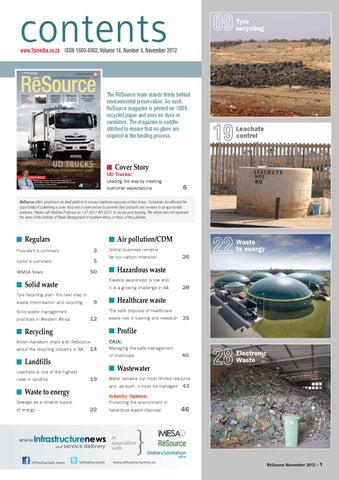
contents
09
Tyre recycling
19
Leachate control
22
Waste to energy
28
Electronic Waste
www.3smedia.co.za ISSN 1680-4902, Volume 14, Number 4, November 2012
6JG QHĹżEKCN LQWTPCN QH VJG +PUVKVWVG QH 9CUVG /CPCIGOGPV QH 5QWVJGTP #HTKEC
Promoting integrated resources management
Pollution
+550 4 KPEN 8#6 Ĺ– 8QN 0Q 0QXGODGT +550
Leachate containment critical on landfills
Carbon tax
Rolling out
Urban mining
Global climate mitigation – pie in the sky
Tyre recycling plan cleans up
Lucrative, but buy-in is essential
UD TRUCKS
Tackling environmental issues
The RĂŠSource team stands firmly behind environmental preservation. As such, RĂŠSource magazine is printed on 100% recycled paper and uses no dyes or varnishes. The magazine is saddlestitched to ensure that no glues are required in the binding process.
Cover Story UD Trucks:
'ZRGTV 1RKPKQP “Our energy recovery rates are lower than that of the European Union. On the mechanical side, though, we are better off than them.�
Leading the way by meeting customer expectations
is printed on 100% recycled paper
Anton Hanekom, executive director at Plastics|SA
6
RĂŠSource offers advertisers an ideal platform to ensure maximum exposure of their brand. Companies are afforded the opportunity of publishing a cover story and a cover picture to promote their products and services to an appropriate audience. Please call Christine Pretorius on +27 (0)11 465 6273 to secure your booking. The article does not represent the views of the Institute of Waste Management of Southern Africa, or those of the publisher.
Regulars
Air pollution/CDM 3
President’s comment
5
Editor’s comment
50
IWMSA News
Global business remains far too carbon intensive
Hazardous waste E-waste awareness is low and
Solid waste
it is a growing challenge in SA
Tyre recycling plan: the next step in
9
waste minimisation and recycling
12
practices in Western Africa
Healthcare waste waste lies in training and research
Anton Hanekom chats with RĂŠSource about the recycling industry in SA
14
CAIA: Managing the safe management
40
of chemicals
Landfills
Wastewater
Leachate is one of the highest
19
Water remains our most limited resource and, as such, it must be managed
Waste to energy
43
Industry Opinion:
Sewage as a reliable supply
Protecting the environment in
22
hazardous waste disposal
in association with infrastructure news
35
Profile
Recycling
of energy
28
The safe disposal of healthcare
Solid waste management
risks in landfills
26
infrastructure4
46
}
www.infrastructurene.ws
RÊSource November 2012 – 1
:H RƪHU essential products IRU waste storage and transportation. 3mƾ FROOHFWLRQ EDQN
770 litre
240 litre
Wheeled Bins:
Ǟ 140 litre Ǟ 240 litre Ǟ 770 litre Ǟ 1000 litre Ǟ 1100 litre
Ǟ 3mƾ collection bank
FRQWDFW XV
IRU PRUH LQIRUPDWLRQ
Mpact Plastic Containers Neil Hare Road, Atlantis, South Africa 9 Piet Pretorius Street, Brits, South Africa PO Box 1551, Dassenberg, 7350 Tel: +27 (0) 21 573 9400/ 0861 672 444 www.mpcsa.co.za
President'sCover comment strap
WRESTLING WITH WASTE
A successful bout at WasteCon 2012 by Deidré Nxumalo-Freeman, president, IWMSA
W
asteCon 2012, Southern Africa’s most comprehensive waste management conference, drew to a close in East London on 12 October 2012 and we are delighted to report a resoundingly successful event. This year’s WasteCon boasted over 500 delegates and 100 exhibitors, and was the biggest waste conference to have been hosted in South Africa to date. Now in its 25th year, this four-day, flagship biennial event brought together municipals as well as private entities to deliberate and set up processes that will move our nation ahead in addressing crucial issues pertinent to the waste management industry. At the IWMSA, we believe that we are on the brink of change, facing exciting new opportunities and challenges. Establishing a quality assurance framework for our membership base is foremost on the agenda, which will not only result in that base having acquired sound knowledge but also serve to enhance the reputation and credibility of the IWMSA. We simply have to move away from landfill as the primary option for waste disposal and in order to achieve the desired result, our focus will continue to be on reuse, recycling and recovery. The IWMSA seeks for its members self-regulation within an appropriate legal framework. We understand that it is critical that the IWMSA serves its members by engaging with the various stakeholders in determining legislation and also to provide education in the form of workshops and training that is relevant and informed.
We are pleased to have established a waste management processes, we need much greater rapport with government, to be proactive, especially at grass roots and the resultant attendance of more level. The challenges that are faced by municipal delegates than ever before at those on the ground on a day-to-day basis WasteCon 2012 is evidence of the strides must be addressed in order to effect real taken in this regard. We are excited, too, to change in the industry. have received inputs from young delegates We, at the IWMSA, focus on providing attending WasteCon 2012, who were there education and training for our members, as as a result of concern for the environment well as other interested parties, whether and for their future. We need to nurture private individuals or government entities. and encourage such interest wherever The IWMSA is a non-profit organisation possible in order to more effectively com- comprising a body of dedicated profesmunicate with communities so that trans- sionals in their respective fields, who give formation takes place from the ground up. freely and voluntarily of their time and In the past five years, the IWMSA has expertise in order to effectively educate, made significant progress in appointing sponsored and accredited assessors and moderators to ” facilitate accredited training proDeidré Nxumalo-Freeman, president, IWMSA grammes. These individuals are professionals in their respective fields who promote and fur ther give voluntarily of their time and expertise the science and pracand are, as such, truly invested in combat- tice of waste manting our waste management crises. We agement. Anyone thank and salute them all. wishing to find out The role of the IWMSA as an organisation more about the is to educate its members, as well as pri- IWMSA or how to vate and government sectors, and to set a become a memnew standard for IWMSA members in terms ber can visit of certification and accreditation. In order www.iwmsa. to implement effective and sustainable co.za.
We believe that we are on the brink of change, facing exciting new opportunities and challenges.
Patron members of the IWMSA
RéSource November 2012 – 3
Editor's comment Publisher: Elizabeth Shorten Associate Publisher: Ferdie Pieterse Editor: Yanna Erasmus Tel: +27 (0)11 233 2600, yanna@3smedia.co.za Head of design: Frédérick Danton Senior designer: Hayley Mendelow Chief sub-editor: Claire Nozaïc Sub-editor: Patience Gumbo Production manager: Antois-Leigh Botma Production coordinator: Jacqueline Modise Financial manager: Andrew Lobban Marketing & online manager: Martin Hiller Distribution manager: Nomsa Masina Distribution coordinator: Asha Pursotham Administrator: Tonya Hebenton Printers: United Litho Johannesburg Tel: +27 (0)11 402 0571 Advertising sales: Christine Pretorius Tel: +27 (0)11 465 8255 christine.pretorius@lantic.net
Publisher: MEDIA No.4, 5th Avenue Rivonia, 2191 PO Box 92026, Norwood 2117 Tel: +27 (0)11 233 2600 Share Call: 086 003 3300 Fax: +27 (0)11 234 7274/5 www.3smedia.co.za Annual subscription: subs@3smedia.co.za R195.00 (incl VAT) South Africa ISSN 1680-4902 The Institute of Waste Management of Southern Africa Tel: +27 (0)11 675 3462 E-mail: iwmsa@telkomsa.net
All material herein RéSource is copyright-protected and may not be reproduced either in whole or in part without the prior written permission of the publisher. The views and opinions expressed in the magazine do not necessarily reflect those of the publisher or editor, but those of the author or other contributors under whose name contributions may appear, unless a contributor expresses a viewpoint or opinion in his or her capacity as an elected office bearer of a company, group or association. © Copyright 2012. All rights reserved.
RéSource is endorsed by:
It has to be a collective and inclusive effort
W
aste is part of the human condition. It is a by-product of our very existence and for this reason, solutions to minimising and managing it are critical. The amount of waste generated per person is highly dependent on living standard measures and the higher that measure, the higher the consumption and, consequently, the higher the levels of waste. Thus, you would not be wrong for thinking that as a country, South Africa should be in a better position since the bulk of our population falls into the lower levels of income but this, in turn, provides a new challenge as a lot of recyclable waste is sent to landfill. Recycling and concern for the environment is not exactly top of the list for people who are struggling to meet the most basic needs. Maslow’s hierarchy of needs is applicable here. We cannot expect of people whose basic needs are not met to care about recycling, litter and things like the environment. We cannot expect people who need plastic canisters to keep water to be concerned about what the canisters held in the first place. Neither can we expect those self-same people to not litter or separate their waste for the benefit of reducing landfills. In fact, many of those people are on landfills trying to reclaim what they can to make a living or collecting recyclables from more affluent suburbs. By the same token, recycling initiatives cannot solely rely on private individuals and companies, with very little assistance from government. More support is required to back up the legislation and, as discussed by Anton Hanekom, the chief at Plastics|SA in this edition, more incentives and subsidies could form part of that solution. Training and policing of waste management and disposal, including hazardous waste, along with forums where all the role players can
come together and keep communication channels open to engage everyone, are very important to achieve country success. The process is moving forward but it is fragmented because the business, economic and infrastructure environment to see it achieve the success it has to achieve, is not in place. Waste is not an isolated concept. Every citizen is involved because we are all generating it. We cannot expect innovation, recycling and minimisation to take place if we are not all involved and we do not all understand the paramount importance of it. A lot of information was put forward at the recently held WasteCon in East London, hosted by the Institute of Waste Management of Southern Africa, but in-depth research is required. Solutions include training, education, employment opportunities to uplift communities living on the fringe of society, and a conducive environment in which to operate. There are many initiatives and while this puts us on our way to waste management success, we are nowhere near close enough yet.
We cannot expect innovation, recycling and minimisation to take place if we are not all involved
Yanna Erasmus
APOLOGY
RéSource left out the references from the following case study in the August 2012 edition: Water balance covers and their applicability to South African landfills. For more information on the case study, please contact Riva Nortje on +27 (0)11 519 0200 or e-mail: nortje@jaws.co.za. We apologise for any inconvenience caused.
RéSource November 2012 – 5
Cover Story
UD U D TRUCKS TR
Into the future after QUALITY AND AFTERSALES SUPPORT FORM THE BACKBONE OF UD TRUCKS
As one of the region’s leading truck manufacturers, UD Trucks Southern Africa is driven by its vision of being ‘professional, passionate and dependable’ in everything it does.
U
D Trucks forms part of one of the world’s largest trucking groups, with operations in South Africa being the brand’s largest market outside of Japan, signifying its strategic importance in the country as well as in Southern Africa. “For more than 50 years, UD Trucks has produced legendary vehicles that have built an outstanding reputation in the local transport industry,” says Jacques Carelse, UD Trucks Southern Africa MD. “This is mainly due to the vehicles’ unrelenting reliability, versatile performance and suitability to South African road and operating conditions. The company has invested greatly in developing innovative and modern vehicles that offer better efficiency, fuel economy and environmental responsibility.” Through its environmental policy, UD Trucks aims to create a better environment by taking every possible measure to tackle global environmental issues. The company also aims to develop environmentally friendly products through measures such as reducing exhaust emissions, improving fuel efficiency, developing cleaner fuels and reducing external automobile noise.
closer professional relationships with its customers and offers dependable transport solutions – a recipe for future success. UD Trucks’ extensive dealer network remains committed to providing customers with innovative transport solutions and service offerings, built on trust, in-depth industry knowledge and a strong technical skills set. The company has more than 60 dealers in Southern Africa, including Botswana, Kenya, Lesotho, Madagascar, Malawi, Mauritius, Mozambique, Namibia, Uganda, Swaziland, Tanzania, Zambia and Zimbabwe. UD Trucks has a proud after-sales care record as a result of a concerted commitment to consistently improve product and customer support to ensure the best possible vehicle availability and utilisation. “This commitment starts with excellent product support from UD Trucks in Japan. The company also continuously employs and trains specialist technicians in order to ensure the highest quality of workmanship,” explains Carelse. The efficient and timely supply of quality UD Trucks parts remains one of the company’s main priorities. UD Trucks’ dedicated distribution centre aims to provide the best service in the industry and contribute to the low life cycle costs of all UD Trucks products. With more than 400 000 parts internationally and 28 000 locally – all of which are managed through a computer-controlled storage
UD Trucks’ MDT range is geared to achieve excellent fuel consumption and gradeability
Matching customer expectations with global business insights Extensive research by UD Trucks has revealed that customers are increasingly looking for a truck provider that can be a true professional partner. The company is therefore committed to continue building
6 – RéSource November 2012
system – an industry-leading parts supply has consistently been achieved.
Legendary trucks, futureforward technology Through a pioneering spirit, groundbreaking engineering and a customer-centric approach, UD Trucks applies the expertise amassed in the diesel-engine field to produce trucks that are comfortable, safe and environmentally friendly. UD Trucks Southern Africa offers a wellbalanced range ensuring appropriate technology for the needs of customers in the waste management and related industries.
Medium duty trucks • UD85 Recycling (skip loader) • UD90 Recycling (compactor) Specifically configured for the waste management industry, UD Trucks’ range of medium duty trucks (MDT) offers a comfortable ride and low noise levels, with advanced safety features and a powerful engine that provides high levels of fuel economy and durability. UD Trucks’ MDT range is geared to achieve excellent fuel consumption and gradeability, ensuring that a high average speed is attained to boost productivity. The class-leading performance of these units is achieved by the unique combination of engine power, transmission ratios and final drive ratio. The high specification, inherent strength and minimalist approach of UD Trucks’ MDT engine range, proven through extensive testing, make the trucks ideal for work. The vehicles are easy to drive, operate and
Cover story
50 successful years maintain, and are exactly what UD Trucks Southern Africa wants to offer its South African customers.
Heavy duty trucks • UD330WF Recycling (compactor) • CW26 490 Recycling (skip loader) UD Trucks’ Quon range of heavy duty trucks has been specifically designed and developed as a “smart worker” – a truck that works intelligently as part of a profitable transport solution for its owner. The design fuses UD Trucks’ tradition of environmentally friendly technology, with the smartness and stalwart power of a newgeneration working truck that is endowed with high levels of intelligence. After thousands of kilometres of testing, UD Trucks believes the new Quon range also adheres to stringent local requirements.
A selection of manual and automatic manual transmissions has been employed across the range to suit a variety of applications. The automatic gearboxes were specifically developed to improve safety, overall economy and offer the operators easy driving capabilities. The AO612 group new automated manual transmission, offers two-pedal or clutchless operation through the innovative 12-speed Escot V gearshift mechanism, and is suitable for the skip loader application. For compactor applications, the Allison fully automatic transmissions are employed specifically like in the case of the UD330 WM. ESCOT has been specifically designed for enhanced driver comfort and safety, lower maintenance as well as greater fuel
efficiency. It offers both power and economy in a wide variety of driving scenarios by increasing driving performance at low speeds at time of start, and reducing engine speeds in high gear at cruising speeds. The UD Trucks Quon range successfully combines leading environmentally friendly technology with the smartness and stalwart power of a new-generation working truck that is endowed with high levels of intelligence. However, the Quon range remains easy to operate and maintain, providing customers with the best of both worlds. A special off-road chassis packaging has also been introduced specifically to suit the region’s unique operating conditions. This includes uprated front axle ratings, heavy duty front suspension and stabiliser, radiator protection, as well as a higher repositioned exhaust silencer and fuel tanks.
RéSour RéS RéSource ourcce e November Nov Nov vemb em er er 2012 2012 – 7 20 201
REMOVAL OF SCRAP TYRES •
Solid Waste
BY YANNA ERASMUS
Rolling out tyre recycling
As South Africa continues in its drive to manage and limit waste, in particular waste to landfill, recycling initiatives are growing. The driving force for recycling is attaching a value to the ‘waste’ product and in the next step to waste minimisation, one plan for dealing with scrap tyres has recently been gazetted, albeit surrounded by controversy.
S
omewhere between 10 and 15 million tyres are produced annually in South Africa, which equates to approximately 300 000 t. The number of scrap tyres, or tyres that can no longer be retreaded or reused, amounts to 10 million per year. Currently, there are only three active tyre recycling companies in the country, recycling around 1 000 t each, which means an estimated 13% of total waste tyres recycled, and this is currently meeting market demand for crumb. Tyres are a particular problem for landfill due to their large volumes and 75% void space, which provides a breeding ground for mosquitoes and rodents. They also trap methane, not only risky in itself for fires at landfills, but the gas also causes the tyres to become buoyant or bubble to the surface, damaging the liners in landfills and enhancing groundwater pollution with toxic leachate.
The controversy Originally, three plans to deal with the surplus existed; the Retail Motor Industry Organisation (RMI), the South African Tyre Recycling Process (SATRP) and the Recycling and Economic Development Initiative of South Africa (Redisa) all prepared plans. The RMI accused Redisa of ‘hijacking’ the plan prepared by the RMI and the Tyre Dealers’ and Fitment Association plan, as the Redisa chief, Herman Erdmann, was formerly the chairman of the latter. Erdmann denied these allegations, but allegedly agreed to repay the association for a disputed amount that was spent on the plan. The SATRP also submitted a plan that cost in the region of R8 million, which it had worked on for around 12 years. At the end of it all, after several attempts and interdicts and
The number of scrap tyres, or tyres that can no longer be retreaded or reused, amounts to 10 million per year
ABOVE A pile of scrap tyres near a landfill in the East Rand
other actions, the court ruled in favour of the Redisa plan, which was approved by the ministry, and all tyre manufacturers were ordered to join Redisa by 21 September this year. The judge ruled that no one would be prejudiced if the other plans were also approved by the environment ministry as they could then leave Redisa and join another plan. The other organisations are continuing their submissions.
The recycling plan Redisa’s recycling plan, which is now gazetted, involves a levy of R2.30/kg on all locally manufactured and imported tyres. Instead of the producer responsibility system for recycling, the association opted for a levy system. The argument for this is based on its argument that producer responsibility is a voluntary system, which does not offer a fair playing field. In a levy system, it says
RéSource November 2012 – 9
Solid waste ABOVE Scrap tyres are baled to reduce their volume for transport to a recycling plant
costs are very competitive. To establish markets for downstream products is easier said than done. It might well require serious intervention from government and an approved waste tyre plant to assist in creating markets. One of the challenges is a surplus of crumb in Europe and if the market here is not protected, the prices that the crumb can be imported at will be equivalent to what it costs us to produce it.”
The challenge of recycling
all producers and importers operate equally. Redisa has focused on small and very small black businesses to remove waste tyres that are already in the environment. These will be delivered to one of a 150 collection points which will be established across the country. The document states that a “network of collection depots and recyclers will be established, and part of the operating cost of the plan will be devoted to training and supporting of the SMMEs. Another component will be allocated to research and development to create recycling processes.”
formally set-up and there is therefore no overall regulation of this informal industry. By creating a sustainable recycling industr y (that includes product development and transporters), formal income earning opportunities will be significantly increased (and tracked and reported on).” This will not be without its challenges. Currently, there are three recycling plants in operation with one in Gauteng, one in KwaZulu-Natal and another in the Western Cape. They are meeting market demand.
More crumb markets needed Formalising collection The roll-out of the plan is that collections of passenger and truck tyres must start within 10 months. They are aiming to better that target. “New recycling plants will typically take 18 to 24 months to establish from scratch, but some are being commissioned now and others – estimated to account for about 10% of the total volume of waste tyres – are currently operating.” Redisa stated: “At the moment, collectors pick up the tyres from dealers but there is no agreed tariff and no agreed or regulated depot for transporting the tyres, which often results in the tyres being indiscriminately dumped either at landfills or in the veld. There is, as yet, little formalised recycling of tyres, and the majority is disposed in environmentally unfriendly ways (burning, illegal dumping, landfill). Recycled rubber for other avenues, such as rubber shoes and so on, have not yet been
10 – RéSource November 2012
According to Ika van Niekerk of SA Tyre Recyclers in the Western Cape, the company
Tyres offer a particular challenge for recycling, because unlike waste products like glass, plastics and paper, they cannot be remade. Natural rubber consists of polymers that exist in chains, and virgin or new rubber cannot bind to the polymers in crumb, the final product of the tyre recycling process. Scrap tyres can be used in the construction of houses, roads, boarding, apparel and the like. Incineration in cement factory kilns is also an option, but only 15% of the coal load can be replaced by crumb and the technology is very expensive. Thus, Van Niekerk says that his plant does not sell crumb for incineration. He says that he is aware of one factory near Port Elizabeth that uses shredded tyres in the brick-making process. Road construction companies, however, order crumb and the Heidelberg highway for example, was constructed this way. The use of crumb in this way is very efficient as the road lasts five times longer because the crumb protects the road foundation.
The majority of countries in the European Union are using producer responsibility above the levy system handles around 1 000 t scrap tyres monthly and produces crumb from them. He is also of the opinion that the three recyclers are meeting market demand. “It is becoming a very limited and competitive market for direct or wholesale sales to crumb users. More crumbers would result in profitability challenges and inevitably the survival of the fittest.” Thus, a market must be created for crumb. “The future lies in utilising rubber crumb in value-adding industries, such as motor industry components, foot wear and many other possibilities. This process will inevitably compete with Chinese imports and other countries in the East, where labour
The problem of red tape Another criticism of the Redisa plan is the levy system. Riaan van Niekerk from Pirelli and the SATRP plan is of the opinion that the levy system will cause a lot of red tape. A lot of tyre brands are imported to South Africa and from here, service the SADC region. The levy must be paid on the import but once exported the levy must be claimed back. This is considered to be a strength in the SATRP plan and the levy is lower at R1.98/kg. The levy on the tyre is charged at the point of sale in South Africa, which eliminates the system of credits and debits that the Redisa plan will cause.
Solid waste
And the European Tyre and Rubber Manufacturers’ Association (ETRMA) agrees. Research published in 2011 on end-oflife tyres (ELT) shows that the majority of countries in the European Union (EU) are using producer responsibility above the levy system. Some 57% in 2011 used producer responsibility. This system, the association says, is robust and suitable and currently, there is a 100% recovery rate with producer responsibility. Denmark and Slovakia still use the levy system and six countries are using the free-market system. In the EU, countries can choose the system they want to use, but landfilling has been abolished since 2006. Only two countries are still landfilling: Bulgaria and Cyprus. Europe has around 5.7 Mt of tyre stockpiles, which is almost double the number of used tyres produced in 2010, and the number continues to increase. Material recovery stands at 40% and energy recovery at 38%. The total recycling rate in the EU stands at 96% compared to 50% in 2005. The association says that “the improvement is due to the sustained deployment of the producer
responsibility model”. Genan in Denmark, one of the largest recycling operations in the world, does not agree due to unfair competition and Redisa has followed this model. If it is indeed true, as Redisa says, that South Africa has 60 million scrap tyres lying around, then the country’s challenge is massive. Once value has been added to these tyres, the influx will grow quickly and the market has to catch up. Plants
tyre problem and the gazetting of this plan is the first step in the right direction.
Options for recycled and scrap tyres Besides reuse and retreatment, there are other products that can be created. Options for tyre derived products include the use of crumb as an energy source, binding whole tyres together used as barriers including collision reduction, erosion control, rainwater runoff, wave action that protects piers and marshes, landfill walls and sound barriers between roadways and residences. Entire homes can be built with whole tyres by ramming them full of earth and covering them with concrete. Shredded tyres can also be used in civil engineering applications such as sub-grade fill and embankments, backfill for walls and bridge abutments, sub-grade insulation for roads and septic system drain fields. Ground and crumb rubber can also be used in both paving type projects and mouldable products. These types of paving are rubber-modified asphalt or concrete, livestock mats and more.
This means an estimated 13% of total waste tyres are recycled have to be built, research into new products must be completed and a market created for these products as a matter of urgency. However, in spite of these tangible obstacles, South Africa has to deal with its waste
RéSource November 2012 – 11
Specialist Waste Management Consultants Sustainable and appropriate engineering solutions with integrity and professionalism. Stanford Drop-off Vissershok Waste Management Facility
Gansbaai Recycling Centre
Velddrif Transfer Station
t t t t t t t t t t t t
Integrated Waste Management Plans Waste Disposal Strategies Identification and permitting of landfill sites Design of General and Hazardous Waste sites Design of Solid Waste Transfer Stations Design of Material Recovery Facilities Optimisation of Waste Collection Systems Auditing of Waste Management Facilities Development of Operational Plans Closure and Rehabilitation of Landfills Quality Assurance on Synthetic Liners Waste Recycling Plans
Hermanus Materials Recovery Facility
Botrivier Drop-off
Jan Palm Consulting Engineers Tel +27 21 982 6570
/ Fax +27 21 981 0868 / E-mail info@jpce.co.za / www.jpce.co.za
Solid waste
PART II OF V
Solid waste management practices in Western Africa In Western Africa, the rapid rate of uncontrolled and unplanned urbanisation, coupled with a high density of urban settlements and changing consumption patterns, have accelerated the need for water supply, sanitation and waste management infrastructure.
I
n Western African countries, as in many other low-income countries, waste management is generally organised as summarised in Table 7, with low income area
collection informally organised and separation for recycling done by households and the informal sector. Recycling takes place in both the informal and formal sectors. Public
TABLE 7 ORGANISATION OF WASTE MANAGEMENT IN WESTERN AFRICA Step Pre-collection (in low income areas) Collection (in high income areas) Transportation
Separation Recycling Final disposal
Actors Informal sector, CBOs, NGOs, cooperatives, SMEs Municipality, formal private sector
Infrastructure and equipment available Very low. Wheelbarrows, handcarts, tricycles (in Ghana). Communal collection points or transfer stations. Plastic bags, bins, barrels, skip containers.
Municipality, formal Compactor trucks, skip trucks, tipper trucks and roll-on private sector roll-off trucks, or in more rural areas tractors and carts. An important share of the vehicles is second hand vehicles (international donations), which is not in working order. Zoomlion Ghana Limited, the largest Ghanaian company has 50 000 collection trucks and tricycles. Households, infor- By households (if they sell to the informal waste buyers), by mal sector informal workers in the street and on dumping sites. Informal and forInformal sector: manual metal smelting equipment mal sector Formal sector: plastic shredders etc. Municipality, formal 70% to 90% of the municipal solid waste is disposed of in private sector official dumpsites. The rest is irregularly or illegally dumped. On the official dumpsites, the waste is compacted with trucks. There are usually no installations for gas collection and treatment or leakage water drainage. The leakage water runs uncontrolled to the next river. Only in Lagos the leakage water reaches a leachate pond. Information on total and remaining capacities of official dumpsites could not be acquired. Open air incineration is very common for households and at irregular and official dumpsites, to reduce the volumes.
Source: (IWWA 2011)
12 – RéSource November 2012
and formal private role players are mostly involved in – insufficient – collection and final disposal (landfills), whereas informal actors are involved in pre-collection and recycling. Pre-collection is generally performed by the informal sector in low-income neighbourhoods that are not covered by the formal collection systems. So, informal actors or NGOs organise pre-collection and transportation up to the level of ‘transfer stations’. From here the waste is collected by trucks belonging to either public or private entities and brought to the municipal dumping site. Sometimes informal collectors also deposit the waste in illegal dumping sites, especially when there is no reloading site nearby or when waste is not collected regularly. When zoning of waste collection was initiated, conflicts between formal and informal sectors was observed especially in the metropolitan areas of Accra, Kumasi, Tema, Takoradi and Tamale. There is an ongoing dispute about whether or not the informal sector should be allowed to continue operating, to be integrated or organised into the formal sector or to be stopped all together.
Final disposal infrastructure The Accra Metropolitan Assembly is struggling to secure land for the construction of a sanitary landfill. Residents are against the idea of constructing landfills close to their homes because of the fear of the unbearable stench that is likely to emanate from the landfill and also of the possibility of flies and rodents invading the area. In Ivory Coast, after having provided an emergency suppor t during the political crisis (four SMEs have signed ser vice agreements with Abidjan), the World Bank in its partnership strategy for 2010-2013 has committed to funding the construction of two sanitary landfills in Abidjan
Solid waste
TABLE 10 JOBS IN MUNICIPAL SOLID WASTE COLLECTION, TRANSPORTATION AND DISPOSAL Ghana Number of formal companies Number of formal workers Number of formal workers per 1 000 inhabitants Number of informal workers engaged in separation, re-selling of recyclable materials and recycling
Accra 17 in Ghana 3 200 0.80
KEEA 141 0.71
Ivory Coast Abidjan 7 1 765 0.0003
On Abgog-bloshie scrap yard: 3 000 n.a. members of the scrap dealers association.
Lagos 10 3 000 0.38
Nigeria Ido n.a. 120 n.a.
Senegal Dakar Matam n.a. n.a. 1 701 9 0.57 0.51
Over 25 000 in the Kano metropolis
Sources: IWWA 2011; Sané 2002; Saleh 2008
and further, to support the government in conceiving a national strategy for solid waste management. The objective is to secure 9 000 permanent jobs (waste collectors) by 2013 and to collect and deposit in the landfills 80% of the waste generated in Abidjan. In Dakar, a sanitary landfill is built in the region of Thiès next to Dakar, where Dakar’s waste will be disposed in the future. The landfill will be operated by a private company. In addition, a transfer and separation station is being built in Mbao. There is currently a conflict regarding the geographical location of the landfill between the Ministry of the Environment, the National Agency for Cleanliness (APROSEN), the network of the main cities of the region of Dakar (Entente CADAKCAR) and inhabitants of neighbouring areas in the rural communities of Sindia and Diass. In the City of Matam, the NGO LuxDevelopment is implementing a project including three transfer stations and a sanitary landfill for the municipal waste. Prior to the project, the city administration together with the inhabitants has carried out an environmental impact analysis.
Collection and recycling rates Concerning recycling rates, there is no public monitoring of such figures as recycling is left to the formal and informal private sector.
There is hardly any support from both local authorities and governmental agencies for companies and business people who intend to establish businesses that make use of waste materials. However, paper, cardboard, organic waste, plastics, e-waste and scrap metal are sorted by the informal sector on dumpsites or scrap yards and either recycled locally by formal or informal actors, or exported. Some fractions such as metal scrap have a very high recycling rate while less valuable fractions end up in the dumpsites to a large extent.
Employment opportunities The number of formal workers responsible for the collection and transportation of municipal solid waste varies from 0.003 (Abidjan) to 0.8 per 1 000 inhabitants (see Table 10). The number of informal workers is high in all four countries. The informal sector is particularly developed in Nigeria and is structured in the following way (Adebola, 2006): • Cart pushers: house to house waste collection at a small fee. • Scavengers: involved in both on-site and off-site waste and resource recovery. They recover re-usable and recyclable materials like plastics, aluminium, glass, paper, scrap metal and animal waste such as horn, bones and the like. • Resource merchants: traders involved in the purchase of all recovered
recyclable and reusable materials from the scavengers. • Recyclers: includes both the micro- and the small-scale recycling companies. They convert recovered waste materials like paper, aluminium, animal by-products, plastics and scrap metals, to valuable materials and raw materials for the consumption of the industrial sector.
Costs and financing mechanism It is generally assumed that the cost of the management of solid municipal waste in Africa is very low with an average of €2 (R26) per year per inhabitant, as compared to the high income countries where it can go well beyond €100 (R1 300). The City of Accra is practicing full cost recovery and thus charging close to commercial rates, while waste management in the most Western African cities is subsidised. Moreover, households pay the service providers directly, particularly in the informal sector for pre-collection services. This is an abridged version of the second part of a paper on the project of Integrated Waste Management in Western Africa. The duration of the project, funded by the EU within the Seventh Framework Programme, was two years and the results of the research were submitted during May 2012. For a full version, including references, please contact Yanna Erasmus at yanna@3smedia.co.za RéSource November 2012 – 13
Mills & Otten cc Johannesburg Tel: (011) 486 0062 Fax: (086) 554 6573 Contact: Charles Mills / Kirstin Otten
Environmental Consultants 1998/46338/23 info@millsandotten.co.za www.millsandotten.co.za
Cape Town Tel: (021) 671 7107 Fax: (021) 671 7107 Contact: Stephanie de Beer
Independent Environmental Consultants specialising in: Environmental Impact Assessments Environmental Management Systems Environmental Audits
Contaminated Land Assessment Environmental Management Plans Waste License Applications
Recycling
PLASTICS RECYCLING
SA has unique circumstances in the recycling sector Plastics|SA’s executive director, Anton Hanekom, speaks to Yanna Erasmus about the business of recycling plastics. The industry in South Africa is growing in leaps and bounds and the country leads in many aspects, but there are difficulties and obstacles that must be overcome.
T
he advent of plastics changed the packaging landscape and human society forever. Not only was it relatively inexpensive and easy to make, it was light and easier to handle than the packaging solutions of old. In South Africa, it is a relatively young material, having only been around for about 50 or 60 years. Today, and in the public eye, plastics have a bad reputation, thanks to litter – in particular plastic bags. Hanekom says: “Our modern lifestyle will not be possible without plastics. The industr y provides essential products to a variety of sectors, including medical and health, automotive, mining, agriculture, packaging, building and construction, electrical, and electronics.” South Africa conver ts around 1.3 million tonnes of virgin plastic material a year, and 52 to 55% of this goes into packaging. The rate of plastics packaging recycling is around 30%, and this figure grows annually. That, however, does not mean that there is more room for growth. Plastics are getting lighter and lighter, resulting in more products being created out of the same total weight and hence, more are recycled. Many recycled plastics also go into long-term products, like motor vehicle bumpers and water pipes, and do not return into the recycling stream. In fact,
DID YOU KNOW? • Just over 245 000 t of plastics were recycled in 2011 and of this, 76% was packaging material. • South African consumers spend around R45 billion on plastics every year. • Some 63 000 people are employed in the plastics industry. • Plastic packaging has a low carbon footprint because only between 1 and 3% of the total product weight is the packaging. This decreases the rate of transport. • Around 27% fewer apples are discarded if they are purchased shrink-wrapped in a tray. • The shelf life of an average cucumber is increased by 333% (from three to 14 days) if it is packaged in a mere 1.5 g of plastic wrap.
14 – RéSource November 2012
Recycling
ABOUT PLASTIC WATER BOTTLES: • Close to four million PET bottles are recycled every day in South Africa. • Recycling plastic bottles decreases the need for raw materials and saves energy. • Recycling a tonne of PET bottles saves 1.5 t of carbon dioxide emissions. • Some 100 kg of plastic, in a car weighing 1 000 kg, ensures a fuel saving of up to 7.5%. • A total of 41 recycled polystyrene hamburger clamshells make one plastic picture frame. • Five recycled PET bottles are equal to one T-shirt. • A total of 11 coke bottles is equals to a pair of trousers. • It takes 35 recycled water bottles to produce a polar fleece jacket. • The carbon footprint of plastic water bottles can be reduced by 25% if consumers simply recycle the bottles.
our recycling rate is higher than that of the UK and the US. But it is not that simple, says Hanekom. “As a countr y, we are both ahead and behind in terms of plastics recycling. Our energy recover y rates are lower than that of the European Union (EU), which has historically incinerated its waste due to the lack of landfill space. On the mechanical side, though, the collection, sor ting, separation and reprocessing process, we are better off than the above-mentioned countries.” It can therefore be said that because South Africa historically did not focus on recycling and mostly landfilled its waste, the recycling of plastics and innovation in this waste stream has grown, due to the pressure of the decreasing landfill space. The EU, on the other hand, has focused on developing waste to energy strategies instead of innovations in recycling, due to its incineration of waste. Innovations are driven by Plastics|SA’s Sustainability Council. Here, issues of differing polymers, which affect the success of recycling, are discussed to maintain and
16 – RéSource November 2012
increase the recycling rate. The aim is to achieve a 35% plastics packaging recycling rate by 2015. However, Hanekom says that innovation star ts at the planning, design and manufacturing of the original product. Its complexity influences its eventual rate of recover y. “For example, a plastic water bottle is made from PET, the closure from polypropylene (PP) and the label from a different plastic material. Thus, the choice of material used by the manufacturer can influence the recycling process of the plastics. Ink on the bottle, which indicates the manufacturing and expir y dates, can also act as a contaminant in the process. These are the things that need to be considered. Plastics are multidimensional, and this is the central challenge in recycling success.” Public awareness is also impor tant. A lot of plastics are going to landfill, in par ticular plastic bags, as they are used in the home to dispose of nappies, organic and general waste, for example. A low level of separation at source and the efficient sor ting of domestic waste with collection also hampers success.
Separation at source “Municipalities must increase capacity to ensure that sorted domestic waste is kept sorted and that consumers develop the discipline to do the separation. This may take some form of incentive for the consumers, but municipalities can save a lot of money
“The process is not cheap, and because there is a skills shor tage the price of recycling increases. This, in turn, affects the success of the entire process.”
Challenges for the plastics industry There are other problems as well. Company compliance costs in South Africa are high and this could increase final product price by between 5 and 15%. Energy, labour and logistics costs continue to increase. In some instances, it is cheaper to ship products to South Africa than to transport them within the countr y. Cheap imports also undermine plastics recycling. In China, for example, there are subsidies and cheaper operating costs. This results in a cheaper final product. The bulk of local consumers are poor and purchase according to price, which affects not only the industr y that manufactures local products but also the recover y of these products. “We are expor ting jobs, money and raw material,” states Hanekom. Companies that recycle must also impor t all the equipment from overseas, and the moulds used to manufacture the actual products are also impor ted from the Far East or the EU. This pushes up the cost substantially. Another challenge is the public view that recycled plastics are second-hand and substandard, or that purchasing glass and paper packaging is the ‘greener’ option. “It is critical that this mind-set is changed. Recycled plastic products are new prod-
Producers must create local, recyclable products and take responsibility for them. This should not be voluntary as landfills are expensive. WastePlan was ver y successful in Cape Town with its household recycling collection ser vice. This twobag curb side collection project was rolled out to certain areas in Pretoria. PikiTup has recently launched its second pilot project for this in Johannesburg.”
Skills shortage To maintain our current success, it is vital that skills are retained and, as in other sectors, there is a skills shortage in the countr y. There are too few university graduates that specialise in polymers, and too few plasticians, setters and operators. The designers who create the product are also few and far in between. Says Hanekom:
ucts and the bad reputation of plastic is undeser ved. The total carbon footprint resulting from the creation of a plastic product and its recycling is in many cases lower than the manufacturing and recycling of other products such as glass. Only 4% of the total global oil production is currently going into plastic manufacturing.” So how do we keep the industr y in positive growth? Hanekom is of the view that it needs to be protected. “South Africa’s borders are open to impor ts, and there are no protective measures such as levies or standards. For example, the current levy on plastic bags should be going to the industr y. There should be incentives and subsidies for plastics recycling companies,
Recycling
This logo
indicates that the manufacturer has expressed its commitment to environmental responsibility. It is registered in the name of the Plastics Federation of South Africa.
as adding a levy onto a recycled product is too much of a burden for already burdened consumers in the current economic climate. Consumers should be educated to suppor t locally manufactured products, as this will combat pover ty overall.”
Solutions “Standards are crucial. These have to be put in place and maintained in our industry. If this occurs and they are enforced, certain imports will be limited and those that enter the country will comply. Our ‘Enviromark’ on products also guarantees that the producers of those products are committed to extended producer responsibility. This is important as producers must create local, recyclable
products and take responsibility for them. This should not be voluntary. Communication between the trade and industry and environmental departments is also essential to this process. “The Preferential Procurement Policy Framework Act that came into force during December, last year, is a good example of what can be done. Previously, the only requirement for a tender was an empowerment policy, but with this Act there must be a cer tain amount of locally manufac-
making the same product. “Industry should be thinking about how it can diversify and enter a more niche market with an original product. This will decrease competition and increase innovation.” The recycling of plastics is a group effor t and all role players, from the manufacturer, the user and the municipal utility through to the government, must be involved if the industr y is to grow and develop. Many successes have been achieved as was seen with the awards for the best recycled
Our modern lifestyle will not be possible without plastics. The industry provides essential products to a variety of sectors.” Anton Hanekom, Executive Director of Plastics|SA tured product or content to secure the work. However, government procurement of plastics is low and hence, local content should be specified.” Hanekom adds that the industry as a whole must become more original and innovative. There are a host of small companies
products held in September. A wide variety of innovative products were entered but suppor t is needed for the manufacture of these products to grow from small community products to large and inexpensive mainstream products. It has to be a collective effor t. RéSource November 2012 – 17
Recycling of Municipal and Industrial Waste
Pellets or fluff as alternative fuels AMANDUS KAHL GmbH & Co. KG Dieselstrasse 5, D-21465 Reinbek / Hamburg, Germany Phone: +49 (0)40 727 71-0, Fax: +49 (0)40 727 71-100 info@amandus-kahl-group.de www.akahl.de
Johannes Schuback & Sons (S.A.) PTY Limited, Johannesburg / RSA Phone: +27 11 7062270, Fax: +27 11 7069236 jsssa@mweb.co.za
Landfills
COMPLIANCE
Pulling the plug on leachate If it is true that leachate is somewhere between 10 and 1 000 times more contaminated and damaging to the local surface and groundwater than sewage, then the case is made for well-engineered and more importantly, well-managed landfill sites. Yanna Erasmus reports.
S
outh African experts in the field believe that between 20 and 30% of landfills in South Africa comply with the minimum requirements. This is primarily due to smaller towns and villages across the countr y with landfills that can only be described as dumpsites. If this is indeed true, or if overestimated and around 50% of landfills do not comply, our groundwater resources are under threat. Smaller towns and villages also do not separate organic waste and when coupled with high rainfall, the potential for contamination is high. Consider a dumpsite on top of a hill in a high rainfall area such as Mpumalanga. There is a settlement at the base of the hill, drawing water from stream or borehole. Chronic infections in these communities are considered to be a by-product of their lifestyle when it could be due to polluted groundwater. But
RÊSource November 2012 – 19
Landfills
the problem is not only centred around landfill sites that do not comply. According to Leon Grobbelaar of Inter waste: “Around 50% of the active landfills in the countr y are poorly managed.” The cause of this is not necessarily that the landfill was badly designed but that the knowledge of managing it well is lacking. In some cases, municipalities, being unaware, also damage liner systems. Municipalities also often move away from non-compliant landfill sites and simply construct new ones.
filled with a variety of waste from vastly differing sources’. While some landfills may be classified as dr y and the potential for leachate low, there is still some runoff, albeit considered negligible. Leachate becomes a tangible challenge in wet or B+ rated landfills as well as hazardous landfill sites. For the purposes of this discussion, the focus will be on general waste landfills. The goal of landfill technical design is complex and the main objective is to
“We still have insufficient knowledge of the science associated with waste management” Dr Luis Diaz And this is not all we do not know. According to Dr Luis Diaz, a member of the solid waste management task group for the International Waste Working Group,
preser ve groundwater and to protect the environment. Stormwater systems for both contaminated and clean water must be in place and collection and storage for
and exper t in the field for the past 40 years: “We still have insufficient knowledge of the science associated with waste management.” Luis raised several concerns including increased consumption, which is coupled with increased affluence and the excessive increase in packaging in urban societies. “Globally, the focus is on the diversion of waste from landfill.” While this is the emphasis in South Africa as well, with the well-known deadline of zero waste to landfill by 2022, we still have the problem of existing landfills, many of them ‘holes in the ground
leachate, including lined leachate dams, must form par t of the site. Rod Claus from Fiber tex says that clay liners in landfills are risky. “Early in the landfill operations, clay may be exposed to the open environment and dr y out. This can cause cracks and consequently, a drainage path for leachate. Darr yn Meissel, regional director of Geotextiles Africa, agrees. “Clay is moisture dependent. In a wet and dr y season, it has the potential to desiccate. Clay needs to function at its optimum moisture content and wet clay does not crack and create a leak path.” Liners,
20 – RéSource November 2012
although not infallible, seem to be the penultimate solution to capturing leachate and ensuring that it is drained to leachate collection dam. Except for waste type, landfill liners and design depend on the topography and rainfall of the area, among other things. For a large, general waste and wet landfill though, minimum requirements in the draft standard include drainage and monitoring system on top of in situ soil is topped by a geosynthetic clay liner. This, in turn, is topped by four 150 mm of compacted clay topped by a 1.5 mm HDPE geomembrane. On top this either a 100 mm protection layer of silty sand or a geotextile of equivalent per formance is required. This is followed by a stone leachate collection system which is topped by another geotextile layer on which the waste body is collected. At the Rietfontein landfill (GLB+) site near Springs, which is managed by Inter waste, the municipality has taken the linings a step fur ther. Below the leakage detection and collection layer, a 150 mm compacted clay liner and below that 150 mm base preparation layer tops the in situ soil. Sanitar y landfills have been par t of human settlements since 1937 with the first one built in Fresno, California, in that year. By the 1960s, laws and regulations were implemented and in the 1970s the US star ted separation at source. A paper published in 1982 examined the potential of German sanitar y landfills to pollute through leachate and methane entering the groundwater system. The results indicated that landfills compacted with a compactor instead of a crawler tractor had a lower incidence of leachate generation, around 15 to 25% of the annual precipitation as compared to between 25 and 50% in the case of the crawler tractor. This was measured at a 500 to 800 mm annual precipitation rate. The author, R Stegman suggested, already at that time, that biological processes be used to filter leachate. The product, although still relatively contaminated, can be recirculated to increase moisture content in the landfill and after it is closed, “leachate recirculation should be practiced in order to maximise evaporation on top of the landfill. Leachate production of closed-up landfill sections can also be reduced by suppor ting vegetation growth on top of the landfill and erosion prevention methods should be used such as growing grass on the slopes.”
Cut-off trenches that effectively isolate landfills hydraulically from the surrounding environment and monitoring boreholes also assist to manage leachate.
Treating leachate There are a variety of factors that can influence the production and composition of leachate. One major factor is the climate of the landfill. For example, where the climate is prone to higher levels of precipitation, there will be more water entering the landfill and therefore more leachate generated. Another factor is the site topography of the landfill, which influences the runoff patterns and again the water balance within the site. There are two natural treatments that can be used to filter and treat leachate although the product is still not entirely free of toxins. Bioremediation is the treatment of choice for mineralising most organic compounds in landfill leachate. Under aerobic conditions, microorganisms can degrade organic compounds to carbon dioxide, and under anaerobic conditions to carbon dioxide and methane. Xenobiotics can also be degraded with the correct species of microorganisms that are introduced. This is what was done at Mariannhill Landfill in Durban. According to Lindsay Strachan of SLR Consulting: “The application of naturalistic engineering to landfill development is crucial to environmental acceptance of the landfill site. Naturalistic engineering encompasses many landfill facets, for example: the provision of landfill capping layers that would stimulate vegetation growth, the use of simple and low-cost yet robust natural systems to treat landfill leachate, and the installation of wetlands to reduce stormwater energy and to simultaneously reintroduce bird life to the site.” Phytoremediation was also used as a second-phase polishing treatment with the use of a reed bed at the Mariannhill landfill site. At WasteCon 2012, held in October, Jeffares and Green announced the commissioning and initial results of a leachate treatment plant at Vissershok in the Western Cape. It is the largest treatment plant of its kind in the countr y and it was commissioned after upgrades towards the end of April. After 10 days, denitrification of the leachate was achieved. The plant also boasts an innovative design that is internationally state of the ar t for broader wastewater treatment. It is the first in South Africa to denitrify landfill leachate. Although expensive, costing just under R34 million, Jeffares and Green is of the opinion that plants like these are ver y impor tant due to the pollution potential of leachate. Leon Grobbelaar of Inter waste agrees: “Pollution by antiquated landfills and those that are badly managed will only be seen years from now.” Liners will only go as far as preventing leachate from penetrating and polluting groundwater resources, and while leachate collection dams are useful for the evaporation of leachate, the product still remains, drained off the landfill site. Durban Solid Waste’s Mariannhill site is a world-class solid waste site and leads the way for the countr y. Hence, bioremediation, phytoremediation and leachate treatment plants are the way of the future, even after waste is completely diver ted from landfills. Leachate is produced years after landfills have been closed, albeit in a lower potency. It must be dealt with as a matter of priority focus in landfill and solid waste management.
RéSource November 2012 – 21
VERMEER PORTRAIT
Waste to energy
Waste not, want not It has become abundantly clear that South Africa does not have enough energy to supply its power and supplement Eskom’s output. The government has announced the Renewable Energy Independent Power Producer Programme, which is looking to supply 3 725 MW to Eskom’s grid from renewable sources – and wastewater is one of those sources, as Yanna Erasmus discovers.
B
iogas is similar to landfill gas in that both are produced by anaerobic bacterial processes from suitable organic substrate. As such, wastewater treatment works are abundant sources of power waiting to be exploited, since wastewater plants should be able to generate between 60 and 70% of their own power needs. The resource, in this case organic substrate, is constantly fed into wastewater treatment plants and, as such, is readily and reliably available for conversion to electricity. The biggest wastewater treatment plant in South Africa processes around 450 Mℓ/d in wastewater from suburbs of the city of Johannesburg and this is a reliable and continuous supply of raw material for the generation of electricity. Depending on the design and the operational
22 – RéSource November 2012
Waste to energy
SAFETY FIRST
philosophy of the wastewater treatment plant, a biogas-to-power plant has the ability to run and supply power in conjunction with Eskom. This is referred to as grid parallel operation and supplies power to works in the absence of Eskom or to feed power into the Eskom grid as well, as is practiced in some parts of the world. However, this is very rare. Where this is the case, the wastewater treatment plant supplements this with other organic material. Biogas is a product of anaerobic digestion, the decomposition of suitable organic matter by bacteria in the absence of OPPOSITE TOP Applied filter technology and the digester gas conditioning system for siloxane and hydrogen sulphide removal as well as dewatering the gas. This picture from Portland, Colombia OPPOSITE BOTTOM Aerial view of a modern biogas plant in Ramstein, Germany ABOVE Digesters at Edar de Rubi’s biogas plant in Madrid, Spain
oxygen, which produces a methane-rich gas. Typically, biogas comprises 60% methane and 40% carbon dioxide and other impurities, which typically must be removed before beneficial use of the biogas. While this may appear complicated, it is possible with the right equipment and plant plan. The method of a treatment works that harnesses biogas uses a biological nutrient removal (BNR) process whereby the wastewater that arrives enters a balancing tank, which ensures consistent flow and feed into the BNR system. This is very important to the stability of the BNR process as the influx of sludge must be steady and consistent for the nutrient removal processes to work efficiently. The raw sewage enters the primary settling tank and then three phases of the BNR process: an anaerobic phase followed by an anoxic phase and then the aerobic phase. It is then transferred to the secondary clarifier as the final step. This
Safety features, such as those included in the Johannesburg Water biogas plant, are essential to ensure safe generation of methane-rich biogas for electricity. Biogas, which is made up of 50 to 70% of methane, can form an explosive mixture in air, the lower explosive limit being 5% methane and the upper limit 15% methane. Biogas mixtures containing more than 50% methane are combustible and lower percentages may support combustion. With this in mind, no naked flames should be used in the vicinity of a digester and electrical equipment must be of suitable quality, normally what is referred to as ‘explosion proof’. As biogas displaces air it reduces the oxygen level, which restricts respiration, so any digester area needs to be well ventilated to minimise the risks of fire, explosion and asphyxiation.
entire process settles out solids (primary sludge and waste-activated sludge), which comprise anaerobically digestible carbonbased organic material. The settled, thickened combined sludge is pumped to the anaerobic digesters where the chemical oxygen demand (COD) and volatile suspended solids (VSS) are partially destroyed in the absence of oxygen. The anaerobic process destroys about 30 to 50% of the VSS, resulting in a stable sludge that is suitable for dewatering, composting and final disposal of the stabilised solids
RéSource November 2012 – 23
Waste to energy
A BRIEF HISTORY OF BIOGAS
Anaerobic digesters (left) and the double membrane gas holder (right) at the Edar de Rubi’s wastewater treatment plant in Spain
to land. Interestingly, the volume of sewage is only an indicator of how much biogas can be generated. As digester capacity increases, more biogas and thus more electricity can be generated on-site for beneficial use by a water works. The retention time remains the same regardless of the volume of the sewage and this is why more digesters mean more biogas.
that operates best at temperatures between 36 and 38°C. The process works as follows: Once the sludge enters the digesters, the biogas produced is stored in a gas holder from which the boiler, flare and biogas-to-power plant can draw biogas. As mentioned earlier, wastewater treatment works that elect to make beneficial use of the biogas produced by the anaerobic digester for electricity and heating on-site at the waste treatment works first must clean the biogas before being used to
As digester capacity increases, more biogas and thus more electricity can be generated on-site for beneficial use by a water works In essence, anaerobic digestion is simply about reducing the organic load and stabilising the sludge by decreasing the volume of VSS in the solution. The by-product? Valuable methane-rich biogas. Historically, a small proportion of gas would be used to fire the boilers, which heat the anaerobic digesters and the balance of the biogas is flared off. However, the flaring of gas, essential as a safety mechanism, is not applied in a biogas plant that generates electricity. In most of these types of plants, mesophilic bacteria are used, a species
24 – RéSource November 2012
fuel the generators. This clean-up process includes removing hydrogen sulphide, water and siloxanes. The hydrogen sulphide is removed by a biological process, resulting in hydrogen sulphide levels far below the generators’ maximum tolerance. Once the biogas has passed through the biological hydrogen sulphide scrubber, it is compressed before dewatering and reheating. This process ensures that the relative humidity is reduced from 100% to a maximum of 30%. The biogas then passes through a segmented activity gradient unit, which ensures the total
The use of biogas has been with us a long time. Anecdotal evidence indicates that biogas was used for heating bath water in Assyria as early as 900 BC and also in Persia, albeit much later, around AD 1500. Marco Polo also made mention of covered sewage tanks and Chinese literature mentions it around 2 000 to 3 000 years ago. The technology consequently goes back a long time, with experiments in 1630 to around 1808 where biogas was collected successfully. Scientifically, it was determined in 1600 that flammable gas could be extracted from decaying organic matter and methane was discovered in the 1800s from cattle manure. The first digester was built in 1840 in New Zealand and in 1859, an actual plant was built in Bombay, in a leper colony. By 1895, believe it or not, street lamps in Exeter, England, were fuelled by biogas.
removal of all species of siloxanes present in the biogas produced at the works. Lastly, before being made available to the engines, the dry siloxane-free biogas passes through a three-micron filter to ensure no particles (solids) are in the gas. Plants of this nature are designed for maximum energy efficiency and utilise as much of the available energy as possible. The generators run an electrical efficiency of 38 to 40% and a thermal efficiency of 55%, giving the installation an overall efficiency of 93 to 95%. The thermal energy is used to heat water, which in turn is used to maintain the temperature within the anaerobic digesters between 36 and 38°C. The heat is recovered from the engine cooling circuit and engine exhaust, and is transferred to the digester heating circuit via a plate heat exchanger. The heat recovery process ensures that the water to heat the anaerobic digesters leaves the power plant between 85 and 90°C. There are
Waste to energy SILOXANE REMOVAL
A Guascor SFGLD 560 (1 025 kW) generator, complete with heat recovery
safety features required throughout the process, including methane gas and fire detection, flame arresters and breather valves. Plants that do not have power purchase agreements in place with municipalities of electricity providers require protection
mechanisms in place to prevent reverse feeding into Eskom’s or the municipal grid. Such a wastewater treatment works would use the power available from the biogas-topower plant and draws the additional power it requires to supplement its energy demands from Eskom. With more than 400 Mℓ of sewage and enough digesters, biogas-to-power plants can produce in excess of 4 MW and
The prevalence of siloxanes in wastewater and solid waste has increased over the past decades due to their use in almost all cosmetics and industrial applications. Research has indicated that they are persistent and can bioaccumulate in aquatic systems. At wastewater treatment plants and landfills, low molecular weight siloxanes volatilise into digester gas and landfill gas. When this gas is combusted siloxanes are converted to silicon dioxide, which can deposit in the form of white powder in the combustion and/or exhaust stages of the equipment. These deposits can compromise the functioning of the equipment and have to be removed, at a cost. Manufacturers of combustion turbines and reciprocating engines are expressing an increasing desire for siloxane control. There is no doubt that some maintenance cost benefit can be realised by siloxane removal, which is why it is such an important step in any biogas plant’s operation.
a biogas plant of this scale will pay back the investment in between four and seven years. Although the generation of electricity from biogas is not a new concept, it is relatively new for South Africa. RéSource November 2012 – 25
How does your company turn waste into a resource?
JUST ASK GOLDER. Golder analyses the risk profile of your waste stream and proposes remediation actions. We develop waste processing and treatment infrastructure, in order to minimise waste production and improve waste reuse, thereby providing an alternative to disposing waste at landfills. Our specialists compile Waste Management Plans in accordance with the new Waste Act. Every solution starts with actively listening to our clients’ needs and working closely with regulators. The results are sustainable and compliant. Engineering Earth’s Development, Preserving Earth’s Integrity
Offices across South Africa, Botswana, Ghana, Guinea and Mozambique. Tel: +27 11 254 4800 | mail@golder.co.za | www.golder.com
Air Pollution
CARBON EMISSIONS REDUCTION
Global 500 companies not doing enough PwC’s report on the carbon disclosure of the Global 500 companies shows that the carbon-intensive nature of business has not changed much, or as much as it should have. Yanna Erasmus reports.
P
ricewaterhouseCoopers (PwC) recently released its research into the carbon disclosure of the Global 500. The research, conducted on behalf of 655 investors representing around US$78 trillion (R672.2 trillion) in assets, showed that less than half of the respondents reported a decline in carbon emissions solely due to emission reduction activities. Some 31% of the respondents did not report any reduction in carbon emissions, and the average of the long-term reduction targets of these companies is around 1% per annum. This, of course, is too low to achieve the limit in warming of 2°C. For this reduction to be achieved, the report states that “absolute emission reduction must be 4% per year, between the years 2020 to 2050”. Companies appear to be making short-term decisions for operations, but there is no long-term capital investment. The research showed that 82% of the Global 500 companies had set emission targets and while this appears to be positive, long-term targets are lacking. Only 20% set their targets to 2020 or beyond. As with most of the COP (Conference of the Parties) meetings, Durban too has not
26 – RéSource November 2012
translated into government policy. On a more positive note, 2012 has seen a 10% increase year on year for companies that have included climate change into their overall business strategies. “There has been a 13.8% reduction in reported greenhouse gases from 3.6 billion tonnes in 2009 to 3.1 billion tonnes in 2012. This is equivalent to the closure of 227 gas-fired power stations or removing 138 million cars off the road.” The failure of absolute reduction appears to
on this level are set to continue as increasing erratic weather conditions will seriously affect markets, causing financial damage. Long-term investments are therefore critical to company resilience and shareholders are putting increasing pressure on these companies to demonstrate this. The report states that “the new normal is a period of high uncertainty, subdued growth and volatile commodity prices”. Regulatory certainty must come soon or business ability to act and plan around energy and
The average of the long-term reduction targets of these companies is around 1%. This, of course, is too low to achieve the limit in warming of 2°C be linked to legislation. Almost half, 49%, of the respondents said that regulation is an important driver of corporate action. Emission reduction in the past year has occurred due to the credit crunch and economic climate, which has affected production levels. While this is positive, it is for the wrong reason. It appears to be a catch-22 situation. Reductions in emissions
elements such as supply chain risk could be anything but normal. The primary conclusion drawn from the research is that some companies are demonstrating awareness of strategic opportunities in acting on climate change, but few are setting the needed targets or investing in the long-term. Climate change risks are physical in nature and are tangible,
but capital is hard to come by for these changes. PwC is of the opinion that capital investments will be made if plans and strategies are structured over three years and more. Only a fifth of companies reported that they have a dedicated budget for low carbon production research and development, and these companies, with a good position on climate change, will generate better stock performance.
costly way of cutting emissions. Inevitably, the negotiated system of national emission reductions, which will impose some form of caps on emissions of the major emitting countries, will be an imperfect solution – some countries will face a much higher cost of reducing emissions than others.” South Africa is one of those countries.
Regulation and corporate action
If regulation drives corporate action then South Africa is on the right track with The Clean Development Mechanism (CDP) the planned carbon tax to take off in driven by the United Nations also seems to the 2013/14 financial year. The tax was be slowing down and research into better announced by minister of Finance, Pravin managing it has recently been completed. Gordhan, during this year’s budget speech. The bottom line, however, is that due to cli- The proposal currently stands at R75 per mate change initiatives, the growing of the tonne of carbon dioxide emissions, which global consciousness of the importance of could amount to almost R7.79 billion for environmental responsibility and the global the top 40 companies in the country. South economic downturn, a reduction in emis- Africa relies heavily on fossil fuels to drive sions has taken place, whether by capping the economy, and measures to change this or simply economics. Thus, although this are critical. Part of this is the carbon tax. But South African companies are not initiative has seen more than R215 billion in investments in 75 projects worldwide, happy. They question the implementation with a total reduction in emission of a of such a tax in the context of a developbillion tonnes of carbon, carbon credits ing country, and while the government has are simply not being bought the way they reiterated that it is open to negotiation, it used to. Valli Moosa, the chair of the CDP correctly states that the potentially cataboard, urges countries to restore their faith strophic effects of climate change must in global carbon markets, saying that the be addressed. The status quo cannot be system has improved markedly in the past maintained as productivity will be impacted years and has mobilised the private sector in the near future. As was demonstrated by to combat climate change. But, the current the PwC research, companies that do comlevel of mitigation ambition is simply not ply and manage carbon could draw benefit from this tax and its conseDIRTY SOUTH AFRICA quences, and South Africa is one of the top 10 polluters in subsequently the world and in 2010, the country sent out 500 million tonnes of carbon into the atmosphere. also compete The top 40 companies in the country are better and responsible for around 20% of that output. grow their marThese companies are involved in all sectors, ket share. including food and beverage, basic resources, oil and gas, industrial goods, and services and At the end communications. The reason for this is the reliance of the day, on coal and the burning of fossil fuels for energy. there is only The government renewable energy plan, REIPPP, one thing that where clean energy is to be sourced from private power producers to be fed into the Eskom grid, is impor tant. will go some way to alleviate the burden on the We must cut atmosphere but it must be completed soonest. emissions and slow the rate sufficient, writes Crispian Olver in the Mail of climate change and global warming. This & Guardian. in spite of whatever companies may say and “Global mitigation to achieve the 2°C how difficult it is to change production systarget will require an enormous effort to tems and power generation, whatever legisrestructure our economies on a low-carbon lation governments may impose and how the footing. This will impose a heavy burden in CDP is restructured, the bottom line is that terms of costs and job losses. It is vital for we have a small window of opportunity to the world that we are able to find the least save ourselves. We simply have to do it.
The carbon market
RéSource November 2012 – 27
Hazardous Waste
ELECTRONIC WASTE
A growing challenge E-waste recycling, referred to as ‘urban mining’ by those in the industry, is slowly making its way into the general recycling consciousness in South Africa, but it is faced with a multitude of challenges including lack of awareness by generator, limited options for incountry recycling and cradle-to-grave regulations. Yanna Erasmus reports.
28 – RéSource November 2012
Hazardous Waste
I
n an address to Africa E-Waste, the chairman of the e-Waste Association of South Africa (eWasa), Keith Anderson, says that South Africa has had the advantage of being able to study what the US and Europe have done in this regard. This allowed a deeper insight into mistakes and successes, which can be applied to South Africa’s particular circumstance. “South Africa faces its own set of unique challenges, however. One cannot mirror practices in a country like Switzerland in Africa. Geography, economics and logistics differ too much. South Africa has developed systems that work, and yes, South Africa is not where is should be, but the good thing is that it is not where it was five years ago. International pressure has been to South Africa’s advantage. Global companies are governed by corporate best practice and whether operating in Canada or India, they have to follow an e-waste management plan. This has applied pressure on local companies, which have seen an increase in awareness in the corporate market.”
of those taking part and only 9.5% of the respondents were affiliated to the organisation. One-third of those interviewed had no e-waste strategies in place and a paltry 14% followed eWasa’s best practice strategies. But this is not the only problem faced. If Greenpeace’s research is correct, Africa, in particular countries like Ghana and Nigeria, face a crisis of e-waste dumping from Europe and the US. According to the research, the governments of those countries are taking money from this and permitting the entrance of these materials at great risk to their citizens. According to the Basel Convention, e-waste, as a hazardous waste, cannot be transported across borders, thus also preventing the importation of redundant waste electric and electronic equipment (WEEE) for proper recycling.
The second-hand market Due to the nature of the products, the waste stream is growing. The pace of the technology means constant replacement and redundancy. And to compound matters, secondhand IT equipment is being imported into South Africa. But this, according to Ulze van Wyk, MD of Africa E-Waste, is not necessarily a bad thing. “There are simply not enough second-hand products available for sale in South Africa and there is a very good market for them. Within themselves, second-hand goods are not the problem. E-waste is not even the problem. The problem is the correct disposal of these products.” Van Wyk is of the opinion that e-waste and growing volumes thereof indicate country growth. “The more waste there is, the more the country is progressing and flourishing. The challenge remains that of correct disposal. E-waste also offers a host of opportunities for employment and skills development. There are three avenues: the first is refurbishing, which creates employment; the second is the sale of parts, which allows people with limited finances to ensure that their equipment is running and, at an affordable price; and finally, there is recycling.”
Almost half of the country’s organisations are unaware that the country has legislation that criminalises the dumping of e-waste But there has not been enough. Research performed by Africa E-Waste and ITWeb has shown that almost half of the country’s organisations are unaware that the country has legislation that criminalises the dumping of e-waste due to its hazardous nature. The survey was carried out with 190 high-level IT professions and business owners. It investigated whether South African organisations understand the nature of e-waste, the laws regarding the dumping of e-waste, or are aware of legislation that has been passed regarding e-waste. Some 48% of respondents were not aware that it was illegal to dump e-waste and 14% said that while they care about e-waste they did not have the resources to deal with it. Only 39.33% of the respondents prioritised the safe disposal of e-waste. eWasa, the governing body for e-waste, was only known to 55%
RéSource November 2012 – 29
Hazardous Waste
Consumer ignorance Lack of awareness is the problem. “As a consumer I can guarantee you that you have several old mobile phone chargers at home. When you finally clean out ‘that’ drawer, you are going to throw them away in your dustbin even though I can guarantee you that somewhere, within a 10 km radius from your home, there is a collection site. But you do not know that.” While there are no real statistics on computer, mobile phone and electric appliance sales in South Africa, from what could be gleaned it appears as though the country has 59.5 million mobile phones in use, representing 117% of the population. This is expected to continue a sharp growth curve, with total IT sales expected to top R36 billion by next year. In 2007, almost 66% of households in the country owned a television set, which can then be related to the ownership of irons, fridges, washing machines (so-called white goods) and more. Moreover, the country has around 9.5 million mobile internet users, i.e. laptops or netbooks, and five million desktop users.
ahead for the country in the responsible disposal of e-waste. According to the Polokwane Declaration of 2001, zero waste to landfill has to be achieved by 2022 – just short of ten years to go. Recently, the public was invited to comment on a draft standard for assessment of waste for landfill disposal (comments closed on 21 September) that includes WEEE. According to the draft, there will be a three-year compliance framework for the disposal of lamps and an eightyear compliance framework for the disposal of other WEEE. Hence, until such a time,
from e-waste. In a nutshell, there are ferrous and non-ferrous metals, PC (printed circuit) boards, PVC cables, BFR (brominated flame retardant) plastics, batteries and packaging. Most insidious of all is the CRT (cathode ray tube) glass for which there is currently no solution. This glass contains lead and during recycling, is separated into leaded and nonleaded glass, which is then processed for recycling into other glass products. But due to the rise of flat screen technologies, the demand for CRT has collapsed worldwide. Outside of China, one or two manufacturers accept CRT glass for reuse. This makes their volumes small in comparison to the cost of transporting large and bulky waste products to these sites. Recyling of e-waste is currently mostly handled by Sindawonye, the only site for CRT recycling in the country. Here the volumes are still high due to the fact that the country is still developing and many of the older style monitors are still in use. The company also granulates and shreds non-ferrous parts and recycles all types of cables as well as ferrous and non-ferrous metals. Dismantlers also provide material to Rand Refineries but, some e-waste is still exported. Specialists like Desco Electronic Recyclers for example, dismantle and prepare in as far as is possible and then sell these fractions of e-waste to specialist downstream vendors who are equipped to handle these materials and recover the value in them. It is estimated that one tonne of shredded PC boards may yield up to 15 times more gold than a tonne of gold-bearing ore, thus substantially reducing the cost, as well as the carbon footprint of mining these materials in order to manufacture new electronics.
The country has around 9.5 million mobile internet users, i.e. laptops or netbooks, and five million desktop users
Electrical goods to outpace electronic An assessment of e-waste performed by eWASA in 2008 showed that white or electrical goods will overtake electronic goods as the biggest stream of e-waste in the country. At the time, figures showed that the total e-waste sources, including white goods and electronics, was estimated to be around one to two million tonnes, which would enter the waste stream in the next five to ten years and, astoundingly, the amount of e-waste in storage in 358 middle class homes could be packed into two-thirds of a standard shipping container. Clearly, there are some tangible challenges and good opportunities
30 – RéSource November 2012
these can be landfilled, if the draft document is approved. This in itself is not as big a problem as it appears to be. Informal reclaimers are well versed in the value of certain waste products, and recyclers in the country say the influx of products from this segment of the market is good.
The financial rewards of recycling Recycling of e-waste may not be as lucrative as it was prior to the advent of nanotechnology, but it is still rewarding. Gold is not as prominent a feature as it once was but this along with silver and palladium are still present. Aluminium, brass and copper form part of the base metals that can be recovered
Hazardous Waste
Desco currently has a 98% recovery rate, which is excellent considering that EU standards require a base of 75% recovery. PC boards are shredded and exported overseas while PVC cables are granulated and the copper and PVC subsequently recycled. Via two local companies, BFR plastics go to Taiwan. They purchase the material from Desco, bale it and ship it. This will be done until a sustainable local solution is found for the use of recycled BFR plastics. Lithium ion batteries are stored until the volumes justify the transport to Belgium. Interestingly, there is a high volume of packaging that electronic recyclers have to deal with. Large companies would rather write off an entire batch than replace one or two parts and hence, companies like Desco often receive deliveries of fully packaged and new computers, electronic telephones and the like.
Developing new methods Processes are being developed by universities across the world to make the extraction of precious metals more efficient. The University of Nottingham’s Ningbo campus in China has recently announced that with funding from the Chinese science and technology ministry, it is working on a new method of extraction, which it says it hopes to see implemented in the next three years. The university did not make the technology public but says that when it is applied, it can “recover 97% of non-ferrous metals from e-waste while cutting energy consumption by 15% and chemicals used in the process by 10%. More than 1.5 billion Chinese yuan (R2 billion) can be recycled from 10 000 t of e-waste consisting of 13% copper, 0.045% gold and iron, palladium and lead.” Electric and electronic recyclers depend on the cradle-to-grave regulations, where a company that manufactures must ensure safe disposal. This is not yet in place, but eWasa is agitating for it. According to Alwyn Bester, accounts manager at Sindawonye, big institutions such as banks and the like, are coming to the party. They also audit the companies that they use and ensure that the recycling takes place correctly. A lot of manufacturers, including HP for example, are also taking responsibility for their stock even though the legislation is lacking. But the going is still good because through the informal reclaimers, only roughly 35% of goods are coming through the gate and the rest, in large shipments from
manufacturers. With a rate of 5 500 t a year, Desco, as with other e-waste recyclers, can operate at much higher volumes of up to 40 000 t annually. Sindawonye handles anything between 2 and 500 t monthly. eWASA estimates that around 200 000 to 400 000 t of WEEE is generated per year, of which 75% is in consumer’s homes. According to Bester: “That may very well be; if one takes into consideration the electric waste from companies like Telcom. Electric waste is certainly generated in higher proportions than electronic waste.” Greenpeace says that there are three e-waste solutions. The first is companies removing hazardous substances to make reuse and recycling easier and safer. In India, for example, a new WEEE law requires this. The second is producer responsibility, which is also included in the Indian WEEE law. One of the companies there, Wipro, is now collecting 30 t of e-waste every month. Finally, strong global regulation and
enforcement is required to prevent illegal, and sometimes legal, exports of e-waste for dumping in Asia and Africa. For South Africa, increased awareness through municipal action, coupled with support from the industry, will go a long way to ensure that the proper disposal of e-waste grows and that recycling of all the components can begin take place in South Africa. The old adage of ‘if it pays it stays’ can comfortably be applied to the management of e-waste if the incentives were there and the correct structures for responsible disposal were in place. Technology is here to stay and with its current growth, the prediction that e-waste may become one of our greatest challenges, can comfortably be made. RéSource would like to thank Desco Electronic Recyclers for assistance with information as well as permission for the photographs accompanying this article.
WHAT’S IN THIS STUFF? What makes it so important to diligently deal with e-waste and what are the risks associated with not recycling these products? Waste electric and electronic equipment, referred to as WEEE, contains compounds which may not necessarily be hazardous in their natural state but which are altered in the manufacture, making them toxic and environmentally very destructive. These compounds include arsenic, which is a persistent poison with carcinogenic and nerve conduction velocity effects; barium, which, when in contact with air, can cause brain swelling, damage to the heart and muscle weakness after short-term exposure; and beryllium, which is a human carcinogen and when inhaled in dust form causes the disease beryllicosis. It is also persistent and small exposures can lead to complications later in life. BFRs migrate from plastics and cause the production of dioxins, which lead to hormonal disruptions. These are bio-accumulative and are known to be toxic and dangerous to both human and animal life. Lead and mercury need no further elucidations and neither does the chlorofluorocarbons or CFCs. PVC used in plastic contains high levels of chlorine, up to 56%, which when burnt creates hydrogen chloride gas. When this gas comes into contact with water, such as at a landfill, hydrochloric acid is formed. There are 20-odd substances in e-waste that pose a great risk to human, animal and environmental health.
RéSource November 2012 – 33
Healthcare Waste
HEALTHCARE WASTE MANAGEMENT
Research and training vital The correct disposal of healthcare waste is very important, for if it is not done effectively, the impact on people, animals and the environment will be great and it will only be seen in years to come. South Africa’s challenge in this is the lack of training, provincial legislation and disposal sites as Yanna Erasmus shows.
W
ho can forget the debacle of the almost 7 000 t of healthcare waste found dumped in and around Welkom during November 2009? At the end of it all, because the soil that came into contact with the waste had to be removed, 18 000 t of material was taken from the site. The cost of this rehabilitation was estimated to be between R53 million and R60 million and the criminal case has not yet been completed. While this is certainly the biggest case in recent history, it is by no means isolated. As recent as August of this year, healthcare waste was found dumped near Aspiranza Primary School in East London and children were found playing with syringes, needles, latex gloves and pills. It is these risks and dangers of irresponsibly disposing of healthcare waste that make it one of the biggest challenges in the waste sector. There are a myriad different Acts that apply to the management of healthcare waste and they govern this waste stream nationally. This is vital because healthcare waste, in all its categories, is classified as hazardous waste due to its infectious nature, and thus requires very specific methods of disposal. Dealing with this type of waste stream in South Africa not only requires information dissemination and training, but also investigation, as it is not known how much the country generates. To further compound matters, while the disposal of healthcare
waste is controlled by national legislation, provincial control is vital and as matters currently stand, only Gauteng and the Western Cape have this in place. However, the Waste Act of 2008 will be amended to soon include healthcare risk waste management. It is due to be promulgated, and this will be applicable to all provinces. Central to the challenges of safe disposal is correct separation at the point of generation. Hospital and other medical staff do not necessarily have the required knowledge and containers. Often, healthcare waste is simply collected and placed in red plastic
bags for collection. Storage areas at facilities also do not comply, as many are outdated and have not been upgraded. Lack of communication between the relevant departments of the Acts that apply to the disposal of healthcare waste also causes problems.
What are these legal requirements? Most healthcare waste is considered hazardous and defined as “material that has come into contact with body fluids”, and therefore must be treated as infectious. The precautionary principle applies here, meaning that where the risk is uncertain or unknown, the risk must be considered to be significant. According to the law, the generator of the waste, whether a hospital, doctor or veterinarian, or even an individual with diabetes for example, remains responsible for the waste until the confirmation of disposal has been received in the transport manifest, which has to be returned to the generator by the transporter. This way, healthcare waste is tracked and recorded. Any generator of more than 20 kg of healthcare waste daily has to register with the relevant authorities. While the legislation in the country is extensive, the Green Scorpions, tasked to police this waste stream, does not have the
Sharps containers must be strong, durable and fully sealable to prevent injury to personnel, both in healthcare and those in transport
RéSource November 2012 – 35
bidim
R
Healthcare Waste
capacity or infrastructure to do this effectively. Communication between departments should also improve. Around three years ago, several incinerators were closed by the environmental department because they did not comply with the air quality specifications. The health department, however, was not notified and a crisis ensued with tonnes of healthcare waste with nowhere to go for delisting. Eventually, this waste was disposed of untreated and landfilled at an HH-registered site, under the instruction of the environment minister. Although it was duly controlled, this situation is clearly not ideal. Regulations that apply to healthcare waste include the Basel Convention, which deals with the transportation of hazardous waste across borders, the World Health Organisation’s 1999 publication on the management of healthcare waste and cities. On a national and provincial level are the Constitution, the Hazardous Substances Act, the Environmental Conservation Act, the Occupational Health and Safety Act (including the Hazardous Biological Agents or HBA regulations), the Water Act, Air Quality Act, Road Transport Act, the Medicines and Related Substances Bill and the National Environmental Management Act and Waste Act. All these are necessary due to the potential of waste to cause pollution and of course, due to the incineration, which in turn affects air quality.
time and heat distribution has an impact of the effectiveness of the treatment. This is not effective for anatomical waste as it cannot be shredded as well as for pharmaceutical or chemical waste streams. There are distinct advantages to using incineration even though the technology to comply with the Air Quality Act is expensive. Not only is there a volume reduction of between 90 and 95%, sterile ash is the product and there is a 100% destruction of fungi, spores and bacteria, which could be infectious. The transportation of healthcare waste is specialised. It must be collected and transported in sealed containers that are colour-coded to the type, in trucks that are fully sealed. Sharps are stored in yellow containers, infectious waste (waste that has come into contact with bodily fluids) is red as is pathological waste (human and animal tissue), while pharmaceutical waste
cycle or in the case of accident during transportation, the containers will remain intact. The transportation procedure is as follows: A manifest from the transporter is completed by the waste generator, including the waste information system number. The quantity, description and weight of the containers are also included. The transporter then acknowledges the waste and once it arrives at the disposal facility, it is signed off by the recipient. The document is then returned to the generator for filing. It is kept for three years, unless the generator is ISO registered. In this case, the manifest is kept for five years. The transporter must also ensure that the trucks are labelled, necessary spill kits are included and there is an emergency procedure system in the case of an accident. South Africa does not have enough disposal sites and provincial legislation to deal adequately with healthcare waste. It is also
Disposal of this waste In a nutshell, healthcare waste must be treated before it can be disposed of. This is generally by burn or non-burn technologies, as well as chemical treatments including the addition of lime and encapsulation for heavy metals. Burn technologies: this primarily includes incineration. Anatomical and pharmaceutical waste is always incinerated as this is a legal requirement. Sharps are currently being sent for incineration but this can also be auto- or hydroclaved and ground up. The waste burns at 850°C in the first chamber and 1 100°C in the second chamber. The waste is burnt in its containers. Non-burn technologies: here waste is preshredded and water is added. A low-frequency electrical current can be used to treat the waste. Before landfilling, the waste is shredded again. Other non-burn methods include auto- or hydroclaving, where steam is used to treat the waste. This is also very effective in destroying infectious agents but, the cycle
ABOVE Cardboard containers also work well if well sealed. Incineration is also very effective for waste packaged in these RIGHT Containers for pharmaceutical waste (green), sharps (yellow) and anatomical waste (red)
is green. In the case of the latter, the manufacturers of the medicines also require that their packaging be included in the disposal. Other healthcare waste types include cytoand genotoxic, chemical and heavy metal, radioactive and pressurised canisters. Containers should ideally be SABS approved, having undergone stringent testing to ensure that they comply with safety standards. There are locally manufactured containers, such as those from Aids Medical Waste, available to the industry. Using these ensures that the labelling and structure comply with the relevant legislation and of course, guarantees employment and the development of industry. It also ensures that if the waste has to be frozen before a burn
expensive to dispose of correctly, and this is why the correct waste stream separation at point of generation is critical to reduce the volumes for specialised disposal. The higher cost is caused by containers that have to be purchased, transport that must be paid for and the actual disposal as well. This opens it up to several economic challenges and this is why illegal dumping takes place. The pressure on disposal sites is great. Limpopo and Mpumalanga have no disposal facilities. There is a small incinerator in the North West and one in Bloemfontein, which services the Northern Cape and the Free State. Gauteng has four incinerators (three large and one small) and therefore receives healthcare waste from all provinces
RéSource November 2012 – 37
Healthcare Waste
involved. Whose job is that? If waste is dumped and the generator is a large hospital, who assumes responsibility at that hospital? Many of the smaller generators are also not aware that in terms of the Johannesburg by-laws, if you are generating hazardous waste you have to inform the city. Communication between the government departments will also ensure that the chaos of three years ago will not be repeated. Members of the public, such as diabetics and those with expired medication, should
Medication cannot be disposed of in a domestic waste wheelie bin nearby and has also accepted waste from the Western Cape, in one instance 17 t, to be disposed of. Gauteng also has a non-burn disposal facility, which is owned by Solid Waste Technologies. To solve the problems of the correct and safe disposal of healthcare waste, the information must be disseminated to those 38 – RÊSource November 2012
also be informed of proper disposal methods. Medication cannot be disposed of in a domestic waste wheelie bin and cannot be flushed down the toilet. So, how are these problems overcome? Firstly, provincial legislation is vital. More incinerators are needed, because although HH landfill sites are important, the goal is
zero waste to landfill by 2022. Incinerators are expensive and subsidies will go a long way to ensuring there are a sufficient number. Municipal utilities should also be encouraged and assisted to develop their own. Newsletters and forums where medical personnel are informed of their legal responsibility will assist in getting the word out as would short courses during training at tertiary institutions on the disposal of healthcare waste. Finally, a platform must be created for the role players in this waste stream, from government departments to generators, transporters and disposal companies, to meet on regular basis and in this way ensure that communication channels stay open. The risks are too great to do nothing and hope that everything works as it should. *RĂŠSource would like to thank the City of Johannesburg and The Waste Wizard for allowing us to attend a training session on the issues of healthcare waste and its disposal. For enquiries on healthcare waste disposal, contact Waste Wizard at +27 84 717 4768. Containers picture are manufactured by Aids Medical Waste +27 (0)79 044 6981.
Profile
MORE THAN A ‘NICE TO HAVE’
The safe management of chemicals
More and more companies that use or manufacture hazardous chemicals are realising the importance of having a chemicals management system in place. Being proactive rather than reactive and implementing best practice requirements for the safe management of chemicals puts companies in an advantageous position.
T
he safe management of chemicals is about knowing the chemical substances that a company works with, knowing the potential hazards that the chemicals pose, assessing the risk to employees and preventing or controlling exposure to these hazardous substances to as low a level as possible. For manufacturers, this involves the classification and correct labelling of hazardous substances, providing an appropriate safety data sheet and knowing if a substance is restricted, banned nationally or internationally, or whether it is on the ‘candidate list’ (substances that are of very high concern). Chemical companies that are signatories to Responsible Care (RC) have the benefit of support, training, guidance and information regarding chemical safety. The RC initiative supports the chemical industry and its related industries’ contributions to the safe management of chemicals by
40 – RéSource November 2012
providing posters, guideline documents and codes of practice for the safe management of chemicals throughout their life cycle. Appropriately managing chemicals involves commitment from all employees in a company – both managers and workers – to make it work well. Too often, information on chemical hazards is known only to a supervisor, or is locked away in a cabinet where no one ever sees it. A good chemical safety programme is more than a file of documents; it is an integral, evolving, vital element of everyday business. A safety programme isn’t just for large chemical manufacturers, but will bring benefit to all companies that implement it, no matter how small. Implementing a chemical safety management system within a company is not only necessary for the environment and the safety of employees and communities, but
it also makes financial sense. A chemical safety programme can save lives and prevent injuries or damage to property; it prevents on-site accidents, saves insurance costs and reputational damage to companies and the chemical industry at large.
Responsible Care is a global initiative by the chemical industr y. It assists members with improving their safety, health and environmental performance by continuously raising standards in management and operations. CAIA members sign a voluntar y pledge, committing themselves to the guiding principles of Responsible Care and to undergo regular assessments and thirdparty audits to ensure compliance. For more information visit www.caia.co.za/rescare.
Wastewater
GROUNDWATER
The importance of groundwater management With recycled water soon to be introduced to coastal metros, the importance of preserving clean groundwater cannot be stressed enough, Talbot & Talbot explains.
S
outh Africa is a water-stressed country. Being semi-arid with limited annual rainfall supply and a lack of perennial streams, the future implications of population growth combined with the uncertainty of climate change are likely to have significant financial, human and ecological impacts on already scarce water resources. Much of South Africa’s water supply originates from groundwater sources. These occur widely and geographically, and almost two-thirds of South Africa’s population depend on it for their domestic water needs. On a global scale, groundwater is an essential freshwater resource for both socio-economic and environmental systems, and forms a critical buffer during periods of drought. This makes the protection of groundwater supplies (management, pollution control and remediation) essential, particularly in developing countries where groundwater management is neither strongly emphasised in national water legislation, nor implemented where it is needed. Groundwater is water that exists in the pore spaces and fractures in rock and sediment beneath the earth’s surface. It is naturally replenished by surface water from precipitation or snow, and moves through the soil into the groundwater system where it recharges the water table. Groundwater sources are generally extracted through the construction and operation of extraction wells or boreholes. In areas where rural infrastructure is minimal, rural communities will often rely on more informal, traditionally developed groundwater sources such as hand-dug wells, springs and sand abstraction. Currently, South Africa’s groundwater resources supply approximately 15% of the total volume of water consumed nationally. Of this, almost 64% is used for agricultural irrigation purposes, while exploitation for mining and domestic consumption constitutes 8%. Despite our reliance on groundwater, it has remained a poorly understood and
managed resource, most likely due to its ‘hidden’ nature and the lack of adequate knowledge and physical data pertaining to aquifer characteristics and behaviour such as recharge, discharge, base flow and aquifer dependent ecosystems. Most groundwater quality and quantity problems in South Africa are related to human activities such as industry (e.g. infiltration of chemicals and toxins) and mining (e.g. acidification and increased metal content), urban development (e.g. salinisation, eutrophication, microbial effects) and the intensification of agricultural practices (e.g., sedimentation, infiltration of agro-chemicals and salinisation through irrigation return flows). Deteriorating standards in wastewater treatment, agricultural drainage, land use patterns and waste disposal intensify the problem. Contaminants either seep through the soil to reach the water, are washed into the ground by rainfall or surface runoff, or leach from contaminated landfills and other buried hazardous wastes, all of
which affect both human well-being and ecosystem functioning. Millions of rand are spent every year on control and remediation measures, even though remediation is difficult and extremely costly. Remediation of soil and groundwater is usually carried out by government agencies or environmental companies, with the first step being the identification of the contaminants. The analysis and classification of the pollutant(s) is critical in that it enables identification of appropriate solutions for remediation. Analyses are performed by internationally recognised environmental laboratories that can provide expert interpretative data to consultants who are then able to make recommendations on and implement remediation measures. Reliable data is vital for making informed decisions. Once identified, the contaminant is either physically removed to a landfill site or subjected to chemical oxidation methods, which remove the pollutant from the soil before it is reintroduced back
Despite our reliance on groundwater, it has remained a poorly understood resource
RéSource November 2012 – 43
Wastewater
into the environment. Specialised mechanical techniques in the form of pump-and-treat methods are used, or the area is rehabilitated in situ with the use of microorganisms. Although groundwater is a vital source of water for many and has given rise to several short- and medium-term socio-economic benefits, the additional pressure on the resource has put many aquifers at risk due to high extraction rates. Until 1998, groundwater was considered a privately owned asset (under the traditional riparian system). However, after the promulgation of the new national Water Act, groundwater was declared a public resource with shared entitlements to use, therefore exposing the resource to further exploitation. Although provision was made for the management of groundwater resources under the Department of Water Affairs, the motivations behind the regulations and guidelines have been difficult to account for and implement on a regional level and subsequently are largely overlooked or neglected. Thus,
there are still many challenges to overcome to achieve the sustainable management, appropriate allocation and protection of South Africa’s groundwater resources. Perhaps the most significant challenge is education and awareness, and the collaboration between stakeholders on the importance of sustainable and efficient groundwater use (and monitoring). Greater awareness and understanding, as a first step, will allow for the timeous assessment of the occurrence and extent of pollution and assist with the proactive management of groundwater pollution in South Africa. Companies such as Talbot & Talbot have laborator y facilities that can routinely
44 – RÊSource November 2012
19 - 21 FEBRUARY 2013 SANDTON CONVENTION CENTRE JOHANNESBURG, SOUTH AFRICA
For sustainable energy.
analyse, and currently do, groundwater samples and can provide interpretative data to assist in remediation measures. Talbot Laboratories achieved ISO 25 accreditation through SANAS in 2001, upgraded to ISO 17025 in 2005 and, to date, has successfully maintained this status through its consistently high standard of operation and quality. It also analyses industrial effluent, landfill leachates, marine water, marine sediments and solid waste for classification for disposal to landfill sites. It can also provide on-site sampling, consultation and interpretation of results. This is particularly useful for landfills and mines where groundwater must be regularly tested.
There are still many challenges to overcome
SOLID WASTE TECHNOLOGIES SA Medical Waste Disposal
Your leader in hazardous waste management
Our core business is the treatment of HEALTH CARE RISK WASTE
We offer: • The treatment of HCRW at international standards with an Electro Thermal Deactivation Unit. A system that reduces health risk and ensures a safer working environment. • Quality products for the storage of medical/ hazardous waste that are compliant with the legal requirements as stipulated by Government. • Approved training system designed to educate all people on the preservation of the environment and the reduction of risk to human health. • Assistance on all health, environmental and transport related matters.
Waste Treatment & Disposal is our business www.swtsa.co.za • info@swtsa.co.za Tel H/O +27 21 556 9167 Killarney Gardens, Cape Town • City Deep, Johannesburg • Port Elizabeth, Eastern Cape • George, Southern Cape • Kimberley, NorthernCape • Durban, Kwazulu Natal • Bloemfontein, Free State
Industry Opinion
MANAGING WASTEWATER
Protecting groundwater from hazardous waste
S
outh Africa is recognised as a semi-arid country with freshwater being the most limiting natural resource. Water availability now and in the future is heavily dependent on climate, water use, and management and land-use practices, and with erratic weather conditions predicted due to climate change, the future looks complicated, to say the least. The supply of water will become a major restriction to the future socio-economic development of the country, in terms of both the amount of water available and the quality of what is available. At present, many water resources are polluted by industrial effluents, domestic and commercial sewage, acid mine drainage, agricultural run-off and litter. Recently, it was announced that both Cape Town and Durban may soon have to drink recycled water, and the countr y is also looking at neighbours such as Lesotho to assist in providing sufficient water for projected future demands. However, the risks of international dependency on such a priority resource are high. Hazardous waste is becoming an increasing problem in South Africa due to the cost of disposal through incineration and delisting. Chemicals form par t of this waste stream and while hospitals and other medical facilities take the utmost care to dispose of this waste in an environmentally friendly way, this is not always
the case. Institutions of learning too have difficulty in always disposing of laborator y effluent, whether chemical or medical, in a responsible way as many were built decades ago and simply do not have the infrastructure or funds. Medical and other healthcare waste has become par ticularly difficult to dispose of due to cost, because most incinerators are privately owned, and due to logistics, location and management. With the new Waste Management Act, this has become crucial in South Africa. But it is not only due to legislation that this must be managed. Both chemical and medical effluent can pollute precious water ways and soils. Once soils are polluted, water courses and underground resources too, can become polluted, making them ver y toxic for human consumption. Those directly involved in generating this waste are not necessarily as aware as they should be, and it is essential that solutions and alternatives be brought to the fore. This will allow the development of exper tise and, most impor tantly, the implementation of these technologies to ensure responsible disposal of contaminated water.
The supply of water will become a major restriction to the future socio-economic development of the country
Healthcare waste falls into this category and environmentalist Agnetha Poggenpoel at Solid Waste Technologies talks to Yanna Erasmus about solutions. What services and management solutions does your company offer to support educational institutions (in a costeffective manner) to reduce this contamination/pollution? Solid Waste Technologies SA conducts training at various healthcare facilities. The purpose of the training is to create
The purpose of the training is to create a forum for learning 46 – RéSource November 2012
a forum for learning, in good development and practices regarding healthcare waste management at different levels of implementation. The following bases are covered in order to prevent illegal dumping of healthcare risk waste: • correct segregation of healthcare risk waste according to its classification
• applicable legislation for healthcare waste management • packaging for safety and labelling and for communication of the dangers • the use of competent transpor t and disposal methods • spill control. It is therefore ver y impor tant to understand the classification of all waste generated within the healthcare facilities.
Subscriber contact details Surname:
SUBSCRIBE
Name: Designation: Company: Type of business:
• TRADE & TECHNICAL PUBLICATIONS SA
SADC
Int.
480
110
120
Ra n d
U S$
Address:
US$
Code: Fax:
Tel: Cell: E-mail:
Subscriber VAT Reg. No: 270
60
80
Order #:
Payment options 270
60
80
195
40
60
q EFT Deposit: Bank details
Nedbank Branch code: 128405 Acc. number: 1284129934 Acc. type: current Acc. name: 3S MEDIA
Please use Ref: #:
q Mastercard q Visa Expiry date:
/
480
110
120
Credit Card Number
350
80
100
Last 3 digits on back of card:
q Debit order – Please contact Accounts on 011 233 2600 to organise I have read the terms and conditions below and I agree to abide by them
• BUSINESS & CONFERENCING PUBLICATIONS SA
Ra n d
SACONFERENCE
SADC U S$
Int. US$
270
60
80
170
35
55
directory
SUBSCRIPTION SALES t+27 (0)11 233 2600 • f+27 (0)11 234 7275 subs@3smedia.co.za
Authorizing signature: Date: Contact person for payments: E-mail: Terms & Conditions • All rates include postage and VAT. • Foreign subscriptions include airmail rates • The subscription will be activated when we receive receipt of payment. • The subscription form can serve as a pro-forma invoice with a tax invoice to follow. • Proof of payment to be sent with signed copy of the subscription form. • Unpaid invoices will be cancelled after 3 months, thus cancelling the subscriptions. • Renewal subscriptions are automatically renewed on payment of invoice and cancelled if not paid by the date. • Electronic return of this form is deemed as an authorized purchase Fax or e-mail proof of payment to activate your subscription.
No.4 5th Avenue, Rivonia 2191 PO Box 92026, Norwood 2117
Tel: +27 (0)11 233 2600 Share Call: 086 003 3300 Fax: +27 (0)11 234-7274/5 www.3smedia.co.za
MEDIA
Industry Opinion
combination of these two sectors stimulates and ensures integrated and complete waste disposal ser vice. 1) a waste collection ser vice 2) a waste treatment/processing facility.
Tell us about some of the companies that successfully use your products and services for hazardous waste disposal. Medical waste
This is impor tant for the people responsible for activities, from handling until the disposal thereof, to take the precautions that are present. Although the necessar y training and skills with respect to healthcare risk waste manage-
segregation methods of the total waste stream generated at the health care facility.
What are your special technologies that ensure effective cleansing of the pollutants? Solid Waste
What is your core business function in this arena? The
Technologies introduces a leapfrogged global technology in highly effective processing for the safe collection and disposal of regulated medical waste or
mission of the healthcare risk waste treatment facility is as follow: • render the material non-infectious • render the material unrecognisable and non-reusable. Solid Waste Technologies comprises two variant sectors. The
These waste streams all require special handling and disposal ment is offered to the generators, the challenge we are still faced with to date is improper
cer tain types of hazardous waste streams. This results in zero emission of any liquids, solids or regulated air emissions.
comprises all the potentially infectious waste materials generated in a hospital, laborator y, home-based care, general practitioners, pharmacies or medical centres. There are various recognised categories of medical waste. 1) general medical waste (wards, outpatient areas, dentists, doctors and veterinar y practitioners) 2) theatre waste (linens, vials, IV sets, syringes, ampules, tubing, dressings, etc.) 3) sharps containers (syringes, trocars, phlebotomy sets, etc.) 4) pharmaceutical and anatomical waste 5) Sani-waste (hygiene companies) 6) hazardous waste identified by Solid Waste Technologies for treatment or destruction. These waste streams all require special handling and disposal in accordance with South African legislation and national and international standards.
What hazardous waste disposal markets does your company operate in? Healthcare risk waste treatment and disposal. TOP Healthcare waste fed into the of ETD (Electro Thermal Deactivation) to enter burn phases LEFT Solid Waste Technologies owns a sizeable fleet of vehicles designed for safe disposal and hazardous waste
48 – RéSource November 2012
IWMSA News
WASTECON 2012
The most successful WasteCon ever!
T
The biggest ever, IWMSA’s WasteCon 2012 in East London wrestled successfully with waste issues.
50 – RéSource November 2012
he Institute of Waste Management of Southern Africa’s biennial WasteCon event has never been quite as successful as this year. Delegates from across the country, as well as exhibitors agree. The conference was held from 8 to 12 October 2012 and, with almost 500 delegates and 70% of these coming from municipalities across the country, IWMSA president, Diedré Nxumalo-Freeman, was excited. In former years, only around 40% of the delegates at WasteCon were from municipalities and the increase this year demonstrates the will of municipalities to tackle the waste issue. “It is tremendous taking the reins at this stage. There are so many exciting developments taking place. Our rapport with the Department of Environmental Affairs is coming to fruition and our partnership with government is going well. We are here to service government and the needs of our members and municipalities. The bulk of the papers presented at WasteCon are geared towards municipalities, therefore it
IWMSA News
is very pleasing to have so many of these delegates here,” said Nxumalo-Freeman. And many of the members and exhibitors agree that WasteCon 2012 was the biggest and best one yet. Said Lindsay Strachan of SLR: “It is a great meeting of people and new ideas. This year’s event felt fundamentally different. I got the feeling that we are moving from here; that this is the starting point.” Overall, everyone agreed. The networking was excellent and the papers relevant, fresh and informative. Even manufacturers of equipment were excited. While the papers may not 5
1
2
have been applicable to their business, WasteCon provided them with countless business opportunities to network and find out what’s happening in the industry. All in all, everyone was happy and it was a great event, for RéSource too!
3
4
16
7
1 Gloria Cousins (right) has worked for Oilkol since March 1986. “It has been a beautiful transition from then to now,” she says. She is flanked by Gail Smit, IWMSA’s executive officer 2 International waste expert Dr Luis Diaz during his keynote address at the plenary session on the opening of WasteCon. “We have insufficient knowledge of the science associated with solid waste management” 3 James Kamau of Mfangano Solutions enjoying the August edition of RéSource 4 Collect-aCan was happy with WasteCon, saying that there was a lot of value in attending. Not only did it get to promote recycling with the local community, it also networked. In the picture, Janette Kruger and Zimasa Velaphi 5 Chief of Interwaste, Leon Grobbelaar in deep conversation 6 Leon Herbst (left) and Rob Lerena (right) from Otto Waste. They could not keep up with the demand for mini-wheelie bin gifts 7 What an awesome job! Diedré Nxumalo-Freeman, IWMSA President, with Gail Smit, the Institute’s executive officer
INDEX TO ADVERTISERS Amandus Kahl
17
Golder Associates Africa
25
Africa Energy Indaba
44
Interwaste
IBC
Jan Palm Consulting Engineers
11
AfriSam
OBC
Boitumelang Holdings
31
Kaytech
36
CAIA
40
Mills & Otten
13
Collect-a-Can
IFC
Mpact Plastic Containers
Desco Electronic Recyclers
8
Oilkol
2
Plastics SA Rose Foundation Solid Waste Technologies UD Trucks
42 15 & LI 4 45 OFC
32, 39 & 49
Duncanmec
34
Otto Waste Systems
41
Envitech Solutions
27
Pikitup
18
52 – RéSource November 2012
Pilot Crushtec
Vermeer Equipment Suppliers
21
WorleyParsons
38