Vol 13, No 4, November 2011
Promotin g in teg rated res ou rces man age m e nt
The road to COP 17 Exclusive
88 000 waste pickers in SA
interview with KPMG’s Neil Morris
The reclamation stream going forward
Sugar cane in tyre production
Plant and equipment Bigger is better
Sweet news indeed!
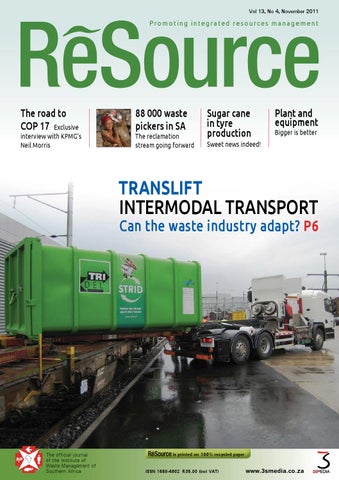
TRANSLIFT INTERMODAL TRANSPORT
Can the waste industry adapt? P6
The official journal of the Institute of Waste Management of Southern Africa
is printed on 100% recycled paper ISSN 1680-4902 R35.00 (incl VAT)
www.3smedia.co.za
contents
www.3smedia.co.za ISSN 1680-4902, Volume 13, Number4, November 2011
The RéSource team stands firmly behind environmental preservation. As such, RéSource magazine is printed on 100% recycled paper and uses no dyes or varnishes. The magazine is saddlestitched to ensure that no glues are required in the binding process.
8
Cover story 6
Translift INTERMODAL TRANSPORT – can the waste industry adapt?
19 Solid waste
Air pollution / CDM
8 12
48
The future of waste pickers in SA Using shredded plastic bags for engineering applications
Recycling 19 22 24 27
The SAPRO Awards Consol’s ‘green’ plant in Nigel Nampak’s multi-million rand glass cullet National Recycling Day highlights
Landfill 28
Is there life beyond CDM?
Waste to energy 35 36
Eskom electricity price path not sustainable Sugar cane in tyre production
50 54
Q&A with KPMG’s Neil Morris on COP 17 Aurecon’s Green Star building Water and energy nexus
Wastewater management 56
Groundwater modelling: examples from Cape Town
Plant & equipment 61 62 63 65 67 68
Design, manufacture and repair specialists A 360 degree waste focus Radio network for Gautrain Road sweeper first of its kind The tyre shredding experts A well-rounded approach Environmental equipment for the professional
Medical waste
Regulars
39
3 5
Sharps containment system scoops Green Apple Environment Award
Hazardous waste 43
Packaging best practice
24
President’s comment Editor’s comment
41 RéSource November 2011 – 1
We are excited to introduce our
140
NEW wheelie bin litre
This product is in line with the waste minimization strategy, as KRXVHKROGV ZLOO JHQHUDWH OHVV ZDVWH WR ODQG ƬOO VLWHV DV D GLUHFW result of recycling initiatives. 587 mm
Ǟ eas
y to
Ǟ Ʈ
482 mm
hand
le
H[L
EOH
t
n a t s
1009 mm
i
Ǟ
s re
Ǟ re
200 mm
le
liab Ǟ made from HDPE Ǟ suitable for selective collection Mpact Plastic Containers Neil Hare Road, Atlantis, South Africa 9 Piet Pretorius Street, Brits, South Africa PO Box 1551, Dassenberg, 7350 Tel: +27 (0) 21 573 9400/ 0861 672 444 Email: salesforce@mpcsa.co.za www.mpcsa.co.za
President's comment
How time flies when you're busy!
I
t is amazing how time flies when you are busy. It feels like only yesterday when we had WasteCon here in Kempton Park and it was actually a year ago! In this November edition, I wish to take the opportunity to wish all our members a successful conclusion to the year and a safe and happy festive period. In the previous edition in August, I reported back on the developments within the Health Care Waste Forum (HCWF) and the unsuccessful attempt at electing a committee to run forum. In view of this, the IWMSA Council have decided that, for the foreseeable future, the HCWF will be run and administered by head office with members of Council engaging with government in health care waste issues. We are currently engaging with government departments and are happy to report that the Department of Environment Affairs (DEA) have indicated that they are keen to arrange the 2012 Waste Management Officer’s Khoro (for municipalities) in Buffalo City, together with the IWMSA’s WasteCon 2012. This is indeed exciting news for the IWMSA as it means that municipal delegates can attend WasteCon immediately after the Khoro. The planning for WasteCon 2012 is therefore well underway and the first announcement will have been released by the time you read this. We have sent out proposed changes to the Constitution to all our voting members with a view to updating the constitution. I encourage all our members to review
these carefully and make sure that you vote for the amendments so that we can ensure that our Constitution remains relevant to the changing times. Any further proposals or suggestions from our members are also welcome. Please direct these to Gail Smit at head office. A number of our members, both individual and organisational, recently approached the IWMSA to report that a major metro municipality was in the process of considering an unsolicited bid for the takeover of their waste management services by an international company. The members’ concern was that these services could be provided by local South African companies and that a proper procurement process in terms of national legislation and National Treasury rules was not being followed. The IWMSA therefore, on behalf of our members, lodged an objection to this process with the relevant municipality. We await, with interest, the outcome of this process. On another note, and by the time you have read this comment, I will have been to Sardinia and attended the 13th International Waste Management and Landfill Symposium. This symposium has evolved over a number of years where the symposium focused mainly on landfill issues, alternative technologies, the waste management hierarchy and energy from waste. I will provide a report back on the Sardinia Symposium in the next edition of ReSource.
Stan Jewaskiewitz President IWMSA
Ciao until then!
Patron members of the IWMSA
RéSource November 2011 – 3
Editor's comment Publisher: Elizabeth Shorten Editor: Candice Landie Tel: +27 (0)11 233 2600, candice@3smedia.co.za Creative executive head: Frédérick Danton Chief sub-editor: Cindy Maulgue Sub-editor: Danielle Hugo Production manager: Antois-Leigh Botma Financial manager: Andrew Lobban Marketing: Martin Hiller Subscriptions sales: Nomsa Masina Administrator: Tonya Hebenton Distribution coordinator: Asha Pursotham Printers: United Litho Johannesburg Tel: +27 (0)11 402 0571 Advertising sales: Christine Pretorius Tel: +27 (0)11 465 8255 christine.pretorius@lantic.net
Publisher: MEDIA No.4, 5th Avenue Rivonia, 2191 PO Box 92026, Norwood 2117 Tel: +27 (0)11 233 2600 Share Call: 086 003 3300 Fax: +27 (0)11 234 7274/5 www.3smedia.co.za Annual subscription: R195.00 (incl VAT) South Africa cindy@3smedia.co.za ISSN 1680-4902 The Institute of Waste Management of Southern Africa Tel: +27 (0)11 675 3462 E-mail: iwmsa@telkomsa.net
All material herein RéSource is copyrightprotected and may not be reproduced either in whole or in part without the prior written permission of the publisher. The views and opinions expressed in the magazine do not necessarily reflect those of the publisher or editor, but those of the author or other contributors under whose name contributions may appear, unless a contributor expresses a viewpoint or opinion in his or her capacity as an elected office bearer of a company, group or association. © Copyright 2011. All rights reserved.
ReSource is endorsed by:
SUSTAINABILITY
what’s in a word?
I
t’s official – this is the last edition of RéSource for 2011! And what an exciting year it’s been in the waste industry with the New Waste Act rearing its head just about everywhere – and we suddenly have local government riding the recycling gravy train in an effort to create employment for the informal waste pickers sector. Isn’t this what the private sector has been screaming for years now?! I suppose, regardless of when government decided to sit up and take notice, the good news is that they have and I personally am looking forward to more separation at source initiatives, as well as stricter penalties for those who don’t comply and continue to fill landfill sites with useful, reusable garbage. On the subject of separation at source, the IWMSA hosted a workshop on the future of waste pickers in South Africa, which saw the likes of Simon Mbata of the SA Waste Pickers Association, Leon Grobbelaar of Interwaste, Frans Dekker of Tshwane Municipality and Dr Suzan Oelofse of the CSIR voice their opinion. And, although this topic presented its fair share of pros and cons, the overall message was clear: waste pickers do not belong on landfill sites and the rule of separation at source, from a household level, needs to be enforced. RéSource chatted even further to these workshop participants and readers can find the full story in this issue. With the build up to COP 17 in Durban (December 2011), global warming and climate change have also become the topics of discussion. ion. But, as mainstream media is renowned for sensationalnsationalism, related stories es have largely focused onn the failure of Durban to pull off such a massive ve event. Luckily, RéSourcee has a more sensible editor, moi, and I thought it more appropriate to focus on the serious issues
at hand – the impact of government’s carbon policy on the local economy, the private sector’s role in reducing national carbon emissions and the financial and market mechanisms that can be applied to COP 17. So, don’t miss the Q & A session (inside) with Neil Morris, director of Climate Change and Sustainability Services KPMG, on the subjects of COP 17 and the impact of climate change for South Africa. With regard to sustainability, the trend locally seems to be shifting towards green buildings. Aurecon – the consulting engineers who were instrumental in Nedbank’s Phase II green building in Sandton – have just launched their impressive GreenStar SA rated building in Lynnwood, Pretoria. Featuring innovations such as reduced electricity and water consumption, the harvesting of rainwater and indoor environment quality control, the building encompasses all the elements of sustainability in the workplace. And from green buildings to green factories – Consol’s latest flint glass factory, which the company dubs “a sustainable investment in the future”, is currently under construction in Nigel. Recycling remains a key internal focus in order to minimise Consol’s demand for raw materials andoptimise energy efficiency. The new plant will accept as much recycled glass as it can, which will be used in the production of new glass. Accordingly, the Nigel factory includes a basic cullet processing facility to recycle all waste produced at the site. This edition of RéSource also features snaps from National Recycling Day on Nat 16 and 17 September so, if you were inv involved, be sure to look for your ph photo at the back of the magazine. magazi And, with that, I wish all our And loyal readers, advertisers lo and clients a safe festive season. Enjoy the welldeserved break – I know I will! Candice Landie, editor
RéSource November 2011 – 5
Cover story
TRANSLIFT
The road transport industry in South Africa has been forewarned about the need to reduce the number of heavy vehicles on our roads but...
...can the waste industry adapt to
the growing need for intermodal J
eremy Cronin, deputy minister of transport, Abrie De Swart of IMPERIAL Logistics, and Dr Jan Havenga, head of the Supply Chain Management School at the University of Stellenbosch, among others, delivered presentations on the topic of reducing heavy vehicles on South Africa’s roads at the Transport Forum’s monthly special interest group session in Paarl on 1 September. The large group of attendees from all over the country was an indication of the interest in this topic. The message was clear, the statistics and facts supported it and Transnet has moved forward already by having launched the
first phase (RFI) of a tender process to investigate the options and technologies available for a solution to transfer containers from road to rail and vice versa.
The ACT System The Advanced Container Transport System (ACTS) is another resident concept to be found in the Translift BV stable. Introduced in 1984, it was designed specifically for road/rail interfacing and is now widely used in Europe as well as in parts of the UK, Israel and USA – providing a seamless transfer solution between road and rail for the transportation of bulk containers over long distances. The system basically consists of three elements: • ACTS turntables fitted on suitable flatbed rail wagons • ACTS slide-on frames fitted to existing or new containers • road transport vehicles fitted with Translift ‘chain-lift’ equipment. Together these form the ACT System.
ACTS slide-on frame (fitted to existing or new containers)
6 – RéSource November 2011
Cover story
Any type of container (open, closed or tank) can be transferred horizontally from rail to road or vice versa in less than 60 seconds. Once on the road vehicle, these containers can be transported to their final destinations where they can be stored on the ground or tipped, as required. The need for cranes and rubber wheel trailers to handle and store containers is eliminated. One
ABOVE ACTS turntables on a flatbed rail wagon OPPOSITE PAGE Translift ‘chain-lift’ equipment fitted to a road transporter
waste remain a challenge and the need to containerise waste will probably increase. But are transfer stations the correct way to go? Once again, nobody wants them in their back yards, simply because they attract more traffic, they smell bad, they pollute the area, etc. And they require permitting, which in itself is a long and difficult process. Compaction and re-compaction is expensive. An ideal alternative would be to compact waste once only – during the collection phase – into containers that could then be transported directly to their end destination, meaning no smelly operator/driver does all of the above without having to get out of transfer stations and no expensive re-compaction of waste. the vehicle. The Translift waste collection and transport system was designed to do exactly this. The containers with compacted waste Transfer stations can be transferred very easily to long-haul road vehicles or to rail In the waste industry, the compaction of waste into containers is wagons, while the collection vehicles stay in their collection areas nothing new. We are all aware of the not in my back yard (NIMBY) doing the work they were built for. era that led to more distant disposal facilities and longer transThe aforementioned ACT System makes the transfer of waste port distances, which in turn gave rise to waste transfer stations containers to rail a very simple operation – and a trusted one. The system has “The simplicity, speed and robustness of the system been successfully used for the long-haul are almost unbelievable!” Comment from a South African railage of waste in Europe for decades. Rail is an ideal mode of transportaclient who recently visited an ACTS facility in Europe to view tion, which reduces road congestion the system in action and carbon emissions. With the writing on the wall for long-haul road transport, intermodal transport in South Africa seems to be entering a growth where waste is offloaded and re-compacted into containers for phase. ACTS offers an ideal and very competitive solution for this, the long haul to these facilities. and for challenges within the waste industry. In the meantime, waste to energy is fast becoming a reality, with one option being to incinerate waste to create electricity. Contact Les Penny on t +27(0)12 460 1973 and/or lesp@groupcom.co.za Whether landfilled or incinerated, the transport distances for
transport?
RéSource offers advertisers an ideal platform to ensure maximum exposure of their brand. Companies are afforded the opportunity of publishing a cover story and a cover picture to promote their products and services to an appropriate audience. Please call Christine Pretorius on +27 (0)11 465 6273 to secure your booking. The article does not represent the views of the Institute of Waste Management of Southern Africa, or those of the publisher.
RéSource November 2011 – 7
Solid waste
A SERVICE DELIVERY ISSUE
The future of waste pickers in SA Even the South African Waste Pickers Association believes that waste pickers do not belong on landfill sites, but with no formal regulations in place to prevent otherwise, what will the answer be moving forward?
W
aste pickers, as they have been dubbed, are individuals who make an independent living reclaiming recyclable waste from the waste stream, predominantly from landfill sites, and selling it on to recycling companies. An estimated 88 000 South Africans currently earn a living in this way. Waste picking offers individuals a means to make a living regardless of their age, level of education or skills set. A basic understanding of what is recyclable is required, but this is gained through working experience. Waste pickers may be perceived by the uninformed as poor, dirty, uneducated and dangerous
reas
Illegal dumping of waste in open areas
8 – RéSource November 2011
individuals, but they are hardworking, fiercely independent, self-motivated people who bring with them a wealth of knowledge about the waste management stream and recyclable products. It is imperative that they be considered and included in future waste management plans and it is encouraging that the waste management industry seems to be doing this. According to Dr Suzan Oelofse, principal researcher: Pollution and Waste at the CSIR, the reason that waste pickers are found on landfill sites is clear. She says that a huge amount of recyclables and reusable waste enters the waste stream
owing to South Africa’s current waste disposal strategies. This waste is valuable and if reclaimed can earn collectors up to R120 per day. In some cases, waste pickers have evolved into entrepreneurs by finding creative ways of reusing waste. “Even though I acknowledge the important role that waste pickers play in waste management in the country, landfills are not the place for anyone to sort waste,” continues Dr Oelofse. “Waste separation at source will reduce the amount of recyclables going to landfill and therefore the income potential of pickers at the landfill. One unintended consequence of waste separation at source is that the pickers
Solid waste
will go to where the recyclables are; they will migrate into the residential areas. It is therefore important that waste pickers are incorporated into the formal recycling system so as not to affect their livelihood. I have also seen literature reports that pickers working in residential areas typically collect less waste on a single day as they have to walk from bin to bin, whereas at the landfill the waste is delivered to them.”
(PACSA). Marthinusen accompanied Mbata on the recent fact-finding trip to Brazil. But waste pickers continue to plague landfill sites in an attempt to make a daily living. Frans Dekker, functional head of Landfill Management Operations for the City of Tshwane, says that although having waste pickers on a landfill site has its cons, it also has its pros for the site operator. “Waste pickers contribute
Pros and cons
Separation of waste at source (household level) is the way forward for the waste industry
“Waste pickers are not fighting for the right to be on landfill sites; they are fighting to be part of the waste management system,” said Simon Mbata, representative of the South African Waste Pickers Association (SAWPA) at a workshop debate hosted by the Institute of Waste Management of Southern Africa (IWMSA). Having seen first-hand how effectively waste is being managed by informal waste pickers in Brazil recently, Mbata strongly believes that separation of waste at source (household level) is the way forward for the waste industry. “This too is the solution being advocated in the recycling industry’s Waste Management Plan that is currently being developed,” reiterates Andrew Marthinusen of the Packaging Council of South Africa
towards waste reduction on the site and can be extra eyes, if trained, to look out for illegal dumping activities and criminal behaviour,” he adds.“They assist the public with offloading waste and can help out during strikes, as they did recently. However, having waste pickers on a landfill site means more people for the site operator to manage and slower turnaround time on waste processing. The personal safety of the waste pickers themselves is also an ongoing risk. Many sites feel that their public image may be tarnished by the presence of waste
pickers.” He goes on to add that despite the health and safety risks, waste pickers are always going to be on landfills and it is important for landfill sites to cooperate as far as possible. Waste pickers also need to be encouraged to manage themselves via a representative committee, a process that started in the City of Tshwane during 2002.
Reported safety incidents However, the existence of these waste pickers and their prevalence on landfill sites has become an increasing concern for site operators as landfill sites are a dangerous environment and accidents arising on the sites can become the responsibility of the site operators. This is highlighted by Leon Grobbelaar of Interwaste, who says that a site could face serious consequences if something goes wrong. Enviro-Fill, an Interwaste subsidiary, was sued for R5 million by an informal waste picker who was accidentally injured while collecting waste informally on an EnviroFill-operated landfill site. The legal action was instituted in spite of measures being put in place by Enviro-Fill to reduce the risks to the health and safety of the waste pickers. “Recycling should be done before waste reaches the landfill site,” says Grobbelaar. “I don’t believe that a landfill
RéSource November 2011 – 9
Solid waste
site is the right place for the waste pickers to operate.” To reduce future risks, signs of illegal trespassing, as well as daily and weekly meetings with waste pickers, have been implemented at Interwaste, making
There is room for improvement in the working conditions of waste pickers reclaimers aware of the dangers present on a landfill site. “I have personally witnessed a waste reclaimer being covered in waste without the landfill compactor operator being aware of it,” notes Grobbelaar. “He would have killed her by compacting her in among the waste. I know of reclaimers being killed by refuse compactor trucks reversing over them – running them over at the working phase.” It is clear that there is room for improvement in the working conditions of waste pickers and in the way waste is currently being managed, but it is also clear that
the waste management industry is actively tackling this challenge, and while there is still a lot of work to be done and discussions to be had, the outlook is predominately positive. The IWMSA has recognised that the forum for more discussions around these issues is necessary and as such will be planning more workshops in the near future.
“Reclaimers on landfill sites should not be allowed there but this is easier said than done. They add to operating costs, cause major nuisances to the environment by burning tyres for the steel, and from a health perspective, they are exposed to condemned foodstuffs, which is detrimental to their health,” Grobbelaar concludes. RéSource November 2011 – 11
Specialist Waste Management Consultants Sustainable and appropriate engineering solutions with integrity and professionalism. Stanford Drop-off
Hermanus Materials Recovery Facility
Kupferberg Landfill ? Integrated Waste Management Plans ? Waste Disposal Strategies ? Identification and permitting of landfill sites ? Design of General and Hazardous Waste sites ? Design of Solid Waste Transfer Stations ? Design of Material Recovery Facilities ? Optimisation of Waste Collection Systems ? Auditing of Waste Management Facilities ? Development of Operational Plans ? Closure and Rehabilitation of Landfills ? Quality Assurance on Synthetic Liners ? Waste Recycling Plans
Velddrif Transfer Station
Botrivier Drop-off
Gansbaai Recycling Centre
Tel +27 21 982 6570
Jan Palm Consulting Engineers
/ Fax +27 21 981 0868 / E-mail info@jpce.co.za / www.jpce.co.za RéSource November 2011 – 11
Solid waste
SHREDDED PLASTIC SHOPPING BAGS
Use in civil engineering projects By D Kalumba* and MA Petersen**
Millions of tonnes of waste are generated in South Africa. A considerable amount of this is in the form of plastic (polyethylene) shopping bags, most of which are destined for landfill. Can this modern waste and environmental hazard find a new application in civil engineering projects?
F
or over half a century, the world has become increasingly dependent on the use of plastic bags as a packaging material for nearly every product bought. Highly convenient, strong and inexpensive, plastic bags are appealing to both customers and businesses as a reliable way to deliver goods from the store to the home or office. Unfortunately, as plastic bags were first introduced in the 1950s, they have become a global scourge, littering roadsides, clogging sewers and filling landfills. The durability of these bags is one of the best advantages of their design for humans, but is also its greatest weakness as they severely pollute the
12 – RÊSource November 2011
environment. Although these types of bags have long-design lives, they are normally used once before consumers dump them in the bin. In recent years, there has been much effort put into identifying inexpensive and easily accessible reinforcement materials in the geotechnical field (Floss, 1985; Mandal, 1987; Sarsby, 2007). Waste materials are currently being recognised as a potential source of soil reinforcement. For instance, the use of old tyres to increase the bearing capacity and shearing strength of soil has been studied (Hataf and Rahimi, 2006). However, despite the large quantity of plastic bags produced,
there is hardly any reported work on turning polyethylene bags into a civil engineering resource.This project was, therefore, undertaken to investigate whether such plastic bags were capable of increasing soil strength and could consequently be incorporated into projects such as those requiring strengthening of foundations and embankments. The study was not intended to prove this type of reinforcement to be better than established methods like geosynthetic reinforcement. Those conventional methods, however, are expensive and inaccessible to the majority of developing countries. Plastic bags, in contrast, are
Solid waste
cheap and abundant as a waste material. Finding a new application for them in the civil engineering works could cut down the waste that goes into landfill sites.
Research materials and methods Plastic bag material The plastic materials used in the study were grocery shopping bags sourced from the local supermarket. The bags were medium-sized and manufactured from high-density polyethylene by a South African company based in Johannesburg. The bags were light green in colour, with black print on either side, as displayed in figure 1. The material density was measured to average 798 kg/m3, while the tensile strength, determined by using a computer controlled Zwickuniversal material testing machine, ranged between 14 and 20 MPa. The thickness of the bags was 20 μm. Selected soil material Cape Flats sand and Klipheuwel sand were specifically selected because of their availability locally. Additionally, these two sand types are clean, consistent and easily controllable, i.e. identical samples could be reproduced if prepared the same way, thereby enhancing repeatability of results. Cape Flats sand is a medium-density, light grey and clean quartz sand. Klipheuwel sand is a uniformly-graded, mediumdensity reddish brown sand. Table 1 summarises the mechanical properties of the two soils, determined according to BS 1377: 1990.
five distinct rectangular dimensions using a guillotine (figure 2). This allowed for the investigation of the optimum length, width and concentration of the plastic reinforcements required to obtain the maximum soil strength characteristics of the composite material. The five reinforcement strips dimensions used were 6 x 15 mm, 6 x 30 mm, 6 x 45 mm, 12 x 15 mm and 18 x 15 mm. The elements dimensions chosen were in the range of 0.06 – 0.45 of the shear box dimensions so as to control entanglement between the reinforcing strips. Strips entanglement would limit soil particles forming surface attachments with the reinforcement, resulting in lower shearing strengths of the composite material. For any given test, a batch of plastic strips of known dimensions and weight was added to a predetermined dry soil weight and then thoroughly and randomly
FIGURE 1 Plastic shopping bag specimen with both sides displayed mixed in a plastic bowl using a spatula to form a composite material with the required reinforcement content (figure 3). The three reinforcement concentrations used were: 0.1, 0.2 and 0.3% by mass. These relatively low concentrations were chosen because, although the strips are light in weight, they occupy large volumes. Additionally, at the selected concentrations, it was easier to ensure consistency and even distribution of reinforcing elements within the soil sample without entanglement between strips. Once each specimen had been thoroughly mixed, it was poured into the
FIGURE 3 Random mixture of plastic elements in soil for different reinforcement concentration
Methodology All tests were conducted with dry soil in order to eliminate any effect of water during investigation. In each experiment, the soil specimen was first spread out over a pan and oven dried at 1050C for 24 hours. The grocery bags were cut into strips of
FIGURE 2 Guillotine used for the slicing of plastics into strips
RéSource November 2011 – 13