The official journal of the Institute of Waste Management of Southern Africa
Promoting integrated resources management
Solid Waste
Landfills
ISSN ISSN SSN 1 1680-4902 680 80-4 0-4 R40.00 (incl VAT) • Vol 15, No 2, May 2013
eThekwini: modernised & mechanised
Swaziland’s solid waste management facelift
Cape Town
Recycling
Considering urban home composting
Beverage bottle recycling grows 18%
Adaptable reliability Expert Opinion E “Our role is to prove that technologies can be rolled out and commercialised using the intellectual capacity within the university.” Mansoor Mollagee, Director of the Process Energy and Environmental Technology Station (PEETS), University of Johannesburg
is printed on 100% recycled paper
Institute of Waste Management of Southern Africa
Reduce your CO² footprint. Through our experience and knowledge we can help your company reduce the CO² impact on the environment and be in compliance with Environmental Act of 2012. Through our 18 years of experience, we have developed strategic partnerships revolving around corporate social investment in environmental sustainability. For more information on purchasing and installing bins, contact us on ( 011) 466 2939 or visit www.collectacan.co.za. Recycle cans today. Sustain tomorrow.
contents
10
Waste management
www.3smedia.co.za ISSN 1680-4902, Volume 15, Number 2, May 2013
The RéSource team stands firmly behind environmental preservation. As such, RéSource magazine is printed on 100% recycled paper and uses no dyes or varnishes. The magazine is saddlestitched to ensure that no glues are required in the binding process.
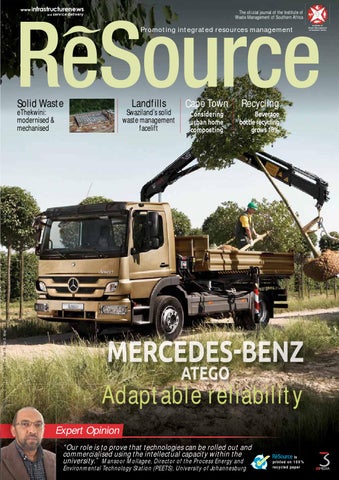
Cover Story Mercedes-Benz Atego Adaptable reliability
6
RéSource offers advertisers an ideal platform to ensure maximum exposure of their brand. Companies are afforded the opportunity of publishing a cover story and a cover picture to promote their products and services to an appropriate audience. Please call Christine Pretorius on +27 (0)11 465 6273 to secure your booking. The article does not represent the views of the Institute of Waste Management of Southern Africa, or those of the publisher.
Recycling
Regulars President’s comment
3
Editor’s comment
5
Panel discussion: reviewing recycling • Mpact • Pikitup
25
Plastics industry has its say
32
Beverage bottling recycling grows 18%
34
56
IWMSA News
Hot seat PEETS, University of Johannesburg
8
34 41
Recycling
Medical waste
Landfills
Solid waste
Introducing Knot’s Dump
Solid waste management practices in Western Africa
10
Cape Town: Considering composting
14
Ekurhuleni moves towards strategic waste management
16
eThekweni: Modern and mechanised waste transfer station 18
Waste to energy Incineration: a changing landscape
22
36
Air Pollution/CDM Carbon tax from 2015
39
Medical waste A challenging context
41
Hazardous waste Keeping ahead of SA’s wave of hazardous waste
46
Wastewater
44
Wastewater A realistic perspective of energy optimisation considerations: Part II
in association with infrastructure news
infrastructure4
}
www.infrastructurene.ws
46
RéSource May 2013 – 1
strap President'sCover comment
Looking ahead by Deidré Nxumalo-Freeman, president, IWMSA
Thank you to all our members for participating in the recent referendum pertaining to the Quality Assurance scheme; your input is greatly appreciated. Feedback will be provided to you in due course with regards to the direction that IWMSA will pursue. We are engaging with additional stakeholders, including government authorities, to establish a clear way forward.
A
fter much deliberation, we have decided to postpone our Health Care Waste Forum Summit this year and integrate health-care risk waste management (HCRW) into our WasteCon 2014 programme, which will be taking place in Cape Town. The decision was not an easy one, but we believe that this alignment will yield far greater benefits and exposure to all stakeholders involved in this very important sector. If you have any queries in this regard, please do not hesitate to contact our head office. In the last issue of RéSource, I provided you with an over view of the various por tfolios and the responsible council members for these por tfolios. Your National Council is ver y busy ensuring that these por tfolios add value to you our IWMSA members. We are making great strides in the training programmes that are being offered by the IWMSA and are receiving training requests from across the countr y. Our accredited training programmes are sought after by municipalities and are an impor tant par t of our capacity building programme. We are rolling out these accredited training programmes to all our branches; you are now also able to register online for
these courses from our IWMSA website. These training courses are facilitated by members of the IWMSA. We are constantly needing trained facilitators, assessors and moderators who have the requisite waste management experience to aide us in facilitating these programmes nationally. If you have not already registered as a facilitator, assessor or moderator on our database, I would urge you to do so as your input into the training programme would be highly valued. You may contact our head office to register on the database. The Landfill Interest Group is hard at work planning a very insightful Landfill 2013 at Misty Hills, Muldersdrift, Gauteng. Similarly, the Eastern Cape branch is in the throes of preparation for its biennial Eastern Cape conference themed ’The Eastern Cape Green Revolution’, to be held in Port Elizabeth. Your involvement in both these conferences by way of paper submissions and/or conference attendance is requested. We are also pleased to advise our members that within the past quarter we have had formal engagements with the Department of Environmental Affairs (DEA)
to discuss various waste-related matters that impact them. It was a very fruitful meeting and we are hoping to structure these quar terly meetings with the department, going forward. The discussions helped us gain insight into the stances adopted by DEA on the various agenda items discussed and will definitely add value in our day-to-day IWMSA business. We would like to hear from you our members on what issues you would like us to table in our forthcoming meetings with the DEA – as always your inputs are highly valued. Keep well and WASTE not the wonder ful RESOURCES we have at our DISPOSAL. Yours in waste management, Deidré Nxumalo-Freeman IWMSA president
Patron members of the IWMSA
RéSource May 2013 – 3
Editor’s comment Publisher: Elizabeth Shorten Editor: Chantelle van Schalkwyk Tel: +27 (0)11 233 2600 Head of design: Frédérick Danton Senior designer: Hayley Mendelow Designer: Kirsty Galloway Chief sub-editor: Claire Nozaïc Sub-editor: Patience Gumbo Production manager: Antois-Leigh Botma Production coordinator: Jacqueline Modise Financial manager: Andrew Lobban Marketing & online manager: Martin Hiller Distribution manager: Nomsa Masina Distribution coordinator: Asha Pursotham Administrator: Tonya Hebenton Printers: United Litho Johannesburg Tel: +27 (0)11 402 0571 Advertising sales: Christine Pretorius Tel: +27 (0)11 465 8255 christine.pretorius@lantic.net
Publisher: MEDIA No.4, 5th Avenue Rivonia, 2191 PO Box 92026, Norwood 2117 Tel: +27 (0)11 233 2600 Share Call: 086 003 3300 Fax: +27 (0)11 234 7274/5 www.3smedia.co.za Annual subscription: subs@3smedia.co.za R195.00 (incl VAT) South Africa ISSN 1680-4902 The Institute of Waste Management of Southern Africa Tel: +27 (0)11 675 3462 E-mail: iwmsa@telkomsa.net
All material herein RéSource is copyright-protected and may not be reproduced either in whole or in part without the prior written permission of the publisher. The views and opinions expressed in the magazine do not necessarily reflect those of the publisher or editor, but those of the author or other contributors under whose name contributions may appear, unless a contributor expresses a viewpoint or opinion in his or her capacity as an elected office bearer of a company, group or association. © Copyright 2013. All rights reserved.
RéSource is endorsed by:
A fresh resource A
new beginning is always daunting – even more so when it is as the new editor of an already established title like RéSource. However, with the support of the Institute of Waste Management of Southern Africa (IWMSA), through some intensive days of training over February this year as an attendee of the Waste Management Training Programme, I think I am finally coming to grips with an industry that is both all-encompassing and has the power to affect almost every aspect of one’s life. The training covered a number of interesting topics and challenges that are also – believe it or not – reflected in the pages of this edition of the magazine. These include the challenging context relating to compliance and enforcement with regards to medical waste, as highlighted in an interview with IWMSA past president Stan Jewaskiewitz on page 41; the significant investment in training and capacity building required to keep ahead of South Africa’s “wave of hazardous waste” as discussed by SRK Consulting’s Phillipa Emanuel on page 44; and the current waste management context in the municipal sphere, specifically through highlighting three key projects in three of the country’s metros – Cape Town on page 14, Ekurhuleni page 16 and eThekwini on page 18. In addition, the panel discussion deals with a highly topical subject at the moment that is garnering a lot of attention both in the public and private spheres – recycling. The idea of a panel discussion is also relatively new in the RéSource portfolio and, as such, the support of the panel discussion collaborators – Mpact and Pikitup – is much appreciated. We look forward to this feature continuing to grow in the magazine in coming editions. In an interview with Golder Associate’s Natalie Kohler on page 22, I also highlight that change is not only happening at the 3S Media offices as I take over as
editor of RéSource, but also in the industry at large as the focus is increasingly moving from merely discussing incineration to considering waste-to-energy as a more appropriate focus, partly because of the negative connotations associated with the word incineration and par tly because waste-to-energy is more progressive and in line with where, according to Kohler, industry is heading. It is industry opinion leaders such as these that I believe should be reflected in the pages of the magazine, along with the latest innovations, intellectual findings and technologies that have the capacity to add economic and environmental value to the current South African waste landscape, both further adding to the larger discussion on the topics and offering sustainable alternatives to current contexts. As such, collaborations and contributions are always welcome. Any suggestions, submissions or enquiries can be directed to me at chantelle@3smedia.co.za. As a newcomer to the industr y, I look forward to your valued input over the coming editions.
The focus is increasingly moving from merely discussing incineration to considering wasteto-energy as a more appropriate focus
Chantelle van Schalkwyk
RéSource May 2013 – 5
Cover story
MERCEDES-BENZ ATEGO
Adaptable reliability Reliability, safety and environmental awareness, with excellent driving comfort, are but a few of the qualities that set the Mercedes-Benz Atego apart.
T
he fuel-efficient and reliable Euro 3 compliant engines in the Atego range are particularly designed for economical operation. Whatever is to be transported, each detail of the Atego is designed to cope with the demands of light-duty short-radius distribution. The Mercedes-Benz Atego is also finding huge favour in niche conversions like fire engine and emergency support, as well
as specialised equipment vehicles such as the waste collection vehicles favoured in most waste management applications. As the Atego frame was specially designed with the demands of short-radius operation ABOVE AND BELOW The Atego is designed to cope with the demands of light-duty short-radius distribution, while ensuring driver comfort
in mind, a special feature insuring this is its two-piece design. The front section comprises two downward-sloping longitudinal members with Z-profile, which enables the front part to be lowered, resulting in a lower entry level for driver and passenger convenience. The vehicle offers two cabs for a wide range of applications. The short cab is ideal for short-radius operations and the long cab with crew seat/bunk combination is best for short- to medium-radius operation.
The low-noise, lowmaintenance drive axles have a positive effect on fuel consumption Christo Kleynhans, Mercedes-Benz Trucks product manager, says: “Featuring reliable, high-torque 4- and 6-cylinder engines as well as gearshift systems, transmissions and axles aligned with each application, the Mercedes-Benz Atego delivers supreme performance. Three high-per formance, weight-optimised and perfectly configured 6-speed
6 – RÊSource May 2013
Cover story
The biggest tyre grab crane in SA Mercedes-Benz South Africa (MBSA) has handed over a fleet of three MercedesBenz Actros 4144K/51 trucks with a unique heavy-duty tyre crane to Beltread Tyres. Mounted on the Actros, it is the largest and most sophisticated tyre handler currently in operation in the countr y. The iconic tyre grab was achieved by adapting the Stellar TM16160 Tyre Manipulator to suit the HMF 6020-K1-RC truck-mounted crane. The tyre handler was designed to fit onto a Mercedes-Benz Actros 4144 (8x4) with custom wheelbase and body crafted to the last centimetre to meet the spec from Beltread Tyres. Peter Toweel, managing member of the company, says: “The Mercedes-Benz Actros 4144 is a comprehensible choice for our requirements because it is power ful and reliable. The reliability of the Mercedes-Benz brand, as well as the support from the dealership and head office, is an added bonus to us.” Craig Rogers, sales manager of Crane & Forestr y Equipment, says: “Custom-built tyre handlers have to conform to local and international mining safety standards. In the end, we had a phenomenal vehicle and are proud to have been part of this journey.” The vehicle allows for faster earthmoving machiner y, such as those necessitated on landfill and waste management sites, than the conventional method, with unsurpassable safety standards. The Stellar TM16160 Tyre Manipulator is capable of handling up to 63 inches of the largest earthmoving tyre in Africa and has as safe working load of 7 500 kg. Mounted on the truck is an SHD245 American Eagle air compressor – an industrial four-cylinder, two-stage unit that is powered by a hydraulic motor that
puts out 110 cfm at 175 psi. The crane is equipped as standard with continuous rotation, while the Danfoss PVG32 highprecision proportional valve bank offers smooth, multifunction operation. A feature that increases operator safety and efficiency of the crane operation is a Scanreco radio remote control that offers live feedback on crane speed and load percentage. The crane is equipped with multiple safety features for the protection of the staff and fitters working in and around the machine. The vehicle is remote-controlled so that the operator can work at a safe distance, away from possible harm, such as that posed by unstable landfill sites.
transmission systems (optionally Freight Carrier available with the 918/42 Telligent auto1118/48 mated gearshift) 1318/48 enable engine 1323/48 power to be trans1518/54 ferred to the road 1523/54 with minimal loss 1528/54 due to friction, Tipper adds Kleynhans. 1518K/33 The low-noise, All wheel drive low-maintenance 1118AF/39 drive axles have a 1428AF/39 positive effect on fuel consumption. Boasting a large number of different ratios, they deliver optimum drive configurations to handle virtually all applications. The Atego chassis offers optimum protection against rust as a result of the cathodic dip priming. Due to the 50 mm hole pattern, no further drilling is necessary when mounting any attachments and other units, such as tanks, exhaust systems and batteries. Bodies can therefore be pre-assembled and mounted, efficiently reducing processing time at the bodybuilder. Kleynhans adds: “The Atego is arguably the benchmark in its market segment and offers unsurpassable performance, safety and uptime among other things. Total cost of ownership along with the support from Mercedes-Benz South Africa’s value chain offerings makes a strong business case for the Mercedes-Benz Atego.”
TABLE 1 What is the product range?
Shift in focus ABOVE AND BELOW (From right to left) Peter Toweel, Beltread managing member; Pieter Theron, regional sales manager (MBSA) and Dave Croxon, (sales executive Union Motors Lowveld)
“While we believe that there will be a shift in the mode of transport as government implements the aggressive and ambitious expansion of the rail network, we also believe that the demand for more integrated transport solutions will remain and increase,” concludes Kleynhans.
RéSource May 2013 – 7
Hot seat
PEETS, UNIVERSITY OF JOHANNESBURG
Resourceful innovation A newly created unit, within the broader University of Johannesburg context, is focusing on developing intellectual, technological and well-defined practical solutions for the multitude of energy and environmental challenges within the South African milieu, director of technology station Mansoor Mollagee tells Chantelle van Schalkwyk.
T
he core business of the Process, Energy and Environmental Technology Station (PEETS), according to Mollagee, is in the energy (focusing on renewables and energy efficiency) and environmental spheres (focusing on water, air and solid waste), with the emphasis on waste-to-energy. “Our role is to prove that technologies can be rolled out and commercialised using the intellec-
galvanise the role players towards a sustainable solution.”
Contextual analysis: 1. Air The focus in this context for the unit is on investigating emissions from industrial activity in the engineering and mining sectors, primarily. “There is appropriate legislation that was recently modified, e.g. the Air Quality
also lacking. “The main challenge therefore comes down to technical competence and the ability to implement lasting and sustainable solutions while bringing companies closer to compliance with the law.” On a project by project basis, the unit assesses a particular operation, specifically evaluating the extent to which the operation contributes towards harmful emissions and technological interventions to mitigate this. “In this arena, we work with all tiers of government, whether national, provincial or local, to make these interventions relevant and help realise already established targets.”
It is purely the idea of harnessing the human capital within a real time, real world context.” Mansoor Mollagee, Director of PEETS tual capacity within the university.” Essentially, says Mollagee, PEETS moves from the premise that the UJ's faculty of Engineering and the Built Environment has a 7 000-strong student base, a considerable postgraduate pipeline at master's and PhD level and approximately 200 academics at its disposal. These intellectual “resources” are in addition to the over 1 000 trainees eligible for internship in the technology and training programme that are “being churned out” every year across 10 to 12 different disciplines. “Harnessing human capacity in a contextual manner is really where a lot of the problem originates because there is traditionally a big chasm between universities and industry – and that is where we envision our role,” says Mollagee, adding that the issue is not skills but rather the relevance of those skills to the local markets and challenges. “It is purely the idea of harnessing the human capital within a real time, real world context and then focusing it on the problem at hand in order to
8 – RéSource May 2013
Act, so our idea is to iron out the kinks that prevent companies from complying with the law,” he states. Mollagee believes that the current “carrot and stick” approach is not necessarily always the most beneficial approach and is actually having a negative effect on the growth of SMMEs in the sector. In addition, the capacity to enforce this approach is
2. Water and wastewater The primary challenge in the context of drinking water is the optimal utilisation of the resource currently available to us as a country. “We are losing water at the rate of billions of litres per annum that are unaccounted for,” continues Mollagee. As such, the focus is on the capacity of the coalface of service delivery – municipal
Hot seat
PEETS: WHAT IS ON OFFER?
ABOVE PEETS exhibition stand at the Energy Indaba, Sandton Convention Centre which was held from 19 to 21 February. OPPOSITE Qedani Mahlangu Gauteng Department of Infrastructure Development at the exhibition opening
officials. “We are looking at interventions and specifically setting up facilities that can train municipal officials in the already prevalent and apparent challenges, like leakage detection, how to do a water audit and so forth,” explains Mollagee, adding that he believes it is pivotal that this problem be addressed on a micro pilot scale, municipality by municipality. The intervention will start in Limpopo and Gauteng jointly, before being rolled out on a larger scale. PEETS has, however, taken a different approach to addressing the challenges faced in the wastewater context. “We are sitting with more than 800 water treatment plants, of which at least 400 are operating at critical levels in the last Green Drop report. We require more than R500 billion to upgrade and maintain existing infrastructure and build new treatment plants because it has gone into a state of disrepair. But blame is not the issue – we as PEETS are interested in how we are going to solve the problem sustainably,” he says. Regionally, PEETS has started by focusing its proposed interventions on KwaZulu-Natal. “We are looking at creating strategic partnerships with international investors where they will come and build the plant at no cost to the municipality, recovering their cost per kilolitre through water purchase agreements with the municipalities, over sustained periods of time,” states Mollagee. Obviously, challenges arise around governance and municipal
finance management, but these can, to a large degree, be solved through establishing sound public-private partnerships (PPPs). “I think the solution lies in forming solid PPPs driven by technically competent entities, be it us or similar role players, so that the related politics is sidelined,” he continues. A further wastewater focus – and a major driver in the unit – is the waste-to-energy aspect. The unit is engaging Johannesburg Water on a project that assesses the use of the sewage’s low-grade methane emissions to generate electricity, wastewater treatment plant by wastewater treatment plant. “These interventions are about rolling out implementable, bankable, scalable pilot projects that feed into government’s drive for increasing human capacity development, technology transfer and job creation,” says Mollagee.
These interventions are about rolling out implementable, bankable, scalable pilot projects that feed into government’s drive for increasing human capacity development
3. Solid waste
According to Mollagee, the context locally with regards to solid waste and the related legislation is good; the ideal of a zero-waste-to-landfill is fully realisable. “It is possible to move to a zero waste–to-landfill reality not only on a policy level, but on a realised implementation level; however, the issue is cascading this idea and its related implications down to a micro-level within communities and municipalities.” The technology to make this a reality, however, is proven and readily available – as is the case specifically with waste to energy, which is where the unit is specifically focusing its efforts in this sphere. “The problem with waste to energy, particularly locally, is the cost of rolling out the technology. Our approach as PEETS is going to be very
THE PRIMARY MANDATE of PEETS is to foment technology transfer and human capacity development in the energy and environment realm for the socio-economic benefit of all South Africans. “We support youth who demonstrate innovation, government entities that need refinement of their systems to achieve greater capacity to deliver or private companies that need assistance in addressing their energy needs or environmental problems,” says Mollagee. The unit’s products and services include: • testing • analysis services • manufacturing/prototyping/ up-scaling • consultation/technology audit • product and process development • project-applied engineering, design and development • project research and development • technology demonstration • training and development.
different, looking at localising the technology so that it becomes affordable within the South African context.”
Proven processes PEETS, however, is not about merely providing intellectually driven solutions – it is more than willing to practise what it preaches. A good example of this is the implementation of the abovementioned technologies on the Doornfontein Campus in Johannesburg, where the unit is based. Part of the project includes a 1 MW (generation capacity) photovoltaic installation of a few thousand solar panels on all of the campus’s rooftops to mitigate the current consumption and move off-grid. “The idea is to reduce our dependence on the city power grid, and if this proves to be successful, it will be the largest mass-scale rooftop photovoltaic installation in the country,” continues Mollagee. Once the solar installation is complete, the unit will move on to processing all waste generated on-site and piloting waste-to-energy technologies, as well as assessing the efficacy of harvesting its own water and digesting the campus’ own sewage. “I think within three to five years we will have achieved all this and it will stand as proof that similar integrated energy pilots can be implemented on a micro-scale in South Africa and become a major contributor towards job creation,” concludes Mollagee.
RéSource May 2013 – 9
Solid waste
PART IV OF IV
Solid waste management practices in Western Africa In Western Africa, the rapid rate of uncontrolled and unplanned urbanisation coupled with a high density of urban settlement and changing consumption patterns, have accelerated the need for water supply, sanitation and waste management infrastructure – often resulting in no proper separation of the different health care waste as well.
T
his is the fourth and final instalment of a paper investigating waste management and its challenges in the west of the African continent and deals specifically with the handling of health-care waste in the region as well as the final conclusions.
Health-care waste Often, no proper separation of the different types of health-care waste takes place, resulting in it getting mixed with household waste. Very few institutions separate their waste – predominantly large hospitals in major cities. They separate sharp waste; infectious, but not sharp waste; and anatomical waste; sometimes using a colour code system. In the healthcare institutions, waste is most often not transported adequately (containers without wheels, etc). Infectious waste is sometimes treated with bleach, sterilised in autoclaves or incinerated. But most health-care facilities
10 – RéSource May 2013
do not have access to such treatment facilities and, if they exist, they are often dysfunctional (open-air incinerators) or out of operation. The most modern incinerators in Senegal are to be found in the principal hospital – the Dantec Hospital – and in the Pasteur Institute. Ash is put together with household waste and brought to the dumping sites. Anatomic waste such as placentas is often delivered to the belonging families for burial. Besides the few treatment options, most of the health-care waste transportation is subcontracted to the same companies that transport municipal solid waste (MSW). Consequently, it ends up at official or informal dumpsites together with the MSW without any prior treatment, except in Lagos where the waste is shredded and the original volume is reduced by 80%. The
shredded waste is heated at temperature of 135°C and 4 bar pressure. The final products are then disposed of with other general waste (LAWMA, 2008). Some structures, such as the University Hospital of Yopougon (Ivory Coast) have their own dumpsite for the reception of wastes of all types. A factory in Port Harcourt, River State (Nigeria), called BOSKEL Thermal Factory incinerates expired pharmaceutical products and antiretroviral drugs in a high temperature rotary kiln incineration (Iyortim et al., 2011).
Conclusions MSW is composed of recyclable materials such as organic matter, plastic, paper, cardboard, metal, glass and textiles, but also toxic materials such as car batteries, dry batteries from electronic devices, electronic components, pharmaceutical products and agrochemicals. In Ivory Coast, Ghana,
Solid waste
ABOVE Plastic waste sorting at dumpsite, Senegal Source: IAGU 2006
ABOVE RIGHT Plastic waste sorting, Ghana Source: www.trashybags.org 2012
RIGHT Infectious waste bin in a health-care facility in Lagos, Nigeria Source: Oketola et al., 2011
BOTTOM RIGHT A locally built incinerator at a healthcare facility, Ibadan, Nigeria Source: Oketola et al., 2011
Nigeria and Senegal, sorting at household level is conducted by informal waste buyers who collect valuable fractions directly from households, small businesses, etc. The rest is disposed of as mixed waste. The formal collection theoretically is well organised and includes both door-to-door collection and communal collection from central points. It is normally carried out by private waste service providers contracted by local authorities. In practice, however, the formal collection reveals some difficulties due to service providers that do not attend to their duties, inefficiency of operations, bad road and weather conditions, old vehicles, etc. Sorting and recycling of MSW fractions in significant quantities only exists in urban areas. Most of the sorting activities take place in the informal sector that is concentrated on the solid waste dumpsites or on specialised scrapyards. Formal recycling
comprises metal scrap recycling, plastic recycling, paper and cardboard recycling, as well as recycling of organic waste. The formal recyclers often receive their material from the informal sector. Although sorting and recycling activities are only driven by economic interests, they still contribute to generating secondar y resources and therefore conserve primary (natural) resources. However, not much attention is paid to negative environmental impacts during sorting and recycling processes, and information on recycling technologies, environmental impacts, etc., is rather scarce. MSW is finally disposed of mainly in official dumpsites, but also in irregular or illegal dumps. None of the RÊSource May 2013 – 11
Mills & Otten cc Johannesburg Tel: (011) 486 0062 Fax: (086) 554 6573 Contact: Charles Mills / Kirstin Otten
Environmental Consultants 1998/46338/23 info@millsandotten.co.za www.millsandotten.co.za
Cape Town Tel: (021) 671 7107 Fax: (021) 671 7107 Contact: Stephanie de Beer
Independent Environmental Consultants specialising in: Environmental Impact Assessments Environmental Management Systems Environmental Audits
Contaminated Land Assessment Environmental Management Plans Waste and Air Emission License Application
Solid waste
official dumpsites feature leakage water or gas control; leakage water often reaches the closest river or lake. In none of the target countries does a sanitary landfill exist where MSW could be disposed of appropriately, although in some countries such landfills are planned. Instead of dumping MSW, it is a very common practice for households to burn paper and plastic components of their waste. Also, at irregular and official dumpsites, waste is often burnt in order to reduce the volumes. Burning of waste, especially plastics, can lead to significant air pollution with dioxins and furans. Plastic waste, which accounts for around 15 to 20% of municipal waste in the four countries, is rarely sorted at source but disposed of together with the remaining waste fractions. Separate collection is carried out by informal collectors that sort, reuse and recycle plastics themselves or work together with a formal plastic recycler. Both formal and informal plastic recycling exists that include sorting, shredding, washing, drying and extruding in order to produce pellets or flakes. There is little documentation on recycling processes and its resulting environmental impacts. There are plans to intensify sorting and recycling of plastics in some cities. Waste electric and electronic equipment (WEEE) or e-waste originates mainly from households, corporate businesses, public institutions and repair businesses. There is no formal collection of e-waste, but due to its valuable content (iron, aluminum,
12 – RéSource May 2013
copper etc.), it is often bought or collected by informal e-waste collectors who go from door to door but also sift through waste bins, visit landfills and other waste dumping grounds to search for e-waste. The quantity of e-waste is difficult to determine due to different product scope of existing studies. Ghana and Nigeria, which have received large quantities of second-hand equipment in the past years, have showed a significantly higher e-waste generation than Ivory Coast and Senegal. Obsolete electric and electronic equipment is often refurbished or repaired before it is disposed of. These activities in general do not lead to negative environmental impacts but contribute to the extension of the lifetime of equipment and therefore a reduction of WEEE generated. Recycling of e-waste mainly takes place at informal scrapyards where devices are manually dismantled and valuable substances are extracted, sorted and then sold to local smelters or exporters. Copper cables are often burnt to remove the plastic casings. ‘Non profitable’ fractions such as plastic casings are not recovered
ABOVE In Senegal, the average waste generation for municipal waste is 0.60 kg/day per inhabitant for cities with more than 100 000 inhabitants BELOW The public administration and the private sector are challenged in developing adequate waste management policies
and usually dumped and eventually burnt in order to reduce the volumes of the dumpsites. Besides valuable substances, e-waste also contains many toxic substances (lead, cadmium, mercury, plastics with brominated flame retardants) that are released during the dismantling and burning process and lead to serious environmental impacts. Final disposal of e-waste fractions often takes place on irregular or illegal dumpsites next to the scrapyards. There are no
Solid waste
appropriate disposal options for hazardous substances resulting from e-waste recycling in the target countries. Health care waste constitutes a problem in all four target countries. Most often, no proper segregation of health-care waste takes place and it is often mixed with household waste. Very few facilities segregate their waste, mostly large hospitals in major cities. But most health-care facilities do not have access to treatment facilities and, if they exist, they are often dysfunctional or out of operation. Besides the few treatment
Source: Green Advocacy Ghana 2010
bodies to these actors), but also by persistent inappropriate practices such as open-air dumping and burning of all types of waste including hazardous waste. A sustainable solution to these challenges could consist in measures for the social and economic inclusion of the informal sector (for collection, reuse, separation and recycling) and for the industrialisation of disposal practices, especially sanitary landfills and treatment plants for hazardous waste.
options, most of the health care waste ends up at official or informal dumpsites together with the municipal waste. In conclusion, solid waste management practices in Western Africa are characterised by a high participation of informal actors, remarkably frequent reuse, sorting and recycling practices (which is particularly remarkable given the absence of support from public
This is an abridged version on the project of Integrated Waste Management in Western Africa. The duration of the project, funded by the EU within the Seventh Framework Programme, was two years and the results of the research were submitted during May 2012. For information on the complete paper, including references, please contact the editor at chantelle@3smedia.co.za
ABOVE LEFT E-waste refurbishing, Nigeria Source: Empa 2009
ABOVE RIGHT E-waste recycling, Ghana
RÊSource May 2013 – 13
Specialist Waste Management Consultants Sustainable and appropriate engineering solutions with integrity and professionalism. Stanford Drop-off Vissershok Waste Management Facility
Gansbaai Recycling Centre
Velddrif Transfer Station
t t t t t t t t t t t t
Integrated Waste Management Plans Waste Disposal Strategies Identification and permitting of landfill sites Design of General and Hazardous Waste sites Design of Solid Waste Transfer Stations Design of Material Recovery Facilities Optimisation of Waste Collection Systems Auditing of Waste Management Facilities Development of Operational Plans Closure and Rehabilitation of Landfills Quality Assurance on Synthetic Liners Waste Recycling Plans
Hermanus Materials Recovery Facility
Botrivier Drop-off
Jan Palm Consulting Engineers Tel +27 21 982 6570
/ Fax +27 21 981 0868 / E-mail info@jpce.co.za / www.jpce.co.za