Vol 13, No 1, February 2011
Promoting integrated resources manag gement management
Carbon credits An industry perspective
Gasification technology Africa’s first carbon-neutral power plant
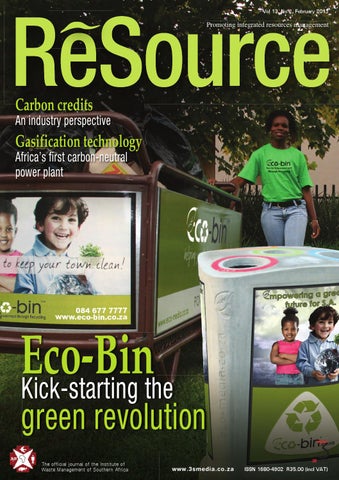
Eco-Bin Kick-starting the
green revolution The official journal of the Institute of Waste Management of Southern Africa
www.3smedia.co.za
ISSN 1680-4902 R35.00 (incl VAT)
contents
www.3smedia.co.za ISSN 1680-4902, Volume 13, Number 1, February 2011
Vol 13, No 1, February 2011
Promoting integrated resources manag management gement
Carbon credits An industry perspective
Gasification technology Africa’s first carbon-neutral power plant
Eco-Bin Kick-starting the
Cover story
green revolution The official journal of the Institute of Waste Management of Southern Africa
www.3smedia.co.za
10
6 ISSN 1680-4902 R35.00 (incl VAT)
Based on the principle of separation at source, Eco-Bin is SA’s first roadside recycling receptacle
The RéSource team stands firmly behind environmental preservation. As such, RéSource magazine is printed on 100% recycled paper and uses no dyes or varnishes. The magazine is saddle-stitched to ensure that no glues are required in the binding process.
Regulars
Air pollution
3 5
36 40
President’s comment Editor’s comment
Demystifying carbon credits Carbon footprint: what’s your impact?
Solid waste
Medical waste
8 10
46
A new approach to classification Municipal study: waste minimisation
16
Selecting an HCRW contractor
Hazardous waste Recycling
55
16 19 20
Wastewater management
Glass recycling volumes boom Cash for trash From plastic to paper
Landfills 22 28
Managing landfill odours Gas emissions: Joburg case study
Waste to energy 34
Carbon neutral power plant
58
Responsible Care Performance Report
19
Dewatering of coal, gold and diamond mines: part II
Product news 63 64 65 68
Compostable pots Lead paint Recyclable bread tags Health-Care Waste Summit & Expo
20 RéSource February 2011 – 1
President'scomment
President’s comment
T
o begin with, I trust you all enjoyed the festive season and got home safely after your holidays. I would like to take this opportunity to wish all our members the best for 2011: may you be successful and prosperous in tackling the new year with renewed vigour! The year 2010 certainly went by in a flash and the buzz and excitement will remain in our memories for a long time to come when thinking back on the Soccer World Cup and our highly successful WasteCon 2010. However, behind the scenes we still managed to get on with some of our other strategic objectives, namely communications and education and training. You will by now know that we have a super monthly newsletter in the form of the Waste Vine, and a vastly improved and redesigned website. These communication channels are there for you, the member, so please use them and let us know what the issues are and what is happening in our industry. The institute has for some time now recognised the need for training and education and has set this as one of its most important strategic goals. In order for us to achieve the required levels of service delivery in waste management, we have to start the rebuilding process with education and training, and putting in place the necessary foundation on which we can place our building blocks for a sustainable waste management system in the future. This is an issue I have elaborated on a number of times in the past year. This has also been a difficult issue to resolve and has been the subject of debate/discussion over the past eight years and more. A series
of accredited training courses was developed through the IWMSA for the LGSETA approximately two years ago, but we then appeared to run into a brick wall when it came to presenting these training courses. However, we appear to have now made a tremen-dous breakthrough. At our recent council meeting on 11 November 2010, the Education & Training Committee presented a very detailed report to the council on the proposed way forward for training within the IWMSA. Deidre Nxumalo-Freeman (our vice-president), the chairperson of this committee, and Gail Smit, in her role as executive officer of the IWMSA, have been mandated
In order for us to achieve the required levels of service delivery in waste management, we have to start the rebuilding process with education and training by the council to coordinate the implementation of training courses presented by the IWMSA. Together, they have devised a comprehensive plan that will ensure that a recognised programme of courses will be presented, which will include both nonaccredited and accredited training material. We will also have access to the accredited material at the LGSETA. In short, the programme will be presented under the auspices of the Cape Peninsula University of Technology (CPUT). Various short courses, including a full learnership, will also be available through this
Stan Jewaskiewitz, president, IWMSA programme. A three-way agreement has been reached between the IWMSA, the CPUT and the LGSETA. An article providing all the details of the programme appears in this edition of RéSource. This programme is scheduled for launch in April this year. Last year also saw the restructuring of the IWMSA head office in order to meet the new demands that have resulted from the development of the strategic objectives that we are pursuing. The council decided last year to restructure the head office as follows: • executive officer: Gail Smit • administration officer: Ann Oosthuizen • receptionist: Sanki Tshabangu. Finally, all council members and the vicechairpersons of the branches have been invited to attend a strategic workshop on 17 and 18 February. The purpose of this workshop is to revisit the strategic objectives we previously set for ourselves, and in terms of the progress made so far, to determine what changes are required to ensure that we move forward in the right direction. So if any of our members have any input to make or issues to be addressed, please channel these through your branch committee or directly to Gail Smit at the head office. A survey questionnaire will also be sent out to our members shortly – please support the survey as this is your opportunity to have your say and to take part in the affairs of the IWMSA.
Patron members of the IWMSA
RéSource February 2011 – 3
KINGJAMES 17222
We put our money where our mouths are
Our responsibility extends beyond only marketing our products. Since 1994 more than ONE BILLION litres of used lubricating oil has been collected and recycled in South Africa. As members of the ROSE Foundation we have been preventing pollution and preserving our most important natural resource - OUR WATER. For more information call the ROSE Foundation on 021 448 7492, email usedoil@iafrica.com or visit www.rosefoundation.org.za
Supported by:
Editor's comment Publisher: Elizabeth Shorten Editor: Candice Landie Tel: +27 (0)11 233 2600, candice@3smedia.co.za Creative executive head: Frédérick Danton Graphic designer: Cynthia Selemela Chief sub-editor: Lia Marus Sub-editor: Danielle Hugo Production manager: Felicity Moon Production coordinator: Jacqueline Modise Financial manager: Andrew Lobban Marketing manager: Natalie Nelson Subscriptions sales: Cindy Cloete Administrator: Tonya Hebenton Distribution coordinator: Asha Pursotham Printers: United Litho Johannesburg Tel: +27 (0)11 402 0571 Advertising sales: Christine Pretorius Tel: +27 (0)11 465 6273 christine.pretorius@lantic.net
Publisher: MEDIA No.4, 5th Avenue Rivonia, 2191 PO Box 92026, Norwood 2117 Tel: +27 (0)11 233 2600 Share Call: 086 003 3300 Fax: +27 (0)11 234 7274/5 www.3smedia.co.za Annual subscription: R160.00 (incl VAT) South Africa cindy@3smedia.co.za ISSN 1680-4902 The Institute of Waste Management of Southern Africa Tel: +27 (0)11 675 3462 E-mail: iwmsa@telkomsa.net All material herein RéSource is copyright-protected and may not be reproduced either in whole or in part without the prior written permission of the publisher. The views and opinions expressed in the magazine do not necessarily reflect those of the publisher or editor, but those of the author or other contributors under whose name contributions may appear, unless a contributor expresses a viewpoint or opinion in his or her capacity as an elected office bearer of a company, group or association.
© Copyright 2011. All rights reserved.
ReSource is endorsed by:
The start of something great
H
appy New Year everyone! waste side, we look at some shockI hope you all have your ing images of illegally dumped healthresolutions in check and that care risk waste (HCRW). The article those self-made promises to join a looks at the criteria involved in selectgym, stop smoking, practise anger ing the correct HCRW service providmanagement in rush-hour traffic, or er, taking into account environmental to go to church for reasons other and government legislation and codes than to pray for the demise of your of practice. In our landfills section, boss haven’t fallen by the wayside. we look at a case study from Ireland Me, I’m not a believer in New Year’s on effective tools for managing resolutions. As diligent as I am when odours from landfill sites. The article it comes to my work, I unfortunately focuses on progressive, proactive don’t have the same discipline when tools for assisting landfill managers it comes to my personal life. I would in identifying issues with gas release much rather not commit to any resoand where best to apply mitigation lutions than make an active decision within the facility in order to minimise to implement a change, and then…. and possibly eliminate the issue. Also nothing! I could never deliberately featured in this section is a case set myself up for such failure. I do, study on gas emissions at five landfill however, always strive to be a better sites in Johannesburg, and the contriperson, which I firmly believe we bution of these to global greenhouse should all aim to do every day, and gas emissions. not just when the clock strikes midFor those of you who haven’t heard, night on 31 December. Africa’s first carbon-neutral power The first 2011 issue of RéSource plant was launched late last year. kicks off with a bang as we settle An EECOFuels initiative (a division in and get back to tackling issues of EnviroServ) funded by Nedbank, within the industry. We feature the the plant makes use of the latest dynamic team at EcoMedia on this gasification technology, and presents month’s cover, who firmly believe in organisations with an economical, creating a positive attitude towards safe way of generating electricity from recycling. The Eco-bin is one of renewable resources. What is probthe company’s biggest products. ably the most exciting aspect of this It is South Africa’s first roadside project is that the gasification plants recycle bin, which makes it easier can be placed anywhere as the plant for the general public to engage in operates independently of infrastrucrecycling while at the same encourture requirements and there is no aging municipalities to adopt the need for the transportation of feedconcept of waste separation stock for the process. But I’m not at source. And it seems going to give away the entire story; that municipalities are in you can read up on that inside. fact fast following this This issue also features everytrend, as is the case with thing you need to know about the City of Cape Town. carbon credits, an insight We feature the city’s into the Responsible Care waste minimisation Report 2010, legal issues initiatives based on surrounding the developan Integrated Waste ment of the National Waste Management Policy Management Strategy and a that also encourages whole lot more. waste separation at Editor, Candice Landie Happy reading! source. On the medical
RéSource February 2011 – 5
strapline Coverstory
Recycle rubbish into rands South Africa is on the threshold of a 'Green Revolution', thanks to Eco-Bin's path-finding innovation that leads to cleaner surroundings, helps to conserve natural resources, uplifts communities through sustainable income generation and offers both the public and private sectors an eco-friendly medium for hosting their awareness, branding, identity and marketing campaigns. Eco-Bin The unique, patented Eco-Bin, adopted by Eco-Media as a vehicle for social upliftment and job creation, is the country's first commercial roadside recycling receptacle based on the principle of 'Separate @ Source' for optimal functionality and benefits. It comprises four individual, colour-coded compartments for plastic/ polystyrene, glass/cans, paper/cardboard and food waste, plus a fifth for cigarette butts, each with its own reusable and recyclable polypropylene inner lining for simple collection of materials via a hinged door with a failsafe locking system. The outdoor Eco-Bins, constructed out of 98% natural sediment concrete, are available in mini (360 ℓ) and maxi (720 ℓ) sizes to suit all needs. Indoor versions are also available. Already launched at Wastecon in October 2010, Eco-Bin's vision is to expand this footprint by encompassing more communitybased authorities and additional seats of learning, along with highly frequented venues such as shopping centres and malls, office parks, airports, sports clubs and stadiums, national wildlife parks, game farms and zoos. The Eco-Bin system is also ideal for seaside hamlets, country villages, gated communities, housing estates and even neighbourhood groupings. Separate @ Source is representative of Eco-Bin's striving to foster recycling
through making the process easier, in this way encouraging public participation and leading to even greater awareness nationwide. From a community perspective, as implemented within the abovenamed initiatives, Eco-Bin goes beyond recycling to being a true empowerment solution for South Africa. The system sees independent SMME recyclers empowered and allocated selections of bins, the contents of which make their way to buy-back centres by means of Eco-Trolleys. The trolley is a specifically designed pavement-friendly two-wheeled pushcart with a 500 kg load capacity. By arriving with preseparated recyclables, participants are ensured prompt, efficient service at the weighing stations. Once financial transactions have been completed, each empowered recycler has the responsibility to maintain its allotted bins until ready for the next delivery. Finding the nearest buy-back centre, depot or recycling centre is made simple through EcoMedia's partnership with My Waste: the latter's database completes the solution and a community of recycling is in place in this way. By implementing the Eco-Bin system SMME recyclers will help alleviate the burden on the job market as it is a sustainable industry since consumption is on the rise, and in turn SMME buy-back centers will contribute positively towards the economy as South Africa is fast running out of landfill sites, which are not only costing the tax-payers money for maintenance but contributing to carbon dioxide emissions. One of the biggest challenges to date is that the lack of education on recycling has resulted in a lack of buy-back centres. Eco-Bin is a proud supporter of B.K.B, 'Make Mzantsi Beautiful', 'Movement For Good' and 'Unashamedly Ethical’.
For more information please email us on recycle@eco-bin.co.za or visit www.eco-bin.co.za
patented by Spoor Fisher 6 – RéSource November 2010
Coverstory strapline
Four individual, colour-coded compartments for plastic, glass/cans, paper/cardboard and food waste
Recylers loading their Eco-Trolley for easy transportation to a buy-back centre
Eco-Media
Separate @ Source, each with its own reusable and recyclable polypropylene inner lining for collection
Hinged door with failsafe locking system, constructed out of 98% natural sediment concrete
Eco-Media is an entrepreneurial enterprise with a vision that involves the development of innovative outdoor media solutions while working closely with each city council to improve the social and environmental requirements. Eco-Media's infrastructure products enhance each municipal district's aesthetics as well as the visual quality of the environment, while simultaneously providing a high-quality visual brand for municipalities and their clients alike. Eco-Media is committed to the principle of developing the social prosperity of the community and conser ving its natural resources. In terms of Eco-Media advertising opportunities, the Eco-Bin networking system provides valuable space for advertising that ultimately gives back to the community at large. The eyecatching, triangular Eco-Bin itself acts as a stable platform with three highly visible faces. Furthermore, its size and sturdy construction make for a dynamic and sustainable outdoor advertising solution. Ad spend is therefore transformed into an environmentally friendly endeavour and has the added feel-good bonus factor that comes with helping local communities. For more information please visit us on www.eco-media.co.za or www.eco-bin.co.za.
Embrace life‌ Get an Eco-Bin and start recycling RÊSource offers advertisers an ideal platform to ensure maximum exposure of their brand. Companies are afforded the opportunity of publishing a cover story and a cover picture to promote their products and services to an appropriate audience. Please call Christine Pretorius on +27 (0)11 465 6273 to secure your booking. The article does not represent the views of the Institute of Waste Management of Southern Africa, or those of the publisher.
strapline Solidwaste
A new approach to classification ENCOURAGING WASTE MINIMISATION AND REUSE
The new Waste Management and Classification Regulations are in the process of being finalised. What does this new approach to waste classification involve? By Liz Anderson*
T
he following draft regulations are in progress under the National Environmental Management: Waste Act (No. 59 of 2008): • draft Waste Classification and Management Regulations • draft standard for assessment of waste for landfill disposal • draft standard for disposal of waste to landfill. The Department of Environmental Affairs hopes to finalise these and gazette them to come into effect either early in 2011. Stakeholder consultations have taken place over the past two years and the final documents for comment will be published shortly, for a final 30-day comment period, after which they will proceed through the normal process to become gazetted into law. The purpose of the regulations is to: a) regulate the classification and management of waste in a consistent way b) establish a mechanism and procedure for the approval of activities that facilitate diversion from landfill
c) prescribe requirements for the environmental risks associated with landfills d) prescribe requirements for waste manifest systems e) prescribe requirements for the management, acceptance criteria and restrictions of waste to landfill. The new approach to waste classification is a major change from the familiar DWA minimum requirements. It utilises the international UN GHS classification as in SANS 10234, and this makes it necessary to assess health and environmental risks in addition to the familiar nine physical risk classes embodied in the UN and South African transport regulations as per SANS 10228.
How does this work? Substances, in this case waste, have to be evaluated in terms of primary physical properties, for example, flammable, oxidising, water reactive, or corrosive, followed by an evaluation of health and environmental effects.
It is therefore essential to conduct analysis and to keep waste separate as far as possible in order to provide opportunities for reuse and recycling, as well as to simplify the analysis of all components for classification.
Draft Waste Classification and Management Regulations Key principles and issues of the regulations include the following: • The regulations apply to all provinces and waste generators, except domestic waste generators. • Waste generators must register on the SAWIS website (www.sawic.gov.za) and obtain a SAWIS number. • Waste must be kept separate and not mixed for classification or after classification. • Waste generators have a duty to classify waste within 12 months of the regulations coming into effect. • Stockpiled waste must be managed within five years of the regulations coming into effect. • Waste may not be treated after classification if it will dilute concentration or mask components – if treated it must be reclassified. • Waste must be disposed of in terms of the standard for assessment of waste for landfill disposal. • Records must be kept of types of waste, quantities of waste and where the waste is disposed of, and kept for five years. • A safety data sheet (SDS) (ISO/SANS 11014) must be compiled for each waste stream by the generator. • A waste manifest must be completed by the generator to accompany each consignment of waste. • Transporters and waste facilities may
Separation of waste will simplify classification and provide more opportunities for reuse
8 – RéSource February 2011
Solidwaste ststtra strapline raaplilinee rap
not accept hazardous waste without a manifest, which is a legal record for each organisation, detailing who dispatched what, who transported it and the receiving facility. • All wastes currently classified under the minimum requirements must be reclassified within 18 months of the regulations coming into effect. • Record keeping must be implemented in terms of regulation 11 within six months. • A manifest must be in place within 12 months. • Penalties for failure to comply or the provision of false or misleading information can take the form of a fine and/or up to 15 years in prison. Schedule 1 lists pre-classified general and hazardous waste as: • general, domestic, building, business, garden, waste tyres and post-consumer packaging, e.g. paper, glass and plastic • hazardous – HCRW and asbestos. Schedule 2 contains information about content for the waste manifest, which includes: • SAWIS registration number, information on transporter and waste facility sent to, as well as a declaration of accuracy of information.
Draft standard for assessment of waste for landfill The purpose of this standard is to assess the level of risk associated with the disposal of waste to landfill. This encompasses: • standard assessment methodology for total and leachable concentrations and threshold levels and which must be implemented by an accredited laboratory • a table for LCT & TCT threshold of metal ions, inorganic anions, organics and pesticides • a waste disposal risk level table for landfill, which describes four levels of risk: type 1: very high risk: high potential for contaminant release; requires high-level control and ongoing management to protect health and the environment type 2: high risk type 3: moderate risk type 4: low risk.
Draft standard for disposal of waste to landfill The purpose of this standard is to prescribe requirements for landfill, and it consists of: • Part 1: Definitions • Part 2: Standard design, acceptance and disposal requirements, which state the following: • A new approach to landfill classification and containment barrier design is to be followed, with detailed engineering requirements and requirements to be signed off by a registered professional engineer. • Design requirements supersede those of the minimum requirements and will come into effect for all new landfill and new cells in existing class A landfills, unless authorised before the date of publication of these regulations and standards. • Any landfills not permitted prior to the regulations will not be able to operate unless permitted under the new system. Waste acceptance criteria for landfill chart 1 relates the type 1, 2, 3 and 4 wastes to the new class A, B and C landfills with crossreference to the exiting HH, Hh and GLB+ landfills. Chart 2 informs that general waste may be disposed of at class B landfills and that inert waste may be disposed of at class B or C landfills. Chart 3 informs about which hazardous ratings may be disposed of at which newdesignation landfills, confirming the relationship between new and old classifications for landfills: • class A: all hazardous waste • class B: only delisted hazardous waste and general waste • class C: only general or inert waste. It is important to note that waste classified under the minimum requirements may only be accepted for a period not exceeding 18 months, by which time it must have been reclassified.
Waste disposal restriction Prohibitions and restrictions of various types of waste will come into effect, some
The new approach to waste classification is a major change from the familiar DWA minimum requirements immediately, with the regulations coming into effect, and others over a phase-in period. These are listed in table form with time frames, examples being: (a) explosive, corrosive, oxidising: immediate (b) waste with a pH value of < 6 or > 12: immediate (c) reactive waste or waste which can generate toxic gases: immediate (d) pesticides: immediate (g) lead acid batteries: immediate (h) other batteries: eight years (i) used oil: two years (j) used/spent solvents: four years (k) brine or waste with high salt content: eight years. Waste generators must register on SAWIS within 60 days of commencement of these regulations. Records must be kept on what, how much and where waste has been sent for reuse or disposal and reporting has to be done quarterly, within 30 days of each quarter. Records are vital to protect generators and the waste facility. Separation of waste will simplify classification and provide more opportunities for reuse in another process, or recycling or energy recovery. Make a start now to classify and address possible options to minimise waste produced, and reduce any unavoidable waste to landfill, as this is undesirable and will become a very expensive option.
ABOUT THE AUTHOR: *Elizabeth Anderson leads the Responsible Packaging Management Association of Southern Africa (RPMASA), coordinating with the various players to protect people, health and the environment, by setting better standards of practice for the management of industrial chemical packaging in Southern Africa.
RéSource February 2011 – 9
Solidwaste landfill
A MUNICIPAL CASE STUDY
Benefits of waste minimisation
SA is experiencing a shortage of landfill space, a high rate of unemployment and a deterioration of the environment. The City of Cape Town has approved an Integrated Waste Management Plan, emphasising waste minimisation. By E Gilbert and X Fumba*
T
he approach of the City of Cape Town (CoCT) recognises the diverse culture, demographics and economic factors that need to be taken into account when determining the waste minimisation methodologies to be undertaken. The theme selected to underpin the effort of waste minimisation within the city is ‘Think Twice, Phind’ Ucinge, Dink Twee Maal’. The city has embarked on a pilot split-bag/wet and dr y waste separation project, aimed at separating waste at
10 – RéSource February 2011
source to reduce the amount of waste going into landfill, while concentrating on job creation and entrepreneurial development. In addition, the CoCT has a network of drop-off facilities for residents to drop off excess waste not handled during the scheduled weekly refuse collection ser vice. NGOs and community members are on site, and recover and sort recyclables from the general waste stream. The initiatives are designed to be labour intensive to support the needs of recyclers who receive sorted
materials, making sorting and resale much easier.
Services The CoCT Solid Waste Management’s Collections section provides the following ser vices to its citizens: Refuse collection ser vice: A refuse collection ser vice in a 240 ℓ wheeled container is provided to formal properties. Property owners are billed a monthly tariff for the refuse removal ser vice, based on the number of bins they require.
Solidwaste strapline landfill
While residential properties are obliged to make use of the weekly curbside municipal refuse removal ser vice, nonresidential properties are required to enter into a contractual agreement with either the city or a private waste removal company. Each month, the department ser vices an estimated 850 000 ser vice points. Drop-off facilities: Drop-off facilities are strategically located for use by residents within a 7 km radius. The facilities provide for the drop-off of builders’ rubble, garden refuse and recyclable materials. Ad hoc garden refuse removal ser vice: An ad hoc garden refuse removal ser vice is available to formal residential properties. The garden refuse is removed along with the normal refuse collection ser vice. Costs are dependent on the number of bags or bundles removed.
Conceptualisation of Think Twice In 2006, after the approval of the Integrated Waste Management Plan (IWMP), a waste minimisation project was initiated under the banner of Think Twice, which addresses the ‘three Rs’: reduce, reuse and recycle. The aim of the Think Twice project is to establish innovative ways of promoting waste minimisation in the city. The existing programmes and initiatives were implemented by the Collections Section, as this is the section which is at the coalface of waste producers and is responsible for the removal of waste. The initiatives that were embarked on by the section are: • waste separation at source: wet and dr y or split-bag collection • waste recover y and sorting at the drop-off facility Both initiatives focused on providing a ser vice to formal residential properties.
FIGURE 1: Monthly totals from all facilities
FIGURE 2: Monthly trends of recovered material types properties. This translates to 102 000 ser vice points, and there may be multiple lifts per ser vice point. The ser vice of collecting the dr y recyclable material is currently outsourced via a tender/contract in targeted areas. The contractor is responsible for: • the collection of wet waste and dr y recyclable materials with two separate vehicles • marketing and communication to the targeted/participating communities
• the provision of bags for the dr y recyclable material • the provision of a mini recycling facility (MRF) • the keeping of and reporting on statistical information.
How does the service work? The contractor will provide a starter pack a week prior to the commencement of the contract. The starter pack includes: • communication on the ‘how to do’
Zibi advert on a waste collection vehicle
Waste separation at source: wet and dry or split-bag collection This initiative is implemented at 12% of the total ser vice points within the city, which excludes businesses because the project is not aimed at business
RéSource February 2011 – 11
12 Tungsten Road, Isando, Gauteng, South Africa • P.O.Box 746, Isando 1600, South Africa Tel:(011) 974-5660 • Fax: (011) 974-5143 • Email:ottosa@global.co.za
Solidwaste strapline
• what to recycle and what not to recycle • a clear bag for the recyclable materials. On the scheduled refuse collection day, the contractor will have two vehicles on the collection beat – a compactor will collect wet waste and an open truck will collect clear bags full of recyclables. The resident will fill the bag/s with dr y recyclable materials. On the scheduled refuse collection day, the bag is placed inside the bin, on top of other waste. The recyclable material will be transported to the contractor’s own MRF for further sorting. The percentage of material sold to industr y in relation to the waste disposal at the landfill from the targeted area should be at least 12.5%; for example, if 200 t of waste is disposed of at landfill, at least 25 t of material must be recycled. Areas participating in the waste separation source project are: • Helderberg: Somerset West, Gordons Bay, Strand, Macassar • Atlantic: Hout Bay, Camps Bay, Clifton, Llandundno, Pinelands, Bantr y Bay, Parklands, Bloubergstrand, Melkbosstrand • Deep South: Simons Town, Muizenberg, Fish Hoek. • The total number of participating ser vice points is 120 000, with a minimum of 3.5 kg of recyclables per household. The contractor has a target participation rate of 50%. The total recyclable tonnage for the past 12 months is at 750 t per month, inclusive of all participating areas.
Challenges: informal collectors The waste separation at source, as with municipal project, had its own challenges. The project did not consider the impact of the informal collectors within the targeted areas. Prior to the conception of the project, the areas were already filled with informal collectors who were scavenging the bins for recyclable materials, as the recyclables were their source of income. The project: • invaded the informal collectors’ space, or territor y of their operation • gave the informal collectors easy access.
Zibi, the rubbish eating ostrich: CoCT’s campaign to encourage waste minimisation at a public level via the use of separation at source bins
any
Overcoming the challenge It was established that the informal collectors are territorial. The contractor was requested to involve the informal collectors in the daily operation, especially in collecting the recyclable material. A meeting was organised with the informal collectors. They were requested to cooperate as the project is intended to benefit all role players in the value chain. They were asked to collect bags from households without scavenging and breaking the bags. The full bags were then purchased from them by the contractor for an agreed-on fee. The collectors took the bags to a designated area, where the contractor has a weighing scale on a truck to weigh each bag. Initially, the informal collectors were paid in cash immediately for the full bags of recyclable materials; payment was based on the weight of the bag. Later, the contractor, in consultation with the informal collectors, introduced a coupon system. The informal collectors were issued with a coupon to the value of their material weighed. They could then redeem the coupons at a later date for cash. Waste minimisation initiatives at drop-off facilities The CoCT has 19 solid waste drop-off facilities. These facilities are strategically located within a 7 km radius of the communities they ser ve. Most parts of the city have drop-offs, except for those areas where land is not available to erect the drop-off or there is ‘not-in-my-backyard’ (NIMBY) syndrome. The 20th drop-off facility is currently in the design phase of the project and will be placed in the Mitchell’s Plain area, where it will cover most parts of the Cape Flats area. Drop-off facilities ser ve as a convenient point for communities to dispose of their excess waste. The waste that is disposed of at the drop-off facility is consequently transported to a disposal facility. The community can drop off garage waste, builders’ rubble or construction waste, garden waste and recyclable waste; however, no wet/kitchen waste and hazardous waste is permissible. Nine of the 19 drop-off facilities are currently undertaking the waste minimisation activity and are the major drop-off facilities. Usage of these facilities is free of charge and they are for residential
RéSource February 2011 – 13 RéSour