Vol 14, No 1, February 2012
Promotin g in teg rated res ou rces man age m e nt
Pikitup’s strategy Eradicating excess waste in Joburg
COP 17 and the Kyoto Protocol The effect on business
Recycling villages
Panel discussion
Community sustainability
Landfill disposal, rehabilitation and extraction
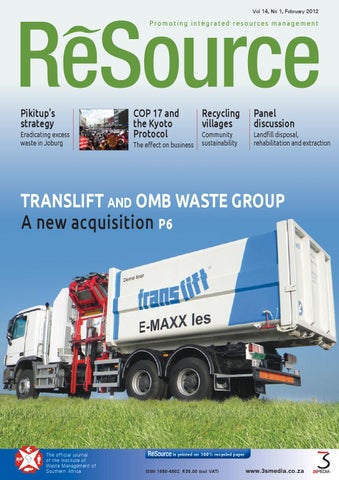
TRANSLIFT AND OMB WASTE GROUP A new acquisition P6
The official journal of the Institute of Waste Management of Southern Africa
is printed on 100% recycled paper ISSN 1680-4902 R35.00 (incl VAT)
www.3smedia.co.za
contents
www.3smedia.co.za ISSN 1680-4902, Volume 14, Number 1, February 2012
Vol 14, No 1, February 2012
Promoting integrated resources management
Pikitup’s strategy Eradicating excess waste in Joburg
COP 17 and the Kyoto Protocol The effect on business
Recycling villages
Panel discussion
Community sustainability
Landfill disposal, rehabilitation and extraction
TRANSLIFT AND OMB WASTE GROUP A new acquisition P6
The RéSource team stands firmly behind environmental preservation. As such, RéSource magazine is printed on 100% recycled paper and uses no dyes or varnishes. The magazine is saddlestitched to ensure that no glues are required in the binding process.
11
Cover story The official journal of the Institute of Waste Management of Southern Africa
6
is printed on 100% recycled paper ISSN 1680-4902 R35.00 (incl VAT)
www.3smedia.co.za
Translift and OMB Waste Group – a new acquisition
Regulars
Air pollution / CDM
3 5 60
40
President’s comment Editor’s comment IWMSA news
42
Solid waste
45
8
Hazardous waste
Pikitup’s new strategy: eradicating excess waste in Joburg
Recycling
46
11
Medical waste
14 16 18
Plastics recycling survey results revealed Recycling villages boost local sustainability Excellence in e-waste recycling Consol celebrates official Nigel launch
49
54
21
56
Exclusive panel discussion: Landfill disposal, rehabilitation and extraction
Waste to energy 33
Renewable heating technology
COP 17 feature 34
COP 17 and the Kyoto Protocol: expectations and outcomes
38
COP 17 image highlights
2011 Responsible Care Report: the good and bad
Case study: hazardous waste minimisation at medical schools
Wastewater management
Landfills
34
‘Smart’ buildings reduce GHG emissions Sasol: green washing or step in the right direction? Who will pay the price of carbon tax?
42
HybridICE: chemical-free toxic water treatment system WWTW upgrade lowers carbon emissions
Plant & equipment 57 59
Mercedes-Benz: raising the bar on waste collection Pilot Crushtec: the ‘pilot’ of asphalt recycling
54 RéSource February 2012 – 1
We are excited to introduce our
140
NEW wheelie bin litre
This product is in line with the waste minimization strategy, as KRXVHKROGV ZLOO JHQHUDWH OHVV ZDVWH WR ODQG ƬOO VLWHV DV D GLUHFW result of recycling initiatives. 587 mm
Ǟ eas
y to
Ǟ Ʈ
482 mm
hand
le
H[L
EOH
t
n a t s
1009 mm
i
Ǟ
s re
Ǟ re
200 mm
le
liab Ǟ made from HDPE Ǟ suitable for selective collection Mpact Plastic Containers Neil Hare Road, Atlantis, South Africa 9 Piet Pretorius Street, Brits, South Africa PO Box 1551, Dassenberg, 7350 Tel: +27 (0) 21 573 9400/ 0861 672 444 Email: salesforce@mpcsa.co.za www.mpcsa.co.za
President's comment
It’s time for WasteCon 2012
I
trust that all our members have enjoyed that municipalities will follow the proper a safe holiday season and have returned procurement procedures in terms of the legto face the New Year with renewed enislation and look no further than the many ergy and vigour to tackle the challenges that local waste management service providers, lie ahead this year! both consultants, contractors and vendors, One of the major challenges we face is that are available. They will be surprised to that of procurement in local government, see the wealth of expertise and knowledge especially in waste management. It is heartthat is available. ening to see that government is now taking The Eastern Cape branch, with the assisactive steps and intervening at provincial tance of the IWMSA head office, is well level in an attempt to address the various advanced with the organising of WasteCon issues that are bedeviling procurement and 2012 to be held in East London later proper financial management of provinces this year. A new look WasteCon is on the and ultimately, local authorities. cards as we are in discussions with the Another interesting trend is that a number Department of Environmental Affairs to of municipalities are experiencing challengintegrate the annual Waste Khoro es relating to landfill sites where airspace with WasteCon. This will allow the is running out and they will soon be faced many municipal delegates attendwith a lack of airspace. It is also becoming the Waste Khoro the opportuing difficult to find and develop new landfill nity to attend WasteCon and the sites due to the lack of planning, budgeting attendant exhibition. This will afford and political will. It is thus with this in mind, our exhibitors the opportunity to get that a number of local authorities have exposure to the many municiturned to “waste to energy” as a solution to palities that will be attendtheir problems. In some cases municipaliing. Details of the new look ties succumb to the advances of commerWasteCon programme will cial companies who offer to take over all be released shortly once their waste management woes and promise the arrangements have the earth in terms of what to do with their been finalised. waste, all at “no cost”! It should be remembered that there are no “free lunches” in this world and any service that is provided comes at a cost somewhere down the line. I trust ” Stan Jewaskiewitz, President, IWMSA
A new look WasteCon is on the cards as we are in discussions with the Department of Environmental Affairs
A further call for papers for WasteCon has gone out. Please support your flagship conference and get busy with those abstracts. This is the ideal opportunity to showcase the expertise out there which is so vitally needed within our municipalities and especially in addressing the theme of “Wrestling with Waste”. For those companies still pondering on whether they wish to exhibit, please note that only 20 stands are left. This is the best response we have had in many years when it comes to the sale of exhibition stands! So don’t delay, book now! Finally, we are in an election year again and it will soon be time for those nominations for branch committees and vice-president. Please make yourself available to get involved in the affairs of the IWMSA, particularly at branch level which is the heart of the IWMSA. All our new members are particularly encouraged to get involved – make yourself available and contact your local branch or the IWMSA head office. We need to get “new blood” with dynamic ideas and lots of energy to take this institute forward in the right direction.
Patron members of the IWMSA
RéSource February 2012 – 3
Editor's comment Publisher: Elizabeth Shorten Editor: Candice Landie Tel: +27 (0)11 233 2600, candice@3smedia.co.za Creative chief executive: Frédérick Danton Sub-editor: Patience Gumbo Production manager: Antois-Leigh Botma Financial manager: Andrew Lobban Marketing: Martin Hiller Subscriptions sales: Nomsa Masina Administrator: Tonya Hebenton Distribution coordinator: Nomsa Masina Printers: United Litho Johannesburg Tel: +27 (0)11 402 0571
Advertising sales: Christine Pretorius Tel: +27 (0)11 465 8255 christine.pretorius@lantic.net
Publisher: MEDIA No.4, 5th Avenue Rivonia, 2191 PO Box 92026, Norwood 2117 Tel: +27 (0)11 233 2600 Share Call: 086 003 3300 Fax: +27 (0)11 234 7274/5 www.3smedia.co.za Annual subscription: R195.00 (incl VAT) South Africa ISSN 1680-4902 The Institute of Waste Management of Southern Africa Tel: +27 (0)11 675 3462 E-mail: iwmsa@telkomsa.net
All material herein RéSource is copyrightprotected and may not be reproduced either in whole or in part without the prior written permission of the publisher. The views and opinions expressed in the magazine do not necessarily reflect those of the publisher or editor, but those of the author or other contributors under whose name contributions may appear, unless a contributor expresses a viewpoint or opinion in his or her capacity as an elected office bearer of a company, group or association. © Copyright 2012. All rights reserved.
ReSource is endorsed by:
Nothing beats a front row seat
N
o words can describe the feeling of being a delegate at COP 17. Never have I been surrounded by individuals who exude such concern for the environment and the planet as a whole. The talks were electrifying. The passion, contagious! Despite the language barrier, the colour of your skin, or your native country, there was one focus and one focus only – to act now against climate change while we still have the chance. Heads of state and government officials descended on one particular conference room at the ICC, while throughout the venue and Durban metro various other press conferences, launches and talks were being held. Despite the negativity prior the event, good news prevailed with the Kyoto Protocol being reinstated. For more insight into COP 17, the Kyoto Protocol and image highlights from the event, look out for the special RéSource COP 17 feature inside this issue. On a different note though, the tyre industry has been hit by a new levy. For those who haven’t yet heard, an Integrated Industry Waste Tyre Management Plan has been approved by Environmental Affairs Minister, Edna Molewa, and will be implemented and managed by the Recycling and Economic Development Initiative of South Africa (REDISA) – a not-forprofit organisation. The South African tyre industry produces more than 10 million scrap tyres every year and it is estimated that anything between 60 and 100 million scrap tyres are stockpiled in the country. Hence the new law is intended not only to support the creation of a sustainable recycling industry deal with a major waste product, but also to create
jobs and foster small and medium-sized businesses in communities throughout the country. A levy of R2.30 per kilogram will apply to all tyres either manufactured or imported on or after 1 February 2012. Tyres already in stock will not be affected. When the plastic bag levy was initiated in 2003, the South African Revenue Services (SARS) pocketed handsomely from the collections, ringing in R61 385 000 for the 2005/06 financial year. However, SARS collected no plastic bag tax for the 2003/04 financial year and it is not clear where the money from the tax went to in the initial year. Let’s hope that the tyre industry doesn’t encounter the same ‘X-files’ scenario. Rattling on about COP 17 and the tyre levy, I completely forgot to welcome everyone to the start of a brand new year and I am sure that 2012 is going to be a great one! To kick start the year, RéSource has a brand new line-up of the best reads in the waste industry including an insight into Pikitup’s waste management strategy, a panel discussion based on landfill disposal, rehabilitation and extraction, and a revolutionary chemical-free toxic water treatment system called HybridICE. This issue also features some interesting recycling stories and news on WasteCon 2012 – yep, it’s time for the biggest waste industry event again! RéSource welcomes all editorial submissions so please send your copy to candice@3smedia.co.za or drop me an email and we can meet and discuss.
When the plastic bag levy was initiated, SARS pocketed handsomely from the collections
Happy reading!
Editor
RéSource February 2012 – 5
Cover story
TRANSLIFT AND OMB WASTE GROUP
International expertise meets local business Translift Netherlands recently became a major stakeholder in OMB Waste Group of companies, South Africa, with the acquisition of the local shareholding early in 2011. Translift is now in the process of establishing a new and revised management structure, which includes the introduction of a fully-participating BEE component.
T
owards the end of last year, after serving in a mandatory executive position, Les Penny stood down from his position as director at OMB Waste Group. Penny is currently consulting for the company specifically in the area of technical innovation and marketing of the product range, particularly active in other developing and emerging areas. He will concentrate on community upliftment in the waste industry and consult in the structure, selection and implementation of the product. Product development will also form part of his function for the industry. Translift is in the process of establishing a new and revised management structure, which includes the introduction of a fully participating BEE component. The intention is that training and upliftment form the cornerstone of operations in South Africa, both in the administrative and technical areas of the business. Local manufacture has already commenced and a South African flavour will
be applied to all products manufactured both locally and abroad for use within and beyond South African borders. Wherever practical, parts will be manufactured for the international market now that the local entity forms a larger part of the Translift operation. The local manufacture initiative opens new employment opportunities and potential export markets for production and spare parts required locally and elsewhere in the world where Translift has manufacturing and service requirements. The company has recognised the need for a greater participation in the social upliftment of local inhabitants of the country and is eager to share its knowledge and experience with the South African related industry. This proactive approach creates the opportunity for expansion into other African countries, and the intention is to replicate the initiative in other developing countries outside of Africa where the need for environmentally-related commercial initiatives serve a dual purpose by targeting
appropriate waste handling issues and, in doing so, create entrepreneurial Les Penny opportunities for individuals in local communities.
The Translift range Considering the range of equipment in the Translift portfolio, the fabrication of large components and finished goods for local and neighbouring countries makes perfect sense. Given the immensity of transportation costs from abroad, Translift has seen the requirement as an opportunity to become an integral part of the waste equipment and systems industry in the region.
ACTS ACT A AC CTTS sslide-on C lid dee-o -o on frame framee (fi (fitted ed to o existi existi ex issti sti tin ng ng or or new new ccontainers) ne on on ont nttain nta ain ineers errs rs)
6 – RÊSource February 2012
Cover story
Bulk containers for use with Translift’s own range of waste collection/transportation and handling equipment should provide a practical base for the extrapolation of the specific product into similar but otherwise applied containers, also found in the region. Rear loader bodies, which are also somewhat costly to ship from abroad, are also a part of the parcel. Manufactured components for new equipment destined for the Translift international market may consist of bin lifter components, compactor components, prefabricated container lifting components and a variety of other similar parts for the bulk container lifting mechanisms. Translift has progressively upgraded its own main manufacturing facility in Dronten, Holland, and will aim to apply the experience and expertise that was gained and applied during the course of the progressive approach. The locally-manufactured spare parts meant for local consumption will be kept in Pretoria for distribution alongside parts imported from elsewhere in the world, such as hydraulic components and PLC products where appropriate. The hardware, being only a part of the bigger picture, sees that an on-going technical support programme is in place whereby the experienced technical team from Holland combined with the newly structured technical team in South Africa, will be available to train and assist their own maintenance personnel, as well as individuals recognised as suitably positioned to undertake whatever service and maintenance activities that may arise from time to time. What is more, Translift will become more actively engaged with supporting waste handling initiatives aimed especially at community level. The variety of options available to the community are numerous and the company has several models from which to select – all of which are aimed at addressing employment opportunities within the collection and transportation component as well as with waste separation initiatives. Their projects will invariably require a degree of funding and that is where Translift is likely to be on top of the game with potential options. It was once said that the ‘extra mile’ is not too busy, simply because not too many people attempt it. Sadly, this is not a very well supported concept but, that too, is because not too many are thus inclined.
Community involvement The principle of community-based waste collection presents the opportunity to engage
the community in the process of waste collection. Primarily the focus is on less affluent areas where unemployment is usually at its highest. Simple arithmetic will demonstrate that less sophisticated equipment is required for waste collection when including the community in sustainable waste management initiatives. The consolidation method has been, and is being used with positive effect but the need for the expansion of the concept appears to have eluded the industry, in all likelihood because first world principles are applied in the areas in question. This is not to say that these principles and related equipment are not applicable in metropolitan areas and affluent society but the fact is that the majority of the population do not fall within that category. For this reason, Translift is focusing on the underprivileged in the context of community involvement. The concept
ABOVE ACTS turntables on a flatbed rail wagon
remuneration of the individuals within the community that are collecting and consolidating the waste. This principle may be applied to the suburban and CBD in a modified format and Translift has the methodology and experience to apply these concepts. When distance to disposal becomes a problem the concept kicks into overdrive and provides further entrepreneurial opportunities than ever.
Conclusion Naturally each area is different and for this reason Translift would evaluate the requirement with a view to determination of the range and type of equipment required, whilst endeavouring to preserve what collection infrastructure there is in order not to
The locally-manufactured spare parts meant for local consumption will be kept in Pretoria for distribution alongside parts imported from elsewhere in the world of community based waste collection requiring less capital equipment is fundamental where consolidation is maximised. If a collection vehicle, particularly a large compactor type, is compelled to collect at every household, the time required to load the vehicle is determined by factors such as traffic congestion, accessibility, road conditions and more. On the other hand if the waste were to be collected by the community in a managed fashion and consolidated, the collection vehicle would find itself completing a route in half the time otherwise required. Considering the capital and operational cost savings by optimising the operation of the garbage compactor, the available saving is amortised and applied to the
disrupt the existing operation, but rather to optimise it. With the vast number of options and tweaks that can be applied to the waste collection process, Translift is poised to embrace the challenges of community-based waste collection, recycling at source and environmental stability. Last but not least, all of the Translift concepts and equipment implementation have a significantly positive effect on the reduction of carbon emissions. With quantifiable studies having been performed, Translift is in a unique position to assist in developing systems that ensure the whole community benefits from these lowered carbon emissions. t +27(0)12 460 1973
RéSource offers advertisers an ideal platform to ensure maximum exposure of their brand. Companies are afforded the opportunity of publishing a cover story and a cover picture to promote their products and services to an appropriate audience. Please call Christine Pretorius on +27 (0)11 465 6273 to secure your booking. The article does not represent the views of the Institute of Waste Management of Southern Africa, or those of the publisher.
RéSource February 2012 – 7
Solid waste
PIKITUP’S WASTE STRATEGY
Eradicating excessive waste production
“We have at least eight years to go before we run out of landfill space in the City of Johannesburg.” Lawrence Boya, MD of Pikitup
T
he City of Johannesburg’s solid waste management ser vice provider and the biggest waste management company in Africa unveiled its waste minimisation plan for the city – placing sustainability at the forefront of its operations. “Landfill space is fast depleting and is impacting the environment negatively at an alarming pace, mostly because of the rapid population growth in the City of Johannesburg (CoJ),” says Zandile Mpungose, Pikitup’s executive: Legal Environment Compliance and Safety. “That, in turn, links directly to excessive waste production.” Speaking at the annual 2011 EnviroCon Conference, targeted at environmental managers and specialists from large organisations around South Africa and aiming to present solutions and opportunities to the environmental issues which the countr y faces, Mpungose stressed the importance of waste reduction as “we simply do not have the space to accommodate the continuously increasing levels of waste being
CITY OF JOHANNESBURG AND PIKITUP • Total area of 1 625 km² • Home to 3.8 million people • Pikitup responsible for transporting, collecting and disposing of domestic refuse • Pikitup provides commercial services to some 17 000 businesses • Litter picks and sweeps approximately 9 000 km of streets • CoJ generates a total of 1.6 million tonnes of waste per annum • What is takes to keep CoJ clean • Over 4 000 employees in 11 depots • Fleet of around 500 vehicles • Four landfill sites • 44 garden refuse sites • 472 000 new 240ℓ wheelie bins delivered
8 – RéSource February 2012
generated as more people move into the city”. The CoJ’s population is growing at a rate of 9% annually. More than a space issue, the local environment cannot withstand the sustained impact. As the city’s constitutionally mandated solid waste management company, Pikitup needs to find a meaningful and sustainable way of reducing the levels of waste generated and ultimately disposed of at landfill.
reducing the waste that is produced by residents, businesses and individuals so that we have less to dispose of at landfills.” This is in line with the National Waste Management Strategy, which cabinet approved on 10 November 2011. The strategy reveals trends on minimising waste and therefore reducing the negative impacts on the environment. The ultimate objective is to change Pikitup’s current value chain from ‘collect, transport and dispose’ to ‘rethink, reduce, reuse and recycle’. “Even though we encourage people to reduce waste creation, we must accept that, realistically, there will always be some level of waste generated,” says Mpungose. Critical to this process is changing the public’s mindset and attitude towards the creation and management of waste. Pikitup will bolster its education and awareness drive so that Johannesburg citizens can understand what the company is tr ying to achieve as not much can be achieved without public support and active participation.
Manufacturers must take back The plan moving forward Looking at what constitutes waste, how it is generated and ultimately managed, Pikitup’s plan, moving forward, is to drastically cut down on waste produced in order to reduce what needs to be disposed of down the line. Mpungose explains: “We’re looking at
Pikitup is looking to divert at least 33% of waste from landfills through a combination of product stewardship (take-back) programmes where manufacturers take back their own packaging and other recyclable products, and the development of facilities which promote re-use, recycling and
FIGURE 1 CoJ’s intentions on waste minimisation
15%
30%
55%
Waste minimisation through separation at source, composting, crusher plants, centres of excellence
Waste to energy plant construction and initiation
Additional landfill space
General Waste Legislation. Funding. Recycling. Collection
Solid waste
A FEW PIKITUP INITIATIVES Clean City Campaign
Illegal Dumping Programme to combat the problem of illicitly discarding waste in any open space around the city. Clean-up Day an annual event galvanising Johannesburg residents to actively clean up.
Eco Rangers
Pilot phase: creating a generation of environmentally-aware warriors.
Separation at source
Education drive to get households to separate their refuse from home to help minimise what ends up at landfill sites.
composting. These initiatives will, in turn, increase CoJ residents’ participation in recycling and support the roll out of infrastructure for waste diversion, such as materials recovery facilities, composting plants, waste transfer stations, builder’s rubble plants and through extensive city-wide education and awareness outreach programmes. Pikitup has already embarked on a number of initiatives which contribute towards the CoJ’s goal of emitting less carbon emmissions. “We presently run the Clean City Campaign, the highlight of which is the annual Clean-up Day. It also incorporates the Illegal Dumping Programme, which is about combatting the problem of illicitly discarding waste in any open space around the city. In 2012, we will expand the
WASTE DIVERSION TACTICS • Source reduction strategies look at diverting waste from waste streams before any collections. • Waste separated at source reused and/or recycled by residents. • Dry recyclables and e-waste exchanged amongst residents. • Home composting (worm farming strategies) of green and wet waste, facilitating food security as the compost is a critical component of vegetable gardening. • Residents’ training on home composting and assisted implementation. • Community outreach programmes for mindset changes. • By-law enforcement and penalties as a last resort. • Enhancing the role of reclaimers. • Reusing, recycling and composting: the strategy seeks the attainment of 33% waste diversion from landfills through a combination of the following: • Product stewardship (take-back) programmes, whereby manufacturers take back their own packaging and other products. • Development of facilities that promote reuse, recycling and composting. • Increasing residents’ recycling rate participation. • Roll out of builder’s rubble plants. • Extensive city wide education and awareness outreach programmes. • Conversion technologies provide the biggest chunk of recyclables that can be diverted from landfills • The strategy projects 40% diversion of waste from landfills to conversion technologies by 2040. • This methodology not only assists in waste diversion but is a significant contributor to electricity and heat generation that will provide long-term financial sustainability for the city and Pikitup.
INTERIM MEASURES TO IMPLEMENT (12 MONTHS) • Focus on short-term gains in the Waterval area and prepare for roll out to other areas. i.e. Randburg, Selby, Southdale and Roodepoort depot areas. • Investigate the viability of the Robinson material recovery facility (MRF). • Initiate feasibility studies for the MRF at Linbro Park transfer station. • Upgrade two garden sites to centres of excellence (subject to feasibility studies).
LONG-TERM MEASURES TO IMPLEMENT (TWO TO FIVE YEARS) • Mobile buy back centres. • Buy banks – flats and townhouse complexes. • Make recycling facilities available at all 44 garden sites (two new sites established). • Establish 100 tonnes per day clean MRF at Marie Louise landfill site, based on recommendations of feasibility study. • Complete the construction of a MRF at the transfer station at Linbro Park landfill site. • Review business operations of Pikitup to support waste minimisation strategy. • Five year target is to recycle 160 000 tonnes of recyclable waste generated in the CoJ per annum.
Separation at Source initiative to include more suburbs, and this will feature an education drive to get more households to
FIGURE 2 (above) Pikitup’s waste minimisation objectives
separate their refuse from home to help minimise what ends up at the landfill site,” Mpungose concludes.
FIGURE 2 (above) Pikitup’s waste minimisation objectives
Traditional waste hierarchy
Today
Proposed Strategy
0%
20% 33%
7%
Potential paradigm shift for COJ Pikitup
40%
0%
7%
93% Traditional Waste Hierarchy
Potential Paradigm shift for CoJ / Pikitup
RéSource February 2012 – 9
70469B
Let’s recycle our way to a better future.
We at Pikitup Johannesburg (Pty) Ltd. aspire to be the leading integrated waste management company in Africa. It’s why we’ve made it our mission to provide sustainable and innovative waste management solutions that exceed stakeholders’ expectations time and time again. Our service offering includes Round Collected refuse, Business Waste, Hazardous Waste, Special Waste, Landfill Sites, Garden Sites and Green Waste Recycling; just some more ways we’re working toward a better, greener South Africa.
Recycling
PLASTICS RECYCLING SURVEY
Plastics – too valuable to waste Plastics get the spotlight in this edition of RéSource. We take a look at the plastics recycling survey results and Plastics SA’s achievement at The Green Expo.
F
ulfilling its mandate of promoting the responsible and sustainable use of plastics as a material, Plastics SA conducts annual surveys into the state of plastics recycling in the country. A complete survey of the plastics recycling industry in South Africa was concluded in 2009, with the updated estimates for 2010 recently released. According to the updated recycling figures released by Plastics SA, the recycling of plastics in the country has shown a steady increase during 2010. There were 194 recyclers operating in 2010, who have managed to: • recycle 241 853 tonnes of plastics • provide 4 800 jobs • create 35 000 indirect jobs with an annual payroll of R240 million.
derived recycling rate for plastics packaging is therefore 30.1%. Plastics packaging recycling rates will be even higher, thanks to Tiger Brands’ decision to stop using oxo-biodegradable bread bags. The South African Plastics Recycling Organisation (SAPRO) welcomes this decision as all bread packaging can now be recycled,
average tonnage per recycler has increased in Gauteng, Limpopo and Mpumalanga as well as in the Eastern Cape and the Western Cape. “The overall tonnage increased by 17% from 2009 to 2010 in the Western Cape and the tonnage per recycler with 10%. A number of separation at source collection systems are in place in the Western Cape and the
Tonnages recycled “The most significant impacts of plastics recycling were job creation, the reduction of carbon footprints and the re-use of nonrenewable resources,” says Anton Hanekom, executive director of Plastics SA. According to Hanekom, the most recent survey reveals that the recycling rate of plastics (all plastics converted) has increased to 18%. “These statistics clearly show that there is a growing demand for recycled plastics that has proven it to be versatile, economic and reliable,” he says. Similarly, the growth in virgin material consumption showed a 4.7% increase (from 1 280 000 tonnes to 1 340 000) during the same period.
a development which will improve the recycling rates for PE-LD/LLD.
Plastics packaging
Provincial representation
Out of the 241 853 tonnes of plastics that were recycled, 182 032 was plastics packaging. This is an increase of 6% which is mainly due to the increased recycling rates for PE-LD/LLD (for example,pallet wrap, shrink wrap, shrouds, liners, bags, form-fill and seal packaging, general flexible packaging, protective wrapping, bubble wrap, etc) and PET beverage bottles. The total amount of plastics packaging in the waste stream was recorded as 605 000 tonnes in 2010. The
The 2010 survey results indicate that the TABLE 1 Tonnages recycled
2009
2010
Total tonnes converted
1 280 000
1 340 000
Total tonnes recycled
228 057
241 853
Recycling rate
17.8%
18.0%
Out of the 241 853 tonnes of plastics that were recycled in 2010, 182 032 tonnes was plastics packaging
increased tonnage could be a result of more recyclable material of improved quality that became available in 2010. Similar initiatives were also started towards the end of 2010 in Gauteng and it remains to be seen if the recycled tonnage will increase as a result of more and cleaner available recyclables,” Hanekom explains.
Source of recyclable plastics Interestingly, the survey also reveals a definite change in the source of recyclable
RéSource February 2012 – 11
12 Tungsten Road, Isando, Gauteng, South Africa • P.O.Box 746, Isando 1600, South Africa Tel:(011) 974-5660 • Fax: (011) 974-5143 • Email:ottosa@global.co.za
Recycling
plastics waste from 2009 to 2010. Preconsumer materials increased by 38% and post-industrial by 44%, while post-consumer and landfill materials dropped by 14%. “We attribute this change to the 2010 economy,” Hanekom says. “In an attempt to reduce operating costs, recyclers sourced cleaner materials to recycle, hence the increased figures for post-industrial and preconsumer materials.” Hanekom said consumers, recyclers and the industry as a whole have a huge role to play in helping the recycling statistics to increase. “We believe that the largest growth potential in recycling lies in postconsumer, household recyclables. However, the costs of washing and drying are prohibiting recyclers from sourcing more post-consumer and landfill recyclables,” he continues. Other hindrances facing local recycling operations include the high cost of water and electricity, wages, transport, repairs and maintenance required on the recycling plant and its equipment.“Whilst a number of larger recyclers were able to overcome these obstacles by investing heavily in their recycling plants in order to improve efficiencies of their washing and drying facilities, we need government’s support and a collective effort to find more energy efficient solutions in the years to come.” The Packaging and Paper Industry Waste Plan submitted to the Department of Environmental Affairs early in 2011 stated
an overall plastics packaging recycling rate of 35% by 2015. The last updated statistics for 2010 indicate that this could be achieved as long as the current growth rates are maintained. Plastics are typically polymers of high molecular mass and may contain other substances to improve performance and/or reduce production costs
Enviropaedia Award for recycling On a different note, Plastics SA was awarded the 2011 Enviropaedia Award for Recycling, at the inaugural Eco-Logic Awards ceremony which took place in Cape Town in November 2011, in partnership with The Green Expo. “We are honouring companies and individuals who are helping us fight both the symptoms and the causes of environmental problems,” says David Parry-Davies, editor of The Enviropaedia, South Africa’s
reference to the green revolution and the driving force behind the awards. The organisation impressed the judges with its ongoing commitment to increase public awareness about the importance of plastic recycling through its various Enviromark activities. Under the auspice of its sustainability director, Douw Steyn, this non-profit organisation has launched and driven numerous annual activities through the years, including initiatives such as National Recycling Day, Clean-Up South Africa Week and the international Coastal Clean-Up Day, which takes place in September every year. The Enviromark and its team of eco-warriors have also become a familiar sight at large international sporting events such as the annual Cape Argus/Pick‘n Pay Cycle Race and the Two Oceans Marathon, where they pick up and recycle the litter that gets left behind by participants and supporters. “Plastics are often unfairly blamed for polluting the environment,” said Steyn, after he received the award. “However, we are trying to educate the public that plastics don’t litter – people do. Used plastic packaging or discarded plastic products should not end up in landfills. We have a thriving, innovative and successful plastic recycling industry in South Africa that creates new products from virtually every type of plastic – whether it is used water bottles, plastic shopping bags or yoghurt tubs.”
RéSource February 2012 – 13
LANDFILL COMPACTORS (FOR SALE) FIGURE 3 Random mixture of plastic elements in soil for different reinforcement concentration
from R395,000 - R995,000 Machines available in stock ex Durban (23 – 30 tons) Regular imports of (23 – 45 tons)
HANOMAG, BOMAG & CAT
Machines repaired & serviced at our workshop FIGURE 2 Guillotine used for the slicing of plastics into strips
Hanomag parts agent
PTN PARTS & EQUIPMENT CC CONTACT STEVE 031 700 3907
CELL 083 226 6156