The official journal of the Institute of Waste Management of Southern Africa
Promoting integrated resources management
Recycling
Vlakfontein A new cutting-edge facility
ISSN 1680-4902 R40.00 (incl VAT) • Vol 15, No 1, February 2013
National Composting strategy on the cards
Carbon tax
Is treasury ready for implementation?
Hazardous waste Composting of companion animal carcasses
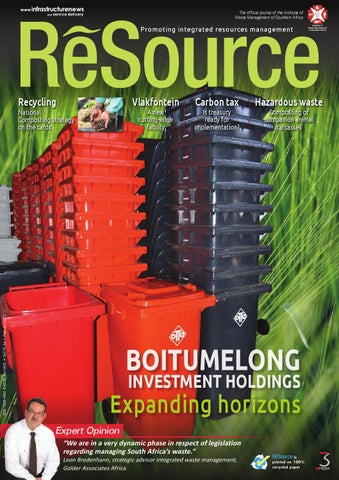
BOITUMELONG
INVESTMENT HOLDINGS
Expanding horizons Expert Opinion “We are in a very dynamic phase in respect of legislation regarding managing South Africa’s waste.” Leon Bredenhann, strategic advisor integrated waste management, Golder Associates Africa
Institute of Waste Management of Southern Africa
is printed on 100% recycled paper
NEM:WA
Your Responsibility, Our Solution Talbot Laboratories is a commercial environmental laboratory specialising in chemical and microbiological analysis of water, wastewater and solid waste. The specialists in our waste division adhere to the latest environmental waste legislation and trends. With over 10 years waste classification experience, our laboratoryoffers our clients definitive waste management solutions. Puzzled by how to classify waste? Contact Talbot Laboratories.
+27 (0) 33 346 1444 • talbot@talbot.co.za • www.talbot.co.za Talbot Laboratories is a business division of Talbot & Talbot (Pty) Ltd.
contents
www.3smedia.co.za ISSN 1680-4902, Volume 15, Number 1, February 2013
6JG QHſEKCN LQWTPCN QH VJG +PUVKVWVG QH 9CUVG /CPCIGOGPV QH 5QWVJGTP #HTKEC Institute of Waste Management of Southern Africa
Promoting integrated resources management
Recycling
Vlakfontein
Carbon tax
Hazardous waste
A new cutting-edge facility
Is treasury ready for implementation?
Composting of companion animal carcasses
ISSN 1680-490 1680-4902 02 R40.00 (incl VAT) • Vol 15, No 1, February 2013
National Composting strategy on the cards
The RéSource team stands firmly behind environmental preservation. As such, RéSource magazine is printed on 100% recycled paper and uses no dyes or varnishes. The magazine is saddlestitched to ensure that no glues are required in the binding process.
10
Recycling
BOITU OITUM UMEL ELO LONG
IN NVESTMEENT EN HOL EN OLLD OL DING GS
Cover Story
Expanding horizons
Boitumelong Investment Holdings
'ZRGTV 1RKPKQP “We are in a very dynamic phase in respect of legislation regarding managing South Africa’s waste.”
Changing the South African waste management landscape
is printed on 100% recycled paper
Leon Bredenhann, strategic advisor integrated waste management, Golder Associates Africa
6
RéSource offers advertisers an ideal platform to ensure maximum exposure of their brand. Companies are afforded the opportunity of publishing a cover story and a cover picture to promote their products and services to an appropriate audience. Please call Christine Pretorius on +27 (0)11 465 6273 to secure your booking. The article does not represent the views of the Institute of Waste Management of Southern Africa, or those of the publisher.
Regulars
Air pollution/CDM 3
President’s comment
64
IWMSA News
Hot seat 8
Golder
Unpacking SA’s coming carbon tax
Hazardous waste Mortality composting of companion animals – novel and fresh
Carbon tax
Hazardous waste
40
Health care waste
Solid waste Seeking out a national strategy on the composting of organic waste
10
Tyre recycling plan ready to go after several speed bumps
14
Solid waste management practices in Western Africa
15
Health care waste remains a global challenge
The A to Z of landfills and landfilling
20
Vlakfontein is the new futuristic Class A landfill for Gauteng
25
The importance of GCL shear strength in steep sloped landfills
29
in association with infrastructure4
56
Profile Langkloof Bricks goes green, gets gold
Landfills
49
Wastewater Wastewater energy efficiency and optimisation
Turning used oil into explosives – recycling with a difference
47
Panel discussion
Recycling
infrastructure news
32
32 40
56
Wastewater
38
}
www.infrastructurene.ws
RéSource February 2013 – 1
strap President'sCover comment
Prosperity, planning & portfolios by Deidré Nxumalo-Freeman, president, IWMSA
C
ompliments and well wishes for a prosperous and fruitful 2013. At the IWMSA we are well into 2013 and ready to tackle the goals we have set for ourselves for this year and beyond. Our calendar of events for this year is very noteworthy and some of the highlights include The Healthcare Waste Summit (May), Landfill 2013 (October) as well as the Eastern Cape Conference (August). For a more detailed list of all our events refer to the Wastevine and the IWMSA website. All our goals and objectives are aligned to our vision, which is to strive towards a clean and healthy environment. The goals and objectives are the result of strategic planning sessions we have had as council and the inputs derived from our members via questionnaires. In this edition, I would like to introduce your IWMSA council to you and expound on the various portfolios assigned to the various council members in ensuring that we constantly strive towards achieving our vision.
• review of the branding manual • evaluation and extensive utilisation of marketing channels • media training of all branch chairpersons • hosting of conferences, seminars and networking sessions • the Eastern Cape Branch Conference headed up by Kay Hardy (IWMSA branch chairperson – Eastern Cape Branch) • WasteCon 2014 headed up by Melanie Traut (IWMSA branch chairperson – Western Cape Branch).
IWMSA) and its key objectives include: • establishment of a forum for interaction with Department of Environmental Affairs (DEA) • hosting of WasteCon back-to-back with the DEA Waste Khoro
All our goals and objectives are aligned to our vision, which is to strive towards a clean and healthy environment.” Deidré Nxumalo-Freeman, IWMSA
Portfolio 2: To facilitate government liaison with all spheres of government. This portfolio is headed up by myself and Dr Suzan Oelofse (vice president of the
• all branches to have representation of provincial and local government officials • co-hosting of information sharing sessions with regulator y authorities • industr y awards partnerships with provincial environmental authorities (such as
Portfolio 1: To market and brand IWMSA as an extension of our continuous communication portfolio where we focus on priorities as defined by the council. This portfolio is headed up by Gail Smit (IWMSA executive officer) and branch chairpersons for the specific conferences held in their branches. The key objectives of this portfolio include: • development of marketing and branding strategy • development of marketing materials (website, brochures, etc.) FROM LEFT TO RIGHT: Dr A Muswema, Ms M Traut, Dr S Oelofse, Mrs De Nxumalo Freeman, Ms K Hardy and Mr Bertie Lourens
Patron members of the IWMSA
RéSource February 2013 – 3
President's comment Publisher: Elizabeth Shorten Editor: Yanna Erasmus Tel: +27 (0)11 233 2600 Head of design: Frédérick Danton Senior designer: Hayley Mendelow Chief sub-editor: Claire Nozaïc Sub-editor: Patience Gumbo Production manager: Antois-Leigh Botma Production coordinator: Jacqueline Modise Financial manager: Andrew Lobban Marketing & online manager: Martin Hiller Distribution manager: Nomsa Masina Distribution coordinator: Asha Pursotham Administrator: Tonya Hebenton Printers: United Litho Johannesburg Tel: +27 (0)11 402 0571 Advertising sales: Christine Pretorius Tel: +27 (0)11 465 8255 christine.pretorius@lantic.net
Publisher: MEDIA No.4, 5th Avenue Rivonia, 2191 PO Box 92026, Norwood 2117 Tel: +27 (0)11 233 2600 Share Call: 086 003 3300 Fax: +27 (0)11 234 7274/5 www.3smedia.co.za Annual subscription: subs@3smedia.co.za R195.00 (incl VAT) South Africa ISSN 1680-4902 The Institute of Waste Management of Southern Africa Tel: +27 (0)11 675 3462 E-mail: iwmsa@telkomsa.net
All material herein RéSource is copyright-protected and may not be reproduced either in whole or in part without the prior written permission of the publisher. The views and opinions expressed in the magazine do not necessarily reflect those of the publisher or editor, but those of the author or other contributors under whose name contributions may appear, unless a contributor expresses a viewpoint or opinion in his or her capacity as an elected office bearer of a company, group or association. © Copyright 2013. All rights reserved.
RéSource is endorsed by:
the KwaZulu-Natal and Eastern Cape Top Green Organisation awards). Portfolio 3: To provide accredited education and training relevant to the client/municipality needs that will result in high ethical conduct and standards in the industry. This portfolio is headed up by Gail Smit (IWMSA executive officer) assisted by a national training committee with representation of all the branches. The key objectives of this portfolio include: • provision of accredited as well as non-accredited training to the waste industr y • development of national training prospectus • availing funds for training and development of assessors and moderators to conduct IWMSA accredited training • utilisation of IWMSA members to conduct and facilitate training sessions. Portfolio 4: To accredit member organisations (big, small and individuals) through the development of a model (assessment standard/audit) that will accredit our member organisations, yet include mentorship as part of the package. This portfolio is headed up by Bertie Lourens (IWMSA branch chairperson – Central Branch) and its key objectives include: • establishing status quo and determine various modalities • conducting extensive stakeholder consultation • development of model that incorporates stakeholder feedback. Portfolio 5: To involve ourselves in social responsibility opportunities with school programmes, supporting communities and providing assistance to those with existing programmes resulting in tangible grassroots impact where projects get benchmarked and used by municipalities as well as small and micro enterprises. This por tfolio is headed up by all branch chairpersons and its key objectives include: • development of evaluation criteria for social responsibility projects to fund • support of IWMSA member organisations in the school/NGO categories.
so that this has an influence on the needs of the members. This portfolio is headed up by Aubrey Muswema (IWMSA branch chairperson – KwaZulu-Natal Branch) and Gail Smit (IWMSA executive officer) and its key objectives include: • conducting status quo and needs assessment based on the seven BBBEE pillars: – PDI (previously disadvantaged individuals) ownership percentage – PDI senior management percentage – PDI employment equity percentage in work force – Skills development percentage of salary bill – Preferential procurement percentage – Enterprise development percentage – Social development percentage • set objectives for Council and branches to achieve. I hope this provides insight into the goals and objectives that we have set for ourselves as the IWMSA council. Your assistance in the attainment of these goals and objectives is crucial to ensure that the IWMSA remains relevant within the waste industr y. Your feedback is highly valued and we have numerous communication platforms where your voice can be heard. Besides the traditional methods of communication (telephone, fax, e-mails, snail mail), we also utilise social media extensively to maintain contact with our membership base and also reach other industr y professionals. Below is a list of all our contact details and you are most welcome to communicate with us utilising any (or all) of these. Your input in directing the future of the IWMSA is highly valued.
IWMSA CONTACT DETAILS: Tel: +27 (0)11 675 3462 Fax: +27 (0)11 675 3465 E-mail: iwmsa@telkomsa.net Address: Weltevreden Shopping Centre Cnr. Kanniedood & Rinyani streets, Weltevreden Park Postal Address: PO Box 79, Allen’s Nek, 1737 Like us on Facebook Follow us on Twitter
Portfolio 6: To ensure that the institute transformation policy is all-encompassing
Find us on LinkedIn
RéSource February 2013 – 5
Cover story
BOITUMELONG HOLDINGS
Acquisition to change local waste management landscape Black-owned investment company Boitumelong Holdings has acquired the previously internationally owned Otto Industries South Africa and Otto Waste Systems. Otto’s MD, Rob Lerena, and Boitumelong Holdings’ executive chairman, John Sithole, speak to RéSource about the acquisition.
T
he acquisition process has recently been completed, as the majority of negotiations and final agreements were already put in place in the final quarter of 2012, say Lerena and Sithole. The acquisition will strengthen Boitumelong’s already strong position in the local market, in light of its recent partnership with leading manufacturer of waste management equipment in Europe, the Ros Roca Group, under Lefatse Vehicle Solutions. “The result of Boitumelong’s acquisition of Otto is the formation of the first entirely BEE company to focus on the manufacturing of waste management products, as well as the service offerings aspects,” explains EMC Risk Management Consulting’s MD, Juneas Lekgetha, in his capacity as transactional advisor on the acquisition.
Strong roots Boitumelong Holdings was started in 1988 by Sithole from humble beginnings – a single borrowed flat-bed truck and eight casual labourers. The organisation has since evolved dramatically into a major operation focusing on the entire value chain of waste management, and currently hosts a large fleet of service vehicles with a substantial staff collective offering world-class waste management services to residential, commercial and industrial customers. Otto Industries South Africa was established in 1981 as only the second foreign investment of the group outside of Germany. Since then, however, the group has grown exponentially, with bases in Australia, North America, and Asia Pacific, not to mention their expansion into other European markets. The changing international dynamic and economics have necessitated a change in its business model.
6 – RéSource February 2013
“They are focusing more on markets in the European and North American sectors, and as a result they have stopped doing business in South Africa,” explains Lerena.
Long history Sithole and Boitumelong Holdings are, however, no strangers to Otto Industries South Africa. Sithole bought a 20% share in Otto Industries in 1995 and in 2000 both companies entered into a 50:50 joint venture to form Otto Waste Systems. The latest acquisition negotiations were resolved fairly quickly in light of these already strong bonds, with Boitumelong entering into negotiations in June last year and the final agreements being reached in December 2012. “This is pending approval of all the
necessary documentation to be finalised in the first quarter of 2013,” explains Sithole. As a result of the JV, Sithole was 50% owner of Otto Waste Systems, which meant he was not new to the business, with a good understanding of not only the industry and market but also the organisation – this was one of the key aspects in the negotiations. “The other partners knew him and his business practices well, and felt comfortable entering into discussions with him as they believed this would make the transition through the acquisition smoother. That made it very easy to enter into negotiations for both parties,” explains Lerena.
Optimising efficiencies Sithole believes the transition will take place with minimal upheaval. “Basically what we will be doing is evaluating efficiencies and structures in order to
Cover story
strengthen systems and processes already in place. It is really more about strengthening the business,” he says. The increased focus on effectiveness and efficiency is almost instantaneously evident when considering that the previous owner was based in Europe and managed the business long distance by proxy, believes Lekgetha. “The new owner, Boitumelong Holdings, is based in South Africa. It knows the waste management market and the role players, so it will be easier to identify efficiencies as it takes a more hands-on approach,” says Lekgetha. The increase in output efficiencies is not the only reason the team forecast a better business result – its strengthening BEE status is also likely to play a strong role. Boitumelong Holdings’ chief executive, Tumelo Sithole, says: “We are a blackowned company in the entirety now. We will be getting a Level 2 or 3 BEE rating in the next three to four months; however, we are targeting a Level 1 rating, be it now or in the long run.” John Sithole adds: “I think this in itself will open up a number of opportunities with regards to new contracts and new market opportunities not previously available to the organisation, due to the preference availed to BEE companies in local government contracts specifically. This will allow Otto Industries South Africa specialises in the manufacture of waste management tools such as plastic containers and wheelie bins
us to collaborate with more municipalities that were not previously in the system.” He adds that the most exciting reality or opportunity for him is when the cumulative waste management system they now offer gets into townships. “This spells immense growth for us.”
SADC and beyond John and Tumelo Sithole and Lerena indicate that expansion into Africa has been targeted as a growth strategy for the organisation moving forward. “Growth is coming to Africa.
is a lot of potential to benefit from introducing our system,” says John Sithole.
Holistic approach Both John Sithole and Lerena are quick to indicate that it is not just bins they are selling and marketing, but rather a holistic waste management system. Although the recently acquired Otto Waste Systems’ focus has to date been on the pro-
Production on-site is set to continue as normal after the changeover of ownership I think Europe is exhausted. It has been in the system for years and Africa is only just being introduced to it,” says John Sithole Lerena points out that in the sub-Saharan region specifically, business is still being entered into with Europe, at immense cost. “Why are they not doing business with Africa when the resources and technology are available?” Although this is a strategic focus, the organisation has already garnered some small orders and is currently setting up a number of agents throughout the region, with a focus on the SADC region predominantly. “We want to strengthen our influence in the SADC countries and then use it as a springboard into the rest of sub-Saharan Africa,” says Lerena, adding that the entire process is all about exploring partnerships – both established and potential. The challenge – and the potential in some respects – lies in the fact that SADC countries have very different waste management environments compared to the South African markets. “It is a very dynamic and different market. Look at Angola for example. It is a fast-growing economy and country, and yet it is not in the system and their waste system is not up to scratch as yet, so there Left to right: Otto Industries South Africa’s Rob Lerena, Boitumelong Holdings’ executive chairman, John Sithole, and Boitumelong Holdings’ chief executive, Tumelo Sithole
duction of virgin high-density polyethylene, ultra-violet stabilised waste containers for provincial and municipal authorities, as well as industrial and private contractors, the bin is merely one aspect of the recovery and collection system. “The advantage of advocating the entire system is that it increases the waste management process effectivity, while saving significant costs, introducing a number of controls and ensuring the correct hygiene practices,” says Lerena. However, education remains key in ensuring the successful roll-out of the system. “You still have to teach the individual households how the system works so that they can effectively take advantage of the system,” says John Sithole, adding that this education needs to be happening from the point of the service provider to the end user in order to ensure peak performance. While Otto’s speciality is in the manufacture and supply of waste management tools, Boitumelong Holdings is involved in the service provision aspects of waste management, which adds significant value as the focus then becomes holistic in nature. “We are not only going to be manufacturing a bin. We also offer the services to back that up. It is going to be a one-stop shop where we supply everything from a truck to a lifter, to the bin, to education,” says John Sithole. John Sithole and the team are quietly confident that with the recent acquisition and continued growth on Boitumelong’s side, 2013 is going to be a growth year for the new firm. “It has to be in light of recent developments, and our expectations are high going forward,” concludes Sithole.
RéSource February 2013 – 7
Hot seat
WASTE MANAGEMENT WORKSHOP
Focusing on a sustainable future
Golder Associates unpacks waste management legislation, its implementation and the future impacts in what is sure to be definitive waste management workshops, to be held in May 2013.
“W
e are in a very dynamic phase in respect of legislation regarding managing South Africa’s waste. Not only in terms of the primary legislation – the Waste Act – but also in implementing the Act,” says Leon Bredenhann, Strategic Advisor for Integrated Waste Management at Golder in Africa. Golder will therefore be holding waste management workshops to engage the waste management sector on the legislation and the implications of the rollout thereof, among other aspects. The workshops will be held in May this year in three of South Africa’s key cities, namely Johannesburg, Durban and Cape Town. The workshops are aimed at senior decision-makers in companies pertaining to waste management responsibilities in mining, oil and gas, energy, chemical
8 – RéSource February 2013
manufacturing industries (including pharmaceutical) and the agricultural industry, as well as decision-makers in government. The workshops are set to host a number of international speakers in order to contextualise the local dialogue in the global context, as well as a number of local waste management experts.
A definite need The necessity for the workshop in the current local waste management context is clear, believes Bredenhann. The most proactive, financially rewarding and long-term costefficient way to protect our environment and contribute to resource conservation is in the opportunity and choice that each individual manufacturer, industry, mine and owner of
a waste activity company is presented with – namely to prevent and/or minimise waste, optimise its resource value and advance green economies. In this way, proactively managing waste makes economic sense. “For a number of reasons, managing waste and implementing supporting legislation have become increasingly challenging, especially if considered against the backdrop of South Africa being a developing country that is home to mining and industry infrastructure on a par with developed countries. The challenges are compounded by the reality of limited water resources and a significantly eco-tourism-based economy. However, in a truly democratic society, governance is a joint responsibility. A platform to discuss not only the various issues, but also an opportunity to share ideas and innovations is critical to any industry and so too, with waste management,” says Bredenhann. The waste management workshops will therefore create a forum where the current status quo of waste management and the environment will be discussed. “It is also critical that the industry achieves the objectives of the various Acts contained in the legislation pertaining to waste and this will be unpacked – including strategies, classifications and processes. There is also a lot of work that needs to be done in terms of remediation, contaminated land and wastage
Hot seat
in the industry. Technologies and their various applications will be discussed and explained, and ideas will be shared. National waste management systems, waste to energy and WRATE (Waste and Resources Assessment Tool for the Environment) will also be brought to the fore,” says Bredenhann. The workshops, which are seen as a platform to engage rather than transfer knowledge in a top-down fashion, will consist of four key focus areas, namely unpacking the current legislation, Golder’s approach to translating the current contexts and opportunities into value, the value of sustainable design in landfills, and finally assessing ‘where to from here’.
Examining current legislation
compliance. “It is one thing to gain compliance, but it is better to save costs, reduce risks and increase your organisation’s sustainability,” says Bredenhann. This view also relates to rectifying past transgressions and, through the workshops, the company will seek to specifically address the issue of contaminated land and how to rehabilitate that land. “We want to go beyond remediation though. We want to take remediated land and allocate new land use and this is where the value is unlocked,” he says. With regards to Golder’s contaminated land service offering, “the value in Golder’s
Sustainable design The third focus highlighted by Bredenhann is on integrated waste management facilities as opposed to just disposal facilities. “The essence of an integrated facility is that rather than just accepting that waste arriving at landfills is earmarked for final disposal, it is viewed as an opportunity to gain value. It is not a new concept; however, specialists should be contracted to translate the value chain into operation – design wise – which is where the shortfall often arises.” In addition to focusing on mate-
The Act almost lists the opportunities where you could, instead of creating and disposing of waste, explore opportunities for deriving extra value from that waste.” Leon Bredenhann, Strategic Advisor for Integrated
According to Bredenhann the current legislation is very Waste Management at Golder in Africa dynamic and comprehensive; however, the focus from here on out needs expertise is managing the spectrum of to be on implementation and industry buy-in. sources that results in land contamination, This starts with the national waste manage- whether that spectrum involves organic, ment strategy that is a course of action – a inorganic or nuclear waste, and modelling road to achieve the objectives of the law – and the risk to ultimate receptors and mitigating it affects everybody in society, from national against those risks through various means”. government to local government, industry and The economics of waste the rights of individuals. “It’s a strategy that has a huge impact Another focus area is the resource value and needs to be understood by all the role of waste, which is also a focus area in the players in the waste management stream Waste Management Act, and how this value and this is what we will also be unpacking in the waste chain can be unlocked. “The in the workshops.” Additionally, best prac- Act almost lists the opportunities where you tice standards are also to be investigated, could, instead of creating and disposing of touching on issues relating to how to classify waste, explore opportunities for deriving extra waste, how to manage waste information, value from that waste,” says Bredenhann. In dealing with this topic, a two-pronged which disposal sites are acceptable and what standards are required for disposal approach should be taken. First, investigatsites. This entails a keen understanding of ing the legal process of getting approval for what Bredenhann terms the “fundamentals recovery and managing the risk in respect of third-party use (downstream use). Second, of the law”. The first focus of the workshops therefore from a more practical perspective, the workseeks to give a holistic overview of the cur- shops will unpack optimising and investigatrent legislative environment. “It is about ing those opportunities through feasibility where we stand currently in South Africa in studies around the application, all the way respect to legislation and what the legislation through to implementation. Other technologies to be investigated requires from us. And what the implications include using WRATE of conformance and nonmodelling to optimise conformance are. The efficiency in respect beauty of conformance is of waste logistics and that it could, if correctly reducing organisations’ managed, add value to a carbon footprint as a company’s financial botresult, as well as remetom line.” diation options for the A company’s sole aim, closure of mines. however, should not be
rial recovery, storage, treatment and then only disposal, the approach should be to ensure that these facilities operate as value-adding facilities in the communities or locations where they are based using specific modelling tools, namely Landsim, Goldsim and the newest tool in the arsenal, Gassim. These manage the risk of those landfills on the downstream side. “Positioning a landfill is also critical in managing costs for transferring waste to that landfill and also in managing the social sensitivities, where air and odours are key issues for the public downstream. Specific air quality modelling should be used to determine the distance.”
A visionary approach The final category attempts to “look in the crystal ball and build a bridge between the current status quo and the realities of the future,” says Bredenhann. This entails managing people from situations (such as contaminated land) to a sustainable future and debating what that reality will entail, while trying to prevent repetition of the inherited legacy of the past. The questions to be asked, according to Bredenhann, are: What do we do now? What do we need to do differently? What can we do collectively? Interested parties who would like to attend these workshops can contact Golder’s media relations manager in Africa, Lucinda Scholtz, on +27 (0)11 313 1151 or via e-mail on lscholtz@golder.co.za.
RéSource February 2013 – 9
Solid waste
Recycling the way nature intended
That South Africa has to divert waste from landfill sites and find other management options is a given. One of the simplest options is the diversion of organic waste from landfills with a possible view of composting it. The Department of Environmental Affairs has tasked engineering and environmental consultant Jeffares & Green to develop a national strategy on this, as Yanna Erasmus discovers.
10 – RÊSource February 2013
Solid waste
U
nofficial estimates put organic waste around the 13% mark of the total waste produced in South Africa and roughly a third of this is being composted, recycled or reused. However, the composition of domestic waste differs vastly across municipalities in South Africa and organic waste can make up anything from 10% to 58% of the waste stream. Whatever the figures may be, there is a lot of waste going to landfill that should be diverted, particularly due to the fact that this type of wet waste is the key contributor to leachate and greenhouse gas production on landfills. As such, the Department of Environmental Affairs should be commended for having a strategy developed for composting. The department should also continue to apply its energy looking at other possible alternatives once this composting alternative has been addressed. According to Stuar t Gower-Jackson of Jeffares & Green, the creation of the National Organic Waste Composting Strategy will soon be complete. This project required a lot of initial groundwork in trying to establish some form of status quo of organic waste quantum in the country due to a lack of quantifiable data on organic waste volumes produced in the provinces, as well as data that differentiates between differing organic waste streams. A literature and review of the current applications of organic waste in South Africa and elsewhere in the world was conducted along with a review of the relevant legal requirement(s) in South Africa and then comment was sought from a database of over 1 000 stakeholders, which included individuals, companies, NGOs and public entities. A draft status quo document was circulated for public comment until 21 November 2012, after which a final document was written to include the pertinent comments and responses received from the public. According to Gower-Jackson: “A country’s strategy should be practical, implementable, applicable and affordable. Most importantly, it should be sustainable and must have broad-based participation on all levels.” Technically, food and abattoir waste along with offal and manure could all be categorised as organic waste. Paper, wool and other organic materials and certain sewage sludge could also be included into this category; it is not just regular garden waste that applies. This will have to be included into a strategy so that the different categories of organic waste streams and the beneficial use thereof are defined.
ABOVE AND BELOW Composting methods are diverse and can be separated by the level of technology used to prepare the compost
Interestingly, there is no specific legislation that deals with composting itself. The onus rests upon the municipalities to manage organic waste and the only legislation that is applicable to composting is the construction of a facility as well as the activities and processes on the site. Further, in terms of the Air Quality Act, if more than a tonne of animal matter is processed daily, an emissions licence must be applied for. Finally, the seller of any compost product must register with the Department of Agriculture’s Technical Services.
Composting methods Composting methods are diverse and can be separated by the level of technology used to prepare the compost. In the draft document drawn up by Jeffares & Green, the lowest technological level is the static pile where no aeration is used. These piles can be quite large, starting at around a cubic metre. Lowtechnology applications include the use of
bins or barrels, windrows and vermicomposting (as examples). In the case of the former, aeration can be introduced in various ways, including carton layers or possibly turning the windrows, and in the latter earthworms are used to degrade the matter. From here on it moves to medium and high technology where equipment, including turning machines, mechanised continuous flow worm systems, tunnels and other vessels, and even cylindrical drums are used. Lower and cheaper technology use tends to take longer, needs more space and delivers a variable grade product. Alternatively a higher-value compost product can be developed in a smaller space (although at added expense). The simpler technologies would be easily applied and operated by municipalities or private sector but, as medium and high technological inputs are required, public-private partnerships and predominantly private sector initiatives would tend to be more common.
Commentary Main concerns from stakeholders were on the financial viability of composting since the return on investment is slow and the profit
RéSource February 2013 – 11
Solid waste
margins small. Adding value to organic waste or turning it into energy were both strong themes in the general comments and the South African Waste Pickers Association took it one step further saying the beneficiation of organic waste was vital for the association. Mention was also made of the use of chemical fertilisers by commercial farmers with suggestions of an awareness campaign, synergies with the agricultural departments and other efforts. However, some parties were concerned about the regular and consistent supply of raw material (feedstock) for operations to ensure consistency of product and delivery. Here suggestions were made for municipalities to communicate better, work together and do improved research to gather more informative baseline data. The diversion of organic waste from landfill also featured strongly, one of the causes of informal reclaimers on landfill sites, and comments included legislation to prevent organic waste from going to landfill as well as separation at source initiatives. One key issue is the cost of transport, which financially hinders initiatives. Capacity (also
for equipment maintenance), public awareness, incentives, subsidies, public private partnerships and a good commercial market appear to form the backbone of the recommendations and comments made, and these would certainly have to be included in a country strategy if composting is to become the way forward for some of the country’s organic waste . At the star t of 2012, Jeffares & Green
began to host more stakeholder workshops, garner more commentar y and engage the major metros again, among other key stakeholders. More information from what is being done in this field is also being gathered. The process is expected to be completed soon and a plan for the countr y’s organic waste should emerge; hopefully leading the way for further diversion from landfill. RéSource February 2013 – 13
Waste Tire Recycling Plants
■ Most Advanced Technology ■ Most Efficient ■ Most Professional ■ Less Maintenance ■ Less Energy ■ Less Spare Parts ■ Integrated Rubber Granulate Production AMANDUS KAHL GmbH & Co. KG Dieselstrasse 5, D-21465 Reinbek / Hamburg, Germany Phone: +49 (0)40 727 71-0, Fax: +49 (0)40 727 71-100 info@amandus-kahl-group.de www.akahl.de
Johannes Schuback & Sons (S.A.) PTY Limited, Johannesburg / RSA Phone: +27 11 7062270, Fax: +27 11 7069236 jsssa@mweb.co.za