www.miningne.ws
AF R IC AN U PDATES ON TH E
INDUSTRY LEADERS
POLYPIPE
Best practice in mine water management
G RO UN D A N D UN D E RG RO UN D
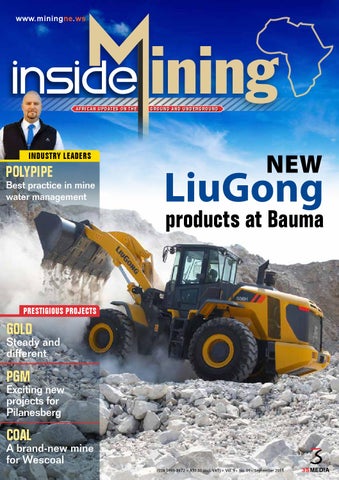
NEW
LiuGong
products at Bauma
PRESTIGIOUS PROJECTS
GOLD
Steady and different
PGM
Exciting new projects for Pilanesberg
COAL
A brand-new mine for Wescoal ISSN 1999-8872 • R50.00 (incl. VAT) • Vol. 9 • No. 09 • September 2015
CONTENTS ENDORSED BY
AF R IC AN U PDATES ON TH E
September 2015
GROU ND AND U NDERG ROU ND
ON THE COVER
www.miningne.ws ws
AFRIC AN UPDATES ON THE
INDUSTRY LEADERS
POLYPIPE
Best practice in mine water management
GROUND AND UNDERGROUND
NEW
LiuGong
products at Bauma
P4
LiuGong South Africa will be showcasing no less than 17 of its robust machines at this year's Bauma.
PRESTIGEOUS PROJECTS
GOLD
Steady and different
PGM
Exciting new projects for Pilanesberg
COAL
A brand-new mine for Wescoal ISSN 1999-8872 • R50.00 (incl. VAT) • Vol. 9 • No. 08 • September 2015
12
EDITOR’S COMMENT
3
An eventful month
COVER STORY
4
New LiuGong products at Bauma
AFRICA ROUND-UP
7
News from around the continent
ECONOMICS, FINANCE & RISK
8
The harsh reality of employment in the mining industry
PRESTIGIOUS PROJECTS
18
10 12 14
Gold: Steady and different PGM: Exciting new projects for Pilanesberg Coal: A brand-new mine for Wescoal
INDUSTRY LEADERS | PIPES
18
Best practice in mine water management
MINING MACHINERY
22 25
New-generation power Maintenance is key
IT & SOFTWARE
27 31
Wits PhD pins down mine planning software usage
OPEN-PIT MINING
31
The art of convenience
BLASTING, DRILLING & EXPLORATION
36 38
Electronic vs non-electric detonators Rock cutting as a future solution
EVENTS
36
41 43 44
Bauma: bigger and better 'Come Home to Bell' at Bauma Conexpo Africa 2015 Changing the old industry narrative
IN SID E M IN IN G 0 9 | 2015
1
VERMEER ADDS A MEASURE OF PRECISION
TO SURFACE MINING.
THIS IS WHERE THE NAME ON THE MACHINE MATTERS MOST. Whether you’re facing Equipment Suppliers (Pty) Ltd. Southern Africa
VERMEER.CO.ZA | +27 (0)11 608 0893
the hassles of blasting or hammering, Vermeer and our global dealer network will be right beside you. We know the conditions you face are demanding — that’s why we make sure our equipment is up to the task. The Vermeer Terrain Leveler® surface excavation machine helps you get more value from the mine, while reducing the need for costly support equipment. So when it’s tough going out there, look to Vermeer — the trusted name for proven equipment and reliable support.
PROTON PARK, PROTON STREET (OFF OSSEWA ST), CHLOORKOP EXT.65 GAUTENG, SOUTH AFRICA
Vermeer, the Vermeer logo and Equipped to Do More. are trademarks of Vermeer Manufacturing Company in the U.S. and/or other countries. © 2014 Vermeer Corporation and Equipment Suppliers (Pty) Ltd. Southern Africa. All Rights Reserved.
EDITOR'S COMMENT PAGE STRAP Publisher Elizabeth Shorten Associate publisher Nicholas McDiarmid Editor Mientjie Kleinhans Journalist Mpinane Senkhane Head of design Beren Bauermeister Designer Ramon Chinian Chief sub-editor Tristan Snijders Sub-editor Morgan Carter Contributors Andries Louw, Tony Stone Client services & production manager Antois-Leigh Botma Production coordinator Jacqueline Modise Marketing & digital manager Philip Rosenberg Financial manager Andrew Lobban Administration Tonya Hebenton
An eventful
month
Distribution manager Nomsa Masina Distribution coordinator Asha Pursotham Printers United Litho Johannesburg Tel: +27 (0)11 402 0571 ___________________________________ Advertising Sales
Ereka Boettger Tel: +27 (0)11 233 2600 Cell: +27 (0)82 808 4041 insideminingsales@3smedia.co.za ___________________________________
No. 9 3rd Avenue, Rivonia 2191 PO Box 92026, Norwood 2117 Tel: +27 (0)11 233 2600 Fax: +27 (0)11 234 7274/5 www.3smedia.co.za ___________________________________ Annual subscription:
South Africa: R550.00 (incl VAT & postage) African countries: US$80 Foreign: US$100 Email: subs@3smedia.co.za ISSN 1999-8872 Inside Mining Copyright 2015. All rights reserved. ___________________________________ All material in Inside Mining is copyright protected and may not be reproduced either in whole or in part without the prior written permission of the publisher. The views of contributors do not necessarily reflect those of the publishers.
To our avid readers, be sure to sign up and get the latest updates and inside scoops from the mining industry. Check out what we are talking about on our website, Facebook page or follow us on Twitter and have your say.
@mining_news www.facebook.com/ pages/Mining-News
September is an eventful month in the mining industry. Not only is Spring in the air, but people are also emerging from all over to experience the latest and greatest technology and happenings in the industry at the various events.
T
HE MONTH WILL kick off with Electra Mining in Botswana, from 1 to 3 September. This event promises to showcase the latest technology in a growing industry, which recently added coal and uranium as two of the Botswana’s newest revenue generators. Speakers at the event will include Kabo Molimi, client relationship manager at Rand Merchant Bank Botswana – who will be discussing how to raise finance for mining projects in Botswana; and the chief minerals officer at the Botswana Ministry of Minerals, Energy and Water Resources, Harold Melaetsa – who will be sharing his outlook for the Botswana minerals market. At the same time, the mining industry can also attend African Construction/Totally Concrete East Africa, from 1 to 3 September in Lagos, Nigeria. In South Africa, the mining industry welcomes Bauma Conexpo Africa 2015, taking place from 15 to 18 September. Some prominent industry players will exhibit at the show. The organisers of the expo estimate that about 14 700 visitors from 101 countries attended the Bauma Conexpo Africa in 2013. The organisers of Bauma Conexpo Africa are so positive about the expo that they are planning a similar event in Germany next year, taking place from 11 to 17 April in Munich. Another event that will be taking place in September is the 3rd Annual Mine Security and Safety Africa Conference, from 29 to 30 September, at the Indaba Hotel Fourways.
Read more about these and other events in this issue and on our digital publication, Miningne. ws, by following this link: http://www.miningne.ws/category/events/ And, in other news, Inside Mining had the privilege to visit Elandspruit – Wescoal’s brand new mine. During a time of uncertainty in the mining industry, it is refreshing to see new mines opening up and other mines planning major new projects, such as Pilanesberg Platinum Mine. This mine partnered with the Bakgatla-Ba-Kgafela Tribal Authority to develop the surrounding community with several projects. Furthermore, the mine will also be implementing new technology soon. Read more about Pilanesberg Platinum Mine on page 12, and the Elandspruit Mine on page 14. Whether it is during a time of loadshedding or purely because of location, when a company needs power to operate the business, it may be time to look at some generators. Inside Mining spoke to a few suppliers to find out what is available in terms of generators. See page 22 for more details.
Mientjie Kleinhans
FOLLOW THE LINK http://www.miningne.ws/category/events/ and http://www.miningne.ws/category/news/
IN SID E M IN IN G 0 9 | 2015
3
COVER STORY
LiuGong's Bauma showcase
L
IUGONG HAS BEEN making inroads into the South African market since 2008, having settled into its own premises in Pomona, Kempton Park, where it holds an array of machines in stock and parts holding in the region of $3 million in South Africa alone – ensuring that parts availability and turnaround are fast and efficient. LiuGong’s Bauma showing of its heavy-duty, durable equipment will cover the full spectrum of the company's equipment, including the launch of two new machines into the market – namely the CLG856H and CLG890H wheel loaders.
The new 856H wheel loader The new 856H wheel loader has been tailored for the European and African markets, combining half a century of LiuGong technology and innovation with full EU Stage IV regulation compliance. The 856H wheel loader marks the start of a new era at LiuGong and introduces a new level of productivity and serviceability for customers. The CLG856H is equipped with a Cummins 6LTAA9.3 engine in compliance with EU Stage II for African Standards. As the successor of the 856, the H Series’ new engine comes with a slightly more powerful 217 hp, with a higher torque and increased breakout force, yet lower noise levels. These are the main improvements that led to a stronger
4
INS I DE MI N I N G 0 9 | 2 0 1 5
Committing to its overall strategy of building the brand into a leading South African supplier of construction machine with equipment, LiuGong South Africa reduced fuel will be showcasing no less than consumption and cycle time. 17 of its robust machines at this The new revolutionary chassis year's Bauma, on a spacious and body design, integrated with an 1 070 m² outdoor upgraded cooling sysexhibition stand. tem, provides an advanced heat management system. LiuGong's H models are of the best technologies in Africa, providing state-of-the-art performance in the continent's unforgiving conditions. While being even more environmentally friendly than previous models, the new H models provide better and more continuous performance, through an efficient cooling system that helps prevent overheating problems. Mature variable-geometry turbocharger technology provides superior torque and the high-pressure common rail fuel injection system improves injection pressure and optimises fuel consumption. With this powerful engine, the 856H can work in the most extreme of conditions. Further adding to the medley of leading-edge technologies, modern ZF technology is applied in the driveline system, with the 856H featuring a ZF AP3000 dry axle of exceptional carrying capacity (the 856H has a wet axle option). The
axle housing and main transmission system are reinforced to improve strength and anti-load capacity, with carrying capacity being increased by 40% from the previous model. The H models have a long service life, with the average life cycle increased by 250% over previous models. The ZF 4WG200 transmission works efficiently with the machine to achieve optimal power output and an automatic shift transmission – with kickdown function and electric proportional FNR lever – makes operating more convenient, reducing operator fatigue. Along with the world-class parts, the 856H maximises user productivity. “To be a serious player in the global market, LiuGong has to ensure it manufactures high-quality products. LiuGong starts the design process with the customer, noting
In each issue, Inside Mining offers advertisers the opportunity to promote their company’s products and services to the appropriate audience by booking the prime position of the front cover which includes a two-page feature article. The magazine offers advertisers an ideal platform to ensure the maximum exposure of their brand. Please call +27(0)11 233 2600 to secure your booking.
DRILLING COVER & BLASTING STORY The hydraulic driving fan motor can be reversed for cleaning, and the water and oil drains are placed together to realise easier and faster maintenance and service. “At LiuGong, it isn’t just about developing the latest technologies. It’s about developing the latest technologies that work – consistently, reliably, day in and out, at the toughest, most extreme jobsites in the construction machinery industry,” adds Beatenbough. “The 856H is one of the best demonstrations of LiuGong’s hard efforts. We are on the right track; we are doing the right thing and we will never stop.” Visitors will have the opportunity to see one of the CLG856H wheel loaders in action, as it shows off its superior class in the demonstration area at Bauma. The balance of LiuGong’s product range on display at Bauma – built for rugged terrain, extreme climates, and remote locations – includes three excavator models, three wheel loaders, a roller and a motor grader, forklifts, skidsteers, and the 906D mini excavator, which has all the traits of its bigger brother – boasting superior power, durability, and fuel efficiency. The 906D is strengthened with a Yanmar 4NTV94L engine and produces 52.3 hp gross power. The cabin offers all-round visibility with ergonomic operating space. Just like middle- and The LiuGong 950E excavator at heavy-size excavators, the work in a mine near Brits 906D has an electronic control panel to ensure work
performance demands for the product and any improvements that may be required. We listen and then make the appropriate product design improvements,” says David Beatenbough, vice-president of LiuGong. “This is how the 856H wheel loader was created.” The 856H’s new cab design allows for improved visibility of the work tool and improves all-round visibility for safety. Frequently used controls are placed within easy reach of the operator and curved glass in the cab decreases sound levels; the constant-temperature function automatically adjusts the cab temperature. The cab features ROPS (rollover protective structure) and FOPS (falling object protective structures) in compliance with ISO3471 and ISO3449 safety standards, which ensure operator safety is kept at a maximum. Like other LiuGong machines, maintenance of the 856H is simple and convenient. It adopts a ground maintenance idea, which means that users can accomplish the replacement and checks of various filters and fuels by standing on the ground, without climbing up and down. The forward-tilting engine hood, which is equipped with an electric lifting device, allows for groundlevel access to service points to increase the accessibility to components, thus reducing daily and scheduled service times while increasing the machine’s availability to work.
OPPOSITE PAGE LiuGong skid steer loaders are built for efficiency ABOVE The LiuGong CLG2070H forklift has a strong carrying capacity, with 592 mm fork overhang
efficiency under all operating conditions. It’s compact structure and unique design enable the easy maintenance and application of attachments, such as a variety of different buckets and hydraulic breakers.
Nationwide distributors servicing the market LiuGong has stepped up its Marketing and Sales divisions by building a favourable reputation with nationwide distributors Burgers Machinery and CES Forklift. Burgers has head offices in Johannesburg and branches in Middelburg, Durban, Upington, and the Western Cape. CES Forklift's head office is in Cape Town, with branches in the Eastern Cape, Durban, Johannesburg and George. LiuGong machines are easy to own, operate, and maintain. Built in a world-class facility, in Liuzhou, China, the company employs over 1 000 research and development engineers to guarantee the versatility, durability, efficiency, and productivity of every machine. Rigorous testing ensures that, when a machine leaves the factory, it is able to tackle any job thrown at it. “Servicing is a very important aspect of equipment maintenance. A wellmaintained piece of construction equipment means less downtime, higher productivity, and lower costs for our customers,” explains Kivanc Eren, sales director, LiuGong South Africa. LiuGong’s reliability and professionalism ensure value for money, durability, and an excellent backup service for the company's equipment.
www.liugong.com
IN SID E M IN IN G 0 9 | 2015
5
AFRICA ROUND-UP
MINING NEWS
from around the continent
BOTSWANA Cupric to spend $200 million building copper mine Cupric Canyon Capital, a private equity firm backed by a unit of Barclays Plc, will spend $200 million to bring its copper-silver mine in Botswana to production, the company said. Construction of the mine, which will be built by Cupric’s Botswana unit, Khoemacau, is set to start in 2016, with the first copper expected to be shipped to market in 2018. Cupric acquires undeveloped copper assets with the aim of developing them and then exiting via sales or a public listing.
Cupric CEO: Africa Sam Rasmussen
Cupric’s CEO: Africa, Sam Rasmussen, told reporters the mine would produce 50 000 tonnes of copper and 1.8 million ounces of silver per year. “The cost of the mine would have been much higher had it not been for the processing plant we have acquired,” he said. Khoemacau recently concluded a deal to buy the mothballed Boseto mine, which is 30 km away from its new mine site. Khoemacau country manager Johannes Tsimako said the company is in negotiations with the government to connect the north-western copper region to the electricity national grid. Sparsely populated Botswana is the world’s top diamond producer and the government is keen to diversify the economy to reduce its dependence on gem production and sales.
DEMOCRATIC REPUBLIC OF THE CONGO State miner sells permit to Chinese investors DRC state miner Gecamines said it has sold an exploitation permit for a copper and cobalt concession in south-east Katanga province to Chinese investors, for $52 million. In a statement on its website, Gecamines said that it sold the roughly 13 km2 concession to Congo Dongfang International Mining, a subsidiary of Chinese company Zhejiang Huayou Cobalt Co. The concession contains reserves of 354 619 tonnes of copper and 62 903 tonnes of cobalt, Gecamines said, and was controlled by its former subsidiary, Compagnie Miniere du Sud Katanga (CMSK SAS), which Gecamines has since absorbed. Gecamines and another state-owned company, Simco, acquired full ownership of CMSK SAS, in 2012, by purchasing a 60% stake from Belgian investor George Forrest’s Entreprise Generale Malta Forrest (EGMF), for $58 million. The statement gave the main reason for the sale as the significant distance between the concession and the concentrator it uses to process the extracted minerals, which Gecamines said imposed substantial transport costs. Gecamines added that it had gained capital with the sale, as it retains control of a concentrator and several other exploitation and research permits previously held by CMSK SAS. Last month, the International Monetary Fund said that Gecamines’ failure to publish the terms of a sale of state shares in a joint copper and cobalt mining venture to a Glencore unit breached
government regulations and an agreement with the World Bank.
KENYA Senate passes mining law Kenya’s mining ministry has said the country’s senate has passed a mining bill that will give the government a 10% stake in new projects, taking it a step closer to becoming law. The bill was approved by the national assembly last year and now needs to be signed by President Uhuru Kenyatta, which is usually a formality. Kenya exports titanium, fluorspar, and manganese, and has reserves of coal, niobium, and rare earths; mining, however, currently accounts for less than 1% of its economic output.
Jackson Sikamo, President of Zambian Chamber of Mines
Copperbelt Energy buys electricity from state power company Zesco, and supplies it to companies including Vedanta Resources, Glencore, and Vale.
Zimbabwean Finance Minister Patrick Chinamasa
ZIMBABWE Royalty levies on small gold mines to be cut
President Kenyatta of Kenya
ZAMBIA CEC to reduce power supply to mines Zambia’s Copperbelt Energy Corporation (CEC) will cut power supply to mines it services, by 30%, a senior industry official said last month. “Copperbelt Energy Corporation informed us that it will cut power supply to the copperbelt mines it supplies by 30%. Obviously, this will have a negative impact on production,” Zambia Chamber of Mines president Jackson Sikamo told Reuters.
Zimbabwe will reduce royalties levied on small-scale gold producers to 1% from 3%, from September, to boost output from the sector, Finance Minister Patrick Chinamasa said in late July. In a half-year budget presentation to parliament, Chinamasa said deliveries of gold from small-scale producers had increased to 3 117 kg between January and June, compared with 993 kg over the same period last year. “In order to consolidate the gains realised to date, and taking into account the international commodity prices, I propose to further review the royalty rate on small-scale gold producers,” he said. IN SID E M IN IN G 0 9 | 2015
7
ECONOMICS, FINANCE & RISK
The harsh reality Andries Louw, Coface commercial analyst
Mining in South Africa has been the main driving force behind the development of the national economy, turning the country into the strongest economy in Southern Africa. However, a bleaker picture faces the industry right now. BY ANDRIES LOUW
T
HROUGHOUT THE history of the country, large-scale mining provided a significant source of employment and sparked the development of various industries dependent on the mining industry. Unfortunately, a combination of factors contributes to the challenging environment that South African mining is facing today, painting a bleaker picture for South African growth and employment. Mining’s contribution to the GDP has changed considerably since the 1970s when it contributed approximately 20% to GDP – today, the mining industry is contributing far less. Even with its dwindling contribution, mining’s labour-intensive nature has made South Africa’s labour force highly dependent on the industry as a source of employment for masses of unskilled labourers.
8
INS I DE MI N I N G 0 9 | 2 0 1 5
of employment in the mining industry Gold prices Over the past few years, output figures from Statistics South Africa reveal a declining trend in monthly gold production. As a result of pending wage negotiations, a further drop in gold output is possible. Furthermore, mines are under pressure as a result of low gold prices and increasing production costs. This is concerning, as the prevailing trend could indicate gold losing the prominent role it once played in South Africa’s economy. Gold contributed 3.8% to GDP in 1993 and decreased to only 1.7% in 2013, and accounted for only 12.5% of total mineral sales in 2014.
Platinum prices Platinum prices have declined sharply over the past five years, dropping to levels that have not been seen since the 2008 financial crash. This has placed platinum producers under immense pressure. It is evident that the major mining companies are facing one of the worst crises in recent history. This, in combination with the mining strikes in 2012 at Marikana, and the most recent five-month strike in 2014, is crippling some of the world’s largest platinum producers. The 2014 work stoppage was one of the longest labour strikes, which affected some producers more than others due to the strikers’ demonstrations being conducted mainly in the Rustenburg area. This forced management to take swift action, and reduce costs, by retrenching workers as well as closing unprofitable shafts. Large platinum producers are set to drastically reduce their employee numbers and limit capital spending in an attempt to adjust to lower profit margins.
Restructure and consolidate Certain mining companies are planning to restructure and consolidate management operations in an attempt to focus on more
profitable operations, which will inevitably result in job losses. As a result of labour becoming a prominent risk factor in South African mining, the search for alternative ways to extract ore in the gold and platinum sectors has become a priority. After enduring these labour challenges, large platinum and gold mines have opted to move their companies towards predominantly mechanised operations, which include considerations to either sell their labour-intensive mining operations or list them separately. The mining industry, as a whole, has been underspending on technological research. The industry spends about 80% less, on a revenue-to-revenue basis, on technology and innovation compared to the petroleum industry. The aim, now, is to implement drilling rigs and roof bolters that can fit into narrow shafts and replace human rock drillers. At the turn of the century, the increasing demand for exhaust catalysts made the platinum industry thrive. Industry expectations in the early 2000s were expansionary, based on growth forecasts in the automotive industry. This is in sharp contrast to the current situation, with platinum prices declining, making the physical mining of ore and its associated production costs more expensive than originally expected. Platinum producers intended to expand production by up to 20% at the time. Raising capital for the planned expansion placed these companies in a difficult position when global demand turned during the 2008 credit crunch.
ECONOMICS, FINANCE & RISK
Further job losses can be expected from the iron ore industry, as there is an expectation of mines closing in the Limpopo region. Factors contributing include high operating costs, difficult mining conditions, and unprofitable shafts due to the mines’ relatively old age. Ceasing these operations will likely result in more than 1 000 workers losing employment. In the current economic climate, it is considered necessary to close inefficient operations to ensure the future of mining companies across the industry. Iron ore prices are expected to remain under pressure because Australian and Brazilian producers have increased their supply of iron ore and the corresponding demand from China has declined, as a result of China’s economy growing at the slowest pace in more than two decades. Falling coal prices have caused international companies to consider closing some of their operations in South Africa. In addition, forecasts can be seen to divest from
Gold price over the last five years
Unemployment reached 26% in the first quarter of 2015, which is the highest level in 11 years. This figure can be further investiThe employment Platinum prices gated to reveal a 50% conundrum unemployment rate in Due to the fact that have declined South Africa’s youth. South Africa is highPossible mechanily dependent on the sharply over the sation of the mining mining industry crepast five years, industry will make ating employment, governmental employit is in the country’s dropping to ment goals of creating best interest to prolevels that have six million new jobs by tect mining companies 2019 very challenging. and attract foreign not been seen A contributing factor to investment. The minsince the 2008 this predicament is the ing industry currently weak economic growth, employs in excess of financial crash which has been influ400 000 people directenced by power shortages, labour strikes, ly and an additional 400 000 employees inand high wage demands. The overall effect directly, through the supply of goods and of these factors leads to the realisation services to the mining industry. Mining that the high employment target that will need to play a vital role in the employSouth Africa is aiming to reach in 2019 is a ment figures in order for South Africa to challenging task. reach its employment goals. mining companies, indicating a drop in confidence in South African mining.
Platinum prices have seen a steady decline in recent years
A quarter-on-quarter representation of the unemployment rate over the last seven years
IN SID E M IN IN G 0 9 | 2015
9
PRESTIGIOUS PROJECTS | GOLD
Steady as she goes
Unique in its own right, Beatrix’s No. 3 Shaft straddles three reefs, each with its own challenges. Even so, and despite external influences, the mine continues to produce rock-solid results. BY TONY STONE
S
IBANYE’S BEATRIX MINING Operations, with four shafts, is unique in comparison to the other mining operations in its neighbourhood. Situated in the far south of the Free State Goldfields, the mine exploits the Beatrix Reef, the Aandenk Reef, the VS5 Reef, the Kalkoenkrans Reef, as well as composites of these reefs. The reefs have their origins in a laterally extensive braided fluvial deposit that developed on unconformities – gaps in the geologic record. The Aandenk Reef is at the base of the Kimberley formation and the VS5 and Beatrix Reef at the base of the Elsburg formation. Mining at Beatrix’s Mining Unit 1, accessed via No. 3 Shaft, is carried out literally at the point where the changeover between the Beatrix Reef and the Aandenk Reef occurs, and along the VS5 Reef further north. Stoping of the VS5 Reef, to the north of No. 3 Shaft, is in progress. Work on this reef – through stoping, underground development, and underground exploration drilling – is still in the early stages. As with all the other reef types, sub-facies have been mapped and are used in the mineral resource estimation process. The VS5 Reef is subdivided into three facies based on maturity and subsequent gold value distribution. Gold is mined
10 INS I DE MI N I N G 0 9 | 2 0 1 5
using the traditional ‘drill, blast, and clear’ mining method, down to level 26 – the lowest working level – which is approximately 1 350 m below surface. Ore is cleared and taken to dump points using, among others, small 10 t locomotives and bottom-discharge rock flow wagons.
Ventilation The 1 042 m3/s airflow circulating through the Mining Unit 1 complex is cooled via a 15 MW surface bulk air cooler, using chilled water from No. 1 Shaft’s refrigeration plant. Mining Unit 1 has defined ventilation districts, with large regional booster fans used to assist the main surface fans. This ensures optimal airflow distribution throughout the mine. No. 1 Shaft’s surface refrigeration plant consists of three Stal Astra
TOP Map of Sibanye’s Beatrix Mining Operations ABOVE Geological cross-cut model of Beatrix gold mine
ammonia machines installed in series. The plant has a design duty of 20.6 MW and circulates 425 ℓ/s of chilled water.
Methane management The mine’s methane management policy comprises the following: • T he detection of flammable gas using detection instruments is imperative. The mine standard requires a minimum of two flammable gas detection instruments per stope panel and at
PRESTIGIOUS PROJECTS | GOLD
COMMENT BY NEAL FRONEMAN, CEO, SIBANYE GOLD “The gold industry plays an important role in South Africa by: • making a significant contribution to the fiscus through tax and royalty payments • providing much-needed employment • supporting a significant supplier industry • contributing to the development and upliftment of communities • investing significant capital in the country. “The sustainability of the gold industry is, therefore, critical, if the government’s developmental goals and stakeholder needs are to be met. “Many gold mines are marginal, and inflated wage and benefits increases will significantly impact on the sustainability of the industry. While delivering short-term gains for employees and unions, it will inevitably result in the loss of jobs and destroy value for all stakeholders in the longer term. “The gold industry is cognisant of the social and economic issues affecting its employees, and the communities close to its operations. It will approach the current wage negotiations in a balanced manner, ensuring that any agreements are in the interests of all stakeholders, and do not compromise the long-term sustainability of the industry.” Photo by Cherese van der Mescht
Sibanye Gold CEO Neal Froneman
ABOVE Beatrix No. 3 Shaft
least one instrument per development end, when work takes place. Both the Mining Unit 1 and 2 sections have a telemetry system, to which strategically placed flammable gas sensors, velocity sensors, critical fans, as well as carbon monoxide sensors are connected. These conditions are monitored on a 24-hour basis in the main control room situated at Mining Unit 1. Callout procedures are in place in the event of emergencies. • W here 0.5% or more flammable gas is continually present in the general atmosphere, the mine declares hazardous locations based on the results of risk assessments. Hazardous locations require special operating conditions such as explosion-protected apparatus, telemetry monitoring, strict adherence to mine standards, and, most importantly, awareness training for all employees. Hazardous location meetings are held on a monthly basis, involving all stakeholders, to ensure all requirements, in terms of hazardous locations, are coordinated. • To ensure proper supervision at all working places, the mine has instituted a workplace management system. The documentation is kept in
the mine overseers’ offices and contains all special instructions, hazard identification, risk assessments, DMR recommendations, flammable gas register, and handover notes. The workplace management system is used to transfer the required knowledge and awareness in the area of responsibility to any new person, or to an individual acting in a specific section, as part of their induction.
An underground substation
quartzites, which occurs occasionally in Mining Unit 3. Crush pillars are utilised, which accounts for a ~5% loss of reserve.
Hydrology The Beatrix Mining Operations is a water-positive mine and is required to pump excess water from underground to ensure its mining activities are carried out safely. The water pumped is naturally saline, which is a key characteristic of the region,
An underground substation
TABLE 1 Mining Unit 1 (No. 3 Shaft) historical mining statistics
Component
Unit
Five-year average per month
On-reef development
(m)
351
Off-reef development
(m)
879
Volume mined
(m2)
20 636
Mill tonnes
(kt)
118
Yield – Au
(kg)
400
Geotechnical analysis In general, ground conditions at the Beatrix Mining Operations are fairly stable. There is occasional seismic activity, but very little in rock burst damage. Generally speaking, the greatest risk, from a geotechnical perspective, is the presence of smectite clay in the argillaceous footwall
and is disposed into a series of evaporation dams on the surface. These evaporation dams have adequate capacity to manage the volume of water that is pumped to surface and are monitored on a regular basis. Water discharged in this way conforms to the requirements of the mine’s water permits. IN SID E M IN IN G 0 9 | 2015 11
PRESTIGIOUS PROJECTS | PGM
New projects
in the pipeline A PART FROM TESTING new technology at the mine, PPM will soon start with the preparations of the new Wilgespruit open-pit mine, open up underground reserves, start a tailings retreatment plant, and investigate the possibility of using Doppelmayr rope conveyors. If that is not enough, PPM also has a few community projects lined up, including a water project, sewage pipeline, road upgrades, and housing development projects.
for about 40 years. The sorters are based on the X-ray fluorescence concept that analyses and sorts mineral particles in real time. The sorter simultaneously measures the concentration of up to five metals in the surface of each particle. “We will test four sorter units to see if the technology is cost-effective, and if it delivers on the promise of waste reduction before the ore reaches the mills,” says Casper Badenhorst, chief operating officer at Pilanesberg Platinum Mine.
Ore sorting technology
New conveyor system
Although the Rados ore sorter is new in South Africa, it has been in use in Russia
Another new technology the mine is considering is the Doppelmayr Ropecon system. This materials handling system
New mining and community projects, including the testing of new technology, are on the cards for the Pilanesberg Platinum Mine (PPM). MIENTJIE KLEINHANS looks at how this mine has managed to steadily increase its production over the past six years.
12 INS I DE MI N I N G 0 9 | 2 0 1 5
combines the traditional conveyor and ropeway technologies – creating a system that runs over long distances and over obstacles, with a minor structural footprint. “It will be a step closer to mechanisation if we use this system. The benefits include lower maintenance, reduced energy, and savings in diesel,” says Badenhorst.
Production PPM produces an average of 5.3 tonnes of platinum group elements (PGEs) a year and is now mining at 95% steady state. Although the mine is located in the Bushveld Complex, PPM mines the 1.8 m Upper Group 2 Chromitite (UG2 package) and the 6 m silicate package consisting of the Upper Pseudo, Hartzburgite, and the Lower Pseudo. “It is not worth our while
PRESTIGIOUS PROJECTS | PGM
the seven-year partnership between PPM to mine the Merensky Reef, as this reef 2016. “This pit should have been in operand BBKTA, the partners have identified is only about 10 cm where we mine,” exation two years ago but, due to the reloa number of large-scale initiatives for plains Badenhorst. cation of people and cattle, the original the area. One of the biggest challenges that PPM plans have changed somewhat,” explains These include a water project in Pilaneshas encountered is the geological strucBadenhorst. The mining company has berg West, a housing development project been negotiating with the farmers to ture in the open-pit mine at Tuschenin Lekutung, a sewer pipeline project to relocate their cattle to alternative grazkomst. Badenhorst explains that open connect PPM and the pit mining operations Sedibelo Corridor villagare complicated due to “We benefit from underground reserves es to the Moruleng wathe reef being displaced ter treatment plant, and by faulting. less than 700 m deep – therefore, our a road infrastructure mining costs are generally lower than project focusing on the Underground reserves Legkraal-Motlhabe road. In some areas, the comthose of our competitors.” “We are reaffirming pany will have to mine this partnership with a underground to get to focus on providing the best possible valing between 5 km and 10 km away. More the reserves. “We benefit from underue to the people of the area. Instead of than half of the cattle herders have been ground reserves less than 700 m deep – initiating separate projects, we will merge relocated without issues. Badenhorst says therefore, our mining costs are generally our resources to provide an integrated that it is not so much infrastructure that lower than those of our competitors. For approach to the development of the rehas to be moved, but rather the cattle to instance, we won’t have to install cooling gion. This should result in significant innew grazing grounds. systems,” says Badenhorst. Three underfrastructure projects that will benefit all ground shafts are on the cards – one in members of the BBK communities,” says the Eastern Limb and two in the Western Community projects Erick Clarke, acting CEO and CFO of Sedilimb of the Bushveld Complex. PPM has already spent about R50 million belo Platinum Mines Limited, the holding on community projects, which include hycompany of PPM. droponic gardens, crushing and brickmakNew pit The estimated life of mine for open-pit ing projects, training, and skills developThe new East Pit on Wilgespruit will most mining is in excess of 15 years, and the ment. This has all been done in collaboraprobably be in operation by the end of underground mines will add to the life of tion with the Bakgatla-Ba-Kgafela Tribal mine. Management of PPM realises the Authority (BBKTA). And, to strengthen potential and benefits of developing, educating, and involving the community. On OPPOSITE PAGE The Pilanesberg the other hand, the community of BBK Platinum Mine concentrator also realises the value of PPM and the role BELOW Loading of waste in process it has to play in skills development, job BELOW RIGHT Thickeners at creation, and community upliftment. the concentrator
IN SID E M IN IN G 0 9 | 2015 13
PRESTIGIOUS PROJECTS | COAL
A brand-new mine for Wescoal D
URING A TIME OF much uncertainty and low commodity prices, it is refreshing to see the start of a new greenfield project in a resource-rich part of the country. Even though it is a junior mine, this means that a company has enough confidence to commit to the industry’s economy.
coal per month, equivalent to about 4 million tonnes of ROM on an annual basis, with processing taking place at the Muhanga plant. “We have now successfully operated our processing plant with feed from Elandspruit and the results are very much in line with expectations. We have also started selling Elandspruit coal into the domestic and export markets,” adds Sulaiman.
Commodity outlook
Quality coal
Wescoal Holdings’ acting CEO, Waheed Sulaiman, explains that although the outlook for commodities remains constrained, Wescoal, and in particular Elandspruit, is not too exposed on the export market, which is on the front line of this difficult situation. “Nevertheless, we are taking a very pragmatic approach in the short term, with a view to our medium- to long-term sustainability,” he says. Mining activities at Elandspruit commenced on 4 June 2015, with the promise of 335 000 tonnes of run of mine (ROM)
Dutch Botes, Wescoal Mining CEO, explains that the Elandspruit mine has four economical seams and that they are currently mining from seams 2 Lower and 2 Upper, with the majority of coal mined from 2 and 1 Lower. They will mainly utilise 2 Upper seam for Eskom supplies. “The mine has been doing well so far. We started mining in a very short period of time. The seams are thick and of good quality. Should one add the coal seams together, there will be 12 to 13 metres of coal – and that is very rare,” boasts Botes.
Elandspruit is located 10 km from Middelburg, Mpumalanga
14 INS I DE MI N I N G 0 9 | 2 0 1 5
Expected life of mine: 12 to 14 years
Reserves of over 34 million tonnes
The Elandspruit mine is Wescoal’s latest undertaking and boasts coal reserves of over 34 million tonnes, with a life of mine expectancy of between 12 and
14 years. MIENTJIE KLEINHANS visited
the greenfield project to find out what the operating plans are.
Operations started 4 June 2015
PRESTIGIOUS PROJECTS | COAL
He adds that the focus on Elandspruit was to get quick returns. “Within six weeks of opening the box, the mine encountered coal, which is quite fortunate. When we opened up the seam, we encountered exactly what we anticipated – good-quality coal.” Eskom will be Elandspruit’s prime target market and the mine will also use some of the reserves for their quatro allocation. As a result, quality management is done on a daily basis. The team will pre-qualify the coal, ensuring that the coal is not misplaced and that it is suitable for the target market. “We need to ensure that we maximise the yielding of the coal,” explains Howard Galloway, Blue Print Solutions, a consultant to Elandspruit mine.
Mine management The mine is located in close proximity to Middelburg, Mpumalanga, and within the region of some of South Africa’s best coal reserves, surrounded by various coal mines. “The land on which the mine is now located was originally Xstrata’s property. We, in turn, had another mine adjacent to Xstrata’s mines and it made sense to exchange the two properties in a financially viable manner,” says Botes. A mining contractor takes care of most of the mining operations at Elandspruit, from the drilling, blasting, and excavating to stockpiling into various product piles. To do that, the mining company
makes use of eight 100 tonne rigid trucks, sixteen 40 tonne articulated trucks, and numerous excavators, graders, dozers, and water trucks. The products are transported, by road, to the Muhanga processing plant, which makes use of a roller crusher in the primary crushing stage.
Transporting coal out of the open-pit mine to the stockpiles
Particulars A part of Elandspruit will be an underground mine; operations should start early next year, depending on when the outstanding applications are approved. While the deepest point in the open-pit mine will be an average of 28 m, the underground mine’s deepest point will be about 45 m. As with the other Wescoal mines, this mine’s rehabilitation programme was compiled during the preplanning of the mine and will be using a rollover rehabilitation programme. OPPOSITE PAGE A coal stockpile at the processing plant BELOW Working up a frenzy in the open-pit mine BOTTOM The conveyor belt from the primary crusher in the processing plant
FROM LEFT TO RIGHT Howard Galloway, Blue Print Solutions; Dutch Botes, Wescoal Mining CEO; and Baat Leonard, Elandspruit mine manager
IN SID E M IN IN G 0 9 | 2015 15
Join the community
STAY INFORMED Hourly Follow the news or join the conversation: find and follow us on Facebook and Twitter.
Daily Visit the website for your daily mining news: fresh stories are posted daily. You are in good company as this site receives more than 31 000 page views per month.
Weekly Subscribe to the FREE weekly newsletter and enjoy news from the convenience of your own inbox.
Monthly Subscribe to the print or digital magazines for in-depth articles and expert analysis from industry experts and thought leaders.
CRITICAL INFORMATION on mining and exploration projects in Africa and beyond, focusing on the entire mining value chain.
STAY CURRENT with in-depth coverage of the most important mining and exploration projects in Africa.
COMPREHENSIVE COVERAGE on technologies and developments in mining and processing equipment.
CONNECT NOW www.miningne.ws Mining News
Mining_News
Editorial Meintjie Kleinhans insideminingeditor@3smedia.co.za Advertising Johann Liebenberg +27 (0)11 233 2600 johann@3smedia.co.za Subscriptions Trust Makina trust@3smedia.co.za
PIPES
Polypipe
Water management solutions
INDUSTRY LEADERS | PIPES
Bart Malan, Polypipe Mining Business Development Manager
Plastic piping systems manufacturer Polypipe, with its international track record in delivering efficient and effective water management solutions to high-profile projects, is unrivalled. Bart Malan, Polypipe’s Mining Business Development Manager, showcases the company’s expertise in overcoming the challenges of African mining, and the prestigious projects with which it has recently been involved.
18 INS I DE MI N I N G 0 9 | 2 0 1 5
Best practice in mine water management W ATER CONSERVATION, and the responsible use of this precious resource, is of growing importance to mine operators worldwide. The demand for sustainability, to meet government targets and secure approval for new mining projects, is driving innovation in energy and water management and, in the often arid climates of the African continent in particular, water usage, treatment, and reuse essential for continued growth and prosperity. Mining is the second largest industrial user of water in the world, with only power generation being responsible for higher water consumption. Globally, around 7 billion m3 to 9 billion m3 of water are used for mining purposes each year, which is as much as a country such as Nigeria uses in total in a year – according to Mining Magazine.
Minimal water resources In Africa, in particular, the responsible use and conservation of water used in mining
operations is vital to sustainability. According to a 2011 De Beers report, arid lands cover around 60% of African land, which, although it is home to around 15% of the world’s population, has only 9% of global renewable water resources. Putting the spotlight on South Africa, Mava Scott from the Department of Water Affairs says that 2.5% of national water supplies is used to sustain mining activities in the country. This may not seem like a lot, but the 2004 National Water Resource Strategy puts this in perspective by contrasting South Africa’s annual average rainfall of 450 mm with the world average of 860 mm. Recent evidence, from MSCI ESG Research, points to a 61% increase in mining projects in South Africa from 2005 to 2013, placing additional pressure on an already stretched resource. The same study also looked at common mine locations, finding there is often an overlap between mineral deposits and fertile agricultural land – for example, platinum group metals are most concentrated in the Limpopo basin, in
INDUSTRY LEADERS | PIPES
OPPOSITE PAGE Ridgidrain installation, Marampa mine LEFT Water management at Namoya mine site BELOW Ridgidrain installation, Sierra Leone
close proximity to cattle and crop lands – creating greater demand for South Africa’s most stressed and economically important groundwater source.
Managing water Mismanaging mine water can interrupt production, as many extraction and washing processes depend upon clean water, as well as disrupting the transportation of minerals, which is often run to a tight schedule. A lack of fresh water for cooking, drink-
downtime. Only with the right pipework infrastructure in place to transport, store, supply, and drain water, can this resource be properly managed on a mine site to reduce water stress, maintain high water quality, and prevent flooding or damage to the environment.
Bespoke solutions It is Polypipe’s track record in designing bespoke water management systems for largeand small-scale projects, as well as its technical expertise, which has led the organisation to be selected as both a design partner and product supplier to prestigious projects. Polypipe’s UKAS accredited test laboratories can be configured to replicate both typical and extreme conditions for any climate worldwide, assessing the performance of Polypipe products under varying temperatures and providing vital data for its in-house product designers, construction partners, and mine operators alike. One such example of a prestigious mining project with which Polypipe has been associated is the Marampa brownfield haematite iron ore mine in Lunsar, Sierra Leone. There, Polypipe’s Ridgidrain high-density polyethylene (HDPE) twinwall drainage system was installed as part of an infrastructure project
to drain and stabilise an existing tailings dam ready for the next phase of work. The 150 mm diameter Ridgidrain pipes and associated fittings were shipped from the UK, with the ability to meet an extremely tight logistics schedule being a key part of the supply arrangement. The Ridgidrain solution was supplied for the management of water decanting from the tailings into a pipeline that will drain the water within the tailings dam wall to a local water treatment area. HDPE is fast becoming the material of choice in many mining applications, being ideally suited to rugged terrain, extreme climates, and changing site environments. Ridgidrain, which offers a complete solution for non-pressurised surface and subsurface drainage applications, is lightweight and offers exceptional compression strength with easy push-fit installation. It delivers time and cost savings over traditional systems and requires no heavy lifting equipment on-site. Normally manufactured in 6 m lengths, the consignment for Marampa was made to 5.8 m lengths, to allow for the internal dimensions of the shipping containers, maximising their capacity.
Mining is the second largest industrial user of water in the world, with only power generation being responsible for higher water consumption
ing, laundry and washing will also result in negative impacts for mine workers on-site, while water mismanagement can also lead to environmental damage through unintentional contamination. Where water is wasted and mismanaged, more water than is truly necessary is pumped on to the site, all at considerable cost – meaning properly managed water use can save money as well as optimise production and reduce
Tonkolili mine
On a project that is destined to have a multigenerational lifespan in excess of 60 years, sustainability was an important factor in the choice of materials used to underpin its infrastructure. This project was the surface drainage of the rail marshalling yard at the Tonkolili iron ore mine, also in Sierra Leone. Here, mine operator African Minerals Ltd opted for the Ridgidrain system – installing more than 4 000 m of the 300 mm diameter perforated twinwall pipe. Tonkolili is one of the largest iron ore resources in the world and – through African Minerals, which is the largest employer in the country – contributes substantial IN SID E M IN IN G 0 9 | 2015 19
INDUSTRY LEADERS | PIPES
economic benefits to Sierra Leone. At least 80% of the workforce is drawn from local communities, and the operator is also dedicated to respecting the environment and delivering safe and healthy workplaces – part of which it achieves through responsible procurement processes. RAIL INFRASTRUCTURE To support the iron ore project, African Minerals developed significant port and rail infrastructure, which is fully integrated into the mining operations. • Part of the railway, which provides the link between the mine and the port facility at Pepel, 200 km away, was originally built in the 1930s. • This 74 km section was completely replaced. • It was extended by a further 125 km of new rail to complete the link.
Best quality products Specifying HDPE as a sustainable solution for the surface drainage at the new marshalling yard, African Minerals selected PolypThe conveyor belt from ipe through a competitive tender process. the jaw crusher in the Part of the tenderstage required supply partners primary crushing to demonstrate compliance with internationally-recognised performance standards so, as all Polypipe products meet the relevant UK and European standards (which
20 INS I DE MI N I N G 0 9 | 2 0 1 5
are among the world’s most stringent), validation was guaranteed. The Polypipe Ridgidrain is suitable for use in civil engineering and infrastructure projects, including highway, rail, and airport infrastructure, and features a proven structured wall construction with a reduced virgin plastic content. It was the first product in the UK to achieve the Highways Authority Product Approved Scheme (HAPAS) certification, and is BBA (British Board of Agrément) certified as suitable for surface water drainage in commercial and industrial applications. The Marampa and Tonkolili projects aptly demonstrate why Polypipe’s products are surging in popularity among mine operators. Suitable for a wide variety of water-using applications around a mine site, from subsurface draining and tailings management to transport management and extraction and processing applications, Polypipe’s HDPE and polyethylene (PE) product portfolio has a proven track record in some of the world’s toughest mining environments. And, as they are much lighter than traditional pipe materials such as concrete or ductile iron, they are also far cheaper and easier to transport and install.
Ridgidrain Ridgidrain benefits from a structured wall design, which provides high ring stiffness and strength while maintaining a lighter weight than traditional pipe materials,
OPPOSITE PAGE Rigidrain pipe BELOW Open-pit mine
enabling it to withstand the ground movement and differential settlement typical of transport infrastructure and working mine sites, as well as providing excellent abrasion resistance both inside and out. The longer pipe lengths available reduce the number of joints required, significantly reducing the risk of leakage, while the extremely smooth bore resists blockage and makes the pipework system easier to maintain. It can also be supplied fully perforated to allow effective subsoil drainage. Ridgidrain is, however, just one of Polypipe’s products that are ideally suited to mining operations, with PE100 also bringing considerable benefits to the mining industry where a medium-pressure pipe is required. Able to handle up to 25 bar pressure, PE100 is also resistant to thermal shock and will stand up to the harshest of environmental conditions, operating between -40°C and 60°C – ideal for mines at high altitudes, where temperatures can drop well below freezing, and also for mines in hot, arid climates. It also offers the same resistance to chemical corrosion or rock and metal abrasion that has made Ridgidrain so popular with mine operators.
INDUSTRY LEADERS | PIPES
For above-ground applications, black PE100 systems have the additional benefit of being UV-stabilised and, therefore, do not need to be buried or covered, as they are inherently resistant to weathering. Additionally, PE is naturally non-conductive and is not at risk of electrolytic corrosion, subject to taking the correct precautions to avoid the build-up of static discharge – however, should there be a requirement, electrically conductive systems can be produced.
Environmental sustainability To address the critical issue of sustainability, which can not only influence the mining operations themselves but also the choice of materials for infrastructure work, both HDPE and PE offer excellent environmental credentials. Additionally, the interior surfaces of PE pipes resist bacterial growth, an attribute that is essential for the supply of drinking water to remote mines where no mains supply is available. Concrete and metal pipes, meanwhile, can be badly damaged by both bacterium sediment build-up and galvanic corrosion, to which PE is resistant. HPDE AND PE With ongoing technological innovation, HPDE and PE have become: • more robust than traditional materials • lighter – typically weigh 94% less than their concrete equivalents • more beneficial in terms of reduced transportation costs, manoeuvrability, ease of installation, and also the possibility of future reuse.
The target set by South Africa’s Mining Charter, to significantly improve mineworkers’ living conditions by April 2014, could not have been clearer and was taken very seriously by all within the mining industry, with penalties put in place for all who did not comply. Particularly in hot climates and territories where water is in short supply, the welfare of employees must be guaranteed with safe drinking water, effective removal of wastewater, and ventilation and heating, as required – however, mining companies and their contractors also need to consider the environmental impact of their operations. Polypipe’s British-made products are designed to meet today’s carbon and water challenges while providing solutions for the total water management process – covering capture, treatment, reuse, attenuation and soakaway, and drainage.
Finally, but no less important, the remote nature of many African mining projects poses significant challenges for operators. Most easily accessible sources of minerals around the world have already been explored and exhausted, meaning companies must seek out increasingly isolated deposits, which do not have existing transport and power infrastructure. The need to satisfy demand from emerging markets can often benefit nearby communities with jobs and development, but supplying the new site with the necessary utilities, while avoiding damage to the local environment, is a considerable hurdle to overcome.
Remote mines
above or beneath them, and will also need to withstand extremes of temperature and UV exposure. The interior surfaces of pipes must be resistant to corrosion from slurries or rock fragments within processing water, as well as the chemicals, salts, and acids used in extraction, while pipes used for potable water must resist bacterial growth. Ridgidrain and PE100 meet this exacting brief entirely, making them perfect for remote mining operations.
The Polypipe solution Polypipe’s water management solutions address many of the issues faced by mine operators – from transporting the pipes to remote sites easily and safely, to resisting degradation from the chemicals used in mineral extraction. This deep understanding of the challenges faced by the mining industry, coupled with Polypipe’s extensive experience in providing plastic piping systems for residential developments and civils and infrastructure projects, means its team is ideally placed to advise on the right solutions for both new and replacement water management and plastic piping systems. For further information on Polypipe’s solutions for the African mining industry, and to download a copy of its mining brochure, please visit www.polypipe.com/ mining or email bart.malan@polypipe.com or international@polypipe.com
Mismanaging mine water can interrupt production, as many extraction and washing processes depend upon clean water
Modern methods of sustainable power generation, including solar and wind energy, have made providing a remote mine site with electricity a more straightfor ward task, particularly in climates with little precipitation and long hours of daylight. However, while these conditions are ideal for solar power, they generally also lead to a shortage of water sources in the local area. Mining operations will, therefore, be competing with local communities and agriculture for a scarce resource; for this reason, mines often choose to pump in water from further afield to satisfy demand. Conversely, remote mines, located in areas of high rainfall, may need a complex water management infrastructure to prevent pit flooding and damaging tailings pond overflows. Transporting water across long distances puts many demands on the associated pipework, all of which are met by Polypipe’s product portfolio. They must have a tough exterior that will not be perforated by rocks or damaged by slight land shifts
www.polypipe.com
IN SID E M IN IN G 0 9 | 2015 21
MINING MACHINERY
New-generation power
When the lights go out, or in a remote location, far away from the national power grid, alternative power generation could be the solution to an immediate problem. Now, more than ever, power generators are available from leading manufacturers. BY MIENTJIE KLEINHANS
W
HETHER IT BE to keep the lights on while loadshedding takes place, or to generate power in a faraway, remote location, power generators are one of the most wanted items by companies across South Africa. Companies can either rent or purchase a generator set from a number of leading suppliers. The problem, in most cases, is not so much the cost, but having to choose which generator is best suited to a specific application. It seems that the best answer to that problem is to consult the professionals. Generators come with different specifications and the latest technology is not necessarily the best solution. It is almost impossible to compare all generators on the market, so only a few are highlighted in this article.
22 INS I DE MI N I N G 0 9 | 2 0 1 5
Cummins Power Generation Cummins Power Generation diesel generators offer up to 3.5 MW 60 Hz and 3.75 MVA 50 Hz power. These gensets are suited for harsh conditions, challenging environments, and where the demand for reliable, continuous remote power exists. The
manufacturers of the QSK95 Series generator sets claim fewer maintenance requirements, longer service intervals, and 25 000 hours to major overhaul.
Renttech CG350S-3
MINING MACHINERY
“With a smaller footprint, this series requires less space to install and, in multiple-genset applications, fewer generators are required to achieve the necessary power output,” claims Kobus Coetzer, Cummins Southern Africa Power Generation director.
Renttech Renttech offers a range of gas-fuelled and diesel-driven generators, which include a heavy-duty range covering 10 kVA to 30 kVA, in both single- and three-phase sound-attenuated models, with an extra heavy-duty ‘rental spec’ for extreme conditions. The heavy-duty ‘rental spec’ units can be double-stacked, painted to specifications,
Goscor Power Products Goscor Power Products offers an extensive range of petrol- and diesel-powered generators. “With loadshedding now an everyday reality, generators are no longer a luxury – they have become a necessity,” says Mark Bester, managing director of Goscor Power Products. “Our generators present end users with an affordable solution, by delivering a perfect balance
“There can be major cost implications if a unit is either too big or too small for the purpose.” Martiens Opperman, operations manager, Renttech and can be supplied as duel-frequency units (50 Hz/60 Hz). “These units are fitted with either Perkins/Newage Stamford or Cummins/Newage Stamford power packs, and handle ambient temperatures of up to 50°C. The 800 kVA units and above are fitted in converted soundproof marine containers,” says Martiens Opperman, operations manager at Renttech South Africa. Opperman points out that, when it comes to installation, it is vitally important to get the sizing right. “Correctly sizing a generator is essential in the supply of standby power equipment, as running a unit under capacity will cause it to ‘glaze’ or get damaged, owing to an undersupply of power. There can be major cost implications if a unit is either too big or too small for the purpose,” warns Opperman.
Atlas Copco Atlas Copco offers multiple customisation options, allowing individual customers to choose a generator that fits their individual requirements. The company’s QES generator range is available in five models, from 9 kVA to 42 kVA rated power. The units are both compact and stackable, reducing storage and transport costs. The forklift slots and lifting eye ensure the models can be easily moved from one location to another.
between high-performance and low input costs.” In some instances, companies do need smaller generations. Goscor Power Products offers a range that is available from 2 kVA inverter units to silent 65 kVA water-cooled, diesel-powered standby sets. The company's generators are equipped with automatic voltage regulation and an easystart function that includes electric and remote starting. To ensure the best-suited application, the company will send a qualified installer to conduct site visits to determine the end user’s exact generator requirements.
Caterpillar Caterpillar went one step further with its range of generators. The company offers, among others, a gas generator with an output of 1 966 kWe at standard conditions. The technology to harness coal mine methane for the generation of electric power makes this generator particularly impressive. With this technology, coal mining companies can generate their own electricity by extracting methane from the mine, following a specific treatment process. There will be certain requirements for electric power production, of course.
TOP QES generators are available in five models MIDDLE Renttech generators are gasfuelled or diesel-driven TOP Lutian generator from Goscor Power Products
The company has gas gensets that involve natural gas, sewage gas, biogas, coke oven gas, landfill gas, propane, and coal mine gas. With so many models, specifications, and different requirements, it is in any company’s best interest to consult with the professionals before installing any genset. IN SID E M IN IN G 0 9 | 2015 23
Overland Conveying Systems With capacities exceeding 10,000 t/h, our overland conveying systems provide the mining industry with solutions for the toughest and most complex conveying applications. Our innovative approaches to optimizing conveyor ight and transfer station designs, and integrating high powered gearless drive technology set the standards for high capacity and high lift applications.
10,000 t/h
capacity
Our overland conveying systems can be equipped with gearless drives providing up to 7,000 kW per drive.
ThyssenKrupp Industrial Solutions www.thyssenkrupp-industrial-solutions.co.za
MINING MACHINERY
Maintenance is key Mining companies are relooking business strategies to save costs. Proper planning and maintenance not only improve operational efficiencies and spending, but also save downtime at a plant. BY MIENTJIE KLEINHANS
5 Raymond Obermeyer, managing director of Sew-Eurodrive
M
AJOR manufacturers of equipment emphasise the importance of maintaining equipment on all levels. Maintenance shouldn’t be a ‘niceto-have’ but an all-important necessity. Manufacturers recommend that keeping equipment in pristine shape is important for optimal service, production, and safety. “It is not just the economic times and the power disruptions that plague the profitability of customers. Much can be said about planned maintenance and putting measures into place to allow for the smooth running of a plant,” says Raymond Obermeyer, managing director at Sew-Eurodrive.
1
LUBRICATION: Most
moving parts of a working machine need lubrication in one way or another. Without lubrication, wear and tear will eventually result from friction. This, in turn, will shorten the lifespan of the moving parts. CLEAN MACHINE: By cleaning the machines and keeping delicate areas clean from dust, debris, grime ,and excess oil, the lifespan of the parts will be increased, as will safety. SCHEDULES: Creating a schedule of when which part needs maintenance, replacement, repair, or inspection will assist in keeping the machine in peak condition. INSPECTION: Frequent inspection of crucial parts of the machine for wear and tear and, of course, immediate action will prevent damage. TRAINING: Train operators well regarding the operation of the machines, how and where to report faults, minor fault finding, and what to check on a daily basis.
2
3
4
Two types of customers Obermeyer reveals that there are two types of customers in the African market: those who operate the equipment until it needs replacing, and those who make use of condition monitoring equipment and the benefits that it provides. “There are several arguments for the use of condition monitoring equipment. First, there is a lack of skills in the country, and maintenance staff are sometimes not equipped to look after the
KEY POINTS TO KEEP IN MIND, WHEN IT COMES TO MAINTENANCE
5
IN SID E M IN IN G 0 9 | 2015 25
MINING MACHINERY
units,” says Obermeyer and adds that although the cost of adding on the additional monitoring equipment may seem expensive at first, the pay-off is unrivalled compared to the cost of replacing a unit. “Today, customers have the option of adding oil dipsticks, oil drain valves, temperature switches, and various sensors to assist them in knowing when the unit is in need of maintenance. In this way, the customer can plan for the maintenance and avoid productivity losses,” explains Obermeyer.
Simplifying maintenance Maintenance is so important that Barloworld Equipment rolled out Cat Equipment Management Solutions (EMS), which now comes standard with most Cat machines. Wally Parsons, senior product manager at Barloworld Equipment, explains that retrofit kits are also available for the older machines. “The management solution is available in five levels and meets every scope requirement – all the way from plant hire
and construction fleets to full-scale mine sites,” says Parsons. The five levels comprise access, inform, advise, support, and manage. Cost reduction, better resale, safety, higher mechanical availability, and improved utilisation are some of the benefits when registering a machine on the maintenance solutions. Major mining machinery manufacturers offer maintenance solutions, packages, and programmes to make the life of the mine manager, engineers, and operators so much easier. Maintenance should never be seen as a luxury. It is key and shouldn’t be a once-off exercise now and then. It should be planned, scheduled, and acted upon for the duration of every machine’s lifespan to prevent unplanned and unnecessary downtime.
26 INS I DE MI N I N G 0 9 | 2 0 1 5
GORMAN-RUPP engine-driven trash pumps are the perfect solution for sewage bypass operations, construction site dewatering, hydraulic fracturing and all your other tough pumping applications. Gorman-Rupp’s priming-assisted pumps feature a positive priming and sealing system that virtually eliminates leaks, reducing environmental concerns and allows these pumps to run-dry indefinitely. For positive, reliable priming time after time, you can count on Gorman-Rupp pumps.
GORMAN-RUPP AFRICA
2 Kelly Road, Jet Park, Boksburg n Gauteng, South Africa PH: +27 11 397 3536 n WEB: www.pumptron.co.za n EMAIL: info@pumpton.co.za 513-GRA
©Copyright, The Gorman-Rupp Company, 2014
AFRICA
IT & SOFTWARE
Wits PhD pins down mine planning software usage There are few fields of product development in the mining sector that have evolved quite as fast as mine planning software, a fact that led Wits University School of Mining Engineering lecturer Dr Bekir Genc to conduct his PhD on the topic.
I
N PARTICULAR, Genc was interested in which software was, in practice, most relevant to each of the functions carried out by software developers and mine planners. His research, which earned him his doctorate from Wits earlier this year, now helps software users to make better decisions when purchasing new software or planning to upgrade the tools of their trade. “Although the software companies are trying to feature as much functionality as possible, in many cases, the software that is being purchased by the mining company is not adequate for the intended purpose,” said Dr Genc. “Every piece of software comes with limitations.”
Numerous needs Considering the wide range of applications for mine planning software, this is not difficult to understand. There is barely an aspect of life on the average mine that is not served by one or more specialist software programs, which include the following: • mapping • geological data management • geological modelling and resource estimation • mine design and layout • planning and scheduling • financial valuation • mine optimisation.
“Bearing in mind that each software provider’s product is not compatible with the others, it is difficult for customers who are trying to find a program that addresses their particular needs – without having to acquire too many different products,” he said.
Add-ons not cutting it
Dean of the Faculty of Engineering and the Built Environment at Wits Professor Ian Jandrell announcing the PhD graduation of Dr Bekir Genc, a senior lecturer at the Wits School of Mining Engineering
software being used. This now allows users to see which software is the most utilised not only for the function for which it is used (e.g. geological modelling), but also for the commodity in which the user is engaged (e.g. coal or gold mining).
To overcome some of these challenges – faced mainly by mining companies, but also by other users such as consultants and educational institutions – software vendors started offering additional modules to the existing software. This, however, tends only Choosing software to muddy the waters, as it becomes unclear “It is difficult to distinguish the actual reawhere the core functionality of the software sons behind the acceptance of a particular lies, and which features are just ‘add-ons’. mine planning software, as most software What was rehave similar features, quired, said Genc, but the relationship was a “method- “Every piece of between software venology to evaluate software comes with dors and customers in mine planning the mining industry, as software utilisa- limitations.” Dr Bekir Genc well as after-sales sertion to enhance vice and customer supdecision-making strategies in South Afport, play a very important role in deciding rica to improve efficiencies within the which software to choose and use,” he said. mining sector.” One of the key issues, though, is that minUsing a database that he populated with ing company choices are based mainly on data from software providers, the Departindividual user preference – so the choice ment of Mineral Resources (DMR), and may change when a new mine planner consultants, Genc created a framework is employed. to link South Africa’s main mineral com“The staff turnover within the mining inmodities with the core functionality of the dustry is historically high, so competent
IN SID E M IN IN G 0 9 | 2015 27
IT & SOFTWARE
Realising possibilities...
Geological Data Management 1 Sable Data Warehouse 22% 2 Pegs Lite 4% 3 Surpac 9% 4 Minex 61% 5 Vulcan 4%
2
3
1
5
4
mine planning software users tend to move around quite often,” said Genc. “If the new appointee is not familiar with the existing mine planning software package, the mine may consider purchasing a new mine planning software package with which the new appointee is familiar.” He said it was also well known that most mine planning software users prefer using a combination of software to complete their task efficiently – adding to the complexity of his research. His final study focuses on which software is most utilised in each of six mining functions, and within two commodities – coal and platinum group metals.
...from mine to market.
Teaching relevance “When interpreting the obtained results for the functionality of geological data management in the commodity coal, for instance, we can see that Minex software is clearly the market leader at 61% of mine planning software utilised, followed by Sable Data Warehouse with a 22% market impact,” he said. His results will also assist mining engineering schools to make a more informed choice of which software they teach students as part of their specialist studies; knowing which software is most widely utilised by future employers now makes it easier to align the content of mining courses with what the student is likely to find in the workplace. The research also provided a new framework to predict future utilisation of mine planning software. The benefits, he said, are likely to be felt not only by users, but by the software companies themselves. “As mergers and acquisitions will continue reshaping the mine planning software field in this very competitive market, the mine planning software providers are now also in a position to understand their market impact so that they can develop appropriate decision-making strategies for future growth,” said Genc.
Resource Evaluation
Mineral Processing
Mine Planning
Tailings & Waste Management
Smelting & Refining
Materials Handling
Environment & Approvals
Transport to Market
Non-Process Infrastructure
WorleyParsons adds value through our full scope of services from pit to port including studies, mine planning, impact assessments, permitting and approvals, project management, construction management and global procurement.
46
countries
157
www.worleyparsons.com
I N S I D E M I N I N G 0 9 | 2 0 15 29
Mining & Mine Development
offices
35,600
people
Retrofit your old generation cone crusher with Metso’s new generation HP series crusher
Metso’s new generation HP series crusher • Increased reliability and availability (Machine uptime) • Safer maintenance regime and tramp removal (Safety) • Superior performance (Productivity) - Higher reduction ratio - Finer product - Higher capacity • Lower operating costs (efficient opex) - Reduce liner scrap rate - Reduced electrical energy consumption • Purposely designed to retrofit into existing civils at minimal cost
BEE Ownership Compliant metso.com – email: mmsa.info.za@metso.com
Metso will review the application and crushing system and recommend an appropriate HP crusher for the application. A business case for the retrofit will be developed.
OPEN-PIT MINING & CONTRACTING
TheOF art CONVENIENCE The choice between owner mining and contract mining is becoming increasingly critical, as mines focus on improving ore quantities and grades at lower production costs. Several well-equipped contractors serve the South African mining industry. MPINANE SENKHANE explores why contracting has moved to the forefront of mining activities.
F
OR MORE THAN a decade now, mining companies in the openpit mining sector, including smaller open-pit mines and larger surface mines, have more thoroughly considered the advantages of contractor-operated mines. Gradually, contract mining has become increasingly popular. Historically, contractors were mostly employed during the pre-production phase of mining activities but, over time, this has begun to change, with contractors being made use of throughout the entire mining life cycle. With the depressed commodity prices and a mining industry struggling to survive, contractors have become short of work and, in a time where mining companies are trying to trim off the fat, what exactly is a contractor’s value?
Skills on demand In his paper titled ‘Owner versus contract miner: a South African update’, S.M Rupprecht writes “contractors offer mine owners a number of advantages for projects that have short mine lives, widely varying mining rates, limited company borrowing or credit capacity, complicated joint venture arrangements, a lack of
mining experience, a policy of out sourcing, or a rigid labour market.” With this in mind, it is no wonder junior miners have opted to bring contractors on board. Unlike larger corporate mining houses, juniors do not have the availability of expertise and resources in-house. Sourcing contractors has become a suitable option because it provides the necessary skills, equipment, and resources to conduct specialised work. In all the cases listed, a contractor is better suited. As mining activities tend to be complex in nature, contractors are attractive because they are often more flexible. Are contractors generally deemed better? If so, why?
Economies of scale Declining commodity prices have made big spending a big issue; contractors curb this by providing economies of scale. As Rupprecht writes, “they offer economies of scale and scope through access to capital equipment and human resources, both in mining and in technical areas such as mine management, plant operations, mine planning, and materials handling. This can result in
RUPPRECHT LISTS AREAS WHEREIN OWNERS MAY ELECT TO MAKE USE OF CONTRACTORS:
• projects in which owners do not have the necessary skills or experience to carry out the work • projects that require specialised skills, such as shaft sinking, decline development, and major construction work • operations with variable production or stripping rates, where equipment requirements change on a regular basis • short-term projects where the services of employees would be required only for the limited duration of the project • projects where the contractor can offer specialised equipment or techniques • areas where full-time employment is not required, e.g. office cleaning • non-core business activities
IN SID E M IN IN G 0 9 | 2015 31
OPEN-PIT MINING & CONTRACTING
Contracting in open-pit mining operations
optimised mining, plant and equipment utilisation rates, and labour productivity.”
Flexible and economical Contract mining can also provide mining companies with some flexibility that a company otherwise wouldn’t have, given that they have the ability to adhere and adapt to varying market cycles – contractors are more readily able to promptly deploy modern equipment and a skilled workforce, and provide cost-efficiencies and effective performance management systems. Making use of contractors has the ability to manage risks around several areas, including those associated with workforce availability, occupational health and safety, and environmental incidents. Rupprecht writes that, when demand rises, contractors are able to add manpower and equipment resources as production requirements increase. In times of a slowdown, it may be possible for the contacting company to move resources between operaContractors are increasingly being tions, thereby reducing risk of retrenchments or made use of throughout the equipment remaining idle. entire mining life cycle Hiring a contractor that can secure attractive commercial terms for additional capital equipment requirements can save costs and diminish the burdens that most owner miners take on. Additionally, there is the benefit of lower administration costs to the company because, without the added secondary costs, a company can save a large amount of money. Time and expense of sourcing
32 INS I DE MI N I N G 0 8 | 2 0 1 5
OPEN-PIT MINING & CONTRACTING
and recruiting workers is eliminated – recruitment can be undertaken within days rather than the weeks that it would normally take sourcing personnel internally. In the same breath, the use of contractors provides greater job security for employees, while health, safety, and skills development become mine priorities, and changes in scope do not incur unnecessary cost. In addition, the contractor approach transfers the responsibility of the dayto-day management of the workforce to the contractor.
Disadvantages Granted, there are some drawbacks, the major one being loss of intellectual property that comes with hiring a contractor. The loss of intellectual property can affect operations, in that continuity of knowledge or decision-making can be lost when there are changes in contractors. Rupprecht points out that “geological knowledge and mine planning are critical to mining operations, yet this information/knowledge can often be held with the contractor, leading to inefficiencies, as work is often redone
when previous knowledge and learning outcomes are lost with changes in contract personnel.” As much as hiring a contractor decreases labour management risks, it also incurs the risk of elated labour disputes, which can result in industrial action.
Conclusion But, even then, the concept of contracting has proven more beneficial than otherwise in terms of convenience, reliability, and competitive pricing. AAB Douglas wrote in his paper ‘The Contractor’s Perspective’, “I foresee growth in this area of activity. The practice has taken root and the barriers to entry for this type of work are low.” It is important to note that, when implemented properly, contract mining can be very advantageous, but every mine is different and a complete understanding of your operations can help inform the decision to use a contractor or not. The economy plays a big part in informing that decision, as well as labour relations – a turbulent matter in the local mining industry. With gold industry wage talks still ongoing, the need to approach the labour issue delicately is still very real. IN SID E M IN IN G 0 9 | 2015 33
Lilac Moon Safety & Risk Management (Pty) Ltd
A CAREER WORTH HAVING | A BUSINESS WORTH BEING PART OF | A LIFE WORTH LIVING
Prepare and Prevent, Don’t Repair and Repent
Performing Your duties, is Your responsibility, making sure You do it SAFE, is Ours Consulting, coaching and auditing services to the mining and construction industries to ensure compliance with: ISO 9001, ISO 14001, OHSAS 18001 and Integrated management systems. Assisting companies with safety solutions to enhance their company’s HSE performance, increase awareness on and off site, as well as to be more successful in business. Providing trained and experienced mining and construction safety personnel to run with and maintain high levels of standards in HSE, based on the MHS Act as well as OHSAS. Designing and formulating safety documents, contractors packs, safety files and workers files from the ground up or as per supplied index.
Karel Caslavsky
+27 81 437 4974
www.lilacmoon.org
Over 8 million man-hours managed. A combined project value of R6.1 billion. 6 platinum concentrators delivered in 1 year. Impossible? Not for DRA. In one year, DRA delivered 6 platinum concentrators to various clients in Africa, resulting in a total processing capacity of 670 Ktpm. As one of the industry’s leading concentrator and mining experts, DRA can proudly attest to satisfied clients in all areas of the platinum industry. It’s just another way DRA delivers through all circumstances.
DRAglobal.com
IT, COMMUNICATION & DATA 100031HM
Extraordinary Possibilities
BLASTING, DRILLING & EXPLORATION
W
HILE SHOCK TUBE detonators took over from fuse and igniter cord to initiate the charges in the required order, electronic initiation systems, or detonators, are safer, reliable, and the most accurate systems available. According to Tinus Brits, manager: Detonator Technology at BME, the electronic initiation system is a fully programmable, accurate, and easy-to-use detonator system. “Our company’s AXXIS detonator system offers two-way communication between the blasting box and detonators. During detonator logging, there is no direct communication with the detonators.” Dirk Uys, vice-president at Sasol Explosives and Fertilisers, says that electronic detonators offer the user more flexibility in that they are programmable, typically in one millisecond (ms) increments or steps – usually from 0 ms to about 15 000 ms. “This flexibility allows for blast timing to be optimised in terms of burden relief criteria, such as improved overall fragmentation, increased plant throughput rates, and expanded drill patterns. The accuracy of the delays with electronic detonators is usually two or three orders of magnitude more than the conventional shock tube detonators.”
Electronic vs non-electric detonators Long gone are the days where mining companies would use dynamite as explosives. These days, many underground mines make use of shock tube initiation systems, but technology has moved up another notch to electronic detonators. MIENTJIE KLEINHANS
investigates how the two technologies compare and what to expect in the future.
Software and programming Smart software packages for blast design criteria, in terms of initiation timing patterns, are also possible with digital blasting and electronic detonators. This allows for a more modelled approach to blasting and less guesswork.
1
36 INS I DE MI N I N G 0 9 | 2 0 1 5
2
3
BLASTING, DRILLING & EXPLORATION
4
using handheld programming units, others by passive scanning, and some digitally. Uys points out that programming units are physically different to blasting units, in that programming units cannot fire detonators, while blasting units cannot program detonators.
New improvements
OPPOSITE PAGE Blasting in action at a mine
Brits explains that the AXXIS system allows the programming of detonators to fire at 1 ms intervals, firing up to 600 detonators from one blasting box. When linking multiple boxes, up to 10 000 detonators can be fired per blast. The full system includes the blasting box, software, detonator, tester, and logger.
Ammonium nitrate technology Sasol developed Expan – a low-density ammonium nitrate technology for more efficient and cost-effective blasting operations. Uys explains that electronic detonators offer additional advantages, such
1 AXXIS electronic detonator 2 BME's technical team on the block prior to blast 3 Programming ahead of blast 4 V iew from blasting position using AXXIS wireless detonator system
as larger blasts and synchronised blasting in multi-bench blast applications, making multi-blast applications possible. “These advantages lead to the mine being able to break more rock, or a higher volume of rock, with fewer blasts. This leads to the mine having to shut down their pits less frequently, possibly twice per month, rather than twice per week, presenting significant cost-saving opportunities for mines.” Electronic detonators usually consist of integrated circuits (microchips) to facilitate the programmability and to fire an internal fuse or igniter. Usually, one or more capacitors are included in the detonator for energy storage – the energy being used to fire the devices and to provide power to the device, while it is in a ‘countdown’ mode. Uys explains that once the blasting machine has sent a fire command to the electronic detonators, the devices start their countdown routine, and when the programmed delay is reached, the units fire. The method of programming electronic detonator delays differs from system to system. Some systems are programmed
According to Uys, vast improvements have been made with wireless communications between system components, inclusive of communication distances and signal strength. In all remote blasting applications, ‘line of sight’ is necessary between the system components. “It is absolutely important to develop reliable communications, free of interference. The latest developments include electronic detonators that use minimum energy levels for normal operation, leading to larger blasts, with higher numbers of detonators per blast, and multiple detonators per blast hole being possible.” Brits claims that the accuracy of electronic detonators and well-designed blast timing can dramatically transform operations. The accuracy allows for optimal interaction of the shockwaves between adjacent blast holes, to enhance fragmentation and limit subsequent secondary blasting. “The future of electronic detonators may see technical and functional enhancements, with future electronic detonator products being less prone to leakage problems and far easier and quicker to use, while maintaining reliability and safety,” predicts Brits. Uys foresees electronic detonator systems becoming smaller, more powerful, lighter, more robust, and more affordable. “Futuristic systems may be completely wireless, which could reduce costs immensely and improve ease of use.” IN SID E M IN IN G 0 9 | 2015 37
New and pre-owned fire trucks and ambulances Whatever your needs and budget, we have vehicles and equipment available for immediate delivery to anywhere in Africa and beyond. Agents based in: Kenya, Nigeria, Zimbabwe, Argentina, UK and Poland
www.firetrucks4africa.com Ph: +27 (0) 31 916 7856 Cell: +27 (0)83 776 5213 email: info@firetrucks4africa.com
BLASTING, DRILLING & EXPLORATION
Rock cutting as a future solution
Various factors are forcing platinum mines to relook their mine design, layout, and how they operate. One of the possible approaches to saving costs is rock cutting – according to a white paper by Daan van den Berg, an experienced registered professional engineer. FOLLOW THE LINK
Female employees mark the rock face at Dishaba platinum mine. This shows where the team will drill
T
HE WHITE PAPER, titled ‘Rock Cutting – Platinum Mining Of The Future’, discusses signs that indicate a strong case for change in the platinum mining industry. According to Van den Berg, full mechanisation of stoping operations by use of rock-breaking methods, other than drilling and blasting, has been a target for research for the past two decades, due to the potential benefits. He further states that: “These benefits are said to be increased face advance rates, increased productivity, lower personnel requirements, reduction in operating costs, increased operational margins, and increased safety and health for employees. Although the prospects for mechanised rock-breaking seem reasonable, factors such as a lack of suitable equipment, the specific energy required to cut rock in the hard-rock environment, as well as economic viability due to the cost of rock-breaking tools have hampered progress towards commercial implementation of the technology.”
Bushveld Complex cutting In the paper, he evaluates the Bushveld Complex (BC) platinum orebodies for rock-cutting methods and discusses the hydrogeological and geotechnical investigations required prior to the rock-cutting feasibility studies. The following are examples of the tests that can be done to test the suitability of a rock mass cutting:
38 INS I DE MI N I N G 0 9 | 2 0 1 5
• modified QTBM for tunnel-boring machine (TBM) application by Barton – analysis of some 145 TBM tunnels extending more than 1 000 km, which can be used to predict penetration rates and advance rates for TBMs using rock mass classification data • Bieniawski’s rock mass excavability (RME) method for prediction of tunnel-boring advance rates • the linear cutting machine (LCM), which is a full cutting test combined with physical property tests, is the most reliable available production estimation technique. The paper also details other information necessary or useful when considering a mechanised on-reef rock-cutting operation, as well as alternative mining methods to conventional platinum mining. One of the alternative methods is mechanised mining by means of rock cutting. Apparently, mechanised rock cutting offers the potential for continuous 24-hour operations, meaning higher usage of mining infrastructure and less labour, therefore resulting in higher productivity. The author goes into more detail about rock-cutting forms, and the technologies appropriate for platinum reefs and surrounding rock. “In the past, the breaking of hard rock in mining has predominantly been by means of drilling and blasting. The electrical energy consumed in this process was, to a large degree, used only to power compressors to provide compressed air to drill-blast holes.
Follow the link to the technical white paper online: http://www.platinum.org.za/Pt2014/ Papers/225-VanDenBerg.pdf
The energy to physically break the rock was supplied in the form of a shock wave from explosives and the resultant energy of expanding gas generated by the chemical reaction of detonating explosives. This was believed to be the most effective way of breaking hard rock,” says Van den Berg.
Comparing costs The immediate question stipulated in the paper is whether the increased power requirement for cutting hard rock and the cost of applying this power makes economic sense compared with the use of explosives. The paper answers the question by exploring various rock-cutting technologies. One such technology is disc cutting – a rather unknown technique. The current understanding of hard rock cutting by means of discs is listed in the paper as follows: • The dominant mode of failure is through the creation of a zone of highly crushed rock material beneath the cutter tip prior to chipping. • As the cutter penetrates the rock, a crushed zone is formed by the extremely high compressive stresses generated in the rock under the top of the cutter. • The pressure in the crushed zone causes tensile cracks to initiate and propagate radially from the point of impact into the rock mass. • If the stresses developed in the crushed zone are sufficiently high, one or more
BLASTING, DRILLING & EXPLORATION cracks extend far enough to reach one of the tensile cracks developed from an adjacent cut or, alternately, a free face. • In conventional disc cutting, rock failure is in the form of chipping, similar to raise-boring cutters.
TABLE 1 Continuous reef miner - expected and historical production outcomes at Mining Unit 1 (No. 3 Shaft)
Original Modified Expected Cutter cutting diameter (metres)
0.85
1
1
Cutter cycle (min/cycle)
3.5
3.5
2
Production rate (tonnes/cycle)
0.8
0.95
0.95
Mine design
Nett mining rate (tonnes/hour)
12.8
15.2
26
The paper further discusses the undercutting of hard rock, reef boring, mechanised rock-cutting mine design criteria, as well as mine access and personnel, rock, material, and equipment handling. The case study of a futuristic, mechanised rock-cutting platinum mine in the paper is very interesting and depicts how commercial-scale mechanised rock cutting has not yet been implemented in the platinum mining industry. This provides a view on how such a mine could look and which technologies would be included in such a mine of the future. First, the paper discusses the layout, mine design, on-reef declines, and the continuous narrow-reef miner. According Van den Berg, this machine showed the most promise for on-reef mechanised cutting. “It utilises undercutting technology and can cut as narrow as 1.3 m. It weighs 32 tonnes and cuts a 4 m wide path. Mining trials indicated that 8.5 m2 production per shift is plausible. “This equates to roughly 7 000 tonnes per machine per month. It is expected that four machines per Upper Group 2 reef (UG2) half level will cut 17 000 t/ month per half level. The output per half level is on par with conventional and mechanised mining systems. Expected operating costs are within 8% of conventional stoping costs, with the biggest cost contributor being cutter and machine maintenance. Labour costs should be about one-third of a conventional mining operation.”
Available time (% of total time)
65
Available time (hours)
15.6
Operating cycle time (% of available time)
70
Utilisation (% of total time)
38
38
45
Other cutting and maintenance time (hours)
4.7
Daily production (tonnes/day)
116
137
280
Monthly production (tonnes/machine/month)
3 500
4 100
8 500
Monthly production (square metres/month)
1 030
1 025
2 125
Production operators (three shifts + one shift)
8
8
8
Labour productivity (square metres/man/month)
129
128
265
All tonnage calculations are based on an assumed specific gravity of 4.
He specifies the design features of the continuous narrow-reef miner in the paper as follows: • The cutter discs are mounted in the same cutting plane. • The reef would be cut in an undercutting mode, thus minimising the power and cutting forces and maximising the chip sizes. • The effective undercutting depth is estimated to be between 50 mm and 60 mm. • Machine stability and stiffness are essential, thus the machine must be staked while cutting. • The cutter boom must be as short and stiff as possible. • The machine must be capable of cutting its own entry into the stope. • The machine should excavate the maximum amount of reef from a single set-up.
• The machine will not be fitted with crawlers and will ‘walk’ in the stope using its staking system. • The machine in operation must be flexible enough to follow the major reed undulations. • All rock cuttings must be removed from the immediate cutting area and then transported out of the stope. The paper further compares efficiencies of a narrow-reef miner on financial and labour costs, and also discusses the advantages of the narrow-reef miner. Van den Berg concludes by stating a high-level business case for the mechanised rock-cutting platinum mine showing positive results. As indicated in the paper, it seems that machinery already exists for all the facets of platinum mining, and that collaboration between major equipment manufacturers and mining houses should be actively pursued to achieve the breakthroughs that are needed. IN SID E M IN IN G 0 9 | 2015 39
Change that doesn’t cost the earth Dust solutions: Dust is a pervasive hazard that undermines the health of workers, impacts negatively on the environment and substantially reduces the lifespan of machinery. In a water-scarce country, I-CAT is committed to ensuring that vast quantities of this precious resource are not wasted. GreenBit is a natural binding agent combined with an emulsified bituminous product to create a durable gravel road sealant. It is an environmentally-safe alternative to pure chemically-based products for permanent gravel roads on mines and residential areas. 086 112 ICAT www.i-cat.co.za
DUST S
O
L
U
T
I
O
N
S
EVENTS
T
AKING PLACE FROM 15 to 18 of September 2015 at the Johannesburg Expo Centre, Bauma Conexpo has grown exponentially since its inception in 2013. As the international trade fair for construction machinery, building material machines, mining machines and construction vehicles, Bauma’s economic impact on the mining and construction industries is significant.
bigger and better
Short- and long-term economic impacts “Exhibitors will have the opportunity to connect with customers and each other. From this perspective, the opportunity arises to enhance networks, generate business leads, and facilitate deal-making among world-class players in the industry,” says Elaine Crewe, CEO of Bauma Conexpo Africa. The international trade fair also provides a substantial boost to South Africa’s business tourism sector. In 2013, Bauma Africa welcomed 14 700 visitors from 101 countries, who not only supported the local hotels, but visited restaurants, shopping malls, and enjoyed various other sightseeing activities while utilising public transport. “As organisers, we provide pre- and post-show tour package deals that provide our international visitors the opportunity to enjoy the best that South Africa has to offer,” explains Crewe. “In this sense, we extend their stay in the country and create the opportunity for increased revenue for business tourism.”
Exclusive product launches The trade fair provides exhibitors the opportunity to showcase their products and new technologies on an international platform, and there is a dedicated demonstration area for exhibitors to demonstrate their latest developments. “At Bauma, we will be showing some firsts, which includes a pre-production E-Series large Articulated Dump Truck, the latest generation of our large ADT range,” says Stephen Jones, executive general manager: Group Marketing at Bell Equipment. Among other exciting launches at the event, Bell Equipment will also be showcasing its partner products, including a new recycler – the Bomag MPH 364.
Building on 2013’s success Bauma Africa 2013, the first edition of the trade fair, was a resounding success.
The mining industry is abuzz, with the upcoming Bauma Conexpo Conference promising to be the biggest yet – with 20 000 visitors expected. This year’s Bauma will feature some of the biggest names in the industry.
“The feedback from our 2013 exhibitors was outstanding and showed numerous cases of deal-initiation and deal-making,” says Crewe. “These include the sale of machines and equipment, as well as the establishment of strategic networks that included important contacts for future business.”
Home of the heavyweights Bauma has managed to draw quality visitors – featuring some of the heavyweights in the mining and construction industries – and is particularly focused on the opportunities and challenges within the SADC region. This year, visitors, customers, and potential customers will also benefit from the Bauma Forum. “The forum, which is open to all, is a new introduction to the trade fair and will feature ‘Country Specials’, focusing on investments and projects in South, East, and West Africa,” explains Crewe. Africa’s vast and untapped mineral reserves continue to offer big rewards for
investors. Infrastructure development, too, is on the rise across the continent. According to a recently published report, ‘Deloitte on Africa: African Construction Trends 2014’, investment by value of mega projects under construction in Africa grew by 46.2% in 2014 (from $222 billion in 2013 to $326 billion in 2014). Says Jones: “Doing business successfully in Africa is about forging long-term relationships with customers and users, having a good understanding of their businesses, and working together to mitigate risks.” As a trade fair focused on mining and construction in Africa for Africa by Africa, Bauma is the ideal platform for decision-makers to build on relationships and develop new business. “Bauma looks forward to bringing together mining and construction industry heavyweights from across the continent and providing them with a unique opportunity to meet, connect, and expand their contribution to the African development story,” concludes Crewe. IN SID E M IN IN G 0 9 | 2015 41
Advert17650615
Proud to be Building Africa for 60 Years
Bell is Africa’s very own global equipment supplier. With support from our strategic partners we deliver a full range of premium machines well suited to a variety of industries and applications. Whether it’s mining, general and bulk earthworks, construction, roads and rehabilitation or waste management, our machines are all built tough for our harsh environment and are fully supported by Africa’s most comprehensive network of people dedicated to your success. Bell Equipment - a proudly South African company that’s committed to helping businesses to realise Africa’s potential. Tel: +27 (0)11 928 9700 E-mail: sales@bell.co.za www.bellequipment.com 42 INS I DE MI N I N G 0 9 | 2 0 1 5
EVENTS
'Come Home to Bell' at Bauma Conexpo Africa 2015
A
T BAUMA CONEXPO Africa 2015, Bell Equipment will occupy a prime outdoor location – Stand ES 230 – where it will showcase its diverse and comprehensive range, introduce new products, and give the market a taste of future machine developments. Bell Equipment’s executive general manager: Group Marketing, Stephen Jones, says: "Our stand will include a pre-production large articulated dump truck from our latest E-Series generation of trucks. These trucks are absolute class beaters and have been 100% locally designed and developed by our team of engineers in Richards Bay to deliver the lowest cost-per-tonne haulage solution on the world market, complemented by some of the most advanced modern technologies to set the benchmark in safety, comfort, and productivity."
Exciting products Other exciting Bell products on display include the new E-Series rock scaler, which is an upgraded version of a product that has gained much acceptance in underground mining and has a number of customerfocused improvements, including a slewing boom and a sealed, air-conditioned cabin, as standard for improved safety.
Africa's leading homegrown heavy equipment manufacturer, Bell Equipment, has spent the last few years developing partnerships with other respected global equipment brands and growing its product range across the entire spectrum of construction and mining earthmoving equipment.
"In addition, we will showcase our partner products, including models from John Deere, Liebherr, Bomag, and Finlay," adds Jones.
One-stop equipment shop Well established across Africa as a onestop equipment shop, backed up by one of the most comprehensive customer support networks on the continent, Bell Equipment has themed its stand at BCA 2015 ‘Come Home to Bell’ and aims to not only showcase its product range but also to strengthen relationships with customers and reinforce the Bell brand as a leading equipment supplier on the African continent. "BCA 2015 presents a unique opportunity to interact with a large number of customers and potential customers over a short space of time. It is difficult to get such a high concentration of decision-makers together
with your equipment in one place and we look forward to being able to display our products and technologies, and engage with decision-makers," says Jones.
A pre-production model from the Bell E-Series, large articulated dump truck range will head up the company's extensive product offering on display at Bauma Conexpo Africa 2015
IN SID E M IN IN G 0 9 | 2015 43
EVENTS
Changing the old industry narrative
T
HE 2015 JOBURG INDABA aims to discuss a positive narrative in overcoming industry challenges, where we progress to a better future and cross the bridge into the ‘promised land’. The indaba will take place at the Inanda Club, Johannesburg, from 14 to 15 October 2015. According to Joburg Indaba founder and CEO Paula Munsie, the Joburg Indaba has, over the past years, been bringing together some of the industry’s most respected CEOs, government representatives, investors, key decision-makers, and independent thought leaders who have hotly debated some of the key challenges facing the mining industry.
The prologue “We have succeeded in hosting bold dialogues on some of the most challenging and sensitive issues; however, the success of any conversation we facilitate is entirely dependent on the outcomes. This year, we ask participants to speak to some of the benchmarks established at the 2014 Joburg Indaba and how we, as an industry, are measuring up against these,” explains Munsie. Tackling important factors such as remuneration, social licence to operate, sustainability, resource rents and delivering shareholders returns, and running a mining operation that is profitable and rewarding for all stakeholders remains hugely challenging. “We are delighted to welcome some of the industry’s leading CEOs once more this year, including Mark Bristow of Randgold Resources, who will share how he managed to build a successful business, navigating
both a bull and bear market and bucking the trend to deliver real shareholder returns in a challenging environment,” says Munsie. No matter within which jurisdiction they operate, rising costs and low commodity prices remain ongoing challenges for all mining companies trying to squeeze a profit. South Africa also has its own set of unique challenges. Important factors defining the current state of affairs were evident at the close of last year’s indaba: these included the three Ps – productivity, profits, and positive narrative. Governance, sustainability, regulatory certainty, compliance, executive remuneration, productivity, mechanisation, and a lack of shareholder returns were just some of the hotly debated issues.
The crisis The future scenario, as painted by participants, depicted a huge herd of animals migrating – some even storming across the African plains – not a united bunch. Distinctive herds representing mining companies, employees, unions, the inevitable fat cats, and BBBEE companies are shown kicking up dust and causing confusion rather than moving forward in any harmonious way – each dreaming of a future that is theirs alone, while investors, bankers, and lawyers buzz overhead. The migration leaves a scorched earth in its wake and treacherous terrain ahead, in a storm of regulatory uncertainty, unyielding communities, and rising costs. And, all the while, the industry perhaps prays for rain in the form of a commodity price boom, but there is no sign of that.
Challenges facing the industry and the future of mining are some of the topics that will discussed at the Joburg Indaba 2015.
The denouement The 2014 Joburg Indaba participants looked at this sorry state of affairs and tried to paint a picture of a future they would be happy to be part of. Bernard Swanepoel, chairman of the Joburg Indaba, says: “For even one stakeholder group to drink at the legitimate, competitive, sustainable industry waterhole of the future, all stakeholders have to be there. Realising that all stakeholders need each other and belong together should frame the inevitable trade-offs and compromises.” The stakeholders agreed that without partnership, the industry will die. The three Ps are all critical and take on a new dimension in 2015, defining the future of the mining sector. This new context is modernisation and it is the bridge to a new mining future. “To change the narrative of an industry that’s over a century old, in a way that unleashes potential and inspires hope, requires that we actually have to change – and that means us,” states Swanepoel.
INDEX TO ADVERTISERS Atlas Copco
28
Insurance Underwriting Managers IFC
Parker Hannifin Group/Velcon IBC
Babcock Equipment
40
Joburg Indaba 6
Polypipe 17
Bell Equipment 42
Komatsu OBC
Pumptron 26
DRA Minerals 34
Lilac Moon Safety & Risk Management 33
TKIS Resource Technologies 24
Fire Trucks 4 Africa 37
LiuGong OFC
Vermeer Equipment Suppliers 2
I-Cat Environmental Solutions 39
Metso Minerals 30
WorleyParsons RSA 29
44 INS I DE MI N I N G 0 9 | 2 0 1 5
Together, we can improve fuel cleanliness and reduce your equipment downtime.
90% of engine failures experienced by off-road vehicle are due to poor or below specification fuel quality. Contact Parker Velcon today for a clean solution.
www.vfp.co.za | +27 11 392 5633 | vfp_sales@parker.com