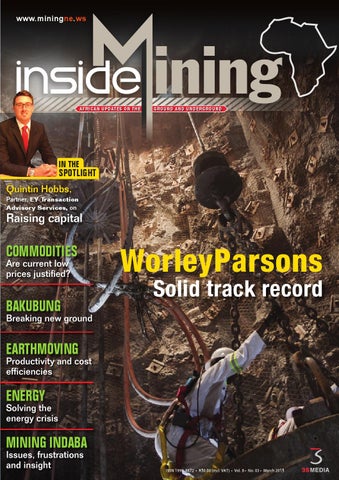
www.miningne.ws
AF R IC AN U PDATES ON TH E
G RO UN D A N D UN D E RG RO UN D
IN THE
SPOTLIGHT Quintin Hobbs, Partner, EY Transaction Advisory Services, on
Raising capital
COMMODITIES Are current low prices justified?
BAKUBUNG
WorleyParsons
Solid track record
Breaking new ground
EARTHMOVING
Productivity and cost efficiencies
ENERGY
Solving the energy crisis
MINING INDABA Issues, frustrations and insight
ISSN 1999-8872 • R50.00 (incl. VAT) • Vol. 8 • No. 03 • March 2015
CONTENTS ENDORSED BY
AF R IC AN U PDATES ON TH E
March 2015
GROU ND AND U NDERG ROU ND
ON THE COVER
P4
Over the past five years in South Africa, WorleyParsons have created centres of excellence for mine design, mine development, mining, minerals processing and mine closure, and built a solid track record.
12 EDITOR'S COMMENT
3 Focus: Productivity and cost-efficiency COVER STORY
4 Taking on the challenges, and winning AFRICA ROUND-UP
6 News from around the continent IN THE SPOTLIGHT
7 Raising capital MINING INDABA
10 Mining today: Issues, frustrations and insight ECONOMICS, FINANCE & RISK
16
12 Does policy affect investment 14 Mining calls for growth initiatives 15 Much ado about nothing COMMODITY: PLATINUM
16 Bakubung: People of 20 The Phoenix rises
the Hippo
SURVEYING
24 The new world of
underground mapping
EARTHMOVING
26 Open-pit mining productivity and cost-efficiencies DRILLING & BLASTING
29 Consider it done! 26
TECHNOLOGY
30 Sprucing up concrete surfaces 31 New electronic checklist system 32 Pipeline design 33 The self-aligning bearing system ENERGY
35 Optimising electricity consumption HEALTH & SAFETY
35
39 Arc flash hazards 40 Depression affects 20% of
SA workforce
IN SID E M IN IN G 0 3 | 2015
1
EDITOR'S COMMENT Publisher Elizabeth Shorten Editor Tony Stone Editorial assistant Mpinane Senkhane Head of design Hayley Mendelow Designer Ramon Chinian Chief sub-editor Tristan Snijders Sub-editor Morgan Carter Contributors Quintin Hobbs, Robbie Cheadle, Mpinane Senkane Production manager Antois-Leigh Botma Production coordinator Jacqueline Modise Marketing & digital manager Esther Le Roux Marketing specialist Philip Rosenberg Financial manager Andrew Lobban Administration Tonya Hebenton Distribution manager Nomsa Masina Distribution coordinator Asha Pursotham Printers United Litho Johannesburg Tel: +27 (0)11 402 0571 ___________________________________ Advertising Sales
Tazz Porter Tel: +27 (0)11 465 5452 Cell: +27 (0)82 318 3908 tazz@connect.co.za ___________________________________
No. 9 3rd Avenue, Rivonia 2191 PO Box 92026, Norwood 2117 Tel: +27 (0)11 233 2600 Fax: +27 (0)11 234 7274/5 www.3smedia.co.za ___________________________________ Annual subscription:
South Africa: R550.00 (incl VAT & postage) African countries: US$80 Foreign: US$100 Email: subs@3smedia.co.za ISSN 1999-8872 Inside Mining Copyright 2015. All rights reserved. ___________________________________ All material in Inside Mining is copyright protected and may not be reproduced either in whole or in part without the prior written permission of the publisher. The views of contributors do not necessarily reflect those of the publishers.
To our avid readers, be sure to sign up and get the latest updates and inside scoops from the mining industry. Check out what we are talking about on our website, Facebook page or follow us on Twitter and have your say.
FOCUS
Productivity and cost-efficiency
T
HIS YEAR’S Africa Mining Indaba was an interesting affair, to say the least. Investors, miners and politicians from Africa and around the world raised issues, expressed frustrations and provided insight, which it seems some African states have taken seriously. Attempts to repackage nationalisation through equity holdings, royalties, tax, capital gains tax and windfall tax were met with resistance, and rightly so. There simply is no profit in laying out large capital investments merely to become what is essentially the hired help because you are better at running and operating a mine than public servants are. Government policy can make or break the industry. Caution is advised. Raising finance remains a global challenge. But, with some commodity prices beginning to show early signs of bottoming out and improving, of which gold is the most likely to benefit in 2015 – because of its role as a safe haven in times of political and market uncertainty – things may well get better on the mining front during the coming year. For some commodities, such as iron ore and thermal coal, it will take a while before they start rising. Copper has come off a bit but is looking positive, and platinum is likely to turn this year. And, in talking about platinum mining, we have the story of Phoenix Platinum where the modified adage, “One man’s waste is another man’s riches”, holds true. Another interesting platinum story is that of Wesizwe Platinum’s Bakubung mine. Here a bunch of journalists, myself included, enjoyed a trip down the 748 m deep work-in-progress ventilation shaft to get the feel of what it is like to be a miner. In what may be a bold attempt to solve the problem of predicting productivity in an open-pit mine, by avoiding the ‘bunching’ problem, I applied the scientific principle of observation and investigated the phenomena. In the process, and acquiring new knowledge (for me that is), and integrating it with previous and other knowledge, I came up with a solution and mathematical model that can be built into any Microsoft Excel spreadsheet. Does it work? Yes; on paper! You be the judge. With the possible negative impact on the economy fearfully significant, Eskom’s electricity supply woes, while potentially debilitating, are quite irrelevant at the moment. What is needed, right now, are solutions to the energy crisis. In this issue we present two solutions: the first from Eskom itself and the second from a leading equipment supplier. The question to be asked is can you afford to live with load shedding? The emphasis of course is on ‘afford’. Fortunately we have examples of other mines, who have implemented both solutions, to guide us. It may just boil down to capital expenditure, for which you may need finance. And, therein is the rub. Nonetheless, to be positive, in all things money, what goes down goes up again. This truth you can take to the bank.
There is no profit in laying out large capital investments merely to become the hired help
@mining_news www.facebook.com/ pages/Mining-News
IN SID E M IN IN G 0 3 | 2015
3
COVER STORY
Taking on the challenges,
WorleyParsons RSA is one of the international project delivery group's global centres of excellence for mine design, mine development, mining, minerals processing and mine closure, and has built a solid track record throughout the subcontinent.
P
ROJECT DELIVERY AND Consulting services firm WorleyParsons recently completed the prefeasibility study (PFS) for gold miner Morobe Mining’s Wafi-Golpu project, in Papua New Guinea. The Wafi-Golpu project involves the development of a new greenfield copper/ gold mine, process plant and associated infrastructure. Morobe Mining is a joint venture between South Africa-based gold miner Harmony Gold and Australia-based gold company Newcrest Mining. WorleyParsons RSA states that, further, TOP The 10-tonne capacity kibble approaching the surface BELOW Wesizwe's Bakubung platinum mine
4
INS I DE MI NI NG 0 3 | 2 0 1 5
it is also working on its first potash project, with the provision of a definitive feasibility study (DFS) for global potash development group Sirius Minerals’ York Potash project. The DFS marks the start of the first new potash mine to be established in the UK since 1973. Another first-time client for WorleyParsons RSA is Mauritanian 78% state-owned mining company Société Nationale Industrielle de Mauritanie (SNIM), which is engaged in mining the Kedia d’Idjill (F’Derik), Guelb El Rhein, and M’Haoudat iron ore mines in Mauritania. SNIM awarded WorleyParsons RSA two feasibility studies for the
rehabilitation and modernisation of the Guelb 1 iron ore plant in April 2014. WorleyParsons RSA is also responsible for the development of the F’Derik mine to ensure it produces 3 million tonnes of iron ore annually, based on its PFS. Additionally, the company recently provided Limpopo-based phosphate producer Foskor with process consulting services. WorleyParsons RSA has also ventured into the rare-earths sector through its undertaking of a PFS for TSX-listed rare-earths miner Frontier Rare Earths at its Zandkopsdrift project in the Namaqualand region of the Northern Cape during the course of 2014. The company is also involved in the local iron ore sector and is focused on extracting value from jig discard. WorleyParsons RSA further avers that it remains the recognised dominant player in shaft sinking, stating that it is currently undertaking the development of several shaft sinking projects, including JSE-listed junior platinum group metals mining company Wesizwe Platinum’s Styldrift No 17 shaft in Rustenburg and South African ferrochrome producer Assmang’s Black Rock mine operations in the North ern Cape.
Duly awarded In September, WorleyParsons RSA won the Southern African Institute of Steel Construction’s 2014 Steel Awards Mining and
COVER STORY
and winning
sectors, he says. Jonker asserts that the consolidation has made WorleyParsons RSA “Africa’s leading project delivery and engineering company.” He further states that since relocating, WorleyParsons RSA has established itself as “one of the largest engineering contractors in the country, providing a broad offering of well-developed services into sub-Saharan Africa across the mining, hydrocarbons, power and infrastructure sectors.” Moreover, Jonker highlights that with all the company’s operations under one roof, along with it possessing “a young, dynamic and diverse team” with strong ties to other WorleyParsons centres of excellence worldwide, the company is “well placed for growth and expansions during this year.” He points out that despite the downturn in the local mining industry, WorleyParsons has maintained a strong core of
WorleyParsons OneWay enterprise-wide Industrial category for its work on Weintegrity management framework, the sizwe’s Bakubung platinum mine’s main company has made good progress in shaft headgear. achieving improved operational safety The Bakubung mine is located on the levels in 2014. western limb of the Bushveld Complex, Jonker explains that OneWay consists of near the town of Rustenburg, in the “simple expectations that align the comNorth West. pany’s business” and establishes the founThe judges described the final structure dation for achieving WorleyParsons’ vias “a classic example of excellence in the sion of industry leadership in zero harm. use of steel.” Meanwhile, WorleyPasrson “The OneWayTM expectations set the RSA’s GM of Mining, Minerals & Chemminimum standard every person in the icals, Henry Jonker, states that the mincompany must meet and aligns every ing team “moved into a whole new realm” individual, team, group, project, conat diamond mining company De Beers’ tract, location and region to work as one Venetia underground diamond project, WorleyParsons unit.” in Limpopo, by harnessing a methodoloThe company is working in partnergy from other industries to create an inship with stakeholders in the South Aftelligent three-dimensional model of the vertical shaft. He says that it is believed to be the first time “The present trend towards modernising mining this technology is bethrough design is being steered by the mines ing used on a vertical themselves.” Henry Jonker, GM: Mining, Minerals & Chemicals shaft project from the design stage. engineering capability in the industry “The present trend towards modernrican mining industry to challenge and and built the capacity necessary to “harising mining through design is being potentially improve the current safety ness new opportunities when the climate steered by the mines themselves, who have standards and productivity levels within inevitably improves.” recognised that the rapid development the sector. “The African mining sector is a very exof digital technologies, automation and citing space for those who are willing to mechanisation is fundamental to meeting Company consolidation grasp the opportunities available. It is a the challenge of safety in future capitalMeanwhile, the consolidation of the comdynamic environment but it demands intensive shaft development projects.” pany’s local project delivery capabilities flexibility, agility and mobility.” into a single location in Melrose Arch, Further, Jonker emphasises that there Safety emphasis Johannesburg, in September 2014, poexist significant opportunities in Africa, Jonker states that WorleyParsons RSA sitioned WorleyParsons RSA to reach as it remains a new frontier for global is placing increased emphasis on imout from a robust base of long-term conmining houses. proving safety at its projects. He hightracts to secure new business from firstlights that, underpinned by the greater time clients in non-traditional industry
www.worleyparsons.com
IN SID E M IN IN G 0 3 | 2015
5
AFRICA ROUND-UP
MINING NEWS
from around the world in association with DRC The Democratic Republic of Congo Mines Minister Martin Kabwelulu submitted a draft of a new mining code to the government in the face of opposition from the industry lobby. Following a year of negotiations with mining companies, the ministry has asked the government to prepare the draft and send it to parliament so it can be discussed during the next session, which begins in midMarch, Kabwelulu said. Congo wants to boost income from some of the world’s biggest mining companies, including Glencore Plc, Freeport McMoran Inc. and AngloGold Ashanti, by raising taxes and royalties for miners. The country’s Chamber of Mines believes the recent “decision by the DRC’s Ministry of Mines to suspend consultations with the DRC’s mining industry about the country’s proposed new mining code and to refer it in draft legislation form to parliament instead, poses a material threat to further investment.” The Chamber said a one sizefits-all code was not suited to the DRC because of significant capital and exploration framework differences between the various sectors of the country’s mining industry.
GHANA Ghana’s power crisis will hurt the country’s gold production if it is prolonged, the chief executive of country’s Chamber of
6
INS I DE MI NI NG 0 3 | 2 0 1 5
Mines, Sulemanu Koney, told Reuters this month. Gold is one of the West African country’s main sources revenue, and Koney advised that should the crisis continue, production of the commodity would certainly take a hit. The country has seen long electric cuts on a nearly daily basis for some time now, and is currently shedding between 440 and 650 MW of power during off-peak and peak periods as a result of a production deficit. The production shortfall has come about as a result of poor hydrology in the three main hydro-electric power stations – Akosombo, Bui and Kpong – as well as lack of gas from the West Africa Gas Pipeline in Nigeria to supply gas to various thermal plants in the country. “It is…a major constraint and the net effect is that your costs go up and your margins are squeezed,” Koney said, adding that power from the national grid constitutes 25% to 30% of mining production costs,”he said.
Ghana Sulemanu Koney
UGANDA Uganda has a new mining law which seeks to remove a series of taxes and introduce bidding rounds for
exploration licenses in a bid to attract investors to a longneglected sector, the mining minister said in February. Uganda is set to become an oil exporter, and geological surveys have revealed significant deposits of a range
Uganda Peter Lokeris with Mining Cabinet Secretary CS Balala
of minerals including iron ore, gold, uranium, rare earths, titanium and diamonds. The new law, to be reviewed by cabinet in March, proposes to abolish the exploration tax as well as an 18% VAT on mining equipment to lure investors into the sector, Peter Lokeris, state minister for minerals and energy, said. “We found the exploration tax to be so prohibitive, the companies are really complaining,” Lokeris told reporters at the Mining Indaba conference in Cape Town. The draft bill, which needs to be passed by parliament first after getting the goahead from cabinet, also recommends moving away from the ‘first-come, firstserved’ exploration licensing policy to help eliminate passive speculators.
ZIMBABWE Zimbabwe has announced a plan to revoke its unrefined platinum tax,
provided companies build a platinum refinery. The Zimbabwean government has said it will maintain the 15% export tax on unrefined platinum for the time being. In February, Minister of Mines and Mining Development Walter Chidhakwa was quoted by a state-owned newspaper as saying Zimbabwe would only revoke the tax on raw platinum exports if mining companies built a refinery. Chidhakwa told The Herald newspaper that he had informed mining companies during meetings that the platinum tax could be removed only if they build a refinery.
Zimbabwe Patrick Chinamasa
In November last year, Minister of Finance Patrick Chinamasa announced in a budget speech that he had postponed the tax’s introduction until January 2017 to give the firms time to build the smelting and refining plants. However, the finance bill was made effective on 1 January 2015. Chinamasa told Reuters that he had made his budget speech on the assumption that producers in Zimbabwe, which holds the world’s second largest platinum deposits, had a firm plan on setting up a refinery.
IN THE SPOTLIGHT
RAISING
CAPITAL Last year was not a good year for the mining industry, or for raising capital. Coming out of 2014 battered and bruised, but not beaten, the industry has its eye on recovery. BY QUINTIN HOBBS*
V
OLATILE commodity prices and an uncertain economic outlook provided the backdrop to a fourth consecutive year of falling deal activity in 2014, while risk aversion and capital discipline among investors and producers alike stymied both the availability and spending of capital. With the industry set to undergo a period of historic restructuring, a shift in focus toward longer-term growth and value creation is required if companies are to position themselves competitively to take advantage of the global supply rebalancing. Looking at a little more detail, the mining and metals sector did lag in broader initial public offerings (IPO) recovery. This, because commodity price weakness continued to put pressure on share prices, dampened risk appetite.
GRAPH 1 IPO volume and proceeds (2007–14)
• A SX tops volume: The Australian Securities Exchange hosted the highest volume of IPOs at seven, raising $76m, the largest being a $45 million domestic listing by U&D Coal in February. The TSX Venture exchange hosted just two IPOs, raising a combined total of just over $1 million. • Two sizeable offerings helped total proceeds to reach $1.5 billion, a YOY increase of 89%: • The $662 million IPO of Shaanxi Coal Industry on the Shanghai Stock Exchange: This was the largest mainland listing since 2012 as China reopened its IPO market after a 14-month freeze, Shaanxi Coal is China’s third-largest listed coal miner, with a market value of $10.7 billion at year-end • Foresight Energy’s IPO on the New York Stock Exchange: The company listed at a challenging time for the US
17% 94%
IPOs in the sector, vs 26 in 2013 Fall in 2014 IPO from a pre-GFC peak of 280
coal industry, but secured $350 million in support of its large-scale, integrated, cost-competitive operations in the Illinois Basin, proceeds were used for debt repayment and cash distributions under its master limited partnership (MLP) structure.
Follow-on equity Equity issuance, for many, remained an expensive and dilutive option of nearlast resort. Proceeds raised by juniors fell by 7% YOY to $5.5 billion, shared among 1 230 issuers. A number of deeply discounted ‘rescue’ rights issues, unhappy
GRAPH 2 Follow-on equity volume and proceeds (2007–14)
IN SID E M IN IN G 0 3 | 2015
7
IN THE SPOTLIGHT
57% 42%
Share of equity offerings • Turquoise Hill undertook the largest raising less than equity issue, with its $2.4 billion rights $1 million 2013 levels offer. The offer was priced at a 42% discount to the reference price, with proYOY decline in junior ceeds used to repay debts and for the mining share prices continued funding of Oyu Tolgoi. – EY’s Mining Eye • Ma’aden raised the second-highest features of the 2014 equity financing proceeds at $1.5 billion, reportedly landscape, supported overall proceeds of one of the largest ever rights issues in $21.4 billion. Equity for project developthe Middle East. Proceeds will be used ment and acquisitions was available, but to expand the company’s phosphate, only on a highly selective basis. aluminium and gold operations.
GRAPH 4 Loan volume and proceeds (2007–14)
8
INS I DE MI NI NG 0 3 | 2 0 1 5
• Lundin Mining secured $674 million in a bought-deal financing towards its acquisition of the Candelaria copper complex in Chile. • Outokumpu and Kobe Steel were among steel producers raising equity to repay debt, restructure operations and improve profitability.
Convertible bonds The popularity of convertible bonds dissipated in 2014, with a year-on-year decline
GRAPH 2 Primary use of loan proceeds (2014)
IN THE SPOTLIGHT
in proceeds of 52% to $3.7 billion. Recent examples of companies struggling to meet maturing conversion payments may be behind the dramatic fall in proceeds, along with the uncertain share price outlook. Increased perception of risk, accentuated by the large share of unrated and junior issuers, has increased the average coupon on mining convertibles to 10%, from 9% in 2013. Alcoa’s $1.25 billion convertible issue accounted for nearly a third of total proceeds. The funds will be used as partial consideration for the acquisition of Firth Rixson.
20% 36%
EQUITIES OUTLOOK
Across all industries, the outlook for equity performance is generally positive in 2015 on the strength of US economic and corporate growth and a resultant increase in M&A and dividend income. However, we expect it to be some time before this extends to the mining and metals sector; confidence is yet to return fully and the price outlook for many metals remains uncertain and unpredictable. As a result, shareholders may not see the capital returns that were expected to drive a re-rating of the sector The coupon paid on a as cash flows remain number of junior convertible uncertain. In spite of bond issues this, we are likely to see equity markets open up The fall in the number of periodically in response convertibles issued from to favourable price 2013 levels
Imperial Metals, Discovery Metals, Stornoway Diamond and San Gold were among junior companies issuing convertible bonds for project development.
Loans Syndicated loan proceeds inched toward 2011 highs at $152 billion, as strong demand and liquidity in the global banking sector supported extensive refinancing activities at improved pricing. However, only a small fraction of new bank debt coming into the sector is going toward project development at the junior and mid-tier level. In absolute terms, project finance increased to $22 billion, helped by Roy Hill Holdings’ $7.2 billion package, but access remains challenging. Banks are increasingly selective about the projects they support, requiring extensive due diligence, resulting in longer lead times and higher costs associated with
movements in certain metals, providing companies with the opportunity to take advantage of transitory phases of positive sentiment. The $800 million financing window that opened up for gold companies at the start of 2015, on the back of a 10% rise in the gold price, is such an example. Until price momentum swings decisively to the positive, IPOs are likely to be unpopular. Ongoing portfolio reviews may feed the pipeline, but spinouts via IPO are likely to be exceptions rather than the rule and will be heavily reliant on timing and market sentiment for success. Consensus estimates see a slight increase in gearing levels in 2015, before retreating in 2016; any additional unexpected price weakness may drive further rights issues in the year ahead.
15% 74%
arranging such funding and more stringent terms to compensate for riskier loans. Agreements on development projects invariably included hedging requirements. • Glencore attracted $17.5 billion of commitments from its populous banking syndicate, in the end signing a $15.3 billion revolving credit facility with 69 banks to refinance existing revolvers. • Tata Steel restructured around $7 billion of debt accrued during its acquisition of Corus at lower borrowing costs.
Outlook Lending conditions are expected to be broadly supportive in 2015, with demand likely to be strong for high-quality refinancing deals and acquisition financing for investment grade borrowers.
GRAPH 5 Loan volume and proceeds (2007–14)
The proportion of syndicated loan proceeds allocated to project finance The proportion of syndicated loan proceeds allocated to project finance
However, continued price volatility and continued tightening of regulation, raises a question mark over how much risk banks will be willing to bear in 2015. As such, it is likely that lenders will continue to be selective, that finance for commodities with weaker near-term fundamentals will be difficult to come by, and that lenders will seek to diversify project risk on leveraged loans through syndication and stringent terms. * Quinton Hobbs is a partner at EY Transaction Advisory Services, Johannesburg, South Africa.
GRAPH 6 Primary use of loan proceeds (2014)
IN SID E M IN IN G 0 3 | 2015
9
MINING INDABA 2015
MINING TODAY
Issues, frustrations and insight As a kick-off to the Mining Indaba, the Canadian Breakfast, for the fourth year running, was well attended. Mining industry panellists, from South Africa, Ghana and Zambia, shared common ground, but that’s where it ends. BY TONY STONE
I
T IS CLEAR that the gap between government and the mining industry is yet to be bridged. This is after listening to Michael Spicer, the now retired head of Business Leadership South Africa; Godfrey Oliphant, Deputy Minister of the Department of Mineral Resources in South Africa; Peter Leon, a partner at Weber Wentzel; Jackson Sikamo, president of the Zambian Chamber of Mines and Sulemanu Koney, CEO of the Ghanaian Chamber of Mines.
be changed or ignored by any party. Any proposed change to the regulatory environment should be reviewed and accepted or rejected by the mining industry prior to promulgation. Legislation should be geared towards attracting investors, and keeping them invested over the 20 to 30 years of their investment. Jackson Sikamo, president of the Zambian Chamber of Mines, agreed that mining
10 INS I DE MI NI NG 0 3 | 2 0 1 5
Questions and answers Michael Spicer kicked off the Q&A sessions with a question of his own. He asked Godfrey Oliphant, DPM of the Department of Mineral Resources in South Africa
Key points With five minutes to make a statement, before moving on to a Q & A session, Deputy Minister Oliphant opened the discussion with a marketing statement about South Africa’s mining industry. The picture painted was a positive one, and of interest to any would-be investor. In contrast, Peter Leon squarely placed the South African mining industry’s position on the table. His points encapsulated the industry’s frustrations with government: • Mining is a capital intensive, high risk, long-term investment wherein the rules of the game cannot change suddenly. • Because of this, strategic decisions, which ultimately affect the profitability of a mining operation, need to remain effective, without any major shocks along the way. This, Peter Leon said, means that the regulatory environment should not change, that there should be security of tenure, that mining rights should remain exclusive to the company that own the rights and that the rule of law must apply, and not
the need to have a reasonable regulatory environment that is strictly enforced, and a positive fiscal regime. Taxation and royalties should not be a moving target and there should be trust between the government and the investor.
Greg Goldman, High Comission of Canada Trade Office in SA Commercial Counsellor
is a long term business. He stressed that cost-effective and reliable energy was a problem for mines. And, in relating back to Leon’s point about the regulatory environment, he said that dialogue and finding common ground between government and investors was critically important. Sulemanu Koney, CEO of the Ghanaian Chamber of Mines underpinned the importance of having a stable government. The avoidance of military coups, common to Africa’s history, was critical. He reiterated
the Deputy Minister whether the “quality of dialogue” was there. Whether the government listened to the mining industry? Predictably the deputy minister responded by saying that the institutional framework was in place and that the government had the national interests at heart. He said that this placed the South African government in a contested situation with the mining industry. (Note: Opinion expressed by various delegates after the breakfast agreed that this was a rigid, inflexible and almost
MINING INDABA 2015
dictatorial approach!) He added that mining companies should comply with the law, e.g. the Mining Charter, and stressed that mineworkers need to be happy. Peter Leon, in responding to Oliphant, and commenting on the institutional framework in South Africa, said that the quality of dialogue at NEDLAC had deteriorated over the last 10 years. He concurred that the idea of a framework agreement was a good one but this would need to impose enforceable obligations on government, labour and the mining industry, not just the mining industry. This was a weakness of the existing framework as it does not have the sanction to be enforced, and is ambiguous. Also, while the first mining charter spread the obligations across the spectrum of government, labour and the mining industry, the new mining charter placed the obligation solely on the mining industry. This, he said, was not a fair or acceptable. The next question Spicer put to the panel dealt with taxes and royalties. Deputy Minister Oliphant simply stated that South Africa was reviewing its position in this regard and would communicate its findings in due course. Peter Leon pointed out that Zambia had set their royalty rates and then changed these rates. This, he said, underpins what has already been said about
deputy minister as to what measures were being put in place by government to address lengthy, violent and economically damaging labour strikes, and whether any concrete action had been taken to implement a secret ballot for striking workers. The deputy minister responded by saying that the government was awaiting the outcome of the Marikana Farlam Commission report but, in the meantime, was looking at legislation to limit the length of time a strike would be allowed to run before government intervened. Peter Leon re-stressed the importance of having a secret ballot for workers while acknowledging that things were better today than they were in the first half of 2014. He added that while the South African Chamber of Mines had expressed concern about President Zuma’s referral of the latest mining legislation back to parliament, it would be better to have better legislation. The deputy minister added that government was looking at the bigger picture and needed to have a greater representation of indigenous people in the mining sector, and that there was a need for good working conditions. This, however, created uncertainty and perpetuate investor nervousness. Spicer raised the issue of mine mechanisation and automation was necessary. This
industrialise its economies; it would, however, be energy intensive. It would create employment but would be limited to skilled workers. The deputy minister stated that demand in South Africa had reached a point where it outstripped supply. The electrification of townships and industrialisation had taken up all the spare capacity in the last 20 years, while mining and quarrying had grown from 800 to 1 700 mines and quarries. (Note: While this was true, the current power shortage problem is the fault of the South African government. In 1996, Eskom approached the government to say that, by 2007, they would be short of capacity and that they needed more coal-fired power stations. Government at the time did not agree, yet loadshedding started in 2008.) Peter Leon asked the deputy minister whether the government was now open to Private Public partnerships on infrastructure (meaning private electricity generators). The Deputy Minister answered and said the government had a massive rollout plan for infrastructure but did not say when this was going to happen. (Note: This rollout plan has been talked about for some years but nothing has happened.) Turning finally to black economic empowerment (BEE), and in response to Mi-
Jackson Sikamo, president of the Zambian Chamber of Mines
Peter Leon, a partner at
Sulemanu Koney, CEO of the Ghanaian Chamber of Mines
Webber Wentzel
changing rules. The mining industry needed predictability and certainty and could not afford to have their profitability eroded. The question was put to the panellists as to what portion of the taxes and royalties made it back to local communities. Sulemanu Koney and Jackson Sikamo were not able to comment as they did not represent their respective governments. Deputy Minister Oliphant remained silent. Against the backdrop of the Marikana strike, Spicer put the question to the
required higher skills, with a commensurate wage, higher productivity but fewer workers. He questioned whether the South African government appreciated this reality and had bought into the model, to which the deputy minister said they had. (Note: South Africa’s labour unions are opposed because it translates into a loss of jobs.) In responding to Spicer’s question about mining beneficiation, Peter Leon said that this was central to Africa’s need to
chael Spicer’s question about what happens when a 26% BEE partner decides to divest, the deputy minister said that the BEE Act was very clear. Companies had to have a 26% black shareholding and would have to acquire another if the existing BEE partner divested. There would be no compromise. His response was quite clear. The government would not even consider the mining industry’s concerns of the impact this could have on the shareholding over the long term. IN SID E M IN IN G 0 3 | 2015 11
ECONOMICS, FINANCE & RISK
Does policy affect A common thread permeating the 2015 Mining Indaba presentations was that mining is a long-term investment that requires consistency of legislation in the host country. The impact of this is examined. BY ROBBIE CHEADLE*
T
HE RECENT lack of growth in developed markets coupled with perceived improvements in political and macroeconomic stability, policy certainty and legal systems in many African countries, as well as Africa’s growing middle class and rise in consumption is leading to increasing interest by foreign companies and institutions in Africa as an investment destination. Added to this, the US government is looking to strengthen its commercial ties with Africa through its ‘Power Africa’ and ‘Investing in Africa Trade for our Common Future’ initiatives and its ‘Doing Business in Africa’ campaign. Is this perceived improvement in political and macroeconomic stability, policy certainty and legal systems in African countries really an actuality and, more importantly, are policy uncertainty and poor legal systems likely to curb foreign direct investment into Africa? Africa did not score well in the Frazer Institute Survey of Mining Companies 2013 Policy Perception Index, which measures the overall policy attractiveness of 112 jurisdictions globally. The top five African countries and their ratings were: 1. Botswana (25/112) 2. Namibia (34/112) 3. Ghana (43/112) 4. Burkina Faso (46/112) 5. Eritrea (52/112). South Africa rated 64th and Nigeria 75th, well ahead of the three lowest ranking African countries, namely: Angola (108/112), Zimbabwe (106/112) and Côte d'Ivoire (103/112). Policy factors examined include uncertainty concerning the administration of current regulations, environmental regulations, regulatory duplication, the legal system and taxation regime, uncertainty concerning protected areas and disputed
12 INS I DE MI NI NG 0 3 | 2 0 1 5
land claims, infrastructure, socioeconomic and community development conditions, trade barriers, political stability, labour regulations, quality of the geological database, security, and labour and skills availability. While Botswana achieved the highest ranking in Africa and had high scores in most areas, it should be noted that Botswana’s ranking dropped from 17th of 96 jurisdictions in 2012. The deterioration in Botswana’s ranking is a result of lower ratings in nearly all policy factors compared to the prior year, particularly regulatory duplication and inconsistencies; uncertainty concerning
the administration, interpretation or enforcement of existing regulations and the taxation regime; and uncertainty concerning land claims. In addition, Botswana scored notably lower ratings with regards to the quality of its geological database, infrastructure, trade barriers and availability of labour/ skills. In terms of the 2014 Corruption Perceptions Index prepared by Transparency International, which measures the corruptness of 175 jurisdictions globally, Botswana is perceived to be the least corrupt country in Africa. Botswana ranked
ECONOMICS, FINANCE & RISK
investment? weaknesses in some emerging markets and risks relating to policy uncertainty and regional instability could negatively impact on the expected FDI upturn. Despite Africa’s far from perfect scores in both the Frazer Institute Survey of Mining Companies 2013 Policy Perception Index and the 2013 Corruption Perceptions Index, total FDI flows into Africa increased by 4% to approximately $57 billion in 2013, according to the 2014 World Investment Report. Increasing intra-African investments are sustaining FDI inflows into Africa, mainly in the manufacturing and services industries – led by South African, Kenyan and Nigerian transnational corporations. In addition, the main beneficiaries of the increased FDI flows were Ethiopia and Kenya in East Africa, and South The decrease in FDI Africa and Mozambique in Southern flows is largely due Africa. FDI flows to uncertancies over to North, Central and West Africa pending legislation and declined by 7%, political upheaval 18% and 14% respectively, which is partly due to political and security uncertainties. The decline in FDI flows to North Africa is mainly a result of the political instability in Egypt which resulted in a decrease of 19% in FDI flows to that country. The decrease in FDI flows to West Africa is largely due to decreasing flows to Nigeria resulting from uncertainties over the petroleum industry 31st with a score of 63/100 (where 0 is bill and security issues, and Central Afvery corrupt and 100 is very clean), fol- rica has been negatively impacted by the lowed by Mauritius (47th with a score of political upheaval in the Central African 54/100), jointly Lesotho, Namibia and Republic together with ongoing armed Rwanda (55th with scores of 49/100 conflict in the Democratic Republic of the each), and Ghana (61st with a score of Congo. The impact of the Ebola virus on 48/100). FDI flows to West Africa during 2014 has According to the United Nations Con- yet to be determined. ference on Trade and Development (UNCThe UNCTAD has also revealed that alTAD), subsequent to the 2012 slump, though the share of the extractive indusglobal foreign direct investment (FDI) try in the cumulative value of announced increased by 9% in 2013 to $1.45 tril- cross-border greenfields projects is still lion. UNCTAD has projected that FDI significant for Africa, at 26%, the extracflows should continue to rise over the tive industries share of the total numnext few years; however, it cautions that ber of projects in Africa has dropped to
8%. Ninety per cent of the announced greenfields investments in Africa in 2013 related to manufacturing and services projects. This is in line with a worldwide reduction in investment into the extractive industries. Mining companies continue to face difficulties resulting from commodity price fluctuations, global economic concerns and supply/demand imbalances. According to the October/November 2013 ResourceStocks World Risk Survey, there has been a significant shift in investment focus to developing countries, with Mexico, Botswana, Chile, Peru, Burkina Faso, Brazil and Namibia all featuring in the top 10, despite these countries scoring generally lower than their peers in the developed world. This shift is attributed to the prospect of greater returns due to a lower cost base in terms of labour and the lack of red tape in these jurisdictions. Based on the above, it would seem that while many jurisdictions in Africa still have some way to go in order to achieve rankings that are in line with their peers in developed countries, others are achieving better rankings. It is apparent that poorer rankings in certain African jurisdictions, particularly with regards to political and policy uncertainty, have deterred FDI flows to those regions. It does seem equally clear, however, that the higher levels of growth and increasing GDP, populations and consumption in many African countries will continue to attract increasing FDI inflows, both regional and foreign, into Africa, particularly in rapidly growing economies such as Zambia, Nigeria, Ghana and Uganda. Those African countries that are making progress in creating a more investment-friendly environment resulting in increased FDI inflows could assist other African jurisdictions – who are still working on improving their policies and regulations – by collaborating with them and sharing best practices.
THE AUTHOR *Robbie Cheadle is an associate director at KPMG
IN SID E M IN IN G 0 3 | 2015 13