www.miningne.ws
af r ic an u pdates on th e
g ro un d a n d un d e rg ro un d
FROM THE EXPERT
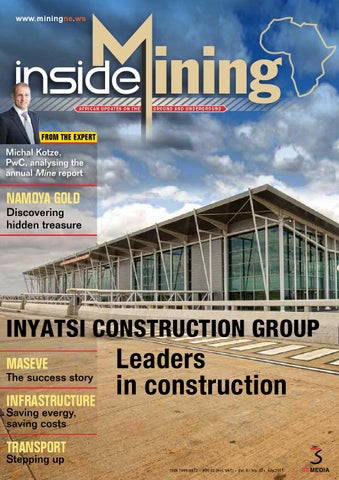
Michal Kotze, PwC, analysing the annual Mine report
Namoya Gold
Discovering hidden treasure
InyaTSi construction group Maseve
The success story
Infrastructure
Leaders in construction
Saving evergy, saving costs
Transport Stepping up
ISSN 1999-8872 • R50.00 (incl. VAT) • Vol. 8 • No. 07 • July 2015
contents Endorsed by
Af r ic a n u pdates on th e
July 2015
g rou nd a nd u nderg rou nd
on the cover
P4
Growing the annual turnover from R100 million to R1.5 billion in 10 years, with operations in seven African countries, Inyatsi Construction aims to be Africa's biggest little construction company.
10
Editor’s Comment
3
Not the best of time for mines
Cover story
4
Inyatsi Construction Group
Africa Round-up
7
News from around the continent
Economics, Finance & Risk
8
Down but not out
Commodities: Gold & Platinum
18
10
Discovering hidden treasure
14
The socio-economic impacts of gold mining
18
The Maseve success
Mining infrastructure
26
23
Double the benefits for Implats
24
Saving energy, saving costs
26
Amphibious multipurpose dredger
27
Rethinking resource savings
29
GreenBit overcomes all obstacles
Transport & logistics
30
Stepping up
IT, communication & data
34
Watson the supercomputer
37
Mined control
Junior Mining Indaba
34
39 Critical conversations In sid e M in in g 0 7 | 2015
1
editor's comment page strap
Publisher Elizabeth Shorten Associate publisher Nicholas McDiarmid Editor Mientjie Kleinhans Editorial assistant Mpinane Senkhane Head of design Beren Bauermeister Designer Frédérick Danton Chief sub-editor Tristan Snijders Sub-editor Morgan Carter Contributors Frances Ringwood, Maxwell Stamp, Tony Stone, Tristan Wiggill Client services & production manager Antois-Leigh Botma Production coordinator Jacqueline Modise Marketing & digital manager Esther Le Roux Marketing specialist Philip Rosenberg Financial manager Andrew Lobban Administration Tonya Hebenton Distribution manager Nomsa Masina Distribution coordinator Asha Pursotham Printers United Litho Johannesburg Tel: +27 (0)11 402 0571 ___________________________________ Advertising Sales
Johann Liebenberg Tel: +27 (0)11 233 2600 Cell: +27 (0)82 997 4453 johann@3smedia.co.za ___________________________________
No. 9 3rd Avenue, Rivonia 2191 PO Box 92026, Norwood 2117 Tel: +27 (0)11 233 2600 Fax: +27 (0)11 234 7274/5 www.3smedia.co.za ___________________________________ Annual subscription:
South Africa: R550.00 (incl vat & postage) African countries: US$80 Foreign: US$100 Email: subs@3smedia.co.za ISSN 1999-8872 Inside Mining Copyright 2015. All rights reserved. ___________________________________ All material in Inside Mining is copyright protected and may not be reproduced either in whole or in part without the prior written permission of the publisher. The views of contributors do not necessarily reflect those of the publishers.
To our avid readers, be sure to sign up and get the latest updates and inside scoops from the mining industry. Check out what we are talking about on our website, Facebook page or follow us on Twitter and have your say.
@mining_news www.facebook.com/ pages/Mining-News
Not the best of times for mines
G
lühwein is well known all over the world and one sip of it is said to keep the winter’s chills at bay. The sweet, syrupy concoction with exotic spices, drunk at the end of a difficult week, with one’s feet in the air, definitely seems to soothe mind and soul. It feels as if all the winter’s problems could be solved with a glass of steamy glühwein. Just a pity glühwein cannot solve the challenges in the mining industry as well. Sitting in the 2014/15 Wescoal final results presentation, and listening to the mining company’s past and present challenges, regarding their efforts to sign long-term contracts with Eskom, one question crossed my mind: what happens to Eskom if all its small suppliers of coal do not comply to the BBEEE requirements, by December 2016? This will cause more shortages to the coal supply and add to Eskom’s power generation dilemmas. According to Waheed Sulaiman, acting CEO of Wescoal, small coal miners, like Wescoal, do not make a dent in the supply demand of Eskom. However, the effect would surely be different if several small miners cannot supply, due to non-BBEEE compliance. By forcing the smaller miners to be BBEEE compliant, Eskom will succeed in its BBEEE part of the equation. Therefore, I am sure smaller miners will do whatever is necessary to comply, in order to obtain Eskom contracts. As Sulaiman explained, the BBEEE requirements that Eskom demands are part of the contract requirements with the suppliers. At the Junior Mining Indaba, held in Johannesburg, the president of the Chamber of Mines of South Africa, Mike Teke, highlighted the fact that coal prices are not doing as well as they could be – a fact also highlighted at the Wescoal final results presentation. The indaba also looked at other challenges in the junior mining industry, such as funding for junior miners, regulatory concerns, and the current state of the industry. Our article covering the indaba can be found on page 36. On a lighter note, we feature the Namoya gold mine in the Democratic Republic of the Congo, where we looked at the geology and development of the mine. We also feature Maseve in Rustenburg, located in the North West province. This platinum mine, also known as the Western Bushveld Joint Venture Project 1 platinum mine, was discovered in 2011 – a very interesting find if one keeps in mind that the explorers were actually looking for something else. Also, read about the platinum fuel cells that Implats will be implementing at the Springs Refinery and all the benefits that the fuel cells will bring to the company. Not only will Implats save on energy costs and reduce its environmental impact, but the miner will also benefit from the sales of the platinum that goes into the fuel cells. In our IT, data, and communications feature, we look at the programmes available for communication between man and machine. All the communication in the world will be worthless, at the end of the day, if the data cannot be mined and managed to be used in other applications. With continuous technology upgrades, the possibilities of automated mines, and the drive to make mines safer, miners are finding it increasingly worthwhile to use all data available to them. The cherry on the top of this issue is most probably the lunch that was prepared for Tony Stone by a supercomputer from IBM. The idea is not so much to have your lunch prepared by a computer, but more about the supercomputer itself, which is able to combine artificial intelligence and sophisticated analytic software. In this instance, the supercomputer, named Watson, was able to plan a lunch, work out the menu, the ingredients, and the methods for the chef to execute. Mientjie Kleinhans In sid e M in in g 0 7 | 2015
3
cover story
Inyatsi Construction Group
Africa's leading construction multinational When a company grows its annual turnover from R100 million to R1.5 billion in 10 short years, the market pays attention. Inside Mining recently accompanied Swaziland-based Inyatsi Construction Group to see its Zambian operations, and spent time with its visionary chairman, Frans Pienaar (pictured left), whose belief in the human spirit embodies the company’s success.
I
n 2004, Inyatsi Construction was a single entity, working in one country, in one currency, with one major client and turning over R100 million annually. It had 326 employees, few of whom could have anticipated their number increasing tenfold in as many years. Now, with operations in Swaziland, South Africa, Zambia, Botswana, and Mozambique, as well as registered companies in Uganda and Namibia, Inyatsi is a force to be reckoned with. In 2007, with an annual turnover of over R300 million, Inyatsi Construction Group Holdings (ICGH) was established, reflecting both a new shareholding and Inyatsi’s remarkable diversification and expansion into new markets. At this time, its growth rate increased rapidly and has continued unabated in 2015, and is notable for its absence of the spikes that typify externalities, like the 2010 FIFA World Cup. Inyatsi and its subsidiaries are ISO 9001:2008 certified
4
Ins i de Mi n i n g 0 7 | 2 0 1 5
and were awarded four Platinum Stars during its 2014 NOSA 5-Star Audit.
Frans Pienaar, a chairman with vision Frans Pienaar is the chairman of Inyatsi and has been with the company since 2004. He has an impressive track record of building new subsidiaries for South African construction companies, an endeavour which would soon drive Inyatsi’s growth and sustainability strategy. “We understood, in 2004, that attempting to sustain a company in a small market like Swaziland with essentially one client – the Swazi government – was limiting to growth opportunities,” Pienaar explains. A goal was set to operate in at least four countries, with a minimum of two clients in each. Inyatsi has exceeded this goal, and the Zambia mining project to which we travelled is a good example of the company’s approach in doing so. “In 2007, we were
approached by the Lumwana Mining Company to submit a proposal for residential infrastructure for the mining town they were developing in Solwezi,” explains Pienaar. “We duly submitted a tender, and got a call from them to meet.” After presenting to Lumwana’s leadership, and the project manager, Pienaar realised that, although they were impressed, the client didn’t know enough about Inyatsi. “So much of our expansion is due to the fact that we understand the value of human relationships in doing business,” says Pienaar. Pienaar made a commitment to visit Zambia and meet more of the Lumwana team on-site, being there by the following Wednesday. “We demonstrate ourselves through actions; we got the work because of our integrity and agility,” he emphasises. top King Mswati III International Airport in Swaziland
drilling & cover story blasting Building from scratch The Lumwana mine, located in Solwezi, is a perfect example of how mines can catalyse rapid economic development. “When we arrived, there was almost nothing here,” explains Pienaar, guiding me through the mining town. “We initially built the first 400 platforms for the houses, as well as 100 complete houses, followed by infrastructure for a further 3 000 houses, including roads.” The first contract’s worth stands at $16.7 million, and Inyatsi has been providing services to the mine on further jobs. Although primarily a roads and earthworks company, Inyatsi also built houses using a new technology they introduced to the project. “We used a cast in situ concrete house design, which enabled us to complete a house in eight days,” he explains. Inyatsi was also contracted by the Ausenco-Bateman JV to provide civils works for the mine’s processing plant, including all concrete works, access roads, pipe infrastructure, water purification works, and electricity reticulation works. Inyatsi also built the offices of the local municipality, which the Lumwana mine sponsored. The area is now a hub of development and is considered Zambia’s most rapidly growing town, and may be its second biggest within five years. The success Inyatsi experienced at Lumwana led to the establishment of Inyatsi Roads Zambia, which has gone on to win further significant road upgrade contracts from the Zambian government.
Mobilisation, construction, growth It is not difficult to imagine how it must have been starting out on the Lumwana project: the approach to the town reveals an area of rough, low-forest terrain, punctuated by massive anthills, and extending as far as the eye can see. In contrast, the mining town presents a modern environment, complete with schools, leisure and training facilities, shops, and contrasting tar and gravel roads. The sheer logistics of the challenge recalls the spirit of the pioneers. “We have an extremely effective plant and logistics team, headed up by a very strong individual,” states Pienaar. Inyatsi has a zero failure policy and, to date, has never received a penalty. “We
top Access road to King Mswati III International Airport above Corporate Place, Swaziland
establish a new operation by appointing the right project manager, and ensuring that the establishing team is utterly proficient. We also ensure that locals are brought in and trained, and, after six months, we withdraw a significant portion of the original team to hand over the skills,” explains Pienaar. Inyatsi has a very strong plant division, and the company is able to resource projects efficiently and quickly. “We have our normal range of construction equipment, as well as our own concrete manufacturing plants,” says Pienaar. The company also runs its own laboratories. The company’s capex investments and capabilities, combined with its regional market knowledge and relationships, render it highly competitive, providing pooled resources across its subsidiaries. Inyatsi is geared to take on everything from smaller, starter projects with new clients, to largescale projects such as the King Mswati III International Airport in Swaziland.
The people of Inyatsi Frans Pienaar does not pay lip service to the fundamental link between Inyatsi’s success and the well-being of its people. This is a man who has never missed a company funeral, and knows that a company has to create loyalty in its ranks, and not just expect it. “Our people experience the real value of what we do in a holistic way,”
says Pienaar. “The success of Inyatsi will directly impact their quality of life, so the motivation for our success is invested in each individual.” Pienaar says there is a clear, direct link between the growth of the company, the expertise it has been able to attract and attain, and individual growth. “Everyone at Inyatsi can see and experience continually improving prospects within the company – from the cleaning staff, to the top,” he says. Pienaar sites a Swazi employee who was a site agent, in 2004, and is now a project manager on a R400 million project in Zambia; he cites a tender compiler who is now the group communications manager. “We believe in education, giving people opportunities, and allowing them to make mistakes; our processes and systems are strong enough to contain them,” explains Pienaar. “Companies make the mistake of thinking they can find a perfect employee; no one is perfect. We believe in knowing people’s weaknesses and ensuring they are paired with people of opposite and equal strengths.” Critical to the company’s goal of keeping its people in touch with all its operations is a system known as ‘twinning’. “We link staff at differing levels to share their experiences and challenges, and, thereby, broaden their exposure to the company as a whole,” he continues. “A surveyor in Swaziland is in touch with another in Zambia, for example, and this gives everyone a feel for the bigger picture.” Although small, Swaziland is Inyatsi’s launch pad for the whole continent. Inyatsi’s Wellness Programme is another essential component. “In 2004, we had 48 deaths outs of 326 employees due to health and illness related matters. At that time, Swaziland had the worst HIV record in the world,” says Pienaar. Pienaar is passionate about the peer-led programme, which addresses five primary illnesses: HIV/Aids, diabetes 2, tuberculosis, hypertension, and mental health: “Our absenteeism has dropped to below two percent and I only went to one funeral last year.” The programme is so successful that Inyatsi has been asked to roll it out for one its larger clients. “It is the people who make Inyatsi work, full stop,” says Pienaar. “We maintain a In sid e M in in g 0 7 | 2015
5
cover story
on time. We could have simply resorted to the terms, cancelled the project, and sued. We simply don’t think this way; we renegotiated the terms and conditions, which included redeploying team members where possible, but still holding the client liable. We agreed to resume works when cash flow improved, which it did, a short eight months later, and both parties retained their responsibilities and benefited.”
Inyatsi in South Africa
Capabilities Inyatsi’s expertise includes: • bridge work • stormwater drainage • water reticulation • water treatment plants • sewer work • dams • reservoirs • plant management for its international clients.
its divisions and subsidiaries. “We have made our systems and governance compliant with the major bourses, so we are not only ready to list when we choose to, but have also strengthened the essential company ethos.” Inyatsi’s DNA is a helix of operations, procedures, ethics, attitudes, and standards that ultimately gear those at Inyatsi to constantly seek positive outcomes. “We value strong corporate governance, but ensure decision-making is kept as agile and direct as possible,” says Pienaar.
The New Africa Contract – Inyatsi’s market relationships from top Lumwana’s mining town in Solwezi, Zambia, bears testament to Inyatsi’s versatility, going beyond earthworks to include mass residential development Usuthu smallholder irrigation project Lubombo Referral Hospital Matsapha Wastewater Treatment Plant
cycle of growth, retention, opportunities, and more growth.”
Corporate rules, human decisions Inyatsi’s diversification into multiple markets and countries is predicated on powerful operational and management systems that ensures that what Inyatsi calls its DNA permeates through
6
Ins i de Mi n i n g 0 7 | 2 0 1 5
Pienaar is passionate about seizing opportunities and seems hardwired to find solutions. “I hear a lot of negativity in the industry about working in Africa, particularly when it comes to government clients,” he explains. “I believe this perception is the result of a rigid approach. Each country, project, and official is going to be different, and each requires understanding.” Inyatsi has also faced challenges in dealing with clients in financial trouble, avoiding litigation as far as possible. Pienaar illustrates this with a public sector example. “The Global Financial Crisis only started impacting the African market in 2011. At the time, we had a major project with a municipal client that began experiencing unanticipated financial constraints and struggled to pay us
Inyatsi plays the long game. Although the company worked on some 2010 FIFA World Cup projects, it realised that, with so many resources meeting demand in South Africa, there was a more sustainable opportunity for it to pursue longer-term relationships elsewhere. “The result is that we are now well established and very competitive in our target markets, and we know our clients and their infrastructure plans well,” surmises Pienaar. “There is no reason for companies not to prosper in Africa today,” Pienaar vehemently states. With an estimated infrastructure budget of $140 billion per year, Pienaar observes that the market will not be saturated any time soon. “The key to our success in these markets lies in our attitude and approach – we assist our clients, we do not feel entitled to having things work our way, and we respect the relevant policies and regulations.” Having already worked with major clients in South Africa, like Sasol, Sanral, and Mbombela Municipality, Inyatsi is now focused on bringing its DNA to the service of the local markets. Inyatsi’s operational and logistical strengths suggest it has special value to bring to the mining sector, not only on the mine sites, but in social infrastructure being rolled out through social labour plans. “Our South African subsidiary is growing our footprint and there are significant inroads in all sectors,” concludes Pienaar. As a Level 2 BBBEE contributor, and with its extremely refined ability to deliver turnkey proposals in the most challenging of environments, the Inyatsi bull will soon be imprinted in the minds of South Africans, as it already is in Swaziland and beyond.
t: +268 2508 1000 f +268 2508 1802 www.inyatsi.net
In each issue, Inside Mining offers advertisers the opportunity to promote their company’s products and services to the appropriate audience by booking the prime position of the front cover which includes a two-page feature article. The magazine offers advertisers an ideal platform to ensure the maximum exposure of their brand. Please call +27(0)11 233 2600 to secure your booking.
africa round-up
Mining news
from around the continent
Ghana Urging the end of child labour at mines
traders, to child labourers. The artisanal mining sector accounted for 40.7 tonnes of bullion out of 107.9 tonnes produced in 2013, according to government data.
Liberia The Human Right Watch reported, in June, that a recent mining accident, which killed 16 people at an unlicensed artisanal gold mine in Ghana, underscores the need for tougher measures to end child labour and protect the safety of adult artisanal miners. Ghana should better enforce its laws, to prevent thousands of children from working at its small-scale mines. The children work alongside family members or on their own, often to help pay school fees – based on interviews with mine workers, mostly aged 15 to 17 years old. Many said they had been working since the age of 12. According to the report, Ghana’s unlicensed gold mines are very dangerous places, where no child should work. Companies buying gold in Ghana should exert control over their whole supply chain, to make sure they’re not benefiting from child labour. Small-scale mines employ about 1 million people and account for about 40% of total production of gold in Ghana. A majority of the small mines operate without licenses. The work is especially hazardous for children because it involves heavy lifting, sharp tools – like shovels and picks – and exposure to mercury, which is poisonous. Mercury, used to extract gold, is readily available in some gold trading shops and is provided, by gold
Aureus pours the first gold at its New Liberty project Toronto- and AIMlisted Aureus Mining has poured the first gold at its New Liberty project in northwestern Liberia, the company was proud to announce in June. The mine, around 100 km northwest of the capital Monrovia, is expected to have an eight-year mine life and annual production of 119 000 ounces for the first six years of production, according to a feasibility study. After a phased ramp up of its plant feed, the company said, in a statement, the mine should reach full production in the third quarter of this year, at which point it will be processing 95 000 tonnes of ore per month. Africa-focused Aureus Mining has permits for three properties in Liberia and a fourth in Cameroon. Liberia’s economy, including its nascent mining sector, was hit hard during a yearlong Ebola epidemic, which has killed over 11 000 people across West Africa. The World Health Organization declared the country free of the disease last month after a 42-day period without a new case of infection.
Zambia Reduced mining royalties may support kwacha Zambia’s central bank governor said, in mid-June, that he hoped a reduction of royalties for underground mines, to 6% from 9%, would
boost the kwacha currency, which has weakened, partly over mining tax rows. Zambia’s government said that it will further lower the mineral royalties for underground mines, marking its second retreat from higher rates, since Africa’s number two copper producer decided, in January, to raise royalties. “We hope that lower royalties will encourage mines to produce more, enabling better exporting and foreign exchange,” Denny Kalyalya, World Bank Group executive director, told Reuters on the side-lines of a conference in the Lusaka. As of 14 June, the kwacha had fallen 13% since the start of the year, partly hit by the royalties and tax rows. Zambia set the royalty rate for open pit and underground mining at 9%, in April, rowing back from earlier plans to charge as much as 20%. The decision to raise taxes rankled mining companies and unions, and forced the government to review its plan. Mining firms operating in Zambia include Vedanta Resources Plc, Glencore, Barrick Gold Corp, and First Quantum Minerals.
Zimbabwe Four-year ban on chrome export lifted In June, Zimbabwe lifted a four-year ban on chrome ore exports. In addition, the country also licensed 12 private companies, and a state-owned firm, to ship excess ore for smelting outside the country and lowered electricity tariffs for miners of the base metal from 8 cents to 6.7 cents per Kilowatt hour. The mineral-rich country holds about 12% of the world’s chromite reserves, with South Africa holding
70%. Minister of Mines and Mining Development Walter Chidhakwa said, in Harare, that the ban was lifted to promote growth of the chrome mining sector, while Finance Minister Patrick Chinamasa said mining is a crucial low-hanging sector, which needs all the fiscal support it can get to spur it to growth. “A ban that is not supported by South Africa will not succeed,” Chidhakwa said. He added that the ban had not resulted in additional smelting capacity, because of a decline in international prices, high electricity tariffs, and a lack of efficient and modern technology for processing chrome ore to ferrochrome. “The government has, with immediate effect, lifted the ban to allow for the export of 30 million tonnes of chrome
Zimbabwe Minister of Mines & Mining Development Walter Chidhakwa
ore,” said Chidhakwa. He also announced that the government has upped the royalty on chrome mining from 2% to 5%. Chinamasa said there are companies sitting on idle claims and added that the government is geared to make sure that the country’s assets are put to use. He said his hope was that the lifting of the ban would help create employment and enable companies to contribute more to state revenues through increased productivity. In sid e M in in g 0 7 | 2015
7
Economics, finance & risk
Down but L not out PwC released its 12th annual Mine report on Thursday 4 June 2015, giving an analysis of the top trends in the global mining industry today. Michal Kotze (pictured left) of PwC takes us through a summary of the findings.
ast year was expected to be a tough fight for the global mining industry, especially with commodity prices down and short-term volatility increasing. The initial scorecard for the largest 40 miners was mixed and now the gloves are off for the industry, with widespread government intervention, internal industry conflicts, and rising shareholder activism. The past year’s highlights are: • overall market values plummeted $156 billion, due to commodity price declines • free cash flow turned positive again to $24 billion; but net profit down 9% • capital velocity declined for the first time since 2010 and continues to slow • dividend yields at an all-time high of 5% • government intervention and conflict abound with strategy debates as effect of lower prices felt by many. This year will be a continuation of last year, and it will be another challenging year for the sector and the Top 40. The prolonged downswing in 2014 commodity prices has forced companies to fight hard to implement various measures to improve free cash flow, hence a major focus on reducing costs. The Top 40 know lower prices aren’t temporary and they need to cut costs to allow appropriate returns to be generated in the current environment. As we forecast in last year’s report, these cost-reduction and -efficiency efforts have started to pay off. Another cash-conservation strategy was to reduce capital spending.
Graph 1 (Left) Industry on the ropes again, with increasing short-term volatility Graph 2 (Above) The Top 40 recorded 5% reduction in operating costs, lower impairments, and 26% less investing cash outflows, leading to positive free cash flow and higher shareholder returns. However, the positive story is closely linked to external factors such as exchange rate fluctuations and the 40% reduction in oil price, during the latter half of 2014, rather than sustainable cost savings Graph 3 (Bottom left) Tightening the belt – capex reduction saved the day
8
Ins i de Mi n i n g 0 7 | 2 0 1 5
Economics, finance & risk
The Top 40 have been saying, for a few years, that they will reduce capital spending they delivered in 2014. Meanwhile, the pace of mergers and acquisitions has slowed dramatically, especially compared to 2011, when many commodity prices were at, or near, record highs. There have been improvements in most financial statement metrics across the Top 40. Still, market values continued to decline. The Top 40 miners lost $156 billion, or about 16% of their combined market value, in 2014. The good news is that’s only half of last year’s slide. The market value decline, in 2014, was driven largely by iron ore miners, particularly the diversified companies with large exposure. It was a better year, financially, for the Top 40, despite a continued dip in almost all commodity prices, as various cost initiatives, fewer high-dollar impairments, and lower input costs helped to improve the bottom line. Commodity prices remained under pressure, as iron ore, coal, and copper took another tumble in 2014. Gold prices were volatile, but remained relatively steady compared to prior years. Iron ore was hardest hit in 2014, with prices falling by half, as a result of oversupply and a negative short-term demand outlook. Nickel was one of the few commodities to see a boost in 2014, gaining about 15%, due mainly to supply issues. Some of the stories related to the price changes were contentious. There’s been a vigorous debate among miners in the iron ore space around the appropriate supply strategy, given the drop in demand. With nickel, certain government policies had a significant impact on supply and price. The general outlook for the global metals and mining market remains subdued, due to the combination of a slower rate of global economic growth, particularly in emerging markets, and signs of an oversupply of several commodities, crude oil prices, and a stronger US dollar are proving beneficial for miners by helping to lower operating costs. The uneven global economic recovery and divergent monetary policies continue to create uncertainty around medium-term supply and demand across the mining industry. When it comes to supply, expectations vary by commodity group. Iron ore and coal will continue to be under pressure, as both commodities struggle with oversupply. This is caused partly by marginal operations having been slow to close. The outlook for base metals may not be as bleak, especially for nickel, copper, zinc, and aluminium. Tighter supply for these commodities has led to either a stabilisation or increase in prices. Nickel supply, in particular, could see constraints, as stockpiles decrease, following a ban on exports of unprocessed ore in Indonesia. Meanwhile, the shutdown of older mines is expected to favourably impact the price of certain commodities, such as zinc. With few exceptions, the commodity price outlook remains dim, forcing miners to keep up their guard. As the old saying goes, ‘survival will be of the fittest’ and, for miners, also the leanest. Miners across all metals and minerals continue to focus on core operations, cost-cutting, and capital discipline in their quest to improve their relative positions on the cost curve, and remain profitable during this prolonged period of low prices. Miners will need to stay on the defensive and in lean, fighting form, as they bob and weave through a number of ongoing challenges, ranging from slumping commodity prices and volatile markets, to growing pressures from government and shareholders. It’ll be a tough bout. Inside Mining 07 | 2015
9
commodity: gold
Discovering hidden The DRC, mostly covered by vast swathes of jungle, is really an unknown quantity. Given the discoveries of diamonds, gold, and other minerals along its border areas, who knows what else there may be. Namoya is such a discovery. by tony stone
T
he Namoya gold mine is an open-pit operation located at the south-western end of the 210 km long Twangiza-Namoya gold belt in the eastern Maniema province of the Democratic Republic of the Congo, approximately 225 km south-west of the town of Bukavu. In mining terms, Namoya, owned by the Banro Corporation, is a new mine. Construction began in the fourth quarter of 2012, with full commercial production expected by the second half of 2015.
Geology The main host rock for the gold mineralisation is fine-grained sericite schist with associated albite, quartz, chlorite, and calcite. Quartz veins and quartz ‘stock works’ cross-cut the majority of the host, which
10 Ins i de Mi n i n g 0 7 | 2 0 1 5
has also been intruded by quartz feldspar porphyry. The quartz systems, and the associated sediments, host the primary gold mineralisation. The mine has a proven and probable resource of 23 million tonnes, grading 2.34 g/t Au, containing 1.03 million ounces of gold. Measured and indicated resources at Namoya are 29.78 million tonnes grading, 1.91 g/t Au, containing 1.83 million ounces of gold, plus an inferred resource of 6.52 million tonnes, grading 1.61 g/t Au, containing 340 000 ounces of gold. The updated resource calculation used a cut-off grade of 0.4 g/t Au.
Development Typical of the many such projects located in remote areas, there have been challenges, but with more ups than downs in the
journey to where the mine is today. In joining this journey, we look at the timeline of its development, which began with the exploitation permit that covered an allotted area of 174 km2. After some initial delays, which led to cost overruns, good progress was made and 2013 turned out to be a productive year. The 420 km main access road to Namoya from Uvira has been rehabilitated. Ten bridges have been upgraded, increasing the logistics capacity of freighting materials and equipment to the Namoya site. There is a road construction team that will be permanently in place to conduct top An aerial view of the Namoya exploration camp below An overview of the plant, with the primary crusher in the centre
commodity: gold
treasure general maintenance work on the roads, to facilitate consistent delivery of goods to site via the existing access route. Mining commenced at the Seketi and Mwendamboko pits during the third and fourth quarters, respectively, with activities focused on the stockpiling of low-, medium-, and high-grade ore, as well as grade-control drilling to support short- to medium-term mine planning. Installation of the high-density polyethylene (HDPE) lining of the heap leach pads was completed during the fourth quarter, rendering all leach pads ready to receive the pad gravel (aggregate) drainage blanket and crushed ore. By the end of 2013, approximately 17% of the leach pads had been covered by pad gravel, allowing for the stacking of crushed ore. The pregnant and barren solution ponds had been completed and were in use. The emergency and detox ponds were waiting for lining to be installed. During the fourth quarter of 2013, the first of two carbon-in-solution (CIS) columns and the pregnant feed solution line to the first CIS column were completed as part of the plan to produce gold, while still completing construction of the remainder of the plant. While one CIS column was utilised, the second CIS column was being completed. All major earthworks for the TMF were completed, with the HDPE lining of the raw water dam also completed. The TMF consisted of an initial 620 000 m3 earth wall at a 12 m height, with two years of storage capacity.
Recovery of gold on to activated carbon within the CIS commenced once the first column had been completed. Gold on carbon was then stripped in the main carbon-in-leach (CIL)/gravity section of the plant’s carbon treatment facility (comprised of acid wash, elution, carbon regeneration, electrowinning, and the smelt house), which was completed in December 2013. This resulted in a symbolic first gold pour of 320 ounces, at the end of December 2013. During this time, mobile crushers were used. To this point, approximately 130 000 tonnes of ore has been stacked on the leach pads for spraying of cyanide. In the second quarter of 2014, the construction of the hybrid gravity/CIL and heap leach processing plant was completed. Wet commissioning identified that the CIL circuit was hampered by the quantity of fines content in the ore, which exceeded the design capacity. Management, along with internal expertise and external consultants, evaluated the issues identified and determined that the optimal plan of action was to acquire an agglomeration drum, to run the mine as an agglomerated heap leach operation while pursuing options to best utilise the CIL plant to process the fines material. The run-of-mine wall and primary crusher were installed and completed in January 2014, while the scrubber, secondary and tertiary crushers, and screen circuit – waiting for structural mechanical piping – were all completed in March 2014. At that time, the assembly of conveyor systems was ongoing, while all electrical systems, including substations and the main circuit control systems,
I n s i d e M in in g 0 7 | 2 0 1 5 11
commodity: gold
A clear view of wiring in the foreground, with the CIL plant in the background
were completed. With the procurement of the agglomeration drum, in the fourth quarter of 2014, and its installation, in January 2015, Namoya’s focus turned to ore delivery, to increase the stacking rate towards commercial levels as well as optimising the stacking process with the agglomerated heap leach, in order to improve percolation and gold extraction. Management continually assessed the utilisation of the CIL circuit with respect to ongoing ore extraction, fines content, and the heap leach circuit, which had been optimised to meet capacity. During 2014, the Namoya mine produced 18 282 ounces of gold from a total of 565 350 tonnes of ore, stacked and sprayed on the heap leach pads and processed through the CIL circuit, at an indicated head grade of 2.13 g/t Au. After 2014 and its little hiccups, the key objective for Namoya’s management was to position the operation to reach commercial production levels by the second half of 2015. The commissioning of the agglomeration drum enabled the heap’s bottleneck to be cleared and the leach operation to increase the speed and capacity of the conveyor system, as well as the activities to prepare and improve the CIL plant. Because of a delay in Metric
raising the needed finance, one of the other challenges, the original ramp‐up plans were modified. This included pre‐stripping the Kakula reserve pit earlier than planned, which opened up more mining faces to improve flexibility in mine scheduling and provide additional time for the delivery of the mobile truck fleet that would commence waste stripping activities. Once the fleet arrived, stacking levels increased to as much as 190 000 tonnes per month, pursuing the ramp-up towards commercial production levels. Mining continued at the Seketi and Mwendamboko pits, as well as the newly opened Kakula pit, during the first quarter of 2015. In total, 702 793 tonnes of material, of which 178 800 tonnes were ore at a strip ratio of 2.93, were moved. The strip ratio has since increased as a result of the increased waste material mined in order to provide access to ore in the Kakula pit. Costs during the first quarter of 2015 comprised the completion of the agglomeration drum, commissioning activities, as well as pre‐commercial operating losses – due to the mine operating at levels that were below break‐even point. During the first quarter of 2015, the Namoya mine produced 9 254 ounces of gold from a total of 255 323 tonnes of ore, stacked and sprayed on the heap leach pads, at an indicated head grade of 1.97 g/t Au. Ore stacked during the period comprised semi‐agglomerated material, prior to the commissioning of the agglomeration drum, followed by material that was processed through the agglomeration drum. Stacking levels during the quarter
Unit
Q1 2015
Q1 2014
Q4 2014
Total ore mined
Tonnes
178 800
253 853
343 753
Total ore stacked
Tonnes
255 323
129 372
218 248
Head grade
g/t Au
1.97
1.91
2.33
Strip ratio Gold production
t:t
2.93
1.81
1.08
Ounces
9 254
3 362
8 791
12 Ins i de Mi n i n g 0 7 | 2 0 1 5
were impacted by processing shutdowns, surrounding the installation and commissioning of the drum, and the availability of the mobile fleet for mine waste. The CIL circuit was not utilised during the first quarter of 2015, as the focus, and resources, were targeted at the progression of the heap leach operation. However, small-scale project activities were carried out on the CIL plant in order to assess the circuit needs and associated timelines to incrementally contribute to production. Namoya’s production will continue to benefit incrementally from the increasing stacking rates that are being achieved, and as the heap leach curve progresses toward steady state operating levels. The mine’s preliminary 2015 first quarter production results, in comparison to the same quarter of 2014 and the previous quarter in 2014, are reflected in Table 1. With the agglomeration problem resolved, production growth and properly ramping up Namoya to commercial production steady state is now the priority. “We are very pleased with the progress at Namoya, where the commissioning of the agglomeration drum has led to improvements in the quality of stacked material, which, in turn, is supporting the ramp-up towards commercial operations,” commented Banro CEO and president John Clarke. “Meanwhile, with the completion of Q1 2015, the Twangiza mine has achieved three quarters of consistent and improving gold production. Twangiza’s improving production profile indicates that Twangiza is maturing into a stable, low-cost mine.” Table 1 Operating metrics below The main conveyor belt to the primary crusher
commodity: gold
gold mining
The socio-economic impacts Despite the industry’s scale, the socio-economic impacts of the gold mining industry are not well understood. However, a research study undertaken for the World Gold Council, by Maxwell Stamp, sheds light on the issue.
G
needs. In eight of the top 30 gold-proold mining companies Council to provide an understanding of ducing countries, the production and are a major source of income the socio-economic impacts of the gold procurement activities of gold mining and economic growth, with mining industry at global, national, and companies generate over 10% of each an important role in suphost-community levels. In doing so, this country’s gross domestic product. For porting sustainable socio-economic dereport seeks to facilitate more effective two of these countries, this figure rises velopment. During 2013, gold mining dialogue between companies, governto over 25% of gross domestic product. companies contributed over US$171.6 ments, citizens, and civil society and Many of the countries that are signifbillion to the global economy through contribute towards the development of icant gold producers are also impovertheir production activities and expendipolicies and engagement activities that ished countries that are long-term recipture on goods and services. This is more deliver shared value for all stakeholders. ients of development assistance than the combined gross domes(aid) from foreign government tic product of Ecuador, Ghana, Societal benefit from the donors. Given that reliance on and Tanzania, or close to half of revenues created by gold foreign aid is an inherently vulthe gross domestic product of nerable position for any impovcountries such as South Africa mining depends upon erished country, it is notable or Denmark. responsible host governments that the economic value, directWhile the potential for negaly and indirectly, created by the tive social and environmental gold mining industry, globally, has eximpacts from gold mining activities is Responsibly undertaken, gold mining ceeded the global total value of developwell known, the nature and distribution has the potential to make a significant, ment assistance every year since 2010. of the socio-economic impacts of gold positive impact on the economies of the It is recognised that, in several mining, at an industry level, on host countries in which it takes place, and on gold-producing countries, the socio-econations and communities is relativethe lives of the citizens of those counnomic impacts of artisanal and smallly poorly understood. Focusing on the tries. Amongst the top 30 gold-producscale gold mining are significant, parimpacts of large-scale commercial gold ing countries, over 60% are low or lowticularly for local communities. Howevmining, this report builds on previous er-middle income countries, with suber, the need for data transparency and studies commissioned by the World Gold stantial socio-economic development
14 Ins i de Mi n i n g 0 7 | 2 0 1 5
commodity: gold
consistency has dictated that this report for 70% of total expenditures by gold focus solely on larger-scale, corporate mining companies. In terms of direct gold mining activities, primarily undertaxation, almost 60% of the payments taken by listed companies. These gold that gold mining companies make to mining activities represent the majority host governments are for income and of gold extraction globally. corporate taxes. Royalty rates, by conPerhaps more importantly, given cuts trast, account for around an average of to aid budgets in many donor countries, 15% of direct taxation. the longer-term trend for the economic Other taxes that can be almost as sigvalue created by the gold mining indusnificant as royalty payments include try is that of significant growth. The diimport or fuel duties – for some mining rect economic contribution of the gold companies, fuel costs may account for mining industry to the global economy, up to 40% of total operating expenses, as defined by ‘gross value added’ (GVA), so such duties can be significant. has increased almost seven-fold, in the Arguably the most well documented period from 2000 to 2013. The world rechallenge facing resource-rich develgions that have benefited most from the oping countries is the management of GVA created by gold mining are Asia and revenues from the extractive industries. Africa. Amongst Governments, several of the especially in lower income The economies of gold- poorer coung o l d - p ro d u c i n g tries, are not alproducing countries countries, such ways open about gain far more value as Ghana and the revenues Mali, growth of they receive from the productive the gold mining from extracactivities of gold industry means tive industries, that gold mining mining companies than which has an imcompanies now pact on the abilthey do from royalties ity of citizens create substantially more value to hold them on land use in the economy accountable. A than is received from development askey initiative designed to help improve sistance programmes. For Ghana and the accountability of governments is the Mali, this was not the case, as recently Extractive Industries Transparency Inias 2008. tiative (EITI), which provides a mechaNaturally, governments of gold-pronism for host governments to publicly ducing countries want to maximise disclose the revenues raised and received the value they receive from the mining from extractives companies. The gold companies that develop their resourcmining industry is an active supporter es. Much of the literature on this topic of the EITI, as are many gold-producing suggests that royalty rates on mineral countries: 70% of the developing counextraction are the principal economic tries within the top 30 gold-producing benefit for governments. However, an countries have implemented the EITI analysis of gold mining company exand over 20 international gold mining penditures reveals that far more value is companies support the administration distributed to host governments and the of the initiative. wider economy through other means. One of the objectives of transparency By far, the most significant means by initiatives, such as the EITI, is to reduce which value flows from gold mining corruption risk, a significant factor in companies to the economies of host the misuse of revenues from extractive countries is through payments to supindustries. In gold-producing countries, pliers and contractors, and wages for this appears to be working. An analyemployees. Together, these two areas, sis of eight gold-producing countries usually taxed by governments, account that have implemented the EITI shows I n s i d e M in in g 0 7 | 2 0 1 5 15
commodity: gold
a positive correlation between growth in the economic contribution of largescale commercial gold mining and a reduction in corruption. Clearly, there are other factors beyond EITI implementation that drive reductions in corruption. Nonetheless, this trend illustrates how responsible gold mining companies, working in partnership with governments, civil society, and other stakeholders, can contribute towards improvements in host country governance. Managing the expectations of host communities regarding the number of
remains a challenge in the gold mining industry, with companies reporting an average of around 10% of their workforce at mining operations being women. However, there is some evidence that, despite their low numbers, on average, women employed at gold mining operations are earning more than men, as a result of occupying higher skilled positions. Securing the social licence to operate is a critical issue for the gold mining industry. The value of a company’s assets below ground can only be realised if the
to finance healthcare interventions that may be beyond the resources of most aid programmes, due to cost or technical investment requirements. The existence of a business case for addressing a community health issue can provide an entirely different perspective on how a programme is funded, compared to the approaches that aid agencies must take. While many communities benefit from responsible gold mining, there are others where disputes between mining companies and other stakeholders abound. Undoubtedly, gold mining companies
One
70%
4 million
people that a mining operation will employ can be a significant challenge for companies, given the capital-intensive nature of gold mining. Globally, gold mining companies directly employed over one million people, in 2013, with over three million more people employed as a result of the industry’s procurement activities. Nonetheless, the gold mining industry simply does not employ the same number of workers as other sectors, such as manufacturing. What it does do, however, is provide high-value employment. Gold mine employees consistently earn more than the local average and often, in less developed economies, considerably more. This is an important trend because, in less developed economies, each worker usually supports more dependants than in more developed economies. In Mali, a study found that each gold mine worker supported six dependants. In addition to receiving relatively high salaries, employees also benefit from the investments that companies make in the skills development and training of their workforces. Moreover, gold mining companies are relatively successful at employing local people in their operations: in most regions, over 90% of the employees at gold mining operations are local workers. For comparison, in the oil and gas sector, on average, around 70% of the workforce are local workers. In common with other segments of the extractive industries, gender diversity
social and political environment above ground enables production. In addition to being the right thing to do, the need to secure the social licence to operate means that gold mining companies, in common with other extractives industries, often invest heavily in improving the socio-economic conditions of host communities. In many cases, gold mining companies make targeted investments that focus on the same social or economic challenges that aid donors and national governments are also seeking to address. For example, many gold mining companies invest significant resources in improving health care in local communities. Beyond the benefits such investments bring, in terms of the social licence, investments in community healthcare can often help minimise absenteeism and reductions in productivity, due to workforce illness. Health issues that are often prioritised by gold mining companies include HIV/AIDS, tuberculosis, and malaria. In a significant number of gold producing countries, the growth of the gold mining industry, over a ten-year period, coincides with a reduction in the prevalence of these diseases. While these improvements in disease control cannot be solely attributed to the gold mining industry, the industry investments in community healthcare will have made an important contribution. Moreover, a key benefit that gold mining companies can bring to investments in community healthcare is the ability
bear a burden of responsibility to ensure their presence in a community, and the country, results in socio-economic benefits. During this year, 2015, the global community of the United Nations is developing a new set of Sustainable Development Goals (SDG) that include an unprecedented focus on the role of businesses. It is, therefore, timely to focus on the role that the gold mining industry can play as a development partner. This report shows that responsible gold mining companies can create many benefits for host communities and governments in gold-producing countries. However, there remain very significant challenges that the gold mining industry cannot address alone. Partnerships are key. Considering gold mining companies as development partners for gold-producing countries would represent a major shift from the conventional, more transactional type of relationship that currently exists between many industry, government, and community stakeholders, and a major milestone in the journey towards sustainable socio-economic development. Finally, this research found some deficiencies in the data available on the socio-economic impacts of gold mining. Addressing these deficiencies would be of significant benefit to all stakeholders working on understanding, improving, or making the most of the socio-economic impacts of the gold mining industry.
of the objectives of transparency initiatives, such as the EITI, is to reduce corruption risk, a significant factor in the misuse of revenues from extractive industries. In gold producing countries, this appears to be working
16 Ins i de Mi n i n g 0 7 | 2 0 1 5
of total expenditures by gold mining companies are on payments to suppliers, contractors, and employees
Globally, gold mining companies directly employed over one million people, in 2013, with over three million more people employed as a result of the industry’s procurement activities
commodity: platinum
The Maseve success
Maseve, also known as the Western Bushveld Joint Venture Project 1 platinum mine, in the North West province, will mine one of the last large, near-surface sections of the Merensky Reef above 1 000 m. With surface and underground infrastructure nearly completed, this promising mine is set to deliver impressive platinum yields. by tony stone
M
aseve, located on the western limb of the Bushveld Complex, approximately 35 km north-west of the town of Rustenburg, is approaching the end of its construction phase. It will extract and process platinum group metals and associated minerals from the Merensky and UG2 Reefs over the 20 plus years of its life. Michael Jones, CEO and president of Platinum Group Metals and majority shareholder, said, “The shallow depth and high grade at the WBJV offers lower capital and operating costs along with better working conditions compared to the older, deeper platinum mines operating nearby. Formal construction of the WBJV Project 1 platinum mine, which began in 2010, is nearing completion. The mine is scheduled to go into production in the fourth quarter of 2015, which, in terms of our latest report, shows we are well on track.” With this said, Jones has assembled a first-class management team. “Our job,
18 Ins i de Mi n i n g 0 7 | 2 0 1 5
manager, Rowan Ray as mine manas leaders of Platinum Group ager, Schalk Engelbrecht as finanMetals, is to attract strong, cial manager, Curt von Graevenitz as experienced, and like-mindengineering manager, Deslin Johned people who are confison as the human resources developdent in their abilities ment superintendent, and Leon and enthusiastic Lewis as the safety, to be part of a health, and envistrong team. I am ronment manager. pleased to report “The shallow depth With the funding that we have been and high grade at wobble, caused by able to attract the a previous JV partright local people the WBJV offers ner, now a thing with the expertise lower capital and of the past, Jones to do this job,” operating costs added, “This is he said. an important and Chief operatalong with better exciting time for ing officer Peter working conditions us. With funding Busse, a mine for mine complebuilder and mancompared to the tion secure and ager with over older, deeper the WBJV Pro40 years’ experiplatinum mines ject 1 fast nearence, will overing completion, see the operating operating nearby.” this management team comprisMichael Jones, CEO and president, team, comprised ing David NguPlatinum Group Metals entirely of local bane as general
commodity: platinum
opposite Aerial view of the Maseve site right Concentrate thickener and ore silo
people, along with a 1 700-strong construction contracting team, we have the expertise to take us successfully into production at a promising time.
Geology The WBJV property is situated in a layered igneous complex known as the Waterberg Bushveld Igneous Complex (WBIC), and its surrounding sedimentary footwall rocks. The WBIC is unique and well known for its layering and continuity of economic horizons mined for platinum, palladium and other platinum-group elements, chrome, and vanadium. To the north, the property extends into a younger Pilanesberg Igneous Complex that truncates the target WBIC rocks. The scale and thickness of the Waterberg deposit make it stand out. Traditional Merensky Reef and UG2 Reef platinum mines in South Africa average approximately 1.0 m to 1.4 m thick. The mineralised zones at Waterberg are 3 m to 60 m thick. The most recent inferred resource estimate for the Waterberg deposit, as a whole, totals 287 million tonnes over 9 km strike length. The deposit still
remains open for expansion. Many older, vertical shaft platinum mines are struggling with narrow mining widths and great depths, as well as ventilation, working conditions, and safety issues. Waterberg is shallow and is modelled as a decline-accessible, fully mechanised mine with improved safety and efficiency, as compared to deep, conventional mines. The capital cost for a decline accessible mine is generally much less when compared to deeper mines requiring large, twin vertical shafts. Being thick and shallow, within 200 m from surface, Waterberg has a very competitive configuration. Even though Waterberg was discovered in November 2011, PGM is still asked, “How could this happen? It can’t be true or it would have been found already”. PGM’s primary scientific work drove it to look for something different under surface cover rocks in a location that others had ignored. After initial geochemical and geophysical work, the third exploration drill hole hit the ‘T’ reef discovery. A short time later they
discovered the ‘F’ layer below it. The T layer occurs within the main zone, just beneath the contact of the overlaying upper zone. Although the T layer consists of numerous mineralised layers, two potentially economical layers have been identified, T1 and T2. These are composed mainly of anorthosite, pegmatoidal gabbros, pyroxenite, troctolite, harzburgite, gabbronorite, and norite. The F layer occurs towards the bottom of the Bushveld Complex, in a cyclic unit of olivine-rich lithologies. This layer consists of alternating units of harzburgite, troctolite, and pyroxenite. The F layer has been subdivided into the FH and FP layers. The FH layer has significantly higher volumes of olivine in contrast with the lower-lying FP layer, which is predominately pyroxenite. It is further subdivided into six cyclic units chemically identified by their geochemical signature, especially chrome. The base of these units can also be lithologically identified by a pyroxenite layer.
Development COO Peter Busse has a welcome and somewhat unique policy regarding contractors. He believes that if you show confidence in contractors, by encouraging them to make decisions at the
In sid e M in in g 0 7 | 2015 19
commodity: platinum
Major items completed on time, and within or on
budget, in 2014 include: • mill foundations and civil works for the primary mill • water infrastructure for construction and development • mill steel and bearings in place, and mill delivered and lifted into position • structural steel for mill and flotation circuits largely complete • stands and civil works for the conveyor from North Mine to mills completed • north change house for 1 200 persons – exterior complete, interior in progress • south change house for 500 persons – exterior complete • electrical substation and connections for North and South mines in place • pollution control dams completed • underground development along the Merensky Reef and first underground raises started • North Mine development to five blocks advancing as planned • chairlift and conveyor in the North Mine commenced • ore silo on surface and conveyor transfer points completed • equipment maintenance shop completed • two raise bore holes developed and fans installed for ventilation • South Mine declines advanced to the first turn and 500 m from ore • space for underground ore silos and underground workshop completed • computer access control system installed and operational • security control centre and mill control buildings completed from top Single-boom drill rig in action Logging core at Waterberg site complex Conveyor from ore silo to main mill
face, the mining company will reap significant benefits. His justification is simple: “These are the people with substantial experience. Our contractors bring brainpower to the project and we utilise this to our benefit. DRA as our
20 Insi de Mi ni ng 0 7 | 2 0 1 5
EPCM contractor, JIC Mining Services as the underground mining developer, and Sandvik as equipment and support supplier are committed to making sound decisions and have always ensured that construction remains on track, if not ahead,” Busse said. The quality and extent of the performance is reflected in the development rates achieved. While the industry average is generally between 75 m and 80 m
per month, if not lower, JIC achieved in excess of 100 m/month using Sandvik’s supplied fleet, which included single and double boom drill rigs – one with split feeds, a number LHDs (Load, Haul, Dump), and underground trucks. Speaking highly of the development team, Busse said, “Our performance delivery was crucial to our raising the second round of finance needed to complete the mine’s construction. Sandvik
commodity: platinum
and JIC’s performance, and their unified teamwork, largely attributed to our having achieved this.” The proof of the pudding lies in JOGMEC and Mnombu coming on board, and providing the funding needed.
North Mine The north decline box-cut excavation brings the working area down an access ramp from the surface by 128 m linear and 20 m vertical to where the north declines enter the underground. From the portal entrance, or ‘collar’, the north declines are now approximately 1 387 m linear and approximately 220 m vertical (at 11 October 11 2014) into the underground. Approximately 1 367 m of lateral development and reef drives have been completed. This brings development to the first infrastructure level, in order to provide for storage bins for conveyor transfers from various mining blocks at depth, as well as workshops, reef drive take-offs, ventilation headings, and other ancillary excavation, totalling 1 530 m. Breakaway declines are underway to mining block 11, totalling 911 m linear and 334 m vertical, and block 12, totalling 734 m linear and 281 m vertical. Multiple cross cuts between declines of 10 m in length and multiple remuck bays have also been installed, as well as sumps and water management facilities. Two ventilation raisebore shafts have been completed and commissioned. Over 4 200 m of access development has been completed. Initial raises are in development and ore stockpiling has commenced. Geotechnical work and preparations for an additional ventilation shaft are complete and ready for a raisebore machine to establish the site while preparation work for another ventilation shaft is in progress. On 28 March 2013, the Merensky Reef (MR) was intercepted in the north declines, as had been projected in the mine geological model. Underground drives
along the strike of the deposit have now advanced on the MR approximate position northward for approximately 470 m along the reef plane, exposing approximately 235 m of the MR and 200 m in the hanging wall. Raise development of 408 m has commenced into the mining blocks and continues. Shallow MR mine blocks are exhibiting rolling features, where the critical zone of the Bushveld Igneous Complex is in close proximity to the Transvaal Sediment floor rocks. This condition, referred to as an abutment facies of the MR, is common to the shallow portions of the adjacent operating mine. Smallscale stockpiling of MR development material on surface has begun, with ap-
To date, work indicates that the areas opened so far are consistent with the company’s geological model for these areas proximately 85 685 tonnes on surface. As development opens areas of the MR, evaluation of the initial mining blocks is being completed by PGM geologists and engineers. To date, work indicates that the areas opened so far are consistent with the company’s geological model for these areas. In addition to the drives along the reef position laterally, the north declines have now turned and are continuing from the first infrastructural level-targeting deeper mine blocks.
South Mine The south box cut is complete, and underground mining has advanced the material decline for approximately 813 m and the conveyor decline for
approximately 644 m. The south decline Phase 2 development is behind the original planned schedule. The early development of the south declines progressed slower than anticipated, due to poor ground conditions in the first 50 m vertical from surface. Work to deal with these conditions included consolidation support, grouting, void filling, and the installation of steel sets. The south declines are now advancing into more competent rock. Development rates are improving and are on track for the current schedule. On 14 June 2013, the PGM announced that, as a result of the slower development rates in the south decline and a one-month project delay as a result of safety work stoppages pursuant to Section 54 of the MHSA, the targeted start date for first concentrate production was adjusted by six months, to mid-2015. As a result of Africa Wide’s decision, on 18 October 2013, not to fund an approved cash call by Maseve, and the consequent delays in finalisation of the Project 1 finance package – including project lending – a procurement freeze was implemented on Project 1 for approximately 12 weeks, from late 2013 into 2014, which resulted in delays to the acquisition and procurement of various goods and services, delaying mill and surface infrastructure construction. The delay in implementing construction contracts, combined with potential delays in ramping up mining ore, resulted in a decision to further delay the completion of mill construction and the first concentrate sales to the fourth quarter of 2015, subject to the PGM raising sufficient capital to complete remaining Phase 2 construction. The ramp-up profile for production from commencement forward, over the following two years, is similar to previous projections, when the start date delay is considered. Delays in the rampup profile could occur if underground In sid e M in in g 0 7 | 2015 21
I n s i d e M in in g 0 7 | 2 0 1 5 21
commodity: platinum
development rates fall behind plan or if mining produces less tonnes or grade than predicted by the geological model, potentially resulting in delayed or reduced revenue from concentrate sales, which would negatively impact peak funding requirements. The rate of underground development in the north and south declines continues to be an important factor with respect to future mine start-up dates and production rates. Delays in underground development, stoping rates, and planned tonnages may result in delayed start-up of production and may have a negative impact on peak funding and working capital requirements.
Processing and infrastructure The mill and concentrator at WBJV Project 1 is a design that EPCM (engineer, procure, construct, manage) engineer DRA has built several times previously. The mill component procurement, manufacture, delivery, and erection have gone very well and according to plan, in 2014. The foundations for major mill and concentrator components at WBJV Project 1 platinum mine have been completed. All of the major mill components have been delivered. The primary mill shell and related ends, trunnions, Ore silo, mill, flotation circuits, and filter press
and gears have been installed. The filter press building and infrastructure is nearing completion. The filter press, itself, was recently tested in Finland and is currently en route to South Africa. While the conveyors, crushers, and the ore silo are well advanced, ancillary servicing for the north decline site, including buildings, piping, cabling, fencing, and security has been completed. Steel erection of various components is in progress and the milling and concentrating facility is expected to be delivered on schedule. Power infrastructure is on track, with an initial 10 MVA installation complete and an additional 10 MVA service scheduled for completion in 2015. A full 40 MVA service is scheduled for delivery before steady-state production, in 2017. The project has had regular electrical power delivery with no major interruptions. Ground preparations for the WBJV Project 1 tailings storage facility (TSF) commenced in late 2013, on surface rights owned by WBJV Project 1. However, work was postponed due to concerns raised by Royal Bafokeng Platinum (RBPlat), which owns the prospecting right below the planned TSF site. RBPlat’s primary concern was with the allocation of legal responsibility, under the MHSA and associated regulations, where Project 1’s surface mining activities overlay the underground areas where RBPlat
holds prospecting rights. PGM and RBPlat have now executed an agreement with regard to a way forward and RBPlat has withdrawn its complaint to the regulators. RBPlat and PGM are currently in discussions with the Department of Mineral Resources and other regulators to clarify this issue to the benefit of both parties. To date, the current construction postponement on the TSF has not negatively affected the projected date of first production.
Safety Every meeting at the operating and corporate level begins with a review of safety. Lewis said, “During 2014, we achieved an excellent safety record and we remain focused and vigilant going forward. We have now worked over 5.5 million man hours during construction and development at the WBJV Project 1 mine site. The industry average LTIF for operating mines is approximately 3.0 per million man hours. Ours is 1.1 per million man hours. Construction sites are generally more challenging, in terms of safety, than operating mines, as a result of crew rotations and changing tasks and job assignments. Nonetheless, we continue to use the SAFEmap training programme at the WBJV Project 1, stressing team communication and risk competence. We strive for an environment in which each individual becomes capable and confident in assessing risks and opportunities in the workplace. We want each person to feel comfortable communicating identified risks to their supervisors and other team members.”
Wrapping up One cannot help but walk away from the WBJV project with a good feeling. The professionalism, the tightness of the team, the problem-solving approach, and the commitment to making each day another step towards the primary objective imbues one with a balanced confidence that this mine will be a huge success.
22 Ins i de Mi n i n g 0 7 | 2 0 1 5
mining infrastructure
Double the benefits for Implats
the large-scale fuel cell industry, as we are a platinum producer and can supply the necessary platinum that goes into the by Mientjie Kleinhans fuel cells. This means a possible expanding market for the platinum industry,” says arge Platinum fuel cell techFox. “The rationale for our implementanology is new to South Africa and tion is securing an alternative supply of Implats will be implementing the energy and the increased demand for plattechnology at their Springs Refininum this technology brings with it. ery next year. While providing an opportu“Ideally, we would like to obtain annity to reduce usage of Eskom power, the other 19 MW of fuel cells for the Springs Implats Group will supply the platinum Refinery. That would take us off the grid. used in the fuel cells. However, we may use fuel cells with an Currently, all Implats operations are deon-board reformer, but this will be part of pendent on power supplied by the Eskom future plans.” grid and are, from time to time, influenced Fox explains that platinum fuel cells are by current shortages. As with any businot necessarily the answer to alternative ness, power cuts have a negative influence energy in other refineries or mines, as they on the production rate and, ultimately, are only ideal if gas supply is in place prior the profit margin. “To mitigate the power to the installation. challenges, we have been investigating al“There are talks of a gas pipeline extendternative and renewable energy sources as ing to Rustenburg and, if that materiala replacement for Eskom supply,” explains ises, we may implement fuel cells at our Martyn Fox, group executive of Technical Impala Platinum mine Services at Implats. in Rustenburg as well.” Mitochondria Energy Fuel cells are in wideoffered Implats a soluspread use already in tion and a partnership South Africa, but on a was formed to install smaller scale, and typiplatinum fuel cells at the cal examples of their use Springs Refinery. Due to are the powering of cell the existing 110 km pipephone towers and rural line supplying hydrogen schools. Other, smaller to the refinery, it made applications in mines sense to commence the Martyn Fox, group executive: include underground project in Springs. Technical Services, Implats locomotives. The platThe fuel cells operate off inum fuel cells to be installed in Springs excess hydrogen and will supply an initial are much larger and the first installation 1.8 MW of power in two tranches. In the of their kind in Africa was undertaken at hydrogen-to-power conversion, hydrogen the Chamber of Mines in Johannesburg, passes through the stacks and separates in by Mitochondria Energy, earlier this year. to electrons, which form electricity, and Implats, Mitochondria Energy, and the protons, which mix with oxygen from the Department of Trade and Industry (DTi) surrounding air to form pure water over are working to possibly manufacture these a platinum catalyst. The only emissions cells in South Africa, making platinum fuel from this reaction are clean water and cells more readily available and, possibly, heat, which can be used in other areas of more affordable. The DTi is planning to the refinery. The fuel cells will be housed in contribute financially to the joint venture 18 containers and integrated into the syswith Mitochondria Energy and the Industem in a ‘plug and play’ process. About two trial Development Corporation is a sharetonnes of hydrogen will be used, per day, holder in the company. to power the platinum fuel cells. If the platinum fuel cells prove to be a The lifespan of a fuel cell is approximatelucrative alternative to traditional energy, ly 15 to 20 years, whereas a stack has a life more companies and mines will use them. expectancy of about 7 to 12 years. When a This will benefit the environment through fuel cell reaches the end of its life, the platthe clean emissions from fuel cells, as well inum can be reused in new fuel cell stacks. as the recyclability of platinum. “We are in a special position to kick start
L
I n s i d e M in in g 0 7 | 2 0 1 5 23
In sid e M in in g 0 6 | 2015 23
mining infrastructure
Saving energy, saving costs With the escalating costs of electricity, energy-saving technology is critical. But without the right feedback, effective management, and change, it is simply not possible. by tony stone
T
he two things management strives to achieve in a factory-type environment are efficiency and productivity. Production operations on a mine are a perfect example of where these objectives are targeted, because consistency in achieving these objectives leads to predictable profits and happy investors. But, embedded within efficiency is the danger of complacency, which often leads to a ‘blindness’ and an inability to identify the need for change, or to do things better. With the evolution of the electric motor, manufacturers have constantly improved their designs to meet the varying applications the mining industry employs and, in the process, have achieved greater energy and cost efficiencies. This now presents a mine with a range of motor and motor/ gear designs that offer different levels of efficiency, in accordance with the IEC
60034 standard – the International Electrotechnical Commission standard for rotating electrical machinery. IEC 6003430 specifies energy-efficiency classes for single-speed, three-phase induction motors with two, four, or six poles. It offers three classifications: IE1 (standard), IE2 (high), and IE3 (premium). For each class, the efficiency is defined for a rated output range from 0.75 kW to 375 kW. The European Ecodesign Directive sets out mandatory minimum energy efficiency requirements for motors that can be placed on the market (see Table 1). This can serve as a guideline to South Africa. Higher-efficiency motors cost more to purchase because of the more intensive production techniques and additional material costs. However, the saving in operating energy costs can often offset the higher capital cost, as shown in Figure 1.
FIGURE 1 Savings in operating energy costs (in Euros) left Norman Maleka, SEW-Eurodrive mechatronics engineering manager (left), with Greg Perry, engineering manager table 1 The European Ecodesign Directive’s energy efficiency requirements for saleable motors Date June 2011 January 2015 January 2017
24 Ins i de Mi n i n g 0 7 | 2 0 1 5
Motor range 0.75 kW to 375 kW 7.5 kW to 375 kW 0.75 kW to 375 kW
“At 8 000 operating hours per year, the additional cost of an IE2 motor is paid back in 7 months, with an IE3 motor paid back in 10 months,” Norman Maleka, engineering manager: Mechatronics, SEW-Eurodrive Mechatronics, says. In South Africa, many – if not most – mineral processing plants still run IE1 motors. While these motors do a good job, they are not as efficient as IE2 and IE3 motors (see Figure 1). All three standards of IE motors are available in South Africa. We classify them as DRS (standard), DRE (high efficiency) and DRP (premium efficiency). IE3 motors are sold in South Africa and are classified by SEW as DRP. We have motors that go as high as IE4 (super premium efficiency) rating, explains Maleka.
New technology One of the latest motor/gear solutions to be made available on the market is the SEW-Eurodrive mechatronic industrial gear unit that is set to revolutionise the mining industry with its system intelligence. The intelligent integration of all components allows linked-up sensor technology to be used to monitor, evaluate, and control both the drive and process statuses. Quick reaction to changes, redundancy in design, and high power density ensure efficient processes, increased productivity, and a wider range of options – thus paving the way for a more intelligent industry.
Making the right choice To assist mines in maximising their energy and cost savings, SEW-Eurodrive has launched an energy consulting service – a consulting service that allows the company to identify the optimal energy-saving solutions for systems, whether they exist or are still being developed. And, as Maleka points out, SEW-Eurodrive takes a broader picture view, and looks at a complete process as an integrated system. “Our energy specialists draw on an extensive wealth of experience, with triedand-tested package solutions. They are familiar with the applications of numerous industries, and can ensure the success of all the energy-efficient drive components. The benefit to the customer is measurable success, by reducing energy consumption and costs, while simultaneously lowering CO2 emissions,” Maleka concludes.
Minimum efficiency standard IE2 (with fixed or variable speed control) IE3 (with fixed or variable speed control) or IE2 with VSD IE3 (with fixed or variable speed control) or IE2 with VSD
The home of
infrastructure! 3S MEDIA publishes three official institute magazines relevant to the infrastructure sector. It makes business sense to showcase your products and services in our publications, which are officially supported by industry institutes, representing the clients you want to reach.
IF INFRASTRUCTURE IS YOUR BUSINESS THEN WE ARE YOUR MOUTH PIECE!
The official magazine of the Institute of Municipal Engineering of Southern Africa
IMESA
The ofcial journal of the Institute of Waste Management of Southern Africa
Promoting professional excellence in the water sector
Water& Sanitation The official magazine of the Water Institute of Southern Africa
Complete water resource and wastewater management
Promoting integrated resources management
Africa
Landfill
Robinson Deep: gas-to-energy project launched
INFRASTRUCTURE DEVELOPMENT • MAINTENANCE • SERVICE DELIVERY
SPRAYPAVE Open for business in the Western Cape
Institute of Waste Management of Southern Africa
Recycling
Industry commits to ‘Zero plastics to landfill by 2030’
Cogeneration
A viable and effective power source for Durban
Renewables
Africa’s first concentrating cooling system
OILKOL WIRED
OPINION Managing groundwater through technology sharing
FOR WASTE
WASTEWATER Quality and sustainability in service delivery
RAND WATER Cement and concrete
SARMA Readymix 2014 MEDIA
Panel discussion
The road to excellence
Civil engineering
State of the industry
in the
HOT SEAT
“Sasol’s needs are being met and so are government’s, so it is a real win-win situation” Maureen Mboshane, president of public and regulatory affairs, Sasol
I S S N 0 2 5 7 1 9 7 8 V o l u m e 3 9 N o . 8 • A u g u s t 2 0 1 4 • R 5 0 . 0 0 ( i n c l VAT )
Partnering change in Africa
IN THE HOT SEAT July
The best way to promote sound water resources management principles is through working and sharing lessons with other organisations. Phakamani Buthelezi, CEO of BGCMA P14
ISSN 1680-4902 R50.00 (incl VAT) • Vol 16, No 3, Aug 2014
ODOUR CONTROL Managing plant odour
Expert Expe err Opinion Golder’s Andre Venter, divisional leader of integrated waste G MEDIA
m management solutions, discusses the development and execution of tthe h new Waterval landfill site in Rustenburg
is printed on 100% recycled paper
July/August 2014 • ISSN 1990-8857 • Cover price R50.00 • Vol 9 No. 4
Infrastructure development, maintenance, service delivery
Complete water resource and wastewater management
The official magazine of the Institute of Municipal Engineering of Southern Africa
The official magazine of the Water Institute of Southern Africa.
Promoting integrated resource management The official magazine of the Institute of Waste Management of Southern Africa.
IMESA
For more information, contact Jenny Miller on +27 (0)11 467 6223 or jennymiller@lantic.net
Sharing knowledge and skills for industry growth | www.3smedia.co.za
mining infrastructure
Recovering valuable materials Watermaster pumps coal back to the process from drainage ponds, and old tailings back to the process for reprocessing. It also collects spilled ore.
Pumping old tailings for reprocessing
A Watermaster dredger in operation
I
watermaster
As mining techniques and the price of minerals improve, it is not unusual for tailings to be reprocessed using new methods to recover additional minerals. This dredge can pump old tailings straight back to the process, thus minimising the need for extra machinery and labour. If the tailings ponds dry completely, wind will spread the fine rock powder to the surrounding areas. Therefore, water is needed to tie the tailings to the pond. Watermaster pumps the mixture of water and sediments back to the process without the need to dry the ponds first.
Amphibious multipurpose dredger
t solves problems found in process water, seeping water, and tailings water in mines and, for this reason, Watermaster is ideal for the mining environment. “Whether it is process ponds, tailing ponds, or drainage ponds, the versatile Watermaster can meet the demanding maintenance requirements in an efficient and safe way,” says Vuokko Laurila, regional manager, Watermaster Southern Africa. These ponds are a necessity for most mines and they all require maintenance work. However, the demanding conditions of these ponds set high requirements for the machinery used therein. One of the demands is that the depth of the ponds vary from zero to several metres, which causes problems for most machinery. Also, there are usually several ponds, and moving between them can be very challenging. Furthermore, land-based excavators and traditional dredgers have a very limited operational area and job range. Therefore, mines need a versatile and mobile machine to meet these requirements and to work in an efficient and safe way.
Process ponds Watermaster removes mineral sediments and slimes from process ponds, preventing pump clogging and the lowering of production rate.
Tailings pond maintenance
An amphibious multipurpose dredger can do the work of many separate machines in shallow water environments, such as in typical mining operations. Open pit mine
Easy movement
Watermaster removes rain and groundwater and can be utilised in the groundwater ponds in open pit mines. Watermaster suction dredges the slimes from the pump stations suction area, to prevent slimes from clogging and breaking the ground/ rainwater pumps. Removing the slimes also ensures that there is enough volume in the pond to prevent water from leaking into unwanted areas.
Moving Watermaster is easy. The machine is transportable, as a complete unit, on public roads. It can also load and unload by itself and ‘walk’ in and out of the water without any crane assistance. When it is in the water, it cruises to the site, using its own propulsion system. Anchoring and moving at the working site is also independent, so no wire-cables, separate anchors, or assisting vessels are needed. “Our dredger reduces investment, operational, and maintenance costs, since one machine can do the work of many separate machines. The technology is sturdy and reliable,” explains Laurila.
Watermaster offers solutions to:
• mineral sediments, or slimes, accumulate over time in process water and hamper pond operation, causing costly downtime • tailing ponds require regular maintenance to ensure safe operation of the enrichment plant • valuable materials accumulate in both tailings and drainage ponds, due to rainfall or outdated methods.
26 Ins i de Mi n i n g 0 7 | 2 0 1 5
Watermaster keeps the tailings ponds in good condition and maintains their volumes. Pumping tailings to final deposit, enforcing tailings pond banks, and leveling tailings in tailings ponds all prevent major environmental disasters, which have been caused by tailings pond failures and release of tailings into the environment. This dredger is hugely beneficial for the mine, where the maintenance work does not need to stop the enrichment process.
t +27 (0)21 788 2123 • www.watermaster.fi
mining infrastructure
Rethinking resource savings
Mines reticulate a variety of substances, including water, wastewater, effluent, slurries, and gasses. The movement and control of fluidic substances requires vast amount of energy and Frances Ringwood investigates how savings can be achieved using smart functionality.
S
mart functionality is possessed by any device combined with computing power (usually a microcomputer), making it capable of interpreting and sharing signals for process optimisation. The need for smart functionality arose from power disruption and unexpected wear on parts, resulting in business downtime and poor electricity consumption management. Given South Africa’s current power supply disruptions, smartening up pumps and valves to minimise energy usage and mitigate surge damage is becoming the norm rather than the exception. The benefits of such measures are undeniable, resulting in huge savings on the electricity bill, a reduction of time lost for repairs and maintenance, and better environmental performance.
Smart solenoids The range of valves used to manage the flow of water, slurries, gasses, and corrosive formulas at the average mine is vast. This includes hydraulic, pneumatic, quarter-turn, and solenoid valves, among others. Valves can be made out of a wide variety of materials, too, including stainless steel, PVC, brass, and other alloys for valves controlling acidic flows. But, can something designed to manage flow be used to save energy? The answer is a resounding ‘yes’, especially since the introduction of centralised control units, programmable logic controllers (PLCs), and smart automatic controllers. Solenoid valves are the most commonly used valve in the world. Since these are electromagnetic components, they rely on access to an electric current to function. These types of valves have many uses on mines, including smart control of much larger valves (a pilot), dosing, mixing, and flow management. These valves can be made to run in a centralised way, by wiring each one to a central
saving expert from Calcutta, “pumping control unit (such as a switch gear), which systems account for 20% of the world’s will either be a standalone, purpose-built electricity demand. In industrial plants, unit or an ordinary personal computer. 25% to 50% of overall energy usage can be The advantage of such a system is that all attributed to pumping systems.” solenoids connected in a series become Good pump operation is a key means programmable, to adjust power demand of lowering energy consumption – here based on operational need. A disadvantage too, smart functionality has advantages. is that this will result in many wires, which The variable speed drive (VSD) may be are ugly and can become subject to fraythe greatest energy-saving invention ever ing, faults, and present a fire hazard. conceived for large industry. According A way to circumvent the wiring problem is to individually fit each solenoid with its own battery- or solar-operated control unit. These automatic controllers make each standalone unit programmable. When this innovation is combined with a local area network, solenoids can be made be made to use controlled, lower, and optimised voltages, while also operating independently of the grid. Such a process would be ideal for common mining applications such as dust suppression, drill cooling, and flushing effluent. DeSolenoid valve pending on the sophisA typical solenoid valve relies on a solenoid tication of the control (coil) managing the pressure differential within unit, operation, mainthe device’s casing to allow a small plunger tenance, and replace(diaphragm) to move up and down, shutting off or ment data can also be allowing flows. In water applications, the voltage fed back. for managing this process is usually kept low to avoid electrical accidents. Variable
speed drives According to Dr Himadri Sen, Pumpsense managing director and reticulation energy
Smart management of solenoid valves makes it possible to lower the voltage needed for optimal operation under varying flow conditions. This is particularly beneficial when flow rates are low, requiring less electricity.
In sid e M in in g 0 7 | 2015 27
mining infrastructure
to a broad survey of several different manufacturers, a variable speed drive can reduce energy consumption by as much as 60%. For a 90 kW motor in continuous duty, this can mean more than R170 000 saved per year. This is because the variable speed drive reduces the amount of energy drawn by the motor. The above information is specific to centrifugal pumps or fans, which consume proportionally lower amounts of energy running at half speed than they Power-saving brass do when going at full throttle, because of the solenoids for high pressure and hot flow applications way energy diffuses over the device’s impeller. In addition, some VSDs are fitted with a special component called a proportionalintegral-derivative (PID) controller. A PID is an efficient way of controlling set points on flows through a feedback loop, to moderate flow rates. As such, the process becomes completely automated, facilitating ease of use, and requiring only basically skilled operators.
Automation Using smart functionality in mine reticulation systems connects with the current global trend towards automation. Yes, there are arguments against automation in South Africa, on the basis that job creation is paramount, but, given current market constraints in the commodities sector, the overarching cost and productivity benefits of automation cannot be ignored. Also, Southern African mining needs to stay competitive on the global market, where adoption Example of standard variable of automation is speed drive energy management widespread. Worth remembering is that staying ahead of competitors increases cash flows and, ultimately, saves jobs. Valves and pumps represent just one area for targeted energy -saving interventions. In the many logistical, mechanical, and personnel applications at a single mine, investigating the benefits of smarter automation yields rewards – for one thing, shareholders are likely to be pleased by operational cost reduction when it comes time for year-end reports.
28 In sid e M in in g 0 7 | 2 0 1 5
mining infrastructure
GreenBit overcomes all obstacles With environmental compliance and water security rivalling cost as key issues for mines and municipalities, I-CAT’s GreenBit serves as an effective, low-cost solution for dust suppression.
I
GreenBit is a natural n order to combinding agent ply with safety and that produces durable, occupational and ensmooth, and dust-free vironmental guidegravel road surfaces lines and legislation, dust results, which have exceeded their expecsuppression has evolved from being a rectations of durability.” ommendation to a mandatory obligation. He indicates that I-CAT has been supI-CAT director of environmental solutions plying GreenBit to a large mining group in Lourens Jansen van Rensburg reveals that the Northern Cape since November 2014, GreenBit offers the perfect solution to with excellent results. “Our contract with dust control. this mine was extended by five years, “GreenBit combines a natural binding which we attribute to the success and agent with an emulsified bituminous cost-effectiveness of the product. We have product to create a durable gravel road also secured a contract in the DRC for the sealant. It is an environmentally safe alterproduct and are currently busy with a sixnative to purely chemical-based products month paid trial at this mine.” for permanent gravel roads on mines and I-CAT is also focusing on municipaliin residential areas,” he explains. ties and road agencies for application in Manufactured locally by I-CAT, GreenBit residential and rural areas. Jansen van contains around 70% all-natural binders Rensburg continues, “The need for dust ,derived from wood extracts – a by-prodsuppression here is great, and municipaluct of the paper and pulp industry, which ities are keen to comply with regulations. has a negative carbon footprint due to carOur solution is cost-effective and, more bon sequestration by the trees. importantly, reduces the health hazards The balance contains emulsified bitumen associated with dust for people living in and natural polymers, making the product these regions.” far less environmentally risky than any alAccording to Jansen van Rensburg, the ternative on the market. GreenBit is also demand for GreenBit will continue to diluted with between 80% and 99.75% wagrow as more companies implement best ter, depending on road and soil conditions, practice with regard to the air quality before application by spray trucks. and dust regulations specified by occuJansen van Rensburg notes that Greenpational health standards. “GreenBit is a Bit produces a durable, smooth, and dustwater-soluble and easy-to-apply product free surface that eliminates the need for that improves tyre grip, while reducing frequent maintenance. “Our product has the need for constant grading and waterbeen extensively tested on both public and ing of the roads, thereby saving on premine haulage roads. It produces a strong cious water resources and overall costs,” base with a smooth and durable surface. he concludes. Our clients are highly satisfied with the
I n s i d e M in in g 0 7 | 2 0 1 5 29
transport & logistics
Stepping up Having spent a day at the two-day Coal Transportation Africa Summit last month, Tristan Wiggill asked Transnet’s Divyesh Kalan and transport economist Andrew Marsay about the measures currently underway to boost South Africa’s coal exports by rail.
left Divyesh Kalan, GM: Group Commercial, Transnet SOC right Andrew Marsay, transport economist
A
has recently demonstrated, in terms of the transportation requests it receives from miners.
DK “We [Transnet] try to collaborate with junior miners and the majors. We’ve successfully done that in the manganese and iron ore sectors. We understand that we can’t demand that every junior miner invest in capital. Investment is a function of economics, life of mine, and the annualised throughput you get on rail and port capacity. We try to encourage collaborative processes between the junior and major miners so they can share the loading facilities on commercial terms. We also created the coal industry forum. I think we’ve been a lot more participative than in the past; there’s a lot of engagement.”
AM “What’s really good to see is the emergence of commercial realism. Requests to transport coal are being investigated and audited by Transnet. Consider that you might investigate the ramp up of what may be a legitimate mining right, with the potential for four million tonnes, only to realise its 100 000 tonnes in year three, 500 000 tonnes in year four’, and 2 000 000 tonnes in year five. Suddenly, you’re left with a very, very different scenario to what you thought you had. You thought you needed to create a railway, for example, in the Waterberg, with twenty or thirty million tonnes in five years’ time. “We are seeing much greater honesty in the relationship between the mines and Transnet. I think that’s very much to be welcomed. Hopefully, there’s also a growing realism on the side of the
central theme on the day was the need for industry-wide collaboration, a topic Kalan was happy to elaborate on. His presentation was titled: ‘Next Steps in Creating Export Capacity’.
Realism Marsay was encouraged by the wisdom that Transnet
30 Ins i de Mi n i n g 0 7 | 2 0 1 5
industry. Transnet cannot do everything, for everybody, all the time. There’s a very good mutual recognition process happening. The industry needs to recognise that Transnet is committed, longterm, to providing a predictable framework of capacity, but that it cannot do everything. “There is a tendency within the industry to look at the
“Mining risk and transport risk have to be aligned.” Richard’s Bay coal line, which will give some people a tariff of $15 (two and-a-half US cents per tonne, per kilometre), for example, from Ermelo to Richard’s Bay, and say: Why can’t I have that on the Maputo line? Why can’t I have that out of Waterberg? – forgetting that the low tariff means a high-volume, long-period commitment to long distance. That low tariff cannot always be replicated, thus an organisation like
Transnet faces the quandary: How does it recover its costs without charging a tariff that nobody can afford? And how can it commit to long-term infrastructure?”
Party hard While there is talk of a fairly ambitious expansion programme for the Waterberg, success is very much perceived to be dependent on miners coming to the party. DK “We’ve already started the first phase to unlock 6.3 million tonnes, but what we find is that the miners we’ve been working with run for a while, and then come to a standstill. We are showing goodwill and commitment to this [RichCor 81 Mtpa] project but, likewise, miners have got to show a similar commitment. “Every time we have a meeting with the miners, the project is another year older. So what we are saying is: If you have projects in the Waterberg, let’s be more transparent. If you are dependent on an Eskom supply, don’t just say you’ve got an Eskom agreement. In fact, I propose that Eskom, Transnet, and the company sit around one table together, because we can’t speak in different rooms. Something is going to break. “We are committed to run ahead, but it’s a function of where the industry is. We need to underpin these investments through long-term contracts. You don’t want a take-orpay contract that’s a noose around your neck and an impediment to your business. We haven’t done a full validation on the Waterberg assets yet, so we’ll be doing that soon. We will be informed by the infrastructure investments made by the mines in the region. There’s no point in having investments and stranded capacity.”
transport & logistics Benefits Someone in the audience asks how increases in the export capacity of coal will assist local beneficiation. DK “Most beneficiation will be seen in coal washing. Greater levels of beneficiation will occur in the iron ore and manganese sectors. “The big challenge we have with coal, in this country, is to make sure we don’t evacuate coal and leave Eskom high and dry. We did a valuation of the coal resources, some years ago, when looking into the RichCor 81 Mtpa expansion drive, and we were quite comfortable that there was sufficient export capacity and Eskom supply. “Those dynamics can change, depending on Eskom’s requirements. We will seek guidance from the Departments of Public Enterprises, Energy, and Minerals on how they will take the issue of limiting exports going forward. “Right now, there hasn’t been a clear path and we don’t see a need for any changes. There was talk of increasing exports to 120 Mtpa. I think, when we play above 81 Mtpa, there may be some risk. There is always room for a smaller port operator, for what I would call the deep grades. There are
certain markets that you could send smaller ships to. You could send certain types of anthracite, perhaps. We don’t see the Richard’s Bay Coal Terminal as a competitor to any of the ports; but, I think the ports should be more collaborative and complementary. “We are expanding the scalable manganese line to 16 Mtpa and are looking at validation for iron ore and manganese expansion. We are a lot more bullish about the long term, but we find that the mines are taking shortened decisions on where they are. A few months ago, the mines wanted maybe six million tonnes, today they are saying they are not expanding because of market forces. So, we are not sure if we’re going to get caught in a super cycle, whenever it returns.” AM “The more you beneficiate, the lower the volume of product you’re going to move, so, the less viable it becomes to put it on rail. A trade-off has to be sought in beneficiation policy and it’s going to affect the manganese industry significantly. “Hopefully, you get to more economic added value through the beneficiation. Zambia, for example, is now exporting pure copper plates. You’ll see
Seven major coal transport initiatives
convoys of trucks coming all the way down from the copper belt to Durban, six trucks in a row, which appear half-empty, but it’s because they’ve got flat plates of copper. It’s very high value, and not economical to put on rail. So, the total potential export volume out of the copper belt on the NorthSouth Corridor will decline in proportion to the amount of beneficiation that takes place. In terms of economic policy-making, one has to balance these things. “What is clear is that Transnet is having to become a lot more commercial in its thinking. It cannot invest without realisation of the real commercial underpinnings of the demand.”
Cooling off There is a view that rail projects around the world are put on ice because the coal price has to reach a certain level before it becomes financially viable. DK “The kind of studies we’ve done are to clearly understand the mines, in terms of the cost curve. We try and understand the ability versus the affordability. It’s not just the coal price; it’s where we’re sitting on the cost curve. A lot of the
Transnet is currently involved in:
Waterberg Project: This involves upgrading the existing rail infrastructure to 1 accommodate, initially, an additional two one-hundred-wagon trains and, eventually, six two-hundred-wagon trains traversing from Lephalale to Ermelo. These will connect to the coal line going to Richards Bay. Forty per cent of South Africa’s remaining coal reserves are said to be in the Waterberg. RichCor 81 Mtpa: This project is designed to ramp up and sustain tonnage capacity of
2 81 Mtpa. The yards at Blackhill, Saaiwater, and Vryheid will be upgraded and new
substations will be built. New electrical (OHTE) feeder wire projects, covering 99 km, a locomotive workshop in Ogies, and a locomotive turntable in Richards Bay are to be developed.
3
Project Shongololo. This project will optimise operational efficiencies on the coal line and reduce operational costs.
4
Excavation of the second Overvaal tunnel: Done to remove bottlenecks along the coal line and improve turnaround times. Swaziland Rail Link: Finalisation of an alternative route to assist and relieve pressure on
5 the Transnet Coal Line to Richards Bay, freeing capacity for heavy haul bulk coal traffic.
Navitrade RBTG: Upgrading of the Bhizolo yard in Richards Bay to increase capacity to
6 the RBTG Navitrade Terminal to 6 Mtpa.
The Maputo/Limpopo coal and magnetite project. This is an efficiency
7 improvement initiative to reduce train operation activities in the yard.
32 Ins i de Mi n i n g 0 7 | 2 0 1 5
mines that we have in this country, in iron ore for example, are sitting on the correct (left) side of the curve, so we can still take a bit of margin at the current ore price. “When we do our formation of iron aluminide (FeAl) studies, we’ve got to have an informed tariff. It’s a difficult thing, because it’s a long-term project. Companies are saying they’ll sign a take-or-pay contract, depending on the commerciality and market conditions, at that point in time. “Building an expansion line will probably take longer than setting up a mine. So, how do you marry these two things together? I imagine the mines would be in the best position to know. “We will not expand if we don’t have the underpinning of the commercial arrangement. The mines themselves know what the markets and costs are going to look like at an informed tariff. Rail and ports are sizeable components of commodity prices today. We need to encourage collaboration, in terms of getting a mining contract to work across two or three neighbouring mines, to optimise costs. As Transnet, we have a shareholding and we’ve got to earn a certain return on our assets.”
In sid e M in in g 0 7 | 2015 33
it, communication & data
Watson
the supercomputer It’s not often that the editor of a mining magazine goes to lunch with a supercomputer. What is this all about? Mining, in every aspect! But, there is a twist in the tale. By Tony Stone
A
s a magazine editor, it’s not unusual to receive an invite to lunch with a PR agent and client to punt their latest product or service. So, when IBM sent an invite, it was accepted without much thought. The Griffin restaurant in Illovo, Johannesburg, was the setting. On arrival, the PR agent informed us that we would be eating a lunch prepared by the award winning chef, Thomas Hughes. What a pleasant surprise. But, this was not the actual surprise. The lunch, we were told, had been designed by a computer. Looking at the other faces around the table, the exclamation and question marks on my face probably matched theirs. Lunch was served – starters, main course, and dessert. I cannot begin to describe the heavenly and exquisite blend of flavours my taste buds had the privilege of experiencing. It was simply stunning. IBM calls
34 Ins i de Mi n i n g 0 7 | 2 0 1 5
Watson’s key components include:
• Apache UIMA (Unstructured Information Management Architecture) frameworks, infrastructure, and other elements required for the analysis of unstructured data •A pache’s Hadoop, a free, Java-based programit cognitive cooking – by ming framework that supercomputer. Its name supports the processing is Watson. of large data sets in a disWhat’s this got to do with tributed computing envimining? Watson is an IBM ronment Martin Jakoby and supercomputer that combines • S USE Enterprise Linux Server Thomas Hughes artificial intelligence (AI) and 11, the fastest available Power7 sophisticated analytical software for optiprocessor operating system mal performance as a ‘question-answering’ • 2 880 processor cores machine. The supercomputer is named af• 15 terabytes of RAM ter IBM’s founder, Thomas J. Watson. • 500 gigabytes of preprocessed Watson processes at a rate of 80 terainformation flops (trillion floating-point operations • IBM’s DeepQA software, which is deper second). To replicate (or surpass) signed for information retrieval that ina high-functioning human’s ability to corporates natural language processing answer questions, Watson accesses 90 and machine learning. servers, with a combined data store of To test Watson’s abilities, it competed on over 200 million pages of information, the quiz show ‘Jeopardy!’, in the first ever which it processes against six million logic human-versus-machine matchup for the rules. The device and its data are self-conshow. In a two-game, combined-point tained in a space that could accommodate match, Watson beat Brad Rutter, the big10 refrigerators. gest all-time money winner on the show
it, communication & data
and Ken Jennings, the record holder for the longest championship streak (75 days). The system behind Watson, which is called DeepQA, is a massively parallel, text mining–focused, probabilistic evidence-based computational architecture. For the ‘Jeopardy!’ challenge, Watson used more than 100 different techniques for analysing natural language, identifying sources, finding and generating hypotheses, finding and scoring evidence, and merging and ranking hypotheses. What is far more important than any particular technique the IBM team used was how it combined them in DeepQA, such that overlapping approaches could bring their strengths to bear and contribute to improvements in accuracy, confidence, and speed. DeepQA is an architecture with an accompanying methodology that is not specific to the ‘Jeopardy!’ challenge. These are the overarching principles in DeepQA: • Massive parallelism Watson needed to exploit massive parallelism in the consideration of multiple interpretations and hypotheses.
•M any experts Watson needed to contextually evaluate, integrate, and apply a wide range of loosely coupled probabilistic question and content analytics. •P ervasive confidence estimation No component of Watson commits to an answer; all components produce features and associated confidences, scoring different question and content interpretations. An underlying confidence-processing substrate learns how to stack and combine the scores. • I ntegration of shallow and deep knowledge Watson needed to balance the use of strict semantics and shallow semantics, leveraging many loosely formed ontologies.
Analytics and optimisation Information management data is becoming nearly as valuable a resource in the mining industry as the metals and minerals themselves. It is continually generated from mines, mill operations, and supply chains. To better manage operations and collaborate with business partners, smart companies are integrating this informa-
tion within their business and across their ecosystems. Companies should seek to integrate systems to help simplify their complex IT environments and improve the visibility, flexibility, and collaboration required for effective operations and decision-making. Collecting and managing data is only the first step. Applying analytics and optimisation capabilities to that data enables mining companies and mills to make better production decisions that ultimately extend the life of mines, improve production yields, and reduce environmental risks. Predictive analytics capabilities fill in the gap between data and action by helping management draw reliable conclusions about current conditions and future events in such areas as asset management. Analytics can also be used to help optimise mining and production through modeling of systemic changes that lead to actionable insights.
Mining and equipment Joy Global selected IBM’s Big Data and Analytics Technology – including IBM’s advanced predictive analytics software and In sid e M in in g 0 7 | 2015 35
it, communication & data
above IBM CEO Ginni Rometty and senior vice-president Mike Rhodin open IBM’s new global Watson headquarters in New York above right One of Joy Global’s continuous low seam mining machines right Ben Snyman, vice-president: product management, Joy Global Underground Mining
optimisation solutions – to enhance the ability of their Smart Services, with the specific intent to improve mining machine performance, while reducing downtime and costs. Joy Global Smart Services deliver mining customers real-time analytics that predict machine failures and recommend preventative actions for individual Smart Services customers. The cloud-based, mobile-enabled IBM solution will allow Joy Global to take Smart Services from the individual customer level to the worldwide fleet level – giving Joy Global the ability to analyse big data from all Smart Services-connected Joy Global mining machines. Joy Global and IBM expect that the ability to analyse and compare operating data from Joy Global’s worldwide fleet of installed machines will enable Joy Global to identify anomalies in machine performance more quickly, leading to continuous improvement of its mining machine products. Joy Global customers will benefit from improved machine availability, utilisation, and productivity, as well as lower operating costs. “Joy Global is always looking to become a more efficient and effective partner for our valued customers around the world,” said Ben Snyman, vice president: product management, Joy Global Underground Mining. “Applying IBM’s Big Data products and expertise will result in a very significant and highly differentiated business advantage – not only for Joy Global, but also for Joy Global customers.” This solution will help Joy Global increase productivity and lower operating
36 Ins i de Mi n i n g 0 7 | 2 0 1 5
costs for Smart Services customers, which include underground surface companies that mine coal, copper, iron ore, oil sands, gold, and other mineral resources. “Joy Global’s goal is to help its customers increase production and reduce operating costs, while maintaining a focus on zero harm, in a highly technical and challenging industry,” Snyman said. “IBM will help Joy Global boost its Smart Services through the innovative design and implementation of a truly holistic Big Data and Analytics solution,” Jerry Kurtz, vice president and partner, IBM Strategy and Analytics consulting practice said.
Mining and mineral processing Mike Rhodin, IBM senior vice president, related two other examples of Watson applied in the mining, metals, and minerals industries: In the first instance, a global mining company, which wishes to remain anonymous, has turned complexity into advantage. It is adopting analytics and optimisation capabilities to identify the best portfolio of contracts to offer each client, define the best volume for each type of product, and analyse which mines or combination of mines produce the most profitable output. In addition, it is using the data to synchronise production operations across the entire supply chain, from mines, ore process-
ing, rails, ports, and transportation to the client’s front door. In the second of these cases, when economic turmoil caused an abrupt drop in demand for steel products, a Chinese iron and steel producer saw its profits turn into losses. To compete in the volatile economic environment, the company needed to better integrate external information, with respect to fluctuating prices and market conditions, with internal production and capacity information to improve steel production efficiency, revenue, and profitability. By integrating this information, and with the help of powerful analytical capabilities, this company turned economic volatility into opportunity, enabling management to predict market movements and price fluctuations – and make more profitable decisions. The company reached CNY200 million in profit by pursuing three major business opportunities uncovered by advanced market analysis. It also reduced operational management costs by 20% by improving the quality and speed of decision-making.
Cooking up a storm From these examples it is clear that Watson can be put to good and practical use in the mining industry. And, it does not stop there. With computing power of this magnitude, even the sky isn’t a limit.
it, communication & data
Mined control
knowledge that can be used for real-time decision-making. “In our experience, no single type of sensor is enough to provide all the critical information necessary to effectively describe In order for automation to deliver without failure, the risks in underground environments. communication between man and machine, both underIn an AziSA network, we have deployed and above ground is crucial, writes Mientjie Kleinhans. micro-seismic, strong ground motion, gas detection, and closure sensors,” explains Stefan Brink, senior electronic engineer • d ata mining techniques using compulthough seemingly fuat the CSIR’s Meraka Remote Sensing Retational intelligence to distil the inturistic, it is possible for one search Unit. He goes on to explain that the put from a vast array of sensors into control room, with a set of opsensors deployable in an Azierators, to conSA network are not limited to trol various machinery in an specific technologies, whether automated system. It is also it be network protocol or senpossible to collect all the resor type. quired data, in real time, for The design of the netcontrollers to make the necwork, and the consistent essary decisions. time-stamping and location Such a control room will tagging of data collected from immediately reduce human these diverse sensors, aggreinjury, human error, and gated by AziSA, ultimately miscommunication. Also, by enables a comprehensive view reducing fuel expenditure Class 1 (CL1) Server Class One devices provide a central control into the conditions that deand, thereby, creating less point for the network and are responsible for data storage. They termine the safety of miners pollution, there are benefialso facilitate decision support, by allowing client applications to subscribe to all or part of the data stream. They are responsible in the working area. cial returns such as reduced for routing received alerts to responsible parties, and may present According to Brink, Azienvironmental impacts. data and information through various standard interfaces, such as SA has been trialled in variweb services. ous gold, platinum, and coal Information gathering Class 2 (CL2) Aggregators Class Two devices each coordinate a mines. Due to the novelty of The CSIR also realised the sub-network of Class Three and Four devices, aggregate the data produced by those devices for transmission to a Class One device the installation, these trials value of a good communica(caching the data in the event of any communication disruptions), were conducted in partnertion system for mine workand make autonomous decisions based on the data available to ship with the mines. “The triers and, subsequently, dethem, raising alerts as required. They translate between different als have resulted in continued veloped a technology archicommunication protocols as necessary. working relationships with tecture that mainly assists Class 3 (CL3) – Sensor capable of local decision-making Class the mines involved and this is mines with the information Three devices produce local measurements, as well as make local decisions. In addition to the Class Four functionality, a Class due to the positive results the gained underground. They Three device must be able to raise alerts based on its data and trials have demonstrated.” realised that, by developing continue to monitor this data, logging the alert information Due to the reliable feedback, an architecture where ineven if communication with the Class Two parent device has the product undergoes conformation is shared, mines been interrupted. tinual revision to adapt to the can make better decisions, Class 4 (CL4) – Sensor Class Four devices produce local data requirements of the mining measurements. A Class Four device will typically be a low-power measure parameters to be battery-operated device, transmitting data from a few detector partners. And, even better managed, and communicate transducers over a wireless network. It is required to respond to news is that the network techmeasurements in time to commands, at minimum providing information about itself, its nology has been adapted into affect these parameters. The detectors and their positions, and providing data on request. a self-healing, self-maintained product is called AziSA, a Class 1 – Class 2 (Communications Box) This interface meshwork that is suitable in Zulu word for ‘to inform’. is dependent on the existing or potentially available on-site architecture. Two interfaces that have been tested and used are environments where clients The product comprises the SHDSL and Fibre. With SHDSL, an unused copper pair is used as experience power outages and following elements: the medium of communication between the stope and surface; intermittent line-of-sight dif• a series of standardised with Fibre, an ethernet connection is forwarded over the fibre ficulties. A more streamlined wireless sensor networks connection. In one installation, a hybrid of these two technologies and easily deployable design • an open protocol for conis used. A third option that has been tested in laboratory is part of the current adaptanecting to sensors environments is PLC (Powerline Communication) solutions for outof-stope communications. tion and the CSIR team is also • the acquisition of measClass 2 – Class 3/Class 4 The AziSA standard allows for any form working on creating a mobile urements and controlling of wireless communications protocol that provides meshAziSA toolkit. Brink explains, actuators networking capabilities. In current use is the ZigBee protocol – a “This version of AziSA can be • a data communication syslow-power, low-bandwidth, low-range 2.4GHz communication seen as a toolkit of sensors tem that uses already instandard with mesh-networking and sleep features. The range of ZigBee in underground environments is mostly limited to line-ofand a local network platform. stalled mine power cabling sight restrictions, but can be extended via ZigBee routers. The toolkit itself consists of: and infrastructure
A
In sid e M in in g 0 7 | 2015 37
it, communication & data
• a network coordinator and data aggregator that is deployable by an individual miner • detachable sensors that are used to monitor the immediate environment around the miner.” Currently, the CSIR team has a 45 sensor network deployed in a coal environment to monitor the real-time propagation of closure during an expected goaf event in active mining areas. The system deploys disposable ultrasonic distance sensors that contain local storage and redundant network routing capability, in order to quickly establish connectivity and report essential data during goaf events. “This will result in information that can be used in future to guide mining practices,” concludes Brink. More information is available on the CSIR website: http:// www.csir.co.za/mineral_resources/pdfs/ CPO-0005.pdf. But, all is not a pot of gold at the end of the rainbow. Some mines have lost faith in automation and that can be linked to the
38 Insi de Mi ni ng 0 7 | 2 0 1 5
failure of automation processes where a the benefits for the mines, which include sufficient communication plan and probetter revenue and cash flow, safer mine cesses were not in place – according to a management, and ensuring sustainwhite paper: ‘Integration of the mining ability through efficient and effective plan in a mining automation system using mining processes. state-of-the-art technology at De Beers It seems that automation is the ideal Finch Mine’ by DJ Burger, published in futuristic solution to underground minthe South African Journal of Mining ing, when a proper communication system is part and parcel and Metallurgy. The paper goes of the entire information into detail on how the varmanagement system, proious systems were impleviding all the necessary mented, how they work, data to one control room. and the plans on making To get to that point, a these systems work. The proper, uniquely develpaper can be found at oped software programme http://www.saimm.co.za/ will be the core of the sucJournal/v106n08p553. pdf In the conclusion of the Stefan Brink, senior engineer, cess, while offering a wide range of benefits paper, the author links the CSIR, Meraka Remote Sensing Research Unit to the mine. The biggest success of the De Beers challenge to the mines Finch Mine projects with would be to upskill and redeploy their intelligent integration of underground current working forces. Therefore, it information management and the autoseems that full automation of mines is mation system’s development and imstill a distant dream. plementation. The author also highlights
Junior Mining Indaba
1
2
3
4
Critical conversations
At the inaugural Junior Mining Indaba, held recently in Johannesburg, junior miners took the bull by the horns and locked into critical conversations about the current state of the industry, funding, and regulation. By Tony Stone
T
1 Mike Teke, president of the Chamber he president of of Minerals and Resources (DMR), of Mines 2 Tony Harwood, CEO, the Chamber of Mines of reminded delegates of the abunMontero Mining 3 Peter Major, Cadiz South Africa, Mike Teke, reitdant world-class mineral resources Corporate Solutions 4 David Msiza, chief erated, in his key note address, that exist in South Africa, and that inspector, Department of Mineral Resources that coal prices are not where they should the roll-out has started to unlock the infrathat the DMR will continue working with be and, like the rest of the global mining structure opportunities in energy generathe sector, law enforcement agencies, and industry, there have been – and will be tion, transport, health, and education, to labour in this regard. more – job losses during these difficult name a few. times. The industry is indeed suffering. “It is evident that the junior mining Teke said the purpose of the chamber sector is lagging behind on transformaState of exploration is to act for the industry, as the key cretion targets, and we are encouraging this Dr Tony Harwood, president and CEO of ator of decent jobs, and to see governsector to be compliant. We are also comMontero Mining, revealed statistics on ment as a proud and fully supportive mitted to providing support to the secthe state of exploration in the junior minstakeholder. Teke spoke of his vision, of tor in the processing of the bill that has ing sectors, both globally and in Africa. a mining industry with proactive manbeen referred back to parliament,” stated Figures showed that the easiest African agement and a productive and fairly paid Msiza. “The DMR believes that one of jurisdiction in which to operate is Botworkforce. The chamber should be the enthe strengths of our mining industry is swana, followed by South Africa. Even abler in creating the necessary balthough statistics showed that ances in this equation. that the best ore bodies are found We need junior miners, “We need junior miners, and we in South Africa, only 10% of the need to be aggressive about creindustry delegates present beand we need to be ating and supporting them. There lieved that the market outlook is are big opportunities; the world is ‘looking up’. aggressive about creating urbanising, with five billion people “Africa is the heartbeat on the and supporting them.” in towns and cities, and the mining global political, corruption, and industry is central to this. South Afartisanal mining risk map,” conrica needs to participate,” remarked Teke. our spirit to engage and to come up with tinues Harwood. “Fund managers read According to Teke, South African comsolutions, by working together with state, this type of information and out of 50 of panies have the capability of going beyond business, and investors.” the least-developed countries, globally, South Africa. “We need to consolidate the In a poll among the delegates, howevmost are in Africa; the level of developfragmented junior industry, and sit in a er, only 46% felt that they could do honment risk is high.” room with Transnet, Eskom, the ports, the est business with the DMR. In response, Although Africa is ranked reasonably regulators, the financial community, and Msiza said it is regrettable that such a high, it is still underexplored, and 26% of the junior miners to create models that negative perception exists; however, he is exploration expenditure is found in South work and I will support this move.” encouraged by industry initiatives like the America. “The best people to explore AfIn a response to questions on allowing Junior Indaba, to help government unrica are Africans – they have the skills. the juniors to play in the fracking space, derstand and open up lines of communiMany South Africans are already working Teke responded positively, provided that cation and deal with the challenges facing on projects in Africa,” concludes Harwood. regulations are in place and that there are this sector. “Compared to Australia, the conversion opportunities for juniors to play alongSome encouragement was found in the of discoveries to mines is relatively low in side the majors in this space. Inspector of DMR’s continued efforts in the closing Africa. South Africa did benefit from high Mines David Msiza, from the Department down of illegal miners. Msiza mentioned metal prices, but the problem is getting
“
In sid e M in in g 0 7 | 2015 39
VERMEER ADDS A MEASURE OF PRECISION
TO SURFACE MINING.
THIS IS WHERE THE NAME ON THE MACHINE MATTERS MOST. Whether you’re facing the hassles of blasting or hammering, Vermeer and our global dealer network will be right beside you. We know the conditions you face are demanding – that’s why we make sure our equipment is up to the task. The Vermeer Terrain Leveler® surface excavation machine helps you get more value from the mine, while reducing the need for costly support equipment. So when it’s tough going out there, look to Vermeer – the trusted name for proven equipment and reliable support.
Equipment Suppliers (Pty) Ltd. Southern Africa
VERMEER.CO.ZA | +27 (0)11 608 0893
NO. 1 BRETT PARK, 11 JERSEY DRIVE, LONG MEADOW BUSINESS PARK EAST JOHANNESBURG, SOUTH AFRICA
Junior Mining Indaba
the ore out,” stated Keith Scott, managing director of the MSA Group. Peter Major, mining policy consultant at Cadiz Solutions, added, “South Africa did better on exploration in the last boom than it had done in the previous 40 years. From over 20 000 prospecting licenses that have purportedly been issued, I can’t come up with more than three or four mines that have been born, and out of the 6 000-odd abandoned mines, not one has been rehabilitated into production. If we cannot translate this ore into revenue – it is simply not doing us any good.” The panellists and delegates agreed that the industry needs an enabling sector, one that rows in the same direction, to ensure projects are realised, with everyone doing their part. From the issuing of permits, financing, and incentives, it’s the belief that politics have infected the industry and prevented most from doing anything productive. The long-term Chinese investment is a welcomed source, and comes from a nation that is trying to benefit its own industry sectors. The Chinese are doing what the British and Americans did in the 1940s and 1950s – building infrastructure. The African continent also obtains investment from American and Russian sources. The view is that if African countries made a decision to reduce taxes, reduce fiscal responsibility, and made way for transparent enabling legislation, this would open the door for Africa to become a more attractive option. “Change one step at a time… if it doesn’t work, you back up immediately,” concludes Major.
The right advice Insightful advice on how to overcome the challenges facing the sector was imparted by leaders of junior mining and investment companies. There was great excitement for developmental gas projects in South and Southern Africa – one being the Ibhubesi Gas Project, where Dorian Wrigley, director of Sunbird Energy, presented a case for a catalyst for the South African gas economy. DRD Gold is considered one of South Africa’s success stories, and CEO Niel Pretorius provided an outlook for mid-tier producers. “If you encounter something that is wrong, act accordingly and treat all stakeholders with respect – be honest, sincere, and diligent. Markets happen and are out of your control, but you can control your business.” Pretorius emphasised that management cannot postpone a single decision by a single day, and backed up the premise that capital and people are strategic themes in defining a business.
index to advertisers Aury Africa 11
Mineral Resources Conference 31
Bauma Conexpo Africa 2015 29
PMSA 23
Babcock OBC
WE LOOK FORWARD TO WELCOMING YOU TO OUR
De Beers 9
NEW, PURPOSE-BUILT PREMISES
DRA Mineral Projects SA 33
EARLY 2015!
Electra Mining 35 Energyst South Africa 13 Insurance Underwriting Managers IFC
Polypipe IBC SEW-Eurodrive 2 SKF 38 Tega Industries 15 Vermeer Equipment Suppliers 40
I-CAT Environmental Solutions 21
Watermaster 26
Inyatsi Construction Group OFC
WorleyParsons 24
Vermeer, the Vermeer logo and Equipped to Do More. are trademarks of Vermeer Manufacturing Company in the U.S. and/or other countries. © 2014 Vermeer Corporation and Equipment Suppliers (Pty) Ltd. Southern Africa. All Rights Reserved.
40 Ins i de Mi n i n g 0 7 | 2 0 1 5
40 In sid e M in in g 0 7 | 2 0 1 5
www.polypipe.com/mining