www.miningne.ws
AF R IC AN U PDATES ON TH E
G RO UN D A N D UN D E RG RO UN D
FROM THE EXPERT
Xavier Prévost, XMP Consulting, on coal prices in South Africa
URANIUM
Rock bottom to best practice
COAL
A successful mine rehabilitation programme
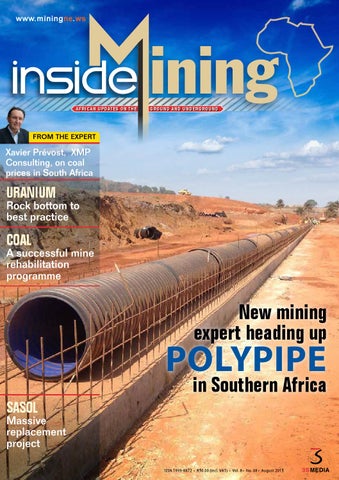
New mining expert heading up
POLYPIPE
in Southern Africa
SASOL
Massive replacement project ISSN 1999-8872 • R50.00 (incl. VAT) • Vol. 8 • No. 08 • August 2015
CONTENTS ENDORSED BY
AF R IC AN U PDATES ON TH E
August 2015
GROU ND AND U NDERG ROU ND
ON THE COVER
P4
Polypipe has appointed a mining expert to head up its Southern African operations, as the company seeks to expand its presence across the continent.
12
EDITOR’S COMMENT
3
What a privilege
COVER STORY
4
Mining expert to lead Polypipe in SA
AFRICA ROUND-UP
7
News from around the continent
ECONOMICS, FINANCE & RISK
8 Measured optimism for coal prices 10 Facts about uranium 20
COMMODITY: COAL
12 16
Massive replacement project at Sasol A successful rehabilitation programme
COMMODITY: URANIUM
20
Rock bottom to best practice
UNDERGROUND DEVELOPMENT
24 26
The bigger, the better Engineering excellence from pit to port
COMMINUTION
28 28
Jaws vs primary gyratory
GEOTECHNICAL SURVEYING
31
3D laser scanning: A solution
SHEQ
38
33 34 36 37 38
Support what’s been bought Machinery fires start somewhere Partnerships aiding northerly expansion 2015 Mine Security and Safety Africa Conference How safe can you get?
IN SID E M IN IN G 0 8 | 2015
1
Retrofit your old generation cone crusher with Metso’s new generation HP series crusher
Metso’s new generation HP series crusher • Increased reliability and availability (Machine uptime) • Safer maintenance regime and tramp removal (Safety) • Superior performance (Productivity) - Higher reduction ratio - Finer product - Higher capacity • Lower operating costs (efficient opex) - Reduce liner scrap rate - Reduced electrical energy consumption • Purposely designed to retrofit into existing civils at minimal cost
BEE Ownership Compliant metso.com – email: mmsa.info.za@metso.com
Metso will review the application and crushing system and recommend an appropriate HP crusher for the application. A business case for the retrofit will be developed.
EDITOR'S COMMENT PAGE STRAP
Publisher Elizabeth Shorten Associate publisher Nicholas McDiarmid Editor Mientjie Kleinhans Editorial assistant Mpinane Senkhane Head of design Beren Bauermeister Designer Frédérick Danton Chief sub-editor Tristan Snijders Sub-editor Morgan Carter Contributors Xavier Prévost, Trevor Scott Client services & production manager Antois-Leigh Botma Production coordinator Jacqueline Modise Marketing & digital manager Esther Le Roux Marketing specialist Philip Rosenberg Financial manager Andrew Lobban Administration Tonya Hebenton Distribution manager Nomsa Masina Distribution coordinator Asha Pursotham Printers United Litho Johannesburg Tel: +27 (0)11 402 0571 ___________________________________ Advertising Sales
Johann Liebenberg Tel: +27 (0)11 233 2600 Cell: +27 (0)82 997 4453 johann@3smedia.co.za ___________________________________
No. 9 3rd Avenue, Rivonia 2191 PO Box 92026, Norwood 2117 Tel: +27 (0)11 233 2600 Fax: +27 (0)11 234 7274/5 www.3smedia.co.za ___________________________________ Annual subscription:
South Africa: R550.00 (incl VAT & postage) African countries: US$80 Foreign: US$100 Email: subs@3smedia.co.za ISSN 1999-8872 Inside Mining Copyright 2015. All rights reserved. ___________________________________ All material in Inside Mining is copyright protected and may not be reproduced either in whole or in part without the prior written permission of the publisher. The views of contributors do not necessarily reflect those of the publishers.
To our avid readers, be sure to sign up and get the latest updates and inside scoops from the mining industry. Check out what we are talking about on our website, Facebook page or follow us on Twitter and have your say.
@mining_news www.facebook.com/ pages/Mining-News
What a privilege
W
HAT A PRIVILEGE it was to be the first media person, and female, to be precise, to visit the Shiva Uranium mine in Hartbeesfontein in the North West province. The visit was conducted both underground, where uranium is produced, and at the opencast gold mine, where we witnessed a blast in action. And, if that weren’t enough excitement for one day – we hitched a helicopter ride back to Gauteng; all in a day’s work. A few factors render Shiva Uranium worth featuring in this issue, but the most impressive is that Oakbay Resources and Energy managed to restore the mine from a ‘care and maintenance’ state to a successful and profitable business in just four years. The company’s turnaround strategy meant major cost cuttings and many hours’ hard work. But it seems that all the hard work has paid off. Read more about their success on page 18. Sasol has been replacing some of its mines, building new infrastructure, assisting the community, sinking new shafts, and constructing new conveyor belts – all part of the company’s R15.3 billion project. And it’s no wonder, as some of Sasol’s mines – and infrastructure and equipment – are in the region of 30 to 35 years old. Also, Sasol’s strategy is to, among others, supply coal until 2050. All these factors gave Sasol the ideal reason to replace its outdated technology and mines that reached the end of their coal supply. From a huge operation to a junior coal mine – we look at Wescoal’s rehabilitation programme and how the company managed to attract attention from bigger mines. Wescoal’s Intibane and Khanyisa mines, in Mpumalanga, are perfect examples of how mines can run a successful rehabilitation programme and be profitable at the same time. Whatever they have been doing right at these mines will be duplicated at their new mine, Elandspruit, close to Middelburg, Mpumalanga. Elandspruit started operations in July this year. Still within the coal theme, Xavier Prévost looks at the coal prices and describes his prediction of the coal price expectations for the future of South Africa. It seems that there is a chance of higher prices, albeit not too soon. Prévost has been involved in the coal industry since 1977 and is well known in the South African coal industry as an expert in his field. One of the big questions in the coal industry has been whether an operation should use jaws or a primary gyrator in its primary crushing process. Although the answer may seem simple at first, there is an area where this decision needs some careful deliberation. While there is a definite space for each crusher in the primary crusher stage, a vague area where both machines could do quite well exists. So, will it be jaws or a primary gyratory crusher in the primary crushing stage? See the discussion on these machines on page 28. What I found most interesting in the recent mine site visits is that safety, in general, is a high priority in South African mines. A safe mine is said to attract investors. In the smaller mines, it may be much easier to develop and encourage safety between workers, but the bigger mines often struggle when safety becomes somebody else’s responsibility. It seems that a good safety-conscious culture starts with management leading by example. As a part of the safety feature, we found some safety equipment in the market place that we would like to share with you. Talking about safety, one of the big hazards in mines, especially underground, is fire. As part of our safety feature, we look at preventing fires in machines and why good maintenance is such a profound factor in machines and equipment. But, let me not spoil the content of this issue in this comment – read about all the good news in the pages to follow.
Mientjie Kleinhans IN SID E M IN IN G 0 8 | 2015
3
COVER STORY
Mining expert to lead
Polypipe, one of the most innovative manufacturers of plastic piping systems, has appointed a mining industry expert to head up its Southern African operations, as the company seeks to expand its presence across the continent.
B
ART MALAN takes up the newly created role of mining business development manager and brings with him nearly 20 years worth of experience in mining products and processes, gained through his previous roles with companies like Multotec, Victaulic, and Osborn Engineered Products. Malan is also a member of the South African Institute of Mining and Metallurgy, and has developed extensive knowledge of multiple mining disciplines, including: coal processing, gold mining, copper processing and refining, iron ore beneficiation and processing, and filtration and electro-winning. Having worked around the globe, Bart has developed a high level of international mining knowledge, particularly on methods and environments.
4
INS I DE MI N I N G 0 8 | 2 0 1 5
Commenting on his new role, Malan explained: “This new role allows me to draw on my years of experience in the international mining industry and open up new opportunities. Polypipe is still a relatively new name in the African mining market; my first task will be to introduce the company and its water management solutions to the industry, as well as highlight the benefits of working with a global manufacturer like Polypipe. “Africa, as a continent, frequently struggles with water shortages and it will be my job to work closely with mine operators to help them optimise their water management systems. This company has a variety of solutions for water recycling, storage, and rainwater harvesting, which can help make the most of the available
TOP Namoya mine, the DRC ABOVE Ridgidrain pipes
resources and allow us to plan for times of drought; a major part of my role will be assisting with the design and development of water infrastructure at mines across the continent.” After supplying several high-profile mining projects in Kenya, Sierra Leone, and the Democratic Republic of the Congo, among others, Polypipe is building a reputation for providing efficient, resilient water management solutions that withstand the demands of mining environments. This is achieved through the products being strong and lightweight, with the added benefit of being chemical- and corrosion-resistant.
In each issue, Inside Mining offers advertisers the opportunity to promote their company’s products and services to the appropriate audience by booking the prime position of the front cover which includes a two-page feature article. The magazine offers advertisers an ideal platform to ensure the maximum exposure of their brand. Please call +27(0)11 233 2600 to secure your booking.
DRILLING COVER & BLASTING STORY
Namoya mine
Adding value
One such example of a successful installation is the Namoya mine, situated at the south-western end of the Twangiza-Namoya gold belt. The mine operators were seeking an effective subsoil drainage solution for the tailings management facility – a substantial system that processes leftover
Bart commented: “The Namoya mine is precisely the type of project where we can add real value through our knowledge of mine water management and expertise in specification. Plastic piping systems such as Ridgidrain are up to 94% lighter than concrete alternatives, meaning that they are safer to install and move around site,
materials and wastewater from gold extraction, as well as ensuring harmful particles or chemicals cannot enter the soil or groundwater. Following a competitive tender, Polypipe was selected to provide a solution and recommended the Ridgidrain twin-wall drainage system, with perforations at regular intervals along its full length, to allow safe and gradual drainage. Manufactured in high-density polyethylene (HDPE), Ridgidrain boasts excellent abrasion resistance, both internally and externally – protecting against sediment within the wastewater and the rugged mine environment. It also offers a high compression strength to withstand imposed loadings, yet is still incredibly lightweight for ease of installation and transport. Polypipe supplied 1 386 metres of 500 mm diameter and 190 metres of 600 mm diameter Ridgidrain twin-wall pipe, shipped via eight 40 ft sea containers, which required close coordination, between Polypipe’s UK manufacturing operation and the shipping agent, in order to meet deadlines and ensure the full order was despatched as one shipment. Tailings management facilities are essential in ensuring the mine operates in an environmentally conscious manner, and the Ridgidrain system allows for the controlled seepage of treated water. The system can also deal with unpredictable fluctuations, due to factors including stormwater, and is a crucial element of an effective water management system.
“The mismanagement of water can, therefore, significantly impact production. Many extraction and washing processes depend upon clean water and, if water is mismanaged, mineral transportation – which is often run to a tight schedule – and also offer considerable environmental can be disrupted. Where water is wasted benefits. Production and transportation and mismanaged, more water than is truly are simplified and use less carbon, and necessary is pumped to site, all at considthe product can often be reused erable cost – meaning properly manelsewhere when the project ends. aged water use can save money, as These factors are key considerwell as optimise production and ations for mine operators, and reduce downtime,” he adds. also make the product more As seepage from pipes can accost-effective. For these reasons, count for up to 50 000 m3 lost per Ridgidrain is bringing month in a mine using 1 million a new perspecm3 in the same time peritive to the use of od, robust yet flexible plastic pipework engineered pipework in the African solutions are essential mining market, in minimising lost and and is growing in wasted water. HDPE popularity.” pipes, as well as polyethylene (PE) pipes, are the ideal choice for Effective water “This new role mining applications management thanks to their inherIn Bart’s expeallows me to draw ent strength and leak rience, effective on my years of resistance, coupled with water manageexperience in the lightweight materiment can help als that make them easy avoid disruption the international to install. to production and mining industry Polypipe offers a costly downtime. number of HDPE and “The uses of water and open up new PE product solutions in mining operopportunities.” for water manageations are varied Bart Malan, mining business ment in mining apand substantial,” development manager, Polypipe plications, from the he explained. “It supply and storage of is used to recovpotable and process water, to dewaterer mineral ores from chemical solutions, ing and treatment. These include: PE100 to cool equipment (such as rock cutters), pressure pipes, HDPE twin-wall gravity and to wash minerals once extracted. Ores systems – Ridgidrain and RidgistormXL – can also be transported away from the and Polystorm cell units for water attenusite, through pipelines, in slurry, which ation and reuse. can cut the costs associated with road or
Polypipe in SA
rail transport but increase the amount of water used by a mine. Arid climates often lead to dusty conditions, particularly on service roads, and water is used to damp down and control dust. Finally, high-quality water is also required to meet the drinking, cooking, and washing needs of workers throughout the life of the mine.
Mismanagement of water
Bart Malan
will be based at Growth Point Industrial Estate in Meadowdale, Johannesburg, travelling internationally within Southern Africa. He can be contacted at bart.malan@polypipe.com or on +27 (0)72 690 0279.
www.polypipe.com/mining
IN SID E M IN IN G 0 8 | 2015
5
AFRICA’S LEADER
IN MINING AND MINERALS PROCESSING
MINERALS PROCESSING
Tel: +27 11 202 8600
MINE DESIGN
INFRAStRuCtuRE
WINDER SyStEMS
CONtRACt OPERAtIONS
StuDIES
draglobal.com
AFRICA ROUND-UP
MINING NEWS
from around the continent
BURKINA FASO New mining code adopted Burkina Faso’s transitional parliament passed a new mining code in June that abolishes the previous 10% tax break on mining company profits and obliges firms to pay into a local development fund. The adoption of the new code, which replaces 12-year-old mining regulations, was among requirements set by the World Bank for the release of $100 million in budget support for the West African country. The funds were frozen in February, pending passage of the new code and an anticorruption law that was adopted in March.
Boubacar Ba, Minister of Mines and Energy, Burkina Faso
The two pieces of legislation had long been called for by donors and demanded by protesters who took to the streets in October, forcing veteran leader Blaise Compaore to step down and flee the country after nearly 30 years in power. Burkina Faso is Africa’s fourth biggest gold producer and the precious metal accounts for roughly 20% of GDP. Two dozen firms operate in the sector, including Semafo, Iam Gold, and Avocet Mining, and they had previously benefited from corporate tax rates lower than other nations in West Africa. “We think that, in the context in which we are living today, it’s time to move from an attractive code (for the mining companies) to a code that encourages community development,” said the
Burkinabe Energy and Mines Minister, Boubacar Ba. Under the new regulations, companies with exploitation permits will pay the normal tax rate on profits of 27.5%. Firms with industrial mining licences will pay 1% of monthly turnover excluding taxes or 1% of the value of extracted minerals into a local development fund. It was not clear how it would be decided which of the two payment measures would be used. The state will also pay 20% of its mining revenues into the fund. Burkina Faso’s interim leadership is due to usher the country to elections later this year. But, the new authorities have to shore up revenues in the face of slowing economic growth, as the political instability has exacerbated the impact of lower commodity prices and a regional Ebola outbreak. The World Bank has provided around $300 million in support to Burkina Faso in each of the last four years. The new mining code includes provisions for the creation of a fund to rehabilitate artisanal mining sites and prohibit the use of harmful chemicals, and another to finance geological research and support education in earth sciences.
public financial management, including implementing stronger controls over stateowned enterprises,” the IMF said in a statement. The Southern African country’s economy grew 7.5% in 2014 and the government said, in April, it expected GDP to remain at that level in 2015, driven mainly by strong performances in the electricity and gas sectors. Mozambique is in the process of offering over a dozen exploration blocks in its northern region, where US oil major Anadarko Petroleum and Italy’s Eni are already developing multibillion-dollar natural gas projects. The IMF said new mining and hydrocarbon legislation, on the verge of being passed, would attract further investment in the former Portuguese colony, which celebrated 40 years of independence last month.
TANZANIA Acacia warns that weaker shilling may hit earnings Tanzania-focused gold miner Acacia warned that a weaker shilling could hit its second quarter earnings by reducing the US dollar
MOZAMBIQUE Solid, but in need of more control Strong economic growth in Mozambique is supported by major investments in the coal mining and natural gas sectors but stricter control over staterun firms is necessary, says the International Monetary Fund (IMF). “Mozambique’s continued strong growth performance and low inflation are commendable… but more needs to be done to improve
Brad Gordon, CEO, Acacia Mining
value of the taxes it is owed. The outstanding Tanzanian shilling-denominated tax balance owed to the company was worth approximately $124 million at the beginning of the second quarter. Since then, the shilling has weakened against the US dollar and the tax balance has
to be converted into dollars for reporting purposes. “Any accounting loss from the revaluation… may, therefore, impact earnings, although this has no corresponding impact on cash flow for the period,” the company said in a recent statement. Acacia said it also expected a small reduction in its cost base, due to the weaker shilling. About 15% to 20% of the company’s costs are denominated in shillings, while the bulk of gold sales are in US dollars or dollar equivalents.
ZAMBIA VAT refund payments to mining firms resumed Zambia has again started paying value-added tax (VAT) refunds to mining companies, Mines, Energy and Water Development Minister Christopher Yaluma said, aiming to put an end to a long-running dispute. Mining companies had claimed, for months, that they were owed more than $600 million in VAT refunds. In February, the government decided to relax the rule requiring exporters to produce import-export documents to claim the refunds. “We are very committed to repaying. We have started to pay and that’s to clear the debacle,” Yaluma said on the sidelines of the Zambia Mining Investment Forum. Foreign companies operating mines in the world’s second biggest producer of copper include Glencore, First Quantum, Barrick Gold Corp, and Vedanta. Vedanta chief executive Tom Albanese, a delegate at the event, confirmed that the government had resumed some payments. IN SID E M IN IN G 0 8 | 2015
7
ECONOMICS, FINANCE & RISK
Measured optimism If only it were possible to correctly predict the future prices of coal – life would be so much easier. Since that is not entirely possible, one has to work with the data at hand for a possible prediction. XAVIER PRÉVOST* (pictured left) discusses what has happened to coal prices recently.
W
GRAPH 1 Platts International Coal Report July 2015 statistics.
COAL
FACTS
8
power stations to become surplus and, therefore, exports, at extremely low, uncompetitive prices. The Pacific Rim countries still had a very large appetite for steam and metallurgical coal, at that stage, and China, the main producer and user of coal in the world, was still a strong importer of coal. Since then,
the new Chinese government policy of decreasing pollution levels, which were then extremely high, has turned China into a more or less self-sufficient energy country, with little place for foreign imports. How does this, occurring in such a faraway country, have an effect on us? Why is China’s coal usage so important? In a
Coal prices per tonne in US$
HAT HAS HAPPENED with coal over the last three years has been a disaster, especially for coal-based economies like South Africa. Since mid-2012, coal prices have been decreasing steadily, with minor periods of slight increase, followed by more decreases. The cause or beginning of the debacle was the abundance of seaborne thermal coal from the US, as a result of the American shale-gas revolution, which forced large amounts of coal earmarked for US coal-fired
Since
77% 28% 2012 Primary energy needs in South Africa provided by coal
INS I DE MI N I N G 0 8 | 2 0 1 5
Coal production being exported from South Africa
Coal prices in SouthAfrica have been decreasing
The more renewable energy is implemented, the less coal will be consumed for energy purposes
45%
Approximate coal export to India from South Africa
ECONOMICS, FINANCE & RISK
for coal prices recent article, from well-known energy consultancy Wood Mackenzie, titled ‘Coal – It’s all about China’, the author explains the importance of the volumes of coal consumed by China, and how that country is now managing to introduce vast amounts of renewables into the energy mix; further, China’s once inefficient, high-cost coal mines are being consolidated and assisted by government to curtail imports. Wood Mackenzie states that China’s large coal imports have ceased, for good.
Coal demand In June 2013, Wood Mackenzie declared that Chinese thermal coal demand would double by 2030. This advice from such a reputed source produced large investments in coal mining and triggered the present coal glut. It looks like nobody took the Chinese government decision to cut their incredibly high air pollution seriously. After discussing the future coal market in China, we should look at India, second only to China as a user and producer of coal. Is India going to replace China in the
world coal market? Some analysts say yes but, looking at present trends and current coal policy in India, it looks like the country might follow a similar pattern of becoming self-sufficient, optimising its mines and, therefore, importing less coal. Most of our exports – about 45% – currently go to India, but for how long?
South African market Some years back, South Africa was displaced, by Colombia, as a main exporter of coal to Europe. And now that our once large exports to Asia are also decreasing sharply, where can our coal go? We have a fair chance to export to the Middle East, but volumes there will never be as large as in Europe or Asia, and we face competition with all the other exporters, including Russia, with a very strong presence in the region. Since our export markets are dwindling and prices, according to most analysts, are going
to stay low for the foreseeable future, what can the coal industry in South Africa do to survive? I believe the most important thing is to, at the very least, decrease exports in order to increase, even slightly, demand and, therefore, prices. The rest of the lower-quality coals can find a buyer in the local market, maybe at better prices than exports. The same applies to the better-quality, 6 000 kcal/kg coals that the exports are based on. While a certain amount could be absorbed by some of the industry, some must still be exported. One thing is for sure, with the ongoing energy crisis, coal prices in the inland market will never be decreased; on the contrary, they could increase soon.
Most of our exports – about 45% – currently go to India, but for how long?
Hopeful
Is there hope for coal in South and Southern Africa? In my view, there is, provided we optimise, cut costs, and maximise our marketing. As many experts agree, coal is here to stay; it is the only cheap, reliable source of energy, especially for poor and developing countries. Prices will never reach the levels we saw before but, with careful cost control, mines can still deliver profits. *Xavier Prévost is a senior coal ana-
lyst at XMP Consulting
51%
Coal produced in South Africa from underground mines
49%
Coal produced in South Africa from opencast methods
In South Africa, Eskom is the biggest user of steel coal
7th
Eskom's rank in South Africa as an electricity generator
Sasol
The largest coal-tochemical producer in South Africa
IN SID E M IN IN G 0 8 | 2015
9
ECONOMICS, FINANCE & RISK
Facts about
uranium T
Uranium seems to have a rather positive future ahead, despite the Fukushima disaster a few years ago. TREVOR SCOTT* (pictured left) gives his predictions regarding the future of uranium.
HE LONG-TERM market fundamentals for uranium are very promising, with demand expected to outstrip global supply by 50 million pounds (lbs) per annum. It is estimated that, by 2030, uranium demand will grow to 266.0 million lbs from 167.5 million lbs in 2014.
Africa currently produces 18% of global uranium demand. These expectations outweigh the current oversupply in the market. However, uranium producers globally are limited, so supply disruptions remain a concern. Supply declined marginally in the past year and, to meet global demand, new
1
10 INS I DE MI N I N G 0 8 | 2 0 1 5
mines will need to be commissioned. However, the price of uranium remains a challenge, as many producers have indicated that only a price in excess of $70/lb would make mining viable. The spot price averaged $33/lb in 2014 and recovered somewhat in Q4, to $37/lb. Nonetheless, uranium prices are forecast to rise by 65% to 85% by 2016, in order to stimulate increased production. In 2015, they are expected to average $41/lb. Uranium is used as fuel for nuclear power plants and is a key mineral for the aerospace and defence industries. Growth in nuclear energy is, therefore, fuelling demand for uranium. At present, approximately 435 commercial nuclear power reactors operate in 31 countries, with over 375 000 MWe of total capacity. Of these, about 240 are research reactors and the remaining 180 nuclear reactors power some 140 ships and submarines. A record 70 new nuclear reactors are under construction globally and a further 500 plants are being proposed for roll-out. A number of countries are focusing on meeting energy demands with low-carbon-emitting solutions, which bodes well for demand for uranium. In
2
addition, Japan’s revival of its reactors, following Fukishima, remains critical to demand. Nuclear power plants use uranium fuel to generate electricity through a process called fission and, with demand for energy rising, the need for nuclear power is becoming more evident. Global electricity demand is growing twice as fast as overall energy demand and worldwide demand for electricity is projected to rise by 75%, by 2035. China’s demand for energy is expected to triple by 2050. A kilogram of uranium produces three million times the energy equivalent of oil or coal, and nuclear power plants do not emit criteria pollutants or greenhouse gases. Nuclear power is the cheapest energy source available, even factoring in the high costs of power station construction.
Realising possibilities...
Growth in nuclear energy is fuelling demand for uranium
*Trevor Scott is the financial director of Oakbay Resources.
GRAPH 1 World Electricity Generation, 1990–2040 GRAPH 2 Uranium Oxide Price, $38.25/lb, 9 February 2015 TABLE 1 (Below) A global nuclear snapshot Sources: BBC, www.bbc.com/news/business; IEA - International Energy Agency, www.iea.org; InfoMine - Mining Intelligence and Technology, www. infomine.com/; Rockstone Research, www.rockstone-research.com; Uranium Investing News, www.uraniuminvestingnews.com; World Energy Council, www. worldenergy.org; World Nuclear Association, www.world-nuclear.org; KPMG
COUNTRY
REACTORS OPERABLE
REACTORS UNDER CONSTRUCTION
REACTORS PLANNED
REACTORS PROPOSED
1
US France Japan* Russia South Korea China India Canada UK Ukraine World Total
99 58 48 34 23 22 21 19 16 15 437
5 1 3 9 5 27 6 0 0 0 70
5 1 9 31 8 64 22 2 4 2 183
17 1 3 18 0 123 35 3 7 11 311
...from mine to market.
Resource Evaluation
Mineral Processing
Mine Planning
Tailings & Waste Management
Mining & Mine Development
Smelting & Refining
Materials Handling
Environment & Approvals
Transport to Market
Non-Process Infrastructure
WorleyParsons adds value through our full scope of services from pit to port including studies, mine planning, impact assessments, permitting and approvals, project management, construction management and global procurement.
46
countries
157
www.worleyparsons.com
I N S I D E M I N I N G 0 8 | 2 0 1 5 11
offices
35,600
people
COMMODITY: COAL
Massive
replacement project R Sasol Mining has undertaken a R15.3 billion mine replacement programme, scheduled to be completed by 2018. This programme includes the replacement of three mines, high wall access, social and labour plans, and local economic development projects. MIENTJIE KLEINHANS takes a closer look at the programme’s details.
12 INS I DE MI N I N G 0 8 | 2 0 1 5
EPLACING MINES THAT vary between 30 and 35 years old has become a matter of urgency for Sasol Mining. Some of the equipment and infrastructure have become old, redundant, and very expensive to maintain. Some of the coal reserves have also been nearing their end. These are the main reasons why Sasol Mining launched the replacement programme in 2009. “Sasol Mining also implemented a strategy to supply the Sasol Synfuels plant with coal until 2050. This meant that we had to replace the mines, equipment, infrastructure, and gain access to new reserves. So, while we were at it, management decided to commence with the social and labour plan, and the local economic development projects as well,” states Kobus Louw, vice-president: Projects at Sasol.
Mine replacement The three mines that are affected in the replacement programme are: • Twistdraai Colliery (now Thubelisha Shaft) • Brandspruit (now Impumelelo Mine) • Middelbult (now Shondoni Mine).
COMMODITY:COAL COAL COMMODITY:
Beyond just moving the mines over to new locations were the various challenges of moving equipment, creating infrastructure, building new access roads and new materials handling systems, engaging with communities and contractors, and various other challenges – such as safety aspects.
Thubelisha Shaft
The shaft is 714 m long and 160 m deep, with an inclination of 17 degrees, and was installed with 831 m double-inclined conveyors. The coal handling conveyor is 17 km and is designed to carry 2 400 tph of coal. To complement this shaft, 14 069 m2
near Greylingstad. Although the approved budget was R4.65 billion, the cost forecast is slightly higher, and totals R4.69 billion. “More people were involved with this project and much more time was spent in the construction phase,” says Louw. The construction team peaked at 2 200 people and worked 13.5 million hours on the project. “What makes this mine remarkable is that it has the longest single-flight conveyor belt in the Southern Hemisphere, at a length of 28 km,” says Louw. The conveyor belt was designed to carry 2 400 tph of coal, yet it will be operating at 2 000 tph at a speed of 6.5 m/s. The inclined shaft is 235 m deep, 1 000 m long, 6.5 m wide, and 3 m high. The ventilation shaft is 210 m deep, 6.6 m in diameter, and contains three fans. In the first phase, 13 500 m2 of buildings and 500 m2 of structures were built. “Another interesting fact with this project is that 28 km of roads and two new bridges had to be constructed to get to the mine,” explains Louw.
“What makes Impumelelo Mine remarkable is that it has the longest single-flight conveyor belt in the Southern Hemisphere.”
The Thubelisha Shaft project was the first of the replacement projects to commence, having started in March 2009, with a budget of R3.4 billion. The project was completed within budget, at slightly less than R3.3 billion, and the first production commenced in January 2012. The construction workers peaked at 1 600 people and worked a total of 9 million hours on this project. On the structural side of the project, a winder and elevator system, ventilation fan system, an inclined shaft, and a conveyor system were constructed. The winder and elevator shaft is 160 m deep and 11.4 m wide, able to carry 200 people, with a licensed capacity of 65 tonnes. The ventilation shaft is slightly narrower, at 9 m wide, but the same depth. The equipment for the first production section was lowered down the ventilation shaft to make an early start on the underground development. Two fans were installed and are in operation.
of buildings and a total of 7 620 m2 of structures were erected on-site.
Impumelelo Mine The Impumelelo Mine project construction phase commenced in January 2011. It has taken just over four and a half years to start first production, in August 2015, and is scheduled to be completed in May 2016. This mine is located OPPOSITE During earlier construction of Impumelelo and Shondoni’s 4 000 tonne bunker area, with Sasol Two and Three clearly visible in the background. On the right-hand side is the Brandspruit conveyor belt BELOW One of the roadways constructed to the coal seam as part of the 7 road high wall access during the Tweedraai project. This was part of the initial blast of the project
Shondoni Mine The last of the three replacement programme mines is Shondoni Mine. Although the construction started in February 2012, first production is only expected in January 2016, and completion of the
IN SID E M IN IN G 0 8 | 2015 13
COMMODITY: COAL
first phase is expected in January 2017. The approved budget for this project is R5.46 billion; so far, R4.05 billion has been committed. Once completed, the coal handling conveyor belt will be 21 km long and will operate at 6.5 m/s. The designed capacity of the conveyor belt is 2 400 tph, but it will most likely operate at 2 000 tph. The ventilation shaft will be 120 m deep and 9 m in diameter, with three fans, while the winder and elevator shaft will be 150 m deep, 11.7 m in diameter, and able to accommodate 200 people. Construction workers on this project peaked at 2 400 persons. TOP The Impumelelo 15 000 tonne bunker during the construction phase BELOW The Impumelelo 15 000 tonne bunker
A total 18 700 m2 of buildings and 8 970 m2 of structures will be erected at this mine.
Syferfontein Tweedraai high wall access The Syferfontein Tweedraai project allows access into Block IV through the high wall. This project started in May 2013 and was completed less than two years later, in March 2015. First production started in April 2014. The approved budget was R1.38 billion and the amount spent is estimated at R1.3 billion. A total of 341 people worked 532 968 hours up to the completion of the project. The following entrances had to be constructed: • two ventilation roads of 7 m x 4 m, at 10 degrees
• two underground access roads of 7 m x 4 m, at 7 degrees • one incline belt road of 7 m x 4 m, at 7 degrees • one pit access road of 904 m. The amount of concrete used to build these road was 1 808 m3. Two ventilation fans, with a capacity of 700 m3/s, were installed, while the overland conveyor, which will handle the coal, measures 1.5 km. An office block, a change house for 200 workers, and substation buildings were added to this project.
Small projects A few less-costly projects were also undertaken as part of Sasol’s small projects. These smaller projects included: • Irenedale surface service dam • Modderfontein ventilation shaft • Kinross reservoir project. The Irenedale surface service dam started in October 2013 and was completed in August 2014, with a budget of R10.98 million. R10.97 million was spent on this 30 Mℓ earth dam. The Modderfontein ventilation shaft took 16 months to complete. Construction was started in June 2012 and completed in October 2013. The approved budget was R84.6 million, but the actual spend was
PROJECT FACTS
28 km
The longest single-flight conveyor belt in the Southern Hemisphere, will transport coal from Impumelelo to Synfuels
14 INS I DE MI N I N G 0 8 | 2 0 1 5
66 km
The total distance of overland conveyors
45 million The estimated hours of work done on this project
43 km
The total distance of roads built
3 090 m2 The total area of structures
COMMODITY: COAL
R72.5 million. It took 118 087 hours to complete. Kinross reservoir repair was completed in December 2014, after the project commenced in May 2013. This was the cheapest project and although R1.5 million was budgeted, the actual spend was only R1.2 million.
Local economic development projects Health centre and fire station
“While Koppies, in the Free State, received a community health centre to the value of R5.5 million, which took seven months to complete, Leandra in Mpumalanga, received a new fire station,” says Louw. The fire station also took about seven months to complete and cost R6.7 million. Both the projects were started and completed in 2014.
Nthoroane roads The project that took the least time to complete was the Nthoroane roads project. During the six months from March to September 2014, Sasol Mining constructed 2 km of paved roads and V-drains for the community of Nthoroane, in Greylingstad, Mpumalanga. Once again, the project team managed to save some money and only spent R9.7 million of the approved budget of R10 million.
Affordable housing project As part of Sasol’s social and labour plan, the company will build 300 affordable houses for its workers. Of these, 100 will be in Secunda, 100 in Sasolburg, and 100 in eMbalenhle. The infrastructure for the houses is ready in Secunda and eMbalenhle, but the project is yet to commence in Sasolburg. Louw explains that, although Sasol built the infrastructure, the employees will have to carry the cost of the top structures themselves. To assist the employees in obtaining bonds for the houses, Sasol negotiated with FNB to assist the workers with more than just the financing of bonds and other hidden costs. This project started in November 2013 with an approved budget of R67.7 million. The Sasol Mine Replacement Programme
has been a huge undertaking by Sasol and the company has involved the communities, where it could, to ensure that they also benefit from the programme. Sasol Mining supplies 42 million tonnes of coal a year to Synfuels. Considering that Sasol has a strategy to keep on supplying coal to Synfuels, until at least 2050, there will surely be more replacement and investment projects to look forward to. TOP The ventilation shaft at Modderfontein BELOW Sasol built and upgraded various roads and bridges as part of the replacement project BOTTOM Leandra Fire Station was one of the local economic development projects undertaken by Sasol
IN SID E M IN IN G 0 8 | 2015 15
COMMODITY: COAL
A
L
JUNIOR MINING company, such as Wescoal, has no fewer responsibilities towards the environment, in its rehabilitation programme, than any other larger coal mining operation. Although on a smaller scale, Wescoal still has to ensure that it rehabilitates the land that it has been mining to conform with the post-closure mine use as described in the Environmental Management Plan (EMP). “Whether you have one machine in a small operation, or an entire fleet of machines working, a mine is a mine, and the same laws have to be adhered to,” says Dutch Botes, Wescoal’s mining CEO. “So, while we are at it, we might as well do it
right and we are doing just that.” Both mines’ rehabilitation programmes were compiled during the preplanning phases of the mines and are updated regularly to address the fluid nature of mining. The financial provisions for rehabilitation are also updated annually. The land rehabilitation programme that has been implemented is actually quite simple. Wescoal uses what is called rollover rehabilitation. Botes explains that the rollover process, in a nutshell, means that earth is moved from the first stage of mining, to a stipulated area, by separating the topsoil from the rest of the overburden. But, as the process moves along, the valuable topsoil is placed back on the backfilled section/cut.
A successful rehabilitation programme
In an industry notorious for neglecting rehabilitation programmes, Wescoal’s Intibane and Khanyisa mines are doing something right, as their rehabilitation programmes are a success story in progress.
16 INS I DE MI N I N G 0 87 | 2 0 1 5
COMMODITY: COAL
The topsoil, with the seed bank, is placed on top again. Thereby, voids are continuously filled as the process moves along – restoring the land, as near as possible, to its previous state. “In that way, by the time we get to the last cut, we will have been concurrently rehabilitating the areas that have been mined already. And, when we are finished with the coal extraction, all the material will be back in place, looking as near to natural as it used to be,” says Botes. Even though it sounds quite simple, the rehabilitation programme entails much more than just refilling the previous void, allowing the grass to grow, and replacing cattle in the veld.
The Environmental Management Programme Before any of the two mines were allowed to start any operation, the properly planned EMP had to be approved by the Department of Mineral Resources (DMR). This document addresses the various environmental issues that need to be addressed, before, during, and after mining operations. Even though the Khanyisa and Intibane EMPs look very similar, each of the two mines has its site-specific plans and monitoring programmes in place. The rehabilitation programmes have been monitored very closely by Tim van Stormbroek, an environmental consultant from Ferret Mining and Environmental
Services, who does weekly monitoring sessions on-site and submits a monthly report to the mine management, as well as annual reports to the DMR. “I must compliment the management team of the two mines, as Wescoal is one of the best mines to work on, from an environmental point of view. I sometimes give them a hard time, but there is always a positive response to recommendations,” praises Van Stormbroek. The various aspects that need to be monitored include: • material backfill monitoring: e.g. to prevent topsoil from mixing with other material • water monitoring: e.g. surface and groundwater samples are taken and
IN SID E M IN IN G 0 8 | 2015 17
COMMODITY: COAL
evaluated for chemistry and biology • construction activities are monitored to ensure that Wescoal stays within the scope of the EMP • stockpiling and stockpile management • construction of any surface infrastructure • maintenance of the access and haul roads • construction and maintenance of the pollution control dam • dust control • geology • topography • natural, and alien, vegetation control • animal life • noise and vibration. “When we take all of the above into consideration, Wescoal’s mines have set a great trajectory for compliance,” says Van Stormbroek. Botes adds that it had visitors from the ‘big mines’ at Intibane, to look at its rehabilitation programme. “The environmental consultants look at the smallest detail, which we sometimes overlook, such as correct storage procedures for used machine filters and old oil. Although the EMP is applicable within the borders of the area where the company has mining rights, some monitoring activities extend beyond these boundaries. Mining companies are, therefore, responsible for any potential impacts they may have on neighbouring communities or receiving environments. For this reason, Wescoal has been working with the surrounding communities to facilitate constructive liaison and problem solving when required.
Heritage sites During the initial phase of the Environmental Impact Assessment, it was found that the Intibane mining area had several historical graves. In compliance with the relevant legislation, a Heritage Impact
Assessment was conducted. This process aims to identify the living family of the existing graves, where possible. The option exists to exhume and move graves to a formal cemetery for re-burial, in cooperation with the surviving family. In the case of Intibane, it was opted to rather leave the graves undisturbed. The two grave areas were fenced off and pedestrian gates installed to provide access for family visitation. These grave areas, therefore, became ‘islands’ in the opencast pits for a time, until the applicable cut was backfilled.
Housing As part of Wescoal’s EMP and social responsibility, the company provided some of the oldest and poorest people in the neighbouring area with new houses. Three of these families were living on Wescoal’s mining property and were happily relocated to the Arbor community. The other 17 houses were also built in the Arbor community for other needy families. “We used members from the local community, taught them some building skills, and used them to build the houses. This way, we created jobs for these people, as they can apply their new skills elsewhere. Furthermore, the houses were built with the minimum maintenance requirements, so that the new owners won’t have to spend money on maintenance challenges any time soon,” explains Botes.
Instead of building fixed infrastructure that would require demolition at the end of mining, Wescoal’s management decided to minimise the company’s footprint by using as many mobile offices and store rooms as possible. The only fixed buildings are the laundry and storage facilities for the fuels and lubricants, and the weighbridge, which will also be removed at the end of life of mine and the area rehabilitated. “This way, we are saving building and construction costs, and demolishing the infrastructure afterwards,” says Botes.
Animal life On the boundaries of the Intibane mine, and between the maize fields, birds abound. During weekly site visits, Ferret takes note of any significant potential impacts on the bird life of the area. African grass owls have regularly been identified in the overgrown vegetation on the periphery of Intibane and indications of breeding activity have been seen. A pair of spotted eagle owls successfully raised two chicks in a crevice on the high wall of one
INTIBANE ANDAND KHANYISA FACTS SOME INTIBANE KHANYISA FACTS
28 km
The two mines are located close to the Kendal Power Station
18 INSI DE MI NI NG 0 8 | 2 0 1 5
Less infrastructure
The two open-pit mines supply the Tutuka Power Station
2.70 m tonnes
Coal reserves for Intibane
1.63 m tonnes Coal reserves for Khanyisa
COMMODITY: COAL
of the Khanyisa mining pits. The contractors were eager not to disturb the owls and kept activity in the area to a minimum. An infrared game camera was set up to monitor progress in the raising of the chicks. In general, snakes that come into contact with humans are, unfortunately, killed. However, at Intibane and Khanyisa, a number of snakes that have wondered into operational areas have been caught and relocated to a safer area instead of being killed.
Water trenches and dam Wescoal is particularly proud of its surface- and groundwater monitoring programme. Van Stormbroek explains that there are numerous monitoring boreholes used for monthly sampling at both mines. One such borehole is located at the Intibane processing plant, right next to the crushing facility.
plant. Managing the water level in these dams is crucial and maintenance of the inlets and sediment traps is part of the management programme. Monitoring points are used in the river that runs close to the mine. There are upstream monitoring points to determine the quality of the surface water before the potential impact of the mine; midstream and below stream monitoring points record the water quality after the impact of the mine. Any anomalies in water quality are evaluated and investigated to determine whether action is required. “At Intibane, the only poor-quality groundwater emanates from an abandoned historical underground mine within the neighbouring portion of the farm. Because this groundwater follows the topography of the area into the Intibane colliery, Wescoal considers this the company's responsibility. The impact of this
“Wescoal is one of the best mines to work on from an environmental point of view.” Tim van Stormbroek (end right), environmental consultant, Ferret Mining and Environmental Services “Even this borehole’s water complies with Class 1 drinking water. It is not often that one finds that at a mine.” As required by their Water Use Licenses, both Intibane and Khanyisa have trenches around the mines that channel stormwater to the pollution control dams. The specially lined dams store the run-off water, which is recycled as part of the dust control programme and wherever water is needed in the processing
water is managed within the stormwater infrastructure at Intibane,” explains Van Stormbroek.
Health and safety Another achievement of which Wescoal is very proud is its exceptional safety record. With over 300 people employed at two operations, and zero lost time for the last financial year, this safety record is quite an achievement. Mine manager Joe
ABOVE LEFT Some of the areas were left intact. Eventually, the mined area will meet up with this piece of land, and will look similar as well ABOVE Wescoal decided to keep the graves intact and mine around the graveyard BELOW LEFT Curtis Mnisi, GM : Processing, Wescoal; Joe van Rensburg, mine manager, Wecoal; Bert Immelman, safety manager, Wescoal; and Tim van Stormbroek, environmental consultant, Ferret Mining and Environmental Services, with the Intibane stockpiles in the background
van Rensburg manages the workers by encouraging safety as a priority. “We pace the workers and inspire them to halt any operations if they notice any hazardous situations. For instance, if, for some reason, there is a high volume of dust present, the workers will stop the operation until the water bowsers have covered the area again and suppressed the dust,” explains Van Rensburg. Botes adds, “We have done our studies. We monitor and manage the contractors on a day-today basis, on all aspects of mining, and we have, therefore, been doing well in all aspects.” All in all, Wescoal has been doing well with its rehabilitation programme. The company is working well with the community and does whatever necessary to keep its footprint small. Wescoal will leave the land as close as possible to the way it was found before operations. “At Wescoal, we acknowledge that mining in South Africa has often had a poor record of environmental management. It is with this in mind that we have committed to excellence through sound environmental practices. “We are steadfast in our dedication to the implementation of industry best practice control measures in order to minimise the impact of our mining operations. Great emphasis is placed on robust rehabilitation techniques to contribute effectively to ultimate post-closure land use,” concludes Waheed Sulaiman, Wescoal CEO. IN SID E M IN IN G 0 8 | 2015 19
COMMODITY: URANIUM
Rock bottom to best practice Growing from a ‘care and maintenance’ mine to a best practice mine, in four years, didn’t come easy. It took many hours of hard work, commitment, and dedication. MIENTJIE KLEINHANS looks at how Shiva Uranium was turned around in such a short period.
The conveyor belt from the jaw crusher in the primary crushing stage
20 INS I DE MI N I N G 0 8 | 2 0 1 5
D
ESPITE THE FUKUSHIMA disaster causing a huge downturn in uranium demand, Oakbay Resources and Energy managed to turn its Shiva Uranium mine into a profitable business and even listed the mine on the JSE last year. Although the uranium side of the mine is still in development, Shiva Uranium will be the only dedicated uranium mine in South Africa and is located in the Hartbeesfontein district of the North West province. It claims to have one of the largest uranium ore bodies
COMMODITY: URANIUM
in South Africa, and one of the top five in the world. It also has two new order mining rights that are valid for 30 years. Oakbay Resources and Energy bought Shiva Uranium from Uranium One in 2010. At this stage, the mine was under a state of ‘care and maintenance’ for two years, which could be as a result of the commodity’s global downturn. “We saw the future potential of uranium becoming a commodity in huge demand when we acquired 74% of Shiva Uranium. The operation was in turmoil, with an average maintenance spend of $1 million a month,” states Varun Gupta, Oakbay Resources and Energy executive director of operations. One of the first calls to action was to
start an open-pit mine to mine the gold reserves, which assisted with the cash flow in the earlier days. Although most gold mines are underground, Shiva’s reserves are quite shallow, making it an ideal situation for open-pit mining. “The initial cash flow assisted us in the development of the uranium mining. Unfortunately, after the Fukushima disaster, we had to stop; but, we are doing well with the gold operation,” says Gupta. The rest of the actions occurred over several phases, until the gold mine was in full operation. The company managed its costs well, claiming that the main drive behind the success was to achieve the lowest costs possible. As Shiva Uranium has a lowgrade gold ore body, the company had to maintain the spend to make money – and they did. “As a group, we strategise very
well on how to make a company profitable in a short space of time,” says Gupta. Since the onset, Shiva Uranium has refurbished three underground incline shafts, developed an open-pit gold mine, and upgraded and recommissioned the uranium plant.
Partnerships for success Oakbay Resources got the best in the industry to assist them in turning the mine around. Companies like JIC Mining, SNC-Lavalin, Bateman, and Babcock assisted Shiva Uranium with starting the mining operations. Furthermore, the management team worked on the ‘ground level’. “We, as management, are hands-on. We don’t sit in boardrooms or fancy offices,” says Gupta. Trevor Scott, Oakbay Resources’ financial director, adds that much of Shiva Uranium’s
IN SID E M IN IN G 0 8 | 2015 21
COMMODITY: URANIUM
the operation would only start twelve months from the acquisition,” says Kobus Kotze, general mine manager for Shiva Uranium. He tells how the entire shaft had to be refurbished and that nobody could enter the shaft without equipment. Everything was flooded and washed away by the years of neglect. “When we arrived here, the roadway was washed away and there was no infrastructure in place to control the water at the incline shaft. All the water accumulated into the incline shaft and we had to refurbish everything to get the mining equipment underground,” remembers Kotze. The initial target was to descend 100 m a month into the mine to get to the lowest point as quickly as possible. Kotze tells how the mine increased the standards every day and, when it reached 100 m a month, the target was increased to 250 m a month. success is also due to staff and management’s hard work, commitment, and dedication from the very beginning – before the opening of the underground operation. He remembers how some of the managers slept in containers on-site, while working long hours with the workers. “That is the sort of dedication that, along with highly trained staff from other major gold producers, assisted in the success of Shiva Uranium,” claims Scott. He states that there are between 180 and 200 years’ worth of combined experience within the management team. “It took only six months to go from nothing to first production, even though the bankable feasibility study predicted that TOP The furnace where the gold is melted, before it is poured into bars BELOW Blasting in the open-pit gold mine
22 INS I DE MI N I N G 0 8 | 2 0 1 5
Uranium plant The uranium plant is the first in South Africa to use pressure leaching technology. In a nutshell, the process works as follows: The uranium that has not been leached by the oxidative leach process goes to the autoclave, the autoclave is heated up to about 180°C, bringing the acidity down to between 1 pH and 2 pH, at a pressure of approximately 18 bar. “That is why we can reach an efficiency of between 85% to 90%, while other plants in South Africa can only reach up to 60% efficiency. We currently have two of these plants, with space for another one,” boasts Gupta. Furthermore, what makes the plant significant is the fact that it is fully automated.
Also, both the gold and uranium plants are interconnected; whatever is used for gold can be used for uranium, as well as the management of peak electricity demand. As part of keeping costs low, Shiva Uranium manages its electricity usage wisely. The mine makes use of the Demand Management Programme (DMP) of Eskom, and launched its own programme to manage peak-hour electricity. “Because we manage peak-hour electricity well, we don’t get loadshedding. Most of our equipment is on a timer, so it doesn’t operate in peak hours. That is how we make it work for us,” says Gupta.
Safety The management takes safety in the mines very seriously and believes that the ‘safety first’ concept is one of the biggest reasons behind the zero fatality safety record since the start of operations at Shiva Uranium. Management also believes that it should set the example by wearing the necessary protective clothing. “Safety is always good for business. Investors like a good safety record, as it means that the mine is managed well,” claims Gupta. He adds that the good safety record is also due to the fact that Kotze chairs the safety meetings himself, as he takes safety seriously.
Training Another important aspect for the mine is training. While Shiva Uranium has a fully operational training centre, with classes that can accommodate about 30 people, the company is also in the process of setting up an underground training centre. The training centre can train various artisans, such as mechanics, electricians, and boilermakers. “Currently, we are in the process of training about 25 electricians. Once they have qualified, their certifications will assist them
COMMODITY: URANIUM
in finding work in other mines. However, we often find that these trained artisans cannot find work, as they lack experience. Therefore, we started a programme where we employ these qualified artisans for a two-year period. Thereafter, they can decide whether they want to stay on or not,” explains Gupta. That is not the only skills development programme Shiva Uranium has started. It established a programme where people can start as plant cleaners and are trained for various positions, up to and including plant operators, in a four-year programme. In other sectors of the mine, it has upskilled women, who now make up 22% of the workforce, in various positions – such as supervisors, dump truck drivers, store workers, dispatchers, and many more.
Unions and communities “We have built excellent relationships with the unions and communities. I guess it has to do with our open-door policy and the way we deal with them, as well as the fact that we sourced labour from the local communities. By working so close with the community, we have earned its respect and it is much more interested in the long-term growth and, therefore, the financial success of the mine,” says Gupta. The company has assisted the community with various projects, such as the refurbishment of the school, contributing equipment such as computers, and growing vegetables for the community.
Members of the community also have access to the mine’s clinic, free of charge. The clinic is more like a hospital, with special equipment like X-ray machines, audio testing equipment, and the ability to treat patients with various viral infections, such as HIV. It is no wonder that the community approaches Shiva Uranium’s management when it encounters a problem within the community. Its good deeds don’t stop there; the company is also concerned with protecting the environment and has been rehabilitating the opencast mine as it goes along, in a rollover process. It claims that rehabilitation is very important to it and believes that, if it is done well, it will keep the cost down. “Otherwise, it will cost a lot of money and much damage will be done to the environment,” explains Gupta. Shiva Uranium also monitors the dust closely and is deliberating on the installation of an irrigation system along the road to control the dust, thereby removing the need to spray the road manually.
ABOVE The plant where the uranium is leached LEFT Trevor Scott, financial director at Oakbay Resources, and Michèle Mackey, investor relations officer at Envisage
Future plans Future plans include reaching maximum capacity with uranium in the next five years. In order to achieve this, the company will be embarking on a R800 million capital raising programme. “If we get the mine to produce at its full capacity, then we will be in the top 10 producers in the world,” claims Gupta. The mine is in position to reach maximum annual production of 1 100 tonnes of uranium concentrate. These are optimistic plans but, when one looks at the company’s track record of setting up and producing in a short time, it seems very possible to reach these targets. If Oakbay Resources’ predictions are anything to go by, the demand for uranium will soon increase, making this target achievable. IN SID E M IN IN G 0 8 | 2015 23
UNDERGROUND DEVELOPMENT
The bigger, the better The biggest raisebore in the world is currently drilling two ventilation shafts at Palabora Mining Company in Phalaborwa, Limpopo, as part of the R9.3 billion Palabora Lift II project. MIENTJIE KLEINHANS discusses the ventilation shafts and how they fit into the Lift II project.
The raisebore used in the Palabora Lift II project
Palabora Mining Company was an open-pit mine until the late 1990s
80 000
tonnes of copper produced in a year by the company
24 INSI DE MI NI NG 0 8 | 2 0 1 5
7.2
kilometres of infrastructure that had to be complete before the commencement of the Lift II project
T
WO VENTILATION shafts, of 6.1 m in diameter and 2 100 m deep, are being constructed at the Palabora Mining Company, by Master Drilling, in order to provide adequate ventilation for the Lift II operation. Not only is the biggest raisebore drill in the world being used to accomplish this, but it will also be the deepest anyone has drilled to date. To drill these shafts, Master Drilling built and customised a RD8 raisebore, specifically for Palabora, for a contract that should last about three years. The ventilation shafts are but a part of the recent developments at the copper mine, which has been supplying copper to the South African market for the last 50 years. At first operating as an openpit mine, the decision was taken to go underground and initiate the Lift I operation. The reason for the decision was that the life of the open-pit mine was coming to an end. “We are currently running the Lift I block cave mining operation, with a 0.61% copper grade, mining 32 400 tonnes of ore per day. This is the highest quantity of ore being moved in an underground operation in South Africa. In order to continue mining, it was decided to further extend the life of the mine with the Lift II project,” explains Nick Fouché, general manager: Lift II, Palabora Mining Company.
Lift II project The Lift II project amounts to R9.3 billion and the development started in 2011. Lift II is 430 m beneath Lift I, and the mine has drilled 72 000 m3 of orebody from Lift II since 2008. In May 2014, the magnitude pre-feasibility and the final feasibility studies were completed, and the decision was made to continue with block cave mining.
A closed water circuit system is used in the drilling process
The biggest raisebore in the world is drilling at Lift II
UNDERGROUND DEVELOPMENT
“The early works was part of the initial investment phase to make the mine viable in the long term. From a strategic point of view, this was the best approach: to get the project up and running and avoid having to deal with a big gap of non-mining during the connection of Lift I and Lift II,” says Fouché. In addition to the two ventilation shafts, the mine is also constructing five other shafts, from 3.5 m to 5 m, to connect the Lift I infrastructure to the Lift II infrastructure. In total, the mine will have seven raisebore shafts constructed for the Lift II operations, with the first shaft to be completed in September 2016 and the second towards the end of 2017. There are also five underground vertical shafts of 400 m deep, which will connect Lift I and Lift II. “We have used Lift I as a template for Lift II. From a risk management point of
view, we looked at the successes of Lift I and kept to the same design for Lift II,” says Fouché.
Future plans
“The advantage we have here is that everything is mechanised.”
The mine is currently producing and beneficiating from magnetite as one of Nick Fouché, GM: Lift II, the core products and wants Palabora Mining Company to draw in magnetite through the ore from the block cave, even though the mine’s June 2015, which cost in the region of R1 historical focus has been copper. Furtherbillion. The process plant development – more, the mine started building a new a part of the Lift II project – was approved process plant for copper and magnetite in by the board in November 2014.
IN SID E M IN IN G 0 8 | 2015 25
UNDERGROUND DEVELOPMENT
DRA
Engineering excellence from pit to port From one humble office in South Africa in 1984, DRA has grown to new heights with offices in 15 countries worldwide and, with a proud track record of over 500 projects spanning 26 countries, it now employs over 3 000 people globally.
O
FFERING A FULL RANGE of engineering and project services, DRA tailors its services to meet the needs of its clients, providing both total engineering solutions and customised project solutions. Engineering companies generally have skills that are too similar to differentiate, but DRA differentiates itself in terms of its people and applying the ‘DRA Way’ to all of its projects. The company puts huge effort into selecting its people, then empowering them to do their task, looking for people with a can-do and persistent attitude in line with the company’s approach to business – so that it can engineer a solution that satisfies both itself and the client. Minerals processing and mining expert DRA has capabilities in the design of mineral processing plants for a range of commodities and is recognised for its expertise in processes such as
26 INSI DE MI N I N G 0 8 | 2 0 1 5
comminution, flotation, gravity concentration, and hydrometallurgy. It has been the African front runner in minerals processing since 1984, with all of DRA’s mineral processing plants, their surrounding infrastructure and materials handling functions, operating according
ABOVE DRA has been the African front runner in mineral processing BELOW DRA's pit to port offering
handling systems, whether it be in the extreme cold of northern Canada, or the high altitudes of South America.
Mining
to ISO-based quality standards, systems, and procedures. All projects are managed according to the highest safety standards. In 2005, DRA established offices in North America, now called DRA Taggart, which provide specialist services in large-scale coal preparation plants and materials
DRA’s Mine Design and Engineering team – consisting of integrated teams of mining, mechanical, electrical control, and instrumentation specialists – offers engineering, procurement, and construction management (EPCM) services. The company supplies specialised mining services and total mining service solutions, with its success in technically challenging mining projects setting it apart – a distinction achieved through value engineering, innovation, and the support of world-class project management systems. Always delivering projects on time and within budget, DRA approaches mining services with flexible
UNDERGROUND DEVELOPMENT
project structures that meet its clients’ needs. Every project is undertaken in partnership with its clients and in a spirit of mutual trust and respect, since building good client relations is one of the company’s core values. It ultimately collaborates with its clients to unlock the value of their assets in a safe and responsible way. DRA’s mining services extend from pit to port. The company often collaborates with clients, from the inception of brown- and greenfield projects to the end of mine development when production starts; it also operates mines on behalf of clients. Its holistic service, covering the major milestones on the road to mine development, typically starts with the completion of feasibility studies and proceeds to the design and construction of mines and mineral processing plants.
Infrastructure DRA Infrastructure has provided consulting civil engineering and structural design work for a wide range of sectors – including mining, the commercial industry, and government – for more than 20 years. DRA’s vision has been to deliver a complete service to clients anywhere in the world, building on its reputation for quality and safety, and the ability to deliver on time and under budget. The company maintains the capability to complete infrastructure, structural, and civil engineering designs as well as manage related projects through the procurement and implementation phases; DRA has developed a reputation in the contracting industry for consistently delivering successful projects. The company’s track record includes the development of large-scale surface infrastructure to support mining operations, concentrator plants, and government projects. The scope of its infrastructure work is broad; it delivers standalone infrastructure such as bridges, roads, dams, schools, hospitals, and offices and larger, more-complex projects such as township development, complete ports and airports, railway lines, and hydropower plants.
with a number of manufacturers that fabricate the winders. In addition, the company provides winder refurbishment services, and the sourcing of new and used winder parts for its clients, which significantly cuts costs and implementation times. Additionally, DRA also provides staff training for its clients, which allows them to take care of much of the winder maintenance themselves. Finally, the company conducts audits and carries out risk assessments of existing winders and winding systems to enhance safety, reliability, and functionality.
Operations DRA Operations specialises in the operation and maintenance of mineral processing plants, on a contract basis, for its mining clients. It is focused on empowering its clients to achieve and exceed their production targets. Globally, DRA Operations employs over 1 500 people and is recognised as a leader in the provision of outsourced operations and maintenance services for a wide range of commodities. It de-risks operations and improves efficiencies by: • reducing upfront capital costs for equipment facilities • reducing upfront capital costs for personnel
• r educing operating costs • g uaranteeing production • i mproving productivity.
Safety At DRA, safety is not just a programme it implements; it is not just something it applies, enforces, and reports on; it is part of its organisational DNA. For DRA, it starts with actively caring for people. This changes behaviour; people begin to feel responsible for each other and safe working practices flourish. DRA’s People-Based Safety approach strives to go beyond behaviour-based safety. Focusing on thoughts and attitudes that promote safe behaviour, it transforms how employees think about the way they work, and empowers them to approach each task in a safe manner. People-Based Safety enhances regulatory compliance with empowerment, ownership, and trust, creating a Total Safety Culture. It is ideal for projects of any size. Through daily observation, DRA is able to predict where incidents are likely to occur and take steps to prevent them.
t: +27 (0)11 202 8600 • info@DRAglobal.com
DRA Operations specialises in the operation and maintenance of mineral processing plants, on a contract basis, for its mining clients.
Winder systems DRA’s electrical, mechanical, and civil engineers complete the designs and work
DRA took on the detailed design and construction of the Booysendal Mining Complex in Mpumalanga
IN SID E M IN IN G 0 8 | 2015 27
COMMINUTION
Jaws vs primary gyratory G
In general, it seems quite clear when an operation should incorporate either a jaw crusher or a primary gyratory crusher in its primary crushing stages. However, there are times when either is equally effective. BY MIENTJIE KLEINHANS
ENERALLY, AN operation would use a jaw crusher when its throughput falls below 1 000 tph and a primary gyratory when its throughput exceeds 2 000 tph. The debate really starts when the throughput lies in between 1 000 tph and 2 000 tph. This is where other factors come into play in the decision-making process regarding which machine to implement. One has to keep in mind that the primary stage of crushing, in most cases, is meant to reduce the materials to be transported out of the mine – if it is an underground mine – and to prepare the materials for the next stage in the comminution process.
Feed top size “The second factor to consider in decision-making is the feed top size,” says Charles Ntsele, general manager: Mining Sales, Metso Minerals South Africa. “Most jaws can handle material with a top size of up to 1.2 m in diameter. With
28 INS I DE MI N I N G 0 8 | 2 0 1 5
anything above that, one has to consider a primary gyratory crusher. These machines can normally handle material with a top size of up to 1.35 m in diameter.” Although both machines can crush materials that range from soft to very hard, one can ‘fine-tune’ a decision based on the following material characteristics: • What is the crushability of the ore? This influences the throughput of the crusher.
• How much clay is present in the ore? This influences the performance of the crusher. •W hat is the level of moisture in the ore? • What feed arrangement, or method of feed, will be used? “Typically, small mining operations tend to install jaw crushers, as the average tonnage that small operations feed through the primary crushers is less than the bigger mines,” adds Ntsele.
Cost-effectiveness Martin Botha, marketing director of Osborn Engineered Products, agrees with Ntsele and adds that jaw crushers are easier to operate and cheaper. “Jaw crushers have two plates to compress TOP LEFT A jaw crusher in an underground mine TOP RIGHT A primary gyratory crusher being prepared for maintenance LEFT A stationary, semimobile primary gyratory crusher system
COMMINUTION
material – a truly simple method, whereas primary gyratory crushers have a round head, gyrating in a bowl to compress material – this is a more expensive design,” explains Botha. Ntsele continues, saying that the customer’s requirements are taken into consideration. If a client wants flexibility to frequently relocate the crushers and has little to no headroom for the installation, then a jaw crusher is really the answer. “There are instances where the client is compelled to use multiple jaw crushers, because of mobility requirements or restrictions in headroom. For example, if a client needs 2 000 tonnes of material crushed in an hour, two jaw crushers will be required.” Jaw crushers can be semi-mobile and, if the lifespan of the mine is between five and seven years, it will definitely be more economical to build a jaw crusher into the operation. Primary gyratory crushers have long lead times to manufacture and take longer to pay themselves off, because of their high cost. “We always advise our customers, when buying a primary gyratory crusher, to factor into their capital expense a spare main shaft. This is because, when it comes to maintenance, it is more cost-effective to have a spare shaft on hand to replace the mantle. That is what makes the initial capital expense of a primary gyratory crusher even more expensive,” explains Ntsele. A primary gyratory crusher takes much longer to service and maintain, as the parts are so much heavier and bigger;
A spider protects a primary gyratory’s shaft from falling rock
additionally, the concaves are typically comprised of many smaller sections that can be difficult to remove. “In certain cases, it is possible to have more than one jaw crusher in the primary crushing stage. Let’s say four jaw crushers are doing the same work as one primary gyratory crusher – meaning the customer has to be aware of the fact that the cost of a jaw crusher has to be multiplied by four. This means four times more services, four times more parts, etc.,” adds Ntsele. Jaw crushers are easier to operate and cheaper. It can take up to eight to ten months to manufacture one of the biggest jaw crushers, while the smallest primary gyratory crusher takes at least a year to manufacture. And the maintenance of the jaw crushers is also cheaper and done in less time. Another factor that Ntsele mentions, for the efficient operation of jaw crushers, is the feed chute and, in certain cases, one needs a scalper as well. With a primary gyratory crusher, one can dump the material straight into the crusher. In the case of a primary gyratory crusher, a spider is needed to hold and support the shaft within the crusher. One also needs a hopper – designed to feed the crusher with the right angle and protect the shaft from falling rock.
One more factor to keep in mind with the two types of crushers is that the liners in a jaw crusher need to be replaced between two and five times a year. The lining, or concave, of a primary gyratory only has to be replaced twice a year.
Safety aspects Botha points out that some safety aspects need to be considered with both crushers, including: • guarding at the feeder • lifting equipment, for when the crushers are being serviced • alarms, for when machines start up • specially designed service platforms. So, many factors need to be taken into consideration before a final decision can be made as to which crusher to use in the primary crushing stage. At the end of the day, it really comes down to the specific mine’s plan. IN SID E M IN IN G 0 8 | 2015 29
MILLING & CLASSIFICATION IS OUR BUSINESS E V E N 1 0 0 Y E A R S O F B E I N G A N I N N O V AT O R A N D
EVERY DAY
FROM INVENTING BETTER SOLUTIONS
Are you looking for cost-effective size-reduction and classification of ores, industrial minerals and concentrates? Contact Loesche SA to find out the advantages of the Loesche Grinding System for your beneficiation process.
Tel: +27 (0)11 482 2933 | Fax: +27 (0)11 482 2940 | Email: umeyer@loeschesa.co.za | Web: www.loesche.com
Loesche six roller Mill
MARKET LEADER DOES NOT KEEP US
Join the community
STAY INFORMED Hourly Follow the news or join the conversation: find and follow us on Facebook and Twitter.
Daily Visit the website for your daily mining news: fresh stories are posted daily. You are in good company as this site receives more than 31 000 page views per month.
Weekly Subscribe to the FREE weekly newsletter and enjoy news from the convenience of your own inbox.
Monthly Subscribe to the print or digital magazines for in-depth articles and expert analysis from industry experts and thought leaders.
CRITICAL INFORMATION on mining and exploration projects in Africa and beyond, focusing on the entire mining value chain.
STAY CURRENT with in-depth coverage of the most important mining and exploration projects in Africa.
COMPREHENSIVE COVERAGE on technologies and developments in mining and processing equipment.
CONNECT NOW www.miningne.ws Mining News
Mining_News
Editorial Meintjie Kleinhans insideminingeditor@3smedia.co.za Advertising Johann Liebenberg +27 (0)11 233 2600 johann@3smedia.co.za Subscriptions Trust Makina trust@3smedia.co.za
GEOTECHNICAL SURVEYING
3D LASER SCANNING
A solution
One of the latest technologies to assist in various aspects of mining is 3D laser scanning. There are various benefits and applications for this technology, according to a white paper published by the Southern African Institute of Mining and Metallurgy, writes MIENTJIE KLEINHANS.
A
UTHORS JOHAN van der Merwe and Donovan Cedric Andersen both worked at Anglo Amercian Platinum when they co-wrote a white paper titled: ‘Applications and benefits of 3D laser scanning for the mining industry’. The paper starts off by going into detail as to how 3D laser scanning works. According to the authors, laser light captures spatial data of the shape, position, and location of the objects. This is then recorded by millions of points with latitude and longitude, complete with elevation coordinates. The paper further describes how “3D scanning uses a highspeed laser scanner with a 360-degree field of view around the horizontal axis and 270-degree around the vertical axis, with the shadow vertically below the instrument.” This means that a 3D scanner can replicate any structure with millions of points of data. The coordinates allow the scanner to measure exact distances and, therefore, replace a structure to within millimetre accuracy. With this scanner, a person can use software to recreate a structure to AutoCAD drawings and even have a 3D model printed.
Applications According to the white paper, 3D laser scanning has been used globally in civil engineering, plant design, movie animation, architectural design, planning, and forensic investigation. Although this technology is relatively new in mine surveying and still has to prove itself in this industry, the possibilities are seemingly endless. As stated in the paper: “There is clear potential for large benefits in complex engineering jobs, such as shaft sinking and development haulages, where shaft steelwork, conveyors, and plant equipment are being installed. “Other aspects that also draw benefit from laser scanning are accident investigations, and health and safety training, or accident analysis. 3D laser scanning has the potential to significantly empower mine engineers, rock engineers, ventilation engineers, geologists, and safety officers by providing details of the spatial environment in which they operate.”
Threads There are a few threads mentioned in the paper, such as the potential abuse of this technology. Strict procedures for control I N S I D E M I N I N G 0 8 | 2 0 1 5 31
and georeferencing will be necessary to maintain quality of information. The paper discusses the importance of equipment custodians having experience working with tolerances, limits of error, and codes of practice in mine surveying.
Case study The authors of the white paper describe the case study of the Thembelani 2 main shaft, which was done by Anglo American Platinum in conjunction with 3D Mine Surveying International. Apparently, this was the first trial of 3D laser scanning in South Africa.
GEOTECHNICAL SURVEYING
AFRICA’S PREMIER CONSTRUCTION AND MINING TRADE FAIR OR CE F TIONS! N A ENTR ISTRA FREEINE REG /en/ ONL .com n a c i r tratio .bcaf wwwors/regis visit
First, the team started off by using a standard report, which was then sent to Anglo American’s Mining and Technology Department for analysis. “This report reflects the sag or lift by elevating the set of six bunton plates cast into the concrete lining of the shaft, at a vertical spacing of 6 m per ring or lift. This is done from the stage by means of a dumpy level (attached to a bracket that is affixed to the shaft sidewall to eliminate movement) and five shaft tapes suspended from the tape brackets in the shaft to determine the collimation and eventual elevation of the bunton plates.” Even though the report is accurate, there were a few concerns, such as the position of the bunton plates. If there are any deviations on the accuracy, there could be major impacts on the cost of the project. This is where the 3D laser scanning was a possible solution to the project.
Summary of applications The paper lists a few applications and benefits of 3D scanning in the mining industry, including: • to improve safety in high areas • to survey accidents • to train aids for hazardous activities • to supply a manageable database of information • to complete surveys faster • to improve installation times on costly projects • to determine the efficiency of a ventilation network • to identify bottlenecks in ventilation • to support mapping • to measure movement in full 3D.
Methodology One of the challenges was to identify how much time was needed to scan the shaft and what other issues should be considered in the shaft scanning. The paper further describes how the team implemented a stop-and-go system to ensure a high level of accuracy, and how they manufactured a specially designed bracket for the project. Instead of the usual one to two hours required to complete traditional methods of measurement, the trial scan took 20 minutes to complete. It is estimated that the scan can be done in seven minutes – capturing vast amounts of data, including shaft alignment data. Once an accurate 3D model has been structured, future modifications and upgrades can be done to the model.
Advantages
International Trade Fair for Construction Machinery, Building Material Machines, Mining Machines and Construction Vehicles. WWW.BCAFRICA.COM 15 32 INS I DE MI N I N G 0 7 | 2 0MMI/BCA/Quirk/CEN
Although a 3D laser scanner could be 15 times more expensive than a mid-range total station, there are cost benefits to using this technology. One can reuse and manage the data obtained from the scan and, therefore, save time, without having to physically revisit the site to gather additional information. Traditional methods of obtaining specific information not only mean physical labour, but also possible downtime, depending on the type or location of the required information. As the white paper states: “Using 3D data, the acquisition time for tunnel sectioning is reduced to 3.5 minutes per scan. Once the survey is completed, the scans can be registered together, offsite, without impeding other operations. After the data set has been compiled, it is
32 I N SID E M IN IN G 0 8 | 2 0 1 5
relatively straightforward to extract the sections or other information required by concerned parties. An entire drive can be sectioned at any interval the surveyor requires at the click of a button. “A typical laser scanner captures more than 50 000 points a second, with an average scan time of 3.5 minutes. In contrast, a surveyor would be able to capture 500 points in a shift of four hours.”
The next step in technology 3D scanning falls in the category of virtual reality, and the next step in virtual reality – and what it can do for the mining industry – is mind-blowing. Apart from scanning objects to gain a 3D picture, one will be able to apply the technology further and add other information to gain a better perspective with visual effects. Images and even videos can be created by using the 3D imaging and can be applied as a training tool for mine planning and design, to recreate and optimise processes and, of course, to solve problems. In a nutshell, virtual reality makes pictures from data. Various local and international education institutions are working hard at developing this technology even further. From the paper, it is quite clear that 3D scanning technology is definitely an advantage in the mining industry. As the technology develops, more and more applications will be possible and the accuracy will most probably improve. To obtain a copy of the paper with more information and illustrations, go to www.saimm.co.za/ Conferences/Pt2012/501-518_vdMerwe.pdf
SHEQ
MSA
Support
W
what’s been
We are able to expedite end HY IS AFusers’ requirements on any TER-sales specific custom configurasupport tions if planned in advance. important? However, unforeseen cirThe purpose of after-sales cumstances do arise and we support would be to enwill always accommodate courage customers to take After-sales support is a strategy many customers to the best of up preventative mainour abilities,” he continues. tenance contracts. This companies have begun to see the value Nel adds that correct operwould involve monthly of, mainly because it helps ensure optimal ation and proper care of PPE on-site equipment audits by the user extends service by a technician, who will performance throughout the specified service life and reduces the costs of subsequently inform them life of a company’s products and services. routine maintenance. when maintenance or re“Customer training, in pair work is due. this regard, is primarily MSA Africa supervisor: offered by the MSA Africa After-Sales Service Theo sales team at our headquarNel says, “Our customers ters in Johannesburg, but are well covered with a the service team does assist number of MSA Africa when necessary.” service centres established The online MSA-U Trainin major centres, including ing Centre has also been Johannesburg, Cape designed as a complemenTown, Durban, Ghana, tary resource, and offers a Nigeria as well as a number variety of programmes and of remote regions across MSA service technician Walter formats, including video, the Africa continent. Diphoko certifying animation, and interactive Should a customer’s area masks in accordance simulators, for entertainnot be included, we will with South African ing and effective guidance. arrange for the equipment legislation MSA Africa recently celeto be transported to the brated its 75th anniversanearest centre or for the ry on the continent, and dispatch of a technician Nel states that the compato the customer’s facility. ny continues to grow as a In addition, our field customer-centric leader in service engineers are quite the local personnel safety mobile and have travelled equipment industry. to a number of remote Theo Nel, MSA Africa supervisor: “We are well positioned customer operations After-Sales Service to continue to provide our conducting on-site aftercustomers with superisales support work”. or-quality equipment that is backed up delay, as they are vital items of emerThe after-sales solution is customisaby unrivalled after-sales and technical gency equipment that operations canble, giving the customer the flexibility support services. This will ensure that not afford to be without. While most to choose what type of services may be MSA Africa remains the most trusted service parts are stocked on-site in the required, as well as the period of that name in safety long into the future,” centres’ warehouses, Nel urges customservice. Nel adds, “What’s more, all of he concludes. ers to alert MSA Africa timeously of our highly skilled technicians are trained their needs. according to US and European certifica“Customers enjoy swift service turntions, which are upgraded each year, to around if end users plan their service enable them to work on the full MSA maintenance well in advance, and make range of ISO 9001 approved products.” the necessary arrangements with the It is crucial that product servicing and MSA Africa After-Sales Service centre. returns to the customer happen without t: +27 (0)11 610 2600 • za.msasafety.com
bought
“All of our highly skilled technicians are trained according to US and European certifications.”
IN SID E M IN IN G 0 8 | 2015 33
SHEQ
Machinery fires start somewhere Fires need certain elements to start and spread, and don’t just happen in a vacuum. On rare occasions, fires start in machinery and then spread underground. MIENTJIE KLEINHANS looks at the possible causes and preventions of fires in mining machinery.
F
IRE CAN BE hazardous when it is out of control. Underground fires can be life-threatening, as there is limited space to escape from the fire, and rapidly consumed oxygen is limited. Therefore, it is fundamental that mines do everything in their power to prevent fires. One of the causes of fires in mines, although rare, yet a definite occurrence, relates to machinery. Fires need three elements to start or spread: heat, oxygen, and fuel. Obviously, when there is a spark in the right environment, enough heat and fuel, a fire could spread as fast as the fuel can carry it. Some of the ideal fuels for fires in mines are coal or coal dust, wood, diesel, mineral oils and grease, plastics and rubber, and other waste products. Alexis Basson is a mechanical failure and fire investigator at Alexis Basson Consulting and, as a mechanical engineer and investigator, he has to investigate fires in mines on behalf of insurance companies. According to Basson, there are a number of reasons why fires start in mining machinery. “Some of the fires are caused by poor maintenance, component failure, op-
erator abuse, poor fitment of after-market equipment, and poor housekeeping.” Jaco Strydom, HSE lead: Africa at Cummins, explains that machinery fires are mostly commonly caused when diesel or hydraulic oil sprays on to hot components, and when pipes and hoses are worn through or burst. “If the engine is turned off, the hydraulic fluid or diesel oil flow generally stops and the fire goes out. But, in many cases, oil-soaked dirt and dust, or
fact that underground mining operations are more prone to fires, it is the fact that the impact of a fire underground is that much greater. The fire can cause a lot more damage in a very short time.” “What makes an underground fire especially hazardous is the confined space; the lack of infrastructure could sometimes contribute to a difficult situation if a fire does start. The fire can then be flared by different gases that could be present at the time,” explains Strydom. Basson agrees with Strydom. “Hot, toxic combustion gases (smoke) are circulated through the forced ventilation system and will affect all personnel downwind from the fire,” asserts Basson. The ventilation cannot be turned off, as it provides breathing air for personnel underground and also provides cooling. The fire also consumes oxygen, making the atmosphere underground less breathable. Confined spaces allow for very limited (if any) escape routes. The high heat of combustion is likely to damage a tunnel roof and can cause localised collapses, due to the thermal strain of the roof structure. “This is an immediate threat, as well, as that it can block exit routes and ventilation,” adds Basson.
Underground fire prevention Both Basson and Strydom agree that the most important tip is to ensure good housekeeping. A fuel or oil leak can cause a fire, and the build-up of coal dust, grease, and oil in a machine adds to the combustible materials and the fire load. “Check critical components with every machine service,” emphasises Basson. “Critical components include fuel systems, hydraulic hoses and couplings routed in engine bays, and high-current electrical cables – such as battery cables, starter cables, and alternator charge cables.” He adds that one should ensure that firewalls are fitted between engine compartments and hydraulic pumps. Also ensure that hot components, such as exhaust manifolds, turbine housings, and exhaust ducts are shielded or insulated to prevent the ignition of sprayed fluids. Other factors to be aware of include crimping on hydraulic hoses – worn or inadequately sized dies can cause failure
“It is sometimes unsafe to fight a fire and better to rather evacuate straight away.”
34 INS I DE MI N I N G 0 8 | 2 0 1 5
deposits of grease on the equipment, provide enough fuel to keep the fire burning.” Strydom continues that diesel and oil do not ignite on their own, but need to be sprayed on to a hot exhaust manifold or turbocharger, or on to a worn-out and arcing electrical wire, for example. “Underground machinery fire is a very serious topic for mines and much effort and procedures are daily put in place to reduce these risks,” says Andro Gibhard, head: Fire Division at I-CAT. “It is not the
SHEQ
IT, COMMUNICATION & DATA
of crimped couplings. Finally, and importantly, Basson recommends that the fire suppression system is charged and in working order. Strydom adds that the implementation of maintenance programmes is incredibly important. “Also, one needs to develop preventative maintenance programmes for critical or at-risk equipment.” Further, introduce a rigid housekeeping programme that focuses on cleanliness – making it easier to find and fix problems or potential risks. And, of course, risk management and daily activity or equipment risk assessment programmes will assist in fire prevention. Gibhard elaborates that daily pre-start-up checklists should be completed by the operator. This can reduce the risk by picking up any irregularities before the operator actually starts the machine. An automatic detection system is advised wit the option of manually activating the system as well.
Firefighting materials Basson continues that there are no ideal firefighting materials. “Some materials are more suited for certain fires than others.” For example, water is not recommended for fuel and oil fires, as it can spread the fire and the burning fuel simply floats on top of the water. Foam, sand, dry chemical powder, and fine water mist are more suitable for such fires. Inert gases and dry chemical powders are more suited for electrical fires in confined spaces. Basson explains that water is deemed unsuitable for high-voltage/-current electrical fires, as the water may conduct electricity. “However, this risk is overestimated. Salt water is a good conductor of electricity, fresh water isn’t.” Fine water mist can also be used in such applications. He further explains that dry chemical powder is unsuitable for fires where a lot heat (thermal inertia) is present, such as tyre fires, overheated components, conveyor belt fires, fuel spray fires, and fires caused by frictional overheating. The dry chemical powder does not adequately dissipate heat. Foam, water mist, and water are more suitable for such applications. “One must also consider which fire suppression agents are safe if personnel are in the area. People cannot breathe in inert gases or foam – water mist and water are safer. “All fire suppression agents are ineffective in electrical fires if the energising circuit (either as ignitor or heat source) is not switched off or isolated. All fire suppression agents are ineffective in fires where fuel, such as hydraulic oil or diesel, is sprayed near an ignition source. It is, therefore, critical to switch a machine off and isolate its batteries upon fire detection, for fire suppression to be effective,” adds Basson. “The type of agent used to suppress the fire should also be carefully selected, as many agents lack the cooling capabilities to prevent reignition of fires after the initial flame knockout. That is why a water or foam mist system is a good option for machine fires. It not only knocks out the flames, but it also cools down the machine to prevent any reignition,” says Gibhard. Prevention is better than cure and if the correct fire prevention plans are in place, if safety officers frequently drill workers, and if operators are adequately trained, then fires could be better managed. It is not always possible to prevent a fire but, luckily, these days, most mines are well aware of the hazards and are more safety-conscious than in previous decades.
C
M
The Inanda Club, Johannesburg | 14 – 15 October 2015
REGISTER NOW! w w w. j o b u r g i n d a b a . c o m enquiries@resources4africa.com The Joburg Indaba on “Investing in Resources and Mining in Africa” is a unique event for leaders from the mining and resources sectors to engage in value added strategic conversations that are open, honest, bold, fresh, relevant and to the point. Newsworthy content is delivered from shared thinking, solution focussed interaction by delegates and renowned entrepreneurs and CEOs
2015 SPEAKERS
Conference Chair - Bernard Swanepoel Tom Albanese CEO, Vedanta Resources
Mark Bristow CEO, Randgold, Resources
Cheryl Carolus Chairperson, Gold Fields
Mike Schmidt CEO, African Rainbow Minerals
Y
CM
MY
Graham Briggs, CEO, Harmony Gold Mining Company
Neal Froneman CEO, Sibanye Gold
CY
CMY
K
I N S I D E M I N I N G 0 8 | 2 0 1 5 35
Norman Mbazima CEO, Kumba Iron Ore
Rick Menell Chairman South Africa, Credit Suisse
Barend Petersen Executive Chairman, De Beers Consolidated Mines
Sipho Pityana Chairman, AngloGold Ashanti
Dr Martyn Davies CEO, Frontier Advisory
Peter Steenkamp Director, Sasol Mining
w w w. j o b u r g i n d a b a . c o m
SHEQ
Partnerships aiding northerly expansion socio-economic contributions to these economies have been well received. As a result, we plan to expand into West Africa soon,” adds Whitfield. Exports manager Hayley Arnesen adds that the company’s product portfolio is supported by product specialists who provide technical support. This is aimed at ensuring that its African partpolicies of certain regions in Africa. ner companies always have access to inHowever, North Safety Products’ generformation and sound advice on correct al manager: Africa Exports, John Whitproduct applications. In addition, clifield, says the company has found a way ents have the option to curb and overcome of on-site stores that these very challenges. are administered by “Policies tend to North’s inventory confavour conducting trol system. business with domes“This enables them tic product and serto provide value-added vice providers, which site audits that identify sometimes prevents possible safety, health, us from becoming a and environmental preferred supplier,” risks, followed by a recsays Whitfield. ommendation of relHe attributes the evant PPE to enhance company’s ongosafety,” she says. ing success to its Arnesen continues, high-quality product “The inventory control offering, together system allows the client with the establishto measure and control ment of strategic local “It (inventory PPE issues by individpartnerships. “Growth control ual, thereby reducing in these sectors has expenditure on PPE prompted an increase system) also and providing valuable in demand for PPE eliminates the data on consumption (personal protective need for costly by plant, employee, equipment) and safestockholding, as job position, cost centy products, as more workers are exposed customers only tre, and item. It also eliminates the need for to hazardous environpay for what costly stockholding, as ments,” he says. they use.” customers only pay for North has managed Hayley Arnesen, what they use.” to overcome industry By providing supedifficulties by growing exports manager, North rior-quality products its business through Safety Products and offering comprestrategic investments. hensive solutions, the “We have formed partanticipation is that North will remain a nerships with local associates and have supplier of choice to a number of Afriopened North Safety Products compaca-based international firms requiring nies in Mozambique, Zambia, the DRC, head-to-toe safety solutions. and Kenya. Our positive financial and
North Safety Products continues to make measurable strides into the African market, particularly in the mining, construction, oil and gas, and agricultural sectors – but this has been no easy feat.
T
HE LOCAL MARKET has demanded that companies no longer just sell superior products, but provide value for
“Our positive financial and socio-economic contributions to these economies have been well received. As a result, we plan to expand into West Africa soon.” John Whitfield, GM: Africa Exports, North Safety Products money by offering comprehensive solutions as well. Admittedly, progression in this particular market tends to be limited by the economic empowerment
36 INS I DE MI N I N G 0 8 | 2 0 1 5
SHEQ
3 RD ANNUAL MINE SECURITY AND SAFETY AFRICA CONFERENCE
Highly organised crime addressed
H
AWKS SPOKESMAN Brigadier Hangwani Mulaudzi said, “Because of the seriousness and frequency of illegal mining, it has been recognised as a highly organised crime that needs priority intervention.” With this in mind, the ITC will be hosting the 3rd Annual Mine Security and Safety Africa Conference on 29 to 30 September 2015, at the Indaba Hotel in Fourways, Johannesburg. The conference will focus on improving security and safety on mining sites and will highlight actions to be taken in combating illegal mining, as well as deliberate on how to avoid and manage mining unrest. In addition, the conference will look into creating a partnership between SAPS and on-site security for optimal security assurance; maintaining an ‘illegal-mining-free’
status; key factors to consider in security, sustainability and strategy; and combating bribery and corruption. Also on the agenda will be the NPA perspective on possession of stolen property, theft, an examination of case laws in the industry, and the development of a safety conscious, zero harm to environment culture on mine sites. Confirmed speakers include Lieutenant General Mzwandile Petros, the former provincial commissioner of SAPS and current chairman of The iFirm; Brian Gonsalves, vice-president: Global Security at Anglo Gold Ashanti; Skollie Scholtz, protection services manager, Thermal Coal at Anglo American; and many more. The conference will host three skills driven workshops, namely: • ‘Securing the safety of mine workers and employees at all times’
• ‘Best practices in eliminating theft of high-value items including copper cables, diamonds, and precious metals from mining sites and improving fleet security for goods in transit’ • ‘Improving mine safety – emergency preparedness and response’
Should you attend? Those who should undoubtedly attend the conference are: all safety and security personnel on mines including heads of security, heads of intelligence, heads of crime investigations, risk and security personnel, VP security, security managers, safety officers, SHEQ managers, safety superintendents, health and safety managers, and other personnel in related fields. Visit the Intelligence Transfer Centre website at intelligencetransferc.co.za for more information.
IN SID E M IN IN G 0 8 | 2015 37
3rd Annual
Mine Security & Safety africa conference Date: 29 & 30 September 2015
Venue: Indaba Hotel, Fourways, Johannesburg
Confirmed Speaker orGaniSaTionS
Three SkiLLS driVen WorkShopS
• • • • • • •
SapS The ifirm anGLo ameriCan Jonrik mininG & enGineerinG anGLo GoLd aShanTi naTionaL proSeCUTinG aUThoriTY afriSam
• improVinG mine SafeTY- emerGenCY preparedneSS and reSponSe - hoGan LoVeLLS • BeST praCTiCeS in eLiminaTinG ThefT of hiGhVaLUe iTemS from mininG SiTeS and improVinG fLeeT SeCUriTY - LafarGe ZamBia pLC • SeCUrinG The SafeTY of mine WorkerS and empLoYeeS aT aLL TimeS - rio Zim
keY STraTeGieS To Be diSCUSSed inCLUde
ITC
• • • • • is
ap
ro
Creating a partnership between SAPS and on-site security for optimal security assurance Maintaining an “illegal mining free” status Key factors to consider in combating bribery and corruption Security, sustainability and strategy – connecting the dots An NPA perspective on possession of stolen property, theft and a look at case laws ud
me
mb
er
For easy registration contact Zakhele: +27 (0) 11 326 2960 or email bookings@intelligencetransferc.co.za or fax: +27 (0) 11 326 2501 or visit: www.intelligencetransferc.co.za :
ITC IS ETDP SETA ACCREDITED & LEVEL 1 B-BBEE COMPANY
Re
se
c ar
he
d&
ve De
lop
B ed
y:
SHEQ
How safe can you get? With the Department of Mineral Resources’ (DMR) health and safety regulations currently under review, we expect some clarity to be provided on some contentious safety issues in the mining industry. We take a look at some of the constantly evolving market trends and offerings this year. BY MPINANE SENKHANE
S
AFETY IS A core value, which works across the metals and mining, as well as energy and infrastructure sectors. The importance of protecting the health and safety of employees, clients, visitors, and contractors needs to be recognised. The ‘One Hatch’ team approach was developed by Hatch Goba to deliver the highest level of health and safety performance. “Working together safely is a continuous journey, and a cornerstone of the ‘Hatch Way’,” John Bianchini, chief executive officer at Hatch, says.
Some safety tips • Proper planning: “Do your homework,” Gerry Hatch. • Personal health and safety: report all hazards and incidents to your supervisor. • Travelling to unfamiliar places: be aware of your surroundings at all times and do not take unnecessary risks. • Road and vehicle safety: always wear a seatbelt and follow traffic regulations. • Hazardous substances: always read and understand precautions on containers and on the material safety data sheet.
38 INS I DE MI NI NG 0 8 | 2 0 1 5
In order to accomplish this goal, the company says it is committed to operating its facilities in a safe manner, implementing ‘designing for safety’ principles: planning, designing, constructing, and commissioning safe facilities for its clients. While striving to continuously improve its performance, the company also ensures that it complies with all relevant legislation and regulations at all times – in doing so, has identified 10 safety fundamentals as its guiding principles in terms of health and safety.
•W orking at height: always use fall protection and prevention techniques when exposed to a risk of falling. •S afety in design: always consider the end user in the design process. •S igns and barricades: do not cross barricades unless authorised to do so. •E nergy isolation: always confirm proper energy isolation procedures have been implemented. • Confined spaces: entry into a confined space is prohibited, unless managed by competent persons.
SHEQ
Minetec SafeDetect Australia-based mine safety solutions provider Minetec has just announced the opening of its new wholly owned subsidiary in Johannesburg, South Africa: Minetec RSA. It will soon be made mandatory that every operating mine in South Africa must comply with the legislation for collision avoidance systems. “Minetec’s safety solutions are compliant with the new DMR legislation and we are experiencing unprecedented interest in our SafeDetect product,” says Alan Fenelon, GM: Commercial Development. “The system is a vehicle-to-vehicle and vehicle-to-person configurable safety system that can incorporate high-precision tracking technology that benefits both safety, as well as productivity. Both systems share a common hardware platform, allowing SafeDetect and Minetec’s productivity solution, known as SMARTS, to reside on the same infrastructure.” The DMR requires that a mine’s safety system automatically slows down and stops a machine in order to prevent accidents. Minetec is the only systems supplier that can provide a single DMR-compliant solution for both surface and underground mining operations. These systems form part of the Minetec Unified Platform, which encompasses tracking, safety, and productivity applications. “We are uniquely qualified to help South African mine operators demonstrate compliance with these new regulations and also provide a platform for operational savings going forward,” added Mr Fenelon.
Hardworking gear for hardworking people BRANCHES: KWAZULU-NATAL Pinetown - H/O Tel: +27 (0)31 705 6085 Pinetown - Sales Tel: +27 (0)31 705 7652 Pietermaritzburg Tel: +27 (0)33 342 0854 Richards Bay Tel: +27 (0)35 789 2245 GAUTENG Isando Tel: +27 (0)11 974 7062 Pretoria Tel: +27 (0)12 804 1693 Vanderbijlpark Tel: +27 (0)16 931 9750 NORTH WEST Rustenburg Tel: +27 (0)14 596 5083 LIMPOPO Steelpoort Tel: +27 (0)13 230 3220/1
SafeDetect zones
3M leads the way in respiratory and hearing safety solutions Admittedly, much progress has been made in addressing the challenges of occupational diseases; however, there is still an urgent need to strengthen the capacity for their prevention in South Africa. 3M South Africa is dedicated to addressing issues such as these. Occupational lifestyle diseases include those caused by factors present in the workplace, and include heat, noise, dust, fumes, smoke, and other pollutants, which may cause hearing loss and respiratory conditions. Recently, 3M’s Personal Safety Division held a Safety Day seminar, which focused on safe breathing and hearing, and associated complexities. A global innovator in worker health and safety, 3M provides an extensive range of disposable, reusable, powered, and supplied air respirators; end-to-end hearing solutions; I N S I D E M I N I N G 0 8 | 2 0 1 5 39
WESTERN CAPE Cape Town Tel: +27 (0)21 510 7078 EASTERN CAPE Port Elizabeth Tel: +27 (0)41 487 2311 EXPORT DIVISION: Tel: +27 (0)11 974 7062 Email: jwhitfield@northsafety.co.za
www.northsafety.co.za IN SID E M IN IN G 0 7 | 2015 39
SHEQ
eyewear; disposable coveralls; and welding helmets. Jaco Combrinck, business manager: 3M Respiratory Protection for MEA, announced that a new innovative product, the 3M Service Life Indicator, will be launched into the market in a few months’ time. “Used for organic vapour cartridges for reusable half- and full-face pieces, this device informs you when the cartridge has reached approximately 90% of its lifespan. The indicator is a simple visual tool placed
3M Rugged Comfort Half-Face Reusable Respirator
Booyco pedestrian detection systems Booyco Electronics has recently installed pedestrian detection systems (PDS) technology at a surface mining operation, maintaining the company’s position at the forefront of PDS in the South African mining industry, since 2006. “We have completed the mining operation side and are currently busy with the mineral processing side, wherein lie more challenges and definitely a lot more applications. We have standardised the PDS deployment, i.e. specific zone shaping per vehicle type, which required analysing the operational parameters,” managing director Anton Lourens says. Booyco Electronics would typically recommend a 10 m wide warning zone, for example, whereas the client would request that this zone be made smaller. “One of the definite advantages of our technology is that it is inherently flexible,
Safe and sustainable fire protection in mining One of the most imminent risks in mining operations is fire – which is a constant threat in numerous applications, ranging from the battery-operated headlights used for underground mining, to fuel storage for mobile mining equipment. One of the major obstacles to fire safety in the mining industry is that standard dry chemical powder (DCP) handheld extinguishers are specified onsite. Although DCP extinguishers are highly effective in extinguishing flames, they offer minimal cooling properties. Environmental solutions company I-CAT recently introduced a new range of Water Mist handheld fire extinguishers to the local market. Utilising water as the main agent and nitrogen as a propellant, this handheld range is capable of extinguishing most types of fire, including
inside the cartridge and can easily be checked by lifting a repositionable tab on the side of the cartridge. Another new product on the market is the new silicone 3M Rugged Comfort 6500 Half-Face Reusable Respirator, featuring an over-moulded, low-profile design. The 6500 is available in a standard head harness design or the quick-latch option, for easy on and off without the need to remove your hard hat or face shield. The 6500 is comfortable and durable, with a lightly textured silicone face seal,” explains Combrinck.
enabling us to adapt it according to specific requirements and vehicle type,” Lourens explains. Booyco Electronics is setting the local standard in PDS technology for surface mining operations. “Currently, there are quite a few systems out there that look at machine-to-machine interaction, but which are not necessarily applicable or effective on the pedestrian side. While we believe that we have the best solution available on the market, the industry-wide implementation of PDS technology remains an issue.” The mining industry has adopted a cautious approach to the implementation of PDS technology. “There is quite a lot of work still to be done, as we are not yet at the point where these systems can just be switched on. A major challenge is that there are so many stakeholders to deal with, from the mining house and contractor to the vehicle OEM and PDS supplier,” Lourens concludes.
rubber and plastic fires, diesel and petrol fires, and electrical fires rated up to 350 kV. I-CAT's manager: Fire Division, Andro Gibhard, states that, by using patented technology from Europe, the atomised mist generated by the extinguisher gradually cools down a hot surface without causing thermal shock. “It creates a thermal heat radiation barrier between the operator and the fire, thereby preventing the operator from getting burned when operating the extinguisher.” Gibhard highlights the fact that the Water Mist range is environmentally friendly and ensures greater operator safety. “Each litre of water amounts to 120 m2 coverage capability, making it extremely safe and efficient. What’s more, the small quantity of water used also results in little to no redundancy or damage,” he adds.
I-CAT's Water Mist extinguisher range received SABS approval at the end of 2014
INDEX TO ADVERTISERS Mine Security & Safety Africa Conference 37
DRA Mineral Projects SA 7
Model Maker Systems 31
Barloworld Power OBC
Insurance Underwriting Managers IFC
MSA IBC
Joburg Indaba 35
North Safety Products Africa 39
Loesche SA 29 Metso 2
Polypipe OFC
Bauma Conexpo Africa 2015 32 Hansen Industrial Gearboxes 25
40 INS I DE MI N I N G 0 8 | 2 0 1 5
WorleyParsons 11
MSA’s Workman Tripod is easy to use. Built for durability and versatility a simple setup procedure makes the process quick and promotes correct use. Features that improve ease of use include: • Legs automatically lock in the open position for added safety. • A maximum height indicator provides quick and easy identification of the maximum leg extension length. • There is no need for a separate pulley/bracket assembly, which makes hoist attachment easier and faster. • Accessories can attach to any leg for faster setup. • Aluminium leg and head design reduces weight, improving portability. • Telescoping legs do not tangle when the unit is collapsed, for easier transportation and storage.
Head Protection Protecting what eyond Comparison matters most
MSA’s Workman Tripod is easy to use. Built for durability and versitility a simple setup procedure makes the process quick and promotes correct use. Features that improve ease of use include: • Legs automatically lock in the open position for added safety. • A maximum height indicator provides quick and easy identification of the maximum leg extension length. • There is no need for a separate pulley/bracket assembly, which makes hoist attachment easier and faster. • Accessories can attach to any leg for faster set up.
Head Protection Head Protection ond Comparison Workman d Comparison Workmans Tripod Tripod
• Aluminium leg and head design reduces weight, improvingportability. • Telescoping legs do not tangle when the unit is collapsed, for easier transportation and storage.
y it before you buy it! Once you experience the MSA V-Gard Helmet, you’ll • We get you home safely derstand why it is the best-selling industrial hard hat available today. MSA’s• A global leader in the manufacture and supply of safety products since mple program youato experiencerange the MSA V-Gard before purchasing.• 1914,allows MSA offers comprehensive of reliable andHelmet comfortable d, with an safety array solutions of options features, can customize MSA V-Gard Helmet• thatand exceed industryyou standards. Experience,the on-going • research and development ensure we keep you protected from harm. fit your individualized needs. •
Durable, Versatile rable, Vesatile
•
Supplied Air Respirators & Escape Devices Air-purifying Respirators Head, Eye & Hearing Protection Please visit our newly launched website: Fall Protection www.MSAsafety.com Thermal Imaging Portable Gas Detection Permanent Gas Detection
Comprehensive service and training – We complement our experience head protection beyond comparison, 'Try it before you buy it!' products with a full-service back-up and maintenance programme, Call us today for more information on MSA’s complete range ntact MSAsupported customer service at 1-800-MSA-2222 today. is ready for by personalised training to ensure equipment use in any situation that demands fail-safe protection.
buy it! Once you experience the MSA V-Gard Helmet, you’ll s the best-selling industrial hard hat available today. MSA’s ore you buy it! Once you experience the MSA V-Gard Helmet, A North • 1-800-MSA-2222 / ID 5666a ws you America to experience the MSA V-Gard Helmet before purchasing. erstand why it is the best-selling industrial hard hat available options and features, you can customize the| www.MSAsafety.com MSA V-Gard Helmet 0861 SAFETY A’s samplePhone: program allows| +27 you11to610-2600 try the MSA V-Gard Helmet chasing. And, with an array of options and features, you can the MSA V-Gard Helmet to fit your'Try indivualized protection beyond comparison, it before needs. you buy it!'
of safety products.
Phone: 0861 SAFETY (723389) +27 11 610-2600 Please visit our newly launched website: www.MSAsafety.com Because has a purpose... Please visit our newly every launched life website: www.MSAsafety.com
www.MSAsafety.com BecauseBecause every lifeevery has alifepurpose... has a purpose...
$ %# S%# ST# STO STO
! ! ! ! P
Remote access to your equipment is the first step to uncover additional value. Keep in touch with your machines through state-of-the-art equipment management. Saving you production time and money. • Track the location and status of your equipment
ABUSING YOUR MACHINE! START TALKING TO US ABOUT ® CAT EMSOLUTIONS.
• Monitor utilisation, availability and health • Receive real time critical alerts • Monitor fuel usage To connect with Equipment Management Solutions visit http://bwe.mobi/equipms or call Barloworld Equipment on 010 040 3822
© 2015 Caterpillar. All Rights Reserved. CAT, CATERPILLAR, BUILT FOR IT, their respective logos, “Caterpillar Yellow,” the “Power Edge”trade dress as well as corporate and product identity used herein, are trademarks of Caterpillar and may not be used without permission.