www.miningne.ws
THE KNOWLEDGE YOU NEED
Highly commended 2011 PICA Cover of the Year - B2B Publishing
ining
MEDIA
FROM THE INDUSTRY EXPERTS
HOT SEAT
SRK chairman, Roger Dixon, is proud to sell a global brand
PRECIOUS METALS
Pan African announces strong results
GOLD
Village Main spots under-valued assets
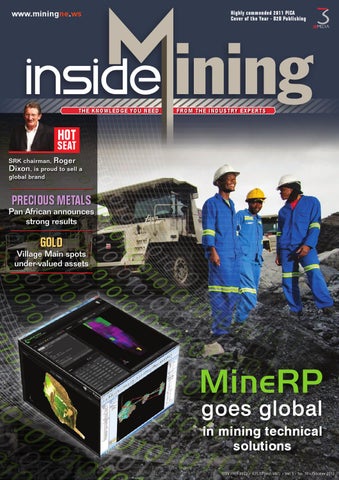
MineRP goes global in mining technical solutions ISSN 1999-8872 • R35.00 (incl. VAT) • Vol. 5 • No. 10 • October 2012
+
Two industry leaders, now One Source FLSmidth and Ludowici have joined forces to become One Source. These industry greats bring together over 150 years of experience from Ludowici in screens, centrifuges and complementary products and 130 years of experience from FLSmidth in process and material handling equipment. Ludowici’s legacy of leadership in the Australian and global markets continues forward as FLSmidth Ludowici. Adding to FLSmidth’s services and offerings, Ludowici technologies allow FLSmidth to provide complete minerals processing and preparation plants from start to finish; including engineering, testing, process equipment, material handling solutions, and more. With the combined strength of Ludowici, FLSmidth now truly becomes your One Source for minerals processing and material handling equipment and services.
For more information contact us: Tel no. +27 (0)10 210 4000 • www.flsmidth.com
CONTENTS
T H E K N O W L E D G E YO U N E E D
ining
October 2012
FROM THE INDUSTRY EXPERTS
Highly commended 2011 PICA Cover of the Year - B2B Publishing
www.miningne.ws
MEDIA
10
THE KNOWLEDGE YOU NEED
LQLQJ
ON THE COVER
MineRP
MineRP has announced the long-anticipated transaction that will see the company position itself as the premier provider of integrated mining technical solutions to the global mining industry
in mining technical solutions
P6
FROM THE INDUSTRY EXPERTS
HOT SEAT
SRK chairman, Roger Dixon, is proud to sell a global brand
Background image: Petmin
PRECIOUS METALS Pan African announces strong results
GOLD Village Main spots under-valued assets
ISSN 1999-8872 • R35.00 (incl. VAT) • Vol. 5 • No. 10 • October 2012
EDITOR’S COMMENT
3
12
“Boom and doom” in mining?
MINING NEWS
4
The top mining stories headlining this month
HOT SEAT
10
SRK – selling a global brand known for its integrity and quality
PGMS AND GOLD
14 Lesego Platinum – a world-class asset in the making 16 Blyvoor’s turnaround – a terrific start 20 Pan African Resources announces excellent results 23 Implats’ sustainable keys 25 Tharisa defies the economic climate EXPLORATION
25
28 Botswana – the Tsodilo Phase 1 exploration drill programme
DEEP LEVEL MINING
30 TWP – the challenges of deep-level mining INFORMATION AND COMMUNICATION TECHNOLOGY
35 Improving safety, productivity and efficiency in underground mining
37 NSSLGlobal – Satellite communication, from exploration to full production
PANEL DISCUSSION
30
38 Adroit introduces bulk material handling system 39 DataSaint – Gilbert McCaul – projects manager MINERALS PROCESSING
40 Multotech – mobile spiral plant attracts growing interest
PRODUCT NEWS
42 Afrox – offering all-round products and services to mining
CETERUM CENSEO
44 A much bigger jinx Inside Mining 10/2012
1
A life depends on it AfroxPac 35i
SANS 1737:2008 compliant
There is no more stringent testing ground than a South African mine. The new-generation AfroxPac 35i, enhanced with new-age materials and superior chemical containment embodies the already proven success of the AfroxPac. More robust and heat resistant than ever before. Unashamedly home grown in the toughest mines on earth.
Afrox Self-Rescue Division: +27 11 914 4000
Email: srdmarketing@afrox.linde.com
www.afrox.com
Editor’s comment Publisher Elizabeth Shorten Associate publisher Ferdie Pieterse Editor Hans Alink Head of design Frédérick Danton Senior designer Hayley Mendelow Chief sub-editor Claire Nozaic Sub-editor Patience Gumbo Marketing & online manager Martin Hiller Production manager Antois-Leigh Botma Production coordinator Jacqueline Modise Financial manager Andrew Lobban Administration Tonya Hebenton Distribution manager Nomsa Masina Distribution coordinator Asha Pursotham Printers United Litho Johannesburg Tel: +27 (0)11 402 0571
___________________________________ Advertising Sales
Stacey Glad Tel: +27 (0)11 465 5452 Cell: +27 (0)83 567 0073 stacey.glad@lantic.net ___________________________________
MEDIA
No. 4 5th Avenue, Rivonia 2191 PO Box 92026, Norwood 2117 Tel: +27 (0)11 233 2600 Fax: +27 (0)11 234 7274/5 www.3smedia.co.za ___________________________________ Annual subscription:
South Africa: R350.00 (incl VAT & postage) SADC countries: US$80 Foreign: US$100 E-mail: subs@3smedia.co.za ISSN 1999-8872 Inside Mining Copyright 2012. All rights reserved. ___________________________________ All material in Inside Mining is copyright protected and may not be reproduced either in whole or in part without the prior written permission of the publisher. The views of contributors do not necessarily reflect those of the the publishers.
“BOOM AND DOOM” IN MINING?
Global mining industry is readjusting itself There has been
a lot of “boom and doom” talk in the mining industry lately. If what international mining commentators say is true, then growth among the large players in the international mining arena seems to have slowed down somewhat and it looks as if the sector is busy adjusting itself to the new market conditions. However, junior miners in the international market seem to be making use of new opportunities with some showing exceptional growth. While the mining industry is not totally unaffected by the global financial crisis and talk of another “recession”, there is still a healthy demand for natural resources from strong growing economies like China and India. Being a continent blessed with an abundance of these much sought after natural resources, Africa is, in the view of various mining commentators, fast becoming a global growth point with big international mining companies operating in most parts of the African continent. In the case of South Africa, however, strikes of all types – unprotected, protected, wildcat, trucking, automotive… you name it – have been dominating the news since the preamble to Marikana and have affected the economy and us all to a greater or lesser extent. Whether or not there are good reasons
behind them, most become violent with disastrous effects in terms of loss of life, injury, damage to private and public property, hardship for mine workers and their families who do not receive any income, intimidation of workers who are prepared to work in order to put food on the table and care for their families, labour unions at each other’s throats, mine management and their representatives failing to respond effectively, and bureaucrats and politicians pointing fingers at each other. Strikes have become viral and contagious, spreading from one industry to the next and making headlines in the local and international media. The bottom line is: strikes are hurting brand South Africa. They are hurting our economy, our country’s financial and social reputation and, in the end, each and every one of us. Ostrich politics does not work. Mine workers, mine management, labour unions and government must reach an agreement – sooner rather than later – before the labour unrest becomes an all-devouring monster that can no longer be contained. Electra Mining 2012 has come and gone. More than 800 mining supply companies big and small, from all parts of the world, were there to showcase their new products, services and technologies in an exhibition space of about 36 000 m2. Exhibitors entertained visitors to the show with new product launches, live demonstrations, interactive product displays and the latest in supplies, machinery and equipment. As a first time mining visitor commented after the show: “It is abundantly clear that technology can be integrated into virtually all aspects of the mining industry. I was amazed by all the hi-tech solutions on offer.” According to the organisers, Specialised Exhibitions, the number of visitors at 38 296 over the five days of the show was significantly up from the 34 836 figure of 2010. Now we can all start planning for the next show, which will be held at Nasrec from 15 to 19 September in two years’ time. Hans Alink
To our avid readers, be sure to sign up and get the
latest updates and inside scoop from the mining industry. Check out what we are talking about on our website, Facebook page or follow me on Twitter and have your say. @mining_news www.facebook.com/pages/Mining-News
Inside Mining 10/2012
3
Mining news www.miningne.ws
The top mining stories making the news in the past month ASIA
Newmont cuts Indonesia copper, gold mine output forecast
compiled by Ameerah Griffin
| SOUTH AFRICA | Wescoal announces new CEO Source: www.miningne.ws Dutch Botes has been named as the new CEO of Wescoal Mining. The appointment comes as the company aligns its strategy to expand its mining capabilities. Botes is a qualified mining‚ electrical and mechanical engineer who has over 34 years of experience in the mining sector. He previously held the position of CEO at Umcebo Mining‚ a junior coal mining house, where he successfully brought a total of six new coal mines into production, including an underground operation at Klippan Colliery. Before his tenure at Umcebo Mining‚ Botes was general manager at various BHP Billiton Energy Coal South Africa operations, including Middelburg mines‚ Khutala Colliery‚ Optimum Colliery‚ Koornfontein Mines and Delmas Colliery.
| AFRICA | Kaboko Mining secures strategic Zambian licence Source: www.miningne.ws Kaboko Mining has secured a joint venture (JV) agreement for an initial 51% interest in the Rockstone Manganese Project. The JV is a large-scale prospecting licence 120 km north of the company’s Peco Manganese Project in Zambia. The acquisition is a strategically important and significant addition to Kaboko’s existing Zambian manganese projects,
4
Inside Mining 10/2012
given recent technical results and a broader geological understanding at the Peco Project, which is forecast to become a primary production and processing location. The company has also secured a AUD$1 million [Australian dollars] (R8.66 million) debt facility with Perth-based investment group Celtic Capital, to fund further exploration and complete reverse circulation drilling at its Emmanuel and Peco Projects.
| AUSTRALIA | Anglo American cuts coking coal output Source: www.miningne.ws Anglo American has announced plans to reduce its coking coal output in the coming months, the miner’s coking coal chief executive, Seamus French said, warning that industry-wide cuts would continue. Coal producers have raised concerns over the profitability of the sector in recent months as prices have slumped, particularly in Australia, where the country’s resources minister, Martin Ferguson, said the nation risked missing out on billions of dollars of new projects due to high costs. French said: “We are going through a planning process where we will adjust to the market conditions and, in the short term, we will cut back. “It’s times like these that really are the right opportunity to re-evaluate things,” French stated, adding that the market had become over-supplied after strong prices at the start of last
Source: www.miningne.ws Newmont Mining has revised down 2012 target production figures for its Indonesian mine to 71 000 ozunces of gold from 114 000 ounces previously. Annual copper output from the Batu Hijau mine on Sumbawa Island is now expected to be 170.6 million pounds, from an earlier forecast of 192 million, said spokesman Rubi Purnomo. The lower forecasts come as Newmont processes lower grade ore from stockpiles in preparation for a new phase of mining at the vast opencast in the mountains of Sumbawa. Production in the first six months of this year has been about 90 million pounds of copper and 40 000 ounces of gold, said Ian McGaffin, the mine’s general manager. Newmont has already flagged that its 2012 attributable Indonesian output is expected to be significantly lower, a factor that led the Colorado-based firm to post a 30% drop in second quarter profit.
year encouraged miners to ramp up production. French said cuts would be made on a case-by-case basis in its operations, concluding that any decisions were likely to come in the next few months.
| EUROPE | Lundin Mining cancels acquisition of Spanish copper mine Source: www.miningne.ws Lundin Mining has announced that the company will not exercise its option to buy a stake in the Touro copper mine in northern Spain. The reason for this decision is that the company believes that
it will not receive returns from the project. President and CEO, Paul Conibear said: “Despite the diligent efforts of our team and the cooperation of the authorities, the local community and the owners of the project, we unfortunately are not able to progress with the Touro project.” Lundin Mining announced in April it had signed a deal with two Spanish companies for an option to buy an 80% stake for €60 million (R658.5 million). Lundin Mining has operations in Portugal, Sweden, Spain and Ireland, and an equity stake in the Tenke Fungurume copper and cobalt mine in the Democratic Republic of the Congo. The
Mining news
company produces copper, zinc, lead and nickel.
| SOUTH AMERICA | Pan Pacific Copper to acquire 40% of South America copper mine Source: www.miningne.ws Pan Pacific Copper has announced that the company will purchase 40% of a large South American mine. The Japaneseowned Pan Pacific, which has Japan’s largest smelter, will purchase the mine from the Japanese government. The massive mine is located across Argentina and Chile in a region called Frontera that spans across 60 000 acres. The mine is expected to have an estimated output of 150 000 t (165 347 tons) a year. Once the acquisition is finalised, it is expected to be one of the largest copper mine stakes held by a Japanese company.
NORTH AMERICA
Strike Energy will begin fracking in the US
Source: www.miningne.ws Strike Energy says it will begin a 21-stage fracture stimulation programme in Texas, United States. The Eagle Landing joint venture (JV) with Strike Energy, which holds a 27.5% stake in the JV, is a 151.3 km2 project located
within the northern Lavaca and southern Fayette counties in Texas. The JV began in September at the Eagle Ford shale project. Four Texas-based companies hold the remaining interests in the venture. The fracking programme is scheduled to start at the project’s first production test well, Bigham 1H. Upon completion of the fracking operations, the partners plan to carry out cement plug drill-out and flow-back operations. Production testing is
expected to start once the well has cleaned up. The Bigham 1H well was drilled about 5 400 m deep, with a 157 m horizontal section drilled and cased in the Upper Eagle Ford formation. The
Eagle Landing JV has identified more than 300 potential drilling sites within the Eagle Ford gas-condensate fairway and has estimated a potential resource equivalent to 135 million to 165 million barrels of oil.
Cover story
MINING TECHNICAL SOFTWARE AND CONSULTING
MineRP Goes Global MineRP has announced the long-anticipated transaction that will allow it to realise its position as the premier provider of integrated mining technical solutions globally. MineRP president, Pieter Nel, speaks to Hans Alink about the takeover, the parties forming the consortium that acquired MineRP, the company’s future strategy and new products to be launched.
“F
urther to the cautionary announcements published to the general public earlier this year, South African ICT firm Gijima’s shareholders were advised at the end of September that MineRP has entered into agreements with a consortium led by RMB Corvest, Shalamuka Capital, Hasso Plattner Ventures Africa and a representative management committee from the MineRP business, in terms of which the consortium will purchase the MineRP business from Gijima. The conclusion of the transaction is subject to certain conditions, which have been set out on the websites of both Gijima and MineRP. The entire transaction should be finalised and signed by November,” says Nel.
Reason for the transaction The MineRP businesses have historically attained a position among the top mining technical systems providers worldwide. This market has seen significant growth over the past years as opportunities for market consolidation were identified by large corporates and companies were able to invest in various expansion initiatives. In the recent past, it has become evident that MineRP requires similar levels of investment to achieve its various global growth objectives. As the business of MineRP is essentially non-core to Gijima, the required investment was not sanctioned, and for this reason, Gijima has taken a view that in order to set MineRP on its own growth trajectory, it should be sold to investors that would adequately invest in its strategy. “MineRP is not 100% fit for Gijima as we only make out 10% of the company’s business,” explains Nel. “Our business requires investment, especially if we want to see international growth. The consortium of new
6
Inside Mining 10/2012
owners believe in our strategy and want to support us to grow the business and support the mining industry on a higher level than what we have been doing up to now. “Also, unlike MineRP, Gijima focuses more on the South African market, while the mining industry is global. Although the local mining industry remains highly important to us, we need to grow our business internationally, for which a lot of investment is needed. We are busy opening offices in Accra, Ghana, and in Tanzania, East Africa, to have a greater presence in sub-Saharan Africa, and are also establishing a presence in Lima, Peru, and in Brazil and Indonesia. “Furthermore, MineRP needs capital to invest in the continued R&D of its products.
company and a member of the First Rand Group. The company participates predominantly in management buyouts and buy-ins, leveraged buyouts and BEE transactions involving businesses with a value of between R50 million and R1 billion. The company also invests in established, well-managed, medium-sized businesses with a proven track record of solid performance. Its mission is to be a guiding force and strategic partner in the financing of selective transactions, always
“A greater selection of software solutions that have been tried and tested in the international market is now being used , and a dependable integration partner is required to make this new world work.” Pieter Nel, MineRP president The mining industry will benefit from this, both locally and internationally. The South African mining environment is changing. A greater selection of software solutions that have been tried and tested in the international market is now being used, and a dependable integration partner is required to make this new world work.”
The consortium The parties to the consortium acquiring MineRP have been carefully selected and will individually and collectively contribute significantly to the future success of the business. RMB Corvest is a South African private equity
seeking to yield maximum returns for each party involved. To the initiated in the technology industry, the name Hasso Plattner is very meaningful. Hasso Plattner Ventures Africa, based in Cape Town, South Africa, is the largest technology-focused venture capital fund in Africa, with most of its capital committed by SAP co-founder and chairman, Prof Dr Hasso Plattner. Hasso Plattner Ventures Africa turns local technologies into global assets by investing in software, telecommunications, internet and clean energy companies in emerging markets with the potential to grow internationally. As a partner in the MineRP
Cover story RIGHT The MineRP Strategy for delivering integrated enterprise solutions
consortium, Hasso Plattner Ventures Africa’s expertise and global network will allow MineRP to broaden its offering and thrive in the global marketplace. Shalamuka Capital is the private equity company for the Shalamuka Foundation. Shalamuka offers investment partners a key advantage through its status as a broadbased BEE private equity company, which uses its own funds for investment rather than third party funds. The funding received by the Shalamuka Foundation from Shalamuka Capital is used to facilitate the growth of the Penreach programme and ultimately improve the lives of the children and educators of South Africa. Penreach is an awardwinning non-profit, in-service educational development-training programme that was developed to improve the teaching skills of qualified and unqualified educators, as well as their schools in and around Mpumalanga. Through the efforts of Shalamuka Capital and its involvement in Penreach, more than 2 000 teachers, 900 schools and in excess of 350 000 learners a year are reached and benefit from the programme.
MineRP’s future strategy In business since 1997, MineRP started life as Graphic Mining Solutions International (GMSI), an in-house service provider to the Anglo American Gold division, developing its mining technical software portfolio. In the past 15 years, the company has seen remarkable growth and is now one of the top four
providers of mining technical solutions in the world in terms of revenue. “For a newcomer in this industry, where all the other players have been around for 25 years or more, we made a significant impact on this market. This is mainly due to the South African mining industry and the knowledge that we gained from underground mining in this country. However, over the past decade we also spent a lot of time building our capability and technology to support surface mining, where opencast has become important for us,” comments Nel. With its dual focus on both software engineering and professional mining consulting, MineRP is uncontested as the world’s biggest supplier of enterprise-level integrated
mining solutions. This has been achieved through a combination of the development of natively integrated expert solutions within the MineRP stable, as well as the establishment of the MineRP Foundation Blocks. These Foundation Blocks are a set of innovative enterprise technologies that allow for the horizontal as well as vertical integration of not only systems provided by MineRP, but also those of any other mining technical solution willing to share data in an open standards-based spatial format. MineRP has seen significant growth in both local and international business, doubling its BELOW Mine2-4D 2012 will be launched globally in November 2012
Inside Mining 10/2012
7
Cover story
ABOVE Utilising MineRP SpatialAnalyzer to visualise Stope and Block Model intersections
revenue twice over the past six years and has established offices on each significant mining continent. According to Nel there is almost no mining company in South Africa that is not a client of the company. Also internationally, its client list boasts most of the top 50 mining houses in the world.
World ranking “Internationally there are only three companies bigger than us in our market. These companies offer expert applications, i.e. stand-alone applications for different mining disciplines, which typically integrate to some degree with other solutions developed within the same company. “Where the solutions offered by other players in our market only allow integration of their own expert applications, we set ourselves apart in that our enterprise system (MineRP) has the complete flexibility to integrate expert applications from different vendors to obtain an integrated view. It also has the flexibility to link up with any commercial enterprise application like SAP, Oracle, and other ERP solutions to link all mining data with commercial data in order to get an enterprise wide view of the entire operation. To top it all, our system is totally web-enabled, which means you can run your application on the mobile device of your choice and view
8
Inside Mining 10/2012
intricate mining graphics over the web. The flexibility of our system and its ability to provide a full enterprise view of the business is strategically important in our plans for international expansion,” explains Nel.
New products On the expert product side, MineRP will launch Mine2-4D 2012 in November, which will be ready for the market in January 2013. New releases of MineRP Foundation Blocks will also be published in November 2012. These products will be launched at a series of international open days over a five-week period, starting in South Africa in the last week of October, followed by
mine planning tool will be as well received as previous versions. Mine2-4D has always been one of the best underground planning tools, but it is also excellent for opencast mining. This product has been rated as the top planning tool for underground environments in the Australian market, an endorsement that is a good benchmark for us,” says Nel. In South Africa, where mining is more conventional, the generally used planning tool is CADSMine. As part of its future road map, MineRP plans to merge Mine2-4D and CADSMine into one product. The company is also busy upgrading all the foundation blocks for MineRP, including Spatial Dash, MineORC, Mine Forms and Spatial Analyser, which will allow customers to integrate any collection of expert applications and thereby achieve total flexibility. From a MineRP perspective, it is currently business as usual. According to Nel, the market can expect MineRP to redouble its efforts to support its global client base, as well as maintain the impressive investment in research and development, which has made it the force to be reckoned with that it is today. “With the new consortium in place, we are confident that we will soon achieve our stated objective of being the number one global provider of enterprise, integrated mining technical solutions and consulting,” concludes Nel.
MineRP has the complete flexibility to integrate expert applications from different vendors launches in Australia, Latin America, the US, Canada and Europe. “All the information on our new products and the presentations for the launches will be available on our website. We are also going to send free versions of the new software for a trial period to all our customers. Mine2-4D 2012, our new mine planning tool, is a real winner and excellent feedback from our Beta testing programs predict that the latest version of this thoroughbred
In each issue, Inside Mining offers advertisers the opportunity to promote their company’s products and services to the appropriate audience by booking the prime position of the front cover which includes a two-page feature article. The magazine offers advertisers an ideal platform to ensure the maximum exposure of their brand. Please call +27(0)11 465 5452 to secure your booking.
Hot seat
SRK
Selling a global brand known for its integrity and quality SRK Consulting (South Africa) has been appointed technical consultant to the government of Cameroon for a US$5-billion (R41.2 billion) mining and infrastructure project to span over a period of at least five years. SRK (SA) chairman, Roger Dixon, speaks to Hans Alink about the products, services and expertise of his group and their most recent African projects.
OCTÉA’s Koidu Diamond Mine in Sierra Leone where SRK has been involved since 2002
“W
e are proud to sell a global brand that is known for its integrity and a quality product that our clients can use when they go into the market,” says Dixon. “When people raise money for projects, after the financial meltdown of 2008, they want to know that the projects in which they are investing their capital are the real deal. There have been many cases where investors have been misled. They don’t want that to happen again. In countries like Canada and Australia, regulators have introduced checks and balances to ensure that what is contained in project plans and valuations is actually going to come to fruition.” Major mining houses and junior resource companies regularly approach SRK for reviews, audits and independent assessments of their projects. Resource estimations, using the most appropriate methods
10
Inside Mining 10/2012
“We provide technical advice and do not get involved in downstream activities, which sets us aside from others that may have an interest in downstream activities.” Roger Dixon, chairman and partner of SRK Consulting (SA), part of the global consulting group
based on rigorous data analysis and sound geological assessment of ore bodies, provide clients with a clear understanding of reliability and risk at all stages of reserve development projects. “We provide technical advice and do not get involved in downstream activities,which sets us aside from others that may have an interest in downstream activities. This makes us truly independent. Our independent engineer reports, comprehensive competent persons reports and due diligence reports and programmes carry the weight
of our global reputation in the stock markets and banks of the world. “We offer a wide range of specialist consulting services for natural resources from greenfield explorations through to mine
Hot seat closure. This encompasses a broad spectrum of disciplines that are involved throughout, which we are proud to have in-house.” SRK staff includes world-recognised experts in structural geology, seismic interpretation, alteration geochemistry, and design and management of exploration projects. The group’s customers – large and small – are as widespread as their projects are varied. They include mining companies, financial institutions, national and local governments, government departments, regulatory authorities, property developers, water authorities, power utilities, contractors and consulting engineers. “Our current strategy is to focus on large companies, because one tends to diffuse a lot of one’s energy trying to help everybody. We don’t want to spread ourselves too thinly,” explains Dixon. “We currently have one major client, the government of Cameroon, which is an enormous project. We are advising it not only on mining circumstances, but also on its national infrastructure, including 510 km of railway line and port facilities. On the mining side, we are involved in the areas of geotechnical, tailings, water and waste management.” SRK SA recently secured the role of project management consultant and engineer for Brazilian mining company Vale for the Nacala Rail Corridor Project Section 3. This new section of rail infrastructure runs from the Mozambican-Malawi border, close to Tete, to the existing rail line at Nkaya Junction in the heart of Malawi. This is the most challenging section of the rail line and is 162 km of the total 940 km being built. SRK SA has a team of 150 people working full time on this project. Apart from doing geotechnical and hydrogeology work for oil companies like Chevron, Shell and BP, and for power utility Eskom in South Africa, SRK has in recent years been very active in West and Central Africa. In West Africa, the company has done feasibility work in Sierra Leone on the Koidu Diamond Mine, for diamond company OCTEA Holdings, and in Ghana it designed tailing facilities for Idiapruim, an AngloGold Ashanti project. In Central Africa, in the Democratic Republic of the Congo (DRC), SRK was commissioned to complete a big, multidiscipline project involving geotechnical engineering work, water management and
ABOVE Mongbwalu community forum meeting – SRK was the independent environmental practitioner that led the environmental and social studies for the Mongbwalu project in the DRC RIGHT SRK Consulting’s team on-site in the Cameroon jungle
hydrogeology work, environmental impact assessments, environmental and social impact and management work, and community development work for the Tenke Fungurumi project, one of the world’s largest copper-cobalt operations. In the eastern DRC, SRK is doing geotechnical work at AngloGold Ashanti’s Mongbwalu project, and was the independent environmental practitioner to lead the environmental and social studies for the project. In neighbouring Congo, the company has been involved in a large iron ore project. In Angola, SRK has done at least three geotechnical projects and environmental work for oil companies through its joint venture with ARC, while in Namibia it was involved in a gold project for a number of years and carried out studies for various companies. The company completed geotechnical work for coal and diamond companies in Botswana. The group is also active in Zambia and Zimbabwe. In Zambia, it has a long-standing relationship with Konkola Copper Mines, owned by international
company Vedanta for which it is doing technical studies and work. Speaking about the technology that is relevant and required for the company’s areas of expertise, Dixon states: “Computer technology has made our life much easier. For instance, we use satellite technology for mapping and I don’t think we realise how this technology has improved. We also use specialised software for the optimisation and scheduling of opencast and underground mining. Nowadays everyone wants to be scheduled by a computer, the software is available and we are applying this on our projects. We are using it specifically on the coal side of the mining business, which is on the move in South Africa and Mozambique.”
RIGHT AngloGold Ashanti’s Iduapriem open pit where SRK has been providing geotechnical review services for a number of years
Inside Mining 10/2012
11
PGMs and Gold
DOING DE BRON
Rapid roll-out
JSE/TSX-listed gold junior Wits Gold is rapidly advancing its shallow De Bron Merriespruit project in the southern Free State goldfield and is due to complete the final feasibility study during the third quarter of 2013.
C
onsulting engineers Turgis Consulting has been appointed to undertake the detailed engineering and mine designs, while mining engineer house MDM Engineering has been appointed to focus on the metallurgical plant and related design aspects. Turgis recently completed the positive pre-feasibility study (PFS) at De Bron Merriespruit (DBM) on time and within budget, and the study confirmed that a mine at DBM was both technically and economically viable. “We are pleased to continue our solid working relationship with Turgis, which developed a thorough knowledge of the DBM orebody since its involvement began at scoping study level. The specialist expertise brought in by MDM Engineering to provide the detailed plant design will result in the fast-tracking of the final feasibility study. It is an exciting stage in the development of the company when its first project is taken to such an advanced stage, and we look forward to commencing with the construction of South Africa’s next shallow gold mine,” says Wits Gold CEO, Philip Kotze.
12
Inside Mining 10/2012
The pre-feasibility The PFS delineated a probable gold reserve of 23.5 Mt at a grade of 4.1 g/t (3.1 Moz), which is contained within that portion of the resource at DBM that occurs at depths shallower than 1 000 m and contains an indicated mineral resource of 26.7 Mt at 5.8 g/t Au (4.99 Moz). DBM will be a shallow underground mine comprising a planned twin shaft system to 660 m, with average gold production expected to be 200 000 ozpa over an 18year life of mine. Production is expected to peak at 246 777 ozpa at 5.5 g/t during year nine, and first gold production is expected 47 months after shaft sinking commences. The PFS estimates production cash costs of US$628/oz (R5 279/oz) with peak capital funding of R2.37 billion.
The feasibility The feasibility study will further refine certain aspects identified in the PFS that will aim to improve mining efficiencies by introducing safer, semi-mechanised mining equipment and down-dip mining methodologies. In addition, further upside
exists if the study investigates the inclusion, through additional drilling, of the existing shallow inferred resources of 5.97 Mt at 5.7 g/t (1.1 Moz) that is readily mineable from the current mine design. Mineral resources that are not mineral reserves do not have demonstrated economic viability. On 22 February 2012, the Department of Mineral Resources accepted the company’s application for a mining right for gold, silver and uranium over its advanced prospecting rights areas in the southern Free State goldfield, which includes the DBM, Bloemhoek, Robijn and Hakkies project areas. Wits Gold holds 14 new order prospecting rights over 1 195 km² in the southern Free State, Potchefstroom and Klerksdorp goldfields. The mining right is expected in the second half of 2013, once the company complies with requirements in terms of the Minerals Act, such as obligations in terms of feasibility studies, environmental impact assessment as well as social and labour plan commitments. Once granted, a mining right is valid for a period of 30 years and renewable for a further period as required.
PGMs and Gold
LESEGO PLATINUM
A world-class asset in the making Platinum is the foundation upon which diversified mining company Village Main Reef was established. Today, its single platinum project, Lesego, is set to become one of the most attractive platinum mines on the Bushveld Complex Eastern Limb, reports Inside Mining.
“E
verything we do with this project reaffirms it to be a world-class project. I believe this project alone is worth more than all four gold projects that currently make up our market cap: Buffelsfontein, Tau Lekoa, Cons Murch and Blyvoor,� says Village Main Reef (VMR) joint CEO Marius Saaiman. Located near several large-scale platinum mines on the Eastern Limb of the Bushveld Complex near Burgersfort, Lesego is a large, shallow, high-grade resource with a potential production life of 50 years (39 Moz,
5.95 g/t over 1.23 m) from 350 m down. Thanks to funding support from the Industrial Development Corporation (IDC), which has a 23% effective stake in the project, it is financially covered up until the completion of its bankable feasibility study – which is currently under way and due to be completed in April 2013. VMR recently announced an updated mineral resource estimation on the project, based on borehole data generated from a database compiled by specialist mining consultants MSA Geoservices, of all
available data from previous and present drill campaigns up to 31 March 2012. The campaign included shallow drilling results from 300 m below surface. This latest database includes the results from 116 590 m of drilling, of which 13 973 m was from the 2007/8 drilling and 102 618 m from the 2011/12 boreholes. In total, 1 704 m of core were assayed for PGMs and gold, as well as nickel and copper. The updated resource estimate was prepared by MSA in accordance with the SAMREC code and signed off by competent
'FBUVSFT PG UIF .VMFCZ 4ZTUFN 5BOL
P Prestressed post-tensioned panel reservoir P Cast elements from 3m up to 7m in height P Diameter ranging from 8.6mĂ˜ to 32.60mĂ˜ P Contains volumes from 159Kl to 5,600Kl P Final concrete strength well over 50MPa P Conforms to the strict Eurocode 2 part 3 P Reservoir underwritten by Vela VKE
Scan our QR code for quick and effortless access to more information on our website.
Contact t www.aquadam.co.za Pretoria: 012 - 810 0940 t $BQF 5PXO 021 - 905 7943
WATERTIGHT SOLUTIONS
PGMs and Gold LEFT Exploration drill rig at Lesego
person, Venmyn. MSA has reduced the overall tonnages by applying a 17% geological loss, as recommended by Venmyn, to account for possible losses due to factors such as faulting, pillar losses and potholing. The updated resource estimate reports 39.03 Moz from 204 Mt of ore. The updated resource width of 1.23 m was selected to take account of some of the known mining parameters, thus moving the resource closer to what could be expected in a reserve statement. In addition, the resource contains combined nickel and copper of 600 000 t. The amended resource estimate has improved the measured and indicated categories to 65% from the 55% previously reported. “Based on our current pre-feasibility
results, Lesego looks set to be a 300 000 tpm run-of-mine (ROM) project, which will deliver over 500 000 oz of PGMs and over 8 000 tpa of nickel and copper,” Saaiman states. This indicates a robust business case, returning an IRR of 18.7% (real) and NPV of R6.7 billion. The project requires a twin shaft system (ventilation and men and materials to a 1 600 m depth, with an 11 m diameter shaft circumference). There will be an interim mid-shaft loading point at 800 m using the main ventilation shaft for early extraction and a temporary ventilation shaft, raisebored from 800 m. Ore below 1 600 m will be accessed via declines. “Given the size and scope of the project, we continue to believe that it would be optimally suited to be exploited by a bigger company focused on PGM assets, and as
Th e N a me t h a t Re a lly H o ld s Wa ter ABECO
Est. 1983 Manufactured in South Africa Specialists In: Pressed Sectional Steel Tanks • Structural Steel • Supporting Towers • Water Storage • G.R.P Tanks
TANKS Abeco House, 6A Bradford Rd Bedfordview, South Africa
Tel: +27 11 616 7999 | Fax: +27 11 616 8355 E-mail: Abeco@icon.co.za
www.abecotanks.co.za
Resource highlights • 39 Moz from 204 Mt of ore at an average grade of 5.95 g/t over 1.23 m • Merensky – 14.7 Moz at 5.66 g/t • UG2–- 24.4 Moz at 6.13 g/t • Approximately 65% in measured and indicated categories • Significant nickel and copper credits – 600 000 t • Defined from 350 m below surface
such we continue to engage with potential strategic partners,” Saaiman comments. The project’s current status and development programme – intended to see production start-up in 2017/18, will not be influenced by the current PGM market, which is currently in dire distress. “The fundamentals of the platinum market remain attractive in the medium term, making Lesego the right asset to come on stream at the right time,” Saaiman concludes.
Regional geology • The Phosiri Dome uplift brings the Merensky and UG2 reefs to mineable depths • The current Merensky resource is defined from 350 m to 2 100 m. The reef continues below • The UG2 reef lies 200 to 300 m below the Merensky reef • Fully developed, undisturbed reefs • Good grades, widths and reef continuity.
PGMs and Gold
BLYVOOR’S TURNAROUND
A terrific start Diversified mining company Village Main Reef is once again proving it has an eye for under-valued assets with long-term potential. Its latest acquisition, DRD Gold’s distressed Blyvooruitzicht gold mine has a bright future, thanks to its new owner, reports Inside Mining.
B
lyvooruitzicht (Blyvoor) has become recognised as a ‘problem child’ gold mine. Late last year the operation called for business rescue. Gold production sunk significantly after DRD closed Shafts 4 and 6, and 1 800 employees were retrenched. “Because Blyvoor is an old mine, which first started producing in the 1930s, it requires care, attention, optimisation and efficient processes. Even though we have not fully acquired the mine, we have already evaluated its needs and identified a number of opportunities to ensure it delivers to its best ability,” says Village Main Reef (VMR) joint CEO, Marius Saaiman.
16
Inside Mining 10/2012
Turning Blyvoor around Part A closure of the Blyvoor acquisition was successfully concluded and Blyvoor consolidated with effect from 1 June 2012, which effectively allows VMR to operate the asset without owning the equity yet. Part B closure requires Blyvoor’s old order mining rights to be converted and Section 11 consent after which the equity will transfer. Saaiman says that Blyvoor holds substantial promise and is suffering somewhat from the effect of having been the only underground operation in a portfolio focused on service re-treatment. “Already in its first month under Village ownership, Blyvoor contributed R5.6 million
ABOVE Celebrating 2 million fatality free shifts at Blyvoor as well
towards our overall operating profit, despite the fact that the company incurred major winter tariff energy costs – 30% of total operating costs,” Saaiman notes. “This means that even if we maintain the same production levels for the next financial quarter in the summer months, the mine will deliver a profit.” Looking ahead, Saaiman says Blyvoor will remain a one-shaft mine (5 Shaft),
Exceptional rates for junior miners and government. See registration details or call +27 (0) 11 771 7000 or visit www.juniormining.co.za
The Inaugural Conference on:
Junior Mining & Exploration www.juniormining.co.za 6th - 8th November 2012 Turbine Hall, Newtown, Johannesburg
Opportunities and Strategies for Junior to Mid-Tier Mining Companies from Exploration to Production Promoting investment, development, growth & sustainability Gain valuable insights on key issues such as: , Creating an optimal policy and regulatory environment for attracting investment, enabling juniors and facilitating growth , Increasing investor appetite for exploration ventures and long-term funding for juniors , Exploration trends and strategies for juniors in South Africa and the mining economies of the SADC region: risks and opportunities , Attracting private equity funding for mining projects , Forging a common purpose between industry and mining communities , Fast-tracking development in the junior sector: geoscience initiatives, transportation infrastructure, power supply initiatives , Experiences of juniors in building successful mining companies
Visit www.juniormining.co.za for the full speaker line-up
Conference Chairs: , Bernard Swanepoel, Village Main Reef , Dr Lelau Mohuba, Sephaku Holdings
Key Speakers: , , , , , , , , , , , ,
Michael Solomon, J&J Group Nchakha Moloi, Motjoli Resources Rob Still, Pangea Group Richard Linnell, formerly Coal of Africa Michael Spicer, Business Leadership SA Daphne Mashile-Nkosi, Kalahari Resources Godfrey Gomwe, Anglo American Philip Kotze, Wits Gold John Wallington, Coal of Africa Moss Radingoana, Sekoko Resources Bheki Sibiya, Chamber of Mines of South Africa Peter Temane, South African Mining Development Association (SAMDA) , Frans Baleni, National Union of Mineworkers , Siyabonga Gama, Transnet Freight Rail , Steve Phiri, Royal Bafokeng Platinum , James Campbell, Rockwell Diamonds , Brian Dames, Eskom , Xolani Mkhwanazi, Chamber of Mines of South Africa And many more! Researched and developed by:
Media partners:
VIP CODE: P3288INMIN
TO REGISTER: +27 11 771 7000
registrations@iir.co.za
www.juniormining.co.za
Fax the below form to 011 880 6789 or for more information call 011 771 7000 or visit www.juniormining.co.za Title: _________________ Name: __________________________________________________________________________________________ Company: ______________________________________________________________________________________________________________ Job title: ______________________________________________________________________________________________________________ Tel. no: ____________________________________________________ Fax no: ____________________________________________________ Email address: __________________________________________________________________________________________________________ Please send me further information about The Inaugural Conference on Junior Mining & Exploration
PGMs and Gold
ABOVE Village Main Reef joint CEO, Bernard Swanepoel (front right)
although the company must continue to incur the mine’s massive pumping costs. The main pumping infrastructure is in 4 and 6 Shaft, and needs to continue running to ensure Blyvoor and surrounding gold mines are not flooded. The underground plant is also standing idle and may be dismantled, which could release substantial gold lock-up. “We have already re-evaluated the orebody and will seek to increase development to give the mine greater flexibility. We have furthermore identified opportunities to reduce overall operating costs and intend to implement methods to ‘pump smarter’,” Saaiman notes.
Service underpinned by expertise, experience and energy Focused on engineering, project management and project services within the hydro-pyro metallurgical, minerals processing and chemical industries, K' Enyuka produces affordable, workable and effective solutions.
VMR has also revised Blyvoor’s total measured reserves considerably. It has dropped from 7 Moz to just 828 000 oz. According to Saaiman, this is no cause for concern: “We intend to ensure the mine operates at a run-of-mine (ROM) capacity of between 35 000 and 40 000 tpm, which in turn will deliver between 50 000 and 60 000 ozpa of gold at an average grade of about 4.5 g/t. At these levels, Blyvoor’s life will continue for another 15 years.” And these volumes and levels are not the finite boundaries in which Blyvoor will operate until its end. Saaiman says that once the company implements cost reduction initiatives, it will most likely result in ounces being again classified into the reserve category. Even as a single shaft operation, Blyvoor still employs some 3 000 people (including contractors) and unlike South Africa’s traditional ultra-deep level gold mines, will not mine beyond 3 000 m below surface.
On surface While all surface infrastructure not associated with 5 Shaft has already been decommissioned, there are additional production opportunities, such as the mine’s surface tailings, which have another nine months of production capacity. Treating this material through the surface plant will provide VMR with the flexibility it needs to impact on the underground
“Our focus has never just been to acquire distressed assets and turn them around, but rather... to help them realise their full potential.” Marius Saaiman, joint CEO of VMR operational costs and increase production from underground, while remaining profitable.
Blyvoor – aligned with VMR’s business model and strategy
Hydro-Pyro Metallurgical | Mineral Processing Engineers | Project Managers
T +27 11 498 6000 F +27 11 498 6060 E mail@kenyuka.com
Coralynne & Associates +27 (0) 11 422 1949
www.kenyuka.com
“Our focus has never just been to acquire distressed assets and turn them around, but rather to source undervalued assets and implement operational strategies to help them realise their full potential. And Blyvoor is perfectly aligned with this strategy,” Saaiman explains. “There is also a misconception that we are just a gold company – bear in mind that our first venture started in platinum, followed by our acquisition of Cons Murch – an antimony-focused mine, with gold by-product.” VMR is a diversified commodity company, aligned with the models and values of a private equity fund, but the company acknowledges that attractive opportunities currently lie in gold, platinum and coal in South Africa. “We want to create sustainable mines, pay fair value on acquisition, impact on the assets and create value for all our stakeholders, enabling us to return capital to our shareholders, and retain some value to enable us to do it all again, ” concludes Saaiman.
PGMs and Gold
PRECIOUS METALS
Pan African Resources announces excellent results Pan African Resources has announced strong full-year results for the financial year ending 30 June 2012. Profit margins for the reporting period improved, significantly increasing by 57.19% to US$918 per ounce, while revenue for the year was up 27% in £101.1 million.
F
or the first time ever, Pan African Resources broke the R1 billion barrier with revenue of more than R1.2 billion, up 41% from the previous year. This increase in revenue was mainly due to a 24% increase in the gold price to US$1 694 per ounce for the period under review, as opposed to a price of US$1 366 (R11 943.86) per ounce of the previous financial year. In rand per kilogram terms, the gold price was up 37% to R422 000/kg, up from R306 000/kg of the previous year. Apart from the favourable gold price, stringent cost management at the operations also contributed to improve profits. When presenting the annual financial results Pan African CEO, Jan Nelson, commented: “We have produced an excellent set of financial results and achieved two significant corporate milestones. Barberton mines produced a consistent 94 449 oz gold at a consistently high head grade of 10 g/t and we started construction on our tailings retreatment plant at Barberton. “At Phoenix Platinum, we have also seen significant improvement. We agreed on terms to acquire Evander Gold Mines from
20
Inside Mining 10/2012
Harmony, which is a game changing acquisition for us and sets us on a path to mid-tier production status. In addition, post year end we found the right opportunity for Manica in Terranova Minerals NL on the ASX.” Last month, the company informed the market that it was selling the Manica gold exploration project in Mozambique to Australian-listed Terranova Minerals for £4 million (R 55.99 million) and 96 million shares. The Barberton operations delivered a solid performance. Tonnages were up 4% from 296 000 t to 308 000, while the grade was slightly down to 10.45 g/t from the previous reporting period when the mine reported a head grade of 10.55 g/t. Attributable profit in rand terms was up 88% from R190 million to R358 million. Cost of production was up by 12% (still below mining inflation of about 14%) to R566 million from R503 million the previous year. Other costs were
ABOVE A schematic lay-out of the Barberton Tailings Retreatment Project BELOW LEFT The leach tanks in an early stage of construction with the Bramber tailings dam in the background BELOW RIGHT The BTRP carbon in leach tank pads at an early stage with the Gold Room under construction in the background
up 133% from R31 million to R72 million. The main reason for this is that the company built a school for the communities at
OUR UPCOMING SUMMIT – MEET US IN LONDON Early Bird Registration
Now Open!
Global Mining IT & Communication Summit 2012 Mining industry‘s vision of the future... 20 – 21 November 2012, Hilton London Kensington Hotel, London, United Kingdom
Participating Companies Teck Resources Fresnillo Plc Severstal Gold Fields GE Industrial Communications
Newmont Mining Corporation Micromine Eastern Platinum Ambatovy
Ventyx
Centre for Strategic Cyberspace Security Science (CSCSS)
Alcoa
Hochschild Mining
Mining companies are increasingly looking into technology solutions to manage increasing complexities of day to day operations and boost operational efficiency. This summit aims to address majority of these issues and facilitate this industry as a whole.
ATTEND AND LEARN t SPONSOR AND EXHIBIT PARTNER AND PROMOTE t SPEAK AND SHARE For more info contact Tikenderjit Singh E: tikenderjit.singh@fleminggulf.com T: + 971 4609 1570
www.fleminggulf.com/ITMINING
Platinum Sponsor
Principal Partner
Intuitive Mining Solutions
Silver Sponsor
Lead Media Partner:
PGMs and Gold Barberton Mine, which cost close to R8 million. It also invested significant funds on social development projects. There were also costs for investigating the Evander transaction and the disposal of Manica. The royalty also impacted on the costs and the charge was up 79% from R26 million to R47 million. The write-off of a very old plant
OPERATIONAL HIGHLIGHTS Offer accepted for the acquisition of Evander Gold Mines • On 30 May 2012 the group entered into an agreement with Harmony Gold Mining to acquire the entire issued share capital and claims against Evander Gold Mines for a total purchase consideration of £116.2 million, subject to certain terms and conditions. • Evander Gold Mines reported a net profit of £21.9 million for the six months ended 31 December 2011. • Evander Gold Mines has an expected life of mine (excluding the reserves from the Rolspruit area that is contiguous to the current mining area) of more than 10 years. • Expected production profile of approximately 100 000 oz of gold per annum. • Evander Gold Mines total underground resource represents 28.74 Moz (110 Mt @ 8.16 g/t) and a reserve of 7.66 Moz. • (28 Mt @ 8.45 g/t). Mining operations – Barberton Mines • Gold sold increased by 2.44% to 94 449 oz (2011: 92 197 oz). • Capital investment of £10.7 million (2011: £6.8 million). • Sustained a head grade in excess of 10 g/t. • Lost time injury frequency rate increased to 3.26 (2011: 2.2) and the serious injury frequency rate to 0.74 (2011: 0.66). Retreatment operations – Phoenix Platinum Mining • Sale of concentrate agreement concluded during November 2011. • Hot commissioning completed in April 2012. • Production of 3 384 oz PGE 6E#. • Ramp up phase completed by July 2012. Near-term production – Barberton Tailings Retreatment Project • Capital expenditure of approximately £23.2 million approved for project • Construction commenced in April 2012 • Capital expenditure to date of £4.5 million • Commissioning is scheduled for July 2013
22
Inside Mining 10/2012
at Barberton cost an additional R591 000. The other major cost component was tax, which was up 55% from R102 million to R151 million. “All this translates back to our headline earnings per share, which has almost doubled comparable for the period under review,” says Nelson. “Regarding our headline earnings per share and the impact on our dividend, Pan African is probably one of the highest dividend yield companies in the sector,” he adds.
Explaining the key drivers for continued growth, Nelson states that the company is targeting a production of 250 000 oz of gold production. With the successful completion of the Evander transaction and the BTRP project coming on stream, they should achieve up to 230 000 oz. Pan African is also looking to grow its PGM production up to 50 000 oz. “Our balance sheet remains very strong, which enabled us to develop. We are only looking at developing orebodies
“Regarding our headline earnings per share and the impact on our dividend, Pan African is probably one of the highest dividend yield companies in the sector” As a result of the Evander transaction the Pan African Board, in consultation with their major institutional shareholders, have decided to forgo the dividend for this year due to the rights issue that they are doing. It is, however, the board’s intention – and they have given a commitment to their institutional shareholders in this regard – to resume the payment of the dividend next year. “We are currently – as a percentage of revenue – spending 20% of all our funds on capital projects, which are all organic. This bodes very well for the future of the company. The first big capital investment was for the development of the Phoenix processing plant, which is in production now. A second large investment this year is being used for the development of the Barberton Tailings Retreatment Plant (BRRP) project. All these investments together are expected to contribute to the revenue and profitability of the company in future.”
organically and inquisitively with Evander, where we have a low cash cost base, a highgrade margin and a long life.” Nelson comments that Pan African’s business approach has been a successful driver for the company’s wellbeing. This approach is based on the relationship between three partners: the shareholders; the employees, who are the business partners of the company; and the communities around its operations. It is very important that the company finds a balance between these three stakeholders to ensure that it has a viable and sustainable business in future. “The first quarter sees Pan African Resources in excellent health and we are very excited at the prospects 2013 will bring,” he concludes. The carbon in leach tanks half way up. Construction of the Gold Room in the background, which is almost complete
PGMs and Gold
RUSTENBURG AND LEEUWKOP
Implats’ sustainable keys The world’s second largest platinum producer, Impala Platinum, is focusing on ensuring it has a sustainable business model well into the future. This means bringing its new shaft projects on stream – and on time, reports Inside Mining.
T
he entire PGM mining community is suffering at the hands of a depressed platinum market, which has had an equally debilitating impact on Impala Platinum’s (Implats) latest bottom line. “Coupled with the six-week illegal strike in Rustenburg earlier this year, which lost the company 150 000 oz of platinum, the year has been challenging to say the least,” says new CEO, Terence Goodlace. Goodlace, who officially took over from former CEO David Brown in July this year, is looking to see Implats prosper and grow. “Our current model is not sustainable, meaning we need to implement cash preservation strategies and ensure our new shaft projects come on stream as scheduled,” Goodlace continues. Reviewing the entire business model also requires a strategic review of its Marula
operation, which has been a ‘problem child’ for years. “It is not sustainable at its current production levels, and we will make a decision on this asset by the end of the year.” Implats currently operates 14 different shafts across the Rustenburg area, and in the coming years, the older generation shafts will be closed, production from the five majors (1, 10, 11, 12 and 14) sustained, and most importantly, the three new shafts (16, 17 and 20) ramped-up to full production. Alongside the expansion of its Zimplats operation, the three new shafts are so integral to Implats’ production future that the company has already invested billions in their development and R7.3 billion over the last financial year (July 2011 – June 2012). While the three new shaft projects will contribute significantly to Implats’ portfolio, they alone are only part of the company’s portfolio growth plans. Goodlace has
ABOVE Impala 17 shaft
also eventually announced his intentions to see the R9.8 billion Leeuwkop project’s construction start. Implats acquired Afplats, and its undeveloped UG2 project, Leeuwkop, in 2007 and the project has lain dormant ever since. “I received a lot of disapproval for overpaying Leeuwkop time frame and development Capital spend for FY2013
R261 million
Remaining capital spend
R9.8 billion
First production date
FY2021
Full production date
FY2026
Steady-state throughput
2.16 Mtpa
Steady-state platinum production
145 000 ozpa
PGMs and Gold Major capital projects – 16, 17 and 20 Shafts 20 Shaft
16 Shaft
17 Shaft
Zimplats Ph II
Capital spend for FY2012 R997 million
R960 million
R581 million
US$176 million
Remaining capital spend
R3.2 billion
R4.1 billion
R8.3 billion
US$240 million
Full production date
FY2018
FY2018
FY2020
FY2015
Steady-state throughput
1.7 Mtpa
2.7 Mtpa
2.7 Mtpa
2 Mtpa
Steady-state platinum production
125 000 ozpa
185 000 ozpa
180 000 ozpa
90 000 ozpa
Main shaft equipping under way. Development towards reef has commenced from the ventilation shaft. Production start-up scheduled for FY2014
Sinking of the main and ventilation shafts and excavating Merensky reef and shaft pillars. Production start-up scheduled for FY2017
Construction of the concentrator plant, development of Portal 3 and associated infrastructure under way
Current primary activities Development of the ancillary includes and declines. Production buildup has commenced with 26 000 oz planned for FY2013 for Afplats in 2007,” former CEO, David Brown admits. “But the mining business is a long-term one and CEOs need to make decisions that will impact positively on the business in the future. The Afplats deal is one of them. It is a good UG2 resource, with an 83 Moz resource in the ground. It will add significant ounces to Implats’ production profile down the line at the low end of the cost curve.”
Goodlace continues: “The Implats board has approved R1.4 billion for Leeuwkop Phase 1, but has restricted spend to R261 million for the 2013 financial year. This cash will be spent on sinking the Main Shaft to a depth of about 330 m,” Goodlace states.
• shaft safety devices (R60 million to be spent over the next two years) • training of 3 200 safety representatives by 2014 • internal safety stoppages will also increase until all problem areas can be addressed and solved.
Safety Goodlace acknowledges that the company’s 12 fatalities over the year are unacceptable. “This is an area that Implats needs to address and as a result, we are going to implement a new cultural transformation framework, which will adopt best safety practices,” says Goodlace. This includes: • safety nets and in-stope bolting (R200 million over the next year) • proximity devices on trackless mobile machinery (R36 million to be spent at 11 and 12 Shafts; R40 million already spent at 14 Shaft and Marula)
PGM market PGM markets have been primarily influenced by macroeconomic events rather than fundamentals for the metals themselves. The recovery in world markets post the 2008/9 global financial crisis has been negatively impacted by the financial woes currently being experienced in Europe. The resultant low metal prices in conjunction with low productivity and high mining costs have stressed the platinum mining industry. The key drivers for PGM demand, however, remain sound. Automotive sales still show positive growth globally, driven by the US and China, but offset by a decline in Europe. “The long-term fundamentals remain sound, and we continue to invest in our current suite of capital projects to ensure future production,” Goodlace concludes.
PGMs and Gold
AN UPSIDE FOR PGMS
Tharisa defies the economic climate The Tharisa PGM and chrome mine, located on the Western Limb of the Bushveld Complex, is under way with the commissioning of its 3.6 Mtpa expansion project, with plans to expand even further, reports Inside Mining.
T
rial mining at Tharisa first started in October 2008, following the operation of a 1.2 Mtpa PGM and chrome test pilot scale concentrator, successfully developed and commissioned during the fourth quarter of 2011. It provided steady state commercial production of 420 000 tpa of metallurgical grade chrome concentrate and 40 000 ozpa of PGM concentrate. Work on the Tharisa R1 billion expansion project, which includes a larger processing facility undertaken by engineering house MDM Engineering, will process an estimated 3.6 Mtpa of run-of-mine (ROM).
“With commissioning already under way, we anticipate a short ramp-up period to full production, which we are aiming to achieve in the first quarter of 2013,” says Tharisa Minerals MD, Mark Farren. “The expansion specifically entails the development of an opencast mine, capable of producing at a rate of 400 000 tpm of ROM ore, as well as processing capacity to treat approximately 400 000 tpm of feed to the chrome processing facilities and 300 000 tpm to the PGM facilities. Ancillary infrastructure such as power, water, road and rail sidings have also been provided – with the support of Eskom, Transnet
and other government institutions,” Farren continues. The expanded project will produce 1.92 Mtpa of metallurgical grade chrome concentrate and 156 000 ozpa of PGM concentrate. Earlier this year, Tharisa Minerals confirmed it had secured R1 billion in debt finance, enabling it to quadruple ROM production to 4.8 Mtpa. Mining is set to transition to underground mining once the opencast reserves are depleted. The mine has total contained chrome resources of approximately 800 Mt, making it the largest single chrome
Inside Mining 10/2012
25
PGMs and Gold LEFT A view of the concrete structure and 21 m high wall constructed by Civcon prior to the installation of the primary crusher at the Tharisa expansion project
mineral resource deposit in the world. Tharisa Minerals is favourably positioned in the PGM space, largely because of the current economic devastation that the majority of the players are facing. “The current commodity market is tough, but Tharisa has the advantage of being a high volume, low cost producer,” Farren discusses.
Strategic role players AfriSam has been commended for the high quality and consistent strength above specification of readymix concrete delivered to the Tharisa expansion project.
Burt van der Merwe, project manager for Civcontract Civils, the civils contractor on the project, says that during the project peak in recent months, an estimated 220 m³ of readymix was poured each day. “AfriSam, a leading supplier in advanced composite cement, secured the contract to supply up to 22 000 m³ of readymix by road in November last year,” says Gerhard Maree, branch manager, AfriSam Readymix: North West province. “Our challenge was to ensure a smooth supply of readymix during three big pours: 725 m³ for the SAG mill one base, followed by two pours of 687 m³ and 715 m³ for the SAG mill two bases. The first pour saw product supplied from our 600 m³/ day Marikana plant, 15 km from the project site.” “With the second pour, we split supply between our Marikana and Brits plants, the latter providing 200 m³ of product. The Brits plant is 45 km from site.” At all times, another AfriSam plant was on standby, and Maree explains that the geographic location of the site allowed the company to have standby plants at Brits and Rustenburg. Maree indicated that the extent of the large pours, as well as the need to ensure smooth supply to the project site and to
Substantial quantities of readymix were required for much of the extensive civils work
26
Inside Mining 10/2012
AfriSam’s other customers, motivated a strategic decision to supplement the existing fleet of AfriSam readymix trucks in the Rustenburg area with additional vehicles from Johannesburg. “We had two concrete pumps on site with a third on standby for the big pours, and thereafter a concrete pump was on site from 07:00 to 18:00 daily for 37 consecutive days. In addition to this, AfriSam had concrete pumps on site on 42 other occasions,” Maree says. On some days, AfriSam delivered readymix to four different pours at the same time and had two concrete pumps on-site pumping concrete for two different foremen. An additional logistical challenge was to ensure that sufficient supplies of cement, aggregate and slagment were available on time at the Marikana plant to manufacture readymix in sufficient quantities to meet peak pour demands. To monitor the quality of the AfriSam product, concrete samples were taken on a daily basis and tested in the company’s laboratory in Rustenburg. A production team leader was also in attendance at AfriSam’s Marikana plant to maintain quality and ensure appropriate levels of service as per the company’s service pledge. Junithan Moodley, Civcontract Civils site agent at Tharisa, says that substantial quantities of readymix were required for much of the extensive civils work that forms part of the contract on the expansion project. BELOW A general view of the Tharisa mine expansion project with the new plant in the foreground and the existing chrome concentrator and PGM processing plant on the far left
PGMs and Gold Among the civils elements which Civcon constructed using readymix supplied by AfriSam are: • the foundations and 21 m high wall for the high primary crusher • a 47 m x 11.3 m high circular thickener chamber • three flotation lines ranging in height from 6 m to 18 m • foundations and bases for two SAG mills as well as a bore mill – the biggest readymix pours on the project with 85 t of reinforced steel • two stockpile tunnels, each 72 m long and 8 m high from the bottom of the foundation to the top of exterior walls • a 16 m high concrete trestle to support the stockpile conveyor. Further deliveries of readymix were required for the construction of concrete bases and columns for the secondary and tertiary crushers, the foundations, columns and floor slabs for the primary and secondary spiral, the construction of a process water area comprising circular tanks ranging from 3 to 30 m in diameter, bases and columns for steelwork for the 20 x 20 m mill
screening building, and bases and columns for structural steel work for the PGM plant. All these structures required 150 mm concrete surface beds with bund walls and sumps. A total of 2 100 t of reinforced steel was used on the project. The scope of work was increased over the duration of the project with concrete
required for the construction of a 15 m diameter thickener, the secondary and tertiary crushers, the platform of the Eskom incoming 88 kVA feed substation, outgoing 11 kVA feed, and six mini substations throughout the plant yard, chrome dewatering pads comprising a 80 x 60 m surface of 150 mm reinforced with 30 MPA concrete.
Concrete was used in the construction of several 80 m x 60 m chrome dewatering pads
Another “Best in Class” Performance From the outset, building the R1-billion Tharisa Minerals chromite and platinum expansion plant was always going to be a gem of a challenge: a fasttrack, scope-changing project that would require expert management to deliver a quality result. Driven by a strong leadership team and an ability to execute turnkey solutions, Civcon successfully handed over a diverse range of work, including concrete foundations, bases, crusher columns, the thickener chamber, columns and the floor slabs for the primary and secondary spiral. Civcon also ‘green slipped’ the process water tanks, additional bases and columns for the mill screening building, large bases for the Sag and ball mills, stockpile tunnels and other key items. Civcon proudly presents a “best in class” value proposition of first time right, zero harm, on time and within budget.
+27 11 206 9660 I www.civcon.co.za
THE ERBACON GROUP
Exploration
EX AFRICA SEMPER ALIQUID NOVI
Tsodilo proves this old Roman saying true yet again First there were sniggers when Tsodilo stated exploring for diamonds in Ngamiland – that died away when the company turned up several kimberlites, some diamondiferous. More recently the sniggers were back when Tsodilo first announced they discovered what looks like an extension of the Copperbelt in Botswana – nobody is laughing anymore. Willem Smuts takes a look at some recent developments. Tsodilo
About Tsodilo Resources Limited
T
he Tsodilo Phase 1 exploration drill programme identified three different targets all within Katangan-age sedimentary rocks similar to those of the Central African Copperbelt of the Democratic Republic of the Congo and Zambia: the Xaudum Rapitan-type BIF magnetite project in the north, the Copperbelt style sedimentary rock hosted stratiform mineralisation, and the skarn deposits associated with late-stage intrusions in the southern part of the company’s licence area. The company is currently focused on a detailed drilling programme on the Xaudum Magnetite BIF Ironstone prospect. Recent isotope dating of Late Proterozoic diamictites interbedded within the magnetite units has provided ages (734 Ma) that are equivalent to the ‘Grand Conglomerate’ of the Zambian Copperbelt. These rocks have been identified as being part of a
28
Inside Mining 10/2012
Rapitan-type iron formation both in terms of age and lithology, Rapitan-type iron formations are Neoproterozoic (0.8 to 0.6 Ga) iron formations that are characterised by their distinct association with glaciomarine sediments. They are thought to have been deposited in the immediate aftermath of a so-called ‘Snowball Earth’ state. Examples include the Rapitan Group in north-west Canada (18.6 billion tonnes of 47% Fe); Matto Grosso, Brazil-Bolivia (36 billion tonnes of 50% Fe); the Yudnamutara Subgroup, Australia; the Chuos Formation, Namibia; and the Jacadigo Group, Brazil.
What’s in the basket? Tsodilo is currently focusing on the following projects: 1. Three metal areas identified on Tsodilo’s prospecting land (14 900 km²): • Xaudum Magnetite BIF: Fe grades ~70%
Tsodilo Resources is an international diamond and metals exploration company engaged in the search for economic kimberlites and metal deposits at its Newdico and Gcwihaba Resources projects in northwest Botswana. The company has a 98% stake in Newdico (3 949 km² under Precious Stone – diamond licences). The Gcwihaba project area: 3 728 km² under Precious Stone – diamond licences, 14 914 km² metal (base, precious, platinum group, and rare earth) licences, and 6 925 km² under Radioactive Minerals licences is 100% held by the company. Tsodilo manages the exploration of both the Newdico and Gcwihaba licence areas. The company has offices in Toronto, Canada, and Gaborone and Maun in Botswana. ABOVE Members of affected communities where Tsodilo operates are kept informed as to company activities – this includes visits to operations
and anomalous Ag, Co, Mo, U, V. Belt 35 x 5 km. • Copperbelt-type mineralisation: Stratabound Cu (Co) and (Ni) in meta-sediments. Belt ~90 km long; 30 and 40 km wide. • Sepupa Skarn-type: Demonstrated Cu-FeAu skarns associated with ~535 Ma intrusions (IOCG) 2. Kimberlite exploration (7 300 km²) continuous with: • evaluation of K10 and K11
Exploration RIGHT Tsodilo’s complex geological package within the tectono-sedimentary context of Southern Africa
• targets in the most northern licences 3. Uranium (7 000 km²) will focus on: • Duricrusts within the regional geomorphology • Neoproterozoic mineralised meta-sediments.
Bruchs on the way forward Smuts: What is the programme for the near-term? Bruchs: We will start on a 43-101 Technical and Mineral Reserves Report on the northern section of the Xaudum iron deposit. Smuts: You have a great deal of prospective land. How are you going to advance it all? Bruchs: We are confident that we can advance the iron project and it is no secret that we have been and are in discussions with mining companies with respect to advancing the metals exploration – especially copper. We are a bit different than most junior exploration companies, and it is important that we find the right partner so that it is a win/win situation for both parties. Smuts: How’s that going? Bruchs: All I can say is that discussions are ongoing and we hope to reach an accord before the end of the year.
A new dawn is unfolding for mining in Botswana... and there is certainly a lot more work to be done here This series of projects is an excellent example of a situation where unexplained drill results were not ignored but unraveled and taken right back to academic basics to rebuild the big picture so as to fully understand what one is dealing with. There is certainly a lot more work to be done here, but the company is on the right track to writing a beautiful story in this north-western corner of Botswana, which will greatly add to our understanding of the structural and economic geology of the region, while at the same time unfolding a new dawn for mining in Botswana. In a follow-on article, Inside Mining will look at the regional implications for Tsodilos projects and the work being carried out to bring these and other significant resource projects of the region to market.
LEFT Bernard Amaning, IFC Infrastructure and Natural Resources Department: Mining Division, and Tsodilo drill foreman, Gosaitse Moabi (right), during a recent IFC visit RIGHT The first Davis Tube Recovery Results from the Rapitan-type Fe formation at the base of Grand Conglomerate produced Fe with recoverable grades of between 69.5% and 72% with only 0.9% to 3.5% SiO2, 0.05% to 0.2% Al2O3, 0.002% to 0.04% S and less than 0.05% P. The DTR tests recorded between 71% and 79% recovery by magnetic separation with most of the iron reporting in the magnetic fraction (high magnetite and low hematite).
IFC does a private placement Tsodilo Resources closed a non-commissioned private placement financing agreement for gross proceeds to the company of US$2 million (R16.4 million) on 11 September The financing is for 1 818 181 units of the company. Each unit is comprised of one common share priced at C$1.10 and one common share purchase warrant per unit, each such warrant entitling the holder to purchase one common share of the company for a period until the close of business on 29 June 2015 at US$1.21. The common shares to be issued as a result of the financing will have a statutory four-month hold period expiring on 8 January 2013. The proceeds of the financing will be used by Tsodilo for advancement of the Xaudum iron ore and metals project in Botswana, and for general corporate working capital. IFC, a member of the World Bank Group, is the sole placee in this financing and, as a result, will own upon the closing thereof 4 520 883 common shares (representing 16.11% of the issued and outstanding share capital of the company and up to 30.27% on a partially diluted basis, assuming the exercise of all of IFC’s warrants granted to date [2 802 802 priced at C$2.17, expiring on 29 June 2015, and 1 818 181 priced at US$1.21, also expiring on 29 June 2015]). James Bruchs, chairman, said: “IFC is our ‘Partner of Choice’; its participation, professionalism, guidance and expertise combined with the economic, political and social stability afforded by the government of Botswana, together with the assistance and support provided by the Ministry of Minerals, Energy and Water Resources and the Department of Geological Survey, create a winning atmosphere for mineral exploration and development.”
Inside Mining 10/2012
29
Deep level mining
TWP – INCREASING EFFICIENCIES
The challenges of deep level mining The introduction of new technology and mechanisation in deep-level mining has and will play a major role in future mining, and will dramatically reduce the number of people having to go underground. Hans Alink speaks to Murray Macnab, TWP executive director and general manager: Mining, about the challenges of deep-level mining.
S
outh Africa has some of the deepest mines in the world, most of them located in the provinces of Gauteng and North West. Only a few years ago, the deepest deep-level mining project exceeded a depth of 3 000 m in a single wind, which was a record at the time. Today, deep level mines exceed a depth of 4 000 m and there seems to be no limit to the depths mining companies can go; the only limitation being man’s ability to master the deep underground environment. Macnab paints a futuristic picture of mining in the 21st century and beyond. “Deep-level mining projects’ biggest challenges are costs and safety. Costs are from an energy and efficiency point of view. The cost of cooling at depth is one of the greatest challenges and different methods of cooling have a direct effect on the costs. The commodity price can only support a certain cost. Beyond that you can’t mine profitably. For example, South Africa has gold reserves that seem to go deeper and deeper. The challenge is to contain costs so that you can access those deeper gold deposits and still give the investors a competitive return. If you can contain your costs you can increase your depth; it is as simple as that. Safety is addressed through the correct application of mine design and the combination of modern technology,” explains Macnab. It all boils down to increasing efficiencies. Technology is being challenged in order to get to these aggressive environments without having to try and tame the environments to man’s satisfaction, as we have become accustomed to doing in the past. A lot of experimental work and R&D, funded by the various mining houses, is currently taking place to mine continuously and by remote control. This work is aimed not to tame the environment through cooling, but focuses on remote mining and mechanisation where man is not required to work under the extreme temperatures of around
30
Inside Mining 10/2012
Strap 60°C and higher (virgin rock temperatures), but where machines will extract the ore. This may be achieved using mini continuous tunnel boring machines – similar to those used in the coal mining industry, but running up and down the reef and not along it. Therefore there is no longer a need for people to access the tunnels. The only snag is that these machines can break down and someone has to go underground to maintain and repair them. So, instead of having to cool the whole environment you put a person in a mini space suit and send him underground in an air conditioned micro-environment to do his work. This is the type of lateral thinking that is now taking place. Despite the fact that mechanisation of deep-level mines means having less people underground and reduces job opportunities underground, Macnab says the real challenge of creating jobs lies after beneficiation of the ore, thereby creating downstream opportunities for industries. This will employ ten times the number of people above ground than could ever be employed underground. Describing the big picture, he says: “Take the inherently dangerous and high heat environment out of the picture – get the metal away from that zone using as few people as possible, get it to surface and from there create secondary and other industries using the raw metals. That way you will create more employment in an ergonomically friendly environment than could ever be achieved underground.” When designing a deep mine, one of the greatest challenges is accessing the deposit, taming the environment for miners to mine safely and then getting the ore to the surface as economically as possible. Remember you are competing against mines elsewhere, which are often opencast (opencast mining is the most economical), mining the same metal. When designing vertical shafts the cost challenge can simply be overcome by speeding up the schedule, which equates to the rate at which one can sink a shaft. To overcome this challenge, technology is used to access the new mine quicker and safer. The longer it takes before the mine starts giving a return on its investment (ROI), the less likely the project will become financially viable. Some of the deep shaft projects take longer than 10 years to come into production. Investor appetite generally focuses on quicker ROI and therefore the challenge lies in sinking shafts faster. The technology and skills mix has proven that shafts can be sunk beyond 1 000 m in South Africa without a single lost time injury (Impala 20 Main Shaft from 2004 to 2008). South African companies have become renowned globally for the fast and efficient way they sink shafts. They are also now being recognised for adopting the safest methodologies and methods. However, shafts were sunk faster in the 1960s, using old technology, than they are today. Despite the use of new technology the average daily advance through rates for shaft sinking have become progressively worse, mainly due to a number of constraints such as ergonomics and a host of new safety rules and regulations. In the 1960s, the bottleneck was the rate at which concrete could be placed behind the shutter ring, with drilling and blasting being stopped so that the concrete could catch up. Today, that is rarely the case in hard rock where the drilling, blasting and cleaning cycles result in the concrete crews waiting for the advance rate to improve. In the 1960s, every new shaft was setting a new world record. Today, we rarely see 2 m per day average through rates in blind sunk shafts. Mechanised shaft sinking is currently in R&D stage and will be fully implemented in the next few years. Concrete lining will
Providing Flexible Mining Solutions Takes Great Skill.
When it comes to mining, it’s not just about digging deep into the earth – it’s about digging deep into your skills and determination to make mining activities safer, more economical and more rewarding for your business. Call us, or visit www.twp.co.za TWP South Africa T 0861 TWP TWP (SA) / +27 11 218 3000 E twpinfo@twp.co.za
Deep level mining
once again be challenged to keep up with the shaft bottom. In order to sink shafts faster, concrete constraints must be addressed in parallel to the mechanisation challenge. “The challenge now is to halve the time it takes to sink a shaft,” says Macnab. “If we succeed, a lot more projects are going to become economically viable. This is where new technology comes into play.” The safety issue has been addressed largely by new methodologies, which have reduced crews from 300 persons to less than 70. This has been achieved through more
using modern methods of transport. This can be done through improved mine design, deeper shafts, better positioning of shafts in greenfields projects and implementing modern underground transport methods like chair lifts, conveyor belt systems, high speed trains and monorails. South Africans are well-respected in the field of deep-level mining. According to Macnab, TWP is being invited more and more to tender on deep-level projects all around the world in countries like Australia, Chile, Peru, India, Indonesia and Kazakhstan.
The country still has about a third of the world’s known gold reserves, which is a strategic resource mechanisation. Although mechanisation has introduced the potential for new injuries, it has reduced the injury rate by cutting down the number of persons exposed to falls of ground. When considering constraints on the productivity of the workforce estimations are that deep-level mines have “less than four hours on the work-face times”, which means workers spend about four hours of their day travelling/walking to and from the workplace underground. To improve efficiencies, productivity and safety, travelling time has had to be reduced to get the workforce to the work-face of the mine
32
Inside Mining 10/2012
Elaborating on their international projects Macnab states: “We have set-up in Australia as shaft and underground mine design experts because ramps are going to be a thing of the past. Travelling times related to the depths of ramps means shafts are the economical alternative. The Australian mining industry will be forced to look at vertical shafts when they hit the economical threshold. TWP is currently busy with a shaft design for Newmont’s Tanami shaft project in Australia. “In Chile, Codelco has asked TWP to be on its Owner’s Team. Six of our engineers will be stationed on that project for the next two
years as Owner’s Team advisors. We’ve also set-up in Lima, Peru, and there have been further enquiries from this region interested in the South African deep shaft and underground mining experienced engineers. “In India, we have been invited by Tata to tender for the EPCM work for a chrome mine. Tata is also after the South African experienced engineers.” Asked why it’s essential to sustain South Africa’s deep-level mining industry, Macnab responds that the country still has about a third of the world’s known gold reserves, which is a strategic resource for the country. Government and mining houses need to work together to realise that opportunity, regardless of the depth. Despite the fact that the South African gold mining industry has been in decline for the past 20 years, it does not make economic sense to close these mines, because once they are closed it will become uneconomical, if not almost impossible, to reopen these deep-level mines again. Once such a mine is closed it floods, deteriorates and collapses, which makes it a very dangerous place to go back to. While the mine is open and maintained – and bearing in mind that the capital cost of getting to the 4 000 m depth has already been amortised over the past 50 years – it is better to develop these mines deeper. To put in a new shaft to a depth of 4 000 m and develop a mine will take about 15 to 20 years at a capital cost
Deep level mining of tens of billions of rand. According to Macnab, we must rise to the challenges now. Asked to what depth deep-level mining can go, Macnab explains that most of these operations are currently mining for gold in am-
“We are therefore mining for gold at greater and greater depths for as long as we can do so economically.” Murray Macnab, TWP executive director and general manager
bient temperatures, which are very high due to their VRT influence at depth. However, temperatures at platinum deposits are even higher than in the gold deposits because of the higher thermoconductivity of the rock mass in the Bushveld Complex. “The heat at 2 km depth in platinum mines is almost equivalent to that at 3 km in a gold mine. So, although the platinum mines have not so much rock mechanics depth challenge with rock pressure bursts, they have the same environmental temperature challenge that comes with the deepening of platinum mines. Consequently, whatever technology we get to master the environmental challenges in the gold mines, it would also be applicable to the platinum mines and vice versa.” Cooling amounts to a large electrical cost and often makes deep projects uneconomical as a result. Then there is the question of how long South Africa’s deep-level mining projects will remain viable. Macnab expects this to be for another couple of generations. “Large mining companies, like AngloGold Ashanti and Gold Fields, still have very large gold deposits in South Africa and have invested large amounts of capital in them over the years, and as explained earlier, they will want to benefit from their previous investments. Government also has an invested interest in the successful exploitation of this resource. This symbiotic relationship will therefore ensure the two will move in the right direction to secure a winning recipe for gold and platinum mining, long into the future of South Africa. “Man loves a challenge and we are therefore mining for gold at greater and greater depths for as long as we can do so economically. There are enough engineers out there who will rise to the challenges. It’s in the DNA of South African engineers. The rest of the world doesn’t have this great depth challenge yet, but at some stage down the line they are going to get to the same challenges. By then South Africa would have mastered these challenges and will be world leaders of deep-level mining once again. South Africans simply started mining tabular steep dipping orebodies a hundred years before anyone else did, which has forced us into the forefront of deep-level mining.” Looking at safety and special safety considerations that companies need to be aware of when developing deep-level shafts and mines, Macnab says that falls of ground is still one of the big challenges, as always, when working underground and under the effects of gravity. “However, as you get deeper the hazard of loose rock type falls of ground start being overtaken by the pressure burst (sudden energy release by the rock, including footwall bursts), and so rock bursts have become the new challenge. This is often confused with falls of ground. Rock bursts are completely different to falls of ground. The deeper you go underground, the more potential energy there is to contend with all around you. We are trying to tame more and more of this energy that wants to release
itself into the new void we are creating. In treating the symptoms of rock bursts we often try and use the same mechanisms and tools as developed in the past 20 years for support purposes. However, the right way is to eliminate pressure bursts by applying the correct design to the mine data gained in seismic surveys, ground penetrating radar and drilling reports. In so doing, one minimises the impact of the natural stress zones. “Additional stresses to the inherent natural stresses can be induced by poor mine design or mining sequence. This is where South African engineers have gained a lot of experience and data over the years. We have acquired deep-level mining experience in gold over the past three decades (often the hard way), and although there may be many incidents of rock bursts where no injuries have occurred, many have occurred that prevented further mining in the area or fractured the area to such an extent that it constitutes a dangerous environment to undertake remedial repairs and resulted in production losses for many months.” By using the newest technology and computer power, which includes the installation of strain gauges, microphones and geophones underground, miners can monitor rock stresses and the additional induced rock stresses straight after a blast. Miners can also monitor how much energy is released after the blast, which is when most rock bursts occur. They can then forecast and predict events that may be hazardous to the next shift or subsequent shifts. It’s a combination of all these technologies, experience and engineering knowledge that will lead to an overall improvement in the safety of
Deep level mining
deep-level mines and the viability of deeplevel projects. There has not been a quantum leap in a new direction in the area of mining safety through mine design in recent years. As in the past, old methods were simply refined. The industry seems to have done a lot of work in the past few years in achieving better efficiencies out of existing designs. However, that is changing as we strive to go safely to and beyond the 5 000 m mark, using technology and remote mining methods. Macnab spoke about a revolutionary new shaft sinking technology that is being investigated by some of the major mining houses and technology providers, which is in the R&D phase. He believes that in the next decade this technology will be in operation and man will be totally eliminated from the shaft bottom during the sinking process. This technology will also double the rate of sinking shafts and thus make more projects profitable and therefore viable. “In deep level mining, South Africans are already progressively moving away from labour-intensive shaft sinking to more mechanised shaft sinking technologies, combining the best of different countries’ technologies with our own technology. I believe that this is going to be the great leap forward in the interim,” said Macnab. “Everyone is looking at the De Beers’ Venetia mine shaft project, which TWP designed and Murray & Roberts are going to execute using a combination of the Canadian
34
Inside Mining 10/2012
methodology and the South African technology. We’ve used what we believe is the best from both worlds to improve safety and efficiency in shaft sinking.” According to Macnab, there is one other technology that TWP is looking at integrat-
lining it to shaft bottom immediately after the blast. This is done independently of the stage position. In the current South African shaft sinking methods, the shaft lining is dependent on the position of the stage and the position of the stage is dependent
There has not been a quantum leap in a new direction in the area of mining safety through mine design in recent years ing into its next shaft design for improving concrete linings and eliminating side wall falls of ground. “There are a lot of accidents during shaft sinking because of the exposed side wall of the shaft before the concrete is placed in situ. Typically the concrete can be anything between 6 and 24 m away from the shaft bottom. We spend a lot of time to first make the area safe by barring it down and stabilising it, by drilling and inserting rock bolts, installing wire mesh, even shotcreting – we do all kinds of things to treat that temporary 24 m area. In the process there are a lot of falls of ground and injuries. It makes sense to concrete it as soon as possible with as little effort and personnel exposed to the hazards of temporary support.” He explains that the Chinese put very little effort into temporary support of that 24 m area. They try to get the concrete onto the side wall of the shaft as fast as possible by
on the mucking and loading arrangements that are fixed under the stage. The Chinese have, however, divorced the two from each other, as they believe the two have nothing to do with one other. Accordingly, you can have the stage wherever you want as it is related to the mucking and loading arrangements, which is independent from the concrete lining. Macnab says TWP is investigating how this technique can be successfully integrated into the new South African/ Canadian methodology. “We must give South African miners credit. They’ve gone from the worst shaft sinking safety records to having one of the best in the past few years. We need to give recognition to all the time, effort and money that has gone into the continuous improvement in safety in our mines. We still have a way to go, but there is a willingness to be the best and we are doing something about it” he concludes.
IT in mining
PITRAM SYSTEMS
Improving productivity in underground mining
Underground mining projects across Africa can comply with increasingly stringent operating conditions by optimising every asset and process using Pitram systems developed by leading mining and exploration systems provider Micromine Africa.
P
itram records, manages and processes mine site operations data in real time and provides the tools needed to increase production and efficiencies, reduce costs and improve safety and real-time business intelligence capabilities. “Pitram has gained considerable ground in the African opencast mining sector and can offer unique additional benefits as it is further used in underground operations,” says Marc Ramsay, regional manager of Micromine Africa. “Pitram is available in four product suites with varying scalable functionalities and capabilities and is currently being used by more than 40 underground mining operations
worldwide with impressive results. I believe that Pitram has the potential to substantially improve safety, productivity and efficiency in the predominantly labour-intensive African underground mining sector,” he explains. The suite of products includes the entry-level Pitram Report, the real-time Pitram Control managing system, the fully automated Pitram Optimum solution and the more general fleet management programme, Pitram Fleet Manager. Ramsay says that as an operation grows and becomes more complex, Pitram can be configured and be seamlessly upgraded to suit the mine’s expansion. “Pitram’s underground functionality has been developed with hard rock and deep-level mining in mind, and the
systems have been designed as a ‘toolkit’ of applications and functionality as standard, and operate within commonly used industry technology standards. What’s more, these tools are configurable to all mining operations, thereby shortening implementation times while allowing for the required flexibility to suit all relevant operational requirements,” he continues. He highlights the fact that limited communication is a major challenge in underground mining projects in Africa. “Pitram has been specifically designed to cater for this aspect of underground mining, as the system can operate independently of any communication systems by managing information through intuitive operator screens, and catering for sporadic communications by updating automatically when assets enter communication hot spots.” Another major benefit of Pitram is that it is also hardware independent. “The benefit of Pitram being non-hardware reliant is that it allows our clients to consolidate systems and integrate them with third party systems without any additional costs and unnecessary downtime periodsThis ultimately ensures that our clients are provided with a shorter return-on-investment cycle as we assist them to achieve information accuracy and improved decision making,” explains Ramsay “The Pitram strategy is to provide clients with intuitive and user-friendly solutions that simplify system processes for operators. As Africa continues to move towards automation and control-room-type operation centres, I believe that this technology will significantly benefit our local underground customers across all commodities.
Reliable communications from exploration to production_
Fastest
speeds in the
industry now available
8 Mb / 1 Mb
Please contact NSSLGlobal Ltd www.nsslglobal.com enquiries@nsslglobal.com +44 1737 648 800
Satellite communications
SATCOMS FOR MINING
Satellite communication from exploration to full production Satellite communications provider NSSLGlobal offers reliable communications, suited to the needs of the mining industry; offering combat-proven products that are tough, reliable and highly durable, the company provides solutions designed specifically for use under harsh mining conditions. LEFT NSSLGlobal’s unit for Broad-IP VSAT service RIGHT An IsatPhone Pro Handset as provided by NSSLGlobal
individual locations and without inordinate changes in cost.
Fully operational, large-scale mines
T
he nature of the mining industry involves workers spending long periods of time in remote areas, which makes reliable communications key. Until recently, satellite communications (Satcoms) was deemed to be an expensive luxury. However, with the latest technology and more competitive price plans, companies like NSSLGlobal have made Satcoms an increasingly viable option with costs that are competitive with mobile roaming. A new mine goes through many stages of development, from mobile exploration through to fully established large mines. Add to this the growing use of remotely operated sites and increasingly mobile staff working across several sites, and it is apparent that there are a wide range of requirements for mining companies when considering a communications solution. In order to provide cost-effective communications that meet the requirements of mining companies, NSSLGlobal has a dedicated team with a firm understanding of mining, and the ability to provide bespoke solutions for the different stages of the mining process.
Exploration The initial stages of the mining process focuses on the geologists, with one geologist or
a small team researching across a large area in a short space of time. They are highly mobile, and frequently send data back to head office from ever-changing locations. To meet the needs of such small mobile operations, NSSLGlobal has developed solutions that include small data and voice terminals (BGAN) and satellite phones. This solution allows teams to make voice calls and send data for analysis in real time, allowing for a free flow of information between the office and the exploratory team and efficient use of time. Having portable units also allows companies to have fewer staff in the field. Vehicular solutions are also offered, providing highly mobile communications links to small teams.
Development As the mine is developed there are larger teams on-site, leading to a change in the communications requirements. As more people need access to communications channels the demands on capacity increase; however, the need for high mobility decreases, as activity will be restricted to a specific area. In order to accommodate more users, NSSLGlobal recommends a flexible and costeffective solution, which includes mobile satellite modems, satellite phones and transportable satellite broadband systems. This solution allows the larger capacity required by the larger user group. Users will have access to high speed, high capacity communications, without being constrained to
Full-scale operations require a high capacity, full broadband connection, capable of both high capacity data and multiple voice services, which allows all the workers on-site access to full communications solutions. The benefits of this are both commercial and welfare orientated. When teams are working on a mine in a remote territory for prolonged periods, it is important that they have communications links for their work and for their personal lives. This makes satellite communications vital. In this scenario, NSSLGlobal provides fullscale VSAT solutions that allow for the speed and capacity required for the mine to fulfil its commercial functions and support the welfare of its staff. This kind of solution can be highly tailored to fit the requirements of the customer. BELOW An Inmarsat BGAN Class 2 Terminal provided by NSSLGlobal
Inside Mining 10/2012
37
IT panel discussion
ADROIT INTRODUCES BULK MATERIAL HANDLING SYSTEM
MAPS chosen for Deebar’s Rail-Veyor
T
he Rail-Veyor® bulk material handling system combines the best of conventional railroads, overland conveyors, trucks and slurry pipeline
transport, moving materials by using light rail track systems with a series of cars that represent a long, open trough moving along the track. An integrated software solution was required that allowed for seamless electronic information flow between the Mitsubishi PLC platform and visual control stations for operator use, as well as a bulk engineering tool for rapid development. A permanent, sustainAdroit’s Rail-Veyor®-dumping loop able solution was
found with Adroit, Mitsubishi and MAPS. Performance is monitored, including production and operational cost. Complete record keeping, from spares used, electricity consumed, production delivery and personnel activity, is available through the extended product range from Adroit. A visualisation and reporting software platform was required to fulfil the needs of global mining houses, to form an integral part of the Rail-Veyor. MAPS addresses the shortcomings of standard SCADA software programs, offering value to the engineering
and integration phases. Some benefits include optimised engineering, reduced costs and single point of configuration, deployment and management. MAPS is a life cycle software tool that offers value along the entire value chain. It extends the integrity of the ‘as delivered’ solution and customers can handle the normal extensions and maintenance of any automation solution. Contact Gareth Davies of Deebar Automation gareth@deebar.co.za or Jan-Hendrik Rust of Adroit Technologies kp@adroit.co.za for more information.
IT panel discussion
GILBERT MCCAUL – PROJECTS MANAGER – DATASAINT What IT solutions do you provide to the mining industry? DataSaint is a provider of comprehensive ERP solutions, branded as Delta, with realtime integrated business modules, designed to meet the challenges of cost-control, multi-currency reporting and administration.
Why has it become essential to include state-of-the-art IT technology for ERP Projects? Increasing demands for cost-effective operations, on-the-fly management information and distributed decision-making has driven us to develop business and IT solutions to meet high standards of data warehousing
and graphical representation of trends and information. This requires that we use the latest IT tools and techniques. Our latest developments are focused on the ‘Cloud’ computing environment.
What makes your company or IT solutions stand out as the obvious choice for current and prospective clients?
Give us an idea of typical projects in the past. Projects that stand out would be producing individualised business solutions, such as restricted area access control, clinic management, crossborder supply chain
management. These all enhanced the core ERP modules to provide customised user solutions. Gilbert McCaul in a training environment, describing the match between Delta ERP and user’s business processes
With more than 15 years of experience and close engagement with the mining industry’s ERP applications, our dynamic real-time interactive Delta product provides the functionality, user-friendly interfaces and enhancements required by mining operations.
Intelligent Business Solutions Are you looking for… Technologically advanced ERP solutions? Information anywhere, anytime? Delta ERP will add value to your business Call us for a round table discussion
Tel: +27 12 807 9100 info@datasaint.com www.datasaint.com Pretoria, South Africa
Minerals processing
MULTOTEC
Mobile spiral pilot plant attracts interest A mobile spiral pilot plant manufactured by Multotec is generating growing interest, particularly from junior miners and operations that need pilot plant information to design full-scale plants.
S
uccesses with this pilot plant include treating -1 mm ROM chrome in various South African and Zimbabwean operations, supplying a plant to a mineral sands operation in Gambia and plants to various local coal operations.
With a lead time between 12 and 14 weeks, depending on the specific configuration required, the plant can be despatched quickly to a site. Easily transported inside two 12-metre containers or on two 12-metre low bed trucks and quickly assembled onsite using a crane to manoeuvre it onto a
Weba Chute Systems
Tel: +27 (0) 11 827-9372 Fax: +27 (0) 11 827-6132
www.webachutes.com
weba@mjeng.co.za
Coralynne & Associates +27 (011) 422 1949
Absolute Material Flow Control
Minerals processing
Set-up is simple and only requires connecting the process feed line, power supply and water line to the plant business development at Multotec. “For mining operations planning to build their own plant, once the pilot plant test data has been reviewed, it becomes possible for customers to embark on the design of the most appropriate full-scale plant for the
chosen application and conditions. This ensures absolute plant flexibility, enabling the treatment of almost any type of mineral including beach sands, titanium, chromite, iron ore, silica sand and tin, as well as coal.�
the SJHIU
ingredients
for the perfect mix ABOVE Multotec’s mobile spiral pilot plant being used on-site. The plant generated great interest among junior miners at the recently held Electra Mining Exhibition 2012
concrete base or compact floor, the plant can just as easily be dismantled and relocated to the next site. The compact plant has been engineered as a pre-assembled unit, complete with all electrical requirements. The design includes Multotec’s field proven technology with cyclones and spirals. Set-up is simple and only requires connecting the process feed line, power supply and water line to the plant. On display at the recently held Electra Mining Africa 2012 exhibition in Johannesburg, this innovative plant comprises spirals and cyclones, and sieve bends for coal applications. The unit was modified to operate independently on four spirals, allowing four different minerals to be run through it in closed circuit. The plant has design capacities of 10 and 20 tph for heavy minerals, and 36 tph for coal, once fully installed. “This mobile pilot plant is proving particularly useful where mines are running on a tight budget that doesn’t extend to building their own plant,� says Dean Lincoln, general manager, marketing and
Multotec, a leading mineral process solutions provider to the mining and mineral beneďŹ ciation industries, partners with customers for perfect equilibrium between the life of equipment and process effectiveness in every individual customer application. Our value-added products and extensive application knowledge have established our global reputation for providing optimum technical solutions and the highest levels of support through consulting services and ďŹ eld service teams.
Partner with us today 5FM t NBSLFUJOH!NVMUPUFD DP [B www.multotec.com
Mining products & services
NEW AFROX PRODUCTS
Offering all-round products and services to mining “With our all-round, 360-degree products and services offer, we are probably the only company in South Africa that offers a total solution in terms of all the different products, end-to-end solutions and value-added support services into the mining industry,” Gerhard van Wyk, Afrox’s business manager: hard goods, explains to Hans Alink.
A
frican Oxygen Limited (Afrox), sub-Saharan Africa’s market leader in gases and welding products and supplier to the mining industry of a comprehensive range of products and services, is launching its new Saffire Legend 916 range of heating, welding and cutting torches into the mining market, hot on the heels of the introduction of its new AfroxPac 35i self-contained self-rescuers for mine workers. “Afrox aims to offer its mining customers products that are cost-effective, economical, robust, durable and safe, which will add value to the different mining applicaprocesses. Our new Legtions and end 91 916 forms part
of the Afrox Saffire premium range of cutting torches, which have been specifically developed for the the mining industry. The main feature of the Legend is that the actual control mechanism is positioned at the bottom of the torch, which is where miners prefer it to be. With our normal Saffire range of torches, the control mechanism is at the top of the torch. Probably the most important benefits of the Legend are that it is very robust, durable and safe, which is exactly what the mining environment requires,” comments Van Wyk. Afrox has served the needs of the mining sector over the past 80 years and is the leader in supplying industrial gas and welding process solutions. The group offers
application solutions from the first stages of ore extraction and mining, through to surface processing and mineral recovery. Its product offerings include industrial gases and welding kits for general maintenance (heating, cutting and welding), lamproom calibration gases, refrigerants for mine shaft cooling, scientific gases for laboratories, underground self-contained self-rescuers (SCSR) and bulk gases for metallurgical product recovery and water treatement processes. The following product categories and products are on offer: • Industrial packaged gas: industrial gases such as oxygen, acetylene, nitrogen and shielding gases, among others • Speciality gas: such as special gas mixtures of Methcal and Cocal, specifically formulated to customer requirements. Other special gases include refrigerant gases such as amGerhard van Wyk, business manager hard goods of Afrox monia and R134a, as
“We offer a wide range of mining application and process solution for the mining sector, which supports both surface and underground mining operational requirements”
42
Inside Mining 10/2012
Mining products & services
and underground mining operational requirements in the following specific areas: general maintenance heating, cutting and welding; gas equipment maintenance, repair and replacement; PPE; self-contained self-rescuer packs, lamproom gas solutions; mine shaft cooling and ventilation; the Goldox gold recovery technology; laboratory gas solutions; and
water treatment technologies for cyanide destruction and acid mine drainage, specific to gold mining. “We also provide mines with a no-cost, value-added consulting service to monitor and report on the condition and safety of the equipment that we sell to them in order to comply with legal requirements,” concludes Van Wyk.
MARTHINUSEN AND COUTTS - LEADERS IN ELECTRIC MOTOR AND POWER GENERATION REPAIR, MAINTENANCE AND SPECIALISED MANUFACTURE.
Large AC / DC Motors Small AC / DC Motors Traction & Flameproof Motors Transformers Power Generation ON SITE SERVICES
CUSTOMISED ELECTRICAL AND MECHANICAL DESIGN Coralynne & Associates +27 11 422 1949
• well as the HiQ scientific range of high purity gases and specialty equipment for laboratory applications • Self-contained self-rescuers (SCSR): includes the new robust and heat resistant AfroxPac 35i selfcontained self-rescuers (SANS 1737:2008 compliant), used as standard underground emergency breathing apparatus in the mining industry • Gas equipment: including regulators, flashback arrestors and torches, as well as welding and cutting kits, including other parts and accessories • Arc welding equipment: including MIG equipment, MMA equipment, TIG equipment and accessories • Welding filler materials: such as market-leading brand Vitemax, as well as other specialised filler materials, including hydrogen controlled, carbon steel and stainless steel electrodes • Personal protective equipment: including heating, cutting and welding-related, and general PPE • Bulk industrial gases: bulk industrial gases such as oxygen, nitrogen and carbon dioxide and other gases • LPG: including Handigas cylinders, and bulk Handigas supply. “We offer a wide range of mining application and process solution for the mining sector, which supports both surface
Marthinusen & Coutts Your Assets. Your Needs. Your Service Partner.
A division of ACTOM (Pty) Ltd Tel: +27 (0)11 607 1700
www.mandc.co.za
commercial@mandc.co.za
Ceterum Censeo
A much bigger jinx BY WILLEM SMUTS
Recently the news wires and press have been awash with saucy headlines like “Juju jinxes Zuma over mining unrest” and many of similar ilk. Unfortunately, these storylines all too often miss the bigger picture as it is ultimately the workers that get sucker-punched and the South African economy that gets the jinx.
Well-known
market observer Alec Hogg believes that South African mining is in a crisis and that the national anxiety will spark overdue action – on mining and Malema. I suspect Hogg has too much faith in the national will to fix anything and I certainly agree with him on the crisis, but in my opinion the hour is very late for severe measures in addressing the ever-growing problem. I think we are now at the point where companies like Lonmin need to stop the bleeding and close down those shafts – if the company doesn’t, eventually its shareholders will, and that is a place where no company would like to end up, for then it ends really badly for everybody. Hope springs eternal, but if both government and the mining sector do not take decisive steps on their own turfs the current situation of uncontrolled demands and spiralling violence will take us to the abyss in no time. We have, over the past six decades or so, seen what that looks like on our continent – we really do not have to test it for ourselves.
Zimbabwe change of feet again?
even worse. If indeed it is true that major players in the industry are ignoring the Ministry of Mines over latent EPOs then clearly there is a great disconnect and I would expect responsible officials to have sleepless nights over this. Investment opportunities exist in greenfield exploration and known highly prospective areas. There are also many projects at embryonic stage in the country. It is a fact that there are numerous investors with approved funds and technical teams in place to explore and develop late-stage projects in Zimbabwe who have been begging deaf ears in the ministry for years to get their tenure confirmed, with absolutely no joy. Chamber of Mines president Winston Chitando said the sector requires US$5illion to US$7 billion (R41.7 to 58.4 billion) to recapitalise. This will never happen unless the government cleans the house and sets clear, simple rules without discretion. In my opinion a good start for this ministry would be to get a copy of the last few years’ Fraser Institute annual mining reports. Then read them, get a good fright, take some good advice and get off from the bottom of the barrel! In my opinion Zimbabwe really should not be one of the hyenas of African mining...
The cancellation of exclusive prospective orders (EPOs) by the Ministry of Mines and Mining Development has resulted in the release of additional ground, Zimbabwe’s permanent secretary in the ministry, Prince Mupazviriho, told attendees at the recent Mining Indaba held in Harare. He stated that in excess of 344 EPOs were withdrawn in order to deal with speculative holding of mining rights. Targeted companies included large players like RioZim and Metallon Gold Exploration. Mupazviriho, who chairs the Mining Affairs Board responsible for allocating the EPOs, said the government had withdrawn the EPOs after it emerged that they had been lying idle for over 10 years. He stated that the ministry would push for the enforcement of “use it or lose it” policy for land that would not be used in the immediate future. Meanwhile, the talk about amendments to the Mines and Minerals Act and what to do about the diamonds rolls on
endlessly. Perhaps they should visit Eritrea and learn how to get something that works once and for all? No “structures around the policy” can “address the structural deficiencies” of the current legislation, but you can fix security of tenure and transparency. Mupazviriho also said he believes there was need to look at every mineral to see how the sector could come up with beneficiation strategies. Forget beneficiation if you can’t get the basics right first. Here is some free advice to the ministry and the Mining Affairs Board: the two most critical investment criteria for spending money in mining are geological potential and security of tenure. Now be assured that in terms of item one, Zimbabwe is in my opinion (and I am certainly not alone in this) one of the most prospective countries on the beloved dark continent. The problem is that Zimbabwe fails miserably on issue two! Nobody has faith that their tenure is safe at all. Policies keep changing, are clear as mud and the way decisions are made
M & J Engineering
40
Model Maker Systems
33
Multotec Group
41
NSSL Global
36
RCM Plastics
19
INDEX TO ADVERTISERS Abeco Tanks
15
FLSmidth South Africa
IFC
Adroit Technologies
38
Global Mining IT & Communications Summit
Marthinusen & Coutts
43
21
MDM Engineering
24
AFROX Aquadam
14
Gold One International
13
Melco Conveyor Equipment
23
Civcon Construction
27
Junior Mining & Exploration
17
Micromine
35
Datasaint
39
K'enyuka
18
MineRP
OFC
TWP Projects
31
Mining Indaba
IBC
Weir Minerals
OBC
DRA Mineral Projects
44
2
5
Inside Mining 10/2012
Kulkoni-ITSt/a SKOK Machines
9
ct ts ec sw ne o wiit nn c on th c d ha d l af l r fr r o riic o w ca w an e e nm h h t miin t e e niin r r e ng e h g.. h w w
The World’s Largest Mining Investment Conference.
4–7 february, 2013 Cape Town, South Africa Mention offer code PAIM100 before 18 January, 2013 for Us$100 savings!
w w w. m i n i n g i n d a b a . c o m
The total solution for your mine dewatering and tailings applications
WARMAN® Centrifugal Slurry Pumps GEHO® PD Slurry Pumps FLOWAY® PUMPS Vertical Turbine Pumps ENVIROTECH® Centrifugal Dewatering Pumps MULTIFLO® Mine Dewatering Solutions
Weir Minerals offers a complete range of pumps to overcome high heads and to create flows to help keep your operations moving and production on time. We understand that a reliable and structured dewatering system is critical in any mine dewatering operation. Weir Minerals offers an extensive range of mine dewatering pumps from conventional to customized arrangements. Weir Minerals. Expertise where it counts. www.weirminerals.com Copyright © 2012, Weir Slurry Group, Inc. All rights reserved. WARMAN is a registered trademark of Weir Minerals Australia Ltd and Weir Group African IP Ltd; HAZLETON and MULTIFLO are registered trademarks of Weir Minerals Australia Ltd; FLOWAY is a registered trademark of Weir Floway Inc.; GEHO is a registered trademark of Weir Minerals Netherlands bv; WEIR is a registered trademark of Weir Engineering Services Ltd.
Excellent Minerals Solutions