www. insidemining .co.za
Winner of the 2010 PICA Winne W CCover Co over of the Year - B2B Publishing MEDIA
THE KNOWLEDGE YOU NEED
ining FROM THE INDUSTRY EXPERTS
HOT SEAT
Ferdi Dippenaar
P13
FINANCE
Rehab is not just for quitters
SHEQ
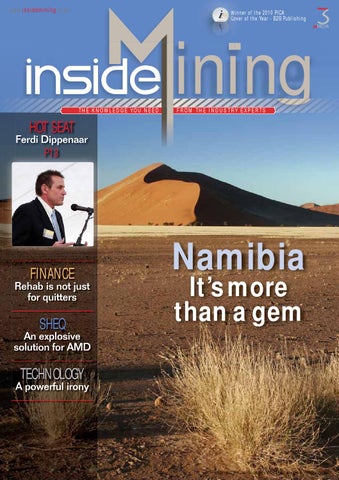
Namibia It’s more than a gem
An explosive solution for AMD
TECHNOLOGY
A powerful irony
ISSN 1999-8872 • R30.00 (incl. VAT) • Vol. 3 • No. 4 • May/June 2011
CONTENTS
T H E K N O W L E D G E YO U N E E D
ining
May/June 2011
FROM THE INDUSTRY EXPERTS www. insidemining .co.za
W Winner Winne of the 2010 PICA Cover Co over of the Year - B2B Publishing MEDIA
14
ining
THE KNOWLEDGE YOU NEED
FROM THE INDUSTRY EXPERTS
HOT SEAT
Ferdi Dippenaar
P13
FINANCE SHEQ
Namibia is a country
where folks tend to knuckle down and get their work done while living in peace with their countrymen and neighbours, says Willem Smuts when discussing its relative obscurity on P20
Namibia
Rehab is not just for quitters
ON THE COVER
It’s more than a gem
An explosive solution for AMD
TECHNOLOGY
A powerful irony
ISSN 1999-8872 • R30.00 (incl. VAT) • Vol. 3 • No. 4 • May/June 2011
EDITOR’S COMMENT
3
20
Belabouring the point!
3S MEDIA
4
Celebrating 50 years of publishing
MINING NEWS
5
The top stories making the news this month
HOT SEAT
12
Ferdi Dippenaar – Positive reality vs negative perceptions South Africa is still the most mining friendly country on earth; it is just a pity that international perceptions don’t reflect this, says Ferdi Dippenaar, CEO and president of Great Basin Gold.
REGIONAL FOCUS
29
14 20
Zambia: Where the buys are Amid the rough waters post meltdown and the general mayhem caused by calls for nationalisation, onerous/unclear ownership rules and tenure uncertainties in mining jurisdictions to the south, Zambia seems to be steady as she goes.
Namibia: Not so quiet on the western front Last year mining contributed about 15% to Namibian GDP and its export earnings were more than half the country’s total export revenue. Recent developments around strategic minerals may influence this in future.
FINANCE
29 Risk management: Managing the costs of rehabilitation 30 Royalty tax: Fiscal stability agreements SHEQ
32 36
42
Environment: Water conservation boosts production Acid mine water: An explosive solution for AMD
TECHNOLOGY
37 42 44 47 51
Furnaces: Fibre optics aren’t just for Xmas trees Explosives: Electronic detonator explodes on market Energy: A powerful irony Pipes and pumps: Enduring, economical solutions Crushers and screens: Sensor-based sorting technology
CETERUM CENSEO
52
For fox sake Inside Mining 05.06/11
1
EDITOR’S COMMENT EDITOR Tersia Booyzen E-mail: tersia@3smedia.co.za CONTRIBUTING EDITOR Dr Willem Smuts FEATURES George Chavunduka CREATIVE CHIEF EXECUTIVE Frédérick
Belabouring the point
Danton SENIOR DESIGNER Hayley Moore CHIEF SUB-EDITOR Sally Shaw SUB-EDITOR Danielle Hugo MARKETING MANAGER Natalie Nelson PRODUCTION MANAGER Antois-Leigh Visagie PRODUCTION COORDINATOR Jacqueline Modise FINANCIAL MANAGER Andrew Lobban ADMINISTRATION Tonya Hebenton SUBSCRIPTION SALES Cindy Cloete DISTRIBUTION COORDINATOR Asha Pursotham PRINTERS United Litho Johannesburg Tel: +27 (0)11 402 0571 ___________________________________
ADVERTISING SALES Stacey Glad Tel: +27 (0)11 467 6224 Cell: +27 (0)83 567 0073 E-mail: stacey.glad@lantic.net ___________________________________
MEDIA
PUBLISHER Elizabeth Shorten
No. 4 5th Avenue, Rivonia 2191 PO Box 92026, Norwood 2117 Tel: +27 (0)11 233 2600 Fax: +27 (0)11 234 7274/5 www.3smedia.co.za ___________________________________ ANNUAL SUBSCRIPTION: South Africa: R300.00 FOR 12 ISSUES (incl VAT & postage) SADC countries: US$ 75 Foreign: US$ 95 ISSN 1999-8872 Inside Mining Copyright 2011. All rights reserved. ___________________________________ All material in Inside Mining is copyright protected and may not be reproduced either in whole or in part without the prior written permission of the publisher. The views of contributors do not necessarily reflect those of the the publishers.
The past few weeks have been utterly depressing as the number of fatalities in the global mining industry doubled on almost a daily basis. It seems as if fatalities have a symbiotic relationship with commodity prices: both either decline or increase at the same time. Obviously, when commodity prices are high there is a lot of pressure on mines to perform and increase production, but it is not as obvious why this should lead to the deterioration of safety practices, to the point of death. Are corners being cut, is it a function of stress or fatigue, or does the health and safety of workers take second place when it comes to profit? During ‘off-the-record’ discussions with businesspeople and NGOs across all industries it has on occasion been admitted to me that ‘soft’ issues such as health and safety and corporate social responsibility are perceived as grudge purchases by some businesses. Until all of these issues, especially health and safety, are entrenched within the values and corporate cultures of all workplaces as non-negotiable must-haves, it will unfortunately be necessary to use the stick, in the form of legislation, instead of the carrot to imbed them. Locally, mines are being closed while any accidents, especially fatal ones, are investigated. This practice should by rights be broadened to include every industry as the subsequent loss in production and impact on the bottom line will hopefully be painful enough for employers and shareholders to insist on zero tolerance for any harmful behaviour and practices at any level of an organisation. As we enter the period of wage negotiations in South Africa, it is also hoped that there will not be any violence or loss of life associated with any industrial action that might take place. Labour, even more so than infrastructure or talks of nationalisation, is highlighted by our man in this month’s Hot Seat, Ferdi Dippenaar, as a major cause of the country becoming a less than desirable investment destination. In this month’s Inside Mining we also investigate the geopolitics and mining opportunities in some of our neighbouring countries that are becoming increasingly popular investment destinations. We also have some explosive stories on the latest technology and other developments in the mine water area. We hope you enjoy the read.
Remember that you can get daily news updates on the latest industry developments on www.miningne.ws, our electronic media partner
Tersia
28 186 subscribers can’t be wrong! Subscribe to the weekly miningne.ws e-newsletters today! To advertise on the e-newsletter or website contact Stacey Glad on 011 467 6224 or stacey.glad@lantic.net
Inside Mining 05.06/11
3
s s e r g o r p Print, The
and
MEDIA story
As 3S Media celebrates 50 years in business, and MD Elizabeth Shorten marks a decade at the helm, we look back at the colourful history of the company and its founder, and forward to the fast-changing future. 3SMEDIA
held a stylish cocktail party in honour of the occasion at the Birchwood Hotel and Conference Centre, where guests mingled outdoors and under an exotic Bedouin tent. They were entertained by a juggler, mime artist and magician, as well as mellow after-dinner music that allowed the conversation and wine to keep on flowing well into the night. Elizabeth regaled the crowd with incidents from the history of the company, formerly called Shorten Publications, and established by her father John Shorten in 1960. “He was a real character and one of the true founders of business-to-business publishing in this country.” His early business involvement was with a number of trade union journals. When being interviewed by the board to work on the South African Railways magazine, he was asked if he spoke Afrikaans. Shorten, who was born in England, replied that he did not, but was perfectly prepared to speak English with an Afrikaans accent. “That was typical of my father’s sense of humour,” says Elizabeth. “And somehow, he always got away with it.” Shorten then established his own publishing company. His first solo venture was The
Transactions, a record of the bi-annual conference of the Institute of Municipal Engineering of Southern Africa (IMESA). He then approached the institute with the idea of publishing a monthly magazine. He called it IMIESA (the middle ‘I’ stands for ‘Ingenieur’ and the ‘E’ for ‘Engineer’). Today, IMIESA is probably the most successful monthly publication in its industry, and has been the recipient of a number of awards. Further magazines followed for SABI, the irrigation institute, and for SAESI, the emergency services institute, of which he was made an hon-
orary member in recognition of the magazine’s positive contribution to the industry. When he died in 1996, firemen from the institute formed an honour guard at his funeral. Shorten was a natural salesman with a style all his own. Elizabeth recalls: “He would visit a client with his contract book and speak about everything except the business at hand. He would establish the client’s view on some issue and argue the complete opposite. When they had passed a good half hour in heated debate, my father would suddenly produce the book and ask
Awards, awards and
more awards ... 1999 - IMIESA wins a PICA Award
2001 - IMIESA wins a PICA Award - IMIESA wins a Highly Commended PICA Award - RéSource wins a PICA Award
2003 - RéSource wins a Highly
LEFT: Founder John Shorten in Cape Town with his wife Shelley and their four daughters (Elizabeth on left)
the client to sign his contract. ‘But I have no more money in the budget,’ the client might object. ‘Then why have you wasted my damn time talking about politics?’ my father – who loved nothing better than a good political argument – would demand, and the client would feel obliged to sign.” Shorten was then officially appointed by the Cape Town municipality to write the history of their city and its industries. The Golden Jubilee of Greater Cape Town was published in 1963, followed by the even weightier Johannesburg Saga in 1970. Both were critically acclaimed. By then, his wife Shelley was running many aspects of the business. “She managed to do the layout, proofreading g and
bookkeeping. bo book ookkke keeep ep ping in ng She She he was was as always l the backbone of the family and the business,” Elizabeth acknowledges. Shelley took over Shorten Publications after her husband’s death in 1996, together with her daughter Patricia, who made a significant contribution to the company over many years, including bringing RéSource magazine into the stable. In 2001, Elizabeth took the helm, having returned from London where she worked for newspapers such as The Times and The Daily Mail, and for big consumer magazines such as Woman’s Own. “Princess Diana was often on our cover, and asked to visit our offices to see a ‘normal working day at a magazine’. That was never going to happen. So many flowers were delivered that the place looked like the Hanging Gardens of Babylon, and every stray piece of paper was filed away. But one staff member had forgotten to hide her grapefruit. When Her Royal Highness walked in, her eyes zoned straight in on the offending fruit and she asked, ‘Who’s on diet?’ She was very sweet and charming to everyone, but she didn’t get what she wanted – a taste of normal life – which I thought was rather sad.” Commended PICA Award
- RéSource wins a PICA Award
OPPOSITE PAGE: The 3S Media team
YEARS 50 AT A GLANCE
!
Elizabeth E El iizzab abeth etth wa w wasn’t aasn sn’t sn ’tt q quite u te ui e ssure urree wh ur what hat tto o ex eexpect xpe pect cctt when she moved back to South Africa in 2001 to take the reins at Shorten Publications. “I became immersed in engineering, water, waste management, emergency services – all matters of life and death. It was very challenging.” She inherited four publications, and soon set about launching and purchasing others. The stable now boasts 11 magazines, dealing with engineering and infrastructure development (IMIESA; Local Government Supplier), water and waste management (Water & Sanitation Africa; RéSource), mining (Inside 1975 Mining), transport (Transport World Africa), enterprise-wide and occupational risk (Enterprise Risk; Occupational Risk), and the meetings and events industries (Meetings SA; SA Conference). Each of the products serves unique niche markets. “IMIESA goes all the Excellence Award as Journalist of the Year
- Emergency Services SA wins a PICA Award
- SA Irrigation wins a Highly Commended PICA Award
2006
- Elizabeth Shorten wins a Mondi Journalism Award
- Elizabeth Shorten wins a Mondi Journalism Award
2008
2004
2005
- Transport World Africa wins a Highly Commended PICA Award
- Elizabeth Shorten wins a SAACE
- IMIESA wins a PICA Award
- IMIESA wins a PICA Award - IMIESA wins a Highly Commended PICA Award
2010 - Inside Mining wins a PICA Award
- Water & Sanitation Africa receives a PICA nomination - Enterprise Risk receives a PICA nomination - Inside Mining receives a PICA nomination
MEDIA
1960 1975 1978 1980 1996 1999 2001
Shorten Publications is founded IMIESA is launched Emergency Services SA is launched SA Irrigation is launched John Shorten passes away ReSource is launched Elizabeth Shorten becomes managing director of Shorten Publications
2003 2005
Transport World Africa is purchased
2005 2005
Occupational Risk is launched
2006 2006 2007 2008 2008
Water & Sanitation Africa is launched
SA Conference, www.saconference. co.za, Meetings SA and www. hrhighway.co.za are purchased Shorten Publications is renamed 3S Media Local Government Supplier is launched Enterprise Risk is launched Inside Mining is launched 3S Media becomes the South African representative for www.miningne.ws
1994
Present
WINNER Best B2B Cover
NOMINEE Best B2B Cover
3S celebrates in style! 3S Media’s 50th birthday celebration was held in the gardens of the Birchwood Hotel. Jugglers and magicians roamed among guests, adding to the festive atmosphere.
TOP Staff and guests of SA Conference and Meetings SA enjoy a pre-dinner drink.
A thumbs up from the mime artist and RéSource editor Candice Landie
Colin Jordaan (chairman), Elizabeth Shorten (publisher and managing director), Shelley Shorten (co-founding publisher)
Water & Sanitation Africa was nominated for way from local government infrastructure developB2B editor of the year, and Enterprise Risk was ment, the responsibility of the municipal engineer, nominated for B2B cover of the year. “We are through consulting engineers, to civil engineering very proud of this record in a competitive market,” contractors and their suppliers. There is nothing Elizabeth says. “The credit goes to our talented else like it in the market,” says Elizabeth. staff who won these accolades.” Elizabeth herself It was a difficult decision when she changed has received two Mondi Awards for excellence in the 45-year-old company name from Shorten journalism and the SAACE (now CESA) ExcelPublications to 3S Media in 2005. “The Internet lence Award from the consulting engineers for had already been in popular use since the 1990s. Journalist of the Year – “not bad for someone who The writing was on the wall – or rather, it was no was once more comfortable talking to a princess longer just on the printed page. Publishers had to than a pipe manufacturer,” she says. “I think my adapt to the fact that we needed to deliver confather would have been proud of me, had he lived tent across multiple platforms. We are no longer to see what I’ve done with the company.” print publishers, but media owners.” Elizabeth has been a board member of the The other challenge was to find a name – in Magazine Publishers Association (MPASA) since a country with 11 official languages – that was 2003, and chaired the PICA Awards for three neutral and inclusive. The name ‘3S’ popped into Elizabeth’s mind because the three children in her family are called Sandra, Stephen and Sebastian. She wasn’t looking to perpetuate a family-style business, but liked the abstract letter and number, and the almost mirror-image shape they make. “Everyone else loved it, too, so 3S Media became the brand.” All of the three children after whom the company was not quite intentionally named have worked for it at one time or another. Elizabeth’s Elizabeth Shorten with her husband Colin Jordaan and their husband Captain Colin Jordaan, forchildren Sebastian, Sandra and Stephen (left to right) merly director of the South African years. She was invited to be a panel speaker Civil Aviation Authority and GM: Flight Operations at the First Media Summit, before the 2010 of South African Airways, and currently a senior PICA Awards, on the topic of traditional magacaptain flying the Airbus 340, is the chairman zines redefining their businesses into a broader of the board. “He’s the engineer in the family,” media landscape. Elizabeth says. While she believes that 3S Media’s print Nonetheless, 3S Media is publications will always form the backbone of no longer structured as a famthe company, and are unlikely to disappear any ily business. The company emtime soon, she also sees a great future for niche ploys editors who are experts in titles in the electronic space, without the limits of their fields, and heads of departtime and geography. “We already have access to ment with strong track records well-defined communities with similar interests,” in print and online publishing. she says. “Now that we’re engaging with them “Staff numbers have increased through web, mobile and social media platforms, from about four in my father’s day the possibilities are limitless.” to about 38 full-time employees An independent survey undertaken by Price and 10 outsource consultants, all Waterhouse Coopers predicts an increase in of whom make the company what it business-to-business advertising support for is today.” both print and online products. Elizabeth believes In line with the new name and multithat what matters is both the message itself platform direction, Elizabeth launched and how it is adapted to the different means of newsletters and websites for 3S Medelivery. “Print magazines offer brand awareness, dia’s business communities, with more to follow, newsletters provide direct marketing to individual and entered into an agreement to represent the mailboxes, and websites elicit instant and measurinternational site www.miningne.ws, which has able responses. We at 3S Media intend to be a seen a significant growth in traffic. 3S Media also one-stop shop, offering all these solutions.” launched events for related industries. Proof of In conclusion, Elizabeth acknowledges the the company’s publishing success has come in loyalty of 3S Media’s advertisers and readers, the form of seven PICA awards (four for IMIESA and their contribution to the company’s success. alone) and four Highly Commended awards. “We couldn’t have done it without you. And your When the system was revamped in 2010, support is what will write our story for the next Inside Mining won B2B Cover of the Year and 50 years.” was nominated for best trade and industry writer,
MINING NEWS www.miningne.ws
The top mining stories making the news in the past month
compiled by George Chavunduka
| AFRICA | SOUTH AFRICA IDC funds $860 million platinum mine Source: www.reuters.com
South Africa’s Industrial Development Corporation (IDC) will contribute about R840 million in equity MOZAMBIQUE
finance to the new Lesego platinum mine project, a senior IDC official says. South Africa, the world’s largest platinum producer, could lift its platinum output by 5% in 2011, from 4.64 million ounces last year, although a strong rand currency and threat of labour strikes may hit expansion. “The total capital outlay is estimated to be approximately R6 billion and assuming a 50:50 debt to equity split, the
Vale opens $1.7 billion coal mine
Source: www.iol.co.za
Brazilian mining giant Vale has opened a new $1.7 billion (R11.3 billion) coal mine in in Moatize in northwest Mozambique, tapping the country’s coal reserves of about 23 billion tonnes. The project is the largest single investment to date in Mozambique. Vale plans to start production in July and export one million tonnes of coal this year, ramping up output to 11 million tonnes in a few years. Company CEO Roger Agnelli says the project will add as much as $3 billion (R20.77 billion) to the economy. In 2004 Vale became the first mining giant to get a concession in Mozambique. Australian mining company Riversdale, together with India’s Tata Steel and Jindal Steel and Power, is also developing coal mines in Mozambique. But concerns remain regarding getting the product to the market as infrastructure renovation lags behind. “We are running at this stage to get the infrastructure ready for export,” Agnelli says.
IDC equity contribution will be approximately R840 million,” the IDC’s chief executive, Geoffrey Qhena, says. He notes the state-owned IDC, which will invest R102 billion over the next five years to boost industry in Africa’s largest economy, has acquired a 28% stake in the Limpopo-sited project in collaboration with junior miner Village Main Reef.
Gold One accepts China-led takeover Source: www.theaustralian.com.au
firm, which is a unit of the state-controlled Citic Group. The deal comes at a time when precious metals have been trading at near-record levels, and the offer represents a 73% premium to the company’s $347 million valuation last Thursday, when shares closed at 43 cents each before the disclosure of the deal. Gold One said the consortium plans to buy a stake of between 60 and 75% and has structured a deal to secure at least the lower end of that range.
NAMIBIA Large diamonds turn up in Namibia marine mining sample Gold One International says it has accepted a takeover offer from a Chinese consortium that values the Africa-focused gold producer at roughly $600 million (around R4 136 million), adding that the deal will provide funding for the miner’s expansion plans and could lead to the company’s listing on the Hong Kong bourse. The offer from the consortium, led by Baiyin Non-Ferrous Group, comes less than a month after Gold One said it would significantly boost the production of gold and add uranium reserves by investing $750 million (about R5.19 billion) to acquire assets near Johannesburg. The consortium bought an almost 18% stake in the Sydney-based company in April, sparking speculation of a possible takeover. Gold One, which has mines in South Africa and is exploring neighbouring countries, said its board is recommending a cash offer of 55 Australian cents (R4.06) per share from a group of investors led by the Chinese mining and smelting
Source: www.israelidiamond.co.il
A sampling programme recently concluded by Afri-Can at the EPL 3403 marine diamond mining concession off the coast of Namibia has turned up 84 diamonds, 15 of which were over 0.5 ct in weight each, the company reported this week. The largest diamonds yielded by the sample weighed 1.6, 1.3, and 1.15 ct. The size distribution of the sample’s diamonds indicates a potential concentration of large diamonds of high quality and Afri-Can plans to move on to the next phase of diamond exploration at the site, including a geophysical survey, as soon as possible. Afri-Can president and CEO Pierre Leveille says the company expects the global diamond market to “remain robust for many years as demand surpasses supply and
Inside Mining 05.06/11
7
300kVA - 2500kVA
GENERATE YOUR OWN POWER.
IF IT’S POWER YOU NEED SWITCH TO CAT.
you need for maximum efficiency and performance.
CONTINUITY - When you choose Cat equipment, all the products of your electric power system fit together seamlessly. Cat components, controls and support from Barloworld Power combine with Cat generator sets to ensure efficiency and provide the peace of mind of a completely integrated operation.
STABILITY - When Barloworld Power supplies your operation with electric power, you know Caterpillar is behind you, all the way. One company is always there to get your operation up and running and to keep it running, no matter what the circumstances. For more information call Barloworld Power on 011 898 0222
DEPENDABILITY - Power is the force that keeps your operation alive. Depend on Barloworld Power to provide the equipment and support to keep your power flowing. SUPPORT - One company offers the complete equipment management solutions that keep your operation running smoothly. From analysis and assessment to the service agreements that take maintenance worries off your mind, Barloworld Power can supply the total support
© 2009 Caterpillar Inc. All Rights Reserved. CAT, CATERPILLAR, their respective logos, “Caterpillar Yellow” and the POWER EDGE trade dress, as well as corporate and product identity used herein, are trademarks of Caterpillar and may not be used without permission.
Always available • Always on
MINING NEWS www.miningne.ws
New bill restricts miners in Quebec
new diamond mining projects are few… We feel that we are sitting on a strong project in a very solid industry.”
| NORTH AMERICA | CANADA New bill restricts miners in Quebec
on mining claims they hold or relinquish them. Bill 14, which amends the province’s Mining Act, is a key measure in the 25-year, $80 billion (R551 billion) development plan for northern Quebec unveiled by the provincial government. The bill has elicited some protests from the mining sector, which says it gives municipalities power over mining activities that should come under provincial jurisdiction.
Source: www.theglobeandmail.com
The Quebec government is proposing tougher regulations on mining exploration in the province and restrictions on mining in and around urban centres and vacation resorts. A bill tabled in the Quebec National Assembly requires companies to begin exploration within two years NEW APPOINTMENTS
| AUSTRALIA | Wah Nam amasses controlling Brockman stake Source: www.ninemsn.com.au
Wah Nam International Holdings has amassed a controlling stake in iron
ore explorer Brockman Resources. However, the target is crying foul and says it may seek intervention by the Australian Securities and Investments Commission. Brockman, which is now 51.99% held by Wah Nam, says it remains concerned the Hong Kong-based company has stockpiled a bigger than permissible interest in the target via alleged relatedparty transactions. Under the Corporations Act, a company cannot hold a stake of more than 20% in another firm without formally declaring a takeover. Brockman claims that parties including Star Ray International had taken a stake in Brockman before Wah Nam’s takeover was announced, but had not declared an association with Wah Nam. The Takeovers Panel early
this year rejected Brockman’s request for a declaration of unacceptable circumstances on these grounds. Brockman says acceptances into the offer between 11 and 13 May appeared to be mainly from offshore shareholders, including some of the investors identified in its application to the Takeovers Panel in January. Wah Nam says analysis has shown Brockman’s Australian registered shareholders, excluding Wah Nam and Brockman directors, held only 21% of the target’s shares.
HK Regent again withdraws bid for Australia’s BC Iron Source: www.ibtimes.com
Hong Kong-listed company Regent Pacific has abandoned
Iamgold Q1 up on higher gold output
Source: www.reuters.com
Canadian mid-tier gold miner Iamgold Corp.’s first-quarter earnings almost tripled as it started production at its West African Essakane mine in Burkina Faso. However, the company cut its gold production outlook for the year to 950 000 to 1.05 million ounces, from its prior view of 1.1 to 1.2 million ounces, to reflect the proposed sale of its interest in two of its mines in Ghana. January to March earnings rose to C$162.3 million (R1.16 billion), or 41 cents (R2.94) per share, from C$60.2 million, or 15 cents per share, a year ago. Toronto-based Iamgold, which has mines in Canada, South America and Africa, posted an 80% rise in revenue at C$432.5 million (R3.08 billion). Adjusted earnings were 36 cents (R2.56) per share. Analysts on average expected earnings of 32 cents (R2.28) per share on revenue of C$410.4 million (R2.92 billion), according to Thomson Reuters. Quarterly gold production was 290 000 attributable ounces at a cash cost of C$570 to C$580 per ounce. Last month, Iamgold had agreed to sell its 18.9% interest in the Tarkwa and Damang gold mines
in Ghana to Gold Fields, the world’s fourth-largest gold producer, for C$667 million (R4.75 billion) in cash.
Inside Mining 05.06/11
9
ULTIMATE BENEFICIATION
MINING NEWS www.miningne.ws
its $345 million (R2 378 million) proposal for Australia’s Pilbara junior BC Iron after its board pulled out its support for the bid because an expert’s recommendation deemed it was not just or practical. Perth-based iron ore miner BC Iron validated that its board had withdrawn an earlier $3.30-a-share bid subsequent to the report by KMPG, which deemed the offer was not in the best interests of the shareholders. Managing director Mike Young says, “The value of the miner, which operates the Nullagine project in joint venture with Fortescue Metals Group, had obviously increased since the original bid was launched in January. When Regent Pacific made the offer, the Pilbara region was going into the wet season and the project still had operational, execution and timing risk. Metals prices have since moved up and the value of the company has increased.”
| SOUTH AMERICA | PARAGUAY Uranium Energy Corp to acquire large uranium project Source: www.uraniumenergy.com
Uranium Energy has entered into a share exchange agreement with a Nevada company in which it acquired a Paraguayan company that holds a 100% legal and beneficial interest in two unencumbered prospecting permits covering 247 000 acres located in the area of Coronel Oviedo, Paraguay, subject to a gross overriding royalty. The total purchase price for the Paraguayan company was the issuance of 225 000 restricted common shares in the capital of Uranium Energy. Amir Adnani, president and CEO, states, “The Coronel Oviedo property is located in stable and business friendly Paraguay, is geologically very similar to the South
Texas uranium belt and is anticipated to be ISR-amenable, as initially indicated through our pump test studies. This opportunity profile is an excellent fit for our technical team, which has a distinctive track record of discovering and advancing sandstone-hosted uranium deposits. Share dilution to acquire the project is far below 1% and we plan to commence exploration immediately.” Uranium Energy also agreed to pay the Vendor a royalty interest of 1.5% of the gross proceeds it received in connection with any uranium, which is produced and sold from mineral interests in the property. Uranium Energy says it also has the exclusive right and option to acquire at any time 0.5% of the aggregate royalty interest for $500 000 (R3.46 million). The vendor granted the company a right of first refusal to acquire all or any portion of the remaining one percent 1.0% royalty interest.
| ASIA | INDONESIA Newmont’s Indonesia unit wraps up 7% stake sale to government Source: www.reuters.com
Foreign shareholders of Newmont Mining Corp’s Indonesia unit have completed the sale of a 7% stake to the government, paving the way for an initial public offering for the unit in coming months. Denver-based Newmont and Japan’s Sumitomo Corp are the majority owners of PT Newmont Nusa Tenggara (NNT), which runs the Batu Hijau copper and gold mine in West Nusa Tenggara province. The stake went to state investment agency Pusat Investasi Pemerintah (PIP) on 6 May, says Martiono Hadianto, president director of PT NNT. “We are pleased as our obligation to sell all of our divestiture shares in PT NNT has completed in compliance with the contract of work with the government of Indonesia.” NNT did not disclose the price but the finance ministry said PIP has agreed to buy the 7% for $246.8 million (R1.71 billion). Under the mining contract agreed on with the government, foreign shareholders of NNT were supposed to sell a total stake of 51% gradually to local investors in four years from starting production.
HOT SEAT FERDI DIPPENAAR
Positive reality vs negative perceptions South Africa is still the most mining friendly country on earth; it is just a pity that international perceptions don’t reflect this, Ferdi Dippenaar, CEO and president of Great Basin Gold, tells TERSIA BOOYZEN in a frank discussion.
G
reat Basin Gold is an international mining company with two emerging gold mines: the Hollister Mine on the Carlin Trend in Nevada, United States, and the Burnstone Mine in the Witwatersrand Basin, South Africa.
Burnstone was officially opened in February this year; did the much maligned South African infrastructure cause any problems for you? We are lucky, we are close to Johannesburg so we are easy for suppliers to get to. If you have to look at the total route to the mine we are privileged because you drive most of it on the highway and after the turn-off there is only about 20 km that is not so good, but as a percentage of the total route it’s very small. So there isn’t really a big influence. The road from the highway to the mine is a provincial road and it is bad. I’m just waiting for the mine to make some money so that we can fix the road or build a new one. The bigger problem that we will have is electricity. At the moment Eskom is working on a second line for us which means we will not be dependent on one line, although one line is enough to supply the entire mine with electricity. So we have backup, and that is nice, I don’t think that there are a lot of people that have a backup plan. It is three years after we experienced the rolling black-outs and I still go to conferences where they discuss the problem of electricity supply and delivery. This creates a negative perception of South Africa in the international market, and if you then add talks about nationalisation – although we have heard the president and most of the ministers say that nationalisation is not on the agenda – it only takes one comment from the ANC Youth League to have a negative impact. Because you have to remember that the
12
Inside Mining 05.06/11
youth is the future of this country, so the current government is saying not in their lifetimes but the people that are looking at long-term investments in South Africa, say over a period of 10 to 15 years, the possibility of the current youth becoming the government before the end of that period and implementing nationalisation is a very real issue. For someone who buys
a negative view, it is just things that people don’t always think of.
If you compare Burnstone to Hollister, what was the time difference in developing the mines? It was about the same. Apart from everything that I have said, South Africa is still a mine-friendly environment to gets things
Unless there is some or other gain – whether it is productivity or competitiveness – what you are doing is eroding margins shares it is not a big problem because he can buy and sell in a short period of time. But I don’t think that the South African mining industry offers more to investors that any other country in the world, so why would South Africa become a primary investment destination?
What do we have to do to make South Africa a primary investment destination again? Precisely the opposite of what I just said. Give people some security in terms of their investment. At Burnstone we started exploring in 2002, we did everything in a boom period, we had money available and it still took us eight years to build the infrastructure to begin mining a relatively shallow ore reserve. It is a long time for a shareholder to wait for a return. At the current gold price it is going to take us four years to pay back the money we took from investors to build the mine. So his or her investment horizon spans from 2002 to 2015. People don’t always realise just how long that period is. And it is a shallow mine and it is mechanised. I can almost say that is easy mining as the rest of the gold reserves in the country lie around 4 km deep. Just think of the time it takes to have a return on investment on those mines. This is not
done in, to get co-operation from the official side, to process documents. Normally, if I have to speak and explain to stakeholders at international conferences, I tell them that at the end of the day I would much rather build a mine here than anywhere else in the world. Because here legislation is still mining friendly, it is actually only the perceptions around it that is negative and that is a pity – the disconnect between the two. At the end of the day it will take much longer to get the relevant permits to put our mine in commercial production in Nevada then it will take here. If I look at the rest of Africa, I would much rather build another mine here in South Africa then anywhere in the rest of Africa. Something that is strange is that the bigger mining companies prefer the rest of Africa.
How competitive is South Africa in terms of labour? Do you think our cost of labour has become too high? I don’t think it is the cost of labour, I think it is the productivity and efficiencies. It doesn’t look like we have seen the improvement in productivity as we see the increase in the cost of labour. The cost of labour has also been one thing that people who look at South Africa in terms of investment quite often refer to. There is
HOT SEAT Vital statistics Date of Birth: 18 June 1961 Place of Birth: Omaruru, Namibia Degrees: B.Comm, B.Proc, MBA Other directorships: Harmony Gold Mining Company: 1997 to November 2005; Kryso Resources Inc.: April 2007 to present; Village Main Reef Gold Mining Company: July 2008 to present Career summary: Dippenaar started his career at the Buffelsfontein Gold Mine in 1982 and was employed in various financial and administrative capacities at the Gengold mines. In 1996, he became managing director of Grootvlei and of East Rand Proprietary Mines. Following Harmony Gold’s acquisition of Grootvlei and Cons Modder, he was appointed marketing director of Harmony in 1997, overseeing the service delivery departments, corporate affairs and investor relations. He was appointed director, president and CEO of Great Basin Gold in December 2005.
nothing wrong with being unionised but it is the way we conduct our negotiations that is a problem. It becomes a lengthy and often violent and destructive affair and typically the increases are way above inflation. So, unless there is some or other gain – whether it is productivity or competitiveness – what you are doing is just eroding margins and that is not good for the industry. The perception is that negotiations are protracted, destructive and associated with violence. Ultimately someone has to pay for it, and it is the man in the street, because any increase is just passed on and it is the manufacturer, and it is the developer and ultimately it goes back to who makes that money available and that is the shareholder. The shareholder sits there and says well, I can invest in the Burnstone project in South Africa or I can invest in a project in South America and here is what the returns look like, but here is a risk that is associated with those returns and my investment decision is to go elsewhere.
What about South Africa’s strict environmental legislation? We find it easy to comply with the environmental legislation; we accept that that is part of our licence to operate. We feel like that about anyplace, the legislation is just as strict as in Nevada. Even if we build a mine in Tanzania, were we are currently busy with exploration, we will have the same standards that we have here and in Nevada. I’m very happy with environmental legislation; I don’t think it is too strict
How is Great Basin’s exploration in Tanzania and Mozambique coming along? After the capital market crisis in 2008, due to the lack of funding availability, we had to reconsider our continued active exploration in Tanzania and Mozambique. The intention was to continue to do evaluation targeting and the minimum exploration required to maintain licences with the idea that, as soon as Burnstone was up and running and in commercial production, we would be revisiting our exploration activities. The impact of that being that we will probably actively restart our drilling programmes in the second half of 2011. The reason for this was just focus. In Nevada, it was about refurbishing and upgrading the Esmeralda Mill which has basically now been completed. In South Africa it was the construction and the delivery of the Burnstone mine. So at the time when capital was scarce I think we took the right decision to focus on the US and South Africa. We did our first phase drilling in 2008/2009 drilling season. We completed technical reports on the properties. I am confident that we will see the benefit of taking a bit more time to delineate targets and plan the next phase of active exploration, instead of just rushing off and spending money randomly at a time where it wasn’t available.
How positive are the results looking at the moment? We are extremely confident but it definitely needs follow up and more targeted drilling, focusing on specific areas where we
ABOVE Ferdi Dippenaar, CEO and president of Great Basin Gold
have had success in the past. We have declared resources in two areas, measured in all categories, so it is looking good. There is some exciting stuff.
If you do start mining there will you invest in beneficiation as well? It’s an interesting question, I do know that there is another operator in some of the regions so there is a possibility to share infrastructure like plants or a mill. I mean, that must be something to consider because it will influence our capital cost. I think it is all determined by the size of the ore body that needs to be mined. The minimum that you will end up with will be a mine and a mill. And in gold it is very difficult to take beneficiation beyond that in our industry. But in terms of beneficiation I agree with you metals that can be beneficiated locally and in Africa they should be before they are exported. That way the value adds and the employment opportunities are actually created here. If you have been to India you will see there are hundreds of people working in jewellery factories who just manufacture and the price of labour is cheap and that is why they can be competitive.
Any last thoughts? I think we got so much to talk about and we have so much to say. There are a lot of positive things about South Africa that we are not selling, and it is not going to take much from South Africa to address some of these negative perceptions that exist in the market at the moment.
Inside Mining 05.06/11
13