www.insidemining .co.za
W Winner Winn of the 2010 PICA CCover Co ove of the Year - B2B Publishing MEDIA
THE KNOWLEDGE YOU NEED
ining FROM THE INDUSTRY EXPERTS
COMMODITIES
CSI South Africa
FINANCE
When disaster strikes strik kes
SHEQ
Fatigue management m gement
PP38 38
Health & Safety
Mining’s next frontier ISSN 1999-8872 • R30.00 (incl. VAT) • Vol. 3 • No. 3 • March/April 2011
THE SPECIALIST TOUCH
Just like each emerald, every company has its own unique qualities and characteristics — a particular reflection of depth and clarity.
Our job is to understand and recognise these qualities. To craft solutions that are both outstanding and original.
At
Emerald,
we
offer
a
rare
entrepreneurialism, are inspired by a progressive, contemporary approach and
believe
in
building
strong,
enduring relationships.
With our specialised focus on Corporate Property and Engineering insurance, we can offer you relevant solutions tailored to your needs.
To find out more about what we can offer your Corporate clients, visit www.emeraldsa.co.za; or call us on +27 11 658 8200.
T + 27 11 658 8200
www.emeraldsa.co.za
CONTENTS
T H E K N O W L E D G E YO U N E E D
ining
March/April 2011
FROM THE INDUSTRY EXPERTS www. insidemining .co.za
W Winner Winn of the 2010 PICA CCover Co ove of the Year - B2B Publishing MEDIA
22
THE KNOWLEDGE YOU NEED
ining FROM THE INDUSTRY EXPERTS
COMMODITIES
CSI South Africa
FINANCE
When disaster strikes strik kes
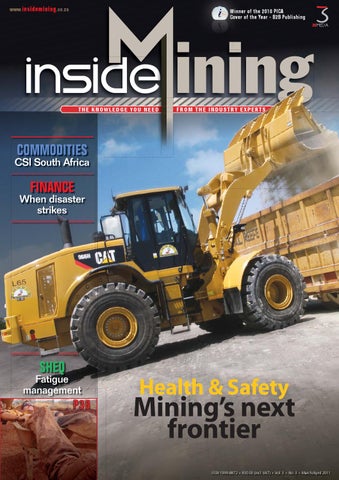
ON THE COVER West Rand Plant Hire is expanding its comprehensive equipment fleet with the addition of new Cat wheel loader and hydraulic excavator models.
SHEQ
Fatigue management m gement
PP38 38
Health & Safety
Mining’s next frontier ISSN 1999-8872 • R30.00 (incl. VAT) • Vol. 3 • No. 3 • March/April 2011
EDITOR’S COMMENT
3
30
Survivor isn’t just a TV game
MINING NEWS
6
A brief overview of the top stories in the news
TALKING POINT
10
Nationalisation: a global perspective
COMMODITIES
12 18 22
34
The carat or the stick? Southern Africa has been, and will remain for a long time yet, one of the important addresses in the diamond world. We take a look at some of the juniors in this area.
CSI South Africa When it comes to the forensic investigation of stolen PGM-bearing material, it is crucial to identify the deposit of origin as well as the producer.
Andiamo! An overview of one company’s experience in gold exploration and mining in Eritrea.
FINANCE
30
Forces majeure
SHEQ
34 36 38
42
Kicking bad habits Unwanted incidents such as injuries and fatalities can be averted by creating a shift in the individual’s mindset towards health and safety and human behavioural patterns.
A not-so-unlikely threesome How will the Consumer Protection Act affect the mining industry and what will the implications be?
Do you just wanna crash? Fatigue management is a shared responsibility and all stakeholders should participate to provide the safest and healthiest working environment possible.
TECHNOLOGY
42
Moving mountains
EXECUTIVE ESSENTIALS
48
Products, services and toys for executive boys and girls
Inside Mining 03|04/11
1
2011 Ball mill - 1906
Polysius Mills - Mines ahead 150 years of leading design technology
Cerro Verde - Peru
Northam - South Africa
Catoca - Angola
Oxiana - Australia Polysius Service Centre Johannesburg South Africa Polysius has, for over 150 years, led the minerals and cement industries with innovative AG, SAG, Ball mill and Scrubber designs. Industries globally benefit from the state-of-the-art machines which incorporate •Fully fabricated shell endwalls and girthgear •Slide shoe bearing shell support •Combiflex and gearless drives Global acceptance The following significant Polysius mill installations are operating successfully since 2007:
Skorpion Zinc - Namibia
With the following contracts in progress:
Local service and customer support Advanced Service Centres in South Africa, Germany, Australia and Peru ensure dedicated after sales support.
Combiflex
Polysius A division of ThyssenKrupp Engineering (Pty) Ltd 71 Nanyuki Road, Sunninghill 2191 Republic of South Africa Tel: +27 (0) 11 236-1218. Fax: +27 (0) 11 236-1301 e-mail: pia.guertler@thyssenkrupp.com www.polysius.co.za
Polysius mills – A tribute to innovative process design
EDITOR’S COMMENT EDITOR Tersia Booyzen E-mail: tersia@3smedia.co.za CONTRIBUTING EDITOR Dr Willem Smuts FEATURES George Chavunduka CREATIVE CHIEF EXECUTIVE Frédérick Danton SENIOR DESIGNER Zané Janse van Rensburg CHIEF SUB-EDITOR Lia Marus SUB-EDITOR Danielle Hugo MARKETING MANAGER Natalie Nelson PRODUCTION MANAGER Antois-Leigh Visagie PRODUCTION COORDINATOR Jacqueline Modise FINANCIAL MANAGER Andrew Lobban ADMINISTRATION Tonya Hebenton SUBSCRIPTION SALES Cindy Cloete DISTRIBUTION COORDINATOR Asha Pursotham PRINTERS United Litho Johannesburg Tel: +27 (0)11 402 0571 ___________________________________
ADVERTISING SALES Tel: +27 (0)11 233 2600 Carien Daffue Cell: +27 (0)82 927 8294 Stacey Glad Cell: +27 (0)83 567 0073 ___________________________________
MEDIA
PUBLISHER Elizabeth Shorten
No. 4 5th Avenue, Rivonia 2191 PO Box 92026, Norwood 2117 Tel: +27 (0)11 233 2600 Fax: +27 (0)11 234 7274/5 www.3smedia.co.za ___________________________________ ANNUAL SUBSCRIPTION: South Africa: R300.00 FOR 12 ISSUES (incl VAT & postage) SADC countries: US$ 75 Foreign: US$ 95 ISSN 1999-8872 Inside Mining Copyright 2011. All rights reserved. ___________________________________ All material in Inside Mining is copyright protected and may not be reproduced either in whole or in part without the prior written permission of the publisher. The views of contributors do not necessarily reflect those of the the publishers.
Survivor isn’t just a TV game The health and safety of miners has become one of the most crucial issues in the industry. It has not only become an important topic of conversation, but also an area in which mining houses are investing considerable resources. There are a number of factors at play, such as genuinely caring about the well-being of employees, productivity, consumer pressure, reputation management and investor confidence. In South Africa we have the tripartite Zero Harm campaign, which sees big business, government and labour working together on an unprecedented scale to make the industry if not a happy place, then at least a healthy place for everyone involved. In this issue we take a look at some innovative ideas on how to actively involve and educate the workforce. It is also heartening to see that local realities and living conditions are being acknowledged as contributing factors and that viable solutions are being implemented to counter the socio-economic conditions that are so prevalent in South Africa and other developing nations. Unfortunately not all risks can be managed, as the natural disasters in Australia, New Zealand and Japan have indicated over the past few months. The pictures that are flashing on our screens are horrific and the loss of lives is deeply disturbing: our sincere condolences go out to everyone affected. While people are irreplaceable, it would be irresponsible of us not to take a look at how such events affect business in general and the mining industry in particular. Enterprise risk management has to include the possible effect of forces majeure and how these risks can be mitigated to ensure that not all of the damage done is irreversible. Economies have to endure through or rise up again after major catastrophes, be they political, such as that currently happening in North Africa, or natural, in order to provide the human survivors with any hope for the future.
The pictures that are flashing on our screens are horrific and the loss of lives is deeply disturbing: our sincere condolences go out to everyone affected
Tersia Booyzen
Inside Mining 03|04/11
3
COVER STORY
West Rand delivery 24/7 Aimed at meeting the mining sector’s high production demands, West Rand Plant Hire expands its comprehensive equipment fleet with the addition of new Cat wheel loader and hydraulic excavator models.
T
racing its origins back to West Rand Plant Hire’s foundation in 1971, this renowned, family-owned business is today one of South Africa’s leading plant hire specialists in the mining, construction and allied industries. Originally established a generation ago, the company is now run by the three sons of the founders, all of whom are directors responsible for making the day-to-day decisions. Over time, the mining segment has become a key business focus area, encompassing activities that include rehabilitation works, building tailings dam walls, general plant hire, ore transport, materials handling, rock dump profiling, mechanical hydraulic mining, as well as constructing paddocks, a past example being a project completed at West Wits in Carletonville, Gauteng. For more than a decade now, West Rand Plant Hire has been deployed on a series of ongoing contracts at AngloGold Ashanti’s Vaal River operations, located close to the towns of Orkney and Klerksdorp. Prior to this, West Rand Plant Hire’s involvement with AngloGold Ashanti dates back to 1986 at the Ergo Mine, situated to the east of Johannesburg, where the company continues to work as a contractor in the areas of rock dump handling, tailings dam maintenance
4
Inside Mining 03|04/11
and related works. There are four Vaal River operations – all of which are deep-level mines with associated surface infrastructure – comprising Great Noligwa, Kopanang, Moab Khotsong and Tau Lekoa. “Our activities across these operations form part of AngloGold Ashanti’s rehabilitation and future planning initiatives,” explains West Rand Plant Hire director, Gerrie du Randt, based at the company’s North West branch in Orkney. As a leader in its field, West Rand Plant Hire currently owns around 300 plant items, with an ongoing equipment modernisation programme in place, and recently added to its comprehensive fleet with the addition of eight new Cat 966H front-end wheel loaders and four 23 t Cat 323D L hydraulic excavators, sold and supported by Southern African Cat dealer, Barloworld Equipment. Delivered in February 2011, Du Randt says that West Rand Plant Hire decided on the Cat 966H as their primary production loader following an in-depth market analysis and past experience with competitor models.
These Cat 966H units are now deployed at AngloGold Ashanti’s Vaal River complex working the rock dumps and loading the materials into awaiting train hoppers. The Cat 323s, in turn, are mainly deployed on rehabilitation and sustainable upgrade tasks. Setting the standard for mid-sized loaders in their class, the Cat 966H has an operating weight range of 23 800 to 27 300 kg, depending on attachments, and a bucket capacity of 3.5 to 4.8 m³, depending on the application. “The 966H continues to use Cat’s heavy-duty power-shift transmission technology, proven in the previousgeneration models and installed across the range, up to and including Cat’s BELOW Two of West Rand Plant Hire’s new Cat 966Hs work alongside each other as they load waste rock material into awaiting rail hoppers at one of AngloGold Ashanti’s Vaal River sites in Orkney
In each issue, Inside Mining offers advertisers the opportunity to promote their company’s products and services to the appropriate audience by booking the prime position of the front cover which includes a two-page feature article. The magazine offers advertisers an ideal platform to ensure the maximum exposure of their brand. Please call +27(0)11 233 2600 to secure your booking.
COVER STORY
largest model, the 994F with its massive net flywheel power of 1 092 kW,” explains Hendrik de Wet, who is Barloworld Equipment’s Kimberley depot
The 966H continues to use Cat’s heavy-duty power-shift transmission technology, proven in the previousgeneration model manager and responsible for the West Rand Plant Hire account. Power on the Cat 966H is delivered via a fuel-efficient Cat C11 ACERT engine, generating a net power of 195 kW. In terms of engine design, electronic fuel injection is provided through Caterpillar’s well-proven, mechanically actuated, electronically controlled unit injection (MEUI) system. A wastegate turbocharger, equipped with a titanium wheel for improved durability, combined with air-to-air cooling, provides consistently high horsepower output. Along with the power to perform is a design focus on fuel efficiency, a key factor in lowering the cost per tonne. This is in part because of the 966H’s Engine Idle Management System (EIMS), which was first introduced on Caterpillar’s previous generation G Series II loaders. Four idle control speeds are available. “In a typical load-and-carry application, 30% of the time can be spent idling, which means that the EIMS system ends up passing on significant and quantifiable cost savings,” explains De Wet. Given West Rand Plant Hire’s constant 24/7 work rate, it is important to ensure that their Cat 966H units function optimally and Caterpillar provides for this with its Cat Monitoring System (CMS). The CMS is designed to monitor critical engine system functions
ABOVE Pictured here, from left to right, are: Hendrik de Wet, depot manager: Barloworld Equipment (BWE) Kimberley; Gerrie du Randt (jnr), North West managing director: West Rand Plant Hire (WRPH); Willie du Randt, East Rand managing director: WRPH; Gert du Randt (snr), West Rand managing director: WRPH; Brett Stevens, operations manager: BWE Bloemfontein; and Jurg Prinsloo, customer service representative: BWE Wolmaransstad
constantly, de-rating the engine to protect itself from damage if needed. Warning lights, together with audible alarms, will be triggered should any one of the following six predefined critical conditions arise: • high coolant temperature • high air inlet temperature • low engine oil pressure • high fuel pressure • low fuel pressure • engine over-speed. Along with optimal engine output, consistently high availability is ensured by features such as Cat 966H’s
linkage system, which is a single-tilt Z-bar design. Z-bar linkage generates excellent breakout force and good rack back angle for better bucket loading and load retention. The end result is improved payload capacity, which together with Cat’s responsive hydraulics translates into faster digging and loading cycle times. Du Randt adds: “We’re confident that the class-leading dependability of the Caterpillar brand will further reinforce West Rand Plant Hire’s track record as the first choice in safe and efficient bulk materials handling.”
RIGHT Along with optimal engine output, consistently high availability is ensured by features such as the Cat 966H’s linkage system, which is a single-tilt, Z-bar design Inside Mining 03|04/11
5
MINING NEWS www.miningne.ws
The top mining stories making the news in the past month | AFRICA | Zuma launches stateowned mining firm Source: reuters.com
South African president, Jacob Zuma, recently launched a state-owned mining company in a move to ensure greater state involvement in the economically vital sector. Zuma said the African Exploration Mining and Finance Corporation (AEMFC), currently a subsidiary of the Central Energy Fund, would serve as the state-run mining firm under which all state interests in mining would be consolidated. "The role of the state cannot merely be confined to that of a regulator. The state must actively participate in the mining AFRICA
industry to ensure that our national interest is protected and advanced," said Zuma during the launch. "Government policy on minerals and mining does not make provision for the nationalisation of mining assets, but it does not prevent the state from participating actively in mining, competing with other companies." Radical elements within the ANC have been pushing for the nationalisation of mines, although most analysts see the establishment of a state mine as the limit of the government's involvement in the sector. In February, mines minister Susan Shabangu said that nationalising mines in the world's top platinum producer and major supplier of gold and coal was "not the correct option�.
Zambia's 2011 mining tax revenue to top US$737 million
Left: Julius Malema; right: Saviour Kasukuwere
Inside Mining 03|04/11
Situmbeko Musokotwane, Zambia finance minister
Source: reuters.com
Zambia's mining tax revenue is expected to rise to ZMK3.4 trillion (approximately R4.9 billion) in 2011, from ZMK1.7 trillion (approximately R2.4 billion) last year, propelled by a boost in mining investment, according to the Zambian finance minister. Situmbeko Musokotwane
Zimbabwe to nationalise most foreign-owned mines
The Zimbabwean minister of youth and indigenisation has announced plans to take over majority stakes in foreign-owned diamond mines in the east of the country, with the exception of a Chinese-owned mine. "Cabinet will meet to decide on action to take on foreignowned companies that fail to meet requirements to cede majority ownership to locals," said Saviour Kasukuwere, youth and indigenisation minister. Referring to the Chinese firm that owns a diamond mine in the east of the country, he said: "We have companies that are already on the ground and have
6
Minister of energy, Dupeo Peters, president Jacob Zuma and mininster of mineral resources, Susan Shabangu, turn the first soil at the new state-owned mine
stated that Zambia's mine privatisation scheme has led to massive investment in the mining sector since 2000, lifting output and tax revenue. "In 2005, the tax revenue that we collected was ZMK260 billion (approximately R375 million) and this year we expect to collect ZMK3.4 trillion (approximately R4.9 billion).
Source: reuters.com
agreed to partner with us. We will respect the conditions offered to such companies." Last year, the Zimbabwean government announced that it would nationalise all alluvial diamond mines in Marange in the east of the country; local media reported that the army has formed a diamond mining company there. The army has not commented on the reports. Kasukuwere said the decision to nationalise alluvial mining operations in December was an attempt to curb diamond smuggling. His comments came as the coalition government, which was formed in 2009 between Mugabe and prime minister Morgan Tsvangirai, is embroiled in a row over diamond revenues. Finance minister, Tendai Biti, a Tsvangirai ally, said proceeds have not reached the treasury. Local media quoted Biti as saying he had commissioned an audit of revenues from diamond sales after receiving US$62 million (approximately R427 million) so far against the projected US$174 million (approximately R1.1 billion). "As a result of these discrepancies, I have since instructed the accountant general and the Zimbabwe Revenue Authority to verify figures of the diamond proceeds received so far," Biti told parliament. Last year, global gem trade regulator, Kimberly Process, allowed Zimbabwe to conduct two auctions for diamonds from Marange. Biti says the country has since secretly sold more but the money remains unaccounted for.
MINING NEWS www.miningne.ws
This shows this is the right policy for our country and our people," said Musokotwane. According to central bank data, Zambia's mining tax revenue was ZMK1.7 trillion (approximately R2.4 billion) in 2010. Copper production in Zambia, Africa's largest producer of the metal, is likely to rise to 850 000 t in 2011, from just below 750 000 t last year, owing to expansion of some of the country's mines, stated the mining minister. Musokotwane said Zambia's copper output would continue increasing as the price of the metal, which is used extensively in wiring and construction, is expected to stay high for many years to come. "In the next five to seven years, we see the level of copper production nearing 2 million tonnes," he said. Mining companies operating in Zambia include First Quantum Minerals, Vedanta Resources, Equinox Minerals, Glencore International AG and Metorex.
Ranger uranium mine in Australia
country is taking a responsible approach to nuclear power generation and the new agreement will open up an important new market for Australian uranium producers. The UAE hopes to begin using nuclear power for electricity by 2017. Opposition foreign affairs spokesperson, Julie Bishop, welcomed the announcement but said it highlights the government’s “hypocrisy” in refusing to sell uranium to India.
Newcrest announces doubled first-half profit on acquisition
has announced that firsthalf profit more than doubled after the purchase of Lihir Gold, accompanied by a surge in prices. Net income was AU$438 million (approximately R3 billion) in the six months ending on 31 December, compared with AU$176 million (approximately R1.2 billion) a year earlier. This was less than the AU$457 million (approximately R3.1 billion) mean of four analyst estimates surveyed by
Source: businessweek.com
| AUSTRALASIA | Australia paving way for uranium sales to UAE Source: abc.net.au
The federal government is taking the first steps towards selling uranium to the United Arab Emirates (UAE), which is planning to launch a nuclear energy programme. Foreign affairs minister, Kevin Rudd, says Australia has begun negotiations on a bilateral agreement with the UAE that would specify the peaceful use of nuclear energy, a precursor to uranium sales. Rudd says negotiations will take as long as necessary to get the right agreement. “But we believe the fundamentals for such an agreement to occur are now in place,” he says. The UAE has signed the Nuclear Non-Proliferation Treaty and Rudd says the
Newcrest Mining, Australia’s largest gold mining company, AUSTRALIA
Bloomberg. Gold recorded a 10th straight annual gain in 2010 as concern about rising inflation and currency debasement spurred investors to seek the metal as a store of value. Sales from Newcrest’s mines in Australia, Indonesia, Papua New Guinea and West Africa rose 66% to AU$1.97 billion (approximately R13 billion). Greg Robinson, Newcrest’s executive director: Finance, will succeed retiring CEO Ian Smith from 1 July. Robinson stated that Newcrest will hold a board meeting in April, which will discuss the company’s geographical focus as well as assess the potential to trade its shares in North America, Asia and Europe. Newcrest shares dropped 1.4% to AU$37.16 (approximately R255) recently, trimming gains over the past 12 months to 15%. Newcrest doubled its first-half dividend to 10c a share. The company was “happy with” its assets in West Africa, including the Bonikro Mine in Ivory Coast, which
Key Australian exports hit AU$165 billion in 2010
Steady demand from key trade partners in Asia pushed Australia's energy and minerals export earnings to AU$165 billion (approximately R1.1 trillion) in 2010. This represented a 25% increase on the previous year, according to the latest report from the Australian Bureau of Agricultural and Resource Economics and Sciences (ABARES). Average prices rose by 13% for the year for commodities including iron ore, metallurgical coal and some base metals, despite a slight dip in the December quarter. Some of the best export performers were iron and steel, which gained AU$531 million (approximately R3.6 billion) or 61% to AU$1.4 billion (approximately R9.6 billion), iron ore, which rose AU$17 billion (57%) (approximately R116 billion) to AU$47 billion (approximately R322 billion) and crude oil, up AU$3.3 billion (43%) (approximately R22 billion) to AU$11 billion (approximately R75 billion). Metallurgical coal earned AU$30 billion (approximately R205 billion), an increase
Source: reuters.com
of AU$4.7 billion (R32 billion) or 19%. Around half of all commodities recorded increased production in 2010, although uranium oxide, diamond and thermal coal bore the brunt of declines in earnings. ABARES stated that demand from major trading partners China, Japan and the Republic of Korea helped fuel local growth in the sector. It predicts that earnings will remain at historically high levels, given proposed expansions in production and infrastructure capacity.
Inside Mining 03|04/11
7
MINING NEWS www.miningne.ws
it acquired with the Lihir takeover. “Clearly, our focus during the transaction was on Lihir Island, but we’re happy with our assets in West Africa,” said Robinson. The change in leadership came at a “natural point” after achieving a number of strategic goals, including the takeover of Lihir, said Don Mercer, chair of Newcrest.
| NORTH AMERICA | Queensland floods send US coal exports to 15year highs Source: businessweek.com
The biggest floods in Queensland, Australia, in half a century are turning SOUTH AMERICA
Queensland floods spur US coal exports to highest in 15 years
into a windfall for US coal mining companies, which are anticipating record profits and the highest exports in 15 years. The US Energy Department stated that shipments from the US are poised to rise 8.8% this year to about 86.5 million tonnes, the most since 1996. Demand for American coal is increasing
after floods devastated an area of Australia twice the size of Texas. Bank of America Merrill Lynch announced in a report that Queensland’s combined output of steelmaking and thermal coal may be reduced by 23 million metric tonnes. That is about 13% of the state’s exports in the year ended in June.
Growth to drive Peru’s first surplus in three years
Source:
bloomberg.com
Rising copper and gold exports, coupled with robust economic growth, is set to boost tax revenue in 2011 and give Peru its first fiscal surplus in three years, said finance minister, Ismael Benavides. The South American country expects to have a surplus equivalent to 0.6% of gross domestic product (GDP) this year, compared with a 0.6% deficit last year and a 1.9% deficit in 2009. Surging exports of minerals, which account for almost two thirds of Peru’s foreign sales, helped lift its tax revenue by 21% last year. Tax collection also climbed as GDP rose 8.8%, the strongest growth in Latin America. The US$153 billion (approximately R1 trillion) economy will probably expand about 7% this year, fuelled by investment in mining and energy. “Peru will lead growth in the region this year and has the lowest inflation,” said Benavides. “Private investment of around US$50 billion (approximately R247 trillion) in the next five years is going to spur growth.” Peru’s exports will likely rise 15% to a record US$42 billion (approximately R291 billion) this year as imports climb 20% to US$35 billion (approximately R244 billion). Peru may cut public debt to below 22% of GDP this year, from 23% in 2010. Monthly tax collection will range from PEN5.5 billion soles (approximately R13 billion) to PEN6 billion (approximately R15 billion) this year. Last year’s average monthly revenue was PEN5.38 billion (approximately R13 billion), according to data from Sunat, the tax collection agency. The government may lose an estimated PEN300 million (approximately R755 million) of revenue between now and July because of a proposed tax cut on fuel to offset higher crude oil prices.
8
Inside Mining 03|04/11
Disruptions will drive the average price of US eastern coal, which is used to make steel, up 13% to US$254/t (approximately R1 700/t) and the fuel used in power plants to US$74/t (approximately R509/t), 20% higher than a year ago. That may spur a fivefold profit gain for Alpha Natural Resources and 75% for Walter Energy, while boosting President Barack Obama’s goal of doubling exports by 2014. “Are we pushing the price? You’re damn straight we are,” said Bob Pusateri, executive vice-president of sales and marketing at Canonsburg, Pennsylvaniabased Consol Energy, which operates 18 mines across six US states. “If there is a short-term phenomenon because of weather-related issues, the coal companies are going to take advantage of it.”
Goldcorp sells 10.1% stake in Osisko for C$530 million Source: bloomberg.com
Goldcorp, the world’s second-largest producer of gold by market value, sold its stake in Osisko Mining Corp. for around C$530 million (approximately R3.7 billion) to help pay for its expansion plans. It sold 38.6 million shares at C$13.75 (approximately R96) each. Goldcorp is targeting annual gold production of 4 million ounces a year by 2015, up from about 2.5 million ounces last year. The price of gold for immediate delivery has gained 26% in the past year. “The sale of our investment in Osisko highlights Goldcorp’s continued success in redeploying internal capital from non-core assets to fund our
MINING NEWS www.miningne.ws
| ASIA | Over 2 400 dead in Chinese coal mines in 2010 Source: www.google.com
Chuck Jeannes, president of Goldcorp
leading growth profile,” said Chuck Jeannes, president of Goldcorp. “The transaction reinforces our disciplined approach to maintaining an investment grade balance sheet.” Canaccord Genuity and UBS Securities led the sale. RBC Capital Markets, Scotia Capital, Bank of America Merrill Lynch, GMP Securities and Macquarie Capital Markets Canada were also involved. Barrick Gold Corp., based in Toronto, is the world’s largest gold miner ranked by market capitalisation.
A senior work safety official was reported as saying that a total of 2 433 people died in coal mine accidents in China last year. Huang Yi, chief engineer and spokesperson for the State Administration of Work Safety, stated that the death toll last year was 198 lower than in 2009 but the total still means that more
than six people are killed in mines each day on average. China's mines are known for being among the deadliest in the world because of lax regulation, corruption and inefficiency. Labour rights groups have long maintained that the actual death toll is likely to be much higher than shown in official data, partly because of the underreporting of accidents as mine bosses seek to limit their economic losses. "The safety support abilities at coal mines are still not strong and foundations for safe production are quite weak at many small coal mines," said Huang. Fatalities at Chinese coal mines peaked in 2002 when 6 995 deaths were recorded, sparking efforts by the government to boost
safety standards in mines. In March last year, a flood at the vast, unfinished Wangjialing Mine in the northern province of Shanxi left 153 workers trapped underground, but 115 were recovered alive in a rare rescue success for the industry. In its latest campaign to increase safety standards, last year the government issued a policy that required six kinds of safety systems, including rescue facilities, to be installed in all coal mines within three years. Huang indicated that work safety authorities were screening producers to manufacture equipment such as rescue capsules and were selecting certain mines for a trial programme before implementing the systems nationwide.
TALKING POINT NATIONALISATION
A
global perspective
There is a regular set of defences for nationalisation and some states would reasonably refer to these. However, other countries have been found to conceal ulterior goals behind the same reasons. BY NEALE BAARTJES
R
easons given for nationalisation lisation n include market failure, national p polies interest or natural monopolies om mic required for socio-economic r radevelopment, or revenue generaa al tion for government or national security. When discussing re-tak-ing mineral and mine ownership, d we have expropriation at one end of the spectrum (taking with no n compensation) to deprivatisation nat the other end (with full compensation at fair market value). weeen What we do know is that in between nss and there are numerous permutations nments hybrid forms of ownership. Governments lisation are usually the drivers of nationalisation and the private sector the claimed victims (but on occasion also the beneficiaries) ciaries). Nationalisation can be further encouraged by both economic need and political agendas. The new debate around South African mineral ownership is currently wrapped in a debate around nationalisation. There is really nothing new about the role of nationalisation in global economic evolution. There are many forms of nationalisation and it is definitely not an aspect unique to despotic or developing countries bent on punishing foreign investors or colonial regimes. Nationalisation has occurred in the USA, Canada, the UK and Japan, all leading players in mining investment. It has also occurred in producer countries and consumer countries. In the case of Norway and Bolivia, nationalisation was to regain control of natural resources that would provide the necessary revenue to fund much-needed development. The nationalisation in Zambia was also to increase government revenue that was supposed to lead to increased social spending. Once nationalised or renegotiation has been forced, the renegotiated
10
Inside Mining 03|04/11
Commodities or processes that the state can compellingly classify as ‘strategic’ would also be targets contracts have returned the nationalised assets, often to the original owners but with different tax treatment (from 20/80 in favour of industry to 50/50 or up to 80/20 in favour of the state). Payments to the state can be achieved by a combination of taxes and dividend payments. This is a model similar to that of Botswana’s diamond industry. Globally, governments do maintain complete ownership in some activities, typically those linked to utilities (electricity and water), providers of public goods (roads and free public broadcasting) and defence companies. Mining does not straight away fall into this sphere. Usually one of the state-owned enterprises (SOEs) becomes the vehicle through which mine
nationalisat nationalisation is typically handled so additional fears would surface when a pa or government-connected third party group lobbies for full or partial minn ing nationalisation as a means for the to increase their own stake them in tthe sector. I many countries, governIn me have established their own ments SO and state-owned businessSOEs e es either controlled by an SOE or direc responsible to a ministry. directly China has in excess of 200 000 SOEs whe these SOEs perform badly but when e they are either propped up or allowed seq to close sequentially or consolidate. This rationalisat rationalisation, it was found, led to some increa SOEs increasing their profitability. An SOE sometimes performs poorly, which can be owing to market conditions (external drivers) and sometimes poor management (internal drivers). The production of socially desirable goods (education and housing are good examples in South Africa) where these are at either a cost covering or other favourable price level can be a deliberate reason for poor performance. Often, SOEs are required to shoulder additional externalities for the benefit of the state or its citizens. Transnet and Eskom are probably South Africa’s better known SOEs. In mining, the Department of Public Enterprises manages Alexkor for the state. Government has smaller stakes in partly privatised SOEs such as Telkom and SAFCOL. Through the IDC, one could trace commercial holdings in mines which would ultimately accrue to the state.
The speed of nationalisation A large investor concern is that nationalisation occurs quickly, e.g. by decree. This is also called expropriation. No one likes uncertainty, particularly investors, and
TALKING POINT
to protect against this some resource-rich countries migrate towards expropriation incrementally. This form of incremental nationalisation or ‘nationalisation by stealth’ is found in places that enforce increasing legislative compliance, pecuniary taxes and a shutting down of forex movements, increasing attention to windfall taxes, manipulation of exchange rates and enforced renegotiation. Across the continent, there have been many forms of renegotiation, particularly during regime changes. When something is viewed as 'in the national interest’, it is not surprising when the state encourages a form of renegotiation between government and mining companies. Are we seeing this in the iron and steel sector in South Africa? Venezuela achieved its nationalisation by decree in 2007 and foreign companies were required to renegotiate with the state. The DRC also did this in 2007 with gold, copper and cobalt producers. Following the Venezuela expropriation and forced renegotiations around oil fields (particularly the companies in the Orinoco Belt), the government moved in on the means of production, also confiscating oil rigs and ships. To keep local actions away from international scrutiny or arbitration, this renegotiation could typically include a clause that the matter, once settled locally, will not ever be taken to international arbitration or into a foreign jurisdiction. The Zambian expropriation occurred over a short period but this was quickly reversed in a form of denationalisation – privatisation. This was not a complete admission of defeat and today the Zambian government still holds in excess of 80% of Zambia Consolidated Copper Mines but this entity holds less than 25% in the subsidiary operations.
What is nationalised What is a good target for nationalisation? Governments have not only nationalised mineral deposits but also electricity production and distribution networks, banks, telecommunication networks, universities and motor manufacturers. Airlines are popular and so too are airline routes and occasionally shipping lanes. Oligopolistic industries, where few producers account for the bulk of national or global output, are appealing targets for nationalisation. The host country can
either seize the right to develop a mineral deposit, the facilities to extract or process or the refined commodity or intermediate products. This is usually done in the national interest. In South Africa, it does happen that the owners of the various stages of the mineral value chain are different entities and so the exact area along that commodity chain considered for nationalisation will definitely affect a different stakeholder group directly. Currently, the speculation is that the South African state may be interested in the mineral deposits themselves with no one thinking that the processing, refining or financing sectors could be under threat. What we do know so far from history is that any stage can be targeted for full or partial nationalisation if the justification can be found. China has adopted a system whereby they group their industries as either ‘strategic’, ‘key’, ‘basic’, ‘pillar’ and ‘other’ industries. The strategic industries are where nationalisation is focused, and are downstream and side-stream development focused as well. The number one international commodity seems to be oil and natural gases but there are many other dry commodities such as copper (in Zambia and Chile), coal (in the UK and India) and diamonds (Botswana). Cement production is also occasionally nationalised. The price of the commodity is not important but the value to end users or stakeholders is a good indicator of targets for nationalisation. Losses made by nationalised mining assets can be partially absorbed but when commodity prices run so far down that they will require government to prop these up it is a double blow. This is part of the problem that Zambia had to deal with a few years after it nationalised the copper mines. A report by the SA Chamber of Mines which stated that R67 billion would have been needed to keep the mining sector afloat during the last economic crisis is of interest only. What this line of reasoning overlooks is that if the sector is correctly segmented there are probably some commodity classes that did not need propping up. If a government requires increased revenues they could hand-pick on some basis to get hold of the productive operations. Governments have gone as far as to nationalise geographical areas and all who operate within them. The
equivalent in South Africa would be the nationalising of certain geological terrains or formations. The precedents for all the above are in place.
The beneficiaries of nationalisation Nationalisation would typically be in favour of a purpose-built government business or SOE. Bolivia’s 2006 nationalisation was in favour of the state oil and gas company, Yacimientos Petroliferos Fiscales Bolivianos (YPFB). In the DRC it was in favour of Gécamines. Nationalisation in Zambia in the 1960s was in favour of the Industrial Development Corporation (INDECO). The model of ownership is usually in favour of either the state or in favour of the people. A common practice then is to hold the state's share (50 to 75%) on a non-dilutable basis in strategic industries.
Likely targets for nationalisation If it does become state policy to nationalise or pursue a form of nationalisation, the likely targets would be where some oligopolies or monopolies can be identified. Commodities or processes that the state can compellingly classify as ‘strategic’ would also be targets and where market failure is feared the state can justify some form of nationalisation. Where a fragile faction controls a step along a targeted mineral value chain, it would be easiest to depose them. Government also has the option to nationalise incrementally, in which case South Africa could be in for a decadal transitioning process. Resource nationalisation is not a uniquely South African phenomenon, but a global issue that has reached the shores of South Africa.
ABOUT THE AUTHOR He holds degrees in geochemistry, geology and business administration and has worked for some of the leading mining companies in South Africa. Baartjes is a mineral economic and mining policy strategist and works as a resource consultant for EcoPartners.
Inside Mining 03|04/11
11
COMMODITIES DIAMONDS
The carat or the stick? Southern Africa has been, and will remain for a long time yet, one of the important addresses in the diamond world. Willem Smuts looks at some of the juniors in this area.
D
uring October to December 2008, diamond prices collapsed with the global meltdown. As a result, De Beers cut production by 90% in Q1 2009, severely reducing supply to the market. Sales in 2009 ended up the lowest since 1986: H1 sales were down 68%. In the last two years, production was down 35% but demand was saved by China ending up only 3% down, resulting in destocking in the pipeline, in turn leading to price recoveries. As of late February 2011, diamond prices are at their highest levels since October 2008. Consensus from most analysts are that we are seeing the calm before the storm and the upswing in the diamond market driven by growing demand from China and India is going to be with us for a while, and all this while the pipeline is not exactly gushing forth... Against this backdrop, many diamond mines are rapidly maturing, in other
ABOVE Diamond prices for the past three years
words nearing the end of their life of mine. De Beers is divesting from several of their ‘grand old ladies’ such as Koffiefontein, Finch and Cullinan, and at Venetia they are hard at work on planning the end game. This means there must be new mines coming into the global pipeline at a
BELOW Lucara has projects spread across Southern Africa but Boteti is the most likely to become the company flagship in years to come
rate that keeps pace with close-outs and slow-downs. Dusting off old dames such as Lace in the Free State and Petra’s rejuvenations certainly helps but alone this will not deliver a healthy pipeline going into the longer-term future. The only solution is discovering and developing new mines, and doing this takes time and money.
Boteti, Botswana The Boteti project is an advanced diamond development project located in the Orapa district of Botswana, the largest diamond-producing region in the world. The Boteti AK6 kimberlite consists of three lobes (south, centre and north), of which the south lobe makes up approximately 75% of the kimberlites’ resource potential. The pipe has an area of 4.2 ha at the surface which expands to 7 ha at a depth of 120 m. An updated feasibility study details a cost-effective technical solution with a process plant initially designed at a throughput rate of 2.5 mtpa increasing to 4.0 mtpa after four years. This phased production approach, combined with contract mining, reduces upfront capital required to bring this
12
Inside Mining 03|04/11
COMMODITIES
Holder
Country
Commodity
Property/ project
Type and number
Date of grant or renewal
Renewal or expiry date
Area (km²)
Lucara
Lesotho (75% interest)
Diamonds
Mothae
Mining licence (1)
September 2009
September 2019: renewable for a further 10 years
20.0
Lucara
Namibia (49% interest)
Diamonds
Kavango
Prospecting licence (10)
October 2007
October 2011
8.359
Lucara
Botswana (100% interest)
Diamonds
Boteti
Mining licence (1)
October 2008
October 2023
9.0
Gem
Botswana
Diamonds
Gope
Mining licence(1)
December 2010
December 2035
Pangolin
Botswana (100%) Diamonds
Tsabong
Prospecting licence (2)
Pangolin
Botswana (100%) Diamonds
Malatswae
Prospecting licence May 2009 (2)
May 2012
1.174
Pangolin
Botswana (100%) Diamonds
Mmadinare
Prospecting licence January 2011 (4)
January 2013
1.345
project on stream. From an indicated resource of 51 million tonnes containing 8.2 million carats of diamond, the mine design delineates probable reserve of 36.2 million tonnes of ore, containing 6.3 million carats of diamond in an open pit to a depth of 324 m. The reserves are to be mined over an 11-year mine life. The study indicates that the first phase will require a capital investment, including contingency, of US$120 million (approximately R835 million), which includes the process plant and all mine site and
off-site infrastructure. Operating costs over the life of mine are estimated to be US$17.20/t (approximately R120/t) treated. The financial model, on an all-equity basis using June 2010 costs, generates a free cash flow NPV (at 8%) of US$164 million (approximately R1.1 billion) and an IRR of 29%. The execution schedule indicates that with work commencing in July 2010, diamond production is expected to ramp up to full design capacity during 2012. Project engineering has been awarded to DRA Africa (DRA) and work has commenced. Work on weather-sensitive
1.020
tasks has commenced in the third quarter of 2010, such as the upgrading of the mine access road and plant terracing. Relocation of parties affected by the mine development has been completed in accordance with the Botswana Land Board assessment report as a minimum. Relocation and resettlement claims have been finalised to all parties’ satisfaction. Amendments to the diamond sales provisions of the mining licence with the Government of the Republic of Botswana (GRB) have been concluded. The mining licence was amended to allow the sale of the
LEON DANIELS: THE EXPLORERS’ EXPLORER DR LEON DANIELS HAS EXTENSIVE DIAMOND EXPLORATION and production experience, spanning more than 35 years. Early in his career, he discovered the Klipfontein kimberlite pipe in South Africa. He worked for Falconbridge Exploration, Botswana, evaluating the 180 ha crater facies M1 Kimberlite and conducted exploration that led to the discovery of at least three kimberlite fields in the Kalahari Desert where he monitored exploration and bulk sampling drilling programmes. While working as part of the management team with the Trans Hex Group in Swaziland, he oversaw the evaluation and development of the Dokolwayo Diamond Mine. Dr Daniels has experience working in the active war zones of Angola where he was the chief geologist for Roan Selection Trust International, overseeing production of five alluvial mines including,
among other responsibilities, grade control and predictions, production and mining reconciliations, planning and supervision, river diversions and monitoring diamond population distribution. Dr Daniels also has worked on the: • Koidu kimberlites located in Sierra Leone • Fort à la Corne kimberlites in Canada • evaluation and development of the River Ranch kimberlite • discovery and bulk sampling of a 5 ha kimberlite diatreme and kimberlite dykes, all in Zimbabwe. In addition, he has been involved in diamond exploration and bulk sampling of kimberlites in Russia, evaluating alluvial diamond deposits in South Africa, as well as exploring and developing properties in the Congo, Finland, the Kingdom of Lesotho, Australia, Zambia, Guinea, Mali and Sao Tome.
Dr Leon Daniels still gets as excited about diamonds as he did when he first got into the field in 1976
Inside Mining 03|04/11
13