www. insidemining .co.za
W Winner Winne of the 2010 PICA Cover Co over of the Year - B2B Publishing MEDIA
THE KNOWLEDGE YOU NEED
ining FROM THE INDUSTRY EXPERTS
HOT SEAT
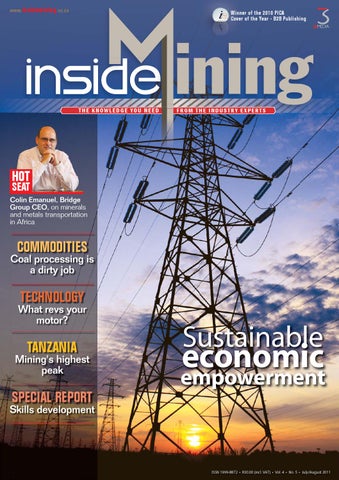
Colin Emanuel, Bridge Group CEO, on minerals and metals transportation in Africa
COMMODITIES
Coal processing is a dirty job
TECHNOLOGY
What revs your motor?
TANZANIA
Mining's highest peak
SPECIAL REPORT
Sustainable
economic
empowerment
Skills development
ISSN 1999-8872 • R30.00 (incl. VAT) • Vol. 4 • No. 5 • July/August 2011
© 2011 Caterpillar Inc. All Rights Reserved. CAT, CATERPILLAR, their respective logos, “Caterpillar Yellow” and the POWER EDGE trade dress, as well as corporate and product identity used herein, are trademarks of Caterpillar and may not be used without permission.
CONTENTS
T H E K N O W L E D G E YO U N E E D
ining
July/August 2011
FROM THE INDUSTRY EXPERTS www. insidemining .co.za
W Winner Winne of the 2010 PICA Cover Co over of the Year - B2B Publishing MEDIA
22
THE KNOWLEDGE YOU NEED
ining FROM THE INDUSTRY EXPERTS
HOT SEAT
ON THE COVER
Without sustainable energy there will not be
any economic growth and development in this or any other country.
Colin Emanuel, Bridge Group CEO, on minerals and metals transportation in Africa
COMMODITIES
Coal processing is a dirty job
TECHNOLOGY
What revs your motor?
TANZANIA
Mining's highest peak
SPECIAL REPORT
Sustainable
economic
empowerment
Skills development
ISSN 1999-8872 • R30.00 (incl. VAT) • Vol. 4 • No. 5 • July/August 2011
29
FINANCE
34
Investing - Is the gold rush on?
36
Sustainable energy - The use and abuse of power
An excerpt from a recent newspaper advertisement espousing the benefits of gold pretty much sums up the current mood: “gold is at its highest levels ever and is definitely one of the best investments in today’s times”. The South African economy, in which mining plays a major role, cannot develop without adequate and reliable energy resources. It is arguable that the 2008 power outages had a more detrimental effect on the local economy than the global economic crisis did.
SHEQ EDITOR’S COMMENT
3
Sustainability
MINING NEWS
7 A global overview of the top mining news
41
SPECIAL REPORT
44 45
HOT SEAT
12
Emanuel – Getting to the market
Most mines are, unfortunately, to be found in rather remote locales and not conveniently close to ports and harbours. Colin Emanuel, CEO of the Bridge Group, shares the trials and tribulations of metals and minerals transportation in Africa
REGIONAL FOCUS
15 Zimbabwe – Putting mining on the agenda
When one thinks about historic mining jurisdictions, Mozambique is not exactly one of those ‘go-to’ places that pops into your mind. It has, however, seen some rapid change in the last few years, in no small part due to the country’s significant coal resources.
Cranes - Setting new records - 100th Liebherr crane for JCH - Cosira Group gets a lift
50
Gears and motors - Energy-efficient electric motors - Worm geared motors - Bigger and better industrial gear units
52
Ventilation - Holistic underground systems - Harmony gets put on ice - A big fan of Zim mining
COMMODITIES:COAL
29 A brief overview of coal processing 30 Thermal coal resource optimisation
The high demand and volume of thermal coal project activity has facilitated the development of new and robust tools and methodologies for resource evaluation and optimisation.
Skills development initiatives - Zest invests in primary school - Hatch and the African Academy - The Sandvik Apprentice Programme - Samsung’s Electronics Engineering Academy - BEE Consulting’s R3 million VUMA software to Wits School of Mines
TECHNOLOGY
22 Tanzania - East Africa’s mining giant has come a long way
Tanzania has in recent decades stormed up the mining totem pole to take a prominent place in the African mining hierarchy.
Skills development - A global overview
47
Over the past two years Zimbabwe has shown real GDP growth, with the mining sector taking the top spot on the podium.
16 Mozambique - King Coal alive and well (and mostly ruling)
Breathing apparatus - When the canary stops singing
CETERUM CENSEO
56
Sun rising in the west? Inside Mining 07.08/11
1
*OOPWBUJWF t $PTU FòFDUJWF t 2VBMJUZ QSPEVDUT Manufacturer & supplier of comprehensive ranges of Mining Roof Bolts, Snatch Blocks & Steel Ventilation Pipes and Fittings.
A certified Company
www.videxmining.co.za 5 t & WJEFY!WJEFYNJOJOH DP [B Johannesburg, South Africa
EDITOR’S COMMENT EDITOR Tersia Booyzen E-mail: tersia@3smedia.co.za CONTRIBUTING EDITOR Dr Willem Smuts FEATURES George Chavunduka CREATIVE CHIEF EXECUTIVE Frédérick Danton SENIOR DESIGNER Hayley Moore CHIEF SUB-EDITOR Cindy Maulgue SUB-EDITOR Danielle Hugo MARKETING MANAGER Luzanne Munro PRODUCTION MANAGER Antois-Leigh Botma PRODUCTION COORDINATOR Jacqueline Modise FINANCIAL MANAGER Andrew Lobban ADMINISTRATION Tonya Hebenton SUBSCRIPTION SALES Cindy Cloete DISTRIBUTION COORDINATOR Asha Pursotham PRINTERS United Litho Johannesburg Tel: +27 (0)11 402 0571 ___________________________________
ADVERTISING SALES Stacey Glad Tel: +27 (0)11 467 6224 Cell: +27 (0)83 567 0073 E-mail: stacey.glad@lantic.net ___________________________________
MEDIA
PUBLISHER Elizabeth Shorten
No. 4 5th Avenue, Rivonia 2191 PO Box 92026, Norwood 2117 Tel: +27 (0)11 233 2600 Fax: +27 (0)11 234 7274/5 www.3smedia.co.za ___________________________________ ANNUAL SUBSCRIPTION: South Africa: R300.00 FOR 12 ISSUES (incl VAT & postage) SADC countries: US$ 75 Foreign: US$ 95 ISSN 1999-8872 Inside Mining Copyright 2011. All rights reserved. ___________________________________ All material in Inside Mining is copyright protected and may not be reproduced either in whole or in part without the prior written permission of the publisher. The views of contributors do not necessarily reflect those of the the publishers.
Sustainability Supporting the coal industry while being an unashamed bunny and tree hugger might sound like a contradiction in terms, but the truth is that without coal we would all be scraping a living as subsistence farmers, chopping down the trees for firewood and boiling the bunnies for dinner. Speaking to senior power officials from two of the largest metropoles in South Africa has made it abundantly clear to me that we are on a knife-edge in terms of energy supply. If absolutely nothing goes wrong, and with our aged infrastructure and poor maintenance of assets making that highly unlikely, we will just about scrape through the next few years until Medupi goes live. While alternative energy sources are highly viable, it will take at least three years to develop any kind of meaningful contributor to the national grid. And the money is simply not there. The major criticism against coal is of course the damage that is being done to the environment. At the Free State Indaba of the Fossil Fuel Foundation one of the presenters pointed out that the levels of carbon emission have peaked during the last 150 years: this roughly and unsurprisingly coincides with the start of the industrial revolution. When he noted that we are killing the planet, a geologist in the audience made an extremely interesting comment, saying that based on his scientific knowledge the planet will survive but humans won’t. This is a rather novel form of suicide – we might be the first species to cause our own extinction directly. While we are reliant on coal, there are fortunately a large number of local and international companies developing new technologies and equipment to make the processing of it more user- and environmentally friendly. Starting with this issue, we will be publishing a series of articles about the sustainable and efficient supply and use of energy in mining and down the mining value chain. We’re also taking a trip up the southeast coast of Africa to have a look at what’s happening in the mining industry in Mozambique and Tanzania. Colin Emanuel from the Bridge Group shares some of his company’s experiences transporting metals, minerals and equipment in this region. One of the common denominators in the mining sector globally is the lack of skilled labour. Along with energy, this is one of the most important resources for ensuring sustainable economic growth and development in all parts of the world. Inside Mining’s special report takes a look at the current state of affairs and how a number of companies have embraced making a difference in their CSR policies. We hope you enjoy the read! Tersia
Without coal we would all be scraping a living as subsistence farmers
28 186 subscribers can’t be wrong! Subscribe to the weekly miningne.ws e-newsletters today! To advertise on the e-newsletter or website contact Stacey Glad on 011 467 6224 or stacey.glad@lantic.net
Inside Mining 07.08/11
3
Komatsu… a heritage of success
At Komatsu our vision has resulted in a proud heritage of technological success, and we are continuously evolving to meet the needs of our customers. Our unique and advanced equipment provides our customers in South Africa and world-wide w i t h innovation a nd ex ceptional v alue. We u n d e rst a n d t h e c h a l l e n g e s o u r c u s tomers encounter in their business; that is why our construction, surface mining, utility and process equipment is designed to meet the highest productivity, safety and environmental standards.
Komatsu – for the best in: • • •
Earthmoving and surface mining equipment Utility equipment Process equipment
uppe marketing A05344/1
Komatsu – Unique and unrivalled.
HD785-7
PC8000-6
PC5500-6
PC4000-6
PC3000-6
PC2000-8 WA1200-3 WA800-3
WA700-3 PC1250SP-8
Payload: 91,0t Capacity: 60m3 Max. GVW: 166t
HD1500-7
730E
830E-AC
860E
930E-4
Payload: 292t Capacity: 211m 3 Max. GVW: 502t
960E
Payload: 327t Capacity: 214m 3 Max. GVW: 576t
Payload: 144t Capacity: 78m3 Max. GVW: 249,5t
Payload: 183,7t Capacity: 111m 3 Max. GVW: 324,3t
Payload: 221,6t Capacity: 147m 3 Max. GVW: 386t
Payload: 254t Capacity: 166m 3 Max. GVW: 440t
3 passes
4 passes
6 passes
8 passes
9 passes
5 passes
7 passes
10 passes
4 passes
6 passes
8 passes
3 passes
4 passes
5 passes
7 passes
8 passes
3 passes
4 passes
5 passes
6 passes
8 passes
8 passes
3 p asses
4 passes
4 passes
5 p asse s
5 p asses
9 passes 109,5t3 6,7m (SAE heaped)
7 passes 71t 8,7m 3 (SAE heaped)
6 passes 98,3t3 11m (SAE heaped)
205,2t 20,0m 3 (SAE heaped)
11 passes (High lift option)
200t 12,0m 3 (SAE 2:1 heaped)
250t 15,0m 3 (SAE 2:1 heaped)
380t 22,0m 3 (SAE 2:1 heaped)
500t 28,0m 3 (SAE 2:1 heaped)
700t 42,0m 3 (SAE 2:1 heaped)
Note: The above is based on SG of 1,8 t/m3 and a bucket fill factor of 95%. The heaped capacity is rated at 2:1 SAE
Komatsu Southern Africa (Pty) Ltd, cnr Diesel and Isando Roads, Isando. Tel: 011 923 1000 | Fax: 011 923 1111 Customer Care Line: 0860 566 2878
www.komatsu.co.za
MINING NEWS www.miningne.ws
The top mining stories making the news in the past month
compiled by George Chavunduka
| AFRICA |
TANZANIA
SOUTH AFRICA
Parliament backs mineral ‘super tax’ plan
Nationalisation talk may cut output Source: www.bloomberg.com
South African mine production may drop as foreign investors get ‘cold feet’ following a call from the youth wing of the ruling African National Congress to nationalise the industry, Impala Platinum Holdings Ltd (IMP) said. “There is definite worry around this particular topic” among European and US investors, David Brown, chief executive officer of Johannesburg-based Impala, stated in a speech. Impala is the world’s second-largest producer of platinum, accounting for a quarter of global output. “Investors, the traditional suppliers of risk capital to this industry, are getting cold feet,” Brown said, adding that “The risk associated with future investment in South African mining has increased considerably as seen from the outside world” because of nationalisation and other concerns.
Source: www.reuters.com
Tanzania’s parliament in June approved a $27.4 billion five-year development plan, backing the proposed introduction of a super-profit tax on mining companies. Revenue from the east African country’s mineral resources will be an important source of financing for the mediumterm programme, the plan stated. Lawmakers approved the plan in its entirety, without making any changes. “The government’s five-year development plan has been approved by majority votes of members of parliament,” National Assembly speaker Anne Makinda said in parliament after lawmakers voted to endorse the plan. Tanzania, Africa’s fourthlargest gold producer, has remained noncommittal on if and when it might introduce the super-profit tax. The idea of such a tax has raised eyebrows among foreign investors in Tanzania. The country’s mining minister clarified that Tanzania would not impose the new tax on existing companies, but would negotiate with the companies to have them pay.
Tanzania cites rising commodity prices as justification for the tax. Its annual gold exports have tripled to $1.5 billion in the past five years owing to the increase in the price of gold, but government revenues have remained at around $100 million a year, the plan stated. Under the five-year plan, Tanzania targets raising 2.7 trillion shillings out of the 8.5 trillion shillings that will be invested annually in development projects.
SIERRA LEONE
NAMIBIA $250 000 raised for rare earth exploration Source: www.proactiveinvestors.co.uk
Mount Burgess Mining will now boost exploration at the company’s African projects after completing a placement of 25 million shares at $0.01 to raise $250 000. At the Tsumkwe Project in Namibia, Mount Burgess will drill test a rare earth target and investigate the potential kimberlite target overlain by
Kimberlite expansion project gains momentum
Source: www.miningne.ws
Koidu Holdings, the largest diamond mining company in Sierra Leone, has confirmed that funding for the US$150 million Expansion Project at the Koidu Kimberlite Project has been secured and that project implementation is gaining momentum. Located 2 km south of Koidu, the capital of the Kono district in the Eastern Province of Sierra Leone and approximately 360 km from the capital, Freetown, the existing 50 t/h open pit operation at the Koidu Kimberlite Project produces just over 120 000 carats per year of high-quality diamonds from the K2 kimberlite pipe, placing Koidu in the league of the Diavik and Snap Lake mines in Canada in terms of revenue per tonne. Jan Joubert, chief executive officer of Koidu Holdings, commented: “The Expansion Project incorporates all the currently evaluated kimberlite resources on the property. The richer K1 kimberlite pipe, which was mined by vertical pit methods from 2005 to 2007, is currently being redeveloped to be brought back into production by the end of this year. Once the new 180 t/h processing plant is commissioned in early 2012, we will ramp up production from both the K1 and K2 open pits to over half a million carats per year. “Optimisation studies indicated that the two open pits would be economical to depths of 310 m for K1 and 240 m for K2. At average mining rates of 100 000 tonnes per month of ore and 1.4 million tonnes per month of waste, the open pit phase of the Expansion Project will continue until the end of 2015. The underground operation will kick in as early as 2015, drawing ore from the two kimberlite pipes, as well as from the four small blows developed along two of the four kimberlite dyke zones included in the mine plan at present.”
Inside Mining 07.08/11
7
MINING NEWS www.miningne.ws
a recently discovered nearsurface sub-outcropping of highly silicified brecciated dyke-like body. The company’s rare earths progress has so far flown under the investor radar; however, results to date indicate some early-stage potential that bears watching. Also at Tsumkwe, Mount Burgess will further investigate a copper-gold anomaly, which was recently delineated with soil geochemical sampling. At the Kihabe-Nxuu Project in Botswana, the company continues with soil geochemical sampling over several prospective areas. Kihabe-Nxuu is a zinc-leadgold project, with recent assays from close-spaced geochemical soil sampling having delineated a copper cobalt anomaly and three zinc/lead anomalies, all with the potential to increase the company’s resource base.
| AMERICAS | USA US uranium moratorium extended for six months Source: www.bendbulletin.co
The federal government extended for six months a moratorium on new uranium mining claims in a million acre buffer zone around the Grand Canyon as it awaits the conclusions of a study of potential environmental harm to the region. Interior secretary Ken Salazar said that expanded uranium mining around the canyon
8
Inside Mining 07.08/11
CANADA
Lincoln Mining closes private placement of $945 000
Source: www.lincolnmining.com
could threaten water supplies, air quality, wildlife, desert vegetation and priceless scenery. Once lost, he said, those assets can never be reclaimed. But he said he was not yet ready to declare the area off limits to new mining claims for the next 20 years, as many local and state officials and environmental advocates have demanded. He said in a briefing at the Grand Canyon that a 20-year moratorium was his preferred solution but that more scientific study was needed. The decision represents at least a partial victory for environmentalists, who have grown increasingly uneasy in recent months as the Obama administration has, in their view, seemed to retreat on several environmental and regulatory fronts. They were particularly unhappy with Salazar’s decision in May, under pressure from Republicans in Congress and energy interests, to reverse his own policy that would have set aside millions of federally owned acres as wilderness protected forever from energy exploration. Salazar said that the relatively small number of existing mining claims around the canyon would be honoured but that he was leaning strongly against allowing any new activity.
| AUSTRALIA | Coal ban a $36 billion threat Source: www.adelaidenow.com.au
A Greens policy to phase out coal mining would cost more than $36 billion a year, a study commissioned by the mining industry claims. It would
Canadian exploration company Lincoln Mining Corporation closed a private placement in which a total of 5 556 177 units were issued at a price of $0.17 per unit for total proceeds of $944 550. Each unit comprises one common share of the company and one half of one non-transferable common share purchase warrant. In a statement, Lincoln explained that each whole purchase warrant will entitle holders to acquire one additional common share of the company at a price of $0.35 per share until 14 June 2013. Two insiders subscribed for 441 177 units for total proceeds of $75 000. As compensation, qualified persons acting as finders in connection with the private placement received a cash commission of 7% of the proceeds raised and non-transferable warrants equal to 7% of the total number of units sold to persons introduced to the company by the finder. Lincoln said it intends to use the proceeds raised from the private placement to advance the work programmes on its mineral projects and for general working capital and administrative purposes. The company also advises that drilling will commence at La Bufa and at the Oro Cruz project later this year. $4 million has already been committed to these programmes as a result of the agreement with Elgin Mining Inc., which was announced on 31 March 2011.
also cost 200 000 jobs, the study says. The release of the RMIT University study for the Minerals Council of Australia coincides with the Greens gaining the balance of power in the Senate. Greens numbers recently swelled in Canberra, with four new senators in the house and leader Bob Brown hailing it a “green letter day”. But the Greens were dealt a blow
when Prime Minister Julia Gillard announced that petrol would be excluded from the carbon tax – potentially saving motorists $2 billion in tax. The Greens campaigned for petrol to be included, but were defeated in the government’s Multi-Party Climate Change Committee. In a concession from the government, the Greens will get a Productivity Commission review of fuel excise – which could itself lead to higher fuel prices by 2015.
Miners look east amid poaching claims Source: www.smh.com.au
Mining companies are increasingly looking to the
“ANTI-CORROSIONâ€? “ACID PROOFINGâ€? “CORROSION PROTECTIONâ€? Whatever you call it, we have the solution! )RU DOO \RXU $QWL &RUURVLRQ $FLG 3URRÂżQJ &RUURVLRQ 3URWHFWLRQ UHTXLUHPHQWV 9(51, RIIHU D FRPSUHKHQVLYH UDQJH RI VSHFLDOLVW OLQLQJ V\VWHPV IRU ERWK FRQFUHWH DQG VWHHO 9HUQL DUH VSHFLDOLVW PDWHULDO PDQXIDFWXUHUV DV ZHOO DV VSHFLDOLVW DSSOLFDWRUV DQG FRQGXFW ZRUN WKURXJKRXW $IULFD :LWK RYHU \HDUV RI H[SHULHQFH 9(51, DUH DEOH WR WDLORU PDNH VROXWLRQV IRU HYHU\ DSSOLFDWLRQ ZKHWKHU EHLQJ DSSOLHG E\ \RXU RZQ PDLQWHQDQFH GHSDUWPHQWV RU DSSOLHG E\ RXU VSHFLDOLVWV )URP GHVLJQ VWDJH WR LQVWDOODWLRQ RU UHIXUELVKLQJ RI H[LVWLQJ 9(51, RIIHU D VLQJOH OLQH JXDUDQWHH ZKHQ GRLQJ WKH ZRUN DV WKHUH LV QR VSLOW UHVSRQVLELOLW\ EHWZHHQ PDWHULDO VXSSOLHU DQG VXE FRQWUDFWRU 9(51, RIIHU VROXWLRQV IRU DOO &KHPLFDO 3URFHVV $UHDV $FLG 6WRUDJH %XQGV 5HÂżQHU\ )ORRUV %DVHPHQWV 7DQNHU /RDGLQJ %D\V 7DQN /LQLQJV $FLG 7RZHUV HWF
Typical Lining Systems Include: Acid Brick Lining to Acid Storage Bund
-
)LEUHJODVV /LQLQJV (SR[\ 7DU /LQLQJV 5KHSDQRO 0HPEUDQH $FLG 7LOH /LQLQJV $FLG %ULFN /LQLQJV (SR[\ 5HVLQ &RDWLQJV (SR[\ 5HVLQ 6FUHHGV 3RO\XUHWKDQH 5HVLQ 6FUHHGV
Specialist Materials Include: 6XSDĂ RU 38 +' PP 3RO\XUHWKDQH Screed to Acid Storage Bund
5DSLG +DUGHQLQJ &RQFUHWH 5HSDLU 0RUWDUV 1RQ VKULQN 6XSHU ÀRZ *URXWV (SR[\ *URXWV (SR[\ &UDFN 6HDODQW ([SDQVLRQ -RLQW 6HDODQWV $FLG 5HVLVWDQW 0RUWDUV $FLG 5HVLVWDQW 7LOHV $FLG 5HVLVWDQW %ULFNV
For additional information, contact Vernon Botha. (PDLO YHUQRQ#YHUQL FR ]D _ 0RELOH 7HO _ )D[
manufacturers and specialist applicators – no split responsibility on guarantees www.verni.co.za
MINING NEWS www.miningne.ws
east coast for skilled labour amid claims that recruiters are poaching people at Perth Airport on their way to work. As resources projects ramp up in northern Western Australia, an academic says companies in the resources capital are jostling to secure
labour while commodity prices are high. “There are people there looking to recruit and looking to poach each other’s workforce,” said Dr Michael Rafferty, a senior research analyst at Sydney University’s Workplace Research Centre. He says mining houses are prepared to pay more money to lure people from existing ventures or fly them in from around the country. “What we were told when we were over there is that you go into the Qantas lounge, or those club lounges in Perth, and there are recruiters there looking for guys doing fly-in, fly-out,” he told AAP. “They’ll ask: `What’s your employment contract like? Are you on 10 days on, seven off? We can do better than that. We can give you another $15 000’.”
| ASIA | PHILIPPINES Philex Mining project reserves worth $22 billion Source: www.bworldonline.com
Philex Mining Corp. said its Silangan project in the province of Surigao del Norte is estimated to contain copper and gold reserves worth at least $22 billion, with exploration works in the adjacent mine expected to enhance the project. In a disclosure to the local bourse,
RST Shower Roses
More than 20 years experience in water & electricity saving! HEAD OFFICE: TEL: 016 987 2122 / FAX: 016 987 3300 E-MAIL: rstadmin@telehost.co.za
Electric Heating Kitchen Faucet
Deliver hot water in 5 seconds Output water temperature: 35~65C Only heat flowing water. When water stops flowing, the appliance cuts off the power and stops heating automatically.
Save Up To 50% Water 20% electricity
567 VKRZHU URVHV XVH OLWUHV RI ZDWHU SHU PLQXWH :KHUHDV WKH FRQYHQWLRQDO VKRZHU URVHV XVH XS WR
Arm Not inclu ded
Compilux
Profilence
Arm Not included
OLWUHV SHU PLQXWH DQG PRUH
Solar Air Conditioner The RST Solar Air Conditioning system is a system that utilizes the sun as a heat source to assist the energy needed to drive the cooling process of a typical air conditioning system which in turn reduces the electrical consumption required to run the compressor. Various sizes and configurations available
the miner said that SRK Perth, Australia, prepared the independent mineral resource estimates for the project. The miner said the combined measured and indicated resources in the site contain an estimated metal content of five billion pounds of copper and nine million ounces of gold. Philex said the resource estimates were based on verified drill results from over 80 000 m of drilling it completed in June last year. The 5 184 ha Silangan copper and gold mine is
SOLAR WATER HEATING SYSTEM By Using The power of the Sun you can save up to 60% - 70% on your annual electricity bill
Various sizes available
Energy That is Safe, Clean, & Free LED Lights LED lighting is more efficient, durable, versatile and longer lasting than incandescent and fluorescent lighting. LEDs emit light in a specific direction, whereas an incandescent or fluorescent bulb emits light, and heat, in all directions. LED lighting uses both light and energy more efficiently. Various Styles & Types available
MINING NEWS www.miningne.ws
adjacent to the Kalayaan site. Philex finalised an agreement with Manila Mining Corp. for the exploration and development of the 286.6 ha Kalayaan mine in May. Philex said the exploration works in the Kalayaan site are expected to enhance the value of the Silangan project further. “We are excited about the Silangan project and the prospects of further exploration into the Kalayaan tenement,” Philex Chairman Manuel V Pangilinan was quoted as saying in the disclosure. He said the project cost for developing Silangan is estimated to be more than $1 billion over a period of three years. “It will be a significant project and will probably be one of the most important for Mindanao in terms of promoting economic development,” he added.
SOUTH AMERICA BRAZIL
Steel industry ‘almost at crisis’
Source: www.marketwatch.com
Brazil’s steel industry is “almost at crisis point”, owing to the country’s strong currency and soaring raw materials costs, an industry analyst said. “There’s been a sharp fall in Brazilian steelmakers’ profitability,” said Marcos Assumpcao, head of Natural Resources, Equity Research, at Itau BBA. “In early 2008, EBITDA margin levels were above 40%; they’re close to 10% now,” the analyst said at the Coaltrans congress in Rio de Janeiro. Steelmakers have been hit by soaring prices for raw materials, including metallurgical coal and iron ore, prices for which reached record-high levels earlier this year as a result of high Chinese demand. Some steelmakers, including Companhia Siderurgica Nacional SA (SID, CSNA3.BR), Usinas Siderurgicas de Minas Gerais SA and Gerdau SA (GGBR4.BR) have intensified their own iron ore production activities in Brazil to shield themselves from high ore prices. However, they are unable to hedge adequately against surging coal prices as Brazil is deficient in metallurgical coal and is therefore dependent on coal imports. “Coal
prices have risen even more than iron ore prices, which is damaging to Brazilians,” Assumpcao said. Metallurgical coal quarterly contract prices reached an all-time high of around $330 a metric tonne on global markets in the second quarter, while spot iron ore prices touched $170 a tonne. Nearly 1.5 tonnes of iron ore are needed to produce a tonne of steel. Export market prices for hot rolled coil, a standard flat steel commodity product, meanwhile stand at around $748 a tonne, according to global price provider The Steel Index.
Heat. Dust. Vibration. Mission critical. Easy. Peripheral 2011151
In the toughest environments you’ll find WEG motors.
That’s good engineering. WEG Group
0861 00 ZEST www.zest.co.za
HOT SEAT COLIN EMANUEL
Getting to the market Most mines are, unfortunately, to be found in rather remote locales and not conveniently close to ports and harbours. Colin Emanuel, CEO of the Bridge Group, shares the trials and tribulations of metals and minerals transportation in Africa with Tersia Booyzen. Where in Africa do you operate? We have a big market share in sub-Saharan Africa, with warehouses and offices in South Africa, Zambia, Malawi, Zimbabwe, Mozambique and Tanzania. Our main focus is the logistics and shipping of agricultural products, metals and minerals and raw materials from Africa to predominantly Southeast Asia, although we do extend our operations to the rest of the world. About 50% of our volume is from South Africa and the rest is from Southeast Africa.
Which commodities are you shipping on a regular basis? In terms of exports, about 70% of our loads are mining-related, with the
remaining 30% being attributed to agriculture. In terms of imports; fertilizer is big in Africa, but it is seasonal, and other imports are mainly finished goods from Southeast Asia. Imports for mining projects are mostly equipment from China to the southern DRC. Our biggest challenge is to compliment imports and exports. If a company has 50 000 tonnes of cargo moving in one direction, it should try to match that with 50 000 tonnes of cargo moving in the opposite direction. We are always looking at ways to import and export the same amounts of cargo in an effort to minimise economic disparities. There are also other issues that have an impact on imports and exports. Malawi has, for instance, run out of foreign exchange for this year so they cannot purchase fertiliser. Because there is now a shortage of trucks entering the country, they cannot get cargo out to earn more foreign exchange. Zimbabwe also has foreign exchange problems. Zambia has a liberal foreign exchange policy so their trade is fluid.
Infrastructure spend by governments and private industry is going to generate extra capacity of about 122-million tonnes, but this still leaves a shortfall of 205 million tonnes that has to move through different corridors - Dar es Salaam, Beira, Nacala or Durban. The dredging of the Beira Port for the coal industry is under way, so we will see the benefits of that by the end of this year or mid-next year. There is also a big development happening north of Beira where a Brazilian company has bought a port. A bit of privatisation in the mix, like that in Mozambique, makes a huge difference. If governments are more willing to get private enterprise involved in de-bottlenecking the different corridors, it will also create an inviting environment for foreign investment. We used to move all our cargo from the hinterland through Durban, but now have private concessionaires in Dar, Beira, etc., so we can use these ports too.
What are your biggest logistical challenges?
It is cheaper to use other ports in Africa as they are coming off a low base and improving their infrastructure. From Ndolo on the Zambian Copperbelt it costs $150 per tonne through Dar es Salaam and $195 per tonne through Durban. The turnaround time is also important, so the costs are actually on par. To get a shipment on board from Ndolo will take three weeks through Durban but two months through Dar. Because of this, and excluding South African cargo, Durban handles about 81% of all industry cargo flows. As the movement of goods is faster than in other corridors, South Africa is an ideal investment destination for mining companies. Our infrastructure,
Definitely the lack of infrastructure across the continent. The African mining industry will have to invest in new and replacement infrastructure to meet the ever-growing logistical demands. We monitored new capital spend in these regions in a recent study and found that infrastructure is under pressure, particularly with the current 20year commodity super cycle. By 2015/16 there will probably be an additional 327-million tonnes of cargo generated in the regions we operate in, specifically in central Mozambique, northern Zambia, the DRC, Malawi and Zimbabwe.
12
Inside Mining 07.08/11
What are the benefits of using ports other than Durban?
HOT SEAT
although tired, is better than those regions. The investors’ best route to the market is through South Africa as it is easier to move cargo from here than from other regions. The border posts have also improved significantly. It is now a fairly painless exercise, except for the congestion at certain posts like Beitbridge.
How can we improve our tired infrastructure? In South Africa we missed a trick - we should have capitalised on the huge demand from China but did not because of infrastructure problems with our rail, ports and power. We need to beneficiate a lot more locally, and not just export raw commodities, but we cannot due to power shortages. We currently have 20 million tonnes of copper in the harbour which we cannot sell because the Chinese won’t buy until they’ve forced the price of commodities down. This is a natural cycle and should pick up again in August.
The fourth quarter volumes for 2010 picked up but the second quarter volumes in 2011 went soft. The demand is down as there is an inflationary risk
We should have capitalised on the huge demand from China but did not because of infrastructure problems with our rail, ports and power to China as 60% of the consumption of the raw material is local. This is dictated by the Chinese government - we have one customer who simply had the power to two of his three smelters turned off. To make the most of opportunities while they exist, South Africa sorely needs fast, efficient and predictable
high-volume transportation capacity within its borders. We have the potential to be a superpower in this space but are holding ourselves back from fulfilling it. We urgently need to prioritise the development and maintenance of a sophisticated rail and land transportation network that works reliably. The product is there. The supplier is there. The willing buyer is there. The difficulty associated with getting the product to the ship, however, is a major hurdle to South Africa being recognised as a serious, profitable and efficient trading partner by the rest of the world.
Any final thoughts? Parastatals such as Transnet and Eskom should be privatised. Government has no place in business. They should own strategic assets like the railway lines, energy cables, etc. and concentrate on creating infrastructure for private enterprise to flourish through the use of those assets.
The Bridge Shipping Group: 0RYHV PHWDOV DQG PLQHUDOV WR PDUNHW 0RYHV LQSXWV DQG FDSLWDO HTXLSPHQW WR WKH PLQHV
Bridge Shipping Group
011 625 3000 | www.bridgeshipping.co.za