www.miningne.ws
Highly commended 2011 PICA Cover of the Year - B2B Publishing
The knowledge you need
ining
media
from the industry experts
Hot seat
Hatch Africa’s Lister Sinclair on delivering the hallmark Kolomela mine
IRON ORE & MANGANESE
A Kalahari Basin banquet
AFRICAN INFRASTRUcTURE
Pioneers of the future
LABORATORIES AND CHEMICALS
The artistry of analysis
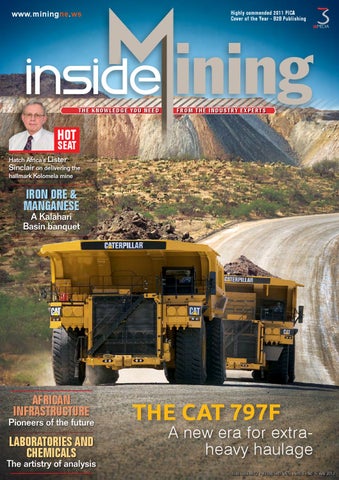
The Cat 797F
A new era for extraheavy haulage ISSN 1999-8872 • R35.00 (incl. VAT) • Vol. 5 • No. 7• July 2012
Murray & Roberts Construction, newly created by merging Murray & Roberts Construction and Concor, is one of the largest players in the African, Middle East and South East Asian construction sectors. The company of fers a range of engineering and contracting services that include civil, building and marine construction, roadworks, earthworks, engineering and opencast mining.
building trust - creating value
Tel: +27 (011) 456-1000 Fa x: +27 (011) 590-5450 Email: info.construction@murrob.com Website: w w w.construction.murrob.com
Produced by Coralynne & Associates Tel: (011) 422-1949
CONTENTS
T H E K N O W L E D G E YO U N E E D
ining
July 2012
FROM THE INDUSTRY EXPERTS
Highly commended 2011 PICA Cover of the Year - B2B Publishing
www.miningne.ws
22
MEDIA
THE KNOWLEDGE YOU NEED
LQLQJ
ON THE COVER
FROM THE INDUSTRY EXPERTS
A new era for extraheavy haulage – the Cat
HOT SEAT
Hatch Africa’s Lister Sinclair on delivering the hallmark Kolomela mine
IRON ORE & MANGANESE A Kalahari Basin banquet
AFRICAN INFRASTRUCTURE Pioneers of the future
LABORATORIES AND CHEMICALS
797F is followed by a Cat 795F AC truck along a mine haulage route. P6 THE CAT 797F
A new era for f extraheavy haulage
The artistry of analysis ISSN 1999-8872 • R35.00 (incl. VAT) • Vol. 5 • No. 7• July 2012
EDITOR’S COMMENT
3
36
Blindsided – what happened to platinum?
MINING NEWS
4
The top mining stories headlining this month
HOT TOPIC
10 Vantage Goldfields’ gold-laden Lily HOT SEAT
16 A Hatch hallmark FERROUS METALS
52
13 Kumba’s Kolomela is a knockout 22 ARM Ferrous bullish on manganese and iron ore 26 Kaboko bears manganese fruit in Zambia 28 Lehating’s manganese masterminds 30 Kudumane’s major manganese appetite INFRASTRUCTURE IN AFRICA
36 Is the African continent South Africa’s saving grace? 40 Doing away with conventional wastewater treatment 47 Water on tap – it can be a reality LABORATORIES AND CHEMICALS
50 SGS expands across Africa 52 A new nitric acid plant in Sasolburg 55 Elite analytical experts in action
58
OPENCAST MINING
58 Can you weather the weather? 62 Ferrex ferrets PROJECT DELIVERY
64 The weight and worth of waste management 66 Magical motors CETERUM CENSEO
68 ... and onward marches the skills shortage Inside Mining 07/2012
1
IS YOUR
PROCESS REALISING ITS POTENTIAL? Get more out from what you put in with the Weir Minerals Mill Circuit Solution You manage a lifecycle: maximum raw material in, maximum processed material out. The Weir Minerals Mill Circuit Solution delivers longevity, capacity CPF QRGTCVKPI GHȨEKGPE[ VJTQWIJ QWT RTQXGP JKIJ RGTHQTOCPEG YGCT TGUKUVCPV technology and engineering know-how. Through focussed application on your operation critical processes we can help you deliver enhanced performance at a lower total cost of ownership. Weir Minerals’ superior engineering and design CPF VJG EQODKPCVKQP QH ȨXG RGTHQTOCPEG NGCFKPI DTCPFU GPUWTG QRVKOKUGF productivity. Because we know you have to keep your asset moving. Realise your full processing potential by visiting www.weirminerals.com
KHDÂŽ High Pressure Grinding Rolls
VULCOÂŽ Wear Resistant Linings
CAVEXÂŽ Hydrocyclones
WARMANÂŽ Centrifugal Slurry Pumps
LINATEXÂŽ Vibrating Screens
Excellent Minerals Solutions
Editor’s comment Publisher Elizabeth Shorten Associate publisher Ferdie Pieterse Editor Laura Cornish laura@3smedia.co.za Head of design Frédérick Danton Senior designer Hayley Mendelow Senior sub-editor Claire Nozaic
BLINDSIDED
What happened to platinum?
Sub-editor Patience Gumbo Marketing & online manager Martin Hiller
I have been blindsided by our plati-
Production manager Antois-Leigh Botma
num industry’s spiralling crash. I just didn’t see it coming, although with hindsight the signs were staring me in the face. I blame my tunnel vision on the over-abundant iron ore and manganese activity in the Northern Cape, which I have been devoted to sharing with you. It appears that July’s main commodity feature – ferrous metals – could not have been better timed. If you delve into this issue’s pages, you will quickly discover what a ‘field day’ I had picking and choosing from the multitude of projects emerging across the iron ore and manganese industries. The Northern Cape’s Kalahari Basin, home to a massive of manganese and iron ore resource, is playing host to a multitude of new players that have claimed their piece of the property pie, and are working hard towards developing ounces for the local and international market’s hungry demand and consumption. It goes without saying, of course, that our country’s major miners, predominantly Assmang (and African Rainbow Minerals (ARM)), have expansion plans of their own. They are dedicating many hours to Transnet Freight Rail with the hopes that an expanded iron ore and manganese export line gets the ‘green light’. “We are bullish that these billion rand projects will go ahead, and our mines’ expansions will follow suit,” says ARM Ferrous chief executive, Jan Steenkamp. I also had the fortune of attending Kumba Iron Ore’s ‘official’ opening of its new Kolomela mine, located just outside of Postmasburg. There goes an additional 9 Mtpa to the Saldanha port for export, and already the possibility of an expansion plan is in the pipeline. Let us not even delve into Africa and the drove of companies aiming to develop new iron ore mines there – it seems there are not even enough laboratories to cater to the demand for sampling. See the story on page 50 for further details. But when you are so busy focusing on the industry highs, the lows are always hanging in the wings. Was I too focused on our booming ferrous metals industry not to see the platinum industry start crashing down in front of my very eyes? Sure, the platinum price has been looking more than a little depressed for a little while now, but so much so that mines are closing and developments are being frozen – again? Didn’t the recession just end?
Production coordinator Jacqueline Modise Financial manager Andrew Lobban Administration Tonya Hebenton Distribution manager Nomsa Masina Distribution coordinator Asha Pursotham Printers United Litho Johannesburg Tel: +27 (0)11 402 0571 ___________________________________ Advertising Sales
Stacey Glad Tel: +27 (0)11 465 5452 Cell: +27 (0)83 567 0073 stacey.glad@lantic.net ___________________________________
MEDIA
No. 4 5th Avenue, Rivonia 2191 PO Box 92026, Norwood 2117 Tel: +27 (0)11 233 2600 Fax: +27 (0)11 234 7274/5 www.3smedia.co.za ___________________________________ Annual subscription:
South Africa: R350.00 (incl VAT & postage) SADC countries: US$80 Foreign: US$100 E-mail: subs@3smedia.co.za ISSN 1999-8872 Inside Mining Copyright 2012. All rights reserved. ___________________________________ All material in Inside Mining is copyright protected and may not be reproduced either in whole or in part without the prior written permission of the publisher. The views of contributors do not necessarily reflect those of the the publishers.
Even when you see such a situation heading straight for you, it can still take you by surprise, so you can imagine the horror I feel as I write and realise that, in the space of a week, Marikana and Everest were put on care and maintenance, Eastern Platinum has put its Mareesburg project (in development) on hold, Anglo American Platinum is drawing back on its platinum cash funds and even junior Platinum Australia is reviewing the future of its troublesome Smokey Hills operation. Let’s hope it’s still open when this issue comes out. Even the robust Royal Bafokeng Platinum has announced its plans to decrease spending while this depressed platinum market remains – its exploration is on hold, a new chairlift is no longer on the cards and an upgrade at the Bafokeng Rasimone Platinum Mine concentrator is also not happening! Isn’t it amazing, it takes years to develop a new mine, but only seconds for it to be placed indefinitely on hold or to be stopped altogether. It was only a few months ago when I wrote about Mareesburg and the exciting prospects this project would bring to its owner. But why platinum? Why now? Unlike our other commodities, there is a surplus platinum supply at present while Europe’s demand continues to dwindle. And if operating costs and labour costs continue to escalate but margins don’t, the result is an industry struggling to remain profitable. From a mining editor’s perspective, it is extremely depressing. But, as usual, we will hold our heads up high, revise business and model strategies, and remember that if you are in the business of mining, your commitment is longterm, and depressed commodity cycles don’t last forever. Laura Cornish
To our avid readers, be sure to sign up and get the
latest updates and inside scoop from the mining industry. Check out what we are talking about on our website, Facebook page or follow me on Twitter and have your say. @mining_news www.facebook.com/pages/Mining-News
Inside Mining 07/2012
3
Mining news www.miningne.ws
Top mining stories headlining this month SOUTH AFRICA
Minister steps in as platinum industry loses ground
Source: www.miningne.ws
compiled by Ameerah Griffin
| SOUTH AFRICA | Gold One fires over 1 000 workers Source: www.miningne.ws
viable employment option,” Marais continues. The strike action, which Gold One was informed of on 31 May 2012 by the Professional Transport and Allied Workers Union, began on 3 June 2012 and was interdicted by the Labour Court on 4 June 2012.
| MOZAMBIQUE | Following the illegal strike at Gold One International’s East Rand-based mine, Modder East, last week the company dismissed approximately 1 035 of its employees. This equates to more than half of the mine’s total workforce, which typically comprises 1 800 people, and consists of Category A and B workers, says Izak Marais, Gold One International senior vice president of operations. Gold One management had considered the representations made against the dismissal at the time, but concluded that there were insufficient mitigating factors against the sanction of dismissal in almost all cases. Marais said that despite the dismissal, Modder East will continue to operate profitably until the issue can be fully resolved. “Supervisors are overseeing limited mining, milling operations are continuing and surface stockpiles are being processed. “Ultimately, we will need to commence with a hiring programme, which could constitute dismissed employees. But there are also thousands of unemployed workers in the surrounding Grootvlei areas, which could be an alternative
4
Inside Mining 07/2012
Mozambique to develop fuel from coal project Source: www.miningne.ws
The Mozambique government, through its Ministry of Energy, has signed a development agreement with Clean Carbon Industries LDA. A joint venture between Twin City Venture Capital, Hugh Brown & Associates, local Mozambique shareholders and a team of international engineering specialists will undertake a full feasibility study into the construction of a plant to produce 40 000 barrels of transport fuel and chemical byproducts from lower grade coal in the Mozambique Tete Basin. The study is already in the final stages of pre-feasibility, having commenced in concept in February 2011. During a meeting in May 2012, CCI handed the Phase 1 results to the Minister of Energy, Dr Salvador Numburete, and his team in Maputo. The Bankable Feasibility Study will be completed by the end of
South Africa’s Mineral Resources minister, Susan Shabangu, has commissioned a report into the platinum industry. The objective is to find solutions to the many challenges the industry is facing in this economic climate. “There is a report on my desk that identifies the challenges and what we’re not doing right,” Shabangu said while speaking at the Gordon institute of Business Science last month. She says that a meeting between her and various stakeholders in the platinum industry will be held to address these issues. Aquarius Platinum and its partner, Anglo American Platinum, have suspended the Marikana mine because of the poor state of the platinum market. Eastern Platinum (Eastplats) recently suspended a 100 000 oz platinum group metal mining development project for the same reason. The decline in prices, weakness in Europe, soaring input costs and a volatile labour force had informed the decision, Eastplats CEO Ian Rozier said. 2014 and subject to final viability; financial closure is expected by October 2015, enabling construction to start in the first quarter of 2016. The Tete Basin has extensive coking, thermal and low-grade resources of coal. Vale, Rio Tinto Group and Ncondezi Coal Company, among others, are advanced in exploring, developing, constructing and commissioning new coal mines in the area, with a total of almost US$4 billion (about R32.8 billion) already invested to date in the basin. Vale exported its first coal to overseas markets in November last year via the Beira Port.
| ZAMBIA | Zambia tightens mine tax collection regulations Source: http://af.reuters.com
Zambia, Africa’s top copper producer, has tightened its regulations on the taxation of
mining companies to boost compliance and revenue collection, the country’s minister of Mines said last month. President Michael Sata has expressed concerns that copper exporters are misrepresenting the amount of metal leaving the country. Data shows much of Zambia’s exported copper is destined for Switzerland, but little of it shows up in Swiss customs figures, raising questions about transparency. The minister of Mines, Energy and Water Development, Christopher Yaluma, said that mining companies would now be required to provide information on tonnages, type and grade of ore mined, quantities and the end product. Yaluma said mining companies would also be required to submit annual reports on the recovery percentages and efficiency of all mining and metallurgical processes. “We have reviewed legislation to independently monitor the production and export of minerals, and failure to comply will result in revocation of licences and other punitive measures,” he said in a statement.
Mining news
| AUSTRALIA | Fortescue, Baosteel to merge Australia magnetite Source: www.marketwatch.com
Australia’s Fortescue Metals Group has reached an agreement with China’s Baosteel to consolidate their interests in two iron ore mining leases into a Hong Kong-based subsidiary that will be 88% owned by the Australian iron ore producer and 12% by the Chinese steel producer. Fortescue unit FMG Iron Bridge will own the Perth-based
company’s wholly owned Northstar deposit and the Glacier Valley deposit, currently 65%-owned by Fortescue and 35% by Baosteel, which have combined estimated resources of 3.2 billion tonnes. “This agreement consolidates one of the world’s most prospective magnetite projects, taking into account its massive scale and close proximity to both customers, and rail and port infrastructure,” Fortescue chief executive Neville Power said. The company said in a statement that an agreement was signed with Baosteel in Shanghai, although it remains subject to approval by the Australian Foreign Investment Review Board and Chinese State-Owned Assets Supervision and Administration Commission.
| ASIA | Kentor Gold delivers stunning copper results from Jervois Source: www.proactiveinvestors.co.uk
Kentor Gold has delivered ‘stunning’ near surface results from its Jervois copper-silvergold project in the Northern Territory of Kyrgyzstan. There is no doubt the market will be impressed with assays of up to 19.4% copper, 37.6% lead, 14.2% zinc and 702 g/t silver. The latest highlights include 60 m at 1.73% copper, 3.81%
lead, 1.15% zinc, 113.3 g/t silver and 0.21 g/t gold from 7.1 m. Better still, with the above intersection, the first 3.35 m hosts 12.06% copper, 2.42% lead, 2.4% zinc, 217.3 g/t silver and 0.62% gold. Astute investors will know these are not one-off intersections; a few weeks ago, Kentor announced from Jervois: 1.08% copper at 53.5 m, 24.9 g/t silver and 0.24 g/t gold from 105.1 m, 3.72% copper from 12 m, and 40.7 g/t silver and 0.68 g/t gold from 63 m. Initial production rates are forecast at 24 000 ozpa from a combination of opencast and underground mining. Based on the current US$1 560 (about R12 763.45) spot price, this would create gross revenue of more than US$37.4 million in the first year of operation.
Cover story
THE CAT 797F
A new era for extra-heavy haulage While the Cat 797 series remains the leader in its class, the new Cat 797F sees this tradition continue with advancements in safety, productivity, serviceability and comfort.
6
Inside Mining 07/2012
In each issue, Inside Mining offers advertisers the opportunity to promote their company’s products and services to the appropriate audience by booking the prime position of the front cover which includes a two-page feature article. The magazine offers advertisers an ideal platform to ensure the maximum exposure of their brand. Please call +27(0)11 465 5452 to secure your booking.
Cover story
W
ith a 363 t nominal payload, it is clear from the outset that the Cat 797F off-highway truck is a heavy hauler. Replacing the previous generation B-Series model, which had a 345 t carrying capacity, the 797 remains the world’s only mechanical drive rigid truck in its tonnage class. The first units to arrive in Southern Africa have been deployed at a major greenfield coal mine in northern Mozambique, which has also seen the recent delivery of the region’s first Cat 6090FS hydraulic shovel. An optimal three- to four-pass match with the Cat 797F, this front shovel has an effective working weight of 980 t and a 93.6 t bucket capacity. “Designed and built using components and systems that have evolved through years of rugged application studies, the Cat 797F is the next step in ultra-class mechanical drive mining trucks,” explains Nico Coetzer, Barloworld Equipment product and application manager for off-highway trucks. “Overall, the emphasis is on
giving safety and performance equal priority.” (Barloworld Equipment is the Cat dealer for Southern Africa.) Excellent manoeuvrability and ride comfort are key features on the 797F, which provides the operator with precision control – an important consideration when you’re driving a truck with a gross combination mass well in excess of 600 t at a top speed (loaded) of up to 67.6 km/h. Significantly, the overall engineering design on the new truck model caters for a larger load, but the actual gross vehicle operating weight on the Cat 797F remains more or less the same at around 623 690 kg. During routine hauling operations, the n797F has two retarding options for downhill or flat/uphill applications, backed up
by oil-cooled multiple disc brakes on all four wheels. A new brake cooling system incorporates square coolers that are more efficient than the round ones used on the 797B, and Cat Extended Life carbon fibre friction discs are now standard. Especially suited to heavy load applications, Cat Extended Life friction material provides increased heat resistance. “This resistance to glazing, which occurs during periods of high-temperature braking, provides consistent braking power,” Coetzer expands. Delivering the haulage power required is a newly developed 20-cylinder single block engine with a four-stroke design that uses long, effective power strokes for optimum efficiency. Tier II compliant, this Cat
OPPOSITE Delivering the haulage powerr required is a newly developed 20 cylinderr single block engine. Tier II compliant, thiss Cat C175-20 engine has a gross powerr output of 2983 kW (SAE J1995))
The Cat 797F is a three-to four-pass loading match with the Cat 6090FS hydraulic shovel, which has an effective working weight of 980 t and a 93.6 t bucket capacity
Inside Mining 07/2012
7
Cover story
ABOVE The Cat 797F, with its 363 t nominal payload, is the world’s largest mechanical drive off-highway mining truck in its tonnage class
C175-20 engine has a gross power output of 2 983 kW (SAE J1995), compared
The Cat 797F’s seven-speed planetary power shift transmission is matched with the C175-20 power train system to deliver constant power over a wide range of operating speeds, in poor underfoot conditions and on haul roads with high rolling resistance. The lock-up torque converter
VIMS constantly monitors critical machine health and payload data in real-time during every hour the truck is operational to 2 648 kW on the previous model. “The C175-20 is a major improvement on the 797B unit’s Tier I Cat 3524B power plant, and features a tandem unit layout consisting of two 3512B HD engine blocks coupled to perform as a single engine in terms of operation, monitoring and control,” says Coetzer. (For added safety, the Cat 797F’s new Lockout Box now has separate battery disconnect, engine start and transmission lockouts.) “The converter drive torque limit of 25 760 Nm in first gear remains, but the increase in power allows the Cat 797F to outperform the 797B beyond that point via increased speed on grade.” The C175-20’s electronically controlled Cat common rail fuel system senses operating conditions and regulates the fuel delivery for optimum consumption. In terms of power train, the Cat 797F retains the proven design of the 797B, but has additional features to accommodate the higher horsepower. For example, the truck utilises a four-disc lock-up clutch, one more than the 797B.
8
Inside Mining 07/2012
combines maximum rimpull and cushioned shifting with the efficiency and performance of a direct drive system, engaging at
approximately 8 km/h and directing more power to the wheels. To prevent speeding, the transmission control electronically senses engine conditions and automatically up-shifts one gear. The transmission top gear maximum can also be set using the Cat Electronic Technician, while a reverse speed inhibitor prevents shifts into reverse when forward ground speeds are in excess of 4.8 km/h. For added in-pit safety, Cat’s body-up shift inhibitor system prevents the transmission from shifting above the pre-programmed gear without the body fully lowered. The machine can move forward, but the speed is limited to avoid excessive racking when pulling away from a dump site. On the move, Cat final drives work as a system with the planetary power shift transmission to deliver maximum power to the ground. “Double reduction final drives provide high torque multiplication to further reduce drive train stress,” says Coetzer. The ultimate objective of these and other technical features is to mine at the lowest cost per tonne. Helping to achieve this is the Cat 797F’s 3rd generation Vehicle Information Management System (VIMS). VIMIS constantly monitors critical machine health and payload data in real-time during every hour the truck is operational. This information can be accessed and interpreted by maintenance personnel and mine management to further improve production and mechanical efficiencies.
Tough on the job. Gentle on the surroundings. Husqvarna DCR 300
The new crushers for Husqvarna’s demolition robots. Our new crushers make Husqvarna’s demolition robots even more productive and versatile. It’s the ideal solution for silent and powerful demolition of concrete and brick constructions, staircases, roofs and sensitive locations inside buildings. HUSQVARNA DCR 300
The crusher for Husqvarna’s larger demolition robots DXR 310 and DXR 250 is the most powerful in its class. HUSQVARNA DCR 100
The crusher for Husqvarna’s compact demolition robot DXR 140 has a big gap and power enough to demolish a 400 mm wall. Husqvarna DCR 100
HUSQVARNA CONSTRUCTION PRODUCTS
www.husqvarnacp.co.za Share Call: 08600 48759. Tel: 033 846 9700. info@husqvarna.co.za Husqvarna is a registered trademark. Copyright © 2012 HUSQVARNA. All rights reserved.
Hot topic
THE LOVELY LILY
Gold-laden lady
The production ramp-up at Vantage Goldfields’ Lily gold mine near Barberton is on schedule to achieve its July target date of processing 35 000 tpm of ore.
T
he ASX-listed gold junior’s overall expansion objective for the mine, located on the Barberton greenstone belt (BGB), is to produce 35 000 ozpa of gold for the next 12 years, starting from 2013. The mine produced 4 674 oz of gold in the first quarter of this year against a target of 30 000 oz for the 12-month period to the end of December. Gold production in the final quarter of 2011 totalled 5 493 oz. Lily mine was launched as an opencast operation 12 years ago and has been developed by Vantage Goldfields over a 36-month period into a shallow underground operation
10
Inside Mining 07/2012
with access via a portal at 2 Level. The open pit has subsequently been backfilled. Improved access to higher grade ore on the stopes has seen head grade improve to 3.31 g/t in the last quarter of 2011. In line with the planned mining sequence for the first six months of 2012, lower grade ore blocks are being extracted leading to slightly lower head grades. Lily mine’s engineering manager, Ignatius (‘Ig’) Fourie, indicates that the mine’s strategic operational approach is to attain high levels of productivity and availability to achieve production targets at the lowest cost per tonne. This approach required interventions
ABOVE A view across the carbon-in-pulp tank platform with the primary crusher in the background and the road from Lily mine in the distance
in both the mining operation and in the running of the process plant dedicated to Lily. “We have addressed a bottleneck in our plant – the Central Metallurgical Complex (CMC) – by introducing improvements to the crusher and screening circuits. A second ball mill was commissioned in April and the introduction of a third ball mill in July will result in a 70% increase in production. Additional improvements have been undertaken and systems implemented to boost plant throughput and reliability to above the required 90% level. This is a remarkable achievement when one considers that the CMC is a rebuild of the old Barbrook plant.”
Hot topic
Compared to traditional GBG mining methods, Vantage Goldfields is approaching its Lily orebody differently. Decline access has been provided to the orebody, which is between 2 and 15 m wide, and extends for an estimated 2 000 m along strike. In the next three years, the bulk of production ore will be drawn from the wide orebody below the back-filled main pit and accessed via a spiral decline. Mine manager, Eben Swanepoel, says that as a result of this, bulk mining tonnages are far higher than those of other mines in the BGB.
Tackling problems, strategically “After experiencing problems with equipment, we took the decision to standardise on brands, of which Sandvik is one,” says Fourie. “We took into account brand reputation in the industry, service levels, spare parts availability and general technical support, staff training and equipment knowledge, and experience within our own team. I believe that those elements combined lead to better equipment reliability and productivity.” “We have implemented the open stope method, meaning the orebody is blasted out. This approach suits the orebody and leads naturally to more tonnage. Ore grade control is a crucial element of our bulk mining methodology. We don’t want to waste milling time; we want to achieve the best recoveries possible. “We are utilising mechanised, long-hole drilling, blasting, mucking and hauling methods. With the mine design and productivity needs in mind, the use of trackless equipment was a natural selection to maximise output. We require improved productivity and efficiency at a lower cost per tonne.” Swanepoel says the addition of two Sandvik TH430 30 t underground mining trucks is aimed at meeting these needs. “The upgrading of our underground fleet through the addition of these trucks, which are equipped with larger capacity dump boxes, goes directly towards improving our productivity and achieving higher levels of reliability. We are achieving a 30 to 40% improvement in productivity on the basis of better cycle times per shift. We plan to add further such trucks to our fleet, all of
which complements our use of Sandvik Solo vertical drills in both production and development mining,” Swanepoel continues. He mentions that improved cabin layout and the introduction of enclosed, air-conditioned cabs have significantly upgraded operator ergonomic and safety conditions. The new electronic vehicle control and management system (VMS) fitted to the Sandvik TH430 as standard has resulted in improved operator interface with the vehicle and its performance parameters, leading to improved efficiencies. The VMS has also made diagnostics and maintenance easier and quicker. Improved dump box design is a factor in the new trucks, achieving quicker turn-around times despite the larger dump box capacity. Swanepoel points out that while the mine works two nine-hour shifts, it is important to achieve sustained reliability from trucks hauling production ore from the stopes. “We are achieving about 350 t per shift with each of the new trucks. At present, the truck fleet is delivering around 1 200 tpd of ore to the sorting bay. Once sorting has taken place, the ore is loaded onto 30 t road trucks for transportation to the process plant 6 km away.” Swanepoel attributes the success of the Lily mine rampup to the vision and guidance of Vantage Goldfields’ senior management: Mike McChesney, the CEO, who has had
ABOVE Vantage Goldfields has purchased two Sandvik TH430 30 ton articulated underground mining trucks in order to meet productivity targets
more than 25 years of experience in the BGB, and Lily mine’s general manager, Mike Begg, who completed the mine’s initial exploration programme in 1998 and has had extensive exposure to greenstone mining. “Their leadership is exceptional and the direction that they are taking this operation is clear to the entire team.” Corrie Hallett, human resource manager at the mine, says: “In keeping with the demand for a larger workforce during the ramp-up, the number of people employed at Lily mine has increased from 100 to 400 in the last three years.” New appointments have ranged from management and professional staff through to the expansion of the semi-skilled and unskilled labour complement. Vantage Goldfields is active with additional mining projects in the BGB, the most advanced of which is the development of the Barbrook Mines complex, which is being handled in two stages. The ramp-up of production at Taylors mine continued during the quarter. A total of 1 104 oz of gold was produced in the first quarter of 2012 (991 oz in the last quarter of 2011). Barbrook Stage Two is currently the focus of a bankable feasibility study, which is scheduled for completion in January 2013. Vantage Goldfields has an 85% interest in Lily mine and the remaining interest is held by BEE partner Lomshiyo Investments.
TOP LEFT Two new ball mills are being installed at the Lily mine processing plant in the second quarter of 2012. The number two regrind mill (left) was commissioned in April and the number three regrind mill (foreground) is due to be taken into service in July BOTTOM LEFT The Lily mine CMC ball mill with the number two and three ball mills in the background
Inside Mining 07/2012
11
Delivering projects from concept to commissioning Consultants, designers, engineers and project managers delivering innovative solutions for surface and underground mines and plants - including all studies and technical support through to full EPCM projects.
www.hatch.co.za +27 (0)11 239 5300
Consulting
EPCM Services
Technologies
Operations Support
Ferrous metals
KUMBA’S KOLOMELA
What a knockout In the space of four years, a major new iron ore mine has emerged in the Northern Cape. Kumba Iron Ore’s R8.5 billion Kolomela mine, although officially launched late last month, began operating at the end of 2011. Laura Cornish attended the event.
B
y the end of 2013, the Greenfield Kolomela operation (located about 80 km from Kumba’s Sishen mine near Postmasburg) will offer another 9 Mtpa of iron ore to the export market. Not only has the mine increased Kumba’s mine portfolio from two to three (it also owns Thabazimbi iron ore mine), but will help the company achieve its 2019 production target of 70 Mtpa of iron ore. Despite the large-scale size of the project – with a plant that consists of a three-stage crushing circuit, together with screening – it exceeded expectations when celebrating
its first production five months ahead of schedule. Last year the mine produced 1.5 Mt, will deliver between 4 and 5 Mt in 2012, and ramp up to its nameplate capacity by the end of 2013. A 36 km rail link was also completed in time by Transnet Freight Rail to link the mine with the Sishen-Saldanha iron ore export channel. The mine’s official launch ceremony was extremely well attended and not only included the minister of Mineral Resources, Susan Shabangu; Kumba CEO, Chris Griffith; and Anglo American CEO, Cynthia
BELOW FROM LEFT Anglo American CEO, Cynthia Carroll; Kumba CEO Chris Griffith; and minister of Mineral Resources, Susan Shabangu BOTTOM The Leeuwfontein opencast mine - the first of three to be developed
Inside Mining 07/2012
13