www.miningne.ws
Highly commended 2011 PICA Cover of the Year - B2B Publishing
The knowledge you need
ining
media
from the industry experts
Hot seat
Hatch Africa’s Lister Sinclair on delivering the hallmark Kolomela mine
IRON ORE & MANGANESE
A Kalahari Basin banquet
AFRICAN INFRASTRUcTURE
Pioneers of the future
LABORATORIES AND CHEMICALS
The artistry of analysis
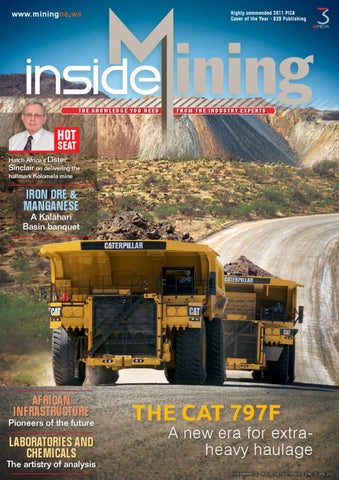
The Cat 797F
A new era for extraheavy haulage ISSN 1999-8872 • R35.00 (incl. VAT) • Vol. 5 • No. 7• July 2012
Murray & Roberts Construction, newly created by merging Murray & Roberts Construction and Concor, is one of the largest players in the African, Middle East and South East Asian construction sectors. The company of fers a range of engineering and contracting services that include civil, building and marine construction, roadworks, earthworks, engineering and opencast mining.
building trust - creating value
Tel: +27 (011) 456-1000 Fa x: +27 (011) 590-5450 Email: info.construction@murrob.com Website: w w w.construction.murrob.com
Produced by Coralynne & Associates Tel: (011) 422-1949
CONTENTS
T H E K N O W L E D G E YO U N E E D
ining
July 2012
FROM THE INDUSTRY EXPERTS
Highly commended 2011 PICA Cover of the Year - B2B Publishing
www.miningne.ws
22
MEDIA
THE KNOWLEDGE YOU NEED
LQLQJ
ON THE COVER
FROM THE INDUSTRY EXPERTS
A new era for extraheavy haulage – the Cat
HOT SEAT
Hatch Africa’s Lister Sinclair on delivering the hallmark Kolomela mine
IRON ORE & MANGANESE A Kalahari Basin banquet
AFRICAN INFRASTRUCTURE Pioneers of the future
LABORATORIES AND CHEMICALS
797F is followed by a Cat 795F AC truck along a mine haulage route. P6 THE CAT 797F
A new era for f extraheavy haulage
The artistry of analysis ISSN 1999-8872 • R35.00 (incl. VAT) • Vol. 5 • No. 7• July 2012
EDITOR’S COMMENT
3
36
Blindsided – what happened to platinum?
MINING NEWS
4
The top mining stories headlining this month
HOT TOPIC
10 Vantage Goldfields’ gold-laden Lily HOT SEAT
16 A Hatch hallmark FERROUS METALS
52
13 Kumba’s Kolomela is a knockout 22 ARM Ferrous bullish on manganese and iron ore 26 Kaboko bears manganese fruit in Zambia 28 Lehating’s manganese masterminds 30 Kudumane’s major manganese appetite INFRASTRUCTURE IN AFRICA
36 Is the African continent South Africa’s saving grace? 40 Doing away with conventional wastewater treatment 47 Water on tap – it can be a reality LABORATORIES AND CHEMICALS
50 SGS expands across Africa 52 A new nitric acid plant in Sasolburg 55 Elite analytical experts in action
58
OPENCAST MINING
58 Can you weather the weather? 62 Ferrex ferrets PROJECT DELIVERY
64 The weight and worth of waste management 66 Magical motors CETERUM CENSEO
68 ... and onward marches the skills shortage Inside Mining 07/2012
1
IS YOUR
PROCESS REALISING ITS POTENTIAL? Get more out from what you put in with the Weir Minerals Mill Circuit Solution You manage a lifecycle: maximum raw material in, maximum processed material out. The Weir Minerals Mill Circuit Solution delivers longevity, capacity CPF QRGTCVKPI GHȨEKGPE[ VJTQWIJ QWT RTQXGP JKIJ RGTHQTOCPEG YGCT TGUKUVCPV technology and engineering know-how. Through focussed application on your operation critical processes we can help you deliver enhanced performance at a lower total cost of ownership. Weir Minerals’ superior engineering and design CPF VJG EQODKPCVKQP QH ȨXG RGTHQTOCPEG NGCFKPI DTCPFU GPUWTG QRVKOKUGF productivity. Because we know you have to keep your asset moving. Realise your full processing potential by visiting www.weirminerals.com
KHDÂŽ High Pressure Grinding Rolls
VULCOÂŽ Wear Resistant Linings
CAVEXÂŽ Hydrocyclones
WARMANÂŽ Centrifugal Slurry Pumps
LINATEXÂŽ Vibrating Screens
Excellent Minerals Solutions
Editor’s comment Publisher Elizabeth Shorten Associate publisher Ferdie Pieterse Editor Laura Cornish laura@3smedia.co.za Head of design Frédérick Danton Senior designer Hayley Mendelow Senior sub-editor Claire Nozaic
BLINDSIDED
What happened to platinum?
Sub-editor Patience Gumbo Marketing & online manager Martin Hiller
I have been blindsided by our plati-
Production manager Antois-Leigh Botma
num industry’s spiralling crash. I just didn’t see it coming, although with hindsight the signs were staring me in the face. I blame my tunnel vision on the over-abundant iron ore and manganese activity in the Northern Cape, which I have been devoted to sharing with you. It appears that July’s main commodity feature – ferrous metals – could not have been better timed. If you delve into this issue’s pages, you will quickly discover what a ‘field day’ I had picking and choosing from the multitude of projects emerging across the iron ore and manganese industries. The Northern Cape’s Kalahari Basin, home to a massive of manganese and iron ore resource, is playing host to a multitude of new players that have claimed their piece of the property pie, and are working hard towards developing ounces for the local and international market’s hungry demand and consumption. It goes without saying, of course, that our country’s major miners, predominantly Assmang (and African Rainbow Minerals (ARM)), have expansion plans of their own. They are dedicating many hours to Transnet Freight Rail with the hopes that an expanded iron ore and manganese export line gets the ‘green light’. “We are bullish that these billion rand projects will go ahead, and our mines’ expansions will follow suit,” says ARM Ferrous chief executive, Jan Steenkamp. I also had the fortune of attending Kumba Iron Ore’s ‘official’ opening of its new Kolomela mine, located just outside of Postmasburg. There goes an additional 9 Mtpa to the Saldanha port for export, and already the possibility of an expansion plan is in the pipeline. Let us not even delve into Africa and the drove of companies aiming to develop new iron ore mines there – it seems there are not even enough laboratories to cater to the demand for sampling. See the story on page 50 for further details. But when you are so busy focusing on the industry highs, the lows are always hanging in the wings. Was I too focused on our booming ferrous metals industry not to see the platinum industry start crashing down in front of my very eyes? Sure, the platinum price has been looking more than a little depressed for a little while now, but so much so that mines are closing and developments are being frozen – again? Didn’t the recession just end?
Production coordinator Jacqueline Modise Financial manager Andrew Lobban Administration Tonya Hebenton Distribution manager Nomsa Masina Distribution coordinator Asha Pursotham Printers United Litho Johannesburg Tel: +27 (0)11 402 0571 ___________________________________ Advertising Sales
Stacey Glad Tel: +27 (0)11 465 5452 Cell: +27 (0)83 567 0073 stacey.glad@lantic.net ___________________________________
MEDIA
No. 4 5th Avenue, Rivonia 2191 PO Box 92026, Norwood 2117 Tel: +27 (0)11 233 2600 Fax: +27 (0)11 234 7274/5 www.3smedia.co.za ___________________________________ Annual subscription:
South Africa: R350.00 (incl VAT & postage) SADC countries: US$80 Foreign: US$100 E-mail: subs@3smedia.co.za ISSN 1999-8872 Inside Mining Copyright 2012. All rights reserved. ___________________________________ All material in Inside Mining is copyright protected and may not be reproduced either in whole or in part without the prior written permission of the publisher. The views of contributors do not necessarily reflect those of the the publishers.
Even when you see such a situation heading straight for you, it can still take you by surprise, so you can imagine the horror I feel as I write and realise that, in the space of a week, Marikana and Everest were put on care and maintenance, Eastern Platinum has put its Mareesburg project (in development) on hold, Anglo American Platinum is drawing back on its platinum cash funds and even junior Platinum Australia is reviewing the future of its troublesome Smokey Hills operation. Let’s hope it’s still open when this issue comes out. Even the robust Royal Bafokeng Platinum has announced its plans to decrease spending while this depressed platinum market remains – its exploration is on hold, a new chairlift is no longer on the cards and an upgrade at the Bafokeng Rasimone Platinum Mine concentrator is also not happening! Isn’t it amazing, it takes years to develop a new mine, but only seconds for it to be placed indefinitely on hold or to be stopped altogether. It was only a few months ago when I wrote about Mareesburg and the exciting prospects this project would bring to its owner. But why platinum? Why now? Unlike our other commodities, there is a surplus platinum supply at present while Europe’s demand continues to dwindle. And if operating costs and labour costs continue to escalate but margins don’t, the result is an industry struggling to remain profitable. From a mining editor’s perspective, it is extremely depressing. But, as usual, we will hold our heads up high, revise business and model strategies, and remember that if you are in the business of mining, your commitment is longterm, and depressed commodity cycles don’t last forever. Laura Cornish
To our avid readers, be sure to sign up and get the
latest updates and inside scoop from the mining industry. Check out what we are talking about on our website, Facebook page or follow me on Twitter and have your say. @mining_news www.facebook.com/pages/Mining-News
Inside Mining 07/2012
3
Mining news www.miningne.ws
Top mining stories headlining this month SOUTH AFRICA
Minister steps in as platinum industry loses ground
Source: www.miningne.ws
compiled by Ameerah Griffin
| SOUTH AFRICA | Gold One fires over 1 000 workers Source: www.miningne.ws
viable employment option,” Marais continues. The strike action, which Gold One was informed of on 31 May 2012 by the Professional Transport and Allied Workers Union, began on 3 June 2012 and was interdicted by the Labour Court on 4 June 2012.
| MOZAMBIQUE | Following the illegal strike at Gold One International’s East Rand-based mine, Modder East, last week the company dismissed approximately 1 035 of its employees. This equates to more than half of the mine’s total workforce, which typically comprises 1 800 people, and consists of Category A and B workers, says Izak Marais, Gold One International senior vice president of operations. Gold One management had considered the representations made against the dismissal at the time, but concluded that there were insufficient mitigating factors against the sanction of dismissal in almost all cases. Marais said that despite the dismissal, Modder East will continue to operate profitably until the issue can be fully resolved. “Supervisors are overseeing limited mining, milling operations are continuing and surface stockpiles are being processed. “Ultimately, we will need to commence with a hiring programme, which could constitute dismissed employees. But there are also thousands of unemployed workers in the surrounding Grootvlei areas, which could be an alternative
4
Inside Mining 07/2012
Mozambique to develop fuel from coal project Source: www.miningne.ws
The Mozambique government, through its Ministry of Energy, has signed a development agreement with Clean Carbon Industries LDA. A joint venture between Twin City Venture Capital, Hugh Brown & Associates, local Mozambique shareholders and a team of international engineering specialists will undertake a full feasibility study into the construction of a plant to produce 40 000 barrels of transport fuel and chemical byproducts from lower grade coal in the Mozambique Tete Basin. The study is already in the final stages of pre-feasibility, having commenced in concept in February 2011. During a meeting in May 2012, CCI handed the Phase 1 results to the Minister of Energy, Dr Salvador Numburete, and his team in Maputo. The Bankable Feasibility Study will be completed by the end of
South Africa’s Mineral Resources minister, Susan Shabangu, has commissioned a report into the platinum industry. The objective is to find solutions to the many challenges the industry is facing in this economic climate. “There is a report on my desk that identifies the challenges and what we’re not doing right,” Shabangu said while speaking at the Gordon institute of Business Science last month. She says that a meeting between her and various stakeholders in the platinum industry will be held to address these issues. Aquarius Platinum and its partner, Anglo American Platinum, have suspended the Marikana mine because of the poor state of the platinum market. Eastern Platinum (Eastplats) recently suspended a 100 000 oz platinum group metal mining development project for the same reason. The decline in prices, weakness in Europe, soaring input costs and a volatile labour force had informed the decision, Eastplats CEO Ian Rozier said. 2014 and subject to final viability; financial closure is expected by October 2015, enabling construction to start in the first quarter of 2016. The Tete Basin has extensive coking, thermal and low-grade resources of coal. Vale, Rio Tinto Group and Ncondezi Coal Company, among others, are advanced in exploring, developing, constructing and commissioning new coal mines in the area, with a total of almost US$4 billion (about R32.8 billion) already invested to date in the basin. Vale exported its first coal to overseas markets in November last year via the Beira Port.
| ZAMBIA | Zambia tightens mine tax collection regulations Source: http://af.reuters.com
Zambia, Africa’s top copper producer, has tightened its regulations on the taxation of
mining companies to boost compliance and revenue collection, the country’s minister of Mines said last month. President Michael Sata has expressed concerns that copper exporters are misrepresenting the amount of metal leaving the country. Data shows much of Zambia’s exported copper is destined for Switzerland, but little of it shows up in Swiss customs figures, raising questions about transparency. The minister of Mines, Energy and Water Development, Christopher Yaluma, said that mining companies would now be required to provide information on tonnages, type and grade of ore mined, quantities and the end product. Yaluma said mining companies would also be required to submit annual reports on the recovery percentages and efficiency of all mining and metallurgical processes. “We have reviewed legislation to independently monitor the production and export of minerals, and failure to comply will result in revocation of licences and other punitive measures,” he said in a statement.
Mining news
| AUSTRALIA | Fortescue, Baosteel to merge Australia magnetite Source: www.marketwatch.com
Australia’s Fortescue Metals Group has reached an agreement with China’s Baosteel to consolidate their interests in two iron ore mining leases into a Hong Kong-based subsidiary that will be 88% owned by the Australian iron ore producer and 12% by the Chinese steel producer. Fortescue unit FMG Iron Bridge will own the Perth-based
company’s wholly owned Northstar deposit and the Glacier Valley deposit, currently 65%-owned by Fortescue and 35% by Baosteel, which have combined estimated resources of 3.2 billion tonnes. “This agreement consolidates one of the world’s most prospective magnetite projects, taking into account its massive scale and close proximity to both customers, and rail and port infrastructure,” Fortescue chief executive Neville Power said. The company said in a statement that an agreement was signed with Baosteel in Shanghai, although it remains subject to approval by the Australian Foreign Investment Review Board and Chinese State-Owned Assets Supervision and Administration Commission.
| ASIA | Kentor Gold delivers stunning copper results from Jervois Source: www.proactiveinvestors.co.uk
Kentor Gold has delivered ‘stunning’ near surface results from its Jervois copper-silvergold project in the Northern Territory of Kyrgyzstan. There is no doubt the market will be impressed with assays of up to 19.4% copper, 37.6% lead, 14.2% zinc and 702 g/t silver. The latest highlights include 60 m at 1.73% copper, 3.81%
lead, 1.15% zinc, 113.3 g/t silver and 0.21 g/t gold from 7.1 m. Better still, with the above intersection, the first 3.35 m hosts 12.06% copper, 2.42% lead, 2.4% zinc, 217.3 g/t silver and 0.62% gold. Astute investors will know these are not one-off intersections; a few weeks ago, Kentor announced from Jervois: 1.08% copper at 53.5 m, 24.9 g/t silver and 0.24 g/t gold from 105.1 m, 3.72% copper from 12 m, and 40.7 g/t silver and 0.68 g/t gold from 63 m. Initial production rates are forecast at 24 000 ozpa from a combination of opencast and underground mining. Based on the current US$1 560 (about R12 763.45) spot price, this would create gross revenue of more than US$37.4 million in the first year of operation.
Cover story
THE CAT 797F
A new era for extra-heavy haulage While the Cat 797 series remains the leader in its class, the new Cat 797F sees this tradition continue with advancements in safety, productivity, serviceability and comfort.
6
Inside Mining 07/2012
In each issue, Inside Mining offers advertisers the opportunity to promote their company’s products and services to the appropriate audience by booking the prime position of the front cover which includes a two-page feature article. The magazine offers advertisers an ideal platform to ensure the maximum exposure of their brand. Please call +27(0)11 465 5452 to secure your booking.
Cover story
W
ith a 363 t nominal payload, it is clear from the outset that the Cat 797F off-highway truck is a heavy hauler. Replacing the previous generation B-Series model, which had a 345 t carrying capacity, the 797 remains the world’s only mechanical drive rigid truck in its tonnage class. The first units to arrive in Southern Africa have been deployed at a major greenfield coal mine in northern Mozambique, which has also seen the recent delivery of the region’s first Cat 6090FS hydraulic shovel. An optimal three- to four-pass match with the Cat 797F, this front shovel has an effective working weight of 980 t and a 93.6 t bucket capacity. “Designed and built using components and systems that have evolved through years of rugged application studies, the Cat 797F is the next step in ultra-class mechanical drive mining trucks,” explains Nico Coetzer, Barloworld Equipment product and application manager for off-highway trucks. “Overall, the emphasis is on
giving safety and performance equal priority.” (Barloworld Equipment is the Cat dealer for Southern Africa.) Excellent manoeuvrability and ride comfort are key features on the 797F, which provides the operator with precision control – an important consideration when you’re driving a truck with a gross combination mass well in excess of 600 t at a top speed (loaded) of up to 67.6 km/h. Significantly, the overall engineering design on the new truck model caters for a larger load, but the actual gross vehicle operating weight on the Cat 797F remains more or less the same at around 623 690 kg. During routine hauling operations, the n797F has two retarding options for downhill or flat/uphill applications, backed up
by oil-cooled multiple disc brakes on all four wheels. A new brake cooling system incorporates square coolers that are more efficient than the round ones used on the 797B, and Cat Extended Life carbon fibre friction discs are now standard. Especially suited to heavy load applications, Cat Extended Life friction material provides increased heat resistance. “This resistance to glazing, which occurs during periods of high-temperature braking, provides consistent braking power,” Coetzer expands. Delivering the haulage power required is a newly developed 20-cylinder single block engine with a four-stroke design that uses long, effective power strokes for optimum efficiency. Tier II compliant, this Cat
OPPOSITE Delivering the haulage powerr required is a newly developed 20 cylinderr single block engine. Tier II compliant, thiss Cat C175-20 engine has a gross powerr output of 2983 kW (SAE J1995))
The Cat 797F is a three-to four-pass loading match with the Cat 6090FS hydraulic shovel, which has an effective working weight of 980 t and a 93.6 t bucket capacity
Inside Mining 07/2012
7
Cover story
ABOVE The Cat 797F, with its 363 t nominal payload, is the world’s largest mechanical drive off-highway mining truck in its tonnage class
C175-20 engine has a gross power output of 2 983 kW (SAE J1995), compared
The Cat 797F’s seven-speed planetary power shift transmission is matched with the C175-20 power train system to deliver constant power over a wide range of operating speeds, in poor underfoot conditions and on haul roads with high rolling resistance. The lock-up torque converter
VIMS constantly monitors critical machine health and payload data in real-time during every hour the truck is operational to 2 648 kW on the previous model. “The C175-20 is a major improvement on the 797B unit’s Tier I Cat 3524B power plant, and features a tandem unit layout consisting of two 3512B HD engine blocks coupled to perform as a single engine in terms of operation, monitoring and control,” says Coetzer. (For added safety, the Cat 797F’s new Lockout Box now has separate battery disconnect, engine start and transmission lockouts.) “The converter drive torque limit of 25 760 Nm in first gear remains, but the increase in power allows the Cat 797F to outperform the 797B beyond that point via increased speed on grade.” The C175-20’s electronically controlled Cat common rail fuel system senses operating conditions and regulates the fuel delivery for optimum consumption. In terms of power train, the Cat 797F retains the proven design of the 797B, but has additional features to accommodate the higher horsepower. For example, the truck utilises a four-disc lock-up clutch, one more than the 797B.
8
Inside Mining 07/2012
combines maximum rimpull and cushioned shifting with the efficiency and performance of a direct drive system, engaging at
approximately 8 km/h and directing more power to the wheels. To prevent speeding, the transmission control electronically senses engine conditions and automatically up-shifts one gear. The transmission top gear maximum can also be set using the Cat Electronic Technician, while a reverse speed inhibitor prevents shifts into reverse when forward ground speeds are in excess of 4.8 km/h. For added in-pit safety, Cat’s body-up shift inhibitor system prevents the transmission from shifting above the pre-programmed gear without the body fully lowered. The machine can move forward, but the speed is limited to avoid excessive racking when pulling away from a dump site. On the move, Cat final drives work as a system with the planetary power shift transmission to deliver maximum power to the ground. “Double reduction final drives provide high torque multiplication to further reduce drive train stress,” says Coetzer. The ultimate objective of these and other technical features is to mine at the lowest cost per tonne. Helping to achieve this is the Cat 797F’s 3rd generation Vehicle Information Management System (VIMS). VIMIS constantly monitors critical machine health and payload data in real-time during every hour the truck is operational. This information can be accessed and interpreted by maintenance personnel and mine management to further improve production and mechanical efficiencies.
Tough on the job. Gentle on the surroundings. Husqvarna DCR 300
The new crushers for Husqvarna’s demolition robots. Our new crushers make Husqvarna’s demolition robots even more productive and versatile. It’s the ideal solution for silent and powerful demolition of concrete and brick constructions, staircases, roofs and sensitive locations inside buildings. HUSQVARNA DCR 300
The crusher for Husqvarna’s larger demolition robots DXR 310 and DXR 250 is the most powerful in its class. HUSQVARNA DCR 100
The crusher for Husqvarna’s compact demolition robot DXR 140 has a big gap and power enough to demolish a 400 mm wall. Husqvarna DCR 100
HUSQVARNA CONSTRUCTION PRODUCTS
www.husqvarnacp.co.za Share Call: 08600 48759. Tel: 033 846 9700. info@husqvarna.co.za Husqvarna is a registered trademark. Copyright © 2012 HUSQVARNA. All rights reserved.
Hot topic
THE LOVELY LILY
Gold-laden lady
The production ramp-up at Vantage Goldfields’ Lily gold mine near Barberton is on schedule to achieve its July target date of processing 35 000 tpm of ore.
T
he ASX-listed gold junior’s overall expansion objective for the mine, located on the Barberton greenstone belt (BGB), is to produce 35 000 ozpa of gold for the next 12 years, starting from 2013. The mine produced 4 674 oz of gold in the first quarter of this year against a target of 30 000 oz for the 12-month period to the end of December. Gold production in the final quarter of 2011 totalled 5 493 oz. Lily mine was launched as an opencast operation 12 years ago and has been developed by Vantage Goldfields over a 36-month period into a shallow underground operation
10
Inside Mining 07/2012
with access via a portal at 2 Level. The open pit has subsequently been backfilled. Improved access to higher grade ore on the stopes has seen head grade improve to 3.31 g/t in the last quarter of 2011. In line with the planned mining sequence for the first six months of 2012, lower grade ore blocks are being extracted leading to slightly lower head grades. Lily mine’s engineering manager, Ignatius (‘Ig’) Fourie, indicates that the mine’s strategic operational approach is to attain high levels of productivity and availability to achieve production targets at the lowest cost per tonne. This approach required interventions
ABOVE A view across the carbon-in-pulp tank platform with the primary crusher in the background and the road from Lily mine in the distance
in both the mining operation and in the running of the process plant dedicated to Lily. “We have addressed a bottleneck in our plant – the Central Metallurgical Complex (CMC) – by introducing improvements to the crusher and screening circuits. A second ball mill was commissioned in April and the introduction of a third ball mill in July will result in a 70% increase in production. Additional improvements have been undertaken and systems implemented to boost plant throughput and reliability to above the required 90% level. This is a remarkable achievement when one considers that the CMC is a rebuild of the old Barbrook plant.”
Hot topic
Compared to traditional GBG mining methods, Vantage Goldfields is approaching its Lily orebody differently. Decline access has been provided to the orebody, which is between 2 and 15 m wide, and extends for an estimated 2 000 m along strike. In the next three years, the bulk of production ore will be drawn from the wide orebody below the back-filled main pit and accessed via a spiral decline. Mine manager, Eben Swanepoel, says that as a result of this, bulk mining tonnages are far higher than those of other mines in the BGB.
Tackling problems, strategically “After experiencing problems with equipment, we took the decision to standardise on brands, of which Sandvik is one,” says Fourie. “We took into account brand reputation in the industry, service levels, spare parts availability and general technical support, staff training and equipment knowledge, and experience within our own team. I believe that those elements combined lead to better equipment reliability and productivity.” “We have implemented the open stope method, meaning the orebody is blasted out. This approach suits the orebody and leads naturally to more tonnage. Ore grade control is a crucial element of our bulk mining methodology. We don’t want to waste milling time; we want to achieve the best recoveries possible. “We are utilising mechanised, long-hole drilling, blasting, mucking and hauling methods. With the mine design and productivity needs in mind, the use of trackless equipment was a natural selection to maximise output. We require improved productivity and efficiency at a lower cost per tonne.” Swanepoel says the addition of two Sandvik TH430 30 t underground mining trucks is aimed at meeting these needs. “The upgrading of our underground fleet through the addition of these trucks, which are equipped with larger capacity dump boxes, goes directly towards improving our productivity and achieving higher levels of reliability. We are achieving a 30 to 40% improvement in productivity on the basis of better cycle times per shift. We plan to add further such trucks to our fleet, all of
which complements our use of Sandvik Solo vertical drills in both production and development mining,” Swanepoel continues. He mentions that improved cabin layout and the introduction of enclosed, air-conditioned cabs have significantly upgraded operator ergonomic and safety conditions. The new electronic vehicle control and management system (VMS) fitted to the Sandvik TH430 as standard has resulted in improved operator interface with the vehicle and its performance parameters, leading to improved efficiencies. The VMS has also made diagnostics and maintenance easier and quicker. Improved dump box design is a factor in the new trucks, achieving quicker turn-around times despite the larger dump box capacity. Swanepoel points out that while the mine works two nine-hour shifts, it is important to achieve sustained reliability from trucks hauling production ore from the stopes. “We are achieving about 350 t per shift with each of the new trucks. At present, the truck fleet is delivering around 1 200 tpd of ore to the sorting bay. Once sorting has taken place, the ore is loaded onto 30 t road trucks for transportation to the process plant 6 km away.” Swanepoel attributes the success of the Lily mine rampup to the vision and guidance of Vantage Goldfields’ senior management: Mike McChesney, the CEO, who has had
ABOVE Vantage Goldfields has purchased two Sandvik TH430 30 ton articulated underground mining trucks in order to meet productivity targets
more than 25 years of experience in the BGB, and Lily mine’s general manager, Mike Begg, who completed the mine’s initial exploration programme in 1998 and has had extensive exposure to greenstone mining. “Their leadership is exceptional and the direction that they are taking this operation is clear to the entire team.” Corrie Hallett, human resource manager at the mine, says: “In keeping with the demand for a larger workforce during the ramp-up, the number of people employed at Lily mine has increased from 100 to 400 in the last three years.” New appointments have ranged from management and professional staff through to the expansion of the semi-skilled and unskilled labour complement. Vantage Goldfields is active with additional mining projects in the BGB, the most advanced of which is the development of the Barbrook Mines complex, which is being handled in two stages. The ramp-up of production at Taylors mine continued during the quarter. A total of 1 104 oz of gold was produced in the first quarter of 2012 (991 oz in the last quarter of 2011). Barbrook Stage Two is currently the focus of a bankable feasibility study, which is scheduled for completion in January 2013. Vantage Goldfields has an 85% interest in Lily mine and the remaining interest is held by BEE partner Lomshiyo Investments.
TOP LEFT Two new ball mills are being installed at the Lily mine processing plant in the second quarter of 2012. The number two regrind mill (left) was commissioned in April and the number three regrind mill (foreground) is due to be taken into service in July BOTTOM LEFT The Lily mine CMC ball mill with the number two and three ball mills in the background
Inside Mining 07/2012
11
Delivering projects from concept to commissioning Consultants, designers, engineers and project managers delivering innovative solutions for surface and underground mines and plants - including all studies and technical support through to full EPCM projects.
www.hatch.co.za +27 (0)11 239 5300
Consulting
EPCM Services
Technologies
Operations Support
Ferrous metals
KUMBA’S KOLOMELA
What a knockout In the space of four years, a major new iron ore mine has emerged in the Northern Cape. Kumba Iron Ore’s R8.5 billion Kolomela mine, although officially launched late last month, began operating at the end of 2011. Laura Cornish attended the event.
B
y the end of 2013, the Greenfield Kolomela operation (located about 80 km from Kumba’s Sishen mine near Postmasburg) will offer another 9 Mtpa of iron ore to the export market. Not only has the mine increased Kumba’s mine portfolio from two to three (it also owns Thabazimbi iron ore mine), but will help the company achieve its 2019 production target of 70 Mtpa of iron ore. Despite the large-scale size of the project – with a plant that consists of a three-stage crushing circuit, together with screening – it exceeded expectations when celebrating
its first production five months ahead of schedule. Last year the mine produced 1.5 Mt, will deliver between 4 and 5 Mt in 2012, and ramp up to its nameplate capacity by the end of 2013. A 36 km rail link was also completed in time by Transnet Freight Rail to link the mine with the Sishen-Saldanha iron ore export channel. The mine’s official launch ceremony was extremely well attended and not only included the minister of Mineral Resources, Susan Shabangu; Kumba CEO, Chris Griffith; and Anglo American CEO, Cynthia
BELOW FROM LEFT Anglo American CEO, Cynthia Carroll; Kumba CEO Chris Griffith; and minister of Mineral Resources, Susan Shabangu BOTTOM The Leeuwfontein opencast mine - the first of three to be developed
Inside Mining 07/2012
13
Ferrous metals
ABOVE Drill rigs at the Leeuwfontein pit LEFT The primary crusher
Carroll, but also paid tribute to the company’s export customers with representatives from China, Japan, India, Korea, Germany and Austria. Anglo American holds a 65% stake in Kumba. “Today’s ceremony marks an important milestone in Kumba and Anglo American’s history. This project has had an excellent track record since inception. Not only is the mine development within budget and
Kolomela’s life of mine is about 28 years at 9 Mtpa, although Kumba is already looking to increase output to about 15 Mtpa
Corporate social responsibility “The R33 million we invested in regional development and upliftment in 2011 alone is proof that the physical asset that lies in Kolomela mine reaches wider than the confines of the mine itself. We have proven to our local communities that even before we develop a mine, we start developing a community and this integrity will continue throughout the life of the Kolomela mine,” said Griffith. In addition to new job opportunities, the Kolomela mine is building 718 new houses for its employees, most of which have already been completed and handed over to the residents. “There is only one way to finish a project: on time, on budget and with zero harm. This mantra is at the heart of our approach to project development – the Projects Way – and was adopted by everyone involved in the Kolomela mine; I am proud of the team who set a number of standards for the wider Anglo American group in delivering on this project. The Kolomela project has prioritised safety throughout, while making a contribution to its community since construction began, exemplifying the Anglo American way, which puts people and partnerships at the heart of its business. Kolomela mine is one of the three big projects delivered by Anglo American on or ahead of schedule in 2011 – Barro Alto and Los Bronces being the others. This excellent performance will contribute significant new volumes of iron ore, copper and nickel to Anglo American’s portfolio as the new operations continue to ramp up throughout 2012.”
14
Inside Mining 07/2012
boasts an excellent safety record of 26 million lost-time injury-free hours, it also started dispatching product to the port of Saldanha five months ahead of schedule and shipped the first ore for sale to customers in China,” Griffith said on the day of the official launch. Another major milestone, according to Carroll, is the mine’s commitment to a cleaner, more energy-efficient future. “The Kolomela plant is a dry plant, meaning it consumes less water, and comprises energy-efficient equipment and technology wherever possible,” Carroll noted. Although Kolomela only consists of a single open-pit currently, at nameplate capacity it will constitute three pits. Kolomela mineral resource manager, Mike Carney, says the current pit (Leeuwfontein) will vary in depth from 170 to 350 m and, thanks to 190 t waste trucks and 100 t ore trucks, will operate 24 hours a day, seven days a week. Based on its current resource and annual production, Carney adds that Kolomela’s
Ferrous metals Beneficiation and surplus While Shabangu is in the midst of encouraging local beneficiation, for which iron ore is a key commodity, all of Kolomela’s production has been allocated for export. “Despite this, we do discount our prices to the local steel industry and can and do provide the local market, together with other iron ore miners, with the volumes it requires. Even if the industry grows, we have sufficient capacity to supply the market. In essence, this means we are contributing positively to the minister’s beneficiation strategy already,” Griffith points out. Regardless of future iron ore demand and consumption forecasts, Griffith notes that Kolomela has come online at a good time, where iron ore prices are high. “Many potential projects will also never reach production, or come online later than anticipated. With India’s demand predicted to escalate substantially, Kolomela and Kumba are well positioned to supply into such key markets. life of mine (LOM) is about 28 years at 9 Mtpa, although Kumba is already looking to increase output to about 15 Mtpa, which would require processing lower grade ore and a beneficiation process for upgrading. The macroeconomic impacts from the new mine are significant; throughout the
project, roughly 15 000 people worked on Kolomela, enhancing their learning, skills and experience, which is particularly important for the Northern Cape as it is one of the poorer provinces in South Africa. Once in full production, Kolomela will be responsible for the employment of roughly
ABOVE Conveyor feeding material from the primary crusher
840 permanent employees and about 150 contractors, with more than 90% of the employees being recruited from the Northern Cape.
When the demand for air changes
Atlas Copco’s Variable Speed Drive (VSD) technology offers a cost effective uninterrupted air supply solution where air demand profiles fluctuate. $FKLHYH XS WR UHGXFWLRQ LQ HQHUJ\ FRQVXPSWLRQ 5HGXFHG E\ DQ DYHUDJH RI XS WR RYHU D \HDU OLIH F\FOH Atlas Copco Compressor Technique P.O Box 14110, Witfield, 1467 Tel: (011) 821 9000, Fax: (011) 821 9106/7 www.atlascopco.com / www.atlascopco.co.za
Visit us at
Stand G21 Hall 6
Hot seat
DELIVERING KOLOMELA
A Hatch hallmark
Kumba Iron Ore’s brand new Kolomela mine, officially launched in June this year, realised numerous milestone achievements during its development. Many of these can be attributed to engineering firm Hatch Africa, whose role and project contract was substantial, writes Laura Cornish.
T
he R6.5 billion Kolomela greenfield opencast iron ore operation (including plant, mine and infrastructure) can be described as nothing less than a major success for Kumba, and for the many contractors who contributed to its development. Impressively, what will be one of the country’s larger iron ore producers and exporters at nameplate capacity, (9 Mtpa
from 2013 onwards) was completed in a space of four years – under budget and two months ahead of schedule. One of the largest contracts on site was awarded to Hatch Africa, which was responsible for the full engineering, procurement, project and construction management (EPCM) component for the crushing and screening plant, as well as stockyard area.
“Although Hatch is a global company capable of handling projects with values as high as US$50 billion (about R421.38 billion), we consider the Kolomela contract an extremely significant one,” says Lister Sinclair, Hatch Africa director for mining and minerals processing. More specifically, Hatch’s areas of responsibility for the plant began with the primary crusher feed-point and runs through the entire plant, including primary, secondary and tertiary crushing of material, with scalping and product screening in between, through to stacking and reclaiming in the stockyard, into the load-out station and finally into the rail chase. It oversaw 4 000 contractors on site during peak construction. Sinclair points out that Kumba was responsible for managing the overall project,
TOP Kolomela will deliver 9 Mtpa of iron ore for the export market LEFT An aerial view of the Kolomela crushing and screening plant RIGHT The plant with the mining operation pit in the background
16
Inside Mining 07/2012
Hot seat Who, where and when Client: Kumba Iron Ore (Anglo American) Location: Postmasburg, Northern Cape, South Africa Start: March 2008 Completion: September 2011 Value of Hatch’s work portion: R2.3 billion including the construction (by other consultants/contractors) for the infrastructure and bulk earthworks, inclusive of the opencast development. Hatch was also responsible for the construction of a 27 km railway line as a separate project, which connects Kolomela with the main Sishen-Saldanha export railway line. Sinclair notes that because the iron ore is of such high-grade quality, almost all ore extracted from the pits is product, which only needs to be crushed, screened and sized prior to transportation and export. “We successfully commissioned the plant and handed it over in November last year, which was followed shortly by its first production,” Sinclair explains.
Notable successes From inception, right the way through the project’s development, Kolomela was notching impressive statistics on its belt. By March 2010, engineering was 100% complete, and procurement and delivery of free issue equipment completed in June 2010, all ensuring construction would be fully complete at the end of July 2011. “Having delivered so successfully on our contract, Hatch also took over the construction management of the housing development for operations staff at the beginning of 2011, which includes 718 houses in the nearby town of Postmasburg,” Sinclair continues. To date, this portion of its work remains on track to be completed towards the end of 2012. It constitutes three different sites
within Postmasburg and is developing with speed thanks to the 2 200 contractors working on the project. “Due to Hatch’s substantial workload at the time of being awarded the project (prior to the economic crash), we decided to handle the project together with our São Paulo office in Brazil, which was responsible for 60% of the detailed engineering. This ensured we injected sufficient skill and expertise into the project,” Sinclair notes. The arrangement was so successful that Hatch Africa and Hatch Sudbury (Canada) are working in a similar fashion on a project in North America. Hatch’s procurement team in China also assisted with quality control of vendor-sup-
Overcoming challenges “Delivering a project successfully requires commitment from the start, and that is exactly what we did. We devoted a lot of time to working with Kumba upfront, learning and understanding its procedures and protocols and aligning our modus operandi with theirs,” Sinclair outlines. “Sourcing and securing local skills in the Northern Cape area was another major challenge, but something we embraced. Not only
“Kolomela has demonstrated our ability to service Kumba and Anglo American as a Tier 1 engineering house service provider and has helped to develop a strong relationship between us.” Lister Sinclair, Hatch Africa director for mining and minerals processing plied stackers and bucket wheel reclaimers that were manufactured in China. This was also the first major Kumba project to achieve all of its stipulated key performance indicators. Hatch Global also awarded Hatch Africa with the chairman’s project of the year, the first time awarded to a South African project. “Kolomela has demonstrated our ability to service Kumba and Anglo American as a Tier 1 engineering house service provider and has helped to develop a strong relationship between us. I also believe it has contributed to the new study work we have been awarded from Kumba. Interestingly, we are the only engineering house that is represented as a Tier 1 company across all continents in which Anglo American operates.”
did we manage the process intensely, but took an active interest in it. We also took on a management role with all the contractors themselves to ensure their contracts portions were fulfilled as required.” Sinclair believes the project’s safety achievements, which started on ‘rocky ground’, can be attributed to the two companies’ innovative delivery approach. Various safety messages were conveyed using snake metaphors down to the lowest working levels so concepts could be understood properly. Incidents were re-enacted to ensure they did not happen again and videos were recorded and continuously played via mobile trailers so workers were constantly reminded of safety protocol and how to avoid accidents. Statistics and achievements Hatch was awarded Kumba Iron Ore’s Gold “Laurel” Safety Award (2011). The plant and stockyard project included pouring 30 000 m3 of concrete, 1 450 t of plate work, 1 300 t of structural steel, 1 100 t of conveyors, 335 mechanical equipment items, 205 km of electric and instrument cables and 26 km of piping. The first stages of hot commissioning were completed ahead of schedule. The entire project fell within budget. The project achieved 26 million lost-time incident-free (LTI-free) hours, surpassing the previous Anglo American global record of 13.7 million hours without a single LTI. The Hatch-managed areas contributed approximately 20 million LTI-free hours.
Inside Mining 07/2012
17
Profile
BVI GROUP
Kolomela drives EPCM infrastructure service arm A single event can change the course you are taking. Born a small multi-disciplinary engineering firm, BVi Group’s contract for Kumba Iron Ore’s new Kolomela mine has seen its journey spread direction and evolve, writes Laura Cornish.
18
Inside Mining 07/2012
Profile
B
Vi Group’s (BVi) growth since its inception in 1967 has been a remarkable one. The company was established as a multi-disciplinary engineering firm offering ‘traditional’ consulting engineering services in the fields of civil, structural, electrical and mechanical engineering. Today, the Level 2 BEE company has a 47% black ownership status and is 300 heads strong. And thanks to the success
achieved through its Kolomela contract, it is now capable of offering engineering, procurement and construction management (EPCM) services across its respective infrastructure fields. “This one single, but extremely significant project has provided us with the platform to further develop and continue with our newly established strategy: to become recognised as a true expert infrastructure EPCM contractor in the mining and industrial sectors,” explains Hennie Maas, BVi director of mining and EPCM projects. “There are very few infrastructure specialists that can offer the industry EPCM capability, adhering to all the stringent regulatory, compliance and safety standards that mining houses require from their
industry is starting to recognise its importance and treat it with equal priority to all other project aspects. “Infrastructure is falling under the same umbrella as all project elements, making it of equal importance and an equal priority,” he adds.
Kolomela – BVi’s involvement Although BVi is actively involved in the Northern Cape, providing EPCM services to the mining (heavy mining equipment workshops for Sishen), public and private sectors, it is proud to be associated with the Kolomela project. The Kolomela iron ore mine is one of Kumba Iron Ore’s latest greenfield mining projects. Situated just outside of Postmas-
Infrastructure is falling under the same umbrella as all project elements, making it of equal importance and an equal priority contractors. We have identified the opportunity and need for this service, and we will develop this new business aspect going forwards in this niche field,” Maas continues. Until recently, mining project infrastructure (all surrounding development needed to support the mining and process plant) has never received the significant priority attention it deserves when a new project emerges. Considering it often outweighs capital expenditure in any other area during project development phases, Maas believes the LEFT Kolomela Mine buildings BELOW Heavy mining equipment workshop
burg, it will ramp up to its nameplate production capacity (9 Mtpa) in 2013. “We started the project providing conventional consulting engineering skills, which we executed together with the owner’s team, but our contract evolved and became further responsible for the project’s infrastructure EPCM services. There were 68 BVi office staff and 12 on-site staff involved with the project. Most notably, BVi was responsible for all bulk earthworks – moving in excess of 1.5 million cubic metres, dewatering the mining areas at a rate of 2 400 m³/h, prefabricated electrical substations (developed off
Inside Mining 07/2012
19
Profile In addition to mining In terms of BVi’s traditional spectrum of engineering services, it currently has a reliable footprint across the country, enabling it to service almost all the districts and local councils countrywide. The company intends to increase its commitment and focus on local government by making use of an innovative project approach, including project finance models, Public-Private Partnerships and other asset management options. It is also constantly improving its green building department as well as its renewable energy delivery resources. BVi believes the future lies in renewable energy and is positioning itself accordingly. The company is further expanding across borders to service its fellow SADC members with much needed skills and infrastructure requirements. With regards to South Africa specifically, the company believes it has a significant role to play in assisting government in reaching its service delivery and aspirations.
ABOVE Heavy mining equipment washbay RIGHT Heavy mining equipment workshop lubrication installation
site in conjunction with Kumba), bulk fuel installation of 1.2 Mℓ of diesel and oils, heavy mining equipment workshops and all administrative buildings. “We were also responsible for a major engineering portion of the company’s housing project, with some 700 housing units already established. We also created dedicated procurement, health and safety and planning departments to oversee and properly manage the workload.” Although Kolomela is already producing, BVi remains active on site, under budget for its project scope and on time, and is still under way with the necessary infrastructure required for the mine’s ramp up to full production. “Although we provided safety resources to the project, we did not manage the safety aspects, but form part of the overall team that helped Kolomela achieve its 15 million lost-time-injury-free hours.” Maas adds that one of the company’s great challenges was facilitating, managing and interfacing between at least 30 different contractors on site, varying from major companies such as Group Five, Concor and Steffanuti Stocks to specialist and general contractors. “Interface and coordination management was a huge challenge and one of the major focus areas from a construction management point of view, as it is not easy to keep up with the required progress while interfacing between disciplines and working in a safe environment.” The infrastructure development was implemented by 53 procurement packages to ensure cost effectiveness.
20
Inside Mining 07/2012
BVi’s future “Thanks to Kolomela, we now truly know what we can achieve, and we have our
“This alone is such a strong indication of the vital importance and necessity for quality, well-managed infrastructure services,
“Thanks to Kolomela, we now truly know what we can achieve, and we have our sights set on attaining EPCM work in the rest of Africa.” Hennie Maas, BVi director of mining and major projects sights set on attaining EPCM work in the rest of Africa next,” Maas outlines. “We may have worked in conjunction with the owners’ team at Kolomela, but are ready to handle entire projects in-house.” The African continent is a hive of activity, particularly in the mining sector at present, but only those who have the cash to develop the necessary infrastructure will ‘get off the ground’. For this reason, BVi believes its success will lead directly off the back of mining projects, as they comprise and form part of the original team responsible for a mining project’s development, from conception and feasibility onwards.
especially from those who can offer EPCM service,” Maas notes. “We can handle any infrastructure project, of any size, cost effectively, with a core team of infrastructure engineer specialists who have been together for four years,” Maas continues. And while some of the country’s local process engineers have been recognised as Tier 1 professionals, Maas believes it is important that they be distinguished for their specific infrastructure skills, and from an EPCM capability aspect, should be recognised in a similar manner. www.bvigroup.co.za
Ferrous metals
ARM FERROUS
Bullish about iron ore and manganese Demand for iron ore and manganese (for the foreseeable mid-term future) is robust. One only has to look at the current and potential projects pipeline for confirmation, writes Laura Cornish.
D
iversified BEE mining company African Rainbow Minerals’ (ARM) ferrous metals division, ARM Ferrous, has numerous exciting prospects in various stages of development – from stakeholder engagement and discussion, through to execution. With major export logistics expansions imminent, the ferrous portfolio is set to contribute significantly into the future. “We are driven largely by demand for our product, so much so that it directly influences the future life plan of our operations in LEFT Underground at the Black Rock manganese mine BELOW Black Rock processing plant
22
Inside Mining 07/2012
REDEFINING Khumani iron ore project
certain instances,” ARM Ferrous chief executive Jan Steenkamp explains. And this is clearly the case when looking at its Northern Cape-based iron ore operations: Beeshoek and Khumani.
IRON ORE Beeshoek – mining since 1964 Ten years ago, Beeshoek was making its way slowly towards the finish line; it had only seven years of operational life left based on the remaining resource and the last remains of ‘contaminated’ dumps. “Our decision not to extend Beeshoek’s life was based on numerous factors, namely our
long-term outlook for the iron ore industry, the mine’s limited and remaining resources, as well as the introduction and future implementation of our new nearby greenfield mine Khumani,” Steenkamp explains. Today, however, Beeshoek’s life looks far from over and, in fact, should continue well into the future. “For limited capital spend, we are evaluating the possibility of gaining access to and open up an untouched resource (about 40 Mt insitu) located directly below Beeshoek’s village, which consists of 400 houses and related infrastructure,” Steenkamp continues. The capital will be spent on small infrastructure and plant upgrades, but largely to
TECHNOLOGY
The new Haver Scarabaeus Pelletizing Disc converts up to 150 tph of fines into transportable pellets that can be sold for profit. This revolutionary technology is designed with a low-maintenance, energyefficient direct drive. The variable adjustment inclination, rotation and side wall height of the Haver Scarabaeus have the ability to control size and consistency of your pellet and reduce recirculation. Improving recirculation loads by even a few percentage points is an opportunity for you to generate millions. The Haver Scarabaeus redefines your fines into something precious.
Ferrous metals The make-up ARM’s ferrous metals interests are held through wholly owned ARM Ferrous, which, in turn, has a 50% holding in Assmang, a long-established miner and processor of metals for the world’s steel industries. The remaining 50% of Assmang is owned by Assore. Assmang is jointly controlled by ARM and Assore.
ABOVE Stacking at Khumani BELOW Another view of Black Rock's processing plant
relocate and build new houses in the nearby town of Postmasburg (Tsantsabane) where Assmang acquired and developed 400 serviced stands a few years ago. The estimated time to first production is about three years, should the project commence. In addition to extending the mine’s operational life, the project would also ensure that at least 450 workers will not have to be retrenched or relocated. Currently, Beeshoek supplies only the local market and would continue to supply its current customer base, and it can also transport material to Khumani if necessary. But the longer term plan for Beeshoek is even greater. “Because our plant, which incorporates a JIG unit for low-grade ores, can process up to 4 Mtpa, we are engaging with producers in the surrounding area to pursue opportunities to optimise Beeshoek mine’s infrastructure,” Steenkamp outlines. Should Assmang be successful in infrastructure to produce at a rate of 4 Mtpa, it would need to be connected with the main
24
Inside Mining 07/2012
Transnet Freight Rail (TFR) export line to Saldanha. “To achieve this connection, a ±500 m rail siding and load-out station that links with Kumba Iron Ore’s new Kolomela rail line to Saldanha Port need to be constructed”
Khumani – mining since 2008 Bordering the large-scale Sishen iron ore mine is Assmang’s latest iron ore venture - Khumani. While originally designed as a 10 Mtpa mine, a second phase expansion to 16 Mtpa commenced shortly after TFR announced its intention to expand the Saldanha export channel from 47 Mtpa to this year’s 60 Mtpa. “And we will be supplying 13 Mt this year, having successfully commissioned our expanded operation late last year, with the target of 14 Mtpa from 1 July 2013 onwards.” Khumani has at least a 25-year lifespan based on current resources and grades. “For now, we remain focused on ramping up the operation while evaluating the best methods for optimising the resource. We are also on track to complete our wet
high-intensity magnetic separation plant in June 2013, which will ensure that the grade mix will average about 65% iron.” Another project success story is the Khumani Housing Development Company, which aims to provide, sell and subsidise housing units of various sizes to mine employees. The number of houses already completed is 420, of which 320 have been sold to employees who already moved in and another 500 are in the pipeline. Established around the town of Kathu, Steenkamp predicts that investments into the area will see the town grow significantly over the next few years. “Our dream is to ensure at least 80% of our workforce ultimately live in their own houses.”
MANGANESE N’chwaning and Gloria – mining manganese since late 1920s These two manganese properties, situated on the northern side of the Kalahari Basin, like all other manganese players in the Kalahari Basin, are waiting for a final decision on an expansion of the manganese export line to Coega. Steenkamp says that Transnet is concluding the feasibility study for the export of manganese ore through the Port of Coega. “We are hopeful and bullish that this capacity increase will be ready to roll around 2017.” As manganese is used primarily in the steel making process, Assmang is confident about the long-term demand for manganese. “Our current product nameplate capacity is 3 Mtpa. We currently export ±2.6 Mtpa and use the remaining 400 000 tpa for our local smelting operations. We want to position ourselves to be ready for the expansion of the manganese export line and are busy completing a feasibility study to expand the manganese production capacity to 4 Mtpa. At the Machadodorp Smelter, where one of the four furnaces had been successfully converted from producing ferrochrome to ferromanganese, the conversion of two more furnaces to produce ferromanganese is progressing and first production from these two furnaces is expected in September 2012.
Ferrous metals
KABOKO’S MANGANESE KEEPSAKE
Bearing fruit in Zambia ASX-listed manganese explorer and miner Kaboko Mining is moving ahead in ‘leaps and bounds’ with its suite of Zambia-based manganese projects, CEO Tokkas van Heerden tells Laura Cornish.
LEFT Manganese from the Emmanuel project ABOVE Opencast mining is under way at Emmanuel
T
he Perth-based company, formerly known as Uran, has quickly become recognised for its strong focus on developing a range of low-cost, high-value manganese projects in Zambia. In late 2010, the company reached an option to acquire up to 74% in the Emmanuel project, as well as five large-scale prospecting licences and a further two small-scale mining licences in Zambia after entering into an option agreement with private South African company Impondo Mining Resource Consultants as well as African Asian Mining Development, a Mauritius-based company. Both companies are under the management of experienced South African, Tokkas van Heerden, who has operated on various mines across Africa since the early 1990s. The company’s Zambian manganese projects cover 2 734 km², including large areas known to their manganese prospects, and comprises the Emmanuel project (including the Chowa mining lease), the Peco project and the Kanona project.
26
Inside Mining 07/2012
Even though successful manganese mining in Zambia has historically been rare, Van Heerden’s knowledge of the orebodies and their occurrence makes the company’s potential longer term success rate high. “Manganese occurs in a number of areas within Zambia, usually as sub-vertical veins or in low-angle faulting, some of which can be traced for several kilometres. Zambian manganese is generally high grade with very low deleterious impurities, making it a premium product for stainless steel manufacture and for blending with lower quality material,” Van Heerden explains.
Emmanuel The Emmanuel project, which lies near Kabwe in central Zambia, covers 2 000 km² and includes a granted mining lease 8 km from the railway line. The project lies within the Kabwe manganese field, a region of known manganese occurrences and several established opencast operations. The project includes a granted mining lease, the Chowa open pit.
Van Heerden points out that several ground and aeromagnetic and density surveys, as well as diamond and RC drilling, have already been completed at Emmanuel, and manganese mineralisation has been identified in several veins, each 1.5 to 5 m in thickness, with a north-easterly strike, dipping around 40 degrees to the south-east. Based on the work undertaken by Kaboko, in conjunction with consultants, manganese mineralisation has been determined to extend over an initial strike length of 1 489 m and a width of 680 m, which is both open at depth and to the north-east. “In late August 2011, Kaboko kicked off its maiden development with the first mine production blast of approximately 2 000 t of high-grade and high-quality manganese ore from the Chowa opencast mine near Kabwe,” Van Heerden states. Ore from the production blast was trucked to stockpile and storage facilities at Kabwe, where it was bagged until an off-take partner was locked in for the company’s production of manganese ore. The Chowa open pit is now being mined using conventional opencast drill and blast, truck and shovel methods. Mining activities are being conducted and managed by Impondo Mining using an excavator bulldozer and tipper trucks. Monthly production from Chowa is initially expected to average around
Ferrous metals 2 000 t of ore from the main manganese reef. “We are however looking to significantly increase production through mine optimisation and the use of additional mining equipment.” In March this year, Kaboko locked in a landmark off-take agreement with Sinosteel Australia, a subsidiary of China’s largest importer of manganese ore Sinosteel Group, for the export of high-grade manganese ore to China. The company agreed to sell an initial 180 000 t, with a minimum 48% manganese ore to Sinosteel at a price based on BHP Billiton’s reference manganese price. Product for the off-take agreement will be primarily sourced from the Emmanuel and Peco projects. First exports will begin this year and will be shipped from either the ports of Dar es Salaam in Tanzania or Beira in Mozambique. The deal followed the successful trial shipment by the company of 510 t of manganese ore delivered to Sinosteel and another major Chinese steel manufacturer in February this year, which confirmed the high grade and high quality of the ore. Last month, the company received the final design and costings for the supply and construction of a manganese processing
Target mining sites
in Impondo Zambia Mining from 51 to 75%. The Peco project lies 65 km east-north-east of the town of Mansa, in the northern Luapula Province of Zambia, and is proposed to be the second mine to be brought into development by Kaboko late this year. “The project consists of two granted mining leases and a large area covered by prospect-
Though successful manganese mining in Zambia has historically been rare, the company’s potential longer term success rate is high
plant to be built at Emmanuel. “Exploration at Emmanuel has been focused on a broader interpretation of the structural geology across the whole project area, given the impact of the rainy season, which limited field activities. We are currently completing a proposed resource definition drilling program comprising 52 holes to an average depth of 55 m and average drill hole spacing of 25 m.”
Peco Meanwhile, the company, through its shareholding in African Asian Mining Development, recently elected to increase its stake
ing licences surrounding current and historic manganese mining. A new road around 30 km long has been completed to connect the property directly to Mansa.” Kaboko has completed ground magnetic and radiometric surveys over the project area, which identified a number of follow-up targets and also exposed more than eight old exploration trenches (exposing manganese mineralisation) and artisanal mine workings. Earlier this year, the company completed further aeromagnetic surveys over the small mining licence area and began work over the two large-scale exploration licences. The company is planning to commence a 40-hole RC drilling programme at Peco in the near future.
Kanona The Kanona project is located between the towns of Serenje and Mpika of central Zambia. The project is around 80 km from Serenje, 5 km from the Tazara railway line and close to the Great Northern Highway. Manganese occurs in veins and rubble
O ptio na l min in g s ites
An experienced board The company’s board and management have extensive experience in mining, corporate finance and administration, says Van Heerden. The board includes Malenga Michael as non-executive chairman, Shannon Robinson as director and Jason Brewer as executive director. Malenga Machel is the MD of Whatana Investments Group energy division, a privately owned and highly successful Mozambiquebased investment group that has interests throughout Africa in resources, energy, logistics, telecommunications, the financial sector and property development. Shannon Robinson is a corporate lawyer and an associate of the Institute of Chartered Secretaries and Administrators and of Chartered Secretaries Australia, and is a member of AMPLA. Robinson provides corporate advice in relation to mergers and acquisitions, capital raisings, due diligence reviews and legal compliance, takeovers and managing legal issues associated with client transactions. Jason Brewer has over 18 years’ international experience in the natural resources sector. He is a mining engineer with a master’s degree in mining engineering with honours from the Royal School of Mines, London. He has experience in mining operations in Africa, North America and Australia, and has worked for major investment banks in London, Sydney and Perth. zones, which appear to be several hundred metres in length at this project. Mapping and surveying has been carried out over parts of the area, and ground magnetic surveys have been completed to date over three areas within the project. XRF analyses of manganese reefs exposed at surface and in old workings have produced results of 47.7 to 48.8% manganese.
Inside Mining 07/2012
27
Ferrous metals
LEHATING MINING
High-grade manganese masterminds The Northern Cape’s Kalahari Basin B is home to a new manganese explorer – Lehating. generation of junior mangan new era is developing one The company's part in this n high-grade deposits in the area, of the last remaining high writes Laura Cornish.
L
ehating is a junior BEE mining company born from the 2004 Mineral and Petroleum Resources Development Act. Named after the farm Lehating, the six-yearold company was formed when a group of eight professional engineers, metallurgists and geologists acquired a new order prospecting right. In 2009, TWP Investments
(TWPI) and Traxys Projects LP (Traxys) acquired a stake in the project. TWPI is owned by the Basil Read Group and has significant financial and technical experience, while Traxys, a global marketing group that specialises in sourcing, securing and marketing metals across international markets, has annual revenues in excess of US$6 billion, 23 offices globally and over 300 employees. Through supportive institutional shareholders (TWPI and Traxys), Lehating has a rich blend of technical and financial capability. The bankable feasibility study is almost complete and the project is advancing under the watchful eye of a strong and experienced board. The next step – applying for its mining right – will take place during the course of this year. “Although the size of our property is relatively small, it contains some of the highest grade manganese within the entire Kalahari Basin, synonymous with the characteristics of the high-grade Wessels-type manganese ore mined at Assmang’s N’Chwaning and BHP Billiton’s SamancorWessels mines, but it is not a contiguous extension of those deposits. Wessels-type manganese ore is the industry’s recognised manganese-grade benchmark,” director Nico Hager explains. The 90 ha property has been proven to contain grades in excess of 48%. Since its inception, Lehating has travelled the long road all juniors must travel with promoters funding the initial work, which included exploration drilling and the pre-feasibility studies. “Upfront, we had nothing to rely on but historical data, which indicated the property had an estimated 15 Mt resource. Having intersected manganese from the first holes drilled, a two-phase feasibility study commenced in 2009, funded by the investments ABOVE Lehating core samples LEFT Typical Kalahari Basin landscape
28
Inside Mining 07/2012
Lehating grades are synonymous with characteristics of the high-grade Samancor Wessels mine
Africa’s leader in natural resource
Photo credit: BHP Billiton
of Traxys and TWPI,” CEO Charles Sambo explains. Phase 1, completed in the third quarter of 2011, saw another 12 holes drilled and verified the extent of the orebody, culminating in a Competent Person’s Report. The Phase 2 in-fill drilling programme, including 13 additional holes and two geotechnical holes, has also been completed and the results of a bankable feasibility study are due imminently. The company has also pre-qualified for Transnet rail allocation, which Sambo and Hager says will ‘kick in’ from 2015, around
a main and ventilation shaft to a depth of 260 m. The orebody dips at an average five degree east to west to a final depth of 320 m on the western boundary. The mined high-grade ore will only require crushing and screening. “While our intention is to produce 500 000 tpa of saleable product over a 17-year life-of-mine period, we have potential design nameplate capacity of 1 Mtpa to take advantage of future product demand,” Sambo notes. The mine will deliver three different product sizes, of which 80% will be a -75 mm
and development solutions
Lehating is a junior BEE mining company born from the 2004 Mineral and Petroleum Resources Development Act the time the mine should start producing a forecast 500 000 tpa of saleable product. “As far as juniors go, our project to date is well advanced. Apart from the engineering studies undertaken by TWP Projects, we have also commissioned heritage and infrastructure studies, environmental and logistical studies and a social-labour plan, and we are engaging with Eskom for power,” Hager continues.
The way forward The next phases for Lehating are to obtain a mining right and fundraising. Thereafter, the project will move into its development phase. “We have already started approaching banks, looking at a debt component and are reviewing possible equity partners and other options, such as a front door or reverse listing locally or on a foreign stock exchange.” With enough cash on hand, Lehating is well positioned to take itself to the development phase. Together with TWP Projects, it has been determined that the most economical method for accessing the orebody will be to sink
lumpy product, which is highly sought in the market. “It is public knowledge that the graben structured orebody extends beyond our farm boundaries, with different portions belonging to other mining companies. While our project is highly economic as a stand-alone operation, it has always been our intention to mine the graben as one orebody and take advantage of economics of scale. We are in discussions with all of the other rights holders to look at methods of consolidating the property into a single asset since our project is the most advanced,” Sambo continues. The result of consolidating the orebody would extend Lehating mine’s lifespan considerably. Expanding capacity would then also have to be considered.
Tel: +27(0) 11 441 1111 www.srk.co.za
Ferrous metals
KUDUMANE MANGANESE RESOURCES
A junior with a major’s appetite Kudumane Manganese Resources has added its name to the growing list of companies developing a piece of the Kalahari Basin’s manganese ‘pie’. Although a junior by definition, it has the heart and mining appetite of a major, writes Laura Cornish.
M
ay 2012 will be recorded as a historical milestone month for Kudumane Manganese Resources (KMR) as it successfully achieved its first blast. It also represents
LEFT Minister of Mineral Resources, Susan Shabangu with the explosives detonator BELOW The first mine blast
30
Inside Mining 07/2012
the beginning of development of its R1.5 billion Kudumane project. Situated below Assmang’s Black Rock and N’chwaning manganese operations just 1 km from Hotazel in the Northern Cape, Kudumane’s development plan is a rapid one – first production is targeted to commence at the end of this year. Unlike most junior companies, KMR owns prospecting licences over six contiguous
Ferrous metals KMR company structure KMR was originally owned jointly by two BEE companies: Northern Cape Manganese Company and Dirleton Minerals & Energy. When privately owned Hong Kong manganese trader, Asia Minerals, acquired 49% stakes in each company, it gained a 49% stake in the project. Asia Minerals, which owns two smelters in China and is developing a third in Malaysia, will purchase 1 Mt of Kudumane product each year for internal consumption and will trade the remaining product. farms, meaning its long-term production and development scope could be substantial. “Our strategy and approach to developing our properties is sensible; we start initially with an open pit mine, which will be quick to develop, thereby generating cash quickly as well. Once the open pit operation has reached its nameplate capacity, we will proceed shortly thereafter with underground development, increasing Kudumane’s tonnage and overall life of mine,” KMR’s CEO, Sechaba Letaba, explains. Letaba was previously the senior general manager at Assmang’s manganese mining operations in Kuruman. Production from the opencast mine, located on the York farm property, will start late this year, after which it will ramp up to its nameplate capacity of 2 Mtpa of saleable product by the end of 2013. A bulk sampling exercise is currently under way
Ferrous metals The six farms • York – the opencast mine • Telele – the underground mine • Hotazel – the next small opencast mine on schedule (currently being drilled to confirm resource) • Devon • Perth – only portions of the farm
Kudumane hopes to build its own smelting facility eventually
to confirm the opencast mine resource, expected to be completed in August. The mine’s lifespan is projected to last between 10 and 15 years. “The underground development plan is to build a decline from the bottom of the open-pit to access the orebody quickly and efficiently,” Letaba adds. The planned underground mine is situated on the Telele farm and is anticipated to
increase KMR’s total saleable production to 2.5 Mtpa within seven years from start of first production, all at a total average grade of 37.5%. For now, the open pit Kudumane mine project components include a crushing and screening plant, mine residue disposal storage and facilities, and various support infrastructure and services, including a 5.3 km railway siding, a 3 500 tph automated rapid
“Unlike most junior companies, KMR owns prospecting licences over six contiguous farms, meaning its long-term production and development scope could be substantial.” Sechaba Letaba
loading station, roads, housing, community buildings and road trucks capable of loading 3 000 tph. The company will apply for rail allocation soon. “An engineering contractor will soon be appointed for the construction of the permanent crushing and screening plant,” notes David Wellbeloved, the project director. Until then, mobile crushers will be used. The company will give preference to the locally unemployed wherever possible, and where it cannot source local employees, it will recruit nationally. Up to 500 workers will be employed during the project construction phase, and the company will provide permanent employment to between 200 and 300 people. But it is KMR’s long-term vision that is admirable. The company will commence with a feasibility study in the next few months to determine the economic viability of building a smelter and sinter plant on its property. Securing Eskom power will likely be one of the biggest project challenges. A smelter plant enables low-grade material to be processed viably, Wellbeloved explains. If successful, this will further increase the mine’s lifespan by providing access to a greater resource.
Consulting Engineers Railway and Civil
} Railway design and Project Management } Railway and Civil Infrastructure Maintenance } Roads, Structures and other Civil Engineering } Feasibility Studies } EPCM services Member of CESA
Email: info@wrw.co.za | Website: www.wrw.co.za | Tel: 011 425 2724
Blue Chip Mining KURUMAN
YOUR PARTNER IN MINING
Together We do it
Better.
We are committed to add value to your operation through interaction and innovation. x
Contract Mining
x
Blast Hole Drilling
x
Surface Exploration
x
Ore Crushing & Screening
x
Underground Exploration
x
Lowbed Rentals
x
Load & Haul
x
Mobile Scale Services
x
License Management
x
Social & Labour Plan Design
info@bluechipmining.co.za +27 53 712 2858
+27 83 406 0404
+27 83 457 8404
Ferrous metals
MANGANESE MANIA
Crushing the manganese market Materials handling specialist Osborn Engineered Products has supplied equipment totalling R14 million to a new manganese mine in the Northern Cape, thanks to the hard-wearing reputation of its machines in the manganese industry.
O
sborn product specialist Francois Scott elaborates: “We secured this order, which was for a new manganese mine situated between Black Rock and Sishen, based on the number of machines that we already have operating in this area.” In the past 12 months, Osborn has supplied eight machines to this part of the country, primarily for manganese production. “About 90% of all the machines operating here are Osborn’s,” Scott adds. He says that this, combined with fact that this customer (a prominent new mining company in the region) has Osborn crushers operating successfully at another site, led to it choosing Osborn for this latest order,
34
Inside Mining 07/2012
which includes an apron feeder, vibrating grizzly feeder, jaw crusher and an Osborn 57SBS Gyrasphere cone crusher. The installation and commissioning were undertaken by Osborn. Also included in the equipment supplied was a BTi MRHT25BXR50 stationary Rockbreaker system, which is perfectly suited to this hard rock application. Osborn is the local distributor for Breaker Technology, a world-class supplier of stationary and mobile Rockbreakers to all industries. The production of manganese – an essential ingredient of steel – represents an area BELOW Stationary rockbreaker system RIGHT Osborn Gyrasphere cone crusher
of vast untapped potential for the South African mining industry. The country has 80% of the world’s identified high-grade manganese reserves, but has only cornered 15% of the world market. “With Osborn’s rugged machines having established their reputation in this tough industry, we look forward to supplying even more equipment to this fast-growing sector,” Scott concludes.
Passion Through Our People
COST EFFECTIVE INNOVATIVE SOLUTIONS
Coralynne & Associates +27 (011) 422 1949
Armed with extensive industry experience and an enviable reference base, EnI Electrical is focused on delivering a project safely, even in the harsh operating conditions found in Africa. This leading specialist electrical, instrumentation and control systems construction company offers a complete and comprehensive service.
+27 11 792 2803
|
www.zest.co.za
Infrastructure in Africa
THE AFRICAN CONTINENT
A saving grace Bulk earthworks and civil engineering group Protech Khuthele Holdings remains focused on its strategy to expand its mining infrastructure footprint in Africa. This is essential as activity in South Africa’s construction industry remains muted, CEO Antony Page tells Laura Cornish.
T
he last financial year (which ended February 2012) was tough for Protech Khuthele Holdings (PKH) as the aftermath of a repressed construction economy continued to delay the number of new business opportunities. In comparison with most business sectors, the mining industry has been fairly robust, particularly across the African continent. And PKH’s annual turnover results bear testimony to this – with about 77% attributable to work from the mining industry. The company specialises in mining infrastructure, which includes the construction of slimes dams and access roads. The company also dabbles in contract mining.
While local construction and large infrastructure project investment spend continues to lag, the group remains focused on extending its reach in the infrastructure value chain and is selectively pursuing projects in the rest of Africa. “Expansion in South Africa and the rest of Africa by junior miners is now opening up opportunities for second tier contractors such as PKH, which can provide a wide range of value added services. We can provide the junior market with an innovative, speedy business model that is well-suited to their cash-tight business approach. The challenges of operating in Africa, however, do lead to longer establishment cycles, and
PKH also plays in the open cast mining space
contractors need to be compensated for the additional risks,” states Page. With this in mind, the company has adopted a strong project selection criteria system for African mining projects: it looks at the country itself, the logistics and risk, cash value, etc., and determines what work is best suited to its capabilities and appetite. “In most cases, we intend to follow our current client base into Africa as they open up new projects, which will also help us to learn and better understand the countries we will move into,” Page continues. PKH already has a fair amount of African working experience under its belt, thanks to some of the industry’s blue chip mining
Expansion in South Africa and the rest of Africa by junior miners is now opening up opportunities for second tier contractors players it has worked for in the past. It is currently involved in four projects in Africa. These include two in the Democratic Republic of the Congo, one in Zambia and another in Sierra Leone. Its African work experience extends into Mozambique, Zimbabwe and Botswana.
36
Inside Mining 07/2012
The focus of new management, which took over from 1 September 2011, has been on repositioning the group to weather the current market environment while gearing up for growth in 2013, when it anticipates a strong market recovery. One of the core areas of the business that has been prioritised is its plant policy, which according to the company has been modified without compromising its service quality. Replacement cycles for plant and equipment have been extended within their warranty periods to optimise asset utilisation and reduce capital requirements, with the overall effect of reducing the inherent financial risks of the business.
The future outlook “We have seen evidence of improved tender activity since the beginning of the new financial year (March 2012), both in the mining sector and commercial infrastructure,” Page notes. There are numerous opportunities to work in Africa, in mining and related infrastructure, but the company will adopt a conservative and highly selective approach in relation to clients and partners. The total order book, which consists of awarded
“In most cases, we intend to follow our current client base into Africa as they open up new projects, which will also help us to learn and better understand the countries we will move into.” Antony Page INTRINSICALLY SAFE SOLUTIONS
Produced by: Coralynne & Associates +27 11 422 1949
projects currently in progress in the contracting business unit, amounted to R1.1 billion (on 29 February 2012). In addition, the total value of work tendered, submitted and awaiting adjudication and award to the successful contractor is currently valued at some R2.4 billion on a probability weighted basis. With its internal repositioning and capacity building, Protech believes it is on a sound footing to benefit from these opportunities. Initiatives to extend its capability in specific areas of the construction value chain are on track; PKH recently announced that it was establishing a civils division. This should provide further growth as the group delivers more diversified solutions to its customers.
Infrastructure in Africa
GROUNDBREAKING CLEAN POWER SUPPLY
A gap-filler for Eskom
While uncertainty regarding power supply continues to plague the South African economy, short-term solutions are as critical as long-term ones. One such solution was recently announced and is a welcome relief for the country.
U
nited Kingdom-based interim power solutions specialist Aggreko, together with South African investment holding company Shanduka Group, recently announced a groundbreaking clean fuel power supply project that is due to come on stream imminently, providing a much-needed ‘temporary interim gap filler’ power supply. The project – a new 107 MW power plant – will use gas from Mozambique’s Temane gas field to provide a power supply to South African power utility Eskom and its Mozambican counterpart, Electricidade de Moçambique (EDM). It came about following discussions initiated by Aggreko, which has 9 000 MW of rental power capacity, and included Shanduka Group, Eskom and EDM. The discussions took place early in 2011 and the project was approved by South Africa’s National Energy Regulator (NERSA) and the country’s departments of Energy and Public Enterprise.
38
Inside Mining 07/2012
‘Imminent timing’ is a key component of this project, which is on schedule to come on stream early in the third quarter of this
at Ressano Garcia, on the Mozambique/ South African border. “We are able to bring this project on stream so quickly because
The project will supply 92 MW of power to Eskom and 15 MW of peak hour power to EDM until July 2014 year. It will supply 92 MW of power to Eskom and 15 MW of peak hour power to EDM until July 2014. It is important to note, however, that the power purchase agreements are subject to the parties fulfilling a number of conditions before becoming effective. “We are very supportive of this innovative cross-border project and we look forward to the seeing the plant coming online early in the third quarter,” says Hilary Joffe, Eskom spokesperson. As part of Mozambique’s Concession Agreement, the power plant will be built on the site of Gigawatt Mozambique SA
the Ressano site already has existing gas off-take agreements in place, as well as approved concessions and licences,” says Aggreko chief executive, Rupert Soames. Aggreko (with 1 300 MW of rental capacity currently installed in Africa) will be responsible for building gas interconnections, a major substation and a 1.5 km, 275 kV transmission line as per the agreements with the Matola Gas Company SA and Gigawatt Mozambique SA. This is thought to be the first project by a private company to supply an interim cross-border power solution to two utilities in Southern Africa, and it underlines
Infrastructure in Africa RIGHT Temporary gas power supply generators at an Aggreko power plant in the DRC. The Ressano Garcia site will be similar in appearance LEFT Aerial view of the Ressano Garcia site
the potential benefits that can accrue for the countries sharing resources. Both countries will get much needed additional power, and the project also underlines the importance of Mozambique as an energy hub for the entire Southern African region. The total value of the project is likely to be in the region of US$250 million (about R2.1 billion) over two years, including fuel costs. “This is an important contract for Aggreko, and for Southern Africa, under-scoring the benefits of working together for the common good. Southern Africa is experiencing strong and sustained economic growth and the demand for energy is a major issue. Meeting future needs is going to require an energy mix, and natural gas – which has the lowest environmental impact out of the thermal options – will
definitely be part of the solution. We also hope this project will be an example for other countries seeking to optimise their resources and manage the supply of regional power,” says Soames. “The partnership with Aggreko creates an opportunity for Shanduka to contribute to the Southern Africa Power Pool.
This project will support our vision of creating value while making a difference. Shanduka will oversee the employment and training of about 100 locals and we will also lead the procurement process to ensure South African companies benefit,” comments Phuti Mahanyele, CEO of the Shanduka Group.
BLAZING A TRAIL THROUGH CHANGE The CMG name has changed to Regal. As a global player, we offer cutting-edge technology to enhance product quality and service excellence for which we are already renowned. We boast a 2 year warranty on our new Marathon motor - an industry first! We combine global and local expertise to deliver efficient, cost effective solutions for lowest cost of ownership. Choose the right partner when running your Marathon.
Visit us at the finish line Electra Mining Stand E6 Hall 6
Infrastructure in Africa
CLEANING WASTEWATER
Doing away with conventional methods Imagine being able to purify polluted water without using expensive, hazardous chemicals and highly technical processes. Israel-based company P2W not only offers such a solution, but has multiple success stories in Africa to back up its claims, writes Laura Cornish.
P
ollution To Water (P2W) is a private company that has emerged in the mining industry with great success over the past few years, based on its already proven technology to treat polluted water effectively and cost efficiently. The company has installed a few water treatment plants for West Africa’s gold industry since 2009 and is targeting major growth across the entire continent,
including South Africa, and furthermore has initiatives in Latin America as well. With this ambition in mind, it recently announced the formation of a partnership with South Africa-based wastewater treatment company, Tecroveer. “We believe so strongly in the P2W technology that Tecroveer has established a new division, Thanda Manzi, which will not only represent P2W in South Africa, but will construct the P2W plants going
P2W process advantages • • • • • •
a reduced plant footprint, resulting in less space required substantially reduced operational expenditure, compared to other technologies a 100% recovery rate and reduced waste solids less than 1% dry cake environment-friendly capital outlay for a tailings storage facility (TSF) can be reduced, together with ongoing maintenance and rehabilitation costs, particularly around closure of the TSF
Successful case studies AngloGold Ashanti’s Idupriem gold mine (Ghana) • P2W supplied a mine wastewater treatment system with the capacity of 450 m³/h, operating continuously. Commissioned in March 2009, the plant is treating cyanide, heavy metals and high turbidity. AngloGold Ashanti’s Obuasi gold mine (Ghana) • P2W supplied a system with a capacity to treat 250 m³/h, treating heavy metals and arsenic. It was commissioned in February this year. Golden Star’s Bogosu gold mine (Ghana) • P2W supplied two identical systems, each with a capacity of 550 m³/h to treat cyanide, heavy metals and sulphates. It was commissioned in May this year. AngloGold Ashanti’s Obuasi gold mine (Ghana) • P2W is supplying a 500 m³/h system to treat additional mine wastewater. It will be commissioned in August this year.
40
Inside Mining 07/2012
LEFT Thanda Manzi in partnership with P2W recently hosted clients at a pilot test facility in Randfontein MIDDLE Site of the pilot test facility in Randfontein RIGHT AND OPPOSITE P2W commissioned a water treatment plant at Golden Star's Bogosu mine in Ghana in February 2012
forward, maintain all P2W plants in the country and stand as a fully capable service provider for P2W technologies,” says Izak Cronje, MD for Thanda Manzi To mark the new venture officially, the companies hosted clients to see its technology in action – through the establishment of a pilot test facility in South Africa’s gold hub, Randfontein. This successfully demonstrated the technology’s ability to treat sulphates in acid mine drainage (AMD) water without the need for chemicals, or for the traditional reverse osmosis membrane methodology. According to Palmach Zeevy, P2W CEO: “The leading solution for AMD treatment is reverse osmosis. We are challenging the use of this traditional treatment. The P2W technology is more cost effective, and no brine is created during the treatment process.” In layman’s terms, the core technologies that drive the P2W solution offerings are based on patented electrolysis and electro-coagulation configurations, and are
Infrastructure in Africa Business and financial highlights for tailings discharge treatment P2W and Tecroveer design, construct, operate and maintain their plants, and thus: • provide a sustainable water treatment method • offer cash savings, especially when not constructing a TSF • reduce hazardous tailings sludge requiring treatment • ensure no toxic seepage into the ground and natural water sources • reduce the environmental impact posed by TSFs effective in the reduction of all forms of cyanide, sulphates and heavy metal concentrations from internal water process circuits and from discharge streams entering the environment. “With the use of a small amount of electricity, we can successfully remove any toxic materials from a water stream to meet discharge requirements,” says Zeevy. The company has also recently started offering the mining community a complete slurry treatment solution that is
capable of treating all pollution levels of cyanide, arsenic and dissolved heavy metals that typically exist in a mine slurry stream, resulting in a final tailings that is virtually free of any contaminant. This also has enormous positive impacts on the environment.
With this technology, the liquids are separated from the solids and the pollution existing in the solid is transferred to the water and then treated. As a result, two clean streams are received: a stream of solids and a stream of liquids. Both can be remixed or reused according to need.
Driving customer service through skills development
The Atlas Copco ACademy is responsible for the in-house skills development of all employees. Through its Apprenticeship and Training in Africa programme, the ACademy provides employees with the knowledge that empowers and inspires them to deliver excellent customer service. www.atlascopco.co.za
Infrastructure in Africa
AFRICA’S PROMISING MINING INDUSTRY
The need for supporting infrastructure The future of Africa’s mining industry holds more promise than that of any other continent. The critical key factor to ensure its success is the establishment and development of the necessary infrastructure to support the sector, writes Laura Cornish.
M
ining engineers TWP Projects’ infrastructure division, TWP Infrastructure, is bullish about the infrastructure opportunities in Africa. So much so that despite its slow emergence into the sector, it is now anticipating the imminent award of a significant logistics infrastructure project. Officially established in October 2010, TWP Infrastructure’s mandate is to source, tender and secure any infrastructure-related engineering project work across the African continent. “This includes product import and export projects, all transportation and logistics (both rail and road), buildings, housing, bulk services, acid mine drainage and wastewater treatment projects, materials
handling and port projects,” says general manager Ian Pinnock. While Pinnock aims to lessen the division’s dependence on the mining precinct entirely, to include public-private and government works, its connection to the mining industry via its parent companies (TWP Projects and Basil Read) means it will always remain close to the sector. “What differentiates us in such a globally competitive market is our company roots, which enable us to offer clients a full engineering, procurement and construction management (EPCM) service suite,” Pinnock continues. This will also help alleviate the severe skills shortage crisis the world is currently experiencing. While the company has celebrated the award of workshop and housing
We have numerous tenders out at present for transport and logistics infrastructure projects in the Northern Cape, Liberia, the Democratic Republic of the Congo and Mozambique
42
Inside Mining 07/2012
Infrastructure in Africa TWP Infrastructure has the capability to design housing schemes, rail, and ports similar to the Richards Bay Coal Terminal (right)
ventures since its inception, it remains heavily focused on large-scale pit-to-port project work. “We have numerous tenders out at present for transport and logistics infrastructure projects in the Northern Cape, Liberia, the Democratic Republic of the Congo and Mozambique. One of these projects looks promising, and we anticipate its award in the nearby future,” Pinnock reveals. To strengthen its service capabilities and offerings further, the division is looking at
Inside Mining 07/2012
43
3D construction modelling aimed at assisting construction companies to visualise and understand the dynamics and project elements of a building throughout the construction phase. This will decrease the chance for construction errors, and should improve on-site safety as well. “We have also adopted a strategic focus on establishing rail expertise initiatives within the company, which will bring an immediate improvement to our in-house capabilities,” Pinnock continues. And while TWP Infrastructure’s staff complement will grow as its project portfolio does, it can out-source project work to India to increase its capacity quickly if necessary.
Providing Flexible Mining Solutions Takes Great Skill.
Project work to date TWP Infrastructure recently celebrated the completion of a large bucket and bowl workshop facility for Kumba Iron Ore’s Sishen mine in the Northern Cape. The workshop will be used as an interim maintenance facility for the mine’s fleet of heavy haulage vehicles and thereafter for maintaining the buckets and bodies. “We have also been awarded the development of the permanent ‘life-of-mine’ workshop facility for the mine,” Pinnock adds. TWP is involved in the ongoing housing project at Kathu, which the company became involved with in February 2011, and continues to be the EPCM contractor for Lakutshona
“We have also adopted a strategic focus on establishing rail expertise initiatives within the company, which will bring an immediate improvement to our inhouse capabilities” When it comes to mining, it’s not just about digging deep into the earth – it’s about digging deep into your skills and determination to make mining activities safer, more economical and more rewarding for your business. Call us, or visit www.twp.co.za TWP South Africa T 0861 TWP TWP (SA) / +27 11 218 3000 E twpinfo@twp.co.za
Housing Company development, management house development, boarding houses and hostel refurbishment projects. For this project, TWP Infrastructure is responsible for the EPCM construction management of the installation of the bulk services as well as the construction of the houses. The project is due for completion in 2014.
Breakthrough mining solutions.
Long recognised for our ability to engineer efďŹ cient and reliable equipment, Joy Global is taking mining to even higher levels through the enhancement of cost-focused technologies. Our proven solutions and worldwide customer partnerships allow us to continue to lead the way in developing results-driven equipment and unmatched customer support — all at the lowest cost for mining operations. joyglobal.com
Infrastructure in Africa
WATER ON TAP
It can be a reality Mines and process plants in Africa are becoming increasingly reliant on water management experts to ensure that the lack of such a precious, limited resource does not impact on project development or sustainability, writes Laura Cornish.
V
eolia Water Solutions and Technologies South Africa (Veolia) has been supplying water and wastewater management solutions to the mining industry for decades. With over 450 registered technologies (registered through its French head office), the company continues to deliver on its strategic business vision, which is “to be a holistic water technology vendor and complete service and product supplier to all major industries across Africa, including the mining sector,” says Chris Braybrooke, Veolia business development manager. “With access to so many technologies from the global Veolia Water Group, we cover all wastewater treatment aspects, including high-tech filtration, membrane
bioreactor and thermal technologies.” Considering the company is capable of providing ‘cradle to grave’ service solutions, it continues to build on its vision daily. “In addition to offering our clients full design, build and commission water plant packages, we also provide consulting, technical, operation and maintenance services, as well as retaining a full spare parts division and water treatment chemical supply division. Logistically, we can also transport our plants by sea or road to any location in Africa.”
– particularly in Mozambique, Ghana, Tanzania and Zambia – and remains aware of the potential increase in Namibian projects as the uranium sector develops further. “As the industry matures, its demand for more efficient and environment-friendly BELOW Veolia's Actiflo plants in operation
Developing trends Braybrooke explains that while the company has traditionally always focused on the African continent, it has more noticed a renewed upsurge in African project work
Inside Mining 07/2012
47
Infrastructure in Africa
technologies is escalating as well. Mines are calling for zero-liquid effluent discharge water technologies as more stringent regulations insist that no toxic water is released into the environment. And while technologies to recycle water for reuse in plant processes is common practice, Braybrooke notes that Veolia takes the solution ‘one step further’ by ensuring that water is treated to specific standards according to the exact process it is being used for. “This I believe is what distinguishes us in the market,” Braybrooke states.
The modular solution Although Veolia has been supplying containerised modular water plants into Africa for over a decade, the company is noticing a substantial increase in interest for the product.
BELOW Typical modular or containerised plant configurations manufactured for the mining industry
“These rugged, highly efficient and robust plants are ideally suited to the mining industry’s evolution. Mines are emerging in extremely remote areas, where there is very little water source, and often consist of multiple deposits in multiple areas. Speedy production is also becoming increasingly vital,” Braybrooke describes. Veolia can supply modular drinking, process, sewerage or wastewater treatment plants, and guarantees a short delivery time from time of order until on-site commissioning. Depending on location, a unit can be designed and fabricated in Johannesburg, Cape Town (Paarl) or Namibia (Windhoek). While the term ‘modular’ implies size limitations, Braybrooke points out that this is not the case. Although designed for developing country conditions, they still adhere to first-world standards. “We also always respect every individual country’s water specifications.” The Namibia branch recently supplied a modular sewerage unit for a new gold operation in Tanzania, capable of catering for up to 500 people. “As part of our value-added service, we will also visit and run maintenance procedures on the plant four times a year. We are also looking at flying our patented range of Hydrex chemicals up to the site as well.”
Problem solving across Africa Outside of South Africa, Veolia has branches in Windhoek and Botswana (Gaborone), which are both well positioned to benefit from the growing mining industries in the country, as well as neighbouring countries. Both facilities are fully equipped with the entire Veolia Group suite of products and together with South Africa, are fully capable of servicing the entire African continent. “I believe Veolia has become recognised in Africa for its ability to address problems
48
Inside Mining 07/2012
ABOVE LEFT The Tubatse Ferrochrome plant can treat 5 000 m3 of water per day ABOVE RIGHT Veolia SA’s patented high rate package plant Actiflo clarifiers remove all suspended solids and some precipitated salts from the treated water
and find solutions to the variety of waterrelated challenges in Africa,” says Chris Stöck, MD of ASE (Aqua Services & Engineering), Veolia’s Namibia branch. Stöck was, in fact, part of the original Veolia team that established the modular technology, updating and applying modern concepts to what was already a well-established product. More recently, the company supplied a pilot filtration unit to a Namibia-based uranium company. The unit is being used on the pregnant liquor solution generated from a heap leach pad. The filtration unit is filtering the final product to produce a higher quality. “We also recently supplied two seawater desalination plants for two clients who desperately needed to process the groundwater they were using, which was extremely brackish in nature due to the remote desert location,” Stöck explains. He predicts that desalination technology will grow in demand in the next few years in Namibia. Veolia is also capable of providing solutions that can generate cash for its clients. “Our thermal technologies can beneficiate waste effluent streams and produce a saleable product that can be sold and utilised in other markets,” Braybrooke mentions. Naturally, it goes without saying that Veolia has sufficient technologies to cater to South Africa’s serious acid mine drainage (AMD) crisis. “All three of our main Witwatersrand basins have different AMD challenges, and we remain ready to help solve this severely debilitating problem,” Braybrooke concludes.
Laboratories and chemicals
SGS MINERALS GROUP
Expanding laboratories across West Africa Laboratory and minerals specialist SGS Minerals Group is riding the gold and iron ore rush in West Africa. Its establishment of new, upgraded and expanded laboratories across numerous countries is evidence of this, writes Laura Cornish.
E
arly this year we officially launched and opened the first commercial X-Ray fluorescent (XRF) iron ore laboratory in Liberia [West Africa], aimed at servicing the wide range of current, new and emerging iron ore projects in the country, and neighbouring countries as well,” Derick Govender, SGS vice president: Minerals Africa, begins. Govender attributes the success of the laboratory, which is already busy with work for certain key clients, to the vast amount of iron ore experience present within the entire global group. While it is already running according to ISO standards, it will take between 12 and 18 months to attain full ISO 17 205 accreditation. The new laboratory (employing about 35 local and expatriate staff members) is
50
Inside Mining 07/2012
capable of processing between 10 000 and 12 000 samples every month, but plans are already under way to increase this to 20 000 by the beginning of 2013. This is largely to the upcoming addition of a basic metallurgical test facility and the addition of a gold laboratory facility (already in operation). Because the XRF instrument is an extremely complex piece of equipment, SGS will provide continuing support from its Johannesburg office to ensure the laboratory maintains constantly high-quality levels and standards. Govender also mentions that the company has a significant footprint in the Republic of Congo (ROC) – providing onsite preparation sampling services to the Mayoko iron ore project of ASX-listed iron exploration and development company Equatorial Resources.
ABOVE The gold industry in West Africa is booming
“Although our intention is to open up a laboratory facility in the country and expand our service capabilities in the region, we will temporarily transport samples from the ROC to our new Liberia laboratory for processing.
Meeting the gold rush demand “Our three West African offices are bursting at the seams as a result of the massive uptake in gold projects,” Govender notes. SGS has its major commercial laboratories in Burkina Faso, Guinea and Mali. The expansion projects are not only aimed at coping with the additional project work, but are also aimed at increasing and improving efficiency and flow rate levels, thanks to improved equipment. It will also
Laboratories and chemicals
SGS has officially launched and opened the first commercial X-Ray fluorescent iron ore laboratory in Liberia alleviate the pressure and stress on the current workforce.
Burkina Faso SGS is expanding its commercial laboratory facility to include a larger sample preparation gold assay facility. Once complete, the Burkina Faso laboratory’s capacity will increase from 60 000 samples a month to between 80 000 and 100 000. Govender says that the new equipment has already been ordered, with the new facility on target to be commissioned in October and opened in November.
Mali “Our expansion plans for Mali are similar to what we are doing in Burkina Faso,” says Govender. SGS is adding a full gold laboratory onto its sample preparation facility, thereby increasing its capacity to between 80 000 and 100 000 samples per month.
Ghana The plan for the Tarkwa town-based commercial analytical facility is to relocate it to a nearby site, which will provide it with the space to add on a new laboratory. The new laboratory, due to be in operation by February next year, will cater for 100 000 samples each month. “We are still deciding whether to keep the original facility open or not. This will depend on the demand for its capacity, which is between 55 000 and 60 000 samples a month.”
another five on order for this year already,” Govender outlines. SGS provides a full commissioning team, and also provides operational management of the MSPU with staff of between six and 10 people, which is equipped to run for between 12 and 60 months. They can be used exclusively on a single operator’s site, or placed in a more neutral position and shared between several clients. “MSPU facilities offer numerous benefits for both us and our clients,” Govender explains. “Because the samples are prepared on site, this prevents a back-log from building up at the laboratory, which speeds up the analysis process substantially.” In many African countries, there is a lot of red tape to go through before obtaining permission to send bulk samples out of the country. By preparing the samples on site, the volume of the sample is reduced to between 200 and 300 g, making it less expensive and easier to transport. They are able to run 24/7, depending on the volume of work required, and can be operated anywhere in the world.
SGS's XRF machine in Liberia
Mobile sample preparation laboratory
Atomic absorption spectrophetometer analysing elements in solution
The attraction of mobile laboratories A fairly new initiative for SGS that has taken off with great success is its mobile sample preparation laboratories. Referred to as mobile sample preparation units (MSPUs), they are either 20 ft or 40 ft containers that are shipped to any remote location and are fully equipped to prepare samples with speed. “Last year we set up four units in Burkina Faso, Ghana, Mali and the Democratic Republic of the Congo, and have
RIGHT The iron ore industry is growing rapidly across Africa
Inside Mining 07/2012
51
Laboratories and chemicals
A NEW NITRIC ACID PLANT
Sasolburg’s green explosives The African mining sector is set to benefit from a more secure supply of explosives after Omnia, the holding company for blasting specialist BME, officially opened its new energy-efficient and low-emission nitric acid plant in Sasolburg.
R
od Humphris, Omnia Group MD, officially opened the company's world-class nitric acid complex in Sasolburg, which started operating towards the end of March 2012. This complex is the first of its kind to be built in South Africa for many decades and represents a milestone investment in the development of South Africa to produce nitric acid. It will also alleviate the pressure Omnia experienced as a result of an increasing shortage of this critical raw material. The complex comprises a nitric acid plant, an ammonium nitrate plant, a porous ammonium nitrate plant, a fleet of 145
52
Inside Mining 07/2012
specialised ammonia rail tankers and other ancillary facilities. The nitric acid plant will produce 1 000 t/d, which is 40% more than the current plant. The R1.4 billion facility will boost South Africa’s nitric acid output by 330 000 tpa, increasing the country’s overall output capacity to about 1.4 Mtpa. It will also reduce the need to import nitrogen products necessary for the manufacture of explosives for the minerals industry. “This added production will improve BME’s security of supply, which means that it can further improve its service offering, particularly to countries within the Southern
African region,” said BME MD Francois Hay, who noted that the recent upsurge in mining activity in Africa had strained the supply of mining equipment, skills and other inputs. “Because explosives form the basis of most mining operations, mine owners have actively been seeking solutions to their twin requirements of security of supply and the diminishing pool of skills available in this arena,” said Hay. The company already holds a significant market share in the explosives industry in West and Southern Africa, and is expecting to further improve its competitive position. Hay added that BME had developed a stable
emulsion product that could be safely transported across vast distances without compromising quality. According to BME, the new production capacity puts it – through the Omnia group – in the same league as competitor Sasol, which previously dominated the market with about 50% of nitric acid produced. The new plant also boasts impressive ‘green’ credentials, having installed cuttingedge EnviNOx technology from ThyssenKrupp Uhde of Germany, to eliminate greenhouse gas emissions. The technology, which is already in place at the group’s older nitric acid plant in Sasolburg, will allow the new plant to generate about 400 000 t in carbon credits annually at full load, in terms of the United Nations Framework Convention on Climate Change. According to Danie Oosthuizen, group project director, all nitric acid plants produce
“The process of making nitric acid is exothermic, generating heat that we then convert to steam,” said Oosthuizen. “We use this
According to BME, the new production capacity puts it in the same league as competitor Sasol, which previously dominated the market with about 50% of nitric acid produced greenhouses gases, but the EnviNOx process effectively destroys 98% of these gases by converting them in a reactor into nitrogen and water vapour. “In line with government commitments to reduce outputs of greenhouse gases, we have invested considerably to ensure that our plants are environmentally friendly,” said Oosthuizen. The new plant is also self-sufficient in terms of its electrical energy needs, even generating more than it needs for its own processes and ‘exporting’ electrical energy into the local Omnia grid that feeds its Sasolburg operations.
to drive the heart of our plant – the compressor train – and still have excess steam to drive an electricity-generating turbine. “This allows us to be effectively independent of Eskom’s national energy grid, and to feed some into the Omnia network on the same site.” Omnia recently became the first company in sub-Saharan Africa to be issued in excess of one million Certified Emission Reductions (CERs) by the Executive Board of the Clean Development Mechanism Protocol. Omnia has to date been issued with a total of 1 076 015 CERs, 42% of the total quantity issued in Southern Africa.
For almost a century, Mintek has been at the forefront of minerals and metallurgical research and development...
T
ODAY THIS CENTRE OF TECHNOLOGICAL EXCELLENCE, with its teams of highly trained and experienced scientists, engineers, researchers, and specialists, continues to build South Africa’s resources and capacity by providing advanced technology for the more effective extraction, XWLOLVDWLRQ DQG EHQHÀFLDWLRQ RI RXU PLQHUDO ZHDOWK
Mintek supplies new technology, process development to pilot-plant scale, and mineralogical and analytical services, to the gold, platinum, base and ferrous metals, XUDQLXP DQG LQGXVWULDO PLQHUDOV VHFWRUV Internationally recognised products and services: ‡ Advanced process control VRIWZDUH WR RSWLPLVH RSHUDWLQJ HIÀFLHQFLHV DQG UHGXFH FRVWV RI PLOOLQJ à RWDWLRQ smelting, and leach circuits; ‡ Technologies for the heap bio-assisted leaching of base metals and uranium, and DC arc smelting of ferroalloys and platinum; and ‡ $XGLWLQJ PHDVXUHPHQW DQG RSWLPLVLQJ RI F\DQLGH XVDJH RQ JROG SODQWV Our expertise lies in: ‡ Integrated piloting facilities for process development including FRPPLQXWLRQ à RWDWLRQ SK\VLFDO VHSDUDWLRQ OHDFKLQJ DQG SUHVVXUH OHDFKLQJ VPHOWLQJ DQG PHWDO UHFRYHU\ DQG SXULÀFDWLRQ ‡ Analytical services; ‡ &HUWLÀHG UHIHUHQFH materials; ‡ Mineralogical investigations; ‡ Novel and advanced materials; and ‡ 0LQHUDO HFRQRPLF VWXGLHV Facilities: Our well-equipped facilities include: ‡ world class laboratory and piloting facilities for process development; ‡ optimisation, scale-up, and data acquisition in support of feasibility studies in the areas of minerals processing, pyrometallurgy and hydrometallurgy; backed up by ‡ the latest instrumental techniques for mineral FKDUDFWHULVDWLRQ DQG FKHPLFDO DQDO\VLV
“Your partner in unlocking mineral wealth.�
0DOLERQJZH 'ULYH 5DQGEXUJ 6RXWK $IULFD 3ULYDWH %DJ ; 5DQGEXUJ 6RXWK $IULFD Phone: +27 (011) 709 4111 Fax: +27 (011) 709 4326 ( PDLO LQIR#PLQWHN FR ]D KWWS ZZZ PLQWHN FR ]D
A global leader in mineral and metallurgical innovation
Laboratories and chemicals
MINTEK’S ANALYTICAL LABORATORY
Elite experts in action As mining costs continue to escalate, so does the need to find more efficient processes. Governmentfunded researcher Mintek is at the forefront of finding such new technologies, and relies greatly on its in-house analytical laboratory to affirm the success of its pilot projects.
O
ne of Mintek’s core purposes is to pioneer new technologies and processes aimed at streamlining minerals processing systems and enhancing operational efficiencies. It does this either through its own internal cash flows or by working in association with various mining houses. The company has various divisions devoted to the multitude of commodity sectors, along all processing avenues, largely hydrometallurgy, minerals processing and pyrometallurgy. “Because we are constantly evaluating new methodologies, we need a fully equipped, well-staffed laboratory capable of accommodating our analytical test work needs,” explains Dr Mike Bryson, specialist minerals processing consultant at Mintek. Bearing this in mind, Mintek’s head of chemistry, Sandra Graham adds: “Our analytical team is 70 personnel strong and consists largely of a diverse range of skills, all specialists and experts with unsurpassed knowledge in the field.” “Our workload is therefore largely dependent on the amount of support that our other divisions require,” she continues. Importantly, Graham emphasises the fact that despite its core support function, 30% of Mintek’s analytical work is commercial. The company, which also offers resource estimation work and analyses checking to its clients, has close working relationships with the mining houses, as well as with the engineers and consultants appointed to develop new projects. The company is capable RIGHT Mintek has a fully equipped analytical laboratory, which it uses internally for its own processes as well as commercially
Inside Mining 07/2012
55
Laboratories and chemicals
of taking on more work, and is willing and keen to do so. “We also still offer, upon request, certified reference materials for quality control purposes – an analytical business unit that continues to operate sustainably. Graham mentions that there are two mining ‘trend’ areas at present that are driving a lot of business into the laboratory. “The rare earths industry is extremely active at the moment and we are organising ourselves to take on and deal with all of the associated complexities that the analyses of
these elements require. We want to decrease analytical turnaround time, and we are looking at the process of microwave digestion, as opposed to hot plates,� Graham outlines. Contradictory to belief, the frequency of rare earth prospects is high and their value high. It is how to process and extract these minerals (17 in total) viably that will determine how many projects make it to commercial production. Another recent development this year for the division is the addition of a new
analytical instrument designed specifically for lower grade PGM ores. Although South Africa’s PGM market is currently becoming increasingly repressed, it remains one of the country’s most influential commodities. Overall, Mintek may not have the same capacity as other large-scale commercial mining laboratories, but instead offers the market “unparalleled� speciality and expertise knowledge, and has facilities large enough to take on more commercial analytical work than it is currently has.
PARTNER MAGAZINE NE
MiningNe.ws attracts 22 000 users a month from RYHU FRXQWULHV ZKR EHQHÀW IURP QXPHURXV GDLO\ XSORDGV RI LQWHUQDWLRQDO DQG ORFDO PLQLQJ VWRULHV ZKLFK DUH VFUHHQHG IRU TXDOLW\ DQG UHOHYDQFH E\ WKH RQOLQH HGLWRU A dedicated jobs section on MiningNe.ws DOORZV XVHUV WR ÀQG MREV DW D FOLFN RI D EXWWRQ Users can tailor their own news feeds DQG WDJ DUWLFOHV RI LQWHUHVW PDNLQJ MiningNe.ws WKHLU SHUVRQDOLVHG RQOLQH SRLQW RI UHIHUHQFH WKDW FDWHUV VSHFLÀFDOO\ WR WKH LQWHUQDWLRQDO DQG ORFDO PLQLQJ VHFWRUV Sign up online for our FREE weekly MiningNe.ws newsletter DQG JHW WKH ORZ GRZQ RQ ZKDW¡V KDSSHQLQJ LQ WKH PLQLQJ DQG H[SORUDWLRQ LQGXVWULHV
+DYH \RXU VD\ RU JHW WKH FRQYHUVDWLRQ VWDUWHG DERXW DQ\WKLQJ DQG HYHU\WKLQJ UHODWHG WR WKH PLQLQJ DQG H[SORUDWLRQ LQGXVWULHV
The @mining_news tweets ZLOO NHHS \RX XSGDWHG RQ DOO WKH ODWHVW H[FLWLQJ DQG RI FRXUVH LQWHUHVWLQJ KDSSHQLQJV LQ WKH PLQLQJ DQG H[SORUDWLRQ LQGXVWULHV
Commodities Commod dities M Minerals inerals
Legend Sample Preparation Facility Mineral Laboratory Coal Laboratory
Intertek Mineral Services Africa Global scope, local presence Intertek’s Mineral Division in Africa offers world class mineral inspection, assay and testing services to the Minerals, Mining and Exploration industries on a global basis. Intertek has had a presence in Africa since 2004 through its acquisition of Genalysis Laboratory Services. Since then Intertek has opened and currently operate 5 laboratories and 12 sample receipt / preparation facilities on the African continent. These facilities service multiple commodities from Gold, Platinum Group Elements, Iron Ore, Manganese Ore, Copper, Nickel, Uranium and Rare Earth Elements. All of the African operations are supported by Intertek’s 1,000 laboratories and offices and more than 30,000 employees globally. Our network of Mineral laboratory facilities are either accredited or work in accordance with the ISO17025 and offers a wide range of services including; x x x x x x x x x x
Sample Preparation Fire Assay and Precious Metal Analysis Exploration Geochemistry XRF analysis Environmental Services Dedicated Preparation Facilities Mine-Site Laboratories Coal Testing and Inspection Consulting Services Minerals Inspections
Intertek’s Minerals Divisions are currently operating in South Africa, Namibia, Botswana, Mozambique, Madagascar, Zambia, Tanzania, DR Congo, Kenya, Eritrea, Ghana, Cote d’Ivoire, Guinea and Burkina Faso. Through this network most countries in Africa are able to be serviced. Intertek Genalysis Laboratory Services (South Africa) Pty Ltd Intertek Commodities | Minerals 43 Malcolm Moodie Crescent, Jet Park, Gauteng, South Africa 1459 Tel: +27 (11) 552-8149 (office) | Fax: +27 (11) 552-8248 (fax) Email: min.zaf.jhb@intertek.com
Opencast mining
WEATHER INTELLIGENT SYSTEMS
Can you weather the weather? Any mining house serious about maintaining or increasing production levels and improving safety statistics should keep a weather eye open, writes Laura Cornish.
58
Inside Mining 07/2012
Opencast mining
R
ainfall and lightning, severe heat or cold, wind and even barometric pressure changes are all factors that any opencast mining operation should take into account on a monthly, daily and even hourly basis to help ensure that its operation runs as productively and safely as possible. “Natures’ elements play a vital role in a mine’s daily operational tasks. The impact certain weather conditions can cause on a mine site should always be taken into
ABOVE The automated weather station presents up to the minute access to weather intelligence at an exact location LEFT WeatherSA's online weather portal has found wide acceptance in the local mining industry
account,” explains the director of Weather Intelligence Systems (WIS), Barry Gonin. Established in 2008, WIS offers and provides holistic weather-related risk management systems to industries across South Africa, but has found the majority of its business stems from the mining sector. The company provides industries with weather stations, web-based weather forecast portals and immediate evacuation warning systems. Gonin estimates that in the space of four years, the company has acquired somewhere between 50 and 70% of the weather monitoring market share, with over 800 product installations in South Africa. “About 400 of those are on mine sites across the country. Our client base includes most blue chip, large-scale mining houses in the country,” he adds. And while WIS’s footprint is largely confined to South Africa at present, it hopes to expand this into other African territories. “The lack of infrastructure in Africa is a big problem for the equipment we use, which relies on the Internet and
ABOVE Early warning weather detection system sets new standards for safety in mining
communication technology. We are looking at alternative methods which will enable our systems to work with less reliance on such technologies,” Gonin mentions.
Impacting production A mine’s annual production rates are to a large extent dependent on or influenced by maintenance schedules and forward planning, which on plant and large equipment items can require days and even weeks. Being prepared for unusual weather patterns, such as a month of heavy rainfall, can help mines determine the best time for maintenance procedures, for example. Through its web-based weather stations situated on site, WIS is able to provide sixmonthly seasonal forecasts within an accurate radius of an open pit. The equipment
Inside Mining 07/2012
59
The ability to provide ‘almost immediate’ forecasts means mining sites can operate with safety as their primary driving factor specifically monitors for rain and temperatures, making it ideal for maintenance planning. “Blasting is another routine procedure that contributes significantly to production quotas. A lot of mining operations are located in close proximity to communities and housing settlements, which can be severely impacted by a blast if the wind is blowing in their direction on a blasting day. It can also contribute to noise impact,” Gonin explains. Because WIS is able to provide clients with weekly weather forecasts, blasting programmes can be scheduled for the days best suited to the activity.
Impacting safety The ability to provide ‘almost immediate’ forecasts means mining sites can operate with safety as their primary driving factor. “We have provided many of our clients with WISBOBs, which are essentially warning sirens. These indicate when immediate evacuation from site should take place due to lightning strike possibilities, or even heavy rainfall, which can affect tyre traction on pit inclines and declines” Gonin explains. Certain minerals, such as copper or iron ore, have magnetic properties and actually attract lightning, meaning the chance of being struck by lightning is high. And while some may consider such an event highly unlikely, an event a few years ago led to a statement issued by the Department of Mineral Resources’ principal mining inspector (at the time), Max Madubane. He said: “It is recommended that at any of your opencast mining operations, slimes dams or reclamation operations, where there is the likelihood of a lightning strike, you install a lightning detection device, which would warn operating personnel of an advancing lightning storm so that preventative action can be taken.” The weather systems themselves can also be programmed to provide warning signals should temperatures rise or fall below what is considered to be safe for human exposure over a certain timeframe. “Monitoring how weather can impact or affect your production targets or safety statistics may be marginal, but it is often the marginal influences that make the biggest difference,” Gonin concludes.
Opencast mining
FERREX FERRETS
Finding opencast manganese potential in Togo AIM-listed Africa iron ore and manganese development company Ferrex recently announced a positive update from its 85%-owned 92 390 ha Nayega manganese project in northern Togo. The project has the potential to be developed into a low capital and operating cost opencast manganese mine in the near term.
R
esults to date from initial metallurgical test work have been positive with a simple scrubbing, screening, crushing and gravity circuit producing a saleable manganese concentrate at economic grades. Additional test work is now planned to further optimise recoveries and grade to allow finalisation of the best process route for Nayega. Based on the current flowsheet, the company estimates that the total capital for the project will be less than US$15 million (about R124.35 million), which will allow it to produce up to a maximum of 250 000 tpa of manganese product. This low-capital requirement will be of great benefit to the project’s economics. Additionally, independent studies have shown that there is more than 350 000 t of backload availability on the nearby Highway 1 that would be able to transport any product produced to
62
Inside Mining 07/2012
the Port of Lome in southern Togo, where existing manganese blending operations are already in place for containerisation and shipping to China. This will also substantially reduce the capital and operating costs of a mining operation at Nayega. “Furthermore, regional exploration is also under way and is focused on 47 targets surrounding the main Nayega deposit. A total of 30 targets have been investigated at present and these indicate interesting manganiferous outcrops. Although exploration is at an early stage, we hope to delineate additional resources at these areas, which will enable us to increase the scale of this already exciting project in the future,” says Ferrex MD Dave Reeves. “This is a very encouraging development update following close on the heels of the recent maiden resource at our Nayega project, which we are aiming to be our first
near-term low-capex mining operation to bring cashflow to the company.”
Metallurgical test work Initial metallurgical test work has been conducted under the guidance of Consulmet, a South African gravity processing specialist. The test work has consisted of screening and dense media separation processes. The screening results show that when the -850 micron fines are removed, a mass recovery of 44% and a manganese recovery of 86% were achieved. This results in the grade of the feed material being upgraded from 14 to 28% via simple scrubbing and cleaning, while capturing the bulk of the manganese mineralisation. A series of heavy liquid separation tests LEFT Channel sampling on site RIGHT Typical landscape in the area
The project in summary • maiden inferred resource of 6.3 Mt @ 14.1% manganese • ore easily amenable to low-cost upgrade through screening and gravity • resource estimated on results of 77 pits dug on 100 m centres along east-west lines spaced 200 m apart • further infill pitting completed on 100 m x 100 m centres – results targeted for the third quarter (Q3) 2012 to allow potential resource upgrade to indicated classification • deposit is amenable to development as a shallow opencast operation with no waste stripping required • metallurgical test work results are due Q2 of 2012; the scoping study will commence immediately after • definitive feasibility study is on track to be completed before the end of 2012 • Nayega has access to good infrastructure; there is direct road access to the major deepwater port of Lome 600 km to the south of Nayega. were then run on the screened product utilising both uncrushed and crushed material. The best results were obtained by crushing the entire +850 micron screened product to -6 mm. An average mass recovery of 56% and a manganese recovery of 75% were achieved. This resulted in an average product of 38% being produced. This equates to a standard South African manganese export ore grade that is readily traded in the market. From the results to date, it is believed that the process at Nayega has the ability to be optimised in respect to both recoveries and concentrate grade produced. As a result, another round of test work will now be undertaken to finalise the process route for the bankable study.
Cost estimates Initial scoping cost estimates have now been received for the majority of the operating and capital costs components of developing a mine at Nayega. These costs are broadly in line with previous expectations and will form the basis of the full scoping
ABOVE Manganese samples from site
study, which is targeted to be finalised with the next round of metallurgical test work in the third quarter of 2012. Initial figures suggest that the capital cost will be less than US$15 million, which will benefit project economics and allow multiple sources of finance to be investigated.
Infrastructure investigation Initial investigations have shown that the deposit is located in a rapidly developing area. A new road is currently being built within a few kilometres of the mine from the regional centre of Dapaong. In addition, power lines are planned to the same area at a rated capacity of 33 kVA. US Aid studies suggested that in 2009, there was up to 350 000 t of empty backload capacity on the Dapaong to Lome route, the main import route from neighbouring Burkina Faso, with recent figures suggesting that this capacity is increasing by 10% per annum. This empty capacity will be targeted to transport the product back to Lome where manganese from Burkina Faso is already transported to a packing yard. This facility provides a receiving, containerisation and dispatch service. In addition, the Port of Lome has recently announced the construction of a third container pier of 450 m in length to facilitate the increased demands from the area.
Project delivery
WASTE MANAGEMENT
Weighty and worthy The mining industry has started placing increased emphasis on finding waste management solutions that are environmentally sound, safe and cost-effective. The key is to find solutions that overcome technical and environmental challenges, says Linda MacDonald, Interwaste mining business development manager.
W
hile South Africa’s mining industry may not be at the forefront of all business and operational aspects, MacDonald is quick to point out that recent legislation has set South Africa at the forefront of complying with progressive international standards in waste management and disposal. “The task makes demands of all stakeholders, from the waste generator to those in local government tasked with overseeing delivery and compliance,” she says. No matter the key driver behind implementing effective waste management procedures, including stringent regulatory requirements and public concerns, MacDonald says that mining companies have begun recognising that long-term, environmentally acceptable approaches are needed and need to be adhered to, particularly when it comes to reducing the liability that environmental contamination from mining activities can cause.
64
Inside Mining 07/2012
Interwaste is a provider of holistic environmental services to the mining sector, including the design, development and implementation of various waste management strategies, tailor-made to meet specific requirements. These strategies are closely aligned and fully compliant with local legislative requirements and international best practices. The company has a dedicated team of experts who work in the area of research and development relating to the mining sector and specifically focus on addressing industry challenges. “Our objective is to develop sustainable solutions for mine waste management and rehabilitation. Our
multi-disciplinary approach and wide range of resources enable us to assist mining companies at all stages of a mining project, from feasibility and planning through to operation and final decommissioning.” Interwaste also has logistical experience in excess of 23 years, meaning it is well placed to provide sound advice and assistance with the ever-increasing costs of waste transportation, particularly from remote mining locations. “The safe and efficient movement of waste materials is becoming increasingly important. This, combined with our continual investment in handling and waste beneficiation methods, ensures the continued sustainability and financial viability of services offered to our clients.” Over the years, Interwaste has become a holistic waste management service provider, and is able to offer a range of services covering all aspects of environmental management. This includes the management and separation of wastes on site, as well as the final disposal and/or material beneficiation – both issues remain high on Interwaste’s list of priorities.” This single point of contact ensures accountability and allows for the provision of accurate reporting information in line with reporting requirements.
Project delivery
A LANDMARK SUPPLY AGREEMENT
Platinum motors Zest WEG Group has entered into a landmark supply agreement with Lonmin Platinum, the world’s third largest producer of platinum.
W
ith existing supply agreements with Anglo American Platinum and Impala Platinum, we’re thrilled to extend our market share in the platinum industry through this new agreement with Lonmin,” says Louis Kotze, Zest WEG Group’s area manager responsible for Rustenburg. “Zest WEG’s Rustenburg branch is now party to formal supply agreements with all three major world platinum producers.” He explains that Lonmin Platinum was seeking to enter into an agreement that offered a low voltage motor standardisation supply strategy for IE2 (premium efficiency
plus) motors that would cover a complete range of low voltage cast iron electric motors, ranging from 0.18 to 330 kW. “The new IE2 WEG motor efficiency specification will allow Lonmin Platinum to meet its mediumterm low voltage electric motor energy saving objectives. Zest WEG is well known for its proven Total Cost of Ownership programme on low voltage motors, and we believe a key motivation for Lonmin Platinum to enter into this landmark supply agreement with Zest WEG was the prospective long-term benefit.” As part of the support functions, while the agreement was being implemented,
ABOVE The WEG W22 motor will allow Lonmin Platinum to meet its low voltage electric motor energy saving objectives
Zest WEG assisted with motor repair specifications, which allowed Lonmin to have electric motors repaired to nearWEG OEM specification. Zest WEG assisted with technical motor data details to streamline the SAP coding and the commercial order process.
A FORCEFUL DRIVE
Motoring the Copperbelt Marthinusen & Coutts (M&C) has successfully acquired and now operates a dedicated rotating machinery repair facility in Zambia, which services its growing customer base both in Zambia and in the Democratic Republic of the Congo.
M
anned by 50 personnel, this M&C operation is the largest electromechanical repair facility on the Zambian and DRC copperbelt, and was opened as a result of the ever-increasing demand for the company’s services in the region. “Zambia and the DRC are poised to become the second biggest copper mining area in the world and many new projects and mines have come on stream, with more planned for the future,” says Richard Botton, MD at M&C. “M&C’s permanent presence in Zambia means customers no longer have to send their rotating machinery and transformers across border for repair work. Operating from a 5 000 m2 site, of which 2 000 m2 is a dedicated workshop, the M&C
66
Inside Mining 07/2012
facility offers rapid turnaround times, design improvement, cutting edge service, high technical capabilities and tailor-made solutions for the unique challenges confronting operations in this territory. The operation is headed by general manager Adam Hughes. M&C has made a significant investment into the Zambian operation, including the upgrade of the existing Kitwe workshop, bringing it up to the international standards of design and engineering equipment currently prevalent in all M&C other company facilities. New plant and equipment added to the facility include a balancing machine, a core tester, a 250 t press, a banding machine, a Baker pressure tester, a 3 m
ABOVE Final inspecting of magnet frames for Konnoco motor by a customer in a Zambian workshop
lathe and a 120 cfm screw compressor. Botton says further capex investments will be made in the near future and will include a burn-off oven, a 10 t crane, two lathes and a milling machine “Results achieved to date are ahead of budget and are projected to grow further. The intention is to maintain a true centre of excellence in Zambia that will, in turn, provide a springboard into other countries in the region,” Botton comments. M&C has been active in the area for the past 16 years, supporting clients in the copper mining sector. The central African Copperbelt contains 34% of the world’s cobalt reserves and more than 10% of the world’s copper reserves hosted in high-grade deposits.
Ceterum censeo
... and onward marches the skills shortage BY WILLEM SMUTS
Antwerp’s diamond polishers are ageing and new blood is needed. So much so, that the local diamond industry is offering free polishing courses. Demand for experienced diamond polishers is increasing. The Antwerp World Diamond Centre (AWDC) estimates that there will be 55 job openings over the next two years. To address this shortcoming, the Antwerp diamond industry is organising a free course in diamond polishing, to be held in September, which will cover the basic polishing skills. Several local diamond companies support the project. Each company will take under its wing one of the students and closely follow their development. The companies also committing to hiring their apprentices after the course concludes. This course stems from the ‘Antwerp Diamond Master Plan – Project 2020’ and is an initiative from HRD Antwerp, Fonds voor de Diamantnijverheid [Diamond Industry Fund] and AWDC. With the move of the Diamond Trading Centre from
London to Gaborone in process, surely there will be some further opportunities for training more polishers right here on African soil as well?
revealed their full list of beneficiaries … there is a risk that these beneficiaries could include corrupt Congolese officials”, and how “in at least
It’s double standards! Say what?!
Surely there will be some further opportunities for training more polishers right here on African soil as well?
The Democratic Republic of the Congo’s (DRC) Ministry of Mines went on the defensive about allegedly granting mining licenses to companies with close connections to the government, qualifying those accusations as uninformed and a “double standard”. The DRC’s minister of mines, Martin Kabwelulu, insisted in a statement that the government has not benefited some companies over others, as a report from Global Witness exposed recently. The Global Witness listed several deals completed by a front company in the DRC, questioning how an Israeli magnate’s offshore companies “obtained their licenses in deals that were conducted in secrecy and not subject to public tenders”, how the offshore entities “have not
two cases the ‘front’ bankrolled the initial purchases by Israeli magnate-related offshore companies instead of doing business directly with the Congolese government”. In response, Kabwelulu protests that all deals were conducted in strict compliance with the legal, regulatory and statutory provisions regulating the company and the process of license granting in the country. It sounds a bit like the rhetoric one hears from certain countries further to the south, I hear you murmuring… This most recent example is, of course, not an isolated case of companies doing business in the DRC that have burned their fingers. Early this year,
following a dispute with the DRC government over expropriation of one of its key assets, First Quantum Minerals sold out completely from the
country. The Vancouver-based copper miner sold its Kolwezi tailings project along with the Frontier and Lonshi mines, and related exploration interests for US$1.25 billion (about R10.18 billion), about half the value some analysts put on the projects before the DRC government stepped in. As attractive deposits become harder and harder to find in traditional markets, miners are pushing the limits of the political risk they are willing to take on. However sooner or later everyone reaches a limit – in my opinion the DRC is only one of many developing countries that are busy pushing that envelope too far.
INDEX TO ADVERTISERS Atlas Copco Barloworld Equipment Bell Equipment Blue Chip Mining & Drilling BME Booyco Electronics Buckman Laboratories BVi Consulting CMG DRA Mining Eqstra Construction Equipment
68
Inside Mining 07/2012
15, 41 OFC 63 33 53 37 67 18-20 39 61
Genalysis/Intertek
57
Hatch
12
Haver
23
Husqvarna Impondo Mining
9 25
Interwaste Environmental Solutions
65
Joy Global
45
Ludowici Meshcape
31
Mineral Resources Compliance & Reporting Conference
49
Mintek
54
Murray & Roberts Construction Pilot Crushtec RCM Plastics Sandvik SRK Consulting Engineers TWP Veolia Water Solutions & Technologies Vermeer Equipment Suppliers Weir Minerals WRW Consulting Engineers Zest WEG Group-EnI Electrical
IFC IBC OBC 21 29 44 46 60 2 32 35