www. insidemining .co.za
W Winner Winn of the 2010 PICA CCover ove of the Year - B2B Publishing MEDIA
THE KNOWLEDGE YOU NEED
ining FROM THE INDUSTRY EXPERTS
WOW!
PICA Cover of the Year P3 www. w w ww. w. MEDIA
THE KNOWLEDGE YOU NEED
ining FROM THE INDUSTRY EXPERTS
NATIONALISATION NATIONA N ALISATION
Don’t ccall all them stupid stup pid P3
SPECIAL REPORT
Wome Women Wo me en n in in mining minin inin in ing ISSN 1999-8872 • R30.00 (incl. VAT) • Vol. 3 • No. 2 • February 2010
COMMODITIES The everresourceful Kalahari Kid
SHEQ
Putting mines on critical life support
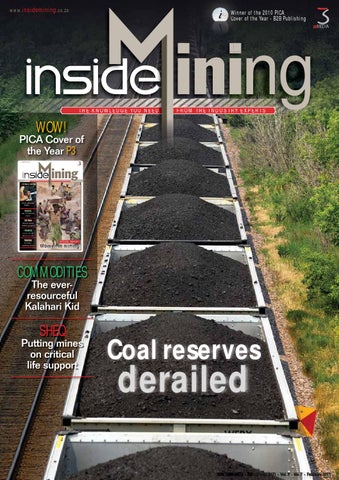
Coal reserves
derailed ISSN 1999-8872 • R30 R30.00 (incl. VAT) • Vol. 3 • No. 7 • February 2011
CONTENTS
T H E K N O W L E D G E YO U N E E D
ining
February 2011
FROM THE INDUSTRY EXPERTS www. insidemining .co.za
W Winner Winn of the 2010 PICA CCover ove of the Year - B2B Publishing MEDIA
12
THE KNOWLEDGE YOU NEED
ining
ON THE COVER
South Africa’s coal
FROM THE INDUSTRY EXPERTS
WOW!
PICA Cover of the Year P3
reserve estimates controversially downgraded. See page 22.
www. w w ww. w.insidemining .co. .co.za co .za MEDIA
THE KNOWLEDGE YOU NEED
ining FROM THE INDUSTRY EXPERTS
NATIONALISATION NATIO NATION NAT A OONAAALISA ATIONA LIS LISATION LISAT SATION SATIO ATION O
Don’t call call them stupid stup pid P3
NICKEL NIC NI CKEL
The 7070-year-old -year-old junior jun nior nior
ERITREA ER ERI ERIT R TTREA REA Nevsun n leaves bankerss gasping
FINANCE FINA ANCE NCCEE Canadaa breaks global records
ZAMBIA ZAM MBIA Mumbwa Mum mbwa leapfrogs leapfrog gs ahead
SPECIAL REPORT
Wome Women Wo me en n in in mining minin inin in ing ISSN 1999-8872 • R30.00 (incl. VAT) • Vol. 3 • No. 2 • February 2010
COMMODITIES The everresourceful Kalahari Kid
SHEQ
Putting mines on critical life support
Coal reserves
derailed ISSN 1999-8872 • R30 R30.00 (incl. VAT) • Vol. 3 • No. 7 • February 2011
EDITOR’S COMMENT
3
32
Wow!
LETTERS
4
Letter to the Editor
MINING NEWS
5
A brief overview of the hottest topics and issues in the global mining industry
REGIONAL FOCUS
12
Quo vadis? Continuing rumblings about nationalisation demands in SA has its SADC neighbours nervous as it is the largest economy in the region due in no small part to a long and illustrious independent and free mining sector.
COMMODITIES
38
18 22
The Kalahari Kid Botswana is arguably the richest per capita country in Africa. Besides queen diamond, a bit of gold and nickel, recent years have seen amazing developments in coal and base metals.
Estimates of coal reserves downsized The BP Statistical Review of World Energy 2008 contains an item on coal reserves that is of particular interest: SA’s coal reserve has been reduced by nearly 18 Gt.
FINANCE
30
Does CSI work?
SHEQ
32 38
42
Critical life support Mine ventilation and cooling is a science. Something that needs to be very carefully thought through, planned and implemented. Lives depend on it.
Fifteen to one First Uranium’s Mine Waste Solutions is back on track with the construction of its new Stilfontein facility for storing tailings from gold and uranium processing.
TECHNOLOGY
40 42 46
Making it in tough times Beasts of burden On the move...
CETERUM CENSEO
48
Of gold, kettles and mighty big heaps of diamonds Inside Mining 02/11
1
7-10 FEB 2011
THE WORLD’S LARGEST GATHERING of INVESTORS, FINANCIERS, and MINING PROFESSIONALS in
AFRICAN MINING
KEYNOTE PRESENTERS: Global Thought Leaders
NIALL FERGUSON
10$+.ÄŒĹ?Ä— $!Ĺ? / !*0Ĺ?+"Ĺ? +*!5Ä?Ĺ? Ĺ? %* * % (Ĺ? %/0+.5Ĺ?+"Ĺ?0$!Ĺ? +.( Ę
GRAHAM BIRCH
%.! 0+.Č !0.+, 2(+/'
DAVID HALE
+1* %*#Ĺ? $ %.) *ÄŒ 2% Ĺ? (!Ĺ? (+ (Ĺ? +*+)% /
FRANK E. HOLMES
$%!"Ĺ? 4! 10%2!Ĺ? Ăž !.ÄŒĹ? $%!"Ĺ? *2!/0)!*0Ĺ? Ăž !.ÄŒ Ä‹ Ä‹Ĺ? (+ (Ĺ? *2!/0+./ÄŒĹ? * Ä‹
JAMES TURK
+1* !.Ĺ? * Ĺ? $ %.) *ÄŒ +( +*!5
KOBUS VAN DER WATH
+1* !.Ĺ? * Ĺ? .+1,Ĺ? * #%*#Ĺ? %.! 0+.ÄŒ Ĺ? Ĺ?
At the 2011 Investing in African Mining Indaba you will ďŹ nd: Ä‘Ĺ? Ä‘Ĺ? Ä‘Ĺ? Ä‘Ĺ? Ä‘Ĺ? Ä‘Ĺ? Ĺ?
$+1#$0Ĺ?(! !./Ĺ?3%0$Ĺ?/,! % (Ĺ?%*/%#$0Ĺ?+*Ĺ? ".% Äš/Ĺ?0.!* %*#Ĺ?%*Ĺ? Ĺ? 5* )% Ĺ?#(+ (Ĺ?,+(%0% (Ĺ?! +*+)5Ĺ? .'!0Ĺ?(! %*#Ĺ?/1,,(5Ĺ? * Ĺ? !) * Ĺ?!4,!.0%/!Ĺ?+*Ĺ?/,! %Ăź Ĺ?)%*!. (/Ĺ? +.!Ĺ?0$ *Ĺ?Ä…Ä€Ĺ? ".% *Ĺ? +2!.*)!*0Ĺ? !(!# 0%+*/Ĺ?, .0% %, 0!Ĺ?ĢĹ?# %*Ĺ?Ăź./0ÄĄ$ * Ĺ?* 0%+* (Ĺ?,1 (% Ĺ?,+(% 5Ĺ?%*0!((%#!* ! +))%0)!*0ÄŒĹ?0+#!0$!.Ĺ?3%0$Ĺ?+1.Ĺ?, .0*!./ÄŒĹ?0+Ĺ?/! 1.!Ĺ?3+.( Ĺ? ( //Ĺ?/+ % (Ĺ?(% !*/%*#Ĺ?/0 * . /Ĺ?"+.Ĺ? ".% *Ĺ?)%*%*#Ĺ? $!Ĺ?3+.( Äš/Ĺ?0+,Ĺ?)%*%*#Ĺ?%*2!/0)!*0Ĺ?$+1/!/Ĺ?,.!/!*0%*#Ĺ?*!3Ĺ?+,,+.01*%0%!/ +*ÄĄ ".% *Ĺ?#+2!.*)!*0Ĺ? !(!# 0%+*/Ĺ?,.!/!*0%*#Ĺ?+*Ĺ?3$ 0Ĺ?"+.!%#*Ĺ?#+2!.*)!*0/Ĺ? .!Ĺ? +%*#Ĺ?0+Ĺ?%),.+2!Ĺ?Ĺ? ".% Äš/Ĺ?%*2!/0)!*0Ĺ? (%) 0!Ĺ?
GO TO WWW.MININGINDABA.COM FOR PROGRAMME DETAILS.
ON-SITE REGISTRATION WILL OPEN ON SUNDAY, 6 FEBRUARY 2011. The main registration area will be located in Strelitzia Atrium of the Cape Town International Convention Centre (CTICC). For full on-site registration details, visit WWW.MININGINDABA.COM or call +1-859-746-5700
EDITOR’S COMMENT EDITOR Tersia Booyzen E-mail: tersia@3smedia.co.za CONTRIBUTING EDITOR Dr Willem Smuts FEATURES George Chavunduka
Wow!
And the 2010 Pica for Cover of the Year – B2B Publishing goes to …
CREATIVE CHIEF EXECUTIVE Frédérick
www. insidemining .co.za
Danton
MEDIA
SENIOR DESIGNER Hayley Moore CHIEF SUB-EDITOR Lia Marus SUB-EDITOR Danielle Hugo MARKETING MANAGER Natalie Nelson PRODUCTION MANAGER Felicity Moon PRODUCTION COORDINATOR Jacqueline Modise FINANCIAL MANAGER Andrew Lobban ADMINISTRATION Tonya Hebenton SUBSCRIPTION SALES Cindy Cloete DISTRIBUTION COORDINATOR Asha Pursotham PRINTERS United Litho Johannesburg Tel: +27 (0)11 402 0571 ___________________________________
ADVERTISING SALES Tel: +27 (0)11 233 2600 Carien Daffue Cell: +27 (0)82 927 8294 Stacey Glad Cell: +27 (0)83 567 0073 ___________________________________
MEDIA
PUBLISHER Elizabeth Shorten
No. 4 5th Avenue, Rivonia 2191 PO Box 92026, Norwood 2117 Tel: +27 (0)11 233 2600 Fax: +27 (0)11 234 7274/5 www.3smedia.co.za ___________________________________ ANNUAL SUBSCRIPTION: South Africa: R300.00 FOR 12 ISSUES (incl VAT & postage) SADC countries: US$ 75 Foreign: US$ 95 ISSN 1999-8872 Inside Mining Copyright 2011. All rights reserved. ___________________________________ All material in Inside Mining is copyright protected and may not be reproduced either in whole or in part without the prior written permission of the publisher. The views of contributors do not necessarily reflect those of the the publishers.
Please forgive me while I
ining
wallow in joy for a while. This award is, after all, the local publishing inNATIONALISATION dustry’s equivalent of an Oscar. And we came very close to a second award as our contributing editor, Dr Willem Smuts, was one of the four finalists for the Pica Columnist of the Year. We are Don’t call them stupid P3 of course talking about entries from the entire business-to-business pubNICKEL The 70-year-old lication industry, which makes it no junior mean feat. ERITREA But as it takes a village to raise a Nevsun leaves bankers gasping child, according to the old African saying, so does it take an entire team FINANCE Canada breaks to create an award-winning publicaglobal records tion. My heartfelt thanks go to every ZAMBIA stakeholder we have, from our brilSPECIAL REPORT Mumbwa liant design and writing teams to our leapfrogs ahead sales and support services and, last but certainly not least, our loyal readers Winner of Cover of the Year and advertisers. B2B publishing But it isn’t just the magazine that is starting the new decade off well; everyone I speak to is extremely optimistic about business going forward. After the slump, commodity prices are once again heading in the right direction, which means that dormant projects have become feasible. There is positive energy in the air that hasn’t been around for a while and it promises great things for the year to come. Leading from that, and due to popular demand, Inside Mining has reverted back to a monthly publication. As always, we would like to hear which aspects of the mining industry you would like to know more about. Please feel free to e-mail your information needs and suggestions to me at tersia@3smedia.co.za. We will be more than happy to follow up with the experts in those fields and revert back to you with in-depth news and views you can use. Sadly, our online editor, Steven O’Sullivan, has decided to Finalist: Willem Smuts, make some drastic career changes which will definitely be • Trade & Industry Writer of the our loss. If you have anything to suggest that we can add Year, Individual Awards, for or change to make www.miningne.ws the preferred one-stop Inside Mining site in the industry, please let me know as I will also be taking on the editorial responsibility for 3S Media’s electronic mining publications. Since the company has just scored its half-a-century, we are now going all out to bat for the 100! Enjoy the read and I hope to see you at the Mining Indaba. THE KNOWLEDGE YOU NEED
FROM THE INDUSTRY EXPERTS
Women in mining
ISSN 1999-8872 • R30.00 (incl. VAT) • Vol. 3 • No. 2 • February 2010
This award is, after all, the local publishing industry’s equivalent of an Oscar
Tersia Booyzen Editor
Inside Mining 02/11
3
LETTERS
LETTER TO THE EDITOR
W
e would like to comment on the article published in Inside Mining, October/ November 2010, with the heading ‘Diamonds are forever .... or not’. We wish to highlight the fact that most, if not all, of the allegations are refuted by eminent scientists and representatives of the diamond trade, both locally and internationally. The Diamond and Jewellery Federation of South Africa (DJFSA) is a properly constituted body that represents both the diamond and jewellery industries – of which the members include the Diamond Dealers Club of South Africa (DDCSA), the Diamond Council of South Africa (DCSA) and the Jewellery Council of South Africa (JCSA) – and is recognised by the South African government locally. The executive committee of the DJFSA had the opportunity to meet with various stakeholders in the different industries and discussed the article mentioned above and the comments that were attributed to Baron Baretsky. The diamond industry is a significant player in the economies of the different countries, especially in Southern Africa, and has an unquestionable reputation as a responsible global corporate citizen.
“Two types of fingerprinting for diamonds exist” The first paragraph of the article makes the above statement. In this regard, we wish to record the following:
4
Inside Mining 02/11
• Determination of a stone’s geographical origin has proved difficult for individual stones, requiring techniques with extremely high sensitivity to trace elements within a diamond. Efforts by a number of research groups worldwide have made much progress, but to date no definitive means of geographical identification of stones has been demonstrated. Such a technique would undoubtedly assist in addressing concerns over conflict diamonds; but in its absence, the robust approach to certification offered by the Kimberley Process is the best option and has resulted in a significant and measured decrease in the number of conflict diamonds. • South Africa is currently investigating, through a combination of physical and chemical methods, whether diamonds can be differentiated from each other. In other words, can diamonds from different areas be identified as such. Using state-of-theart equipment, which provides the necessary sensitivity, the system is able to analyse at parts per trillion levels. In addition, the research is aiming to construct a large database of characteristics for diamonds to enable diamonds to be matched to different areas of origin. • On the basis of available technology, it is not yet possible to distinguish diamonds from one or other area, although research is being undertaken to ascertain if this will be possible in the future.
This has significant future relevance for the Kimberley Process Certification.
Synthetic diamonds and treated diamonds Synthetic diamonds and other treated diamonds can be traded as long as this is disclosed to the buyer at the point of sale. It also needs to be highlighted that any person or entity that sells a treated diamond, and does not disclose this to the customer, may be charged with fraud.
Consumer confidence The diamond and jewellery industries remain unquestionably accountable to consumers for transparent dealings. In this regard, the industry will continue to educate and
standards and ethics, and can institute arbitration proceedings against those who do not adhere to the codes. Dialab is not a member of any recognised body, and as such cannot be held accountable for any of its dealings.
Overview Some of the other remarks attributed to Baretsky should be totally discounted, for example, his claim regarding DNA fingerprinting in diamonds. The thermal pen is a testing method that is not utilised: a combination of tests is used as an industry standard, and the principle of DNA is unknown in the diamond industry worldwide. We extend an open invitation to yourselves to contact us at any time
It is strongly recommended that consumers deal with diamond and jewellery members who belong to recognised industry trade bodies communicate facts to the consumers, in a responsible and ethical manner. The article mentioned above is viewed as being sensational, self serving and leaving elements of doubt in the minds of the market, most of all the consumers. The diamond industry and all its institutional players are ethically bound by non-negotiable ethics that govern the behaviour of the industry. It is strongly recommended that consumers deal with diamond and jewellery members who belong to recognised industry trade bodies, which members are bound by local and international
regarding any matters pertaining to the diamond jewellery industry. The diamond industry has faced many challenges in the past and criticism is always accepted when properly founded on material facts. ‘Diamonds are forever .... or not’ cannot be considered to be properly based on facts owing to the reasons outlined above. E Blom, chairman and C van Rensburg, vicechairman, DJFSA Ed’s note: At the time that the article was written, the DJFSA was approached for comment but none was forthcoming.
MINING NEWS www.miningne.ws
The top mining stories making the news in the past month
compiled by STEVEN O’SULLIVAN, online editor of www.miningne.ws
| AFRICA | Aviva announces renewal of special licence for project in West Kenya Source: www.avivacorp.com.au
Aviva Corporation has announced that the acting commissioner mines and AFRICA
geology department, Republic of Kenya has granted a full three-year, 100% renewal of Special Licence No.123 (SPL123) located in West Kenya. The West Kenya Project consists of two contiguous licences, SPL213-Ndori and SPL123-Siaya, comprising a total area of
approximately 2 800 km2. This latest renewal provides guaranteed security of tenure for SPL213-Ndori to at least July 2013 and
First Quantum 2010 copper output drops to 322 700 t
Source: www.reuters.com
First Quantum Minerals’ full-year copper production fell to 322 700 t in 2010 versus 373 940 t in 2009. First Quantum, which operates mines mostly in Zambia and Mauritania, said that it produced 191 400 oz of gold in 2010 compared with 193 288 oz in 2009. Copper production in the fourth quarter of 2010 dropped to 75 600 t versus 98 528 t in 2009, and gold output fell to 48 600 oz compared with 62 679 oz in the 2009 quarter. First Quantum said that in November it posted a third-quarter loss, hurt by the shutdown of its Frontier copper operation in the Congo and increased mining costs. It had expected to produce 322 000 t of copper and 195 000 oz of gold in 2010, while 2011 production was forecast to be 305 000 t of copper and 210 000 oz of gold.
The West Kenya Project comprises 2 800 km2 of the highly prospective Ndori Greenstone Belt in Kenya, which forms part of the Tanzanian Archaean Craton
for SPL123-Siaya to at least January 2014. The company will pursue its active exploration program in 2011, which will include both the evaluation of existing anomalies and prospects, and the generation of new targets within its extensive exploration package.
Petra maintains output target despite dip Source: www.businessday.co.za
The Kansanshi Mine (pictured here) is the world’s eighth-largest copper mine
Petra Diamonds maintained its production forecast of 1.3 million carats for its 2011 financial year, despite a dip in output in the interim period that was more than offset by improved prices. The company will increase output to 2.5 million carats by the 2014 financial year and to more than 3 million carats by 2019. Group production was lower at 58 2102 ct for the interim period against 614 594 ct a year earlier. This was because the Williamson Mine in Tanzania is being refurbished, and will be
Inside Mining 02/11
5
MINING NEWS www.miningne.ws
AFRICA
Resource upgrade to JORC-indicated category at Dutwa Nickel Project, Tanzania
Source: www.africaneagle.co.uk
African Eagle Resources has announced a significant resource upgrade at its Dutwa Nickel Project in Tanzania. This resource upgrade, by independent geological contractors the Snowden Group, places more than three quarters of the Wamangola resource (the larger of the two nickel deposits that make up the Dutwa Project) into the indicated category under the JORC code. This is the first indicated resource at Dutwa and signifies a leap forward for the project, with increased confidence in the continuity of the ore body. Indicated resources can be used to derive formal mineral reserves for the feasibility study now underway. Highlights of the resource statement upgrade are: • 46.2 Mt at 0.93% nickel and 0.03% cobalt (of the total Dutwa Project 98.6 Mt) now in the JORC-indicated category • grade increase for the tonnes upgraded to indicated from 0.90% Ni to 0.93% Ni • 47% of the total Dutwa resource in JORC-indicated category and more to be upgraded after further drilling at Ngasamo later in the year • the possibility of indicated resources being used to derive probable mining reserves for the pre-feasibility study, due for completion by Q3 2011. The Dutwa Oxide Nickel Project consists of two deposits which form caps on the tops of low ridges 6 km apart. Together, the deposits contain around 850 000 t of nickel with by-product cobalt
back in production by the end of the June quarter. The Cullinan Mine is putting in fresh mining areas that will restore grades from about 37 ct/100 t of ore to 50 ct or more per 100 t. The Koffiefontein Mine is also moving to fresh mining areas and the grade should improve to 8 ct/100 t from six.
The four special white diamonds recently recovered at the Cullinan mine in South Africa
6
Inside Mining 02/11
| AUSTRALASIA | Arafura set to receive over US$1.5 billion annually from rare earths sales Source: arafuraresources.com.au
Rare earths prices have continued to increase into 2011. Industry analysts attribute the price increases to a combination of the decrease in export quotas for the first half of 2011, as announced by the Chinese Ministry of Commerce, and increased demand, particularly for cerium and lanthanum. Consequently, the Nolans Rare Earths mix average valuation currently stands at US$75.23/kg (approximately R521) based on current Metal Pages China FOB prices for The Nolans Project comprises operations at two sites within Australia: the Nolans Bore Mine in the Northern Territory and the Whyalla Rare Earths Complex in South Australia
MINING NEWS www.miningne.ws
rare earths oxides. (This price was $70.52 at the end of December 2010 – approximately R489). Arafura Resources is well placed to secure sales at superior prices for its rare earth products in this climate of tightening supply with increasing demand. Dr Steve Ward, Arafura’s managing director and chief executive officer, commented: “The recent further reductions in export quotas announced by China reinforce the importance of new supply sources. Arafura is one of the very few projects that are sufficiently advanced to come into production in the short to medium term and be available to supply users worldwide. At current prices, we will receive over US$1.5 billion [approximately R10 billion] each year from
rare earths sales alone before other products are considered.”
Australia mines need months to pump out flood waters Source: www.reuters.com
Coal mines in Australia’s flood-ravaged Queensland state could take up to six months to return to full operation as the lack of water pumping and storage capacity is slowing efforts to clear pits, said mining contractors. “There’s just nothing left to hire; all the pumps are working nonstop,” said Dave Walker, who manages water pumping for Total Water Management. “It could be months before all the water is out.” The price of Australian premium coking coal has jumped 35%
since flooding began, forcing nearly 50 mines to shut, and eventually flooding Brisbane, the nation’s third-largest city. “Production has restarted in a few places and the lucky ones will be clear in two to four weeks but some mines will take three to six months,” Walker said. Warrick Ryan, an operations manager at Bowen Basin Hire which rents out pumping equipment, said the pump capacity is only part of the issue as many mines simply lack the water storage capacity to clear pits.
| NORTH AMERICA | Mining fatalities in the United States more than doubled in 2010 Source: www.online.wsj.com
The number of miners who died on the job in
the US more than doubled in 2010, with 29 of the fatalities occurring at a Massey Energy Co. coal mine in West Virginia, said the Labour Department. Seventy-one miners died last year, compared with 34 miners in 2009. The department said that more than half the workers died in coal mines, while the remainder died in metal and non-metal operations. The miners died from explosions, roof falls and powered haulage accidents. In April, 29 miners died after an explosion at Massey’s Upper Big Branch Mine in Montcoal, Western Virginia. The 2010 fatalities were the highest since 2006, when 73 workers died, department statistics showed.
MBE Minerals, is a leading global engineering company engaged in providing appropriate solutions in the areas of coal washing and minerals processing including crushing, milling and screening. Some of the MBE Minerals patented technologies: ROMJIG® for deshaling of coal, ® ® BATAC JIG for separation of coal and minerals, JONES (WHIMS), ® ® PERMOS (MIMS), PNEUFLOT pneumatic flotation, Vibrating Screens and Feeders, PALLA® vibrating mill, TESKA® DMS separator, EKOF® Flotation reagents.
MBE Minerals SA Pty Limited Formerly KHD Humboldt Wedag SA Pty Limited 36 Wankel Street Jet Park, Boksburg +27 11 397 4660 +27 11 397 4411 info@mbe-minerals.co.za www.mcnallybharat.com
Designed by Atomic Design Studio. Produced by Coralynne & Associates Tel: (011) 422-1949
MINING NEWS www.miningne.ws
Inmet Mining has an 18% stake in the OK Tedi Mine (pictured here). The mine is located in the Star Mountains region of Papua New Guinea and produces two main products: a gold-rich copper concentrate, and gold recovered from the gravity circuit
Lundin agrees to combine with Inmet in C$9.1 billion Canadian mining deal Source: bloomberg.com
Inmet Mining Corp. and Lundin Mining Corp. agreed to combine to create a Canadian copper producer with a market value of about C$9 billion (approximately R63 billion) as the metal traded near to a record. Inmet investors will get 3.4918 shares of Symterra Corp., as the new company will be called, NEW APPOINTMENTS
for each of their shares and Lundin investors will receive 0.3333 of a Symterra share, the Torontobased companies said in a statement that dubbed the deal a “merger of equals”. Inmet’s CEO, Jochen Tilk, will be president of Symterra. There were 1 165 global mining deals announced in the past 12 months worth at least US$87.8 billion (approximately R610 billion), compared with 1 007 valued at $43.5 billion (approximately
and Mongolia to reap the benefits of a comeback in commodity prices.
| SOUTH AMERICA |
| ASIA |
Most miners agree to tax hike in copper giant Chile
BHP starts auctioning spot iron ore shipments to China
Source: www.reuters.com
Source: www.reuters.com
Most miners in Chile have agreed to pay higher taxes to fund post-earthquake reconstruction, but investment is seen as safe in the top world copper producer as prices for the red metal soar and new projects remain scarce. Mining minister Laurence Golborne said nearly all of Chile’s mining industry, which initially criticised the plan, will adopt a new royalty scheme that will link tax payments to margins and cash in on a copper bonanza. “With this confirmation, we have more than 80% of miners, in terms of volume, adopting the new tax system,” Golborne said. “I expect that by early January 2011 we will have more than 90% of miners accepting the tax.” Adopting the new royalty follows similar attempts in Australia
Mining giant BHP Billiton has begun auctions for spot iron ore shipments to Chinese steel mills. This marks the latest shift in its pricing strategy to cash in on rocketing prices. BHP, the world’s no. 3 iron ore producer, has started to auction a 170 000 t spot iron ore shipment every fortnight to Chinese customers, the China Securities Journal reported, citing a procurement manager at an unidentified steel mill in southern China. A tight supply market, combined with fast-rising spot prices, meant that BHP was unwilling to extend even quarterly prices to new customers, forcing many steel producers to buy iron ore either priced on a monthly basis or to take extra spot market shipments.
BHP Billiton SA chair is new CoM president
Xolani Humphrey Mkhwanazi, chair of BHP Billiton South Africa, was elected president of the Chamber of Mines late last year. Mkhwanazi began his career as a lecturer in physics at the University of Swaziland in 1978. He left Swaziland for Perth, Australia, during 1988 as a refugee. On his return to South Africa in 1993 he joined the Atomic Energy Corporation as a senior scientist in applied radiation technology. He later moved to the Council for Scientific and Industrial Research (CSIR) to take up the position of technology transfer manager. In 1997, he was seconded to establish the National Science and Technology Forum (NSTF). In January 1999, he was appointed the CEO of the National Electricity Regulator (NER) where he was tasked with rebuilding it into a reputable regulatory authority in Africa. From the regulator he joined the private corporate world as CEO of the process engineering company, Bateman Africa. He is currently chair of BHP Billiton South Africa and in this role he is the custodian of the company’s business strategy in South
8
R302 billion) a year earlier, according to data compiled by Bloomberg.
Inside Mining 02/11
Africa. He also chairs the South African Operational Committee, comprising the global CSG presidents of businesses with operations in South Africa.
PROFILE PROCESSING
Let the ore dictate the terms Of late the buzz word, or should we say sentence, in Africa has been “I’m into mining”. LEFT On-site processing equipment
D
uring a visit to most hotels in Africa, you will invariably notice clumps of people huddled in close and concentrated meetings, all very deeply intent and focused. They are part of the mining fraternity (geologists, process engineers, exploration experts, metallurgists and mining engineers to name a few). The continent has attracted extreme interest from all corners of the earth and within, because of its huge, and in many cases dormant, surface and underground resources.
Africa is endowed with a huge array of minerals and to enter into that realm would take up a huge chunk of time. Suffice to say, the interest is there and many projects are being planned, implemented and commissioned right now. Mining today is an applied art; the business model must be efficient and worthwhile, taking into account all aspects such as preliminary mineral testwork, resource targeting, resource evaluation, environmental and social impact, water and power needs and availability, return on expenditure, etc. Old-time miners will easily take a seat and proclaim, ‘You need this and you need that’, and in many cases would-be miners and active miners take advice from these revered men of yore, going ahead blindly and often boldly, only to find the recommended process equipment does not suit the actual ground conditions and feed material. White elephants in the form of abandoned plants can be found all over LEFT Testing: one, two, three
10
Inside Mining 02/11
the African continent, rusting sentinels that have a tale to tell. There is an up-to-date mineral testwork laboratory (www.peacockesimpson.com) situated on the continent where material can be submitted for actual amenability testwork to ensure that before a project is undertaken, the ‘ore does the talking’. A great mining cliché is: ‘Let the ore dictate the terms’. The laboratory boasts the latest state-of-the-art equipment, such as XRF/digital microscope technology, not to mention the Knelson Gravity testwork modules. The laboratory has recently commissioned a 2 ℓ DESWIK ultrafine grinding mill. This facility also includes a MALVERN mastersizer for determining ultrafine particle distributions and a cyclosizer for producing samples of ultrafine classified products. This facility is unique in Africa and represents a major advance in local testing capability. Combined with the other aspects of the lab, such as cyanidation and flotation, complex metallurgical problems can now be tested locally. This capability will be particularly important in investigating refractory gold ores and calcines as well as unlocking additional values from tailings stockpiles. Using this world-leading technology hub, mining concerns can rest assured they will be given the red, orange or green light before proceeding to process specification. A popular process that has evolved recently is scrubbing available resource to liberate minerals within the loose matrix which can be recovered by gravity, alleviating the use of chemical processing that takes up a lot of time, money and environmental issues. The Rubble Guzzler (RG) (a large-diameter scrubbing drum with integral trommel and screen) range of scrubbers represented by Appropriate Process Technologies has taken not only Africa by storm, but others to boot. Advantages of the RG process are many. A few examples are:
PROFILE RIGHT Saving costs and the environment
• • • • • • •
easy maintenance and easy operation easy installation quick return on capital expenditure low operating expenses chemical-free process high recovery efficiency low-energy requirement (usually below 2 kWh/t, as opposed to conventional mining process of milling and crushing that uses in excess of 4 kWh/t • low labour requirement. APT has also recently offered the option of combining a unique fine-crushing module with the scrubbing plants. Consequently, if the washed oversize is carrying well it can be crushed and re-introduced to the scrubber feed system. This is proving a very popular addition to the range and by using up-to-date technology, APT has ensured the energy required for these modules is kept to the absolute minimum. Once a resource is ready and proven to be amenable, and there is enough raw
water available on site, the scrub/gravityor scrub/crush/gravity-recovery process plant can be implemented with the minimum of effort. Gone are the days of setting up mine administration centres, mine clinics and mine staff complexes that sprawl over the countryside as well as huge milling houses and engineering departments to perform just 20 t/h. The RG plants’ minimal footprint for 20 t/h is miniscule – only 100 m2. Start-up is
short and sweet, and mineral recovery is instant. What more could a miner want? The RG scrubbing plants cater for many different minerals, the most common being the big five: gold, chromite, tantalite, tin and silver. Chatting to the guys and girls who represent the RG Scrubbers is easy. Visit the website at www.processtech.co.za or e-mail info@processtech.co.za.
Modular Minerals Processing Plants Quick delivery, easy installation and re-location, high efficiency Placer, rubbles, clay, alluvial and hard rock variants' Plug ‘n play plant in a box
From bush to.... . Minimal environmental impact Low energy — uses generator power Low capital and operating costs Fully comprehensive package 6, 20 and 80 tph modules Gold, chromite, tin, silver, tantalite, industrial minerals
www.processtech.co.za
..... Production...in days!
info@processtech.co.za
REGIONAL FOCUS SOUTHERN AFRICA
Quo vadis? Continuing rumblings about nationalisation demands in SA has its SADC neighbours nervous as it is the largest economy in the region, due in no small part to a long and illustrious independent and free mining sector. BY WILLEM SMUTS
C
ountries with mineral resource endowments that could equal if not outstrip South Africa, given an equal run, long ago fell by the wayside largely owing to governments taking the road to nationalisation. Most notable among these African stars were Zambia, Tanzania and Zaire (now the DRC). Nationalising the mining sector in South Africa could take us down the slippery slide to oblivion. One of many unintended (or more precisely, neverthought-of) consequences of this will also be the total collapse of SADC as none of the other member states are strong enough to step in and hold up the others. The Chamber of Mines welcomed reports that the ANC’s National Executive Committee (NEC) had resolved to “investigate successful models that could be considered on the role of the state in mining”. The immediate past chief executive of the Chamber of Mines, Zoli Diliza, said he was particularly pleased that the ANC had resolved to use researchers who were independent of the ANC. Even without the looming spectre of nationalisation, South Africa has been on slippery ground for the last 15 years as mine production keeps declining amid all-time high prices and a booming global demand for resources. RIGHT Geopolitics plays a major role in the well-being of a country’s mining industry. Not only has South Africa had to deal with currency issues and major power shortages, but the market perception is that government has wreaked havoc on what has long been South Africa’s most important industry Credit: Willem Smuts
12
Inside Mining 02/11
Pre-meltdown, it was estimated that South Africa was missing out on between R5 billion and R10 billion a year in mining investment because of onerous government environmental regulations and delays in issuing of mining rights and water licences. Between 2004 and 2006, investment in the mining sector fell by 33%. In
2006, the Australian mining sector’s pre-tax profits rocketed 95%, while in South Africa profits increased by only 12%! For over 100 years, South Africa was ranked the world’s largest gold producer, overtaken by China in 2007. South African production has fallen off a cliff, down by nearly half since 2001. It
REGIONAL FOCUS
took only three years to drop to fourth place. Why? For years, the Chamber of Mines has expressed concerns about the negative effects of regulatory constraints with hardly any effect. In addition to dangerous levels of ‘discretion’ awarded to the minister, there is confusion surrounding the interpretation of new mining law and extra red tape brought about by the Mining Charter. Inconsistencies in the regulatory environment, lack of skilled officials, threats to ownership in the form of nationalisation, and the blatant theft of
For over 100 years, South Africa was ranked the world’s largest gold producer, overtaken by China in 2007. It took only three years to drop to fourth place. Why? mineral rights by people with connections to the highest office in the land, have resulted in divestment by major miners while new foreign investors have dried up to a mere trickle, leaving the country vulnerable. Of course some regulations are required to ensure consistency, transformation, order, discipline and compliance in a society that needs focus to put certain
realistic controls in place, and any good-quality management system has clear procedures and processes. However, these are supposed to provide solutions and not obstacles. We’ve seen government meddling destroy many countries’ mining industries. When commodities prices run higher, some governments get too greedy and impose impractical levies on mineral production. They’ll raise taxes,
Inside Mining 02/11
13