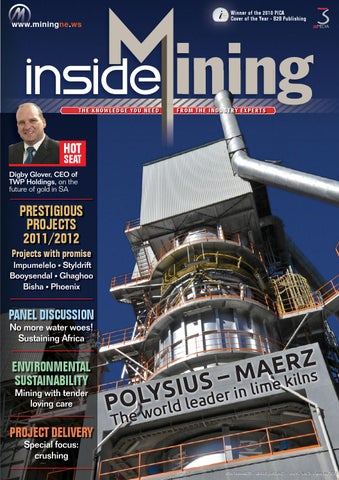
Winne of the 2010 PICA Winner Cover of the Year - B2B Publishing
www www.miningne.ws
MEDIA
THE KNOWLEDGE YOU NEED
ining FROM THE INDUSTRY EXPERTS
HOT SEAT
Digby Glover, CEO of TWP Holdings, on the future of gold in SA
PRESTIGIOUS PROJECTS 2011/2012 Projects with promise Impumelelo • Styldrift Booysendal • Ghaghoo Bisha • Phoenix
PANEL DISCUSSION No more water woes! Sustaining Africa
ENVIRONMENTAL SUSTAINABILITY Mining with tender loving care
PROJECT DELIVERY
Z R E MA ilns
– k S e m U i l I LYS der in
POe world lea Th
Special focus: crushing ISSN 1999-8872 • R35.00 (incl. VAT) • Vol. 5 • No. 2 • February 2012
Bredel Hose Pumps
A COMPLETE SOLUTION!
In the mining industry, water is money. Flushing pump seals and diluting thickened slurries is incredibly costly because the water added has to be removed or treated. Watson-Marlow Bredel hose pumps have no seals to flush – and have the ability to pump thickened slurries up to concentrates of 80 percent solids. So replace your troublesome PC, double diaphragm and centrifugal pumps with Watson-Marlow Bredel SPX hose pumps. They offer: • Less water consumption JOHANNESBURG: Tel: +27 11 796-2960 RUSTENBURG: Tel: +27 14 596-6695 DURBAN: Tel: +27 31 512-5122 E-mail: info@wmbpumps.co.za Website: www.watson-marlow.com
• Lower energy consumption • SPX patented direct-coupled design incorporates extra heavy-duty bearings within the pump rotor, which eliminate any overhang load and gearbox failures • No flow reduction due to specific gravity variation • Less maintenance and spare parts • Heavy duty construction for difficult fluids like acidic, caustic, abrasive, viscous, shear-sensitive, gaseous and corrosive chemicals • Flows from microlitres to tens of thousands of litres an hour and up to 16 Bar
INNOVATION IN FULL FLOW Watson-Marlow \ Bredel \ Alitea \ Flexicon \ MasoSine
CONTENTS
T H E K N O W L E D G E YO U N E E D
ining
February 2012
FROM THE INDUSTRY EXPERTS
12
ON THE COVER
Polysius The world leader in lime kilns P8
EDITOR’S COMMENT
3
Let me ‘re’-introduce myself
MINING NEWS
26
4
The top mining stories of 2011
HOT SEAT
12
TWP – gold in its veins
PRESTIGIOUS PROJECTS: 2011/2012
46
16
Impumelelo – Sasol Mining’s flagship replacement project
20 26 30 34 36
The mighty, mighty Styldrift Bisha rains cash for shareholders Booysendal – the Eastern Limb’s promising project Phoenix flies In the sands of Ghaghoo
ENGINEERING
46
Finsch’s emergency egress
WATER PANEL DISCUSSION
48
Solutions and answers to mining’s water and wastewater challenges
INFRASTRUCTURE PANEL DISCUSSION
66
Products and services to promote African mining sustainability
ENVIRONMENTAL SUSTAINABILITY
74 80
78
Fairbreeze – the future of Hillendale Engineering a sustainable environment
PROJECT DELIVERY SPECIAL FEATURE: CRUSHING
82 83 85 86
Modular mining comes alive Osborn’s new equipment showcase Crushing and screening across 25 countries Demand impacts how ore is transported
CETERUM CENSEO
88
First of the big dogs feeding in the Horn
Inside Mining 02/2012
1
© 2011 Caterpillar Inc. All Rights Reserved. CAT, CATERPILLAR, their respective logos, “Caterpillar Yellow” and the POWER EDGE trade dress, as well as corporate and product identity used herein, are trademarks of Caterpillar and may not be used without permission.
EDITOR’S COMMENT Publisher Elizabeth Shorten Editor Laura Cornish laura@3smedia.co.za Creative Chief Executive Frédérick Danton Senior designer Hayley Moore Mendelow Sub-editor Patience Gumbo Marketing Manager Martin Hiller Production Manager Antois-Leigh Botma Production coordinator Jacqueline Modise Financial Manager Andrew Lobban Administration Tonya Hebenton
Let me ‘re’-introduce myself
Subscription sales Nomsa Masina Distribution coordinator Asha Pursotham Printers United Litho Johannesburg Tel: +27 (0)11 402 0571
___________________________________ Advertising Sales
Stacey Glad Tel: +27 (0)11 467 6224 Cell: +27 (0)83 567 0073 stacey.glad@lantic.net ___________________________________
MEDIA
No. 4 5th Avenue, Rivonia 2191 PO Box 92026, Norwood 2117 Tel: +27 (0)11 233 2600 Fax: +27 (0)11 234 7274/5 www.3smedia.co.za ___________________________________ Annual subscription:
South Africa: R350.00 (incl VAT & postage) SADC countries: US$80 Foreign: US$100 ISSN 1999-8872 Inside Mining Copyright 2012. All rights reserved. ___________________________________ All material in Inside Mining is copyright protected and may not be reproduced either in whole or in part without the prior written permission of the publisher. The views of contributors do not necessarily reflect those of the the publishers.
I feel like the year has just begun, and the 2012 Mining Indaba is already here! Anticipation levels are high as ears and eyes survey the “landscape” for potential deal opportunities, mining professionals network frantically, and experts in their respective fields provide answers to those uncertain about what the year may hold in store. The four-day conference is a playground for journalists, leaving no one in want of a good story, or five or six or seven ... Having joined 3S Media as editor of Inside Mining late last year, I will be using the conference to re-introduce myself to those I have not yet been in touch with since taking on my new position. It is also the ideal platform to re-introduce the magazine which, for those who are familiar with it, will see some significant and positive changes. What I offer Inside Mining readers in my first issue is a selection of what I consider to be some of Africa’s most prestigious projects of the past year. Considering our “prestigious projects” section covers over 22 pages of the magazine, it is good indication of the industry’s current state – healthy and prosperous. Even our gold industry, which is unlikely to record another boom period in history, is showing its robust versatility – our deepest gold mines are going deeper. And something can be said for the small, and not-so-small, mining towns that are sustained by our gold-mining industry, which, in most cases, you wouldn’t even know existed unless you lived there, or know someone who did/does live there. I spent time visiting some of these off-themap towns over the holiday period. Glenharvie, Waterpan, Hillshaven, Libanon, Finsbury and the much larger Westonaria still today retain their livelihood as a result of nearby mining operations. They are quaint in appearance, appear safe with their tiny picket fences, and the person in the street still greets you with a friendly hello. For the most part, it was like travelling back in time.
Unfortunately, an attempt to visit the Pilgrim’s Rest equivalent – Venterspost – was disappointing. The town, although practically a stone’s throw from Westonaria, has been closed. The golf course is ghost-like and a forgotten wasteland. The town was proclaimed in 1937, following the development of the first mine/shaft in the area, Venterspost mine, in 1934. I cannot establish exactly when it was closed, although I gather it was sometime between 2004 and 2009. Today the buildings and typical clubhouse exist only through their original foundations, nothing more. Apparently, the entire area is sinking! The main road into the town was closed when it developed a large crack through it, and there are records of tennis courts and houses disappearing in seconds. Yet despite its “non-existence”, an important part of our gold industry today still remains defined in part by the history of Venterspost. Let it be said that my experience of Westonaria, in general, was more than a pleasure, when it took me less than half an hour to renew my driver’s licence. Who said there are no benefits to small-town living? For those who have fond memories of Venterspost, or other similar mining towns, please write to me. I would love to hear from you. Otherwise, I look forward to catching up at Indaba. Follow us on Twitter @ Mining_News - I will be sending through live feeds from Indaba, keeping you informed of who is there and what they are saying. Laura Cornish
Inside Mining 02/2012
3
MINING NEWS www.miningne.ws
The top mining stories of 2011 SOUTH AFRICA
ANC ‘unlikely’ to go for full nationalisation – December 2011 Julius Malema Disgraced ANCYL leader
compiled by Ameerah Griffin
| AFRICA | SOUTH AFRICA Anglo American agrees acquisition of Oppenheimer family’s 40% interest in De Beers – NOVEMBER 2011 Source: www.miningne.ws
Nicky Oppenheimer is Chairman of the De Beers Group and as such Chairman of De Beers SA, De Beers Consolidated Mines and De Beers Centenary AG. He is also a non-executive director of Anglo American Anglo American and CHL Holdings announced their agreement for Anglo American to acquire an incremental interest in the world’s leading diamond company, De Beers, increasing its current 45% shareholding to 85%. Anglo American has entered into an agreement with CHL and Centhold International, together representing the Oppenheimer family interests, to acquire their 40% share in DB Investments and De Beers SA for a total cash consideration of $5.1 billion, subject to adjustment as provided for in the agreement.
4
Inside Mining 02/2012
Anglo American looks forward to working more closely with governments through De Beers’ joint venture partnerships in Botswana and Namibia and with De Beers’ BEE partners in South Africa to share expertise and tailor programmes to employees and the wider communities. The transaction does not alter the existing arrangements for the management of De Beers SA.
ZIMBABWE Zimbabwe gets KP greenlight to sell diamonds – NOVEMBER 2011 Source: www.talkzimbabwe.com
The Kimberley Process Certification Scheme Plenary Session (KP) in the Democratic
Source: www.businessday.co.za
THE African National Congress (ANC) is unlikely to go for outright nationalisation of mines, London-based emerging markets economist, Peter Attard Montalto says. In December, the party sent back a research report compiled by economists on the state intervention in the mining industry, saying the report was written in dense language and did not contain case studies of countries they visited. In an interview, Montalto said he had spoken to people in the ANC who gave him the idea that the researchers’ report was opposed to nationalisation. He said the ANC and the government have sought to explain to investors that nationalisation was not the party’s policy. The party would need to look at alternatives to outright nationalisation, such as mineral beneficiation and enforcing transformation through the mining charter. There were questions over a suggestion to increase mineral beneficiation in South Africa, and calls for the stringent implementation of the mining charter is one area investors would be watching. The ANC is considering a push for more mineral beneficiation in South Africa by imposing taxes on unbeneficiated mineral exports, according to the chairman of the party’s economic transformation committee, Enoch Godongwana. The proposed export tax is one of the considerations contained in a draft document drawn up as the party begins discussing economic policies ahead of its policy and elective conferences in 2012. That document, together with the researchers’ report on nationalisation, was sent back for more work by the ANC. The government is pushing industry to process minerals locally in the quest for the revival of the local manufacturing industry. Republic of Congo (DRC) gave Zimbabwe the green light to sell its Marange diamonds late last year. The development saw the immediate export of rough diamonds from two KPcompliant operations in the Marange diamond fields, as well as exports from other mining operations in the area. President of the World Diamond Council, Eli Izhakoff
MINING NEWS www.miningne.ws
AUSTRALIA
Australia’s lower house passes mining tax – November 2011 Australian Prime Minister - Julia Gillard
hailed the development, saying the sale of the diamonds by the southern African country will economically develop the wellbeing of Zimbabweans.
Harare’s indigenisation ultimatum causes panic – AUGUST 2011 Source: www.iol.co.za
The Zimbabwe government’s ultimatum to several multinationals to submit “acceptable indigenisation proposals” within 14 days, or face summary seizure of their businesses, sent shock waves through the country’s embattled business community. The targeted firms include South African mining companies Mimosa Holdings and Impala Platinum subsidiary Zimplats. The legal department of Indigenisation minister, Saviour Kasukuwere, announced that it had issued ultimatums to 11 groups to submit proper proposals on how they planned to implement controversial indigenisation laws to give majority 51% equity to black Zimbabweans in five years.
MOZAMBIQUE Mozambican minister wants to train 4 000 geologists, engineers
and metallurgists – OCTOBER 2011 Source: www.macauhub.com.mo
The Mozambican mining sector is facing a lack of qualified staff to keep up with the development of the sector, Mozambican Mining Resources minister, Esperança Bias, said in Maputo in October last year. The minister noted that over the next four years the government of Mozambique aimed to train 4 000 staff in the mining sector. These figures are still far below requirements, Bias noted.
| ASIA | CHINA Agency sets new rules for safety in coal mines – AUGUST 2011 Source: www.chinadaily.com.cn
China’s top workplace safety regulator is introducing national standards for safety technologies used in the country’s accident-plagued coal mines. A set of four standards on polymeric materials used for coal mining safety took effect on December 1, according to the State Administration of Work Safety (SAWS). The standards are related to the prevention of coal mine
Source: www.bloomberg.co
Australia’s lower house of parliament passed legislation for a 30% tax on coal and iron-ore profits as independent lawmakers and the Greens Party backed Prime Minister Julia Gillard’s plan. The Minerals Resource Rent Tax Bill will likely be passed and become law early this year after a vote in the upper-house Senate, where the Greens hold the balance of power. BHP Billiton, Rio Tinto Group and other iron-ore and coal producers, which negotiated the levy with the government, face paying about A$11 billion in extra charges in the first three years of the tax. The legislation is a key policy platform of Gillard’s Labour government, and passage of the bill may help restore public support for the party, which is trailing the opposition Liberal-National Coalition. Gillard ousted her predecessor Kevin Rudd last year after his initial plan to impose a 40% tax on mining company profits contributed to a decline in support for the Labour Party. She negotiated a new proposal with BHP, Rio and Xstrata, cutting the tax back to 30%. The legislation is “seriously flawed and discriminates” against smaller producers, Simon Bennison, chief executive officer of the Association of Mining and Exploration Companies, said. The government has said proceeds will reduce the corporate tax rate to 29% from 30%, provide A$6 billion in spending for roads, rail and ports, and help increase the amount paid to people’s retirement savings to 12% of their salary by 2020 from the current 9%.
accidents, including methane gas blasts, underground floods and shaft collapses, by using high-technology polymeric materials, Jiang Zhimin, the secretary-general of the China National Coal Association, said at a conference to introduce the standards.
China faces hurdles to fracking – NOVEMBER 2011 Source: www.news24.com
Energy-hungry China is tapping its vast shale gas reserves to reduce its reliance on dirty coal and imports, but experts warn its lack of technical expertise and scarce
Inside Mining 02/2012
5
water supplies pose challenges. China, which has substantial reserves of the hard-to-reach gas, trapped in formations of shale, or sedimentary rock, has started drilling to meet an ambitious annual production target of 80 billion m3 by 2020. Beijing is investing billions of dollars to develop clean energy as it seeks to meet a target of generating 10% of its energy needs from natural gas and 15% from renewable sources by 2020.
14 with a deal under which Freeport agreed to pay increases of roughly 40% for around 8 000 union members and a framework for a better deal for roughly 15 000 non-union workers and contractors. The strike at the world’s second-largest copper mine was the highest profile attempt by organised labour in Indonesia to gain a larger share of the rewards in a growing economy.
INDONESIA
Peru’s Humala signs bills to raise mining taxes
Freeport Indonesia suffers debilitating labour strike
| SOUTH AMERICA |
– SEPTEMBER 2011 Source: www. reuters.com
– NOVEMBER 2011 Source: www.reuters.com and www.businessweek.com
Freeport McMoRan Copper & Gold’s massive Grasberg mine in Indonesia was producing copper, gold and silver ore at 5% of its full capacity after some 8 000 workers went on strike in September – demanding higher wages. The stoppage, Freeport said on October 26, forced it to declare force majeure on some shipments. In November, the mill to process the ore stopped running because of damaged pipelines, reducing its ore production to about 5% of its full capacity now,” said Thamrin Sihite, the director general of mineral resources. In early January 2012, workers started heading back to Grasberg. The strike officially ended on December
Peru’s President Ollanta Humala signed three bills raising taxes and royalties on the lucrative mining sector into law , fulfilling a campaign promise. The government plans to use the new source of funds, estimated at $1 billion per year at current metals prices, to build roads and schools to fight rural poverty. It says the taxes won’t affect the vital sector’s competitiveness. “These resources will be used primarily to fund infrastructure in the poorest parts of the country as a way to bring social inclusion,” said Humala, who took office in July promising to spread the benefits of rapid economic growth. Miners will now pay royalties of between 1% and 12% of their operating profits and a windfall profits tax of between 2% to 8.4% of their net profits. They currently pay royalties of 1% to 3% of sales.
Grasberg Mine Indonesia, one of the largest open pit mines in the world
HELPING JUNIOR EMPOWERED MINING OPERATIONS GET OFF THE GROUND Although Anglo American operates globally, we believe in making a real and lasting difference locally. In South Africa, we aim to create sustainable jobs, promote skills transfer and contribute to the transformation of the mining sector according to national imperatives. To this end, we partnered with Khula Enterprise Finance Limited, a government-owned entity that promotes small and medium enterprise development, to launch the Anglo American Khula Mining Fund in 2003. The Fund focuses on promoting mining-related investments, and is managed by Zimele – Anglo American’s enterprise development initiative. It is based on an effective business model that aims to boost the economy and support the entry of emerging mining operations.
the Fund offers hands-on business support and guidance in areas like empowerment, corporate governance and legal and accounting matters. Already, the Fund has invested R148 million across a variety of projects. With 11 current investments, which collectively employ 1014 people and a turnover of R786 million, the Anglo American Khula Mining Fund demonstrates that with the right partnerships a country can profit. Contact information:
Recognising that aspirant miners face many barriers, such as ubiquitous prospecting permits, lack of access to development capital and a shortage of advisors, the Fund provides entrepreneurs with the means to turn business plans into operational businesses. By providing financial support, which takes the form of equity and loan finance at prime interest rates, we help bring these businesses to commercially bankable positions. But we recognise that more than financing is needed, which is why
The Fund Manager: Anglo American Khula Mining Fund PO Box 61587, Marshalltown, 2107 Tel: Fax: Email:
+27 (0)11 638 4172 +27 (0)11 638 5321 Mxolisi.kota@angloamerican.com
www.angloamerican.co.za
COVER STORY TARKWA IN RECOVERY REDEMPTION ROLLOUT
Polysius delivers key HPGR technology
Gold Fields’ Ghana-based Tarkwa operation is preparing to undergo a major expansion project aimed at significantly improving plant recoveries, thanks largely to the successful implementation of high-pressure grinding roll (HPGR) technology.
G
old Fields’ mid-term vision for its West African operations is one of significant expansion at its Tarkwa and Damang operations. However, should the Ghanaian government proceed with a plan to raise new taxes on mining companies, including a windfall tax, the economic feasibility of these expansion projects, worth over $1 billion, would have to be re-evaluated.
8
Inside Mining 02/2012
Gold Fields has entered into discussions with the Ghanaian government, which had not been concluded by the time this article went to press.
Tarkwa “We are currently in pre-feasibility phase, and hope to take a final expansion proposal to the board for Tarkwa early this year,” said Peet van Schalkwyk, executive vice-president for Gold Fields West
Africa, speaking ahead of the November budget announcement of the changing tax regime. Unlike more “traditional” expansions, which usually increase mined tonnages and capacity throughput, the Tarkwa Phase 6 expansion project is scheduled to significantly increase its current 65% to 70% recoveries. Post-expansion, the mine’s annual gold production will remain between 720 000
COVER STORY
LEFT Tarkwa processing plant
and 750 000 oz of gold per annum. Its current life of mine (LOM), incorporating the expansion, is 2021. The project entails altering Tarkwa’s entire process circuit, which currently in-
drastic change to our typical recoveries,” says Van Schalkwyk. Although the south plant was decommissioned in 2008, HPGR specialist Polysius, a wholly owned company of Thys-
“It is the HPGR technology, which has been running at the south heap leach pad since 2009, that will help deliver such a drastic change to our typical recoveries” Van Schalkwyk cludes a north heap leach pad, a conventional CIL plant and a decommissioned south heap leach pad. “It is the HPGR technology, which has been running at the south heap leach pad since 2009, that will help deliver such a
senKrupp Engineering, commissioned a 700 tph HPGR on site. “At the time, the HPGR’s function was to run for about four months to determine its capabilities for improving recoveries,” says Polysius minerals marketing
manager, Gerhard Sauermann. The HPGR has been in operation since then. “As part of our expansion plan, we intend to relocate the HPGR to our north plant, which we will convert from a heap leach pad to a CIL plant. With the incorporation of an HPGR and ball mill, we expect to push our recovery rate up to about 97%,” Van Schalkwyk explains. The Tarkwa mine consists of six massive open pits, which are becoming increasingly deeper, the deepest being about 150 m. The ore body at greater depth becomes “more competent” and hard, meaning heap leach recovery is not adequate to recover sufficient gold. Tarkwa is a low-grade operation, so high-volume throughput is vital and a processing circuit for low-grade recovery is increasingly necessary. “To see Tarkwa’s recoveries improve from 70% to above 90% will have a major impact on the operation’s overall performance. Laboratory test work has proven that when we install an HPGR in an open circuit with an edge recycle, recoveries can be improved by about 10% in a heap leach application, such as that operated in the south heap leach plant since 2008. When installing the HPGR in a CIL application, the resultant finer grind should translate into even better recoveries, Sauermann reveals. If board approval is granted for this project around April, which will depend to some extent on whether the Ghanaian government has compromised on its tax proposals, conversion of the north plant to an 8 mtpa CIL plant will begin, and the HPGR immediately relocated. “Our intention is to commission the plant before 2015.”
Inside Mining 02/2012
9
COVER STORY
According to Van Schalkwyk, another reason for his preference for the HPGR is its power consumption. Power is severely limited and restricted in Ghana, and the HPGR consumes significantly less power than a competitive product – the SAG mill.
20 000 oz of gold a year for about five years. We may even consider a small HPGR for the project.”
Damang The expansion at Damang, also in feasibility stage, with pending board approval this year,
To see Tarkwa’s recoveries improve from 70% to above 90% will have a major impact on the operation’s overall performance The expansion plan also involves changes to the current 12.3 mtpa CIL plant, including the installation of a secondary crusher, which is well advanced and should be commissioned in the first quarter of 2012. There is still opportunity for some final gold recovery at the south plant, Van Schalkwyk points out. “We would like to clean up the old heap leach residue, which still contains a lot of gold in the coarse fraction. We will retain the existing crushing circuit and build a small CIL circuit, which should give us about
10
Inside Mining 02/2012
will be a major growth project. Board approval will again depend on the economic viability of the project once the tax proposals have been finalised by the Ghanaian parliament. Like Tarkwa, it has five open-pit operations. Should the expansion plan be approved, its LOM will increase from 2019 to 2024. “Our intention is to double the current annual capacity from 220 000 ozpa to approximately 450 000 ozpa,” says Van Schalkwyk. Two options were evaluated to do this: decommissioning the 5 mtpa CIL
ABOVE A view of the HPGR at the Tarkwa South Heap Leach plant plant and replacing it with a 10 mtpa plant, or a more cost-effective operation which involves an upgrade to the existing plant and building an additional plant of the same size. A decision is expected this year. “We also want to enhance the recoveries in the current plant (about 92%) and deliver optimal recoveries from the new plant, and are also considering incorporating an HPGR.”
The long-term future Gold Fields is investing significantly in ensuring that it remains a significant player in Ghana post-2024, but needs a competitive investment environment to justify the investments it is planning. “We believe there is further near-mine exploration potential around Tarkwa, and we are conducting a 42 500 m drilling exploration programme in the Damang lease area as well,” Van Schalkwyk says. Gold Fields owns additional exploration areas in the northern region of Ghana.
In each issue, Inside Mining offers advertisers the opportunity to promote their company’s products and services to the appropriate audience by booking the prime position of the front cover which includes a two-page feature article. The magazine offers advertisers an ideal platform to ensure the maximum exposure of their brand. Please call +27(0)11 465 5452 to secure your booking.
HOT SEAT TWP
Gold in its veins
Major engineering project house, TWP Projects, a wholly-owned subsidiary of Basil Read Group and largest division of TWP Holdings, has developed a local reputation for specialising in the development of deep level shaft projects. Part of its strategy is to grow further on the back of a much revived global gold sector, says TWP Holdings CEO, Digby Glover.
A
lthough its platinum project work still constitutes a significant portion of TWP Project’s portfolio, it has significant work in many other commodities including the copper, iron ore, coal and gold sectors. “Gold accounts for about 12% of our current turnover, only slightly less than platinum,” says Glover. Strengthening its presence in the gold sector is part of a larger strategy for the
12
Inside Mining 02/2012
company’s greater diversification. “By diversifying across commodities, companies, services (largely infrastructure and energy) and geographies, our exposure to single commodity and industry cycles is minimised,” Glover notes. While the amount of gold project opportunities in Africa and South America is vast, Glover says South Africa remains promising and open-ended with potential prospects.
South Africa “Our deep level gold mining industry may be the oldest in the world, but established gold houses like AngloGold Ashanti, Harmony and Gold Fields are working towards taking their operations even deeper,” Glover explains. South Africa’s time-honoured gold mines have not necessarily approved such projects to replace production over the last few years but are in essence, in
HOT SEAT
According to McGill, when developing to very deep levels underground, the cost, design, management and implementation of these elements must be prioritised. The elements are: • rock mechanics and engineering, and seismicity • refrigeration and ventilation(deep level ambient rock temperatures average about 600) • logistics – hoisting to surface. These components will have a huge impact on project viability. “But if the gold price remains high, and the rand stable, underground mine extensions will proceed, especially at mines such as
To a large extent, we cut out teeth in the gold industry, and intend to re-inject these skills into the sector - Digby Glover, CEO, TWP Holdings
E+I 16640
a ‘catch-up’ period driven largely by the healthy gold price. TWP anticipates significant work to emerge from this particular area, so much that it has established an office in Krugersdorp to cater to the deep level gold mines. The office will constitute between 15 and 20 people who have experience in deep level gold mining, while aiming at pulling skills and resources from the general area who have experience in deep level gold mining. “We are in the process of assisting AngloGold Ashanti with deepening project studies at its Mponeng and Moab Khotsong operation, below 3.5 and 2.6 km depths respectively,” says Rob McGill, head of gold projects at TWP Projects. When extending underground operations well below 3 km, there are three main elements that must be considered and accounted for.
Will there be any water left for the Kimberley Thornveld wildlife? A research project among antelope species currently underway at Rooipoort Nature Reserve. Made possible by De Beers.
www.diamondroute.co.za
Inside Mining 02/2012