www.miningne.ws
THE KNOWLEDGE YOU NEED
HOT SEAT
Exxaro’s captive mines general manager, Dr Nombasa Tsengwa, on Tshikondeni’s imminent closure
Highly commended 2011 PICA Cover of the Year - B2B Publishing
ining
MEDIA
FROM THE INDUSTRY EXPERTS
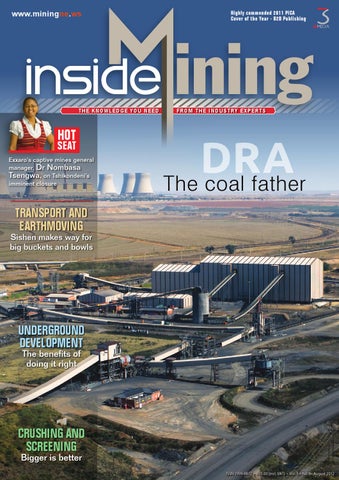
DRA The coal father
TRANSPORT AND EARTHMOVING
Sishen makes way for big buckets and bowls
UNDERGROUND DEVELOPMENT The benefits of doing it right
CRUSHING AND SCREENING Bigger is better
ISSN 1999-8872 • R35.00 (incl. VAT) • Vol. 5 • No. 8• August 2012
CONTENTS
T H E K N O W L E D G E YO U N E E D
ining
August 2012
FROM THE INDUSTRY EXPERTS
Highly commended 2011 PICA Cover of the Year - B2B Publishing
www.miningne.ws
12
MEDIA
THE KNOWLEDGE YOU NEED
LQLQJ
Phola coal processing plant, a
HOT SEAT
Exxaro’s xxaro’s captive captive mi m mines general manager, Dr Nombasa Tsengwa, on Tshikondeni’s imminent closure
The coal father
TRANSPORT AND EARTHMOVING Sishen makes way for big buckets and bowls
UNDERGROUND DEVELOPMENT The benefits of doing it right
CRUSHING AND SCREENING Bigger is better ISSN 1999-8872 • R35.00 (incl. VAT) • Vol. 5 • No. 8• August 2012
20
ON THE COVER
FROM THE INDUSTRY EXPERTS
joint venture between BHP Billiton Energy Coal South Africa (BECSA) and Anglo American Thermal Coal. The R814 million project saw the construction of a 16 Mtpm coal washing facility servicing coal from two mines – BECASA’s Klipspruit and Anglo’s Zondagsfontein. DRA designed and built a twin module coal washing facility with a throughput of 1 180 tph per module as well as the ROM storage and materials handling systems. P6
EDITOR’S COMMENT
3
Sunrise, sunset – the circle of life
MINING NEWS
4
The top mining stories headlining this month
HOT TOPIC
10 Getting to grips with groundwater HOT SEAT
12 Exxaro’s Tshikondeni walks towards the finish line COAL
28
14 Overcoming coal junior challenges 20 Growth opportunities for the coal industry across multiple platforms
UNDERGROUND DEVELOPMENT
22 The benefits of doing mechanised mining the right way
26 Finland’s concrete aspirations 28 Revolutionising shaft sinking in South Africa TRANSPORT AND EARTHMOVING
32 Sishen’s brand new bucket and bowl workshop 36 HPE breaks new ground 38 Concor’s lucky number 12 40 Trollope spreads its wings and flies
44
CRUSHING AND SCREENING
42 Bigger screens are better says Haver 44 Isithebe’s magic mill lining 46 A decade of demand for BTI rock breakers PUMPS AND MIXERS
48 FLSmidth pumps up its market share 50 Mega mixing 52 Pumping out flagship products Inside Mining 08/2012
1
Sketch 4677/12
, G IN NE N L I I M CH ICA ST MA TR 2 E 1 C , N G 0 2 vĂ€ÂˆV> G IAL ELE W I CA I r ĂŠ B R D I e ĂŒÂ… O R T Ă• E b Âœ H F m ]ĂŠĂŠ l y TH DUS AN E S A L e ]ĂŠ Â… a i N t S D N L R p Ăƒ Ă€i V m d I O A E e R S ]ĂŠ > 5p TO T UTH 4 1 ĂŒ Ă€i m ˜ O - i S 0 ÂœĂŠ 9a
1
Ă?
ÂŤ
*, ‡, -/ ,Ê Ê Ê* ,/Ê" Ê/ Ê ‡ ,"7
INTERNATIONAL MINING, INDUSTRIAL, CONSTRUCTION AND POWER GENERATION EXHIBITION SHOWCASES NEW INNOVATIONS, PRODUCTS, SERVICES AND TECHNOLOGIES
co-locating in hall 9
Pre-registration is now open for Electra Mining Africa, the ultimate market place for all stakeholders involved in the mining, construction, industrial and power generation industries. Visitors can expect to see leading local and international industry players in the packed halls and outside precincts. It’s the ideal place to view the latest in technology and equipment, innovative products and new supplies and services. Tr a n s p o r t f o r t h e M i n i n g I n d u s t r y
Experts will be on hand to give advice, live demonstrations will be happening daily and co-located conferences and workshops will add even greater value. Electra Mining Africa is recognized as the second largest mining show in the world and the biggest trade exhibition in southern Africa with global recognition for its broad reach across mining, construction, industrial and power generation industries. Electra Mining Africa and co-located Elenex Africa, Machine Tools Africa and Transport Expo runs from 10-14 September 2012 at the Expo Centre, Nasrec, Johannesburg, South Africa.
Contact the Marketing Director at Specialised Exhibitions Leatitia van Straten leatitiavs@specialised.com +27 (0) 11 835 1565 www.electramining.co.za
PRE-REGISTER NOW FOR FREE ENTRY It’s simple – just complete the registration form at www.electramining.co.za R15 per vehicle, per day for secure parking
ĂŠUĂŠ
1-/, ĂŠUĂŠ "
-/,1 / "
ĂŠUĂŠ*"7 ,
Editor’s comment Publisher Elizabeth Shorten Associate publisher Ferdie Pieterse Editor Laura Cornish laura@3smedia.co.za
SUNRISE, SUNSET
Head of design Frédérick Danton Senior designer Hayley Mendelow Senior sub-editor Claire Nozaic Sub-editor Patience Gumbo Marketing & online manager Martin Hiller
The circle of life
Production manager Antois-Leigh Botma Production coordinator Jacqueline Modise Financial manager Andrew Lobban Administration Tonya Hebenton Distribution manager Nomsa Masina Distribution coordinator Asha Pursotham Printers United Litho Johannesburg Tel: +27 (0)11 402 0571 ___________________________________ Advertising Sales
Stacey Glad Tel: +27 (0)11 465 5452 Cell: +27 (0)83 567 0073 stacey.glad@lantic.net ___________________________________
MEDIA
No. 4 5th Avenue, Rivonia 2191 PO Box 92026, Norwood 2117 Tel: +27 (0)11 233 2600 Fax: +27 (0)11 234 7274/5 www.3smedia.co.za ___________________________________ Annual subscription:
South Africa: R350.00 (incl VAT & postage) SADC countries: US$80 Foreign: US$100 E-mail: subs@3smedia.co.za ISSN 1999-8872 Inside Mining Copyright 2012. All rights reserved. ___________________________________ All material in Inside Mining is copyright protected and may not be reproduced either in whole or in part without the prior written permission of the publisher. The views of contributors do not necessarily reflect those of the the publishers.
The average mining personality could be described as a ‘forward thinker’, a ‘long-term planner’, or an optimist with an indescribable passion for the industry – often with an over-ambitious frame of mind as well.
Of course you
understand what I am saying – production can always be more, safety statistics should continuously be improved, and broadening horizons across continents is always the plan – am I wrong? We, the small group of mining journalists, are always close by, grappling for the opportunity to share the industry’s ‘never boring’ news and fuelled by the constant buzz and drive of an industry with an insatiable appetite for growth. Who is expanding? Who is investing in a new mine? Who is opening a new mine? We so often get caught up in the future, of what is to come, that we seldom take the time to look at the past and present, and celebrate those mines whose life is coming to an end. Laying a mine to rest is like watching a child leave home – with nothing but memories remaining of the time spent nurturing, caring for and loving – from the parents who gave it life. So when writing about the imminent closure of Exxaro’s special Tshikondeni mine, it brought a tear to my eye. Like the runt of the mining giant’s brood, Tshikodeni is by far the smallest producer in the Exxaro stable. Yet despite its size, has required so much care and attention to prosper in the face of extremely difficult mining conditions. Three small opencast sections will breathe one final breath into the mine before it is returned to the natural state it once was early in 2015. With significant rehabilitation programmes in planning stage, Exxaro is showing nothing but the utmost respect for the land it has drawn from, and brings to mind the following words, which so aptly apply to the lives of our mines, and the responsibility they have to our planet: “A [mine’s] time… rises and falls like the sun. One day, the sun will set on our time and rise on a new generation’s.” When our time as ruler ends, we must return our kingdom to its natural form, connecting us all in the great circle of life.
Having visited Tshikondeni in the early days of my mining career, I truly feel I was part of its life, for just a moment in time, and will celebrate the full circle it will make when future generations will listen to stories of the mine that once was. Before I get too sentimental, I must mention another great mining head who, I found out while writing this very column, is leaving. Fortunately, Kumba Iron Ore CEO Chris Griffith is not leaving the Anglo stable all together, but simply, how can I say it, reshuffling. Griffith will soon be captaining Anglo American Platinum (as of September 2012). Wow, he brought ‘fame and fortune’ to Kumba and with 18 years of experience within the Anglo Platinum stable, has more than enough know-how to offer the industry. The company is financially struggling and is in the midst of reviewing its business. Coupled with the platinum industry’s mini-recession, will he take this company where it needs to go? I am optimistic! One last thing – I look forward to seeing you all at Electra Mining, which is just around the corner. Inside Mining, and its sister website, w w w. m i n i n g n e . w s , will be exhibiting. Let me say this, our stand is sure to wow and mesmerise you, and entice you over for an indepth look. Laura Cornish
To our avid readers, be sure to sign up and get the
latest updates and inside scoop from the mining industry. Check out what we are talking about on our website, Facebook page or follow me on Twitter and have your say. @mining_news www.facebook.com/pages/Mining-News
Inside Mining 08/2012
3
Mining news www.miningne.ws
Top mining stories headlining this month
compiled by Ameerah Griffin
| SOUTH AFRICA | Aquarius Platinum to become owner-operator Source: www.miningne.ws
Aquarius Platinum has decided to terminate its contract mining model and will instead apply the ‘owner and operator’ working model to ensure maximum future cost control and flexibility. Aquarius Platinum and contractor Murray & Roberts Cementation have mutually agreed to terminate their contract mining agreement. The board of Aquarius has indicated that it is endeavoring
to proactively manage the company’s business to deal effectively and responsibly with the continuing difficult trading conditions facing the platinum industry in South Africa. The company’s Kroondal, Mimosa and tailings operations will further be optimised to maximise cash flow generation. Blue Ridge, Marikana and Everest have been placed on care and maintenance, and all non-essential capital expenditure will be suspended. This decision has been prompted by several factors including the recent downsizing of the business of Aquarius Platinum South Africa, the changing industrial relations landscape in the country and the continuing margin pressure faced by the platinum industry.
Murray & Roberts Cementation has agreed to provide Aquarius with full support and assistance during a six-month transition period, which is expected to be concluded by the end of December 2012. The transition to owneroperated mining is expected to incur once-off costs of approximately R190 million relating principally to the purchase of mining equipment and stores inventory from Murray & Robert Cementation.
| AUSTRALIA | BHP to grow Australian operations Source: www.theaustralian.com.au
BHP Billton - Olympic Dam BHP Billiton is pushing for environmental approval to grow its iron ore operations in Australia and seeking rights to potentially copperrich land, despite its board having not yet considered
whether to proceed with two key expansion projects in the country costing tens of billions of dollars. BHP has lodged documents with Western Australia’s Environmental Protection Authority to start an environmental review for plans to further boost ore production in the state’s remote Pilbara region to 350 Mtpa by 2020. It also has, in recent months, laid claim to thousands of kilometers of land around its Olympic Dam copper-uranium mine in South Australia. In its application, BHP said it is investigating a number of developments, including bringing new ore bodies into operation at existing sites and developing new mines to grow production to more than double its current production capacity and, in time, grow it to 450 Mtpa. The moves contrast with increasingly cautious comments from mining executives in recent weeks that reflect the slump in commodity prices amid the ongoing economic gloom in Europe and concerns over China’s appetite for metals and minerals.
Cover story
DRA MINERAL PROJECTS
The coal father DRA Mineral Projects has a renowned reputation for its processing expertise, across multiple commodities. Perhaps less commonly known is the foundation upon which its success has grown – the coal sector, writes Laura Cornish.
D
RA’s project portfolio is growing annually, with numerous successes across most mineral sectors. The company has experienced phenomenal growth since its inception in 1984 and has a number of large-scale prestigious projects under its belt. “Our success is based upon humble beginnings, designing small and simple wash plants for the coal sector, with feed capacities of no more than 500 tph,” says Mark Cresswell, consulting minerals processing engineer at DRA.
6
Inside Mining 08/2012
Although the company took on its first large coal project in 1996 (the 1 400 tph Twistdraai plant for Sasol Coal), this proved to be a one-off. It was only 10 years later in the mid-2000s that its growth in coal really started to escalate with the awarding of the Western Coal study for the Anglo Coal/ BECSA JV, which eventually became the 2 400 tph Phola coal processing plant, and the rest, as they say, is history. “As the sector currently stands, DRA is singly responsible for about 50% of South Africa’s total coal washing capacity, and
is furthermore accountable for establishing three of the four last major coal projects in the country – Mafube, Phola and Douglas-Middleburg Optimisation (DMO),” Cresswell explains. Considering the company is currently working on another two major coal execution projects, together with a number of studies aimed at moving into execution in the short- to mid-term, its EPCM stronghold in the sector looks set to continue. “Our strategic intention is to move and evolve with the industry, which has already
Cover story DRA prides itself on keeping abreast of the latest processing technologies applicable to the various minerals it is involved with started undergoing changes as more and more players look to acquire new resources and produce new products such as coking coal from coalfields other than the traditional Witbank and Highveld resource, namely the Waterberg and Soutpansberg coalfields in South Africa, Moatize in Mozambique’s Tête Province, as well as in Madagascar and Botswana,” Cresswell continues. DRA is however assisting both governments and developers with infrastructure solutions in these regions. DRA is currently developing a 4 000 tph plant design for Vale’s Moatize Phase 2 project, which will double the project’s treatment capacity from 26 Mtpa to 52 Mtpa ROM material. Also in Mozambique, the company is building a 400 tph modular plant for India’s Jindal Corp, alongside a study for Rio Tinto’s Riversdale resource. The company’s largest current project is the establishment of a 2 000 tph plant for
Xstrata Coal South Africa’s Tweefontein project. The design builds on the success of Xstrata's Australian coal plants such as Mt Owen and Mangoola, with which it shares many conceptual features. For countries like Botswana and Madagascar, one over-riding challenge remains the sole prohibiting factor for potential coal industry booms – the lack of infrastructure such as rail and ports. Once these problems have been resolved, DRA will form an essential part of the coal fields’ development.
New technologies and trends DRA prides itself on keeping abreast of the latest processing technologies applicable to the various minerals it is involved with, and this definitely includes coal. While Cresswell points out that the coal sector is asking the contractor industry to supply larger dense media equipment and technologies that will reduce the volume of water required for coal washing, he speaks extensively of the growing necessity to find solutions for treating coal fines. It has been discovered that in the newer coal fields like Moatize, 70% of the coking coal product can be in the -1 mm coal sizes. This contrasts with an average Witbank thermal coal where typically only 5 to 15% of product comes from this size range. Technologies best suited to such fine grade resources, according to Cresswell, who has spent the majority of his working career in the coal industry, include spirals, teeter bed separators, reflux classifiers, derrick screens and fine dense media separation plants. DRA is, in fact, the only engineering house to build two 50 tph fine coal DMS plants LEFT Phola processing plant RIGHT Twistdraai processing plant
The DRA success formula The key to DRA’s processing success across all of its commodities can be attributed to highly skilled experts in their respective fields. In addition to Mark Cresswell and Herman Oosthuizen (Principal process engineer) as coal preparation specialists in the Johannesburg office, DRA can also call on board director Clive Hart and Mike Salter, based in the Perth and Brisbane offices respectively to offer the industry specialised skills based on long-term, in-depth industry experience. This is proving to be particularly valuable for Australian-based coal mining groups moving into Southern Africa. DRA has also recently recruited a number of young graduate process engineers both in South Africa and Australia. “DRA has gradually built up its processing capabilities by building on its corporate memory, establishing a ‘library’ of sound projects to base new designs on. We have home-grown engineers, base our success on repeat business and are proud of our Tier One supplier status with the Anglo Group.” for Exarro’s Leeuwpan mine to the successful design developed by the Coaltech 2020 programme – a collaborative research programme established to address the specific needs of the coal mining industry in South Africa using local and international knowledge and skills to ensure it remains competitive into the 21st century. And while fine coal products are normally dewatered in centrifuges, dewatering of the slimes is becoming increasingly important as new mines strive to reduce their raw water requirements. For this task, there are numerous filter press technologies emerging from Spain, China and Japan, along with
Inside Mining 08/2012
7
Cover story
ABOVE Phola processing plant under construction
older technologies that have been upgraded and refined, such as the Bokela vacuum disk filter (Roymec Technologies), the Phoenix belt press (Malvern Engineering) and paste thickening, Cresswell adds.
Extending the lives of power stations Some of the most exciting coal work DRA is currently involved in is the development of processing strategies for Eskom-tied
collieries, whose sole purpose is to supply coal exclusively to an adjacent power station. The collieries include Khutala, which supplies the Kendal power station; New Denmark, which supplies Tutuka power station and Kriel Colliery, which supplies Kriel power station. All three mines currently supply all their mined raw coal to their respective power stations, which maximises the strategic resource. “However because these mines’ reserves of Eskomquality coal are starting to reach the end of their life, more resources must be found. The short-term solution has been to supplement the supply with trucked in coal, but besides the extra expense, this has led to a severe deterioration in the local provincial roads. We have been appointed to design partial washing plants that are able to upgrade poorer quality reserves within the tied colliery mineral boundaries. The main effect on the
mine will be that it has to increase its mining rate by around 15%, stockpiles and a washing plant will be required, there will also be a coarse discard to dispose of, but the great bonus will be the delivery of a consistent coal quality to the power stations. It should also be noted that there will be a reduction in the sulphur in the washed product of 10 to 15%,” Cresswell explains. Consistency of supply to the Eskom spec is as important as a fluctuating quality. Cresswell explains that the model being copied is Eskom’s Letaba power station, which receives the lowest quality coal in the country from its tied New Vaal Colliery. The Letaba station is considered by Eskom to be one of its crown jewels because the New Vaal plant de-stones the raw coal feed and delivers a consistent quality to the boiler. “Our intention is to deliver New Vaal equivalent plants.” Cresswell notes that all the plants will be large, no smaller than 1 000 tph, and could be approved to move into construction between 2014 and 2020.
In each issue, Inside Mining offers advertisers the opportunity to promote their company’s products and services to the appropriate audience by booking the prime position of the front cover which includes a two-page feature article. The magazine offers advertisers an ideal platform to ensure the maximum exposure of their brand. Please call +27(0)11 465 5452 to secure your booking.
Hot topic
SM ENVIRO
Getting to grips with groundwater Groundwater extraction for industrial use and consumption is a viable water supply and should be given greater usage consideration. However, the need to monitor this resource for toxins and pollutants, and to understand its hydrology is essential, writes Laura Cornish.
S
outh Africa’s surface water resource is reducing, slowly but steadily, meaning the need to secure alternative water sources is essential. Groundwater has always been considered the ‘Cinderella’ of water sources and thus never truly considered a truely viable option, says Dr Shafick Adams, chairman of South Africa’s Groundwater Association and research manager for the Water Research Commission. “Despite its poor reputation, it is a viable source and can assist with the country’s water supply shortage. The cost of accessing groundwater is, in fact, 10 times cheaper to deliver than the cost of a desalination plant,” Adams continues. The key to accessing this resource properly is not the lack of technology to pump it to surface, but the necessity to implement the correct tools to monitor quality, toxicity and hydrology. “There is also almost no cooperative bridge linking the consulting industry with project-implementing engineers on typical groundwater projects. This circumstance, coupled with the lack of tool monitoring training and awareness means that groundwater is often generally being monitored incorrectly, or not at all,” explains Vic Cruger, SM Enviro MD. If groundwater is
to become a sustainable resource, then continuous monitoring is essential. SM Enviro sells process and environmental monitoring instrumentation devices – largely to consulting companies in the field of groundwater across Africa. Its equipment monitors almost every possible waste influence in the water, including pH levels, oxidation reduction potential, conductivity, residual chlorine, turbidity, salinity, total dissolved solids, temperature, as well as levels for resource monitoring and aquifer characterisation.
ABOVE Mine’s must monitor to prevent environmental hazards such as AMD
While the use of groundwater is and will become an increasingly significant municipal initiative for supplying to local communities, it is an extremely important issue to the mining sector as well. “It is essential that the mines are aware of and monitor their tailings
The Vaal Dam
LEFT Tailings dams can be a major source of water pollution if not managed properly
10
Inside Mining 08/2012
Hot topic Teaching the new generation Driven by its desire to enable and empower the new generation of consultants and engineers emerging into the water and associated industries with the necessity for groundwater monitoring, the SA Groundwater Association, together with SM Enviro, embarked on a seminar road trip to provide groundwater monitoring training and discussion forums to university students. The one-day seminars were well attended and included the universities of Pretoria, Western Cape and KwaZulu-Natal. A similar seminar was held in Windhoek for consultants mining and government institutions, including the Ministry of Water, Windhoek municipality and Namwater. Consultants and various industry experts also attended and, thanks to the seminar, were provided with the platform to share their industry knowledge. “We were also successfully able to educate students and consultants on the technological advancements of typical monitoring equipment, which today is highly successful in remote monitoring,” Cruger adds. Guest speaker, Dr Ted Way, a senior hydrologist with over 40 years of experience, applauded the event, praising all parties for initiating such a useful information transfer opportunity. Christopher Williams, United States-based international sales manager for In-Situ (SM Enviro has the local distribution rights to sell the In-Situ water monitoring products), also attended. “Africa is becoming an increasingly important continent for our business, and we see massive potential for growth and increased knowledge awareness in this area,” Williams stated.
Rugged Level TROLL family stepped
D Tape Meter Family
facilities for possible seepage, dewatering on surface and underground, as well as wastewater discharge, that could potentially pollute natural surface water streams and rivers, but can also pollute underground water sources as well, which in turn affects surface water streams,” Cruger continues. The mining sector, however, has become exceedingly environment conscious and technologically advanced in terms of its understanding of the need to monitor its
environment-impacting footprint. As a result of this, Cruger believes the country’s mining houses could lead other industries and municipalities forward in terms of learning how to monitor water sources effectively and efficiently. SM Enviro has most recently helped develop a special marine-equivalent monitoring
probe capable of operating at underground depths of 3 000 m – making it ideal for monitoring underground acid mine drainage (AMD) water. The company has instruments installed in numerous different shafts within the central and eastern Witwatersrand gold basins to monitor AMD.
SCREENS PALLA®
PNEUFLOT®
JONES®
ROMJIG®
TESKA® BATAC®
MBE Minerals SA (Pty) Ltd A MBE Coal & Minerals Technology Group Company T +27 11 397 4660 F +27 11 397 4411
www.mbe-cmt.com
MBE Minerals is a leading global engineering company engaged in providing appropriate solutions in the areas of coal washing and minerals processing including separation, flotation, crushing, milling and screening. Coralynne & Associates +27 11 422 1949
Hot seat
TSHIKONDENI
Almost time to say goodbye
Exxaro’s Tshikondeni coal mine has travelled a long and unconventionally difficult road since its first production in 1984. As it walks towards the finish line, it will leave a lasting legacy – one that ended on a high note, writes Laura Cornish.
U
nlike the majority of South Africa’s large opencast coal mines, Tshikondeni is an underground, hard coking coal operation, and an extremely difficult mine to operate. Located in the fairly isolated Soutpansberg coalfield in Limpopo, just outside the Kruger National Park, its seam angles are extremely deep, varying between 2 and 18 degrees, explains Exxaro’s
12
Inside Mining 08/2012
captive mines general manager, Dr Nombasa Tsengwa. Structurally, the 400 m deep mine is very complex, with faulting and intrusives also having a significant impact on mining with both displacement and devolatilisation of the coal. Major faults in the area tend to be listric normal faults forming steps and grabens, which delineate the different mining blocks. Intrusives occur in the form of
dolerite dykes and sills with thicknesses of between 15 and 30 m, respectively. The intrusives result in a devolatilisation halo that is related to the thickness and/or dip of the intrusive. “These factors have largely influenced the mine’s production volumes, which by comparison with Exxaro’s other coal mines, is extremely small,” Tsengwa continues. Tshikondeni has traditionally mined between 500 000 and 580 000 tpa
Hot seat
While most mines heading towards closure gradually decrease their annual production, with Tshikondeni it is quite the opposite, thanks to a project started last year. “In April 2011, we commenced with our mini-pit project, which entails the addition of three small open-pit operations, that have already successfully seen us increase our annual ROM production to 850 000 tpa, equating to about 350 000 tpa of saleable product,” Tsengwa outlines. Each pit will be mined in sequence, the first already completed, which will take until the middle of 2013 to complete. Trollope Mining Services was appointed to mine all three pits. Each pit is situated close to one of the mine’s old shafts and has been named accordingly after the shafts. All three are no more than 2 km from the mine’s main office buildings. The first mini-pit, Kremetart, took just seven and a half months to complete and delivered an additional 280 000 t of coal. The second pit, Nari, is scheduled to be
Upskilling projects • Exxaro has invested in the establishment of the Sanari Skills Development Centre in the area, aimed at teaching sewing, welding, carpentry and computer skills – the centre is up and running. • The establishment of the Musunda citrus farm – a mango plantation where the trees are currently growing. • The Makuya cattle feedlot. This is due to be commissioned later in 2012, following finalisation of the infrastructure. • Mukomawabani vegetable garden – currently being established.
Building up to, and post closure “We are putting together a comprehensive mine closure plan, which we will finalise at the end of the year. It will look at the mine’s environmental footprint and other postclosure activities, including infrastructure, employees, after-care requirements, and compliance to our social and labour plan, and will also have to be approved by government,” Tsengwa mentions. Management has also already commenced with future forum strategy discussions
“In April 2011, we commenced with our minipit project, which entails the addition of three small open-pit operations.” Nombasa Tsengwa, Exxaro’s captive mines general manager
run-of-mine (ROM), delivering about 200 000 tpa of saleable product. As one of three captive mines in the Exxaro stable, all of its product is sold directly to ArcelorMittal, making it a strategically important asset to the company – until its last month of production. Unfortunately, every mine has a finite lifespan, and Tshikondeni’s is almost up. Its closure will be official in 2015.
completed in November this year, and will deliver a further 200 000 t. Preparation for the third pit, Mopani, has already commenced, and it will deliver about 180 000 t over a six-month time frame. In line with Exxaro’s extensive commitment to best environmental practices, all the pits will be backfilled and rehabilitated. Rehabilitation around the shafts is also an ongoing activity on site. Despite the operating challenges associated with the mine, it has also made remarkable improvements in the area of safety over its life, which last year recorded an impressive 0.12 lost-time-injury rate – below Exxaro’s own target.
with its employees, engaging with them on possible future scenarios once the mine is closed. The workforce is less hostile as a result. “We are investing heavily in reskilling our employees, teaching them different skills, and will even look to possibly relocate those who are willing to move to our other mines.” Tshikondeni employs about 700 permanent staff. In January this year, the Tshikondeni plant was ‘overhauled’ to help better process the coal from the mini pits. Different options are being evaluated regarding what can be done with the plant which still has some operational life left.
Exxaro’s captive mines Exxaro has three captive mines: Tshikondeni, Matla and Arnot. Tshikondeni sells exclusively to ArcelorMittal, with the other two mines exclusively supplying Eskom. Tshikondeni’s production equates to 18% of the company’s entire coal consumption. In exchange, ArcelorMittal and Eskom fund the respective mines’ running costs.
Inside Mining 08/2012
13
Coal
OVERCOMING COAL JUNIOR CHALLENGES
Prospering in Natal, for a start While the demand for coal, both export and local, continues to escalate, it has not made the process for junior coal companies evolving from developers to miners an easy one, David Pile, MD of junior coal developer Ikwezi Mining, tells Laura Cornish.
T
he ASX-listed Ikwezi Mining story is an exciting one. Unlike most other junior coal companies in South Africa, it has not set its sights on developing the remaining eMalahleni coal resources. The local subsidiary and 30% BEE owned Ikwezi Resources (Ikwezi) has instead secured a number of mining and prospecting rights in unexplored or yet-to-be-tapped mining areas, and will, from its first project, soon start producing from the largely forgotten KwaZulu-Natal coalfields. With extensive background experience in the coal sector, which includes time with BHP Billiton Energy Coal South Africa, Pile’s business model and strategy for Ikwezi has been well thought out and will also be well implemented. Ikwezi’s management team also comprises the original NuCoal management. “Why KwaZulu-Natal and Newcastle? In addition to the fact that KwaZulu-Natal still has significant amounts of untapped coal resources that provide quick expansion platforms and consolidation opportunities, it is also not constrained by rail capacity
14
Inside Mining 08/2012
and retains the flexibility to export via the Durban and Richards Bay ports, making the distance to the ports shorter – enough to consider trucking,” Pile outlines. This fact alone highlights the advantages of choosing to mine in the KwaZulu-Natal area, in which it owns a number of prospecting rights, in addition to its current single mining right.
Ntendeka colliery – 70% ownership • Initial JORC reserve: 14 Mt • JORC resource: 221 Mt (upgrade expected in Q3, 2012) Considering Ikwezi's IPO was based on just a prospecting right for this 12 182 ha project in July last year, it has taken its 20 year life-of-mine (LOM) Ntendeka project quickly up the value curve. The company acquired the project’s mining right in February this year, and believes its integrated water use licence is imminent. First production – 1.25 Mtpa of saleable product at nameplate capacity – is expected in the last quarter of this year, and remains dependent on putting certain loans in place, and the issue of the water licence.
It has also already entered into a transport agreement with Transnet Freight Rail (TFR) and has been offered an off-take agreement from an international trading company to purchase its entire production and provide port facilities for a three-year period. “We are already commissioning our onsite wash plant, which has been designed to process 170 000 tpm run-of-mine (ROM) material. Its design will also accommodate an additional second stage unit, which will increase its total capacity to 340 000 tpm ROM,” Pile explains. Bond Equipment was responsible for the plant’s design and construction. The Phase 2 expansion, which will increase annual production to 2.5 Mtpa, correlates directly with the need for an increase in overall Eskom power supply to the project, as well as the necessity to convert the mine from opencast to underground, which should start in late 2014. The major mineable coal seam averages a consistent 2.5 m thickness, and it has between four and five years of opencast potential. Underground, it will comprise five main sections.
Coal
Ntendeka 170 000 tph wash plant and Ikwezi has invested in the repair of two culverts as part of its community work in the KZN area
The thermal coal product, which generally has elevated sulphur levels and slightly low volatiles, has a high calorific value (CV) and has been allocated entirely for the export market, in which demand continues to escalate. “Eskom is in the process of providing the operation with an initial 500 kVA. Four 1 MVA gensets manufactured specifically for the project by Engine Applications will run the wash plant and office complex until they are connected to an Eskom main power supply. An initial 7 MVA has been applied for from Eskom with the ramp-up of the project’s possible underground progression and plant expansion as well.” According to Pile, Eskom has verbally advised that there is sufficient
power available in the area to supply the operation’s requirements. In line with the Ikwezi Mining's commitment to surrounding communities and its aim to transport its coal via rail, it is investing in upgrading the main haul road to the nearby Ngagane siding, which includes the repair of two culverts and
the rehabilitation of the first 8 km of a 16 km road connecting the wash plant to the siding. In December last year, Ikwezi secured an option to purchase the land on which the siding for the old Ngagane power station is located, subject to the successful completion of a basic environmental impact assessment.
Eskom has verbally advised that there is sufficient power available in the area to supply the operation’s requirements
Inside Mining 08/2012
15
Coal
This has progressed well and is expected to be approved shortly to reinstate the original siding. “We have also decided to invest the cash required to own the siding, rather than have a third party fund its acquisition. We will engage with an outside party to oper-
December also saw Ikwezi secure 1.5 Mtpa of rail capacity from TFR, either to Durban or Richards Bay. The contract is renewable on an annual basis. Ikwezi is also in the final stages of negotiation of an approximate 500 000 tpa port allocation in its own name. This contract is expected to be announced in the next two months. “From a financial point of view, we are in advanced discussions with
TFR has mandated DBSA to encourage mining houses to return to rail logistics, by assisting with loan applications for this specific task ate it however,” Pile notes. This is expected to cost about A$3.4 million (R28.7 million) and take about three months to construct. In the interim, coal is planned to be transported via an existing siding on the outskirts of Newcastle. ABOVE Repairing the culverts is currently underway BELOW Mothballed Ngagane power station
the Development Bank of Southern Africa (DBSA), along with two other banks to put a five-year loan facility in place for the operation of about R200 million. Funding the coal plant as well as upgrading the siding at Ngagane requires an additional R100 million not originally budgeted for from internal cash funds. Pile explains that TFR has mandated DBSA to encourage mining houses to
ABOVE FROM LEFT Various angles and close up of the Ntendeka plant
return to rail logistics, by assisting with loan applications for this specific task.
Dundee colliery – 60% ownership Also situated in northern KwaZulu-Natal, the Dundee exploration project (formerly Newcastle Phase 2) comprises a 4 664 ha area. Ikwezi currently holds a prospecting right, and is under way with an exploration drilling programme. Pile says the area is well understood within Ikwezi’s management structure and indicates that the probability of announcing a 50 Mt good quality, low phosphorous coal is high. It also has close proximity to rail sidings.
Waterberg project – 70% ownership This 5 669 ha Limpopo based project (including six farms) holds massive potential for Ikwezi, should the necessary infrastructure required to sustain the area develop. The Waterberg is expected to be the next major coal field to be developed in South Africa. Transnet has already committed to increase rail capacity in the coal field from 4 Mtpa to 23 Mtpa. “We acquired two prospecting rights over the properties subject to certain conditions precedent including a S11 approval which is in process. These prospecting rights have an exploration target of between 2 and 4 Bnt, with coal for both the local and export markets,” says Pile. “We are also already in discussions regarding port capacity at Matola, and looking at off-take opportunities.”
Acorn project – 60% ownership Situated in Gauteng’s Springbok Flats, Ikwezi owns prospecting rights of the 20 758 ha thermal coal property. “The coalfields, as yet to be mined, show similar characteristics to the Waterberg, but quite uniquely, are highly uraniumenriched,” Pile points out. “Until a viable extraction method can be found for such a reserve, we will retain this project as a major blue sky opportunity.”
16
Inside Mining 08/2012
Coal
A BIG ANGLO ACQUISITION
Making inroads into Mozambique Major mining company Anglo American has agreed to acquire a 58.9% interest in one of Mozambique’s most highly prospective coal projects.
T
he acquisition is for Revuboè metallurgical coal project in Mozambique, which Anglo American will acquire from the Talbot Estate for a total cash consideration of $540 million (R4.6 billion). The project is a joint venture partnership and includes Nippon Steel Corporation (33.3% interest) and POSCO (7.8% interest). The Revuboè project has a reported Joint Ore Reserves Committee resource
of 1.4 billion tonnes of hard coking and thermal coal suitable for open cut mining, with the potential to support the export of 6 to 9 Mtpa on a 100% basis. Cynthia Carroll, chief executive of Anglo American, says: “The acquisition of a majority interest in Revuboè is in line with our strategic commitment to grow our global metallurgical coal business to supply our customers from each of the key metallurgical coal supply regions of Australia, Canada and Mozambique. Revuboè is located in
Cynthia Carroll, chief executive of Anglo American
the most attractive area of Mozambique’s Moatize coal basin and has a number of infrastructure development options. We look forward to working with the government of Mozambique and our joint venture partners to progress this exciting prospect.” The transaction is subject to a number of conditions and is expected to be completed during the third quarter of 2012.
www.ikwezimining.com +27 11 994 8900 “RISING STAR”
Coal Resource Exploration | Development | Mining | Processing Ikwezi Mining Limited derives its’ heritage and name from the word “Ikwezi” used in South African culture and translates to “Morning Star” or “Rising Star”. Ikwezi Mining is a Specialist Coal Mining Company that focuses its core business in resource exploration, development, mining and processing. We are strategically positioned to exploit coal resources in Kwa-Zulu Natal, South Africa.
Coal
FIRING UP
Detailing Medupi and Kusile’s boilers Consulting engineering and project implementation firm Hatch has been instrumental in the shop detailing of six boiler ducts at Eskom’s Medupi and Kusile power stations, in the Lephalale and Delmas areas.
E
ngineering, contracting and construction services company Murray & Roberts approached Hatch to assist with the shop detailing of the boiler ducts, which included the creation of 3D models, 2D fabrication and erection drawings of ducting for 12 boilers using Tekla Structures software. Hatch Structural Practice and Project Delivery Group: Detailing section leader, Hendrik van Graan, says that each boiler duct stretches a full 103 m up in the air and weighs up to 1 480 t per unit. The plate work varies between 5 and 6 mm, depending on hot or cold air flow. Van Graan says that Hatch had to supply the fabrication workshop and site with intensive, high-quality drawings and daily communications on progress, safety and accuracy. This required that the team members perform well in a fast-tracked environment with a significant amount of pressure. The number of drawings per unit was as follows: 8 755 single part drawings, 3 623 assembly drawings and 40 general arrangement drawings; a total of 12 058 drawings per unit. “Owing to the nature of this project, there was a substantial amount of tasks that occurred simultaneously, such as interface complexities with other detailing companies, and mechanical and structural miss matches. Due to the complex nature of the interfaces, we needed to be able to think on our feet and provide innovative solutions to problems of varying complexity. The work often involved multidisciplinary approaches to problem solving,” explains Van Graan. One of the complexities that Hatch managed to overcome through innovative work was the modification of the duct structures previously detailed by others. The ducts needed to be modified for the correct interfacing as per the calculation sheets done by Hitachi in Germany. Van Graan says that most of the other detailing companies withdrew from this project due to the schedule and complexity.
Included in the innovative work items completed by Hatch was the modeling of major round duct structures as well. Van Graan states that work accuracy was one of Hatch’s most important aspects on the project: “Owing to the fast changing nature of the construction environment, it was essential that every individual on the team, do his or her part to ensure that the detailing sequence experience as little delay as possible. Accuracy was very important in ensuring that the solution was engineered correctly. Mistakes can easily be made in such a fast-track programme, but the team
ABOVE Hatch was instrumental in the shop detailing for all six boilers at Medupi power station
members performed exceptionally well, with the project coming in on time and on budget.” Hatch is one of the only consulting engineering firms in South Africa with an inhouse detailing division. These capabilities are spread across the globe and can be accessed through Hatch’s offices in Montreal, Canada; Johannesburg, South Africa; Delhi, India; and Shanghai, China.
Inside Mining 08/2012
19
Coal
JUSTIFYING COAL JUNIORS
Growth opportunities across multiple platforms The number of junior coal mines in South Africa will continue increasing and the tonnages of coal they ship will grow, Xavier Prevost, mining industry doyen, told a recent Junior Coal Mining Ventures conference held in Johannesburg.
20
Inside Mining 08/2012
I
n his keynote address at the conference, organised by the Fossil Fuel Foundation, Prevost painted a positive picture for the junior mining sector’s future, which is currently in a growth and consolidation phase. Junior miners are looking for large blocks of coal and are likely to focus on better quality product to increase on sales to the metallurgical and other industries. At the same time, junior miners will have to contain costs to ensure that product is competitively priced. The sale of product to Eskom is likely to be curtailed in the future because of low prices. Turning to the potential for junior mines in the emerging Waterberg fields, Prevost declared that only large-scale mining houses will be able to run profitable mines in the region. The major barrier of entry into the Waterberg for junior mines lies directly with the beneficiation of the raw coal to Eskom requirements. The capital required to establish such plants will rule out the entry of junior mines to the Waterberg deposits he continues.
Coal “Waterberg coal is a highly complex product with ash contents of up to 60%. This requires a substantial investment in the washing process, which therefore limits entry to the large mining houses.” This statement was in direct contrast with the view of Eskom’s Johann Bester, who told delegates that the energy parastatal sees opportunities for junior mines to supply Eskom with between 5 and 10 Mtpa from the Waterberg. Eskom is in negotiation with Transnet regarding the provision of rail infrastructure. “The percentage of volatiles in coal sourced from the Waterberg is a lot higher and the washing of product to Eskom requirements is challenging. We are currently running trials in our power stations.” Bester, who is the GM for fuel saving in the primary energy division at Eskom, says that 10 Mtpa of coal from the Waterberg has already been secured. “Eskom requires 20 Mtpa of coal from the Waterberg for the next 40 years from 2018. Contracting principles for the Waterberg will include adhering to today’s best practice green mining principles, beyond legislative requirements with new parameters for coal quality management, including automated systems.” Referring to junior mining development, Bester mentioned that Eskom is currently sourcing 30% of coal on medium-term contracts, the primary portion (about 35 Mtpa) of which is sourced from junior mines. “The significant volumes of coal Eskom still needs to secure for the long term
provides an increasing opportunity for the junior mining coal sector to collaborate with each other as well as with Eskom to further develop the mining sector of South Africa and also improve the security of supply from Mpumalanga and the Waterberg.” He stated that Eskom is committed to paying a price for coal that will enable mines to be sustainable.
Gas fracking is environmentally acceptable “Gas fracking, as opposed to conventional fracking, presents the possibility of accessing quantities of gas in the Karoo in an environmentally acceptable fashion,” said Andrew Kinghorn of Shava Mining Enterprise. Providing the conference with an energy update in which he examined the various energy product mix options, Kinghorn pointed out that an environmentally friendly fracking cocktail mix was already in use in the United States. “If we go into fracking in the Karoo and we have cronyism and corruption, we will have contamination. If we go the right route we will get a good product with no problems.” Kinghorn made the comment against the background of the current high energy costs of 50c/kWh being levied by Eskom, which is resulting in South Africa beginning to exceed international industrial prices, in particular prices in more energy intensive industries. “South Africa’s electricity prices, even excluding carbon tax, are at the high end of prices in China and India. South Africa needs a transparent, affordable price.”
Juniors need a better mining charter Paul Miller, outgoing MD of Keaton Energy, told delegates that while the company was a staunch supporter of the Mining Charter, three unintended consequences of the charter need to be addressed. Not only do farmers have to be paid for underground rights, but for surface rights as well. Highlighting flaws within the Mineral and Petroleum Resources Protection Act (MPRPA), he said a ‘tie-breaking process that works’ is required to ensure that mining companies do not have to pay three or four times the value of agricultural land. In addition, the Act does not allow a mining right to be used as security to secure finance without specific contractual and legal requirements, one of which requires ministerial approval. “This limits the ability of entrants to the mining industry. I’m surprised banks haven’t lobbied the minister (concerning the anomaly).”
ABOVE The junior coal industry is instrumental in supplying coal to Eskom’s power stations
Miller also pointed out that mines are also required to hire illiterate people and have to educate them to a certain level a cost burden that junior mines cannot afford to carry. “No credit is given in the charter for junior miners providing jobs for the unemployed.”
From junior explorer to junior producer and exporter Continental Coal, with two operational mines, a third mine near Ermelo close to seam and the De Wittekrans mine expected to begin production in 2013, is also busy with exploration in Botswana. Speaking on the subject of the rise from junior explorer to junior producer of export and domestic coal, CEO Don Turvey told delegates: “We have three exploration projects in Botswana just across the border from the Waterberg. We see a growth platform in South Africa and are looking further afield – the Americas, Australia and Indonesia. We want to build an international company.” Barry Nel, chairman of Elitheni Coal, said the company has secured an export order and will start shipping through East London in November. “We are exporting our coal because local industry (in the Eastern Cape) can’t burn our product. We were hoping that there would be a [power] IPP we could fuel, but the project was shelled.” South Africa’s first stocks of coal were mined in the Eastern Cape in 1857. Mining stopped in 1915. Sustainability Julie Stacey, an independent consultant with Envaluation, a company that focuses on sustainable development in the mining sector, says: “There is no excuse not to get the basics right. If we create pollution, we have to seek solutions. Pursue poor performers and point fingers at the mines not doing things right.”
Inside Mining 08/2012
21
Underground development
MECHANISED MINING
The benefits of doing it right Mechanised mining – it is the present and future methodology for underground development. But why is the entire industry not embracing the advantages it offers? Particularly in South Africa, Laura Cornish asks.
T
he word ‘mechanised’ still induces a lot of negativity in the mining sector. In contradiction to its core purpose of increasing productivity, it is often associated with decreasing productivity and compromising workers’ safety. Ultimately, as a result of false bad publicity, it is often deemed a cost failure. The fault typically lies with the incorrect use of the equipment and mine plan, rather than the equipment itself. “Considering mechanised mining, for both development and production, has been successfully implemented across many mining operations around the world, it already is a tried and tested practice. “The key to understanding the merits and benefits that a mechanised system has to offer requires a complete shift in mindset, as LEFT The Sandvik LH514 14 t load haul dumper offers reliable performance RIGHT The Sandvik TH540 is the perfect fit for the LH514 LHD.
22
Inside Mining 08/2012
well as an awareness of how to implement it correctly,” says Björn Göhre, Sandvik Mining and Construction’s general manager for business development. Sandvik Mining is just one of a handful of companies that not only supplies mechanised mining equipment, but is happy to consult with its clients to ensure mine layout and development plans are best suited to mechanised equipment. Ultimately, the entire industry needs to accept the fact that the sector is evolving.
Operating and development costs are increasing rapidly, along with steep annual cost increases in wages and power. “Mines no longer have the luxury of time when it comes to developing new declines, and need to access more reserves as quickly as possible. Achieving this not only sees new and expansion projects start generating cash faster, but increases their net profit value as well,” Göhre continues. In terms of development specifically, Göhre states undeniably that the mechanised
“Understanding the merits and benefits that a mechanised system has to offer requires a complete shift in mindset, as well as an awareness of how to implement it correctly.” Björn Göhre, Sandvik Mining and Construction’s general manager for business development
Underground development
Doing it right
approach can reduce overall construction time by up to two thirds. In other words, a 2.5 km decline that would traditionally take five years to develop will take two. “The average traditional advancement rate of a twin decline system is, at best, 60 m every month, but more commonly is closer to 40 m. Mechanised mining can achieve an advance rate of up to 100 m a month,” Göhre outlines.
ABOVE The Sandvik DD321-40 is capable of delivering 3 to 5 m long rounds
And this is not hearsay, it is fact – if the system and equipment are utilised correctly. Some of the country’s large-scale mining houses are already achieving these mechanised advancement rates. Simply put, mechanised mining requires highly skilled operators and supervisors, a
Many conventional mining operations introduce mechanised equipment for development, but continue to operate around conventional batch mining processes for production. Sweating the mechanised mining assets through continuous drilling, supporting, loading and tramming cycles should remain as standard procedure, and not viewed as separate cycles. However, the conventional stoping operations, which are performed in a batch process between day and night shifts, result in safety and production clashes if not separated. This leads to not fully integrated processes in the underground mining system. Such hybrid systems often result in overcrowding and puts workers at risk, meaning the two streams are seldom run in conjunction. The result is decreased productivity levels, where the blame is usually directed at the non-availability of the mechanised equipment during the production time of the mining cycle. “With mechanised mining, the challenge is to plan the perfect cycle and then execute the plan. For example, at any one time there should be an end being loaded, an end being drilled and another end being supported so that the planned panels are ready for the next shift. This eliminates the situation where costly machines stand idle because they cannot be operated if the end has not been prepared at the planned time as the interaction between the cycles is so interdependent. Imagine how productivity will increase if the ends are prepared and planned to such an extent that a drill rig will be continuously drilling for a full shift. This will ensure that the purpose of the drill rig, which is to continuously drill holes, is fulfilled.”
Inside Mining 08/2012
23
Underground development well thought out and executed mine plan, good maintenance routines and at least three ends to develop. “The result is a safer mine operation, thanks to the separation of development sections from production sections.â€? Despite the general reluctance of the industry to adopt the mechanised approach, the sector is slowly progressing. GĂśhre points out that the mechanised industry is growing on an average of between 5 and 8% every year. This is largely thanks to the fact that the cost of running a mechanised mine is starting to become competitive with traditional methods.
Trans4Mine Because the country’s severe skills shortage could be attributed as one of the biggest shortcomings for mechanised mining systems, Sandvik Mining has become heavily involved in apprentice training, local skills development and on-site training. “In addition to training about 100 new apprentices every year, we also partner with our clients and reinvest in skills development in surrounding areas, with a particular
RIGHT The Sandvik DS311 is able to bolt without exposing operators to unsupported ground
focus on teaching the teachers to ensure the best skills transfer to future generations. We have also discovered that it is at the supervisory level that there is a noticeable skills deficiency.� As a result, Sandvik Mining established a consulting business unit called Trans4Mine, which conducts audits for mine operations and also offers equipment training and simulation packages. The aim of the audit is to put together a programme that maps out an action plan to elevate production levels to meet the mine’s requirements safely. GÜhre is one of the founding members of Trans4Mine. Mine personnel are involved from the outset and members of senior and middle management are co-opted to an action committee, which drives the project and includes representatives from Sandvik Mining’s own action unit. Low production levels usually result from an imbalance in the cycles that are the cornerstone of a healthy mechanised mining
system. The Trans4Mine team drills down in the people, process or system elements that affect the production. Once the contributing factors are identified, action plans with relevant responsible mine personnel are mutually agreed on and implemented. These generally lead to miniature improvement projects that have the biggest impact on productivity – idling equipment will not deliver.
'FBUVSFT PG UIF .VMFCZ 4ZTUFN 5BOL
P Prestressed post-tensioned panel reservoir P Cast elements from 3m up to 7m in height P Diameter ranging from 8.6mĂ˜ to 32.60mĂ˜ P Contains volumes from 159Kl to 5,600Kl P Final concrete strength well over 50MPa P Conforms to the strict Eurocode 2 part 3 P Reservoir underwritten by Vela VKE
AQUADAM will be in stand MA38 10-14 September
Contact t www.aquadam.co.za Pretoria: 012 - 810 0940 t $BQF 5PXO 021 - 905 7943
WATERTIGHT SOLUTIONS
BRO OCHURE NOW OUT! DRC MINING & ENERGY INDABA CONFERENCE & EXHIBITION 16 – 18 October 2012 – KINSHASA 23 – 25 October 2012 - LUBUMBASHI
MINING & INFRASTRUCTURE
KINSHASA - DRC
ONE COUNTRY TWO VENUES THREE EVENTS Platinum sponsors:
Special offer for Inside Mining subscribers: Save 10% on the online registration price by quoting the following code: DRC-IM www.drc.ipad-africa.com
Gold sponsors:
Silver sponsor:
With the official support of:
LUBUMBASHI - DRC
Host utility:
Bronze sponsors:
Media partner:
Co-located with:
OIL & GAS KINSHASA - DRC
Underground development
FINLAND’S CONCRETE ASPIRATIONS
Taking Africa by storm South Africa remains a central hub for international companies looking to establish or grow their presence across the African continent. Finland’s underground mining solutions provider Normet has done precisely that, writes Laura Cornish.
An interesting fact The market for underground mining and construction equipment of the type produced by Normet is estimated at R200 million a year, while the market for specialist chemicals and systems for concrete-based products is also estimated at R200 million annually. The Minimec machine in operation
W
hile the global mining arena is a playing field for all, most have their eyes set on Africa. The continent is expected to continue opening up vast opportunities for mining contractors in particular as more and more projects develop. Normet has 50 years of experience in the development, production, sales and service of e q u i p ment and vehicles for underground mining and tunnel construction. It also provides patented construction chemicals for these industries, together with a comprehensive range of lifetime care services for maintenance and operating processes throughout the entire lifecycle of its products. It has delivered over 8 000 machines globally. “Until 2007, Normet was represented on the African continent through third parties, but this was discontinued after the global economic crash. We spent a large part of the recession focusing on growing
26
Inside Mining 08/2012
our brands and resources internally for the global market, and started building a stronger network,” Normet president Tom Melbye, explains. Having invested and prepared itself around the world for the next global boom, the company launched a programme dedicated to establishing a local
The branch was officially ‘open for business’ in May and already has customers purchasing its products. In July, its chemical manufacturing plant went into production and will produce a range of construction materials used in underground mining and civil engineering projects, such as sprayed concrete for rock support, water proofing, and repair and protection for civil construction. The company is aiming to employ between 20 and 40 people at the local Spraymec
presence in Asia, Australia, the United States, and now also in one of the company’s remaining ‘blind spots’ – Africa. “The continent is rich in minerals, has an appetite for international companies and is looking for safe mechanisation technologies,” Melbye continues. “And because we need to have a more local presence to grow our business in Africa, we have established a regional office in Gauteng, South Africa.”
branch and insists on employing the best skills available. “Tunnelling is our business and the chemicals we use in our wet sprayed concrete (a concept which Melbye was instrumental in developing) are unparalleled with any other,” Normet GM Gary Clench, adds. And although Normet may remain a household name to some, the
Africa’s leader in Normet acquires the remaining 60% of TAM International In April 2010 Normet acquired 40% of the construction chemicals manufacturer and supplier TAM International (TAM), to form a global partnership. The company has since grown rapidly and significantly in the underground construction and mining sectors. Based on this growth success, Normet has acquired the remaining 60% of TAM, making it a wholly owned subsidiary of the Normet Group. “Our 40% ownership in TAM was a logical step forward in Normet’s quest to offer the industry a total solution that customers see value in. This has already proved successful in the areas of the world where the company has offered such solutions, but with the complete acquisition of TAM, we can accelerate our ability to provide both new and existing Normet customers around the world entire process solutions that lower their risk and achieve a positive project outcome,” says Aaro Cantell, chairman of Normet Group. Today TAM is involved in many major and prestigious tunnelling projects in Taiwan, Hong Kong, the United Kingdom (such as Crossrail) and in Singapore. It is also very active in mining projects in Australia, Sweden and Ireland, to name a few. Moving forward, all TAM companies worldwide will eventually operate under the Normet company name, and ‘TAM’ will be retained as the product brand name for construction chemical products.
company is reintroducing itself to the transport equipment. market as not only an equipment providIt is the group’s African growth forecasts er, but a solutions creator/problem-solver that tell the real story about its view on as well. what opportunities the continent holds Normet employees are experts in all in store. fields of business and are qualified not Melbye predicts that 30% of the compaonly to sell a machine, but to assist with ny’s growth will be generated from Africarepairs and problems, as well as provide generated work over the next three years. recommendations. The company has a Minimec – the most recent addition team of ‘flying engineers’ who can be sent to Normet’s range to any job site to quickly resolve any equipNormet has recently added a new product ment and/or process problems. to its diverse equipment range. The MiniSays Melbye: “Another important aspect mec is a mechanised concrete spraying roof the new group structure is the change bot. Designed especially for smaller-scale from a product- and production-driven sprayed concrete works, it is the recomcompany to a market-driven ormended solution for ganisation. We want to mechanised be as close as possible spraying in to our customers, escalator wherever they are in and tunthe world.” nel shafts, According to the small diamcompany’s subeter tunnels regional manager, Ian o r in places inaccessible to Northcroft, the compaVariomec larger machinery. ny has between 50 and 60 “This small, mobile and robust shotcrete machines operating across Africa. robot is ideal for the narrow gold and plati“Thanks to the new regional branch, we num stopes in South Africa, sitting comwill be able to offer these machines serfortably in areas with a height of around 2 vice, maintenance and spare parts supm,” Clench explains. plies going forwards, in addition to creatDespite the Minimec’s small, compact diing new business supply opportunities,” mensions, there is no need to compromise states Northcroft. on the spraying range, output efficiency, The sub-Saharan operation will fosafety or quality of spraying concrete. With cus on new sales and servicing of the its telescopic boom, it can cover up to 8 m entire Normet product range, includin height and 6.4 m in width with a spraying concrete sprayers, lifting and charging distance of 1.5 m. ing equipment, as well as underground
natural resource and development solutions
Tel: +27(0) 11 441 1111 www.srk.co.za
Underground development
A CANADIAN UPGRADE
Revolutionising shaft sinking in South Africa South Africa may have the world’s respect for its deep level shaft sinking project expertise, but the same cannot be said for its safety statistics. “Our local shaft sinking model needs to be modernised,” TWP Mining general manager, Murray Macnab, tells Laura Cornish.
N
o other country in the world has sunk and operated as many deep level mining shafts as South Africa, and the trend is continuing as most of the country’s shallow resources have been depleted. From a global perspective, the phenomenon is growing, and countries like Australia and South America are in need of deep level shaft sinking expertise.
28
Inside Mining 08/2012
Environmental compliance and law is also on the rise, meaning more projects are likely to receive approval as underground rather than surface operations. TWP Projects, a company that specialises in the design and management of sinking shafts, engineering and project house, is currently busy with 15 major shaft sinking projects. “The workload has necessitated substantial growth in our mining
division, which has doubled in the last year,” says Macnab. Decades of South African history, however, indicate that shaft sinking remains one of the most risky and safety-compromising activities on a mine. And mining houses, unions, workers and the government are all calling for and demanding that safety be prioritised – which requires a drastic change in local mindset.
Underground development There are fundamental shaft sinking elements that have to change if South Africa is to retain, and in some instances, regain its reputation in this relatively niche mining area. “Our traditional, historical shaft sinking methods are unsafe and don’t protect the workers. We cannot keep doing the same thing and expect a different result every time.” Considering the country’s skills level is severely lacking, the most obvious solution is to reduce the human element as much as possible, if not all together. “The absence of sufficient skills lies at the heart of fatalities. A strong, competent and well-experienced team can sink a shaft using traditional methods without any fatalities. Impala Platinum’s 20 Main Shaft is evidence of this; it was sunk to 1 050 m without any incident. While training is absolutely vital, it does not count for experience,” Macnab states. Significant investment is being injected into research and development to best determine new mechanisation technologies and methods to reduce the human factor from its current average of 300 people, to around 30, and ultimately, all together. Until such new technologies can be implemented, the answer is to apply existing technologies that have already proven to dramatically enhance safety.
typically causes damage in the conventional method,” Widlake continues. “We’ll use sensitised emulsions for the blast initiation, with vertical shaft muckers housed in the stage – as opposed to cactus grabs. This allows for a faster cleaning time, with only one person needed at the bottom of the shaft during the mucking cycle. There are tremendous safety advantages to this approach, since the muckers are capable of manoeuvring the kibbles into position, eliminating the need for the human element in this dangerous task.” Murray & Roberts Cementation has also changed the design of the shaft shutter, to be able to accomplish a six-metre lift in a single eight-hour shift. The company has
furthermore changed the way in which materials handling takes place on the surface, introducing a much more mechanised approach than before. “The overall impact of all these changes is that although the number of people involved has been reduced, the individual skill set is higher than before.” The implementation of such advanced equipment and skills means that all activities in the sinking cycles can be handled in line, in other words, no two jobs will take place simultaneously. Contrary to the assumption that this will slow down the entire cycles, the full combination of changes engineered will actually improve productivities across the board. “The traditional number of people involved in the shaft sinking process will be pared
A solution Macnab says that TWP is promoting advanced shaft sinking technologies and all South Africa’s shaft sinking. Companies are seeing the benefits. Shaft sinking contractor Murray & Roberts Cementation is another leading this field forward, and is not only committed to changing the way mine shafts are sunk in South Africa, but will not sink another shaft using traditional South African methods. “We have completely abandoned the traditional South African approach to shaft sinking – using cactus grabs and Jumbo drill rigs that stand on the bottom of the shaft, as well as the conventional way of carrying out concurrent activities in the sinking cycle,” Allan Widlake, the company’s business development executive, says. The new shaft sinking methodology harnesses sling-down Jumbos that nest in the sinking stage. “The advantage here is that this equipment can drill a burn cut round, which improves the advance and reduces the fly rock that
LEFT TWP is underway with major shaft sinking project, 17 Shaft for Impala Platinum RIGHT Training is underway in the shaft mock-up at Bentley Park
Inside Mining 08/2012
29
Underground development down to a small, multi-skilled team that will perform all the required tasks. In practical terms, this means the labour force involved with sinking will be reduced to about one third of what is currently being utilised. “We’ve been able to implement this watershed revision in our future approach to shaft sinking by virtue of the fact that we have a sister company in Canada that has long
revolutionise the local shaft sinking industry. Both companies have been selected as preferred contractors (EPCM and shaft sinking respectively) for the development of an underground mining operation at De Beers Consolidated Mines’ Venetia kimberlite mine. “Venetia will be the first successful shaft sinking project to fully apply this new shaft sinking methodology,” Macnab points out.
“South African shaft sinking companies have the will and the ability to take safety in shaft sinking to a new level.” Murray Macnab, TWP Mining general manager
since proved this methodology and has been assisting us with the process of skills transfer to bring about a smooth transition. This is not an R&D exercise,” Widlake stresses. Murray & Roberts has already sent numerous employees to Canada and the United States to view the methodology first hand. Both TWP Projects and Murray & Roberts are poised to deliver on their vision to
The project is still pending final approval from the De Beers and Anglo American boards – which are due this year. For South Africa, Macnab believes that the platinum industry will still offer at least 10 new first-generation shaft sinking projects in the future – particularly on the eastern limb. The gold industry could also continue going deeper as well.
ABOVE Shaft bottom mucking by means of VSM clam shell machines.
“Their viability however is largely determined by associated costs, particularly power, and the need to reduce the human element below certain levels. If our industry can find solutions to these problems, shaft sinking projects in the country remain ample.”
Weba Chute Systems
Tel: +27 (0) 11 827-9372 Fax: +27 (0) 11 827-6132
www.webachutes.com
weba@mjeng.co.za
Coralynne & Associates +27 (011) 422 1949
Absolute Material Flow Control
Underground development
A FULL-SCALE TRAINING FACILITY Murray & Roberts Cementation has moved a step closer to fully implementing its innovative new shaft sinking method. The company is undertaking a multimillion rand upgrade to its Bentley Park training facility near Carletonville. The modifications to the existing training facility will serve to implement components of the necessary skills transfer across all stages of the sinking cycle. Murray & Roberts established Bentley Park as training academy solely for its employees in 2005. It is the only training academy in the mining industry that is ISO 9001:2000, ISO 14001:2004 and OHSAS 18001:1999 accredited, with accreditation from the Mining Qualifications Authority that effectively affords a licence to train in the mining industry. Up to 300 people can be accommodated at the centre. The upgrade to Bentley Park, considered the country’s largest mining contracting facility dedicated to the training of in-house personnel, is being managed by a steering committee and will be able to enrol the first trainees later in 2012. Orders have been placed for the necessary imported equipment and designs for the conversion of the facility have been completed. Each of the existing four six-metre diameter training shafts will be modified to replicate a specific phase of the shaft sinking cycle. This will ensure that every team member will have actually practised the procedures repeatedly before being deployed to a client site. Final skills transfer will be conducted on the job, under the supervision of the team’s Canadian counterparts from its sister company in Canada. Two Canadian trainers will be seconded to the Bentley Park training team and, once on site, five Canadian
When I say I’ll deliver... I deliver! Ben Pretorius
Designed by Atomic Design Studio. Produced by Coralynne & Associates Tel: (011) 422-1949
Safety Officer
Together, the Johnson team delivers a SMART lift Safety | Maintenance | Availability | Reliability | Total Cost Effectiveness Tel: +27 (011) 455 9222 or 0860 CRANES | Fax: +27 (011) 455 9230
trainers will be deployed to ensure that every single shift is covered. Murray & Roberts Cementation will deploy as many as 40 trainees in total for any single shaft project. The trainees will also be required to complete a theoretical component, which includes safety procedures. The Bentley Park team has already drafted this material, in conjunction with the safety department, and it will shortly be submitted for peer review by the Canadian office. The first training shaft will replicate the new mucking method, allowing trainees to experience first-hand how the unit mucks and traverses in and out of the stage. The second shaft will be used to demonstrate and practise a new drilling method and handling of the drill rig. The third shaft will be equipped for the shaft lining process, which is regarded as the key activity in the new method, requiring the highest levels of skill. The fourth shaft will showcase pre-sink methodology, involving the use of excavators for mucking. Trainees will be able to lower and raise the excavators and muck the shaft. They will also train on the stage-mounted drill equipment. New shaftsmen will be in training for about three months before going onto a client site for a further four to six months, to ensure the training cycle is comprehensively completed. With the dearth of shaft sinking skills still an issue in the industry, suitable retention strategies are being put in place to ensure emerging trainees remain with the company. These strategies take a multi-faceted and holistic approach.
Transport and earthmoving
SISHEN’S BUCKET AND BOWL
A big workshop for a big mining fleet Kumba Iron Ore’s Sishen mine near Kathu in the Northern Cape, the largest iron ore mine in the country, will see significant growth over the next eight years. This requires the injection of cash into the mine’s on-site infrastructure to support its development, writes Laura Cornish.
T
he growth of the current 12 x 4 km Sishen opencast pit necessitates additional haul trucks for overburden waste handling. With this in mind, engineering project house TWP (part of the Basil Read Group) was contracted to design and oversee the construction management of a new ‘Bucket and Bowl’ workshop facility, which will cater to the maintenance and service requirements of the mine’s expanded haul
A permanent facility is already under construction, and is due to be completed in September 2013 truck fleet’s buckets and bowls. Infrastructure and EPCM company BVi Group has been appointed as design subcontractors to TWP, alongside main construction company, Stefanutti Stocks. Awarded in April 2011, the project took 14 months to complete, coming in on budget, says Digby Glover, CEO of TWP. “The workshop will enable us to do our business safely and efficiently, while simultaneously allowing us to sweat our growing fleet assets without compromising on maintenance,” says Sishen general manager, Andrew Loots. Launched in June this year, the workshop is enormous in size, but is only temporary. LEFT The new Bucket and Bowl workshop will accommodate some of the largest mining vehicles in the industry
32
Inside Mining 08/2012
ABOVE the new Komatsu 960 truck situated outside the new workshop BELOW A view of the Sishen overburden dumps in the background
A permanent facility (life of mine workshop) is already under construction, and is due to be completed in September 2013. The workshop, measuring 50 x 40 m, with a height of 27 m and internal footprint of 2 000 m², has been fitted with two 80 t overhead cranes, and the largest commercially installed tyre press (450 t) in the country, which will be moved to the life of mine workshop when it starts operating. There were 450 people working on
Sishen statistics • Sishen first became operational in 1953 • it has a current 28 year lifespan • it mines opencast to an average depth of 400 m • it produces 41 Mtpa of saleable product • about 6.25 Mtpa is distributed to local markets. site during the project’s peak construction phase period. It also had four undercover bays and six apron bays outside. The scope of work for the ‘Bucket and Bowl’ workshop also incorporated a tyre
Transport and earthmoving
yard for storing up to 280 tyres for the mega trucks, an adjacent administration building, compressor room, nitrogen tank storage slab, sewer pump station and 11 kV sub-station. Mindful of the impact of the mine on the neighboring district within the Kalahari
landscape, the workshop was positioned close to the existing waste dump, meaning its location is within a controlled environment isolated from the mine operations, with polluted wash water and contaminated stormwater run-off leading to a new pollution dam complex.
A total of 4 600 m³ of concrete, 560 t of structural steel and 93 000 bricks were used. At peak, a total of 455 employees were on site. The project achieved a zero lost time injury over 700 885 man-hours and 326 days worked (462 calendar days).
Transport and earthmoving
ABOVE Workshop interior, 26 m in height RIGHT BVi mining director, Hennie Maas, and TWP Projects CEO, Digby Glover
The successful completion of the ‘Bucket and Bowl’ workshop is regarded as a major achievement in that numerous challenges were overcome both prior to commencement of the project and during
the study phase, and during the construction phase. These included the remoteness of the location, environmental considerations, adaptation of the facility for an alternative purpose before the permanent
maintenance facility is completed, and the size of the building required to service the mega trucks. “We consider our most impressive achievement however the zero lost time injuries – over 464 days,” Glover concludes.
HEAD OFFICE: BLOCK C - Menlyn Corporate Park C/O Garsfontein Road & Corobay Ave. MENLYN - PRETORIA Tel: +27 (0) 12 940 1111 FAX: +27 (0) 86 743 3100 E-mail: marketing@bviho.co.za www.bvigroup.co.za
BVI is proudly associated with Sishen Mine’s Bucket & Bowl Project
Mining Infrastructure EPCM Construction Management Civil Engineering Structural Engineering Electrical Engineering Mechanical Engineering Town Planning Project Management
O f f i c e s : Ts h w a n e , P o l o k w a n e , C a p e To w n , B l o e m f o n t e i n , U p i n g t o n , S p r i n g b o k , Empangeni, Durban, Port Elizabeth, Mozambique,Namibia, Angola, DRC
Transport and earthmoving
BREAKING NEW GROUND
Elevated excavator HPE Africa, the sole distributor of Hyundai earthmoving equipment in Southern Africa, is expanding its product offering following the recent introduction of its 120 t Hyundai R1200LC-9 excavator.
T
he Hyundai R1200LC-9 excavator is now the largest and most powerful in the HPE Africa range,” says Neil Sauls, HPE general manager. It is particularly well-suited for use in mining and quarrying applications, explains Hyundai Heavy Industries team leader JJ Choi. “The size and robustness of the excavator makes it an ideal choice for large earthmoving projects, especially in the harsh African climate and landscape. It is also more competitively priced than similar sized competitor excavators, ultimately reducing the overhead costs of managing a larger fleet, g while maintainingg the highest standards of quality and reliability,” he continues. The Hyundai R1200LC-9 excavator was successfully launched internationally in 2011, and Choi is confident that it will be well
36
Inside Mining 08/2012
received by the local market. “A considerable amount of investment is being poured into African mining projects in particular, and development is taking place at a rapid rate. With this in mind, local contractors will be
R1200LC-9 comes standard with Hyundai’s exclusive Hi-mate remote management system, which provides operators and dealers with continuous access to vital service and diagnostic information on the ma-
The size and robustness of the excavator makes it an ideal choice for large earthmoving projects looking for earthmoving machinery such as the Hyundai R1200LC-9 excavator, which is robust and reliable, while remaining afp fordable. These features, coupled with HPE Africa’s commitment to customer support, place the Hyundai R1200LC-9 excavator in a strong position entering the market,” he enthuses. The “technologically advanced”
chine from any computer in the world with internet access. “Users can pinpoint the excavator’s exact location using digital mapping and set machine work boundaries to reduce the need for multiple service calls. Hi-mate also promotes preventative maintenance and reducing of machine downtime,” Sauls explains. With a comprehensive stockholding of Hyundai parts and spares, and fully trained and qualified mechanics, HPE Africa is capable of servicing and repairing the excavator as well.
N
EW
NEW NEW
N
T ew 120 ! n l l a e Th tor Excava i a d n u Hy EW
NEW NEW
J
Now reliability has a name... HPE AFRICA US
TA
RRIVE
D
J
new The all ackiB Hyunda der! hoe loa US
TA
RRIVE D
HPE Africa has a proud reputation in supplying world-leading earth moving equipment and uncompromised service to various industries, including plant hire, construction, government, mining, demolition and materials handling. To reach 110% productivity and get your business in business with the big names in heavy machinery, talk to HPE Africa today. Together we can move the world. H13091/3809
www.hpeafrica.co.za
customerservice@hpeafrica.co.za
24/7 Parts: +27 76 815 1085 24/7 Services/Workshop: +27 82 077 0793 ,IEH 3J½ GI .,& 8IP 4EXVMGO 6SEH .IX 4EVO &SOWFYVK (YVFER &VERGL 8IP 3XXS :SPIO 6SEH 2I[ +IVQER] )EWX 0SRHSR &VERGL 8IP 9RMX )ZIVKVIIR 4EVO 3GIER[E] 3PH +SRYFMI 6SEH 'ETI 8S[R &VERGL 8IP 9RMX 2SYVWI %ZIRYI )TTMRKW Sharecall: 086 022 7309
HYDRAULIC HAMMERS
Transport and earthmoving
LUCKY NUMBER 12
An opencast odyssey Consistently achieving production and safety targets that are over and above the required is the key to building solid client relationships in the mining opencast contract business. It also leads to long-term contract renewals.
W
e have exceeded the required production targets for the last 11 years at Impala Platinum’s opencast mine near Rustenburg and, as a result, our contract has renewed for another year,” says George Killian, Concor Opencast Mining’s site manager at the mine. “The annual targets are set jointly by Impala Platinum and Concor Opencast Mining. Scope of work comprises extraction from a narrow reef dipping at approximately nine degrees to a depth of between 30 and 35 m, crushing the material to <300 mm and delivering to the stockpile. The mine draws material from the stockpile for transportation to the processing plant where platinum and other minerals are extracted. Concor
38
Inside Mining 08/2012
Opencast Mining’s contract also includes the rehabilitation of the mined areas, of which 26 have been completed to date.” “We are following the outcrop reef comprising the Merensky reef and the UG2 reef,” Killian says. “The strike length is 14 km. To mid-June this year we had moved 2.5 million cubic metres of top soil, 19.6 million cubic metres of overburden and 921 000 m³ of reef material. The corresponding figures for the Merensky reef are 1.6 million cubic metres of topsoil, 9.4 million cubic metres of overburden and 1 million cubic metres of reef material.”
ABOVE Concor Opencast Mining has consistently achieved excellent production and safety targets at Impala Platinum’s opencast mine BELOW A general view of the opencast operation at Impala Platinum where Concor Opencast Mining has operated for the last 11 years
Frank O’Toole, Impala Platinum’s mine manager for the opencast operation, says that Concor Opencast Mining “has met and exceeded our expectations in all areas – safety, production and community relations. “Our first priority is safety and we expect quality work. The operation is uneconomic, however, if production targets are also not
Transport and earthmoving
met. In addition, community relations are challenging and we require Concor Opencast Mining to be involved with all affected stakeholders, including farmers. High standards must be maintained in those interactions to foster good relationships. Concor Opencast Mining is doing well in all these areas.” Killian attributes his team’s success to high levels of planning and discipline coupled with a strong adher-
Rehabilitation forms part of the Concor Opencast Mining contract at Impala Platinum
The operation... received Concor Opencast Mining’s divisional safety award for achieving zero lost time injuries for a full year ence to safety standards. Among the challenges faced by the team are geological – presented by potholes, dykes and fractures in the reefs, all of which impact on productivity – and interfacing with communities in the Bafokeng area affected by the blasting and mining operations. Turning to safety, Killian states that the opencast operation has worked four and a half million hours with no fatalities. Last September, the operation was awarded platinum safety medals by Impala Platinum and received Concor Opencast Mining’s divisional
safety award for achieving zero lost time injuries for a full year. The site’s short-term objective is to achieve two years without lost time injuries. Concor Opencast Mining employs 200 permanent people on site. Activity is plant intensive and requires the use of 35 machines, ranging from a 70 t excavator to 45 t rigid trucks and 30 t articulated dump truck. Two nine-and-a-half-hour shifts are worked five days a week and one shift is worked on Saturdays.
Neo Motlhajoe, environmental officer for Impala Platinum, at one of the rehabilitation sites on this opencast mine
Need expert assistance to process your uranium? K' Enyuka produces affordable, workable and effective solutions tailored to specific requirements, whether an EPCM, EPC, or LSTK project. Its offering includes processing design of comminution, leaching (atmospheric pressure), solid and liquid separation, ion exchange and resin-in-pulp process plants.
Hydro-Pyro Metallurgical | Mineral Processing Engineers | Project Managers
T +27 11 498 6000 F +27 11 498 6060 E mail@kenyuka.com
Coralynne & Associates +27 (0) 11 422 1949
www.kenyuka.com
Transport and earthmoving
DIVERSITY DELIVERANCE
Spread your wings and fly Surviving the recent world economic recession had its advantages – particularly for those who were willing to change their business model and strategy. Trollope Mining Services did just that, and the benefits are paying off, writes Laura Cornish.
U
p until 2008, opencast mining contractor Trollope Mining Services (TMS) was thriving on the back of a single client, and a single commodity – coal. “It was the recession
that made us realise that our business model needed to change. Four years down the line, we are a different company and have almost doubled in size as result of strategic decisions we made,” explains TMS MD, Guy Hopkins.
Diversifying Today, TMS is substantially diversified, with 10 opencast contracts across the platinum, gold, andalusite and coal sectors. Its workforce headcount stands at 1 100 – of which over 800 are operators. “Diversity is the key to ensuring your risk is widely spread and not confined to any single area,” Hopkins adds. “Because the nature of most coal mining is largely opencast, it remains a key area of our business and always will do. Our target into the near future is for coal to constitute no more than 60% of our total business.” TMS is due to complete the last two coal contracts (with Xstrata Coal) it retained during and after the recession, shortly. Once these are completed, every contract on its books will be newly awarded since 2008. According to Hopkins, the other key diversity component is geographic location. “Our short- to mid-term focus now is to follow our clients across the border, which until now had been restricted to South African project work only.”
MILLING & CLASSIFICATION IS OUR BUSINESS E V E N 1 0 0 Y E A R S O F B E I N G A N I N N O V AT O R A N D
FROM INVENTING BETTER SOLUTIONS
EVERY DAY
Are you looking for cost-effective size-reduction and classification of ores, industrial minerals and concentrates? Contact Loesche SA to find out the advantages of the Loesche Grinding System for your beneficiation process.
Tel: +27 (0)11 482 2933 | Fax: +27 (0)11 482 2940 | Email: umeyer@loeschesa.co.za | Web: www.loesche.com
Loesche six roller Mill
MARKET LEADER DOES NOT KEEP US
Transport and earthmoving
Business model policy Contracts: Hopkin’s preference is for contracts ranging between one and three years in length. This is the best way to ensure the company is protected from having to incur escalation costs if payment is settled on upfront and fixed for the contract period. The company is currently tendering on a number of contracts in Africa and hopes to secure an established presence within the next three years. Even though the company lacks experience outside its local borders, Hopkin’s African experience is extensive. The ‘trick’, he explains, is to secure just one project, which puts a foot in the door and enables the learning curve to start. And it appears Botswana and Namibia are TMS’s primary targets. Securing additional work outside of South Africa means one thing – greater growth. “This past month we moved 3.2 million cubes of earth, which means we are operating almost at full capacity. New project work in Africa would require us to grow our fleet (of 400 units). Our intention, for now, is to remain a mid-tier contractor and not take on larger scale equipment. Our dump trucks vary in size from 40 to 100 t.”
Joint ventures Hopkin’s has recorded substantial experience in the construction industry over his work career and admits that the industry has achieved numerous successes thanks to strategically established joint
venture agreements. “Joint venture agreements in the mining sector have yet to be fully exploited, tested and implemented, but it is something I am familiar with and would like to explore,” Hopkins notes.
Replacement: Hopkin’s likes his core plant’s availability to be between 92% and 95% at all times. Based on this, the company’s policy to replace its machines after their first life, which can be anywhere between 12 000 and 20 000 hours.
Delving into new, but familiar areas
Managing debt levels: To ensure the company is able to maintain its debt levels, its growth overall aspirations are not too big, and are sustainable – between 10 and 20% for the next while. Stabilisation is not a bad place to be sometimes and can be healthy for a company for certain periods.
Playing in the mining space requires longterm thinking, and that is exactly what TMS is doing. “We could buy bigger machines and tender on bigger contracts or we could delve into new business areas, which we have set our sights on. We would like to mine our own coal operations.” In line with this vision, the company already owns a mining right to a small coal property in eMalahleni, together with few prospecting rights. It is also applying for additional prospecting rights. Hopkins explains that the plan is for the company to mine its first reserve – 800 000 t – which should take no more than 18 months. The major challenge is learning about and conforming to all the regulatory compliance issues associated with mining, such as attaining the correct licences, environmental procedure documents and off-take
agreements. Mining itself is in essence TMS’s core business. An environmental management programme is the last outstanding requirement necessary to start mining, which Hopkins believes TMS could be ready for in the next eight months to one year. The company even owns its own small 100 000 tpm wash plant, which it acquired from Sasol Mining as a test plant. “Alternatively, we may look to purchase prospecting rights, prove up a reserve and resource, and sell them, with greater values, to interested buyers.”
Crushing and screening
THE SCREENING SAINT
Bigger is better More and more low-grade resources are becoming viable mining projects thanks to commodity prices and new generation equipment capable of handling high tonnage volumes, writes Laura Cornish.
S
creening, washing and pelletising solutions company Haver & Boecker is intent on making big inroads into the African mining market. So much so that it has established a local subsidiary, Haver Southern Africa, to drive its business and solutions across the continent.
42
Inside Mining 08/2012
“Although it is challenging establishing, or in our case re-establishing, a local presence, our advantage lies in the strong global reputation behind the Haver name. We have added strength from our international structure, with various global modular technology designs organised into a screening group, with three global manufacturing
facilities specialising and optimising various vibrating screen components,” explains Noel De Wet, local general manager. When a screen order is placed, each of the three facilities in Canada, Brazil and Germany manufacture certain components, which are then transported and assembled as close to the site as possible.
Crushing and screening
All of the Haver companies have become increasingly aware that while most of the world’s high-grade resource has been depleted, the remaining ore bodies become viable on the back of significantly increased production volumes to compensate for lower grades. “Most new projects require large volumes of machines within relatively short timeframes, capable of processing significant volumes of low-grade ores. Haver has strategically positioned itself in this market – indicating its capability of fulfilling high volume, large-scale equipment needs timeously,” De Wet reiterates. “Our machines have proven designs, are durable, easy to maintain, are adapted to customers’ specific process needs and have extremely competitive lead times because we can distribute the workload across our manufacturing facilities. A speciality of Haver is its 4-bearing primary scalping screen with constant amplitude, meaning they can handle difficult, sticky materials and highly fluctuating loads without difficulty,” he continues. Joachim Hoppe, technical and marketing director, believes there are few companies that have the capacity to design and optimally manufacture screens of the size required in process plants today. And even though the company is targeting large-scale screens, it is fully equipped to supply the entire size range. To demonstrate the Haver screening group’s capacity for handling large-scale projects, De Wet points out that the company has recently executed seven large supply orders worldwide.
“These seven projects alone required 77 large vibrating screens. The group’s largest machine supplied to date is a 4 x 11 m (20 000 tph) vibrating screen,” De Wet points out. While the local subsidiary has spent the past two years – it was officially established in 2009 – familiarising the mining sector with its services and equipment, it already has a small installation base. The company recently replaced two scalping screens that had been installed and successfully operating at a Namibian mine since 1975. “While this alone is proof
of the Haver screen’s extreme durability, the replacement was essentially just a product upgrade, incorporating the latest technology,” Hoppe notes. Cement producer LaFarge has had a similar experience at its Lichtenburg operation, where three of the company’s 4-bearing eccentric-driven vibrating screens remain in operation. They were also installed in the mid-1970s. “For the immediate future, our focus is to grow our African installation base and, more importantly, provide after-sales service and machine maintenance. Ultimately, we would like to establish a fully staffed and equipped service centre, capable of replacing entire machines, similar to that of our Brazil sister company,” Hoppe outlines. De Wet continues: “Entering a new market is a demanding exercise and relatively slow process, but we have already had our first supply order in South Africa.” The company will supply two ‘new generation’ large vibrating screens (1 800 x 6 000 mm) for a diamond application situated along the Orange River. To suit the customer’s processing needs, the screens have been designed with three decks. As further evidence of the entire group’s screening capabilities, global mining house Vale last year awarded the Haver screening group with its 2011 ‘best screening’ award.
“Our focus is to grow our African installation base and, more importantly, provide after-sales service”
Inside Mining 08/2012
43
Crushing and screening
ISITHEBE FOUNDRY FULLY FITTED
The magic metallic lining
Interior lining of a mill
Minerals processing equipment specialist Metso’s local foundry Isithebe, one of six across the globe, has introduced the manufacture of metallic mill linings to its facility – aimed at driving the company’s local and African business. A visit to the foundry was an eye-opener, writes Laura Cornish.
O
ne of the largest components of Metso’s business, both globally and locally, is the supply of large-scale grinding and crushing equipment to the mining industry. The nature of the business requires an extensive network of foundries – support structures and comminution wear solutions for the group – manufacturing various components and castings for the company’s extensive product lines. Situated in the remote Isithebe township, half way between Durban and Richards Bay, Metso’s South African foundry, Isithebe, was first founded in 1978 (under different ownership) and forms an integral part of the local company’s crushing and grinding business.
44
Inside Mining 08/2012
“Up until recently, our core function has primarily been the manufacture of large manganese crusher wear parts for the Metso crushing business – to both the African and Australian markets,” explains Cameron Mather, Isithebe foundry’s general manager. Considering Metso’s significant investment into its local foundry over the recent years, equipping the foundry largely with new and additional equipment, it was decided last year to expand the company’s service and manufacturing capability. “The result of a 2011 newborn strategy is the manufacture of metallic mill lining products in manganese steel, low-alloy steel and high chromium iron – for AG, SAG and ball mills. Unlike any other foundry-manufactured
Isithebe specs • Land area: 55 950 m² • Production area: 19 300 m² • ICT programme: SAP GPS, also highfidelity simulation, solidifications simulation by Magma Soft • Delivery lead time: six weeks • On time delivery: 95% • Smelting: 12 t electric arc furnace and four 1.5 MW electric furnaces • Quality control: ISO9001:2008 and SANS 407:2008 (also chemical analysis, hardness tests, visual surface quality, ultrasonic tests, impact resistance, metallography, dimensions, strict temperature control on heat treatment ovens) • The cooling process: Quenching in water, oil or forced air
Crushing and screening product, the mill linings will not only be manufactured for Metso’s product range, but will be sold to the industry for any mill in operation. Metso has been manufacturing rubber mill linings for decades, which is undertaken at its factory in Vereeniging. “There are very specific strategic reasons for adding this product to our foundry manufacturing offer,” says Dennis Farnworth, Metso’s rubber and synthetic wears regional sales manager. “Primarily because mining houses today require larger mills to increase their production volumes, even more so for low-grade ores. This means that the correct liner design and material selection offer are extremely important to ensure an improved and optimum grinding performance.
The ideal situation for Metso is having the ability to offer our clients the entire lining range. Sometimes rubber is the best solution, sometimes poly-met or steel, and sometimes even a combination of these.” Metallic-lined mills also offer: • improved grinding performance • increased wear life • reduced downtime for replacement • improved ergonomic conditions during installation • reduced liner breakage risk and reduced grinding media consumption. “With an annual capacity of 12 000 t, the intention is to allocate 8 000 tpa to the crusher lining business and the remaining 4 000 tpa to the metallic lining business as it takes off,” Mather continues. The company will even consider a mechanised manufacturing stream once the product volume warrants it. This new business avenue will form an integral part of Metso’s overall growth strategy, to triple its business in Africa in the next six years. “Thanks to the addition of metallic mill liners, we are also now able to offer our clients the full comprehensive range of lining products, which in many cases is a combination of both rubber and metallic (poly-met). And because each lining design is customised to each client and their processing needs, we are the ultimate solutions and product provider,” Farnworth believes. The immediate success of the foundry’s new product line is the group’s close working
THE FOUNDRIES (70 000 TPA TOTAL CAPACITY)
Metso’s own foundries producing high chromium white iron, chrome-molybdenum steel and high chrome martensitic steels. Foundry
Annual capacity
Maximum cast capacity
Melting process
Moulding process
Sorocaba (Brazil)
30 000 t
30 t
EAF
Mechanised/mechanical
Tampere (Finland)
12 000 t
45 t
EAF/VOD
Mechanised/mechanical
Isithebe (South Africa)
12 000 t
12 t
EAF
Manual
Slaverna (Czech Republic) 13 000 t
8t
EAF/IND
Manual
Ahmedabad (India)
5t
Induction
Manual
7 000 t
global network and standardised global best practice methods, first implemented in 2005. “We are able to share best practices and technologies across our globe of facilities. This includes material research and development, benchmarking and reporting systems, global compliance according to Metso specifications and controls, and, ultimately, the promotion of a ‘one quality’ concept offering customers reliable and consistent wear part performance,” Mather outlines. Because metallic lining applications can vary substantially from rubber linings, Isithebe is working closely with its Brazilian sister foundry, which already has extensive experience in metallic mill lining manufacturing. It is currently is the major supplier of metallic mill liners to the South American market.
Committed to the environment and its workforce The Metso group is also committed to reducing its environmental footprint and practising energy efficiency, and recently introduced its Metso Energy Efficiency Programme. “The initiative aims to reduce the entire global group’s energy consumption by 15% by 2015 and 20% by 2020. The Isithebe foundry will contribute towards these targets and is reviewing all its manufacturing lines and components,” Mather notes. This includes purchasing a new air compressor, incorporating new furnace linings to better retain heat, introducing energy efficient motors and lighting, and even looking at technologies to convert its offheat (generated from the foundry process) into energy. The foundry, which thanks to Metso is a vital local business component, employs 377 employees – the majority sourced directly from the township. Among just a few major industrial players in the area, Metso is contributing substantially to the local community, providing social upliftment and employment.
It also providers HIV/Aids counselling and guidance – its workforce, and the entire area, has a high level of HIV infection.
Metso’s customer model (supplied by Farnworth) 1. Supply and service agreements – focus on core business • pay per kilowatt-hour or tonne. Service where applicable • improved capital utilisation/cash flow • utilise Metso maintenance crew. 2. Increased availability – revenue • liner parts in balanced life cycles • predictable maintenance stops • quick installation/changeouts. 3. Potential capacity increase – revenue • lining optimised in relation to operating conditions/objectives 4. Reduced lining costs • long life from application unique design and materials. 5. Improved environment/safety with rubber and poly-met linings • low weight components reducing accidents risks • reduced noise levels.
The history of Isithebe 1979: Following a joint venture between Lennings Holdings (South Africa), Vickers (United Kingdom) and Vickers (Australia), Lennings Manganese was founded in Isithebe, KwaZulu-Natal. 1985: Rexnord certified Lennings Manganese as a supplier of manganese steel castings. Lennings was officially recognised as a worldwide source for manganese parts to the Nordberg Group. 1991: Scaw Metals took control of Lennings foundry. 1998: Nordberg took control of the Lennings manganese facility. 2001: Nordberg Lennings became part of Metso Minerals as Metso Minerals Isithebe plant.
Inside Mining 08/2012
45
Crushing and screening
BTI ROCK BREAKERS
A decade of demand It has been 10 years since Osborn added equipment from Canadian hydraulic breaker specialist BTI to its underground offering. Demand for the robust range has increased steadily ever since, says Casper Booyse, product sales manager for Osborn’s BTI equipment. What and where The BTI BX and BXR range of rock breakers comprise 14 models, from 550 to 21 500 joules energy class, with most also available in box-style configurations. BTI’s TM series of mobile rock breakers is a heavy-duty, low profile vehicle specifically designed for breaking oversize materials in underground applications. The BTI scalers and rock breakers are employed underground once blasting has been completed. Scaling is the removal of insecure material from the back, sidewalls and face. Making the drift or tunnel safe for the next operation is the main purpose of scaling.
B
ulk materials handling equipment manufacturer Osborn first started handling sales and marketing in sub-Saharan Africa for its sister company Breaker Technology (BTI) – which is also a member of the Astec Industries Group of companies – in 2002. Since then, Osborn has achieved substantial growth of BTI’s business in the region. In addition to hydraulic breakers, BTI’s underground equipment range also includes underground utility vehicles, mobile rock breakers, stationary and portable rock breaker systems and mobile scalers. Booyse says BTI equipment is highly sought-after, primarily because it is well suited to even the most arduous underground operating conditions, including South Africa’s gold mines. “Recent finite element analysis undertaken by BTI has further enhanced its features and performance. The simple construction of the rock breakers ensures reliability and low maintenance. Simplicity of design is, in fact, a key element of the BTI breaker system,”
46
Inside Mining 08/2012
Booyse notes. “The breaker’s control valve also features a simple design to minimise cavitation, thereby reducing hydraulic component wear and increasing the efficiency and lifespan,” he adds. Another noteworthy feature of the breaker system is its power-to-weight ratio. “This offers significant benefits to customers, since larger, more powerful hammers can be mounted on smaller excavators or boom systems, resulting in reduced overall cost to the end user.” Standard features on all models include a nitrogen cushion chamber designed to absorb piston recoil and recycle the energy to increase the output energy on the next blow, dual retainer pins to ensure positive tool alignment and easy tool replacement; short tie rods that utilise protected threads to yield long life and high reliability, and a protected lubrication point.
Booyse says that mobile and fixed hydraulic rock breakers are increasingly being used for reducing oversize material underground, rather than secondary blasting, which was once the norm. “The use of hydraulic rock breakers is a growing trend as more mines recognise the advantages, both in terms of efficiency, safety and increased production,” he comments. “BTI’s rock breaker systems minimise disruptive, costly and unsafe blasting, providing an efficient, safer alternative. Rock breakers provide for selective breaking, as opposed to the indiscriminate nature of blasting. This can allow for improved material grades to be mined, which brings higher sales revenue.”
Crushing and screening
ROBOTIC CRUSHING
Jaws of steel International construction and crushing specialist Husqvarna has not only enhanced the usefulness and flexibility of its robotic crushers, but has also provided a whole new range of options for the industries they serve.
W
ith the widest jaw openings on the market, the new DCR 300 and DCR 100 robotic crushers take Husqvarna’s robots to a whole new level. With a crushing force of 45 and 34 t respectively, Husqvarna crushers’ deep and wide jaw openings provide the capacity to get through walls of 430 and 425 mm. Both the DCR 300 and the DCR 100 are typical Husqvarna products with well thought through, robust designs and built-in innovative solutions. Both can be equipped with crushing tips in the middle of the crushers, making for even more effective grinding. The metal cutters at the back of the jaw make it possible to cut thicker rebar. The Husqvarna DCR 300 fits the Husqvarna DXR 310 and Husqvarna DXR 250 robots. With a robust design, the DCR 300 has a high power-to-weight ratio and weighs in at 274 kg (including the adapter plate and hoses). It has a depth of 195 mm and a maximum jaw opening of 430 mm. The DCR 100 is the smaller of the two new crushers, but comes w i t h two different jaw opening settings at 320 and 425 mm. This gives it an ever-wider range of use. It is compatible with the Husqvarna DXR 140 robot. The DCR 100 weighs 192 kg (including the adapter plate and hoses) and has a depth of 185 mm. The crushers are easily serviced – the tips of the DCR 300 are detachable, for example.
the right
ingredients
for the perfect mix
Multotec, a leading mineral process solutions provider to the mining and mineral beneďŹ ciation industries, partners with customers for perfect equilibrium between the life of equipment and process effectiveness in every individual customer application. Our value-added products and extensive application knowledge have established our global reputation for providing optimum technical solutions and the highest levels of support through consulting services and ďŹ eld service teams.
Indulge yourself in the Multotec experience 4FQUFNCFS t )BMM t 4UBOE " 8 TFM t NBrLFUJOH!NVMtotec.co.zB www.multotec.com
Pumps and mixers
ONE STEP AT A TIME
Pumping up market share The South African pump industry is highly competitive, but robust, solid performing pumps that deliver will guarantee a continually growing market share, writes Laura Cornish.
L
ocal pumps and valves manufacturer FLSmidth Krebs, a subsidiary of the global FLSmidth brand, may be small compared to some of its peers, but it continues to pursue an aggressive growth strategy aimed at increasing its market share in Africa, says Brad Moralee, FLSmidth Krebs general manager.
While the company’s aspirations may require long-term vision, it is well on its way, especially considering the recent successes on major projects it has tendered on, which include involvement in a local gold project. “Over the past four years, we have supplied, installed and commissioned
hundreds of pumps across multiple projects in South Africa and Mozambique.” Based on its coal-related project work, FLSmidth has established a small service centre in the country’s Tete province, primarily to service the coal sector. “The challenge is to keep the momentum going, which we are absolutely dedicated to doing considering the installations we now have in that country. We have tenders out on various new and expansion projects as well, and hopefully will continue our success trend in the country should these projects materialise for us.” Moralee continues: “The coal sector is and will always remain an extremely important industry for FLSmidth Krebs, but we are expanding our horizons and are keen on growing extensively in Zambia and the Democratic Republic of the Congo’s mining sectors.” In addition to retaining its close working relationship with Kitwe, Zambia-based Liquid Rock Process Solutions, which serves as the group’s country representative, the FLSmidth group is also committed to establishing a service centre in Zambia, aimed at providing the country with all of the products and services across the FLSmidth portfolio, including pumps. The company’s South African assembly facility has been equally busy. “We have
LEFT Krebs millMAX UMD (28 x 26) thiat is installed in a copper plant in South America
The UMD’s hydraulically improved design: • minimises turbulence inside the volute • increases the wear life of the wet end components • reduces downtime • increases slurry efficiency • maintains consistent pressure to hydrocyclones • includes a wide range of pump sizes that can handle flows from 1900 to 15 000 m³/ hour
48
Inside Mining 08/2012
Pumps and mixers
more than doubled the size of our current premises, from 4 000 to 10 700 m² to cater to our growing business.� A larger facility will enable FLSmidth Krebs to improve its overall efficiency and productivity by increasing its assembly rate.
The UMD – a solid performer The millMAX UMD is the latest addition to the Krebs millMAX family. It was introduced to the market just over a year ago
and is already performing well, with installations in South America, North America and Australia. Orders have been received for numerous future installations into mining sectors around the world. The UMD design combines the patented millMAX suction side sealing technology with customer feedback and computational fluid dynamic research. According to Moralee, it out-performs the competition in both
“We have supplied, installed and commissioned hundreds of pumps across multiple projects in South Africa and Mozambique.� Brad Moralee, FLSmidth Krebs’ general manager
ABOVE A 14 x 12 Krebs slurryMAX pump
power consumption and wear life, lasting longer than any other mill discharge pump. “We not only have designs for the largest UMD in the range, but now have them in production as well,� Moralee notes.
One Source
One Source Many Solutions FLSmidth is your One Source for the world’s largest installed base of original equipment for the Minerals Processing industry. For testing, design, engineering, crushing, grinding, classifying,thickening, clarifying, ďŹ ltering, slurry handling, otation, mine shaft systems, pyroprocessing, material handling and automation, FLSmidth offers you a complete line of equipment with proven reliability and enhanced performance. For further information please contact us at: 4EL s WWW mSMIDTH COM
Pumps and mixers
MEGA MIXING
South Africa gets intensive Intensive mixing technology company Eirich has developed and tested the new R28 intensive mixer to capacities of 5 500 â„“, creating a highly versatile, large-scale mixing solution.
T
he R28 intensive mixer, supplied and supported in South Africa by industrial process company, Birkenmayer, features a throughput rate of 650 tph. This capacity is a result of high-tech designs that ensure the intensive mixing effect during operation. Louis Eksteen, business development manager at Birkenmayer explains: “Maximum energy is directed into the mix by a set of rotating mixing tools and a rotating pan. These components efficiently separate the transportation process from the high-speed mixing, making the R28 ideal for use in various applications ranging from ore processing and cement mixing, to rubber compounds and emulsions that require true homogenisation.� The intensive mixing principle is also employed to minimise wear and tear for lower maintenance and more economical operation.
ABOVE The new R28 intensive mixer features a load capacity of an incredible 5 500 ℓ – an industry first for true homogenisation
Birkenmayer will analyse and design mixing processes for its clients to determine optimal tilt angles, mixing speeds and durations, as well as other aspects which affect final mix quality. The result is a complete mixing solution that includes the mixer’s feeding systems, measurement devices and other process-related components.
EfďŹ ciency
VS
Effectiveness
1.
The metallurgical process with EIRICH mixers
2.
The traditional metallurgical process
EIRICH mixers simplify the metallurgical process by combining mixing and granulation. Our intensive mixers are specifically designed to produce predictable and reproducible grain sizes, saving you time and money, ensuring you get a high quality end-result. <ZL VM ,090*/ TP_LYZ VMMLYZ ZPNUPĂ„ JHU[ HK]HU[HNLZ PU ]HYPV\Z TL[HSS\YNPJHS ZLJ[VYZ! 7LSSL[Z MVY ISHZ[ M\YUHJLZ VY KPYLJ[ YLK\J[PVU r 3FEVDFE FOFSHZ SFRVJSFNFOUT r Increased green strength of pellets with lower flow of returns r Reduced use of binding agents :PU[LY TP_LYZ r High mixture homogeneity and increased moisture distribution r Good agglomeration leads to less dust, increased permeability and reduced coke consumption
5FM t XXX CJSLFONBZFS DP [B
Fine ores r Stable agglomeration and mixture homogeneity with the use of organic binders 9LJ`JSPUN r Optimal homogenisation of dust or slurry mixtures r Preparation of mixtures for different thermal processes r Drying and granulating of slurries containing heavy metals
Birkenmayer is the sole manufacturer and supplier of EIRICH mixers in S.A.
Pumps and mixers
FLAGSHIP PROJECTS
Pumping out flagship products Weir Minerals Africa has received a substantial order for the supply of its cyclones and pumps to the Kwale mineral sands project in Kenya, Base Resources’ flagship project. To date, this is one of the company’s largest orders in Africa for the supply of Cavex cyclines.
T
his is also the first time that Weir Minerals Africa will supply Linatex rubber liners in the Cavex technology. Both Cavex clusters include the supply of Isogate valves with Linatex rubber linings. This order was swiftly followed by a second contract from the project calling for the supply of 55 pumps including tailings pumps, cyclone feed pumps, plant and sump pumps — one of the largest orders across the product range that Weir Minerals Africa has received out of East Africa. The Kwale project is located 10 km inland from the Kenyan coast and 50 km south of Mombasa. Ore mining and production are scheduled to commence in August 2013 with a 13-year mine life that will produce ilmenite, rutile and zircon. The order will be delivered in October this year in good
time for the project’s 2013 startup. Weir Minerals Africa’s branch in East Africa will provide product support, and commission the equipment alongside the Kwale team. The order comprises one cluster of twelve 500CVX cyclones and a second cluster of eight 650CVX cyclones, as well as a variety of 24 additional cyclones and stackers ranging in size from 100CVX to 650CVX. The 55 pumps will be delivered between December 2012 and February 2013. “Weir Minerals Africa is proud to have been selected to supply this extensive range of cyclone and pump products,” says Rui Gomes, slurry pumps product manager at Weir Minerals Africa. “This significant pump order is being supplied from our complete range of Warman AH pumps, the world standard for the most difficult slurry applications. The order
INDEX TO ADVERTISERS AMEC Minproc AQUADAM Bell Equipment Birkenmeyer BVI Consulting DRA Mineral Projects DRA Mining DRC Related Events Electra Mining
IFC 24 33 50 35 8 OFC 25 2
Filtaquip SA FLSmidth Krebs HATCH HPE (High Power Equipment Africa) Ikwezi Mining Johnson Crane Hire K'enyuka Loesche SA M&J Engineering
5 49 OBC 37 17 31 39 40 30
ABOVE Warman AH 14 12 pumps prior to inspection at the quality verification station at the Alrode facility
includes 450MCR and 550MCR units – two of the biggest sizes in this range, signaling major acceptance of the MCR pump range in East Africa.”
MBE Minerals Mixtec Morris Crane Multotec Group Roymec Technologies SGS SM Enviro SRK Consulting Engineers Stefanutti Stocks Mining Trollope Mining Services
11 51 34 47 9 51 4 27 18 41
Fluid mixing technology, worlds best practice We offer: • Robust and ef¿cient agitators for all industries • The latest impeller designs for the best process results • Innovative research and design to tailor our mixers to your requirements • Global backup and support services for all mixer brands • World-class application experience with installations across the globe
Mixtec supplies the world with some of the most advanced and comprehensive Àuid mixing technology that is available today. Its ability to solve mixing problems with the latest technology and expertise is solely due to its commitment to mixing research and development. Whether your requirements are for simple blending or solids suspension to the more exacting standards of multiple complex reactions, Mixtec has the capability and experience to suit your needs, today and in the future.
Address: 59 Fleming Road, Meadowdale, Germiston Postal: PO Box 8220, Edenglen, 1613 Phone: +27 (0)11 974 7161 Fax: +27 (0)11 974 7167 Website: www.mixtec.com
Delivering projects from concept to commissioning Consultants, designers, engineers and project managers delivering innovative solutions for surface and underground mines and plants - including all studies and technical support through to full EPCM projects.
www.hatch.co.za +27 (0)11 239 5300
Consulting
EPCM Services
Technologies
Operations Support