The official magazine of the Institute of Municipal Engineering of Southern Africaa
Winn of the 2011 PICA Winner Non-p Non-professional writer of the year
IMESA
INFRASTRUCTURE DEVELOPMENT • MAINTENANCE • SERVICE DELIVERY
HOUSING EXCELLENCE in th he
Insight Buying Proudly South African
Water 5 million benefit
SABITA Warm mix asphalt
“It is our goal to assist in maximising service delivery” Dumi Sibandze, MD, Southern Mapping Geospatial I S S N 0 2 5 7 1 9 7 8 V o l u m e 3 7 N o . 1 0 • O c t o b e r 2 0 1 2 • R 4 0 . 0 0 ( i n c l VAT )
MEDIA
Hazardous and toxic waste, raw water, potable water, effluent and sewage 'PS NPSF UIBO ZFBST "RVBUBO IBT CFFO QSPWJEJOH JOOPWBUJWF DPTU FòFDUJWF BOE UVSOLFZ TPMVUJPOT GPS MJRVJE DPOUBJONFOU CBTFE PO TUBUF PG UIF BSU HFPNFNCSBOF MJOJOH UFDIOPMPHZ 4JOHMF MJOJOHT BOE NVMUJQMF DPNQPTJUF MJOJOH TZTUFNT GPS IB[BSEPVT MJRVJE TUPSBHF TPMJE XBTUF DPOUBJONFOU FõVFOU QPOET øPBUJOH DPWFS BOE QPUBCMF ESJOLJOH XBUFS SFTFSWPJST TFXBHF QPOET MJOJOHT UP UVOOFMT BOE DBOBMT GPS JOGSBTUSVDUVSBM EFWFMPQNFOU CVOE BSFBT SBX BOE SFUVSO XBUFS EBNT UBOL MJOJOHT GPS JOEVTUSZ EBNT GPS BHSJDVMUVSF BOE BRVBDVMUVSF PSOBNFOUBM MBLF BOE XBUFS GFBUVSFT $MFBO XBUFS EBNT TMJNFT EBNT BOE DMFBS XBUFS EBNT
For your geomembrane lining requirements please contact: t TEL t FAX t EMAIL BRVB!BRVBUBO DPN t WEBSITE XXX BRVBUBO DPN
AQUATAN – an SABS ISO 9001 company
CONTENTS
VOLUME 37 NO 10 OCTOBER 2012
25 Water deliver y
106
Commendation: Projects valued at less than R50 million
107 108
Winner: Best International Project
GIS 111
13
Winner of the 2011 PICA Winn Non-p Non-professional writer of the year
The official magazine of the Institute of Municipal Engineering of Southern Africaa
Cover Story
IMESA
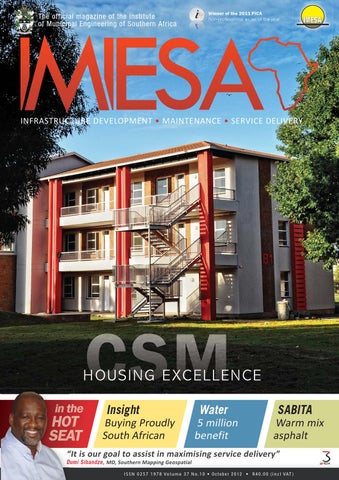
CSM Consulting Services conducted the professional services needed for The Masimong 4 Community Residential Units project in Matjhabeng.
INFRASTRUCTURE DEVELOPMENT • MAINTENANCE • SERVICE DELIVERY
HOUS I NG EX CELLENCE in th he
Insight
Water
Buying Proudly South African
5 million benefit
SABITA Warm mix asphalt
“It is our goal to ultimately maximise service delivery” Dumi Sibandze, MD, Southern Mapping Geospatial
waste management
PANEL DISCUSSION The latest products and ser vices in road construction
67
Education 115 SAICE & WRC Water Competition Municipal water 116 Municipal invoices not consumer friendly
P6
Roelof Jacobs Lafarge South Africa
69
Frank Cattich Velocity Road Rehabilitation
71
Mark Smith CLM Positioning Solutions
73
123
Trevor Freestone Polokwane Surfacing
75
Pascal Garrioch National Cold Asphalt
77
Alber t Weber Technicrete
79
Road equipment 125 Bell previews new E-series ADT 126 Sustainable concrete roads 127 New road stabilisation product 128 Improving public transpor t 130 Facelift for Free State bridge Water equipment 131 Relocatable steel reser voirs 132 Reinforced soil at
Energy 119 Biogas digesters installed in KZN Municipal governance 122 Reassessing municipal management
MEDIA
I S S N 0 2 5 7 1 9 7 8 V o l u m e 3 7 N o . 1 0 • O c t o b e r 2 0 1 2 • R 4 0 . 0 0 ( i n c l VAT )
Regulars 3 Editor’s comment 5 President’s comment News 9 Local government leadership is critical
Government perspective 12 State-owned construction company – debate needed
Industry perspective 14 Building bridges for the breaking Insight 19 To impor t…or not to? Water and wastewater 25 Long-term water requirements addressed
32 Municipal groundwater supply SAPPMA Conference 47 A holistic view of the
Housing 81 Integrated solutions at Scottsdene
84 Free housing construction plans 87 R5 billion for housing projects 89 Reducing water losses Asset management 93 Integrated asset management 95 Remote environmental monitoring CESA Aon Engineering Excellence Awards 99 Publisher of the year 100 Winner: Projects valued in excess
applications
62 64
Mobile crushing plant launched Reduced fuel consumption for hydraulic breakers
in the he
HOT HO SE S EAT
101
Commendation: Projects valued in excess of R250 million
103
Entr y: Projects valued in excess of R250 million
104
Winner: Projects valued between R50 million and R250 million
105
Commendation: Projects valued between R50 million and R250 million
105
Winner: Projects valued at less than R50 million
Dumi Sibandze, MD, Southern Mapping Geospatial on managing municipalities
16
Municipal electricity wired for success
Bushkoppies WWTW
133 134
Historical wooden pipeline saved PVC minimisation clause removed
135 Tough pumps for abrasive fluids 135 Online academy launched 136 Built-in protection for pumps Products and services 137 Township road construction brochure available
of R250 million
humble pipe
SABITA 55 The benefits of warm mix asphalt 59 SABITA membership listing 61 Asphalt planer for diverse
Total Geo-spatial Information Solutions now ISO cer tified
Waste management 112 The way for ward:
91 Water losses
Construction conundrum
Commendation: Best International Project
137 138 139 140 140 141 143 144
Paving skills development Paving specified for housing estate Precast CRCP system developed Unimog to Kalagadi well A decade of growth for pump distributor Failing retaining walls – are you covered? Innovation and customer suppor t Record time achieved for supply contract
IMIESA October 2012
1
Clear Air and Clean Streets
The
C201 – Refreshingly Clear
When sweeping with the C201 Compact, Johnston’s “Water Curtain” technology traps small dust particles (PM10 and PM2.5) helping air quality by preventing their airborne release into the environment. Link air quality to the reduced fuel consumption of the C201 in work mode – up to 40% less fuel than other sweepers in its class – plus Eco Mode fitted as standard for in-transit fuel savings, and the Johnston C201 Compact is one of the cleanest sweepers available. Finally with an annual reduction of CO2 to 16 tonnes, the Johnston C201 is an environmental winner.
Contacts us on +27 (0)21 948 4746 email info@transtech.co.za
www.transtech.co.za
Surprisingly affordable, totally dependable
The VT650 The VT Range of truck mounted sweepers is now established as the most durable and dependable road sweeper ever produced by Johnston, a fact supported by our sweepers maintaining the highest residual value. With more than 50 years of engineering expertise and design the VT Range leads the way, offering you years of outstanding performance.
www.transtech.co.za
You can choose your VT Range options from our selection of Customer Packs and save even more time, cost and labour. Ask about our Contractor’s Pack, the Productivity Pack or our Eco Pack and you can be confident that whatever you specify, the VT Range from Johnston will provide you with the best solution in an ever demanding market.
Contacts us on +27 (0)21 948 4746 email info@transtech.co.za
EDITOR'S COMMENT
PUBLISHER Elizabeth Shorten ASSOCIATE PUBLISHER Ferdie Pieterse EDITOR Richard Jansen van Vuuren HEAD OF DESIGN Frédérick Danton SENIOR DESIGNER Hayley Mendelow SENIOR SUB-EDITOR Claire Nozaic SUB-EDITOR Patience Gumbo CONTRIBUTORS Candice Landie, Helen Seyler, Andiswa Milisa, Kornelius Riemann, Nick Mannie, Greg Austin PRODUCTION MANAGER Antois-Leigh Botma PRODUCTION COORDINATOR Jaqueline Modise FINANCIAL MANAGER Andrew Lobban (ACIS, FCIBM) MARKETING AND ONLINE MANAGER Martin Hiller ADMINISTRATION Tonya Hebenton DISTRIBUTION MANAGER Nomsa Masina DISTRIBUTION COORDINATOR Asha Pursotham SUBSCRIPTIONS subs@3smedia.co.za PRINTERS United Litho Johannesburg +27 (0)11 402 0571 ___________________________________________________
T
HE UNITED STATES has never been a shy nation. Everything is bigger and better in ‘State-side’, or so it seems. I was very surprised recently when I read about the former mayor of Chicago’s backing of a very unusual decision – this being to reverse the flow of the Chicago River, AGAIN. Yes, you read correctly. The flow of the Chicago River was first reversed in 1900! Chicago originally pumped untreated sewage into the Chicago River, which in turn emptied into Lake Michigan. In an apt case of not seeing the bigger picture, the lake soon became the city’s primary source of fresh drinking water. As was to be expected, contagion soon ran rampant and outbreaks of cholera and typhoid claimed thousands of lives. So, in 1900, a group of engineers, in an effort to keep the lake clean, blocked the Chicago River's path to the lake – effectively reversing the flow with the construction of two canals directing the water to run back inland and eventually into the mighty Mississippi River. This ‘old-school’ engineering solution has now eventually led to a new problem. Several nonindigenous species of fish are now migrating up the Mississippi and are threatening the lake’s ecosystem. In addition, three problems still persist. Firstly, the lake level's controversy remains. Since the channel system still receives the treated effluent and overflow, it is necessary for some diversion to provide a current. When drought conditions in the 1980s hampered navigation on the Illinois and Mississippi rivers, suggestions that the Chicago diversion be increased were opposed on the basis of the potential reduction in lake levels. Secondly, pollution continues to affect the area. In 1969, the Sanitar y District adopted
ADVERTISING SALES Jenny Miller Tel: +27 (0)11 467 6223 ___________________________________________________
PUBLISHER: MEDIA No. 4, 5th Avenue, Rivonia 2056 PO Box 92026, Norwood 2117 Tel: +27 (0)11 233 2600 Fax: +27 (0)11 234 7274/5 E-mail: richard@3smedia.co.za www.3smedia.co.za ANNUAL SUBSCRIPTION: R480.00 (INCL VAT) ISSN 0257 1978 IMIESA, Inst.MUNIC. ENG. S. AFR. © Copyright 2012. All rights reserved. ___________________________________________________ IMESA CONTACTS IMESA Administration Officer: Ingrid Botton P O Box 2190, Westville, 3630 Tel: +27 (0)31 266 3263 Fax: +27 (0)31 266 5094 Email: imesa@webstorm.co.za Website: www.imesa.org.za
EAST CAPE BRANCH Elsabé Koen Tel: +27 (0)41 505 8005 Fax: +27 (0)41 581 2300 E-mail: elsabek@africoast.com KWAZULU-NATAL BRANCH Secretary: Rita Zaayman Tel: +27(0)31 311 6382 NORTHERN PROVINCE BRANCH Secretary: Cornel Taljaard Tel: +27 (0)82 899 8341 Fax: +27 (0)11 675 1324 E-mail: cornel@rchc.co.za SOUTHERN CAPE KAROO BRANCH Secretary: Henrietta Oliver Tel: +27(0)79 390 7536 Fax: 086 536 3725 E-mail: imesa.southcape@gmail.com WESTERN CAPE BRANCH Secretary: Erica van Jaarsveld Tel: +27 (0)21 938 8455 Fax: +27 (0)21 938 8457 E-mail: erica.van_jaarsveld@capetown.gov.za FREE STATE AND NORTHERN CAPE BRANCH Secretary: Wilma Van Der Walt Tel: +27(0)83 457 4362 Fax: 086 628 0468 E-mail: imesa.fsnc@gmail.com
All material herein IMIESA is copyright protected and may not be reproduced either in whole or in part withoutt the prior written permission of the publisher. The views of contributors do not necessarily reflect those of the Institute of Municipal Engineering of Southern Africa or the publishers.
an ordinance that forced pretreatment of industrial pollutants at their source. It prohibited discharges into Lake Michigan and reduced those into the waterways. Although more than 90% of the district’s wastewater is treated, a heavy rainfall or quickly melting snow can still force the district to open the floodgates and let raw sewage escape into the lake, violating the spirit, if not the letter, of this law. A 1972 federal law required area wide planning to control water pollution. The Tunnel and Reservoir Plan (TARP), prepared by the North-eastern Illinois Planning Commission, with Sanitary District expertise, provided a solution to the third problem, the lack of efficient natural drainage in such a flat region. The majority of the district has combined sewers carrying both waste and stormwater. Heavy rainstorms can overload the combined sewer systems so that the sewers overflow into the district’s waterways and flood low-lying areas. Phase 1 of TARP, the anti-pollution phase, which went into operation in 1985, involved the construction of 10 miles (16.09 km) of tunnels to capture the overflow. Phase 2, the anti-flooding phase, calls for an additional 21 miles of tunnels plus three large reservoirs. By re-reversing the flow of the river again the non-indigenous species of fish will not be able to reach the lake, and used water will be recycled back to the lake instead of down the Mississippi. The local engineering and construction firms are eagerly awaiting the passing of the plan as it will require a complete overhauling of the city’s soon to be defunct sewerage system. I’m certain that I, and many of our readers, will be learning about mega projects such as this during October and November as IMIESA, along with many of our readers, will be attending the SAFCEC, IMESA and CESA conferences. See you there!
As was to be expected, contagion soon ran rampant and outbreaks of cholera and typhoid claimed thousands of lives
BORDER BRANCH Secretary: Melanie Matroos Tel: +27 (0)43 705 2401 Fax: +27 (0)43 743 5266 E-mail: melaniem@buffalocity.gov.za
REST OF SOUTHERN AFRICA Representative: Andre Muller E-mail: imesa@webstorm.co.za
Defying gravity
Richard Jansen van Vuuren
The official magazine of the Institute of Municipal Engineering of Southern Africaa
Winner of the 2011 PICA Winn Non-professional writer of the year Non-p
IMESA
A SA MEESA MES IMESA IM
PICA ar the year of the 2011 Winner l writer of fessiona Non-pro
Instit ute Africa ern zine of the al maga eerin g of South The offici cipal Engin of Muni
INFRASTRUCTURE DEVELOPMENT • MAINTENANCE • SERVICE DELIVERY
INFR AST
RUC TUR
E DEV ELO
PME NT
ͻ MAI NTE
NAN CE
IVER VICEE DEL RVIC ͻ SER
Y
Cover opportunity
E N Zn o iioon C E DpoEthSol-B e soluuutttio M E Rwe rs Po
Water in
e
T
Africa
Sustainable operations
TT ASSTT SAS
hleessss ncchle ren Tren ologggyy nolo hn ech tech
HOUSING E XC E L L E NC E in th he
Insight
Water
SABITA
Buying Proudly 5 million Warm mix benefit asphalt nce Fina “It is our goal to ultimately maximise service delivery” tionsMD, Southern Dumi Sibandze, Mapping Geospatial solu
HousingSouth African
reinforced r precasstt ing directo forr preca
In each issue, IMIESA offers advertisers the opportunity to get to the front of the line by placing a company, product or service on the front cover of the journal. Buying this position will afford the advertiser the t cover story on pages and maximum exposure. For more information on cover bookings contact Jenny Miller on tel: +27 (0)11 467 6223.
MEDIA
6 P16
I S S N 0 2 5 7 1 9 7 8 V o l u m e 3 7 N o . 1 0 • O c t o b e r 2 0 1 2 • R 4 0 . 0 0 ( i n c l VAT ) MEDIA
ce V ) lete servi izen, Echo Group market R 4 0 . 0 0 ( i n c l VAT s ide a comp a Esterhu TEMBER “We prov slabs” Melind s 3EP 7 No.9 lume 3 hollow core 9 7 8 Vo 0257 1 ISSN
IMIESA October 2012
3
11696 Initiative
Global Innovative Solutions Specialist consulting engineering services through focused business units to meet client requirements in the fields of:
Working hand in hand with municipalities to provide service delivery outcomes that balance the technical and social needs of the community we serve.
• • • • • • • •
Services include: • Water and Wastewater Services • Solid Waste and Environmental Services • Geographic Information Systems • Underground Services Location • Infrastructure Refurbishment • Turnkey Solutions
Water Wastewater Agriculture / Irrigation Roads & Development Housing Environmental and Solid Waste Electrical and Building Services Project and Construction Management
Tel: +27(31) 535 6000 | Email: bsdbn@boschstemele.co.za www.boschstemele.co.za
Tel: +27(31) 535 6000 | Email: info@boschmunitech.co.za www.boschmunitech.co.za
PRESIDENT'S COMMENT
IMESA
IMESA CONFERENCE
Addressing infrastructure challenges
by Jannie Pietersen, president of IMESA
The 76th IMESA Conference, to be hosted by the Southern Cape/Karoo branch in George from 24 to 26 October 2012, promises to be a special event in the unique and beautiful area of the Garden Route, the Klein Karoo and the Greater Karoo.
T
HE THEME FOR this year’s conference, ‘Engineering for Change’, is appropriate in terms of technological advancement occurring at the greatest rate ever. Emphasis is on continually improving efficiency and output while increasing the life expectancy of infrastructure assets, with dwindling natural resources. Municipal engineering has undergone a huge change in the last 10 years, with less technical capacity in municipalities and more reliance on government and outside sources for funding and support. The quality and quantity of human resources are also dwindling, while a growing population has greater needs and demands. The lack of economic development and delivery of infrastructure in rural areas, together with unemployment, has led to increasing migration and urban influx, increasing the burden on the resources within municipalities. This year’s IMESA Conference is aimed at using technology advances and changes in infrastructure engineering to address these
shortcomings. Conference delegates will be presented with professional papers on relevant engineering topics and opportunities to meet,
Municipal engineering has undergone a huge change in the last 10 years network and exchange experience. There will also be an extensive range of technology and products exhibited, as well as technical tours showcasing local engineering achievements.
Another opportunity to showcase engineering achievements is at our biannual IMESA/CESA Excellence Awards, which will be presented at the opening cocktail function. The aim of these awards is to recognise and promote innovation, ingenuity and science in finding professional engineering solutions to the challenges faced in responding to community needs, environmental sustainability and financial sustainability of municipal infrastructure. Award categories include: • structures and bridges • water/wastewater • roads/stormwater • environment • community upliftment The entries this year provide ample evidence of the quality and ability of our local resources to meet the challenges of ‘Engineering for Change’, and it will be an honour to present the awards. In closing,this is my last entry for this page– my two year term in office terminates at the end of October 2012. My special thanks to all our readers, I hope you've enjoyed reading my comments.
IMIESA October 2012
5
COVER STORY
Multidisciplinary This project was awarded Best Rental Housing Project – 2012 Free State Govern Mbeki Award. National Govern Mbeki Award 2012 runner up and 2012 SAHF category 2B award.
CSM
CONSULTING SERVICES conducted all the professional services needed for this project. The Masimong 4 Community Residential Units (CRU) project in Matjhabeng is a publicprivate partnership (PPP) development, where the Free State provincial government, through the Department of Human Settlements, formed a partnership with Matjhabeng Local Municipality and Harmony Gold Mining Company to develop affordable rental housing for low income groups. The Department of Human Settlements is providing financing as well as the regulatory and management framework, while Harmony Gold Mining Company has donated land and buildings, and also provided bridging finance to the project. The rental housing units developed are government-owned through Matjhabeng Local Municipality and will not at any stage be transferred to individual occupants. CSM Consulting Services was commissioned to provide professional services for the design, facilitation and management of the implementation of the programme. A Memorandum of Understanding (MOU) on behalf of the Free State Department of Human Settlements with Matjhabeng Municipality and Harmony Gold Mining Company was
concluded in 2010. The MOU was geared towards the formation of a partnership between the Free State provincial department, Matjhabeng Municipality and Harmony Gold Mining Company to focus on converting single quarter mining hostels into rental family units. The overall objective of the partnership was to upgrade existing units into sustainable and acceptable tenancy, thereby providing high-quality living environments to qualifying beneficiaries in the Welkom area. A project steering committee, which includes the Free State province, National Depar tment of Human Settlements, CSM Consulting Ser vices, Harmony Gold Mining Company as well as the Matjhabeng Local Municipality was set up and has been running since the inception of the project. Masimong 4 was identified by the steering committee as the first phase of the MOU. CSM services include: • application for approval of the project • feasibility study for the project • architecture • civil engineering • electrical engineering • electronic engineering • project management • property management: design of plan and systems and ongoing involvement acting as director on Amohela Property Management • quantity surveying • structural engineering. Harmony Gold Mining company provided the folowing: • bridging finance • donation of land • commercial and social amenities
Sufficient effort was put in to ensure a cost-effective, low maintenance, wellrun development
6
IMIESA October 2012
COVER STORY
excellence
• social development framework • property management: acting as the director on Amohela Property Management.
Duplication of development Prefeasibility studies and engineering services scoping studies have already been completed for other similar developments identified in the MOU. CSM is of the professional opinion that this development is not only replicable, but can be implemented more cost-effectively, depending on specific development objectives, locality and size. The minister of Human Settlements, Tokyo Sexwale, officially opened the Masimong 4 estate on 20 June 2012 and stated that based on the quality of development that he has viewed during his visit, the next phase of the development is approved. Target market The target market for the development is for tenants with an income of less than R3 500 per month. A small number of units have been made available to Harmony Gold Mining employees earning above R3 500, but this is in line with the CRU policy that makes provision for accommodating existing tenants in a CRU development regardless of their income. Apartments are rented at the following monthly rates: • bachelors unit – R500 • one-bedroom unit – R700
• two-bedroom unit – R1 000 • three-bedroom unit – R1 200. Specific care in the design of the estate was to reach the objective where CSM could, with confidence, state that sufficient effort was put in to ensure a cost-effective, low maintenance, well-run development, which will host satisfied tenants willing to continuously pay their rental in time every month. This is proven by a consistent 0% rental default.
Innovative engineering Consideration into ongoing maintenance of the estate after construction was a key aspect of the design. It was a condition of the design brief that maintenance will not be performed by the local authority, but by the appointed property manager. The property manager’s agent
therefore took part in all design decisions ensuring that easy maintenance formed part of the team's design decisions. Successes reached in terms of planning and designs consist of: • Stormwater originally drained to the centre of the clusters, from where it connected to an elaborate open deep V channel and underground system. Stormwater control was changed to a predominantly overland system that is not only easier to maintain, but also assisted in providing a safer environment. • Safety of tenure was achieved by the utilisation of biometric access control. • Roads and parking were constructed with paving rather than bitumen topped surface, ensuring easier maintenance. • Prepaid water meters (hot and cold) were installed, again ensuring less cost in monthly meter reading and debtor control. • Boreholes and storing of water for irrigation was introduced to lessen the cost to the tenant. • TV antennas were installed as part of the project to lessen the effect on the aesthetics of the building, should tenants start installing their own antennas at a later stage. • Solar geysers and energy efficient lighting were installed to reduce electricity cost. • The layout of the development ensured easy service delivery in terms of emergency and other services like refuse control.
CONTACT CSM Tel: 0861 276 266 | Web: www.csmeng.co.za
IMIESA offers advertisers an ideal platform to ensure maximum exposure of their brand. Companies are afforded the opportunity of publishing a two-page cover story and a cover picture to promote their products to an appropriate audience. Please call Jenny Miller on +27 (0)11 467 6223 to secure your booking.
IMIESA October 2012
7
I M E S A A F F I L I AT E M E M B E R S
IMESA
Afri-Infra
afri-infra@mweb.co.za
Kgatelopele Consulting
AJ Broom Road Products
ajbroom@icon.co.za
Knowledge Base
Arup SA
rob.lamb@arup.com
Lektratek Water
Aurecon
Danie.Wium@aurecongroup.com
Makhaotse Narasimulu & Associates
Bigen Group Africa
otto.scharfetter@bigenafrica.com
Maragela Consulting Engineers
BKS Consulting Engineers
siyandan@bks.co.za
Much Asphalt
BMK Consulting
brian@bmkconsulting.co.za
Nyeleti Consulting
Bosch Stemele
bsdbn@boschstemele.co.za
Odour Engineering Systems
Bosch Munitech
info@boschmunitech.co.za
BVI Consulting Engineers
marketing@bviho.co.za
CBI Consulting Engineers
durban@cbisa.co.za
Civilconsult Consulting Engineers Civil & Blasting Solutions Concrete Manufacturers
mail@civilconsult.co.za jane@drillingandblasting.co.za cma@mweb.co.za
Corrosion Institute of Southern Africa secretary@corrosioninstitute.org.za
kgatelopele@wol.co.za info@knowbase.co.za general@lwt.co.za mmakhaotse@mna-sa.co.za admin@maragelaconsulting.co.za john.onraet@murrob.com ppienaar@nyeleti.co.za mathewc@oes.co.za
PD Naidoo & Associates Consulting Engineers Johannesburg@pdna.co.za Power Construction
nbarnard@powergrp.co.za
Pumptron
info@pumptron.co.za
Pragma Africa
deang@pragma.co.za
Rocla Royal HaskoningDHV SBS Water Systems
karen.devos@murrob.co.za francisg@rhdv.com irene@sbsgroup.co.za
CSIR Built Environment
LAustin@csir.co.za
Sektor Consulting
cradock@sektor.co.za
Davies Lynn & Partners
dlpdbn@dlp.co.za
Sight Lines
sales@sightlines.co.za
divb@dbsa.org.za
SiVEST SA
Development Bank of SA DPI Plastics EFG Engineers Elster Kent Metering EnviroServ Waste Management Geotechnologies GLS Consulting Goba Hidrostal SA Huber Technology Hydro-comp Enterprises I@Consulting Iliso Consulting Infraset Jeffares and Green Johannesburg Water
mgoodchild@dpiplastics.co.za eric@efgeng.co.za keith.bailey@za.elster.com benoitl@millenniumwaste.co.za garry@geotechnologies.co.za nicky@gls.co.za trumang@goba.co.za hstal@mweb.co.za fstammer@lantic.net dan@edams.co.za louis_icon@mics.co.za monde@iliso.com fmyburgh@infraset.com dennyc@jgi.co.za rtaljaard@jwater.co.za
SNA Inc Siza Water Company
garths@sivest.co.za snapta@icon.co.za tionette.bates@sizawater.co.za
Southern African Society for Trenchless Technology director@sasst.org.za SRK Consulting Sulzer Pumps Wastewater Syntell Thm Engineers East London
jomar@srk.co.za Sonja.Hattingh@sulzer.com julia@syntell.co.za thmel@mweb.co.za
TPA Consulting
roger@tpa.co.za
UWP Consulting
zulchl@uwp.co.za
Vela VKE WorleyParsons WSP Group Africa WSSA WRP Zebra Surfacing
capetown@velavke.co.za chris.brandsen@WorleyParsons.com dirk.hattingh@mbs-wsp.co.za nbinase@wssa.co.za ronniem@wrp.co.za andrew@zebrasurfacing.co.za
NEWS
SERVICE DELIVERY
Leadership for local government is critical A PwC report states that inspirational leadership is critical if cities implement their strategies and deliver the outcomes their stakeholders deserve.
B
UT LEADERSHIP ON its own is not enough, and local governments are failing to build the capabilities they need to overcome the challenge of execution in several key areas, such as adequate financing, implementation planning, and comprehensive performance and risk management. These are some of the findings in the latest PwC report focusing on the challenges facing today’s cities and local government organisations entitled: Making it happen – A roadmap for South African municipalities to achieve desired outcomes. This year’s survey of local, district and metropolitan municipalities confirms that leadership is critical to the development and execution of an organisation’s strategy. But with public, private and voluntary sector organisations collaborating to deliver public services, all stakeholders need to be aligned in order to maximise the chances of success and being able to do more with less. The study was under taken by PricewaterhouseCoopers LLP (PwC). It covers local, district and metropolitan municipalities across all of South Africa’s nine provinces. The findings in the report are based on 36 completed surveys. This research follows an international study carried out by PwC of local government leaders around the world, which also confirms that leadership is critical to the development and execution of an organisation’s strategy. Jan Gey van Pittius, PwC director and local government subject matter exper t, says: “While we agree that sound leadership is crucial to the implementation of strategy, in our view leadership on its own is not enough. The study discloses that, of the other internal management capabilities needed to accomplish a city’s vision, local governments are falling short in some key areas.” These key areas are: • Financing: More than half (56%) of municipalities see financing as the biggest
The study indicates that the majority of local governments (94%) is reaching out to their external stakeholders in designing and implementing their strategies
barrier to implementing strategies. There also appears to be a lack of capability to make plans resilient to the financial challenges. Less than a third (31%) of respondents reported having a strategic plan, underpinned by a financial plan with key risks properly assessed and mitigated. • Implementation planning: Only one in three (30%) of municipalities has a comprehensive implementation plan, with accountabilities and responsibilities in place, together with frequent monitoring, updating and risk mitigation. • Supporting frameworks, tracking systems and performance management: Outcome assessment and sourcing (both 53%) were cited as the biggest challenges to service delivery. Only one in five (19%) of respondents has a comprehensive performance management framework in place that is aligned to the municipality’s strategic objectives and supported by transparent reporting of performance.
Van Pittius says it is encouraging to note that all respondents have a strategic vision. “However, it is concerning to note that only just over half (56%) say that this vision is being implemented, having an impact and being regularly kept up to date. “A vision on its own is not enough. It needs to set the overall scene and direction for growth and development for the municipality. The shorter-term strategies (integrated development plan and spatial development framework) should take the vision (growth and development strategy) as a blueprint, and their formulation should be done with the involvement of key internal and external stakeholders.” The study also shows that almost two in six (42%) of municipalities reported that their organisations’ strategies were ‘completely integrated with the strategic visions’. For 39%, the level of integration is not complete as there are gaps and a lack of full integration. “In our view, municipal managers need a clear and deliverable strategy setting out the focus for the organisation, what is driving it and what it does best and why. The ability to respond to a constantly changing environment through sensitivity to market forces and having visibility of the future impact; and a clear mandate for change that is driven through the organisation,” says Van Pittius.
Service delivery: The challenge of assessing outcomes In carrying out the research for this report, PwC looked more closely at the service delivery cycle of municipalities to understand the key challenges being faced by local governments. According to 53% of respondents, the greatest challenges are posed by sourcing and outcome assessments. The study indicates that the majority of local governments (94%) is reaching out to
IMIESA October 2012
9
NEWS
their external stakeholders in designing and implementing their strategies. Most local governments report the need to partner collaboratively with city officials, followed by residents (44%) and to a lesser extent, businesses (36%). Local governments also appear to have a need to partner with private (89%), public (86%) and voluntar y (64%) sector providers to deliver their strategies effectively.
of respondents (42%) see innovation as the second most significant obstacle. The research suggests that smaller organisations are more likely to involve all levels
Key success factors Only one in five (22%) of local governments strongly agree and just over half agree (58%) that they have been successful in implementing their strategies. Leadership is seen as by far the most important factor in enabling the implementation of a strategy with more than two-thirds (69%) of local governments emphasising this factor. There are some strong barriers to the successful implementation of a strategy. The most important of these identified by respondents is finance (56%). Over two in five
in a highly collaborative process and have less negative impact on the implementation of strategies arising from the number of decision-making levels and complexity in their organisations. Furthermore, most of the respondents from the relatively smaller municipalities believe that per formance monitoring is the biggest challenge in the ser vice deliver y cycle, whereas larger local government respondents believe it to be an outcome assessment. “We believe that there is an urgent need for cities and local government organisations
to prioritise their activities and develop a road map to ensure they have in place the internal capabilities and external relationships needed to deliver efficient and effective strategies. With the mantra ‘do the same with less’ ringing in their ears, local governments must focus on outcomes in order to make things happen,” states Van Pittius. The suggested ‘agenda for action’ should include: 1. investing in their capabilities around financing 2. redesigning their organisations to enable more effective collaboration with primar y stakeholders 3. assessing the impact of their size and scale, seeking out ways to standardise, simplify and streamline their operations 4. introducing systems to measure outcomes and value for money 5. developing implementation plans with clear roles, responsibilities and timetables for actions.
Only one in five of local governments strongly agree and just over half agree that they have been successful in implementing their strategies
IMIESA October 2012
A CONCRETE PAVED ROAD FOR ALL Quality paved roads for every setting. Creating community skills development. SABS approved product from CMA members. For supply and technical advice visit the CMA website.
www.cma.org.za
11
GOVERNMENT PERSPECTIVE
DEBATE NEEDED
Establishment of a stateowned construction company Human Settlements Minister, Tokyo Sexwale, says no decision has been taken as yet to establish a state-owned construction company, but he wants a debate on the issue to address the shoddy workmanship that characterises low-cost housing.
S
EXWALE MAINTAINS, however, that the R50 billion rectification bill is forcing his hand. “I cannot continue giving money to people whose sole mission is to undermine the work of government. We want to see you succeeding, creating wealth and being profitable. At the same time we want quality delivery. What we have been getting in the past is less than pleasing, shoddy work,” states Sexwale. The triple challenges of poverty, inequality and unemployment means that the government
12
IMIESA October 2012
and the industry, the very foundation of infrastructure development in the country, have to change course. The South African economy is going through tough times forcing the Gross Domestic Product to be revised from 2.9 to 2.7%, largely influenced by what is happening in the global economy. President Jacob Zuma saw it fit to establish the Presidential Infrastructure Coordination Commission in line with the country’s New Growth Path. This would see over R800 billion
being invested in infrastructure over the next few years. Human Settlements occupies a very pivotal role in infrastructure development because whatever the country does, it had to think about where people lived first as they could not live on freeways and harbours. Sexwale asks: “Why not give the Human Settlements budget of R25 billion a year to major companies that would be forced to bring in their partners into the low cost housing sector?”
GOVERNMENT PERSPECTIVE
“We want people who are credible, people who pay attention to detail, people who have the know-how and who can provide us with quality work. We are gatvol, fed-up… We want taxpayers to feel that it is worth it to pay their taxes,” he says. Governments worldwide are known to be very ineffective, characterised by stinking corruption and nepotism, but this does not mean that the idea of a state construction company is not going to work in South Africa. It is working in Brazil. This also does not mean that government is going to control 100% of the state-owned construction company. Management of such a company can remain with the private sector. “I cannot continue doing this job knowing that the figure of R50 billion will escalate and we keep on going to the same people (who are the cause of the problem in the first place) to rectify. I need your help to find out what it is that you are thinking,” maintains Sexwale.
Sanitation task team report The Sanitation Task Team, appointed by Sexwale last September to look at the challenge of unclosed toilets in the country, found that there is no compliance to the norms and standards in the implementation of the programme. Briefing the Portfolio Committee on Human Settlements on the findings of the Task Team in parliament recently, Sexwale said the lack of compliance led to poor operation and maintenance of sanitation facilities and infrastructure by municipalities designated as Water Services Authorities. The report has also found, among others, that: • Local authorities are not using the annual Municipal Infrastructure Grant allocation of R7 billion for water and sanitation, rerouting it to other priorities instead. • As a result, municipalities are not adequately planning for the sanitation programme in their budgets. • Government has delivered over 2.5 million sanitation facilities since 1994, halving the backlog by 2010. • Rural and urban communities are generally serviced. • More settlements are connected to the grid (waterborne). • Informal settlements dwellers on privately owned land are severely underserviced. The Ministerial Sanitation Task Team recommends that sanitation become a national priority of government, something that has been achieved following a decision by the recent Cabinet Lekgotla to elevate it to one of the Strategic Infrastructure Projects.
“We want people who are credible, people who pay attention to detail, people who have the know-how and who can provide us with quality work.” Tokyo Sexwale “The first thing for common people, the first infrastructure before a road and airpor t and all these things, even before a house, is a toilet. Sanitation is the first line of defence for human dignity,” says Sexwale. Sanitation must remain a national priority, until the last person in South Africa found dignity – not behind a tree or a rock. There was something wrong in buying arms, which were impor tant but not critical to the countr y at the time when there was pressing socio-economic imperatives, states Sexwale. “If only a quar ter of that money would have been given to housing and sanitation… If you cannot deliver that (sanitation), people cannot trust you with delivering houses and other things. If we can’t provide this one, then we are not wor th the trust people have invested in us.” Sexwale also announced that he will request the Special Investigating Unit to see if people who are responsible for the “sloppy work” in the deliver y of sanitation cannot be brought to book.
Housing challenges in the Free State Following the Por tfolio Committee’s visit to the Free State in September 2011 as par t of its Parliamentar y oversight mandate, it expressed disquiet about the state of housing deliver y by the provincial human settlements depar tment in that province. Upon invitation for a briefing to Parliament by the Por tfolio Committee led by Nomhle
Dambuza, Sexwale repor ted to the committee, inter alia, as follows: • The National Depar tment of Human Settlements has established as far back as 2010 that there is serious cause for concern around housing grant expenditure totals, which do not tally with the amount of units delivered on the ground. • At the time, this led to the Human Settlements MINMEC – a committee of all provincial human settlements MECs and the minister – taking a decision to reallocate certain funds to other provinces to avoid non-performance and failure of delivery. • National Treasury also become involved and indicated their concerns around the Free State issue. • On 16 May this year, the office of the Auditor-General independently dispatched a team led by Paul Serote to the Free State, and having interacted with human settlements officials presented disconcerting analysis and findings on the housing delivery situation in the province. These included wrongful housing allocation by senior managers, irregular expenditure of more than R500 million, houses built without being registered with the NHBRC, houses recorded on the Housing Subsidy System that could not be physically verified, advanced payments to suppliers on behalf of contractors; and so on. • The full and detailed report beyond the briefing to the Portfolio Committee will be tabled before the cabinet for remedial action.
IMIESA October 2012
13
INDUSTRY PERSPECTIVE
Building bridges… for the breaking!
The finals of the annual BKS-SAICE International Bridge Building Competition organised by the South African Institution of Civil Engineering were recently held at St Albans College in Pretoria.
T
HE COMPETITION attracted participation of approximately 600 schools countr ywide, as well as from Namibia and Zimbabwe. The finalists from all the regions, organised by the South African Institution of Civil Engineering (SAICE) branches countr ywide, competed for
the much sought-after shield and the cash prize for team members and their schools. The 2012 winners are the Domino Ser vite School from Pietermaritzburg with its bridge weighing 130 g, which carried 87 kg before it succumbed! The team consisted of Janek Stegen, Luke Allen and Johnny Pop. The
second place went to Merrifield College in East London, with team members Dakota Corbett, Mitchell Struwig and Vasco Mendes. The team’s bridge weighed 160 g and carried 75 kg. Technical High School Daniel Pienaar from Uitenhage came third with a bridge weighing 155 g and withstood 63 kg before destruction. Its team consisted of Frank Ferreira, Nicholas Coetzee and Anroe Steyn-Clulow. For the three teams to reach the winning marks of 156, 114 and 105 respectively, aspects such as aesthetics, the mass of the bridge and, ultimately, the weight-bearing capacity determined the winning bridge. The bridge building kits contained 25 sticks of 3 mm nominal thickness, glue and a little string. Construction is done according to a technical briefing given on the day. The teams then got down to the gruelling business of planning, designing, measuring, cutting dowel sticks and constructing the bridges by gluing ever ything together to form sturdy bridge structures, while racing against the clock towards ‘tools-down’ time. The bridges were then left to dr y for a few hours. The adjudicators completed their task regarding the aesthetics and weight of the bridges. SAICE initiated the bridge building competition in 1991 to further high school learners’ use of mathematics and science in an engineering context to grow the profession. It has since become an enormous success and is enjoyed by all. The bridge building competition forms an integral part of some schools’ activities and is recognised on the same level as academic or sports achievements. In some schools it has been incorporated as part of the curriculum. Because of its practical and hands-on nature, this event is SAICE’s most successful initiative in attracting learners to civil engineering, as well as promoting a general awareness of the profession. The competition provides an ideal career guidance opportunity. The camaraderie that develops among the various competing teams during their stay gives learners the opportunity to also build bridges between people, cultures and countries!
TOP Intense concentration is essential LEFT The competitors constructing their bridges
14
IMIESA October 2012
Through a sound understanding of and partnership with the public sector, Nedbank provides the funding and banking expertise needed to help the country meet the challenges of infrastructure development. Just one of the ways we embrace our responsibilities to make a difference. For more information email us at publicsector@nedbank.co.za.
Nedbank Limited Reg No 1951/000009/06, VAT Reg No 4320116074, 135 Rivonia Road, Sandown, Sandton, 2196, South Africa. We subscribe to the Code of Banking Practice of The Banking Association South Africa and, for unresolved disputes, support resolution through the Ombudsman for Banking Services. We are an authorised ďŹ nancial services provider. We are a registered credit provider in terms of the National Credit Act (NCR Reg No NCRCP16).
NET#WORK BBDO 8014623
SUPPORTING THE PUBLIC SECTOR IN INFRASTRUCTURE DEVELOPMENT.
HOT SEAT
GIS TECHNOLOGY
The eye in the sky MANAGING MUNICIPALITIES GIS can provide a wealth of information necessary for municipalities to manage not only their geographic topography, but also social dynamics and urban sprawl, pollution and resources. Richard Jansen van Vuuren finds out exactly how this is done from Dumi Sibandze, MD of Southern Mapping Geospatial.
Hyperspectral technology is able to provide quantitative information on two key water quality indicators. Organic water quality through direct measurement of Chlorophyll-a concentrations in water and turbidity. By mapping these water quality indicators, it is possible to determine not only where water quality source points occur but also the likely contributors
16
IMIESA October 2012
Please provide a brief background on Southern Mapping Geospatial.
how are these used to assist municipal management? Recent technological
Southern Mapping Geospatial is a division of Southern Mapping. It was launched in 2010 to focus independently on the South African geographic information systems (GIS) market with the existing technology available through Southern Mapping. As I have extensive experience as a commercial pilot and am familiar with the technologies used, I was approached to head the company. We are South Africa’s only Level 1 BEE aerial survey company.
advancements in airborne and satellite imaging stand to benefit municipalities. High-resolution satellite coverages of all municipalities year on year since 2006, are already available free
What technologies does Southern Mapping Geospatial make use of and
take a conventional surveyor a lifetime. The same airborne LiDAR data used for engineering design is also being utilised by other municipal departments allowing for cross subsidisation of the data investment. The output imagery (up to 5 cm resolution) and accompanying height meas-
Disaster risk management is another municipal function area that is benefiting from the rich content of lidar of charge. These images allow for powerful analysis of formal and informal urban growth, and are essential inputs to Spatial Development Frameworks (SDFs) and Integrated Development Plans (IDPs). In conjunction with the vast amount of high-resolution satellite imagery being utilised for municipal planning, is the rapidly expanding use of airborne LiDAR (light detection and ranging). This technology allows for up to 200 000 survey accurate height measurement, to be captured per second from an aerial platform using laser technology. This translates into the ability to survey each square meter of an area the size of Johannesburg every four days, a task that would
urements allow for efficiencies in engineering design for township establishment, road, rail, power, sanitation and water bulk service infrastructure projects as demonstrated by Southern Mapping Geospatial's delivery of full coverage LiDAR for the municipalities of Johannesburg and Mogale City. Disaster risk management is another municipal function area that is benefiting from the rich content of LiDAR. By utilising high-resolution digital elevation models in flood modelling software, flood risk maps are easily generated as demonstrated by Southern Mapping Geospatial in Alexandra township in the City of Johannesburg. Cutting-edge airborne hyperspectral cameras
HOT SEAT
Left Multi-temporal satellite image coverage over south-western Polokwane. Note the rapid increase in RDP developments (in the north and south), and the subsequent reduction of informal housing units (centre) showing the positive effect of housing delivery in this area
have the ability to map water quality by accurately mapping levels of chlorophyll a and b in water bodies and rivers, thus pinpointing organic pollution sources. By also accurately measuring water turbidity, which is generally a function of erosion and mining activities, it is possible to discern not only organic pollution sources but also those from mining and construction sectors. Airborne technology is also able to assist with infrastructure monitoring and maintenance function of municipalities. Utilising airborne thermal cameras, Southern Mapping Geospatial is actively monitoring pipeline and industrial infrastructure to detect leaks and areas prone to failure.
Below High-resolution aerial photography of Kendal Power station. Lidar surveys that provide extremely accurate height positions of infrastructure are accompanied with high resolution aerial images such as this and can be used for detailed planning and mapping in GIS or CAD environments
In what areas of municipal management can all of these technologies assist? Satellite and airborne imaging technologies are able to assist municipal housing, engineering, disaster, infrastructure maintenance and monitoring, and planning functions. Southern Mapping Company’s experience in these fields is unprecedented. Being the only local black-owned geospatial firm offering these services, it is our goal to share this experience with the local government sector – ultimately to maximise service delivery. The provision of free and rich image data sets, coupled with our access to free open source GIS systems (with our University of Pretoria accredited training), is one of the ways we intend achieving this.
Business in such a specialised field must have limited access to young talent. How does Southern Mapping Geospatial address this issue? Southern Mapping Geospatial is extremely proud to be associated with Continuing Education at University of Pretoria, South Africa’s leading provider of work-
place training solutions for career professionals, to present a short course in Quantum GIS (QGIS). The short course will be offered on a postgraduate level with the aim of supplying valuable education to individuals wishing to grow in their fields. QGIS is an open source GIS software package, but it goes much further than that; the idea of open and free data coupled with an open source GIS software package is priceless. This education drive by Southern Mapping Geospatial will expose to the GIS community at all levels that there is another software option out in the market. Southern Mapping Geopspatial provides lectures on our cutting edge technologies at various universities and through this, identify candidates for our internship programme which currently stands at five sudents per year.
Southern Mapping Geospatial t +27 (0)11 467 2609 www.southernmapping.com
IMIESA October 2012
17
SA’s leading manufacturer of liquid storage tanks and gunite-based, seamless, reinforced Concrete Reservoirs.
Muleby Tanks installed by Famitec.
“Aquadam’s Muleby Tanks are your affordable, reliable and customised solution to liquid storage of any type.� – One of Aquadam’s many satisfied clients Known as the Muleby System Tank, Aquadam’s Prestressed Panel Reservoir is a highly effective storage solution. This money-saving post-tensioned circular concrete tank is extremely durable. The pre-casting process ensures a high resistant to corrosion and chemical attack. This high resistance allows for the usage in potable water up to sewage treatment plants. Muleby System Tanks can be used in any number of liquid storage applications and are available in a wide range of custom-designed volumes. Installation is quick and can take place in almost all weather conditions. Muleby System Tanks uses a highly effective construction method requiring less labor, less time onsite and virtually no concrete moulding shutters. Dangerous erections or constructions on heights are kept to a minimum and the relatively slender panels keep transport costs in check. The panels are precasted in a controlled factory environment, offering better quality control and faster production.
Pre-cast concrete panels are assembled on-site on a cast-in-situ bottom slab.
The system is post-tensioned using horizontal circumferential mono strands.
Manholes, anchorages etc. are cast as required, and the system can be closed with a pre-cast or cast-in-situ roof.
Aquadam’s Muleby Tanks are designed to exacting standards and meet the highest European standard of water tightness, Eurocode 2, part 3 Liquid retaining and containment structures.
Contact t XXX BRVBEBN DP [B Pretoria Tel: 012 - 810 0940 t $BQF 5PXO 5FM 021 - 905 7943
WATERTIGHT SOLUTIONS
INSIGHT
To be or not to BEE
Following South Africa’s 2011 post-World Cup hangover, Business Monitor International noted a gradual return to slow yet steady economic growth, with a GDP of 2.7% repor ted in 2012. However, international threat reigns supreme for the local construction sector, with the industr y experiencing a severe hangover from pre-World Cup excesses, IMIESA repor ts.
OCAL CONTENT, high-quality South African manufacturers can find products, fair labour practiccompeting on the global es and environmental stand- market challenging ards – these are the top four factors that determine a company’s Proudly South African status. By opting for products that carr y this local stamp, consumers, businesses and government make a personal contribution to building the nation and economy. According to the Proudly South Africa Campaign, buying South African stimulates an increased demand for locally produced products and ser vices. This translates into the safeguarding of existing employment opportunities, economic growth and the creation of more quality employment opportunities in our countr y.
L
The World Cup that was In order to complete the 2010 World Cup projects on time, budgets were pushed to the limit and, in some cases, stretching even further. The effect: an almost instant drawback in government funding following the big event. BMI reported that real growth decelerated from 7.8% year-on-year (2009) to 0.9% in 2010, and continued to weigh heavy on South African construction companies in 2011 – resulting in a drop in share prices. The medium-term outlook for the local
IMIESA October 2012
19
Wastewater never tasted so sweet. By using Talbot Operations’ dedicated, multi-disciplinary team to operate, manage and maintain your Water or Wastewater Treatment Plant, you can rest assured that keeping your discharge compliant will always be a priority. We tailor our solutions to suit your needs and with every detail from testing to maintenance covered, you can simply sit back and enjoy.
¡ ¡ ¡ ¡ ¡ ¡ ¡
Full outsourced operation On-site laboratories supported by SANAS accredited Talbot Laboratories Dedicated team of technicians, process controllers, process specialists and engineers Call centre to respond to process failures and maintenance breakdowns Customised process controller training and skills transfer Engineering and process audits Green drop assessments
LABORATORIES t ENGINEERING t GREEN ENERGY t OPERATIONS
+27 (0) 33 346 t UBMCPU!UBMCPU DP [B t XXX UBMCPU DP [B
INSIGHT
construction industr y was a carefully calculated positive one of 2.5% forecast for 2012.
Year of infrastructure According to President Jacob Zuma’s State of the Nation address, 2012 has been dubbed the ‘year of infrastructure’. Clearly identified infrastructure projects have been strategically identified across the country, and the Eastern Cape is finally receiving its long overdue budget allocation. The Department of Public Works is also on a drive to transform the built environment, including the maintenance of current structures. Great hype has been created around the department’s new job driver: the New Growth Path, which stresses the need for substantial public investment in infrastructure. Although the much-anticipated R3.2 trillion-infrastructure budget has been allocated provincially, there are still concerns from the private sector that the actual projects are yet to manifest. There seems to be no urgency in unlocking the massive infrastructure capital made available by National Treasury. But with ageing infrastructure rearing its ugly head and the countr y’s housing situation in dire straits, the spotlight is on government to deliver on its infrastructure mandate. The private sector has been in negotiations with government over numerous issues, ranging from skills development and training through to corruption and failure to pay contractors and consultants on time. However, the issues of local supply and BEE are also burning concerns that need to be tackled head on.
built or even suited for local conditions? This could be a good reason as to why the countr y battles with the state of its infrastructure over the long-term. Is price being selected over quality, job creation and local economic growth? IMIESA chats to marketing executive of Dynamic Fluid Control, Charl Myburgh, on the company’s experiences with local government and tender processes. DFC manufactures valves for the water, wastewater, mining and mineral processing industries and its biggest customers are therefore water authorities and bulk water suppliers such as the Department of Water
Infrastructure projects have been strategically identified across the country
A local supplier’s perspective The number one problem arising from imported products is whether these materials are
Tender processes can be detrimental to local manufacturers if imported goods can be supplied at a lower cost
Affairs and Rand Water. We asked Myburgh about the tender process with local government and the clout DFC’s BEE status holds, if any. Normally, local government has a minimal prescribed technical requirement but eventually, it will opt to buy from the cheapest supplier, regardless of which countr y the product is being imported from.” When it comes to smaller orders, these are usually narrowed down to the cheapest of three quotes. With cheap labour and manufacturing costs, it’s no surprise that most products are imported from the East. “What happens is, a one- or two-man organisation comes along, is
IMIESA October 2012
21
INSIGHT
fully BEE compliant, gets awarded the tender and then imports the products from our Asian competitors. Who runs a follow-up on these companies? What lengths does government go to in order to ensure the products are not being imported but locally manufactured?” Myburgh continues. DFC is a Level 2 BEE contributor and employs about 300 people. The company is also dedicated to community upliftment and skills development, but these factors are ver y easily overlooked when pitching for a tender. “Within reason, we tr y to source all our materials locally. We pay and employ local people and in doing so, we continue to support local business in South Africa,” he explains. There will always be a battle regarding the cost to manufacture products in South Africa versus the cost to manufacture products in Asian countries, says Myburgh. He believes the reason for this is very simple – many people in China work 14 hour-days, with very little time off – quoting an article taken from The Shanghai Times, Simon Perry interviewed with a worker at a factory on the outskirts of the city, the staff member who quoted “one month I worked 30 days out of 31 nd did over time everyday and I still only made 1 200 Yuan.”
These working conditions do not raise any red flags as it is considered the norm in those countries. In South Africa, companies are under scrutiny from the Labour Act, which sets out clear working conditions, working hours and salar y indications for labourers. “It’s ver y simple: local job creation grows the local economy. Of course one has to import from time to time but the local guys must be given preference.” Despite the company’s commitment to supporting local, DFC also has some of the best manufacturing facilities in the world – boasting a plant in the US, Finland and two sales offices in Australia. “So, no one can tell us we don’t have the technology or know-how to deliver on a job,” Myburgh reiterates.
It is undeniable that transportation is a considerable cause of greenhouse gases
22
IMIESA October 2012
The bigger picture Another point to consider with regard to impor ted products is transpor tation and logistics. It is undeniable that transportation is a considerable cause of greenhouse gases. Consider then the absurd amount of carbon dioxide and other gas emissions released into the atmosphere when bringing in products from the East as opposed to transporting from Johannesburg to Durban?
The quality of products is often not considered when comparing quotations
What about health hazards? In 2007, two out of three recalls were for products from China. Out of 447 products recalled for safety reasons, 298 were produced in China. The pet food recall was just one example where an imported product – vegetable protein – created a massive recall. The Mattel toy recall was another widespread problem of Chinese imports due to lead paint and small ingestible magnets. There have also been recalls on baby carriers, oscillating fans, air pumps, children’s toys and even circular saws in just 2007 alone. Ever y time imported goods are purchased, we indirectly support the processes behind the manufacture of those products and also the manner in which they are transported. So, whether you are awarded a tender as a supplier, contractor or consultant, remember to think twice before opting for imported products. Consider the quality of the end product, consider the manufacturing process, consider local job creation, consider the environment and, most impor tantly, consider building the South African economy. Let’s utilise local skills and products wherever possible!
OUR VALUE CHAIN PARTNERS
WWW.FREIGHTLINER.CO.Z A
Freightliner Argosy offers enhanced fuel economy, supreme engine response and the brute strength of a real champion. You wouldn’t expect anything less from the hero of long haul.
* With the choice between two uncompromisingly powerful engine makes, the New Generation
THE OLD SHANGHAI FIRECRACKER FACTORY 702944
WATER AND WASTEWATER
UMKHOMAZI WATER PROJECT
Long-term water requirements in KZN’s coastal region The DWA is exploring options to meet the long-term water requirements of almost five million domestic and industrial water users in the Durban and Pietermaritzburg regions of KwaZulu-Natal.
T
O THIS END, the Department of Water Affairs (DWA) is currently implementing the Technical Feasibility Study as part of the uMkhomazi Water Project Phase 1 (uMWP 1). The uMkhomazi River is the third-largest river in KwaZulu-Natal in terms of mean annual runoff (MAR), but is largely undeveloped. This proposed new water scheme will transfer water from the uMkhomazi River to the existing Mgeni System, thereby developing the uMkhomazi River and augmenting water supplies to the downstream users and ensuring that the area’s long-term water demands can be met. Once completely developed, phases 1 and 2 of the uMWP will be the largest water transfer scheme in South Africa, comparable to the Lesotho Highlands Water Project in terms of water volume and tunnel lengths and diameters.
The Mgeni System comprises the Midmar, Albert Falls, Nagle and Inanda dams, as well as a water transfer scheme from the Mooi River. The current construction of Spring Grove Dam (Phase 2 of the Mooi Mgeni Transfer Scheme) on the Mooi River, and a new water transfer scheme to take water from Spring Grove Dam to the Mpofana River, will augment the system by 60 million cubic metres per year, bringing the total system yield to 394 million cubic metres per year.
Unfortunately, this addition to the system will only meet water requirements until about 2017, when additional augmentation will be needed to meet the downstream region’s longterm water requirements. The aim of this study, therefore, is to explore the preferred options for supplying water to
FIGURE 1 Location of the uMWP in the Umgeni and uMkhomazi River catchments
Background to the study In 2010, the DWA conducted a water reconciliation strategy study for the KwaZulu-Natal coastal metropolitan areas, which found that the total yield of the system was 334 million cubic metres per year at an annual assurance of supply of 99% (measured at Inanda Dam).
IMIESA October 2012
25
BLUE IS THE NEW GREEN
Coralynne & Associates +27 (011) 422 1949
0861 00 ZEST (9378)
|
www.zest.co.za
To find out more scan the code or visit: zest.co.za/sustainability
WATER AND WASTEWATER
meet the long-term requirements of water users in the Mgeni System, specifically in the eThekwini Municipality’s area of jurisdiction. Pre-feasibility investigations undertaken by the DWA indicated that Phase 1 of the uMWP, which involves the transfer of water from the largely undeveloped uMkhomazi River to the integrated Mooi-Mgeni System, should be the most favourable scheme for providing additional augmentation. However, the details of this option and its possible date of implementation still needs to be evaluated with consideration of other alternatives such as the reuse of treated effluent and desalinisation, which can be implemented at an earlier stage to provide some relief for the shortfalls likely to occur from 2017 to 2023. While the reuse of water is being considered as an option for augmenting supply, it is not the focus of this article and will not be discussed under the water demand projections that are presented.
Phase 1 of the uMkhomazi Water Project Previous studies identified eight alternative schemes as possible alternatives, but the combined Impendle and Smithfield scheme configurations emerged as preferred alternatives that were suitable for further investigation. The pre-feasibility investigation, concluded in 1998, recommended that the Smithfield scheme be taken to a detailed feasibility-level investigation because its transfer conveyances
would be independent of the existing Mgeni System, thereby reducing the risk of limited or non-supply to the eThekwini Municipality, and providing a back-up to the Mgeni System. The pre-feasibility investigation concluded that the first phase of the uMWP would comprise the new Smithfield Dam on the uMkhomazi River near Richmond, water transfer infrastructure (possibly a tunnel) to a balancing dam, proposed to be the existing Baynesfield Dam (which would have to be raised) or another dam in the area, a water
FIGURE 2 Location of the uMWP in the Umgeni and uMkhomazi River catchments
treatment works in the uMlaza River valley and a pipeline to a distribution reser voir at Umlaas Road. From Umlaas Road, water would be distributed under gravity to the
FIGURE 3 Location of the recently constructed Western Aqueduct linking Umgeni Water’s infrastructure with infrastructure of the eThekwini Municipality
IMIESA October 2012
27
WATER AND WASTEWATER
eThekwini Municipality and low-lying areas of Pietermaritzburg. The implementation period (design, procurement and construction) for this project is estimated to take approximately six years.
Current feasibility studies The objective of the current feasibility study is to finalise the planning of the proposed uMWP at a detailed level so that the scheme may be accurately compared with other possible alternatives and be ready for implementation (detailed design and construction) on completion of the study. To expedite the study’s progress, the feasibility study has been divided into the following modules, which will run concurrently: • Module 1: Technical feasibility: Raw water (The DWA appointed BKS in December 2011). • Module 2: Environmental Impact Assessment (EIA) (The DWA will commission a full EIA under a separate study). • Module 3: Technical feasibility: Potable water (Umgeni Water is under taking this module). Figure 2 shows how the three study modules overlap in terms of the infrastructures and development options that are being addressed. Technical feasibility study: Raw water (Module 1) In December 2011, the DWA appointed BKS to undertake the uMkhomazi Water Project Phase 1, Module 1: Technical feasibility study
raw water. Some specific objectives for this study are to: • investigate Smithfield Dam (Phase 1) to a detailed feasibility level • investigate the availability of water from Impendle Dam (Phase 2) as a future resource to release to Smithfield Dam, and refine the phasing of the selected schemes • optimise the conveyance system between Smithfield Dam and the proposed Baynesfield Water Treatment Plant • undertake a water resources assessment of the uMkhomazi River Catchment, including water availability to the lower uMkhomazi • evaluate the use of Baynesfield dam as a balancing dam • investigate the social and economic impact of the uMWP. The raw water module (Module 1) is considering water resources aspects, engineering investigations and project planning, scheduling and implementation tasks, as well as the environmental and socio-economic impacts of the proposed project. At the same time, Umgeni Water is undertaking a study for the potable water component (Module 3), ranging from the water treatment plant to the tie-in point with eThekwini Municipality’s distribution system.
Projections for meeting long-term water requirements Phase 1 of the uMWP will supply water from the proposed Smithfield Dam via the recently constructed Western Aqueduct (shown in Figure 3) to parts of the integrated Mooi-Mgeni
System as well as the eThekwini Municipality downstream of the Umlaas Road Reservoir. The area likely to be supplied is shown in Figure 4. Previous water requirements projections (based on Average Annual Daily Demand (AADD) and indicated by the red line on Figure 5) was revised, at eThekwini Municipality’s request, to assume a growth rate of 1.3%, based on proposed new developments and projected positive economic growth in the area, as well as plans to include supply to areas such as Cornubia, Umhlanga and Waterloo from the system. The resulting projection (indicated by the green line on Figure 5) is based on a list of requirements and not on the capacity of the Western Aqueduct. A water requirement projection assuming the Summer Daily Demand (SDD) was also developed and is shown as a pink line in Figure 5. For this, an SDD peak factor of 1.5 was assumed in consultation with eThekwini Municipality. The projections in Figure 5 show that Phase 1 of the uMWP can meet water requirements via the Western Aqueduct up to 2036. However, while Umgeni Water has indicated that the full allocation from Smithfield Dam will be used from the date of first water delivery for supply via the Western Aqueduct, with a combination of water supplies from the proposed scheme with the Mooi-Mgeni into an integrated system,
FIGURE 4 Likely area to be supplied from the uMkhomazi Water Project: Phase 1
IMIESA October 2012
29
urn ... T
lut ion s
D
..
d Supply n a n o g i f s . e
ke o yW S ater Treatment
Own Equipment Manufacturer (OEM)
Focused Business Areas
s $OMESTIC WASTEWATER TREATMENT TECHNOLOGIES AND SYSTEMS
s "UILD /WN /PERATE 4RAIN 4RANSFER
-AINTAIN
s $RINKING WATER PURIl CATION TECHNOLOGIES s Bio-MASS MANAGEMENT AND SLUDGE DEWATERING EQUIPMENT
s %QUIPMENT MANUFACTURE AND refurbish
s -INE and industRIAL WATER TREATMENT technologies
s Accredited laboratory services s %VALUATIONS AND !SSESSMENTS s Training
“Clean water for future generations” by: s Partnering with nature s Creating an awareness s Sustaining a legacy
Tel: +27 (0) 11 752 1191 Fax: +27 (0) 11 752 3218 info@tecroveer.co.za www.tecroveer.co.za
WATER AND WASTEWATER
FIGURE 5 Water requirement projections for the proposed uMkhomazi Water Project: Phase 1
the water requirements of the entire system could be met up to about 2040 (even without the implementation of other augmentation options such as the reuse of water). This issue is illustrated by the water balance for the total integrated Mooi-Mgeni System (including Phase 1 of the uMWP and water requirement projection for the Western Aqueduct) in Figure 6. Module 1 (Technical feasibility study: Raw water) of the feasibility study will include a detailed planning analysis of the integrated system, aimed at balancing water resources
FIGURE 6 Long-term water requirement projection for the integrated Mooi-Mgeni System
with long-term projected water requirements, as part of the Water Resource Planning Model (WRPM) task.
Stakeholder involvement and participation Because the project aims to augment water supply to the Mgeni system, an area that is managed by Umgeni Water with users mainly from eThekwini Municipality, this study requires participation from the three spheres of government, as well as from key stakeholders in the water sector. An extensive public participation process will be followed as part of the EIA (Module 2).
Phase 2 of the uMWP At this stage, indications are that Phase 2 of the uMWP would be implemented when needed, and would comprise the construction of a large dam at Impendle further upstream on the uMkhomazi River to release water to the downstream Smithfield Dam. The proposed Impendle Dam will probably be implemented in two phases to the maximum size of 1.5 MAR, with a gross storage capacity of 830 million cubic metres. Together, these developments have been identified as having a 99% assured stochastic yield of about 388 million cubic metres per year. By developing the uMkhomazi River and using its supplies to augment current systems, the DWA’s long-term vision for reliable, efficient and sustainable water supplies for the hub of KwaZulu-Natal is being realised. In a water-scarce country such as South Africa, the DWA is taking careful steps to optimise the current water resources to ensure sustainable supplies to support the country’s developing economy. Contract value: R31 325 000 Study period: Dec 2011 to Nov 2014 Client: Department of Water Affairs Team: BKS (lead consultant), AGES, MMA
IMIESA October 2012
31
WATER AND WASTEWATER
PRIVATE LAND
… and municipal groundwater supply According to the National Water Act, a landowner does not own the water under his land. The use of groundwater from private land for municipal domestic supply is therefore possible and promoted. By Helen Seyler, Andiswa Mlisa and Kornelius Riemann from Umvoto Africa
H
OWEVER, the Department of Water Affairs (DWA) requires landowner agreements before considering any licence application or funding for groundwater development projects. According to the National Water Act (NWA), the DWA has the right to access private land for monitoring purposes, but this right is not extended to municipalities as Water Services Authorities (WSAs). The municipalities are bound by the Water Services Act, under which they are allowed to lay services on properties but cannot necessarily gain entry for groundwater exploration or drilling prior to laying of the service. In addition, in terms of the Municipal Ordinance, the only compensation required for the laying of a service is calculated based on the value of land under the servitude area. The typical problems encountered in groundwater development projects for municipal supply are:
32
IMIESA October 2012
Trenchless Technology Specialists
Our range of services include: • Pipe Bursting • Horizontal Directional Drilling • Pipe Rehabilitation • Slip Lining
• • • •
Pipe RO[ming CCTV Inspection Dewatering Industrial Pipe Cleaning
• • • •
HDPE Welding Deep Excavation and Shoring Underground Service Detection Close-fit lining: COMPACT PIPE
For more information you can contact us: +27 (0)21 761 3474 F +27 (0)21 797 1151 E info@tt-innovations.co.za www.tt-innovations.co.za
WATER AND WASTEWATER
• The worth of time to be spent in negotiations with landowners to access the land for exploration is unknown, as the exploration has not yet given results. • Commencing exploration on the basis of verbal consent is cost effective in terms of negotiation time but the lack of written consent enables the landowners to refuse access to the established boreholes, which inhibits the monitoring process. • Landowners often make requests for compensation in the form of private assets that the municipality cannot legally fund. • No standard exists for calculating compensation for inconvenience caused during drilling or laying of services. • Landowners attempt to use the laying of service process to secure rights to water on land that is currently not utilised, or to object to the municipal abstraction, which can only be done under the DWA water use licensing process. Hence, although the NWA, the WSA and the municipal by-laws and ordinance support the municipal procedures and allow for servitude for water works with agreed compensation, a key challenge for the municipalities, the landowners and the DWA is to run the various processes in conjunction while maintaining that requests and concerns are dealt with under the correct process, i.e. establishing servitude for water works and licensing of abstraction are two separate processes. The lessons learned and the hurdles jumped in overcoming these problems are discussed. All parties involved should try to avoid the last resort, expropriation of the land so that the municipality can ensure the provision of water to all. Groundwater has historically been given limited attention and has not been perceived as an important water resource in South Africa. This is reflected in general statistics showing that only 13% of the nation’s total water supply originates from groundwater. Public perception that groundwater is not a sustainable resource for bulk domestic supply and cannot be managed properly lingers. Despite this, a growing number of municipalities utilise groundwater on a regular basis, and provide examples of successful management of this resource. A number of guidelines for groundwater management have been developed internationally and for the South African context, these include the NORAD toolkit (DWAF, 2004), the WRC Guidelines for the monitoring and management of groundwater resources in rural water supply schemes (Meyer, 2002) and the DWA Guideline for the assessment, planning and management of groundwater resources in South Africa (DWAF, 2008). Other documents include water quality management protocols, minimum standards, the Framework for a National Groundwater Strategy (DWAF, 2007), the National Water Resources Strategy (DWAF 2004), the Guidelines for catchment management strategies towards equity, sustainability and efficiency (DWAF, 2007) and regional groundwater plans, as well as selected national and international articles and publications on groundwater management aspects. However, neither of these guidelines provides the local authorities with tools on how to deal with access to private land. This hinders groundwater development in the country, and as a result, several WSAs have opted to only develop groundwater on municipal property, or this is seen to be the first option. This means that even when desktop studies have shown that the best groundwater yield will be on private
IMIESA October 2012
33
land, the WSAs opt for exploration on municipal land first and only when it is proven that the yield will not be sufficient they commence with the process to access the private land for drilling and eventually abstraction, which means the projects get delayed and become more expensive than they need to be. This also adds to the perception that groundwater cannot be used effectively for municipal supply. Recent groundwater development projects in the Eastern and Western Cape have shown that the process of getting landowner agreements and registering servitudes is problematic for municipalities and can result in municipalities only drilling on municipal land. The projects include: • Drilling of exploration boreholes commenced in the Oudtshoorn Municipality without having landowner agreements and servitudes in place. Subsequently, one of the landowners denied access to the borehole for monitoring and used the artesian borehole for irrigation. • An artesian monitoring borehole, drilled during a WRC project for the City of Cape Town on communal land, managed by Cape Nature, has been opened to be used for an ablution facility on the nearby picnic spot. • Lengthy and finally unsuccessful negotiations with different landowners close to Stanford in the Overstrand Municipality have resulted in
WATER AND WASTEWATER
the need to drill the proposed production close to the existing road outside of the farm fence under condition that a percentage of the abstracted water is supplied to the landowner. • Most municipalities in the Eastern Cape focused the drilling of emergency boreholes during the recent drought on municipal land, with the expected result of low yields and boreholes declared dry and unsuccessful.
Legal framework for access to water and water delivery A number of laws, from the South African Constitution to municipal by-laws, govern the access to water in South Africa. The South African Constitution supports access to water for all and gives rights to the relevant authorities to ensure delivery of water. Section 27 states: “... Everyone has the right to have access to sufficient food and water… the state must take reasonable legislative and other measures, within its available resources, to achieve the progressive realisation of… these rights”. The South African Constitution allocates the management of water resources to national government and the management of water and sanitation services for all citizens to municipalities (local government). Hence there is one Act that deals with the sources of water (National Water Act, national responsibility) and one Act that deals with water services (Water Services Act, local responsibility). The public water and sanitation sector in South Africa is organised in three different tiers, namely: • The national government, represented by the DWA, and establishes policy. • Water boards, which primarily provide bulk water, in addition to playing a role in water resources management. They also provide some retail services and operate some wastewater treatment plants. • Municipalities, which provide most retail services and also own some of the bulk water infrastructure. The municipalities do this through the WSA and Water Service Provider (WSP) departments. South Africa’s Water Services Act (Act 108 of 1997) contains a section on the right of access to basic water and sanitation. It states that: • everyone has a right of access to basic water supply and basic sanitation • every water services institution must take reasonable measures to realise these rights • every water services authority must, in its water services development plan, provide for measures to realise these rights. Under the Water Services Act, the municipalities are allowed to lay services on properties but cannot necessarily gain entry for groundwater exploration or drilling prior to laying of the service. The National Water
34
IMIESA October 2012
CHEERS! CONGRATULATIONS to our customers who achieved this year’s coveted Blue Drop Status. If you live in 9HUK >H[LY»Z HYLH VM ZLY]PJL `V\ HYL KYPURPUN :V\[O (MYPJH»Z ZHMLZ[ ^H[LY ¶ HUK [OH[»Z VMÄ JPHS
WATER AND WASTEWATER
Act (Act 36 of 1998) provides a framework to protect water resources against over-exploitation and to ensure that there is water for social and economic development and water for the future. It also recognises that water belongs to the whole nation for the benefit of all people. The Act outlines the permissible use of water. It says people can: • take water for reasonable domestic use in their household, directly from any water resource to which they have lawful access • take water for use on land owned or occupied by that person for reasonable domestic use, small gardening (not for commercial purposes) and the watering of animals (excluding feedlots) that graze on that land (within the grazing capacity of that land) from any water resource that is situated on or forms a boundary of that land, if the use is not excessive in relation to the capacity of the water resource and the needs of other users • store and use run-off water from a roof • in emergency situations, take water from any water resource for human consumption or fire fighting. According to the NWA, a landowner does not own the water under that land. Municipal abstraction from private land is therefore possible and promoted. However, the DWA requires landowner agreements before considering any licence application or funding for groundwater development projects. According to the NWA, the DWA has the right to access private land for drilling exploration boreholes for monitoring purposes, but this right is not extended to municipalities as WSAs. The municipal by-laws and ordinance give municipalities a certain amount of legal leeway for accessing private land; however, enforcement of these laws and their legal value is not clear. In terms of the Municipal Ordinance, the only compensation required for the
laying of a service is calculated based on the value of land under the servitude area. When drilling of exploration boreholes and abstraction of groundwater was considered a listed activity under the National Environmental Management Act (NEMA) (Act 107 of 1998), requiring a Record of Decision and an EIA, landowner consent was a requirement if the activity would not occur on the applicant’s land, e.g. on private land for a municipality as applicant. This caused confusion with landowners as they thought this may mean they cannot object to the activity, which in turn caused delays with the EIA process as basic assessment reports could not be finalised and submitted, or site evaluation could not be carried out until the consent forms had been signed. The change of the NEMA regulation for EIA requirements with respect to groundwater development is welcome, as it would help to align the different processes.
Groundwater development and landowner agreement process The development of groundwater schemes and implementation of wellfields should follow a standard project process, which is similar to other infrastructure development (Riemann et al, 2011). The main elements of this process are shown in Table 1. It is clear from the above process that only the landowner agreements of the design level are supported by the current laws, although even those are not sufficient as they do not give the WSAs the full rights required for successful and effective implementation. Unlike the DWA, which can just inform the landowner through a standard letter when they need to undertake exploration and/or monitoring on private land,
TABLE 1 Phases of groundwater development and landowner agreements (after Riemann et al., 2011)
36
LEVEL OF STUDY PRODUCT/DECISION
DATA COLLECTION
LANDOWNER AGREEMENT REQUIREMENT
Conceptualisation
• Inception/planning report
• Expert evaluation of existing data
• Not required
Reconnaissance
• Identify target areas • Recommendation for and prioritisation of monitoring
• Primarily desktop work with limited fieldwork and data collection, as required, (e.g. Hydrocensus) • 1st order water balance model
• Access to private land for fieldwork
Pre-feasibility
• Environmental monitoring and assessment • Identify target sites
• Geological and ecological mapping • Installation of monitoring infrastructure and ongoing monitoring of relevant processes • Recalibrate water balance model
• Access required for establishing monitoring infrastructure and ongoing monitoring. • No law in support of this
Feasibility
• Exploration • Yield estimation • Licence and EIA application • Feasibility report
• Site survey, borehole siting • Drilling and testing of exploration boreholes • Regional groundwater modeling • Invest in collecting all relevant input for design purposes
• Access required for borehole siting, exploration drilling and continuous monitoring. • NEMA no longer requires EIA for drilling of exploration boreholes • For licensing purposes DWA requires the WSA to have landowner agreements in place • Exploration and monitoring boreholes not seen as services by the Water Services Act • DWA is supported by the NWA to establish exploration/monitoring boreholes but not the WSA
Options analysis
• Options analysis report
• Comparison of different options for water supply, based on feasibility studies
• No access required
Design and implementation
• Wellfield design and implementation • Operating rules
• Design all components of the scheme • Wellfield model
• Access and servitude required for drilling of production boreholes and laying of services e.g. pipeline • The Constitution and NWA provide guidance on compensation • The Water Services Act grants the WSP the legal right to lay services
Operation and maintenance
• Operation and maintenance
• Ongoing monitoring
• Access to undertake continuous monitoring required
IMIESA October 2012
WATER AND WASTEWATER
the WSAs have to go through a negotiation and compensation process, which is time consuming and expensive, and sometimes leads to expropriation as at times the landowners are not reasonable and agreeable. As outlined in Table 1, groundwater development is a phased approach. Hence, access agreement, servitudes and compensation agreements are required at different times and levels of the groundwater development project: • access for exploration fieldwork from reconnaissance level onwards • access for installation of monitoring network from pre-feasibility level onwards • access for drilling of exploration and/or production boreholes at feasibility and design level • servitude for monitoring from pre-feasibility level onwards • servitude for services, e.g. borehole, pipeline, pump house from design level onwards • compensation for servitude and use of water from operation level onwards. It is also not clear who is responsible to engage and negotiate with the landowners for these different agreements. In some cases: • the consulting hydrogeologist undertakes the process • the WSA undertakes these with or without the legal assistance of the municipality • external lawyers are appointed to undertake the process. Unfortunately, the whole process of landowner agreements and compensation for access of land for groundwater development is not regulated. As there is no guideline available, the municipality must become a negotiator involving bargaining, handshake agreements, pleas and memorandum of agreements. In most cases, the landowners request far more as compensation than what is reasonable. One of the landowners in Stanford requested fencing off of the proposed servitude.
Access agreement Access agreements can have many forms and details. For once-off access at an early stage of a project, a handshake agreement or verbal permission is normally sufficient, while the installation of equipment or drilling should only commence once a written agreement is in place. There is no guideline or template for these agreements,
IMIESA October 2012
37
To the thousands of engineers who are not sure which company to call for the best valve solution
• Complete range of mineral processing valves • Automation solutions • Extensive range of water & effluent valves • Most extensive knowledge base • Leading edge quality • Nationwide distribution • Offices in Europe, USA and Australia Dynamic Fluid Control is a South African based multinational with a holistic approach to problem-solving, and a focus on precision and craftsmanship throughout the range. Quality management is approved to ISO 9001:2000.
THRUSH INDUSTRIAL - DFC D/05/05/4/2
The DFC team together possess more than 150 years· experience in engineered valve solutions - experience that ensures delivery of precisely the right valve for your particular application, whatever and wherever it may be.
32 Lincoln Road Industrial Sites Benoni South PO Box 5064 Benoni South 1502 Republic of South Africa Telephone +27 11 748-0200 Facsimile +27 11 421-2749 E-mail dfc@dfc.co.za
ATE, CHECK & BUTTERFLY VALVES • DIAPHRAGM VALVES • PNEUMATIC ACTUATORS • ANTI-SHOCK AIR VALVES • AUTOMATIC CONTROL VALVE WEDGE GATE VALVES • BUTTERFLY VALVES • SLURRY KNIFE GATE VALVES • GATE, CHECK & BUTTERFLY VALVES • DIAPHRAGM VALVES • PNEUMATIC TUATORS • ANTI-SHOCK AIR VALVES • AUTOMATIC CONTROL VALVES • WEDGE GATE VALVES • BUTTERFLY VALVES • SLURRY KNIFE GATE VALVE ONTROL VALVES • WEDGE GATE VALVES • BUTTERFLY VALVES • SLURRY KNIFE GATE VALVES • VALVES • GATE, CHECK & BUTTERFLY VALVES • DIAPHRAGM VALVE
WATER AND WASTEWATER
and each one must be negotiated on its own merit. The EIA and licensing processes require the consent of landowners, on which land the activity will occur. The Department of Environmental Affairs uses a consent form for the EIA process that simply states that the landowner gives consent to the activity being investigated and considered. This does not imply that the landowner agrees with the activity taking place and does not foreclose any comments or concerns by the landowner. A special form of agreement is the servitude that is registered in the title deeds. A registered servitude gives the municipality the right to access land for reasons stipulated in the servitude. The landowner still has free access to the land, but might be restricted in his activities, so that the servitude can be effective. Since the servitude is registered in the title deeds, it remains valid when selling the property.
in terms of law of general application… for a public purpose or in the public interest; and subject to compensation, the amount of which and the time and manner of payment of which have either been agreed to by those affected or decided or approved by a court.” It further states that “the amount of the compensation and the time and manner of payment must be just and equitable, reflecting an equitable balance between the public interest and the interests of those affected, having regard to all relevant circumstances, including: • the current use of the property • the history of the acquisition and use of the property • the market value of the property • the extent of direct state investment and subsidy in the acquisition and beneficial capital improvement of the property • the purpose of the expropriation. The Constitution further states that for the purposes of Section 25 “… the public interest includes the nation’s commitment… to bring about equitable access to all of South Africa’s natural resources... ” The NWA also stipulates conditions for servitudes
The landowner still has free access to the land, but might be restricted in his activities
Compensation The question of compensation is addressed in the South African Constitution, Section 25, 2): “… Property may be expropriated only
IMIESA October 2012
39
Wastewater Solution In-house design, supply, installation and commissioning of: Floating aerators • Platform aerators • Horizontal aerators • Fine bubble aerators • Clari¿ers • Thickeners • Belt press machines • Fine screens • Classi¿ers • Belt conveyors • Bio¿lters • Screw conveyors • Compactors • Grit removal systems • Archimedean screw pumps • Axial Àow pumps • Mixers • Chlorination systems • DAF tanks • Penstocks
Head Of¿ce: Telephone (018) 293 0487 • Fax (018) 293 0489 • Web: www.lwt.co.za • e-mail: general@lwt.co.za Other branches: Western Cape (Parow), Eastern Cape (Port Elizabeth), Botswana (Gaborone)
WATER AND WASTEWATER
and associated compensations, effectively stating that compensation should be based on the value of the effected land. In Table 1 it is suggested that compensation is agreed upon effectively during the design and implementation level of a groundwater development project, since the success of the groundwater exploration like borehole yield can only be established at this stage. However, there might be a case for compensation for inconvenience during earlier phases of the project, meaning compensation for day to day disturbance of the landowner by the project activities such as drilling, which mainly occur during feasibility and design levels of a project. Following the recommendation of the Constitution and the NWA on compensation, the minimum requirement is deemed to be the value of land to be used (area), which is a straightforward land evaluation by a municipal land evaluator. The current or potential land use and hence loss of ‘economical productivity’ of that land to the landowner is often not considered.
an “in principle” agreement with the landowners over whose property access for drilling is required. • If possible, the MOA should cover all activities required to be undertaken on the land, including the design level. • The agreement should consider the duration of the intended ser vitude, i.e. will it be for a fixed period of time or will it subsist indefinitely or be based on activity. • The MOA should indicate that a subsequent servitude registration might occur depending upon the results of the feasibility and design levels of the study. • Compensation for the servitude will be negotiated once the results of the design level are available, meaning once it is known whether the boreholes will be used for abstraction of water. • Servitude to be registered by way of an endorsement/restriction on the title deed for the property concerned so that it gives rise to what is known as a real right, i.e. it is enforceable against the world at large. This would protect the municipality in a situation where the owner of the land concerned sold the property, as the new owner would be bound by the servitude as reflected on the title deed of the property. Following the above two-step process ensures that the negotiations for compensation are carried out once the WSA knows the value of the water found on the land and hence can evaluate a reasonable compensation for the access and use of water. The request by many landowners for use of water as compensation is premature before production
Potential land use and hence loss of ‘economical productivity’ of that land to the landowner is often not considered
Possible way forward Though the Constitution and the NWA allow for expropriation, this is found to be an extreme path by all parties involved, and hence servitude registration in the title deeds of the property has been found to be the most effective option for a final agreement for access to land. The following process is considered appropriate for groundwater development projects: • Signing of an “in principle” Memorandum of Agreement (MOA) prior to commencement of exploration drilling, i.e. at feasibility level – reaching
IMIESA October 2012
Th e N a me t h a t Re a lly H o ld s Wa ter ABECO
Est. 1983 Manufactured in South Africa Specialists In: Pressed Sectional Steel Tanks • Structural Steel • Supporting Towers • Water Storage • G.R.P Tanks
TANKS Abeco House, 6A Bradford Rd Bedfordview, South Africa
Tel: +27 11 616 7999 | Fax: +27 11 616 8355 E-mail: Abeco@icon.co.za
www.abecotanks.co.za
41
WATER AND WASTEWATER
boreholes have been drilled and tested as the amount of compensation cannot be agreed upon until the yield of the boreholes has been established. Commencing exploration on the basis of verbal consent is cost-effective in terms of negotiation time, but the lack of written consent enables the landowners to refuse access to the established boreholes, which inhibits the monitoring process, e.g. two years’ worth of monitoring data was lost in a project, while access was being renegotiated. Hence, the “in principle” MOA is a strongly suggested step prior to drilling. The negotiation and agreement with respect to the compensation is a lengthy process, if proper guidelines are not followed. The minimum requirement of the land value is often not accepted by the landowners, while their requests for special items and assets to be included, e.g. fence, private borehole and free water supply, cannot be entertained by the municipality. However, it has been a very successful approach to “buy” the water from the landowner for a value similar to the potential profit, if the
landowner would use the water on their property for economic benefit. In estimating reasonable compensation, the WSAs have to consider the following additional costs related to servitude registration: • sur veying of the section of the property to be registered for servitude, including dimensions of the road access • sur vey diagrams lodged with and approved by the Sur veyor-General and, thereafter, the servitudes would have to formally register against the properties’ title deeds at the Deeds Office • land evaluators’ fees – preferably use municipal ones, though mutual agreement may need to be reached between the par ties on who to appoint to avoid perception of biases • lawyers’ costs for all parties involved, including the lawyers for the landowners. In this case the WSAs are advised to set a maximum charge per hour and expected time to be spent by the lawyer.
The negotiation and agreement with respect to the compensation is a lengthy process, if proper guidelines are not followed
44
IMIESA October 2012
WATER AND WASTEWATER
Recommendations and conclusions Although the Constitution, NWA, the WSA and the municipal by-laws and ordinance support the municipal procedures and allow for servitude for water works with agreed compensation, a key challenge for the municipalities, the landowners and the DWA is to run the various legal processes in parallel while maintaining that requests and concerns are dealt with under the correct process. Although the NWA Section 24 requires the consent of landowners for the use of water found underground on that land, it is suggested that the DWA considers water use licence applications (WULA) without the requirement for landowner agreements in place. Their concerns can be dealt with in the comments and responses register of the public participation during the licensing process, and the water could be allocated to the municipality without the consent. The passing of a licence then allows the municipality to establish the
water works and lay the pipeline. It is further suggested that right for the establishment of exploration boreholes and the access to land for monitoring purposes be extended to include the WSAs and WSPs. References: Government of South Africa, 1998. South African National Water Act, Act No. 36 of 1998. Government Gazette Volume 398. Government of South Africa, 1997. South African Water Services Act. Act No. 108 of 1997. Government Gazette Volume 390. Riemann, K, D. Louw, N. Chimboza & M. Fubesi (2011). Groundwater Management Framework. WRC Report No. 1917/1/11. Water Research Commission South Africa, Pretoria Acknowledgements: This paper draws on lessons from two Umvoto projects in which the support of the Overstrand Municipality and the Outdshoorn Municipality is acknowledged.
ABOUT THE AUTHORS (from far Left) Andiswa Mlisa is a director at Umvoto Africa Dr Kornelius Riemann is the principal hydrogeologist at Umvoto Africa Helen Seyler is a senior hydrogeologist at Umvoto Africa
IMIESA October 2012
Member of the Dawn Group
45
Think Green
Leading ng gm manufacturer off quality p pi piping systems for water ret t reticulation and conveyance conveyan
Building a GREEN ER tomorrow today.. . Johannesburg Tel: +27 11 345 5600 headoffice@dpiplastics.co.za bellville@dpiplastics.co.za
Cape Town Tel: +27 11 957 5600
pe@dpiplastics.co.za george@dpiplastics.co.za
exports@dpiplastics.co.za info@dpiplastics.co.za
www.dpiplastics.co.za za bloem@dpiplastics.co.za durban@dpiplastics.co.za
info@dpiplastics.co.za polokwane@dpiplastics.co.za ane@dpiplastics.c nelspruit@dpiplastics.co.za co
Elster Kent Metering your trusted partner in Pre-Paid Metering Elster Kent Metering’s vast experience both locally and abroad make us the perfect partner for your pre-paid metering programme. Our range of FOUR prepaid metering options cover your needs from standpipe to individual unit metering. Our pre-paid meters have: • excellent low-flow metering capabilities • secure software • lowest service-life cost • robust components • capacity to feed three bathrooms • different options for flats • reliability you can trust • superb after-sales service • SANS 1529-9:2008 approval • the name you can trust
For the best pre-paid metering advice and trusted, cost-effective metering solutions call:
Elster Kent / Telbit Pre-Paid Metering Systems Domestic and Commercial Often copied - never equalled
JOHANNESBURG Tel: (011) 470-4900 Fax: (011) 474-0175
BLOEMFONTEIN Tel: (051) 430-2603 Fax: (051) 430-6165
The company's policy is one of continuous improvement and the right is reserved to modify the specifications without notice
DURBAN Tel: (031) 266-4915 Fax: (031) 266-9521
PORT ELIZABETH Cell: 082 458-3439
6802/11/2011
CAPE TOWN Tel: (021) 511-8465/6 Fax: (021) 511-8446
Copyright © Elster Group. All Rights Reserved. Elster and its logo, are trademarks of Elster Group.
SAPPMA CONFERENCE
A HOLISTIC VIEW
The humble pipe and the triple challenge
The Southern African Plastic Pipe Manufacturers Association recently held its annual conference and exhibition. IMIESA examines one of the papers delivered at the event. It was presented by Peter Kleynhans, president-elect of the South African Institution of Civil Engineering.
S
OUTH AFRICA IS FACED with many developmental and sustainability challenges. The South African government has identified three socio-economic imperatives as requiring particular attention. They are: • poverty alleviation • removal of inequality • reduction in unemployment. As practitioners, we tend to focus on the aspects with which we are charged and give limited thought to the sole purpose of a pipe, namely to convey a fluid intended for some form of service delivery. Also, many buried pipes are subject to a human shortcoming, often referred to as ‘out of sight out of mind’. This paper serves to illustrate some of the contributions that the ‘humble pipe’ makes to address the triple challenge, and what those of us who are actively engaged in the life cycle of pipes should do to enable the ‘humble pipe’ to come to its ‘full glory’. The three socio-economic imperatives are intertwined and much of
The panel of speakers answering the audience’s questions at the end of the SAPPMA conference
IMIESA October 2012
47
SAPPMA CONFERENCE
what is done in respect of one can have a beneficial result for another. A sound, well-balanced socio-economic regime is the foundation of efforts to address the triple challenge. Virtually all economic activity and social services require the efficient and effective conveyance of fluids. Hence, without the ‘humble pipe’, a developmental socioeconomic order would not be possible. While it is not always obvious, the ‘humble pipe’ is integral to addressing the triple challenge.
The pipe as an asset and as a liability For convenience, the comments in this paper are structured to reflect the life cycle of a pipe. The implication of a life cycle approach is that a pipe is not only an asset, but also a lifelong liability. In order for a pipe to attain its true asset potential, it needs to be fit for purpose with the liability in respect of matters such as cost, resource requirements, loss of the fluid conveyed, refurbishment and replacement being as low as reasonably possible. Only then can the ‘humble pipe’ come to its ‘full glory’. In essence, for the ‘humble pipe’ to contribute in full to the package of measures required to address the triple challenge, the benefits of the pipe need to be maximised, while the liabilities associated with the pipe need to be minimised. The fitness for purpose of a pipe installation, its quality and the manner in which it is managed throughout its life cycle are the dominant contributors to the value of the asset and the extent to which the pipe installation contributes to addressing the triple challenge. Inappropriateness, poor quality and inadequate management have an adverse effect on service delivery by increasing the liability of the pipe, while reducing its value as an asset. This adverse effect works against endeavours to address the triple challenge. Every rand spent unnecessarily due to a shortcoming in a pipe installation, reduces funds available to address the triple challenge.
challenge. The manner in which and extent to which there is a contribution, varies among pipe materials. Extractors and processors of raw material together with manufacturers of pipes seek to obtain a sound balance between factors, such as energy needs, quality of product and the employment of labour, while remaining locally as well as internationally competitive. International competitiveness is critical as the importation of less expensive pipes is not conducive to addressing the triple challenge. On the other hand, the ability to export pipes contributes to addressing the triple challenge. The quality of pipes (and the associated fittings) plays a significant part in a pipe being an asset and in reducing the liability associated with that asset. Consequently, standards for materials and the manufacture of pipes as well as compliance with those standards (for locally manufactured as well as imported pipes and fittings) are central to the contribution that the ‘humble pipe’ can make towards addressing the triple challenge. Continual technological improvement of materials, pipes, fittings and coupling arrangements (that result in a more robust pipe installation with reduced risk of failure, reduction in the loss of fluid and increased longevity) goes a long way towards increasing the value of the asset and in reducing the lifelong liability. These technological improvements are an important contributor to addressing the triple challenge.
Planning, design and documentation Planning and design are the foundations of the life cycle of any asset, including the ability of the ‘humble pipe’ to contribute to the triple challenge. An important component of planning is to reduce the need for an asset, such as pipes (thereby reducing the lifelong liability), while still retaining appropriate service delivery. Much of this planning might vest with political decisionmakers and others who are not involved with pipes. In those instances, the planners of pipe installations might have little input into determining the service delivery mechanisms. In other instances, the planners of pipe installations would have a central role in determining appropriate ways of addressing service delivery requirements. Whichever way, planners should seek ways of reducing the necessity for new assets. Once the most beneficial pipe installation is identified, it becomes incumbent on designers to apply their minds with ‘due skill, care and diligence’ to select the most appropriate pipe materials, pipe sizes and pipe configurations. Collectively, these considerations determine, or at least strongly influence, the appropriateness of the resulting asset for the desired service delivery requirements, together with the lifelong liability associated with the asset. Inappropriateness of one or more of pipe materials, pipe sizes and pipe configuration could result in the service delivery requirements not being met, energy being used unnecessarily,
Every rand spent unnecessarily due to a shortcoming in a pipe installation, reduces funds available to address the triple challenge
Materials and manufacture Many materials are used in the manufacture of pipes. Each material and manufacturing process tends to have individual resource (including employment) and energy requirements. These requirements can be expected to become increasingly important selection criteria. The abstraction and processing of raw materials contribute to addressing the triple Lizl du Preez of Pipeflo was the lucky draw winner of the Canon camera
IMIESA October 2012
49
SAPPMA CONFERENCE
and excessive maintenance and in extreme cases, premature failure coupled with the need to replace the asset. While these aspects are undesirable in their own rights, they have knock-on effects by deviating scarce financial and human resources from other matters that seek to address the triple challenge. An important consideration in the design of pipe installations is the ability to identify leaks that might occur during the operating life of the installation. While the loss of fluid is undesirable from resources and ecological perspectives, it also reduces finances that might otherwise be available to contribute towards addressing the triple challenge. When detail designs are prepared, designers need to make maintenance as easy as practicable. Poorly designed pipe installations from the perspective of maintenance might contribute to a reduction in unemployment by needing larger maintenance teams. The employment is not productive, however, and results in greater costs, which detract from the ability to address the other two socio-economic imperatives of the triple challenge. The identification, selection and design of an appropriate pipe for a specific service delivery requirement need to be accompanied by sound bid and contract documents, without which problematic contracts or a less than optimal asset with significant lifelong liability could result. ‘Due skill, care and diligence’ is required when compiling bid and contract documents. ‘Cut and paste’ documentation, using flawed documents as the basis, has the danger of shortcomings being repeated. Standards, pro forma documents of various forms and pipe manufacturers’ handbooks have a major part to play in ensuring suitable bid and contract documents, thereby contributing towards the creation of sound assets and limiting lifelong liabilities. In their own right, such documents play a meaningful role to assist in addressing the triple challenge. A critical element of bid documentation is the evaluation criteria that are adopted when bids are adjudicated. In the case of public sector pipe installations, the current Broad-Based Black Economic Empowerment regulations make it incumbent on the compilers of bid documents (for professional service providers, suppliers and contractors) to make sure the ‘functionality criteria’ are such that there is assurance only bidders capable of designing or constructing sound assets proceed to the
second round of evaluation. Failure to do so would increase the risk of troublesome contracts and assets with high lifelong liabilities. Both such occurrences would detract from the authorities’ abilities to contribute to addressing the triple challenge. Labour-based methods of construction for pipelines and pipe systems are an acknowledged method of contributing towards the triple challenge, particularly for poverty alleviation and for the reduction in unemployment. Owners and ‘implementers’ of pipe installations should allow for such methods of construction where practicable, with the design and documentation being appropriate. Recent experience in such projects, including those containing pipes, has indicated shortcomings in our present approach; however, particularly concerning assurance of value for money in asset creation. Such shortcomings can and should be rectified in the interests of addressing the triple challenge.
Construction, testing and commissioning The manner in which a pipe and its fittings are installed and the appurtenant works are constructed is central to the creation of a sound asset with low lifelong liability. In accordance with the most commonly adopted general conditions of contract, the quality of the pipe asset is a combined responsibility of the ‘contractor’, the ‘employer’ and the ‘engineer‘. Each has specific contractual rights and responsibilities. If any party fails to exercise those rights or to comply with its responsibilities, the quality of the resulting asset may be compromised. For example, a contractor’s failure to adequately bed a pipe, the employer not allowing for adequate site attendance and the engineer’s site representative not inspecting the bedding, could result in premature failure of the pipe, additional maintenance and the unnecessary loss of fluid from the pipe. Although a manufacturer of pipes is generally not a party to the construction contractual arrangement outlined above, much benefit can be derived when the manufacturer (through initiatives such as training, monitoring and technical assistance) proactively contributes to ensuring that the pipe and its appurtenant fittings are properly installed and protected. Hydraulic testing of a pipe installation plays an important part in quality assurance and in
Where inadequate attention is given to commissioning, a pipe installation’s fitness for purpose is suspect
Attached is a picture of Dawie Fick, MC, handing Peter Kleynhans a bottle of wine to thank him for his presentation
detecting potential defects that could result in fluid leaking from the installation or premature failure of pipes and/or fittings. These matters are key to the soundness of the asset and to reducing the lifelong liability associated with the asset. The three participants in conventional contracts, as well as pipe manufacturers, should participate in ensuring that a pipe installation is tested for soundness, thereby reducing the lifelong liability and contributing to addressing the triple challenge. Where inadequate attention is given to commissioning, a pipe installation’s fitness for purpose is suspect. The result might be that less fluid is delivered than was initially intended, higher energy costs might be necessary or the level of service might be lower than required. All these aspects have a negative impact on addressing the triple challenge by reducing the value and/or increasing the lifelong liability of the asset.
Management, operation and maintenance It is common knowledge that the planning and construction of a pipe installation is of short duration relative to the lifelong need for management, operation and maintenance of the asset. A pipe installation should fulfil its purpose for many decades and ideally well in excess of a century. The longer a pipe is fit for purpose the better it contributes to addressing the triple challenge. The absence of sound pipe management, resulting in higher than necessary
IMIESA October 2012
51
SAPPMA CONFERENCE
Marley Pipe Systems was awarded a gold certificate for their stand at PIPES VI
maintenance costs and the possible premature replacement of the asset detracts from an institution’s abilities to focus on other matters that contribute directly to addressing the triple challenge. Critical parts of water management are cost recovery and reduction of non-revenue water. Every rand that is not collected for services rendered and every litre of water for which costs cannot be recovered detract from an institution’s ability to contribute towards addressing the triple challenge. The same tends to apply to pipe installations conveying other fluids. While it can be argued that poor consumers benefit in respect of poverty alleviation by not paying for water, free basic services are intended to achieve this objective. The water for which there is no payment is above that required to meet basic needs and is often in respect of water that is used (or possibly wasted) by consumers who are not
impoverished. Non-payment for such water actually detracts from the potential to address poverty alleviation. An asset that is fit for purpose and of sound quality does not result in service delivery if it is not appropriately operated. In addition, poor operation could result in a reduction of the useful life of an asset (or even its destruction),
Inadequate planned maintenance and shoddy unplanned repairs have resulted in unnecessary remedial work
52
IMIESA October 2012
while increasing the lifelong liability due to breakdowns or unnecessary failures that result in unplanned maintenance. The avoidable cost of keeping the asset functional reduces the funds available to contribute towards addressing the triple challenge. The South African Institution of Civil Engineering infrastructure report card clearly shows that, in general, the public sector pipe
installations are at best satisfactory; many are at risk, while sanitation in certain areas outside of the major urban areas is unfit for purpose. The cause is not necessarily divorced from the quality of the assets that were constructed, but is generally the result of inadequacy in maintenance. In essence, inadequate planned maintenance and shoddy unplanned repairs have resulted in unnecessary remedial work being required in respect of pipe installations. While such remedial work could contribute to a temporary reduction in unemployment (often at a local level), the expenditure would not be necessary if the assets had been appropriately managed. There is no addition to the infrastructure assets, merely a replacement, thereby utilising funds that should otherwise be available to address poverty alleviation and the removal of inequality. Being part of the global economy, South Africa needs to be able to compete with the best in the world if the triple challenge is to be addressed. Consequently, the ‘humble pipe’ has a role in basic services as well as in delivering services to world-class enterprises. Several of our cities have aspirations to be ‘world-class cities’.
Conclusion The ‘humble pipe’ is an important component in our endeavours to address the triple challenge. The manner in which we approach and execute our disparate roles in the life cycle of pipe installations either contributes to the country’s ability to address the triple challenge or detracts from our ability to address the triple challenge. By fulfilling our obligations as ‘pipe practitioners’ with ‘due skill, care and diligence’, we contribute to addressing the triple challenge.
PROFILE
FIBERPIPE
The leader in piping in civil applications Jan Kruger of Fiberpipe talks to IMIESA about Vectus, Flowtite and the benefit of using Fiberpipe for water and sewage applications. How many manufacturers of Glass Reinforced Polyester (GRP) pipes are there in South Africa? JK Fiberpipe is the sole manufacturer for the civil industry, but there are more in the industrial sector. What speciality does GRP pipes provide? They are easy to install, non-corrosive, have an extended lifespan, have a very low coefficiency of friction, and are lightweight with high strength. What makes it suited to local conditions? It is corrosive resistant, therefore no maintenance or cathodic protection is required. How has it been received locally? We have had mixed reviews as it is still a relatively new material and you will always have the two camps: people who embrace new technology and people who do not. Where are you experiencing growth – or are you
strategising to move into new markets? As people become more confident with a new material they start to use more of it. We are also moving into new markets such as mining. Why is GRP a better choice? Each product has its place in the market just as GRP does. But with the advantages that GRP has, it is a viable option and very competitive on pricing. What sets your product apart from others? We supply a full pipe system out of GRP, including fittings, which are tailormade to specification, and we also provide on-site assistance from our field engineering department, which advises the contractor with correct installation methods throughout the project. What is the cost comparison of your products to similar options? Depending on the pressure and diameter, GRP pipes can be 20% more cost-effective than traditional materials.
You manufacture two brands, Flowtite and Vectus; what are their specific applications? Both are used to transport water and sewage, but Flowtite is more widely suited for long lengths due to the continual manufacturing process.
on the installation methods and advise during installation.
Why are the products suited to water applications in Southern African? They have the right price combined with excellent advantages, and there is little or no maintenance required.
Does the Flowtite pipe have applications in agriculture or is the use only industrial? Agriculture is one of our main markets as our pipes are used for the transportation of bulk water.
In relation to corrosion with certain wastewater streams, how do your two brands fare? Excellent, as no corrosive materials are used in GRP.
What is Fiberpipe’s mission and vision? To be the leading manufacturer and preferred supplier of GRP pipes and fittings in civil engineering, mining, industrial and agricultural markets in sub-Saharan Africa and in the Indian Ocean islands. Our financial goals will be achieved through intensive focus on quality products, excellence in customer service and manufacturing efficiency.
How do the products fare in terms of life cycle? Excellently, as they have a design lifespan of 50 years. From tests performed on pipes removed from the ground that have been in use for 25 years the expected lifespan forecast is up to 120 years. What key maintenance aspects need to be taken into account? Very little or no maintenance is required on our pipes. How important is the proper and specialist installation? Like all pipe systems, correct installation is a key factor, but we do not require a special artisan to install our pipes with our field engineering department on-site. We train the contractors’ staff
What are the specific benefits of Vectus? The joining method used in Vectus allows us to test at every joint after installation to ensure no leakages.
How do these contribute to project success? Our main focus is on quality and providing excellent customer service; we are ISO 9001:2008 certified and manufacture to strict processes to ensure a quality product. We also supply our clients with aftersales service and assistance from our field services division.
www.fiberpipe.co.za
IMIESA October 2012
53
DuPont™ Elvaloy® RET BITUMEN MODIFIER. Polymer modified bitumen made with Elvaloy® RET has storage stability that is unmatched in the market. It reacts chemically with the bitumen, which enables it to maintain initial binder properties even after prolonged storage and shipment. Together, we can enhance the physical performance of road infrastructure. Welcome to The Global CollaboratoryTM. For a bitumen modifier designed to fight all major road failure mechanisms - from rutting and fatigue cracking to cold cracking and binder stripping - contact Richard Ntombela on 082 819 0554 or richard.ntombela@dupont.com To learn more, visit www.dupont.com/asphalt
Copyright(C) 2012 DuPont. All rights reserved. The DuPont Oval Logo, DuPont™ and all products denoted with ® or TM are registered trademarks or trademarks of E.I. du Pont de Nemours and Company or its affiliates.
SABITA
The benefits of warm mix asphalt
The imperative of sustainable practices in the road construction industry has been accepted throughout the world.
O
VER THE PAST three years, the South African bituminous products industry has made significant strides in the introduction of warm mix asphalt (WMA), a process which allows asphalt mixes to be manufactured and paved at temperatures at least 30°C below those of conventional hot mix asphalt (HMA), while maintaining or even exceeding the quality of equivalent HMA mixes. This generates significant savings in energy consumed in heating aggregate and bitumen in the asphalt manufacturing process.
Other significant benefits Lower overall emissions: Lower mixing temperatures to manufacture WMA means reduced consumption of burner fuel, conservation of non-renewable fossil fuels, and reduced greenhouse gas emissions. Improved working environment: The reduction in fuel burned reduces emissions of aerosols and fumes, both at the mixing plant and the paving site, improving conditions for both the
workers and the neighbouring communities. Lower asphalt temperatures improve general worker safety and reduces the risk of heatrelated injuries. Engineering benefits: WMA offers a host of engineering benefits, including: • Its improved workability and compactability that is beneficial for hand work such as at intersections, widening, around manholes or for patching. • The longer “compaction window” provides significant advantages over HMA when transporting and paving asphalt at night and in cold weather. It allows for longer haulage distances or times. WMA can be produced at normal HMA temperatures to enable substantially longer haulage distances or times to be achieved. • The reduced temperatures of WMA can be expected to reduce binder ageing during manufacture and paving, and result in improved durability, flexibility and resistance to fatigue and age cracking, resulting in reduced life cycle costs.
ABOVE The effects of reducing asphalt manufacturing temperatures can best be seen when loading asphalt into a tipper truck. The silo on the left is loading conventional hot mix asphalt, that on the left is discharging WMA, and the reduction in fume emissions is clearly visible
• There is close synergy between WMA and asphalt recycling, where the WMA technology tends to improve the compactibility of stiffer mixes resulting from the incorporation of high proportions of recycled asphalt (RA). This last point – highlighting the use of RA (up to 40%) in WMA – is important in the areas of sustainability, the conservation of diminishing resources and also the reduction of infrastructure cost to the taxpayer. By substituting varying proportions of aggregate requirements in any particular WMA mix, existing assets (the distressed pavement that is being recycled) are used rather than virgin aggregate. The RA also includes a proportion of aged bitumen, which is rejuvenated in the WMA manufacturing process. Recycled materials therefore include both pre-owned aggregate and bitumen, and offers significant savings in the construction of new pavements. An additional and unexpected benefit that arose during the WMA development and trial period, initiated by the eThekwini Municipality in 2008, was the unique synergy that emerged
IMIESA October 2012
55
DICK KING LAB SUPPLIES (Pty) Ltd SUPPLIERS OF
labcon Civil Laboratory Equipment
Test Sieves & Sieve Shakers
Laboratory Drying Ovens
Bitumen - Asphalt Testing Equipment
Marshall Computerized 50kN Load Frame with Digital Display Unit
Continuous Flow Filterless Centrifuge
Marshall Stability Mould
Automatic Penetrometer
Soils Testing Equipment
CBR Body, Collar, Perforated Base Plate, Compaction Base Plate & Soaking Weight 1m Dynamic Cone Penetrometer
CBR/UCS/ITT/MAR Machine Fully Automatic / AC type
Nuclear Moisture Density Gauge
Concrete Testing Equipment Slump Set Consisting of: Slump Cone, Tray, Tamper, Hopper, Ruler & Scoop
Fully Automatic Concrete Cube Press Model PREC3FT High Stability Stiffness Frame
Cast Iron & Nylon Rubber Concrete Cube Moulds 100mm & 150mm & Concrete Cube Tamper
Tel: +27 (0)11 499 9400 Fax: +27 (0)11 493 6349 Email: lanserac@iafrica.com
Concrete Testing Hammer Mpa - reading
Email: dickkinglabs@iafrica.com Unit 6, Selby 515, Prop Street, Selby, Johannesburg, Gauteng
SABITA
between the client, the consulting engineers working on the WMA mix design, the manufacturers producing the mix and the contractors who carried out the paving. This cooperation, which continued throughout the three-year trial period, resulted in the development of a WMA template that will facilitate the implementation of WMA for many years to come, and also in the publication of Sabita’s Manual 32: Best practice guideline for warm mix asphalt, which was launched at CAPSA’11 in September 2011. This guideline synthesises the technical and practical experience gained from the three trials carried out by the eThekwini Municipality, as well as that gathered by members of the Warm Mix Asphalt Interest Group (WMAIG) who undertook a study tour of several European Union countries in August and September 2010. The document was drafted by a team of WMAIG members and was subjected to both local and international peer review. The relatively rapid introduction of this new technology into South Africa – it took just over three years – has surprised the asphalt
industry in a number of countries where the process is taking much longer. This quick response no doubt hinges to a large extent on the excellent cooperation and teamwork between all parties as mentioned above and in particular those professionals and practitioners involved in the WMAIG. South Africa’s bituminous products sector has acknowledged that the process of
ABOVE Members of the Society for Asphalt Technology inspect WMA paving in Greyville, Durban
entrenching WMA technology was also facilitated by the boldness of eThekwini Municipality’s Road Rehabilitation Branch, which took the initiative to use new technologies on its roads and to implement sustainable and environmentally friendly processes.
IMIESA October 2012
57
Productivity Partnership for a Lifetime
Single drum roller ASC 110.
An innovative family firm Ammann is a leading supplier of plant and machinery, with the focus very firmly on road building. Our strengths are the forthcoming approach of a family firm that has been operating for many years, coupled with our strong and well - established international presence. Ever since 1869 we have been setting benchmarks in the road - building industry, thanks to countless innovations and solutions which are as competitive as they are dependable. For more information on compaction machines, asphalt mixing plants and pavers go to www.ammann - group.com
Ammann Construction Machinery South Africa 229 Hull Road, Rynfield, Benoni 1500 Tel. + 27 11 849 3333 Fax + 27 11 849 8889 Mobil + 27 82 554 7620 rocco.lehman @ ammann - group.com
SABITA
Sabita members ACTOPHAMBILI ROADS Tel: +27 (0)11 894 1433
DMV HARRISMITH Tel: +27 (0)58 622 2676
MORE ASPHALT Tel: +27 (0)21 975 0784
SALPHALT Tel: +27 (0)11 823 2218
AFRISAM SA Tel: +27 (0)11 670 5500
DUPONT DE NEMOURS INT SA Tel: +27 (0)11 218 8600
MTTC Tel: +27 (0)12 800 3018
SARF Tel: +27 (0)11 403 5603
MUCH ASPHALT Tel: +27 (0)21 900 4411
SASOL OIL Tel: +27 (0)11 889 7872
N3 TOLL CONCESSION Tel: +27 (0)11 454 3596
SASOL TECHNOLOGY FUELS RESEARCH Tel: +27 (0)16 960 4068
NADESON CONSULTING SERVICES Tel: +27 (0)21 418 4988
SASOL WAX Tel: +27 (0)16 960 2126
AG THOMAS Tel: +268 518 4499 AJ BROOM ROAD PRODUCTS Tel: +27 (0)11 454 3102 AKASIA ROAD SURFACING Tel: +27 (0)12 562 9500 AQUA TRANSPORT & PLANT HIRE Tel: +27 (0)32 533 6883 ARCUS GIBB Tel: +27 (0)21 469 9172
DURBAN UNIVERSITY OF TECHNOLOGY Tel: +27 (0)33 845 8916 ENGEN PETROLEUM Tel: +27 (0)11 480 6389 GMH/CPP CONSULTING ENGINEERS Tel: +27 (0)11 462 0601 GOBA Tel: +27 (0)12 679 9300
NAIDU CONSULTING Tel: +27 (0)31 265 6007 NAMIBIA TECHNICAL SERVICES Tel: +264 (0) 61 215 324
SHELL SA MARKETING Tel: +27 (0)31 571 1000 SPECIALISED ROAD TECHNOLOGIES Tel: +27 (0)31 700 4510
ASPHALT SERVICES Tel: +27 (0)43 745 2733
GROUP FIVE CIVIL ENGINEERING Tel: +27 (0)11 409 6607
ASTEC – ASPHALT TECHNOLOGY Tel: +27 (0)16 362 1310
HHO AFRICA Tel: +27 (0)21 425 2870
NATHOO MBENYANE ENGINEERS Tel: +27 (0)31 312 2097
ILISO CONSULTING Tel: +27 (0)31 266 2600
NATIONAL ASPHALT Tel: +27 (0)12 562 9533
TAU PELE CONSTRUCTION Tel: +27 (0)51 436 0103
NEIL SOBOTKER AND ASSOCIATES Tel: +27 (0)21 863 2020
TOR CONSTRUCTION Tel: +27 (0)44 694 0008
AURECON Tel: +27 (0)12 427 2634 AURECON Tel: +27 (0)21 526 9400
IMESA Tel: +27 (0)31 266 3263
BIGEN AFRICA SERVICES Tel: +27 (0)11 802 0560
INSTANT ROAD REPAIRS ASPHALT Tel: +27 (0)15 291 3225
BITUMEN CONSTRUCTION SERVICES Tel: +263 (0)4 305 506
JAVSEAL Tel: +27 (0)31 902 5988
BITUMEN SUPPLIES & SERVICES Tel: +27 (0)11 803 9338
JEFFARES AND GREEN Tel: +27 (0)11 807 0660
OUTENIQUA LAB Tel: +27 (0)44 874 3274 PD NAIDOO AND ASSOCIATES Tel: +27 (0)21 440 5091
SPRAYPAVE Tel: +27 (0)11 868 5451 TAR SPRAY Tel: +27 (0)82 601 9062
TOSAS Tel: +27 (0)11 889 7872 TOTAL SA Tel: +27 (0)11 778 2056 TPA CONSULTING Tel: +27 (0)31 765 1907
KANTEY AND TEMPLER Tel: +27 (0)21 405 9600
PHAMBILI ROAD SURFACING Tel: +27 (0)33 346 1982
TSHEPEGA ENGINEERING Tel: +27 (0)12 665 2722
KAULANI CIVILS SOUTH Tel: +27 (0)21 881 3152
POLOKWANE SURFACING Tel: +27 (0)15 293 1221
UNITRANS SUPPLY CHAIN SOLUTIONS Tel: +27 (0)21 521 6200
BSM LABORATORIES Tel: +27 (0)31 764 6537
KAYMAC T/A KAYTECH Tel: +27 (0)31 717 2303
POWER CONSTRUCTION Tel: +27 (0)21 907 1300
CAPE PENINSULA UNIVERSITY OF TECHNOLOGY Tel: +27 (0)21 959 6664
LAFARGE INDUSTRIES SA Tel: +27 (0)11 657 1156
RAND ROADS Tel: +27 (0)11 923 5045
LETABA LAB Tel: +27 (0)13 752 7663
RANKIN ENGINEERING CONSULTANTS Tel: +260 (211) 290 085
BKS CONSULTING ENGINEERS Tel: +27 (0)11 206 6980
CHEMIMPO SOUTH AFRICA Tel: +27 (0)11 293 2058 CHEVRON SOUTH AFRICA Tel: +27 (0)21 403 7834 COLAS SOUTH AFRICA Tel: +27 (0)21 531 6406 CONCOR ROADS & EARTHWORKS Tel: +27 (0)83 326 6746 DICK KING LAB SUPPLIES Tel: +27 (0)11 499 9400
LIDWALA CONSULTING ENGINEERS Tel: +27 (0)861 543 9252
RAUBEX Tel: +27 (0)31 700 8216
UNIVERSITY OF PRETORIA, DEPT CIVIL ENG Tel: +27 (0)12 420 2171 UNIVERSITY OF STELLENBOSCH Tel: +27 (0)21 808 4379 VAN WYK TARMAC Tel: +27 (0)12 561 1871 VELA VKE Tel: +27 (0)12 481 3805
MDUBANE ENERGY SERVICES Tel: +27 (0)31 304 2470
ROADSMART Tel: +27 (0)21 713 0129
MILLING TECHNIKS Tel: +27 (0)31 792 9580
ROADSPAN ASPHALT PLANTS Tel: +27 (0)11 552 8505
WSP SA CIVIL AND STRUCTURAL ENGINEERS Tel: +27 (0)11 450 2290
ROYAL HASKONINGDHV Tel: +27 (0)11 798 6051
ZEBRA SURFACING Tel: +27 (0)21 761 3474
MMILA CIVILS & TRAFFIC SERVICES Tel: +27 (0)12 993 3098
WORLEYPARSONS Tel: +27 (0)12 425 6300
IMIESA October 2012
59
bidim
R
SABITA
Efficient output from asphalt planer A new Bobcat asphalt planer delivers all the power required to meet demanding and diverse applications.
T
HE PLANER IS an ideal attachment for efficiently milling asphalt or concrete, and is ideal for asphalt and concrete repair jobs, making uneven pavement surfaces a thing of the past. This compact machine is designed for operator comfort and excels in demanding construction, industrial and agricultural applications. Planer ski contact is maintained across uneven surfaces, which according to Eugene Brown, director at Bobcat Equipment South Africa, is unique to Bobcat planers. “This ensures optimum surface tracking for the best reliable output because the loader travels across any surface to deliver consistent even cuts,� he says. With features that enable the operator to work productively and efficiently, the asphalt planer is suitable for any job, from repairs to creation and removal; the planer utilises the high-flow hydraulic systems of Bobcat loaders for maximum horsepower and production.
The new asphalt planer in action
IMIESA October 2012
WIRE ROPE
QUADGUARDS
ALPHA 70K TMA
END TERMINALS
Isando 011 392 1242 | Cape Town 021 531 9071 | Durban 031 705 6355 Port Elizabeth 041 486 3674 | Bloemfontein 051 432 0707 Web: www.armcorsp.co.za
61
SABITA
A new benchmark for crushing A reliable and efficient mobile crushing plant is a sum of several factors working together smoothly.
T
HIS IS WELL ILLUSTRATED on Metso Mobile’s latest and most advanced track-mounted jaw crusher plant, the Lokotrack LT120. Significantly, the Lokotrack LT120 uses the same field-proven technology seen in Metso’s tracked units for over 26 years “Building on this track-record, the LT120 combines crushing per formance and user-friendly design in a new, revolutionary way,” points out Andrew Stones, sales
62
IMIESA October 2012
manager for Barloworld Equipment’s Metso Mobile division. The new on-board C120 jaw crusher, with its feed opening width and depth of 1 200 and 870 mm, respectively, provides excellent capacity even in the toughest applications and is optimally designed to meet the requirements of aggregate producers, medium- and large-scale contractors, and mining concerns. Metso’s primar y targets in developing this unit are safety, reliability, simplified
SABITA
LEFT The Lokotrack LT120 is the latest and most advanced of Metso’s track-mounted jaw crusher plants
maintenance, energy efficiency and long operational life. Good examples of safety in-built on the Lokotrack LT120 include sturdy, easyto-open composite flywheel guards and hydraulically folding and locking feed hopper sides. Additionally, jaw die bolts are readily accessible. “The result of in-depth field research, the C120 comes equipped with a large feed opening, a very aggressive cavity nip angle and an extremely long stroke in the bottom of the cavity to achieve the highest possible capacity in its class. Plus, for the first time, the same Lokotrack model is available either as a hydraulically or electrically driven option,” continues Stones.
Power delivery on the hydraulic version is provided by a 310 kW Cat C13 engine. In turn, the Lokotrack LT120E electric powered unit sources its energy from an external supply or a 420 kV on-board diesel generator, depending on the preferred configuration set-up. The operating weight on the LT120 and LT120E are 57 and 63 t respectively with the same compact dimensions for road legal low-bed transportation.
The Lokotrack LT120
IMIESA October 2012
63
SABITA
Low costs and high productivity The Atlas Copco Solid Body concept of the small hydraulic breakers integrates the percussion mechanism and guide system into one block of steel, including a 20% weight reduction.
T
HE INCREASE IN the power to weight ratio and the high efficiency of the latest generation Atlas Copco small, medium and heavy hydraulic breakers translate to reduced investment and operating costs for lower overall cost of ownership. This is the view of Neville Stewart, business line manager: construction tools division. He explains: “Less hydraulic input power is required from the carrier, while maximum impact performance is maintained, which calls for smaller carriers and lower investment costs,� adding that less input demand from the hydraulic system to operate the breaker means
64
IMIESA October 2012
SABITA
reduced fuel consumption and resultant lower operating costs. “This makes our range of hydraulic breakers efficient and suitable for a wide range of market segments including mining and quarrying, heavy demolition, renovation, construction, metallurgical industry and underwater applications.” Powered by a combination of oil and gas, the breaker becomes virtually independent from the hydraulic oil supply. About 70% of the impact energy is generated by the gas from the piston accumulator and only 30% by the oil supply from the carrier. The breaker, in combination with the internal control valve, is able to convert the required hydraulic input
and, according to Stewart, the breakers are among the quietest in the industry. In addition to lower vibrations, which reduces wear and tear on carriers, the Solid Body design concept and the new impact mechanism also reduces noise levels to approximately 6 dB(A). The VibroSilenced Plus system on the medium and large hydraulic breakers reduces strain on the breaker, carrier and operator, while the Atlas Copco recovery system helps to absorb recoil. Increased impact performance due to Energy Recovery is a feature that minimises maintenance costs. The equipment is easy to use, including the easy set-up, which prevents or
Less input demand from the hydraulic system to operate the breaker means reduced fuel consumption into more hydraulic output, thus improving the use of energy resources. Atlas Copco medium and heavy hydraulic breakers are particularly suitable for mine and quarry applications when: • loading is primarily done by wheel loaders • backhoe loaders or heavy-duty excavators (with service weights upward of 150 t) are in use • loaded rock is very tough • secondary reduction is subcontracted. The hydraulic breaker design is kind to man, machine and the neighbourhood, as well as the environment. “Our breaker range is proof that high performance does not compromise environmental friendliness,” comments Stewart. The VibroSilenced hydraulic breakers ensure effective noise and vibration damping as standard
minimises downtime, is easier to service and easy to lubricate for full efficiency. Additional features including PowerAdapt (detection of excessive carrier settings on all HB breakers), ContiLube II (eliminates regular manual greasing intervals), and DustProtector II. The hydraulic breakers enhance productivity by allowing continuous operations without interruptions for blasting and clearing, which also allows for more flexible planning. The cost of initial work impacts the profitability of the overall mining operation, thus using an Atlas Copco hydraulic breaker reduces the costs of removing the overburden with faster productivity and more flexibility. BELOW The new hydraulic breakers offer reduced fuel consumption and lower operating costs
IMIESA October 2012
65
MANUFACTURERS & SUPPLIERS OF PIPE FITTINGS SINCE 1984
Cascade has a full range of Couplings and Flange Adaptors from 50mm to 800mm. Larger sizes up to DN 1600mm and higher pressures up to PN40 are available on request
Tel: +27 (11) 824 3943 Fax: +27 (11) 827 0556 Email: info@cascade.co.za Web: www.cascade.co.za
PANEL DISCUSSION • Introduction
THE LATEST IN ROAD CONSTRUCTION
by Candice Landie
Timely road maintenance is extremely impor tant as it sustains the quality and safety of the countr y’s ar terial networks.
I
t is common knowledge that road construction products, equipment and technology are essential in building South Africa’s vital transport network. However, a factor that is often neglected, yet remains an important, is precision quality engineering, which most companies claim to offer but not all can deliver on. Technology of choice for
each operation, the correct type and cost of equipment and the overall running and maintenance costs of road products and equipment, play a huge factor in enhancing road projects and delivering on imperative customer service. But with all the equipment, products and technology available in South Africa – both imported and locally manufactured – what
makes certain road products a cut above the rest. How do your products assist in the quality construction of roads? What feature/s does your equipment or products offer, which give it a competitive edge? How does your equipment or products fair in terms of purchase price, efficiency, maintenance and warranty? Do you offer an after-sales service? IMIESA compares the latest road construction products, equipment and technology available in the market – to help municipalities, industry and decision-makers in their selection of road construction products.
IMIESA October 2012
67
LET YOUR BRAND STAND OUT WITH 3S MEDIA ‡ 1HHG WR UHDFK \RXU QLFKH WDUJHW PDUNHW" ‡ :DQW PD[LPXP H[SRVXUH" ‡ :DQW D KLJK SHQHWUDWLRQ IRU \RXU PHVVDJH" Then 3S MEDIA’S products are for you. Our brands reach the infrastructure and service delivery, water, waste management, mining and conferencing industries. WE OFFER YOU ‡ %UDQG DGYHUWLVLQJ LQ print magazines, buyers’ guides, directories and supplements ‡ %UDQG DGYHUWLVLQJ LQ exact replica online magazines with limited animation and hyperlinks to your website ‡ 3UHVV RIÀFHV with multimedia functionality on websites accessible via computers or mobile phones, harnessing the power of video and animation ‡ Banner adverts RQ ZHEVLWHV DQG LQ QHZVOHWWHUV WR GULYH WUDIÀF WR \RXU SUHVV RIÀFH your own website event or job listing ‡ Event sponsorships and exhibition stands. MEDIA Scan here to go to website
FOR MORE ABOUT 3S MEDIA’S OFFERINGS VISIT www.3smedia.co.za or e-mail enquiries@3smedia.co.za
PANEL DISCUSSION
ROADS INFRASTRUCTURE ROELOF JACOBS – Manager: Products & Customer Support – Quality Department Southern Africa – LAFARGE SOUTH AFRICA What are the major challenges experienced in local road construction and how do your products, equipment or technology assist in the quality construction of roads? The diverse demands on the country’s resources impact the road sector. Frequently, a short-term expedient use of asphalt is adopted rather than a decision based on life cycle costing that takes into account the low maintenance benefits of concrete roads and new technologies such as ultra thin, high-strength concrete paving. Lafarge South Africa is a leader in adapting international best practice technology for the benefit of the local construction industry. Examples of this are: • Soil stabilisation – Lafarge introduced the innovative specialised cementitious roadbinder, RoadCem CEM II/B-M (V-S) 32,5N in 2010 – at the time it was the first of its kind in the market. Designed to control the plasticity and enhance the strength of various road making materials, RoadCem has been highly successful. Subject to an assessment of the road material, contractors also have the option of using our well-known general purpose cement, Buildcrete. • Concrete – Lafarge Readymix continually introduces products of Lafarge research such as the Agilia range of self-compacting concretes, and the recently launched Hydromedia – the company’s breakthrough in concrete drainage technology.
How do your products or equipment fair in terms of purchase price, efficiency, maintenance and warranty? Innovation in
products and services provides real value that differentiates Lafarge from its competitors. For example, the Lafarge Stoltz Site Spreader is able to consistently
services. Should a problem arise on a project or a customer has technical queries with regard to the performance of Lafarge products, the company has technical
The company offers road contractors extensive support services including the unique Lafarge Stoltz Site Spreader and comfortably spread cement from 3.5 kg/m² to 50 kg/m² in one pass, which is currently unattainable with any other equipment in South Africa. Lafarge South Africa can assist cement customers with product application policy and technical investigation work, by providing access to the unique technical and laboratory resources of Quality Department Southern Africa (QDSA) at
service staff on the ground that will investigate and carry out any necessary laboratory testing.
What would you like to see changed in the future with regard to road construction in the country? With regard to road construction contractors, the overall challenge largely centres
on the bitumen versus concrete debate. We believe all stakeholders have a role to play in creating better informed, better coordinated guidelines regarding the short-term, lower cost expediency of using bitumen, versus the long-term durability, low maintenance but higher capital outlay of concrete. Lafarge is actively involved in new technology development such as ultra-thin continuously reinforced concrete paving (UTCRCP) and contributes locally to the better understanding of the benefits of concrete for road construction through the excellent work of the Cement & Concrete Institute.
The state-of-art Lafarge Stoltz site spreader
Industria, Gauteng. QDSA operates one of the largest and most respected SANAS accredited civil engineering testing facilities in South Africa. Complying with ISO/ IEC 17025, the facility has a proud 16-year track record of continuous accreditation. Similarly, the Lafarge South Africa Readymix business operates three regional laboratories, including the SANAS accredited one in Cape Town. The business conducts all its own quality control testing and provides a laboratory service to contractors and engineers.
Does your company offer an after-sales service on projects? Lafarge maintains an ongoing interest in the performance of its products and their application techniques as a key part of working with customers to continually develop enhanced value, innovative products and
Lafarge is the world’s leading cement company and a world leader in building materials. The core business of Lafarge South Africa are the manufacturer and supply of cement, aggregates, readymixed concrete, gypsum plasterboard and interior building fittings. The company works closely with all players in the construction industry chain to develop innovative solutions to their current and future needs. Lafarge offers road construction contractors the unique specialised roadbinder, RoadCem; road and concrete aggregates; technical backup from the world’s largest building materials research and development facility; support services such as QDSA (one of the largest and most respected SANAS accredited civil engineering testing facilities in South Africa); a range of spreading equipment for soil stabilisation cements, including the unique Lafarge Stoltz Site Spreader; mobile concrete pumps and mobile concrete batch plants. Additional information is available on the website at www.lafarge.com
IMIESA October 2012
69
! Potholes
One unit repairs in excess of 200 potholes per day
Before
During
After
Making South Africa’s roads safer for all
A fast and economic alternative to road rehabilitation solutions
on The Hole Solution For further information contact us on;Tel: (012) 001 7086 Fax: 086 239 1243 E-mail: info@velocitypatching.co.za www.velocitypatching.co.za
PANEL DISCUSSION
ROADS INFRASTRUCTURE FRANK CATTICH – CEO – VELOCITY ROAD REHABILITATION
Q. What services and/ or products are offered by Velocity Patching? Velocity offers fast and efficient repairs to numerous types of road defects, for example, the reinstatement of broken road edges, potholes, sheet patching to cracked road surfaces, and the filling of depressions, all with the use of specialised and selected materials. Velocity’s repair operation basically consists of a three step simultaneous process, that is: (a) clear all dust and loose debris from the defect and expose any cracks with compressed air (b) apply tack or prime emulsion coat at high velocity to ensure maximum penetration, resulting in an optimum seal (c) apply evenly coated cold-mix asphalt to defect in thin layers from the bottom up, ensuring maximum compaction.
What are the major challenges experienced in local road construction and how do your products, equipment or technology assist in the quality construction of roads? General road maintenance in many areas has been overlooked due to budget restraints, and consequently, existing maintenance teams cannot effectively cope with the backlogs that now exist. Furthermore some of the methods used to deal with the repairs of road defects are inadequate or at best only serve as temporary measures. The repair jobs are often carried out by inexperienced or unqualified contractors simply for the sake of creating additional job opportunities. Unfortunately more permanent repairs and effective preventative maintenance require technical knowledge,
specialised equipment and the use of selected materials. These conditions need to be continuously monitored and applied correctly. Velocity offers the required
quently, the client benefits from a well-controlled process that is carried out by qualified staff and applied using the best technology available in the world today – the
when required for a period of 12 months; however, that has not proven necessary to date.
What have been some of the challenges experienced with local and national government with regard to road construction, and what would you like to see change in the future? Velocity has done
ABOVE Velocity polymer modified emulsion developed in collaboration with Colas UK, now produced locally by Colas SA. The picture indicates core samples taken for analysis after a year
knowledge and expertise with the aid of specialised equipment that has been developed and evolved after 20 years in the field. Speed and performance are also critical to addressing any backlog and sustaining an effective preventative maintenance programme that is economically viable. No other process can match Velocity in this regard.
How does your products or equipment fair in terms of purchase price, efficiency, maintenance and warranty? Velocity SA
results of which equates to a fast and economic alternative to conventional patching.
Does your company offer an after-sales service on projects? The Velocity process deals primarily with the surface layer of the road and not necessarily the condition or stability of the road base or subbase. Therefore any guarantee may be limited. We monitor all repair work for up to a full year and refurbish repair work if and
countless presentations and onsite demonstrations in numerous parts of the country. All of which have made an impression and the overall response has been very positive. In reality, there appears to be an urgent need for additional funding to meet road maintenance requirements; not just for dealing with backlogs but for the introduction of sustainable preventative maintenance programmes. The establishment of Velocity in South Africa represents a much needed initiative by the private sector; however, it now requires the support from local government in order to succeed. BELOW Defect repair combined with preventative sheet patching
has made a substantial investment in acquiring the licence to operate in Southern Africa (from Velocity UK), train personnel (operational and technical), acquire numerous machines (seven at present), and the manufacturing licence for the specialised polymer modified emulsions developed by Colas/Velocity UK. Velocity SA is therefore a fully operational service provider and does not retail road maintenance equipment or machines. Conse-
IMIESA October 2012
71
wasting time and money... Talk to CLM Positioning Solutions today …about increasing your productivity and profitability with Trimble technology. You’ll be surprised at just how easy it is. Tel: +27 11 708 7206 www.clmps.com
Trimble Heavy Civil Construction Division (800) 361-1249 (937) 245-5154 FAX: (937) 233-9441 © 2012 Trimble Navigation Limited. All rights reserved. TC-165 (02/12)
PANEL DISCUSSION
ROADS INFRASTRUCTURE MARK SMITH – MD – CLM POSITIONING SOLUTIONS
What are the major challenges experienced in local road construction and how do your products, equipment or technology assist in the quality construction of roads? MS One of the biggest
system that allows contractors to easily add more sensors and upgrade software as needed to meet specific machine and application requirements. From laser or sonic-based through to 3D, these rugged systems are
problems facing the roads and earthworks contractor is the lack of skills. We are often told by contractors that they battle to find good final level grader operators. Trimble’s 3D systems integrate high-precision GPS, lasers and optical positioning with a sophisticated control system and extensive software, enabling operators to precisely grade complex sites up to an accuracy of 5 mm. This precision reduces rework and increases job site productivity by more than 25%. Contractors need to track all expenditure on site and this includes knowing where their plant is used (or not), and allocating these expenses to the correct cost centres. We offer mobile asset management systems designed specifically for the contractor. Knowing when a vehicle is working and when it is idling, and knowing how much fuel was burnt, can add huge value overall. Companies that have clamped down on excessive idling have saved 20% on their fuel bill.
One of the biggest problems facing the roads and earthworks contractor is the lack of skills easy to use, fully upgradable and flexible enough to meet a wide range of applications and job site requirements.
Does your company offer an after-sales service on projects? We understand that downtime costs money. We understand that for contractors to reap the rewards of high productivity using Trimble Grade Control sys-
to say that most of the systems we sell can be repaired locally, at our workshop in Johannesburg. We employ a dedicated team of field technicians and support specialists to perform installations and provide training and ongoing
support. Trimble provides us with regular training to ensure we are on top of our game.
What have been some of the challenges experienced with local and national government, and what would you like to see change in the future? We would like to see government offer bonuses
to contractors who provide a world-class product with better rideability. This way we would see more technology used to achieve per fect layer thickness, proven compaction and better final levels. Stronger roads with smoother sur faces means better pavement durability, less unnecessar y wear and tear on vehicles and a much safer driving experience. Through all phases of the construction process, our solutions help streamline work processes, minimise downtime and rework, which increases productivity and profitability for the contractor. BELOW GCS900 Dual GPS Motor grader
How do your products or equipment fair in terms of purchase price, efficiency, maintenance and warranty? We offer a complete range of products for all on-site positioning applications, from a simple laser tape measure to a 3D automated grade controlled motor grader. Trimble Grade Control Systems can be installed on machines from any vendor and use industry standard interfaces to deliver a
tems, they must have timely support from their supplier. In order to provide world-class support, we have factory trained technicians in our Trimble authorised service centre, and we have a large stock holding of spares to perform these repairs. We are very proud
CLM Positioning Solutions supplies the most complete range of positioning solutions for the construction market, including design and data prep software, grade control machine systems for earthmoving, site positioning systems for construction survey, general and interior building laser tools, and mobile asset management. Our solutions are based on Trimble’s experience in developing positioning products for the harsh construction environment. Trimble lasers, total stations, GPS positioning and wireless technologies give customers more control over their job site.
IMIESA October 2012
73
POLOKWANE SURFACING is committed to producing and paving quality asphalt The ROADTEC Shuttle Buggy R : Remixes the asphalt to a consistent temperature Continuous feed reduces joints in paving Eliminates segregation in the mix
(Pty) Limited ASPHALT PRODUCERS & SURFACING CONTRACTORS
Tel : 015 293 1221 - Fax : 015 293 1258 email : admin@polokwanesurfacing.co.za - www.polokwanesurfacing.co.za
PANEL DISCUSSION
ROADS INFRASTRUCTURE TREVOR FREESTONE – MD – POLOKWANE SURFACING
What are the major challenges experienced in local road construction and how do your products, equipment or technology assist in the quality construction of roads? TF The South African
How does your product or equipment fair in terms of purchase price, efficiency, maintenance and warranty? Although the
road network consists of a large number of ageing roads. The traffic volumes and intensity thereof has also increased exponentially over the past few decades. Polokwane Surfacing operates a modern fleet of pavers, rollers, milling machines, chip spreaders, haulage trucks, asphalt plants and other ancillary equipment to enable us to offer the full range of service from road maintenance to the surfacing of newly constructed roads. We recently purchased a Roadtec Shuttle Buggy, which was only the third of its kind to be brought into South Africa. The use of this machine is essential for the paving of ultra-thin friction coarse seals; however, it has vast benefits to the quality of the finished product when paving any grade of asphalt sur facing. Local refineries have, in recent times, struggled to meet the bitumen supply-demand of the road industry. We have recently invested in a Drum Decanting Plant, which allows us to stockpile local bitumen in drums during the periods when bitumen is readily available. We thus have a backup supply for use when the refineries are on shutdown or when bitumen is in scarce supply. By drumming South African bitumen rather than importing bitumen, we ensure the quality and consistency of our bitumen and downstream products. Although this is an insurance policy for a rainy day, it allows us the ability to complete our projects with less risk of disruption or delay.
Our products are all produced and placed in accordance with industry norms and standard specification
geographic nature of our market is small when compared to other
and alternate products or designs. When we commit to a project, we will always avail ourselves to the successful completion of that project. Often as surfacing subcontractors to other contractors, we are required to fit into the
We trust that this will soon normalise and we can continue to deliver quality services to the people of our province. With regard to national government, we mainly deal with Sanral, and it is always a pleasure tendering for it. If your tender comes in the lowest and you conform to the requirements of the tender with regard to BBBEE and capacity in line with the CIDB grading, you are generally confident of being awarded the job. This goes a long way in the planning and management of our business. Similarly it is a pleasure working for Sanral
larger players in the bigger city, we believe we are leaders in the industr y, dominating the northern region of South Africa. Our modern fleet ensures quality and reliability, and our dedicated and competent staff ensures quality and deliver y. This is further enhanced by the good relationships we maintain with our suppliers, strategic partners and related companies, and is
main contractor’s programme. We are a versatile company willing to take on any project from driveways to highways.
One of the biggest problems
BELOW RIGHT Asphalt surfacing on the N1 Section 27 near Polokwane BELOW LEFT Asphalt surfacing of streets in Polokwane
filtered through to our valued clients. Our products are all produced and placed in accordance with industr y norms and standard specifications such as COLTO or SANS or the SABITA guidelines – whichever are applicable. Our production plants are ISO 9001 certified, which ensures consistent quality and peace of mind.
we face, mainly with local and provincial governments, is when political alliances are chosen over price, capacity, quality and service. In our home province of Limpopo, corruption has featured extensively over the past few months. National government’s intervention into the provincial government’s administration has caused a slowdown in projects.
as it has a clear set of rules that are consistently applied; it usually appoints competent consulting engineers, and its payment record is impeccable. Ultimately, South Africa requires a great deal of investment in infrastructure. If the limited public funds available are spent wisely on quality products that are good value for money, we will have a better outcome.
Does your company offer an after-sales service on projects? Not only do we offer an after-sales service, but we are always willing to give advice on available products, local conditions
What have been some of the challenges experienced with local and national government, and what would you like to see change in the future?
Polokwane Surfacing offers a wide range of products and services related to bituminous road surfaces. Its product range can be broken down into prime coats, chip seals and slurries, asphalt seals, and crack sealing. The company also offers road maintenance and rehabilitation services, such as crack sealing, patching and texture slurries.
IMIESA October 2012
75
PANEL DISCUSSION
ROADS INFRASTRUCTURE PASCAL GARRIOCH – Business Development Consultant – NATIONAL COLD ASPHALT What are the major challenges experienced in local road construction and how do your products, equipment or technology assist in the quality construction of roads? PG The main obstacles, challenges and concerns with respect to road construction in South Africa are: limited government resources; an enormous backlog in total repair and maintenance solutions; limited centralised, local and integrated IT Project Management Offices; late payments, which are especially detrimental to SMMEs; qualified labour-intensive alternative solutions (products and technology); lack of transparency and accountability; and limited interdepartmental communication, focus and holistic strategies. National Cold Asphalt (NCA), part of a Raubex, ensures maximum delivery, support and infrastructure; all its products supplied meet with relative national and local road authority standards; all its machinery, equipment and products supplied genuinely aim to optimise national government strategy and policy to increase labour in all construction applications. Being part of a JSE-listed entity means the company maintains strict codes of conduct, business ethic, production and staff/labour relations.
How do your products, equipment or technology fair in terms of purchase price, efficiency, maintenance and warranty? NCA considers itself to be the market leader locally in terms of continuous development and innovations with all its products supplied. Our initial cold mix was originally licensed from the World Asphalt Convention held in
Florida (US) in March 2009, and is arguably considered to be in the top three products globally. Our infrared ProMix and LT40 ‘hot mix in a bag’ was developed through our national laboratories and engineers for SMMEs that have difficulty getting access and supply from hot mix plants, and are adversely affected by time, wastage, weather conditions or geographic locations. Our ‘Chippy’ manually-operated chip spreader has won numerous SABITA and local awards for innovation and optimising labour in constructions. All
and owners. We have dedicated staff (myself included) that focus on all key areas of support to ensure continuous delivery and long-term success is maintained.
What have been some of the challenges experienced with local and national government, and what would you like to see change in the future? The main challenge, I personally feel, is to consolidate and integrate all positive national and local government efforts,
We have the ability to provide total support at all levels our materials used for the specific applications mentioned result in enormous cost savings from an input and productivity perspective. Our products also carry qualified warranties with perpetual data sheets and testing to ensure we supply quality materials at all times.
programmes and initiatives. It is almost impossible right now to get to all the various departments to integrate and make optimal use of their collective SMME programmes. I also firmly believe
that the private sector needs to make more diligent investments in previously disadvantaged communities where infrastructure is especially poor and neglected. This means investing in programmes that are not ‘quick fixes’ or purely there to gain the necessary BEE points for tenders, but rather programmes that will enable the beneficiaries to genuinely contribute to themselves, their communities and the economy as a whole. I would like to see transparent, reciprocal investment and return on investment for all parties concerned. Giving our youth and future generations a real sense of hope, ownership and belonging is all it will take to truly unite our incredible rainbow nation. Below left NCA Cold Mix repairs carried out on the N1 South between Pretoria and Johannesburg
Does your company offer an after-sales service? Being part of ‘big brother’ Raubex means we have the ability to provide total support at all levels to all sizes of emerging contractors. We are proud to say that our company has numerous members of staff that have varied levels of incredible personal expertise with decades of work experience. This has been visibly noticeable in our ability to develop sustainable working relationships and models that truly empower our focused SMME initiatives, providing opportunities for all members of our community ranging from the unskilled, semi-skilled and operators, through to foremen, management, administration
National Cold Asphalt (NCA) offers the following products and services: NCA Wearing Course cold mix; NCA BTB Base Course cold mix; ProMix Infrared pothole repair; LT40 continuous grade ‘hot mix in a bag’; and ‘Chippy’ manually-operated chip spreader. NCA endorses and supports a comprehensive SMME Development Model including: CIDB accredited training and safety; access to world-class technology partnerships; access to government grants and CAPEX funding; access to financing models for vehicles, CAPEX, equipment and tools; and credit facilities with preferred banks and qualified suppliers.
IMIESA October 2012
77
EROSION PROTECTION SOLUTIONS AND PAVED ROADS
erosion protection paving
precast products concrete masonry drainage
kerbs
retaining walls
For long lasting low-maintenance systems, Technicrete’s range of concrete paving and erosion protection blocks is the answer! • • • •
Pave roadways, pathways, driveways and line canals, river banks and dams Products let you make use of local labour Technical back up and training Projects remain as good as new after many years
Tel: 0861266267 www.technicrete.co.za
PANEL DISCUSSION
ROADS INFRASTRUCTURE ALBERT WEBER – MD – TECHNICRETE
What are the major challenges experienced in local road construction and how do your products, equipment or technology assist in the quality construction of roads? AW The major challenges experienced in road construction come from financial constraints at the level of the road owner – the municipality. The most important tool the municipal design engineer has is life cycle costs, whereby the total investment cost of a project is ascertained. Usually new infrastructure may be financed externally. There is absolutely no excuse to go for inferior products, equipment or technology when new capital projects are undertaken. Maintenance, however, cannot be financed externally but must be funded from direct income, such as rates and taxes. It is therefore easy to explain that the limiting factor in road construction is the maintenance budget. It should be a criminal offence to create infrastructure that cannot be maintained. Therefore the municipal maintenance budget dictates the type of roads a municipality can afford. Technicrete’s products, such as concrete block pavers, kerbs, erosion control and landscape products, are imminently suitable to feature in capital projects where life cycle cost principals control expenditure and capital investments. In the rural areas, where labour-intensive projects take place, the construction of quality roads is provided through Technicrete’s training of local community members on, for example, how to lay paving, which in turn creates employment opportunities and empowerment.
How do your products or equipment fair in terms of purchase price, efficiency, maintenance
and warranty? Technicrete’s products are extremely cost effective when compared to other suppliers of similar products or even when compared to other types of products and services used in similar situations. The fact that we have been in the industry for so long proves that we have immense experience and are driven to keep on improving and coming up with innovative products. We use world-class equipment and
and what would you like to see change in the future? What we would like to see change is the attitude that everything should be cheap at the investment stage with scant regard for future cost implications. Even when some future maintenance costs have been taken into consideration, it has been proven time and again that these maintenance issues may be abandoned by the department
There is absolutely no excuse to go for inferior products, equipment or technology ensure at all times that we stay abreast of changes within the industry, whether they be technological or product specific in the form of raw materials, moulds, etc. If our products are applied
to the detriment of the entire organisation and the ratepayers. Another important issue that we would like to see changing is the enforcement of SABS-accredited products for all players in the
correctly the first time they last for years and years to come.
industry. If government could be strict about this, there would not be delivery of poor quality products that end up cracking and not being durable like accredited SABS products. It becomes difficult competing with companies
Does your company offer an after-sales service on projects? Most definitely! We offer after-sales service in the form of long-term guarantees on our products and services and we also provide continuous consultative advice both pre- and post-construction.
What have been some of the challenges experienced with local and national government,
that will sell their products at extremely low margins because they know that the products that they are manufacturing are not up to standard. There should be a drive from government’s side to ensure that SMMEs are provided with proper training and that when they land major contracts from government tenders they are paid on time because the late payments that are currently taking place have led to a number of these companies being shut down and the owners being left blacklisted. It’s all good and well to encourage people to
Below left Armorflex Project in Pretoria Below Beany Blocks -used on the N4 highway
be entrepreneurs, but, support and mentoring should also be in place. Although our government comes up with good initiatives, it is important to ensure that proper planning takes place to avoid delays and projects running late.
Technicrete employs the highest technological standards in the manufacture of concrete products for the building construction and mining industries. With factories in Olifantsfontein, Welkom, Stilftontein, Carletonville, Polokwane, Witbank and White River, the company is one of the largest manufacturers of precast concrete products in South Africa. Technicrete manufactures an extensive range of products such pavers, kerbs, masonry, roof tiles, retaining walls, and erosion and flood control drainage systems. The company also customises its offering to suit specific requirements for the mining industry.
IMIESA October 2012
79
±)HYGEXMSR#²
±-RJVEWXVYGXYVI ²
Delivering sustainable infrastructure that improves our world. “DOING GOOD WHILE DOING BUSINESS”
Contact www.bigenafrica.com, or the office most convenient to you: Pretoria (012) 842 8700; Johannesburg (011) 802 0560; Bloemfontein (051) 430 1423; Cape Town (021) 919 6976; Durban (031) 717 2571; East London (043) 748 6230; Gabarone gaborone@bigenafrica.com; Kuruman (053) 712 2882; Mafikeng (018) 386 2111; Mthatha (047) 532 5234; Nelspruit (013) 755 1421; Polokwane (015) 297 4055; Richards Bay (035) 753 1235; Rustenburg (014) 597 3655; Umtata (047) 532 5216; Windhoek +26 461 237 346.
HOUSING
INTGRATED SOLUTIONS
Breaking new ground at Scottsdene housing project Bigen Africa has been appointed consulting engineers for a groundbreaking housing project in Scottsdene, Western Cape, by Calgro M3 Holdings.
B
IGEN AFRICA WILL under take management and design of all civil engineering work required for this project, which follows government’s new approach to developing integrated human settlements by actively involving private sector funders. This new approach is set to be successful in addressing the national housing backlog, according to the parties involved. Despite the fact that 2.8 million houses have been built since the advent of democracy, South Africa has “hardly moved in breaking the [housing] backlog at a rate of just 10% per annum”, says Tokyo Sexwale, Human Settlements Minister. “This project is an encouraging and decisive step in the right direction, and one which addresses both the housing backlog Above A schematic of the project Below Construction work in progress on the retention pond
IMIESA October 2012
81
HOUSING
Above The Scottsdene project is scheduled for completion in 2015 Below The project will house more than 2 000 families with water and electricity services as well as tarred cycling lanes, sidewalks and taxi embayments
and the high levels of unemployment,” says Deon Fabel, executive director: RSA South at Bigen Africa. “By actively involving private sector funders, government will go a long way towards achieving minister Sexwale’s challenging target of delivering 220 000 homes a year between 2010 and 2014.” The four-year integrated housing project in Scottsdene, Kraaifontein, which was started in January and is set to be completed in 2015, is a successful example of building a truly integrated community, and the first of its kind to be implemented in the Western Cape. “The idea behind this development is not to base housing just on reliance on government funds, but also to draw in the private sector to balance the forces of the housing market,” says Patricia de Lille, executive mayor of Cape Town.
The more than 2 000 families to be housed in the 22 ha settlement will not only receive water and electricity ser vices, but will also benefit from a network of tarred cycling lanes, sidewalks and taxi embayments. A further important benefit is the development of infrastructure and transport ser vices, which not only the new residents but also the wider
community in the northern suburbs of Cape Town can look for ward to. Complete infrastructure development is being achieved through the public-private partnership between the City of Cape Town and Calgro M3 Holdings. “Experts from the full spectrum of property development and construction are involved in this project, and they have the know-how to ensure quality lower-cost housing,” says Willem Steenkamp, Western Cape divisional director of Calgro M3 Holdings. The more than 2 000 housing units to be constructed will consist of: • Nearly 550 semi-detached, double-storey Reconstruction and Development Programme (RDP) houses, also known as Breaking New Ground units. These are fully subsidised units. • Approximately 350 community residential units, which are subsidised rental units owned by the municipality. These will consist of three- to four-storey flats in blocks of 24 to 40 units. • Social housing units, also consisting of three to four-storey
The four-year integrated housing project... is a successful example of building a truly integrated community
82
IMIESA October 2012
HOUSING
Above Infrastructure development is being achieved the a public-private partnership Right The transport services infrastructure at the project will benefit the residents as well as the communities in the surrounding areas Bottom The bulk and link services will be funded by the City of Cape Town
flats in blocks of 24 to 40 units. These are rental units for households and par tially subsidised. • Approximately 200 affordable units for the gap house market, which are freestanding, single-storey homes offering a choice of house plans. The bulk and link ser vices will be funded by the City of Cape Town through the Urban Settlements Development Grant (USDG) programme and the required development contributions by the developer. The internal ser vices for the subsidised units will also be funded through the USDG programme. The internal ser vices for the non-subsidised units will be the responsibility of the developer. A new taxi transfer station at Scottsdene will be built as part of this project. At present there is an informal taxi transfer station with no supporting infrastructure. The new taxi routes within the Scottsdene road network
The bulk and link services will be funded by the City of Cape Town through the Urban Settlements Development Grant will be incorporated into existing taxi routes in the region, ensuring easy access for future commuters. Proper taxi embayments along these new routes will improve the safety of public transport users. The bulk infrastructure in the region will be upgraded as part of this housing project. The bulk water line from the existing reser voirs, which ser ve Scottsdene and Wallacedene, will be upgraded, along with two sewage pump stations and the current wastewater treatment works. Also included in the project is the rehabilitation of an existing retention pond. Certain sections of Old Paarl Road, one of the main roads ser ving the area, will be upgraded as well. This includes the intersection between Old Paarl Road and Okavango Road as well as a part of Old Paarl Road leading to Kruisfontein Road.
The project will, when finished, achieve the goal of creating a better life for this community, showing that government and the private sector can work together successfully to better the lives of South Africans. “Bigen Africa’s involvement in the implementation of this project has, once again, convinced us of the significant benefits derived from an integrated approach to housing delivery, which is aligned with Bigen Africa’s smarter business approach of bringing together the key success factors that will attract private sector funders to public sector projects,” says Fabel. “We remain committed to assisting government to empower disadvantaged individuals and support job creation and the initiatives of the Expanded Public Works Programme by, among others, facilitating accredited skills training during the development and construction of these projects.”
IMIESA October 2012
83
HOUSING
House plans available on CAD Architectural plans for the 40 m² Concrete Manufacturers Association’s house are now available on CAD. CAD-based plans can be downloaded off the association’s website at no charge.
Agile, Powerful, Prepared And Determined.
I
SIA ORTNER, the architect who designed the Concrete Manufacturers Association (CMA) house, says that placing the plans into CAD software means that they can be easily modified and will therefore have much broader appeal. “There is no such thing as a totally standard house, even at the subsidised housing level. Each development is different, if only minimally, and CMA house plans can now be easily adapted to suit specific developments. “For example, CAD allows for easy orientation and makes future extensions much easier. It also facilitates mirror imaging as well as the adjustment of internal layouts,” comments Ortner.
Unlike most subsidy housing plans which are basic, the CMA house plans are fully detailed
Our engineering and architectural skills are world-class and we have the people, systems and structures to make your project world-class too. Call us, or visit www.twp.co.za
Unlike most subsidy housing plans which are basic, the CMA house plans are fully detailed, down to the last concrete block in fact. Central to the whole CMA house concept is modular masonry, which requires that each block and dimension is accounted for and avoids the time-consuming and wasteful process of chopping blocks to fit; if applied correctly, the process can generate substantial cost and quality benefits. “Preparing plans for proper modular masonry is time consuming but the extra effort is definitely worthwhile. As most subsidy housing developments involve the construction of ±50 if not hundreds of houses, the additional costs that detailed/modular masonry plans entail are rendered insignificant through amortisation. Moreover, when the savings that accrue from modular masonry are realised, the preparation of detailed plans becomes even more compelling. “This poses the question as to why all subsidy housing developments are not built using modular masonry? The sad truth is that most subsidy housing developers are too focused on securing architectural plans at the lowest possible cost and, in so doing, missing out on the cost-savings and improved quality aspects that detailed plans for modular masonry entail.
TWP South Africa T 0861 TWP TWP (SA) / +27 11 218 3000 E twpinfo@twp.co.za
84
IMIESA October 2012
HOUSING
“This false economy results in plans that cover the basics only and leaves building contractors to proceed as they see fit. Houses that take longer to build, shoddy quality control and a high percentage of wasted materials are often the consequence,” states Ortner. “If developers appreciated the cost savings, let alone quality benefits of modular masonry they would most certainly insist on its widespread application,” says CMA director, Hamish Laing. There are two sets of CMA house plans; one for inland projects based on the 290 x 140 x 90 mm solid concrete block and the other for coastal projects based on the 390 x 140 x 190 mm hollow concrete block. “Now that the plans are on CAD they can be used as a template for almost any subsidy housing project with minor modifications. And because all the detailed leg-work has already been done, very little additional work, if any, would be required to adopt the plans for numerous subsidy housing projects. Being available at no charge, the only cost would be that of the modifications, which should be minimal,” maintains Laing.
IMIESA October 2012
85
HOUSING
HOUSING INFRASTRUCTURE
R5 billion for housing projects A joint venture between an estate agency, construction group and an investment company will see R5 billion steered annually into affordable housing projects.
A
CUTTS MOTLEKAR, a joint venture between the Acutts Property Group and African investment holding company Motlekar Holdings, in conjunction with construction company Group Five as the building contractor and development manager, aims to bring 18 000 housing units to the market each year. This conservatively translates into a R5 billion injection to the local economy with spinoffs and job creation expected in land surveying, architecture, building and construction, material delivery and administration. Currently the initiative has the capacity to deliver 100 houses a day, a mobilisation that will also promote employment in the selling, mortgage origination and property transfer value chain. The properties would be geared towards first-time buyers and middle-income earners, typically households earning R13 500 to R25 500 monthly to secure bonds between R450 000 and R850 000. The new suburbs would correspond with the government›s proposed economic zone requirements for newly establishing commercial centres. “In areas where the government is driving economic development, there is a critical
need for housing as investments come to bear. The government is driving a need to create housing, specifically in the spectrum of the economically active population that can purchase affordable housing – and this
opportunities to participate in the formal housing market. A 2006 survey reflected the country had a housing backlog of 660 000 units in the middle and upper income tiers covered by the Financial Services Charter (households
Each suburb would range between 600 and 5 000 houses to effect the delivery of quality houses to communities. initiative answers that demand,” says Acutts chairman, Pat Acutt. Old Mutual research into South Africa›s affordable housing reflected the country has 14 million households, of which half were substandard quality and included three million formal dwellings without sanitation. Government housing focused on households earning below R3 500 a month, while private sector development catered to the country›s top 10% earners receiving more than R20 000 a month. The research, covered in its A Glimpse into the Development Impact Funds report by Christine Glover and Leon Dykman, released in March 2012, concluded that a quarter of South African households had limited
earning between R2 500 and R7 500), while Statistics South Africa showed a decrease in private sector housing delivery in line with a market contraction and reduced bank lending. Acutt states that the association between Acutts and Motlekar will drive and transform the South African affordable housing property sector. The realty company Acutts Motlekar was forged to market newly constructed houses and apartments across South Africa on behalf of the property developers. The joint venture would manage the marketing, sales Below Gearing up to accelerate South Africa’s delivery of affordable housing are the Acutts Motlekar directors (from left) Jonathan Acutt, Ken Fann, Michael Dewar and Pat Acutt
IMIESA October 2012
87
HOUSING
and mortgage origination processes for a number of developments. The initial project, Crystal Park, comprising 4 250 units, was launched in Benoni in May this year with further projects in the pipeline. Acutt adds that the next phase would be in Midrand followed by the Western Cape and East London. Each suburb would range between 600 and 5 000 houses to effect the delivery of quality houses to communities. The consequential spin-off would involve the development of schools, shopping centres, health facilities and transpor t initiatives, which Acutt confirms form part of the pre-planning phases in terms of getting the development areas approved. Acutts Motlekar director and project manager, Ken Fann, says the limit to the number of properties built in each development depends on the limitations for the neighbourhood. Specifically, if the number of schools currently available cannot handle 5 000 new homes, then approvals will only be granted for the capacity in that region.
88
Acutt highlights that the country’s financial institutions are committed to providing mortgage finance to the affordable housing segment. The developments will have a streamlined credit approval and bond calculation system on-site to assist potential buyers. Homes within the schemes are colourgraded to guide buyers with their choices in line with their mortgage limits, and in the initial phase, where homes have already been built, transfer will be effective within six to eight weeks. Acutt discusses that the banks will typically grant bonds, but the joint venture has also made arrangements with Old Mutual via its Development Impact Funds specialist financial services company, Mettle, and specialist home loan group, Integer. The Old Mutual Development Impact Funds South Africa specifically provides opportunities to invest in assets benefiting disadvantaged individuals and communities, while generating commercially accepted returns on investment. The underlying investments primarily focus on stimulating the supply of affordable housing and related infrastructure
and on increasing access to housing finance for lower-income households. Glover and Dyman’s report expects these funds to facilitate the development of more than 50 000 affordable housing opportunities over the next decade. Finance will include unsecured housing financial and mortgages, areas where the Acutts Motlekar developments will focus. The Integer product links the home loan to a transaction account, debit card and credit facility, while Mettle is a niche provider of property finance focusing on the affordable housing segment. Currently the company is managing property that will lead to the delivery of 12 000 housing units in this market. Acutt says the initiative has already seen three new sales agents employed on-site at Crystal Park, and he anticipates around 200 front-line estate agency positions will be created as the developments rolled out nationally. Further positions will be created in administrative levels, effectively promoting black economic empowerment and transformation within the real estate industry.
IMIESA October 2012
Utility Systems offer the following suite of products: Water Management Device (WMD) a versatile, multifunctional, remote payment enabled, electronic meter reading and control device with Advanced Metering Infrastructure (AMI) capabilities.
The USC WMD is the only meter of its kind with SABS approval. Aquadata Automated Meter Reader (AMR) a low-cost, intelligent device that enables utilities to remotely read and monitor the metered consumption of water. Bulk WMD Bulk AMR is available in large bore diameters ie 25, 40 and 50mm diameters. USC Suppliers of domestic water management devices to affluent and indigent areas.
encouraging responsible water usage
CORPORATION
HOUSING
MUNICIPAL MANAGEMENT
Reducing water losses through pressure management Conveyance solutions supplier Incledon is able to assist municipalities in addressing the increasing challenge of water leakages in a cost-effective and environmentally friendly manner.
T
HIS IS BECAUSE the company plans to introduce the advanced Germanengineered VAG intelligent pressure management system to the local market within the next two years. Incledon national product manager for civils, Kelly Wilson, highlights that the majority of local authorities tend to increase investments in water infrastructure in an attempt to raise production capacities, rather than implementing programmes to reduce water losses. “Although investment in infrastructure increases production capacities, it does not permanently increase water production. This means that the structure of the pipeline system remains unchanged, placing enormous pressure on the valves that regulate the flows and pressures to maintain a constant supply of potable water,” he explains. “If those valves cannot be precisely controlled, high pressure differences in the pipes can ultimately lead to a collapse of the entire distribution system.” Wilson notes that the most cost-effective and environmentally friendly solution is to reduce water losses in the distribution systems, by implementing the VAG intelligent
ABOVE VAG Plunger Valve under test in VAG laboratory RIGHT VAG Plunger Valve with multi-orifice cylinder
pressure management system. “The systemt atic reduction of pressure in the main water supply system enables the water authorities to reduce water loss to sustainable economic levels.” The VAG intelligent pressure management system is comprised of a plunger valve, a pressure sensor and a flow meter, which are installed at the feed point of the supply area. Wilson adds: “A programmable logic controller (PLC) records, processes and archives the measured sensor data needed to control the plunger valve. Depending on the supply system’s topography and consumption, the valve is moved into the position that optimally reduces the supply pressure, ultimately reducing the risk of new leaks occurring in the supply system.” Unlike butterfly or gate valves, which assume only shut-off functions in the pipeline, VAG plunger valves are designed to fulfil special control
functions in the i th water t supply l systems. t Due to the linear regulating characteristic, these valves guarantee best cavitation behaviour with lowest friction-loss and can be used for the delivery of potable water at temperatures of up to 50˚C. “The VAG plunger valve precisely regulates pressure in a piping system and guarantees a constant supply of water at any time or condition in coordination with both flow rate and network pressure. It is available in nominal widths from DN 150 up to DN 1 600 and in pressures ranging from PN 10 to PN 40,” Wilson continues. “Another essential advantage of the VAG plunger valve is its piston guiding, which is made of welded bronze for added strength. The piston-drive is connected by a stainless steel shaft to a gearbox assembled to a connecting flange on the outside of the body.” Wilson points out that the VAG intelligent pressure management system can be operated
IMIESA October 2012
89
ADVERTORIAL
CELEBRATING 10 YEARS of dedication to service delivery Lekwa Consulting Engineers is proud to be celebrating its 10-year anniversary this October. Our history Lekwa Consulting Engineers was established in 2002 by two dedicated professional engineers, Kibiti Ntshumaelo and Gert Smit, who seized and developed an entrepreneurial opportunity in the civil engineering industry. Our approach is based on finding synergies with the public and private sector stakeholders, including communities. We believe that through this partnership approach, we could be instrumental in unlocking skills development and job creation initiatives in South Africa. Our office network covers the Gauteng, KwaZulu-Natal, Mpumalanga, Free State and North West provinces.
90
What 10 years means to us Ten years in a sector that is constantly and rapidly advancing is an achievement we are proud of, and we have successfully established ourselves in the civil engineering consultancy sector. The company has grown progressively over the past 10 years from being a small consultancy to a fully fledged medium-scale firm. Through our dedication and consistency, we have strived to fulfil our mission and offer our clients: • value-added project management services according to internationally accepted standards
• in-house exper tise that is broadened through networking with specialist partners and associates to provide conventional and turnkey project solutions to our clients • quality consulting engineering services • a high level of technical expertise and professionalism that has ensured excellence in terms of our service delivery. Our 10-year journey has not been an easy one, but like all of life’s journeys it has been a rewarding experience that has compelled the company to grow. We continue our commitment to offering our clients a professional and unrivalled service. We would like to thank all our clients, stakeholders, suppliers and staff for supporting us through all these years and look forward to continuing the journey with you.
IMIESA October 2012
AREAS OF EXPERTISE • Roads and Stormwater. • Bulk water and sewage installations. • Water and Sewage reticulation networks. • EPWP Projects. • Structures and Buildings (Facilities) • Sport and Recreational Facilities. • Solid Waste Projects. • Community Centres. • Multi-Disciplinary Project Management. • Labour Intensive Projects. • Township Establishments and Housing Projects. • Railway Engineering Services. • Mining Infrastructure Projects. LEVEL 2 BBBEE PROCUREMENT CONTRIBUTER OFFICES: ALBERTON-Gauteng 118 Hennie Alberts Street Brackenhurst: PO Box 145851 Bracken Gardens 1452 Tel: 011 868 2494 Fax: 011 868 1348 E-mail: lekwainfo@civilnet.co.za
ERMELO-Mpumalanga 67 Fourie Street PO Box 1903 Ermelo 2350 Tel: 017 819 1985 Fax: 017 819 4017 E-mail: lekwa@civilnet.co.za
NEWCASTLE-Kwa-Zulu Natal 34 Paterson Street Newcastle PO Box 27 Newcastle 2940 Tel: 034 315 3232 Fax: 086 669 7533 E-mail: lekwa@civilnet.co.za
www.lekwaconsulting.co.za
HOUSING
via the following three approaches, depending on budgeting and engineering requirements: • Time-based modulation: This method is achieved by using a controller with an internal timer to change the set point of the fixed outlet control. Control is affected in time-bands in accordance with the demand profiles. This mode is effective for areas with stable demand profiles and head loss, and where cost is an issue. • Flow or demand-based modulation: More water can be saved when the pressure follows the demand cycle for a specific period, such as a day, week, month or year. A flow meter in the main supply pipeline recognises current demand for water in the network. This value is sent to a computer, where an evaluated curve for this specific network is stored. This method is best-suited for areas with varying conditions, head loss and fire flow requirements. As demand is reduced primarily at night, pressures are reduced accordingly and, when demands peak, higher pressures are applied. • Remote node-based modulation: With this mode, the pressure is measured directly in the network at a critical point, via a signal that is sent wirelessly to the control valve.
“The long-term savings are substantial, due to the fact that the need for continuous maintenance is significantly reduced”
that the need for continuous maintenance is significantly reduced.” Wilson points out that Incledon has been involved in high-profile talks with a number of water authorities, and he is confident of the potential for the VAG intelligent pressure management system in South Africa in the short-term future. “We are currently working on a number of technical proposals for water bodies across South Africa, and we have received overwhelmingly positive feedback to date. I am
ABOVE VAG PRV installation in Sao Paulo, Brazil BELOW VAG Plunger Valve with lever and weight
confident that the VAG intelligent pressure management system will obtain strong market share in the years to come, as the need for saving our country’s most precious resource becomes more urgent. With this in mind, I anticipate that the first systems will be installed and fully operational in South Africa by 2013,” he maintains.
This type of control is the most proactive, and is affected by connecting a remote pressure sensor to the valve controller. A remote sensor is usually placed at a critical point in the district and the controller is set to change pressure at the valve to consistently maintain the desired pressure in the network system. This mode also smooths system pressure at the weaker extremities, thereby reducing the number of new pipe breaks. Despite its distinct advantages, Wilson does admit that it will be a challenge for Incledon to promote the VAG intelligent pressure management system to the local market due to the fact that the initial capital outlay is high. “We expect water boards to be initially reluctant to convert to the VAG system, as a large amount of capital and civil works is required during the installation process. Following this initial cost, however, the longterm savings are substantial, due to the fact
IMIESA October 2012
91
ASSET MANAGEMENT
Integrated infrastructure asset management and asset registering Integrated infrastructure asset management is the discipline of managing infrastructure assets that underpin an economy, such as roads, water supply, wastewater, stormwater, power supply, flood management, recreational and other assets.
I
NTEGRATED INFRASTRUCTURE asset management (IIAM) is concerned with meeting a required level of service in the most cost-effective manner for present and future customers. Key elements of IIAM include: • identifying all assets • understanding the impact of growth • managing the risks associated with asset failures • continuous improvement in asset management practises • cost-effective management strategies for life cycle asset management • defined level of service and monitoring performance • life cycle approach Infrastructure is the cornerstone of municipal service delivery and is essential to achieve the increased levels of economic growth through job creation and the establishment of well serviced areas conducive for economic investment. Sound knowledge of the location, characteristics, estimated lives, capacity and utilisation, cost characteristics, risk exposure and safety requirements of assets is required to best manage them and make sustainable improvements in service delivery. If the engineer does not apply his mind in the setting of expectations of the useful life of assets, tariffs may increase beyond customer affordability levels when assets lives are set too low, or insufficient funding may be available for asset renewal where asset lives are set too high. Modern infrastructure asset registers (AR) are no longer the inventory lists to suit basic accounting criteria. Sophisticated asset management systems allow for the componentised asset registers to not only satisfy accounting requirements, but provide data on aspects such as asset physical characteristics, capacity, failure mode status, criticality rating and remaining useful life. As such, an
asset register should be a common and accurate dataset used to inform decision-making in the areas of ser vices planning, risks assessments, asset life cycle planning and investment prioritisation. The introduction of the generally recognised accounting practice (GRAP) standards has not only highlighted the value of the specialist asset knowledge of engineers, but placed the municipal engineer in a position to negotiate funding for the establishment of asset registers and associated asset management planning instruments way beyond accounting compliance needs. The use of a system that allows the capturing of asset data and also provides outputs showing asset performance and therefore funding requirements, goes a long way to providing a long-term integrated asset planning platform for both accountants and engineers. Asset information is extracted and collected from whatever sources of data that are available, preferably electronic but if needs be, from physical plans. In doing this, the basic asset inventory is established using available data. IMQS has introduced the Big 6 approach, whereby it focuses on the six core civil engineering services of water, sewer, roads, property and buildings, stormwater and electricity. It provides the system elements to effectively
capture and track all the details required to populate an integrated asset inventory. In doing so, the system effectively links the detail in the underlying (Big 6) technical systems to a comprehensive and abstracted integrated asset register. The system ensures that the final infrastructure inventory can be maintained and updated utilising the tools within the integrated asset management suite of products. Depending on the other systems deployed, the AR may well also be linked to other ‘feeder’ systems. These systems may include: hydraulic modelling and master planning, maintenance, GIS and ERP systems – all of which will be drawn on either manually or in an integrated manner to further populate the IIAM system. Increased levels of economic growth through job creation and improved service delivery can only be achieved through the provision of well-managed infrastructure. To that end, IMQS has designed and built a fully integrated geo-referenced asset management solution that not only supports improved service delivery, but also supports the asset management practice and reporting requirements of National Treasury allowing local authorities to configure and populate the system to be GRAP compliant.
IMIESA October 2012
93
uppe marketing A07782
INFR SET
BUILDING DURABLE INFRASTRUCTURE
WITH PRECAST CONCRETE PRODUCTS Aveng Manufacturing Infraset produces a diverse range of precast concrete products to world-class quality standards and actively contributes to SADC infrastructure development. Our range includes concrete pipes, culverts, manholes, special precast products, various type of pre-stressed railway sleepers, turnouts, maintenance-free railway electrification masts and poles, paving blocks, retaining wall systems and roof tiles.
Aveng Manufacturing Infraset’s admired heritage is founded on innovation, technical and service excellence. Aveng Manufacturing Infraset
PIPES • CULVERTS • MANHOLES:
RAILWAY SLEEPERS • POLES & MASTS
PAVING • RETAINING WALLS • ROOF TILES
Steeldale House
GAUTENG – TEL: +27 (0)11 876 5100
NATIONAL – TEL: +27 (0)11 813 2340
ROSSWAY (MIDRAND) – TEL: +27 (0)12 652 0000
TEL: +27 (0)11 876 5500
CAPE TOWN – TEL: +27 (0)21 908 1156
KWAZULU NATAL (EFFINGHAM) –
FAX: +27 (0)11 872 1713
KWAZULU NATAL (PIETERMARITZBURG) –
TEL: +27 (0)31 569 6900
EMAIL: infrasetinfo@infraset.com
TEL: +27 (0)33 387 2236
www.infraset.com INTERNATIONAL BRANCHES SWAZILAND – TEL: +2682 518 4236 | ZAMBIA – TEL: +260 21 131 1838
ASSET MANAGEMENT
Remote environmental monitoring system
H
YDROMACE XCI is a ready-to-use data logging platform to facilitate remote monitoring of inputs from flumes and weirs, water quality sensors and rainfall gauges, drinking water flows (detecting leakages) and weather stations. With a fully integrated data logger, solar regulator and battery housed in one weatherproof enclosure (IP65 rating), the HydroMace XCi is built to withstand the harshest environments. The system includes data logger, battery, LCD display and solar panel kit for remote locations. In addition, with five available card interfaces, the user can install any combination to tailor the HydroMace to exact monitoring requirements. With the WebbComm card, data can be accessed 24/7 from the Mace website. The unit allows plug and play of just about any sensor, such as multi-parameter water quality probes; rain gauges; echo-flo ultrasonic depth/level sensors; pH, DO and EC water
quality sensors; electromagnetic insert flow sensors; water samplers and weather sensors. The HydroMace is designed and manufactured by Australian company Measuring & Control
Equipment (MACE), which has 40 years’ experience in water monitoring solutions. These products are marketed in South Africa by Impact Measurement Systems.
IMIESA October 2012
95
4GD )MSDKKHFDMS #GNHBD With a solid track record spanning over half a century, GIBB has established itself as a partner of choice. Backed by a Level 2 BBBEE rating, GIBB provides engineering solutions to a diverse range of markets across the African continent.
0D N O K D k % W O D Q S H R D k % WB D K K D M B D marketing@gibb.co.za | www.gibb.co.za | +27 11 519 4600
PROFILE
ZITHOLELE CONSULTING
Biogas-to-energy at sewage treatment plants A leading South African water utility has embarked on a multibillion rand capital investment programme to upgrade, expand and modernise its wastewater treatment facilities. The introduction of infrastructure, which contributes to the sustainable use of waste by-products, has the added benefits of significantly reduced long-term operating costs for the utility.
Z
ITHOLELE CONSULTING, a specialist • Cleaning of the biogas to adequately condifirm of consulting engineers and envition it for use in co-generation engines or ronmentalists in the field of water and turbines. This is a critical step that ensures wastewater engineering, was reliable operation and enhances appointed by a leading South longevity of the co-generation African water utility to provide equipment. professional ser vices for the • Generation of electrical management, design and compower by means of co-genermissioning of a “biogas-toation methane gas engines energy” installation. Zitholele or turbines. investigated and designed a • Optimising the plant by reuscomplete system to har vest ing the waste heat generated the methane gas (biogas) that from the equipment cooling Dr Sven Sotemann, is produced from the biological and exhaust circuits, to heat senior process engineer at Zitholele nutrient removal (BNR) process the anaerobic digesters. Consulting in the utility’s wastewater (sewOn average, a 200 Mℓ/d actiage) treatment facility, and to vated sludge treatment plant convert this waste stream into clean, usable can generate approximately 3 MW of electrical energy. This process can reduce the plant’s power, which is equivalent to approximately dependence on the local electricity grid, lower 50% of the total electrical consumption of the plant’s operating costs, as well as intro- the treatment plant. BNR processes use relap p rela duce a sustainable source of energy for the tively t less electrical power compared to other operation of the treatment plant. The project conventional activated sludge treatment proc was spearheaded by Dr Sven Sotemann, who cesses. c The electrical power usage for wasteis a senior process engineer at Zitholele. water treatment, in general, w Two waste streams, apart from treated efflu- remains high due to the ent, are typically generated following waste- requirement for mechaniwater treatment processes, namely sludge cal aeration of the c (primary and waste activated) and biogas. The biogas, produced from anaerobic sludge digestion, is the key input and fuel to this technology. High performance mesophilic anaerobic digestion, including sludge pre-thickening, as well as mixed and heated anaerobic digestion, enhance the biogas production. The key features of the biogas-to-energy project include: • A biological sludge cell lysis (cell destruction) installation on the thickened waste activated sludge (WAS) stream to maximise methane production from the WAS constituent of the combined sludge.
aerobic compartments of the BNR reactor tanks. This first biogas-to-energy plant in South Africa, which will sustainably use a waste stream that is produced during the treatment of domestic effluent, is currently being commissioned. Zitholele is proud to have successfully undertaken this project, which will contribute to preserving the country’s natural resources. The company is a Level 3 BBBEE contributor, operating within a quality management system, and is a member of Consulting Engineers South Africa.
T (011) 207 2060 E mail@zitholele.co.za W www.zitholele.co.za
IMIESA October 2012
97
CESA AON ENGINEERING EXCELLENCE AWARDS 2012 WINNER • Publisher of the Year • 3S MEDIA
Publisher of the year In recognition of the role the media plays in the consulting engineering industry, 3S Media was awarded Publisher of the Year: Trade Publications, at the CESA Aon Engineering Excellence Awards 2012.
T
HE FACT THAT 3S Media won this award is an acknowledgement of the high-quality information the company provides through its magazines and other platforms to the infrastructure sector. 3S Media showcases various projects that CESA members are involved in and thus aids the organisation in its goals. 3S Media’s relevant products are: • IMIESA magazine – the official publication of the Institute of Municipal Engineering of Southern Africa which deals with infrastructure development, maintenance and service delivery.
• Water & Sanitation Africa magazine – the official magazine of the Water Institute of Southern Africa which focuses on the entire spectrum of water-related issues. • RéSource magazine – promotes integrated resource management, with a special interest in waste management and cleaner production. The www.infrastructurene.ws website and its newsletters bring together the communities from the three magazines – IMIESA, Water&Sanitation Africa and RéSource. It is a leading news hub, with in-depth articles, videos and podcasts, an events calendar and full social media functionality.
3S Media publisher and MD, Elizabeth Shorten, receives the Publisher of the Year: Trade Publications, from CESA president, Naren Bhojaram
IMIESA October 2012
99
Infrastructure Development Structural Engineering Electrical Engineering Mechanical Engineering Civil Engineering Project Management Town Planning HEAD OFFICE: BLOCK C - Menlyn Corporate Park C/O Garsfontein & Corobay Ave. MENLYN - PRETORIA Tel: +27 (0) 12 940 1111 FAX: +27 (0) 86 743 3100 E-
www.bvigroup.co.za
MDP
Offices: Tshwane, Polokwane, Cape Town, Upington, Springbok, Durban, Port Elizabeth, Mozambique,Namibia, Angola, DRC
CESA AON ENGINEERING EXCELLENCE AWARDS 2012 WINNER • Projects valued in excess of R250 million • HHO AFRICA
Upgrading of the Koeberg Interchange
T 100
HE R710 MILLION upgrade of the Koeberg Interchange was completed in July 2011 after a 42-month construction period. The project alleviates
congestion on one of Cape Town’s busiest interchanges. It required construction of two new directional ramps at a third level over the old interchange, while maintaining the
existing traffic flow of 200 000 vehicles per day. A ‘just-in-time’ design, use of precast elements, and excellent cooperation between the client, engineer, contractor and service authorities overcame several challenges and ensured the completion of the project ahead of the scheduled contract completion date and within budget. Innovative design, approval and tender processes were adapted to achieve the extremely tight time constraints imposed by the need to open Ramp A before June 2010. The design aimed at the most effective use of concrete beams to reduce interference with the heavy daily traffic through the interchange. Innovative construction techniques reduced traffic deviations to a minimum. Enormous 40 m beams were precast offsite and transported to the project site using a purpose-built beam carrier. They were also launched in the quickest and most efficient way using cranes.
IMIESA October 2012
Innovating infrastructure for life HHO AFRICA INFRASTRUCTURE ENGINEERS
Roads, Rail, Airports & Harbours Transportation & Traffic Urban & Rural Infrastructure Structures Water Engineering Geotechnical & Materials Project Management KOEBERG INTERCHANGE UPGRADE AWARD WINNING PROJECT
Innovative Solution with Precast Beams
14 Bree Street, Cape Town Tel : +27 21 425 2870 Fax : +27 21 419 4689 E-mail : enquiries@hho.co.za Website : www.hho.co.za Branches Johannesburg, East London, Mthatha, Queenstown & Nelspruit
CESA AON ENGINEERING EXCELLENCE AWARDS 2012 COMMENDATION • Projects valued in excess of R250 million • BKS
Upgrading of the Ben Schoeman Freeway
T
HE BEN SCHOEMAN Freeway, linking Johannesburg and Pretoria, is one of the oldest and busiest freeways in the countr y. Extensive traffic congestion occurs on the freeway – particularly at the old Allandale Interchange. BKS has been appointed for the detailed assessment, preliminar y and detailed design, and construction monitoring of the capacity upgrading and rehabilitation of the freeway and associated interchanges, as part of the Gauteng Freeway Improvement Project. The project consists of 21 km of the N1 freeway between the Buccleuch Interchange and the Brakfontein Interchange. The five access interchanges on the project are the Allandale, New Road, Olifantsfontein, Samrand and Old Johannesburg Road interchanges.
The upgrading of the Ben Schoeman Freeway makes use of ‘fit-for-purpose’ designs and construction methods
IMIESA October 2012
101
ŏ ŏŏŏŏ ŏ ŏ
+/$ *#12!Čŏ /$3 *!ŏ
ŏ wayŏ
đ Save 30 - 80% energy đŏ (%)%* 0!ŏ,( **! ŏ) %*0!* * ! đŏ $%!2!ŏăġąŏ5! .ŏ ŏ"+.ŏ.!0.+ü0 đŏ $%!2!ŏŌŏāŏ5! .ŏ ŏ"+.ŏ*!3ŏ%*/0 (( đŏ ),.+2!ŏ-1 (%05ŏ+"ŏ(%#$0 đŏ ),.+2!ŏ/ "!05 đŏ ! 1 !ŏ . +*ŏ!)%//%+*/ đŏ ! 1 !ŏ(%#$0ŏ,+((10%+* đŏĆĥāĀŏ5! .ŏ3 .. *05 đŏ %"!ŏ!4,! 0 * 5ŏāĆŇŏ5! ./
+*!/ŏ + Čŏ +$ **!/ 1.#
% 'ŏ*ŏ 5ŏ+*ŏ % +(Čŏ * 0+*
www.cree.com/lighting
CESA AON ENGINEERING EXCELLENCE AWARDS 2012 ENTRY • Projects valued in excess of R250 million • KAS JOINT VENTURE
The Gauteng Freeway Improvement Project Package E1
T
HIS PACKAGE OF the Gauteng Freeway Improvement Project (GFIP) is located south of Johannesburg and included the construction of a 405 m incrementally launched bridge, relocation of services, widening of existing freeway lanes and bridges, and interchange upgrades under very strenuous traffic conditions. The planning, design and construction was executed professionally – showcasing the KAS joint venture’s commitment to providing safer infrastructure, environmental sustainability and engineering excellence. The GFIP Package 1 is part of the network that will stimulate development and growth while improving traffic flows in Gauteng.
*The KAS joint venture comprises Knight Piésold Consulting, Arcus Gibb and PD Naidoo & Associates An incrementally launched bridge
IMIESA October 2012
103
Knight Piésold CONSULTING
EXPERTISE: Water TransportaƟŽŶ Environmental Services Mining Geotechnical Hydro-geological invesƟgaƟŽŶƐ Structural Engineering GIS Services
www.knightpiesold.com Johannesburg Pretoria +27 11 806 7111 +27 12 991 0557
Durban +27 31 276 4660
Polokwane Phalaborwa +27 15 781 0839 +27 15 291 2048
Nelspruit Cape Town +27 13 752 3617 +27 21 555 0400
engineering and environmental consultants
CESA AON ENGINEERING EXCELLENCE AWARDS 2012 WINNER • Projects valued between R50 million and R250 million • BKS
The safety rehabilitation of Klein Maricopoort Dam
S
ERVICES FOR THIS project included the design and rehabilitation works for the earth fill embankment, and the design and construction of a new central trough spillway. These elements showcased the design team’s ingenuity in successfully addressing numerous challenges on this project. BKS successfully completed the project in February 2012. The Klein Maricopoort Dam is 7 km east of Zeerust in the North West province. The dam now complies with dam safety legislation and the increased spillway capacity and refurbished earth fill embankment have significantly lowered the risk of dam failure if major flooding occurs in the area.
Members of the professional team receive their award from CESA president, Naren Bhojoram (far right)
104
IMIESA October 2012
tĞ ŚĂǀĞ Ă ǁĞĂůƚŚ ŽĨ ĞdžƉĞƌŝĞŶĐĞ ĂŶĚ ĞdžƉĞƌƟ ƐĞ ƚŽ ŵĞĞƚ ĂŶLJ ĐůŝĞŶƚ͛Ɛ ŶĞĞĚ͘ &Žƌ ŵŽƌĞ ŝŶĨŽƌŵĂƟ ŽŶ ĂďŽƵƚ ŽƵƌ ZŽĂĚƐ ŝǀŝƐŝŽŶƐ ƉůĞĂƐĞ ĐŽŶƚĂĐƚ͗ 'ĂƵƚĞŶŐ ŽŶ нϮϳ ϭϭ ϴϬϳ ϬϲϲϬ͗ WĂƵů KůŝǀŝĞƌ ;ŽůŝǀŝĞƌƉΛũŐŝ͘ĐŽ͘njĂͿ Žƌ WŚĂŬƐ EŐƋƵŵƐŚĞ ;ŶŐƋƵŵƐŚĞƉΛũŐŝ͘ĐŽ͘njĂͿ ĂƉĞ ŽŶ нϮϳ Ϯϭ ϯϱϮ ϬϵϰϬ͗ ƵŶĐĂŶ DƵƌƉŚLJ ;ŵƵƌƉŚLJĚΛũŐŝ͘ĐŽ͘njĂͿ or :ƺƌŐĞŶ 'ĞŶƚnj ;ŐĞŶƚnjũΛũŐŝ͘ĐŽ͘njĂͿ <ǁĂ ƵůƵͲEĂƚĂů ŽŶ нϮϳ ϯϯ ϯϰϯ ϲϳϬϬ͗ ĂǀĞ :ŽŚŶƐŽŶ ;ũŽŚŶƐŽŶĚΛũŐŝ͘ĐŽ͘njĂͿ or ŽůŝŶ ^ĐŽƩ ;ƐĐŽƩ ĐΛũŐŝ͘ĐŽ͘njĂͿ
CESA AON ENGINEERING EXCELLENCE AWARDS 2012 COMMENDATION • Projects valued between R50 million and R250 million • JW WASTEWATER PARTNERSHIP: JOINT VENTURE
The Northern WWTW sludge drying bed
A
S PART OF Johannesburg Water’s sludge treatment and disposal plan for compliance with the national sludge guidelines, the Johannesburg Water Wastewater Partnership was commissioned to undertake the planning, design, and assistance with procurement and construction monitoring of a sludge bed at the Northern Wastewater Treatment Works (WWTW). Knight Piésold was the lead consultant on the project which was characterised by a significant earth platform and use of polymer fibre reinforcement in an extensive concrete slab. The sludge treatment plan included solar drying to enable composing without a bulking agent to produce an end-product suitable for disposal to the agriculture industry.
*The JW Wastewater Par tnership comprises Knight Piésold Consulting, Zitholele Consulting, PD Naidoo and Associates and the WSP Group An aerial view of the expansive sludge drying bed
WINNER • Projects valued at less than R50 million • AURECON
Meulwater Water Treatment Works
T
HIS PROJECT WAS carried out for the Drakenstein Municipality in Paarl. The 8 Mℓ/d Meulwater Waste Water Treatment (WTW) was commissioned in May 2012. “The design team overcame significant challenges in providing a solution for the water needs of the Drakenstein Municipality in an extremely sensitive environmental area,” says Brendon Theunissen, water and wastewater engineer and project leader for the Meulwater project. The WTW treats water from the Nantes and Bethel dams, sited on the Paarl Mountain, and is located on the boundary of the beautiful Paarl Mountain Nature Reserve. “Due to its location, the plant was designed with careful attention to ensuring that it fits appropriately into this environment, while continuing the heritage of water supply and treatment on Paarl Mountain,” comments Theunissen. The involvement of professionals such as a heritage specialist, botanist, landscaper and an architect added to the team of treatment specialists and engineers, resulted in a special product that will hopefully prove to be a heritage for the community served by the Drakenstein Municipality.
An external view of the Meulwater WTW
IMIESA October 2012
105
CESA AON ENGINEERING EXCELLENCE AWARDS 2012 COMMENDATION • Projects valued at less than R50 million • GOBA
The construction method allowed for the majority of the work to be carried out while the line was operational
The Brakspruit Bridge
T
HE BRAKSPRUIT BRIDGE was extensively damaged following a train derailment. A temporar y structure, using material immediately available to Transnet Freight Rail, was designed and
106
constructed in just five weeks – returning the line to ser vice. An innovative side-launched scheme for a replacement bridge was developed by Goba to take advantage of a planned maintenance occupation of the line.
This scheme required moving a new concrete deck 100 m long and weighing 1 700 t into position on the existing substructure. The project was completed on time and within budget.
IMIESA October 2012
SOUTH AFRICA’S PREFERRED
CONSULTING ENGINEERING COMPANY SNA provides engineering excellence in Planning, Design, Project Management ĂŶĚ ƚŚĞ ŽŶƐƚƌƵĐƟŽŶ ŽĨ WƌŽũĞĐƚƐ ƵƐŝŶŐ ƐƚĂƚĞͲŽĨͲƚŚĞͲ art technology, teamwork ĂŶĚ ƉƌŽĨĞƐƐŝŽŶĂůŝƐŵ
SERVICES INCLUDE: ͻ WƌŽũĞĐƚ DĂŶĂŐĞŵĞŶƚ ĂŶĚ ŽŶƚƌĂĐƚ ĚŵŝŶŝƐƚƌĂƟŽŶ ͻ Design of Major Road Networks ͻ Civil Engineering Township Services ͻ WĂǀĞŵĞŶƚ ĞƐŝŐŶ͕ DĂŶĂŐĞŵĞŶƚ ĂŶĚ ZĞŚĂďŝůŝƚĂƟŽŶ ͻ Bridge and Structural Design in Concrete and Steel ͻ dƌĂĸĐ ĂŶĚ dƌĂŶƐƉŽƌƚĂƟŽŶ ŶŐŝŶĞĞƌŝŶŐ ͻ Railway Engineering ͻ Airport Runways ͻ ŝǀŝů ĂŶĚ ^ƚƌƵĐƚƵƌĂů ĞƐŝŐŶ ŽĨ ^ƉŽƌƚƐ &ĂĐŝůŝƟĞƐ
CIVIL & STRUCTURAL ENGINEERS (PTY) LTD Tel: (012) 842 0000
|
Fax: (012) 803 4429
|
pta@sna.co.za
|
www.sna.co.za
CESA AON ENGINEERING EXCELLENCE AWARDS 2012 WINNER • Best International Project • VELA VKE (PART OF THE SMEC GROUP)
The Luanda Waterfront Development
T
HE BAIA DE LUANDA Project is located along the Bay of Luanda on a peninsula as the Ilha. Vela VKE was appointed as lead consultant at project inception stage during 2003. Despite several obstacles along the way, the excellence with which the consulting firm coordinated the project culminated in a high quality product that defined new parameters in the Angolan construction industry. The site-based design team demonstrated proactiveness, ability and commitment while operating under challenging circumstances. The project enhanced the lives of the local community and returned a sense of pride in the city. The first stage of the project consisted of the public works, which was split into two contracts namely the civil and marine contracts. In order to create the least disruption to traffic and not worsen the parking problems, this stage was divided into three phases: A, B and C. The project is expected to continue over several years as future stages commence. These include the construction of hotels as well as commercial and residential elements. Prior to 2003, war-damaged infrastructure and socio-economic problems were hugely debilitating for the country. Vela VKE, together with Pintoroux Architects, was instrumental in initiating projects following the end of the war that could contribute towards returning
the country to its former glory. The Baia de Luanda was the most ambitious and highest profile project that could achieve that. The project is perhaps the most prominent project in the city due to the fact that it attracted investors back into the city. At the time the project was initiated, it appeared as though the city would suffer the same fate as so many others as a result of the migration of investors but the project secured financial backing. When complete, the Baia de Luanda project will impact the daily lives of the people of Luanda. Recreational areas include children’s
play parks, adult training equipment, kiosks, restaurants, a cycle corridor and spaces for keen runners. Trees, plants and grass as well as urban furniture enhance the landscaped areas and bring new life to the city’s waterfront. Another distinguishing fact about the project from others in Angola is that no money could be obtained from the government to upgrade the infrastructure. Above The project under construction Below CESA president, Naren Bhojoram with the professional team
IMIESA October 2012
107
WATER AND WASTEWATER COMMENDATION • Best International Project • BOSCH PROJECTS
The Ubombo Sugar Mill
Specialists in the manufacturing of domestic and industrial water storage
Water
A Storage MEYERTON 0861STRUCT (787828) Fax: 016 362 3608 rodney@structa.co.za www.structa.co.za
S ONE OF THE largest projects undertaken to date by Bosch Projects, the brownfield expansion of the Ubombo Sugar Mill in Swaziland included a number of firsts for the company, as well as for Illovo Sugar. The installation of a Bosch Projects’ chainless diffuser was the first installed in Africa. The project also included the installation of a boiler and steam turbine for the generation of electricity from biogas for internal consumption and export into the Swaziland national grid. The project also included the upgrading of existing processing equipment as well as the procurement and installation of a substantial amount of new equipment to achieve planned increase in sugar production. The Ubombo 410 to 500TCH factor y expansion was an extremely large and complex project in scope which required a visionar y and multi-faceted approach to tackle the technical, logistical and construction features inherent in a venture of this nature. What makes the project all the more remarkable is that it was undertaken in a foreign countr y with equipment and manpower sourced from across the globe. The R1.5 billion expansion of the Ubombo Sugar Mill will boost productivity from 220 000 tpa to 300 000 tpa
108
IMIESA October 2012
SECTION
028 MANUFACTURER & SUPPLIER OF MASTS, POLES & TOWERS
1
LIGHTINGCIH STRUCTURES LeBLANC Lighting Structures is a leading supplier of STRUCTURES Masts, Towers and associated equipment for High Mast Lighting in South Africa and other African Countries and has been in operation since 1976. The company designs, fabricates and erects Monople Type Masts and Towers in seven basic product ranges • • • • • • •
E X P
Railow Masts Midhinge Masts Hydro Masts Internal and External Access Masts Monopole Transmission Masts Electricity transmission Masts Street Lighting Poles
Manufacturing Facility The Facility comprises of a 3500 square meter covered factory with extensive loading facilities and stacking space as well as 500 square meters of office space. The faciluty is well equiped with extensive plant and machinery for the handling and processing of steel plate as well as all other steel work required for the production of Monopole type structures. The production facility employs some fifty persons including qualified boiler makers, coded welders and machine operators. Quality The production facility is EN ISO 9001:2008 certified by Dekra International Engineering All monopoles and structures fabricated by the company are designed by a professional structural engineer, and detailing for fabrication is done by our own experienced staff, making use of the latest CAD drawing facilities Track Record Lighting Structures has designed and fabricated Masts for numerous customers in the Ligthting and Electrical sectors both in South Africa as well as many other countries in Africa. Services • Design and fabrication of masts from a standard range or special design to suit client specifications • Erection of Masts • Design and construction of Mast foundation • Inspection and maintenance of existing Masts and foundations • Turnkey capabilities for full site build • Technical support and as built documentation
LeBLANC Jasco Lighting Structures LeBlancJasco CTH Lighting Structures (Pty) Ltd Jasco LeBLANC Jasco Lighting Structures.co.za Structures LeBlanc Lighting Structures (pty)ltd L Reg. No. 2005/002613/07 18 Johnson Rd, Pretoriastad, Nigel PO Box 1592, Nigel, 1490, South Africa (0)87 310 1000 Fax: +27 (0)11 (0)86 699 6999 Tel: +27 (0)11 87 814-1404 86 814-1444 email: sales@lightingstructures.co.za web site: www.leblancgroup.com, www.lightingstructures.edx.co.za
SECTION
028
WATER AND WASTEWATER
110
IMIESA OCTOBER 2012
GIS
TGIS is ISO certified Total Geo-spatial Information Solutions has been awarded ISO 9001:2008 cer tification by PWC.
T
HIS IS an exciting milestone in the histor y of Total Geo-spatial Information Solutions (TGIS), which stands proud as one of the very few GIS, software and management information systems companies in South Africa to posses this valued certification. Lance Nel, MD of TGIS, delivered a heartfelt address to the auditors from PWC and to all the staff: “It is with much jubilation that I now announce TGIS is ISO 9001: 2008 certified. It is a clear indication of the commitment of the management and staff of TGIS to delivering the highest quality products and services.” Adri du Plessis, senior manager: Certification and Accreditation for PWC, remarked upon presentation of the certificate that “TGIS has performed extremely well during the various stages of the process towards accreditation.” Du Plessis proceeded to deliver a welldeserved round of praise for all the effort that was put in. Special mention was made of the fact that TGIS had zero non-conformances of any kind, which is extremely rare for any company. Fair warning for future complacency was given and that only after the climax of achieving certification does the real work begin, to ensure that processes are continually improved. Ciska Engelbrecht, director of Corporate Services at TGIS, who oversaw the ISO certification process, attributed much of the success to the internal use, of the Integrated Management Information System (IMIS), which is TGIS’s flagship product. After the formalities of the handover ceremony, the directors of TGIS proceeded to thank each staff member individually for all the effort they placed to achieve ISO certification as well as over the years in maintaining industry leading solutions. IMIS is a system that integrates document management, land data
via a GIS, with business functions such as HR and communications management; these core modules can be supplemented with a myriad of technical functions such as project management, infrastructure management, and town and building management functions. The system is designed to be a one-stop shop for most software needs of any organisation, but especially the municipal market which has complex technical requirements. IMIS is a process-driven system, which allows TGIS to digitise all processes and then align them to ISO standards. TGIS believes
The system is designed to be a one-stop shop for most software needs
TOP Lance Nel proudly shows the staff the certificate ABOVE Adri from PWC and Lance Nel receiving the certificate
that the use of IMIS will enable other organisations to take great strides to achieve their own ISO compliance. The ISO certification is testament to the effort to ensure that only the best products and services are produced, keeping clients fully satisfied. ISO is an ongoing process of improvement. The management and staff of TGIS will endeavour to continue to improve their processes, which will in turn increase the quality of delivery to their valued clients.
IMIESA October 2012
111
WASTE MANAGEMENT
The way forward on waste management
The negative impact of waste on the environment and on people’s health is of ongoing concern. Nick Mannie, Aurecon technical director – Waste
P
OOR WASTE MANAGEMENT places significant and, at times, overwhelming pressure on the capability of municipalities to manage waste. To address this issue, waste management strategies that are advanced, yet easy to implement and have measurable outcomes, are required. Gauteng’s Merafong City Local Municipality (MCLM) has taken bold steps towards ensuring sustainable waste management solutions and lessons that can be shared from these actions.
Identifying low-hanging fruits In 2011, the MCLM was faced with the task of disposing over 150 000 t of waste each year, collected from 36 000 households and businesses. After assessing the situation, Aurecon identified numerous problems, in many cases due solely to the use of plastic bags for the storing and disposing of waste. Key issues were: • Frequent spillages from torn or open bags resulted in unhygienic conditions, such as exposure to noxious streams of waste, flies and unpleasant odours. • Workers risked sprains from handling heavy bags and cuts from sharp objects in bags.
112
IMIESA October 2012
• The collection process was time consuming as workers needed to pick up individual bags, one at a time. • The bags were unsightly and frequently the source of windblown litter on residential streets. This was environmentally poor practice as the bags themselves introduced a secondary waste problem.
A simple solution To address the problem quickly and efficiently, Aurecon recommended a switch to 240 ℓ trolley (‘wheelie’) bins to replace the use of plastic bags. Sometimes, when faced with massive challenges, it is best practice to identify easy actions that deliver big gains. We found this to be true of the MCLM. Apart from solving the problems listed above, the municipality benefitted through a significant reduction in health and safety costs among employees, as well as the creation of revenue from selling additional wheelie bins to members of the community. Discontinuing the use of plastic bags also raised awareness among residents of the need for responsible waste management. In
addition, reducing the quantity of plastics in the landfill results in a reduced carbon footprint, demonstrating the municipality’s commitment to the National Waste Management Strategy (2011) of South Africa.
Optimisation of waste collection service delivery A major problem many local municipalities face is the issue of service delivery. The MCLM was challenged by one service area in particular – that of its waste collection process. Once the municipality had addressed the immediate challenge of replacing plastic bags with waste collection bins, it needed to arrive at a holistic solution to its broader waste collection challenges. In dire need of a tool to optimise the allocation of resources and improve efficiency, the municipality engaged Aurecon to investigate and develop a management system for the improved collection of waste in the local municipality area. Aurecon’s team, made up of myself, Kobie Pretorius (project manager), and Hentie Viviers (geographic information system (GIS) and data management professional), undertook
WASTE MANAGEMENT
to completely review the municipality’s waste management procedures and implement a sustainable scheme with substantial benefits for all the stakeholders.
A holistic solution The solution lay in an effective information system that could measure service delivery at any given time. The new collection system was based on customised GIS modelling according to the MCLM’s specific requirements. The system was designed to take into account various factors such as the geographical area (location, population size and distance to the landfill or transfer station), future developments in the city, potential population growth, the timing and frequency of waste collection and, of course, the client’s resource allocation. The GIS modelling for optimal route planning is a considerable improvement on the municipality’s existing approach, which had been to randomly designate certain days for collecting waste in certain areas. With this newly developed system, Aurecon was able to assess factors such as risk areas, inefficiencies and costs that were incurred daily during the waste collection process and report back to the MCLM on its findings with innovative and practical recommendations.
The latest information on all the solid waste sites and services within the jurisdiction of the municipality was also incorporated into a database, allowing for the comprehensive compilation of best waste management practices. The system we developed can now govern waste collection in order to make it optimal, through the calculation of factors like waste generation per suburb and the number of the rubbish trucks required. Aurecon’s GIS mapping and database also assisted the municipality strategically in terms of long-term planning to ensure that resources, equipment and personnel will be efficiently utilised. Some of the wideranging benefits of the system’s optimised route planning were: • the MCLM’s collection backlog was eradicated • the risk of drivers missing areas or collection points was eliminated • travelling distances were lowered, reducing chances of truck breakdowns and significantly reducing fuel costs, which in turn effectively lessens the MCLM’s overall carbon footprint • productivity improved: the revised time scheduling demonstrated that the waste collection service could be maximised by implementing an additional shift per day. The use
The new collection system was based on customised GIS modelling
of equipment and personnel more efficiently neutralised the amount of overtime taken by municipal workers and the new system motivated them by allowing them to leave work early if they had completed their routing for the shift • customer satisfaction improved with the well-organised collection of waste, reflecting in minimised complaints from the 36 000 residents • the MCLM is now better equipped to identify potential problems in advance and take timely preventative measures by re-optimising the routes.
Lessons learnt When reviewing the way in which the MCLM handled its waste collection challenges, two important lessons emerge: • Making small, simple changes (such as replacing plastic bags with bins) all the way through to a complete redesign of the current working system (as with a new waste collection route planning system) all have a place in the adoption of a holistic view of waste management. • Instead of incorporating waste management only as a means of cleaning up a messy and unhygienic situation, it is far smarter and more cost-effective to avoid the situation by integrating an effective waste management plan from the start.
IMIESA October 2012
113
T O S G U E I H N D R E TU OM DU LO GY RE MM IN CHN EN RUC C IND CH EN UCT OIL C G E E L N T RT UC C IN NO ER TU CO G T T TR E TE R T AST OI NG N R IL G H EN UC L E I O O E T I OR AS TUR E P FR RE IN N I C I R P R C NC NSP AS O NIN TEC T S ST E O M IEN AN IN TU M IEN NS INF UL R E MI E R A F A IC R IN UR C PO FR UR CH SC TR S UL CH SC TRA S R LO N H T S C N R G T I R O N E N C L S N A N ICU AR SCI RA S I CUL SEA M CE TIO GR EA ISM CE TIO HN S S Y N A A E I C I N T E R R A R N R R E S TE UR INA NIC RY R OU INA NIC ST AG RE ISM CE TIO AG Y O F U Y T T U F U T R N A G CE GY OU NA NIC RY LO Y RE MM DUS LOG GY RE MM IND N E G U O N O R U O I T FI U ST O SC Y E MM DU HN NER UCT L C G I HN NE CT C ING I E RU IL IN UR CO IN TEC T E STR O NIN TEC T M O M T I IS R AST E C IL NG E E R A R E M R O H O INI NC SPO NFR TU H NC RC I UL RC IE A M CIE AN E S R NS RIC EA SC ES T IO G ES CH R M M Y IS NCE CAT Y A Y R RIS NC I R G C RY OG U A I A N L O N N T O N RT O FI MU US OL Y T FI MU UST NO P M D N G E M D H CO IN ECH ER TUR CO IN TEC N C G G IN E T T E RU OIL IN CE N C N S T I R EN PO RAS RE M CIE AN S R NS INF LTU RCH T O F T A R S ICU EA ISM CE ATI AG R Y E Y R G S R N C R ON AG RE OU NA NI TRY LOG ER CTU U I T F M US O EN U Y RY OG GY RE OM ND HN I C C OL NER TU E • 853 million people • 6.4% GDP growth in 2012, and more beyond
AFRICA
RISING S Sub-Saharan Africa set for a boom in 2012 and beyond
COMPARING APPLES WITH APPLES, the purchasing power parity (PPP) index of final household consumption expenditure in Sub-Saharan Africa, using the average 2005 US dollar exchange rate as a constant, was last reported at $832 008 892 761.36 in 2010 - according to the World Bank. It is now 2012, and Africa has grown even more. Household final consumption expenditure is the market value of all goods and services, purchased by households, including durable products such as cars, washing machines, home computers and other items. Exports of durable products such as foodstuffs and pharmaceuticals to Africa have also increased substantially.
Household final consumption expenditure (PPP USD 2005 = ZERO) in Sub Saharan Africa
Intraregional supply chain solutions from producer to consumer
LEADI LEADING PRODUCT MANUFACTURERS AND SERVICE PROVIDERS doing business Africa read and advertise in Transport World Africa - regularly. Do you? To gain in Afr understanding of this market, and more importantly, get your product to market, an un subscribe to Transport World Africa. We will provide you with the business intelligence subs needed for your company to operate profitably in Sub-Saharan Africa. need
Magazine Ma
Website
www.twa.co.za
Newsletter
Market alerts
Transport-World-Africa
twaeditor
To subsc To subscribe cribe and/or advertise please call +27 11 233 2600 or visit www.twa.co.za
EDUCATION
SAICE WRC SCHOOLS WATER COMPETITION 2012
Reticulation initiative
The Aqualibrium educational initiative focuses on the preservation of water for future generations and encourages the youth to become part of this effort.
M
ARLEY INFRASTRUCTURE, a division of Marley Pipe Systems, was one of the major sponsors at this year’s South African Institution of Civil Engineering (SAICE) and Water Research Commission (WRC) Schools Water Competition. The finals of the competition were held at the Sci-Bono Discover y Centre in Newtown, where winners of the individual regional competitions came together to battle it out for prize money totalling more than R17 000. To open the event, Marley’s Pranesh Maniraj addressed the students on the importance of water as a precious resource and the role of water reticulation as a means of saving this fundamental resource from one day running out. Prof Kobus van Zyl then briefed the students on what the competition would entail. The teams of three students each were tasked with designing a model water distribution network that would distribute three litres of water equally between three points on the grid using two different diameter pipes and connection pieces. Each team had about an hour in which to design, build and operate their network and were judged according to a penalty system.
The champions for 2012 came from the Domino Ser vite School near Pietermaritzburg with 160 penalty points conceded. The team consisted of Bianca Coetzee, Ntengo Memela and Zama Nyembe, whose ingenuity and practicality in design and execution is testament to the untapped talent that the younger generation has to offer for the future of engineering and for the infrastructure of South Africa. In addition, Marley selected six aspiring engineers and civil engineers from the group of finalists to partake in “a day with Marley”, which would give them the opportunity to spend a day with a Marley representative and gain valuable insight into the manufacturing environment and the practicalities of the industr y. In the build-up to the final, held in Johannesburg, Knight Piésold’s CSI beneficiaries participated in the Aqualibrium regional competition. The regional SAICE-TCTA School Water Competition was held in May 2012. This year Knight Piésold supported the event by making a financial contribution towards catering.
Above left Learners get cracking on their water challenge project Above Marley Infrastructure was a sponsor at the SAICE and WRCSchools Water Competition
The company also provided participants with goodie bags. Learners from previously disadvantaged backgrounds gathered at the SAICE head office in Midrand to participate in this competition. The purpose of the competition was to emphasise the importance of water distribution networks for supplying safe and clean drinking water to the people of South Africa as well as to encourage learners to take mathematics and science as school subjects. These subjects are a gateway to professions in the built environments. Realogile High School (one of the schools that Knight Piésold sponsors from Alexandra) participated again this year and was placed in fourth position.
The purpose of the competition was to emphasise the importance of water distribution networks
IMIESA October 2012
115
MUNICIPAL WATER
Municipal invoices still not consumer friendly in SA Local and international research has shown that customers of many municipal entities, in both the developed and developing countries, struggle to understand their municipal invoices.
A
LACK OF understanding of invoices has a negative effect on customer awareness, participation and the regulation of water ser vices. It also leads to distrust in the correctness of an invoice, which, in turn, could affect consumers’ willingness to pay. A study by the Water Research Commission (WRC) found that municipal invoices in South Africa have much to improve on before they can function as a tool to ser ve consumers effectively. In particular, South African invoices are not standardised at all. Most invoices do not meet regulator y requirements, and are barely legible as they are not in plain and understandable language as required by the Consumer Protection Act (68 of 2008) and far from being user-friendly. Most municipalities’ invoices are not customer-orientated. While South Africa has 11 official languages, invoices are still presented in English only. Most invoices do not communicate water
116
IMIESA October 2012
conser vation and effective water use. South African invoices do ver y little to reduce the water and energy footprint, and lag far behind international best practice in this regard. Municipalities miss the opportunity to brand water conser vation through their invoices. They could also be a tool to set consumption targets or give incentives for conservation. Ver y few municipal invoices show comparative or historical consumption information, which has been proved to positively influence consumer behaviour. A quantitative sur vey of 2 500 urban respondents undertaken in 2010 by Sarah Slabber t Associates showed that the integrity of South African municipal invoices is in question. About 35% of consumers doubt the correctness of their municipal invoices. The ordinar y South African consumer struggles to find basic information on municipal invoices, such as the amount owed from Sarah Slabbert of Sarah Slabbert Associates
previous months, the meter reading date, water use and Free Basic Water received. For example, only 7.4% of respondents could find the water use on an invoice that scored ‘average’ (4.8 out of a possible 10 on the EMI tool that was developed to evaluate municipal invoices). It is common practice on municipal invoices to use numbers without the unit (R or kℓ), as well as to include codes that are meaningless to consumers. Consumers have great difficulty to distinguish between numbers without units. Consumers, especially those whose home language is not English, find acronyms and abbreviations such as ‘cons’, ‘w’, ‘bas’ or ‘char’ difficult to decipher. Consumers struggle to understand words commonly used on invoices, such as arrears, remittance advice, rebate, consumption, opening balance, balance brought for ward and previous. In some cases, consumers confuse litres and kilolitres. Simple changes dramatically increase consumer understanding of municipal invoices. Improved understanding strengthens consumers’ trust in the correctness of the information. According to the project leader Dr
MUNICIPAL WATER
trust in, and suppor t for, Sarah Slabbert, municipal invoices, if used their municipalities. properly, present a significant opportunity Jay Bhagwan, WRC director to engage customers in water conser vation, in Water Use and Waste manwater regulation and planning. The WRC agement, says: “New softhas created a platform for South African ware developments and techmunicipalities to work towards improving nology hold exciting possibilicompliance and standardising their domestic ties to address shortcomings municipal invoices. The Standards Document is an effor t to steer municipalities, financial services, businesses Jay Bhagwan, WRC director and customers in Water Use and Waste management towards quality in the design and communiand efficiency in water management. cation of municipal invoices. Opportunities The standards and model invoices develinclude sending invoices via SMS, e-mail oped and tested in the study aim to improve and web; using SMS, e-mail and the web to the understanding of domestic water invoicactivate payment, explain invoice details, set es, within specific South African regulator y targets, give incentives, communicate interrequirements, and contribute to changing ruptions and educate consumers on how to behaviour and reducing consumers’ water use water and electricity more effectively; footprint. Better understanding will improve and using interactive websites to explain consumers’ trust in the validity of their invoicinvoices and assist consumers to manage es, which will, in turn, improve consumers’
“Opportunities include... using interactive websites to explain invoices.”
their invoices.” The WRC study recommends a customer-centred approach to achieve compliance with the Consumer Protection Act (68 of 2008). Municipalities could start to involve their consumers in the development of their invoices and test their customers to make sure that they are indeed clear. The WRC also recommends the use of the EMI Tool to effect simple changes, which is specifically developed to evaluate invoices based on international and local regulation standards. The study, entitled “Towards standards for municipal invoices in South Africa” (Report no. TT 458), is fully downloadable to registered website users.
IMIESA October 2012
117
Specialist Waste Management Consultants Sustainable and appropriate engineering solutions with integrity and professionalism. Stanford Drop-off Vissershok Waste Mana gement Facility
Gansbaai Recycling Centre
Velddrif Transfer Station
t t t t t t t t t t t t
Integrated Waste Management Plans Waste Disposal Strategies Identification and permitting of landfill sites Design of General and Hazardous Waste sites Design of Solid Waste Transfer Stations Design of Material Recovery Facilities Optimisation of Waste Collection Systems Auditing of Waste Management Facilities Development of Operational Plans Closure and Rehabilitation of Landfills Quality Assurance on Synthetic Liners Waste Recycling Plans
Herman us Materials Recovery Facility
Botrivier Dr op-off
Jan Palm Consulting Engineers Tel +27 21 982 6570
/ Fax +27 21 981 0868 / E-mail info@jpce.co.za / www.jpce.co.za IMIESA OCTOBER 2012 117
WATER AND WASTEWATER
When you can see the whole facility, you’ll see the savings Energy is a major part of water’s price and, of course, your facility’s operating costs. In addition, energy is the single largest contributor to the carbon footprint of the water process. Fortunately, Schneider Electric™ has the solution to manage and optimise your energy in line with your process obligations — and to reduce your carbon foot print. Our comprehensive approach to energy management, along with combined power and process services, can yield an energy cost reduction of up to 30 per cent of your existing installation. And with visibility across your entire water network, you’ll be able to optimise the management of your process, reducing and avoiding energy waste in real time.
Flexible software, reliable services make upgrading easy
The difference an energy management solution makes kWh
Our combined security, SCADA, and power monitoring solution yields the highest efficiency
Implementatie van energiebeheeroplossing Baseline energie @ gemeten @ geregistreerd
ng ssi plo o r de EnergieZon besparing
sing plos o t Me Tijd Metingen geregistreerd tijdens de referentieperiode
Metingen geregistreerd voor vergelijking met de referentie
When you partner with Schneider Electric all along the life cycle of your facility, you’ll gain access to our expertise as a world leader in electrical distribution, motor control, and process automation.
Improve productivity and safety at once
Presenting EcoStruxure™, a solutions approach to the energy needs of the water industry that combines advanced power management with a proven automation control system to improve your energy efficiency and help yield a holistically optimised plant.
Add to this, integrated security and remote management capabilities, and you’ve got a scalable, flexible solution to reduce energy costs, lower your carbon footprint, and provide a safer, more productive work environment for your employees.
Make the most of your energySM
We encourage you to directly involve our experts and engineers by inviting them to conduct a thorough on-site audit and diagnosis of your facility, allowing them to propose informed solutions for improvement.
Learn more about our water solutions Download our FREE water solutions guide today and stand a chance to WIN an iPad 2! Visit www.SEreply.com and enter the key code 20782p Call +27-11-254-6400
©2012 Schneider Electric. All Rights Reserved. Schneider Electric, Make the most of your energy, and EcoStruxure are trademarks owned by Schneider Electric Industries SAS or its affiliated companies. All other trademarks are the property of their respective owners. Registered Name: Schneider Electric South Africa (Pty) Ltd Registration Number: 1971/002841/07 Terms and conditions apply. www.schneider-electric.com • 998-2574_ZA_B
ENERGY
Enhancing the quality of life in rural KwaZulu-Natal
Biogas digesters have been installed in the Upper Thukela area in KwaZuluNatal as part of a natural resource management project to enhance the quality of life of people living there. Agama Biogas’s Greg Austin reports.
B
EFORE HER Agama biodigester was installed, Mama Ethel Khumalo spent R800 of her R1 140 monthly pension on energy – R100 on electricity and R700 on wood. Unfortunately, both the electricity and the wood never lasted a full month, and the family often spent nights at a time with only candles to light their home and no fire to cook over. Today, she uses the dung from her five cattle to feed the biodigester. The gas it produces is used for cooking and the electricity she purchases to light the home. As a result of the digester, the family always has light and Mama Khumalo has cut her Eskom expense to R50 a month and no longer buys wood.
Mama Miya’s household is large – three adults, two children out of school and eight school-going children. Before the biogas digester project, she used R200 a month of electricity for lighting and ironing, and spent close to three hours a day collecting wood to use for cooking. She points out that the digester saves her time and money, as she no longer needs to collect wood and she has cut her electricity spend to R50 a month. In a nearby valley, Velam Khumalo used to spend R800 of his pension each month to buy wood for cooking. This never lasted the full month and so his wife and children would go out to collect wood and cow dung. With the biodigester providing all the energy they
ABOVE One of the biogas digesters installed in the Upper Thukela area
need for cooking, they don’t need to forage for fuel and he can spend that R800 on other items like clothing, school books, candles and more food to supplement the family’s meagre pantry. These three stories provide anecdotal evidence of the benefits of biogas, an alternative energy technology fulfilling all the criteria relating to environmental sustainability, requiring relatively low technological input and being cost effective to implement. Although biogas is used all over the world (India for instance has more than 12 million
IMIESA October 2012
119
IN ASSOCIATION WITH
INFRASTRUCTURE DEVELOPMENT Íť MAINTENANCE Íť SERVICE DELIVERY
JOIN THE INFRASTRUCTURENE.WS COMMUNITY FOR FREE
Have your say or get the conversation started about anything and everything related to the infrastructure and service delivery industries.
The official magazine of the Institute of Municipal Engineering of Southern Africa
Winner of the 2011 PICA Non-professional writer of the year
Think water, think WISA! T
IMESA
MEDIA
The official magazine of the Water Institute of Southern Africa T
:DWHU 6DQLWDWLRQ Complete water resource and wastewater management
Africa
INFRASTRUCTURE DEVELOPMENT Íť MAINTENANCE Íť SERVICE DELIVERY
Water storage solutions for Africa
Scan here to go to website
SEMBCORP Vital partners, essential water solutions MUNICIPALITIES Water metering reference guide WATER REPORT Cradle of Humankind
LQ Q WKH
Water
Ekurhuleni
Litter
Looming crisis
Urban infrastructure
Lurking danger
Dirk Meyer, managing director of Corobrik: ÍžDƾŜĹ?Ä?Ĺ?ƉĂů Ĺ?ĹśÄ¨ĆŒÄ‚Ć?ĆšĆŒĆľÄ?ĆšĆľĆŒÄž
Ä?ŽŜĆ?ĆšĆŒĆľÄ?ĆšĹ?ŽŜ ŚĂĆ? Ä‚ĹŻÇ Ä‚Ç‡Ć? Ä?ĞĞŜ Ä‚Ĺś Ĺ?ĹľĆ‰Ĺ˝ĆŒĆšÄ‚ĹśĆš ĹľÄ‚ĆŒĹŹÄžĆš Ä¨Ĺ˝ĆŒ Ĺ˝ĆŒĹ˝Ä?ĆŒĹ?ĹŹÍ˜Í&#x; ISSN 0257 1978 Volume 37 No.5 R40.00 (incl VAT)
S
THE HOT SEAT
Dean Mulqueeny, managing director NCP Chlorchem, discusses the company's y''s water treatment solutions P12 P1 12
MEDIA
0D\ -XQH ‡ ,661 ‡ &RYHU SULFH 5 ‡ 9RO 1R
Infrastructurene.ws brings together the communities from our three magazines – IMIESA, Water&Sanitation Africa and ReSource. It is a leading news hub, with in-depth articles, videos and podcasts, an events calendar, and full social media functionality.
STAY IN TOUCH A weekly newsletter keeps you up to date Sign up online for our FREE weekly newsletter and get an instant summary of the latest news, events and developments in the infrastructure and service delivery industries.
VISIT
The @infrastructure4 tweets will keep you updated on all the latest, exciting and, of course, interesting happenings in the infrastructure and service delivery industries.
www.infrastructurene.ws TODAY
READY FOR MORE? To advertise on infrastructurene.ws, contact Jenny Miller jennymiller@lantic.net Tel: +27 (0)11 467 6223 Fax: 086 587 6247 For editorial enquiries contact Candice Landie candice@3smedia.co.za Tel: +27 (0)11 233 2600 Fax: +27 (0)11 234 7275
ENERGY
digesters), biogas in South Africa is practically unknown. Less than 100, mostly small-scale domestic installations, have successfully been built and commissioned to date, locally. The BiogasPro (from SESSA member Agama Biogas), the first small digester to achieve certification from the South African Pipeline Gas Association and is installed in the Upper Thukela area, is a unique, patented system that is engineered, designed and manufactured in South Africa for African conditions. The unit has a total capacity of 6 000 ℓ and can produce a nominal amount of 1.9 m3 of biogas every day, which is equivalent to four hours burning time on a single gas plate, 0.8 kg LPG, or 3.5 kWh continuous electrical output. The biogas is captured and stored within the upper part of the digester itself, which has a gas storage capacity of 0.95 m3, and relies on hydraulic pressure to produce gas pressure at 7 kPa when fully primed. The benefits of the Biogas Pro range are many, including the following: • prefabricated from linear, low-density polyethylene (LLDPE) using a roto-moulding
manufacturing technique, making it ideal for a wide range of applications and situations • robust • quick to install because it is pre-engineered to circumvent the complex brickwork required to build a digester from scratch • convenient to use. Installations can be performed by certified drainage and gas technicians, who are accredited by Agama Biogas. Alternatively there is a ‘DIY option’ where customers install the digesters themselves from comprehensive manuals supplied with the digesters. To prove the efficacy of the technology locally, two senior researchers from the University of KwaZulu-Natal, Dr Monique Salomon and Dr Terry Everson will be working with Mama Khumalo, Mama Miya, Velam Khumalo and others to plot their electricity and wood use both before and post installation. The biogas household owners provided input regarding the variables that they would
measure during the project. Salomon created a data sheet using photographs to facilitate recording of data by both illiterate and educated household members. Each participant has been given a file with copies of the data sheets and an information leaflet on ways to save energy when cooking. We are looking forward to receiving the results of the project as we believe it will help fuel the demand for biodigesters in other areas around the country. We anticipate that with an increasing number of reference projects, our biogas systems will become more mainstream. It is important to note, though, that this project is focused on reducing the wood used for cooking and heating purposes. The gas produced by the digesters can also be used for lighting and heating, and this is a ‘second phase’ that could be introduced at a later date.
This project is focused on reducing the wood used for cooking and heating purposes
IMIESA October 2012
121
MUNICIPAL GOVERNANCE
Reassessing municipal management Municipal officials need to relook their management and governance structures to turn the tables on the increasing number of difficulties and challenges they face, says professional ser vices firm PwC.
W
HILE THE audit outcomes report for 2011/12 issued by the Auditor-General, Terence Nombembe, paints a dismal picture of the country’s state of municipalities, Kalane Rampai, PwC leader for Local Government for Southern Africa, believes that many of the issues that are giving rise to these challenges cannot be isolated in a vacuum – “the whole system must be reviewed and a comprehensive turnaround plan be executed”. Therefore, the focus should be broader than fixing the financial management practices. PwC supports the findings contained in the Auditor-General’s reports, which PwC also picked up during its dealings with local government as auditor and adviser. These include the poor quality of integrated development plans (IDPs) and the poor supply chain and contract management practices. “These tend to be big problems in local government,” says Rampai. “There are also internal control deficiencies, with too many loopholes where people can get away with doing the wrong things.” Johan Leibbrandt, a local government specialist adviser at PwC, says that another difficulty is that the current legal framework is too onerous and costly for local government. “Municipalities spend a lot of time and money on complying with these laws, and less focus on service delivery. Some of the audit qualifications are also as a result of the complexity of the requirements from these regulations, which small municipalities find difficult to comply with. The compliance process needs to be simplified. There needs to be a balance between service delivery imperatives and compliance with the laws and auditing standards,” says Leibbrandt. However, South Africa has some very efficient and sustainable municipalities in place, he states. The findings of the Auditor-General’s report bear testimony to this, with 13 municipalities receiving a clean audit and 115 receiving financially unqualified audit.
122
IMIESA October 2012
“This is an indication that the government’s initiatives, such as the building of skills and good governance practices, are beginning to have an effect.” The government has also rolled out a number of other initiatives to improve a sustainable and accountable local government. However, the difficulty with some of these initiatives is that there are usually insufficient skills and resources to sustain the action plans beyond the intervention period, explains Leibbrandt.
Municipalities should ensure that a space is created for meaningful partnerships to be developed with these social partners
“PwC believes that there is a solution towards a sustainable turnaround for local government and in achieving clean audit. PwC is committed to working closely and in partnership with local government to assist municipalities in overcoming their difficulties,” says Leibbrandt. Rampai suggest several solutions: “Firstly, a credible IDP plan linked to the SDBIP (Service Delivery and Budget Implementation
Plan), budget and Performance Management System will drive the conduct of people in the right direction. Currently, the IDPs of most municipalities are prepared purely for compliance with legislation, and if linked to budget and scorecards of senior executives, such a linkage can be quantified to be below 30%. Further, the plans should be supported by adequate governance and management structures, and optimal oversight systems.” Secondly, the right performance enablers should be put in place, such as facilities, infrastructure, technology, processes and people. “Local government needs to recruit and retain the best available talent, particularly the best possible leadership. It also needs to implement the right value system at the top. An organisation cannot confine values to a document, such as a Code of Conduct. Leaders need to set, define and live out values in order for others in the organisation to follow them.” Thirdly, management needs to reward employees for good performance and there must be consequences for poor performance. Rampai says that the right partners must be brought on board to assist in the delivery and execution of these IDPs. “Service delivery is the cornerstone of local government and is currently by and large impeded by internal constraints and the silo effect. Sector departments, SOEs (state-owned enterprises) and private sector all have a role to play. Municipalities should ensure that a space is created for meaningful partnerships to be developed with these social partners. A clean audit should not be the outcome we seek to achieve, but should be the only outcome possible. This can only happen if municipalities do the right things daily and not at year end in preparation for the audit. The importance of local government in the prosperity of South Africa cannot be overemphasised. Even private sector needs effective and efficient local government to be successful and globally competitive.
MUNICIPAL GOVERNANCE
Municipal electricity wired for success
Over the last decade, asset management company, Pragma, has proven its consistent added value to local government ser vice deliver y by providing its exper tise to five metropolitan municipalities.
T
HESE ARE: Ekurhuleni; City of Cape Town; Nelson Mandela Bay; uThungulu and eThekwini. Pragma’s engagement with each municipality started with either a detailed asset management maturity assessment with the development of a comprehensive asset management strategy, or an asset identification and verification process with an asset management strategy. The vehicle used to implement this strategy is known as Asset Care Centres (ACC) and has been implemented in each of these municipalities. The ACC integrates best practice business processes, enabling technologies and people skills into a unified system that delivers infrastructure asset performance at the least sustainable cost and fully contained asset-related risks, while maintaining an asset register compliant to all public finance regulations. Key challenges at the electricity and energy department of the Ekurhuleni Metropolitan Municipality included the amalgamation of nine previous municipalities and the associated challenges of improving and standardising the level of maintenance and refurbishment,
personnel skills, technical asset management and operations as examples. “We used Pragma’s enterprise asset management system, On Key, as well as Pragma’s Asset Management Improvement Plan (AMIP) to improve performance. This has enabled us to collate accurate asset data, standardised work planning and control procedures, and easier decision making based on accurate data. Through improved asset management, we supported Ekurhuleni to invest more than R600 million on the refurbishment of networks over the last three years,” explains Johannes Coetzee, regional manager of Pragma Africa. “Since Pragma established the solid basis of maintenance, planning and asset care via On Key and a dedicated ACC, it ensured best practice and standardisations thereof in our organisation,” adds Hannes Roos, director: operations and maintenance, electricity division.
The distribution directorate of the Nelson Mandela Bay Municipality is responsible for the maintenance of and extensions to the distribution network, which includes overhead lines, substations, underground cable networks, high mast lighting and gas turbines. Challenges facing the directorate included low morale among the workforce, significant manpower shortages, reluctance to accept a formalised computerised maintenance system, seven depots being supported from a central ACC with a slow and unreliable network, and unmaintained multiple asset data bases. “Municipalities are required to deliver services that are dependable, of consistent standard and affordable. Delivering this standard of service is influenced by a number of factors, and infrastructure asset performance is certainly most critical. Pragma’s ACCs is currently making the difference in sustainable infrastructure asset performance and thereby positively contributing to service delivery,” maintains Alan Tait, managing director of Pragma Africa.
Municipalities are required to deliver services that are dependable, of consistent standard and affordable
IMIESA October 2012
123
Saving Water, Saving Lives YARD WATER METER OVERVIEW
FEATURES
The Intelligent Water Meter and the supporting Meter Management System (MMS) provides a revolutionary approach to Water Demand Management. The Intelligent :DWHU 0HWHU HQVXUHV VLJQLĂ€FDQW water savings through consumption management and leak detection with WKH DGGHG EHQHĂ€W RI QR ELOOLQJ FRVWV Bad debt is reduced and the lower consumption contributes towards reduced demand on reticulation and treatment plant.
‡ ,QWHOOLJHQW 0HWHU RSWLRQV Ȋ &RQYHQWLRQDO 0RGH Revenue collection via standard billing. The client can check the status of his/her debt at any given time Ȋ 3UH SDLG 0RGH the client buys credit in advance from a vending point Ȋ 3RVW 3D\PHQW 0RGH the user is assigned a negative credit limit in litres or rand value Ȋ )ODW UDWH 0RGH À[HG DPRXQW SHU PRQWK IRU XQOLPLWHG YROXPH ‡ 2SWLRQDO PHWHUHG /LIHOLQH à RZ ȳ KU ZKHQ FUHGLW UXQV RXW ‡ +LJK DLU à RZ GHWHFWLRQ DQG FRUUHFWLRQ ‡ ,QVHQVLWLYH WR OLJKWQLQJ IUHH]LQJ ZDWHU DPELHQW WHPSHUDWXUHV XS WR 700 C, water hammer and dirt particles in water ‡ 2SWLRQDO EXLOW LQ UDGLR IRU $05 QR ORRVH ZLUHV RU DQWHQQD
‡ $UUHDUV FROOHFWLRQ YLD 8VHU 7DJ PRGH GHSHQGHQW
COMMUNITY STANDPIPE OVERVIEW
FEATURES
The Community Standpipe Water Meter and supporting Meter Management System (WAS) is designed to offer a solution to the provision of water at communal water supply points. It requires low capital investment and can be used in both rural areas and informal settlements. 2QH 0HWHU FDQ W\SLFDOO\ VHUYH XS WR KRXVHKROGV 7KH unit consists of a Class B multi jet water meter with HOHFWURQLF UHDG RXW DQG EXLOW LQ à RZ FRQWURO YDOYH $ patented valve system ensures extended battery life. The unit is meteorologically sealed and provides a high level of resistance to physical tamper and is immune to magnetic tamper. Should the meter become faulty, it can EH UHSODFHG LQ WKH ÀHOG ZLWKLQ WHQ PLQXWHV
‡ (LJKW SURJUDPPDEOH WDULII VWHSV ‡ 3K\VLFDO WDPSHU UHVLVWDQW )XOO HQFU\SWLRQ DQG FRS\ SURWHFWLRQ ‡ ,PPXQH WR PDJQHWLF LQWHUIHUHQFH ‡ 0HWHU DFFXUDF\ XQDIIHFWHG E\ VDQG SDUWLFOHV ‡ +LJK DLU à RZ GHWHFWLRQ DQG FRUUHFWLRQ ‡ $GMXVWDEOH )UHH %DVLF :DWHU ‡ 'DLO\ FRQVXPSWLRQ OLPLW IRU ZDWHU VFDUFH DUHDV ‡ )XOO FDOHQGDU FORFN ‡ 3DWHQWHG ORZ SRZHU FRQVXPSWLRQ V\VWHP ‡ %DWWHU\ FDQ SURYLGH YDOYH DSSOLFDWLRQV ‡ 5REXVW PHWDO KRXVLQJ ZLWK VHFXULW\ VFUHZV ‡ 'HOLYHUHG IXOO\ DVVHPEOHG DQG SUHVVXUH WHVWHG WR EDU ‡ 6$16 DQG 6$16 DSSURYHG
HANDHELD VENDING UNIT OVERVIEW
FEATURES
7KH +DQGKHOG 9HQGLQJ 8QLW is used in conjunction with the Intelligent Water Meter and Community Standpipe. It provides the link between the Meter and the Meter Management System (MMS). A network of conveniently located 9HQGLQJ 8QLWV SURYLGHV WKH customer with easy access to “point of sale� where credit can EH SXUFKDVHG (DFK WUDQVDFWLRQ is supported by a receipt printed from a dedicated printer.
‡ 0% LQWHUQDO GDWD PHPRU\ /&' GLVSOD\ ‡ 6LQJOH PHPEUDQH NH\SDG ZLWK VWDQGDUG NH\ IXQFWLRQV ‡ %XLOW LQ EDWWHU\ ZLWK EDWWHU\ FKDUJH OHYHO LQGLFDWRU ‡ &KDUJHG EDWWHULHV SURYLGH KRXUV FRQWLQXRXV RSHUDWLRQ ‡ 5H FKDUJHDEOH IURP D 9 $& VRXUFH XVLQJ WKH VXSSOLHG charger. A car charger can also be used ‡ +LJK OHYHO RI VHFXULW\ ZLWK SDVVZRUG SURWHFWLRQ ‡ 7KHIW ULVN LV ORZ DV RQO\ GHGLFDWHG IXQFWLRQV DUH SURYLGHG ‡ :HLJKV DSSUR[LPDWHO\ J ‡ 6XSSOLHG ZLWK GHGLFDWHG SULQWHU ‡ 2SWLRQDO LQFUHDVHG LQWHUQDO GDWD PHPRU\ XS WR *%
‡ 2SWLRQDO *356 PRGXOH IRU DXWRPDWLF UHDO WLPH GRZQORDGLQJ RI data and online transactions ‡ 2SWLRQDO FROOHFWLRQ RI FDSLWDO UHSD\PHQWV DQG VHUYLFH FKDUJHV
523 Church Street, Provisus Building, Arcadia, Pretoria, 0083, South Africa Tel: +27 12 440 9885 | Fax: +27 12 440 9751 Naphtali Motaung | +27 72 736 2995 info@lesira.co.za | www.lesira.co.za
(PTY) LTD
ROAD EQUIPMENT
Bell previews its new E-series ADT ‘E’ is for evolutionary with regards to Bell Equipment’s E-series generation of articulated dump trucks.
T
HIS IS according to Bell Equipment chief executive Gary Bell. The South African specialist and world leader in the design and manufacture of articulated dump trucks (ADTs) previewed its latest product development for the first time at this year’s Intermat in France. With a wider hood and more imposing styling, the E-series looks well poised to grow Bell Equipment’s proud heritage as a premium ADT supplier and is planned to go into production in 2013. “We believe that our D-series has successfully met the challenges of the world’s job sites and has many strengths and features across the range that our customers would like to see carried for ward in our product advancement. Therefore we have adopted an evolutionary approach to the E-series, to build on the legacy of the D-series generation and our decades of experience in design and manufacture, rather than a revolutionary clean-sheet design. We’ve stuck to our design principles of delivering weight optimised, highproduction trucks with superior tractive effort, but looked at ways of doing things smarter
to provide customers with an even greater competitive advantage in their businesses,” says Bell. Bell Equipment has a tradition of pioneering industry firsts and these groundbreaking ADT innovations are in its latest generation of trucks, including standard on-board weighing, keyless ignition, HillAssist, bin tip prevention, Auto Park Application and standard turbo spin protection. In addition, the new trucks include various other safety features and further advancements have been made to the company’s fleet management system, Fleetm@tic, to take the existing technology to the next level and
Rhe E-series looks well poised to grow Bell Equipment’s proud heritage
Bell has been developing the E-series for the past five years and is currently in the final stages of durability testing, having enlisted reputable independent national and international test facilities for additional verification
provide customers with seamless integration with their business systems. The new styling keeps the functional strength and advantages of the truck and ensures that no compromise will be necessary to meet future emissions requirements. “In Europe, the E-series trucks will continue to use Bell’s Blu@dvantage system, with its fuel saving benefits. Importantly, the E-series platform has been engineered to be with us for a long time and to stand up to any future movements in the market and legislation,” explains Bell.
IMIESA October 2012
125
ROAD EQUIPMENT
New publication on sustainable concrete roads The Cement & Concrete Institute (C&CI) has produced a new publication, Concrete Roads: a sustainable solution – the third in a series of publications on the sustainable use of concrete.
A
UTHORED BY Bryan Perrie, the C&CI managing director and a globally respected authority on concrete pavements, the free publication covers the environmental, economic and social aspects of concrete pavements and draws on international experience to demonstrate that concrete pavements are a sustainable solution for South Africa. Perrie says in the introduction: “Sustainable pavements make efficient use of natural resources and respect the environment during their entire life cycle; they improve transport facilities for the entire community, provide services to society in terms of mobility, safety and comfort by means of judicious choices regarding design, construction, maintenance and demolition.” He believes that concrete pavements offer substantial benefits over the long term and – in economic terms – are often the most favourable solution when life cycle costs are taken into account. “This is even more so when user costs are taken into account, as concrete requires minimal maintenance and results in less disruption to road users.” Furthermore, concrete pavements provide benefits such as reduced fuel consumption, pollution reduction, stormwater attenuation, local availability, recyclability, reduced heat island effect, reduction in street lighting requirements, labour-intensive construction and improved skid resistance. “Concrete pavements have a crucial role to play in the provision of new infrastructure in South Africa as well as for the upgrading of existing pavement infrastructure. Concrete overlays and inlays provide an ideal solution for the upgrading of existing asphalt and unsurfaced pavements for all categories of traffic. The development of ultra-thin concrete pavements has added to the various type of concrete available to the road design engineer,” he states.
“Sustainable pavements make efficient use of natural resources and respect the environment”
126
IMIESA October 2012
ROAD EQUIPMENT
New road stabilisation product A specialist product designed for road stabilisation applications has been launched by AfriSam.
C
ALLED ROADSTAB CEMENT, the new product has been undergoing research, development and testing for the past three years. “Roadstab Cement will offer civil engineers an excellent alternative for road design,” says Mike McDonald, AfriSam product manager. “This product has been developed to achieve superior stability across a broad range of road material types. Roadstab Cement offers enhanced per formance, even with soils with a high plasticity index. “We’ve also had exciting results from tests conducted on the higher clay containing soils found in the Free State and we’re eagerly awaiting the reaction of our customers to this product. We can assure them that Roadstab Cement will deliver on our promises, based on the consistently good outcomes recorded from trials on stabilisation projects on the N8 in Tweespruit in the Free State, the N1 from Fonteintjie to Wurasoord, the N6 at Smithfield and the N5 from Bethlehem to Kestell. “The same excellent results have been demonstrated on projects in Gauteng. These
include the Kaalfontein Road in Midrand, the R21 between Boksburg and OR Tambo International Airpor t and on runways at Lanseria Airport.” Stabilisation using cement improves the engineering properties of granular materials. Cement with extended setting times, such as a Roadstab Cement in the 32.5 strength class, is more suitable for soil stabilisation applications, because of the longer working times required to place and compact the material. McDonald says a minimum of 2% cementitious material is required to ensure a uniform distribution of the stabilising agent throughout the stabilised layer, as cement contents lower than this may result in the required strengths not being achieved, even though prior laborator y tests have indicated other wise. “The selection of the cement type influences the ‘working time’,
which is defined as the time between placing and compaction of the stabilised layer,” he explains. “If most of the hydration has occurred by the time the material is compacted, the chemical bonds that have been formed between the cement and the soil will be broken down by the compaction process and further chemical bonding will be limited. “This limitation may result in lower in-situ strength of the stabilised layers and we recommend that a 32.5 strength class cement with a slower rate of strength gain is used. Roadstab Cement effectively meets these criteria.” Upgrade across the board The release of Roadstab Cement follows in the wake of AfriSam’s recent across-the-board revision of its entire cement product portfolio. “The upgrade of our cement product range forms part of our strategic vision and positioning as a company committed to sustainable innovation. The completion of this initiative is a proud milestone along the AfriSam journey – with more to come,” Stephan Olivier, AfriSam CEO, says.
“This product has been developed to achieve superior stability”
BELOW Roadstab Cement offers ci civil ivil viilil v engineers an excellent alternative for orr ro o rroa road oad oa ad design and has been tested on several veral contracts with success BOTTOM Roadstab Cement has been developed to achieve superior stability across a broad range of road material types and offers enhanced performance, even with soils with a high plasticity index
IMIESA October 2012
127
ROAD EQUIPMENT
Improving public transport The improvement of public transpor t is one of eight key strategic focus areas identified by the City of Cape Town in its Integrated Development Plan for achieving its long-term vision and developmental goals.
T
HE CITY has been working on the first phase of an Integrated Rapid Transit (IRT) system, aimed at significantly improving its public transport. The first leg of this IRT system is the dedicated work on the MyCiTi IRT system. While the first leg is primarily a Bus Rapid Transit
(BRT) system, it is designed in a way that emphasises the need for integration with other modes, especially rail, the backbone of public transport in Cape Town. Phase 1A of the project includes the inner city (including extension to Hout Bay), Woodstock rail station, Paarden Eiland, Milner ton,
Montague Gardens, Century City, Dunoon, Table View, Melkbos, Atlantis and Mamre. It also includes the rapidly growing residential areas in Blaauwberg north of the Diep River, and the low-income communities of Atlantis, Mamre, Du Noon and Doornbach. This corridor faces some of the worst peak period congestion levels, especially to the south and east of the bridges over the Diep River. In October 2011, the council approved the commencement of planning of Phase 1B (completion of the logical set of services around Phase 1A), and Phase 2 (Metro South East, including Khayelitsha and Mitchells Plain), which are now nearing construction. “The construction of the first stage of Phase 1A began in mid-2008. The route and stations between the Greenpoint Stadium and the Civic Centre was completed for the 2010 FIFA World Cup. The second stage was constructed from Civic Centre to Tableview, Bayside Centre, and
It is designed in a way that emphasises the need for integration with other modes, especially rail was completed for operation in May 2011. The remainder of the routes, Blaauwberg Road, Melkbos, Atlantis and Potsdam Road will be completed by the middle of 2013 with the whole Phase 1A system coming into full operation in the second half of 2013,� explains Alastair Rendall, MD of ARG Design: Architects & Urban Designers. Corobrik has supplied 350 000 of its Autumn Pavers to this ambitious project where they have been used on the ramps of bus stations. Dedicated bus lanes have also been created in Cape Town providing vital link up with major routes, and this could see the number of Autumn Pavers used increase to as much as 800 000 over the next few years. Thibault Station is one of the integrated rapid transport stations within the Cape Town CBD
128
IMIESA October 2012
Africa’s “The Corobrik pavers have been used on the sidewalks at station intersections and median walkways to the stations. The specific pavers were chosen to match the environment in which the stations are located. Thibault Station is paved with De Hoop Red as it is in the CBD core area of the city in which the City of Cape Town has selected this brick as the primary theme. The Autumn Paver is used throughout the route from the Civic Centre to Tableview as it also accords with the City of Cape Town’s landscape theme,” highlights Rendall. It is estimated that more than 1 million Autumn, Wheatstone and De Hoop Red pavers have been supplied to these sections of the project.
“It is well known that solid clay 73 mm pavers are the most durable paving material available. In addition, they are aesthetically pleasing due to their earthy colours and ‘all-the-way-through’ colour. It is especially pleasing when seen during rain or when ‘irrigated’ by landscape sprinkler systems as the moisture intensifies the colours,” maintains Rendall. Corobrik has an established demand in Cape Town having previously supplied 2.5 million Autumn 73 mm pavers, 350 500 De Hoop brown and 509 500 De Hoop red 73 mm pavers to the Greenpoint Stadium precinct.
leader in natural resource and development solutions
ABOVE One of Cape Town’s BRT buses that are offering an improved transport system for residents of the city. Corobrik Autumn Pavers have been used on the ramps of the bus stations at the new IRT system BELOW Cape Town’s new Integrated Rapid Transport system is improving publicity transport in the city. Corobrik’s Autumn Pavers have been used on the ramps of bus stations
Tel: +27(0) 11 441 1111 www.srk.co.za
IMIESA October 2012
129
ROAD EQUIPMENT
BRIDGE REHABILITATION
Facelift for Free State bridge The Modder River Bridge in the Free State was constructed in 1951. Sixty years on, the ageing bridge, for the first time in its histor y, required some cosmetic “surger y�.
A
URECON WAS responsible for the 637 m2 operation and specified Sika products, not only for their outstanding quality, but also for their excellent pricing and accessibility. The project commenced in January 2011, with contractor Roadcrete Africa repairing the beams and columns of the bridge. SikaTop-Armatec 110 EpoCem (40 kits) was used as a primer and bonding agent prior to application of the repair mortar. This cement-based, epoxy-modified, three-component product, provides excellent adhesion to steel and concrete, acts as an
130
effective barrier against penetration of water and chlorides and contains corrosion inhibitors. It also provides a high degree of mechanical strength and may be spray applied. After the required waiting period, the beams and columns were then coated with Sika MonoTop-615 HB (50 bags). This is a high build, cementitious, polymer-modified, one component repair and reprofiling mortar containing silica fume. It is designed for thick layer concrete repairs, and its excellent thixotropic behaviour is especially suited for overhead and vertical applications, making it an ideal product for this
project. Sika MonoTop-615 HB provides excellent workability characteristics, requires mixing with water only, has an adjustable consistency, and is sprayable by the wet spray method. It also provides good mechanical strength, good freeze/thaw resistance as well as good resistance to water and chloride penetration. Following the repair phase of the project, the entire bridge was coated with Sika TopSeal-107 ZA (15 kits) which is a two-part, polymer-modified, cementitious, mortar slurry comprising a liquid polymer and a cementbased mix, incorporating special admixtures. It is used for exterior and interior waterproofing and damp-proofing of concrete, including basements and cellars. It provides protection of concrete structures against the effects of chloride and carbonation attack and freeze/ thaw attack, and may also be used for pore/ blowhole filling, sealing of hairline cracks and as a levelling mortar. Sika TopSeal-107 ZA is easy to mix and provides ease of application, either by hand (using a brush or thin trowel) or by the spray method. Providing very good adhesion, it is also non-corrosive to steel or iron, is over-paintable and possesses approval for potable water contact. Heavy rains causing delays, and interruptions caused the contractor to be behind schedule and the project was completed in September 2011. Now that the Modder River Bridge has been repaired, strengthened and protected with Sika’s high-quality products, there is no doubt that it will continue to carry traffic between Bloemfontein, Brandfort, Theunissen and Welkom far into the foreseeable future.
IMIESA October 2012
6758&785,1* 7+( )8785( 6758&785$/ (1*,1((5,1*
75$)),& 75$163257$7,21
:$7(5 6$1,7$7,21
52$'6 67250:$7(5
PDODQL SDGD\DFKHH DVVRFLDWHV SW\ OWG WHO ID[ HPDLO DGPLQ#PSDFRQVXOWLQJ FR ]D
QG )ORRU 6RXWK :LQJ %UDP )LVFKHU 'ULYH 5DQGEXUJ
ZZZ PSDFRQVXOWLQJ FR ]D
WATER EQUIPMENT
Relocatable steel reservoirs
Rainbow Reser voirs has begun local manufacture of several reser voir component par ts and plans to begin local rolling of the Zincalume steel panels.
L
OCAL ROLLING will increase the number of flat panels that can be packed by the source factor y overseas into a shipping container, lowering shipping costs and helping Rainbow to keep prices down. Panel cutting and punching is likely to continue abroad because of the precise nature of these operations and the high cost of the machiner y needed to carr y them out. Announcing plans for local panel rolling, Rainbow managing director, Wayne Thompson, explains that a worldwide shortage of freshwater continues to drive reser voir construction. Freshwater comprises just 3% of all water covering the world’s sur face, and much of it occurs only in the form of unusable ice, he says. According to Thompson, the steel panel reser voir in recent years has been readily adopted by commerce, industr ndustr y and construction because of its increased structural and general eneral sophistication, and becausee of the savings in space and ease of installation delivered by a panel design. However, agriculture has largely ignored this convenience, preferring the
bricks and mortar structures, which have over time become ingrained as the generally accepted method of construction. “In some sectors, the steel alternative remains incorrectly viewed as expensive,” explains Thompson. “The purchase price is possibly generally higher than a bricks-and-mortar alternative, but when viewed in terms of overall lifetime cost the panel reser voir is always much, much cheaper than bricks and mortar, and it carries the additional advantage of relocatability.” Thompson explains that a lower lifetime cost is the direct result of the longer effective life of the steel panel reser voir. His own product, the Rainbow reser voir, has leak-free, corrosion-free installations going back 30 years and more. The bricks and mortar reser voir, by contrast, has a genm erally accepted effective lifespan of only e
A typical Rainbow steel panel reservoir
fifteen years. The inherent strength of the steel reser voir, too, is often misunderstood. Thompson argues that the cracks and bursts that routinely occur in bricks-and-mortar reser voirs (the result of unsound construction and ear th movement) should cast doubt on a preference for older methods of reser voir construction. “Although steel remains expensive, the price of cement has recently seen a dramatic rise, reducing the advantage of a lower initial outlay for a bricks and mortar reser voir,” he says. “When the projected life of such a structure, say 15 years, is compared to the life of 30, 40 and more years of a steel reser voir, the case for the latter becomes clear.” Relocatability is a fur ther advantage, Thompson points out. “Whereas the bricks and mortar construct is fixed, the steel reser voir’s design facilitates easy relocation. Should the source of the steel reser voir’s water run dr y, it can simply be moved. “In this way, the steel reser voir becomes an asset rather than a consumable.”
“Although steel remains expensive, the price of cement has recently seen a dramatic rise, reducing the advantage of a lower initial outlay for a bricks and mortar reservoir.” Rainbow Reservoir managing director, Wayne Thompson IMIESA October 2012
131
WATER EQUIPMENT
Reinforcing soil at Bushkoppies WWTW After initial investigation the soil conditions at Bushkoppies Waste Water Treatment Works were found to be too soft and the shear strength unsatisfactor y.
W
HEN JOHANNESBURG WATER instr ucted contractors’ Eigenbau Construction and Zitholele Consulting Engineers to erect four additional anaerobic digesters at the Bushkoppies Waste Water Treatment Works (WWTW) in Eldorado Estates, mandator y assessments of the soil strength were carried out to ensure it had sufficient loadbearing capacity.
Recommendation of RockGrid PC It was essential that the soil foundation was sufficiently solid in order to support a 20 m high, round anaerobic digester with a diameter stretching up to 12.3 m and a wall thickness of 400 mm reinforced concrete. However, as the soil was found to be too soft and the shear strength unsatisfactor y, BELOW LEFT It was essential that the soil foundation was sufficiently solid in order to support a 20 m high round anaerobic digester BELOW RIGHT Wherever soft soils with low bearing capacity are encountered RockGrid PC can be used as an effective and lasting reinforcement
132
IMIESA October 2012
it was deemed necessar y to reinforce the soil. Kaytech was called in to find a solution, and after carr ying out the requisite tests, the engineer recommended the use of RockGrid PC, a high tensile strength composite geotextile, as the ideal solution. It offers the reinforcement characteristics of a woven geogrid in conjunction with the favourable hydraulic qualities of a non-woven geotextile. The non-woven is strengthened with high tenacity, multifilament polyester yarns. This combination of components guarantees the unique characteristics of RockGrid PC. Additionally, the non-woven layer protects the reinforcement elements during the critical installation phase, thereby ensuring a safer optimum per formance. Wherever soft soils with low bearing capacity are encountered, RockGrid PC can be used as an effective and lasting reinforcement. Even wet, cohesive soils can be utilised as a fill in steep, retaining structures because the PC grid helps drain the fill and accelerate
the consolidation process. This prevents soil exchange and makes the import of expensive fill material unnecessar y, saving both time and money.
Design and solution In the foundation design, the consultant allowed for extra cushion, which is intended to give suppor t to the bearing capacity of the soil by wrapping dump rock at a 600 mm depth surrounding the foundation bearing area of the digester. This will prevent possible shear in the soil and will also act as a drainage medium in case there is variation in the water content. Because the PC grid carries both the drainage characteristic as well as the high biaxial strength (100 kN), should the nature of the soil change, the environment change, and/or water content increase, the PC grid will ensure that no fines will escape into the dump rock layer, thus retaining the desired shear strength and preventing possible settling.
The PC grid carries both the drainage characteristic as well as the high biaxial strength
WATER EQUIPMENT
Saving a historical wooden water pipeline Air release valves designed and manufactured in South Africa have helped save a 100-yearold wooden pipeline in Tasmania.
T
HE WOODEN PIPELINE was built as part of one of the southern hemisphere’s first hydroelectric power plant projects, near Lake Margaret, Tasmania, in 1911. The lake was dammed to raise its water level by 6 m, and a 2.2 km woodstave pipeline constructed to transfer water from the dam to the power station’s turbines. Wood was chosen as the pipeline material because it was cheaper than steel at the time of construction, and was also expected to last longer. For reasons that are not clear, the original wood deteriorated ver y quickly and was replaced in 1938 by pine, allowing the line to remain in ser vice until 2006, when the power station’s new owners, Hydro Tasmania, closed it because of maintenance costs. By that time, the line was wasting a lot of water and had been dubbed by one regional magazine “the world’s biggest soaker hose”, a moniker that was perhaps correct since, during the 2007 drought, leakage in the pipe became so bad that it drew down the level of Lake Margaret by a staggering 10%. At the time, the pipeline was still under pressure even though the power station was closed. When the decision to close the pipeline was taken, local lobby groups pushed for it to be rebuilt, as both the power station and its pipeline are major tourist attractions and an important part of the local histor y. Resulting from this, a new pipeline was designed by Johnstone McGee and Gandy (JMG) in Hobart and constructed by Hazell
Bros, with technical assistance from the International Tank and Pipe Company, Portland, Oregon. The original woodstave line was preser ved in three sections. To protect the restored pipeline against the potential damage of surge and water hammer, JMG chose South African Vent-O-Mat valves, which are recognised worldwide as the market leader in terms of useful life and pipeline protection. The valves limit surge and water hammer as a standard function during pipeline filling, when most surge devices are not yet operational, and deliver automatic protection against column separation. Under conditions of surge within the pipeline, they allow controlled air release through a valve orifice aerodynamically engineered to throttle air discharge when the velocity of the approaching liquid would other wise become too great and induce an unacceptable pressure rise. This throttling action increases resistance to the flow of the
Top The leaking woodstave pipeline in Tasmania before restoration Above The valves installed on the restored pipeline
approaching liquid, which decelerates. The opposite extreme is experienced when a pipeline experiences liquid column separation due to pump stoppage. Under these conditions, Vent-O-Mat allows air into the pipeline, but throttles its discharge as the separated column begins to rejoin, reducing the impact velocity and alleviating high surge pressures.
One of the original woodstave lines preserved
IMIESA October 2012
133
WATER EQUIPMENT
GBCSA’s removes PVC minimisation clause Building contractors in South Africa can now enjoy the benefits of PVC piping products, following the GBCSA's announcement that it will remove the MAT-7 PVC minimisation clause from its green star tool rating system.
T
HE GREEN BUILDING Council of South Africa (GBCSA) developed the Green Star SA rating tool to provide the local property industry with an objective measurement for green buildings, and to recognise and reward environmental leadership in the industry. The council initially introduced the clause in 2007 to minimise the use of PVC products in buildings, due to environmental concerns with regards to the formulation, manufacturing process and end-of-life disposal of PVC products. Following negotiations with the South African Vinyl’s Association (SAVA), the GBCSA agreed to adopt recommendations to remove the MAT-7 PVC minimisation credit in its green star tool rating system, provided that PVC manufacturers adhere to best practice conditions. DPI Plastics, a leading manufacturer of water reticulation, drainage and pipefitting systems in South Africa, has welcomed the decision. “The MAT-7 minimisation clause impacted negatively on DPI Plastics’ sales, as contractors and architects would have been avoiding the use of PVC pipes, in order to obtain a four or five star green rating for their building. In the past, any projects that used PVC would be penalised,” says Renier Snyman, DPI Plastics product manager for pressure pipe systems. “In late 2011, the GBCSA completed a comprehensive credit review process for the Mat-7 PVC minimisation credit. The GBCSA Technical Steering Committee (TSC) resolved to withdraw the credit after considering the outcomes of the credit review, which involved stakeholder engagement through a PVC Expert Reference Panel and precedents set by other green building councils surrounding the treatment of PVC in green building rating tools,” adds GBCSA CEO, Brian Wilkinson.
134
IMIESA October 2012
Snyman points out that the removal of the clause means that the use of PVC products now has a neutral impact on the green star rating of a building in South Africa. The neutral rating does, however, only apply to PVC manufacturers that meet best practice based on the manufacture and recycling of the product. “As a founding member of the South African Plastic Pipe Manufacturers Association (SAPPMA), DPI Plastics has committed itself to
word of mouth and product displays, in particular to non-residential building projects that are focused on obtaining green star status.” DPI Plastics will be marketing a wide range of PVC products to green star projects during the course of 2012. These include: U-PVC: ‘Unplasticised’ or ‘rigid’ PVC has been extensively used in the building industry as a low-maintenance material in South Africa for more than 50 years. U-PVC has strong resistance against most chemicals and oxidation from water. • M-PVC: ‘modified’ PVC is a more environmentally friendly product, imparting greater ductility to the pipe, with lower hydraulic friction and pumping costs as a result of a larger internal diameter. • O-PVC: ‘oriented’ PVC, known as Gemini Biax, has the thinnest wall thicknesses in the DPI Plastics range, thanks to the pipe molecules being orientated in two directions to provide substantial strength and toughness, making it the most energy-efficient piping material in the DPI DPI Plastics will be marketing a wide range of PVC products to green star projects Plastics range. Snyman highlights the fact that DPI Plastics’ entire range of PVC piping products has numerthese best practice methods.” ous advantages for environmentally conscious Snyman notes that due to its light weight, building contractors. “Firstly, the energy conhigh strength, low reactivity and corrosion sumed in the manufacture of a PVC pipe is resistance, PVC is the best-suited material for considerably lower compared to a number of piping. “PVC has become the most popular piptraditional materials, which require high heat ing product in South Africa, due to its unique and energy during the manufacturing process. properties. What’s more, PVC pipes are almost What’s more, PVC consists of more than 50% entirely leak-proof when joined together, makb salt, which is available in abundance and is; ing it one of the most reliable piping products therefore, not as taxing on the environment in the industry too.” when compared to other materials. With this He admits that the biggest challenge now in mind, I am confident that DPI Plastics can facing DPI Plastics is to inform and educate the achieve measurable growth in the sale of PVC industry of the benefits of the removal of the products in the short-term future, while keepMAT-7 minimisation clause. “The most effective ing a green eye trained on all our long term method of highlighting the benefits of using PVC futures,” he maintains. products in green star projects will be through
WATER EQUIPMENT
No slurry application too robust
In June 2012, Grindex received an order for 27 BRAVO 700 37 kW 50 Hz pump units, including control panels.
Chris Heunes, Lester Fine and Klint Bawden of Grindex with 27 Grindex BRAVO 700 37 kW 50 Hz pump units developed to handle any highwear applications
G
lead to costly production downtime. Also, excess sediment build-up in a sump cost time and money to remove. Grindex has focused on solving these problems by developing the slurry pumps that can handle any high-wear applications with an effective solution to the rising costs of slurry handling.
RINDEX’S BRAVO SLURRY pumps are designed for pumping slurr y and other fluids with high concentrations of abrasives, like sand and stones, delivering between 30 and 140 ℓ/s. Typical applications include dredging, cleaning of settling ponds, coal
and ore slurries, bentonite, coal washing water, steelworks, quarries, mines and many other industries. As pumping slurry is one of the most demanding applications for any pump, parts require maintenance and repair costs are high. In many cases, frequent pump failures
Online academy launched
T
HE KROHNE ACADEMY online is a web-based training programme where customers can train themselves on specific topics valid for the whole process industr y, and not only for Krohne. The content provided does not represent advertisement either; Krohne decided to provide the content also on an external platform, called Krohne Academy online. This platform is dedicated to customers, prospects, students, etc. The mentioned target groups can train themselves on specific topics. The registration and the use of the platform are completely free of charge.
Register now for free: http://academy-online.krohne.com
IMIESA October 2012
135
WATER EQUIPMENT
DIAPHRAGM RUPTURE
No problem
Ecochem Pumps is impor ting a new and highly accurate dosing pump with built-in protection against diaphragm rupture, targeted at local industrial and mining markets.
T
GO
From the word: we chose the right colour L13, L18, L22
Terrafix
Terracrete
4x4 Multi
L11, L12, L15, L16
Find a supplier near you at www.terraforce.com / Tel: 021 465 1907
TERRAFORCE Your growing force
HE PRODUCT is the Maxroy hydraulically actuated doublediaphragm dosing pump from Milton Roy Europe, a versatile industrial design incorporating a cast iron casing and stainless steel liquid end and check valves. Maximum pump capacity is 1 100 ℓ/hour at a maximum pressure of 10 bar. Manual control is standard, although the unit can be fitted with an electrical or pneumatic stroke positioner. A variable speed drive can also be used. The pump’s hydraulic actuation eliminates the usual mechanical Milton Roy Maxroy linkage between reciprocating mechanism double-diaphragm dosing pumps components and the liquid end diaphragm. Instead, a mechanical control spool piece is set via the pump’s stroke adjustment knob, regulating the exact amount of hydraulic fluid transferred from the pump reservoir chamber in the liquid end, which in turn determines the amount of deflection of the diaphragm and the pump’s swept volume. The result is a dosing flow rate accurate to between 1 and 2% across the entire operating spectrum, and pump adjustment that can be affected while the pump is running without damage to internal gearbox components. The absence of a mechanical link also means that discharge pressure on the process side of the diaphragm inside the liquid end is equal to the pressure on the hydraulic side inside the pump. The resulting absence of differential pressure across the pump diaphragm reduces wear on it and extends diaphragm life. A major feature of the Maxroy dosing pump is its double diaphragm with rupture detection mechanism to provide increased safety and operational redundancy. If the process diaphragm is perforated, the rupture is immediately indicated by means of a pressure gauge installed on the liquid end to detect such a fault. The remaining, unruptured diaphragm allows the pump to continue running with only negligible attenuation in hydraulic efficiency, and prevents ingress of the process chemical into the gearbox. The benefit to the customer is that there is time to plan for repair of the ruptured diaphragm without pump downtime. A second key product feature is the internal hydraulic over-pressure prevention system fitted as standard to all models in the Maxroy range. Should the pump be started against a closed valve on the discharge side, the pressure build-up in the liquid end results in an internal pressure relief valve opening to release hydraulic oil from the liquid end chamber back into the oil reservoir chamber with each stroke. This prevents rupturing of the diaphragms or, worse, a burst in the discharge process pipelines and the release of harmful or corrosive chemicals. Other features of the Maxroy pump range include a reciprocating mechanism lubricated by full oil immersion, and robust process connections flanged to ensure leak-free durability.
136
IMIESA October 2012
PRODUCTS AND SERVICES
Updated township-roads brochure The Concrete Manufacturers rs Association has updated its Township Roads paving brochure.
A
IMED AT NON-TECHNICAL DECISION MAKERS in national and local government, the brochure promotes the use of concrete rete block paving (CBP) for township roads. Concrete Manufacturers Association director, or, Hamish Laing, says although CBP has been used ed extensively for township roads, the potential for itss further use is immense. “CBP has several advantages over asphalt, offering ring both practical and important socio-economic benefits. Besides durability and lowmaintenance properties, CBP is aesthetically pleasing and is made from 100% South African materials.”
Skills development paving manual launched
TOWN CONCR
SHIP
ETE BL OCK
PAVIN G
ROAD
– THE PEOPL
E’S CH OIC
S
E
The maintenance aspect was brought Th to light lig recently when Lucain Paulik, Royal Bafokeng Administration project manBafok ager, said that in Nor thwest Province, where 300 km have been paved with the R13 million was being saved on CBP, some so maintenance annually. maintena Another benefit of CBP township projects is they act as a a spur for the improvement of the properties adjacent to the roads. “It is not uncommon for yards to be tidied, trees planted and houses painted in the wake of newly-paved roads,” maintains Laing.
A STEP-BY-STEP GUIDE TO
PERFECT PAVING
R20.00 incl. VAT
The Concrete Manufacturers Association has introduced a skillsdevelopment paving manual, A step-by-step guide to per fect paving.
W
HILE ITS PRINCIPAL OBJECTIVE is to generate employment opportunities, the manual is sufficiently informative and technical, and will be used as a refresher material or a paving ‘bible’ for contractors, both large and small. It is also being offered to training and technical institutions to be incorporated into construction-related course material. The DIY paver will find the manual of considerable benefit too. Essentially a visual guide comprising hand-drawn illustrations with captions, it covers all aspects of flexible concrete block paving, beginning with the ordering of materials, tool selection and site preparation. Tool selection includes safety equipment such as tight-fitting gloves, safety boots and face protection. Subsequent sections cover the laying of edge restraints or kerbs, bedding-sand placement, laying and compacting, and the use of jointing sand. Maintenance is dealt with in the final section.
The manual was edited by former Concrete Manufacturers Association (CMA) director and independent paving consultant, John Cairns, and the illustrations were drawn by Anne Jonker-Colley. CMA president, Taco Voogt, says that even the complete novice will be able to lay concrete pavers by studying the manual.“However, if anyone is unsure of any aspect and needs further information, they can contact the CMA for a more detailed explanation,” comments Voogt. “Another aim of the manual is to reduce the number of failures in the concrete block paving industry, of which there are far too many. Most paving failures result from insufficient or badly designed drainage and inadequate earthworks, and the manual covers these aspects in detail. “There are three important elements in the drainage of conventionally paved surfaces, the correct falls (slopes), the surface drainage and the sub-surface drainage. Any water which seeps into the bedding layer must be properly drained. If not the whole structure is destabilised.”
IMIESA October 2012
137
PRODUCTS AND SERVICES
Paving specified for Midrand estate
An assortment of ±35 000 m² top-quality concrete block pavers, manufactured by Aveng Manufacturing Infraset, have been used Midrand’s Blue Hills Country and Equestrian Estate.
T
HE ESTATE COMPRISES 270 stands each measuring between 5 000 and 15 000 m². The exclusive use of concrete pavers in several shapes and colours, as opposed to any other surfacing material, has highlighted the estate’s upmarket and rural pedigree. The pavers, in the colours of charcoal, tan and Sahara sand, were supplied by Aveng Manufacturing Infraset Construction Products Division and the actual paving work was executed by REE Paving Contracts. The bulk of the paving material requirement was met by 30 800 m² of Construction Products’ Village Cobble, which was used to pave the roads at Blue Hills. The remaining paver complement in various textures, finishes and colours were used on the traffic circles, intersections and pavements, and comprised: Classic Cobbles, Masonique, Parkay Split and Cottage Stone. Peter Fielden, a construction products sales and marketing manager, says that
138
IMIESA October 2012
all intersections and traffic circles were highly detailed and incorporated a mix of paving products. “Classic Cobble pavers were used at the main intersections and traffic circles, and these were interspersed with Parkay Split paving and natural rock to create an attractive wagon-wheel effect. Moreover, the Parkay Split pavers were laid upside down to take advantage of their rough textured finish. “To further enhance the rural effect, all road kerbing was laid flat, i.e. on a level with the road verges. Kerbing was constructed by means of in-situ concrete and dump rock beam. Besides enhancing the aesthetic aspect of the development, the combination of finishes, textures and colours served to clearly demarcate the roads, traffic circles, intersections, paths and, of course, kerbing,” advised Fielden. Parkay Split pavers were also used to create traffic calming rumble strips that, because of their rough texture finish, allowed the height of the speed bumps to be lowered. Pedestrian
Top The gatehouse at the main entrance to Blue Hills where Classic Cobble pavers were interspersed with Parkay Split paving and natural rock to create an attractive wagon wheel effect Inset A view of the main traffic circle at Blue Hills showing the wagon-wheel style traffic circle and the estate beyond Above Cottage Stone pavers, as shown here on the main traffic circle pavement at Blue Hills, were selected for their rustic textures, which have blended well with the overall rural theme
paths were constructed with Cottage Stone pavers, their rustic textures blending in well with the overall rural theme. Fielden says most pavers supplied to Blue Hills were manufactured at Aveng Manufacturing Infraset’s new Masa plant at Rossway, Midrand. The others were produced on its American Columbia machine, also based at Rossway.
PRODUCTS AND SERVICES
Off-the-shelf precast CRCP system developed Conventional CRCP operations on the N12 highway in Gauteng
The Skyline Group has developed an innovative precast concrete road system based on proven continuously reinforced concrete pavement techniques.
S
KYLINE’S NEW POSTTEN SYSTEM, for which a patent is pending, involves an ‘off-the-shelf’ cost-saving solution for concrete pavement construction, in which Postten slabs are transported to site and laid on a dry sub-base to form bi-directional ‘continuous’ roads. Michael Kretzmann, MD of Skyline, says Postten slab dimensions are within the standard guide for concrete floors – with the length not greater than 30 times the thickness, and the width less than 1.5 times the length – which prevents drying shrinkage . “To allow for transport to site with conventional transport vehicles, the slab length is set at 2.5 m and the width at the road lane width of 3 5 m. Some self-supporting reinforcing is provided to add rigidity and prevent cracks or fissures during transport,” states Kretzmann. Postten slabs with a 180-mm thickness should effectively provide 60 to 80 years operational life, he adds. “Postten is a longlife system and will exceed the life expectancy of standard continuously reinforced concrete pavement (CRCP) pavements, therefore all reinforcing and reinforcing mesh has a minimum of 50 mm concrete cover,” he states. The slabs feature hollow tubes and cones to accommodate torque rods, which are fastened and tightened together on site. The rods are not loaded into the slabs until placement to prevent them from being bent
in transport and avoid delays by not readily locating the torque nut in the previous slab during connections. To enable adjacent slabs to butt up against each other and ‘pass’ the torque rods from slab to slab in both directions, female cones are cast-in on all sides of the slab during precasting at the Skyline plant. The fastened torque rod connection provides an unbroken length of rebar in the longitudinal direction of the Postten CRCP. “This concealed locking of the reinforcing torque bars, and the post-tensioning into one continuous reinforced slab in both longitudinal and transverse directions, sets the Postten slab apart from other systems that are currently available. The concept also provides resistance to transverse cracks,” Kretzmann explains. “To accommodate road curves, only the length dimension of the Postten slabs would require alteration.” Colloidal cement grout is pumped under pressure in and around the torque rods and nuts to provide an effective imitation of on-site casting. The moulds for Postten slabs are made from profile-cut 6 mm steel sides, resting on a 40 mm granite base to prevent warping and mechanical damage. The solid steel frame platform for the granite base and concrete can
be mounted on a wheel chassis or lifted by fork lift after casting to a curing area. Kretzmann says the Postten system provides the solution for current concrete road building problems such as shrinkage, long on-site construction periods, and logistic limitations for laying down pavements in more than one location at a time. “There is also no need to control temperature and other site conditions during casting and curing, and the performance – as well as costs and overheads – can now be predicted. With sufficient moulds, up to 150 m of pavement can be placed in an eight-hour shift. The slabs can also be overlaid with asphalt for high-traffic national roads. “A Postten system with thinner slabs of say 150 mm would be ideal for factory or warehouse floors, and for airport runways, hard-standing and parking areas, the thickness could be increased to 320 or 400 mm. What’s more, future development could include adding walls and service ducts to the slabs for human settlement housing – and such housing could even be moved…” Kretzmann says he and Allan Sutton, Skyline’s design engineer, were assisted by former Portland Cement Institute (now the Cement & Concrete Institute) concrete road doyen, Louis Marais, and the C&CI’s current MD, Bryan Perrie. Skyline intends making the Postten system available for national use through the allocation of manufacturing licences. The development of the system is not Skyline’s first involvement in concrete roads. Over 55 000 concrete barriers were manufactured for Sanral’s Gauteng Freeway Improvement Project (GFIP) by the Group, providing a turnkey operation involving its precast, readymix, crane and transport divisions for the challenging contract. In addition to the temporary barriers and permanent barriers manufactured for the GFIP, Skyline also supplied bridge parapets, toll gantry blocks, special manholes for all the junction cables on the medians, wing walls, light masts and 30 m high list mast bases.
The Postten system provides the solution for current concrete road building problems
IMIESA October 2012
139
PRODUCTS AND SERVICES
Unimog to serve Kalagadi well When Kalagadi Manganese was looking for a rugged, robust and reliable vehicle to use for fire fighting, its choice fell on the Mercedes-Benz Unimog 4000.
T
HE UNIMOG OFFERS top off-road performance and its manoeuvrability makes it possible to go almost anywhere, says Christo Kleynhans, product manager: Mercedes-Benz Trucks at Mercedes-Benz South Africa (MBSA). “The Unimog’s versatility gives it the edge and there are not many, if any, other vehicles that are more suited for fire fighting on hostile terrains. The Unimog is used extensively for rescue missions, fire fighting, flood rescue, recovery and disaster management incidents over the world, and its numerous applications are legendary,” he explains. The Unimog is a custom-made vehicle that can be adapted to best suit each individual
customer’s needs and requirements. The chassis concept is what makes the Unimog ideally suited for conversions and why others struggle to compete. The chassis provides
extra dimensions to the Unimog, allowing it to operate with strength, stability and superior traction. The Unimog chassis allows for an expanded range of flexibility and requires some expert engineering to fit the specialised equipment. It takes four to six months to complete the process and each Unimog fire engine is closely inspected by Mercedes-Benz upon completion to ensure it complies with its stringent standards and regulations.
The Unimog is a custom-made vehicle that can be adapted to best suit each individual customer’s needs and requirements
A decade of growth Pump distributor Wilo South Africa is marking 10 years of sustained growth with the introduction of latest-technology pumps that outperform the world’s most demanding environmental protection levels.
A
STEEP REDUCTION in electricity consumption by newly developed Wilo pumps is the result of the German parent company’s response to a European Union (EU) directive calling on pump manufacturers to produce more energy-efficient pumps. “South Africa is a direct beneficiary of this directive,” says Wilo South Africa managing director, Errol Cornelius. “This is a significant milestone in Wilo’s contribution to the
140
IMIESA October 2012
development of South African industry and national infrastructure.” Two of the latest pumps are the Helix and Stratos high-efficiency pumps, which Wilo recently launched on the South African market. “They significantly outperform the present EU performance levels as well as the even stiffer levels still Wilo South Africa MD, Errol Cornelius
to be applied in Europe for pumps of this kind,” explains Cornelius. “Energy efficiency is increasingly becoming the watchword in pump selection by major users and one German coal-mine has reported electricity consumption savings of as much of 80% by using Wilo Stratos pumps.” From modest beginnings in a suburban garage in December 2001, Wilo South Africa has grown to become a major supplier of the renowned Salmson and Wilo pumps and pump systems for heating, ventilation and air conditioning, bulk water delivery, water treatment plants, power stations, mines, sewage treatment and irrigation systems.
PRODUCTS AND SERVICES
FAILED RETAINING WALLS
Are you covered? South African property owners are learning some hard lessons about failed retaining walls.
T
HEY HAVE DISCOVERED that although their walls are insured with the rest of their fixed properties, when they fail, as some of them inevitably do, their claims for the repair work are often not met. There are several legitimate reasons why insurance companies don’t simply pay up when presented with claims – inadequate
pattern of late has seen a rise in retaining wall failures. “Most of the failures have occurred on walls built either with stone or brick walls, whereas the incidence on concrete retaining block and in-situ concrete walls has been relatively low. “Many of the walls which have failed recently were built 30 to 60 years ago and
prove especially if the project was super vised by an engineer and more especially if photographs were taken during construction as supporting evidence. “People buying a house on steeply sloping ground should establish whether the retaining wall(s) on the property was designed by a structural engineer and should ask for the certification to prove it. If no documentation
most of the failures are caused by a rise in the underground water pressure. However, no matter how old the walls, provided property owners can produce a set of engineering drawings, their claims will usually be regarded in a positive light. That said, there are many instances in which the structural drawings have either disappeared during change of ownership, or simply did not exist in the first place. “Insurance policies cover subsidence and landslip but exclude damage caused by excavations and defective workmanship. Other typical exclusions include normal settlement, shrinkage, expansion or inadequate compaction. However, defective workmanship and inadequate compaction are ver y difficult to
can be produced the new owner should either factor this in to the purchase price or get the existing owner to have the wall properly assessed by a structural engineer. This can involve considerable expense as the engineer may well recommend some improvements such as proper drainage. “Of course it goes without saying that anyone wanting a new retaining wall built higher than 1.5 m must get a structural engineer involved, not only in the design of the wall but also to ensure that the contractor follows the design to the letter. Once the wall is built a copy of the drawing and design certificate should be lodged with the local council, and the original should be kept by the owner as record,” maintains Ferraris.
The pictures show two typical retaining wall failures, one of a brick wall and the other a stone wall
wall designs, poor workmanship and defective materials being some of the contributing factors. However, by far the most common escape clause relates to the fact that 95% of the walls which fail weren’t designed by structural engineers. For insurance claims to have any chance of success property owners must be able to submit approved structural engineering designs on walls higher than 1.5 m. This is one of the basic conditions stipulated in a typical home or property owner’s insurance policy. President of the Concrete Manufacturers Association (CMA), and vice president of its Concrete Retaining Block Division, Silvio Ferraris, says the abnormally high rainfall
IMIESA October 2012
141
5WDUETKDGT EQPVCEV FGVCKNU Surname:
SUBSCRIBE
Name: Designation: Company: Type of business:
Å– 64#&' 6'%*0+%#. 27$.+%#6+105 5# 5# & %
+P V
4C P F
7 5
7 5
Address: Code: Tel:
Fax:
Cell: E-mail:
Subscriber VAT Reg. No:
Order #:
2C[OGPV QRVKQPU
T EFT Deposit: Bank details
Nedbank Branch code: 128405 Acc. number: 1284129934 Acc. type: current Acc. name: 3S MEDIA
Please use Ref: #:
T Mastercard T Visa Expiry date:
/
Credit Card Number
Last 3 digits on back of card:
T Debit order – Please contact Accounts on 011 233 2600 to organise
I have read the terms and conditions below and I agree to abide by them
Å– $ 7 5+ 0 ' 5 5 %10(' 4 ' 0 % +0 ) 2 7$ . +% #6+10 5 5# 5# & % +P V
4C P F
7 5
7 5
SACONFERENCE directory
SUBSCRIPTION SALES V Å– H subs@3smedia.co.za
Authorizing signature: Date: Contact person for payments: E-mail: Terms & Conditions Å– #NN TCVGU KPENWFG RQUVCIG CPF 8#6 Å– (QTGKIP UWDUETKRVKQPU KPENWFG CKTOCKN TCVGU Å– 6JG UWDUETKRVKQP YKNN DG CEVKXCVGF YJGP YG TGEGKXG TGEGKRV QH RC[OGPV Å– 6JG UWDUETKRVKQP HQTO ECP UGTXG CU C RTQ HQTOC KPXQKEG YKVJ C VCZ KPXQKEG to follow. Å– 2TQQH QH RC[OGPV VQ DG UGPV YKVJ UKIPGF EQR[ QH VJG UWDUETKRVKQP HQTO Å– 7PRCKF KPXQKEGU YKNN DG ECPEGNNGF CHVGT OQPVJU VJWU ECPEGNNKPI VJG subscriptions. Å– 4GPGYCN UWDUETKRVKQPU CTG CWVQOCVKECNN[ TGPGYGF QP RC[OGPV QH KPXQKEG and cancelled if not paid by the date. Å– 'NGEVTQPKE TGVWTP QH VJKU HQTO KU FGGOGF CU CP CWVJQTK\GF RWTEJCUG Fax or e-mail proof of payment to activate your subscription.
No.4 5th Avenue, Rivonia 2191 PO Box 92026, Norwood 2117
Tel: +27 (0)11 233 2600 Share Call: 086 003 3300 Fax: +27 (0)11 234-7274/5 www.3smedia.co.za
MEDIA
PRODUCTS AND SERVICES
Innovation and customer support Chryso Southern Africa has six laboratories: four specialist laboratories for its Jet Park branch, and basic ones in Cape Town and Durban.
T
HESE LABORATORIES ASSIST in giving daily technical support to its customers, while upholding high levels of quality control. The first laboratory was established 15 years ago, at the same time of the commencement of its operations in South Africa. This was followed by the research and development lab, coupled by the concrete lab in 2004. In 2007, the research and development lab was augmented by the colour lab. The quality control laboratory’s main function lies in its title: it measures the quality of all products produced locally by the company. This ensures that only products that meet
preset criteria are dispatched to customers. The research and development laboratory has overall management responsibility for the quality control lab and the colour lab. The primary functions of the research and development lab are quality control, new product evaluation, existing product optimisation, and product comparison and product complaint evaluation. The latter four functions are normally always performed in conjunction with the concrete lab, while the quality control function is evaluated jointly only when the need arises. Chryso lab assistant Tumiso Makhabedu and mixer
IMIESA October 2012
Reflections
An
143
journey through time
We take this opportunity to invite you to purchase this collectors item: Contact IMESA at 031-266-3263 or more info.
ORDER FORM For invoicing purposes: Name:
______________________
Address:
______________________ ______________________ ______________________
Postal Code: ______________________
Number:_________________ VAT Number:
Contact No:
E-mail: ______________________
______________________
Number of Hard Copies @ R455.00 Including VAT _________ Number of Soft Copies @ R200.00 Including VAT
_________
IMESA
Please complete and return to IMESA at fax 031-266-5094 or email: info@imesa.org.za
PRODUCTS AND SERVICES
Supplying product in record time KEW Foundries supplied Gunric Valves with seven DN2500 valve bodies and discs, weighing 5 and 6.5 t each, respectively, to be used on isolation duty
Kew Foundries has just completed a multimillion rand order for Gunric Valves – to cast seven valve bodies
T
HE BIGGEST BUTTERFLY VALVES that this leading manufacturer of high-quality valves has supplied to the local market to date comprised of DN2500 valve bodies and discs, weighing 5 and 6.5 t respectively, to be used on isolation duty. With diameters of 2.5 m (inside) and 3.5 m (outside), each fully assembled valve weighs
around 13.5 t. The valves are pressure rated for 10 bar. The valve bodies and discs were cast from SG Iron, ideal for this application due
to its good pressure-rating and tensile-strength and corrosion properties. Having received the order in October 2011, KEW Foundries managed to deliver in less than four months as per the client’s requirement, despite the period coinciding with the festive season. The first four sets were provided in November, two arrived at Gunric Valves’ factory in December, and the last followed in January 2012. KEW Foundries also assisted Gunric Valves with the pattern-making for this order, and acted as consultants for the project.
INDEX TO ADVERTISERS Abeco Tanks
Incledon
86
SIKA
Ammann Construction Machinery South Africa 58
Jan Palm Consulting
117
SNA Civil and Structural Engineers
Jeffares & Green
104
Southern Mapping
Aquadam
18
Kaytech
Aquatan
IFC
Knight Piesold
Arcus Gibb
95
Krohne South Africa
37
Armco Superlite
61
Lafarge Industries
68
Aveng Manufacturing Infraset
94
Le Blanc Jasco
Bell Equipment
65
Lesira-Teq
Bigen Africa
80
Lekwa Consulting Engineers
BKS
24
Light Kinetics Inc
Bosch Stemele
4
BVI Consulting
60
106 16 & 17
SRK Consulting
129
Sturctacom
108
Talbot and Talbot
20
109
Tecroveer
30
124
Terraforce
136
90 102 39
99
Martin East
98
Cascade
66
Mercedes Benz Freightliner
23
Cement & Concrete Institute
85
Model Maker Systems
126
CLM Positioning Solution
72
MPA
130
OFC
44
103
Letratek Water Technology
CSM Engineering
The Concrete Manufacturers Association 11 Total Geospatial Information Solutions
110
Transtech Manufacturing
2
Trenchless Technologies
OBC
TT Innovations
32
TWP
84 88
Much Asphalt
62
Utility Systems
Dick King Lab
56
Murray & Roberts Building Products
78
UWP
101
DPI Plastics
45
National Asphalt
64
Vela Vke
121
Du Pont South Africa
54
National Cold Asphalt
76
Verder Pumps
52
Dynamic Fluid Control
38
NedBank
15
Velocity Road Rehabilitation
70
Elster Kent Metering
46
Osborn Engineered Products
63
Fiberpipe
53
Vermeer Equipment Suppliers
34
Polokwane Surfacing
74
Fibretex
50
Videx Storage Tanks
96
Rainbow Reservoirs
33
Frontier Pipeline Services
48
Rand Water
35
Water & Sanitation Services
28
Hall Longmore
40
Sabita
57
WRP Consulting Engineers
IBC
Zest WEG Group
26
Zitholele Consulting
97
HHO Africa IMQS Software
144
41
IMIESA October 2012
100 92
SBS Group Schneider Electric
42 & 43 118
A Miya Group Gr Grou ou u Company mpany
Water Demand Management Training
WRP Consulting Engineers offers a wide variety of accredited water demand management training modules that have been developed to client’s requirements. Course modules focus not only on technical aspects, but also provide hands-on experience through practical examples, case studies and exercises. WRP has provided customised training in WDM to the Johannesburg Water, Ekurhuleni Metropolitan Municipality, City of Tshwane, City of Cape Town, Emfuleni Local Municipality, Buffalo City and many other municipalities and water boards throughout South Africa. Modules include: • The Importance of Water Demand Management and Water Conservation (1 day to 3 days) • Data Logging of Pressure and Flow (3 day Practical) • Interpretation and Understanding Logging Results (1 day) • Leak Detection (3 day Practical) • Operation and Maintenance of Control Valves (3 day Practical) • Meter Reading and Domestic Audits • Installation of Domestic Meters • Industrial & Commercial Meter Audits • Public Participation and Social Awareness • Pipe and Service Locating Training (3 day Practical) WRP offers highly experienced course presenters who have been involved in training and technical support to many client bodies not only throughout South Africa but also in Australia, Botswana, Ethiopia, Europe, Ghana, India, Lesotho, Namibia, New Zealand, the Phillippines, Puerto Rico, Qatar, Saudi Arabia, the UK, USA and Zambia.
WRP_A0002_ Marketing_Brochures_Training.cdr Last updated: 2012-08-06
For further details contact Tel:+27(12) 346 3496, Fax: +27(12) 346 9956, Email: wrp@wrp.co.za Internet: www.wrp.co.za www.miya-water.com
300 000 metres of
TRENCHLESS PIPE Successfully Installed
RENOVATE EXISTING PIPES BY: +2' 7456+0) .+2.+0+0) 74' /$+'06 74' +$.1% :2#0&# +$.1% +$.+0' +$.1% 161.1% +2' #6+0) INSTALLATION OF NEW PIPES BY:
14+<106#. +4'%6+10#. 4+..+0) 7+&'& 1%- 4+..+0) 14'5 1( EFNN// '0)6*5 72 61 HNN /'64'5 +%416700'..+0)
Countrywide 08600 66 344 +0(1u64'0%*.'55T%1T<# 999T64'0%*.'55T%1T<#