The official magazine of the Institute of Municipal Engineering of Southern Africa
IMESA
MEDIA
INFRASTRUCTURE DEVELOPMENT • MAINTENANCE • SERVICE DELIVERY
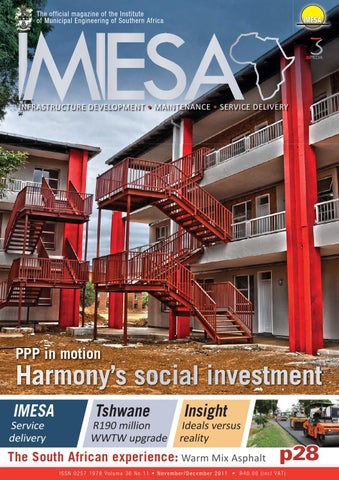
PPP in motion
IMESA Service delivery
Tshwane R190 million WWTW upgrade
Insight Ideals versus reality
The South African experience: Warm Mix Asphalt
p28
ISSN 0257 1978 Volume 36 No.11 • November/December 2011 • R40.00 (incl VAT)
250 000 metres of
TRENCHLESS PIPE Successfully Installed
RENOVATE EXISTING PIPES BY: 1JQF #VSTUJOH t 4MJQMJOJOH t $*11 67 $VSF t $*11 "NCJFOU $VSF 3JCMPD &YQBOEB t 3JCMPD 3JCMJOF t 3JCMPD 3PUPMPD t 1JQF &BUJOH INSTALLATION OF NEW PIPES BY: )PSJ[POUBM %JSFDUJPOBM %SJMMJOH t (VJEFE 3PDL %SJMMJOH t #PSFT PG NN -FOHUIT VQ UP NFUSFT t .JDSPUVOOFMMJOH
Countrywide 08600 66 344ÊÊUÊÊ v JÌÀi V iÃðV °â>ÊÊUÊÊÜÜÜ°ÌÀi V iÃðV °â>
Contents
VOLUME 36 NO 11 NOVEMBER DECEMBER 2011
17 53 60 73 EPWP Examined
WWTW Upgrade
The official magazine of the Institute of Municipal Engineering of Southern Africa
IMESA
MEDIA
Regulars 3 Editor’s comment 5 President’s comment
AMD Action
Ideals vs reality
49 Improved waste collection 53 Zeekoegat WWTW underway 56 Moreletaspruit outfall sewer update
INFRASTRUCTURE DEVELOPMENT • MAINTENANCE • SERVICE DELIVERY
Cover article 6 Perfecting a recipe for success
IMESA 11 IMESA’s role: National agenda, service delivery and capacity
Water and wastewater 60 63 65 67 71
AMD: Not all doom and gloom The power of teamwork Eskom’s R18 billion energy project Sebokeng WWTW upgrade Earth core dam under construction
17 Examining the EPWP
Government perspective
PPP in motion
Insight 73 Ideality versus reality, or greed
21 Empowering people through IMESA Service delivery
Tshwane R190 million WWTW upgrade
employment
Insight Ideals versus reality
The South African experience: Warm Mix Asphalt
p28
ISSN 0257 1978 Volume 36 No.11 • November/December 2011 • R40.00 (incl VAT)
The Free State Provincial Department of Human Settlements, together with Harmony Gold Mining Company Limited and the Matjhabeng Municipality has embarked on a joint project of the development of about 2 500 high quality rental units
CESA conference 27 Infrastructure expenditure
Roads 28 Warm Mix Asphalt: The SA 36 39 41
experience Dozing in a new class Concrete block paving used for resurfacing project Benchmark for head and wing walls
Industry news 82 Training for Zimbabwe Power Company
83 The top employers in SA 87 Innovation secures sustainable future
People and events 90 Industry appointments and events
Equipment and technology 91 Concrete’s role in human settlements
Tshwane 42 Providing potable water to 46
the people Baviaanspoort WWTW upgrade
Marketplace 94 SA business plan unveiled 96 Energy generation milestone IMIESA NOVEMBER/DECEMBER 2011 - 1
EDITOR'S COMMENT
The harder you work the more time flies
PUBLISHER Elizabeth Shorten EDITOR Richard Jansen van Vuuren CREATIVE CHIEF EXECUTIVE Frédérick Danton SENIOR DESIGNER Hayley Moore Mendelow CHIEF SUB-EDITOR Cindy Maulgue SUB-EDITOR Danielle Hugo CONTRIBUTORS Romano Del Mistro, R McCutcheon, F Taylor Parkins, Mildred Oliphant, Krishna Naidoo, Tony Lewis, Wynand Nortje, Eric Lathleiff, Herman Marais, Candice Landie, Tony Stone PRODUCTION MANAGER Antois-Leigh Botma PRODUCTION COORDINATOR Jaqueline Modise FINANCIAL MANAGER Andrew Lobban (ACIS, FCIBM) ADMINISTRATION Tonya Hebenton DISTRIBUTION MANAGER Nomsa Masina DISTRIBUTION COORDINATOR Asha Pursotham SUBSCRIPTION SALES Nomsa Masina PRINTERS United Litho Johannesburg +27 (0)11 402 0571 ___________________________________________________
T
HE 75TH IMESA Conference has been and gone and, to those readers who were there, I’m sure you will agree it was quite a spectacle. The exhibition element of the conference was the largest in the history of the conference and the social events were a perfect opportunity to combine relaxing around friends and colleagues with networking. I had a short time at the podium in the conference auditorium, where it was a privilege to announce the winners of the best articles published in IMIESA throughout the year. 3S Media sponsors two prizes at the IMESA Conference every year, one being for the best article authored by a member of IMESA and the other being for the best article authored by a non-member of IMESA. This year’s winners were: Best article authored by a member of IMESA: Mike Marsden, executive director of transport, roads and major projects at the City of Cape Town – ‘Resolving Cape Town’s public transport crisis’ (IMIESA June 2011). Best article authored by a non-member of IMESA (co-authored this year): Lucas Ebels from UWP Consulting, Riaan Burger from Vela VKE and Deon Fontini from Martin and East – ‘Construction of ultra-thin continuously reinforced concrete pavement on the N1’ (IMIESA February 2011). Readers who missed these articles and would like to read them, should please contact me at richard@3smedia.co.za and I will send a PDF version of the articles to you. In addition, if you would like to submit an article or technical paper, please also contact me. This edition of IMIESA, our last for the year, highlights Tshwane as our featured municipal area. We would like to expand this section next year, so please send us your projects, whether completed or nearing completion. Planned projects and developments are also ideal to cover as we can then follow up on them as they progress. As this edition is a combined edition, we have
ADVERTISING SALES Jenny Miller Tel: +27 (0)11 467 6223 ___________________________________________________
PUBLISHER: MEDIA No. 4, 5th Avenue, Rivonia 2056 PO Box 92026, Norwood 2117 Tel: +27 (0)11 233 2600 Fax: +27 (0)11 234 7274/5 E-mail: richard@3smedia.co.za www.3smedia.co.za ANNUAL SUBSCRIPTION: R480.00 (INCL VAT) ISSN 0257 1978 IMIESA, Inst.MUNIC. ENG. S. AFR. © Copyright 2011. All rights reserved. ___________________________________________________ IMESA CONTACTS IMESA Administration Officer: Ingrid Botton P O Box 2190, Westville, 3630 Tel: +27 (0)31 266 3263 Fax: +27 (0)31 266 5094 Email: imesa@webstorm.co.za Website: www.imesa.org.za BORDER BRANCH Secretary: Melanie Matroos Tel: +27 (0)43 705 2401 Fax: +27 (0)43 743 5266 E-mail: melaniem@buffalocity.gov.za EAST CAPE BRANCH Elsabé Koen Tel: +27 (0)41 505 8005 Fax: +27 (0)41 581 2300 E-mail: elsabek@africoast.com KWAZULU-NATAL BRANCH Secretary: Rita Zaayman Tel: +27(0)31 311 6382 NORTHERN PROVINCE BRANCH Secretary: Cornel Taljaard Tel: +27 (0)82 899 8341 Fax: +27 (0)11 675 1324 E-mail: cornel@rchc.co.za SOUTHERN CAPE KAROO BRANCH Secretary: Henrietta Oliver Tel: +27(0)79 390 7536 Fax: 086 536 3725 E-mail: imesa.southcape@gmail.com WESTERN CAPE BRANCH Secretary: Erica van Jaarsveld Tel: +27 (0)21 938 8455 Fax: +27 (0)21 938 8457 E-mail: erica.van_jaarsveld@capetown.gov.za FREE STATE AND NORTHERN CAPE BRANCH Secretary: Wilma Van Der Walt Tel: +27(0)83 457 4362 Fax: 086 628 0468 E-mail: imesa.fsnc@gmail.com REST OF SOUTHERN AFRICA Representative: Andre Muller E-mail: imesa@webstorm.co.za
All material herein IMIESA is copyright protected and may not be reproduced either in whole or in part without the prior written permission of the publisher. Thee views of contributors do not necessarily reflect those off the Institute of Municipal Engineering of Southern Africaa or the publishers.
The official magazine of the Institute of Municipal Engineering of Southern Africa
Instit ute Africa ern zine of the al maga eerin g of South The offici cipal Engin of Muni
IMESA
MEDIA
INFR ASTR
UCT URE
DEV ELO
• MAI NTE PME NT
NAN CE
• SERV ICE
DEL IVER
covered both roads and water and wastewater. I’m sure many readers will find the article on acid mine drainage (page 60) extremely interesting. We also feature another ‘Insight’ article, which I trust will prove to be food for thought. The magazine which you hold in your hands would not be made possible every month without the hard work and dedication of several people. These include: • Elizabeth Shorten, our publisher and managing director • Antois-Leigh Botma, our production manager • Asha Pursotham, our receptionist and distribution co-ordinator • Candice Landie and Tony Stone, IMIESA’s regular contributors • Cindy Maulgue, our chief sub-editor • Hayley Mendelow, our designer • Jenny Miller and her sales team • Martin Hiller, our marketing manager • Nomsa Masina, our subscription manager. Thank you all for your hard work throughout the year, as well as for the long hours spent on our largest October edition ever! I would also like to thank Ingrid Botton, from IMESA’s head office, and Rita Zaayman for their invaluable assistance throughout the year. To our readers - have a fantastic festive season, travel safe and we’ll meet again in the New Year.
Y
Richard Jansen van Vuuren, editor of IMIESA
INFRASTRUCTURE DEVELOPMENT • MAINTENANCE • SERVICE DELIVERY
Cover opportunity In each issue, IMIESA offers advertisers the opportunity to get to the front of the line by placing a company, product or service on the front cover of the journal. Buying this position will afford the advertiser the cover story on pages and maximum exposure. For more information on cover bookings contact Jenny Miller on tel: +27 (0)11 467 6223.
ve SpraythePRoaad to Succcess
PPP in motion
fort A Team Ef IMESA
Mangaung
Project ent managem
The revita
on
Road tion rehabilita
lisation
and bea
me 78 Volu 257 19 ISSN 0
Insighte
IMESA
A delicat resource
utification
Service
city er city ner nne inn ’s delivery n’s of Durban i n c l V A T )
tobe 9 • Oc 36 No.
r 2011
.00 • R40
(
Tshwane R190 million WWTW upgrade
Insight Ideals versus reality
The South African experience: Warm Mix Asphalt
p28
ISSN 0257 1978 Volume 36 No.11 • November/December 2011 • R40.00 (incl VAT)
IMIESA NOVEMBER/DECEMBER 2011 - 3
COMMENT
PRESIDENT'S COMMENT
Looking back on the year that was This year’s conference was a landmark for IMESA.
I
MESA AND ITS forerunner organisations have been running very successful conferences for 74 years and this year’s event was as successful as any of the previous ones. For me personally, the conference this year marked a landmark, as my term of office coincided with the start of the planning process for the Institute’s 50th Jubilee Year celebrations. Our 75th IMESA Conference, held from 26 to 28 October in Johannesburg, was a resounding success. The conference had well over 700 delegates and 109 exhibitors – making it the largest we have ever hosted. I would personally like to thank the people who made the following conference events run smoothly and memorably: • IMESA Exco meeting • IMESA Exco and International Federation of Municipal Engineering (IFME) dinner • IFME council meeting • mayoral dinner • the hosting of IMESA past-presidents at the mayoral dinner • the presenting of professional affiliate certificates, as well honorary and fellow membership • the launch of Reflections • the opening of the conference and papers delivered • the annual general meeting • the IFME dinner • the IMESA gala dinner • the technical tour • the companions programme • pre-conference workshop. In addition, I would like to thank our panel discussion participants who took part in the final session of the conference, titled ‘Engineering of the future’. The discussion was led by Dr Kevin Wall, Mr Dawie Botha, Dr Allyson Lawless and Prof Romano Del Mistro. I am deeply appreciative of the abundant leadership qualities that exist within our organisation. This year I have also had the real privilege of working with our deputy president, Johan de Beer, our two vice presidents, Frank Stevens and Gerhard
Fritz, and a wonderfully competent IMESA council and Exco. I would like to express my gratitude to them and to our staff at IMESA House. Thank you all for your support and for the invaluable expertise and commitment you bring to IMESA. To get to the engineering issues at hand, looking back over the years, we have built a legacy of infrastructure, and capital spending continues. In the metros the average budget for capital infrastructure has now reached about R4 billion per annum. It is all very well to build infrastructure, but the question is: How well are we currently managing and maintaining what we have created in a responsible and sustainable way? Quite clearly, it is imperative to critically examine the state of municipal engineering, both globally and in South Africa, and the context in which IMESA functions today. During the course of this year IMESA has: • shown communities that municipal engineers are not just ‘fixers’, but ‘finders’ too • responded to national priorities, such as poverty alleviation, food security and job creation
representation at IFME board meetings and this year’s board meeting was held to coincide with our Jubilee conference. A further development involves a concerted membership drive within the SADC community. Africa is regarded as one the world’s major growth areas and relationship building amongst the engineering community is therefore strategically important for IMESA. On behalf of IMESA, I was privileged to write the South African section of the 2011 edition of the International Infrastructure Management Manual. We are proud to say that we have sold many copies of this valuable information resource. I would like to thank everyone who has assisted in making this, I believe, one of the IMESA’s most memorable years in terms of what has been achieved, as well as what has been planned for the coming years. Wishing you a blessed and restful festive season.
I would like to thank everyone who has assisted in making this, I believe, one of IMESA’s most memorable years • prioritised international relationships. I am glad to report that IMESA has made progress in all three of these areas this year. We have: • Found a solution to dealing with GRAP 17 compliance issues by developing an infrastructure management system. • Appointed a technical director to deal with job creation. • Made great strides in establishing and maintaining our valuable international ties. • Maintained strong relations with the International Federation of Municipal Engineering (IFME). IMESA has regular Jannie Pietersen, president of IMESA
IMIESA NOVEMBER/DECEMBER 2011 - 5
COVER STORY
MATJHABENG MUNICIPALITY
1 500 affordable rental units to be built over short term Unprecedented cooperation between the private sector, provincial government and the municipality has provided quality rental housing units for the Matjhabeng community in the Free State.
I
n a dual and far-sighted attempt to enhance the local economy and provide much-needed rental housing stock, the Free State Department of Human Settlements, together with Harmony Gold Mining Company Limited and the Matjhabeng Municipality has embarked on a joint project of the development of about 1 500 high-quality but affordable two- and threebedroomed rental units at sites spread throughout the Matjhabeng municipal area stretching from Welkom to Virginia over the next three to five years. This fulfils the Matjhabeng Metro Vision 2030 Statement that states that Matjhabeng is to emerge as an innovative agricultural, commercial and industrial-based metropolitan city in the Free State that: • boasts a balanced wealth distribution system, affordable housing and efficient transportation and health systems
• encourages economic and environmental health by establishing positive connections between different land uses in terms of location and mix. The appointed consultants that provide the professional services needed for this contract are the locally (Welkom) based CSM Consulting Services and LSB Group. Some of the benefits of this development include: • the provision of housing • urban renewal • creation of sustainable rental stock • environmental renewal through implementation of green technology • social upliftment of beneficiaries • job opportunities • local economic development and revival of existing assets. Single-quarter hostel buildings, previously owned by Harmony, are being converted
Affordable family-orientated rental housing is made available to tenants earning below R3 500 per month
6 - IMIESA NOVEMBER/DECEMBER 2011
into high-quality municipal rental estates, earmarked predominantly for tenants with a lower income. Harmony, as part of its land rehabilitation programme, has spearheaded the project by providing land, buildings and bridging finance to ease cash flow over the construction period. In addition to the buildings donated to the municipality, land adjacent to converted estates together with a completed spatial development framework has also been donated to the municipality for further development. This project will provide secure rental housing stock in accordance with the government’s CRU policy. Affordable familyorientated rental housing is made available to tenants earning below R3 500 per month. There is a great need for such uch rental stock, which will typically ally be taken up by migrant workers, rs,
COVER STORY families not qualifying for government ownership subsidies or families simply choosing to rent accommodation in a safe and secure environment. To ensure sustainable asset creation for the municipality, the property and facility management of the estates will be contracted out for a minimum period of two years. The newly formed property management company, Amohela (which means ‘accommodation’) Property Management NPC, is a not-for-profit company formed solely to manage rental stock in the Matjhabeng municipal area. Full involvement from Harmony and CSM Consulting Services will be provided during these two years and personnel will be trained on site to provide maintenance and social management services. Close-by social amenities are being created as part of the estates with the development of small commercial enterprises. This will assist with enhancing sustainable human settlements that will support future spatial restructuring of the area. These commercial properties are rented out by the property manager to enhance rental income that will assist with keeping residential rentals affordable. The first phase of the development taking place at the existing Masimong 4 hostel will include the following amenities: • bank • clinic • crèche • church • paraplegic workshop and sport centre • social community project centre • taxi and bus stop • grocer; takeaway/fast food • hairdresser • clothing shop • motor vehicle workshops • sports bar and bottle store. Specific emphasis is placed on enhancing the local economy by ensuring building contracts are downsized, so that local contractors can take part. Where possible, materials and technology encouraging local sourcing are specified. Projects are specifically phased to allow local contractors to
ABOVE RIGHT Units have solar-heated water units installed LEFT Masimong 4 project units vary in size, offering three options: one-bedroom (44 m²), two-bedroom (68 m²) and threebedroom (72 m²) units RIGHT Units at Masimong have satellite dishes with TV points in each unit IMIESA NOVEMBER/DECEMBER 2011 - 7
ABS Afri-Infra AJ Broom Road Products Arup SA Aurecon Bigen Group Africa BKS Consulting Engineers Bosch Stemele Bosch Munitech BVI Consulting Engineers CBI Consulting Engineers Civil & Blasting Solutions Concrete Manufacturers CSIR Built Environment Davies Lynn & Partners Development Bank of SA DPI Plastics EFG Engineers Elster Kent Metering EnviroServ Waste Management Geotechnologies GLS Consulting Goba Hidrostal SA Huber Technology Hydro-comp Enterprises I@Consulting Iliso Consulting Infraset Jeffares and Green
hennie.basson@absgroup.com afri-infra@mweb.co.za ajbroom@icon.co.za rob.lamb@arup.com Ian.VanWijk@af.aurecongroup.com otto.scharfetter@bigenafrica.com siyandan@bks.co.za bsdbn@boschstemele.co.za info@boschmunitech.co.za cask@bvigp.co.za durban@cbisa.co.za jane@drillingandblasting.co.za cma@mweb.co.za LAustin@csir.co.za dlpdbn@dlp.co.za divb@dbsa.org.za mgoodchild@dpiplastics.co.za eric@efgeng.co.za keith.bailey@za.elster.com benoitl@millenniumwaste.co.za garry@geotechnologies.co.za nicky@gls.co.za trumang@goba.co.za hstal@mweb.co.za fstammer@lantic.net dan@edams.co.za louis_icon@mics.co.za monde@iliso.com fmyburgh@infraset.com dennyc@jgi.co.za
Johannesburg Water Kgatelopele Consulting Knowledge Base KV3 Engineers Lektratek Water Makhaotse Narasimulu & Associates Maragela Consulting Engineers Much Asphalt Nyeleti Consulting Odour Engineering Systems Power Construction Pragma Africa Rocla SBS Water Systems Sektor Consulting Sight Lines Pipe Survery Services SNA Inc Siza Water Company SRK Consulting SSI Syntell Thm Engineers East London TPA Consulting UWP Consulting Vela VKE WSP Group Africa WSSA WRP Zebra Surfacing
rtaljaard@jwater.co.za kgatelopele@wol.co.za info@knowbase.co.za cbrandsen@kv3.co.za general@lwt.co.za mmakhaotse@mna-sa.co.za admin@maragelaconsulting.co.za john.onraet@murrob.com ppienaar@nyeleti.co.za mathewc@oes.co.za nbarnard@powergrp.co.za deang@pragma.co.za karen.devos@murrob.co.za irene@sbsgroup.co.za cradock@sektor.co.za sales@sightlines.co.za snapta@icon.co.za tionette.bates@sizawater.co.za jomar@srk.co.za francisg@ssi.co.za julia@syntell.co.za thmel@mweb.co.za roger@tpa.co.za zulchl@uwp.co.za capetown@velavke.co.za dirk.hattingh@mbs-wsp.co.za nbinase@wssa.co.za ronniem@wrp.co.za andrew@zebrasurfacing.co.za
COVER STORY
Project team at Masimong 4
tender on new projects repeatedly without overcommitting themselves. For the first project under construction, ‘Masimong 4’, 78% of goods purchased and/or contractors used are local. This project, for which planning started in November 2009, will provide 464 units and six main building contracts with cidb ratings of between 6 and 7, and construction values of approximately R13.3 million each have already been awarded. The total project value is estimated at R125.1 million, with planned completion in January 2012.
ABOVE The development has high mast lighting and additional LED street lighting, 4.5 m wide paved roads with a parking ratio of 0.5 and formalised refuse removal incorporating a recycling plant BELOW Masimong site plan
The Masimong 4 project unit sizes vary: there are one-bedroom units (44 m²), twobedroom units (68 m²) and three-bedroom units (72 m²). The project sites that will follow Masimong 4 into construction, and on which planning to some extent has already started, are the Steyn 2, Merriespruit and Western Holdings 1 hostel sites.
• CSM Consulting Services (architecture, civil/electrical/structural engineering, project management, property management and quantity surveying) • LSB Group (land surveying and town planning) • Insight Landscape Architects • Downtouch Investments (civil works)
Building contractors: • • • • • •
Tantalasi Projects & Isheme Projects JV Satena Construction Reder Construction Tantalasi Projects & Isheme Projects JV Gold Fields Development Estamos Juntos & Welkom Community Contractors JV
Subcontractors: • • • •
Bomac Joiners M@L Electrical Land Breeze Trading MPC Engineering
It is envisaged that construction will start early in the new year on the Merriespruit site, with a new site following each year thereafter in line with the availability of provincial funding. This joint initiative provides for sustainable rental accommodation combining private fixed assets, provincial funding and cooperation for the achievement of a common goal. Contact details: CSM Consulting Services Tel: 0861 276 266 Web: www.csmeng.co.za IMIESA offers advertisers an ideal platform to ensure maximum exposure of their brand. Companies are afforded the opportunity of publishing a two-page cover story and a cover picture to promote their products to an appropriate audience. Please call Jenny Miller on +27(0)11 467 6223 to secure your booking.
IMIESA NOVEMBER/DECEMBER 2011 - 9
AQUA DIRT TRAP/STRAINER Patent No. RSA 95/9706 Unit 2, Zone 5, Murrayfield, 4 Prospecton Road, 4115 . P.O. Box 357, Umbogintwini, 4120 Tel: +27 (0)31-902 6550 Fax: +27 (0)31-902 1349 Email: 0794949628@vodamail.co.za
Web Address: www.aquastrainer.com MAKE THE INTELLIGENT CHOICE Install before every water meter and pressure relief valve (PRV)
NON-RETURN CHECK VALVE
AQUA STRAINER WATER METER
ISOLATION VALVE
DIRECTION OF FLOW
The Aqua Strainer is used and stocked at several Municipalities and water authorities. x The water departments have specified the Aqua Strainer for all its projects and installations. x The Strainer/Dirt Trap is an essential protection for all water meters in order for it to operate efficiently. x
The Aqua Dirt Trap/Strainer was designed for the protection of turbine-type flow meters and pressure relief valves. In order to eliminate the issue of damage and blockages, the Aqua Strainer was developed using mild steel pipes and flanges. The main feature of this strainer is the sight glass, situated on the top flange. The sight glass enables one to see directly into the pipeline. Blockages can be identified by merely looking into the sight glass. Consequently, the water flow can be observed and monitored. Blockages can be observed and removed by simply unbolting the top flange and cleaning the stainless steel grid, thereby reducing the downtime and make troubleshooting and fault finding, easier.
ESSENTIAL PROTECTION FOR ALL WATER METERS AND PRESSURE RELIEF VALVES.
IMESA
THE NATIONAL AGENDA, MUNICIPAL ENGINEERING SERVICE DELIVERY AND HUMAN CAPACITY
The role of IMESA IMESA represents the interests of professionals and institutions dedicated to the delivery of municipal engineering services for the benefit of the citizens of these urban areas, and for the economic and social benefit of the country as a whole. By Romano Del Mistro (Technical Director: Education and Training)
M
unicipal engineering services are not delivered for their own sake, but to promote, support and achieve the national agenda. This agenda is enshrined in our Constitution, reconfirmed through each democratic election and articulated in government legislation, regulation, policy and strategy. Municipal engineering services contribute directly to Presidential Outcomes 2, 6, 8, 9, 10 and 12 (http://www.thepresidency. gov.za/dpme/docs/guideline.pdf). Our ability to deliver municipal engineering services is also significantly affected by social, economic and political circumstances in our country and outside its borders. IMESA’s role in capacity development needs to take three forms, namely, training, advocacy and research. This article looks at the implications of meeting the national agenda, the human resources needed to meet the agenda and the role of IMESA in building this capacity.
gender transformation in municipal government. This has been accompanied by some unintended consequences, e.g.: • Loss of experienced staff through early retirements and resignation, and the appointment of new staff to meet racial and gender goals, in some cases regardless of their skills and previous relevant experience. • Frequent change in elected officials, which has resulted in the loss in continuity of
policy and governance experience and a disruption in the working relationships built up between elected and appointed officials. • Appointment of contractors and consultants to meet racial and gender goals, often regardless of their experience, skills and capacity. Developmental local government has required municipalities to do much more, often with fewer resources, e.g.: • There has been a rapid introduction of
Our ability to deliver municipal engineering services is affected by social, economic and political circumstances The issue of municipal service delivery remains a contentious issue
The national agenda, service delivery and human capacity Among the objectives of the national agenda, the following four are pertinent to this article: • the transformation of South Africa from a separated apartheid state into an integrated equitable state • developmental local government • improving efficiency in the delivery of municipal service • eradicating backlogs in services and housing. Major strides have been made in transforming South Africa through political, racial and
IMIESA NOVEMBER/DECEMBER 2011 - 11
IMESA engineering services to previously informal settlements. This has increased the total cost of service delivery without related growth in income, i.e. basic services are provided for free. These extra costs have been at the expense of reduced operations, maintenance, rehabilitation and replacement. • Municipalities have also been required to take on a wider role in activities such as social and economic development, which has reduced the relative allocation of resources to provide engineering services. • The Extended Public Works Programme, which is intended to create jobs, has usually produced localised employment of short duration, with little or no sustainability and therefore inadequate skills development or opportunity to apply these newly learned skills. Medium-term operations and maintenance support would have produced significantly different socioeconomic benefits. (See IMIESA, August 2011, p.9) Government has initiated many strategies to improve efficiency in service delivery, e.g.: • While intended to ensure the most appropriate person is appointed, contract appointments of senior staff have also resulted in discontinuous leadership, advice that sometimes might be aimed at ensuring reappointment rather than the best interests of the municipality and the cost of the learning period of each new appointment. • Outsourcing assumes that the private sector can always deliver a service better than the municipality. It does have two important benefits, namely, it specifies the service to be delivered and ringfences the contracted activities and costs.
However, it does need very experienced officials to monitor, evaluate and ensure performance. • Tendering for consulting is intended to reduce the cost of consulting services. A newly-graduated professional finds in his first job that there is no space to develop innovative solutions. He is told that low tender prices do not permit the time needed to include innovation or to convince the client of its benefits. He is so disappointed that he plans to do his master’s research on the implications of tendering consulting work on the quality of the technical product.
Tendering might have reduced the cost of consulting services but it has increased the
In 1994, the new government inherited some good infrastructure but also a sizeable backlog in municipal engineering infrastructure and services. While significant inroads have been made, not all efforts have been effective, e.g.: • Infrastructure has been constructed to provide varying levels of services, ranging from communal basic service to full in-house service. Furthermore, evidence is emerging that the quality of construction has not always been up to standard, and the need for major rehabilitation has already been identified. • The focus on new build has come at the cost of less resources being available for operations and maintenance and a decline in the quality of municipal assets. According to the SAICE scorecard 2011;
Municipalities have taken on a wider role in activities such as social and economic development cost of the product. It has also reduced the space for the professional growth of newly qualified professionals through self-learning and mentoring. (See IMIESA, September 2011, p.12) • The requirements of GIAMA and MFMA have at least required local authorities to have and maintain asset registers, and to estimate the remaining useful life. Being forced to assess residual replacement cost will go a long way towards ensuring that infrastructure is at a quality to deliver the desired level of service. The sustainability of municipal engineering service delivery can only be assured if asset management is also made mandatory. (See IMIESA, May 2011, p.7)
the ‘C: Satisfactory for now’ rating is generally not met for any municipal engineering service in the non-major urban areas and is only met for water supply and solid waste management (i.e. not for sanitation or roads) in major urban areas. (http://www.saice.org.za/pdf/IRC2011landscape-1-final-lr.pdf) Skills development and training needs The skills needed to provide municipal engineering services sustainably can be estimated in many ways. Dr Allyson Lawless (2007), in her book Numbers and Needs in Local Government has extended her analysis beyond using ‘in the good old days’ or
POPULATION
HOUSE-HOLDS CIVIL ENGINEERING PROFESSIONALS PROFESSIONALS QUALITY OF PROFESSIONALS PER 100 000 POPULATION REQUIRED* (LAWLESS, 2007,174 TO 176)
<20 000
<5 000
SA ’89* 37
** 40
SA ’04** 0.5
*** 15
39
20 001 to 50 000 50 001 to 100 000 100 001 to 200 000 200 001 to 800 000 >800 000
5 001 to 10 000
23
40
3
11.5
104
10 001 to 25 000
28
35
3.7
7.9
461
25 001to 40 000
19
25
1.5
6.5
449
40 001 to 200 000 18
26
2
6.3
1 814
200 000
20
5
6.6
743 2 868
20
1 to 2 civil engineering staff to manage service delivery on a day-to-day basis 2 technical staff; 1 responsible for projects and 1 for O&M 4 to 6 civil engineering professionals; 1 as technical services director 1 professional per discipline; technical director: experienced Pr Eng Technical services director and deputies; professional staff in each discipline Regional offices or service centres
* Lawless, 2007, 15 **Data on English speaking and Scandinavian countries (Lawless, 2007, 15) *** Based on Lawless (2007) equations where number of professionals = (1+HH/5000)*# activities/9*Urban Land factor (assumed=1,2)*Informal Housing factor (assumed=1,2).
12 - IMIESA NOVEMBER/DECEMBER 2011
IMESA international experience to develop a set of three equations to serve as a guideline to estimate the number of civil engineering professionals (engineers, technologists and technicians). Her method accounts for the number of households, area of land developed for urban commercial and community purposes and the backlog in informal housing. This is reflected in the table, as are her comments on the quality of professionals required in local authorities. Lawless estimated that municipalities required at least 2 500 professionals while only having 1 500 in 2007. (The difference between her estimate and that in the table is because this analysis used simpler assumptions.) She went on to show how the full complement could be achieved. These estimates need to be revised when Census 2011 demographic information becomes available and to account for the effects of changes in legislative requirements, environmental imperatives and procurement practices. New graduates need to develop their experiences by proceeding from novice to
advanced beginner, competent, proficient and then expert (Lawless, 2007, 17). The initial stages need mentoring by experienced professionals. Early retirement and resignation has created a vacuum in some municipalities. An example of how this vacuum can be overcome is the initiative developed by the Department of Roads and Public Works of the provincial government of the Western Cape and driven by Carl October, in which young graduates are seconded to mentors in construction and consulting companies. The R&PW Department of the PGWC has formed a committee of representatives of government, the private sector, IMESA and graduates to monitor, review and improve the programme. As expected, the enthusiasm among the graduates ranges, but some are keeping diaries of the ‘technical tips and experiences’ that they gain each day. This reflects the impact of mentoring on the graduates.
The role of IMESA Training and information transfer, develop training material and present courses • IMESA has developed and presented twoday and four-day modules on asset management, which have been attended by 272 participants to date. • IMESA is currently negotiating with SALGA and COGTA to present a course in which elected and appointed officials of local authorities work together to choose the best intervention for municipal engineering service delivery problems (using an asset management framework) to build an understanding of their respective and co-operative roles and skills in serving their municipality. Present continuing professional development courses • CPD courses on aspects of asset management have been presented at the annual conferences over the past three years. IMIESA NOVEMBER/DECEMBER 2011 - 13
OUR EXPERIENCE FOR YOUR FUTURE For PULSATOR Settling tank or similar Baffles Lamellar blocks and plates GRP pipes Vacuum Fan GRP pipes
For this & other Degrémont’s water t t treatment t plant l t equipment, i t contact: t t George van der Merwe, Technical Man. george.van.der.merwe@degremont.co.za
For AQUAZUR V & T Filters or similar Nozzles, Washers & Grommets Partialisation Valves Clack Valves Silica Filter Media Partialisation valves Siphon Slab mould
Degrémont, a subsidiary of SUEZ Environnement, is the world specialist in water treatment plants and as such makes an important contribution towards sustainable development. Degrémont’s subsidiary in South Africa, previously trading as AQUAZUR, is committed to keep plants running smoothly. The objectives of Degrémont’s Spares Department are mainly to supply the needs of its clients with: • The best and affordable quality spares, as per the original designs • Delivering the spares within the best specified period deliveryy p
Other Spare parts Chemical dosing pump Various pumps Various valves Pipes (GRP, Fibreglass, PVC, Steel) Instrumentation Air diffuser Mixer Membranes Screening
DESIGN AND SUPPLY OF SPARE PARTS
Mornay de Vos, Business Develop. Man. mornay.de.vos@degremont.co.za Tel: +27 (0) 11 807 1983 Fax: +27 (0) 11 807 4118 www.degremont..co.za
THE WATER TREATMENT SPECIALISTS