The official magazine of the Institute of Municipal Engineering of Southern Africa
Winner of the 2011 PICA Non-professional writer of the year
IMESA
INFRASTRUCTURE DEVELOPMENT • MAINTENANCE • SERVICE DELIVERY
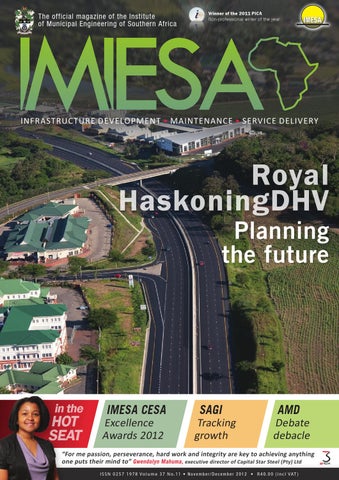
Royal HaskoningDHV
Planning the future
in the
HOT SEAT
IMESA CESA
Excellence Awards 2012
SAGI
Tracking growth
AMD
Debate debacle
“For me passion, perseverance, hard work and integrity are key to achieving anything one puts their mind to” Gwendolyn Mahuma, executive director of Capital Star Steel (Pty) Ltd I S S N 0 2 5 7 1 9 7 8 V o l u m e 3 7 N o . 1 1 • N o v e m b e r / D e c e m b e r 2 0 1 2 • R 4 0 . 0 0 ( i n c l VAT )
MEDIA
SECTION
028 MANUFACTURER & SUPPLIER OF MASTS, POLES & TOWERS
1
LIGHTINGCIH STRUCTURES LeBLANC Lighting Structures is a leading supplier of LIGHTING STRUCTURES Masts, Towers and associated equipment for High Mast Lighting in South Africa and other African Countries and has been in operation since 1976. The company designs, fabricates and erects Monople Type Masts and Towers in seven basic product ranges • • • • • • •
E X P
Railow Masts Midhinge Masts Hydro Masts Internal and External Access Masts Monopole Transmission Masts Electricity transmission Masts Street Lighting Poles
Manufacturing Facility The Facility comprises of a 3500 square meter covered factory with extensive loading facilities and stacking space as well as 500 square meters of office space. The faciluty is well equiped with extensive plant and machinery for the handling and processing of steel plate as well as all other steel work required for the production of Monopole type structures. The production facility employs some fifty persons including qualified boiler makers, coded welders and machine operators. Quality The production facility is EN ISO 9001:2008 certified by Dekra International Engineering All monopoles and structures fabricated by the company are designed by a professional structural engineer, and detailing for fabrication is done by our own experienced staff, making use of the latest CAD drawing facilities Track Record Lighting Structures has designed and fabricated Masts for numerous customers in the Ligthting and Electrical sectors both in South Africa as well as many other countries in Africa. Services • Design and fabrication of masts from a standard range or special design to suit client specifications • Erection of Masts • Design and construction of Mast foundation • Inspection and maintenance of existing Masts and foundations • Turnkey capabilities for full site build • Technical support and as built documentation
LeBLANC Jasco Lighting Structures LeBlancJasco CTH Lighting Structures (Pty) Ltd Jasco LeBLANC Jasco Lighting Structures.co.za Structures LeBlanc Lighting Structures (pty)ltd L Reg. No. 2005/002613/07
18 Johnson Rd, Pretoriastad, Nigel PO Box 1592, Nigel, 1490, South Africa (0)87 Tel: +27 (0)11 814-1404 (0)11 814-1444 87 310 1000 Fax: +27 (0)86 86 699 6999 email: sales@lightingstructures.co.za web site: www.leblancgroup.com, www.lightingstructures.edx.co.za
SECTION
028
CONTENTS
VOLUME 37 NO 11 NOVEMBER/ DECEMBER 2012
CESA 15 IMESA Awards
13
46 Urban renewal
Water supply Winn of the 2011 PICA Winner Non-p Non-professional writer of the year
The official magazine of the Institute of Municipal Engineering of Southern Africaa
IMESA
INFRASTRUCTURE DEVELOPMENT • MAINTENANCE • SERVICE DELIVERY
Ro Roya oyya yal al Ha H a ssk kon o iin ng gD D HV HV Planning the future
in n the
HO OTT SE EA AT
IMESA CESA Excellence Awards 2012
67 Debate debacle
SAGI Tracking growth
AMD Debate debacle
“For me passion, perseverance, hard work and integrity are key to achieving anything one puts their mind to” Gwendolyn Mahuma, executive director of Capital Star Steel (Pty) Ltd
MEDIA
IMESA CESA Awards 15 Water and wastewater: Winner 17 Water and wastewater: 2nd place 20 Water and wastewater: Nsezi WWTW
23
Water and wastewater: Northern WWTW
24
Water and wastewater: Churchill Pipeline Upgrade
25 26 28 29
Roads and stormwater: Winner
30 31 32 33
Community upliftment: Winner
I S S N 0 2 5 7 1 9 7 8 V o l u m e 3 7 N o . 1 1 • N o v e m b e r / D e c e m b e r 2 0 1 2 • R 4 0 . 0 0 ( i n c l VAT )
Cover Story To members of the public, road planning forecasting many decades into the future may be an alien concept, but in KwaZulu-Natal real progress is being made with road infrastructure planning around the province’s industrial heart, illustrated by the highly significant R102 project.
Structures and buildings: Winner Structures and buildings: 2nd place Community upliftment: 2nd place Environmental: 2nd place
CESA Aon Engineering Excellence Awards 34 Business Excellence: SSI
Cover article Future perfect? 6 Government perspective Construction Accord launched 9 Hot Seat 10 Capitalising on quality
35
Visionary Client of the Year: Gauteng Provincial Government and the Bombela Consortium
36
Mentoring Company of the Year: Bigen Africa
36
Young Engineer of the Year: Imraan Mahomed from BKS
37
Mentor of the Year: Andrew Brown from Golder Associates
SAGI 38 High-accuracy 3D mobile mapping
News 13 The ripple effect of clean
Municipal feature 45 Drought relief for Nelson Mandela Bay
in the
HOT S SEAT
Belmont Terrace – urban renewal project
Roads and stormwater 63 Concrete pipes for CBD 65 Shuttle buggy ready for deployment
Water and wastewater 67 AMD: Debate debacle Safety 71 Government to regulate safety 73 Contractor passport system expanded
Plant and equipment 75 Sealants used at container terminal
Environmental: Winner
Engineers and Environmental Managers (Royal HaskoningDHV)
Regulars 3 Editor’s comment 5 President’s comment
water supply
Roads and stormwater: 2nd place
46
76
Ride-on trowels
Panel discussion Efficient wastewater management Amanz’ Abantu Services Richard Saulez Becon Watertech (Tecroveer Group) Gary Brown
49 51 53
Bigen Africa Services Dr Mias van der Walt
55
GLS Consulting Dr Leon Geustyn
57
BTW Consulting Bassie Bouwer Department of Water Affairs Ntombizanele Mary Bila-Mupariwa
“For me passion, perseverance, hard work and integrity are key to achieving anything one puts their mind to.” Gwendolyn Mahuma, executive director of Capital Star Steel Pty LTD
59 60
10
IMIESA November/December 2012
1
EDITOR'S COMMENT
PUBLISHER Elizabeth Shorten ASSOCIATE PUBLISHER Ferdie Pieterse EDITOR Richard Jansen van Vuuren HEAD OF DESIGN Frédérick Danton SENIOR DESIGNER Hayley Mendelow CHIEF SUB-EDITOR Claire Nozaïc SUB-EDITOR Patience Gumbo CONTRIBUTORS Chantelle Mattheus, Candice Landie, Yanna Erasmus PRODUCTION MANAGER Antois-Leigh Botma PRODUCTION COORDINATOR Jaqueline Modise FINANCIAL MANAGER Andrew Lobban (ACIS, FCIBM) MARKETING AND ONLINE MANAGER Martin Hiller ADMINISTRATION Tonya Hebenton DISTRIBUTION MANAGER Nomsa Masina DISTRIBUTION COORDINATOR Asha Pursotham SUBSCRIPTIONS subs@3smedia.co.za PRINTERS United Litho Johannesburg +27 (0)11 402 0571 ___________________________________________________
D
member of IMESA, Nick Alcock from Khanyisa URING THE course of the year, sevProjects, was titled “Green Street retrofit for eral large consultancy firms have Cato Manor”. It was published in the April merged with global entities for the 2012 edition of IMIESA. mutual advantages of maximising Interestingly, both articles were based on the opportunities on the African continent. two relatively new aspects of construction While Africa is going to be the source of many and business – the rise of social marketing mega projects in the next 30 years, it can also and “green” solutions being implemented on be stated that the lack of infrastructure spend a large scale. within our borders has also, to an extent, Alcock’s article outlined how 30 low-inforced this trend. Good business practice come homes in Cato Manor, Durban, underdictates that “you should follow the money”. went a ‘green’ refurbishment, to demonstrate With this in mind, it is now time for governthe range of possible social, economic and ment to unlock the infrastructure spend it has environmental benefits. South Africa’s first been sitting on for almost four years now. The ‘Green Street’ retrofit was led by the Green future of South Africa depends on it. It has Building Council of South Africa (GBCSA) in been reported that government’s R4 trillion collaboration with the infrastructure development eThekwini Municipality, and plan will address unemploythe World Green Building ment, poverty and the skills Council (WGBC). It was shortage. More than R3.7 trilendorsed by the South lion of this amount will be African Depar tment of spent through the formation Environmental Affairs, and of public-private partnerships the main funding was prowithin the Strategic Integrated vided by the British High Projects that the Presidential Commission. The project Infrastructure Coordinating involved adding solar water Commission has identified. heaters, energy efficient The first six months of 2013 lighting in homes and in will provide a very telling indithe street, insulated ceilcation of government’s comings, heat insulation cookmitment to the promises it In the last 15 years, South ers, rainwater harvesting has made. Africa has built up to 2.5 systems and food gardens. On a much happier note, million low income houses Tyrrell authored an I would like to congratulate with little consideration for in-depth article on the high our winning authors of articles ‘green’ issues Photograph courtesy of Green Building Council of level of participation by published in IMIESA since last South Africa householders required to year’s IMESA Conference. make a voluntary programme successful. The best article authored by a non-memThe article outlined key principles of comber of IMESA, Hugh Tyrrell from GreenEdge, munity-based social marketing and showed was titled “Raising participation in recycling how some of these have been applied in programmes: the power of social marketing”, public education and marketing campaigns and was published in the August 2011 edition supporting the City of Cape Town’s ‘Think of IMIESA. The best Twice’ programmes. article, authored by a
ADVERTISING SALES Jenny Miller Tel: +27 (0)11 467 6223 ___________________________________________________
PUBLISHER: MEDIA No. 4, 5th Avenue, Rivonia 2056 PO Box 92026, Norwood 2117 Tel: +27 (0)11 233 2600 Fax: +27 (0)11 234 7274/5 E-mail: richard@3smedia.co.za www.3smedia.co.za ANNUAL SUBSCRIPTION: R480.00 (INCL VAT) ISSN 0257 1978 IMIESA, Inst.MUNIC. ENG. S. AFR. © Copyright 2012. All rights reserved. ___________________________________________________ IMESA CONTACTS IMESA Administration Officer: Ingrid Botton P O Box 2190, Westville, 3630 Tel: +27 (0)31 266 3263 Fax: +27 (0)31 266 5094 Email: imesa@webstorm.co.za Website: www.imesa.org.za BORDER BRANCH Secretary: Melanie Matroos Tel: +27 (0)43 705 2401 Fax: +27 (0)43 743 5266 E-mail: melaniem@buffalocity.gov.za EAST CAPE BRANCH Elsabé Koen Tel: +27 (0)41 505 8005 Fax: +27 (0)41 581 2300 E-mail: elsabek@africoast.com KWAZULU-NATAL BRANCH Secretary: Rita Zaayman Tel: +27(0)31 311 6382 NORTHERN PROVINCE BRANCH Secretary: Cornel Taljaard Tel: +27 (0)82 899 8341 Fax: +27 (0)11 675 1324 E-mail: cornel@rchc.co.za SOUTHERN CAPE KAROO BRANCH Secretary: Henrietta Oliver Tel: +27(0)79 390 7536 Fax: 086 536 3725 E-mail: imesa.southcape@gmail.com WESTERN CAPE BRANCH Secretary: Erica van Jaarsveld Tel: +27 (0)21 938 8455 Fax: +27 (0)21 938 8457 E-mail: erica.van_jaarsveld@capetown.gov.za FREE STATE AND NORTHERN CAPE BRANCH Secretary: Wilma Van Der Walt Tel: +27(0)83 457 4362 Fax: 086 628 0468 E-mail: imesa.fsnc@gmail.com REST OF SOUTHERN AFRICA Representative: Andre Muller E-mail: imesa@webstorm.co.za
All material herein IMIESA is copyright protected and may not be reproduced either in whole or in part without the prior written permission of the publisher. Thee views of contributors do not necessarily reflect those of the Institute of Municipal Engineering of Southern Africa or the publishers.
No more excuses
Richard Jansen van Vuuren
The official magazine of the Institute of Municipal Engineering of Southern Africaa
Winner of the 2011 PICA Winn Non-p Non-professional writer of the year
IMESA
IMESA
PICA e yyear the of the 2011 Winn Winner l writer of fessiona Non-pro Non-p
Instit ute Africaa ern zine of the al maga eerin g of South The offici cipal Engin of Muni
INFRASTRUCTURE DEVELOPMENT • MAINTENANCE • SERVICE DELIVERY
INFR ASTR
UCT URE
DEV ELOP
MAI NTE MEN T •
NAN CE
C • SERV ICE
DELI VERY
Roy oyal oy oyal al Has H Ha Haskon a ass kon ko on ing ng n g DH DHV D HV Planning the future
HO US IN he in th
IMESA CESA LLL EN CE inn the HO OTT Excellence G EX CE Awards 2012 SE EA ASAB T ITAmix
ght
Insi udly Buying Procan South Afri
a er Wat W
m ion 5 mill e efit ben
ice misee serv imis ately max atial 2012 goal to ultim ng Geosp ctober “It is ourze, MD, Southern Mappi 7 8 Vo l u m e 3 7 N o . 1 0 • O Dumi Siband
Warm asphalt
SAGI Tracking growth
AMD Debate debacle
“For me passion, perseverance, hard work and integrity are key to achieving anything one puts their mind to” Gwendolyn Mahuma, executive director of Capital Star Steel (Pty) Ltd
Cover opportunity
In each issue, IMIESA offers advertisers the opportunity to get to the front of the line by placing a company, product or service on the front cover of the journal. Buying this position will afford the advertiser the t cover story on pages and maximum exposure. For more information on cover bookings contact Jenny Miller on tel: +27 (0)11 467 6223.
MEDIA
I S S N 0 2 5 7 1 9 7 8 V o l u m e 3 7 N o . 1 1 • N o v e m b e r / D e c e m b e r 2 0 1 2 • R 4 0 . 0 0 ( i n c l VAT )
ery delivery” .00 • R40
MEDIA ME
AT ) ( i n c l VAT
257 19 ISSN 0
IMIESA November/December 2012
3
PRESIDENT’S COMMENT
IMESA OVER THE NEXT TWO YEARS
‘Hockey sticks’ and ‘breaking through bottles’ I’m sure that those of us who were fortunate enough to attend the 76th IMESA Conference, which was held in George in October, will agree that it was a worthwhile week filled with knowledge-sharing and networking opportunities.
B
EING INAUGURATED as IMESA’s president for the next two years is a huge honour and also so humbling – one has only to page through Reflections 2011: An IMESA journey through time and bask in the history and fine example set by Southern Africa’s municipal engineers, technologists and technicians who helped mould our towns and cities over the past century. Among those great achievers, one must make mention of our outgoing president, Jannie Pietersen. It was during his presidency that IMESA moved to new levels. Some of the many previously unthought-of milestones that were reached under Jannie’s leadership include the opening of IMESA House in Westville (our very own head office and staff), the establishment of the IMESA Training Centre, the registration of IMESA (Pty) Ltd and the commencement of IIMS (the IMESA Infrastructure Management System). To Jannie, I say thank you for the boundless amount of hard work and dedication you contributed over the past two years. (And also, for leaving a pair of giant-sized knee-high boots to fill!) I used the quirky title ‘Hockey sticks’ and ‘breaking through bottles’ to help illustrate some
thoughts on the challenges we face as municipal engineers almost daily, together with the quest for finding solutions.
Hockey sticks At a one-day seminar dealing with bulk service delivery, held in eThekwini a couple of months ago, one of the speakers used the analogy of the inner curve of a hockey stick (i.e. climbing gently and then suddenly turning steeply upwards as it reached the handle) for many of his graphs. The hockey stick curves facing upwards were used to illustrate the increasing use of oil and coal reserves, carbon dioxide emissions, the increasing high cost of construction and the need for adequate expenditure on infrastructure operation and maintenance, etc. The hockey stick curves facing downwards illustrated the dwindling numbers of qualified technical municipal staff (engineers, technicians and technologists as well as artisans), the shortage of available raw water and dwindling allocation of municipal budgets to the maintenance of assets, etc. A disturbing commonality in all of these graphs (based on statistics mainly from South Africa) was that the sudden change in slope has occurred over the last 10 years or will take
place in the next 10 years. One haunting final statement by the speaker: “Eventually something has to give – what will happen when Batman (an unstoppable object) meets the Joker (an immovable object)?”
Breaking through bottles As municipal engineers, we continually strive to find solutions to the many, many problems and challenges that we face. Allow me to share some illustrations (again borrowed from others) that I came across recently. At a power breakfast, which I attended not too long ago, Andrew Layman, the chairman of the Durban Chamber of Commerce, remarked that for years we have spoken about the need to “break the silos down”. He then made the point that often it’s just not possible to do this, in which case we must learn to break through the silos and learn to work together. One of the illustrations used by Layman was that often in port cities, the port authority’s planners often work independently from the city’s planners, which is bound to lead to uncoordinated long-term projects with problems such as traffic congestion after extending a port for example. I was amazed when similar sentiments were expressed at an African-Singapore Conference,
ABOVE Frank Stevens, president of IMESA
held in Singapore, which I was fortunate to attend a couple of months ago. A number of speakers used the term “we had to learn to break through our various bottles”. They were alluding to how Singapore’s politicians and engineers worked as a team and were usually referring to large projects, such as the huge recycled desalination and water harvesting projects that are vital to this country’s successful development. Having realised some time ago that there is a strong need to form partnerships and work more closely with similar-minded service delivery bodies (which have similar goals), I list – in closing – some of the organisations that we already work more closely with and more such relationships will certainly follow. • SALGA – The creation of Blue/ Green Drop masterclass has been very successfully rolled out nationally. • IFME – IMESA serves on the board of the International Federation of Municipal Engineers. • Professional affiliation and exchange of certificates with bodies such as WISA, SARF, SABITA, CORRISA and SASTT have resulted in positive interaction and knowledge exchange.
IMIESA November/December 2012
5
COVER STORY
Future perfect? To members of the public, road planning forecasting many decades into the future may be an alien concept, but in KwaZulu-Natal real progress is being made with road infrastructure planning around the province’s industrial hear t, illustrated by the highly significant R102 project.
T
HE KWAZULU-NATAL Department of Transport’s (KZN DOT’s) planning scenario of a complementary route to National Route 2 – Durban Outer Ring Road, stretches from Kingsburgh, south of Durban, through Pinetown, New Germany, Phoenix, Inanda, Ntuzuma, KwaMashu, Mount Edgecombe, Ottawa and Verulam to the new King Shaka International Airport and beyond to Tongaat. This is a visionary project stretching over some 80 km, which will guide decision-making for generations to come. With the construction of Main Road 577, linking
6
IMIESA November/December 2012
1985
Phoenix, Inanda, Ntuzuma and KwaMashu (PINK) to the industrial and commercial job opportunities in New Germany and Pinetown, under way for some years now, the Northern Urban Development Corridor (NUDC) along the R102 became critically important. The study of the NUDC was a groundbreaking urban planning project, carried out by the Urban Planning Unit of Royal HaskoningDHV – formerly SSI Engineers and Environmental Consultants – for eThekwini Transport Authority, funded by the KZN Corridor Development Programme. The project scope included planning and designing
2011 ABOVE An aerial view of how an interchange along the R102 route has evolved over 27 years
for the long-term public and private transport infrastructure, incorporating rail freight, industry and business, housing developments, and other infrastructure and facilities to support the community of the metropolitan area. The study created a vision of how development will occur in a framework that integrates the economic, social, environmental, spatial, institutional attributes of the areas into a set of cohesive, practical and feasible short- and long-term public and private development and intervention principles, objectives and implementation strategy proposals. The impetus provided by the opening of the new King Shaka International Airport (KSIA) to meet the FIFA 2010 Soccer World Cup deadline required the department to advance the construction of the second route to the airport. The consulting engineer on the R102 design and construction management was Royal HaskoningDHV, in joint venture with Naidu Consulting. An added benefit of this project was the important economic stimulus provided to the adjacent communities, significantly improving their lives.
COVER STORY
Background to the project The project is located along the R102, from Mount Edgecombe to the KSIA – a total length of approximately 14 km. Situated about 5 km from the coast and 30 km north of Durban, the route goes through the centre of Verulam in a road reserve that was declared when the original single carriageway was constructed some 30 years ago. It then traverses rolling hills covered in sugar cane, towards the KSIA intersection and Tongaat. The project entailed the planning design and construction of a new carriageway, starting just north of the Mount Edgecombe Interchange and ending about 1 km north of the KSIA intersection. The route follows the previous design of the existing two lane carriageway. The cross-sectional width of the existing road remains unchanged at 12.2 m, incorporating 3.7 m lanes, and 3.0 m and 1.8 m shoulders. The new northbound carriageway is 10 m wide, which can, at a future stage, be widened on the median to accommodate the planned Integrated Regional Public Transport Network. The time challenge The project started during the dry season using conventional methods for earthworks and layerworks. The client requested that due to the FIFA World Cup and the importance of the R102 as an alternative entrance the new airport, critical elements of the road should be open to traffic by the end of March 2010. The contractor submitted a revised programme with a completion date of 5 April 2010, by bringing in extra resources to reduce times on various items, such as the G9/G7 layerworks by working it as a single 300 mm layer rather than two 150 mm layers. This reduced the time for construction of the layerworks by three months on the original programme and the anticipated completion time was still on target, even though in the five months from August to December, 53 days were lost due to rain against an annual norm of 15 days. Target date moves out Although the contractor attempted to stay on target by working through the December 2009 break, a further nine days were lost as a result of rain. A review of the programme set a new target date of 30 April 2010, one day before the opening of the new King Shaka International Airport. For the six weeks leading up to the opening target, all layerworks and asphalting teams worked seven days a week and some during the
night to remain on target. All this frantic energy allowed the road to be opened at 16:30 on 30 April 2010, only seven and a half hours before the opening of the new airport at 24:00!
Ultra-thin friction course The R102 corridor was the first use of ultrathin friction course (UTFC) by KZN DOT, and the experience gained has opened the way for further use of this innovative material. UTFC is an ultra-thin layer of open graded hotmix asphalt applied at between 15 and 20 mm thick on a thick modified binder tack coat laid in a single pass with a special paver. UTFC was developed
ABOVE Work in progress on a drainage channel
and introduced in France in 1986. The hotmix is manufactured in a conventional asphalt drum or batch plant, where the product reaches a mixing temperature of between 150 and 170°C. It has a number of functional properties and advantages over other conventional asphalt paving, including improved skid resistance, a quieter road surface (all the large aggregate on the surface lays on its average least dimension, hence an exceptionally smooth surface is created, which has the effect of substantially reducing tyre/road noise), and minimal water
ABOVE An overview of the R102 routing
spray in wet traffic. It is hard wearing, capable of withstanding a full range of traffic over an 8to 12-year lifespan and environmentally friendly, with no tack coat carried off during construction and an overall saving in materials.
Labour and the environment An opportunity was seen by the consulting team to create employment while significantly benefiting the local environment; “Operation Cleanup” was implemented, which had the benefit of providing many more jobs than would have been possible under conventional construction. The result of this was that a contract participation goal of 26% was achieved, as opposed to the commitment of 10.7% in the tender. The end result was a win-win for all parties. Visionary planning has allowed the DOT to implement an important element in the road infrastructure in KwaZulu-Natal at a key time in the province’s history. The project completed critical portions of the work within an extremely tight deadline – running to the wire, ahead of the opening of the new airport. The R305 million project was completed at a cost of R275 million and creative engagement by the site staff allowed significant employment opportunities to be created, which cleaned up the environment along the whole corridor – the effects of which will be enjoyed for many years. Enhancing society together!
Royal HaskoningDHV Tel: +27 (0)11 798 6000 Web: www.royalhaskoningdhv.com
IMIESA offers advertisers an ideal platform to ensure maximum exposure of their brand. Companies are afforded the opportunity of publishing a two-page cover story and a cover picture to promote their products to an appropriate audience. Please call Jenny Miller on +27 (0)11 467 6223 to secure your booking.
IMIESA November/December 2012
7
I M E S A A F F I L I AT E M E M B E R S
IMESA
Afri-Infra
afri-infra@mweb.co.za
Kgatelopele Consulting
AJ Broom Road Products
ajbroom@icon.co.za
Knowledge Base
Arup SA
rob.lamb@arup.com
Lektratek Water
Aurecon
Danie.Wium@aurecongroup.com
Makhaotse Narasimulu & Associates
Bigen Group Africa
otto.scharfetter@bigenafrica.com
Maragela Consulting Engineers
BKS Consulting Engineers
siyandan@bks.co.za
Much Asphalt
BMK Consulting
brian@bmkconsulting.co.za
Nyeleti Consulting
Bosch Stemele
bsdbn@boschstemele.co.za
Odour Engineering Systems
Bosch Munitech
info@boschmunitech.co.za
BVI Consulting Engineers
marketing@bviho.co.za
CBI Consulting Engineers
durban@cbisa.co.za
Civilconsult Consulting Engineers Civil & Blasting Solutions Concrete Manufacturers
mail@civilconsult.co.za jane@drillingandblasting.co.za cma@mweb.co.za
Corrosion Institute of Southern Africa secretary@corrosioninstitute.org.za
kgatelopele@wol.co.za info@knowbase.co.za general@lwt.co.za mmakhaotse@mna-sa.co.za admin@maragelaconsulting.co.za john.onraet@murrob.com ppienaar@nyeleti.co.za mathewc@oes.co.za
PD Naidoo & Associates Consulting Engineers Johannesburg@pdna.co.za Power Construction
nbarnard@powergrp.co.za
Pumptron
info@pumptron.co.za
Pragma Africa
deang@pragma.co.za
Rocla Royal HaskoningDHV SBS Water Systems
karen.devos@murrob.co.za francisg@rhdv.com irene@sbsgroup.co.za
CSIR Built Environment
LAustin@csir.co.za
Sektor Consulting
cradock@sektor.co.za
Davies Lynn & Partners
dlpdbn@dlp.co.za
Sight Lines
sales@sightlines.co.za
divb@dbsa.org.za
SiVEST SA
Development Bank of SA DPI Plastics EFG Engineers Elster Kent Metering EnviroServ Waste Management Geotechnologies GLS Consulting Goba Hidrostal SA Huber Technology Hydro-comp Enterprises I@Consulting Iliso Consulting Infraset Jeffares and Green Johannesburg Water
mgoodchild@dpiplastics.co.za eric@efgeng.co.za keith.bailey@za.elster.com benoitl@millenniumwaste.co.za garry@geotechnologies.co.za nicky@gls.co.za trumang@goba.co.za hstal@mweb.co.za fstammer@lantic.net dan@edams.co.za louis_icon@mics.co.za monde@iliso.com fmyburgh@infraset.com dennyc@jgi.co.za rtaljaard@jwater.co.za
SNA Inc Siza Water Company
garths@sivest.co.za snapta@icon.co.za tionette.bates@sizawater.co.za
Southern African Society for Trenchless Technology director@sasst.org.za SRK Consulting Sulzer Pumps Wastewater Syntell Thm Engineers East London
jomar@srk.co.za Sonja.Hattingh@sulzer.com julia@syntell.co.za thmel@mweb.co.za
TPA Consulting
roger@tpa.co.za
UWP Consulting
zulchl@uwp.co.za
Vela VKE WorleyParsons WSP Group Africa WSSA WRP Zebra Surfacing
capetown@velavke.co.za chris.brandsen@WorleyParsons.com dirk.hattingh@mbs-wsp.co.za nbinase@wssa.co.za ronniem@wrp.co.za andrew@zebrasurfacing.co.za
GOVERNMENT PERSPECTIVE
Construction accord launched by DoL The latest information on employment within the construction sector has reflected a decrease for January to March 2012 at 986 000 when compared to January to March 2011 at 1 031 000.
T
his statistic reflects the importance of the construction sector to the economy, not only as it makes infrastructure available, but also contributes to the well-being of the society through the provision of employment. Just a little over a decade ago, the Department of Labour launched the Occupational Health and Safety Accord (2002). Since the signing of that accord, the department has promulgated the first set of sector-specific construction regulations, actively engaged its stakeholders in the construction sector to review those regulations and is on the verge of presenting an amended construction regulation.
The department has also, over time trained numerous trade union shop stewards, conducted thousands of inspections and served various contravention, improvement notices and stopped various unsafe acts and conditions on various construction sites through the serving of prohibition notices where there was immediate danger to life or limb. It is notable that the construction sector incident claims is currently within the top five registered by the Compensation Fund. It is also notable that various charters have been signed over the past several years by several bodies in government and the private sector in the construction sector.
It is imperative that the industr y joins hands to effect the change required and, in so doing, stem the tide of unnecessar y deaths that the industr y sees each year. This partnership between the various parties and the success of this accord will rely on the leadership provided and the communication between the affected partners and those they represent. The signing of the accord will be followed by an action plan, drafted and agreed to by all stakeholders, which will be communicated to the industr y by way of the media and thereafter by several workshops in several of the provinces.
IMIESA November/December 2012
9
HOT SEAT
CAPITAL STAR STEEL SA
Capitalising on quality Capital Star Steel SA manufactures high-frequency welded steel pipe and serves some of the most recognised names in the oil, gas and mining industries across much of the African continent and the world as a whole. Company timelines: • Beginning 2008: Capital Africa Steel approached the Mozambique government to start negotiations to set up the production facility. • 2009: Commissioning of 100 000 m2 plant • Mid-2009: First three major projects awarded: – Driftsands: 508s - 900 t – Gamtoos: 610s - 600 t – CPMZ: 273s - 2 000 t • August 2009: ISO Accreditation • March 2010: API Accreditation • October 2010: Presidential inauguration of plant • End 2010: First expansion of plant by 15 000 m2 • Beginning 2011: Introduction of RFID system – electronic barcoding to track pipes • End 2011: BEE acquisition of Capital Star Steel (Pty) Ltd by MIH • Mid-2012: Level 4 BBBEE Status acquired • August 2012: OSHAS 18001 accreditation • 2012/2013: Second expansion to plant – 20 000 m2.
10
IMIESA November/December 2012
I
TS PRODUCTION PLANT has an annual capacity of 200 000 t of pipe and encompasses state-of-the-art machinery, supported with two coating lines, specifically driving three-layer polyethylene coating, and a range of internal linings, external end-facings and jointing options to facilitate any application. Capital Star Steel SA, based with its manufacturing plant in Mozambique, is a subsidiary of the South African company, Capital Africa Steel (Pty) Ltd, which is based in Rivonia, Gauteng, and markets and distributes for Capital Star Steel SA. Since inception, Capital Star Steel has seen a substantial scaling up of the size and complexity of the projects it undertakes, leading to its second facility expansion in 12 months. The paint had only just dried on the 15 000 m² extension to the original 100 000 m² site, in the Beluluane Industrial Park in Maputo province, when the decision was made to increase the world-class plant by another 20 000 m². “We expect to start work on the new extension soon. We have already grown by almost 50% and we certainly see that trend continuing at the present rate.” Only in its third year of
production, the increased capacity perfectly illustrates the rate of growth of the company. Large projects that Capital Star Steel is in the process of completing include a 120 km multi-products pipeline for the Mozambican CP Tec and 54 km of a similar pipeline in Nigeria, with smaller projects collectively requiring over 750 km of pipeline for water, high-pressure transmission lines and various infrastructure developments. On a local level, the following are just a few of the projects awarded to Capital Star Steel: • Gamtoos project – Driftsands Reservoir, Nelson Mandela Bay Municipality, Eastern Cape province • Xonxa Dam – Chris Hani Municipality, Eastern Cape province • Mopani project – Mopani Municipality, Limpopo province • Maphumulo BWS – Umgeni Water, KwaZuluNatal province.
International recognition Major objectives for Capital Star Steel include annual improvement and creating a brand that is synonymous with service excellence, quality and deliverables. The company highly values its
HOT SEAT
emphasis on gaining internationally recognised accreditations and certificates, and to this end has so far been awarded API 5L and 5CT from the American Petroleum Institute, as well as ISO 9001:2008 In addition, the company has just completed its ISO 18000. Combined, the accreditations provide a backbone for the company’s continuous improvement strategy and assist to promote its ability to undertake and complete high-profile, high-value projects. Coupled with its experience, networking and industry-wide associations, and attendance at related trade seminars and conferences globally equips the company with the necessary knowledge and expertise to advise project managers and engineers.
Strategically located Capital Star Steel specialises in the sub-Saharan Africa region, with a third of its current output going off-shore (outside the African continent), a third staying within the region and the remainder going to South Africa alone. “One of the strategic decisions for locating our facility where it is, is the close proximity to the port, which provides us with easy access to internationally produced hot-rolled steel coil,” says Capital Star Steel MD, Kennith van Rooyen. Distribution of the finished product is mainly by road, either direct to the port to be freighted out to global projects, or direct to the jobsite. Quality in, quality out The responsibility of producing high-specification pressurised vessels capable of delivering materials without contaminating the surrounding environment, or posing a danger to people in close proximity, is not taken lightly by Capital Star Steel. Every pipe is rigorously tested before leaving the plant to ensure that there are no weak points, leaking or cracking; each product is
stressed to 95% of the steels yield strength to guarantee its integrity and safeguard against any latent inclusions, which could cause future problems. “It’s imperative that everything that leaves our plant is perfect” Van Rooyen states. “It’s a much specialised operation and requires skills, necessitating in-depth training programmes.”
Proudly African Capital Star Steel (Pty) Ltd is a BBBEE level 4 status company, which is 51% black women-owned. The manufacturing plant based in Mozambique, being within the SADC region, supports the region’s economic and social-economic agenda to increase the competitiveness of the region as a whole in relation to the world economy. Though it continues to supply companies globally, the business is proud of its African heritage, embracing its roots within the continent and concentrating on supplying the region with world-class expertise and products. Capital Star Steel has currently tendered on a substantial development for Sasol in Mozambique to supply 150 km of high-grade steel and specialised coatings, alongside a variety of projects arising from the Kenyan oil and gas industry, and the mines at Lake Alberta in Uganda. “We are also involved in infrastructure development in Southern Sudan, so the east coast is providing us with some great opportunities for the future,” Van Rooyen explains. Regardless of project location, however, there is
GWENDOLYN N MAHUMA, Executive director, Capital Star Steel
BCom Honours (University of the North West) Chairperson of Mahuma Investment Holdings, with investments in several companies within the infrastructure space, and a focus on steel and concrete products and services. Mahuma has eight years’ experience within the industry and is an avid supporter of women empowerment. She is a member of the Institute of Directors of Southern Africa, with the following Directorships: • WSP Africa Group • Capital Africa Steel • Alert Steel • 3Q Concrete Mahuma JV • Cas Enviro • AESoft • Krost Shelving
only one over-arching ambition: “We offer excellent products, excellent people and excellent service, a level we hope to maintain. It takes time to earn the reputation of being a credible, reliable and quality supplier, but I feel we are definitely going the best way about it.”
Contact Tel: +27 (0)11 257 5000 373 Rivonia Boulevard, Rivonia, Gauteng www.capitalstarsteel.co.za
“We offer excellent products, excellent people and excellent service. It takes time to earn the reputation of being a credible, reliable and quality supplier, but I feel we are definitely going the best way about it.” Kennith van Rooyen, MD, Capital Star Steel
IMIESA November/December 2012
11
NEWS
Not all kerbs are the same...
TACKLING THE RIPPLE EFFECT
Clean water supply
Worldwide, the shortage of water is expected to transform corporate and industrial practices, according to a report issued by professional services firm PwC.
1BUFOU 1FOEJOH
P
wC’s ‘2012 Water challenges, drivers and solutions’ study shows that the dwindling supply of safe drinking water throughout key regions, such as South Africa, China, India and the US, is under major threat from unsustainable domestic, industrial and agricultural demands. The report anticipates that virtually every industry worldwide expects to undergo major transformation in the next decade in their business, production and planning models, in the wake of a stressed water system and a lack of sanitary facilities. Luther Erasmus, senior manager and water expert at PwC, says: “Sub-Saharan Africa and South Asia remain the key regions in the world with the lowest use of safe drinking water and a lack of sanitary facilities. “Sanitation and water stress pose major economic and social challenges as these inevitably have an effect on consumers’ disposable income, businesses’ profits and economic growth.� Globally, one in three people are affected by water scarcity and, if current trends continue, nearly half of the world’s population will live in areas of high water stress by 2030, according to statistics issued by the Organisation for Economic Cooperation and Development (OECD). Erasmus says that the management of water has become an increasingly difficult and complex task for governments worldwide. The main challenges lie in providing access to safe drinking water for a global population that rose from 1.5 billion at the beginning of the 20th century to seven billion today. The report states that the management of water has become both difficult and complex. The complexity arises from the multifaceted aspects of water management, beginning with technical, institutional and organisational issues, the application of new technologies, legal and regulatory concerns, and regulatory effectiveness. Other aspects include standards, investment, costs, financing, pricing, governance, financial, social and environmental sustainability.
13
t &BTJFS UP IBOEMF t 2VJDLFS UP JOTUBMM t #FUUFS BEIFTJPO XJUI MFTT NPWFNFOU "WBJMBCMF PO 'JHVSF $ NN LFSCT Advantages of Castle Bottom Kerb, Compared to Conventional Kerbs t 5IF DBWJUJFT QSPWJEF B HSJQ GPS JOTUBMMFST XIFO MBZJOH UIF LFSCT 5IJT FOBCMFT NVDI FBTJFS IBOEMJOH t 5IF DBWJUJFT NBLF UIF $BTUMF #PUUPN ,FSC NVDI RVJDLFS BOE FBTJFS UP JOTUBMM 8IFSF VOMFWFM TDSFFE TVSGBDFT GPSDF JOTUBMMFST UP VQMJGU m MM VQ BOE SF MBZ DPOWFOUJPOBM LFSCT JU JT FBTJFS UP NBOPFVWSF B $BTUMF #PUUPN ,FSC JOUP QMBDF XJUI UIF TDSFFE CFJOH EJTQMBDFE UP UIF DBWJUJFT JO UIF LFSC t 5IF $BTUMF #PUUPN TJOLT JOUP UIF TDSFFE QSPWJEJOH NVDI CFUUFS BEIFTJPO BOE NBOZ NPSF QPJOUT PG TVSF CPOEJOH t 5IF $BTUMF #PUUPN JT MFTT QSPOF UP NPWFNFOU UIBO DPOWFOUJPOBM n BU LFSC TVSGBDFT PODF UIF CFEEJOH IBT DVSFE t 5IF n BU CPUUPN PG DPOWFOUJPOBM LFSCT EP OPU IBWF DPOTJTUFOU TVQQPSU GSPN UIF TDSFFE BT UIF TDSFFE JT OFWFS B QFSGFDU NBUDI UP UIF CPUUPN TVSGBDF PG UIF LFSC 5IF FOUJSF CPUUPN TVSGBDF NJHIU UIFSFGPSF OPU CF JO DPOUBDU XJUI UIF TDSFFE SFTVMUJOH JO LFSC CSFBLBHFT PODF XFJHIU JT BQQMJFE GSPN BCPWF 5IF SFHVMBS QPJOUT PG TVSF CPOEJOH PG UIF $BTUMF #PUUPN ,FSC BOE UIFJS QSPYJNJUZ UP FBDI PUIFS OFHBUF UIJT QPTTJCJMJUZ
www.bosun.co.za
E+I 17006
IMIESA November/December 2012
Introducing the Bosun Castle Bottom Kerb.
Tel 0860 267 862 info@bosun.co.za
IMESA CESA AWARDS
WINNER • Category: Water and wastewater • MOSSEL BAY 15 Mℓ/D DESALINATION PLANT
Mossel Bay 15 Mℓ/d desalination plant
D
UE TO AN EXTENDED drought, which resulted in the domestic and industrial water supply to Mossel Bay being critically stressed and the town being declared a disaster area in 2009, the Mossel Bay Municipality embarked on an emergency desalination project to augment traditional sources of supply. Implemented as an emergency initiative, the project had an accelerated programme with the objective of commissioning the plant before the region ran out of potable water. Royal HaskoningDHV, as the overall project manager, closely monitored and coordinated all aspects of the project, with all designs and drawings going through a very thorough HAZOP (hazard and operability) study and design review, parallel to the construction being executed. A unique aspect to the project was that although the official client was the Mossel Bay Municipality, PetroSA joined the project as a co-funder and was also present on the client representative team. The desalination plant’s preferred site was identified in Hartenbos, within the Voorbaai industrial area. Owned by PetroSA, it was previously used as a material staging area. The Mossel Bay desalination plant has been designed to produce 15 Mℓ/d (625 m³/h average) of permeate over a 24-hour cycle, operating approximately 20 hours in every 24-hour cycle. The product is then pumped to
two users, namely 10 Mℓ/d to the Mossel Bay Municipality and 5 Mℓ/d to PetroSA. In order to achieve this production volume, approximately 37.5 Mℓ/d of seawater will be abstracted from the ocean, of which 22.5 Mℓ/d will be returned as brine. The plant employs a number of water treatment processes involving chemical and physical treatments, which ensure that it runs optimally and the water produced meets the Category 1 SANS 241 drinking water standard. The plant has a single pass reverse osmosis (RO) system, consisting of six 2.5 Mℓ/d RO modules, and the feed water abstraction and disposal of the concentrate (brine) is achieved by direct abstraction from the sea intake structure, a pipeline that is pumped by a seawater abstraction pump station, and the final disposal of brine from the pipeline into a diffuser structure in the sea. Special attention was given to the seawater abstraction pipeline and brine disposal pipelines to ensure that they are buried underground on the beach to minimise the visual impact, and although currently sections are exposed, it is expected to settle in time. The discharge pipes will be under a constant positive pressure of approximately 1 bar to ensure the dispersion of the brine into the seawater and the brine is to be discharged at a level and
position where it will have minimal impact on the sea bed and surrounds. The desalination plant was commissioned on 21 June 2011.
FACT BOX • Location: Mossel Bay • Civil client/local authority: Mossel Bay Municipality • Contractors: VWS Envig (design & build, desalination plant), M&R Marine (sea intake & discharge pipelines, pumping station), Entsha Henra (clear water rising main, reservoir connection), Tricom (mechanical, clear water pumping station),VE Reticulation (bulk electricity) • Consultants: Royal HaskoningDHV (project management, civil & structural design), RLH (marine consulting engineers), MVD (clear water rising main, reservoir connection), CVW (bulk electricity), Aurecon Group (environmental consultants), House of Safety Consultants (Pty) Ltd
IMIESA November/December 2012
15
“IT’S ALL ABOUT GETTING THE JOB DONE� THE NEW F-SERIES BACKHOE LOADERS
GET MORE FLEXIBILITY, INCREASED PRODUCTIVITY AND GREATER EFFICIENCY FROM THE NEW CATÂŽ F-SERIES BACKHOE LOADERS. The range of improvements on the F-Series include: s EXTENDED BUCKET REACH s INTEGRATED LOAD SENSING HYDRAULICS s IMPROVED VISIBILITY s REDUCED FUEL CONSUMPTION Get the job done with the new CatÂŽ F-Series backhoe loaders. For more information contact our call centre on 0800 21 22 48 or visit www.barloworld-equipment.com
Scan here to GO TO WEBSITE
&OLLOW US ON &ACEBOOK Barloworld Equipment Southern Africa Follow us on Twitter @Barloworldequip
IMESA CESA AWARDS
2ND PLACE • Category: Water and wastewater • MEULWATER WATER TREATMENT WORKS
FACT BOX
Meulwater Water Treatment Works
C
OMMISSIONED IN JULY 2012, the 8 Mℓ/d Meulwater Water Treatment Works (WTW) treats water from the Nates and Bethal dams, which are sited on Paarl Mountain, located on the boundary of the Paarl Mountain Nature Reserve. The motivation for the construction of the plant was partly due to the long-term savings afforded the Drakenstein Municipality when compared with the alternative of purchasing water from another water supply authority. Additionally, the viability of the supplement scheme to store pumped water from the Berg River in Nantes Dam was only ensured through the construction of a treatment facility for the water. The treatment capacity of the works
is 8 Mℓ/d and is upgradable to 15 Mℓ/d. The treatment process has been optimised to suit the relatively good raw quality of the mountain water. The Meulwater plant was originally proposed in 2001 after the Drakenstein Municipality identified the need to secure its own reliable water source. The project was given the go-ahead after a comprehensive environmental impact assessment (EIA), which was carried out between 2001 and 2006. The total cost of the project was R34.7 million, of which the Municipal Infrastructure Grant contributed R29.8 million and the municipality financed the remaining R4.9 million. Civil works on the project cost R15.2 million,
• Location: Paarl • Civil client/local authority: Drakenstein Municipality • Main contractors: Superway Construction, Bateman Africa • Civil contractor: Superway Construction • Mechanical and electrical contractor: Bateman Africa • Operator Training: Chris Swartz Water Utilisation Engineers • Architect: Clive Hildering • Engineering surveyors: Joubert and Brink Surveyors • Engineering and environmental consultants: Aurecon • Health and safety agent: Aspirata (a business unit of Aurecon) • Heritage specialists: Heritage Resource Consultants • Visual impact specialist: Steyn Swanepoel, Landscape Architectural Design • Landscape architects: Viridian Consulting Landscape Architects • Botanists: Nick Helme Botanical Surveys, the Nature Conservation Corporation • Environmental law consultants: Smith, Ndlovu, Summers Environmental Law Specialists • Supplier: FESTO (pneumatic and electrical automation technology)
IMIESA November/December 2012
17
IMESA CESA AWARDS
while the mechanical costs were R12.7 million.
Site specifics Due to its location, the plant was designed with careful attention. The design team overcame significant challenges in providing a solution for the water needs of Drakenstein Municipality, which is in an extremely sensitive environmental area. Noteworthy design features include the architectural style of the WTW, which sought to minimise its visual impact through the extensive use of granite for structural cladding, sourced from excavations for the WTW. The provincial Department of Environmental Affairs and Development Planning’s requirements also included instructions to limit the aesthetic impact of the structure by blending it into the natural environment, and to achieve this, the plant was set as low into the ground as possible. The structure sits up to 5.5 m deep into the ground in places and has displaced 1 500 t of granite, almost half of which has been retained on-site as cladding to the outside of the main buildings. Sections of the structure are also built completely underground and are planted with fynbos. Treatment process The treatment process of the works has been optimised to minimise the plant footprint by the use of direct filtration designed appropriately for the water being treated. This affords a substantial capital cost-saving over conventional treatment options, in the order of 15% of the construction costs. Direct filtration is not common in South Africa and requires a more careful and specific design, particularly as there is no up front sedimentation step to reduce the load on the filters. Furthermore, the chemical dosing requirements and flocculation processes differ from conventional systems, where heavy and large settleable flocs are sought. The design of the Meulwater WTW facilitates a penetrating depth filtration of sturdier and smaller flocs, resulting in a full utilisation of the solids storage capacity within the filter bed. The filters are also designed to be upgradeable to dissolved air flotation filtration units through the incorporation of relatively minor equipment. In the case of raw water quality changes, the Drakenstein Municipality can choose to make more extensive use of the existing supplementation scheme, which allows water from the Berg River to be pumped into Nantes Dam. In addition, the filters have also been equipped with a dual-parallel lateral under-drainage system, which has been incorporated as part of the overall design to enhance filter performance through incorporating optomised collapse-pulsing backwashing. This process is more effective at abrading filter media and loosening accumulated and adhering solids/flocs. This feature is particularly important for the deepbed direct filtration plant design at Meulwater to ensure that the entire depth of the bed is cleaned with minimal loss of water. Another novel aspect is the design of the filters with declining rate hydraulic control. This, although also an uncommon feature in South African plants, has been shown (with all other aspects being equal) to further assist in producing a better filtered water quality. Commissioned and tested The Meulwater plant has undergone full equipment testing and handover to the municipality was at the end of June 2012, with strict adherence to safety, health and environmental requirements being a prerequisite. No injury or safety-related incidents occurred throughout the entire contract period.
18
IMIESA November/December 2012
IMESA CESA AWARDS
ENTRY • Category: Water and wastewater • UPGRADE OF NSEZI WATER TREATMENT WORKS
Upgrade of Nsezi Water Treatment Works
S
ITUATED ON the banks of Lake Nsezi in Richards Bay, the Nsezi Water Treatment Works provides bulk water services to the City of Mhlathuze, Mondi Paper and surrounding industrials. The upgrade is part of Mhlathuze Water’s expansion plan meant to increase production in order to meet the growing demand for purified potable water to be supplied to industrial consumers in the former Borough of Richards Bay and the general public by the City of Mhlathuze. ILISO Consulting was appointed to undertake
20
IMIESA November/December 2012
this project from inception to handover. The project consisted of the upgrading of the treatment works from 150 to 205 Mℓ/d. The 29-month-long construction upgrade of the Nsezi Water Treatment Plant – the flagship water treatment works (WTW) of Mhlathuze Water – also sought to deal with the deteriorating raw water quality from Lake Nsezi.
Expanding capacity The expansion of the water works included the upgrade of the raw water pump station, which
entailed the conversion of a dual lift low head axial flow pump, originally designed to transfer water from the Mhlathuze River to Lake Nsezi, to a variable speed submersible pump station of medium lift (205 Mℓ/d @ 61 mWG) to transfer raw water directly to the new water works inlet tower, thereby overcoming the problem of deteriorating water quality in the lake. The collaborative effort and meticulous planning on the design and construction of the raw water pump station was undertaken within a restricted space and time frame. Further expansion entailed the construction of a 1 200 mm diameter steel pipeline, which was an extension to the original 1 200 mm diameter continuously welded rising main, originally provided to transfer raw water from said pump station to the Nsezi Lake, to transfer river water directly to the new inlet tower. This extension enabled the river water to be transferred directly to the water works, taking advantage of the improved river water quality. The construction of the new inlet tower enabled optimal chemical dosing and ensured flow split between the three clarifiers, with a separate pre-chlorination facility being provided to enhance the entire water treatment process. An additional 48 m diameter clari-flocculator was constructed to complement the existing 48 m and 35 m diameter clarifiers. This
IMESA CESA AWARDS
clarifier included a ‘double launder’, which presented its own construction challenges, but drastically enhances the process performance when compared with a single launder. Another noteworthy design aspect of the upgrade of the water works further included upgrading the existing dissolved air floatation (DAF) Plant from approximately 140 Mℓ/d to 205 Mℓ/d, while keeping the waterworks in operation without prolonged shutdowns. The selected design increased the recirculation rate from 8% to 12% and saturator efficiency was markedly improved with the inclusion of internal dispersion nozzles. Bubble formation
in the reactor units was improved using fixed orifice nozzles in lieu of existing ‘pinch valves’. These measures enabled the plant to be upgraded to 205 Mℓ/d without additional civil works using the four existing internally modified saturators and uprated reticulation pumps.
supply of high-quality potable water to all users during the construction phase were dealt with in an innovative manner. During design, the potential for future layouts for further increased capacity were also catered for.
Complex construction Throughout the construction period the existing water works retained its full operational status and water works shutdowns were limited to a maximum of 24 hours. Engineering challenges encountered while ensuring a continuous
FACT BOX • Location: Richards Bay, KwaZulu-Natal • Civil client/local authority: Mhlathuze Water • Consultants: ILISO Consulting, MSW Consulting, Igoda Projects • Contractors: PCI Africa, Esorfranki, Civcon Construction (Erbacon), Leomat Construction • Supplier: Group Five Pipes
IMIESA November/December 2012
21
“Best in Class” Performance Driven by a strong leadership team and a proven track record, Civcon delivers quality construction solutions for mining, construction and heavy industrial sectors across Africa. Our clients include mining houses, petrochemical companies, fertiliser producers and large and medium industrial concerns. As part of the JSE Altx-listed Erbacon Group, Civcon offers turnkey services in civil engineering construction, bulk earthworks, road and pipeline construction, concrete and bridge rehabilitation, industrial and process plants, mining (surface and underground), mining infrastructure and the design and construction of turnkey industrial projects.
+27 11 206 9660 I www.civcon.co.za
THE ERBACON GROUP
uppe marketing A07782
INFR SET
BUILDING DURABLE INFRASTRUCTURE
WITH PRECAST CONCRETE PRODUCTS Aveng Manufacturing Infraset produces a diverse range of precast concrete products to world-class quality standards and actively contributes to SADC infrastructure development. Our range includes concrete pipes, culverts, manholes, special precast products, various type of pre-stressed railway sleepers, turnouts, maintenance-free railway electrification masts and poles, paving blocks, retaining wall systems and roof tiles.
Aveng Manufacturing Infraset’s admired heritage is founded on innovation, technical and service excellence. Aveng Manufacturing Infraset
PIPES • CULVERTS • MANHOLES:
RAILWAY SLEEPERS • POLES & MASTS
PAVING • RETAINING WALLS • ROOF TILES
Steeldale House
GAUTENG – TEL: +27 (0)11 876 5100
NATIONAL – TEL: +27 (0)11 813 2340
ROSSWAY (MIDRAND) – TEL: +27 (0)12 652 0000
TEL: +27 (0)11 876 5500
CAPE TOWN – TEL: +27 (0)21 908 1156
KWAZULU NATAL (EFFINGHAM) –
FAX: +27 (0)11 872 1713
KWAZULU NATAL (PIETERMARITZBURG) –
TEL: +27 (0)31 569 6900
EMAIL: infrasetinfo@infraset.com
TEL: +27 (0)33 387 2236
www.infraset.com INTERNATIONAL BRANCHES SWAZILAND – TEL: +2682 518 4236 | ZAMBIA – TEL: +260 21 131 1838
IMESA CESA AWARDS
ENTRY • Category: Water and wastewater • NORTHERN WASTEWATER TREATMENT WORKS: SLUDGE DRYING BED
Northern Wastewater Treatment Works: sludge drying bed
FACT BOX
J
OHANNESBURG WATER (JW) operates six wastewater treatment works on behalf of the City of Johannesburg. Considerable quantities of sludge are produced daily at these plants and, as such, the company has embarked on a sludge treatment and disposal programme, ensuring compliance with National Sludge Guidelines. Through solar drying, the programme seeks to enable composting without a bulking agent, to produce an end product suitable for disposal to the agricultural industry. JW therefore commissioned the JW Wastewater Partnership to undertake the design and construction of sludge-drying beds at three of its treatment works, with Knight Piésold appointed as lead consultant at the Northern Wastewater Treatment Works (WWTW) – the largest of the three, which treats approximately a third of all sludge produced by JW.
Project breakdown The main components of the project were a belt conveyor system, which was to transport 100 dry tonnes equivalent of dewatered sludge from the existing sludge composting building to the proposed drying beds, the bulk earthworks and the creation of a platform and the 69 000 m² slab for drying and composting. Ancillary work included a stormwater retention pond and related infrastructure, a stormwater collection system and access roads surfaced with block paving, among others.
Separate tenders were invited for the construction of the drying bed and for the construction of a belt conveyor, with the design and tender documentation for the belt conveyor undertaken by PD Naidoo and Associates and WSP Consulting. The drying bed and ancillary work tender was awarded to King Civil Engineering Contractors in May 2009. Following the closing of the 1 km belt conveyor tender process, JW reviewed the project and decided that the daily transporting of dewatered sludge from the existing sludge composting building to the drying bed would be done by means of trucks using an additional roadway. This represented unique design challenges in that a significant earth platform for the large slab needed to be designed, which is almost the size of 10 soccer fields. A single slab of the size required also resulted in the generation of a considerable volume of stormwater runoff and, as such, an innovative rainwater management system to comply with pollution requirements was designed, which included attenuation of water on the bed and provision of a stormwater retention pond. To accommodate the drainage of stormwater falling on the sludge bed, the whole slab was given a uniform 1:200 fall toward the western side of the bed. To attenuate the flow of stormwater leaving the bed, holes were included in the western dwarf wall to throttle the rainwater leaving the bed and flowing via a U-drain collector to the downstream collection pond.
• Location: Johannesburg, Gauteng • Civil client/local authority: Johannesburg Water • Contractor: King Civil Engineering Contractors • Main subcontractor: Floors for Africa • Lead & civil consultant: Knight Piésold Consulting • Geotechnical consultant: Knight Hall Henry (member of Knight Piésold Group) • Specialist consultant: Bryan Perrie (Cement & Concrete Institute) • Mechanical & electrical consultant: PD Naidoo and Associates • Control & instrumentation consultant: WSP Consulting • Environmental consultant: Envirolution Consulting • Geohydrological consultant: Blue Rock Consulting • Air quality consultant: Margot Saner & Associates • Aquatic consultant: Strategic Environmental Consultants • Heritage consultants: Johnny van Schalkwyk • Occupational health & safety consultant: Nemai Consulting • Supplier: Aveng Manufacturing
Client requirements As labour-intensive methods for large portions of paved areas had been chosen, considerable use was made of local labour for the construction of block paving surfaces, including roads, during the construction phase. Making use of the free solar energy available, the sludge drying bed at the Northern WWTW successfully became operational in 2011 and immediate benefits were realised by JW, not least of which were allowing for the elimination of a bulking agent, simplifying the composting operation, making use of low-level technology and significantly reducing the operating costs, making it an affordable and attractive treatment and disposal option.
IMIESA November/December 2012
23
IMESA CESA AWARDS
ENTRY • Category: Water and wastewater • CHURCHILL PIPELINE UPGRADE: GAMTOOS PUMP STATION
Churchill pipeline upgrade: Gamtoos pump station FACT BOX • Location: Eastern Cape • Civil client/local authority: Nelson Mandela Bay Municipality • Contractors: WK Construction, PCI Africa • Consultants: BKS, CA du Toit • Supplier: Capital Star Steel
T
HE UPGRADING OF the Churchill pipeline was required to enable the Nelson Mandela Bay Municipality to fully utilise the yield of the Churchill/Impofu Supply Scheme and to optimise the use of spare capacity in the existing infrastructure. BKS, in association with BVI Consulting Engineers, was appointed by the Nelson Mandela Bay Municipality for the planning, design and implementation of the upgrading of the Churchill pipeline. Part of the appointment fell parallel with another appointment to CA du Toit for the upgrade of the mechanical and electrical equipment for the existing Gamtoos booster pump station, which is situated on the Churchill pipeline at the Gamtoos River valley.
24
IMIESA November/December 2012
The appointments were combined under the banner Churchill pipeline upgrade and BKS was appointed lead consultant. The proposed works included a new pump station, which consists of two separate pumping systems, totalling seven pumps. The Gamtoos booster pump station comprised of four variable speed horizontal split case booster pumps, which supply water to reservoirs throughout the city of Port Elizabeth and will replace the existing pumps. This function is fully automated and as water levels and pressures in the distribution system drop, the pumps come online and control automatically. The Summit pump station comprised three high-pressure multi-stage pumps to transfer water to the Summit reservoir in the Loerie supply scheme.
Construction commenced At tender stage, there was uncertainty of the cadastral boundary of the existing farms surrounding the pump station. This restricted the positioning of the proposed pump station. After cadastral boundaries were confirmed, the position of the proposed pump station was revised and the demolition of an old reservoir became unnecessary. The floor level for the new pump station was below the floor level of the existing redundant reservoir. The foundation of this reservoir protruded into the wall of the new pump station and had to be trimmed back with pneumatic tools. The new building was also moved 200 mm to the south to take care of the backward rake of the reservoir wall. Ongoing design improvements also required that the transformer room, which ran the full length of the new building, be constructed holistically as one structure and not as two individual buildings adjacent to each other. An integrated network of new pipework has been constructed from the take-off of the main water supply lines up to the point of suction of the new pumps and also from the pump delivery points back into the mains. The supply, installation and commissioning of pumps, motors and electrical switchgear falls under a separate contract. There was, out of necessity, cooperation between the two contracts with respect to the access to working areas. The project has been carefully thought through and expedited. The civil and building works are just one facet of the integrated project, which involved input from two teams of consultants and two contractors, and the new Gamtoos pump station is a worthy replacement for the old pump station that served the municipality for half a century.
IMESA CESA AWARDS
WINNER • Category: Roads and Stormwater • SANDILE THUSI (ARGYLE) ROAD STORMWATER SEA OUTFALL EXTENSION
Sandile Thusi (Argyle) Road stormwater sea outfall extension
S
ANDILE THUSI ROAD stormwater outfall has long been associated with water quality issues. As a municipal project, the pier’s focus has always been on satisfying community needs. The extension has allowed the efficient dispersal of stormwater and has been a key project in the City of Durban’s attempt to provide Blue Flag beaches. Sandile Thusi Road outfall is a major stormwater collector from the Berea and is located on Durban’s Battery Beach, overlooked by the Blue Waters Hotel and flanked by Sun Coast Casino. The original beach outfall was upgraded to a sea outfall in 1990. The distinctive shotgun culvert stretched 50 m from the original brick outfall to the ocean. Localised beach accretion, causing blockages at the outlet, necessitated a further extension of the outfall by 60 m, based on a CSIR study. The extension was intended to improve the outlet conditions and the water quality of the adjacent beaches.
Project breakdown The pier is now a total of 110 m long and is supported by 13 m long precast concrete piles. The extension consisted of 12 mass concrete panels, each 5 m long. The culvert is elliptical with two elliptical barrels. The pier acts as an extension to the promenade, allowing people to wander along the 4 m wide culvert. The pier is wheelchair friendly with
a gentle rise from the culvert to an 8.6 m x 17.3 m purpose-built fishing deck. Being in a very aggressive marine environment, a special high-density 40 Mpa concrete mix was used to provide durability and long-term resistance to chloride penetration. The culvert itself was mass concrete, but the access ramps and platform reinforcing was galvanised and had a minimum cover of 60 mm. To limit concrete spalling, the handrail posts were constructed from polymer concrete and glass fibre reinforcing. The traditionally stainless steel handrails were replaced with fibreglass. Where steel could not be avoided (e.g. the bait table spout housings), stainless steel was used and coated in polyurethane.
Construction challenges The project’s greatest challenges were in the construction phase. The project necessitated a temporary access jetty and a cofferdam. The construction of a cofferdam is highly specialised in such an unforgiving environment. In addition, working in a marine environment is essentially adding waves and tide to the challenges of a typical civil engineering project. The project team ensured that the construction of the temporary works did not coincide with the March or September equinoxial tides. Concrete pours also had to be carefully planned to minimise the tidal and wave interferences.
The eThekwini Coastal Department undertook an in-house wave transformation and wave height exceedance study to estimate the frequency at which the cofferdam would be overtopped. The pier is therefore a prime example of a well-executed municipal project. The project was designed and managed entirely by eThekwini municipal engineers. The extension has improved the water quality of the adjacent beaches and has been essential in the pursuit of Blue Flag beaches. The construction of a dedicated fishing platform, designed in consultation with local fishermen, has also served to alleviate social conflicts on the central beaches.
FACT BOX • Location: Durban, KwaZulu-Natal • Civil client/local authority: eThekwini Municipality: Coastal, Stormwater and Catchment Management Department • Main contractor: Esorfranki Geotechnical • Consultants: Architects Collaborative • Supplier: Beka
IMIESA November/December 2012
25
IMESA CESA AWARDS
2ND PLACE • Category: Roads and stormwater • UPGRADING OF MUNICIPAL STREETS IN BRANDWAG, MOSSEL BAY
Upgrading of municipal streets in Brandwag (phase 1 & 2), Mossel Bay
T
26
HIS PROJECT INVOLVED the upgrading of gravel roads in Brandwag to surfaced standard, with preference to ultra-thin reinforced concrete
IMIESA November/December 2012
pavement, constructed by means of labour intensive construction methods. The contractor established the construction site on 17 October 2011 and construction
commenced on 24 October 2011. The contract work was completed on 29 June 2012. The estimated completion time was 12 weeks, but due to the actual commencement of work on 12 April 2012, the contractor had to work overtime in order to complete on time. For design, the Technical Recommendations for Highways (TRH4) was used as reference. Different options were considered, i.e. block paving and ultra-thin reinforced concrete pavement (UTRCP) based on the latest CSIR approach. From the onset, it was clear that the design and documentation needed to be adapted in order to maximise the interest of the community, as well as ensuring a quality product. Well-balanced use of equipment and local labour was key to the success of the project, as extensive training was undergone before the specific tasks were programmed to commence.
IMESA CESA AWARDS
On-site design changes were possible due to the flexibility of the spin-screed being used with resultant innovative techniques, which resulted in time saving as well as improved constructability and quality. Quality control of both virgin and modified materials before, during and after construction needed a higher level of supervision. After consultation with CSIR, the latest techniques and methods were implemented as far as possible. This included the adjustment of the concrete design as well as using a spinscreed to compact and finish-off the concrete layer. The photos show the aggregate, fibres, plasticiser and mesh proposed. The spin-screed consists of an aluminium pipe, up to 6.4 m in length, which is caused to spin by an electric power head opposite to the direction it is being advanced so that concrete rolls up in front of the screed, cutting off high spots and filling in low spots. The aluminium pipe screed can be purchased or cut into any length up to 6.4 m, making screeds tailor-made for various jobs. Contractors can switch from one length of pipe to another in just a matter
FACT BOX of seconds by means of quick disconnects. The construction of the UTRCP is a very effective tool in creating work opportunities. Major earthworks and layerworks need to be done by use of machines, to prevent the risk of substandard layers. The majority of the other work was done by labour intesive methods. This created an infrastructure asset that is durable and long-lasting with little operational and maintenance cost in future.
• • • •
Project principal: Royal HaskoningDHV Project manager: Royal HaskoningDHV Design engineer: Royal HaskoningDHV Operational manager: Mossel Bay Municipality Phase 1 • Contract and projects manager: Urhwebo e Phase 2 • Resident engineer: Mossel Bay Municipality • Project manager and site agent: New Adventure Civil
IMIESA November/December 2012
27
IMESA CESA AWARDS
WINNER • Category: Structures & buildings • MVOTI RIVER PIPE BRIDGE CROSSING
Mvoti River Pipe Bridge Crossing
T
HE MVOTI RIVER Pipe Bridge Crossing is an important component of the Umgeni Water North Coast Bulk Water Supply Project. The strategic bulk conveyance system, comprising large diameter steel pipelines, is necessary to ensure security of supply by meeting the present and projected future water demand requirements in the north coast area of KwaZulu-Natal. The North Coast bulk water pipeline starts from the Avondale Reservoir in Ballito, traverses through and along several housing developments, farms, major roads and crosses the Umhlali, Etete and Mvoti rivers until it terminates at the Mvoti Balancing Reservoir in KwaDukuza. The pipe bridge crossing is located over the Mvoti River in Groutville, alongside the existing R103 road bridge between Umhlali and Stanger. The planning phase of the project required involvement of Umgeni Water’s Planning and Operations engineers, as well as input from the district and local municipalities in the region.
Innovative engineering The project provides an innovative engineering design solution incorporating a 220-m-long steel lattice bridge structure, with two large spans, supported on existing old abandoned road bridge concrete abutments and central pier at the Mvoti River. The design of
28
IMIESA November/December 2012
the bridge structure, pipework and supports required sophisticated structural modelling and analysis to determine the forces, stresses and movements resulting from varying loading conditions, including the effects of pipeline pressure and temperature. This is achieved partially through below-ground reinforced concrete anchor walls, which contain the forces generated as a result of the transition from the buried to the above ground pipe installation; pipe thrust walls as well as a system of pipe bearings and bridge bearings. The Mvoti River Pipe Bridge consists of two main spans fabricated from tubular steel sections in a trapezoidal arch configuration. Each girder spans a distance of 79.46 m, is 3.5 m wide and 4 m high. A lower bridge deck, which supports the bulk water pipeline, is suspended from the main bridge girders with tubular hangers at 6 m centres. All loads are taken to ground through the existing concrete abutments and central pier, which previously supported a steel road bridge that was decommissioned. The existing abutments and pier were modified to suit the new bridge steelwork. Both main spans were fully pre-assembled, surveyed and welded in the contractor’s workshops to ensure fitment on-site. The girders were then dismantled in approximately 20 m segments, and shot-blasted and painted in the contractor’s in-house painting facility.
The pipe is designed to accommodate a future bulk pipeline and to operate bi-directionally from Hazelmere Dam in the south in the short term, and from the future Tugela River supply in the north in the medium to long term. Other salient features of the project include a maintenance walkway along the bridge and allowance for the installation of a second 800 mm diameter pipeline at a later stage It was completed within budget at a cost of R22.3 million, although later than originally programmed mainly due to inclement weather conditions and associated high river levels being encountered during construction.
FACT BOX • Location: North Coast, KwaZulu-Natal • Civil client/local authority: Umgeni Water • Consultants: Bosch Stemele (Pty) Ltd, BKS (Pty) Ltd • Contractors: Icon Construction, Impact Engineering
IMESA CESA AWARDS
2ND PLACE • Structures & buildings • SANDILE THUSI (ARGYLE) ROAD STORMWATER SEA OUTFALL EXTENSION
Sandile Thusi (Argyle) Road stormwater sea outfall extension
S
ANDILE THUSI ROAD outfall is a major stormwater collector from Berea and is located on Durban’s Battery Beach. The distinctive shotgun culvert stretched 50 m from the original brick outfall to the ocean. Localised beach accretion, causing blockages at the outlet, necessitated a further extension of the outfall by 60 m, based on a CSIR study. The pier is now 110 m long and is supported by 13 m long precast concrete piles. The extension consisted of 12 mass concrete panels each 5 m long. The culvert is elliptical with two elliptical barrels. The pier acts as an extension to the promenade allowing people to wander along the 4 m wide culvert. The pier is wheelchair friendly with a gentle rise from the culvert to an 8.6 m x 17.3 m purpose built fishing deck.
Culvert construction The construction of the culvert required a temporary access jetty and a sheet piled cofferdam. The construction of these two temporary elements accounted for almost half the project cost. A temporary access road was initially constructed and defended by concrete armour units prior to being retained by steel sheet piles. The jetty was then constructed with a series of hollow steel tubes and I-beams. The jetty was used to install the cofferdam. The piles were cast during the construction of the temporary works and jetted into place with a mixture of air and water. Finally, the culvert was poured in situ. The original shotgun culvert was cast onto the beach on a shaped blinding profile. The new extension, however, required a class 3a concrete finish on all surfaces as the underside of the culvert is expected to be exposed
intermittently. This made the new shuttering significantly more complicated than previously as it had to be supported off the piles. Esorfranki engineered an elegant steel shutter solution to comply with the specification.
Fishing focus The fishing platform was designed in consultation with local fishermen and is the only purpose-built fishing pier in eThekwini. Unique benches were provided and all the furniture situated away from the perimeter to maximise the available fishing area. The pier has specially designed exposed aggregate concrete bait tables. The tables were designed to minimise theft and vandalism opportunities. Water is provided via a housed spout by pressing a recessed demand valve. Team effort The projects engineering aspects were performed in their entirety by eThekwini municipal engineers. The coastal and stormwater design, as well as the project management, was undertaken by the Coastal, Stormwater and Catchment Management Department. The structural design was under taken by the Structures Branch, Roads Provision Department while the architectural elements were addressed by Architects Collaborative.
FACT BOX • Location: Durban, KwaZulu-Natal • Civil client/local authority: eThekwini Municipality: Coastal, Stormwater and Catchment Management Department • Main contractor: Esorfranki Geotechnical • Consultants: Architects Collaborative • Supplier: Beka
IMIESA November/December 2012
29
IMESA CESA AWARDS
WINNER • Category: Community upliftment • COMMUNITY RESIDENTIAL UNIT REFURBISHMENT PROGRAMME
Community Residential Unit Refurbishment Programme
T
HE CITY OF CAPE TOWN has launched its Community Residential Unit Refurbishment Programme to ensure positive change for its residents. The direct community residential unit (CRU) refurbishment intervention by the Cape Town Council ensures the enhancement of the lives of tenants, who have become accustomed to unsafe and poorly maintained rental accommodation Aurecon was appointed in August 2008 as the implementing agent of the project team for the upgrade of 3 840 units in Region 2, which comprises Kewtown (Athlone), Hanover Park, Heideveld, Ottery and the Range (Elsies River). It is the first time in South Africa where a CRU programme has been implemented and used for renovations and upgrade work of this magnitude, and in turn decreasing the life cycle cost of the city’s housing stock. The project was delivered within a tight budget; however, the enormity of the project (±R500 million) is still noteworthy and required precise and detailed project management, as well as mass community movement and involvement through public meetings, block meetings and job opportunities created.
Innovation on-site The real complexity and sophistication of this project did not necessarily lie in the technical challenges, but in the community challenges and dynamics.
30
IMIESA November/December 2012
Initially, it was thought that the tenants should stay in the buildings during the renovations. However, it was acknowledged that due to the magnitude of work required to upgrade the units, their presence would not only slow down progress to unacceptable levels, but tenants would be at great risk of injury. The team designed a temporary village that met stringent standards set by the City of Cape Town. The housing was based on converted storage/ shipping containers for residents to occupy while their flats were being refurbished. The 12 m converted containers had windows and doors, insulation, partitions and bathrooms, as well as free electricity, and hot and cold water. The success of this temporary village cut the construction time for each block by half. Innovative measures were introduced to specifically address the safety of the backyarders. Scaffolding was erected through roofs and anchored on open spaces between the shacks. The part of the shack that was under the scaffolding was partitioned off and not accessible to anyone. Additionally, cantilevered netting was used to protect the occupied shacks next to the scaffolding. In order to develop the public open spaces, additional funding was sourced from the Social and Economic Facilities Programme (SEFP). Besides attending to the immediate maintenance requirements for buildings, the SEFP is used to revitalise housing estates by
addressing general neighbourhood appearance, such as paved areas, greening opportunities, spatial planning aspects, play areas, etc. The project is replicable and, based on the current successes, will be rolled out during the next few years in the City of Cape Town.
FACT BOX • Location: Cape Town, Western Cape • Civil client/local authority: City of Cape Town • Developer and project managers: Aurecon • Architect and urban planners: Architects Associate • Landscape architects: Architects Associated • Electrical engineer: Aurecon • Occupational health and safety consultant: Aurecon • Contractor: Filcon and Vusela • Civil engineers: Aurecon • Structural engineers: Aurecon • Quantity surveyor: MLC • Contract manager: Aurecon • Principal agent: Aurecon
IMESA CESA AWARDS
2ND PLACE • Category: Community upliftment • CITY OF BULAWAYO WATER AND WASTEWATER MASTER PLAN
City of Bulawayo water and wastewater master plan
A
S A RESULT of the twinning arrangement between the City of Bulawayo and the City of Durban (eThekwini Municipality), the need was identified to develop a water and wastewater master plan for the City of Bulawayo. The master plan’s objective was to address Bulawayo’s current water and wastewater challenges, with a sustainable management plan, and be used as a basis for sourcing funding to implement recommendations made. This would provide a sustainable economic, social and environmental solution for water and wastewater services delivery to more than one million people in the city. The extent of the area under consideration is the developed central and surrounding suburbs of Bulawayo, which are served from the existing water and wastewater supply systems. Bulawayo, the second largest city in Zimbabwe, has a population of some one million residents, with approximately 110 000 residential sites, in addition to the city’s commercial and industrial parts. Bulawayo’s present water demand is estimated at 150 Mℓ/d and is projected to increase to 200 over the master plan’s 20-year planning horizon.
Challenging context Challenges identified included dilapidated infrastructure in need of rehabilitation and upgrading, limited operations and maintenance resources, a need for improvement of institutional and cost recovery for water and wastewater services, alongside infrastructure remedies and further funding to address the challenges. Following discussions with the Built Environment Professionals Export Council) (BEPEC),on behalf of the City of Bulawayo, Bosch Stemele (a member of BEPEC) approached the Department of Trade and Industry (DTI) for funding to undertake a water and wastewater master planning study for the city. The DTI approved the study, which was counter-funded by the City of Bulawayo. Bosch Stemele was subsequently appointed to undertake the master plan study in January 2011. A draft master plan was submitted to the City of Bulawayo at the end of May 2012, with the final plan due for completion at the end of August 2012. The plan will be completed within the budgets approved by the DTI and City of Bulawayo. The master plan strategy developed proposals at three levels, that is:
• an immediate action plan aimed at implementing interventions in the very short-term to remedy priority problem areas • a short-term, five-year action plan for improving water and wastewater services in Bulawayo • a medium- to long-term plan with a 20-year implementation horizon was drafted to create and deliver viable and sustainable water and wastewater services in Bulawayo. The project demonstrates how adopting a ‘big picture’ stance and sharing resources between Africa’s cities can benefit the continent and its people. This was evident in the relationship between the study’s main role players: City of Bulawayo, eThekwini Municipality, World Vision, Bosch Stemele and local Bulawayo consultant, Inter Africa.
FACT BOX • Location: Bulawayo, Zimbabwe • Civil client/local authority: City of Bulawayo • Consulting engineers: Bosch Stemele (Pty) Ltd • Subconsultants: Inter-Africa Consulting • Other role players and advisors: eThekwini Municipality; World Vision
IMIESA November/December 2012
31
IMESA CESA AWARDS
WINNER • Category: Environmental • MEULWATER WATER TREATMENT WORKS
Meulwater Water Treatment Works
O
RIGINALLY PROPOSED in 2001, after the Drakenstein Municipality identified the need to secure its own reliable water source, the Meulwater Water Treatment Works was given the go-ahead after a comprehensive environmental impact assessment, which was carried out between 2001 and 2006. The plant facilities include process units integrated with buildings for general administration of the plant, laboratory facilities, chemical dosing and a machine room, a raw water pipeline to connect to an existing raw water reservoir, a treated water pipeline to connect to an existing command reservoir, a pipeline to convey residual solids down the mountain to connect to the existing sewage system, landscaping, roadworks and paving, and further ancillary work.
Sustainable focus The water treatment works (WTW) is located in an extremely environmentally sensitive area, on the boundary of the Paarl Mountain Nature Reserve on the Paarl Mountain, which brought with it its own challenges and complications – not least of which is the existing heritage of water supply and treatment on the Paarl Mountain. The involvement of professionals, such as a heritage specialist, botanist, landscaper and architect added to the team of treatment specialists and engineers, resulted in a special product.
32
IMIESA November/December 2012
From an environmental perspective, not only was the site re-vegetated with indigenous seeds and plants carefully collected from the mountain reserve under the supervision of the park’s department, but extensive use of granite sourced from the WTW excavations was also made for the cladding of all the structures. This indicates the implicit entwinement of the aesthetic design with environmental sensitivity.
Aesthetically pleasing As part of the environmental authorisation process conducted prior to design, the team commissioned an independent landscape specialist to deal with possible visual intrusion to the sensitive environment. His advice was that the plant would not pose an intrusion, provided certain design principles were adhered to. In particular, the plant was not to be designed as a large monolithic structure, but rather be broken up into smaller components to mimic the large granite boulder outcrops that characterise Paarl Mountain. This was carried out with the design challenge of linking the structures functionally out of sight, so as to provide for ease of operation. All the buildings were designed with ‘green’ roofs in order to reduce visibility. The roofs serve to hide the structures when viewed from above on the Paarl Mountain Nature Reserve and are far less obtrusive than the alternative of synthetic roofing surfaces. Selected
indigenous flora species were carefully planted on the roofs, and form a pleasing blanket of colour in season. In order to further reduce the visual impact of the WTW, the structure was set as lowly into the ground as possible, in order to minimise its height above natural ground level, with sections built entirely beneath the ground and covered with the green roofs. In addition, the plant lighting was designed to prevent light pollution, with the use of shielded knee-level exterior lights. The National Heritage Authority has advised the Drakenstein Municipality that the project will be receiving an award from the authority.
FACT BOX • Location: Paarl • Civil client/local authority: Drakenstein Municipality • Main contractors: Superway Construction, Bateman Africa • Civil contractor: Superway Construction • Mechanical and electrical contractor: Bateman Africa • Operator training: Chris Swartz Water Utilisation Engineers • Architect: Clive Hildering • Engineering surveyors: Joubert and Brink Surveyors • Engineering and environmental consultants: Aurecon • Health and safety agent: Aspirata (a business unit of Aurecon) • Heritage specialists: Heritage Resource Consultants • Visual impact specialist: Steyn Swanepoel Landscape Architectural Design • Landscape architects: Viridian Consulting Landscape Architects • Botanists: Nick Helme Botanical Surveys, the Nature Conservation Corporation • Environmental law consultants: Smith, Ndlovu, Summers Environmental Law Specialists • Supplier: Festo (pneumatic and electrical automation technology)
IMESA CESA AWARDS
2ND PLACE • Category: Environmental • UMBUMBULU AGRIHUB
Umbumbulu Agrihub
T
HE UMBUMBULU AGRIHUB has been designed as an appropriate lowcost and modular pilot model that seeks to facilitate agriculture development in disadvantaged and under-serviced areas, through facilitating the supply of discounted seeds and seedlings, compost and plant materials to identified growers within a 15 km radius. A pilot project managed by the Newlands Mashu Community Development Centre and funded by eThekwini Municipality and Project Preparation Trust KZN, the site is surrounded by a permaculture and food forest garden that demonstrates to visitors and target beneficiaries the elements of small-scale sustainable farming techniques.
Low-cost focus The Agrihub infrastructure consists of two 12 Mℓ refurbished shipping containers placed on concrete footings and set 2.5 m apart. The central space facilitates cleaning, grading and weighing of vegetable and seedling storage.
The processing and packing container allows for packaging of product to high-value customers, which is transported by Agrihub vehicle. The second refurbished container houses an office, meeting room (library) kitchenette and storeroom. A corrugated roof (with skylight) is suspended by a galvanised steel structure that facilitates airflow. Rainwater tanks and use of grey water systems demonstrate the sustainable development initiatives. The low-cost structure performs two key functions – a one-stop shop for farmer development and support, and a small-scale and appropriate low-cost pack house and cold room. The formalised community grower partners and contract growers are being capacitated to manage all elements of business and markets related to agriculture production. As such, a low running cost model was designed, which through a modular approach (containers) can be modified and space added as required (e.g. a further processing or training container). New versions of the Agrihub will include alternate technology components, further decreasing the
farmer costs associated with managing and running the Agrihub after the NGO hands it over to the farmers.
Site specifics The site is located in Umbumbulu Town, south of Durban, and the 2 500 m² plot is an eThekwini Municipality-owned site. Site clearing and construction started in August 2009. The gardens were designed using permaculture and sustainable farming principles utilising local labour, Hub staff and volunteers. Approximately 20 000 seedlings per month are sold to growers through the Agrihub and approximately 4 t of produce is sold by growers through the Agrihub to high-value markets.
FACT BOX • Location: Umbumbulu, KwaZulu-Natal • Civil client/local authority: eThekwini Municipality • Contractor: Newlands Mashu Community Development Centre (Section 21 Company)
IMIESA November/December 2012
33
CESA AON ENGINEERING EXCELLENCE AWARDS 2012
WINNER • Category: Business Excellence • ROYAL HASKONINGDHV
Linking people, promoting growth SSI Engineers and Environmental Managers (rebranded as Royal HaskoningDHV) has been a leading local engineering consultancy for 90 years.
T
HE COMPANY’S MOTTO of “linking people promoting growth” reflects the spirit and commitment to maximising of skills and services to meet market requirements, while developing its staff and engendering the highest ethical standards in the profession. The company’s values make it a firm-of-choice for both employees and clients, with both taking comfort in its reputation and professionalism. SSI was one of the very first independent consulting engineering companies in South Africa and later, one of the first to be established as an empowerment company. It is committed to transformation through the empowerment of previously disadvantaged individuals, and to gender equality.
BELOW SSI Engineers and Environmental Managers CEO, Nyami Mandindi, addresses the floor at the CESA Aon Engineering Excellence Awards 2012 dinner
34
IMIESA November/December 2012
Leadership and management development is regarded as one of the key building blocks for management and leadership in the group. The company’s policy of commitment to education, skills development and knowledge transfer is unparalleled. This focus on education and capacity building has led to the establishment of the DHV University, which is an integral part of the DHV Group’s strategy. The company enjoys an excellent local and international reputation and credit rating with the financial institutions and is known as a reliable ‘payer of bills’. Innovation, technical excellence and sustainability are the cornerstones of the company’s philosophy, and there are many examples of its engineering prowess and contribution to infrastructural development.
Award-winning examples of this include dams at Shongwezi, Hartebeespoort (1924), Mohale in Lesotho and, more recently, the Bedford Dam at Eskom’s Ingula Pumped Storage Scheme. The Richards Bay and Sishen-Saldanha iron ore rail lines, and Johannesburg’s N12 southern freeway and Reading interchange are but a few wellknown projects that incorporate the company’s expertise. More recent innovation can be found in the world’s first commercial-sized Nereda wastewater treatment plant, the Mandina Salinity control weir in Madagascar, the Mgeni Viaduct and the brace of water reuse and desalination projects in the Southern Cape covered by the firm’s “Life Beyond Our Rivers” innovation scenario.
BELOW Naren Bhojaram, president of CESA, Francis Gibbons from SSI Engineers and Environmental Managers (rebranded as Royal HaskoningDHV), SSI Engineers and Environmental Managers CEO, Nyami Mandindi, and Kevin Walker from Aon
CESA AON ENGINEERING EXCELLENCE AWARDS 2012
WINNER • Category: Visionary Client of the Year • GAUTENG PROVINCIAL GOVERNMENT AND THE BOMBELA CONSORTIUM FOR THE GAUTRAIN RAPID RAIL LINK
The Gautrain Rapid Rail Link The Gautrain Rapid Rail Link offers a cost-effective, efficient, environmentally friendly and safe solution to some of the worst transport problems in the most densely developed areas in Gauteng.
T
HE PROJECT, which is now managed by the Gauteng Department of Transport, was initiated as one of 11 Blue IQ projects of the Gauteng Provincial Government. The Gautrain project is primarily aimed at enhancing and supporting economic growth in the Gauteng Province and generating employment. This pioneering project is part of a longerterm vision, which includes a commitment towards creating and sustaining a new culture of public transport usage. In addition,
the project brought a new host of technologies to the countr y, including high-speed passenger rail transport; advanced bridge construction techniques, water-use management in dolomite areas, the latest tunnelling techniques as well as long-term measurement and control techniques, to name but a few.
RIGHT The Gautrain Rapid Rail Link is a complex and multifaceted transport project IMIESA November/December 2012
35
Specialist Waste Management Consultants Sustainable and appropriate engineering solutions with integrity and professionalism. Stanford Drop-off Vissershok Waste Mana gement Facility
Gansbaai Recycling Centre
Velddrif Transfer Station
t t t t t t t t t t t t
Integrated Waste Management Plans Waste Disposal Strategies Identification and permitting of landfill sites Design of General and Hazardous Waste sites Design of Solid Waste Transfer Stations Design of Material Recovery Facilities Optimisation of Waste Collection Systems Auditing of Waste Management Facilities Development of Operational Plans Closure and Rehabilitation of Landfills Quality Assurance on Synthetic Liners Waste Recycling Plans
Herman us Materials Recovery Facility
Botrivier Dr op-off
Jan Palm Consulting Engineers Tel +27 21 982 6570
/ Fax +27 21 981 0868 / E-mail info@jpce.co.za / www.jpce.co.za
CESA AON ENGINEERING EXCELLENCE AWARDS 2012
WINNER • Category: Mentoring Company of the Year • BIGEN AFRICA
Striving towards S-Vision 2016 Bigen Africa is striving towards achieving its S-Vision 2016 by becoming the infrastructure development company that provides services in engineering, management consulting, and development financing and advisory services.
A
KEY ELEMENT of its new strategy is to further expand and leverage its capability and capacity. Bigen Africa’s largest asset is human capital, which realises the company’s vision and strategic objectives. Investing in the development of personnel supports the company’s retention, attraction and transformation strategies. The company’s career development programme accelerates workforce adaptation to change, improves cost-effectiveness of human capital decisions and increases retention of its top achievers. With a heightened awareness of career management in the workplace, Bigen Africa has designed and implemented strategies that align business objectives with individual expectations of career success.
RIGHT Representatives from Bigen Africa receive the company’s award from Naren Bhojoram, president of CESA
WINNER • Category: Young Engineer of the Year • IMRAAN MAHOMED: BKS
Imraan Mahomed: BKS Over the past three years, Imraan Mahomed has fulfilled a leadership role in the establishment of a sustainable operating model for the Moses Mabhida stadium and precinct in Durban.
M
AHOMED HAS FULFILLED the roles of facility manager, operations manager and, for the past two years, general manager of the facility. In this time he has contributed significantly to the development of what is now recognised to be the best performing new stadium in South Africa in terms of financial results, number of events hosted and contribution to social cohesion.
RIGHT Imraan Mahomed from BKS receives his award from Naren Bhojaram, president of CESA
36
IMIESA November/December 2012
To achieve this recognition, Mahomed developed two primary models used to structure the organisation and the operation of the facility as a whole. These are referenced as the “Triangular Organisational Structure Model” and the “Circular Operational Success Model”. Mahomed has also been involved in many other BKS projects, including fast-track industrial projects for Toyota Motor Corporation and several complex public projects.
CESA AON ENGINEERING EXCELLENCE AWARDS 2012
WINNER • Category: Mentor of the Year • ANDREW BROWN: GOLDER ASSOCIATES
Andrew Brown: Golder Associates Andrew Brown, principal of Golder Associates and director of Golder Associates Africa, currently heads the Reclamation and Closure Division of Golder Associates Africa in Pretoria.
B
ROWN STARTED WORKING in the industry 37 years ago and boasts experience and knowledge that has proved to be invaluable to Golder. His contribution and experience gained and willingness to share it makes him the ideal mentor to new generations of engineers and scientists within the Golder group. In his capacity as strategic advisor to the Environmental Planning Business Unit within Golder, Brown plays a fundamental mentoring role to junior, intermediate and senior civil and environmental engineers and scientists. Individuals of various levels regularly accompany him to conferences, site visits and project meetings throughout the globe, to share his knowledge and develop their skills. His open door policy encourages team members to raise queries and engage him in informal debates, creating an environment conducive to personal growth and technical skills development.
ABOVE Andrew Brown from Golder Associates receives his award from Naren Bhojaram, president of CESA IMIESA November/December 2012
37
JOIN OUR COMMUNITY FOR FREE Infrastructurene.ws brings together the communities from our three magazines – IMIESA, Water&Sanitation Africa and ReSource. It is a leading news hub, with in-depth articles, videos and podcasts, an events calendar, and full social media functionality.
LIKE INFRASTRUCTURE NEWS ON FACEBOOK Have your say or get the conversation started about anything and everything related to the infrastructure and service delivery industries.
Scan here to go to website
STAY IN TOUCH A weekly newsletter keeps you up to date Sign up online for our FREE weekly newsletter and get an instant summary of the latest news, events and developments in the infrastructure and service delivery industries.
The @infrastructure4 tweets will keep you updated on all the latest, exciting and, of course, interesting happenings in the infrastructure and service delivery industries.
VISIT www.infrastructurene.ws TODAY
SAGI
GEOGRAPHIC INFORMATION SYSTEMS
High-accuracy 3D mobile mapping for road design Without accurate geographical (survey) information, no construction project, whether it is buildings, plant, civil works, electricity or any other project, can proceed. All professionals need reliable data for planning, design, execution and as-built purposes. By Altus Strydom, Global Geomatics ISTORICALLY, THE SURVEYOR supplies this data through ground survey with conventional equipment and aerial survey methods. During the past few years, the construction industry was introduced to airborne and terrestrial (ground-based) lidar mapping. The latest development is high-resolution 3D mobile mapping.
H
to 70 km/h. Accuracies are in the same order and better than conventional ground survey methods. The equipment can be mounted on any moving vehicle, including trolleys (railway lines) and boats. Data can be extracted automatically or manually, and the software has unique object recognition abilities to identify objects such as road signs and markers.
Definition of lidar Light detection and ranging (lidar) is a three-dimensional laser scan, and each pixel that is scanned is assigned an x, y or z value that allows for accurate 3D mapping.
Sanral specifications Most road construction surveys need to adhere to Sanral (TMH11) specifications, especially accuracies. These accuracies are summarised in Table 1.
What is 3D mobile mapping? 3D mobile mapping is a three-dimensional mobile scanning unit that comprises laser sensors, navigation sensor (IMU) and high-resolution cameras. This range of equipment enables a rapid accumulation of data at speeds of up
Existing information Prior to survey, it is necessary to gather and investigate existing information including: • aerial or lidar surveys and data of survey • existing ground surveys, if any • existing Sanral benchmark data • existing Sanral surveys • cadastral/road reserve data.
FIGURE 1
Benchmarks An accurate benchmark system is the basis of any survey. The benchmark system ensures that the pre-construction, construction and as-built surveys are all on the same system. The benchmark survey typically consists of: • confirmation of existing benchmarks x and y by GPS or total station and z by electronic levelling • building of new or rebuilding of existing benchmarks. Sanral specifies that the existing benchmark system must be confirmed and used; this must be included in the survey quote • if existing information needs to be used, it must be confirmed by ground checks. Strip survey This must be tied in to the benchmark system and consists of two types of surveys, which are detailed below: • Road prism, which includes kerbing, edge of road, topographic detail of road prism and asphalt surface. This is a high-accuracy (10 mm) survey. These accuracies cannot be achieved by an aerial survey, so ground survey methodologies are necessary. In the past, this was only done by total station equipment, but recent technological developments have enabled this to be done by lidar scanning equipment, including mobile or terrestrial scanners. • Road corridor, which is the area between the edge of road and the road reserve boundary. Ground survey methodology The key advantages of a ground survey are that it is relatively cheap, especially on smaller projects, and the surveyor is on the ground,
38
IMIESA November/December 2012
SAGI
ensuring that as little detail as possible is missed. The biggest disadvantages of current ground survey methods are: Safety: Roads are busy and extensive traffic control measures are necessary to ensure safety of personnel and road users. These measures slow down the survey process. Completion time: The survey process is always on the critical path because the engineer needs the design data. Cross sections at 20 m intervals: Road surface data between cross sections is seldom recorded, and for surveys outside the road reserve, it is necessary to obtain access from property owners.
Mobile mapping solution In general, the mobile mapper is used for road prism surveys, but it can easily cover most of the road reserve of up to 50 m, depending on the terrain. This reduces the ground survey part to infill surveys only. The most significant advantages of the mobile mapping option are: • Independent tests have proved that certain mobile mapping systems can achieve
TABLE 1 FEATURE
HORIZONTAL ACCURACY
VERTICAL FIXING ACCURACY
Kerbing and edge of asphalt
50 mm
10 mm
Road surface (seal/asphalt/concrete)
50 mm
10 mm
Stormwater pipes
50 mm
15 mm
Lined drains
50 mm
15 mm
Gravel road surface
100 mm
30 mm
General topographic detail of the road prism
100 mm
10 mm
Off the road prism
150 mm
50 mm
Detail accuracy
The position of all well-defined detail shall be plotted in relation to the coordinate grid so that the positional error of the detail shall not exceed 0.5 mm on the plan.
The most stringent specification is 10 mm and therefore equipment and work execution should be conducted to achieve these accuracies.
accuracies that comply with the TMH11 specification, of which the most stringent is 10 mm height accuracy. • High-resolution photography, which reduces site visits. • Turnaround time of projects is reduced due to the speed of travel and less safety requirements. • The survey of the road surface can be done from the safety of a vehicle. The vehicle is
travelling at a speed of up to 70 km, minimising impact on traffic flow. • The density of the points is well distributed, with typical densities of 1 000 points/m3 on the road surface. • The survey platform enables the use of heavier equipment, and certain mobile mapping systems are equipped with a laser sensor that has a useful range of up to 200 m.
IMIESA November/December 2012
39
New Oblique Imaging Changing the Rules for Municipal Mapping Pictometry
3D City Models
Specialising in: www.aoc.co.za
Pictometry® | 3D City Models | SiteSee™ LiDAR | Digital Photography | GIS Capability
Above: 3 of the 12 views available with Pictometry oblique imagery
SAGI
FIGURE 3: Photograph FIGURE 2: Scan • The scanner is mounted on a vehicle and can be lifted using a lifting platform to increase the angle of incident of the laser sensor. This increases the accuracy of the survey and enhances the ability of the scanner to penetrate through vegetation and grass. • A typical strip survey using the mobile mapper is a continuous point cloud with a high degree of accuracy. The military grade IMU ensures that the data set is homogeneous and the typical up-down effect of a registered terrestrial laser scan is largely eliminated. • Mobile mapping was developed with roads in mind; the software is well suited for the creation of line maps, contour drawings, break line creation, intelligent point thinning and so on.
The disadvantages of the mobile mapping options are infill surveys. Infill surveys off the road prism are still necessary, especially in areas of dense vegetation. Fortunately, traffic control measures are a minimum in this area. As for deliverables, the data is available in any industry standard format and will be processed up to the level required by the engineer. These formats are: • Vector data – available in 2D or 3D CAD format and exportable to AutoCAD, Microstation, Smallworld, Civil Designer, Modelmaker, Caddy or any other industry standard software • 3D – Point clouds to be exported to AutoCAD or Microstation 3D format • Triangles – exported to GMS or TOT file standards • Geo-referenced high-resolution photography with index of photography in CAD and Google Earth.
Terrestrial laser scanning Detailed designs of bridges and tunnels are required for most projects. Terrestrial laser scanning is used where the mobile mapper cannot reach or enter. Terrestrial laser scanning can also be used for the road prism survey as the accuracies are better than 10 mm. The advantages of terrestrial laser scanning are as follows: • Detail – high-density data ensures that bridges, tunnels and structures can be accurately modelled. • Reach – the scanners can reach areas where no survey prism can be held. Aerial lidar survey Where reroutes are required or where access is not available yet, it might be necessary to use airborne lidar. (Note: It is essential that enough ground control and ground truthing surveys are executed to ensure that the aerial model is on the ground.) The advantages of aerial lidar survey are: • It covers a wider strip than necessary and wider mapping is possible where reroutes are necessary. • For record and information purposes, the photography is a valuable tool. • It is necessary for overall planning and can be used for other purposes such as route planning, EIA studies and stormwater design, to name but a few. The disadvantages of aerial lidar survey are: • Accuracy – a rehabilitation survey requires high accuracies on the road prism, accuracies that cannot be met by airborne methods. • Not all detail is covered – ground survey is still necessary. • It takes time to mobilise and weather can be a time factor. • Aerial surveys are often executed well ahead of construction and are often not tied to benchmarks close to the project area. As a result,
40
IMIESA November/December 2012
SAGI
FIGURE 5: Contours and break lines
Specifications for road surveys When writing specifications for road surveys, the following should be taken into consideration: Surveyor: The work should be executed by a PLATO-registered surveyor or under his/her supervision. The advantage is that the person is qualified and can be held responsible for incorrect work. Equipment: The equipment used should be suitable for the project. Ask for specifications of equipment to be used and confirm with suppliers that the equipment can achieve the accuracies claimed. This is essential with GPS and lidar equipment because there are literally hundreds of different types of equipment designed for different levels of accuracy and applications. Benchmarks: It must be understood that an accurate benchmark network is the backbone of every survey. The engineer must clearly specify at what density benchmarks should be erected and what accuracies need to be achieved. TMH11 covers this extensively. Strip survey: Ground survey – It must be clearly stated at what density and accuracy the topographical grid should be surveyed. It is of little use to specify 1 m, 0.5 m or 0.25 m contours, as that merely determines the level of interpolation. A useful guideline is as follows: • 0.25 m contours: survey grid of 5 m (400 pts per ha) to 10 m (100 pts per ha), depending on terrain • 0.5 m contours: survey grid of 10 m (100 pts per ha) to 20 m (25 pts per ha) • 1 m contours: survey grid of 20 m or more depending on terrain. Take note of the work load between 400 pts per ha and 25 pts per ha. If you do not specify the survey grid, surveyors might calculate costs on incorrect assumptions. 3D mobile survey There are many factors that influence mobile surveys, and accuracies are a combination of: • GPS Post Processing accuracies • laser sensor range accuracies • IMU angular accuracies • IMU drift rates • IMU initialisation quality • system calibration accuracy • survey tie-point interval and accuracy.
IMIESA November/December 2012
41
Photography (air or ground survey) A big advantage of scanning, whether it is aerial, mobile or terrestrial, is that there are normally cameras attached to the system. Ask for sample photography to ensure that you get the quality needed. It is of little use if you want to capture road furniture and you cannot zoom in to identify street names. Conclusion Clearly there is no ultimate survey methodology and every project needs be judged according to its own requirements. Mobile and terrestrial scanning are “new tools in the toolbox” and can certainly assist surveyors, engineers and planners in executing their tasks more effectively. The challenge therefore is whether they can adapt to these new technologies.
Faculty of Engineering & The Built Environment POSTGRADUATE STUDIES IN URBAN INFRASTRUCTURE: DESIGN & MANAGEMENT The MPhil Programme in Urban Infrastructure: Design & Management is aimed at building capacity amongst those in government and the private sector with an interest in addressing challenges of infrastructure and services in African cities, and servicing particularly those affecting poorer inhabitants. The Programme is: ³ Interdisciplinary. Urban problems can only be addressed by integrating all relevant disciplines. ³ Modular. This allows part-time and full-time study with modules being structured as one week of contact time sandwiched between periods of self-study. ³ Flexible. It is possible to start with any module; although it is preferable to start with the first in the year. ³ Supported by some of the world’s foremost academics and practitioners to anchor the modules. Applicants should preferably have obtained an Honours or four-year Bachelors degree from a recognised university. Applicants with other tertiary qualifications and appropriate work experience are also encouraged to apply. Modules offered in the Programme include: • Urban Transitions in the Global South: 4 – 8 March 2013 • Sustainable Urban Systems: 13 – 17 May 2013 • Community Development: 12 – 16 August 2013 • Urban Renewal: 9 – 13 September 2013 • Advanced Infrastructure Management: 15 – 19 April 2013 • Integrated Urban Water Management: 28 October – 1 November 2013
108303 SAICE
the aerial survey is often not on the same survey date as the subsequent surveys. It is the client’s responsibility to ensure that the tender specification allows an aerial survey that is tied to benchmarks on the ground.
www.ayandambanga.co.za
FIGURE 4: 3D CAD
For more information, contact: Ms Isabel Ncube on tel 021 650 2580 or via email uidm@uct.ac.za or visit the website www.urbaninfrastructure.uct.ac.za
www.uct.ac.za
University of Cape Town
PROFILE
SOUTHERN MAPPING
GIS in focus Southern Mapping, South Africa’s only Level 1 BEE aerial survey company, is the leading geospatial services company in Africa. It provides a wide range of services and products to clients all over the world in various market sectors.
T
HE COMPANY USES several different sensors to provide these services. These include lidar, digital cameras, hyperspectral and thermal sensors, as well as all mainstream satellites. Southern Mapping prides itself on delivering complete solutions to its clients, and to achieve this it has partnered with respected companies that provide complementary solutions. In conjunction with EPA Survey of Middelburg, Mpumalanga, which offers both vehicle-mounted mobile lidar and tripod-mounted static lidar, Southern Mapping can tailor the correct topographic or asset mapping solution for its customers. All of these solutions include high-resolution digital imagery (5 to 20 cm) and can be integrated into a complete 3D representation of a customer’s site, however large or small it may be, at whatever level of detail is required. The imagery and elevation models collected by such a combined system allow for efficient engineering design for township establishment, road, rail, power, sanitation and water bulk service infrastructure projects. The same airborne lidar data used for engineering design is also being utilised by other municipal departments, e.g. for disaster risk management. By utilising high-resolution digital elevation models in flood modelling software, flood risk maps are easily generated, as shown in Figure 1.
FIGURE 1
Hyperspectral mapping is a technology that is being recognised as a major provider of hard-to-obtain geospatial information and Southern Mapping, along with US-based Spectir, is at the forefront of providing this service to Africa. In the past year, the company has analysed mining drill core for target minerals, provided maps of mineral potential, oil spills, alien vegetation, hazardous minerals and water quality, as well as concentrations of uranium in tailings dumps. Hyperspectral cameras have the ability to map water quality by accurately mapping levels of chlorophyll a and b in water bodies and rivers, thus pinpointing organic pollution sources. By also accurately measuring water turbidity, it is possible to discern not only organic pollution sources
but also those from mining and construction sectors. Figure 2 shows results from a water quality analysis of municipal water treatment plants.
FIGURE 2
Access to a wide variety of satellite imagery at a range of resolutions complements the company’s high-accuracy airborne products and allows it to provide cost-effective geological and topographic mapping. Its products include visible spectrum colour and black and white imagery, colour and infrared multispectral imagery, and elevation information. Not only does the company order this imagery on demand, but it is also able to provide imagery from its providers’ archives, ranging from very recent imagery that provides for a rapidly delivered product, to older images going back several decades, providing a historical perspective and changing mapping possibilities. The satellite elevation modelling products include accuracies ranging from 15 to 1 m, while a movement monitoring service, accurate in the millimetre range, is also offered. Southern Mapping uses radar satellite monitoring to measure small movements in high-risk areas. This includes buildings and infrastructure, such as bridges, opencast mine walls and the like. This gives the company early warning of movements as low as a few millimetres, allowing mitigating measures to be implemented at an early stage. Over the past 16 years, the staff of Southern Mapping has provided geospatial services to a wide variety of market sectors, including municipal clients such as eThekwini, Johannesburg and Mogale City. Southern Mapping collects information from a wide variety of sources. Its processors and training department make sure that clients are trained in the use of information as well as the free open source GIS software, to ensure that full value is obtained from their investment. Contact Dumi Sibanze dumi@southernmapping.com or Norman Banks at norman@southernmapping.com +27 (011) 467 2609
IMIESA November/December 2012
43
Proud to be associated with the Nooitgedacht-Coega Low Level Scheme Contracts
Pipelines
Open cast mining
Trenchless Technology
Crushing
Concrete Structures
Related M & E
Your Civil Engineering Infrastructure and Related M&E Contractor of choice
“………….Since 1960 “ Tel: 041-3721728 Fax : 041-3721732 ecadmin@wkc.co.za P.O.Box 515 , Hunters Retreat , 6017 www.wkc.co.za
MUNICIPAL FEATURE
Drought relief for Nelson Mandela Bay The Nooitgedacht Low Level Scheme brings water from the Gariep Dam through the Sundays River Valley, to provide water for areas like Uitenhage, Despatch, Deal Party and Blue Water Bay.
A
ccording to a municipal spokesperson, nine contracts will be awarded for this project, two of which have already been granted. These two contracts are the laying of pipes, which are more than one metre in circumference. The spokesperson says the project was fully implemented from 1 July 2012 and should take about 16 months to complete. The project was part of the municipality’s long-term planning and was planned to be implemented in 2013. Work on the extension of the Nooitgedacht level water treatment works along the Sundays River is under way. Massive water pipes are being installed next to the R335 or Addo Road past Motherwell. This extension is set to see an extra 70 Mℓ of water being pumped into the Nelson Mandela Bay area every day by the end of March 2013.
The municipal spokesperson says this is part of the municipality’s drought relief efforts. “We asked for R1.6 billion for drought relief efforts from national government. This year, we received R450 million from treasury and we are using it to implement phase one of the Nooitgedacht scheme.” The Nooitgedacht scheme is the extension of the Nooitgedacht water treatment works, which treats Gariep Dam water that flows via the Orange-Fish River tunnel and a series of connected rivers to the Sundays River irrigation scheme. From there it is piped, via the treatment works, to areas that include Port Elizabeth’s Bluewater Bay. The first phase of the project involves the implementation of the “bare essentials”, which will enable the municipality to treat the water to an acceptable standard and push it through the system. IMIESA November/December 2012
45
4GD )MSDKKHFDMS #GNHBD With a solid track record spanning over half a century, GIBB has established itself as a partner of choice. Backed by a Level 2 BBBEE rating, GIBB provides engineering solutions to a diverse range of markets across the African continent.
0D N O K D k % W O D Q S H R D k % WB D K K D M B D marketing@gibb.co.za | www.gibb.co.za | +27 11 519 4600
MUNICIPAL FEATURE
Belmont Terrace receives a face lift Several tenders put out by the Mandela Bay Development Agency have been awarded for the total environmental upgrade plan of Port Elizabeth’s most historical area. The upgrade will rejuvenate what is essentially, a decaying city centre. By Yanna Erasmus
D
URING APRIL of this year, the Mandela Bay Development Agency put out a tender for an environmental upgrading plan of the Belmont Terrace/Bird Street Precinct in Port Elizabeth, a historical precinct rooted as far back as the late 1700s. Adendorff Architects and Interiors provided the overall planning of the environmental upgrading plan and Bigen Africa was awarded the civil infrastructural engineering component of the project. Bigen Africa forms part of a multidisciplinary professional team, appointed by the agency to implement this project. The precinct represents the city’s earliest built heritage and has become a centre for arts and culture and, more recently, also institutional, legal and commercial uses. It is a valued tourist destination with various activities offered including walking trails and tours. The presence of the Nelson Mandela Metropolitan University’s Bird
46
IMIESA November/December 2012
Street campus is also central to the personality of the area. Adendorff’s plan was centred around the realities of the area, which forms their vision for the concept design of the project. The company said: “The completion of the upgrading plan is less important than the creation of a robust and flexible development plan. Hence, the plan should be continually monitored and reviewed to assess its performance.” The company’s central goal was to create a unique space within an environment where a large variety of people will meet, network and prosper.
Current realities The precinct’s current land use comprises predominantly privately owned land. There is a high court and public offices, the university campus, and two- to four-storey buildings and apartment buildings. There are several cultural and art
uses with an opera house, museums, performance venues and rehearsal rooms. Over the past years, the creative focus moved primarily to the Athenaeum and the Ford Little Theatre. The area has lots of parks and open spaces. Improving the street tree-scape, however, will provide a greater continuous open space corridor system. To improve the general flow of traffic and increase the aesthetic value of the precinct, pedestrian crossings and raised intersections to calm traffic were included. Old and uneven walkway surfaces will be replaced and roadway reconstruction will be required. Street lighting amplifying the heritage and historic beauty of this precinct will be necessary and is key to the environmental upgrade project. Existing water infrastructure, electrical and sewer reticulation will not pose a constraint to the upgrading and the stormwater system has been upgraded to address the current inadequate system.
MUNICIPAL FEATURE
ABOVE The introduction of brick paving will significantly impact on the aesthetic quality and the character of the precinct. Pedestrian and traffic calming facilities will improve safety. New street lighting will include sidewalk illumination and will also make a big contribution to improve the quality of the precinct LEFT The area of central Port Elizabeth affected by the project
The bulk of this project comprises the redevelopment of roads, pedestrian walkways and traffic calming facilities, and the upgrading of street lighting, which is to be undertaken
by Bigen Africa and CA du Toit Eastern Cape, respectively. Other work the company will perform includes the upgrading of the Historical Athenaeum and Little Theatre complex, as well
IMIESA November/December 2012
47
MUNICIPAL FEATURE
No need for Maintenance
ABOVE Trinder Square will be redeveloped to become the heart of the Art Precinct and will include a modern sports facility with flood lighting to accommodate sports activities in the evenings
as the redevelopment of Trinder Square as part of an Art Precinct. The total estimated value of this project, which is implemented in three phases, is approximately R45 million. The phases are scheduled over three financial years.
KROHNE WATERFLUX 3070 C, a battery powered, and maintenance-free electromagnetic water meter. The WATERFLUX3000 combined with the IFC070 battery powered converter is a reliable solution for remote water monitoring needs in the water industry where no power connection is available and provides certainty in case of power failure. The IFC 070 compact signal converter is available in aluminium and polycarbonate housing. The signal converter in a polycarbonate housing is suitable for submersion in flooded measurement chambers and is protected to IP68 / NEMA 6P. Non-wearing and maintenance-free thanks to RILSAN®lined measuring tube without moving measuring inserts and no need for repair therefore reducing the operating cost. Further, the Rilsan® liner of the flow sensor is highly resistant to pressure or vacuum conditions, to corrosion and aging. The meter can be installed with 0 inlets and 0 outlets before and after the meter due to the rectangular measuring section.
Critical points for success According to Deon Fabel, executive director RSA South at Bigen Africa: “Urban redevelopment and upgrading aims to reclaim central city areas that have degenerated and also introduces facilities that will improve security and traffic safety (specifically for pedestrians). These changes are generally relatively expensive and municipalities are not necessarily geared to maintain these facilities with existing maintenance budgets, skills and resources. A major challenge is therefore to achieve the objectives associated with urban renewal with minimum financial and practical implications to the local authority. A further objective of the project is to utilise locally based SMMEs for the construction of a significant portion of the project.” Adendorff concurs in the original plan and added that “safety and security were also identified as core components of the success of the project. Illegal trading, prostitution and petty theft, common in the area, must be eliminated, and safe recreational facilities and public transport provided. BELOW The Athenaeum site will be redeveloped to complement the environmental upgrading of the Belmont Terrace area. The complex houses the Little Theatre, which is to be refurbished
KROHNE – Water engineering is our world. Contact details: KROHNE South Africa 8 Bushbuck Close Corporate Park South Randjiespark, Midrand Tel: 011 314 1391 Fax: 011 314 1681 John Alexander E-Mail: johna@krohnesa.co.za
48
IMIESA November/December 2012
PANEL DISCUSSION • Introduction
EFFICIENT WASTEWATER MANAGEMENT
by Candice Landie
When it comes to wastewater management and treatment, there are various permits, rules and guidelines that affect how a municipality handles its sanitary wastewater and stormwater runoff.
P
ROPERLY MANAGED municipal facilities and wastewater systems, such as separate and combined storm sewer systems, play an important role in protecting community health and local water quality. Although the responsibility lies with local government or privately owned wastewater boards to ensure this
upkeep, municipalities rely greatly on the assistance and services from industry experts with regard to design, treatment, maintenance, capacity increase and efficient running of these wastewater plants. This IMIESA panel discussion features a discussion on municipal wastewater management, including all the elements from design
through to treatment. Find out what expertise is offered in terms of wastewater design, rehabilitation and capacity upgrade. What are the differentiating factors between the treatments and various wastewater plants? What new parts and/or technology are being developed for use in municipal wastewater plants?
IMIESA November/December 2012
49
LET YOUR BRAND STAND OUT WITH 3S MEDIA ‡ 1HHG WR UHDFK \RXU QLFKH WDUJHW PDUNHW" ‡ :DQW PD[LPXP H[SRVXUH" ‡ :DQW D KLJK SHQHWUDWLRQ IRU \RXU PHVVDJH" Then 3S MEDIA’S products are for you. Our brands reach the infrastructure and service delivery, water, waste management, mining and conferencing industries. WE OFFER YOU ‡ %UDQG DGYHUWLVLQJ LQ print magazines, buyers’ guides, directories and supplements ‡ %UDQG DGYHUWLVLQJ LQ exact replica online magazines with limited animation and hyperlinks to your website ‡ 3UHVV RIÀFHV with multimedia functionality on websites accessible via computers or mobile phones, harnessing the power of video and animation ‡ Banner adverts RQ ZHEVLWHV DQG LQ QHZVOHWWHUV WR GULYH WUDIÀF WR \RXU SUHVV RIÀFH your own website event or job listing ‡ Event sponsorships and exhibition stands. MEDIA Scan here to go to website
FOR MORE ABOUT 3S MEDIA’S OFFERINGS VISIT www.3smedia.co.za or e-mail enquiries@3smedia.co.za
PANEL DISCUSSION
EFFICIENT WASTEWATER MANAGEMENT RICHARD AR SAULEZ, SANITATION PROJECT MANAGER – AMANZ’ ABANTU SERVICES
LEFT Community workers at the precast concrete yard at Maggie Resha near Matatiele. This forms part of the Expanded Public Works Programme BELOW Local community members erecting a pre-cast concrete VIP latrine at Madiba near Matatiele
What have been Amanz’ abantu Services’ most prominent sanitation projects in the past three years? Amanz’ abantu Services was appointed through open public tender in October 2009 as the professional service provider (PSP) to the Alfred Nzo District Municipality (ANDM) to undertake the eradication of the sanitation backlog programme within its municipal borders. Since October 2009, more than 19 000 ventilated improved pit latrines have been built under this contract within the Matatiele and Mzimvubu local municipalities at a cost of R140 million. The VIP latrines were constructed from blocks and, more recently, precast superstructures were introduced as directed by the ANDM. The programme falls under the Expanded Public Works Programme (EPWP) and uses labour-intensive methods as proposed in the EPWP guidelines.
What role did the company play in these municipal projects? Amanz’ abantu’s role has been firstly to rejuvenate existing manufacturing infrastructure in five sanitation ‘zones’ within the district. These facilities, commonly referred to as the Sanitation Zone Centres, are where cement blocks and precast components are manufactured according to the
client’s specification. Secondly, Amanz’ abantu Services is also responsible for the VIP latrine building programme in priority villages as determined by elected ward councillors in conjunction with the community-based project steering committees.
What measurable impact has the project had on unemployment in the region? All workers are employed through liaison between the zone project steering committees and Amanz’ abantu Services. To date, 200 000 person days of work have been performed using 3 850 local community members who have received some kind of employment, some very short term and others for up to 12 months at a time. The work is not complicated and is easily broken down into a system of tasks, which allows people to work at their own pace and provides opportunity for reward of individual efforts. Basic work skills transfer has taken place through on-the-job-training and will provide a good labour base for future infrastructure programmes of the district municipality for un-serviced communities.
How has the project contributed to local economic development? The bulk of the wage bill to date (>R19 million) has been spent
locally on goods and services. Where possible, local SMMEs have been contracted directly by Amanz’ abantu Services for the transportation and distribution of products to individual household sites. Approximately R11 million has been paid to over 150 local SMMEs, which are mostly individual truck and tractor owners. While the programme purchases its cement and reinforcing from outside the district, the aggregates are sourced from local quarries and suppliers, and preference is given to local manufacturers for supplementary material
requirements for cement blocks. Wherever possible, Amanz’ abantu has been procuring the services of local service providers for equipment repair, maintenance and materials. BELOW Local labourers and office clerks at the Mphakamisa Zone site
Amanz’ abantu Services (Pty) Ltd is a private company whose shareholders include both Eastern Cape and nationally based companies, representing the full range of skills and experiences required for implementing rural water supply and sanitation projects. The company is active in the Eastern Cape province and operates out of its head office in East London. Amanz’ abantu Services commits itself to providing sustainable water and sanitation services to developing communities in partnership with government. In addition, the company is committed to: a partnership approach with government; the development of local government in the management of water services; the engagement and development of SMMEs in programme implementation; internationally accepted norms on environmental protection and quality standards; the principle of corporate citizenship and social responsibility towards the communities they serve; the provision of best quality, sustainable and affordable services to all communities in South Africa; and the importance of women and people empowerment.
IMIESA November/December 2012
51
urn ... T
lut ion s
D
..
d Supply n a n o g i f s . e
ke o yW S ater Treatment
Own Equipment Manufacturer (OEM)
Focused Business Areas
s $OMESTIC WASTEWATER TREATMENT TECHNOLOGIES AND SYSTEMS
s "UILD /WN /PERATE 4RAIN 4RANSFER
-AINTAIN
s $RINKING WATER PURIl CATION TECHNOLOGIES s Bio-MASS MANAGEMENT AND SLUDGE DEWATERING EQUIPMENT
s %QUIPMENT MANUFACTURE AND refurbish
s -INE and industRIAL WATER TREATMENT technologies
s Accredited laboratory services s %VALUATIONS AND !SSESSMENTS s Training
“Clean water for future generations” by: s Partnering with nature s Creating an awareness s Sustaining a legacy
Tel: +27 (0) 11 752 1191 Fax: +27 (0) 11 752 3218 info@tecroveer.co.za www.tecroveer.co.za
PANEL DISCUSSION
EFFICIENT WASTEWATER MANAGEMENT GARY BROWN, MD BECON WATERTECH BUSINESS UNIT (TECROVEER GROUP) Q. What are the major challenges experienced with regard to municipal wastewater management in South Africa? The implementation of the Blue and Green Drop initiatives by the Department of Water Affairs (DWA) is excellent for the industry. However, one of the main challenges at municipal level is the current state of the treatment facilities, the lack of basic maintenance and the management of these facilities. Although there are projects taking place for the refurbishment of existing plants, the challenge is to ensure that a preventative maintenance programme is implemented that will continue to keep the equipment operational. New equipment that is not continuously maintained by experienced operators cannot perform to design requirements. As part of our turnkey solution offering, Tecroveer provides a complete back up service in operation and maintenance with its on-site plant operators. To meet the challenges of South Africa’s municipal infrastructure, a qualified, motivated, experienced and supported workforce is required to manage, operate and maintain the new and existing infrastructure. Overall, the Blue Drop certification programme will most likely not be sustainable and successful if the Green Drop does not follow suit as protection of our natural water resources is paramount.
What expertise can you offer in terms of wastewater design, rehabilitation and capacity upgrade? In terms of refurbishment and upgrading of existing plants, we offer a full plant evaluation service to our clients. This not only includes the equipment, but the assessment of the current process
optimisation and expansion of the hydraulic and organic treatment capacities of wastewater treatment works, as well as criteria for Green and Blue Drop certification. We have permanent maintenance and refurbishment teams in the field that can react and repair emergency situations in a short time. In addition, we also undertake our own research, design, manufacturing, installations, operation and maintenance, as well as monitoring work. Our equipment is designed, manufactured and tested in-house in our fully equipped workshops. We have our own fully equipped laboratory that monitors various wastewater treatment works and potable water supplies on a weekly to monthly basis for various public and private sector clients. Tecroveer offers a unique patented wastewater solution that is developed in South Africa, for African conditions. The combination of Tecroveer equipment and activated sludge has proven to be the most effective treatment process for the treatment of domestic wastewater, in terms of process efficiency, ease of operation and cost efficiency.
Are you instrumental in developing new parts and/or technology for use in municipal wastewater plants? Yes indeed. Our shareholders understand and have committed their support to research and development (R&D), which is now an active part of our business. We have applied our experiences to the point where we have competitive advantages with regard to capex, opex and energy consumption across a range of our technologies. In addition, we have a continuous engagement with the international water technology sector and have secured technology agreements with AMCON in Japan, for the
supply of the Volute Dehydrator for mechanical sludge dewatering; with P2W in Israel for mine water treatment technologies; and with Cambi in Norway for thermal sludge hydrolysis technologies and processes. We are very excited about these three partnerships as they all present distinct advantages and advances in their respective fields.
Tell us about some of the projects that the company has been involved in. We recently provided a full maintenance service to the City of Mogale across all of its wastewater treatment facilities. This has not only improved the performance of the wastewater processes, but has assisted in the administrative functions of budgeting and spending accurately for maintenance activities. Our recent commissioning of the drinking water treatment works at Jagersfontein assisted Bloem Water in achieving its targets for service delivery. The completion of the refurbishment work that we recently undertook at Regengkotso WWTW has provided an opportunity to engage with the nominated works operators, supervisors and managers on a dedicated training programme that will support the municipality’s Green Drop certification efforts. The largest design and supply project that Tecroveer
has undertaken to date is the construction of a WWTW for Jeffrey’s Bay Municipality. Phase 1 is for a 5 Mℓ plant and Phase 2 for an 8 Mℓ plant. Our Becon Watertech Business Unit, providing wastewater solutions to the smaller treatment range, has been particularly active and has provided support to refurbishment and upgrading of systems in Botswana, Guinea, Seychelles, Uganda, Swaziland and several sites in South Africa over the last year. Our committed R&D programme has confirmed two exciting
ABOVE The Jeffreys Bay project is Tecroveer’s largest design, supply and built project to date. The reactor is on the left and the clarifier on the right
prospects in our mixer transfer design for wastewater treatment applications, while our work on sulphate reduction, in conjunction with P2W, is producing very positive results without applying membranes or producing a waste brine stream.
Tecroveer is a technology-driven company that designs and supplies processes and equipment, as well as develops, manufactures, installs and commissions, operates and maintains world-class turnkey solutions for all water treatment-related industries, specifically in the domestic wastewater, mine water and drinking water treatment sectors. Our range of water treatment technology capacities is wide, from as little as 7 Kℓ/d to 20 Mℓ/d. We offer a holistic solution for each specific application, utilising our patented and proprietary equipment and methods to optimise the solution for our clients. Tecroveer has been in existence since 1976, and its vision is Clean water for future generations by: Partnering with nature, creating an awareness and sustaining a legacy.
IMIESA November/December 2012
53
±'PIER [EXIV#²
±-RJVEWXVYGXYVI ²
Delivering sustainable infrastructure that improves our world. “DOING GOOD WHILE DOING BUSINESS”
Contact www.bigenafrica.com, or the office most convenient to you: Pretoria (012) 842 8700; Johannesburg (011) 802 0560; Bloemfontein (051) 430 1423; Cape Town (021) 919 6976; Durban (031) 717 2571; East London (043) 748 6230; Gabarone gaborone@bigenafrica.com; Kuruman (053) 712 2882; Mafikeng (018) 386 2111; Mthatha (047) 532 5234; Nelspruit (013) 755 1421; Polokwane (015) 297 4055; Richards Bay (035) 753 1235; Rustenburg (014) 597 3655; Umtata (047) 532 5216; Windhoek +26 461 237 346.
PANEL DISCUSSION
EFFICIENT WASTEWATER MANAGEMENT DR MIAS VAN DER WALT – BIGEN AFRICA SERVICES
LEFT AND BELOW Rustenburg Wastewater Treatment Works
and operation and maintenance management of wastewater systems. In addition, our Development Finance Division has also assisted municipalities in raising off-balance sheet funding for much needed expansion and refurbishment.
What are the major challenges experienced with regard to municipal wastewater management in South Africa? The state of the municipal wastewater management is well summarised by the 2012 Green Drop progress report published by the Department of Water Affairs. Of the 831 plants assessed, 440 showed some level of improvement, 323 deteriorated and the rest remained neutral. In terms of risk to the environment, 225 plants were classified as low risk, 241 as moderate risk, 212 as high risk and 153 are in the critical risk category. Though
this reflects a slight improvement from 2011, a giant leap in improvement is still required before compliance targets are met. From our experience, the poor performance of wastewater plants is predominantly caused by poor planning, a lack of funding, inappropriate staffing, lack of training and experience, and poor operation and maintenance. Wastewater treatment works in small towns are often overloaded as a result of new townships that have been established without planning the upgrade of the sewage treatment works or from losing skilled operating and maintenance personnel.
What expertise can you offer in terms of wastewater design, rehabilitation and capacity upgrade? Bigen Africa can offer a wide range of services, from the initial township planning, sewer reticulation and outfall sewers to the design of the wastewater treatment works. We have extensive experience in the design, upgrade and refurbishment of wastewater treatment works. Some of the more recent projects include, the 85 Mℓ/d Zeekoegat WWTW upgrade and extension, which is currently in construction, and the Rustenburg and Boitekong WWTW. We have also been involved in numerous condition assessment
What are some of the setbacks experienced with local government and water authorities, and why? The key setback is the lack of technical knowledge in many of the local authorities, which leads to inefficient and inappropriate planning and management of infrastructure. An added problem is the level of corruption and misuse of funds that should be applied for the operation and maintenance of wastewater infrastructure. Income generated from sanitation services is often poorly structured and often insufficient to cover even the most basic operation and maintenance support. Most local governments are therefore entirely dependent on national government to provide grant funding for capital upgrades.
Bigen Africa is a leading infrastructure development company with a solid base in Southern Africa. With its vision of improving the quality of life of all through the development of sustainable infrastructure solutions, the company operates on the principle of “doing good while doing business”. Areas of specialisation include development finance, management consulting and engineering. Services include structural engineering, water and wastewater bulk services, roads and transportation, management of urban and rural developments, infrastructure and asset management, rural water supply, construction management, municipal financial management and institutional development, building technology, bulk electrical services and electrical distribution infrastructure, mining and industrial services, project and programme management, project sponsoring and structuring, master plan development, labour and business management, revenue management, and project preparation, including financial and project modelling, project sponsorship facilitation, project structuring and transaction advisory services, risk management solutions and viability, feasibility and bankable studies. The company operates from 16 offices across Southern Africa and has eight more offices in other African countries.
IMIESA November/December 2012
55
“Leaders in providing solutions related to the optimal planning and management of water and sewer reticulation systems�
OUR CLIENTS Johannesburg Water City of Tshwane City of Cape Town Ekurhuleni
Metropolitan Municipality Buffalo City Emfuleni Municipality All the municipalities in the Western Cape Province Randfontein LM Midvaal LM Lesedi LM Renosterberg LM Ubuntu LM Emthanjeni LM Siya Themba LM
Phone +27 21 880 0388 Fax +27 21 880 0389 Email info@gls.co.za
www.gls.co.za
PANEL DISCUSSION
EFFICIENT WASTEWATER MANAGEMENT DR LEON GEUSTYN – GLS CONSULTING Q. What are the major challenges experienced with regard to municipal wastewater management in South Africa? The magnitude and rate at which waterborne sewage is rolled out to communities, combined with rapid growth in urban areas, have put wastewater treatment works and sewer reticulation systems under severe pressure. This relates not only to a lack of funding, but also to the inability to spend available funding and, in several cases, the non-existence of long-term optimal planning. An additional factor in this respect is that the traditionally applied design standards do not appear to align with the observed densities and socio-economic conditions of the communities they service. Health hazards and
ABOVE Lack of pipe spare capacities indicated by hydraulic analysis
environmental issues related to spills and overflows are rife due to several factors, including abuse of sewage infrastructure (foreign objects clogging pipes, pumps etc.); lack of capacity due to poor long-term planning but also due to excessive infiltration and stormwater ingress, and high return flows due to wasteful water consumption; pump stations without stand-by generator capacity not functioning due to interrupted power supply; insufficient system maintenance; use of inferior materials resulting in compo-
nent failure as well as damages occurring during maintenance (e.g. rodding); and unfortunately in several cases, poor design, construction and supervision. These issues are exacerbated by the lack of sufficiently trained and experienced management.
What expertise can you offer in terms of wastewater design, rehabilitation and capacity upgrade? GLS provide services towards identifying solutions for poor hydraulic performance of existing sewer systems, as well as requirements for future system planning and operation. The service is based on the performing of data capturing and verification of sewer reticulation systems and establishing of hydraulic models simulating the
performance of the entire system. Calibration of the models is performed through spatially correct flow allocation and adjustments based on flow measurements at selected locations. The models are applied to identify or verify current performance issues with respect to required service levels, and perform detailed planning and phased budgeting for upgrading and extension of the systems to address these issues, as well as to accommodate anticipated future development in the service area. The analyses performed include identification of optimal operational rules and prioritisation of system component refurbishment or replacement. Through the appli-
cation of the models and analyses of flow measurements at strategic locations, flow components, such as infiltration and stormwater ingress, are quantified and critical areas for the implementation of mitigating measures identified. High-risk situations, such as components posing a high probability of pollution to sensitive areas, are identified. The system data and application of analyses results provide the bases for Asset Registers and Management Plans.
Are you instrumental in developing new approaches or technology for use in the planning of municipal wastewater systems? GLS is not just involved in the practical planning of sewer systems, but also on a frequent basis participate in the academic environment, through lecturing, mentoring and examining of postgraduate students, as well as preparing and reviewing technical publications. This exposure allows GLS to investigate more appropriate approaches and technology in the set and application of, for example, planning standards and appropriate modelling technology, on a continuous basis. Current interest on the planning side is the identification for more appropriate allocation of sewer flow volumes and peaks within densely developed areas, such as those with a high occurrence of backyard dwellers. Recent original contributions in practical planning by GLS include the developing of risk-based
algorithms for the purpose of the prioritisation of pipe refurbishment or replacement and pump station elimination within systems developing across watersheds.
What are some of the setbacks experienced with local government and water authorities, and why? A major setback regarding performance by local government and water authorities with respect to implementing and operating sewer systems pertains to several hampering factors in the procurement of services providers over the whole spectrum from planning to implementation. These factors cover a wide range, including lack of staff, lack of expertise, delays in the procurement process due to issues, such as those caused by, for example, uncovering of corruption on non-related projects or simply overly complicated or clumsy administrative processes. A specific issue related to this problem seems to be that decisions on awarding contracts could lie in committees where the members are not sufficiently informed with respect to the discipline the contract pertains to. This aspect could also relate to service providers either not being sufficiently proactive in informing a broader audience or not providing appropriate support to the officials, who have to present the cases to the decision-makers.
GLS Consulting provides a specialist service related to the optimal analysis, planning and management of water distribution and sewer reticulation systems, as well as water demand management. GLS also applies high-level technology in related areas of engineering, such as pipeline replacement prioritisation based on risk, system risk analysis and pertinent parameters required for the purposes of asset management. The company is the South African market leader in its field of expertise, serving large clients such as Johannesburg Water, Ekurhuleni Metropolitan Municipality, City of Cape Town and City of Tshwane; water boards such as Magalies Water, Umgeni Water and Sedibeng Water, as well as more than 50 other municipalities.
IMIESA November/December 2012
57
BTW Consulting (Pty) Limited PROFESSIONAL CONSULTING CIVIL ENGINEERING COMPANY civil engineering structural engineering geotechnical engineering process engineering water and wastewater management environmental management project management
EXPERTISE water treatment wastewater treatment solid waste disposal bulk services license and registration of water and wastewater plants permit applications for solid waste disposal sites water services development plans and water safety plans housing development township and the associated civil services development structural design of general steel and concrete structures water retaining structures flood line analysis environmental impact assessments networking with various specialists networking with various government departments
HEAD OFFICE IN MPUMALANGA eMahlahleni
Pretoria
Johannesburg
Velddrif
P.O. Box 13614 Leraatsfontein 1038 Tel: 013 697 6050 Fax: 013 697 6060 E-mail: basieb@btw.co.za
PostNet Suite 337 Private Bag X20009 Garsfontein, 0042 Tel: 087 150 5006 Fax: 012 991 6662 E-mail: basieb@btw.co.za
PostNet Suite 150 Private Bag X10030 Randburg 2125 Tel/Fax: 011 792 0862 E-mail: ilonkah@btw.co.za
PO Box 640 Velddrif 7365 Tel: 022 783 1663 Fax: 086 758 0517 E-mail: westcoast@btw.co.za
PANEL DISCUSSION
EFFICIENT WASTEWATER MANAGEMENT BASIE BOUWER, DIRECTOR; WILLEM THERON, ASSOCIATE; ILONKA HAYLETT, DIRECTOR – BTW CONSULTING Q. What are the major challenges experienced with regard to municipal wastewater management in South Africa? Poor operation and maintenance of new and existing plants and associated infrastructure. The local authorities are not accessing the array of information and resources available to understand the processes and mechanisms. It is not only a lack of skills on some levels, but also a lack of human resources that puts a severe strain on service delivery. The process controllers are often not adequately trained and
ABOVE Activated sludge process unit at Waterval Boven Wastewater Treatment Plant
motivated, formal job evaluations should form an integral part of the municipality’s responsibility to ensure that plants are operated effectively on a daily basis. The best technical expertise is not necessarily being accessed due to the tendering process and sometimes political agendas. Crime is one of the most crippling challenges experienced, as new infrastructure is vandalised or stolen on an ongoing basis. It is a major obstacle in building and growing a stable and substantial industry.
What expertise can you offer in terms of wastewater design, rehabilitation and capacity upgrade? BTW is able to assist the client from the planning to the execution phase, as well as the ongoing assessment, maintenance and operation of wastewater treatment plants. The following expertise is available in terms of the provision, evaluation, assessment, monitoring and implementing of wastewater treatment and sanitation services: • intimate knowledge of design, operation and management of treatment processes and legal requirements
• situational assessment and proposals for new infrastructure and distribution systems, i.e. feasibility assessments • status quo assessment of existing infrastructure and identification of upgrading or refurbishment requirements • troubleshooting and identification or evaluation of problem areas accompanied by functional solutions • recommendations regarding all waste streams • process design reports/civil design reports • technical reports and MIG applications in support of new sewage infrastructure and upgrading/refurbishment of existing infrastructure
• feasibility studies, in terms of water resource development • intimate knowledge of tender submission, evaluation and adjudication processes • geotechnical and geo-hydrological investigations • EIA reports • water quality management reports in support of the registration and licensing of wastewater treatment plants • operational and management plans, sludge management plans and monitoring plans, and interpretation of wastewater and water quality information • identification of applicable process controller requirements • water services development plans, water safety plans • assistance with Green Drop assessments. Ongoing training of staff ensures up-to-date knowledge of software, business principles and the technical aspects relating to projects.
Are you instrumental in developing new parts and/or technology for use in municipal wastewater plants? BTW is not particularly instrumental in the development of new technology. The company does, however, research new technology on a continual basis to be able to offer the best application for a specific need. The company also makes use of previous experience to improve on the ap-
plication of treatment processes and the design of process units. We apply only proven technology in our processes, applicable to the specific circumstances.
What are some of the setbacks experienced with local government and water authorities, and why? Local government often has difficulty in making decisions due to inexperience. Decision making therefore often takes much longer than necessary, causing delays in the implementation of projects. Due to the increase of cost over time, this often has a negative impact on the budgetary control. During the tender process, the expertise in a specific discipline is often not acquired as tenders are awarded to inexperienced companies, based on price and factors not relevant to a specific project. We find that a significant amount of our work comes from other consulting companies that do not have the appropriate knowledge to execute a project. An ongoing challenge is the lack of proper administration and subsequent document filing and retrieval mechanisms at the municipality level. Documents are forever misplaced or lost and need to be resubmitted over and over again.
BTW Consulting is a professional consulting civil engineering company, providing services to the public and private sectors in South Africa. The company is registered with CESA and is a member of various professional organisations. The core business includes civil engineering, structural engineering, geotechnical engineering, process engineering, water and wastewater management, environmental management and project management. The emphasis is on: water treatment, wastewater treatment, solid waste disposal, bulk services, water use licence and permit applications, water services development plans and water safety plans, housing development, township and the associated civil services development and supervision, structural design of general steel and concrete structures, water retaining structures, flood line analysis, environmental impact assessments, and networking with various specialists and government departments.
IMIESA November/December 2012
59
PANEL DISCUSSION
EFFICIENT WASTEWATER MANAGEMENT NTOMBIZANELE MARY BILA-MUPARIWA, CHIEF DIRECTORATE: REGULATION DIRECTORATE: WATER SERVICES REGULATION – DEPARTMENT OF WATER AFFAIRS What are the major challenges experienced with regard to municipal wastewater management in South Africa? A number of problems contribute to water becoming a risk to the public, business, mining and agricultural sectors. On the coal face of delivery, the most pressure is on local government to address shortcomings in terms of asset management, particular to the operations, maintenance and repairs of infrastructure, as well as financial accountability and ring fencing of water services, industrial effluent management, water loss and stormwater infiltration, and medium- to long-term planning. Underlying all the above as major causes is the shortage of qualified and competent technical and management professionals and the inability to attract and retain professionals. New risks are becoming more prominent, such as the rising cost of energy, and hence, the department will focus more and more on energy
60
IMIESA November/December 2012
demand and supply management through a risk-based approach. The drinking water Safety Planning and Wastewater Risk Abatement plans (W2RAPs) are key initiatives to identify and abate critical risks in the sector. Broader issues that impact on the delivery of water services would include aspects of systems and processes within municipal departments not being aligned, weak intergovernmental support and oversight, and political factors. The importance of a caring and accountable administrative and political interface cannot be over emphasised. The Department of Water Affairs (DWA) is encouraged to see how such administrations buy-in and use the risk- and incentive-based regulation measures to identify, prioritise and abate the higher risk elements within the institutions, with the (limited) resources in hand. Liaising and integrated planning between bulk infrastructure and housing initiatives still remain a significant concern in the industry and will require practical
approaches by the sector actors. Incredible progress has been witnessed by the more pioneering municipalities, which have used their W2RAPs to access additional funds for project implementation. The DWA will increase its focus on the use of risk abatement to influence business decisions, determine priorities and (re)allocate resources, in order to achieve compliance and best practice. Currently, problems associated with water losses are being addressed via partnership with the private sector in demonstrating good stewardship by business. The National Water Resource Strategy will be instrumental in addressing the underlying causes that curtail performance and compliance in local government.
What have been the top three service delivery projects the DWA has been involved in over the past five years? The Blue Drop certification programme is an innovative means to regulation,
which was designed and implemented with the core objective of reinstating the importance of people within the context of tap water quality. This objective stems from the fact that the livelihood of mankind balances on the availability of clean drinking water. The programme endeavours to provide the general public with a transparent view on the ability of the responsible authority to manage the drinking water according to the risk management principles described by the World Health Organisation. Municipal officials and service providers are provided with ‘excellence targets’ towards which they can aspire: The Green Drop certification programme seeks to identify and develop the core competencies required for the sector that if strengthened, will gradually and sustainably improve the level of wastewater management in South Africa. The American Academy for Environmental Engineering (an affiliate of the International Water Association) acknowledged the above two programmes by awarding the department an award for Environmental Engineering Excellence. This award was handed over to the DWA minister of Water and Environmental Affairs by the International Water Association (IWA) at the 3rd Municipal Water Quality Conference in June 2011. DWA developed and implemented the Regulatory Performance Measurement Systems (RPMS) as a tool to regulate local government effectively in all critical areas of water service delivery, including financial- and contract management. This web-based system measures Water Services Authorities against 11 key per-
PANEL DISCUSSION
formance indicators derived from the Strategic Framework for Water Services (DWA 2003) and National Water Services Regulatory Strategy. Among others the objectives of the RPMS programme are: • to improve business practice with regards to water services delivery in local government • to improve local government compliance with national norms and standards.
What is the DWA’s longterm goal to overcome problems associated with wastewater management in rural areas? Since 1994, impressive progress has been made in providing millions of South African with access to safe water (and sanitation), as the water supply backlog was reduced from 41 to 5% up to the year 2012. Major investment was made to the provision of water supplies to urban areas and large parts of rural areas. However, efforts need to be upscaled to address the rural areas that still lack acceptable water and sanitation. The National Water Resource Strategy (NWRS) recognises that at rural household level, access to a relatively small amount of water for productive purposes can make a substantial difference to the quality of life of the poor, but without access to resources such as markets and transport infrastructure, it is unlikely that such access will enable people. Some of the macro strategies that will focus on rural water and sanitation supply from 2012 onwards
include the National Development Plan 2030, with prioritisation of poor consumers, as well as the New Growth Path, which will focus on water planning to underlie employment and development, job creation and new green economies (such as recycling and reuse of wastewater). The department is working with institutions such as the Water Research Commission to investigate and pilot ‘resource-oriented’ technologies in rural areas where access to bulk infrastructure is not affordable. The future efforts will be on technologies such as rainwater harvesting tanks, reuse of effluents and composted sludge for small agriculture, anaerobic digestion for energy, groundwater use, and pond systems.
When it comes to addressing and eradicating water-related issues in South Africa, how important is the relationship between the public and private sectors, and why? It is crucial to have a healthy relationship between the public and private sectors. The NWRS emphasises the importance of cooperation and partnership between government and business as one of the 11 core strategic areas. The DWA is in the process of expanding on the successes of the regulation programme by introducing concepts such as water offsetting, to incentivise business to support and invest in reducing their water footprints by working with municipalities. An
interesting aftermath of the Green Drop Certification programme is that the private sector is now also being audited against the criteria initially developed for municipal wastewater services. This means
business recognise the strategic value that would potentially be gained from participation with the department regulation initiatives. This approach and programme is informing the way forward in
Problems associated with water losses are being addressed via partnership with the private sector that the programme has become value-added and dynamic in its own design and is attracting business’ attention. The publishing of the Water Disclosure Report (NBF, 2012) showed that large companies in South Africa consider water quality and volume as a major risk to their business, and already measures are put in place to address this risk via closer cooperation with government. As a result of the benchmarking and exposure opportunities associated with Green Drop Certification, many privately owned facilities are now part of the process to have their facilities assessed and rated. Thereby, industry and
terms of implementation against the minister of Water Affairs’ leadership to the Strategic Water partners network (South Africa), where she has expressed (COP November 2011) “... this private and public sector partnership initiative will focus on water...” (re: close the 2030 water volume gap). Her strategic vision that “... by exploring partnerships between industry and municipalities, we aim to upgrade and rehabilitate inadequate infrastructure that is central to securing our water supply mix...” has already triggered development around a potential “No Drop Certification” incentive-based economic regulation for South Africa.
The Department of Water Affairs (DWA) oversees and ensures that South Africa’s water resources are protected, used, developed, conserved, managed and controlled in a sustainable and equitable manner, for the benefit of all persons and users. The DWA’s regulation function is particularly important as it clarifies the requirements and obligations placed on water service institutions, thereby protecting consumers from a potentially unsustainable and unsafe service. In this regard, South Africa has adopted incentive-based regulation as a means to identify, reward and rectify non-compliance in the water sector. The strategy of the Green Drop and Blue Drop regulation programme was launched by the minister on 11 September 2008.
IMIESA November/December 2012
61
5 218 / L e f t R i g h t
Build your road on solid ground. Introducing Roadstab. Your A1 Choice for road construction.
New Roadstab composite cement has been speciďŹ cally designed to improve the engineering properties of soil. By reducing plasticity, it strengthens even sub-standard, in-situ soils, giving you a solid and economical base. Of course, this allows for peace of mind for your surface layers too. If you’re looking for a versatile, economical solution for all soil types give AfriSam a call.
0860 141 141
www.afrisam.com
ROADS AND STORMWATER
ROAD DRAINAGE
Concrete pipes for new Midrand CBD Approximately 5 000 m of precast concrete stormwater pipes, which have been specified by the Johannesburg Roads Agency, will be used to drain Waterfall City.
R
EGARDED AS ONE OF Gauteng’s largest infrastructural projects to date, Waterfall City is currently under construction and is earmarked to become Midrand’s new central business district. The initial Waterfall City development will comprise 800 000 m2 of rentable space when completed. Spanning 125 ha, the site forms part of a 565 ha estate, bordered by Allandale Road, the Johannesburg/Pretoria highway, Woodmead and a mushroom farm. The professional team includes C-Plan Consulting Engineers, responsible for infrastructural planning and project
management, with Labucon Resources handling a major portion of the earthworks, road infrastructure and the installation of stormwater, freshwater and sewerage piping. Rocla was selected as one of the suppliers of concrete stormwater pipes. The stormwater drainage project, which commenced in November, last year, is due for completion in early 2013. The pipes, ranging in diameter from 450 to 1 950 mm, will drain the site and discharge into three water channels, which will RIGHT Rocla supplied 322 m of 1 950 mm precast concrete piping to the project
IMIESA November/December 2012
WIRE ROPE
QUADGUARDS
ALPHA 70K TMA
END TERMINALS
Isando 011 392 1242 | Cape Town 021 531 9071 | Durban 031 705 6355 Port Elizabeth 041 486 3674 | Bloemfontein 051 432 0707 Web: www.armcorsp.co.za
63
ROADS AND STORMWATER
ultimately feed the Juskei River to the south. According to KC Oojkaas of C-Plan Consulting Engineers, all roads are constructed to Johannesburg Roads Agency (JRA) standards, which specify concrete stormwater piping. “Precast concrete is the best material for stormwater drainage due to its strength and durability, which is why it forms part of our road-building specifications.” The Concrete Manufactures Association’s director, Hamish Laing, adds: “Besides its durability and longevity, concrete piping is far less dependent on embedment material than flexible piping. Because concrete piping is rigid, contractors don’t incur the same sort of difficulties as they do with the proper installation of flexible pipe products. These difficulties become more pronounced when working in trenches.” Besides fairly steep gradients, other engineering challenges included outcrops of rock and a high water table. Stone bedding comprising
64
IMIESA November/December 2012
19 mm imported aggregate provides additional founding stability for the pipes. The rocks were blasted and crushed, and used as dump material on an adjacent road building project Oojkaas adds: “The stone bedding prevents any soil movement from exerting excessive pressure on the pipe joints. A laserbeam is used to ensure that the pipes are properly aligned.” The pipes are connected with ogee joints, which are rendered waterproof by applying a water-based damp seal to the joints, as well as 20 mm of the piping surface on either side of the joints. This area is then covered with bidem sheeting and a second coat of damp seal.
Wingwalls minimise erosion Wingwalls are being installed where the pipes discharge into the water channels, to prevent soil erosion. According to Sias Swart, Labucon Resources site manager, the Waterfall City project is setting a precedent in that two of
the wingwall outlets are being custom-manufactured off-site at the Rocla plant, instead of in situ. Rocla precast wingwalls, which were recently introduced to the South African market, offer numerous benefits, which include quicker installation, lower material requirements, no formwork and no wastage, and were approved by JRA for this project. The wingwalls are placed by a crane and, depending on ground condition, take between 15 minutes to an hour to install. In contrast, in-situ wingwalls take a minimum of two days to construct, seven days to cure and can be adversely affected by rain during and shortly after construction. “In stormwater applications, wingwalls direct the water into and out of pipes, resulting in the reduced turbulence, thereby optimising the hydraulic capacity of the conduit,” says Craig Waterson, sales and marketing director of Rocla. “Precast wingwalls come with a separate precast concrete toe, which keys the entire unit to the ground and prevents any movement, while also reducing the risk of scouring of the soil below or to the side of the toe.”
ROADS AND STORMWATER
New shuttle buggy poised for deployment Murray & Roberts Plant is poised to deploy its newly purchased Shuttle Buggy, a premier asphalt remixing device, on a two-year contract awarded to Concor Roads & Earthworks.
T
HE CONTRACT was awarded by Bakwena toll concessionaires for the rehabilitation of about 22 km of double carriageway road along the section of the N1/N4 Bakwena toll highway, between Hammanskraal and Pienaarsrivier, situated either side of the Gauteng/Northern Province geographical border. Purchased in Canada, the Shuttle Buggy will meet the client’s high demand on the quality of the road surface and above-the-norm requisite performance guarantee. Globally, this technology has led the way to improved smoothness (rideable) and even densities (compaction) in asphalt pavements, elements which ensure good performance of the asphalt surface. It is essentially a mobile device capable of storing and remixing hot mix asphalt just before feeding it to the paver, thereby effectively eliminating the material segregation that, in hot mix asphalt, can ruin the quality of an asphalt layer. “After completion of this project, our intent is to use the Shuttle Buggy for follow-on work,” explains Cobus Snyman, MD of Concor Roads and Earthworks. “Consulting engineers are beginning to recognise the value of this technology and we’re confident that this significant
investment into capital equipment will open up opportunities for more road projects. “The purchase of the Shuttle Buggy reflects our commitment to continually identifying and evaluating new technology that will enhance our capabilities and accommodate the extensive growth we anticipate in our division.” A small team from Concor Roads & Earthworks, including a junior engineer, has been trained by a local agent to operate the Shuttle Buggy and achieve maximum productivity from the technology. The machine is operated by two controllers, one to control the asphalt feed and the other to manage the speed and angle of discharge. The Shuttle Buggy will be serviced at a project site workshop by a specialised Murray & Roberts Plant team. On arrival in South Africa, the machine was fitted with added safety equipment, including hazard lights, a back-up alarm and lock-out system, to ensure it operates in compliance with Murray & Roberts Construction safety protocols. RIGHT Pictured in front of the new shuttle buggy are Cobus Snyman, MD of Concor Roads & Earthworks, and Jim Wiggins, MD of Murray & Roberts Plant
IMIESA November/December 2012
65
WATER AND WASTEWATER
ACID MINE DRAINAGE
The time for debate has run out The issue of mine water treatment and management has become urgent for South Africa. It was always important, but now we have run out of time to debate and must act.
T
HIS IS THE VIEW OF the Water Research Commission (WRC) research manager, Dr Jo Burgess, who currently serves on the Inter-Governmental Task Team on Acid Mine Drainage (AMD). Ownerless mines, which have become wards of the state, are more vulnerable to releasing untreated water to the environment. Nothing has been done yet when a lot of treatment is still required there. The impacts of uncontrolled decant (emergence in subsurface and surface environments) of some types of mine water are becoming severe. Many types of waters exiting mine workings are not acidic; neutral mine water is almost harmless (depending on what has dissolved in the water). However, at sites where mine water is acidic (with a pH below 6, mine water with pH of 6 to 8 is classified as neutral mine drainage [NMD]) have been escaping into the environment without control suffer severe damage when acidic water, dissolved metals and salts get into rivers or lakes or re-enter downstream aquifers. The salts and metals can be toxic to plants, animals, and people. Burgess confirms that in South Africa, mine water treatment already takes place at several sites. However, every site is unique, as the amount of water that needs to be treated, the characteristics of the water to be treated and the characteristics of the desired resulting water all influence what treatment is needed. For example, saline drainage needs a completely different treatment process to AMD. Mine sites that are still active include mine water treatment, which is done by the mine owners, like the water reclamation plants in Mpumalanga, operated by Anglo Coal and Optimum. According to Burgess, the current hindrances to effective treatment of AMD are mostly not scientific or technical in nature, but relate to institutional arrangements and funding. Over 20 different methods for treating all the types of mine waters have been developed worldwide, so the issue isn’t that people do not know how to treat the water. Most of the factors come from problems identifying who should be responsible for paying for or effecting the treatment, and deciding what type of water we want to produce by treating AMD. For example, it is possible to treat water to different extents so that it is suitable for industrial use, irrigation of certain crops, release into rivers or even for drinking. The other issue is where the treated water and the by-products of treatment will be sent. The by-products are created because AMD is basically water with things dissolved in it; when you take those things out to create clean water, you are left with the same things and have to do something with them. “We need to align the regulatory functions of the departments of Water Affairs, Environmental Affairs and Mineral Resources that relate
IMIESA November/December 2012
67
ABOVE Acid mine water pollution in a water catchment
WATER AND WASTEWATER
to mine water, and create a regulatory environment that enables the private and public stakeholders to work together in implementing the treatment methods that we already know about,” comments Burgess. It should also be noted that there is no one single treatment process that can be used for all sites with AMD, each site must have a tailored treatment process created for it. There are four types of different treatment methods, categorised according
The way in which treatment of mine water must be done is selected on the basis of the quality and quantity of untreated water and the desired treated water quality. Also, water treatment is usually only possible using a combination of treatment processes. Each process is called a ‘unit operation’ and several unit operations are put together to tailor-make a ‘process train’ for each individual situation. For example, if the water is acidic and contains heavy metals, then treatment technologies will be selected from the lists for neutralisation and for metals removal, and placed in series in the process train so that all the pollutants in the water are removed. South Africa does not lack knowledge, since methods of dealing with AMD do not differ from those used in other parts of the world, adds Burgess. The international gold standard for dealing with AMD is a document called ‘The GARD Guide’ (Global Acid Rock Drainage), and Acid Rock Drainage (ARD) is the most commonly used term internationally for mine water. Dr Jo Burgess, WRC research manager: mine water treatment and management The GARD Guide actually includes treatment of ARD, NMD and SD (saline drainage), and the guide was created through the contributions of many individto what you want to achieve using the selected method. uals and organisations around the world, including several South These are: African organisations. • neutralisation “It is high time we allow partnerships to be created. No single stake• metals removal holder has all the answers and resources needed for a complete solu• desalination tion to the problem,” maintains Burgess. • specific target pollutant treatment.
“We need to align the regulatory functions of the departments of Water Affairs, Environmental Affairs and Mineral Resources that relate to mine water.”
68
IMIESA November/December 2012
SAFETY
INDUSTRY INITIATIVE
Governmental drive to regulate site safety The Gauteng Master Builders Association has been a leading participant in the South African Council for Project and Construction Management Professions “road shows” to promote the benefits of formal registration of construction health and safety practitioners.
H
EALTH SAFETY AND THE ENVIRONMENT (HSE) manager of the Gauteng Master Builders Association (GMBA), Doug Michell, is a keynote speaker supporting and explaining the concept at the road shows, held in the major centres of South Africa. Michell says a registered construction health and safety agent is a person with at least five years’ experience in the construction sector and has been assessed by the South African Council for Project and Construction Management Professions (SACPCMP) as competent to provide HSE services, in accordance with the Occupational Health and Safety Act and applicable construction regulations. The purposes of registration are focused on control and regulation, and set out: • to establish a comprehensive mechanism for the evaluation and assessment of applicants • to draw up a Code of Conduct to regulate the behaviour of registered construction health and safety agents • to maintain a national register of such accredited agents • to provide continuing professional development in construction health and safety • to measure and monitor the impact of health and safety in the construction industry. “The benefits of registration are many and include the fact that clients will be able to select competent agents and have recourse if the agent proves to be incompetent. There will also be means of disciplining non-compliant professionals and clients will have the assurance that their building work will be done to the best practices, with the professionals’ own reputation at stake in any given project,” adds Michell. “Registration will raise the profile of the profession and boost interest in it and attract better practitioners. Continuing professional development will ensure that professionals are kept up to date with the latest information pertaining to their scope of responsibilities,” he continues. The SACPCMP registration promotional drive follows a historic health and safety accord hosted by the Department of Labour and signed by stakeholders from business, organised labour, the government, civil society groups and academics in Boksburg at the end of August 2012. The focus of the accord was to ensure that health and safety were major factors in the decisions of financiers, investors and designers.
IMIESA November/December 2012
ABOVE The GMBA played an active role in recent SACPCMP ‘roadshows’ to promote the benefits of formal registration of construction health and safety practitioners. Pictured at a Midrand presentation are (from left): James Flint of SAFCEC, Phumi Maphaha of the Department of Labour, Nomvula Rakolote of SACPCMP and Doug Michell of the GMBA
Need expertise with effluent and wastewater treatment? K' Enyuka produces affordable, workable and effective solutions tailored to specific requirements, whether dewatering or the treatment of wastewater and effluent. Its offering includes design, engineering and construction of wastewater treatment and effluent plants as well as dewatering installations.
Hydro-Pyro Metallurgical | Mineral Processing Engineers | Project Managers
T +27 11 498 6000 F +27 11 498 6060 E mail@kenyuka.com
71 Coralynne & Associates +27 (0) 11 422 1949
www.kenyuka.com
SAFETY
SAFETY REGULATIONS
‘Contractor Passport’ system expanded An increasing number of companies are ensuring better compliance with health and safety regulations, while eliminating duplication and loss of hardcopy documents, by adopting the electronic Contractor Passport system developed by KBC.
T
HE KBC Contractor Passport is a webbased electronic solution that monitors, records and stores medical and training records of all contractors and on-site employees. As part of the Contractor Passport, every contractor on-site is issued with a unique card at employee, supervisor and management levels. The main benefit of the card is that it speeds up the contractor prequalification process and reduces duplication, and also intelligently manages contractor compliance in terms of personal Occupational Health and Safety documentation, e.g. competency certificates. KBC’s project coordinator, Chris Taylor, points out that the Contractor Passport system has been well-received during 2012, with numerous operations currently implementing the solution on-site. “The Contractor Passport system is currently going live at BHP BECSA, the coal arm of BHP Billiton, in addition to Lonmin Marikana Rustenburg Mine, Wesizwe Mine, Lanxess Mine and Evraz Highveld Steel’s Mapochs
Mine. This is an exciting time for KBC within the mining sector, where the future prospects for the Contractor Passport look very positive.” Taylor highlights the fact that the Contractor Passport is also gaining ground in the local telecommunications industry, after the system was implemented during the first half of 2012 by mobile phone giant Vodacom and leading global information and communication technology (ICT) solutions provider Huawei. “Although telecommunications is a new sector for KBC, we remain fully confident in our abilities to obtain considerable market share in this market through the Contractor Passport, particularly after gaining the support of two of the largest names in the industry.” Despite the continued success of the Contractor Passport, Taylor admits that KBC still faces a number of challenges in highlighting the benefits of the system to its local target markets. “Many companies traditionally have established HR systems in place and are hesitant of experimenting with newer technology. These
ABOVE The Contractor Passport in action
older systems are generally only one-dimensional, whereas the Contractor Passport is a comprehensive and holistic solution that is able to monitor and manage all the contractors and employees located on different sites, and within different companies; furthermore, it is able to track them in their movement between companies. This is a benefit that only a third party can provide to companies and once companies fully understand the benefits of the Contractor Passport, the buy-in is generally rapid, as they more greatly appreciate the value of the system.” Looking to the future, Taylor believes that KBC can expand its geographic footprint across Africa, by promoting the benefits of the Contractor Passport to the mining, construction, telecommunications and petrochemical industries throughout the entire continent. In conclusion, he adds: “A strong amount of interest in the Contractor Passport has been expressed by the telecommunications industry in terms of expanding the solution to the other African countries in which they operate.”
IMIESA November/December 2012
73
Subscriber contact details Surname:
SUBSCRIBE
Name: Designation: Company: Type of business:
• TRADE & TECHNICAL PUBLICATIONS SA
SADC
Int.
480
110
120
Ra n d
U S$
Address:
US$
Code: Fax:
Tel: Cell: E-mail:
Subscriber VAT Reg. No: 270
60
80
Order #:
Payment options 270
60
80
195
40
60
q EFT Deposit: Bank details
Nedbank Branch code: 128405 Acc. number: 1284129934 Acc. type: current Acc. name: 3S MEDIA
Please use Ref: #:
q Mastercard q Visa Expiry date:
/
480
110
120
Credit Card Number
350
80
100
Last 3 digits on back of card:
q Debit order – Please contact Accounts on 011 233 2600 to organise I have read the terms and conditions below and I agree to abide by them
• BUSINESS & CONFERENCING PUBLICATIONS SA
Ra n d
SACONFERENCE
SADC U S$
Int. US$
270
60
80
170
35
55
directory
SUBSCRIPTION SALES t+27 (0)11 233 2600 • f+27 (0)11 234 7275 subs@3smedia.co.za
Authorizing signature: Date: Contact person for payments: E-mail: Terms & Conditions • All rates include postage and VAT. • Foreign subscriptions include airmail rates • The subscription will be activated when we receive receipt of payment. • The subscription form can serve as a pro-forma invoice with a tax invoice to follow. • Proof of payment to be sent with signed copy of the subscription form. • Unpaid invoices will be cancelled after 3 months, thus cancelling the subscriptions. • Renewal subscriptions are automatically renewed on payment of invoice and cancelled if not paid by the date. • Electronic return of this form is deemed as an authorized purchase Fax or e-mail proof of payment to activate your subscription.
No.4 5th Avenue, Rivonia 2191 PO Box 92026, Norwood 2117
Tel: +27 (0)11 233 2600 Share Call: 086 003 3300 Fax: +27 (0)11 234-7274/5 www.3smedia.co.za
MEDIA
PLANT AND EQUIPMENT
Sealants used at Durban container terminal Dow Corning sealants supplied by a.b.e. Construction Chemicals were specified for the joint sealing at the Port of Durban’s Pier 2 Container Terminal.
T
100% and compression of 50% of the original joint width and a recovery rate of about 95%. The sealant being used at Pier 2 Terminal is DC 890 SL, a self-levelling sealant ideal for use in asphalt-to-concrete, concrete-to-concrete or asphaltto-asphalt joints that experience a high degree of movement, such as transverse pavement expansion and construction joints in highways, airports and any other paving surfaces. It can be used in longitudinal, centre-line and shoulder joints.
HE JOINTS BEING sealed are predominantly between concrete slabs, but the sealants are also being applied to seal concrete-to-asphalt and asphalt-to-asphalt areas for the upgrading of the harbour terminal, explains Ivor Boddington, a.b.e. Construction Chemicals technical consultant. Sealant applicators Holmes Cut and Seal is handling the contract following specification by the Transnet Projects consulting team, which insisted on a durable sealant that can withstand excessive horizontal and vertical movement with good weathering ability. Boddington says Dow Corning silicone pavement sealants are capable of withstanding extension of
LEFT The Port of Durban’s Pier 2 Container Terminal where sealants were used for the joint sealing
IMIESA November/December 2012
Reflections
An
75
journey through time
We take this opportunity to invite you to purchase this collectors item: Contact IMESA at 031-266-3263 or more info.
ORDER FORM For invoicing purposes: Name:
______________________
Address:
______________________ ______________________ ______________________
Postal Code: ______________________
Number:_________________ VAT Number:
Contact No:
E-mail: ______________________
______________________
Number of Hard Copies @ R455.00 Including VAT _________ Number of Soft Copies @ R200.00 Including VAT
_________
IMESA
Please complete and return to IMESA at fax 031-266-5094 or email: info@imesa.org.za
PLANT AND EQUIPMENT
New range of ride-on trowels Atlas Copco Construction Tools is launching a new range of three ride-on trowels for concrete floor specialists and rental companies.
A
TLAS COPCO’S DESIGN, smooth operation and very good balance ensure top-class concrete surfaces. The new machines are fully mechanical with two sizes to choose from: the 1 880 mm BG740 and the 2 336 mm BG910. Both trowels are equipped with reliable engines and heavy-duty drive trains, all built into a service-friendly frame. The BG740 is equipped with four blades per rotor. A torque converter allows the machine to move quickly on the concrete and sustain the same torque, thus saving energy. The BG910
has larger rotor diameters and is equipped with five blades per rotor, providing a more accurate surface in a shorter working time. For big jobs and high demands, the range is rounded off by the hydrostatic BG920. Its reliability, power and responsiveness are much appreciated features among larger contractors. Robust design, a Kubota diesel engine and a heavy-duty gearbox contribute to a long lifetime and high performance. Hydraulic steering provides better handling control and the mechanical drive is easy to maintain.
The BG920 is equipped with five blades per rotor
INDEX TO ADVERTISERS Afrisam
62
Capital Star Steel
Amanzi Abantu
50
Civcon Construction
21
AOC
39
Corobrick
69
Arcus Gibb
45
Degremont
68
Armco Superlite
63
Department of Water Affairs
Ash Resources
12
Festo
18
Aveng Manufacturing Infraset
22
GLS Consulting
56
Royal HaskoningDHV
2
Group Five Pipes
19
UWP Consulting
Babcock Equipment
76
10 & 11
60 & 61
Bagshaw Footwear
70
Incledon
Barloworld Equipment
16
Jan Palm Consulting
35
Beier Safety Footwear
72
K’Enyuka
71
Bell Equipment
65
Krohne South Africa
48
Bigen Africa
54
Le Blanc Jasco
IFC
Bosun
13
Model Maker Systems
BTW Consulting
58
National Asphalt
IMIESA November/December 2012
4
National Cold Asphalt
64
SBS Group
67
Tecroveer
52
University of Cape Town
41
Southern Mapping
42
Vela Vke Veolia Water Water and Sanitation Services
OFC 47 9 14 OBC
WK Construction
44
40
WRP Consulting Engineers
IBC
27
Xylem
66
A Miya Group Company
Pressure Management Specialists Providing quality pressure management support on advanced pressure management to the South African water industry since 1997
For further support contact Tel:+27(12) 346 3496, Fax: +27(12) 346 9956, Email: wrp@wrp.co.za Internet: www.wrp.co.za