www.infrastructurene.ws
IMESA The official magazine of the Institute of Municipal Engineering of Southern Africa
INFRASTRUCTURE DEVELOPMENT • MAINTENANCE • SERVICE DELIVERY
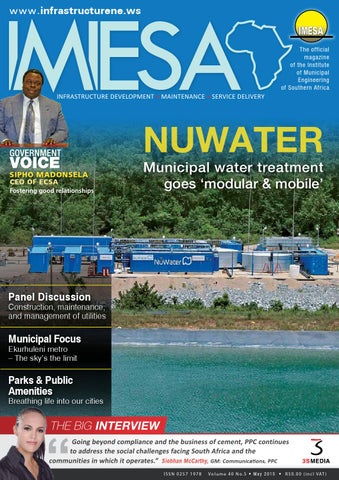
NUWATER SIPHO MADONSELA CEO OF ECSA
Fostering good relationships
Municipal water treatment goes ‘modular & mobile’
Panel Discussion
Construction, maintenance, and management of utilities
Municipal Focus Ekurhuleni metro – The sky’s the limit
Parks & Public Amenities
Breathing life into our cities
THE BIG INTERVIEW Going beyond compliance and the business of cement, PPC continues to address the social challenges facing South Africa and the communities in which it operates.” Siobhan McCarthy, GM: Communications, PPC ISSN 0257 1978
V o l u m e 4 0 N o . 5 • M a y 2 0 1 5 • R 5 0 . 0 0 ( i n c l VAT )
PAVING
Aveng Infraset produces a diverse range of precast concrete products to world-class quality standards and actively contributes to SADC infrastructure development. Our range includes concrete pipes, culverts, manholes, special precast products, various types of pre-stressed railway sleepers, turnouts, maintenance-free railway electrification masts and poles, paving blocks, retaining wall systems and roof tiles.
RAILWAY
ROOF TILES
Aveng Infraset’s admired heritage is founded on innovation, technical and service excellence. RETAINING WALLS
KERBS
SEVEN WAYS TO
LASTING INFRASTRUCTURE Aveng Manufacturing House Tel: +27 (0)11 876 5500 Fax: +27 (0)11 872 1713 email: Infrasetinfo@infraset.com www.infraset.com
Pipes • Culverts • Manholes: Gauteng Tel: +27 (0)11 876 5100 Cape Town Tel: +27 (0)21 908 1156 Kwazulu Natal (Pietermaritzburg) Tel: +27 (0)33 387 2236
Railway Sleepers • Poles & Masts National Tel: +27 (0)11 813 2340
POLES & MASTS
INFRASTRUCTURE
Paving • Retaining Walls • Roof Tiles Rossway (Midrand) Tel: +27 (0)12 652 0000
International Branches Swaziland Tel: +2682 518 4236
Kwazulu Natal (Effingham) Tel: +27 (0)31 569 6900
Zambia Tel: +260 21 131 1838
CONTENTS www.infrastruc
turene.ws
VOLUME 40 NO. 5 MAY 2015
16
IMESA The officia l magaz ine of the Institu te of Munici pal Engine ering of Southe rn Africa
INFRASTRUCTURE
MAIN DEVELOPMENT •
TENANCE • SERVI
PARKS & PUBLIC SPACES Public amenities
CE DELIVERY
NUWATER
treatment Municipal water mobile’ goes ‘modular &
ELA SIPH O MAD ONS CEO OF ECSA Fostering good
relationships
ion Panel Discusstenan ce,
Construction, main utilities of and management
10
Municipal Focus Ekurhuleni metro – The sky’s the limit
Parks & Public Amenities Breathing life into
our cities
THE BIG INTERV comm
IEW
continues ess of cement, PPC liance and the busin the Going beyond comp South Africa and challenges facing PPC Communications, to address the social n McCarthy, GM: Siobha ) tes.” opera 5 0 . 0 0 ( i n c l VAT May 2015 • R unities in which it 8 ISSN 0257 197
.5 • Vo l u m e 4 0 N o
NuWater is well recognised as a leader in the provision of highly flexible and scalable water and wastewater treatment solutions and services to the mining and other industrial sectors, both in South Africa and internationally. P6
MUNICIPAL FEATURE Ekurhuleni Metropolitan Municipality
Regulars Editor’s comment President’s comment Africa round-up Index to advertisers
3 5 8 68
Cover Story 6
NuWater
Municipal Feature
The socio-economic climate in South Africa is a challenge for any business but some see it not only as a hurdle to be overcome, but as an obstacle that must be actively removed. PPC is one such business and IMIESA talks to Siobhan McCarthy about PPC’s innovative projects aimed at accomplishing this goal. P14
44
Call for aggregate standardisation
45
Constructing a precast paradise
47
Hydrostatic dumpers stick it
Green Building
The Big Interview
Failure in the Durban 14
Public amenities – breathing life into our cities Healing construction
16 18
Panel Discussion
19
Metering Measuring green
32
Water & Wastewater Clarifier upgrades with high-rate ballasted clarification
34
Roads Improving road maintenance skills 36 The Ganyesa gravel roads upgrade 38
47
CEMENT & CONCRETE Constructing a precast paradise
Container Terminal
56
Tackling drug abuse
59
Skills & Training Excellence through collaboration
60
Technology & Innovation 61
Putting the power in your hands A striking solution for ABSA’s Project Lumen
62
An optimum drainage solution
63
Construction Vehicles, Equipment & Logistics Small hammers big on performance 64 A cost-effective guardrail system
65
The legend of the compact
Cement & Concrete Solid as a 'roc'
52
Creating a green heritage
SHEQ
PPC
50
to tough terrain
Ekurhuleni Metropolitan Municipality 10
Parks & Public Spaces
THE BIG INTERVIEW
Examining new roles for concrete
41
66
loader continues
52
GREEN BUILDING Creating a green heritage
IMIESA May 2015
1
EDITOR’S COMMENT
PUBLISHER Elizabeth Shorten EDITOR Nicholas McDiarmid EDITORIAL ASSISTANT Liesl Frankson JOURNALISTS Beatrix Knopjes, Frances Ringwood HEAD OF DESIGN Beren Bauermeister CHIEF SUB-EDITOR Tristan Snijders SUB-EDITOR Morgan Carter CONTRIBUTORS S Gibson, N Kranz, N Tandi CLIENT SERVICES & PRODUCTION MANAGER Antois-Leigh Botma PRODUCTION COORDINATOR Jacqueline Modise FINANCIAL MANAGER Andrew Lobban MARKETING & DIGITAL MANAGER Esther Le Roux MARKETING SPECIALIST Philip Rosenberg ADMINISTRATION Tonya Hebenton DISTRIBUTION MANAGER Nomsa Masina DISTRIBUTION COORDINATOR Asha Pursotham SUBSCRIPTIONS subs@3smedia.co.za PRINTERS United Litho Johannesburg +27 (0)11 402 0571 ___________________________________________________
Positive progression
W
HEN IS ENOUGH, enough? Lately, we have seen the answer in outbreaks of violence, directed at easy targets, which have become the objects of blame for South Africa’s numerous challenges. Indeed, the national focus often seems to be misdirected, with the xenophobic attacks being preceded by the Cecil John Rhodes UCT statue controversy. Frustration is definitely high; but what is it really all about? Terms like transformation and delivery are well worn but still speak to the urgent need to improve the majority of South African lives. Naturally, the role of municipalities in achieving this is critical – starting with the construction, maintenance, and management of infrastructure and services, through to job opportunity creation, skills, and training. This edition of IMIESA places a special focus on the utilities function of municipalities in South Africa. With directives from national government, the focus now is on empowering South Africa’s secondary cities and district municipalities to yield revenue from their assets. Counteracting the negative issues that have dominated the landscape over the last few months are the innovative solutions that municipalities, their private sector partners, and national government itself have presented. One of the key areas where movement seems to be happening is in the financing and procurement solutions that are overcoming some of the bottlenecks typically seen. These include proposals for nationalising procurement, support for emerging contractors in separating their services from the procurement of materials, and bridging finance from institutions like the Development Bank of Southern Africa. As this publication has illustrated before, there are opportunities for leaders with vision to propose solutions to national government for the delivery of essential infrastructure.
ADVERTISING SALES Jenny Miller Tel: +27 (0)11 467 6223 ___________________________________________________
PUBLISHER: MEDIA No. 9, 3rd Avenue, Rivonia 2056 PO Box 92026, Norwood 2117 Tel: +27 (0)11 233 2600 Fax: +27 (0)11 234 7274/5 E-mail: nicholas@3smedia.co.za www.3smedia.co.za ANNUAL SUBSCRIPTION: R550.00 (INCL VAT) ISSN 0257 1978 IMIESA, Inst.MUNIC. ENG. S. AFR. © Copyright 2015. All rights reserved. ___________________________________________________ IMESA CONTACTS IMESA Administration Officer: Narisha Sogan P O Box 2190, Westville, 3630 Tel: +27 (0)31 266 3263 Fax: +27 (0)31 266 5094 Email: admin@imesa.org.za Website: www.imesa.org.za BORDER BRANCH Secretary: Melanie Matroos Tel: +27 (0)43 705 2401 Fax: +27 (0)43 743 5266 E-mail: melaniem@buffalocity.gov.za EAST CAPE BRANCH Clarine Coltman Tel: +27 (0)41 505 8019 Fax: +27 (0)41 585 3437 E-mail: clarinec@africoast.com KWAZULU-NATAL BRANCH Secretary: Rita Matthews Tel: +27 (0)31 311 6382 Fax: +27 (0)31 701 2935 NORTHERN PROVINCE BRANCH Secretary: Rona Fourie Tel: +27 (0)82 742 6364 Fax: +27 (0)86 634 5644 E-mail: imesanorth@vodamail.co.za SOUTHERN CAPE KAROO BRANCH Secretary: Henrietta Oliver Tel: +27 (0)79 390 7536 Fax: 086 536 3725 E-mail: imesa.southcape@gmail.com WESTERN CAPE BRANCH Secretary: Erica van Jaarsveld Tel: +27 (0)21 938 8455 Fax: +27 (0)21 938 8457 E-mail: erica.van_jaarsveld@capetown.gov.za FREE STATE AND NORTHERN CAPE BRANCH Secretary: Wilma Van Der Walt Tel: +27(0)83 457 4362 Fax: 086 628 0468 E-mail: imesa.fsnc@gmail.com
As editor, I would personally like to thank all the participants in this edition, not only for their presence in the publication, but for the ongoing commitment to keep South Africa functioning and developing. Certainly, determination, grit, and commitment are clearly in evidence. Creating a positive environment in which local government functions is more important than it ever has been and, like our institute, IMESA, IMIESA magazine sees knowledge sharing as indispensable to achieving this. The institute continues to make impressive in-roads in the areas of asset management support to local government, including software suppor t, training, and other tools essential to this core development area. Not only do municipalities stand to benefit from updated and useable asset registers (from which accurate forecasting and budgeting decisions can be made), the potential savings involved in managing asset maintenance and repairs are hugely significant. IMIESA will cover this, again – in more depth – in its June edition. I would once again like to say that I consider it a privilege to work with the institute, and the sector as a whole, and I hope you enjoy the edition thoroughly.
Nicholas McDiarmid
To our avid readers, check out what we are talking about on our website, Facebook page or follow us on Twitter and have your say.
@infrastructure4
www.infrastructurene.ws
Infrastructure News
IMESA IMESA
All material herein IMIESA is copyright protected and may not be reproduced either in whole or in part without the prior written permission of the publisher. The views of contributors do not necessarily reflect those of the Institute of Municipal Engineering of Southern Africa or the publishers.
The official magazine of the Institute of Municipal Engineering of Southern Africa
INFRASTRUCTURE DEVELOPMENT • MAINTENANCE • SERVICE DELIVERY
NUWATER SIPHO MADONSELA CEO OF ECSA
Fostering good relationships
Municipal water treatment goes ‘modular & mobile’
Panel Discussion
Construction, maintenance, and management of utilities
Municipal Focus
ussion Panel Disc technology Trenchless
l Focus Municipa City – An Mogale landscape evolving
ns in Innovatio tion: Construcapproaches Innovative tructure to infras
ildingads Bu g ro Parks & Public Ekurhuleni metro – The sky’s the limit
Cover opportunity In each issue, IMIESA offers advertisers the opportunity to get to the front of the line by placing a company, product or service on the front cover of the journal. Buying this position will afford the advertiser the cover story and maximum exposure. For more information on cover bookings contact Jenny Miller on tel: +27 (0)11 467 6223.
urin end Amenities
M PTRM KNS UCTION Breathing life into our cities
THE BIG INTERVIEW
CO
Going beyond compliance and the business of cement, PPC continues to address the social challenges facing South Africa and the communities in which it operates.” Siobhan McCarthy, GM: Communications, PPC ISSN 0257 1978
V o l u m e 4 0 N o . 5 • M a y 2 0 1 5 • R 5 0 . 0 0 ( i n c l VAT )
IMIESA May 2015
3
IMESA conference 2015 social events
Grand West Casino and Hotel 27 OCTOBER 2015
28 - 30 OCTOBER 2015
OPENING FUNCTION
COMPANION PROGRAMME
• Grand West Casino and Hotel: networking with exhibitors, other delegates and colleagues
• Wed 28 Oct to Fri 30 Oct – for spouses to enjoy while partners are at the conference – Kalk Bay with lunch at Brass Bell – Rhodes Memorial – Franschhoek – Chocolate factory – Shopping
GOLF DAY • Bellville Golf Club – Shotgun start four ball alliance Starts at 11:30 // prizes
29 OCTOBER 2015 GALA EVENING – SHIMMY’S BEACH CLUB • Ocean front dining, with its breath taking backdrop of Cape Town’s iconic Table Mountain; join us for a spectacular fun filled evening of delicious food and entertainment.
Delegates attending full conference: Opening Function and Gala evening included in full delegate fee. To book any of these social events call Debbie 031 266 3263 or email: conference@imesa.org.za
IMESA ORGANISER THE INSTITUTE OF MUNICIPAL ENGINEERING OF SOUTHERN AFRICA (IMESA)
t +27 (031) 266 3263 email conference@imesa.org.za
PRESIDENT’S COMMENT
IMESA
SALGA National
Members’ Assembly Duncan Daries, IMESA president
P
RESIDENT JACOB Zuma’s keynote address to the South African Local Government Association on 25 March 2015 has elicited quite a varied response. The theme of the National Assembly was ‘Celebrating 15 years of Democratic Local Government. Going back to basics to consolidate and deepen a developmental and people-centred local democracy'. In essence, he made a couple of points, which I summarise as follows: • The release of the 2011 Census has confirmed the great strides made in the provision of basic services and this positive trend is reinforced by the latest report on the non-financial census of municipalities released on 2 September 2014. While the lives of millions have improved meaningfully, there are still many who are waiting to see their lives change for the better. They want water, electricity, housing, roads and decent schools near their homes. • Centres of excellence have emerged across the country and, in the spirit of cooperative governance, there is a need to share lessons we have learnt. Municipalities that are functioning effectively, with effective political and administration systems, are characterised by clean administration and zero tolerance to poor performance.
This is the goal of all municipalities, as local government exists to serve the people. • The countr y’s National Development Plan has identified a number of areas for targeted action, such as “clearer separation between the roles of political principals and the administrative heads of municipalities”, as well as the improvement of accountability, oversight and management systems. • Government has responded by making amendments to legislation, improving the professionalism and management of local government. There should be no compromise in ensuring that officials possess the minimum skills. Chief financial officers, engineers and other technical staff should be qualified and skilled at performing their duties. • Effective public administration is not a privilege in a democratic society. It is a fundamental right. Some delegates disapproved the 'back to basics' concept, as it is suggesting there is somethings untoward about the functioning of councils and that it supports the narrative that councils do not know what they were doing. However, Minister Pravin Gordhan countered that the campaign was intended to create a positive narrative about local government.
Others were concerned that local government was being singled out with respect to the skills and experience requirement and they asked whether the same was being expected of national and provincial government.
Professional municipal staff From IMESA’s point of view, we understand the intention of the national government. The request that skilled cadres be deployed from national or provincial government should be taken in the context of knowing the separation of roles between the political principals and the administrative heads of municipalities. We believe that every head within the municipal structure should, first of all, be a professional whose primary role is to provide the administrative and technical input for decisions that will be taken by the political principals. Being politically aligned is an added bonus, not a primary point of departure. The separation of these roles promotes accountability in the provision of local government services. The professional staff component, individuals who subscribe to an ethical code of conduct (e.g. ECSA registered professional engineers/technologists/ technicians), is the catalyst to achieving clean audits, transparent tendering processes and
efficient, cost-effective service delivery. IMESA is fully committed to encouraging this approach and, as a voluntary association of municipal engineering practitioners, offers support in providing opportunities for continued professional development. IMESA will also continue to be of support to engineering practitioners, who presently lack the capacity or specific skills, through networking and engaging with fellow IMESA members via local branch activities and our annual conference. With respect to assisting municipalities in need, IMESA is ideally placed for rolling out asset management training on behalf of MISA, as well as assisting CoGTA in formulating and implementing asset management plans in the Free State. Through this initiative, we also hope to highlight the central role of infrastructure engineers in formulating these plans, as well as the enhanced decisionmaking tools available to inform political principals. Knowledge-sharing is a fundamental part of IMESA’s strategy, and great effort is being put into our web page development to ensure that it is of value to our members as well as the wider community within the municipal environment. To all spheres of government, IMESA continues to extend its hand as a partner in the journey to improved service delivery to our communities.
IMIESA May 2015
5
COVER STORY
Municipal water treatment
goes ‘modular & mobile’
NUWATER
NuWater is well recognised as a leader in the provision of highly flexible and scalable water and wastewater treatment solutions and services to the mining and other industrial sectors, both in South Africa and internationally.
I
TS MODULAR AND MOBILE solutions are now also being embraced by the public sector in South Africa with the eMalahleni Local Municipality entering into an agreement with NuWater to provide an advanced membrane-based solution, along with related operations and maintenance services, to treat up to 20 million litres per day of raw feedwater to potable water standard. NuWater’s services will address a critical water treatment capacity constraint within the municipality and will ensure that safe, high-quality drinking water is available to all residents within the municipal area.
Flexible and responsive treatment solutions John Holmes, NuWater’s CEO, believes this project is an important endorsement of his company’s technology, solutions and service culture and shows a changing mindset in the public water and wastewater treatment sectors in South Africa.
6
IMIESA May 2015
According to Holmes, “In the past, water and wastewater utilities have favoured fixed treatment infrastructure with a large civil engineering component and based on technologies developed decades ago. However, as planning and investment have trailed the pace of urban growth, more flexible and responsive water and wastewater treatment solutions are now critical to help close the rapidly growing gap between demand and supply. "NuWater incorporates some of the most advanced membrane technology into its plants in order to provide highly compact and readily scalable solutions that can be rapidly deployed – and, where necessary, redeployed. This technical flexibility also means that NuWater can offer new commercial models to its customers that better match their financial situation – in short, NuWater can offer solutions that require none of the normal upfront capital investment and, at the same time, do not tie our customers into restrictive long-term service agreements. We
are effectively backing ourselves to deliver a high-quality, affordable solution that will lead to long-term trusted relationships with our customers.” Holmes continues, “What we are doing at NuWater is applying what we have learnt in the private sector, and in particularly the mining sector, to the public or municipal sectors. Mining is a major user of water and producer of wastewater, which, left untreated, can have a major environmental and social impact, as evidenced in the Gauteng area. The challenge for miners is to be able to cost-effectively treat large volumes of water back to safe potable water standards. Unfortunately, a mine’s water treatment requirements change over time and, in many instances, quite rapidly – due to seasonal and climatic changes, or due to changes in the operations of the mine. In order to cost-effectively treat the required volumes of water to the required standards, over the mine’s useful life and beyond, miners need to be able to rapidly increase or reduce treatment capacity and reconfigure the treatment process to address changing
COVER STORY
LEFT UF modules at Anglo American Thermal Coal RIGHT eMalahleni Local Municipality plant render
feedwater chemistry. Therefore, in order to be successful, service providers such as NuWater need to offer both technical and commercial flexibility. This is exactly what we have done for customers such as Anglo American, starting back in 2010.”
Solutions in action With its modular and mobile treatment plant design, NuWater was able to offer Anglo American Thermal Coal’s New Vaal Colliery a short-term (two-year) service agreement to treat up to 20 million litres per day of the mine’s wastewater to potable water standard for a fixed price per cubic metre of water treated. As NuWater retained ownership of the plant and provided all the operations and maintenance services required, Anglo carried no technical or operational risk. This, together with NuWater’s competitive pricing, made for a relatively simple decision for Anglo. There was no upfront capital outlay or need to train personnel. The mine effectively outsourced the treatment of its wastewater to NuWater while retaining the flexibility to engage another service provider, or to build its own plant, should NuWater not perform. Holmes adds, “Without the ability to relocate our plant at the end of the initial contract period, we would not have been able to offer Anglo the terms we did. As it happens, our confidence in our solution and our commitment to providing Anglo with a quality and affordable service have meant that we have had multiple extensions to our contract at New Vaal Colliery, with the most recent being a further three-year extension running through to 2018. This reflects the confidence and trusted relationship we have built with Anglo.” This customer confidence and satisfaction is also being demonstrated by contract extensions with other key customers. At the same time, NuWater is building its plant asset base, meaning that it is able to offer an even faster response to customer requests. According to Holmes, NuWater is building this impressive momentum by focusing on three core aspects in its business: continual improvement of its technology solutions through proprietary product development
and integration of worldclass third-party technologies; an entrenched culture of customer service; and further strengthening of the company’s balance sheet through strategic investors. This brings us back to the project with the eMalahleni Local Municipality. Jeeten Nathoo, NuWater’s CTO, takes the opportunity to explain the technology incorporated in the plant that is being mobilised for delivery to the allocated site in eMalahleni. According to Nathoo, “At up to 20 million litres per day of treatment capacity, the eMalahleni plant will be the largest ultrafiltration plant in Southern Africa. "The plant will also be commissioned in as little as 12 weeks from final contract conditions being met, providing a very quick solution to the current treatment shortfall. In addition, the plant can be redeployed at another location at the end of the ini-
It would appear that the appeal of NuWater’s modular and mobile solutions, and the flexible commercial models these plant designs enable, is not limited to South Africa. In the past 12 months, NuWater has expanded its presence, through local joint-venture partners and investors, to include India, Thailand, UAE and Mexico. This has already resulted in a very promising pipeline of new business in each of these countries, with a number of projects nearing con-
“What we are doing at NuWater is applying what we have learnt in the private sector, and in particular the mining sector, to the public or municipal sectors.” tial three-year contract period, should the contract not be renewed. NuWater retains ownership and responsibility for the plant and its operation at all times, which ensures our interests are fully aligned with those of our customers.
Advanced technology and design “Ultrafiltration, commonly referred to as UF, is a synthetic membrane technology that allows pure water, under pressure, to pass through the membrane while blocking minute suspended particles, including bacteria and viruses, from passing through it. This advanced technology has been proven, in some of the world's most advanced water treatment plants, to produce high-quality potable water. The technology is far more effective than conventional water treatment plants. In addition, it is far more compact than conventional technology and, with NuWater’s proprietary designs, we are able condense the plant size into a small number of modules with a very compact footprint. This, in turn, allows us to easily move these modules from one project location to another – hence the modular and mobile description.”
tract signing. This is in addition to NuWater’s existing operations in Singapore, from where it already services its customers in southeast Asia. Holmes is confident that the pace of NuWater’s expansion will continue, and accelerate, as the demand for more flexible and responsive water and wastewater treatment continues to grow. He concludes, “NuWater is helping to define this new water subsector that we describe as 'modular and mobile'. We are demonstrating that we are able to significantly lower the barriers to getting water and wastewater projects done, which will be hugely beneficial to local communities, and the country in general. Our focus is on building the trusted NuWater brand in this new modular and mobile space, and on changing the mindsets of customers, partners and investors by continuing to deliver high-quality projects.”
t +27 (0)21 531 0641 www.nuwaterglobal.com
IMIESA offers advertisers an ideal platform to ensure maximum exposure of their brand. Companies are afforded the opportunity of publishing a two-page cover story and a cover picture to promote their products to an appropriate audience. Please call Jenny Miller on +27 (0)11 467 6223 to secure your booking.
IMIESA May 2015
7
AFRICA ROUND-UP
INFRASTRUCTURE NEWS FROM AROUND THE CONTINENT CAMEROON Three-year Emergency Plan to go ahead The North-West Region will soon welcome new projects to step up development within the framework of President Paul Biya's three-year emergency development plan. In effect, the technical adviser at the PM's office, who doubles as the coordinator of the Technical Secretariat of the Three-year Emergency Plan Committee, Elanga Obam Georges, revealed that the plan will cover, among others, the construction of two highways in the North West, construction of 100 boreholes in needy rural areas of the region, construction of modern slaughter houses and cold stores to enhance the production of livestock, support of agricultural activities, and the improvement of facilities to reinforce border security. He urged the population to support, participate, and appropriate Cameroon's move towards emergence by 2035.
EGYPT
8
According to the brochure, there will be exactly 21 residential districts, 25 ‘dedicated districts’, 663 hospitals and clinics, 1 250 mosques and churches, and 1.1 million homes – housing at least five million residents.
NAMIBIA Ondangwa runway under rehabilitation
Deputy President of Kenya William Ruto
KENYA
Egypt plans £30 billion purpose-built capital in desert
Rules to govern 10 000 km road construction financing gazetted
The government of Egypt has announced plans to build a new capital city on virgin sands to the east of its predecessor. According to officials, the new £30 billion capital is to be built by the Emirati businessman behind the Burj Khalifa. If completed, the currently nameless city would span 700 km2 (a space almost as big as Singapore), house a park double the size of New York's Central Park, and a theme park four times as big as Disneyland – all to be completed within five to seven years.
The Kenyan government has put into law guidelines that will govern the operations of the newly unveiled plan to tarmac 10 000 km of roads across the country. The treasury gazetted regulations that will operationalise a special fund that will finance the refurbishment of the roads over the next five years. The guidelines on the establishment of the Public Finance Management (Roads Annuity Fund) 2015 details the objectives and purposes, source of funds, management of the
IMIESA May 2015
fund, payments of the fund, as well as winding up of the fund. Deputy President William Ruto, who chaired a meeting of banks that will fund the project, said the regulations will ensure the government's new model for road construction through public-private partnership works seamlessly. "The regulations will make sure the road annuity programme operates smoothly by guaranteeing timely payment of contractors and services," he said.
Work on the approximately $17 million Ondangwa runway rehabilitation has commenced following the signing of the agreement between Namibia Airports Company (NAC), Aurecon Namibia, and China State Construction Engineering Corporation. According to acting chief executive officer of NAC Tamer El-Kallawi, completion of the job is envisaged for July 2016. “It will mean that the Ondangwa airport runway will be upgraded from category 3 C to category 4 C and this, in turn, means that bigger aircraft such as the Airbus A319, will be able to land there. The runway will be widened to 45 m and lengthened to 2.8 km,” said El-Kallawi. He added that the second priority area of the NAC's strategic plan focuses on rehabilitating and upgrading airport infrastructure and this, in turn, would lead to achieving the NAC's long-term objective of positioning Namibia as a key aviation connection hub.
NIGERIA AfDB and others to finance $1.5 billion Lekki Port Project Six banks, including the African Development Bank (AfDB), have signed an agreement with Singaporean firm Tolaram Group to finance the proposed $1.5 billion port project in the Lekki area of Lagos. The construction of the port has been scheduled to commence this month, after it had been shifted a number of times. Other banks contributing to the port project include the African Finance Corporation, European Investment Bank, Standard Chartered Bank, Rand Merchant Bank, and Standard Bank. When completed, the port will handle 2.5 million 20-foot equivalent units (TEUs), 16.7 million tonnes of liquid cargo and 4.5 million tonnes of dry bulk. The proposed deep-seaport has capacity for containers, liquid and bulk terminals, 150 million quays, and 14 million draughts, among others.
SOUTHERN AFRICA SADC Gateway Port takes off The SADC Gateway Port, part of the Namibia Ports Authority (Namport), could become a reality with the first phase – the construction of the oil terminal – expected to take off soon. The SADC Gateway Port, which will cost approximately $2.5 billion, will be developed in at least five phases while construction will gradually take place as demand for services arises. According to Namport engineer Elzevir Gelderbloem, the contract was already awarded
AFRICA ROUND-UP
and construction has started. The phase itself will be commissioned in 2017. The oil terminal will consist of two new tanker berths that will replace the port's current tanker berth. According to Gelderbloem, the existing tanker berth already reached the end of its lifespan, as it has banked the country's fuel for the past 50 years and needs to be replaced. Gelderbloem said Phase Two of the SADC Gateway Port will focus on the construction of the planned liquefied natural gas (LNG) terminal. He said the terminal will provide gas to the new power plant, soon to be constructed behind Dune 7, to supply the SADC Gateway Port with power.
renovating and extending the terminal buildings. BAM International, which is a subsidiary of Royal BAM Group, one of Europe's largest contracting companies, active in construction, property and civil engineering, will be revamping the airport, the country's major northern tourism circuit's gateway, to the tune of €37 million.
ZAMBIA AfDB to finance ChinsaliNakonde road construction The African Development Bank (AfDB) will finance the construction of the ChinsaliNakonde road at the cost of $250 million. The project forms a section of the Trans-Africa Highway/ North-South Corridor.
Road works equipment in Harare
The main components of the entire project include: civil works, the rehabilitation of the Chinsali-Nakonde road section, rehabilitation of 50 km of feeder roads and complementar y initiatives/social infrastructure, among others.
ZIMBABWE $50 million terminus for Harare's fourth street
SADC Gateway Port
TANZANIA Major plan to transform KIA into East Africa's best An ambitious project to renovate, expand and modernise the Kilimanjaro International Airport (KIA) has started at the country's second busiest terminal and is expected to be completed in 23 months' time. BAM International of Netherlands will be executing the project involving the rehabilitation and extension of the airport's taxiways, runways and aprons, as well as
AfDB officer-in-charge for Zambia Philip Boahen said the project aims to improve road transport infrastructure and ser vices through the development of the priority road corridor to reduce transport costs between northern Zambia and southern Tanzania. Boahen said the feasibility, preliminar y design, detailed engineering design, and environmental and socio-economic impact assessment studies had been completed and reviewed by the bank.
A $50 million bus interchange is expected to be constructed at Fourth Street bus terminus in Harare, after Pearl Properties signed a joint venture agreement with the City of Harare. Pearl Properties general manager for developments
Christopher Manyowa says the project, which is expected to begin next year, will change the face of the capital. "The joint venture will see the City of Harare contribute the land while Pearl Properties will contribute the funding for the development,” Manyowa said. He said the project, which would also include a shopping mall, would be implemented in phases. The Pearl Properties manager said the bus interchange project would stretch from Fourth Street to Fifth Street and then Robert Mugabe Avenue to George Silundika Avenue.
Kilimanjaro International Airport
IMIESA May 2015
9
MUNICIPAL FEATURE
EKURHULENI
The sky’s the Ekurhuleni Metropolitan Municipality (EMM), boasting first-world infrastructure, is the transportation hub of South Africa. BY BEATRIX KNOPJES
T
HE METROPOLITAN municipality of Ekurhuleni was established in 2000, and covers an extensive geographical area from Germiston in the west to Springs and Nigel in the east. It comprises nine towns: Alberton, Benoni, Boksburg, Brakpan, Edenvale/Lethabong, Germiston, Kempton Park/Tembisa, Nigel, and Springs. EMM has come a long way in consolidating its systems and processes for the sustained delivery of services in the city. Ekurhuleni has a surface area of 1 975 km2 that accommodates a population of 3 178 470 million according to Census 2011. Ekurhuleni is spread over 15.6% of Gauteng’s land mass, houses 5.4% of the country’s population, and 25.5% of Gauteng’s population. Migration into the area is a key challenge. This is evident in the number of informal settlements and the informal trading activity. The Ekurhuleni metropolitan economy is larger and more diverse than that of some small countries in Africa, including all the countries in Southern Africa. It accounts for nearly a quarter of the Gauteng economy, which, in turn, contributes over a third of the national GDP. Ekurhuleni has a network of roads, airports, rail lines, electricity grids and telecommunications that rivals that of Europe and America, giving it first-world infrastructure to support a wellestablished industrial and commercial complex. Ekurhuleni is regarded as the transportation hub of the country. It is home to O.R. Tambo International Airport, the busiest airport in Africa. This airport services the entire continent and links to major cities throughout the world. Similarly, many of the world’s leading airlines fly into O.R. Tambo International Airport.
10
IMIESA May 2015
limit
South Africa’s largest railway hub is in Germiston, which links it to all the major population centres and ports in the Southern African region. A number of South Africa’s modern freeways and expressways connect Ekurhuleni to other cities and provinces. The Maputo Development Corridor, South Africa’s most advanced spatial development initiative, connects Ekurhuleni with the capital of Mozambique and the largest South African Indian Ocean port. Direct rail, road and air links connect Ekurhuleni to Durban, the biggest and busiest port within South Africa. The O.R. Tambo International Airport has been identified as the nucleus for the development of the Aerotropolis, which is one of the flagship projects of the municipality to stimulate growth and job creation.
Human settlements – Eastern Development Corridor The Gauteng State of the Province Address 2015 highlighted a number of development corridors in Gauteng. Ekurhuleni largely comprises the Eastern Development Corridor. As part of this development, provincial and local government has committed to addressing the dire shortage of housing in the growing metropolis. The current housing backlog of 144 000, and the housing solution of one house per stand targeted at poor families, is constrained by land availability because the city only has about 7 000 hectares of developable land. Together with the Ekurhuleni metro and national government, the provincial government is now undertaking 29 industrial initiatives, under the banner of the Aerotropolis, to
revitalise manufacturing, aviation, transport and logistics industries linked to O.R. Tambo International Airport. In order to change the human settlements paradigm, more than 100 000 housing units will be delivered over the next five years in areas such as Chief Albert Luthuli, John Dube Ext 2, Tsakane Ext 22, Germiston South, Leeuwpoort, Rietfontein, and Clayville Ext 45.
Tambo Springs inland port Away from the ports, plans for the proposed new South African freight hub at Heidelberg, near Johannesburg, which will link road and rail transport to and from the country’s major freight routes, are progressing, with a start on construction expected before the end of the year. The project, being undertaken by the Tambo Springs Development Company, will be the largest inland port in Africa and should commence operations in 2017, as City Deep, Johannesburg’s current inland port, reaches capacity. The port may also tie in to the proposed KwaZulu-Natal-Free State-Gauteng industrial freight corridor, which is intended to shift cargo from road to rail by 2030. There is also the possibility that Tambo Springs could later connect to the planned high-speed rail link between Johannesburg and Durban, significantly raising the route’s present freight capacity. By the time it is completed, the facility will double Gauteng province’s freight handling capacity.
BRT system With regard to freight and logistics, Transnet’s investment in the inland ports of Tambo
MUNICIPAL FEATURE
Springs and Sentrarand will also have a major impact on revitalising the economy of Ekurhuleni. The Tambo Springs inland port development will have an estimated R7.5 billion investment over five years, creating a total of 110 000 jobs over 15 years. In a bid to further change the spatial geography of this corridor, the bus rapid transit (BRT) system in Ekurhuleni is being rolled out, and its first phase will be operational by March next year. Over R500 million will be invested in the BRT system over the next five years.
Landfill-to-gas EMM boasts a landfill-to-gas project. The objective of this project is the capture and combustion of landfill gas, thereby avoiding methane emissions to the atmosphere, and hence the production of emission reductions in terms of the clean development mechanism. Key features of the project include: • installation of 96 gas wells in the existing landfills (vertical and horizontal) • installation of more than 10.5 km of gas collector pipework • design and installation of one 1 300 m3/h
(SC1300), two 2 000 m3/h (SC2000) and one 3 000 m3/hour (SC3000) high-temperature gas flares • design and installation of continuous gas monitoring system, including flow rates, temperature and gas quality, with continuous exhaust monitoring system to prove flare efficiencies • design and installation of electrical supply and backup generator systems to all sites • design and installation of Scada system, incorporating the gas extraction and flaring systems • operation and maintenance of landfill gas extraction and flaring systems for five years after commissioning, including complete CDM data management, reporting and certification.
the province since 1906. However, the failure in water supply was unanticipated. An early warning system will be used to indicate dropping water levels in EMM’s storage reservoirs, allowing for timely intervention. To do this, telemetric-type systems that will synchronise all reservoirs in Ekurhuleni will be installed, making it easy to divert water from one supply zone to another. Construction of two additional water reservoirs, in Palm Ridge and Etwatwa Ext 19, is currently underway and expected to be com plete by 2017.
Water demand management In 2014, EMM experienced a month-long interruption in water service delivery. To address this issue, the municipality has rolled out an extensive water demand management plan. Rand Water is the service provider for the entire EMM area and has supplied water to IMIESA May 2015
11
L ANDFILL
Aquatan is the first IAGI-approved installation contractor in Africa, which underscores our reputation for installing Geosynthetics professionally and reliably, every time. Aquatan is ISO 9001/2008 certified, and has been awarded the SABS Certificate of Recognition for its 20 years of loyalty, commitment to and compliance with the SABS Quality Management Certification scheme.
ENHANCED BARRIER SYSTEM® Aquatan's patented Enhanced Barrier System® (EBS) for waste sites is a new technology that has gained international recognition for its dedicated and focused performance characteristics. The principle is to draw a fluid at a negative pressure through the geosynthetic barrier system to achieve:
Aquatan provides the TOTAL SOLUTION! In addition to our Geomembrane innovations, Aquatan's HDPE, LLDPE, RFPP and EVA geomembranes are used in applications ranging from hazardous liquid or solid waste to potable water reservoirs, linings of tanks, sewage ponds, anaerobic digestors, heap leach facilities, tunnels, canals, water features and underground water storage facilities. We also construct floating covers to potable water, molasses storage and biogas containment reservoirs, small dams and tanks.
1. Heat removal from Geosynthetic components 2. Post loading hydration of the Geosynthetic Clay Liners 3. Removal of Volatile Organic Compounds This innovative technology, for which Aquatan holds the worldwide patent, expands conventional containment barrier boundaries for protecting the environment far into the future.
For more information: Tel: +27(0)11 974 5271 Fax: +27(0)11 974 4111 E-mail: aqua@aquatan.com www.aquatan.com
NO LS0798
N O I T A R T
S I G E R E N I L ON N O I T A R T S I G RE D E N E P O HAS
ww
org.za . a s e w.im
28-30 OCTOBER 2015
THEME: Changing the face of the Municipal Engineer Earn 2.5 CPD points by attending The 2015 IMESA Conference will be hosted at the Grand West Hotel and Casino – Goodwood
Register and pay before 31 July 2015
Register and pay before 31 August 2015
Register and pay AFTER 31 August 2015
• Early Bird for IMESA Members – R4900.00 • Early Bird for Non IMESA Members – R5400.00
• Late Registration for IMESA Members – R5100.00 • Late Registration for Non IMESA Members – R5700.00
• Last Minute Registration for IMESA Members – R5650.00 • Last Minute Registration for Non IMESA Members – R6250.00
IMESA ORGANISER THE INSTITUTE OF MUNICIPAL ENGINEERING OF SOUTHERN AFRICA (IMESA)
t +27 (031) 266 3263 email conference@imesa.org.za
MUNICIPAL FEATURE
Water metering
The municipality will also ensure that more potable water reservoirs are built by the year 2021, in anticipation of future supply risk and population growth due to urbanisation. Additional reservoirs to be built include: • 20 Mℓ reservoir in Brakpan at an estimated R25 million • 11 Mℓ reservoir in Masetchaba View at an estimated R18 million • 26 Mℓ reservoir at Russel Road at an estimated R34 million
• 10 Mℓ reservoir in Etwatwa at an estimated R20 million • 1.1 Mℓ water tower in Etwatwa at an estimated R10 million • 5 Mℓ water tower in Northmead at an estimated R32 million • 13 Mℓ reservoir in Dunottar at an estimated R23 million • 1 Mℓ water tower in Visagie Park at an estimated R10 million. • 25 Mℓ reservoir in Bredell at an estimated R31.12 million.
In order for the local government to effectively meet this constitutional mandate, systems, including water metering, need to be put in place to ensure sustainable provision of water services. Water metering remains a critical component of service delivery in the municipal environment, for both management and protection of the water provision. Sadly, the majority of municipalities in the country are buckling under pressure and neglect this basic component of service delivery, which renders them ineffective in their quest for water services provision. EMM aims to ensure that each and every drawoff point from the municipal water network is legally, effectively and properly metered, thereby exercising effective water metering policies and principles. Through the adoption of principles such as “to measure is to know”, the department and the broader metro finds itself in a position where it knows the losses encountered through the provision of water services and the actions required to curb such losses. IMIESA May 2015
ST RU YT T L YA LO
Smarter Partnerships. R ME S TO U C
The solutions all add up to degrees of success. Everything hinges on a combination of skill, intelligence, experience and attitude - the ability to approach things differently. You’ll find this in abundance at Stalcor. Our people have had their abilities honed through years of tackling the unexpected. You’re not only getting the finest range of stainless steel and aluminium on the planet, you’re engaging as partners, a 24-hour a day team of highly skilled experts to ensure that you get your product on time and at the right price. For more information visit www.stalcor.co.za or call Stalcor: Germiston 011 871 6900 Cape Town 021 928 2500 KwaZulu Natal 031 719 1000
13
THE BIG INTERVIEW
A new infrastructure outlook – rising to the challenge
PPC What is PPC’s vision for creating a continuing legacy of innovation, socio-economic upliftment, driving value across the value chain and working to deliver its products and expertise to markets beyond South Africa’s borders? SM PPC understands that managing a sustainable business requires the balanced integration of performance; corporate governance; and social, economic and environmental factors into the strategy and operation of our business. Equally, we understand that a range of stakeholders affect, and are affected by, our business, meaning that our approach must be both dynamic and regularly reviewed. We engage regularly with all our stakeholder groups, understanding the importance of their input in developing our strategy and operating a truly sustainable business.
How is PPC advancing the national goals of socioeconomic transformation? In all countries where PPC operates, there is competition for skills to operate a sustainable manufacturing business. This can affect business
14
IMIESA May 2015
The socio-economic climate in South Africa is a challenge for any business, but some see it not only as a hurdle to be overcome, but rather as an obstacle that must be actively removed. IMIESA talks to Siobhan McCarthy, GM: Communications, about PPC’s innovative projects aimed at accomplishing this goal. performance, and cause costs to spiral to keep remuneration and retention schemes marketrelated, especially with new entrants to the industry. PPC aims to advance BBBEE in South Africa, understanding the importance of meaningful mainstream economic participation by black people in meeting the country’s socio-economic objectives. After an initial R2.7 billion BBBEE transaction six years ago, the R1.1 billion second phase was introduced in 2012. Black beneficiaries in broad-based shareholder groupings – including employees and communities – now hold an effective 26% of PPC’s South African operations. We continue to engage with national and provincial government departments to align broad-based socio-economic transformation objectives. Progress is guided by the REAL (relevant, empowering, actualised and lasting) transformation philosophy – the heart of all PPC’s social performance initiatives. In the past, the PPC Education Trust completed its mathematics and science project at high schools near PPC operations. With a total investment of R1.4 million, approximately 250 pupils benefited from this much-needed initiative. This trust also ensured
the successful completion of the artisan programme, with all graduating learners employed in the group. Ongoing training projects for beneficiaries linked to the PPC Construction Industry Associations Trust have seen around 3 000 beneficiaries participating in accredited training initiatives since inception. The PPC Ntsika Fund was established in 2008 as an enterprise development fund and formal vehicle for financial support and active mentorship to black-owned enterprises. To date, the Ntsika board has invested R64 million in six black-owned businesses. Given the entrepreneurial nature of these initiatives, some are more successful than others.
What is PPC doing to change people’s lives in a sustainable manner, and how does it fit into PPC’s long-term business objectives? PPC believes that being a responsible and caring corporate citizen in all our operating areas is a key component of true business leadership. Its policy highlights strategic commitment to sustainable development, shapes relations with other organisations and specifies how PPC
LEFT Francie Shonhiwa, CSI manager at PPC, hands over iPads to children at Forest Town
functions in the wider social, economic and political environment. The intention is to be a socially grounded business. In 2014, PPC spent R7.04 million on CSI initiatives. These initiatives focus on income generation and poverty alleviation. By partnering with established organisations, PPC ensures that these initiatives can reach as many beneficiaries as possible.
What differentiates PPC’s ability to deliver, from a supply chain perspective? Going beyond compliance and the business of cement, PPC continues to address the social challenges facing South Africa and the communities in which it operates. In line with social and labour plans (SLP) for 2014 to 2018, it implemented projects for 5 out of 10 mines. Of the implemented projects, two of the five were completed in 2014. PPC will engage communities and municipalities in various regions to identify development priorities and contribute towards the funding and implementation of socio-economic initiatives.
THE BIG INTERVIEW
How does PPC leverage its skills to create improved economies of scale for complex projects? The development and growth of globally competitive people is a key principle of PPC’s HR strategy and culture. We believe in enriching our team members by ensuring they have the right skills, knowledge and competencies to reach their potential. Training programmes are designed to produce substantial benefits for both PPC and its employees. In 2014, PPC spent R38.1 million, or 4.2% of payroll (i.e. leviable amount), on skills development for employees. Of these direct and indirect costs, over 80% was spent on previously disadvantaged employees. The PPC Operations Academy was established in 2007. To date, 90 learners have successfully completed the academy’s programmes. The academy offers the further education and training certificate in carbonate materials manufacturing process on NQF Level 4. PPC is the only cement manufacturing company offering this programme, which is accredited by the Mining Qualifications Authority (MQA) and registered with the South African Qualifications Authority (SAQA).
How is PPC developing its products and operations to optimise the energy used in its manufacturing processes? In partnership with energy service company HVAC, PPC has been doing its part to take the stresses off the national energy grid through predictive production software. HVAC, in line with Eskom, has been providing technology to sites, such as PPC’s Hercules plant in Pretoria that helps monitor electricity consumption and production levels, in order to plan production around peak times. In this way, PPC has ensured that it can schedule its processes
"PPC has been doing its part to take the stresses off the national energy grid." during off-peak periods to reduce the load on the national grid. This also allows PPC to minimise the impact of loadshedding on production. PPC is constantly striving to improve operational efficiency through product optimisation and investment in more-efficient equipment and processes.
In what ways do PPC's products contribute to minimisation of energy consumption in the structures in which they are used? Although Portland cement manufacturing is energy-intensive and does result in significant CO2 emissions, advances in cement production have greatly decreased these impacts relative to even a few years ago. In addition, and just as important, modern concrete uses less Portland cement per unit volume relative to past practices, thus concrete structures have a lower carbon footprint than at any time in history. Future innovations will ensure additional improvements in reducing the carbon footprint and energy use over the next decade. When all aspects of sustainability are considered, properly designed and constructed concrete structures are clearly part of sustainable infrastructure development.
Africa by InnoWind, its local subsidiary. The construction of the R1.2 billion Grassridge wind energy facility, in Nelson Mandela Bay near PPC Cement’s Grassridge quarry, in Port Elizabeth, forms part of PPC’s long-term rehabilitation plans for the mine. This project is the first step in PPC procuring power from renewable sources. The wind farm is the first, built and operated on the African continent, to be developed by EDF Energies Nouvelles. The facility comprises 20 Vestas V-112 3 MW wind turbines, with a combined installed capacity of 61.5 MW, delivering electricity equivalent to the yearly consumption of about 40 000 households.
What have PPC’s recent innovations brought to the market and what should the public sector understand about the lifetime value of its products, beyond upfront costs? The chemical stabilisation of soil with cement and lime has been widely used for over 40 years as a cost-effective option of improving materials to produce durable roads. Research, undertaken by the CSIR (Council for Scientific and Industrial Research) in 2004, recommended using cement in
the 32.5 MPa strength class to stabilise road layers. At the end of 2012, PPC launched its purposedesigned SureRoad product to meet CSIR recommendations for road construction. SureRoad, a CEM II product, is manufactured by adding an extender or blend of extenders (fly ash, blast-furnace slag or limestone). The CEM II Portland composite cements are ideal for constructing cement-stabilised substrate layers for roads. Historically, the cost of using concrete instead of conventional material, like asphalt, in road construction, was prohibitive. Concrete is, however, far more durable, delivering roads with an expected lifespan of up to 40 years, compared to 25 years for conventional roads. With increasing oil and bitumen prices, concrete has also become a more competitive road building material. The development of specialised, ultra-thin concrete technology is ideally suited for labour-based construction.
www.ppc.co.za
BELOW PPC hands over a house through the Infrastructure Development Project in Ivory Park, Johannesburg
What other developments contribute to PPC’s energy-smart future – from its facilities and offices to its waste management and plant optimisation? EDF Energies Nouvelles recently announced the commissioning of the Grassridge wind farm in South
IMIESA May 2015
15
PARKS & PUBLIC SPACES
Public amenities
– breathing life into our cities
P
ARKS PROVIDE INTRINSIC environmental, aesthetic, and recreation benefits to our cities. They are also a source of positive economic benefits. They enhance property values, increase municipal revenue, bring in homebuyers and workers, and attract retirees. The bottom line is that parks are a good financial investment for a community. Understanding the economic impacts of parks can help decision-makers better evaluate the creation and maintenance of urban parks. Parks are complex elements of a city. They can provide different uses, may be specialised in their function, or can simply provide visual appeal for residents. Whatever their purpose, they act to define the shape and feel of a city and its neighbourhoods. They also function as a conscious tool for revitalisation. Parks can stem the downturn of a commercial area, support the stabilisation of faltering neighbourhoods, and provide landmark elements and points of pride for constituents. For all these things to happen, the city needs to be open and aware of the potential of parks to spur revival, and need support to make that happen.
Why parks matter Easy access to parks, green spaces, and recreation areas is critical to the well-being
16
IMIESA May 2015
Parks, street trees and other green spaces are the living lungs of our built environment. Providing vital functions that contribute to a healthy and liveable environment, their purpose and placement in our cities run deeper than aesthetic appeal. BY BEATRIX KNOPJES of urban communities. From improving the health and wellness of urban citizens to creating a healthier physical environment, city parks are vital to creating sustainable cities. Open space is a key component of urban infrastructure, providing valuable economic, health, and ecosystem benefits. However, many urban neighbourhoods still lack access to parks and recreation opportunities, particularly in disadvantaged areas. While affluent areas in our cities have wellestablished parks, those in our townships are in dire need of development.
Green infrastructure As much as developing communities need to upgrade and expand their built environment, they also need to pay close attention to their green infrastructure. The benefits of green spaces in a built environment go well beyond aesthetic, super ficial functions. These interconnected systems can enhance flood control and reduce the cost of stormwater infrastructure if properly planned. They provide vital life support for the people and wildlife in an area and, ultimately, result in a built environment that
is in harmony with nature rather than in opposition to it.
Social upliftment and geospatial transformation The Sport and Recreation Act of 2007 recognises the important role that parks and recreation facilities play in an urban environment. South Africa is a developing country with rapidly growing socio-economic demands and, as a respectable player in global affairs – including sport and recreation – it faces numerous challenges, which include the creation of sustainable sport and recreation infrastructure. It recognises the remarkable disparities between the previously advantaged areas and disadvantaged areas of our population in the provision of sport and recreation facilities. A significant number of communities do not have any access to even a basic sport and recreation facility. In some areas where facilities exist, they are not properly located for easy access, not properly constructed, not well operated or maintained, and some are not effectively utilised. Urban areas are fast becoming concrete settlements without any spor t
PARKS & PUBLIC SPACES
JOHANNESBURG’S GREEN INFRASTRUCTURE INCLUDES: 10 million trees 2 343 parks 174 hectares of water surfaces 1 587 hectares of trails and river trails 23 nature reserves consisting of 1 203 hectares 17 bird sanctuaries consisting of 366 hectares
and recreation amenities as no provision is made by the local authorities or developers. This is something that sorely needs to be addressed as these are laid out in the norms and standards to set minimum standards for the provision and management of spor t and recreation infrastructure. Initially, street trees were only planted in ‘white’ areas, with trees only being planted on Soweto’s sidewalks from the 1950s. Now, this has changed and tree-planting in formerly neglected areas is a priority. In 2006/7, City Parks planted 21 653 trees, compared to 3 578 the year before. The Greening Soweto project, which was launched in 2006 with the planting of 6 000 trees, is Johannesburg's biggest green revolution. It aims to turn the sprawling township into an urban forest through the planting of 200 000 trees.
A makeover for Johannesburg’s oldest park Rotanda Park, one of the oldest parks in Johannesburg, has been revamped in early 2015. Work on the park included building flower beds, laying the lawn, planting
7 hiking trails 35 cemeteries consisting of 1 254 hectares 3 crematoria 4 environmental and education centres 4 nurseries 1 botanical garden 1 zoo
indigenous trees, installing new outdoor gym equipment, and painting playground equipment in the so-called Xtremepark Makeover initiative. “The aim of the Xtremepark Makeover initiative is to fast-track the establishment of outdoor recreational facilities in highdensity areas, while rehabilitating public spaces showing symptoms of illegal dumping, littering, vandalism, and vagrancy. The whole exercise was aimed at revitalising Turffontein, really. “The reason City Parks and Zoo specifically chose this park is because Turffontein has been earmarked for redevelopment as part of the Corridors of Freedom strategy, aimed at turning Joburg into an economically inclusive and vibrant African city in which residents live and play near their places of work and schools,” Johannesburg City Parks and Zoo managing director Bulumko Nelana says. The park now boasts a new skateboard cour t, an AstroTur f mini-soccer field, revamped netball and tennis courts, a state-of-the-art children’s play area complete with rubberised surfaces, a fitness track, and picnic shelters. IMIESA May 2015
17
PARKS & PUBLIC SPACES
Healing
construction The Al Jalila Children’s Specialty Hospital is not only dedicated entirely to children but was also designed by combining innovative aspects of design and construction while keeping the healing process in mind.
T
HE HOSPITAL IS an initiative of Shaikh Mohammed bin Rashid Al Maktoum, vice-president and prime minister of the UAE, and ruler of Dubai. “The hospital will be the first of its kind in the region, offering super-specialty and multispectrum pediatric care. It will provide pediatric services, from newborns to 16-year-olds, and will offer all necessary pediatric services under one roof for the children of the UAE and the region,” says Essa Al Haj Al Maidoor, director-general of the Dubai Health Authority. Al Maidoor adds that of the total area, nearly half has been dedicated for gardens and landscaping, including a 'healing garden' with bright flowering shrubs, herbs and medicinal plants. “The use of natural light, greenery and healing landscapes is aimed at offering a high level of indoor air quality, reducing noise and creating a pleasant environment. “The development will be highlighted by several energy-saving initiatives, including sustainable construction techniques to reduce energy use, an active wall facade system to reduce ambient temperature inside the hospital, and rooftop gardens that provide greater insulation. As part of its focus on sustainability, the hospital will use recycled water for irrigation purposes.” When Italian architect and engineer Studio Altieri International was looking for green building materials to use for landscaping on hospital grounds, it came across Terraforce, a South African-developed hollow-core,
18
IMIESA May 2015
plant-friendly concrete retaining wall system. Manufactured under licence in the UAE and region by Consent, the Terraforce system is akin to a living wall – the unique hollow-core design of the interlocking blocks allows plants to become a part of the wall. By using water-wise plants and a good irrigation system, a sustainable, yet durable, green wall can be created. On request by Studio Altieri, Consent proposed a design for a number of earthretaining and noise-reduction issues on the expansive site. This design is a unique variation for Terraforce, and was put together by Bryan Newby, a Namibia-based specialist Terraforce installer; Simon Knutton, a Johannesburg-based consulting engineer with extensive experience in designing Terraforce walls; and the input from the Terraforce head office in Cape Town. Once the proposal was accepted, Al Aamal Construction Co was appointed as the subcontractor, who, under the guidance of Bryan Newby, started with the installation in 2013. Construction of the walls started with the placement of 1 800 mm x 1 000 mm x 300 mm precast foundations, 600 mm below the finished ground level, on to which Terraforce L16 blocks were installed to the finished ground level. Subsequently, the blocks were placed double-skin, soil-filled and in the rockface finish at an inclination of 80 degrees.
As the wall progressed, the innovative facade of this Terrforce wall design came into play. Slightly reversing and moving forward every third row of blocks provided a plant-supportive pocket that could also accommodate an efficient, easy-maintenance dripper irrigation system. Out of these pockets, water-wise plants would eventually drape over the side of the block, softening the near-vertical concrete surface with curtains of greenery. “This must be the most efficient irrigation system ever. The exposed pipe is hidden by the plants (Portulacaria afra) within three months. Each plant has a dripper and water provision can be accurately controlled with a timer, meaning wastage is reduced to a minimum. Furthermore, the system is extremely maintenance friendly and repairs are a breeze,” said Holger Rust, Cape Townbased founder of Terraforce, after a visit to the site earlier this year. As the wall increased in height, backfill was brought in, compacted to specification with reinforcing layers of high-strength geo-grid every second course, to the final height of up to 8 m. Near the top and midway up the walls, a non-woven geo-textile cut-off filter layer was installed. Bryan Newby stayed on in Dubai for a few months, working with the team mostly at night to avoid the intense summer heat. Later, Sinan Awad took over the supervision of the contract, which is ongoing.
Panel discussion
Utility infrastructure
T
HE OPTIMAL FUNCTIONING of utilities in providing regional services and support to local authorities is essential in South Africa’s delivery puzzle. Facing capacity constraints and clear transformation requirements, municipalities can improve their performance by improving relationships with utilities. This year’s National Budget places infrastructure in prime position as South Africa’s leading area of growth and job creation. The fundamental principle is to aim all infrastructure investment in a single direction: to yield sufficient revenue for secondary metros and larger municipalities to leverage future investment off their own books. In some
cases, extreme measures are being taken, with the North West coming under the developmental control of the DBSA, within a holistic plan that leverages private sector skills in a sustainable manner to create robust infrastructure, supported by functioning utilities. Utility decision-makers have a very clear directive from national government to ‘make it work’. National government is taking action to clear bottlenecks and ensure utilities play their role in revenue generation and collection. This exists within the framework of transformation, job creation, training and skills, support services and shared services. IMIESA invited infrastructure and service provider professionals to provide insights
into their contribution to utility development, to coincide with this year’s Africa Utility Week. With insights into improved portfolio management from CPC2’s Dr Johan Coetzee; water infrastructure technical solutions from Industrial Water Cooling’s Roger Rusch, Sizabantu’s Sean Harmse and Structa Technology’s Adelaide Ruiters; utilities management, operation and maintenance contracts from Sembcorp’s Marius van Aardt; and asset management from Pragma’s Andre Jordaan, this edition’s Panel Discussion reveals a multitude of technical and operational solutions that offer compelling support to South Africa’s utility sector. IMIESA May 2015
19
INSIGHT
CP2C (PTY) LTD Infrastructure planning Project portfolio management Long-term capital project planning Project portfolio financial modelling Life-cycle analyses
www.cp2c.co.za • info@cp2c.co.za • +27 (0) 81 876 2397
Dr Coetzee from CP2C (Pty) Ltd is also presenting a series of infrastructure planning courses at Continuing Education at UP Trust, namely: an introduction to capital/ infrastructure planning of projects and project portfolios, and an application course. +27 (0) 12 434 2500
Capital/infrastructure project portfolio planning CP2C specialises in the medium- to long-term planning of capital or infrastructure projects from a project portfolio point of view.
P
ROJECTS ARE split into (i) existing and (ii) future or pipeline projects and compete for the same financial resources. They are prioritised in respect of (i) financial allocation and (ii) completion. The full, or remaining, project life-cycle phases are planned making use of various techniques, one of which is the uniquely developed (discrete) cash flow profiles for each phase. Results are presented in graphical and tabular format and show monthly cash flow requirements in current (nominal) money terms, i.e. “What you see is what you get”, the same as the Public Sector’s Medium Term Expenditure Framework presentation.
ABOVE A project life cycle in constant money terms
Results can be viewed at various project and project portfolio hierarchical levels, for both professional and contractor costs. This includes monthly or annual cash flow results in current (nominal) money terms for a given phase, per project and per portfolio. Results are further sorted and presented to show what impacts over the planning horizon could be expected or when the planned delivery will be realised for operations. Impacts can also include summaries of a portfolio broken down into regions, organisations, business units, sectors (transport, oil and gas, energy, water) and subsectors (roads, bridges, ports, refineries, pipelines, power generation, transmission, distribution).
ABOVE A portfolio of projects bar chart in priority
Approach: All projects are split into existing and new pipeline projects Existing projects: These are projects that have already started (money is already spent) and will according to its status in the project life cycle have first choice on the annual budget. These projects are all starting in the first month of the next financial year and scheduled (absorbing the available budget) such that those in construction take first financial priority and projects in the first stage/phase of the life cycle take last priority. The summation of all annual cash flow requirements of the existing projects then provides the annual commitment of funds. New pipeline projects: These are projects not yet started. No money has been spent on them. They are prioritised and scheduled at the earliest possible date such that there are enough funds available each year. The total available budget for pipeline projects is also reduced (annually) with the annual committed funds for existing projects. When all the projects have been scheduled and balanced against the annual available budget (all in current or nominal money terms for both budget and cash flow requirement) then a feasible preferred schedule of a portfolio of projects is established.
Evaluating schedules and scenarios Various scenarios are being evaluated, namely (i) evaluating the original expected delivery schedule, (ii) evaluating a prioritised (financially) schedule of projects and (ii) evaluating a delivery prioritised schedule. The above scenarios can also be evaluated for impact requirements, e.g. ensuring that a specific sector or region or any other identified impact receives the required resources and is delivered when and where it is required. It is also extremely easy to change major parameters such as the annual budget or priorities and rerun the scheduling and optimisation routines. Millions of calculations are being carried out by the software model to the satisfaction of the user. Quick changes, “quick” updated answers, much improved accuracy of planning results, easy to use, tabular results in current or nominal money terms, a full portfolio perspective, keeps track of inflation, can show the realisation of benefits, can conduct impact analyses through the use of a pivot table, can build own graphical displays, just a pleasure to use the CP2C Cash Flow Planning Model X100 (CFPMX100).
CP2C (Pty) Ltd is proud to assist organisations in better, fast and more accurate of planning of a portfolio of projects. Terms and conditions apply. LEFT The final monthly cash flow requirements against the budget in current (nominal) money terms
20
IMIESA May 2015
PANEL DISCUSSION
CP2C Dr Johan Coetzee | Director | CP2C Consulting Services Why do you think the delivery of infrastructure is important? JC Delivering infrastructure not only provides temporary jobs to our labour force during construction, but in most cases it also results in the creation of much-needed permanent jobs once the facility is operational. It stimulates the economy, leading to further job creation and providing impetus to economic development, adding to economic growth. Whether at a national and strategic level or at a small, localised level, the timely delivery of infrastructure is always a priority to fulfil South Africa’s service delivery domain needs.
What, in your opinion, are the challenges South Africa faces with regard to the delivery and implementation planning of infrastructure? In many cases, one group of projects is dependent or has an impact on another group of projects. You do not develop a residential area (residential units and water, sewer, and power networks) without having reservoirs, wastewater treatment plants and substations in place. This requires the further bulk storage and supply of dams and water mains, and power generation and transmission. Also, you do not expand a port to export products if you cannot transport the products to the ports over roads and railway
lines. Thus, the challenge is the coordination and timing to deliver infrastructure projects when needed – this requires project portfolio planning. There is also a view that projects can be delivered in the shortest possible time without taking into consideration all risk factors that may occur. We also know that there are a number of projects that are late, which causes operational problems. The challenge is to plan and schedule a portfolio of projects in such a way that there is a good probability of achieving the delivery schedule, otherwise you will face much bigger challenges further down the line.
Another problem is that many projects overshoot their budget. Why is this? There could be many reasons but one that could have a detrimental impact on the planning and the delivery of projects within budget is the ‘time value of money’ – i.e. taking into account inflation in a project-relevant way. The challenge is to ensure that all teams working on a portfolio of projects understand how to take the time value of money into consideration when planning the delivery of a portfolio of projects. In addition, I think planning of a portfolio of infrastructure projects needs to be much more realistic and achievable from a financial, delivery and technological or technical point of view.
Sometimes you sense that the delivery plan of a project is, perhaps, too optimistic.
What do you think should be done to improve the quality of infrastructure delivery planning? Whether you have a national perspective on infrastructure planning (for example the South Africa Strategic Infrastructure Projects – SIPs) or a localised view, where municipalities or a single mine plans for their specific infrastructure needs, you should know that you already have a portfolio of projects. We also know that, year after year, sometimes, even within a few months, organisations experience external influences that require immediate rethinking and replanning of the portfolio of projects. This results in many people running around trying to get information, doing many calculations, trying to repackage the solution and engage stakeholders, and, eventually (due to time constraints), putting something on the table that is not thoroughly thought through. Some of the challenges that impact a portfolio are: i. less or more available budget ii. changes to the required completion times iii. changes to the technical requirements or scope of work iv. changing priorities of projects in respect of which projects get the most money and which should be completed
earlier, which will have an impact on resource allocation v. the decision-making process in respect of time taken to make decisions and whether the leadership has the best available information in front of it to make informed decisions. This requires many human resources to analyse and identify the best possible solutions. In order to improve on the above issues, we need to be innovative in developing effective planning and decision-support models that can assist the planning of a portfolio of projects by three key groups, namely: i. leadership, who needs to make informed decisions ii. financial experts, who need to correctly determine the annual budget and allocate the necessary funds iii. technical teams, so that they are able to determine all costs and delivery times for all life-cycle phases of a project. This requires that people working in a project portfolio management environment all have a total and strategic view of what is happening or going to happen and how that will impact the portfolio. BELOW CP2C’s solution is a uniquely South African endeavour to conduct effective project portfolio analyses for planning and decision-making purposes long before the implementation of projects regardless of sector
IMIESA May 2015
21
PANEL DISCUSSION
IWC Roger Rusch | Managing Director | IWC
I
NDUSTRIAL WATER Cooling (IWC) was founded in 1986 and specialises in evaporative water cooling and glass-reinforced plastic (GRP) solutions for numerous applications. IWC developed inhouse expertise to undertake custom GRP fabrications related to the cooling tower industry, including fan rings, slurry GRP cooling towers, distribution launders and troughs, inlet louvers and so on. That service offering has since been expanded to include GRP pipes.
Where are GRP pipes best used, and what are their limitations? RR GRP pipes are best used for conveyance and storage of liquids, particularly liquids of a corrosive nature. GRP is extremely well suited for use in corrosive environments or in installations where piping needs to be buried in the ground where ground moisture, as a result of a high water table, would result in corrosion of steel piping. They are generally limited by temperatures exceeding 100oC in fluid applications. When compared to traditional pipe materials including steel and asbestos cement, GRP is stronger, more durable and stiffer, therefore needing fewer supports. GRP pipes last longer and resist greater loads from surrounding soil, backfill and surface traffic. Also, GRP piping can flex up to 40% more than steel or ductile iron pipes, making them better suited to handle high internal pressure surges as well as ground movement.
To what standards do your GRP pipes adhere? Our pipes adhere to AWWA, SANS, DIN, BS, and ANSI standards.
What is your supply and manufacturing capacity? Depending on the pipe diameter and pressure rating, we can produce up to 240 m per day. We also specialise in the design, manufacture and installation of GRP piping and fittings from 25 mm up to 2 500 mm in diameter; GRP ducting; GRP overwrapped thermoplastics and fluoroplastics – such as polypropylene, HDPE, PVC, PVDF, PFA, and ECTFE – used for pipelines, fittings, tanks, process vessels, ducting, stacks, etc.; polypropylene, PVC and HDPE vessels and piping; and underground storage tanks for petroleum storage and firewater mains.
Do GRP pipes need specialised skills to install and, if so, do you provide training/ skills transfer? Generally, GRP pipes do not require specialised skills as they are relatively simple to install. However, it is advisable that a short training session, conducted by IWC, be attended. We are always available to assist contractors in this regard.
What specific applications do GRP pipes have for utilities? The specific application of GRP pipes for utilities includes: potable water piping for bulk reticulation, sewage piping, plant piping in reverse osmosis and other water treatment applications, stormwater and drainage, and fire water mains.
GRP pipes can be used in above-ground as well as buried applications. Municipalities across South Africa are facing a sewage and wastewater crisis as the country’s dilapidated pipe lines, mainly constructed out of steel or asbestos cement and installed in the 1960s, reach the end of their effective lifespan. Unless urgent attention is given to the replacement and maintenance of these pipes, the end result is predictable: bursts will start occurring on a daily basis, followed by catastrophic component failure and regular and prolonged disruptions in service delivery. To solve the crisis, municipalities should consider replacing old pipes with ones constructed out of GRP – a relatively new composite material that was not available in the 1960s. GRP is an exceptional, long-lasting material that is resistant to corrosion and able to withstand the highly acidic and sulfurous sewage environment.
Given the state of utilities and service delivery in South Africa, how will IWC’s service offering contribute to longterm sustainability in the country? Our products are corrosion free and, therefore, offer really good life-cycle cost in comparison to other materials. The service life expectancy of GRP piping is in excess of 50 years, far exceeding that of traditional materials that have been used in the past.
IMIESA May 2015
23
Providing Essential Solutions to the World Across six continents, Sembcorp is committed to helping industries and communities flourish. We are a global provider of essential energy and water solutions, supplying efficient energy and clean, safe water to households and businesses every day. We are a world leader in the marine and offshore industry and an established Asian developer of integrated townships and industrial parks.
Above all, we are a trusted partner to millions, committed to carrying out our businesses responsibly, supporting development and enhancing the quality of life. With more than US$8 billion in assets and over 9,000 employees, Sembcorp delivers the collective expertise, seamless support and commitment you require. We provide essential solutions to meet your needs and the world’s.
www.sembcorp.com
Vital Partners. Essential Solutions.
PANEL DISCUSSION
SEMBCORP Marius van Aardt | Managing Director | Sembcorp Silulumanzi What are Sembcorp’s operational and technical capabilities? MvA Sembcorp’s main businesses are utilities, marine engineering and property development. In South Africa, our focus is on the utility sector. Our typical business model is the ownership or lease of utilities under long-term operation and maintenance contracts. These utilities include power plants, and water and wastewater systems. It takes a very special approach towards asset management to effectively and efficiently manage such an asset base. We focus on the three utilities of electricity, water and wastewater. We work with government and municipalities in the public sector. In the private sector, we offer solutions to mines and heavy industries with a need for water and/or power solutions such as the petrochemical industry, sugar and paper mills, food and beverage, and manufacturing and processing industries.
How does Sembcorp contribute to government’s ability to deliver services effectively? We have two flagship projects that are good examples of effective public-private partnerships in the municipal water sector. These are Sembcorp Silulumanzi in the Mbombela Local Municipality and Sembcorp Siza Water with the iLembe District Municipality, in the Dolphin Coast area, north of Durban. Achieving Blue and Green Drop status on behalf of our client municipalities on many of the water and wastewater plants we operate is recognition of
good services rendered. There are still many communities with no, or substandard, water and sanitation services. In this regard, we assist the municipalities to plan, procure, implement commission and operate and maintain MIGs (Municipal Infrastructure Grants) and other grant-funded projects. In this fashion, we create additional project management capacity for the municipality.
What must the private sector take into consideration for a working PPP business model? We request potential clients to recognise that, for the private sector to really add value, it requires long-term contracts in excess of 10 years, and up to 30 years, in order to recoup a return on investment, and to be able to make a difference. Short three- to five-year operations and maintenance contracts that we often see now are too short to create a lasting positive impact. A well-prepared concession contract, which thoroughly addresses the technical, contractual and financial needs of both parties, will ensure the success of such a project. This will ensure an operating environment in which the PPP relationship can flourish. We believe that the PPP model should be further exploited by government to advance its BBBEE targets and initiatives. It is an ideal model that could build capacity, transfer skills and ensure economic empowerment.
Given the state of utilities and service delivery in South Africa, how will Sembcorp’s service offering contribute to long-
term sustainability in the country? There are almost daily news reports on the dissatisfaction that communities have with the backlog in service delivery in South Africa. The public sector needs to leverage with the private sector to address these backlogs, and also to build new infrastructure to support economic growth and create jobs. The task at hand is enormous and we believe it can best be addressed by all available resources, inclusive
of both the public and private sectors. Conclusion: We have two examples of long-term concession projects, our Sembcorp Silulumanzi and Sembcorp Siza Water projects. These are our success stories, both having excellent track records and proof of delivery. They have also been the subjects of independently conducted research. We welcome interested parties to visit these projects and are willing to assist them to further their own public-private partnerships.
IMIESA May 2015
25
PANEL DISCUSSION
SIZABANTU PIPING SYSTEMS Sean Harmse | Director | Sizabantu
What are the advantages of PVC-O pipes over conventional materials, such as high-density polyethaline (HDPE) or ductile iron pipes (DIP)? SH The PVC polymer of oriented PVC pipe (PVC-O) has greatly enhanced physical and mechanical properties. Without altering the advantages and properties of the original polymer, it makes for a plastic pipe with unbeatable qualities in terms of resistance to traction and fatigue, flexibility and impact resistance. The added advantages of lower installation costs, zero corrosion and energy efficiency make PVC-O the logic material choice for all pipeline design and implementation.
PVC-O pipe technology is relatively new in South Africa; is it being well received? After Sizabantu Piping Systems introduced the new Molecor TOM 500 PVC-O into South Africa, in August 2012, the uptake from water boards, municipalities, metros and consulting engineers has been quite astounding. Now, with a lot of major projects supplied all over South Africa and its neighbouring countries with great success, we have seen an outright demand for PVC-O as a pipeline material of choice. Some of the institutions that have approved Molecor TOM 500 PVC-O pipe for use are: Umgeni Water,
City of Tshwane, JHB Water, Nelson Mandela metro (PE), Sedibeng Water, and City of Ekurhuleni.
Given the general state of utilities in South Africa, how would PVC-O pipes assist municipalities in ensuring better and faster service delivery? What is well known is the lack of maintenance of infrastructure. The installation of PVC-O pipes in reticulation, and especially bulk pipelines, will give the municipality the assurance that their investment will perform, for many years to come, virtually maintenance free. It’s almost a case of install and forget!
Is there a project where these pipes were used
that you are particularly proud of? The Driefontein Bulk Water Infrastructure Scheme in Ladysmith, KwaZulu-Natal has been a flagship project. This project entails many kilometres of 630 mm PN 16 to PN 25s. Our KZN branch has done a sterling job in liaising with the consulting engineer and uThukela District Municipality, which is the implementing agent for the Department of Water and Sanitation.
What are the challenges associated with using PVC-O pipes and does Sizabantu offer skills transfer or training as part of its service offering? At this stage, keeping up with demand and quick supply is a challenge, but our local factory,
once in full production, should take care of this. Sizabantu does offer a basic pipe-laying course to contractors, after which all participants receiving a certificate of completion. This can be used as a reference for future projects.
Is there anything else you think our readers should be aware of? We currently offer PVC-O up to 630 mm PN 25. However, through continuous product development, Molecor has now successfully managed to increase the range of socketed TOM 500 PVC-O up to 800 mm PN20. This is a fantastic development for PVC pipes as it now has a product that gives the client the option of using a quick-to-install, corrosion-free and maintenance-free product.
IMIESA May 2015
27
Pressed Steel Sectional Water Tanks
Pressed Steel Sectional Water Tanks
sustainable and long term Water Storage Solutions
Specialists in the manufacturing of domestic and industrial water storage Prestank tank capacities range from 1 500 litres to 4.2 million litres designed to SANS 10329:2004 guidelines and SANS structural codes. Our Hot Dipped Galvanising units are easily transported and assembled on even the most remote sites.
Structa Technology’s Prestanks are hygienically safe, cost effective and a reliable way to store water for commercial sectors, private sectors and even for personalized storage. Choose from temporary or permanent erection at mines, powerstations, building sites, hospitals, water affairs,municipalities, rural communities and agriculture. There is a wealth of water storage applications, for which Prestanks are an answer.
STRUCTA TECHNOLOGY is part of the STRUCTA GROUP of Companies
Structa Technology (Pty)Ltd P.O Box 2538, Vereeniging, 1930 Tel: (016) 362 9100 e-mail: Sales and Marketing: tanks@structatech.co.za Estimator: watertanks@structatech.co.za Director: rodney@structa.co.za
www.structa.co.za Structa Technology is a Level 3 BBBEE Contributor.
PANEL DISCUSSION
STRUCTA TECHNOLOGY Rodney Cory | Director for Prestank | Structa
ABOVE Medupi, 3.5 million litre tank LEFT Roddy tank: water to the people
What range of utilities services does Structa Technology provide? RC Structa Technology supports government – specifically municipalities, water utilities, schools, hospitals and clinics – in its water infrastructure roll-out programme. “Meyerton-based Structa Technology, a member of the Structa Group of Companies, is proud to be of service to the government by assisting to provide much-needed water storage to rural communities throughout South Africa,” says Structa Technology director for Prestank Rodney Cory. “Our 40-year brand, namely Prestank, has proven itself as a hygienically safe, cost-effective and reliable way to store water for communities, commercial sectors, private sectors and even for personalised storage. We are one of the preferred suppliers of water storage tanks to municipal authorities and mines because we are known as a supplier who always strives to deliver our water tanks on time and within budget, adhering to the best quality standards. Our Prestank water storage tank is the ideal water storage solution for volumes from 10 000 ℓ and above,” adds Cory.
“We have improved on our basket of service offerings to the municipalities by introducing our new patented Roddy water storage tank. Through these new tanks, we have responded to the need to offer government a patented water storage solution for lower volumes (up to 10 000 ℓ) that is an alternative, more durable, robust and cost-effective solution with minimal maintenance required, ideally suited to smaller rural villages, schools, and clinics. The Roddy tank is a sectional, round galvanised water storage tank that offers the following capacities: 3 900 ℓ, 7 200 ℓ and 10 000 ℓ. However, if the client requires more than 10 000 ℓ – if, for example, a population in a village grows and it requires a bigger water storage tank – then this patented system can provide for an easy extension to increase the volumes of the water storage tank. There is, therefore, no need to replace the original water storage tank with a bigger water storage tank. The Roddy tank can be on ground level or on a stand of 5 m or 10 m.
How does Structa Technology partner with municipalities to improve service delivery? First of all, Structa Technology
provides the municipalities with a durable product, which is easy and cost-effective to maintain. Second, Structa’s philosophy is to partner with the local contractors in an area to provide the foundations and installations, therefore supporting the respective municipality’s localisation policy and assisting with the muchneeded job creation for locals in the area.
What makes Structa Technology’s products and services an ideal solution here? Prestank may be used for various water storage applications, such as temporary or permanent installations at mines, power stations, building sites, hospitals, water affairs, municipalities, rural communities and agriculture. The Structa Prestanks are fully customisable, high-quality water storage solutions that are manufactured according to SABS guidelines and meet South African hot-dipped galvanising requirements. Structa’s pressed steel sectional tanks are hot-dip galvanised for corrosion control in accordance with the requirements of the SABS 121 (ISO 1461) galvanising standard. The thickness of the hot-dip
galvanising coat is applied within a range of 80 µm to 100 µm. This is more than five times the thickness of zinc on pre-galvanised corrugated steel, cylindrical tanks. The purpose is to ensure extended maintenance-free life in situations where water with aggressively corrosive properties is required to be stored. Where the patented-design Roddy tank is concerned, the following are noted: The Roddy tank may be used for lower-volume water storage up to 10 000 ℓ applications, such as rural water storage, domestic water storage, industrial water storage, as well as agricultural water storage. The advantages of using the Roddy tank are as follows: • robust patented-design steel tank • longevity: lasts up to 40 years (hot-dip galvanised according to SANS 121 and SABS 1461) • minimal maintenance • easily transported, with stacked segments • easily erected • inspection access hatch • ground-level tanks: minimal foundations required, namely simple concrete slab • easy volume increase options available.
IMIESA May 2015
29
Take Control 2500%
increase in operational output over 6 years
21%
decrease in cost per job card
25%
decrease in breakdowns
38%
increase in employee engagement
We at Pragma have a complete set of services to assist and improve service delivery at municipalities. This will lead to increased client satisfaction and increased revenue collection.
www.pragmaworld.net | +27 21 934 3900
PANEL DISCUSSION
PRAGMA Andre Jordaan | Key Account Manager | Pragma Without the ability to measure and query these factors, a municipality will be unable to manage its assets. This inability to manage assets is, unfortunately, found far too frequently amongst South African municipalities.
What makes Pragma’s products and services an ideal solution at this level?
What is the current state of assets in the public sector, specifically at municipal level? AJ Evaluating assets in terms of output, i.e. service delivery, it is evident that the current state is not a healthy one. There are pockets of excellence but, on the other side of the scale, too many examples of extremely poor management, leading to extreme under-maintenance and poor performance.
How should a municipality go about optimising asset management? Critical for any municipality is control. This is achieved through an asset management (AM) system in line with ISO 55000. Second, a municipality must be able to execute and improve on all its AM functions. At the very least, an AM policy, AM strategy/objectives, an AM plan and a complete asset register – with an enterprise asset management system (EAMS) that facilitates the maintenance tasks and informed decision-making – are critical. This EAMS must show all breakages – what was done to fix them, the causes, etc. – as well as all preventative tasks and it must report on these.
Pragma offers integrated asset management solutions which look at the complete requirements of the municipality from an asset management perspective. Ultimately, we give control and insight into asset care interventions and the data to enable informed decision-making. Pragma offers: • AM consulting • AM training • AM business processes • On Key – an EAMS • outsourced asset care services. All of our ser vices adhere to ISO 55000 standards. The combination of these ser vices into an asset care centre gives municipalities the ability to manage assets as well as control and direct resources and, ultimately, to optimise the per formance of all assets while reducing risks and maintenance costs.
interruptions in ser vice deliver y, which allows clients to use more of the ser vices, thereby increasing revenue ii. by ensuring that metering is optimal, allowing for accurate billing iii. by addressing leakage, which leads to the loss of revenue, whether this be due to the leakage of water, illegal electricity collections or other examples.
Does Pragma’s technology integrate with existing metering/monitoring and GIS technologies? Pragma’s On Key EAM system enables all assets to be linked and viewed in GIS format and allows this information to be viewed in other systems. Furthermore, it measures all activities per asset, in terms of preventative and reactive maintenance. This includes measurement of contractor activity against a ser vicelevel agreement (SLA). These activities, with their respective costs, can be linked to financial systems for payment.
Given the general concern about the state of South Africa’s public sector assets, what is the broad picture of Pragma’s potential impact on the country’s ability to sustain itself and improve its revenue generating capacities? Pragma is passionate about South Africa’s people and potential. Municipal services are paramount to the enablement of this. Municipalities are at the heart of service delivery and the upliftment and empowerment of South Africa, its people, and its companies. We at Pragma have a complete set of services to assist and improve municipalities’ service delivery. This will increase not only client satisfaction but also revenue collection. Pragma – with consulting, training, systems, business processes and asset care services – give municipalities the tools needed to gain the maximum value from their assets. Pragma can assist municipalities to excel in their core business - reliable service delivery to the people of South Africa.
How does asset management assist municipalities in increasing revenue collection? Asset management contributes to increased revenue collection opportunities in three ways: i. by reducing
IMIESA May 2015
31
METERING
Measuring
GREEN
Proponents of smart metering technology will frequently cite the social benefits and municipal risk management angles as a reason for their adoption. But a recent South African study demonstrates numerous other, especially environmental, advantages, as well as possible drawbacks. BY FRANCES RINGWOOD
R
ECENTLY, GOVERNMENT-FUNDED, industry-led environmental consultancy GreenCape was appointed by the Cape Town Department of Economic Development and Tourism (CTDEDT) to compile a report on the roll-out of smart meters and smartenabled prepaid meters under the CTDEDT’s Green Economy Programme. The Green Economy Programme was mooted in 2013 and is structured around the concept: ‘Green is Smart’. According to outgoing Premier Helen Zille’s commentary on the strategy, “Green is Smart is the Western Cape’s roadmap to becoming the leading green economic hub in Africa.” So what exactly is meant by the concept? And can it live up to the hype?
What makes ‘Smart’ green? Smart meters offer a range of ‘intelligent’ functions, meaning that they are capable of communicating using a variety of networks to some form of user interface, viewed by a range of users, from private homeowners to property developers and managers, and even big utilities. It’s often taken for granted that smart metering will contribute towards sustainable resource use. Resources that smart meters are capable of measuring include water, energy, gas and electricity. Having the ability to provide accurate data and consumption levels at specific times enables the rate of resource use to be better managed and tracked. User interfaces and displays are an important concept in the smart metering world because
32
IMIESA May 2015
the idea is that when a water or electricity user (or manager of a group of users) is capable of seeing their consumption and monitoring it on a regular basis, there is an automatic incentive to begin managing the use of that resource, whether motivated by the need to cut down on overheads or due to environmental concerns. Smart metering solutions are not only useful in municipal environments but have also been demonstrated to have significant positive impacts on private sector initiatives the world over. Business management systems that incorporate the regular management of electricity and water use, in settings such as retail centres and housing developments, consistently yield a return on the initial investment and offset capital outlay – while also contributing towards national water and electricity management imperatives. An idea many smart meter manufacturers agree on is that having access to the vast amount of data provided through smart metering systems is one thing, but managing that information to maximise benefits and develop economies of scale is another. For this reason, many manufacturers will recommend some type of meter data management system in order to maximise system efficiencies.
Study results When proposing the roll-out of new, environmentally sound technology in South Africa, there is obviously a right way to do things and a wrong way. When infrastructure is
METERING
The world’s best revenue generating domestic water meter
FAR LEFT The Cape Town Department of Economic Development is conducting thorough research on how best to roll out smart meters LEFT Map showing the Drakenstein Local Municipality, within the Cape Winelands area
implemented without proper research into the environment in which it will be received and the needs it meets, there is a risk of costly hardware being stranded, resulting in inefficiently spent municipal resources. In order to avoid this pitfall, as well as meeting other key national energy saving objectives, GreenCape performed a survey across all organisations that manufacture, or are capable of manufacturing, smart or smart-enabled prepaid meters, or provide smart-meter-related services. Thirteen companies were identified and provided information on the barriers and challenges of mass local roll-out. These include a lack of focused smart meter funding vehicles; lack of customer knowledge and experience with smart meters; and lack of South African standards for smart metering. A lack of local technical capability is also an issue, highlighting the need for people who are able to plan, procure, implement, and run smart meter systems. One of the oft-mentioned benefits of smart meters is that they remove the need for meter readers to enter private residences, which has, however, also led to a perceived threat of job losses. In actual fact, it is highly likely that more high-level jobs will be created if the roll-out is handled correctly. These factors lead to other hurdles, such as the need to fund upskilling to cope with more advanced meters, and a concern from industry members that the tender awards process is complex and involves a number of constraints. There are also questions being raised about whether the awards process is fair and weighs the relevant expertise criteria. Corruption and inequitable business practices are also a concern.
Localisation When a relatively unfamiliar technology is considered for procurement, the single
most important factor determining success and citizen buy-in is whether it will enhance localisation, skills development and job creation. One of the biggest barriers to a local smart meter roll-out is that smart meter sales volumes are not yet great enough to reach the economies of scale required to support local manufacturing and make South African products globally cost-competitive. The report also states that, “The presence of large, global companies in the South African smart meter market could lead to monopolistic conditions.”
d opieled C n Ofteer Equa Nev
The Elster Kent V110 KSM Polymer Volumetric Water Meter
• Optimum accuracy and performance at all times, in any orientation • Revolutionary low revving grooved piston for improved durability and performance • Durable tamperproof construction • Full range of sizes from 15mm to 25mm in polymer and brass • Water temperatures up to 50°C • Maximum working pressure of 16 bar • Standard pulse output providing access to management information
Adoption strategies Despite a number of potential drawbacks to a national smart meter roll-out, the benefits are so overwhelmingly clear that it becomes the role of government to overcome challenges and motivate successful adoption. This is a development imperative and, as a result, the British High Commission has funded three municipal smart grid projects through GreenCape. These are being developed in the Western Cape municipalities of Saldanha Bay, Witzenberg and Drakenstein. The three studies form the basis of how obstacles may be removed and overcome. These interventions may include “generation tariff design guidelines, guidelines for customer engagement with regard to smart meter roll-out, roadmaps for municipalities on putting processes in place to create an enabling environment for embedded generation, and identifying funding sources for smart grid processes.” So, in sum, a smart meter roll-out is no straightforward process, but the benefits are crucial to meeting national resource management, and environmental and revenue stabilising imperatives. Overcoming obstacles sensibly will be well worth it in the long run.
IMIESA May 2015
Compensating counter ramp ensures alignment of geartrain and counter when polymer meter body flexes due to pressure shocks. Path of water flow eliminates turbulence in geartrain and counter area. Geartrain remains clean and meter maintains ability to accurately measure low flow rates.
Measuring every drop, because every drop counts
33
Telephone: 011 470-4900 www.elstermetering.com 1711
WATER & WASTEWATER
Clarifier upgrades with high-rate ballasted clarification
In order to meet increasingly stringent environmental discharge requirements or tighter drinking water qualities, existing plants need to be expanded. Many of the challenges faced when upgrading water and wastewater treatment plants in South Africa are related to capital investment and the availability of space.
G
REATER CONCRETE reactor volumes and new clarifiers are required across South Africa’s treatment plants, putting pressure on the available capital and space. Traditional coagulation, flocculation and clarification processes in drinking water systems, and activated sludge plants used in wastewater treatment, produce light, ‘fluffy’ flocs with a specific gravity barely greater than 1.0. This results in slow settling, long hydraulic retention times (HRTs), and surface overflow and solids load rate constraints. Large, expensive clarifiers are conventionally installed with a high upset vulnerability unable to manage wet weather flows.
CoMag and BioMag processes reduce capital The CoMag particulate removal system for process and drinking water treatment and the BioMag biological ballasted treatment system for wastewater treatment are innovative and proven technologies for the removal of solids, and other particulate or precipitated contaminants. CoMag is capable of achieving solids removal levels that approach, and in many cases equal, the removal performance of ultrafiltration membranes. The CoMag process, as
34
IMIESA May 2015
shown in Figure 1, is based on conventional coagulation and flocculation, but uses an innovative ballast material that differentiates the process from other technologies. The ballast material is magnetite (Fe3O4), which is a fully inert, high specific gravity (5.2), finely ground, non-abrasive iron ore. BioMag is a similar technology applied in biological treatment plants, where the magnetite is infused with the biological solids (mixed liquor suspended solids). Through simple mixing, the magnetite is infused into the floc, thereby significantly increasing the specific gravity of the floc. When the magnetite-infused flocs are introduced to the clarifier, the flocs settle 20 to 60 times faster than conventional flocs or those infused with micro-sand. Rapid settling enables CoMag and BioMag systems to employ much smaller and less expensive clarifiers. The technology can be applied to new designs or as a simple retrofit to any type of existing clarifier. Unlike other ballasted clarification systems, CoMag recycles settled solids from the clarifier back to the reaction tanks to increase nucleation sites, enhance precipitation kinetics and promote sweep floc. The result is superior solids removal and more efficient chemical use. In BioMag systems, the ballast is returned to the aeration tanks where it is infused into the biological mixed liquor suspended solids.
The magnetite ballast is magnetically recovered from the waste sludge – with almost no energy consumption – and returned to the treatment system with very little magnetite loss, thereby keeping operating costs low. In CoMag systems, the recovery of magnetite is in excess of 99.8%. In BioMag systems, the capture rate is a little lower, due to the viscocity of the flocs, but still in excess of 96%.
CoMag technology discussion Depending on the plant’s hydraulic profile, influent to the CoMag system can either be pumped or flowed by gravity. An influent flow meter is used upstream of the CoMag system to monitor incoming flow and control the dose of coagulant being metered into the system. The CoMag system is capable of operating with commonly used coagulants, including aluminum sulfate, ferric chloride, or PAC. Coagulation and flocculation occur in the CoMag system reaction tanks. Unlike conventional coagulation and flocculation with other ballasted systems, the use of magnetite in the CoMag process allows for relatively short HRTs because the process does not require the development of large flocs for settling. Each CoMag reaction tank is equipped with a variable frequency drive controlled mixer to allow for optimal mixing conditions. Magnetite serves two major functions: 1. With its high specific gravity (SG) of 5.2 (in contrast, micro-sands have an SG of 2.7), magnetite increases the weight of the floc (unballasted chemical floc has an SG of just over 1.0) and significantly increases its settling velocity.
WATER & WASTEWATER
2. Magnetite is attracted to a magnet, which enables it to be recovered using a simple magnetic drum, and is recycled back to the reaction tanks. After coagulation and the infusion of magnetite, polymer is added to consolidate the floc just prior to settling in the clarifier. CoMag works well in multiple clarifier configurations, including cone, circular, and rectangular designs. Settled sludge from the clarifier flows to the recycle and waste sludge pump systems. A large and variable portion of the solids underflow is conveyed back to the reaction tanks by a recycle sludge pump. These recycled solids greatly improve the flocculation process by increasing the mass of solids in contact with the floc. The remainder of the settled sludge is pumped through a sludge shear system, which breaks up the floc particles and creates a mixture in which the ballast particles are no longer physically attached to the floc. This slurry flows over a magnetic drum separator that captures the ballast and returns it to the process. The metal hydroxide and precipitated sludge flow to the sludge system for further processing and disposal. The CoMag system is designed for automated operation. A process loop control (PLC), located inside the control panel, manages the CoMag treatment system under normal operations. Various field instruments provide the raw data needed for process control. The PLC continuously monitors the instrument signals and, based on the programmed control logic and set
FIGURE 1 CoMag treatment process
points, adjusts the chemical feed rates, turns the pumps on and off, and makes other process changes.
BioMag technology discussion BioMag is the only ballasted, high-rate clarification process that has been successfully applied in biological treatment processes like activated sludge, biological nutrient removal plants, oxidation ditch and sequencing batch reactor systems. The BioMag process enhances biological treatment by increasing settling rates in the secondary clarifier, and allowing the operation of the process at higher mixed liquor suspended solids. This results in capacity increases of two to three times with existing clarifiers, and the ability to handle wet weather flows with no loss of solids. New plant designs implementing BioMag require a significantly smaller footprint than conventional processes. The process starts by combining virgin and recovered magnetite with mixed liquor in a ballast feed tank. This blended slurry is fed to the bioreactor for conventional processing, followed by secondary clarification. Return sludge is recycled to the bioreactor, with a portion being waste activated sludge (WAS). The WAS is passed through an inline shear mixer and magnetite recovery drum, where the recovered magnetite is returned to the process. SPONSORED BY
www.qualityfilters.co.za
CLARIFICATION BENEFITS AND ADVANTAGES
The benefits and advantages of CoMag and BioMag over conventional technologies are numerous: • Low capital/installation costs: CoMag’s high-rate, ballasted clarification technology enables the use of small footprint solids reaction and clarification tanks that have relatively low fabrication and construction costs. The advantage of CoMag, in terms of capital costs, comes from the elimination of post-media filtration. • Retrofit/capacity increase: In BioMag systems, an increase of two to three times in capacity can be achieved with no additional tanks or clarifiers, resulting in significant savings for a facility. • Low operating costs: CoMag employs the same coagulation and flocculation processes as most other chemical treatment systems: chemical and power consumption are also about the same. CoMag’s advantage comes from ease of operation, no media to plug or foul, and no abrasion to increase maintenance costs. • Non-abrasive ballast: CoMag and BioMag ballast is less abrasive than micro-sand and therefore causes reduced wear and tear on mixers, pumps, and other treatment components. • Reliable components: CoMag components and fundamental processes have been proven in over 40 years of industrial operation. They can also readily be purchased on the open market. CoMag’s advantage is its simplicity. • Flexible and robust operation: With its internal solids recycle increasing nucleation sites, enhancing precipitation kinetics and promoting sweep floc, CoMag’s treatment efficiency actually improves when an upset in the upstream systems discharges excess solids. The system can process wide ranges of flows and loads with almost no effect on contaminant removal performance or operational stability. • Flexibility of coagulant type: CoMag produces high-quality effluent with alum, ferric chloride, ferric sulfate or polyaluminum chloride. A facility is thereby free to determine which coagulant makes the most sense for its needs without concern for performance loss. • Low-cost nutrient removal: Increasing capacity with BioMag enables existing activated plants to free up reactor capacity for later-stage bioloigcal treatment processes, thereby enhancing the removal of nitrogen and phosphorus to levels of <3 mg/ℓ total nitrogen and <0.2 mg/ℓ for total phosphorus. In summary, CoMag and Biomag offer simple, reliable, and highly effective processes that easily handle highly variable flows and solids loads.
IMIESA May 2015
35
ROADS
Improving
road maintenance skills
T
HE MUNICIPAL ROAD Patchwork Teams Challenge project, set in motion at a meeting in the George district manager’s office in October 2013, culminated in an awards ceremony in November 2014. There, Sabita CEO Saied Solomons presented trophies for ‘Best Team in the Local Council’ to the Hessequa Riversdale team, supervised by Romeo Daries, followed by the award for ‘Best Quality Workmanship in the District Council’ to the Eden Riversdale team, under the supervision of Johannes Amsterdam. Speaking at the awards presentation, consultant Dave Rose said he believed the Sabita Road Maintenance Challenge could be carried for ward to other local and district municipalities; the all-embracing purpose being to improve productivity and quality of ser vice. Addressing the par ticipants, Reggie Wesso, manager: Technical Ser vices for Hessequa Local Municipality, urged all staff to recognise the important role they play in delivering a quality ser vice to the communities they ser ve. Japie Str ydom, senior manager: Roads and Ser vices for the Eden District Municipality, expressed his gratitude to Sabita for selecting Eden for the pilot project, and assured his unwavering support of future initiatives.
The planning phase The inaugural meeting in the George district manager’s office in October 2013, which set the project in motion, was attended by Johan Prodhel from the Western Cape provincial government, Hans Otter vanger from the Eden District Municipality, and
36
IMIESA May 2015
A unique cooperative initiative between industry and local government, aimed at improving road maintenance skills at local, district and municipal level, and facilitated by the Southern African Bitumen Association (Sabita), has already proved to be a huge success.
Saied Solomons of Sabita. All agreed that the project would take the form of a competition between selected teams from participating municipalities. Sabita undertook to provide training on patchwork for the selected teams, and to arrange for the assessment of selected repair works after an agreed period. A prize would be awarded to the team assessed to have per formed the best on compaction, ride quality, and impermeability. A planning meeting to fine-tune the process was held in Riversdale in March 2014, between representatives from Sabita, and the Eden and Hessequa municipalities. Issues considered were the different extremes of potholes and patches (levels of severity), and different formats or methods for pothole and patch repairs.
Municipal Road Patchwork Teams Challenge A training session took place in Riversdale on 14 May, followed by the construction of patches by two teams in the afternoon. There were 34 participants consisting of maintenance team members and their super visors from Eden District Municipality and Hessequa Local Municipality. The
workshop interaction was robust, and the two patch demonstrations, and subsequent discussions, were carried out well, in spite of the wet conditions. All participants tackled this pilot task with enthusiasm, and accepted the importance of ensuring that all teams achieved the same quality level. To assist this process, copies of Sabita’s DVD200 – Training guide for the construction and repair of bituminous sur facings by hand – and CD Manual 12 – Methods and procedures – Labour-intensive construction for bituminous sur facings – were made available to all super visors for continuous training during off-peak periods (e.g. wet weather). Prior to the completion of the pilot project and the awards presentation, a Sabita team consisting of Dave Rose (Aurecon), Lorraine Wagner (Sabita) and John Onraët (IAPP) visited Riversdale in September 2014 to evaluate the maintenance work. Two teams from Eden District Municipality were observed executing edge break and patching work from commencement to completion. A team from Hessequa Local Municipality, Riversdale, and Heidelberg also showed the judges various patchwork jobs that had been carried out.
ROADS
LEFT AND ABOVE Hard at work repairing South Africa's damaged roads RIGHT Proud winners at the Municipal Road Patchwork Teams Challenge
A predetermined scoring system had been developed to assess the quality of workmanship, based on criteria such as compaction, sealing, water-proofing, joint preparation,
smoothness, neatness, quality of material, deformation, and cracking. Commenting on the success of the inaugural Municipal Road Patchwork Teams Challenge project, Solomons said: “The success of this private-public sector partnership, which I am convinced will lay the groundwork for similar projects in the future, has once more underlined the value and importance of cooperation between
industr y and government. I believe projects such as this can lead to a significant improvement in the skill levels applied to the maintenance of our roads. Ultimately, however, the beneficiaries are the road users – both in terms of the improved riding quality of the roads they use, and in the long-term savings resulting from the extended lifespan of well-maintained roads.” IMIESA May 2015
37
www.nationalasphalt.co.za +27 86 146 6656
Southern African leading asphalt manufacturer and supplier
INSIGHT ROADS
Gravel roads in the Ganyesa area, which is located approximately 70 kilometres north-west of Vryburg, are currently being upgraded by the North West provincial government’s Department of Public Works and Roads.
The Ganyesa gravel roads upgrade
M
URRAY & ROBERTS Infrastructure was awarded the contract for the upgrade, which forms part of the province’s concerted efforts to upgrade its road infrastructure, while Aurecon is to oversee the project as consulting engineer.
The contract “The scope of work comprises the upgrading of gravel roads D327 and Z389 to a surface standard, plus appurtenant works,” Junior Nortje, Murray & Roberts Infrastructure site agent, says. The contract covers 58.4 km and
38
IMIESA May 2015
was awarded in May 2014, with completion anticipated by May 2016. The pavement specification for the project is a 13.2 mm/6.7 mm double seal, with layerworks consisting of a G5 natural gravel base, a C4 stabilised sub base, a G7 selected layer, and a G9 fill.
“There is a mobile crushing plant, consisting of a jaw crusher and a gyratory cone crusher, on-site,” Nortje says. “We are still determining the need to crush material for the base and sub base.” The on-site fleet encompasses a full range of road construction equipment, from
BELOW LEFT A load-and-haul operation to produce fill material for Murray & Roberts Infrastructure’s contract to upgrade various gravel roads in the Ganyesa area of the North West BELOW Processing of the fill layer for the contract, which covers 58.4 km BELOW RIGHT Filling a water cart at a water point. Other equipment on-site includes graders, rollers, tipper trucks, excavators, and TLBs
ROADS
graders to rollers, tipper trucks, water carts, excavators, and TLBs.
Challenges in a remote location “The challenges posed by the project at this initial stage are mainly the remote location in the former Bophuthatswana – about 70 km north of the town of Vryburg in the North West province – in terms of logistics and supply chain management,” Nortje says.
The flagship contract This is a flagship contract for Murray & Roberts Infrastructure in the area, as the North West local government has embarked on a major infrastructure development drive. In his State of the Province Address, North West premier Supra Ramoeletsi Mahumapelo said, “Brand North West has suffered major reputational damage due to the bad condition of most of our roads. We are going to
ABOVE LEFT Installation of precast culverts, part of the appurtenant works associated with the contract ABOVE RIGHT Traffic accommodation in the construction area. The location is about 70 km north of Vryburg
do everything with the limited resources available to local government to improve the general condition of our roads.” IMIESA May 2015
39
“OFTEN THE LITTLE THINGS BECOME THE GREAT THINGS.” Striving to eliminate downtime... to elevate our clients performance
Largest fleet of bitumen distributors south of the Sahara at your service... Head Office: 12 Commercial Road, Wadeville, Germiston, 1422 Tel: 011 323 2000 / Fax: 011 902 1112 / Email: quotes@tosas.co.za Website: www.tosas.co.za / Branches: Spartan: 011 974 1971 / Worcester: 023 342 0609 Namibia: 0026 (46) 722 1942 / Botswana: 00267 391 4957 / Bloemfontein: 051 435 0214
Binder Excellence
CEMENT & CONCRETE
Solid
as a ‘roc’
C
HRYSO OPTIMA 203 is a newgeneration, high-range water reducing/superplasticising admixture, based on modified polycarboxylate technology. “This admixture is formulated primarily to achieve high workability with a wide range of cements, thus lending itself to the sophisticated requirements of SCC mix design,” Kabelo Sepotokele, technical sales representative at Chryso Southern Africa, explains. Chryso Quad 20 is a stabiliser that features a unique formulation to increase the viscosity of cement paste, with a limited impact on concrete slump and flow. “Chryso Southern Africa is a market leader in concrete and cement admixtures and ancillary products. Due to the latest developments in admixtures, modern concrete is now attaining unparalleled levels in important areas, such as mechanical performance, workability and durability,” says Sepotokele.
Self-compacting concrete
Construction chemicals specialist Chryso Southern Africa is supplying precast product manufacturer Rocla with its latest admixtures for use in its self-compacting concrete (SCC).
Jason Roberts, a civil technologist at Rocla Roodepoort, explains that the global trend among precast product manufacturers is to use SCC as an alternative to conventional vibrated concrete (CVC). With its extremely high workability (flow is measured rather than slump), SCC does not require post-cast vibration, which means a greatly reduced noise level in the precast yard. “SCC does all the work for you; you just cast it. The end result is a precast element that usually exhibits a generally superior surface finish, provided that the design mix is correct.” Technical specialist at Cement & Concrete Technology PPC George Evans, in conjunction with Chryso Southern Africa, was primarily responsible for formulating the specific design mix that Rocla is using for its SCC. Roberts says that Rocla began experimenting with SCC in 2012, mainly due to
the complex forms it had to replicate for several of its products such as the Alfabloc retaining wall system, Rebloc road barriers and wing walls for stormwater outlets. “SCC is ideal for all of our wet-cast applications. Typically, our wing walls are extremely thin walled – in some cases, they are only 80 mm thick. Our Alfablocs, which are literally cast in the shape of an A, also require complex, thin-walled moulds. It is difficult to achieve this with CVC. Hence the main reason for incorporating SCC into our production – it gave us the ability to take on more complex projects and allowed us to broaden our product range,” Roberts says.
IMIESA May 2015
41
A strong foundation for infrastructure success
CEMENT & CONCRETE
Calling in the experts Rocla called on the expertise of Evans and Chryso Southern Africa when it wanted to change its concrete mix design. “We had to look at redesigning our SCC mix when we changed material supplier. You cannot simply change the cement and sand and expect to get the same product. SCC is a lot more sensitive. It is almost a new animal in terms of concrete,” Roberts says. Rocla assembled an expert team of concrete technologists to trial its SCC, including Evans; Warren McKenzie, Murray & Roberts Centre of Concrete Excellence; and Eddie Correia, Brenton Brouard and Sepotokele – all from Chryso Southern Africa. “Chryso Southern Africa was recommended to us, and it provided some admixtures for us to test. We conducted preliminary trials and it worked out well. The end result was an SCC that allows us to strip in six to eight hours, whereas we could not double-strip originally,” Roberts says. Chryso Southern Africa now supplies six of Rocla’s 12 plants with a range of products, from superplasticisers and accelerators to mould release oils. Sepotokele attributes the success of the project to the close working relationship achieved between Chryso Southern Africa and Rocla. “Our aim is to provide tailor-made solutions for the specific applications and requirements of our clients. Working with progressive clients like Rocla also serves to advance concrete technology in South Africa,” Sepotokele concludes.
Concrete Culverts
RIGHT Jason Roberts, a civil technologist at Rocla Roodepoort
Where time-critical installations of culvert crossings are required, then the ROCLA Precast Culvert Base Slab is an ideal solution. It is designed and manufactured to suit the ROCLA Precast Concrete Portal culverts and is profiled to suit these specific types of culvert which complete most projects.
BELOW A 3 000 mm x 3 000 mm SAR culvert used for railway applications
ROCLA is Southern Africa’s leading manufacturer of pre-cast concrete products for infrastructure, including pipes, culverts, manholes, roadside furniture, retaining walls, stock troughs, poles and other related products.
Tel: 011 670 7600 | www.rocla.co.za
ISO 9001: 2008 certified SABS mark on applicable products
Rocla is a subsidiary of ISG, a leading supplier of innovative infrastructure products to the construction and mining markets in Southern Africa.
42
IMIESA May 2015
CEMENT & CONCRETE
Examining new roles for
concrete
Modern readymix concrete can be produced to give engineers and architects almost limitless strength characteristics, while simultaneous developments in decorative concrete are now giving designers the ability to make any concrete structure look spectacular.
I
N RECENT YEARS, global companies in the supply of cement products, additives and equipment have needed to push the boundaries far beyond the ordinary in order to meet requirements for some of the most spectacular structures the world has ever seen. While these technologies allowed record-breaking achievements, they have also been made available in the market place to be used in a vast range of applications. According to Johan van Wyk of Southern Africa Readymix Association (Sarma), “It is important that South African firms adopt these technologies and explore the nearunlimited possibilities of new readymix concrete. This country has an advanced readymix supply chain and there is absolutely no reason why our readymix concrete suppliers cannot mix and match the concrete being produced in Dubai, China, and Europe.
44
IMIESA May 2015
Brave new world “New concrete products and equipment are making it possible to pump concrete higher and further, to dry quicker, and improve flexibility, strength or weight. Porous concrete makes covering vast expanses kinder to the environment, while self-compacting concrete makes construction easier and faster than ever before,” he explains. “To harness all the new developments, this year’s Readymix Conference by Sarma will strive to showcase more of the abilities of readymix concrete and show local suppliers and construction professionals what can be done. We have also arranged a smorgasbord of technical speakers to discuss the possibilities of readymix concrete and look at practical ways of ensuring local suppliers are able to produce the best possible concrete. “We will also focus on pushing the boundaries of local construction and improving
practices, methods and machinery in order to ensure that our construction industry keeps up with global trends. Speakers will also examine new formulas and techniques available, and will discuss and demonstrate the benefits of new products and techniques. “The difference with our conference is that, as far as is possible, we will demonstrate these new techniques and products, and delegates will have the chance to interact with technical experts and suppliers to discuss practical applications within their own businesses. Sponsors will also exhibit their offerings and engage directly with visitors at the large indoor and outdoor show venue.”
Power-packed agenda Van Wyk adds that the programme will also include an address by one of the country’s top economists, Roelof Botha, who will look at predictions made at last year’s event and see how they remain relevant this year. Brand Pretorius, former CEO of McCarthy Motors – known as ‘Mr Fixit’ for his abilities to set companies on the path to profitability – will be the dinner speaker discussing opportunities for the readymix and broader construction industries. A high-powered delegation of industry experts will also delve further into an array of topical issues such as road transport, truck and fleet insurance, pumping concrete, and decorative trends. Technical and training sessions will also be brought into the schedule. The conference will be preceded by the association’s AGM on the first morning, until shortly before the opening of the conference at 10:00, and is open to all Sarma members. “We will bring our members together to decide upon the future path of our association and to draw up a new agenda and action plan for the year ahead. The conference will take place at Misty Hills Conference Centre in Muldersdrift on 13 to 14 August 2015,” concludes Van Wyk.
CEMENT & CONCRETE
Call for aggregate
standardisation
Aggregate grading specifications are being reviewed by representative bodies in order to move the construction industry in Southern Africa towards tighter specifications that can be uniformly adopted by all sectors.
A
T THE HELM OF the review process is the Aggregate and Sand Producers Association of Southern Africa (Aspasa), which is seeking a common grading system to be used across the board when ordering or specifying aggregates for any purposes. At present, buyers can quote either SANS or the dated TMH, or other specifications, when ordering materials leading to some confusion among suppliers and users alike. “We have been approached by the country’s major users of aggregates (including roads agencies, metropolitan and smaller municipalities) as well as major consulting engineering firms to move the industry towards a common standard. Aggregates make up, by far, the largest component of materials used (by volume) for any standard type of construction project, and are used in processes such as making concrete, building paved roads, and stabilising ground.
Widely varying methods “But different professions have adopted their own standards, and this leads to problems wherever projects overlap or where the responsibility for projects is shared among companies who use different standards. “In other instances, it may disadvantage suppliers who produce products in accordance with opposing standards and have equipment producing aggregate products to
varying standards. In the past, aggregate suppliers have supplied aggregates to a certain specification, yet their products have been rejected at great cost and we want to avoid this, where possible,” says Nico Pienaar, director of Aspasa. Speaking at a specially convened Aspasa workshop, GoConsult civil engineer Jacques Smith says that formalisation is required and that appropriate tests and training need to be developed to ensure these can be accepted and implemented across the board.
Consistency is needed “Sampling methods need to be agreed upon and best practice should dictate that all sampling be done collaboratively between the supplier and parties responsible for specifying the materials. With the right processes and procedures in place, it becomes easier to comply with client requirements and keep record of what was supplied.” Pienaar says laboratories will also have a role to play and will need to work according to strict criteria laid out in test material specifications. The adoption of uniform standards is the only way to ensure that materials of a consistent quality are produced to meet increasingly stringent requirements for building materials. Aspasa is, therefore, investigating the use of a neutral professional laboratory that will be used to ensure fairness in the event of disputes arising. “We urge all professional bodies in all industries – including consulting engineers, civil engineering contractors, civil engineers, architects and specifiers – to make their voices heard and to support Aspasa in its attempts to bring about constant improvement in the supply of aggregates,” he concludes.
IMIESA May 2015
45
CEMENT & CONCRETE
South Africa is years behind much of the developing world in the construction of multi-storey buildings, largely because the local construction industry has yet to realise the economic benefits of hollow-core concrete slabs and other precast elements. BY LIESL FRANKSON
a preConstructing cast paradise
I
N SOUTH AFRICA, precast concrete is regarded as an alternative system, as 90% of concrete used in local building construction is still cast in situ. This results in buildings that are far more costly and time-consuming to erect, to the detriment of property developers and the consumer. Notwithstanding South Africa’s seeming reluctance to take advantage of hollowcore and precast technology, this situation looks set to change – and quite rapidly too. The 21st century has seen an increase in the use of precast hollow-core slabs for the construction of multi-storey buildings and for the extension of existing structures in South Africa. Companies such as the Echo Group, Africa’s largest precast concrete supplier, are already geared to assist the local building industry in making the switch. It seems evident that as soon as some of the major architectural practices start to design with precast, the rest will soon follow.
Hollow-core slabs can be used for most applications requiring a floor and roofing system. Flats, office buildings, schools, and hotels all lend themselves to the technology. The slabs are produced using advanced technologies, in well-equipped, modern plants, where it is far easier to ensure consistently high quality standards than it is in an in situ building environment. Slabs are manufactured on steel casting beds and, in the case of the Echo Group, using slipform technology. Echo manufactures both reinforced and prestressed hollow-core slabs. Reinforced slabs run to a maximum length of 5 m, whereas the additional strength afforded by prestressing facilitates spans of up to 12 m. Longer spans and the capacity to carry heavy loads mean better space utilisation, lower floor-to-floor heights, and more profitable buildings. As its name implies, hollow-core slabs are cast with continuous voids that reduce weight and cost, and offer excellent sound insulation. Concrete batching plants with
The who and what of hollow-core Hollow-core slabs were first introduced in the 1950s to fast-track flooring in multi-storey apartments during the reconstruction of a bomb-ravaged Europe, in the wake of the Second World War. And over the years, other precast concrete elements – such as beams, columns, cladding, walling, double T slabs and staircases – were adopted, such that 90% of today’s building superstructure concrete in Europe is precast.
RIGHT FROM TOP TO BOTTOM Echo’s prestressed slabs are supported by concrete columns and precast beams A workman finishes off one of the column/beam joints at MTN’s Data Centre Some of the installed Echo prestressed slabs of Phase 2 of the MTN Data Centre roof-switch project Phase 2 of MTN’s Data Centre takes shape using Echo prestressed slabs
IMIESA May 2015
47
CEMENT & CONCRETE
“The benefit of using precast slabs, as opposed to in situ concrete, is that it speeds up construction times and causes minimal disruption.” Morten Jerg, contracts director, Aveng Grinaker-LTA
automatic weight control, cement-to-water ratios and the steam-curing of concrete in controlled conditions, mean that consistently high quality standards are achieved. The great versatility of hollow-core slabs allows their use not only for floors, but for high-end security walls, retaining walls and cladding. The numerous examples of precast buildings in other parts of the world demonstrate that the various possibilities of hollowcore slabs have not been fully exploited. In fact, hollow-core development should be considered as being in its infancy.
Prestressed slabs at work A recent example of prestressed slabs in action can be seen in the second phase of the MTN Data Centre in Louwlardia, Centurion, which required the addition of a second floor.
48
IMIESA May 2015
48
IMIESA May 2015
Completed in Februar y 2012, Phase 1 comprised of a ±3 000 m² single-storey structure that was roofed with Echo prestressed slabs. Phase 2, which commenced in Januar y 2014, entails the construction of a second storey that is being built on top of the Phase 1 prestressed slab roof. Once again, prestressed hollowcore slabs, in this instance covering an area ±2 600 m², were used for the roofing. The main contractor on both phases was Aveng Grinaker-LTA, and DSM Consulting Engineers was the engineering consultancy on the second phase. Morten Jerg, contracts director of Aveng Grinaker-LTA, says that the benefit of using precast slabs, as opposed to in situ concrete, is that it exponentially speeds up construction times and causes minimal disruptions.
CEMENT & CONCRETE
“We have used Echo slabs on many occasions. They enable us to do away with formwork and propping, not to mention long curing times and, in some instances, having to pour concrete in wet weather. We also like their smooth soffits.”
roof. These may be used at a later stage as stub columns for supporting solar panels or other plant on a suspended steel grid. After all the slabs had been placed, a lightweight Politerm screed, ranging between
Project details
“Precast hollow-core slabs are to the construction industry what cell phones are to modern communications – fast, flexible, multifunctional, and cost-effective.” Melinda Esterhuizen, marketing director, Echo Group
The prestressed roof slabs used on both phases were 250 mm deep and varied between spans of 2.2 m and 11.5 m. They were designed to carr y live loads of 10 kN/m² and dead loads of 2.5 kN/m², and were mounted on precast inver ted T-beams measuring 420 mm deep and 630 mm wide. Echo outsourced the design work and fabrication of the beams, handled by Andreas Rehwinkel, of Encon, and Civilcon respectively. The beams and slabs were installed by Echo using 80 tonne and 200 tonne cranes. The beams were placed on 6.5 m high reinforced concrete columns that were cast in situ. Most of the columns were cast with additional rebar, which protrudes ±1.5 m through Echo’s prestressed slab
75 mm and 400 mm, was installed, and then covered by a second 40 mm doublewaterproofed screed. Once the new roof was semi-sealed, Aveng Grinaker-LTA was able to remove the screed on the Phase 1 roof. DSM consulting engineer Mike Silberman commented that the new roof had been designed in close collaboration with Echo Group engineer Daniel Petrov, who Silberman said was extremely helpful in ensuring the success of the project.
“Due to the number of services and penetrations through the new roof, an in situ concrete slab had been investigated as an alternative to the prestressed slab solution. “However, the amount of propping
required for an in situ slab, as well as the high loading on the existing slab, precluded in situ as an option. This is why we chose prestressed concrete slabs,” said Silberman. Echo Group marketing director Melinda Esterhuizen says precast hollow-core slabs are to the construction industr y what cell phones are to modern communications – fast, flexible, multifunctional, and cost-effective. IMIESA May 2015
49
We are there when you celebrate
Need to excel in concrete? Our School of Concrete Technology offers internationally recognised courses for anyone interested in concrete. Master concrete with us. www.theconcreteinstitute.org.za +27 11 315 0300
CEMENT & CONCRETE
Hydrostatic dumpers stick it to tough terrain
Hydrostatic drive unit concrete dumpers are ideally suited to the arduous operating conditions found on South African construction and building sites.
T
HIS IS ACCORDING to Devin van Zyl, CEO of Lambson’s Hire. Lambson’s Hire has stocked its countrywide fleet with Wacker Neuson 1.6 tonne and 3 tonne dumpers to meet customer demand for reliable and hardworking equipment. Van Zyl explains that many dumpers suffer from gearbox failure, resulting in unwanted downtime and frustration for customers. “However, by opting for hydrostatic drive units, this problem area will be eliminated. Feedback from customers, combined with extensive research and testing, forms the basis of all our equipment choices. We need to know that the machines we send to site will per form according to spec and remain operational for as long as possible. While adequate maintenance plays a large role in the uptime of our equipment, it is even more important to make the right selection upfront,” says Van Zyl. The heavy-duty mid-size dumper range provides greater utility for building processes and logistics. The swivel-tipping skip, available on both the 1.6 and 3 tonner, comes with a 180 degree tilt, facilitating precision dumping of material, and is per fect for applications where exact placement of concrete is a prerequisite.
Effortless and operator friendly The range features hydrostatic, permanent two-wheel drive on the 1.6 tonne and twin-lock, four-wheel drive on the 3 tonne as standard. This makes on-site travel – at continuously variable speeds of up to 16 km/h on the 1.6 tonne version and 25 km/h on the 3 tonne version – effortless, even on the roughest and most uneven sur faces.
50
IMIESA May 2015
CEMENT & CONCRETE
®
Hydrostatic drive unit concrete dumpers, available from Lambson's Hire, are ideally suited to the arduous operating conditions found on South African construction and building sites
Mining & Aggregates Industrial Minerals Contracting International Concrete Products Readymix
Investing in diversified growth Operator-friendly hydrostatic controls are provided by the hydrostatic drive system, eliminating the need for gear changes while driving. The operator is, thus, able to concentrate on negotiating around and over any site obstacles, making these dumpers extremely easy and safe to use. The dumpers feature a clearly laid out instrument panel and have wide, robust leg protection, further adding to operator ease of use. The absence of a clutch and gears means that maintenance is reduced to a minimum, resulting in maximised operational time on-site and minimised overall operating costs. The dumpers are ideal for sur face construction work, civil engineering, road building, quarr ying, industr y, demolition and rubble handling, waste disposal, forestr y, farming, landscaping, and public works. “The success of our fleet is based on understanding exactly which equipment works in specific environments. Our team is able to consult with customers and provide them with the right item of plant for their particular application. The selection is based on a number of factors, including intended use of the equipment, site conditions, hours of ser vice required, and whether other complementar y equipment is being used. Through the extensive experience our skilled personnel have garnered over the years, they are able to take the tedium out of plant selection for our customers,” Van Zyl points out.
IMIESA May 2015
51
A range of products built on the foundation of quality and durability Afrimat Limited is a leading black empowered open pit mining company providing an integrated product offering ranging from aggregates, industrial minerals, concrete products (bricks, blocks and pavers) to readymix concrete. Afrimat has established a strong foothold in contracting services comprising mobile crushing, screening, drilling and blasting. Backed by more than 45 years’ experience, Afrimat listed on the JSE Limited in 2006. As part of its continued diversification strategy, the group is expanding its footprint into Africa. The group’s capabilities enable Afrimat to service projects of any scale from major infrastructure and construction projects for stateowned enterprises and parastatals through to small private sector contracts.
Tel +27 21 917 8840
info@afrimat.co.za
Fax +27 21 914 1174
www.afrimat.co.za
GREEN BUILDING
Creating a
green
heritage
South Africa is well into embracing the green building trend, with more than 70 buildings recognised by the Green Building Council of Southern Africa (GBCSA) as green, and just over 200 registered for certification. BY LIESL FRANKSON
I
N THE PERIOD between January 2014 and March 2015, the council certified almost 20 buildings with varying ratings, two of which were 6 Green Star buildings. Last year also saw the official launch of the government’s first 6 Green Star building and, in the spirit of sharing best practice and educating South Africans about sustainable building strategies, the Department of Environmental Affairs (DEA) recently opened the doors of its R653 million head office to the public.
Welcome to Environment House The DEA’s new headquarters, which was officially launched at the end of last year, is located in Pretoria on the corner of Soutpansberg and Steve Biko roads and boasts an impressive 6 Green Star rating from the Green Building Council of Southern Africa. It is the first government building, as well as the first building in the city of Tshwane, to achieve a 6 Green Star rating. According to Albi Modise, the DEA’s chief director of communications, the building was awarded
ABOVE The design and construction of Environment House was carried out over a period of two years BELOW The ‘living wall’ is not only a striking and beautiful feature of Hotel Verde but also functional, as it helps clean the interior air
the rating based on efficient energy consumption, use of environmentally friendly materials, environmentally friendly transportation modes, efficient water saving devices
WHAT IS LEED?
Leadership in Energy and Environmental Design, also known as LEED, is a stringent programme spearheaded by the US Green Building Council. It is an internationally recognised green-building certification system that uses thirdparty verification to confirm that a building was constructed to excel in performance aspects such as: • integrative process • location and transportation • sustainable sites • water efficiency • energy and atmosphere • materials and resources • indoor environmental quality • innovation • regional priority.
52
IMIESA May 2015
GREEN BUILDING
(e.g. on-site grey water treatment works), emissions reduction systems, and solar energy innovations. The building also has a unique and precedent-setting energy consumption mechanism which has not been implemented elsewhere in the construction sector in the country. “This project is the culmination of years of hard work.” says Modise. The project comes after Nosipho Ngcaba, director-general of the DEA, signed a public-private partnership with project developers the Imvelo Concession Company, which comprises Old Mutual, Kagiso Tiso Group, Wiphold, and Aveng Grinaker-LTA. The design and construction of the building was carried out over a period of two years. However, in line with the department’s service requirements, the company will provide facility management services together with complementary support services for a period
of 25 years. The entire contract will run for a period of 27 years, in total, at a cost of R8 billion. Some of the facility management services include building maintenance, cleaning, energy and utilities supply, waste management, furniture management, parking management, pest control, and landscape maintenance. According to the department, the maximum overall energy consumption of the Environment House is expected to be 115 kWh/m2 per annum. The roof is almost entirely covered with photovoltaic panels, which exceed the 10% target, and will supply almost 20% of the buildings energy needs. The building will use harvested rainwater for the gardens and restrooms, which is expected to result in a 30% reduction of municipal water use compared to buildings of a similar size. It also features lighting efficiencies that maximise natural light sources, such as cutting-edge compact fluorescent lights and an individual motion sensor light-switching system. For temperature control, the building features an energy-efficient, two-stage evaporative air-conditioning system and an automatic temperature-sensor-based window-opening system. The northern parking area hosts a large concentrated photovoltaic (PV) panel, which tracks the sun during the day and supplies power to the electric vehicle (EV) charging station for the department’s EV pilot project.
Africa’s greenest hotel South Africa is currently home to the greenest hotel on the content. Hotel Verde – verde meaning green in Italian – is situated just 400 m from Cape Town International Airport. Last year, the hotel was awarded a platinum rating under the LEED green building rating system in the category of building design and construction. This is the first building in Africa to have done so.
IMIESA May 2015
53
GREEN BUILDING
The hotel, owned by Mario and Annemarie Delicio, was built by Cape Town-based developer Dematech. To make the green dream a reality, the Hotel Verde team sought the services of Ecolution Consulting as the lead sustainability consultants on the project. According to André Harms, founder and principal sustainability engineer at Ecolution Consulting, “The hotel was designed, from the planning phase, to be environmentally sustainable and, as such, every aspect of the business has an environmental context.” In the area of energy optimisation, the hotel features PV panels located on the north facade of the building as well as on the roof. At maximum output, the PV panels produce 54 kWh. This is fed first to charge their UPS battery, then to essential appliances and hardware, and finally the excess goes to wherever it is needed within the hotel to offset power from the grid. The hotel also features three wind turbines that produce renewable energy for the hotel. These turbines are a landmark feature for the hotel and a statement towards the belief that wind power is a solution to the world’s energy problems. The heart of the hotel’s energy optimisation drive is the plant room, which facilitates many of the building’s other green features. The hot and cold water systems allow for minimal energy to be lost within the system, due to effective insulation. Hot water is circulated throughout the hotel constantly to ensure that guests have hot water as soon as they open their tap. “This is not only a convenience feature, but a water saving feature too,” says Harms. A geothermal field, coupled to ground-source heat pumps, has also been installed. This is done to bypass the need for standard air-conditioning systems, traditionally one of the biggest energy consumers in a building. “The geothermal field was made by drilling 100 holes, about 65 m deep, into the ground. A complex network of piping, 13 km in length, and equipment, specifically designed for Hotel Verde, uses the earth as a heat source in winter and heat sink in summer, boosting efficiency and dramatically reducing operational costs,” Harms explains. Some of the hotel’s water management features include a Pontos grey water plant. Used bath and shower water from the hotel is sent to a Pontos grey water plant where it is biologically filtered and sterilised by UV light to be used again to flush toilets.
54
IMIESA May 2015
GREEN BUILDING
5 WAYS TO GREEN YOUR BUILDING
WATER
• Double-glazing doors and windows: The type of windows you use in your building can affect energy consumption. • Suitable insulation: Insulated buildings reduce the need for additional power generation capacity. Insulation also assists with regulating building temperature. • Building management systems: Installing a building management system will allow you to manage your usage and curb wastage. • Eco-friendly gardens: Installing a green roof or green wall is not only aesthetically appealing but functional. These can assist with added insulation, shade and energy savings. • Skylights: Using skylights to introduce natural light into buildings during the day can greatly reduce reliance on artificial lighting and save you energy.
Water Supply | Water Treatment | Industrial Water Management Minesite Water Management | Water Reuse & Recycling Chemistry and Geochemistry | Numerical Modelling
Water management for sustainable business
LEFT Hotel Verde’s eco-pool functions as a living ecosystem
“There are various stages of cleansing that the water goes through. Natural bacteria found in the grey water breaks down particles in the water, such as hair or skin,” says Harms. The last stage is a UV filter which sterilises the water. The entire process uses no harmful chemicals. Once complete, the output is water that is colourless and odourless, which is used for toilet flushing and car washing. Other water management features include a 40 000 ℓ water tank, WISY filter, and an eco-pool. As opposed to conventional pools, eco-pools function as a living ecosystem. On the outer perimeter, they have the filtering system consisting of flowing water, living plants, and other organisms. The living plants and organisms in the pool consume all the nutrients in the water, thereby cleaning it and eliminating the growth of algae. Several other smaller initiatives and principles have been initiated to save resources and embed the green culture in the hotel. These include a zero-waste-to-landfill initiative – all printed material, even business cards and marketing collateral, is printed on recycled FSC-certified paper, using soy-based inks – and offering guests a carbon-neutral-certified experience by offsetting carbon emissions via responsible carbon capturing/ reduction projects.
Hotel Verde has three wind turbines that produce renewable energy for the hotel
WorleyParsons has a strong track record in delivering innovative solutions utilising pipelines, groundwater and membrane technologies and sustainability modelling for cost-effective water solutions. - Over 30 years’ experience - Deep local knowledge - Global expertise - BBBEE Level 2
46 IMIESA May 2015
55
countries
157
www.worleyparsons.com
offices
35,600
people
SHEQ
Failure in the
Durban Container Terminal Numerous failures have occurred at the Durban Container Terminal. This study looks at the reasons for such failures and provides recommendations to address them. BY ROWEN NAICKER AND DHIREN ALLOPI
T
HE EXISTING PAVEMENT throughout the terminal is in situ, unreinforced concrete slabs, generally 375 mm deep. Much of the paving has been in use for 35 years and is at, or near, the end of its design life. The paving is drained by continuous slot drains, generally running the length of the terminal. Pavement rehabilitation is ongoing at the Durban Container Terminal (DCT). The most recent pavement rehabilitation project entailed 585 panels that needed to be demolished, 68 654 m of joint sealing, 695 partial repairs and 3 850 m of slot drain cleaning. Data was collected from this project, as well as previous projects, to identify various causes behind panel failure.
Study limitations This study is based on data collected during various pavement rehabilitation projects within the vicinity of berths 108–205. Figure 1 shows a detailed layout of the area covered by this study.
Recommendation •D owel and tie bars should be placed middepth of the slab. • When installing dowel and tie bars, loose concrete should be removed from the concrete face.
56
IMIESA May 2015
•A bond-breaking compound should be applied to the face of the concrete and on one half of the dowel bar (the half that does not have epoxy applied). • Dowel bars are generally placed transversely and tie bars longitudinally. • When placing dowel and tie bars, ensure that there is sufficient spacing between the bars to avoid clashing. • To avoid poor joint performance and inadequate load transfer, dowel and tie bars should be placed at 90 degrees to the face of the concrete.
FIGURE 1 Detailed layout of DCT
FIGURE 2 Purpose of dowel bars
Reasons behind panel failure at DCT Improper placement of dowel and tie bars Dowel bars are commonly made of round, smooth, epoxy-coated steel bars. Tie bars are made of deformed epoxy-coated steel. The purpose of dowel bars is to transfer the load from one slab to another and reducing joint faulting and corner cracking (Figure 2). The purpose of tie bars is to prevent lane separation and differential deflections (Figure 3). Tie bars also reduce transverse cracking. Placing bars at incorrect depths Dowel bars provide load transfer across joints, which reduce stresses and deflections – thereby reducing faulting at joints
FIGURE 3 Purpose of tie bars
FIGURE 4 Clashing of bars
SHEQ
and slab cracking. However, to ensure proper functioning of the dowels, proper placement is critical. Clashing of bars Clashing of the bars will result in spalling and cracking. The tie bar pointed out in Figure 4 will not be effective in preventing lane separation and deflections due to clashing of the bars. This will ultimately lead to panel failure.
Slot drains not maintained Slot-drain cleaning plays a pivotal role in ensuring concrete panels maintain the life-expectancy period, and must be practised on an ongoing basis. When slot drains are blocked, water will pond on the surface of the concrete and will eventually seep in joints where the sealing has been omitted or has become old and needs to be replaced. Thereafter, the water will begin to undermine the slab by weakening the layerworks, which will eventually lead to a panel failure. Recommendation • After a slot drain is cleaned, a team should return to that slot drain at least every three months, due to the fact that oil and grease will always block the drain. • Slot-drain cleaning should be practiced on an ongoing basis and a full time drain cleaning team should be employed to carry out this task. • The correct procedure to clean a slot drain is, first, to remove debris using a tool called a spoon and, thereafter, perform hydro-jet cleaning on the drain.
Fly ash used as infill material Fly ash is inconsistent in terms of thickness and quality and is, therefore, not graded or classified as G6, 7, 8 or 9. Sometimes you do get decent material, but it is very fine and cannot be compacted (similar to cake flour). Concrete pavements rely on the layers below for support, so imagine a sheet of glass on a mattress as opposed to it being on a table. The concrete can withstand a certain amount of flexure as it is unreinforced, but as soon as there are 'soft spots' then differential settlements arise, which result in premature failure. There were serious panel failures in the areas that contained fly ash material in Pier 2. Recommendation Firstly, trial pits were excavated and samples were taken to the laboratory to test and confirm that the contaminated material was actually fly ash. Thereafter, all the fly ash material was cut and spoiled, and replaced with G5 and G2 up to the underside of the slab. The depth of the fly ash material went as far as 1 m deep.
Damaged stormwater pipes Damaged stormwater pipes were one of the common problems that contributed towards panel failure at DCT. Due to the loss of sand through various cracks on the pipe, the layer works above the stormwater pipe destabilised, which eventually resulted in panel failure. Recommendation Due to the flooding of excavations because of high tides, a quick and effective solution had to be implemented when excavating down to the damaged stormwater pipe. As a quick solution, it is recommended that bidim be wrapped around the vicinity of the collar and secured with binding wire.
Joints not maintained One of the causes of panel failure is the lack of joint maintenance. When water ponds on panels due to insufficient surface run-off or slot-drain blockages, it eventually seeps through joints if the joint sealing is worn, omitted or sealed using improper techniques. Eventually, the water will undermine the slab by weakening the subgrade and will, ultimately, lead to panel failure. Joint sealing prevents incompressible materials from getting lodged in the joint space, which can cause spalls. Sealant materials must be able to withstand repeated expansion and compression, as the pavement slabs expand and contract with temperature and moisture changes. There are three different categories of sealants: hot-poured liquid sealants, cold-poured silicone sealants, and preformed compression sealants. Recommendation • Joints should be inspected on a regular basis and sealed when required. • After sealing, it is recommended that a pull out test be carried out.
Unsuitable backfill material
Failure along quay wall
It was noticed that unsuitable backfill material was used in some areas in Pier 2. This resulted in hard and soft spots (Figure 5) being formed in the vicinity, which resulted in vast amounts of panel failure. Serious panel failure resulted due to the fact that this material lacked compaction and subgrade uniformity. Recommendation The unsuitable material should be removed and replaced with imported G10 and, thereafter, be completed with 150 mm of G5 and G2 up to the underside of the slab. After compaction of each of these layers, density tests should be carried out progressively. Density tests should be done at least every 300 mm on the G10, depending on the depth of the backfill.
There was an increase in panel failure along the quay wall. An investigation was carried out and it was discovered that the existing marine sand was seeping through the joint of the quay wall during high tides. Failure of the road and concrete panels resulted from the destabilisation of the layer works, which occurred over a protracted period. Recommendation Fixing bidim on the joint is a quick, yet effective, solution due to the flooding of excavations because of high tides. Water pumps had to be used whilst repairing the quay wall, to reduce the accumulation of water during high tides.
For the unabridged paper, and a list of references, please contact the editor at nicholas@3smedia.co.za. FIGURE 5 Hard and soft spots
IMIESA May 2015
57
BEIER SAFETY FO OTWEAR A DIVISION OF BBF SAFETY GROUP (PTY) LTD
SHEQ
Gaining higher ground
against drug abuse Rhys Evans, director of ALCO-Safe, speaks to IMIESA about implementing drug testing in South African industries. BY BEATRIX KNOPJES
W
ITH ONE IN ten South Africans suffering from drug addiction, and drugs often being cheaper and more available than alcohol, substance abuse is a national problem. The risk an intoxicated operator of heavy machinery poses to the safety of other employees and equipment is substantial. It has become important for companies to ensure the safety of their employees and equipment by implementing regular drug tests. Fortunately, legislation and technology make this plain sailing.
What are the most pressing problems that make drug testing difficult? RE The biggest challenge is that people are worried about the legal repercussions of testing someone, perhaps dismissing them or taking their pay away. People don’t understand how we can solve this problem or how they can comply with OHSA. They also do not know how big the problem is. For example, we will go to a company and they say, “Well you know, we had one guy who was a bit of a problem and he smelled like alcohol.” Then when they start testing, they find
out a couple months later that six employees had a problem. They do not realise how big the problem is and are not sure how to deal with it. Just by having an OHS policy in place and testing people, you can actually take action against them.
In what way is drug testing seen as challenging to implement from a legal perspective? When drug testing is done in the workplace, we begin with screening tests, which give us a result. Say we get a positive result for THC, the active and illegal compound in dagga, the employee will sometimes try to contest the result, saying that they have been taking medication and this is what has given a cross-reaction with the screening test. The screening test will be able to tell you if the employee has or has not been using. It is a costeffective way to test employees, as only positive screening tests are sent to a laboratory for confirmation. This confirmation test will stand as evidence in a criminal court. This means that the confirmation test will not have any legal repercussions from falsely accusing an employee. It is 100% accurate, in that it is
able to determine exactly what drug was used. Say the screening test tests as positive for methamphetamines – which could be tik, crystal meth, ecstasy or any other drug that is methamphetamine based – and it is then sent for confirmation, the confirmation lab will be able to determine exactly what drug was used.
In what way does ALCO-Safe assist clients with formulating their OHS policy? We assist from the beginning. A new company may contact us for drug/alcohol testing and we will assist them in setting up their OHS policy through training and template documents, which they can use and make amendments to, in order to suit their specific needs. This document will outline why testing is taking place, as well as how testing will be conducted and who will be tested. It will also clearly state what the consequences will be for a positive test. If a company contacts us retrospectively because they have a problematic employee they now want to get rid of, we explain that that is not what our programme is here for. We are interested in creating
a safe work environment – for employers and employees. An OHS policy must be in place first. If you dismiss someone for drug use without that policy being in place, the dismissal will be seen as unfair.
What sort of training do you provide to ensure that testing is non-discriminatory for employees while still being effective for the employer? There are many ways that testing can be implemented. One of the most popular and effective methods is random testing. This can be done by using a ‘random selector’. This is a computerised box that will randomly select by showing a green or red light. The selector can be programmed to select a desired percentage of employees for a screening test. This will be outlined in the company’s OHS policy, making these tests compulsory. If you have a big construction or mining site, the best way to implement this kind of selection for testing is to use it every time anyone goes on-site. This eliminates potential for the testing to be viewed as discriminatory, as no single person can say that they have been personally targeted. IMIESA May 2015
59
SKILLS & TRAINING
Excellence through
collaboration The Engineering Council of South Africa (ECSA) recently hosted over 300 registered engineers to discuss the New Registration System (NRS), with the aim of eliciting input and support from the profession, to ensure that a collaborative approach is taken in its adoption. BY BEATRIX KNOPJES
S
IPHO MADONSELA, CEO of ECSA, emphasised that ECSA is in an era where consultation has become a central part of all dialogue as an organisation. The body has used a series of national roadshows to go beyond the call of duty with its members. “People are not satisfied with consultation announcements issued in the media. They want to have a personal interaction with ECSA, and we encourage this and appreciate their input,” he said, emphasising the importance of this engagement. Madonsela added that South Africa’s engineering sector is at the leading edge of setting standards for education and registration. “The standards must be applicable to the profession, and therefore it is important that you, as representatives of the profession, should find a voice, and have a contribution in shaping those standards going forward,” he added.
New Registration System review At the crux of the event was the review of the NRS. Through ECSA council member Alec Hay, the engineers reviewed the NRS, and its requirements and categories. This process undertook to outline and understand the NRS, and the issues defining the new system, as it relates to professional engineers, technologists, certified engineers and technicians. Included in this was consideration for candidates and other specified categories in the engineering sector.
60
IMIESA May 2015
In responding to why ECSA would need an NRS, Hay explained that ECSA has a responsibility to conform to the competency standards focus of the Engineering Professions Act. “There is a need to harmonise and consolidate policies, in aligning with accepted international standards – for which ECSA is ranked relatively high,” said Hay. “We want to optimise our time in peer evaluation, and provide better information and guidance to applicants as they register with ECSA,” he added. Feedback from the profession indicated that engineers were open to the NRS, albeit
TOP Sipho Madonsela, ECSA CEO ABOVE ECSA roadshow
alternative methods of reviewing a candidate engineer’s thinking abilities. The engagement brought to light the plight of several foreign engineers who had been struggling to confirm their Pr Eng status, despite appropriate qualifications attained in foreign countries. These individuals queried the legacy registration system, which
“We want to optimise our time in peer evaluation, and provide better information and guidance to applicants as they register with ECSA.” Alec Hay, ECSA council member with some work required to fully understand the system. There were issues raised around continuous professional development (CPD) and the points allocation of the system; as well as the registration status of academics who are not functioning in the profession, but who are linked directly to the education systems that feed the profession with candidates. Engineers felt strongly about the removal of the essay test as part of the registration process, as it tested the candidate’s ability to express his/her ideas and logical thinking. ECSA resolved to take this particular point into consideration, in identifying
had not seen them fit to be registered as professional engineers, but which rather classified them as technologists. ECSA undertook to look into these matters, to ensure resolution on each one. A question was also raised about how candidate engineers can be connected with potential mentors, as there was a need to support younger aspirant engineers. “We need to grow the profession and grow youngsters,” said ECSA vice-president Adrian Peters in his closing remarks. “We need to develop the profession. It’s not about exclusion – it’s about inclusion,” he concluded.
TECHNOLOGY & INNOVATION
power
Putting the in your hands
P
ROUDLY SOUTH AFRICAN company carbonTRACK offers an innovative, intelligent energy management system that enables businesses and households to adjust and regulate their energy use, improving efficiency and reducing costs. Irvan Damon, of carbonTRACK, says: “Energy consumption represents a large proportion of a business or household budget, and this will continually increase as electricity prices hike. carbonTRACK offsets this increasing trend with a solution that includes energy monitoring, control, and remote switching savings. It monitors and controls heavy energy loads; in fact, it can manage the entire energy consumption of a home or business. This functionality is accessible via a smart phone,
spend. In addition, by switching off your appliances at the plug power level, you can avoid the damages appliances experience when connected back to the grid due to loadshedding and voltage spikes. Using your phone to interface with your ZigBee is a first for South Africa,” says Van Zyl. carbonTRACK technology can “see” electricity use in a home or business, and uses clever algorithms to switch devices on and off as required, so as to minimise electricity consumption. A proprietary communications stack allows remote switching of devices in less than three seconds, using robust telecommunication networks at an extremely reduced cost. The end results are electricity savings of up to 30% or more.
tablet or personal computer, using the userfriendly app or customer interface.”
Saving energy made simple Invariably consumers pay for energy use when they shouldn’t. Most energy used is for heating and cooling water or operating pool pumps. By ensuring water is at temperature during times of use only, carbonTRACK can reduce electricity consumption substantially. The web user-interface allows you to set geyser temperatures and timer settings. “With this system, you will conveniently be able to set your energy loads to draw power during off-peak times. With the launch of the system’s ZigBee wireless plug, stand-by devices can now be switched off at appliance level, via your phone, further reducing energy
IMIESA May 2015
61
Gorman-Rupp manufactures a complete line of above- and belowground lift stations designed specifically for sewage. Our lift stations can be used in new wastewater collection systems for community expansion or to retrofit an existing pump system.
COLLECTION SYSTEMS
n
DIGESTER RECIRCULATION
n
EFFLUENT
n
FLOOD CONTROL
n
FILTER FEED
n
WAS
n
RAS
n
SLUDGE TRANSFER
We set the industry standard in solids-handling, emergency back-up and bypass engine-driven pumps for all your wastewater needs. Every pump is factory-designed and tested for long lasting, trouble free use. All of our pumps are backed by the best distributor network and parts inventory in the industry. Contact your local Gorman-Rupp distributor today for more information on our line of sewage-handling products.
GORMAN-RUPP AFRICA
2 Kelly Road, Jet Park, Boksburg n Gauteng, South Africa PH: +27 11 397 3536 n WEB: www.pumptron.co.za n EMAIL: info@pumpton.co.za A GORMAN-RUPP AFRICA COMPANY
491-GRA
©Copyright, The Gorman-Rupp Company, 2014
AFRICA
TECHNOLOGY & INNOVATION
Deep and active
A striking solution for ABSA’s Project Lumen KROHNE WATERFLUX meets SANS1529-1:2006 fit for trade metrology – exceeds class D Specifications
Direct subsurface installation of water meters? Now it’s possible with the WATERFLUX from KROHNE. WATERFLUX – the new electromagnetic water meter – enormously simplifies the integration of measurement technology in drinking water networks. Thanks to its permanent maintenance-free operation, an above-average service life of 25 years and the special subsurface installation coating, the WATERFLUX can be installed directly in the ground for applications not subject to custody transfer – and all this without a measuring chamber. The precisely acquired measurement and totaliser values can be conveniently read aboveground on the batteryoperated converter. Optionally, the data can be transmitted cyclically via any number of GSM mobile communications networks to a control system – even from remote areas. With minimum effort, you can set up an autonomous and fully remotely monitored metering point installed underground – one that is deep and active! KROHNE – Water is our world. Please see our website for more information www.krohne.com/waterflux-series KROHNE South Africa 8 Bushbuck Close Corporate Park South Randtjiespark, Midrand Tel.: +27 113141391 Fax: +27 113141681 Cell: +27 825563934 John Alexander j.alexander@krohne.com www.za.krohne.com
They say lightning never strikes the same place twice, but South African bank ABSA has decided not to take any chances.
T
HE BANK CALLED on lightning protection systems (LPS) provider, Pontins, to install a unique protection system for Project Lumen. The system comprises, inter alia, an insulated, high-voltage resistant HVI conductor, designed and developed by Pontins’ German partners, DEHN, in conjunction with Pontins’ engineers. Trevor Manas, managing director, Pontins says: “Project Lumen had specific requirements in terms of lightning protection. Besides the significant height and size of the structure, it is situated in an area of very high lightning density – approximately 12 strikes/km2/year – and since being switched on in November 2013 it has suffered damage from numerous direct strikes.” Pontins is the only specialist LPS company in South Africa with access to, and expertise in, DEHN’s renowned HVI conductors, and was the obvious choice to solve this intricate problem. Manas says that the previous “Cross Bonded” system failed on Project Lumen because this conventional technology did not maintain a separation distance between the lightning protection conductors and the LED panels or the electrical/data supply cables of the panels. Before installing the HVI conductor to SANS/IEC 62305 standards, Pontins undertook risk assessments and calculated the required separation distance. The risk assessments determined that the highest lightning protection level (LPL) – level one – was required for Project Lumen. Separation distance – determined utilising DEHN Toolbox software – is the minimum distance between the protection device and electrically conductive materials to prevent flashover and sparking, and to ensure that the lightning currents are reliably conducted to the earth-termination system. The ABSA Towers building was constructed using steel-reinforced concrete. Electric continuity tests performed on the concrete steel reinforcing at strategically exposed points established that the interconnected reinforcing should be used as natural down conductors, and natural earth electrodes, to enhance the division of the lightning’s current in the event of a direct strike.
62
IMIESA May 2015
TECHNOLOGY & INNOVATION
An optimum drainage solution In 2012, the Bakwena Platinum Corridor Concessionaire approved an essential rehabilitation project on the N1 National Road north of Pretoria.
T
HE 51 KM SECTION of road between Hammanskraal, in northern Gauteng, and Bela Bela, in Limpopo, was in dire need of repair. When consultants, Jeffares and Green investigated the condition of the pavement it was obvious that the pavement layers had extensive signs of moisture ingress and normal maintenance would not suffice. They decided that subsoil drains would have to be installed in the median of the highway as well as on the roadsides in both north and south directions. Kaytech was approached to recommend optimum drainage solutions and representative Joe Anderson suggested that the drainage should consist of Flo-Pipe 110 mm encased in 19 mm stone. This would be wrapped in 2.65 m wide Bidim A4,
a non-woven, continuous filament, needlepunched geotextile that has a high drainage capacity in both the transmissivity and permittivity planes. The three-year project commenced in April 2012 with Concor Roads and Earthworks contracted to remove the road surface, reconstruct and stabilise the failed layer works on certain sections, and install the subsoil drainage on the highway. Flo-Pipe, a high strength rigid slotted pipe consisting of a ribbed outer shell combined with a smooth inner bore, is optimally slotted for maximum infiltration with minimal blockage. Fabricated from the highest quality HDPE available, the twin-wall sandwich design provides strength and flexibility. The convenient lengths and lightweight construction of Flo-Pipe
facilitates transportation and handling of the product, while its design allows for easy installation, even by unskilled labour. Bidim performs two functions when incorporated in a subsoil drain – filtration and separation. The complex, needlepunched structure of this locally manufactured geotextile provides for the retention of fine particles without significantly reducing the permeability of the drain. Phases One and Two of this project have involved the installation of 115 000 m of Flo-Pipe and 295 000 m² of bidim A4. This contract is only scheduled for completion in June 2015. The engineers are confident that Kaytech’s high-quality subsoil drainage system will effectively draw water from the road median, and extend the life of the rehabilitated base layers. IMIESA May 2015
63
GENUINE PARTS, NOT PART GENUINE If you work with Cat machines, they deserve only the best. That’s why you should protect them by using only genuine Cat parts. Anything less can put your machines and their components at serious risk. And genuine Cat parts can actually improve machine performance. Call us on 010 040 3889 or visit http://bwe.mobi/catfluids to learn more about why genuine is important. Making sure you have easy access to genuine Cat parts - that’s the way we’re built.
FOR PEACE OF MIND USE CAT® ORIGINAL FLUIDS • Cat Fuel Filters can increase injector life by 45% • Cat Extended Life Coolant reduces coolant and additive costs by 500% • Cat Oils can save as much as 15% in oil costs
© 2015 Caterpillar. All Rights Reserved. CAT, CATERPILLAR, BUILT FOR IT ™, their respective logos, “Caterpillar Yellow,” the “Power Edge”trade dress as well as corporate and product identity used herein, are trademarks of Caterpillar and may not be used without permission.
CONSTRUCTION VEHICLES, EQUIPMENT & LOGISTICS
Small hammers
big
on performance Launched globally in the first quarter of 2015, the new Cat E-Series small hydraulic hammer line-up is supplied in a four-model range for fitment across a broad spectrum of machines.
T
HESE MACHINES EXTEND from mini hydraulic excavators to skid steers and backhoe loaders. Developed specifically for construction and demolition projects, these hammers are well suited for robust applications such as concrete, asphalt, rock, and light trenching. Replacing the earlier D-Series, these small hammers are 100% designed, engineered and manufactured by Caterpillar at the OEM’s Waco factory in Texas, USA, and are a seamless match for Cat carriers.
TOP A Cat H65E hammer fitted on a Cat backhoe loader ABOVE A Cat H65Es fitted on a mini hydraulic excavator
match for machines with a carrier weight of three to nine tonnes.
More options The new Cat E-Series – H35E/Es, H45E/Es, H55E/Es and H65E/Es – small hammer models are available as side-plate or ‘silenced’ versions. Silenced hammers, which bear the ‘Es’ suffix, use a fully enclosed housing to suppress noise. This is a valuable feature in sensitive work environments and when the hammer is in close proximity to the operator. Machine owners have the option of pin-on or flat-top mounting configurations. Flat-top models allow versatility for installation on Caterpillar, as well as earthmoving equipment made by other manufacturers. Pin-on models are available for the H55E and H65E in applications that require a dedicated hammerequipped machine. In terms of an output comparison, from the top and bottom of the range, impact frequency on the H35E FT (flat-top) is 600 to 1 800 blows per minute, with the hammer designed for fitment on carrier weights from 1.1 tonnes to 2.4 tonnes. At the other end of the scale, this compares with the H65E FT, which delivers 720 to 1 740 blows per minute, and is a
64
IMIESA May 2015
Robust and easy to maintain In the field, Caterpillar’s propriety hammer designs ensure robust, long-life operation, and simplified maintenance. For example, a single grease point provides hammer paste to tool bushings; and the power chamber and accumulator pressures can be checked and charged while the hammer is mounted on the machine. The power cell is designed for efficiency, with only two major components – the front head and valve body. “Caterpillar’s tri-suspension system guides the power cell, and reduces noise and vibration,” explains Barloworld Equipment product specialist Craig Christie, expanding on technological features. (Barloworld Equipment is the Cat dealer for Southern Africa.) “During operation, the automatic shut-off function eliminates blank firing and reduces internal wear, protecting the hammer from less-experienced operators, while an integral accumulator protects the carrier pumps from hydraulic spiking, ensuring consistent performance,” Christie concludes.
CONSTRUCTION VEHICLES, EQUIPMENT & LOGISTICS
A cost-effective guardrail system Easy-Rail, a crash-tested guardrail system representing the latest European safety and quality standards, is being manufactured in South Africa by Andrew Mentis, under licence from Volkmann & Rossbach of Germany.
T
HIS QUALITY, MODULAR guardrail system has received attention from the South African National Roads Agency (Sanral) and the South African Road Federation (SARF). “The Easy-Rail guardrail system is tested to EN 1317-2 specifications. It is a modular system that allows for the most cost-effective solution for various applications,” Elaine van Rooyen, marketing manager at Andrew Mentis, says. It provides maximum safety at minimal weight, as well as being simple and fast to install. All Easy-Rail modules connect to each other without any transitional construction required, so that the containment level and working width can be adjusted accordingly for a specific application. The guardrail beam is attached to the posts by a single screw, in order to minimise the installation effort.
Mentrail guardrail In addition to Easy-Rail, Andrew Mentis also manufactures and distributes its own Mentrail guardrail. “Guardrails prevent vehicles from leaving the roadway and striking a hazard, by containing and redirecting the vehicle. The specific design of Andrew Mentis’ Mentrail guardrail, with a W-shaped profile, allows it to be used in a variety of roadside situations,” Van Rooyen explains. An independent survey in the US indicated that not only can guardrails reduce the vehicle accident rate by about 30%, but that, when accidents do occur, the number of fatalities and injuries is reduced by between 45% to 50%. Mentrail guardrails are manufactured using specialised machinery at Andrew Mentis’ facility in Elandsfontein, in 2.6 mm thick steel to standard 3.81 m lengths, according to SANS 1350-1982 specifications. The Mentrail guardrail has a tensile strength of 445 MPa and a yield strength of 310 MPa for effective impact absorption. The guardrails are easy to install without further tension or stretching, and do not require any special tools. Available in either galvanised or uncoated lengths, the guardrails have a buried end for the start and terminate in an end wing. In terms of double rows of guardrails, a bullnose end wing is used for termination. The performance of the guardrail is enhanced by joints that absorb normal expansion and contraction forces so that the posts remain aligned correctly. Concave and convex rails are also available to cater for bends and turns. Not only are Mentrail guardrails ideal for use on existing roads, but they are also extensively used where roadworks are taking place, providing a resilient temporary safety barrier throughout the construction phase. During road construction, guardrails can be moved from completed sections to protect new sections in progress. The success of Mentrail in this application has often resulted in the permanent erection of these guardrails.
IMIESA May 2015
65
Andrew Mentis has teamed up with Road Furnishing Services to ensure that the Easy-Rail guardrail system is installed according to specification
CONSTRUCTION VEHICLES, EQUIPMENT & LOGISTICS
The legend of the compact loader continues
D
ESCRIBED AS ‘the evolution of the legendary Bobcat loader’, the S450 compact loader has been improved in the areas of performance, robustness, ergonomics and maintenance. For the first time in this class, large-machine comfort and technology are built into a compact: for greater operator space, comfort and control. For customers, it means low cost of machine ownership and rapid return on investment because jobs are completed fast, effectively and efficiently. “In our relentless pursuit to offer only the best in compact equipment to our customers, so that they can move their business forward, Bobcat is always looking to identify areas that can be even further improved. The result is the S450, which encompasses the best of the S130 made even better,” says Les Lothian, Bobcat Equipment MD.
Robust, durable, low maintenance The Kubota diesel power pack delivers 36.4 kW and is cooled by a unique system complete
66
with a smartfan. A stronger lift arm allows for greater load handling of 608 kg (rated operating capacity; static tipping load of 1 215 kg). Redesigned hydraulic and transmission systems boost productivity, while operating time is extended thanks to the enlarged fuel tank. With 30 mm more ground clearance, the S450 offers better manoeuvrability. The loader is extremely robust and features a rugged 6 mm steel frame, high-strength oval chains and hardened pins. A new frame and lift arms ensure greater durability in heavy-duty applications. The larger, sealed pressurised cab, a first on a machine of this size, minimises dust and dirt ingress for enhanced operator comfort, and reduces heating and cooling load on the system. The S450 boasts the largest cab door in this machine size. Safe night operation is facilitated through an augmented forwardlight output (+50% total wattage) and improved light dispersion.
A number of features built into the S450 as standard ensure easy serviceability and low maintenance, fundamental to keeping production levels high. The loader’s unique no-maintenance axle bearings are automatically lubricated with chaincase oil and never require greasing. The axle bearing seal is fully protected by the wheel hub. The unit is also fitted with a maintenance-free chaincase, and automatic drive-belt tensioner and exclusive fixed-axle tubes that never require adjustment. The S450 M-series machines are compatible with Bobcat’s massive array of over 90 different attachments, ensuring optimum versatility to meet materials handling applications in the construction, general industry, mining, agriculture and landscaping sectors.
IMIESA May 2015
Innovation for Quality and Value Registration Deadline Dates
CAPSA '15 Focus Areas 1. Optimising structural design in new construction and rehabilitation 2. Up-to-date procurement practice for products and services to promote efficient, sustainable and innovative delivery 3. The design of asphalt layers and spray seals to ensure efficient application and adequate performance 4. Construction, practice and materials assessment for a high level of efficiency 5. Low volume surfaced roads to promote access and mobility in southern Africa
Early Bird: Closed Regular: Tue 3 Feb – Mon 1 June ‘15 Ÿ Late: Tue 2 June – Fri 7 Aug ‘15 Ÿ Late Reg / Penalty: From 8 Aug ‘15 Ÿ Ÿ
Satellite Events @ CAPSA2015 SANRAL SARDM Workshop: Thursday 20 August 2015 3rd ISAP APE Symposium: Sunday 16 August 2015 Please visit the website for more information.
IMESA
IMESA
100 95 75
25 5
PROFESSIONAL AFFILIATES AECOM vanessa.partington@aecom.com AJ Broom Road Products ajbroom@icon.co.za Arup SA rob.lamb@arup.com Aurecon danie.wium@aurecongroup.com Aveng Manufacturing Infraset cgroenewald@infraset.com Bigen Africa Group Holdings otto.scharfetter@bigenafrica.com BMK Consulting brian@bmkconsulting.co.za Bosch Munitech info@boschmunitech.co.za Bosch Stemele bsdbn@boschstemele.co.za Brubin Pumps sales@brubin.co.za BVI Consulting Engineers marketing@bviho.co.za Civilconsult Consulting Engineers mail@civilconsult.co.za Corrosion Institute of Southern Africa secretary@corrosioninstitute.org.za CSIR Built Environment rbapela@csir.co.za Development Bank of SA divb@dbsa.org.za DPI Plastics mgoodchild@dpiplastics.co.za EFG Engineers eric@efgeng.co.za Elster Kent Metering leon.basson@elster.com Engcor Engineers masham@engcorengineers.co.za Fibertex South Africa (Pty) Ltd rcl@fibertex.com GIBB yvanrooyen@gibb.co.za GLS Consulting nicky@gls.co.za Hatch Goba info@hatch.co.za Herrenknecht schiewe.helene@herrenknecht.de Huber Technology cs@hubersa.com Hydro-comp Enterprises dan@edams.co.za I@Consulting louis_icon@mics.co.za ILISO Consulting hans@iliso.com INGEROP mravjee@ingerop.co.za Integrity Environment info@integrityafrica.co.za Jeffares and Green dennyc@jgi.co.za Johannesburg Water rtaljaard@jwater.co.za KABE Consulting Engineers info@kabe.co.za Kago Consulting Engineers kagocon@kago.co.za Kantey & Templer (K&T) Consulting Engineers info@kanteys.co.za Knowledge Base info@knowbase.co.za Lektratek Water general@lwt.co.za Makhaotse Narasimulu & Associates mmakhaotse@mna-sa.co.za Malani Padayachee & Associates (Pty) Ltd admin@mpa.co.za Maragela Consulting Engineers admin@maragelaconsulting.co.za Marley Pipe Systems info@marleypipesystems.co.za Martin & East gbyron@martin-east.co.za Mhiduve adminpotch@mhiduve.co.za
Mott Macdonald PDNA mahomed.soobader@mottmac.com Much Asphalt john.onraet@murrob.com Namela Consulting (Pty) Ltd melissa@namela.co.za Nyeleti Consulting ppienaar@nyeleti.co.za Odour Engineering Systems mathewc@oes.co.za Pumptron info@pumptron.co.za Pragma nicojobe.mabaso@pragmaworld.net francisg@rhdv.com Royal HaskoningDHV SABITA info@sabita.co.za SALGA info@salga.org.za SARF administrator@sarf.org.za.co.za SBS Water Systems terri@sbstanks.co.za Sektor Consulting cradock@sektor.co.za Sight Lines sales@sightlines.co.za SiVEST SA garths@sivest.co.za Siza Water Company tionette.bates@sizawater.co.za SMEC capetown@smec.com SNA stolz.j@sna.co.za Sobek Engineering gen@sobek.co.za Southern African Society for Trenchless Technology director@sasst.org.za SRK Consulting jomar@srk.co.za Sulzer Pumps Wastewater sales.abs.za@sulzer.com Syntell julia@syntell.co.za Thm Engineers East London thmel@mweb.co.za TPA Consulting roger@tpa.co.za UWP Consulting craign@uwp.co.za Vetasi south-africa@vetasi.com VIP Consulting Engineers esme@vipconsulting.co.za VOMM commerciale@vomm.it VUKA Africa Consulting Engineers info@vukaafrica.co.za Water Institute of Southern Africa wisa@wisa.org.za Wilo South Africa marketingsa@wilo.co.za WorleyParsons chris.brandsen@WorleyParsons.com WRP ronniem@wrp.co.za WRNA washy@wrnyabeze.com WSP Group Africa dirk.hattingh@mbs-wsp.co.za
I M E S A A F F I L I AT E M E M B E R S
I M E S A A F F I L I AT E M E M B E R S
IMESA
0
SA Affiliates 2015.indd 1
IMIESA Affiliates 2015/04/24 01:50:55 PM
INDEX TO ADVERTISERS
INDEX TO ADVERTISERS IMESA Affiliates
68
67
Fiberpipe 65
Sembcorp 24
Afrimat 51
IMESA Conference
4
Sephaku Cement
AfriSam
IMESA Registration
12
43
46
Sika 50
ALCO-Safe 59
IWC 22
Sizabantu Piping Systems
Aquatan 11
Krohne 62
SMEC 19
Aveng Manufacturing Infraset
IFC
Lafarge Industries
53
Stalcor
13
Barloworld Equipment
63
National Asphalt
37
Structa Group
28
Bauma ConExpo Africa
32
NuWater OFC
Technicrete 68
Beier Safety Footwear
58
PMSA 45
Terraforce 17
Builders 2
PPC 14
The Concrete Institute
Capsa 66
Pragma Holdings
Tosas 39
Chryso SA
40
Pumptron 61
Vital Engineering
Concrete Society of Southern Africa
48
Quality Filtration Systems
Water & Sanitation Services
CP2C
20
Rocla 42
WorleyParsons 55
Elster Kent Metering
33
SA Readymix Association
WRP Consulting Engineers
30
34
54
26
49
64 OBC
IBC
IMIESA May 2015
ENDING EROSION Technicrete Armorflex erosion control system provides an alternative for a wide variety of erosion control and drainage projects. When your project calls for protection that can withstand severe applications and climatic conditions, with quick installation with no in-situ concrete or even under water, Armorflex from Technicrete is the engineered solution. Suitable for: • • • • •
Rivers, Estuaries, Dams, Reservoirs Areas subject to wave action Access roads Parking areas Stormwater drift crossings
Specially designed: • • • •
Compressed concrete blocks (solid or vertical holes or horizontal cable ducts)
Interlocking system Partial taper of each block Various sizes of blocks available
paving | mining | masonry | roof tiles | erosion protection retaining walls | drainage | kerbs | precast products Technicrete is a trading division of ISG, a leading supplier of innovative infrastructure products to the construction and mining markets in Southern Africa.
Tel: 086 126 6267 www.technicrete.co.za
ISO 9001: 2008 certified SABS mark on applicable products
High Municipal Water Account? Zednet provides a complete GPRS/SMS based data acquisition, control, monitoring and reporting system for: • • • • • • • •
Auto Reporting
Flow and pressure logging Water level monitoring Pump status (on/off) monitoring Rainfall monitoring Identification of leakage through Minimum Night Flow analysis Real time data monitoring Identification of pressure problems Ideally suited for industrial or large consumers
Leak Identification If the leak had run undetected for 2 months: Volume of water loss = ± 2 000m³ Cost of water loss = ± R78 000
Leak occurs Leak Repaired
3
Leak @1,4 m /h
Additional features: • • • • • •
Provides live data to aid network management Automated reports Alarm notification with data import AMR and daily consumption monitoring Store and display all historical logging data Data can be exported in to any required format
For further information contact Tel:+27(12) 346 3496 • Email: info@zednet.co.za or visit the Zednet Demo Site at: www.zednet.co.za Username: VISITOR123 Password: VISITOR123
Developed and supported by:
A Miya Group Company
Water and Sanitation Services South Africa (Pty) Ltd (WSSA) is a specialised provider of sustainable water services in Southern Africa