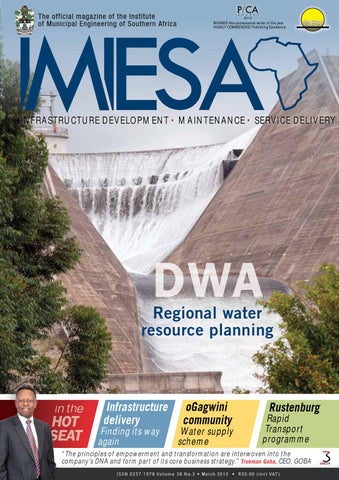
The official magazine of the Institute of Municipal Engineering of Southern Africa
2012
WINNER Non-professional n professional wri writer of the year HIGHLY COMMENDED Publishing Excellence
IMESA
INFRASTRUCTURE DEVELOPMENT • MAINTENANCE • SERVICE DELIVERY
Regional water resource planning
iin n the
Infrastructure delivery Finding its way again
oGagwini community Water supply scheme
Rustenburg Rapid Transport programme
“The principles of empowerment and transformation are interwoven into the company’s DNA and form part of its core business strategy.” Trueman Goba, CEO, GOBA I S S N 0 2 5 7 1 9 7 8 V o l u m e 3 8 N o . 3 • M a r c h 2 0 1 3 • R 5 0 . 0 0 ( i n c l VAT )
MEDIA
±'PIER [EXIV#²
±-RJVEWXVYGXYVI ²
Delivering sustainable infrastructure that improves our world. “DOING GOOD WHILE DOING BUSINESS”
Contact www.bigenafrica.com, or the office most convenient to you: Pretoria (012) 842 8700; Johannesburg (011) 802 0560; Bloemfontein (051) 430 1423; Cape Town (021) 919 6976; Durban (031) 717 2571; East London (043) 748 6230; Gabarone gaborone@bigenafrica.com; Kuruman (053) 712 2882; Mafikeng (018) 386 2111; Mthatha (047) 532 5234; Nelspruit (013) 755 1421; Polokwane (015) 297 4055; Richards Bay (035) 753 1235; Rustenburg (014) 597 3655; Umtata (047) 532 5216; Windhoek +26 461 237 346.
CONTENTS
CONTENTS
VOLUME 38 NO 3 MARCH 2013
49 Municipal benchmarking
33 Water provision
13
47 Water infrastructure
Water treatment
Roads and stormwater
Africa Africa in review
12
New water treatment plant for Maun
A 25-year commitment to transport
13
Bridging the gap
Infrastructure delivery How infrastructure delivery can find its way again
Panel discussion 17
Jurie Niemand
Climate change 'hotspots'
33 35
The importance of groundwater management
37
Herman Smit
PVC pressure pipes for water supply project
The Regional Bulk Infrastructure Grant Programme is a departmental financial resource mobilisation plan designed to facilitate availability of sufficient funds and expenditure management systems for the implementation of regional bulk infrastructure across the country.
Ensuring quality Ductile iron pipes installed New handbook available
61 63
Quality Filtration Systems
65
GLS Consulting
Pipes, pumps and valves Cover Story
Water and wastewater quality management Shosalowe
Water and wastewater Community water supply scheme
60 60
67
Erik Loubser
43 45 47 48
Cascade Group
69
George Peters Amanz' Abantu
71
Oliver Ive
IMESA Municipal benchmarking initiative
49 Products and services
Rustenburg RRT project well under way Road and sewer upgrades
Alternate solutions for housing
51 54
Thousands of solutions provided Retaining wall constructon
72 73 75
Regulars 3 5
Editor’s comment President’s comment
Industry news
Power PV solar panel produced locally Courses for Eskom staff
56 57
Kevin Wall wins esteemed award
76
Cover article DWA's Regional Bulk Infrastructure Grant Programme
Housing 6
Insight The blueprint for our survival
in the
HO OT SEATT
Northern Cape housing provision
58
Lephalale housing project launched
59
9
“The principles of empowerment and transformation are interwoven into the company’s DNA and form part of its core business strategy.” Trueman Goba, CEO, GOBA
14
IMIESA March 2013
1
Increased number of strikes against poor services delivery in 2012, numerous reported failures of water supplies, sewerage conveyance & treatment systems, and poor road maintenance conditions, are pointers of warning, that serious turn-around strategies are required in South African municipal service delivery.
23 - 25 October 2013
This will be required from institutional structures and financial management right up to the operation and maintenance of quality service delivery to the people. Hence the theme for 2013:
Municipal Engineering: Meeting Peoples’ Needs
CALL FOR PAPERS THE EASTERN CAPE BRANCH HEREBY ISSUES THE 2013 IMESA CONFERENCE
Authors are requested to think innovatively, base new ideas on case studies (local and elsewhere), be practical in approach and indicate how their proposed paper will support the conference theme. • • • • • •
Political and Legislation Ecological / Environmental Financial Transport and Traffic Water and Sanitation Roads and Storm Water
Submissions of extracts in the prescribed format by Friday, 26 April 2013 to Dup van Renen email: dupva@africoast.com Download abstract forms from www.imesa.org.za
Tel: 031 266 3263
EDITOR’S COMMENT
PUBLISHER Elizabeth Shorten EDITOR Richard Jansen van Vuuren HEAD OF DESIGN Frédérick Danton SENIOR DESIGNER Hayley Mendelow DESIGNER Kirsty Galloway CHIEF SUB-EDITOR Claire Nozaïc SUB-EDITOR Patience Gumbo CONTRIBUTORS Ron Watermeyer, Kevin Wall, Graham Pirie, Frank Stevens, Simon Foulds PRODUCTION MANAGER Antois-Leigh Botma PRODUCTION COORDINATOR Jacqueline Modise FINANCIAL MANAGER Andrew Lobban (ACIS, FCIBM) MARKETING AND ONLINE MANAGER Martin Hiller ADMINISTRATION Tonya Hebenton DISTRIBUTION MANAGER Nomsa Masina DISTRIBUTION COORDINATOR Asha Pursotham SUBSCRIPTIONS subs@3smedia.co.za PRINTERS United Litho Johannesburg +27 (0)11 402 0571 ___________________________________________________
DOING IT RIGHT
A taste for life Certain advertisement jingles stay with you a long time. Red, yellow, blue… which one’s for you? The BMW beating the bends on Chapman’s Peak Drive remains firmly imprinted in my brain. “It’s not inside… it’s ON TOP” even more so.
ADVERTISING SALES Jenny Miller Tel: +27 (0)11 467 6223 ___________________________________________________
PUBLISHER: MEDIA No. 4, 5th Avenue, Rivonia 2056 PO Box 92026, Norwood 2117 Tel: +27 (0)11 233 2600 Fax: +27 (0)11 234 7274/5 E-mail: richard@3smedia.co.za www.3smedia.co.za ANNUAL SUBSCRIPTION: R530.00 (INCL VAT) ISSN 0257 1978 IMIESA, Inst.MUNIC. ENG. S. AFR. © Copyright 2013. All rights reserved. ___________________________________________________ IMESA CONTACTS IMESA Administration Officer: Ingrid Botton P O Box 2190, Westville, 3630 Tel: +27 (0)31 266 3263 Fax: +27 (0)31 266 5094 Email: imesa@webstorm.co.za Website: www.imesa.org.za BORDER BRANCH Secretary: Melanie Matroos Tel: +27 (0)43 705 2401 Fax: +27 (0)43 743 5266 E-mail: melaniem@buffalocity.gov.za EAST CAPE BRANCH Elsabé Koen Tel: +27 (0)41 505 8005 Fax: +27 (0)41 581 2300 E-mail: elsabek@africoast.com KWAZULU-NATAL BRANCH Secretary: Rita Zaayman Tel: +27(0)31 311 6382 NORTHERN PROVINCE BRANCH Secretary: Cornel Taljaard Tel: +27 (0)82 899 8341 Fax: +27 (0)11 675 1324 E-mail: cornel@rchc.co.za SOUTHERN CAPE KAROO BRANCH Secretary: Henrietta Oliver Tel: +27(0)79 390 7536 Fax: 086 536 3725 E-mail: imesa.southcape@gmail.com WESTERN CAPE BRANCH Secretary: Erica van Jaarsveld Tel: +27 (0)21 938 8455 Fax: +27 (0)21 938 8457 E-mail: erica.van_jaarsveld@capetown.gov.za FREE STATE AND NORTHERN CAPE BRANCH Secretary: Wilma Van Der Walt Tel: +27(0)83 457 4362 Fax: 086 628 0468 E-mail: imesa.fsnc@gmail.com
Richard Jansen van Vuuren
I
’M WRITING THIS column from a Spur – the Silver Cloud Spur in Port Elizabeth to be exact. Readers will be well acquainted with not only the Spur chain of restaurants, but also IMIESA’s long standing municipal features. The municipal features we publish are the core of the magazine’s content – it is from here that the remainder of the content published in the magazine originates. So as I sit and write this I feel compelled to let you know that in the coming months we will be publishing the following municipal features: • May 2013 – Ekurhuleni • June 2013 – City of Johannesburg • July 2013 – Buffalo City • August 2013 – eThekwini The reason for my visit to Port Elizabeth is to report on municipal projects happening
in the Nelson Mandela Bay Metropolitan Municipality’s domain. These projects will be published in the April edition of IMIESA. It is one thing to interview a person over the phone or e-mail questions to them – which is common practice – but interviewing someone one-on-one on-site remains the best way to write an article. It not only allows a journalist to get the required information from people regarding a project, but it also allows for a greater understanding of what has been or will be accomplished. There is no better way of formulating and understanding knowledge or information than the double input of aural and visual stimulus. So please contact me with regards to the municipal features listed above and let’s arrange a project site visit. The last journalist anyone should ever trust is one chained to a desk. This goes against the natural instinct of a journalist as they are normally the first to the door when the opportunity to see something or somewhere new arises. The journalist who comes to where you are, shakes your hand and looks you in the eye is doing their job right. This brings me back to the Spur. Admittedly there are more imaginative or exotic places to dine when travelling for work purposes – but Spur is solidly reliable whether here in Port Elizabeth or in some town off the beaten track. I’ve been to many in my 14 years of construction and engineering journalism all over the country. They just get it right.
On page 16 of the January 2013 edition of IMIESA we published an article titled “10 Mℓ wastewater reuse at Outeniqua WWTW.” Unfortunately we forgot to list Ovivo Aqua South Africa as one the project participants. For more information on the company’s involvement in the project please contact t: +27 (0)11 886 0266.
REST OF SOUTHERN AFRICA Representative: Andre Muller E-mail: imesa@webstorm.co.za
All material herein IMIESA is copyright protected and may not be reproduced either in whole or in part without the prior written permission of the publisher. The views of contributors do not necessarily reflect those of the Institute of Municipal Engineering of Southern Africa or the publishers.
Cover opportunity
In each issue, IMIESA offers advertisers the opportunity to get to the front of the line by placing a company, product or service on the front cover of the journal. Buying this position will afford the advertiser the t cover story and maximum exposure. For more information on cover bookings contact Jenny Miller on tel: +27 (0)11 467 6223.
IMIESA March 2013
3
2013
IMESA CONFERENCE
nelson mandela bay PORT ELIZABETH
23 - 25 OCTOBER 2013 Theme: Municipal Engineering – Meeting Peoples’ Needs EARN 2.5 CPD POINTS BY ATTENDING The 2013 IMESA Conference will be hosted at the brand new Boardwalk Hotel & Conference Centre on the beautiful Port Elizabeth beach front. A variety of exciting technical tours are being arranged to SA Breweries, Koega Harbour, VW Factory and Van Staden’s Wind Farm. Register and pay early to qualify for excellent Early Bird Discounts! Included in conference fee: •
Opening Cocktail Function with Presidential Address
•
3 Day Conference with local and international experts
•
Techncial Tours
•
Access to 80 industry suppliers at their exhibition stands
•
Gala Function: the best networking opportunity
Additional fees for: • Golf Day at Humewood before Conference opens • Companion to join at social functions or to participate in 3 Day Companion Tours For information: Tel: 031 2663263 Email: conference@imesa.org.za
PRESIDENT’S COMMENT
IMESA CONFERENCE 2013: PORT ELIZABETH
A response to call for papers and attendance vital for success The benchmarking for water services in South Africa through the national Municipal Benchmarking Initiative started in April 2011 (see my article on pages 49 and 50) is one of several partnership agreements that IMESA is involved with to address national issues affecting municipalities.
T
HE THEME for our 2013 IMESA conference is ‘Municipal Engineering: Meeting People’s Needs’. Poor service delivery strikes, ongoing failures in water services as well as poor road maintenance conditions are pointers that a turnaround strategy in South Africa’s municipal service delivery is urgently required, from institutional structures and financial management right up to the operation and maintenance of quality service delivery to the people who need it most. Trevor Manuel, in the executive summary of the National Development Plan 2030, identifies the nine challenges facing South Africa as being: • too few South Africans are employed • the quality of education for poor black South Africans is substandard • poorly located and inadequate infrastructure limit social inclusion and faster economic growth • South Africa’s growth path is
We hope that the call for papers... will attract innovative ideas based on local and international case studies for practical and sustainable solutions to support the conference theme resource-intensive and therefore unsustainable • spatial challenges continue to marginalise the poor • the ailing public health system confronts a massive disease burden • the performance
of the public service is uneven • corruption undermines state legitimacy and service delivery • South Africa remains a divided society. While local municipalities cannot assist directly with most of the underlying
problems, there are several of these challenges that municipal engineers can input on. We hope that the call for papers, which has been publicised for the abstract deadline of 26 April 2013, will attract innovative ideas based on local and international case studies for practical and sustainable solutions to support the conference theme. We are looking for papers that offer innovation through leadership, business value and business interest in the following categories: • Political and legislation • Ecological/environmental • Financial • Transport and traffic • Water and sanitation • Roads and stormwater. One of the strengths of our nation is our ability to reinvent ourselves to meet the constantly changing circumstances. In the words of Charles Darwin: “It is neither the strongest nor the most intelligent of the species that survive. It is the species that is the most responsive to change.” I look forward to the solutions that will emerge at our 2013 IMESA Conference.
IMIESA March 2013
5
COVER STORY
NORTHERN CAPE
Regional Bulk Infrastructure Grant
The RBIG is being implemented in all nine provinces. This overview features the Northern Cape province, where the distance between towns and previously disadvantaged communities was one of the challenges that needed to be overcome during the planning phase.
T
HE REGIONAL BULK Infrastructure Grant Programme (RBIG) is a departmental financial resource mobilisation plan designed to facilitate availability of sufficient funds and expenditure management systems for the implementation of regional bulk infrastructure across the country. The projects into which this grant injects funds aim to develop bulk water infrastructure required to connect or augment existing water resources infrastructure serving extensive areas across various municipal boundaries, or large regional bulk infrastructure serving numerous communities over a large area within a municipal area. The grant extends to sanitation through the building of wastewater treatment works that do not meet area requirements or that have become inoperable. National Treasury is the sole funder of the national programme and, as a result, all projects and associated implementation, administration and management processes are subject to numerous legislative
6
IMIESA March 2013
frameworks. Key among other legislative frameworks that guide implementation of the grant is the PFMA (Public Finance Management Act), Treasury Regulations, DORA (Division of Revenue Act), and procurement and supply chain management (SCM) guidelines within the public service context. Key functionaries in the Northern Cape region are the acting regional chief director, Abe Abrahams; the director of Water Sector Support, Dr Magda Ligthelm; and the regional project manager, Keletso Kgarana. The National Office programme manager: regional bulk infrastructure is Lerato Mokoena.
Background dynamics of the region As in other provinces, the Northern Cape focuses on access to potable water service delivery to disadvantaged communities. Through its RBIG programme, the construction of bulk infrastructure is paramount for the expansion of reticulation systems to communities. After
the installation of bulk infrastructure, which includes bulk pipelines, water treatment plants and associated infrastructure, reticulation work is undertaken by the relevant municipalities to ensure water supply to communities within its area of operations. Without viable bulk services in place, reticulation work, which would supply water to communities, could not take place. Due to the vast distances between water sources, such as dams and rivers, towns and communities in need of potable water were quickly left behind. For this reason, the Northern Cape was excited when RBIG came into effect in 2007 as this meant that the region could begin to address the bulk infrastructure backlog that had developed – with particular focus on backlog eradication, higher levels of service and growing settlements in remote areas. Due to the population size of the province traditionally, this meant that only 2 to 2.4% of the national infrastructure programme budgets was received. For this reason the province started
COVER STORY
Programme
the DWA regional office gave the region a head start over many of the other provinces, which had not focused on getting a project production line in place. The success of this tactical decision paid off as the Northern Cape currently receives 8.5% of the RBIG budget – which is a great benefit to all sectors of its diverse communities. It also proved the value of good planning and proactive project preparation. At present, there are six
that this impact will be clear in improved Green Drop and Blue Drop results in the near future. The Northern Cape municipalities struggle with significant water scarcity challenges. For many communities access to a sustainable supply of potable water is an uphill struggle, as water is a scarce natural resource throughout the province. However, careful planning and innovative thinking is addressing these obstacles.
The construction of bulk infrastructure is paramount for the expansion of reticulation systems to communities
out small, with a groundwater augmentation project at Vanwyksvlei with a value of R5.7 million. The department’s regional office quickly realised though that if it wanted to increase funding flows to the Northern Cape RBIG programme, it would have to identify projects and ensure that they are ‘implementation ready’. For that reason, the province decided to invest in the preparation of detailed feasibility studies that would identify and recognise the growth and development needs and guide it in future bulk project selection. During this start-up phase, 18 feasibility studies were completed. Approximately half of these identified key projects that were implementation ready. The region’s project production line was now in place, so that it could quickly direct funds to these projects, if and when more funds became available. This proactive approach by
regional bulk projects under implementation, three in design and tender phases, and work is under way on 12 more feasibility studies. The Northern Cape, like many other provinces, has experienced particular challenges relating to the condition of municipal wastewater treatment works (WWTW). These challenges are clearly seen in the results of Green Drop compliance assessments. The lack of investment in the maintenance of existing infrastructure over many years has also had negative results. Over time, the infrastructure simply did not have the capacity to keep up with treatment demands, with the resultant negative impact on service delivery and the environment. The RBIG programme focuses on turning around the water treatment capacity of selected municipalities. While the province recognises that bulk projects by their very nature are implemented over a number of years due to their size, the availability of funding, water sources, local absorption capacity, the DWA is confident
The department has assisted with the bulk pipeline project at Kai !Garib Local Municipality where water has been taken from Lennertsville to Kenhardt. This project brought relief to a long-suffering community that has had to endure harsh conditions for many years. The availability of a secure supply of water will also allow development opportunities that were not previously possible. This development has resulted in the employment of six local citizens who were trained to operate and maintain the new infrastructure. Putting this technical capacity into place will make a considerable contribution to the sustainability of government’s investment in this area.
Department of Water Affairs Web: www.dwa.gov.za
IMIESA offers advertisers an ideal platform to ensure maximum exposure of their brand. Companies are afforded the opportunity of publishing a two-page cover story and a cover picture to promote their products to an appropriate audience. Please call Jenny Miller on +27 (0)11 467 6223 to secure your booking.
IMIESA March 2013
7
I M E S A A F F I L I AT E M E M B E R S
IMESA
Afri-Infra afri-infra@mweb.co.za AJ Broom Road Products ajbroom@icon.co.za Arup SA rob.lamb@arup.com Aurecon Danie.Wium@aurecongroup.com AECOM Siyanda.Ngebulana@aecomm.com Bigen Africa Group Holdings otto.scharfetter@bigenafrica.com BMK Consulting brian@bmkconsulting.co.za Bosch Stemele bsdbn@boschstemele.co.za Bosch Munitech info@boschmunitech.co.za BVI Consulting Engineers marketing@bviho.co.za CBI Consulting Engineers durban@cbisa.co.za Civilconsult Consulting Engineers mail@civilconsult.co.za Civil & Blasting Solutions jane@drillingandblasting.co.za Concrete Manufacturers cma@mweb.co.za Corrosion Institute of Southern Africa secretary@corrosioninstitute.org.za CSIR Built Environment LAustin@csir.co.za Davies Lynn & Partners dlpdbn@dlp.co.za Development Bank of SA divb@dbsa.org.za DPI Plastics mgoodchild@dpiplastics.co.za EFG Engineers eric@efgeng.co.za Elster Kent Metering keith.bailey@za.elster.com EnviroServ Waste Management benoitl@millenniumwaste.co.za GIBB yvanrooyen@gibb.co.za GLS Consulting nicky@gls.co.za Goba trumang@goba.co.za Hidrostal SA hstal@mweb.co.za Huber Technology fstammer@lantic.net Hydro-comp Enterprises dan@edams.co.za I@Consulting louis_icon@mics.co.za Iliso Consulting monde@iliso.com Infraset fmyburgh@infraset.com Jeffares and Green dennyc@jgi.co.za Johannesburg Water rtaljaard@jwater.co.za Kgatelopele Consulting kgatelopele@wol.co.za Knowledge Base info@knowbase.co.za
Lektratek Water general@lwt.co.za Makhaotse Narasimulu & Associates mmakhaotse@mna-sa.co.za Maragela Consulting Engineers admin@maragelaconsulting.co.za Much Asphalt john.onraet@murrob.com Nyeleti Consulting ppienaar@nyeleti.co.za Odour Engineering Systems mathewc@oes.co.za PD Naidoo & Associates Consulting Engineers Johannesburg@pdna.co.za Power Construction nbarnard@powergrp.co.za Pumptron info@pumptron.co.za Pragma Africa deang@pragma.co.za Rocla karen.devos@murrob.co.za Royal HaskoningDHV francisg@rhdv.com SBS Water Systems irene@sbsgroup.co.za Sektor Consulting cradock@sektor.co.za Sight Lines sales@sightlines.co.za SiVEST SA garths@sivest.co.za SNA Inc snapta@icon.co.za Siza Water Company tionette.bates@sizawater.co.za SMEC capetown@smec.com Southern African Society for Trenchless Technology director@sasst.org.za SRK Consulting jomar@srk.co.za Sulzer Pumps Wastewater Sonja.Hattingh@sulzer.com Syntell julia@syntell.co.za Thm Engineers East London thmel@mweb.co.za TPA Consulting roger@tpa.co.za UWP Consulting zulchl@uwp.co.za VIP Consulting Engineers esme@vipconsulting.co.za Water Institute of Southern Africa wisa@wisa.org.za WorleyParsons chris.brandsen@WorleyParsons.com WSP Group Africa dirk.hattingh@mbs-wsp.co.za WSSA nbinase@wssa.co.za WRP ronniem@wrp.co.za Zebra Surfacing andrew@zebrasurfacing.co.za
INSIGHT
WATER RESOURCE STRATEGY – PART 1
The blueprint for our survival Compiled by Richard Jansen van Vuuren
Effective water resources management is dependent on all water users and water managers playing their part. Government cannot do it alone. This article is the first of a series highlighting the key issues discussed in the National Water Resources Strategy II (2012).
I
N ORDER TO IMPLEMENT the National Water Resources Strategy II (2012) (NWRS2), it is important that South Africans generally understand how the water cycle works and how their actions impact on this cycle. It is equally important to understand the context of water resources in South Africa, and the specific challenges that the country faces. Water is a renewable resource that operates in a closed loop system. Infrastructure, such as dams, enables the provision of a reliable supply of water and increases the quantity available for use by storing water that would otherwise run into the sea. Storage of water in dams enables a reliable supply of water even during a drought. Other technologies are also available for increasing water availability, such as desalination, although such technologies are still relatively expensive. The challenge is, however, that dams and general use of water for social and economic purposes have negative impacts on aquatic ecosystems that provide important goods and services. The problem therefore comes in of how to balance the use of water with the protection of aquatic ecosystems. The NWRS-2 provides strategies that aim to achieve this.
Understanding water scarcity While water is the most abundant resource on Ear th, 97.5% of it is too salty for
human consumption and crop production. South Africa has low levels of rainfall relative to the world average, with high variability as well as high levels of evaporation due to the hot climate, and increasing challenges from
ABOVE Picture of Earth showing how, if all of Earth’s water (ice, freshwater, saline and water vapour) were put into a sphere, its diameter would be a little bit more than the flight distance from Johannesburg to Cape Town. Credit: Illustration by Jack Cook, Woods Hole Oceanographic Institution
The problem therefore comes in of how to balance the use of water with the protection of aquatic ecosystems water pollution. All of these pose constraints on the amount of water available for use. Although the regulator y framework and the institutional arrangements have changed since the advent of democracy, one aspect remains constant: water scarcity – whether quantitative, qualitative or both – that originates as much from inefficient use and poor management as from real physical limits. South Africa is the 30th driest country in the world and has less water per person than countries widely considered to be dry. At present, there is a well-developed infrastructure, with more than 4 395 registered dams in South Africa, of which 2 528 are water supply related. However, in many parts of the country we have either reached or are fast approaching the point at which all of our financially viable freshwater resources are fully utilised. Despite the good infrastructure, the occurrence of floods and droughts are part of the “normal” water cycle, and water restrictions and flood management are a critical
IMIESA March 2013
9
INSIGHT
part of the water business. And despite the good infrastructure, the poor and marginalised experience water scarcity most intensely, particularly in underdeveloped rural areas and areas such as the former homelands. In many parts of the country, we are fast approaching the point at which all of the easily accessible freshwater resources are fully utilised. All South Africans must recognise this situation so that necessary steps are taken to assess current and future demands for water. This will not be an easy task, but with the necessary resolve to plan and implement the required interventions, a secure water future can be achieved. The present water supply situation has created a false sense of water security within the privileged sectors of the South African society. Marginalised and poor communities, on the other hand, have always experienced high levels of water insecurity. It must be noted that, as of 2012, South Africa had 16 consecutive years of aboveaverage rainfall in the majority of summer rainfall areas and in these areas the last major drought was more than two decades ago. This trend is unlikely to continue.
10
IMIESA March 2013
Water quantity The NWRS-1 showed that the majority of the water management areas (WMAs) have water deficits despite significant transfers from other catchments. Only a few selected WMAs, such as parts of the Eastern Cape, had surplus water. There were already concerns that more WMAs will have fresh water deficits by the year 2025. There are a number of options for reconciling water supply and demand,
water can be abstracted at the determined ‘yield’, 98 out of 100 years on average. There are about 10 billion cubic metres per year available with this level of assurance. In most areas where there are water deficits or where the system is considered ‘in balance’, the probability is that water shortages are experienced more than 2 out of 100 years. Water shortages have become part of life in South Africa.
At present, there is a well-developed infrastructure, with more than 4 395 registered dams in South Africa which are dealt with in the technical strategies, including improved water use efficiency, development of new infrastructure, reuse and recycling, desalination and the removal of water-hungry alien invasive plants.
Surface water For the purpose of water planning, the Department of Water Affairs (DWA) plans with ‘available water’ and uses a 98% assurance of supply (DWAF, 2004). This means that
Approximately 25% of the mean annual runoff (MAR) of 49 billion cubic metres per annum needs to remain in the rivers and estuaries to support ecological functioning of the catchments, depending on the specific river systems. In many water management areas the ecological portion of the reserve is not yet fully implemented. Most of the economically available yield from surface water resources over large parts of the country have been fully developed and
INSIGHT
utilised. More than two thirds of the country’s MAR is already stored in dams. Where additional water is still available, such as in the uThukela, Mzimvubu and Pongola basins, it is located in relatively remote areas far from existing centres of demand. Opportunities for economically viable new dams are few and far between (DWA, 2010), and the costs of transfer of water per cubic metre to locations where water is needed are also rising with longer distances. Surface water from dams and direct abstraction from rivers, accounted for 9.5 billion cubic metres per annum, with a significant volume of the surface water yield (3 billion cubic metres per annum) moved via inter-basin transfers to areas in the country where requirements exceed supply. An example is the Lesotho Highlands Water Scheme, which supplies water to Gauteng through transfer from Katse and Mohale dams in Lesotho to the Upper Vaal WMA. The Mzimvubu to Keiskamma WMA is currently the only WMA not subject to inter-basin transfers.
Many dams and associated water resources infrastructure were built more than 40 years ago. While the main structures may have an extremely long life, spillways, gates, pumps, pipelines and canals, and associated infrastructure, need regular maintenance and occasional major rehabilitation to extend the lifespan of these assets for which funding is required. There are also backlogs in the rehabilitation of water infrastructure owned by the municipalities.
Groundwater Groundwater is a significant resource in many parts of the country, although local yields are usually quite low. The most recent estimate of sustainable potential yield of groundwater resources at high assurance is 7.5 billion cubic metres per annum, while current groundwater use is estimated at around 2 billion cubic metres per annum. Allowing for an underestimation on groundwater use, potentially about 3.5 billion cubic metres
per annum is available for further development. This resource is, however, sparsely distributed and often not readily available at points of demand. This is exacerbated by the levels of knowledge and information on the groundwater resource. Some of the most favourable areas/aquifers regarding groundwater availability include: the Dolomites of the West and far-West Rand; Table Mountain Group Aquifers of the Western and Eastern Cape; Coastal sand aquifers in the Western and Eastern Cape, and northern KwaZulu-Natal. Other high-yielding aquifers include basement granites in the Polokwane-Dendron-Coetzerdam area, alluvial deposits along sections of major rivers such as the Limpopo, and parts of the Karoo Sequence associated with dolerite dykes and ring structures. *Source: Department of Water Affairs/National Water Resources Strategy II (2012)/Water for equitable growth and development. IMIESA March 2013
6HULRXV ÀRZ &KDUDFWHULVHG E\ KLJK HI¿FLHQF\ UHOLDELOLW\ HDVH RI LQVWDOODWLRQ DQG ORZ FRVW PDLQWHQDQFH )UDQNOLQ (OHFWULFVœV 7VXQDPL D[LDO ÀRZ SXPSV DUH HQJLQHHUHG DQG designed to suit a variety of aquaculture, irrigation, and project-related applications. Features include: - Heads of between 1-100m - Flow rates of up to 2 600 litres per second 0RWRUV DUH SRVLWLRQHG ZHOO DERYH ÀRRG OHYHOV - Permanently submerged turbines eliminate the need for foot valves. Contact us for trusted brands, excellent service and world-class pumping system solutions.
13 Engwena Road, Sebenza, Edenvale, 1610, South Africa Tel: +27 11 723-6500 info@franklin-electric.co.za www.franklin-electric.com Branches: Bloemfontein: +27 51 434-1565, Cape Town: +27 21 949-5458, Durban: +27 31 700-4160 Depot: Port Elizabeth: +27 41 487-2866, Export Division: +27 11 723-6500 Franklin Electric Botswana (Pty) Ltd: +267 397-4926
11
AFRICA
Africa in review
ANGOLA Cutembo River Bridge inaugurated A BRIDGE OVER Kwanza River in the Bocoio Municipality was recently inaugurated by the municipal administrator, Deolinda Valiangula. The bridge was built with material and the logistical support of Benguela’s province Bocoio Municipality. Construction spanned two months. Source: Angola Press Service
KENYA Law to establish housing fund THE DRAFT Housing Bill will establish the National Housing Development Fund (NHDF) once it becomes law, which will facilitate housing construction and related infrastructure. According to Kenyan housing permanent secretary, Tirop Kosgey, the fund will be allocated in excess of Sh10 billion [Kenyan shillings] (R1.02 billion) annually by the national government in renewed efforts to plug the widening demand-supply gap for affordable homes across the country. It will also raise funds from the capital markets through housing bonds. Funds will be channelled through financial and mortgage institutions, including micro-financiers and cooperatives, to facilitate low-cost housing projects. The National Housing Corporation will get direct allocation from the NHDF for public and
12
IMIESA March 2013
social housing and rural housing loans, but other institutions will have to apply to the fund for part or full financing of low-cost housing development or onward lending. The fund will be administered by the Kenya NHDF committee, which will be set up once the law is enacted. Source: The Star/Kenya
NAMIBIA Construction companies accused of collusion THE ALLEGED collusion by four Swakopmund contractors in tendering for the construction of a traffic circle at the entrance to Swakopmund is heading to the High Court. An investigation of the applicants and their quotations for the project by the council’s legal advisors, Kinghorn Associates, suggested the possibility that local contractors DMA Holdings, Precision Construction, Pandora’s Construction and Elite Construction colluded in the submission of bids. The investigation found that all the tenders were allegedly filled in by the same person for the same construction period and at the same price. The page listing of previous work done also suggested that the main partner of DMA Holdings is a partner in the other three companies. The investigation further discovered that based on the company documentation, in particular the amended founding statements, in respect of DMA Holdings, a Deon and Marlene Miljo each holds 45% interest, and Anita Marlene Mijo owns 10%. In respect of Elite Construction and Precision Construction, Marlene Miljo
holds 100% interest in each of these corporations. In respect of Pandora’s Construction, no partnership documents were provided. According to the legal advisors, Deon Miljo allegedly misrepresented a number of facts about each of the entities that tendered for the paving works and that there was alleged “collusion, anti-competitive behaviour and perhaps even tender fraud”. The Swakopmund council ordered the contractors to argue why their actions should not be regarded as collusion and why the council should not blacklist them from receiving future contracts from council for the next 12 months. The contractors had five days for their side to be heard. They failed to take the opportunity, resulting in a recommendation by the management committee to the council to disqualify the contractors. Source: The Namibian
NIGERIA The state of the Third Mainland Bridge FOR USERS OF the Third Mainland Bridge in Lagos, fresh concerns over the bridge’s state have emerged following the repairs conducted between 7 July and 30 October 2012 by the Federal Ministry of Works. A report by Prof JHT Kim, head of the Concrete Structural Engineering Laboratory at Yousei University in Seoul, Korea, who conducted an underwater examination of the structures holding the bridge last December, has shown that the damages to the structure are worse than what he had initially thought. The report,
produced by a company experienced in underwater surveys, indicated that the underwater metal casing housing the concrete piles on which the bridge stands has rusted. He said this may have accounted for the vibration experienced in some portions of the bridge, which led to the closure of the bridge for repairs. The professor’s report also indicated that there was progressive steel caisson deterioration in about 1 318 foundation piles and that there was extensive reinforcement bar deterioration in eight piles. Source: Vanguard/Nigeria
TANZANIA NHC to establish satellite towns THE TANZANIAN National Housing Corporation (NHC) intends to establish two new satellite towns in the Meru and Arusha rural districts, the two precincts where it owns more than 1 000 acres of land. The state-owned and Tanzania’s oldest public real-estate developer also has plans to build a total of 15 000 housing units countrywide, with 70% of these houses to be sold and the remaining 30% to be rented out. “We own more than 1 000 acres of vacant land in the locality, which we intend to develop into new satellite towns – not to overshadow or make the existing Arusha City obsolete, but rather to complement the fast-growing urban centre that serves as the capital for the East African Community,” states the NHC director general, Nehemia Mchechu. Source: Tanzania Daily News
AFRICA
BOTSWANA
Maun to get drinking water plant VWS Envig Botswana has been awarded a contract by the AEVVMI joint venture to design, supply and commission a 6 000 m3/d potable water plant in Maun, northern Botswana.
T
HE PLANT, located near the banks of the Thamalakane River, is scheduled to be commissioned in September 2013 and will be operated and maintained by Veolia for a subsequent six-month period. The new plant will augment the supply from existing underground water sources that become impractical to maintain during the nearby Okavango Delta’s flood season. To maintain consumer demand during these periods, the plant will source water directly from the river. “River water is high in dissolved organic compounds that give it its characteristic brownish colour and earthy smell and taste, despite its normally low turbidity,” says Peter Healy, MD at VWS Envig Botswana.
“To make this water suitable for human consumption, we opted for clarification by means of ballasted flocculation to remove the extremely light-weight organic particles that would otherwise settle very slowly.”
ABOVE The Veolia-developed Actiflo will use a ballast to gather and settle impurities in the water, allowing cleaner water to flow off the top of the clarifier
ballast designed to rapidly flocculate and settle organic particles. “After clarification, the water will be polished with multimedia and granular activated carbon filters, and finally disinfected before being fed into the town’s pipeline system,” explains Healy. Veolia is also responsible for a booster pump and delivery pipelines. “This involves replacing the main distribution pump and connecting
“After clarification, the water will be polished with multimedia and granular activated carbon filters, and finally disinfected.” Peter Healy, the MD of VWS Envig Botswana – a subsidiary of Veolia Water Solutions & Technologies South Africa Veolia will install its patented Actiflo highrate water clarification system. Featuring footprints that are five times smaller than conventional clarifiers, the Actiflo will achieve rapid settling with the help of Actisand – a
the new station with minimal disturbance to the current water supply,” maintains Healy.
IMIESA March 2013
13
HOT SEAT
A PROVEN HISTORY
Setting the scene for IMIESA speaks to GOBA’s CEO, Trueman Goba, about how the company has evolved over the years and what the future holds for it within the infrastructure construction sector.
P
lease provide an in-depth brief background to the establishing of GOBA At GOBA we are privileged that the company’s continued trend of visionary thinking and innovation is deeply rooted in the South African consulting engineering landscape. The numerous infrastructure projects that started to alter the rural countryside of South Africa in a big way over the past 50 to 60 years have contributed significantly to the country’s economic development. In the process, much of the technical knowledge and expertise gained or perfected has been instrumental in the growth of what is known today as GOBA. Founded in 2001 through the merger of Goba Moahloli and Associates Inc and Keeve Steyn, GOBA represents recognition of the powerful synergy inherent in merging the two diverse companies. GOBA is a reputable and progressive professional firm where young potential built environment candidates are identified, career
14
IMIESA March 2013
opportunities are maximised and professional people from diverse backgrounds come and work together through mutual respect. The company continues to be at the forefront of transformation in the consulting engineering profession in South Africa and is a Level 3 BBBEE contributor. GOBA is a member of Consulting Engineers South Africa (CESA) and the International Federation of Consulting Engineers (FIDIC). It is ISO 9001-accredited and has built up a reputation for service excellence; this is reflected in the numerous prestigious awards that it has acquired over the years.
Please outline the growth of GOBA from its inception to its current status Since the merger, GOBA has grown from its initial staff complement of 180 in 2001 to 500 in 2012. GOBA has also significantly grown its presence in KwaZulu-Natal and opened offices in the Eastern Cape and Western Cape. The firm currently operates out of eight offices throughout the country and
is active in projects in 12 countries on the African continent.
Please give a list of the top projects GOBA has been involved with and a brief description of each Mpumelelo: GOBA, in a 50:50 joint venture with RSV Enco Consulting, has been appointed as EPCM consultant for the Brandspruit Colliery – Impumelelo Shaft Project in Secunda, to be completed early 2014. The scope of the contract includes shaft systems and surface shaft infrastructure. GOBA will also design and supervise the civil the construction of Sasol’s Brandspruit Colliery’s 28 km overland conveyor civil services. The design includes the 28 km platform, the crossings as well as the drainage for the overland conveyor. Thubelisha: The 10.6 Mtpa Thubelisha Shaft Project is to be designed and constructed to accommodate the first production section in January 2012 and build-up to full production with 12 continuous miners and three
stonework sections in 2015. The scope of the contract entails the development of the complete mine complex including the shaft systems, the materials handling system and all supporting infrastructure. GOBA, in a 50:50 joint venture with RSV ENCO Consulting, has been appointed as EPCM consultant for the project. eThekwini Integrated Rapid Public Transportation Network (IRPTN): The eThekwini IRPTN is intended to deliver to public transport users within the eThekwini Municipality an efficient, safe, reliable and affordable means of travel. The project involved, inter alia, undertaking extensive demand modelling, network design, service design and financial feasibility, as well as preparation of a comprehensive implementation plan and preliminary design for all infrastructure components of Phase 1 of the IRPTN. Goba is the lead consultant on the project and responsible for the overall project management, coordination, planning and design of the IRPTN. Transnet’s Bayhead Expansion
HOT SEAT
a new beginning Container Terminal Feasibility Study: The Bayhead Expansion Project is a R37 billion project to extend Durban Harbour some 2.5 km inland to enable a deep water container terminal to be constructed. The rail work involves the relocation of some 135 existing rail lines in the operating Bayhead Rail Yard, constructing a replacement rail yard near the Durban Airport and relocating the existing loco and wagon maintenance workshops and wagon cleaning facilities to other locations in a phased approach. GOBA, as part of the HMG JV, led the study and engineering design team for this 1.5 year-long multidisciplinary study and provided the engineering, costing and scheduling requirements to enable Transnet to assess the next location for their mega terminal expansion strategy.
For years GOBA has had a vision to expand its already strong South African skills base into the global arena, and has partnered with global engineering companies on certain large projects in the past. How do you envisage achieving this moving forward?. GOBA has worked in joint ventures with large international firms, allowing us to participate in most of the large prestigious projects in South Africa, from the Lesotho Highlands Water project in the 1980s and
1990s to Transnet’s Capital Works programme from 2008 to 2011. However, the consulting engineering landscape is rapidly changing in South Africa. Large multinational engineering companies have purchased most of the top-tier South African consulting entities in the past five years. As a result, GOBA’s traditional partners, both local and international, are increasingly unavailable to work with us. The company considered this a potential risk that would reduce its opportunities to continue to participate in larger projects and remain relevant within the country and the continent. In response to this risk, GOBA initiated discussions with a large international entity in 2011 with a view to merging operations in Africa.
The company is totally focused on providing sustainable solutions to its clients and places great emphasis on staff development and retention. The principles of empowerment and transformation are interwoven into the company’s DNA and form part of its core business strategy. In other words, GOBA is empowered by choice and does not simply try to comply with any statutory requirements.
fully to this policy as well as to the Supplier Development Programme, which is an initiative of the Department of Public Enterprises. GOBA has a structured skills development plan, which is based primarily on the needs of its staff and the company as a whole. The plan includes partnering with identified schools to assist with the development of maths and science, provision of bursaries to qualifying candidates, mentoring of graduates towards professional registration as well as professional development of technical and administration staff. The company often surpasses all statutory targets for skills development, both in terms of the skills development plan and requirements of BBBEE.
What is the next step for the company? As mentioned previously, the company is in its final stages of concluding merger negotiations with a large multinational company. At the time of going to press, these discussions will have been finalised and announced accordingly. The combined entity will be a major player on the African continent and will have a strong local presence centred in South Africa, with the ability to draw on expert resources from around the globe. This is an exciting time for the company and is the natural next step to build on its 60 years of heritage in delivering sustainable solutions to its clients while touching everyday lives.
The company is totally focused on providing sustainable solutions to its clients
Goba has achieved so much already. What is its secret to success? GOBA is a value-driven company and these values are aptly expressed by the acronym 'EQUIP', which stands for: • Excellence • Quality • Ubuntu • Integrity • Professionalism.
Most importantly, all clients are treated as true partners and this is evidenced by significant repeat business from long-standing clients of 50 years and more. New clients who are attracted by this service offering and dedication to their needs, are viewed with the same importance as existing clients with the intention to retain them as partners for the next 50 years and beyond.
How would you describe the company’s ongoing investment in developing staff? The government’s New Growth Path advocates the promotion and development of skills and capabilities that are in short supply as one of the means to enhance growth, employment creation and equity within the South African economy. GOBA subscribes
Belvedere Place, 5 Eglin Road, Sunninghill, Johannesburg f +27 (0)11 807 8535 t +27 (0)11 236 3300 e-mail: info@goba.co.za • www.goba.co.za
IMIESA March 2013
15
INFRASTRUCTURE DELIVERY
EXPERT ANALYSIS
How infrastructure delivery can find its way again The National Planning Commission, chaired by the Minister in The Presidency for National Planning, was mandated to take a broad, cross-cutting, independent and critical view of South Africa in order to help define the South Africa its people seek to achieve in 20 years’ time and to map out a path to achieve those objectives.
I
N 2011, THE National Planning Commission (NPC) published a detailed diagnostic report that set out the key challenges that South Africans confront in fighting poverty and inequality and in achieving constitutional objectives (NPC, 2011). The implicit conclusion of this report was that a business-as-usual approach will result in South Africa failing to meet a great many of its objectives. The National Development Plan 2030, which was published in 2012, seeks to eliminate poverty and reduce inequality by 2030 by drawing on the energies of South Africans, growing an inclusive economy, enhancing the capacity of the state, and promoting leadership and partnerships throughout society (NPC, 2012). People are surrounded by economic infrastructure (fixed capital investment including construction works), including the homes in which they live, the offices and factories in which they work, schools that are essential for the education of their children, and hospitals and clinics that are fundamental for their health and well-being. They are also surrounded by economic infrastructure that supports the economy in its totality. Road and railway infrastructure not only enable travel between homes and places of work, schools and hospitals, but also distribute goods and services to people. Border posts, harbours and airports are the physical links with neighbouring
BY Ron Watermeyer (Soderlund & Schutte)
countries and the world. Dams provide water not only for human consumption but also for agricultural and industrial purposes. Power stations generate electricity. Networks delivery water and electricity to homes, places of work, schools and hospitals and convey industrial effluent, soil water and wastewater to treatment works. Economic infrastructure is foundational to a better life for all. Investment in economic infrastructure occurs in expectation of demand or in reaction to demand for capacity. When it happens, it has the following three impacts (Watermeyer, 2011): • an initial growth in demand for people, equipment and materials on the project, which lasts as long as it takes to create the asset • a demand on resources over the lifespan of the project to maintain the asset • a productivity impact in the overall economy, either producing more or producing it better, due to more efficient infrastructure (or simply the availability of capacity like harbour capacity and electricity). Expenditure on economic infrastructure will not necessarily lead to economic growth. Infrastructure that provides improvements or efficiencies in services, production or export capabilities and is delivered and maintained in a manner that minimises waste of materials, time and effort in order to generate the
Kevin Wall (CSIR)
Graham Pirie (Consulting Engineers South Africa)
maximum possible amount of value, is most likely to contribute to economic growth. Given the linkage between infrastructure investment and economic growth, it is not surprising that five of the nine priority areas identified in the NPC’s diagnostic report have a direct bearing on infrastructure. The tackling of poverty and underdevelopment is, however, being hampered by shortcomings in the delivery and maintenance of infrastructure as evidenced in a recent World Bank report (Foster, V (2008)) that examined infrastructure in 24 countries that together account for 85% of GDP, population and infrastructure aid flows of sub-Saharan Africa. This report found that: • in some countries infrastructure provision is not focused where it is most needed • countries typically only manage to spend about two-thirds of the budget allocated to investment in infrastructure • about 30% of infrastructure assets are in need of rehabilitation. The inability of many South African municipalities and provincial governments to spend all of their capital budgets each year has for several years been a sore point with National Treasury (Wall et al, 2012). The McKinsey Global Institute estimates that the world needs to increase its investment in infrastructure by nearly 60% over the next 18 years, from US$36 trillion (R320.65 trillion) to US$57 trillion, simply to support projected
IMIESA March 2013
17
19 to 20 June 2013 Killarney Countr y Club, Jhb.
The experts speak out on infrastructure delivery Read the paper on page 17. Attend the Public-Private Infrastructure Forum to unpack the issues further.
I
NFRASTRUCTURE DELIVERY IS top of the government’s agenda and will be spearheaded by the National Planning Commission, which is chaired by the Minister in The Presidency. On page 17 of this issue, expert authors Ron Watermeyer (Soderlund & Schutte), Kevin
will be invited to give presentations on what the challenges are, what progress has been made to date and what future solutions are being proposed. Delegates from the public and private sector will be able to pose questions to the expert speakers. Thereafter both speakers and delegates will
Management System (IDMS) has been developed and will be rolled out across the country • how the cidb’s National Contractor Development Programme will develop skills to deliver on infrastructure goals • how IMESA and SAICE are assisting with capacity building to ensure that there are the
THE EXPERTS Nazir Alli, CEO of South African Roads Agency Limited (Sanral)
Dr Oswald Franks, CEO of the Engineering Council of South Africa
Wall (CSIR) and Graham Pirie (CESA) provide detailed proposals for the effective implementation of infrastructure delivery within the context of the national plan. The Public-Private Infrastructure Forum, to be held on 19 and 20 June at the Killarney Country Club, Johannesburg, affords a further critical platform for addressing the important topic of infrastructure delivery and how it can be implemented. Ron Watermeyer and Abe Thela (deputy president of CESA) will be among the high-profile speakers. The Public-Private Infrastructure Forum will focus in greater depth on how the public and private sectors can work together to ensure the successful implementation of the Infrastructure Plan, spear-headed by the Presidential Infrastructure Coordinating Commission (PICC). EXPERT SPEAKERS from government, state-owned entities and the private sector
SAVE BY BOOKING EARLY!
Frank Stevens, President of the Institute of Municipal Engineering of Southern Africa
participate in workshop sessions to identify sustainable solutions to the issues affecting infrastructure development.
Gerard Naidoo, Programme manager for growth and contractor development at the cidb
Abe Thela, Deputy president of Consulting Engineers South Africa
necessary engineering skills in municipalities and on tender boards • how ECSA is repositioning the organisation to align with the goals of the infrastructure plan THE FORUM WILL FOCUS ON • how CESA, SAICE and SAFCEC can solve • problems and solutions for government problems with execution and delivery, implementation of the infrastructure plan and assist government in rolling out the • problems and solutions for capacity building, Infrastructure Plan skills development and job creation • what future opportunities will be available in • problems and solutions for delivery of the the construction sector infrastructure plan by the private sector. • how the public and private sector can work together… AND MUCH MORE! Expert FIND OUT speaker • how government plans to transform Watermeyer will fur ther at the the built environment and mainexplain the Infrastructure Delivery Forum: tain current structures through Ron Watermeyer, Management system (IDMS) its Presidential Infrastructure co-author of How and its ISO standard developed Coordinating Commission infrastructure from the cidb toolkit and standand Infrastructure Delivery deliver y can find ard for uniformity. He will explain its way again Improvement Programme how this system will be rolled out • how the Infrastructure Delivery – page 17 in Cape Town and other metros.
To find out more, please contact Tazz Porter tazz@connect.co.za t +27(0)11 467 6224 f 086 502 4906 www.infrastructurene.ws
INFRASTRUCTURE DELIVERY
economic growth (Dobbs et al, 2013). This institute suggests that boosting infrastructure productivity could save US$1 trillion dollars a year and cites the following main levers to deliver potential savings: • improving project selection and optimising infrastructure portfolios • streamlining delivery • making the most of existing infrastructure assets • upgrading infrastructure governance systems to capture potential savings. Government expenditure can account for a significant portion of GDP. A recent study of the 40 countries having the largest GDP in the world found that government expenditure accounted for approximately 29 and 45% of GDP for developing and developed countries, respectively (CUTS, 2013). This study found that government expenditure in South Africa is approximate 31% of GDP. Public procurement forms a significant portion of such expenditure. It is therefore not unexpected that procurement is a recurring topic throughout the National Development Plan.
The case for a separate supply chain for the delivery and maintenance of infrastructure Procurement is “the process that creates, manages and fulfils contracts” (ISO 10845, 2010). Procurement deals with activities surrounding contracts, i.e. the development of a procurement strategy and a procurement document, the solicitation of tender offers, the evaluation of submissions, the award of a contract and the administration of a contract. On the other hand, supply chain management (SCM) in the public sector may be regarded as “the design, planning, execution, control and monitoring of supply chain activities in the delivery of goods, services or works, with the objective of creating net value and providing oversight and coordination of information and finances within the supply chain” (Western Cape Provincial Government, 2012). SCM is the management of all activities at a portfolio level that relates to a supply chain i.e. the management of all the interconnected activities from the point of origin to the point of consumption. SCM is accordingly far broader than procurement. Government procurement that is unrelated to the delivery and maintenance of infrastructure typically relates to goods and services that are standard, well-defined and scoped. Once purchased, goods invariably need to be taken into
General services Demand management
General goods Demand management
Delivery and maintenance of infrastructure
Contract planning processes
Sourcing Procurement
Standard, well defined and scoped services
Purchasing
Receipt of goods
Portfolio planning processes
Procurement processes Management processes
Detailed design processes
Storage of goods
Site processes
Issuing of goods to employees
Close out processes
Off the shelf product/ readily available commodities
storage prior to being issued to employees. Services most often involve routine, repetitive services with well understood interim and final deliverables that do not require officials to provide strategic inputs, or require decisions to be made regarding the fitness for purpose of the service outputs. Accordingly, the supply chain for procurement that is unrelated to the delivery of infrastructure involves one of two basic types, which relates to consumption and operational needs (see Figure 1). They are the procurement of: • general goods (i.e. manufactured products or materials), which involve demand management, sourcing, purchasing, receipt, storage and issuing of goods to employees (end users) • general services, which involves demand management, procurement, verification and payment for the services provided. In contrast, procurement relating to the delivery and maintenance of infrastructure cov-
Works (products) developed or maintained on a site
FIGURE 1: Commonly, public sector encountered supply chains (Wall et al, 2012)
service delivery and accommodation needs assessment. Thereafter it involves planning at a contract level and the procurement and management of a network of suppliers, including subcontractors to produce a product on a site (i.e. works) (see Figure 1). There is no need for an organ of state to store and issue materials or equipment unless these are issued to officials responsible for maintenance, or are issued free of charge to contractors for incorporation into construction works. There are also differences in the approach to the procurement of construction-related goods and services, and general goods and services. Non-construction procurement deals with direct acquisitions, which involve standard, well-defined and scoped services, off-theshelf items and readily available commodities.
The inability of many South African municipalities and provincial governments to spend all of their capital budgets each year has for several years been a sore point with National Treasury ers a wide and diverse range of goods and services, which are required to develop or maintain fixed assets on a site. Accordingly, the supply chain for the delivery and maintenance of infrastructure involves the initial and subsequent recurring updating of planning processes at a portfolio level flowing out of
The business need is commonly achieved through the production of a specification, which then forms a requisition for the procurement of goods or services. An immediate choice can generally be made in terms of the cost of goods or services satisfying specified requirements. Construction contracts differ in
IMIESA March 2013
19
The world’s most popular water meter wins more enthusiasts
The V110 KSM incorporates all the advanced engineering attributes of its popular cousin, the PSM, plus its engineering-plastic body makes it unlikely to be stolen. Having no second hand value virtually eliminates the potential for theft. While the tough, UVstabilised, engineering-plastic body repels undesirable interest, its internal mechanism is unsurpassed for low
Elster Kent Metering (Pty) Ltd PO Box 201, Auckland Park 2006 JOHANNESBURG DURBAN CAPE TOWN BLOEMFONTEIN PORT ELIZABETH
Tel: (011) 470-4900 Tel: (031) 266-4915 Tel: (021) 511-8465/6 Tel: (051) 430-2603 Cell: 082 458-3439
Fax: (011) 474-0175 Fax: (031) 266-9521 Fax: (021) 511-8446 Fax: (051) 430-6165
and high flow accuracy in any position. Over the last six years every component in our meters has been refined and improved for greater accuracy and longevity. For the full story on our V110 KSM meter range, visit our website or call our offices. Often copied, never equaled.
Copyright Š Elster Group. All Rights Reserved. Elster and its logo, are trademarks of Elster Group. The company's policy is one of continuous improvement and the right is reserved to modify the specifications without notice www.elstermetering.co.za 8360/6/2012
Vital Connections
INFRASTRUCTURE DELIVERY
that each contract is unique and there cannot be direct acquisition of infrastructure. Each contract has a supply chain that needs to be managed and programmed to ensure that the project is completed within budget, to the required quality, and in the time available. Many risks relate to the “unforeseen” that may occur during the performance of the contract. This could, for example, include unusual weather conditions, changes in owner/enduser requirements, ground conditions being different to what was expected, and market failure to provide materials or accidental damage to existing infrastructure. Unlike nonconstruction procurement, there can be significant changes in the contract price from the time awarded to the time of completion. Key persons responsible for managing a contract, particularly in complex services or works, have a major impact on the outcome of these changes. The procurement of supplies and equipment within the construction industry is also different as requirements are frequently established in terms of desired performance. As a result, a range of goods and services (or combinations thereof), with different characteristics, costs, time for delivery, etc., may satisfy such requirements. The following practices, which are commonly encountered in non-construction procurement, do not sit well with construction procurement: • awarding tenders on the basis of the lowest price for meeting a minimum standard • applying generic conditions of contracts that only describe the rights and obligations of the parties and lack agreed procedures for the administration or management of the contract • negotiation of terms of contract after the evaluation of tenders • lack of standardised structuring of component procurement documents • reliance on completing standard schedules that are applied indiscriminately to procurement transactions • standard, inflexible allocation of risks in contracts that require the drafting of extensive special conditions of contract to amend. In construction procurement, a procurement strategy (selected packaging, contracting, pricing and targeting strategy, and procurement procedure for a particular procurement) needs to be developed for each transaction and an appropriate form of contract selected to support that strategy. There are far more permutations and options available for
construction-related procurement than there are for non-construction procurement. The risks that need to be managed, the skills sets that are required and the performance metrics for a supply chain involving the delivery and maintenance of infrastructure are very different to those relating to general goods
• greater efficiency in all areas of government expenditure as the overall envelope is likely to grow relatively slowly over the medium-term • the employment of more effective procurement processes that result in robust contracts and move away from an overly
“It is vital for public servants to have the skills and motivation they need to do their jobs” and services. There is an urgent need to have a separate supply chain for the delivery and maintenance of infrastructure.
The NPC’s proposals for a new procurement system The NPC’s Diagnostic Overview (2011) made the observation that: “It is vital for public servants to have the skills and motivation they need to do their jobs. Yet, there is a shortage of staff and specialist skills in many aspects of the public service.” The report makes specific mention of the shortage of skilled professionals, especially in health, policing, infrastructure planning, engineering, finance and information technology. It furthermore makes the observation that: “Transformation in the post-apartheid state required that the racial monopoly over skill be challenged and dismantled. Policies designed to improve the representation of the public service work best when accompanied by effective management, training and recruitment processes… The result has been a reduction in the number of professionals available to the state, and a looming crisis in the generational reproduction of professional expertise as the ageing cohorts continue to leave the system.” The NPC’s diagnostic overview also points out that: “Many short-term responses to skills shortages do little to address long-term capacity constraints. Consultants can be brought in to design and build infrastructure, but without in-house technical expertise, provincial and local governments lack the capacity to ensure that the work is done to an adequate standard or to maintain the infrastructure once the work has been completed.” The National Development Plan 2030 requires the following, among other things (NPC, 2012): • the state to purchase what it needs on time at the right quality and for the right price • an improvement in the quality of spending through better planning, sound procurement systems and greater competition in the economy
bureaucratised process with the emphasis on compliance by box-ticking • the engagement of supply-chain management staff to support technical and other specialists in a manner that does not displace the involvement of the later in procurement processes. The plan proposes that the following five areas be focused on in designing a procurement system that is better able to deliver value for money while minimising the scope for corruption: • differentiate between the different types of procurement that pose different challenges and require different skills sets • adopt a strategic approach to procurement above the project level to balance competing objectives and priorities rather than viewing each project in isolation • build relationships of trust and understanding with the private sector • develop professional supply chain management capacity through training and accreditation • incorporate oversight functions to assess value for money. The plan, when considering different forms of procurement, recognises that: “Infrastructure procurement involves conceptual design, structuring contracts and ensuring sustainability. As these decisions involve long-term lockins, the quality of decision-making is vital.” The plan also makes specific reference to the work being done between National Treasury and the Construction Industry Development Board (CIDB) to establish an infrastructure deliver y management system that better accommodates the particular challenges of infrastructure procurement.
Government’s Infrastructure Delivery Management System The Infrastructure Deliver y Management System (IDMS) is a government management system for planning, budgeting, procurement, delivery, maintenance, operation, monitoring
IMIESA March 2013
21
INFRASTRUCTURE DELIVERY
FIGURE 2: The linkages between systems and subsystems within an institution (Watermeyer et al, 2012)
and evaluation of infrastructure. It comprises a set of interrelating or interacting elements that establish processes that transform inputs into outputs (see Figures 2 and 3). The IDMS comprises the following systems (Watermeyer et al, 2012): • an infrastructure planning system • an infrastructure gateway system (IGS) • a construction procurement system (CPS) • a programme and project management system • an operations and maintenance system. Risks are managed within each of these systems. The IDMS is designed to be linked to the Medium Term Expenditure Framework (MTEF). It has a strong focus on outcomes, value for money and the effective and efficient functioning of the procurement and delivery management system in compliance with relevant legislation. It includes a supply chain management (SCM) system that can be readily integrated into the various systems that accounting officers and accounting authorities are required to implement. The IDMS contains a number of systems each comprising a set of processes that need to be managed. These systems are interrelated and contain interacting elements as shown in Figure 3. The planning of an institution’s infrastructure projects at a portfolio level is not only influenced by the strategy and planning processes conducted at a national, provincial and local level, but also by the asset management plans developed by custodians
(caretakers of infrastructure throughout its life cycle) and users (those who operate allocated infrastructure) in the operation and maintenance of infrastructure. The infrastructure gateway system, which provides the workflow for the delivery of projects involving the construction, refurbishment, rehabilitation, extension, alteration or scheduled maintenance of infrastructure, cannot be implemented in isolation from the construction procurement and programme and project management systems. Likewise, the operations and maintenance system cannot be implemented in isolation from the procurement system
and certain outputs (e.g. record information and user manuals) of the infrastructure gateway system. The construction procurement system included in the IDMS comprises not only procurement processes but also: • rules and guidelines governing procedures and methods as embodied in the CIDB Standard for Uniformity in Construction Procurement and the ISO 10845 Standards for Construction Procurement • procurement documents, which include terms and conditions, procedures and requirements embodied in the CIDB, FIDIC, JBCC and NEC3 families of contracts and SAICE’s GCC standard form of contract • risk/quality oversight (governance and performance) controls • organisational policies, which deal with issues such as: • the usage and application of particular procurement procedures • requirements for recording, reporting and risk management • procedures for dealing with specific procurement issues • the usage of procurement to promote social and developmental objectives • the assignment of responsibilities for the performance of activities.
FIGURE 3: Interacting systems and processes embedded within the IDMS
IMIESA March 2013
23
INFRASTRUCTURE DELIVERY
TABLE 1: Scope of the draft National Treasury standards for the delivery and maintenance of infrastructure National Treasury standard
Scope
This standard establishes an IDMS comprising processes, procedures Infrastructure Delivery Management and methods within an institution for the delivery or maintenance of infrastructure in a staged, systematic, disciplined, uniform integrated and System auditable manner. It covers the manner in which projects involving the construction, refurbishment, rehabilitation, extension, alteration or dayto-day, routine, scheduled and emergency maintenance of infrastructure are conceived, budgeted for and delivered. Construction procurement system
24
This standard establishes a CPS within an institution for the procurement of: a) goods, services, engineering and construction works, and disposals relating to the construction industry b) goods or services necessary for a new facility as delivered to be occupied and used as a functional entity and c) temporary facilities. The standard does not apply to: a) the storage of goods and equipment following their delivery to an institution, which are stored and issued to contractors or to officials b) the procurement of non-construction industry related goods and services or land, except as specifically provided c) the sale, exchange, donation or letting of land d) public-private partnerships contemplated in Regulation 16 of the Treasury Regulations for Departments, Trading Entities, Constitutional Institutions and Public Entities, issued in terms of the PFMA, 1999 e) the conclusion of any form of land availability agreement f) leasing and rental of assets.
Recent developments in the SCM regulatory environment Draft Public Finance Management Act (PFMA) regulations issued for public comment in Government Gazette 35939 of 30 November 2012 separate the supply chain management system for the delivery and maintenance of infrastructure from that for general goods and services. Reference is made in these draft regulations to a National Treasury standard for an IDMS and a National Treasury standard for a Construction Procurement System, which draws extensively on the work of the CIDB. The scope of these standards is indicated in Table 1. Government’s IDMS, which is embedded in the two standards referenced in Chapter 30 of the draft PFMA regulations, addresses four of the five focus areas identified in the National Development Plan around which future procurement systems need to be designed. The NPC envisaged that the focus area “build enabling support structures” would result in a professional supply-chain management capacity, which would be developed through
IMIESA March 2013
EROSION PROTECTION SOLUTIONS
erosion protection paving
precast products concrete masonry drainage
kerbs
retaining walls
An engineered erosion solution that can withstand even the most severe climatic conditions. • Armorflex offers environmental protection • Labour intensive and cost effective • Complete erosion protection (even when placed under water) Tel: 0861266267 www.technicrete.co.za
INFRASTRUCTURE DELIVERY
training and accreditation, and supported by a database of registered supply-chain managers and a central list of those who have been barred from working in supply chain management roles in the public sector. This has yet to be established.
The relationship between the various built environment professions and the IDMS ISO 9000 defines quality as the “degree to which a set of inherent characteristics fulfils requirements�, and a quality management system as a “management system to direct and control an organisation with regard to quality�. ISO 9001 establishes the requirements for a quality management system relating to the establishment, documentation, implementation and maintenance of a quality management system and continually improving its effectiveness. The starting point is to determine the processes needed for the quality management system and their application throughout
the organisation. Thereafter, the sequence and interaction of these processes need to be determined, as well as the criteria and methods needed to ensure that both the operation and control of these processes are effective. Once this is in place, resources and information need to be made available to support the operation and monitoring of
established in ISO 9001 for a quality management system. It also establishes the compliance framework. What it does not address is the availability of resources to support the operation and monitoring of processes. ISO 9001 in this regard requires that “personnel performing work affecting conformity to product requirements shall be competent on
The IDMS is designed to be linked to the MTEF. It has a strong focus on outcomes, value for money and the effective and efficient functioning of the procurement and delivery management system these processes. This enables actions necessary to achieve planned results to be implemented and continual improvement of these processes. The IDMS as contained in the draft standards identified in Table 1 documents the essence of a quality management system as it addresses most of the requirements
the basis of appropriate education, training, skills and experience�. Packages (works that have been grouped together for delivery under a single contract or a package order issued in terms of a framework agreement) can in terms of the IDMS be delivered as a programme of projects or an independent project. The draft National IMIESA March 2013
25
More Stainless and Aluminium than you have ever dreamed of. In the Stainless steel and aluminium business one name comes to mind Âż UVW PRUH WKDQ RWKHUV 6WDOFRU 7KHUHÂśV JRRG UHDVRQ IRU WKLV 2YHU WKH ODVW \HDUV ZH KDYH SURYHQ WKDW ZH DUH DEOH WR GHOLYHU Âż UVW WLPH HYHU\ WLPH ELJ RU VPDOO QHDU RU IDU 6WDOFRU LV GHGLFDWHG WR VXSSO\LQJ TXDOLW\ SURGXFWV DQG WRWDO VHUYLFH WR RXU FOLHQWV )RU HYHU\WKLQJ IURP VKHHW WR WXEH WR DQJOH DV ZHOO DV D KXJH UDQJH RI H[WUXVLRQV LQ DOXPLQLXP VWHHO DQG VWDLQOHVV VWHHO :KHQ \RX ZRUN ZLWK 6WDOFRU QRW RQO\ GR \RX JHW TXDOLW\ PDWHULDO EXW DOVR WKH FRPPLWPHQW RI D JURXS RI SHRSOH ZKR ZLOO GR HYHU\WKLQJ SRVVLEOH WR HQVXUH \RX DFKLHYH \RXU REMHFWLYHV BUILD WITH US AND WE WILL BUILD WITH YOU. For more information visit www.stalcor.co.za or call Stalcor: Germiston 011 871 6900 Cape Town 021 928 2500 KwaZulu Natal 031 579 7500
Stainless Steel,Aluminium and Carbon Steel Suppliers
INFRASTRUCTURE DELIVERY
Treasury standard for an IDMS identifies the roles associated with the implementation of a package and assigns responsibilities for such roles. Roles are identified for a principal programme/project manager, project leader, lead designer, designer, cost consultant,
in assigning functional responsibilities to particular persons (officials, professional service provider or contractor). This ensures flexibility. For example, in some programmes of projects different individuals will be assigned functional responsibilities for each of the identified
Persons registered with the statutory body governing a profession have the necessary generic skills that are required to implement the IDMS procurement leader, contract manager, supervising agent and health and safety agent. The draft National Treasury standard for a CPS also assigns technical responsibilities to a documentation review team and an evaluation panel, and governance responsibilities to a construction procurement committee and delegated authority. The basic lines of reporting for each package within a programme of projects or an independent project are set out in Figure 4. There are many options available to an implementer
26
IMIESA March 2013
roles. In other programmes it may be desirable to combine functional roles and responsibilities, e.g. the project leader can also be the procurement leader and the same person can be appointed to function as project leader, lead designer, designer and cost consultant or the contract manager and supervising agent. There are a number of Acts which establish statutory councils to regulate the architectural, project and construction management, engineering, landscape architectural and quantity surveying professions through:
• the setting of standards of professional qualifications and practice • the keeping of a register of qualified persons and the awarding of titles • determining the conduct of registrants • the investigation of complaints and disciplinary sanctions for professional misconduct. Persons registered with the statutory body governing a profession have the necessary generic skills that are required to implement the IDMS. Categories of registration within a profession can easily be linked to some of roles and responsibilities in Figure 4. There are, however, overlaps in the services offered by different professions when it comes to the roles relating to principal programme/project manager, project leader, procurement leader and contract manager. Registration in a relevant and appropriate category of registration with a relevant council is a good starting point in meeting the ISO 9001 requirement for “personnel performing work affecting conformity to product requirements shall be competent on
INFRASTRUCTURE DELIVERY
Principal programme manager/principal project Package
Project leader Procurement leader Leaddesi gner
Designer
Cost consultant
Contract manager
Supervising agent
Health and safety agent
Package
Package
FIGURE 4: Basic lines of reporting for assigned functional responsibilities for each package the basis of appropriate education, training, skills and experience”. There is, however, a need to establish a system that recognises demonstrated ability to perform specific
outcomes relating to the IDMS in order to ensure that those who perform key tasks associated with the IDMS not only have appropriate education, training, skills and experience, but also the necessary contextual knowledge to do so. What is required is for categories of registration to be established, for example:
• IDMS practitioners to apply the draft National Treasury Package standard for an IDMS • construction procurement practitioners to undertake a range of activities in accordance with the draft Package National Treasur y standard for an IDMS and the National Treasury standard for a CPS • construction procurement evaluators to ser ve as members of a documentation review team or an evaluation panel • contract managers to undertake the administration of a contract strictly in accordance with the provisions of the form of contract selected by the client, i.e. FIDIC, JBCC, NEC3 or SAICE’s GCC, and any targeted procurement procedures included in the contract. The categories of professional registration provided by the South African Council for Project IMIESA March 2013
27
INFRASTRUCTURE DELIVERY
ACCOUNTABILITY t Quality management t Transparency t Performance monitoring
A
CAPACITY t Finance, staff and equipment t Operating procedures t Skills and experience
C
registration to support the implementation of government’s proposed IDMS.
T S TRUST t Shared values and vision t Mutual trust between stakeholders t Confidence in fairness of procurement processes
Enable institutional and legal SETTING t Capacity development encouraged t Accountability mechanisms applied t Good performance
NOTE: A weakness in any of these elements gives rise to a risk of Ä?Ĺ˝ĆŒĆŒĆľĆ‰Ć&#x;Ĺ˝n
FIGURE 5 The ACTS framework for the drivers of performance (After GoldieScot, 2013)
and Construction Management Professions (SACPCMP) have the sharpest focus of all the built environment councils on supply chain management and contract management. It is also the council with the most dual
28
registrations as many of its members are also registered with other councils governing other professions. The SACPCMP is empowered in terms of its governing legislation to create specified categories of registration in terms of its governing legislation to support the effective implementation of government’s IDMS and CPS. The SACPCMP is currently exploring the establishment of additional categories of
Extending the IDMS to municipalities The principles for the procurement and delivery of infrastructure expressed in the National Development Plan 2030 need to be extended to the relevant municipalities. There is no reason why the draft National Treasury standards for an IDMS and a CPS cannot be implemented within municipalities. There are many benefits in doing so, particularly if accreditation is linked to standards. It makes no sense in having separate standards for different spheres of government involved in the delivery and maintenance of infrastructure. Any specifics, for example, that relate to portfolio planning processes, can be accommodated by making minor variations to some of the activities within these standards. The draft PFMA regulations embed the standards in the regulations and in so doing link the standards to the PFMA. These standards also need to be linked to the Local Government:
IMIESA March 2013
LET YOUR BRAND AND
WITH 3S MEDIA
‡ 1HHG WR UHDFK \RXU QLFK KH WDUJHW PDUNHW" ‡ :DQW PD[ [LP LPXP H[SRVX XUH" ‡ :DQW D KLJK SHQHWUDWLRQ Q IRU \RXU PHVVDJH" Then 3S MEDIA’S products are for you. Our brands reach the infrastruc cture and service delivery, water, waste manage ement, mining and conferencing industries. WE OFFER YOU ‡ %UDQG DGYHUWLVLQJ LQ print mag gazines, buyers’ guides, directories and supplements ‡ %UDQG DGYHUWLVLQJ LQ exact replica plica online magazines with limited animation and hyperlinks yp to y your website ‡ 3UHVV RIÀFHV with multimedia functionality on websites accessible via computers or mobile phones, harnessing the power of video and animation ‡ Banner adverts RQ ZHEVLWHV DQG LQ QHZVOHWWHUV WR GULYH WUDIÀF WR \RXU SUHVV RIÀFH your own website event or job listing ‡ Event sponsorships and exhibition stands. MEDIA Scan here to go to website
FOR MORE ABOUT 3S MEDIA’S OFFERINGS VISIT www.3smedia.co.za or e-mail enquiries@3smedia.co.za
INFRASTRUCTURE DELIVERY
Municipal Finance Management Act (MFMA) of 2003. Section 111 of the MFMA requires that “each municipality and each municipal entity must have and implement a supply chain management policy that gives effect to the provisions of this part.” Section 112 requires that the supply chain management policy of a municipality or municipal entity comply with a regulatory framework for municipal supply chain management, which, as a minimum, must cover a number of areas identified in the MFMA. Regulation 3 of the Supply Chain Management Regulations issued in terms of this Act requires that the accounting officer prepare and submit a draft supply chain management policy to the council for adoption, review the policy annually and, where necessary, submit proposals to the council for adoption. The accounting officer may make use of any National Treasury guidelines determining standards for such policy and submit such policy or any modified version as a draft for adoption. Where the policy deviates from the guideline standard issued by the National Treasury, the accounting officer is required to develop such a policy so that it complies with the constitution, the MFMA, the Regulatory Framework contained in the regulations and other legislation, and does not undermine the objective for uniformity in supply chain management systems between organs of
References • Consumer Unity & Trust Society (CUTS (2013). WTO Plurilateral Agreement on Government Procurement Market Access Opportunities and Challenges for India Executive Summary. • www.cuts-citee.org/GP/pdf/ Executive_Summary-National_ Consultation_Meeting_ Government_Procurement.pdf • Dobbs, R; Pohl, H; Lin, D; Mischke, J; Garemo, N; Hexter,J;, Matzinger, S; Palter, R; and Nanavatty, S. (2013). Infrastructure Productivity : How to save $1 trillion a year. McKinsey Global Institute www.mckinsey.com/insights/mgi/ research/urbanization/ infrastructure_productivity. • Foster, V. (2008). Overhauling
•
•
•
•
•
state in all spheres. The accounting officer is also required to report any deviations from the guideline standard to National Treasury and the relevant provincial treasury. National Treasury in 2005 issued a Municipal Supply Chain Management Model Policy in
2013). The National Treasury standards, read together with the draft PFMA regulations, not only establish the “setting”, but also the “accountability” and part of the “capacity” and feed into “trust”. The SACPCMP has the opportunity to complete “capacity” in a meaningful
In terms of this framework, “accountability” makes it happen. “Capacity” makes it possible. “Trust” makes it flourish terms of the MFMA. National Treasury needs to issue a Municipal Supply Chain Management Model Policy for the Delivery and Maintenance of Infrastructure to enable the National Treasury standards to be adopted within municipalities. Consideration may also have to be given to making some minor amendments to the MFMA SCM regulations.
Conclusions Strengthening the drivers of performance can reduce corruption as indicated in the Accountability Capacity Trust Setting (ACTS) framework presented in Figure 5. In terms of this framework, “accountability” makes it happen. “Capacity” makes it possible. “Trust” makes it flourish. Enabling institutional and legal “setting” allow it to continue (Goldie-Scot,
the Engine of Growth: Infrastructure in Africa. World Bank, September. Goldie-Scot, H. (2013) Personal communications with RB Watermeyer. ISO 9000:2005, Quality Management Systems – fundamentals and vocabulary. ISO 9001:2008, Quality management systems – requirements ISO 10845-1:2010. “Construction procurement – Part 1: Processes, methods and procedures.” International Organisation for Standardisation, Geneva. National Planning Commission (2011). Diagnostic overview. The Presidency of the Republic of South Africa. www.info.gov.za/view/ DownloadFileAction?id=147192.
way should it accredit practitioners through its governing legislation. The National Development Plan sets a clear agenda for the redesigning of the current procurement and SCM systems to deliver value for money, while minimising the scope for corruption so that the needs of South Africans are better met. National Treasury has aligned the revised Public Finance Management Act regulations for the delivery and maintenance of infrastructure with this agenda, but still needs to extend this to municipalities through the Municipal Finance Management Act. In order to effectively implement the agenda, set by the NPC, statutory councils for built environment professionals need to focus on providing government with the right skills set to effectively implement the new system.
• National Planning Commission (2012). National Development Plan 2030: Our future - make it work. Department: The Presidency of the Republic of South Africa. www.npconline.co.za/ pebble.asp?relid=758 • Wall, K; Watermeyer, R and Pirie, G. Wagging the dog’: How service delivery can lose its way in the procurement maze -- and could find it again. 76th Conference of the Institute of Municipal Engineering of Southern Africa, George, October. • Watermeyer, RB. (2011). The critical role of consulting firms in the acceleration of infrastructure delivery and the improvement of the quality of life. In Ofori , G (Ed) New Perspectives on
Construction in Developing Countries (Cib). Routledge (July 7, 2011) - Chapter 11: The critical role of consulting firms in the acceleration of infrastructure delivery and the improvement of the quality of life • Watermeyer, Ron; Nevin, Graham; Langenhoven, Klaas. 2012. “The supply chain management system for the delivery and maintenance of infrastructure by organs of state”. “Civil engineering”, South African Institution of Civil Engineering, July 2012. • Western Cape Provincial Treasury 2012. Provincial Treasury Instructions: Supply Chain Management (www. westerncape.gov.za/eng/ publications/regulations/ prov/2012/246420).
IMIESA March 2013
29
PROFILE
WATER INDUSTRY EXPERT PROFILE
SA’s study into NRW shows we can do more While South Africa’s non-revenue water levels compare well internationally, as a water scarce country we need to do all we can to prevent the unnecessary loss of this precious resource.
T
HIS IS ONE of the main recommendations of a recent study into the state of non-revenue water (NRW) in South Africa, commissioned by the Water Research Commission (WRC). NRW refers to all the water that is lost through physical leakage or commercial losses as well as any unbilled authorised consumption. The WRC, in collaboration with the Department of Water Affairs (DWA), has launched the latest investigation into the state of NRW in South Africa. In the most comprehensive and detailed study of its kind to date, data was gathered from 132 municipalities throughout South Africa, representing over 75% of the total volume of municipal water supply. The study follows on on similar WRC assessments undertaken in 2001, 2005 and 2007. This is the first time the countr y has a single representative estimate of NRW as opposed to various estimates in previous years. According to Jay Bhagwan, WRC executive manager of water use and waste management, many of the country’s municipalities are realising the value of undertaking a proper and reliable water balance. They were therefore happy to cooperate with the project team as it also helped them to formalise their water balance, a requirement of DWA. “Unfor tunately, we also have several municipalities operating in crisis mode, which were not prepared to deal with requests for information,” adds Bhagwan. More than half of municipalities were unable to provide any data on NRW, and many lacked even the most basic bulk meter readings, which means they do not know how much water they are consuming let alone how much is being lost through physical leakage or commercial losses. South Africa’s present level of NRW is estimated to be in the order of 37%, which
30 3 0
IMIESA IMIES SA March Maarch 20133
is virtually at the world average of 36,6%. Of this, a quarter is considered to be losses through physical leakage. According to the MD of WRP Consulting Engineers, Ronnie Mckenzie, while South Africa compares well to the world average we do not compare well to other developed water scarce countries such as Australia, whose NRW levels are often less than 10%. “There is still much scope for improvement. As a water scarce countr y we cannot afford to waste so much water.” The study also indicates that South Africa still has a relatively high per capita water use (around 273 ℓ/d per person), which is an indication that the average citizen still does not realise the scarcity of this resource. The current volume of NRW is around 1 580 million cubic metres per annum – roughly equal to the annual supply of Africa’s largest water utility, Rand Water. At a nominal production cost of R4.50/m3, this loss represents about R7.2 billion a year. “All of the large metros and most of the large cities and towns are now monitoring their water use and tr ying to BELOW Non-revenue water
establish a proper and reliable water balance in line with international recommendations,” notes Mckenzie. “Progress in this regard is certainly being made and both the DWA and the WRC are creating awareness and encouraging proper water auditing at the municipal level.” The categor y A municipalities (metros) achieved NRW levels of around 34.3% compared to 72.5% (on average) achieved by B4 (small) municipalities. Unfortunately, despite the progress being made, it seems that South Africa’s NRW levels have remained stagnant at best over the past five to ten years. “It appears that the overall level of NRW throughout South Africa is not reducing, with indications that it may in fact be increasing,” says Dhesigen Naidoo, WRC CEO. “Unfor tunately, it is currently not clear whether the slight increase is due to more reliable data from a larger data set or due to a real increase in the NRW. We require another year or two of reliable data to establish if the trend is really increasing or not.” While the Second National Water Resources Strategy (NWRS2) sets a target to reduce NRW in municipalities to 15% by 2014, the study indicates that that this may be difficult to achieve without the injection of many billions of rand into the necessar y water demand management inter ventions countr ywide within the next two years.
To order the report, The State of Non-Revenue Water in South Africa (Report No. TT 522/12), e-mail: orders@wrc.org.za or visit: www.wrc.org.za to download a free copy.
PROFILE
WATER INDUSTRY EXPERT PROFILE
Driving technology development and thought leadership
Jeeten Nathoo, NuWater’s Chief Technology Officer
Richard Jansen van Vuuren speaks to Jeeten Nathoo about his role at NuWater, highlighting the company’s technology and its research and development. Q. Please outline your history at NuWater. JN I joined NuWater at the beginning of 2011 after having spent nine years in the field of industrial research and consulting within the Department of Chemical Engineering at the University of Cape Town. Please discuss your current position at NuWater and what it entails. My role encompasses both technology development and thought leadership, which are both central to driving the company’s competitive strategy and vision. From the technology perspective, I am responsible for continuously assessing and refining our existing technologies as well as for creating and taking to market new technologies resulting from our research and development initiatives in both South Africa and Singapore. I am also tasked with ensuring that NuWater’s executive team and customers are in the best position to make optimal decisions on the adoption of technology for specific applications. I actively participate in a number of industrially relevant professional communities through platforms such as the Water Research Commission, and I am continuously forging new relationships with key stakeholders. In addition, BELOW NuWater’s 20Mℓ/d water treatment plant at Anglo New Vaal Colliery
I also retain operational responsibility for process engineering aspects of the business.
Please outline some of NuWater’s technology and the associated applications. NuWater pioneered the use of large-diameter reverse osmosis (RO) with its patented 16 inch RO technology at one of the world’s most advanced sewerage wastewater reclamation plants at Singapore’s Public Utilities Board (PUB). This technology has proven to be significantly more effective and efficient than conventional RO technology and is also far more compact. This has allowed us to combine our RO technology with other technologies to address unconventional applications such as mine drainage water treatment and reclamation where rapid deployment, plant scalability and cost-efficiency are considered critical. Our proprietary technology portfolio has been extended to cover brine treatment and zero liquid discharge, areas that are becoming increasingly critical for effective wastewater treatment and reclamation. What are NuWater’s current focus areas? We are focused on specific subsectors of the water treatment market, namely mining, oil and gas, power and heavy industry, and wastewater reclamation for potable reuse.
Can you share your medium-term vision for NuWater going forward In the medium term, NuWater will consolidate its position, both in South Africa and globally, as a key player in the provision of innovative, mobile and modular, rapidly deployable water treatment solutions customised to our customers’ diverse requirements. We will continue to develop our flexible plants, services and project funding models to help our customers address their increasingly complex and changing water treatment and reclamation requirements. Our R&D focus will remain on refining and extending our product suite through rigorous identification, experimentation and piloting of new and potentially disruptive technologies. What are the largest water challenges facing South Africa? South Africa’s water scarcity is already a major issue and increasing demands from growing populations, agricultural and industry will compound the challenge of providing a safe and reliable supply of water to all. In addition, we are faced with water quality issues, such as the very topical acid mine drainage (AMD) challenge, which impact on the usability of the country’s ground and surface water resources. Can you outline how you think these should be dealt with? Protection and sustainable reuse of localised water resources has a critical role to play in South Africa’s broader water management strategy. The use of non-conventional water resources such as industrial and domestic wastewater reclamation and reuse, as well as seawater desalination, need to form part of the broader strategy.
t +27 (0)21 531 0641 • www.nuwaterglobal.com
IMIESA March 2013
31
PROFILE
WATER INDUSTRY EXPERT PROFILE
Efficiency and market-leading solutions Mark M a Shepherd started JOAT with Daryl Spencer in 2005 as there was a need for a company that could respond to the operational w problems experienced in the delivery of water services.
T
HE INITIAL COMBINATION of experience in the design and management of reticulation networks and expertise in measurement and instrumentation proved to be extremely successful and has grown into a considerable and respected presence in the market. The JOAT Group of Companies has moulded itself into an efficient and market leading solutions-orientated team that primarily addresses the optimisation of water supply to consumers through the minimisation of water losses, application of appropriate technology, revenue improvement and energy efficiency. The group’s key focus areas of operation are consulting and operations engineering (essentially the reduction of non-revenue water and stabilising of water supply), product sales and support, energy efficiency and mentorship. Shepherd heads up the consulting division of JOAT and is responsible for the overall management and quality assurance of the division’s output, together with two other directors, Vishal Poona and Ignacio Peña. He is an acknowledged expert in the field of non-revenue BELOW installation of pressure reducing valves help reduce leaks BOTTOM ensuring that the correct consumer meters are in place help revenue streams
32
IMIESA March 2013
water reduction and has been used as a lead consultant in non-revenue water reduction programmes, developing and guiding non-revenue water reduction and operational strategies as well as developing and implementing customised mentorship programmes for water service authorities. JOAT’s passion and vision is to ensure that municipalities become as efficient as possible in delivering water to consumers and has adapted its approach towards an outcomes-based partnership that has shared responsibility and accountability. The ultimate objective of any successful partnership with JOAT is to provide water service authorities with an efficient distribution system that they are fully equipped and trained to continue to operate. In response to this approach, JOAT has invested in wide-ranging technology and partnerships that can be harnessed for the benefit of municipalities. Flow metering solutions (permanent or temporary, monitoring or revenue-generating), data management solutions (data loggers, GSM data loggers), control valve solutions (pressure reducing valves, pressure controllers, surge control), leak detection solutions (leak detection equipment and service) and energy efficiency solutions (variable speed drives and system optimising) are all available to be presented into cost-effective, custom-made packages. One of the recent technologies that JOAT has invested in is the i2O intelligent control system, which is a state-of-the-art self-learning pressure controller. JOAT is the exclusive distributor for this system, which is undoubtedly the marketleading controller and has already been successfully installed and commissioned in most of the major centres around the country. JOAT is also the exclusive distributor for the LeaksSuite software packages, developed by Allan Lambert. These powerful software packages allow municipalities to properly benchmark their performance through the development of water balances, as well as determine the impact of pressure management
and leak detection and repair programmes. The most recent development in software modelling is the introduction of predictive modelling capability for burst frequency reduction and the extension of pipeline asset life through pressure management. This unique module, developed and calibrated using local information, now allows water operators to predict the reduction in mains and service connection bursts and the corresponding savings in operational expenditure, as well as predict estimated extended field life of AC and cast iron pipes through pressure reduction, including cost of deferred capital. JOAT has also expanded into the optimisation of energy consumption in the water cycle and has a number of in-house experts that can undertake energy audits and design energy efficiency solutions for pump stations and treatment works. This forms part of its overall approach to making the distribution of water as efficient as possible. Shepherd graduated from the University of Natal, Durban, in 1993 with a BScEng in Civil Engineering and has spent his entire career in the water sector, achieving his Professional Engineer status in 1998. He is actively involved in the field of water demand management and non-revenue water management both nationally and internationally. He has served on the International Council of the American Water Works Association and is currently a member of the Repair or Replace, Pressure Management and Transient-Induced Leakage Committees of the International Water Association’s Specialist Group on Water Losses. He is also involved in WISA’s KwaZulu-Natal Division of Water Distribution Committee.
t +27 (0)31 700 1177 • www.joat.co.za
WATER AND WASTEWATER
WATER PROVISION
Community water supply scheme The days of walking long distances to collect water in 20 â„“ bottles will soon come to an end for the oGagwini community. The community has finally won its battle for clean water, with the uMgungundlovu District Municipality now bringing clean water closer to its people.
T
HE OGAGWINI COMMUNITY Water Supply Scheme is situated in the Mkhambathini Local Municipality, which is in the extreme south of the uMgungundlovu District Municipality boundary, south of the Provincial Road 21, approximately 1 km west of Umbumbulu. The project is approximately 30 km2 in size. The northern footprint of the project abuts the Durban Metro boundary and the east side of the project abuts Ugu District Municipality. Kantey and Templer Consulting Engineers was appointed by the uMgungundlovu District Municipality to design and implement the contract for phases 1 and 2 of the oGagwini Community Water Supply Scheme. Hydrotech Infra was appointed for the construction of Phase 1 and Icon Construction were appointed for the construction of Phase 2 The aim of the project is to provide the
community with a stable supply of potable water, create employment opportunities, training and transfer professional skills to the local community.
ABOVE Fixing of steel for the reinforced concrete reservoir BELOW A 750 kâ„“ reservoir during construction
Water from an existing bulk supply line supplies all the reservoirs via a 150 mm steel pipe The Ogagwini Community Water Supply Scheme is sourcing bulk water from the Eston/Umbumbulu bulk pipeline (Umgeni Water pipeline), which is located on the northern border of the project footprint.
Water from an existing bulk supply line supplies all the reservoirs via a 150 mm steel pipe. From the source bulk line, two separate chambers are provided for Umgeni Water and uMgungundlovu District Municipality to
IMIESA March 2013
33
WATER AND WASTEWATER
ABOVE A typical stand pipe
monitor the volume of water supplied. Phase 1 reservoirs have a capacity of 350 kℓ and 750 kℓ, both feed to 47 km of domestic reticulation ranging in size from 32 mm to 250 mm diameters and 124 stand pipes Phase 2 reservoirs have a capacity of 300 kℓ, 100 kℓ and 75 kℓ, all feeding to 61 km of domestic reticulation ranging from 32 mm to 160 mm diameters and 144 stand pipes. The reservoirs are constructed with a reinforced concrete roof covering to prevent contamination and evaporation of the stored water. The storage reservoirs are provided with a scour valve and scour chamber to facilitate removal of the reservoir contents for cleaning and maintenance purposes. The level of water in the storage reservoirs is controlled by a valve. High-level chambers have been constructed at the reservoir to maintain pressure from the bulk line and then be able to feed future
34
IMIESA March 2013
stands pipes that are higher than or at a similar level with the storage reservoirs. Water from the storage reservoirs is gravity fed via the network of different types and size piping to feed the project area. Isolation valves
In each phase, a total of 10 people from the community were trained, which varied from plumbing, pipe laying, concreting and steel fixing. In addition, two student technicians were also appointed in each phase, which enabled them to gain practical experience in the engineering field. This contract was operated under the auspices of the Expanded Public Works Programme (EPWP) and, as such, the majority of the tasks were undertaken using labour-intensive methods on a task work basis. Unskilled labour was employed from the local community, with an emphasis on gender and youth equality. The days of using river water for domestic use are long gone for some part of the oGagwini community since the completion of Phase 1 earlier last year. The remaining parts of the community will soon be enjoying the benefits of this project as the focus is now on Phase 2, which will be completed at the end of March 2013. This project has created employment opportunities for the community. Skills were
In each phase, a total of 10 people from the community were trained, which varied from plumbing, pipe laying, concreting and steel fixing are provided at the entry and exit of the reservoir for maintenance purposes. A security fence with a double opening gate for vehicles has been erected around each reservoir to prevent acts of vandalism and/ or theft. Beside the ISD capacity building workshops and training of the PSC members, an accredited skills development training course was held on-site, where local community members were selected based on their education, employment and poverty level.
imparted to the local community through active participation in the construction and management of the project through various employment opportunities. The project reduced unemployment and assisted in promoting local emerging contractors. The Ogagwini Community Water Supply Scheme has assisted in creating an infrastructure that will cater for the basic needs of the community. It is envisaged that this will promote the growth of economic activity within the community.
WATER AND WASTEWATER
CLIMATE CHANGE
Research shows risks faced by climate change ‘hotspots’ A Water Water Research Research Commission Commission study study confirms confir ms that that communities communities with with llow ow s ocio-economic status status are are most most vulnerable vulnerable to to climate climate change change as as socio-economic tthey hey do do not not have have the the capacity capacity or or resources resources to to protect protect themselves themselves or or their their p roper ties from from possible possible impacts. impacts. properties
Communities with low socio-economic status are most vulnerable to climate change Photo credit: Lani van Vuuren, Water Research Commission
IMIESA March 2013
35
Degrémont, a subsidiary of SUEZ Environnement, is the world specialist in the design and construction of water treatment plants and an important contributor towards sustainable development. Degrémont South Africa has the ability to propose various technologies to suit the clients’ requirements and site constraints.
COMMITTED TOGETHER FOR WATER, A SOURCE OF LIFE
Its teams design, build and commission facilities for: • Potable water production • Desalination • Wastewater treatment & recycling • Sludge treatment • Industrial process water and wastewater treatment Degrémont also specialises in: • the supply of package pre-assembled and skid-mounted potable water and wastewater treatment plants, • the refurbishment of old plants to their original design capacities and/or upgrading of old plants to produce higher quantities of water. The latter is achieved by installing additional high-performance equipment to existing concrete structures. Degrémont also provides the following additional services to its clients: • Execution supervision • Installation & Commissioning • Plant operation • Technical assessment • Spare parts Mornay de Vos – Business Development Manager mornay.de.vos@degremont.co.za George van der Merwe – Technical Manager george.van.der.merwe@degremont.co.za
Tel: +27 (0) 11 807 1983
Fax: +27 (0)10 591 5095
www.degremont.co.za
WATER AND WASTEWATER
“People who are directly dependent on resources around them are more likely to be affected by any changes in the availability and distribution of those resources.” Environmental hydrologist Sabine Stuart-Hill of the CWRR
T
HIS EMANATED from a Water Research Commission (WRC) research project contracted by the Centre for Water Resources Research (CWRR) at the University of KwaZulu-Natal (UKZN). Environmental hydrologist Sabine Stuart-Hill of the CWRR presented the research findings at the 16th National Hydrology Symposium. The project aimed to, firstly, identify which communities are most sensitive to climate change due to their socio-economic status; secondly, investigate how able those communities are to respond to the risks imposed on them; and, thirdly, define what risks these communities are most exposed to. The importance of a community’s ability to make informed decisions about the risk climate change imposes on it and its ability to use this information to protect itself against the threats, or react and recover from the effects of the threats. “People who are directly dependent on resources around them are more likely to be affected by any changes in the availability and distribution of those resources,” says StuartHill. Those living next to a river, for example, are at greater risk to increased runoff and flooding. The research was done on the Mgeni catchment, in KwaZulu-Natal, where a projected increase in annual rainfall is predicted and on the Berg catchment, in the Western Cape, where decreases in annual rainfall is predicted. The Mgeni catchment includes two major cities, i.e. Pietermaritzburg and Durban, while the Berg
36
IMIESA March 2013
catchment includes Cape Town. Both catchments comprise a mixture of land uses, including urban settlement, rural areas, subsistence and commercial farming, as well as various open spaces to degraded areas. Both catchments have high-density settlements characterising urban settlement patterns, implying that a large number of people, living in a relatively small area, are vulnerable to climate change impacts. “Urban migration may have a negative effect on people’s ability to adapt to climate change as they experience disruptions in social structure and lose traditional practices,” explains Stuart-Hill. “This presents a challenge to city managers and decision-makers to help protect a large number of highly vulnerable people.” Furthermore, the research showed that often the communities least able to adapt were also those most sensitive and exposed to climate change, partly also due to patterns of urban migration, legacies of past legislation and the urban structure of society. Families in traditional or informal households are at greater risk due to flooding as the buildings materials and structures lack the structural integrity to withstand the pressures of flood water. This is of particular concern in the Mgeni catchment where large projected changes in three-day flood events are predicted, especially in the interior around Pietermaritzburg, where a large number of informal houses are still to be found.
Communities in the Mgeni catchment were found to be more reliant on open sources of water than communities in the Berg catchment. While stream flow is predicted to increase in the Mgeni catchment as a result of projected climate change, this stream flow may become more variable. In the Berg catchment, the problem is rather of too little water as annual stream flow is projected to decrease between 10 and 20%, resulting in less water being available in rivers and dams. Using open water also has various social and health issues, such as risk to waterborne diseases. In Mgeni catchment, many communities have a major river running through them, leaving them vulnerable to risks of flooding. “The need to reduce the number of people relying on open water sources is imperative in both catchments as these people are using unsafe water sources and are at risk to changes in water quality and quantity,” says Stuart-Hill. While rainwater tanks and groundwater extraction may be viable alternative water sources in Mgeni catchment, the latter may not be a viable option, even to those already making use of boreholes in the Berg catchment, as a decrease in recharge of groundwater is predicted due to climate change. Overall, the results showed far higher levels of vulnerability in the Mgeni than the Berg catchment. This is based mainly on low income and education levels as well as high population densities in the Mgeni catchment. However, each catchment presents a different set of challenges to municipal managers and different adaptation plans will be required. By identifying which communities are vulnerable to climate change researchers can provide planners with a starting point on where to focus specific adaptation options and offer insight into which adaptation strategies are most viable for each location.
WATER AND WASTEWATER
WATER RESOURCES
The importance of groundwater management South Africa is a water-stressed country. Being semi-arid with limited annual rainfall supply and a lack of perennial streams, the future implications of population growth combined with the uncertainty of climate change are likely to have significant financial, human and ecological impacts on already scarce water resources.
M
UCH OF SOUTH AFRICA’S water supply originates from groundwater sources. These occur widely and geographically and almost two thirds of South Africa’s population depend on it for their domestic water needs1. On a global scale, groundwater is an essential freshwater resource for both socioeconomic and environmental systems, and forms a critical buffer during periods of drought. This makes the protection of groundwater supplies (management, pollution control and remediation) essential, particularly in developing countries where groundwater management is neither strongly emphasised in national water legislation, nor implemented where it is needed. Groundwater is water that exists in the pore spaces and fractures in rock and sediment beneath the Earth’s surface. It is naturally replenished by surface water from precipitation or snow, and then moves through the soil into the groundwater system where it recharges the water table. Groundwater sources are generally extracted through the construction and operation of extraction wells or boreholes. In areas where rural infrastructure is minimal, rural communities will often rely on more informal, traditionally developed groundwater sources such as hand-dug wells, springs and sand abstractions. Currently, South Africa’s groundwater resources supply approximately 15% of the total volume of water consumed nationally2. Of this, almost 64% is used for agricultural irrigation purposes, while exploitation for mining and domestic consumption constitutes 8%. Despite the country’s reliance on groundwater, it has remained a poorly understood and managed resource, most likely due to its ‘hidden’ nature and the lack of adequate knowledge and physical data pertaining to aquifer characteristics and behaviour such as recharge, discharge, base flow and aquifer dependent ecosystems. Most groundwater quality and quantity problems in South Africa are related to human activities such as industry (e.g. infiltration of chemicals and toxins) and mining (e.g. acidification and increased metal content), urban development (e.g. salinisation, eutrophication and microbial effects) and the intensification of agricultural practices (e.g. sedimentation, infiltration of agro-chemicals and salinisation through irrigation return flows). Deteriorating standards in wastewater treatment, agricultural drainage, land use patterns and waste disposal intensify the problem. Contaminants either seep through the soil to reach
1 2
Department of Water Affairs and Forestry (DWAF), 2000 DWAF, 2002
IMIESA March 2013
37
ABOVE Talbot Laboratories routinely analyses groundwater samples and can provide interpretative data to assist in remediation measures
the water, are washed into the ground by rainfall or surface run-off, or leach from contaminated landfills and other buried hazardous wastes, all of which affect both human well-being and ecosystem functioning. Millions are spent every year on control and remediation measures even, though remediation is difficult and extremely costly. Remediation
WATER AND WASTEWATER
of soil and groundwater is usually carried out by government agencies or environmental companies, with the first step being the identification of the contaminants. The analysis and classification of the pollutant(s) is critical in that it enables identification of appropriate solutions BELOW The company also analyses industrial effluent, landfill leachates, marine water, marine sediments and solid waste for classification for disposal to landfill sites
38
for remediation. Analyses are performed by internationally recognised environmental laboratories that can provide expert interpretative data to consultants who are then able to make recommendations and implement remediation measures. Reliable data is vital for making informed decisions. Once identified, the contaminant is either physically removed to a landfill site or subjected to chemical oxidation methods, which remove the pollutant from the soil before it is reintroduced back into the environment. Specialised mechanical techniques in the form of pump-and-treat methods are used, or the area is rehabilitated in-situ with the use of microorganisms. Although groundwater is a vital source of water for many and has given rise to several short- and medium-term socio-economic benefits, the additional pressure on the resource has put many aquifers at risk due to high extraction rates. Until 1998, groundwater was considered a privately owned asset (under the traditional riparian system). However, after the promulgation of the new National Water Act, groundwater was declared a public resource
with shared entitlements to use, therefore exposing the resource to further exploitation. Although provision was made for the management of groundwater resources under the Department of Water Affairs, the motivations behind the regulations and guidelines have been difficult to account for and implement on a regional level and subsequently are largely overlooked or neglected3. Thus, there are still many challenges to overcome to achieve the sustainable management, appropriate allocation and protection of South Africa’s groundwater resources. Perhaps the most significant challenge is education and awareness, and the collaboration between stakeholders on the importance of sustainable and efficient groundwater use (and monitoring). Greater awareness and understanding, as a first step, will allow for the timeous assessment of the occurrence and extent of pollution and assist with the proactive management of groundwater pollution in South Africa. 3
KnĂźppe (2010): The challenges facing sustainable and adaptive groundwater management in South Africa. www.wrc.org.za
IMIESA March 2013
Building g a GREENER ENER tomorrow tom to om today with Best Practice ctice PVC products p for water reticulation and conveyance
Johannesburg Tel: +27 11 345 5600 headoffice@dpiplastics.co.za bellville@dpiplastics.co.za
Cape Town Tel: +27 21 957 5600
pe@dpiplastics.co.za george@dpiplastics.co.za
exports@dpiplastics.co.za info@dpiplastics.co.za
www.dpiplastics.co.za bloem@dpiplastics.co.za durban@dpiplastics.co.za
info@dpiplastics.co.za polokwane@dpiplastics.co.za nelspruit@dpiplastics.co.za
25 YEARS OF THE EXTRAORDINARY
TCTA is a state-owned liability management entity responsible for bulk raw water infrastructure development
The Trans-Caledon Tunnel Authority (TCTA) is proud to contribute towards a system which aims to deliver a sustainable water supply across Southern Africa. 2XU VSHFLDOLVW VNLOOV IURP VRXUFLQJ SURMHFW ÂżQDQFH WR planning, design and construction, place TCTA in the ideal position to facilitate development of bulk raw water infrastructure. From an initial single project, TCTA now manages a portfolio of nine. These are the Lesotho Highlands Water Project Phase 1; the Berg Water Project (Western Cape); the Vaal River Eastern Subsystem Augmentation Project (Mpumalanga); the Mooi-Mgeni Transfer Scheme Phase 2 (KZN Midlands); the Olifants River Water Resource Development Project Phase 2 (Limpopo); the Mokolo-Crocodile (West) Water Augmentation Project (Limpopo); the Komati Water Scheme Augmentation Project (Mpumalanga) and, more recently, the Acid Mine Drainage Project (Gauteng) and the Metsi Bophelo Borehole Project (across six provinces). TCTA is also expected to play a key role in the funding of the Lesotho Highlands Water Project Phase 2, the implementation of which was announced in a joint statement issued in August 2011 by the Governments of Lesotho and the Republic of South Africa.
The provision of water serves as a catalyst for sustainable economic development. The manner in which TCTA implements and manages its projects is governed by principles of transformation and sustainable development. We consider ourselves an instrument of social purpose, formed within society to accomplish social objectives. Consequetly, we are obliged to create new patterns, processes and strategies to tackle complex socio-ecological issues. TCTA has committed itself to the progressive ideals and principles of sustainable development and their integration into various aspects of our business processes, giving us an opportunity to create value for all stakeholders, including social, economic and environmental facets. All the above services are in support of government’s development agenda to make a better life for all. TCTA is committed to assisting government to achieve its socioeconomic objectives.
For more information on TCTA visit: www.tcta.co.za or call +2712 6831200
Komati Water Scheme Augmentation Project (KWSAP) National Water Month: The Trans-Caledon Tunnel Authority Delivers Water To Eskom Eskom operates several power stations in the Mpumalanga Province, a number of which are located in the eMalahleni/Middelburg area. Electricity demands in South Africa have increased rapidly and Eskom is required to increase the electricity generation at its operating power stations.
Social Responsibility Initiatives through Project Implementation Sustainable socio-economic development is central to TCTA’s project implementation methodology and management. Our socio-economic strategy strives to uplift the lives of affected local communities; we have developed a transformation strategy which includes the following critical aspects: (i)
Enterprise Development – which is aimed at developing a minimum of two enterprise GHYHORSPHQW EHQH¿FLDULHV E\ DOORFDWLQJ RI the contract value to them.
(ii)
Preferential Procurement – which promotes the procurement of services and goods from blackowned enterprises, women-owned enterprises and local enterprises.
(iii)
Employment targets Âą UHFUXLWPHQW RI XQVNLOOHG SHUVRQQHO DQG RI EODFN VHPL skilled personnel from the local communities. Employment opportunities created on this project SHDNHG DW PRUH WKDQ ÂżYH KXQGUHG
(iv)
Skills development and training – entails training of local unskilled and semi-skilled labour.
7UDGLWLRQDO FRDO ¿UHG SRZHU VWDWLRQV FRQVXPH ODUJH volumes of water as part of their operating and cooling processes. The generation of energy depends mostly on the reliable supply and provision of water to power stations operated by Eskom Soc Ltd. Two of Eskom’s power generation stations (Duvha and Matla) in Mpumalanga require a substantial amount of water supply to meet the increased electricity demand in the country, hence, in September 2008, the Minister of Water Affairs directed TCTA to fund and implement the Komati Water Scheme Augmentation Project (KWSAP). This pipeline project aims to augment the existing Komati Water 6FKHPH IRU WKH VROH EHQH¿W RI (VNRP 7KLV HQWDLOV WKH supply of an additional 57 million cubic metres of water per annum to the system. TCTA appointed AECOM (formerly BKS Engineers) in April 2009 to undertake the design and construction supervision of the scheme. SSCC Pipeline Joint Venture (comprising Stefannuti Stocks, Cycad Pipelines and Ceremele Construction) was awarded the construction contract in December 2010 with the construction commencing in January 2011. The KWSAP is scheduled for commissioning during February 2013.
TCTA closely monitors socio-economic development targets on a monthly basis and carries out half-yearly audits as part of the process to ensure the targets are met.
Environmental Sustainability TCTA is fully committed to upholding and improving on the environmental and social integrity of its project footprint through implementation of sound and best environmental and social practices. We continue to comply with national environmental legislation and strive to achieve international best practices in the protection of the natural and social environment. The environmental impact on KWSAP being mainly a pipeline project is of a temporary nature with only minor impacts on the long term.
PIPES, PUMPS AND VALVES
BULK WATER SUPPLY
PVC pressure pipes used on large water supply project The ductility of the Ultraflo uPVC piping system ensures that the pipes have exceptional resistance to crack propagation under pressure.
D
PI PLASTICS'S technical and product manager, Renier Snyman, points out that the company’s range of Ultraflo pipes are manufactured from modified polyvinyl chloride (mPVC), which is specifically designed to provide similar tensile strength and greater resilience than standard PVC piping products. “The Ultraflo range of pressure piping systems is ideally suited to bulk water supply projects, due to the fact that mPVC is considerably more ductile than industry standard unplasticised polyvinyl chloride (uPVC),” he explains. Snyman notes: “The product being supplied to the water supply line project is the 500 mm Ultraflo system, which is the largest in the DPI Plastics range. It boasts a pressure rating of 12 bar with a design stress of up to 18 mPa, making it ideally suited as a large underground piping system.” According to Snyman, Ultraflo pipes offer environmental advantages too. “Due to its superior toughness, the wall thickness of mPVC is less than that of uPVC.
This ensures that less material is used during the manufacturing process, which ultimately results in a lighter product that is easier to transport and install, thereby minimising the carbon footprint of the pipe.” The DPI Plastics range of Ultraflo piping products is available in pressure classes varying between 6 and 25 bar, and supplied in standard 6 m lengths, complete with spigot, integral socket and rubber ring seal for userfriendly installation. Snyman highlights that DPI Plastics was the first company in South Africa to manufacture mPVC piping systems in the 1970s.
The range of pressure piping systems is ideally suited to bulk water supply projects, due to the fact that mPVC is considerably more ductile than industry standard unplasticised polyvinyl chloride
“DPI Plastics is recognised as a pioneer in the local development of mPVC products and to this day remains an international market leader in mPVC product development, having sold numerous licences to manufacturers in markets as far afield as Australia, Asia and South America. All Ultraflo mPVC products in South Africa are compliant with SANS 966 quality standards,” he adds. IMIESA March 2013
43
PIPES, PUMPS AND VALVES
WELDER IDENTIFICATION
ID stamps to ensure quality installations A welder identification system allows for a welder to be traced back to every weld he has ever done.
I
N A MOVE to ensure consistent high quality of welding and introduce transparency and accountability in the industry, the Installation and Fabrication Plastics Pipe Association (IFPA) has astics issued all of its welders with identification stamps. ders According to the IFPA chairman, Mike Smart, its welders were required to be recertificated rtificated before they were issued with their unique stamps. “The annual recertificationn of welders was instituted by the Plastics Federation (now Plastics|SA) cs|SA) in 2000 in an effort to better ensure quality of practical al work. However, in September 2010 10 it was decided that IFPA members would uld have the benefit of only having to recertify their ir welders once in a three-year renewal cycle, while non-IFPA FPA members would be required to certify their welders annually,” says Smart. As part of IFPA’s mandate and mission to ensure that its members adhere to the association’s objectives of ensuring consistently high standards of plastic pipe fabrication and installation, they felt it necessary to also develop a mechanism whereby a welder could be traced back to every weld he has ever done. A Welder Identification System was implemented by Plastics|SA and IFPA in 2010. “Since then, IFPA welders have been issued with a unique number, printed on an identification card, along with a photograph. Each IFPA member company is expected to complement the system of traceability with the use of a stamp on each weld, displaying the IFPA company number, the unique welder number and the IFPA logo,” Smart explains. The stamp is made of special hardened steel and can be used next to a weld if the weld surface is too small. Members are tasked with the responsibility of ensuring the stamps made for their welders are kept up to date, to verify the specific discipline that the welder has been qualified for and to control employee activities such as moonlighting. These are not the responsibility of IFPA. “IFPA is an initiative of SAPPMA (Southern African Plastic Pipe Manufacturers Association) and was formed with the view to expand regulation of the plastic pipe industry in Southern Africa. We fully support and endorse this programme that proves our commitment to go further on the quality value chain. This move has also been welcomed and applauded by customers who appreciate the level of transparency and accountability we try to introduce and maintain in this highly specialised industry,” maintains Jan Venter, CEO of SAPPMA.
IMIESA March 2013
45
ABOVE A welder applies his unique IFPA identification stamp after completing a weld INSET A closer look at the IFPA welder identification stamp
Civil Engineering Structural Engineering Electrical Engineering Mechanical Engineering Project Management
www.bvigroup.co.za
HEAD OFFICE: BLOCK C - Menlyn Corporate Park C/O Garsfontein Road & Corobay Ave. MENLYN - PRETORIA Tel: +27 (0) 12 940 1111 FAX: +27 (0) 86 743 3100 E-
PIPES, PUMPS AND VALVES
WATER INFRASTRUCTURE
Ductile iron pipes installed The R41 million project entails the construction of bulk lines from Khombaso to Tsambokhulu and Mbuzini.
T
HE PROJECT INFRASTRUCTURE involves the construction of two pump stations, two 3 Mℓ concrete reservoirs, a 1 Mℓ concrete reservoir and 15.4 km of water pipelines. Incledon's national product manager for civils, Kelly Wilson, points out that the company supplied the appointed civil contractors, Gabby Construction and Thakitsi Construction, with 9.5 km of 300 mm and 4.5 km of 250 mm Hydroclass ductile iron pipe, in addition to 1.4 km of 110 mm uPVC pipe, waterworks valves and water meters steel specials in order to complete the contracts. Construction work began in January 2012 and is due for completion in February 2013. “The Hydroclass ductile iron pipes and fitting systems are produced by internationally recognised French manufacturer St Gobain PAM, which is one of the first companies worldwide to comply with international EN 545:2010 and ISO 2531:2009 quality standards. These quality standards were set as a benchmark to ensure that all ductile iron products comply with preferred pressure classes, in addition to reducing their environmental footprint during the manufacturing process,” he explains. Wilson highlights the fact that Hydroclass is fully compliant with the local equivalent SANS 2531:2009 standard. “This ultimately means that Hydroclass ductile iron pipes are manufactured with increased accuracy, and in accordance to specific classes and wall thicknesses,” he continues. Nathi Mnyaka, project manager at Monde Consulting Engineers, the appointed consultant for the project, points out that Hydroclass was selected as the piping product of choice for the 25 bar bulk line due to the fact that it is easy to install. “The project is located along mountainous terrain, which is always more challenging when it comes to installation. Hydroclass ductile iron pipes are considerably easier to install than industry standard steel pipes, as they are simply slotted into one another. What’s more, ductile iron is also very competitively priced and easier to transport on-site.”
ABOVE Incledon supplied the appointed civil contractors with 9.5 km of 300 mm and 4.5 km of 250 mm Hydroclass ductile iron pipe, in addition to 1.4 km of 110 mm uPVC pipe, waterworks valves and water meters BELOW Hydroclass pipes with diameters of between 100 and 1 000 mm are available as standard to the South African water supply market
Wilson notes that all Hydroclass pipes come standard with an external 200 g/m2 metallic zinc coating, thereafter bitumen coated and an internal sulphate resisting cement (SRC) mortar lining, which increases the lifespan of the pipe by up to 55%, when compared to the older minimum metallic zinc coating requirement of only 130 g/m2. In addition to the high-quality product offering, Mnyaka points out that Incledon has also provided Monde Consulting with excellent after-sales service and support. “The service from Incledon has been outstanding, and the company’s sales representatives did not only educate us on the advantages of using Hydroclass, but have also kept us up to date with the progress of the orders, in addition to offering support services to us on an aroundthe-clock basis.” With this in mind, Mnyaka is confident that the Mbuzini bulk water augmentation scheme will be completed by its stated deadline.
“A good working synergy between the companies involved in the project will play a significant role in ensuring that the community is served with potable water in a timeous and efficient manner,” he continues. Hydroclass pipes with diameters of between 100 and 1 000 mm are available as standard through Incledon. Wilson concludes by adding that larger sizes are available to the market on demand.
IMIESA March 2013
47
PIPES, PUMPS AND VALVES
SELECTION AND SPECIFICATION
New pipe and culvert handbook available The Concrete Manufacturers Association (CMA) has published the sixth edition of its Precast Concrete Pipe and Portal Culvert Handbook.
A
IMED AT municipal and consulting engineers, the handbook provides designers of concrete pipes and culverts with basic guidelines on most aspects of selection, specification and testing. CMA's executive director, Wally Armstrong, says it essentially covers the pre-construction activities associated with precast concrete pipe and portal culverts, but installers will also find it useful. “The handbook makes no attempt at replacing textbooks or codes, but rather complements them by providing designers and specifiers with sufficient detail to ensure that all aspects of precast concrete pipe and culvert usage are considered. “The book also includes some basic theory on determining product size, strength and durability, as well as some theory on special features. Chapter headings include: Product Classification, Hydraulics, Loads on Buried Pipelines, Concrete Pipe Strengths, Bedding, Pipe Jointing, Floatation, Sewer Corrosion and Portal Culverts.
48
IMIESA March 2013
Armstrong says the book’s formulas, diagrams and tables are more than adequate for most product applications. “However, they are by no means all-encompassing, and the book provides a list of useful publications for further reading.” Three groups of standards are applicable to precast concrete pipe and portal culverts, namely: • Codes of practice, which detail how product size, strength and durability should be selected. • Product standards, which prescribe the product requirements to be met. • Construction standards, which prescribe how products should be installed. The handbook uses the Standards South Africa (StanSA) certification codes, and all products it covers comply with the relevant SANS specifications. These ensure that the products meet the necessary performance requirements and use the same basic layout, which are: • scope • normative references • definitions • materials used • requirements to be met • sampling and compliance • inspection and test methods • marking
ABOVE Precast concrete stormwater pipes during installation BELOW Precast concrete stormwater pipe sections prior to installation
• normative and informative annexures. There are currently two South African national standards applicable to concrete pipes – SANS 676: Reinforced concrete pressure pipes and SANS 677: Concrete non-pressure pipes. The code of practice for the selection of pipe strength is:
SANS 10102 Part 1: Selection of pipes for buried piplines: general provisions Part 2: Selection of pipes for buried pipelines: rigid pipes. There are no standards for determining the size or durability of concrete pipes. The standards for the installation of concrete pipes are included as sections in SANS 1200 standardised specification for civil engineering construction. These sections are: • SANS 1200 DB – Earthworks (pipe trenches) • SANS 1200 L – Medium pressure pipelines • SANS 1200 – Bedding (pipes) • SANS 1200 – Sewers • SANS 1200 – Stormwater drainage • SANS 1200 – Pipe jacking.
OM TE MEET IS TE WEET!
IMESA’s involvement with the Municipal Benchmarking Initiative IMESA is – together with SALGA, the Water Research Commission, eThekwini Water and Sanitation, the Municipal Institute of Learning and the DWA – an active member of the team involved with the Municipal Benchmarking Initiative. by Frank Stevens
T
HE SOUTH AFRICAN Local Government Association (SALGA) and the Water Research Commission (WRC) re-established (with IMESA’s assistance) water services benchmarking in South Africa through the national Municipal Benchmarking Initiative (MBI) for Water Services in April 2011. For municipalities, the key benefits of benchmarking are access to a support network of peers where they can share common experiences, achievements and challenges in a manner that enables improved performance. The MBI offers a bottom-up focus on the performance measurement capabilities of municipalities, with
the provision of appropriate support to strengthen performance reporting systems and affirm their importance for effective service delivery. The MBI aims to: • Support improved efficiency and effectiveness in water services delivery through comparative performance benchmarking, peer-to-peer knowledge sharing and iterative performance improvements. • Strengthen performance measurement, monitoring and management in municipal water services provision. • Forge relationships of mutual respect and trust between municipalities, thereby strengthening the
development of per formance tracking, reporting and comparative assessment systems. • Build communities of practice within and between municipalities. Key elements of the MBI progress are: 1. water services master classes 2. development and implementation of benchmarking webbased tool (Munibench) 3. establishment of peer working groups with focus on city working groups.
and management staff. To date, the following master classes have taken place: Master Class 1 (in KwaZuluNatal, Gauteng and Western Cape), with topics including: Blue Drop Certification, Green Drop Certification, and Water Loss and Demand Management Master Class 2 (in KwaZuluNatal, Gauteng and Western Cape), with topics including: Green Drop Certification, Operations and Maintenance, and Service Delivery and Backlogs
Water services master classes The primary target audience is senior water services technical
Munibench Data collection for MBI is via an online system, www.munibench. co.za. The aim of the system is to both measure performance (through facilities for data input, comparison of performance indicators via appropriate dashboards and checking participation progress) and improve performance (through access to material associated with shared learning, peer networks, case studies, guidelines, methodologies/techniques, training, etc.). Peer working groups: feedback on the city working groups City Working Groups (CWGs) have been established to IMESA workshop with SALGA and WRC
IMIESA March 2013
49
structure peer learning among the nine cities (the eight metros plus Msunduzi Local Municipality). A CWG is held for each of the existing six initial modules currently included in the MBI (namely service delivery and backlogs, operations and maintenance, product quality, water conservation and demand management, HR and skills development and financial management). Three rounds of CWGs have taken place to date, in October and November 2012, and in January 2013, hosted by eThekwini Metropolitan Municipality, Johannesburg Water and the City of Tshwane, respectively. These CWGs covered water conservation and demand management, HR and skills development and service delivery and backlogs. Eight of the nine cities have attended at least one of the
50
IMIESA March 2013
meetings. The meetings have off with the very successful been very well received, with Electronic Drinking Water Quality open sharing of current pracManagement System (eWQMS) tices, issues of concern and in 2005, for which it received an how challenges are addressed. International Water Association The Working Groups for the Global Award, much has changed operations and maintenance and for the better in the municipal financial management modules water services sector. (There is are planned for March 2013. no doubt that this was the foreIn conclusion, I include a comrunner to the DWA’s Blue/Green ment from Eddie Delport (an Drop systems). IMESA Council member) who is IMESA has always been adavery involved mant that with with and close to the absence of 3 Free participation this project: a benchmarkby all “The cooping system for 3 Technical overviews 3 Case studies eration between municipalities 3 Best practices IMESA and the – run by munici3 Share common Emanti team has palities – it will issues/challenges faced really helped always be dif3 How did they do South African ficult to improve that?? municipalilocal government 3 Performance ties to provide service delivery. measurement 3 Networking sustainable To measure is to water services know. To share over the last decade. Starting experience and knowledge is
For more information on the Municipal Benchmarking Initiative please contact: SALGA: William Moraka (wmoraka@salga.org.za; +27 (0)12 369 8000) WRC: Jay Bhagwan (jay@wrc.org.za; +27 (0)12 330 9008) IMESA: Frank Stevens (FrankSt@dmws.durban.gov.za; +27 (0)31 3118549) MBI project manager: Grant Mackintosh (grantm@emanti.co.za; +27 (0)21 880 2932)
the basis of individual improvement. In this, SALGA and the WRC have helped by becoming the sponsors of the project. It is welcomed and appreciated. IMESA looks forward to the full and successful implementation of the MBI and urges all municipal technical managers to cooperate fully with the programme to ensure its success.”
RUSTENBURG
URBAN TRANSPORTATION
RRT project well under way Construction started last year on the Rustenburg Rapid Transport (RRT) project in the North West province, following completion of detail design by the SMEC South Africa-UWP-Phatwe JV, which won the R40.8 million tender for planning, design and construction supervision.
T
HE SMEC South Africa-UWP-Phatwe JV comprises UWP Consulting, SMEC South Africa and Phatwe Consulting Engineers, a 100% black-owned company based in Rustenburg. This project forms part of the national Public Transport Action Plan to improve public transport networks in 12 cities in South
Africa. It aims to provide a high-quality and affordable public transport system that will enhance the social and economic development of Rustenburg. The development and construction of the RRT was planned to take place from 2011 to 2014, with implementation of the public transport services envisaged by 2015, explains UWP
Consulting director, Friedrich Slabbert. The total construction value of the infrastructure development is expected to be more than R1.3 billion. The tender, awarded to the SMEC South Africa-UWP-Phatwe JV, incorporates two bus BELOW Compaction of concrete for pavements
IMIESA March 2013
51
RUSTENBURG
rapid transport (BRT) corridors over a distance of 34 km that overlap in the Rustenburg CBD, with 37 proposed stations. “We completed detail design for a fast-track section between the Rustenburg CBD and Phokeng town of the Royal Bafokeng in a very short time and the 15-month construction contract was awarded to M Civils on 18 June 2012,” says Slabbert.
ABOVE Concrete placement under way next an operational section of road RIGHT AND BELOW A trial section of concrete pavement
SMEC South Africa's head of the Rustenburg (Nor th West province) division, Tshepo Matshego, highlights the fact that the JV was able to complete the design of a section of the trunk route, consisting of new concrete bus lanes and rehabilitation of existing mixed traffic lanes, within five months – four months ahead of schedule, due to municipal requests. “We started with the concept in October 2011, and the tender was advertised in March 2012. In that time, we had to fast track our design, in order to ensure that the municipality met its budgetary obligations.”
“Both SMEC South Africa and UWP, in the joint venture, have in-depth experience from working on previous BRT systems nationwide, and we were able to rely on that experience to make accurate assumptions. “From appointment to construction award, the JV team completed all planning and
The tender incorporates two bus rapid transport corridors over a distance of 34 km that overlap in the Rustenburg CBD, with 37 proposed stations Matshego believes that the strong working relationship within the JV ensured that the conceptual design of the bus lanes was completed successfully, despite the considerable time constraints.
52
IMIESA March 2013
inception through award processes within eight months for a project with a total value of R392 million,” continues Slabbert. “Planning and design of the remaining sections of the contract, involving the Rustenburg CBD and Phokeng town, have commenced and we plan to call for tenders early this year.”
RUSTENBURG
ABOVE A visual test of a rock fill layer BELOW Stabilisation of the road layer
Most of the route will have a dedicated bus lane in each direction with an additional passing lane at the stations. Along the regional routes outside the CBD, the road will consist of a dedicated bus lane and one to two mixed traffic lanes per direction with paved shoulders and non-motorised transport facilities. In the CBD, two existing lanes will be dedicated to the BRT. All the intersections will be upgraded, either to a left in/left out access or to a full intersection with BRT traffic signals and turning lanes. Unique video technology is being used in the planning, design and construction phases to assist with accurate on-site details. This allows detail planning and design sessions to be held off-site with all role players present. 30% of the contract value is being spent with local contractors and materials suppliers. Public transport is closely linked to the future spatial development of Rustenburg, which aims to:
• integrate the existing urban structure • provide a greater housing typology mix • provide social amenities in an equitable manner • protect commercial agriculture and natural open spaces • enable the cost-effective provision of bulk municipal services
• rationalise transpor tation infrastructure and services provision, specifically public transportation • capitalise on the economic competitive advantages in the region, such as mining. The Department of Transport has made it clear that BRT is crucial to the success of South Africa’s transport system. BRT is a mass roadbased public transport system that mimics rail systems. The aim is to provide a high-quality, customer-oriented transport system that delivers fast, comfortable and low-cost urban mobility to public transport users. Through improvements to infrastructure, vehicles and scheduling, a BRT system uses buses to provide a service that is of a higher quality than an ordinary bus line. The BRT will play a leading role in transforming public transport within Rustenburg to a point where it will become the preferred mode of travel for most and make a major contribution towards the more efficient development of Rustenburg as a whole. The public transport priority measures to be implemented will reduce travel times, with an enormous economic impact. Immediately after completion of the construction work, journey times for all road users will reduce, saving on vehicle operating costs and time in vehicles.
IMIESA March 2013
53
RUSTENBURG
ROAD AND SEWER UPGRADE
Vital road and sewer rehabilitation Bigen Africa Services is currently working on a number of road projects for the Rustenburg Local Municipality. IMIESA reviews four of the projects.
B
OITEKONG AND MERITING are located north-east of Rustenburg with access afforded on the Thabazimbi Road P20-2 nor thwards. All of the extensions in these areas are joined through a network of main collector roads. Developments in these areas address the housing shortage for the middle- and low-income groups and provide housing and adequate services to residents. The upgrading of the street system in Boitekong and Meriting was divided into the five development areas of wards 18, 19, 20, 21 and 22.
BELOW (1, 2, 3) Boitekong Road
1
The streets and stormwater system areas are mainly governed by the choosing of loops within the wards. The land surface of the areas is worn down due to erosion to a broadly undulating plain. Soils are fairly impermeable and stormwater run-off tends to be near the ground surface down the gentle slopes to the Hex River. Residential black clayey silts and silty clayey soils form the predominant soil type with the exception of the south-western sector, where the norite bedrock has been mantled by transported reddish and olive to khaki coloured clayey or silty sands, silty or sandy clays, and sandy or clayey silts, all of mixed origin. The design criteria and standards are summarised in Table 1 and are in accordance with the standards of the guidelines for the provision of engineering services and amenities in residential township development. All streets will be surfaced afterwards by the municipality and provision will be made for the installation of sleeve pipes for the internal electrical cables and Telkom cables. Lethabong (Har tbeesfontein) was established as a township under the previous BELOW (4, 5, 6) Lethabong Road
2
4
dispensation with dust streets, no stormwater system, no water connections to stands and with pit latrines only. Over the past 15 years, the municipality provided 18.8 km of tarred streets, water yard connections to 6 300 stands, sewer reticulation with yard connections to 2 150 strands as well as toilet structures to 1 650 stands. The upgrading of the street system in Lethabong was divided into the two development areas of Ward 27 and Ward 28. The streets and stormwater system areas are mainly governed by the choosing of loops within the wards. During the past 15 years sections were developed into tarred streets with a stormwater system. The design criteria and standards are summarised in Table 1. Kerb inlets are provided at low points in the roads to intercept the stormwater run-off from the road and road reserve. These kerb inlets will also discharge the stormwater into the stormwater system. The roads will be designed to accommodate the 1:2 year flood recurrence with allowance of 80% flooding of the roadway without kerb overtopping. Fifteen years ago, the municipality constructed a sewer treatment works for Lethabong; however, to date it was not put into operation because of the limited number of toilets connected to the sewer reticulation system. During the long period that the plant was not in operation, some of the equipment was vandalised.
BELOW and OPPOSITE (7, 8, 9, 10) Lethabong sewer 7 5 6 3
54
IMIESA March 2013
RUSTENBURG
8
13
of Lethabong. The upgrading of sewer system in Lethabong was divided into the two development areas of Ward 27 and Ward 28. Monnakato Township falls under the jurisdiction of the Rustenburg Local Municipality and is situated approximately 42 km north of Rustenburg. Access to the township is from Rustenburg via the Provincial Road 510 to Thabazimbi. Due to the existing developments, most of the bulk services for roads, water and sewage
9
14
BELOW and RIGHT (11, 12, 13, 14) Monnakato Road 11
10
12
Bigen Africa Services’ contract is for the provision of 21 km of sewer reticulation to 2 100 stands as well as for 2 500 toilet structures in Ward 28. The main objective of this upgrade is to supply safe and hygienic facilities to the community
have already been provided. Adequate measures have been taken to provide connections
from the bulk supply to the internal draw off points and discharge points. The upgrading of the street system in Monnakato is covered by Ward 25. The design norms adopted for the provision of internal infrastructure to Monnakato are those recommended in Guidelines for the Provision of Engineering Services for Residential Townships, generally known as the ‘Blue Book’, and Guidelines for the Provision of Engineering Services and Amenities in Residential Township Development. The design criteria and standards are summarised in Table 1. All streets will be surfaced afterwards by the municipality.
TABLE 1 Road design criteria
ROAD CATEGORY PARAMETER
ACCESS COLLECTOR CLASS 5A
ACCESS LOOP CLASS 5B
Road reserve width
16 m
13 m
10 m
Carriageway width
6.0 m
6.0 m
6.0 m
Minimum centre line radii for angles of deflection less than 60°
50 m
30 m
30 m
Minimum centre line radii for angles of deflection 60° and >
15 m
15 m
12 m
Roadway verges
Low side: Mountable kerb High side: Mountable kerb
Low side: Mountable kerb High side: Mountable kerb
Low side: Mountable kerb High side: Mountable kerb
Desired maximum speed
40 km/h
40 km/h
40 km/h
Minimum stopping distances
65 m
65 m
65 m
Minimum gradient
0.5%
0.5%
0.5%
Maximum gradient
12.5
12.5
12.5
Minimum K-value
6
6
6
Minimum vertical curve
30 m
30 m
30 m
Cross fall
2% single cross fall
2% single cross fall
2% single cross fall
Super elevation
None
None
None
IMIESA March 2013
55
POWER
SOLAR ENERGY
Local PV solar panel manufacture The first photovoltaic solar panel manufacturing plant in KwaZulu-Natal has recently been established in New Germany.
A
RT SOLAR – which is the only South African-owned photovoltaic (PV) manufacturer – specialises in the manufacture of solar PV modules for the sustainable generation of electrical power. The company is set to play a significant role in renewable energy – initially in South
Africa, followed by the sub-Saharan African market and the African continent. “ART Solar uses the latest PV technology to convert solar energy to electricity. By utilising this environmentally friendly technology to generate electrical power, the company provides long-term solutions to the current
and predicted electricity issues facing South Africa,” says Dr Ronald Lange, chief operating officer for ART Solar. “PV modules, which use daylight to generate electricity, are gaining popularity globally as a form of renewable energy that is clean, emission and noise-free, sustainable, safe and cost-efficient. “These modules are easy to install and require no maintenance, apart from occasional cleaning. Other important features are the 25-year guarantee offered by ART Solar and an estimated 40-year lifetime of the module. The company also offers a technical advisory and support service throughout the country. “Customers value the flexibility of our highly skilled team, which designs and produces modules according to exact requirements. Important factors also include local content, black economic empowerment and the enhanced aesthetics of these modules.” The company has made a significant investment in the latest equipment from Swiss equipment manufacturer Meyer Burger Swiss Solar Systems and benefits from shared technology with global PV specialists. PV modules, which adhere to stringent International Electro-technical Commission (IEC) specifications, are certified at ART Solar by the leading and independent test institute TüV Rheinland in Germany. The establishment of ART Solar gives the South African market access to high-quality, aesthetically pleasing and locally manufactured PV panels.
ABOVE The first photovoltaic solar panel manufacturing plant in KwaZuluNatal has recently been established in New Germany LEFT The modules are easy to install and require no maintenance, apart from occasional cleaning
56
IMIESA March 2013
POWER
Power transformer courses for Eskom personnel
ABOVE Actom Power Transformer’s test manager, Sabelo Mahlobo, explains the active part assembly of one of the 13 x 110 MVA unit transformers being manufactured for Eskom’s Kusile power station. The Eskom personnel seen here are all from the central Gauteng region
Special courses for Eskom technical personnel to familiarise them with the design, manufacture and installation of power transformers and all related aspects, including health, safety and environmental considerations, have been launched by Actom Power Transformers.
T
HE COURSES FORM part of the company’s current seven-year frame contract with Eskom for manufacture and supply of power transformers ranging from 5 MVA to 80 MVA at 132 kV. “The course content is tailor-made to suit the Eskom people attending it, who range from skilled site personnel through to engineers,” says Ronnie Russell, divisional CEO of Actom Power Transformers. “The courses have been very well received. We have run four five-day courses to date since November last year, each course being attended by up to 12 people at a time.” The courses, which include hands-on experience in the factory and test facility, are run at the company’s Wadeville premises. The course structure and content were designed by Paul Rodgers, the company’s former chief draughtsman, together with Louis Liasides, technical manager; Vincent Thorpe, engineering manager; Mohamed Alli, QA manager; Sabelo Mahlobo, test manager; and John Duncan, safety, health and environment manager, all of whom are course presenters. “The course content is aimed at enabling commercially orientated employees in Eskom to fully understand the range of power transformers they are required to purchase against various contracts. In addition, although the course material is fully structured, it allows for maximum interaction between all participants,” explains Russell.
IMIESA March 2013
57
320D
323D
329D
A HIGHER YIELD Medium Size Excavators. Our current range offers excellent controllability and reliability, impressive lift capacity, better fuel efficiency, simplified service and a more comfortable operator station to increase your productivity and lower your operating costs. For more information contact our call centre on 0800 21 22 48 or visit www.barloworld-equipment.com
Follow us on Facebook Barloworld Equipment Southern Africa Follow us on Twitter @Barloworldequip
HOUSING
BRICK SUPPLY
Mine housing in the Northern Cape South Africa has the largest known deposits of manganese ore in the world and is the largest producer of iron ore on the continent, making mining operations in the arid Northern Cape critical to the national economy and the largest employers in the region.
P
RODUCTION VOLUMES among the two biggest players in the region’s mining sector – Assmang and Anglo American – continue to increase at a tremendous speed. To cater for new employees and respond within the ambit of the revised mining charter published by government in late 2010, both mining giants are in the throes of creating new and upgrading existing accommodation with a number of housing projects both on the drawing board and under construction. Gary Westwood, sales manager for the Free State and Northern Cape region, says that Corobrik took pride in being a part of the progress of a sector that was the greatest contributor to the country’s gross domestic product. “Kumba is currently building 60 mine management houses with our Blue Barley Travertine and Roan Travertine face bricks. A contract for the construction of a further 479 50 m2 houses has been awarded to Steffanuti Stocks,” he says. In addition, production at the new Kolomela mine in Postmasburg came on stream in May 2012 and is expected to add additional production of 13 Mtpa.
58
IMIESA March 2013
“This Kolomela mine expansion saw Corobrik delivering some two million Corngold Satins for the building of 400 staff houses. This project has been divided into three projects, namely Postdene, Airfield and Boichoko,” he adds. Westwood also explains that one of the most critical housing projects in the Northern Cape – and one of the greatest challenges faced by the mining industry as a whole – was the resettlement of residents to facilitate the expansion of a mine. “Plans are currently being finalised to relocate the entire town of Dingleton, situated 12 km south-west of Kathu, to allow further expansion at the Sishen mine. This will require the building of more than 500 houses, as well as schools, police stations and commercial properties.” “The recent fall in manganese prices has forced them to delay their capital projects in Black Rock and Hotazel. However, we believe these – 200 mine houses, a gym, a new guest house and accommodation for 40 students – are expected to go ahead towards the middle of 2013. In Postmasburg, construction of some 700 new houses is currently under way.
ABOVE Corobrik Blue Barley Travertine bricks have been used in the mine houses built for staff working at Anglo American’s Kumba Iron Ore mine in Kathu BELOW Corobrik Corngold face brick has been used in the 400 houses built for staff at Kolomela mine near Postmasburg. Two million Corngold satin bricks were used in this project
In Kuruman, 800 houses will be built. The first phase, which comprises 89 units, commenced in January 2013. A combination of Nevada Travertine, Nebraska Travertine, Corngold Satin and Opal Satins has been specified by Assmang for these projects.” “In Kathu, there are plans to build 700 houses. Group 5 has already started construction of 300 houses using our Sapphire Satin, Nevada Travertine, Montana Travertine, Nebraska Travertine and Opal Satin. VHB Developments is also busy with 60 houses which are being built with Sapphire Satin and Corngold Satin. Approximately 200 have already been completed and there are plans to extend the total number of houses to about 1 000.”
HOUSING
HUMAN SETTLEMENTS
Lephalale housing project launched A R234 million bulk services contract, which is being undertaken by Liviero in joint venture with Magoda Construction, kicked off with a sod turning ceremony attended by Human Settlements Minister, Tokyo Sexwale.
ABOVE The Human Settlements minister, Tokyo Sexwale, turns the first sod at Lephalale
T
HE LIVIERO/MAGODA joint venture’s (JV’s) contract forms part of a major human settlement project being undertaken in Lephalale, as the area gears up for the development set to unfold around the new Medupi Power Station. Liviero's CEO, Neil Cloete, elaborates: “Lephalale Local Municipality is situated in Waterberg District Municipality and is the largest in the Limpopo province, but with a small population and low settlement densities. It consists of just one formal town, which is Lephalale, along with 38 rural villages and a number of small settlements. The area is characterised by game, cattle, vegetable farming and tourism as the major economic activities, but future development will see a major expansion in coal mining,” he says. “It is also anticipated that the coal-fired Medupi Power Station will lead to the expansion of industrial activity, as well as substantial population growth. Water and sanitation services therefore need to be expanded and upgraded. In addition, the development of 30 000 new housing units is planned.” The Liviero/Magoda JV’s contract includes the design and construction of 17 km of bulk water line, 8 km of bulk sewer line, two pump stations with associated infrastructure and three 4.5 Mℓ reservoirs. All of these will supply the Lephalale Municipality, Cloete explains. Environmental considerations will take high priority during construction, since the Lephalale district is an ecologically sensitive area.
IMIESA March 2013
59
ROADS AND STORMWATER
INTEGRATED TRANSPORT
Committing to transport over 25 years Consulting engineers GIBB is one of the member companies in the 2 037 consortium for the implementation of Gauteng’s 25-year Integrated Transport Master Plan, spearheaded by the Gauteng Department of Roads and Transport.
T
HE INTEGRATED Transport Master Plan is aimed at delivering a worldclass, sustainable transport system that supports Gauteng province’s economic, social, cultural and environmental goals for the next 25 years. GIBB transportation technical executive, Kollan Pillay says that GIBB’s involvement in the project illustrates the company’s ability and willingness to contribute to the growth and sustainability of transport infrastructure and efficient service in the province. Gauteng must emerge as a globally competitive region,
and the potential energy challenges, technology advances, and population and economic growth scenarios over the next 25 years, motivated the province to develop a transport master plan. The Integrated Transport Master Plan is intended to prioritise an integrated
transportation system, including road- and rail-based public transport, and associated non-motorised transport. The final report will be available in July 2013.
The Integrated Transport Master Plan is intended to prioritise an integrated transportation system
Bridging the gap in road upgrade Innovative concrete coring, sawing and scanning expert QA Coring has become the first company in South Africa to successfully drill through three concrete bridges with pinpoint accuracy.
T
HE FIVE-WEEK project was completed by QA Coring in August 2011 and involved the drilling of 560 holes – each measuring 32 mm in diameter and 2 m in depth – into the bridges along the
60
IMIESA March 2013
Rietfontein Interchange where the R21 and N12 freeways cross. QA Coring's MD, Henry Dippenaar, believes that the company was able to complete the project on time and within budget by making
use of custom-designed core barrels supplied by Diamond Products. BELOW Three drilling machines running 2.4 m long, 41 mm diameter barrels
PANEL DISCUSSION • Intro
URBAN AND RURAL WATER AND WASTEWATER DISTRIBUTION
Waste and wastewater quality management by Simon Foulds
P
ROVIDING QUALITY DRINKING water is a critical aspect for every municipality, and this month Simon Foulds facilitates a panel discussion among various companies that are key players in ensuring quality drinking water is produced in South Africa. We look at the importance of providing water and sanitation infrastructure, as well as the importance of the correct pipes, pumps and valves within the water and wastewater sectors. We also take a look at the ultrafiltration and reverse osmosis processes in the treatment of water and also speak to key
companies involved in wastewater treatment, management and reticulation process. How are these vital components being utilised in their appropriate applications? What technology is being used? What products enhance wastewater and water treatment, water delivery and reticulation sectors? Several water catchments are recognised in South Africa as the country’s ‘water factories’, yet we still lack efficient water supply and proper sanitation services in both urban and rural areas – we also look at how this area is being addressed.
It is important for municipalities to utilise the best equipment and processes ensuring the quality of drinking water is always at an optimum. This panel discussion provides municipal engineers involved in wastewater management with options at their disposal in ensuring wastewater is treated effectively. IMIESA March 2013
61
Save the nature with
Teknofanghi ek
5off Monobelt Belt press installation
Mobile dewatering plant in operation
Shosalowe
Sewage e Treatment T t t and Sludge Handling Since its foundation in 1997, SHOSALOWE INV has specialised in the design, manufacture and supply of equipment for water treatment industry. With about 60 employees, the company has a modern factory in Pretoria with a total area of 25 000 m². About 11 000 m² of this is used for production and stores, while 1200 m² is used fRU RI¿FH VSDFH SHOSALOWE INV is sensitive to the needs of the continuously evolving market, and for this reason is constantly engaged in the study, research and development, of new equipment and applications, with particular attention to suitability for the South Africa market. Thanks to the use of the most modern technologies and software, the company can swiIWO\ DQG HI¿FLHQWO\ VXSSRUW RXU FXVWRPHUV DQG TXLFNO\ GHvelop new products. A sound organised stock allows instant response and prompt delivery to the highest quality standards. A well organised equipment ¿HOG support team allows SHOSALOWE INV to react to any equipment problems within the shortest time.
Start-up before dredging
The site repairs, maintenance and installation work are performed by WAMECHSI.
What do we offer: Shosalowe/Wamechsi offers a comprehensive range of mechanical equipment for the use in Sewage treatment plants as well as some industrial applications, as listed below:
International partnerships Â? Â? Â?
Teknofanghi Vandezande Biolak
Â? Â? Â? Â? Â? Â? Â? Â? Â? Â? Â? Â?
All inlet works equipment Screw pumps Waste bin trailers and waste skips Mechanical screens Screw conveyors and Screw press Hydro conveyors and Wash screw press Full range of de-gritting equipment Digester CFD analysis and mechanical mixers Surface Aerators Belt press equipment Mobile and containerised Belt press units Remote controlled dredgers
Contact Jurie Niemand: jurieniemand@mweb.co.za co.za 083 302 9703 | +27 12 808 0682
www.shosa.co.za
CFD Analysis
Mixing in Digester Vessels
PANEL DISCUSSION
UR RBAN N AND RU URAL WATER R AN ND WASTEWATER R DIS STRIBUTION N Jurie Niemand | Managing Director | SHOSALOWE What products and services do you offer that enhance the wastewater and water treatment and management sectors? JN Municipal wastewater treatment plants require a large variety of mechanical equipment in all the different parts of the process. We manufacture a large range of customised machines in our own mechanical engineering workshop. The inlet of a treatment plant consists of mechanical screens, washers and screw presses to wash and compact the removed screenings. Elevating the water is commonly done with screw pumps. We also manufacture surface aerators for the biological process and the mechanical equipment for the clarifiers. Biological processes produce excess sludge, which can be further treated by digesters where equipment is also required. Finally, the sludge needs to be removed by dewatering machines. Thickening and dewatering of the sludge is a very special field and a process on its own. We have extensive experience in head of works equipment and sludge dewatering, and we also supply turnkey installations. Besides supplying all the aforementioned machines, we also supply consulting services and after-sales service.
What projects have you recently supplied your expertise and products to? We have supplied equipment to numerous wastewater treatment plants in South Africa and other countries, either directly or indirectly as a subcontractor. At the Rooiwal wastewater treatment plant outside Pretoria, we erected an emergency sludge dewatering plant, consisting of five belt presses, in a very short time. Some other projects are:
the Delmas sludge dewatering; upgrading of the Baviaanspoort Wastewater Treatment Works (WWTW); upgrading of the Parys WWTW – screw pumps and digester mixers; the design and installation of a 10 Mℓ/d BNR plant at the Ekangala WWTW; supply and delivery of screw pumps for Rooiwal WWTW; and the supply and delivery of digester mixers; PST equipment and belt press for Rustenburg WWTW.
Several critical water catchments are recognised in South Africa as the country’s ‘water factories’, yet we still lack efficient water supply and proper sanitation services in both urban and rural areas – how can your company help address this? Both drinking water and wastewater are part of the same water cycle. Wastewater eventually ends up in the ground or in catchment areas via rivers from which drinking water is reclaimed. For this reason, the treatment of wastewater needs very special attention. Cutting back the treatment of wastewater finally results in higher costs to produce potable water. As the water demand in South Africa is constantly increasing some areas are experiencing shortages and will eventually need to produce drinking water from the treated wastewater. We have suitable technology that is available that has not yet been applied in South Africa. In general Shosalowe is expanding to new technologies to cope with these challenges.
What divisions within the water and wastewater sectors are you most prevalent in? Municipal and industrial waste-water treatment plants.
What do you think the significant challenges are to the water and wastewater sectors? Since the general water situation is deteriorating every day, the biggest challenge is to upgrade and build plants in a very short time. Decision-makers should prioritise funding and rapid construction for more sustainability.
Please highlight three recent projects you have been involved with, outlining what you supplied and how it was used? A. Rooiwal WWTW – Emergency Sludge Dewatering plant, where we supplied, delivered, installed and commissioned five belt presses B. Bultfontein WWTW – we supplied, delivered, installed and commissioned a complete 6M ℓ/d BNR at the Bultfontein WWTW C. Baviaanspoort WWTW – we supplied and delivered the mechanical equipment for the new 20 Mℓ/d upgrade of the Baviaanspoort WWTW.
extended the scope of machines so that we can do most of the work in-house. In this way we are less dependant on subcontractors and this improves our internal management and quality. We also export some of our equipment and this ensures that we stay on top with regards to efficiency, maintenance and warranty. Since we work with machines in a difficult environment, aftersales service is crucial for good operations. We are well-known for our service and can even do refurbishments on other machines in a very short time. We have little red tape and are flexible. BELOW Design, manufacturing and installation of screw pumps
How does your equipment or products fair in terms of purchase price, efficiency, maintenance and warranty? Since we develop and produce most of the machines, we are very competitive. Our workshop has
Shosalowe is an engineering company that specialises in the design and manufacturing of mechanical equipment for the wastewater treatment industry. Although it is able to provide equipment for an entire sewage plant, the company specialises mainly inlet works screens and sludge handling by means of mechanical equipment such as belt press equipment. The two areas, i.e. screening, and sludge handling and dewatering, are the ones where waste is produced. Shosalowe also has small and superlarge dredging systems. The dredging systems can be supplied as manual or fully automatic and can dredge any size dam, pond or sludge lagoon.
IMIESA March 2013
63
PANEL DISCUSSION
UR RBAN N AND RU URAL WATER R AN ND WASTEWATER R DIS STRIBUTION N Herman Smit | Managing Director | QUALITY FILTRATION SYSTEMS What divisions within the water and wastewater sectors are you most prevalent in? HS Potable
What do you think the significant challenges are to the water and wastewater sectors? Challenges
water, municipal wastewater and industrial wastewater, especially for reuse.
related to membrane plant installations are mostly related to reverse osmosis membrane fouling. We focus our efforts into pretreatment before the reverse osmosis memWhere and how are your branes to minimise and prevent products used within the fouling. Biological fouling is one of water and wastewater the major challenges in the operasectors? To convert municipal tion of desalinawastewater The new technology tion systems for reuse to and we have drinking water will improve both reduced this by standards, we the life cycle using the correct make use of costing and final ultrafiltration ultrafiltration membrane, and reverse water quality selection and osmosis. For design as prefiltration technology. industrial wastewater reuse, we make use of clarification, microfiltration, ultrafiltration and Please outline any unique reverse osmosis. technologies used in your For the desalination of brackish product or service. Through water, converting it to drinking our collaboration with Siemens water standards, we use ultraWT, we have technologies availfiltration and reverse osmosis. able that are internationally recThen for the colour removal from ognised and able to meet most of source water to drinking water, we the water treatment challenges. use clarification and ultrafiltration.
How does your company contribute to these sectors? The new technology we have introduced will improve both the life cycle costing and final water quality. We take care in the correct implementation of membrane equipment along with the applicable training for engineers and operators not familiar with the technology.
• Brackish water: Through a water treatment plant, blended water from two borehole sources underwent iron oxidation by aeration through ultrafiltration, followed by a two-stage brackish water reverse osmosis and a partial blending of reverse osmosis permeate with ultrafiltration filtrate. • Municipal wastewater: Through a direct reclamation plant we used ultrafiltration and a twostaged reverse osmosis. The RO permeate are treated by ultraviolet light and hydrogen peroxide as an advanced oxidation step. RIGHT Memcor UF skid for 6 Mℓ/d BELOW Memcor UF skid for 2 Mℓ/d
Please highlight three recent projects you have been involved with outlining what you supplied and how it was used. • Steel Mill effluent: Water was fed to the plant through a high rate clarifier, which acts as a high turbidity protection step, utilising two ultrafiltration skids and three two-stage reverse osmosis skids.
Quality Filtration Systems specialises in membrane technology, and is the representative for Siemens Water Technologies Memcor in South Africa. The company has been manufacturing membrane, based plants since 1999 after obtaining the Siemens Memcor agency for the industrial sector in South Africa. Since 2006, the company has been representing Siemens Memcor in both the industrial as well as municipal markets. Quality Filtration Systems has the capability to design, manufacture, install, commission and maintain membrane plants and general water treatment equipment in South Africa.
IMIESA March 2013
65
“Leaders in providing solutions related to the optimal planning and management of water and sewer reticulation systems�
OUR CLIENTS Johannesburg Water City of Tshwane City of Cape Town Ekurhuleni
Metropolitan Municipality Buffalo City Emfuleni Municipality All the municipalities in the Western Cape Province Randfontein LM Midvaal LM Lesedi LM Renosterberg LM Ubuntu LM Emthanjeni LM Siya Themba LM
Phone +27 21 880 0388 Fax +27 21 880 0389 Email info@gls.co.za
www.gls.co.za
PANEL DISCUSSION
UR RBAN N AND RUR RAL WATER R AND D WASTE EWATER DIST TRIBUTION Erik Loubser | Director | GLS CONSULTING What services do you offer that enhance the wastewater and water treatment, water delivery and water reticulation sectors? EL Our core business is the computer modelling and master planning of water distribution and sewer reticulation systems, using (mostly) our own in-house software. The data in the hydraulic models is extended to represent a (near) complete information system on the infrastructure, which is then also integrated with other systems/data such as billing and bulk metering (for water demand management purposes), maintenance and management (for pipe replacement prioritisation), asset registers, SCADA, and datalogging websites. We are not water treatment experts and therefore do not propose or analyse processes on treatment plants. We do, however, report on the required plant capacities in the context of the master planning.
What projects have you recently supplied your expertise to? Our modelling and planning processes culminate in a GIS-based information system (IMQS), which our clients use to access all their data. The information has to be continuously updated and for this purpose we enter into a “bureau” type contract with most of our clients. Most of our projects (after the implementation phase) therefore become an ongoing service rendered to the client. Our main clients are four of the metros in South Africa, namely Johannesburg, Ekurhuleni, Tshwane and Cape Town. But we also
service many (±50) medium to small municipalities in the same way, e.g. George and Mbombela.
What divisions within the water and wastewater sectors are you most prevalent in? The planning
Several critical water catchments are recognised in South Africa as the country’s ‘water factories’, yet we still lack efficient water supply and proper sanitation services in both urban and rural areas. How can your company help address this?
sectors within municipalities usually commission our work, but the information is widely used in a vertical and horizontal sense within the organisations. The information is available from the municipal manager down to the plumbers, and from head office through all the sectors (bulk, reticulation, operations, water demand management, asset management, and finance) to the remote depot locations of the municipality.
The planning and allocation of water resources are the domain of the Department of Water Affairs and its consultants. Our planning processes determine very accurate water demand projections and return flows from sewer systems, which are inputs into the water resource planning studies. The water and sewer master plans and other information that we maintain allow our clients to identify spare capacities and deficiencies in their systems and ensure efficient capital expenditure on required infrastructure.
What do you think the significant challenges are to the water and wastewater sectors? As documented by Allyson Lawless in her Numbers and Needs SAICE publication, we have witnessed the dire shortage of professional
skills in the water and wastewater sectors. The challenge would be to redress this situation by depoliticising the appointments of technical staff. Together with this, the procurement processes have also been centralised and taken out of the hands of the technical departments. This often leads to critical delays and the appointment of unsuitable consultants and product suppliers. Skilled technical staff, professional consultants and suppliers of quality products are required to efficiently plan, manage and operate our water and sanitation systems. TOP Integration of pipe and billing info in one system BOTTOM Pipe replacement prioritisation by township
What are some of your most recent project successes? Our main success lies in the fact that we retain all our clients through uncompromising professional service! As a specific item, the recent extension of our services to include a new unique algorithm to prioritise the replacement of pipes can be mentioned. We have already successfully applied this algorithm in Tshwane and Ekurhuleni, and are currently busy with a similar project for the largest water utility in the Netherlands.
GLS Consulting is a consulting engineering firm specialising in the analysis and master planning of water and sewer reticulation systems as well as all aspects of water demand analysis. The main area of work for GLS is providing consulting services related to the establishing and implementation of management information systems for the supply of water and sewer services by local authorities.
IMIESA March 2013
67
MANUFACTURERS & SUPPLIERS OF PIPE FITTINGS SINCE 1984
Cascade has a full range of Couplings and Flange Adaptors from 50mm to 800mm. Larger sizes up to DN 1600mm and higher pressures up to PN40 are available on request
Tel: +27 (11) 824 3943 Fax: +27 (11) 827 0556 Email: info@cascade.co.za Web: www.cascade.co.za
PANEL DISCUSSION
UR RBAN N AND RU URAL WATER R AN ND WASTEWATER R DIS STRIBUTION N George Peters | CEO | CASCADE GROUP will put pressure on the potable water resources of our country.
Please outline any unique technologies used in your products or service. Our stainless steel
What is your core business function? GP We manufacture stainless steel pipe repair clamps, socketed and flanged off-take clamps, a wide range of couplings and flanged adapters along with related products for the convenience of our customers.
What divisions within the water and wastewater sectors are you most prevalent in? Our business was developed to service a general need for the easy maintenance of the water supply infrastructure. Accordingly, we work closely with both the water and sewer maintenance divisions.
Where and how are your products used within the water and wastewater sectors? They are extensively used by municipal plumbers to repair burst or leaking pipes, eliminating the need for expensive and time-consuming pipe replacement. Our saddles and flanged off-take clamps allow for “hot tapping” to be undertaken (tapping off while the line is still under pressure).
How does your company contribute to these sectors? Since we supply
products that are used in emergencies, we carry substantial stocks. This enables us to offer a “same-day” service to our customers, which eliminates costly downtime. Our products can generally be fitted without having to switch off the mains, which, besides the time saving, eliminates the damages caused when the water mains are switched on again.
pipe repair clamps provide a quick, easy and permanent repair solution for problem pipes, eliminating the need for costly pipe replacement. They are a simple to use product and do not require any special expertise. They are designed to be fitted while the line is still under pressure, which: • avoids the situation where homeowners and businesses have no water while the repair takes place • saves time and also eliminates
the damages that are caused when the water mains are switched on again.
What makes your products advantageous for specification? As an ISO 9001 certified company, Cascade continually strives to improve the quality of our products and achieve total customer satisfaction. Our products meet SANS 180845, and are approved by the JASWIC committee for supply to all municipalities in South Africa. For our Australian customers, products for use in the Australian market meet Australian Standard AS 4181 and are approved by
What do you think the significant challenges are to the water and wastewater sectors? The lack of maintenance to existing pipelines and sewerage works, or the development of new facilities
Water Services Australia for use by all municipalities throughout Australia and New Zealand.
Please highlight three recent projects you have been involved with, outlining what you supplied and how it was used. Our products are not project based, but we are suppliers in good standing to all the major municipalities in South Africa.
Cascade has been distributing stainless steel pipe repair clamps and related fittings since 1984, with full manufacturing capability being introduced in 1986. We understood immediately that the supply of highquality products alone would not provide complete customer satisfaction. It needed to be coupled with a first-rate service to accommodate the emergency nature of customers’ requirements. Our success has been the result of addressing these key customer requirements and we have built up and maintained an enviable reputation in the market place since then.
IMIESA March 2013
69
PANEL DISCUSSION
UR RBAN N AND RU URAL WATER R AN ND WASTEWATER R DIS STRIBUTION N Oliver Ive | MD | AMANZ’ ABANTU SERVICES
What are your greatest project successes? OI Amanz’ abantu Services was initially established in 1997 to act as the Programme Implementation Agent on behalf of the Department of Water Affairs to implement its rural water supply and sanitation programme in the Eastern Cape province. This programme, often
ties. The programme successfully provided water supply infrastructure for more than 1.5 million people living in rural communities across the Eastern Cape.
What water and sanitation infrastructure and services do Amanz’ abantu Services supply to local communities? Since programme
The BoTT successfully provided water supply infrastructure benefitting more than 1.5 million people in the Eastern Cape referred to as the “Build, operate, Train and Transfer Programme” (BoTT), required our consortium of consulting engineers, contractors, operators, and institutional and social development consultants to team up to undertake the full project development cycle from planning, design and building the infrastructure through to operating, training and transferring working projects to the municipal authori-
2004, following the completion of the BoTT Programme*, Amanz’ abantu has undertaken a range of projects and programmes associated with water and sanitation infrastructure including: • rural household sanitation, which involves planning and the provision of ventilated pit latrines (VIPs) along with the associated health and hygiene education for the beneficiaries • construction of basic water supply schemes • refurbishment, operation and maintenance of water supply schemes • audits of existing water services infrastructure
ABOVE Amanz’ abantu is a key member of the Zana Manzi Joint Venture, which is currently undertaking the construction of the Mndwaka Dam for the Amathole District Municipality
• installation of ablution facilities for rural schools and clinics • construction of boreholes, weirs and dams for raw water abstraction and storage.
What is your role in government’s community water and sanitation programme? Amanz’ abantu Services is a private company, and we contract with all spheres of government. The company tenders for work in terms of the public procurement processes, and our role includes the mobilisation of private sector expertise and the procurement and direction of the resources required for successful implementation of the government’s water and sanitation programmes.
What skills development programmes do you offer? Government’s policy, in
its roll out of infrastructure and service delivery, is to provide a number of associated outcomes including skills development, employment, job creation and black economic empowerment. Amanz’ abantu seeks to act as a development partner to our government clients by supporting these objectives. We follow labour intensive approaches to construction wherever possible, and over the past few years we have been piloting a water services franchising programme whereby small locally based service providers are established, trained and supported to provide operation and maintenance services for community water supply and sanitation infrastructure.
Where do you operate? Amanz’ abantu Services is based in the Eastern Cape where the majority of our work is undertaken. *The BoTT approach was an innovative way of implementing projects through a partnership between the Department of Water Affairs (DWA) and private sector consortia or groups, called Programme Implementing Agents (PIA), with the involvement of the local community and local authorities. The main objective is to combine the skills and resources of the private sector with the vision and financial strength of the public sector, in this case DWA.
Amanz’ abantu Services commits itself to providing sustainable water and sanitation services to developing communities in partnership with government, along with the development of human settlements for rural and developing communities.
IMIESA March 2013
71
PRODUCTS & SERVICES
CONSTRUCTION TECHNOLOGY
Alternative concrete solutions rise to housing challenge Most of the increasing number of alternative building technologies on offer to help reduce the increasing backlog of housing in South Africa are essentially concrete systems.
T
HIS IS ACCORDING to Adéle de Lange, human settlements technical marketing advisor at the Cement & Concrete Institute (C&CI). “It is common knowledge that concrete masonry is the building material of choice in the subsidised housing market. Yet, the exciting range of innovative variations that has been developed around the conventional block design aimed at improving, among other aspects, the thermal performance, speed and quality of construction and water resistance of the masonry units, is less known. The potential for these innovations to revolutionise the concrete masonry industry in South Africa has not yet been fully explored,” she explains. “When it comes to alternative building technologies (ABTs), there is literally no limit to the creative opportunities that concrete presents. These concrete solutions aim to provide superior quality and increased speed of construction through factory-controlled precision or unskilled labour-intensive processes. Precast, cast in-situ or tilt-up concrete panels dominate the ABT market, often incorporating the reuse of industry by-products to reduce the use of limited resources and improve the durability of the concrete system. The systems are also
72
IMIESA March 2013
frequently designed to achieve superior thermal resistance compared to conventional building systems through the effective combination of high-insulation products with the inherent thermal mass of concrete. This can ultimately contribute to the most optimal energyand cost-saving results over the lifespan of a building. “However, due to the vast number of ABTs on the market, it can be a challenging task to choose the most appropriate system. Apart from the cost considerations, C&CI advises specifiers and potential homeowners to ensure that the system complies with the necessary SANS regulations or, alternatively, holds a valid Agremènt SA certificate. They should also request a visit to a completed project where the system was used, firstly as a validation of the end product that is promised and, secondly, to serve as a benchmark for the quality that
can be expected. Finally, when local unskilled labour is incorporated, they should ensure that proper training and skills transfer takes place and that adequate site supervision and technical support are provided on-site during the entire construction process. “ABT or conventional concrete can provide a building material solution to address the challenges that face the South African housing backlog. But it remains essential to bear in mind that, while increased speed of construction through ABT solutions will certainly contribute towards diminishing the housing backlog, building technology cannot solely provide a solution to this. The availability of suitable land, affordable finance and the provision of infrastructure services constitute the greater issues that contribute first and foremost to the backlog and these issues need to be resolved before a reduction in the actual construction period through advanced building technology will be able to contribute significantly to increased housing delivery. The significant role of the construction industry in the job creation process can also not be ignored and it is therefore important to evaluate the contribution of ABTs towards the socio-economic development of South Africa,” De Lange adds.
“There is literally no limit to the creative opportunities that concrete presents”
TOP Concrete dominates most alternative building technologies LEFT Adéle de Lange, human settlements technical marketing advisor at C&CI, says the potential for these ABTs to revolutionise the concrete masonry industry in South Africa has not yet been fully explored
PRODUCTS & SERVICES
Tens of thousands of solutions provided The Cement and Concrete Institute’s advisor y role in the field of concrete technology has been highlighted again in statistics supplied at its annual general meeting.
B
RYAN PERRIE, MD of the Cement and Concrete Institute (C&CI), told the AGM that the institute had handled over 68 000 telephonic queries about cement and concrete matters during the last financial year. This total excluded cell phone inquiries. “The C&CI furthermore provided technical input for 47 consulting projects focused on concrete during the past year,” added Perrie,
who chairs the SABS committee on cement, concrete and concrete products. “The institute also participated in the revision of the national cement and concrete related standards; managed proficiency schemes, including the audit of 16 concrete technology laboratories; and maintained contact with the National Regulator for Compulsory Specifications regarding the quality of imported cement reaching South Africa.”
ABOVE Bryan Perrie, MD of C&CI, reports that the C&CI handled over 68 000 telephonic queries about cement and concrete matters during the last financial year
Regarding training by the C&CI School of Concrete Technology (SCT), Perrie reported that 91% of the students, who had attended the 32 SCT courses in the 2011/12 financial year, had expressed satisfaction with all aspects of the training provided. A pass rate of 76% was achieved by the 1 225 students who attended the courses over 3 057 student days. IMIESA March 2013
73
SU BSC R IB E
Subscriber contact details Surname:
Ĺ– 64#&' 6'%*0+%#. 27$.+%#6+105
Name:
5#
5# & %
+PV
4CPF
75
75
Hard Copy + Digital
530
110
120
Digital Only
360
80
90
Designation: Company: Type of business: Address: Code: Tel:
Fax:
Cell: Hard Copy + Digital
290
60
80
E-mail: Subscriber VAT Reg. No:
Digital Only
200
40
60
Order #:
Payment options
T EFT Deposit: Bank details Hard Copy + Digital
190
40
60
Digital Only
150
30
40
Nedbank Branch code: 128405 Acc. number: 1284129934 Acc. type: current Acc. name: 3S MEDIA
Please use Ref: #:
T Mastercard T Visa Expiry date: Hard Copy + Digital
420
80
60
Digital Only
270
60
80
/
Credit Card Number
Last 3 digits on back of card:
T Debit order – Please contact Accounts on Hard Copy + Digital
Digital Only
290 200
60 40
011 233 2600 to organise
80 60
I have read the terms and conditions below and I agree to abide by them Authorizing signature: Date:
Ĺ– $75+0'55 %10('4'0%+0) 27$.+%#6+105 5#
5# & %
+PV
4CPF
75
75
Hard Copy + Digital
290
60
80
Digital Only
200
40
60
Hard Copy + Digital
200
40
60
Digital Only
130
30
40
CONFERENCE
SUBSCRIPTION SALES V Ĺ– H subs@3smedia.co.za
Contact person for payments: E-mail: Terms & Conditions Ĺ– #NN TCVGU KPENWFG RQUVCIG CPF 8#6 Ĺ– (QTGKIP UWDUETKRVKQPU KPENWFG CKTOCKN TCVGU Ĺ– 6JG UWDUETKRVKQP YKNN DG CEVKXCVGF YJGP YG TGEGKXG TGEGKRV QH RC[OGPV Ĺ– 6 JG UWDUETKRVKQP HQTO ECP UGTXG CU C RTQ HQTOC KPXQKEG YKVJ C VCZ KPXQKEG to follow. Ĺ– 2TQQH QH RC[OGPV VQ DG UGPV YKVJ UKIPGF EQR[ QH VJG UWDUETKRVKQP HQTO Ĺ– 7PRCKF KPXQKEGU YKNN DG ECPEGNNGF CHVGT OQPVJU VJWU ECPEGNNKPI VJG subscriptions. Ĺ– 4GPGYCN UWDUETKRVKQPU CTG CWVQOCVKECNN[ TGPGYGF QP RC[OGPV QH KPXQKEG and cancelled if not paid by the date. Ĺ– 'NGEVTQPKE TGVWTP QH VJKU HQTO KU FGGOGF CU CP CWVJQTK\GF RWTEJCUG Fax or e-mail proof of payment to activate your subscription.
No.4 5th Avenue, Rivonia 2191 PO Box 92026, Norwood 2117
Tel: +27 (0)11 233 2600 Share Call: 086 003 3300 Fax: +27 (0)11 234-7274/5 www.3smedia.co.za
MEDIA
PRODUCTS & SERVICES
RETAINING WALL CONSTRUCTION
Making room for retail The professional team at retail centre construction project was faced with a challenging retaining wall design.
K
LS CONSULTING ENGINEERS, with Martin & East as the civil subcontractor to Stefanutti Stocks, approached Decorton and Terrafirma to help with the construction of a few level platforms. Karien Visser, engineer with KLS Consulting Engineers, says: “Due to the slope of the ground and the size of the platforms, natural cut/fill slopes were not possible. The objective was to allow Shoprite Checkers Properties maximum space to enlarge the existing Freshmark distribution warehouse and build a new flow through facility.” Both retaining wall contractors proposed the Terraforce Retaining System, a cost-effective earth retaining product that combines more advantages than other systems available. Paul Kennedy of Terrafirma says: “The block is relatively lightweight for transport, interlocks on a horizontal as well as vertical level, is reversible to display a smooth round face, smooth straight face or split straight face appearance, is fully plant supportive with an open horizontal surface structure, and has a closed vertical surface structure to prevent progressive erosion of compacted backfill. “In addition, the wall inclination and curvature can be adapted at will to suit site conditions, and blocks can be filled with soil, gravel or concrete as required by the design engineer.” When asked why KLS chose the Terraforce system, Visser affirmed that it is a very well-known product, adding that the retaining wall was a design and supply item, with Fred Laker, Terraforce associated engineer, providing the design and Terraforce recommended contractors installing the walls. Two months later, 14 400 blocks had been installed on-site, at an angle of 65 degrees, placed on concrete foundations and secured with geo-grid tie backs or concrete poured into blocks where needed. Around the two high-lying boundaries of the property, an open stormwater channel had to be installed, using erosion control blocks that were reused from a previous, now redundant, installation. In addition, it was essential to install subsoil drains in the back-fill of the walls at foundation level with free-draining outlets at regular intervals. To finish off the project and to soften the overall concrete feel, GBI Landscape Consultants specified that the blocks be filled with topsoil and planted. Erwin Bartsch of GBI Landscape Consultants states: “Even at a 65 degrees slope, pockets in the Terraforce were able to be planted allowing multiple rows of plants to cascade down, playing down the strong vertical element with different textures and colours.”
ABOVE A view of the completed retaining wall
GO
From the word: we chose the right colour L13, L18, L22
Terrafix
Terracrete
4x4 Multi
L11, L12, L15, L16
Find a supplier near you at www.terraforce.com / Tel: 021 465 1907
ct
ds je ar pro Aw e A abl CMain 2 1 st 20 t su os m
TERRAFORCE Your growing force
IMIESA March 2013
75
INDUSTRY NEWS
JD ROBERTS AWARDS 2012
Kevin Wall wins esteemed award In the spirit of recognising talent and research at the CSIR, the coveted 2012 JD Rober ts Award recently went to CSIR Built Environment’s Dr Kevin Wall.
T
HE AWARD WAS given in recognition of Wall’s leading role in developing innovative solutions for alternative housing, infrastructure asset management and the maintenance of sanitation systems. A registered professional engineer and town planner, Wall’s lifelong career in urban and regional engineering, and planning and city management afforded him substantive experience in civil engineering and town planning
in low-income urban areas and forward planning for development at the metropolitan and regional scale. The recognition for his expertise included the development of a franchising model for the routine maintenance of municipal infrastructure.
ABOVE 2012 JD Roberts Award winner, Dr Kevin Wall (centre), at the award ceremony with Dr Conelius Ruiters, unit head of CSIR Built Environment (left) and Murray & Roberts CEO, Henry Laas (right)
INDEX TO ADVERTISERS Amanz’ Abantu
70
Franklin Electric
11
Shosalowe
62
Barloworld Equipment
57
GLS Consulting
66
SIKA
26
Bigen Africa
IFC
GOBA
Stalcor
25
BVI Consulting
45
Hall Longmore
44
TCTA
Cascade Group
68
Incledon
46
Terraforce
Cement & Concrete Institute
73
JOAT Group
32
Veolia Water Solutions & Technologies
Corobrik
16
Kantey and Templer Consulting
Degrémont
35
Engineers
OFC
Krohne SA
Department of Water Affairs
76
13 & 14
40 & 41 75
South Africa
39
34
Videx Storage Tanks
22
59
Water Research Commission
30 OBC
DPI Plastics
38
Murray & Roberts Building Products 24
Water & Sanitation Services
Echocem Pumps
43
National Asphalt
27
Watertec Africa/Pumps Valves & Pipes
ELB Equipment
42
NuWater
31
Africa 2013
61
Elster Kent Metering
20
Quality Filtration Systems
64
WRP Consulting Engineers
IBC
Fiberpipe
37
SBS Water Systems
36
Xylem Water Solutions SA
IMIESA March 2013
Bellyband
A Miya Group Company
Water Demand Management and Water Resource Specialists Providing quality support to the South African water industry since 1997
For further support contact Tel:+27(12) 346 3496, Fax: +27(12) 346 9956, Email: wrp@wrp.co.za Internet: www.wrp.co.za