www.infrastructurene.ws
IMESA The official magazine of the Institute of Municipal Engineering of Southern Africa
INFRASTRUCTURE DEVELOPMENT • MAINTENANCE • SERVICE DELIVERY
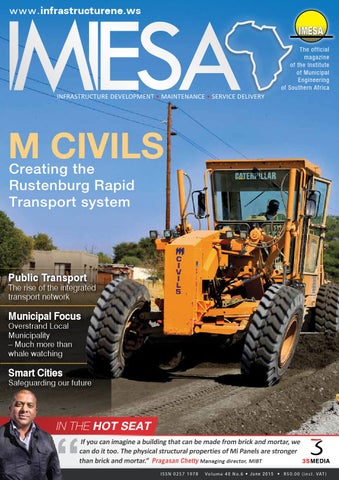
M CIVILS Creating the Rustenburg Rapid Transport system
Public Transport
The rise of the integrated transport network
Municipal Focus Overstrand Local Municipality – Much more than whale watching
Smart Cities
Safeguarding our future
IN THE HOT SEAT If you can imagine a building that can be made from brick and mortar, we can do it too. The physical structural properties of Mi Panels are stronger than brick and mortar.” Pragasan Chetty Managing director, MIBT ISSN 0257 1978
V o l u m e 4 0 N o . 6 • J u n e 2 0 1 5 • R 5 0 . 0 0 ( i n c l . VAT )
The Preferred and Strategic Practitioners in the Provision of Sustainable Human Settlements
AREAS OF EXPERTISE
Roads and Stormwater Bulk Water and Sewage Installations Water and Sewage Reticulation Networks EPWP Projects Structures and Buildings (Facilities) Sport and Recreational Facilities Solid Waste Projects
MEMBERS OF:
Community Centres Multi-Disciplinary Project Management Labour Intensive Projects Township Establishment and Housing Projects Railway Engineering Services Mining Infrastructure Projects
Truly Empowered South African Company United through its Diversity www.lekwaconsulting.co.za
/Lekwa
@Lekwa
ALBERTON - Gauteng 118 Hennie Alberts Street | Brackenhurst P.O Box 145851 | Bracken Garden | 1452 Tel: +27 (0)11 868 2494 Fax: +27 (0)11 868 1348 E-mail: lekwainfo@civilnet.co.za
ERMELO - Mpumalanga 67 Fourie Street | Ermelo P. O Box 1903 | Ermelo | 2350 Tel: +27 (0)17 819 1985 Fax: +27 (0)17 819 4017 E-mail: lekwa@civilnet.co.za
NEWCASTLE - KwaZulu Natal 34 Paterson Street | Newcastle PO Box 27 | Newcastle | 2490 Tel: +27 (0)34 315 3232 Fax: +27 (0)86 668 7533 E-mail: lekwainfo@civilnet.co.za
CONTENTS www.infrastruc
turene.ws
VOLUME 40 NO. 6 JUNE 2015
24
IMESA The officia l magaz ine of the Institu te of Munici pal Engine ering of Southe rn Africa
INFRASTRUCTURE
MAIN DEVELOPMENT •
TENANCE • SERVI
UTILITIES MANAGEMENT & EQUIPMENT Safeguarding our future
CE DELIVERY
CIVILS M Creating the pid Rustenburg Ra Transport system
rt Public Transporated The rise of the integ transport network
Municipal Focl us
10
Overstrand Loca Municipality – Much more than whale watching
Smart Cities
Safeguarding our
future
IN THE HOT SEA
T
and mortar, we be made from brick a building that can s are stronger If you can imagine properties of Mi Panel physical structural can do it too. The ing director, MIBT an Chetty, manag Pragas ) r.” 0 . 0 0 ( i n c l VAT than brick and morta ne 2015 • R5 e 40 No.6 • Ju 8 ISSN 0257 197
Vo l u m
North West civil engineering contractor M Civils is expanding its core focus in road construction, diversifying into residential building and allied services, as well as niche load and haul services in contract mining. P6
MUNICIPAL FEATURE Overstrand Local Municipality
Regulars 3
Editor’s comment President’s comment
5
Africa round-up
8 60
Index to advertisers
M Civils – Creating the Rustenburg Rapid Transport system
6
Building Business
Overstrand Local Municipality
Welcome to Pelican Park
Cement & Concrete 39
Driving customised solutions
40
Who's liable for overloading?
42
Retaining key points
43
14
Pretty but tough
44
17
Construction Vehicles, Equipment & Logistics
10
Human Settlements
44
35
Predicting growth beyond 2020
Municipal Feature
MIBT
Pragasan Chetty, managing director of MIBT, takes the IMIESA Hot Seat to discuss his unique product, Mi Panels – an innovative, green building material with a plethora of applications for the African market. P14
33
Aquadam’s steel-coated tank solutions
Partners for cross-border success 37
Cover Story
Hot Seat
HOT SEAT
NuWater's decentralised treatment solutions
Renewable revolution underway
Utilities Management & Equipment
45
Commitment, passion, and reliability 47
Excellent service to the municipal market
22
Safeguarding our future
24
Smart water meters'
Let’s get lifted
49
Shine bright like a diamond
51
Remanufacturing engines
53
A bucket load of choices
54
endless benefits
27
Technology & Innovations
A breath of fresh air
30
An app revolution
55
Energy storage evolution
58
Growing support for IFAT
58
Demystifying the future of wastewater treatment
CEMENT & CONCRETE Pretty but tough
55
31
TECHNOLOGY & INNOVATIONS An app revolution
IMIESA June 2015
1
A Recycling Productive Plant Ready to Move
N1 Bloemfontein –Prime 140 Asphalt plant with RA
Need a plant that is mobile, productive and has exceptional recycling potential? Look no further than the Ammann Prime 140 continuous asphalt mixing plant. Because you never know where the next job mig ht be, the Prime 140 includes an option to utilise two smaller trailers during relocation. Doing so provides manoeuvrability and ultimately access to hard-to-reach places. In addition to mobility and recycling ability, the Prime 140 features: • Numerous upg rade options and accessories that help customize the plant for your specific needs • Separation of the drying and mixing processes for improved mix quality and reduced emissions • A controllable outlet g ate that enables filling heig ht and mixing time to be set depending on recipe and output For more information on compaction machines, mixing plants and pavers g o to www.ammann-group.com
Ammann Construction Machinery 229 Hull Road, Rynfield Benoni 1500, South Africa Tel. + 27 11 849 3939 Fax + 27 11 849 8889 info.aza@ammann-g roup.com
EDITOR’S COMMENT
PUBLISHER Elizabeth Shorten EDITOR & ASSOCIATE PUBLISHER Nicholas McDiarmid EDITORIAL ASSISTANT Liesl Frankson JOURNALISTS Beatrix Knopjes, Frances Ringwood HEAD OF DESIGN Beren Bauermeister DESIGNER Ramon Chinian CHIEF SUB-EDITOR Tristan Snijders SUB-EDITOR Morgan Carter CONTRIBUTORS S Gibson, N Kranz, N Tandi CLIENT SERVICES & PRODUCTION MANAGER Antois-Leigh Botma PRODUCTION COORDINATOR Jacqueline Modise FINANCIAL MANAGER Andrew Lobban MARKETING & DIGITAL MANAGER Esther Le Roux MARKETING SPECIALIST Philip Rosenberg ADMINISTRATION Tonya Hebenton DISTRIBUTION MANAGER Nomsa Masina DISTRIBUTION COORDINATOR Asha Pursotham SUBSCRIPTIONS subs@3smedia.co.za PRINTERS United Litho Johannesburg +27 (0)11 402 0571 ___________________________________________________
A
T A RECENT Captains of Construction leadership forum in Sandton, Johannes Musel, CEO of Hitachi Power Africa, noted that critical skills that had been transferred by multinational companies to workers at Eskom’s delayed new power stations stand to be lost, should no new projects follow timeously. This is an excellent point, and one that, in my opinion, points in the direction of both the public and the private sectors in South Africa. Recently speaking to visiting European representatives of several construction vehicle and equipment manufacturers, with long-established presences in South Africa, I was interested to discover their thoughts on what was holding back development of the infrastructure sector. Several cited wasted opportunities for skills transfer on a sustainable basis. As an example, one representative found it very confusing to witness machine operators being fired instead of being provided with opportunities to learn from their mistakes – the more so, since he found their initial training to be so inadequate. From a purely pragmatic point of view, he found this ludicrous, as damage to machinery, reduction of machinery- and plant-life, downtime, and inefficiencies on-site come at a very high price to both the companies involved and the economy as a whole. With Marikana back in the news, the release of increasingly poorer unemployment data, and tensions growing around increasing challenges South Africa is facing, there is definitely one thing we all do have control over, and that is how we treat each other. We can teach, not criticise; we can support, not enable; we can encourage, not threaten; and we can all remember to be on the lookout for each other’s strengths, rather than weaknesses. I had the good fortune to attend African Utility Week in May, and what a week it was. Delegates were spoiled for choice on both the conference and the exhibition side, and the Industry Awards delivered some seriously good news about some wonderful achievements, the highlight being City Power’s MD, Sicelo Goodwill Xulu, taking the
ADVERTISING SALES Jenny Miller Tel: +27 (0)11 467 6223 ___________________________________________________
PUBLISHER: MEDIA No. 9, 3rd Avenue, Rivonia 2056 PO Box 92026, Norwood 2117 Tel: +27 (0)11 233 2600 Fax: +27 (0)11 234 7274/5 E-mail: nicholas@3smedia.co.za www.3smedia.co.za ANNUAL SUBSCRIPTION: R550.00 (INCL VAT) ISSN 0257 1978 IMIESA, Inst.MUNIC. ENG. S. AFR. © Copyright 2015. All rights reserved. ___________________________________________________ IMESA CONTACTS IMESA Administration Officer: Narisha Sogan P O Box 2190, Westville, 3630 Tel: +27 (0)31 266 3263 Fax: +27 (0)31 266 5094 Email: admin@imesa.org.za Website: www.imesa.org.za BORDER BRANCH Secretary: Melanie Matroos Tel: +27 (0)43 705 2401 Fax: +27 (0)43 743 5266 E-mail: melaniem@buffalocity.gov.za EAST CAPE BRANCH Clarine Coltman Tel: +27 (0)41 505 8019 Fax: +27 (0)41 585 3437 E-mail: clarinec@africoast.com KWAZULU-NATAL BRANCH Secretary: Rita Matthews Tel: +27 (0)31 311 6382 Fax: +27 (0)31 701 2935 NORTHERN PROVINCE BRANCH Secretary: Rona Fourie Tel: +27 (0)82 742 6364 Fax: +27 (0)86 634 5644 E-mail: imesanorth@vodamail.co.za SOUTHERN CAPE KAROO BRANCH Secretary: Henrietta Oliver Tel: +27 (0)79 390 7536 Fax: +27 (0)86 536 3725 E-mail: imesa.southcape@gmail.com WESTERN CAPE BRANCH Secretary: Erica van Jaarsveld Tel: +27 (0)21 938 8455 Fax: +27 (0)21 938 8457 E-mail: erica.van_jaarsveld@capetown.gov.za FREE STATE AND NORTHERN CAPE BRANCH Secretary: Wilma Van Der Walt Tel: +27(0)83 457 4362 Fax: +27 (0)86 628 0468 E-mail: imesa.fsnc@gmail.com
award for Top Utility Executive of the Year. City Power is leading the way in finding innovative solutions to the current electricity challenges and has rolled out a metering solution, with Edison Power Group, that is set to take lead nationwide when it comes to load control. In the next edition of IMIESA, we will be providing full coverage of this major event.
IMESA and 3S Media sign historic contract renewal Cape Town was also the setting for a rather historic moment between the Institute of Municipal Engineering Southern Africa (IMESA) and 3S Media, when IMESA president Duncan Daries and 3S Media managing director and publisher Elizabeth Shorten signed the contract that will see the continuation of a publishing partnership that began in 1975 and that has gone from strength to strength. IMIESA is a true leader in its field, covering a unique segment of the South Africa’s developmental and economic trajectory that is fundamental to the well-being of the nation. “3S Media is extremely proud of its partnership with IMESA and it means a great deal to me personally as well,” says Shorten. “My father first approached the institute in 1975 with the proposal to publish a monthly title, and IMIESA was the result. “To be signing a renewal contract 40 years later, in a much-changed country, in a much-changed world, is a wonderful reminder of the passion with which my father built the title and how IMIESA continues – through the written word – to contribute to the growth of South Africa,” concludes Shorten.
Nicholas McDiarmid
To our avid readers, check out what we are talking about on our website, Facebook page or follow us on Twitter and have your say.
@infrastructure4
www.infrastructurene.ws
www.in
All material herein IMIESA is copyright protected and may not be reproduced either in whole or in part without the prior written permission of the publisher. The views of contributors do not necessarily reflect those of the Institute of Municipal Engineering of Southern Africa or the publishers.
Moments that matter
frastruc
turene.w
INFRASTRUC
IMESA
s
The official magaz ine e of the Institut pal of Munici Engine ering rn Africa of Southe
OPMENT TURE DEVEL
Fostering
ENANCE
• SERVIC
E DELIVE
RY
ER CIVILS Creating the NUWAT M Rustenburg Rapid treatment’ l water mobile Municipa dular & Transport system goes ‘mo
LA MAD ONSE SIPH O ECSA OF nships CEO
• MAINT
good relatio
Public Transport
The rise of the integrated transport network
Municipal Focus
ussion ce, tenan Panel Disc on, main s
Overstrand Local Municipality – Much more than whale watching
Constructi gement of utilitie and mana
l Focus Municipametro
Smart Cities
Public Parks & s our cities Amenitie
IN THE HOT SEAT
into
ues If you can imagine a building that can be made from brick and mortar, we t, PPC contin of cemen the can do it too. The physical structural properties of Mi Panels are stronger business and the Africa and than) brick and mortar.” Pragasan Chetty, managing director, MIBT ons, PPC c l VAT facing South GM: Communicati d compliance .00 (in hy, • R50 Going beyon social challenges y 2015 ISSN 0257 1978 V o l u m e 4 0 N o . 6 • J u n e 2 0 1 5 • R 5 0 . 0 0 ( i n c l VAT ) n McCart 5 • Ma ss the 40 No. tes.” Siobha olume to addre it opera 78 V 257 19 s in which ISSN 0 communitie
THE BIG
Cover opportunity In each issue, IMIESA offers advertisers the opportunity to get to the front of the line by placing a company, product or service on the front cover of the journal. Buying this position will afford the advertiser the cover story and maximum exposure. For more information on cover bookings contact Jenny Miller on tel: +27 (0)11 467 6223.
Safeguarding our future
Ekurhuleni the limit – The sky’s
life Breathing
Infrastructure News
IMESA The official magazine of the Institute of Municipal Engineering of Southern Africa
INFRASTRUCTURE DEVELOPMENT • MAINTENANCE • SERVICE DELIVERY
INTERV
IEW
IMIESA June 2015
3
N O I T A R T
S I G E R E N I L ON N O I T A R T S I G RE D E N E P O HAS
ww
org.za . a s e w.im
28-30 OCTOBER 2015
THEME: Changing the face of the Municipal Engineer Earn 2.5 CPD points by attending The 2015 IMESA Conference will be hosted at the Grand West Hotel and Casino – Goodwood
Register and pay before 31 July 2015
Register and pay before 31 August 2015
Register and pay AFTER 31 August 2015
• Early Bird for IMESA Members – R4900.00 • Early Bird for Non IMESA Members – R5400.00
• Late Registration for IMESA Members – R5100.00 • Late Registration for Non IMESA Members – R5700.00
• Last Minute Registration for IMESA Members – R5650.00 • Last Minute Registration for Non IMESA Members – R6250.00
IMESA ORGANISER THE INSTITUTE OF MUNICIPAL ENGINEERING OF SOUTHERN AFRICA (IMESA)
t +27 (031) 266 3263 email conference@imesa.org.za
PRESIDENT’S COMMENT
IMESA
Metal theft Duncan Daries, IMESA president
Metal, and especially copper cable, theft has cost the country in the order of R5 billion (Salga’s estimate) per annum, over the last few years. This phenomenon has been fuelled by the insatiable scrap metal consumption of China and India.
I
N CAPE TOWN, it is estimated that 70% of thieves involved in this activity are drug addicts who steal in order to support their dependencies. However, these thieves are organised by unscrupulous owners or employees of scrap metal dealers and crime syndicates, who expor t directly, bypassing the scrapyard. The resultant disruption to service delivery (electricity outages, water supply down, industr y productivity stalled, train commuters late, etc.), as well as increased public liability claims (missing manhole covers causing injuries and vehicle damages), has been branded as economic sabotage by the Minister of CoGTA, Pravin Gordhan. Other than catching thieves in the act of stealing cable or metal covers, prosecutions of scrap metal dealers in possession of illegally obtained cable are difficult, as the identification of the owner proves problematic. The City of Cape Town, in 2007, spearheaded an approach
by forming a specialised law enforcement unit dedicated to combating the scourge of nonferrous metal theft. This unit, known as the ‘Copperheads’, was hugely successful and, in its first year of operation, was responsible for reducing the estimated metal theft cost from R22 million to R500 000 per annum. Through these efforts, many lessons were learnt, and discussions took place at a national level to identify the stumbling blocks in the crime fighting and judicial systems hindering effective action against this criminal activity. The following significant measures have, thus far, been put in place: • The passing of the SecondHand Goods Act, which makes the buyer of stolen goods as guilty as the person who stole the goods. • A training manual for SAPS, developed in conjunction with Sarpa (South African Revenue Protection Association), which focuses on the trading in second-hand goods and combating the illegal trade in
non-ferrous metal, has been rolled out country-wide. This gives direction to the evidence collection process, to ensure successful prosecution of metal theft cases. • SAPS taking over the responsibility of coordinating the NFMCCC (Non-Ferrous Metal Crime Combating Committee, which consists of representatives of public entities and private businesses) and conducting regular meetings, even at station level. This improves the sharing of knowledge, the identification of crime syndicates, and the effective prosecution process. • Technological developments have focused on the identification copper cables and warning systems when breaks in telecommunication and power conduits are detected. • CoGTA’s elevation of metal theft as a priority issue, making it part of its ‘back to basics’ campaign with municipalities. IMESA fully endorses these effor ts and suppor ts any
inter ventions that enhance service delivery and redirect this unnecessary expenditure toward the provision or renewal of infrastructure, where it is most needed. Engineering efforts to stem this tide have concentrated on the use of alternative materials, which have a reduced, or no, scrap value. In the case of manhole covers, the industry has, over the past few years, introduced reinforced concrete, reinforced fibre cement, ductile steel, polywood, and combinations of these materials. These materials have, however, not been able to replace the intrinsic properties of the cast iron being replaced i.e. weight, durability, stability, tensile, and compressive strength. The same is probably true in the cable industry as well, where the properties of alternate materials do not match the copper. It is, therefore, imperative that all efforts need to be directed at curtailing metal theft as a whole, as it is a threat to sustainable infrastructure provision and, subsequently, service delivery.
IMIESA June 2015
5
COVER STORY
Creating the Rustenburg
Rapid Transport system North West civil engineering contractor M Civils is expanding its core focus in road construction, diversifying into residential building and allied services, as well as niche load and haul services in contract mining.
O
NCE COMPLETED, THE Rustenburg Rapid Transport (RRT) system will serve an 18 km trunk line network of dedicated bus lanes and station terminals, with local contractor M Civils forging ahead with key phases of the construction programme. The RRT forms part of the 2025 Rustenburg City Development strategy that is set to transform the city and the way it interconnects with the neighbouring mining and agricultural communities it serves. Similar to other bus rapid transport (BRT) initiatives constructed in Johannesburg and Cape Town (referred to under their project names of Rea Vaya and MyCiTi, respectively), the first phases of the RRT are due to come on stream during 2016, via trunk corridors, direct routes, and feeder services. Some 80% of the Rustenburg Local Municipality will be covered once the RRT system is completed, catering for upwards of 200 000 commuters. M Civils completed the first phase of the RRT contract in January 2014, which was valued at around R412 million, and extended over a project duration of around 18 months. The scope of works here entailed construction of 5 km of RTT section, which comprised the upgrading of the north- and southbound sections to a dual carriageway, the installation of a dedicated central concrete lane for the buses, as well as the foundations for the bus stations.
6
IMIESA June 2015
Thereafter, in May 2014, M Civils was awarded three of the four contracts (namely A, C, and D work packages) for the second phase of the RRT, with a combined value of around R798 million. Stage A has been finalised and the balance is due for completion in April 2017.
A track record of excellence Headed by managing director Mike de Kock, M Civils is an 8CE PE contractor, according to the Construction Industry Development Board (cidb), and the company has a well-respected track record for both private and public sector road and infrastructure developments that serve as key socio-economic conduits in the North West, famed globally for its rich platinum and allied metals industries. To date, more than 120 contracts have been completed, since the company’s formation in 1997, for a range of civil engineering projects that include bulk earthworks establishment for blue-chip mining houses, township services (sewer, bulk water reticulation, and stormwater control systems), and pavement rehabilitation. Milestone civil services projects include 45 km of internal sewers for Tekwane village close to Bleskop. Supporting all these initiatives is M Civils’ expanding, mixed earthmoving fleet, now numbering more than 100 units. This fleet includes Caterpillar machines such as Cat 140K motor graders, Cat 428F backhoe loaders,
COVER STORY
and Cat 320D L hydraulic excavators, supplied and supported by Southern African Cat dealer Barloworld Equipment. Cat graders remain the preferred choice for M Civils for building-site work and road construction. “For any civil engineering contractor, optimal grading performance is essential and we regard the Cat 140K as the industry benchmark,” says M Civils contract manager Richard Stone. “This has been reinforced time and again on our road and infrastructure projects.” Past milestone contracts include the construction of the Leeuwkop shaft terrace for Impala Platinum’s Afplats. A challenging contract, M Civils was tasked with blasting and excavating some 190 000 m3 of unsuitable material from the terrace area, and importing 170 000 m3 of dump rock and norite over a 17 ha site. Another complex project entailed the construction of a ring road in Phokeng for the Rustenburg Local Municipality. This fasttracked contract involved the construction of approximately 3 km of a four-lane carriageway, two large culvert crossings, and the upgrading of around 8 km of existing road. M Civils has also played its part in South Africa’s highly successful hosting of the 2010 FIFA World Cup. The scope here, for the Royal Bafokeng Sports Trust, saw the construction of a bulk water pipeline supplying potable water to the five-star hotel at the Bafokeng Sports Campus, which housed the English national team during the tournament. Meanwhile, in 2011/2012, M Civils converted a series of internal gravel road networks to asphalt, surfacing with a 25 mm premix, in the Rustenburg townships of Boitekong and Lethabong. Work also included stormwater accommodation. M Civils continues to roll out similar projects, on an ongoing basis, across the North West and the company’s fast-tracking capabilities form part of the solution. For example, tasked with an emergency repair contract for the North West Department of Public Works, Roads and Transport – on the Mafikeng to Vryburg section – M Civils completed a scheduled six-month project in around 60 days, in February 2012, along a 6 km to 8 km section.
A diversified strategy On these and other projects, community upliftment and skills transfer are central to all M Civils contracts, especially on labour-intensive components, where the training focus includes pothole repairs and concrete block paving.
ABOVE From left to right: Barloworld Equipment Cat sales professional Molly Breton and M Civils site agent Reino de Kock OPPOSITE An aerial perspective showing a section of the Rustenburg Rapid Transport system at an advanced stage of construction
Addressing the current skills shortage in building and construction, plans are now underway at M Civils to open its own training centre, initially for internal requirements, and later for the outside commercial market. M Civils also plays its part in facilitating SMME development, managing and mentoring subcontractors across all its projects. Maintaining its civil engineering focus, the company has recently diversified into new industry sectors that include turnkey services for the construction of affordable housing
by Impala Platinum for its employees, while further building activities include work for the South African Department of Human Settlements in Klerksdorp, where close to 500 RDP homes have undergone structural repair work by M Civils, following the earthquake that occurred in the region in August 2014. M Civils teams are now employed from May 2015 in the servicing and sale of approximately 4 500 stands in Bokamoso, which is situated approximately 10 km from Rustenburg. This is a joint project between Anglo American
“For any civil engineering contractor, optimal grading performance is essential and we regard the Cat 140K as the industry benchmark.” Richard Stone, contract manager, M Civils developments, as well as a venture into mine tailings load and haul contracting. Towards the end of 2012, M Civils was awarded a contract from Anglo Platinum to construct 310 fully serviced stands in Northam Extension 6, as well as individual free-standing homes, for mine personnel, with the final phases completed during 2015. M Civils was also responsible for the marketing and sale of these homes. Other work completed includes internal works and infrastructure development for Platinum Village – a housing project commissioned
Platinum, the Rustenburg Local Municipality, the Department of Human Settlements, and North West provincial government. In the first phase, M Civils will construct and market some 1 600 homes over an estimated period of 24 months. “M Civils has a strong order book going forward, which supports our diversified strategy, and we anticipate excellent growth, over the next 12 months, through new contract opportunities across the North West. This could translate to work worth over R1 billion,” adds Stone.
IMIESA offers advertisers an ideal platform to ensure maximum exposure of their brand. Companies are afforded the opportunity of publishing a two-page cover story and a cover picture to promote their products to an appropriate audience. Please call Jenny Miller on +27 (0)11 467 6223 to secure your booking.
IMIESA June 2015
7
AFRICA ROUND-UP
INFRASTRUCTURE NEWS FROM AROUND THE CONTINENT AFRICA Benefits of adapt-
KENYA
ing Africa’s infrastructure to climate change outweigh the costs
Standard gauge railway to boost local steel firms China Bridge and Road Corporation (CRBC) is in the process of buying over 5 000 tonnes of steel, worth more than $3.7 million, from Kenyan manufacturers for the construction of a standard gauge railway (SGR). This will be the first largescale local purchase of steel by the CRBC since construction of the new railway began. The firm previously purchased smaller consignments from different Kenyan steelmakers. “We have tested the suppliers’ steel products that are participating in this process in our SGR project centre lab and they have met the requirements for the project,” says James Chen, CRBC business manager. The firm said the 5 250 tonnes of steel bars are expected to meet the requirements for the construction of culverts and bridge foundations for about three months.
The impact of climate change on Africa’s water and energy infrastructure will be costly, according to a new World Bank report, and immediate action is needed to reduce these risks. The report uses, for the first time, a consistent approach across river basins and power systems in Africa, and a wide range of state-of-the-art climate projections to evaluate the risks posed by climate change to planned investments in Africa’s water and power sectors. While ignoring climate change could result in planning and designing infrastructure unsuitable for future climates, the study points to a risk of adapting to climate change in the wrong way, which could have significant implications. The report provides actionable steps to increase resilience in Africa’s infrastructure, including providing technical guidelines on integrating climate change into the planning and design of infrastructure.
BOTSWANA Industry-oriented training important Botswana’s government is not doing enough to train people with relevant skills that can grow the economy, the managing director of Allied Engineering Services, Emmanuel Paradza, has said. He was speaking during a breakfast meeting, held by the Minister of Trade and Industry, to discuss issues that were of particular interest to both the government and private sector in
8
IMIESA June 2015
The increase in construction activities in Botswana will boost economic development
terms of growing the economy and creating employment. Paradza urged the government to provide apprenticeship training that is relevant for the engineering industry. He said economic development that had led to growth in jobs was as a result of business-oriented services and the increase in construction activities. He added that more construction brought higher demand for engineering, architecture, surveying, landscaping, and horticultural services.
BELOW The construction of Kenyan standard gauge railway will boost the sales of local steel manufacturers
MALAWI $70 million loan for border post project The African Development Fund (ADF) has granted Malawi and Zambia a $70 million loan to construct one border post
AFRICA ROUND-UP
between Mchinji, in Malawi, and Mwame, in Zambia. The construction of one border post is meant to promote trade links across Southern African countries and reduce time spent at borders. ADF country manager to Malawi Andrew Mwawa said the bank is to release funds for the construction of the project. Meanwhile, Malawi’s Minister of Trade Joseph Mwananveka has revealed plans to construct a border post along the border with Mozambique.
NAMIBIA Major infrastructure upgrades for Erongo Erongo will see the upgrading of key infrastructure over the next three years. The infrastructure projects will be partly funded through the government’s Medium-Term Expenditure Framework (MTEF). The value of the MTEF development projects to be funded, 1 April 2015 to 31 March 2018, amounts to N$36.8 billion, of which 7% (N$2.6 billion) is earmarked for projects in Erongo, which represents the third largest allocation of all regions. Some of the largest projects planned for Erongo include a
new road between Swakopmund and Walvis Bay (N$1.3 billion), the Karibib-Usakos-Swakopmund road upgrade (N$747 million), farm land purchases for land reform (N$592 million), the Walvis Bay airport upgrade (N$447 million), and the Namibian navy headquarters in Walvis Bay (N$396 million).
NIGERIA Local engineers lauded over Aba Mega Mall project The $300 million Aba Mega Mall is now being built by Greenfield Assets Limited, a Nigerian developer, who engaged Nigerian engineers in all aspects of the project. President of the Nigerian Society of Engineers (NSE) Ademola Olorunfemi, who inspected the project, commended the quality of work, saying that Nigerians were capable of handling any type of engineering work if given the opportunity. Olorunfemi challenged other Nigerians with the means to emulate Greenfield Assets by providing similar infrastructure that would create jobs, especially for indigenous engineers. He said that the NSE was interested in engineering
BELOW One of the largest projects planned for Erongo is the upgrade of the Walvis Bay airport for N$447 million
developments in the country and encouraged projects like the Aba Mega Mall.
RWANDA New bidding procedure for construction jobs Effective next financial year, which begins in July, construction firms will be required to bid for public works according to newly established categories. Officials at the Rwanda Public Procurement Authority (RPPA) say they are in the process of putting all construction firms in categories depending on their financial, logistical, and human resource capacities. The move, according to RPPA director general Augustus Seminega, aims at streamlining operations, eliminating unfair competition, and reducing the possibilities of corruption and breach of contract, among other ills. There will be six categories, from A to F, he says. According to the categories, companies can only go for tenders that fall in their category and two categories below it. A non-categorised foreign company will be awarded a tender only once and must then be categorised for another. “We shall be revising the categories annually, making it possible for a company to move to an upper or lower category,
ABOVE The Dar es Salaam port capacity will double to 28 million tonnes by 2020
depending on their capacity at a given period of time," Seminega says.
TANZANIA $596 million Dar es Salaam port upgrade works begin Civil works have started on the $596 million upgrade of Dar es Salaam port, involving financing by both bilateral and multilateral donors and overseen by nonprofit consultancy TradeMark East Africa (TMEA). According to Philippe Dongier, World Bank country director for Tanzania, Uganda and Burundi, the event is happening at the right time, when the World Bank, together with the Tanzanian government, the British Department of International Development (DFID), and TMEA, is preparing a substantive programme to increase the capacity and efficiency of the port. Port capacity will double to 28 million tonnes by 2020. Dongier said the total cost is envisaged to be $596 million, including an IBRD Enclave loan of up to $400 million – the first of its kind in the Africa region – a prospective grant of $136 million from DFID, and committed and pipeline support from TMEA to the sum of $60 million, excluding the complementary private investment in the port. Modernising and expanding the Dar es Salaam port will reduce ships’ dwell time from nine to ten days, down to just five days by 2020. IMIESA June 2015
9
MUNICIPAL FEATURE
Much more than
whale watching
Overstrand Local Municipality, located on the west coast of South Africa and incorporating Hermanus, Kleinmond, Gansbaai, and Stanford, is a sterling example of local governance. Famous for its whale watching, the municipality has infrastructure projects in progress that demonstrate its efficiency. BY BEATRIX KNOPJES
B
ASED ON AN investigation into the water resources for De Kelders by Overstrand Local Municipality, the water supplied from the various fountains in and around De Kelders was classified as varying from ‘slightly brackish’ to ‘moderately brackish’, and ‘hard’ to ‘very hard’, resulting in scaling of calcium carbonates in the hot water cylinders and kettles of the residents. Historically, water supplied from these two fountains was only disinfected and then pumped directly into the De Kelders and Gansbaai water distribution systems.
De Kelders reverse osmosis water treatment plant During 2010, the municipality initiated a project for the implementation of a new water treatment works (WTW) for De Kelders, to treat the water supplied from the Klipgat and Grotte fountains to SANS 0241 standards. Construction of the new water treatment works commenced in June 2011, and was completed in May 2012. The water treatment processes comprise both ultrafiltration (UF) and reverse osmosis (RO) technologies, which are advanced and proven treatment technologies. The use of this treatment technology enables minimisation of the footprint of the treatment works, the impact on the environment, and also water losses associated with the process.
10
IMIESA June 2015
Water is blended from the two fountains at the De Kelders WTW. An iron oxidation step was introduced at the intake of the raw water buffer tank using an aeration technique. From the raw water buffer tanks, the water passes through a strainer and is then pumped to the UF process. The UF filtered water is subsequently treated with a two-stage brackish water RO process. Partial blending of the RO permeate and UF filtrate is done, followed by a disinfection step, before the water is transferred to the De Kelders reservoir. All valves and pumps are controlled by the MasterLogic Programmable Logic Control (PLC). The flow rate is monitored at the feed flow meter and variable speed drive (VSD) controlled feed pump. The filtrate pressure is indicated and sensed on a pressure gauge, and by a filtrate pressure transmitter on the filtrate side of the module array.
Hermanus relief road Rapid development in Hermanus and surrounding communities has led to a steady increase in volumes of local and through traffic. Increased tourism has contributed to this growth, and has extended peak traffic demand into periods of the generally regarded tourist season. High traffic volumes over long periods, inadequate parking and road capacity, inadequate
pedestrian accommodation, and inconsistent road layout and markings have resulted in several traffic problems on roads in the Hermanus CBD and greater Hermanus area. Motorists passing through Hermanus mainly use Main Road through the CBD, which is also the main route for those wishing to access the CBD area, or Marine Drive along the beachfront. These roads are severely congested during peak traffic periods. The proximity of many restaurants and tourist destinations (such as Market Square, the Old Harbour Museum, and key whale watching areas) means that Main Road also carries a high level of pedestrian traffic. Motorists thus wishing to avoid Main Road and Marine Drive must use several smaller detour roads that serve the residential areas to the north of the CBD area.
Before the construction of the relief road During the 1990s, the Hermanus Structure Plan made provision for, what was termed, the bypass road. The bypass followed an alignment along Spence Street, Royal Street, and Lord Roberts Street. and a preliminary design was drawn up for this route by Ninham Shand Consulting Services. Another plan, namely the Hermanus Transportation Plan (compiled by Jeffares & Green in 1997), confirmed the need for a CBD relief road as part
MUNICIPAL FEATURE
of a larger municipal transportation system, which identifies a number of policy goals and objectives from such a system, namely: • providing mobility for residents, visitors, and through traffic • providing access to properties within the CBD and on the outside of the relief road • providing for safe traffic operations • supporting public planning objectives • minimising cost to taxpayers. The total construction cost of the relief road was R22 089 549.58 and the construction period was 15 months. The commencement date was during September 2009, and completion date 2011.
GIBB is a leading multi-disciplinary engineering firm Leaders in engineering consulting
Karwyderskraal landfill site Cell 3 The recent opening of the new third cell at the Karwyderskraal landfill site, by Overstrand mayor Nicolette Botha-Guthrie, was indeed a happy occasion for the municipality. The regional landfill site at Karwyderskraal had to remain closed for approximately the last three-year period, as the existing cell was filled to capacity and there was a lack of funding for building a new cell. The closure of the landfill site posed specific challenges to the municipality, with the landfill site at Gansbaai being the only other permitted landfill site in the Overstrand municipal area. All the refuse from the Kleinmond and Hermanus areas, therefore, had to be transported to Gansbaai for the past three years. Refuse from the Kleinmond and Hermanus areas do not have to be transported to the Gansbaai land fill site any more, resulting in a smaller carbon footprint. The expected lifespan of the Gansbaai site will also be extended as a result of this project. Kar wyderskraal is situated in a per fect area for a landfill site, due to the high-quality clay found in the underlying material. The clay material acts as a ver y good barrier between the waste and the underlying groundwater, due to its low permeability. The good high clay could also be used in the layer works, thereby reducing construction costs considerably.
Operating in:
Dams, Hydropower and Tunnelling Environmental Integrated Infrastructure - Water Cycle - Housing
Power and Energy Transportation -
Airport and Aviation Railway Engineering Roads and Highways Traffic and Transportation
Architecture
TOP The original Preekstoel Water Treatment Works was designed to treat mainly surface water from the De Bos Dam ABOVE Since the recent opening of the new third cell at the Karwyderskraal landfill site, refuse from the Kleinmond and Hermanus areas no longer need to be transported to the Gansbaai landfill site
IMIESA June 2015
+27 11 519 4600 marketing@gibb.co.za | www.gibb.co.za GIBB is a Level 2 BBBEE contributor
11
MUNICIPAL FEATURE
The total project cost for building the new cell was R9.3 million. The project was funded by Overstrand Local Municipality, as well as a contribution of R4.1 million from the Municipal Infrastructure Grant by the Department of Local Government. It is estimated that 155 000 tonnes of refuse can be dumped in the new cell, and it is expected to have a lifespan of approximately five years at current growth rates, before the next cell will have to be operational.
Preekstoel biofiltration water treatment plant The original Preekstoel Water Treatment Works (WTW), located in the scenic Hemel-enAarde Valley near Hermanus, was constructed in 1974, with a capacity of 12 Mℓ/d. The plant was extended in the 1990s to treat a total volume of 24 Mℓ/d. Until then, the plant was designed to treat mainly surface water from the De Bos Dam. Between 2011 and 2013, the existing plant was refurbished and an additional treatment plant has been completed for the treatment of borehole water. This plant represents the first fullscale biological iron and manganese removal plant in South Africa, with a total capacity of 10 Mℓ/d. Through the refurbishment of the existing plant, and the use of new technology, the plant’s capacity was increased to 28 Mℓ/day. Added to the biological plant’s 10 Mℓ/day capacity, the total treatment capacity of the plant became 38 Mℓ/day.
The Hemel-en-Aarde well fields and bulk pipelines Two major challenges were encountered during construction of the boreholes and feed
12
IMIESA June 2015
pipelines, namely: ensuring the continuous operation of the existing treatment works during the refurbishing process; and overcoming environmental and social sensitivities. During the rehabilitation process of the existing treatment lanes, only small sections of the existing Preekstoel WTW could be decommissioned, refurbished, and re-commissioned at a time, ensuring minimal disruption of the water supply and treatment system. Construction activities were also programmed to ensure that the full works was operational during the peak holiday periods. Although water restrictions were put in place, due to a severe drought period, no water supply cut-offs were required during any stage of the refurbishment period. Most of the borehole wells are located on private properties, while a large portion of the pipeline routes is also very environmentally sensitive. Borehole structures were, therefore, designed to blend in with the environment, also taking into consideration the requirements of the property owners. Vast sections of power supply lines had to be installed below ground level to reduce visual impact. The total project cost was R87 million, of which R21 million was contributed by the Department of Water and Sanitation, through the RBIG (Regional Bulk Infrastructure Grant). Sixty-seven temporary jobs were created for local people during construction. Overstrand Local Municipality has implemented various actions over the last number of years in order to quantify and reduce nonrevenue water and water losses. The municipality adopted a water demand management plan as part of its turnaround strategy. The aim is to reduce water losses to 17% by 2017. The following activities form
Preekstoel WTW is located in the greater Hermanus area, known for its whale watching
part of the strategy, to support the achievement of the desired result. Water pipe replacement involves the replacing of existing water pipes, which are known to be old and subject to frequent bursting, as well as augmenting the existing reticulation network, to ensure that sufficient water is available – even during the extreme peak holiday season. The project was implemented in Rooi-Els, Pringle Bay, Betty’s Bay, Kleinmond, Hermanus, Stanford, Gansbaai, and Pearly Beach – all coastal and predominantly holiday towns within the Overstrand Local Municipality. The municipality has a 20-year water network master plan, and also a water pipe replacement model. The pipe replacement model considers various factors, such as recorded pipe bursts, pipe type, age of pipes, geotechnical conditions, geographical locations, and the potential impact of pipe bursts. The municipality also continually monitors the water losses in the various sections of the network, which also assists in determining the priority areas. The project is in its seventh phase, and the
MUNICIPAL FEATURE
methods used include trenchless methods – such as pipe cracking and slip lining, where possible – and conventional open excavation. The value of work done to date is approximately R65 million, with 60 km of main pipelines having been replaced to date, var ying between 110 mm and 450 mm in diameter. This represents approximately 8% of the total network.
The use of trenchless technology reduces the impact on local residents and, by moling the house connections, damage to roads and the impact on traffic and residents were minimised. Challenges during construction included: • being sensitive of the location of existing water mains and connections • avoiding damage to existing ser vices
Preekstoel WTW was fitted with a new pump and compressor room
and working in environmentally sensitive areas • maintaining public safety • maintaining and controlling vehicular and pedestrian access. IMIESA June 2015
13