AGEING WATER & SANITATION INFRASTRUCTURE | PANEL DISCUSSION
HALL LONGMORE Kenny van Rooyen | Managing Director What are the challenges surrounding South Africa’s water infrastructure? KvR It is the right of every South African to have access to water, according to the Constitution. It is, therefore, a priority that South Africa has an adequate source of potable water and an efficient manner to divert the water to where it is required. It goes without saying that it must be of a world-class standard. The funding of such activities is part of a complex implementation matrix. Starting from the planning and design desk through to the laying of new pipes and maintenance of existing water pipelines – challenges exist for each facet of the value chain.
Given the state of South Africa’s ageing water networks, how can Hall Longmore assist municipalities in ensuring water supply and combatting losses? The products offered by Hall Longmore are of an international quality standard, underpinned by a pedigree of more than 90 years. The experience gained over this period in the manufacture of pipes for the water, petrochemicals, gas, construction and mining industries positions Hall Longmore as an ideal partner in water supply solutions. For example, we offer protective coatings and linings for steel pipes that could increase pipeline longevity to beyond the expected 50 years. When it comes to jointing systems, the rubber ring joint provides a working pressure rating of 42 bar – an adequate pressure for most water pipeline systems. However, a 1.5 built-in factor of safety provides a test pressure rating of about
63 bar. In-house test pressures in excess of 70 bar have been recorded and this jointing system will undoubtedly minimise leaks and resultant water loss.
Hall Longmore has an easy-to-use pipe jointing system. How does it work and what are the advantages? This product falls nicely within government’s Expanded Public Works Programme. The jointing system empowers up-and-coming contractors to be able to lay steel pipelines with minimal investment in plant and training. Known as a rubber ring joint, this patented system (Sintajoint) consists of a specially formed spigot and socket, which, when pulled together, compress a natural rubber O-ring between them, providing
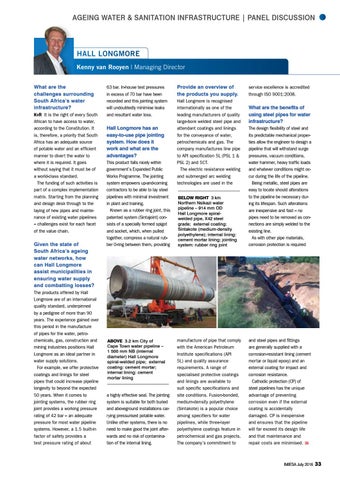
ABOVE 3.2 km City of Cape Town water pipeline – 1 500 mm NB (internal diameter) Hall Longmore spiral-welded pipe; external coating: cement mortar; internal lining: cement mortar lining
a highly effective seal. The jointing system is suitable for both buried and aboveground installations carrying pressurised potable water. Unlike other systems, there is no need to make good the joint afterwards and no risk of contamination of the internal lining.
Provide an overview of the products you supply. Hall Longmore is recognised internationally as one of the leading manufacturers of quality large-bore welded steel pipe and attendant coatings and linings for the conveyance of water, petrochemicals and gas. The company manufactures line pipe to API specification 5L (PSL 1 & PSL 2) and 5CT. The electric resistance welding and submerged arc welding technologies are used in the
service excellence is accredited through ISO 9001:2008.
What are the benefits of using steel pipes for water infrastructure?
BELOW RIGHT 3 km Northern Nsikazi water pipeline – 914 mm OD Hall Longmore spiralwelded pipe, X42 steel grade; external coating: Sintakote (medium-density polyethylene); internal lining: cement mortar lining; jointing system: rubber ring joint
The design flexibility of steel and its predictable mechanical properties allow the engineer to design a pipeline that will withstand surge pressures, vacuum conditions, water hammer, heavy traffic loads and whatever conditions might occur during the life of the pipeline. Being metallic, steel pipes are easy to locate should alterations to the pipeline be necessary during its lifespan. Such alterations are inexpensive and fast – no pipes need to be removed as connections are simply welded to the existing line. As with other pipe materials, corrosion protection is required
manufacture of pipe that comply with the American Petroleum Institute specifications (API 5L) and quality assurance requirements. A range of specialised protective coatings and linings are available to suit specific specifications and site conditions. Fusion-bonded, medium-density polyethylene (Sintakote) is a popular choice among specifiers for water pipelines, while three-layer polyethylene coatings feature in petrochemical and gas projects. The company’s commitment to
and steel pipes and fittings are generally supplied with a corrosion-resistant lining (cement mortar or liquid epoxy) and an external coating for impact and corrosion resistance. Cathodic protection (CP) of steel pipelines has the unique advantage of preventing corrosion even if the external coating is accidentally damaged. CP is inexpensive and ensures that the pipeline will far exceed its design life and that maintenance and repair costs are minimised.
IMIESA July 2016
33