www.infrastructurene.ws
IMESA The official magazine of the Institute of Municipal Engineering of Southern Africa
INFRASTRUCTURE DEVELOPMENT • MAINTENANCE • SERVICE DELIVERY
SICELO XULU Leading City Power
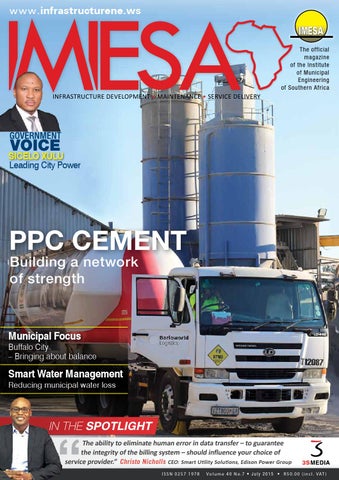
PPC CEMENT Building a network of strength
Municipal Focus
Buffalo City – Bringing about balance
Smart Water Management Reducing municipal water loss
IN THE SPOTLIGHT The ability to eliminate human error in data transfer – to guarantee the integrity of the billing system – should influence your choice of service provider.” Christo Nicholls CEO: Smart Utility Solutions, Edison Power Group ISSN 0257 1978
V o l u m e 4 0 N o . 7 • J u l y 2 0 1 5 • R 5 0 . 0 0 ( i n c l . VAT )
We are there when you study
Working on your assignment? The wealth of information freely available from our Information Centre will help you. Discover concrete with us.
www.theconcreteinstitute.org.za +27 11 315 0300
CONTENTS www.infrastruc
turene.ws
VOLUME 40 NO. 7 JULY 2015
20
IMESA The officia l magaz ine of the Institu te of Munici pal Engine ering of Southe rn Africa
INFRASTRUCTURE
MAIN DEVELOPMENT •
TENANCE • SERVI
UTILITIES MANAGEMENT Creating tanks of the first water
CE DELIVERY
SICELO XULU r Leading City Powe
ENT PPC aCneEtwM ork Building of strength
10
Municipal Focus
Buffalo City ce – Bringing about balan
agement Smart Water Manwate r loss
MUNICIPAL FEATURE Buffalo City Municipality
Reducing municipal
IN THE SPOTLIGH
Regulars
T
ntee data transfer – to guara ate human error in of The ability to elimin d influence your choice billing system – shoul Edison Power Group the integrity of the Utility Solutions, Smart CEO: ) lls 5 0 . 0 0 ( i n c l . VAT Christo Nicho July 2015 • R service provider.” me 40 No.7 • 8 ISSN 0257 197
Vo l u
Pretoria Portland Cement is the corporate embodiment of its product. Through its extensive service offering, it ensures sustainability and skills transfer – literally, and figuratively, holding the built environment together. P6
3 5 8 76
Editor’s comment President’s comment Africa round-up Index to advertisers
Municipal Feature
Infrastructure Finance 10
Buffalo City Municipality
Government Voice 14
Sicelo Xulu leads City Power
15
Utilities Management
31
Creating tanks of the first water Power conference for African utilities Construction industry to solve infrastructure problems The quest for smart cities
20 22 23 24
Procurement compliance: Private and public sector projects
47 50
53
Cement & Concrete Sarma Conference 2015 Precast concrete is the answer Civilworks Time-saving concrete Mixing it up Providing concrete solutions Taking centre stage Smart turnkey solutions secure major projects
55 57 58 61 63 65 67 69
SHEQ
Fulton Awards 31 39
The 2015 Fulton Awards Sanral bags top awards
Building houses, mending fences
45
Rights and responsibilities of the Occupational Health and Safety Act 71
Construction Vehicles & Plant Equipment
Infrastructure Development Partnerships
THE 2015 FULTON AWARDS for excellence in concrete
42 45
Road Building & Maintenance
PPC: Building a network of strength 6
Edison Power Group: What’s so smart about smart meters?
Christo Nicholls, CEO: Smart Utility Solutions for Edison Power Group unpacks the methodology behind smart meter roll-out to unlock the technology’s true potential. P15
An age-old problem Reducing municipal water losses
Ammann SA makes the grade Wired for road safety
Cover Story
In the Spotlight
IN THE SPOTLIGHT
Water & Wastewater
40
Top 10 vehicles and equipment
72
WATER & WASTEWATER Reducing municipal water loss
IMIESA July 2015
1
HEAD OFFICE - BARTLETT Tel +27 (0)11 230 7300 Fax +27 (0)11 397 2686 enquiries@babcock.co.za BRANCHES: BLOEMFONTEIN +27 (0)51 432 1226 CAPE TOWN +27 (0)21 380 4700 DURBAN +27 (0)31 700 6009 EAST LONDON +27 (0)43 703 0400
Tzaneen
GEORGE +27 (0)44 878 1035
Lichtenburg
KIMBERLEY +27 (0)53 832 3443
Matola
Middelburg
KURUMAN +27 (0)53 712 0472 LICHTENBURG +27 (0)18 633 6232
Kuruman
MIDDELBURG +27 (0)13 246 2870 MOCAMBIQUE +258 84 265 2397 NELSPRUIT +27 (0)13 758 1864 PORT ELIZABETH +27 (0)41 407 5900 RICHARDS BAY +27 (0)35 751 1180 RUSTENBURG +27 (0)14 592 6150 STEELPOORT +27 (0)13 230 9054
George
WOLMARANSSTAD +27 (0)18 596 1514 WINDHOEK +264 61 305 5560/3 ZAMBIA Kitwe +260 212 216 200 Lusaka +260 211 127 2926/28 INDEPENDENT DEALERS: BOTSWANA Rola +27 (0)82 415 8758 POLOKWANE RGR Services +27 (0)15 297 6711 SWAZILAND Swazi Trac +268 251 84 555 TZANEEN Swaarvoertuie +27 (0)15 307 5000
TRUSTED TO DELIVER LEADING BRANDS IN AFRICA.
ZIMBABWE Conquip +263 4 485 543
www.babcock.co.za
Babcock is the Southern Africa dealer for: Volvo Construction Equipment, Tadano Mobile Cranes, SDLG Construction Machinery and Winget Concrete Equipment. Our reputation and good name are our greatest assets. We take great pride in the considerable depth and breadth of the products we sell and our people's expertise. Our market-leading reputation is based on one key fact: Babcock is a partner who can be trusted to deliver.
TADANO
EDITOR’S COMMENT
PUBLISHER Elizabeth Shorten EDITOR & ASSOCIATE PUBLISHER Nicholas McDiarmid JOURNALISTS Beatrix Knopjes, Frances Ringwood, Liesl Frankson HEAD OF DESIGN Beren Bauermeister DESIGNER Ramon Chinian CHIEF SUB-EDITOR Tristan Snijders SUB-EDITOR Morgan Carter CONTRIBUTORS R Sha, H Sonn, T Mokotedi, R Evans CLIENT SERVICES & PRODUCTION MANAGER Antois-Leigh Botma PRODUCTION COORDINATOR Jacqueline Modise FINANCIAL MANAGER Andrew Lobban MARKETING & DIGITAL MANAGER Esther Le Roux MARKETING SPECIALIST Philip Rosenberg ADMINISTRATION Tonya Hebenton DISTRIBUTION MANAGER Nomsa Masina DISTRIBUTION COORDINATOR Asha Pursotham SUBSCRIPTIONS subs@3smedia.co.za PRINTERS United Litho Johannesburg +27 (0)11 402 0571 ___________________________________________________
Challenging the
future
W
E NEED HOPE; there is no doubt about it. South Africans from all walks of life have been so continuously subjected to news of problems, seemingly irreconcilable differences, and disruptive politics that it is easy to forget about the quite remarkable progress that is being achieved. In this edition, we look at projects that are making a real difference, and that relate to solutions to current challenges that don’t seem to make the headlines. From City Power rolling out a smart metering project that is already minimising loadshedding occurrences to its clients and removing demand from the grid in an intelligent way, to the innovative approaches from various public sector segments of the infrastructure sector that are making a real difference in the lives South Africans, from a deliver y and empowerment point of view. I had the privilege of spending time with the chairman of Inyatsi Construction recently. The company is based in Swaziland, and has a distinctly different take on how the public and private sector can work together. Frans Pienaar is engagingly optimistic and pragmatic, and one thing he said will always stay with me: “No one gets out of the bed in the morning planning to fail. Whether I am working with a private sector client facing funding challenges, or a public
ADVERTISING SALES Jenny Miller Tel: +27 (0)11 467 6223 ___________________________________________________
PUBLISHER: MEDIA No. 9, 3rd Avenue, Rivonia 2056 PO Box 92026, Norwood 2117 Tel: +27 (0)11 233 2600 Fax: +27 (0)11 234 7274/5 E-mail: nicholas@3smedia.co.za www.3smedia.co.za ANNUAL SUBSCRIPTION: R550.00 (INCL VAT) ISSN 0257 1978 IMIESA, Inst.MUNIC. ENG. S. AFR. © Copyright 2015. All rights reserved. ___________________________________________________ IMESA CONTACTS IMESA Administration Officer: Narisha Sogan P O Box 2190, Westville, 3630 Tel: +27 (0)31 266 3263 Fax: +27 (0)31 266 5094 Email: admin@imesa.org.za Website: www.imesa.org.za BORDER BRANCH Secretary: Melanie Matroos Tel: +27 (0)43 705 2401 Fax: +27 (0)43 743 5266 E-mail: melaniem@buffalocity.gov.za EAST CAPE BRANCH Clarine Coltman Tel: +27 (0)41 505 8019 Fax: +27 (0)41 585 3437 E-mail: clarinec@africoast.com KWAZULU-NATAL BRANCH Secretary: Rita Matthews Tel: +27 (0)31 311 6382 Fax: +27 (0)31 701 2935 NORTHERN PROVINCE BRANCH Secretary: Rona Fourie Tel: +27 (0)82 742 6364 Fax: +27 (0)86 634 5644 E-mail: imesanorth@vodamail.co.za SOUTHERN CAPE KAROO BRANCH Secretary: Henrietta Oliver Tel: +27 (0)79 390 7536 Fax: +27 (0)86 536 3725 E-mail: imesa.southcape@gmail.com WESTERN CAPE BRANCH Secretary: Erica van Jaarsveld Tel: +27 (0)21 938 8455 Fax: +27 (0)21 938 8457 E-mail: erica.van_jaarsveld@capetown.gov.za FREE STATE AND NORTHERN CAPE BRANCH Secretary: Wilma Van Der Walt Tel: +27(0)83 457 4362 Fax: +27 (0)86 628 0468 E-mail: imesa.fsnc@gmail.com All material herein IMIESA is copyright protected and may not be reproduced either in whole or in part without the prior written permission of the publisher. The views of contributors do not necessarily reflect those of the Institute of Municipal Engineering of Southern Africa or the publishers.
sector official struggling to specify a project, I always tr y to work towards to a positive end goal.” He explained that this does require a long-term approach, and it means ensuring that agreements are sustainable and fair for all parties involved; most importantly, however, it means taking the focus away from litigious outcomes and negative consequences. This approach has allowed the company to develop dramatically within a space in which challenges are often viewed as limitations. There will be more on this in later editions but, for now, it certainly led me to challenge my own view on how I deal with challenges, and how I could improve my own approach to sustainable outcomes. I invite you to enjoy the celebration of excellence to be found in our coverage of the Fulton Awards, and read about the projects making a difference in the concrete industr y. PPC is this year’s sponsor of the Sarma Conference, which takes place next month, and our cover stor y also notes how assisting an industr y is good for ever yone. We also look at how the mining industr y is contributing to public infrastructure, and how the utility sector in South Africa continues to grow. So, I invite you to let this edition of IMIESA cast a positive light on this world to which we all hope to contribute and sustain.
Nicholas McDiarmid To our avid readers, check out what we are talking about on our website, Facebook page or follow us on Twitter and have your say.
@infrastructure4
www.infrastructurene.ws
www.in
frastruc
turene.w
INFRASTRUC
IMESA
s
OPMENT TURE DEVEL
• MAINT
ENANCE
S M CIVIL the Creating pid urg Ra Rustenb system ort Transp
• SERVIC
E DELIVE
RY
The official magazine of the Institute of Municipal Engineering of Southern Africa
INFRASTRUCTURE DEVELOPMENT • MAINTENANCE • SERVICE DELIVERY
SICELO XULU Leading City Power
PPC CEMENT Building a network of strength
sport rated Public ofTran the integ The rise network transport
Municipal Focus
l Focus Municipa Local
Buffalo City – Bringing about balance
Overstrand Municipality than more – Much ing
Infrastructure News
IMESA
The official magaz ine e of the Institut pal of Munici Engine ering rn Africa of Southe
Cover opportunity In each issue, IMIESA offers advertisers the opportunity to get to the front of the line by placing a company, product or service on the front cover of the journal. Buying this position will afford the advertiser the cover story and maximum exposure. For more information on cover bookings contact Jenny Miller on tel: +27 (0)11 467 6223.
Smart Water Management Reducing municipal water loss
whale watch
s Smart Citie ng our future Safeguardi
IN THE SPOTLIGHT
r, we and morta er The ability to eliminate human error in data transfer – to guarantee T from brick be made Mi Panels are strong the integrity of the billing system – should influence your choice of of g that can a buildin properties ) MIBT Christo Nicholls CEO: Smart Utility Solutions, Edison Power Group service provider.” imagine ( i n c l VAT structural managing director, 50.00 If you can 5 • R physical ne 201 ISSN 0257 1978 V o l u m e 4 0 N o . 7 • J u l y 2 0 1 5 • R 5 0 . 0 0 ( i n c l . VAT ) an Chetty, too. The 6 • Ju 40 No. r.” Pragas can do it olume 78 V and morta 257 19 ISSN 0 than brick
IN THE
HOT SEA
IMIESA July 2015
3
1
PVC GUMBOOT • Available in black standard colours
R
• Sizes 5- 12 (407155)
WHITE R130
1
• Exclusive • Comes in assorted colours
2
R20 (123195) J54 REFLECTIVE CONTI SUIT • Sizes 34 to 48 • 100% cotton, for use in welding • Reflective tape
• PVC Boot • Size 6-11
SABRE SHOE BLACK
(553558)
HIKER SAFETY BOOT
• Steel toecap • Oil & solvent resistant
• Sizes 6 - 11
• Sizes 5- 12 R220(527142)
R
180ea
R
R
R450/pair (553568)
180
/pair
195
/pair
2000W 230MM ANGLE GRINDER
R
1497
• GA9050 • 6600 rpm • Extra slim design with “deadmans” switch • Excludes disc • 12 month warranty (473186)
*
Stand a chance to
/pair
WIN
R10 000!
*SEE COMPITITION DETAILS IN-STORE OR WWW.BUILDERS.CO.ZA/COMPETITIONS
1700W BREAKER HAMMER • DH-45K • 1300 blows per min • 45 Joules impact force • 12-month guarantee (412392)
R
5997
WATCH MANCAVE ON SABC3 EVERY THURSDAY FROM 18 JUNE 2015 AT 20:30 FOR 26 WEEKS TO SEE HOW JANEZ & LUNGA GET THINGS DONE!
For your nearest store call our Builders Contact Centre on 0860 284 533 or visit us at www.builders.co.za
220
1 of 3 power and hand tool hampers to the value of
Prices valid from 15 June to 10 August 2015. See our online digital magazine for more tool inspiration. Visit us at www.builders.co.za. Products available at Builders Warehouse and selected Builders Express, Trade Depot and Superstore Stores
Get to Builders. Get it done!
R
• Sizes 5- 12 • Steel toecap • Oil & solvent resistant (527151)
get it done! Excludes accessories used for display
/pair
(538211)
SABRE BOOT
We have all the tools you need to
3
75
ROCKSTAR BOOT LACE UP
R298 (537799)
3
• Steel toecap • Sizes 5- 12
• Available in assorted colours & sizes • Polyester cotton blend fabric • General usage • Hard wearing, practical workwear (537817, 537892)
2
(538253)
GUMBOOT SABS
65/35 REFLECTIVE CONTI SUIT
GENERAL PURPOSE HARD HAT
GUMBOOT
PRESIDENT’S COMMENT
IMESA
Engineering in the global village Duncan Daries, IMESA president
The first six months of my presidential term have flown by. One of my duties is representing IMESA on the board of the International Federation of Municipal Engineers (IFME), which meets biannually – every sixth meeting coincides with the annual congress of a member institute, resulting in the IFME World Congress.
T
HIS YEAR THE IFME honour is bestowed on the Institute of Public Works Engineering Australasia (IPWEA), whose conference was held in Rotorua, New Zealand, from 7 to 11 June 2015. This international federation has been in existence for a while and currently consists of 16 national members and two obser ver members. Based in the Netherlands, it has a strong base in English-speaking countries but also well-represented are the Scandinavian countries. The outgoing president of IFME is Ross Vincent, of New Zealand, who will be succeeded by Doug Drever, of Canada, as from the end of the current world congress. Doug's term of office is 2015 to 2018, after which he will be handing over to John Thomson, of Scotland. There is no longer a need to justify the benefits of belonging to an international body representing engineers active in the
municipal environment. Simply put, the world has changed within the consulting engineers’ community. I.e. The globalisation of major consulting companies such as Aurecon, Aecom, and SMEC, to name a few, is a reflection that IFME was ahead of its time. Engineering skills are in short supply globally and it is, therefore, important that we do not reinvent the wheel, but rather learn from each other. This relates not only to the smaller developing nations, but also the more established countries. Networking is an important aspect thereof, and innovation sometimes driven, from a resource constraint, happens all over. Engineering decisions are enhanced through experience. This experience is not only from oneself, but also from fellow colleagues. Therefore, conferences and seminars, where experiences are presented and shared, are a big part of
forming the necessar y engineering part of management skills required for day-to-day decision-making in municipal engineering environments. IFME has, therefore, re-examined the way it operates to ensure more value add to its membership. Board meetings, arranged in conjunction with either technical tours or conferences, have been a largely successful format for the participants. Meetings are, as a result, ver y well attended, with delegates remaining enthusiastic and eagerly awaiting the following event. It now needs to ensure that the best practices identified during these tours are properly documented and disseminated for the benefit of its wider membership. It is precisely these interactions, at international level, that have exposed the previous leadership of IMESA to the asset management best practices of the Australian and New Zealand models. From this
contact, IMESA, in conjunction with these international partners, developed the IIAMSA (International Infrastructure Asset Manual for South Africa). This has formed the basis to influence national government departments to buy into the concept of an asset management approach, to ensure appropriate budgeting for the prioritised infrastructure needs of municipalities. To this extent, MISA (Municipal Infrastructure Ser vices Agency) has contracted IMESA to roll out the asset management training courses on its behalf, countr y wide. One of the main takeaways from my interaction with IPWEA during the congress is its approach to engaging with its young engineering practitioners. It seems as if they have embraced the use of social media to keep this vital community engaged and, in so doing, have increased their membership levels significantly.
IMIESA July 2015
5
COVER STORY
Building a network of strength Pretoria Portland Cement is the corporate embodiment of its product. Through its extensive service offering, it ensures sustainability and skills transfer – literally, and figuratively, holding the built environment together.
C
EMENT AND CONCRETE are sustainable construction materials that support urbanisation. Both are versatile materials used in construction and contribute towards alleviating the numerous threats to sustainable development. The most pertinent of these threats include: • population growth • urbanisation • global warming • energy use • excessive waste generation • limited supply of natural resources • pollution of air, water, and soil. Concrete is the second most widely used material in the built environment, after water, and its use is expected to double in the next few years. It is an inherent component of our environment, used in the construction of schools, dams, bridges, airports, and commercial, industrial, and residential buildings.
Cementing its place Cement, constituting approximately 11% of concrete, is a vital construction material and strategic commodity. Cement is the key component in a concrete mix, and is responsible for strength development once activated by water during the hydration process. The manufacture of cement is identified as one of the major contributors to CO2 emissions and global
6
IMIESA July 2015
warming, primarily due to the volume of cement used globally. In response, the cement industry has taken conscientious steps to reduce this impact by manufacturing extended cement products and pursuing the active use of alternative energy sources. The built environment has a huge, but largely untapped, potential for emission reductions at the least cost. Concrete, for example, has excellent thermal mass. Concrete walls and floors slow the passage of heat moving through, reducing temperature swings. It reduces energy needs for heating or air conditioning, which is estimated at ~17%. Cement – when combined with other materials, such as cement kiln dust, lime, limestone, or lime kiln dust, and mixed with soil – can act as a binding agent that changes the chemical (stabilisation) and physical (solidification) properties of various contaminants. Cement-stabilised material is regularly used to reduce the plasticity index of soils, enhancing its structural properties for redevelopment. Sureroad has been specially developed by PPC for this application.
Building green PPC is a proud member of the Green Building Council of South Africa – the official certification body of green buildings. As a responsible, leading African cement producer, PPC
COVER STORY
understands that maintaining a sustainable business requires the balanced integration of performance, corporate governance and social, economic, and environmental factors into the strategy and operation of the business. Competent and experienced teams at PPC implement these strategies and make achievable the objectives outlined for sustainable development. “When it comes to designing green buildings, concrete is ideal, as it can be designed to incorporate supplementary cement materials (SCMs), such as fly ash or slag, resulting in a reduction of the carbon footprint. PPC is also incorporating these SCMs in the production of cement, making extended Portland cements with slag, fly ash, and/or limestone – such as Surebuild. Surebuild is a premium, generalpurpose cement, It is ideal for general building operations, structural concrete, and the manufacture of cement-based products. PPC also manufactures a Portland cement (which some may say adds to the carbon footprint); however, this CEM I 52,5N allows it to be blended with locally available SCMs or by-products that would otherwise end up in landfills. Concrete structures are durable – they do not rust, rot, or burn – and require minimal maintenance, if designed taking a holistic life-cycle approach at the onset. Concrete can be designed in conjunction with other materials like steel, timber, fibres, or glass. Concrete can be designed using a prescriptive or performance approach. Designing concrete according to performance criteria facilitates the incorporation of industrial by-products. The by-products have added benefits in that they improve durability, reduce the amount of cement required, improve fresh and hardened properties, and lower the heat of hydration. The beauty of concrete is that it can be manufactured in any shape or colour, and in a range of textures. Formwork can provide texture for readymix concrete and the production of concrete is resource-efficient. Most primary raw materials used in concrete are sourced and manufactured locally, which minimises transportation costs and supports regional economies.
Resource efficiency and sustainability PPC has responded to the threat of global climate change by reducing the effective footprint of cement manufacturing. Significant progress has been made through various initiatives. One of the main focal areas to improve the eco-impact of cement production is the
reduction of resource and energy requirements for the production of Portland cement. Energy accounts for a high proportion of production costs. To improve fuel and electrical energy efficiency, various process engineering solutions were implemented through technology upgrades and modifications. PPC has recently upgraded the kiln line at Dwaalboom (Limpopo) with an energy efficient cooler. Modifications to an existing line and installation of a new energy efficient line at Slurry Plant (North West), including key infrastructure upgrades, will commence shortly. To minimise emissions, various upgrade projects were undertaken – including the replacement of electrostatic precipitators with bag house filters at De Hoek (Western Cape) and Lime Acres (Northern Cape). There are various quality, process, and environmental benefits from co-processing secondary materials during the clinker manufacturing process. Environmental benefits include the reduction of landfill waste and the reduction of greenhouse gas emissions, mainly due to decreasing the use of coal. PPC has successfully implemented alternative fuels projects, like the use of waste tyres and carbonaceous spent pot liners in place of coal. Conserving water resources, by incorporating admixtures and/or using recycled water in concrete mixes, reduces the freshwater requirement. Certain admixtures reduce the amount of cement required, which, in turn, reduces the carbon footprint. The use of pervious concrete, which is a special type of structural concrete – consisting of a sponge-like network of voids – readily allows water to percolate into the ground. Used for parking lots, sidewalks, and other pavements, pervious concrete can help to retain stormwater run-off and replenish local water supplies. Concrete cisterns capture rainwater and store it for non-potable uses such as flushing and irrigation, or – after suitable treatment – bathing and drinking. Concrete is recyclable. It can be crushed and the aggregates reused in new concrete, in road bases, or as fill material, thus extending the life of the concrete and reducing the environmental impacts of extracting and processing aggregates from natural sources. Cements, with inclusions of up to 30% recycled coarse aggregate, having strengths of up to 30 MPa – without any modification to the mix design – have been reported. The use of manufactured sand is also an environmentally sustainable alternative to the use of river sand.
Sheena Murugan, technical analyst at PPC
A large portion of PPC’s sustainability lies in the technical support it offers customers. Sheena Murugan, technical specialist, says, “PPC’s contribution to sustainability – apart from using alternate fossil fuels, alternate raw materials, and modifications to and the installation of new plant – extends to skills transfer in the industry.” Skills transfer takes place through creating awareness and working with customers to implement sustainable solutions and produce sustainable products. PPC provides learning opportunities and assistance to students, contractors, customers, and SMEs. In doing this, the gap in skills shortages in the construction industry is narrowed, creating a more sustainable workforce. “For example, a civil engineering student who needs a greater understanding of cement and cement production is invited for a half-day seminar, which includes the technical theory behind cement production, followed by a tour of the cement manufacturing plant. The relationship created during the process of skills development and skills transfer is an ongoing, sustainable one, as the individuals become part of a network of professionals. These initiatives support PPC’s ‘Strength beyond the bag’ philosophy,” explains Murugan. “PPC’s mobile app and the Cement and Concrete Cube (C3), an online information portal, facilitate the skills transfer process through knowledge and information sharing. The provision of these services ensures that the development of the local industry keeps up with latest global trends and standards. Supporting and uplifting communities takes us a few steps closer to sustainability,” Murugan concludes.
IMIESA offers advertisers an ideal platform to ensure maximum exposure of their brand. Companies are afforded the opportunity of publishing a two-page cover story and a cover picture to promote their products to an appropriate audience. Please call Jenny Miller on +27 (0)11 467 6223 to secure your booking.
www.ppc.co.za
IMIESA July 2015
7
AFRICA ROUND-UP
INFRASTRUCTURE NEWS FROM AROUND THE CONTINENT AFRICA World Bank and
KENYA Major grant signed for Mombasa port modernisation
Chinese firm partner to develop low-cost African houses The World Bank's private sector arm, the International Finance Corporation (IFC), recently inked a new partnership with a Chinese construction and engineering company to develop low-cost houses in three African countries. IFC and Citic Construction Co. will set up a joint venture and inject $300 million to develop 30 000 homes in Kenya, Rwanda, and Nigeria in the next five years. Construction chairperson Hong Bo says her company has a proven track record in the implementation of large-scale housing schemes in Africa. "Citic will take advantage of its engineering experience and delivery capability to develop more affordable houses for Africa through the platform with IFC," she explains, adding that new housing units will be built in accordance with IFC's green building standards.
ETHIOPIA ERA receives $370 million loan from World Bank The Ethiopian Roads Authority (ERA) received credit approval from the World Bank Group for $370 million, for the construction of a section of the ModjoHawassa expressway, in the next fiscal year. The highly concessional agreement, with a maturity date of 38 years and a grace period of six years, will finance the 57 km Batu Ziway-Arsi Negele section of the expressway. The Modjo-Hawassa expressway is 203 km long and is divided into four sections. The
8
IMIESA July 2015
The redevelopment of the Ghana Kumasi Central Market is ready for take-off
Mojo-Meki and Meki-Ziway sections are in the process of auction for construction. The 57 km Mojo-Meki section was financed by a loan from the African Development Bank, the 37 km Meki-Ziway section by Korea EXIM Bank, and the 52 km Arsi Negele-Hawassa section will be financed by China EXIM Bank. The upgrade to the road comes as a result of the increasing traffic flow on the route, which currently stands at 3 000 trucks a day, and is projected to reach 10 000 trucks, says Samson Wondemu, communication director at the ERA.
GHANA $298 million Kumasi Central Market, Kejetia Project ready for take-off All is set for the commencement of the $298 million redevelopment of the Central Market and Kejetia lorry terminal project in Kumasi, as plans to relocate transporters are finalised. The Brazilian construction firm Contracta Engenharia Limited, which is to execute the threephase project, recently handed
over 40 000 km2 of land to the Kumasi Metropolitan Assembly (KMA) for the relocation of all transport unions. The relocation of the transporters would enable the contractors to undertake a geographical mapping of the area, with the Ghana Water Company and Electricity Company of Ghana to prepare the place for construction works to begin. The first phase of the project comprises construction work at the Kejetia terminal, over a period of 24 months at the cost of $198 million, while the remaining $100 million will be expended on the second and third phases, which will focus on the redevelopment of the Central Market in Kumasi.
The United Kingdom’s Department for International Development (DFID) and TradeMark East Africa have signed a £23 million grant agreement towards the modernisation work at the Port of Mombasa. This includes infrastructure investments aimed at addressing energy efficiency, speeding up import and export trade handling, and minimising environmental impacts at the Port of Mombasa. Deputy head of DFID Tony Gardner says the modernisation work at the Port of Mombasa would take into account environmental and social aspects, and this will go a long way in complementing existing projects and in expanding the flow of benefits to stakeholders, including the population of Mombasa and East African Community residents.
NIGERIA $2 trillion infrastructure plan awaits Buhari As Nigeria transitions to a new government, a major concern for the country is the fate of the National Integrated Infrastructure Master Plan
Muhammadu Buhari, Nigerian president
AFRICA ROUND-UP
(NIIMP), a document that has projected $2 trillion for infrastructure development over 30 years. The National Planning Commission, in 2012, initiated the idea of drawing up a long-term infrastructure development plan for the nation's sustainable economic growth and development. The growth path had expected Nigeria to raise its investments in infrastructure to $51.1 billion, annually, as from 2014. The presidential launch, which is a cardinal requirement for the star t of the plan, initially slated for December last year and later postponed to Januar y this year, seems to have been abandoned for no disclosed reason. There are concerns that the NIIMP may go down the drain just like other previous national plans in Nigeria’s histor y. Over the years, since having gained independence, several Nigerian economic plans have been drafted by previous administrations to tackle the nation's infrastructure deficit.
TANZANIA Feasibility for Dar es Salaam flyovers underway The government has promised that Dar es Salaam will have flyovers and interchange roads to decongest the city from the daily traffic. The Minister of Works, Dr John Magufuli, stated that other flyovers would be constructed along the Dar es Salaam-Chalinze expressway, which is intended to have around five flyovers. The contract, wor th $7.72 billion, has already been signed for feasibility and detailed design. Magufuli adds that tendering for the construction of the Ubungo interchange is already in process, stressing that what he has said was not a
A cement factory in Dangote, Zambia
series of empty promises from the government, but would be a future reality for the countr y.
ZAMBIA Dangote roars to life The $400 million Dangote cement factor y in Masaiti has commenced operations, following the completion of construction early this year. Dangote Cement operations director Anand Kameshwar said, in a recent inter view, that work on the plant had been completed and it was already working ahead of commissioning, which will be done soon. The cement plant, which has an installed capacity to produce 1.5 million tonnes of cement per annum, has been equipped with a 30 MW power plant.
The power plant was put up at a cost of $50 million, to ensure uninterrupted supply and relieve pressure on Zesco. The opening of Dangote brings the total number of cement factories in the area to three, following the current operations of Zambezi Por tland and Lafarge Cement. Dangote, which is investing another $400 million in a similar plant in Lusaka, has operations in several countries in Southern Africa, including Tanzania and South Africa.
ZIMBABWE Green light for Mutirikwi mini-hydropower plant Work on a $13.5 million minihydropower plant on Lake Mutirikwi Dam is set to begin soon, now that the Masvingo
Rural District Council (RDC) has given the project the green light. Great Zimbabwe Hydro Power Company – a joint venture between Zimbabwean firm ZOL and New Planet of South Africa – recently got permission from the Masvingo RDC to go ahead with the project that will generate 5 MW of power upon completion. Masvingo RDC acting chief executive Mar tin Mubviro said, in late May, that the JV was jointly managing the power generation project with the Zimbabwe National Water Authority. Power produced at the plant will be fed into the national grid and is expected to ease electricity shor tages in Masvingo. The project will be broken down into several phases and will take up to two years to complete. This will be the second plant in Masvingo, with a similar project being planned at Tokwe-Mukosi Dam in Chivi south to generate about 15 MW.
Flyovers and interchange roads will become a future reality for Dar es Salaam in Tanzania
IMIESA July 2015
9
MUNICIPAL FEATURE
Located in the Eastern Cape, Buffalo City Metropolitan Municipality (BCMM) is a hub of developmental activity. In this municipal feature, BEATRIX KNOPJES looks at key projects that will balance the East London Industrial Development Zone with a rural population in need of infrastructure.
Buffalo City
Bringing about balance
B
UFFALO CITY HAS framed its development strategy to be in line with the Integrated Development Plan. According to Nceba Ncunyana, an engineer for BCMM, this “accommodates growth in particular areas, with a specific focus on roads and water, as these are at the core of the IDP.” Engineers face a number of challenges when working in the region. Says Ncunyana, “The terrain consists of undulating hills and valleys and, when building roads in these areas, you have to be specifically aware of the catchment areas of rivers for drainage and the high altitudes. “There are many dirt roads and a large part of the area is rural, which makes accessibility challenging. East London is a bustling industrial zone that is integral to the prosperity of the region. There is a great deal of infrastructure that supports this industrial zone and it is inherent in our provision of bulk infrastructure supply.”
Second Creek housing development Second Creek is a housing development built on a reclaimed dump, where residents scavenged out a living and lived in informal settlements, as a result of rapid urbanisation. Says Ncunyana, “The projects in BCMM
10
IMIESA July 2015
are committed to providing an integrated approach to designing human settlements that provide water, sanitation, and roads, as these are the keys to a successful project.” The waste disposal site was cleared in 2009, in preparation for construction, which began in 2013. The development consists of low-cost housing, as well all service infrastructure including roads, water and sanitation, and electricity. Over 260 homes have been built thus far, consisting of two commodious bedrooms, an open-plan kitchen and lounge, and a bathroom. Bigen Africa received a Govan Mbeki Award for its successful work on this project.
Queen’s Park Zoo Substation The need for a major tertiary injection substation has become necessary, due to the extensive electrification of housing developments in order to meet government’s call for universal access to electricity. In meeting the programme, the houses have been added to the existing network with no upgrade or enhancement taking place. The housing department has plans to build an additional 10 000 RDP houses, which will further add to the load. In addition, commercial and industrial consumers are being added to the system, making the Queens Park Zoo Substation an
important project for the sustainability of the electrical service in the East London area of BCMM. The BCMM requested funding for the project from the Department of Energy (DoE). The DoE approved funding in 2007, and have provided funding for the duration of the project. The Queen’s Park Zoo Substation has been designed as an 80 MVA firm capacity substation. That is to say, initially, three 40 MVA 132/11 kV power transformers have been installed. If required, the design allows for the substation to be upgraded in the future with an additional 40 MVA power transformer, together with the associated switchgear and ancillary equipment. The substation is equipped with the following: • t ubular low-profile busbar configuration mounted upon busbar and equipment supports • three 40 MVA 132/11 kV on load tap change (oltc) power transformers • space requirements for future 40 MVA 132/11 kV OLTC power transformers, but equipped with transformer plinths • three power transformer feeders, comprising 132 kV circuit breakers, voltage transformers, current transformers, surge arrestors, and isolators • space requirements for future power
MUNICIPAL FEATURE
DESCRIPTION INEP electrification programme
FUNDING SOURCE DoE
transformer feeders, comprising 132 kV circuit breakesr, voltage transformers, current transformers, surge arrestors and isolators, but equipped with essential supports and foundations for future equipment • double busbar arrangement with circuit breaker, isolator, and required interlocking mechanisms • lightning protection • substation earthing • brick-built substation switch/control room, housing the 11 kV switchboards for the power distribution cabling or overhead line feeders, outdoor switchgear control panels, oltc control panels, and quality of supply panel.
PROJECT NAME Queen’s Park Zoo Substation
CONTRACT PRICE R115 443 000.00
EXPENDITURE R106 523 057.00
Queen’s Park 132 kV overhead line
R10 704 692.00
R8 572 857.00
The substation will be supplied off a 3.6 km, 132 kV overhead line. This overhead line is a double circuit supported by eight towers/ structures. The structures are of a steel lattice configuration. Chickadee electrical conductors are utilised for the line, which is 1.8 km long for the single circuit and 3.6 km for the double circuit. Steel-wired armoured OPGW cable, commonly referred to as fibre-optic cable, also forms part of the aerial installation. The OPGW cable ser ves a data cable between protection relays installed in the Queen’s Park Zoo, Woodbrook, and West Bank substations. Local labour was employed during the early part of the construction process
but was not utilised during the latter part of the project, due to the high level of skills required. Excavations and the foundation preparations for the towers began in March 2014, and were completed in early May 2014. The towers were partially built off-site and transported to site for erection and installation, this portion of the work ran concurrently with the ground preparation stage of the project. The erecting of the towers began in May 2014, and was completed in June 2014. The stringing of conductors was done in stages, as towers became available to hold the conductors. The 11 kV circuit breakers, switches, and panels at Queen’s Park Zoo Substation are IMIESA July 2015
Specialist Waste Management Consultants
JPCE
Tel: +27 21 982 6570
/
www.jpce.co.za
Jan Palm Consulting Engineers
11
MUNICIPAL FEATURE
undergoing final testing. The total estimated cost to complete this project, which is near completion, R136 million, and it is within the budget.
Reeston Wastewater Treatment Works BCMM is currently undertaking the construction of diverting the current sewer flow to Reeston Wastewater Treatment Works (WWTW), whose capacity BCMM intends to increase from 2.5 Mℓ/day to 10.5 Mℓ/day. BCMM also intends to appoint an experienced mechanical and electrical contractor for the execution of the design, installation, commissioning, and performance testing of mechanical, electrical, and instrumentation equipment for the new 48 Mℓ/day inlet works and a new 10 Mℓ/day activated sludge reactor, complete with clarifiers and chlorination plant. The scope of works for both aspects comprises the following: • bulk excavation and earthworks to form terraces • modification and decommissioning of existing 2.5 Mℓ/d inlet works • new diversion box to the existing 15.5 m clarifier • connection of existing 350 mm fibre cement (2.5 Mℓ/d) reactor outlet • n ew inlet works •1 0 Mℓ/d extended aeration reactor • r eturn activated sludge pumps • two 26 m clarifiers and one 15.5 m clarifier on existing works • a new return activated sludge
pump station • sludge lagoon pumps • equipment of a new chlorine building • upgrading of the MV reticulation and extension to the substations • alterations to the MCC building • supply, installation, programming, and setting up a Scada system for the Reeston WWTW. The site’s official handing over and commencement date was 20 May 2013. Due to community disruptions, the completion date has been extended to February 2016. The contract value is placed at R101 249 087.10, and the costs expended to date since commencement are R51 158 448.18. The use of local labour has been prioritised in the project, there are currently 53 people employed from the Reeston community and one local SMME. The local SMME is being used for the trenching and laying of the 110 mm water supply line to the treatment works. The local labour that has been employed on the project has also received training on: • hand and tool safety • site awareness • plant awareness. The project steering committee members have also received accredited training and certificates.
Mdantsane roads upgrade This project is implemented by BCMM’s Roads Division staff and BCMM’s PIU Unit. It
Cluster Cluster 1 Cluster 2 Cluster 3
12
IMIESA July 2015
involves upgrading the Mdantsane gravel road to surfaced standard. The scope of works for Phase 3 is divided into three clusters, each of which entails the upgrading of 10 km of road network. The work to be carried out in this project includes the following: • earthworks for streets in residential areas, including selected rock fill layers, selected sub-base and base layers with a 30 mm asphalt surface • k erbs, channels, and edge beams • s tormwater catch pits and pipework • sidewalks • alterations to existing sewerage, water, and other services where needed • cable ducts, telephone, and electrical, where needed • f inishing of the road reserves. The works to be carried out per cluster, by each contractor, comprise mainly of the following: • construction of approximately 10 km of road network per cluster, which equates to 30 km for the combined three clusters and scope of made up of streets with a width of 5.5 m • construction of a stormwater drainage system consisting of approximately 8 000 m of concrete pipes up to 750 mm diameter • construction of appurtenant works such as service ducts and kerbing • location and protection of existing services, and relocation where necessary; correction of defects in the works in
Contractor Mamlambo Construction Down Touch Investments SC Contractors
Consultant Engineering Advice & Services GIBB MBSA
MUNICIPAL FEATURE
accordance with the requirements specified in the contract documents. This description of the works is not necessarily complete and shall not limit the work to be carried out by the contractor under this contract.
Cluster Contractor Consultant Ward/unit Cluster 1 Mamlambo Construction EAS Ward 14 Ward 17 Cluster 2 Down Touch Investments GIBB Ward 11, 20, 30, 48 & 50 Cluster 3 SC Contractors MBSA Ward 21 & 22; 13, 14 & 15
Length 7.3 km 2.7 km 12.4 km 9.87 km
Cluster 1 The project was awarded at a cost of R68 953 687.47, in December 2013, and will be completed in October 2015. To date, the project expenditure is at R30 182 851.03 and the progress on-site is 62%.
Cluster 2 The project was awarded at a cost of R53 472 541.32, in December 2013, and will be completed in August 2015. To date, the project expenditure is at R47 893 903.86 and the progress on-site is 88%.
Cluster 3 The project was awarded at a cost R67 022 176.85, in December 2013, and be completed in August 2015. To date, the ject expenditure is at R51 297 850.26 and progress on-site is 76%. All three clusters are under construction.
of will prothe still IMIESA July 2015
13
YOUR CAT ® MACHINE KNOWS No matter how hard they try, competitors just can’t deliver genuine Cat quality. Make sure you’re using genuine Cat® parts - the only parts built specifically for your Cat machine. Call us on 010 040 3891 or visit http://bwe.mobi/catfilters to learn more about why genuine is important. Making sure you have easy access to genuine Cat parts - that’s the way we’re built.
FOR PEACE OF MIND FIT CAT® ORIGINAL FILTERS
• Cat Fuel Filters can increase injector life by 45% • Cat Extended Life Coolant reduces coolant and additive costs by 500% • Cat Oils can save as much as 15% in oil costs
© 2015 Caterpillar. All Rights Reserved. CAT, CATERPILLAR, BUILT FOR IT™, their respective logos, “Caterpillar Yellow,” the “Power Edge”trade dress as well as corporate and product identity used herein, are trademarks of Caterpillar and may not be used without permission.
GOVERNMENT VOICE
Sicelo Xulu
leads City Power
Managing director Sicelo Xulu has led City Power to a new level, with a 10% reduction in billing losses and achieving a 98% meter reading by 2015. BY NICHOLAS McDIARMID
X
ULU ALSO INTRODUCED demand-side management (DSM) initiatives, achieved an unqualified audit for City Power for the first time in four years, and oversaw the Solar Water Heater Programme – the largest solar geyser roll-out in South Africa and City Power's flagship programme. With loadshedding now a serious threat to commercial and domestic electricity consumers, the attention has mostly been on Eskom, and what it needs to do to solve the crisis. However, the utilities across the countr y also have a major role to play in mitigating the effects of inadequate generation supply. Innovations in DSM stand to play a major role in managing the national energy security, and the major metropoles have the potential to significantly reduce demand. One utility that has already made an impact on reducing demand is City Power, which has rolled out a smar t metering programme to over 10 000 of its customers. This investment has already reduced the amount of loadshedding its customers endure, by applying the load-limiting mechanism this investment facilitates. "Load limiting allows City Power to remotely monitor household energy usage and curb excessive consumption using smar t meters, while ripple control allows the utility to switch off energy-intensive geysers when the grid is under pressure," noted Xulu, who was named Top Utility Executive of the Year, at the annual African Utility Week Industr y Awards in Cape Town, in May this year. Under Xulu’s leadership,
14
IMIESA July 2015
Sicelo Xulu receiving the African Utility Executive of the Year award from Brett Grobbelaar, managing director: Resources, Accenture, South Africa. Edison Power provided the expertise behind one of the achievements resulting in this award
City Power has become the first utility in South Africa capable of mitigating the effects of loadshedding for its customers through intelligent systems capable of taking high-energy-use appliances, such as geysers and stoves, off the grid rather than entire neighbourhoods. Some of the utility’s inter ventions include the roll-out of smart meters and solar geysers across Johannesburg, and the introduction of smart technologies such as ripple control, load limiting, and time of use. With technical roll-out and implementation done by Edison Power Group, Xulu
chose a smart partner, led by the highly respected Vivian Reddy, whose pedigree as an electrical engineer is second to none, and whose commitment to social investment is profound. IMIESA inter views Edison Power Group’s Christo Nicholls in this issue, and explores the technology in more detail. Xulu was recently awarded his MPhil in Electrical and Electronic Engineering, with distinction, from the University of Johannesburg. His disser tation was titled ‘Modelling renewable sources for South Africa’.
IN THE SPOTLIGHT
What’s so smart about smart meters? Christo Nicholls, CEO: Smart Utility Solutions for Edison Power Group, unpacks the methodology behind smart meter roll-out to unlock the technology’s true potential.
T
HE ADVANTAGES OF SMART meters are threefold: they provide accurate billing, alarm detection, and smart loadshedding/-limiting. Implementing smart electricity meters en masse requires a specialised expertise that takes into consideration the vast potential of these meters. When you purchase a smart meter, you are purchasing a smart solution of technology plus benefits. Business processes, facilities, and training combine to make a smart metering solution. A supplier who is well versed in the intricacies of providing a smart metering solution is a necessity. Edison Power Group’s (EPG) smart meters fully comply with the guideline regulations of the IEC. Nicholls emphasises, “This guarantees the accuracy of the meters; accuracy is fundamental to any meter, and a crucial aspect of the technology.” Meters are classified according to their accuracy. There is a global standard, allowing various technologies to be brought to the table. Residential meters are Class 1, for example, which is the most accurate according to the global standard. These meters adhere to IEC accuracy guidelines for billing purposes. For prepaid smart meters, the Standard Transfer Specification (STS) has become recognised as the only globally accepted open standard for prepayment systems, ensuring inter-operability between system components from different manufacturers of prepayment systems. Nicholls explains, “This simply means that loading a R100 token will dispense R100 worth of electricity. The standard is fixed. The STS 2 is in its second revision, which will hopefully see the start of vending currency as opposed to kilowatts.” A smart meter is not just an accurate meter. There are different use cases for each stakeholder, according to Nicholls.
IMIESA July 2015
15
IN THE SPOTLIGHT
“The ability to eliminate human error in data transfer – to guarantee the integrity of the billing system – should influence your choice of service provider.” Christo Nicholls, CEO: Smart Utility Solutions, Edison Power Group
Smart billing data collection In the first case, a smart meter allows for smart billing data collection. Nicholls argues, “If you have non-smart meters installed for 100 000 customers, you will have to get meter readers to walk to 100 000 houses to manually check the meter reading in order to most accurately bill your customers.” This is time-consuming and has too much room for human error. By utilising smart meters, you eliminate contested bills.
Automated, integrated billing solutions Accurately measuring energy consumption allows you to generate autonomous bills. According to Nicholls, “This guarantees the integrity of the billing process and ensures timeous deliver y. You are also able to collect billing data.”
Tampering detection If the terminal cover of a smart meter is opened, an alarm is communicated to a centralised control centre. Says Nicholls, “This is a critical par t of the meter, which can provide the factual basis of complaints for legal
cases, if necessar y.” This has a great legal impact because the utility has its own system of gaining evidence. This has empowered the Johannesburg Metropolitan Police Department (JMPD), allowing a massive close-up of investigations. The JMPD is able to make arrests for meter tampering. This is governed by the by-laws of a particular utility and, for this reason, it needs to be written in.
Technological paradigm shift EPG has positioned itself to take on this technological paradigm shift. The company is able to assist utilities in the formulation of their policies and documents, as well as testing and development. EPG will provide an effective support element for the technology. Says Nicholls, “Proprietar y technology and communication protocols, as well as a lot of technological development, have gone into our meters. The meters are built to accommodate various forms of communication. They are ‘agnostic’, which allows the client to decide what they want, which we will fit in. We use the latest in power line communication (PLC), utilising Zigbee/ binar y-phase shift-keying PLC technology leading to the customer inter face.
Last gasp The meters also provide lost power detection. When the meter loses power, it sends a ‘last gasp’ signal that simply informs the communication centre that it has lost power. When power supply resumes, the meter will continue as normal. The meters are adaptable for future growth/change, ensuring that the technology will not become obsolete. Smar t meters require a device association list replete with GPS coordinates. An electrification audit needs to be conducted to determine which meters are linked to a specific transformer. Data needs to be collected in the field. Nicholls explains, “Do we know which houses are fed from which transformers? You can’t overload the data concentrator. Overloading a network will
16
IMIESA July 2015
IN THE SPOTLIGHT
result in the disruption of supply quality and communications.” If this data is not available, the roll-out may need to be postponed to do a data clean-up. These details are ultimately governed by a commercial contract. Mass roll-out excludes audits and validation; therefore, municipalities must be careful to manage what has been asked versus what is required. Says Nicholls, “Let us speak about what we know and allow us to speak to what you want. Once we do that, we will explain all the stuff you don’t know. Exceptions happen – there will be questions like, ‘By whom do customer calls need to be answered?’ The entire system needs to be integrated.”
Customer awareness Policies need to be carefully thought out to determine which customers get a smar t meter. Do they pay for the meter or not? Customer awareness is crucial to the success of smar t meter roll-out to avoid confusion and protestation. This process begins with policy awareness and audits, including pre-installation audits. Legal installers need to be sent to a point of interest, not an address, as addresses are not always reliable. The customers need to be informed of the installation process. “The installation of smar t meters requires up to three visitors to a customer’s home. The customer needs to be aware that visits may be conducted by three different people and needs to be available to give the installers access to the premises. This cannot be accomplished without making customers fully aware of the process.” The installer does not engage the customer. There must be predeployment, deployment, and post-deployment campaigns so that the customer is well informed. According to Nicholls, “At Edison, our Stabilisation Depar tment has two functions: to make sure that customers realise the benefits of smar t meters and to ensure the ser vice roll-out is stable.”
Communication The primar y purpose of the meter is accurate billing. In the case of prepaid meters, data from various vendors needs to be consolidated into one data management system – a translation inter face model. According to Nicholls, there are
many considerations to the translation inter face model. One way to communicate this volume of data is an integration bus, for which City Power won an international award from Microsoft for the software it has been using. This is world-class systems integration. Biztalk – the integration bus deployed by Edison – is a Microsoft project, utilised by the industr y. According to Nicholls, “We did it predominantly to introduce a paperless job card system. We need proof of replaced meters and this requires a job card. A paper trail allows human error to creep into data entering. “Our field deployment management system (FDMS) uses a handheld unit. There is a fixed workflow, which syncs to the FDMS. When a work order is closed, it is updated within three days, on an account level. This way, there is smooth integration from the old system to the new, from a customer-billing point of view.”
Smart architecture Collecting data autonomously for billing purposes requires smar t architecture. According to Nicholls, “The ability to eliminate human error in data transfer – to guarantee the integrity of the billing system – should influence your choice of service provider. The end-to-end value chain is actually working. Edison’s capacity is to provide smar t utilities solutions.” The applicable technology needs to be customised; there is no one-size-fits-all technology. Edison is well positioned to provide a comprehensive smar t metering solution through its ability to advise utilities on the best course of action and create smar t architecture.
Ghost vending Prepaid meters make use of an SGI code. Customers purchase tokens from approved outlets. Unfor tunately, there are criminal syndicates that exploit the systems. According to Nicholls, “This results in ‘ghost vending’ – where tokens are purchased but the money ends up in someone else’s pocket. Smar t meters are critical because they allow the utility to pinpoint where this is happening and take measures to prevent it.”
neighbourhoods off the grid to manage electricity demand, customers can be individually disconnected if they do not limit their electricity use. The customer’s limit is a matter of policy. If the limit is 10 A, for example, those using below 10 A will not be affected, whereas those exceeding this limit may be disconnected. Nicholls explains, “This is enough to run a fridge and lights, and perhaps a TV, but no stove or geyser. The smar t meter becomes the policeman. It will disconnect electricity for 30 seconds, giving the customer the oppor tunity to reduce usage to avoid being disconnected for the duration of the loadshedding period. Policy dictates the timelines.”
Edison currently has 80 000 meters in field, with a target of 120 000 by the end of July Load limiting is the lesser of two evils because, as Nicholls succinctly states, “Loadshedding does not benefit anyone.” Edison currently has 80 000 meters in field, with a target of 120 000 by the end of July. The roll-out of the meters is divided into categories. A usage profile of a street is created so that EPG is able to blanket an area and roll out meters accordingly. This can potentially have a great impact on a utility’s ability to limit electricity usage. However, Nicholls emphasises, “The success of load limiting is dependent on customer education. We need the details of the person living at the premises, who may not be the person who owns the proper ty. You risk a revolt if customers are not adequately informed. City Power has tasked Edison with bringing the full 120 000 on to load limiting by the end of July. City Power is the first utility to do so at scale.”
Load limiting Smar t meters bring a new dimension to load limiting. Instead of taking entire
Tel: +27 (0)11 032 3100 www.edisonpowergroup.co.za
IMIESA July 2015
17
UTILITIES MANAGEMENT
ABECO TANKS
20
CREATING TANKS OF THE FIRST WATER
22
A POWER CONFERENCE FOR AFRICAN UTILITIES
23
CONSTRUCTION INDUSTRY TO SOLVE INFRASTRUCTURE PROBLEMS
24
THE QUEST FOR SMART CITIES IMIESA July 2015
19
UTILITIES MANAGEMENT
Creating tanks of the
first water
Abeco Tanks designs, manufactures, and installs quality ground-level, elevated, customised, and circular bolted tanks. Abeco has moved beyond being a leader in water storage to include a wide range of product storage solutions. Tank Connection circular tanks, Midrand
W
ITH OVER 30 years’ experience, Abeco Tanks is able to offer outstanding expertise and technical knowledge to professionals in the water industry, and a unique perspective on potable water, wastewater, fire protection, and industrial liquid applications. Abeco has the exclusive right to represent Tank Connection in South Africa. According to Duane Ramos, technical director, the product includes RTP (rolled tapered panel) tanks. “Tank Connection is an industry leader of custom-designed, bulk-storage tanks and integrated storage systems. These tanks require no liner waterproofing; they use a paintless system that eliminates liner with a capacity of 30 million litres. They are not only suitable for water storage, but serve a broader requirement including dry-bulk, fracking, and wastewater treatment. This allows us to diversify away from purely water storage,” explains Ramos. The beauty of these modular tanks is that, because they can be transported and assembled on-site, there is no abnormal load and they are not restricted by space on-site, making them easier to move around. This means they are more easily transported to remote locations – precisely the kind of locations where these tanks are most needed. Ramos says, “The lead times for our
20
IMIESA July 2015
“Abeco Tanks are safe, durable, and hygienic because they are manufactured from scratch, with unique connections that are custom-made.” Duane Ramos, technical director, Abeco Tanks
rectangular tanks are between 4 to 6 weeks, elevated tanks take 8 to 10 weeks, and circular tanks around 5 to 7 weeks. This is because all of our steel is locally sourced. The added benefit of local suppliers is that we are better able to control and guarantee quality and ensure that our tanks strictly adhere to SANS standards.” Abeco Tanks are safe, durable, and hygienic because they are manufactured from scratch, with unique connections that are custommade. The tanks are manufactured from mild steel and galvanised for added protection against rust and corrosion, which ensures a durable tank with increased longevity of up to 20 to 30 years. According to Ramos, they do not develop algae, are safe, and easy to assemble. They have no height restrictions, are rugged, and long-lasting.
Investing in R&D In order to maintain market share, Abeco has invested more in research and development and adapted its product range to allow the company to make a considerable impact on
the wastewater, dry-bulk storage, and digester markets by adding the powder-coated Tank Connection circular tank to its range, which can store up to 30 million litres and the base requires no lining for water storage application. Explains Ramos, “We installed our new product – Tank Connection – for one of our clients. Three tanks were installed in Midrand and five in Boksburg. This was the first time we installed these tanks in South Africa. The client was well satisfied with the product and it was milestone project for us.” Abeco’s plans for the future are to “diversify and explore different areas. Our R&D Department allows for more testing, ultimately improving our ser vice offering. We cover most areas related to water. Going for ward, we want to be known for tanks that are able to hold any product that can be kept under storage,” concludes Ramos.
Typical customer and market • L ocal governments, and townships
municipalities,
UTILITIES MANAGEMENT
ADVANTAGES:
• All components are lightweight, easy to transport, and easy to manoeuvre • Standard tools are used for installation • All parts and sealants needed are supplied • Access ladders, access manhole, and water level indicators are supplied. Abeco Tanks’ ground-level tank
Abeco Tanks’ ground and elevated tank
Tank Connection tanks in Boksburg Abeco Tanks’ elevated tank
• i ndustrial and commercial property development companies • engineering companies and mining projects • fire control companies • all of the above for neighbouring countries’ demands, as well.
Highlights and milestones •R eaching over 20 000 installations • the installation of the first 5 million litre rectangular tank, in 2008 – which is still the biggest bolted steel tank in Southern Africa, to date • the installation of the first 3 million litre circular bolted tank, in 2009 • the installation of a 5 x 500 m3 tank on a 25 m stand – located on the north-eastern coast of Central America – the structure had to be designed to withstand hurricanes, which had historically played a devastating role in the area • A beco has supplied storage tanks to over 30 countries • Abeco is the first steel manufacturer to have received IS09001 accreditation – in 2010 • SABS certified.
KEY PROJECTS: • O.R. Tambo International Airport • Lobatse Mental Hospital • Rooival power station • Middelburg mine water supply • Jubilee Mall • Sands Casino Resort – Bethlehem • Twelve Apostles Hotel – Cape Town • Benga water supply • Gauteng provincial government • Red Cross Hospital – Pretoria • University of Pretoria • Cape Town High Court • Wanderers cricket stadium • Grootegeluk coal mine • Klein-Kariba Holiday Resort • Holcim – Roodepoort • prisons/police stations • Water Affairs and Forestry • Green Point Stadium • Botswana Water Affairs • Potgietersrus Platinum • Zambia Water Affairs • Waterkloof Air Force Base.
Tank Connection, circular tanks
t +27 (0)11 616 7999 www.abecotanks.co.za
IMIESA July 2015
21
UTILITIES MANAGEMENT
A power conference for African utilities
In May, African Utility Week turned Cape Town into the continent's energy capital, with record attendance, coveted awards, and quality programmes.
T
HE 15TH AFRICAN Utility Week, collocated with Clean Power Africa, proved that it is the leading power and water conference and expo of its kind on the continent, with a record attendance of 6 000 people over three days in Cape Town. “This year, we raised the bar in every aspect of African Utility Week,” said event director Evan Schiff. “From adding an extra day and producing an exciting, relevant programme with thoughtful speakers, to building our largest expo to date – more than 10 000 m2, we have, along with various strategic local and international partners, created an event that enables us to tell the world about the incredible opportunities available in the African power and water industry.” From 12 to 14 May, the event gathered power and water professionals from utilities, governments, large power users, IPPs, consultants, contractors, and regulators in the various spheres of the industry, from energy generation, finance and investment, metering, smart grids, water, and renewable energy such as solar and wind. The expo featured 250 local and global technology and service providers, 64 free technical workshops, and this year boasted several large international pavilions from Germany, Norway, Italy, India, South Korea, and the USA. Some 200 speakers addressed eight conference tracks.
South African manufacturer and supplier of Water meters Ball valves Meter boxes Limiter valves www.amanzimeters.co.za A
Micromega Group Company
The key points African Utility highlights included:
22
IMIESA July 2015
Week
conference
• Day 1, Keynote session: Africa is open for business, investing in the hottest frontier - Victor Kgomoeswana, author, news anchor, and business advisor, South Africa - Zethembe Khoza, Eskom board member - A ndrew Herscowitz, coordinator for Power Africa and Trade Africa at the US government, USA. • Day 2, Keynote session: Delivering energy solutions for African economies - David Walker, CEO of Energy, DNV-GL, Netherlands -H ugo Lamin, public ser vices regulation specialist, Brazilian Electricity Regulator y Agency, Brazil. • Day 3, Closing keynote: The evolution of the utility: From Edison to grid modernisation to smar t cities - Carlos Lopes, executive secretar y, United Nations Economic Commission for Africa, Ethiopia. “With our dedicated finance and investment forum, we also proved that the continent's power and water sector has some really exciting projects to invest in,” said Evan Schiff. “The rural electrification session was a hit! It was hugely topical and relevant, and the conference room was packed. Our nuclear panel discussion always provides for great debate. Fur thermore, the panel discussion on the International Renewable Energy Agency’s (IRENA) vision for Africa’s Clean Energy Corridor formed the per fect platform to get all stakeholders that could make this vision a reality in a room.”
UTILITIES MANAGEMENT
Construction industry to solve
infrastructure problems Infrastructure has become one of the critical expenditure items for South African municipalities, according to Moody’s associate analyst Daniel Mazibuko. He reports that the country’s metropolitan municipalities are planning combined capital expenditure of around R103 billion between 2015 and 2017.
B
AUMA CONEXPO AFRICA CEO Elaine Crewe comments, “This investment in infrastructure will enable construction companies to play an even greater role in the development of South Africa. Constructive participation from the private sector is critically important for sustainable infrastructure development and implementation. Those companies who are ready to play their part in solving infrastructure problems in South Africa’s towns and cities will find themselves in a win-win situation.” Rapid rural-urban migration, as experienced in a number of developing countries, including South Africa, can put massive strain on existing infrastructure. In South Africa, heavy investment in municipal infrastructure and services is now critical to ensure that the country’s towns and cities are able to supply adequate municipal services, including social housing, for a growing urban population. The World Economic Forum Global Risks 2015 report noted, “As cities in developing countries are expanding rapidly, it is likely that infrastructure will not be able to keep pace with their growth nor the increased expectations of their populations. Action to close the infrastructure gap is urgently needed and will strongly influence the potential of risks having catastrophic cascading effects.” Indeed, the
same report points to water crises as being the foremost global risk, in terms of impact.
Infrastructure under strain According to industry experts, South Africa’s water management infrastructure is already under strain and unable to meet the needs of consumers, big business, and new infrastructure and development projects. “This is as a result of ageing infrastructure, poor maintenance, and failure to keep abreast with population growth and technology,” comments Harry Steyn, GC dewatering manager at Xylem Water Solutions South Africa, one of the exhibitors at Bauma Conexpo Africa 2015. Last year, Minister of Water and Sanitation Nomvula Mokonyane told parliament that capital investment in new water and sanitation infrastructure of around R670 billion would be required, over the next 10 years. Big business has an important role to play. The Carbon Disclosure Project (CDP) Water Report 2014 noted that over two thirds of Fortune Global 500 companies reporting to the CDP, last year, “faced substantive water risks, therefore, investing to conserve, manage, or obtain water has become crucial for some sectors.” “In South Africa, mining and construction companies are a big part of the action taking place, as they look to responsibly manage
their heavy reliance on water,” comments Crewe. Steyn suggests the introduction of more efficient ways of water treatment to ensure recycling of used water and to reduce water leakages in the process. “Infrastructure maintenance is a critical component to water management to ensure that the correct quality of water is being produced – both in terms of sewage and potable water,” he adds. “These are just some of the important issues that will be addressed by IFAT Environmental Technology Forum Africa, the premiere of which takes place alongside Bauma Conexpo Africa, in September 2015,” says Crewe. IFAT Environmental Technology Forum – ‘Water, Sewage, Refuse and Recycling: Solutions for the Mining and Construction Industry’ will bring together suppliers and users of innovative solutions and technologies for water, wastewater, refuse, and recycling. “Bauma Conexpo Africa is the premier construction and mining event in Africa, and the inclusion of IFAT Environmental Technology Forum Africa will bring an additional element to the trade fair, highlighting the importance of water management in the industry,” concludes Crewe. Bauma Conexpo Africa takes place from 15 to 18 September 2015 at the Johannesburg Expo Centre (Nasrec).
IMIESA July 2015
23
UTILITIES MANAGEMENT
There is global hype around smart cities and the benefits they bring to communities. However, there are many definitions of what a smart city is, as well as differing criteria and checklists to determine what cities need to do to become smart. There are also several indices in place to identify the smartest cities around the globe. All of this can be confusing, making it difficult to understand exactly what it means to be a smart city.
The quest for
smart cities
BY RESHAAD SHA AND HUGH SONN
F
OR A CITY TO become truly smart it needs to have infrastructural and organisational building blocks that can enable the delivery of smart services; these services are beyond the simple Internet access that a smart city will, naturally, need to provide. It should also have processes in place that proactively and reactively respond, in real time, to information gathered from the events taking place in and around the city. These events may include traffic problems, crime activity, protest action, sporting and entertainment activities, or any number of citizenor business-related activities. When the mechanisms and processes are in place to react and respond to these events, you may then be in a position to label a city as smart. The most basic function of a smart city is to improve the lives of its citizens.
Defining the smart city Simply put, a smart city uses information and communication technologies in innovative ways to improve city management and
24
IMIESA July 2015
the lives of its citizens. However, if this is the only criterion, one might say all major cities are already smart cities, as many major metros around the world connect and interact with their citizens via technologies that did not exist 20 years ago. For example, we have seen the introduction of sensors that are used to monitor and manage utilities, new apps that are created and used daily to improve the lives of users, and advanced hardware and software that move municipalities and government departments from manual to automated processes. Building on this, the European Smart Cities Organisation defines a smart city as performing well in six areas, namely economy, mobility, environment, people, living, and governance – as illustrated in Figure 1. However, the FTTH Council Smart Cities Committee states that a smart city has to have:
- a strong and reliable communication network (preferably based on fibre optics) - government involvement (to provide added value to the citizens) - initiatives (to promote the use of renewable energy). While many people already live in relatively smart cities, based on the above Smart Economy
Smart Governance
Smart Mobility
Smart Living
Smart Environment
Smart People
Figure 1 Required elements of a smart city
UTILITIES MANAGEMENT
enable effective data collection and analytics, effective use of mobile technologies, and provide the foundation to use available technologies to address the unique challenges faced by each city.
The building blocks of a smart city
definitions, there is a lot more that can contribute towards improving the daily lives of the citizens living in these cities and help provide better service delivery. The IESE Cities in Motion Annual Smartest Cities Index supports this. The index identifies 50 indicators, which include aspects of governance, public management, urban planning, technology, environment, international outreach, social cohesion, mobility and transportation, human capital, and economy. However, it notes that there is no single model for success and that being successful in one area alone is not enough. Critical to the success of the smartest cities is the need to be strategically innovative and, ultimately, to be sustainable. Across all of the definitions and requirements for a smart city, the central thread that comes through is that a smart city is one that enables its citizens, its resident
businesses, its varied government and non-government stakeholders, and itself to benefit from the effective use of technology. These smart cities, which will emerge in the not-too-distant future, will harness advanced technologies to improve education, traffic management, billing, city resource and asset management, crime control, and public safety. In these cities, there will be more real-time interaction between citizens and the authorities to improve crime control, traffic, and power management, which will result in safer and healthier environments. Every city resource, whether it is a traffic light, an ambulance, or reservoir pump, will need to be connected. For these technologies to succeed in bringing the smart cities to life, we need to lay the right foundation. Ubiquitous highspeed broadband connectivity is at the crux of the smart city, as this connectivity will
While broadband connectivity is at the core of the smart city, there are several building blocks that are required to work together to create the smart city. These building blocks illustrated in Figure 2, while not an exhaustive list, provide a view of the minimum components that you need to integrate and, importantly, connect. To begin with, the smart city requires a long-term urban plan that defines what the city is working towards achieving. It is important that this plan considers how many citizens the city will be required to manage in the future, and whether it will be capable of doing so. This is a critical component, as the populations in major cities are growing at a rapid rate. According to the World Bank, 6 of the 10 countries with the highest urbanisation rates in the world, in 2013, were in sub-Saharan Africa. This is substantiated in research conducted by the United Nations, which estimates that the world’s urban population is expected to increase from 54% in 2014 to 66% by 2050, and 90% of this growth will take place in Asia and Africa. As such, cities need to have a defined 20- to 40-year plan, coupled with a long-term vision to accommodate this projected growth. Some of our cities, at present, only have short-term plans, and in instances where they do have long-term plans, the implementation plans are largely non-existent. Once the long-term plan has been established, the various utilities need to be managed efficiently and be highly connected and available to support the city’s goals. These utilities include water, electricity and gas, sanitation and waste, transportation and traffic management, and safety and security. As a critical component of the smart city, connectivity should also be included at utility level. The systems layer provides every department with the tools it needs to track, monitor, and manage its environment to develop an operational response plan. These systems are also a critical component in enabling departments to gather, analyse, and communicate information efficiently
IMIESA July 2015
25
UTILITIES MANAGEMENT & EQUIPMENT
Nu Flow relines at Wawiel Bridge Customer and Site: Sarel Cilliers bridge, Built in 1941 over the Vals River in Kroonstad, Free State, South Africa, also known locally as the Wawiel Bridge because of the resemblance to oxwagen wheels. System: 96 meters of 230mm steel potable water pipe suspended under the bridge. Situation: During heavy rains the Vals River flooded and rose to a level above the bridge. A large object floated down the river and dented the pipe suspended under the bridge. Over time this dented section began to rust and eventually leak. When Nu Flow arrived on site there were multiple sections of the pipe that were leaking, the dented section being the worst. Circumvention: A traditional pipe replacement would be complicated due to the pipe having been suspended under the bridge.
Solution: The customer turned to Nu Flow South Africa to take control of the situation and solve the problem. Nu Flow first removed the bitumen lining inside the pipe. Once the pipe was cleaned of the bitumen lining, the pipe was relined with Nu Flow’s patented potable water epoxy creating a barrier coating inside the pipe sealing all leaks. The end result is an epoxy coated pipe repaired from the inside. No damage to the bridge! No scaffolding and trusses! No mess!
Are you concerned about elbows & tees in pipes?
Nu Flow relining process can effortlessly get around 90 degree bends!
Need relining done? Want to become a Nu Flow Installer? Contact us:
(+27) 87 160 0330 enquiries@nuflow.co.za www.nuflow.co.za 26
IMIESA July 2015
SOUTH AFRICA
Turn this...
™
...into this!
UTILITIES MANAGEMENT
Citizens
NGOs
Businesses
National Departments Service Layers
Broadband Ecosystem
Application Layers
Service Delivery
IT Systems + Integrated Operations Platform
Active Network
Interdepartmental Operational Response Plan
Electricity
Sanitation
and Gas
and Waste
Transportation and Traffic Management
Safety and Security
Water
Long-Term Urban Plan
Passive Infrastructure Figure 2 Building blocks of a smart city
with other departments, in order to coordinate efforts. For example, with the right systems in place, the policing and prison services will be able to work together seamlessly to track a prisoner in transit in real time or to determine if a missing person is in a nearby mortuary. This systems layer needs to be built on top of a high-speed broadband network, and systems and processes must be put in place and integrated across departments to be effective. The integration layer enables the various departments to respond appropriately and in a coordinated way, so that resources can be directed to areas where they will have the greatest impact. For example, if a traffic light is knocked down by a car, this connected traffic light should trigger a specific response to the emergency services, roads authority, and the police – coupled with a possible video feed, the incident immediately enables the correct response teams to be dispatched without any delay. This integration will also facilitate feedback and allow the resources to be adjusted based on any changes in the situation. With systems in place and integrated across departments, the service delivery layer will enable the city to physically deliver services, ranging from refuse removal to Wi-Fi, to its citizens. This layer stands to benefit
significantly from having effective systems and processes in place. For example, in the health-care sector, local and provincial hospitals are delivering services in isolation, and patient records are not accessible across these entities. Yet, in a smart city with integrated systems and effective information sharing and management, standardised
A smart city is one that enables its citizens, its resident businesses, its varied government and non-government stakeholders, and itself to benefit from the effective use of technology records will be available regardless of which hospital the patient goes to. This process will provide better service delivery to the patient and deliver more accurate national health information to the relevant authorities, even at a national level. To improve the lives of its citizens further, the smart city will have individual touchpoints to various stakeholders, including
citizens, NGOs, local and national departments, and other cities. The touchpoints will be based on the services that need to be delivered, such as applications for identification documents or the registration of new businesses. With many of these services being provided by government departments, the city must enable the process to serve its customers better, and put measures in
IMIESA July 2015
27
Stocking up on the right solutions: KSB spare parts service KSB stands for outstanding technical expertise and innovative solutions. Whether our customers need to transport fluids or solids, KSB‘s range of tailored spare parts services ensures their systems always work reliably and economically. KSB Service: fast and efficient – also available for products from other manufacturers. Benefit from our ground-breaking technology, expert consulting and comprehensive customer care. Find out how KSB can help your company on the path to success – when it comes to innovative ideas, we have plenty in stock. www.ksb.com
Our technology. Your success. Pumps Valves Service n
n
UTILITIES MANAGEMENT
New for old
place to enable them to interact with the relevant departments as and when necessary. Overall, the pinnacle of the smart city is to achieve concrete outcomes, efficient delivery, and service simplicity, all via tangible service innovation. This will be enabled by a broadband ecosystem that facilitates connectivity between the various local and national systems and stakeholders of the smart city.
Improving the lives of citizens The ultimate test of a city’s ‘smartness’ is in how its technologies and organisational structures respond to the needs of its citizens. A truly smart city has complex and advanced communications and information systems, interconnected and managed in such a way that the needs of the population are met and citizens’ lives are improved. With effective integration and collaboration, combined with layers of functionality, introducing useful applications to improve ser vice deliver y will be the next critical step in the process. For example, a roads agency mobile application to report potholes needs to be integrated and layered with the systems of various departments to make a meaningful difference. In doing this, the department can analyse pothole patterns, causes and costs, and proactively manage the condition of the roads to avoid potholes from reoccurring. Furthermore, it becomes possible to manage the resources needed to monitor and repair the potholes, resulting in cost savings for the roads agency and reducing risk and wasted time for the motorists. Overall, the smart city can improve ever y area of daily life through the collection of data, in real time, and putting systems in place to analyse and respond appropriately. This can range from the provision of water and electricity, to environmental management and putting the necessar y safety and security measures in place. Cities will be equipped to manage their own infrastructure, assets, and ser vices more efficiently and costeffectively. For example, the string trimmers used to maintain the city pavements could be connected to GPS systems to monitor their usage at any given time, and jackhammers used in road maintenance could be connected to data about water pipe locations to prevent accidental water pipe damage, which could other wise have resulted in unnecessar y costs and inconvenience. By connecting ever y component of the city’s infrastructure, cities are empowered to manage and monitor resources and costs efficiently, and deliver unprecedented levels of ser vice to their citizens.
Conclusion Citizens are evolving to be the citizens of the future. They are more knowledgeable and technologically savvy than ever and have new expectations of what they want from the cities they live in. With the new consumer, cities have to evolve to deliver on the needs of their citizens and improve their lives in every possible way. This can only be achieved by putting various building blocks into place to drive integration, collaboration, and service delivery at various customer touchpoints. However, at the core of this system, cities need to have a reliable broadband ecosystem to support it.
IMIESA July 2015
29
KROHNE WATERFLUX meets SANS1529-1:2006 fit for trade metrology – exceeds class D Specifications
Replace all mechanical bulk water meters? Now it’s possible with the WATERFLUX from KROHNE. WATERFLUX – the new electromagnetic water meter – is bringing technological change to the water industry. It measures precisely and maintenance-free very small and large flow rates – from night-time demands up to fire-fighting operations. Throughout its entire service life of 25 years over several custody transfer periods. Its unique, RILSAN®-lined measuring tube is wear-free and without mobile measuring parts, eliminating the need for maintenance. This reduces follow-up costs for statutory recalibrations – as an overhaul or replacement of the water meter is no longer necessary. Both the low initial costs and the significantly reduced operating costs pay off in daily operation. Employ the WATERFLUX instead of mechanical bulk water meters and create financial freedom for new projects – simply exchange new for old. KROHNE – Water is our world. Please see our website for more information www.krohne.com/waterflux-series KROHNE South Africa 8 Bushbuck Close Corporate Park South Randtjiespark, Midrand Tel.: +27 113141391 Fax: +27 113141681 Cell: +27 825563934 John Alexander j.alexander@krohne.com www.za.krohne.com
FULTON AWARDS
The 2015 Fulton Awards for excellence in concrete The Fulton Awards, hosted by the Concrete Society of Southern Africa, is a tribute to the late Dr Sandy Fulton for his outstanding contribution to the understanding of concrete, its development, and improvement. As a celebration of the life and achievements of this remarkable South African, the awards recognise and reward excellence and innovation in the use of concrete. IMIESA magazine congratulates all winners.
WINNERS ROUND-UP Project:
Metolong Dam Pedestrian Bridge
Project:
Stafford’s Post Interchange on N2, Section 21
Category:
Civil engineering structure up to R100 million – Winner
Category:
Civil engineering structure up to R100 million – Judges’ Commendation
Company: Jeffares & Green
The Metolong Dam Pedestrian Bridge is the first multispan, prestressed concrete ribbon bridge in Africa and, at a span of 230 m, the longest of its kind in the world. The design was chosen for its cost-effectiveness, low maintenance, and the fact that it lent itself to the use of local semi-skilled and unskilled workers. As conventional software is unable to analyse catenary structures, the design had to be based on first principles. This was checked using a finite element analysis. Even with its very low natural frequency, the speed and magnitude of the oscillations remain within acceptable limits, allowing the inhabitants to feel safe when crossing The Metolong Dam Pedestrian Bridge is an aesthetically pleasing, highly functional, and environmentally friendly structure, as it does not have towers or large abutments that would impose on the rural landscape.
Company: Nathoo Mbenyane Engineers
The unique slenderness of the cur ved deck, with a slenderness ratio of a remarkable 36, compounded by the fact that the bridge spans at a 30-degree skew, resulted in significant design and construction challenges having to be overcome. The design of the bridge eliminated both bridge bearings and deck expansion joints, thereby ensuring a low maintenance structure for the client. The two-hour haul of concrete presented challenges in terms of logistics management and emergency inter vention plans, particularly when carr ying out the large deck pours. The result is a unique bridge that showcases how concrete can be used to construct an elegant, maintenance-free bridge structure in a remote area.
IMIESA July 2015
31
FULTON AWARDS
Project:
Gouda Wind Tower Precast Panels
Project:
Umgeni Road Interchange
Category:
Civil engineering structure over R100 million – Judges’ Commendation
Category:
Civil engineering structure overn R100 million – Winner
Innovation in concrete – Winner
Company: Hatch Goba
Company:
ACME (JV between Concrete Units & Windtechnic Engineering, SL) & Concrete Growth
The Gouda wind park is South Africa’s first wind farm project in which economic investigations dictated that concrete, rather than steel, should be the primary construction material for the tower support structures, which are 100 m high, and support the turbine and blades, which weigh 170 tonnes. The use of concrete for the towers ensured better structural stability, especially at the height of 100 m, supporting massive blades moving at high speeds. The use of concrete for the towers and particularly the use of highstrength, self-compacting concrete (scc) is highly commended. Some 16 500 m3 of SCC was used in the 782 segments. The attention to detail in the precast yard, transport to site, and erection on-site was excellent. The level of quality control by a third party was also extremely high. There were a number of innovations both in the design of the precast yard, including being able to turn some of the segments prior to transport, and in the method of construction and handling.
www.concreteunits.co.za
This project is a showcase for the use of concrete in civil engineering infrastructure, as it encompasses two incrementally launched bridges, three precast beam and slab bridges, two cast in situ prestressed box girder bridges, a voided deck slab bridge and a conventional reinforced concrete deck, as well as reinforced earth retaining walls and a rockanchored sprayed concrete wall. The two incrementally launched bridges being constructed simultaneously and crossing each other were a first for South Arica, as was the fact that the casting yard for the one bridge was a 20 m high elevated platform. Uniquely shaped pier heads and the excellent quality of the concrete finish enhanced the appearance of the structures. Both design and construction had to overcome the substantial constraints of being surrounded by residential and commercial properties, the Umgeni River, the existing high volumes of traffic through the interchange, multiple services, and a Transnet gas pipeline. Project:
Precast Coal Bunkers at Sasol Secunda, Shondoni Mine
Category:
Civil engineering structure over R100 million – Judges’ Commendation Innovation in concrete – Judges’ Commendation
CONCRETE UNITS Company:
Proud manufacturers of the precast concrete towers used in the Gouda Wind Farm – winners at the 2015 Fulton Awards
t +27 (0)16 362 2236 +27 (0)21 386 1923 precast.ct@concreteunits.co.za
Lyonell Fliss & Associates
The coal bunkers at Shondoni are an excellent example of ‘hybrid’ or ‘composite’ reinforced concrete structures, as the benefits of precast are combined with in situ concrete. The design used resulted in significantly less working-at-height scaffolding during construction. Animated 3D models and 3D printing were used to ensure the accuracy of every connection between precast and precast, and precast and in situ. The number of precast elements was reduced in the design to reduce the number of costly moulds, and the design of an innovative precast sleeper foundation for the conveyor resulted in increased efficiencies in the precast yard.
32
IMIESA July 2015
FULTON AWARDS
Project:
Fairscape Precinct
Category:
Building structure over R100 million – Winner Architectural concrete over R100 million Innovation in concrete – Judges’ Commendation
Company:
Boogertman + Partners
The iconic office tower in the Fairscape precinct is the first building in Africa with diagrid facades, and the use of precast concrete diagrids as a structural element is a world first. The fact that the diagrid structural comprises precast triangular concrete elements is unique and being connected to the floor slabs has allowed the omission of all internal columns. The profile of the diagrid offers solar shading on all wings and ensures good run-off without obstructing views. Besides the fact that this building has effectively used a hybrid method of construction, combining precast and in situ concrete, it has aesthetic appeal of its own. The precast units were constructed in ‘drop-out’ moulds ,ensuring no bleed lines or fins on the elements. The method of construction also significantly reduced the amount of staging and scaffolding, and, thereby, the amount of working at height.
Project:
Cement & Concrete Cube (C3)
Project:
Chevron Project Core
Category:
Innovation in concrete – Special Commendation
Category:
Building structure over R100 million
Company:
PPC
Architectural concrete over R100 million – Winner Company:
The Cement & Concrete Cube (C3) is an information-sharing and collaboration platform for cement and concrete users, designers, and experts. Participants connect to find information and contribute to interest groups through blogs, wikis, documents, graphics, and comments in private or public groups on this platform. C3 makes information more easily accessible for improved efficiency and productivity. C3 also incorporates paid-for content in the form of a focused technical library, with academic and industry journals and book subscriptions, which give expert users access to the latest international research in the field of cement and concrete. PPC’s news feed for South Africa and Africa is also available on C3.
Stefanutti Stocks Building
In this project, the concrete structure forms the actual building facade to create a sustainable building. The exposed concrete structure used a white concrete to achieve an effect reminiscent of travertine marble. This was a very large-scale use and resulted in a number of challenges needing to be overcome. These included reducing contamination of the raw materials, and the use of special shutters and release oil. Special attention was paid to the design of the exposed concrete elements to provide passive cooling and sun shading to the north-east and north-west facades. Joints were concealed in deep shadow lines and oversized ferrule holes were made a feature. The slab edges were tapered to create an illusion of crispness and precision.
IMIESA July 2015
33
FULTON AWARDS
IMIESA was impressed by the number and quality of entries, and congratulates all participants for demonstrating excellence and inventiveness. South Africa can be proud of its capabilities and commitment to ingenuity in the infrastructure sector.
Best in CLASS Project:
Isando Pedestrian Bridge – ‘Walking Wonder’
Project:
Mahatma Gandhi Sewer Pump Station
Category:
Civil engineering structure up to R100 million
Category:
Civil engineering structure up to R100 million
Company:
SMEC South Africa
Innovation in Concrete Company:
As part of the current efforts to overhaul and upgrade the freeways in and around Johannesburg, SMEC South Africa was appointed by the Ekurhuleni Metropolitan Municipality to redesign the Isando Pedestrian Bridge. The new bridge replaces two substandard footbridges, from the early 1970s, with a 4.5 m wide walkway that provides a much-improved level of service to the 9 000 commuters crossing each day. At a total length of 446 m, the bridge and its approaches connect the Isando rail station with the O.R. Tambo International Airport. The central 126.4 m long section of the bridge has a four-span configuration – with spans of 25.4 m, 14.8 m, 22.2 m, and 64.0 m. The superstructure consists of a continuous composite steel box girder with a 5.4 m wide concrete deck slab. The 64.0 m long main span is supported by two vertical planes of fanned cables that are anchored into the back spans. A main feature of the bridge is its two un-braced cigar-shaped steel pylons. One leans forwards at 11 degrees and the other backwards, hence the name, the ‘Walking Wonder’.
34
IMIESA July 2015
Hatch Goba
The pump station relocation project in Durban officially reached completion in November 2014, following three years of industry-leading innovations and world-class project management. As one of the largest pump stations in KwaZulu-Natal, the Mahatma Gandhi Road sewer pump station transfers all sewage from the Durban CBD, Berea, and surrounding areas across the harbour to a treatment works on the seaward side of the Bluff. Due to the fact that it occupied a prime site within the upmarket development zone of the Durban Point Development Corporation (DPDC), eThekwini Metropolitan Municipality requested that the pump station be relocated adjacent to the northern entrance of the recently commissioned Durban harbour tunnel. The most appropriate and least risky solution for the extension of the sewer under the congested Mahatma Gandhi Road was identified as a trenchless method using a slurry type, AVN microtunnelling technique. The pump station consists of four main components – namely, the screening chamber, wet well, dry well, and surface structure. It houses four 250 kW immersible pumps connected to two 1 000 mm diameter rising mains that cross the harbour through the tunnel. The pumps are also connected to a combination of stainless steel and HDPE pipework, ranging between 600 mm to 1 000 mm diameter.
FULTON AWARDS
Project:
Model Kloof Pedestrian Bridge and Walkway
Project:
Vaal River Bridge, Warrenton
Category:
Civil engineering structure up to R100 million
Category:
Civil engineering structure up to R100 million
Company:
Royal HaskoningDHV
Company:
SNA Civil & Structural Engineers
The Model Kloof pedestrian bridge and walkway project was undertaken to provide a safer pedestrian route between the Limit Hill and Model Kloof neighbourhoods of Ladysmith, which are separated by the busy N11. The Sanral project began in February 2012 and was completed in February 2013, at a cost of R26 million. The bridge was designed by Royal HaskoningDHV and constructed by Afrostructures. The finished bridge has spiralling approach ramps, 4 km of walkway and environmentally sensitive LED lighting technology, and forms part of South Africa’s Greenroads project.
The original low-level bridge was frequently under water during the rainy season, posing a hazard to vehicles, pedestrians, and cyclists crossing and resulting in the costly diversion of traffic. It was decided that a new bridge was needed, which resulted in the realignment of the N18 with pedestrian sidewalks. Support pillars for the bridge were designed, so that the potential for floating debris to be snagged was minimised, while energy dissipaters and rock-packed mattresses were used to minimise any possible erosion. Silt fences were used on the riverbanks for the same purpose.
Project:
Thaba Nchu Bridges
Project:
City Deep Container Terminal Upgrade
Category:
Civil engineering structure up to R100 million
Category:
Civil engineering structure over R100 million
Company:
UWP Consulting
Company:
Murray & Roberts Infrastructure
The N8, between Bloemfontein and the Maseru border post, passes through the southern outskirts of Thaba Nchu, approximately 65 km east of Bloemfontein. This portion of the N8 was proclaimed a National Route in April 2003, subsequent to which, Sanral assumed responsibility for this route. In Thaba Nchu, a largely underdeveloped residential area is located to the south of the N8, whereas community facilities, such as schools and clinics, as well as the commercial centre, are located to the north. This situation results in significant pedestrian movement across the N8, with an associated conflict with vehicular traffic. With the view of improving pedestrian safety, dedicated pedestrian crossings were introduced on the N8. The generally poor state of gravel urban streets adjacent to the N8 were, however, not conducive to the optimal utilisation of these pedestrian crossings, which gave rise to Sanral commissioning a project to improve surrounding streets. Implementation of the project by Sanral, has, since inception, been undertaken in consultation with a project steering committee (PSC). This PSC consists of representatives of the community, traffic officials, and the local (Mangaung) and district (Motheo) municipalities. Arising from the PSC’s involvement, the further need for a pedestrian bridge across a spruit, towards the west of Thaba Nchu, which is to serve a large number of schoolchildren, was identified and subsequently included in the project. The scope of the project is thus to include the improvement of streets and the provision of walkways to serve pedestrian crossings on the N8, and the construction of the pedestrian bridge.
The container terminal at City Deep is known to be the largest dr y por t in the world, and the City Deep area has been declared an IDZ (Industrial Development Zone) by the Gauteng government. The project included the removal of 36 500 m3 of existing concrete paving, 110 000 m3 of ear thworks, the installation of a new drainage system and all ser vice ducting and manholes for lighting, fire mains, CCTV equipment, 360 tonnes of mesh reinforcing, and the placing of approximately 146 000 m2 of concrete paving. The Concor Civils team made use of as many emerging contractors as possible to supply ser vices such as pipe laying, ducting, and manholes. It has under taken to employ about 90 general workers, at peak, from the local community, at a cost of some R10 million.
IMIESA July 2015
35
FULTON AWARDS
Project:
102 Rivonia Road, EY Towers
Project:
Portside
Category:
Building structure over R100 million
Category:
Building structure over R100 million
Company:
Aurecon South Africa
Company:
WSP Group Africa
Construction work on the new South African headquarters for EY (formerly known as Ernst & Young) began in 2012. Located in the Sandton CDB, at 102 Rivonia Road, this unique building comprises three elements: • an eight-storey building, with atrium space transected by stair and bridge links • a 14-storey office tower connected by a four-storey-high bridge • a two storey podium on which the building rests. The podium forms part of the eight-storey parking basement. The built footprint is 98 800 m2 and, by completion, the project used approximately 39 000 m3 of concrete, two million bricks, 6 000 tonnes of rebar, and 98 000 m2 of formwork, according to Murray & Roberts Buildings. The development is guided by an environmental management plan and has a 4-star Green Star SA rating. Project:
Department of Environmental Affairs
Project:
Steyn City Clubhouse
Category:
Architectural structure over R100 million
Category:
Architectural structure
Innovation in concrete
Company:
Boogertman + Partners
Company:
Boogertman + Partners
The GBCSA certified the new R8 billion DEA head office building with a 6-star Green Star SA rating last year, which is the highest achievement ever for a government office accommodation project of this magnitude in South Africa. With a gross floor area of 30 654 m2, the building located in Arcadia, Pretoria, showcases green building principles and targets the green output specifications outlined in the government’s National Climate Change Response Policy. The building’s most significant savings are around energy – the most heavily weighted environmental category due to local energy sources being mainly coal based. The DEA’s predicted energy consumption is about 108 kWh/m2/annum for the base building; the estimated savings are in the region of 3.5 million kWh per annum, which translates into 4.4 million kg CO2/annum. The project also targeted the GBCSA’s new Socio-economic Category (SEC), which aims to address the softer aspects of green building so relevant in developing countries. This pioneering category rewards projects that encourage skills development and transfer on building sites as well as those that support job creation.
36
The Por tside building, a joint development between FirstRand Bank and Old Mutual, is Cape Town’s tallest building at 139 m high. Situated in Cape Town’s CBD, Por tside was completed in March 2014 and achieved a 5-star Green Star SA (design) rating. This makes the 32-storey building the greenest tall building in South Africa. Por tside is located on a key intersection in the city and provides two separate entrances on opposite sides of the building for its respective owners. What makes the building unique is that the facade of the building can be disassembled and rebuilt on another site, should Por tside ever be altered in the future.
IMIESA July 2015
Nestled in the heart of Johannesburg, forming part of a 1 000 hectare residential estate, the Steyn City Clubhouse was designed for integration with its surroundings and the indigenous landscape. The conceptual point of departure has its roots in nature’s potential to be abrasive and unrelenting. The architecture is responsive and sensitive, while still being functional and sustainable. Great care was given to utilise local materials and labour, to recycle excavated material, and to implement water conservation to further enhance the building’s sustainability.
FULTON AWARDS
Project:
Dry Mortars and Plaster
Project:
Low Heat of Hydration Concrete for Metolong Dam
Category:
Innovation in concrete
Category:
Innovation in concrete
Company:
Pronto Building Materials
Company:
Lafarge South Africa
The brainchild of Calvin Billett, managing director of Pronto Readymix Concrete, and the first of its kind in Southern Africa, the dr y mor tar range from Pronto Building Materials was introduced to the market by Pronto Readymix Concrete in 2009. All Pronto’s dr y mor tars are suitable for both scratch plasters and as face-brick applications, and have a high colour consistency. The Pronto process includes sourcing and supplying sand, binder, and additives, which are all mixed to specification and delivered to a Pronto 34 tonne por table silo on-site. The dr y mor tars are produced under controlled conditions to meet SABS specification 0145:1987 (amended 1994), and the storage silo solution makes them vir tually immune to theft and pilferage.
Lafarge’s innovative premium technical cement, Powercrete Plus CEM II 42,5R, was used in the construction of the Metolong Dam, an 83 m high roller-compacted concrete (RCC) dam with a design crest length of 280 m, in Lesotho. Traditionally, cement for water infrastructure projects has been dominated by CEM I products. Engineers and contractors are cautious about changing established practice, whereas Lafarge SA had phased out CEM I cements and, some years earlier, had developed a complete range of innovative flyash-extended products. A significant factor in favour of Powercrete Plus was that it is a low-heat cement with a typical heat of hydration value of 227 J/g, compared with the EN 197-1 criterion of <270 J/g at 41 h. This formulation also has the capability of being extended further on-site with additional fly ash. Lafarge's Powercrete Plus has performed exceptionally well, exceeding the contractor's expectations. The consistent quality of the product and its good strength performance have enabled the contractor to systematically reduce the cement content of some of the mixes from the initial design levels.
Project:
Spring Grove Roller-Compacted Concrete Gravity Dam
Project:
Upgrading of Three Historic Arch Bridges near Keimoes
Category:
Innovation in concrete
Category:
Innovation in concrete
Company:
Aecom
Situated on the Mooi River, Spring Grove Dam is the main component of Phase 2 of the Mooi-Mgeni Transfer Scheme. This is a water resource development project designed to bring additional water to the ever-expanding KwaZulu-Natal coastal metropolitan area. The project was approved a few years ago following extensive studies into the future water requirements of the region. The first phase of the Mooi-Mgeni Transfer Scheme, which comprised the construction of the Mearns Weir, was implemented in 1983 to transfer water to the Midmar Dam, and to address the impact of prolonged droughts in the region. The original Mearns Weir had virtually no storage and the system was essentially a run-of-river scheme that could only transfer water when there was sufficient flow in the Mooi and Little Mooi rivers. In 2003, the scheme was upgraded with a 5 m raising of Mearns Weir to create sufficient storage to allow for longer periods of abstraction by the existing 3.2 m3/s pump station. Midmar Dam was also subsequently raised. The present system supplies water through a 13.3 km rising main to a break pressure tank at Spring Grove – the fifth dam to be built in the Mooi-Mgeni system. These dams provide water to more than five million people and industries in Durban, Pietermaritzburg, and surrounding towns. The new dam will augment the yield of the system by 60 million m3/year, taking the total system yield to 394 million m3/year. TCTA was appointed to implement the project on behalf of the Department of Water Affairs. BKS is the main consultant on the project, with the Group 5-Pandev JV being the main contractor.
Civil engineering structure over R100 million Company:
Aecom
The upgrading of Grobler’s Bridges, three historic arch bridges over the Orange River near Keimoes, Northern Cape, aimed to increase the traffic capacity and improve the safety of the routes, especially due to the current single-lane configuration and limited flood capacity. A detailed hydrological and hydraulic assessment of the complex Lower Orange River system was undertaken by specialists from the University of Pretoria. Two of these bridges, consisting of multiple-arch structures with six and three spans respectively, were raised by approximately 2.5 m to prevent overtopping of the structures during larger flood events. The other, a 10-span arch bridge, Bridge B2463, was not required to be raised for similar flood events and, instead, the existing deck was retained and widened in its current position. The raising and widening of the three bridges had to comply with heritage requirements as the structures have significant historical importance. As such, an in-depth heritage study, which formed part of the environmental authorisation process, was performed on the structures. The comprehensive Basic Heritage Impact Assessment, which was part of this study, established that the three arch bridges, collectively known as Grobler’s Bridges, were built between 1931 and 1933. IMIESA July 2015
37
4054
THE IMPROVEMENTS TO THE N2 UMGENI INTERCHANGE
BACKGROUND • The improved Umgeni Interchange is part of the upgrade programme of the Durban Outer Ring Road • The project is jointly funded by SANRAL (65 percent) and eThekwini Municipality (35 percent) IMPROVEMENTS • Construction of two incrementally launched, “free flow” directional ramp bridges • Construction of three cast in-situ bridges • Construction of two pedestrian bridges and pedestrian facilities around the interchange JOB CREATION AND SKILLS DEVELOPMENT
BENEFITS TO THE COMMUNITY
• Local employment amounted to 394 jobs, resulting in R20 461 531 being spent in wages • 13 black-owned SMMEs were employed during the project at a total cost of R15 950 934 • Training has been provided in Basic Computer Skills, Basic Electrical Skills, Advanced Electrical Skills and Basic Plumbing Skills. Eighty people were trained at a cost of R15 950 934
• Reduction in journey times with a substantial reduction in traffic queues • Reduction in traffic congestion on the N2 and M19 during peak hours • Improved safety for pedestrians and motorists • Accident reduction, particularly on the N2 between the EB Cloete and Umgeni Interchanges • This strategic interchange of benifit to SANRAL, the KwaZulu-Natal province and eThekwini Municipality allows free flow traffic movements in all directions, except the west to south, which will be priority signal controlled
FULTON AWARDS
Sanral bags top awards
K
WAZULU-NATAL HAD A second opportunity to brag when the Stafford’s Post Interchange, on the N2 highway between Kokstad and Harding on the South Coast, received a commendation at the Fulton Awards ceremony for Civil Engineering Structure up to R100 million. This interchange is due to be completed by July 2015. The double honours for projects undertaken by South African National Roads Agency SOC Ltd (Sanral), in keeping with its mandate from the government – to finance, improve, manage, and maintain the national road network – speak highly of the quality of work on civil engineering structures. Other Sanral projects that were entered into the competition were the following: • Isando Pedestrian Bridge • upgrading of three historic arch bridges over the Orange River • Warrenton Bridge • Model Kloof Pedestrian Bridge and Walkway • construction of three bridges over the N 8 at Thaba Nchu • Sundays River Bridge.
Fulton Awards The Fulton Awards continue as a celebration of the life and achievements of the remarkable South African concrete expert, Dr Sandy Fulton. Through these awards, the Concrete Society of Southern Africa recognises and rewards excellence and innovation in the use of concrete. The award is symbolically conferred on the structure and is presented to the entire team responsible for its construction, including the owner/developer, professionals, and contractors.
Umgeni Road Interchange Logashri Sewnarain, manager: Eastern Region, Sanral, said the two most recent awards were a reflection of the high standard of work on Sanral projects. “The award for Umgeni Road Interchange is particularly significant because it shows that, despite the many challenges faced, it was still possible to produce world-class infrastructure. “The accolades are testimony to the fact that we can hold our own in civil engineering excellence when competing in the national and international arenas, and such recognition
The partially opened Umgeni Road Interchange in Durban is already a winner with motorists, and the Concrete Society of Southern Africa chose it as the winner of the prestigious Fulton Award in the category for Civil Engineering Structures over R100 million.
is much appreciated by everybody involved in the projects.” In making the award for the Umgeni Road Interchange, the Judges’ Citation stated: “This project is a showcase for the use of concrete in civil engineering infrastructure, as it encompasses two incrementally launched bridges, three precast beam and slab bridges, two cast in situ prestressed box girder bridges, a voided deck slab bridge and conventional reinforced concrete deck, as well as reinforced earth-retaining walls and a rock-anchored sprayed concrete wall. “The two incrementally launched bridges being constructed simultaneously and crossing each other were a first for South Arica, as was the fact that the casting yard for the one bridge was a 20 m high elevated platform. “Uniquely shaped pier heads and excellent quality of the concrete finish enhanced the appearance of the structures. “Both design and construction had to overcome the substantial constraints of being surrounded by residential and commercial properties, the Umgeni River, the existing high volumes of traffic through the interchange, multiple services, and a Transnet gas pipeline. “This project is truly deserving of the Fulton Award in the category of Civil Engineering Structure over R100 million.”
Stafford's Post Interchange The citation for the Stafford’s Post Interchange states: “This slender,
post-tensioned bridge deser ves a judges’ commendation. “The unique slenderness of the curved deck, with a slenderness ratio of a remarkable 36, compounded by the fact that the bridge spans at a 30-degree skew, resulted in significant design and construction challenges having to be overcome. “The design of the bridge eliminated both bridge bearings and deck expansion joints, thereby ensuring a low-maintenance structure for the client. “The two-hour haul of concrete presented challenges in terms of logistics management and emergency intervention plans, particularly when carrying out the large deck pours. “The result is a unique bridge that showcases how concrete can be used to construct an elegant, maintenance-free bridge structure in a remote area.” The Umgeni Road Interchange improvement project, with an estimated cost of R512 million, is scheduled for completion in July 2015 but will largely depend on the contractor’s on-site progress. This strategic interchange at the N2 will allow free-flow traffic in all directions except the west to south movement, which will have an on-demand, signal-controlled intersection. Two ramps leading on to the N2 southbound and nor thbound carriageways have already been opened, substantially relieving the current delays experienced by motorists.
IMIESA July 2015
39
INFRASTRUCTURE DEVELOPMENT PARTNERSHIP
Building houses, mending fences
A
N SLP IS NOT only a complex intervention document intended to advance the social and economic welfare in a disadvantaged area, it is a prerequisite for mining houses to obtain and keep their operations licences. Lonmin’s SLP is an opportunity for the company to relate to the communities that host its mining operations. It provides a platform for them to provide infrastructure that not only meets their legal obligation and commitment, but also provides a means to empower these impoverished communities, by nurturing smaller businesses and through skills training. Says Molebatsi, “In December 2013, we started a process of engaging the community to determine how best to service its needs. Stakeholder relations, in terms of community development, are crucial to the success of our SLPs. We called our host community, the leaders of the Bapo ba Mogale community, to assist us in identifying strategic partnerships with themselves and with other stakeholders. We have been mining in this area for the last 45 years, so they are, as a host community, our most important stakeholders from a community perspective.”
Focal areas The Bapo ba Mogale community agreed on five critical development areas. These being: • water • education infrastructure • health infrastructure • community housing • road infrastructure. SLP commitments are made five years in advance. According to Molebatsi, “What we
40
IMIESA July 2015
did was tweak some of the funding around some of the commitments in order to fulfil this obligation; in some instances, we had to find new money to fund the projects. Essentially, how we see this cycle is one that says our community involvement has got to have the buy-in of the community. There should be a three-tier government engagement around these projects to ensure that they are relevant and deliver on promises.” Lonmin has taken into consideration local government IDP plans and national government’s NDP plans and has attempted to find alignment with these in their own plans. Molebatsi explains that “the challenge is always that, even if you do make sure that there is alignment between government and our own programmes, the reporting for the private sector is not as stringent as what it would be for government agencies and departments.” In terms of Lonmin’s commitments to its SLPs, Molebatsi says, “It is a legal compliance, but we say we want to go beyond compliance, meaning that we are not going to be sticky about quantities and say we will only spend X amount because the law says that is what we should do. Sustainable communities and sustainable development is not premised on a budget. This is where partnerships come in handy; for example, in October/November 2014, we went into partnership with the Department of Human Settlements in the North West province.” As part of this partnership with the Department of Human Settlements, Lonmin donated 52 hectares of unserviced land. Government was then able to develop the donated land for a mixed housing development.
Lerato Molebatsi, executive VP: Communications and Public Affairs, talks to IMIESA about the progress of Lonmin’s social and labour plan (SLP) commitments. Government is in the process of putting up 419 houses, which includes various types of units, valued at R463 million. Molebatsi reiterates, “Many of our employees do not come from the area and will benefit from this housing, and many of them will lease rather than buy property. Some of this land has been used for RDP-type housing also.”
Integrated communities This housing initiative is both for community members and Lonmin’s own employees. According to Molebatsi, it is about ensuring that the integration between its own employees and the community actually happens. In this way, the mining house is not merely seen as a, potentially unwelcome, visitor to the area, but rather as part and parcel of the area. RDP housing comes with negative connotations and an inconsistency in standards. However, by implementing a mixed housing development, “these multistorey housing developments are integrated into a mixed housing solution. Some residents may lease a three-bedroom property, while others, who are eligible for a government grant, may actually purchase social housing property,” says Molebatsi. “We have left the process of
deciding who gets the housing and how it is funded up to government. We have said that we would prefer for our own employees to have first choice, in terms of housing opportunities.” Actual construction has already been started by government. It has progressed as far as putting up roofs. Local construction companies have been used to guarantee job creation and skills transfer within the community. Lonmin is considering a Phase 2, which would require it to open up more available land for government to use for housing, because the allocation, in terms of number of units, was far less than the actual need. Demand for housing in the area stems from the Rustenburg Local Municipality, right up to the Bleskop area and into Marikana. Says Molebatsi, “In order to integrate the communities, and not just provide housing for Lonmin employees, there are discussions around Phase 2. This is an opportunity to employ alternative construction methods such as using solar powered geysers, et cetera. Lonmin is working with the Water Research Council, and has signed a deal with it. It will be working with the Bapo ba Mogale community to deliver innovative solutions around water and sanitation for the area, over the next three years. Says Molebatsi, “It has also provided opportunities for employment, offering employment to 500 people per year. This provides an opportunity for us to inform our skills training initiative. At the moment, we are working on developing community skills. With all these technologies coming on board, our skills programme on these prepares the people accordingly.”
WATER Water Supply | Water Treatment | Industrial Water Management Minesite Water Management | Water Reuse & Recycling Chemistry and Geochemistry | Numerical Modelling
Water management for sustainable business
Expanding housing The University of Pretoria is engaging with the Department of Human Settlements and Lonmin on developing the area to include industries other than mining, to ensure the community’s sustainability. It has been agreed that the only factories in the North West should be established in the Marikana/Rustenburg area. Lonmin has decided to take advantage of that, because they have industryready property in the area. “We have the space and the people who can be upskilled. It will not be Lonmin who enjoys the products from the factory, but rather the North West province as a whole,” says Molebatsi. “Our core function is mining. So, I, the CEO, and the COO started an engagement with the DBSA on housing, because the need for housing in the community and for us is quite large. Lonmin is not the only company mining in the area. In order to eradicate shacks and informal settlements and build good and sustainable houses, we are going to have to do it in partnership with government departments. The DBSA, because it has been given the mandate of doing all the finance around infrastructure, was also brought in to the loop, fast-tracking processes on our behalf. For example, by using the DBSA’s relationship with local government and the treasury, we are able to get concessions and get contracting companies faster. The process is quite complex,” concludes Molebatsi. This is only a part of the development initiated by Lonmin’s SLP commitments. Lonmin is working towards meeting its obligations, through partnership with relevant stakeholders and government agencies. However, Lonmin is not the only mining house in the area, and would like to further partner with the other mines that share the space in order to develop the area in a cohesive, cooperative manner.
IMIESA July 2015
41
WorleyParsons has a strong track record in delivering innovative solutions utilising pipelines, groundwater and membrane technologies and sustainability modelling for cost-effective water solutions. - Over 30 years’ experience - Deep local knowledge - Global expertise - BBBEE Level 2
46
countries
157
www.worleyparsons.com
offices
35,600
people
WATER & WASTEWATER
An age-old
looks at how South Africa can invest in its ageing water infrastructure to make it more resilient. ANDREW SIMMANS
problem
Andrew Simmans, Arup
T
HE NEED TO INVEST in ageing infrastructure is not unique to South Africa – the global infrastructure deficit is estimated at $1 trillion per year – but our water infrastructure is in need of urgent attention. Despite being a water-scarce country, South Africa wastes a lot of water and uses much of the rest inefficiently. Nonrevenue water (NRW) is the term used by the International Water Association (IWA) to represent the level of losses and unauthorised use. In South African municipalities, NRW is over 37% on average. It is even worse in many irrigation schemes, with losses of up to 60%. These losses account for more than R11 billion a year in the municipal sector alone. And losses are far from the only problem. If, with ageing infrastructure, a pump fails,
42
IMIESA July 2015
you might not actually lose any water; however, this would probably affect the supply. That pump, of course, relies on another piece of infrastructure: the power grid. If something happens to the power supply, it has a knock-on effect on water supply. The overall supply chain system needs to be resilient. When we talk about ageing infrastructure, we often focus on just one element or area of responsibility such as water or power. It’s convenient to compartmentalise things like this but what the problem really needs is high-level thinking based on an understanding of the different risks involved and how they are connected. What’s the best way to do this? I believe better budgeting and better asset management are key. The ISO 55000 Standard for Asset Management gives organisations
The Queen Mary's Walk scheme in Llanelli, Wales, captures diverted stormwater in new, retrofitted green infrastructure elements designed to control and treat run-off in an extensively urbanised catchment
a framework for benchmarking how they understand risk and make decisions. From this, you can create an asset management strategy – something Arup is developing a business to help organisations in South Africa to do. And with a strategy in place, you can develop innovative solutions to the problem of ageing infrastructure. In Llanelli, South Wales, 115 properties are at risk of flooding, due to the overloaded Victorian sewer network, which also causes sed unacceptable pollution in local watercourses. Without intervention, these
WATER & WASTEWATER
problems will worsen, further stifling the town's development, with the critical infrastructure unable to cater for much-needed growth and investment. To alleviate flooding and pollution, UK water companies have traditionally constructed larger sewer pipes supplemented with buried storage systems. But Arup helped Welsh Water Dwr Cymru come up with an innovative, lower-cost, and more-sustainable option: Rainscape. Informed by 18 months of hydraulic modelling, which provided detailed catchment knowledge, this scheme sees stormwater runoff diverted away from combined sewers into 100 green infrastructure schemes. These include landscaped swales, bio-retention planters, and urban trees retrofitted into existing highways and pockets of urban grassland. The first three pioneering pieces of green infrastructure were built in 2013/14 at a capital cost of £3.31 million, with an estimated whole-life cost of £3.69 million. This represents a 57% whole-life cost saving compared with traditional solutions. In all, it’s estimated that Rainscape’s capital cost will total £145 million – compared to £600 million for a traditional equivalent. The first three schemes have reduced peak flow by 70% and volume by 60%. This returns 30 000 m3 of rainwater to the water cycle, through evapotranspiration, significantly reducing wastewater treatment costs. It also provides critical local flood alleviation. Finally, it reduces the frequency of spills at nearby combined sewer overflows, improving water quality. In South Africa, I fear that most organisations in the water sector view asset management purely in terms of operations and maintenance. They’re not linking decisions made by financial divisions, HR divisions, and others to the impact these decisions have on the system. They talk about asset management, but I think they view it only in the narrowest of terms. With a wide-ranging asset management strategy in place you can budget and implement more effectively, based on risk. You can look at the work that needs doing in, say, the next five years and see what budget that would require. Then you can prioritise those interventions, weighing up the risks in deferring different pieces of work as well as the skills and resources needed to implement them. It would indeed help if the government found more money to invest in our ageing water infrastructure, but all the organisations involved need to implement the sort of asset management best practices found in countries such as the UK. These organisations also need to ensure they deliver a good service across communities. People should feel that, whether they’re in a city like Johannesburg or a rural area, they’ll get the same level of service – water that’s clean, reliable, and of good value. If the water sector doesn’t find a way to invest in, and manage, its assets more effectively, it could trigger a downward spiral. Service delivery protests are already a major problem; if more people refuse to pay, municipalities will have even less money to invest and the situation could become unsustainable. But this bleak picture is far from inevitable. By looking to asset management best practices elsewhere in the world, and encouraging greater private sector participation, South Africa has a chance to turn the situation around. About the author: Andrew Simmans is the water sector leader for Southern Africa at global, multidisciplinary engineering firm Arup.
IMIESA July 2015
43
Steel Pipe for Water, Petrochemicals, Gas, Construction and Mining
Manufacturing Pipe Since 1924.
Hall Longmore ranks amongst the
leading
international
manufacturers of large diameter
steel pipe for the transportation of water, gas and petrochemicals.
The in-house application of high performance protective coatings
and linings to steel pipe is an essential ingredient when years of trouble-free pipeline service is a pre requisite.
The Hall Longmore name is
synonymous with quality and
to this end holds the esteemed accreditation of the American Petroleum ISO
18001:2007
certification.
Contact Details Tel: Email: Web:
+27 11 874 7300 info@hall-longmore.co.za www.hall-longmore.co.za
Institute
9001:2008,
and
BS
ISO
(API,
OHSAS
14001
INSIGHT
44
IMIESA July 2015
WATER & WASTEWATER
Reducing municipal water losses
W
HEN IT COMES TO effective water demand management, one of the most fundamental principles to remember is that choosing the correct inter vention design to overcome a specific problem is key. Unfortunately, this doesn’t always happen and, more often than not, inappropriate solutions are selected for the sake of making municipal budget spending only super ficially efficient. Overcoming this trend is perhaps the most important motivation to take from McKenzie’s Guidelines, for which he outlines the following methods: pressure management; sectorising; logging and analysis of minimum night flows; bulk management meters; bulk consumer meters; domestic metering and billing; pipe replacement and repair; water balance; and community awareness and education.
Pressure management One of the most effective but frequently under-investigated methods for reducing water loss in a reticulation system is pressure management. According to Guidelines, “Many municipal water supply systems in South Africa are operated at unusually high pressures.” Pertinent to this is the fact that the higher a system’s pressure is, the more leaks it’s likely to have. For this inter vention, as with several other inter ventions, McKenzie notes, “It is important to realise that it is not always necessar y, or appropriate, to use the most sophisticated or expensive electronic or hydraulic controllers. The ‘appropriate technology’ to suit a specific situation may often result in the use of the most basic (and robust) equipment.”
Sectorising Sectorising refers to dividing one big area of piped infrastructure into smaller, more manageable areas, allowing for more accurate identification of problems. To this end, McKenzie states, “The International Water Association’s (IWA) recommendations on a maximum zone size of approximately 2 000
In his book, Guidelines for reducing water losses in South African municipalities, Water Research Commission (WRC) writer Ronald McKenzie lays down the facts about water loss reduction mechanisms. The following summary considers the essential elements of optimal reticulation system management. BY FRANCES RINGWOOD
connections has been embraced throughout the world, to the extent that this is often considered a pre-requisite to any other water demand management intervention.” He, however, warns that a lack of commitment to the maintenance of zones frequently results in a serious problem where new zone designations are neglected. For this reason, it may be preferable to concentrate on a smaller number of larger zones that can be properly maintained.
Logging and analysis of minimum night flow According to McKenzie, it is surprising how few municipalities in South Africa have a data logger, let alone understand how to interpret logging results – especially given how much can be determined from the examination of this data. He notes, “With the advent of the Internet and availability of GSM and GPRS communications, it is now highly cost-effective to use loggers that automatically transmit the data directly to some receiving platform, where the results are immediately available to anyone with a smartphone or other mobile device.”
To measure is to know Guidelines divides its metering discussion into three sections: bulk management, bulk consumer, and domestic metering and billing. These different sections are collected together here to contrast the differences and similarities of each. Bulk management meters, McKenzie points out, “are sometimes considered to be an unnecessar y luxur y by water reticulation managers who don’t appreciate the need to continually monitor the pressures and flows throughout their networks.” He says that this could not be further from the truth because such devices assist water managers to monitor and understand what is happening in a given network, in order to make informed decisions. That makes bulk management essential for the ongoing availability of reliable water supply. Bulk consumer meters measure water consumption for those municipal clients who use a significant volume of water each month and, therefore, pay higher water bills, and need extra assurances that they are being billed correctly. According to Guidelines, “This is one of the most important issues that a water supplier should
IMIESA July 2015
45
WATER & WASTEWATER
address when dealing with the ‘commercial losses’ component of its water balance.” Finally, metering and billing domestic consumers is a major source of revenue for municipalities and should, therefore, be a primar y objective, presenting no insurmountable challenges. Unfortunately, this is not the case. McKenzie points out, “Currently, there appears to be insufficient political support to enforce payment; the issue of non-payment is likely to remain a problem throughout South Africa for years to come.” Moreover, non-payment contributes towards a broadly held mindset that water is not valuable and, therefore, it is more likely to be wasted. To measure is to know, which is why it’s important that the correct metering technology is specified for the correct application, and that this infrastructure is replaced at reasonable inter vals to minimise inefficiencies caused by normal wear.
Pipe replacement and repair Guidelines outlines two main schools of thought, when it comes to pipe replacement in South Africa: the first is the blanket approach where all pipes of a certain type and or age are replaced at once; the second is to replace certain types and ages of pipes according to the incidence of burst pipes as recorded and monitored on the municipality’s management information system. According to Guidelines, “[The latter] approach requires the collection and analysis of all burst information, which is part of sophisticated geographical information systems and spatial data mining.”
Specialists in the manufacturing of domestic and industrial water storage
Non-revenue water losses are not just a South African problem; local authorities the world over are affected by them (Source: World Bank Water and Sanitation Department)
Water balance South Africa was one of the first countries outside the United Kingdom to fully recognise the benefits of adopting the burst and background estimate (BABE) method for benchmarking reticulated water management. McKenzie adds that, in addition to promoting the adoption and development of BABE, the WRC has supported the development of various models to assist water suppliers in understanding and ultimately reducing their leakage. “These included the Sanflow night-flow analysis model (WRC, 1999), the Presmac pressure management model (WRC, 2001) the Econoleak active leakage control model (WRC, 2002), and the Aqualit water balance model, which is used to assess the levels of non-revenue water losses based on the IWA water balance.”
Community education and awareness Guidelines also lends emphasis to the importance of community education and awareness. The author stresses that without stakeholder engagement and community buy-in, even the bestdesigned project or solution will probably fail.
Lessons learned
Water Storage Solutions Robust steel tanks specifically intended for rural, domestic, industrial and agriculutral water storage needs.
www.structa.co.za
Structa Technology is a Level 3 BBBEE Contributor
RODDY TANK
MEYERTON 0861 STRUCT (787828) Fax: (016) 362 3608 rodney@structa.co.za www.structa.co.za
Many readers will be familiar with the earlier WRC report on a similar topic, ‘The state of non-revenue (NRW) water in SA’. That work is now seminal for its revelation that at least 36.8% of South Africa’s non-revenue water is being lost through wastage or theft; it also points to a general lack of good municipal record keeping as an aggravating factor. Guidelines significantly extends this report, adding in-depth analyses of methods used to reduce water losses, their pros and cons, and proper implementation using illustrative case studies. One of the author’s most consistently restated points is the need to conduct proper investigations of the causes behind nonrevenue water losses within a given system. McKenzie compares this process to the work of a detective, where formulating a clear problem statement is the first step to finding an appropriate, cost-saving answer.
46
IMIESA July 2015
ROAD BUILDING & MAINTENANCE
Ammann SA makes the grade Ammann SA is excited to be nearing completion of the installation of a continuous asphalt mixing plant that produces 40% reclaimed asphalt product (RAP). Managing director Rocco Lehman tells IMIESA how Ammann SA has localised the Prime 140 plant and how it’s addressing the final challenges of local implementation. BY NICHOLAS McDIARMID
M
AKING A SUCCESS OF recycling asphalt in the South African market has been riddled with challenges. Traditionally prohibitively expensive and posing a host of mechanical challenges, integrating all the required processes into a seamless operation has been something of a holy grail. The current work involved in completing Ammann SA's Prime 140 asphalt plant, along the N1 in Bloemfontein, is bringing the industry one step closer to realising the prospect of RAP-capable continuous asphalt mixing.
World-class technology that works in SA Ammann SA has optimised Ammann’s Prime 140 asphalt plant to South African market conditions through a careful blend of its parent company's extensive research and development, and locally manufactured components. The result is a financially viable plant that meets all environmental and quality specifications, based on Ammann's globally recognised innovative expertise. "This plant is a new concept in the market, and we are combining Ammann’s technologies with our local know-how to iron out the last-mile challenges of producing a continuous mixing asphalt plant. It is almost fully operational and fairly unique in the world, with particular
application to the South African market," explains Lehman.
Getting the most out of RAP Lehman highlights that there is a misconception that the purpose of using RAP is to cut down on costs. “It is not done because it’s cheap; its main purpose is to minimise environmental impacts and to make better use of available resources. Quarrying aggregate has a huge impact on the environment, and requires explosives, crushing plants, and all the attendant energy required in those processes. Cost savings are not the main goal,” he says. Both components of asphalt – bitumen and aggregate – come at a significant environmental cost. First, the old asphalt is milled off the road and graded into specific sizes. “This is essential to understanding precisely what is going into your end product, which – after all – must meet the standards specified,” he continues. “The bitumen content is perhaps 3% of the total sample, because of oxidation and wear and tear. The Prime 140 is designed to optimise the bitumen content of the reclaimed asphalt, as well as the aggregate.” Reclaimed asphalt is loaded from the screened stockpile and placed into separate bins, away from the virgin materials. The virgin materials advance through the plant,
through the drum. The reclaimed asphalt can't be introduced directly into the drum – which is the heating chamber – because the bitumen could be damaged. This means two processes are required, allowing for the cold RAP to join the virgin bitumen and aggregate.
The benefits of foaming bitumen Another key factor is the advantages of foaming bitumen, explains Lehman. “This process allows you to drop the mixing temperatures from 1550C to between 1200C and 1300C,” he says. “It could be dropped even lower, depending on how well the process is managed. If you were to utilise 40% reclaimed asphalt without the bitumen foaming process, you would need to superheat the virgin materials to 2200C to compensate for the cold materials being introduced. The foaming process allows you to lower the virgin material temperature to around 1700C.”
Foaming Bitumen is introduced through a specially designed chamber, which builds up very high pressure, and water is introduced. As the water leaves the nozzle and hits the heated bitumen, at high pressure, an explosion occurs, increasing the volume of bitumen and, thereby, optimising the aggregate coating process. “What is so unique is that the
IMIESA July 2015
47
Specialised Equipment for Trenching and Underground Drilling INSIGHT
The rugged range of Ditch Witch Horizontal Directional Drilling (HDD) equipment and Chain Trenchers gives you the punch you need to drill or dig through some of the toughest landscapes. And with a wide choice of attachments, Ditch Witch lets you triumph over those tough jobs – everytime! HammerHead® pneumatic piercing tools create a compact hole for almost any underground installation with minimal disruption to landscapes, buildings or normal traffic flow. The latest “must have” tool for municipalities, electrical, cable/ telecom, sewer, irrigation and plumbing contractors.
HammerHead®
Tough and Trusted
For further information on hiring a Ditch Witch please contact ELB Equipment.
ELB EQUIPMENT LIMITED HEAD OFFICE: 14 Atlas RoadOFFICE: Anderbolt Boksburg (011) 306-0700 • e-mail: Elb@elbquip.co.za • www.elbequipment.com ELB HEAD 14 Atlas Road Anderbolt Boksburg (011) 306-0700 • e-mail: Elb@elbquip.co.za • www.elbequipment.com BLOEMFONTEIN: (051) 432-3594 • BRITS: (012) 250-1565 • CAPE TOWN: (021) 933-2383 • DURBAN: (031) 464-6522 DEALERS & BRANCHES - RSA AND EAST AFRICA: BRITS: (012) 250-1565 CAPE TOWN: (021) 933-2383 EAST LONDON: (043) 748-1469 • GEORGE: (044) 878-0874 • KIMBERLEY: (053)•841-0040 DURBAN: (031)(013) 464-6522 • EAST LONDON:(013) (043)755-1003 748-1469• WOLMARANSSTAD: • GEORGE: (044) 878-0874 • KIMBERLEY: (053) 841-0040 MIDDELBURG: 246-2312 • NELSPRUIT: (018) 596-3032 MIDDELBURG: (013) 246-2312 • NELSPRUIT: (013) 755-1003 • NAIROBI: (00254) 20 807 0728 POLOKWANE (015) 293-1978 POLOKWANE: (015) 293-1978 • PORT ELIZABETH: (041) 451-0232 PORT ELIZABETH: (041) 451-0232 • WOLMARANSSTAD: (018) 596-3032 BOTSWANA: (00267) 240-4320 • NAMIBIA: (00264) 61-234-052 • SWAZILAND: (00268) 518-5348 • ZAMBIA: (00260) DEALERS AFRICA: (00267) 390 9972 • LESOTHO: (00266) 2831 3926 • MOZAMBIQUE: (00258) 214-460094 NAMIBIA: 212-210-642- SOUTHERN • ZIMBABWE: (00263) BOTSWANA: 4 494-871 (00264) 61-234-052 • SWAZILAND: (00268) 518-5348 • ZAMBIA: (00260) 212-210-642 • ZIMBABWE: (00263) 4 485 771/2/3/4
48
IMIESA July 2015
ROAD BUILDING & MAINTENANCE
added water is actually retained in the final product,” explains Lehman. “When the water evaporates from the product, the product is identical to that made in a standard process, but it’s been achieved at a lower temperature, and offers a much longer period in which to handle it.” Compaction is improved significantly, as well. “Although lower temperatures can also be achieved using chemical additives, the bitumen foaming process relies solely on water and, once the technology is bought, the expense of continually buying the chemicals is obviated,” continues Lehman. Another plant design sometimes used for RAP involves the use of a single chamber with a special 'RAP ring', which also prevents contact with the flame; however, this places the filters under strain and reduces the bitumen content of the RAP. The Ammann Prime 140 double-chamber design not only retains the quality of RAP, but is a more stable plant.
Foam generator A foam bitumen installation enables you to expand the product portfolio of your mixing plant. Ammann SA’s foam generator enables the foaming of various different hardnesses of road construction bitumen and polymermodified bitumen. It can also be used to manufacture cold base courses with 100% recycled materials, for example. This means that the use of foam bitumen optimally supplements the recycling feed in the mixer.
THE PRIME 140
Prime 140 is the highly mobile version of Ammann’s continuous asphalt mixing plant. It was developed specifically for markets where mobility is in demand. All continuous asphalt mixing plants from Ammann are equipped with a continuously running, two-shaft paddle mixer, and the Prime is no exception. One of its special features is a controllable outlet gate that enables the filling height and, therefore, the mixing time to be set depending on recipe and output. The outlet gate also drastically reduces losses during start-up and shutdown of production.
PROCESS OPTIMISED
Clearly separating the drying and mixing processes leads to significant advantages with regard to mixing quality and emission behaviour. There is no risk of bitumen vapours or filler
Ammann SA's Prime 140 asphalt plant along the N1 in Bloemfontein
Making the grade affordable Ammann SA uses and configures sufficient local components to bring down the plant cost. "Our local manufacturing partner has the capacity to manufacture structural components for asphalt plants and we have been keeping our partner busy for the last two years," explains Lehman. He estimates that Ammann's local partner manufactures around 10% of Ammann's plants, while the core technological components will always remain Ammann's.
The Ammann SA way "The particular configuration of this plant is new and not without its teething problems,” says Lehman. “We made the commitment to achieve the capability of 40% RAP for a continuous mixing plant, and have been trusted to do so because of our reputation as an
asphalt specialist company; we are extremely confident that the end result will deliver.” The expertise that Ammann SA represents comprises years of local industry experience, geared towards optimising world-class technology for the South African market. "We have chosen to operate as an own-risk entity. We chose this route in order to be able to optimise our offering for the South African market," he continues. This makes Ammann SA unique in the market, as this plant positively demonstrates. Generally speaking, Lehman is extremely upbeat about Ammann SA's achievements since opening its doors. "From a business point of view, while we cannot ignore the problems around us, South Africa has a healthy appetite and need for roads – as long as that is the case, Ammann SA will continue in its commitment to the industry."
material contaminating the exhaust air, as the dryer is fully self-contained. The mixer is detached from the thermal process, so it is, therefore, possible to adapt the mixing process to a specific mixing task and to feed additives, such as RAP and fibres, safely into the mix, far from where the heating process takes place. The result is an uncompromised process with optimum and independent control of each process step.
MODERN CONTROL SYSTEM GUARANTEES SAFE PRODUCTION
LATEST TECHNOLOGY INCLUDED
BENEFITS
Ammann is the only provider to control the entire value-adding chain and to consequentially guarantee the quality of the asphalt-conditioning process from start to finish. Numerous upgrade options and accessories can be added to the Prime, making it the best choice to get the most out of your investment in the long term.
The entire plant is operated safely, simply, and is fully automated, with the help of control software. A modern control system regulates and controls every process and guarantees safe, highquality production. The system alerts the operator of the needs to intervene or, in the event of an emergency, switches the plant into a safe state. The operator can switch to manual operation at any time.
• Highly mobile, compact continuous asphalt mixing plant • Produces high-quality asphalt thanks to the clear separation of the drying and mixing processes • Additives, RAP, fibres, foam, etc. can be safely added, far away from the heat source • Adjustable mixing time according to recipe and capacity.
IMIESA July 2015
49
ROAD BUILDING & MAINTENANCE
Wired for road safety Armco manufactures and distributes SAFENCE wirerope barriers under licence from Sweden's Blue Systems, who has developed the system in conjunction with Danish company Brdr. Markussens Metalvarefabrik. SAFENCE is a competitive alternative to traditional longitudinal barriers for improved road safety.
A
RMCO SUPERLITE HAS been in existence for over 70 years. The company has three separate business units: Construction Products, Galvanizing, and Road Safety Products – which was launched in 2005. The Road Safety Division supplies a variety of products to the road industry such as guard rails, wire-rope barriers, crash cushions, and delineation products. Armco is certified in accordance with the requirements of ISO 9001:2008 international standards, which guarantees quality across all its products. SAFENCE wire-rope safety barriers comply with international safety standards and are already are used worldwide. According to Marc Owens, RSP sales manager for Armco, “Wirerope safety barriers have a competitive lifecycle cost in comparison to traditional guard rails. The life-cycle cost is between 22% and 35% cheaper over 15 years. The product has undergone extensive crash testing in Europe and the USA, measuring the impact of a crash on a vehicle occupant. SABS has also recently adopted the European standards under SANS 51317. Our product already complies with this standard and we are the exclusive suppliers of SAFENCE in South Africa.”
Meeting international safety requirements Wire-rope barriers redirect a vehicle, in a controlled way, during an impact. The controlled deceleration reduces the risk of serious injury.
50
IMIESA July 2015
SAFENCE complies with the European safety standard EN 1317, which requires crash testing to various containment levels. The deflection of the road barrier is also measured, which determines a working width that is used to calculate what containment level will be required on a new installation. SAFENCE’s working width can be changed by simply adding or removing additional posts. SAFENCE also complies with the American safety standard NCHRP 350, which details the recommended procedures for the safety performance evaluation of highway features. The standard dictates how impact tests are carried out and the results determine the product’s containment level and working width, similar to the European standard. According to Owens, “Armco manufactures the product locally under licence from Blue Systems of Sweden. This allows us to avoid exposure to exchange rates and keep pricing competitive. We also always have stock on hand. Armco has installed over 60 km of SAFENCE wire-rope safety barriers in South Africa and other African countries, such as the DRC and Namibia. We have some sections on Sanral roads in Pretoria on the N1, between the Rigel and Lynwood off-ramps, as well as in KZN on the N2, where we have supplied a stretch of 8.5 km.”
Easy installation and repair All installations are done by Armco Road Safety Products’ accredited
installation teams, in accordance with Blue Systems specifications. Wire-rope fences are quick and easy to repair, due to the slotted post holes that allow for the easy removal and replacement of damaged posts. The system will also perform as a restraint system, even after an accident, due to the cable still being in place. In order to ensure the quality, function, and standards of service of the product, Armco provides training to the service personnel concerned on each stretch of highway where SAFENCE systems have been installed.
Side barrier The side barrier is placed on the area at the side of the carriageway (on the hard shoulder). It is available with three (670 mm high) or four (720 mm high) cable systems, depending on the required containment level. The side barrier complies to N2, H1, and H2 containment levels under SANS 51317, or TL3 and TL4 under NCHRP350, with various working widths.
Central barrier The central barrier is placed between lanes going in opposite directions – both in the central reserve on a motorway, or when the gap between oncoming lanes is narrow. The central barrier is either placed in the base course or in asphalt. It is also available with three- or four-cable systems with the same containment levels as the side barrier.
ROAD BUILDING & MAINTENANCE Figure 1 A side-by-side cost comparison of the life-cycle cost of SAFENCE vs guard rail
Installation Initial cost of system (material only, 1 000 m) Freight Landed initial cost of system Installation material and equipment cost Traffic control cost/installation
SAFENCE R256 103.77 R16 350.00 R272 453.77 R65 000.00 R132 000.00
Guard rail R236 470.93 R16 350.00 R253 820.93 R77 000.00 R158 400.00
Required installation time (man hours)
80
96
Total installation cost
R197 000.00
235 400.00
Total installed cost
R469 453.77
R488 220.93
Repair Required repair time (man hours) Traffic control cost per repair Anticipated # of impacts requiring repair/year Reusability percentage of system Labour cost (per man hour)
1 R1 650.00 3 50% R300.00
3 R4 950.00 3 10% R300.00
Recommended Disposable 5% Partially reusable 65% Totally reusable 90% Labour cost/repair Material cost/repair
R1 200.00 R2 561.04
R5 400.00 R4 256.48
Total cost/repair
R5 411.04
R14 606.48
Total Cost: 5 years 10 years 15 years
R550 619.34 R631 784.90 R712 950.47
% saving R707 318.08 22.15% R926 415.23 31.80% R1 145 512.38 37.76% IMIESA July 2015
Wire rope
Quadguards
alpha 70K TMa
end TerMinals
w Isando: 011 974 8511 | Cape Town: 021 531 9071 Durban: 031 705 6355 | Port Elizabeth: 041 486 3674 Web: www.armco.co.za
51
N O I T TRA
S I G E R E N I L N O N O I T A R T S I G RE D E N E P O HAS
g.za r o . a s me www.i
28-30 OCTOBER 2015
THEME: Changing the face of the Municipal Engineer Earn 2.5 CPD points by attending The 2015 IMESA Conference will be hosted at the Grand West Hotel and Casino – Goodwood
Register and pay before 31 July 2015
Register and pay before 31 August 2015
Register and pay AFTER 31 August 2015
• Early Bird for IMESA Members – R4900.00 • Early Bird for Non IMESA Members – R5400.00
• Late Registration for IMESA Members – R5100.00 • Late Registration for Non IMESA Members – R5700.00
• Last Minute Registration for IMESA Members – R5650.00 • Last Minute Registration for Non IMESA Members – R6250.00
IMESA ORGANISER THE INSTITUTE OF MUNICIPAL ENGINEERING OF SOUTHERN AFRICA (IMESA)
t +27 (031) 266 3263 email conference@imesa.org.za
INFRASTRUCTURE FINANCE
P
UBLIC SECTOR PROCUREMENT is, therefore, an integral and particularly important component of government’s service delivery plan, which, if handled efficiently, can assist government in transforming the lives of the citizens. A review conducted by the National Treasury indicated that government spent R500 billion on procurement in the 2013/14 financial year alone. Both the private and public sector may, at times, be disadvantaged by some of the pitfalls that exist within the public sector procurement process, resulting in dire consequences from a private sector investment perspective, as well as a poor policy implementation on the part of the public sector. In his budget speech, delivered in parliament on 25 February 2015, Minister of Finance Nhlanhla Nene observed that “supply chain management in the public sector is far from perfect. There are frequent allegations of corruption and inefficiency. Against this background, the National Treasury has conducted a review of public sector supply chain management, drawing on the views and experience of government, business, and civil society. The review was published last month, and is a candid reflection of our current state of public sector procurement, the reforms that are needed, and the opportunities that an efficient, transparent SCM system presents.” The reality of the problems facing our public sector supply chain management processes
A large chunk of the government’s delivery of services to citizens is facilitated through its involvement with the private sector, where the services to be delivered require skills that do not reside within its administrative machinery. BY TSHEPANG MOKOTEDI, DIRECTOR, TGR ATTORNEYS has been eloquently captured by the minister. In doing so, the minister has taken the bold first step often required in problem solving, i.e. acknowledging that there is a problem in the first place. This is a breath of fresh air, as experience teaches us never to expect such a degree of candour from our politicians. Before writing this article, I read a few newspaper articles on the ongoing debacle at Eskom, which has culminated in the suspension of four of its executives. The reasons for their suspension, and for the ensuing power struggle at the utility, have been a subject of great conjecture. Not surprisingly, procurement irregularities came up as one of the reasons for such a state of affairs. There are well-documented cases of many employees in the public sector who have either lost their jobs or have been subject to a disciplinary process owing to procurement and supply chain management irregularities.
Service delivery failures Fixing South Africa’s public sector supply chain management requires a carefully
crafted multi-pronged plan with the contribution of civil society, government, and the private sector. A multitude of problems have been cited as the cause for the poor state of our public sector procurement and supply chain management system, ranging from bribery and corruption to system failures. Whatever the reasons for supply chain management failures, the consequences for failing to comply are potentially catastrophic for both the government departments seeking to achieve service delivery, as well as the private party from whom services are procured. In addition to service delivery failure, leading to an inability to implement government’s policy objectives, procurement failures have often resulted in wasteful spending at municipal level and other government departments. Some of the service delivery projects sought to be implemented by government involve the investment of large sums of money from both the private and public sectors. For the private sector party, failure by its public sector counter-party to comply with the latter’s
Procurement compliance:
Private and public sector projects
IMIESA July 2015
53
INFRASTRUCTURE FINANCE
internal policy and applicable legislation may lead to financial losses, where the former has invested large sums of money in anticipation of delivering under a tender awarded to it. Quite often, irregularities in the procurement process have led to the award of the tender, and related contracts, being declared invalid, with the result being the reinitiating of the tender process. The most recent and well-publicised example of this occurred in the matter of Allpay Consolidated Investment Holdings and others v chief executive officer of the South African Social Security Agency (SASSA) and others. In this matter, the constitutional court declared a contract signed between SASSA and the South African Post office, for the rendering of payment services, invalid as the former had failed to comply with its procurement process prior to entering into the agreement.
The legislative framework The legislative framework pertaining to procurement is founded in section 217 of the Constitution of the Republic of South Africa, 1996, which provides for organs of state to
54
contract for goods or services in accordance with a system that is fair, equitable, transparent, competitive and cost-effective. Organs of state are empowered to develop their own procurement and supply chain management policies within the ambit of applicable legislation. The procurement process applicable to municipalities finds its roots in the Municipal Systems Act No. 32 of 2000, the Municipal Finance Management Act No. 56 of 2003, and the regulations to these Acts. A municipality is empowered to develop a supply chain management policy, to which it is required to adhere, prior to entering into any service delivery agreements with private parties to deliver services to it, or on its behalf. Other organs of state, including departments and parastatals, are regulated by the dreaded Public Finance Management Act No. 1 of 1999 and its regulations. There is a raft of other intricate legislation, regulations, and guidelines applicable to public sector procurement, in addition to the main ones set out above. An efficient supply chain management policy requires a thorough understanding by the staff tasked with its
implementation. The myriad laws and regulations applicable to government procurement, although a necessary evil, create a tricky environment for most public service employees responsible for procuring goods and services. Even in the case of legal practitioners specialising in procurement laws, it becomes necessary, from time to time, to refer to the relevant laws to ensure that the parties have duly complied. In the absence of the relevant training, it is unreasonable to demand that public sector employees, who often are not qualified in matters of law, to have intimate knowledge of all the applicable laws and regulations. As part of a process to improve the supply chain management process, government should, among other things, ensure that adequate training is given to officials in charge of the supply chain process. Private sector clients seeking to deliver services or goods to, or on behalf of, the government would be better advised to seek appropriate advice early in the process, to avoid any financial losses that may arise from failure to comply with procurement process.
IMIESA July 2015
Largest fleet of bitumen distributors south of the Sahara at your service... Head Office: 12 Commercial Road, Wadeville, Germiston, 1422 Tel: 011 323 2000 / Fax: 011 902 1112 / Email: quotes@tosas.co.za Website: www.tosas.co.za / Branches: Spartan: 011 974 1971 Worcester: 023 342 0609 / Namibia: 0026 (46) 722 1942 Botswana: 00267 391 4957 / Bloemfontein: 051 435 0214 East London: 043 745 0595 / Hammersdale (KZN) – 082 492 3833 54 IMIESA July 2015
Binder Excellence
CEMENT &
CONCRETE SARMA CONFERENCE
T
HE SARMA CONFERENCE is set to kick off on 13 August 2015, starting at 10:00. This year’s anchor sponsor is PPC Cement, and, as always, there are a host of new additions to the event, including an indoor and outdoor exhibition, open to delegates during tea and lunch breaks. Sarma is renowned for attracting top-level keynote speakers and, this year, Dr Roelof Botha is doing the honours. Dr Botha is currently joint managing director of GOPA Group SA, a multi-disciplinary research company that specialises in development facilitation. He has been an economic advisor to PricewaterhouseCoopers for the past 17 years and is an experienced presenter and sought after consultant. Dr Roelof Botha’s broad experience includes holding positions like management
2015
accountant of a listed industrial company, financial editor of a daily newspaper, economic policy advisor in the Department of Finance, senior economics lecturer at the University of Pretoria and the University of Johannesburg, chief economist of the South African Federated Chamber of Industries, and visiting lecturer at the Gordon Institute of Business Science and at Tshwane University of Technology. Dr Botha will give feedback on predictions made for the construction industry, in 2014. Other topics, by exper t speakers, will include: • changes in specifications for testing • National Development plans and concrete roads • new truck legislation • t ruck safety and the Sarma Insurance Scheme
• d ecorative concrete, with a live demonstration on polishing slabs • just for fun – drunk & fatigue driving competition. At the Sarma dinner, on the Thursday evening, Brand Pretorius will talk about leadership and the role leaders play. According to his website, “Brand is the recently retired chief executive of McCarthy Limited, the leading motor retail group in South Africa. He doesn't describe his stepping down, on 1 March 2011, from his full-time executive position as ‘retirement’, but rather as ‘changing gear’. In this next phase of his life, he is determined to continue to make a difference to his country and its people.” Sponsors and exhibitors include Sephaku Cement, Chryso, PMSA, Reimer, BASF, Putsmeister and CivilSure.
PRECAST CONCRETE SOLUTIONS DRAINAGE
ENVIRONMENTAL
ENERGY
RETAINING
SECURITY
HOUSING
ROADS
RAIL
CONCRETE FOR LIFE CONCRETE MANUFACTURERS ASSOCIATION (NPC) Office 0400, Standard Plaza Building, 424 Hilda Street, Hatfield, Pretoria, 0083 Post Net Suite 334, Private Bag X15, Menlo Park, 0102 Tel +27 11 805 6742 • Fax +27 86 524 9216 • E-mail admin@cma.org.za
www.cma.org.za
SARMA | CEMENT & CONCRETE
Precast concrete is the answer
T
HE PRECAST CONCRETE manufacturing industry has begun working more closely with municipal and consulting engineers, as well as construction professionals, to develop systems that can meet ever-growing backlogs in infrastructure and housing developments. Precast concrete has the potential to provide stronger structures than traditional methods, while requiring less-specialised skills to install or erect finished structures. According to Concrete Manufacturers Association (CMA) executive director Frans Minnaar, precast concrete not only has the potential to dramatically speed up construction, it also ensures that structures are of the highest ‘factory-made’ quality, to prevent incidents such as recent reports of crumbling RDP houses or roads as a result of poor workmanship. With hundreds of concrete manufacturers that have the correct infrastructure available in every region in South Africa, our municipalities also have the advantage of being able to support local businesses and communities, and encourage job creation.
Finding new ways “The CMA is increasingly seeing technical developments being made by precast manufacturers aimed at easing the burden of municipal engineers. They are developing moulds for applications ranging from the provision of water services to precast reservoirs, roads and road furniture, tilt-up housing, and all manner of infrastructural products. At the same time, CMA members are becoming more flexible about working with contractors and municipal service providers to develop custom-made precast concrete products to meet individual municipalities’ requirements. “We are even seeing manufacturers making one-off products for specific clients and getting really innovative with their mould designs, in order to make it feasible and cost-effective for tax payers’ money. We are also seeing our members becoming more innovative and producing pioneering products to enter different markets, rather than relying on the same old product ranges,” says Minnaar.
Large construction and infrastructural concrete products are also getting more innovative, with new systems being developed locally and adopted from abroad. The continued success of self-compacting concrete (SCC) is also driving higher efficiency among manufacturers, who are able to operate with more flexibility as a result of the simpler requirement for moulds and less cost-intensive resources required.
Municipalities and government departments are calling for simpler and more efficient, yet solid, building and construction methods to replace conventional bricks and mortar, as well as cast in situ structures.
Technologies for municipalities Municipal and consulting engineers should be aware that, in many instances, new techniques and additives are making previously impossible products possible. This is allowing precast concrete to be used more widely for infrastructural applications in power generation, chemical treatment plants, and other difficult applications.
“CMA members are becoming more flexible about working with contractors and municipal service providers.” In addition, hybrid systems that make use of in situ cast concrete in combination with precast products have the potential to make use of the best of both worlds for practicality, speed, and cost-effectiveness. “There has never been a more exciting time to be involved in the precast industry, and we are looking forward to a new wave of innovation among our CMA members. We are upbeat about the future of precast at local government level and encourage the construction and building industries to work with our members to find workable solutions to their challenges,” concludes Frans.
IMIESA July 2015
57
SARMA | CEMENT & CONCRETE
Civilworks Group takes share in M4A The Civilworks Group (CW) is proud to announce the purchase of a significant share in Durban-based manhole cover and frame manufacturer Manholes 4 Africa (M4A).
C
IVILWORKS MANUFACTURES fibre cement and concrete manholes, and components for the civil, electrical, and telecoms markets. The company has enjoyed a sustained growth pattern, over the past few years, and has developed a strong foothold in these markets. M4A has a range of dough moulding compounds (DMC), now well received in the civils market. “The synergies between the two companies are obvious,” says Graham Crooks, Civilworks MD. “We believe the market will move to DMC for its superior per formance in the manhole market, and this is the per fect product range we need in order to extend our manhole range offering.” Traditionally, manhole covers used in construction include ductile iron, cast iron, and concrete. Due to several factors – such as recyclability of materials resulting in pilferage – the market is moving away from these products, and towards nonrecyclable solutions.
standards, and which fulfils its role as the replacement material of choice. It offers high strength and cost savings when compared to the metallic options, and is aesthetically far superior to other non-metallic
products available. Our opinion is that polymer concrete was a temporar y stop that the market, made in the absence of a better solution, and DMC will soon be the material of choice,” adds Crooks.
A new-age solution One such solution is polymer concrete, which, while well-used in the market, does have limitations in moulding accuracy, and some other technical requirements, which DMC overcomes. One classic example is a Type 2A DMC lid that is interchangeable with most existing 2A metallic frames – allowing customers to replace a pilfered metallic 2A lid with a DMC lid that fits! DMC is produced using polyester resins, heat-cured under ver y high pressures, to exacting dimensional and per formance specifications. “The market, at last, has a non-metallic lid, which is made to ver y high
58
IMIESA July 2015
Specialised precast concrete items to customer specification – the plinth photographed here is approximately 8.5 m x 2.5 m in size, with a mass in excess of 12 tonnes
SARMA | CEMENT & CONCRETE
“The market will move to DMC for its superior performance in the manhole market, and this is the perfect product range we need in order to extend our manhole range offering.” Graham Crooks, managing director,
ABOVE Telecoms drawboxes and handholes for fibre-optic networks and electrical engineering infrastructure, manufactured and transported throughout sub-Saharan Africa LEFT DMC replacement Type 2A cover, used inside a cast iron frame in the road; the cast iron cover has been pilfered
Civilworks Group
Taking M4A to the streets M4A products are now widely installed in the KZN area and, in addition to manhole covers, the kerb inlet offering is gaining ground. “There are huge problems with maintaining concrete kerb inlets in eThekwini, and our DMC solution is proving vital in rebuilding programmes across the city,” says M4A business development manager Dicky Schmeltzer. “DMC offers high strength and is less brittle than concrete, and our kerb inlets are outper forming concrete in many areas,” he adds.
CW is now taking the product to a wider audience, with installations in several Gauteng municipalities, as well as in Cape Town. “We have held the SABS mark for concrete manholes for some six years now, and this product will help CW to supply our local clients with the latest technology, as well as to our export markets, which go as far as East Africa, at this stage,” says Crooks.
CW also manufactures a diverse range of precast and prefabricated products to the general civils market. “Reducing timelines for contractors on-site, by supplying readyto-install products, is one of the strategies that has worked well for us, and it is a market that is growing all the time,” Crooks concludes. IMIESA July 2015
PRECAST AND PREFAB
• Precast Specials • Manhole Frames & Lids • Markers & Posts • Valve Boxes • Kerb Inlets Grid Inlets • Draw Boxes • Hydrant Boxes • Kerbs • Sewer Channels • Concrete Channels
• Drainage Channels • Manholes • Electrical Plinths • Rodding Eyes • Culverts • Civil • Mining • Construction • Telecoms
E: civilworks@vodamail.co.za T: 011 903 7023 | F: 086 518 6377
59
SUSPENDED SLABS
MACHINE MOVING AND RIGGING Jaco Steyn 082 335 6194 E: jaco@rocaspark.co.za Garreth Crooks 082 523 0593 E: garreth@rocaspark.co.za
www.civilworks.co.za
The trademark of highly economical suspended flooring systems.
T: 011 903 7748 | F: 086 425 9131 E: j@econorandb.co.za
Three words which perfectly describe Sephaku Cement and what we as a company stand for. With tons of cement produced daily, our flawless delivery ethos, and unrivalled professionalism, at Sephaku Cement we ensure you receive a product that you can be proud of. So, no matter the building demand, be it bulk or bag, we always have the supply. Now that’s living up to our promise. Sephaku Cement.
Call us on 0861 32 42 52 www.sephakucement.co.za
SARMA | CEMENT & CONCRETE
Time-saving concrete In today’s competitive market, the productivity of a precast pile production yard is increasingly under pressure. After being introduced to the Lafarge Chronolia range of readymix concrete, Franki Africa has already transformed the work scheduling in its piling yard.
A
S ITS NAME suggests, Chronolia is about time: both saving a remarkable amount of time for contractors and, importantly, being able to manage time. Chronolia readymix concrete is another technological breakthrough from the Lafarge Group. The research and development focused on the clear need for customers to be able to control their construction schedules and work as rapidly as possible. Chronolia has already
achieved considerable success on various construction projects in the USA, Canada, Europe, and, more recently, in South Africa.
The challenges to productivity The challenges that Franki Africa faced to increase productivity at their precast pile yard were: • Speed: they needed to produce as many piles as possible in the shortest time. • Space: the production yard had limited
Lafarge Chronolia readymix concrete has transformed the work scheduling in Franki Africa’s Durban pilling yard (Source: Franki Africa)
IMIESA July 2015
61
www.nationalasphalt.co.za +27 86 146 6656
Southern African leading asphalt manufacturer and supplier
SARMA | CEMENT & CONCRETE
space for moulds and casting, requiring a quick turnaround on moulds. • Early strength for lifting piles: a minimum compressive strength of 20 MPa was needed before piles could be lifted. • Pile-driving strength: in order to start driving the piles into the ground, a minimum compressive strength of 60 MPa at seven days was required. “Ideally, Franki Africa needed to be able to remove formwork from precast piles when it optimally suited their production programme. On the other hand, there was also a need to provide a concrete that could be transported and handled in the same way as conventional readymix,” says Sivuyile Ngobozana, national product manager of Lafarge South Africa’s Readymix business line.
The Chronolia solution The formulations of the range of Chronolia grades give two hours of slump retention, followed by the selected rapid strength gain. For example, Chronolia 4H gives a minimum compressive strength of 1 MPa, four hours after batching, while Chronolia 15H achieves a minimum compressive strength of 15 MPa,
62
IMIESA July 2015
fifteen hours after batching. Chronolia 24H guarantees a minimum compressive strength of 20 MPa, 24 hours after batching. Similarly, Chronolia 48H gives a minimum strength of 25 MPa, 48 hours after batching.
Achieving customer satisfaction Franki Africa found that Chronolia 24H offered the optimum solution for the production schedule, in light of the various constraints. It readily met the strength criteria, while still offering similar workability to conventional concrete, enabling Franki to place and finish the piles with ease. Works supervisor Blessing Mbatha, of Franki Africa, said, “We are getting terrific results with Lafarge’s Chronolia. By getting an assured high strength the day after casting, it has cut right down on overtime. We now save time and money by only working the day shift, while the workability and durability of the concrete is also much better.” Mbatha holds a Diploma in Civil Engineering and has been with Franki Africa since 1996. Franki has an impressive track record of piling projects, which include Sasol Head Office and the Discovery Building in Johannesburg,
“We are getting terrific results with Lafarge’s Chronolia,” says works supervisor Blessing Mbatha of Franki Africa (Source: Franki Africa)
the Pearls Sky Phases 1 and 2 at Umhlanga, and the Bay of Plenty Pier in KwaZulu-Natal. The company has recently finished a major piling project for the Toyota Press Shop, using Chronolia. “Chronolia enables me to do my job more efficiently. This is helped by the excellent technical backup from Lafarge, who is always there for us and gives us full support,” concludes Mbatha.
SARMA | CEMENT & CONCRETE
Mixing it up
P
MSA SALES AND marketing manager Quintin Booysen highlights that the Fiori DBX35 fills a gap in the local market for an affordable and reliable self-loading concrete mixer that offers the user accurate measurement without the need for additional equipment. “It is the ideal self-loading mixer for the price-conscious customer; therefore, I am confident of obtaining measurable market share across sub-Saharan Africa,” he adds. The new Fiori DBX35 is designed specifically for emerging markets in Africa that require
high-quality concrete on demand at a more affordable price. It was unveiled at the Totally Concrete 2015 exhibition in Johannesburg earlier this year by PMSA, the largest supplier of concrete brick, block, and paving-making machinery and technology in Africa. The new Italian-designed and -manufactured DBX35 forms part of an entire range from Fiori, with a smaller and larger unit available as entry-level machines. To make the DBX35 more affordable, all non-essential parts were removed and certain design aspects adjusted. Fiori’s quality standards have, however, remained uncompromised.
Value-adding enhancements Two major design enhancements are the introduction of front loading arms and a grab bucket, which replaces the standard bucket found on other Fiori machines. This design
change was implemented as a cost-saving benefit for up-and-coming contractors. “The Fiori DBX35 is the ideal self-loading mixer for customers who have not budgeted for a separate weighing system for aggregates, as the grab bucket allows the user to measure materials more accurately when loading the bucket, which can be filled up to 90% capacity. This is not possible with a standard bucket design,” explains Booysen. The Fiori DBX35 self-loading mixer offers additional benefits, including more accurate volumetric loading and reduced loading times. Its compact design also results in considerable transportation savings. “Two Fiori DBX35 self-loading mixers can fit into one standard 140 m3 shipping container, which halves transportation costs when compared to other similar-sized competitor mixers. This is another major value-adding feature, needing no compromise on efficiency or reliability,” points out Booysen. IMIESA July 2015
63
HARD FACT #6 OF 6:
BETTER FOR THE ENVIRONMENT
THAN OTHER CEMENTS AfriSam is an innovator in the world of cement. AfriSam A1 All Purpose Cement with C-Tech contains an engineered composition of mineral components and clinker, meaning that every bag takes less from our planet. With the planet as one of our core values, we assess the carbon footprint of each and every one of our operations and products while actively striving to drive down our impact on the environment. Look out for the CO2 measurement on our bags. For more information, contact the AfriSam Centre for Product Excellence or visit our website.
www.afrisam.com
Creating Concrete Possibilities
SARMA | CEMENT & CONCRETE
INSIGHT
Providing concrete solutions
G
ROWTH ACROSS THE SandtonMidrand-Centurion corridor can be attributed to a number of factors, including the decision by a significant number of large corporate organisations to either upgrade existing buildings in the Sandton CBD or construct new, modern facilities. The general upgrade of the Sandton inner city area will not only dovetail with a number of high-profile projects – such as the Discovery head office, Alice Lane Offices’ third phase, the Mall of Africa, and the new PwC headquarters in Waterfall – but will also effectively transform the transportation systems within the area. AfriSam is not just able to provide a readymix concrete solution, but the strategic footprint of its aggregates operations is also well positioned in this corridor. An important advantage for all AfriSam customers in these growth nodes is that all its plants are equipped with generators. This will ensure that the supply of readymix will not be interrupted, should there be any power outages. The company has a very interactive relationship with both its customers and the industry in general. This level of involvement, and in-depth understanding of the challenges faced by contractors and developers, allows the organisation to proactively and strategically implement plans that cater for increased demand.
Ensuring continuity of supply While AfriSam’s Jukskei operation is most ideally positioned in the centre of this growth node, the company has a number of other readymix plants that ensure continuity of supply to customers. There are two readymix plants at its Wynberg, Sandton, facility and the company operates another strategically situated new readymix plant in Laezonia, just off William Nicol Drive and the N14. The cement giant emphasises that, while the individual plant operation differs, the batching interface is identical across all its plants. Use of the same interface ensures consistent batching, minimises errors, and provides the ability to deliver supply backup from various locations. In this way, customers have the absolute assurance that any potential disruption to an individual operation will be minimised. In a major capital investment, AfriSam commissioned what is deemed to be the single largest stationary readymix plant in operation in South Africa, at the beginning of April. The selection of a wet batch plant for this operation has offered a number of advantages to the company, including greater control of the consistency of the concrete due to improved slump control. Furthermore, the design and configuration of this plant allow concrete to be delivered at a high output, without compromising on the quality of the mix.
IMIESA July 2015
65
IMIESA July 2015
65
INSIGHT
IMESA conference 2015 social events
Grand West Casino and Hotel 27 OCTOBER 2015
28 - 30 OCTOBER 2015
OPENING FUNCTION
COMPANION PROGRAMME
• Grand West Casino and Hotel: networking with exhibitors, other delegates and colleagues
• Wed 28 Oct to Fri 30 Oct – for spouses to enjoy while partners are at the conference – Kalk Bay with lunch at Brass Bell – Rhodes Memorial – Franschhoek – Chocolate factory – Shopping
GOLF DAY • Bellville Golf Club – Shotgun start four ball alliance Starts at 11:30 // prizes
29 OCTOBER 2015 GALA EVENING – SHIMMY’S BEACH CLUB • Ocean front dining, with its breath taking backdrop of Cape Town’s iconic Table Mountain; join us for a spectacular fun filled evening of delicious food and entertainment.
Delegates attending full conference: Opening Function and Gala evening included in full delegate fee. To book any of these social events call Debbie 031 266 3263 or email: conference@imesa.org.za
IMESA ORGANISER THE INSTITUTE OF MUNICIPAL ENGINEERING OF SOUTHERN AFRICA (IMESA) 66
IMIESA July 2015
t +27 (031) 266 3263 email conference@imesa.org.za
SARMA | CEMENT & CONCRETE
Taking
centre stage
W
ITH A DYNAMIC APPROACH to showcasing its product and service offerings, Hydraform was a firm favourite among visitors and delegates alike. According to Nazlie Dickson, Hydraform sales and marketing director, “We had the opportunity to host our workshop, ‘Engineered to Create Possibilities’, which covered the basics of building using our unique Hydraform interlocking building system, which proved ver y informative and interesting to clients, both old and new.” She adds, “The blocks are produced using soil, some cement, and water, after which they are dr y-stacked and interlocked from top to bottom and back to front. The system saves time and money, and is ideal for business owners and entrepreneurs looking to expand their offering to the construction market.”
Supporting infrastructure development With innumerable opportunities available in South Africa and beyond, the construction trade and exchange, both locally and abroad, are in a period of burgeoning growth and activity that looks set to stay. Due to its inherent adaptability, Hydraform’s product offering is uniquely positioned to serve developing countries in their quest for infrastructure development. “Our products are able to work around infrastructural constraints and still deliver housing, public buildings, clinics, and schools – even in the most remote areas in Africa,” says Dickson. “Doing business in Africa has a lot to do with making the time and effort to foster the right relationships, underpinned by trust, in key localities.”
Alternative building technologies were a hit at this year’s Totally Concrete Expo, which took place at the Sandton Convention Centre on 12 to 14 May.
Looking ahead, with the solid backing of nearly three decades in the construction trade, Hydraform has its feet firmly planted in the present and its future looks bright, with no less than two new products just recently launched into the market. “We look forward to setting up these fantastic new products for our clients all around the world, so that they, too, can produce and build with Hydraform. We don’t only sell quality machinery to the market; we are also all about supporting our clients in growing their own businesses to be more successful and profitable.” Dickson concludes, “Totally Concrete 2015 represented an exclusive opportunity, for us, to meet with the movers and shakers of our industry, and to showcase how an innovative mix of materials, coupled with world-class machinery, can offer a quality solution to housing and infrastructure needs – both locally and globally.”
IMIESA July 2015
67
Stay up and running. Uninterrupted. Metso portable plants allow you the use of various crushing and screening operations: from a single, stand-alone unit to two-, three-, even four-stage complete plants providing several end-product fractions. The LT series complete plants can be easily adjusted to accurately suit your crushing application. You can choose feeding to crusher or feeding to screen options to meet your end-product requirements. Quick move and setup times allow minimum loss of production. This combined with the support and backup service of Barloworld Handling keeps you up and running. Uninterrupted.
LOWEST SUSTAINABLE COST PER TONNE. For more information contact your local Metso Mobile salesman, call +27 (0)11 045 6167 or email ggehrung@bwmetso.co.za
SARMA | CEMENT & CONCRETE
Smart turnkey solutions
secure major projects
Supplying smart turnkey solutions for customers in the aggregate and mining industries has put a South African mining solutions company in an excellent position to become involved in some of the largest projects underway in the Western Cape region.
A
CQUIRED BY THE RAUBEX Group, in 2007, SPH Kundalila has provided comprehensive materials-handling solutions for the mining and construction industry since 1969. In addition, it has developed significant expertise in related engineering aspects such as site rehabilitation, road building, and infrastructure development. This has boosted the company’s reputation for being a total solutions provider, with a growing reference base in the Cape region, in particular. “We have a major footprint in the Western Cape, while the Northern Cape is becoming an important focus for us in terms of our future growth and expansion,” says Johan le Roux, business development manager at SPH Kundalila. The Northern Cape is a regional focus for major mining and infrastructure projects.
A strong presence in strategic locations At present, SPH Kundalila is carrying out work at the Port of Saldanha. This was the company’s maiden contract, and the source of its name, which translates as Saldanha Plant Hire (SPH). It also operates a dolomite quarry at Moorreesburg and an
aggregate quarry at Aggeneys. “Our strong presence in such strategic locations places us in a unique position to enable us to offer a complete service for our customers,” Le Roux says. The material from the Aggeneys operation comprises concrete stone, mainly for infrastructure development, while the Moorreesburg operation produces material specifically for Saldanha Steel’s furnace operations. In addition, Moorreesburg produces agricultural lime for use in the farming industry, which is stockpiled and sold to farmers during the peak planting season, at the beginning of the year. This singlesource lime material is of a particularly fine quality, compared to competitor products, which are traditionally blended with additional materials. “Anticipating customers’ future needs is one of our differentiators and, with the mining industry being under pressure, we need to remain flexible and responsive to ensure that we offer customers optimum
ABOVE SPH Kundalila undertaking red dune screening at the Black Mountain zinc-lead mine, near Aggeneys in the Northern Cape
performance on all our contracts. We have a well-maintained fleet of equipment, which ensures reliable operation at all times,” Le Roux says. The company boasts a major fleet of 350 pieces of equipment, including the largest number of Caterpillar 950 loaders in the southern hemisphere. “We have a strong replacement policy, which ensures our fleet remains up to date and incorporates the latest technology. It is critical that our equipment operates at optimal efficiency at all times; this increases the productivity of our operations and reduces running and maintenance costs,” Le Roux says.
RIGHT Johan Le Roux, business development manager at SPH Kundalila
IMIESA July 2015
69
SARMA | CEMENT & CONCRETE
A plant operated by SPH Kundalila at Moorreesburg, about 90 km north of Cape Town in the Western Cape
Opportunities in the renewable energy sector SPH Kundalila recently secured a large aggregate supply order for a major customer who is supplying readymix concrete and earthwork services for various solar-energy projects in the Northern Cape. The burgeoning renewable energy sector offers significant opportunities for SPH Kundalila, and the company is currently extending its reach into this market sector, Le Roux notes. These projects are often located in remote locations and require a dedicated aggregate supply for their construction. This means that the company’s static and mobile plant offerings, in addition to its total service offering, make it an ideal partner for such projects. “Our Aggeneys operation is strategically placed to service the renewable energy sector, in particular,” Le Roux says. “Just having a presence in this area gives us significant exposure to other contractors requiring rapid delivery of large quantities of aggregates, produced to specification with the latest equipment.” In terms of state-of-the-art technology, the company currently operates a Metso LT105 machine, an HP200 cone crusher, and two Finlay screens (683, 694), in addition to a range of mobile equipment and loading tools, at Aggeneys. Le Roux reveals that SPH Kundalila is able to expand its Aggeneys operation, should demand from its major customers in the region necessitate this. “One of the main benefits of our unique placement, which covers all the major mining and infrastructure nodes in the Cape region, is that it saves on logistics and transportation costs for our customers. This is an important benefit, given the rising cost pressures facing many of our customers.”
Promoting community development The company also has a large team of trained and experienced operators, and adheres to all the relevant health and safety regulations when operating on-site. SPH Kundalila promotes community development by recruiting local labour for its operations and partakes in corporate social responsibility initiatives, as well. The company has continued to expand its service offering and geographic base throughout the major regions in South Africa, which has meant a steady increase in the number of employees. Today, the company is a major source of employment, wherever it operates, offering jobs for 1 000 people. The depth of experience of this substantial skills base is indicated by the fact that the top 12 management members boast in excess of a collective 200 years’ service, giving it access to some of the best skills and expertise available locally.
70
IMIESA July 2015
SHEQ
Rights and responsibilities of the Occupational Health and Safety Act
People are the most important asset of any organisation, and all employees are entitled to the highest consideration for their safety while in the workplace. BY RHYS EVANS, DIRECTOR OF ALCO-SAFE
T
HE OCCUPATIONAL HEALTH and Safety (OHS) Act is a proactive attempt by government to provide and maintain a safe and healthy work environment for all, and is something that must be enforced in any organisation, in any industry.
Shared responsibility One of the safety regulations of this Act states that no person with any amount of intoxicating substance within their body is permitted to enter or remain at a workplace. Contravention of the Act may result in penalties; however, aside from the negative implications, compliance with OHS Act also provides numerous benefits. It is the responsibility not only of employers, but employees as well, to enforce and adhere to the OHS Act to prevent unnecessary injury, illness, and loss. According to the OHS Act, employers are required to provide and maintain a safe working environment that does not present risk to the health of employees, in line with the hazards and risks presented by that particular working environment. Employees are responsible for ensuring they take reasonable care with regard to their own health and safety, as well as that of others who may be affected by their actions. Employees are also required to cooperate with other persons in their efforts to comply with the Act, and obey health and safety rules and procedures as laid out by the organisation. In addition, if any unsafe or unhealthy
situation should come to the attention of an employee, it is their responsibility to report the situation to their employer or health and safety representative.
Tackling intoxication Both employees and employers share the responsibility for ensuring that the workplace is a safe environment, and the OHS Act underpins these efforts. Intoxication is one of the major considerations laid out by the Act, which states that employers may not permit any person who is, or appears to be, under the influence of alcohol or drugs to enter or remain at the workplace. Employees are further not permitted to be under the influence, be in the possession of, partake in, or offer other employees any drugs or alcohol at the workplace. Organisations are required to ensure that they take reasonable measures to remove or mitigate these risks. These measures include the development and implementation of substance abuse policies, procedures and programmes, as well as the use of accurate, reliable testing to identify intoxicated persons. Employees need to be made aware of these practices and testing procedures, as they may face disciplinary action, including suspension or termination of employment, if they are in contravention of stipulated rules and regulations. The OHS Act is designed to guide employers and protect employees, and, while it
is legally enforceable, there are also significant benefits to preventing intoxication in the workplace. These include improved productivity, better health of employees, safer and happier work environments, fewer incidents of workplace accidents and violence, and more.
Comply or risk penalties In addition, if an organisation is in breach of the OHS Act, and is not conducting testing for intoxicating substances, they will be liable to pay compensation, should an accident occur. They could also be fined, and will lose production time in the event of an incident. While testing of employees is vital, it is also essential that these policies and procedures are fair and non-discriminatory. Employees should not feel they are being victimised. Therefore, testing must be unbiased and all employees should be tested equally. Compliance with the OHS Act is mandatory for all organisations, and particularly those in hazardous industries – including mining, manufacturing, transport, and construction. Proper communication is essential, as organisations cannot simply put rules into place without ensuring understanding from all parties involved. Professionals in the field, including drug and alcohol testing experts, labour lawyers, and health and safety specialists can assist organisations to ensure they have the highest levels of compliance, health, and safety. IMIESA July 2015
71
CONSTRUCTION VEHICLES & PLANT EQUIPMENT
10
TOP
vehicles and equipment round-up
The construction vehicle and equipment market is constantly evolving, with manufacturers reinventing machinery as they vie for the top spots. Some manufacturers, however, have proven, time and again, why they are among the best in the business. BY LIESL FRANKSON
W
ITH THAT SAID, we’ve compiled a list of the top 10 new vehicles and equipment, based on the top 50 construction equipment manufacturers, for 2014. The list looks at products across the paving and compacting, and construction and excavation markets, and is not listed in any particular order.
TOP FIVE IN PAVING AND COMPACTION Ammann Rammax trench rollers The Rammax 1585 and 1575 have stepped out of the traditional trench roller shadow to provide a universal compaction solution that caters to a broad range of customer demands around the world. The skid-steered Rammax 1585 is the most power ful trench roller in the market, according to its manufacturer. It achieves outstanding compaction results even on the most difficult terrain, thanks to a compaction output of 86 kN, at a frequency of 30 Hz. Skid-steering allows the machine to turn 360 degrees on the spot and ensures outstanding manoeuvrability in cornered
Atlas Copco Dynapac CT3000 The Dynapac CT3000 tamping compactor has been designed to efficiently achieve specified densities on cohesive and semi-cohesive soils. With an operating weight of 22 tonnes, and an average production capacity of 900 m3/h, the Dynapac CT3000 is ideal on projects such as highways, dams, and airport runways, where large-volume earthwork is required.
72
IMIESA July 2015
trenches. The steering concept is also ideal for easily equalising unevenness. The articulated Rammax 1575 features slightly less compaction force, at 75/38 kN, in combination with a higher frequency of 41 Hz. The new machine expands the classic trench roller terrain to include compaction tasks that were once atypical for machines in this segment. It can also be used to compact sandy or gravelly substrates. Its articulation joint, with oscillation, provides smooth running characteristics and permanent contact with the substrate. Balancing the front and rear tracks keeps the centre of gravity at the middle of the machine, and makes it more difficult for the roller to fall over to the side.
The optimal design and distribution of the square pads on the compacting drums maximise the energy transmitted to the soil, which helps the CT3000 to produce uniform compaction density without scarification and with fewer passes. The drums are offset by the width of a pad, so that the rear drum compacts areas that have not been compacted by the front drum. Therefore, a double pass of the machine results in a compaction width of 4.4 m. This means the Dynapac CT3000 can cover a larger area in fewer passes, saving time, fuel, and money on the job, as well as minimising the environmental impact of the machine.
CONSTRUCTION VEHICLES & PLANT EQUIPMENT
CAT B-Series utility compactors The B-Series line of CAT utility compacters – including the CB22B, CB24B, CB24B XT, CB32B, CB34B, CB4B XW, CC24B, and CC34B – features key enhancements that will help contractors achieve more efficient compaction, according to manufacturer Caterpillar. Highlights include better visibility, increased drum diameters, multiple-frequency vibratory systems, and optional ballast additions on some models. The water spray system provides up to 10 hours of operation without refilling. According to the manufacturer, the engines offer plenty of power for consistent performance on grades and are able to operate in eco-mode for reduced fuel consumption and lower sound levels.
Hyundai HR120C-9 compactor The HR120C-9 compactor is a 12 tonne machine equipped with a smooth drum and a permanent front-axle weight of 6.9 tonnes. HA control allows traction drive to be automatically adjusted to different soil types and ensures maximum traction at the axle and drum. The roller features robust, low-maintenance articulated pendulum joints that cause the
Volvo 7000-Series pavers The new 7000-Series highway-class pavers from Volvo have been designed to take the user to the next level of paving, with independent auger and conveyor systems, automatic conveyor tensioning, and 360-degree operator visibility for full view of the whole paving operation. The tracked P7110 and wheeled P7170 feature powerful, fuel-efficient 175 kW Volvo D8 engines, offering a diesel particulate filter and an active, semi-automatic regeneration process that does not interrupt productivity, operation, or performance. Two consoles allow the paver to be operated from the left or right side of the machine.
front and the rear end to run in a single track, creating a very low centre of gravity. The compactor features a two-stage vibration system with a high compaction capacity, as well as two frequencies and amplitudes that can be adjusted for surface and deep compaction. An inclined engine hood and compact design offer ideal circumferential visibility, even while going backwards. The ROPS panoramic cabin is equipped with individually adjustable operating elements.
At the push of a button, two-stage tunnels can be hydraulically extended to confine and control material – ensuring an even head of material in front of the screed for the best possible mat quality. Four standard ultrasonic sensors automatically regulate the proper delivery and flow of material to match the paver’s speed and ensure smooth and consistent paving. For increased versatility, Volvo offers a range of screeds with front- or rear-mounted extensions designed to give you the best paving quality, uniformity, and smoothness. The P7110 has the highest contact surface area in the paving industry, according to Volvo Construction Equipment.
TOP FIVE IN CONSTRUCTION AND EXCAVATION Bell B25E 6x4 Supertruck Bell Equipment’s B25E 6x4 articulated dump truck (ADT) offers a cost-effective and versatile alternative to road-going tipper trucks in the construction and quarrying industries. This is because it excels at carrying a payload in extremely challenging conditions. One of the benefits of the B25E 6x4 Supertruck over a tipper truck is the driven front axle, which assists steering in soft sand, in combination with the typical ADT characteristic of a very tight turning circle. The B25E 6x4 features a 24 000 kg payload. It shares the typical ADT layout but with a 6x4 drivetrain and 20.5R25 tyres. The dumping system features two double-acting, single-stage dump cylinders with a 70-degree standard tipping angle.
IMIESA July 2015
73
CONSTRUCTION VEHICLES & PLANT EQUIPMENT
CAT 335F L CR hydraulic excavator The CAT 335F L CR hydraulic excavator from Caterpillar is a well-built machine designed to give the user a very long service life. It consumes up to 16% less fuel than the D-Series model it replaced. Automatic engine speed control contributes to this by lowering rpm when the machine doesn’t need it for work. The 335F L CR regenerates the flow of oil, from the head end of the boom and stick cylinders to the rod end of the boom and stick cylinders, during the work cycle, to save energy and improve fuel efficiency.
Doosan DX63-3 excavator The DX63-3 compact conventional tail swing excavator features an improved load-sensing closed-centre hydraulic system, which uses engine power more effectively, maximising pump output and offering more comfor t, smoothness, and accuracy, regardless of the load. According to the manufacturer,
Komatsu D37i-23 and D39i-23 crawler dozers The Komatsu D37i-23 and D39i-23 crawler dozers are equipped with fully automatic blade control and both dozers can per form not only finish grading, but also rough dozing. Typical add-on machine control system components mounted on the blade have been replaced on the D37i-23 and D39i-23 with factory-installed cab-top GNSS antennae, an
It’s optimised for any speed setting, which results in less pressure loss for higher controllability, more productivity, and lower operating costs. By utilising the heavy-duty undercarriage, which measures 5 020 mm, the 335F L CR has greater stability when lifting heavy objects, which leads to greater overall productivity. Major hydraulic components, like the main pump and main control valve, are located close together, so that shorter tubes and lines can be used. This design leads to less friction loss, reduced pressure drops, greater fuel efficiency, and more power to the ground to get the work done. the DX63-3’s high tractive effort and strong swing torque make it ideal for working on slopes. Proportional auxiliary flow means that the excavator’s power is matched by smooth, confident manoeuvres. Using sensitive joysticks and clear controls, positioned for convenient access, the user is able to work safely and confidently with minimum effort.
enhanced inertial measuring unit, and stroke sensing hydraulic cylinders. The D37i-23 and D39i-23 feature two selectable working modes – economy (E) and power (P), which match machine performance to the application. E-Mode is intended for all general dozing, levelling, and spreading applications, providing adequate speed and power while saving fuel. P-Mode is intended for slot dozing, ripping, uphill dozing, or other applications that require maximum power, where engine power has priority over fuel consumption.
Wacker Neuson 803 Dual Power hydraulic excavator Wacker Neuson’s innovative one-tonne excavator, the 803 Dual Power, is powered both by a diesel engine and an electrically powered hydraulic power pack. This allows operators to choose between diesel and electric drive to suit the application, without any change in performance. The electro-hydraulic unit, HPU8, is tailor-made to the requirements of the 803 excavator and can be easily connected to the undercarriage via a dedicated plug and play connection. In this way, the excavator can be operated electrically and emission-free, according to the manufacturer. The 803 is ideal for work in confined spaces or urban areas and, for ease of movement on the job site, it features a 12 m hose. The electro-hydraulic unit can easily be transported by hanging the unit over the dozer blade.
74
IMIESA July 2015
PROFESSIONAL AFFILIATES AECOM vanessa.partington@aecom.com AJ Broom Road Products ajbroom@icon.co.za Arup SA rob.lamb@arup.com Aurecon danie.wium@aurecongroup.com Aveng Manufacturing Infraset cgroenewald@infraset.com Bigen Africa Group Holdings otto.scharfetter@bigenafrica.com BMK Consulting brian@bmkconsulting.co.za Bosch Munitech info@boschmunitech.co.za Bosch Stemele bsdbn@boschstemele.co.za Brubin Pumps sales@brubin.co.za BVI Consulting Engineers marketing@bviho.co.za Civilconsult Consulting Engineers mail@civilconsult.co.za Corrosion Institute of Southern Africa secretary@corrosioninstitute.org.za CSIR Built Environment rbapela@csir.co.za Development Bank of SA divb@dbsa.org.za DPI Plastics mgoodchild@dpiplastics.co.za EFG Engineers eric@efgeng.co.za Elster Kent Metering leon.basson@elster.com Engcor Engineers masham@engcorengineers.co.za Fibertex South Africa (Pty) Ltd rcl@fibertex.com GIBB yvanrooyen@gibb.co.za GLS Consulting nicky@gls.co.za Gudunkomo Investments & Consulting info@gudunkomo.co.za Hatch Goba info@hatch.co.za Herrenknecht schiewe.helene@herrenknecht.de Huber Technology cs@hubersa.com Hydro-comp Enterprises dan@edams.co.za I@Consulting louis_icon@mics.co.za ILISO Consulting hans@iliso.com INGEROP mravjee@ingerop.co.za Integrity Environment info@integrityafrica.co.za Jeffares and Green dennyc@jgi.co.za Johannesburg Water rtaljaard@jwater.co.za KABE Consulting Engineers info@kabe.co.za Kago Consulting Engineers kagocon@kago.co.za Kantey & Templer (K&T) Consulting Engineers info@kanteys.co.za Knowledge Base info@knowbase.co.za Lektratek Water general@lwt.co.za Makhaotse Narasimulu & Associates mmakhaotse@mna-sa.co.za Malani Padayachee & Associates (Pty) Ltd admin@mpa.co.za Maragela Consulting Engineers admin@maragelaconsulting.co.za Marley Pipe Systems info@marleypipesystems.co.za Martin & East gbyron@martin-east.co.za
Mhiduve adminpotch@mhiduve.co.za Mott Macdonald PDNA mahomed.soobader@mottmac.com Much Asphalt john.onraet@murrob.com Namela Consulting (Pty) Ltd melissa@namela.co.za Nyeleti Consulting ppienaar@nyeleti.co.za Odour Engineering Systems mathewc@oes.co.za Pumptron info@pumptron.co.za Pragma nicojobe.mabaso@pragmaworld.net francisg@rhdv.com Royal HaskoningDHV SABITA info@sabita.co.za SALGA info@salga.org.za SARF administrator@sarf.org.za.co.za SBS Water Systems terri@sbstanks.co.za Sektor Consulting cradock@sektor.co.za Sight Lines sales@sightlines.co.za SiVEST SA garths@sivest.co.za Siza Water Company tionette.bates@sizawater.co.za SMEC capetown@smec.com SNA stolz.j@sna.co.za Sobek Engineering gen@sobek.co.za Southern African Society for Trenchless Technology director@sasst.org.za SRK Consulting jomar@srk.co.za Sulzer Pumps Wastewater sales.abs.za@sulzer.com Syntell julia@syntell.co.za Thm Engineers East London thmel@mweb.co.za TPA Consulting roger@tpa.co.za UWP Consulting craign@uwp.co.za south-africa@vetasi.com Vetasi VIP Consulting Engineers esme@vipconsulting.co.za commerciale@vomm.it VOMM VUKA Africa Consulting Engineers info@vukaafrica.co.za Water Institute of Southern Africa wisa@wisa.org.za Water Solutions Southern Africa ecoetzer@wssa.co.za Wilo South Africa marketingsa@wilo.co.za WorleyParsons chris.brandsen@WorleyParsons.com WRP ronniem@wrp.co.za WRNA washy@wrnyabeze.com WSP Group Africa dirk.hattingh@mbs-wsp.co.za
I M E S A A F F I L I AT E M E M B E R S
IMESA
INDEX TO ADERTISERS
INDEX TO ADVERTISERS
AFRICA’S PREMIER CONSTRUCTION AND MINING TRADE FAIR
Abeco Tanks
19
Afrisam 64 Aggregate and Sand Producers Association SA
62
ALCO-Safe 71
OR CE F TIONS! N A ENTR ISTRA FREEINE REG /en/ ONL com n . a c i r tratio .bcaf wwwors/regis visit
Amanzi Meters
22
Armco Superlite
51
Aveng Infraset
18
Babcock 2 Barloworld Equipment
13
Barloworld Equipment Metso
68
Bauma ConExpo
76
Builders 4 Civilworks Group
59
Concrete Manufacturing Association
56
Concrete Units
32
Edison Power Group
15
ELB Equipment
48
Hall Longmore
43
IMESA 66 IMESA Registration
52
Jan Palm Consulting Engineers
11
Joat 30 Krohne 29 KSB Pumps & Valves
28
Lafarge Industries
63
National Asphalt
61
PMSA 67 Pretoria Portland Cement
OFC
Rocla 70 SA Leak Detection
26
Sanral 38 Sephaku Cement
60
Sizabantu Piping Systems
44
Structa Group
46
The Concrete Institute
IFC
Tosas 54
International Trade Fair for Construction Machinery, Building Material Machines, Mining Machines and Construction Vehicles. WWW.BCAFRICA.COM 76 MMI/BCA/Quirk/CEN
IMIESA July 2015
Vital Engineering
65
Water & Sanitation Services
OBC
WorleyParsons
41
WRP Consulting Engineers
IBC
5th REGIONAL AFRICAN
WATER
LEAKAGE SUMMIT
2015
Supported by the International Water Association
Sponsor:
25 & 26 August 2015 DBSA Vulindlela Auditorium, Midrand, South Africa Dear Colleague, We are pleased to announce the date for the 2015 annual Water Leakage Summit which will be held this year at the DBSA Vulindlela Auditorium in Midrand, Gauteng on 25 & 26 August 2015. Places for the Summit will be allocated on a first come first serve basis. Please diarise the dates and ensure that you book your place at this year's event early to avoid disappointment. Tim Waldron, who is the chairperson of the International Water Association's Water Losses Specialist Group and former CEO of Wide Bay Water Corporation will again attend the event on behalf of the IWA. Prof. Mike Muller, a commissioner in South Africa’s first National Planning Commission and a visiting adjunct professor at the Wits School of Governance, will also present an opening address on the importance of water loss reduction in South Africa. The summit will carry 2 CPD points. The cost of this year's event will be R4000 (incl VAT) per person for the 2-day event. Discounted rates for IWA/IMIESA/WISA members: R3500 (incl VAT). Follow this link to register for the event to obtain additional information: www.watersummit.co.za . To reserve a place as a delegate, sponsor or exhibitor, kindly e-mail the following: constancem@wrp.co.za (Constance Makola). We look forward to seeing you at the African Water Leakage Summit this year! Dr. Ronnie McKenzie (WRP Engineers) Conference Director, 5th REGIONAL AFRICAN WATER LEAKAGE SUMMIT 2015 Participating and supporting organisations :
Kent Metering( Pty)Ltd
4Water Supplies (Pty) Ltd
CPD Accredited (2 points)
Water and Sanitation Services South Africa (Pty) Ltd (WSSA) is a specialised provider of sustainable water services in Southern Africa