The official magazine of the Institute of Municipal Engineering of Southern Africa
IMESA
INFRASTRUCTURE DEVELOPMENT • MAINTENANCE • SERVICE DELIVERY
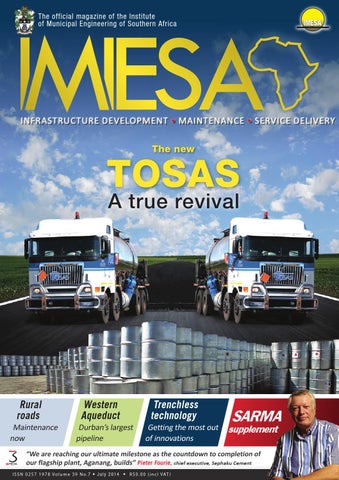
The new
TOSAS A true revival
Rural roads
Maintenance now MEDIA
Western Aqueduct
Durban’s largest pipeline
Trenchless technology
Getting the most out of innovations
SARMA
supplement
“We are reaching our ultimate milestone as the countdown to completion of our flagship plant, Aganang, builds” Pieter Fourie, chief executive, Sephaku Cement
I S S N 0 2 5 7 1 9 7 8 V o l u m e 3 9 N o . 7 • J u l y 2 0 1 4 • R 5 0 . 0 0 ( i n c l VAT )
THE JOAT GROUP OF COMPANIES has moulded itself into an efficient and market-leading solutions-orientated team that primarily addresses the optimisation of water supply to consumers through the minimisation of water losses, application of appropriate technology, revenue improvement and energy efficiency. The group’s key focus areas of operation are consulting and operations engineering (essentially the reduction of nonrevenue water and stabilising of water supply), product sales and support, energy efficiency and mentorship. JOAT’s passion and vision is to ensure that municipalities become as efficient as possible in delivering water to consumers and has adapted its approach towards an outcomes-based partnership that has shared responsibility and accountability. The ultimate objective of any successful partnership with JOAT is to provide water service authorities with an efficient distribution system that they are fully equipped and trained to continue to operate.
In response to this approach, JOAT has invested in wide-ranging technology and partnerships that can be harnessed for the benefit of municipalities. Flow metering solutions (permanent or temporary, monitoring or revenue-generating), data management solutions (data loggers, GSM data loggers), control valve solutions (pressure-reducing valves, pressure controllers, surge control), leak detection solutions (leak detection equipment and service) and energy efficiency solutions (variable speed drives and system optimising) are all available to be presented into cost-effective, custom-made packages. JOAT has also expanded into the optimisation of energy consumption in the water cycle and has a number of in-house experts that can undertake energy audits and design energy efficiency solutions for pump stations and treatment works. This forms part of its overall approach to making the distribution of water as efficient as possible.
HEAD OFFICE Unit 19 Alexander Park, 24 Alexander Road, Westmead, Pinetown, KZN, SA 3610 • Postnet Suite 23, Private Bag X4, Kloof 3640 t +27 (0)31 700 1177 • f +27 (0)31 700 9853 • Contact Daryl Spencer daryl.spencer@joat.co.za c 083 555 9996 NATIONAL OFFICES • Pietermaritzburg • Port Elizabeth • Johannesburg • Cape Town • Shelly Beach
CONTENTS The official magazine of the Institute of Municipal Engineering of Southern Africa
VOLUME 39 NO 7 JULY 2014
road asset 61 Rural management
IMESA
INFRASTRUCTURE DEVELOPMENT • MAINTENANCE • SERVICE DELIVERY
The new
TOSAS A true revival
Rural roads
Maintenance now MEDIA
Western Aqueduct
Durban’s largest pipeline
Trenchless technology
Getting the most out of innovations
16
SARMA
supplement
“We are reaching our ultimate milestone as the countdown to completion of our flagship plant, Aganang, builds” Pieter Fourie, chief executive, Sephaku Cement
Determining the best BRT for eThekwini
I S S N 0 2 5 7 1 9 7 8 V o l u m e 3 9 N o . 7 • J u l y 2 0 1 4 • R 5 0 . 0 0 ( i n c l VAT )
Having been the acknowledged leader in the supply of bituminous products, Tosas is now well on its way to again becoming the number one value-added binder supplier in Southern Africa. P6
3 5 10 76
Tosas – partner, provider, innovator 6
Municipal feature
16
41
Technology in engineering Prepaid water meters turn around revenue collection
Thermally fused PVC pipe in trenchless installations
Preserving our future
Upgrading dam infrastructure in Angola
Water and wastewater
Energy
Caesar’s Dam WTW upgrade in final stage
Restoration of impoundment at Hartbeespoort Dam
27
Southern Africa Readymix Association
SOUTHERN AFRICA READYMIX ASSOCIATION
Water and wastewater
28
Caesar’s Dam Water Treatment Works upgrade in final stage
SARMA
The Readymix Conference 2014
GROWTH
Investing in construction materials
Special feature
50
Tilt-up construction is a modern-day building technique that takes current challenges and requirements into account and incorporates these improvements into a simple yet effective solution.
61
Section cover Sephaku Cement
33
Divisional cover story Sephaku Cement’s kiln ready to fire up
34
46
Africa project
Transport Determining the best BRT for eThekwini – Part 2
29
Roads 13
S A R M A
SEPHAKU CEMENT
Absolute customer commitment
Trenchless technology
Cover story
Adding to Durban’s largest water pipeline
Vlakfontein canal rehabilitation project phase ii
Optimising water infrastructure assets
Regulars Editor’s comment President’s comment Africa Roundup Index to advertisers
Project: Water
68
70
SARMA Sustainable readymix under the spotlight The time to invest is now
68
36 38
Upgrading dam infrastructure in Angola
canal 29 Vlakfontein rehabilitation project
IMIESA July 2014
1
EDITOR’S COMMENT
Beyond the Act
PUBLISHER Elizabeth Shorten EDITOR Nicholas McDiarmid EDITORIAL ASSISTANT Danielle Petterson HEAD OF DESIGN Frédérick Danton SENIOR DESIGNER Hayley Mendelow DESIGNER Kirsty Galloway CHIEF SUB-EDITOR Tristan Snijders SUB-EDITOR Beatrix Knopjes CONTRIBUTORS Emmanuel Adewumi, Dhiren Allopi, Bo Barta, Patrick Dorkin, ML Griffioen, Leonard Malapane, S Natha, Roger Purchase, Andrew Seidel, Robert Walker CLIENT SERVICES & PRODUCTION MANAGER Antois-Leigh Botma PRODUCTION COORDINATOR Jacqueline Modise FINANCIAL MANAGER Andrew Lobban MARKETING MANAGER Hestelle Robinson DIGITAL MANAGER Esther Louw ADMINISTRATION Tonya Hebenton DISTRIBUTION MANAGER Nomsa Masina DISTRIBUTION COORDINATOR Asha Pursotham SUBSCRIPTIONS subs@3smedia.co.za PRINTERS United Litho Johannesburg +27 (0)11 402 0571 ___________________________________________________
The Infrastructure Development Act has come into effect as of 1 July 2014, and is intended to facilitate and coordinate infrastructure development as one of government’s key development levers.
I
T ALSO FORMALISES the Presidential Infrastructure Coordinating Commission (PICC) and will ‘improve the management of infrastructure during all life-cycle phases’. That last point is extremely important. As has been highlighted repeatedly, the current procurement system is highly flawed, placing price above all else, followed by broad-based black economic empowerment. One person who has been very vocal about this is CESA president Lefadi Makibinyane, who has been playing a key role in the Presidential/Business Bilateral for Inclusive Growth, and notes that further meetings with the President are scheduled for mid-July. “The implementation of the Act is very timely and gives serious emphasis to the National Development Plan. It finally shows government acknowledging infrastructure as its primary tool for economic and social development. It should definitely raise hopes and confidence in the sector,” he told IMIESA. Municipal infrastructure is a key sector for the implementation of the Strategic Integrated Projects and much of the Act’s import is to establish transparency and accountability in the structures set to operationalise the Act, with the PICC monitoring development. What this means is a more direct line between the presidency and all infrastructure-implementing agencies, which include many members of IMESA. The issues that are most likely going to be emerging in the coming months will include skills and capacity, specifications and localisation. The specifying of local content in projects is also intended to give local manufacturers, who are very much part of the infrastructure community, a more competitive edge, which can surely only be of benefit to South Africa. Over the months, IMIESA has been examining these issues, and it can only be hoped that establishment of the Infrastructure Development Act will be the final key to unlocking the changes and developments in the sector that everyone has been looking for. Moving from the lofty heights of policy to the business of actual engineering… this edition of IMIESA covers a broad selection of projects, from public transport, to dam building, to hydropower and trenchless technology, and it has been a pleasure to produce. Trenchless technology keeps evolving and the No-Dig South Africa 2014 conference will be taking place from 29 July. It is a packed programme (including an appearance from IMESA president Frank Stevens) and has been split between new construction on day one and rehabilitation on day two. More information can be found on www.nodigsouthafrica.com. Amazingly, we will soon be entering the last quarter of the year, and we are already planning our editorial content strategy for 2015. Please feel free to contact me if there are specific topics you think we should be covering or any improvement you wish to see. I can be reached on nicholas@3smedia.co.za.
ADVERTISING SALES Jenny Miller Tel: +27 (0)11 467 6223 ___________________________________________________
PUBLISHER: MEDIA No. 4, 5th Avenue, Rivonia 2056 PO Box 92026, Norwood 2117 Tel: +27 (0)11 233 2600 Fax: +27 (0)11 234 7274/5 E-mail: nicholas@3smedia.co.za www.3smedia.co.za ANNUAL SUBSCRIPTION: R550.00 (INCL VAT) ISSN 0257 1978 IMIESA, Inst.MUNIC. ENG. S. AFR. © Copyright 2014. All rights reserved. ___________________________________________________ IMESA CONTACTS IMESA Administration Officer: Narisha Sogan P O Box 2190, Westville, 3630 Tel: +27 (0)31 266 3263 Fax: +27 (0)31 266 5094 Email: admin@imesa.org.za Website: www.imesa.org.za BORDER BRANCH Secretary: Melanie Matroos Tel: +27 (0)43 705 2401 Fax: +27 (0)43 743 5266 E-mail: melaniem@buffalocity.gov.za EAST CAPE BRANCH Clarine Coltman Tel: +27 (0)41 505 8019 Fax: +27 (0)41 585 3437 E-mail: clarinec@africoast.com KWAZULU-NATAL BRANCH Secretary: Rita Matthews Tel: +27 (0)31 311 6382 Fax: +27 (0)31 701 2935 NORTHERN PROVINCE BRANCH Secretary: Rona Fourie Tel: +27 (0)82 742 6364 Fax: +27 (0)86 634 5644 E-mail: imesanorth@vodamail.co.za SOUTHERN CAPE KAROO BRANCH Secretary: Henrietta Oliver Tel: +27 (0)79 390 7536 Fax: 086 536 3725 E-mail: imesa.southcape@gmail.com
Nicholas McDiarmid
WESTERN CAPE BRANCH Secretary: Erica van Jaarsveld Tel: +27 (0)21 938 8455 Fax: +27 (0)21 938 8457 E-mail: erica.van_jaarsveld@capetown.gov.za FREE STATE AND NORTHERN CAPE BRANCH Secretary: Wilma Van Der Walt Tel: +27(0)83 457 4362 Fax: 086 628 0468 E-mail: imesa.fsnc@gmail.com All material herein IMIESA is copyright protected and may not be reproduced either in whole or in part without the prior written permission of the publisher. The views of contributors do not necessarily reflect those of the Institute of Municipal Engineering of Southern Africa or the publishers.
To our avid readers, check out what we are talking about on our website, Facebook page or follow us on Twitter and have your say. The official magazine of the Institute of Municipal Engineering of Southern Africa
IMESA
@infrastructure4
Infrastructure News
IMESA Institu te Africa ern ine of the l magaz eering of South The officia ipal Engin of Munic
INFRASTRUCTURE DEVELOPMENT • MAINTENANCE • SERVICE DELIVERY
INFR ASTR
DEV ELOP
UCT URE
MAI NTE MEN T •
NAN CE
• SERV ICE
DELI VERY
The new
TOSAS A true revival
ORLD BARLOW ENT
M EQUIP
the Paving ad le Ro Western Rural Pedic roads Aqueduct
Maintenance Durban’s largest in the now pipeline
Defining
building
Road ecological Evolving towards solutions roads greener
BRT
Integrating in transport
MEDIA
SEAT
ions ensuri
n SA global operat , Amman ce of large , managing director the presen Lehman to have t” Rocco ant for Africa for the marke ) ( i n c l VAT “It is import ent is available 50.00 4 • R ne 201 right equipm 6 • Ju 39 No.
South Africa
um 7 8 Vo l 257 19 ISSN 0
e
Trenchless technology
Getting the most out of innovations
In each issue, IMIESA offers advertisers the opportunity to get to the front of the line by placing a company, product or service on the front cover of the journal. Buying this position will afford the advertiser the cover story and maximum exposure. For more information on cover bookings contact Jenny Miller on tel: +27 (0)11 467 6223.
SARMA
supplement
Disaster nt HOTour ultimate milestone as the countdown to completion of geme “We are reaching
mana our flagship plant, Aganang, builds” Pieter Fourie, chief executive, Sephaku Cement SA’s local Securing tI S S N 0 2 5 7 1 9 7 8 V o l u m e 3 9 N o . 7 • J u l y 2 0 1 4 • R 5 0 . 0 0 ( i n c l VAT ) governmen ng the MEDIA
Cover opportunity
IMIESA July 2014
3
AT IO N N O W O P E N! O N L IN E R E G ISwwTw.iRme sa.org.za
29‐31 OCTOBER 2014
Theme - Balancing Service Delivery Earn 2.5 CPD points by attending The 2014 IMESA Conference will be hosted at the International Convention Centre, Durban
Register & pay BEFORE 31 JULY 2014
Register & pay AFTER 30 AUGUST 2014
Register & pay BEFORE 30 AUGUST 2014
For information
• Early Bird for IMESA members@ R4500 • Early Bird for Non-IMESA members@ R5000
• Late Registration IMESA members@ R4725 • Late Registration Non-IMESA members@ R5250
• Last Minute Reg IMESA Members@ R5200 • Last Minute Reg Non-IMESA Members @ R5775
t 031 266 3263 www.imesa.org.za
Frank Stevens, president of IMESA
South African municipal engineers recognised internationally
One of the proudest moments of my career occurred recently with the announcement of eThekwini Water and Sanitation as the 2014 recipient of the Stockholm Industry Water Award (SIWA).
T
HIS AWARD was established in 2000 to stimulate and celebrate outstanding and transformative water achievements by companies in improving production, managing risks, finding solutions and contributing to wise water management. The Royal Swedish Academy of Engineering Sciences and the World Business Council for Sustainable Development were partners in establishing the award, which is also supported by the International Water Association and World Wide Fund for Nature. Nominations are made by international organisations and not the nominees themselves. eThekwini Water and Sanitation was named the 2014 winner of the Stockholm Industry Water Award for its transformative and inclusive approach to providing water and sanitation services. The international press-release headline read: “Most progressive water utility in Africa wins 2014 Stockholm Industry Water Award.” In its citation, the Stockholm Industry Water Award Jury states: South Africa’s constitution from 1996, praised as a model for inclusion of social rights, enshrined the human right to water. Local government was tasked with putting it into practice. Soon after, Durban, one of
the country’s main urban centres, expanded its administrative boundaries to include 3.5 million people, some of them living in poorly serviced rural areas with huge water and sanitation challenges. The eThekwini municipality decided to face these challenges head-on. In the past 14 years, 1.3 million additional people in greater Durban have been connected to piped water and 700 000 people have been provided with access to toilets. In respecting the constitutional right to water while maintaining financial sustainability, access to basic water supply and sanitation is provided at no cost to poor families, while higher levels of service and consumption are charged at full cost. In addition to successfully providing basic services to a large and diverse population, eThekwini Water and Sanitation is at the forefront of exploring technical and social solutions. One example is a mini hydro-power project: instead of using pressure-reducing valves in pipes running down steep hillsides, the company is installing mini turbines using the excess pressure to generate electricity for the city’s low-tension grid. The eThekwini Municipality is also pioneering solutions to convert urban wastewater challenges to agricultural opportunities as well as harvesting rainwater. The combined result is one of
The EWS building
the most progressive utilities in the world. The open approach to experimenting and piloting new solutions across both technical and social aspects of service delivery has made eThekwini a forerunner in the world of utility-run services. One partner comments that, “Leaders at eThekwini have already been betting on new and risky approaches to test innovation that will ultimately have a long-term benefit for the population. Most municipalities refrain from exploring ideas out of the box, focusing on business as usual. “eThekwini has championed the approach to provide sufficient water to sustain human life, as expressed in the South African Constitution, now embedded in national policy. The methods used and results achieved by eThekwini Water and Sanitation serve as a sterling example for the many communities worldwide facing similar challenges.” The Water and Sanitation unit of eThekwini Municipality was established in 1992 and manages the water and sanitation services for the 3.5 million people living in the Durban area and has worked with some of
the world’s major actors and knowledge hubs in water and sanitation as well as development, such as the Bill and Melinda Gates Foundation, the World Bank, the University of KwaZulu-Natal, Borda, Eawag, and DHI. Its methods have been replicated across the country and region, and eThekwini representatives are successfully sharing and disseminating their findings and working methods.
Conclusion Neil Macleod, the head of eThekwini Water and Sanitation – a fellow member of IMESA – comments that “This recognition reflects the work of our whole team over the past 22 years and is a tremendous honour for all of us here in Durban.” I certainly consider it an honour to be part of eThekwini Water and Sanitation and remain convinced that South African municipal engineers can be proud of their service-delivery record and achievements. For more information on SIWI go to: www.siwi.org/siwa2014.
IMIESA July 2014
5
COVER STORY
Partner, provider, Having been the acknowledged leader in the supply of bituminous products, Tosas is now well on its way to again becoming the number one value-added binder supplier in Southern Africa.
A
FTER BEING ACQUIRED by the Raubex Group in the latter part of Q2 of 2013, Deon Pagel was appointed managing director and is, with the support of the company’s shareholders, painstakingly guiding the company back to its former and future premier position. Pagel explains: “We still have a long way to go but each and every day we are building our customers’ confidence in us. Many people think that Tosas is simply here as a supplier to its shareholder, but that is very far from the actual facts; the investment in Tosas and the capacity of the company far exceeds its own needs. The strategic intent with Tosas is to purposefully ensure its independence and ability to supply the roads
6
IMIESA July 2014
industry as a whole, and in that manner to contribute to Raubex's overall profitability and to give the shareholders a return on the investment.”
The new Tosas Tosas’s redevelopment of its service offering has been deliberately gradual, building consistent service excellence and ensuring quality products across its range, while introducing innovative solutions to its customers across South Africa and its neighbours. “The intent is to service the entire market as an autonomous supplier. The fundamentals are now well established and we have regained the trust of many of our customers in a relatively short time frame but there is still work to be done” Pagel says.
There has been a major overhaul of the efficiencies in all aspects of the business – from its workshops in terms of repairs and maintenance, down to the last activities on all sites and areas of work – and these are successfully addressing the frustrations some clients encountered during the company’s difficult years. This was achieved, in large part, by a highly professional team. “I can really boast that I have a team made up of some of the most respected people in the industry, from technical through to production, maintenance and financial,” continues Pagel, adding that the company got a further boost by drawing on the operational support from certain divisions within the group.
Delivering innovation – new crumbed rubber technology (NCRT) Besides its strategy to regain its former position in the roads industry, Tosas was and is a highly innovative player. After many years of research and development in Germany and South Africa, followed by the production of laboratory blends, full-scale asphalt
COVER STORY
THE BENEFITS OF NEW CRUMB RUBBER TECHNOLOGY (NCRT), the Rolls
innovator designs and plant trials, together with spray applications in a number of places across South Africa during the past three-and-ahalf years, the NCRT for seals and asphalt product is now ready for roll-out on a commercial scale and Tosas recently supplied NCRT binder for the resealing of a number of streets in Mangaung (Bloemfontein). Bitumen rubber remains the ultimate modified binder from a number of perspectives. However, due to its visco-elastic properties, the product has some drawbacks, including a very short shelf life and high handling temperatures. These factors can lead specifiers to overlook, or avoid the product. By addressing these challenges, NCRT successfully eliminates the typical risks synonymous with conventional bitumen rubber. As a result, it is probably the most exciting development for the industry and the state of road building and maintenance as a whole in a long time.
Bitumen rubber – the easy way NCRT effectively lowers the temperature of handling and applying bitumen rubber by
means of specialised treatment of the rubber crumbs. This results in lowered manufacturing temperatures but very significantly also in extended shelf life of the blended rubber bitumen. The lower temperatures not only add to the ease and safety of working with the product, but also have a direct and measurable impact on lowering the carbon footprint. With a working temperature of just 175˚C – as contrasted to 195 to 210˚C – this innovation effectively solves many challenges of working with the rubber-modified bitumen binder. “Traditional bitumen rubber has a window period of four to six hours in which to use it, after which a phenomenon known as over-digestion can occur and the product can no longer be used in its current form. It then has to be reconstituted through the introduction of additional rubber crumbs. The new technology overcomes this, extending the window period to as much as seven days and even beyond. You can work with the product at 170˚C and store it at 140˚C. This makes a profound difference to the energy consumed in working with the
Royce of bitumen rubber and the roadseal binder of the future: • reduced manufacturing, paving and spraying temperatures • also resulting in reduced binder ageing • safer working conditions due to reduced temperature • increased energy efficiency and reduced emissions during production, paving and spraying • lower viscosity at lower temperatures • increased shelflife of seven days • longer-lasting road surface • reduced road maintenance intervals • better rut resistance • higher tolerance for high volumes of traffic • all of the above culminates in environmental friendliness and sustainability.
material, as well to the practical handling of it,” notes Pagel. This is highly significant, as many authorities regarded the demanding logistics, risk of failure and variation in properties of bitumen rubber as too high to specify it.
The history of NCRT NCRT was developed in Germany when Sasol Wax representatives collaborated with asphalt technology company Storimpex to engineer a concept that would improve environmental sustainability. This was driven, in part, by the desire to make a bitumen rubber product that was acceptable to the European market, which has traditionally been resistant to bitumen rubber due to the high operating temperatures and other negative perceptions. Recycling scrap rubber tyres for use in road building was obviously attractive from an environmental point of view. The rubber crumbs from the scrap tyres are partially dissolved and dispersed with extender oils; they swell up in the bitumen at high temperature. The combination of mechanical and chemical processes
IMIESA July 2014
7
I M E S A A F F I L I AT E M E M B E R S
IMESA
AECOM vanessa.partington@aecom.com AJ Broom Road Products ajbroom@icon.co.za Arup SA rob.lamb@arup.com Aurecon danie.wium@aurecongroup.com Aveng Manufacturing Infraset cgroenewald@infraset.com Bigen Africa Group Holdings otto.scharfetter@bigenafrica.com BMK Consulting brian@bmkconsulting.co.za Bosch Munitech info@boschmunitech.co.za Bosch Stemele bsdbn@boschstemele.co.za Brubin Pumps sales@brubin.co.za BVI Consulting Engineers marketing@bviho.co.za Civilconsult Consulting Engineers mail@civilconsult.co.za Concrete Manufacturers cma@mweb.co.za Corrosion Institute of Southern Africa secretary@corrosioninstitute.org.za Development Bank of SA divb@dbsa.org.za DPI Plastics mgoodchild@dpiplastics.co.za EFG Engineers eric@efgeng.co.za Elster Kent Metering leon.basson@elster.com Engcor Engineers masham@engcorengineers.co.za Fibertex South Africa (Pty) Ltd rcl@fibertex.com GIBB yvanrooyen@gibb.co.za GLS Consulting nicky@gls.co.za Hatch Goba leratom@goba.co.za Herrenknecht schiewe.helene@herrenknecht.de Huber Technology cs@hubersa.com Hydro-comp Enterprises dan@edams.co.za I@Consulting louis_icon@mics.co.za ILISO Consulting hans@iliso.com INGEROP mravjee@ingerop.co.za Integrity Environment info@integrityafrica.co.za Jeffares and Green dennyc@jgi.co.za Johannesburg Water rtaljaard@jwater.co.za KABE Consulting Engineers info@kabe.co.za Kantey & Templer (K&T) Consulting Engineers info@kanteys.co.za Knowledge Base info@knowbase.co.za Lektratek Water general@lwt.co.za Makhaotse Narasimulu & Associates mmakhaotse@mna-sa.co.za Malani Padayachee & Associates (Pty) Ltd admin@mpa.co.za
Maragela Consulting Engineers admin@maragelaconsulting.co.za Mhiduve cgroenewald@infraset.com Mott Macdonald PDNA mahomed.soobader@mottmac.com Much Asphalt john.onraet@murrob.com Nyeleti Consulting ppienaar@nyeleti.co.za Odour Engineering Systems mathewc@oes.co.za Pumptron info@pumptron.co.za Pragma nicojobe.mabaso@pragmaworld.net Rocla karen.devos@murrob.co.za Royal HaskoningDHV francisg@rhdv.com SABITA info@sabita.co.za SALGA info@salga.org.za SARF administrator@sarf.org.za.co.za SBS Water Systems terri@sbstanks.co.za Sektor Consulting cradock@sektor.co.za Sight Lines sales@sightlines.co.za SiVEST SA garths@sivest.co.za Siza Water Company tionette.bates@sizawater.co.za SMEC capetown@smec.com SNA temple.d@sna.co.za Sobek Engineering gen@sobek.co.za Southern African Society for Trenchless Technology director@sasst.org.za SRK Consulting jomar@srk.co.za Sulzer Pumps Wastewater sales.abs.za@sulzer.com Syntell julia@syntell.co.za Thm Engineers East London thmel@mweb.co.za TPA Consulting roger@tpa.co.za UWP Consulting craign@uwp.co.za Vetasi south-africa@vetasi.com VIP Consulting Engineers esme@vipconsulting.co.za VOMM commerciale@vomm.it Water Institute of Southern Africa wisa@wisa.org.za Water Solutions Southern Africa ecoetzer@wssa.co.za Wilo South Africa tracy.vanderLinde@wilo.co.za WorleyParsons chris.brandsen@WorleyParsons.com WRP ronniem@wrp.co.za WSP Group Africa dirk.hattingh@mbs-wsp.co.za Zebra Surfacing andrew@zebrasurfacing.co.za
COVERINSIGHT STORY
modify the behaviour of the rubber crumbs in their reaction to the bitumen, resulting in a superior compound that has the best visco-elastic properties of any bitumen rubber technology.
Localising the product As the leading specialist in bitumen rubber technologies in South Africa, Tosas was the logical partner of choice for Sasol Wax to introduce NCRT to the South African market. Not all bitumen rubbers are the same and what is called bitumen rubber in South Africa is actually a very different product to that used in Germany. This has resulted in a need to localise and optimise the product, with the aim of combining the best of bitumen rubber binder technology with Sasol’s high molecular weight FischerTropsch warm-mix technology. “NCRT is changing the way we operate. We can now manufacture and supply directly from the branch, which is far more cost-effective for our clients. We have worked very closely at branch level to ensure they are ready from a supply chain perspective,” explains Pagel. Sasol holds the patent to NCRT, with Tosas the licensee. “We have had great results using the product in Bloemfontein and the industry is now ready to accept NCRT as the modified additive of the future. Our bigger customers look very favourably at the product due to its characteristics.”
Adding value to South African market conditions Beyond being a supplier to the South African roads industry, Tosas embraces the idea of engaging with the industry, and realises this engagement in several ways. The company holds popular workshops for contractors, engineers and other clients to help their stakeholders stay up to date on latest developments. “We make information available to our clients and then go on to make recommendations about a range of possible solutions, including what type of products could be used on a particular job. One of our key areas where we can offer a lot of guidance is that of job creation in the area of road maintenance,” explains Pagel. “We support labour-intensive projects (LIPs) and not only advise on them but also produce products that support LIPs, such as the special emulsions for use in hand-operated chip spreaders. Sealing roads with labour-intensive equipment and
“NCRT is changing the way we operate. We can now manufacture and supply directly from the branch, which is far more cost-effective for our clients” products has massive potential for job creation in South Africa. The CSIR and the International Labour Organisation compiled the manual on labour-intensive road-surfacing methodologies for the Construction Industry Development Board and the products recommended therein we can supply. The bottom line is that we can assist and guide municipalities and other road authorities on a variety of options to keep up the maintenance of roads in cost-effective and recognised labour-intensive ways,” he says. Pagel also notes that Tosas provides particular guidance on overcoming the socalled ‘Winter Embargo’. In autumn and winter, sealing and surfacing of roads is often slowed down because of the cold weather and Tosas offers particular products that allow these activities to continue throughout the seasons. These include autumnand winter-grade rubber bitumen and a variety of modified binders for application in winter. “Anyone is welcome to approach us to ask for advice and assistance in figuring out the best approach and products that will enable them to continue their sealing through winter. There are so many options available today,” says Pagel. “There have been a number of Society of Asphalt workshops, which have been promoting the return of winter sealing workshops. By using the correct application methods and the correct products in the correct areas, there really is no reason for the winter embargo.” Pagel notes that bitumen availability during the winter months is generally also very
stable due to the reduced consumption and this presents opportunities.
Achieving a clear vision Pagel is not shy about the fact that Tosas has seen some very difficult years. “There are many reasons for why Tosas struggled for a while. Its previous shareholder attempted to apply large corporate principles and procedures in areas which actually require more agility in execution. The new shareholder is clear about its role in the company and has encouraged our independence and service responsibility to the industry”. “We intend to become the number one binder supplier in Southern Africa again and to increase our geographic footprint. A year from now, I hope to have as many of our previous customers, some of whom even started their own binder divisions, back in our stable as happy customers,” concludes Pagel. Tosas is once again the efficient, customer-centric organisation it was famous for being, and has extended itself as a partner, provider and innovator in South Africa’s complex road sector. t +27 (0)11 323 2000 f +27 (0)11 902 1112 Elvis.g@tosas.co.za www.tosas.co.za
IMIESA offers advertisers an ideal platform to ensure maximum exposure of their brand. Companies are afforded the opportunity of publishing a two-page cover story and a cover picture to promote their products to an appropriate audience. Please call Jenny Miller on +27 (0)11 467 6223 to secure your booking.
IMIESA July 2014
9
AFRICA ROUND-UP
INFRASTRUCTURE NEWS FROM AROUND THE CONTINENT UGANDA $109 million for road sector support project Uganda has received a $109 million loan to finance the Road Sector Support Project V to support the realisation of the National Development Plan and Uganda Vision 2040. The project’s objective is to improve road access to socioeconomic facilities as well as improve the quality of transport service levels in south-western and eastern parts of Uganda by upgrading the RukungiriKihihi-Ishasha/Kanungu and Bumbobi-Lwakhakha roads from gravel to bitumen standard. The expected project outcomes are a reduction in transport costs, increased mobility, improved access to economic and social facilities, provision of clean water to households and an increase in income of women vendors in the roadside markets. The upgraded roads will also support cross-border trade and regional integration by linking western Uganda with the Democratic Republic of the Congo and eastern Uganda with Kenya at the border of Ishasha and Lwakhakha respectively. The roads will also support the tourism activities at Queen Donald Kaberuka, president, African Development Bank
10
IMIESA July 2014
Elizabeth National Park and Mount Elgon National Parks. The project conforms to the key development policies of the African Development Bank (AfDB) who supplied the funding. Presenting the project to the bank’s board of directors, the director of the Department for Transport, Information and Communication Technologies at the AfDB, Amadou Oumarou, said, “With this project, the AfDB is addressing a pressing demand for the provision of good-quality and reliable transport infrastructure, which Uganda needs for its socioeconomic development and poverty-reduction agenda.”
GHANA Japan helps Ghana deliver water Japan has assisted the Ghanaian government in connecting nine communities – which form part of the coastal wetland in the South Tongu District of the Volta Region – with potable water. The project was undertaken by the Centre for Integrated Education and Development (CIED) in collaboration with the District Assembly. It was funded by the Japanese government at a cost of GHS 325 680 with funding of GHS 172 000 from the District Assembly. The district chief executive for South Tongu, Samuel Mawuko Eworyi, expressed his gratitude to CIED and the Japanese government for their support. He assured the people of government’s commitment to execute the “Better Ghana Agenda”, which he said would improve upon their living conditions. Eworyi commended CIED and the Japanese government for complementing government
efforts by providing the people with their basic needs. He advised the beneficiaries to cultivate a culture of maintenance and to contribute towards regular rehabilitation of the system so as to prolong the lifespan. According to the executive director of CIED, Anthony Adanua, the water project is the third successful project the CIED has undertaken with sponsorship from the Japanese government. He hopes the partnership and relationship with the Japanese government will continue as it will greatly enhance good health and development. Adanua thanked the Japanese government and the people of Japan for their help and appealed to them to provide more grants to address the plight of poor and deprived communities in water and sanitation intervention services. Member of Parliament Kobby Woyome appealed to the Japanese government and the CIED to consider supporting the rehabilitation of the road network in the area, which becomes inaccessible during the rainy season.
TUNISIA $26.2 million to improve water supply Tunisia plans to upgrade water supplies and services in the Greater Tunis area and other cities in Tunisia, as well as improve the financial situation of the national water utility, Société Nationale d’Exploitation et de Distribution des Eaux (SONEDE). In recent years, SONEDE has faced a higher than anticipated water demand in the Greater Tunis area, requiring urgent
production capacity upgrades to avoid water shortages in the medium term. The World Bank has provided $26.2 million in additional financing for the upgrade. “Water is an engine for development,” says Eileen Murray, World Bank country manager for Tunisia. “It has an impact on industrial growth, on commercial activity and tourism, as well as on the daily lives of citizens in all neighbourhoods, whichever socio-economic group they come from.” The additional financing will complement water conservation initiatives to fund the rehabilitation and capacity expansion of the Greater Tunis potable water treatment plant, located at Ghdir-el-Gollah, as well the Belli potable water plant serving the centre of the eastern part of the country, to avoid water shortages in the short to medium term. These water treatment facilities are among the five largest managed by SONEDE, and are key to meeting the needs of the population, as well as industries. The financing is part of the National Water Security Investment Programme developed by SONEDE and the Tunisian government to ensure the country’s urban populations continue to receive undisrupted water services over the next decade, despite fast-growing demand and the negative impact of climate change. The World Bank has developed a strategic partnership with SONEDE, which includes technical assistance to ensure its financial sustainability, as well as twinning it with other well-performing utilities in the region to strengthen water resources
AFRICA ROUND-UP
management, performance and service delivery.
SENEGAL 40 km highway upgrade Senegal will spend approximately $35.8 million on the rehabilitation of the DinguirayeNioro-KeurAyib road in the Kaolack region. The 40 km highway on the Trans-Gambia Corridor is a strategic link between the north and south of the Gambia and Senegal on the DakarLagos Trans-African Highway. The project aims to facilitate the movement of goods and people along the road, so as to increase trade with the rest of the country and improve the population's access to basic services. The African Development Bank’s first vice president and chief operating officer, Emmanuel Mbi, says the project will create jobs for youths and women in rural and semiurban areas and help curb rural exodus from the area, which has a very high net migration.
ETHIOPIA Unlocking geothermal energy Ethiopia is developing its geothermal energy resources to boost electricity supply to all Ethiopians and continuing to
become a regional power hub. The domestic demand for electricity in Ethiopia is expected to grow by more than 25% per year. Over the next five years, the government of Ethiopia intends to significantly expand electricity coverage, reaching 75% of towns and villages and connecting four million consumers to the grid. The Geothermal Sector Development project will help the government to fulfil this increasing demand for electricity by diversifying its power generation sources and tapping into its substantial geothermal
energy potentials. In addition to providing energy security, the project will support Ethiopia’s efforts to build a climate-resilient green economy by developing renewable energy sources with low carbon emissions. The project, which will be implemented in two phases, will develop two potential geothermal sites and help establish an institutional framework for geothermal development during its first phase. During its second phase, electricity will be generated using the steam resources developed and identified in the first phase.
Geothermal energy is set to boost Ethiopian power supply
The power generated from geothermal plants will provide electricity directly to the grid and allow more households and businesses to connect at affordable rates. It will also provide reliable energy to existing commercial consumers currently affected by the energy rationing resulting from insufficient generation capacity. “The geothermal project marks a new push to increase access and improve reliability of electricity supply to new and existing customers,” says Raihan Elahi, the World Bank task-team leader for the project. “Reliable electricity supply to industries and businesses will support job-led growth.” The World Bank’s board has approved a $178.5 million credit from the International Development Association and a $24.5 million grant from the Scaling-up Renewable Energy Programme Trust Fund to help the Ethiopian government develop its geothermal energy resources. Work underway on the Trans-African Highway
IMIESA July 2014
11
MUNICIPAL FEATURE
Adding to Durban’s largest water pipeline Construction of the new inlet water pipe from the eThekwini Water and Sanitation main line to the Jerome Drive reservoir in Kloof was completed ahead of schedule in earlier this year.
T
HE JEROME ROAD inlet is part of the ongoing eThekwini Water and Sanitation (EWS) Western Aqueduct project. Because it is runs past St Mary’s School, it was commissioned as a stand-alone job over the December holidays to cause as little disruption to traffic as possible. “We envisaged at the start that working along St Mary’s Road was going to be the most difficult part but, with careful forward planning, constant correspondence with the school and communication with residents, the work was carried out smoothly with few problems,” says Andrew Copley, senior area engineer, EWS.
“We would like to thank St Mary’s School, parents of children at the school, residents and motorists who have been affected by the construction for their patience and understanding,” Copley says. “We know that this route is used by up to 1 000 cars every day and we did everything in our power to keep disruption to the traffic flow to a minimum. “Other challenges were laying the pipe in the 1.2 m-diameter jacked sleeve across the M13 and in the narrow servitude at Jerome Place,” he said. The decision to lay a completely new pipe was made to minimise leaks and conserve the city’s precious water resources and eThekwini Water and Sanitation staff check the final stages of the construction of the new water pipe to the Jerome Drive reservoir in Kloof. Left to right: graduate intern, Precious Radebe; clerk of works, Logan Govender and graduate intern, Eric Cele
IMIESA July 2014
13
MUNICIPAL FEATURE
Eric Cele and Precious Radebe, both graduate interns at eThekwini Water and Sanitation, itemise the final work that is required for the completion of the new water pipe to the Jerome Drive reservoir in Kloof
because the alternative – ongoing repairs – would be both costly and inconvenient to residents.
Addressing supply “The supply to Jerome Drive reservoir initially came from three supply feeds, which could be unreliable at times and as well as expensive because two of them were via a pumping system,” explained Leisel Bowes, project manager for EWS. “The new Western Aquaduct would have solved this problem by providing a dedicated cost-effective supply to the reservoir but, because it is only due to be commissioned in 2016/2017, we had to consider an alternate supply.” It was decided to eliminate one of the possible supplies to the Jerome Road reservoir. The supply was then designed to come solely from Abelia Road reservoir, with Mount Moriah reservoir as a temporary backup if the Abelia Road system was unable to cope or was being cleaned.
14
“We tested this theory during construction by only using the Mount Moriah reservoir and were pleased to find that the system coped well for seven months without any disruptions,” Bowes said. The new pipe is 300 mm in diameter and 1.5 km long. It crosses the M13 from Old Main Road and exits in front of Standard Bank in Village Road. It then continues down St. Mary’s Road past St Mary’s
School, turns left into Edgecliff Road, passes through a servitude into Jerome Place and ends in the Jerome Drive reservoir complex. The first phase of the Western Aqueduct – Durban’s largest ever water pipeline – was commissioned in June 2011 and covered 19 km from Umlaas Road to Inchanga Station. The second phase of this megaproject is progressing well after being unbundled into individual contracts that are being rolled out over a seven-year period. When complete, the Western Aqueduct is expected to significantly strengthen the capacity of bulk water supply to the western regions of eThekwini.
IMIESA July 2014
Promoting professional excellence in the water sector
ENDORSED BY
Water& Sanitation The official magazine of the Water Institute of Southern Africa T
Complete water resource and wastewater management
Intraregional supply chain solu�ons from producer to consumer
www.miningne.ws
Africa
DOW
The official magazine of the Institute p Engineering g g of Southern Africa of Municipal
IMESA
HOT
AF RIC AN UPDAT ES ON T HE
ining
Commercial vehicles Preventing fuel theft
Operations
Cross-border insurance
Logistics
North-South Corridor
G ROUND AND UNDERG ROUND
SSEAT
Water-perfect
Golder Associates’
Riana Munnik
on guidelines for water-use licensing P10
New approach to logistics
BARLOWORLD
COAL OF AFRICA
WASTEWATER Energy savings at WWTWs INFRASTRUCTURE DEVELOPMENT • MAINTENANCE • SERVICE DELIVERY PIPES AND PIPELINES Managing bulk pipelines
CEO David Brown on Makhado, Vele
POWER
‘WET’ COAL
Eskom’s supply-chain headaches
www.saconference.co.za
WATERBERG
South Africa’s next big coal rush MAY/JUN 2014 • Issue 55
A NEW WAY OF SEEING THINGS Reinventing conference content
IN N THE HE HOT OT SEAT EA AT
Wastt Wastewater and biosolids treatment processes are P16 incre e increasingly being modified for the generation of biogas. Dr André van Niekerk and Theunis Duminy of Golder Associates
MEDIA
March/April 2014 • ISSN 1990-8857 • Cover price R50.00 • Vol 9 No. 2
Insight
Engineering South Africa’s future today MEDIA
The ofcial journal of the Institute of Waste Management of Southern Africa
Promoting integrated resources management
Institute of Waste Management of Southern Africa
20
Engineering
Sustainable infrastructure planning & design
signs that you are an event planner
PPC
Strength beyond CEMENT the bag Renewable energy
Opportunities in the municipal sector
e in the
HOT SEAT
STAY
SSPECIAL CONNECTED The event
WATER planner’s guide W FEATURE P3to0audiovisual FOOD FOR THOUGHT Top restaurants for your next event
“Our value proposition to the public sector... is our ability to deliver large-scale multidisciplinary projects.” Fuzile Felix Fongoqa, executive chairman of the NAKO Group
I S S N 0 2 5 7 1 9 7 8 V o l u m e 3 9 N o . 4 • A p r i l 2 0 1 4 • R 5 0 . 0 0 ( i n c l VAT )
Abdool Kader Tayob, CE at Bakers SA: Performance-driven A
Petco
Growing a sustainable recycling sector
Climate change Facing green challenges head-on
Landfills
Past, present and future performance
llogistics o company P10
Sustainability
Finding ways to reduce carbon footprint
ISSN 1684-7946 May/June 2014 Vol.Mar/Apr 12 No. 2013 3 / R50.00 incl. VAT ISSN 1684-7946 Vol. 11 No. 2 / R40.00 incl. VAT
ISSN 1999-8872 • R50.00 (incl. VAT) • Vol. 7 • No. 5 • May 2014
Technical innovations for the waste industry
SPOTLIGHT You dream it, we make it a reality” Louis Liu, Gwefey group of companies
R50.00 (VAT incl)
is printed on 100% recycled paper
ISSN 1680-4902 R50.00 (incl VAT) • Vol 16, No 1, February 2014
and save, in print or digital. 3S Media’s AWARD-WINNING MAGAZINES keep you informed A subscription will bring you:
• Topical and relevant news and articles • Projects and case studies • Unique content • Expert analysis from industry experts and thought leaders • Updates on activities of companies and key roleplayers • Industry association endorsements
www.3smags.co.za
MEDIA
Partnering our skills with the public sector to manage, support and maintain the projects that move our country forward.
As primary banker to major players in the public sector, Standard Bank is providing world-class expertise to finance local progress. This allows the industry to deliver the solutions that will uplift our country. For more information visit www.standardbank.co.za/business Authorised financial services and registered credit provider (NCRCP15). The Standard Bank of South Africa Limited (Reg. No. 1962/000738/06). SBSA 7906 02/14 Moving Forward is a trademark of The Standard Bank of South Africa Limited.
Moving Forward
TM
PUBLIC TRANSPORT
PART 2
Determining the best BRT for eThekwini BRT systems are fast becoming part of the South African urban landscape. In the first part of this two-part article, the authors set about defining BRT systems, looking at their history and examining configurations, factors and options. This is the second and final part of the article – part one was published in the June 2014 edition of IMIESA. By Emmanuel Adewumi and Dhiren Allopi, Durban University of Technology
Interpretations based on the checklist of the three operational BRT systems in South Africa Running ways BRT vehicles use a fast and easily recognisable dedicated bus lane or traffic lane or have exclusive rights of way. BRT running ways for Rea Vaya operate highway medians with distinctive pavement markings and studs that serve as a separator to other traffic to avoid vehicle manoeuvring and, in some areas of the feeder routes (outer suburbs) that join the trunk route at the main station, operate in mixed traffic. The Port Elizabeth BRT system, called Libhongolethu, makes use of a dedicated median lane along Lilian Diedricks station to Triangle (Nelson Mandela Bay Stadium) and Greenacres, and the other corridors from Lilian Diedrick station to the airport and Nelson Mandela Metropolitan University are operated in a mixed traffic setting. The My Citi BRT system in Cape Town makes use of mixed traffic, segregated, atgrade median and median busways. In mixed traffic, it operates on the kerbside of the road and a segregated busway is situated along the Civic Centre to Table View.
16
IMIESA July 2014
Branding The ability to adopt branding in transport service is an important effort to encourage and maintain a reliable ridership. A perception survey was referenced in a 2004 report by the Federal Transport Authority (FTA) to measure public perception of BRT systems. The outcome of the survey indicated that most booming BRT systems were able to pull off a marked identity and position in their region amidst other transit services. South African BRT systems are branded differently to establish uniqueness among other forms of public transport and as a form of public awareness and aesthetic view for the commuters. This particular system has a distinctive identity and image, which distinguishes it from other types of public transport.
Stations These serve as a temporary shelter for passengers waiting to board to their various destinations, which is conveniently located and integrated along the route in which they serve. BRT stations possess specific paint schemes, logos, CCTV, security, realtime arrival information and streamlined
passenger shelter design. The Libhongolethu BRT system has no covered station/shelter for either commuters or staff. It makes use of the existing CCTV on the road while the Rea Vaya and My Citi BRT systems have beautified stations and the latter has full weather protection. All the system stations are situated at the median of the highway.
Intelligent transportation system (ITS) The Rea Vaya BRT system makes use of advanced digital technologies that improve passengers’ convenience, speed, safety and reliability, both at the station and in the bus, by informing them of the name of each station in transit and also the time of arrival of the next bus at the station. Cape Town's My Citi makes use of a public announcement of the next station and a route map on the bus, which the commuters can study. Libhongolethu is a newly rolledout BRT system still in the marketing stage; there are no information displays in the bus or station but an informative flyer is given to commuters who ask the staff questions. ITS can be referred to as the bus/intersection signal priority and CCTV monitoring of
PUBLIC TRANSPORT BRT stations come in a wide variety of designs
operations that makes use of automatic vehicle location (AVL) with the aid of GPS. There is real-time display information and updated schedules both in the bus and station, which really help passengers who do not know at which station to alight or when the next bus may be arriving.
Fare collection With Rea Vaya, the fare is collected in a fast and easy way before passengers board the bus, which is called off-vehicle fare payment, making use of multiple entrances for boarding and alighting, in order to reduce time. Some passengers make use
of a smart card to pay for the fare, which is at a flat rate. My Citi fares are paid by smart card: the passenger swipes it at the entrance of the bus with money that has been loaded on it, and the fare is a flat rate like the Libhongolethu BRT system, which uses on-board payment. IMIESA July 2014
17
PUBLIC TRANSPORT
COMPONENTS OF A BUS RAPID TRANSIT SYSTEM A BRT system combines flexible service and new technologies to improve customer convenience and reduce delays. While specific BRT applications vary, the components may include: A: Running Ways – exclusive guideways or dedicated lanes that allow BRT vehicles to be free of conflicting automobile traffic, parked or stopped vehicles, and other obstructions – maximising BRT operating speeds. In some situations, BRT vehicles also may operate in general traffic, trading speed and reliability for flexibility. "Queue jumper" is a term that refers to short exclusive lanes at signalised intersections that are used to allow BRT vehicles to jump to the head of the line and bypass stopped automobiles and traffic. B: Vehicles – modern, low-floor, highcapacity rubber-tired vehicles that accommodate high volumes of riders and fast boarding and exiting. BRT vehicles often use clean fuels or alternative power. C: Stations – ranging from protected shelters to large transit centers, BRT sta-
tions are located within the communities they serve and provide easy access to the system. D: Route Structure and Schedule – established to maximise direct, no-transfer rides to multiple destinations and to create more flexible and continuous service (reducing the need for a schedule) for local and express bus service. E: Fare Collection – designed to make it fast and easy to pay, often before boarding the vehicle, BRT fare collection systems include the use of self-service proof-ofpayment systems or pre-paid stored-value fare cards, such as a smart card system. F: Advanced Technology – the use of advanced technologies (or intelligent transportation systems) to improve customer convenience, speed, reliability, and safety. Examples include systems that provide traffic signal preference for buses at intersections and cross streets, as well as global positioning systems to provide passenger information such as real-time bus arrival information.
The population count shows that the routes will experience passenger demand in the order as listed below (in descending order). Note that C2 and C8 are not included below because they are rail tracks: • C1 Bridge City to Warwick/CBD • C5 Mpumalanga & Pinetown to Warwick • C7 Hillcrest & Umhlanga to Durban • C3 Bridge City to Pinetown • C6 Mpumalanga & Pinetown to Warwick • C9 Bridge City to Umhlanga • C4 Bridge City to Merebank and Rossburgh. Access to facilities like offices, residences, schools and malls are another factor that is assessed along the routes, so as not to create obstructions to other road users, because the primary aim of this BRT system is to reduce the travel times experienced by the commuters. Route C1 comprises offices, malls, residences and schools. Along the route C5, it is mainly businesses, schools, malls and residential buildings. Routes C7, C3, C6 and C4 are roads commuters ply every day to reach businesses, schools, shopping and recreational activities, and residential areas. Merebank and Rossburgh are suburbs of Durban; commuters living along these places would have ease of travel to their various destinations. The terrain along the routes C1, C3, C4, C5, C6 and C7 consists largely of mining terrain, which is usually flat but curvy.
Conclusions and recommendations on the in-depth literature review of BRT systems
Pedestrian Among the key components of BRT design and planning is pedestrian safety, and safe, easy access to the boarding facility. If these are not put into proper consideration, commuters will be discouraged about the system. The pedestrian access of Rea Vaya and My Citi are controlled by traffic lights; the passengers are at low risk when going to the station to board. With Libhongolethu, some places are not controlled by a traffic light.
Transport vehicle option The Rea Vaya system makes use of a standard bus with double side doors for alighting
18
IMIESA July 2014
and boarding, in order to minimise delay as do the the My Citi and Libhongolethu systems. My Citi is a combination of both articulated and standard buses, but the Libhongolethu system makes use of articulated buses throughout.
Interpretations based on the assessment of the EMA BRT system It could be deduced that there is pressure on public transport based on the population, according to Current Public Transport Records, and the demand analyses, discussed in Table 2 (Part 1, IMIESA June 2014), in the eThekwini Municipal Area.
Kerbside and median lane configurations are less expensive than a segregated BRT system because of its aerial or underground busway. Kerbside BRT systems do not need a pedestrian bridge, while a median needs a pedestrian bridge, which is safer than an at-grade pedestrian crossway. It is better to have a pedestrian bridge, which seems to be safer than a crosswalk, and a crosswalk controlled by traffic lights is preferable to one that is not. It is good for kerbside and median BRT configurations to have a pedestrian bridge for access, compared to a crosswalk. Also, for physically challenged commuters, kerbside and segregated BRT systems would be preferable because of the access to the station being much more convenient. Commuters using a kerbside station/BRT system tend to be safer when compared to median stations because they do not need to cross the traffic to access the service, but
Save Time Reduce coSTS
a segregated BRT lane configuration is safer than both the median and kerbside lane configurations. Vehicle manoeuvring would pose a delay for a kerbside BRT system but the other lane configurations would be suitable. If a kerbside system were adopted, implementing a shoulder lane, where automobiles can park and make U-turns to their destination, would improve the system. This research study recommends the following: To be able to select the appropriate vehicle option for a BRT system for a particular area/corridor, the transport demand, coverage/distance to be covered and length of public transport delay, due to general traffic conditions, must be put into proper consideration. If the transport demand and coverage are low, a standard bus could be selected over other options and, in order to enhance rebranding and marketing strategies, a stylised bus could be picked over others, provided the condition is the same as above. Any form of BRT system should be considered or implemented because it offers increased levels of mobility, fewer stops and greater accessibility than traditional public transportation. It could also serve as an attractive means to get drivers or car owners to use the system. A BRT system should not be operated in mixed traffic because it poses delays. The introduction of a dedicated bus lane would increase reliability and transit speed and have a positive effect on the commuters. The level of service of a segregated BRT system is much higher than that of kerbside and median BRT systems. The level of service of a kerbside system could be improved by the provision of a shoulder lane, where vehicles can hover or park to execute their task. It is only when there is no space for expansion that a BRT system should be operated in a mixed traffic setting, since the implementation of any mode of BRT system depends on the availability of space. For able and physically challenged pedestrians, a segregated BRT system would be preferable. However, cost will be the major deciding factor. Segregated and median BRT systems should be considered over kerbside, owing to vehicle manoeuvring.
Conclusions and recommendations on South African BRT systems This section gives the conclusions and recommendation on the evaluation of the three main functional BRT systems in South Africa.
eliminaTe The RiSk of TRench digging damage
Horizontal drilling is a practice of trenchless technology that involves drilling an underground hole, while seamlessly feeding in the necessary drill rods, without first having to dig a trench or ditch above it. Our cutting edge directional drilling equipment leaves the ground surface and other infrastructure completely undisturbed throughout a drilling project. The drill head is remotely controlled and can accurately bore holes for hundreds of metres in varying diameters to install gravity lines, pressure lines and cable sleeves.
Rea Vaya BRT system, Johannesburg Using this mode of BRT system poses improvement in travel time, reliability, safety and speed when compared to other public transport and automobiles travelling in mixed flow traffic lanes because they operate on a dedicated bus lane. A separate lane enables the system to have lower headways and accommodate higher peak period loads. When further combined with signal priority, delay is greatly minimised at intersections. Conclusively, it is commuter/user friendly and cost-effective over a long distance, when compared to other public transport, because it operates at a flat rate. In the system, pedestrian safety and convenient and secure access to the facility for physically challenged and able commuters are fully guaranteed, which helps commuters
IMIESA July 2014
19
Contact us for more information or for a FREE Quotation. Tel: 010 040 3233 www.rescuerod.co.za • info@rescuerod.co.za
RR005D
PUBLIC TRANSPORT
A PERFECTLY BALANCED SOLUTION Keep it Real. Keep it Cat 速
Metso portable plants allows you the use of various crushing and screening operations: from a single, stand alone unit to two-, three-, even four-stage complete plants providing several end-product fractions. The LT series complete plants can be easily adjusted to accurately suit your crushing application. You can choose feeding to crusher or feeding to screen options to meet your end-product requirements. Quick move and set-up times allow minimum loss of production. Combined with Cat machines and with the support and back up service of Barloworld Equipment and you have the the perfect balanced solution to move more and make more. LOWEST SUSTAINABLE COST PER TONNE. For more information contact your local Barloworld Equipment salesman or email: metsomobile@barloworld-equipment.com
PUBLIC TRANSPORT
not to be discouraged about the system. The installed ITS help the passengers to know the exact time and place to alight, especially those who do not know their exact bus stop destination. The research study recommends that high maintenance should be the watchword and if there is the need for BRT system diversification in Johannesburg, other lanes should be implemented, using other forms of a BRT system, adopting bicycle and car parking at the main station, which will enable a complete comparison in terms of service reliability and delay. If there is population intensification, articulated standard buses should be adopted. The use of smart cards should be solely adhered to, which will help the commuters to load more than a day fare on it depending on their financial capacity. Another mode of the BRT system, especially segregated, should be employed in case of future BRT intensification. Its cost-effectiveness is justified by the high grade of efficiency, reliability and speed.
My Citi BRT system, Cape Town The use of a dedicated bus lane should be encouraged throughout the routes, due to its improvement in travel time, reliability, safety and speed when compared to other road public transport modes. A separate lane enables the system to have lower headways and accommodate higher peak period loads. When further combined with signal priority, delay is greatly minimised at intersections. Use of automatic vehicle location helps the passengers to know when the bus would arrive at the station and the exact place to alight, especially those who do not know the
exact location of their destinations. AVL is more preferable to audio announcement in the bus. Having no phone booth and information display systems, in either bus or station, keeps the system below standard when compared to an ITS BRT station. It could be noticed that where a segregated lane is used, it is more efficient than median, atgrade median, or mixed traffic lanes. Conclusively, it is commuter/user friendly and cost-effective over a long distance, when compared to other road public transport, because it operates at a flat rate. In the system, pedestrian safety and convenient and secure access to the facility for physically challenged and able commuters are fully
Libhongolethu BRT system, Port Elizabeth Use of a dedicated bus lane should be encouraged throughout the routes because there is great improvement in travel time, reliability, safety and speed with a dedicated BRT system when compared to other road public transport travelling in mixed flow traffic lanes. It makes use of articulated standard buses to accommodate more passengers. The system is far below standard because it has no AVL, information kiosks, phone booths or full weatherproof shelters. Conclusively, it is commuter/user friendly and cost-effective over a long distance, when compared to other public transport, because
BRT systems in South Africa would be a good yardstick in the implementation of the proposed BRT system in the eThekwini Metropolitan Area guaranteed, which helps commuters not to be discouraged about the system. It is recommended that high maintenance should be the watchword and if there is a need for BRT system diversification in Cape Town, other lanes should be implemented using other forms of BRT systems, adopting bicycle and car parking lots at the main station, which will enable a complete comparison in terms of service reliability and delay. Mixed flow traffic lanes should be totally discouraged. Other BRT systems, especially segregated modes, should to be employed in case of future BRT intensification. Phone booths, comfortable seating, bicycle space and an ITS should be fully installed at the station.
it operates at a flat rate and also commuters can be transferred within 30 minutes of purchasing the ticket within IPTS Zone 1. In the system, pedestrian safety and convenient and secure access to the facility for physically challenged and able commuters are fully guaranteed, which helps commuters not to be discouraged about the system. It is highly recommended that proper maintenance should be the watchword and, if there is a need for BRT system diversification in Port Elizabeth, other lanes should be implemented using other forms of BRT systems. A full weather protection streamlined station should be implemented adopting bicycle and car parking lots, phone booths,
TABLE 4 Decisions on Phase 1 BRT routes in EMA
Routes Route length (km) Lane configuration
BRT lane width
C1: Bridge City to CBD via KwaMashu C3: Bridge City to Pinetown 25.3 27.5 Median Median (where C1 and C3 share a dedicated ROW from Kerbside (where C1 and C3 share a the junction (M25 W) running dedicated ROW from the junction kerbside along the southern edge (M25 W) running kerbside along of the M25 up to Malandela the southern edge of the M25 up to Road) Malandela Road) Single BRT lane width: 3.5 m Single BRT lane width: 3.5 m
At stations: where passing lanes are provided, the lane alongside the station will be reduced to 3.0 m, with 3.5 m width maintained for the passing lane Vehicle transport Standard bus (35-70 capacity, 14.5 m option length, 2-3 doors for boarding and alighting on both sides) Demand analysis 2015 31.3 (millions per annum)
C9: Bridge City to Umhlanga 13 Median
Single BRT lane width: 3.5 m
At stations: where passing lanes are provided, the lane alongside the station will be reduced to 3.0 m with 3.5 m width maintained for the passing lane Standard bus
At stations: where passing lanes are provided, the lane alongside the station will be reduced to 3.0 m with 3.5 m width maintained for the passing lane Standard bus
20.56
12.96
IMIESA July 2014
21
Concrete was there‌
New and independent, The Concrete Institute, created for concrete and related industries, incorporating the original School of Concrete Technology, the Information Centre and Technical Advisory services.
www.theconcreteinstitute.org.za
PUBLIC TRANSPORT
TABLE 5 Guidelines for the remaining proposed BRT routes
Routes Route length (km) Lane configuration
BRT lane width
Vehicle transport option
Demand analysis 2015 (millions per annum)
C4: Bridge City to Mobeni and Rossburgh 34 Fully coloured median lane configuration with median aesthetic bus station
C7: Hillcrest to Chatsworth C8: Tongaat and Airport to Umhlanga and Warwick 36 41 Fully coloured median Segregated lane configuration lane configuration with *road width extension median aesthetic bus OR station Fully kerbside lane configuration and aesthetic kerb station * provision of shoulder lane Single BRT lane width: Single BRT lane width: Single BRT lane width: Single BRT lane width: 3.5 m 3.5 m 3.5 m 3.5 m At stations: where passing lanes At stations: where passing At stations: where passing At stations: where passing are provided, the lane alongside lanes are provided, lanes are provided, lanes are provided, the station shall the lane alongside the the lane alongside the the lane alongside the be reduced to 3.0 m with station will be reduced station will be reduced station will be reduced 3.5 m width maintained for the to 3.0 m with 3.5 m to 3.0 m with 3.5 m to 3.0 m with 3.5 m passing lane width maintained for the width maintained for the width maintained for the passing lane passing lane passing lane • Low emission • Low emission vehicle • Low emission vehicle • Low emission vehicle technology technology vehicle technology technology • Stylish articulated standard • Standard bus • Standard bus • Low-floor standard bus bus ( ≥ 70 capacity, 18.5 m • Door ramp for physically • Door ramp for physically • Door ramp for physically length, 2-5 doors for boarding challenged commuters challenged commuters challenged commuters and alighting on both sides) • Air-conditioner with • Air-conditioner with • Air-conditioner with • Door ramp for the physically heater heater heater challenged commuters • Emergency exit • Emergency exit • Emergency exit • Air-conditioner with heater • Separate comfortable • Separate comfortable • Separate comfortable • Emergency exit seats of different colour seats of different colour seats of different colour • Separate comfortable seats for aged commuters for aged commuters for aged commuters of different colour for aged • Separate comfortable • Separate comfortable • Separate comfortable commuters seats of different seats of different seats of different • Separate comfortable seats of colour for physically colour for physically colour for physically different colour for physically challenged commuters challenged commuters challenged commuters challenged commuters 11.5 16.86 25.96 11.76
CCTV, AVL, comfortable seating and information maps at each station. Mixed flow traffic lanes should be totally discouraged. Other modes of BRT systems, especially segregated modes, should be employed in case of future BRT intensification. If there is population intensification, bi-articulated standard buses should be adopted. The use of smart cards should be solely adhered to, which will help the commuters to load more than a day fare, depending on their financial capacity.
Conclusions based on the assessment of the EMA BRT system Decisions made on the Phase 1 BRT systems of eThekwini Municipal Area by ETA Table 4 shows the decisions taken on Phase 1 of the EMA BRT system. Although they have not been carried out, they are on paper, with the intent of being executed. A standard highcapacity bus was chosen in all the Phase 1 routes, with which this research study agrees. Based on the passenger population,
C6: Hammarsdale and Pinetown to Warwick 64 Fully coloured median lane configuration with median aesthetic bus station
C1 would experience the highest demand, then C3 and C9 in the eThekwini Municipal Area. This study suggests articulated buses for C1 and standard buses for C3 and C9. The suggestion comes as a result of the commuter demand analyses of the routes, coupled with the literature underpinning this research, and the vehicle transport options being used by the three functional BRT systems across the nation. The lane configurations were decided on considering the access to property like offices, residences, shopping malls, etc. on those routes. This research study concurs with the lane configurations stated in Table 4 germane to the route inspection and access to property: factors considered in the selection of a BRT system and the evaluation of the Johannesburg, Cape Town and Port Elizabeth BRT systems. Funds would be released by the government for consequent phases only if Phase 1 has been implemented successfully. The success of it has a positive outcome on
the implementation of others. It would be executed one phase after the other.
Guidelines for the remaining proposed BRT routes in the eThekwini Municipal Area Table 5 shows the remaining proposed BRT routes in the eThekwini Municipal Area yet to be implemented. These decisions are based on the access to residential and other activities on the remaining routes, evaluations of the three functional BRT systems in South Africa, demand analyses of the routes, factors necessary to be considered when implementing the system and an in-depth literature review within the scope of the study. This research study concludes that the documented guidelines, conclusions and recommendations of in-depth literature and the assessment of the three functional BRT systems in South Africa would be a good yardstick in the implementation of the proposed BRT system in the eThekwini Municipal Area.
IMIESA July 2014
23
4
PROFILE
ENVIROSAN SANITATION SOLUTIONS
Revolutionising dignity in sanitation for all Envirosan Sanitation Solutions is a service-oriented company with over 50 years’ combined experience in sanitation improvement.
B
Y USING THE most advanced plastic injection moulding machinery and techniques and the best in A-grade raw materials, Envirosan manufactures a range of smooth, non-stick sanitation products to promote hygienic and dignified use. Envirosan specialises in providing environmentally friendly and waterless sanitation systems to South Africa’s rural and peri-urban sanitation market. Providing dignified sanitation that doesn’t require excess use of water is Envirosan’s way of providing a solution to the problem of water scarcity in South Africa. The company manufactures sanitation systems ranging from pedestals in different models and colours, to hand-washing facilities and all the associated accessories. Their range of pedestals spans the entire sanitation ladder, from VIP to urine diversion, pour-flush and low-flushing options. What’s more, the range is upgradable, keeping the cost of retro-fitting and upgrading facilities to a minimum and ensuring mass coverage. Not only is Envirosan able to produce superior sanitation products, the company’s team of experienced sales and technical staff have unparalleled service coverage across the country. Envirosan’s team travels across the country doing site visits and recommendations on the best solutions for municipalities and clients alike. Envirosan is proud to announce three new products:
The Envirosan EaziFlush system After being approached to develop a pourflush system that could be manufactured on a large scale, Envirosan took existing pour-flush technology to the drawing board. Four years later and endless hours of R&D saw the establishment of the EaziFlush toilet – the first two-in-one pour-flush and low-flush toilet. The system is therefore applicable to
The Envirosan Incorporated Child-Seat Lid
rural and peri-urban areas where water is supplied to the household as well as to areas where water is not supplied, but carried in on a daily basis for cooking, cleaning and washing, and now flushing. Offering the dignity of a flushing toilet, the EaziFlush also conserves our precious water resources, needing only two litres of water per flush – a drastic improvement on the standard nine- or even six-litre systems on the market to date. The EaziFlush is available as an upgradable insert, so it can be retrofitted into existing EnvirosanVIP200 models.
The EnviroDoor Envirosan’s new high-density polymer EnviroDoor is a robust, lightweight, noncorrosive and recyclable door designed specifically for sanitation units. Made out of the most durable and resistant virgin raw materials, the product does not degrade, bend, rust or rot, making it the ideal replacement for wooden and metal doors currently littering our scrapyards and shanty towns. The highly durable EnviroDoor is UV stabilised and fire proof and boasts smooth edges and a dual-operation doorlatch, making it safe and easy to use for all, including children.
Fitting onto all existing Envirosan pedestals, the Incorporated Child-Seat Lid has been designed specifically for ease of use by children. The lid is split into two parts; the lower portion has an opening specifically sized for young children. It is placed ergonomically to allow for comfortable use by children on any of Envirosan’s range of pedestals, the same way in which an adult would use the system. The top portion simply acts as a lid for the child seat to ensure the toilet is kept closed at all times when not in use. Young children will easily be able to lift the top lid, encouraging confidence and willingness to use the toilet. The lower portion of the lid is clipped into place above the normal adult-sized seat, allowing older (stronger) children and adults to easily use the regularly sized seat. The Incorporated Child-Seat Lid is attached to all of Envirosan’s pedestal designs using the same hinge pin as previous models of pedestal lids. By using the same attachment configuration, it allows for the part to be retro-fitted onto existing pedestals in the field. The hinge-pin system uses the highest grade of flexible nylon to ensure the lid never breaks off from the pedestal. Envirosan truly believes that by using products designed with such a high level of integrity and attention to detail, it can help reduce the fears of children and encourage increased child hygiene in sanitation.
t +27 (0)31 700 1866 info@envirosan.co.za www.envirosan.co.za
IMIESA July 2014
25
Water Purification Plant & Equipment INTRODUCTION SWANSA (PTY) LTD trading as SWAN’S WATER TREATMENT is a privately owned South African company specializing in the design and manufacture of the full spectrum of water purication equipment. Cost effective innovations are incorporated in our process and equipment designs with the plant being customised for each installation. Our extensive in-house expertise, ensures that out advanced technology is applied to the clients best advantage. PRODUCT RANGE • Water lters • Moore Airlift Rapid Gravity lters • Steel pressure lters • Steel rapid gravity lters Liquid/Solid Separation • Sludge Blanket Vertical Upow Clariers • Diminishing Intensity Floc Conditioners • Incline Sheet Clariers • Upgrading of Horizontal Flow Clariers Chemical Dosing • Helical screw feeders • Rotary disc dry feeders • Water operated dry feeders • Gravity solution feeders • Metering pumps • Gas Chlorinators Efuent Treatment • Biolter rotary distributors • Aerators • Clariers Miscellaneous • Package plants • Ammoniators • Sulphonators • Pilot operated diaphragm valves • Laboratory oc testers • Automatic pH control • Comparators • Domestic and industrial cartridge lters
Swan’s Water Treatment Prop. Swansa (Pty) Limited Reg. No. 80/11814/07 Plot 91, Honingklip, Muldersdrift P O Box 777 Muldersdrift 1747 Tel: 010 594 9999 Fax: 086 609 1595 P Swan
WATER AND WASTEWATER
Caesar’s Dam water treatment works upgrade in final stage The upgrade of the Caesar’s Dam water treatment works in the Addo region will alleviate the water-shortage problem the Eastern Cape town of Paterson is currently facing, due to the increased water demand, writes Nicholas McDiarmid.
T
HE CAESAR’S DAM water treatment works is located in the Sundays River Valley municipality. The existing water treatment infrastructure has been under strain due to both ageing and serving an expanded population with more connections. With the original scheme intended to serve 2 800 households, the more than 3 200 households currently connected have experienced a drop in the quality of the water supplied. Other challenges include a lack of capacity at the municipal level to efficiently operate and maintan the treatment works and this formed part of the mandate of the consulting engineers assigned to the project. GIBB Consulting Engineers is currently involved in the final phase of the project, due for completion in April 2014. The scope of work on the project, which commenced in August 2012, is valued at some R13.7 million. The upgrading of the Caesar's Dam water treatment works is part of the Paterson Bulk Water Supply project aimed at supplying water to Paterson and its surrounding areas, with an estimated population of 8 680 people. The project is now in its final stages.
groundwater abstracted from boreholes. The water is supplied via five boreholes located outside the town, but only four boreholes are used for domestic consumption as the fifth borehole is contaminated. The upgrade will alleviate the problem of the town obtaining its water from boreholes, which remains largely inadequate and is a health risk.”
The main contractor on the project was Phambile Civils, a George-based, multi-disciplinary civil engineering company that specialises in the construction of waterretaining structures, including water towers, sewerage works, pump stations and bridges, as well as township civil services and pipelines. The old treatment works
A 360 upgrade Speaking to IMIESA, Thulani Gumede, design engineer at GIBB, notes that the project went beyond the original treatment works: “There was a lot upgrading to the attendant infrastructure that was urgent as well. This included the access roads, paving, walkways and the operating offices themselves.” Gumede notes that the town needs at least 250 m3 of water per hour, but the old water treatment works was only capable of pumping 145 m3 per hour. “The town currently obtains all of its potable water from
IMIESA July 2014
27
WATER AND WASTEWATER
ABOVE LEFT The project included all service roads ABOVE RIGHT Complete infrastructure was required
bulk distribution networks. In response to market demands and opportunities, Amatola Water has developed its supplementary servicing capability. Service agreements are devised for the operation and maintenance of customer-owned water treatment, plant and reticulation installations. Amatola Water supports these services with complementary managerial, technical, laboratory and related specialist advisory services tailored to the needs of major industry and other institutional customers.
Project scope Bringing capacity online Owing to the capacity challenges of Sundays River Valley municipality, Amatola Water was appointed as the managing agent of the project. Amatola Water was created jointly by national, provincial and local community stakeholders to serve as a multi-service, bulk water services provider. Its core aim is to assist local government in the effective development and sustainable operation and maintenance of safe, reliable water supply and wastewater services. Recognising the challenges facing national, provincial and local government in the water sector, the eradication of water and sanitation backlogs is central to the supportive role that Amatola Water plays. Based in East London, the company operates eleven plants and seven sub-regional,
28
The scope of work included the upgrade of two raw water pumps with a combined capacity of 266 m³ per hour and a standby pump; the upgrading of 50 m of rising main from 150 mm to 250 mm diameter; a new concrete clarifier and a set of rapid gravity sand filters, as well as the upgrade of a chemical storage and dosing system. “The upgrade of the water supply is expected to contribute positively to agricultural activities in the area, which have been severely affected by the water shortage over the past year. This has had a concomitant negative effect on employment sustainability and job creation in the area,” explains Gumede. Work took place around the existing plant and a substantial amount of the equipment and construction were entirely independent of the existing scheme. All the
water treatment equipment was supplied by Swan's Water Treatment, which specialises in the design and manufacture of a full spectrum of water purifaction equipment. Specialising in bespoke design and innovations, Swan's custom-designed the process and the equipment according to the installation specifications.
Working with the operator Gumede points out that one of the crucial elements of working with a municipality with capacity challenges is that they are involved in every step of the project, and are engaged throughout. “The operator must be included from the point of design onwards. They need to understand the technologies from the start. As the plant is contracted, the operator should be part of the team, as some of the structures and technologies are complex – and often hidden from view. The operator needs maximum inside knowledge of the plant to operate and maintain it effectively.” The upgrade of the Caesar's Dam water treatment works is critical as the municipality has considerable eco-tourism and agricultural potential. The Addo Elephant National Park is an important economic driver in the area, while the Sundays River Valley, which the Paterson town forms part of, is regarded as one of the key production areas for citrus and deciduous fruit-farming in South Africa.
IMIESA July 2014
Active Phambili Civils CC t/a
PHAMBILI CIVILS REG NO. 2008/211629/23 MEMBERS D.S. van BLERK (MANAGING) • G. WANA • E. HOMVELD
Tel: 044 874 6341 Fax: 044 873 0603 No 7 Rand Street, George Industria PO Box 3257, George Industria 6536 e-mail: nvb@phambilicivil.co.za e-mail: phambili@phambilicivil.co.za
PROJECT: WATER
Vlakfontein canal rehabilitation project Phase Two
The Vlakfontein canal system, constructed in the 1970s and situated between Standerton and Secunda, is a vitally important strategic link as it supplies water to two of the country’s largest energy suppliers: Eskom and Sasol, both of which are classified as strategic users. Nicholas McDiarmid spoke to the consulting engineers about the challenges of this project.
W
ITH PHASE ONE being completed, Phase Two is under the direction of engineering consultants SMEC, which was awarded the detail design and site supervision contract for Phase Two of the Vlakfontein canal rehabilitation project, which is an important water supply link to coal-fired power stations and petrochemical plants located in Mpumalanga. The three-year contract was awarded to SMEC South Africa by the DWA following the completion of Phase One of the project in September 2013. SMEC’s scope of involvement includes project management, construction site supervision and reporting, design of canal sections, preparation of working drawings, geotechnical investigations and assessment of structures.
The canal system The Vlakfontein canal system was constructed in the 1970s and was, according to Dolf Smook, SMEC South Africa function manager for water and environment, done
so very rapidly and without several key security features, such as under drainage and joint seals. This created some serious maintenance challenges and put the canal at risk. “Considering the haste in which the canal was constructed and the absence of safety features, it has actually fared very well,” says Smook. Although no major failures have yet occurred, some smaller leaks have been appearing and pose a serious risk to the users. The system pumps water from Grootdraai Dam in Standerton to the Vlakfontein canal at a rate of 5.7 m3/s. Once the water reaches the canal, it gravitates to the Grootfontein pump station, which pumps it to the Knoppiesfontein diversion tank, and is distributed through two sets of pipelines to Bossiespruit Dam for Sasol and Trichardtsfontein Dam for Eskom. Eskom and Sasol require a 99.5% assurance level of water supply, making this project crucial to the country’s energy supply. “Sasol only has a couple of days of storage and, during the rehabilitation period,
Completed section before bridge rehabilitation Phase One
it has to rely on water pumped back from the Vaal Dam through the VRESAP pipeline. Eskom also has storage available in the Trichardtsfontein Dam, but it is not allowed to be drawn down to below 50% capacity.” According to Smook, water supplied from the Vaal Dam is distributed to Sasol first. “There is currently not enough capacity to supply both Eskom and Sasol. Periodic augmentation via the Vlakfontein canal is therefore required, and construction must be designed around this. Should the Vaal Dam system fail, the canal has to be returned to operation within two to three days.”
The challenges According to Smook, the canal cannot be out of commission for prolonged periods of time, and therefore Phase One of the rehabilitation of the Vlakfontein canal over the first three years entailed the rehabilitation of the fill sections, which had a higher risk
IMIESA July 2014
29
PROJECT: WATER
Phase One operations LEFT Completed relined fill section MIDDLE Placing of lining for canal RIGHT Inlet to pipe bypass
of failure. “The main aim of Phase Two of the project is to rehabilitate the remaining fill sections of the canal as well as all the cut sections.” Smook points out that a major aspect of Phase Two is the design and construction of all the cut sections. The bypass system is a challenge in the cut sections because the servitude is narrower – leaving little space to lay the pipe. It also requires quite a lot
30
IMIESA July 2014
of blasting activity right next to the canal. “A number of execution options were investigated in detail. However, the one that proved to be most efficient and cost-effective was alternating wet and dry periods in the canal by undertaking construction in the dry periods, and refilling the storage dams by pumping during wet periods.” The work itself consists of cutting the floor of the canal, trenching and filling, then sealing with HDPV lining. The total length of the canal refurbishment is eight kilometres, excluding the cut sections. At any given time, SMEC boasts a team of between four and eight engineering
professionals on the Vlakfontein rehabilitation project. Smook admits that the project has faced a number of challenges to date. “Heavy rainfall a few months back has disrupted construction work. What’s more, a project of this scale is also bound to encounter logistical and procurement challenges.” These challenges have been overcome thanks to the project team’s in-depth expertise and experience, combined with the strong working relationship between all parties involved in the project. “As a result, I am optimistic that the project will be completed within the provisional deadline of September 2016,” Smook concludes.
The one and only construction show for the Western Cape
Contact us now!
Special offer for IMIESA readers! Quote code IMI001 for a 10% discount on your conference registration. Contact: Tamsin Collins on +27 21 700 4354 for more information
REGIS T EARLY ER AN SAVE D !
Conference and exhibition As part of the African construction event series
13 – 14 August 2014 Cape Town International Convention Centre Cape Town, South Africa
Media partners
www.cape-construction.co.za
NO SUBSTITUTE
Manufacturers of Footwear since 1872 ISO 9001 certified | 0800 204 864 | www.bagshaw.co.za
S A R M A
SEPHAKU CEMENT
Absolute customer commitment
SOUTHERN AFRICA READYMIX ASSOCIATION
SARMA
The Readymix Conference 2014
GROWTH
Investing in construction materials
COVER STORY
Sephaku Cement’s kiln ready to fire up
IMIESA asked Sephaku Cement chief executive Pieter Fourie what the South African market can expect from the country’s first new cement entrant in 80 years. The resounding answer was, “We deliver.”
F
OLLOWING THE successful commissioning of our plant in Delmas, we have delivered quality cement to the South African market since early this year. We are reaching our ultimate milestone as the countdown to completion of our flagship plant, Aganang, builds,” says Fourie. The fully integrated cement and clinker plant is scheduled for completion in the coming months. Cement manufacturing operations to be conducted at the plant will include limestone mining, chemical processing of raw materials to produce clinker, as well as milling of approximately 50% of the clinker and blending, as appropriate, with other components, to produce the company’s range of finished cement products. The balance of its cement will be produced at the Delmas milling plant.
Quality control “Building greenfield cement operations gave us the opportunity to ensure that we use the most high-tech cement manufacturing equipment available. From our offerings of Sephaku 32, Sephaku 42 and Sephaku 52
DID YOU KNOW?
cement products to technical support and customer service, we will deliver quality from start to finish,” he explains. Technology in use at its plants includes latest-generation Loesche vertical roller mills. The Delmas plant mill, for example, has performed faultlessly since its first 48-hour run of zero stoppage time. Delivering reliability of over 98%, the Loesche mill continues to exceed expected throughputs. “We had a hugely impressive start-up at this plant and look forward to continued high performance from our high-tech operations,” adds Fourie.
Production capacity Built using in excess of 120 000 m3 of concrete and 14 600 tonnes of structural steel, the Aganang plant is a concrete superstructure. With clinker storage capacity of 50 000 tonnes, its clinker silo is one of the largest single clinker storage bunkers in South Africa and its 6 000 tonne kiln, the biggest single cement kiln in the country. Its raw meal silo storage capacity will accommodate 20 000 tonnes, along with raw material pre-blending and storage stockpiles
• Aganang’s site footprint (site-levelling cut and fill) was prepared over an eight-week period with some 128 000 m3 of cut and 155 000 m3 of fill processed. • Slip forming was maintained at 4 m lifts every 24 hours, a rate much higher than that of the industry average. • The 15 m (height) by 8 m (diameter) concrete cone in the raw meal silo was completed in just 10 days. • The Aganang brick-laying teams laid between 1 000 and 1 200 bricks per brick layer, per day. • Construction of the batch plant was completed in 90 days, the pre-heater foundations and steel super structure were completed in 488 days and the raw meal silo was done in approximately 547 days.
34
IMIESA July 2014
that will extend the length and breadth of four rugby fields. The facilities also have the capacity to store approximately 22 000 tonnes of finished bulk cement products. In the region of 1.2 million tonnes of cement will be produced annually at Aganang, and combined, Sephaku Cement’s plants are projected to achieve cement production volumes of 2.5 mtpa by 2015.
Delivery focus “Our goal is to be people who deliver,” says Fourie. “Our industry is personal. With this comes the need to be approachable and to find solutions. Whether it be our sales or technical team, our finance or marketing team, we need to demonstrate absolute commitment to delivery. “Face-to-face customer service without red tape remains the most effective way of listening to customers and responding in a way that meets their needs,” says Fourie. To this end, Sephaku’s customers will have direct access to Fourie and his executive team, allowing for tailor-made solutions with rapid execution.
COVER STORY
Looking back over the founding team’s seven-year journey, some intense challenges have been overcome. “We never lost belief in why we were entering the market and we remain committed to making South Africa’s cement industry about the needs of the people who make the end product a reality,” he emphasises.
Community at heart Since the inception of the Sephaku Cement project in 2011, the company policy has been to support communities in which it operates. Communities that have benefited from this policy include Itsoseng, Springbokpan and
growth of cement. South Africa may have relatively good infrastructure but there is still a lot to be developed. “Significant competitiveness and cost-efficiency lie in the state-of-the-art technology backing Sephaku Cement’s plants.” The company is a 64%-owned subsidiary of Dangote Cement Plc and an associate company of JSE-listed Sephaku Holdings. “We navigated our way through the global recession through determination and belief in our ability to change the face of the South African cement industry,” he says. The team is passionate about the potential inherent in cement. Recalling what it has
Building greenfield cement operations gave us the opportunity to ensure that we use the most high-tech cement manufacturing equipment available Verdwaal, all of which are adjacent to its operations in the North West province. “To date, we have invested in community infrastructure and supported local income generating projects. This has included projects from building and equipping a clinic to which more than 3 000 people have access, to running a driver training programme to make local community members more employable,” notes Fourie. During the construction of Aganang, Sephaku Cement created over 300 limitedduration employment opportunities, of which more than 50% were from local communities. During the current operational phase of the plant, 76 permanent employment opportunities have been created, of which over 60% are from adjacent communities.
Recession-proof Sephaku Cement’s entry into the market is based on belief in the long-term sustainable
taken to build cement operations from the ground up, Fourie says, “While we have all been in the industry for many years, this project has been a once-in-a-lifetime experience. Not only has it made us better cement experts, but better people.” He concludes: “High-quality product, which in our industry calls for consistency, strength and durability, is imperative, but of equal importance is the need to prioritise people. Solutions focused on every customer’s needs should be a constant measure of great performance for every employee and, for us, it is.” www.sephaku.co.za
PRODUCT INFORMATION
Available in 50 kg bags and bulk, Sephaku Cement provides high-quality cement for all applications. Its product range covers all classes of cement, from high-strength product needed by the technical sector to general-purpose cement often used in less technically demanding projects.
Sephaku 32
General-purpose Sephaku 32 (32.5R) cement is ideal for use in general concrete, mortar, plaster, screed and all domestic concrete applications. Due to the additional factory-blended high-grade fly ash, this product delivers professional quality and uses less water to produce a cohesive mix and longterm durability. Sephaku 32 is compatible with a wide range of admixtures and additives.
Sephaku 42
The early strength of Sephaku 42 (42.5R) cement provides a high-quality, cost-effective product for applications where higher strength and improved technical features are needed. Sephaku 42, which is available in bulk and bags, delivers excellent all round performance. Its innovative formulation allows readymix end users to extend further with additions.
Sephaku 52
High-strength Sephaku 52 (52.5N) cement is predominantly supplied in bulk although there is availability in bags as well. It is specifically suited to applications that need increased one-day strength and is highly beneficial for precast work, as well as coldweather working. Sephaku 52 is ideal for use in major infrastructure projects where high-quality, excellent strength and long-term durability concretes are imperative.
IMIESA July 2014
35
SARMA
Sustainable While readymix concrete remains the single most important construction material used in Southern Africa, the sustainability of supply of all materials used in its manufacture needs to be secured to ensure that suppliers are able to keep pace with construction projects in years to come.
T
HIS YEAR, the annual conference of the Southern Africa Readymix Association (SARMA) will focus largely on securing the sustainability of the industry in future by means of improved practices, advanced methods and machinery, as well as some “out-of-the-box” thinking from speakers that will focus on new and different ways of producing readymix. The Readymix Conference by SARMA is an annual institution among members of the readymix, cement and construction industries and aims at aligning the abilities of manufacturers and suppliers in the industry with current and future needs of the construction, engineering and architectural industries. Raw material suppliers to the industry (cement, aggregate, extenders and admixtures) also play an active role in the conference and provide insight into new products available in the industry.
Paving the way forward “This year, we want to focus much of our attention on future sustainability, have invited speakers like Jason Drew – who built an empire by farming with flies and mosquitoes, for example – and will be able to provide delegates with insight and ideas on doing things differently in order to succeed in a competitive environment.
SARMA general manager Johan van Wyk
36
IMIESA July 2014
SARMA
readymix under the spotlight “We will be looking at energy-saving initiatives that can be implemented both by our manufacturers on-site, as well as by customers making use of SARMA members’ products. Carbon taxes are another topic to be discussed and we will also look at ways of reducing our environmental footprints and manufacturing green products. “Simultaneously, we will share ideas on new formulae and new techniques that are able to support sustainable building techniques and will look at new building methods that make use of readymix concrete to speed up construction of houses and buildings. Some innovative machinery will be displayed and discussed. Moneysaving methods through the elimination of wastage, faster, more efficient construction methods and other methods will also be
discussed,” says SARMA general manager Johan van Wyk.
Participation welcomed It is a jam-packed schedule that will enormously benefit delegates. In keeping with the theme of sustainability, members will also be able to share in incentives that will offset their entire annual SARMA membership fee in savings and enable the funds to be redeployed back into the business. Outdoor and indoor displays of conference sponsors will showcase products and equipment used to manufacture and deliver readymix concrete, as well as equipment used to transport and place concrete on construction sites. The conference will be followed by the association’s annual general meeting and is open to all SARMA members. “Following
interactions between our members, suppliers and customers, we will bring our members together to decide upon the future path of our association and to draw up a new agenda and action plan for the year ahead. We therefore advise everyone in the industry to be part of the change and to participate in both the conference and the AGM." The conference takes place at Misty Hills Conference Centre, West Rand, on 13 to 14 August 2014. Those who wish to attend should book early to avoid disappointment. To sponsor or book seats at the conference call Mary-Ann Sutton, SARMA t +27 (0)11 791 3327 f 086 647 8034, office@sarma.co.za www.sarma.co.za
IMIESA July 2014
37
S I pe et MIE cia l lin if R10 SA off 0 r e Q e be you 0 o ead r fo uo f e r f te ore reg f th rs. co 18 ist e e de J r fee : S uly SF 2 12 014 .
on
18 – 20 August 2014
G
The Vineyard Hotel, Cape Town, South Africa
Join Africa’s leading thinkers who will share their ideas on how to develop world class municipalities for 21st century Africa!
Liezl Groenewald Manager Ethics Institute of South Africa South Africa
Christa Liebenberg Municipal Manager Stellenbosch Municipality South Africa
Dr Moretlo Molefi Chairman Syntell South Africa
There are limited places availible. To secure your seat email or call us today. Platinum sponsor
Bronze sponsors
Association and strategic partners:
Stan Wallace Municipal Manager Theewatersfloof Municipality South Africa
mfundo.ndzuzo@hypenica.com Media partners
Join the conversation: munisustainability
MuniSustain
In http://goo.gl/lHw13
www.sustainability2014.co.za
+27 21 700 4300
SARMA
The time to South African companies in the quarrying industry should consider investing in the growth of their businesses right now, as local and international economies drag themselves out of a prolonged slump and edge towards improved growth.
O
N THE HEELS of the country’s fifth successfully run elections and a flood of positive data from leading economists, it makes sense to invest in an industry that ultimately supports all future building and construction projects and supplies more than 80% of the raw materials required for structures and roads. Nico Pienaar, director of the Aggregate and Sand Producers Association of Southern Africa (Aspasa), says it is imperative that especially sand and aggregate mining operations are able to respond to increased future demands for construction materials.
Economic revival “Government and the private sector have backlogs in terms of investment in physical infrastructure. With elections out of the way, governmental heads have received a fresh mandate and will want to be seen to be delivering on their campaign promises. Likewise, businesses are seeing the first real “green shoots” of a revival in world economies, and that translates into increased demand for South African exports and commodities. “Statistically, history shows that these macro indicators are followed by an up-tick in the residential building industry and are followed shortly afterwards by the construction industry. This improvement is already in evidence and we are already seeing vastly better sentiments in the residential sector. With a new mandate, government can be expected to unleash some new infrastructure projects that should further stimulate the building and construction industry. “For this reason, we believe it Nico Pienaar, director of Aspasa is time for sand and aggregate producers to look to the future and put plans in place to deal with a highergrowth scenario. Also, to look at the type and quality of minerals being
38
IMIESA July 2014
SARMA
invest is now produced and to actively market them to custodians of projects that are either in the pipeline or are being planned, such as municipalities, public works, construction firms and consulting engineers,” says Pienaar.
Stats don’t lie He adds that local statistics show that residential, non residential and total building projects show healthy growth and that yearto-date figures are supporting the fact that 2014 building figures will be up from last year – upholding predictions that the industry has reached a turning point. Furthermore, stability in the political arena should bode well for the future. “With the elections over, we can hopefully return to the real issues and work with government and the industry to move towards world-class mining practices in order to produce world-class aggregates and building products. We need to work together to create legislation that formalises the industry, introduces stricter standards and puts a stop to illegal mining and unnecessary borrow pits. With a level playing field we will then be able to focus on the main issues facing the industry like improving the quality and selection of aggregates to enable our construction industry to have access to world-leading products and enable new building methods. This will require investment in education and training of all levels of employees within our quarries and will require assistance from government to properly align the process of education and training.
"Mining in SA remains lucrative for companies that are prepared to play by the rules"
Mining into the future Cooperation between quarrying and mining organisations, the government, as well as interested and affected people is currently reaping rewards for the industry and is ensuring the local economy remains buoyant with positive input from the mining sector – one of the most important contributors to our GDP. Even despite labour unrest, changes to legislation, disagreement over allocation of new mining licenses and other sticking points, the overall outlook for the industry remains positive. Cooperation between role players shows that the path is clear for mining to take place and for investment to continue to be directed towards the mining sector. “Mining in South Africa remains a lucrative business for companies that are prepared to play by the rules. “With these improvements in place, we are confident that the quarrying industry will be able to supply enough modern, goodquality building materials to the country’s construction and related industries. All that is required now is the will to change and the go-ahead from government and the private sector to kick-start our building and construction industry,” concludes Pienaar.
FUEL SAVING. THE SIMPLE WAY Cat® engines are designed to be more fuel efficient. KEEP IT REAL, KEEP IT CAT® BUILT FOR IT™ For more information contact our call centre on 0800 21 22 48 or visit www.barloworld-equipment.com
Follow us on Facebook Barloworld Equipment Southern Africa Follow us on Twitter @Barloworldequip © 2014 Caterpillar. All Rights Reserved. CAT, CATERPILLAR, BUILT FOR IT™, their respective logos, “Caterpillar Yellow,” the “Power Edge”trade dress as well as corporate and product identity used herein, are trademarks of Caterpillar and may not be used without permission.
IMIESA July 2014
39
I N N O V A T I V E
W A S T E W A T E R
T R E A T M E N T
YOU URGENTLY NEED:
Specialist knowledge on wastewater management Complete professional solutions to wastewater problems
BACKED BY 20 YEARS OF EXCELLENCE, ERWAT BRINGS YOU: Expertise and experience in all aspects of wastewater Consultation, sourcing and facilitation of services to address your needs SANAS 17025 accredited laboratory analysis Value-added service at affordable prices
Why don’t you contact us today? t 011 929 7000
f 011 929 7031
mail@erwat.co.za
www.erwat.co.za
WATER AND WASTEWATER
Optimising water infrastructure assets With the cost of delivering water increasing dramatically in recent years, water utilities need to get the most out of their existing assets, whether it is improving water quality, increasing capacity, extending the life of the asset or lowering energy consumption.
I
NTEGRATED PROGRAMME management and portfolio management offer benefits to the planning, delivery and maintenance of water infrastructure. In this article, John Mason, Aurecon’s programme, portfolio and project delivery leader, discusses the opportunities that owners may wish to consider to help them manage risk and optimise value for money in their investments.
Water industry trends In recent years, we have seen significant changes in how owners manage their infrastructure portfolios, particularly in how they think about risk and value. In addition, as a result of the budget and related pressures owners face in trying to deliver, support and maintain their infrastructure capabilities, many government departments and agencies, as well as private sector owners, are now being asked to make do with less. Strategic reforms and market dynamics therefore continue to challenge owners to think smarter about how they deliver, support and sustain their critical infrastructure capabilities. Optimising decision-making around the sustaining capital spend is critical – getting the best outcome for each taxpayer or shareholder. Owners are also increasingly using efficiency and effectiveness as key drivers for the strategic management of their infrastructure spend, along with building strong, successful relationships with industry.
The challenge As water infrastructure continues to age, despite investments made over the past decade, there is growing evidence in some areas of the decline and reduction in the estimated remaining life of critical infrastructure assets due to underfunding in the upkeep of infrastructure. This increases the risk of future unfunded liabilities. Whole-of-life infrastructure solutions, programme and portfolio management are three interrelated options for addressing these challenges.
undertakings and the stakeholder and supply chain management impacts are normally critical factors in determining the successful outcome. Programmes and portfolios, where the overarching priorities for delivery are clear, commence with a set of strategic objectives in mind, but then require a major effort in terms of planning to ensure these factors are adequately addressed before delivery commences in earnest.
A vision for affordable, safer and sustainable infrastructure models Public and private sector owners will continue to compete for their share of available funding against other government priorities and programmes. The solution is not merely to seek more money or to reduce the quality of the owner’s infrastructure holdings. The more desirable solution is to design and implement a more affordable, safer and sustainable infrastructure model, which utilises integrated, best-practice programme, portfolio and project management to make the right investments in infrastructure and maintenance and achieve the best value possible from available funding.
However, all too often, insufficient consideration is given at the outset of a programme or portfolio to the owner’s strategic objectives, the governance around the programme or portfolio and the strategy for delivering them. Programmes in particular are complex
Whole-of-life infrastructure asset management Asset owners and operators are increasingly focused on life-cycle solutions that optimise infrastructure outcomes and service delivery – a ‘cradle-to-grave’ approach. A whole-of-life infrastructure asset management framework enables asset owners
IMIESA July 2014
41
WATER AND WASTEWATER
A risk-based asset-renewal model was implemented to aid with long-term planning of infrastructure investments and has proven valuable in optimising budget
and operators to achieve their business objectives at the optimum cost and risk across the full asset life cycle. This type of framework has tremendous potential to help owners address their infrastructure challenges and still have the opportunity to identify and unlock strategic reform and efficiency benefits. The framework takes a whole-of-life strategic view at assets from the beginning through the application of proven process methodologies contained within the framework. This approach has seen owners realise significant reductions in physical asset lifecycle costs and simultaneous productivity increases from improved reliability of their physical assets. By way of example, many water treatment plants comprise a vast number of buried metallic assets that require
an effective corrosion mitigation strategy to minimise the risk of unscheduled maintenance, and avoid costly failures with the risk of plant shutdowns, environmental pollution and even the endangering of life. A major Australian water utility has jointly developed a corrosion management regime with Aurecon. The implementation of this regime has also enabled the utility to adopt a unified and structured approach to monitoring and managing corrosion issues. In South Africa, all municipalities manage large portfolios of infrastructure assets. One such municipality wanted to optimise
ser vice levels, risk and expenditure for all assets over the entire asset life cycle and appointed Aurecon to develop a full asset management programme. A risk-based asset-renewal model was implemented to aid with the long-term planning of infrastructure investments and has proven valuable in optimising budget. It considers the social, environmental and economic risks associated with infrastructure services to prioritise capital-renewal interventions. The model was subsequently extended to cover all of the other infrastructure categories typically managed by the municipality, such as stormwater, water supply, sanitation, solid waste and electricity. The benefits to asset-intensive businesses in adopting a cutting-edge framework are in an improved return on the considerable investment in physical
IMIESA July 2014
municipal water conservation food & beverage
mining fire protec�on 5329
43
Tanks
TM
A premium product made by SBS Water Systems (Pty) Ltd TM
Industry Leaders in Water Storage Solu�ons Individual tanks up to 3.3 megalitres Fully cer�fied by professional engineers Rapid onsite construc�on Low maintenance Ready for opera�onal use upon commissioning Installa�on done at safe working heights Tank content not in direct contact with tank walls Freespan dome roof with no internal columns Manufactured in a cer�fied SABS ISO 9001:2008 facility Tried & trusted for more than 14 years Level two BBBEE contributor & proud members of:
Contact us today for professional service:
+27(0)860 482 657
info@sbstanks.co.za Search: SBS Tanks
www.sbstanks.co.za
SBS Tanks Celebrate Their Newly Certified SABS ISO 9001:2008 Quality Management Systems TM
SBS Tanks were handed their SABS ISO Flag & Cer�ficate at an Apprecia�on Dinner that took place in May 2014. TM
From le� to right: Chris Leah (SBS Tanks ), Ron Pillay (SABS Opera�ons Manager), Delayne Gray (SBS Tanks ), Mava Gwagwa (SBS Tanks ) & Heiner Freese (SBS Tanks ) TM
TM
TM
TM
Storage Tanks for Africa
Tanks
TM
WATER AND WASTEWATER
Water quality and availability impact the health, well-being and prosperity of our communities and underpin business, agriculture and the sustainability of the natural environment
assets and improvements in the safe and sustainable use of these assets. The other clear benefit is in providing better information and analysis around investment priorities and their necessity: a key challenge. This contributes to a better understanding of risk and allows more informed decision-making about investment priorities.
Integrated solutions framework A key to achieving these outcomes is implementing them as part of a totally integrated and managed approach to programme, portfolio and project delivery. At its most basic level, it provides a framework that integrates and reconciles competing demands for resources and provides a context and control framework for the investment priorities and projects within the programme or portfolio. It also often involves changes to the culture, style and character of organisations by
44
providing a controlled environment in which there is a common approach to programme or portfolio direction, management, delivery and reporting. Four critical goals are required to establish a new management framework for improving sustainable infrastructure outcomes: 1. Establishing and sustaining the right cultural environment within the owner’s team and any infrastructure programmes. 2. Creating clear structures, boundaries and interfaces. 3. Measuring progress and making decisions focused on successful programme delivery and outcomes. 4. Establishing robust data and information management systems combined with
clear reporting to enable strategic investment decisions to be made. What is clear is that all programmes and portfolios are different, so any solution needs to be tailored to its unique position.
Looking ahead The sustainable management of our water resources presents an increasing challenge and arguably requires greater focus than any other natural resource. Water quality and availability impact the health, well-being and prosperity of our communities and underpin business, agriculture and the sustainability of the natural environment these are collective responsibilities for the water sector. Aurecon, working with industry partners, is committed to delivering integrated catchment-based recreation, water supply, sanitation, irrigation and environmental services at the lowest cost possible.
IMIESA July 2014
Degrémont, a subsidiary of SUEZ ENVIRONNEMENT, is the world specialist in the design and construction of water treatment plants and an important contributor towards sustainable development. Degrémont South Africa has the ability to propose various technologies to suit the clients’ requirements and site constraints.
COMMITTED TOGETHER TO WATER, A SOURCE OF LIFE
Its teams design, build and commission facilities for: • Potable water production • Desalination • Wastewater treatment & recycling • Sludge treatment • Industrial process water and wastewater treatment Degrémont also specialises in: • the supply of package pre-assembled and skid-mounted potable water and wastewater treatment plants, • the refurbishment of old plants to their original design capacities and/or upgrading of old plants to produce higher quantities of water. The latter is achieved by installing additional high-performance equipment to existing concrete structures. Degrémont also provides the following additional services to its clients: • Execution supervision • Installation & Commissioning • Plant operation • Technical assessment • Spare parts Mornay de Vos – Business Development Manager mornay.de.vos@degremont.co.za George van der Merwe – Technical Manager george.van.der.merwe@degremont.co.za
Tel: +27 (0) 11 807 1983
Fax: +27 (0)10 591 5095
www.degremont.co.za
SIZABANTU PIPING SYSTEMS supplies a
We supply MOLECOR O-PVC Pipes up to 630 mm 25 bar! ADVANTAGES
comprehensive range of quality piping & drainage solutions to the Agricultural,
1 Strength
2 Ease & Speed of Installation
Civil, Mining, Industrial & Builders Merchants Markets in Southern Africa. A combined 200 years experience in the plastic pipe industry, ensures the Sizabantu Piping Saystems management team delivers the highest standard of service. We have achieved a B-BEEE level 4 rating and have operations in Gauteng,
3 Zero Corrosion & Maintenance
73
Limpopo, Northwest Province, Central Province, Eastern Cape, Western Cape and Kwa Zulu Natal.
www.sizabantupiping.co.za KZN T +27 31 7929500 F +27 31 7002108 | Gauteng T +27 11 2372200 F +27 11 2372222 | Nelspruit T +27 13 7552707/ 7552708 F +27 13 7532800 Mozambique T +27 82 554 2281 | Polokwane T +27 15 293 1527 F +27 15 293 1167 | Bloemfontein T +27 51 434 2226 F +27 51 434 1225 Klerksdorp T +27 18 462 5564 F +27 18 462 5567 | Eastern & West Cape T +27 21 976 632 C +27 82 574 6329 F 086 544 8453
WATER AND WASTEWATER
Prepaid water meters turn around revenue collection Replacing existing water meters with prepaid meters has allowed a Johannesburg local municipality to collect revenue that was previously lost due to inoperable prepaid metering systems.
A
LOCAL MUNICIPALITY (LM) in the West Rand of Johannesburg, was losing a significant amount of revenue resulting from faulty and nonoperational water meters at an upmarket housing estate located in its area of authority. An analysis conducted at the time showed
46
IMIESA July 2014
that as many as 37% of the water meters in the residential estate were not operating at all. As a result, the LM appointed Utility Management Solutions to under take the installation of Elster Kent prepaid water meters to all the homes in the residential estate.
Leon Basson, sales and marketing director at Elster Kent Metering, explains that the project included the replacement of 1Â 022 existing water meters with Elster Kent prepaid meters. The payback time including installation was 7.6 months. This has since resulted in the LM now being able to collect
WATER AND WASTEWATER
revenue that was previously lost due to inoperable prepaid metering systems. Although the LM has been involved in prepaid metering for over 10 years now, they had identified that, as a result of some of the residents in the estate being undercharged for their water consumption, and in certain cases not being charged at all, urgent interventions were required due to a significant loss of revenue. Basson says that the increase in water sales in the estate from the start of the project was a massive 197%. In the first four-month period, water sales amounted to an average of R138 070 per month. This obviously takes into consideration that the months from January to April are in the summer season of Gauteng, during which residents would water their gardens. During the next four months, water sales increased to an average of R300 949 per month. “This shows the turnaround in water billing as a result of the new Elster Kent prepaid water meters in this particular estate,” says Basson.
WATER Water Supply | Water Treatment | Industrial Water Management Minesite Water Management | Water Reuse & Recycling Chemistry and Geochemistry | Numerical Modelling
Water management for sustainable business
About prepaid metering With prepaid metering, the consumer is in control of their Elster Kent Metering’s prepaid water meters allow consumers to control their own water usage
WorleyParsons has a strong track record in delivering innovative solutions utilising pipelines, groundwater and membrane technologies and sustainability modelling for cost-effective water solutions. - Over 30 years’ experience - Deep local knowledge - Global expertise - BBBEE Level 2
43 IMIESA July 2014
47
countries
166
www.worleyparsons.com
offices
37,500
people
WATER AND WASTEWATER
GIBB is a leading multi-disciplinary engineering firm Leaders in engineering consulting
own water usage, as they decide how much water to purchase according to their requirements at any one time. This system ensures that the consumer can now budget for their water bill, and that they will not receive any surprise bills from the water utility. At any time, the system that has been installed on the consumer’s own property shows how much credit is on the meter and how much water has been used. The prepaid metering system has numerous benefits, including the fact that any water leaks on the premises can be detected immediately as they will be shown on the meter. From a water ser vices authority’s (WSA) perspective, the Elster Kent prepaid metering system is a reliable system that is an effective income-generating system for water sales.
The Elster Kent prepaid metering system
Operating in:
Dams, Hydropower and Tunnelling Environmental Integrated Infrastructure - Water Cycle - Housing
Power and Energy Transportation -
Airport and Aviation Railway Engineering Roads and Highways Traffic and Transportation
Architecture
Basson provides an over view of the Elster Kent prepaid metering system that was installed at the estate. “Our prepaid domestic water dispenser is designed for individual households, to control the dispensing of prepaid quantities of water. The system comprises three main components, which include the electronic module, latching valve and water meter with pulse output,” says Basson. Basson explains that this is a multi-tier tariff system, which monitors the monthly consumption of the consumer, and charges them according to the appropriate tariff. A monthly consumption profile is generated, which in turn is loaded back onto the token. This profile is uploaded to the management system the next time the consumer purchases credit. The management system also caters for a multitude of reports that can be generated and used by WSAs. The system comes with tamper switches which prevent tampering from unauthorised persons. Any tampering with the system results in the switch being activated and water is then shut off. The estate manager says that residents of the estate were ver y impressed with the way in which the new installation was undertaken. The installation was conducted on schedule according to an agreed project plan. There was effective communication with the residents/consumers and the estate management throughout the project.
A project at an upmarket estate in the West Rand of Johannesburg where 1 022 existing water meters were replaced with Elster Kent prepaid water meters
+27 11 519 4600 marketing@gibb.co.za | www.gibb.co.za GIBB is a Level 2 BBBEE contributor
48
IMIESA July 2014
WATER AND WASTEWATER
Sensitive but strong
FIGURE 1 This graph shows the average water consumption, per consumer meter per month, since the project was initiated
“Overall, the installation of the system was seamless,” says the manager. Another resident of the estate, Mr Anderson, says the following: “The installation of the new water meter to my property was carried out in an efficient and competent manner. The company also fully explained how the new water meter functioned.” Basson says that as a result of the success of the project in this estate, the same system has been implemented in four other estates in the area. Basson also recommends that WSAs do proper investigations before purchasing prepaid water meters, as there are products on the market that underper form. He urges them to visit WSAs where the products are installed and talk to the relevant people about the product’s per formance as well as the after-sale ser vices given by the manufacturer.
“Our prepaid domestic water dispenser is designed for individual households” Leon Basson,
Accurate flow measurement for partially filled pipes? The TIDALFLUX 2300 F from KROHNE has got you covered. Backed by over 90 years of expertise in flow measurement, there’s a KROHNE meter for every job. The TIDALFLUX 2300 F reliably measures flows in pipes filled to between 10 % and 100 % of their inner diameter. Even fat and oil floating on the surface are not a problem for the TIDALFLUX 2300 F – its capacitive sensors are integrated into the liner and are never in direct contact with the liquid. Featuring a sturdy polyurethane lining, the TIDALFLUX 2300 F is also perfect for demanding wastewater environments. Ex approvals to ATEX and IECex Zone 1 are available as an option.
sales & marketing director, Elster Kent
When a rugged job demands a high degree of precision, the TIDALFLUX 2300 F performs and never quits. KROHNE – Water is our world. KROHNE South Africa 8 Bushbuck Close Corporate Park South Randtjiespark, Midrand Tel.: +27 113141391 Fax: +27 113141681 Cell: +27 825563934 John Alexander j.alexander@krohne.com www.za.krohne.com IMIESA July 2014
49
TRENCHLESS TECHNOLOGY
Thermally fused PVC pipe in trenchless installations In North America, trenchless pipe installation methods continue to see rapid adoption growth in municipal markets, with 71% of utilities having used trenchless methods in the past 12 months. This adoption rate is a function of improving equipment, installation experience and improved materials. By Andrew Seidel and Robert Walker, Underground Solutions
Portland International Airport
T
HE THREE MOST recognised trenchless installation methods for pressure pipe are horizontal directional drilling (HDD), sliplining and pipe bursting; all are seeing rapid growth in application. Improvements in methods and materials have stretched the boundaries of these technologies, allowing longer lengths of pipe, larger sizes and an increased range of project constraints to be managed. New pipe-joining methodologies for thermoplastic pipe materials, and specifically the advent of thermally fused PVC pipe, have had the largest impact on the growth of these installation modes in North American water and wastewater infrastructure. This article discusses the fused PVC pipe technology that is enabling trenchless growth and highlights two case studies where fused PVC was utilised; a 1 140 m HDD bore with 600 mm and 150 mm pipe pulled in simultaneously under a live airport runway in Portland, Oregon, and a water utility in Colorado that has installed over 45 000 m of fused PVC via the pipebursting method.
50
IMIESA July 2014
In South Africa, with its ageing underground services, especially in dense urban area, the application of trenchless technologies on a larger scale will contribute to costeffective remedial projects, which will result in increased services life.
Underground Construction, February 2013 – “Municipal Survey” Introduction: 1 140 m HDD bore and pull-in Portland International Airport (PDX) encompasses over 10 km2, serving over 15 million travellers annually to domestic and international destinations. It is also home to the 142nd Fighter Wing of the Oregon Air National Guard. A vital element to providing safe aviation service at PDX is the deicing and anti-icing of planes and pavement during periods when air temperatures are below 4˚C. The Port of Portland is tasked with capturing and managing fugitive aircraft and pavement de-icing and anti-icing chemicals, as well as collecting and treating large volumes
of de-icing-chemical-impacted stormwater onsite. The de-icing and anti-icing fluids are collected and managed through the existing stormwater management system. The concern with excessive non-toxic de-icing fluids in the stormwater is its high biological oxygen demand. To maintain stormwater discharge compliance with State and Federal regulations, the Port needed to make significant investments in the existing infrastructure to enhance the de-icing collection and control system at PDX. As shown in Figure 1, due to the significant restrictions placed upon construction activities at an airport, the enhanced system was located on the western edge of the airport property. However, the existing collection and management system is located in the central and eastern portions of the airport, representing significant design and construction obstacles in order to connect the two systems together.
Design and construction of the airfield crossing The new portions of the de-icing enhancement
TRENCHLESS TECHNOLOGY
system were designed on the far west side of the airfield, and the existing system was on the eastern and central areas. These two areas are roughly 3 km apart, and the route between them passes through an active runway/taxiway system. Going around the runway using open-cut or direct-bury methodology was quickly eliminated as an option due to the distance and quantity of utility piping that would have to be managed. This option would also add significant cost to the project. Going under the runway/taxiways eliminated the additional pipe cost, however the costs for removing/replacing aircraft-rated pavement greatly outweighed these reduced pipe cost-savings. Additionally, the logistics of working on or temporarily closing a runway/taxiway made this option unfeasible. Another option was a combination of opencutting and “jack and bore” installation methodology under the critical runway and taxiway facilities in the near-surface soils, which could be done while the runway/taxiways were operational. Unfortunately, these near surface soils proved to be predominantly loose and unconsolidated, precluding the use of “jack and bore” technology. After further and exhaustive review, of potential options, and evaluating potential risks and costs, HDD was advanced as the most cost-efficient, viable option. Using historical geotechnical information (Figure 2), a proposed HDD boring plan was developed going under the cargo air operations and just south of the active runway (Figure 3). Due to the poor soils prevalent across the site, the proposed bore trajectory was taken to a depth of at least 22.5 m, where competent soils were expected. The port was very wary of HDD installation methodology within the airfield, due to contractor miscalculations on a previous project that resulted in the emergence of a sinkhole adjacent to PDX’s south runway. To mitigate this potential risk, this crossing’s bore-path alignment was carefully selected to provide numerous viable workarounds if there were a similar issue that occurred under the cargo area or the very southern end of the active runway. Further complicating this installation was the fact that two separate pipe sections were required for the crossing. One large primary conveyance, which was for stormwater from the airfield collection areas, would require the same 600 mm FPVCP or 760 mm HDPE pipe similar to the outfall installation. The second conveyance, however, was much smaller and required a concentrate-
FIGURE 1 Final site plan showing new treatment and conveyance facilities on the western side of PDX and the existing facilities in the central and eastern portion of the property
stream pump back to the airfield side. Both 760 mm HDPE and 600 mm FPVCP were considered for this crossing, in the same manner that they were considered for the outfall installation. Bore depth again dictated minimum critical buckling design requirements, but the extreme length (11 140 m) and bundled pull also required maximising tensile-strength-toweight ratio. The 600 mm DR18 DIPS FPVCP was chosen specifically due to its strengthto-weight ratio, allowing risk minimisation on the bore by giving the driller the highest safe pull-force-to-weight ratio possible to meet any actual required pull force during pullback. The smaller line was also FPVCP, a 150 m DR14 DIPS cross-section.
Drilling conditions The joint venture of Northwest Underwater Constructors and Kinnan Engineering was
selected to perform the HDD for the airfield crossing. Underground Solutions (UGSI) provided the FPVC pipe and fusion services for this crossing. During drilling, Kinnan encountered difficult and complicated drilling conditions. The same soils that precluded “jack and bore” methodology also had to be considered in the initial approach of the drill shot. Kinnan used a steel casing for the first 36 meters of the installation to stabilise the bore. The required length of the bore, 1 140 m, was a significant length of pipe to fuse and stage – not only to string out in one length, but to make sure that it lined up with the crossing alignment. The fusion and lay-down area for the fused pipe presented a major challenge because wetlands and environmentally sensitive areas that could not be disturbed existed in the work area that had to be used. JE Dunn,
FIGURE 2 Proposed boring plan for the active airfield crossing CDM, Geotechnical Data Report, June 2009
IMIESA July 2014
51
TRENCHLESS TECHNOLOGY
The pull was completed in 13 hours, exerting a maximum pull force of 520 kN. A successful pressure test was completed several weeks later.
Introduction: 11 100 m of pipebursting rehabilitation
FIGURE 3 Results of the boring plan along the chosen HDD alignment Geotechnical Data Report, June 2009
CDM, the Port of Portland, Kinnan and UGSI ultimately identified an alternate alignment that did not disturb the wetlands, yet allowed for the full lengths for both 600 mm and 150 mm sections to be laid out. Kinnan custom-fabricated a manifold-style
52
pullhead to separately link the 150 mm and 2 600 mm pipes and their individual pullheads simultaneously. Pullback commenced on 27 July 2010, with water ballast in the 600 mm pipe to reduce frictional force in the bore.
The Consolidated Mutual Water Company distributes approximately 15 million m3 of water annually to about 90 000 residents in Lakewood, Wheat Ridge, and unincorporated portions of central Jefferson County, Colorado. Treated water is delivered through 1 638 km of pipelines and 21 100 tap connections over a service area of approximately 70 km2. Consolidated, through a distribution contract with Denver Water (Denver), purchases approximately 70% of the total treated water it distributes annually. The other 30% of water is supplied by Consolidated’s own Maple Grove water treatment facility from water rights acquired over the past 85 years. Consolidated still follows the original pattern of the early cooperatives that it was created from – ownership by the water users it serves. It is presently
IMIESA July 2014
• GRUNDOMAT soil displacement hammers for pipes up to ND 150 - extremely precise due reciprocating chisel head.
• GRUNDODRILL HDD systems for steerable bores up to ND 600 - with percussive hammer for stony soils.
• GRUNDORAM ramming machines for steel pipes up to ND 4000 - also applicable vertically for ramming sheet piles.
• FÖCKERSPERGER PIPE AND CABLE PLOWS for trenchlessly plowing in pipes up to OD 225 and cables in open terrain.
• GRUNDOBURST static pipe bursting systems for the replacement of pipes up to ND 1000
• PRIME DRILLING - Midi & Maxi HDD rigs for pipes up to 1400 mm.
ALL THIS AND MORE ONLY FROM TT. TT sales partner in South Africa:
Reef Trenchless Technology SA (Pty) Ltd
· 19 Shamrock Road, Primrose, P. O. Box 2168 · Primrose 1416 · South Africa Phone: +27 (0)11 828 2397 · 828 5782 · Fax +27 (0)11 828 7981 · E-Mail: reefpneu@mweb.co.za · www.reeftrenchless.com
uppe marketing A09481
INFR SET
BUILDING DURABLE INFRASTRUCTURE WITH PRECAST CONCRETE PRODUCTS
Aveng Manufacturing Infraset produces a diverse range of precast concrete products to world-class quality standards and actively contributes to SADC infrastructure development. Our range includes concrete pipes, culverts, manholes, special precast products, various types of pre-stressed railway sleepers, turnouts, maintenance-free railway electrification masts and poles, paving blocks, retaining wall systems and roof tiles.
Aveng Manufacturing Infraset’s admired heritage is founded on innovation, technical and service excellence.
Aveng Manufacturing Infraset Steeldale House TEL: +27 (0)11 876 5500 FAX: +27 (0)11 872 1713 EMAIL: infrasetinfo@infraset.com www.infraset.com
PIPES • CULVERTS • MANHOLES: GAUTENG – TEL: +27 (0)11 876 5100 CAPE TOWN – TEL: +27 (0)21 908 1156 KWAZULU NATAL (PIETERMARITZBURG) – TEL: +27 (0)33 387 2236
RAILWAY SLEEPERS • POLES & MASTS NATIONAL – TEL: +27 (0)11 813 2340
INTERNATIONAL BRANCHES SWAZILAND – TEL: +2682 518 4236 | ZAMBIA – TEL: +260 21 131 1838
PAVING • RETAINING WALLS • ROOF TILES ROSSWAY (MIDRAND) – TEL: +27 (0)12 652 0000 KWAZULU NATAL (EFFINGHAM) – TEL: +27 (0)31 569 6900
TRENCHLESS TECHNOLOGY
FIGURE 4 Start of pull into the insertion pit
FIGURE 5 Pipe bundle at borehole exit and casing
operating under the provisions of the Colorado Nonprofit Corporation Act, accepted by action of the stockholders in 1969. As stockholders, the rate payers and water users of Consolidated’s system have a vested interest in the system and its success. Consolidated’s distribution system dates back as far as 1926 when the original company was formed from four smaller, well-based systems. Through decades of additions, expansions, and reorganisations, Consolidated has remained committed to providing the highest-quality water to its stockholders through a reliable distribution system. Since the mid-50s, they have budgeted money annually for water main replacement and upgrades of other ageing infrastructure. Consolidated has historically used the open-cut installation process in its water main replacement programme. As the cost of open-cut installation continued to rise, including paved street restoration, Consolidated began evaluating alternative methods for water main
replacement. The primary focus of such an initiative being to lower the cost per metre of line being replaced – as long as the methods were suitable and met the requirements of Consolidated and Denver’s standards. Over the years, Consolidated has brought all of the elements of water system maintenance, construction and design, into its organisation. All engineering design, maintenance and construction is selfperformed by company employees. The replacement programme that was in place for undersized or ineffective water mains in the system was to be performed by Consolidated’s crews and it was important that any alternative methods to improve the system were capable of being delivered by Consolidated’s staff.
face, namely large sections of their system that needed to be replaced. These sections contained large amounts of undersized 100 mm and 150 mm cast iron pipe. The piping had served the system well over the years in these sections of the system, however due to large numbers of breaks, water quality issues and restricted flows in some areas due to tubercles and pipe size, it was becoming an ever-increasing concern. In early 2009, money was budgeted for a large-scale pipe replacement programme that would begin in 2010, the goal of which was to replace the undersized and insufficient piping in those areas where required by digand-replace methodology. The total budget for 2010 was approximately $2.4 million, which was intended to replace approximately 7 200 m of existing piping. It was also during this time period that Consolidated started to investigate other methods of waterline rehabilitation compared to the daunting open-cut, dig-and-replace programme that was outlined. After hearing about pipe bursting as a pipe rehabilitation and replacement method, Consolidated began evaluating and testing a variety of equipment, piping products, and procedural methods using pipe-bursting technology. Consolidated decided to proceed with a pipe-bursting programme to replace 6 900 m of water pipelines, beginning in April 2010, in a service area with antiquated
Rehabilitation and/or replacement needs Consolidated was facing the same ageing infrastructure problem many other utilities
FIGURE 6 Service area map with delineation of the service area into the two systems – also shows the project area for 2010
FIGURE 7 Typical water main in areas to be replaced, both outside and inside pipe showing tubercles
IMIESA July 2014
55
TRENCHLESS TECHNOLOGY
given project scenario. It can be argued that most trenchless pipe installation methods fall into one of two global categories, those that ‘rehabilitate’ a pipeline, and those that ‘replace’ a pipeline. They all share the common goal of reducing excavation as much as possible; however, there are distinct differences between the two in relation to how a ‘new’ pipeline is created in relation to the existing one. Rehabilitation methods, by broad definition, utilise the existing pipe that has reached the end of its useful design life. This FIGURE 8 The static pipe-bursting process illustrated means that whatever method is employed, whether it is cured-in-place-piping, liner and undersized lines. Consolidated selected installations, or others, the original host pipe fusible PVC pipe (FPVCP) as the replacement is maintained and the existing utility corridor pipe based on its corrosion resistance, ease is reused. The solution provided is not the of connection, and its ability to upsize old installation of a ‘new’ pipeline, it is the extencast iron distribution lines while minimising sion of the existing pipeline’s design life. soil displacement due to its smaller pipe Replacement, on the other hand, includes OD versus other pipe options. Additionally, those methods, like horizontal directional the other pipe material evaluated and deterdrilling, that provide an entirely new pipeline mined to be feasible was high-density polyinstallation with the opportunity to upsize ethylene pipe (HDPE), however, Denver would the pipe. Replacement requires that a new not allow it to be used. While Consolidated pipeline installation be made, that is inderuns their own programme, maintains and pendent of existing line, and does not rely on constructs their own water system, and functhe existing line for any of the new pipeline’s tions as a fully autonomous utility, the use intended design life. of Denver Water carries with it a stipulation Some trenchless methods sit on the line of following all of Denver’s rules, regulations between these two broad definitions, methand requirements including following their ods such as sliplining, tight-fit liners, and engineering standards for all materials and pipe bursting. Of these methods that have methods. This required that any alternative aspects that make them a rehabilitation pipe replacement or rehabilitation methods method and aspects that assure that they that Consolidated decided to use had to get are in fact a replacement method as well, a variance approval from Denver. Based on pipe bursting is unique. Pipe bursting proDenver’s use of FPVCP pipe in the past, they vides an entirely new pipeline, sized accordallowed Consolidated to use FPVCP as part ing to design needs and not entirely limited of a pipe-bursting programme, after reviewing by existing project conditions, but is installed their variance request. utilising the same utility corridor and original host pipe of the pipeline it is replacing. It is Pipe bursting as both a rehabilitation both a viable replacement method, with a and replacement method brand-new wholly replaced pipeline, and a Under the ‘trenchless’ moniker come many utility corridor rehabilitation method, using varied forms of pipeline rehabilitation and the existing pipeline as the template for replacement methods, all with various installation and final alignment. strengths and weaknesses depending on the The use of the pipe bursting as a potable many variables associated with the system, water system rehabilitation and replacement pipe materials and specific attributes of a technique has been recognised for some
56
IMIESA July 2014
time, but has just recently seen a major rise in application. As pipe-bursting equipment and suitable pipe-replacement products have evolved and flourished, so too has the use of the technology and the required expertise in the construction sector has responded to this need.
Pipe-bursting equipment for potable water installations Static pipe bursting has long been recognised as a viable form of pipe bursting and potable water pipe rehabilitation. Today, static pipe bursting has come to the forefront of trenchless methods in North America. During the static bursting process specially designed bladed rollers are pulled through an existing line by a hydraulically powered bursting unit. As the bladed rollers are pulled through, they split the host pipe. An expander attached to the rollers forces the fragmented pipe into the surrounding soil while simultaneously pulling in the new pipe (see Figure 9). Patented “Quicklock” bursting rods are linked together, which speeds the installation process as well as the breakdown procedure. The rods can be quickly removed one at a time at the exit pit as bursting is in operation. The advantages of static bursting over the other prevalent form of pipe bursting, which is pneumatic bursting, is that it allows for the use of many product pipe materials, and additionally does not require air hoses that feed the pneumatic process to be run down the new product pipe, alleviating concerns about contamination for potable water use. Advances in the equipment technology, including more powerful units with smaller footprints, have sped the increase of its use in the potable water pipeline rehabilitation market.
Pipe products for use in potable water pipe bursting As the equipment for pipe bursting has evolved, so too have the pipe products that can be employed with it. HDPE pipe was the original product used in North America when pipe bursting was first advocated as a method to replace existing cast iron natural gas distribution lines, back in the early 1980s in New Jersey. This pipe material has also seen crossover use in the water and wastewater markets as well, mainly due to its low-profile, non-mechanical, hightensile-capacity thermally butt-fused joint, which is perfect for installation by trenchless methodologies, including pipe bursting.
TRENCHLESS TECHNOLOGY
and common waterworks piping material of PVC and couples it with the low-profile, non-mechanical, high tensile capacity of the thermally butt-fused joint.
Consolidated’s pipe-bursting programme
FIGURE 9 Pipe bursting a 100 mm cast iron water main and upsizing to 150 mm FPVCP
HDPE, in practice however, is historically not a common, standardised waterworks piping material, save for a select few water utilities. This has created a void for other materials to fill when it comes to trenchless piping products in the water market. Filling this void are a number of restrained-joint products utilising the more traditional piping materials for the North American water industry, including PVC and ductile iron pipe. One material that has combined both of these trends is FPVCP, which takes the very popular
Early in 2010, Consolidated started to narrow its focus on pipe bursting as a viable alternative for pipe system replacement and rehabilitation. Research into the method and its successes, as well as its limitations, were showing that it could be viable for a long-term pipe system replacement tool in many areas of their system. Just how useful it would be became the question, and after certainty was attained that this method would meet the physical and operational requirements of the system, the only way to answer that question was with money – namely, will this method be cost-effective, in addition to providing the socio-political benefits of a ‘trenchless’ construction methodology for the shareholders of the system? By all accounts, the numbers that Consolidated came up with showed that it would be beneficial. Not only should the replacement method save construction time in neighbourhoods, limit excavation in the street and right of way, and limit the impacts of these activities to individual shareholders, the numbers were showing a significant cost saving – almost 50% compared to the normal dig-andreplace construction methods normally utilised. As the pieces of the programme began to fall into place, two areas defined
themselves as critical for Consolidated to make sure that it would be a success and that their numbers would be justified. The first was the pipe joining and fabrication and the second was the actual equipment, labour and efficiency associated with the pipe-bursting process. FPVCP pipe joining, which is a thermally fused joining process, requires that technicians undergo an initial three-day training course and then annual requalification to perform the joining process. It also requires the use of a pipe fusion machine, rated for the sizes of pipe to be used in the joining process. Consolidated needed to decide how to handle these two items, and per the long-term goal of the process and rehabilitation programme, decided to bring these items in house. This meant the purchase of a fusion machine and training of Consolidated’s employees in the process. Both of these items would add to the initial cost of the programme. The pipe-bursting process also required the use of special equipment. The installation technique relies on a hydraulically actuated pulling device to fracture the existing pipe into fragments, push them into the surrounding soil, and simultaneously pull in the new product pipe. The process is also coupled with the hardware of the bursting ‘train’ and pipe attachment assembly. This special tooling connects to the pulling system of the equipment, assures that the existing pipe is sufficiently fractured and displaced, and finally expands the created annulus of the utility corridor to allow the trailing insertion
TABLE 1 Walkthrough of typical completion of one block (~390 m)
DAY NO. DAY ACTIVITY 1 Wednesday Fuse Pipe 1 2
3 4 5 6
7 8
DESCRIPTION Pipe length of FPVCP is created, one half of the required block length (~204 m). Thursday Temporary Water System Installed Temporary service pipe is set down. Services are disconnected from the existing water main, the temporary service is initiated, and the existing water main is removed from service. Fuse Pipe 2 Pipe length of FPVCP is created, one half of the required block length (~204 m). Friday Prepare Existing Water Main Cut, plug and otherwise prepare existing water main for bursting activities. Monday Prepare for Pipe Bursting Activity Dig pull pits and insertion pits – set plates and bursting equipment. Tuesday Pipe-Burst Activity Pull 204 m of pipe into existing main through pipe-bursting activity (one half of block). Line connections are made into rest of piping system. Wednesday Pipe-Burst Activity Pull 204 m of pipe into existing main through pipe-bursting activity (other half of block). Line connections are made into rest of piping system including mid-block connections, hydrants, etc. Thursday Commission and Testing of New New water line is hydrostatically tested, health tested, and then Water Main biologically tested. Friday Reconnection of New Water Line, After line clears testing, services are reconnected, temporary services and Surface Rehab system are removed, excavations are back-filled, and surface patching is completed. Water pipe on block is completely replaced.
IMIESA July 2014
57
INSIGHT
of the new product pipe (see Figure 9). All of this equipment would need to be acquired as well, and this too would add to the initial cost of the programme. Before this process takes place, activities include excavating pulling and insertion pits, removing service taps from the existing line, setting up temporary water services and supply, and decommissioning the existing utility. After this process takes place, activities include tie-ins to the existing system, tapping of the line for water services and other work associated with commissioning the new line. All of these are typical processes and well within the equipment and working knowledge of Consolidated’s skilled labour. The final and arguably the most important piece of the puzzle for Consolidated was the efficiency of the work process. In order to assure that they could meet the production and budgetary goals created for the programme, they would need to maximise the efficiency of the process. Not only would they need to make sure that the procedure of the installation worked fluidly from the temporary water system installation to the final commissioning of the new line, they also had to try and make it into a template that could be repeated over and over again, street to street, making the process as efficient as possible. Table 1 illustrates how a typical street block of waterline would be rehabilitated in regards to activities and relative timing. Total time for work on a given block is eight working days.
Pipe-bursting efficiencies attained The overall programme started in earnest on 26 April 2010, and was completed on 10 September 2010. Through the course of their pipe-bursting work, Consolidated gained tremendous efficiency with the process. This not only resulted in a large amount of replaced pipe, it also meant that the total cost to do so on a metre basis dropped as well. By focusing on each step of the process as it related to time efficiency, Consolidated streamlined their pipe-bursting operations. They installed what amounted to a twelve month open cut dig-and-replace programme in a little over four months. Ultimately, the optimisation that had the most impact on the work was in the overall process schedule itself. Consolidated quickly dialled in the needed steps and the appropriate timing of those steps to assure that any one aspect of the overall procedure was not inhibiting or slowing down any other aspect. As Table 2 portrays, when Consolidated moved the process through a city block, they were there for approximately eight days. Essentially, they were in front of a given customer for eight days in one fashion or another. By overlapping activities, they were also working on the next block as the previous one was being completed – so, instead of finishing a block every two weeks, they were actually finishing one every week. The process starts with pipe fusion, so the fusion crew works ahead of the balance of the installation crews in relation to the
FIGURE 10 Final restoration in areas of pipe bursting. Asphalt patches shown in relation to rest of street
58
IMIESA July 2014
58
IMIESA July 2014
TRENCHLESS TECHNOLOGY
TABLE 2 Expected dig-and-replace dollars based on past project experience (sampling of 150 mm projects)
Length of pipe (metres) Diameter (mm) Select Cost Items Labour and overhead Road cut repairs Total Total per metre
PREVIOUS DIG-AND-REPLACE PROJECTS – 2010 PROJECTED DOLLARS Orchard Rd. 26th Place 33rd Ave. 32nd & Tabor 344 165 675 216 150 150 150 150 $27,460 $37,760
$15 550 $17 850
$64 350 $45 500
$22 190 $21 870
Averages $28.21 $26.78
$102,170 $297.01
$62 750 $380.30
$224 710 $332.90
$69 810 $323.35
$333.35
TABLE 3 Actual pipe-bursting dollars based on 2010 programme (sampling of 150 mm projects)
Length of pipe (metres) Diameter (mm) Select Cost Items Labour and overhead Road cut repairs
Final cost comparison
Total The original budget, based on a digTotal per metre and-replace programme was priced at $2.4 million dollars for 2010 for Consolidated. This utilised historic dig-and-replace metrics of previous projects to quantify expected labour, time, and equipment needs. Then these values were coupled with expected rate structures for 2010 to arrive at the total budget estimate. When Consolidated looked at the possibility of a pipe-bursting programme, saving money, but keeping a quality product was a major component of the possible benefits of using the technology. It was estimated that the money savings would come from two major areas: one was the reduced cost of asphalt resurfacing and the second was the reduced time for installation required and the labour associated with it. Examining these two items, with the rolling schedule as described, showed that the entire slate of pipe intended for replacement could be installed in less than half the time and with a massively reduced surface rehabilitation budget, which indicated a possible savings of approximately $1.3 million. Based on these cost differences, along with the reduced impact to their shareholders and water users, Consolidated decided to proceed with the programme. They utilised the cost differential to offset the purchase of the new pipe bursting and fusion equipment required for the programme. Actual dollars have borne out what was originally thought to be the case by Consolidated. Pipe bursting has saved them approximately 50% on costs, while at the same time has reduced impact to their rate payers in the form of construction hassle and surface restoration. In the end, the goal of an improved water system has been met with the pipe-bursting programme, while at the same time saving time and money for all of the stakeholders involved in the process. By 2013, Consolidated had replaced over 45 000 m of cast iron water main by pipe bursting with fused PVC pipe.
ACTUAL PIPE-BURSTING COSTS – 2010 PROGRAMME RESULTS Allison St Brentwood St W. 4th Ave W. 1st Pl 354 402 853 256 150 150 150 150 $29 780 $3 320
$25 560 $3 830
$65 270 $12 420
$17 050 $3 830
Averages $22.49 $3.82
$58 830 $166.19
$59 860 $148.91
$ 143 510 $168.24
$52 160 $203.75
$171.77
Street light poles
LEADERS IN LIGHTING MAST TECHNOLOGY
activity located on each block. With one block’s worth of pipe fused ahead of the installation schedule, the ‘pump is primed’ to roll the programme at the pace of a block a week, recommissioning a block on every Friday. There are several keys to the successful implementation of a rolling schedule such as this one for a pipe-bursting programme. First and foremost, one needs skilled and ambitious workers that can meet the rigours of the schedule while delivering a high-quality work product. Secondly, while the steps of the process could be stacked to maximise efficiency of the process with respect to time, the key to staying on that time schedule is the successful completion of each of those steps without cutting corners or omitting the routine aspects of the process.
Midbow lighting masts Hydromax hydraulically liftable masts Standard high masts Stadium masts
Specialists in the design, supply and installation of lighting support structures
Street light poles Midbow lighting masts Standard high masts Stadium masts Hydromax hydraulically liftable masts Tel: 0861 STRUCT (787828) Fax: 016 362 3608 Email: masts@structa.co.za Meyerton, Gauteng
www.structa.co.za
IMIESA July 2014
59
STRUCTA TECHNOLOGY is part of the STRUCTA GROUP of Companies
Structa Technology is a Level 3 BBBEE Contributor
Specialised Equipment for Underground Drilling
The rugged range of Ditch Witch Horizontal Directional Drilling (HDD) equipment gives you the punch you need to drill through some of the toughest landscapes. And with a wide choice of attachments, Ditch Witch lets you triumph over those tough jobs – everytime! HammerHead® Pneumatic Piercing Tool
HammerHead® Pipe Ramming
HammerHead® piercing, bursting and ramming products are used by contractors around the world to install or replace fibre, communication, water, sewer and gas lines with minimal disruption to above-ground landscapes, structures and traffic flow.
ELB HEAD OFFICE: 14 Atlas Road Anderbolt Boksburg (011) 306-0700 • e-mail: Elb@elbquip.co.za • www.elbequipment.com DEALERS & BRANCHES - RSA AND EAST AFRICA: BRITS: (012) 250-1565 • CAPE TOWN: (021) 933-2383 DURBAN: (031) 464-6522 • EAST LONDON: (043) 748-1469 • GEORGE: (044) 878-0874 • KIMBERLEY: (053) 841-0040 MIDDELBURG: (013) 246-2312 • NELSPRUIT: (013) 755-1003 • NAIROBI: (00254) 20 807 0728 • POLOKWANE (015) 293-1978 PORT ELIZABETH: (041) 451-0232 • WOLMARANSSTAD: (018) 596-3032 DEALERS - SOUTHERN AFRICA: BOTSWANA: (00267) 240-4320 • LESOTHO: (00266) 2831 3926 • MOZAMBIQUE: (00258) 219-00469 NAMIBIA: (00264) 61-234-052 • SWAZILAND: (00268) 518-5348 • ZAMBIA: (00260) 212-210-642 • ZIMBABWE: (00263) 4 485 771/2/3/4
ROADS
Preserving our Future Road authorities in South Africa face many challenges in maintaining one of the country’s most vital assets – its roads. Preliminary results indicate that KwaZulu-Natal’s road network requires a long-term, sustained maintenance plan. By Leonard Malapane, Patrick Dorkin, & Roger Purchase
T
HERE ARE 67 950 km of paved and unpaved vehicular roads in KwaZulu-Natal. SANRAL is responsible for 1 735 km of national roads, the KZN-DOT is responsible for 19 950 km of provincial roads and the remaining 46 265 km fall within the boundaries of KwaZulu-Natal’s 10 district municipalities. Of the 46 265 km of roads, 5 640 km are surfaced and 40 625 km are gravelled. This is a national asset with an estimated current replacement cost (CRC) over R100 billion. Before the South African National Treasury can allocate funds for the maintenance of this national asset, they needed to know the exact length of these roads, the value of the infrastructure on it and the condition of the road and its infrastructure. On 1 February 2011, the S’HambaSonke Programme was adopted by the government. One of the key outputs of the grant is to ensure that district municipalities implement and maintain road asset management systems to support investment decisions in roads. This stems from the Road
Construction and Maintenance Summit, held by the Department of Transport (NDOT), which highlighted the lack of reliable road condition data to support decision-making.
The rural roads asset management (RRAMS) grant Through the RRAMS, 21 district municipalities were selected from the 23 povertystricken presidential nodes and, in KwaZuluNatal, all 10 district municipalities were included. The details of the RRAMS project were presented in the Government Gazette Notice No. 34280 – 10 May 2011, which allocated funds to 21 district municipalities in South Africa over a three-year period: • Eastern Cape – 5 district municipalities • KwaZulu-Natal – 10 district municipalities • Limpopo – 4 district municipalities • North West – 2 district municipalities. Budgets for the RRAMS project were set for three years and a framework was detailed with goals, outputs, responsibilities and conditions stated. The strategic goal of this grant is to ensure efficient and effective investment in rural
roads through the development of road asset management systems (RAMS) and collection of data. The KZN-DOT’s mandate was to assist district municipalities to set up systems of road and traffic data capture. This included detailed data for the road and its assets and the condition of the various assets such as road pavements, bridges, drainage structures, guard rails and sidewalks. The standards were in line with the Road Infrastructure Strategic Framework for South Africa (RISFSA) guidelines. For the past two years, the NDOT and KZN-DOT have been assisting the 10 district municipalities in KwaZulu-Natal to collect inventory and condition data of their roads. Although there is much more road asset capturing ahead, the district municipalities have progressed to a stage where some decisions on the way forward can be made.
Extent of KwaZulu-Natal’s roads Before the start of the RRAMS project, the KZN-DOT undertook an extensive survey of all roads in the province, which culminated
IMIESA July 2014
61
ROADS
TABLE 1 Road classification according to the RCAM model
The KZN RRAMS project
RURAL CLASSES R1 Rural Principal Distributor R2 Rural Major Distributor R3 Rural Minor Distributor R4 Rural Collector Road
URBAN CLASSES U1 Urban Principal Arterial U2 Urban Major Arterial U3 Urban Minor Arterial U4 Urban Collector Street
Using their RRAMS grants, the district municipalities were advised to appoint service providers experienced in road asset management to fulfil a vital role in the development of strategic and operational capacity within the municipalities. Roles and responsibilities were assigned (see Table 3).
R5 Rural Local Road
U5
R6 Rural Walkway
U6
U4a U4b Urban Local U5a Street U5b Urban Walkway U6a U6b
Graduates receiving field training
62
URBAN SUBSET
Commercial Collector Street Residential Collector Street Commercial Local Street Residential Local Street Pedestrian Priority Street or Area Pedestrian-Only Street or Area
in a spatial database comprising 20 662 km of paved and 97 162 km of unpaved roads. These roads have been classified according to TRH 26 – South African Road Classification and Access Management Manual (RCAM – see Table 1). This data reflects the fact that the majority of roads in KwaZulu-Natal are not maintained by a recognised roads authority and are still unpaved (see Table 2).
Skills development through graduate training One of the biggest challenges faced was the lack of experienced personnel to assist district municipalities to manage their road assets. To address this issue, the RRAMS project set up a process of identifying and training unemployed S3/S4 civil engineering candidates who were seeking experiential learning. In time, the district municipalities recruited the numbers seen in Table 4 to carry out the day-to-day tasks of the RRAMS project.
Graduate competence In
order
to
ensure
that
minimum
IMIESA July 2014
SUITABLE SURFACES FOR SPECIFIC PURPOSES!
Talk to us about any special asphalt requirements. ASPHALT IS OUR BUSINESS BON ACCORD Tee: (+27) 12 562 9500 Fax: (+27) 12 562 9600 47 Graf Street, Bon Accord For GPS: 1 Rosemary Street, Bon Accord
CENTURRON Tee: (+27) 86 146 6656 Fax: (+27) 86 549 3140 Buieding No 1 Highgrove Office park, 50 Tegee Avenue, Highveed, Centurion, 0169
DURBAN Tee: (+27) 31 736 2146 Ceee: (+27) 82 3333 511/4 Ceee: (+27) 83 660 5041 Lot AE 6616, Ceiffdaee.
ROADS
TABLE 2 Extent of road network
Graduates assessing an unpaved road
competencies are achieved, graduates have been exposed to the all aspects of road asset management: • road inventory data collection • road condition assessments • quality assurance and control • analysis of visual condition data • selection, adaptation and training related to network decision support systems • GIS in RAMS • tools to develop strategic and annual maintenance plans • management of RAMS.
Planned outcomes for graduates The goal of training the graduates is to produce a technically qualified person who can fulfil a meaningful role within the municipal organisation regarding the management of their road assets. Certain planned outcomes for the graduates were outlined at the start of the project. These were: • knowledge of road-infrastructure-related matters • good understanding of policies related to road infrastructure issues – i.e. RISFSA • knowledge of regulatory elements of integrated transport planning, including ribbon development, traffic engineering, road construction and routine road maintenance • report-writing skills • development of standards and guidelines.
Skills reporting Each district municipality is required to provide comprehensive skills-transfer reporting. The district municipalities report on each graduate’s progress in their theoretical and practical training.
Data collection and updating One of the primary functions of the RRAMS project is to keep both the roads' spatial and inventory data up to date. This process covers the following:
National (tolled) National (untolled) Provincial Metropolitan (eThekwini) Municipal (remainder) Total
PAVED Class 1-5 1 341.11 393.60 7 044.42 6 227.52 5 639.07 20 645.72
Class 6 0 0 0 0 16.23 16.23
UNPAVED Class 1-5 0 0 5 903.38 3 922.07 37 479.59 47 305.04
Class 6 0 0 0 1 894.23 47 962.56 49 856.80
TABLE 3 Assignment of responsibilities, functions and tasks
ROLE PLAYER Municipal authority
Provincial authority
Service provider/ project manager
Graduates
RESPONSIBILITIES ▪ Expenditure of grant according to Division of Revenue Act (DORA) ▪ overall responsibility for RRAMS project during all its phases ▪ initiate project business plan ▪ appoint service providers ▪ control budgeting, accounting and internal auditing processes ▪ operate and maintain information management systems ▪ conclude learnership agreements. ▪ Coordinate project ▪ interact with all role players and stakeholders ▪ coordinate graduate training and mentorship (graduate academy) ▪ interact with national authorities ▪ monitor planning and implementation processes ▪ explore innovative ideas. ▪ Manage project ▪ formulate and manage communication plan ▪ interact with municipal authority as well as role players and stakeholders ▪ train and mentor graduates ▪ coordinate all reporting to municipal authority ▪ monitor progress and submit reports and cash flows. ▪ Commit to learnership and mentorship programme ▪ carry out field assessments, desktop studies and project selection reports.
• c hecking road alignments in the field and correcting on GIS • checking road surface types in the field and updating on GIS • normalising all road links and correcting on GIS • adding local information to roads such as road names and adding on GIS • reclassifying roads according to the methodology outlined in the RCAM document. Additions and modifications to the roads dataset are recorded. Regular updates to and from the provincial datasets are managed by the KZN-DOT (see Figure 1).
Visual condition surveys The majority of the district municipalities have completed the first assessment of the condition of their paved and unpaved roads. This exercise was carried out by the graduates according to the Technical Recommendations for Highways' TRH9 and TRH12 manuals. The graduates were all given theoretical and practical training on the methods of
TABLE 4 Number of graduates employed
DISTRICT MUNICIPALITY DC21 Ugu DC22 Umgungundlovu DC23 Uthukela DC24 Umzinyathi DC25 Amajuba DC26 Zululand DC27 Umkhanyakude DC28 Uthungulu DC29 Ilembe DC43 Sisonke Total
NO OF GRADUATES 6 7 6 6 4 3 6 6 6 3 53
assessing roads. The subsequent field work was overseen and suppor ted by individual service providers appointed for the task. The service providers supported the graduates and focused on quality and acceptance control. The fieldwork highlighted the fact that the geospatial databases needed substantial correcting with the added challenge that the roads were sometimes not accessible
IMIESA July 2014
63
ROADS
Graduates assessing an urban road
FIGURE 1 Data management cycle
to normal vehicles due to their poor condition. The captured data was submitted to the NDOT who are the custodians of all road condition data for the country.
Traffic surveys Traffic on municipal roads ranged from medium densities in towns to very low densities in rural areas. Traffic count locations were selected from desktop studies to determine the representative traffic volumes over the
district municipalities. The graduates were all given theoretical and practical training on traffic counting. Local inhabitants were employed on a temporary basis as traffic enumerators. This captured data was submitted also to the NDOT.
Updating spatial data The goal of the Municipal Infrastructure Grant is to provide all-weather access to
FIGURE 2 Visual condition ratings for road authorities
64
IMIESA July 2014
within 500 m of a dwelling in rural areas and access to all in urban areas. Provincial goals have been set at halving the number of people who do not have an all-season road to within 2 km of their dwelling and to improve access to social facilities (schools, health-care facilities and so on). In assessing the visual condition of road classes one to five, the graduates have highlighted issues regarding the class-six roads in KwaZulu-Natal: • there are approximately 48 700 km of class-six roads in KwaZulu-Natal • a proportion of these roads were constructed for vehicular access in the past but have become inaccessible due to lack of maintenance • roads that can be traversed by vehicle have been cut off either by the loss of access over a bridge or culvert, or by local erosion • most of these inaccessible roads are located in rural areas. These roads were not included in the initial visual assessments as they were considered inaccessible according to TRH 22. They nevertheless do play a role in providing access for the rural population and therefore must be considered an asset. Assessments of these roads have been carried out in a way which yields the most results with the minimum amount of effort. It was not expected that the entire length of each road be inspected, as some of them were only accessible by foot. Graduates located these roads, assessed the possibility of the road being classified as five or higher and then described the present limitations to vehicular access. This exercise has, and will continue, to add class-six roads to the district municipality.
ROADS
Results from the RRAMS project thus far There are 5 639.07 km of surfaced and 37 479.59 km of gravelled roads within the 10 district municipalities. The estimated CRC of this asset can be conservatively set at R150 billion. It is planned that these assets will be maintained by either the provincial or municipal authorities. There is no dedicated budget to maintain these roads at present. To put this in perspective, SANRAL presently is responsible for just over 13 000 km of non-tolled surfaced roads in South Africa. Their budget for routine, periodic and special maintenance for 2011/12 was R3.2 billion. This figure does not take into account road rehabilitation and upgrading. Surveys undertaken over the last two years indicate a clear lack of maintenance of municipal roads. Results of these surveys indicate that a major proportion of the surfaced roads are in either a poor or very poor condition (see Figure 2). These detailed surveys highlight the need to carry out immediate maintenance and rehabilitation. To delay these actions would put the entire road network at risk. Roads which are in a very poor to poor state require maintenance interventions to continue performing their designed functions. The types of maintenance activities required are shown in Figure 3.
Unplanned or routine maintenance Routine maintenance is the fixing of certain defects so that a road can still function properly. Think of this as reactive maintenance. Examples of this would include: • Non-pavement: clearing side drains and culverts, vegetation control, line-marking, road signs repair, guard rail repair. • Pavement: defects caused by a combination of traffic and environmental effects, e.g. crack sealing, patching, edge repair; shoulders regravelling and grading.
FIGURE 3 Expenditure categories
resistance, without increasing the strength of the road.
Road rehabilitation Rehabilitation is for roads that require restoration rather than maintenance. Roads that are in very poor condition require additional investigations before the type and extent of the rehabilitation can be determined. It is for this reason that the costs of such roads are usually not costed when doing networklevel maintenance-needs surveys.
Paved road maintenance costs The RRAMS Division of Revenue Bill intimates that the data generated from the RRAMS project will inform the National Treasur y on the future allocation of Municipal Infrastructure Grants. It is accepted that the level of service for a municipal road would be less than
that which is expected on national or strategic roads. However, it is enlightening to compare the overall condition of the paved network of national roads, provincial roads and municipal roads and then extrapolate what the anticipated budgetary requirement is just to maintain the municipal road network. This comparison puts the challenge into perspective. It must be noted that the provincial road network is also presently underfunded (estimates are put at approximately R0.9 billion per annum). No allowance has been made for the rehabilitation or special maintenance needs of the network in Figure 4, which has been presented for illustrative purposes. From this scenario the annual budgetary shortfall for maintaining 6 250 km of municipal roads is approximately R1.0 billion per annum.
Planned or periodic maintenance Periodic maintenance focuses on treating roads prior to the appearance of distresses. These treatments prolong the life of a road. Periodic maintenance delays future deterioration and is in other words preventive maintenance. An example of periodic maintenance would be adding a thin surfacing to improve sur face integrity, waterproofing, or skid
FIGURE 4 Extrapolated maintenance needs for municipal roads
IMIESA July 2014
65
IMESA Conference 2014 Pre-Conference Workshop Infrastructure Asset Management 28th October 2014 – Durban Country Club, KZN
“Using IMESA’s AMPLE and other tools to get started, and manage your valuable infrastructure portfolios through a structured and cost-effective, step-by-step asset management improvement programme”
WHAT IS AMPLE? AMPLE (Asset Management Program Learning Environment) is a webenabled knowledge management system which aims to present a means by which organisations and their staff can gain an understanding of: the principles of life-cycle asset management in a logical, costeffective, step-by-step process. the essential components of a state-of-the-art asset management programme. ‘how to do it’ information to drive their asset management improvement programme. AMPLE is the result of over 20 years in the development of world-class asset management manuals and approaches
for successful AM improvement programmes that have delivered all aspects of best-practice AM for a full range of infrastructure services, especially local governments – metros and towns – using a ‘whole of city’ approach covering all infrastructure and physical asset types. The objective of IMESA’s AMPLE is to provide a web-based asset management learning environment, which will assist all municipalities and their infrastructure-rich businesses to drive sustainable asset management improvement cost-effectively. It provides a web-based knowledge management system that can be implemented to suit individual
municipalities to achieve a sustainable level of life-cycle asset management that delivers the required level of service at the lowest life-cycle cost.
WHO SHOULD ATTEND? This workshop will be ideal for all those who: are thinking about implementing infrastructure asset management but don’t know where to start. have started, but would like to see some smart ways to do it more cost-effectively, while deriving even greater benefits for your municipality. would like to know how IMESA can support you in your efforts.
YOUR WORKSHOP FACILITATOR Roger Byrne was the international manager of GHD’s Global Asset Management Group for over 30 years. Based in Melbourne, Australia, and now semi-retired, he still works all over the world as a principal advisor/ mentor to clients. He has written many texts on asset management including many manuals, such as the IIMM and the development of the world’s first quality framework; associated AMPLE / TEAMQF web-based tools that are assisting infrastructure owners and managers around the world. Roger has helped develop innovative approaches including business value chains, confidence-level rating processes, the step-by-step approach and methods to identify what is best practice for different organisations and their assets. Roger is in the ‘legacy years’ of his career and is concentrating on really understanding the reasons or causes for AM failures and driving AM improvements collaboratively around the world.
TYPICAL TOPICS INCLUDED IN THE WORKSHOP PROGRAMME The workshop will follow the highly successful 10-box training programme now used across the USA and with municipal clients in Australia, New Zealand, UK, Canada and South America Asset registers, valuation, condition assessment and residual lives, levels of service, business risk exposure, optimal maintenance programmes, rehabilitation/ replacement/augmentation, asset management plans, future expenditure and funding models and stakeholder consultation Getting started – How did others do it: the different ways to get started
All participants will be given a free toggle to use the tool The business case for improving your AM performance – asset management improvement programmes Organisational and people issues Risk management Data collection – smart techniques – Delphi group approaches Capital
investment
programmes
(CIP) justification/validation Strategic asset management planning Justifying and focusing existing budgets
Change management effective implementation programmes (EIP) – successful AM improvement programmes
Understanding the full economic/
Building your first AMP and driving its improvement cost-effectively
Asset valuation/depreciation/
Gap analysis techniques and TEAMQF – Roger will demonstrate the Gap-Ex 1 web-based tool so that participants can then go and try it out with their organisation.
Condition assessment process and
whole-of-life/cost-of-service (triple bottom line – TBL) economic cost residual life estimates Asset
management
information
systems, data and knowledge
IMESA ORGANISERS The workshop is endorsed and organised by the INSTITUTE OF MUNICIPAL ENGINEERING OF SOUTHERN AFRICA (IMESA).
CONTINUING PROFESSIONAL DEVELOPMENT Attendance at the workshop will ensure 1 CPD point. IMESA will issue a certificate of attendance to workshop participants after the event.
COST/REGISTRATION Online registration www.imesa.org.za Venue Durban Country Club Time 08:00 – 16:30 Payment before 17 October 2014 Cost per delegate IMESA members R1 600.00 + VAT R224.00 = R1 824.00 Cost per delegate Non IMESA members R1 800.00 + VAT R252.00 = R2 052.00 For any query, please contact Erin – +27 (0)31 303 9852 Space at the workshop is limited and applications will be accepted on a first-come-first-served basis. Payment of the workshop fee includes full-day conference package.
AFRICA PROJECT
Upgrading dam infrastructure in Angola
A major challenge in Africa is the ability of communities and businesses to access the water required for urban and rural human settlement as well as mining, industrial and agricultural development.
A
S PART OF THE Angolan government’s ongoing effor ts to provide improved basic services to residents, Aurecon is increasingly becoming involved in projects focused on the reconstruction, rehabilitation and upgrading of Angola’s infrastructure. Aurecon has drawn on its extensive experience to assist the Angolan government in the rehabilitation and upgrading of dams as part of its existing water infrastructure, including the Calueque and Quiminha dams.
Calueque Dam, Cunene province Calueque Dam is located on the Cunene River in southern Angola. Construction started before the country gained independence from Portugal and was not completed by the time the Angolan Civil War started in 1975,
ABOVE AND OPPOSITE Caluque Dam, Angola LEFT Intake tower on right bank of Quiminha Dam basin
68
IMIESA July 2014
AFRICA PROJECT
which devastated the dam. A source of water for southern Angola and northern Namibia through the 1964 Cunene River Scheme Agreement, the dam supplies water for a variety of uses, such as domestic, industrial, agricultural and hydropower. Gabinete para a Administração da Bacia Hidrográfica do Rio Cunene (GHABIC) is the Angolan authority responsible for the Kunene River basin and manages this precious resource together with Namibia. GHABIC appointed Aurecon, in joint venture with AECOM and Viaponte, in 2012, to provide project management services for the rehabilitation of the Calueque Dam, including technical assistance for the design review and construction supervision. Aurecon’s previous work on the Calueque Dam includes its appointment by GHABIC to provide rehabilitation design and tender documentation services for the dam and infrastructure. Additional services included tender evaluations and contract negotiations with the successful contractors for this project. Completion of the current Calueque Dam rehabilitation project is expected by July 2015.
means that investing in key areas of opportunity is vital in order to produce lasting growth. We are committed to Angola and to engineering a better future for its citizens,” says José Miranda, Aurecon regional manager, West Africa.
Specialists in the manufacturing of domestic and industrial water storage
Quiminha Dam, Bengo province Quiminha Dam, approximately 80 km from Luanda, the capital of Angola, is a 41 m-high zoned earthfill embankment dam with a storage capacity of approximately 1 560 million m3 and was initially constructed to regulate the Bengo River. Laboratório de Engenharia de Angola appointed Aurecon in September 2013 to carry out a condition assessment and compile tender documentation for the rehabilitation and upgrading of the hydromechanical and electrical equipment for the outlet works of the dam. José Cordeiro, business development leader, Aurecon Angola, says: “Quiminha Dam was constructed in the period between 1964 and 1975. The dam was well planned, well designed, constructed to the highest standards and configured with longterm foresight, i.e. provision has been made in one of the 4.5 m-diameter outlet tunnels for a future 16 MW hydropower station. “We are very pleased with our appointments on these two dams. Aurecon is committed to leading the developing world, which
Water
Storage MEYERTON 0861STRUCT (787828) Fax: 016 362 3608 rodney@structa.co.za www.structa.co.za
Structa Technology is a Level 3 BBBEE Contributor IMIESA July 2014
69
ENERGY
Restoration of impoundment at Hartbeespoort Dam The Hartbeespoort Dam impoundment has been seriously affected by eutrophication for many years and its storage capacity has dramatically been reduced by sedimentation. To extend the scheme’s lifespan, the DWA introduced a restoration process to upgrade the dam reservoir’s water quality and capacity. By ML Griffioen , S Natha and B Barta 1
A
T PRESENT, two important areas of the national economy, which are attracting attention, are energy efficiency and the development of renewable resources available in South Africa. The University of Johannesburg recognises a need for capacity building in renewable energy technology development and offers guidance in the development and implementation of such projects. A project is currently underway where the aim is to develop a small-scale hydropower (<10 MW) installation for restoration of the impoundment at the Hartbeespoort Dam. Small-scale hydroelectricity technology (typically below 10 MW of capacity) is recognised as well-tested and efficient renewable energy technology in the electricity generation sector. This is mainly due to the most
70
IMIESA July 2014
2
3
efficient conversion process of energy from moving water into electricity. Hydropower is a useful conversion form of renewable energy derived typically from the constant head and variable water flows. Currently, of the 45 500 MW installed generation capacity in South Africa, hydropower contributes a mere 5%. Along with the worldwide tendencies in cutting down on greenhouse gas emissions, the South African government created an enabling environment in introducing the Integrated Resource Plan 2010 and the National Energy Efficiency Strategy to encourage energy-use efficiency and the implementation of renewable energy technologies, which includes hydropower. The Hartbeespoort Dam impoundment has been seriously affected by eutrophication for many years and its storage capacity is
dramatically reduced by sedimentation. The Department of Water Affairs (DWA), as a custodian of this water source, will have access to the sustainable and substantial source of energy to be made available for mitigation of the negative environmental impacts and gradual restoration of critical water storage. The increase in optimal utilisation of the Hartbeespoort Dam is one of the main aims of the DWA. To extend the scheme’s lifespan, the DWA introduced the restoration process named the Metsi a Me (My Water) programme, with the main objective in upgrading the dam reservoir’s water quality and capacity. The dredging and management of a top sediments layer from Har tbeespoor t Dam is one of the tasks in the dam facility restoration.
ENERGY
A study carried out for the DWA in 2008 concluded that the sediments in the impoundment should be considered as a resource and not a waste. Beneficiary use of dredged sediments (e.g. land conditioning, compost production, building-block manufacturing, rehabilitation of mine tailings dams, etc.) could provide substantial savings in dredging operational costs. To achieve all that, the energy is needed for at least the next five years. The original estimate of energy annually required to recover and dry dredged sediments is about 10 to 12 GWh. The national electricity supplier indicated to the stakeholders in the Metsi a Me project that for the next several years there will be no energy available for this type of consumption. Subsequently, the interest in the potential of hydroelectricity generation at the dam came into consideration.
Infrastructure and operation of the dam facility The Hartbeespoort Dam facility is situated on the Crocodile River, some 40 km west of the Tshwane Metro urban area in the DWA’s Limpopo Water Management Area (No. 1). The dam was constructed after the First World War, between 1918 and 1923, making the dam wall and storage reservoir some 90 years old. In 1924, the micro hydropower unit was installed at the right flank of the dam wall, providing hydroelectricity to the close vicinity of the dam until the mid-1960s. The wall of Hartbeespoort Dam connects the east and west banks of the Crocodile River by a single-vehicle all-yearround-weather road. A short roadway tunnel is situated on the right flank, just upstream of the dam wall. The dam wall has on its left flank a side-channel spillway equipped with a system of 10 radial gates, measuring 10 m wide by 2.7 m high each. The gates were installed in 1969, resulting in the dam capacity increase. There are no direct river outlets other than the side-channel spillway gates. Two outlet systems, one at each flank of the wall, are providing for the water releases into the right (east) and left (west) irrigation canal systems. The combined maximum outflow through these outlets at FSL is approximately 12 m3/sec. The east bank main canal system is 48 km long and serves irrigation areas around Brits and as far as the Roodekopjes Dam. The west bank main canal system is 56 km long and serves large irrigation areas situated west of Brits.
The east bank outlet works comprise a freestanding tower equipped with four 760 mmdiameter wall-mounted sluice valves arranged in pairs opposite one another, providing for a flow of water into the outlet tunnel approximately 110 m long. The tunnel opens into the free-flow canal supplying the east bank
for about 40 years and was finally decommissioned in the mid-1960s. According to the field assessment, the whole mechanical installation is in a moderate state and can be easily refurbished. The old electrical equipment is, however, in a very poor physical state. The civil housing structure and steel penstock are in a good general condition. Although the renovation and upgrade of this micro plant will be relatively non-expensive and, even with a second turbine added, it is certain that the new capacity, estimated at 80 kW, will not be sufficient for the purpose of the dam impoundment restoration.
The increase in optimal utilisation of the Hartbeespoort Dam is one of the main aims of the DWA canal irrigation system. The tunnel incline is from RL 1 138.49 m at the upstream intake tower floor to RL 1 155.00 m at the exit of the tunnel. There is a bend of about 90˚ in the half length of the inclined tunnel. A disused micro hydroelectric installation has its penstock off-take of unknown size connected into the tunnel not far from the exit. The maximum carrying capacity of the existing tunnel is estimated by the DWA at 9.3 m3/sec. The east outlet works control the flows for irrigation as well as releasing water into the Crocodile River. The west bank outlet works comprise a single 1.5 m-diameter cast iron pipe leading from a wet-well tower fixed against the dam wall. The water is discharged via the isolating valves control room to the sleeve control room into the irrigation canal stilling basin and from there to the west irrigation canal system. To evaluate the hydroelectric potential of the existing but disused installation, situated on the right bank downstream of the dam wall, information only from the site visits and limited historical records were used. According to the historical and limited technical information available on this installation, the plant started operation in 1924 and was equipped with a turbine unit of the Francis type, manufactured in the UK in 1923. The conversion calculation based on the original imperial parameters indicated that one turbine unit of 37 kW in capacity output was originally installed, with the structural provision for another similar unit. The penstock off-take connected to the right bank control works tunnel has a head of 22 m and the flow to the turbine is determined at 0.22 m3/sec from available data. The purpose of this micro hydroelectric installation was to electrify the dam facility and the nearby residential dwellings. The 37 kW plant supplied electricity to the Hartbeespoort Dam
Hydroelectricity potential at the Hartbeespoort Dam The configuration of water outlet works at both banks downstream of the Hartbeespoort Dam offers several viable small-scale hydropower alternatives. Each viable alternative has its advantages and disadvantages. The analysis of dam flow balance data shows that, although total inflow and outflow are increasing, the gross evaporation of the dam is on a steady decrease, despite rainfall patterns showing a decreasing trend. In all likelihood, this trend is due to sediment build-up and eutrophication allowing less surface water area to be subject to evaporation, highlighting the importance of the sediment removal. About 90% of the natural and artificial inflows reaching the Hartbeespoort Dam are collected by the Crocodile River, with the Hennops, Jukskei, Magalies and Upper Crocodile as major tributaries. The extent of urbanisation taking place in the upper reaches of the dam catchment, and around the immediate banks of the dam impoundment, are key reasons for the increases in surface runoff. The visible negative trade-offs being experienced over the years, from increasing urban runoff into the dam impoundment, are manifesting in the serious eutrophication, salination and sedimentation problems. The water volume of dam storage capacity of some 205 million m3 is allocated to residential (12%) and irrigation (82%) water uses with a small volume proportion (6%) released for the river compensation. The water from the dam allocated for irrigation and river compensation has to be released through dam outlets situated on the right and left flanks of the
IMIESA July 2014
71
ENERGY
can be installed without large investments and efforts, is in the order of only 80 kW. Estimated annual power production from the refurbished and upgraded installation is about 0.672 GWh, which is a marginal output of the energy needed in the restoration programme. Based on economies of scale, this alternative has not been considered for further attention.
Alternative 2
FIGURE 1 Schematic illustration of Alternative 2 – New hydropower plant on right bank
dam. Theoretically, that is water which can be used for hydropower generation. From the records available on the dam, water releases through the east outlet works via the existing tunnel almost doubled since 1971, from an average flow of 4 m3/sec, up to almost 8 m3/sec at present. However,
During the original investigation to identify potential for hydroelectric development at the Hartbeespoort Dam facility, which took place in 2008 during the DWA’s Sakhile Asset Register project, a first-order estimate of a moderate capacity of 600 kW has been mooted. Since then, a focus has been aimed to the dam outlet works situated on the right bank of the Crocodile River. It was obvious from the onset of initial investigations that the energy of flowing water can be harnessed conveniently from the irrigation canal situated on the right bank, downstream of the dam wall. The irrigation canal has a favourable geometric configuration, sustainable water flows as well as existing outlet assembly, which might be incorporated into the proposed small-scale hydroelectric scheme. The further investigation concluded that if a small-scale conventional installation would be considered (i.e. an offtake from a freeflow irrigation canal) there are a few possible locations suitable along the right bank canal, with a hydropower housing to be located in the Crocodile riverbed. When the opportunity for a more serious investigation of the hydroelectricity potential at the dam manifested at the University of Johannesburg, three possible alternatives were outlined for a prefeasibility investigation and defined in the following descriptions.
The Hartbeespoort Dam has a potential hydroelectricity capacity of up to 1.5 MW the right bank outlet tunnel’s maximum flow capacity is limited to 9.43 m3/sec. Despite lower than average annual rainfall expected, the flow of water through the right bank canal is increasing. This is due to increasing return flows from Johannesburg’s Northern Wastewater Treatment Works. The flows likely available for hydropower generation at the Hartbeespoort Dam are available from the DWA’s recorded data from the gauging stations situated at the right and left banks. These were extended for another 20 years into the future (with irrigation releases and right canal releases forecasted separately), using the historical trend line of the inflows into the dam. The period of 20 years is generally the minimum lifespan of a conventional hydropower station. Using the frequency function on Microsoft Excel, the flow duration curves were generated for every year showing the frequency of certain flows that could be expected throughout the duration of the year..
72
IMIESA July 2014
Alternative 1 Rehabilitation and upgrade of existing hydropower plant equipment and adding another new electromechanical unit to already existing unit in need of upgrade. This alternative is attractive enough; however, it is envisaged that the capacity, which
Design and build a new conventional hydropower plant situated in the Crocodile riverbed to be fed with the free-flow water from the right irrigation canal elevated 35 m above the river bed. This alternative will require a short steel penstock pipe diverting most of the irrigation canal flows into the newly built hydropower station housing, from which it will be released into the Crocodile River. The schematic illustration of Alternative 2 is shown in Figure 1. The location of an intake for this plant can be anywhere along some 100 m distance after the water is released from the right bank outlet works tunnel, preferably before the river discharge waterfall where irrigation flows are measured (i.e. before the stilling basin and Parshall flume) and the compensation flows released into the Crocodile River. The kinetic energy of moving water available in the irrigation canal flowing under certain fall towards a turbine/generator assembly, located in a power house, can be converted into the electricity. The power capacity output (kW) is proportional to the flow (m3/sec) and height (m) of a fall. The small-scale hydroelectricity generation is for entirely non-consumptive use, in contrary to any other water uses. Using essential parameters determined for this alternative as Qmax = 4.8 m3/sec; Hgross = 30 m and assuming 5 per cent losses manifesting within the penstock and valves assembly, as well as applying the overall plant efficiency of 90 per cent, the hydroelectric capacity is determined at 1 200 kW. The subsequent estimated annual power output is in order of 10 GWh, which is very close to the annual energy requirements of the DWA’s Metsi a Me programme. A similar, most suitable example of the typical small-scale conventional hydroelectric installation in South Africa is the Friedenheim Hydropower Plant (2.5 MW) situated in Nelspruit, Mpumalanga. The scheme consists of 5 km of earth irrigation canal, diversion weir and inlet sluice gates,
‘When the Bottom Line counts’
ENERGY
inlet works and two 900 mm-diameter 460 m-long penstocks, and two 11 kV at 1000 kW asynchronous generators powered by two Francis turbines with fully automatic operation. Transmission is over 2.7 km by 11 kW overhead power line. Annual maintenance expenses are on average about R300 000 with some 45% spent on the power house equipment.
Alternative 3 Design and build a new plant as an extension of the existing disused hydro plant situated at the right bank of the Crocodile River at the toe of Hartbeespoort Dam. This alternative will require a short penstock pipe to be connected directly to the right bank outlet works tunnel, which will have to be pressurised to take advantage of all available water head between the FSL and the river bed, estimated at some 37.5 m. The schematic arrangement of Alternative 3, as given above, illustrates the short penstock pipe connected directly into the pressurised tunnel. In order to utilise the full hydroelectric potential of the right bank dam outlet works infrastructure and available flows from the dam, the outlet works tunnel will have to be pressurised at the tunnel exit. The extra hydrostatic head of about 7 m will result in a capacity gain of about 300 kW, against Alternative 2, over and above the conventional 1 200 kW. The operational advantage of this arrangement is that the irrigation flows will be controlled, as per daily demand, at the pressurised tunnel exit, providing at the same time for the constant flows through the new hydroelectric installation. Using essential parameters determined for this alternative as Qmax = 4.8 m3/sec; Hgross = 37.3 m and assuming 5 per cent
‘Order your water meters from South Africa’s fastest growing water meter company with their stocks of NRCS TYPE APPROVED ASM LXH brass or 15 & 20mm plastic Brass water meters’
FIGURE 2 Schematic illustration of Alternative 3 – New hydropower plant as extension on existing plant
losses manifesting within the penstock and valves assembly, as well as applying the overall plant efficiency of 90 per cent, the hydroelectric capacity is determined at 1 500 kW. The subsequent estimated annual power output is in order of 12.6 GWh, which is more than the annual energy requirements of the DWA’s Metsi a Me programme. This alternative is worthwhile of consideration for implementation. At present, the costs of a small-scale hydroelectric plant (<10 MW) installed in South Africa will be range between R15 million and R25 million depending on the location (the hydro plants added to existing water supply infrastructure will be cheaper), size and type of installation. The costs of electromechanical equipment (i.e. turbine and generator) will presently amount to at least 30% of the total cost of installation. The local market for new hydropower electromechanical equipment practically does not exist in South Africa and all equipment is designed and manufactured abroad, mainly in Europe and North America. To obtain relevant designs and costs for the electromechanical equipment, several manufacturers are typically approached to provide this type of hydroelectric installation project.
Cape Town: 021 510 4266 or 021 510 8408 Johannesburg: 011 609 4647 or 011 609 6336 ASM LXHS 15 & 20mm Plastic LEVEL 2
Turbine and generator selection
info@precisionmeters.co.za www.precisionmeters.co.za
The rated flow and net head determine the set of turbine types applicable to the site and flow characteristics. The suitable turbines are those for which the given rated flow and net head plot within the operational envelopes illustrated in Figure 3. As a
IMIESA July 2014
73
ENERGY
FIGURE 3 Turbine selection using net head (m) and rated flow Q (m3/sec)
river by-pass gate and controls, hydraulic control system for turbines, electrical switchgear, and transformer(s).
Environmental and social impacts evaluation and costing
turbine can only accept discharges between maximal and the practical minimum, it might be advisable to install several smaller turbines instead of one large turbine. It is necessary to seek advice from the manufacturers to select the most appropriate turbine type and size. The investment costs and annual production will allow for the final choice.
Generator type and efficiency There are two types of generators: synchronous and asynchronous. The efficiencies of generators can range from 93 to 97 per cent. It is important that the transmission assembly between a turbine and generator allows to match the rotational speed of each.
Other essential components Turbine efficiency The small hydropower turbines at design flow can range from 80% to 90%. See Table 1.
The other essential mechanical and electrical components of a small hydropower plant may include: water shut-off valve(s) for turbines,
TABLE 1 Maximum efficiency values for small turbines
TURBINE TYPE
MAXIMUM EFFICIENCY Single regulated kaplan 0.91 Double regulated kaplan 0.93 Francis 0.94 Pelton with one nozzle 0.90 Turgo 0.85 Souce: European Small Hydropower Association (2004)
74
IMIESA July 2014
SPECIFIC SPEED 0.19 – 1.55 Ns = (rev/min)*(kW)1/2/(m)5/4 0.05 – 0.33 0.005 – 0.025 Ns = (rev/min)*(kW)1/2/(m)5/4
The environmental viability of a proposal is commonly related to the magnitude of environmental impacts that can be associated with the hydroelectric development. These impacts can vary significantly and are dependant mainly on the location and overall configuration of the proposed development. The key environmental issues typically refer to the status of the environment around a proposed site: • a development within a pristine environment (usually a conservation area or national park) • a development in an altered environment (i.e. already affected environment by extensive or limited human activities) • a development in a completely altered/ adjusted environment (e.g. urban/metropolitan area). The environmental issues generally associated with the development of the small hydropower installations are principally twofold: short term (i.e. typically during the construction period) and medium to long term (i.e. the impacts related to the operation of a scheme). The currently applicable regulations to be consulted are as follows: • regulations in terms of Chapter 5 of the National Environmental Management Act, 1996 (Government Gazette No. 28753. No. R. 385. 21 April 2006) • list of activities and competent authorities identified in terms of Sections 24 and 24D of the National Environmental Management Act, 1996 (Government Gazette No. 28753. No. R. 386. 21 April 2006) • list of activities and competent authorities identified in terms of Section 24 and 24D of the National Environmental Management Act, 1996 (Government Gazette No. 28753. No. R. 387. 21 April 2006).
Regional benefits from utilisation of hydropower at the Hartbeespoort Dam The regional benefits which can be gained from implementation of hydropower are as follows:
ENERGY
• can be built on a wide diversity of scales (e.g. pico, micro, mini, small and macro) • sustains the multiple use of water in non-consumptive manner • technology is robust, highefficiency and long lifetime, up to 30 years • allows for peak load energy optimising the base load generation • enables meeting fluctuations in energy demand • requires low energy demand in its creation – produces 200 times more energy than is needed • h as the highest energy payback ratio • can provide indispensable back-up for other energy sources (i.e. wind and solar sources) • r educes fossil fuel prices • d ecreases greenhouse gas emissions • optimises utilisation of available water resource • aids existing electricity grid stability, and can be easily synchronised with the national grid • c reates direct and auxiliary jobs. Exemplifying the 1 MW small-scale hydroelectric plant, which will be attached to the existing plant, the dam facility can utilise legislated ecological flow released annually for 95% of theoretical time, downstream of the dam. Some 8 322 GWh of electricity can be generated in an average year. If it is assumed that the utilisation lifespan of a plant is 20 years, before major refurbishment will have to take place, the gross energy output over a plant lifespan is about 166.4 GWh. The 1 MW plant can thus offset about 148 132 tonnes of CO2 if the World Bank baseline conversion rate of 890 tonnes CO2 per GWh is applied. The same size plant can also replace, in 20 years, about 6 000 tonnes of fossil fuel while supplying some 1 000 suburban households with electricity.
renewable energy potential from existing infrastructure will comply with regulatory framework on renewable energy currently observed in South Africa. It is also recommended that all further investigation observe principles and methodology as prepared and defined by the International Hydropower Association’s Hydropower Sustainability Assessment Protocol (June 2011). The protocol represents significant advancement towards achieving sustainability in the hydropower sector and it is a complementary tool enabling the users in the practical evaluation and assessment of social, economic and environmental issues.
The visible negative trade-offs being experienced over the years from increasing urban runoff into the dam impoundment are manifesting in the serious eutrophication, salination and sedimentation problems
Conclusion and recommendations South Africa, as one of the signatories of the Kyoto Protocol (1997), committed itself in reducing greenhouse emissions, by 2020, by 34% below projected emissions levels. The load of greenhouse gas emissions from various sources in South Africa as a whole, is currently estimated at about 500 million tonnes of carbon dioxide equivalent (CO2e) per annum. If South Africa is to achieve its
estimated target, the process of extensive implementation of renewable energy technologies has to be facilitated. To provide a suitable enabling environment for emissions reduction and a reliable energy supply for the South African economy, the Department of Energy (DoE), with the endorsement from the National Energy Regulator of SA, introduced the Integrated Electricity Resource Plan for South Africa 2010 – 2030. The DoE subsequently allocated different capacities across various renewable energy technologies from the total development capacity of 3 725 MW. The hydropower sector has been allocated an overall capacity of 75 MW to be commercially operational by June 2016. One of the critical qualification requirements is that only the small-scale hydropower installations above 1 MW are to be included in the forthcoming selection process. The new REBID requirements exclude the renewable energy projects including the hydropower projects with capacity below 1 MW, meaning that the proposed hydropower development at the Hartbeespoort Dam will qualify for inclusion in the REBID (renewable energy bid) process. In view of the international pressures on South Africa and internally rising positive sentiments about speedy implementation of the renewable-energy-producing projects, the Hartbeespoort hydroelectric dam project appears the most suitable and sustainable option. The desktop investigation, summarised in this paper, indicates that there is a good hydroelectricity capacity potential at the Hartbeespoort Dam. The preliminary calculation and basic field surveys indicate that it might be possible to develop potential hydroelectric capacity up to 1.5 MW, as described in the Alternative 3. It is recommended that the preliminary investigation study of hydroelectric potential at the Hartbeespoort Dam be based, in principle, on the methodology illustrated in this report, taking into consideration and being stimulated by the requirements of REBID. In this way, the proposal on development of
Bibliography • “Baseline study – hydropower in South Africa”. B. Barta/DME/COWI. September 2002 • “Economic and Financial Calculations Modelling for the RE White Paper and Strategy Formulation”. Conningarth Economists in association with COWI. 2004 • “National Water Resource Strategy (NWRS)”. Department of Water Affairs and Forestry, September 2004 • “White Paper on Renewable Energy Policy”. November 2003 • “An Overview of Hydroelectric Power Generation in South Africa”. Lereko Energy (Pty) Ltd. February 2006 • T he Engineering Handbook. IEEE Press. Edited by R.C. Dorf, University of California. 1996 • Engineering Economy. L. Blank and A. Tarquin. 6th addition, McGraw-Hill, New York. USA. 2005 • “Modelling the Feasibility of Retrofitting Hydropower onto Existing Dams”. C.L. Blersch. University of Pretoria. July 2009. • “A high level scooping investigation into the potential of energy saving and production/ generation in the supply of water through pressurized conduits”. WRC Report No. KV 238/10. Prof. S. J. van Vuuren. University of Pretoria. April 2010 • “A design and feasibility study of a hydropower station at Hartbeespoort Dam”. K. Hall. University of Johannesburg. Nov 2011. Department of Civil Engineering Science, University of Johannesburg, South Africa 3 Retired Professional Engineer 1&2
IMIESA July 2014
75
INDEX TO ADVERTISERS
INDEX TO ADVERTISERS Afri-Infra 58
Interbuild 38
Sephaku Cement
33
Aquadam 30
Joat Group
Sizabantu Piping Systems
45
Aveng Manufacturing Infraset
Komatsu 13
Standard Bank
15
Babcock 53
Krohne South Africa
49
Structa Group
Bagshaw Footwear
32
National Asphalt
62
Swan's Water Treatment
26
Barloworld Equipment
39
Osborn Engineered Products
Syntell Sustainability Forum
37
Barloworld Equipment Metso
20
Phambili Civils
28
The Concrete Institute
22
Cape Construction Expo
31
Precision Meters
73
Tosas OFC
Degrémont 44
Rand Water
12
UWP Consulting
17
ELB Equipment
60
Reef Trenchless Technology
52
Electra Mining
24
Rescue Rod
19
Veolia Water Solutions & Technologies
42
54
Envirosan 25
76
IFC
2
ERWAT 40
Southern Africa Readymix Association 36
Gibb 48
SBS Water Systems
43
Water & Sanitation Services
59 & 69
OBC
WorleyParsons 47 WRP IBC
IMIESA July 2014
ACTIVE MINING PROJECTS AFRICA With major mining projects forging ahead, Africa’s time has arrived and there are major opportunities to grow the transport infrastructure within the African mining sector.
The guide is a compilation of PROMINENT
SITE VISITS
and CEO INTERVIEWS
featured exclusively
in Inside Mining
over the past year.
If you would like to order a copy of ‘Active Mining Projects: Africa’, or for further information, visit: www.miningne.ws/active-mining-projects-africa-report or contact: Esther Louw t +27(0)11 233 2600 | esther@3smedia.co.za
AFRIC A N UPDATES ON THE
LQLQJ
GROUND AND UNDERGROUND
www.miningne.ws
MEDIA
Water and Sanitation Services South Africa (Pty) Ltd (WSSA) is a specialised provider of sustainable water services in Southern Africa