The official magazine of the Institute of Municipal Engineering of Southern Africa
IMESA
MEDIA
INFRASTRUCTURE DEVELOPMENT • MAINTENANCE • SERVICE DELIVERY
SSI
Water wizards Cape Town DWA Flood alleviation
Consultants
Water: quantity Look to African vs quality projects
Emergency flood warning for local authorities ISSN 0257 1978 Volume 36 No.1 • January 2011 • R40.00 (incl VAT)
p50
240 000 metres of
Trenchless Pipe Successfully Installed
Renovate Existing Pipes By: • Pipe Bursting • Sliplining • CIPP UV Cure • CIPP Ambient Cure • Ribloc ® Expanda • Ribloc ® Ribline • Pipe Eating
Installation of New Pipes By: • Horizontal Directional Drilling • Guided Rock Drilling • Bores of 1200mm • Lengths up to 400 metres • Microtunnelling
COUNTRYWIDE 08600 66 344
info@trenchless.co.za www.trenchless.co.za
Proud Supplier
SASTT A ard Aw of Excellence 2007 & 2009
Award Winner
Contents
VOLUME 36 NO 1 JANUARY 2011
27 62 73 78 Power upgrade
Environmental awareness
The official magazine of the Institute of Municipal Engineering of Southern Africa
IMESA
MEDIA
Regulars 3 President’s comment 3 Editor’s comment
Cover story
Water
4 There is life beyond our rivers
Government perspective 8 Quality versus quantity
Industry perspective
Water wizards Cape Town DWA Flood alleviation
10 Challenging conditions for consultants
Infrastructure review
Consultants
Water: quantity Look to African vs quality projects
Emergency flood warning for local authorities
p50
13 The green revolution continues 18 Consultants eye African
ISSN 0257 1978 Volume 36 No.1 • January 2011 • R40.00 (incl VAT)
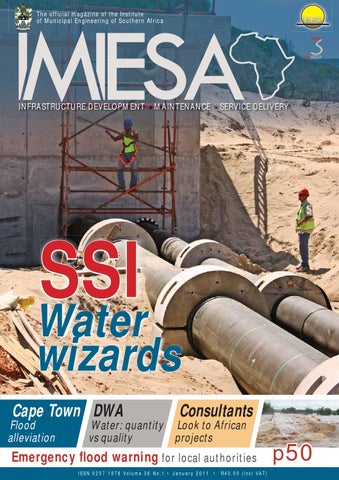
Sea water intake and brine outfall under construction at the new Mossel Bay 15 Mℓ/d desalination plant in the Western Cape. The new plant will augment existing surface water resources and indirect effluent re-use strategies, making the town and nearby PetroSA refinery more water sustainable and less susceptible to draught conditions. These interventions were designed and managed by SSI Engineers & Environmental Consultants. Photo credit: Marius van Coller, SSI George office.
Under pressure
42 Integrated urban transport 45 Connecting communities 48 Water master plan integration
INFRASTRUCTURE DEVELOPMENT • MAINTENANCE • SERVICE DELIVERY
SSI
Trenchless technology
opportunities
50 An urgent call to local authorities 56 Conceptual model for water quality
Opinion 59 The role of IT in good governance 61 Working efficiently enables productivity
62 Walking the talk
CMA Awards 65 Silencing the Gautrain
Trenchless technology
City of Cape Town
71 Manhole launched directional drill 73 International products for
25 Road rehab for link route 27 Loch Road switching
74 SASTT review 76 No water? No problem
28 33 34 36 38 40
station upgrade Cleaning up the Mother City Wemmershoek Nereda WWTW Lourens River flood alleviation Fisantekraal WWTW operational by May CoCT project reviews 5 655 housing units built at Bardale
local applications
Pipes, pumps and valves 78 80 81 83 84
Under pressure in eThekwini New standards for plastic piping Utility detection and mapping Global alliance for manufacturers Packaged pump stations IMIESA JANUARY 2011 - 1
AND BEYOND Goba, an independent and progressive South African consulting engineering practice, offers a range of multidisciplinary services, primarily for civil infrastructure development. As a member of CESA, Consulting Engineers South Africa, we take the lead in working closely with clients to create cost effective solutions and enable efficient investment in new quality assets. The persuit of excellence underlines our fundamental philosophy at Goba, with Executive Chairman Trueman Goba setting the tone for the executive team and dedicated staff members who contribute to this company’s ongoing success. Our track record speaks for itself, with numerous awards received over the years for technical and business excellence. Goba Consulting Engineers and Project Managers. Leading the way in developing South Africa’s infrastructure.
CREATING UNIQUE SOLUTIONS TOUCHING EVERYDAY LIVES
SOUTH AFRICA REGIONAL OFFICES
www.goba.co.za
Sunninghill +27 (0)11 236 3300 Bedfordview +27 (0)11 409 8800 Centurion +27 (0)12 679 9300 Port Elizabeth +27 (0)41 373 6552 Cape Town +27 (0)12 914 3600 East London +27 (0)43 721 0135 Durban +27 (0)31 583 3400
CONSULTING ENGINEERS AND PROJECT MANAGERS
COMMENTS PRESIDENT'S COMMENT
PUBLISHER Elizabeth Shorten EDITOR Richard Jansen van Vuuren CREATIVE DIRECTOR Frédérick Danton SENIOR DESIGNER Hayley Moore, Zane Janse Van Rensburg CHIEF SUB-EDITOR Lia Marus SUB-EDITOR Danielle Hugo CONTRIBUTORS Candice Landie (City of Cape Town feature), Debbie Besseling, Buyelwa Sonjica, Erica Gilbert, Xolisa Fumba, Chris Binnington, Robin Hayes, Andries Lotz PRODUCTION MANAGER Felicity Moon PRODUCTION COORDINATOR Jaqueline Modise FINANCIAL MANAGER Andrew Lobban (ACIS, FCIBM) ADMINISTRATION Tonya Hebenton SUBSCRIPTION SALES Cindy Cloete DISTRIBUTION COORDINATOR Asha Pursotham PRINTERS United Litho Johannesburg ___________________________________________________
Encouraged by expertise
T
O OUR READERS: welcome to the new year, one that is sure to be as challenging as 2010 was. May 2011 bring peace and prosperity for all of us. Without the eyes of the world on us, we now need to take a good, long look at ourselves. IMESA leads the way in terms of emphasising the message of infrastructure asset management and maintenance, which will be a driving factor in the world of municipal engineering in the months and years to come. IMESA and its eight technical directors will this year be addressing the significant challenges we face concerning skills development, housing, sanitation, the quality of drinking water, job creation and transportation. We will be holding a strategic meeting at the end of January to plan the way forward and as we have a vast pool of expertise within our institute, it is my intention to see this used optimally to benefit not only IMESA but the country at large. As mentioned in my previous president’s comment (November and December 2010 edition), 2011 marks IMESA’s jubilee year, and I Jannie Pietersen, am proud to announce that the celebrations will be on an interna- president of IMESA tional scale. Testament to this is that the International Federation of Municipal Engineering (IFME) will be holding its board meeting at our annual conference in October and we will be hosting a large contingent of our peers from several countries.
ADVERTISING SALES Jenny Miller Tel: +27 (0)11 467 6223 ___________________________________________________
PUBLISHER: MEDIA No. 4, 5th Avenue, Rivonia 2056 PO Box 92026, Norwood 2117 Tel: +27 (0)11 233 2600 Fax: +27 (0)11 234 7274/5 E-mail: richard@3smedia.co.za www.3smedia.co.za ANNUAL SUBSCRIPTION: R440.00 (INCL VAT) ISSN 0257 1978 IMIESA, Inst.MUNIC. ENG. S. AFR. © Copyright 2011. All rights reserved. ___________________________________________________ IMESA CONTACTS IMESA Administration Officer: Ingrid Botton P O Box 2190, Westville, 3630 Tel: +27 (0)31 266 3263 Fax: +27 (0)31 266 5094 Email: imesa@webstorm.co.za Website: www.imesa.org.za BORDER BRANCH Secretary: Melanie Matroos Tel: +27 (0)43 705 2401 Fax: +27 (0)43 743 5266 E-mail: melaniem@buffalocity.gov.za
EDITOR'S COMMENT
A year for introspection ahead
EAST CAPE BRANCH Elsabé Koen Tel: +27 (0)41 505 8005 Fax: +27 (0)41 581 2300 E-mail: elsabek@africoast.com
A
FTER A LANDMARK year in local history, the World Cup has come and gone, and 2010 is now a memory. The construction industry is still staggering in the aftermath of the preparations for the event and the few new infrastructure projects, both small and large, are being tightly contested by contractors. Through speaking to clients and readers, it can safely be said that this year is going to prove challenging. The decline in the number of new municipal projects is also very evident to us through IMIESA’s monthly focus on a metro feature. But this does not necessarily depict a year of doom and gloom. Many municipalities will be focusing on repair and maintenance of infrastructure – areas that have been sorely lacking in the recent past. Consultants and contractors have reworked their business strategies to adapt to the ‘business unusual’ climate in South Africa – and I believe in the coming year there will be a renewed focus on securing contracts on the rest of the continent. The hard lesson learnt by many in the industry since the turmoil of late 2008 and the resultant ripple effect is that of adaptation. This is an element embodied in all South Africans and the time to use this advantage to its full extent is now.
KWAZULU-NATAL BRANCH Secretary: Rita Zaayman Tel: +27(0)31 311 6382 NORTHERN PROVINCE BRANCH Secretary: Cornel Taljaard Tel: +27 (0)82 899 8341 Fax: +27 (0)11 675 1324 E-mail: cornel@rchc.co.za SOUTHERN CAPE KAROO BRANCH Secretary: Henrietta Oliver Tel: +27(0)79 390 7536 Fax: 086 536 3725 E-mail: imesa.southcape@gmail.com WESTERN CAPE BRANCH Secretary: Erica van Jaarsveld Tel: +27 (0)21 938 8455 Fax: +27 (0)21 938 8457 E-mail: erica.van_jaarsveld@capetown.gov.za FREE STATE AND NORTHERN CAPE BRANCH Secretary: Wilma Van Der Walt Tel: +27(0)83 457 4362 Fax: 086 628 0468 E-mail: imesa.fsnc@gmail.com REST OF SOUTHERN AFRICA Representative: Andre Muller E-mail: imesa@webstorm.co.za
All material herein IMIESA is copyright protected and may not be reproduced either in whole or in part without the prior written permission of the publisher. The views of contributors do not necessarily reflect those of the Institute of Municipal Engineering of Southern Africa or the publishers.
Richard Jansen van Vuuren, editor of IMIESA
IMESA
te of the Institu rn Africa l magaz ine The officia Engine ering of Southe of Munici pal
INFRA STRU
LOPM CTUR E DEVE
TENA ENT • MAIN
ERY ICE DELIV NCE • SERV
A DIA DIA MEDIA
The official magazine of the Institute of Municipal Engineering of Southern Africa
IMESA
MEDIA
INFRASTRUCTURE DEVELOPMENT • MAINTENANCE • SERVICE DELIVERY
In each issue, IMIESA offers advertisers the opportunity to get to the front of the line by placing a company, product or service on the front cover of the journal. Buying this position will afford the advertiser the cover story on pages 4 and 5 and maximum exposure. For more information on cover bookings contact Jenny Miller on tel: +27 (0)11 467 6223.
N AH IEHsca W ddiinngg ldi ffolld formwork & Water 2 5wizards p52
SSI
NMBM
Strategic projects
WORKERS
Have a right to strike
drainage Acid mine
POLLUTION
Water warning
facts? What are the / D e c e m b e r 2 0 1 0
Novembe No.11 • olume 35 7 1978 V ISSN 025
Cover opportunity
AT) 0 (incl V • R40.0
r
Cape Town DWA Flood alleviation
Consultants
Water: quantity Look to African vs quality projects
Emergency flood warning for local authorities ISSN 0257 1978 Volume 36 No.1 • January 2011 • R40.00 (incl VAT)
p50
IMIESA JANUARY 2011 - 3
COVER STORY
There is life beyond Drought in Africa is a fact of life regardless if one believes the theory of climate change. The Cape coastal belts are currently severely affected by the worst drought in 150 years.
T
OWNS AND CITIES generally rely on surface water capture or abstraction from reliable river resources, both of which could become severely stressed during drought conditions. Towns in this region – which rely heavily on tourism – face an additional dilemma in that their relatively small population swells dramatically during holiday seasons, placing increased demand on scarce water supplies. Conventional storage, treatment and conveyancing structures may meet peak demand for relatively short periods of time but, when coupled with severe drought conditions, water shortages and rationing occur – with a devastating effect on all aspects of the region’s economy. Increasing the capacity of conventional storage structures requires
4 - IMIESA JANUARY 2011
long-term planning and financing models that are often beyond the means of the average holiday town – bearing in mind that such infrastructure could take years to build when immediate relief is required. While acknowledging that increased surface water capture will eventually have to be provided to meet long-term development, SSI Engineers and Environmental Consultants (SSI) have developed an innovative, demandbased solution to solve the water supply crisis to these areas, which is both economical and takes weeks, rather than years, to implement. This intervention provides respite during which time larger and more conventional schemes can be planned and financed. The essence of SSI’s innovative approach is to make better use of what is available
and to supplement traditional, inexpensive supply sources with more expensive water on a sliding scale and as demand dictates. This provides the option for the facility to discontinue the more expensive alternative when demand drops. SSI’s approach has been accepted and implemented by several of the worst-affected towns in the region, i.e. by utilising a combination of surface water and groundwater, desalination and indirect water reuse strategies. Nelson Mandela Bay Municipality – 60 Mℓ/d membrane bioreactor industrial reuse The Nelson Mandela Bay Municipality (NMBM) is a growth point in South Africa, in particular at the Coega Industrial Development Zone
COVER STORY
our rivers
LEFT The Nereda Wastewater Treatment Works in Gansbaai, Western Cape ABOVE The seawater intake and brine outfall at the new Mossel Bay 15 Mℓ/d desalination plant
(IDZ). The growth of industries and subsequent population growth within the municipality has created an increased demand for treated water. The NMBM is also currently affected by severe drought conditions, which places tremendous stress on existing surface water resources. The NMBM and SSI are currently in the process of upgrading the existing Fishwater Flats Wastewater Treatment Works (WWTW) to a 170 Mℓ/d treatment capacity. Planning and design are underway to provide advanced treatment in the form of membrane bioreactors and reverse osmosis plants to supplement the existing water resources and provide the Coega IDZ and NMBM with sustainable industrial and potable water through indirect effluent reuse. It is proposed that the first phase of the water reuse scheme will produce 60 Mℓ/day of industrial and/or indirect potable reuse water with a second phase of similar magnitude to follow.
Sedgefield – 1.5 Mℓ/d desalination plant The town of Sedgefield has been particularly hard hit and actually ran out of water, causing authorities to truck in supplies from nearby George. The town relies on supplies from the Karatara and Hoogekraal rivers, supplemented by boreholes. SSI’s engineers optimised these resources and supplemented the supply with a 1.5 Mℓ/d desalination plant. SSI proposed the use of indirect effluent reuse from the Sedgefield WWTW by advanced treatment and disinfection of final effluent. Knysna – 2 Mℓ/d desalination plant A new 2 Mℓ/day desalination plant for Knysna provides, together with the boreholes, a base flow of potable water to sustain the town in drought conditions. The desalination plant has been constructed next to the wastewater treatment plant. A borehole field, situated next to the lagoon, provides saline feed water for the plant. The return brine effluent is mixed with the final effluent of the wastewater treatment plant, having a raised salinity level which has a positive impact on the lagoon.
George – 10 Mℓ/day indirect water reuse As the largest town on the Garden Route, George also faces water shortages and has decided on an indirect water reuse strategy where final effluent from its Outeniqua WWTW is treated to a very high quality through ultrafiltration and disinfection prior to being returned to the main storage facility, the Garden Route Dam, where it is combined with current raw water supplies. This initiative supplements the existing supply by an additional 10 Ml/d, which contributes approximately one third towards the current drinking water demand. Mossel Bay – 15 Mℓ/d industrial reuse SSI’s Mossel Bay initiative swops potable, treated water used in PetroSA’s Mossgas Refinery for a supply of treated final effluent in the industrial process, so saving valuable drinking quality water for residential demand. Planned to supply Mossgas with 15 Mℓ/d eventually, the first phase of 5 Mℓ/d draws final effluent from the Mossel Bay Regional WWTW through an advanced ultrafiltration
IMIESA JANUARY 2011 - 5
ABS Afri-Infra AJ Broom Arup SA Aurecon Bigen Group Africa BKS Consulting Engineers BVI Consulting Engineers CBI Consulting Engineers Civil & Blasting Solutions Concrete Manufacturers CSIR Built Environment Davies Lynn & Partners Development Bank of SA DPI Plastics EFG Engineers Elster Kent Metering EnviroServ Waste Management Geotechnologies Goba Hidrostal SA Huber Technology Hydro-comp Enterprises I@Consulting Iliso Consulting Infraset Jeffares and Green Johannesburg Water Kgatelopele Consulting
hennie.basson@absgroup.com afri-infra@mweb.co.za ajbroom@icon.co.za rob.lamb@arup.com Ian.VanWijk@af.aurecongroup.com kevin.barnett@bigenafrica.com davidm@bks.co.za cask@bvigp.co.za durban@cbisa.co.za jane@drillingandblasting.co.za cma@mweb.co.za LAustin@csir.co.za dlpdbn@dlp.co.za divb@dbsa.org.za mgoodchild@dpiplastics.co.za eric@efgeng.co.za keith.bailey@za.elster.com benoitl@millenniumwaste.co.za garry@geotechnologies.co.za trumang@goba.co.za hstal@mweb.co.za fstammer@lantic.net john@edams.co.za louis_icon@mics.co.za monde@iliso.com fmyburgh@infraset.com dennyc@jgi.co.za rtaljaard@jwater.co.za kgatelopele@wol.co.za
Knowledge Base KV3 Engineers Lektratek Water Makhaotse Narasimulu & Associates Maragela Consulting Engineers Much Asphalt Munitech Nyeleti Consulting Odour Engineering Systems Power Construction Pragma Africa Rocla SBS Water Systems Sektor Consulting Sight Lines Pipe Survery Services SNA Inc Siza Water Company SRK Consulting SSI Stemele Bosch Africa Syntell Thm Engineers East London TPA Consulting UWP Consulting Vela VKE WSP Group Africa WSSA WRP Zebra Surfacing
info@knowbase.co.za cbrandsen@kv3.co.za general@lwt.co.za mmakhaotse@mna-sa.co.za admin@maragelaconsulting.co.za john.onraet@murrob.com munitech@iafrica.com ppienaar@nyeleti.co.za mathewc@oes.co.za nbarnard@powergrp.co.za deang@pragma.co.za karen.devos@murrob.co.za irene@sbsgroup.co.za cradock@sektor.co.za sales@sightlines.co.za snapta@icon.co.za tionette.bates@sizawater.co.za jomar@srk.co.za francisg@ssi.co.za TurnerS@sbadbn.co.za julia@syntell.co.za thmel@mweb.co.za roger@tpa.co.za zulchl@uwp.co.za capetown@velavke.co.za dirk.hattingh@mbs-wsp.co.za nbinase@wssa.co.za ronniem@wrp.co.za andrew@zebrasurfacing.co.za
COVER STORY
and reverse osmosis treatment process. This treated final effluent is then pumped to the refinery’s raw water storage dam for use in the refining process. Mossel May – 15 Mℓ/day desalination plant To prevent possible water supply failure for both PetroSA and Mossel Bay, a new 15 Mℓ/d seawater desalination plant is under construction at the PetroSA fuel storage tanks in Mossel Bay. Plettenberg Bay – 2 Mℓ/d desalination plant Plettenberg Bay is currently commissioning a 2 Mℓ/d desalination plant, which has just produced its first potable water. The desalination plant will augment the current groundwater and surface water schemes. The new portfolio of water services will reduce the risk of supply failure.
Cape for the Overstrand Municipality, where it has exceeded expectations in terms of final effluent quality. SSI is the leading South African consultant in the fields of design and implementation of water reuse and desalination schemes for the supply of world-class potable and industrial water. SSI’s experienced teams provide clients with optimum emergency and long-term solutions to diversify and supplement their water resource portfolio to provide communities and businesses with sustainable and reliable sources of water for the future.
ABOVE LEFT The Knysna desalination plant ABOVE RIGHT An interior view of the Mossel Bay industrial water reuse plant featuring ultrafiltration and reverse osmosis technologies BELOW A schematic view of the Sedgefield desalination plant showing seawater intake (purple), brine outfall (red) and distribution (blue) networks
Contact details SSI Engineers and Environmental Consultants Tel: +27 (0)11 798 6000 E-mail: corporate@ssi.co.za Website: www.ssi-dhv.com
Innovative engineering Innovative engineering solutions rarely happen by accident. SSI and its Netherlandsbased parent company, the DHV group, have a combined worldwide experience of more than 180 years in all aspects of water and effluent treatment and engineering. SSI has been innovative in the water sector in Southern Africa since 1922. In addition to proven universal treatment methodologies, the DHV group has developed significant process technologies, including Carrousel, Oxyrator-Star, Nautilus Membrane Bioreactor and the groundbreaking Nereda® wastewater treatment process. The latter process has won international and local acclaim. The world’s first Nereda® demonstration production plant was commissioned recently by SSI in Gansbaai in the Western IMIESA offers advertisers an ideal platform to ensure maximum exposure of their brand. Companies are afforded the opportunity of publishing a two-page cover story and a cover picture to promote their products to an appropriate audience. Please call Jenny Miller on +27(0)11 467 6223 to secure your booking.
IMIESA JANUARY 2011 - 7
GOVERNMENT PERSPECTIVE
Quality versus quantity When discussing water resources, you cannot talk about water quantity without talking about water quality. There are significant challenges in water quality emanating particularly from the Vaal system. by minister of water and environmental affairs, Buyelawa Sonjica
U
NFORTUNATELY THE Northern Cape, being at the bottom of the river system, has been affected in terms of water quality. Much of this emanates from Gauteng and this emphasises just how important an integrated catchment management approach is: if you only look at one part of the catchment, another part will inevitably be neglected, or it will be affected by actions in other areas. The Northern Cape should look to keeping its own house in order with respect to aspects such as pollution from industry, mining, agriculture and the operation of municipal wastewater treatment works. It would also be a big oversight in the context of water resources in the Northern Cape not to mention groundwater, as this is the source on which a large part of the province is dependent, particularly in the rural areas. There is evidence of over-exploitation in some areas and enhanced regulation may be necessary in future to prevent this and ensure more sustainable use of the resource. Of course, selfregulation is always a preferable alternative. The Department of Water and Environmental Affairs seeks to raise the profile of water in South Africa, not for any personal prestige, but because of the need to be more efficient with the use of our precious water resources. There has to be a realisation of the many roles of water in society. Obviously, the most fundamental are for basic human survival requirements and environmental preservation. Higher-level needs come in the form of utilisation for agriculture, mining and industry and these create jobs and result in enhanced economic growth for the country, with all the positive spin-offs that this implies. One issue very close to my heart, because it affects both of my portfolios in water and the environment, is that of climate change. This is likely to have an effect on all of South Africa’s provinces, but it is anticipated that the
8 - IMIESA JANUARY 2011
Western Cape and Northern Cape could be the most severely affected. In particular, it is predicted that the Northern Cape will become hotter and drier in the decades to come. There has been much emphasis internationally on mitigation strategies, but when it comes to the water sector the focus will be more on adaptation, and this is something that the indaba will certainly need to deliberate on. In terms of adaptation strategies for the sector, increased emphasis on water conservation and demand management is virtually nonnegotiable. Unfortunately, non-revenue water is far too high in many municipalities and this aspect needs to be improved. Agriculture will need to continue to strive to use water more efficiently and the Working for Water Programme must continue its work and, if possible, be expanded. On the supply side, the desalination of sea water will certainly need to be considered in some areas and this option is currently being actively pursued at Port Nolloth. Another useful technology, particularly for domestic and garden use, is rainwater harvesting, and a project to address this has been undertaken in the Kareeberg Municipality. In almost all instances, water issues crosscut with other sectors, creating many interdependencies. However, at the same time, water resources are recognised as a national competence, which means that there is no political representation at the provincial level. One way of addressing this is through collaborative structures. There is a need for a political figurehead at the provincial level. This will provide an ideal linkage and partnership arrangement, not only with me but also with the department’s regional office. The ‘missing piece in the jigsaw’ is a member of executive council (MEC) that would take over the critical linkage and political leadership role for the water sector in the province. As is common with developing countries, we have found that the key challenges in water
ABOVE The minister of water and environmental affairs, Buyelawa Sonjica
services lie not necessarily in infrastructure delivery, but in sustainable operation afterwards in terms of asset management, with particular reference to operation and maintenance, effective revenue management, customer management and water loss mitigation. This also applies to the issue of ring fencing of water services, which must certainly be regarded as a best practice business-orientated approach and is a requirement of the Water Services Act. Moving on to water resources issues, it is certainly a paradox of sorts that as well as being the driest province in the country, the Northern Cape is home to long stretches of two of the biggest rivers in the country, namely the Orange and the Vaal. Many sections of these rivers could be described as very ‘hard working’ from a water resources perspective, with extensive storage dams in place, inter-basin transfers, pump storage schemes and wastewater being received from various sources. In spite of this, there is still surplus water available in the Orange River system in the Northern Cape, which has been earmarked primarily for the development of small-scale farmers and I would like to see this initiative accelerated, in cooperation with our partners in the agricultural sector. The development of small-scale farmers via irrigation is also an important component of water allocation reform (WAR), which seeks to address the imbalances of water allocation that have occurred historically.
passionate people lowest sustainable cost per ton professional process advice optimising your job site global reputation local market leader world class parts coverage unequaled mobile solutions sales coverage best in class lowest operating costs over the life of the machine long term customer relationships empowered and
integrity
Symbiotic. Chemistry. Sustainability.
reliability quality mobile solutions in depth expertise sales coverage global reputation lowest sustainable cost per ton Coming soon, to a professional process advice construction site near you. optimising your job site world class technical support local market leader world class parts coverage unequaled mobile solutions empowered and passionate people best in class long term customer relationships reliability quality mobile solutions uncompromising customer support
INDUSTRY PERSPECTIVE
Challenging conditions for consulting industry The results of the bi-annual CESA Economic and Capacity Survey indicated that conditions in the consulting engineering industry continued to be challenging.
T
HE GENERAL economy is recovering well after the sharp recession but despite the much-talked-about R846 billion to be spent over three years, capital expenditure is slowing down, with deliver y bottlenecks to execute microeconomic policies at the heart of the problem. Increased spending by government and state-owned enterprises suppor ted consulting engineering confidence during a time when the economy and the business sector showed considerable weakness, while project postponements and delays in project implementation affected confidence in the contracting fraternity. Civil-contracting confidence deteriorated from an average of 34.0 in the last six months of 2009 to 29 in the first half of 2010. Lack of funding and a review of capital expenditure plans have now also affected confidence in the consulting engineering industr y. Despite this, fee earnings in the first six months of 2010 were expected to decline by 2%, but earnings were better than expected and increased by 2.9%. The industr y is still grappling with lower revenues as fee earnings have fallen by 8% year on year in real terms (adjusted for inflation (CPI)). Order books for confirmed appointments have increased by 21% since the June 2009 sur vey, compared to a 29% decrease in the December 2008 sur vey. This means the gap between current income and order books is widening, translating into fewer prospects for future earnings. The contribution of GFCF to GDP averaged between 20% and 22% during the last five quarters, a marked improvement from an average of 17% in 2005. Over the last four years,
10 - IMIESA JANUARY 2011
there has been a substantial increase in fixed capital, necessar y to support longer term and sustainable economic growth, with the construction sector contributing 49% to GFCF. Confidence levels did not deteriorate as badly as expected in the first half of 2010. The level of optimism for working conditions in the first six months weakened to a level of 74.6 in the December 2009 sur vey, but actual working conditions were better than expected and confidence recovered to 87.1. The outlook for the next six months of 2010 is poorer conditions yet again, with confidence deteriorating to 71.9 but recovering quite strongly in the first half of 2011 to 93.6. The depressed outlook in the consulting engineering industr y will have a lagged impact on industr y turnover, affecting downstream opportunities for suppliers and contractors. Fee earnings outstanding from local government, for longer than 90 days, remained at above 16%, the highest level since the December 2004 sur vey when fees outstanding escalated to over 14%. Fees outstanding from provincial governments moderated to 14.7% (from 27% in the December 2009 sur vey). Payments from the private sector deteriorated to over 65% outstanding for longer than 90 days. The overall rate has skyrocketed to above 20%, from 18% in December 2009. This means the consulting industr y is hit twice as hard, on the one side, by a contraction in demand and on the other side, by a client tendency to withhold payments for work already completed. This has serious implications for the industr y already struggling with fewer work opportunities, lower margins
ABOVE Graham Pirie, chief executive of CESA
and increased competition. Competition in tendering has intensified. Industry challenges Lack of capacity within government not only threatens the future growth of the consulting engineering industr y, but also the economic growth potential of the South African economy, and with it, the future prospects of each and ever y South African citizen. Investment in critical scarce resources, such as water, is after all a non-negotiable, but continues to fail to be listed on the priority list of many departments. Lack of attention to maintaining infrastructure poses a serious problem to the industr y. Not only is it much more costly to build new infrastructure, but dilapidated infrastructure hampers economic growth potential. The cost of resur facing a road after seven years at current prices is estimated at R175 000/km, compared to R3 million/km to rebuild, less than 6% of the construction price. In many cases, infrastructure is left to deteriorate to such
INDUSTRY PERSPECTIVE
a state that maintenance becomes almost impossible. This simply translates to ineffective spending of the tax payer’s money. Human resources There was no real change in total employment since the June 2009 sur vey, which was up marginally by 0.2% year on year to an estimated 19 632. Black people represented between 43 and 45% of the total number of people employed. There was a significant change in firms looking to increase employment. The number of firms looking for engineers fell from 26.1% in the preceding sur vey to just 16.6%, the lowest rate since June 2000. Even though employment has slowed, there have not been any major retrenchments resulting in significant job losses. Tr ying to conform to BBBEE requirements means that demand for black engineers will continue to put pressure on firms as there are simply not enough black engineers available to fill those positions. There was a 16% increase in black Pr. Eng in the first six months of 2010 compared to the December 2009 sur vey, as well as a 41% increase in technical assistants. Training expenses, which include the costs directly associated with training as well as the cost of salaries but excluding the 1% CETA skills development levy, averaged 23.6%, compared to 17.4% in the June 2009 sur vey. Bursaries are important to improve productivity in the industr y as well as to secure employment opportunities. The industr y spent between 0.4 and 0.8% of the salar y and wage bill on bursaries. Capacity utilisation fell for the fourth consecutive sur vey, and is currently still below 90% (87.6%), the lowest rate since the June 2002 sur vey (80.9%). Economic sectors The transportation sector contributed the highest to fee earnings (37.6% in the June 2010 sur vey), followed by 22% earned in the commercial sector and 14.6% in water. In the first six months of 2010, compared with the second half of 2009, there was more focus on transportation and a small increase reported in mining and quarr ying. Earnings on water ser vices fell by a disappointing 30% compared with last year. Although the bulk of earnings are in the civil sector, earnings dropped 19% year on
year constant prices, but increased by 12% year on year in structural ser vices. There was an impressive 98% increase in earnings in the environmental sector in the last six months to an estimated R749 million. There was a notable increase in earnings across South African borders in the last 12 months. Local authorities accounted for 20% of earnings during June 2010, down 27% in December 2009. This is the biggest public sector client, while around 36% of earnings were generated in the private sector. The contribution of the private sector has weakened over the last 12 months, but showed a small improvement in the June 2010 sur vey. The role of central government continued to improve in the last six months, contributing 16.4% of fee earnings, up from 6.4% in
2008 framework to be comprehensive and internationally recognised. CETA CESA has also announced that it fully supports the minister of higher education and training in applying for the Construction SETA (CETA) to be placed under administration in full support of other established built environment professional bodies and employer organisations that include Master Builders South Africa (MBSA) and the South African Federation of Civil Engineering Contractors (SAFCEC). CESA’s support stems from the severe lack of service to the construction sector based on feedback from their member firms who are both CETA clients and contributors. “The needs of professional organisations representing business in the built environ-
The industry is concerned with the lack of capacity in local and provincial governments the first six months of 2009. There was a notable increase in the contribution by provincial departments, which increased from 9.9% (December 2009) to 13.9%. The role of parastatals stabilised at 12.7% in the last two sur veys. Given the high volumes earned in the local sector, the industr y is concerned with the lack of capacity in local and provincial governments. CESA estimates that the number of registered engineers employed in government fell from 5 100 in 2005 (ser ving 14 million people mostly in the homelands) to an estimated 1 800 ser ving a total population of 47 million. The number of professional engineers working in the public sector is projected to have declined to 10% from 40% in 2005. The image of the municipal engineer in the public sector has shifted from being a highly respected professional, with a long-term career, to no more than a five-year contract, making it difficult to obtain and retain qualified staff in the public sector. Quality management system Having a quality management system (QMS) in place is now compulsor y for all CESA members, who recognise the importance of good, efficient quality control. CESA recommends the ISO 9001:
ment have been totally neglected over the last 11 or so years, and we as an organisation are looking for a resolution to this untenable situation,” says Graham Pirie, CEO of CESA. CESA has been reliably informed that CETA has recently initiated a process for applying for an interdict against the minister for higher education and training to prevent the CETA from being placed under administration. This follows letters issued by the department in May 2010 to four SETAs, including CETA, regarding possible appointment of administrators to manage their affairs. CESA, together with other established built environment professional bodies and employer organisations, is on record supporting the appointment of an administrator and has assured the minister of higher education and training of their full cooperation and assistance in addressing the shortcomings at CETA. Despite the fact that CETA achieved an unqualified audit in 2010, the first in several years, many issues in connection with weak financial administration, poor learnership management and accreditation of training providers are evidence of ongoing management ineffectiveness, which is not conducive to the promotion of training in the construction industry.
IMIESA JANUARY 2011 - 11
&-+)2 *4 ±8330&3<²
±-X´W SYV WQEVXIV FYWMRIWW ETTVSEGL ²
WHERE CAN YOU FIND ALL THE TOOLS FOR MANAGING OUR NATION’S INFRASTRUCTURE ASSETS? 8\HSP[` PUMYHZ[Y\J[\YL ^PSS Z\Z[HPU ZLY]PJL KLSP]LY` HUK JYLH[L LJVUVTPJ NYV^[O HUK LTWSV`TLU[ MVY THU` `LHYZ [V JVTL PM P[ PZ ^LSS THUHNLK )PNLU (MYPJH VMMLYZ H JVTWSL[L [VVSIV_ VM ZLY]PJLZ HSPNULK ^P[O SLNPZSH[P]L KPYLJ[P]LZ JVUJLYUPUN JVZ[ LMMLJ[P]L PUMYHZ[Y\J[\YL HZZL[ THUHNLTLU[ 6\Y HWWYVHJO ILNPUZ ^P[O [OL ZLHTSLZZ PU[LNYH[PVU VM V\Y ¸ILZ[ WYHJ[PJL¹ LUNPULLYPUN HZZL[ ]HS\H[PVU HUK HZZL[ THUHNLTLU[ L_WLY[PZL >L OH]L H WYV]LU [YHJR YLJVYK MVY Z\JJLZZM\SS` WHY[ULYPUN ^P[O V\Y JSPLU[Z [V IL[[LY THUHNL V\Y UH[PVU»Z PUMYHZ[Y\J[\YL HZZL[Z TPUPTPZL SPML J`JSL JVZ[Z HUK TP[PNH[L YLWSHJLTLU[ YPZRZ ;OPZ PU [\YU MYLLZ \W JHWP[HS [V M\Y[OLY PU]LZ[ PU NYV^[O 0[»Z HU HWWYVHJO [OH[ RLLWZ VU ^VYRPUN 0[»Z V\Y ZTHY[LY I\ZPULZZ HWWYVHJO
*VU[HJ[ ^^^ IPNLUHMYPJH JVT VY [OL VMÄJL TVZ[ JVU]LUPLU[ [V `V\! 7YL[VYPH " 1VOHUULZI\YN " )SVLTMVU[LPU " *HWL ;V^U " ,HZ[ 3VUKVU " 2^Ha\S\ 5H[HS " 4HÄRLUN " 4W\THSHUNH " 7VSVR^HUL " 9\Z[LUI\YN
INFRASTRUCTURE REVIEW
The green revolution continues The term ‘going green’ has been bandied about loosely in the construction industry in recent times, with numerous producers claiming green credentials and products. IMIESA looks at two companies that are making a real impact on green technologies.
D
PI PLASTICS HAS stated that it has managed to save 38.78% in electricity demand within its factor y through the implementation of power factoring technology. “Eskom issued a warning of another potential power cut danger phase looming from the end of 2011, which prompted us to upgrade our manufacturing plant to save energy. We started the gradual process through a capital investment programme whereby we installed transistors capable RIGHT DPI product manager for mining and building, Allen Behrendt IMIESA JANUARY 2011 - 13
THE WATER TREATMENT SPECIALISTS
OUR EXPERIENCE FOR YOUR FUTURE Degrémont, a subsidiary of SUEZ Environnement, is the world specialist in water treatment plants and as such makes an important contribution towards sustainable development. Degrémont, South Africa can assist the client and propose various technologies depending on client requirements and site constraints. Its teams design, build and commission facilities for potable water production, desalination, wastewater treatment and sludge treatment. It can assist with the rebuilding and refurbishment of water treatment plants. Area of expertise Drinking water treatment Desalination Waste water Reuse Biosolids treatment Degrémont’s contacts : Mornay de Vos,
Business Development Manager,
George van der Merwe,
Technical Manager,
Tel: +27 (0) 11 807 1983 www.degremont.edx.co.za
mornay.de.vos@degremont.co.za george.van.der.merwe@degremont.co.za Fax: +27 (0) 11 807 4118 www.degremont.com
Services Design, Engineering studies Execution supervision Installation & Commissioning Plant operation Technical assessment Spare parts