The official magazine of the Institute of Municipal Engineering of Southern Africa
2012
WINNER Non-professional writer of the year HIGHLY COMMENDED Publishing Excellence
IMESA
INFRASTRUCTURE DEVELOPMENT • MAINTENANCE • SERVICE DELIVERY
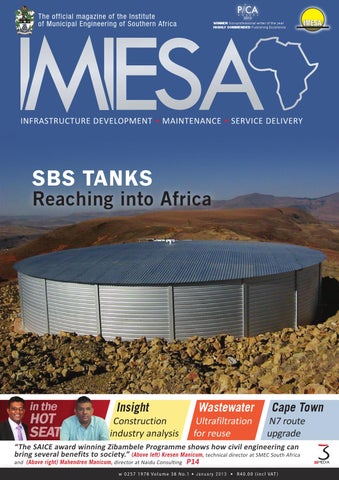
SBS TANKS
Reaching into Africa
in the
HOT SEAT
Insight
Construction industry analysis
Wastewater
Ultrafiltration for reuse
Cape Town
N7 route upgrade
“The SAICE award winning Zibambele Programme shows how civil engineering can bring several benefits to society.” (Above left) Kresen Manicum, technical director at SMEC South Africa and (Above right) Mahendren Manicum, director at Naidu Consulting P14 w 0 2 5 7 1 9 7 8 V o l u m e 3 8 N o . 1 • J a n u a r y 2 0 1 3 • R 4 0 . 0 0 ( i n c l VAT )
MEDIA
ÒEducation?Ó
ÒInfrastructure!Ó
Delivering sustainable infrastructure that improves our world. “DOING GOOD WHILE DOING BUSINESS”
Contact www.bigenafrica.com, or the office most convenient to you: Pretoria (012) 842 8700; Johannesburg (011) 802 0560; Bloemfontein (051) 430 1423; Cape Town (021) 919 6976; Durban (031) 717 2571; East London (043) 748 6230; Gabarone gaborone@bigenafrica.com; Kuruman (053) 712 2882; Mafikeng (018) 386 2111; Mthatha (047) 532 5234; Nelspruit (013) 755 1421; Polokwane (015) 297 4055; Richards Bay (035) 753 1235; Rustenburg (014) 597 3655; Umtata (047) 532 5216; Windhoek +26 461 237 346.
Contents
volume 38 no 1 january 2013
16 Ultrafiltration solution
09
42 Road rehabilitation
28 Automated process
Industr y introspection
Water and wastewater Ultrafiltration for water reuse Desalination plant upgrade
16 22
Concrete pumps for hydro projects
23 25 Water infrastructure advancement 27 Cutting costs through automation 28
IMESA Conference and Exhibition 2012
79
Products and services 84
C&CI information centre
The power of collective action
Awards CMA Awards 2012 SAICE Awards 2012
Cover Story SBS tanks are engineered and manufactured using proven technology and the highest quality materials available, delivering technically superior and competitively priced water storage tanks.
Municipal waste management Getting the job done
37 38 40
3 5
Editor’s comment President’s comment
Multiple contracts for consulting firm
42
Unique challenges for N7 upgrade
44
Nozzle check valve for water pipelines
Cover article SBS Water Systems reaches into Africa
6
Looking ahead to another year of business ‘unusual’
hot seat
9
Ignacio Peña and Vishal Poona Structa Technology
48
61
WamTechnology
63
Christian Mahncke
71 75 77
TT Innovations
78
65
Justin Spreckley Sizabantu Piping Systems
Hydrodifusion Shawn Pretorius
“The SAICE award winning Zibambele Programme shows how civil engineering can bring several benefits to society.” (Far left) Kresen Manicum, technical director, SMEC South Africa and (left) Mahendren Manicum, director, Naidu Consulting
57 59
Hercules Rossouw
Sean Harmse Infrastructure asset management FAQs
53 55
Peter Ker-Fox
Nico van Schalkwyk
IMESA
Insight
in the
Screw pump now available
Marley Pipe Systems
Watson Marlow
Pipes, pumps and valves A global perspective on pipes
Heinrich Jansen van Vuren
51
JOAT Group
Technology Regulars
Frontier Pipeline Solutions Deon Botes Aquatan
City of Cape Town
Brick maker receives green award
49
Preserving our water supply
31 34
Solid waste Combining integrity with engineering
Panel discussion
67 69
14 IMIESA January 2013
1
Clear Air and Clean Streets
The
C201 – Refreshingly Clear
When sweeping with the C201 Compact, Johnston’s “Water Curtain” technology traps small dust particles (PM10 and PM2.5) helping air quality by preventing their airborne release into the environment. Link air quality to the reduced fuel consumption of the C201 in work mode – up to 40% less fuel than other sweepers in its class – plus Eco Mode fitted as standard for in-transit fuel savings, and the Johnston C201 Compact is one of the cleanest sweepers available. Finally with an annual reduction of CO2 to 16 tonnes, the Johnston C201 is an environmental winner.
Contacts us on +27 (0)21 948 4746 email info@transtech.co.za
www.transtech.co.za
Surprisingly affordable, totally dependable
The VT650 The VT Range of truck mounted sweepers is now established as the most durable and dependable road sweeper ever produced by Johnston, a fact supported by our sweepers maintaining the highest residual value. With more than 50 years of engineering expertise and design the VT Range leads the way, offering you years of outstanding performance.
www.transtech.co.za
You can choose your VT Range options from our selection of Customer Packs and save even more time, cost and labour. Ask about our Contractor’s Pack, the Productivity Pack or our Eco Pack and you can be confident that whatever you specify, the VT Range from Johnston will provide you with the best solution in an ever demanding market.
Contacts us on +27 (0)21 948 4746 email info@transtech.co.za
editor's comment
The ideal way to begin a year
Publisher Elizabeth Shorten editor Richard Jansen van Vuuren Head of design Frédérick Danton SENIOR DESIGNER Hayley Mendelow Chief SUB-EDITOR Claire Nozaïc SUB-EDITOR Patience Gumbo ContributorS Yanna Erasmus, Candice Landie, Roger Byrne, Nick Rowse, Chris von Holdt Production MANAGEr Antois-Leigh Botma Production coordinator Jaqueline Modise financial manager Andrew Lobban (ACIS, FCIBM) MARKETING AND ONLINE MANAGER Martin Hiller Administration Tonya Hebenton DISTRIBUTION MANAGER Nomsa Masina Distribution coordinator Asha Pursotham SUBSCRIPTIONS subs@3smedia.co.za Printers United Litho Johannesburg +27 (0)11 402 0571 ___________________________________________________
Ever y year features several industr y award events where excellence is acknowledged across all the engineering and construction categories we feature in IMIESA. The publishing industr y held its premier awards ceremony in November and I have good news to share!
Advertising Sales Jenny Miller Tel: +27 (0)11 467 6223 ___________________________________________________
T
he PICA Awards are the premier awards ceremony in the printing and publishing industr y and in 2012 IMIESA won a coveted PICA Award in the Editorial Excellence – Business-toBusiness: Non-professional Writer of the Year categor y. The author of the article submitted in this categor y was Stewart Gibson from Stewart Gibson & Associates. Gibson’s article, titled Ser vice deliver y solutions for water solutions – learning from private business, highlights how experienced staff, planning, budgeting and collection of income enable efficient and effective water deliver y at municipal level. This is the second consecutive year IMIESA has won this particular PICA award, which is testament to the fact that our industr y expert contributions for the title are of the highest standard. The magazine also received a Highly Commended Cer tificate in the Business to Business Publishing Excellence – Construction, engineering and related industries categor y at the same awards ceremony. In recognition of the role that the media plays in the industr y, 3S Media, publisher of IMIESA received recognition for Publisher of the Year: Trade Publications at the CESA Aon Engineering Excellence Awards 2012. The fact that 3S Media won this award is an acknowledgement of the high-quality information it provides through its magazines and other platforms to the infrastructure sector. 3S Media showcases various projects with
Publisher: media No. 4, 5th Avenue, Rivonia 2056 PO Box 92026, Norwood 2117 Tel: +27 (0)11 233 2600 Fax: +27 (0)11 234 7274/5 E-mail: richard@3smedia.co.za www.3smedia.co.za Annual subscription: R480.00 (INCL VAT) ISSN 0257 1978 IMIESA, Inst.MUNIC. ENG. S. AFR. © Copyright 2013. All rights reserved. ___________________________________________________ IMESA contacts IMESA Administration Officer: Ingrid Botton P O Box 2190, Westville, 3630 Tel: +27 (0)31 266 3263 Fax: +27 (0)31 266 5094 Email: imesa@webstorm.co.za Website: www.imesa.org.za BORDER BRANCH Secretary: Melanie Matroos Tel: +27 (0)43 705 2401 Fax: +27 (0)43 743 5266 E-mail: melaniem@buffalocity.gov.za EAST CAPE BRANCH Elsabé Koen Tel: +27 (0)41 505 8005 Fax: +27 (0)41 581 2300 E-mail: elsabek@africoast.com KWAZULU-NATAL BRANCH Secretary: Rita Zaayman Tel: +27(0)31 311 6382 NORTHERN PROVINCE BRANCH Secretary: Cornel Taljaard Tel: +27 (0)82 899 8341 Fax: +27 (0)11 675 1324 E-mail: cornel@rchc.co.za SOUTHERN CAPE KAROO BRANCH Secretary: Henrietta Oliver Tel: +27(0)79 390 7536 Fax: 086 536 3725 E-mail: imesa.southcape@gmail.com WESTERN CAPE BRANCH Secretary: Erica van Jaarsveld Tel: +27 (0)21 938 8455 Fax: +27 (0)21 938 8457 E-mail: erica.van_jaarsveld@capetown.gov.za FREE STATE AND NORTHERN CAPE BRANCH Secretary: Wilma Van Der Walt Tel: +27(0)83 457 4362 Fax: 086 628 0468 E-mail: imesa.fsnc@gmail.com REST OF SOUTHERN AFRICA Representative: Andre Muller E-mail: imesa@webstorm.co.za
All material herein IMIESA is copyright protected and may not be reproduced either in whole or in part without the prior written permission of the publisher. The views of contributors do not necessarily reflect those of the Institute of Municipal Engineering of Southern Africa or the publishers.
Instit ute Africa ern zine of the al maga eerin g of South The offici cipal Engin of Muni
INFR AST
RUC TUR
E DEV ELO
• MAI PME NT
NTE NAN
CE • SERV
H a s ko n
in the
HOT SEAT
IMESA CES
Cover opportunity
IMESA
PICA the year of the 2011 Winner l writer of fessiona Non-pro
IVER ICE DEL
A
Planning re the futu
perseveran olyn Mahuma, passion, Gwend “For me their mind to” 1 • 7 No.1 ume 3 one puts 7 8 Vo l 257 19
Novem
ber/De
IMIESA January 2013
AMD
SAGI
Debate debacle
Tracking growth
ing ving anyth to achie are key l Star Steel (Pty) Ltd integrity ) work and ive director of Capita ( i n c l VAT ce, hard execut R40.00
ISSN 0
In each issue, IMIESA offers advertisers the opportunity to get to the front of the line by placing a company, product or service on the front cover of the journal. Buying this position will afford the advertiser the cover story on pages and maximum exposure. For more information on cover bookings contact Jenny Miller on tel: +27 (0)11 467 6223.
Y
Roya l in g D H V
Excellence 2 201 Awards
cembe
r 2012
which CESA members are involved in and thus aids the organisation in its goals. If our business communities are properly informed about government policy and legislation, business intelligence, best practice, technological advances and skills training, they will be empowered to grow their businesses, create jobs, alleviate poverty and contribute to South Africa’s GDP. It is 3S Media’s promise to empower industr y role players by providing critical information to key economic sectors. With this great news in mind, I’d like to welcome all our readers to 2013 – a year in which so much can change to turn around the deliver y of infrastructure construction and maintenance. Let’s hope this is indeed the case! Receiving the prestigious PICA Award for Editorial Excellence – Business-to-Business: Non-professional Writer of the Year category
•
MEDIA
3
IMESA 2013
CONFERENCE
nelson mandela bay PORT ELIZABETH
23 - 25 OCTOBER 2013 Theme: Municipal Engineering – Meeting Peoples’ Needs EARN 2.5 CPD POINTS BY ATTENDING Included in conference fee: •
Opening Cocktail Function with Presidential Address
•
3 Day Conference with local and international experts
•
Techncial Tour
•
Access to 80 industry suppliers at their exhibition stands
•
Gala Function: the best networking opportunity
Additional fees for: • Golf Day at Humewood before Conference opens • Companion to join at social functions or to participate in 3 Day Companion Tour For information: Tel: 031 2663263 Email: conference@imesa.org.za
President’s comment
Municipal engineers
Highlight your talents and achievements There is much for municipal engineers to brag about, but either we lack the skill to market ourselves or we are all simply too busy ensuring everyone has essential services.
D
uring a recent trip to New Zealand to attend the board meeting of the International Federation of Municipal Engineering, I was required to spend a fair amount of time at OR Tambo International Airport as well as at Sydney, Auckland and Brisbane’s airports. It was interesting to observe the power of good advertising and cleverly designed billboards that proclaimed the previous/ future success of numerous products such as the latest headphones available or (sadly the late) Stephen Covey’s Book The 8th Habit. In my own case, after being subjected to the extreme marketing on board Air New Zealand flights, I have decided that The Hobbit: An Unexpected Journey will be a must-see when it is released in the near future. Sadly, while there is much for municipal engineers (I obviously include technologists, technicians, consultants and contractors) to brag about, we seem to either lack the skill to market ourselves or we are all simply too busy getting the job done. We have so many amazing projects being carried out throughout the country and I use the list of IMESA/CESA Excellence Award winning projects announced at IMESA’s George Conference to illustrate my point:
•R oads and Stormwater – the Sandile Thusi (Argyle) Road Stormwater Sea Outfall in Durban
Refurbishment Programme Cape town • Environmental – the Meulwater Treatment Works in Paarl.
We have so many amazing projects being carried out throughout the country •W ater and Wastewater – the Mossel Bay 15 Mℓ/d desalination plant • Structures and Buildings – the Mvoti River Pipe Bridge • Community Uplilftment – the Community Residential Unit
Many projects that improve the lives of communities in smaller local authorities are being undertaken continually, but little is known about them beyond the boundaries of the districts concerned. For example, at a recent
meeting of IMESA’s KwaZuluNatal branch – where we usually invite 12 area representatives to briefly share information about Roads and municipal Stormwater projects The Sandile taking place Thusi (Argyle) Road Stormwater within their Sea Outfall areas –Sbu in Durban Mjwara reported on activities within the uMgungundlovu District Municipality as follows: • various water projects in Mkhambathini, Impendle and Richmond local municipalities • sanitation projects in uMshwathi, uMngeni and Muden • a new road in the Msunduzi Local Municipality • a solid waste project in Mpofana. In conclusion, I would strongly encourage you to use this wealth of information on your many municipal projects with which you are involved and submit articles to journals such as IMIESA magazine. The public, politicians and councillors need to be exposed to the value of the municipal technical staff as much as possible. It is with this goal in mind that IMESA is endeavouring to work closely with the South African Local Government Association (SALGA) and Municipal Information Systems Agency (MISA) to help reach this goal.
IMIESA January 2013
5
cover story
sbs tanks
Reaching into Africa SBS Tanks are engineered and manufactured using proven technology and the highest quality materials available, delivering technically superior and competitively priced water storage tanks.
N
ot only are the company’s reser voirs aesthetically pleasing, but each design also complies with the highest standards to withstand a range of extreme conditions. In the interests of corrosion protection, the wall panels and roof sheets of SBS’s reservoirs are made from steel that is hot dipped and coated with a molten alloy commonly referred to by its trade name, Zincalume. In some installations, sacrificial magnesium anodes are applied, further inhibiting corrosion. An accredited liner (AS/NZS 4020:2005 Testing of products for use in contact with drinking water) prevents water coming into contact with the wall panels. With the SBS Tank capabilities ranging from 12 kℓ to 3.3 Mℓ, reser voirs are versatile with a range of standard and special fittings available to meet any engineering or industr y requirement. Established in 1998 and based in South Africa, SBS Water Systems (Pty) Ltd. is a Proudly South African, Level 2 BBBEE business specialising in bulk water storage. It is led by the three original shareholders
6
IMIESA January 2013
operating from its head office in Pinetown, KwaZulu-Natal, and has a regional office in Gauteng and competent distributors throughout South Africa and internationally. With dedicated and efficient staff, SBS is well positioned to maximise its contribution to the prefabricated water storage industr y. SBS is run on sound business principals with high level of customer focus and ongoing research
ABOVE The Gengeshe site was tough to access due to rough terrain below An installation team at the Ncorah Dam site insert The completed storage tank
and development. The company is big enough to deliver, yet small enough to care. Using advanced design facilities and in collaboration with the leading structural
cover story
ABOVE Internal view of the SBS Potable Liner, ladder, float value and overflow bellmouth ABOVE The Letsemeng project provided urgent water storage for a nearby community
engineers within South Africa, SBS has designed reser voirs suitable for the harsh South African climatic conditions and for export into Africa, which makes its products accepted worldwide. Over 600 successful SBS installations have been completed in Angola, Botswana, the Democratic Republic of the Congo, Equatorial Guinea, Ghana, Lesotho, Malawi, Mozambique, Namibia, the Seychelles, Zambia and many other African countries. All of SBS’s products, services and systems boast the Proudly South African accreditation. “This is a great accomplishment for our company and staff. We are proud to be part of this campaign and encourage ever y company, small or big, within South Africa to participate,” states Delayne Gray, SBS MD.
in its own vehicles. There is no site that the company has not been unable to reach as yet! Installation time can take anything between 1 to 17 working days, depending on the size of the tank.
Recent Projects • L etsemeng project The Department of Water Affairs and the Letsemeng District Municipality approached SBS to quote on a 2 010 kℓ tank to provide an urgent water storage solution for the community. The south-western Free State community was in urgent need of water supply as their current stock had run shor t and the community was without water. During installation, the Letsemeng community were accommodating to the SBS staff and were thankful once the project was completed. The project was completed in 12 days. “I want to thank you for the wonderful cooperation that you have granted us during the time of the installation and being able, under challenging circumstances, to complete the installation within the allocated time and budget.” Testimonial received from IE Poöe, Letsemeng municipal manager. In addition to the competition of this project, SBS donated a candle making machine to the Bolokanang Luncheon Club for the Aged and Disabled. This candle making machine enables the members of the club to produce candles, with which they will be able to generate an income and support themselves with. “Thank you most heartily for your thoughtfulness, your kindness and your professionalism.” Testimonial received from IE Poöe, Letsemeng municipal manager.
SBS has designed reservoirs suitable for the harsh South African climatic conditions and for export into Africa
Market sectors and applications SBS tanks have been used successfully in the following market sectors: • mining industr y • fire protection • commercial • food and beverage industr y • municipal and community water supply. Applications include: • emergency water supply • water treatment plants • bulk water storage • potable water storage • community water supply schemes.
Installations Many installations take place in areas that are hard to reach or do not have accessible tar roads. Depending on the distance, SBS will transport all materials to the required site
•U gu project The Ugu District Municipality in Umzumbe required a two ring tank with the capacity of 152 kℓ. This tank was installed in five days and is used to store potable water for the Umzumbe community. “The existing backlog in terms of water and sanitation within Umzumbe requires urgent intervention that will speed up the service delivery of water and sanitation.” Quote from the Umzumbe Municipality website. The SBS tank that has been installed in the district will provide clean, safe and drinkable water for the community. It was a reliable, fast and economical solution for water storage in the community. • Ncorah Dam project The Ncorah Dam is situated in the Eastern Cape. Two tanks of 38 and 50 kℓ respectively were installed. Installation was completed within four days and the tanks are used in different areas for the community to store potable water. • Ntibane project The project was engineered by Toyi and Associates for the Alfred Nzo District Municipality in the Eastern Cape. The client required a 62 kℓ tank to store potable water for the Ntibane community. The SBS installation team only took two days to complete the installation. • Gengeshe This 50 kℓ tank was ordered by the uMgungundlovu District Municipality. The site for the installation was tough to get to as there was rough terrain, but the SBS bakkies managed to get to the site safely and install the tank within two days. The tank is being used as a water storage solution within this district to provide potable water to the community.
IMIESA offers advertisers an ideal platform to ensure maximum exposure of their brand. Companies are afforded the opportunity of publishing a two-page cover story and a cover picture to promote their products to an appropriate audience. Please call Jenny Miller on +27 (0)11 467 6223 to secure your booking.
SBS Tanks Tel +27 (0)31 716 1820 Sharecall +27 (0)86 048 2657 info@sbstanks.co.za www.sbstanks.co.za
IMIESA January 2013
7
I M E S A A F F I L I AT E M E M B E R S
IMESA
Afri-Infra afri-infra@mweb.co.za AJ Broom Road Products ajbroom@icon.co.za Arup SA rob.lamb@arup.com Aurecon Danie.Wium@aurecongroup.com AECOM Siyanda.Ngebulana@aecomm.com Bigen Africa Group Holdings otto.scharfetter@bigenafrica.com BMK Consulting brian@bmkconsulting.co.za Bosch Stemele bsdbn@boschstemele.co.za Bosch Munitech info@boschmunitech.co.za BVI Consulting Engineers marketing@bviho.co.za CBI Consulting Engineers durban@cbisa.co.za Civilconsult Consulting Engineers mail@civilconsult.co.za Civil & Blasting Solutions jane@drillingandblasting.co.za Concrete Manufacturers cma@mweb.co.za Corrosion Institute of Southern Africa secretary@corrosioninstitute.org.za CSIR Built Environment LAustin@csir.co.za Davies Lynn & Partners dlpdbn@dlp.co.za Development Bank of SA divb@dbsa.org.za DPI Plastics mgoodchild@dpiplastics.co.za EFG Engineers eric@efgeng.co.za Elster Kent Metering keith.bailey@za.elster.com EnviroServ Waste Management benoitl@millenniumwaste.co.za Geotechnologies garry@geotechnologies.co.za GIBB yvanrooyen@gibb.co.za GLS Consulting nicky@gls.co.za Goba trumang@goba.co.za Hidrostal SA hstal@mweb.co.za Huber Technology fstammer@lantic.net Hydro-comp Enterprises dan@edams.co.za I@Consulting louis_icon@mics.co.za Iliso Consulting monde@iliso.com Infraset fmyburgh@infraset.com Jeffares and Green dennyc@jgi.co.za Johannesburg Water rtaljaard@jwater.co.za Kgatelopele Consulting kgatelopele@wol.co.za Knowledge Base info@knowbase.co.za
Lektratek Water Makhaotse Narasimulu & Associates Maragela Consulting Engineers Much Asphalt Nyeleti Consulting Odour Engineering Systems
general@lwt.co.za mmakhaotse@mna-sa.co.za admin@maragelaconsulting.co.za john.onraet@murrob.com ppienaar@nyeleti.co.za mathewc@oes.co.za
PD Naidoo & Associates Consulting Engineers Johannesburg@pdna.co.za Power Construction
nbarnard@powergrp.co.za
Pumptron
info@pumptron.co.za
Pragma Africa
deang@pragma.co.za
Rocla Royal HaskoningDHV SBS Water Systems
karen.devos@murrob.co.za francisg@rhdv.com irene@sbsgroup.co.za
Sektor Consulting
cradock@sektor.co.za
Sight Lines
sales@sightlines.co.za
SiVEST SA SNA Inc Siza Water Company SMEC
garths@sivest.co.za snapta@icon.co.za tionette.bates@sizawater.co.za capetown@smec.com
Southern African Society for Trenchless Technology director@sasst.org.za SRK Consulting Sulzer Pumps Wastewater Syntell Thm Engineers East London
jomar@srk.co.za Sonja.Hattingh@sulzer.com julia@syntell.co.za thmel@mweb.co.za
TPA Consulting
roger@tpa.co.za
UWP Consulting
zulchl@uwp.co.za
WorleyParsons WSP Group Africa
chris.brandsen@WorleyParsons.com dirk.hattingh@mbs-wsp.co.za
WSSA
nbinase@wssa.co.za
WRP
ronniem@wrp.co.za
Zebra Surfacing
andrew@zebrasurfacing.co.za
insight
The year ahead
Business unusual as usual Role players within the sphere of infrastructure deliver y and construction should expect the parameters in which they have operated over the past three years to remain as cer tain as death and taxes during 2013, writes Richard Jansen van Vuuren.
T
he good news about this is that no one in the private sector is going to be surprised outside of their planned strategies and that those employed in the public sector can expect to continue to strive in their efforts addressing backlog and maintenance on a shoestring budget. This must be hugely frustrating, especially knowing that the hundreds of billions of rand available from government remain bound in the bonds of bureaucracy. But what exactly are the challenges within the infrastructure delivery and construction chain that are to be met this year if significant progress is to be made?
Starting at the top The Department of Per formance, Monitoring and Evaluation, which falls under the Presidency, exists to assist the executive to monitor and evaluate itself. It has put in several monitoring and evaluation processes since its inception in 2010. Despite this, it has been criticised for failing to ensure that ministers and departments per form to their expectations. The department has also been criticised for not properly communicating government`s ser vice deliver y record and successes. Unfortunately, the issue of accountability remains a thorn in the department’s side as it does not have a mandate to sanction ministers and departments, and is limited to identifying areas in which government programmes are working or failing.
The presidential infrastructure coordinating commission was launched in 2012 following the president’s State of the Nation address, in which it was punted as the new big idea for the economy. Several strategic integrated projects (SIPs) were identified, of which a large proportion per tain to issues such as housing, sanitation, deliver y of water and road construction. The Minister of Economic Development, Ebrahim Patel, aims to create five million jobs by 2020. When the Depar tment of Housing was renamed as the Depar tment of Human Settlements, it empowered the department responsible for not only the construction of housing units but the bigger picture surrounding housing: integrated settlements with adequate power and sanitation. Unfortunately, the department has not indicated a significant interest in working with minfrom top The delivery of potable isters whose portwater remains a folios deal with challenge water, electricity, Tokyo Sexwale, sanitation and the minister of Human Settlements identification of The provision of land. A lack of policy direction and government housing now includes legal uncer tainty the provision of has been labelled associated utilities
as the cause of this failure. Unbelievably, there is no legislative framework to address this status quo, which is staggeringly incredible for a department that is already four years old. The minister of Human Settlements, Tokyo Sexwale, spent much of 2012 honing ambitious plans for the establishment of a state housing construction company and state housing bank – which remain pipe dreams for the time being. In his defence, it would be remiss not to acknowledge Sexwale’s dealing with the long-standing problem of the M2 Gateway housing problem by relocating 10 000 shack dwellers to housing units. His
IMIESA January 2013
9
insight
department has also recognised that in some cases it cannot just remove people from shacks and informal settlements as it has pledged to provide them with water, sanitation and electricity through the national upgrade support programme. The minister of Cooperative Governance and Traditional Affairs, Richard Baloyi, has been widely criticised for delays in finalising regulations and policy, which have stalled the implementation of two critical changes from taking place at a local government level. These are: • b locking political par ty office bearers from running municipalities • demanding minimum standards of training and experience of those who manage local governments. While it may be naïve to assume
10
IMIESA January 2013
above Richard Baloyi, minister of the Department of Cooperative Governance and Traditional Affairs below Malusi Gigaba, minister of the Department of Public Enterprises
that these changes would fix the shambles at local government level, there would be an ideal starting point from which to address the current challenges that have evolved into medium- and long-term problems. Ever y day that passes without these changes being implemented impacts the state of the countr y’s infrastructure outlook well into the future. This gloomy atmosphere is highlighted by the unfortunate fact that municipalities continue to decline – the measurable being the number of ser vice deliver y protests around the countr y. On a much more positive note, the largest state-owned enterprises and those most integral to the government`s infrastructure ambitions, such as Transnet and Eskom, are
actually running relatively well when compared to recent histor y. The Department of Public Enterprises, with Malusi Gigaba at the helm, is establishing a unit to oversee large capital expenditure projects run by the state-owned enterprises and provide additional oversight. This is largely a reaction to the shambles linked to Transnet’s new multi-product pipeline and follows a ministerial review that found many “systemic failings” in the project. Gigaba is a firm believer in using the entities to lead state development. He has been actively involved in the presidential infrastructure coordinating committee that is streamlining the planning of government projects. Last year, the Department of Water Affairs finally embraced the idea that South Africa is facing a severe water crisis and has proposed public-private partnerships to bridge the more than R500 million funding deficit required to address this. The minister of the depar tment, Edna Molewa, endures the frustration of keeping on top of this situation while being constantly
insight
aware that even if she achieves the almost impossible task, she will have to find a way to force local government to take up the slack and start spending some of its budget on infrastructure. Ultimately, she is responsible for ensuring water gets to where it needs to be, but municipalities have to deliver it to the communities they serve. When Thulas Nxesi inherited the Department of Public Works, the Special Investigating Unit had just revealed depressing levels of graft within it and the auditor general had handed the department an audit disclaimer. The department was in a dire state. Nxesi stated at the time of his appointment that in seven years there had been nine different directors general and acting directors general and five different ministers in the department. Despite this tainted past, Nxesi has made a credible start at cleaning up the mess. The first steps he took involved him publicly acknowledging the problems: poor management
above Kusile Power Station under construction left Edna Molewa, minister of the Department of Water Affairs right An urban water pipeline being installed below left Thulas Nxesi, minister of the Department of Public Works below Road construction provides many employment opportunities
and weak controls were fuelling corruption, 35 000 properties were unaccounted for and 3 000 poorly managed and expensive leases were draining public money. He also instituted a “turnaround strategy”, which included a core team reporting
IMIESA January 2013
11
insight
to the director general’s office to address issues and how to fix the department’s deep faults without interrupting services.
What it all means In his 2012 presidential address, Jannie Pietersen outlined that Trevor Manuel, head of the National Planning Commission, and President Jacob Zuma had both called on South Africans to offer their effor ts, time and skills as individuals and citizens of the countr y to realise that in order to solve our problems, we need to do things differently. “It is always tempting to believe that throwing money at a problem will solve it. The implication for municipal engineers in South Africa is that we need to change from being ‘engineers with technical skills’ to becoming ‘engineers for change’. As municipal engineers we have the privilege of being able to improve the lives and well-being of all South Africans, particularly the most vulnerable in society: the poorest of the poor and the children – our citizens of tomorrow,” stated Pietersen. “IMESA has an important leadership role to play. We can contribute towards positive change in South Africa by changing our own mindset from one of ‘we are engineers’ to a more significant ‘we are mentors who support municipalities in engineering their own change’. In sharing knowledge we improve skills. In improving skills we enhance the running of our municipalities. In developing the capacity and effectiveness of one municipality at a time, we can transform the lives of many,” maintains Pietersen.
above A stormwater outlet under construction in eThekwini left Jannie Pietersen, former IMESA president below left Thulas Nxesi, minister of the Department of Public Works below South Africa needs to develop new infrastructure as well as create employment opportunities within the construction sector
Speaking at the IMESA Conference 2012, Naren Bhojaram, the then president of Consulting Engineers South Africa, outlined how municipal engineers need to re-establish their profession within the challenging confines of the current sector. Bhojaram outlined the evolution of the municipal engineering fraternity as being strongly influenced by the training of engineers over the past five decades: • 1970s and 1980s: municipalities and parastatals were the best training grounds for young engineers
• 1990s: experienced municipal engineers moved to the private sector and municipalities lost their credibility • 2000s: the private sector continued to train young engineers • 2010s: Price-based competition has resulted in the private sector reducing training and various interventions for training and development of capacity within local authorities failing. Training of young engineers has become non-existent and the profession itself now an unattractive option for learners. All of the points are further compounded by the current circumstances in provincial and municipal planning where integrated development plans hinder actual progress as they are often political wish lists. With the rapid urbanisation of South Africa’s cities expected to continue, Bhojaram posed the question: “Why are we building infrastructure that will last 50 years in rural areas?” Densification of urban areas incorporating integrated solutions should be explored, as should the continued maintenance and expansion of existing urban infrastructure – and these solutions will call for a new generation of experienced municipal engineers devoid of ‘political affiliation’.
IMIESA January 2013
13
hot seat
Saice Award 2012 • Winner • Outstanding Civil Engineering Project: Community Based Projects
Zibambele Poverty Alleviation Programme
The broader aspects of engineered solutions The Zibambele Programme shows how civil engineering can bring several benefits to society, in particular job creation, skills development, capacity building and the alleviation of poverty through the provision of appropriate road maintenance activities.
T
he programme, which provides cost-effective and labour-intensive methods for the routine maintenance of the eThekwini Municipality rural road network, is run by the eThekwini Roads & Stormwater Maintenance Department in conjunction with a joint venture between Naidu Consulting and Vela VKE Consulting Engineers (par t of the SMEC Group). Zibambele offers meaningful employment to mostly woman-headed households in the most impoverished areas of the community, empowering these women by providing training on road maintenance and other life skills. These contracts therefore stabilise destitute families, helping them to break their poverty cycle. Households, rather than individuals, are engaged to carry out the maintenance activities. Each contractor is assigned a length of road that varies from 0.3 to 0.5 km, depending on the difficulty of the terrain. Currently there are approximately 6 000 beneficiaries
14
IMIESA January 2013
on this programme. This equates to an estimated 2 500 km of eThekwini’s road network being maintained under the banner of the Zibambele programme. In addition to this, Zibambele also provides a training ground for S3 civil engineering students who are able to utilise the programme to obtain the necessar y skills for their experiential training.
Scope of works The Zibambele Programme requires contractors to per form their road maintenance tasks two days a week. The remainder of the time is free for them to carr y on with any other activities, such as planting crops and seeing to their private affairs. Work undertaken typically includes: • maintenance of the road drainage system • ensuring good roadside visibility • maintenance of the road sur face condition • clearing the road verges of litter and noxious weeds
• o ther labour-intensive activities as determined from time to time. The programme’s extensive stakeholder process engages the community by enabling them to select the contractors through a process of identifying the neediest of households. This creates an enormous sense of community ownership of the programme and of partnership with government. The key objectives of the programme are as follows: • provide ongoing and sustainable work opportunities for destitute households in an effort to break the poverty cycle • p rovide cost-ef fective, labour-intensive methods of routine maintenance of the municipalities road network or other duties as determined from time to time by the RSM head or his/her duly appointed designee • increase the potential for skills-based and knowledge-based development of all the programme’s beneficiaries through targeted accredited training programmes • provide exit strategies in an endeavour to create other sustainable work opportunities inside or outside the programme for beneficiaries who complete the training programmes • ensure that the programme is administered in an effective and uniform manner throughout the municipality, thus providing compassionate and sustained support for all of the programme’s beneficiaries. The programme takes cognisance of government prescripts and mandates; this is recognised through full compliance with Expanded Public Works Programme (EPWP) requirements and being fully auditable with respect to Treasur y regulations.
Timeline The joint venture was appointed by eThekwini Municipality in June 2011 as a three-year appointment. The programme is now in its second year of operation.
hot seat
Construction timetable A construction timetable is not applicable to the Zibambele Programme as it is a sustainable development programme. Contractors sign a 12-month contract that can be renewed based on per formance, eligibility in terms of a means test and approval of the area committee structures.
Unique technologies used The project team developed the Zibambele Information Management System (ZIMS), which is a live, web-based database that provides a simple, effective and user-friendly inter face to both manage and monitor the programme. Field information is retrieved, using handheld GPS devices, and imported into ZIMS. The result is a live database that manages the details of each beneficiar y, such as ID number, days worked per month and payment information. The system is fully compliant in terms of the EPWP requirements and therefore ensures auditability and accountability of the programme. Zibambele addresses job creation targets through labour-intensive construction and is in line with the S’hamba Sonke programme. Through the use of ZIMS, the number of job opportunities created is efficiently reflected in the form of full-time equivalents as on the EPWP website. Accurate reporting of the number of jobs created enables the eThekwini Municipality to access grant funding and thereby ensure sustainability of the programme. The operations team also assists eThekwini Municipality with incident reporting in
these rural areas. This involves reporting on bad roads, blocked stormwater drains and incidents that may be hazardous to the community.
Socio-economic aspects of the project What differentiates Zibambele from other programmes is that it creates gainful employment and gives the contractors a sense of dignity associated with being gainfully employed. The programme provides a financial ‘safety-net’ for the poorest of the poor as it allows them to have an income that contributes towards the improvement of their basic needs as they can now afford to pay towards school fees or buy paraffin to cook with. The programme has now been expanded to allow for other maintenance activities and for participation in saving clubs and cooperatives, with which the contractors are able to make purchases of agricultural inputs, school their children and see to their health, and other basic needs. However, the main thrust of these organisations is to be the guardians of life skills and other training programmes.
Mahendren Manicum
Director, Naidu Consulting (Project director) mmanicum@naiduconsulting.com
clockwise from top left Clearing and cleaning of rubble from roadside Incident management – incidents captured are represented spatially. Incident reports are generated, which allows for corrective measures to be followed A contractor performing drainage clearage on their allocated section of road opposite pagE Contractor performing routine road maintenance activities
There are many contractors who are content to continue with road maintenance for the foreseeable future. Others, however, will wish to venture into new fields now that they have achieved a sense of security through the safety net of the programme. This could be achieved in three different ways: • access to funds through the savings clubs for start-up capital for opening hairdressing salons, purchasing seed, etc. • through other maintenance opportunities • t hrough a CETA-accredited learnership programme for NQF 2 (Road Worker) and NQF4 (Super visor).
Kresen Manicum
Technical director, SMEC SouthAfrica (Assistant project director) kresen.manicum@smec.com
We wish to bring to your attention that Vela VKE joined the SMEC Group in June 2012. The process of changing the company name from “Vela VKE Consulting Engineers (Pty) Ltd” to SMEC South Africa (PTY) LTD has been completed and therefore a new era begins in 2013 under the banner of SMEC South Africa
IMIESA January 2013
15
water & wastewater
Ultrafiltration
10 Mâ„“ wastewater reuse
16
IMIESA January 2013
water & wastewater
at Outeniqua WWTW The City of George has implemented a scheme for the indirect reuse of treated effluent in order to ensure a sustainable supply of raw water to meet potable water demands within the George municipal area.
T
wo thirds of the City of George’s water consumption ends up in the two wastewater treatment works, namely Outeniqua and Gwaiing, from where the final effluent is discharged back into the environment. At the beginning of the project, George Municipality’s long-term planning meant it was in a position to immediately reprioritise and implement the necessary changes to address the drought being experienced at the time. The indirect reuse of treated effluent withopposite page The treated water in the City of George is mainly used to supready for reuse plement the raw water in the Garden Route left An aerial view Dam. The water is drawn off from the dam of the entire wasteand pumped to the water treatment works, water treatment plant
IMIESA January 2013
17
The world needs fewer engineering companies. Rebranded as Royal HaskoningDHV, SSI Engineers & Environmental Consultants believes in being more than an engineering company. Our rebranding to Royal HaskoningDHV ushers in a new class of engineers and consultants, offering solutions for the sustainable interaction between people and their environment, ultimately enhancing society together.
www.rhdhv.co.za www.royalhaskoningdhv.com
IMIESA January 2013
17
SUSTAINABLE MBR SOLUTION FOR MUNICIPALITIES X-FLOW AIRLIFT™ MBR MEGABLOCK With the Airlift™ MBR Megablock, Pentair X-Flow revolutionizes the construction and upgrading of municipal wastewater treatment plants. It is designed as a future-proof system as it enables water companies to invest only in what they need now and expand as circumstances demand. Modularly designed block units can easily be added at any time, which reduces up-front investments. KEY FEATURES • High flux rates of 50 l/m²h and up • Removal of all suspended solids • Optimal flow distribution • No sludge carryover • High biomass concentration • Zero cleaning chemical waste discharge • Very good anti-fouling behavior
W W W.X-FLOW.COM
water & wastewater
where it is treated to potable standards, before being distributed into the water distribution network that feeds the city. The reuse scheme produces 10 Mℓ/d from the effluent produced at the Outeniqua WWTW, but can be expanded to accommodate a further 10 Mℓ/d from the Gwaiing WWTW. It is also envisaged that the Outeniqua WWTW will be upgraded in the future by another 15 Mℓ/d, allowing further expansion of the treated effluent scheme. The pumpstation has been designed to handle 10 Mℓ/d but space has been provided for the additional pump required to increase the pumping volume to 35 Mℓ/d. The pumping main has been sized for a flow of 35 Mℓ/d, as it made economical sense to lay a 450 mm diameter pipeline now, as opposed to the 350 mm diameter pipeline required for the initial 10 Mℓ/d flow. It is envisaged that the expansion of the scheme Inside the ultrafiltration plant – Phase 2 – could proceed within the next five years, therefore it was considered prudent to put the 450 mm diameter pipeline in now. The construction cost of two separate pipelines would be almost double, and given the restricted space within the road reserve, this was not considered a viable option. The pipeline has also been constructed through existing residential areas and is positioned under the existing roads in places, with the accompanying existing services crossed in numerous places. Residents would have been disrupted for a second time if the area was disturbed again within five years of the initial pipeline having been installed. The diffuser extends 180 m into the Garden Route Dam and is located 500 m from the existing inlet tower. This will allow the treated effluent to mix with the natural water in the dam as it is drawn to the inlet tower. Construction commenced early in 2010 and once initial funding was available, Amitech was able to complete the whole 450 mm diameter pipeline order in three weeks and deliver it on-site before the new year started. This allowed the main contractors to start immediately in the following year and went a long way in ensuring the successful completion of the project. The emergency construction of the projects for the indirect reuse of effluent for the George Municipality enabled the engineering industry to once again showcase its ability to rise to the challenge and assist a community in a time of crisis. This was achieved with minor delays, within specification and according to budget, showing that the engineering discipline has the capacity to deliver. The treated effluent project can provide almost 45% of the current water demand to the City of George, relieving pressure on the existing raw water systems. The project once again highlighted the need for proper master planning, which enables quick decision making. The Engineering Services Department at the George Municipality is
The Outeniqua WWTW will be upgraded in the future by another 15 Mℓ/d
IMIESA January 2013
19
No need for Maintenance
KROHNE WATERFLUX 3070 C, a battery powered, and maintenance-free electromagnetic water meter. The WATERFLUX3000 combined with the IFC070 battery powered converter is a reliable solution for remote water monitoring needs in the water industry where no power connection is available and provides certainty in case of power failure. The IFC 070 compact signal converter is available in aluminium and polycarbonate housing. The signal converter in a polycarbonate housing is suitable for submersion in flooded measurement chambers and is protected to IP68 / NEMA 6P. Non-wearing and maintenance-free thanks to RILSAN®lined measuring tube without moving measuring inserts and no need for repair therefore reducing the operating cost. Further, the Rilsan® liner of the flow sensor is highly resistant to pressure or vacuum conditions, to corrosion and aging. The meter can be installed with 0 inlets and 0 outlets before and after the meter due to the rectangular measuring section. KROHNE – Water engineering is our world. Contact details: KROHNE South Africa 8 Bushbuck Close Corporate Park South Randjiespark, Midrand Tel: 011 314 1391 Fax: 011 314 1681 John Alexander E-Mail: johna@krohnesa.co.za
water & wastewater
reactor and wasted from the system along with waste activated sludge. The process steps for the emergency scheme are summarised below: • the system has been designed to produce 10 Mℓ/d of product water suitable for indirect reuse and the capacity of the existing works has not been increased • ferric chloride is dosed upstream of the membranes to remove phosphorus • the outflow from the existing clarifiers passes through a protective screen • balancing tanks are provided to balance out the diurnal flow pattern into the works • the screened water is pumped out of the balancing tank through a strainer into the UF membrane units The UF filtrate is chlorinated to provide an additional barrier before being pumped to the Garden Route Dam.
above Delegates at the 2012 IMESA Conference had the opportunity to tour the site right Inside the pump house
an asset to the community and its continual updating of water master plans means that the municipality will continue to meet future growth and development. The original Phase 1 extension proposed for the Outeniqua WWTW was a new 10 Mℓ/d Membrane Biological Reactor (MBR) unit. MBR systems are similar to conventional activated sludge systems. In MBR systems, the separation of the biological solids from the final treated effluent is done through ultrafiltration membranes with pore sizes of 0.05 Hm and not by gravity clarifiers. Membrane filtration systems produce a high-quality effluent and are commonly used overseas in water recycling schemes.
20
In the emergency upgrade, clarified final effluent from the works gravitates from the existing clarifiers into a balancing tank. Water is pumped out of the balancing tank and is fed through a low-pressure ultrafiltration (UF) membrane system. Ferric chloride is dosed into the biological reactor before it passes through the membranes to convert the phosphorus into an insoluble form that will be retained by the membranes. Material and solids retained by the membranes will be returned to the biological
IMIESA January 2013
Ovivo Aqua SA (Pty) Ltd Ovivo Aqua SA supplied and installed a treatment plant based on membrane technology for the reduction of suspended solids and harmful viruses and bacteria from the secondary treated effluent produced by the Outeniqua WWTP for George Municipality. Ovivo Aqua SA, a multi-disciplinary company, specialises in the design, supply, installation and commissioning of Water Treatment, Sewage Treatment and Industrial Treatment Plants. Contact us on 011 886 0266 or info@ovivowater.com for more information
The project team Client: Department of Water Affairs/ George Municipality Consulting engineers: Aurecon Design and monitoring of construction phase: Royal HaskoningDHV Mechanical and electrical engineering: Clinkscales Maughan-Brown Contractors: Entsha Henra • New Heights 232 • Phambili Civils • Viking Pony Africa Pumps t/a Tricom Africa EPWP contractors: ARP Construction • Brainwave Projects • Ikamva Lesizwe Construction • Nqubela Construction • Premier Civils • Siyakutwala Construction Main supplier: Amitech
advertorial
Headstream Water Solutions | Retrofit Solution
Reducing cost, energy, carbon and physical footprint Water company Headstream Water Solutions is focusing on providing innovative, proven, practical and sustainable technologies for the sub-Saharan African market.
H
eadstream’s management recognised that a cost-effective and practical upgrade solution was needed to address the problem of overloaded wastewater treatment works (WWTW) in South Africa. The company has identified Bluewater Bio’s proprietary Hybrid Activated Sludge (HYBACS®) process as the best solution and secured an exclusive licence for HYBACS® in sub-Saharan Africa. HYBACS® is a proprietary biological wastewater treatment process capable of producing high-quality treated effluents that meets all of the Department of Water Affairs’ discharge standards in a cost-effective manner. It is a hybrid system in that it essentially combines a fixed biomass reactor (called a SMART™ unit) with a conventional suspended biomass activated sludge (AS) process for highly effective aeration. A HYBACS® plant will essentially have the same inlet works configuration as any AS plant, the size of which is dictated by hydraulic flow rates. The inlet works will be followed by
main components
the HYBACS® process, which will consist of the following: • anaerobic pre-treatment zone (only required for special phosphate standard) • SMART™ unit reactors • anoxic zone • aerobic zones • clarification • internal recycle • external recycle. HYBACS® is an ideal process for retrofitting onto existing AS plants to significantly increase treatment capacity in a practical and cost-effective manner. The SMART™ units, which are supplied in steel tanks and are preassembled and tested off-site, are easily installed between the inlet works and the main aeration reactors with no major modifications required and using nearly all of the existing infrastructure. The SMART™ units are capable of removing up to 50% of the incoming chemical oxygen demand and, as such, an upgrade using the HYBACS® process can increase treatment capacity by up
to 100% without the need for any costly and time consuming major civil works. The SMART™ units operate automatically, are robust and easily maintained, and hence a HYBACS® plant is easily operated by process controllers qualified to run conventional AS plants. A further significant benefit of the HYBACS® system is its energy efficiency; a HYBACS® plant will generally use up to 40% less energy for aeration and mixing than a conventional AS process. On average, each SMART™ unit uses 1.5 kWh and as a general rule, one SMART™ unit is required for 8 000 population equivalent. The HYBACS® process was initially established in South Korea before being acquired by Bluewater Bio in the United Kingdom and further developed in the UK. Bluewater Bio’s most recent HYBACS® installations include an upgrade at Severn Trent’s Ashbourne works and a 100ml/d upgrade at the Tubli works in the Kingdom of Bahrain. There are currently two installations in South Africa, both of which are new plants treating municipal sewage. One is in Mpumalanga treating 3.5 mℓ/d and the other is in the North West province treating 2.5 mℓ/d. A third plant is currently at the tender stage and this application will be a HYBACS® upgrade taking an existing AS plant from 4 to 8 mℓ/d with the installation of eight SMART™ units, a conversion to fine bubble diffused air and an additional clarifier. Headstream is a member of the Thebe Investment Group and has extensive experience in water treatment and infrastructure project finance. Headstream’s chairperson is Martie Janse van Rensburg, the former CEO of TCTA and former chairperson of Johannesburg Water, and its technical director is Stephen Pickering, a chemical engineer and specialist in water and wastewater treatment and biochemical reaction engineering. Headstream has offices in Johannesburg and Somerset West. www.headstreamwater.co.za
IMIESA January 2013
21
water & wastewater
Namibian desalination plant upgrade
Increasing potable water supply
Aqua Services & Engineering, a Veolia Water Solutions & Technologies company operating in Namibia, has secured a contract to upgrade and refurbish a 400 m3/d seawater desalination plant in Walvis Bay.
T
he source seawa- ABOVE left White scum ter’s high organic con- forms in the settling tank, where heavier particles tent requires that Aqua sink to the bottom with the Services & Engineering help of flocculation sand (ASE) adapts an air flotation fil- and continuous aeration tration system design, making it ABOVE right The suitable for use as a pretreatment flocculation columns, in white and the DAFF step. “Our engineers will introduce columns in blue a vortex mixer to generate micro bubbles, which are fed into the flocculated raw seawater stream,” says Christian Stöck, ASE MD. “This will help lighter organic particles to float to the surface, and heavier ones to settle.” The settled particles will then be filtered by an ultrafine filtration bed where, unlike with an additional pumping step, minimal break-up of the flocculated particles will occur. This pretreatment will ensure that the raw seawater, often affected by red tide and sulphur eruptions, meets the required standards for effective desalination in reverse osmosis membranes. To help the plant optimise its energy consumption, ASE will install an energy recovery system to the reverse osmosis membrane system. “This high-end technology will help the plant reduce its reliance on municipal power sources by up to 42%,” says Stöck. The plant should be operational within five to six months, and will provide much needed relief to Walvis Bay, where water scarcity has been a long-standing problem. “Over the past 15 years, we have built up detailed knowledge of the Namibian coastal waters and gained valuable experience from building and operating numerous seawater treatment plants. This will help ASE deliver the best possible solution to treat the often tricky Namibian seawater,” maintains Stöck.
22
IMIESA January 2013
water & wastewater
Specialised application
Concrete pumps for hydro projects
SEM specialises in the manufacture of userfriendly concrete placer pumps that are proving to be a popular choice for hydro projects.
IMIESA January 2013
23
ABOVE right Twin V300 batching plant for the manufacturing of concrete for a dam wall project in Umtata
thuthuka group limited
Engineered Solutions for Africa
Lead anode plant for Kamoto Copper mine,
TGL designs, manufactures, DR Congo. installs and finances multidisciplinary turnkey projects for the chemical, mining, renewable energy, metallurgical and industrial markets in Africa. • Water Treatment and Reclamation • Air Pollution Management • Mining and Metallurgical Infrastructure Projects • Process Engineering • Solids Waste Management Plant • Hazardous Chemicals Management Plant • Acid Handling Plant • Pharmaceutical Plant • Project Finance • Renewable Energy & Grid Connection Projects
CCD Thickeners for SNC Lavalin, Madagascar
35-million litre reservoir, North West Province, South Africa
TGL has projects in: Zambia, Madagascar, D.R. Congo, Botswana, Malawi, Zimbabwe, Nigeria, Ghana, Namibia, Mauritius, Mozambique Contact: tel: +27 (0)11 468 5956 e-mail: tomm@thuthukagroup.com / www.thuthukagroup.com Adding value to your African project
V Squared V2/11696 Jun2012
S
EM’S general manager, Sarika Lutchman, highlights that the company’s pumps have recently been commissioned at a number of dam building projects in Coffee Bay in the Eastern Cape and in Maseru, Lesotho. “In September 2012, we commissioned the SEM 250 concrete placer pump for the client, who has been contracted to build a dam wall in the Coffee Bay region. The pump is ideally suited for use in the construction of dam walls, as it boasts a 250 ℓ capacity-per-batch, a maximum output of 19 m³/h and a maximum pumping distance of 150 m horizontal or 18 m vertical, and is supplied either on a fixed stand or on a two-wheel site trailer,” she explains. Lutchman notes that in August 2012, the company also supplied an SEM 250 concrete placer pump to a construction company in Maseru for the building of a dam as well. The SEM 500, which is the largest concrete placer pump in the SEM range, has been supplied to an engineering company for a project in Rocky Drift. “The SEM 500 has a 500 ℓ capacity per batch, a maximum output 30 m³/h and a maximum pumping distance 150 m horizontal or 18 m vertical. The SEM 500 is also supplied either on a fixed stand or on a twowheel site trailer and, due to its large output capabilities, is mainly used for civil works and large development projects.” Due to the fact that there are no moving parts in the SEM concrete placer pump range, Lutchman points out that the danger of mechanical breakdown and subsequent downtime is almost entirely eliminated. “This simple, yet robust design ensures that SEM concrete placer pumps are able to operate at maximum efficiency, even in the most challenging site conditions.” Lutchman believes that SEM sets itself apart from the competition due to the fact that most other manufacturers supply piston pumps, which are considerably larger and more expensive than the SEM range.
ABOVE left SEM 250 concrete placer pump in operation on a dam wall project in Umtata
water & wastewater
Partnership case study Sasol-Emfuleni-GIZ
Implementing collective action The par tnership is an innovative collaboration between the Emfuleni Local Municipality, Sasol New Energy and GIZ, with additional par ticipation from ORASECOM (the Orange-Senqu River Commission).
O
n the one hand, the partnership aims to reduce Sasol’s water risks by enabling it to invest in water loss reduction in an ‘upstream’ municipality, simultaneously reducing the municipality’s costs and its residents’ water insecurity. Cumulative savings are expected to trigger reinvestment in the water conservation activities of Emfuleni Local Municipality (ELM). On the other hand, the overall impact of the initiative is expected to support ORASECOM’s objectives, namely reduction of the stress on the integrated Orange-Senqu River System, a key supplier of fresh water, and potentially on other ecosystems through replication. Seed funding for the first (pilot) phase (2011 to 2014) is provided by GIZ (R5 million), and Sasol (R5 million), with further funding by ELM (about R20 million), through part of the ring-fenced savings on its water bill over this period (expected to exceed R65 million). GIZ and Sasol also provide technical support and facilitation while ORASECOM complements the public education component through its ongoing regional “River Learning Box” programme, which is supported by GIZ. ELM is one of three local municipalities comprising the Sedibeng District in the south of Gauteng. It is a largely urbanised municipality that covers an area of 987 km2, with an estimated population of approximately 1.2 million (80% of the district’s total population). The Vaal River, the major tributary of the OrangeSenqu River, forms the southern boundary of the municipality. This pioneer development partnership seeks to pilot a way for businesses to complement the investments made on improving water use efficiency on their direct operations towards helping other users make larger savings and receive recognition and credit for these water savings. In this case, it even involves a user situated upstream from the business. The approach is expected to lead to significant water savings (12 million m³ by June 2014)
and, at the same time, reduce water risks for all users on the catchment, allowing more water to stay in the shared river basin and thereby increasing availability to other users and even neighbouring riparian countries. It will allow Sasol to offset its own water use and help secure its future water supply. Sasol has extensive production facilities that are highly reliant on water supply from the Orange-Senqu River basin, including its major tributary the Vaal River. Improving the efficiency of upstream users will contribute to the mitigation of Sasol’s risks as a result of potential water shortages. Sasol is also interested in using this opportunity to develop a model to offset water savings achieved in the municipal sector against water saving targets for its business. If successful, this will lead to further private investment in public infrastructure schemes, both within and beyond the business. Another key role player in the project is WRP, the company that was awarded the contract to undertake the engineering activities of this project, following an open tender process. The company generated some of the ideas that led to the partnership, having pioneered an innovative approach to water loss reduction. This involves agreements with municipalities for WRP to provide the initial investment for pressure management facilities and/or other water loss reduction activities, receiving a percentage of the water loss savings in payment, while assisting the municipality to invest part of the remainder in ongoing loss reduction and demand management activities. WRP built
a pressure management plant in the ELM in 2005, which has been highly successful and assisted in the conceptualisation of this project. WRP, in association with Sasol, also identified the concept of ‘equivalent water’, which is a form of offsetting and, in some ways, similar to carbon trading. This idea was initially tabled by Sasol at the World Water Forum in March 2009 in Istanbul and was well received. From the initial contacts between GIZORASECOM and Sasol, which were fostered by their mutual contacts to WRP, it took over two years to formalise the GIZ-Sasol partnership, bring the ELM on board (initially through the municipal manager who was involved in the previous WRP pressure reduction Studies conducted by the South Afriproject), develcan Department op the design of of Water Affairs the par tnership indicate that the total water demand and the first proon the integrated ject, agree on Orange-Senqu all the ‘rules of River System already exceeds engagement’ and the sustainable the implementasupply capacity tion procedures, and finally sign the contract/ MOU between the three partners in July 2011. The MOU provides for initial funding to be made available by GIZ on behalf of the German, British and Australian governments and direct investments from Sasol. Actual work on the ground began in July 2012 and from the start, savings effected with regard to drinking water and energy costs (already over R1 million in the first three months) are to be reinvested to augment the partnership seed funding and initiate new water conservation interventions. Over 40 000 homes in the Sebokeng-Evaton area are expected to benefit.
The overall impact of the initiative is expected to support ORASECOM
IMIESA January 2013
25
advertorial
What can Xylem do for you?
F
rom industrial to public wastewater treatment, reuse and ultrapure water production, as well as effluent discharges, our applications and integrated solutions make the treatment and transport of wastewater possible all over Southern Africa. By combining world-class products within the Xylem range with engineering expertise, we can offer full process design, equipment selection, supply, installation and commissioning to offer a total solution to the customer.
1
5
2
4 3
The picture above illustrates the sectors in which Xylem Water Solutions is active: 1 Industrial 2 Mining 3 Wastewater treatment 4 Residential 5 Commercial
Xylem’s products and systems for the industrial and public utility wastewater treatment market
• e nergy-efficient ceramic and membrane fine bubble aeration systems or coarse bubble diffusers and blowers from its Sanitaire range • full-scale sequencing batch reactor (SBR) systems from its Sanitaire range • a wide range of submersible non-clogging centrifugal pumps, mixers and aerators to transport and treat wastewater throughout the primary, secondary, tertiary and sludge treatment processes in public utility treatment plants from its Flygt range • micro-pump stations and turnkey pump stations combined with grinder pump systems for pressure sewage handling requirements from its Flygt range • dual-stage membrane bioreactor systems that accept wastewater with high loadings of suspended solids and other contaminants from its range of membrane products • UV and ozone systems for effluent disinfection before returning it to the environment from its Wedeco range. • biologically active filters to remove nutrients from its Leopold range.
26
IMIESA January 2013
water & wastewater
water infrastructure
At the forefront of development
Substantial advancements in local water infrastructure projects are being undertaken by professional consulting engineering company Vela VKE.
V
ela VKE, a part of the SMEC Group, currently forms part of Mokolo Crocodile Consultants (MCC), a joint venture between five consulting engineering firms established to implement the R15 billion Mokolo Crocodile River (West) Water Augmentation Project (MCWAP) on behalf of TCTA, which was mandated by the Department of Water Affairs (DWA) to implement the project. The MCWAP has been designed to supplement Eskom’s Medupi Power Station and the anticipated industrial development linked to the massive Waterberg coalfield in the Lephalale area of Limpopo, with up to 400 million cubic metres of water per annum, depending on the final extent of the anticipated mining, power generation and petro-chemical industry developments. Vela VKE divisional head of structures, Chris Viljoen, points out that the company’s involvement with MCWAP has includes participation in the feasibility studies, detailed design, geotechnical investigations and construction monitoring, since the commencement of the feasibility study of the two-phase project in 2008. “Mokolo Dam was originally constructed as a water supply facility for irrigation, industrial and household use in Lephalale and surrounds. Due to the overwhelming industrial development of the town in recent years, the demand for water has risen rapidly,” he explains. “MCWAP has been designed to abstract the surplus water from Mokolo Dam and the Crocodile River (West), in order to satisfy the considerable predicted industrial demand without impacting on existing legal water use, which
was a sensitive issue and consequently treated with great circumspect.” Viljoen notes that Phase 1 at MCWAP involves the construction of water delivery infrastructure between Mokolo Dam and a delivery point between Medupi and Matimba power stations. “Construction work started on Phase 1 of the project in September 2011, following the successful completion of the feasibility studies and detail design work. The R750 million phase currently involves the installation of a 44.5 km long, 800 to 1 100 mm diameter steel pipeline, which will be served by a 4.5 MW pump station at Mokolo Dam. It is expected to supply approximately 30 million cubic metres of water per annum at a rate of 1.25 m3/s, following the anticipated completion of construction at the end of 2013.” Viljoen is confident that the implementation of Phase 2 of MCWAP, which will involve the construction of an abstraction works in the Crocodile River (West) near Thabazimbi, will begin by 2013. “Phase 2 will include the development of an abstraction facility in the Crocodile River, which could have a capacity of up to 16.5 m3/s, depending on the selected project development scenario. The project will also require the
installation of large low-lift and high-lift pump stations, which will serve 128 km of pipeline with associated desilting works, balancing and break pressure reservoirs,” he continues. The Crocodile River (West) catchment is expected to eventually supply somewhere between 120 million and 400 million cubic metres of water per annum to the Lephalale industrial region, and Viljoen believes that water from the river may probably have to be augmented by other water transfer schemes. According to Viljoen, MCWAP has been running on time and within budget, with no major challenges faced to date. “The successful completion of the feasibility studies and detailed design stages of the project was made possible due to a good working synergy among the MCC members internally and externally, with our clients DWA and TCTA. This has enabled the construction process to run smoothly, and I am optimistic that the project will be fully completed and commissioned within the anticipated time frames,” he maintains.
top The MCWAP has been designed to supplement Eskom’s Medupi Power Station and the anticipated industrial development linked to the Waterberg coalfield in the Lephalale area of Limpopo right Mokolo Dam was originally constructed as a water supply facility for irrigation, industrial and household use in Lephalale and surrounds
IMIESA January 2013
27
water & wastewater
Automation technology
Cutting costs with automation Festo has its roots in factory automation. The company also applies its experience in automation technology to water technology processes, with complete customised automation solutions.
C
ontrol technology is combined with pneumatic drives for process valves. This gives rise to a consistent automation concept from the process control system to programmable logic control, up to field level. Automated potable water purification and wastewater treatment help to ensure a high level of supply and process safety, and pneumatics represent a cost-effective and reliable alternative to electrical automation systems. In its extensive product range for water technology, Festo offers automation solutions from process valves to the coordinating level as a complete package: pneumatic drives for hand lever valves, butterfly valves and ball valves, local controllers, control cabinets with valve terminals, integrated controllers and fieldbus.
Why use pneumatics? Brian Abbott, pneumatic product manager at Festo, explains: “Compared with electrical
installations, pneumatic automation technology reduces investment, installation and operating costs by over 50% in some cases. Pneumatic drives require no maintenance for their entire lifespan. As process valves are operated irregularly in water technology, deposits or caking can form, which lead to much higher breakaway torques. The overload protection of the pneumatics is a crucial feature here. If the drive comes to a stop, the pressure on the pressure regulator can simply be increased to enable more force to be applied, which eliminates the need for costly maintenance.” Another advantage is that the compressed air is obtainable even in the event of an electrical power failure, as an air reservoir and a compressor to generate and supply compressed air are always available. The valve terminal is at the core of pneumatic systems in water technology, as a decentralised element. Near the process valves, it is ideal for rapid and simple automation solutions
in which process valves, pneumatics and electronics interact optimally. The modular valve terminals can be expanded, depending on the number of process valves. With the fieldbus, this system solution has just a single, clearly defined and standardised interface between the controller (PLC) and the valve terminal. The advantage of the system concept is that extensions or changes can be made at the control level without replacing the hardware. In addition, all components of the machine technology are compatible. Festo pneumatics is used worldwide in waterworks and water purification plants, such as these case studies in Istanbul and Greece prove. In Istanbul, Festo assisted the water supply company ISKI, which provides drinking water to 14 million inhabitants. To this end, more than two million cubic metres of processed river and rainwater is required daily. In Greece, off the coast of Athens at the Psyttalia Wastewater Treatment Plant, sewerage is pumped through pipelines of 1.5 km from the mainland to the rocky island of Psyttalia. The technical data of this project underlines the gigantic scale of the plant: the biological purification process includes 12 fermentation tanks with a total volume of almost 300 000 m³ and a flow rate of one million cubic metres per day. top Pneumatic systems from Festo show significant cost efficiency and reliability as an alternative to electrical automation systems in automated water and wastewater treatment systems left Using Festo pneumatics, the Psyttalia wastewater treatment plant, near Athens, Greece, is the main wastewater treatment plant in the region and treats roughly one million cubic metres of sewage per day
28
IMIESA January 2013
advertorial
nfm multi consulting
Consulting firm looks at African expansion NFM Multi Consulting offers professional ser vices in the infrastructure development and multi-consulting industr y sector, primarily in the African Union’s geographical area.
N
FM Multi Consulting is striving to expand its operations into Africa in suppor t of the initiatives of the New Partnership for Africa’s Development – embracing its aims and objectives. The company is committed to the provision and rendering of services that are affordable, effective and of a high standard to all African and/or global communities, without neglecting the previously disadvantaged groups. The company believes that its clients play an important role in its success and continued business survival. It is for this reason that it will continue to listen to their needs and respond thereto by proving them with the very best services, in the form of meeting their objectives within reasonable time, budget and quality framework. It is within NFM Multi Consulting’s aim to provide a sound employment opportunity to its employees, observing the rules and regulations, employment equity (where applicable) of the countries in which it operates. It further believes in the continuous development of its staff to full potential. NFM Multi Consulting was formed after the founder member realised a major shortage of consulting engineering firms from previously disadvantaged communities in South Africa. The firm has since grown to high magnitude by being a fully fledged consulting firm managed by a highly multi-skilled professional management team, made up of professional engineers and technologists supported legally by highly qualified legal consultants. The company believes in the transfer of skills where possible during its operational activities, depending on the client’s needs, but without sacrificing quality and standards. It will advise the client(s) on outsourcing, such activities as and when required during project planning and implementation, with the full
The company is committed to the provision and rendering of services that are affordable, effective and of a high standard
engagement of the client directly, in pursuant of the above objective. NFM Multi Consulting provides a safe environment at all times during and after the completed operations. Where the need arises and is within reach, the company will advise on the mechanisms that will ensure that the environment is restored to its original state. General and selective skills required in the full maintenance of the project or infrastructure invested to these communities will be provided free, during operations, to enable them to operate and maintain the
infrastructure provided. In general, the firm provides a platform for needy students of all races with a particular emphasis to previously disadvantaged grouping, by providing them with the following: • bursaries and loan schemes for higher education • practical experience in the engineering fields • in-ser vice training to student. NFM Multi Consulting t +27 (0)11 975 8041/15 nfmmulticonsultingsouthafrica@gmail.com
IMIESA January 2013
29
So how many cubes would you like today? Metso Mobile’s Mining and Construction Technology is designed to give you the lowest sustainable cost per ton solution in the industry. If you are a mining company, a contract miner producing mining processed products, in quarrying, a civil engineering contractor on large civil engineering projects then there is only one choice to get more done, produce more, and maintain Lowest Sustainable Cost per ton production that builds your business. Metso‘s Mobile Crushing Solutions - an easy way to increase your efficiency. Combine this with Barloworld Equipment and Cat Machines and you have the ultimate mobile solution. METSO MOBILE. EXPECT CHANGE. For more information contact your local Barloworld Equipment salesman or email: metsomobile@barloworld-equipment.com
awards
CMA Awards 2012
Industry excellence rewarded The CMA held the first Awards for Excellence based on its new awards category format in November last year. A total of 77 entries were assessed by five judges leading up to the event.
T
top The uMhlatuze District Municipality Rural Sanitation Phase 111 Sanitation Project was awarded by the uMhlathuze Municipality in northern KwaZuluNatal. The project entailed the supply and installation of 8 000 Ventilated Improved Double-Pit (VIDP) toilets, assembled using precast concrete panels left The Ingula Pumped Storage Scheme required the construction of a concrete framework to support a 400 t gantry crane in the generator hall of the main underground works. Access to the chamber via a tunnel was limited and an innovative solution was provided by the deployment of permanent precast concrete shutters
he President of the Concrete Manufacturers Association (CMA), Taco Voogt, presented the awards. He reports that judges were briefed to apply strict appraisal criteria and not to allocate awards where they felt it was not merited. In the end, 12 out of a possible 18 awards were made. These included six prestigious trophies and six highly commended awards. “The CMA has always advocated the maintenance of high standards in the manufacture and application of precast concrete products and our Awards for Excellence competition reflects this.”
The six trophy winners were as follows: • CEL Paving Products for a precast concrete paving project at the SAPS Forensic Laboratory at Plattekloof, Cape Town, won the ‘Aesthetics’ trophy. • Rocla was awarded the ‘Community Involvement’ trophy for the supply and installation of 8 000 precast concrete Ventilated Improved Double-pit toilets at the uMhlathuze District Municipality in KwaZulu-Natal. • Salberg Concrete won the ‘Innovation’ trophy for inventing, designing and building precast ATM housing for installation countrywide. • Terraforce took the ‘Sustainability’ trophy for the installation of retaining walls and hard lawn pavers at Cavalli Stud Farm in the Western Cape. • Rocla won a second trophy by taking the honours in ‘Technical Excellence’ by supplying permanent precast shutters for the construction of concrete columns, beams and corbel elements at the Ingula Pumped Storage
IMIESA January 2013
31
Š SmartStone (Pty) Ltd.
We shape a better world We believe in being at the forefront of innovation, enabling us to provide holistic, sustainable solutions for every project we engage in.
Johannesburg +27 11 218 7600 johannesburg@arup.com
Durban +27 31 328 8700 durban@arup.com
Cape Town +27 21 409 3500 capetown@arup.com
Mauritius +230 206 0592 portlouis@arup.com
Melrose Arch - Overall Winner of the 2012 CMA Vintage Trophy (Paving)
Botswana +267 395 3494 gaborone@arup.com
100
awards
95 75
25 5 0
In commemoration of the 30th anniversary of the June 16th Student Uprising in Soweto, the route from Morris Isaacson School to the Hector Pieterson Memorial was paved with red concrete paving blocks – red symbolising the bloody sacrifice of the students
Scheme on the Little Drakensberg Escarpment on the border of KwaZulu-Natal and the Free State. • The ‘Vintage’ trophy was won by Smartstone Midrand for supplying the concrete block paving for the streets of Melrose Arch, a mixed retail, commercial and residential property development in Melrose, Johannesburg. The highly commended awards comprised two Aesthetic awards, and one each for Community Involvement, Innovation, Sustainability and Vintage. There was no highly commended award for Technical Excellence. Of the two Aesthetic highly commended awards, one went to Bosun Midrand for supplying concrete block pavers for the Copperleaf Golf Club Clubhouse in Mnandi, Centurion, and the other was won by Western Granite Bricks for providing concrete bricks and pavers for the construction of the Eerste Rivier Clinic in Cape Town. The highly commended Community Involvement award was presented to Bosun Midrand for supplying concrete pavers for the Soweto Sidewalk project. Echo Prestress won the highly commend100 ed Innovation award for supplying pre-stressed hollow-core panels for a complex roofing system for a private residence in Benmore, 95 Johannesburg. The Brickast Group won a Sustainability highly commended award for supplying concrete pavers for Dube City at King 75 Shaka international Airport, and Revelstone took the Vintage highly commended award for supplying concrete pavers for the entrance of the Vodacom Building at Century City in Cape Town. 25 5 0
IMIESA January 2013
33
awards
saice awards 2012
Awarding excellence in civil engineering The prestigious South African Institution of Civil Engineering Awards event for the Most Outstanding Civil Engineering Project Achievements for 2011/2012 was held in October 2012.
T
here were three categories for technical excellence in civil engineering. The winners of the 2011/12 Most Outstanding Civil Engineering Project Achievements were:
Community-based projects The joint winners were: • The eThekwini Zibambele Poverty Alleviation Programme The Zibambele Programme provides cost-effective, labour-intensive methods for the routine maintenance of the eThekwini Municipality rural road network, and is run by the eThekwini Roads and Stormwater Maintenance Department in conjunction with a from top left The professional teams from the CRU: Refurbishment project – representatives from Aurecon with SAICE president Dr Martin van Veelen (left) The professional teams from the Kraaifontein Waste Management Facility project – representatives from Jeffares & Green/GJA JV with SAICE president Dr Martin van Veelen The professional teams from the upgrading of Koeberg Interchange project – representatives from HHO Africa, Jeffares & Green, Bergstan and Asch, with SAICE president Dr Martin van Veelen
34
IMIESA January 2013
joint venture between Naidu Consulting and Vela VKE. Zibambele offers meaningful employment to mostly woman-headed households in the most impoverished areas of the community, empowering the women by providing training on road maintenance and other life skills. Zibambele also provides a training ground for S3 civil engineering students who are able to utilise the programme to obtain the necessary skills for their experiential training. • Community Residential Unit Refurbishment Programme Unsatisfactory maintenance conditions prevailed in Cape Town’s housing stock of 43 500 units providing accommodation to approximately 340 000 people. To address these issues, the City of Cape Town launched its Community Residential Unit (CRU) Refurbishment Programme, as part of the national subsidy refurbishment programme. The project team included Aurecon as developers and project managers, and Filcon and Vusela as main contractors. The project, which included the involvement and mass movement of tenants, proved to be highly complex in its community challenges and social dynamics, requiring precision planning and an innovative approach.
Technical Excellence projects The civil engineering industry makes a huge contribution towards infrastructure creation and the resultant economic and social development in South Africa. Exceptional projects were entered and the adjudicators decided on joint winners, as well as one commendation:
Joint winners: Upgrading of the Koeberg Interchange The upgrading alleviates the congestion on one of Cape Town’s busiest interchanges. The project required construction of two new directional ramps at a third level over the old interchange, while maintaining the existing traffic flow of 200 000 vehicles per day. The upgrade and commissioning of Ramp A improved the traffic flow from the N1 to the M5 southbound before the World Cup event, thereby avoiding any backup obstructions to the N1 inbound traffic. Ramp B for northbound traffic from the M3 to the N1 was completed just over a year later, dramatically improving the level of service of the interchange. Innovative construction techniques reduced
Awards
traffic deviations to a minimum, allowing construction to proceed quickly by maximising off-site production. The main consultants were HHO Africa, with the Group Five and Power Construction joint venture as main contractors. Kraaifontein Waste Management Facility The City of Cape Town’s R230 million Kraaifontein Waste Management Facility is the first largescale “greenfields” refuse transfer station in South Africa that is integrated with a mechanised materials recovery facility, receiving co-mingled recyclables, separated and collected at source. A key focus for this facility was to move waste management towards a more sustainable municipal service. Its success is attributed to excellent teamwork and foresight by Cape Town’s Solid Waste Management Department and the high-quality civil engineering design, construction and project management from consultants Jeffares & Green/GJA joint venture, and main contractors Haw & Inglis Projects.
Commendation Brakspruit Bridge Project: A train derailment in
September 2010 caused part of the Brakspruit Bridge between Hoedspruit and Phalaborwa to collapse. Transnet faced serious financial losses while the line was out of operation, and it was imperative for it to restore the train service as soon as possible. GOBA Consulting Engineers was appointed to design a temporary structure and to proceed with design, documentation and construction supervision of a permanent replacement structure. A temporary structure was designed and built in just five weeks, returning the line to service, and an innovative new structural system was then designed using technology that eliminated any further disruption to the train service. The permanent structure was completed by main contractor Stefanutti Stocks Civils, in an environmentally sensitive manner, and within budget and programme.
Commendation for international projects of excellence where South African engineers are involved St Regis Saadiyat Island Resort: February 2012 saw the official opening of the stunning new St Regis Saadiyat Island Resort
– a prestigious development on Saadiyat Island, 500 m off the coast of the United Arab Emirates capital city of Abu Dhabi. The professional team comprised Aurecon as the structural and civil engineering-company and the Al Habtoor/Murray & Roberts joint venture as the main contractor.
SAICE also introduced awards for its technical divisions: The Water Engineering Division Award winner was the Bedford Dam on the Drakensberg escarpment on the border of KwaZulu-Natal and the Free State.
SAICE’s Individual Awards for 2012 • SAICE Young Civil Engineer of the Year: Bridgette Kerst • SAICE Technologist Achiever of the Year: Oliver Rowe • SAICE Civil Engineer of the Year: Werner Jerling • SAICE Student Chapter of the Year: University of Cape Town • SAICE Branch of the Year: The SAICE Durban Branch • SAICE Division of the Year: The SAICE Transportation Engineering Division
IMIESA January 2013
Two projects in which J&G played a significant role were judged the joint winner of the Technical Excellence Award in SAICE’s “Most Outstanding Civil Engineering Project Achievements for 2011/2012”. J&G was the leader of the professional team for the Kraaifontein Waste Management Facility, and a member of the professional team for the upgrading of the Koeberg Interchange.
www.jgi.co.za
35
Joint winner of SAICE Award 2012
solid waste
Operating with integrity and engineering Jan Palm Consulting Engineers is an engineering consultancy specialising in waste management.
T
he company strives to ser ve its clients with absolute integrity and engineering with appropriate technology and environmental responsibility. Its focus is to provide sustainable and appropriate engineering solutions and professionalism.
The company’s services include: • • • • • • • •
i ntegrated waste management plans waste disposal strategies identification and permitting of landfill sites t he design of general and hazardous waste sites design of solid waste transfer stations design of material recover y facilities optimisation of waste collection systems auditing of waste management facilities
• development of operational plans • closure and rehabilitation of landfills • development of operational plans • closure and rehabilitation of landfills. Jan Palm Consulting Engineers’ expertise and experience can be broadly categorised into
Solid waste management and environmental engineering require specialist expertise
the field of environmental engineering and, specifically, the fields of solid waste management and water/wastewater treatment. IMIESA January 2013
37
Specialist Waste Management Consultants Sustainable and appropriate engineering solutions with integrity and professionalism. Stanford Drop-off Vissershok Waste Mana gement Facility
Gansbaai Recycling Centre
Velddrif Transfer Station
• • • • • • • • • • • •
Integrated Waste Management Plans Waste Disposal Strategies Identification and permitting of landfill sites Design of General and Hazardous Waste sites Design of Solid Waste Transfer Stations Design of Material Recovery Facilities Optimisation of Waste Collection Systems Auditing of Waste Management Facilities Development of Operational Plans Closure and Rehabilitation of Landfills Quality Assurance on Synthetic Liners Waste Recycling Plans
Herman us Materials Recovery Facility
Botrivier Dr op-off
Tel +27 21 982 6570
Jan Palm Consulting Engineers
/ Fax +27 21 981 0868 / E-mail info@jpce.co.za / www.jpce.co.za
solid waste
Municipal waste management
Manitou enters the market Until now, the only machine that was able to execute the full range of daily workface operations required on a small modern landfill site was a tractor loader backhoe.
M
anitou South Africa, a subsidiary of the Manitou Group in France, recently introduced the new Waste Handler as an innovative alternative to the tractor loader backhoe (TLB), especially on smaller sites that make up around 70% of the approximately 1 000 landfills in South Africa. Its introduction follows intensive product development in cooperation with Interwaste, a leading South African waste management and environmental services company. The Manitou Waste Handler is a versatile, holistic waste management system that can efficiently tow, push, load, compact and effect on-site dust control measures. Only one man is needed to operate the machine, making it an economically attractive option. It can load its own cover material from the site stockpile, can be used to collect waste materials and is ideally suited to handle the problem of illegal dumping. During recent site trials, the Manitou Waste Handler exceeded minimum requirements as it processed and compacted over 50 tph
38
IMIESA January 2013
of waste, averaged over a nine-hour shift. Compaction densities of 450 kg/m3 without cover and 550 kg with cover material were achieved. This represents an impressive 3:1 compaction ratio (loose general waste has an average density of 150 kg/m3. The Waste Handler is based on a standard Manitou Telescopic, adapted with protective
The Manitou Waste Handler is a versatile, holistic waste management system guards and Belly plates to suit harsh landfill site conditions. It also features solid tyres, which remove the threat of punctures that standard TLBs are particularly prone to. The Manitou Waste Handler is supported nationwide by an expert technical team that can offer operational training on the machine as well as guidance on the implementation of its landfill applications. General waste management training is also offered.
As well as the Waste Handler, the Manitou Group also supplies the waste management industr y with the Gehl skid steer loader, which when fitted with the TurboSaw attachment can be used to clear, remove and process large green waste materials for clearing and composting.
The company Manitou South Africa distributes and suppor ts a wide range of material handling equipment to the construction, agricultural, mining, defence and environmental sectors. High per formance levels and safety standards, as well as lower operating costs enable Manitou to deliver improved operational profitability. The company operates an advanced nationwide aftermarket and support ser vice offering 95% parts availability 24 hours a day, throughout the year, on all Manitou equipment . The company offers specially tailored service and finance packages structured to meet individual business requirements, whether operating a single machine or a large fleet. Warranties and maintenance contracts are also among a comprehensive range of personalised ser vices available with the purchase of ever y Manitou machine. Manitou South Africa is based in Spartan, Johannesburg, and is represented by dealers throughout South Africa as well as the Southern African region.
solid waste
Municipal waste
Getting the job done
CSIR research states that the current status of waste management in this country is an indication of how well municipalities success in performing this function. If this is the case, things are not going well. Yanna Erasmus reports.
W
ith an estimated twothirds of landfills in South Africa that do not comply with the minimum standards or the regulations, best practice guides for municipalities are very important. The CSIR has released such a document detailing all aspects of municipal waste management and how to deal effectively with all the elements thereof, including the legally required separation at source.
The delivery of service Primarily, service delivery for waste is limited by transport costs and this is what hampers separation at source. Innovative thinking will go a long way to combat this. Secondary collections need not be done, as Knysna has demonstrated by using trailers for recyclables on the collection vehicles
40
IMIESA January 2013
and collecting all the waste in one route. Breakdowns of vehicles can also be combated if a municipality either has its own dedicated workshop or deals directly with one such business. Lease agreements can also include all maintenance as is the case with the City of Tshwane. While the above may seem helpful, this does not assist rural and informal area service delivery. There are several backlogs in these areas due to limited road infrastructure and extensive travel that is required. The research by the CSIR suggests that households can fund and facilitate collection and transport, or the municipalities can fund this, appointing contract community members to take the waste to the transfer station. The Langeberg Municipality has a rural bring-in system to transfer stations, with participants paying a minimum fee for
dumping, while all other households have a kerbside collection service. A unique project in the informal settlements in the Hibiscus Coast Municipality, the Siyazenzela initiative, is a food-forwaste project. People sign up to collect waste and take it to a transfer station where the municipality removes it. For tnightly inspections are done and if the area is clean, residents received basic household supplies and fresh produce as a form of payment. The target here is women- or child-headed households. Critical in all the above aspects is waste receptacles and incentives to take waste to drop-off facilities, including payment for recyclables. This is central to preventing illegal dumping and littering. These facilities must also be accessible and skips, if used, must be low enough for community members to get their waste inside the container. More often than not, children are sent with waste to transfer stations and if they cannot get it into the container, it is dumped next to it. Underground storage bins are also particularly practical in this case.
Separation at source Separation at source, while required by legislation, is a tough nut to crack in this countr y. At WasteCon2012, during his ‘Separation and Source – is it worth the cost?’ presentation, Jan Palm was correct when he said: “No one size fits all. Public participation is critical, the cost of collection [because it becomes a transport and not a waste issue] is essential to consider and even though we must divert waste from landfill, recycling is only one option of doing that.” Palm’s research focused on three case studies where municipalities applied different methods of separation at source. The most profitable endeavour was Overstrand Municipality, which used standby fleet vehicles for a separate collection, paid a fixed fee to the company running the municipal recycling facility and had another external provider to take the tailings to landfill. The municipality also recovers from black bags in combination with clear bags due to the extra volume recyclables the
solid waste
former still retains. Public participation was good and it managed to recycle 6.1% of the total annual waste and the recycling effort made a profit of R381/tonne. Public participation in schemes such as these is said to be around 25 to 40%, which is ver y low. Pikitup is currently busy with its second pilot phase of separation at source, namely the Zondi depot ser viced residents at Soweto. The first phase was rolled out late in 2009 to Northcliff, Cresta, Fairlands and Westcliff. According to Palm: “Separation at source is one method, but there are many methods post-collection that can be applied.” One method is composting initiatives, such as the National Organic Waste Composting Strategy recently launched by the Department of Environmental Affairs, and Jeffares & Green. Private sector involvement can also assist in achieving success in this field. In informal settlements, this kind of initiative can also have buy-back centres or swop shops to incentivise poorer neighbourhoods to recycle. Ultimately, it is the disposal of recyclable waste that brings informal reclaimers to landfills, a situation that is, at best, far from ideal.
reduce so-called landfill nuisances, but also to ensure that landfill space is maximised and pollution is limited.
Governance As mentioned earlier, it comes down to local government. District municipalities should, in best practice, ensure integrated development planning for the whole district and promote bulk infrastructure development and ser vices. Local municipality capacity also falls under them. Local municipalities should, in turn, develop integrated waste management plans, collect data, ensure public participation, provide ser vices including removal and storage of
smaller municipalities could have combined functions. All of these would serve a greater whole. Separate units for each of the functional clusters work very well in metro municipalities and smaller setups could appoint one person for several clusters. For example, Tswelopele Municipality’s waste management falls under its technical services and the municipality serves two towns. The two technical officers share the responsibility with one deployed in each of the towns. Langeberg has the same setup with one technical waste manager overseeing the western towns and the other the eastern towns. Procurement and tender specifications also require good relationships between councillors and officials, and communication between units is essential if the right equipment or service is to be received. Accurate waste data must be collected and monitoring thereof is essential for adequate reporting. Capacity must be improved and skills developed. If budget for this is lacking or research is required, students under bursary can be called up, as is practiced in eThekwini. The municipality sponsors BSc students a living allowance, supervision fee and conference attendance, which allows them to do research on landfills. The information is then filtered through to the municipality to use. The impact of badly managed municipal waste is not something that will be seen today. It will, however, come to the fore years from now when groundwater and the environment will be so polluted that it becomes unusable. The regulations are in place and the goal of zero waste to landfill has been set. Innovation, commitment and public participation are the central tenets of compliance. IMIESA would like to thank the CSIR for the use of their ‘Municipal waste management – good practices’ 2011 document as the main source of information.
It is the disposal of recyclable waste that brings informal reclaimers to landfills
Landfills Besides a well-designed and engineered landfill, several other practices must be in place. Weighbridges are vital to control the amount of waste coming in to the landfill, as is access control in order to avoid, or at least limit, informal reclaimers. Methane causes fires and hence, gas extraction is important where significant gas emissions are produced. Daily covering, good compaction and cell rehabilitation as it becomes redundant are also important to not only
waste and, finally, implement and enforce waste minimisation initiatives. But again, one size does not fit all, even though legislation and guidelines may imply this. Local conditions vary greatly in terms of staff numbers, areas serviced and the demographics of those areas. Innovation with specific targets in mind is important. The organisational structure that is best suited for the particular municipality must be adopted. Larger municipalities, for example, have a much bigger complement of staff in the waste division and they could have separate functions, while the staff
IMIESA January 2013
41
city of cape town
Road Maintenance
Cape Town roads receive left and below A total of 11 road rehabilitation contracts are being undertaken
The City of Cape Town has embarked on major road rehabilitation projects and appointed Gibb Engineering and Science to carry out professional services for some of the projects for a three-year period. Gibb has announced that the contract is continuing with great success. By Yanna Erasmus
G
ibb’s project leader for these projects, Ian Bowker, discuses three of the larger contracts within the 11 total that the company is currently dealing with. The first, an
42
IMIESA January 2013
R85 million contract, is to rehabilitate Van Riebeeck Road in Eersterivier. The contractor here is Civils 2000. The second is a R26 million contract covering the resur facing of portions of the Old Faure Road as well as the
Swartklip Road and Glencairn Expressway, contracted to Brink and Heath Civils. The third project is to rehabilitate various roads in Somerset West District, via Requad Civils, and the value here is R5.6 million. The Western Cape is viewed as the fastest growing province and the Census 2011 results indicate that. Its growth rate over the past decade stands at 29%, far more than Gauteng, which stands at just over 3%. This surprised even the census officials. As such, the pressure on the province’s road infrastructure continues to grow. This is also reflected by an announcement by the city in May last year that more roads, in particular those in former black or coloured areas prior to 1994, will be upgraded. According to Bowker, the projects should be completed in between three and 10 months, depending on the contract with the longest contract period. Gibb has a strong sustainability focus and Bowker says that
city of cape town
facelift minimising the use of virgin material was a focus in as far as was possible. “We maximised the reuse of milled material on all projects. On the Old Faure Road and Van Riebeeck Road projects, milled material was used to reconstruct the gravel shoulders. On Van Riebeeck Road, we also used milled material to raise levels of the road in
and tunnelling down on the roadside of the barrier. Milled material was also used to construct the soilcrete capping. All other milled material not used on-site was stockpiled at the city’s depots for reuse elsewhere.” Other projects already completed in the full scope of the contract include the rehabilitation of Ottery Road as well as portions of Main Road in Wynberg and Somerset West Main Road, Westbound, between Bright and Dummer Roads. Rehabilitation and resurfacing projects of portions of Klipfontein Road, Olieboom Road and Liesbeek parkway have also been completed. “One of the main challenges we encountered, besides that of the weather, has been the shortage of bitumen. This caused minor delays during the Old Faure Road works. We had to get asphalt from three different suppliers as and when they could supply and this was often still rationed,” concludes Bowker
The Western Cape is viewed as the fastest growing province and the Census 2011 results indicate that certain sections, and to improve the quality of the stabilised sub-base material in areas where the in-situ material was not suitable. We installed mole barriers along the full length and on both sides of the road to prevent future mole damage. Moles tunnel into the road and the tunnels collapse, causing sharp undulations on the road sur face. The mole barrier includes a soilcrete capping to prevent moles from climbing over the barrier
top to bottom The City of Cape Town has prioritised the rehabilitation of its roads
IMIESA January 2013
43
city of cape town
Unique challenges to N7 upgrade The N7 connecting Namibia via Vioolsdrif to the Western Cape carries voluminous amounts of traffic, which is projected to increase 3% annually. Sanral is upgrading the section between the Melkbos Road Intersection and Malmesbur y, and found that Fynbos posed serious challenges. Yanna Erasmus reports.
S
anral initiated a study to evaluate the capacity and thus, future planning, of the N7 between the Melkbos Intersection and Malmesbury. The results projected significant growth due to the fast growing micro-economies of the area, including Atlantis. A second carriageway on this portion was thus warranted in the short- to medium-term. Traffic collisions are also a frequent occurrence and this contributed to the need to improve the infrastructure and design of the road. Randall Cable, a project engineer at Sanral, tells IMIESA that the project will run in three
44
IMIESA January 2013
phases. The first focuses on the improvement between Melkbos Road Intersection and Philadelphia Road Intersection in Atlantis. According to Cable, the upgrade “includes the approach to the Melkbos Road Intersection from the south and that of the Philadelphia Road Intersection from the nor th. The cross roads at these two intersections are also included.”
Scope The section had to be upgraded to a double freeway standard. Priority was given to the safety upgrade of the section, around 8 km in
length, due to the high number of fatal traffic collisions. This was achieved by replacing intersections with interchanges and closing all other access to the freeway, eliminating conflict points and allowing for the flow of traffic, even at increased volumes expected over the next few years, up until 2024. Riaan Landman of Haw and Inglis Civil Engineering says that the work was uncomplicated and that no unique or different technologies were applied in the construction. Key components included in the upgrade are the intersections at Melkbos and Philadelphia roads, which were converted to interchanges;
city of cape town
clockwise from top left Celastraceae Putterlickia pyracantha seedlings germinating at Samekoms Nursery Vula Sensitve shrub cuttings taken by Veld Fynbos Nursery, in this case Rutaceae Diosma aspalathoides ‘haasboegoe’ Seeds were harvested from Fumariaceae Cysticapnos vesicaruis Proteaceae Serruria fasciflora and Serruria decipiens rooted at Samekoms Nursery Vula opposite page Area after topsoil was removed ‘leapfrog style’
the single carriageway between these two intersections was converted to a dual carriageway and access to the N7 was closed off. The work is scheduled to be completed in November 2014, after a 30-month contract. The upgrade also extends to Route 304 between the two intersections, including the interchange ramps. The Melkbos Interchange is a diamond- parclo design on the western and eastern sides respectively. The MR199 passes below the N7, which will be maintained at its current elevation due to the presence of Eskom high-tension power lines. The on- and
off-ramps were designed such that the pylons would not have to be moved and so clearance profiles are achieved. The dual carriageways are each 10.9 m wide with a lane width of 3.7 m. Along with the inner and outer shoul-
the latter on the east of the carriageway. Route 307 also passes under the N7, which is slightly lifted at this interchange. Here too, access to the freeway has been stopped with some 11 km of access roads to be constructed to accommodate entry onto the N7. The second phase of the full upgrade project includes the duelling of the N7 from the Philadelphia Interchange to Leliefontein. From here, the third phase, involving the upgrade from Leliefontein to Malmesbury, starts. This also includes safety
Priority was given to the safety upgrade of the section, due to the high number of fatal traffic collisions ders, the full carriageway is 60 m wide.The Philadephia Interchange has a similar design to that of Melkbos (a combined diamond-parclo), the former also on the western side and
IMIESA January 2013
45
city of cape town
improvements to the Hopefield Intersection. These projects have all commenced.
Challenges Landman says that the usual challenges of weather, including fog, made the work difficult at times. The south-easter also wreaked her own havoc. But the biggest challenge was that of the conservation of the Cape Flats Sand Fynbos and the Swartland Shale Renosterveld due to the widening of the N7. Cable says that three specialist studies were undertaken in line with environmental impact regulations and that these included a comprehensive botanical assessment. “An area of natural vegetation consisting of Cape Flats Sand Fynbos and Swartland Shale Renosterveld, with extremely high conservation value was found located in the proximity of the future Melkbos Interchange, to the east of the southern section of the Vula staff N7. It was found that any form cleaning of road construction in this seed area would completely destroy
46
IMIESA January 2013
“IT’S ALL ABOUT GETTING THE JOB DONE”
a significant portion of this vegetation, which cannot be replaced due to its critically endangered status,” she says. It was found that the second carriageway would be constructed through a critical biodiversity area (CBA) of 38.3 ha in extent. The area is considered to be one of the last remaining examples of the northerly phase of the Cape Flats Sand Fynbos and it is transitional with the Renosterveld variety. At least six Red Listed species, with either a vulnerable or critically endangered status, were found in the area, further enhancing its conservation value. Cable says: “We found that no mitigation measures would be adequate to reduce the botanical impact of the widening of the N7 along this alignment. This was due to the impossibility of creating a similar plant community elsewhere. The soil structure, transitioning from clay to sandy, supports both vegetation types, including
THE NEW F-SERIES BACKHOE LOADERS
Six Red Listed species, with either a vulnerable or critically endangered status, were found in the area the area where they meet.” As a consequence, Sanral had an alternative alignment developed where the first section of the dual carriageway was constructed to the west of the existing road crossing over the existing alignment and back again. While this had cost implications, Sanral accepted this alignment as the preferred one.
Taking it a step further But there were still impacts, even though largely reduced, and mitigation measures were implemented. First, all species and their locations were identified and a full record and database was created. In consultation with the City of Cape Town, a site just east of the construction area was located, which was deemed suitable. The plants and seeds that were to be translocated were har vested and taken to the receptor site. A two-year rehabilitation programme has been implemented to improve the success of the relocation. At the Philadelphia Interchange, it was found that the construction would cause the loss of Swartland Shale Renoster veld, particularly at the parclo ramps on the north eastern quadrant and a number of Red-Listed species would be lost. An alternative layout of a larger radius on the loop on-ramp was chosen as the area protected was the largest in this configuration, at around 12 800 m2. Prior to construction, a ‘search and rescue’ operation was conducted and all plants were relocated to safe sites. During construction, non-construction zones were fenced off and treated as no-entr y zones. Attention was paid to drainage mechanisms on-site to ensure that areas did not become excessively wet or flooded due to the presence of the roads. With the highest influx rate in the country, currently at 29%, the Western Cape will continue to face traffic pressures on its roads. These pressures will be compounded by environmental restraints posed by planned developments and it is heartening to see that Sanral not only accepted the challenge but also rose to the occasion. Every possible step was taken in this particular upgrade of the N7 to not only allow for the safe and free-flowing movement of traffic, but also the preservation of one of the most unique biomes in the world.
GET MORE FLEXIBILITY, INCREASED PRODUCTIVITY AND GREATER EFFICIENCY FROM THE NEW CAT® F-SERIES BACKHOE LOADERS. The range of improvements on the F-Series include: • extended bucket reach • integrated load-sensing hydraulics • improved visibility • reduced fuel consumption. Get the job done with the new Cat® F-Series backhoe loaders. For more information contact our call centre on 0800 21 22 48 or visit www.barloworld-equipment.com
Follow us on Facebook Barloworld Equipment Southern Africa Follow us on Twitter @Barloworldequip
IMIESA January 2013
47
technology
Brick technology
Brick maker wins top green award
Langkloof Bricks, pioneer of the energyefficient Vertical Shaft Brick Kiln technology, has garnered two coveted Eastern Cape Top Green Awards.
T
he awards were received from the Institute of Waste Management Southern Africa (IWMSA), in association with the Department of Economic Development Environmental Affairs and Tourism (DEDEAT). The awards, issued by the head of the DEDEAT, Bulumko Nelana and the president of IWMSA, Deidré Nxumalo-Freeman, went to Langkloof Bricks for first place in the Bronze Award Category, ‘Small Organisation with High Environmental Impact’, along with the family-owned business also scooping the overall Innovation Award for its technical input in this sphere. The SA-VSBK is a continuous updraught kiln that reduces energy consumption during the brick-firing process by as much as 50%, resulting in dramatically reduced carbon emissions, fuel consumption, manufacturing costs and A view of the exceptionally low breakage vertical shaft brick kiln percentages.
48
IMIESA January 2013
panel discussion • Intro
Preserving our water supply
Smart solutions
by Candice Landie
Irrigation and domestic toilet flushing accounts for the majority of South Africa’s freshwater demand, thereby consuming the bulk of the country’s drinking water supply.
A
ccording to a study conducted by local universities and funded by the Water Research Commission, the use of greywater from showers, washing machines, etc. – a dual grey and drinking water reticulation system – is proving to be an effective way of saving high-quality water. Water reticulation systems such as
these offer several advantages, ranging from a reduction in drinking water bills to ‘greener’ water strategies and water conservation. Municipalities that are financally constrained can make use of water reticulation systems to provide communities with safe drinking water and simultaneously reduce effluent discharges to the environment. Another cost-effective way
of providing water to much-needed areas is through the use of water storage devices such as water tanks. This IMIESA panel discussion takes a look at water reticulation, storage and pipelines, and the associated products, trends and services. For more information on pipeline maintenance, water reticulation solutions and water storage devices, read on.
IMIESA January 2013
49
LET YOUR BRAND STAND OUT WITH 3S MEDIA • Need to reach your niche target market? • Want maximum exposure? • Want a high penetration for your message? Then 3S MEDIA’S products are for you. Our brands reach the infrastructure and service delivery, water, waste management, mining and conferencing industries. WE OFFER YOU • Brand advertising in print magazines, buyers’ guides, directories and supplements • Brand advertising in exact replica online magazines with limited animation and hyperlinks to your website • Press offices with multimedia functionality on websites accessible via computers or mobile phones, harnessing the power of video and animation • Banner adverts on websites and in newsletters to drive traffic to your press office, your own website event or job listing • Event sponsorships and exhibition stands. MEDIA Scan here to go to website
FOR MORE ABOUT 3S MEDIA’S OFFERINGS VISIT www.3smedia.co.za or e-mail enquiries@3smedia.co.za
Panel discussion
Preserving our water supply Deon Botes | CEO | Frontier Pipeline Services Frontier prides itself on quality. But how is quality factored into your product and service range in order to ensure efficient pipeline maintenance? DB We offer intelligent pigging services and several in-situ options for repair and coating, and leak detection surveys. Our composite repair systems are superb and they provide an engineered, affordable solution. They comply with international engineering standards, but just because they are affordable it does not mean that they are not durable. From Sasol, Exxon Mobil and Rand Water to the Department of Water Affairs, our clients know that if Frontier is involved, their
standing corrosion resistance and a compelling cost of ownership in various markets. The brand’s insertion valves and line stopping equipment is designed and developed by professionals, and is truly revolutionary. The removable valve bonnet contains a resilient wedge and drive mechanism, while double seal gaskets maintain system pressure and allow rotational
Can the EZ2 valve system be instrumental in resolving and/or avoiding pipeline problems? Yes, there are many direct advantages when using the EZ2 system over traditional methods. There is a single, smaller excavation that leads to shorter lead times, and investment into the equipment is lower. There is also a 40%
Tell us about your new contract with Sasol? We have just been awarded a fiveyear contract by Sasol Shared Services to perform a turnkey hot tapping and plugging service to its Secunda facility. By and large, the growth in the gas industry has been the greatest.
right top Equipment on a high-pressure gas pipeline allowing live intervention to install a 750 mm isolating valve without shutting down the pipeline
Overall, what makes Frontier’s product and service offering unique? We are
right bottom Using a deadweight tester for hydrostatic pressure testing of critical pipeline components prior to installation
pipelines and associated needs will run smoothly. This is due to our one-stop business philosophy and customer support. This is why the IRCA Five-Star safety rating was awarded to us in November 2011 and our company was awarded an ISO 9001:2008 accreditation in August 2012.
What valve systems, if any, does the company offer? We have successfully concluded negotiations with Advanced Valve Technologies to become a licence holder for its technology and products throughout Africa. Advanced Valve Technologies is a global leader in applying reinforced composite technologies to valves and related products. This range of fully rated products offers out-
of the pipeline is maintained and installation is currently faster than any other available method. A low profile allows for plating over of excavation in traffic areas and irregular dimensions are not a problem – the product is versatile. The valve bonnet may be easily removed and reused at another site. These are just a few of the advantages the system presents.
milling. Compatibility is key and the EZ2 works with all common and most uncommon pipe materials. The resilient wedge encases a ductile iron core, the integral isolation valve permits ‘under pressure’ installation, the insertion slot maintains pipe integrity and creates valve access, castings are precision machined ductile iron, and the sacrificial anode provides cathodic protection. Need we say more?
lower cost on the valve kit and no need for a special isolation unit. Transportation costs are reduced due to reduced size and, consequently, staff and labour costs are lowered. The integrity
a local company and consider ourselves a leader in pipeline, plant maintenance and construction. More than anything, we are a solutions provider, performing a wide range of critical services, with all functionalities performed in-house. The company provides a first-class service to oil and gas customers in South Africa as well as to organisations in Africa and the Middle East. Our services extend from engineering design to execution. It is due to our professionalism, skills, experience and solutions-oriented mindset that we attract the calibre of clients we do.
Frontier Pipeline Services is a total solutions company that
primarily serves the African and Middle East oil and gas markets. The company is able to take a project from the engineering design phase through to execution – a total turnkey solution. The company is well positioned to service its clients regardless of the location or specific requirements of the client. It also serves the petrochemical, paper and pulp, power generation and energy, mining and water industries.
IMIESA January 2013
51
This 45.5Ml Parktown reservoir was constructed in 1954 and situated on stand 842 Parktown, bound by York Road and Princess of Wales. The reservoir was constructed below ground level.
Perforated HI-DRAIN 750 (SA Patent 2006/01751) below the liner to relieve groundwater and detect and locate leakage in the event of leakage caused during operation of the reservoir.
Aquatan’s specially formulated unique HYPERLINER with a thickness of 2.0 mm was used to seal this reservoir, including a leakage detection layer.
The reservoir has 295 columns and 82 buttresses around which the liner needed to be formed and sealed.
Aquatan - No compromise in key areas
When it comes to the supply and application of geosynthetic linings, Aquatan places exceptional emphasis on the key areas of quality control, best technology, and solid reliable warrantees. The company’s association with the International Geosynthetic Research Institute, as well as an unbroken 20 year partnership with SABS are testament to our commitment to the industry. These consistently high standards have endured the company and its products since 1966, making Aquatan one of the leading suppliers and installers of geosynthetic linings in the world.
Refurbishing of Reservoirs
Many old reservoirs in developed areas that are found to be leaking can, with the right expertise and products, be refurbished at a fraction of the cost of constructing a new one. In most instances these 30 to 50 year old reservoirs are structurally sound. The sealing of the old reservoirs using Aquatans’ HYPERLINER requires minimal preparation, and the specialist installation of the liner is a cost effective solution that can give a reservoir a renewed life expectancy in excess of 50 years.
For your geomembrane lining requirements : Tel: +27 (0) 11 974 5271 | Fax: +27 (0) 11 974 4111 E-mail: aqua@aquatan.com | www.aquatan.com
Panel discussion
Preserving our water supply Heinrich Jansen van Vuren | Sales and Marketing Manager | Aquatan With regard to water distribution, what products and/or services does Aquatan offer the industry? HJVV All Aquatan’s geosynthetics and services somehow relate to water distribution and storage, or protection of our precious water supplies. We would like to single out our unique specially formulated hyperliner. This is a very flexible geomembrane with properties that make it suitable for the lining of potable water storage facilities. We have successfully installed Hyperliner in many potable water reservoirs and are proud to say that they are still in good condition after many years of use. We further install HDPE and RFPP under-liners to many wastewater treatment works and newly constructed concrete reservoirs.
What sets Aquatan’s geosynthetic linings apart from other products in the market? Certainly the most valuable asset we have is our 47 years of active and concentrated experience in this very specialised market, as well as our highly
qualified contract managers and technical support staff. In combination with our selected materials and best technology equipment, we offer a reliable and professional service. We are associated with the international Geosynthetic Research Institute, which provides our customers with access to yet another unique facility, namely an international database and access to international expertise. We have a proven track record of successful installations since our inception in 1966. The company received an award in October 2012 from the SABS for 20 years of partnership, which I think confirms our commitment to the market.
What are the cost savings to municipalities for refurbishing a reservoir rather than building a new one? The majority of the leaking reser voirs are located in already developed areas, which would in most cases exclude the reconstruction of the reser voir. Most of these 30- to 50-year-old reser voirs are structurally sound. The sealing
of the old reser voirs using our Hyperliner requires minimal preparation and has a life expectancy in excess of 50 years, making it a feasible solution.
Aquatan is very proud of its current Parktown Reservoir Lining project. What is the company’s involvement in this project and what are the benefits to the local municipality? The Parktown reservoir was constructed in 1954 and is situated below ground level on Stand 842, Parktown, bound by York and Princess of Wales Roads, Johannesburg. The reservoir is 65 x 83 m and has a depth of 9 m. The total storage capacity of the reservoir is 45.5 Mℓ. During the past two to three years, the basement of the adjacent building continually flooded with water, which on inspection was found to be as a result of the leaking Parktown reservoir. Aquatan was approached to provide a feasible solution to seal the reservoir. Through years of experience we proposed that our specially formulated Hyperliner with a thickness of 2 mm be used
for this particular reservoir. A perforated Hi-drain 750 (SA Pat.: 2006/01751) was installed below the liner to detect any leaks. The lining in the reservoir is compartmentalised into 16 compartments, each connected to a leakage detection pipe, which will minimise the area to be inspected should a leak be detected. The installation of the lining works started in September 2012. The lining of this reservoir did come with some challenges, especially taking into account the fact that the reservoir has 295 columns and 82 buttresses around which the liner must be formed and sealed. In order to provide a perfect seal around the columns and buttresses, pre-manufactured units were constructed under factory conditions and then delivered to site for installation. During installation further challenges such as a leaking roof, high moisture conditions, ventilation and lighting also need to be dealt with. The installation is running on schedule. Parktown reservoir
Aquatan specialises in the supply and
professional installation of geosynthetic materials, including geomembranes, geodrains, geotextiles and many other variations of synthetic materials of the highest available quality in various Industries. In its 47 years of existence, Aquatan has installed millions of square meters of geosynthetics in a variety of applications. It focuses on providing its clients with the latest available technology and installs its products in a variety of applications, provide the user with a long-lasting solution to their specific needs. As the lining industry developed, Aquatan continually strive to improve its systems and quality management, and has, in line with this philosophy, implemented its recently developed unique software package, which provides site-specific information, daily reports and records on logistics, production rates and quality control.
IMIESA January 2013
53
Bringing Tomorrow to Life Y o u r
V a l u e
P a r t n e r
Performance | Innovation | Sustainability Don’t compromise on quality; choose the best solution for your pipe systems. As the leader in manufacturing and supplying plastic pipe systems, Marley Infrastructure is committed to achieving a water-saving culture, constantly evolving our quality products to offer the Civil, Irrigation, Mining and Industrial markets with sustainable designs, economic value and uncompromising service that goes above and beyond to meet your needs.
Full Solution Pipes Marley is home to a comprehensive range of products that have been endorsed by SAPPMA and bear various SABS marks for superior, tried-and-tested quality that you can trust. • HDPE Pressure Pipe • PVC Pressure Pipe • Petroplas Pipe System • Fittings • Buttwelding • Electro Fusion • Accessories
Take the journey with Marley to ensure not only that tomorrow will come, but that tomorrow will be even better than today.
For more information on the latest product offerings from Marley Pipe Systems, contact
www.marleypipesystems.co.za | 0861 MARLEY
Panel discussion
Preserving our water supply Peter Ker-Fox | Sales and Marketing Manager | Marley Pipe Systems Although Marley has made huge strides in the mining and construction sectors, you still feel the pipe industry is fragmented. How so and what is the company doing to counteract this problem? PKF As a plastic pipe system solutions specialist, we have strategically positioned ourselves to provide complete turnkey piping solutions to clients. However, we still believe the piping industry is extremely fragmented as most piping companies are not able to supply clients with a complete turnkey solution. Our strategy is to do just that while continuing to provide innovative ideas to individual client needs. Marley offers a full HDPE and uPVC range – unique in the piping industry – enabling us to provide fit-for-purpose solutions. We also provide the required fittings and a large variety of valves.
What, to date, has been the company’s biggest piping project? In October 2011, we completed the installation of the longest known gold slurry tailings pipeline in Africa for mining client DRDGold – in collaboration with local contractor, Mocke Construction. The project involved the installation of a sturdy 50 km pipeline from DRDGold’s Ergo plant outside Springs to Crown, the world’s largest gold tailings retreatment facility in the country. The pipeline will be used to transfer gold slurry material from seven reclamation dumps in the surrounding plant area along the line to the Ergo plant. The successful completion of such a wide-ranging project depended on Mocke’s Sureline technology – a cost-effective process of inserting folded HDPE liner pipe into a steel pipe and then expanding it with air to its original shape to match
the interior diameter of the steel pipe. By introducing an HDPE liner, as per the Sureline process, the system is expected to last in excess of 34 years.
The company is effectively tapping into the mining industry. What is your strategy, moving forward? Part of Marley’s mining strategy is to introduce additional mining-related products and solutions to the sector.
represents a high impact mPVC pressure pipe range with SG iron shouldered ends, designed for underground applications in mining. This particular range of pipes is easy and quick to replace and maintain, and does not corrode in acid water, nor is it affected by acidic or alkali water found in mining conditions. Owing to its coupling mechanism, the pipes are also easy to dismantle and reassemble, making them very portable.
With regard to water applications, what are the advantages of Marley’s uPVC pipes? Our sewer and
We are strategically positioned to provide complete turnkey piping solutions Because the mining industry is growing, largely across the African continent, we expect significant growth for Marley through our already established, strong African exposure and alignment. We are well-positioned to work and access the opportunities in Africa. We recently incorporated high-pressure pipes into our product portfolio, namely, Mine-Wall and Metro-Wall, which
drainage underground system is resistant to impact, ensuring minimised site breakages and other failures. The system incorporates Marley Twin-Wall Pipe, complying with SABS 1601, and Solid-Wall Pipe, complying with SABS 791. Marley Twin-Wall offers unprecedented pipe stiffness and the highest levels of hydraulic per formance and quality at affordable prices.
These extruded systems are supported by a full complement of Marley uPVC underground fittings. The uPVC pipes present numerous benefits. For instance, when exposed to fire, uPVC pipes will decompose only in the area in direct contact with the flame and will cease when the heat source is removed, preventing the spread of fire. The smooth bore ensures high flow rates at low friction levels throughout the operating life of the system. The smooth pipe wall is resistant to the build-up of deposits and is resistant to abrasion. A high degree of flexibility enables the pipes to follow cur ves in haulage ways, often without the use of additional fittings. Achieving the optimum life and ser vice from a pipeline depends on design, and the correct handling and installation of the system.
Marley Pipe Systems serves the key market segments of the
plumbing and building industries, as well as the civil, mining, irrigation and industrial markets, primarily in South Africa, but also supplying into Africa, the Indian Ocean Islands, Europe and Australia. The company has manufacturing facilities at Nigel in Gauteng as well as Port Shepstone in KwaZulu-Natal. The distribution network encompasses 11 branches around the country and sales offices in Namibia and Botswana. Marley is also a founding member of the Southern African Plastic Pipe Manufacturers Association (SAPPMA) – meaning its commitment to the retention and enhancement of the quality and standard of all its products remains high.
IMIESA January 2013
55
I2O Pressure Management System Introducing the biggest news in pressure management since the finger: • • • • •
Reduce leakage Minimise burst frequency Drive down operational costs Improve customer ser vice save energy
Down to the Last Drop South Africa’s Leading Water Loss Reduction Company Tel: +27 (0)31 700 1177
www.joat.co.za
HEAD OFFICE Unit 19 Alexander Park, 24 Alexander Road, Westmead, Pinetown, KZN, SA 3610 • Postnet Suite 23, Private Bag X4, Kloof 3640 t +27(0)31 700 1177 • f +27(0)31 700 9853 • Contact Daryl Spencer daryl.spencer@joat.co.za c 083 555 9996 NATIONAL OFFICES • Pietermaritzburg • Port Elizabeth • Johannesburg • Cape Town • Shelly Beach
Panel discussion
Preserving our water supply Ignacio Peña (left) and Vishal Poona | Water Loss Control Engineers | JOAT Group Please explain how pressure management affects the process of water delivery? VP The relationship between pressure and leakage is widely accepted and well documented. The reduction of ‘excess’ pressure in any distribution system effectively reduces the leakage, which ensures that any municipality or utility can still deliver water to its consumers without compromising service. Similarly, by removing excess pressure in any system, the burst frequency rate also decreases and municipalities get the added benefit of the reduction of operational staff workload and materials costs for repairs, and increased customer satisfaction. On the other hand, low pressure and intermittent water supply can derive into a number of problems such as water contamination, pipe blockages and infrastructure deterioration.
With water being an important resource, why is water loss management essential to municipalities and what does the JOAT Group offer? IP Water loss management is essential for the efficient delivery of water to consumers. Water utilities are continuously challenged to ensure that system infrastructure performs at the best possible operating conditions in order to supply customers as efficiently and effectively as possible. With deteriorating infrastructure and scarce water and energy resources, the importance of leakage levels and water losses in general has become significantly important in terms of utility operations, source managed sustainability and cost efficiency from system leakage investments. Our company is aware that many municipalities face financial constraints in terms of maintain-
ing and replacing assets such as costly water infrastructure. Decision makers are increasingly looking to extend the life of ageing pipelines and associated infrastructure – an important aspect of which is to reduce the operating pressure of a reticulation network in order to reduce cyclical fatigue on pipes and joints. If an extension of infrastructure lifespan can be achieved, then municipalities can defer capital output for the replacement of pipelines and use
Durban CBD PRV installation where the pilot study on the first i20 system was conducted
the same capital to ensure the acceleration of service delivery.
What does the company offer to help control water loss? VP Based on our exposure, both locally and internationally, to various types of pressure management solutions, we have opted for the British manufactured i20 system to provide municipalities with the best possible solution. The i20 system makes an impact on six key metrics: leakage, burst frequency, operating expenses, energy costs, lifetime extension of network infrastructure and customer service. The system can be used in all three types of pressure control: fixed-outlet, time-based modulation and flow-based modulation. It
is an integrated system that uses the nationwide GSM network and true artificial intelligence to ‘selflearn’ water distribution networks. The i20 system allows municipalities to: • optimise water pressure continuously and automatically to meet customer service levels throughout the network • adjust water pressure levels in any part of a water distribution network remotely via an internet connection.
The JOAT Group has also developed – in association with an overseas-based company ILMSS Consulting – software that can predict burst frequency pre- and post-pressure management.
Does the company currently have any non- revenue water reduction strategies in place? IP Yes, the key strategies and services offered by the JOAT Group include NRW reduction strategic and operational plans, meter selection, testing, calibration and sizing, system stabilisation, water audits and water balances, water system operations, optimal zoning of distribution systems, leakage management, revenue enhance-
ment, asset and energy management, network analysis modelling and pressure management, turnkey solutions, operations and maintenance manuals, training, and technology exchange and mentorship.
What is the recent, most successful project you’ve completed? VP The JOAT Group has just completed the NRW Reduction Programme for both the southern and western operational zones within eThekwini Water (EWS). During the three-year tenure, there were numerous successes as highlighted below: • design and implementation of 657 new Pressure Management Zones (PMZs) • hydraulic modelling of 303 PMZs • system stabilisation of 16 water distribution systems • optimising 156 existing PRV zones • 262 PMZs were installed with time-modulated pressure management controllers • 17 of the largest PMZs were installed with the i20 pressure management solution • leak detection management of 16 500 km of distribution mains • leak repair management in excess of 18 000 leaks. Our flagship i20 installation was part of this contract and involved controlling the pressure requirements for the Durban CBD. To date, sustained savings have a ccounted for a reduction in service connection bursts as well as 75% reduction on main line bursts.
JOAT Group’s primary function is to provide specialised professional services in the areas of water and energy optimisation within the water sector. The consulting division of JOAT Group specialises in water distribution management and non-revenue water reduction.
IMIESA January 2013
57
Pressed Steel Sectional Water Tanks
Pressed Steel Sectional Water Tanks
sustainable and long term Water Storage Solutions
Specialists in the manufacturing of domestic and industrial water storage Prestank tank capacities range from 1730-3 500 000 litres designed to SANS Specification Sans 10329:2004 guidelines. Our Hot Dipped galvanising units are easily transported and assembled on even the most remote sites.
Structa Technology’s Prestanks are hygienically safe, cost effective and a reliable way to store water for commercial sectors, private sectors and even for personalized storage. Choose from temporary or permanent erection at mines, powerstations, building sites, hospitals, water affairs,municipalities, rural communities and agriculture. There is a wealth of water storage applications, for which Prestanks are an answer.
STRUCTA TECHNOLOGY is part of the STRUCTA GROUP of Companies
Structa Technology (Pty)Ltd P.O Box 2538, Vereeninging, 1930 Tel: (016) 362 9100 e-mail: Sales and Marketing: tanks@structa.co.za Estimator: watertanks@structa.co.za Director: rodney@structa.co.za
www.structa.co.za
Panel discussion
Preserving our water supply Hercules Rossouw | md | Structa Technology Structa Technology is renowned for its supply of pressed steel water tanks. What makes your product unique and where has this technology being applied? HP Structa Technology manufactures and supplies pressed steel water tanks under the 40-year-old brand Prestank. Our well-known pressed steel water tank’s track record speaks for itself. We are proud to note that we successfully provided the Medupi Power Station with a 4.2 Mℓ prestank. We also supplied prestanks to mines in Zimbabwe and Angola as well as Sasol in Mozambique. Prestanks are hygienically safe, cost effective and a reliable way to store water for commercial sectors, private sectors and even for personalised storage. The Prestank may be used for various water storage applications from temporar y or permanent installations at mines, power stations, building sites, hospitals, water affairs, municipalities, rural communities and agriculture. Structa Prestanks are fully customisable, high-quality water storage solutions that are manufactured according to SANS guidelines and meet South African Hot Dipped Galvanizing requirements. Structa’s durable and versatile Prestank
What factors give your pressed steel tanks that competitive advantage? What are the benefits for municipalities that utilise these tanks? There are many elements that ensure our tanks stand out from the rest. These are: • the tanks facilitate construction of an infinite range of sizes and configurations to meet the specifications and needs of various clients • the profile panel sections provide excellent strength properties and are structurally sound for storing water. The stand is designed strictly in accordance with SANS 10160 for wind conditions and SANS 10162 for structural steel work • the sectional tank design facilitates easier handling and transportation over long distances to remote areas, regardless of the final dimensions of the assembled unit • assembly on-site is quickly achieved without the need for sophisticated tools • minimum maintenance is required • access to the water tank can be restricted by means of a lockable, ventilated access cover, providing safety and peace of mind to clients. Reservoirs constructed from pressed steel sections are used extensively by the mining industry and municipal authorities. Large
storage tanks of this design, which are mounted on steel towers, can also be seen at many of Eskom’s power stations. Structa’s pressed steel sectional tanks are hot dip galvanised for corrosion control. The thickness of the hot dip galvanizing coat is applied within a range of 65 to 100 µm. This is more than five times the thickness of zinc on pre-galvanized corrugated steel cylindrical tanks. The purpose is to ensure extended maintenance-free life in situations where water with aggressively corrosive properties needs to be stored.
What can Structa’s Prestank offer the water services industry? As discussed above, our steel pressed tanks can house a very large amount of water, have a long lifespan and are galvanized – making the contents safe for human consumption. Other benefits include: • using the tanks as interim reservoirs to pump water from and to located areas • using the tanks as break pressure tanks/fire sprinkler systems/domestic use – simply by dividing a tank in two compartments • using the tanks for storage of certain chemicals such as bitumen and oil • using the tanks for water purification.
top (Left to Right) Rodney Cory, director at Structa Technology; Hercules Rossouw, MD; and Bertus Booysen, production manager, in front of Structa’s 1 300 t double action hydraulic press machine
How do your products aid in the process of water distribution? Our primary function is providing a vessel, which houses water as a backup supply. In rural areas, we install water storage tanks to house water for ‘immediate’ villages. Water is supplied by the local council or via a borehole system. With regard to urban areas, our tanks are often seen at hotels, hospitals, office blocks and factories. In the case of a council water network failure, water stored in the tank can continue to service the establishment for a certain period of time.
As suppliers, has the company encountered any service delivery issues with local government? We cannot comment in detail on the challenges of water delivery as our product simply acts as an interim from the water source to the consumer, whether in the rural community or an urban setting. But our products are also highly successful among mining companies for use in their local and African water infrastructure systems.
The Structa Group of companies consists of eight subsidiaries active in the manufacturing and supply of structural steel products for water, infrastructure (electrification and telecommunications), mining, petrochemical and industrial sectors. Structa Technology, a member of the Structa Group of Companies, is based in Meyerton, Gauteng, and manufactures electrical masts, utility poles, lighting masts and pressed steel water storage tanks known as Prestanks.
IMIESA January 2013
59
Increase your reliability
Reduce your costs! Designed and Engineered for Water, Sewage and Waste Water Treatment All water and waste treatment works must meet stringent levels of discharge consent, while reducing operating costs – and critical processes such as primary sludge transfer and digester feed must be carried out reliably. Watson-Marlow Bredel pumps meet these demanding performance levels. • Lime, Ferric and Polyelectrolyte dosing • Auto desludging of primary tanks • Digester, centrifuge, filter press and belt press feed • Imported sludge transfer • Humus tank desludging • Raw sewerage transfer
• Sampling duties • Five-year warranty on Watson-Marlow520/620/720 case drive. New models Two new pump models have recently been added to the range: The Qdos 30 eliminates ancillary equipment, enhances productivity and reduces chemical waste through more accurate, linear and repeatable metering. The APEX range of pumps offers levels of versatility unrivalled by any other positive displacement pump. Its unique geometry allows easy field conversion between three different hose elements to double or triple the flow without the need to invest in a new pump.
JOHANNESBURG: Tel: +27 11 796-2960 CAPE TOWN: Tel: + 27 21 852-3649 DURBAN: Tel: + 27 31 512-5122 RUSTENBURG: Tel: + 27 14 596-6695 E-mail: info@wmbpumps.co.za Website: www.watson-marlow.com
Watson-Marlow \ Bredel \ Alitea \ Flexicon \ MasoSine
Panel discussion
Preserving our water supply Nico van Schalkwyk | General Manager | Watson-Marlow There are many counterfeit pumps floating around in the industry. What are the dangers of using such pumps? NVS Many companies use high flow, high pressure peristaltic pumps in their treatment processes. This is why it’s no surprise that there are just as many manufacturers out to make a quick buck by supplying counterfeit or replacement parts for these pumps. With as much as 50% low-cost offerings on these ‘pirate’ pumps, it does seem attractive, but clients need to consider the long-term effects of purchasing substandard products. Using pirate parts can reduce a pump’s efficiency by up to 30%. These include problems such as bearing or shaft failures and reduced life cycles on components such as rotors and shoes.
selected for a project, and the outcome thereof? At one installation where the operator had opted for a cheaper alternative hose, pumps were required to run faster and for longer periods – with a serious adverse effect on running costs and the overall efficiency of the sludge handling system. When
the original hose with a cheaper pirate alternative on one of the pumps. Twelve months later, the original Watson-Marlow hose is still in service. The second pump, using the pirate, is on its fourth hose fitting. In another comparable sludge pumping installation, pirate hoses lasted approximately 200 hours, equivalent to about
In your view, are decisions to opt for counterfeit pumps mainly due to the cost factor? In the light of
In light of this problem, what is Watson-Marlow’s approach? Lower efficiency levels, higher power requirements, greater wear and increased maintenance – which invariably accompany cheaper alternative offerings – are overlooked in the face of perceived significant savings. However, using OEM genuine spares in any pump may cost a little more but operators will see the cost benefits in the end, namely fewer breakdowns, better production and qualified and trained personnel to assist when problems arise. Other engineering companies would not understand the impact of pirate parts due to lack of knowledge in this sector.
Can you cite an incident where genuine versus counterfeit pumps were
that we produce are the end product of continuous research and development. They consist of a thick, resilient inner layer and an outer layer of natural rubber, reinforced internally with braided nylon. Our hoses are produced to close dimensional tolerances – between 0.25 mm on larger hose bore sizes and 0.4 mm on smaller sizes – and ground to the precise diameter. It is important to note that tolerances are of utmost importance in any pump technology.
compared to another site using Watson-Marlow SPX 100 pumps, the result of using inferior hoses was two cracked pump housings that added up to extremely expensive replacement costs. Overall, bearing failures due to uneven loading and/or overloading – and stemming directly from variations in hose wall thickness – can have serious consequences in terms of operating costs and downtime. Figures for hose life are equally in favour of dedicated manufacturers’ hoses, notably on sewage sludge pumping and similar arduous waste handling applications. One example of this is at a site where two identical pumps are installed for the same duty. A maintenance contractor replaced
Every Watson-Marlow Bredel hose is precision-machined to ensure repeatable performance
one month’s service – a retrofitted hose is still in service after more than eight months.
When referring to pumps, why are hoses important and what product does the company offer? As the only component in contact with the pumped media, the hose is the heart of any peristaltic pump. Dedicated hoses such as those
hard facts and figures, it’s difficult to understand how using non-standard parts can ever be viewed as a good business decision. Yet it continues to cause ongoing problems in the industry, particularly in the context of negative impacts on pump performance and system failures, which almost inevitably necessitate additional costs. One must always consider the longterm effects. It is also important to take into account lack of provenance, non-compliance with standards, the reputation of often little-known manufacturers and products with no real validation that the parts being purchased will perform at anything like the required levels and no comeback if they fail to perform.
Watson-Marlow offers the widest range of peristaltic pumps, capa-
ble of handling flow from 0.6 μℓ/minute to 8 000 ℓ/hour and pressures of up to 100 psi (7 bar). With no seals, valves or moving parts in the flow path, the risk of clogging, leaking or contamination is eliminated.
IMIESA January 2013
61
www.wamsys.co.za
Panel discussion
Preserving our water supply Christian Mahncke | ceo | WAMTechnology cc In your view, are there adequate water information systems available in South Africa? cm There are many such systems, however: •m ost are disparate systems, consisting of different applications to manage a plant/works, with the risk that each component may not be communicating effectively with each other • most systems are developed to address specific needs and not address specific problems • quite a number are purchased solutions that have to be modified to suit specific purposes • there is little or no local support and insufficient training • there is rigidity of systems – the purchased solutions cannot be adapted to accommodate ever-changing challenges such as social, technological, legislative or environmental.
How does the company’s service aid in efficient water quality and water storage solutions? And what is the scope of service offered? WAMTechnology cc provides water service providers with a set of tools aimed at achieving the ultimate goal of improved water quality (drinking water quality and effluent water quality). These include: • the management of assets to achieve maximum output from every component • managing and utilising staff efficiently • information and literature • management of plant/works (process diagrams, inspections, incidents, performance, etc.) • monitoring data and the required output against standards and institutional requirements • as Blue Drop and Green Drop certifications have become integral requirements to improve
municipal drinking water quality and wastewater management, our system caters for almost 80% of the required statutory reporting for these certifications. Hence, while many municipalities may take between one to five months to collate all required information on assets,
staff, suppliers and inspections, with our system this information can be exported within hours • save time to manage the plant/works. Our aim is to provide a joint solution with clients rather than imposing a solution, as our clients are the owners of their plants/works.
What unique applications does the company offer local municipalities? In consultation with municipalities, we are able to combine numerous aspects, tools and expertise in a logical sequence that is able to: populate the system with all details (water quality, staff, assets, documentation, etc.), provide training with the populated system (including client data and information), provide process
diagrams and staff organograms, provide site and asset specific operational manuals, provide risk assessments, provide both reactive and preventive maintenance schedules, and offer support. Our most recent growth areas in Southern Africa have been the health and water sectors.
Municipal empowerment and knowledge sharing
What makes WAMTechnology cc’s product and service offering unique? We have an integrated asset management (IAM) system that can be deployed immediately. We believe that the system must address the problem – not the other way around. Immediate action is al-
ways required. The problem is already with us, so tomorrow is too late. This has been evident when reviewing the assets of more than 200 water and wastewater works,
which were assessed over the past four years. We have a solution that can be deployed almost immediately to address a water crisis. Our service offering is extensive, ranging from asset and lifespan assessments, to pipeline profiling, hydraulics, maintenance scheduling, water quality compliance reporting, staff assessment and GPS plotting, to name but a few.
WAMTechnology cc is a professional services company providing specialist services in the health and water sectors. With regard to water, our flagship product, Municipal Assistant™, is a software tool developed over many years by our engineers and software developers in conjunction with local municipalities to assist in the operational management of municipal assets. Initially developed in 2005, it has grown into a mature product over the last seven years. Although mostly used for wastewater and water treatment assets, the system caters for the five asset classes managed by municipalities, i.e. wastewater, water treatment, roads, electricity and solid waste. While each project is unique, our approach remains constant: obtain all requirements, install our system, populate the system with data, train staff and support the system thereafter with either telephone calls to our support desk or a service level agreement.
IMIESA January 2013
63
switch 092010
Trenchless technology with a focus on the environment
As innovative specialists in comprehensive trenchless solutions, we provide a wide range of services that can be tailored to your speciďŹ c project requirements. With our expertise and experience, coupled with an armoury of state-of-the-art equipment and technology, we believe that its not what we do that sets us apart but how we do it. Our range of services include: Pipe Bursting, Pipe Upsizing, Horizontal Directional Drilling, Pipe Reaming, Close-ďŹ t lining: Compact Pipe, Slip Lining, HDPE welding, Dewatering, Pipeline Inspection and Reporting, Deep Excavation and Shoring, Pipe Cleaning For more information you can contact us: +27 (0)21 761 3474 F +27 (0)21 797 1151 E info@tt-innovations.co.za www.tt-innovations.co.za
Panel discussion
Preserving our water supply Justin Spreckley | Managing Director | TT Innovations TT Innovations has become synonymous with pipeline and trenchless innovation. How do your products and services aid in efficient water distribution? JS Although newly established, our company has seen the demand for professional services and advanced technology within the construction sector. Offering solutions to both public and private clients, we show them the advantages associated with trenchless technology. These include, but are not limited to, minimised environmental impact, lower project costs and quicker installation completion times. We offer specialised services, namely: new pipeline installation, pipe replacement and pipeline rehabilitation, as well as other consultation services. All these aspects ultimately add up to increased efficiency and quality of water distribution systems.
Pipe installations and replacements can be taxing on both municipalities and consumers. What services does your company offer in terms of quick turnaround times and increased lifespan? Water has become a precious resource that nobody can do without, and pipe installations and replacements – although essential – usually lead to water disruptions. At TT Innovations, we have the following solutions available to ease the inconvenience associated with these services: Pipe replacements • Pipe bursting: we are able to facilitate the replacement of pipelines, such as sewer lines and water mains, by means of trenchless technology using HDPE liner. The benefits: no need for long, open trenches;
limited construction inconvenience; no disruption to underground services and limited excavation. • Pipe upsizing: the process of pipe bursting can be used to increase the diameter of existing pipelines, thereby enhancing the capacity without the need to first remove the old pipes. It is a quick, efficient and trenchfree method. • Pipe reaming: we recommend this process for the upsizing of large diameter pipelines by means of horizontal directional drilling (HDD) processes. Large trenchless capacity increases are possible as a result. • Close fit liners (compact pipe): this Dutch technology allows us to insert an HDPE pipe into an existing pipeline with minimal disruption and excavation. The installation is fast and allows large volumes to be rehabilitated quickly. New pipeline installations • HDD: this method is used primarily for water and sewer installations as it offers minimal disruption. The steerable boring allows easy navigation around obstacles in a variety of ground conditions. • Pipe ramming: this method is ideal for installations on pipes that cross under busy thoroughfares and accommodates diameters up to 2 m.
What are some of the company’s most successful water-related projects and why? Our Mossel Bay bulk water main installation using the HDD method is definitely a project worth mentioning. The bulk pipeline infrastructure included the construction of a desalination plant in Voorbaai, Mossel Bay. A section of this bulk water pipeline traversed the
Louis Fourie and Alwyndal roads. In order to avoid any traffic disruption or long-term maintenance often associated with open cut construction across roadways, we decided to install both 800 mm diameter HDPE sleeves under the roadway by means of HDD. Another project was the water main rehabilitation using compact pipe for eThekwini Municipality. As part of its ongoing initiatives to reduce non-revenue water, a 4 000 m section of water main was earmarked for upgrade using
ABOVE RIGHT eThekweni Municipality’s water main rehabilitation using compact pipe project: a close-fit lining pipeline renovations solution specifically designed for water, sewer and gas usage
compact pipe – one of our many pipeline rehabilitation services on offer. It is a close-fit lining pipeline renovation solution specifically designed for water, sewer and gas usage. This system occupies
a small site footprint and is also flexible enough to accommodate various bends within the host pipeline. These attributes, coupled with a quick installation time, made it an ideal renovation solution for this project.
Apart from trenchless services, does the company
offer any other technical services? Yes, over and above our specialised trenchless services, TT Innovations also provides technical and consultation services to its clients. These include dewatering, pipeline cleaning, HDPE fusion welding, deep excavation and shoring, conventional construction, and pipeline CCTV inspections and reporting.
TT Innovations is a specialist trenchless technology provider that offers innovative underground drilling and construction solutions, forming part of Martin & East Group of Companies. The group also includes the businesses of: Martin & East, a civil engineering and construction management company, and Zebra Surfacing, a highly reputable black top surfacing, road rehabilitation and road maintenance company.
IMIESA January 2013
65
Sewer & drainage pipe Pressure pipes Thomas pipe products
Valves Cast iron fittings Fabricated fittings Flanges
Durafuse electrofusion and butt-fusion Worldpoly butt fusion welding equipment Jimten filters irrigation &
YOUR PIPING SPECIALIST
industrial
Galvanised fittings Hunter irrigation Jimten plumbing Fittings & building products Interbath hand showers,
Jimten air-release
shower heads & accessories
Valves
Sizabantu Piping Systems is primarily a marketing and sales company, which supplies a comprehensive range of quality piping & drainage solutions to the Agricultural, Civil, Mining, Industrial & Builders Merchants Markets in Southern Africa. Having a combined 200 years experience in the plastic pipe industry, the Sizabantu Piping Systems management team is able to the highest standard of service. We have achieved a B-BEEE level 4 rating (Empowerdex rated B-BBEE Certificate) and have operations in Gauteng (Johannesburg & Centurion), Limpopo, Northwest Province, Central Province, Eastern Cape, Western Cape and Kwa Zulu Natal.
Please contact us KZN T +27 31 7929500 F +27 31 7002108 | Gauteng T +27 11 2372200 F +27 11 2372222 Nelspruit T +27 13 7552707/ 7552708 F +27 13 7532800 | Mozambique T +27 82 554 2281 Polokwane T +27 15 293 1527 F +27 15 293 1167 | Bloemfontein T +27 51 434 2226 F +27 51 434 1225 Klerksdorp T +27 18 462 5564 F +27 18 462 5567 | Eastern & West Cape T +27 21 976 632 C +27 82 574 6329 F 086 544 8453
www.sizabantupiping.co.za
Panel discussion
Preserving our water supply Sean Harmse | Director | Sizabantu Piping Systems As a specialist in the water distribution and civil industries, why do you recommend plastic pipes? SH Plastic pipes have proven to be a cost-effective, zero maintenance and environmentally friendly product. The benefits of using plastic pipes far exceed that of any other material used in pipelines. It is no surprise that plastics are the preferred piping material in residential and commercial hot and cold water distribution, acid waste drainage, irrigation, water mains, sewer lines, rainwater har vesting, water well casings, ultra-high purity water systems, and several other situations. The top five reasons for this are durability, safety, easy installation, cost-effectiveness and environmental soundness.
What pipe systems does the company offer? We offer standard uPVC, MPVC, solid wall HDPE, structured wall
HDPE, composite HDPE and the PVC-O.
Tell us about the new PVC-O. What makes this pipe system so unique? Our new PVC-O partner, Molecor, has developed the only air-based system to manufacture PVC-O to 630 mmø with a pressure
Plastics are the preferred piping material in residential and commercial hot and cold water distribution rating of 25 bar. We secured the exclusive marketing rights for the Molecor TOM 500 PVC-O pipe technology and this new product range allows us to tap into the bulk water, high-pressure and large diameter pipe markets. The TOM 500 PVC-O pipe system
ranges from 90 to 630 mm diameter, with working pressures of up to PN 25 bar. TOM PVC-O pipes are an exclusive product manufactured with groundbreaking technology, ensuring maximum molecular orientation. The manufacturing process is continuous and automated, with a quality control of each individual pipe, which guarantees the reliability of the product throughout the entire production process.
What has been the company’s most recent success? With the acquiring of Molecor’s exclusive distributor agreement, our company has, through a vigorous marketing campaign, secured various projects destined for the use of other materials such as steel or ductile iron, to the use of PVC-O. PVC-O is now an approved product of eThekwini Municipality and the City of Tshwane, with many other municipalities on the brink of approving the product.
Why the confidence in PVC-O? The PVC-O pipe is a breath of fresh air to the bulk water and water distribution industries, and we believe this product will revolutionise the pipe industry going forward. The benefits presented are very impressive, namely: unbeatable impact resistance, high short- and long-term hydrostatic resistance, excellent response to water hammers, increased hydraulic capacity, maximum flexibility, 100% corrosion-resistant and totally water-tight joints. Not to mention it is lightweight, cost-effective and easy to install. eThekweni Municipality’s water main rehabilitation using compact pipe project: a close-fit lining pipeline renovations solution specifically designed for water, sewer and gas usage
Sizabantu Piping Systems (SPS) is a total piping solutions
company servicing the civil, irrigation, mining and industrial markets. Its main focus is plastic-related pipelines and fittings. The SPS management team has a combined 200 years’ experience in the South African plastic pipe industry and is well-positioned to offer a high standard of service to the industries it serves. The company has operations in Gauteng (Johannesburg and Centurion), Limpopo, North West, Eastern Cape, Western Cape and KwaZulu-Natal.
IMIESA January 2013
67
tting iffusio tings Hydr on Fittings rodif ion Fi d s u o f r f i d d i y it d Hydro ings H diffusion F Hydrodiffus Fittings Hy sion t t i F sion sion odiffu Hydro n Fittings u r f s d f i y g odiffu d n H i o n Fitt iffusio tings Hydr ttings ffusion Fiti d F o r n d ffusio o t i y i i s ings H diffusion F Hydrodiffus gs Hydrod ion Fitting t t i F n Fittin diffus Hydro n Fittings o n r s o s Hyi d g g s y n i n u i f H t f o i i t i s d s Fitt g sion F gs Hydrod rodiffu ings Hydro sion Fittin u f d f i y d H o n tt gs rodiffu ttings Hydr usion Fitti fusio ion Fi f i d s y d u o f H f r i f rod s Hyd ittings diffusion Fi s Hydrodif g F n i n t n Fitt o i i o i F g s o s n r u i u n f f t d f if y io it di ings H diffusion F Hydrodiffus gs Hydrod ion Fitting t t i F on Fittin diffus Hydro n Fittings o n r s o s Hyi d g g s y n i n u i f H t t f o t i i i t i s d s F g sion F gs Hydro rodiffu ings Hydro sion Fittin u f d f i y d H o n tt ngs rodiffu ttings Hydr usion Fitti ion Fi d s y diffuu o f H f r i f i s d f d i F y g o d in dr fusion ings Hydro n Fittings H odiffusio n Fitt f i o i d s o r u f r odif s Hyd fusion Fitt iffusio ttings Hyd g d n i n Fi o t r o t i i d f i i s F y d u F f H o n f i n r sio ydrod ion Fittin s Hyd ion Fittings drodiffusio H g n i s t g t i y s s tin on F rodiffu ttings H rodiffu n Fittings H iffusion Fit d d y y H H n Fi tings drod tings fusio o t i f y i i s F H d u o f n s f r i g s Hyd d io d n y g s i o t n r u H i t f i t d f i s t y F i d ng fusion ings Hydro n Fittings H odiffusion F Hydrodiff f i d o r Hyd n Fitt tings ffusio tings Hydr i t o i i d diffus F s o o r u n f r d f i o d t y i i d y s F H o u H dr tings ttings rodiffusion s Hydrodiff i t i F usion F f n f i n o i d o d i g s o y s n r u i f H n Fitt rodiffu ittings Hyd ffusion Fit tings o d t i i y s F u H f n f i i sio ittings diffusion F gs Hydrod ydrod F H tings n t i s o i F g o s n n r i i n u t d t f o i t y it if ydrod ings H diffusion F Hydrodiffus n Fittings t H t i s F g tin iffusio Fittings fusion ings Hydro n Fittings f i d d o r o r d tt Hyd iffusio Fittings Hy rodiffusion ittings ion Fi d s o r u f d f i y d n ydrod sion F tings ings H drodiffusio Fittings Hy u f t f t i i d F o r n n Fit o i iffusio Fittings Hy rodiffusion ittings Hyd s u f dif tings o t F d i r n y F d o n i y H o s n i H s diffu iffusio Fitting ittings tings odiffu d t F i r o F d r n y d o n i y H n io diffus ings H drodiffusio Fitting diffus ttings i t o t F i r F d n y o n i H diffus iffusio Fittings Hy rodiffusion ngs tings d t i o F r d n i y d n io n Fitt o ings H drodiffusio Fittings Hy diffus i t s t i u f F f Hydro odi n Hy r o sion s i d u s g s y f g f n u i i f H n t f i d i t o tt iffusi ydrod ion Fittings ion Fi ion Fi d s H s u o f r u s f f i d g f i od Fittin ydrod gs Hy diffus H n o n i r t o s i t fusion d i f g s i y F n u d i f H t f o n i t r i s o d i o s Hyd ion Fittin Fitting odiffusion F ydrodiffus g n n i t o i t i s ffu n F s H iffus ydr o g i d H n s i o t r u s t f i d f g i y F ittings d in F H t o n t r i o n s i d F g o s i y n n rodiffu ings H fusion Fitti Hydrodiffus ings Hydr t d t y i F H n ngs n Fitt rodiffus tings drodif iffusio o t y i i d s F H o u r f n s f i d d s Hy Fitting ydrodiffusio gs Hydrod gs Hy n n i t o i t i s iffusio F n d i H t o n t r i s o i d F g s y n rodiffu i n rodiffu n Fitt ings H fusion Fitt ffusio i t d o i d t y i s o F H u r f d f n y gs di drodif iffusio tting y i d ings H sion Fittin F H t o t r i n s d F g o i y n ion rodiffu ings H fusion Fitti Hydrodiffus ings Hy t d t y i F H tings ings n Fitt rodiff fusion s Hydrodif t f i o t i i d s F o u r f n f i d s Hyd fus gs Hy sion Fitting ydrodiffusio gs Hydrod g n i t t i H iffu rodif ittin ion F d F s y u n f H f o i ydrod ion Fittings i diffus gs Hydrod on Fittings ion Fi s o s u r u f f d f i f i y d i d H o s in Hydro sion Fittin tings odiffu n Fitt t r i o s i d F g s y n u n i f H sio n Fitt tings drodif rodiffu tings H o t i y i d s y F H u f H n s f i g it s io d
Panel discussion
Preserving our water supply Shawn Pretorius | MD | Hydrodifusion HDPE Jointing Solutions With regard to water distribution, what products and/or services does the company offer? SP Hydrodifusion offers the following products: compression fittings, universal transition fittings, polycop fittings, saddles, PP threaded fittings, PVC pressure fittings, ball valves, electro fusion fittings and machines, Worldpoly butt fusion machines in sizes up to 2 000 mm and specialised CPVC grip rings to suit compression
fittings for high concentrations of acidity. We also focus on total solutions for the connection of all pipe materials, particularly polyethylene pipes. In addition, we specialise in the production, quality and development of compression fittings and distribute products to more than 70 countries globally.
What makes your compressor fittings of a quality standard? Hydrodifusion uses the highest quality virgin raw material for the manufacturing of PP-B (Polypropylene Copolymer-B) compression fittings. Our products are manufactured in Barcelona, Spain, according to the highest standards, thus complying with SABS/SANS14236, DIN, WRAS, NSF American Food Approval certifications.
We are also in the process of manufacturing our compression fitting range, which will have a working pressure of PN20 – this will be a global first. We currently manufacture 70 000 compression fittings a day at our factory in Spain. Our Electrofusion range of fittings is also PN25 rated for water and PN16 rated for gas.
Your company’s products are manufactured in Spain but is this range
Africa, Botswana, Namibia, Mozambique, Angola, the DRC, Tanzania, Malawi, Zambia, Uganda, Sierra Leone, Kenya, Zimbabwe, Mauritius and Rwanda.
Tell us about the company’s current product range. Our product range is
• b all valves • b utt welding machines (40 to 2 000 mm).
Can you name some of your biggest projects to date? Yes, some of our
extensive, consisting of: • compression fittings (16 to 110 mm) PN16 with full SABS 14236 mark • universal fittings for jointing of
biggest projects include the AC Replacements Project for
HDPE pipes to steel, copper, brass pipes • saddles • electrofusion fittings (20 to 1 000 mm) • electrofusion control boxes and tools
Durban Metro, work done at Moses Mabhida Stadium and King Shaka International Airport, the Transnet/Portnet upgrades, Ndulinde Water Supply Project and various mining projects throughout Africa.
ABOVE Worldpoly WHG1000 Workshop Machine in use in Brazil right Worldpoly WHD800 field machine welding 800 mm HDPE Pipes in DRC
suitable for the local industry? Yes, Hydrodifusion South Africa has a complete range of HDPE and PVC fittings available for the local market. We currently ser vice the following African countries: South
Hydrodifusion Fittings is a branch of STP Spain and has depots in Johannesburg and Durban.
Through these branches, the company is able to offer a complete package of products produced in Spain and also has an exciting partnership with Worldpoly Australia, a leading manufacturer of butt welding machines, and Eurostandard Italy, manufacturers of electrofusion fittings. Hydrodifusion specialises in the production of compression and universal fittings, and also supplies a full range of products for electrofusion and butt fusion. The STP group of companies specialises in the manufacture and supply of compression fittings, universal fittings, saddles and jointing equipment for HDPE and PP pipes used in the transportation of water, sewerage, slurry, gas and chemicals. For over 50 years, Worldpoly has been heavily involved in the polyethylene pipe industry as a manufacturer of pipe and fittings, welding contractor, fabricator and consultant. The company provides advice, expertise and products to companies and individuals in the polyethylene pipe industry worldwide.
IMIESA January 2013
69
pipes, pumps & valves
Pipes XVI Conference in Barcelona
A global perspective on pipes The Southern African Plastic Pipes Manufacturing Association (SAPPMA) held the country’s name high at the world’s largest international event focused entirely on the plastic pipe industry.
T
his year’s event attracted key players from around the world, with a record number of almost 500 participants and 33 exhibitors attending from 47 countries. A total of 117 individual presentations were delivered, covering a wide variety of topics ranging from market issues and pipeline solutions to application areas and pipe One of the topics discussed at Pipes XVI system developments. Conference was the fact that the pipe conindustry is regularly confronted with and “Environmental cerns such as lowering introduced to new raw materials
IMIESA January 2013
71
pipes, pumps & valves
our carbon footprint, energy use and sustainability were among the major topics that were addressed during this year’s conference”, says Jan Venter, chairman of SAPPMA who attended the conference. “For some time, climatic change and the need for water conservation have prompted the plastic pipe industry to expand its contribution to environmental sustainability. New ideas and solutions to enhance this approach continued to occupy centre stage in an industry that has contributed enormously to public health and wellbeing throughout the world.” Other areas of focus at the conference were improving skills levels through training, product testing as well as other more varied topics ranging from large diameter coiling, jointing/ welding, installation, structured wall PP, oil and gas, irrigation, water treatment, mining, geothermal, standardisation, the total cost of ownership (TCO), water mains failure and PVC stabilisation. “The quality of the presentations very high, albeit quite technical, and included primary research data covering uPVC, oPVC, HDPE, PP, PB, cPVC, PERT,” says Venter.
Significant industry developments As a result of the ongoing research into plastic polymers, the pipe industry is regularly confronted with and introduced to new raw materials that have enhanced properties with reduced wall thicknesses. “These scientific breakthroughs allow pipe manufacturers to use less material and energy without sacrificing on product quality or its capabilities,” explains Venter. Among the presentations made, delegates gained first-hand information about the production
“Scientific breakthroughs allow pipe manufacturers to use less material and energy without sacrificing on product quality” of groundbreaking new equipment such as new generation extruders, die-heads and cooling mechanisms. “Bigger plastic pipes than were ever envisaged 10 or 20 years ago are now being manufactured. Solid wall pipe is already made up to 2.5 m diameter and structured wall pipes up to 4 m. Extruder output is up to 2.5 tph in PVC with serious talks of 4 tph soon. Polyethylene is produced up to 2.2 tph,” he reports, adding that other significant developments include the coiling and direct ploughing in of pipes up to 450 mm diameter.
The South African plastic pipe industry vs international trends Although the plastics pipe industry in South Africa is much smaller than that of Europe,
North America, Asia and even Australia, Venter says that it is well developed. “Local pipe volume is of the order of 140 000 tpa, compared to 3 million tonnes in Europe. World production is of the order of 18 million tonnes”, he says. The small size of our market implies a number of significant differences, such as profitability, investment potential and hence modernisation of equipment. “Because our production runs are shorter in South Africa, we have lower efficiencies and higher scrap rates. This economic impact limits our research and development compared to our international counterparts. These are areas that need to be improved if we are to be considered a serious international player,” says Venter.
International cooperation possibilities Apart from the usual networking with delegates that attended the Pipes XVI Conference, a special meeting was also called by the seven pipe associations who were in attendance to discuss mutual areas of interests. Present at the meeting – which was chaired by Tony Radoszewski, executive director of the Plastics Pipe Institute (PPI) in Texas – were TEPPFA from Europe, PVC Pipe Association USA, GPPA Middle East, PVC4Pipes Europe, Plastics Pipe Institute USA, PIPA Australia and SAPPMA South Africa. “The associations identified areas of cooperation and expressed the intention to meet on a more regular basis in order to facilitate greater networking and the sharing of ideas,” explains Venter. The next Pipes Conference will take place in Chicago, US, from 23 to 24 September 2014. IMIESA January 2013
73
uppe marketing A07782
INFR SET
BUILDING DURABLE INFRASTRUCTURE
WITH PRECAST CONCRETE PRODUCTS Aveng Manufacturing Infraset produces a diverse range of precast concrete products to world-class quality standards and actively contributes to SADC infrastructure development. Our range includes concrete pipes, culverts, manholes, special precast products, various type of pre-stressed railway sleepers, turnouts, maintenance-free railway electrification masts and poles, paving blocks, retaining wall systems and roof tiles.
Aveng Manufacturing Infraset’s admired heritage is founded on innovation, technical and service excellence. Aveng Manufacturing Infraset
PIPES • CULVERTS • MANHOLES:
RAILWAY SLEEPERS • POLES & MASTS
PAVING • RETAINING WALLS • ROOF TILES
Steeldale House
GAUTENG – TEL: +27 (0)11 876 5100
NATIONAL – TEL: +27 (0)11 813 2340
ROSSWAY (MIDRAND) – TEL: +27 (0)12 652 0000
TEL: +27 (0)11 876 5500
CAPE TOWN – TEL: +27 (0)21 908 1156
KWAZULU NATAL (EFFINGHAM) –
FAX: +27 (0)11 872 1713
KWAZULU NATAL (PIETERMARITZBURG) –
TEL: +27 (0)31 569 6900
EMAIL: infrasetinfo@infraset.com
TEL: +27 (0)33 387 2236
www.infraset.com INTERNATIONAL BRANCHES SWAZILAND – TEL: +2682 518 4236 | ZAMBIA – TEL: +260 21 131 1838
PIPES, PUMPS & VALVES
Nozzle check valve for water pipelines Dynamic Fluid Control has launched Vent-O-Mat NCV, a locally developed and manufactured nozzle check valve designed specifically for water pipelines.
T
he new product is the latest in Dynamic Fluid Control’s (DFC) VentO-Mat range, designed to protect pipelines against damage caused by surge and water hammer. Unlike other VentO-Mats, however, Vent-O-Mat NCV achieves this protection not by managing the air in the pipeline, but by managing the water flow instead. DFC claims that its new valve is the perfect trade-off between the conflicting goals of ideal dynamic DFC’s new characteristics (non-slam), low Vent-O-Mat NCV
pressure loss, low maintenance and price. The Vent-O-Mat NCV opens readily for for ward flow under normal conditions, then backseats firmly at low velocity, closing fully and rapidly on reverse flow with minimal seat leakage, without any of the shock associated with standard check valves as they slam shut. Besides this characteristically gentle closure, DFC anticipates that customers will prefer the new nozzle check valve over other designs because of power savings delivered through a ver y low head loss, with a fully open position being achieved at relatively low flow velocities.
IMIESA January 2013
75
Sustainable technology solutions for a greener future SIGHT LINES Pipe Survey Services has over 20 years’ experience in the pipe surveying and cleaning industry, and boasts the largest fleet of CCTV inspection vehicles and the widest range of non-man entry equipment in South Africa. We offer world-class service and technical support not only to South Africa, but to the entire African continent. • CCTV pipe inspection, condition assessment and structural grading • Vactor combination cleaning • Internal pipe diameter laser measurements • Non-man entry void and cavity inspections • Comprehensive condition assessment under high flow conditions using sonar • High-pressure Jet cleaning • Bucket dredging • Asset/infrastructure management • GIS mapping and GIS correction of buried infrastructure • Data collection for hydraulic modelling • Manhole condition assessment • Well, shaft and borehole inspections
57 Adriana Crescent, Gateway Industrial Park, Rooihuiskraal | t (+27) 86 117 4448 | f (+27) 12 661 4648 | www.sightlines.co.za
cialised pecialised Specialised Equipment Equipment Equipment forfor Trenching Trenching for Trenching and and Underground and Underground Underground Drilling Drilling Drilling
ugged ange of The range Ditch rugged of Witch Ditch range Horizontal Witch of Ditch Horizontal Directional WitchDirectional Horizontal Drilling Drilling (HDD) Directional equipment (HDD) Drilling equipment and (HDD) Chain and equipment Trenchers Chain Trenchers and Chain Trenchers you punch the gives you punch need youyou the to need drill punch or todig you drillthrough need or digtothrough some drill orofdig some thethrough toughest of thesome toughest landscapes. of the landscapes. toughest And with landscapes. And a wide with a wide And with a wide echments, of attachments, choice Ditch of attachments, Witch Ditchlets Witch youDitch lets triumph you Witch triumph over lets those you overtriumph tough thosejobs tough over – everytime! those jobs –tough everytime! jobs – everytime! ® ® ® HammerHead HammerHead pneumatic HammerHead pneumatic piercing piercing pneumatic piercing tools create toolsacreate compact tools a compact hole create for hole almost a compact for almost hole for almost any underground any underground installation any underground installation with with installation with minimalminimal disruption disruption to minimal landscapes, todisruption landscapes, to landscapes, buildings buildings or normal orbuildings traffic normalflow. traffic or normal flow. traffic flow.
The latest The“must latesthave” “must The tool latest have” for“must tool for have” tool for municipalities, municipalities, electrical, municipalities, electrical, cable/ cable/ electrical, cable/ telecom,telecom, sewer, irrigation sewer, telecom, irrigation andsewer, and irrigation and plumbing plumbing contractors. contractors. plumbing contractors.
® ® ® d merHead HammerHead For further For information further information on Forhiring further a onDitch information hiring a Ditch on hiring a Ditch
sted and Trusted Tough and Witch Trusted please Witch contact pleaseELB contact Witch Equipment. please ELB Equipment. contact ELB Equipment.
EQUIPMENT EQUIPMENT EQUIPMENT LIMITED LIMITED LIMITED
er B Group of the A ELB member Groupof the ELB Group
PMENT ED HEAD LIMITED OFFICE: ELB EQUIPMENT HEAD OFFICE: LIMITED HEAD OFFICE: Boksburg ad Anderbolt (011) 14 Atlas Boksburg 306-0700 Road(011) Anderbolt • e-mail: 306-0700 Elb@elbquip.co.za Boksburg • e-mail: (011)Elb@elbquip.co.za 306-0700 • www.elbequipment.com • e-mail: • Elb@elbquip.co.za www.elbequipment.com • www.elbequipment.com ICE: HEAD OFFICE: oad Boksburg Anderbolt 14 (011) Atlas Boksburg 306-0700 Road Anderbolt (011) • e-mail: 306-0700 Boksburg Elb@elbquip.co.za • e-mail: (011) Elb@elbquip.co.za 306-0700 • www.elbequipment.com • e-mail:• Elb@elbquip.co.za www.elbequipment.com • www.elbequipment.com 432-3594 NTEIN: (051) BLOEMFONTEIN: • BRITS: 432-3594 (012)• 250-1565 BRITS: (051)(012) 432-3594 • CAPE 250-1565 TOWN: • BRITS: • CAPE (021) (012) TOWN: 933-2383 250-1565 (021) • DURBAN: • 933-2383 CAPE TOWN: (031) • DURBAN: 464-6522 (021) 933-2383 (031) 464-6522 • DURBAN: (031) 464-6522 48-1469 DON: (043) •EAST GEORGE: 748-1469 LONDON: (044) • GEORGE: 878-0874 (043) 748-1469 (044) • KIMBERLEY: 878-0874 • GEORGE: • KIMBERLEY: (053) (044) 841-0040 878-0874 (053)• 841-0040 KIMBERLEY: (053) 841-0040 432-3594 NTEIN: (051) BLOEMFONTEIN: • BRITS: 432-3594 (012)• 250-1565 BRITS: (051)(012) 432-3594 • CAPE 250-1565 TOWN: • BRITS: • CAPE (021) (012) 933-2383 TOWN: 250-1565 (021) • DURBAN: • 933-2383 CAPE TOWN: (031) • DURBAN: 464-6522 (021) 933-2383 (031) • EAST 464-6522 • DURBAN: LONDON: • EAST (031) (043) LONDON: 464-6522 748-1469 (043) • EAST 748-1469 LONDON: (043) 748-1469 URG: 6-2312 (013) • NELSPRUIT: MIDDELBURG: 246-2312 • NELSPRUIT: (013) (013) 755-1003 246-2312 (013) • WOLMARANSSTAD: •755-1003 NELSPRUIT: • WOLMARANSSTAD: (013) (018) 755-1003 596-3032 • WOLMARANSSTAD: (018) 596-3032 (018) 596-3032 (044) 4 • KIMBERLEY: 878-0874 GEORGE: • KIMBERLEY: (053) (044) 841-0040 878-0874 (053) • MIDDELBURG: • 841-0040 KIMBERLEY: • MIDDELBURG: (013) (053) 246-2312 841-0040 (013) •• NELSPRUIT: MIDDELBURG: 246-2312 • (013) NELSPRUIT: (013) 755-1003 246-2312 (013) • POLOKWANE •755-1003 NELSPRUIT: • POLOKWANE (015) (013)293-1978 755-1003 (015)• 293-1978 POLOKWANE (015) 293-1978 ANE: 3-1978 (015) • PORT POLOKWANE: 293-1978 ELIZABETH: • PORT (015) ELIZABETH: (041) 293-1978 451-0232 • (041) PORT451-0232 ELIZABETH: (041) 451-0232 ZABETH: ) 451-0232 (041) PORT • WOLMARANSSTAD: 451-0232 ELIZABETH: • WOLMARANSSTAD: (041) (018) 451-0232 596-3032 • WOLMARANSSTAD: (018) 596-3032 (018) 596-3032 NA: 0-4320 (00267) • NAMIBIA: BOTSWANA: 240-4320(00264) • NAMIBIA: (00267) 61-234-052 240-4320 (00264)••61-234-052 SWAZILAND: NAMIBIA: (00264) • SWAZILAND: (00268) 61-234-052 518-5348 (00268) • •SWAZILAND: ZAMBIA: 518-5348(00260) • ZAMBIA: (00268) 518-5348 (00260) • ZAMBIA: (00260) NAMIBIA: (00264) 61-234-052 SWAZILAND: (00268) 518-5348 ZAMBIA: (00260) 212-210-642 4 485(00263) 771/2/3/4 07 0254) 0728 (0) •20 KENYA: 807 0728 (00254) • NAMIBIA: (0) 20 807 (00264) 0728••61-234-052 NAMIBIA: (00264) • SWAZILAND: 61-234-052 (00268) • SWAZILAND: 518-5348 • ZAMBIA: (00268) 518-5348 (00260) •212-210-642 • ZIMBABWE: ZAMBIA: (00260) • (00263) ZIMBABWE: 212-210-642 • ZIMBABWE: 4 485 771/2/3/4 (00263) 4 485 771/2/3/4 BWE: 42 • (00263) ZIMBABWE: 212-210-642 4 494-871 (00263) • ZIMBABWE: 4 494-871 (00263) 4 494-871 er n information on hiring Fora further Ditch on hiring Witch information a Ditch pleaseWitch contact on hiring please ELB a Ditch contact Equipment. Witch ELBplease Equipment. contact ELB Equipment.
PIpes, pumps & valves
Screw pump now available When compared to standard submersible pumps, the PA Archimedean screw pump is able to pump continuously without any risk of burning the motor.
T
he PA Archimedean water screw pump is manufactured by WAMGROUP’s Italian sister company, Roncuzzi. WAM South Africa general manager, Emilie Marchand, points out that the product is a flexible and cost-effective type of volumetric pump, where flow rates can be varied according to the depth at which the screw is submerged. “The flow rate can be modified by adjusting the speed without moving its yield too far from the maximum value, making the PA Archimedean screw pumps ideally suited to applications including wastewater treatment, drainage and irrigation, food packaging and any general application that requires water to be lifted,” she explains. Marchand highlights the fact that the PA Archimedean screw pumps are powered by a comprehensive range of motorisation and are available with outside diameters of up to 4 m and with internal pipe lengths of up to 28 m, allowing for impressive flow rates of up to 6 000 ℓ/s, or 21 600 m³ per hour. “The large capacity of the PA Archimedean screw pump makes it a more efficient sewerage inlet pump option, when compared to the industry standard submersible turbine pumps. This is due to the fact that with most submersible turbine pumps, gravity propels the raw sewage below ground level to the
plant. The Archimedean screw pump is, however, able to lift large quantities of sewerage to a higher level without the need for installing a screen upstream below ground level, thereby providing substantial savings on overhead costs,” she continues. Marchand adds that the PA Archimedean screw pump can also be used for flood control. “Stormwater pumping stations are often left on standby mode for most of the year to save on operating costs. When heavy rainfall suddenly strikes, they must be immediately ready to start pumping thousands of cubic meters of polluted rainwater containing substantial amounts of debris. It is critical during this time that the stormwater pumps are not blocked, and the Archimedes’ screw pump is the only type of pump in the local market that can guarantee this reliability.” According to Marchand, the PA Archimedean screw pump has been used in a number of
industrial applications worldwide in recent years, and she is confident that this proven technology will gain measurable and sustainable market share in South Africa in the short-term future. “With our unique price-to-quality ratio, WAM South Africa offers the best value for money in the local market. Our uncompromising dedication to research and development ensures that a vast range of products, varying in standards of quality and price, are designed to meet the needs of all clients. With a strong focus on the requirements of the market, our team of industry experts strive to ensure that all clients are provided with the best value for money, by offering unrivalled after-sales and technical support on the entire WAMGROUP product range,” she maintains. BELOW LEFT A dual installation Archimedean screw pumps in progress BELOW RIGHT PA Archimedean screw pumps are available with outside diameters of up to 4 m and with internal pipe lengths of up to 28 m, allowing for impressive flow rates of up to 6 000 ℓ per second BOTTOM PA Archimedean screw pumps in action
IMIESA January 2013
77
imesa
FAQs on infrastructure asset management IMIESA will be printing a series of frequently asked questions (FAQs) from asset management practitioners. These questions will be answered by IMESA’s team of experts that form IMESA’s National Asset Management Steering Committee (NAMS) group. This edition’s question is:
?
In organisations new to asset management
whose responsibility is it to champion the discipline?
Chris von Holdt (Aurecon), Nick Rowse (SMEC) and Roger Byrne (IMESA mentor) from the Institute of Municipal Engineers of Southern Africa (IMESA NAMS.za group) answer below:
O
ur immediate response to this question would be the team who has the greatest chance of ensuring its successful implementation. It is not really one person’s job. It is not even a financial or technician’s job, it is a team job. We have been involved with very successful implementations where it has been primarily a single champion, but in all these cases they have been senior enough in the management hierarchy to also demand that it happens, and involves a smaller organisation or single compact asset rich facility (e.g. single oil refinery). It is primarily a function of size, complexity diversity of assets and the geographical spread from single site undertakings to global corporate businesses, or from small municipal townships to massive metro cities and national portfolios. In all cases, asset management acts as the integrator or the coordinator across multiple disciplines (planners, designers, builders,
operators and maintainers, financial, economic and technical) and often diverse asset groups and services across large distributed organisations.
Our ‘champion team’ would include: •A high level business leader/manager who has a vital interest in the programme, believes in its benefits and has a good idea of what is involved. They don’t have to be the CEO or general manager, but should be on the next rung/level down. They play the ‘champion role’ as team leader. • A corporate asset management improvement programme steering committee that will include all key stakeholders (divisions) together with expertise in the following areas: - c hange management/team building/ training/raising awareness - asset management improvement
You will need to tailor your team to suit your organisation and its resource availability
far LEFT Roger Byrne, IMESA mentor left Chris von Holdt
78
IMIESA January 2013
programmes and the project management skills proportionate to the tasks that need to be completed. • Specific expertise in the key areas of: - AM information systems (EAMIS) and their integration - data collection • LCAM functional areas involved including: - developing asset management plans, asset strategies and future expenditure/per formance models - life cycle management and costing in TBL terms - maintenance planning and analysis - risk assessment and management - c apital investment assessment and validation. • And last but not least – an external expert adviser(s) who have specialised in these areas to mentor and audit the ‘champion team’ but never take the ownership off the individual organisation’s staff and business units. If all this can be found in one person, then you will have a most suitable champion, but I doubt that person exists. You will need to tailor your team to suit your organisation and its resource availability, but remember that the later you start, the more costly it will be and the benefits will not be as great as they could have been. We hope this helps your considerations. To learn more refer to chapter 4.0 of the International Infrastructure Management Manual (IIMM).
imesa conference
IMESA
IMESA Conference and Exhibition 2012 The 76th Annual Conference of the Institute of Municipal Engineering of Southern Africa was held in George from 24-26 October 2012
IMIESA January 2013
79
Road Infrastructure Development Conference Building sustainable roads and an integrated transport system in Africa 4 - 7 February 2013 Definitive Conferencing, Isando, Johannesburg Our panel of expert speakers includes: G André Kruger, PPP Financing Specialist, Absa Capital G Theunis Heunis, Professional Officer, Transport, Roads and Major Projects, City of Cape Town G Sipho Nhlapo, Operations Manager: Road Safety, Johannesburg Roads Agency G Charles Mvungi, Programme Manager, Development Bank of Southern Africa (DBSA) G Thabiso Ngozwana, Civil Engineering Expert, Development Bank of Southern Africa (DBSA) G John Onraet, Director- Marketing, Much Asphalt G Professor Stephan Krygsman, Transport Economist, University of Stellenbosch G Juanita Theron, Transport Planning Economist, ITS Engineering G Peter Copley, Ops Evaluation Specialist, Development Bank of Southern Africa (DBSA) G Hilton Vorster, Director: Traffic Engineering & Operations, City of Tshwane G Herman Marais, Technical Director, Much Asphalt G Hennie van Tonder, Toll and Transport Manager, Bakwena Platinum Corridor G Dr John Tambi, Transport Infrastructure Expert & Coordinator, New Partnership for Africa’s Development (Nepad) G Patrick Mabuza, Senior Manager: Regulatory, Analysis & Research, National Energy Regulator South Africa (NERSA)
Plus don’t miss out on our practical and in-depth workshops: Pre-conference workshop on:
Implementing new rail networks and integrating them with road infrastructure Led by: Michael du Plooy, Railway Operations Specialist, Arup
Post-conference workshop on:
Strategies for getting road capital projects off the ground Led by: Kobus van Zyl, Associate: Capital Projects Delivery, Aurecon International SA Endorser:
Media partners:
By attending this event you will able to: G G G G G G G G
Implement best practices for developing sustainable road infrastructure Discover funding options for road infrastructure development Implement best practices for greening roads Reduce road infrastructure maintenance costs Manage road infrastructure tenders for quality service delivery Implement e-tolling systems appropriately Plan alternative Rapid Transport Systems Deal with road material shortages
Researched and developed by:
VIP CODE: P3297IMIESA
TO REGISTER: +27 11 771 7000
registrations@iir.co.za
www.iir.co.za/roadinfrastructure
Fax the below form to +27 11 880 6789 or for more information call +27 11 771 7000 or visit www.iir.co.za/roadinfrastructure Title: _________________ Name: __________________________________________________________________________________________ Company: ______________________________________________________________________________________________________________ Job title: ______________________________________________________________________________________________________________ Tel. no: ____________________________________________________ Fax no: ____________________________________________________ Email address: __________________________________________________________________________________________________________ Please send me further information about Road Infrastructure Development Conference
IMIESA January 2013
81
S UBSC R IB E
Subscriber contact details Surname:
• TRADE & TECHNICAL PUBLICATIONS
Name:
SA
SA D C
Int.
Hard Copy + Digital
530
110
120
Digital Only
360
80
90
Rand
US$
US$
Designation: Company: Type of business: Address: Code: Tel:
Fax:
Cell: Hard Copy + Digital
290
60
80
E-mail: Subscriber VAT Reg. No:
Digital Only
200
40
60
Order #:
Payment options
q EFT Deposit: Bank details Hard Copy + Digital
190
40
60
Digital Only
150
30
40
Nedbank Branch code: 128405 Acc. number: 1284129934 Acc. type: current Acc. name: 3S MEDIA
Please use Ref: #:
q Mastercard q Visa Expiry date: Hard Copy + Digital
420
80
60
Digital Only
270
60
80
/
Credit Card Number
Last 3 digits on back of card:
q Debit order – Please contact Accounts on Hard Copy + Digital
Digital Only
290 200
60 40
011 233 2600 to organise
80 60
I have read the terms and conditions below and I agree to abide by them Authorizing signature: Date:
• BUSINESS & CONFERENCING PUBLICATIONS SA
SA D C
Int.
Hard Copy + Digital
290
60
80
Digital Only
200
40
60
Hard Copy + Digital
200
40
60
Digital Only
130
30
40
Rand
US$
US$
CONFERENCE
SUBSCRIPTION SALES t+27 (0)11 233 2600 • f+27 (0)11 234 7275 subs@3smedia.co.za
Contact person for payments: E-mail: Terms & Conditions • All rates include postage and VAT. • Foreign subscriptions include airmail rates • The subscription will be activated when we receive receipt of payment. • The subscription form can serve as a pro-forma invoice with a tax invoice to follow. • Proof of payment to be sent with signed copy of the subscription form. • Unpaid invoices will be cancelled after 3 months, thus cancelling the subscriptions. • Renewal subscriptions are automatically renewed on payment of invoice and cancelled if not paid by the date. • Electronic return of this form is deemed as an authorized purchase Fax or e-mail proof of payment to activate your subscription.
No.4 5th Avenue, Rivonia 2191 PO Box 92026, Norwood 2117
Tel: +27 (0)11 233 2600 Share Call: 086 003 3300 Fax: +27 (0)11 234-7274/5 www.3smedia.co.za
MEDIA
METERING
WATER
CLEAN POWER
LARGE POWER USERS
INVESTMENT & FINANCE
T&D / SMART GRIDS
GENERATION
How would your municipality like to improve revenue collection, loss measurement and control and get to grips with metering communication and tariff determination?
13Th ANNUAL
To find solutions for your most pressing challenges around electricity distribution, clean power integration and water management that will help you to introduce new technology and improve revenue, attend the 13th Annual African Utility Week conference and exhibition and you will meet over 250 international solution providers. Our exhibitors and speakers present solutions to: • Manage loss measurement and control • Assist with tariff determination and revenue collection • Integrate renewable energy into your grid • Implement metering communication technologies Download one of 50 FREE white papers on Global Utility Trends from our website or call us on +27 21 700 3509. Special offer for IMIESA readers: Quote reference IMIE01 to receive 30% off your conference pass. Offer valid until 3 March 2013.
www.african-utility-week.com Co-located:
14 – 15 May 2013, Cape Town, South Africa Pre-conference workshops: 13 May 2013 | Site visits: 16 May 2013
host publication:
Follow us: African Power Forum @AfricaUtilities
products & services
C&CI info centre stock exceeds 100 000
Steady growth over many decades has made the Cement & Concrete Institute’s Information Centre (C&CI) Africa’s largest concrete technology ‘library’.
C
&CI information centre manager, Martha de Jager, says the centre has added 1 605 new publications to its collection of books, pamphlets and technical journals during the past financial year. “The information centre currently has over 106 000 reference items in stock,” she explains. During the C&CI 2011/12 financial year, the information centre was visited by over 1 300 visitors and it handled nearly 3 100 electronic and telephonic inquiries, and almost 300 inquiries via its portal search engine. “We strive to keep our collection up to date and subscribe to around 120 relevant journals and our cataloguer’s index articles in every issue
of each journal. We also exten- The C&CI Information Centre sively index the books and CDs team (from left) Martha de Jager (manager), Susan that we buy, especially conference Battison, Nobuhle Maimela proceedings,” she continues. and Bongani Methula The information centre catalogue is open to all South Africans and is freely available on the website: www.cciinformationcentre.org/ActiveConnect2002. The site features an enhanced search facility whereby the user can directly select and request the items he or she would like to borrow from the collection. As a free service, the C&CI information centre team will then send the selected items.
Index to advertisers Aecom 36
Incledon 72
Sanitech 24
African Utility Week
Jan Palm Consulting
37
SBS Water Systems
Aquatan 52
Jeffares & Green
35
Sizabantu Piping Systems
66
Arup 32
JOAT Group
56
Structa Technology
58
Aveng Manufacturing Infranset
74
Khrone SA
19
Terraforce 33
Barloworld Equipment Metso
30
Langkloof Bricks
48
Thuthuka Group
Barloworld Equipment
47
Manitou Group
39
Transtech Manufacturing
Bigen Africa
IFC
Marley Pipe Systems
54
TT Innovations
64
Bosch Stemele
12
UWP Consulting
10
Ecochem Pumps
73
Naidu Consulting & SMEC South Africa
WAM Technology
62
ELB Equipment
76
83
Fiberpipe 71
84
Frontier Pipeline Services
50
Group Five Pipes
70
Headstream Water Solutions Hydrodifusion HDPE Jointing Solutions
IMIESA January 2013
14 & 15
National Asphalt
46
NFM Multi Consulting
29
Ovivo Aqua SA
20
OFC
23 2
Wasteman Sightlines Pipe Survey Services 75 Water & Sanitation Services
OBC
Watson Marlow
60
WRP Consulting Engineers
IBC
Rainbow Reservoirs
22
21
Road Infrastructure Development Conference
80
X-Flow 18
68
Royal HaskoningDHV
17
Xylem Water Solutions SA
26
A Miya Group Company
Pressure Management Specialists Providing quality pressure management support on advanced pressure management to the South African water industry since 1997
For further support contact Tel:+27(12) 346 3496, Fax: +27(12) 346 9956, Email: wrp@wrp.co.za Internet: www.wrp.co.za