www.infrastructurene.ws
IMESA The official magazine of the Institute of Municipal Engineering of Southern Africa
INFRASTRUCTURE DEVELOPMENT • MAINTENANCE • SERVICE DELIVERY
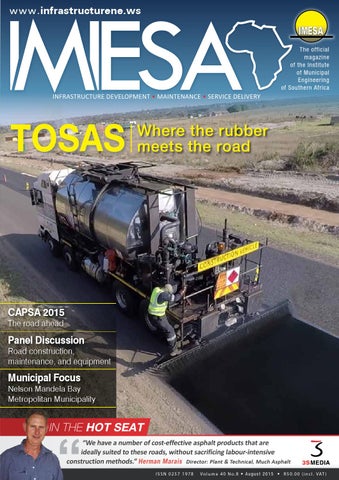
TOSAS
Where the rubber meets the road
CAPSA 2015 The road ahead
Panel Discussion
Road construction, maintenance, and equipment
Municipal Focus Nelson Mandela Bay Metropolitan Municipality
IN THE HOT SEAT “We have a number of cost-effective asphalt products that are ideally suited to these roads, without sacrificing labour-intensive construction methods.” Herman Marais Director: Plant & Technical, Much Asphalt ISSN 0257 1978
V o l u m e 4 0 N o . 8 • A u g u s t 2 0 1 5 • R 5 0 . 0 0 ( i n c l . VAT )
create dream
bathrooms VALUE BATH
sp e Vi Vis cial it w ba ew t for mo ww thro he l a o re . de buil m ed test “ d tai ls. ers.c ition love y Pro o d mo .za/ igita our h b l tio ath ma om n e r 13 valid oom gazi ” ne o Se f . pte rom r in s 21 mb tor e er J 20 uly u 15 nti l insto re
• Exclusive • 1700mm • Available in white • Acrylic bath • Includes handles • Excludes overflow & waste (39469)
R
750
9L CISTERN • White • Plastic cistern • Includes mechanism (40892)
R
215
QUADRATE SHOWER DOOR CLOSE COUPLE TOILET • Exclusive • Front flush • Mechanism included • Seat excluded • Manufactured in South Africa (537046)
• Exclusive • 900mm x 900mm • Available in white • Excludes base (280993)
R
999
TOILET SEAT • Exclusive • Available in white • Nylon hinges (427760)
CHROME HINGE R165 (427761)
R
99
CORNER ENTRY • 900mm x 90mm
R999 (280995)
R
550
LOW LEVEL PAN • White • Ceramic (40895)
R
Get to Builders. Get it done! Prices valid from 21 July untill 13 September 2015 Contact our Customer Care Line on 0860 284 533 or visit us at www.builders.co.za
138
CONTENTS www.infrastruc
turene.ws
VOLUME 40 NO. 8 AUGUST 2015
16
IMESA The officia l magaz ine of the Institu te of Munici pal Engine ering of Southe rn Africa
INFRASTRUCTURE
MAIN DEVELOPMENT •
TOSAS
TENANCE • SERVI
PUBLIC TRANSPORT The rise of the integrated transport network
CE DELIVERY
r Where the rubbe meets the road
Power Struggleseering
10
African energy engin
Panel Discussion
Road construction, equipment maintenance, and
Municipal Focus
MUNICIPAL FEATURE Nelson Mandela Bay
Regulars
Bay Nelson Mandela cipality Metropolitan Muni
T IN THE HOT SEA
lt products that are of cost-effective aspha “We have a number cing labour-intensive t roads, without sacrifi Technical, Much Asphal ideally suited to these Director: Plant & ( i n c l . VAT ) ds.” Herman Marais 15 • R50.00 construction metho .8 • August 20 Vo l u m e 4 0 N o 1978 ISSN 0257
New crumbed rubber technology is offered exclusively by Tosas. Deon Pagel, Tosas managing director, explains what the binder technology is, what it is capable of, and why it is a game changer in the road construction industry. P6
3 5 8 84
Editor’s comment President’s comment Africa round-up Index to advertisers
Cover Story Tosas – Where the rubber meets the road
6
10
Nelson Mandela Bay
Hot Seat Much Asphalt – The right mix
12
Public Transport The rise of the integrated transport network
65
16
Infrastructure Finance Planning and funding megaprojects 18
CAPSA 2015 National Asphalt: The innovators Performance-grade specification for bituminous binders Building on the successes of South Africa’s roads industry
CEMENT & CONCRETE Unlocking the value of readymix concrete
80
22 25 27
54
Asset Management Optimising your water and sanitation assets
Municipal Feature
Honouring excellence in engineering 15
Herman Marais, director: Plant & Technical at Much Asphalt, takes the IMIESA Hot Seat to discuss the secret to the company’s sustainability in the market after 50 years. P12
Energy African energy engineering
CESA Aon Awards
HOT SEAT
SANRAL: More than just roads 29 Ammann SA: The road less travelled 32 Objecting to mooted new traffic regulations 34 Panel Discussion: Roads construction 37
56
Cement & Concrete Challenging the performance of IBTs Unlocking the value of readymix concrete A solid commitment to human settlements Providing an all-round offering Springboarding into Africa Concrete roof tiles boast best green credentials How 'equivalent' is your product, really?
63 65 66 68 69 70 71
Construction Vehicles, Equipment & Logistics Moving up North Giving the African market a lift Mini excavator adds a new dimension Counting on Case for quality Quality meets affordability
73 74 75 76 79
Women in Engineering Inspiring young girls
80
WOMEN IN ENGINEERING Inspiring young girls
IMIESA August 2015
1
Three words which perfectly describe Sephaku Cement and what we as a company stand for. With tons of cement produced daily, our flawless delivery ethos, and unrivalled professionalism, at Sephaku Cement we ensure you receive a product that you can be proud of. So, no matter the building demand, be it bulk or bag, we always have the supply. Now that’s living up to our promise. Sephaku Cement.
Call us on 0861 32 42 52 www.sephakucement.co.za
EDITOR’S COMMENT
PUBLISHER Elizabeth Shorten EDITOR & ASSOCIATE PUBLISHER Nicholas McDiarmid SENIOR JOURNALIST Beatrix Knopjes JOURNALISTS Liesl Frankson, Frances Ringwood HEAD OF DESIGN Beren Bauermeister DESIGNER Ramon Chinian CHIEF SUB-EDITOR Tristan Snijders SUB-EDITOR Morgan Carter CONTRIBUTORS Ian Gray, Andrew McDonald, Andrew Shaw, Trevor Taylor CLIENT SERVICES & PRODUCTION MANAGER Antois-Leigh Botma PRODUCTION COORDINATOR Jacqueline Modise FINANCIAL MANAGER Andrew Lobban MARKETING & DIGITAL MANAGER Esther Le Roux MARKETING SPECIALIST Philip Rosenberg ADMINISTRATION Tonya Hebenton DISTRIBUTION MANAGER Nomsa Masina DISTRIBUTION COORDINATOR Asha Pursotham SUBSCRIPTIONS subs@3smedia.co.za PRINTERS United Litho Johannesburg +27 (0)11 402 0571 ___________________________________________________
Supportive environments
A
S WE NEAR the last quarter of 2015, the numerous sectors that comprise the built environment invest a lot of time, energy, and capital in initiatives that seek to strengthen their professions and the broader operational environment. From awards to events, this time of year is a reminder of the interdependence that drives the success of infrastructure development, across the public and private sectors.
ADVERTISING SALES Jenny Miller Tel: +27 (0)11 467 6223 ___________________________________________________
The CESA Aon Excellence Awards
PUBLISHER: MEDIA No. 9, 3rd Avenue, Rivonia 2056 PO Box 92026, Norwood 2117 Tel: +27 (0)11 233 2600 Fax: +27 (0)11 234 7274/5 E-mail: nicholas@3smedia.co.za www.3smedia.co.za
The CESA Aon Engineering Excellence Awards, taking place this month, has become an industry benchmark. This showcase of projects around South Africa, and beyond, has the ability to raise our awareness beyond our daily challenges and the plethora of negative information we are habitually exposed to. This year, we are informed, has seen a significant increase in entries and a level of innovation, quality, and workmanship that is of a global standard. The CESA Aon Engineering Excellence Awards has also applied a sustained focus on supporting young consulting engineers and the mentors who inspire and guide them, and this year is no different. IMIESA also seeks to play its part in strengthening the intergenerational bridge so critical to the preservation of centuries of skills, experience, and learning, and will be paying special attention to the entrants and winners of the Young Engineer of the Year Award and the Mentor of the Year Award categories, to identify what strategies are achieving the best results and share those with you.
ANNUAL SUBSCRIPTION: R550.00 (INCL VAT) ISSN 0257 1978 IMIESA, Inst.MUNIC. ENG. S. AFR. © Copyright 2015. All rights reserved. ___________________________________________________ IMESA CONTACTS HEAD OFFICE: Manager: King Singh P.O. Box 2190, Westville, 3630 Tel: +27 (0)31 266 3263 Fax: +27 (0)31 266 5094 Email: admin@imesa.org.za Website: www.imesa.org.za BORDER Secretary: Celeste Vosloo Tel: +27 (0)43 705 2433 Fax: +27 (0)43 743 5266 Email: celestev@buffalocity.gov.za EASTERN CAPE Secretary: Susan Canestra Tel: +27 (0)41 585 4142 ext. 7 Fax: +27 (0)41 585 1066 Email: imesa.easterncape@gmail.com KWAZULU-NATAL Secretary: Penny Pietersen Tel: +27 (0)31 266 3263 Fax: +27 (0)31 266 5094 Email: imesakzn@imesa.org.za NORTHERN PROVINCE Secretary: Rona Fourie Tel: +27 (0)82 742 6364 Fax: +27 (0)86 634 5644 Email: imesanorth@vodamail.co.za
CAPSA 2015 The biennial Conference on Asphalt Pavements for Southern Africa follows a few days later, and is an unmissable event for all stakeholders in the roads construction industry. Some of this year’s focus areas include design innovations and optimisation; best practise in procurement, asphalt layer, and seal design; and method and material assessments
SOUTHERN CAPE KAROO Secretary: Henrietta Olivier Tel: +27 (0)79 390 7536 Fax: +27 (0)86 629 7490 Email: imesa.southcape@gmail.com WESTERN CAPE Secretary: Erica Albertse Tel: +27 (0)21 444 7114 Fax: +27 (0)21 444 9470 Email: Erica.albertse@capetown.gov.za FREE STATE & NORTHERN CAPE Secretary: Wilma Van Der Walt Tel: +27 (0)83 457 4362 Fax: +27 (0)86 628 0468 Email: imesa.fsnc@gmail.com All material herein IMIESA is copyright protected and may not be reproduced either in whole or in part without the prior written permission of the publisher. The views of contributors do not necessarily reflect those of the Institute of Municipal Engineering of Southern Africa or the publishers.
for optimal efficiency. We have produced a special CAPSA division in this edition of IMIESA and, much like the conference, you will find some of South Africa’s leading experts sharing their practical knowledge and insights into this continually evolving industry. The capital expenditure to investment in research and development – in this particularly high-stakes industry – and the challenge of introducing innovations in asphalt products and plants emerged as a central theme this year. It is heartening to see that public sector agencies, like Sanral and some of the provincial roads agencies, are creating an environment that supports the development and introduction of new technologies – stories that don’t often make the news. Equally, the private companies willing to take on the innovation challenge should receive as much support from the entire industry as possible. The technical insights, experience, and knowledge that result from these endeavours represent major contributions to the industry, and come at significant risk to the companies involved. And, while the value is shared, the risk is not. IMIESA would like to thank this year’s participants in our CAPSA division for the incredible work they are doing. CAPSA 2015 has an incredible programme and is set to be an ideal environment for the industry’s ongoing development.
IMESA Conference 2015 And finally, IMESA will be hosting its annual conference in Cape Town, with the theme: ‘Changing the face of the Municipal Engineer’. Setting the benchmark for all stakeholders in public infrastructure and service delivery, IMESA’s annual conference is indispensable; make sure you are registered by 31 August 2015. All booking information can be found at www.conference.imesa.org.za, where you will find information about the side events, which include the golf day, ILISO Consulting’s opening function, and the legendary gala function.
Nicholas McDiarmid
To our avid readers, check out what we are talking about on our website, Facebook page or follow us on Twitter and have your say.
@infrastructure4
www.infrastructurene.ws
www.in
frastruc
turene.w
INFRASTRUC
IMESA
s
OPMENT TURE DEVEL
• MAINT
ENANCE
S M CIVIL
• SERVIC
E DELIVE
RY
The official magazine of the Institute of Municipal Engineering of Southern Africa
INFRASTRUCTURE DEVELOPMENT • MAINTENANCE • SERVICE DELIVERY
TOSAS
Where the rubber meets the road
the Creating pid urg Ra Rustenb system ort Transp
sport rated Public ofTran the integ
Power Struggles
African energy engineering
The rise network transport
Panel Discussion
l Focus Municipa Local
Road construction, maintenance, and equipment
Overstrand Municipality than more – Much ing
Infrastructure News
IMESA
The official magaz ine e of the Institut pal of Munici Engine ering rn Africa of Southe
Cover opportunity In each issue, IMIESA offers advertisers the opportunity to get to the front of the line by placing a company, product or service on the front cover of the journal. Buying this position will afford the advertiser the cover story and maximum exposure. For more information on cover bookings contact Jenny Miller on tel: +27 (0)11 467 6223.
Municipal Focus Nelson Mandela Bay Metropolitan Municipality
whale watch
s Smart Citie ng our future Safeguardi
IN THE HOT SEAT
r, we and morta er “We have a number of cost-effective asphalt products that are T from brick be made Mi Panels are strong ideally suited to these roads, without sacrificing labour-intensive of g that can a buildin properties ) methods.” Herman Marais Director: Plant & Technical, Much Asphalt construction MIBT imagine ( i n c l VAT structural managing director, 50.00 If you can 5 • R physical ne 201 ISSN 0257 1978 V o l u m e 4 0 N o . 8 • A u g u s t 2 0 1 5 • R 5 0 . 0 0 ( i n c l . VAT ) an Chetty, too. The 6 • Ju 40 No. r.” Pragas can do it olume 78 V and morta 257 19 ISSN 0 than brick
IN THE
HOT SEA
IMIESA August 2015
3
PRESIDENT’S COMMENT
IMESA
IFME engagement a rewarding experience Duncan Daries, IMESA president
My first IFME (International Federation of Municipal Engineers) engagement and contact with the Institute of Public Works Engineering Australasia in Rotorua, New Zealand, has been a rewarding experience.
T
HIS HAS PUT me in contact with fellow municipal engineering practitioners who share the same enthusiasm, as well as frustrations, for their goal of providing quality, affordable, and efficient infrastructure services to their communities. This international conference attracted in the region of 800 delegates from 17 countries, with a strong international contingent, mainly from the Nordic countries (Norway, Sweden, Finland, and Iceland), whose municipal associations, as well as cities, supported approximately 33 delegates. I was most impressed with the Swedish Association of Municipal Engineers who sponsored a contingent of four young engineers. I ended up being the only delegate from South Africa but came across a number of exSouth African municipal engineers who have successfully continued their careers in Australia and New Zealand. Two of these engineers, Kevin Ketterer and Alex Finn, are actually former colleagues of mine. The president of IFME, Ross Vincent, commented that New Zealand has benefited tremendously from these South African municipal engineers as their training was of such a high standard that they were easily assimilated
into their new environment and in a position to add value immediately. The theme of the conference was ‘Sustainable Communities, Sharing Knowledge’ and 174 papers were presented in eight parallel sessions comprising: • Strategic Asset Management • Asset Management Practice • Engineering Management • Sustainable Communities • Sustainable Practices • Roads & Transport • Three Waters (Potable Water, Stormwater, and Wastewater) • Building Infrastructure After Earthquakes • Managing Roads and Bridges • Roads Efficiency. As New Zealand and Australia are the leaders in asset management strategy and practice, I mostly followed these sessions. However, the highlights of the conference, for me, were the following sessions/presentations:
Fiji’s infrastructure overhaul Fiji’s road infrastructure had virtually collapsed, as a result of neglecting to maintain these assets. A bold decision from government was taken, in 2012, to reform the roads authorities by dissolving the Department of National Roads and establishing the Fijian Roads Authority (FRA). This change
was not an easy one for the new CEO of the FRA, as roads were regarded as a powerful political tool. Among the challenges was the lack of skills and equipment, as well as corruption. The local Fijians did not trust the expats (hired for their skills and mostly from New Zealand), who they thought were taking over. Part of the brief for the FRA was, however, to upskill local workers as well as contractors. Training was arranged over weekends and a culture of safety in the workplace was embedded. These workers are now on par where safety standards are concerned and can rival their developed world counterparts with respect to the quality of work. This ambitious plan of the Fijian government comprises a $1.5 billion investment over a three-year period, and has already reshaped the lives of ordinary citizens, in terms of their ability to get produce to the markets.
The next generation of public works engineers From this session, great importance was attached to knowing what drives young professionals before recruiting them into the public works space. This is in order to get the most out of their
TOP LEFT Outgoing IFME president Ross Vincent TOP RIGHT Fijian presenters BOTTOM LEFT Incoming IFME president Doug Drever BOTTOM RIGHT Young engineers from Sweden RIGHT Maori dancer at the opening ceremony
energy and commitment. Mentorship and continuous professional development remain the cornerstone of developing the management and specialist technical skills of these young professionals. A 25-year-old presenter, in talking about the intrinsic and extrinsic motivators for his generation, characterised his peers as having a keen appreciation for technology and an interest in the consequence of their actions. He personally has placed great emphasis on volunteering and pro bono work. “To be part of something bigger than ourselves is something we really value,” he says. Does this apply to our South African young professionals as well? I would be very pleased is this were the case. For those who have the time, I suggest visiting the website of IPWEA and, under their events tab, access the Rotorua conference.
IMIESA August 2015
5
COVER STORY
Where the rubber
meets the road Tosas’ record in the development and supply of bituminous products to Southern Africa represents a collective of unmatched skills, experience, and know-how. Deon Pagel, managing director, reveals Tosas’ new crumbed rubber technology (NCRT), which is set change the way roads are made.
6
IMIESA August 2015
NCRT was first developed in Germany by the Wax Division of Sasol, in collaboration with asphalt technology company Storimpex and a professor from Hamburg University. “Tosas was selected to be involved in the joint R&D project and was instrumental in modifying and adapting the total process for South African conditions, not only for asphalt applications but also for sprayed seal applications. With positive results being achieved through a number of trials and full-scale applications across the country over more than four years, the product is now beginning to find significant favour in the industry,” explains Pagel.
Viscosity, cPoise
BELOW New crumbed rubber Technology versus conventional bitumen rubber
time, hours Conventional A-R1 @ 200°C NCRT @ 180°C
Softening, Poise, °C
T
HE VALUE OF bitumen rubber, from a quality and cost perspective, is well established in the road construction market because of beneficial visco-elastic properties. However, it is the very visco-elastic properties that make it so attractive that sadly also account for its greatest drawback; namely, a very short shelf-life of only four to six hours at application temperatures between 200°C and 210°C. NCRT solves this problem. The development of NCRT was spurred, in 2010, by a desire to make a bitumen rubber product that was acceptable to the European market, which has traditionally been resistant to bitumen rubber due to the high operating temperatures and less-attractive odours and smoke during construction, especially in close proximity to people. As for other reusable products, recycling of scrap rubber tyres for use in road building was obviously attractive from an environmental point of view. Road owners and authorities such as Sanral, therefore, also appreciate and find the environmental advantages of products like NCRT attractive, as this enhances the sustainability status of road networks. “The European experience commenced in Hamburg in 2010 and ultimately resulted in NCRT being used with high percentages of reclaimed asphalt. NCRT allowed the use of reclaimed asphalt instead of virgin aggregate and binder from non-renewable resources, and it is now regularly used. The main ingredient of NCRT is the specialised rubber compound, comprising almost solely of rubber extracted from waste tyres. This utilisation, therefore, ‘removes’ old tyres as potential environmental waste hazards, in a very responsible and sustainable manner, by incorporation into road building materials of exceptional quality,” Pagel emphasises.
time, hours Conventional A-R1 @ 200°C NCRT @ 180°C
Technicalities Several advantages arise from using the technology; most pleasing has been the findings that the visco-elastic nature of NCRT is being proven to be at least similar to, but mostly better than, conventional bitumen rubber. First, the NCRT process results in modification and improvement of the bitumen rubber concept, which actually results in an enhanced softening point. It can, therefore, be used in asphalt mixes to assist with deformation resistance. Second, the significantly reduced viscosity allows the product to be handled at approximately 25°C to 30°C lower asphalt mixing temperatures. It also allows longer workability of tough bitumen rubber asphalt mixes, which were traditionally difficult to compact. By reducing the compaction effort and, thus, increasing the compaction window, it is possible to ensure a better consolidation of the asphalt surface during construction. The trial sections paved on the Misgund section of the N1 northbound, just south of Soweto, were extensively reported on in IMIESA, Construction World, and Sabita’s Asphalt News. The reduced handling temperature, furthermore, protects the base bitumens from rapid ageing during production and application, and this adds to the increased durability of the highly modified binder and the in-service binder performance, over time. Variations of NCRT have been tested and – depending on the road conditions, type of application (asphalt or sprayed seal application), and environmental conditions – the modified binder’s viscosity and tenacity can be adjusted to produce binder types that are suitable for thin applications such as grit seals, thicker applications such as single and double seals, and, ultimately, in much thicker modified asphalt layers. In the Netherlands, keen efforts
COVER STORY
are currently underway to incorporate the NCRT technology in porous asphalt mixes. In these open-graded asphalt designs, the thicker binder film is protected from air oxidation of the bituminous binders by the antioxidants present in the NCRT binder technology.
Extended shelf-life “Normal bitumen rubber is a preferred road surfacing product; it extends the lifespan of the road and offers high resistance to crack reflection. With its now easily attainable shelf-life in excess of seven days, NCRT is going to change the way we build roads in South Africa.” Extending the shelf-life of bitumen rubber from four to six hours to up to seven days and beyond has a profound impact on its viability, by increasing flexibility related to logistics and supply quantities. Eliminating the need to erect a bitumen rubber blending plant on site, it opens the doors to a myriad of customers and applications for whom it was prohibitive, due to high plant establishment costs, minimum volume requirements, space constraints, and the like. Many road projects, especially in urban environments, require only small quantities of binder and it was not economical or practical to supply conventional bitumen rubber, with a limited shelf-life, for such road rehabilitation contracts. The NCRT concept now also makes it easier and safer to work with, due to reduced emissions of volatile organic compounds. “Tosas produces NCRT at our plant in Wadeville, in a stable and controlled manufacturing environment. We are able to deliver it over long distances, well within its window of usability, with all the benefits (and more) of traditional rubber bitumen,” explains Pagel.
Proven results “Apart from numerous other applications, we recently also conducted a very successful trial in conjunction with Sanral. The
road selected was a portion of the R22 at Manguzi, near Kosi Bay in northern KwaZuluNatal, where conventional bitumen rubber was being applied,” says Pagel. “We sprayed the section of road with NCRT that was manufactured in Wadeville, 650 km away. This is unheard of when conventional bitumen rubber is used, as the shelf-life constraints would never allow for this to be possible. The NCRT compound technology has enormous benefits for road construction, not least of which is that it provides a long-lasting road binder, excellent quality, and durable roads.” In previous construction industry publications, the 2012 trials performed near Upington for Sanral, to maximise seal work, have also been previously publicised and mentioned. These seals have now been evaluated and monitored over a three-year period, and it is expected that some of the associated successes will also be reported on at CAPSA 15. Over and above those previously reported on in trials, Tosas recently inspected some of the NCRT seals on streets that were constructed for Mangaung Municipality. “One year down the road, the results are looking extremely good with binder that was manufactured in Wadeville and transported to Bloemfontein, where it was applied over three days,” says Pagel. “The superiority of the product – over and above an already superior product – together with the environmental and safety benefits of not having to establish bitumen plants in remote conditions, contributes to its success. Not having to establish a mobile bitumen rubber plant is majorly significant,” explains Pagel. With Tosas manufacturing a finished product and delivering the product to site, customers no longer require fuel on site. The energy source at the fixed manufacturing facility in Wadeville, for example, is the cleaner-burning natural gas alternative and, where possible, such benefits can be looked
ABOVE LEFT Relative differences in asphalt applications ABOVE Gerrie van Zyl, from Mycube Asset Management Systems, performing a texture test on the Maximising Seal Work Trials near Upington
at when more fixed installations are rolled out. Currently, mobile units can be utilised to manufacture NCRT, should this be required; however, the goal is to have a few fixed plants to supply the national footprint.
Technical expertise Tosas is backed by solid, in-house technical support, R&D specialists, and technical staff. “Most of the Tosas technical team members are well-known to the industry and most of them have, in one way or another, contributed to industry bodies involved in setting industry standards. Tosas’ fully equipped, state-of-the-art laboratories allow for very high-end technical research and testing, including what is often called bitumen ‘fingerprinting’. “We are able to determine rheological behaviour, as well as the chemical balance of the complex organic composition of the bituminous products that we work with, and this facilitates our ongoing R&D,” notes Pagel. The Tosas technical team members are held in high regard not only within Tosas, but the industry as a whole, and regularly present papers at conferences, including the imminent CAPSA conference. “We have the practical expertise to back up what we are bringing to market. We are at the forefront of fundamental technological advancements in the industry, and this is something we are exceptionally proud of,” concludes Pagel.
Binder Exceeeence
New Crumb Rubber Technooogy
IMIESA offers advertisers an ideal platform to ensure maximum exposure of their brand. Companies are afforded the opportunity of publishing a two-page cover story and a cover picture to promote their products to an appropriate audience. Please call Jenny Miller on +27 (0)11 467 6223 to secure your booking.
www.tosas.co.za
IMIESA August 2015
7
AFRICA ROUND-UP
INFRASTRUCTURE NEWS FROM AROUND THE CONTINENT ANGOLA Programme envisages building of over 200 000 houses by 2017 The Angolan government, through the National Programme of Urbanisation and Housing, aims to provide approximately 213 000 houses and 14 new city centres across the country, to reduce the huge housing deficit in the country. According to government, the planning, financing, and construction of these centres present a viable opportunity for families, and particularly young people, to buy houses and live in these projects with dignity. The cabinet official acknowledges that they have learned a lot from the shortcomings of other developments in Kilamba and Nova Vida. He says that citizens dwelling in these city centres want a modern, affordable, fast, and close administrative service, well managed and with an adequate service provision in the areas of education, health, and medical care.
EAST AFRICA
The Kilamba housing development is 30 km from Luanda, the capital city of Angola
developments, and mega government infrastructure projects – such as ports, railways, and road cement manufacturers – in East Africa,” he explains. Most countries from this group have had political instability, which has curtailed the development of the infrastructure and construction sectors. The implementation of sustainable cost-optimisation strategies focusing on alternate fuels, low-cost technology, and valueadding models is expected to reinforce the local producers' presence and competitive positioning in the East African cement industry.
ETHIOPIA Deal signed for construction of high-voltage transmission line to Kenya Ethiopia has signed a $20 million agreement with China Electric Power Equipment and Technology for the construction of a high-voltage transmission line connected to Kenya, as part of plans to boost regional power exports. The 433 km project will stretch from Wolayta, in southern Ethiopia, to the border, constituting half of a planned 1 045 km link with Kenya. The project is jointly financed by the African Development
Regional demand for cement remains strong Demand for cement in the East African region is expected to remain strong in the medium term, supported by the resurgence in the infrastructure and housing sectors. Tanga Cement managing director Reinhardt Swart says there is huge investment potential in the cement industry, due to rising demand for the commodity in the region. “The increasing demand is fuelled by an upsurge in commercial projects, housing
8
IMIESA August 2015
Demand for cement in the East African region is expected to remain strong
Bank (AfDB), the World Bank, and the French Development Agency, with the AfDB financing the Ethiopian part of the project. Speaking at the ceremony, Water, Irrigation and Energy Minister Alemayehu Tegenu said that the Ethiopia-Kenya Power interconnection project will help to utilise power resources together and the national network expansion will facilitate power trade in the region.
GAMBIA Trans-Gambia Corridor project launched The Trans-Gambia Corridor project, which is being implemented by the Gambia Family Planning Association (GFPA), has officially been launched. According to officials, the project will last for three years and forms part of the ongoing construction of a multimillion dalasi Trans-Gambia Bridge project aimed at phasing out the traditional ferr y crossing at Bamba Tenda/Yelli Tenda, linking the Lower River (LLR) and North Bank regions (NBR). Speaking at the launch, Alhaji Abu Njie, the deputy governor of the Lower River Region, described the coming of the Trans-Gambia Bridge project as not only timely, but also very important, in the sense that the project will create employment opportunities for many people at the construction stage and the completion of the project will also ease and facilitate movement for the people of LRR and NBR. It will also benefit other nationals in the subregion who use this route on a daily basis.
AFRICA ROUND-UP
A Zambian worker digs a ditch in the Zambia-China Economic and Trade Cooperation Zone Photo: Thomas Lekfeldt
NAMIBIA Namport expansion on track for 2017 opening The construction of the $250 million container terminal at Walvis Bay is well on track, according to Namport CEO Bisey Uirab. “Construction is currently 25% completed. Commissioning of the project is expected to occur in September 2017,” he says. The funding for the project is being provided by the African Development Bank ($23 million) and the government ($60 million), along with $43 million from Namport’s cash reser ves. Uirab says, so far, about 2.9 million m3 have been dredged and used for land reclamation. A total of 3.9 million m3 will have been dredged at the end of the project. On completion, Walvis Bay will have 750 000 twenty-foot equivalent units (TEUs*) per annum, from 350 000 TEUs at the moment. The TEU is an inexact unit of cargo capacity often used to describe the capacity of container ships and container terminals.
*
The construction of the N$3 billion container terminal at Walvis Bay is well on track
NIGERIA Construction industry owed over $3 billion Construction companies in Nigeria, with the support of the Federation of Construction Industry (FOCI), have expressed concern over the growing debt of federal, state, and local governments to the construction industry, now running over $3 billion. According FOCI, which is the umbrella group for building and civil engineering contractors, subcontractors, and plant and equipment suppliers, the federal government owes its members over $3 billion. FOCI president Solomon Ogunbusola, who raised the alarm at 59th Annual General Meeting in Abuja, said former president Goodluck Jonathan gave the construction industry excessive work to do without the money to execute the projects. Ogunbusola expressed his concern about the present state
of the association's members, stating that FOCI's 126 registered member companies are utilising less than 30% of their staff strength, due to mass retrenchment.
TANZANIA
its consultant engineer, Cheil Engineering Company (Korea), is the leading contractor on behalf of the Tanzanian government. The firms will be assisted by Tanzanian construction firm Doch Limited. Nearly a year ago, the African Development Bank released the funds for the project, in which a total of $223.5 million is to be spent. Compensation issues have, however, delayed implementation.
ZAMBIA
Work takes off on KenyaTanzania highway
$29 million Chinese loan for infrastructure
Work has started on the longawaited direct road link between Arusha, in northern Tanzania, and the Kenyan town of Taveta. The project, which aims to improve road connectivity between Kenya and Tanzania, as part of the East African road network, will be implemented in two phases on the Tanzanian side. The first phase starts from Sakina suburb in Arusha and is projected to be finished in 16 months. Sources say this will cost nearly $70 million. Hanil-Jiangsu JV, a South Koreabased construction firm, and
The China Development Bank (CDB) and the ZambiaChina Economic and Trade Cooperation Zone (ZCCZ) have signed a loan of $29 million for the improvement of infrastructure at ZCCZ Lusaka Park, a senior Chinese bank official has said. In August 2014, CDB signed the first loan agreement with ZCCZ and the Bank of China (Zambia). Zhu Liqun, the president of CDB's Jiangxi branch, hopes that, through two loans – totalling $59 million – it could further accelerate the development of infrastructure in ZCCZ Lusaka Park and attract more Chinese enterprises to invest in Zambia and promote local economic development. The ZCCZ is the first multifacility economic zone declared by the Zambian government. It is also the first Chinese overseas economic and cooperation zone established in Africa. CDB has, so far, provided loans amounting to $410 million to Zambia in areas such as metallurgy, roads, and real estate.
IMIESA August 2015
9
MUNICIPAL FEATURE
Service (delivery) with a smile
– Infrastructure development in the Friendly City
To redirect a history of poor service delivery, on 28 May, Dr Danny Jordaan was elected executive mayor of Nelson Mandela Bay Metro (NMBM). Having made considerable investment into its water schemes, housing developments, and public spaces, NMBM aims to provide a better life for its residents and support its manufacturing and tourism industries. BY BEATRIX KNOPJES
I
N A STATEMENT to the Nelson Mandela Bay Metropolitan Council in June 2015, newly appointed executive mayor of Nelson Mandela Bay Metropolitan Municipality Dr Danny Jordaan emphasised the importance of prioritising projects that expedite service delivery, such as the provision of clean water, sanitation, regular waste collection, proper housing, electricity, and pothole-free roads. He also stated that he was concerned about big infrastructure projects in the city. The mayor also stated that the municipality would be prioritising projects that “can ensure that people see immediate and visible improvements”. He identified these areas of immediate improvement as: • temporary electrification of informal areas • public street lighting in townships to increase safety and security • addressing the blockages in moving people to existing serviced sites at Khayamnandi • developing housing to include waterborne sanitation at the greenfield Joe Slovo housing project and Walmer informal settlement • increasing provision of temporary ablution facilities in informal settlements • i ncreasing the frequency of waste collection • repairing potholes and cleaning stormwater drains.
10
IMIESA August 2015
Curbing water shortages NMBM experienced a severe drought from 2009 to 2011. This put pressure on the region’s water supply. Additionally, the municipality has seen an increase in water demand since the drought broke, which has caused further strain. Dam levels have considerably dropped and NMBM has been working with the Department of Water to rectify the situation. According to a press release issued by the then Department of Water Affairs, a number of interventions were put in place to tackle the water shortages. In his statement, Jordaan said, “The Nooitgedacht water transfer scheme is absolutely essential to prevent this city from running out of bulk water supply.” The Department of Water and Sanitation has committed R128 million to this project and, according to this statement, NMBM hopes to make up the deficit. The Nooitgedacht Low-Level Scheme was constructed as an extension to the existing High-Level Scheme, which treats Orange River water, delivered through the OrangeFish-Sundays transfer system, to increase drinking water standards for supply into the metro’s water supply system. Water conservation and water demand management are cornerstone strategies for this area, according to the release. NMBM was set a target to reduce water losses by
37 Mℓ per day over a five-year period, and the municipality has achieved 61% of this target over the past two years. NMBM has sought out as many interventions as possible to deal with the water shortages in the area. These include: • The possibility of raising the Kouga Dam was evaluated. • Consultants were appointed by NMBM to investigate possible new locations for a desalination plant. The project’s feasibility stage and concept design were expected to be completed by June 2015. • A study was done by NMBM to determine the feasibility of the large-scale use of treated water from the Fishwater Flats Wastewater Treatment Works (WWTW) to supply industries in Port Elizabeth and the Coega Industrial Development Zone (IDZ). The natural dune sands to the south and north of Ngqura Harbour were investigated for their suitability for filtering surplus wastewater from the Fishwater Flats WWTW. However, it was found that the dune sands south of the harbour are too thin and, thus, unsuitable. • Drilling sites for groundwater sources for NMBM have been identified.
Wastewater treatment All WWTWs in NMBM are being upgraded to meet future development and capacity demands, including effluent compliance. In
MUNICIPAL FEATURE
GIBB is a leading multi-disciplinary engineering firm Leaders in engineering consulting
this area, the upgrade of the Fishwater Flats WWTW is significant, at a cost of R1 billion. However, Jordaan said in his statement, “I am not sure whether we can afford, or even need, the more expensive Fishwater Flats WWTW at this stage.”
Housing development According to the Built Environment Per formance Plan (BEPP) 2014/15 submission, NMBM has a total housing backlog of 72 411. The BEPP also identifies a lack of spatial restructuring and integrated human settlements as problem areas that the municipality needs to address. In 2012, the council adopted the Human Settlements Strategic Framework, recommending spatial restructuring in the following areas: • Urban renewal precincts: Port Elizabeth inner city and water front, North End coastal development, Uitenhage and Despatch CBD, Mother well hub, Happy Valley and Lower Baakens Valley, Walmer Gqebera, Korsten and Helenvale precincts, and Greater Ibhayi-Northern areas hub. • Spatial transformation precincts: Parsonsvlei mixed developments and reinforcing Coega IDZ through a number of strategic projects, including supporting Project Mthombo, relocation of Port Elizabeth International Airport, Greater Motherwell Hub, and Bay West and N2 development hubs. Through this, Jordaan hopes to “finally tackle the apartheid spatial form of the city through the development of a truly transformational BEPP, and integration zones between township and town.”
Operating in:
Dams, Hydropower and Tunnelling Environmental Integrated Infrastructure - Water Cycle - Housing
Power and Energy Transportation -
Airport and Aviation Railway Engineering Roads and Highways Traffic and Transportation
Architecture
Mandela Bay Development Agency The Mandela Bay Development Agency (MBDA) was established, in 2003, by NMBM, with the support of the Industrial Development Corporation, in order to spearhead urban regeneration and promote tourism to the area. The MBDA has completed a number of projects to date, including: • upgrading Govan Mbeki and Parliament Street • upgrading the Uitenhage Market Square • upgrading Donkin Reser ve environmentally • redeveloping Strand Street. The upgrade of these public spaces aimed to increase pedestrian mobility, because the coastal city of Port Elizabeth is a favoured tourist destination, and, thereby, stimulate economic growth by capitalising on this tourism.
IMIESA August 2015
11
+27 11 519 4600 marketing@gibb.co.za | www.gibb.co.za GIBB is a Level 2 BBBEE contributor
HOT SEAT
MUCH ASPHALT
The right mix Herman Marais, director: Plant & Technical at Much Asphalt, takes the IMIESA Hot Seat to discuss the secret to the company’s sustainability in the market after 50 years. Much Asphalt turns 50 this year. What are the main reasons for the company’s sustainability through several changes of ownership over a half century? HM Being customer-focused with a high regard for product quality, together with commitment and capacity to supply. Value creation for both our customers and shareholders has been key in getting us where we are today. Let’s not forget the ongoing investment in our people and plants, as well as the known fact that we do not walk away from problems.
Much Asphalt states its purpose as being “to enable the creation of safe and convenient transport infrastructure, resulting in sustainable wealth creation and community upliftment”. To what extent are you achieving this? Infrastructure drives economic growth. This is not only true for industrial development but also
12
IMIESA August 2015
for our communities. Various attempts to build roads to serve our growing middle-class communities on a shoestring budget have resulted in rapid failure. While these projects generally involve labour-intensive methods, creating jobs, communities are often left with roads that have poor riding quality and are expensive and difficult to repair. We have a number of costeffective asphalt products that are ideally suited to these roads, without sacrificing labourintensive construction methods. We have many successful projects that prove our product design capabilities.
What have been some of the innovation highlights of the past 50 years? Innovation has always been an integral part of our business; it differentiates us from our competitors. From the start, we have continually improved our products and processes to remain competitive. This is true for both our products and processes. As Much Asphalt grew into the
biggest local supplier of asphalt, we embraced the accompanying responsibility – ensuring that South Africa remains at the forefront of technology in the asphalt industry. This entails frequent tours to asphalt-producing countries in Europe and the USA to identify technologies – both asphalt mixes and manufacturing equipment and processes – that can benefit the local industry and then transferring these technologies to South Africa. Just a few technologies we have successfully introduced over the years are bitumen rubber asphalt from the USA, stone mastic asphalt from Germany, and ultra-thin friction course from France. The use of reclaimed asphalt (RA) in the manufacture of asphalt was started in the late 1970s and Much Asphalt was actively involved in the introduction of RA to asphalt mixes, as well as the introduction of various warm-mix asphalt technologies more recently. Both have significant environmental benefits.
ABOVE Crushing and screening of RA at the Benoni plant using a Rubble Master RM80 crusher and a newly acquired Finlay 649 triple-deck screen
Increased traffic volumes and axle loads have necessitated modifying normal penetration grade binder to improve the rutting resistance of our asphalt and this resulted in the development of modified binders. Much Asphalt also participated in the 2006 Rutmix Challenge to the asphalt industry, by the Gauteng Department of Roads, which laid the groundwork for the rutting specification to be included in the new Asphalt Mix Design Manual for South Africa (AMDMSA). We have upgraded all our asphalt plants with state-of-the-art control systems, and fitted filter baghouses to ensure our emissions are well below legal limits. As a responsible manufacturing company, we closely monitor our carbon footprint and our branches
HOT SEAT
are measured against world best practice guidelines.
we now offer the GB5 as a highstiffness, high-fatigue mix in KZN.
What innovative products set Much Asphalt apart today?
How about innovation in testing procedures and equipment?
In the current local asphalt market, it is difficult to be very innovative, as supplied asphalt is specified in every detail. The current project specifications prescribe the aggregate grading, binder type and content, as well as the asphalt properties, leaving little room for innovation. Our focus is on optimising processes and ensuring we have tight control over our process variables and waste. There has been a move towards performance specification for asphalt mixes, but the aggregate grading and binder type are still specified; therefore we are forced to optimise the mix while staying within the specified grading envelope. The imminent publishing of the AMDMSA will bring about changes and this will enable us to be much more innovative. The AMDMSA focuses on the development of asphalt mixes tested for certain performance parameters. Although aggregate quality properties will still be specified, the aggregate grading will be left to the asphalt designer. The binder properties will also be checked for performance parameters. Once the design is completed, the asphalt mix will be certified for use in certain traffic and temperature regimes. All said, however, we have a number of exciting new products, such as a French asphalt base course technology called GB5, which we manufacture under licence in KZN. This mix is aimed at very highly trafficked roads and special applications, such as harbours and container depots. It has been successfully implemented on a project for the eThekwini Municipality, which is renowned for its willingness to use innovative products on projects. Subsequent to this trial,
As mentioned above, the AMDMSA will require the asphalt mixes to be performancetested and we have majorly invested in upgrading our SANASaccredited Central Laboratory in Cape Town, to undertake all the binder tests and prepare asphalt samples for asphalt performance testing. In our binder laboratory, we have installed a dynamic shear rheometer, pressure-ageing vessel, and a vacuum degassing oven required for the tests prescribed in the AMDMSA, as well as future binder specifications. In the asphalt laboratory, we acquired a highly advanced laboratory mixer and gyratory compactor capable of manufacturing briquettes for dynamic modulus testing. We also installed a state-of-the-art asphalt slab compactor to compact asphalt slabs for fatigue testing.
What progress are you making in the use of RA? The use of RA in new asphalt has been around for quite some time and was extensively practiced in the early 80s. It was only after some premature failures that the use of RA was ‘suspended’ for a few decades. During this time, RA was downcycled into lower pavement layers, which is an environmental sin as the aggregate in asphalt is of high quality and the binder can also make a valuable contribution to new asphalt. The aggregate and bitumen are both non-renewable resources and, with subsequent advances in asphalt plant technologies and mix design understanding, the renewed use of RA was inevitable. We believe it is our obligation to reuse RA in asphalt to reduce our impact on the environment. One should, however, do it sensibly, as RA is not freely available in all
areas and it is not viable to use high RA contents everywhere. Upgrades at all but two of our static plants, which are located in remote areas, have enabled RA handling capacities between 10% and 50%. For high RA mixes, it is imperative to process the RA through selective crushing and screening into different fractions, and we have invested in several crushing and screening plants around the country for this purpose.
In the South African environment, SMMEs are a large and critical part of the employment chain. How does Much Asphalt partner with smaller construction companies to ensure sustainability and mutual success? SMMEs are a vital part of our business and are essential to our future, and we want them to grow with us. The biggest challenges for SMMEs are the knowledge of how to use our products, how to quote, and credit access. For the first two, we provide courses on hand-laid asphalt to SMMEs and local authorities at no charge. Delegates are also provided with a handy booklet that explains the course material for easy future reference. They are also introduced to our teams and can call on us for further technical assistance.
ABOVE LEFT Senior lab technician Firyaal Moos operates the dynamic shear rheometer (DSR) at Cenlab, Eerste River ABOVE RIGHT Much Asphalt’s new Ammann mobile plant – capable of handling 40% RA – on an N1 contract near Bloemfontein
Local authorities are welcome to contact us to schedule these training courses in their areas.
Fifty years is a milestone worth celebrating. How do you plan to keep ahead of the game in the next 50? With a changing climate and diminishing natural resources, we will have to be at the forefront of the search for alternative aggregates and binders to remain relevant in tomorrow’s world. We are involved in a number of exciting projects on this front and are working hard to come up with some answers for our changing environment. In the short term, we are excited about the new AMDMSA and are investing in R&D to give our clients the highest-quality products at competitive prices.
www.muchasphalt.co.za
IMIESA August 2015
13