The official magazine of the Institute of Municipal Engineering of Southern Africa
IMESA
INFRASTRUCTURE DEVELOPMENT • MAINTENANCE • SERVICE DELIVERY
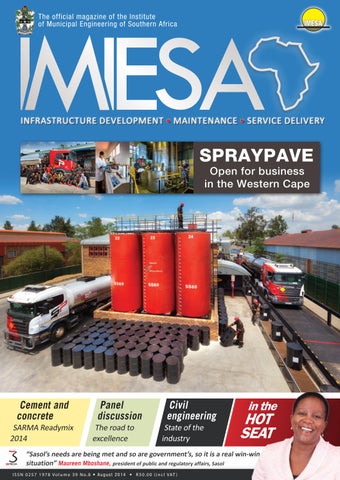
SPRAYPAVE Open for business in the Western Cape
Cement and concrete
SARMA Readymix 2014 MEDIA
Panel discussion
The road to excellence
Civil engineering
State of the industry
in the
HOT SEAT
“Sasol’s needs are being met and so are government’s, so it is a real win-win situation” Maureen Mboshane, president of public and regulatory affairs, Sasol
I S S N 0 2 5 7 1 9 7 8 V o l u m e 3 9 N o . 8 • A u g u s t 2 0 1 4 • R 5 0 . 0 0 ( i n c l VAT )
THE JOAT GROUP OF COMPANIES has moulded itself into an efficient and market-leading solutions-orientated team that primarily addresses the optimisation of water supply to consumers through the minimisation of water losses, application of appropriate technology, revenue improvement and energy efficiency. The group’s key focus areas of operation are consulting and operations engineering (essentially the reduction of nonrevenue water and stabilising of water supply), product sales and support, energy efficiency and mentorship. JOAT’s passion and vision is to ensure that municipalities become as efficient as possible in delivering water to consumers and has adapted its approach towards an outcomes-based partnership that has shared responsibility and accountability. The ultimate objective of any successful partnership with JOAT is to provide water service authorities with an efficient distribution system that they are fully equipped and trained to continue to operate.
In response to this approach, JOAT has invested in wide-ranging technology and partnerships that can be harnessed for the benefit of municipalities. Flow metering solutions (permanent or temporary, monitoring or revenue-generating), data management solutions (data loggers, GSM data loggers), control valve solutions (pressure-reducing valves, pressure controllers, surge control), leak detection solutions (leak detection equipment and service) and energy efficiency solutions (variable speed drives and system optimising) are all available to be presented into cost-effective, custom-made packages. JOAT has also expanded into the optimisation of energy consumption in the water cycle and has a number of in-house experts that can undertake energy audits and design energy efficiency solutions for pump stations and treatment works. This forms part of its overall approach to making the distribution of water as efficient as possible.
HEAD OFFICE Unit 19 Alexander Park, 24 Alexander Road, Westmead, Pinetown, KZN, SA 3610 • Postnet Suite 23, Private Bag X4, Kloof 3640 t +27 (0)31 700 1177 • f +27 (0)31 700 9853 • Contact Daryl Spencer daryl.spencer@joat.co.za c 083 555 9996 NATIONAL OFFICES • Pietermaritzburg • Port Elizabeth • Johannesburg • Cape Town • Shelly Beach
CONTENTS The official magazine of the Institute of Municipal Engineering of Southern Africa
VOLUME 39 NO 8 AUGUST 2014
cement-lined 16 Xonxa steel water pipeline
IMESA
INFRASTRUCTURE DEVELOPMENT • MAINTENANCE • SERVICE DELIVERY
SPRAYPAVE Open for business in the Western Cape
Cement and concrete
SARMA Readymix 2014 MEDIA
Panel discussion
The road to excellence
Civil engineering
State of the industry
in the
HOT SEAT
“Sasol’s needs are being met and so are government’s, so it is a real win-win situation” Maureen Mboshane, president of public and regulatory affairs, Sasol
12 State of the industr y
I S S N 0 2 5 7 1 9 7 8 V o l u m e 3 9 N o . 8 • A u g u s t 2 0 1 4 • R 5 0 . 0 0 ( i n c l VAT )
SprayPave’s newest branch in Cape Town is headed by branch manager Leslie Webb and is now fully operational, offering SprayPave’s full range of quality products, serviced by worldclass plant and manufacturing facilities. P6
in the
HOT SEAT Sasol’s ground breaking PPP with two local governments is not simply delivering critical infrastructure; the need for sustainability is seeing this R800 million project evolve into an example of best practise and capacity building of the first order. Maureen Mboshane, Sasol’s president of public and regulatory affairs explains how in this edition’s Hotseat. P10
Regulars Editor’s comment President’s comment Africa round-up Index to advertisers
3 4 8 92
6
Hot seat Sasol – partnering with local government
10
12
14
76
Island life – engineering connections
Benefits of Green Terramesh
58
Engineering a sustainable future 62 Coastal consulting 64
Realisation of renewable energy technology in SA
66
Training 21 23 25 27 29 31 33 35
Cement and concrete Reducing CO2 footprint through new blends Aiding the enhancement of cementitious materials – Part 1 Readymix to aid delivery The cost of poor specification
54 55
Water and wastewater
Panel discussion Concrete Manufacturers Association Aveng Infraset Kaytech Kerb-Master Lafarge Much Asphalt Osborn Sabita
New access tracks for Geelkrans Nature Reserve Reclaimed asphalt paving
Consulting engineering
Insight State of the South African civil industry
52
SANRAL roads
Municipal project Xonxa cement-lined steel water pipeline
48 51
Roads
Cover story SprayPave: Quality uncompromised
Thriving in a challenging market Missing the critical link Roads: It don’t matter if they’re black or white
40 42 45 46
Engineering robust workforces
73
Construction vehicles and equipment Project: Island life – engineering connections Temporary power solutions for Southern Africa Equipping for installation of solar PV support frames Powerful, profitable, compact – new telescopic handlers A new compact excavator Hydraulic hammers – hit harder & last longer Multipurpose telescopic handlers
76 81 83 85 87 89 91
IMIESA August 2014 1
EDITOR’S COMMENT
PUBLISHER Elizabeth Shorten EDITOR Nicholas McDiarmid EDITORIAL ASSISTANT Danielle Petterson HEAD OF DESIGN Frédérick Danton SENIOR DESIGNER Hayley Mendelow DESIGNER Kirsty Galloway CHIEF SUB-EDITOR Tristan Snijders SUB-EDITOR Beatrix Knopjes CONTRIBUTORS Bo Barta, Tandi Breetzka, Raymond Campling, Ruby Estela Cardona, Concrete Manufacturers Association, Melinda Esterhuizen, Santosh Komal, Inga Loots, Carolina Giraldo, Dr Urishanie Govender, Juan Guillermo Morales, Claudia Rodriguez, Edgar Sabela, Frank Stevens, The South African Forum of Civil Engineering Contractors CLIENT SERVICES & PRODUCTION MANAGER Antois-Leigh Botma PRODUCTION COORDINATOR Jacqueline Modise FINANCIAL MANAGER Andrew Lobban MARKETING MANAGER Hestelle Robinson DIGITAL MANAGER Esther Louw ADMINISTRATION Tonya Hebenton DISTRIBUTION MANAGER Nomsa Masina DISTRIBUTION COORDINATOR Asha Pursotham SUBSCRIPTIONS subs@3smedia.co.za PRINTERS United Litho Johannesburg +27 (0)11 402 0571 ___________________________________________________
Promises and delivery It’s been a month of budget speeches and political commitments, Acts and policy announcements, and much of these ultimately revolve around infrastructure – especially at local government level.
L
INDIWE SISULU is back as Minister of Human Settlements and took the time in her budget speech to reflect on what she calls ‘the golden age’ of housing delivery in South Africa, over which she presided as Minister of Housing until 2009. A lot was achieved during that term: over one million houses were delivered. Sisulu’s speech moved quickly from pleasantries to cold facts: the loss of institutional memory; a 30 per cent drop in delivery; the fact that lack of housing accounted for 20 per cent of all service delivery protests. Her remark that these declines had been attributed by officials in her department to so-called “blockages in the pipeline; whatever that means” was well publicised and criticised. It was unfortunately lost on many that her phrasing indicated her own intolerance of such a vapid explanation. It is my opinion that Sisulu’s speech was on point, and reason for hope. Here is a woman with a track record, common sense and not given to scoring political points. Her realistic approach suggests that ‘blockages’ will no longer be an excuse. From a policy perspective, Sisulu has committed to creating legislation that covers and coordinates all necessary elements, from land reform to finance. Given the range of infrastructure inherent in delivering on human settlements, it was heartening to hear her say that “perhaps nothing short of some kind of Marshall Plan will see us survive this challenge.” Among her commitments are: the revitalisation of mining towns; tackling backlogs and red-tape currently clogging the issuing of title deeds; the urgent completion of the N2 Gateway project; the implementation of megaprojects to capitalise on economies of scale and handover of assets and responsibilities to local governments; the revitalisation of Cosmo City; re-establishing the role of banks, and much
ADVERTISING SALES Jenny Miller Tel: +27 (0)11 467 6223 ___________________________________________________
PUBLISHER: MEDIA No. 4, 5th Avenue, Rivonia 2056 PO Box 92026, Norwood 2117 Tel: +27 (0)11 233 2600 Fax: +27 (0)11 234 7274/5 E-mail: nicholas@3smedia.co.za www.3smedia.co.za ANNUAL SUBSCRIPTION: R550.00 (INCL VAT) ISSN 0257 1978 IMIESA, Inst.MUNIC. ENG. S. AFR. © Copyright 2014. All rights reserved. ___________________________________________________ IMESA CONTACTS IMESA Administration Officer: Narisha Sogan P O Box 2190, Westville, 3630 Tel: +27 (0)31 266 3263 Fax: +27 (0)31 266 5094 Email: admin@imesa.org.za Website: www.imesa.org.za BORDER BRANCH Secretary: Melanie Matroos Tel: +27 (0)43 705 2401 Fax: +27 (0)43 743 5266 E-mail: melaniem@buffalocity.gov.za EAST CAPE BRANCH Clarine Coltman Tel: +27 (0)41 505 8019 Fax: +27 (0)41 585 3437 E-mail: clarinec@africoast.com KWAZULU-NATAL BRANCH Secretary: Rita Matthews Tel: +27 (0)31 311 6382 Fax: +27 (0)31 701 2935 NORTHERN PROVINCE BRANCH Secretary: Rona Fourie Tel: +27 (0)82 742 6364 Fax: +27 (0)86 634 5644 E-mail: imesanorth@vodamail.co.za SOUTHERN CAPE KAROO BRANCH Secretary: Henrietta Oliver Tel: +27 (0)79 390 7536 Fax: 086 536 3725 E-mail: imesa.southcape@gmail.com WESTERN CAPE BRANCH Secretary: Erica van Jaarsveld Tel: +27 (0)21 938 8455 Fax: +27 (0)21 938 8457 E-mail: erica.van_jaarsveld@capetown.gov.za FREE STATE AND NORTHERN CAPE BRANCH Secretary: Wilma Van Der Walt Tel: +27(0)83 457 4362 Fax: 086 628 0468 E-mail: imesa.fsnc@gmail.com All material herein IMIESA is copyright protected and may not be reproduced either in whole or in part without the prior written permission of the publisher. The views of contributors do not necessarily reflect those of the Institute of Municipal Engineering of Southern Africa or the publishers.
else besides. Already, the flailing Social Housing Regulatory Agency has been placed under administration and is likely to be absorbed into the Department of Human Settlements. The hope in all this lies in the fact the Sisulu felt free to speak frankly and critically and presented a feasible, delivery-focused plan that has ramifications way beyond housing itself. The newly combined Department of Water and Sanitation, under Minister Nomvula Mokonyane, unveiled its R12.8 billion annual budget, with a clear focus on bulk water and sanitation. President Jacob Zuma signed in the Infrastructure Development Act, establishing in law the Presidential Infrastructure Coordinating Commission and setting clear time frames for the delivery of the NDP’s Strategic Infrastructure Projects. Pravin Gordhan, now Minister of Cooperative Governance and Traditional Affairs, has announced an oversight strategy to bring municipalities to accountability and – most importantly – will establish an advisory committee to examine what is going on in procurement and how to fix it. Does this mean the projects are on their way? Does it mean we might see an increase of professional engineers in local government? Does it mean that procurement will favour quality and integrity? There is much pause for thought, but after the pause, let’s see the action. This edition of IMIESA introduces some changes. We have launched a section dedicated to construction equipment and vehicles in response to demand from our readers, as without the right equipment, projects are compromised. We have also included a section on cement and concrete; an area packed with innovation and potential. We hope you enjoy this edition – it was a pleasure to compile!
Nicholas McDiarmid
To our avid readers, check out what we are talking about on our website, Facebook page or follow us on Twitter and have your say. The official magazine of the Institute of Municipal Engineering of Southern Africa
IMESA
@infrastructure4
Infrastructure News
IMESA Institu te Africa ern ine of the l magaz eering of South The officia ipal Engin of Munic
INFRASTRUCTURE DEVELOPMENT • MAINTENANCE • SERVICE DELIVERY
INFR ASTR
UCT URE
DEV ELOP
MEN T •
MAI NTE
NAN CE
• SERV ICE
DELI VERY
SPRAYPAVE Open for business in the Western Cape
The new
TOSAvivSal A
true re
Cement and concrete
SARMA Readymix
Western duct
Rural roads
Aque largest Durban’s pipeline
ce Maintenan now MEDIA
MEDIA
down to Cement as the count e, Sephaku
one chief executiv te milest our ultima builds” Pieter Fourie, reaching ) c l VAT Aganang, “We are .00 (in ip plant, • R50 ly 2014 our flagsh 7 • Ju 39 No.
ISSN 0
7 8 Vo 257 19
lume
Panel discussion
The road to
Civil engineering
State of the
in the
HOT
SEAT ss 2014 industry Trenchle SARMntA excellence gy lemeare being met and so are government’s, so it is a real win-win technolo “Sasol’s needs
most out supp situation” Maureen Mboshane, president of public and regulatory affairs, Sasol Getting the s I S S N 0 2 5 7 1 9 7 8 V o l uof m e 3 9 N o . 8 • A u g u s t 2 0 1 4 • R 5 0 . 0 0 ( i n c l VAT ) of innovation completion
Cover opportunity In each issue, IMIESA offers advertisers the
opportunity to get to the front of the line by placing a company, product or service on the front cover of the journal. Buying this position will afford the advertiser the cover story and maximum exposure. For more information on cover bookings contact Jenny Miller on tel: +27 (0)11 467 6223. IMIESA August 2014 3
IFME and its value Frank Stevens, president of IMESA
I regard it as an honour to have represented IMESA at the recent International Federation of Municipal Engineers (IFME) board meeting held in Perth, Scotland.
E
IGHTEEN countries were represented with Israel, France, Italy and Iceland attending for the first time. The usual format was followed: a board meeting, site visits and many useful networking opportunities.
The board meeting at Perth’s municipal offices There were a number of topics presented and discussed during the board meeting. Though I cannot possibly cover all the issues raised, there are some I found particularly interesting and would like to highlight.
Under-use of debt Chris Champion, CEO of IPWEA (Institute of Public Works Engineering Australasia), outlined a paper which he wrote and in which he cautions that: “Local government service provision is asset intensive and infrastructure assets have, on average, long, useful lives. In such circumstances, it is impossible over time to finance
the acquisition of new assets, while at the same time financing warranted asset renewal, without significant reliance on debt. Under-use of debt will result in intergenerational inequity in services and charging decisions – and an inability to accommodate needs for new capital works and asset renewal. Local governments are generally debt averse. Many councils are likely to better serve their communities by making greater use of debt, and many have considerable capacity to deal with urgent asset-renewal needs.” (Full article: www. ipwea.org/DebtPaper).
Cahoot – CPDlive’s cutting-edge online education platform This is a web-based CPD learning site developed at Stanford and Harvard universities with a membership of 5 million people in 200 countries. The courses offered usually involve groups of 30 people per expert facilitator and there is a strong community ‘classmate’
atmosphere. A 95.2% completion rate is achieved. An example of an offered course would be the NAMS ISO 55/000 Asset Management
solutions related to municipal service delivery in South Africa, I found the enthusiasm shown and questions asked by the audience encouraging.
“There were new acquaintances and networking opportunities to be made, illustrating that municipal engineers the world over are cut from much the same cloth” Standards course, which is made up of eight modules held over 10 weeks in 90 minute sessions.
Presentation to the Institute of Civil Engineers (ICE), Scotland. ICE (Scotland) held a one-day municipal engineering seminar titled ‘Innovation in Action’. I was requested to present a paper on IMESA, and fellow IFME members from the USA, Canada and New Zealand also delivered presentations. Sharing some insight into the challenges and innovative
A fascinating paper on the ‘Nordic Link’ was delivered by Dr Richard Blanchfield. This project involves the laying of two 500 kV cables a distance of 650 km, below the seabed, from Peterhead in Scotland to the coast of Norway. This is to form part of a European ‘super grid’, which involves Scotland, Ireland, Spain and several Nordic countries at a cost of £1.2 billion. Of particular interest are the planned wind farms that will feed into the grid and the serious environmental challenges of seabed protection while laying the cable in 300 m-deep fjords.
Site visits It has become an IFME tradition for the host country to showcase interesting projects of a municipal nature as part of the programme. The visits to projects in Perth and Edinburgh proved to be very popular and inspiring. FIGURE 1 19th century: Forth Bridge
4 IMIESA August 2014
to IMESA FIGURE 2 20th century: Forth Road Bridge
The Perth floodprevention scheme The river Tay, which passes through Perth, has the largest peak flow of any UK river and has a long history of flooding. A site visit was carried out to the six-phase project, which was completed in 2002, and involves walls, embankments, flood gates, flood storage and pumping stations at a cost of £26 million. Prior to the completion of this project, a typical flood such as the one in 1993, caused by a combination of rainfall and snowmelt, would flood 1 500 properties at a cost of £40 million. During the project, special attention was paid to the landscape character, ecology, archaeology and cultural heritage of the affected areas. There has been no flooding since the completion of this project.
iconic bridges spanning the Firth and Forth (Firth being the estuary and Forth being the river). We spent a very memorable half-day on-site, basking in the splendour of these structures. • Forth Railway Bridge The 2.5 km Forth Bridge was built in 1883 using 65 000 tonnes of steel. At its peak, 4 600 men were employed on this project and 200 000 litres of paint were required to cover its 145 acre surface!
per annum. An interesting statistic is that the suspension cables, which weigh 6 350 tonnes, would stretch 1.25 times around the world. • Queensferry Crossing With a completion date of 2016, this cable-stayed bridge is needed due to the deterioration in the existing Forth Road Bridge and its heavy traffic load. Construction of the three 210 m-high towers is already underway.
Edinburgh Trams Three centuries of spanning the Forth It must be every bridge engineer’s dream to visit the three
• Forth Road Bridge Completed in 1964, this 2.5 km suspension bridge caters for 24 million vehicles
We were taken on a trial run of the new tram system, which includes the airport, Murrayfield Stadium and
criss-crosses the city of Edinburgh. The system will be integrated with train and bus services offering hop-on and -off tickets, and pensioners and disabled people will travel for free.
Conclusion Among the meetings and tours, there were new acquaintances and networking opportunities to be made, municipal engineers the world over are cut from much the same cloth. There are benefits to IFME membership, the foregoing has illustrated just a few of them. FIGURE 3 21st century: Queensferry Crossing
IMIESA August 2014 5
COVER STORY
SPRAYPAVE SprayPave is one of Southern Africa’s leading manufacturers, suppliers and applicators of bituminous road binders, emulsions, primes, pre-coats and modified binders, serving the road construction, maintenance and waterproofing industries.
LEFT One of SprayPave’s newest sprayers at work for H&I in the Western Cape ABOVE SprayPave’s mobile plants are fully equipped with fitted laboratories
and witness our commitment to quality and service excellence first-hand.”
Quality
uncompromised
U
SING WORLD-CLASS plant and equipment, SprayPave has the ability to successfully take on any project regardless of form or magnitude. From the smallest rural road to the biggest national route, no job is too big or too small. Established in 1981, and a proud member of the Basil Read group of construction companies since 2006, SprayPave is an ISO9001 accredited company and Level 5 BBBEE contributor. Its head office is based in Alrode South, Gauteng, and in 2010 it expanded its footprint by opening a branch in Bothas Hill, KwaZulu-Natal. The company
6 IMIESA August 2014
recently extended its reach even further, with the opening of its Western Cape branch, in Parow Industria, Cape Town.
The Western Cape SprayPave’s newest branch in Cape Town is headed by branch manager Leslie Webb and is now fully operational, offering SprayPave’s full range of quality products, serviced by world-class plant and manufacturing facilities. “We are obviously proud that we have already supplied such high-profile clients as Martin and East/Zebra Surfacing and H&I,” notes Webb. “We invite all current and potential clients to visit our branches
Bitumen reactor SprayPave Cape Town will also be the home of a bitumen reactor, the first of its kind in Africa and testament to SprayPave’s relentless drive to, through innovation, not only maintain world-class standards, but pioneer them. “Our bitumen reactor will be fully commissioned by the end of 2014,” explains Phil Chirnside, SprayPave’s commercial manager. “In essence, it will enable us to produce various grades of bitumen not only for the local market, but ultimately Southern Africa as a whole. Typically, harder/more scarce grades of bitumen have to be imported; however, with our bitumen reactor, we can not only produce these grades from more readily available feedstock, but also engineer inferior, poorer-performing products to become superior, meeting all conceivable specification requirements. Think of how this will mitigate the risk of importing products (should the need arise) as, very often, such products end up not meeting local specification requirements, therefore subjecting the importers to catastrophic financial losses. Now, with the reactor, we can simply reengineer these ‘off-specification’ products and save many suppliers/contractors a lot of time and money.” These are only a few of
COVER STORY
the many benefits of having technology such as this available to the local market.
The business of manufacturing Harnessing more than 30 years’ experience, SprayPave’s commitment to quality is backed by its highly trained staff and stateof-the-art facilities. With impressive manufacturing and storage capabilities for its vast product offerings, SprayPave has successfully harmo-
end-product holding tanks. These self-powered plants are fully equipped and include fully fitted laboratories, thus ensuring stringent quality control standards, regardless of location. Mounted on double-axle trailers and able to reach the remotest of locations and remain there for lengthy periods at a time, each plant is capable of producing up to 6 000 ℓ/h of product. Recent projects deploying SprayPave’s mobile plants include a 165 km stretch of
“We consider quality our chief contribution to the road construction industry in Southern Africa” nised quantity with quality and its product range is now in the final stages of receiving SABS certification. Each branch also comes equipped with its own fully fitted laboratory, all soon to be SANAS accredited. Each and every batch of product undergoes a strict array of testing throughout the manufacturing process, and is delivered to the client with corresponding certificates of analysis. “Quality is at the heart of everything we do,” says Steven Single, SprayPave’s managing director. “Whether the product is for the construction of new roads, rehabilitation of existing roads or simply minor maintenance, we consider quality our chief contribution to the road construction industry in Southern Africa.” SprayPave offers all major forms of testing, including binder content, softening points, viscosity, elastic recovery, and so forth. SprayPave Cape Town even has the ability to go as far as testing the quality of bitumen on a molecular level by way of SARA analysis.
road in Gobabis, Namibia, as well the production and supply of SS60 in Livingstone, Zambia. “Our mobile plants can operate independently for several months at a time and provide our customers with the versatility of on-site production at rates more economically feasible than those employing long-distance haulage,” says Chirnside. “This means you can control the quality of the end product, all of which can be tested on-site. It further provides a high level of on-site efficiency and quantity control, which can accommodate variations in production schedules.”
a company, we align ourselves with global environmental objectives by conducting continuous research into, and development of, alternatives to products traditionally used by the industry,” explains Chirnside. SprayPave promotes the use of environmentally friendly products and conforms to the current European legislation and guidelines as laid down by the South African Bitumen Association (Sabita), of which it is a proud member. For further information on SprayPave’s product and service offerings, please log on to www.spraypave.co.za Interested parties are invited to contact the following personnel for enquires or site visits: Cape Town Leslie Webb – Branch manager +27 (0)82 857 1604 leslie@spraypave.co.za Johannesburg Philippe Chirnside – Commercial manager +27 (0)74 141 4513 philippe@spraypave.co.za KwaZulu-Natal Danashia Padayachee – Branch manager +27 (0)76 755 2024 danashia@spraypave.co.za
Environmental and corporate responsibility Environmental awareness and responsibility are intrinsic to SprayPave’s culture. “As
Beyond borders SprayPave’s footprint also extends beyond South Africa’s borders. Its fleet of modern road haulers not only ensures a smooth supply, of both bulk and drummed products to its customers throughout sub-Saharan Africa, but through the many partnerships forged throughout the years, the company can also comfortably supply product via sea freight, in bitutainers as well as even bagged or pelletised bitumen. Another key element of SprayPave’s versatility and geographic reach is the company’s state-of-the-art emulsion and modified binder mobile plants, the establishment of which includes feedstock, digestion and IMIESA offers advertisers an ideal platform to ensure maximum exposure of their brand. Companies are afforded the opportunity of publishing a two-page cover story and a cover picture to promote their products to an appropriate audience. Please call Jenny Miller on +27 (0)11 467 6223 to secure your booking.
IMIESA August 2014 7
AFRICA ROUND-UP
INFRASTRUCTURE NEWS FROM AROUND THE CONTINENT
Burkina Faso will host the largest PV power station in sub-Saharan Africa
BURKINA FASO Sub-Saharan Africa’s largest PV plant Burkina Faso will soon play host to the largest photovoltaic (PV) power station in sub-Saharan Africa. The government of Burkina Faso has signed an investment support agreement with Windiga Energy, a Canadianbased independent renewable energy power producer, appointing Windiga the first independent solar energy producer in the country. Siemens Energy Smart Generation Solutions has been selected to build and operate the pioneering 20 megawatt PV plant, which will be located in Zina, Mouhoun province and is scheduled for completion at the end of 2015. The PV power plant is a project that would include, among its potential financiers, the African Development Bank, the Frontier Markets Fund Managers and the Emerging Africa Infrastructure Fund. The agreement will finalise a 25-year power purchase agreement with Société Nationale d'électricité du Burkina
8 IMIESA August 2014
Faso, the country’s national power supplier, for the purchase of the facility’s entire electricity production. Edward Fast, Canada’s Minister of International Trade who was in Burkina Faso as part of a trade mission to Africa, congratulated Windiga on the signing of the historic agreement, stating, “This $50 million project will help to meet the country’s electricity needs.”
GHANA Big investments in potable water The government of Ghana aims to increase urban water coverage from the current level to 85% by 2015 while taking rural water coverage to 76% in order to guarantee the availability of potable water for all citizens. According to the Deputy Minister for Information and Media Relations, Felix Kwakye Ofosu, government has made massive investments towards achieving this. The current demand of water supply in the Accra Metropolitan Area stands at 150 million gallons per day, while total water production from the Kpong and
Weija dams stand at only 93 a shortfall of some 57 million gallons per day. In order to address the water supply issue in the country, the Kenyan government has introduced the Kpong water supply expansion project which will supply 40 million gallons of water a day to areas including Adenta, Madina, Kwabenya, Ashongman, North, East and West Legon, Ashaley Botwe, Haatso, Boi, Asofaa, Dome, among others. In addition, the Kpong Intake Rehabilitation Project will improve efficiency by replacing all existing pumps. As part of the project, a 3.3 million gallon per day treatment plant is being built to increase supply to AccraTema Metropolitan Area. The Accra-Tema Metropolitan area water supply project, which cost €56.5 million, involves the installation of equipment for the production of 9 million gallons of water per day. The construction of four reservoirs at Adukrom, Dodowa, Atimpoku and Akorley as well as 92 km transmission pipelines, when completed,
will improve water supply to almost 70 communities in both the Greater Accra and the Eastern Regions. Ofosu pointed out that about a quarter of a million people in these communities would have access to potable water when the project was completed and would add a total of 65.3 million gallons of water per day to the existing production capacity and bring total water supply to the Greater Accra Metropolitan Area to 158.3 million gallons per day.
KENYA Opposition to construction levy The Nairobi City County government has objected to the Kenyan national government’s 0.5 % construction levy, arguing that it will scare away investors. In a letter addressed to Charity Ngilu, the cabinet secretary for lands, housing and urban development, Nairobi governor Dr Evans Kidero said the regulations were Ghana is constructing four new reservoirs
AFRICA ROUND-UP
prepared without consulting the county governments. “This levy affects the housing sector that falls within the jurisdiction of the county governments and it should have been prepared with our participation and concurrence,” said Kidero. The National Construction Authority Act 2014 stipulates that a construction levy of 0.5% of the value of any contract for construction works exceeding KSh5 million (R600 000) will be payable to the National Construction Authority (NCA) by the owner of the works. The levy will have to be paid before the commencement of the contract works. However, the NCA reserves the right to consider the final value of the completed works and assess the amount of the levy afresh. The NCA may suspend, cancel or revoke the registration of a contractor who commences construction works for which the owner has not paid the construction levy. “This levy is bound to impact heavily on housing as well as push the cost of providing urban technical services, which would in turn impact negatively on the ability of the county government to expand infrastructure services for socio-economic development,” said Kidero. He noted that Nairobi City County, as well as other counties, is currently experiencing serious housing deficits and infrastructure inadequacy. As such, this levy would go against the state’s obligation to provide citizens with adequate and affordable housing. “There are already numerous levies and charges imposed on the housing and construction sectors and this latest move will only serve to discourage investment in the sector.” The Nairobi City County government has been trying to engage
Nairobi governor Dr Evans Kidero has objected to the Kenyan government’s construction levy
various potential developers to interest them in investing in large-scale housing and other infrastructure projects in the county, including the Eastlands Urban Renewal project. Kidero believes that the construction levy will scare investors away. The governor urged the national government to revoke the imposition of the construction levy, as he believes it will adversely affect investor enthusiasm and deny Nairobi residents the right to adequate and affordable housing and infrastructure.
NIGERIA ARM Infrastructure Fund Nigerian finance company ARM’s infrastructure fund is expected to close mid-August, with the majority of the money coming from pension funds. The fund will be the country's first infrastructure fund to invest in transport, energy and utility sectors across West Africa. The $250 million infrastructure fund will invest equity in road, airport, electricity, gas, water, sewage and drainage projects. ARM managing director Opuiyo Oforiokuma told Reuters that there are various investors in the fund, including the African Development Bank. To meet short-, medium-, and long-term investor objectives, the fund is structured in such a way
that will allow capital to be raised from both Nigerian and international investors. A parallel legal structure will serve this purpose. The fund’s investment strategy is based on carefully identifying and screening bankable brownfield and greenfield infrastructure assets, and on working with the relevant investee management teams and other investors to optimise returns from those assets. The fund is therefore focused on making direct investments in entities that primarily focus on the management, ownership, and operation of infrastructure assets.
TANZANIA TSh140 billion to improve water supply In an effort to improve water supply for industrial and domestic consumption, the Tanzanian government will spend TSh140 billion (±R900 million) on water projects in the Tanga and Kilimanjaro regions. According to Professor Jumanne Maghembe, at least 38 villages in the Mwanga, Same and Korogwe districts in Kilimanjaro and Tanga will be included in the project. The projects will involve tapping water from Nyumbaya Mungu to those villages, with the aim of solving water shortage problems in. A total of 23 contractors have applied for a job and screening is currently underway to pinpoint the three who will undertake the projects. The projects will commence in September this year after qualified contractors are appointed.
TUNISIA The South Tunisian Gas Project Tunisia has received a $75 million corporate loan for the Entreprise Tunisienned’ Activités Pétrolières (ETAP), the Tunisian state-owned oil and gas exploration and
production company, to finance part of the South Tunisian Gas Project (STGP). Also known as the Nawara project, the STGP involves the construction of gas transportation and treatment facilities to bring stranded and associated gas from the south of Tunisia. It will comprise three parts: a central processing facility that will collect and compress gas received from the Nawara; a 370 km pipeline for rich gas, condensates and commercial products with a design capacity of 10 million m3 per day; and a gas treatment plant that will produce marketable products. The project is being constructed in a 50/50 joint venture by ETAP and OMV Tunisia, a subsidiary of OMV, the largest listed industrial company in Austria and the leading energy group in Central and Southeast Europe. More than 90% of Tunisia’s power capacity is provided through gas-fired power generation. Almost half of the gas needed to generate electricity is imported via gas pipeline. In addition, the current existing pipeline linking the Sahara region, where most of the hydrocarbon resources are located, to the industrial zone of Gabès has reached its capacity limits. Thus, the country’s energy deficit will increase if no additional investment is made in infrastructure. The Nawara project will help reduce importation of gas and also increase hydrocarbon exports. More importantly, the project represents the backbone of a gas infrastructure network and will lay the foundation to develop hydrocarbon resources for future energy sufficiency. The project will add value to local natural resources, reduce current imports of gas in the country, strengthen the energy infrastructure of Tunisia, and benefit local and national SMEs through outsourced activities.
IMIESA August 2014 9
HOT SEAT
Sasol partnering with Project Ikusasa is a groundbreaking public-private partnership (PPP) between Sasol, a giant in South Africa’s energy and chemicals sector, and the municipalities of Metsimahalo and Govan Mbeki. In the hot seat for this edition is Sasol’s vice-president of public and regulatory affairs, Maureen Mboshane, who provides insight into the inner workings of this R800 million project.
T
HE PPP MODEL has long been regarded as one solution to local government infrastructure and service delivery challenges, with enormous potential especially for municipalities struggling with capacity. Sasolburg and Secunda are home to Sasol’s major facilities and Project Ikusasa seeks to satisfy both Sasol’s needs and those of their respective municipalities. From project scoping to sustainability, this work in progress could well serve as a template for PPPs in South Africa as a whole.
This is an impressive project. How did it come about? MM There was clear symmetry between the
municipalities’ needs and Sasol’s. Our needs are to attract and retain skilled talent – particularly young graduates – who have definite and reasonable expectations of the environments in which they want to live. They want to know that infrastructure is sound and reliable, that there is sufficient access to excellent educational and health facilities for their families, and that their environments are safe and attractive to live in. The Secunda and Sasolburg facilities and their equipment are quite old and we had to determine how to proceed in future. Do we maintain our presence in these areas or not? We took a deliberate decision to extend the life of our operations in these regions.
What does Ikusasa mean and what were the first steps in establishing a working framework? Ikusasa is an isiZulu word for ‘hope’, with reference to the future or tomorrow. The need for the project emerged from Sasol’s 2050 strategy and it was launched in July 2011. By October 2011, we were able to define the scope of the project by ascertaining the needs of our employees and the broader communities. This research period also allowed us to assess the impact and sustainability of our established interventions. Specifically, this is a PPP with government, aimed at the two municipalities that are home to our operations in Secunda and Sasolburg. Our engagement is not limited to local government, but also includes provincial and LEFT Workers during the clean up campaign BELOW Sasol emergency vehicles sponsored by Ikusasa
national governments. We have built excellent relationships with these public entities, which have been vital to the success of our interventions. A budget of R800 million was set, with R100 million allocated for each region for four years.
In identifying interventions, have you worked closely with the municipalities? We have indeed. As Sasol identified its particular needs, specific reference was made to the municipalities’ integrated development plans to identify the placement of particular projects, while at the same time determining at what stage the projects were. We would then meet with the municipality to indicate our needs, find out their needs, and then agree on the projects to prioritise. Sometimes it was a case of meeting each other halfway, but in all instances, there would be mutual agreement. The principle we follow for each project is based on Sasol being able to begin and complete projects within identifiable objectives. We take the responsibility to handover completed projects.
How smoothly has this process gone? We are now in the second year and I am happy to say it has gone
10 IMIESA August 2014
HOT SEAT
local government extremely well. Because we are accountable for the project planning and management, we have been able to get to the implementation stage very rapidly. Throughout the various project stages, we have ensured that the municipalities are involved. The municipal engineers and technicians have been very involved and this has been of enormous value. There is excellent cooperation from the municipalities.
Within the context of this being a PPP, whose procurement processes are followed? The whole project is managed within Sasol’s governance framework. We follow our own procurement processes throughout. Where necessary, we would appoint service providers and contractors, while relying on Sasol’s own engineers wherever possible. But ultimately it is about completing projects according to best practice. Sasol has a rich supply of project management skills and an ability to deliver on time and on budget, so it makes sense to use the expertise of our employees. Once each project is completed, it is then handed over in its entirety back to the municipalities for the benefit of the communities and government. In this way, Sasol’s needs are met and so are government’s, so it is a real win-win situation.
What processes have you followed when appointing engineers? The partnership and collaboration between Sasol and government almost goes beyond Ikusasa. If government, in our regular engagements, makes us aware
Ikusasa is an isiZulu word for ‘hope’, with reference to the future or tomorrow of existing challenges – be it infrastructure or simply a capacity challenge within the municipality – we can intervene. We recently initiated a municipal capacity building initiative that the Mpumalanga premier requested to be rolled out to all municipalities in the province. We are currently reviewing this request.
What is Sasol’s approach to the sustainability of these projects? This is probably the most important element. We are in a process of examination right now, looking at what we have achieved and figuring out how best to ensure the sustainability of these projects. While we don’t have all the answers yet, some of
the capacity building measures I just mentioned play into the question of sustainability. We need to upskill and share our expertise in terms of asset management and maintenance and possibly come up with maintenance programmes for the municipalities.
How much impact has Ikusasa had on local job creation? In terms of both
to be transferred as well, to ensure the sustainability of these projects. The long-term objective is improvement over time, and this requires the municipalities to take ownership. So far, we are seeing signs that this will be the case. Our relationships are strong and we are working extremely well together. The success of our collaboration will guarantee that cross-pollination of best practice will be the broader achievement. www.sasol.com
implementing the projects and the subsequent maintenance work done, there has been a lot of employment for locals. There are also opportunities for growth for officials as we all learn together during the implementation phase, so that sense of ownership has
IMIESA August 2014 11
MUNICIPAL PROJECT
Xonxa cement-lined steel water pipeline
The Xonxa Dam Transfer Scheme and Bulk Water Supply project comprises the augmentation of the Queenstown bulk water supply through the inter-regional transfer of raw water from the Xonxa Dam to the Queenstown Water Treatment Works. Nicholas McDiarmid profiles this Chris Hani District Municipality project.
T
HE MAIN PURPOSE of this project is to augment the current water supply shortfall within the municipality and open up the urgently needed supply of bulk potable water to indigent areas within and surrounding Queenstown. Without this project and its components, service delivery as a whole within the Lukhanji Local Municipality cannot be extended to eradicate current service delivery backlogs. The water supply shortfall also has a major impact on the socioeconomic development within this region
12 IMIESA August 2014
Tanks
TM
A premium product made by SBS Water Systems (Pty) Ltd TM
Industry Leaders in Water Storage Solutions
info@sbstanks.co.za 5339
+27(0)860 482 657
www.sbstanks.co.za
MUNICIPAL PROJECT
LEFT Esor Pipelines is on schedule to complete the installation of a 22.3 km pipeline from the Xonxa Dam to Queenstown Water Treatment Works RIGHT The 22.3 km Xonxa pipeline will run from Xonxa Dam to the Queenstown Water Treatment Works
and currently impacts greatly on the future socio-economic growth and sustainability within the municipality. Esor Pipelines, a division of civil engineering and construction group Esor, is on schedule to complete the installation of a 22.3 km DN600 cement-mortar-lined steel water pipeline from the Xonxa Dam to Queenstown Water Treatment Works.
Urgent supply This project, awarded in November 2012 by the Chris Hani District Council, is part of the greater Xonxa Dam Transfer Scheme and Bulk Water Supply project initiated by the Chris Hani District Municipality in the Eastern Cape to augment the Queenstown bulk water supply.
Scope of project Esor’s scope of work includes site clearance for the new pipeline, connections to the pump station delivery line intake and reservoir intake, as well as road and river crossings. The route for the pipeline includes two above-ground/surface sections. One is a 900 m-long concrete-encased section traversing along the base of the hill opposite the Xonxa Dam, with the other portion being only 100 m in length but going over a mountainous rise. This 100 m piece of the pipeline is to be supported on concrete plinths. The difference in elevation from the pump station to the top of the mountain section is 400 m static. Ian Foord, Esor Pipelines’ site agent, says, “This is our first project for the Chris Hani District Council and we’re delighted to be partnering with such a progressive and forward-thinking organisation on an important project like this.”
Environment and safety challenges Special environmental requirements on the project include demarcating and ensuring the protection of two very old trees and the preservation of a collection of Bushman paintings on the rock faces near the mountainous section and an ancient Bushman stone tool factory at the top of
RIGHT The Xonxa pipeline project is part of the greater Xonxa Dam Transfer Scheme and Bulk Water Supply project initiated by the Chris Hani District Municipality in the Eastern Cape
the mountain. Stringent safety procedures have ensured that the project recorded more than 253 530 LTI-free hours by mid-March. Supplementing the Esor project team of 30 skilled personnel, including operators, coded welders, foremen and supervisors, are 165 local labourers that have been recruited and trained in various facets of pipeline construction, where applicable. Esor Pipelines operates mainly in the gas and petrochemical, water, stormwater and sewerage sectors. With specialist expertise in laying and welding of steel pipelines as well as in pipeline refurbishment, including mechanical, linings and coatings, the
division services both public and private sector clients from top mining and industrial groups to regional and municipal government. A fully equipped workshop and yard to support fleet maintenance operates on-site at the business unit’s head office. Esor expects to conclude the project this coming September.
IMIESA August 2014 13
INSIGHT
State of the South African In this quarterly review of the South African civils industry, the South African Forum of Civil Engineering Contractors reflects on developments within a strained environment.
C
ONDITIONS IN the South African civil construction industry came under greater pressure in the first quarter of 2014, following a contraction of 10%, in real terms, during 2013. Nominal turnover contracted by 12% on a quarter-on-quarter (QOQ) basis, but because of a particularly weak 1st quarter in 2013, turnover increased by 18% year-on-year, in real terms. However this is offset by a notable deterioration in other indicators that shows a growing dissatisfaction amongst civil contracting firms regarding the outlook for the civil industry.
A slow start The unexpected slow start to the economy, weakened by the relentless labour strike action in the platinum industry and a contraction in the manufacturing sector, raises fears that government will not be able to deliver on its infrastructure expenditure programmes as was projected in the 2014/15 budget. Considering that the increase in allocations over the next three years were already below construction cost inflationary expectations, here could be serious implications for the civil construction industry. The budget was underpinned by economic growth of 2.7% and inflation at around 6.2%, but latest forecasts by the World Bank as well as the IMF have been revised downward to 2.0%. With growing speculation that the economy may be in a technical recession following the 0.6% contraction in the 1st quarter of 2014, even a 2% growth outlook may be regarded as too optimistic.
Strengthening financial stability Contrary to historical trends, the civil industry did not show any real benefit in the run up to the election, which is normally accompanied by an unusually stronger increase in tender activity. However, because this is normally followed by a contraction of between 10% and 15% in activity in a post-election
14 IMIESA August 2014
period, the nett result will simply imply a less volatile working environment. The National Treasury is serious about improving the financial stability of the economy and this includes reducing the deficit on the current account, while the conditions to release infrastructure-linked grants have been tightened. Also, money not spent will simply be reallocated elsewhere. It is therefore understandable that under these circumstances tender activity did not react as usual within an election period.
Interesting developments in Q2 Employment increased on average by 2.5% QOQ in the first quarter, as larger firms provided increased employment opportunities that were offset to some extent by medium-size firms who offered no additional employment, and a reduction in employment by smaller firms. This contradicts results from the Q1 survey, which showed that it was the medium- and smaller-size firms that increased employment. The mobility of staff is generally more favourable in the first quarter, following the holiday and bonus period in Q4.
Benefits of manageable contracts The tide may be turning for medium-size contractors in terms of the overall business environment. In the last few surveys we noted that medium-size contractors are benefiting from the fact that contracts are broken down into smaller, more manageable contracts, generally implemented by provincial and local authorities. Medium-size contractors however seem to be under increasing pressure as tendering competition has become keener and tender prices pushed lower. This impacts on profitability, which, according to Stats SA, has moderated from an average of 6.5% in the previous four quarters to 0% in Q4 2013. Added to this, the survey has found that the value of late payments has increased by 139% QOQ, which increased late payment, as
a percentage of turnover, from 11.1% in the previous quarter to 15.6%. Late payments also had an effect on large contractors. The value of late payments to larger contractors increased by 67% QOQ, increasing the ratio of late payments to
INSIGHT
civil industry: Q2 2014 turnover from 11.5% to 12.0%. Contradictory to medium-size contractors, there appears to be a gradual improvement in the profitability of larger firms. Late payments are nonetheless considered unacceptable in an industry where government has committed to ensure payment to contractors is made within the 30-day period. Medium-size firms may therefore find themselves in a far worse position as their cash flow may not allow them to carry the additional burden of late payments, alongside deteriorating profitability.
A mixed third quarter According to the survey, medium-size contractors experienced better than average working conditions over the last few quarters, but indicators are somewhat less optimistic in Q2 2014. Only 37.5% of mediumsize firms reported ‘very busy’ working conditions, down from over 70% in the previous survey. None of the larger firms reported busy conditions in Q2 (in line with expectations), compared to 25% in the previous survey. The outlook for Q3 2014 is mixed. While a higher percentage of larger firms expect
to be busier (25%), fewer medium-size firms expect busy conditions (down to 25%). There was a slight improvement in opinion regarding the awarding of tenders, and although the nett satisfaction rate remains negative it did improve from -82 to -22.5, supported mainly by an uptick amongst larger firms. Opinions related to tender activity continued to deteriorate, from -72 in Q1 to -87 in Q2, while opinions related to the state of the two-year forward order book also continued to deteriorate from 91 to 11.4 and a negative
IMIESA August 2014 15
INSIGHT
The estimated value of tenders released during Q1 2014 was 31% lower compared to the 1st quarter in 2013 -0.2 over the last three quarters. An increasing number of medium-size firms were of the opinion that the value of order books were low (63%) compared to 30% in the previous survey. The estimated value of tenders released during Q1 2014 was 31% lower compared to the 1st quarter in 2013, as fewer higher CIDB-grade (7 and up) projects were put out to tender.
Higher competition for smaller firms In Q3 2013, 91% of firms said competition in tendering exceeded 10 bids per project. Competition has eased somewhat with only 44% of firms reporting tendering in competition exceeding 10. Smaller firms experienced the highest level of competition with 75% of firms reporting competition in excess of 25 bids per project. The opinions of firms related to profitability have improved over the last few quarters, although the nett satisfaction rate fell to -13.4 in the current survey, from 15.4 in the previous survey. Opinions are not as negative when compared to 2011 and 2012, and are showing signs of stabilisation. Pressure on profitability is nonetheless broad-based, affecting all firm sizes, in spite of reports that tendering in competition has eased over the last few quarters. Both large and medium-size firms were more pessimistic regarding profitability, when compared to the previous survey.
Managing margins Profit margins are normally influenced by the level of tendering in competition, as contractors need to be more competitive in their tender prices. Reduced tender prices, alongside an increase in input costs (estimated at between 6% and 8%), may pose a challenge for contractors if not carefully managed. According to Stats SA, the average profit margin in the construction industry moderated from an average of 5.9% in Q3 2013 to 5.4% in Q4 2013. The average profit margin for larger firms improved to 4.5% in Q4, from an average of 2.2% in the first three quarters of the year, compared to an average of 4.8% for medium-size contractors for the year 2013. An increasing number of firms (21.4%) reported that their overall assessment of business conditions during the past quarter was poor to very poor, yet 31% reported it to be above average. The nett satisfaction rate therefore improved from -15 in the previous survey to 9, lifting the overall confidence index from -25 to a -24 when smoothed over the last five quarters. This supports our view that conditions may not be deteriorating any further at the moment, but that any real meaningful recovery also remains elusive. Industry confidence was supported by an improved outlook amongst medium and smaller contractors. Price pressures are expected to accelerate in 2014 as currency volatility is expected
to impact on the cost of plant equipment and fuel, while consumer inflation is also expected to increase at a faster pace, averaging 6.2% in 2014. Including the four main drivers of construction input cost inflation (plant, fuel, materials and labour), input costs are expected to accelerate from an average increase of 5.7% in 2013 to 8.1% in 2014.
Changing expectations Considering all the above, we are aware of the growing risk to our original forecast, which expected industry turnover to increase by between 3% and 5% in real terms, or around R5 billion in current prices. Our expectations were supported by higher real growth in infrastructure expenditure by government (including central, provincial and local governments) and a marginal increase in expenditure by state-owned enterprises, while advancement in renewable energy projects should also support private sector spending in 2014. We also expected some marginal improvement in mining activity according to Nedbank’s infrastructure project listing. However, economic risks have intensified in the first six months of 2014 as outlined in the first section of this report, while the industry remains challenged by the slow roll-out of projects, threats of further strike action in the steel industry in July 2014, the deterioration in order books, low industry confidence, combined with growing economic uncertainty associated with emerging market jitters, capital flows, currency volatility and growing inflationary pressures. All these factors may result in a lower than expected turnover for 2014 and a stronger than expected slowdown in 2015.
16 IMIESA August 2014 TJDR 56067
THE PPC BUILDER’S APP Calculate quantities and find your nearest seller of PPC Cement. Download your free App at www.ppc.co.za
As a builder, your customers demand a lot from you. That’s why you need a cement company you can rely on. At PPC, we’re always exploring new possibilities and solutions that we can offer our clients so they can do the best job for all their projects. The first-of-its-kind App for builders in South Africa hosts a range of functions designed to help out on every job. Download it to your smartphone or tablet, for free. Our strength, Your vision.
UniBatch
UniBatch 260 t/h.
The new UniBatch sets new standards for asphalt mix production in the 80–340 t/h output classes. It delivers cutting-edge technology and includes all the features of current and future plant concepts. This batch mixing plant is optimised to reduce wear and maintenance, and is easily accessible. Slimline dimensions and core components designed to maximise performance make it top of our mixing plant range. For more information on compaction machines, mixing plants and pavers go to www.ammann-group.com
Ammann Construction Machinery 229 Hull Road, Rynfield Benoni 1500, South Africa Tel. + 27 11 849 3939 Fax + 27 11 849 8889 info.aza@ammann-group.com
PANEL DISCUSSION INSIGHT
Roads construction South Africa’s municipal roads need help. Latest figures indicate that more than 173 000 km of municipal roads are in very poor condition. Addressing Parliament’s transport portfolio committee, transport directorgeneral Mawethu Vilana put the cost of repair at R149 billion.
A
CCORDING TO the department’s strategic and annual per formance plan, tabled at the briefing, there are 173 089 km of roads in “poor to very poor condition”, of which 16 402 km are paved roads, and 156 687 km gravel. By contrast, the country’s national roadswhich account for approximately for 40% of the nation’s total roads are under the South African National Roads Agency (SANRAL) and in excellent condition.
So while there are two stories to be told here, one thing is for sure: South Africa has the expertise, the equipment and skills to build world-class road infrastructure, and that is what this Panel Discussion is all about. Eight leaders in the road industry provide the insights into the sector, ensuring IMIESA’s readers are kept at the forefront of the latest trends, equipment, materials and techniques used in road building, repair and maintenance.
IMIESA August 2014 19
PANEL DISCUSSION
ROAD CONSTRUCTION, MANAGEMENT AND MAINTENANCE John Cairns | Civil engineer | Concrete Manufacturers Association
M
ost people associate roads and road building with asphalt. However, those involved with road design know that precast concrete also plays an indispensable role in road construction. Can you elaborate? JC Any road, be it a suburban byway or a national freeway, can be built entirely with concrete and suburban roads can be and often are completely built with precast concrete. There are six product categories in which precast concrete is used: • paving and kerbs • water management products such as pipes, culverts, kerb inlets, grating, manholes, and
20 IMIESA August 2014
embankment down drains • columns, beams, slabs and barriers for bridges • retaining walls, security walls, soundproofing walls and barriers • poles and masts for electricity reticulation and lighting • a general category for products such as such as bus shelters, bollards, lay-bys, security boxes and toilets.
Why is concrete such a ubiquitous road-building material? There are several reasons for this. Unlike other materials, which deteriorate with age, concrete gains strength, requires little, if any, maintenance, and has a life expectancy in excess of 50 years. Unlike asphalt, which
is imported and subject to periodic shortages and rising costs, the elements which constitute concrete can all be locally sourced.
Why precast concrete in particular? Perhaps the biggest benefit of precast concrete is that it is much faster to use than its insitu equivalent. Precast concrete has the added advantage of being manufactured in controlled factory environments where SABS standards and ISO 9000 management systems ensure a consistently high quality. The sourcing and production of raw materials, as well as the installation of precast concrete products, is labour intensive, which is
Stormwater concrete piping, 1 350 mm in diameter, is installed under a section of the N12 westbound freeway in Gauteng
very important in South Africa. Locally, there is an abundance of the raw materials required for its manufacture, as well as more than enough installed manufacturing capacity to meet the demands of any accelerated infrastructure programmes.
Gauteng’s freeway system recently underwent a major revamp. What role did precast concrete play in the Gauteng Freeway Improvement Project? During construction, SANRAL project manager Hennie Kotze said that the
PANEL DISCUSSION
CLOCKWISE FROM TOP A typical precast concrete manhole A box culvert, partially obscured by loose rock, at Reading Interchange on the N12 freeway Concrete façade panels, 800 mm to 4 900 mm long and 1 980 mm wide,were used for the protection and aesthetic enhancement of several embankments and cuttings on the N1 freeway between Atterbury Road and the R21 Interchange. On this stretch of southbound freeway, the panels reach their maximum height. Concrete barriers, 1 m high, abut the panels at ground level, securing them firmly in position. Coping panels installed at the upper end of the façade panels add the finishing touch One of several roads paved with CBP in Thembalihle, Phumelela (Vrede) The precast concrete panelling on this Gautrain bridge serves the dual purpose of a safety wall and an aesthetically pleasing façade A beany block stormwater drain
space for staging and shuttering support was often extremely limited, which meant that the use of precast concrete elements such as beams on bridges was indispensable to the upgrading process. In addition, stormwater pipes and box culverts had to be extended under the freeways and in instances where new interchanges were built, new culvert and stormwater systems using precast concrete pipes and rectangular culverts were installed. It was also the first time that precast concrete highway barriers were used extensively, replacing W-section crash barriers. Precast concrete panellingwas used for embankment reinforcing and facades. Precast beams, which varied from small I-beams to huge U-beams, were also used on the project.
It appears that municipal engineers still tend to favour asphalt as their default paving material. However, an increasing number of roads are being paved with concrete block paving (CBP). Why is this? Sustainability, poverty alleviation and safety are the main drivers here. CBP was first introduced to this country 50 years ago when it was used to pave roads in the Durban township of Chatsworth. However, it was not until the advent of the new millennium that CBP was taken seriously as a suburban road-paving alternative. CBP is essentially maintenance-free, provided it is laid in compliance with best practice standards – one of the main reasons why it is finding favour with local governments. What’s
more, the initial capital outlay on CBP roads is only marginally greater than an asphalt equivalent, while the saving on maintenance is considerably more substantial and quickly offsets any higher capital spend.
How does CBP assist with poverty alleviation? Laying roads with CBP is labour-intensive and offers the unemployed an opportunity of acquiring a marketable skill and earning capacity. The income earned has a multiplier effect, stimulating economic activity in other sectors of local communities.
Could you describe how CBP contributes to greater safety? The chance of aquaplaning on wet surfaces is greatly reduced with
CBP roads. The two-to-threemillimetre water sheet often found on asphalt roads during heavy downpours is virtually non-existent, especially when the pavers are bevelled. One may find an isolated water channel crossing a CBP road but not water sheeting over an extended area. Permeable paving installations, which are specifically designed to soak up stormwater, are even more effective at dispersing surface water and can be installed on sections of road where water channels are likely to form. CBP also offers better braking owing to its rough texture and broken surface. In addition, it provides better road marking with coloured and luminous concrete pavers and offers constant and maintenance-free signage.
IMIESA August 2014 21
uppe marketing A09481
INFR SET
BUILDING DURABLE INFRASTRUCTURE WITH PRECAST CONCRETE PRODUCTS
Aveng Manufacturing Infraset produces a diverse range of precast concrete products to world-class quality standards and actively contributes to SADC infrastructure development. Our range includes concrete pipes, culverts, manholes, special precast products, various types of pre-stressed railway sleepers, turnouts, maintenance-free railway electrification masts and poles, paving blocks, retaining wall systems and roof tiles.
Aveng Manufacturing Infraset’s admired heritage is founded on innovation, technical and service excellence.
Aveng Manufacturing Infraset Steeldale House TEL: +27 (0)11 876 5500 FAX: +27 (0)11 872 1713 EMAIL: infrasetinfo@infraset.com www.infraset.com
PIPES • CULVERTS • MANHOLES: GAUTENG – TEL: +27 (0)11 876 5100 CAPE TOWN – TEL: +27 (0)21 908 1156 KWAZULU NATAL (PIETERMARITZBURG) – TEL: +27 (0)33 387 2236
RAILWAY SLEEPERS • POLES & MASTS NATIONAL – TEL: +27 (0)11 813 2340
INTERNATIONAL BRANCHES SWAZILAND – TEL: +2682 518 4236 | ZAMBIA – TEL: +260 21 131 1838
PAVING • RETAINING WALLS • ROOF TILES ROSSWAY (MIDRAND) – TEL: +27 (0)12 652 0000 KWAZULU NATAL (EFFINGHAM) – TEL: +27 (0)31 569 6900
PANEL DISCUSSION
ROAD CONSTRUCTION, MANAGEMENT AND MAINTENANCE Coenraad Groenewald | Technical Marketing Manager: Construction Products | Aveng Manufacturing Infraset
W
hat role does Aveng Manufacturing Infraset play in road construction and infrastructure? CG We provide products for stormwater management, and to this end supply a range of concrete pipes, portal culverts, manholes, various precast concrete channels and kerbs. We also manufacture custom-built precast products, concrete retaining blocks, and an interlocking concrete paver, Uni-Ecolok, which is used for permeable paving installations. Other road-related products include concrete poles and masts for electrical and telephonic reticulation.
How does permeable paving assist with water dispersement? Water ponding on asphalt roads is common during heavy thunderstorms. By contrast, the two-to-three millimetre water sheet often found on asphalt roads during heavy downpours is virtually nonexistent on roads paved with concrete blocks. This is even more evident with permeable paving, which is specifically designed to soak up and disperse stormwater, and it can be installed on sections of road where water ponding is likely to occur.
What innovations does your company bring to the roads, bridges and SMI construction industry? We cast a mammoth 12.8 tonne culvert forthe construction of two buffer tunnels at Glencore’s Tweefontein Optimisation Project near Witbank last year. Although not specifically designed for roads, we believed it wouldn’t be long before the culverts
were specified in stormwater management applications. This proved to be the case earlier this year when they were specified for the replacement of a steel stormwater channel that collapsed under Andre Greyvenstein Road near O.R. Tambo International Airport. Having been eroded by chemicals and other industrial effluent, the collapse was a gradual process and initially the Ekurhuleni roads authorities used premix as a stopgap measure. However, the whole section collapsed during particularly heavy rains in November last year and the road had to be closed for the installation of a new water channel. Ndodana Consulting Engineers was appointed to design the new channel and decided to widen and deepen the stormwater channel under the road to cope with the anticipated increase of flooding. One design option was to construct the culvert using insitu concrete and this would have been done had our mammoth culverts not existed. But because they were available from our Brakpan factory, Ndodana chose to specify them instead.
Was speed of construction what motivated their choice? Yes. I estimate that we saved approximately one-and-a-half months by using the culverts.
foot. Six custom-made steel moulds, which were designed and supplied by local steel fabricating company Mario Meano Engineering were used for the casting, which was done horizontally.
these instances we filled in with soilcrete.
Could you describe the installation process?
Were there any other precast concrete elements used on this project? Yes.
A total of 32 culverts were lowered by crane onto a concrete platform measuring 35 m x 6 m. The internal dimension of the culvert is 33 m x 4.8 m x 3 m. The concrete platform comprised 500 mm of dump rock, two 150 mm layers of G7, a 50 mm layer of blinding, and 350 mm of reinforce concrete. Concrete wing walls were attached to the first culvert using insitu concrete. We waterproofed the culverts using a normal concrete grout and also installed 110 mm subsoil drainage pipes on the outside of the two culvert walls to prevent water buildup under the road. Once the concrete work was completed, we filled in with G7 material, compacting as we went. Some areas were too narrow for the compacting equipment and in
What paving material will be used on the repair road surface? Normal 40 mm asphalt surface.
We had to rehabilitate some stormwater drainage leading into the culvert and we used 450 m of 600 mm-diameter concrete piping supplied by Aveng Manufacturing Infraset.
Are there any other road-related innovations in which Aveng Manufacturing Infraset is involved? Nothing strictly road related, although we are currently involved in the production of culverts for a sewer that forms part of the main line in Newtown, Johannesburg. The culverts for this project are being cast with a chemical additive which helps them better withstand the gaseous sewer environment.
BELOW One of the mammoth culverts is lowered into position RIGHT The entrance to the channel showing the wingwalls BELOW RIGHT The collapsed road above the stormwatwer channel on Andre Greyvenstein Road
How big are these culverts? Each measures 3.5 m (height) x 5.3 m (width) x 1 m (depth) and contains 600 kg of reinforced steel. The culvert walls are tapered, with a maximum thickness of 350 mm at the top end narrowing to 300 mm at the base of each
IMIESA August 2014 23
Engineering More Road for your Rand With more than 500 000 km of roads in South Africa, the maintenance and development of this infrastructure requires critical strategic investment.
drainage systems, Kaytech has the products and professional engineering support to give you the complete solution. For more information, contact Kaytech today.
Kaytech will help you to limit construction and long-term maintenance costs of new roads, and extend the fatigue life of existing and damaged roads. From sealing and patching of cracks, potholes and edge breaks to the rehabilitation of substructures and the development of stable slopes or subsoil
• New roads
• Maintenance, upgrades and repairs • Drainage systems
R
Johannesburg Port Elizabeth East London Cape Town Durban
+27 (0)11 922 3300 +27 (0)41 453 0755 +27 (0)43 727 1055 +27 (0)21 531 8110 +27 (0)31 717 2300
www.kaytech.co.za
Filtration & Drainage • Separation • Road Maintenance & Rehabilitation • Water & Waste Containment • Erosion Control • Reinforcement
octarine 3843
bidim
• Major road rehabilitation projects
PANEL DISCUSSION
ROAD CONSTRUCTION, MANAGEMENT AND MAINTENANCE Garth James | Technical Director | Kaytech Engineered Fabrics
W
hat road constructionrelated services do you offer? GJ Since the mid-1970s, Kaytech has been involved in the maintenance and rehabilitation of South Africa’s road infrastructure, offering different geosynthetic solutions to common problems facing any ageing road network. These primarily include subsoil drainage systems and the maintenance of our road pavements through the use of our specialist products. Our paving fabric, Sealmac, with a suitable bitumen impregnation, forms a waterproofing, stress-relief membrane upon which either a spray seal or asphalt overlay is applied. In the late 1990s, asphalt reinforcement interlayer technology was initiated using a specialist polymeric-coated glassfibre geogrid called GlasGrid. Kaytech also offers a composite reinforcement interlayer geotextile which effectively combines the benefits of a paving fabric like Sealmac with those of the glass fibre to form a highstrength, low-strain interlayer, which, when impregnated with bitumen, provides a waterproof barrier and a stress-absorbing underlayer, known as Sealgrid. These technologies are included in the national guideline TG3 – Asphalt Reinforcement for Road Construction.
What specialised technology/equipment does you company bring to the market? Kaytech has provided a solution to upgrading steep rural and township roads using geocells and a concrete infill. Most of the roads used by locals to access their homes
are constructed of gravel and are often poorly maintained. Paving these roads with asphalt is not always viable due to the steep gradients and prohibitive costs of paving, so these steep road sections are surfaced with Multi-Cell of a 100 mm profile filled with readymix concrete. This system has been successfully installed in the past on a section of a district road at Vulindlela and at Unit H in Edendale. More recently, Kaytech worked on a section of the Vulindlela district road D1125. Working within tight budget constraints, the regrading of the 28% incline and widening of the sharp horizontal curves were particularly challenging. A 600 m section at 19% design grade was constructed using Multi-Cell geocells infilled with 25 MPa concrete. The Multi-Cell system proved to be the most economical technical solution, providing an ideal opportunity for labour-intensive construction techniques.
How do your products aid in the construction of roads, bridges and stormwater management infrastructure? The advanced glass-fibre technology incorporated in our GlasGrid asphalt reinforcement interlayer grid is currently used to strengthen the bitumentreated base on a section of the Bakwena Platinum Corridor, on the N1 between Pienaarsrivier and Bela-Bela. The technology prevents reflective cracking, enhancing the pavement structure, and was incorporated in the design carried out by the consulting engineers. The added advantage is that GlasGrid technology reduces the
need for deeper layer rehabilitation, saving both time and money for the client.
What products does your company supply to ancillary roads infrastructure? The most critical aspect of road pavement design is the prevention of the ingress of water into the load-bearing layer works. Kaytech has been supplying geocomposite drainage systems to the road construction industry since 1985. The most commonly used system is our Flo-Drain, which is a find rain comprising a FlowNet geospacer, wrapped in a bidim drainage geotextile jacket, which is connected to a Geopipe collector. This system offers savings through speed of installation and by reducing the need for expensive stone aggregate used in conventional subsoil drains. The other system that offers all these benefits, plus the advantage of being a collector conduit in one, is the Megaflo system, which can be installed within the pavement layers or immediately adjacent to the road shoulder to relatively shallow depths.
ABOVE GlasGrid 8511 laid onto the BTB, N1 Pienaarsrivier INSET Megaflo 300 being installed alongside a road shoulder
Some locations demand that local materials be used – usually due to scarcity of conventional materials. How has your company approached such situations and what innovations have resulted? We manufacture our bidim and Sealmac geotextiles from 100% recycled polyester, offering cost savings to the end user and a reduced carbon footprint. Millions of cooldrink bottles have been collected, processed and introduced into our extrusion system to produce our well-known geotextile range.
What specialties does your company bring to the discipline of road maintenance? Kaytech brings over 40 years of experience to the table whenever the road authority, pavement design engineer or the roads contractor are faced with challenges requiring innovative solutions that are cost-effective and relatively simple to execute.
IMIESA August 2014 25
MANUFACTURERS AND INSTALLERS OF CONCRETE PRODUCTS • Storm water Catch Pits • Concrete House • Kerbstones • Rumble Blocks • Street name kerbs • Culverts
• Concrete grids • Custom Slabs • Concrete Palisade fence • New Jersey Barriers • Tree rings • Pedestrian Blocks
• Wing Walls up to 750mm Pipe Draw Boxes • Route Markers • Concrete Channels • Pier Caps • Paving and Cladding
FOR ALL YOUR TECHNICAL AND PRODUCT QUERIES CONTACT HEAD OFFICE WEST RAND Tel: +27 (0)11 411 6901/2/3 Sales & Financial Manager: Hennie Bezuidenhoudt Cell: 083 759 8885 hennie@kerbmaster.co.za
Company Secretary: Ronel de Bruyn Cell: 073 826 9661 • ronel@kerbmaster.co.za Marketing Manager: Ben Marais Cell: 074 329 5656 • ben@kerbmaster.co.za Reception: Bernadine Jordaan bernadine@kerbmaster.co.za
EAST RAND BRANCH Sales Manager: Drienne Kruger Tel: +27 (0)11 363 2886 Cell: 081 501 4850 drienne@kerbmaster.co.za
WWW.KERBMASTER.CO.ZA
PANEL DISCUSSION
ROAD CONSTRUCTION, MANAGEMENT AND MAINTENANCE Coen Vermaak | Managing Director | Kerb-Master
W
hat needs to be taken into consideration when selecting stormwater catch pits? CV When we discuss stormwater catch pits, we have to list the pros and cons of each of them.There are several factors that play an important role and must be considered. These are: • price or cost-effectiveness • exposed steel • hydraulic design • strength of units and covers • safety for pedestrians, animals and motorists • availability of spares • adaptability to various site conditions • quality control • speed of installation • job creation or machine installation • length of KI • modern and aesthetically acceptable • for domestic or industrial use. The Kerb-Master complies with all these conditions and all the criteria which will be discussed.
Tell us about the costs Price is very important, but if the catch pit is hydraulically superior to other designs then it can be made shorter and the transitions can be made longer, thereby cutting costs, but still maintaining the same volume of stormwater.
Should metal components be used? Steel components, including manholes and grids, are targeted by opportunistic criminals who sell them for scrap. There is no sense in installing steel components that will be stolen the next day.
Can you explain hydraulic effectiveness? The hydraulic design consists of a system of supports for the covers and also affects the velocity of the water on the apron of the catch pit. If the support system deflects the water in storm condition, then we have wasted our money. Once the water is inside the catch pit, it must be discharged into the pipes with very little turbulence. All these factors play a role in the hydraulic design.
motorists and cyclists, therefore 150 mm openings are the norm and should not be exceeded. Cover slabs should not protrude higher than the paving level and the catch pit should be moved back from the kerb edge to stop vehicles from driving into them. This is especially valid at shopping centres because motorists drive right up to the kerbline when parking. The Kerb-Master is designed so that it is unnecessary to open the side inlet of the catch pit.
How important is strength? The strength of
How important is adaptability? Adaptability is key to
the catch pit is very important because we design roads to last 20 years. We also know that most truck drivers have no
any catch pit installation. There are numerous different site conditions and a catch pit must overcome all these obstacles. It must be able to be installed at any length or depth, to the left or right, or at a low point, and must fit on any pipe size. Tar or paving and operating at different heights should not influence the installation.
Building lasting roads is a specialised operation and requires hiring competent people respect for our infrastructure and they do use the sidewalks as parking areas. You can imagine when a 50 tonne truck drives over a catch pit, there will be very little left and another R10 000 down the drain. Kerb inlets should be so designed that the repair costs are kept to a minimum. The Kerb-Master Storm Water Catch Pit is designed so the units can withstand a load of 60 tonnes and the covers a load of 20 tonnes. The implication is that it is cheaper to replace covers than the entire catch pit.
Are there any particular safety measures to be considered? Safety is very important for pedestrians,
What role does precast play in job creation? Job creation is very important in South Africa, but we have a situation where only temporary job creation has been achieved in the construction industry. There have been expectations that only local people should do critical work and riots have ensued. Building lasting roads is a specialised operation and requires hiring competent people. Contractors are often on the receiving end when clients reject poorly constructed catch pits. In a factory environment, quality control is done on an hourly basis and very few contractors accept substandard
products. These factories drive job creation and produce quality controlled products. We have a skills shortage in South Africa and, as a result, precast is the way forward.
What about machine or TLB installation? Catch pits should be handled safely by hand and it should not be necessary to use TLBs to excavate or transport catch pits on sites. Catch pit sections should not weigh more than 150 kg so that four men can handle them safely.
What length should the kerb inlet be? The KerbMaster inlet can be installed at any length. The longest so far was 10 m with three outlets into the pipe system. The design should contain an outlet for every 3 m of kerb inlet.
What products does Kerb-Master manufacture? Kerb-Master manufactures the following: • stormwater catch pits • concrete housing • kerbstones • rumble blocks • street name kerbs • culverts • concrete grids • custom slabs • concrete palisade fence • new Jersey barriers • tree rings • pedestrian blocks • wing walls up to 750 mm • route markers • concrete channels • pier caps • paving and cladding. We also manufacture cuttingedge retaining walls in various colours. Kerb-Master can be contacted at any time for further product information.
IMIESA August 2014 27
PANEL DISCUSSION
ROAD CONSTRUCTION, MANAGEMENT AND MAINTENANCE Mike Fisher | Infrastructure Road and Rail Development Manager | Lafarge South Africa What road constructionrelated services do you offer? MF Lafarge South Africa
of roads, bridges and stormwater management infrastructure? As a
provides the local construction industry with innovative products, solutions and services from our cement, aggregates and readymix (RMX) lines. We supply an extensive range of materials to the road construction sector made up of cement for stabilisation, base materials, including stone for asphalt application, and concrete for road structures.
solutions-driven company, Lafarge’s products and services are a perfect fit for infrastructural projects that incorporate the use of Lafarge’s cement, aggregate and concrete products. We offer, among others, RoadCem, spreaders, Agilia, durability mixes, and Hydromedia.
What specialised technology/equipment does your company bring to the market? For cement bulk application, Lafarge has the ability to bulk spread with a fully automated system called Stoltz. Our aggregates division offers contractors a mobile crushing solution if the project is far from a commercial source. The same offering can also be given from our RMX division. We provide contractors with mobile batch plant operations.
What specialist technical services does your company deploy? Lafarge offers a complete materials solution, starting with an optimised design for the road binder needed for stabilisation, the concrete design for all structural requirements, and the specific stone requirements for the asphalt used. This can all be done through our SANAS-accredited laboratory, Quality Department Southern Africa. We offer consultative services to train and inform consultants and role players on our offerings as well as on the technical side of specifying solutions.
RoadCem RoadCem is a highly effective soil stabiliser that requires the least concentration to meet the specifications of a particular road project. Lower spreading concentrations equal a lower product requirement and provide reduced handling costs. RoadCem’s workability has made it especially popular with contractors. It provides extended open time, allowing longer application runs and cost savings due to better control over the work schedule. RoadCem is also one of a complete range of Lafarge South Africa’s innovative, lower carbon footprint cements.
Mobile RMX batch plant In the event of the contractor not being able to source concrete from a commercial source, a mobile RMX plant is the perfect solution. The contractor can use stone out of a borrow pit within the contract itself and does not have to worry about excessive turnaround time on RMX The impressive Umgeni Interchange is scheduled to be completed in 2015
trucks. This gives the contractor the ability to plan his concrete pours far more effectively and have better control over all production plans.
Aggregate crushing There are two main benefits with contract crushing. First, the installation cost of putting up a mobile crusher is far more cost-effective than a static crusher. Second, the actual cost of the material is a lot cheaper because the contractor is saving on haulage costs.
Hydromedia Long-term maintenance and stormwater management costs are addressed by Lafarge’s Hydromedia, a new, fast-draining concrete pavement solution that rapidly directs stormwater off surfaces. Its cutting-edge engineered design offers bestin-class drainage, a surface resilient to wear, and an industry-leading aesthetic appeal and increased ease of placement.
Training and informing During targeted involvement in the conceptual and design stages, we can assist in consulting with the specific role players in charge of the project on the technical side of matters, ensuring the correct specification fixed for the contract. This prevents variations on the contract after tender stage.
How does your company’s service level agreements complement the intricacies of road and bridge construction, the materials worked with and the inherent maintenance requirements? Lafarge offers a complete integrated roads solution in which we can supply and support key materials and solutions to the contractor. By offering these integrated solutions, Lafarge removes a lot of risk for the contractor, taking care of the part of the contract that the service provider specialises in. The contractor can concentrate on their main focus knowing that materials supplied to site would be within specification and durability requirements.
What products does your company supply to ancillary roads infrastructure? Lafarge offers a range of decorative concretes and a kerb mix specifically designed for culverts. Long-term maintenance and stormwater management costs are also addressed by Lafarge’s Hydromedia. The wave pattern of the Durban Beachfront Promenade was a combination of Lafarge's Artevia Colour and Artevia Exposed concretes
Lafarge's RMX and cement were used in the upgrading of the Gauteng Freeway Improvement Programme
How do your products aid in the construction
IMIESA August 2014 29
Much Asphalt is southern Africa’s largest supplier of an extensive range of hot and cold asphalt products. Our products are supported by world class technology and expertise, extensive laboratory services and specialist advice. With 17 branches and state-of-the-art mobile plants, Much Asphalt offers services anywhere, any time, no matter how big or small the project.
ANYWHERE. ANY TIME. ANY PROJECT. T: +27 21 900 4400 F: +27 21 900 4468 E: info@muchasphalt.com www.muchasphalt.com
PANEL DISCUSSION
ROAD CONSTRUCTION, MANAGEMENT AND MAINTENANCE Leon Alberts | Strategic Business Development and Marketing Director | Much Asphalt
A
s the leading asphalt producer in the country, what role is Much Asphalt playing in ensuring our roads are properly maintained? LA Much Asphalt
a conventional WMA mix without affecting the workability of the end product or excessive emissions, hence contributing to the environmental benefits.
aims to provide the most appropriate and cutting-edge technology to ensure that our road surfaces meet global standards. At the same time, we have a responsibility to ensure that SMMEs have access to appropriate products and training in order to be able to undertake successful road maintenance.
alternative to high-modulus asphalt –a mix designed to be stiff by using very hard, 10/20 penetration grade bitumen. This helps to reduce pavement thickness, increase longevity and decrease rutting. The GB5 alternative uses an SBS modified bitumen to obtain the same high stiffness modulus, while retaining good fatigue properties. GB5 is a cost-effective alternative to high-modulus asphalt as the binder content is lower and the modified binder is locally available, unlike the imported 10/20 penetration grade bitumen required by the alternatives. GB5 was developed by Eiffage Travaux Publics in France and Much Asphalt has acquired the rights to manufacture GB5 under licence in KwaZulu-Natal. Plant trials have been completed in partnership with the eThekwini metro and full-scale paving trials will start soon on a major harbour access route in Durban. The product should be
What is the most appropriate modern technology that we should be using for South Africa’s major road surfacing projects? The benefits of warm-mix asphalt (WMA) technology are well known in the market and we continue to upgrade all our plants around the country to offer WMA products. WMA decreases carbon footprint by reducing the temperature at which the asphalt is mixed and placed on the road, and provides other benefits in both asphalt production and paving. Higher recycled asphalt content can be added to
What is GB5? GB5 is an
GB5 plant trials in Durban
ready for commercial use in the near future.
What contribution does Much Asphalt make to an enabling environment for SMMEs in the asphalt paving sector? The future of job creation in South Africa lies with SMMEs and training is essential to ensure these businesses have the skills and expertise to succeed and be sustainable. Much Asphalt provides free workshops on best practice in the placement of hot-mix asphalt to assist SMMEs, local and provincial authorities. Thousands of individuals have received this practical training since 2006 and we believe these kinds of interventions are critical to getting the best out of road maintenance programmes. The aim of our workshops is to establish a uniform, industrywide standard for high-quality hand-laid asphalt. It is critical to keep abreast of product innovations, combined with plant technology advancements,to ensure we have the best asphalt products. It is equally important to invest in people so that the right skills are developed and applied in the workplace. Our products undergo very stringent testing procedures, and most road-surfacing failures are due to incorrect placement
of the product, particularly when done by hand. This needs to be remedied for the industry to succeed as a whole and for our roads to endure.
What value can you add for SMMEs with regard to asphalt products? We produce bulk or bagged cold-mix asphalt for the filling of potholes, trench reinstatement, patching of roadsurfaces and emergency road repairs. Hot-mix asphalt, however, remains the first choice due to its ease of placement, workability and long-term results. We are currently in the advanced stage of implementing a unique solution to the problem of getting hot-mix asphalt to paving sites. This will specifically help SMMEs transporting smaller quantities of hot-mix asphalt for road maintenance projects, particularly getting the mix to remote areas, without compromising the integrity of the product. Technologies such as WMA also benefit small asphalt projects as the time window for successful compaction is extended due to the workability of the mix at lower temperatures. We have joined forces with the CSIR to research the use of WMA with high recycled asphalt content for labour-based township road upgrades. This will go hand in glove with appropriate training.
Much Asphalt strategic business development and marketing director Leon Alberts (front left) and Brian Mchunu, managing director of Much Asphalt subsidiary East Coast Asphalt (front right), hosted the first Hand Asphalt Workshop in Mthatha, in April this year, jointly with the South African Road Federation. The workshop attracted 68 delegates
IMIESA August 2014 31
PANEL DISCUSSION
ROAD CONSTRUCTION, MANAGEMENT AND MAINTENANCE Noel Bessler | Sales Director | Osborn Engineered Products What are key principles behind using recycled asphalt in road building?
What should road contractors understand about Voyager? The 120 in the
NB The idea is to reduce the amount of virgin aggregate required in road building and road maintenance projects. This is mainly for environmental reasons and actively reduces the carbon footprint of each new project. The idea is to remove old asphalt-paved surfaces and return them to the asphalt manufacturing plant, introducing it alongside the virgin aggregate. The recycled asphalt is still bitumen coated and requires special technologies to ensure it is reintroduced in the best possible manner. Generally, new road specifications call for certain ratios of RAP. The South African roadmaking industry now needs to ensure it can accommodate this requirement, and Osborn has introduced the Astec Voyager 120 as an excellent solution.
name stands for 120 tonnes. This is an unusually high capacity for a portable asphalt plant and extremely useful for the road-building fraternity. Very importantly, the Voyager 120 is a continuous mix plant, which means the mix can be modified in real time, whilst continuously feeding from the cold feed bins onwards. The Voyager 120 plant affords the user a guaranteed 30% RAP, which will be a requirement for road contractors. For increased RAP percentages of 40% and 200 tph, the Portable Voyager 200 Plant is available. Alternatively for 40 to 60% RAP and 300 to 350 tph, the Astec Six Pack Portable Plant offers a very viable solution.
What are the Astec Voyager 120’s key features? It is a highly compact machine which has been designed with portability in mind. It is unique for a product in this class as it has the ability to run a guaranteed 30% RAP, though capable of up to 40% RAP. It’s built around a counter-flow drum that features Astec’s unique V-flights. These provide greater uniformity of the aggregate veil during the drying process, which results in better heat transfer and a significant reduction in fuel use. Essentially, this minimises heat loss and gets a lot more of the material through the heating gases more evenly and consistently, resulting in a better adhesion and mix of bitumen throughout.
The RAP functionality is obviously great for the environment; does the plant have other environmental benefits? Yes it does – the Voyager 120 comes equipped with a new generation baghouse known as a reverse pulse baghouse. A standard baghouse collects the emitted particulates and dust, and usually these are discharged into the environment, or at the very least, needs to be disposed of. The reverse pulse technology actually reintroduces these emissions straight back into the drum. While it can be (responsibly) dumped or discharged, the ability to reintroduce the particles is obviously better practice, more efficient and minimises waste.
The drum is divided into two sections, with virgin content drying before the fire and induction, and RAP mixing with new bitumen behind fire. RAP is introduced through a collar directly into the dryer and to avoid bitumen contact with fire, the RAP falls behind the fire.
What other technologies drive the Voyager 120? It has excellent blending controls in the shape of the MPIII control system. This system allows the user to create and store unlimited mix designs and has a highly accurate diagnostics capability. It allows for ultimate control. The aggregate weigh system enhances accuracy by using a four-point system, which includes the adjustable feed gate, weigh scales, S-type tracking and gravity take-up.
ability to use components of the Voyager 120 to upgrade existing plants. To enhance portability, a hydraulically driven swing-out drag and batcher can be set up and ready to go in about 10 minutes. Other features include a reverse-pulse baghouse, a control cab with fully automated PLC controls, gravity take-up with direct drive, air-ride suspension – which easily raises and lowers the drum into place – and up to five cold feed bins and two RAP bins. Separate chassis can be offered as well.
Portability is obviously crucial too; how is this achieved? The Voyager typically comes in two chassis – 12.2 metres and 18.9 metres. The longer chassis can be split in two for easier manoeuvrability along narrow roads. All weight is distributed on several axles allowing the plant to remain within maximum South African road authorities limit. The plant is entirely modular in design and allows for flexibility of bin selections and the
QUICK SPECS – ASTEC 120 MTPH VOYAGER PORTABLE PLANT
• Compact, highly portable design • Ability to run a guaranteed 30% RAP • Built around a counterflow drum featuring V-flights, which provide greater uniformity of the aggregate veil during the drying process, resulting in better heat transfer, fuel use reduction and increased productivity • Hydraulically driven swingout drag and batcher can be set and ready to go in about 10 minutes • Other features include reverse-pulse baghouse, a control cab with fully automated PLC controls, gravity take-up with direct drive, air-ride suspension and up to five cold feed bins and two RAP bins
UnifiedDrum™ Seethrough RAP Collar outside the drum Drying Zone
Mixing Zone
So how exactly is the RAP introduced into the mix? The Voyager employs what is known as UniDrum technology.
Fire Shield inside the drum
Long Burner Nose
IMIESA August 2014 33
PANEL DISCUSSION
ROAD CONSTRUCTION, MANAGEMENT AND MAINTENANCE Saied Solomons | CEO | Southern African Bitumen Association (Sabita)
W
hat is Enrobés à Module Elevé (EME) and what prompted the research that resulted in its development? SS EME is a hot-mix asphalt consisting of hard bitumen blended at a high binder content with good quality, fully crushed aggregate to produce a fine-graded mix with a low air voids content. EME is designed to combine good mechanical performance with impermeability and durability. Its key performance characteristic is one of high elastic stiffness, while meeting the requirements for high resistance to permanent (plastic) deformation and high fatigue performance, while also offering good moisture resistance and good workability. A few years ago, road authorities began looking for long-life pavement solutions that would withstand the stresses of heavy and heavily trafficked routes. Sabita therefore initiated a technology transfer project in 2008 to adapt the technology developed in France in the early 1990s. The performance testing and the validation of the design, done by the CSIR indicates that EME is a durable solution to heavily trafficked roads.
How was this project conducted? The research
• phase two: preliminary guidelines on mix and structural design • phase three: validation of EME technology through accelerated pavement design, long-term pavement performance and laboratory studies • phase four: drafting of guidelines and specifications for EME. An initial study was conducted in France using materials selected from South Africa. The output was used by the CSIR to fine-tune the design requirements to South African standards. The focus in particular was to deliver a mix that combines superior permanent deformation resistance with high structural stiffness and good fatigue performance.
When was this technology first applied in South Africa? In September 2010, planning of the first full-scale EME trials were underway on a section of the heavily trafficked South Coast Road near Durban harbour. This ‘test bed’ was made available by the eThekwini Municipality, and used the mix design developed by the CSIR. The EME trial section selected was on the northbound side of South Coast Road, over a length of approximately 300m
dual carriageway. Figure 1 shows the severely deformed road as a result of the almost continuous flow of heavy vehicles – most of them heavily laden with containers and other goods destined for export. Normal asphalt does not cope well with this kind of extreme loading, and the result is rutting and mounding. The trial section was completed in August 2011.
How has this trial section performed? As part of the trial, regular six month inspections were scheduled for a two-year period to assess performance. At the time of its second inspection, the pavement had been in service for one full summer period. A visual inspection was supplemented by falling weight deflectometer tests and profile measurements carried out by VNA testing. The CSIR reported that the trial section had not changed from the previous inspection, and the overall condition of the pavement was rated as good. No distress was apparent aside from localised surface distress and flushing, derived mainly from fuel spillages. It was estimated that during the two-year monitoring period, the trial section carried approximately nine million
E80’s without significant visual or measurable forms of structural damage. This indicates that EME does indeed provide an optimum solution for heavily trafficked roads. Construction is currently underway using EME on the upgrade of the N3 between Durban and Pinetown.
What is being done to disseminate the new technology? To ensure that EME technology is readily available to the road construction sector in general, Sabita produced its Manual 33: Interim design procedure for high modulus asphalt (EME), in January 2013 (available from Sabita in CD format). Ultimately, the design method presented in the manual will be integrated into a South African Pavement Design Method (SAPDM). The target performance characteristics covered tie in with those required as inputs into the SAPDM being developed under the auspices of SANRAL. Sabita fully expects that EME will become an important and widely used technology in South Africa, and that its durability will be recognised as a cost-effective solution to the maintenance and rehabilitation of heavy and heavily trafficked roads.
was split into four phases: • phase one: preliminary assessment of viability FIGURE 1 Avoiding severe pavement deformation demands the kind of fatigue resistance provided by HiMA LEFT Figure 1(a): Severe rutting on the section prior to rehabilitation RIGHT (b) Condition of the section after seven months
IMIESA August 2014 35
Join the INFRASTRUCTURENE.WS community NEWS
ARTICLES
TECHNICAL PAPERS
COMPANY NEWS
ORGANISATIONS
MULITMEDIA
EVENTS
www.infrastructurene.ws unites communities from three magazines – IMIESA, Water&Sanitation Africa and ReSource. It is a leading hub with breaking news, in-depth articles, videos and podcasts, and an events calendar.
RELATED MAGAZINES
STAY INFORMED Hourly
Promoting professional excellence in the water sector
The official magazine of the Institute of Municipal Engineering of Southern Africa
Follow the news or join the conversation: find and follow us on Facebook and Twitter.
The official magazine of the Water Institute of Southern Africa
Complete water resource and wastewater management
Weekly Subscribe to the FREE weekly newsletter and enjoy news from the convenience of your own inbox.
Monthly, bi-monthly and quarterly Subscribe to the print or digital magazines for in-depth articles and expert analysis from industry experts and thought leaders.
Promoting integrated resources management
Institute of Waste Management of Southern Africa
Africa
Landfill
INFRASTRUCTURE DEVELOPMENT • MAINTENANCE • SERVICE DELIVERY
Exposed geomembrane solar caps
Recycling
Post-consumer PET recycling
Sustainability
Solutions to emissions reduction
Energy efficiency
Transforming waste into power
The new
TOSAS
OPINION Managing groundwater through technology sharing
A true revival
Daily
ODOUR CONTROL Managing plant odour
WASTEWATER Quality and sustainability in service delivery
ISSN 1680-4902 R50.00 (incl VAT) • Vol 16, No 2, May 2014
Visit the website for your daily infrastructure news: fresh stories are posted daily. You are in good company as this site receives more than 31 000 page views per month.
The official journal of the Institute of Waste Management of Southern Africa
Water& Sanitation
IMESA
RAND WATER Partnering change in Africa
Rural roads
Maintenance now MEDIA
Western Aqueduct
Durban’s largest pipeline
Trenchless technology
Getting the most out of innovations
SARMA
supplement
“We are reaching our ultimate milestone as the countdown to completion of our flagship plant, Aganang, builds” Pieter Fourie, chief executive, Sephaku Cement
I S S N 0 2 5 7 1 9 7 8 V o l u m e 3 9 N o . 7 • J u l y 2 0 1 4 • R 5 0 . 0 0 ( i n c l VAT )
Critical information on infrastructure development, maintenance and service delivery. Official magazine of the Institute of Municipal Engineering of Southern Africa (IMESA).
IN THE HOT SEAT
The best way to promote sound water resources management principles is through working and sharing lessons with other organisations. Phakamani Buthelezi, CEO of BGCMA P14
July
Expert Opinion “Geotextiles offer a better alternative to conventional construction materials like sand and stone aggregate in landfills.” Cheri Scholtz of
MEDIA
July/August 2014 • ISSN 1990-8857 • Cover price R50.00 • Vol 9 No. 4
Stay current with new developments and technical information on the water and sanitation industry. Official magazine of the Water Institute of Southern Africa (WISA).
CONNECT NOW www.infrastructurene.ws www.infrastructurene.ws
www.infrastructurene.ws
www.infrastructurene.ws
PETCO and Chris Els of Kaytech
is printed on 100% recycled paper
Comprehensive coverage on resource management, with a focus on waste management, cleaner production and waste to energy initiatives. Official magazine of the Institute of Waste Management of Southern Africa (IWMSA).
Editorial Nicholas McDiarmid nicholas@3smedia.co.za Advertising Jenny Miller jennymiller@lantic.net Subscriptions Trust Makina trust@3smedia.co.za
CEMENT AND
CONCRETE Data shows a significant steady growth in cement consumption indicating a continuous increase in the use of concrete in general construction and infrastructure. As cement and concrete markets become increasingly dynamic, the need for innovation is important, while precast cement has seen some important developments.
Welcome to an IMIESA special edition…
CEMENT AND CONCRETE
Echo security wall built at A huge security wall, just under one kilometre long and up to 4.2 m high, has been built with prestressed hollow-core panels manufactured by a leading construction company. The wall is situated at the 640 ha Waterfall Estate in Midrand, currently under development.
R
ISING ON THE eastern perimeter of the property on gently sloping ground just above the Juksei River, the wall forms a secure boundary between what will become wooded parkland and a new public road. The project was a joint venture between Echo Prestress, Encon and V-Con Civils ABOVE Electric security wiring was fastened to the steel supports BELOW The northern end of the wall was built on a steeper gradient
38 IMIESA August 2014
and the wall was built in two sections: one 540 m and 3.6 m high, the other 400 m and 4.2 m high. This height variance is not readily apparent to the naked eye, mainly because there is no stepping and the wall follows the natural slope of the land. To facilitate this, ground-level panels were cut trapezoidally, at the same angle as the gradient. The panels were secured between H-section galvanised-steel columns, which were bolted onto cast-in-situ concrete foundations. The columns were spaced at 6 m centres, which allowed for 25 mm installation tolerances on either side. Echo Group marketing director Melinda Esterhuizen says there are several advantages to this type of walling – speed of construction and cost being major considerations.
“Eight to ten bays or 48 to 60 linear metres were completed daily. A conventional masonry wall would have taken two to three times as long with no advantage gained in strength or durability. In fact, because our panels have a compressive strength of 50 MPa, they are virtually indestructible. Esterhuizen explains that the cost of building a security wall using prestressed hollowcore slabs is considerably more economical than an in situ wall offering the same properties. Moreover, precast walling requires no shuttering or propping, on-site curing, formwork or grouting. The wall has added architectural features such as gabion cladding on the inner-facing steel columns, textured painting and the attachment of electrical wiring on top of the wall. The concrete slabs and steel
CEMENT AND CONCRETE
Waterfall Estate
ABOVE LEFT A section of the Waterfall Estate boundary wall showing the textured paint finish ABOVE RIGHT One of the foundation platforms on which H-section steel support columns were mounted RIGHT Cladding-steel support columns with gabions add aesthetic appeal
other than occasional cleaning, no other maintenance is required. It can also be dismantled and reused,” says Esterhuizen. www.echofloors.co.za
support columns are both 100% recyclable and reusable. “The wall itself has a ver y long lifespan, is maintenance free and,
NE
W
E
BO
OK
IMIESA August 2014 39
Case studies and thought leadership on new technologies, innovations and best practice in water management
WATER INFRASTRUCTURE MANAGEMENT Covering the major developments and application of water management in Southern Africa’s municipal sector and the mining industry. Technology in engineering and water metering Water in energy Water in mining Water in infrastructure Water treatment Major developments, application of water reuse and management in Southern Africa’s municipal sector and mining industry.
CEMENT AND CONCRETE
The Swiss Agency for Development and Cooperation has recently invested in the development and testing of a new blend of low-carbon cement. Nicholas McDiarmid reports on the potential of limestone calcined clay clinker cement.
C
EMENT PRODUCTION is responsible for almost 10% of human CO2 emissions, albeit one of the most sustainable construction materials. The École Polytechnique Fédérale de Lausanne is leading the project, in partnership with the Indian Institutes of
Reducing CO2 footprint through new blends Technology and scholars from universities in Cuba and Brazil. This new blend substitutes up to half of the usual Portland cement used to make concrete with highly abundant clay and limestone, promising to reduce cementrelated CO2 emissions by up to 40%. Applied globally, it could help bring down future global CO2 emissions by several per cent.
The substitute challenge Substituting a fraction of the Portland cement used to make concrete is a well-established way to cut emissions – understandably so, considering that the production of each tonne of cement releases up to 800 kg of CO2. However, alternative materials that allow the substitution of a large fraction of
cement have been hard to find. Industrial waste products that are commonly used today – such as slag from the steel industry or fly ash from coal power plants – are not available in large enough quantities to keep up with demand.
Synergistic chemistry Karen Scrivener, the principle investigator of the project, explains that the strength of the combination of calcined clay and ground limestone, which the researchers call LC3 for limestone calcined clay clinker cement, lies in its chemistry. When used together, the aluminates from the calcined clay interact with the calcium carbonates from the limestone, leading to a less porous,
40 IMIESA August 2014
Construction Vehicles
TFM offers a market-leading range of specialised vehicle conversions, backed up with exceptional Aftersales Service on a National basis. Johannesburg 011 316 4161 Durban 031 902 6443 East London 0861 901 901 Cape Town 021 948 4746 info@tfm.co.za www.tfm.co.za
CEMENT AND CONCRETE
The primary raw material for cement clinker manufacture is limestone, which provides the kiln feed with kaolinite calcium carbonate
and therefore stronger, cement paste. In the past, these materials have been used individually to replace a small fraction of the cement, but together they can replace up to half without altering the performance of the final product.
Limestone calcined clay clinker cement Thanks to partnerships with industrial and governmental partners, the researchers hope to see LC3 become the new gold standard of low-carbon cement, produced by all major cement companies. Two industrial scale pilot projects in India and Cuba have already emphatically demonstrated the robustness of their method and the ease with which it can be integrated into existing cement production lines. In the next phase of the project, larger-scale production tests are scheduled with industrial partners.
LC3 is designed to meet the needs of both industry and users. It was developed in close collaboration with industrial partners and designed to integrate into existing cement production lines. Clay and limestone are available en masse in quarries around the world and consumers will be able to use it the same way they use ordinary Portland cement today.
Time is of the essence Time is of the essence, according to Karen Scrivener, who heads EPFL’s Construction Materials Laboratory. With global demand for cement to double by 2050, driven by
growing demand in emerging economies such as India, China, and Brazil, the need for low-carbon cement is becoming more and more pressing. The CHF4 million in funding from the Swiss Agency for Development and Cooperation will enable EPFL and its partners to do the necessary research and testing for the introduction and standardisation of LC3, so that it makes it to the market as quickly as possible. “If we want to have a real impact on the sustainability of concrete – its cost, availability, and environmental footprint – we have to act before demand explodes in the emerging and developing world.” IMIESA August 2014 41
CEMENT AND CONCRETE
PART 1
XRD AND XRF:
Aiding the enhancement of cementitious materials Within the cement industry, chemical and mineralogical control is one of the principal means of guaranteeing the quality of the final product and its optimum performance in the final application. By Juan Guillermo Morales, Claudia Rodriguez, Carolina Giraldo and Ruby Estela Cardona, Research and Development Department, Cementos Argos S.A.
P
USHED BY ENVIRONMENTAL issues and rising customer demands in terms of quality and new functionalities, the market is imposing new challenges on cement producers, demanding the development and increasing use of more sustainable materials. Cement producers therefore have to know and examine the exact composition of each of the raw materials more deeply, as well as their effects, not only on the final product, but also on the production process. Modern X-ray diffraction (XRD), combined The cement production process
with X-ray fluorescence (XRF), is a powerful tool for determining the elemental composition and the mineralogy of the materials used in the production of traditional Portland cement, as well as potential new cementitious materials. XRF provides detailed information for proportioning raw materials and controlling the main variables in the production process. It also plays a significant role in the environmental control of waste recovery, raw materials, alternative fuels, analysis of trace elements and chemical characterisation of liquids such as additives and slurries. XRD enables us to obtain a complete and
accurate identification and quantification of the crystalline components of the material, providing detailed mineralogical information about them. This is very useful because the performance of cement-based products is determined more by its mineralogy than by its elemental composition. As a result of better knowledge about the science and engineering of materials, which is provided by tools such as XRF and XRD, cement plant process teams, supported by R&D departments, can monitor, control and, in some ways, predict the main parameters regarding the grindability of raw materials and clinker, the burnability of raw feed, the grindability of clinker and supplementary cementitious materials, cement setting times, strength development and the final performance of cement-based products.
More sustainable cement One of the main options for producing cement with a smaller environmental impact is, without a doubt, using less clinker in the final product. In order to be able to do this, a more detailed analysis of the materials and processes has to be carried out to ensure not only adequate amounts in the final formulations, but also its performance in the final application.
Less clinker The use of more reactive clinker: using less clinker in cement requires the cement producer to guarantee to the customer that
42 IMIESA August 2014
CEMENT AND CONCRETE
Modern X-ray technologies can be a powerful tool in cement production
the product will have the same performance when it is used in the final product. To achieve this, R&D teams face the challenge of increasing the reactivity of clinker. One of the ways to do this is to identify the different polymorphous characteristics of the C3S (tri-calcium silicates) and define the best conditions to reach the most reactive form. Without the use of technological tools such as XRD and XRF, this analysis would be almost impossible. The use of more limestone: as a result of more reactive cement, the use of limestone as a mineral admixture is increasing in many countries in order to obtain a more environmentally friendly material. However, it is known that limestone is more than just a filler. Limestone, depending on its crystalline form, can react in different ways in the cement hydration process, resulting in the formation of products that have different effects on the performance of cement. These effects must be measured and XRD tools allow us to identify the different compounds that stem from the use of limestone in cement hydration products. The par tial replacement of clinker/ cement: supplementary cementitious materials (SCM), such as slags, fly ash and pozzolans, are the main materials used to replace clinker in cement production or to
replace cement in concrete production. For many years now, these materials have been used in the cement and concrete industry. However, even though there have been many studies seeking to understand their reaction mechanisms and effects on the final product, it is still not completely clear how they work or what the main phenomena are that determine their reactions with Portland cement. In addition, new technologies, such as chemical activation, have been studied over the last few decades in order to produce new types of cement and/or to increase the use of these materials in the cement industry. Technical analyses like XRF and XRD are tools that are fundamental to understanding the main reactions and products of SCMs in cement. Determining chemical species and minor elements, such as alkalis, along with their chemical structure, crystallography and, at the same time, their reactive phase (glassy, amorphous) is extremely important in understanding the role of each species and how they work during the hydration process, in more detail. Finally, in the product, after application, it is still very important to identify the main compounds that these materials formed or helped to form and how these new products influence, either positively or negatively, the performance of the final application. Part 2 will appear in the September 2014 edition of IMIESA.
IMIESA August 2014 43
4
CEMENT AND CONCRETE
Readymix to aid delivery Building professionals are being urged to harness the amazing characteristics of modern-day readymix concrete to build better structures and speedup the delivery of critical infrastructure throughout Southern Africa.
N
EW TECHNIQUES, as well as advances in cement technology and admixtures, have allowed readymix producers to tailor their offerings more precisely, to produce afar wider range of product choices than ever before. This means that the types of concrete produced today are suitable for a greater variety of uses and can be tailored to suit exact project requirements. Johan van Wyk, general manager of the Southern Africa Readymix Association (Sarma), says that designers, builders and specifiers need to be more keenly aware of the types of readymix that can be ordered and encourages them work more closely with readymix producers in future. He adds that Sarma’s Readymix Conference is the definitive place to share ideas and find out more about the characteristics of modern-day readymix.
They will also shed light on best practices from all corners of the globe and provide insight into alternative methods that can be employed locally,” says Van Wyk. “We will also be showcasing tilt-up construction techniques with an actual demonstration of its ease of construction and simplicity. Tilt-up construction has already been widely mooted as a viable alternative to speed up the provision of housing develop-
“Sarma’s Readymix Conference is the definitive place to share ideas and find out more about the characteristics of modern-day readymix.” Johan van Wyk ments and is a cost-effective and fast method of constructing public sector buildings.”
Sustaining an industry Global best practice “The conference is being held at Misty Hills Conference Centre on the West Rand, on 13 and 14 August 2014, and will showcase the ability of the readymix concrete industry. It is the perfect opportunity for all disciplines to see what is available and share ideas with our industry’s professionals. “Speakers will include international guests with vast experience in the use of readymix.
“Readymix producers and suppliers to the industry will also be able to shed light on new products that are suitable for anything fromroads, skyscrapers and dam walls to lightweight chemical-resistant or ultra-dense concrete for any other type of use. These and many other products give professionals in the industry a number of choices when it comes to concrete, and shows why readymix is probably the most versatile
building material on earth today,” says Van Wyk. He adds that in addition to physical characteristics of readymix concrete, it is also good for sustainable developments, due to its excellent thermal properties and local availability of raw materials. Socially, it empowers communities who are employed full-time on-site and as a result is more socially acceptable than site-mix. Significantly, the conference is also taking place in Women’s Month, which also ser ves to highlight the increasingly important role that women are playing in the manufacture and specification of readymix concrete throughout the country. “To further highlight the role being played, the conference will feature a speaker on women in concrete, who will give her views of the industry and add spice to the already impressive panel of high-profile speakers.”
Tools of the trade During the conference, delegates will also have the opportunity to view static and working exhibits of the latest machines and equipment available to manufacture, as well as deliver concrete to sites. Admixtures that enhance the characteristics of concrete will also be shown.
IMIESA August 2014 45
CEMENT AND CONCRETE
The cost of poor specification The Concrete Manufacturers Association (CMA) warns that millions are being wasted on concrete block paving (CBP) roads, which fail due to poor specification. In many instances, paving is simply specified as being 25 MPa without any reference to the SABS mark.
compression test which measures resistance to crushing. “Paving blocks never crush under load, which is why the compression test is not a good performance indicator. In fact,pavers can have a very high compressive strength but poor abrasion resistance. This is why the standard was changed.
Failed installations
O
NE OF THE CMA’S technical consultants, civil engineer and independent paving consultant, John Cairns, says that many of the engineers and landscape architects who design paved roads are not aware of the most important specification criteria when using CBP.
Tensile strength and abrasion “I participate in regular paving seminars and workshops and am amazed at how many professionals don’t know that the new CBP standard, SANS 1058:2012, is based on
tensile strength and abrasion resistance rather than the old standard of compression resistance. Some are not even aware that the standard has changed. Therefore it is hardly surprising that so many professionals are still specifying for CBP projects based on compression strength,” says Cairns. “In most instances, pavers fail either by cracking and then splitting,or through surface abrasion due to factors such as particle distribution and binder percentages, and these properties are addressed in SANS 1058:2012. The old standard, SANS 1058:2006, was based solely on a single
“This lack of awareness is resulting in failed CBP installations and unnecessary remedial expense. For instance,I was recently asked to submit a report on a new car park paved with CBP at an East London shopping mall. Serious abrasion had taken place even though the paved surface was barely six months old. The reason for this was that the pavers were simply specified on the basis of compressive strength rather than the SABS standard.” Cairns says that most paving failures occur in shopping centres, office parks and housing developments, where paved surfaces tend to be regarded as simple, not requiring an engineering design. “By contrast, industrial CBP surfacing is generally designed correctly, especially where the paving provides a critical functional element such as the working surface of a container yard or steel mill.”
Construction loading Cairns adds that CBP roads can also fail when they are not designed for construction loading. ABOVE These pavers are not appropriate for heavy construction traffic LEFT Pavers at an intersection in Randfontein have worn badly due to poor abrasion resistance
46 IMIESA August 2014
CEMENT AND CONCRETE
GIBB is a leading multi-disciplinary engineering firm Leaders in engineering consulting
“This often occurs on housing estates where roads are designed to handle light traffic only. What normally happens is that the roads are built before other construction takes place. This means that they must then handle the heavy-duty trucks and other construction equipment while the estate is being built and this obviously causes damage. Further damage is caused by the spillage of sand and stone, especially at traffic circles where much braking and turning takes place.
It pays to wait “One way around this problem is to build road bases to handle the construction and early resident traffic and only pave them once the estate is close to completion. Not only will this save the pavers from unnecessary wear but it will also ensure that the road base has been constructed properly. “However, in instances where it is deemed necessary to install complete roads before the construction of the estate commences, they should be built with a paver that can handle heavy-duty traffic. Once built, the contractor should ensure that the roads are kept free of sand and stone. Then, if damage occurs, responsibility for the repairs will fall to the contractor.” CMA director Wally Armstrong notes that most CMA producer members hold the SABS mark. This means they do regular batch testing and manufacture with a recognised quality assurance system in place.
Operating in:
Dams, Hydropower and Tunnelling Environmental Integrated Infrastructure - Water Cycle - Housing
Power and Energy Transportation
- Airport and Aviation - Railway Engineering - Roads and Highways - Traffic and Transportation
Architecture
Holding the mark “Some of our members and other CBP producers comply with the standard but don’t actually hold the mark, which is also acceptable. However, holding the mark is obviously first prize, especially if there are comebacks due to poor specification. “Most South African paving producers manufacture pavers with two layers. The bottom and thicker layer provides the required strength and the top layer can be coloured with pigments for enhanced aesthetic appeal. Now that the new standard measures abrasion resistance, this topping layer is also being designed with excellent surface-wear properties. Even lower-grade blocks with a good topping layer can offer high abrasion resistance, proving that the topping layers do more than offer colour variation,” concludes Armstrong.
IMIESA August 2014 47
+27 11 519 4600 marketing@gibb.co.za | www.gibb.co.za GIBB is a Level 2 BBBEE contributor
CEMENT AND CONCRETE
PMSA thriving in a challenging market Pan Mixers Southern Africa has been supplying the cement and concrete market in Southern Africa for almost 40 years and is Africa’s largest manufacturer of concrete, block and paving machinery. It also supplies leading international brands of concrete pumps, mixers, batching plants and production pallets.
H
AVING HAD a positive 12 months, Nicholas McDiarmid speaks to Quintin Booysen, sales and marketing manager, to learn more about how a company thrives in a challenging market.
How is the market faring? QB There is no doubt it is a challenging market, but it has been excellent 12 months for PMSA. There are a number of factors behind this success, including our ability to strategically manage our highly varied lead times on our plants, which can range from one month to six months. With good planning, we have kept our order book very stable. Our manufacture of large machines is actually at almost full capacity right now and we have enough on our books for the next 12 months.
Where is demand originating from? Geographically speaking, we have remained consistent
48 IMIESA August 2014
in the Gauteng region; the Western Cape has also been very good us – all this despite the fact that some companies in the brick-making business are actually going under. Companies using PMSA equipment are most certainly thriving and we pride ourselves on offering top-class machines with top-class support. Perhaps this contributes to their endurance.
So the market isn’t contracting? Our clients are running 24 hours a day in the Cape. It appears to me that they are capturing the gaps in the market that have been left by the struggling players. So the reason for some companies struggling must be fairly complex: if their demise has simply transferred demand, this would suggest demand has not been the only problem. Companies using older technologies may well be unable to compete cost-wise with companies that do make smart capex investments. Their productivity may not be what it needs to be. Of
course, procurement of raw materials is an issue and some companies definitely have an advantage ove others. The Eastern Cape has also been good for us. We have just finished setting up our largest brick-manufacturing plant, the RE 1400. This is the newest plant in our range – it was developed in 2007 and since then we have been setting them up. This is the largest brick-making plant in Africa, competing directly with European imports. It is much larger than any of our local competitor machines, and also allows us to compete with European competitors.
How have environmental considerations impacted the industry? Carbon is linked to energy; energy is linked to cost. It is the prerogative of ever y client of ours to bring down costs. In a market like ours, bringing down energy costs is crucial to remaining competitive. This has to be tackled in two
ways: efficient equipment and best practice. PMSA launched a series of monthly seminars that have been helping our customers with cutting-edge techniques with regard to issues like moisture control and the maximisation of cement usage.
You seem to be very focused on technology, even beyond the machinery. Why is this? This year has been our technology year, which is why we have been bringing our suppliers to provide seminars to the South African industry. We have had Manfred Ludwig from Frans Ludwig moisture control; we have had ABECE from Sweden, who supplies roof-tiling machinery; we have had in-house seminars for our Fiori, our self-loading concrete mixers. Technology is not always easy to impart – it can require some education. In terms of being as competitive, efficient and economical as possible, we have seen how this type of education
CEMENT AND CONCRETE
“Companies using older technologies may well be unable to compete costwise with companies that do make smart CAPEX investments.” Quintin Booysen, sales and marketing manager, PMSA
has given our clients an edge in the market.
Who attends these seminars? These are open to anyone in the industry: from leading concrete and precast manufacturers to existing users of our equipment. We invite anyone in the industry with an interest in better production to attend, regardless of whether they are a client of ours or not. We have had a very broad audience and the seminars have been very well received. We have between 20 and 40 participants per seminar and sometimes we hold them over two days, keeping the groups small to ensure the seminars are interactive and effective. We have had customers who have learnt some game-changing practices for their production.
Can you give an example of this? I mentioned moisture control earlier. With accurate moisture measurement you get a better aggregate to cement (A/C) ratio, leading to more consistency and a better quality product overall. Before you can make a brick, you need to know how much moisture is in the sand. You can control your mixes better by having the measurements and adjusting your ratio calculations. When it comes to mixing, you then measure the moisture in the drum and get perfect water to cement ratios and perfect A/C ratios. This practice leads to quality and cost savings. Everyone is
concerned about saving the environment and saving on costs at the same time – the less energy that goes into making product, the better. Through moisture control and moisture measurement, we are able to gain more consistent control over the mix, and give the operator the ability to use less cement by having a consistent mix throughout the time of production, regardless of conditions. Manfred Ludwig from Frans Ludwig Moisture Control presented this workshop and brought with him the latest knowledge from Europe, giving South Africans the ability to be aligned with current international best practice. Combine this knowledge with top equipment and you have a recipe for staying competitive.
Has this expanded PMSA’s customer base? We have found that customers who had been considering expanding their operations are now choosing PMSA equipment, due to what they have learnt at our seminars. An acquisition of one of our RE 1400s by a customer in the Western Cape was a direct result of our seminars. We have two of these machines going into the Western Cape, including one to a customer who has been using our competitor’s equipment for the last 25 years. What interests people is the level of backup and support we with which we provide them.
How do you deliver this? Our teams are constantly on the road, travelling throughout
the country and Namibia all the time. Our investment in technology-based solutions, like brand-new laser-cutting machinery, brand-new systems and processes for our operations and business mean that we are in better control of our business, and can ultimately charge a lower price. On the technology side, we have in-house electronics experts, programmers, electrical contractors and computer numeric control operators.
What guides PMSA’s strategic decisions? You need to be geared for market conditions in the long term and you need to be out there in the market in an active
way. Our managing director’s philosophy has been to invest during the market downturn. We took our ‘pre-crisis profits’ and ploughed them back into the business. We invested in the latest machinery and technology and have spent the last six years investing back into our business, through laser-cutting technologies, and adding approximately 7 000 m2 of undercover area to the business plus 4 000 m2 of open area. So where others have been contracting, we have been investing, because when it does turn, we are geared to provide better pricing and services. We anticipated the downturn and, as a result, this year has
IMIESA August 2014 49
CEMENT AND CONCRETE
“Our managing director’s philosophy has been to invest during the market downturn. We took our ‘pre-crisis profits’ and ploughed them back into the business.” been a good year. We have captured more customers and shown them where to invest. Companies that contract lose trust. Customers purchasing large machines are thinking long term – 10 to 20 years – and they know we are here to stay and that we have longterm faith in the industry.
As an importer from Europe, has that market influenced PMSA’s approach? We were in Italy recently and visited one of our suppliers to see how
they have survived their tough circumstances. The Italian industry contracted by more than 90% and their survival demanded the implementation of lean manufacturing techniques, investing in the business, looking at new markets and gaining market share from competitors. We have definitely streamlined our business by cutting the non-critical elements and strengthening the critical ones. So where customisation may have been a dominant function,
now we focus on the 20 best designs and replicate those strengths. This means producing better plants more efficiently and at lower costs, without trying to capitalise on perceived add-ons. This has meant we can produce better products overall at a better economy of scale. We have also sought to simplify our business, operational and manufacturing processes and now we provide better products across our client-base with the support and technology to back it up.
What about markets to our north? The backbone of our business is hardware, and we are now looking to expand this into Africa. We believe that finding suitable partners, both in manufacturing and distribution, is key. There are much bigger knowledge gaps in Africa as well, and we have an opportunity to plug these. Teaching people to make higher quality concrete will bring down cement consumption and lower costs. We see the need for training and technology in Africa as the key driver of our business. In some regions, like Namibia, we already dominate the market, and we are identifying other territories where we believe we can add real value.
50 IMIESA August 2014
® HOLLOW-CORE CONCRETE FLOORING
CEMENT AND CONCRETE
Missing the critical link Experts are sometimes left perplexed in instances where a well-built concrete structure fails despite all evidence indicating that the correct materials and procedures were used in its construction.
C
LOSER INVESTIGATION, however, often reveals a different picture in which blind trust was placed in third-party suppliers whose products were incorrectly classified and did not perform as they should have. Once delivered on-site and accepted by the responsible person, the rest of the crew would have no reason to believe that a problem existed and would continue unaware that a serious breach had taken place. According to Nico Pienaar, director of two central industry associations responsible for supplying concrete to construction sites, the Aggregate and Sand Producers Association (Aspasa) and the Southern Africa Readymix Association (Sarma), such failures are mostly as a result of the “missing critical link” between regulated and unregulated products or scrupulous or unscrupulous suppliers.
Digging for answers “We refer to this as the missing link, in which the construction firm is unwittingly Nico Pienaar, director of Aspasa
responsible for the failure. Even though in their opinion they dotted every i and crossed every t, they missed a step that led to the eventual failure of a structure. In order to prevent this, you need to look at the overall integrity of the concrete that will be used to build a structure. “You have to ask yourself if the integrity is in any way compromised or if you are unsure at any point along the way. For example, is the cement really from a trusted local supplier that has met every requirement of our cement regulations for quality? Is the sand and aggregate being used by the supplier traceable to a credible supplier (and source); is its composition adequate and sized correctly? Is the chemical composition of admixtures, extenders and other components of the concrete correct and are they being used correctly? Is the readymix supplier a member of Sarma with Sarma accreditation? “Only once this has been established should ordering commence, but this is by no means a guarantee that the concrete won’t fail. The next step is equally critical and relies on procedurally correct sampling and testing to be conducted to see if it will indeed perform as expected,” explains Pienaar.
Remedy at hand He says controls and systems are simple to implement to ensure that a high level of certainty can be built into concrete structures. It begins with procuring materials from reputable suppliers that are audited
and accredited by their own industry organisations, such as Aspasa and Sarma. Next, materials should be correctly batched by well-trained staff that know the exact specification and intended usage of the concrete being prepared. “Insist on quality cement products from local suppliers and where possible steer away from cheap imported cement and cheap inferior extenders. Concrete is a very sensitive product because it is made out of aggregate, sand-cement, water and extenders, and if the ratios and timing are not right, it is – simply put – wrong.” “If we are to build strong foundations for the next generation to build upon, we need to leave a legacy of quality construction and infrastructure, as well as sustainable development and the creation of jobs in the local industry.
Sustainable development “By supporting local cement manufacturers and suppliers of aggregate and readymix that are accredited and from areas near the construction site, we are guaranteeing quality and directly contributing to a sustainable environment and the creation of jobs near the construction area,” Pienaar adds. He concludes that management and leaders of construction firms are ultimately responsible for the quality of work carried out by their firmand therefore need to ensure that all critical links are checked and addressed to eliminate problems happening in future.
IMIESA August 2014 51
CEMENT AND CONCRETE
Roads: It don’t matter if they’re
black or white South Africa has great need for durable paved roads that will allow communities in all regions to have equal access to services while allowing them to uplift other aspects of their lives.
decision-makers should concentrate on leaving a quality road infrastructure legacy and should entrust technical aspects to road experts that will choose the right solutions depending on traffic types and volumes, as well as climate, underlying geology and other factors that influence the eventual durability of a road.
building quality, durable roads that won’t need maintenance for years to come, rather than limiting decisions based on cost or personal preferences. “Those responsible for constructing roads have for many years argued and debated whether blacktops (asphalt or tar) or white (concrete) roads are more suited to South Africa’s requirements. Decisions have often been made on cost alone and this has perhaps impeded the quality of roads delivered and has impacted the pace at which delivery is being driven,” says Van Wyk. He continues that each has its own unique strengths and weaknesses and both types should form part of the arsenal used for any road network in the country.
Delivery at all costs
Lifetime costs
“With such a big backlog, it is more important at this point in time to concentrate on
Concrete roads provide a stronger surface for very heavy loads and are particularly
By Raymond Campling
W
HETHER THE ROADS that are eventually built are manufactured from concrete or asphalt will be irrelevant and should not be of any consequence to national, provincial or local government. That is as long as they meet existing and future requirements and are durable enough to last for decades with minimal maintenance requirements. According to Johan van Wyk, general manager of the Southern Africa Readymix Association (Sarma), government
52 IMIESA August 2014
CEMENT AND CONCRETE
good on up or downhill stretches and steeply inclined intersections. They provide a long-lasting solution, but are generally more expensive than blacktop surfaces. Consequently, concrete roads are mostly overlooked by decisionmakers in the mistaken belief that cheaper is better. In many instances residents need look no further than their own town’s road network to see the shortcomings of certain surfacing methods. In many areas, trucks have caused severe indentations and rutting that is particularly visible at intersections and traffic lights. This is as a result of the forces generated when heavy vehicles stop or accelerate and cause the surface to surge and buckle under the repeated stresses. “This type of damage calls for continuous maintenance and as a result it diverts budget and manpower away from the more important requirement to build new roads. Similarly, it may be wasteful to use the more expensive concrete construction where there are vast open stretches of road with only slight gradients and low incidents of heavy loads.
as road builders, rather than pothole repairers.”
Advantages of concrete While most roads in South Africa are constructed with asphalt, it is important to highlight some of the advantages of using concrete roads as well. Overall, concrete has a very low life cycle cost and lower carbon footprint than asphalt. Materials are produced locally and can be professionally mixed by any Sarma-accredited member, with plants conveniently situated throughout the country to reduce transport costs. Concrete roads also generally offer reduced friction, which results in vehicles achieving better fuel consumption and reducing tyre wear. Surfaces are also cooler because the lighter colour reduces warming effects on the environment. Concrete roads are more labour intensive and also support local readymix outlets, as well as quarries and aggregate suppliers. “All in all, we believe that concrete roads have a role to play in building our nation and we therefore encourage all sectors of the road building industry to work together to deliver world-class roads,” concludes Van Wyk.
While preferences and prices favour different techniques at different times, it is important to always use the right material
Best of both “As a result, Sarma wants to encourage those responsible for delivering our roads to make use of solutions that are both costeffective and provide durable, long-lasting surfaces. This requires concrete to be used where it is most suited and asphalt where it is best. Hybrid roads using both methods may also be used to harness the best qualities of each surface type. “We can even draw from past examples that exist in KwaZulu-Natal, where some freeways were constructed with concrete truck lanes and asphalt car lanes. This led to the freeways requiring less repairs than usual and allowed road crews to rather focus their attention elsewhere. “Many other successful examples exist here and abroad and this leads us to
believe that the road industry should not be divided between concrete and asphalt, but should rather stand together in building more quality roads – rather than arguing over merits of the different types. All have their merits and should be incorporated into road designs right from the very beginning,” Van Wyk explains.
Use it, don’t lose it While preferences and prices favour different techniques at different times, it is important to always use the right material for the job at hand. By simply favouring one technique over the other, as a result of price alone, the industry stands a real chance of losing the skills required to construct the other. “It is important to remember that politicians have a shelf life. If all they do is build the cheapest roads for short-term point-scoring then the very communities that they serve will lose out in the long run. Rather, we want to encourage our politicians to leave a legacy that enables the next administration to have funds and manpower available to build upon the previous dispensation’s legacy. “They should do it right the first time, rather than having to repeatedly find funds to do retroactive repair work. By using concrete where concrete works best and asphalt where asphalt works best, we can build world-class roads and become known
IMIESA August 2014 53
ROADS: ADVERTORIAL
New access tracks
for Geelkrans Nature Reserve
THE INSTALLATION PROCESS SIMPLIFIED:
Paving blocks have provided a flexible and environmentally friendly solution to sand tracks at the Geelkrans Nature Reserve.
T
HE CLIENT, Cape Nature, was looking for a permanent yet flexible solution for jeep tracks on deep sandy substrates at Geelkrans Nature Reserve, Stillbaai. It was vital to devise a solution without the associated footprint impacts of commonly used hard structures such as asphalt or paving. Mobicast, Terraforce licensee in the Garden Route area, suggested the Terracrete paving block – a permeable and interlocking ecosurface paver that can be laid in different patterns and may be used with or without ground anchors for the lining of riverbanks, roads and other areas subject to soil erosion.
Finding a versatile solution The blocks have been installed to form a two-wheel jeep track as an erosion control and maintenance measure for existing sand tracks. Jean du Plessis, conservation manager at Geelkrans Cluster and Stilbaai Marine Protected Area, says, “We have a network of
54 IMIESA August 2014
maintenance jeep tracks that give us access to the different sections of the reserve. The substrate is mostly deep dune sand, making it inadequate to surface with normal paving. Putting down a road-base foundation or compacting have been proven to be very costly due to the nature of the substrate. “Investigating alternative solutions produced the principle of putting down a ‘hard’ surface that is permeable for water and vegetation. The idea is also that the surfacing material should then be able to move with the substrate while keeping its shape and integrity. We decided to use the Terracrete blocks because of their permeable nature, minimal impact on the environment and cost-effectiveness.”
Low impact, low cost The blocks are relatively easy to work with compared to other methods that involve more sophisticated machinery and labour. “About 2% of the blocks break during handling, as the transport of the blocks to the
• Blocks are transported to the target area • The substrate is prepared by removing 10 cm to 15 cm and then levelled • Blocks are packed in the desired pattern • Binding wire threaded through holes in the blocks to increase overall stability • After placement and threading, substrate material is used to fill any gaps target areas requires a minimum of two loading/offloading processes due to the nature of the terrain, but on the whole the process was straightforward, causing very little disturbance in the reserve, which is what we were looking for. Another benefit is that the blocks, if they do break, are easy to replace, making maintenance of the tracks quick and easy,” explains Du Plessis. Construction commenced in March 2013 and is still ongoing. The tracks are installed in stages of 250 m each, with 7 000 blocks already laid down. To rehabilitate any destabilisation that may have occurred during construction, Carpobrotus edulis (Sour Fig) were planted on the verges of the jeep track. t +27 (0)21 465 1907 www.terraforce.co.za
ROADS
Reclaimed asphalt paving The benefits of introducing reclaimed asphalt (RA) into a road mix are numerous. Foremost among these is the ability to recycle an existing pavement layer that has a mix with inherently good aggregate and a certain percentage of bitumen that can be recovered. This ensures the sustainability of natural resources by reducing the volume of virgin aggregate required.
T
HIS INTERNATIONALLY accepted concept was first used in South Africa by National Asphalt during the successful completion of a number of warm-mix trials for the eThekwini Municipality in Durban in 2009 and 2010. Krishna Naidoo, from the eThekwini Road Rehabilitation Department, together
with Tony Lewis of Tony Lewis Consulting, added invaluable input and assistance, and ensured the successful completion of these trials. While focusing on the warm-mix technology, the opportunity was used to introduce up to 60% RA into a number of the trial mixes.
The history of RA In 2011, the National Asphalt plant at Cliffdale, Durban, was upgraded using a ‘twin drum’ concept to accommodate the introduction of 40% RA into the mix. Later, together with eThekwini Municipality, a number of projects and trials were completed in the region that also entailed the use of a
National Asphalt RA plant
IMIESA August 2014 55
ROADS
There are two grades of EME in French specifications – EME Class 1 and EME Class 2, with the Class 2 material having significantly higher binder content warm-mix technology. Further orders were placed with Comar, a locally based asphalt plant manufacturer in Pinetown, for the supply of three 120 to 150 tonne-per-hour twin drum mobile asphalt plants. In 2013, National Asphalt successfully supplied the asphalt mix for the road upgrade between the Vaal River and Kroondal Plaza for SANRAL, using 40% RA in the base mix and overlaying the base with an ultra-thin friction course (UTFC).
First contracts National Asphalt secured four more contracts, three for SANRAL and one for the Department of Transport in KZN using its RA technology. The first project involves maintenance of 57 km of the N2 from New Guelderland to the Mtunzini Toll Plaza using
60 000 tonnes of an AP1-modified continuously graded course bitumen treated base with a 40% RA component, together with 63 000 tonnes of ULM, a proprietary UTFC product manufactured under licence from Jean Lefebvre. The second contract is the supply of asphalt mix for the rehabilitation of the N2 between Murchison and Marburg outside Port Shepstone. This project involves 72 000 tonnes of an AP1-modified continuously graded bitumen treated base, with a 40% RA component, together with 12 000 tonnes of ULM.
Introducing EME technology National Asphalt was also part of the first officially recognised South African trials using a high-modulus asphalt (HiMA) on a
section of the South Coast Road in KZN that services the container terminal of Durban Harbour in the Jacobs area. To avoid conflict of terminology, HiMA refers to a ‘highly modified mix’, and reference is made to EME-2 where harder penetration grade bitumen is used. “In 2006, SABITA embarked on a technology transfer exercise whereby the EME technology could be introduced to South Africa as HiMA,” says Sean Pretorius, National Asphalt’s managing director. There are two grades of EME in French specifications – EME Class 1 and EME Class 2, with the Class 2 material having significantly higher binder content, as defined by a richness modulus, K. National Asphalt’s third RA supply combines both the EME and the RA technologies. The contract calls for 74 000 tonnes of an EME Class 2 mix with 20% RA for a SANRAL project on the N2 from Paradise Valley to Candella Road, between Pinetown and Durban. The binder used is a 10/20 penetration grade bitumen, which is
56 IMIESA August 2014
SETTTNG NEW TRENDS...
PRETORRA Tee: (+27) 12 562 9500 Fax: (+27) 12 562 9600 47 Graf Street, Bon Accord For GPS: 1 Rosemary Street Bon Accord
CENTURRON Tee: (+27) 86 146 6656 Fax: (+27) 86 549 3140 Buieding No 1 Highgrove Office park, 50 Tegee Avenue, Highveed, Centurion, 0169 info@nationaeasphaet.co.za / www.nationaeasphaet..co.za
DURBAN Tee: (+27) 31 736 2146 Ceee: (+27) 82 3333 511/4 Fax: (+27) 031 736 1938 Lot AE 6616 Ceiffdaee
INSIGHT ROADS
National Asphalt’s 40% asphalt plant
imported in drums and stored in National Asphalt’s two drum decanting units currently situated at the company’s plant.
Warm-mix technology In a first for the department, the fourth project involves the use of National Asphalt’s warm-mix technology together with a 25% RA component. The supply is for the upgrading of the P255 Inanda Road outside Hillcrest using National Asphalt’s foaming technology for the manufacture of the warm mix. National Asphalt’s dual-purpose, environmentally friendly additive, EcoNat, is manufactured from renewable raw materials and can be used in the manufacture of warm, low-temperature and cold asphalt mixes and, as a powerful asphaltene dispersant, it is used in the manufacture of RA mixes where it rejuvenates the properties of agehardened bitumen. IMIESA August 2014 57
TRANSPORT
“We are proud to have successfully balanced environmental and heritage sensitivities with strict technical requirements.” Neil Slingers
Manager for Roads and Highways Western Cape Upgrade of MR172 between Pniel and Johannesdal
Tel: +27 (011) 369-0600
Email: info@smec.com Web: www.smec.com
SANRAL ROADS
Green Terramesh for community development
The South African National Roads Agency Limited (SANRAL) has been entrusted with the task of developing and maintaining the national road network.
I
N RECOGNITION OF the importance of development, SANRAL has developed a community development philosophy and implementation model to bridge the gap between the first and second economies of South Africa.
Positive development Emphasis is placed on the positive social, economic and political change in a community. Positive development requires skills, institutions, local knowledge and experience and this extends to the creation of wealth
58 IMIESA August 2014
through a consultative practice and should not only address infrastructure provision, but also social and economic development. Community development is about developing the power, skills, knowledge and experience of people as individuals and in groups. It enables them to undertake their own initiatives to combat social, economic, political and environmental problems, and to participate fully in a truly democratic process. Interactive learning programmes should address both concrete and abstract human needs to create human development, self-sufficiency and dignity. Participation does not only mean physical labour, but includes being apart of the decision-making process during and after community assessment. SANRAL believes that communities should receive a lifelong benefit to enable a better life, whether it be a safe road surface on a busy highway or a bridge in a remote community to give access to schools and clinics, a community development approach ensures that the benefit reaches all.
Mechanically stabilised earth walls With the above in mind, Hatch Goba approached Maccaferri Africa as a specialist supplier to provide the design for some mechanically stabilised earth walls. These need to be a costeffective, rock-free and labour-intensive solution that would be environmentally friendly and are intended to create steepened sloped embankments for the community access roads off the R61 at Tombo, just outside Port St John in the Eastern Cape. A solution of Green Terramesh was used for four structures to create the embankments ranging in heights from 2 m to 8 m. Drainage was also provided to ensure that the poor to good soils used for the structural fills were kept dry. Very light loads of 5 kPa were considered for the design. Maccaferri Africa has designed this solution and taken the professional indemnity on the internal elements of the wall.
Benefits of Green Terramesh The project required more unskilled than skilled labour, and was therefore ideal for
SANRAL ROADS
The project required more unskilled than skilled labour, and was therefore ideal for SMME development programmes, job creation and skills development SMME development programmes, job creation and skills development, which SANRAL viewed as very important to support their community development drive. The no-rock solution of Green Terramesh, together with the green front face, would further improve the environmental benefits and save costs, as rock was not available close to the site, and the green front face also makes for a more aesthetically pleasing solution. Green Terramesh is a modular system and is perfect for accommodating tight-curved
roads in a community with minimum impact on dwellings and farming land. Green Terramesh units are manufactured from double-twist hexagonal woven wire mesh to SANS 1580:2005. The mesh is continuous and provides both the reinforcing element as well as, together with a welded mesh panel, the front sloped face of the unit. The front face is lined with an erosion control
blanket, which assists with the retention of the topsoil and green provided. Green Terramesh can be used together with high tensile grids. This combination allows for the reduction in reinforcement used as the spacing between the primary reinforcement (i.e. the grids) and the facing Green Terramesh, which is the secondary reinforcement, can be increased. IMIESA August 2014 59
AFRICA
In partnership with SANRAL focussing on community upliftment
R61 Section 8 Tombo Dual Carriageway & Modal Interchange - EASTERN CAPE
We now have 8 SAICE Accredited Complimentary CPD Lectures available. Visit www.maccaferri.co.za for information on lectures in your area. National Tel: +27 87 742 2710 International: Tel: +27 31 705 0500 Branches: Durban (HO), Johannesburg, Cape Town, East London, Tongaat (Factory) www.maccaferri.co.za
IMESA Conference 2014 Pre-Conference Workshop Infrastructure Asset Management 28th October 2014 – Durban Country Club, KZN
“Using IMESA’s AMPLE and other tools to get started, and manage your valuable infrastructure portfolios through a structured and cost-effective, step-by-step asset management improvement programme”
WHAT IS AMPLE? AMPLE (Asset Management Program Learning Environment) is a webenabled knowledge management system which aims to present a means by which organisations and their staff can gain an understanding of: the principles of life-cycle asset management in a logical, costeffective, step-by-step process. the essential components of a state-of-the-art asset management programme. ‘how to do it’ information to drive their asset management improvement programme. AMPLE is the result of over 20 years in the development of world-class asset management manuals and approaches
for successful AM improvement programmes that have delivered all aspects of best-practice AM for a full range of infrastructure services, especially local governments – metros and towns – using a ‘whole of city’ approach covering all infrastructure and physical asset types. The objective of IMESA’s AMPLE is to provide a web-based asset management learning environment, which will assist all municipalities and their infrastructure-rich businesses to drive sustainable asset management improvement cost-effectively. It provides a web-based knowledge management system that can be implemented to suit individual
municipalities to achieve a sustainable level of life-cycle asset management that delivers the required level of service at the lowest life-cycle cost.
WHO SHOULD ATTEND? This workshop will be ideal for all those who: are thinking about implementing infrastructure asset management but don’t know where to start. have started, but would like to see some smart ways to do it more cost-effectively, while deriving even greater benefits for your municipality. would like to know how IMESA can support you in your efforts.
YOUR WORKSHOP FACILITATOR Roger Byrne was the international manager of GHD’s Global Asset Management Group for over 30 years. Based in Melbourne, Australia, and now semi-retired, he still works all over the world as a principal advisor/ mentor to clients. He has written many texts on asset management including many manuals, such as the IIMM and the development of the world’s first quality framework; associated AMPLE / TEAMQF web-based tools that are assisting infrastructure owners and managers around the world. Roger has helped develop innovative approaches including business value chains, confidence-level rating processes, the step-by-step approach and methods to identify what is best practice for different organisations and their assets. Roger is in the ‘legacy years’ of his career and is concentrating on really understanding the reasons or causes for AM failures and driving AM improvements collaboratively around the world.
TYPICAL TOPICS INCLUDED IN THE WORKSHOP PROGRAMME The workshop will follow the highly successful 10-box training programme now used across the USA and with municipal clients in Australia, New Zealand, UK, Canada and South America Asset registers, valuation, condition assessment and residual lives, levels of service, business risk exposure, optimal maintenance programmes, rehabilitation/ replacement/augmentation, asset management plans, future expenditure and funding models and stakeholder consultation Getting started – How did others do it: the different ways to get started
All participants will be given a free toggle to use the tool The business case for improving your AM performance – asset management improvement programmes Organisational and people issues Risk management Data collection – smart techniques – Delphi group approaches Capital
investment
programmes
(CIP) justification/validation Strategic asset management planning Justifying and focusing existing budgets
Change management effective implementation programmes (EIP) – successful AM improvement programmes
Understanding the full economic/
Building your first AMP and driving its improvement cost-effectively
Asset valuation/depreciation/
Gap analysis techniques and TEAMQF – Roger will demonstrate the Gap-Ex 1 web-based tool so that participants can then go and try it out with their organisation.
Condition assessment process and
whole-of-life/cost-of-service (triple bottom line – TBL) economic cost residual life estimates Asset
management
information
systems, data and knowledge
IMESA ORGANISERS The workshop is endorsed and organised by the INSTITUTE OF MUNICIPAL ENGINEERING OF SOUTHERN AFRICA (IMESA).
CONTINUING PROFESSIONAL DEVELOPMENT Attendance at the workshop will ensure 1 CPD point. IMESA will issue a certificate of attendance to workshop participants after the event.
COST/REGISTRATION Online registration www.imesa.org.za Venue Durban Country Club Time 08:00 – 16:30 Payment before 17 October 2014 Cost per delegate IMESA members R1 600.00 + VAT R224.00 = R1 824.00 Cost per delegate Non IMESA members R1 800.00 + VAT R252.00 = R2 052.00 For any query, please contact Erin – +27 (0)31 303 9852 Space at the workshop is limited and applications will be accepted on a first-come-first-served basis. Payment of the workshop fee includes full-day conference package.
CONSULTING ENGINEERING
Engineering a sustainable future “Sustainability impacts the bottom line, and all industries ought to be acutely mindful of how they do business on a planet with fewer and fewer natural resources.”
T
HIS AND OTHER important concerns were raised by Dr Urishanie Govender, Gibb general manager of environmental services, who was invited to discuss the implications of the Consulting Engineers of South Africa (CESA) Sustainability Framework at a CESA Gauteng South Branch breakfast meeting earlier this year.
CESA Sustainability Framework Govender assisted in mandating the Sustainability Framework, which was introduced by CESA in November 2013. It is aimed at guiding and assisting CESA member firms with sustainability monitoring and reporting. She said that by reporting on sustainability, engineering firms can see where they
62 IMIESA August 2014
are making a material impact. “Importantly, reporting should not merely be about the action of compiling a report or a tick box tool. Rather, it needs to be a structured medium to guide firms on sustainability – how to define it on a firm-by-firm level and how to understand and manage the identified material aspects.” The engineering industry has a major impact on the communities and environment in which it operates. In addition, it is aware of its role as a major job and employment creation driver in South Africa.
Sustainability model Gibb has created its own sustainability service line within the environmental services sector and developed a practical and informative sustainability model, which can
be applied on a project level. The purpose of the model is to highlight the various tasks and outcomes that relate to sustainability and need to be considered from an early project stage. Gibb sustainability manager Karien Erasmus said sustainability in engineering terms is all about achieving balance. “There are a number of key issues on South Africa’s development agenda that need to be addressed. Sustainability is not just about environmental and resource conservation. The social component is becoming increasingly important as it relates to community development, social upliftment and skills transfer. “The fact is, to contribute effectively to South Africa’s National Development Plan goals and objectives and achieve
CONSULTING ENGINEERING
sustainability on a national level, we need to, amongst other things, get electricity and water to people. We also need to ensure that education and jobs are created. Sustainability is not just about conservation, it is about allowing growth, but doing so in a responsible and future-considering manner.” “The engineering sector needs to understand the impact it makes with every project it undertakes. In addition, it needs to establish how it can contribute to the developmental agenda through the work it does,” said Erasmus. “One of our current projects relates to renewable energy and linking it to grassroots skills development and sustained job creation, which are key considerations at the moment, especially in a country such as South Africa where coal resources are running low,” said Erasmus.
Inclusive growth in Africa Legislatively, South Africa will be rolling out carbon tax in 2015. “This will have a major
“Sustainability is not just about environmental and resource conservation. The social component is becoming increasingly important” Dr Urishanie Govender, Gibb general manager of environmental services
impact on the transport and logistics sector. It will also impact the way we do business. If we do not take carbon emissions into consideration and look at international best practice, the cost of business will continue to rise,” warned Erasmus. Africa is a dynamic business space, with major opportunities. Govender said a number of international best practice policies govern the way Gibb does business in Africa. There are several externally developed charters and sets of principles, such as the Equator Principles and International Finance Corporation Best Practice principles, that will become entrenched in the next 10
to 15 years. So, it makes good business sense to align ourselves with them now. “Ultimately, the planet cannot sustain the way we are developing at the moment. It’s a bottom line fact. We have to find ways to develop sustainably. We need to acknowledge our past in South Africa and the way it has impacted our development. We need to find ways to give everyone access to equal services and an improved quality of life. This means we need the development, but we need to take cognisance of the way we develop,” commented Govender.
IMIESA August 2014 63
CONSULTING ENGINEERING
Coastal consulting T Despite living in the age of high technology and convenience, sometimes situations demand a more traditional approach to accessing essential information.
HIS WAS THE case recently when a consulting team was appointed to prepare the Alfred Nzo (Mbizana) Coastal Management Programme (CMP) in terms of the National Environmental Management: Integrated Coastal Management Act, Act No 24 of 2004. The Alfred Nzo District Municipality in the Eastern Cape, South Africa, with only a single coastal local municipality, identified coastal zone management as one of three aspects crucial to creating a conducive environment for economic growth and better access to services. The Mbizana Local Municipality described its coastal environment as it’s “most prized natural resource.” A CMP is intended to provide the policy direction required with particular emphasis on establishing an agreement between
64 IMIESA August 2014
Specialist Waste Management Consultants Sustainable and appropriate engineering solutions with integrity and professionalism
HDPE Capping at Vissershok Waste Management Facility (H:H)
Pearly Beach Drop-off
Integrated Waste Management Plans Waste Disposal Strategies Identification and permitting of landfill sites Design of General and Hazardous Waste sites Design of Solid Waste Transfer Stations Design of Material Recovery Facilities Optimisation of Waste Collection Systems Auditing of Waste Management Facilities Development of Operational Plans Closure and Rehabilitation of Landfills Quality Assurance on Synthetic Liners Waste Recycling Plans
Highlands Material Recovery Facility
Vissershok Waste Management Facility Encapsulation Cell
Jan Palm Consulting Engineers
Paarl Transfer Station
Tel +27 21 982 6570 / Fax +27 21 981 0868 / E-mail info@jpce.co.za / www.jpce.co.za
CONSULTING ENGINEERING
coastal communities, the local and district municipalities as well as the relevant national departments. A CMP also provides a consistent link and alignment with national and provincial CMPs and the national estuarine management protocol. It contains four key components, namely: vision coastal management objectives, priorities and strategies. Specific components and focus areas need to be prioritized and realistic implementation action plans developed. This CMP will be easy to read and comprehend and will employ spatial representation of specific management requirements and outcomes, and will build on the strength of previous documents. Adaptive management principles will be applied making the CMP accessible and easily updated in the fiveyear review period.
Inaccessible study area Royal HaskoningDHV’s project leader Tandi Breetzka describes an unusual and physically challenging approach to gathering the necessary information for this assignment.
“As a result of the relative inaccessibility of the Mbizana coastal zone by vehicle, the site visit to assess local conditions, to ground true information and assess data, our team needed to ‘think out the box’ and come up with an innovative solution. We elected to make use of the almost defunct Amadiba hiking and trekking trails.
On foot and on horseback “Setting off before day break from Durban we drove to the Wild Coast Sun hotel where we hiked the initial 14 km from the northern boundary, crossing two rivers via local ‘ferry’ and then via horse-back on Pondoland ponies hired from local homesteads by trail guide ‘sticks’. With innovative and somewhat suspect tackle, we travelled the remaining 10 km to the southern boundary. The team, including client representatives, spent the night at the Mtentu Lodge, another local tourism initiative, and rested our weary and somewhat bruised bodies. “The second day entailed more horseriding, this time going past the rocky shore
we had missed the day before, followed by a three-hour trip by ‘wild coast taxi’ back to the Wild Coast Sun. After a final look at the beach we headed back to Durban.”
Comprehensive CMP Breetzke’s team will now report on the status quo of the various sectors that influence coastal management issues in an inventory analysis. These include biodiversity, endemism, conservation, public access and ecosystem goods and services, will be prioritised. The drafting of the CMP document follows and will be implementation focused, ensuring that the knowledge generated by the inventory analysis component will be incorporated into a decisionmaking framework (among others). This will provide a list of prioritised actions and timeframes to achieve the identified goals and objectives, identify funding opportunities and sources, as well as defining the roles and responsibilities of various stakeholders and decision-makers involved in coastal governance. IMIESA August 2014 65
WATER AND WASTEWATER
Realisation of renewable energy technology in SA The development process of renewable energy (RE) resources in South Africa was spearheaded by the White Paper on Renewable Energy in November 2003. This document established a generation target of 10 000 GWh per annum from available non-coal energy resources by 2013. By Bo Barta and Inga Loots
T
HE GENERATION output had been envisaged to be extracted primarily from the RE resources namely as biomass, solar radiation, wind and small-scale hydropower (<10 MW). Ocean energy exploitation had not been considered at the time. None of desired RE technology means and products were readily available in South Africa at the time of the WP on RE introduction. The Electricity Regulation Act (Act 4 of 2006) was promulgated in 2006 and led to dissemination of the Regulation on New Generation Capacity. In November 2010, the Department of Energy (DOE) together
66 IMIESA August 2014
with NERSA and National Treasury introduced a new Integrated Resource Plan (IRP 2010-2030). The Government promulgated the new IRP in May 2011 endorsing a widely diversified future energy generation mix aimed at reducing dependency on coal-fired energy generation over next 20 years. At the end of 2011, the DOE and NERSA issued the first order of a 3 725 MW renewable energy capacity, this time entirely allocated to independent power producers (IPPs).
Embedded generation The RE Independent Power Producers Procurement (REIPPP) programme replaced
the internationally adopted REFIT procurement programme, excluding all RE projects below 1 MW in capacity. The REIPPPP has been subsequently implemented in three bidding windows and by now the whole RE capacity allotment is fully allocated primarily to the wind, solar PV and CSP large projects. To date, the development of RE small-scale projects is not supported by any particular incentives. Banks are reluctant to support small-scale developments below 1 MW in capacity. However, the so-called embedded generation of hybrid configuration (typically of solar, wind and hydropower) small projects is taking place around South
WATER AND WASTEWATER
Africa, mainly by these private developers from their own financial resources. The research, assessment studies and training, in the development of embedded generation small-scale projects and technology implementation specifically focusing on hydropower, are conducted at the University of Pretoria. The university is engaged in small-scale hydropower research in collaboration with the Tshwane Metropolitan Municipality, Bloem Water and South Africa’s Water Research Commission (WRC). To date, the local government authorities and water boards, due to their extensive and demanding functions within the water supply and sanitation chain (i.e. a complex urban water services system), have been finding themselves lacking in the development of RE resources and application of modern technology at their disposal. However, the small-scale RE technology options are rather plentiful for most municipalities and water boards, as well as interested IPPs.
Energy conservation, efficiency and RE generation programmes Since 2008, when serious shortages of electricity from the national grid affected all sectors of the economy, users of electricity in South Africa, and particularly the municipalities, were tasked with the implementation of various programmes aimed at energy conservation (EC), energy efficiency (EE) and RE technology implementation.
EC national measures Conservation measures have already been implemented for some time within the municipal electricity supply systems. Timing of electricity usage and new technological measures have helped the conservation and individual users are tasked to implement saving measures both in- and outdoors.
energy audit, solar heating and composting, digester mixing optimisation, oxygenation capacity and efficiency of algal oxidation ponds, submersible versus self-priming pumps, load-shedding and load-shifting, and water distribution systems optimisation. Further substantial improvements in energy efficiency may be obtained from the CHP biogas-to-electricity, cost-benefit model for biogas production, energy recovery in desalination systems, recovery from reverse osmosis, fine bubble diffused air and air injection systems, hydropower generation in pressurised distribution networks, and low-head hydropower generation.
Second National Energy Efficiency Strategy (NEES) The NEES review was instituted in July 2012 introducing the new measures through legislation, incentives, standards and training incentives as given below: • South African NEES standards • regulations for allowance on EE savings, Section 12L of the Tax Amendment Law Act, 2013 • national building codes and regulations (e.g. SANS 204) • minimum energy performance specifications • EE policy recommendations adopted from the International Energy Agency, focusing on a seventh priority of energy utilities to match the ESKOM incentives. It should be noted that the above-listed measures are to enable that the key goals of the NEES – EC, EE and the demand-side management – are implementable. The municipalities and water boards should become familiar with the impacts of new measures on their energy usage within relevant supply areas. The EC and EE measures, together with implementation of RE
technology, will reduce the demand for electricity from the national supply if all entities as well as individual users were to implement such measures on a sustainable basis.
Complex urban water cycle system: energy demand and savings The Department of Water Affairs is a custodian of the raw water resources from where water is supplied either directly or via a water board to the municipalities. The municipalities are overseen by water services authorities that look after the day-to-day operation, maintenance and future development of sustainable water and electricity supplies as well as sewerage services provision and other important municipal services (i.e. waste management, roads and stormwater, housing). The municipalities and water boards in South Africa are also responsible for the rehabilitation and upgrading of their water supply, wastewater treatment and disposal infrastructural assets. Theoretically, although they have a demand for energy, most of these assets also have a potential for generating energy at various processes and locations. The energy demand for pumping within the water supply process is much larger than for pumping wastewater. The energy demand from water supply and wastewater processes are proportionally about 52% to 48% respectively. The institutional stakeholders in the local water sector should be concerned about the energy consumption and in-house energy generation issues within national, regional and municipal watercycle systems (Figure 2). The electricity consumption encountered by a municipality or water board in running the complex water services systems (i.e.
EE measures within the urban water cycle The EE measures are related more to the optimisation of energy usage and the application of advanced technology. Specifically within the municipal water cycle chain, the improvements in energy efficiency are related to pressure management and leakage reduction, off-peak pumping, baseline FIGURE 1 Institutional hierarchy in the water services sector
IMIESA August 2014 67
WATER AND WASTEWATER
TABLE 1 Energy demand and possible gains within complex urban water services cycle
WATER SUPPLY CYCLE (CHAIN) Raw/ Abstraction potable water Treatment
ENERGY-REQUIRING PROCESS POTENTIAL ENERGY SAVINGS PROCESS ENERGY DEMAND WITHIN THE PROCESS Pumping if not gravity – max 100 kWh/Mℓ Energy efficiency motors and pumps (up configuration depending to 12%) Pre-treatment, clarification, 150 to 650 kWh/Mℓ Between 0.014 and 0.021 kWh/m3 (by filtration, disinfection, etc. refurbishment up to 20% ) Distribution Pumping if not gravity – max 350 kWh/Mℓ Devices fitted: 0.91 kWh/m3 or 0.05 m3/ (consumption) configuration depending day/household Waste-water Collection Pumping if not gravity – approx. 100 kWh/Mℓ Heat pumps & in-sewer heat exchanges (sewage) configuration depending Treatment processes Screening, grit, sedimentation, 200 to 1 800 kWh/Mℓ ASP Aeration: 0.063 kWh/m3 aeration, RAS, disinfection, tertiary/advanced treatment ASP nutrient removal: 0.291 kWh/m3 Disposal Pumping if not gravity – minor within WWTW Energy recovery by hydro-turbines or configuration depending hydraulic screw (0.018 kWh/m3) Sludge handling Thickening, dewatering, mainly from belt Approx. 0.101 kWh/m3 (with efficient digestion, drying and disposal presses, centrifuges, etc. devices fitted, up to 23% ) Sources: British Compendium (UKWIR, 2010); DWA’s Green Drop water chain criteria and assessment approach abstraction/pumping, treatment/pumping, storage, supply/distribution, collection/ pumping/treatment and disposal processes) amounts to a significant cost in the overall municipal or utility budget (Table 1). The amount of electricity required in the operation processes of a water-cycle system vary depending primarily on the extent of pumping and treatment requirements. The other factors that significantly influence electricity requirements are related to the technological status of a system and the quality of water and wastewater being treated. At present, practically all municipalities and water boards are connected to the national grid administered, on behalf of the government, by Eskom. Although the situation is changing, there are only a few municipal and large industrial/mining electricity users capable of generating green energy within their own systems. Most existing water services systems have components where the energy usage can be reduced or even discounted by rather generating energy in a subsystem or a specific part of the subsystem. Within a complex urban
water services system, the availability of energy generation can be investigated by two approaches: energy conservation (i.e. demand-side measures) and energy generation (i.e. supply side measures).
Hydropower potential hidden within the urban water cycle systems South Africa, a water-stressed country, has developed extensive and complex bulk supply and distribution water supply infrastructure where significant hydropower potential is hidden. If such potential is developed, energy demand on the national grid will be reduced.
Hydropower in surface and groundwater supply systems Most of South Africa’s municipalities are supplied with surface water, abstracted from either state-owned or their own dams. There are several municipalities entirely dependent on groundwater supplies. Numerous municipalities are supplied directly with potable water via some twenty water utilities (e.g. Amatola Water,
Bloem Water, Magalies Water, Rand Water, Sedibeng Water). South Africa has some 4 500 dams of various sizes. Only around 260 dams are owned by local government administration and only some 70 municipal dams have a capacity over 1 million m3 (i.e. 1 000 Mℓ). A few of these dams have good hydropower potential (Table 2). It should be noted that there are other dams where small-scale hydropower schemes can be installed. There are also privately owned dams where small-scale hydropower projects are currently in development (e.g. new Bains and Boschendal mini hydropower installations in the Western Cape Province).
Bulk water supply and long conduit water distribution Many municipalities and some water boards benefit from the state-owned inter-basin water transfer schemes (WTSs). There are now some thirty such schemes built to overcome imbalances between geographical water availability and ever-growing demand for water in locations without available
TABLE 2 Municipal dam impoundments with significant hydropower potential
DAM RIVER MUNICIPALITY CAPACITY LOCATION OF NAME (PROVINCE) (MILLION M3) HYDROPOWER POTENTIAL Bridle Drift Dam Buffalo Buffalo City Metro (EC) 73.5 From river releases Churchill Dam Fish/Tsitsikamma Nelson Mandela Bay Metro (EC) 33.3 From both river releases and conduit supply Lake Mzingazi Mhlatuze Umhlathuze (KZN) 37.0 From conduit supply Middelburg Dam Olifants Steve Tshwete (MP) 48.4 From river releases Ngweba Dam Fish/Tsitsikamma Camdebo (EC) 46.4 From conduit supply Sol Plaatjie Dam* Upper Vaal Dihlabeng (FS) 15.7 Already retrofitted with hydropower generation Witbank Dam Olifants eMalahleni (MP) 104.0 From both river releases and conduit supply *Note: The Sol Plaatjie Dam of the Dihlabeng LA was retrofitted with capacity installation of a 3 MW hydropower in 2009.
68 IMIESA August 2014
WATER AND WASTEWATER
natural water. Typically the raw water is transferred from one river basin to another by means of pumping or gravity via large tunnels. If a municipality is not receiving raw water directly, the raw water will be conveyed by pumping or gravity to one of the water boards to be treated, and the bulk potable water will be distributed to the municipalities, industries and mines via service and distribution reservoirs. Several WTSs have one or more locations where small-scale hydropower generation plants can be installed, mainly on the gravity pipelines where it is required to reduce the hydrostatic pressure. The bulk water supply and distribution are the most critical and costly components of the urban water supply system. Thus the savings in these areas through process optimisation and retrofitting new technology, can offer conservation results in water supply and energy consumption. Most of the operation pumping takes place within the bulk supply.
Hydropower as pressure reduction in delivery pipelines Most of the pressurised conduits (at both pumping and gravity) operated by the water utilities and municipalities are experiencing excessive pressures at certain locations, which must be typically curtailed by pressure reducing valves (PRVs). At such locations, the installation of hydropower generation devices may be considered. PRVs are typically installed before the inlet of a reservoir or at the breaking point of a long
gravity pipeline. Table 3 illustrates current hydropower developments taking place at the foremost municipalities and water utilities, utilising this approach in developing available hydropower (Table 3).
Hydropower hidden in water distribution networks Terminal consumer installations Theoretically, every urban household having an inflow pipe diameter of 20 mm and a flow under at least 10 m head could generate some 50 W of electricity during each tap opening. However, this energy will have to be stored in a battery system and preferably fed also by a roof solar PV system or another renewable energy technology application in a hybrid configuration to obtain significant household energy capacity. Report No. KV 238/10 of the WRC concluded that the flows of potable water passing through the domestic water supply piping during an average day may be utilised for pico hydropower (<20 kW), primarily for minor household energy uses. A flow exceedance curve can be constructed to assess the availability of the hydropower that might be produced. It is also necessary to determine the pressures in the water supply pipelines.
Residual pressures in urban areas To obtain the residual head at any point in the reticulation network, the network should be balanced using instantaneous peak flows (IPF) and the fire flows. Table 4
TABLE 3 Water supply systems and potential sites of in-line hydropower development
WATER SUPPLY SYSTEM Bloemfontein Water (regional water utility)
eThekwini Water and Sanitation Department
Tshwane Water Supply Area
Rand Water (foremost water utility)
CONSIDERED HYDROPOWER DEVELOPMENT Mini hydropower installations on the pressure Caledon-Bloemfontein pipeline The installation of six mini hydro sets considered at various reservoirs A pilot plant of 15 kW has been installed at Pierre van Ryneveld old Reservoir. Several other sites available In-line hydropower has been evaluated at 13 MW of hydropower capacity. Another 40 to 50 MW capacity is envisaged to develop
IDENTIFIED SITES WITH HYDROPOWER POTENTIAL Uitkijk and Brankop reservoirs totaling almost to 1 MW (other options are investigated) Sea Cow Lake, KwaMashu 2, Aloes, Phoenix 1 & 2, Umhlanga 2 totalling at about 750 kW Estimated capacity of 8 MW is envisaged among 10 suitable city reservoirs Brakfontein Reservoir (1.8 MW), Hartebeesthoek Reservoir (2.2 MW), Klipfontein Reservoir (3.4 MW), Zoekfontein Reservoir (5.6 MW)
IMIESA August 2014 69
‘When the Bottom Line counts’ ‘Order your water meters from South Africa’s fastest growing water meter company with their stocks of NRCS TYPE APPROVED ASM LXH brass or 15 & 20mm plastic Brass water meters’ Cape Town: 021 510 4266 or 021 510 8408 Johannesburg: 011 609 4647 or 011 609 6336 ASM LXHS 15 & 20mm Plastic LEVEL 2
info@precisionmeters.co.za www.precisionmeters.co.za
AT IO N N O W O P E N! O N L IN E R E G ISwwTw.iRme sa.org.za
29-31 OCTOBER 2014
Theme - Balancing Service Delivery Earn 2.5 CPD points by attending The 2014 IMESA Conference will be hosted at the International Convention Centre, Durban
Register & pay BEFORE 30 AUGUST 2014
• Late Registration IMESA members@ R4725 • Late Registration Non-IMESA members@ R5250
Register & pay AFTER 30 AUGUST 2014
• Last Minute Reg IMESA Members@ R5200 • Last Minute Reg Non-IMESA Members @ R5775
For information t 031 266 3263 • www.imesa.org.za
WATER AND WASTEWATER
TABLE 4 Standard head and flow provision at terminal water installations
Minimum and maximum water head at the house connection
Type of development Dwelling house connection
Typical discharge rates for domestic taps
Tap diameter
Min. head under IPF (m) 24
Dwelling house yard tap + tank 10
illustrates the variations in water head in two different settings.
Potential energy gains from wastewater management The WRC study undertaken in conjunction with the South African local government Association established that there are some 850 municipal wastewater treatment plants (WWTWs) of various processing capacities and treatment stages (i.e. from preliminary to advanced treatment). It is essential to any WWTW to have a sustainable and continuous supply of electricity. If a WWTW is subjected to power interruptions and pumping stoppages, untreated wastewater is usually spilled directly into the receiving river. To prevent this occurrence, some of the WWTWs are installing sufficiently large attenuation dams. Although some plants that cater for advanced treatment processes would be equipped with some kind of stand-by, most small and medium WWTWs do not have any backup. Typically, the existing WWTWs in South Africa are not designed to utilise energy generation potential either at various processes or from large quantities of released treated wastewater. Besides energy savings within the wastewater treatment processes, hydropower can be recovered on the outfall in front of the plant and/or after the treatment processes on the outfall into the receiving river ecosystem. Taking into consideration the available head configuration and the quantities of treated wastewater, the type of water turbine can be accordingly selected as per Table 5. It should be noted that by performance, impulse runner-type turbines are more suited to high head applications whereas reaction runner-type turbines are most suited to low head hydropower installations.
90
Discharge (litres/minute)
5 m head
10 m head 23
60 m head 54
22
31
70
15 mm 16 20 mm
Max. head under zero flow (m) 90
Water conduit hydropower availability assessment procedure The University of Pretoria developed, under WRC/UP Project K5/2095, the conduit hydropower assessment Decision Support System (DSS) for the purpose of assessing hydropower availability to assist municipalities and water utilities in administering water supply systems. Each phase, as illustrated in Table 6, has its own process flow diagram linked to the conduit hydropower potential tool. Some of the inputs occur in more than one phase and as the project progresses, more detailed inputs are required. The decision support system used to identify conduit hydropower potential provides guidance for the development of identified potential sites. A systemic approach, consisting of three phases, was developed for the assessment of hydropower potential in a water supply system to ensure that all relevant factors are considered.
Legal and regulatory requirements in developing hydropower projects The development of renewable energy resources is a relatively new activity and untested ground for both the public and private sectors in South Africa. In reality there are no firm guidelines for the implementation of development stages in creating municipal
renewable energy assets. However, most physical infrastructural assets created in South Africa are developed along pre-procurement stages as follows: • p roject planning/inception stage • p roject pre-feasibility stage • project feasibility stage leading to the compilation of a bankable study. Municipalities have to find their own tendering or PPP implementation approach based on suitable contractual procedure, as they will need hydropower consulting services. Hydropower development is a rather specialised field in the design of both the installation and procurement. There are several options available to potential IPPs in negotiating with national departments, parastatals and local government authorities to arrange for access to the resources and infrastructure which are effectively owned/ administered by the state. The general regulatory environment is guided by the Constitution via Parliament, the courts and tribunals. Key regulatory instruments relevant to the water resources and energy development sectors are to comply with: •N ational Water Act (Act 36 of 1998) •E lectricity Regulation Act (Act 4 of 2006) • National Environmental Management Act (Act 107 of 1998). All three pieces of legislation have direct influence on the development of renewable energy resources and the implementation of technological choice within the urban/rural water services system context. Within the municipal and water board context, the DOE/ NERSA standard conditions for small-scale (up to 100 kW) embedded generation within entity boundaries, allows RE projects to be implemented. The licensing requirements to be observed during the process of renewable energy capacity development at the local government and water board levels are illustrated in Table 7. Each municipality must match the general legal and regulatory requirements with their local municipal by-laws and regulations
TABLE 5 Basic turbine type selection criteria
Turbine runner
High head > 100 m Turgo Pelton
Medium head Low head Ultra-low head 20 m – 100 m 5 m – 20 m <5m Impulse Crossflow Turgo Crossflow Turgo Water wheel Multi-jet Pelton Multi-jet Pelton Reaction Francis turbine Kaplan propeller Propeller Kaplan as pump propeller Note: More detailed information on the selection of suitable hydropower generation equipment for wastewater outfalls is available from the WRC/UP project K8/1017.
IMIESA August 2014 71
WATER AND WASTEWATER
TABLE 6 Layout of DSS for assessment of hydropower in water supply conduits
PHASE ESSENTIAL INPUTS Phase 1: Average daily flow Pre-feasibility Average pressure head (or static head) Distance to grid connection (if applicable) Power demand (if applicable) Project design life Phase 2: Measured flow records Feasibility Measured pressure records Environmental studies Regulatory assessment Phase 3: Detailed design
DESIRED OUTPUTS First order power analysis Initial estimate of net present value Initial estimate of internal rate of return Initial estimate of payback period Optimum design flow and head Initial turbine selection Flow rating curve Net present value Internal rate of return and payback period Final turbine selection
Similar to Phase 2, but with additional data All project costs Detailed drawings All expected income Net present value Operational criteria Internal rate of return Detailed design of all civil and Payback period electro-mechanical components NB: A fourth phase, dealing with operation and maintenance aspects (outside the scope of this study) is also an important phase to consider when designing a conduit hydropower facility.
The future upgrade and optimisation of existing water services systems in South Africa are likely to gravitate towards a combination of solar and hydropower technologies integrating the environmental, energy generation and water services legislation. Municipal integrated development plans are perhaps one existing mechanism into which renewable energy development proposals should be incorporated.
Concluding remarks The key objective of IRP 2010-2030 for South Africa is to develop a sustainable
future energy-generation mix, significantly reducing coal-fired generation. The EC and EE programmes, together with development of available RE resources (i.e. particularly solar radiation, small-scale hydropower from existing infrastructure, wind and marine energy where suitable), have become national priorities as the margin between power demand and supply from the national grid is very narrow. Fortunately,
most of the enabling mechanisms are in place to allow for orderly development. On the international scale, South Africa is ranked as the twelfth-highest carbon-emitting nation in the world (our electricity sector contributes 45% of our total emissions). However, with the abundance of solar radiation in most regions of South Africa, together with the positive implementation results of the REIPPP programme, the country is now widely recognised as a future leading renewable energy investment destination. The country is on the threshold of significant growth in all spheres of RE technology industries, with PV municipal rooftop systems being the strongest component. Although energy generation from solar sources is most suitable for development, particularly within the municipal context, the hydropower potential hidden within municipal and water board water services systems is another viable renewable and sustainable option open to the administrators of these systems. The future upgrade and optimisation of existing water services systems in South Africa are likely to gravitate towards a combination of solar and hydropower technologies (following international tendencies). Research and assessments to gauge the potential for development, particularly of small-scale embedded generation hydropower, supported and financed by the WRC, are being conducted at the University of Pretoria, in collaboration with Tshwane Metropolitan Municipality and Bloem Water. The University of Pretoria can help the municipalities and water boards assess energy savings and hydropower potential within their water services systems.
TABLE 7 Essential licensing requirements
Regulatory/legal requirements
Usage options Own use Islanded use Municipal grid Eskom grid For own use + from Completely Feeds into Feeds into grid; but not into independent grid Environmental ROD If < 20 MW: BA ito S1 activities (GN544); If > 20 MW: EIA ito (amendment to original build’s EIA or BA; or new) Water use licence (i) Repair/rehab/upgrade (i.e. public or private ownership): Not required unless an increase of water flow is required (ii) Augmentation of existing infrastructure (e.g. pipelines, canals, etc.): Water permit not normally required if not a state asset (i.e. municipal or private infrastructure) (iii) Retrofitting hydropower to non-powered dams: Water permit is required subject to possible exemption (i.e. for socio-economic/environmental reasons) (iv) Development of greenfield hydropower (not associated with existing infrastructure): Water use permit is required on all accounts together with a basic assessment or environment impact assessment Electricity generation If < 1 MW: None If for nonIf < 100 kW: None If > 100 kW: Yes Yes (only IPPs through licence commercial: None REIPPPP )
72 IMIESA August 2014
TRAINING
Engineering robust workforces Training is the ‘soft’ side of your business, right? Wrong. The right training, guidance and mentoring will empower your engineering staff to take more responsibility and take on more work, adding directly to your bottom line and their job satisfaction.
T
he wheels of ser vice deliver y and the broader economy demand not only more engineering graduates, but more registered engineering professionals, able to take responsibility and make decisions independently, while ensuring the highest level of quality and safety. It is for this reason that organisations need to work towards developing all engineering staff towards professional registration with the Engineering Council of South Africa (ECSA).
Making staff more valuable It is not difficult to see why the process of getting registered makes employees more valuable to a company. Apart from the positive end-result, they learn a wide range of essential skills. Candidates must demonstrably become masters in developing engineering solutions, in addition to being able to analyse problems. They must understand and apply advanced knowledge, including general
principles and specific aspects of their jurisdiction and local area. What is critical for business is that staff manage engineering activities and communicate clearly with others in the course of doing this. Taking a broad and for ward view of what they are doing is also vital: they must develop for ward thinking, and address the social, cultural and environmental impact of their projects — as well as the legal requirements and health and safety aspects.
IMIESA August 2014 73
TRAINING
ECSA also requires candidates demonstrate ethical conduct and take responsibility for the engineering decisions they make. All these demands raise the calibre of candidate in the workplace, uplifting the profile of your company and instilling confidence in the employee’s ability.
As a result of our mentoring ethos, the skills and services of our staff members are highly sought after all over the world,” says Dempsey Naidoo from Mott McDonald, finalist in CESA Mentoring Company of the Year.
Developing the profession
The reality is that the engineering profession is one that is at risk. The development of The skills learnt in the lead-up to professionengineering graduates to the point of regal registration create a strong foundation istration has therefore been identified as a Edgar Sabela - Acting CEO of ECSA for the candidate. Engineering companies national priority which requires targets, policy can rely on this for years to come, knowing and funding. that their staff is legally and professionally The SETAs are being encouraged to make capable of tackling complex projects independently, or actively discretionary funds available to support companies in their efforts contributing to project teams. This means less time-consuming to provide structured workplace experience to graduates. ECSA has management, lower risks, and better returns. been lobbying the Department of Higher Education and Training to Supporting development towards registration ensures that there set national targets, not only for graduation, but for candidacy prois a continuous cycle of skills transfer, and experience within the grammes and to fund the candidate phase. Calls for expressions of business. This ensures that the expertise can be built up over interest from SETAs are increasingly reflecting support for graduate the years and effectively passed down from one generation to the internships or candidate programmes. next, enabling businesses to remain sustainable and retain their Candidate programmes are no longer simply nice to have, but competitive edge. are fast becoming key to addressing South Africa’s ever-increasing “It is possible to launch a small entrepreneurial firm, grow expodemand for engineering professionals. Candidates are also quick nentially and achieve incredible results through investing in people. to see where organisations will invest in them and move there as soon as an opportunity arises.
Better returns, lower risk
Organisational commitment Addressing the problem starts with an organisation’s commitment to fill their engineering workforce with registered professionals as well as supporting graduates to get registered and stay registered. “Research has confirmed that companies that invest in structured training and mentoring of their graduates record higher levels of productivity from their graduates when compared with their counterparts whose training and mentoring is not structured,” says Edgar Sabela, acting CEO of ECSA.
Candidate programmes are no longer simply nice to have, but are fast becoming key to addressing South Africa’s ever-increasing demand for engineering professionals Organisations should start by registering a Commitment and Undertaking with ECSA, ensuring that their graduates register as candidates and providing them with appropriate projects, supervisors and a mentor to oversee and monitor progress. The sooner companies invest in this process, the quicker candidates can pick up the workload and take responsibility. Registration with ECSA is just one step in the continuous development of engineering staff that will allow your business to retain them and plan ahead for succession. Knowing that there is a plan for their advancement also encourages younger staff to contribute fully to the business – if they regard themselves as part of the business’s future, you can rely on their commitment.
74 IMIESA August 2014
&
CONSTRUCTION
VEHICLES
EQUIPMENT
CONSTRUCTION VEHICLES AND EQUIPMENT
Island life
Engineering connections St Helena, discovered in 1502 and one of the most geographically isolated islands in the world, is upgrading its ports infrastructure, from air to sea. Nicholas McDiarmid spoke to the lead engineer, the contractor and the equipment supplier about building something in the middle of nowhere.
76 IMIESA August 2014
CONSTRUCTION VEHICLES AND EQUIPMENT
LEFT The Basil Read ship, NP Glory 4, pictured in Cape Town shortly before making its historic first voyage to St Helena, laden with equipment and materials for building the island’s airport RIGHT James Bay, St. Helena
L
OCATED approximately 1 950 km from the south-west coast of Africa and 2 900 km from South America, the only access to the island has been by sea on the British mail ship, the RMS St Helena. Landing infrastructure on the island has also been limited, with no breakwater or mooring facilities at Jamestown on the seafront. Cargo is transported ashore using towed barges and passengers are ferried to and from the ship by small launches. WorleyParsons, one of the world’s largest engineering, procurement and construction management businesses, is approaching the end of its task as lead design engineer on the iconic St Helena Airport project — an undertaking that has provided an exceptional showcase of many of its design engineering skills.
Building horizons The construction of a modern airport and the establishment of a permanent wharf herald a new era for the island by providing employment, creating opportunities for the local ‘Saints’ to learn new skills, stimulating the expansion of support industries and boosting the island’s economic growth with the increased tourism that will follow. “The St Helena Airport project incorporates many unique and unusual features that have required advanced engineering ingenuity and thorough planning,” says Graham Isaac, technical director special projects at WorleyParsons. “The remoteness
The ship was the first ever to unload directly onto St Helena Island
of the island, its size, material supply logistics, unique geology, topography and climate, endemic biodiversity with sensitive environmental heritage, ethnic diversity and history called for real innovation in the design of specific aspects of the project infrastructure. The design also necessitated careful consideration to ensure ease of constructability and programming of design delivery, calling for close integration between the members of the design and construction teams.” Working alongside main contractor Basil Read, WorleyParsons’ scope of work has covered a full spectrum of infrastructure design aspects for the airport project, notably, land-side engineering, air-side design and the airport buildings, including a bulk fuel storage facility for 6 million litres of Jet A-1, diesel and gasoline fuels, and a winding 14.5 km access road rising over 300 m in the first 5 km.
100 m, with a width of 750 m, to create an embankment that will form part of the runway. Fill material is sourced from the site area as the landscape and hills are levelled. When completed, the 2 km-long concretesurfaced runway will provide an effective 1 550 m available landing distance. Isaac says the predictions of Dry Gut’s potential settlement and the construction method are among the biggest risks on the project. The rock-fill has been designed for stringent final-level tolerances (6 mm in 3 m straight edge) in supporting the concrete runway pavement. The strength and settlement characteristics of the rock-fill determine the side slopes and service performance of the embankment, drawing on WorleyParsons’ extensive international experience in design principles from rock-fill dams. Settlement monitoring instrumentation has been designed and installed at strategic stages in the fill matrix to enable assessments of settlement during construction.
A precious habitat Apart from the varying geographical features of the island, the airport site presented a unique challenge in terms of the setting and history of St Helena. There were protected slave burial sites and archaeological finds to contend with, apart from the site being close to the breeding area of the wirebird, indigenous to St Helena. The site is also in close proximity to some 40 species of invertebrates that can only be found on the island. Environmental protection is being guided by Basil Read’s Environmental Management Plan and the independent Landscape and Ecology Mitigation Programme (LEMP), a four-year initiative that will focus on habitat restoration and landscaping.
Filling the gorge One of the biggest project challenges has been filling the Dry Gut gorge with 8 million m3 of blasted rock to a height of over
Safe landing On the aviation side, the WorleyParsons team had to take the remoteness of the island into account when engineering an innovative airport design capable of ensuring that aircraft would be able to land safely, with sufficient fuel to return to the originating airport. The terrain on the island made positioning of the airport runway difficult, particularly when remaining in the bounds of cost and environmental impact. “WorleyParsons RSA’s response to the exacting requirements of this unique project underpinned this project,” Isaac concludes. “For the bulk fuel facility, for instance, we drew on our world-renowned, in-house hydrocarbons design expertise and, in terms of the design of the 14.5 km access road, bulk earthworks, concrete runway, structural components of the terminal buildings and
IMIESA August 2014 77
78 IMIESA August 2014
CONSTRUCTION VEHICLES AND EQUIPMENT
Settlement monitoring instrumentation has been designed and installed at strategic stages in the fill matrix to enable assessments of settlement during construction
related services, we drew on our core inhouse skills in the built environment.” Environmental protection is being guided by Basil Read’s Environmental Management Plan, which covers flora, fauna and heritage issues. In addition to these environmental considerations, Basil Read is fully supportive of the LEMP, which is required as a result of the airport construction and supporting infrastructure activities. LEMP will carry on after all construction activities have ceased and will provide alternative habitats and landscape treatments to reduce and offset the permanent direct loss of habitat and the direct and indirect impacts on the landscape that might have arisen from construction works.
Fitting out the island The supply of heavy equipment, for both the airport and wharf, was undertaken by Babcock. The project director, Basil Read’s Jimmy Johnston, says with 60% of the airport now complete, the equipment supplied by Babcock – primarily Volvo heavy construction vehicles – has performed reliably, with good fuel efficiency and high productivity. Once the airport and wharf have been completed, this heavy construction equipment, previously unobtainable on the
island as a result of the challenging shipping logistics, will be available for future infrastructure development.
Shipping the yellow metal Babcock has supplied the necessary construction equipment in batches, beginning with shipments on the RMS St Helena, which included a Volvo EW140C wheeled excavator, a BL61 backhoe loader and a DD24 2.5 tonne double drum vibration compactor. Since August 2012, Basil Read’s flat-deck shallow-draft cargo ship, the NP Glory 4, has brought the balance of the equipment to the island. Other shipments have included a high-discharge 2 tonne Winget site dumper and a hydraulically operated, heavy-duty Winget concrete mixer. Later shipments brought a Volvo G940B grader, as well as four colossal 70 tonne Volvo EC700 C-Series crawler excavators and one Volvo MC115C skid steer loader. World-renowned Volvo articulated dumpers were also aboard, including an A30E and brand-new A40F articulated dump trucks with 30 to 40 tonne payloads. This equipment was necessary to perform more rigorous and heavy-duty site work, as well as the necessary bulk excavation and rock-fill in the most cost-efficient manner. Adding to the growing Babcock/Volvo fleet on the
Babcock supplied Volvo heavy construction vehicles
island are an EC480 excavator, an EC380 excavator and four SD200DX compaction rollers, among other machines.
30 000 tonnes of cargo The project began with the construction of a temporary landing facility at Rupert’s Bay to accommodate the NP Glory 4, which, in July 2012, was the first ever ship to unload cargo directly onto St Helena Island. Since then, the volume of material shipped to the island underscores the scale of the operation. Around 30 000 tonnes of cargo has been moved so far, including 500 tonnes of sand from Namibia, more than 120 items of construction equipment, 900 containers and 1 200 tonnes of reinforcing steel. By the end of the project, more than 20 million litres of diesel fuel, 5 000 tonnes of explosives, 27 000 tonnes of cement and pulverised fuel ash, and 20 000 tonnes of miscellaneous cargo have been moved.
Building the building to build To enable the transport of equipment and material from Rupert’s Bay to Prosperous Plain, where the airport site is situated, Basil Read has built a 14 km-long haul road
IMIESA August 2014 79
CONSTRUCTION VEHICLES AND EQUIPMENT
The St Helena Airport project incorporates many unique and unusual features that have required advanced engineering ingenuity and thorough planning
Fill material being sourced from the site area
that rises more than 500 m in the first 5 km – quite an engineering challenge in itself. Volvo equipment is being heavily deployed on the construction of the airport runway, which involves filling the Dry Gut gorge, thereby creating an embankment that will form part of the runway. As at February 2014, the Dry Gut fill was 65% complete with more than 5 million m3 of material
placed through a 24-hour operational cycle. Fill material is sourced from the site area as the landscape and hills are levelled. The Dry Gut fill, taking 24 months to complete, should be completed by September 2014. Work has also commenced on the 1 950 m-long concrete runway, a taxiway and apron. This is due for completion in May 2015. Construction of the terminal building, combined air traffic control and fire
department, is progressing well and is on schedule. Installation of aerodrome ground lighting, navigational aids and air traffic control equipment will begin in August 2014 and will completed and tested by mid-2015. Construction includes a bulk fuel installation for 6 million litres of diesel, petrol and aviation fuel in Rupert’s Valley and an airport fuel facility at the airport site. The airport will be connected to the island’s electrical, communications and roads infrastructure. All construction work and certification will be completed and ready for the first flight in early 2016.
17057 tenaka.co.za
80 IMIESA August 2014
BUILDING LEGACIES
Basil Read is so much more than just a group that has become synonymous with excellence in the construction sectors of Southern Africa. Our reputation is built on quality, expertise and the most innovative solutions to complex and challenging projects. Our impressive and diverse portfolio includes our flagship airport project on the island of St. Helena, the rehabilitation of roads and the building of hospitals. The development of new housing structures and finding sustainable energy resources contributes to a better future for all as Basil Read is involved in diverse communities across South Africa every day. Our legacy lives on in our people, our passion and our promise to make this country a better and more enriching place for all.
W: www.basilread.co.za | E: communications@basilread.co.za | T: +27 11 418 6300
CONSTRUCTION VEHICLES AND EQUIPMENT
Temporary power solutions for Southern Africa A global leader in temporary power solutions has chosen Johannesburg as its location for its Southern African ventures, which will cater to a number of SADC countries, including South Africa, Angola, Botswana, Mozambique, Madagascar, Malawi, Namibia, Zambia and Zimbabwe.
T
HE NEW JOHANNESBURG office will serve as a hub for the company’s sales and operations in Southern African. Altaaqa Global will bring its expertise, innovative technologies, industry-proven reliability and rapid deployment to the region, which is largely known for its thriving oil and gas, industrial manufacturing, and mineral and coal mining industries. Peter den Boogert, general manager of Altaaqa Global, says that the company would provide Southern Africa with the most advanced power plant packaged systems, remote monitoring, and fuel-efficient gas, diesel or dual-fuel-powered generators. “Altaaqa Global and its sister company in Saudi Arabia have a total combined fleet of 1 400 MW rental power plant generation readily available to serve the Southern African region.” One of the flagship innovations that Altaaqa Global will offer is the flexible
operational mode that can switch from island to grid mode in mere seconds. Furthermore, Altaaqa Global’s energy rental dynamic package allows its power plants to hook directly to the grid without the need for a substation. In line with its avowed corporate social responsibility programmes that aim to alleviate the social needs of its immediate environs, Altaaqa Global will also continue to provide job opportunities, extend immediate assistance for school children, and conduct educational campaigns on energy conservation and environmental stewardship in Southern Africa. Meyrick continued, “One of the pillars of our sustainable business model is employing and training local professionals in areas where we operate, and we are excited to extend that commitment to Southern Africa.” Majid Zahid, strategic accounts director of Altaaqa Global, says, “Southern Africa has a promising economic outlook within the
energy, engineering, production, oil and gas, and mining sectors, and we are delighted to open our new office in Africa to provide our wide range of highly innovative interim power plants. We are determined to serve various industries, such as oil and gas, petrochemicals, mining, electric power utilities, industrial manufacturing and maritime.” Altaaqa Global has been aggressively making inroads into the African market with the opening of branch offices in several key locations in the continent. “We have also recently opened an office in East Africa,” says Den Boogert. “We have appointed a highly competent management team to oversee our African operations.” Hendrick Mtemeri has been appointed as the regional director for the entire subSaharan region, and Paul Heyns, a power equipment engineering expert based in Pretoria, and Oduor Omolo, power generation professional based in Nairobi, have been appointed as sales managers for Southern and East Africa, respectively. “Under their leadership, we will reinforce our presence in Africa and ensure that we maintain close ties with our customers.” The economy of Southern Africa is largely driven by the precious stone, mineral and coal mining industry. South Africa, a leading economy in the Southern Africa region, is ranked as an upper-middle income economy by the World Bank, and is touted to be the largest African economy ahead of Nigeria. Though still reeling from the effects of its recent economic setbacks, the African Economic Outlook expects South Africa’s economy to moderately accelerate in 2014. Angola’s economy, after experiencing slow growth due to the recent oil and financial crises, is also predicted to be on the rebound and is expected to grow by 7.8% in 2014. Furthermore, Mozambique’s economy is forecast to maintain its upward trend, predicted to grow by 8% in 2014. Agriculture, manufacturing, oil and gas, in addition to mineral and coal mining, significantly contribute to these countries’ GDP, as well as to their employment rates.
IMIESA August 2014 81
CONSTRUCTION VEHICLES AND EQUIPMENT
Equipping for installation of solar PV support frames PilequipSA is a leading supplier of geotechnical and piling equipment in South Africa. Established in 2003, we have seen the growth and changes of demand for various types of geotech equipment within South Africa says owner Boyd Cousins.
ORTECO HD 1000 unit on solar PV project
O
VER THE LAST two years, we have witnessed the arrival of solar photovoltaic (PV) projects as the government’s Renewable Energy Independent Power Producer Procurement Programme (REIPPP) has been rolled out. The first and second packages saw the overseas providers arrive with European thinking and equipment. The speed and volume of installation needed for some of the larger 75 MW projects also saw a demand on production figures that was uncomfortable for local contractors. The IPPs themselves did not expect the difficult dry and hard rocky terrain that our more arid areas offer. Hence installation of beam/pole supports for the PV support frames proved challenging, says Cousins. The hard formation on many sites required pre-drilling through calcrete formations. Most of our local drilling equipment was geared around larger and deeper rock drilling and proved in some cases expensive and not within budgeted installation costs. The small Orteco pile driver/drill rig has evolved from use in the European guard-rail installation industry into one of the leading brands of solar-PV-post installation equipment. This small 4 t unit is highly versatile for driving short steel sections into the ground using a strong 1 000 J hydraulic percussion hammer and having the capacity for shallow
drillings of up to 3.5 m and 4 m using a DTH hammer and small-diameter auger. Pilequip has been actively supporting some of the units currently in South Africa. From this knowledge basis and from our strong history of drilling equipment, we are the ideal sales and support agent for Orteco. Meeting with owner Segio Tessenrari at his Italian Orteco factory, situated just outside Bologna, was a pleasure, says Cousins. This family-run business has been in operation for over 20 years. Sergio has taken a very simple rig idea and developed it himself into a versatile solar unit that focuses on this recently developed world market. The Orteco units can be converted to do many applications such as driving, drilling,
coring and even extraction of misaligned beams. The rigs are ordered to match customer requirements and can be built to run remotely for improved operator safety. Orteco has even developed a complete GPS remote system whereby preset installation-pole patterns can be preprogrammed into the control box and, with aid of local survey base stations, the rig is completely automated. Pilequip is confident that this unit is ideal for many of our solar projects and for other applications such as fence-post installations, core drilling, mini piles and even short screw piles for light loads. “We are confident that soon we shall establish a few units here for rental,” concludes Cousins.
IMIESA August 2014 83
The World’s Best from a Single Supplier CONSTRUCTION DIVISION: • Compaction Equipment • Backhoe Loaders • Chain Trenchers • Trenchless Technology • Mole Pneumatic Piercing Tools • Mini Excavators • Skid Steer Loaders • Telescopic Handlers EARTHMOVING DIVISION: • Excavators • Front-end Loaders • Bulldozers
ged Rug n a d ble Relia
MINING AND QUARRYING DIVISION: • Mobile Crushers • Mobile Screens • Washing Plants • Rock Drills • Conveyor Belting • Minerals Processing Systems • Static & Modular Crushers & Screens • Blockmakers • Hydraulic Breakers • Telescopic Conveyor Systems • Optical Belt Scales • Modular Plants • Excavator Attachments • Heavy Duty Static & Mobile Rotary Barrel Screens H/OFFICE: 14 Atlas Road, Anderbolt, Boksburg Tel: (011) 306-0700 • Fax: (011) 918-7208 e-mail: Elb@elbquip.co.za • Website: www.elbequipment.com BRANCHES & DEALERS RSA AND EAST AFRICA: BRITS: (012) 250-1565 • CAPE TOWN: (021) 933-2383 DURBAN: (031) 464-6522 • EAST LONDON: (043) 748-1469 GEORGE: (044) 878-0874 • KIMBERLEY: (053) 841-0040 MIDDELBURG: (013) 246-2312 • NAIROBI: (00254) (0) 20 807 0728 NELSPRUIT: (013) 755-1003 • POLOKWANE: (015) 293-1978 PORT ELIZABETH: (041) 451-0232 • WOLMARANSSTAD: (018) 596-3032 BRANCHES & DEALERS SOUTHERN AFRICA: BOTSWANA: (00267) 240-4320 • LESOTHO: (00266) 2831 3926 MOZAMBIQUE: (00258) 219-00469 • NAMIBIA: (00264) 61-234-052 SWAZILAND: (00268) 518-5348 • ZAMBIA: (00260) 212-210-642 ZIMBABWE: (00263) 448-5771/5
CONSTRUCTION VEHICLES AND EQUIPMENT
Powerful, profitable, compact new telescopic handlers A new line of telescopic handlers offer lightweight, effortless manoeuvrability and safe operations.
T
HE UNIQUE and innovative features of the powerful, compact, versatile and economical Wacker Neuson 1245 and 2506 telescopic handlers provide users with significant savings in cycle times, and therefore on operating costs. “The rugged, reliable Wacker Neuson compact telescopic handlers offer an all-round economical, versatile choice,” says Eugene Brown, managing director of Wacker Neuson South Africa. “The compact design of the Wacker Neuson 1245 telehandler allows for effortless manoeuvrability, especially in small spaces. Also, being lightweight, it is the perfect choice for customers who need to work on fresh concrete decks, where the
payload requirements rule out the use of skid steer loaders. “Operation, even for a novice, is easy, uncomplicated and safe, thanks to our vertical lift system, which makes continual pallet placement a pleasure for operators. By keeping the pallet level, so much stress is removed from the operator,” says Brown. “No job is too tough for this compact telescopic handler. The powerful four-wheeldrive system, very low transport weight and impressive digging performance are among
Operating Wacker Neuson telehandlers is safe and uncomplicated thanks to their vertical lift system
The rugged, reliable Wacker Neuson compact 2506 telescopic handler offers an all-round economical, versatile choice
IMIESA August 2014 85
STRATEGIC PARTNERS
CONSTRUCTION VEHICLES AND EQUIPMENT
Wacker Neuson telescopic handlers of 6 m liftingheight class have an innovative lift-arm control system
the standout features our customers are asking for,” says Brown. “Although the 1245 is a small machine, it boasts an impressive payload of 1 200 kg at a maximum lifting height of 4 300 mm.”
Advert14960114
The compact 2506 telehandler
Born and bred right here - Bell is Africa’s very own global equipment supplier. With support from our strategic partners we deliver a full range of premium machines. All built tough for our harsh environment. All supported by Africa’s most comprehensive network of people dedicated to your success. Best of all, while you are creating infrastructure and jobs, so are we. Choose Bell as your equipment partner and enjoy the pride of knowing you’re not just boosting your business but helping make Africa a better place too. Tel: +27 (0)11 928 9700 E-mail: sales@bell.co.za www.bellequipment.com
Moving to the Wacker Neuson compact 2506 telehandler, Brown says that the robustly built Wacker Neuson telescopic handlers of the 6 m lifting-height class offer the market a really innovative lift-arm control system, super tough monocoque chassis and low transport weight. “Our machine has excellence designed and built in as standard, from the low operating weight and high payload, to many other features such as well-positioned components allowing ease of maintenance. We really give our customers the opportunity to experience that technology, environmental sensitivity and high performance can be found in one product, and that they are not just buzzwords of an idealistic manufacturer far removed from the realities of construction equipment.
Going where other machines simply can‘t “With a height and width of less than 2 m, and high ground clearance, the 2506 can go where normal, wider and higher, machines cannot go,“ explains Brown. The robust, twist-resistant frame allows for precision manoeuvrability without machine or product damage. The machine’s powerful hydraulic system is coupled with an intuitive and precise joystick for boom control, and this is all made easily available to the operator through Wacker Neuson’s acclaimed smart handling system. “Obviously, when operating a telescopic handler, you are able to lift heavy weights up high, and machine stability and safety are of utmost importance. While
86 IMIESA August 2014
all telescopic handlers must conform to stringent standards protecting the machine and the operator from potentially unsafe overload conditions, it is how easily the Wacker Neuson smart handling system allows the operator to stay in the safe zone that really sets us apart from the opposition.” With no input from the operator, and with the machine in ‘bucket mode’, the boom is automatically retracted as it is lowered, thereby continually keeping the machine within its safe working zone, allowing the bucket to lower almost vertically, while the boom is simultaneously retracted. “Working with the bucket is only one of the duties of a telescopic handler, another safety-critical function is forklift-type work.
Automatic boom retraction “Let’s assume that an operator has just loaded a pallet of column supports off the second story of a building. Often they will reverse, and start lowering the boom at the same time. Very quickly, the machine moves into an overloaded zone and the boom lowering is cut by the machine’s electric system. With any other machine, the operator will have to stop lowering, retract the boom manually until the machine is out of the overloaded zone, and then continue lowering the boom. This is repeated a few times before the load is actually low enough for the operator to drive the machine. Our machine is different: when ‘stacking mode’ is selected on the smart handling system, it allows the boom to be automatically retracted if it gets into an overloaded zone while lowering, and then continues with manual control once the machine is in a safe zone. All automatically, every time! What this means is that our customers enjoy an automatically continual, safe and controlled workflow, even if the operator puts the machine into an overload situation,” says Brown. The telehandlers complement Wacker Neuson’s comprehensive range of excavators, skid steer loaders, dumpers, wheel loaders and telewheel loaders. “Our machines get the job done fast, effectively and efficiently, while operating costs are kept to a minimum. In other words, maximum results with minimum input,“ concludes Brown.
VERMEER HELPS MEET YOUR TOUGHEST UNDERGROUND CHALLENGES.
Zero tail swing, lots of play A new zero-tail-swing excavator offers ergonomic sophistication, flexibility and great manoeuvrability.
T
HE ZERO TAIL swing excavator EZ38 from Wacker Neuson scores with its compact dimensions as well as a spacious and ergonomic cabin. Tight job sites are no problem for the EZ38. The compact machine from Wacker Neuson with zero tail swing is characterised by flexibility in use and a great deal of manoeuvrability. For contractors, this means a variety of application areas and a high level of economic efficiency. Operators benefit from the comfort of the completely revised cabin.
THIS IS WHERE THE NAME ON THE MACHINE MATTERS MOST. Whether you’re facing a tight, congested urban setting or a remote river crossing, Vermeer and ourglobal dealer network will be right beside you. We know the conditions you work in are demanding – it’s why we make equipment that’s up to the task. We offer the industry’s most complete lineup of horizontal directional drills, tooling, and accessories designed to take on your installation challenges. So when it’s tough going out there – look to Vermeer – the trusted name for proven equipment
and reliable support.
Equipment Suppliers (Pty) Ltd. Southern Africa
Operational comfort and safety The EZ38 is compact on the outside, and spacious on the inside – a combination that every operator enjoys. For narrow or complex job sites, as is often the case in urban areas, the operator does not have to worry that he could damage the machine while working or block traffic. The rear of the compact EZ38 excavator, with an operating weight of 3.8 tonnes, never projects over the excavator’s undercarriage. At the same time, the cabin interior is designed to be spacious and ergonomic – with clear thought given to an intuitive design arrangement, safety and operating comfort. A particular added comfort is the flat spacious footwell of the EZ38 excavator that can also be expanded through fold-down accelerator pedals. It is more than just the operator
VERMEER.CO.ZA | +27 (0)11 608 0893
NO. 1 BRETT PARK, 11 JERSEY DRIVE, LONG MEADOW BUSINESS PARK EAST JOHANNESBURG, SOUTH AFRICA WE LOOK FORWARD TO WELCOMING YOU TO OUR
NEW, PURPOSE-BUILT PREMISES EARLY 2015!
ABOVE Wacker Neuson EZ38 compact excavator with zero tail swing
IMIESA August 2014 87
Vermeer, the Vermeer logo and Equipped to Do More. are trademarks of Vermeer Manufacturing Company in the U.S. and/or other countries. © 2014 Vermeer Corporation and Equipment Suppliers (Pty) Ltd. Southern Africa. All Rights Reserved.
CONSTRUCTION VEHICLES AND EQUIPMENT
who benefits from these advantages; the machine owner can also be assured that his employees have the ideal environment for fatigue-free, focused work. This is the best prerequisite for high productivity and satisfied employees. With up to three auxiliary control circuits, the excavator offers connection options for a variety of attachments and therefore more flexibility for the contractor. Thanks to the standard fitted additional section on the manifold block for the second and third control circuits, retrofitting with minimum effort is possible. This makes the compact excavator even more productive and provides for versatile application areas in the long term.
Easy maintenance Low clearance heights are also not an obstacle: the cabin or the canopy can easily be removed by loosening four screws. The EZ38 is quickly ready for use again at the site of operation. Maintenance of the zero tail EZ38 is also extremely user friendly. The tiltable cabin directly uncovers the underlying
components. All maintenance components, such as fuel, air, oil and hydraulic oil filters as well as the water and hydraulic coolers, are easily accessible thanks to the laterally placed engine. In addition, the side panels are easy to remove. Necessary service work can be carried out directly on-site easily and in a time and money-saving manner – that’s practical and service friendly. The opening system for the front windshield is also extremely practical. Thanks to a front windshield mechanism, the operator has the option of securing both the lower as well as the upper part of the window beneath the cabin roof. This not only facilitates the ventilation of the cabin, but the separate removal and cumbersome storage of the lower front window is also omitted and the windows are better protected from damage. In addition, this system offers various opening versions, such as the ventilation position or dialogue position, in which the lower window is pushed under the upper window portion, thereby ensuring fresh air in any weather.
Flexibility The compact design with zero tail swing makes the EZ38 excavator by Wacker Neuson the ideal device in urban narrowness, because it can also be used without any separation to buildings. The optional vertical digging system (VDS) – the innovative revolving superstructure tilting by Wacker Neuson – gives the machine additional flexibility in use. Even on uneven surfaces, inclines and declines of up to 27% can be compensated for at the push of a button. VDS not only provides greater safety, but also increased efficiency. Through exact vertical digging, the end user saves up to 25% in material and time when excavating and filling. The ergonomics also pay off here, because the upright seating position relieves the back and allows the operator fatigue-free work. As the only manufacturer in the compact excavator segment, Wacker Neuson has been offering the revolving superstructure tilting function for over 20 years.
88 IMIESA August 2014
• 100%
HSE
Products are sold in 200ℓ drums or in bulk. Distribution, as well as application teams.
98%
• 75%
90%
• 50%
98%
• 100%
• 75%
80%
• 50%
• 50%
DLSTRLBUTLON
QUALLTY
• 50%
• 75%
• 100%
• 75%
95%
• 100%
• 75%
70 %
• 50%
• 50%
• 100% CLLENT CARE
We Supply: ● Anionic and Cationic Emulsions ● Modified Bitumen Binders ● Pen Grade Bitumen ● Bitumen Primes ● Bitumen Rubber
• 50%
• 75%
• 100%
ADMLN
75 %
PRODUCTS
• 75%
• 100%
QUOTES
Leading manufacturer, supplier and applicator of top quality bituminous road binders and emulsions.
• 100% TRALNLNG
Largest fleet of bitumen distributors south of the Sahara at your service.
• 75%
95%
• 50%
Head Office: 12 Commercial Road, Wadeville, Germiston, 1422 Tel: 011 323 2000 Fax: 011 902 1112 Email: quotes@tosas.co.za Branches: Spartan: 011 974 1971 Bloemfontein: 051 435 0214 / Worcester: 023 342 0609 / Vryburg: 053 927 2209 / Namibia: 0026 (46) 722 1942 / Botswana: 00267 391 4957
CONSTRUCTION VEHICLES AND EQUIPMENT
Hydraulic hammers hit harder and last longer With many construction sites in South Africa situated in remote areas, being in the business of construction equipment hire comes with very specific challenges.
A
N EFFECTIVE SERVICE structure can make or break a project, especially when it comes to downtime. To meet increasing demand, EPH Plant Hire has increased their offerings as well as their support. “To meet increasing demands in the hire industry, we have increased our rental fleet with the purchase of eight new Komatsu PC200 excavators, which have been fitted with Atlas Copco MB1700 hammers,” states EPH Plant Hire’s Enzo Chiocchi.
Across borders Enzo explains that EPH Plant Hire was established in 2004 to accommodate the demand in the hire market for quality excavators with hammers. “We are situated in Centurion, Gauteng, but our hire footprint covers the entire country, as well as Lesotho and Mozambique.” EPH Plant Hire’s specialised fleet of excavators, fitted with hammers/peckers or buckets, comprises 30 machines ranging from 5 tonne mini excavators to wheeled excavators up to 30 tonnes. The company purchased the first hammer from Atlas Copco in 2007 and due to its outstanding quality and performance over the past six years, it made sound financial sense to continue supporting the Atlas Copco brand. The 1700 and 2200 hammers are ideally suited to their fleet and can be fitted to EPH Plant Hire’s carriers, which include 20 to 35 tonne excavators.
Low maintenance, high uptime The MB1700 hydraulic hammers also boast a number of operator and maintenance friendly features such as the self-greasing and auto control systems. “A consequence of low maintenance is increased uptime and productivity,” remarks Chiocchi. “Atlas Copco hammers hit harder and last longer so when it comes to hydraulic hammers, Atlas Copco remains our hammer supplier of choice.” Discussing the current market climate, EPH Plant Hire sales manager Brendan Badenhorst says there are numerous challenges in this highly competitive market. “One of our main challenges is the fact that many sites are located in remote areas. Customers rely on the reliability of our equipment because they simply cannot afford downtime. It takes time to reach outlying areas and to address this challenge, our main focus is on long-distance service and maintenance. We have developed an effective service structure that includes multiple service teams to keep our machines running smoothly so that we can keep our customers’ downtime to a minimum, regardless of their location.” In closing, Badenhorst says, “To protect our reputation as a supplier of hire
One of EPH Plant Hire’s eight new Komatsu PC200 excavators fitted with an Atlas Copco MB1700 hammer
equipment that delivers maximum performance and reliability, we purchase only the best brands, like Atlas Copco, to reduce the risk of equipment failure and unplanned downtime for our customers. This gives us a competitive edge.”
Hammering it home Atlas Copco Construction Technique, one of four business areas within the Atlas Copco Group, supplies portable compressors and generators, road construction equipment, construction tools and all related services. “Our wide range of world-class construction equipment meet the stringent demands of the construction industry across diverse applications including demolition, compaction, levelling, screening, recycling, rock drilling and concrete surfacing,” says Atlas Copco business line manager: Construction Tools Division Neville Stewart. “Our hammers, engineered to ensure maximum performance and rugged reliability, incorporate features that protect the customer’s investment as well as the environment,” concludes Stewart.
IMIESA August 2014 89
I M E S A A F F I L I AT E M E M B E R S
IMESA
AECOM vanessa.partington@aecom.com AJ Broom Road Products ajbroom@icon.co.za Arup SA rob.lamb@arup.com Aurecon danie.wium@aurecongroup.com Aveng Manufacturing Infraset cgroenewald@infraset.com Bigen Africa Group Holdings otto.scharfetter@bigenafrica.com BMK Consulting brian@bmkconsulting.co.za Bosch Munitech info@boschmunitech.co.za Bosch Stemele bsdbn@boschstemele.co.za Brubin Pumps sales@brubin.co.za BVI Consulting Engineers marketing@bviho.co.za Civilconsult Consulting Engineers mail@civilconsult.co.za Corrosion Institute of Southern Africa secretary@corrosioninstitute.org.za CSIR Built Environment rbapela@csir.co.za Development Bank of SA divb@dbsa.org.za DPI Plastics mgoodchild@dpiplastics.co.za EFG Engineers eric@efgeng.co.za Elster Kent Metering leon.basson@elster.com Engcor Engineers masham@engcorengineers.co.za Fibertex South Africa (Pty) Ltd rcl@fibertex.com GIBB yvanrooyen@gibb.co.za GLS Consulting nicky@gls.co.za Hatch Goba leratom@goba.co.za Herrenknecht schiewe.helene@herrenknecht.de Huber Technology cs@hubersa.com Hydro-comp Enterprises dan@edams.co.za I@Consulting louis_icon@mics.co.za ILISO Consulting hans@iliso.com INGEROP mravjee@ingerop.co.za Integrity Environment info@integrityafrica.co.za Jeffares and Green dennyc@jgi.co.za Johannesburg Water rtaljaard@jwater.co.za KABE Consulting Engineers info@kabe.co.za Kantey & Templer (K&T) Consulting Engineers info@kanteys.co.za Knowledge Base info@knowbase.co.za Lektratek Water general@lwt.co.za Makhaotse Narasimulu & Associates mmakhaotse@mna-sa.co.za Malani Padayachee & Associates (Pty) Ltd admin@mpa.co.za
Maragela Consulting Engineers admin@maragelaconsulting.co.za Mhiduve cgroenewald@infraset.com Mott Macdonald PDNA mahomed.soobader@mottmac.com Much Asphalt john.onraet@murrob.com Nyeleti Consulting ppienaar@nyeleti.co.za Odour Engineering Systems mathewc@oes.co.za Pumptron info@pumptron.co.za Pragma nicojobe.mabaso@pragmaworld.net Royal HaskoningDHV francisg@rhdv.com SABITA info@sabita.co.za SALGA info@salga.org.za SARF administrator@sarf.org.za.co.za SBS Water Systems terri@sbstanks.co.za Sektor Consulting cradock@sektor.co.za Sight Lines sales@sightlines.co.za SiVEST SA garths@sivest.co.za Siza Water Company tionette.bates@sizawater.co.za SMEC capetown@smec.com SNA temple.d@sna.co.za Sobek Engineering gen@sobek.co.za Southern African Society for Trenchless Technology director@sasst.org.za SRK Consulting jomar@srk.co.za Sulzer Pumps Wastewater sales.abs.za@sulzer.com Syntell julia@syntell.co.za Thm Engineers East London thmel@mweb.co.za TPA Consulting roger@tpa.co.za UWP Consulting craign@uwp.co.za Vetasi south-africa@vetasi.com VIP Consulting Engineers esme@vipconsulting.co.za VOMM commerciale@vomm.it VUKA Africa Consulting Engineers info@vukaafrica.co.za Water Institute of Southern Africa wisa@wisa.org.za Water Solutions Southern Africa ecoetzer@wssa.co.za Wilo South Africa tracy.vanderLinde@wilo.co.za WorleyParsons chris.brandsen@WorleyParsons.com WRP ronniem@wrp.co.za WSP Group Africa dirk.hattingh@mbs-wsp.co.za Zebra Surfacing andrew@zebrasurfacing.co.za
CONSTRUCTION VEHICLES AND EQUIPMENT
Multipurpose telescopic handlers A new range of telescopic handlers packs a powerful punch with optimum performance, precision, reliability and safety all in one compact machine.
B
OBCAT TELESCOPIC handlers are built for precise positioning of bulky and heavy loads and combine best-in-class lifting capacity (even at maximum reach) and outstanding stability for efficient, easy, reliable and safe work performance anywhere on a job site.
Transformative By adding a full range of dedicated attachments, the telescopic handler is transformed into a multipurpose material handling machine. With no less than a quick, tool-free attachment change, the telescopic handlers can operate as a man platform,
a crane or a concrete placing machine, accessing locations that are normally impossible for ordinary man platforms or cranes to reach.
Shift on the fly The hydrostatic transmission, in two drivespeed ranges, helps to maintain accurate and precise machine control even in small or restricted work areas. The inching pedal allows for smooth manoeuvring at very low speed and provides maximum stability and braking precision, regardless of the load. Shift on the fly ensures smooth gear changes and reduces wear while dynamic braking gives a smooth, safe ride.
Bobcat tele-handler TL360 with bucket attachment for construction industry
Safety The aggravating movements arrestor (AMA) offered in all Bobcat telescopic handlers prevents dangerous movements during operation of the machine. The longitudinal movement indicator, which complements the AMA, clearly displays the machine’s longitudinal stability. IMIESA August 2014 91
ECOlogy + ECOnomy =
Performance and efficiency originals. www.wackerneuson.com Head Office: Johannesburg: 011 672 0847 Branches: Cape Town: 021 981 2197, Durban: 031 569 1200
INDEX TO ADVERTISERS
INDEX TO ADVERTISERS IAIAsa 19TH ANNUAL
NATIONAL CONFERENCE 2014 GAUTENG
sa amanzi WATERmati
Metsi
madi
IAIASA 19TH ANNUAL NATIONAL CONFERENCE 2014 GAUTENG SUSTAINING DEVELOPMENT FOR LIFE IN SOUTHERN AFRICA 27 - 29 AUGUST 2014 TO REGISTER GO TO: www.iaiasaconference.co.za or email: projects@lithacommunications.co.za
www.iaiasaconference.co.za
Afri-Infra
63
Afrisam
OBC
AMMANN Construction Machinery SA
18
Aveng Manufacturing Infraset
22
Babcock
78
Basil Read
80
Bell Equipment
86
Concrete Manufacturers Association
20
Corobrik
2
Echo Prestress
50
ELB Equipment
84
Electra Mining
44
Esor
17
Gibb
47
IMESA Conference
60
International Association of Impact Assessment
92
Jan Palm Consulting
64
Joat Group
IFC
Kaytech
24
Kerb-Master Stormwater Systems
26
Lafarge Industries
28
Maccaferri Southern Africa
59
Model Maker Systems
74
Much Asphalt
30
National Asphalt
56
Noshcon 2014
65
Osborn Engineered Products SA
32
Pan Mixers South Africa
43
Pilequip
82
PPC
16
Precision Meters
69
Sabita
34
Sasol
10
SBS Water Systems
12
SMEC South Africa
57
Spraypave
OFC
Terraforce
54
TFM Holdings
40
The Concrete Insitute
41
Tosas
88
Vermeer Equipment Suppliers
87
Wacker Neuson
91
WRP
IBC
92 IMIESA August 2014
Your one-stop data acquisition solution for water utilities • GPRS/GSM based • Flow and Pressure Logging • Level Monitoring • Identification of leakage through MNF Analysis • Real time data monitoring WEB BASED DATA ACQUISITION, • Identification of pressure problems DISPLAY AND ANALYSIS SOFTWARE (PROUDLY DESIGNED AND DEVELOPED IN SOUTH AFRICA) • Automatic Meter Reading and Display • Provides live data to aid network management
Client:
Client:
Client Client
NTU
uS/cm
Purification Works
Turbidity
Conductivity
Daily Water Use
Flow
Critical Point Pressure
Meter Reading
• Zednet can be linked to existing GSM and GPRS data logging systems. • Updates immediately on receipt of data from data loggers. • Data can be exported in any required format. • Virtually any type of data can be captured eg. flow, pressure, TDS, conductivity, water levels etc. Receive alarm notification on your standard cell phone via sms text, or e-mailed to your preferred IP address. • Can be used to store and display all historical logging data.
http://www.zednet.co.za
Flow (m3/h)
Pressure (m)
Meter Readings
Consumption (Kl)
Regulo PRV 01